JP2008201760A - Optically active spiro compound and method for producing the same - Google Patents
Optically active spiro compound and method for producing the same Download PDFInfo
- Publication number
- JP2008201760A JP2008201760A JP2007042264A JP2007042264A JP2008201760A JP 2008201760 A JP2008201760 A JP 2008201760A JP 2007042264 A JP2007042264 A JP 2007042264A JP 2007042264 A JP2007042264 A JP 2007042264A JP 2008201760 A JP2008201760 A JP 2008201760A
- Authority
- JP
- Japan
- Prior art keywords
- group
- optically active
- same
- different
- substituent
- Prior art date
- Legal status (The legal status is an assumption and is not a legal conclusion. Google has not performed a legal analysis and makes no representation as to the accuracy of the status listed.)
- Pending
Links
- 238000004519 manufacturing process Methods 0.000 title claims description 25
- 150000003413 spiro compounds Chemical class 0.000 title abstract description 18
- 150000001875 compounds Chemical class 0.000 claims abstract description 62
- 125000000217 alkyl group Chemical group 0.000 claims abstract description 48
- 125000003118 aryl group Chemical group 0.000 claims abstract description 35
- 125000005843 halogen group Chemical group 0.000 claims abstract description 19
- 125000000753 cycloalkyl group Chemical group 0.000 claims abstract description 17
- 125000001188 haloalkyl group Chemical group 0.000 claims abstract description 14
- 125000004435 hydrogen atom Chemical group [H]* 0.000 claims abstract description 10
- 125000001183 hydrocarbyl group Chemical group 0.000 claims abstract 5
- -1 diene compound Chemical class 0.000 claims description 73
- 125000001424 substituent group Chemical group 0.000 claims description 61
- 239000010948 rhodium Substances 0.000 claims description 32
- 239000003054 catalyst Substances 0.000 claims description 29
- MHOVAHRLVXNVSD-UHFFFAOYSA-N rhodium atom Chemical compound [Rh] MHOVAHRLVXNVSD-UHFFFAOYSA-N 0.000 claims description 25
- 229910052703 rhodium Inorganic materials 0.000 claims description 23
- 229910052751 metal Inorganic materials 0.000 claims description 21
- 239000002184 metal Substances 0.000 claims description 21
- 239000003446 ligand Substances 0.000 claims description 13
- 108010013049 tetrain Proteins 0.000 claims description 11
- 125000000732 arylene group Chemical group 0.000 claims description 8
- UFHFLCQGNIYNRP-UHFFFAOYSA-N Hydrogen Chemical compound [H][H] UFHFLCQGNIYNRP-UHFFFAOYSA-N 0.000 claims description 7
- 238000010725 [2+2+2] cycloaddition reaction Methods 0.000 claims description 6
- 150000001450 anions Chemical class 0.000 claims description 5
- 238000000034 method Methods 0.000 claims description 5
- 238000002360 preparation method Methods 0.000 claims description 4
- 230000003287 optical effect Effects 0.000 abstract description 8
- 238000007796 conventional method Methods 0.000 abstract description 2
- YMWUJEATGCHHMB-UHFFFAOYSA-N Dichloromethane Chemical compound ClCCl YMWUJEATGCHHMB-UHFFFAOYSA-N 0.000 description 39
- 125000004432 carbon atom Chemical group C* 0.000 description 35
- 125000003545 alkoxy group Chemical group 0.000 description 26
- 238000006243 chemical reaction Methods 0.000 description 21
- 125000001570 methylene group Chemical group [H]C([H])([*:1])[*:2] 0.000 description 18
- UHOVQNZJYSORNB-UHFFFAOYSA-N Benzene Chemical compound C1=CC=CC=C1 UHOVQNZJYSORNB-UHFFFAOYSA-N 0.000 description 15
- 125000001997 phenyl group Chemical group [H]C1=C([H])C([H])=C(*)C([H])=C1[H] 0.000 description 14
- 125000002496 methyl group Chemical group [H]C([H])([H])* 0.000 description 11
- 125000000956 methoxy group Chemical group [H]C([H])([H])O* 0.000 description 10
- 125000000999 tert-butyl group Chemical group [H]C([H])([H])C(*)(C([H])([H])[H])C([H])([H])[H] 0.000 description 10
- XEKOWRVHYACXOJ-UHFFFAOYSA-N Ethyl acetate Chemical compound CCOC(C)=O XEKOWRVHYACXOJ-UHFFFAOYSA-N 0.000 description 9
- 125000003277 amino group Chemical group 0.000 description 8
- 229910052731 fluorine Inorganic materials 0.000 description 8
- 125000001153 fluoro group Chemical group F* 0.000 description 8
- 125000001495 ethyl group Chemical group [H]C([H])([H])C([H])([H])* 0.000 description 7
- YXFVVABEGXRONW-UHFFFAOYSA-N Toluene Chemical compound CC1=CC=CC=C1 YXFVVABEGXRONW-UHFFFAOYSA-N 0.000 description 6
- 125000000113 cyclohexyl group Chemical group [H]C1([H])C([H])([H])C([H])([H])C([H])(*)C([H])([H])C1([H])[H] 0.000 description 6
- 125000001511 cyclopentyl group Chemical group [H]C1([H])C([H])([H])C([H])([H])C([H])(*)C1([H])[H] 0.000 description 6
- 125000001301 ethoxy group Chemical group [H]C([H])([H])C([H])([H])O* 0.000 description 6
- 125000003253 isopropoxy group Chemical group [H]C([H])([H])C([H])(O*)C([H])([H])[H] 0.000 description 6
- 125000001449 isopropyl group Chemical group [H]C([H])([H])C([H])(*)C([H])([H])[H] 0.000 description 6
- 229910052757 nitrogen Inorganic materials 0.000 description 6
- SJYNFBVQFBRSIB-UHFFFAOYSA-N norbornadiene Chemical compound C1=CC2C=CC1C2 SJYNFBVQFBRSIB-UHFFFAOYSA-N 0.000 description 6
- 125000000843 phenylene group Chemical group C1(=C(C=CC=C1)*)* 0.000 description 6
- 229910052801 chlorine Inorganic materials 0.000 description 5
- 125000001309 chloro group Chemical group Cl* 0.000 description 5
- 125000004122 cyclic group Chemical group 0.000 description 5
- 125000005842 heteroatom Chemical group 0.000 description 5
- 125000000623 heterocyclic group Chemical group 0.000 description 5
- 125000002510 isobutoxy group Chemical group [H]C([H])([H])C([H])(C([H])([H])[H])C([H])([H])O* 0.000 description 5
- 125000000959 isobutyl group Chemical group [H]C([H])([H])C([H])(C([H])([H])[H])C([H])([H])* 0.000 description 5
- 125000006606 n-butoxy group Chemical group 0.000 description 5
- 125000004108 n-butyl group Chemical group [H]C([H])([H])C([H])([H])C([H])([H])C([H])([H])* 0.000 description 5
- 125000003506 n-propoxy group Chemical group [H]C([H])([H])C([H])([H])C([H])([H])O* 0.000 description 5
- 125000004123 n-propyl group Chemical group [H]C([H])([H])C([H])([H])C([H])([H])* 0.000 description 5
- 125000002914 sec-butyl group Chemical group [H]C([H])([H])C([H])([H])C([H])(*)C([H])([H])[H] 0.000 description 5
- 239000000758 substrate Substances 0.000 description 5
- IJGRMHOSHXDMSA-UHFFFAOYSA-N Atomic nitrogen Chemical compound N#N IJGRMHOSHXDMSA-UHFFFAOYSA-N 0.000 description 4
- WKBOTKDWSSQWDR-UHFFFAOYSA-N Bromine atom Chemical group [Br] WKBOTKDWSSQWDR-UHFFFAOYSA-N 0.000 description 4
- 125000002252 acyl group Chemical group 0.000 description 4
- 125000004423 acyloxy group Chemical group 0.000 description 4
- 125000001931 aliphatic group Chemical group 0.000 description 4
- 125000004429 atom Chemical group 0.000 description 4
- 125000006267 biphenyl group Chemical group 0.000 description 4
- 150000002430 hydrocarbons Chemical group 0.000 description 4
- 238000000746 purification Methods 0.000 description 4
- 238000003756 stirring Methods 0.000 description 4
- 125000003258 trimethylene group Chemical group [H]C([H])([*:2])C([H])([H])C([H])([H])[*:1] 0.000 description 4
- LYXHWHHENVLYCN-QMDOQEJBSA-N (1z,5z)-cycloocta-1,5-diene;rhodium;tetrafluoroborate Chemical compound [Rh].F[B-](F)(F)F.C\1C\C=C/CC\C=C/1.C\1C\C=C/CC\C=C/1 LYXHWHHENVLYCN-QMDOQEJBSA-N 0.000 description 3
- 125000004172 4-methoxyphenyl group Chemical group [H]C1=C([H])C(OC([H])([H])[H])=C([H])C([H])=C1* 0.000 description 3
- RTZKZFJDLAIYFH-UHFFFAOYSA-N Diethyl ether Chemical compound CCOCC RTZKZFJDLAIYFH-UHFFFAOYSA-N 0.000 description 3
- LFQSCWFLJHTTHZ-UHFFFAOYSA-N Ethanol Chemical compound CCO LFQSCWFLJHTTHZ-UHFFFAOYSA-N 0.000 description 3
- OKKJLVBELUTLKV-UHFFFAOYSA-N Methanol Chemical compound OC OKKJLVBELUTLKV-UHFFFAOYSA-N 0.000 description 3
- ZMXDDKWLCZADIW-UHFFFAOYSA-N N,N-Dimethylformamide Chemical compound CN(C)C=O ZMXDDKWLCZADIW-UHFFFAOYSA-N 0.000 description 3
- 239000013543 active substance Substances 0.000 description 3
- 238000005349 anion exchange Methods 0.000 description 3
- 125000005428 anthryl group Chemical group [H]C1=C([H])C([H])=C2C([H])=C3C(*)=C([H])C([H])=C([H])C3=C([H])C2=C1[H] 0.000 description 3
- 239000012300 argon atmosphere Substances 0.000 description 3
- 238000011914 asymmetric synthesis Methods 0.000 description 3
- 230000015572 biosynthetic process Effects 0.000 description 3
- 239000000460 chlorine Chemical group 0.000 description 3
- 150000004696 coordination complex Chemical class 0.000 description 3
- 125000004663 dialkyl amino group Chemical group 0.000 description 3
- 125000004051 hexyl group Chemical group [H]C([H])([H])C([H])([H])C([H])([H])C([H])([H])C([H])([H])C([H])([H])* 0.000 description 3
- 125000002887 hydroxy group Chemical group [H]O* 0.000 description 3
- 125000000040 m-tolyl group Chemical group [H]C1=C([H])C(*)=C([H])C(=C1[H])C([H])([H])[H] 0.000 description 3
- 125000002950 monocyclic group Chemical group 0.000 description 3
- VLKZOEOYAKHREP-UHFFFAOYSA-N n-Hexane Chemical compound CCCCCC VLKZOEOYAKHREP-UHFFFAOYSA-N 0.000 description 3
- OFBQJSOFQDEBGM-UHFFFAOYSA-N n-pentane Natural products CCCCC OFBQJSOFQDEBGM-UHFFFAOYSA-N 0.000 description 3
- 125000001624 naphthyl group Chemical group 0.000 description 3
- 125000003854 p-chlorophenyl group Chemical group [H]C1=C([H])C(*)=C([H])C([H])=C1Cl 0.000 description 3
- 125000001037 p-tolyl group Chemical group [H]C1=C([H])C(=C([H])C([H])=C1*)C([H])([H])[H] 0.000 description 3
- 125000005561 phenanthryl group Chemical group 0.000 description 3
- 125000003367 polycyclic group Chemical group 0.000 description 3
- 150000003284 rhodium compounds Chemical class 0.000 description 3
- 238000010898 silica gel chromatography Methods 0.000 description 3
- 239000002904 solvent Substances 0.000 description 3
- 125000005346 substituted cycloalkyl group Chemical group 0.000 description 3
- 125000004434 sulfur atom Chemical group 0.000 description 3
- 238000003786 synthesis reaction Methods 0.000 description 3
- RFFLAFLAYFXFSW-UHFFFAOYSA-N 1,2-dichlorobenzene Chemical compound ClC1=CC=CC=C1Cl RFFLAFLAYFXFSW-UHFFFAOYSA-N 0.000 description 2
- 125000002030 1,2-phenylene group Chemical group [H]C1=C([H])C([*:1])=C([*:2])C([H])=C1[H] 0.000 description 2
- 125000001989 1,3-phenylene group Chemical group [H]C1=C([H])C([*:1])=C([H])C([*:2])=C1[H] 0.000 description 2
- VYXHVRARDIDEHS-UHFFFAOYSA-N 1,5-cyclooctadiene Chemical compound C1CC=CCCC=C1 VYXHVRARDIDEHS-UHFFFAOYSA-N 0.000 description 2
- 239000004912 1,5-cyclooctadiene Substances 0.000 description 2
- 125000004180 3-fluorophenyl group Chemical group [H]C1=C([H])C(*)=C([H])C(F)=C1[H] 0.000 description 2
- XKRFYHLGVUSROY-UHFFFAOYSA-N Argon Chemical compound [Ar] XKRFYHLGVUSROY-UHFFFAOYSA-N 0.000 description 2
- HEDRZPFGACZZDS-UHFFFAOYSA-N Chloroform Chemical compound ClC(Cl)Cl HEDRZPFGACZZDS-UHFFFAOYSA-N 0.000 description 2
- IAZDPXIOMUYVGZ-UHFFFAOYSA-N Dimethylsulphoxide Chemical compound CS(C)=O IAZDPXIOMUYVGZ-UHFFFAOYSA-N 0.000 description 2
- QUSNBJAOOMFDIB-UHFFFAOYSA-N Ethylamine Chemical compound CCN QUSNBJAOOMFDIB-UHFFFAOYSA-N 0.000 description 2
- ZHNUHDYFZUAESO-UHFFFAOYSA-N Formamide Chemical compound NC=O ZHNUHDYFZUAESO-UHFFFAOYSA-N 0.000 description 2
- KFZMGEQAYNKOFK-UHFFFAOYSA-N Isopropanol Chemical compound CC(C)O KFZMGEQAYNKOFK-UHFFFAOYSA-N 0.000 description 2
- LRHPLDYGYMQRHN-UHFFFAOYSA-N N-Butanol Chemical compound CCCCO LRHPLDYGYMQRHN-UHFFFAOYSA-N 0.000 description 2
- IMNFDUFMRHMDMM-UHFFFAOYSA-N N-Heptane Chemical compound CCCCCCC IMNFDUFMRHMDMM-UHFFFAOYSA-N 0.000 description 2
- KDLHZDBZIXYQEI-UHFFFAOYSA-N Palladium Chemical compound [Pd] KDLHZDBZIXYQEI-UHFFFAOYSA-N 0.000 description 2
- DKGAVHZHDRPRBM-UHFFFAOYSA-N Tert-Butanol Chemical compound CC(C)(C)O DKGAVHZHDRPRBM-UHFFFAOYSA-N 0.000 description 2
- WYURNTSHIVDZCO-UHFFFAOYSA-N Tetrahydrofuran Chemical compound C1CCOC1 WYURNTSHIVDZCO-UHFFFAOYSA-N 0.000 description 2
- IOPQYDKQISFMJI-UHFFFAOYSA-N [1-[2-bis(4-methylphenyl)phosphanylnaphthalen-1-yl]naphthalen-2-yl]-bis(4-methylphenyl)phosphane Chemical group C1=CC(C)=CC=C1P(C=1C(=C2C=CC=CC2=CC=1)C=1C2=CC=CC=C2C=CC=1P(C=1C=CC(C)=CC=1)C=1C=CC(C)=CC=1)C1=CC=C(C)C=C1 IOPQYDKQISFMJI-UHFFFAOYSA-N 0.000 description 2
- 230000002411 adverse Effects 0.000 description 2
- 125000004390 alkyl sulfonyl group Chemical group 0.000 description 2
- 125000005530 alkylenedioxy group Chemical group 0.000 description 2
- 125000006615 aromatic heterocyclic group Chemical group 0.000 description 2
- 239000007810 chemical reaction solvent Substances 0.000 description 2
- DIOQZVSQGTUSAI-UHFFFAOYSA-N decane Chemical compound CCCCCCCCCC DIOQZVSQGTUSAI-UHFFFAOYSA-N 0.000 description 2
- 125000000816 ethylene group Chemical group [H]C([H])([*:1])C([H])([H])[*:2] 0.000 description 2
- 229910052736 halogen Inorganic materials 0.000 description 2
- 150000002367 halogens Chemical class 0.000 description 2
- 238000004128 high performance liquid chromatography Methods 0.000 description 2
- 239000011261 inert gas Substances 0.000 description 2
- 125000003261 o-tolyl group Chemical group [H]C1=C([H])C(*)=C(C([H])=C1[H])C([H])([H])[H] 0.000 description 2
- 125000004430 oxygen atom Chemical group O* 0.000 description 2
- 125000004115 pentoxy group Chemical group [*]OC([H])([H])C([H])([H])C([H])([H])C(C([H])([H])[H])([H])[H] 0.000 description 2
- 125000001147 pentyl group Chemical group C(CCCC)* 0.000 description 2
- FVZVCSNXTFCBQU-UHFFFAOYSA-N phosphanyl Chemical group [PH2] FVZVCSNXTFCBQU-UHFFFAOYSA-N 0.000 description 2
- VBQCHPIMZGQLAZ-UHFFFAOYSA-N phosphorane Chemical group [PH5] VBQCHPIMZGQLAZ-UHFFFAOYSA-N 0.000 description 2
- GGCZERPQGJTIQP-UHFFFAOYSA-N sodium;9,10-dioxoanthracene-2-sulfonic acid Chemical compound [Na+].C1=CC=C2C(=O)C3=CC(S(=O)(=O)O)=CC=C3C(=O)C2=C1 GGCZERPQGJTIQP-UHFFFAOYSA-N 0.000 description 2
- 125000000472 sulfonyl group Chemical group *S(*)(=O)=O 0.000 description 2
- 229910052717 sulfur Inorganic materials 0.000 description 2
- VZGDMQKNWNREIO-UHFFFAOYSA-N tetrachloromethane Chemical compound ClC(Cl)(Cl)Cl VZGDMQKNWNREIO-UHFFFAOYSA-N 0.000 description 2
- 229910052723 transition metal Inorganic materials 0.000 description 2
- 150000003624 transition metals Chemical class 0.000 description 2
- 125000002023 trifluoromethyl group Chemical group FC(F)(F)* 0.000 description 2
- MDAHANCDXSBKPT-UHFFFAOYSA-N (1-cyclohexyl-2-diphenylphosphanylethyl)-diphenylphosphane Chemical compound C=1C=CC=CC=1P(C=1C=CC=CC=1)CC(P(C=1C=CC=CC=1)C=1C=CC=CC=1)C1CCCCC1 MDAHANCDXSBKPT-UHFFFAOYSA-N 0.000 description 1
- QKZWXPLBVCKXNQ-UHFFFAOYSA-N (2-methoxyphenyl)-[2-[(2-methoxyphenyl)-phenylphosphanyl]ethyl]-phenylphosphane Chemical compound COC1=CC=CC=C1P(C=1C=CC=CC=1)CCP(C=1C(=CC=CC=1)OC)C1=CC=CC=C1 QKZWXPLBVCKXNQ-UHFFFAOYSA-N 0.000 description 1
- CDJHPMXMJUCLPA-UHFFFAOYSA-N (3-diphenylphosphanyl-2-bicyclo[2.2.1]hept-5-enyl)-diphenylphosphane Chemical compound C1C2C=CC1C(P(C=1C=CC=CC=1)C=1C=CC=CC=1)C2P(C=1C=CC=CC=1)C1=CC=CC=C1 CDJHPMXMJUCLPA-UHFFFAOYSA-N 0.000 description 1
- WSLDOOZREJYCGB-UHFFFAOYSA-N 1,2-Dichloroethane Chemical compound ClCCCl WSLDOOZREJYCGB-UHFFFAOYSA-N 0.000 description 1
- LZDKZFUFMNSQCJ-UHFFFAOYSA-N 1,2-diethoxyethane Chemical compound CCOCCOCC LZDKZFUFMNSQCJ-UHFFFAOYSA-N 0.000 description 1
- WNXJIVFYUVYPPR-UHFFFAOYSA-N 1,3-dioxolane Chemical compound C1COCO1 WNXJIVFYUVYPPR-UHFFFAOYSA-N 0.000 description 1
- JYUXDXWXTPSAEL-UHFFFAOYSA-N 1,4-dioxane;oxolane Chemical compound C1CCOC1.C1COCCO1 JYUXDXWXTPSAEL-UHFFFAOYSA-N 0.000 description 1
- PRBHEGAFLDMLAL-UHFFFAOYSA-N 1,5-Hexadiene Natural products CC=CCC=C PRBHEGAFLDMLAL-UHFFFAOYSA-N 0.000 description 1
- YQTCQNIPQMJNTI-UHFFFAOYSA-N 2,2-dimethylpropan-1-one Chemical group CC(C)(C)[C]=O YQTCQNIPQMJNTI-UHFFFAOYSA-N 0.000 description 1
- GNMWFZWAAAJPLO-UHFFFAOYSA-N 2,4-diethylphosphetane Chemical group CCC1CC(CC)P1 GNMWFZWAAAJPLO-UHFFFAOYSA-N 0.000 description 1
- WDSCSGNNYCRSBO-UHFFFAOYSA-N 2,4-dimethylphosphetane Chemical group CC1CC(C)P1 WDSCSGNNYCRSBO-UHFFFAOYSA-N 0.000 description 1
- FWXAUDSWDBGCMN-UHFFFAOYSA-N 3-diphenylphosphanylbutan-2-yl(diphenyl)phosphane Chemical compound C=1C=CC=CC=1P(C=1C=CC=CC=1)C(C)C(C)P(C=1C=CC=CC=1)C1=CC=CC=C1 FWXAUDSWDBGCMN-UHFFFAOYSA-N 0.000 description 1
- NGPJMZBMZXQOTD-UHFFFAOYSA-N 4-[4-(dimethylamino)-2-diphenylphosphanyl-6-methylphenyl]-3-diphenylphosphanyl-n,n,5-trimethylaniline Chemical group C=1C(N(C)C)=CC(C)=C(C=2C(=CC(=CC=2C)N(C)C)P(C=2C=CC=CC=2)C=2C=CC=CC=2)C=1P(C=1C=CC=CC=1)C1=CC=CC=C1 NGPJMZBMZXQOTD-UHFFFAOYSA-N 0.000 description 1
- CTYPJIUQROQJBG-UHFFFAOYSA-N 4-diphenylphosphanylpentan-2-yl(diphenyl)phosphane Chemical compound C=1C=CC=CC=1P(C=1C=CC=CC=1)C(C)CC(C)P(C=1C=CC=CC=1)C1=CC=CC=C1 CTYPJIUQROQJBG-UHFFFAOYSA-N 0.000 description 1
- 0 CCc(c(C*)c1C)c(*)nc1-c1nc(*)c(C*C2)c2c1*CC* Chemical compound CCc(c(C*)c1C)c(*)nc1-c1nc(*)c(C*C2)c2c1*CC* 0.000 description 1
- KUANRJFPVIOHRX-UHFFFAOYSA-N Cc1nc(C2(CCC3)c4nc(C)c(COC5)c5c4CCC2)c3c2c1COC2 Chemical compound Cc1nc(C2(CCC3)c4nc(C)c(COC5)c5c4CCC2)c3c2c1COC2 KUANRJFPVIOHRX-UHFFFAOYSA-N 0.000 description 1
- ZAMOUSCENKQFHK-UHFFFAOYSA-N Chlorine atom Chemical group [Cl] ZAMOUSCENKQFHK-UHFFFAOYSA-N 0.000 description 1
- 229910020366 ClO 4 Inorganic materials 0.000 description 1
- XDTMQSROBMDMFD-UHFFFAOYSA-N Cyclohexane Chemical compound C1CCCCC1 XDTMQSROBMDMFD-UHFFFAOYSA-N 0.000 description 1
- ZAFNJMIOTHYJRJ-UHFFFAOYSA-N Diisopropyl ether Chemical compound CC(C)OC(C)C ZAFNJMIOTHYJRJ-UHFFFAOYSA-N 0.000 description 1
- XTHFKEDIFFGKHM-UHFFFAOYSA-N Dimethoxyethane Chemical compound COCCOC XTHFKEDIFFGKHM-UHFFFAOYSA-N 0.000 description 1
- 241000790917 Dioxys <bee> Species 0.000 description 1
- OTMSDBZUPAUEDD-UHFFFAOYSA-N Ethane Chemical compound CC OTMSDBZUPAUEDD-UHFFFAOYSA-N 0.000 description 1
- VGGSQFUCUMXWEO-UHFFFAOYSA-N Ethene Chemical compound C=C VGGSQFUCUMXWEO-UHFFFAOYSA-N 0.000 description 1
- 239000005977 Ethylene Substances 0.000 description 1
- PXGOKWXKJXAPGV-UHFFFAOYSA-N Fluorine Chemical compound FF PXGOKWXKJXAPGV-UHFFFAOYSA-N 0.000 description 1
- BZLVMXJERCGZMT-UHFFFAOYSA-N Methyl tert-butyl ether Chemical compound COC(C)(C)C BZLVMXJERCGZMT-UHFFFAOYSA-N 0.000 description 1
- FXHOOIRPVKKKFG-UHFFFAOYSA-N N,N-Dimethylacetamide Chemical compound CN(C)C(C)=O FXHOOIRPVKKKFG-UHFFFAOYSA-N 0.000 description 1
- CTQNGGLPUBDAKN-UHFFFAOYSA-N O-Xylene Chemical compound CC1=CC=CC=C1C CTQNGGLPUBDAKN-UHFFFAOYSA-N 0.000 description 1
- KJTLSVCANCCWHF-UHFFFAOYSA-N Ruthenium Chemical compound [Ru] KJTLSVCANCCWHF-UHFFFAOYSA-N 0.000 description 1
- 229910018286 SbF 6 Inorganic materials 0.000 description 1
- ANSOKCGDSQQISA-UHFFFAOYSA-N [1-(2-diphenylphosphanyl-5,6,7,8-tetrahydronaphthalen-1-yl)-5,6,7,8-tetrahydronaphthalen-2-yl]-diphenylphosphane Chemical group C1CCCC(C=2C=3C(=CC=C4CCCCC4=3)P(C=3C=CC=CC=3)C=3C=CC=CC=3)=C1C=CC=2P(C=1C=CC=CC=1)C1=CC=CC=C1 ANSOKCGDSQQISA-UHFFFAOYSA-N 0.000 description 1
- MSFLWCTZCJTICH-UHFFFAOYSA-N [1-[2-bis(3,5-dimethylphenyl)phosphanyl-5,6,7,8-tetrahydronaphthalen-1-yl]-5,6,7,8-tetrahydronaphthalen-2-yl]-bis(3,5-dimethylphenyl)phosphane Chemical group CC1=CC(C)=CC(P(C=2C=C(C)C=C(C)C=2)C=2C(=C3CCCCC3=CC=2)C=2C=3CCCCC=3C=CC=2P(C=2C=C(C)C=C(C)C=2)C=2C=C(C)C=C(C)C=2)=C1 MSFLWCTZCJTICH-UHFFFAOYSA-N 0.000 description 1
- CRELPJJGSLSRBO-UHFFFAOYSA-N [1-[2-bis(3,5-ditert-butyl-4-methoxyphenyl)phosphanylnaphthalen-1-yl]naphthalen-2-yl]-bis(3,5-ditert-butyl-4-methoxyphenyl)phosphane Chemical group C1=C(C(C)(C)C)C(OC)=C(C(C)(C)C)C=C1P(C=1C(=C2C=CC=CC2=CC=1)C=1C2=CC=CC=C2C=CC=1P(C=1C=C(C(OC)=C(C=1)C(C)(C)C)C(C)(C)C)C=1C=C(C(OC)=C(C=1)C(C)(C)C)C(C)(C)C)C1=CC(C(C)(C)C)=C(OC)C(C(C)(C)C)=C1 CRELPJJGSLSRBO-UHFFFAOYSA-N 0.000 description 1
- ZXLSIBHBPGQKLI-UHFFFAOYSA-N [1-[2-bis(3-methylphenyl)phosphanyl-5,6,7,8-tetrahydronaphthalen-1-yl]-5,6,7,8-tetrahydronaphthalen-2-yl]-bis(3-methylphenyl)phosphane Chemical group CC1=CC=CC(P(C=2C=C(C)C=CC=2)C=2C(=C3CCCCC3=CC=2)C=2C=3CCCCC=3C=CC=2P(C=2C=C(C)C=CC=2)C=2C=C(C)C=CC=2)=C1 ZXLSIBHBPGQKLI-UHFFFAOYSA-N 0.000 description 1
- MJRVUGAHDHEPEL-UHFFFAOYSA-N [1-[2-bis(3-methylphenyl)phosphanylnaphthalen-1-yl]naphthalen-2-yl]-bis(3-methylphenyl)phosphane Chemical group CC1=CC=CC(P(C=2C=C(C)C=CC=2)C=2C(=C3C=CC=CC3=CC=2)C=2C3=CC=CC=C3C=CC=2P(C=2C=C(C)C=CC=2)C=2C=C(C)C=CC=2)=C1 MJRVUGAHDHEPEL-UHFFFAOYSA-N 0.000 description 1
- VEYRFPIBBZGJTR-UHFFFAOYSA-N [1-[2-bis(4-methoxyphenyl)phosphanylnaphthalen-1-yl]naphthalen-2-yl]-bis(4-methoxyphenyl)phosphane Chemical group C1=CC(OC)=CC=C1P(C=1C(=C2C=CC=CC2=CC=1)C=1C2=CC=CC=C2C=CC=1P(C=1C=CC(OC)=CC=1)C=1C=CC(OC)=CC=1)C1=CC=C(OC)C=C1 VEYRFPIBBZGJTR-UHFFFAOYSA-N 0.000 description 1
- LPIWZWWQDQFJAT-UHFFFAOYSA-N [1-[2-bis(4-methylphenyl)phosphanyl-5,6,7,8-tetrahydronaphthalen-1-yl]-5,6,7,8-tetrahydronaphthalen-2-yl]-bis(4-methylphenyl)phosphane Chemical group C1=CC(C)=CC=C1P(C=1C(=C2CCCCC2=CC=1)C=1C=2CCCCC=2C=CC=1P(C=1C=CC(C)=CC=1)C=1C=CC(C)=CC=1)C1=CC=C(C)C=C1 LPIWZWWQDQFJAT-UHFFFAOYSA-N 0.000 description 1
- YLHONAKGDMGEGG-UHFFFAOYSA-N [2-(2-diphenylphosphanyl-3,6-dimethylphenyl)-3,6-dimethylphenyl]-diphenylphosphane Chemical group CC1=CC=C(C)C(C=2C(=C(C)C=CC=2C)P(C=2C=CC=CC=2)C=2C=CC=CC=2)=C1P(C=1C=CC=CC=1)C1=CC=CC=C1 YLHONAKGDMGEGG-UHFFFAOYSA-N 0.000 description 1
- BPCUMCOSCYHFNL-UHFFFAOYSA-N [2-(2-diphenylphosphanyl-4-fluoro-6-methylphenyl)-5-fluoro-3-methylphenyl]-diphenylphosphane Chemical group CC=1C=C(F)C=C(P(C=2C=CC=CC=2)C=2C=CC=CC=2)C=1C=1C(C)=CC(F)=CC=1P(C=1C=CC=CC=1)C1=CC=CC=C1 BPCUMCOSCYHFNL-UHFFFAOYSA-N 0.000 description 1
- KRJVQCZJJSUHHO-UHFFFAOYSA-N [2-(2-diphenylphosphanyl-6-methoxyphenyl)-3-methoxyphenyl]-diphenylphosphane Chemical group COC=1C=CC=C(P(C=2C=CC=CC=2)C=2C=CC=CC=2)C=1C=1C(OC)=CC=CC=1P(C=1C=CC=CC=1)C1=CC=CC=C1 KRJVQCZJJSUHHO-UHFFFAOYSA-N 0.000 description 1
- WHLQQRGHOPIIMQ-UHFFFAOYSA-N [2-(2-diphenylphosphanyl-6-methylphenyl)-3-methylphenyl]-diphenylphosphane Chemical group CC=1C=CC=C(P(C=2C=CC=CC=2)C=2C=CC=CC=2)C=1C=1C(C)=CC=CC=1P(C=1C=CC=CC=1)C1=CC=CC=C1 WHLQQRGHOPIIMQ-UHFFFAOYSA-N 0.000 description 1
- IYTHLSFAUKKSGJ-UHFFFAOYSA-N [2-(6-diphenylphosphanyl-2,3,4-trimethoxyphenyl)-3,4,5-trimethoxyphenyl]-diphenylphosphane Chemical group C=1C=CC=CC=1P(C=1C=CC=CC=1)C=1C=C(OC)C(OC)=C(OC)C=1C=1C(OC)=C(OC)C(OC)=CC=1P(C=1C=CC=CC=1)C1=CC=CC=C1 IYTHLSFAUKKSGJ-UHFFFAOYSA-N 0.000 description 1
- UNROUNAUCFDWAU-UHFFFAOYSA-N [2-(6-diphenylphosphanyl-2,3-dimethoxyphenyl)-3,4-dimethoxyphenyl]-diphenylphosphane Chemical group C=1C=CC=CC=1P(C=1C=CC=CC=1)C=1C=CC(OC)=C(OC)C=1C1=C(OC)C(OC)=CC=C1P(C=1C=CC=CC=1)C1=CC=CC=C1 UNROUNAUCFDWAU-UHFFFAOYSA-N 0.000 description 1
- QASBYAVLBAKYIJ-UHFFFAOYSA-N [2-[2-bis(2-methylphenyl)phosphanyl-6-methylphenyl]-3-methylphenyl]-bis(2-methylphenyl)phosphane Chemical group CC1=CC=CC=C1P(C=1C(=C(C)C=CC=1)C=1C(=CC=CC=1C)P(C=1C(=CC=CC=1)C)C=1C(=CC=CC=1)C)C1=CC=CC=C1C QASBYAVLBAKYIJ-UHFFFAOYSA-N 0.000 description 1
- DTMVLPFJTUJZAY-UHFFFAOYSA-N [2-[2-bis(4-methylphenyl)phosphanyl-6-methoxyphenyl]-3-methoxyphenyl]-bis(4-methylphenyl)phosphane Chemical group COC=1C=CC=C(P(C=2C=CC(C)=CC=2)C=2C=CC(C)=CC=2)C=1C=1C(OC)=CC=CC=1P(C=1C=CC(C)=CC=1)C1=CC=C(C)C=C1 DTMVLPFJTUJZAY-UHFFFAOYSA-N 0.000 description 1
- GHUNCMLPKZAPJK-UHFFFAOYSA-N [2-[2-bis(4-methylphenyl)phosphanyl-6-methylphenyl]-3-methylphenyl]-bis(4-methylphenyl)phosphane Chemical group C1=CC(C)=CC=C1P(C=1C(=C(C)C=CC=1)C=1C(=CC=CC=1C)P(C=1C=CC(C)=CC=1)C=1C=CC(C)=CC=1)C1=CC=C(C)C=C1 GHUNCMLPKZAPJK-UHFFFAOYSA-N 0.000 description 1
- ANORIOSKQLUYSX-UHFFFAOYSA-N [2-[2-diphenylphosphanyl-4,6-bis(trifluoromethyl)phenyl]-4-methoxy-3,5-dimethylphenyl]-diphenylphosphane Chemical group C=1C=CC=CC=1P(C=1C=CC=CC=1)C=1C=C(C(F)(F)F)C=C(C(F)(F)F)C=1C1=C(C)C(OC)=C(C)C=C1P(C=1C=CC=CC=1)C1=CC=CC=C1 ANORIOSKQLUYSX-UHFFFAOYSA-N 0.000 description 1
- OKIAVLQZZLXXGX-UHFFFAOYSA-N [2-[6-diphenylphosphanyl-3-methyl-2,4-bis(trifluoromethyl)phenyl]-4-methyl-3,5-bis(trifluoromethyl)phenyl]-diphenylphosphane Chemical group C=1C=CC=CC=1P(C=1C=CC=CC=1)C=1C=C(C(F)(F)F)C(C)=C(C(F)(F)F)C=1C1=C(C(F)(F)F)C(C)=C(C(F)(F)F)C=C1P(C=1C=CC=CC=1)C1=CC=CC=C1 OKIAVLQZZLXXGX-UHFFFAOYSA-N 0.000 description 1
- 125000002777 acetyl group Chemical group [H]C([H])([H])C(*)=O 0.000 description 1
- 125000003668 acetyloxy group Chemical group [H]C([H])([H])C(=O)O[*] 0.000 description 1
- 150000001298 alcohols Chemical class 0.000 description 1
- 150000001338 aliphatic hydrocarbons Chemical class 0.000 description 1
- 150000001336 alkenes Chemical class 0.000 description 1
- 150000001408 amides Chemical class 0.000 description 1
- 229910052786 argon Inorganic materials 0.000 description 1
- 150000004945 aromatic hydrocarbons Chemical class 0.000 description 1
- 238000009876 asymmetric hydrogenation reaction Methods 0.000 description 1
- 239000012298 atmosphere Substances 0.000 description 1
- QVGXLLKOCUKJST-UHFFFAOYSA-N atomic oxygen Chemical compound [O] QVGXLLKOCUKJST-UHFFFAOYSA-N 0.000 description 1
- 125000003785 benzimidazolyl group Chemical group N1=C(NC2=C1C=CC=C2)* 0.000 description 1
- 125000004618 benzofuryl group Chemical group O1C(=CC2=C1C=CC=C2)* 0.000 description 1
- 125000005872 benzooxazolyl group Chemical group 0.000 description 1
- 125000001164 benzothiazolyl group Chemical group S1C(=NC2=C1C=CC=C2)* 0.000 description 1
- 125000004196 benzothienyl group Chemical group S1C(=CC2=C1C=CC=C2)* 0.000 description 1
- 125000003236 benzoyl group Chemical group [H]C1=C([H])C([H])=C(C([H])=C1[H])C(*)=O 0.000 description 1
- 125000001231 benzoyloxy group Chemical group C(C1=CC=CC=C1)(=O)O* 0.000 description 1
- 125000001584 benzyloxycarbonyl group Chemical group C(=O)(OCC1=CC=CC=C1)* 0.000 description 1
- MUALRAIOVNYAIW-UHFFFAOYSA-N binap Chemical group C1=CC=CC=C1P(C=1C(=C2C=CC=CC2=CC=1)C=1C2=CC=CC=C2C=CC=1P(C=1C=CC=CC=1)C=1C=CC=CC=1)C1=CC=CC=C1 MUALRAIOVNYAIW-UHFFFAOYSA-N 0.000 description 1
- ZDZHCHYQNPQSGG-UHFFFAOYSA-N binaphthyl group Chemical group C1(=CC=CC2=CC=CC=C12)C1=CC=CC2=CC=CC=C12 ZDZHCHYQNPQSGG-UHFFFAOYSA-N 0.000 description 1
- 235000010290 biphenyl Nutrition 0.000 description 1
- 239000004305 biphenyl Substances 0.000 description 1
- GPFIUEZTNRNFGD-UHFFFAOYSA-N bis(3,5-dimethylphenyl)phosphane Chemical compound CC1=CC(C)=CC(PC=2C=C(C)C=C(C)C=2)=C1 GPFIUEZTNRNFGD-UHFFFAOYSA-N 0.000 description 1
- AZEBUSRDBBMQGF-UHFFFAOYSA-N bis(3,5-ditert-butyl-4-methoxyphenyl)phosphane Chemical compound C1=C(C(C)(C)C)C(OC)=C(C(C)(C)C)C=C1PC1=CC(C(C)(C)C)=C(OC)C(C(C)(C)C)=C1 AZEBUSRDBBMQGF-UHFFFAOYSA-N 0.000 description 1
- ICFJFBGAFIUVKS-UHFFFAOYSA-N bis(3,5-ditert-butylphenyl)phosphane Chemical compound CC(C)(C)C1=CC(C(C)(C)C)=CC(PC=2C=C(C=C(C=2)C(C)(C)C)C(C)(C)C)=C1 ICFJFBGAFIUVKS-UHFFFAOYSA-N 0.000 description 1
- FWKICRREDMVWRF-UHFFFAOYSA-N bis(4-methoxyphenyl)phosphane Chemical compound C1=CC(OC)=CC=C1PC1=CC=C(OC)C=C1 FWKICRREDMVWRF-UHFFFAOYSA-N 0.000 description 1
- 125000001246 bromo group Chemical group Br* 0.000 description 1
- 239000001273 butane Substances 0.000 description 1
- 125000004063 butyryl group Chemical group O=C([*])C([H])([H])C([H])([H])C([H])([H])[H] 0.000 description 1
- 238000007036 catalytic synthesis reaction Methods 0.000 description 1
- 150000001768 cations Chemical class 0.000 description 1
- 239000013522 chelant Substances 0.000 description 1
- 238000004587 chromatography analysis Methods 0.000 description 1
- 125000000259 cinnolinyl group Chemical group N1=NC(=CC2=CC=CC=C12)* 0.000 description 1
- 229910017052 cobalt Inorganic materials 0.000 description 1
- 239000010941 cobalt Substances 0.000 description 1
- GUTLYIVDDKVIGB-UHFFFAOYSA-N cobalt atom Chemical compound [Co] GUTLYIVDDKVIGB-UHFFFAOYSA-N 0.000 description 1
- 238000002425 crystallisation Methods 0.000 description 1
- 230000008025 crystallization Effects 0.000 description 1
- 125000004093 cyano group Chemical group *C#N 0.000 description 1
- 125000001995 cyclobutyl group Chemical group [H]C1([H])C([H])([H])C([H])(*)C1([H])[H] 0.000 description 1
- 125000000640 cyclooctyl group Chemical group [H]C1([H])C([H])([H])C([H])([H])C([H])([H])C([H])(*)C([H])([H])C([H])([H])C1([H])[H] 0.000 description 1
- 125000001559 cyclopropyl group Chemical group [H]C1([H])C([H])([H])C1([H])* 0.000 description 1
- YDFQUNJANDYTEQ-UHFFFAOYSA-N dicyclohexyl-[1-(2-dicyclohexylphosphanyl-5,6,7,8-tetrahydronaphthalen-1-yl)-5,6,7,8-tetrahydronaphthalen-2-yl]phosphane Chemical group C1CCCCC1P(C=1C(=C2CCCCC2=CC=1)C=1C(=CC=C2CCCCC2=1)P(C1CCCCC1)C1CCCCC1)C1CCCCC1 YDFQUNJANDYTEQ-UHFFFAOYSA-N 0.000 description 1
- VJVGVDCTJLFWMY-UHFFFAOYSA-N dicyclohexyl-[1-(2-dicyclohexylphosphanylnaphthalen-1-yl)naphthalen-2-yl]phosphane Chemical group C1CCCCC1P(C=1C(=C2C=CC=CC2=CC=1)C=1C2=CC=CC=C2C=CC=1P(C1CCCCC1)C1CCCCC1)C1CCCCC1 VJVGVDCTJLFWMY-UHFFFAOYSA-N 0.000 description 1
- DUFIPUHGLNCREQ-UHFFFAOYSA-N dicyclohexyl-[2-(6-diphenylphosphanyl-3-methoxy-2,4-dimethylphenyl)-4-methoxy-3,5-dimethylphenyl]phosphane Chemical group CC=1C(OC)=C(C)C=C(P(C=2C=CC=CC=2)C=2C=CC=CC=2)C=1C1=C(C)C(OC)=C(C)C=C1P(C1CCCCC1)C1CCCCC1 DUFIPUHGLNCREQ-UHFFFAOYSA-N 0.000 description 1
- HDULBKVLSJEMGN-UHFFFAOYSA-N dicyclohexylphosphane Chemical compound C1CCCCC1PC1CCCCC1 HDULBKVLSJEMGN-UHFFFAOYSA-N 0.000 description 1
- WLLHDCZHPMDDPJ-UHFFFAOYSA-N dicyclopentyl-[1-(2-dicyclopentylphosphanyl-5,6,7,8-tetrahydronaphthalen-1-yl)-5,6,7,8-tetrahydronaphthalen-2-yl]phosphane Chemical group C1CCCC1P(C=1C(=C2CCCCC2=CC=1)C=1C(=CC=C2CCCCC2=1)P(C1CCCC1)C1CCCC1)C1CCCC1 WLLHDCZHPMDDPJ-UHFFFAOYSA-N 0.000 description 1
- 125000001664 diethylamino group Chemical group [H]C([H])([H])C([H])([H])N(*)C([H])([H])C([H])([H])[H] 0.000 description 1
- 125000002147 dimethylamino group Chemical group [H]C([H])([H])N(*)C([H])([H])[H] 0.000 description 1
- AAXGWYDSLJUQLN-UHFFFAOYSA-N diphenyl(propyl)phosphane Chemical compound C=1C=CC=CC=1P(CCC)C1=CC=CC=C1 AAXGWYDSLJUQLN-UHFFFAOYSA-N 0.000 description 1
- GPAYUJZHTULNBE-UHFFFAOYSA-N diphenylphosphine Chemical compound C=1C=CC=CC=1PC1=CC=CC=C1 GPAYUJZHTULNBE-UHFFFAOYSA-N 0.000 description 1
- 238000004821 distillation Methods 0.000 description 1
- 150000002170 ethers Chemical class 0.000 description 1
- 125000003754 ethoxycarbonyl group Chemical group C(=O)(OCC)* 0.000 description 1
- KTWOOEGAPBSYNW-UHFFFAOYSA-N ferrocene Chemical compound [Fe+2].C=1C=C[CH-]C=1.C=1C=C[CH-]C=1 KTWOOEGAPBSYNW-UHFFFAOYSA-N 0.000 description 1
- 239000011737 fluorine Substances 0.000 description 1
- 125000002541 furyl group Chemical group 0.000 description 1
- 150000008282 halocarbons Chemical class 0.000 description 1
- 125000003187 heptyl group Chemical group [H]C([*])([H])C([H])([H])C([H])([H])C([H])([H])C([H])([H])C([H])([H])C([H])([H])[H] 0.000 description 1
- 125000001072 heteroaryl group Chemical group 0.000 description 1
- PYGSKMBEVAICCR-UHFFFAOYSA-N hexa-1,5-diene Chemical compound C=CCCC=C PYGSKMBEVAICCR-UHFFFAOYSA-N 0.000 description 1
- 125000003707 hexyloxy group Chemical group [H]C([H])([H])C([H])([H])C([H])([H])C([H])([H])C([H])([H])C([H])([H])O* 0.000 description 1
- 238000006459 hydrosilylation reaction Methods 0.000 description 1
- 125000002883 imidazolyl group Chemical group 0.000 description 1
- 238000006713 insertion reaction Methods 0.000 description 1
- 150000002500 ions Chemical class 0.000 description 1
- 229910052741 iridium Inorganic materials 0.000 description 1
- GKOZUEZYRPOHIO-UHFFFAOYSA-N iridium atom Chemical compound [Ir] GKOZUEZYRPOHIO-UHFFFAOYSA-N 0.000 description 1
- 238000006317 isomerization reaction Methods 0.000 description 1
- 125000000654 isopropylidene group Chemical group C(C)(C)=* 0.000 description 1
- 125000005956 isoquinolyl group Chemical group 0.000 description 1
- 125000001160 methoxycarbonyl group Chemical group [H]C([H])([H])OC(*)=O 0.000 description 1
- PQIOSYKVBBWRRI-UHFFFAOYSA-N methylphosphonyl difluoride Chemical group CP(F)(F)=O PQIOSYKVBBWRRI-UHFFFAOYSA-N 0.000 description 1
- 125000004170 methylsulfonyl group Chemical group [H]C([H])([H])S(*)(=O)=O 0.000 description 1
- 239000000203 mixture Substances 0.000 description 1
- 125000004573 morpholin-4-yl group Chemical group N1(CCOCC1)* 0.000 description 1
- 238000006899 multicomponent cycloaddition reaction Methods 0.000 description 1
- TYRRWPJYBCYJPG-UHFFFAOYSA-N n,n'-bis(diphenylphosphanyl)-n,n'-bis(1-phenylethyl)ethane-1,2-diamine Chemical compound C=1C=CC=CC=1C(C)N(P(C=1C=CC=CC=1)C=1C=CC=CC=1)CCN(P(C=1C=CC=CC=1)C=1C=CC=CC=1)C(C)C1=CC=CC=C1 TYRRWPJYBCYJPG-UHFFFAOYSA-N 0.000 description 1
- IJDNQMDRQITEOD-UHFFFAOYSA-N n-butane Chemical compound CCCC IJDNQMDRQITEOD-UHFFFAOYSA-N 0.000 description 1
- 125000004593 naphthyridinyl group Chemical group N1=C(C=CC2=CC=CN=C12)* 0.000 description 1
- 125000004433 nitrogen atom Chemical group N* 0.000 description 1
- 230000000269 nucleophilic effect Effects 0.000 description 1
- TVMXDCGIABBOFY-UHFFFAOYSA-N octane Chemical compound CCCCCCCC TVMXDCGIABBOFY-UHFFFAOYSA-N 0.000 description 1
- JRZJOMJEPLMPRA-UHFFFAOYSA-N olefin Natural products CCCCCCCC=C JRZJOMJEPLMPRA-UHFFFAOYSA-N 0.000 description 1
- 239000003960 organic solvent Substances 0.000 description 1
- 125000002971 oxazolyl group Chemical group 0.000 description 1
- ATYBXHSAIOKLMG-UHFFFAOYSA-N oxepin Chemical compound O1C=CC=CC=C1 ATYBXHSAIOKLMG-UHFFFAOYSA-N 0.000 description 1
- 230000003647 oxidation Effects 0.000 description 1
- 238000007254 oxidation reaction Methods 0.000 description 1
- 125000001820 oxy group Chemical group [*:1]O[*:2] 0.000 description 1
- 229910052760 oxygen Inorganic materials 0.000 description 1
- 239000001301 oxygen Substances 0.000 description 1
- 125000003232 p-nitrobenzoyl group Chemical group [N+](=O)([O-])C1=CC=C(C(=O)*)C=C1 0.000 description 1
- 229910052763 palladium Inorganic materials 0.000 description 1
- 125000006340 pentafluoro ethyl group Chemical group FC(F)(F)C(F)(F)* 0.000 description 1
- 125000004817 pentamethylene group Chemical group [H]C([H])([*:2])C([H])([H])C([H])([H])C([H])([H])C([H])([H])[*:1] 0.000 description 1
- ZUOUZKKEUPVFJK-UHFFFAOYSA-N phenylbenzene Natural products C1=CC=CC=C1C1=CC=CC=C1 ZUOUZKKEUPVFJK-UHFFFAOYSA-N 0.000 description 1
- 125000003170 phenylsulfonyl group Chemical group C1(=CC=CC=C1)S(=O)(=O)* 0.000 description 1
- XYFCBTPGUUZFHI-UHFFFAOYSA-N phosphane group Chemical group P XYFCBTPGUUZFHI-UHFFFAOYSA-N 0.000 description 1
- RVZJVYCTFGOEHX-UHFFFAOYSA-N phosphetane Chemical group C1CPC1 RVZJVYCTFGOEHX-UHFFFAOYSA-N 0.000 description 1
- 125000004437 phosphorous atom Chemical group 0.000 description 1
- 229910052698 phosphorus Inorganic materials 0.000 description 1
- 125000004592 phthalazinyl group Chemical group C1(=NN=CC2=CC=CC=C12)* 0.000 description 1
- 230000000704 physical effect Effects 0.000 description 1
- 125000004193 piperazinyl group Chemical group 0.000 description 1
- 125000000587 piperidin-1-yl group Chemical group [H]C1([H])N(*)C([H])([H])C([H])([H])C([H])([H])C1([H])[H] 0.000 description 1
- 239000002243 precursor Substances 0.000 description 1
- 125000001325 propanoyl group Chemical group O=C([*])C([H])([H])C([H])([H])[H] 0.000 description 1
- 125000004805 propylene group Chemical group [H]C([H])([H])C([H])([*:1])C([H])([H])[*:2] 0.000 description 1
- 125000003373 pyrazinyl group Chemical group 0.000 description 1
- 125000003226 pyrazolyl group Chemical group 0.000 description 1
- 125000002098 pyridazinyl group Chemical group 0.000 description 1
- 125000004076 pyridyl group Chemical group 0.000 description 1
- 125000000714 pyrimidinyl group Chemical group 0.000 description 1
- 125000002294 quinazolinyl group Chemical group N1=C(N=CC2=CC=CC=C12)* 0.000 description 1
- 125000005493 quinolyl group Chemical group 0.000 description 1
- 125000001567 quinoxalinyl group Chemical group N1=C(C=NC2=CC=CC=C12)* 0.000 description 1
- 230000035484 reaction time Effects 0.000 description 1
- 229910052707 ruthenium Inorganic materials 0.000 description 1
- BCNVXENYEFNZAO-UHFFFAOYSA-N silepane Chemical group C1CCC[SiH2]CC1 BCNVXENYEFNZAO-UHFFFAOYSA-N 0.000 description 1
- DWRSCILTXDLQBG-UHFFFAOYSA-N silolane Chemical group C1CC[SiH2]C1 DWRSCILTXDLQBG-UHFFFAOYSA-N 0.000 description 1
- 239000000126 substance Substances 0.000 description 1
- 150000003462 sulfoxides Chemical class 0.000 description 1
- YLQBMQCUIZJEEH-UHFFFAOYSA-N tetrahydrofuran Natural products C=1C=COC=1 YLQBMQCUIZJEEH-UHFFFAOYSA-N 0.000 description 1
- 125000003718 tetrahydrofuranyl group Chemical group 0.000 description 1
- 125000001412 tetrahydropyranyl group Chemical group 0.000 description 1
- 125000005958 tetrahydrothienyl group Chemical group 0.000 description 1
- 125000000383 tetramethylene group Chemical group [H]C([H])([*:1])C([H])([H])C([H])([H])C([H])([H])[*:2] 0.000 description 1
- 125000000335 thiazolyl group Chemical group 0.000 description 1
- 125000001544 thienyl group Chemical group 0.000 description 1
- 125000004665 trialkylsilyl group Chemical group 0.000 description 1
- 125000005106 triarylsilyl group Chemical group 0.000 description 1
- 125000003866 trichloromethyl group Chemical group ClC(Cl)(Cl)* 0.000 description 1
- 125000001889 triflyl group Chemical group FC(F)(F)S(*)(=O)=O 0.000 description 1
- 125000000025 triisopropylsilyl group Chemical group C(C)(C)[Si](C(C)C)(C(C)C)* 0.000 description 1
- 125000000026 trimethylsilyl group Chemical group [H]C([H])([H])[Si]([*])(C([H])([H])[H])C([H])([H])[H] 0.000 description 1
- 239000008096 xylene Substances 0.000 description 1
Landscapes
- Nitrogen Condensed Heterocyclic Rings (AREA)
- Organic Low-Molecular-Weight Compounds And Preparation Thereof (AREA)
- Low-Molecular Organic Synthesis Reactions Using Catalysts (AREA)
Abstract
【課題】従来法ではほぼ必須の工程であった光学分割の工程を経ることなく簡便に製造できる光学活性スピロ化合物の提供。
【解決手段】下記一般式(1)で表される化合物。
(式(1)中、R1及びR2は同一または異なっていてもよく、水素原子、アルキル基、シクロアルキル基、アリール基、ハロゲン原子又はハロアルキル基を表す。Z1及びZ2は同一又は異なっていてもよく、二価の炭化水素基を表し、Z3及びZ4は同一又は異なっていてもよく二価基を表す。)
【選択図】なしThe present invention provides an optically active spiro compound that can be easily produced without going through an optical resolution step, which is an almost essential step in conventional methods.
A compound represented by the following general formula (1):
(In Formula (1), R 1 and R 2 may be the same or different and each represents a hydrogen atom, an alkyl group, a cycloalkyl group, an aryl group, a halogen atom or a haloalkyl group. Z 1 and Z 2 are the same or They may be different and represent a divalent hydrocarbon group, and Z 3 and Z 4 may be the same or different and represent a divalent group.)
[Selection figure] None
Description
本発明は機能性金属錯体の配位子として有用なスピロ化合物及びその光学活性体ならびにその製造方法に関する。 The present invention relates to a spiro compound useful as a ligand of a functional metal complex, an optically active substance thereof, and a production method thereof.
従来から、不斉水素化反応、不斉異性化反応、不斉ヒドロシリル化反応等の不斉反応の触媒として利用できる遷移金属錯体については数多くの報告がなされている。中でもルテニウム、ロジウム、イリジウム、パラジウム等の遷移金属に光学活性化合物が配位した錯体は、不斉合成反応の触媒として優れた性能を有するものとして広く知られている。このような錯体における光学活性配位子として、その構造内にヘテロ原子を有するC2対称光学活性スピロ化合物は多くの金属とキレート錯体を形成できるため、不斉反応の配位子として有用と考えられる。 Conventionally, many reports have been made on transition metal complexes that can be used as catalysts for asymmetric reactions such as asymmetric hydrogenation, asymmetric isomerization, and asymmetric hydrosilylation. Among them, complexes in which an optically active compound is coordinated to a transition metal such as ruthenium, rhodium, iridium, and palladium are widely known as having excellent performance as a catalyst for asymmetric synthesis reaction. As an optically active ligand in such complexes, therefore C 2 symmetric optically active spiro compound having heteroatoms in the structure which can form many metal chelate complexes, would be useful as a ligand for asymmetric reactions It is done.
これまで合成された配位子としてのスピロ化合物としては、例えばスピロホスフィナイト化合物(非特許文献1)、スピロホスフィン化合物(非特許文献2)、スピロビスイソオキサゾリン化合物(非特許文献3)などの例が報告されている。しかしながら、これらの化合物の合成には煩雑な操作を必要とする。加えて、その光学活性体を得るためには化合物自身またはその合成中間体となる化合物のジアステレオマーあるいはラセミ体を分割することが必要である。 Examples of spiro compounds as ligands synthesized so far include, for example, spirophosphinite compounds (Non-Patent Document 1), spirophosphine compounds (Non-Patent Document 2), spirobisisoxazoline compounds (Non-Patent Document 3), and the like. Examples have been reported. However, the synthesis of these compounds requires complicated operations. In addition, in order to obtain the optically active substance, it is necessary to resolve the diastereomer or racemate of the compound itself or a compound that is a synthetic intermediate thereof.
触媒的にスピロ化合物の合成を試みた例としてコバルト触媒を用いた例が挙げられるが、その収率は最高で33%であり、効率的とはいえない(非特許文献4)。また、エナンチオ選択的にスピロ化合物を合成した例としては、ロジウム触媒を用いた分子内C−H挿入反応を利用した例が挙げられるが、生成物の収率や光学純度は十分とは言えない(非特許文献5)。 An example of using a cobalt catalyst as an example of catalytic synthesis of a spiro compound is given, but the yield is 33% at the maximum, which is not efficient (Non-patent Document 4). Examples of enantioselective synthesis of spiro compounds include an example of utilizing an intramolecular C—H insertion reaction using a rhodium catalyst, but the product yield and optical purity are not sufficient. (Non-patent document 5).
前記したような不斉合成反応の触媒には、反応目的に応じた多様性が要求されるため、様々な構造を有する配位子の開発が今もなお続けられている。また、前記したようにC2対称光学活性スピロ化合物は限られた方法でしか合成されていない。そこで、比較的入手が容易な基質を用い、少ない工程数での製造、高い光学純度で軸不斉構造を有するスピロ化合物が合成できれば、従来法ではほぼ必須の工程であった光学分割の工程を経ることなく、軸不斉スピロ化合物が得られる。そのような製造法を提供すること、並びにそのようにして製造できる新規なスピロ化合物を提供することが本発明の課題である。 Since the catalyst for the asymmetric synthesis reaction as described above is required to have diversity depending on the purpose of the reaction, the development of ligands having various structures is still continued. Moreover, it not synthesized only in C 2 symmetric optically active spiro compound, as described above is limited way. Therefore, if a spiro compound having an axially asymmetric structure with high optical purity can be synthesized using a substrate that is relatively easy to obtain, with a small number of steps, the optical resolution step, which was almost essential in the conventional method, can be performed. Without passing, an axially asymmetric spiro compound is obtained. It is an object of the present invention to provide such a production method and to provide a novel spiro compound that can be produced as such.
本発明者らは、C2対称軸を有する化合物の合成について検討を重ねた結果、光学活性配位子を有するロジウム触媒により、テトライン化合物を分子内[2+2+2]環化反応させることにより、スピロビピリジン型構造を持つスピロ化合物が得られることを見出し、本発明を完成するに到った。 As a result of repeated studies on the synthesis of a compound having a C 2 symmetry axis, the present inventors have made a spirobipyridine by intramolecular [2 + 2 + 2] cyclization reaction of a tetrayne compound with a rhodium catalyst having an optically active ligand. The inventors have found that a spiro compound having a type structure can be obtained, and have completed the present invention.
本発明は以下の内容を包含するものである。
[1] 下記一般式(1)で表される化合物。
[2] 下記一般式(1*)で表される光学活性化合物。
[3] ロジウム金属と光学活性ビスホスフィンとを含む触媒を用いて、下記一般式(2)で表されるテトライン化合物を分子内[2+2+2]付加環化反応させる前項[2]に記載の化合物の製造方法。
[4] ロジウム金属と光学活性ビスホスフィンとを含む触媒が下記一般式(3)で表される化合物である前項[3]に記載の製造方法。
[Rh(L)m(Y)n]X (3)
(式(3)中、Lは下記式(4)で表される光学活性ビスホスフィンを表し、Yは非共役ジエン化合物を表し、Xはカウンターアニオンを表す。また、mは1又は2の整数を表し、nは0又は1の整数を表す。但し、m=1のとき、n=0又はn=1であり、m=2のときはn=0である。)
R3R4P−Q−PR5R6 (4)
(式(4)中、R3、R4、R5及びR6は、それぞれ独立して置換基を有していてもよいアリール基又は置換基を有していてもよいシクロアルキル基を表し、R3とR4とで及び/又はR5とR6とで環を形成してもよい。Qは置換基を有していてもよい二価のアリーレン基又はフェロセンジイル基を表す。)
[5] ロジウム金属と光学活性ビスホスフィンとを含む触媒が、調製後即時使用されることを特徴とする前項[4]に記載の製造方法。
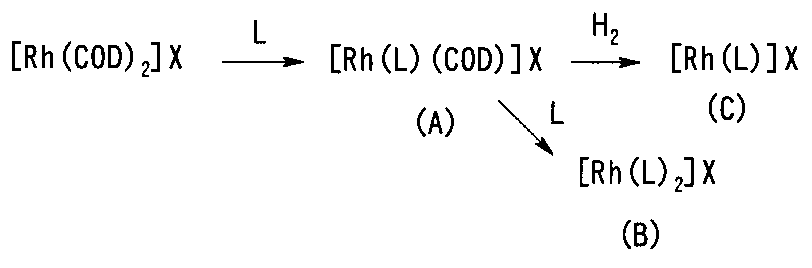
[6] ロジウム金属と光学活性ビスホスフィンとを含む触媒を調製する際に、水素ガスを用いてオレフィン性配位子を脱離させることを特徴とする前項[4]又は[5]に記載の製造方法。
The present invention includes the following contents.
[1] A compound represented by the following general formula (1).
[2] An optically active compound represented by the following general formula (1 *).
[3] Using the catalyst containing rhodium metal and optically active bisphosphine, the tetrain compound represented by the following general formula (2) is subjected to intramolecular [2 + 2 + 2] cycloaddition reaction of the compound according to the above item [2] Production method.
[4] The production method according to [3], wherein the catalyst containing rhodium metal and optically active bisphosphine is a compound represented by the following general formula (3).
[Rh (L) m (Y) n ] X (3)
(In formula (3), L represents an optically active bisphosphine represented by the following formula (4), Y represents a non-conjugated diene compound, X represents a counter anion, and m represents an integer of 1 or 2. N represents an integer of 0 or 1. However, when m = 1, n = 0 or n = 1, and when m = 2, n = 0.
R 3 R 4 P-Q- PR 5 R 6 (4)
(In the formula (4), R 3 , R 4 , R 5 and R 6 each independently represent an aryl group which may have a substituent or a cycloalkyl group which may have a substituent. , R 3 and R 4 and / or R 5 and R 6 may form a ring, and Q represents a divalent arylene group or a ferrocenediyl group which may have a substituent.
[5] The production method according to [4], wherein the catalyst containing rhodium metal and optically active bisphosphine is used immediately after preparation.
[6] The method described in [4] or [5] above, wherein when preparing the catalyst containing rhodium metal and optically active bisphosphine, the olefinic ligand is eliminated using hydrogen gas. Production method.
本発明の方法によれば、シアノ基を2個有するテトライン化合物をロジウム金属と光学活性ビスホスフィンとを含む触媒の存在下に分子内で[2+2+2]環化反応させることにより、1工程でエナンチオ選択的に光学活性スピロ化合物を製造することができるので、比較的入手が容易な基質を用いて簡便に光学活性スピロ化合物を製造することができ、光学分割の工程を経ることなく軸不斉光学活性体を得ることができる。本発明により得られるスピロビピリジン型構造を持つ光学活性スピロ化合物は、簡便に製造ができ、機能性金属錯体の配位子又は不斉合成用の金属触媒の配位子として有用である。 According to the method of the present invention, a tetrayne compound having two cyano groups is enantioselected in one step by subjecting a [2 + 2 + 2] cyclization reaction in the molecule in the presence of a catalyst containing rhodium metal and optically active bisphosphine. Since optically active spiro compounds can be produced, optically active spiro compounds can be easily produced using a substrate that is relatively easily available. You can get a body. The optically active spiro compound having a spirobipyridine structure obtained by the present invention can be easily produced, and is useful as a ligand of a functional metal complex or a metal catalyst for asymmetric synthesis.
以下、本発明について具体的に説明する。
本発明に係るスピロ化合物は、上記した一般式(1)及び(1*)で表される化合物であり、スピロビピリジン型構造を有しており、後に詳しく述べる本発明の製造方法により製造することができる。
Hereinafter, the present invention will be specifically described.
The spiro compound according to the present invention is a compound represented by the general formulas (1) and (1 *) described above, has a spirobipyridine structure, and is manufactured by the manufacturing method of the present invention described in detail later. Can do.
一般式(1)及び(1*)において、R1及びR2は水素原子、アルキル基、シクロアルキル基又はアリール基を表す。
ここで、R1及びR2で表されるアルキル基としては、直鎖状又は分岐状の、例えば炭素数1〜15、好ましくは炭素数1〜10、より好ましくは炭素数1〜6のアルキル基が挙げられる。具体例としては、例えばメチル基、エチル基、n−プロピル基、イソプロピル基、n−ブチル基、s−ブチル基、イソブチル基、t−ブチル基、ペンチル基及びヘキシル基等が挙げられる。また、これらアルキル基はアルコキシ基で置換されていてもよい。アルキル基に置換するアルコキシ基としては、炭素数1〜10、好ましくは炭素数1〜6のアルコキシ基が挙げられる。アルキル基に置換するアルコキシ基の具体例としては、メトキシ基、エトキシ基、n−プロポキシ基、イソプロポキシ基、n−ブトキシ基、イソブトキシ基、s−ブトキシ基mt−ブトキシ基、ペンチルオキシ基、ヘキシルオキシ基等が挙げられる。
In the general formulas (1) and (1 *), R 1 and R 2 represent a hydrogen atom, an alkyl group, a cycloalkyl group, or an aryl group.
Here, the alkyl group represented by R 1 and R 2 is a linear or branched alkyl group having, for example, 1 to 15 carbon atoms, preferably 1 to 10 carbon atoms, more preferably 1 to 6 carbon atoms. Groups. Specific examples include, for example, methyl group, ethyl group, n-propyl group, isopropyl group, n-butyl group, s-butyl group, isobutyl group, t-butyl group, pentyl group, and hexyl group. These alkyl groups may be substituted with an alkoxy group. Examples of the alkoxy group substituted on the alkyl group include an alkoxy group having 1 to 10 carbon atoms, preferably 1 to 6 carbon atoms. Specific examples of the alkoxy group substituted for the alkyl group include methoxy group, ethoxy group, n-propoxy group, isopropoxy group, n-butoxy group, isobutoxy group, s-butoxy group mt-butoxy group, pentyloxy group, hexyl. An oxy group etc. are mentioned.
R1及びR2で表されるシクロアルキル基としては、例えば炭素数3〜8のシクロアルキル基が挙げられ、具体例としては、例えば、シクロプロピル基、シクロブチル基、シクロペンチル基、シクロヘキシル基、シクロヘプチル基、シクロオクチル基等が挙げられる。
これらシクロアルキル基は置換基を有していてもよい。シクロアルキル基に置換する置換基としては、例えばアルキル基、アルコキシ基が挙げられる。アルキル基としては例えばメチル基、エチル基、n−プロピル基、イソプロピル基、n−ブチル基、s−ブチル基、イソブチル基、t−ブチル基、ペンチル基及びヘキシル基等が挙げられる。また、アルコキシ基としては、例えばメトキシ基、エトキシ基、n−プロポキシ基、イソプロポキシ基、n−ブトキシ基、イソブトキシ基、s−ブトキシ基、t−ブトキシ基、ペンチルオキシ基、ヘキシルオキシ基等が挙げられる。
Examples of the cycloalkyl group represented by R 1 and R 2 include a cycloalkyl group having 3 to 8 carbon atoms, and specific examples thereof include, for example, a cyclopropyl group, a cyclobutyl group, a cyclopentyl group, a cyclohexyl group, a cyclo group. A heptyl group, a cyclooctyl group, etc. are mentioned.
These cycloalkyl groups may have a substituent. Examples of the substituent substituted on the cycloalkyl group include an alkyl group and an alkoxy group. Examples of the alkyl group include methyl group, ethyl group, n-propyl group, isopropyl group, n-butyl group, s-butyl group, isobutyl group, t-butyl group, pentyl group and hexyl group. Examples of the alkoxy group include methoxy group, ethoxy group, n-propoxy group, isopropoxy group, n-butoxy group, isobutoxy group, s-butoxy group, t-butoxy group, pentyloxy group, and hexyloxy group. Can be mentioned.
R1及びR2で表されるアリール基としては、例えば炭素数6〜18のアリール基が挙げられ、具体例としては、フェニル基、ナフチル基、アントリル基、フェナントリル基、ビフェニル基等が挙げられる。これらアリール基は置換基を有していてもよく、置換基としては、例えば、メチル基、エチル基、イソプロピル基、t−ブチル基等の直鎖状又は分岐状の炭素数1〜6のアルキル基;メトキシ基、エトキシ基、イソプロポキシ基、t−ブトキシ基等の直鎖状又は分岐状の炭素数1〜6のアルコキシ基;塩素原子、臭素原子、フッ素原子等のハロゲン原子などが挙げられ、これら置換基は該アリール基上に複数置換されていてもよい。これら置換基を有するアリール基の具体例としては、例えば、p−トリル基、m−トリル基、o−トリル基、3,5−キシリル基、3,5−ジ−t−ブチルフェニル基、p−t−ブチルフェニル基、p−メトキシフェニル基、3,5−ジ−t−ブチル−4−メトキシフェニル基、p−クロロフェニル基、m−フルオロフェニル基等が挙げられる。 Examples of the aryl group represented by R 1 and R 2 include an aryl group having 6 to 18 carbon atoms, and specific examples thereof include a phenyl group, a naphthyl group, an anthryl group, a phenanthryl group, and a biphenyl group. . These aryl groups may have a substituent, and examples of the substituent include linear or branched alkyl having 1 to 6 carbon atoms such as a methyl group, an ethyl group, an isopropyl group, and a t-butyl group. Group; linear or branched alkoxy group having 1 to 6 carbon atoms such as methoxy group, ethoxy group, isopropoxy group and t-butoxy group; halogen atom such as chlorine atom, bromine atom and fluorine atom; In addition, a plurality of these substituents may be substituted on the aryl group. Specific examples of the aryl group having these substituents include, for example, p-tolyl group, m-tolyl group, o-tolyl group, 3,5-xylyl group, 3,5-di-t-butylphenyl group, p -T-butylphenyl group, p-methoxyphenyl group, 3,5-di-t-butyl-4-methoxyphenyl group, p-chlorophenyl group, m-fluorophenyl group and the like can be mentioned.
R1及びR2で表されるハロゲン原子としては、例えば塩素原子、臭素原子、フッ素原子が挙げられる。 Examples of the halogen atom represented by R 1 and R 2 include a chlorine atom, a bromine atom, and a fluorine atom.
R1及びR2で表されるハロアルキル基としては、例えば、トリフルオロメチル基、ペンタフルオロエチル基、トリクロロメチル基等の炭素数1〜4のハロアルキル基が挙げられる。 Examples of the haloalkyl group represented by R 1 and R 2 include haloalkyl groups having 1 to 4 carbon atoms such as a trifluoromethyl group, a pentafluoroethyl group, and a trichloromethyl group.
一般式(1)及び(1*)においてZ1及びZ2で表される二価の炭化水素基としては、置換基を有していてもよいメチレン鎖、及び置換基を有していてもよいアリーレン基が挙げられる。 In the general formulas (1) and (1 *), the divalent hydrocarbon group represented by Z 1 and Z 2 may have a methylene chain which may have a substituent, and a substituent. A good arylene group is mentioned.
置換基を有していてもよいメチレン鎖としては、例えば、炭素数1〜4のメチレン鎖が挙げられ、具体的には例えばメチレン基、エチレン基、トリメチレン基等が挙げられる。また、該メチレン鎖の置換基としては、例えばアルキル基及びハロゲン原子等が挙げられる。置換基の具体例としては、例えば、メチル基、エチル基などの炭素数1〜4のアルキル基、及びフッ素原子等が挙げられる。 Examples of the methylene chain that may have a substituent include a methylene chain having 1 to 4 carbon atoms, and specific examples include a methylene group, an ethylene group, and a trimethylene group. Examples of the substituent of the methylene chain include an alkyl group and a halogen atom. Specific examples of the substituent include an alkyl group having 1 to 4 carbon atoms such as a methyl group and an ethyl group, and a fluorine atom.
置換基を有していてもよいアリーレン基としては、例えば炭素数6〜18のアリーレン基が挙げられ、具体的には例えばフェニレン基、ナフタレンジイル基等が挙げられる。フェニレン基としては、例えばo又はm−フェニレン基が挙げられ、該フェニレン基は、例えば、メチル基、エチル基、n−プロピル基、イソプロピル基、n−ブチル基、s−ブチル基、イソブチル基及びt−ブチル基等のアルキル基;メトキシ基、エトキシ基、n−プロポキシ基、イソプロポキシ基、n−ブトキシ基、s−ブトキシ基、イソブトキシ基及びt−ブトキシ基等のアルコキシ基;フッ素原子、塩素原子等のハロゲン原子などで置換されていてもよい。 Examples of the arylene group which may have a substituent include an arylene group having 6 to 18 carbon atoms, and specific examples include a phenylene group and a naphthalenediyl group. Examples of the phenylene group include o or m-phenylene group, and the phenylene group includes, for example, methyl group, ethyl group, n-propyl group, isopropyl group, n-butyl group, s-butyl group, isobutyl group and alkyl groups such as t-butyl group; alkoxy groups such as methoxy group, ethoxy group, n-propoxy group, isopropoxy group, n-butoxy group, s-butoxy group, isobutoxy group and t-butoxy group; fluorine atom, chlorine It may be substituted with a halogen atom such as an atom.
一般式(1)及び(1*)においてZ3及びZ4で表される二価基としては、例えば酸素原子、硫黄原子、メチレン鎖、NRN、Si(RSi)2等が挙げられる。ここで、RNは、アルキル基、アリール基、アルカンスルホニル基、アリーンスルホニル基又はアシル基を表す。また、RSiはアルキル基又はアリール基を表し、あるいは、Si(RSi)2で環を形成してもよい。 Examples of the divalent group represented by Z 3 and Z 4 in the general formulas (1) and (1 *) include an oxygen atom, a sulfur atom, a methylene chain, NR N , Si (R Si ) 2 and the like. Here, R N is an alkyl group, an aryl groups, alkanesulfonyl groups, Aline sulfonyl group or an acyl group. R Si represents an alkyl group or an aryl group, or Si (R Si ) 2 may form a ring.
Z3及びZ4で表されるメチレン鎖としては、直鎖又は分岐のメチレン鎖が挙げられ、例えばメチレン基、エチレン基、トリメチレン基、プロピレン基、イソプロピリデン基、2,3−ブタンジイル基、ジフルオロメチレン基等が挙げられる。 Examples of the methylene chain represented by Z 3 and Z 4 include a linear or branched methylene chain. For example, a methylene group, an ethylene group, a trimethylene group, a propylene group, an isopropylidene group, a 2,3-butanediyl group, a difluoro A methylene group etc. are mentioned.
NRNにおけるRN及びSi(RSi)2におけるRSiで表されるアルキル基としては、例えば直鎖状又は分岐状の炭素数1〜6のアルキル基が挙げられ、具体例としては前記したようなアルキル基が挙げられる。 The alkyl group represented by R Si in R N and Si (R Si) 2 in NR N, for example, for example, linear or branched alkyl group having 1 to 6 carbon atoms, specific examples described above Such an alkyl group is mentioned.
RN及びRSiで表されるアリール基としては、例えば炭素数6〜18のアリール基が挙げられ、具体例としては前記したようなアリール基が挙げられる。 The aryl group represented by R N and R Si, for example, an aryl group having 6 to 18 carbon atoms, an aryl group such as mentioned above as specific examples.
NRNにおけるRNで表されるアルカンスルホニル基及びアリーンスルホニル基としては、例えばメタンスルホニル基、トリフルオロメタンスルホニル基、ベンゼンスルホニル基、p−トルエンスルホニル基等が挙げられる。 The alkanesulfonyl group and Aline sulfonyl group represented by R N in NR N, for example, methanesulfonyl group, trifluoromethanesulfonyl group, a benzenesulfonyl group, p- toluenesulfonyl group and the like.
RNで表されるアシル基としては、例えば炭素数2〜10の直鎖又は分岐の脂肪族アシル基、又は芳香族アシル基が挙げられ、具体例としては、例えば、アセチル基、プロパノイル基、ブチリル基、ピバロイル基、メトキシカルボニル基、エトキシカルボニル基、t−ブトキシカルボニル基、ベンジルオキシカルボニル基、ベンゾイル基、p−ニトロベンゾイル基等が挙げられる。 The acyl group represented by R N, such as linear or branched aliphatic acyl group having 2 to 10 carbon atoms, or an aromatic acyl group, and specific examples include acetyl group, propanoyl group, Examples include butyryl group, pivaloyl group, methoxycarbonyl group, ethoxycarbonyl group, t-butoxycarbonyl group, benzyloxycarbonyl group, benzoyl group, and p-nitrobenzoyl group.
Si(RSi)2で形成される環としては、例えばシロラン環、シリナン環、シレパン環等が挙げられる。 Examples of the ring formed of Si (R Si ) 2 include a silolane ring, a silinan ring, and a silepane ring.
本発明においては、一般式(1)で表される化合物の中でも、上記した一般式(1*)で表される光学活性化合物が好ましい。 In the present invention, among the compounds represented by the general formula (1), the optically active compound represented by the above general formula (1 *) is preferable.
次に、本発明のスピロ化合物を製造できる、光学活性スピロ化合物の製造方法(単に「本発明の製造方法」ということがある)について説明する。 Next, a method for producing an optically active spiro compound that can produce the spiro compound of the present invention (simply referred to as “the production method of the present invention”) will be described.
本発明の製造方法は、以下のスキームに記載するように、一般式(2)で表されるテトライン化合物を、ロジウム金属と光学活性ビスホスフィン化合物とを含む触媒の存在下反応させ、詳しくはエナンチオ選択的に[2+2+2]環化付加させることにより、前記で説明した一般式(1*)で表される光学活性化合物を製造するものである。 In the production method of the present invention, as described in the following scheme, a tetrain compound represented by the general formula (2) is reacted in the presence of a catalyst containing a rhodium metal and an optically active bisphosphine compound. An optically active compound represented by the general formula (1 *) described above is produced by selective [2 + 2 + 2] cycloaddition.
スキーム中にも記載されている一般式(2)におけるR1、R2、Z1、Z2、Z3及びZ4の記号の表す意味および該記号で表される基などの例は、上記で一般式(1)及び(1*)について説明したそれぞれの意味及び例と同じである。 Examples of the meanings represented by the symbols R 1 , R 2 , Z 1 , Z 2 , Z 3 and Z 4 and the groups represented by the symbols in the general formula (2) described also in the scheme are as described above. The meanings and examples of the general formulas (1) and (1 *) described above are the same.
本発明の製造方法で用いられるロジウム金属と光学活性ビスホスフィンとを含む触媒について説明する。 The catalyst containing rhodium metal and optically active bisphosphine used in the production method of the present invention will be described.
本発明に用いられる触媒成分の一つであるロジウム金属のロジウム源としては、ロジウム化合物が用いられ、好ましいロジウム化合物としては、オレフィン性配位子が配位したロジウム(I)の錯体が挙げられる。具体的なロジウム(I)錯体としては、[Rh(cod)2]X、[Rh(nbd)2]X、[RhCl(エチレン)2]2、[RhCl(cod)]2、[RhCl(nbd)]2等が挙げられる。前記錯体化学式中、Xはカウンターアニオンを表し、codは1,5−シクロオクタジエン、nbdはノルボルナジエンを表す。 As a rhodium source of rhodium metal which is one of the catalyst components used in the present invention, a rhodium compound is used, and a preferable rhodium compound includes a rhodium (I) complex coordinated with an olefinic ligand. . Specific rhodium (I) complexes include [Rh (cod) 2 ] X, [Rh (nbd) 2 ] X, [RhCl (ethylene) 2 ] 2 , [RhCl (cod)] 2 , [RhCl (nbd )] 2 and the like. In the complex chemical formula, X represents a counter anion, cod represents 1,5-cyclooctadiene, and nbd represents norbornadiene.
本発明に用いられる触媒成分のもう一つである光学活性ビスホスフィンとしては、例えば下記の一般式(4)で表されるものが挙げられる。
R3R4P−Q−PR5R6 (4)
(式中、R3、R4、R5及びR6は、それぞれ独立して置換基を有していてもよいアリール基又は置換基を有していてもよいシクロアルキル基を表し、R3とR4とで及び/又はR5とR6とで環を形成してもよい。Qは置換基を有していてもよい二価のアリーレン基又はフェロセンジイル基を表す。)
Examples of the optically active bisphosphine which is another catalyst component used in the present invention include those represented by the following general formula (4).
R 3 R 4 P-Q- PR 5 R 6 (4)
(Wherein R 3 , R 4 , R 5 and R 6 each independently represents an aryl group which may have a substituent or an optionally substituted cycloalkyl group, and R 3 And R 4 and / or R 5 and R 6 may form a ring, and Q represents a divalent arylene group or ferrocenediyl group which may have a substituent.
上記式中、R3、R4、R5及びR6で表される、置換基を有していてもよいアリール基としては、例えば炭素数6〜14のアリール基が挙げられ、具体的にはフェニル基、ナフチル基、アントリル基、フェナントリル基、ビフェニル基等が挙げられる。これらアリール基は置換基を有していてもよく、該置換基としては、アルキル基、アルコキシ基、アリール基、複素環基等が挙げられる。 In the above formula, examples of the aryl group which may have a substituent represented by R 3 , R 4 , R 5 and R 6 include an aryl group having 6 to 14 carbon atoms, specifically Includes a phenyl group, a naphthyl group, an anthryl group, a phenanthryl group, a biphenyl group, and the like. These aryl groups may have a substituent, and examples of the substituent include an alkyl group, an alkoxy group, an aryl group, and a heterocyclic group.
アリール基の置換基としてのアルキル基としては、直鎖状又は分岐状の、例えば炭素数1〜15、好ましくは炭素数1〜10、より好ましくは炭素数1〜6のアルキル基が挙げられ、具体例としては、例えばメチル基、エチル基、n−プロピル基、イソプロピル基、n−ブチル基、s−ブチル基、イソブチル基及びt−ブチル基等が挙げられる。 Examples of the alkyl group as a substituent of the aryl group include linear or branched alkyl groups having 1 to 15 carbon atoms, preferably 1 to 10 carbon atoms, more preferably 1 to 6 carbon atoms, Specific examples include methyl group, ethyl group, n-propyl group, isopropyl group, n-butyl group, s-butyl group, isobutyl group and t-butyl group.
アリール基の置換基としてのアルコキシ基としては、直鎖状又は分岐状の、例えば炭素数1〜6のアルコキシ基が挙げられ、具体的にはメトキシ基、エトキシ基、n−プロポキシ基、イソプロポキシ基、n−ブトキシ基、s−ブトキシ基、イソブトキシ基及びt−ブトキシ基等が挙げられる。
アリール基の置換基としてのアリール基としては、例えば炭素数6〜14のアリール基が挙げられ、具体的にはフェニル基、ナフチル基、アントリル基、フェナントリル基、ビフェニル基等が挙げられる。
Examples of the alkoxy group as the substituent of the aryl group include linear or branched alkoxy groups having 1 to 6 carbon atoms, specifically, methoxy group, ethoxy group, n-propoxy group, isopropoxy group. Group, n-butoxy group, s-butoxy group, isobutoxy group, t-butoxy group and the like.
Examples of the aryl group as a substituent for the aryl group include an aryl group having 6 to 14 carbon atoms, and specific examples include a phenyl group, a naphthyl group, an anthryl group, a phenanthryl group, and a biphenyl group.
アリール基の置換基としての複素環基としては、脂肪族複素環基及び芳香族複素環基が挙げられ、脂肪族複素環基としては、例えば炭素数2〜14で、異種原子として少なくとも1個、好ましくは1〜3個の例えば窒素原子、酸素原子、硫黄原子等のヘテロ原子を含んでいる、5〜8員、好ましくは5又は6員の単環、多環又は縮合環の脂肪族複素環基が挙げられる。脂肪族複素環基の具体例としては、例えば、2−オキソピロリジル基、ピペリジノ基、ピペラジニル基、モルホリノ基、テトラヒドロフリル基、テトラヒドロピラニル基、テトラヒドロチエニル基等が挙げられる。一方、芳香族複素環基としては、例えば炭素数2〜15で、ヘテロ原子として少なくとも1個、好ましくは1〜3個の窒素原子、酸素原子、硫黄原子等のヘテロ原子を含んでいる、5〜8員、好ましくは5又は6員の単環式、多環式又は縮合環式のヘテロアリール基が挙げられ、具体的にはフリル基、チエニル基、ピリジル基、ピリミジニル基、ピラジニル基、ピリダジニル基、ピラゾリル基、イミダゾリル基、オキサゾリル基、チアゾリル基、ベンゾフリル基、ベンゾチエニル基、キノリル基、イソキノリル基、キノキサリル基、フタラジニル基、キナゾリニル基、ナフチリジニル基、シンノリニル基、ベンゾイミダゾリル基、ベンゾオキサゾリル基、ベンゾチアゾリル基等が挙げられる。 Examples of the heterocyclic group as the substituent of the aryl group include an aliphatic heterocyclic group and an aromatic heterocyclic group. The aliphatic heterocyclic group has, for example, 2 to 14 carbon atoms and at least one hetero atom. Preferably 5 to 8 member, preferably 5 or 6 membered monocyclic, polycyclic or condensed ring aliphatic heterocycles containing 1 to 3 hetero atoms such as nitrogen atom, oxygen atom and sulfur atom. A cyclic group is mentioned. Specific examples of the aliphatic heterocyclic group include 2-oxopyrrolidyl group, piperidino group, piperazinyl group, morpholino group, tetrahydrofuryl group, tetrahydropyranyl group, tetrahydrothienyl group and the like. On the other hand, the aromatic heterocyclic group has, for example, 2 to 15 carbon atoms and includes at least one hetero atom, preferably 1 to 3 hetero atoms such as nitrogen, oxygen, and sulfur atoms. ˜8-membered, preferably 5- or 6-membered monocyclic, polycyclic or fused-ring heteroaryl group, specifically, furyl group, thienyl group, pyridyl group, pyrimidinyl group, pyrazinyl group, pyridazinyl Group, pyrazolyl group, imidazolyl group, oxazolyl group, thiazolyl group, benzofuryl group, benzothienyl group, quinolyl group, isoquinolyl group, quinoxalyl group, phthalazinyl group, quinazolinyl group, naphthyridinyl group, cinnolinyl group, benzimidazolyl group, benzooxazolyl group And benzothiazolyl group.
また、R3、R4、R5及びR6で表される、置換基を有していてもよいシクロアルキル基としては、5員環又は6員環のシクロアルキル基が挙げられ、好ましいシクロアルキル基としては、シクロペンチル基、シクロヘキシル基等が挙げられる。これらシクロアルキル基の環上においては、前記アリール基の置換基として挙げたようなアルキル基又はアルコキシ基等の置換基で、1乃至2以上置換されていてもよい。 Examples of the optionally substituted cycloalkyl group represented by R 3 , R 4 , R 5 and R 6 include a 5-membered or 6-membered cycloalkyl group. Examples of the alkyl group include a cyclopentyl group and a cyclohexyl group. On the ring of these cycloalkyl groups, 1 to 2 or more may be substituted with a substituent such as an alkyl group or an alkoxy group mentioned as the substituent for the aryl group.
また、R3とR4及び/又はR5とR6とで形成してもよい環としては、R3、R4、R5及びR6が結合しているリン原子を含めた環として、四員環、五員環又は六員環の環が挙げられる。具体的な環としては、ホスフェタン環、ホスホラン環、ホスファン環、2,4−ジメチルホスフェタン環、2,4−ジエチルホスフェタン環、2,5−ジメチルホスホラン環、2,5−ジエチルホスホラン環、2,6−ジメチルホスファン環、2,6−ジエチルホスファン環等が挙げられ、これらの環は光学活性体でもよい。 Moreover, as a ring which may be formed by R 3 and R 4 and / or R 5 and R 6 , as a ring including a phosphorus atom to which R 3 , R 4 , R 5 and R 6 are bonded, A four-membered ring, a five-membered ring or a six-membered ring is mentioned. Specific examples of the ring include phosphetane ring, phosphorane ring, phosphane ring, 2,4-dimethylphosphetane ring, 2,4-diethylphosphetane ring, 2,5-dimethylphosphorane ring, 2,5-diethyl. A phosphorane ring, a 2,6-dimethylphosphane ring, a 2,6-diethylphosphane ring, etc. are mentioned, These rings may be optically active substances.
また、Qで表される、置換基を有していてもよい二価のアリーレン基としては、フェニレン基、ビフェニルジイル基、ビナフタレンジイル基等が挙げられる。フェニレン基としては、o又はm−フェニレン基が挙げられ、該フェニレン基は、メチル基、エチル基、n−プロピル基、イソプロピル基、n−ブチル基、s−ブチル基、イソブチル基及びt−ブチル基等のアルキル基;メトキシ基、エトキシ基、n−プロポキシ基、イソプロポキシ基、n−ブトキシ基、s−ブトキシ基、イソブトキシ基及びt−ブトキシ基等のアルコキシ基;水酸基、アミノ基又は置換アミノ基等で置換されていてもよい。ビフェニルジイル基及びビナフタレンジイル基としては、1,1’−ビアリール−2,2’−ジイル型の構造を有するものが好ましく、該ビフェニルジイル基及びビナフタレンジイル基は、前記したようなアルキル基、アルコキシ基、例えばメチレンジオキシ基、エチレンジオキシ基、トリメチレンジオキシ基等のアルキレンジオキシ基、水酸基、アミノ基、置換アミノ基等で置換されていてもよい。また、フェロセンジイル基も置換基を有していてもよく、置換基としては、前記したようなアルキル基、アルコキシ基、アルキレンジオキシ基、水酸基、アミノ基、置換アミノ基等が挙げられる。 Examples of the divalent arylene group which may have a substituent represented by Q include a phenylene group, a biphenyldiyl group and a binaphthalenediyl group. Examples of the phenylene group include o or m-phenylene group, and the phenylene group includes methyl group, ethyl group, n-propyl group, isopropyl group, n-butyl group, s-butyl group, isobutyl group and t-butyl group. Alkyl groups such as groups; alkoxy groups such as methoxy group, ethoxy group, n-propoxy group, isopropoxy group, n-butoxy group, s-butoxy group, isobutoxy group and t-butoxy group; hydroxyl group, amino group or substituted amino group It may be substituted with a group or the like. The biphenyldiyl group and the binaphthalenediyl group preferably have a 1,1′-biaryl-2,2′-diyl type structure, and the biphenyldiyl group and the binaphthalenediyl group are alkyl groups as described above. And an alkoxy group, for example, an alkylenedioxy group such as a methylenedioxy group, an ethylenedioxy group, and a trimethylenedioxy group, a hydroxyl group, an amino group, a substituted amino group, and the like. The ferrocenediyl group may also have a substituent, and examples of the substituent include the alkyl group, alkoxy group, alkylenedioxy group, hydroxyl group, amino group, and substituted amino group described above.
一般式(4)で表される光学活性ビスホスフィンの具体例としては、例えば公知のビスホスフィン類が挙げられ、その内の一つとして下記一般式(5)で表される化合物が挙げられる。 Specific examples of the optically active bisphosphine represented by the general formula (4) include known bisphosphines, and one of them is a compound represented by the following general formula (5).
上記R7及びR8における、フェニル基の置換基としてのアルキル基としては、例えば、メチル基、t−ブチル基等の直鎖状又は分岐状の炭素数1〜6のアルキル基が挙げられ、フェニル基の置換基としてのアルコキシ基としては、例えば、メトキシ基、t−ブトキシ基等の直鎖状又は分岐状の炭素数1〜6のアルコキシ基が挙げられ、フェニル基の置換基としてのハロゲン原子としては、例えば、塩素原子、臭素原子、フッ素原子等が挙げられる。 Examples of the alkyl group as the substituent of the phenyl group in R 7 and R 8 include linear or branched alkyl groups having 1 to 6 carbon atoms such as a methyl group and a t-butyl group, Examples of the alkoxy group as a substituent of the phenyl group include linear or branched alkoxy groups having 1 to 6 carbon atoms such as a methoxy group and a t-butoxy group, and a halogen as a substituent of the phenyl group. As an atom, a chlorine atom, a bromine atom, a fluorine atom etc. are mentioned, for example.
R7及びR8の具体例としては、例えば、フェニル基、p−トリル基、m−トリル基、3,5−キシリル基、p−t−ブチルフェニル基、p−メトキシフェニル基、p−クロロフェニル基、シクロペンチル基及びシクロヘキシル基等が挙げられる。 Specific examples of R 7 and R 8 include, for example, phenyl group, p-tolyl group, m-tolyl group, 3,5-xylyl group, pt-butylphenyl group, p-methoxyphenyl group, p-chlorophenyl. Group, cyclopentyl group, cyclohexyl group and the like.
また、一般式(5)で表される化合物の基本骨格であるビナフチル環は、置換基で置換されていてもよく、該置換基としては、例えばメチル基、t−ブチル基等のアルキル基;メトキシ基、t−ブトキシ基等のアルコキシ基;トリメチルシリル基、トリイソプロピルシリル基、t−ブチルジメチルシリル基等のトリアルキルシリル基及びトリフェニルシリル基等のトリアリールシリル基が挙げられる。 Moreover, the binaphthyl ring which is the basic skeleton of the compound represented by the general formula (5) may be substituted with a substituent, and examples of the substituent include alkyl groups such as a methyl group and a t-butyl group; Examples thereof include alkoxy groups such as methoxy group and t-butoxy group; triarylsilyl groups such as trialkylsilyl group such as trimethylsilyl group, triisopropylsilyl group and t-butyldimethylsilyl group, and triphenylsilyl group.
また、R3R4P−Q−PR5R6で表される光学活性ビスホスフィンの他の具体例としては、下記一般式(6)で表される化合物が挙げられる。 Another specific example of the optically active bisphosphine represented by R 3 R 4 PQQPR 5 R 6 is a compound represented by the following general formula (6).
上記R9及びR10における、フェニル基の置換基としてのアルキル基としては、例えば、メチル基、t−ブチル基等の直鎖状又は分岐状の炭素数1〜6のアルキル基が挙げられ、フェニル基の置換基としてのアルコキシ基としては、例えば、メトキシ基、t−ブトキシ基等の直鎖状又は分岐状の炭素数1〜6のアルコキシ基が挙げられ、フェニル基の置換基としてのハロゲン原子としては、例えば塩素原子、臭素原子、フッ素原子等が挙げられ、これら置換基は該フェニル基上に複数置換していてもよい。R9及びR10の具体例としては、例えば、フェニル基、p−トリル基、m−トリル基、o−トリル基、3,5−キシリル基、3,5−ジ−t−ブチルフェニル基、p−t−ブチルフェニル基、p−メトキシフェニル基、3,5−ジ−t−ブチル−4−メトキシフェニル基、p−クロロフェニル基、m−フルオロフェニル基、シクロペンチル基、シクロヘキシル基等が挙げられる。 Examples of the alkyl group as a substituent of the phenyl group in R 9 and R 10 include linear or branched alkyl groups having 1 to 6 carbon atoms such as a methyl group and a t-butyl group, Examples of the alkoxy group as a substituent of the phenyl group include linear or branched alkoxy groups having 1 to 6 carbon atoms such as a methoxy group and a t-butoxy group, and a halogen as a substituent of the phenyl group. Examples of the atom include a chlorine atom, a bromine atom, and a fluorine atom, and a plurality of these substituents may be substituted on the phenyl group. Specific examples of R 9 and R 10 include, for example, phenyl group, p-tolyl group, m-tolyl group, o-tolyl group, 3,5-xylyl group, 3,5-di-t-butylphenyl group, Examples include p-t-butylphenyl group, p-methoxyphenyl group, 3,5-di-t-butyl-4-methoxyphenyl group, p-chlorophenyl group, m-fluorophenyl group, cyclopentyl group, cyclohexyl group and the like. .
また、R11〜R16で示されるアルキル基としては、例えば、メチル基、t−ブチル基等の直鎖状又は分岐状の炭素数1〜6のアルキル基が挙げられ、アルコキシ基としては、例えば、メトキシ基、t−ブトキシ基等の直鎖状又は分岐状の炭素数1〜6のアルコキシ基が挙げられ、アシルオキシ基としては、例えば、アセトキシ基、プロパノイルオキシ基、トリフルオロアセトキシ基、ベンゾイルオキシ基等の炭素数2〜10のアシルオキシ基が挙げられ、ハロゲン原子としては、例えば、塩素原子、臭素原子、フッ素原子等が挙げられ、ハロアルキル基としては、例えば、トリフルオロメチル基等の炭素数1〜4のハロアルキル基が挙げられ、ジアルキルアミノ基としては、例えば、ジメチルアミノ基、ジエチルアミノ基等が挙げられる。 In addition, examples of the alkyl group represented by R 11 to R 16 include linear or branched alkyl groups having 1 to 6 carbon atoms such as a methyl group and a t-butyl group. As the alkoxy group, For example, a linear or branched alkoxy group having 1 to 6 carbon atoms such as a methoxy group and a t-butoxy group can be mentioned. Examples of the acyloxy group include an acetoxy group, a propanoyloxy group, a trifluoroacetoxy group, Examples thereof include acyloxy groups having 2 to 10 carbon atoms such as benzoyloxy groups. Examples of halogen atoms include chlorine atoms, bromine atoms and fluorine atoms. Examples of haloalkyl groups include trifluoromethyl groups. Examples thereof include haloalkyl groups having 1 to 4 carbon atoms, and examples of the dialkylamino group include a dimethylamino group and a diethylamino group. .
R11、R12及びR13のうちの二つで置換基を有していてもよいメチレン鎖を形成する場合、並びにR14、R15及びR16のうちの二つで置換基を有していてもよいメチレン鎖を形成する場合のメチレン鎖としては、例えば、炭素数3〜5のメチレン鎖が好ましく、具体的にはトリメチレン基、テトラメチレン基、ペンタメチレン基等が挙げられる。また、該置換基を有していてもよいメチレン鎖における置換基としては、アルキル基及びハロゲン原子等が挙げられ、その具体例としては、例えば、炭素数1〜6の前記したようなアルキル基及びフッ素原子等が挙げられる。 When forming a methylene chain which may have a substituent at two of R 11 , R 12 and R 13 , and having a substituent at two of R 14 , R 15 and R 16 As the methylene chain in the case of forming an optional methylene chain, for example, a methylene chain having 3 to 5 carbon atoms is preferable, and specific examples include a trimethylene group, a tetramethylene group, and a pentamethylene group. Examples of the substituent in the methylene chain which may have the substituent include an alkyl group and a halogen atom. Specific examples thereof include, for example, an alkyl group having 1 to 6 carbon atoms as described above. And a fluorine atom.
また、R11、R12及びR13のうちの二つで置換基を有していてもよい(ポリ)メチレンジオキシ基を形成する場合、並びにR14、R15及びR16の内の二つで置換基を有していてもよい(ポリ)メチレンジオキシ基を形成する場合の(ポリ)メチレンジオキシ基の具体例としては、例えば、メチレンジオキシ基、エチレンジオキシ基、トリメチレンジオキシ基等が挙げられる。また、該(ポリ)メチレンジオキシ基に置換する置換基としては、アルキル基及びハロゲン原子等が挙げられ、その具体例としては、例えば、炭素数1〜6の前記したようなアルキル基及びフッ素原子等が挙げられる。 In addition, two of R 11 , R 12 and R 13 may form a (poly) methylenedioxy group which may have a substituent, and two of R 14 , R 15 and R 16 Specific examples of the (poly) methylenedioxy group in forming a (poly) methylenedioxy group which may have a substituent include, for example, a methylenedioxy group, an ethylenedioxy group, and trimethylene A dioxy group etc. are mentioned. In addition, examples of the substituent substituted on the (poly) methylenedioxy group include an alkyl group and a halogen atom. Specific examples thereof include, for example, an alkyl group having 1 to 6 carbon atoms and fluorine as described above. An atom etc. are mentioned.
一般式(5)及び(6)で示される光学活性ビスホスフィン化合物の具体例としては、例えば2,2’−ビス(ジフェニルホスフィノ)−1,1’−ビナフチル、2,2’−ビス[ジ(p−トリル)ホスフィノ]−1,1’−ビナフチル、2,2’−ビス[ジ(m−トリル)ホスフィノ]−1,1’−ビナフチル、2,2’−ビス[ジ(3,5−キシリル)ホスフィノ]−1,1’−ビナフチル、2,2’−ビス[ジ(p−t−ブチルフェニル)ホスフィノ]−1,1’−ビナフチル、2,2’−ビス[ジ(p−メトキシフェニル)ホスフィノ]−1,1’−ビナフチル、2,2’−ビス[ジ(3,5−ジ−t−ブチル−4−メトキシフェニル)ホスフィノ]−1,1’−ビナフチル、2,2’−ビス[ジ(シクロペンチル)ホスフィノ]−1,1’−ビナフチル、2,2’−ビス[ジ(シクロヘキシル)ホスフィノ]−1,1’−ビナフチル、2,2’−ビス(ジフェニルホスフィノ)−5,5’,6,6’,7,7’,8,8’−オクタヒドロ−1、1’−ビナフチル、2,2’−ビス(ジ−p−トリルホスフィノ)−5,5’,6,6’,7,7’,8,8’−オクタヒドロ−1,1’−ビナフチル、2,2’−ビス(ジ−m−トリルホスフィノ)−5,5’,6,6’,7,7’,8,8’−オクタヒドロ−1、1’−ビナフチル、2,2’−ビス(ジ−3,5−キシリルホスフィノ)−5,5’,6,6’,7,7’,8,8’−オクタヒドロ−1、1’−ビナフチル、2,2’−ビス(ジ−p−ターシャリーブチルフェニルホスフィノ)−5,5’,6,6’,7,7’,8,8’−オクタヒドロ−1,1’−ビナフチル、2,2’−ビス(ジ−p−メトキシフェニルホスフィノ)−5,5’,6,6’,7,7’,8,8’−オクタヒドロ−1,1’−ビナフチル、2,2’−ビス(ジ−p−クロロフェニルホスフィノ)−5,5’,6,6’,7,7’,8,8’−オクタヒドロ−1,1’−ビナフチル、2,2’−ビス(ジシクロペンチルホスフィノ)−5,5’,6,6’,7,7’,8,8’−オクタヒドロ−1,1’−ビナフチル、2,2’−ビス(ジシクロヘキシルホスフィノ)−5,5’,6,6’,7,7’,8,8’−オクタヒドロ−1,1’−ビナフチル、((4,4’−ビ−1,3−ベンゾジオキソール)−5、5’−ジイル)ビス(ジフェニルホスフィン)、(4,4’−ビ−1,3−ベンゾジオキソール)−5、5’−ジイル)ビス(ビス(3,5−ジメチルフェニル)ホスフィン)、((4,4’−ビ−1,3−ベンゾジオキソール)−5、5’−ジイル)ビス(ビス(3,5−ジ−t−ブチル−4−メトキシフェニル)ホスフィン)、((4,4’−ビ−1,3−ベンゾジオキソール)−5、5’−ジイル)ビス(ビス(4−メトキシフェニル)ホスフィン)、((4,4’−ビ−1,3−ベンゾジオキソール)−5、5’−ジイル)ビス(ジシクロヘキシルホスフィン)、((4,4’−ビ−1,3−ベンゾジオキソール)−5、5’−ジイル)ビス(ビス(3,5−ジ−t−ブチルフェニル)ホスフィン)、2,2’−ビス(ジフェニルホスフィノ)−4,4’,6,6’−テトラメチル−5,5’−ジメトキシ−1,1’−ビフェニル、2,2’−ビス(ジ−p−メトキシフェニルホスフィノ)−4,4’,6,6’−テトラメチル−5,5’−ジメトキシ−1,1’−ビフェニル、2,2’−ビス(ジフェニルホスフィノ)−4,4’,6,6’−テトラ(トリフルオロメチル)−5,5’−ジメチル−1,1’−ビフェニル、2,2’−ビス(ジフェニルホスフィノ)−4,6−ジ(トリフルオロメチル)−4’,6’−ジメチル−5’−メトキシ−1,1’−ビフェニル、2−ジシクロヘキシルホスフィノ−2’−ジフェニルホスフィノ−4,4’,6,6’−テトラメチル−5,5’−ジメトキシ−1,1’−ビフェニル、2,2’−ビス(ジフェニルホスフィノ)−6,6’−ジメチル−1,1−ビフェニル、2,2’−ビス(ジフェニルホスフィノ)−4,4’,6,6’−テトラメチル−1,1’−ビフェニル、2,2’−ビス(ジフェニルホスフィノ)−3,3’,6,6’−テトラメチル−1,1’−ビフェニル)、2,2’−ビス(ジフェニルホスフィノ)−4,4’−ジフルオロ−6,6’−ジメチル−1,1’−ビフェニル、2,2’−ビス(ジフェニルホスフィノ)−4,4’−ビス(ジメチルアミノ)−6,6’−ジメチル−1,1’−ビフェニル、2,2’−ビス(ジ−p−トリルホスフィノ)−6,6’−ジメチル−1,1’−ビフェニル、2,2’−ビス(ジ−o−トリルホスフィノ)−6,6’−ジメチル−1,1’−ビフェニル、2,2’−ビス(ジ−m−フルオロフェニルホスフィノ)−6,6’−ジメチル−1,1’−ビフェニル、1,11−ビス(ジフェニルホスフィノ)−5,7−ジヒドロベンゾ[c,e]オキセピン、2,2’−ビス(ジフェニルホスフィノ)−6,6’−ジメトキシ−1,1’−ビフェニル、2,2’−ビス(ジフェニルホスフィノ)−5,5’,6,6’−テトラメトキシ−1,1’−ビフェニル、2,2’−ビス(ジ−p−トリルホスフィノ)−6,6’−ジメトキシ−1,1’−ビフェニル、2,2’−ビス(ジフェニルホスフィノ)−4,4’,5,5’,6,6’−ヘキサメトキシ−1,1’−ビフェニル、1,2−ビス(2,5−ジメチルホスホラノ)ベンゼン、1,2−ビス(2,5−ジエチルホスホラノ)ベンゼン、1,2−ビス(2,5−ジイソプロピルホスホラノ)ベンゼン、1−(2,5−ジメチルホスホラノ)−2−(ジフェニルホスフィノ)ベンゼン、1,1’−ビス(2,4−ジエチルホスフォタノ)フェロセン等が挙げられる。 Specific examples of the optically active bisphosphine compounds represented by the general formulas (5) and (6) include 2,2′-bis (diphenylphosphino) -1,1′-binaphthyl, 2,2′-bis [ Di (p-tolyl) phosphino] -1,1′-binaphthyl, 2,2′-bis [di (m-tolyl) phosphino] -1,1′-binaphthyl, 2,2′-bis [di (3 5-xylyl) phosphino] -1,1′-binaphthyl, 2,2′-bis [di (pt-butylphenyl) phosphino] -1,1′-binaphthyl, 2,2′-bis [di (p -Methoxyphenyl) phosphino] -1,1'-binaphthyl, 2,2'-bis [di (3,5-di-t-butyl-4-methoxyphenyl) phosphino] -1,1'-binaphthyl, 2, 2'-bis [di (cyclopentyl) phosphino]- , 1′-binaphthyl, 2,2′-bis [di (cyclohexyl) phosphino] -1,1′-binaphthyl, 2,2′-bis (diphenylphosphino) -5,5 ′, 6,6 ′, 7 , 7 ′, 8,8′-octahydro-1,1′-binaphthyl, 2,2′-bis (di-p-tolylphosphino) -5,5 ′, 6,6 ′, 7,7 ′, 8,8 '-Octahydro-1,1'-binaphthyl, 2,2'-bis (di-m-tolylphosphino) -5,5', 6,6 ', 7,7', 8,8'-octahydro-1,1 '-Binaphthyl, 2,2'-bis (di-3,5-xylylphosphino) -5,5', 6,6 ', 7,7', 8,8'-octahydro-1, 1'- Binaphthyl, 2,2′-bis (di-p-tertiarybutylphenylphosphino) -5,5 ′, 6,6 ′, 7,7 , 8,8′-octahydro-1,1′-binaphthyl, 2,2′-bis (di-p-methoxyphenylphosphino) -5,5 ′, 6,6 ′, 7,7 ′, 8,8 '-Octahydro-1,1'-binaphthyl, 2,2'-bis (di-p-chlorophenylphosphino) -5,5', 6,6 ', 7,7', 8,8'-octahydro-1 , 1′-binaphthyl, 2,2′-bis (dicyclopentylphosphino) -5,5 ′, 6,6 ′, 7,7 ′, 8,8′-octahydro-1,1′-binaphthyl, 2, 2′-bis (dicyclohexylphosphino) -5,5 ′, 6,6 ′, 7,7 ′, 8,8′-octahydro-1,1′-binaphthyl, ((4,4′-bi-1, 3-benzodioxole) -5,5′-diyl) bis (diphenylphosphine), (4,4′-bi-1, 3-benzodioxole) -5,5′-diyl) bis (bis (3,5-dimethylphenyl) phosphine), ((4,4′-bi-1,3-benzodioxole) -5, 5'-diyl) bis (bis (3,5-di-t-butyl-4-methoxyphenyl) phosphine), ((4,4'-bi-1,3-benzodioxole) -5, 5 ' -Diyl) bis (bis (4-methoxyphenyl) phosphine), ((4,4'-bi-1,3-benzodioxole) -5,5'-diyl) bis (dicyclohexylphosphine), ((4 , 4'-bi-1,3-benzodioxole) -5,5'-diyl) bis (bis (3,5-di-t-butylphenyl) phosphine), 2,2'-bis (diphenylphos Fino) -4,4 ′, 6,6′-tetramethyl-5,5′-dimethoxy -1,1'-biphenyl, 2,2'-bis (di-p-methoxyphenylphosphino) -4,4 ', 6,6'-tetramethyl-5,5'-dimethoxy-1,1'- Biphenyl, 2,2′-bis (diphenylphosphino) -4,4 ′, 6,6′-tetra (trifluoromethyl) -5,5′-dimethyl-1,1′-biphenyl, 2,2′- Bis (diphenylphosphino) -4,6-di (trifluoromethyl) -4 ′, 6′-dimethyl-5′-methoxy-1,1′-biphenyl, 2-dicyclohexylphosphino-2′-diphenylphosphino -4,4 ', 6,6'-tetramethyl-5,5'-dimethoxy-1,1'-biphenyl, 2,2'-bis (diphenylphosphino) -6,6'-dimethyl-1,1 -Biphenyl, 2,2'-bis (diphenyl) Phosphino) -4,4 ′, 6,6′-tetramethyl-1,1′-biphenyl, 2,2′-bis (diphenylphosphino) -3,3 ′, 6,6′-tetramethyl-1, 1'-biphenyl), 2,2'-bis (diphenylphosphino) -4,4'-difluoro-6,6'-dimethyl-1,1'-biphenyl, 2,2'-bis (diphenylphosphino) -4,4'-bis (dimethylamino) -6,6'-dimethyl-1,1'-biphenyl, 2,2'-bis (di-p-tolylphosphino) -6,6'-dimethyl-1,1 '-Biphenyl, 2,2'-bis (di-o-tolylphosphino) -6,6'-dimethyl-1,1'-biphenyl, 2,2'-bis (di-m-fluorophenylphosphino) -6 , 6′-dimethyl-1,1′-biphenyl, 1,11- Bis (diphenylphosphino) -5,7-dihydrobenzo [c, e] oxepin, 2,2′-bis (diphenylphosphino) -6,6′-dimethoxy-1,1′-biphenyl, 2,2 ′ -Bis (diphenylphosphino) -5,5 ', 6,6'-tetramethoxy-1,1'-biphenyl, 2,2'-bis (di-p-tolylphosphino) -6,6'-dimethoxy-1 , 1′-biphenyl, 2,2′-bis (diphenylphosphino) -4,4 ′, 5,5 ′, 6,6′-hexamethoxy-1,1′-biphenyl, 1,2-bis (2 , 5-dimethylphosphorano) benzene, 1,2-bis (2,5-diethylphosphorano) benzene, 1,2-bis (2,5-diisopropylphosphorano) benzene, 1- (2,5-dimethylphosphone) Rano) -2- (diphenyl) Sufino) benzene, 1,1'-bis (2,4-diethyl-phosphotransferase Tano) ferrocene, and the like.
それら以外にも、本発明で用いることのできる光学活性ビスホスフィン化合物の具体例としては、例えば、N,N−ジメチル−1−[1’,2−ビス(ジフェニルホスフィノ)フェロセニル]エチルアミン、2,3−ビス(ジフェニルホスフィノ)ブタン、1−シクロヘキシル−1,2−ビス(ジフェニルホスフィノ)エタン、2,3−O−イソプロピリデン−2,3−ジヒドロキシ−1,4−ビス(ジフェニルホスフィノ)ブタン、1,2−ビス[(o−メトキシフェニル)フェニルホスフィノ]エタン、1,2−ビス(2,5−ジメチルホスホラノ)エタン、5,6−ビス(ジフェニルホスフィノ)−2−ノルボルネン、N,N’−ビス(ジフェニルホスフィノ)−N,N’−ビス(1−フェニルエチル)エチレンジアミン、1,2−ビス(ジフェニルホスフィノ)プロパン、2,4−ビス(ジフェニルホスフィノ)ペンタン等が挙げられる。 Besides these, specific examples of the optically active bisphosphine compound that can be used in the present invention include, for example, N, N-dimethyl-1- [1 ′, 2-bis (diphenylphosphino) ferrocenyl] ethylamine, 2 , 3-bis (diphenylphosphino) butane, 1-cyclohexyl-1,2-bis (diphenylphosphino) ethane, 2,3-O-isopropylidene-2,3-dihydroxy-1,4-bis (diphenylphos Fino) butane, 1,2-bis [(o-methoxyphenyl) phenylphosphino] ethane, 1,2-bis (2,5-dimethylphosphorano) ethane, 5,6-bis (diphenylphosphino) -2 -Norbornene, N, N'-bis (diphenylphosphino) -N, N'-bis (1-phenylethyl) ethylenediamine, 1,2-bi (Diphenylphosphino) propane, 2,4-bis (diphenylphosphino) pentane, and the like.
本発明で用いられる触媒は、触媒成分として上記で説明したようなロジウム金属と光学活性ビスホスフィンとを含む触媒であり、例えば、下記一般式(3)で表される化合物である。
[Rh(L)m(Y)n]X (3)
(式(3)中、LはR3R4P−Q−PR5R6で表される光学活性ビスホスフィンを表し、Yは非共役ジエン化合物を表し、Xはカウンターアニオンを表す。また、mは1又は2の整数を表し、nは0又は1の整数を表す。但し、m=1のとき、n=0又はn=1であり、m=2のときはn=0である。R3、R4、R5及びR6は、それぞれ独立して置換基を有していてもよいアリール基又は置換基を有していてもよいシクロアルキル基を表し、R3とR4とで及び/又はR5とR6とで環を形成してもよい。Qは置換基を有していてもよい二価のアリーレン基又はフェロセンジイル基を表す。)
The catalyst used in the present invention is a catalyst containing rhodium metal as described above as a catalyst component and an optically active bisphosphine, for example, a compound represented by the following general formula (3).
[Rh (L) m (Y) n ] X (3)
(In Formula (3), L represents an optically active bisphosphine represented by R 3 R 4 PQ-PR 5 R 6 , Y represents a non-conjugated diene compound, and X represents a counter anion. m represents an integer of 1 or 2, and n represents an integer of 0 or 1. However, when m = 1, n = 0 or n = 1, and when m = 2, n = 0. R 3 , R 4 , R 5 and R 6 each independently represents an aryl group which may have a substituent or an optionally substituted cycloalkyl group, and R 3 and R 4 And / or R 5 and R 6 may form a ring, and Q represents a divalent arylene group or ferrocenediyl group which may have a substituent.
上記式中、Lで表されるR3R4P−Q−PR5R6なる光学活性ビスホスフィンについては、前述した通りである。 In the above formula, the optically active bisphosphine represented by L 3 R 4 PQQPR 5 R 6 is as described above.
続いて、本発明で用いられるロジウム金属と光学活性ビスホスフィンとを含む触媒の例である一般式(3)で表される化合物について、さらに詳しく説明する。 Next, the compound represented by the general formula (3), which is an example of a catalyst containing rhodium metal and optically active bisphosphine used in the present invention, will be described in more detail.
一般式(3)において、Yで表される非共役ジエン化合物としては、環状でも非環状でもよく、非共役ジエン化合物が環状非共役ジエン化合物である場合には、単環状、多環状、縮環状、架橋環状のいずれであってもよい。また、非共役ジエン化合物は、置換基で置換された非共役ジエン化合物、即ち置換非共役ジエン化合物でもよく、該置換基は、本発明の製造方法に悪影響を与えない置換基であれば特に限定されない。好ましい非共役ジエン化合物としては、例えば、1,5−シクロオクタジエン(以下、CODと略記する。)、ビシクロ[2,2,1]ヘプタ−2,5−ジエン(2,5−ノルボルナジエンとも称される。以下、NBDと略記する。)、1,5−ヘキサジエン等が挙げられる。 In the general formula (3), the non-conjugated diene compound represented by Y may be cyclic or non-cyclic, and when the non-conjugated diene compound is a cyclic non-conjugated diene compound, it is monocyclic, polycyclic or condensed. Any of a cyclic ring shape may be used. Further, the non-conjugated diene compound may be a non-conjugated diene compound substituted with a substituent, that is, a substituted non-conjugated diene compound, and the substituent is not particularly limited as long as the substituent does not adversely affect the production method of the present invention. Not. Preferred non-conjugated diene compounds include, for example, 1,5-cyclooctadiene (hereinafter abbreviated as COD), bicyclo [2,2,1] hepta-2,5-diene (also referred to as 2,5-norbornadiene). Hereinafter, abbreviated as NBD), 1,5-hexadiene and the like.
一般式(3)において、Xで表されるカウンターアニオンとしては、例えばBF4、ClO4、CF3SO3(以下、OTfと略記する)、PF6、SbF6、B(3,5−(CF3)2C6H3)4及びBPh4等が挙げられる。 In the general formula (3), examples of the counter anion represented by X include BF 4 , ClO 4 , CF 3 SO 3 (hereinafter abbreviated as OTf), PF 6 , SbF 6 , B (3, 5- ( CF 3) 2 C 6 H 3 ) 4 and BPh 4, and the like.
本発明で用いられる、一般式(3)で表される化合物は、例えば、下記スキーム1に示すように、不活性ガス雰囲気下、公知の方法で得られるか、又は市販されているロジウム−オレフィン配位錯体に、メタノール、エタノール、イソプロパノール、ブタノール、トルエン、テトラヒドロフラン等の有機溶媒中で、例えば前記のLで表される光学活性ビスホスフィンを反応させた後、MX(Mは一価の金属陽イオンを示し、Xは前記と同じ意味を表す。)でカウンターアニオンの交換反応を行う(これによりスキーム1中の(A)又は(B)の化合物が得られる)ことにより、あるいは更に水素ガスを作用させてオレフィン性配位子を脱離させる(これによりスキーム1中の(C)の化合物が得られる)ことにより得ることができる。 The compound represented by the general formula (3) used in the present invention is, for example, a rhodium-olefin obtained by a known method in an inert gas atmosphere or commercially available as shown in the following scheme 1. After the coordination complex is reacted with, for example, the optically active bisphosphine represented by L in an organic solvent such as methanol, ethanol, isopropanol, butanol, toluene, and tetrahydrofuran, MX (M is a monovalent metal cation). An ion, and X represents the same meaning as described above), and a counter anion exchange reaction is performed (this yields the compound (A) or (B) in Scheme 1), or hydrogen gas is further added. The olefinic ligand can be eliminated by acting (this yields the compound (C) in Scheme 1).
スキーム1Scheme 1
本発明で用いられる、一般式(3)で表される化合物は、また、下記スキーム2に示すように、予めカウンターアニオンの交換反応を行ったロジウム−ビスオレフィン錯体にLで表される光学活性ビスホスフィンを反応させることにより、あるいは更に水素ガスでオレフィン性配位子を脱離させることによっても得ることができる。 As shown in the following scheme 2, the compound represented by the general formula (3) used in the present invention is an optical activity represented by L in a rhodium-bisolefin complex that has been subjected to a counter anion exchange reaction in advance. It can also be obtained by reacting bisphosphine or by further desorbing the olefinic ligand with hydrogen gas.
スキーム2Scheme 2
スキーム1及びスキーム2に示されるようなロジウム−オレフィン配位錯体の中心金属モル数に対しての、Lで表される光学活性ビスホスフィンの添加量は、ビスホスフィンの一部が酸化を受ける場合があるので、1.0〜2.4倍モル、より好ましくは1.05〜2.2倍モルであることが望ましい。 The addition amount of the optically active bisphosphine represented by L with respect to the number of moles of the central metal of the rhodium-olefin coordination complex as shown in Scheme 1 and Scheme 2 is when a part of bisphosphine undergoes oxidation. Therefore, it is desirable that the amount be 1.0 to 2.4 times mol, more preferably 1.05 to 2.2 times mol.
本発明において、一般式(3)で表される化合物を触媒として調製する際に用いられるロジウム−オレフィン配位錯体としては、オレフィン配位子の選択によって種々の錯体を取り扱うことが可能であるが、入手の容易性より、CODのロジウム錯体である[Rh(COD)Cl]2 や、NBDのロジウム錯体である[Rh(NBD)Cl]2 が特に好ましい。 In the present invention, as the rhodium-olefin coordination complex used when preparing the compound represented by the general formula (3) as a catalyst, various complexes can be handled by selecting an olefin ligand. From the viewpoint of availability, [Rh (COD) Cl] 2 which is a rhodium complex of COD and [Rh (NBD) Cl] 2 which is a rhodium complex of NBD are particularly preferable.
また、カウンターアニオン交換反応においては、MXとして例えば銀塩(AgX)を用いて行うことが、取り扱いの面で好ましい。 Further, in the counter anion exchange reaction, it is preferable in terms of handling to use, for example, silver salt (AgX) as MX.
なお、一般式(3)で表される化合物における触媒活性種は[Rh(L)m]Xであるが、その前駆体である化合物、例えば前記スキームに記載の(A)の化合物[Rh(L)(COD)]Xも本発明の製造法において用いることができる。 In addition, although the catalytically active species in the compound represented by the general formula (3) is [Rh (L) m ] X, a compound that is a precursor thereof, for example, the compound [Rh ( L) (COD)] X can also be used in the production method of the present invention.
例えば前記スキームに記載の(A)、(B)及び(C)の化合物などの一般式(3)で表される化合物は、触媒として調製後は、特に精製することなく本発明の製造法に用いることができる。さらにいえば、本発明の製造方法においては、ロジウム金属と光学活性ビスホスフィンとを含む触媒を調製後即時使用することができ、具体的には、ロジウム化合物と光学活性ビスホスフィンとを反応させて該触媒を調製し、続いて前記のテトライン化合物を加えればよい。 For example, the compound represented by the general formula (3) such as the compounds (A), (B) and (C) described in the above scheme can be used as a catalyst in the production method of the present invention without any particular purification after preparation. Can be used. Furthermore, in the production method of the present invention, a catalyst containing rhodium metal and optically active bisphosphine can be used immediately after preparation. Specifically, a rhodium compound and optically active bisphosphine are reacted. What is necessary is just to prepare this catalyst and to add the said tetrain compound subsequently.
本発明の製造方法において用いられる反応溶媒としては、反応に悪影響を与えないものであれば特に制限は無いが、例えばN,N−ジメチルホルムアミド、ホルムアミド、N,N−ジメチルアセトアミド等のアミド類、例えばジクロロメタン、1,2−ジクロロエタン、クロロホルム、四塩化炭素、o−ジクロロベンゼン等のハロゲン化炭化水素類、例えばペンタン、ヘキサン、ヘプタン、オクタン、デカン、シクロヘキサン等の脂肪族炭化水素類、例えばベンゼン、トルエン、キシレン等の芳香族炭化水素類、例えばtert−ブタノール等の非求核性のアルコール類、例えばジエチルエーテル、ジイソプロピルエーテル、tert−ブチルメチルエーテル、ジメトキシエタン、エチレングリコールジエチルエーテル、テトラヒドロフラン、1,4−ジオキサン、1,3−ジオキソラン等のエーテル類及び例えばジメチルスルホキシド等のスルホキシド類等が挙げられる。これら反応溶媒は、夫々単独で用いてもよく、二種以上適宜組み合わせて用いてもよい。 The reaction solvent used in the production method of the present invention is not particularly limited as long as it does not adversely influence the reaction. For example, amides such as N, N-dimethylformamide, formamide, N, N-dimethylacetamide, For example, halogenated hydrocarbons such as dichloromethane, 1,2-dichloroethane, chloroform, carbon tetrachloride, o-dichlorobenzene, aliphatic hydrocarbons such as pentane, hexane, heptane, octane, decane, cyclohexane, such as benzene, Aromatic hydrocarbons such as toluene and xylene, non-nucleophilic alcohols such as tert-butanol, such as diethyl ether, diisopropyl ether, tert-butyl methyl ether, dimethoxyethane, ethylene glycol diethyl ether, tetrahydrofuran 1,4-dioxane, sulfoxides such as ethers and such as dimethyl sulfoxide and 1,3-dioxolane. These reaction solvents may be used alone or in appropriate combination of two or more.
本発明の製造方法において、ロジウム金属と光学活性ビスホスフィンとを含む触媒の、ロジウム金属換算での使用量としては、反応基質の式(2)のテトライン化合物に対し、通常1〜10mol%程度で充分である。 In the production method of the present invention, the usage amount of the catalyst containing rhodium metal and optically active bisphosphine in terms of rhodium metal is usually about 1 to 10 mol% with respect to the tetrain compound of the formula (2) of the reaction substrate. It is enough.
本発明の製造方法における、前記したテトライン化合物を分子内[2+2+2]付加環化反応させる際の反応温度としては、使用する基質により自ずから異なるが、通常−20℃〜100℃、好ましくは0℃〜50℃の範囲である。また、反応時間としては、使用する基質により自ずから異なるが、通常30分〜30時間、好ましくは1時間〜20時間である。なお、反応は、窒素又はアルゴン等の不活性ガス中で行うことが好ましい。 In the production method of the present invention, the reaction temperature for the intramolecular [2 + 2 + 2] cycloaddition reaction of the tetrain compound described above varies depending on the substrate used, but is usually −20 ° C. to 100 ° C., preferably 0 ° C. to The range is 50 ° C. The reaction time is naturally 30 minutes to 30 hours, preferably 1 hour to 20 hours, although it naturally varies depending on the substrate used. The reaction is preferably performed in an inert gas such as nitrogen or argon.
該反応終了後は、この分野で通常行われる後処理操作を行い、結晶化、蒸留、各種クロマトグラフィー等の精製法を単独又は適宜組み合わせることにより目的の化合物を得ることができる。 After completion of the reaction, the desired compound can be obtained by performing post-treatment operations usually performed in this field and combining purification methods such as crystallization, distillation, and various chromatographies alone or in appropriate combination.
以下、実施例により本発明をより具体的に説明するが、本発明はこれら実施例により何ら限定されるものではない。
なお、光学純度は光学活性カラムを用いてHPLC(高速液体クロマトグラフィー)にて測定した。
EXAMPLES Hereinafter, although an Example demonstrates this invention more concretely, this invention is not limited at all by these Examples.
The optical purity was measured by HPLC (high performance liquid chromatography) using an optically active column.
(実施例1〜9) 光学活性スピロビピリジン化合物の製造
このスキームの反応式に従い、以下の通りにして、スピロビピリジン型構造を有する光学活性化合物、すなわち光学活性スピロビピリジン化合物を製造した。
まず、アルゴン雰囲気下、シュレンク管に下記表1に示す光学活性ビスホスフィン(0.010mmol。)、[Rh(COD)2]BF4(4.1mg、0.010mmol)及び塩化メチレン1.0mLを加え、5分間撹拌後、シュレンク管中に水素ガスを導入して30分間撹拌した。続いて、反応液を減圧濃縮して乾固し、塩化メチレン0.5mLを加えた。この溶液に前記スキームに示す(Rは下記表1に示す)テトライン化合物(0.10mmol)の塩化メチレン0.5mL溶液を加え、室温で16〜24時間撹拌した。次いで、溶媒を留去し、シリカゲルカラムクロマトグラフィー(塩化メチレン/酢酸エチル=100/3)で精製することにより目的物を得た。
実施例1〜9のそれぞれにおける、テトライン化合物及び光学活性ビスホスフィン、攪拌時間、並びに結果ついて以下の表1に示す。
According to the reaction formula of this scheme, an optically active compound having a spirobipyridine type structure, that is, an optically active spirobipyridine compound was produced as follows.
First, optically active bisphosphine (0.010 mmol), [Rh (COD) 2 ] BF 4 (4.1 mg, 0.010 mmol) and 1.0 mL of methylene chloride shown in Table 1 below were placed in a Schlenk tube under an argon atmosphere. In addition, after stirring for 5 minutes, hydrogen gas was introduced into the Schlenk tube and stirred for 30 minutes. Subsequently, the reaction solution was concentrated under reduced pressure to dryness, and 0.5 mL of methylene chloride was added. To this solution, 0.5 mL of a methylene chloride solution of a tetrain compound (0.10 mmol) shown in the above-mentioned scheme (R is shown in Table 1 below) was added and stirred at room temperature for 16 to 24 hours. Subsequently, the solvent was distilled off, and purification was performed by silica gel column chromatography (methylene chloride / ethyl acetate = 100/3) to obtain the desired product.
The tetrain compound and optically active bisphosphine in each of Examples 1 to 9, stirring time, and results are shown in Table 1 below.
なお、前記の表1中の(R)−Segphos、(R)−H8−BINAP、(R)−BINAP、(R)−tol−BINAP及び(R)−xyl−BINAPは、それぞれ以下の化合物を表す。
(実施例10〜11) 光学活性スピロビピリジン化合物の製造
このスキームの反応式に従い、以下の通りにして、光学活性スピロビピリジン化合物を製造した。
まず、アルゴン雰囲気下、シュレンク管に下記表2に示す光学活性ビスホスフィン(0.010mmol)、[Rh(COD)2]BF4(4.1mg、0.010mmol)及び塩化メチレン1.0mLを加え、5分間撹拌後、シュレンク管中に水素ガスを導入して30分間撹拌した。続いて、反応液を減圧濃縮して乾固し、塩化メチレン0.5mLを加えた。この溶液に前記スキームに示す(Rは下記表2に示す)テトライン化合物(0.10mmol)の塩化メチレン0.5mL溶液を加え、室温で24時間撹拌した。次いで、溶媒を留去し、シリカゲルカラムクロマトグラフィー(塩化メチレン/酢酸エチル=100/3)で精製することにより目的物を得た。
実施例10〜11のそれぞれにおける、テトライン化合物及び光学活性ビスホスフィン並びに結果について以下の表2に示す。
According to the reaction formula of this scheme, an optically active spirobipyridine compound was produced as follows.
First, under argon atmosphere, optically active bisphosphine (0.010 mmol), [Rh (COD) 2 ] BF 4 (4.1 mg, 0.010 mmol) and methylene chloride 1.0 mL shown in Table 2 below were added to a Schlenk tube. After stirring for 5 minutes, hydrogen gas was introduced into the Schlenk tube and stirred for 30 minutes. Subsequently, the reaction solution was concentrated under reduced pressure to dryness, and 0.5 mL of methylene chloride was added. To this solution, 0.5 mL of a methylene chloride solution of a tetrain compound (0.10 mmol) shown in the above scheme (R is shown in Table 2 below) was added and stirred at room temperature for 24 hours. Subsequently, the solvent was distilled off, and purification was performed by silica gel column chromatography (methylene chloride / ethyl acetate = 100/3) to obtain the desired product.
The tetrain compound, the optically active bisphosphine and the results in each of Examples 10 to 11 are shown in Table 2 below.
(実施例12)光学活性スピロビピリジン化合物の製造
このスキームの反応式に従い、以下の通りにして、光学活性スピロビピリジン化合物を製造した。
まず、アルゴン雰囲気下、シュレンク管に(R)−H8−BINAP(0.010mmol)、[Rh(COD)2]BF4(4.1mg、0.010mmol)及び塩化メチレン1.0mLを加え、5分間撹拌後、シュレンク管中に水素ガスを導入して30分間撹拌した。続いて、反応液を減圧濃縮して乾固し、塩化メチレン0.5mLを加えた。この溶液にテトライン化合物(0.10mmol)の塩化メチレン0.5mL溶液を加え、室温で24時間撹拌した。次いで、溶媒を留去し、シリカゲルカラムクロマトグラフィー(塩化メチレン/酢酸エチル=100/3)で精製することにより収率99%、光学純度18%eeで目的物が得られた。このものの旋光性は(−)であった。
According to the reaction formula of this scheme, an optically active spirobipyridine compound was produced as follows.
First, under an argon atmosphere, (R) -H 8 -BINAP (0.010 mmol), [Rh (COD) 2 ] BF 4 (4.1 mg, 0.010 mmol) and 1.0 mL of methylene chloride were added to a Schlenk tube, After stirring for 5 minutes, hydrogen gas was introduced into the Schlenk tube and stirred for 30 minutes. Subsequently, the reaction solution was concentrated under reduced pressure to dryness, and 0.5 mL of methylene chloride was added. To this solution was added a 0.5 mL solution of a tetrain compound (0.10 mmol) in methylene chloride, and the mixture was stirred at room temperature for 24 hours. Next, the solvent was distilled off, and the residue was purified by silica gel column chromatography (methylene chloride / ethyl acetate = 100/3) to obtain the desired product with a yield of 99% and an optical purity of 18% ee. The optical rotation of this product was (−).
以下に、前記の実施例1〜5及び10〜12のそれぞれで得られた光学活性スピロビピリジン化合物の構造と物性データを示す。 The structure and physical property data of the optically active spirobipyridine compounds obtained in Examples 1 to 5 and 10 to 12 are shown below.
実施例1:
実施例2:
実施例3:
実施例4:
実施例5:
実施例10:
実施例11:
実施例12:
Claims (6)
[Rh(L)m(Y)n]X (3)
(式(3)中、Lは下記式(4)で表される光学活性ビスホスフィンを表し、Yは非共役ジエン化合物を表し、Xはカウンターアニオンを表す。また、mは1又は2の整数を表し、nは0又は1の整数を表す。但し、m=1のとき、n=0又はn=1であり、m=2のときはn=0である。)
R3R4P−Q−PR5R6 (4)
(式(4)中、R3、R4、R5及びR6は、それぞれ独立して置換基を有していてもよいアリール基又は置換基を有していてもよいシクロアルキル基を表し、R3とR4とで及び/又はR5とR6とで環を形成してもよい。Qは置換基を有していてもよい二価のアリーレン基又はフェロセンジイル基を表す。) The production method according to claim 3, wherein the catalyst containing rhodium metal and optically active bisphosphine is a compound represented by the following general formula (3).
[Rh (L) m (Y) n ] X (3)
(In formula (3), L represents an optically active bisphosphine represented by the following formula (4), Y represents a non-conjugated diene compound, X represents a counter anion, and m represents an integer of 1 or 2. N represents an integer of 0 or 1. However, when m = 1, n = 0 or n = 1, and when m = 2, n = 0.
R 3 R 4 P-Q- PR 5 R 6 (4)
(In the formula (4), R 3 , R 4 , R 5 and R 6 each independently represent an aryl group which may have a substituent or a cycloalkyl group which may have a substituent. , R 3 and R 4 and / or R 5 and R 6 may form a ring, and Q represents a divalent arylene group or a ferrocenediyl group which may have a substituent.
Priority Applications (1)
| Application Number | Priority Date | Filing Date | Title |
|---|---|---|---|
| JP2007042264A JP2008201760A (en) | 2007-02-22 | 2007-02-22 | Optically active spiro compound and method for producing the same |
Applications Claiming Priority (1)
| Application Number | Priority Date | Filing Date | Title |
|---|---|---|---|
| JP2007042264A JP2008201760A (en) | 2007-02-22 | 2007-02-22 | Optically active spiro compound and method for producing the same |
Publications (1)
| Publication Number | Publication Date |
|---|---|
| JP2008201760A true JP2008201760A (en) | 2008-09-04 |
Family
ID=39779626
Family Applications (1)
| Application Number | Title | Priority Date | Filing Date |
|---|---|---|---|
| JP2007042264A Pending JP2008201760A (en) | 2007-02-22 | 2007-02-22 | Optically active spiro compound and method for producing the same |
Country Status (1)
| Country | Link |
|---|---|
| JP (1) | JP2008201760A (en) |
Cited By (3)
| Publication number | Priority date | Publication date | Assignee | Title |
|---|---|---|---|---|
| JP2011184341A (en) * | 2010-03-08 | 2011-09-22 | Tokyo Univ Of Agriculture & Technology | Axially asymmetric phosphine compound and method for producing the same |
| JP2013519709A (en) * | 2010-02-19 | 2013-05-30 | ベーリンガー インゲルハイム インターナショナル ゲゼルシャフト ミット ベシュレンクテル ハフツング | Tricyclic pyridine derivatives, medicaments containing such compounds, their use and methods for their preparation |
| US9150583B2 (en) | 2011-08-17 | 2015-10-06 | Boehringer Ingelheim International Gmbh | Furo[3,4-c]quinoline derivatives, medicaments containing such compounds, their use and process for their preparation |
-
2007
- 2007-02-22 JP JP2007042264A patent/JP2008201760A/en active Pending
Non-Patent Citations (3)
| Title |
|---|
| JPN6012027739; Organic Letters vol.1, 1999, p.2141-2143 * |
| JPN6012027742; Organic Letters vol.9, 20070112, p.505-508 * |
| JPN6012027746; Eur. J. Org. Chem. vol.17, 2006, p.3917-3922 * |
Cited By (4)
| Publication number | Priority date | Publication date | Assignee | Title |
|---|---|---|---|---|
| JP2013519709A (en) * | 2010-02-19 | 2013-05-30 | ベーリンガー インゲルハイム インターナショナル ゲゼルシャフト ミット ベシュレンクテル ハフツング | Tricyclic pyridine derivatives, medicaments containing such compounds, their use and methods for their preparation |
| US9029544B2 (en) | 2010-02-19 | 2015-05-12 | Boehringer Ingelheim International Gmbh | Tricyclic pyridine derivatives, medicaments containing such compounds, their use and process for their preparation |
| JP2011184341A (en) * | 2010-03-08 | 2011-09-22 | Tokyo Univ Of Agriculture & Technology | Axially asymmetric phosphine compound and method for producing the same |
| US9150583B2 (en) | 2011-08-17 | 2015-10-06 | Boehringer Ingelheim International Gmbh | Furo[3,4-c]quinoline derivatives, medicaments containing such compounds, their use and process for their preparation |
Similar Documents
| Publication | Publication Date | Title |
|---|---|---|
| JP5685071B2 (en) | Novel ruthenium complex and method for producing optically active alcohol compound using the same as catalyst | |
| EP2166014B1 (en) | Method for producing a ruthenium complex | |
| Yap et al. | Development of a novel chiral palladacycle and its application in asymmetric hydrophosphination reaction | |
| JP2003252884A (en) | Novel ruthenium complex and method for producing alcohol compound using the same as catalyst | |
| WO2012137460A1 (en) | Novel ruthenium complex and process for producing optically active alcohol compound using same as catalyst | |
| US6333291B1 (en) | Optically active diphosphine compound, production intermediate thereof, transition metal complex containing the compound as ligand and asymmetric hydrogenation catalyst containing the complex | |
| JP2008201760A (en) | Optically active spiro compound and method for producing the same | |
| JP6065259B2 (en) | Method for producing optically active amines | |
| JP2008169201A (en) | Novel optically active biaryl phosphorus compound and method for producing the same | |
| JP5244158B2 (en) | Production method of optically active alcohol | |
| JP2009235067A (en) | Axially asymmetric phosphorus compound and method for producing the same | |
| Ence et al. | Synthesis of chiral titanium-containing phosphinoamide ligands for enantioselective heterobimetallic catalysis | |
| ES2297088T3 (en) | PHOSPHINE COMPOUNDS, TRANSITION METAL COMPLEXES WITH THE COMPOUNDS CONTAINED AS LIGHTING IN THE SAME CONTAINING SUCH COMPLEXES AND ASYMETRIC SYNTHESIS CATALYSTS. | |
| JP2012031119A (en) | Axially chiral isoquinoline derivative, its production method, and asymmetric synthesis method | |
| JPH10251281A (en) | Amidophosphine phosphite compound | |
| CN102781948A (en) | Enantiomerically enriched aminodiphosphines as ligands for the preparation of catalysts for asymmetric synthesis | |
| JP5546294B2 (en) | Axial asymmetric phosphine compound and method for producing the same | |
| JP4490211B2 (en) | Process for producing optically active 3-quinuclidinols | |
| US8013171B2 (en) | Axially asymmetric ester compound and production method thereof | |
| EP2183259B1 (en) | Paracyclophane-based ligands, their preparation and use in catalysis | |
| EP1698609B1 (en) | Process for producing an alcohol or its silyl ether | |
| JP6261563B2 (en) | Method for producing optically active aldehyde | |
| Liu | Asymmetric synthesis of chiral phosphines and arsines promoted by organometallic complexes | |
| JP2008069104A (en) | Method for producing helicene derivatives, triyne derivatives, and helicene derivatives | |
| Dıaz-Alvarez et al. | Half-sandwich ruthenium (II) complexes containing a tricyclic b-iminophosphine ligand: Catalytic activity in Diels–Alder reactions |
Legal Events
| Date | Code | Title | Description |
|---|---|---|---|
| A621 | Written request for application examination |
Free format text: JAPANESE INTERMEDIATE CODE: A621 Effective date: 20100205 |
|
| A977 | Report on retrieval |
Free format text: JAPANESE INTERMEDIATE CODE: A971007 Effective date: 20120529 |
|
| A131 | Notification of reasons for refusal |
Free format text: JAPANESE INTERMEDIATE CODE: A131 Effective date: 20120605 |
|
| A02 | Decision of refusal |
Free format text: JAPANESE INTERMEDIATE CODE: A02 Effective date: 20121204 |