JP2009013116A - Ethynylphenylbiadamantane derivative - Google Patents
Ethynylphenylbiadamantane derivative Download PDFInfo
- Publication number
- JP2009013116A JP2009013116A JP2007176956A JP2007176956A JP2009013116A JP 2009013116 A JP2009013116 A JP 2009013116A JP 2007176956 A JP2007176956 A JP 2007176956A JP 2007176956 A JP2007176956 A JP 2007176956A JP 2009013116 A JP2009013116 A JP 2009013116A
- Authority
- JP
- Japan
- Prior art keywords
- group
- formula
- represented
- halogen atom
- biadamantane
- Prior art date
- Legal status (The legal status is an assumption and is not a legal conclusion. Google has not performed a legal analysis and makes no representation as to the accuracy of the status listed.)
- Pending
Links
- 125000005843 halogen group Chemical group 0.000 claims abstract description 86
- 125000000753 cycloalkyl group Chemical group 0.000 claims abstract description 74
- 125000004435 hydrogen atom Chemical group [H]* 0.000 claims abstract description 39
- 125000004169 (C1-C6) alkyl group Chemical group 0.000 claims abstract description 24
- -1 alcohol compound Chemical class 0.000 claims description 129
- 125000001424 substituent group Chemical group 0.000 claims description 78
- 125000000217 alkyl group Chemical group 0.000 claims description 65
- 125000001997 phenyl group Chemical group [H]C1=C([H])C([H])=C(*)C([H])=C1[H] 0.000 claims description 47
- 125000004432 carbon atom Chemical group C* 0.000 claims description 37
- 125000002887 hydroxy group Chemical group [H]O* 0.000 claims description 22
- 125000003277 amino group Chemical group 0.000 claims description 18
- 125000003917 carbamoyl group Chemical group [H]N([H])C(*)=O 0.000 claims description 18
- 125000003808 silyl group Chemical class [H][Si]([H])([H])[*] 0.000 claims description 18
- 125000003178 carboxy group Chemical group [H]OC(*)=O 0.000 claims description 17
- 125000005740 oxycarbonyl group Chemical group [*:1]OC([*:2])=O 0.000 claims description 16
- 238000004519 manufacturing process Methods 0.000 claims description 12
- 150000001345 alkine derivatives Chemical group 0.000 claims description 8
- 125000004429 atom Chemical group 0.000 claims description 6
- 229910052751 metal Chemical group 0.000 claims description 4
- 239000002184 metal Chemical group 0.000 claims description 4
- 239000000463 material Substances 0.000 abstract description 10
- 150000001875 compounds Chemical class 0.000 abstract description 3
- 238000006243 chemical reaction Methods 0.000 description 61
- CSCPPACGZOOCGX-UHFFFAOYSA-N Acetone Chemical compound CC(C)=O CSCPPACGZOOCGX-UHFFFAOYSA-N 0.000 description 60
- YXFVVABEGXRONW-UHFFFAOYSA-N Toluene Chemical compound CC1=CC=CC=C1 YXFVVABEGXRONW-UHFFFAOYSA-N 0.000 description 60
- OKKJLVBELUTLKV-UHFFFAOYSA-N Methanol Chemical compound OC OKKJLVBELUTLKV-UHFFFAOYSA-N 0.000 description 51
- KDLHZDBZIXYQEI-UHFFFAOYSA-N Palladium Chemical compound [Pd] KDLHZDBZIXYQEI-UHFFFAOYSA-N 0.000 description 44
- 238000000034 method Methods 0.000 description 35
- LFQSCWFLJHTTHZ-UHFFFAOYSA-N Ethanol Chemical compound CCO LFQSCWFLJHTTHZ-UHFFFAOYSA-N 0.000 description 34
- WYURNTSHIVDZCO-UHFFFAOYSA-N Tetrahydrofuran Chemical compound C1CCOC1 WYURNTSHIVDZCO-UHFFFAOYSA-N 0.000 description 34
- 239000002904 solvent Substances 0.000 description 31
- HEDRZPFGACZZDS-UHFFFAOYSA-N Chloroform Chemical compound ClC(Cl)Cl HEDRZPFGACZZDS-UHFFFAOYSA-N 0.000 description 24
- RTZKZFJDLAIYFH-UHFFFAOYSA-N Diethyl ether Chemical compound CCOCC RTZKZFJDLAIYFH-UHFFFAOYSA-N 0.000 description 24
- XLYOFNOQVPJJNP-UHFFFAOYSA-N water Substances O XLYOFNOQVPJJNP-UHFFFAOYSA-N 0.000 description 24
- 239000000203 mixture Substances 0.000 description 23
- 229910052763 palladium Inorganic materials 0.000 description 23
- WEVYAHXRMPXWCK-UHFFFAOYSA-N Acetonitrile Chemical compound CC#N WEVYAHXRMPXWCK-UHFFFAOYSA-N 0.000 description 21
- 239000002994 raw material Substances 0.000 description 20
- RIOQSEWOXXDEQQ-UHFFFAOYSA-N triphenylphosphine Chemical compound C1=CC=CC=C1P(C=1C=CC=CC=1)C1=CC=CC=C1 RIOQSEWOXXDEQQ-UHFFFAOYSA-N 0.000 description 20
- UHOVQNZJYSORNB-UHFFFAOYSA-N Benzene Chemical compound C1=CC=CC=C1 UHOVQNZJYSORNB-UHFFFAOYSA-N 0.000 description 18
- XEKOWRVHYACXOJ-UHFFFAOYSA-N Ethyl acetate Chemical compound CCOC(C)=O XEKOWRVHYACXOJ-UHFFFAOYSA-N 0.000 description 18
- 239000013078 crystal Substances 0.000 description 18
- YLQBMQCUIZJEEH-UHFFFAOYSA-N tetrahydrofuran Natural products C=1C=COC=1 YLQBMQCUIZJEEH-UHFFFAOYSA-N 0.000 description 17
- 238000002425 crystallisation Methods 0.000 description 16
- ZMXDDKWLCZADIW-UHFFFAOYSA-N N,N-Dimethylformamide Chemical compound CN(C)C=O ZMXDDKWLCZADIW-UHFFFAOYSA-N 0.000 description 15
- ORILYTVJVMAKLC-UHFFFAOYSA-N adamantane Chemical class C1C(C2)CC3CC1CC2C3 ORILYTVJVMAKLC-UHFFFAOYSA-N 0.000 description 15
- VLKZOEOYAKHREP-UHFFFAOYSA-N n-Hexane Chemical compound CCCCCC VLKZOEOYAKHREP-UHFFFAOYSA-N 0.000 description 15
- MPXKIFWZOQVOLN-UHFFFAOYSA-N 1-(1-adamantyl)adamantane Chemical class C1C(C2)CC(C3)CC2CC13C(C1)(C2)CC3CC2CC1C3 MPXKIFWZOQVOLN-UHFFFAOYSA-N 0.000 description 14
- 239000003054 catalyst Substances 0.000 description 14
- WKBOTKDWSSQWDR-UHFFFAOYSA-N Bromine atom Chemical group [Br] WKBOTKDWSSQWDR-UHFFFAOYSA-N 0.000 description 13
- 238000001914 filtration Methods 0.000 description 13
- 239000012299 nitrogen atmosphere Substances 0.000 description 13
- 230000008025 crystallization Effects 0.000 description 12
- LRHPLDYGYMQRHN-UHFFFAOYSA-N N-Butanol Chemical compound CCCCO LRHPLDYGYMQRHN-UHFFFAOYSA-N 0.000 description 11
- 239000012298 atmosphere Substances 0.000 description 11
- 125000002496 methyl group Chemical group [H]C([H])([H])* 0.000 description 11
- 239000000243 solution Substances 0.000 description 11
- VEXZGXHMUGYJMC-UHFFFAOYSA-N Hydrochloric acid Chemical compound Cl VEXZGXHMUGYJMC-UHFFFAOYSA-N 0.000 description 10
- 239000010410 layer Substances 0.000 description 10
- ZWEHNKRNPOVVGH-UHFFFAOYSA-N 2-Butanone Chemical compound CCC(C)=O ZWEHNKRNPOVVGH-UHFFFAOYSA-N 0.000 description 9
- QTBSBXVTEAMEQO-UHFFFAOYSA-N Acetic acid Chemical compound CC(O)=O QTBSBXVTEAMEQO-UHFFFAOYSA-N 0.000 description 9
- YMWUJEATGCHHMB-UHFFFAOYSA-N Dichloromethane Chemical compound ClCCl YMWUJEATGCHHMB-UHFFFAOYSA-N 0.000 description 9
- ZMANZCXQSJIPKH-UHFFFAOYSA-N Triethylamine Chemical compound CCN(CC)CC ZMANZCXQSJIPKH-UHFFFAOYSA-N 0.000 description 9
- 239000003960 organic solvent Substances 0.000 description 9
- ZCYVEMRRCGMTRW-UHFFFAOYSA-N 7553-56-2 Chemical group [I] ZCYVEMRRCGMTRW-UHFFFAOYSA-N 0.000 description 8
- IMNFDUFMRHMDMM-UHFFFAOYSA-N N-Heptane Chemical compound CCCCCCC IMNFDUFMRHMDMM-UHFFFAOYSA-N 0.000 description 8
- JFDZBHWFFUWGJE-UHFFFAOYSA-N benzenecarbonitrile Natural products N#CC1=CC=CC=C1 JFDZBHWFFUWGJE-UHFFFAOYSA-N 0.000 description 8
- 239000007795 chemical reaction product Substances 0.000 description 8
- 239000000460 chlorine Substances 0.000 description 8
- 229910052801 chlorine Inorganic materials 0.000 description 8
- 125000002534 ethynyl group Chemical group [H]C#C* 0.000 description 8
- 229930195733 hydrocarbon Natural products 0.000 description 8
- 150000002430 hydrocarbons Chemical class 0.000 description 8
- 229910052740 iodine Inorganic materials 0.000 description 8
- 239000003446 ligand Substances 0.000 description 8
- 239000007788 liquid Substances 0.000 description 8
- 238000005160 1H NMR spectroscopy Methods 0.000 description 7
- 238000004440 column chromatography Methods 0.000 description 7
- 125000001495 ethyl group Chemical group [H]C([H])([H])C([H])([H])* 0.000 description 7
- 229910052731 fluorine Inorganic materials 0.000 description 7
- 125000001153 fluoro group Chemical group F* 0.000 description 7
- 150000004820 halides Chemical class 0.000 description 7
- 150000002576 ketones Chemical class 0.000 description 7
- 238000001953 recrystallisation Methods 0.000 description 7
- 238000000926 separation method Methods 0.000 description 7
- OKTJSMMVPCPJKN-UHFFFAOYSA-N Carbon Chemical group [C] OKTJSMMVPCPJKN-UHFFFAOYSA-N 0.000 description 6
- KFZMGEQAYNKOFK-UHFFFAOYSA-N Isopropanol Chemical compound CC(C)O KFZMGEQAYNKOFK-UHFFFAOYSA-N 0.000 description 6
- UIIMBOGNXHQVGW-UHFFFAOYSA-M Sodium bicarbonate Chemical compound [Na+].OC([O-])=O UIIMBOGNXHQVGW-UHFFFAOYSA-M 0.000 description 6
- GDTBXPJZTBHREO-UHFFFAOYSA-N bromine Substances BrBr GDTBXPJZTBHREO-UHFFFAOYSA-N 0.000 description 6
- 229910052794 bromium Inorganic materials 0.000 description 6
- 125000001309 chloro group Chemical group Cl* 0.000 description 6
- 150000004795 grignard reagents Chemical class 0.000 description 6
- RBTARNINKXHZNM-UHFFFAOYSA-K iron trichloride Chemical compound Cl[Fe](Cl)Cl RBTARNINKXHZNM-UHFFFAOYSA-K 0.000 description 6
- LQNUZADURLCDLV-UHFFFAOYSA-N nitrobenzene Chemical compound [O-][N+](=O)C1=CC=CC=C1 LQNUZADURLCDLV-UHFFFAOYSA-N 0.000 description 6
- 230000003287 optical effect Effects 0.000 description 6
- BWHMMNNQKKPAPP-UHFFFAOYSA-L potassium carbonate Chemical compound [K+].[K+].[O-]C([O-])=O BWHMMNNQKKPAPP-UHFFFAOYSA-L 0.000 description 6
- 238000000746 purification Methods 0.000 description 6
- 150000003839 salts Chemical class 0.000 description 6
- 238000004611 spectroscopical analysis Methods 0.000 description 6
- VZGDMQKNWNREIO-UHFFFAOYSA-N tetrachloromethane Chemical compound ClC(Cl)(Cl)Cl VZGDMQKNWNREIO-UHFFFAOYSA-N 0.000 description 6
- YWWDBCBWQNCYNR-UHFFFAOYSA-N trimethylphosphine Chemical compound CP(C)C YWWDBCBWQNCYNR-UHFFFAOYSA-N 0.000 description 6
- 238000005406 washing Methods 0.000 description 6
- RYHBNJHYFVUHQT-UHFFFAOYSA-N 1,4-Dioxane Chemical compound C1COCCO1 RYHBNJHYFVUHQT-UHFFFAOYSA-N 0.000 description 5
- 238000005727 Friedel-Crafts reaction Methods 0.000 description 5
- 238000003747 Grignard reaction Methods 0.000 description 5
- 239000007818 Grignard reagent Substances 0.000 description 5
- CTQNGGLPUBDAKN-UHFFFAOYSA-N O-Xylene Chemical compound CC1=CC=CC=C1C CTQNGGLPUBDAKN-UHFFFAOYSA-N 0.000 description 5
- 239000002253 acid Substances 0.000 description 5
- 150000001298 alcohols Chemical class 0.000 description 5
- 239000003513 alkali Substances 0.000 description 5
- 239000012300 argon atmosphere Substances 0.000 description 5
- 229910052799 carbon Inorganic materials 0.000 description 5
- 238000011437 continuous method Methods 0.000 description 5
- 150000001879 copper Chemical class 0.000 description 5
- 239000000706 filtrate Substances 0.000 description 5
- 150000008282 halocarbons Chemical class 0.000 description 5
- 125000001449 isopropyl group Chemical group [H]C([H])([H])C([H])(*)C([H])([H])[H] 0.000 description 5
- 125000001436 propyl group Chemical group [H]C([*])([H])C([H])([H])C([H])([H])[H] 0.000 description 5
- 229920006395 saturated elastomer Polymers 0.000 description 5
- 125000002914 sec-butyl group Chemical group [H]C([H])([H])C([H])([H])C([H])(*)C([H])([H])[H] 0.000 description 5
- 239000008096 xylene Substances 0.000 description 5
- 125000004800 4-bromophenyl group Chemical group [H]C1=C([H])C(*)=C([H])C([H])=C1Br 0.000 description 4
- 239000004215 Carbon black (E152) Substances 0.000 description 4
- UEXCJVNBTNXOEH-UHFFFAOYSA-N Ethynylbenzene Chemical group C#CC1=CC=CC=C1 UEXCJVNBTNXOEH-UHFFFAOYSA-N 0.000 description 4
- PEDCQBHIVMGVHV-UHFFFAOYSA-N Glycerine Chemical compound OCC(O)CO PEDCQBHIVMGVHV-UHFFFAOYSA-N 0.000 description 4
- SECXISVLQFMRJM-UHFFFAOYSA-N N-Methylpyrrolidone Chemical compound CN1CCCC1=O SECXISVLQFMRJM-UHFFFAOYSA-N 0.000 description 4
- JUJWROOIHBZHMG-UHFFFAOYSA-N Pyridine Chemical compound C1=CC=NC=C1 JUJWROOIHBZHMG-UHFFFAOYSA-N 0.000 description 4
- QAOWNCQODCNURD-UHFFFAOYSA-N Sulfuric acid Chemical compound OS(O)(=O)=O QAOWNCQODCNURD-UHFFFAOYSA-N 0.000 description 4
- NPKGQBIUYHHPOT-UHFFFAOYSA-N [Cu+2].[C-]#[C-] Chemical compound [Cu+2].[C-]#[C-] NPKGQBIUYHHPOT-UHFFFAOYSA-N 0.000 description 4
- 150000001491 aromatic compounds Chemical class 0.000 description 4
- 150000007514 bases Chemical class 0.000 description 4
- QARVLSVVCXYDNA-UHFFFAOYSA-N bromobenzene Chemical compound BrC1=CC=CC=C1 QARVLSVVCXYDNA-UHFFFAOYSA-N 0.000 description 4
- 125000000484 butyl group Chemical group [H]C([*])([H])C([H])([H])C([H])([H])C([H])([H])[H] 0.000 description 4
- 239000006227 byproduct Substances 0.000 description 4
- JHIVVAPYMSGYDF-UHFFFAOYSA-N cyclohexanone Chemical compound O=C1CCCCC1 JHIVVAPYMSGYDF-UHFFFAOYSA-N 0.000 description 4
- 229940052761 dopaminergic adamantane derivative Drugs 0.000 description 4
- 239000011968 lewis acid catalyst Substances 0.000 description 4
- 125000004108 n-butyl group Chemical group [H]C([H])([H])C([H])([H])C([H])([H])C([H])([H])* 0.000 description 4
- 230000000704 physical effect Effects 0.000 description 4
- 239000002244 precipitate Substances 0.000 description 4
- 238000001556 precipitation Methods 0.000 description 4
- BDERNNFJNOPAEC-UHFFFAOYSA-N propan-1-ol Chemical compound CCCO BDERNNFJNOPAEC-UHFFFAOYSA-N 0.000 description 4
- 150000003333 secondary alcohols Chemical class 0.000 description 4
- GEHJYWRUCIMESM-UHFFFAOYSA-L sodium sulfite Chemical compound [Na+].[Na+].[O-]S([O-])=O GEHJYWRUCIMESM-UHFFFAOYSA-L 0.000 description 4
- 125000000999 tert-butyl group Chemical group [H]C([H])([H])C(*)(C([H])([H])[H])C([H])([H])[H] 0.000 description 4
- 125000005919 1,2,2-trimethylpropyl group Chemical group 0.000 description 3
- WSLDOOZREJYCGB-UHFFFAOYSA-N 1,2-Dichloroethane Chemical compound ClCCCl WSLDOOZREJYCGB-UHFFFAOYSA-N 0.000 description 3
- JSRLURSZEMLAFO-UHFFFAOYSA-N 1,3-dibromobenzene Chemical compound BrC1=CC=CC(Br)=C1 JSRLURSZEMLAFO-UHFFFAOYSA-N 0.000 description 3
- JEXKFQGHORZFCE-UHFFFAOYSA-N 1-(1-adamantyl)-2-phenyladamantane Chemical class C1C(C2)CC(C3)CC1CC23C1(C2)CC(C3)CC2CC3C1C1=CC=CC=C1 JEXKFQGHORZFCE-UHFFFAOYSA-N 0.000 description 3
- XDTMQSROBMDMFD-UHFFFAOYSA-N Cyclohexane Chemical compound C1CCCCC1 XDTMQSROBMDMFD-UHFFFAOYSA-N 0.000 description 3
- XTHFKEDIFFGKHM-UHFFFAOYSA-N Dimethoxyethane Chemical compound COCCOC XTHFKEDIFFGKHM-UHFFFAOYSA-N 0.000 description 3
- LYCAIKOWRPUZTN-UHFFFAOYSA-N Ethylene glycol Chemical compound OCCO LYCAIKOWRPUZTN-UHFFFAOYSA-N 0.000 description 3
- 229910021578 Iron(III) chloride Inorganic materials 0.000 description 3
- KWYUFKZDYYNOTN-UHFFFAOYSA-M Potassium hydroxide Chemical compound [OH-].[K+] KWYUFKZDYYNOTN-UHFFFAOYSA-M 0.000 description 3
- HEMHJVSKTPXQMS-UHFFFAOYSA-M Sodium hydroxide Chemical compound [OH-].[Na+] HEMHJVSKTPXQMS-UHFFFAOYSA-M 0.000 description 3
- 125000002723 alicyclic group Chemical group 0.000 description 3
- 125000001931 aliphatic group Chemical group 0.000 description 3
- HSFWRNGVRCDJHI-UHFFFAOYSA-N alpha-acetylene Natural products C#C HSFWRNGVRCDJHI-UHFFFAOYSA-N 0.000 description 3
- YNHIGQDRGKUECZ-UHFFFAOYSA-L bis(triphenylphosphine)palladium(ii) dichloride Chemical compound [Cl-].[Cl-].[Pd+2].C1=CC=CC=C1P(C=1C=CC=CC=1)C1=CC=CC=C1.C1=CC=CC=C1P(C=1C=CC=CC=1)C1=CC=CC=C1 YNHIGQDRGKUECZ-UHFFFAOYSA-L 0.000 description 3
- 238000001816 cooling Methods 0.000 description 3
- 229910052802 copper Inorganic materials 0.000 description 3
- 239000010949 copper Substances 0.000 description 3
- GBRBMTNGQBKBQE-UHFFFAOYSA-L copper;diiodide Chemical compound I[Cu]I GBRBMTNGQBKBQE-UHFFFAOYSA-L 0.000 description 3
- 238000006880 cross-coupling reaction Methods 0.000 description 3
- 150000004292 cyclic ethers Chemical class 0.000 description 3
- UAOMVDZJSHZZME-UHFFFAOYSA-N diisopropylamine Chemical compound CC(C)NC(C)C UAOMVDZJSHZZME-UHFFFAOYSA-N 0.000 description 3
- 150000002148 esters Chemical class 0.000 description 3
- 238000000605 extraction Methods 0.000 description 3
- BXWNKGSJHAJOGX-UHFFFAOYSA-N hexadecan-1-ol Chemical compound CCCCCCCCCCCCCCCCO BXWNKGSJHAJOGX-UHFFFAOYSA-N 0.000 description 3
- 125000004051 hexyl group Chemical group [H]C([H])([H])C([H])([H])C([H])([H])C([H])([H])C([H])([H])C([H])([H])* 0.000 description 3
- 150000007529 inorganic bases Chemical class 0.000 description 3
- 125000000959 isobutyl group Chemical group [H]C([H])([H])C([H])(C([H])([H])[H])C([H])([H])* 0.000 description 3
- 125000004491 isohexyl group Chemical group C(CCC(C)C)* 0.000 description 3
- 125000001972 isopentyl group Chemical group [H]C([H])([H])C([H])(C([H])([H])[H])C([H])([H])C([H])([H])* 0.000 description 3
- 239000008204 material by function Substances 0.000 description 3
- 239000000178 monomer Substances 0.000 description 3
- 125000001971 neopentyl group Chemical group [H]C([*])([H])C(C([H])([H])[H])(C([H])([H])[H])C([H])([H])[H] 0.000 description 3
- 150000002825 nitriles Chemical class 0.000 description 3
- 150000002828 nitro derivatives Chemical class 0.000 description 3
- LYGJENNIWJXYER-UHFFFAOYSA-N nitromethane Chemical compound C[N+]([O-])=O LYGJENNIWJXYER-UHFFFAOYSA-N 0.000 description 3
- 125000001147 pentyl group Chemical group C(CCCC)* 0.000 description 3
- 229920000642 polymer Polymers 0.000 description 3
- 229910000027 potassium carbonate Inorganic materials 0.000 description 3
- 125000006239 protecting group Chemical group 0.000 description 3
- 238000001226 reprecipitation Methods 0.000 description 3
- 229910000030 sodium bicarbonate Inorganic materials 0.000 description 3
- 235000017557 sodium bicarbonate Nutrition 0.000 description 3
- 125000001973 tert-pentyl group Chemical group [H]C([H])([H])C([H])([H])C(*)(C([H])([H])[H])C([H])([H])[H] 0.000 description 3
- 150000003509 tertiary alcohols Chemical class 0.000 description 3
- 125000000026 trimethylsilyl group Chemical group [H]C([H])([H])[Si]([*])(C([H])([H])[H])C([H])([H])[H] 0.000 description 3
- CWMFRHBXRUITQE-UHFFFAOYSA-N trimethylsilylacetylene Chemical group C[Si](C)(C)C#C CWMFRHBXRUITQE-UHFFFAOYSA-N 0.000 description 3
- YDILNDUEFGQLKY-UHFFFAOYSA-N 1,3-dibutyl-5-(3,5-dibromo-2-methylphenyl)-7-(3,5-dibutyl-1-adamantyl)adamantane Chemical compound C1C(CCCC)(C2)CC(C3)CC1(CCCC)CC32C(C1)(C2)CC(C3)(CCCC)CC2(CCCC)CC31C1=CC(Br)=CC(Br)=C1C YDILNDUEFGQLKY-UHFFFAOYSA-N 0.000 description 2
- WNXJIVFYUVYPPR-UHFFFAOYSA-N 1,3-dioxolane Chemical compound C1COCO1 WNXJIVFYUVYPPR-UHFFFAOYSA-N 0.000 description 2
- VFLMUFBZNBSODP-UHFFFAOYSA-N 1-(3,5-dimethyl-7-phenyl-1-adamantyl)-3,5-dimethyl-7-phenyladamantane Chemical compound C1C(C)(C2)CC(C3)(C)CC1(C=1C=CC=CC=1)CC23C(C1)(C2)CC(C3)(C)CC2(C)CC31C1=CC=CC=C1 VFLMUFBZNBSODP-UHFFFAOYSA-N 0.000 description 2
- LODZSBRNAIQMQH-UHFFFAOYSA-N 1-(3,5-diphenyl-1-adamantyl)-3,5-diphenyladamantane Chemical compound C1C(C2)CC(C3)(C=4C=CC=CC=4)CC1(C=1C=CC=CC=1)CC23C(C1)(C2)CC(C3)CC2(C=2C=CC=CC=2)CC31C1=CC=CC=C1 LODZSBRNAIQMQH-UHFFFAOYSA-N 0.000 description 2
- PGGXPMKWVDLDNB-UHFFFAOYSA-N 1-(4-bromo-2-methylphenyl)-3-[3-(4-bromo-2-methylphenyl)-5,7-dibutyl-1-adamantyl]-5,7-dibutyladamantane Chemical compound C1C(CCCC)(C2)CC(C3)(CCCC)CC1(C=1C(=CC(Br)=CC=1)C)CC23C(C1)(C2)CC(C3)(CCCC)CC2(CCCC)CC31C1=CC=C(Br)C=C1C PGGXPMKWVDLDNB-UHFFFAOYSA-N 0.000 description 2
- KBPLFHHGFOOTCA-UHFFFAOYSA-N 1-Octanol Chemical compound CCCCCCCCO KBPLFHHGFOOTCA-UHFFFAOYSA-N 0.000 description 2
- QJIAVZYWOXVGDK-UHFFFAOYSA-N 1-[3,5-bis(4-bromophenyl)-1-adamantyl]-3,5-bis(4-bromophenyl)adamantane Chemical compound C1=CC(Br)=CC=C1C1(CC(C2)(C3)C45CC6(CC(CC(C6)C4)(C5)C=4C=CC(Br)=CC=4)C=4C=CC(Br)=CC=4)CC3(C=3C=CC(Br)=CC=3)CC2C1 QJIAVZYWOXVGDK-UHFFFAOYSA-N 0.000 description 2
- LWCZHLNLGSQKMF-UHFFFAOYSA-N 1-bromo-3-(3-bromo-5,7-dimethyl-1-adamantyl)-5,7-dimethyladamantane Chemical compound C1C(C2)(C)CC(C)(C3)CC2(Br)CC13C(C1)(C2)CC3(Br)CC2(C)CC1(C)C3 LWCZHLNLGSQKMF-UHFFFAOYSA-N 0.000 description 2
- HZAXFHJVJLSVMW-UHFFFAOYSA-N 2-Aminoethan-1-ol Chemical compound NCCO HZAXFHJVJLSVMW-UHFFFAOYSA-N 0.000 description 2
- 125000005916 2-methylpentyl group Chemical group 0.000 description 2
- DLFVBJFMPXGRIB-UHFFFAOYSA-N Acetamide Chemical compound CC(N)=O DLFVBJFMPXGRIB-UHFFFAOYSA-N 0.000 description 2
- PAYRUJLWNCNPSJ-UHFFFAOYSA-N Aniline Chemical compound NC1=CC=CC=C1 PAYRUJLWNCNPSJ-UHFFFAOYSA-N 0.000 description 2
- DKPFZGUDAPQIHT-UHFFFAOYSA-N Butyl acetate Natural products CCCCOC(C)=O DKPFZGUDAPQIHT-UHFFFAOYSA-N 0.000 description 2
- IBAGNZWYCBBGPG-UHFFFAOYSA-N C1C2CC3CC1CC(C2)(C3)C45CC6CC(C4)CC(C6)C5C(F)(F)F Chemical compound C1C2CC3CC1CC(C2)(C3)C45CC6CC(C4)CC(C6)C5C(F)(F)F IBAGNZWYCBBGPG-UHFFFAOYSA-N 0.000 description 2
- ZAMOUSCENKQFHK-UHFFFAOYSA-N Chlorine atom Chemical compound [Cl] ZAMOUSCENKQFHK-UHFFFAOYSA-N 0.000 description 2
- RYGMFSIKBFXOCR-UHFFFAOYSA-N Copper Chemical compound [Cu] RYGMFSIKBFXOCR-UHFFFAOYSA-N 0.000 description 2
- CPLXHLVBOLITMK-UHFFFAOYSA-N Magnesium oxide Chemical compound [Mg]=O CPLXHLVBOLITMK-UHFFFAOYSA-N 0.000 description 2
- FXHOOIRPVKKKFG-UHFFFAOYSA-N N,N-Dimethylacetamide Chemical compound CN(C)C(C)=O FXHOOIRPVKKKFG-UHFFFAOYSA-N 0.000 description 2
- NBIIXXVUZAFLBC-UHFFFAOYSA-N Phosphoric acid Chemical compound OP(O)(O)=O NBIIXXVUZAFLBC-UHFFFAOYSA-N 0.000 description 2
- NQRYJNQNLNOLGT-UHFFFAOYSA-N Piperidine Chemical compound C1CCNCC1 NQRYJNQNLNOLGT-UHFFFAOYSA-N 0.000 description 2
- KAESVJOAVNADME-UHFFFAOYSA-N Pyrrole Chemical compound C=1C=CNC=1 KAESVJOAVNADME-UHFFFAOYSA-N 0.000 description 2
- VYPSYNLAJGMNEJ-UHFFFAOYSA-N Silicium dioxide Chemical compound O=[Si]=O VYPSYNLAJGMNEJ-UHFFFAOYSA-N 0.000 description 2
- XUIMIQQOPSSXEZ-UHFFFAOYSA-N Silicon Chemical group [Si] XUIMIQQOPSSXEZ-UHFFFAOYSA-N 0.000 description 2
- CDBYLPFSWZWCQE-UHFFFAOYSA-L Sodium Carbonate Chemical compound [Na+].[Na+].[O-]C([O-])=O CDBYLPFSWZWCQE-UHFFFAOYSA-L 0.000 description 2
- DKGAVHZHDRPRBM-UHFFFAOYSA-N Tert-Butanol Chemical compound CC(C)(C)O DKGAVHZHDRPRBM-UHFFFAOYSA-N 0.000 description 2
- GWEVSGVZZGPLCZ-UHFFFAOYSA-N Titan oxide Chemical compound O=[Ti]=O GWEVSGVZZGPLCZ-UHFFFAOYSA-N 0.000 description 2
- 229910007926 ZrCl Inorganic materials 0.000 description 2
- 125000002777 acetyl group Chemical group [H]C([H])([H])C(*)=O 0.000 description 2
- 125000002252 acyl group Chemical group 0.000 description 2
- 125000003342 alkenyl group Chemical group 0.000 description 2
- 125000004453 alkoxycarbonyl group Chemical group 0.000 description 2
- PNEYBMLMFCGWSK-UHFFFAOYSA-N aluminium oxide Inorganic materials [O-2].[O-2].[O-2].[Al+3].[Al+3] PNEYBMLMFCGWSK-UHFFFAOYSA-N 0.000 description 2
- 150000004945 aromatic hydrocarbons Chemical class 0.000 description 2
- 125000005098 aryl alkoxy carbonyl group Chemical group 0.000 description 2
- 125000005161 aryl oxy carbonyl group Chemical group 0.000 description 2
- 125000003236 benzoyl group Chemical group [H]C1=C([H])C([H])=C(C([H])=C1[H])C(*)=O 0.000 description 2
- BTANRVKWQNVYAZ-UHFFFAOYSA-N butan-2-ol Chemical compound CCC(C)O BTANRVKWQNVYAZ-UHFFFAOYSA-N 0.000 description 2
- 150000001721 carbon Chemical group 0.000 description 2
- 125000002915 carbonyl group Chemical group [*:2]C([*:1])=O 0.000 description 2
- 239000003729 cation exchange resin Substances 0.000 description 2
- 229940023913 cation exchange resins Drugs 0.000 description 2
- 238000005859 coupling reaction Methods 0.000 description 2
- 125000001995 cyclobutyl group Chemical group [H]C1([H])C([H])([H])C([H])(*)C1([H])[H] 0.000 description 2
- 125000000113 cyclohexyl group Chemical group [H]C1([H])C([H])([H])C([H])([H])C([H])(*)C([H])([H])C1([H])[H] 0.000 description 2
- 125000001511 cyclopentyl group Chemical group [H]C1([H])C([H])([H])C([H])([H])C([H])(*)C1([H])[H] 0.000 description 2
- 125000004851 cyclopentylmethyl group Chemical group C1(CCCC1)C* 0.000 description 2
- 125000001559 cyclopropyl group Chemical group [H]C1([H])C([H])([H])C1([H])* 0.000 description 2
- 125000004186 cyclopropylmethyl group Chemical group [H]C([H])(*)C1([H])C([H])([H])C1([H])[H] 0.000 description 2
- MWKFXSUHUHTGQN-UHFFFAOYSA-N decan-1-ol Chemical compound CCCCCCCCCCO MWKFXSUHUHTGQN-UHFFFAOYSA-N 0.000 description 2
- ZICQBHNGXDOVJF-UHFFFAOYSA-N diamantane Chemical compound C1C2C3CC(C4)CC2C2C4C3CC1C2 ZICQBHNGXDOVJF-UHFFFAOYSA-N 0.000 description 2
- SBZXBUIDTXKZTM-UHFFFAOYSA-N diglyme Chemical compound COCCOCCOC SBZXBUIDTXKZTM-UHFFFAOYSA-N 0.000 description 2
- XBDQKXXYIPTUBI-UHFFFAOYSA-N dimethylselenoniopropionate Natural products CCC(O)=O XBDQKXXYIPTUBI-UHFFFAOYSA-N 0.000 description 2
- 238000001035 drying Methods 0.000 description 2
- 235000011187 glycerol Nutrition 0.000 description 2
- 238000010438 heat treatment Methods 0.000 description 2
- ZSIAUFGUXNUGDI-UHFFFAOYSA-N hexan-1-ol Chemical compound CCCCCCO ZSIAUFGUXNUGDI-UHFFFAOYSA-N 0.000 description 2
- FUZZWVXGSFPDMH-UHFFFAOYSA-N hexanoic acid Chemical compound CCCCCC(O)=O FUZZWVXGSFPDMH-UHFFFAOYSA-N 0.000 description 2
- XMBWDFGMSWQBCA-UHFFFAOYSA-N hydrogen iodide Chemical compound I XMBWDFGMSWQBCA-UHFFFAOYSA-N 0.000 description 2
- 239000012442 inert solvent Substances 0.000 description 2
- ZXEKIIBDNHEJCQ-UHFFFAOYSA-N isobutanol Chemical compound CC(C)CO ZXEKIIBDNHEJCQ-UHFFFAOYSA-N 0.000 description 2
- AUHZEENZYGFFBQ-UHFFFAOYSA-N mesitylene Substances CC1=CC(C)=CC(C)=C1 AUHZEENZYGFFBQ-UHFFFAOYSA-N 0.000 description 2
- 125000001827 mesitylenyl group Chemical group [H]C1=C(C(*)=C(C([H])=C1C([H])([H])[H])C([H])([H])[H])C([H])([H])[H] 0.000 description 2
- 229910052757 nitrogen Inorganic materials 0.000 description 2
- SJWFXCIHNDVPSH-UHFFFAOYSA-N octan-2-ol Chemical compound CCCCCCC(C)O SJWFXCIHNDVPSH-UHFFFAOYSA-N 0.000 description 2
- 125000001181 organosilyl group Chemical group [SiH3]* 0.000 description 2
- JYVLIDXNZAXMDK-UHFFFAOYSA-N pentan-2-ol Chemical compound CCCC(C)O JYVLIDXNZAXMDK-UHFFFAOYSA-N 0.000 description 2
- AQIXEPGDORPWBJ-UHFFFAOYSA-N pentan-3-ol Chemical compound CCC(O)CC AQIXEPGDORPWBJ-UHFFFAOYSA-N 0.000 description 2
- ANRQGKOBLBYXFM-UHFFFAOYSA-M phenylmagnesium bromide Chemical compound Br[Mg]C1=CC=CC=C1 ANRQGKOBLBYXFM-UHFFFAOYSA-M 0.000 description 2
- 150000003138 primary alcohols Chemical class 0.000 description 2
- YPFDHNVEDLHUCE-UHFFFAOYSA-N propane-1,3-diol Chemical compound OCCCO YPFDHNVEDLHUCE-UHFFFAOYSA-N 0.000 description 2
- UMJSCPRVCHMLSP-UHFFFAOYSA-N pyridine Natural products COC1=CC=CN=C1 UMJSCPRVCHMLSP-UHFFFAOYSA-N 0.000 description 2
- 239000011541 reaction mixture Substances 0.000 description 2
- 235000010265 sodium sulphite Nutrition 0.000 description 2
- 238000003756 stirring Methods 0.000 description 2
- 150000003460 sulfonic acids Chemical class 0.000 description 2
- 238000003786 synthesis reaction Methods 0.000 description 2
- 239000011135 tin Substances 0.000 description 2
- 229910052718 tin Inorganic materials 0.000 description 2
- JOXIMZWYDAKGHI-UHFFFAOYSA-N toluene-4-sulfonic acid Chemical compound CC1=CC=C(S(O)(=O)=O)C=C1 JOXIMZWYDAKGHI-UHFFFAOYSA-N 0.000 description 2
- 238000002834 transmittance Methods 0.000 description 2
- GETQZCLCWQTVFV-UHFFFAOYSA-N trimethylamine Chemical compound CN(C)C GETQZCLCWQTVFV-UHFFFAOYSA-N 0.000 description 2
- 229910052725 zinc Inorganic materials 0.000 description 2
- 239000011701 zinc Substances 0.000 description 2
- NAWXUBYGYWOOIX-SFHVURJKSA-N (2s)-2-[[4-[2-(2,4-diaminoquinazolin-6-yl)ethyl]benzoyl]amino]-4-methylidenepentanedioic acid Chemical compound C1=CC2=NC(N)=NC(N)=C2C=C1CCC1=CC=C(C(=O)N[C@@H](CC(=C)C(O)=O)C(O)=O)C=C1 NAWXUBYGYWOOIX-SFHVURJKSA-N 0.000 description 1
- 125000004454 (C1-C6) alkoxycarbonyl group Chemical group 0.000 description 1
- DNIAPMSPPWPWGF-GSVOUGTGSA-N (R)-(-)-Propylene glycol Chemical compound C[C@@H](O)CO DNIAPMSPPWPWGF-GSVOUGTGSA-N 0.000 description 1
- XYBLHJWXFWRBES-UHFFFAOYSA-N 1,3,5-tribromo-7-(3,5,7-tribromo-1-adamantyl)adamantane Chemical compound C1C(C2)(Br)CC(Br)(C3)CC2(Br)CC13C(C1)(C2)CC3(Br)CC2(Br)CC1(Br)C3 XYBLHJWXFWRBES-UHFFFAOYSA-N 0.000 description 1
- YWDUZLFWHVQCHY-UHFFFAOYSA-N 1,3,5-tribromobenzene Chemical compound BrC1=CC(Br)=CC(Br)=C1 YWDUZLFWHVQCHY-UHFFFAOYSA-N 0.000 description 1
- FGXMFSQOCYQGJF-UHFFFAOYSA-N 1,3-bis(3,5-dibromo-4-methylphenyl)-5-[3-(3,5-dibromo-4-methylphenyl)-1-adamantyl]adamantane Chemical compound C1=C(Br)C(C)=C(Br)C=C1C1(CC(C2)(C3)C45CC6(CC(CC(C6)C4)(C5)C=4C=C(Br)C(C)=C(Br)C=4)C=4C=C(Br)C(C)=C(Br)C=4)CC3CC2C1 FGXMFSQOCYQGJF-UHFFFAOYSA-N 0.000 description 1
- NIXRYQSBBWUTQL-UHFFFAOYSA-N 1,3-bis(3,5-dibromophenyl)-5-[3-(3,5-dibromophenyl)-1-adamantyl]adamantane Chemical compound BrC1=CC(Br)=CC(C23CC4CC(CC(C4)(C3)C34CC5(CC(CC(C5)C3)(C4)C=3C=C(Br)C=C(Br)C=3)C=3C=C(Br)C=C(Br)C=3)C2)=C1 NIXRYQSBBWUTQL-UHFFFAOYSA-N 0.000 description 1
- UTRZMUIJHTVYPT-UHFFFAOYSA-N 1,3-bis(4-bromo-2-methylphenyl)-5-[3-(4-bromo-2-methylphenyl)-1-adamantyl]adamantane Chemical compound CC1=CC(Br)=CC=C1C1(CC(C2)(C3)C45CC6(CC(CC(C6)C4)(C5)C=4C(=CC(Br)=CC=4)C)C=4C(=CC(Br)=CC=4)C)CC3CC2C1 UTRZMUIJHTVYPT-UHFFFAOYSA-N 0.000 description 1
- KIDGIANKJNAMOB-UHFFFAOYSA-N 1,3-bis(4-bromo-3-methylphenyl)-5-[3-(4-bromo-3-methylphenyl)-1-adamantyl]adamantane Chemical compound C1=C(Br)C(C)=CC(C23CC4CC(CC(C4)(C3)C34CC5(CC(CC(C5)C3)(C4)C=3C=C(C)C(Br)=CC=3)C=3C=C(C)C(Br)=CC=3)C2)=C1 KIDGIANKJNAMOB-UHFFFAOYSA-N 0.000 description 1
- ULDSFIBJCZWEDV-UHFFFAOYSA-N 1,3-bis(4-bromophenyl)-5-[3-(4-bromophenyl)-1-adamantyl]adamantane Chemical compound C1=CC(Br)=CC=C1C1(CC(C2)(C3)C45CC6(CC(CC(C6)C4)(C5)C=4C=CC(Br)=CC=4)C=4C=CC(Br)=CC=4)CC3CC2C1 ULDSFIBJCZWEDV-UHFFFAOYSA-N 0.000 description 1
- GEINHROHAQATKC-UHFFFAOYSA-N 1,3-dibromo-5-(3,5-dibromo-1-adamantyl)adamantane Chemical compound C1C(C2)CC(Br)(C3)CC2(Br)CC13C(C1)(C2)CC3(Br)CC1CC2(Br)C3 GEINHROHAQATKC-UHFFFAOYSA-N 0.000 description 1
- JHRXLDVWUJHUAO-UHFFFAOYSA-N 1,3-dibutyl-5-(3,5-dibromo-2-methylphenyl)-7-[3,5-dibutyl-7-(3,5-dibromo-2-methylphenyl)-1-adamantyl]adamantane Chemical compound C1C(CCCC)(C2)CC(C3)(CCCC)CC1(C=1C(=C(Br)C=C(Br)C=1)C)CC23C(C1)(C2)CC(C3)(CCCC)CC2(CCCC)CC31C1=CC(Br)=CC(Br)=C1C JHRXLDVWUJHUAO-UHFFFAOYSA-N 0.000 description 1
- JTYAOSHWEGIINN-UHFFFAOYSA-N 1,3-dibutyl-5-(3,5-dibromo-4-methylphenyl)-7-[3,5-dibutyl-7-(3,5-dibromo-4-methylphenyl)-1-adamantyl]adamantane Chemical compound C1C(CCCC)(C2)CC(C3)(CCCC)CC1(C=1C=C(Br)C(C)=C(Br)C=1)CC23C(C1)(C2)CC(C3)(CCCC)CC2(CCCC)CC31C1=CC(Br)=C(C)C(Br)=C1 JTYAOSHWEGIINN-UHFFFAOYSA-N 0.000 description 1
- ZBWHIJDSQQMABL-UHFFFAOYSA-N 1,3-dibutyl-5-(3,5-dibromophenyl)-7-(3,5-dibutyl-1-adamantyl)adamantane Chemical compound C1C(CCCC)(C2)CC(C3)CC1(CCCC)CC32C(C1)(C2)CC(C3)(CCCC)CC2(CCCC)CC31C1=CC(Br)=CC(Br)=C1 ZBWHIJDSQQMABL-UHFFFAOYSA-N 0.000 description 1
- YWBUNJNJELNNBM-UHFFFAOYSA-N 1,3-dibutyl-5-(3,5-dibromophenyl)-7-[3,5-dibutyl-7-(3,5-dibromophenyl)-1-adamantyl]adamantane Chemical compound C1C(CCCC)(C2)CC(C3)(CCCC)CC1(C=1C=C(Br)C=C(Br)C=1)CC23C(C1)(C2)CC(C3)(CCCC)CC2(CCCC)CC31C1=CC(Br)=CC(Br)=C1 YWBUNJNJELNNBM-UHFFFAOYSA-N 0.000 description 1
- SFPQFQUXAJOWNF-UHFFFAOYSA-N 1,3-diiodobenzene Chemical compound IC1=CC=CC(I)=C1 SFPQFQUXAJOWNF-UHFFFAOYSA-N 0.000 description 1
- NDXVVUNQTQQQRF-UHFFFAOYSA-N 1-(1-adamantyl)-2-(4-bromophenyl)adamantane Chemical compound C1C2CC3CC1CC(C2)(C3)C45CC6CC(C4)CC(C6)C5C7=CC=C(C=C7)Br NDXVVUNQTQQQRF-UHFFFAOYSA-N 0.000 description 1
- XHMTZSGGCVOOQG-UHFFFAOYSA-N 1-(1-adamantyl)-2-bromoadamantane Chemical compound C1C(C2)CC(C3)CC2CC13C1(C2)CC(C3)CC2CC3C1Br XHMTZSGGCVOOQG-UHFFFAOYSA-N 0.000 description 1
- DBRDKANWKAUFNX-UHFFFAOYSA-N 1-(1-adamantyl)-2-methyladamantane Chemical compound C1C(C2)CC(C3)CC2CC13C1(C2)CC(C3)CC2CC3C1C DBRDKANWKAUFNX-UHFFFAOYSA-N 0.000 description 1
- WRMBRTPHAGHXBI-UHFFFAOYSA-N 1-(1-adamantyl)-3-(3,5-dibromo-2-methylphenyl)adamantane Chemical compound CC1=C(Br)C=C(Br)C=C1C1(CC(C2)(C3)C45CC6CC(CC(C6)C4)C5)CC3CC2C1 WRMBRTPHAGHXBI-UHFFFAOYSA-N 0.000 description 1
- URJWEDWOZQTWDF-UHFFFAOYSA-N 1-(1-adamantyl)-3-(3,5-dibromo-4-methylphenyl)adamantane Chemical compound C1=C(Br)C(C)=C(Br)C=C1C1(CC(C2)(C3)C45CC6CC(CC(C6)C4)C5)CC3CC2C1 URJWEDWOZQTWDF-UHFFFAOYSA-N 0.000 description 1
- CMJWRDLUMSBCRT-UHFFFAOYSA-N 1-(1-adamantyl)-3-(3,5-dibromophenyl)adamantane Chemical compound BrC1=CC(Br)=CC(C23CC4CC(CC(C4)(C3)C34CC5CC(CC(C5)C3)C4)C2)=C1 CMJWRDLUMSBCRT-UHFFFAOYSA-N 0.000 description 1
- YCOLXWFGSTULQZ-UHFFFAOYSA-N 1-(1-adamantyl)-3-(3,5-diethynylphenyl)adamantane Chemical compound C#CC1=CC(C#C)=CC(C23CC4CC(CC(C4)(C3)C34CC5CC(CC(C5)C3)C4)C2)=C1 YCOLXWFGSTULQZ-UHFFFAOYSA-N 0.000 description 1
- WPJOHQLAHHBMCR-UHFFFAOYSA-N 1-(1-adamantyl)-3-(4-bromophenyl)adamantane Chemical compound C1=CC(Br)=CC=C1C1(CC(C2)(C3)C45CC6CC(CC(C6)C4)C5)CC3CC2C1 WPJOHQLAHHBMCR-UHFFFAOYSA-N 0.000 description 1
- RWSPHDHKFQNZLV-UHFFFAOYSA-N 1-(1-adamantyl)-3-[3,5-bis(2-phenylethynyl)phenyl]adamantane Chemical compound C1C(C2)CC(C3)CC1CC23C(C1)(C2)CC(C3)CC2CC31C(C=1)=CC(C#CC=2C=CC=CC=2)=CC=1C#CC1=CC=CC=C1 RWSPHDHKFQNZLV-UHFFFAOYSA-N 0.000 description 1
- LZCHUUSXNIQWEE-UHFFFAOYSA-N 1-(1-adamantyl)-3-bromo-5,7-dimethyladamantane Chemical compound C1C(C2)CC(C3)CC2CC13C(C1)(C2)CC3(Br)CC2(C)CC1(C)C3 LZCHUUSXNIQWEE-UHFFFAOYSA-N 0.000 description 1
- YXDZOIOCSPNEEZ-UHFFFAOYSA-N 1-(1-adamantyl)-3-bromoadamantane Chemical compound C1C(C2)CC(C3)CC2CC13C(C1)(C2)CC3CC1CC2(Br)C3 YXDZOIOCSPNEEZ-UHFFFAOYSA-N 0.000 description 1
- RKFYZIACFQOHFB-UHFFFAOYSA-N 1-(1-adamantyl)-4-bromoadamantane Chemical compound C1C(C2)CC(C3)CC2CC13C(C1)(C2)CC3CC1CC2C3Br RKFYZIACFQOHFB-UHFFFAOYSA-N 0.000 description 1
- BLOXCDBVFOEXSX-UHFFFAOYSA-N 1-(3,5-dibromo-2-methylphenyl)-3-(3,5-diethyl-1-adamantyl)-5,7-diethyladamantane Chemical compound C1C(CC)(C2)CC(C3)CC1(CC)CC32C(C1)(C2)CC(C3)(CC)CC2(CC)CC31C1=CC(Br)=CC(Br)=C1C BLOXCDBVFOEXSX-UHFFFAOYSA-N 0.000 description 1
- ZWZHSIIAJVZSCF-UHFFFAOYSA-N 1-(3,5-dibromo-2-methylphenyl)-3-(3,5-dimethyl-1-adamantyl)-5,7-dimethyladamantane Chemical compound CC1=C(Br)C=C(Br)C=C1C1(CC(C2)(C3)C45CC6(C)CC(C)(CC(C6)C4)C5)CC3(C)CC2(C)C1 ZWZHSIIAJVZSCF-UHFFFAOYSA-N 0.000 description 1
- KBKFKXNUEFHMPK-UHFFFAOYSA-N 1-(3,5-dibromo-2-methylphenyl)-3-[3-(3,5-dibromo-2-methylphenyl)-5,7-dimethyl-1-adamantyl]-5,7-dimethyladamantane Chemical compound CC1=C(Br)C=C(Br)C=C1C1(CC(C2)(C3)C45CC6(CC(C)(CC(C6)(C)C4)C5)C=4C(=C(Br)C=C(Br)C=4)C)CC3(C)CC2(C)C1 KBKFKXNUEFHMPK-UHFFFAOYSA-N 0.000 description 1
- VBTGZJUGWPDGBK-UHFFFAOYSA-N 1-(3,5-dibromo-4-methylphenyl)-3-(3,5-dimethyl-1-adamantyl)-5,7-dimethyladamantane Chemical compound C1=C(Br)C(C)=C(Br)C=C1C1(CC(C2)(C3)C45CC6(C)CC(C)(CC(C6)C4)C5)CC3(C)CC2(C)C1 VBTGZJUGWPDGBK-UHFFFAOYSA-N 0.000 description 1
- CKLKEVGHWUBEIC-UHFFFAOYSA-N 1-(3,5-dibromo-4-methylphenyl)-3-[3-(3,5-dibromo-4-methylphenyl)-1-adamantyl]adamantane Chemical compound C1=C(Br)C(C)=C(Br)C=C1C1(CC(C2)(C3)C45CC6(CC(CC(C6)C4)C5)C=4C=C(Br)C(C)=C(Br)C=4)CC3CC2C1 CKLKEVGHWUBEIC-UHFFFAOYSA-N 0.000 description 1
- JMXXGEBWGZGYLC-UHFFFAOYSA-N 1-(3,5-dibromo-4-methylphenyl)-3-[3-(3,5-dibromo-4-methylphenyl)-5,7-dimethyl-1-adamantyl]-5,7-dimethyladamantane Chemical class C1=C(Br)C(C)=C(Br)C=C1C1(CC(C2)(C3)C45CC6(CC(C)(CC(C6)(C)C4)C5)C=4C=C(Br)C(C)=C(Br)C=4)CC3(C)CC2(C)C1 JMXXGEBWGZGYLC-UHFFFAOYSA-N 0.000 description 1
- IMFZOVQKUWNFAP-UHFFFAOYSA-N 1-(3,5-dibromophenyl)-3-(3,5-diethyl-1-adamantyl)-5,7-diethyladamantane Chemical compound C1C(CC)(C2)CC(C3)CC1(CC)CC32C(C1)(C2)CC(C3)(CC)CC2(CC)CC31C1=CC(Br)=CC(Br)=C1 IMFZOVQKUWNFAP-UHFFFAOYSA-N 0.000 description 1
- LRMYLCJQYBLRAF-UHFFFAOYSA-N 1-(3,5-dibromophenyl)-3-(3,5-dimethyl-1-adamantyl)-5,7-dimethyladamantane Chemical compound C1C(C)(C2)CC(C3)CC1(C)CC32C(C1)(C2)CC(C3)(C)CC2(C)CC31C1=CC(Br)=CC(Br)=C1 LRMYLCJQYBLRAF-UHFFFAOYSA-N 0.000 description 1
- RTMPTDNZHSDEKP-UHFFFAOYSA-N 1-(3,5-dibromophenyl)-3-[3-(3,5-dibromophenyl)-5,7-dimethyl-1-adamantyl]-5,7-dimethyladamantane Chemical compound C1C(C)(C2)CC(C3)(C)CC1(C=1C=C(Br)C=C(Br)C=1)CC23C(C1)(C2)CC(C3)(C)CC2(C)CC31C1=CC(Br)=CC(Br)=C1 RTMPTDNZHSDEKP-UHFFFAOYSA-N 0.000 description 1
- AFGLKQIQKKWSJQ-UHFFFAOYSA-N 1-(3,5-diethynylphenyl)-3-(3,5-dimethyl-1-adamantyl)-5,7-dimethyladamantane Chemical compound C1C(C)(C2)CC(C3)CC1(C)CC32C(C1)(C2)CC(C3)(C)CC2(C)CC31C1=CC(C#C)=CC(C#C)=C1 AFGLKQIQKKWSJQ-UHFFFAOYSA-N 0.000 description 1
- LPRBEYDFTWSURC-UHFFFAOYSA-N 1-(3,5-diethynylphenyl)-3-[3-(3,5-diethynylphenyl)-1-adamantyl]adamantane Chemical compound C#CC1=CC(C#C)=CC(C23CC4CC(CC(C4)(C3)C34CC5(CC(CC(C5)C3)C4)C=3C=C(C=C(C=3)C#C)C#C)C2)=C1 LPRBEYDFTWSURC-UHFFFAOYSA-N 0.000 description 1
- UQNMJLWFGNIPQB-UHFFFAOYSA-N 1-(3,5-dimethyl-1-adamantyl)-3,5-dimethyl-7-[4-(2-phenylethynyl)phenyl]adamantane Chemical compound C1C(C)(C2)CC(C3)CC1(C)CC32C(C1)(C2)CC(C3)(C)CC2(C)CC31C(C=C1)=CC=C1C#CC1=CC=CC=C1 UQNMJLWFGNIPQB-UHFFFAOYSA-N 0.000 description 1
- UHZXGQSLHQVQIL-UHFFFAOYSA-N 1-(3,5-dimethyl-1-adamantyl)-3-(4-ethynylphenyl)-5,7-dimethyladamantane Chemical compound C1C(C)(C2)CC(C3)CC1(C)CC32C(C1)(C2)CC(C3)(C)CC2(C)CC31C1=CC=C(C#C)C=C1 UHZXGQSLHQVQIL-UHFFFAOYSA-N 0.000 description 1
- BRVFKAYBHGWYMO-UHFFFAOYSA-N 1-(3-bromo-1-adamantyl)-3,5-dimethyladamantane Chemical compound C1C(C2)CC(C3)CC2(Br)CC13C(C1)(C2)CC3(C)CC1CC2(C)C3 BRVFKAYBHGWYMO-UHFFFAOYSA-N 0.000 description 1
- WKBQWIMSBRTBLJ-UHFFFAOYSA-N 1-(4-bromo-2-methylphenyl)-3,5-dibutyl-7-(3,5-dibutyl-1-adamantyl)adamantane Chemical compound C1C(CCCC)(C2)CC(C3)CC1(CCCC)CC32C(C1)(C2)CC(C3)(CCCC)CC2(CCCC)CC31C1=CC=C(Br)C=C1C WKBQWIMSBRTBLJ-UHFFFAOYSA-N 0.000 description 1
- ALLQNFHAXLMGNK-UHFFFAOYSA-N 1-(4-bromo-2-methylphenyl)-3-(3,5-diethyl-1-adamantyl)-5,7-diethyladamantane Chemical compound C1C(CC)(C2)CC(C3)CC1(CC)CC32C(C1)(C2)CC(C3)(CC)CC2(CC)CC31C1=CC=C(Br)C=C1C ALLQNFHAXLMGNK-UHFFFAOYSA-N 0.000 description 1
- VOXWJVDJVPXDIL-UHFFFAOYSA-N 1-(4-bromo-2-methylphenyl)-3-(3,5-dimethyl-1-adamantyl)-5,7-dimethyladamantane Chemical compound CC1=CC(Br)=CC=C1C1(CC(C2)(C3)C45CC6(C)CC(C)(CC(C6)C4)C5)CC3(C)CC2(C)C1 VOXWJVDJVPXDIL-UHFFFAOYSA-N 0.000 description 1
- VIYWNCZAZJIULL-UHFFFAOYSA-N 1-(4-bromo-2-methylphenyl)-3-[3-(4-bromo-2-methylphenyl)-1-adamantyl]adamantane Chemical compound CC1=CC(Br)=CC=C1C1(CC(C2)(C3)C45CC6(CC(CC(C6)C4)C5)C=4C(=CC(Br)=CC=4)C)CC3CC2C1 VIYWNCZAZJIULL-UHFFFAOYSA-N 0.000 description 1
- JICXCESQOZDXFT-UHFFFAOYSA-N 1-(4-bromo-2-methylphenyl)-3-[3-(4-bromo-2-methylphenyl)-5,7-diethyl-1-adamantyl]-5,7-diethyladamantane Chemical compound C1C(CC)(C2)CC(C3)(CC)CC1(C=1C(=CC(Br)=CC=1)C)CC23C(C1)(C2)CC(C3)(CC)CC2(CC)CC31C1=CC=C(Br)C=C1C JICXCESQOZDXFT-UHFFFAOYSA-N 0.000 description 1
- BPVVPVIFTZRUAD-UHFFFAOYSA-N 1-(4-bromo-3-methylphenyl)-3,5-dibutyl-7-(3,5-dibutyl-1-adamantyl)adamantane Chemical compound C1C(CCCC)(C2)CC(C3)CC1(CCCC)CC32C(C1)(C2)CC(C3)(CCCC)CC2(CCCC)CC31C1=CC=C(Br)C(C)=C1 BPVVPVIFTZRUAD-UHFFFAOYSA-N 0.000 description 1
- NQHRXOHMWRWCQK-UHFFFAOYSA-N 1-(4-bromo-3-methylphenyl)-3-(3,5-dimethyl-1-adamantyl)-5,7-dimethyladamantane Chemical compound C1=C(Br)C(C)=CC(C23CC4(CC(CC(C4)(C3)C34CC5(C)CC(C)(CC(C5)C3)C4)(C)C2)C)=C1 NQHRXOHMWRWCQK-UHFFFAOYSA-N 0.000 description 1
- LTOBSEPRGFNKEG-UHFFFAOYSA-N 1-(4-bromo-3-methylphenyl)-3-[3-(4-bromo-3-methylphenyl)-1-adamantyl]adamantane Chemical compound C1=C(Br)C(C)=CC(C23CC4CC(CC(C4)(C3)C34CC5(CC(CC(C5)C3)C4)C=3C=C(C)C(Br)=CC=3)C2)=C1 LTOBSEPRGFNKEG-UHFFFAOYSA-N 0.000 description 1
- XCPMLYBTCNBADI-UHFFFAOYSA-N 1-(4-bromo-3-methylphenyl)-3-[3-(4-bromo-3-methylphenyl)-5,7-dimethyl-1-adamantyl]-5,7-dimethyladamantane Chemical compound C1=C(Br)C(C)=CC(C23CC4(CC(CC(C4)(C3)C34CC5(CC(C)(CC(C5)(C)C3)C4)C=3C=C(C)C(Br)=CC=3)(C)C2)C)=C1 XCPMLYBTCNBADI-UHFFFAOYSA-N 0.000 description 1
- VTLINIVCBGVNAN-UHFFFAOYSA-N 1-(4-bromophenyl)-3,5-dibutyl-7-(3,5-dibutyl-1-adamantyl)adamantane Chemical compound C1C(CCCC)(C2)CC(C3)CC1(CCCC)CC32C(C1)(C2)CC(C3)(CCCC)CC2(CCCC)CC31C1=CC=C(Br)C=C1 VTLINIVCBGVNAN-UHFFFAOYSA-N 0.000 description 1
- GNFFSVHIBLEZAR-UHFFFAOYSA-N 1-(4-bromophenyl)-3-(3,5-diethyl-1-adamantyl)-5,7-diethyladamantane Chemical compound C1C(CC)(C2)CC(C3)CC1(CC)CC32C(C1)(C2)CC(C3)(CC)CC2(CC)CC31C1=CC=C(Br)C=C1 GNFFSVHIBLEZAR-UHFFFAOYSA-N 0.000 description 1
- CDBINJGPKCWXEG-UHFFFAOYSA-N 1-(4-bromophenyl)-3-(3,5-dimethyl-1-adamantyl)-5,7-dimethyladamantane Chemical compound C1C(C)(C2)CC(C3)CC1(C)CC32C(C1)(C2)CC(C3)(C)CC2(C)CC31C1=CC=C(Br)C=C1 CDBINJGPKCWXEG-UHFFFAOYSA-N 0.000 description 1
- WTFHNZQPTWTXQN-UHFFFAOYSA-N 1-(4-bromophenyl)-3-[3-(4-bromophenyl)-5,7-diethyl-1-adamantyl]-5,7-diethyladamantane Chemical compound C1C(CC)(C2)CC(C3)(CC)CC1(C=1C=CC(Br)=CC=1)CC23C(C1)(C2)CC(C3)(CC)CC2(CC)CC31C1=CC=C(Br)C=C1 WTFHNZQPTWTXQN-UHFFFAOYSA-N 0.000 description 1
- YWQMOIQQAGLFBF-UHFFFAOYSA-N 1-(4-ethenylphenyl)adamantane Chemical compound C1=CC(C=C)=CC=C1C1(C2)CC(C3)CC2CC3C1 YWQMOIQQAGLFBF-UHFFFAOYSA-N 0.000 description 1
- 239000005968 1-Decanol Substances 0.000 description 1
- VTBOTOBFGSVRMA-UHFFFAOYSA-N 1-Methylcyclohexanol Chemical compound CC1(O)CCCCC1 VTBOTOBFGSVRMA-UHFFFAOYSA-N 0.000 description 1
- XYPGUXMNYSTDPI-UHFFFAOYSA-N 1-[3,5-bis(2-phenylethynyl)phenyl]-3-(3,5-dimethyl-1-adamantyl)-5,7-dimethyladamantane Chemical compound C1C(C)(C2)CC(C3)CC1(C)CC32C(C1)(C2)CC(C3)(C)CC2(C)CC31C(C=1)=CC(C#CC=2C=CC=CC=2)=CC=1C#CC1=CC=CC=C1 XYPGUXMNYSTDPI-UHFFFAOYSA-N 0.000 description 1
- NJOHSVLTYLZJAS-UHFFFAOYSA-N 1-[3,5-bis(2-phenylethynyl)phenyl]-3-[3-[3,5-bis(2-phenylethynyl)phenyl]-1-adamantyl]adamantane Chemical compound C1C(C2)CC(C3)(C=4C=C(C=C(C=4)C#CC=4C=CC=CC=4)C#CC=4C=CC=CC=4)CC1CC23C(C1)(C2)CC(C3)CC2CC31C(C=1)=CC(C#CC=2C=CC=CC=2)=CC=1C#CC1=CC=CC=C1 NJOHSVLTYLZJAS-UHFFFAOYSA-N 0.000 description 1
- LQTOOGHURCWZIN-UHFFFAOYSA-N 1-[3,5-bis(2-phenylethynyl)phenyl]-3-[3-[3,5-bis(2-phenylethynyl)phenyl]-5,7-dimethyl-1-adamantyl]-5,7-dimethyladamantane Chemical compound C1C(C)(C2)CC(C3)(C)CC1(C=1C=C(C=C(C=1)C#CC=1C=CC=CC=1)C#CC=1C=CC=CC=1)CC23C(C1)(C2)CC(C3)(C)CC2(C)CC31C(C=1)=CC(C#CC=2C=CC=CC=2)=CC=1C#CC1=CC=CC=C1 LQTOOGHURCWZIN-UHFFFAOYSA-N 0.000 description 1
- DBXMFYQOBPBRJM-UHFFFAOYSA-N 1-[3,5-bis(3,5-dibromo-4-methylphenyl)-1-adamantyl]-3,5-bis(3,5-dibromo-4-methylphenyl)adamantane Chemical compound C1=C(Br)C(C)=C(Br)C=C1C1(CC(C2)(C3)C45CC6(CC(CC(C6)C4)(C5)C=4C=C(Br)C(C)=C(Br)C=4)C=4C=C(Br)C(C)=C(Br)C=4)CC3(C=3C=C(Br)C(C)=C(Br)C=3)CC2C1 DBXMFYQOBPBRJM-UHFFFAOYSA-N 0.000 description 1
- MKLUYKJEIZCVFX-UHFFFAOYSA-N 1-[3,5-bis(3,5-dibromophenyl)-1-adamantyl]-3,5-bis(3,5-dibromophenyl)adamantane Chemical compound BrC1=CC(Br)=CC(C23CC4(CC(CC(C4)(C3)C34CC5(CC(CC(C5)C3)(C4)C=3C=C(Br)C=C(Br)C=3)C=3C=C(Br)C=C(Br)C=3)C2)C=2C=C(Br)C=C(Br)C=2)=C1 MKLUYKJEIZCVFX-UHFFFAOYSA-N 0.000 description 1
- KWSQLSBGOVORRZ-UHFFFAOYSA-N 1-[3,5-bis(3,5-diethynylphenyl)-1-adamantyl]-3,5-bis(3,5-diethynylphenyl)adamantane Chemical compound C#CC1=CC(C#C)=CC(C23CC4(CC(CC(C4)(C3)C34CC5(CC(CC(C5)C3)(C4)C=3C=C(C=C(C=3)C#C)C#C)C=3C=C(C=C(C=3)C#C)C#C)C2)C=2C=C(C=C(C=2)C#C)C#C)=C1 KWSQLSBGOVORRZ-UHFFFAOYSA-N 0.000 description 1
- LJADRIYOIYCAOO-UHFFFAOYSA-N 1-[3,5-bis(4-bromo-2-methylphenyl)-1-adamantyl]-3,5-bis(4-bromo-2-methylphenyl)adamantane Chemical compound CC1=CC(Br)=CC=C1C1(CC(C2)(C3)C45CC6(CC(CC(C6)C4)(C5)C=4C(=CC(Br)=CC=4)C)C=4C(=CC(Br)=CC=4)C)CC3(C=3C(=CC(Br)=CC=3)C)CC2C1 LJADRIYOIYCAOO-UHFFFAOYSA-N 0.000 description 1
- QDIBWHYLSMABGY-UHFFFAOYSA-N 1-[3,5-bis(trifluoromethyl)-1-adamantyl]-3-bromo-5,7-bis(trifluoromethyl)adamantane Chemical compound C1C(C2)(Br)CC(C(F)(F)F)(C3)CC2(C(F)(F)F)CC13C(C1)(C2)CC3(C(F)(F)F)CC1CC2(C(F)(F)F)C3 QDIBWHYLSMABGY-UHFFFAOYSA-N 0.000 description 1
- WMDHAGHDVBKSHF-UHFFFAOYSA-N 1-[3,5-bis[3,5-bis(2-phenylethynyl)phenyl]-1-adamantyl]-3,5-bis[3,5-bis(2-phenylethynyl)phenyl]adamantane Chemical compound C1C(C=2C=C(C=C(C=2)C#CC=2C=CC=CC=2)C#CC=2C=CC=CC=2)(CC(C2)(C3)C45CC6(CC(CC(C6)C4)(C5)C=4C=C(C=C(C=4)C#CC=4C=CC=CC=4)C#CC=4C=CC=CC=4)C=4C=C(C=C(C=4)C#CC=4C=CC=CC=4)C#CC=4C=CC=CC=4)CC2CC31C(C=C(C=1)C#CC=2C=CC=CC=2)=CC=1C#CC1=CC=CC=C1 WMDHAGHDVBKSHF-UHFFFAOYSA-N 0.000 description 1
- ZKKWMEXBXWRGOF-UHFFFAOYSA-N 1-[3,5-dimethyl-7-[4-(2-phenylethynyl)phenyl]-1-adamantyl]-3,5-dimethyl-7-[4-(2-phenylethynyl)phenyl]adamantane Chemical compound C1C(C)(C2)CC(C3)(C)CC1(C=1C=CC(=CC=1)C#CC=1C=CC=CC=1)CC23C(C1)(C2)CC(C3)(C)CC2(C)CC31C(C=C1)=CC=C1C#CC1=CC=CC=C1 ZKKWMEXBXWRGOF-UHFFFAOYSA-N 0.000 description 1
- CZTAWEKAEIKTSB-UHFFFAOYSA-N 1-bromo-3-(2-bromo-1-adamantyl)adamantane Chemical compound C1C(C2)CC(C3)CC2(Br)CC13C1(C2)CC(C3)CC2CC3C1Br CZTAWEKAEIKTSB-UHFFFAOYSA-N 0.000 description 1
- VJQNCRYQSDBWQA-UHFFFAOYSA-N 1-bromo-3-(3,5-diethyl-1-adamantyl)-5,7-diethyladamantane Chemical compound C1C(C2)(Br)CC(CC)(C3)CC2(CC)CC13C(C1)(C2)CC3(CC)CC1CC2(CC)C3 VJQNCRYQSDBWQA-UHFFFAOYSA-N 0.000 description 1
- RZYICYSOJMLHNS-UHFFFAOYSA-N 1-bromo-3-(3,5-dimethyl-1-adamantyl)-5,7-dimethyladamantane Chemical compound C1C(C2)(C)CC(C)(C3)CC2(Br)CC13C(C1)(C2)CC3(C)CC1CC2(C)C3 RZYICYSOJMLHNS-UHFFFAOYSA-N 0.000 description 1
- OWGJYGJARBJIHX-UHFFFAOYSA-N 1-bromo-3-(3-bromo-1-adamantyl)-5,7-dimethyladamantane Chemical compound C1C(C2)CC(C3)CC2(Br)CC13C(C1)(C2)CC3(Br)CC2(C)CC1(C)C3 OWGJYGJARBJIHX-UHFFFAOYSA-N 0.000 description 1
- PDPOOUFNMRVJRF-UHFFFAOYSA-N 1-bromo-3-(3-bromo-5,7-dibutyl-1-adamantyl)-5,7-dibutyladamantane Chemical compound C1C(C2)(Br)CC(CCCC)(C3)CC2(CCCC)CC13C(C1)(C2)CC3(CCCC)CC1(Br)CC2(CCCC)C3 PDPOOUFNMRVJRF-UHFFFAOYSA-N 0.000 description 1
- WMMNKIAYAIURRU-UHFFFAOYSA-N 1-bromo-3-(3-bromo-5,7-diethyl-1-adamantyl)-5,7-diethyladamantane Chemical compound C1C(C2)(Br)CC(CC)(C3)CC2(CC)CC13C(C1)(C2)CC3(CC)CC1(Br)CC2(CC)C3 WMMNKIAYAIURRU-UHFFFAOYSA-N 0.000 description 1
- ZTJJVCAXKVWCOY-UHFFFAOYSA-N 1-bromo-3-(4-bromo-1-adamantyl)adamantane Chemical compound C1C(C2)CC(C3)CC2(Br)CC13C(C1)(C2)CC3CC1CC2C3Br ZTJJVCAXKVWCOY-UHFFFAOYSA-N 0.000 description 1
- ODQIIWYOAPVHQJ-UHFFFAOYSA-N 1-bromo-3-[3-bromo-5,7-bis(trifluoromethyl)-1-adamantyl]-5,7-bis(trifluoromethyl)adamantane Chemical compound C1C(C2)(Br)CC(C(F)(F)F)(C3)CC2(C(F)(F)F)CC13C(C1)(C2)CC3(C(F)(F)F)CC1(Br)CC2(C(F)(F)F)C3 ODQIIWYOAPVHQJ-UHFFFAOYSA-N 0.000 description 1
- JMSUNAQVHOHLMX-UHFFFAOYSA-N 1-cyclohexylethanol Chemical compound CC(O)C1CCCCC1 JMSUNAQVHOHLMX-UHFFFAOYSA-N 0.000 description 1
- WPCMSUSLCWXTKB-UHFFFAOYSA-N 1-cyclopentylethanol Chemical compound CC(O)C1CCCC1 WPCMSUSLCWXTKB-UHFFFAOYSA-N 0.000 description 1
- WCASXYBKJHWFMY-NSCUHMNNSA-N 2-Buten-1-ol Chemical compound C\C=C\CO WCASXYBKJHWFMY-NSCUHMNNSA-N 0.000 description 1
- YQYMLXBQYVMPRB-UHFFFAOYSA-N 2-[3-[3-(1-adamantyl)-1-adamantyl]-5-(2-trimethylsilylethynyl)phenyl]ethynyl-trimethylsilane Chemical compound C[Si](C)(C)C#CC1=CC(C#C[Si](C)(C)C)=CC(C23CC4CC(CC(C4)(C3)C34CC5CC(CC(C5)C3)C4)C2)=C1 YQYMLXBQYVMPRB-UHFFFAOYSA-N 0.000 description 1
- UDRAKOOXEWXKFX-UHFFFAOYSA-N 2-[3-[3-(3,5-dimethyl-1-adamantyl)-5,7-dimethyl-1-adamantyl]-5-(2-trimethylsilylethynyl)phenyl]ethynyl-trimethylsilane Chemical compound C1C(C)(C2)CC(C3)CC1(C)CC32C(C1)(C2)CC(C3)(C)CC2(C)CC31C1=CC(C#C[Si](C)(C)C)=CC(C#C[Si](C)(C)C)=C1 UDRAKOOXEWXKFX-UHFFFAOYSA-N 0.000 description 1
- HWAPEPQZGZROHS-UHFFFAOYSA-N 2-[3-[3-[3,5-bis[3,5-bis(2-trimethylsilylethynyl)phenyl]-1-adamantyl]-5-[3,5-bis(2-trimethylsilylethynyl)phenyl]-1-adamantyl]-5-(2-trimethylsilylethynyl)phenyl]ethynyl-trimethylsilane Chemical compound C[Si](C)(C)C#CC1=CC(C#C[Si](C)(C)C)=CC(C23CC4(CC(CC(C4)(C3)C34CC5(CC(CC(C5)C3)(C4)C=3C=C(C=C(C=3)C#C[Si](C)(C)C)C#C[Si](C)(C)C)C=3C=C(C=C(C=3)C#C[Si](C)(C)C)C#C[Si](C)(C)C)C2)C=2C=C(C=C(C=2)C#C[Si](C)(C)C)C#C[Si](C)(C)C)=C1 HWAPEPQZGZROHS-UHFFFAOYSA-N 0.000 description 1
- FDTBLHLPBDUVQW-UHFFFAOYSA-N 2-[3-[3-[3-[3,5-bis(2-trimethylsilylethynyl)phenyl]-1-adamantyl]-1-adamantyl]-5-(2-trimethylsilylethynyl)phenyl]ethynyl-trimethylsilane Chemical compound C[Si](C)(C)C#CC1=CC(C#C[Si](C)(C)C)=CC(C23CC4CC(CC(C4)(C3)C34CC5(CC(CC(C5)C3)C4)C=3C=C(C=C(C=3)C#C[Si](C)(C)C)C#C[Si](C)(C)C)C2)=C1 FDTBLHLPBDUVQW-UHFFFAOYSA-N 0.000 description 1
- GSXKAFPZISQORY-UHFFFAOYSA-N 2-[4-[3-(3,5-dimethyl-1-adamantyl)-5,7-dimethyl-1-adamantyl]phenyl]ethynyl-trimethylsilane Chemical compound C1C(C)(C2)CC(C3)CC1(C)CC32C(C1)(C2)CC(C3)(C)CC2(C)CC31C1=CC=C(C#C[Si](C)(C)C)C=C1 GSXKAFPZISQORY-UHFFFAOYSA-N 0.000 description 1
- FRHBQKDTCPLTDS-UHFFFAOYSA-N 2-[4-[3-[3,5-dimethyl-7-[4-(2-trimethylsilylethynyl)phenyl]-1-adamantyl]-5,7-dimethyl-1-adamantyl]phenyl]ethynyl-trimethylsilane Chemical compound C1C(C)(C2)CC(C3)(C)CC1(C=1C=CC(=CC=1)C#C[Si](C)(C)C)CC23C(C1)(C2)CC(C3)(C)CC2(C)CC31C1=CC=C(C#C[Si](C)(C)C)C=C1 FRHBQKDTCPLTDS-UHFFFAOYSA-N 0.000 description 1
- YMYJOSZMKLWCRI-UHFFFAOYSA-N 2-bromo-1-(2-bromo-1-adamantyl)adamantane Chemical compound C1C(C2)CC(C3)CC2C(Br)C13C1(C2)CC(C3)CC2CC3C1Br YMYJOSZMKLWCRI-UHFFFAOYSA-N 0.000 description 1
- 125000006276 2-bromophenyl group Chemical group [H]C1=C([H])C(Br)=C(*)C([H])=C1[H] 0.000 description 1
- MSXVEPNJUHWQHW-UHFFFAOYSA-N 2-methylbutan-2-ol Chemical compound CCC(C)(C)O MSXVEPNJUHWQHW-UHFFFAOYSA-N 0.000 description 1
- BSKHPKMHTQYZBB-UHFFFAOYSA-N 2-methylpyridine Chemical compound CC1=CC=CC=N1 BSKHPKMHTQYZBB-UHFFFAOYSA-N 0.000 description 1
- BMYNFMYTOJXKLE-UHFFFAOYSA-N 3-azaniumyl-2-hydroxypropanoate Chemical compound NCC(O)C(O)=O BMYNFMYTOJXKLE-UHFFFAOYSA-N 0.000 description 1
- 125000006275 3-bromophenyl group Chemical group [H]C1=C([H])C(Br)=C([H])C(*)=C1[H] 0.000 description 1
- DTDMYWXTWWFLGJ-JTQLQIEISA-N 4-Decanol Natural products CCCCCC[C@@H](O)CCC DTDMYWXTWWFLGJ-JTQLQIEISA-N 0.000 description 1
- NZGYJLJTKGYFTF-UHFFFAOYSA-N 4-bromo-1-(4-bromo-1-adamantyl)adamantane Chemical compound C1C(CC(C2Br)C3)CC2CC13C(C1)(C2)CC3CC1CC2C3Br NZGYJLJTKGYFTF-UHFFFAOYSA-N 0.000 description 1
- JVVRCYWZTJLJSG-UHFFFAOYSA-N 4-dimethylaminophenol Chemical compound CN(C)C1=CC=C(O)C=C1 JVVRCYWZTJLJSG-UHFFFAOYSA-N 0.000 description 1
- 229960000549 4-dimethylaminophenol Drugs 0.000 description 1
- VHYFNPMBLIVWCW-UHFFFAOYSA-N 4-dimethylaminopyridine Substances CN(C)C1=CC=NC=C1 VHYFNPMBLIVWCW-UHFFFAOYSA-N 0.000 description 1
- VEMFOKHECMSLHE-UHFFFAOYSA-N 5-bromo-7-(3,5-diamino-7-bromo-1-adamantyl)adamantane-1,3-diamine Chemical compound C1C(C2)(N)CC(N)(C3)CC2(Br)CC13C(C1)(C2)CC3(Br)CC2(N)CC1(N)C3 VEMFOKHECMSLHE-UHFFFAOYSA-N 0.000 description 1
- BVKZGUZCCUSVTD-UHFFFAOYSA-M Bicarbonate Chemical compound OC([O-])=O BVKZGUZCCUSVTD-UHFFFAOYSA-M 0.000 description 1
- KUNHBTBOTDMOKW-UHFFFAOYSA-N BrC=1C=C(C=C(C1)Br)C1C2(CC3CC(CC1C3)C2)C23CC1CC(CC(C2)C1)C3 Chemical compound BrC=1C=C(C=C(C1)Br)C1C2(CC3CC(CC1C3)C2)C23CC1CC(CC(C2)C1)C3 KUNHBTBOTDMOKW-UHFFFAOYSA-N 0.000 description 1
- CPELXLSAUQHCOX-UHFFFAOYSA-M Bromide Chemical compound [Br-] CPELXLSAUQHCOX-UHFFFAOYSA-M 0.000 description 1
- AUQAJTLPGMCTLK-UHFFFAOYSA-N C(CCC)C1C2(CC3CC(CC1C3)C2)C23CC1CC(CC(C2)C1)C3 Chemical compound C(CCC)C1C2(CC3CC(CC1C3)C2)C23CC1CC(CC(C2)C1)C3 AUQAJTLPGMCTLK-UHFFFAOYSA-N 0.000 description 1
- BVKZGUZCCUSVTD-UHFFFAOYSA-L Carbonate Chemical compound [O-]C([O-])=O BVKZGUZCCUSVTD-UHFFFAOYSA-L 0.000 description 1
- VEXZGXHMUGYJMC-UHFFFAOYSA-M Chloride anion Chemical compound [Cl-] VEXZGXHMUGYJMC-UHFFFAOYSA-M 0.000 description 1
- 229910021594 Copper(II) fluoride Inorganic materials 0.000 description 1
- ZAFNJMIOTHYJRJ-UHFFFAOYSA-N Diisopropyl ether Chemical compound CC(C)OC(C)C ZAFNJMIOTHYJRJ-UHFFFAOYSA-N 0.000 description 1
- ROSDSFDQCJNGOL-UHFFFAOYSA-N Dimethylamine Chemical class CNC ROSDSFDQCJNGOL-UHFFFAOYSA-N 0.000 description 1
- KCXVZYZYPLLWCC-UHFFFAOYSA-N EDTA Chemical compound OC(=O)CN(CC(O)=O)CCN(CC(O)=O)CC(O)=O KCXVZYZYPLLWCC-UHFFFAOYSA-N 0.000 description 1
- KRHYYFGTRYWZRS-UHFFFAOYSA-M Fluoride anion Chemical compound [F-] KRHYYFGTRYWZRS-UHFFFAOYSA-M 0.000 description 1
- UFHFLCQGNIYNRP-UHFFFAOYSA-N Hydrogen Chemical compound [H][H] UFHFLCQGNIYNRP-UHFFFAOYSA-N 0.000 description 1
- FYYHWMGAXLPEAU-UHFFFAOYSA-N Magnesium Chemical compound [Mg] FYYHWMGAXLPEAU-UHFFFAOYSA-N 0.000 description 1
- GRYLNZFGIOXLOG-UHFFFAOYSA-N Nitric acid Chemical compound O[N+]([O-])=O GRYLNZFGIOXLOG-UHFFFAOYSA-N 0.000 description 1
- QAOWNCQODCNURD-UHFFFAOYSA-L Sulfate Chemical compound [O-]S([O-])(=O)=O QAOWNCQODCNURD-UHFFFAOYSA-L 0.000 description 1
- ATJFFYVFTNAWJD-UHFFFAOYSA-N Tin Chemical compound [Sn] ATJFFYVFTNAWJD-UHFFFAOYSA-N 0.000 description 1
- 239000007983 Tris buffer Substances 0.000 description 1
- 229910021536 Zeolite Inorganic materials 0.000 description 1
- HCHKCACWOHOZIP-UHFFFAOYSA-N Zinc Chemical compound [Zn] HCHKCACWOHOZIP-UHFFFAOYSA-N 0.000 description 1
- BLEIKZCSOGVLDX-UHFFFAOYSA-N [Cu].C[Si](C)(C)C#C Chemical compound [Cu].C[Si](C)(C)C#C BLEIKZCSOGVLDX-UHFFFAOYSA-N 0.000 description 1
- SNIYGPDAYLBEMK-UHFFFAOYSA-M [I-].[Mg+]C1=CC=CC=C1 Chemical compound [I-].[Mg+]C1=CC=CC=C1 SNIYGPDAYLBEMK-UHFFFAOYSA-M 0.000 description 1
- 150000001242 acetic acid derivatives Chemical class 0.000 description 1
- 239000003377 acid catalyst Substances 0.000 description 1
- 230000002378 acidificating effect Effects 0.000 description 1
- 150000007513 acids Chemical class 0.000 description 1
- 125000004423 acyloxy group Chemical group 0.000 description 1
- 239000000853 adhesive Substances 0.000 description 1
- 230000001070 adhesive effect Effects 0.000 description 1
- 239000011825 aerospace material Substances 0.000 description 1
- 229910001854 alkali hydroxide Inorganic materials 0.000 description 1
- 150000001447 alkali salts Chemical class 0.000 description 1
- 125000003545 alkoxy group Chemical group 0.000 description 1
- 150000003973 alkyl amines Chemical class 0.000 description 1
- 229910052782 aluminium Inorganic materials 0.000 description 1
- 229910000147 aluminium phosphate Inorganic materials 0.000 description 1
- 150000001408 amides Chemical class 0.000 description 1
- 125000002102 aryl alkyloxo group Chemical group 0.000 description 1
- 125000004104 aryloxy group Chemical group 0.000 description 1
- YCOXTKKNXUZSKD-UHFFFAOYSA-N as-o-xylenol Natural products CC1=CC=C(O)C=C1C YCOXTKKNXUZSKD-UHFFFAOYSA-N 0.000 description 1
- 125000001584 benzyloxycarbonyl group Chemical group C(=O)(OCC1=CC=CC=C1)* 0.000 description 1
- ODWXUNBKCRECNW-UHFFFAOYSA-M bromocopper(1+) Chemical compound Br[Cu+] ODWXUNBKCRECNW-UHFFFAOYSA-M 0.000 description 1
- HQABUPZFAYXKJW-UHFFFAOYSA-N butan-1-amine Chemical compound CCCCN HQABUPZFAYXKJW-UHFFFAOYSA-N 0.000 description 1
- OWBTYPJTUOEWEK-UHFFFAOYSA-N butane-2,3-diol Chemical compound CC(O)C(C)O OWBTYPJTUOEWEK-UHFFFAOYSA-N 0.000 description 1
- JYYOBHFYCIDXHH-UHFFFAOYSA-N carbonic acid;hydrate Chemical compound O.OC(O)=O JYYOBHFYCIDXHH-UHFFFAOYSA-N 0.000 description 1
- 238000003763 carbonization Methods 0.000 description 1
- 150000001732 carboxylic acid derivatives Chemical class 0.000 description 1
- 150000001735 carboxylic acids Chemical class 0.000 description 1
- 229960000541 cetyl alcohol Drugs 0.000 description 1
- 239000012050 conventional carrier Substances 0.000 description 1
- 238000007796 conventional method Methods 0.000 description 1
- ORTQZVOHEJQUHG-UHFFFAOYSA-L copper(II) chloride Chemical compound Cl[Cu]Cl ORTQZVOHEJQUHG-UHFFFAOYSA-L 0.000 description 1
- GWFAVIIMQDUCRA-UHFFFAOYSA-L copper(ii) fluoride Chemical compound [F-].[F-].[Cu+2] GWFAVIIMQDUCRA-UHFFFAOYSA-L 0.000 description 1
- GFSQUFUIPGFIHV-UHFFFAOYSA-N copper;ethynylbenzene Chemical compound [Cu].C#CC1=CC=CC=C1 GFSQUFUIPGFIHV-UHFFFAOYSA-N 0.000 description 1
- 125000004093 cyano group Chemical group *C#N 0.000 description 1
- 125000004122 cyclic group Chemical group 0.000 description 1
- KTHXBEHDVMTNOH-UHFFFAOYSA-N cyclobutanol Chemical compound OC1CCC1 KTHXBEHDVMTNOH-UHFFFAOYSA-N 0.000 description 1
- HPXRVTGHNJAIIH-UHFFFAOYSA-N cyclohexanol Chemical compound OC1CCCCC1 HPXRVTGHNJAIIH-UHFFFAOYSA-N 0.000 description 1
- XCIXKGXIYUWCLL-UHFFFAOYSA-N cyclopentanol Chemical compound OC1CCCC1 XCIXKGXIYUWCLL-UHFFFAOYSA-N 0.000 description 1
- GUDMZGLFZNLYEY-UHFFFAOYSA-N cyclopropylmethanol Chemical compound OCC1CC1 GUDMZGLFZNLYEY-UHFFFAOYSA-N 0.000 description 1
- DTDMYWXTWWFLGJ-UHFFFAOYSA-N decan-4-ol Chemical compound CCCCCCC(O)CCC DTDMYWXTWWFLGJ-UHFFFAOYSA-N 0.000 description 1
- 238000010511 deprotection reaction Methods 0.000 description 1
- ZBCBWPMODOFKDW-UHFFFAOYSA-N diethanolamine Chemical compound OCCNCCO ZBCBWPMODOFKDW-UHFFFAOYSA-N 0.000 description 1
- HPNMFZURTQLUMO-UHFFFAOYSA-N diethylamine Chemical compound CCNCC HPNMFZURTQLUMO-UHFFFAOYSA-N 0.000 description 1
- 229940043279 diisopropylamine Drugs 0.000 description 1
- 150000002009 diols Chemical group 0.000 description 1
- HNPSIPDUKPIQMN-UHFFFAOYSA-N dioxosilane;oxo(oxoalumanyloxy)alumane Chemical compound O=[Si]=O.O=[Al]O[Al]=O HNPSIPDUKPIQMN-UHFFFAOYSA-N 0.000 description 1
- 238000007336 electrophilic substitution reaction Methods 0.000 description 1
- 125000003754 ethoxycarbonyl group Chemical group C(=O)(OCC)* 0.000 description 1
- 125000006437 ethyl cyclopropyl group Chemical group 0.000 description 1
- 125000000524 functional group Chemical group 0.000 description 1
- 229920001002 functional polymer Polymers 0.000 description 1
- 229910052736 halogen Inorganic materials 0.000 description 1
- 150000002367 halogens Chemical class 0.000 description 1
- 125000000623 heterocyclic group Chemical group 0.000 description 1
- XXMIOPMDWAUFGU-UHFFFAOYSA-N hexane-1,6-diol Chemical compound OCCCCCCO XXMIOPMDWAUFGU-UHFFFAOYSA-N 0.000 description 1
- 239000001257 hydrogen Substances 0.000 description 1
- 229910052739 hydrogen Inorganic materials 0.000 description 1
- 238000005470 impregnation Methods 0.000 description 1
- 229910021432 inorganic complex Inorganic materials 0.000 description 1
- 150000002484 inorganic compounds Chemical class 0.000 description 1
- 229910010272 inorganic material Inorganic materials 0.000 description 1
- 239000011229 interlayer Substances 0.000 description 1
- PNDPGZBMCMUPRI-UHFFFAOYSA-N iodine Chemical compound II PNDPGZBMCMUPRI-UHFFFAOYSA-N 0.000 description 1
- SNHMUERNLJLMHN-UHFFFAOYSA-N iodobenzene Chemical compound IC1=CC=CC=C1 SNHMUERNLJLMHN-UHFFFAOYSA-N 0.000 description 1
- 238000005342 ion exchange Methods 0.000 description 1
- XEEYBQQBJWHFJM-UHFFFAOYSA-N iron Substances [Fe] XEEYBQQBJWHFJM-UHFFFAOYSA-N 0.000 description 1
- 229910052742 iron Inorganic materials 0.000 description 1
- 239000011777 magnesium Substances 0.000 description 1
- 229910052749 magnesium Inorganic materials 0.000 description 1
- 239000000395 magnesium oxide Substances 0.000 description 1
- IWCVDCOJSPWGRW-UHFFFAOYSA-M magnesium;benzene;chloride Chemical compound [Mg+2].[Cl-].C1=CC=[C-]C=C1 IWCVDCOJSPWGRW-UHFFFAOYSA-M 0.000 description 1
- 229910044991 metal oxide Inorganic materials 0.000 description 1
- 150000004706 metal oxides Chemical class 0.000 description 1
- 125000001160 methoxycarbonyl group Chemical group [H]C([H])([H])OC(*)=O 0.000 description 1
- 150000007522 mineralic acids Chemical class 0.000 description 1
- DNIAPMSPPWPWGF-UHFFFAOYSA-N monopropylene glycol Natural products CC(O)CO DNIAPMSPPWPWGF-UHFFFAOYSA-N 0.000 description 1
- AFFLGGQVNFXPEV-UHFFFAOYSA-N n-decene Natural products CCCCCCCCC=C AFFLGGQVNFXPEV-UHFFFAOYSA-N 0.000 description 1
- 229910017604 nitric acid Inorganic materials 0.000 description 1
- 125000000449 nitro group Chemical group [O-][N+](*)=O 0.000 description 1
- 150000002894 organic compounds Chemical class 0.000 description 1
- HBEQXAKJSGXAIQ-UHFFFAOYSA-N oxopalladium Chemical compound [Pd]=O HBEQXAKJSGXAIQ-UHFFFAOYSA-N 0.000 description 1
- 125000001820 oxy group Chemical group [*:1]O[*:2] 0.000 description 1
- 150000002940 palladium Chemical class 0.000 description 1
- 229910003445 palladium oxide Inorganic materials 0.000 description 1
- NXJCBFBQEVOTOW-UHFFFAOYSA-L palladium(2+);dihydroxide Chemical compound O[Pd]O NXJCBFBQEVOTOW-UHFFFAOYSA-L 0.000 description 1
- PIBWKRNGBLPSSY-UHFFFAOYSA-L palladium(II) chloride Chemical compound Cl[Pd]Cl PIBWKRNGBLPSSY-UHFFFAOYSA-L 0.000 description 1
- INIOZDBICVTGEO-UHFFFAOYSA-L palladium(ii) bromide Chemical compound Br[Pd]Br INIOZDBICVTGEO-UHFFFAOYSA-L 0.000 description 1
- GJYMQFMQRRNLCY-UHFFFAOYSA-N pent-3-en-2-ol Chemical compound CC=CC(C)O GJYMQFMQRRNLCY-UHFFFAOYSA-N 0.000 description 1
- WXZMFSXDPGVJKK-UHFFFAOYSA-N pentaerythritol Chemical compound OCC(CO)(CO)CO WXZMFSXDPGVJKK-UHFFFAOYSA-N 0.000 description 1
- XLMFDCKSFJWJTP-UHFFFAOYSA-N pentane-2,3-diol Chemical compound CCC(O)C(C)O XLMFDCKSFJWJTP-UHFFFAOYSA-N 0.000 description 1
- 125000006678 phenoxycarbonyl group Chemical group 0.000 description 1
- DFOXKPDFWGNLJU-UHFFFAOYSA-N pinacolyl alcohol Chemical compound CC(O)C(C)(C)C DFOXKPDFWGNLJU-UHFFFAOYSA-N 0.000 description 1
- 239000000047 product Substances 0.000 description 1
- 235000019260 propionic acid Nutrition 0.000 description 1
- 235000013772 propylene glycol Nutrition 0.000 description 1
- IUVKMZGDUIUOCP-BTNSXGMBSA-N quinbolone Chemical compound O([C@H]1CC[C@H]2[C@H]3[C@@H]([C@]4(C=CC(=O)C=C4CC3)C)CC[C@@]21C)C1=CCCC1 IUVKMZGDUIUOCP-BTNSXGMBSA-N 0.000 description 1
- 239000004065 semiconductor Substances 0.000 description 1
- 229910052710 silicon Inorganic materials 0.000 description 1
- 239000000377 silicon dioxide Substances 0.000 description 1
- 229910000029 sodium carbonate Inorganic materials 0.000 description 1
- 239000000126 substance Substances 0.000 description 1
- 150000005846 sugar alcohols Polymers 0.000 description 1
- NRUVOKMCGYWODZ-UHFFFAOYSA-N sulfanylidenepalladium Chemical compound [Pd]=S NRUVOKMCGYWODZ-UHFFFAOYSA-N 0.000 description 1
- 125000000020 sulfo group Chemical group O=S(=O)([*])O[H] 0.000 description 1
- PUGUQINMNYINPK-UHFFFAOYSA-N tert-butyl 4-(2-chloroacetyl)piperazine-1-carboxylate Chemical compound CC(C)(C)OC(=O)N1CCN(C(=O)CCl)CC1 PUGUQINMNYINPK-UHFFFAOYSA-N 0.000 description 1
- 125000003944 tolyl group Chemical group 0.000 description 1
- 230000007704 transition Effects 0.000 description 1
- COIOYMYWGDAQPM-UHFFFAOYSA-N tris(2-methylphenyl)phosphane Chemical compound CC1=CC=CC=C1P(C=1C(=CC=CC=1)C)C1=CC=CC=C1C COIOYMYWGDAQPM-UHFFFAOYSA-N 0.000 description 1
- 239000010457 zeolite Substances 0.000 description 1
- 229910052726 zirconium Inorganic materials 0.000 description 1
Classifications
-
- C—CHEMISTRY; METALLURGY
- C07—ORGANIC CHEMISTRY
- C07C—ACYCLIC OR CARBOCYCLIC COMPOUNDS
- C07C25/00—Compounds containing at least one halogen atom bound to a six-membered aromatic ring
- C07C25/18—Polycyclic aromatic halogenated hydrocarbons
- C07C25/22—Polycyclic aromatic halogenated hydrocarbons with condensed rings
-
- C—CHEMISTRY; METALLURGY
- C07—ORGANIC CHEMISTRY
- C07C—ACYCLIC OR CARBOCYCLIC COMPOUNDS
- C07C13/00—Cyclic hydrocarbons containing rings other than, or in addition to, six-membered aromatic rings
- C07C13/28—Polycyclic hydrocarbons or acyclic hydrocarbon derivatives thereof
- C07C13/32—Polycyclic hydrocarbons or acyclic hydrocarbon derivatives thereof with condensed rings
- C07C13/54—Polycyclic hydrocarbons or acyclic hydrocarbon derivatives thereof with condensed rings with three condensed rings
- C07C13/605—Polycyclic hydrocarbons or acyclic hydrocarbon derivatives thereof with condensed rings with three condensed rings with a bridged ring system
- C07C13/615—Polycyclic hydrocarbons or acyclic hydrocarbon derivatives thereof with condensed rings with three condensed rings with a bridged ring system with an adamantane ring
-
- C—CHEMISTRY; METALLURGY
- C07—ORGANIC CHEMISTRY
- C07F—ACYCLIC, CARBOCYCLIC OR HETEROCYCLIC COMPOUNDS CONTAINING ELEMENTS OTHER THAN CARBON, HYDROGEN, HALOGEN, OXYGEN, NITROGEN, SULFUR, SELENIUM OR TELLURIUM
- C07F7/00—Compounds containing elements of Groups 4 or 14 of the Periodic Table
- C07F7/02—Silicon compounds
- C07F7/08—Compounds having one or more C—Si linkages
- C07F7/0803—Compounds with Si-C or Si-Si linkages
- C07F7/0805—Compounds with Si-C or Si-Si linkages comprising only Si, C or H atoms
-
- C—CHEMISTRY; METALLURGY
- C07—ORGANIC CHEMISTRY
- C07C—ACYCLIC OR CARBOCYCLIC COMPOUNDS
- C07C2603/00—Systems containing at least three condensed rings
- C07C2603/56—Ring systems containing bridged rings
- C07C2603/58—Ring systems containing bridged rings containing three rings
- C07C2603/70—Ring systems containing bridged rings containing three rings containing only six-membered rings
- C07C2603/74—Adamantanes
Landscapes
- Chemical & Material Sciences (AREA)
- Organic Chemistry (AREA)
- Organic Low-Molecular-Weight Compounds And Preparation Thereof (AREA)
- Low-Molecular Organic Synthesis Reactions Using Catalysts (AREA)
Abstract
【課題】エチニルフェニルビアダマンタン誘導体と、中間原料として有用なハロフェニルビアダマンタン誘導体の提供。
【解決手段】下記式(1)
[式中、R1〜R6は同一又は異なって、水素原子、ハロゲン原子を有していてもよい炭素数1〜6のアルキル基もしくはシクロアルキル基等を示す。]で表される化合物。
【選択図】なしAn ethynylphenylbiadamantane derivative and a halophenylbiadamantane derivative useful as an intermediate material are provided.
The following formula (1)
[In formula, R < 1 > -R < 6 > is the same or different, and shows the C1-C6 alkyl group or cycloalkyl group etc. which may have a hydrogen atom and a halogen atom. ] The compound represented by this.
[Selection figure] None
Description
本発明は、多層配線基板の層間絶縁膜材料、フレキシブルプリント基板材料、接着剤材料、航空宇宙用材料等として用いることができる新規エチニルフェニルビアダマンタン誘導体、及び、種々のアダマンタン誘導体の原料となる新規ハロフェニルビアダマンタン誘導体と、その製造方法に関する。 The present invention provides a novel ethynylphenylbiadamantane derivative that can be used as an interlayer insulating film material, a flexible printed circuit board material, an adhesive material, an aerospace material, etc. for a multilayer wiring board, and a novel material that is a raw material for various adamantane derivatives. The present invention relates to a halophenylbiadamantane derivative and a method for producing the same.
従来、アダマンタン誘導体は、安定な炭素骨格構造を有していることから、耐熱性、耐水性、光学特性、光透過性、低誘電率特性、剛直性等の物性を有し、熱特性、機械性、電気特性、光学特性等に優れた各種高機能性ポリマー等の機能性材料の原料として用いられている。なかでも、アダマンタン骨格を2つ結合したビアダマンタン誘導体は、アダマンタンやジアダマンタンに比べ、より熱特性等に優れるため、電子部品材料、光学部品材料等の高機能材料の原料としての利用が検討されている。 Conventionally, since an adamantane derivative has a stable carbon skeleton structure, it has physical properties such as heat resistance, water resistance, optical properties, light transmittance, low dielectric constant properties, rigidity, thermal properties, mechanical properties It is used as a raw material for functional materials such as various highly functional polymers having excellent properties, electrical properties, optical properties, and the like. In particular, a biadamantane derivative with two adamantane skeletons is more excellent in thermal properties than adamantane and diadamantane, so it is considered to be used as a raw material for highly functional materials such as electronic component materials and optical component materials. ing.
また、架橋性官能基を、モノマーに組み込んだり又はポリマーに添加して、熱硬化することにより、ポリマーネットワークを形成して機械的強度を向上させることが知られている。そこで、エチニル基を有するアダマンタン誘導体(特許文献1参照)、ジアダマンタン誘導体(特許文献2参照)、ビアダマンタン誘導体(特許文献3参照)を、誘電率、機械的強度、熱安定性に優れた多孔質絶縁膜等の半導体デバイスへ利用することが検討されている。 In addition, it is known that a crosslinkable functional group is incorporated into a monomer or added to a polymer and thermally cured to form a polymer network to improve mechanical strength. Therefore, an adamantane derivative having an ethynyl group (see Patent Document 1), a diadamantane derivative (see Patent Document 2), and a biadamantane derivative (see Patent Document 3) are porous with excellent dielectric constant, mechanical strength, and thermal stability. Utilization for semiconductor devices such as porous insulating films is under study.
更にまた、アダマンタン骨格を含有するポリマーを製造する際に、有機溶剤への、モノマーの溶解性の高さは重要な要素である。そこで、誘電率、機械的強度、熱安定性に優れ、且つ、有機溶剤に対する溶解性が向上し、製造、加工面での優位性が大きい、エチニル基を有するビアダマンタン誘導体が求められている。 Furthermore, when producing a polymer containing an adamantane skeleton, the high solubility of the monomer in an organic solvent is an important factor. Therefore, a biadamantane derivative having an ethynyl group, which is excellent in dielectric constant, mechanical strength, and thermal stability, has improved solubility in an organic solvent, and has a great advantage in terms of production and processing, is demanded.
また、ハロフェニルビアダマンタン誘導体は、ハロゲン原子をカルボニル基、アルキル基、フェニル基、アルケニル基、エチニル基等の様々な置換基に変換することができることから、中間原料として幅広く利用でき、大変有用である。しかし、ハロフェニルビアダマンタン誘導体の開示例は少なく、唯一の例として、1−(4−ビニルフェニル)アダマンタンの原料として、3−(4−ブロモフェニル)−1,1’−ビアダマンタンが開示されているのみである(特許文献4参照)。 In addition, halophenylbiadamantane derivatives can convert halogen atoms into various substituents such as carbonyl groups, alkyl groups, phenyl groups, alkenyl groups, ethynyl groups, etc., so they can be widely used as intermediate materials and are very useful. is there. However, there are few disclosure examples of halophenylbiadamantane derivatives, and 3- (4-bromophenyl) -1,1′-biadamantane is disclosed as a raw material of 1- (4-vinylphenyl) adamantane as the only example. (See Patent Document 4).
そこで本発明の目的は、電気特性、熱特性、機械特性、物理特性等に優れた機能性材料として有用な新規のエチニルフェニルビアダマンタン誘導体を提供することにある。 Accordingly, an object of the present invention is to provide a novel ethynylphenylbiadamantane derivative useful as a functional material having excellent electrical characteristics, thermal characteristics, mechanical characteristics, physical characteristics, and the like.
本発明の他の目的は、上記エチニルフェニルビアダマンタン誘導体の中間原料であり、且つ、様々なアダマンタン誘導体の中間原料としても幅広く利用できる新規のハロフェニルビアダマンタン誘導体を提供することにある。 Another object of the present invention is to provide a novel halophenylbiadamantane derivative which is an intermediate raw material for the ethynylphenylbiadamantane derivative and can be widely used as an intermediate raw material for various adamantane derivatives.
更に本発明の他の目的は、上記ハロフェニルビアダマンタン誘導体から、上記エチニルフェニルビアダマンタン誘導体を製造する方法を提供することにある。 Still another object of the present invention is to provide a method for producing the ethynylphenylbiadamantane derivative from the halophenylbiadamantane derivative.
本発明者等は、上記目的を解決するため鋭意検討した結果、モノエチニルフェニル基を有する従来のエチニルフェニルビアダマンタン誘導体よりも、高架橋性、溶媒に対する高溶解性を有する新規のエチニルフェニルビアダマンタン誘導体を見いだした。 As a result of intensive studies to solve the above-mentioned object, the present inventors have found that a novel ethynylphenylbiadamantane derivative having higher crosslinkability and higher solubility in a solvent than a conventional ethynylphenylbiadamantane derivative having a monoethynylphenyl group. I found.
さらに、エチニルフェニルビアダマンタン誘導体の中間原料であり、且つ、様々なビアダマンタン誘導体の中間原料としても幅広く利用できる新規のハロフェニルビアダマンタン誘導体を見いだした。 Furthermore, the present inventors have found a novel halophenylbiadamantane derivative that is an intermediate raw material for ethynylphenylbiadamantane derivatives and can be widely used as an intermediate raw material for various biadamantane derivatives.
さらに、上記ハロフェニルビアダマンタン誘導体から効率よく、上記エチニルフェニルビアダマンタン誘導体を製造する方法を見いだした。更にまた、上記エチニルフェニルビアダマンタン誘導体の保護基を脱保護する方法を見いだし、本発明を完成させた。 Furthermore, the inventors have found a method for efficiently producing the ethynylphenylbiadamantane derivative from the halophenylbiadamantane derivative. Furthermore, the present invention was completed by finding a method for deprotecting the protecting group of the ethynylphenylbiadamantane derivative.
すなわち、本発明は、下記式(1)
で表される置換基を示す。R1〜R6のうち2つ以上が、式(2)で表される置換基を示す場合、それらは同一でも異なっていてもよい。式(2)のベンゼン環はハロゲン原子と共に、炭素数1〜6のアルキル基もしくはシクロアルキル基を有していてもよい。ただし、R1〜R6のうち、1つのみが式(2)で表される置換基である場合、R1〜R6のうち少なくとも1つはハロゲン原子を有していてもよい炭素数1〜6のアルキル基もしくはシクロアルキル基であるか、又はnが2以上の自然数である]
で表されるハロフェニルビアダマンタン誘導体を提供する。
That is, the present invention provides the following formula (1):
The substituent represented by these is shown. When two or more of R 1 to R 6 represent the substituent represented by the formula (2), they may be the same or different. The benzene ring of Formula (2) may have a C1-C6 alkyl group or a cycloalkyl group with a halogen atom. However, when only one of R 1 to R 6 is a substituent represented by the formula (2), at least one of R 1 to R 6 may have a halogen atom. 1 to 6 alkyl groups or cycloalkyl groups, or n is a natural number of 2 or more]
A halophenylbiadamantane derivative represented by the formula:
また、本発明は下記式(3)
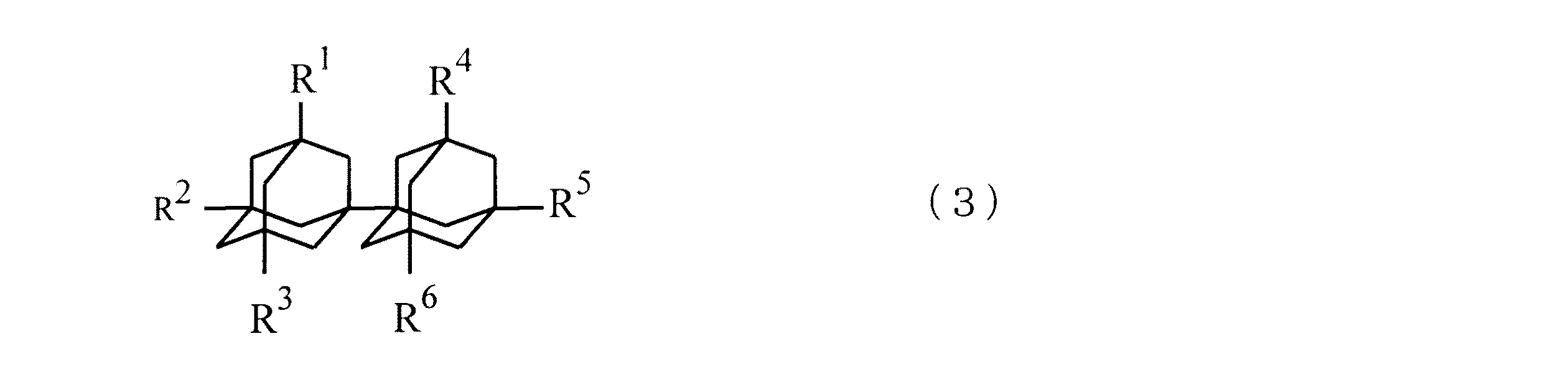
で表される置換基を示す。R1〜R6のうち2つ以上が、式(4)で表される置換基を示す場合、それらは同一でも異なっていてもよい。ただし、R1〜R6のうち、式(4)で表される基の全てにおいてn=1の場合は、R1〜R6のうち少なくとも1つはハロゲン原子を有していてもよい炭素数1〜6のアルキル基もしくはシクロアルキル基である]
で表されるエチニルフェニルビアダマンタン誘導体を提供する。
Further, the present invention provides the following formula (3)
The substituent represented by these is shown. When two or more of R 1 to R 6 represent the substituent represented by the formula (4), they may be the same or different. However, among the R 1 to R 6, in the case in all of the groups represented by the formula (4) n = 1, the at least one of R 1 to R 6 which may have a halogen atom carbon It is an alkyl group or a cycloalkyl group of the number 1-6]
An ethynylphenylbiadamantane derivative represented by the formula:
さらに、本発明は下記式(1a)
で表される置換基を示す。R1〜R6のうち2つ以上が、式(2)で表される置換基を示す場合、それらは同一でも異なっていてもよい。式(2)のベンゼン環はハロゲン原子と共に、炭素数1〜6のアルキル基もしくはシクロアルキル基を有していてもよい。ただし、R1〜R6のうち、式(2)で表される基の全てにおいてn=1の場合は、R1〜R6のうち少なくとも1つはハロゲン原子を有していてもよい炭素数1〜6のアルキル基もしくはシクロアルキル基である]
で表されるハロフェニルビアダマンタン誘導体と、下記式(5)
で表される末端アルキンとを反応させて、下記式(3)
で表される置換基を示す。R1〜R6のうち2つ以上が、式(4)で表される置換基を示す場合、それらは同一でも異なっていてもよい。ただし、R1〜R6のうち、式(4)で表される基の全てにおいてn=1の場合は、R1〜R6のうち少なくとも1つはハロゲン原子を有していてもよい炭素数1〜6のアルキル基もしくはシクロアルキル基である]
で表されるエチニルフェニルビアダマンタン誘導体を得ることを特徴とするエチニルフェニルビアダマンタン誘導体の製造方法を提供する。
Furthermore, the present invention provides the following formula (1a)
The substituent represented by these is shown. When two or more of R 1 to R 6 represent the substituent represented by the formula (2), they may be the same or different. The benzene ring of Formula (2) may have a C1-C6 alkyl group or a cycloalkyl group with a halogen atom. However, among R 1 to R 6 , when n = 1 in all of the groups represented by formula (2), at least one of R 1 to R 6 may have a halogen atom. It is an alkyl group or a cycloalkyl group of the number 1-6]
And a halophenylbiadamantane derivative represented by the following formula (5):
Is reacted with a terminal alkyne represented by the following formula (3):
The substituent represented by these is shown. When two or more of R 1 to R 6 represent the substituent represented by the formula (4), they may be the same or different. However, among all of the groups represented by formula (4) among R 1 to R 6 , when n = 1, at least one of R 1 to R 6 may have a halogen atom. It is an alkyl group or a cycloalkyl group of the number 1-6]
A method for producing an ethynylphenylbiadamantane derivative represented by the formula:
さらに、本発明は、下記式(3a)
で表される置換基を示す。R1〜R6のうち2つ以上が、式(4a)で表される置換基を示す場合、それらは同一でも異なっていてもよい。ただし、R1〜R6のうち、式(4a)で表される基の全てにおいてn=1の場合は、R1〜R6のうち少なくとも1つはハロゲン原子を有していてもよい炭素数1〜6のアルキル基もしくはシクロアルキル基である]
で表されるエチニルフェニルビアダマンタン誘導体と、アルコール化合物とを反応させて、下記式(3b)
で表される置換基を示す。R1〜R6のうち2つ以上が、式(4b)で表される置換基を示す場合、それらは同一でも異なっていてもよい。ただし、R1〜R6のうち、式(4b)で表される基の全てにおいてn=1の場合は、R1〜R6のうち少なくとも1つはハロゲン原子を有していてもよい炭素数1〜6のアルキル基もしくはシクロアルキル基である]
で表されるエチニルフェニルビアダマンタン誘導体を得ることを特徴とするエチニルフェニルビアダマンタン誘導体の製造方法を提供する。
Furthermore, the present invention provides the following formula (3a)
The substituent represented by these is shown. When two or more of R 1 to R 6 represent the substituent represented by the formula (4a), they may be the same or different. However, among R 1 to R 6 , when n = 1 in all of the groups represented by formula (4a), at least one of R 1 to R 6 may have a halogen atom. It is an alkyl group or a cycloalkyl group of the number 1-6]
An ethynylphenylbiadamantane derivative represented by the formula (3b) is reacted with an alcohol compound.
The substituent represented by these is shown. When two or more of R 1 to R 6 represent the substituent represented by the formula (4b), they may be the same or different. However, among R 1 to R 6 , when n = 1 in all of the groups represented by formula (4b), at least one of R 1 to R 6 may have a halogen atom. It is an alkyl group or a cycloalkyl group of the number 1-6]
A method for producing an ethynylphenylbiadamantane derivative represented by the formula:
本発明によれば、溶媒に対する溶解性に優れ、電気特性、熱特性、機械特性、光学特性、物理特性などに優れた機能性材料の原料として有用な新規のエチニルフェニルビアダマンタン誘導体が提供される。また、本発明によれば、種々のアダマンタン誘導体の原料として幅広く利用できる新規のハロフェニルビアダマンタン誘導体を提供される。更にまた、本発明によれば、ハロフェニルビアダマンタン誘導体からエチニルフェニルビアダマンタン誘導体を工業的に効率よく製造することができる。 According to the present invention, there is provided a novel ethynylphenylbiadamantane derivative useful as a raw material for a functional material that is excellent in solubility in a solvent and excellent in electrical properties, thermal properties, mechanical properties, optical properties, physical properties, and the like. . The present invention also provides novel halophenylbiadamantane derivatives that can be widely used as raw materials for various adamantane derivatives. Furthermore, according to the present invention, an ethynylphenylbiadamantane derivative can be industrially efficiently produced from a halophenylbiadamantane derivative.
[ハロフェニルビアダマンタン誘導体]
本発明のハロフェニルビアダマンタン誘導体は前記式(1)で表される。式(1)中、R1〜R6は同一又は異なって、水素原子、ハロゲン原子を有していてもよい炭素数1〜6のアルキル基もしくはシクロアルキル基、置換基を有していてもよいフェニル基、カルボキシル基、置換もしくは無置換カルバモイル基、置換オキシカルボニル基、置換もしくは無置換アミノ基、ハロゲン原子、又は、ヒドロキシル基を示す。ただし、R1〜R6のうち、少なくとも1つが前記式(2)で表される置換基を示す。式(2)中、Xはハロゲン原子を示し、n=1〜5の自然数を示す。
[Halophenylbiadamantane derivatives]
The halophenylbiadamantane derivative of the present invention is represented by the formula (1). In formula (1), R 1 to R 6 may be the same or different and each may have a hydrogen atom, a halogen atom, a C 1-6 alkyl group, a cycloalkyl group, or a substituent. A good phenyl group, carboxyl group, substituted or unsubstituted carbamoyl group, substituted oxycarbonyl group, substituted or unsubstituted amino group, halogen atom or hydroxyl group is shown. However, at least one of R 1 to R 6 represents the substituent represented by the formula (2). In formula (2), X represents a halogen atom and represents a natural number of n = 1-5.
R1〜R6のうち2つ以上が、式(2)で表される置換基を示す場合、それらは同一でも異なっていてもよい。式(2)のベンゼン環はハロゲン原子と共に、炭素数1〜6のアルキル基もしくはシクロアルキル基を有していてもよい。ただし、R1〜R6のうち、1つのみが式(2)で表される置換基である場合、R1〜R6のうち少なくとも1つはハロゲン原子を有していてもよい炭素数1〜6のアルキル基もしくはシクロアルキル基であるか、又はnが2以上の自然数である When two or more of R 1 to R 6 represent the substituent represented by the formula (2), they may be the same or different. The benzene ring of the formula (2) may have a C 1-6 alkyl group or cycloalkyl group together with a halogen atom. However, when only one of R 1 to R 6 is a substituent represented by the formula (2), at least one of R 1 to R 6 may have a halogen atom. 1 to 6 alkyl groups or cycloalkyl groups, or n is a natural number of 2 or more
R1〜R6について、ハロゲン原子を有していてもよい炭素数1〜6のアルキル基もしくはシクロアルキル基としては、溶解性を向上させる機能を有している基であればよい。ハロゲン原子を有していてもよい炭素数1〜6のアルキル基としては、例えば、メチル、エチル、プロピル、イソプロピル、ブチル、イソブチル、s−ブチル、t−ブチル、ペンチル、1,1−ジメチルプロピル、2,2−ジメチルプロピル、3−メチルブチル、ヘキシル、4−メチルペンチル、1,3−ジメチルブチル、1−イソプロピルブチル、1,1−ジメチルブチル、2−メチルペンチル、3,3−ジメチルブチル、1,2,2−トリメチルプロピル、2,2−ジメチルブチル基等の炭素数1〜6の直鎖状、又は、分岐鎖状アルキル基、又は、これらの基の水素原子の少なくとも1つがハロゲン原子で置換された基等が挙げられる。 About R < 1 > -R < 6 >, as a C1-C6 alkyl group or cycloalkyl group which may have a halogen atom, what is necessary is just a group which has the function to improve solubility. Examples of the alkyl group having 1 to 6 carbon atoms which may have a halogen atom include methyl, ethyl, propyl, isopropyl, butyl, isobutyl, s-butyl, t-butyl, pentyl, and 1,1-dimethylpropyl. 2,2-dimethylpropyl, 3-methylbutyl, hexyl, 4-methylpentyl, 1,3-dimethylbutyl, 1-isopropylbutyl, 1,1-dimethylbutyl, 2-methylpentyl, 3,3-dimethylbutyl, A linear or branched alkyl group having 1 to 6 carbon atoms such as 1,2,2-trimethylpropyl and 2,2-dimethylbutyl groups, or at least one of hydrogen atoms of these groups is a halogen atom And a group substituted with.
R1〜R6について、ハロゲン原子を有していてもよい炭素数1〜6のシクロアルキル基としては、例えば、シクロプロピル、シクロブチル、シクロペンチル、シクロヘキシル基などの3〜6員のシクロアルキル基(特に、5又は6員のシクロアルキル基)、又は、これらの基の水素原子の少なくとも1つがハロゲン原子で置換された基等が挙げられる。 As R 1 to R 6 , the cycloalkyl group having 1 to 6 carbon atoms which may have a halogen atom is, for example, a 3 to 6 membered cycloalkyl group such as cyclopropyl, cyclobutyl, cyclopentyl, cyclohexyl group ( Particularly, a 5- or 6-membered cycloalkyl group), or a group in which at least one of the hydrogen atoms of these groups is substituted with a halogen atom, or the like can be given.
R1〜R6について、ハロゲン原子を有していてもよい炭素数1〜6のアルキル基とシクロアルキル基が結合した基としては、例えば、シクロプロピルメチル、シクロプロピルエチル、シクロプロピルプロピル、2−メチル−3−エチルシクロプロピル、2−シクロプロピルエチル、1−エチル−1−シクロブチル、2−シクロブチルエチル、2,3−ジメチルシクロブチル、2−エチルシクロブチル、シクロペンチルメチル基、又は、これらの基の水素原子の少なくとも1つがハロゲン原子で置換された基等が挙げられる。 Regarding R 1 to R 6 , examples of the group in which an alkyl group having 1 to 6 carbon atoms which may have a halogen atom and a cycloalkyl group are bonded include cyclopropylmethyl, cyclopropylethyl, cyclopropylpropyl, 2 -Methyl-3-ethylcyclopropyl, 2-cyclopropylethyl, 1-ethyl-1-cyclobutyl, 2-cyclobutylethyl, 2,3-dimethylcyclobutyl, 2-ethylcyclobutyl, cyclopentylmethyl group, or these And a group in which at least one of the hydrogen atoms in the group is substituted with a halogen atom.
上記炭素数1〜6のアルキル基、シクロアルキル基、もしくはアルキル基とシクロアルキル基が結合した基が有していてもよいハロゲン原子としては、臭素原子(Br)、ヨウ素原子(I)、塩素原子(Cl)、フッ素原子(F)等が挙げられる。 Examples of the halogen atom that the alkyl group having 1 to 6 carbon atoms, the cycloalkyl group, or the group in which the alkyl group and the cycloalkyl group are bonded may include a bromine atom (Br), an iodine atom (I), chlorine An atom (Cl), a fluorine atom (F), etc. are mentioned.
R1〜R6について、置換基を有していてもよいフェニル基における置換基としては、種々の置換基、例えば、アルキル基、シクロアルキル基、ハロゲン原子(フッ素原子、塩素原子、臭素原子、ヨウ素原子)、ヒドロキシル基、置換オキシ基(例えば、アルコキシ基、アリールオキシ基、アラルキルオキシ基、アシルオキシ基など)、カルボキシル基、置換オキシカルボニル基(アルコキシカルボニル基、アリールオキシカルボニル基、アラルキルオキシカルボニル基など)、置換又は無置換カルバモイル基、シアノ基、ニトロ基、置換又は無置換アミノ基、スルホ基、複素環式基などを挙げられる。また、前記ヒドロキシル基やカルボキシル基は有機合成の分野で慣用の保護基で保護されていてもよい。置換基を有していてもよいフェニル基としては、なかでも、フェニル基、メチルフェニル基が好ましい。 As for the substituents in the phenyl group which may have a substituent for R 1 to R 6 , various substituents such as an alkyl group, a cycloalkyl group, a halogen atom (a fluorine atom, a chlorine atom, a bromine atom, Iodine atom), hydroxyl group, substituted oxy group (for example, alkoxy group, aryloxy group, aralkyloxy group, acyloxy group, etc.), carboxyl group, substituted oxycarbonyl group (alkoxycarbonyl group, aryloxycarbonyl group, aralkyloxycarbonyl group) Etc.), substituted or unsubstituted carbamoyl groups, cyano groups, nitro groups, substituted or unsubstituted amino groups, sulfo groups, heterocyclic groups and the like. The hydroxyl group and carboxyl group may be protected with a protective group commonly used in the field of organic synthesis. As the phenyl group which may have a substituent, among them, a phenyl group and a methylphenyl group are preferable.
R1〜R6について、置換オキシカルボニル基としては、例えば、メトキシカルボニル、エトキシカルボニル基等のアルコキシカルボニル基(例えば、C1-6アルコキシカルボニル基等)、フェノキシカルボニル基等のアリールオキシカルボニル基、ベンジルオキシカルボニル基等のアラルキルオキシカルボニル基等が挙げられる。 With respect to R 1 to R 6 , examples of the substituted oxycarbonyl group include alkoxycarbonyl groups such as methoxycarbonyl and ethoxycarbonyl groups (eg, C 1-6 alkoxycarbonyl group), aryloxycarbonyl groups such as phenoxycarbonyl group, An aralkyloxycarbonyl group such as a benzyloxycarbonyl group and the like can be mentioned.
R1〜R6について、置換もしくは無置換カルバモイル基としては、種々の置換基、例えば、メチル、エチル、プロピル、イソプロピル、n−ブチル、s−ブチル、t−ブチル基等のアルキル基、アセチル、ベンゾイル基等のアシル基等を有するカルバモイル基、もしくは、無置換カルバモイル基等が挙げられる。 Regarding R 1 to R 6 , the substituted or unsubstituted carbamoyl group includes various substituents such as alkyl groups such as methyl, ethyl, propyl, isopropyl, n-butyl, s-butyl, t-butyl groups, acetyl, Examples thereof include a carbamoyl group having an acyl group such as a benzoyl group, or an unsubstituted carbamoyl group.
R1〜R6について、置換もしくは無置換アミノ基としては、種々の置換基、例えば、例えば、メチル、エチル、プロピル、イソプロピル、n−ブチル、s−ブチル、t−ブチル基等のアルキル基、アセチル、ベンゾイル基等のアシル基等を有するアミノ基、もしくは、無置換アミノ基等が挙げられる。 For R 1 to R 6 , the substituted or unsubstituted amino group includes various substituents, for example, alkyl groups such as methyl, ethyl, propyl, isopropyl, n-butyl, s-butyl, and t-butyl groups, Examples thereof include an amino group having an acyl group such as acetyl and benzoyl groups, or an unsubstituted amino group.
その他に、R1〜R6について、カルボキシル基、ヒドロキシル基は、有機合成の分野で慣用の保護基で保護されていてもよい。 In addition, as for R 1 to R 6 , the carboxyl group and the hydroxyl group may be protected with a protective group commonly used in the field of organic synthesis.
本発明のハロフェニルビアダマンタン誘導体としては、モノマー自体の溶媒に対する溶解性及びポリマー化したときの溶媒に対する溶解性を向上させるために、R1〜R6のうち少なくとも1つ(特に2つ又は4つ)が炭素数1〜6の直鎖状アルキル基もしくはシクロアルキル基であることが好ましい。 The halophenylbiadamantane derivative of the present invention includes at least one of R 1 to R 6 (particularly two or four) in order to improve the solubility of the monomer itself in the solvent and the solvent when polymerized. Is preferably a linear alkyl group or cycloalkyl group having 1 to 6 carbon atoms.
式(2)で表される置換基において、Xはハロゲン原子を示し、nは1〜5の自然数を示す。式(2)中のベンゼン環は、ハロゲン原子以外にも、炭素数1〜6のアルキル基もしくはシクロアルキル基を含有していてもよい。ハロゲン原子、炭素数1〜6のアルキル基もしくはシクロアルキル基としては、上記と同様に例示できる。 In the substituent represented by the formula (2), X represents a halogen atom, and n represents a natural number of 1 to 5. The benzene ring in formula (2) may contain an alkyl group or cycloalkyl group having 1 to 6 carbon atoms in addition to the halogen atom. Examples of the halogen atom, the alkyl group having 1 to 6 carbon atoms, and the cycloalkyl group are the same as described above.
式(2)で表される置換基で、ハロゲン原子を有する置換基としては、例えば、2−ブロモフェニル、3−ブロモフェニル、4−ブロモフェニルなどのモノブロモフェニル基;2,3−ジブロモフェニル、2,4−ジブロモフェニル、2,5−ジブロモフェニル、3,5−ジブロモフェニルなどのジブロモフェニル基;2,3,4−トリブロモフェニル、3,4,5−トリブロモフェニル、2,3,5−トリブロモフェニル、2,3,6−トリブロモフェニルなどのトリブロモフェニル基;2,3,4,5−テトラブロモフェニル、2,3,5,6−テトラブロモフェニルなどのテトラブロモフェニル基などが挙げられる。 Examples of the substituent represented by the formula (2) having a halogen atom include monobromophenyl groups such as 2-bromophenyl, 3-bromophenyl and 4-bromophenyl; 2,3-dibromophenyl , 2,4-dibromophenyl, 2,5-dibromophenyl, 3,5-dibromophenyl and the like; 2,3,4-tribromophenyl, 3,4,5-tribromophenyl, 2,3 , 5-tribromophenyl, tribromophenyl groups such as 2,3,6-tribromophenyl; tetrabromo such as 2,3,4,5-tetrabromophenyl and 2,3,5,6-tetrabromophenyl A phenyl group etc. are mentioned.
また式(2)で表される置換基で、ハロゲン原子と共にアルキル基を有する置換基としては、例えば、3−メチル−2−ブロモフェニル、4−メチル−2−ブロモフェニル、5−メチル−2−ブロモフェニル、6−メチル−2−ブロモフェニル、2−メチル−3−ブロモフェニル、4−メチル−3−ブロモフェニル、5−メチル−3−ブロモフェニル、6−メチル−3−ブロモフェニル2−メチル−4−ブロモフェニル、3−メチル−4−ブロモフェニルなどのモノブロモフェニル基;4−メチル−2,3−ジブロモフェニル、5−メチル−2,3−ジブロモフェニル、6−メチル−2,3−ジブロモフェニル、3−メチル−2,4−ジブロモフェニル、5−メチル−2,4−ジブロモフェニル、6−メチル−2,4−ジブロモフェニル、3−メチル−2,5−ジブロモフェニル、4−メチル−2,5−ジブロモフェニル、6−メチル−2,5−ジブロモフェニル、2−メチル−3,5−ジブロモフェニル、4−メチル−3,5−ジブロモフェニルなどのジブロモフェニル基;5−メチル−2,3,4−トリブロモフェニル、6−メチル−2,3,4−トリブロモフェニル、2−メチル−3,4,5−トリブロモフェニル、4−メチル−2,3,5−トリブロモフェニル、6−メチル−2,3,5−トリブロモフェニル、4−メチル−2,3,6−トリブロモフェニル、5−メチル−2,3,6−トリブロモフェニルなどのトリブロモフェニル基;6−メチル−2,3,4,5−テトラブロモフェニル、4−メチル−2,3,4,5−テトラブロモフェニルなどのテトラブロモフェニル基などが挙げられる。 Examples of the substituent represented by the formula (2) having an alkyl group together with a halogen atom include 3-methyl-2-bromophenyl, 4-methyl-2-bromophenyl, and 5-methyl-2. -Bromophenyl, 6-methyl-2-bromophenyl, 2-methyl-3-bromophenyl, 4-methyl-3-bromophenyl, 5-methyl-3-bromophenyl, 6-methyl-3-bromophenyl 2- Monobromophenyl groups such as methyl-4-bromophenyl, 3-methyl-4-bromophenyl; 4-methyl-2,3-dibromophenyl, 5-methyl-2,3-dibromophenyl, 6-methyl-2, 3-dibromophenyl, 3-methyl-2,4-dibromophenyl, 5-methyl-2,4-dibromophenyl, 6-methyl-2,4-dibromophenyl, 3 Methyl-2,5-dibromophenyl, 4-methyl-2,5-dibromophenyl, 6-methyl-2,5-dibromophenyl, 2-methyl-3,5-dibromophenyl, 4-methyl-3,5- Dibromophenyl groups such as dibromophenyl; 5-methyl-2,3,4-tribromophenyl, 6-methyl-2,3,4-tribromophenyl, 2-methyl-3,4,5-tribromophenyl, 4-methyl-2,3,5-tribromophenyl, 6-methyl-2,3,5-tribromophenyl, 4-methyl-2,3,6-tribromophenyl, 5-methyl-2,3, Tribromophenyl groups such as 6-tribromophenyl; tetrabromophene such as 6-methyl-2,3,4,5-tetrabromophenyl, 4-methyl-2,3,4,5-tetrabromophenyl Etc. Le group.
式(2)で表される置換基について上記の例以外にも、ハロゲン原子としては、臭素原子(Br)に代えて、ヨウ素原子(I)、塩素原子(Cl)、フッ素原子(F)の場合も同様に例示できる。また、アルキル基としては、メチル基に代えて、上記に挙げられている炭素数1〜6のアルキル基もしくはシクロアルキル基の場合も同様に例示できる。 In addition to the above-described examples of the substituent represented by the formula (2), as the halogen atom, instead of the bromine atom (Br), an iodine atom (I), a chlorine atom (Cl), a fluorine atom (F) The case can be similarly illustrated. Moreover, as an alkyl group, it can replace with a methyl group and can illustrate similarly in the case of the C1-C6 alkyl group mentioned above or a cycloalkyl group.
R1〜R6のすべてが水素原子又は式(2)で表される置換基である、式(1)で表されるビアダマンタン誘導体の代表的な例として、例えば、3−(3,5−ジブロモフェニル)−1,1’−ビアダマンタン、3,3−ジ(4−ブロモフェニル)−1,1’−ビアダマンタン、3,3−ジ(3,5−ジブロモフェニル)−1,1’−ビアダマンタン、3,3’,5−トリ(4−ブロモフェニル)−1,1’−ビアダマンタン、3,3’,5−トリ(3,5−ジブロモフェニル)−1,1’−ビアダマンタン、3,3’,5,5’−テトラ(4−ブロモフェニル)−1,1’−ビアダマンタン、3,3’,5,5’−テトラ(3,5−ジブロモフェニル)−1,1’−ビアダマンタンなどが挙げられる。 As a typical example of the biadamantane derivative represented by the formula (1) in which all of R 1 to R 6 are a hydrogen atom or a substituent represented by the formula (2), for example, 3- (3,5 -Dibromophenyl) -1,1'-biadamantane, 3,3-di (4-bromophenyl) -1,1'-biadamantane, 3,3-di (3,5-dibromophenyl) -1,1 '-Biadamantane, 3,3', 5-tri (4-bromophenyl) -1,1'-biadamantane, 3,3 ', 5-tri (3,5-dibromophenyl) -1,1'- Biadamantane, 3,3 ′, 5,5′-tetra (4-bromophenyl) -1,1′-biadamantane, 3,3 ′, 5,5′-tetra (3,5-dibromophenyl) -1 , 1'-biadamantane and the like.
上記R1〜R6のすべてが水素原子又は式(2)で表される置換基である、式(1)で表されるハロフェニルビアダマンタン誘導体のハロゲン原子について、臭素原子(Br)に代えて、ヨウ素原子(I)、塩素原子(Cl)、フッ素原子(F)の場合も同様に例示できる。 The halogen atom of the halophenylbiadamantane derivative represented by the formula (1), in which all of R 1 to R 6 are hydrogen atoms or substituents represented by the formula (2), is replaced with a bromine atom (Br). In the case of iodine atom (I), chlorine atom (Cl), and fluorine atom (F), the same applies.
R1〜R6の少なくとも1つが炭素数1〜6のアルキル基もしくはシクロアルキル基で、且つ、少なくとも1つが、式(2)で表される置換基である、式(1)で表されるハロフェニルビアダマンタン誘導体の代表的な例として、例えば、3−(4−ブロモフェニル)−5,5’,7,7’−テトラメチル−1,1’−ビアダマンタン、3−(3,5−ジブロモフェニル)−5,5’,7,7’−テトラメチル−1,1’−ビアダマンタン、3,3’−ビス(4−ブロモフェニル)−5,5’,7,7’−テトラメチル−1,1’−ビアダマンタン、3,3’−ビス(3,5−ジブロモフェニル)−5,5’,7,7’−テトラメチル−1,1’−ビアダマンタンなどのアルキル基としてメチル基を有するビアダマンタン誘導体;3−(4−ブロモフェニル)−5,5’,7,7’−テトラエチル−1,1’−ビアダマンタン、3−(3,5−ジブロモフェニル)−5,5’,7,7’−テトラエチル−1,1’−ビアダマンタン、3,3’−ビス(4−ブロモフェニル)−5,5’,7,7’−テトラエチル−1,1’−ビアダマンタン、3,3’−ビス(3,5−ジブロモフェニル)−5,5’,7,7’−テトラエチル−1,1’−ビアダマンタンをなどのアルキル基としてエチル基を有するビアダマンタン誘導体;3−(4−ブロモフェニル)−5,5’,7,7’−テトラ(n−ブチル)−1,1’−ビアダマンタン、3−(3,5−ジブロモフェニル)−5,5’,7,7’−テトラキス(n−ブチル)−1,1’−ビアダマンタン、3,3’−ビス(4−ブロモフェニル)−5,5’,7,7’−テトラキス(n−ブチル)−1,1’−ビアダマンタン、3,3’−ビス(3,5−ジブロモフェニル)−5,5’,7,7’−テトラキス(n−ブチル)−1,1’−ビアダマンタン等の、炭素数1〜6のアルキル基もしくはシクロアルキル基としてn−ブチル基を有するハロフェニルビアダマンタン誘導体等が挙げられる。 At least one of R 1 to R 6 is an alkyl group or cycloalkyl group having 1 to 6 carbon atoms, and at least one is a substituent represented by the formula (2). Representative examples of halophenylbiadamantane derivatives include, for example, 3- (4-bromophenyl) -5,5 ′, 7,7′-tetramethyl-1,1′-biadamantane, 3- (3,5 -Dibromophenyl) -5,5 ', 7,7'-tetramethyl-1,1'-biadamantane, 3,3'-bis (4-bromophenyl) -5,5', 7,7'-tetra As an alkyl group such as methyl-1,1′-biadamantane, 3,3′-bis (3,5-dibromophenyl) -5,5 ′, 7,7′-tetramethyl-1,1′-biadamantane Biadamantane derivative having a methyl group; 3- (4-bromophenyl) -5 , 5 ′, 7,7′-tetraethyl-1,1′-biadamantane, 3- (3,5-dibromophenyl) -5,5 ′, 7,7′-tetraethyl-1,1′-biadamantane, 3,3′-bis (4-bromophenyl) -5,5 ′, 7,7′-tetraethyl-1,1′-biadamantane, 3,3′-bis (3,5-dibromophenyl) -5, Viadamantane derivatives having an ethyl group as an alkyl group such as 5 ′, 7,7′-tetraethyl-1,1′-biadamantane; 3- (4-bromophenyl) -5,5 ′, 7,7′- Tetra (n-butyl) -1,1′-biadamantane, 3- (3,5-dibromophenyl) -5,5 ′, 7,7′-tetrakis (n-butyl) -1,1′-biadamantane 3,3′-bis (4-bromophenyl) -5,5 ′, 7,7′-tetrakis (n-butyl -1,1′-biadamantane, 3,3′-bis (3,5-dibromophenyl) -5,5 ′, 7,7′-tetrakis (n-butyl) -1,1′-biadamantane, etc. And a halophenylbiadamantane derivative having an n-butyl group as the alkyl group or cycloalkyl group having 1 to 6 carbon atoms.
上記R1〜R6の少なくとも1つが炭素数1〜6のアルキル基もしくはシクロアルキル基で、且つ、少なくとも1つが、式(2)で表される置換基である、式(1)で表されるハロフェニルビアダマンタン誘導体のハロゲン原子について、臭素原子(Br)に代えて、ヨウ素原子(I)、塩素原子(Cl)、フッ素原子(F)の場合も同様に例示できる。 Represented by formula (1), wherein at least one of R 1 to R 6 is an alkyl group or cycloalkyl group having 1 to 6 carbon atoms, and at least one is a substituent represented by formula (2). Examples of the halogen atom of the halophenylbiadamantane derivative include the case of an iodine atom (I), a chlorine atom (Cl), and a fluorine atom (F) instead of the bromine atom (Br).
R1〜R6のすべてが水素原子又は式(2)で表される置換基であって、式(2)のベンゼン環にハロゲン原子と炭素数1〜6のアルキル基もしくはシクロアルキル基を有する、式(1)で表されるハロフェニルビアダマンタン誘導体の代表的な例として、例えば、3−(4−メチル−3,5−ジブロモフェニル)−1,1’−ビアダマンタン、3−(2−メチル−3,5−ジブロモフェニル)−1,1’−ビアダマンタン、3,3’−ビス(2−メチル−4−ブロモフェニル)−1,1’−ビアダマンタン、3,3’−ビス(3−メチル−4−ブロモフェニル)−1,1’−ビアダマンタン、3,3’−ビス(4−メチル−3,5−ジブロモフェニル)−1,1’−ビアダマンタン、3,3’−ビス(2−メチル−3,5−ジブロモフェニル)−1,1’−ビアダマンタン、3,3’,5−トリス(2−メチル−4−ブロモフェニル)−1,1’−ビアダマンタン、3,3’,5−トリス(3−メチル−4−ブロモフェニル)−1,1’−ビアダマンタン、3,3’,5−トリス(4−メチル−3,5−ジブロモフェニル)−1,1’−ビアダマンタン、3,3’,5−トリス(2−メチル−3,5−ジブロモフェニル)−1,1’−ビアダマンタン、3,3’,5,5’−テトラキス(2−メチル−4−ブロモフェニル)−1,1’−ビアダマンタン、3,3’,5,5’−テトラキス(3−メチル−4−ブロモフェニル)−1,1−アダマンタン、3,3’,5,5’−テトラキス(4−メチル−3,5−ジブロモフェニル)−1,1’−ビアダマンタン、3,3’,5,5’−テトラキス(2−メチル−3,5−ジブロモフェニル)−1,1’−ビアダマンタンなどが挙げられる。 R 1 to R 6 are all hydrogen atoms or substituents represented by formula (2), and the benzene ring of formula (2) has a halogen atom and an alkyl group or cycloalkyl group having 1 to 6 carbon atoms. As typical examples of the halophenylbiadamantane derivative represented by the formula (1), for example, 3- (4-methyl-3,5-dibromophenyl) -1,1′-biadamantane, 3- (2 -Methyl-3,5-dibromophenyl) -1,1'-biadamantane, 3,3'-bis (2-methyl-4-bromophenyl) -1,1'-biadamantane, 3,3'-bis (3-Methyl-4-bromophenyl) -1,1′-biadamantane, 3,3′-bis (4-methyl-3,5-dibromophenyl) -1,1′-biadamantane, 3,3 ′ -Bis (2-methyl-3,5-dibromophenyl) -1,1 ' Biadamantane, 3,3 ′, 5-tris (2-methyl-4-bromophenyl) -1,1′-biadamantane, 3,3 ′, 5-tris (3-methyl-4-bromophenyl) -1 , 1′-biadamantane, 3,3 ′, 5-tris (4-methyl-3,5-dibromophenyl) -1,1′-biadamantane, 3,3 ′, 5-tris (2-methyl-3) , 5-Dibromophenyl) -1,1′-biadamantane, 3,3 ′, 5,5′-tetrakis (2-methyl-4-bromophenyl) -1,1′-biadamantane, 3,3 ′, 5,5′-tetrakis (3-methyl-4-bromophenyl) -1,1-adamantane, 3,3 ′, 5,5′-tetrakis (4-methyl-3,5-dibromophenyl) -1,1 '-Biadamantane, 3,3', 5,5'-tetrakis (2-methyl-3,5-di- Romofeniru) -1,1' such as bi-adamantane and the like.
R1〜R6のすべてが水素原子又は式(2)の構造で表される置換基であって、式(2)のベンゼン環にハロゲン基と炭素数1〜6のアルキル基もしくはシクロアルキル基を有する、式(1)で表されるハロフェニルビアダマンタン誘導体について、臭素原子(Br)に代えて、ヨウ素原子(I)、塩素原子(Cl)、フッ素原子(F)の場合も同様に例示できる。また、炭素数1〜6のアルキル基もしくはシクロアルキル基としては、メチル基に代えて、上記に挙げられている炭素数1〜6のアルキル基もしくはシクロアルキル基の場合も同様に例示できる。 R 1 to R 6 are all hydrogen atoms or substituents represented by the structure of formula (2), and a halogen group and an alkyl group or cycloalkyl group having 1 to 6 carbon atoms on the benzene ring of formula (2) As for the halophenylbiadamantane derivative represented by the formula (1) having an iodine, instead of the bromine atom (Br), an iodine atom (I), a chlorine atom (Cl), and a fluorine atom (F) are also exemplified. it can. Moreover, as a C1-C6 alkyl group or a cycloalkyl group, it can replace with a methyl group and can illustrate similarly in the case of the C1-C6 alkyl group or cycloalkyl group mentioned above.
R1〜R6の少なくとも1つが炭素数1〜6のアルキル基もしくはシクロアルキル基で、且つ、少なくとも1つが式(2)で表される置換基であって、式(2)のベンゼン環にハロゲン原子とアルキル基を有する、式(1)で表されるハロフェニルビアダマンタン誘導体の代表的な例として、例えば、3−(2−メチル−4−ブロモフェニル)−5,5’,7,7’−テトラメチル−1,1’−ビアダマンタン、3−(3−メチル−4−ブロモフェニル)−5,5’,7,7’−テトラメチル−1,1’−ビアダマンタン、3−(2−メチル−3,5−ジブロモフェニル)−5,5’,7,7’−テトラメチル−1,1’−ビアダマンタン、3−(4−メチル−3,5−ジブロモフェニル)−5,5’,7,7’−テトラメチル−1,1’−ビアダマンタン、3,3’−ビス(2−メチル−4−ブロモフェニル)−5,5’,7,7’−テトラメチル−1,1’−ビアダマンタン、3,3’−ビス(3−メチル−4−ブロモフェニル)−5,5’,7,7’−テトラメチル−1,1’−ビアダマンタン、3,3’−ビス(2−メチル−3,5−ジブロモフェニル)−5,5’,7,7’−テトラメチル−1,1’−ビアダマンタン、3,3’−ビス(4−メチル−3,5−ジブロモフェニル)−5,5’,7,7’−テトラメチル−1,1’−ビアダマンタンなどのR1〜R6がアルキル基としてメチル基を有するビアダマンタン誘導体;3−(2−メチル−4−ブロモフェニル)−5,5’,7,7’−テトラエチル−1,1’−ビアダマンタン、3−(3−メチル−4−ブロモフェニル)−5,5’,7,7’−テトラエチル−1,1’−ビアダマンタン、3−(2−メチル−3,5−ジブロモフェニル)−5,5’,7,7’−テトラエチル−1,1’−ビアダマンタン、3−(4−メチル−3,5−ジブロモフェニル)−5,5’,7,7’−テトラエチル−1,1’−ビアダマンタン、3,3’−ビス(2−メチル−4−ブロモフェニル)−5,5’,7,7’−テトラエチル−1,1’−ビアダマンタン、3,3’−ビス(3−メチル−4−ブロモフェニル)−5,5’,7,7’−テトラエチル−1,1’−ビアダマンタン、3,3’−ジ(2−メチル−3,5−ジブロモフェニル)−5,5’,7,7’−テトラエチル−1,1’−ビアダマンタン、3,3’−ビス(4−メチル−3,5−ジブロモフェニル)−5,5’,7,7’−テトラエチル−1,1’−ビアダマンタンなどのR1〜R6がアルキル基としてエチル基を有するビアダマンタン誘導体;3−(2−メチル−4−ブロモフェニル)−5,5’,7,7’−テトラキス(n−ブチル)−1,1’−ビアダマンタン、3−(3−メチル−4−ブロモフェニル)−5,5’,7,7’−テトラキス(n−ブチル)−1,1’−ビアダマンタン、3−(2−メチル−3,5−ジブロモフェニル)−5,5’,7,7’−テトラキス(n−ブチル)−1,1’−ビアダマンタン、3−(2−メチル−3,5−ジブロモフェニル)−5,5’,7,7’−テトラキス(n−ブチル)−1,1’−ビアダマンタン、3,3’−ビス(2−メチル−4−ブロモフェニル)−5,5’,7,7’−テトラ(n−ブチル)−1,1’−ビアダマンタン、3,3’−ビス(2−メチル−4−ブロモフェニル)−5,5’,7,7’−テトラキス(n−ブチル)−1,1’−ビアダマンタン、3,3’−ビス(2−メチル−3,5−ジブロモフェニル)−5,5’,7,7’−テトラキス(n−ブチル)−1,1’−ビアダマンタン、3,3’−ビス(4−メチル−3,5−ジブロモフェニル)−5,5’,7,7’−テトラキス(n−ブチル)−1,1’−ビアダマンタンなどのR1〜R6が炭素数1〜6のアルキル基もしくはシクロアルキル基としてn−ブチル基を有するビアダマンタン誘導体などが挙げられる。 At least one of R 1 to R 6 is an alkyl group or cycloalkyl group having 1 to 6 carbon atoms, and at least one is a substituent represented by the formula (2), and the benzene ring of the formula (2) Representative examples of the halophenylbiadamantane derivative represented by the formula (1) having a halogen atom and an alkyl group include, for example, 3- (2-methyl-4-bromophenyl) -5,5 ′, 7, 7′-tetramethyl-1,1′-biadamantane, 3- (3-methyl-4-bromophenyl) -5,5 ′, 7,7′-tetramethyl-1,1′-biadamantane, 3- (2-Methyl-3,5-dibromophenyl) -5,5 ′, 7,7′-tetramethyl-1,1′-biadamantane, 3- (4-methyl-3,5-dibromophenyl) -5 , 5 ′, 7,7′-tetramethyl-1,1′-biadamantane, , 3'-bis (2-methyl-4-bromophenyl) -5,5 ', 7,7'-tetramethyl-1,1'-biadamantane, 3,3'-bis (3-methyl-4- Bromophenyl) -5,5 ′, 7,7′-tetramethyl-1,1′-biadamantane, 3,3′-bis (2-methyl-3,5-dibromophenyl) -5,5 ′, 7 , 7′-Tetramethyl-1,1′-biadamantane, 3,3′-bis (4-methyl-3,5-dibromophenyl) -5,5 ′, 7,7′-tetramethyl-1,1 '- biadamantane derivative R 1 to R 6, such biadamantane has a methyl group as the alkyl group; 3- (2-methyl-4-bromophenyl) -5,5', 7,7'-tetraethyl-1, 1'-biadamantane, 3- (3-methyl-4-bromophenyl) -5,5 ', 7,7'-tetraethyl- , 1′-biadamantane, 3- (2-methyl-3,5-dibromophenyl) -5,5 ′, 7,7′-tetraethyl-1,1′-biadamantane, 3- (4-methyl-3) , 5-Dibromophenyl) -5,5 ′, 7,7′-tetraethyl-1,1′-biadamantane, 3,3′-bis (2-methyl-4-bromophenyl) -5,5 ′, 7 , 7'-Tetraethyl-1,1'-biadamantane, 3,3'-bis (3-methyl-4-bromophenyl) -5,5 ', 7,7'-tetraethyl-1,1'-biadamantane 3,3′-di (2-methyl-3,5-dibromophenyl) -5,5 ′, 7,7′-tetraethyl-1,1′-biadamantane, 3,3′-bis (4-methyl) 3,5-dibromophenyl) -5,5 ', R 1 ~, such as 7,7'-tetraethyl-1,1'-biadamantane Viadamantane derivative in which R 6 has an ethyl group as an alkyl group; 3- (2-methyl-4-bromophenyl) -5,5 ′, 7,7′-tetrakis (n-butyl) -1,1′-bi Adamantane, 3- (3-methyl-4-bromophenyl) -5,5 ′, 7,7′-tetrakis (n-butyl) -1,1′-biadamantane, 3- (2-methyl-3,5 -Dibromophenyl) -5,5 ', 7,7'-tetrakis (n-butyl) -1,1'-biadamantane, 3- (2-methyl-3,5-dibromophenyl) -5,5', 7,7′-tetrakis (n-butyl) -1,1′-biadamantane, 3,3′-bis (2-methyl-4-bromophenyl) -5,5 ′, 7,7′-tetra (n -Butyl) -1,1'-biadamantane, 3,3'-bis (2-methyl-4-bromophenyl) -5 , 5 ′, 7,7′-tetrakis (n-butyl) -1,1′-biadamantane, 3,3′-bis (2-methyl-3,5-dibromophenyl) -5,5 ′, 7, 7′-tetrakis (n-butyl) -1,1′-biadamantane, 3,3′-bis (4-methyl-3,5-dibromophenyl) -5,5 ′, 7,7′-tetrakis (n -Butyl) -1,1'-biadamantane and the like, R 1 -R 6 is a beadamantane derivative having an n-butyl group as an alkyl group or cycloalkyl group having 1 to 6 carbon atoms.
R1〜R6のすべてが水素原子又は式(2)で表される置換基、又は、少なくとも1つが炭素数1〜6のアルキル基もしくはシクロアルキル基で、且つ、少なくとも1つが式(2)で表される置換基であって、式(2)のベンゼン環にハロゲン基と炭素数1〜6のアルキル基もしくはシクロアルキル基を有する、式(1)で表されるハロフェニルビアダマンタン誘導体について、式(2)で表される置換基は上記以外にも、ハロゲン原子として臭素原子(Br)に代えて、ヨウ素原子(I)、塩素原子(Cl)、フッ素原子(F)の場合も同様に例示できる。 R 1 to R 6 are all hydrogen atoms or substituents represented by formula (2), or at least one is an alkyl group or cycloalkyl group having 1 to 6 carbon atoms, and at least one is formula (2). A halophenylbiadamantane derivative represented by formula (1) having a halogen group and an alkyl group or cycloalkyl group having 1 to 6 carbon atoms in the benzene ring of formula (2) In addition to the above, the substituent represented by the formula (2) is the same in the case of an iodine atom (I), a chlorine atom (Cl), or a fluorine atom (F) instead of a bromine atom (Br) as a halogen atom. Can be illustrated.
本発明に係るハロフェニルビアダマンタン誘導体は、ビアダマンタンハライド誘導体又は、ビアダマンタンアルコール誘導体と、芳香族化合物又はその誘導体とを原料として、ビアダマンタン骨格にハロゲン化したベンゼン環を導入する方法や、まずベンゼン環を導入し、続いてハロゲン原子を導入する方法により得ることができる。ビアダマンタン環にベンゼン環を導入する方法としては、ビアダマンタンハライド誘導体、又は、ビアダマンタンアルコール誘導体を原料としてビアダマンタン環にベンゼン環を導入するフリーデルクラフト反応や、ビアダマンタンハライド誘導体を原料としてビアダマンタン環にベンゼン環を導入するグリニャール反応による方法が挙げられる。また、ベンゼン環を導入する工程で、芳香族化合物の使用量を調節したり、反応条件(温度、触媒量など)を調節することでビアダマンタン骨格にハロゲン基やヒドロキシル基を残すのもよい。 The halophenylbiadamantane derivative according to the present invention is a method of introducing a halogenated benzene ring into a biadamantane skeleton using a biadamantane halide derivative or a biadamantane alcohol derivative and an aromatic compound or a derivative thereof, It can be obtained by a method of introducing a benzene ring and subsequently introducing a halogen atom. As a method of introducing a benzene ring into a biadamantane ring, a Friedel-Craft reaction in which a benzene ring is introduced into a biadamantane ring using a biadamantan halide derivative or a biadamantan alcohol derivative as a raw material, or a biadamantan halide derivative as a raw material. Examples thereof include a Grignard reaction method in which a benzene ring is introduced into an adamantane ring. Further, in the step of introducing a benzene ring, it is also possible to leave a halogen group or a hydroxyl group in the biadamantane skeleton by adjusting the amount of the aromatic compound used or by adjusting the reaction conditions (temperature, amount of catalyst, etc.).
フリーデルクラフト反応では、ルイス酸触媒存在下、ベンゼン環にアルキル基を親電子置換的に導入することができ、グリニャール反応では、有機ハライドとグリニャール試薬とのカップリング反応により、ビアダマンタン環にベンゼン環を導入することができる。 In the Friedel-Crafts reaction, an alkyl group can be introduced into the benzene ring by electrophilic substitution in the presence of a Lewis acid catalyst. In the Grignard reaction, benzene is added to the biadamantane ring by a coupling reaction between an organic halide and a Grignard reagent. Rings can be introduced.
本発明に係るハロフェニルビアダマンタン誘導体の製造工程の1例を下記に示す。式中、Xはハロゲン原子(塩素、臭素、ヨウ素原子等)を示す。R1〜R6は、前記と同じである。しかし、本発明に係るハロフェニルビアダマンタン誘導体は、下記工程により製造されたものに限らない。 An example of the production process of the halophenylbiadamantane derivative according to the present invention is shown below. In the formula, X represents a halogen atom (chlorine, bromine, iodine atom, etc.). R 1 to R 6 are the same as described above. However, the halophenylbiadamantane derivative according to the present invention is not limited to those produced by the following steps.
原料に用いるビアダマンタンハライド誘導体としては、例えば、3−ブロモ−1,1’−ビアダマンタン、2−ブロモ−1,1’−ビアダマンタン、4−ブロモ−1,1’−ビアダマンタン、3−ブロモ−5,7−ジメチル−1,1’−ビアダマンタン、3−ブロモ−5’,7’−ジメチル−1,1’−ビアダマンタン、3−ブロモ−5,5’,7,7’−テトラメチル−1,1’−ビアダマンタン、3−ブロモ−5,5’,7,7’−テトラエチル−1,1’−ビアダマンタン、3−ブロモ−5,5’,7,7’−テトラブチル−1,1’−ビアダマンタン、3−ブロモ−5,5’,7,7’−テトラキス(トリフルオロメチル)−1,1’−ビアダマンタンなどのモノハロビアダマンタン誘導体;3,3’−ジブロモ−1,1’−ビアダマンタン、2,3’−ジブロモ−1,1’−ビアダマンタン、3’,4−ジブロモ−1,1’−ビアダマンタン、2,2’−ジブロモ−1,1’−ビアダマンタン、4,4’−ジブロモ−1,1’−ビアダマンタン、3,3’−ジブロモ−5,7−ジメチル−1,1’−ビアダマンタン、3,3’−ジブロモ−5,5’,7,7’−テトラメチル−1,1’−ビアダマンタン、3,3’−ジブロモ−5,5’,7,7’−テトラエチル−1,1’−ビアダマンタン、3,3’−ジブロモ−5,5’,7,7’−テトラブチル−1,1’−ビアダマンタン、3,3’−ジブロモ−5,5’,7,7’−テトラキス(トリフルオロメチル)−1,1’−ビアダマンタン、3,3’−ジブロモ−5,5’,7,7’−テトラヒドロキシ−1,1’−ビアダマンタン、3,3’−ジブロモ−5,5’,7,7’−テトラアミノ−1,1’−ビアダマンタンなどのジハロビアダマンタン誘導体;3,3’,5,5’−テトラブロモ−1,1’−ビアダマンタンなどのテトラハロビアダマンタン誘導体;3,3’,5,5’,7,7’−ヘキサブロモ−1,1’−ビアダマンタンなどのヘキサハロビアダマンタン誘導体等が挙げられる。 Examples of the biadamantan halide derivative used as a raw material include 3-bromo-1,1′-biadamantane, 2-bromo-1,1′-biadamantane, 4-bromo-1,1′-biadamantane, 3- Bromo-5,7-dimethyl-1,1′-biadamantane, 3-bromo-5 ′, 7′-dimethyl-1,1′-biadamantane, 3-bromo-5,5 ′, 7,7′- Tetramethyl-1,1′-biadamantane, 3-bromo-5,5 ′, 7,7′-tetraethyl-1,1′-biadamantane, 3-bromo-5,5 ′, 7,7′-tetrabutyl Monohalobiadamantane derivatives such as -1,1′-biadamantane, 3-bromo-5,5 ′, 7,7′-tetrakis (trifluoromethyl) -1,1′-biadamantane; 3,3′-dibromo -1,1'-biada N, 2,3′-dibromo-1,1′-biadamantane, 3 ′, 4-dibromo-1,1′-biadamantane, 2,2′-dibromo-1,1′-biadamantane, 4,4 '-Dibromo-1,1'-biadamantane, 3,3'-dibromo-5,7-dimethyl-1,1'-biadamantane, 3,3'-dibromo-5,5', 7,7'- Tetramethyl-1,1′-biadamantane, 3,3′-dibromo-5,5 ′, 7,7′-tetraethyl-1,1′-biadamantane, 3,3′-dibromo-5,5 ′, 7,7′-tetrabutyl-1,1′-biadamantane, 3,3′-dibromo-5,5 ′, 7,7′-tetrakis (trifluoromethyl) -1,1′-biadamantane, 3,3 '-Dibromo-5,5', 7,7'-tetrahydroxy-1,1'- Dihalobiadamantane derivatives such as adamantane, 3,3′-dibromo-5,5 ′, 7,7′-tetraamino-1,1′-biadamantane; 3,3 ′, 5,5′-tetrabromo-1, And tetrahalobiadamantane derivatives such as 1′-biadamantane; hexahalobiadamantane derivatives such as 3,3 ′, 5,5 ′, 7,7′-hexabromo-1,1′-biadamantane, and the like.
原料として用いるビアダマンタンアルコール誘導体としては、例えば、3−ヒドロ−1,1’−ビアダマンタン、2−ヒドロ−1,1’−ビアダマンタン、4−ヒドロ−1,1’−ビアダマンタン、3−ヒドロ−5,7−ジメチル−1,1’−ビアダマンタン、3−ヒドロ−5’,7’−ジメチル−1,1’−ビアダマンタン、3−ヒドロ−5,5’,7,7’−テトラメチル−1,1’−ビアダマンタン、3−ヒドロ−5,5’,7,7’−テトラエチル−1,1’−ビアダマンタン、3−ヒドロ−5,5’,7,7’−テトラブチル−1,1’−ビアダマンタン、3−ヒドロ−5,5’,7,7’−テトラキス(トリフルオロメチル)−1,1’−ビアダマンタンなどのモノヒドロビアダマンタン誘導体;3,3’−ジヒドロ−1,1’−ビアダマンタン、2,3’−ジヒドロ−1,1’−ビアダマンタン、3’,4−ジヒドロ−1,1’−ビアダマンタン、2,2’−ジヒドロ−1,1’−ビアダマンタン、4,4’−ジヒドロ−1,1’−ビアダマンタン、3,3’−ジヒドロ−5,7−ジメチル−1,1’−ビアダマンタン、3,3’−ジヒドロ−5,5’,7,7’−テトラメチル−1,1’−ビアダマンタン、3,3’−ジヒドロ−5,5’,7,7’−テトラエチル−1,1’−ビアダマンタン、3,3’−ジヒドロ−5,5’,7,7’−テトラブチル−1,1’−ビアダマンタン、3,3’−ジヒドロ−5,5’,7,7’−テトラキス(トリフルオロメチル)−1,1’−ビアダマンタン、3,3’−ジヒドロ−5,5’,7,7’−テトラアミノ−1,1’−ビアダマンタンなどのジヒドロビアダマンタン誘導体;3,3’,5,5’−テトラヒドロ−1,1’−ビアダマンタンなどのテトラハロビアダマンタン誘導体;3,3’,5,5’,7,7’−ヘキサヒドロ−1,1’−ビアダマンタン等のヘキサヒドロビアダマンタン誘導体等が挙げられる。 Examples of the biadamantan alcohol derivative used as the raw material include 3-hydro-1,1′-biadamantane, 2-hydro-1,1′-biadamantane, 4-hydro-1,1′-biadamantane, 3- Hydro-5,7-dimethyl-1,1′-biadamantane, 3-hydro-5 ′, 7′-dimethyl-1,1′-biadamantane, 3-hydro-5,5 ′, 7,7′- Tetramethyl-1,1′-biadamantane, 3-hydro-5,5 ′, 7,7′-tetraethyl-1,1′-biadamantane, 3-hydro-5,5 ′, 7,7′-tetrabutyl Monohydrobiadamantane derivatives such as -1,1′-biadamantane, 3-hydro-5,5 ′, 7,7′-tetrakis (trifluoromethyl) -1,1′-biadamantane; 3,3′- Dihydro-1,1 ' Biadamantane, 2,3′-dihydro-1,1′-biadamantane, 3 ′, 4-dihydro-1,1′-biadamantane, 2,2′-dihydro-1,1′-biadamantane, 4, 4'-dihydro-1,1'-biadamantane, 3,3'-dihydro-5,7-dimethyl-1,1'-biadamantane, 3,3'-dihydro-5,5 ', 7,7' -Tetramethyl-1,1'-biadamantane, 3,3'-dihydro-5,5 ', 7,7'-tetraethyl-1,1'-biadamantane, 3,3'-dihydro-5,5' , 7,7′-tetrabutyl-1,1′-biadamantane, 3,3′-dihydro-5,5 ′, 7,7′-tetrakis (trifluoromethyl) -1,1′-biadamantane, 3, 3'-dihydro-5,5 ', 7,7'-tetraamino-1,1 A dihydrobiadamantane derivative such as biadamantane; a tetrahalobiadamantane derivative such as 3,3 ′, 5,5′-tetrahydro-1,1′-biadamantane; 3,3 ′, 5,5 ′, 7,7 And hexahydrobiadamantane derivatives such as' -hexahydro-1,1'-biadamantane.
原料に用いる芳香族化合物としては、例えば、ブロモベンゼン、1,3−ジブロモベンゼン、1,3,5−トリブロモベンゼン、ヨードベンゼン、1,3−ジヨードベンゼン、1,3,5−トリヨードベンゼン等が挙げられる。なかでも、ブロモベンゼン、1,3−ジブロモベンゼンを好適に用いることができる。芳香族化合物、又はその誘導体の使用量としては、例えば、上記ビアダマンタンハライド誘導体、又は、ビアダマンタンアルコール誘導体1モルに対して1〜1000モル、好ましくは、2〜500モルであり、特に好ましくは、5〜200モル程度である。 Examples of the aromatic compound used as the raw material include bromobenzene, 1,3-dibromobenzene, 1,3,5-tribromobenzene, iodobenzene, 1,3-diiodobenzene, 1,3,5-triiodo. Examples include benzene. Of these, bromobenzene and 1,3-dibromobenzene can be preferably used. The amount of the aromatic compound or derivative thereof used is, for example, 1 to 1000 mol, preferably 2 to 500 mol, particularly preferably 1 mol of the above-mentioned biadamantan halide derivative or biadamantan alcohol derivative. , About 5 to 200 mol.
フリーデルクラフト反応は、ルイス酸触媒存在下で行われる。ルイス酸触媒としては例えば、FeCl3、FeBr3などのハロゲン化鉄、AlCl3、AlBr3などのハロゲン化アルミニウム、ZrCl2、ZrCl4などのハロゲン化ジルコニウム、BF3などが用いられる。なかでも、AlCl3を好適に用いることができる。ルイス酸触媒の使用量は反応速度等を考慮して適宜選択でき、例えば、上記ビアダマンタンハライド誘導体又は、ビアダマンタンアルコール誘導体1モルに対して、0.001〜10モル、好ましくは、0.05〜5モル程度である。 The Friedel-Craft reaction is performed in the presence of a Lewis acid catalyst. Examples of the Lewis acid catalyst include iron halides such as FeCl 3 and FeBr 3 , aluminum halides such as AlCl 3 and AlBr 3 , zirconium halides such as ZrCl 2 and ZrCl 4 , and BF 3 . Of these, AlCl 3 can be preferably used. The use amount of the Lewis acid catalyst can be appropriately selected in consideration of the reaction rate and the like. For example, 0.001 to 10 mol, preferably 0.05, per 1 mol of the above-mentioned biadamantane halide derivative or biadamantane alcohol derivative. About 5 mol.
フリーデルクラフト反応において、ハロフェニルビアダマンタン誘導体の原料として、ビアダマンタンアルコール誘導体を用いる場合、反応を促進するために、酸の存在下で反応を行うことが好ましい。酸としては、例えば、硫酸、塩化水素酸、臭化水素酸、硝酸、リン酸等の無機酸;メタスルホン酸等のスルホン酸類;酢酸、プロピオン酸等のカルボン酸;ヘテロポリ酸;陽イオン交換樹脂等が挙げられる。これらのなかでも、強酸、例えば、塩化水素酸、硫酸等の無機塩基、p−トルエンスルホン酸等のスルホン酸類、ヘテロポリ酸、強酸性陽イオン交換樹脂等が好ましい。酸の使用量としては、例えば、上記ビアダマンタンアルコール誘導体1モルに対して、0.1〜10モル、好ましくは、0.1〜5モル程度である。 In the Friedel-Crafts reaction, when a biadamantane alcohol derivative is used as a raw material for the halophenylbiadamantane derivative, the reaction is preferably performed in the presence of an acid in order to accelerate the reaction. Examples of the acid include inorganic acids such as sulfuric acid, hydrochloric acid, hydrobromic acid, nitric acid and phosphoric acid; sulfonic acids such as metasulfonic acid; carboxylic acids such as acetic acid and propionic acid; heteropolyacids; cation exchange resins and the like Is mentioned. Among these, strong acids, for example, inorganic bases such as hydrochloric acid and sulfuric acid, sulfonic acids such as p-toluenesulfonic acid, heteropolyacids, strong acidic cation exchange resins and the like are preferable. As usage-amount of an acid, it is 0.1-10 mol with respect to 1 mol of said biadamantan alcohol derivatives, Preferably, it is about 0.1-5 mol.
フリーデルクラフト反応は、不活性な溶媒の存在下、又は、溶媒非存在下で行われる。前記溶媒としては、例えば、ヘキサン、シクロヘキサンなどの炭化水素;塩化メチレン、1,2−ジクロロエタン、クロロホルム、四塩化炭素等のハロゲン化炭化水素;ジエチルエーテル、ジメトキシエタン、テトラヒドロフラン、ジオキサン等の鎖状又は、環状エーテル;アセトニトリル、ベンゾニトリルニトリル;酢酸エチル等のエステル;酢酸等のカルボン酸;N,N−ジメチルホルムアミド等のアミド;アセトン、メチルエチルケトン等のケトン;ニトロメタン、ニトロベンゼン等のニトロ化合物;これらの混合物等が挙げられる。 The Friedel-Crafts reaction is performed in the presence of an inert solvent or in the absence of a solvent. Examples of the solvent include hydrocarbons such as hexane and cyclohexane; halogenated hydrocarbons such as methylene chloride, 1,2-dichloroethane, chloroform, and carbon tetrachloride; chain forms such as diethyl ether, dimethoxyethane, tetrahydrofuran, and dioxane; , Cyclic ether; acetonitrile, benzonitrile nitrile; ester such as ethyl acetate; carboxylic acid such as acetic acid; amide such as N, N-dimethylformamide; ketone such as acetone and methyl ethyl ketone; nitro compound such as nitromethane and nitrobenzene; Etc.
反応温度としては、反応成分等の種類に応じて適宜選択できる。ビアダマンタンハライド誘導体を用いる場合、反応温度は、例えば、−50〜200℃、好ましくは−50〜200℃、さらに好ましくは−20〜150℃程度である。ビアダマンタンアルコール誘導体を用いる場合、反応温度は、例えば、10〜200℃、好ましくは40〜150℃、さらに好ましくは60〜130℃程度である。反応は常圧下で行ってもよく、減圧下又は加圧下で行ってもよい。反応の雰囲気は反応を阻害しない限り特に限定されず、例えば、空気雰囲気、窒素雰囲気、アルゴン雰囲気などの何れであってもよい。また、反応はバッチ式、セミバッチ式、連続式などの何れの方法で行うこともできる。 The reaction temperature can be appropriately selected according to the type of reaction components and the like. When using a biadamantan halide derivative, the reaction temperature is, for example, -50 to 200 ° C, preferably -50 to 200 ° C, more preferably about -20 to 150 ° C. When using a biadamantan alcohol derivative, the reaction temperature is, for example, about 10 to 200 ° C, preferably about 40 to 150 ° C, and more preferably about 60 to 130 ° C. The reaction may be performed under normal pressure, or may be performed under reduced pressure or under pressure. The atmosphere of the reaction is not particularly limited as long as the reaction is not inhibited, and may be any of an air atmosphere, a nitrogen atmosphere, an argon atmosphere, and the like. Further, the reaction can be carried out by any method such as batch, semi-batch and continuous methods.
グリニャール反応において、グリニャール試薬は、マグネシウムとハロゲン原子含有化合物とを反応させて合成される。本発明におけるグリニャール試薬としては、例えば、フェニルマグネシウムブロマイド、フェニルマグネシウムヨージド、フェニルマグネシウムクロライド等が挙げられ、なかでも、フェニルマグネシウムブロマイドを好適に使用することができる。これらのグリニャール試薬は、反応容器内もしくは、別の容器内で生成させたものをそのまま用いてもよいし、市販品を使用してもよい。グリニャール試薬の使用量としては、上記ビアダマンタンハライド誘導体1モルに対して、例えば、1〜2モル、好ましくは1〜1.5モル、特に好ましくは1〜1.2モル程度である。 In the Grignard reaction, the Grignard reagent is synthesized by reacting magnesium with a halogen atom-containing compound. Examples of the Grignard reagent in the present invention include phenylmagnesium bromide, phenylmagnesium iodide, phenylmagnesium chloride and the like. Among them, phenylmagnesium bromide can be preferably used. As these Grignard reagents, those produced in a reaction vessel or in another vessel may be used as they are, or commercially available products may be used. The amount of the Grignard reagent used is, for example, about 1 to 2 mol, preferably about 1 to 1.5 mol, and particularly preferably about 1 to 1.2 mol, with respect to 1 mol of the above biadamantan halide derivative.
上記グリニャール反応は、溶媒中で行われる。またグリニャール反応はグリニャール試薬を使用するため、溶媒としては水分を含まないエーテル系の溶媒を用い、不活性雰囲気下で行うことが好ましい。エーテル系の溶媒としては、ジエチルエーテル、ジイソプロピルエーテル、テトラヒドロフラン等が好ましく用いられ、なかでも、テトラヒドロフランが特に好ましく用いられる。 The Grignard reaction is carried out in a solvent. In addition, since the Grignard reaction uses a Grignard reagent, it is preferable to use an ether solvent that does not contain moisture as the solvent and perform it under an inert atmosphere. As the ether solvent, diethyl ether, diisopropyl ether, tetrahydrofuran or the like is preferably used, and tetrahydrofuran is particularly preferably used.
反応温度は、反応成分や触媒の種類などに応じて適宜選択でき、例えば、−20〜80℃、好ましくは−10〜50℃程度である。反応は常圧下で行ってもよく、減圧下又は加圧下で行ってもよい。反応の雰囲気は反応を阻害しない限り特に限定されず、例えば、空気雰囲気、窒素雰囲気、アルゴン雰囲気などの何れであってもよい。また、反応はバッチ式、セミバッチ式、連続式などの何れの方法で行うこともできる。 The reaction temperature can be appropriately selected depending on the reaction components and the type of catalyst, and is, for example, about -20 to 80 ° C, preferably about -10 to 50 ° C. The reaction may be performed under normal pressure, or may be performed under reduced pressure or under pressure. The atmosphere of the reaction is not particularly limited as long as the reaction is not inhibited, and may be any of an air atmosphere, a nitrogen atmosphere, an argon atmosphere, and the like. Further, the reaction can be carried out by any method such as batch, semi-batch and continuous methods.
反応生成物の精製方法としては、反応終了後、高収率の場合であって、酸触媒が存在する場合は触媒除去工程である液調整、濃縮、濾過、洗浄等の一般的な精製手段を用いることができる。反応副生成物が多い場合は、晶析、再結晶、カラムクロマトグラフィー等の一般的な分離精製手段を用いることができる。 As a purification method of the reaction product, a general purification means such as liquid adjustment, concentration, filtration, washing, etc., which is a catalyst removal step in the case of high yield after the completion of the reaction and the presence of an acid catalyst, is used. Can be used. When there are many reaction by-products, general separation and purification means such as crystallization, recrystallization and column chromatography can be used.
晶析法とは、反応生成物を適宜な溶媒(例えば、テトラヒドロフラン等のエーテル、アセトン等のケトン、トルエン等の炭化水素、クロロホルム等のハロゲン化炭化水素、これらの混合液など)に(加熱)溶解させ、必要に応じて濃縮した後、冷却して結晶を析出させる方法であり、良溶媒(例えば、テトラヒドロフラン、トルエンなど)と貧溶媒(例えば、メタノールなど)とを組み合わせる方法、水溶性有機溶媒(テトラヒドロフラン、1,4−ジオキサン、アセトン、アセトニトリルなど)と水とから晶析する方法等が挙げられる。 In the crystallization method, the reaction product is put into an appropriate solvent (for example, ether such as tetrahydrofuran, ketone such as acetone, hydrocarbon such as toluene, halogenated hydrocarbon such as chloroform, a mixture thereof, etc.) It is a method of dissolving and concentrating as necessary, followed by cooling to precipitate crystals, a method of combining a good solvent (eg, tetrahydrofuran, toluene, etc.) and a poor solvent (eg, methanol, etc.), a water-soluble organic solvent Examples thereof include a method of crystallizing from (tetrahydrofuran, 1,4-dioxane, acetone, acetonitrile, etc.) and water.
本発明のハロフェニルビアダマンタン誘導体は、溶媒に対する溶解性に優れ、ハロゲン原子をカルボニル基、アルキル基、フェニル基、アルケニル基、エチニル基等の様々な置換基に変換することができることから、種々のアダマンタン誘導体の原料として幅広く利用できる。 The halophenylbiadamantane derivative of the present invention has excellent solubility in a solvent and can convert a halogen atom into various substituents such as a carbonyl group, an alkyl group, a phenyl group, an alkenyl group, and an ethynyl group. It can be widely used as a raw material for adamantane derivatives.
[エチニルフェニルビアダマンタン誘導体]
本発明のエチニルフェニルビアダマンタン誘導体は、前記式(3)で表される。式(3)中、R1〜R6は同一又は異なって、水素原子、ハロゲン原子を有していてもよい炭素数1〜6のアルキル基もしくはシクロアルキル基、置換基を有していてもよいフェニル基、カルボキシル基、置換もしくは無置換カルバモイル基、置換オキシカルボニル基、置換もしくは無置換アミノ基、ハロゲン原子、又は、ヒドロキシル基を示す。ただし、R1〜R6のうち、少なくとも1つが式(4)で表される置換基を示す。式(4)中、Yは水素原子、炭素数1〜6のアルキル基、フェニル基、又はトリ置換シリル基を示し、nは1〜5の自然数を示す。
[Ethynylphenylbiadamantane derivative]
The ethynylphenylbiadamantane derivative of the present invention is represented by the formula (3). In formula (3), R 1 to R 6 may be the same or different and each may have a hydrogen atom, a halogen atom, a C 1-6 alkyl group, a cycloalkyl group, or a substituent. A good phenyl group, carboxyl group, substituted or unsubstituted carbamoyl group, substituted oxycarbonyl group, substituted or unsubstituted amino group, halogen atom or hydroxyl group is shown. However, at least one of R 1 to R 6 represents a substituent represented by the formula (4). In formula (4), Y represents a hydrogen atom, an alkyl group having 1 to 6 carbon atoms, a phenyl group, or a tri-substituted silyl group, and n represents a natural number of 1 to 5.
R1〜R6のうち2つ以上が、式(4)で表される置換基を示す場合、それらは同一でも異なっていてもよい。ただし、R1〜R6のうち、式(4)で表される基の全てにおいてn=1の場合は、R1〜R6のうち少なくとも1つはハロゲン原子を有していてもよい炭素数1〜6のアルキル基もしくはシクロアルキル基である。 When two or more of R 1 to R 6 represent the substituent represented by the formula (4), they may be the same or different. However, among all of the groups represented by formula (4) among R 1 to R 6 , when n = 1, at least one of R 1 to R 6 may have a halogen atom. It is an alkyl group or a cycloalkyl group of formula 1-6.
式(3)中、R1〜R6は、上記式(1)におけるR1〜R6と同様の例を挙げることができる。式(4)中、Yが炭素数1〜6のアルキル基である場合、炭素数1〜6のアルキル基としては、例えば、メチル、エチル、プロピル、イソプロピル、ブチル、イソブチル、s−ブチル、t−ブチル、ペンチル、1,1−ジメチルプロピル、2,2−ジメチルプロピル、3−メチルブチル、ヘキシル、4−メチルペンチル、1,3−ジメチルブチル、1−イソプロピルブチル、1,1−ジメチルブチル、2−メチルペンチル、3,3−ジメチルブチル、1,2,2−トリメチルプロピル、2,2−ジメチルブチル基等の炭素数1〜6の直鎖状又は分岐鎖アルキル基が挙げられる。Yがトリ置換シリル基である場合、置換基はアルキル基、シクロアルキル基、フェニル基のいずれであってもよく、また、同一又は異なっていてもよい。 Wherein (3), R 1 to R 6 may be the same examples as R 1 to R 6 in the formula (1). In the formula (4), when Y is an alkyl group having 1 to 6 carbon atoms, examples of the alkyl group having 1 to 6 carbon atoms include methyl, ethyl, propyl, isopropyl, butyl, isobutyl, s-butyl, t -Butyl, pentyl, 1,1-dimethylpropyl, 2,2-dimethylpropyl, 3-methylbutyl, hexyl, 4-methylpentyl, 1,3-dimethylbutyl, 1-isopropylbutyl, 1,1-dimethylbutyl, 2 -A linear or branched alkyl group having 1 to 6 carbon atoms such as methylpentyl, 3,3-dimethylbutyl, 1,2,2-trimethylpropyl, and 2,2-dimethylbutyl group. When Y is a tri-substituted silyl group, the substituent may be any of an alkyl group, a cycloalkyl group, and a phenyl group, and may be the same or different.
Yがトリ置換シリル基である場合、シリル基の置換基について、アルキル基としては、例えば、メチル、エチル、プロピル、イソプロピル、ブチル、イソブチル、s−ブチル、t−ブチル、ペンチル、1,1−ジメチルプロピル、2,2−ジメチルプロピル、3−メチルブチル、ヘキシル、4−メチルペンチル、1,3−ジメチルブチル、1−イソプロピルブチル、1,1−ジメチルブチル、2−メチルペンチル、3,3−ジメチルブチル、1,2,2−トリメチルプロピル、2,2−ジメチルブチル基等の炭素数1〜6の直鎖状又は分岐鎖アルキル基が挙げられる。 When Y is a tri-substituted silyl group, examples of the alkyl group for the substituent of the silyl group include methyl, ethyl, propyl, isopropyl, butyl, isobutyl, s-butyl, t-butyl, pentyl, 1,1- Dimethylpropyl, 2,2-dimethylpropyl, 3-methylbutyl, hexyl, 4-methylpentyl, 1,3-dimethylbutyl, 1-isopropylbutyl, 1,1-dimethylbutyl, 2-methylpentyl, 3,3-dimethyl Examples thereof include linear or branched alkyl groups having 1 to 6 carbon atoms such as butyl, 1,2,2-trimethylpropyl and 2,2-dimethylbutyl groups.
Yがトリ置換シリル基である場合、シリル基の置換基について、シクロアルキル基としては、例えば、シクロプロピル、シクロブチル、シクロペンチル、シクロヘキシル基などの3〜6員のシクロアルキル基(特に、5又は6員のシクロアルキル基)等の炭素数1〜6のシクロアルキル基が挙げられる。 When Y is a tri-substituted silyl group, the cycloalkyl group is, for example, a 3- to 6-membered cycloalkyl group such as cyclopropyl, cyclobutyl, cyclopentyl, cyclohexyl group (especially 5 or 6). A cycloalkyl group having 1 to 6 carbon atoms, such as a member cycloalkyl group.
Yがトリ置換シリル基である場合、シリル基の置換基について、アルキル基とシクロアルキル基が結合した基としては、例えば、シクロプロピルメチル、シクロプロピルエチル、シクロプロピルプロピル、2−メチル−3−エチルシクロプロピル、2−シクロプロピルエチル、1−エチル−1−シクロブチル、2−シクロブチルエチル、2,3−ジメチルシクロブチル、2−エチルシクロブチル、シクロペンチルメチル基等の炭素数1〜6のアルキル基とシクロアルキル基が結合した基が挙げられる。 When Y is a tri-substituted silyl group, examples of the substituent of the silyl group include a group in which an alkyl group and a cycloalkyl group are bonded, such as cyclopropylmethyl, cyclopropylethyl, cyclopropylpropyl, 2-methyl-3- C1-C6 alkyl such as ethylcyclopropyl, 2-cyclopropylethyl, 1-ethyl-1-cyclobutyl, 2-cyclobutylethyl, 2,3-dimethylcyclobutyl, 2-ethylcyclobutyl, cyclopentylmethyl, etc. And a group in which a group and a cycloalkyl group are bonded to each other.
R1〜R6のすべてが水素原子又は式(4)で表される基であり、且つ、Yが水素原子であるエチニルフェニルビアダマンタン誘導体としては、例えば、3−(3,5−ジエチニルフェニル)−1,1’−ビアダマンタン;3、3’−ビス(3,5−ジエチニルフェニル)−1,1’−ビアダマンタン;3,3’,5,5’−テトラキス(3,5−ジエチニルフェニル)−1,1’−ビアダマンタン等が挙げられる。 Examples of the ethynylphenylbiadamantane derivative in which all of R 1 to R 6 are a hydrogen atom or a group represented by the formula (4) and Y is a hydrogen atom include 3- (3,5-diethynyl Phenyl) -1,1′-biadamantane; 3,3′-bis (3,5-diethynylphenyl) -1,1′-biadamantane; 3,3 ′, 5,5′-tetrakis (3,5 -Diethynylphenyl) -1,1′-biadamantane and the like.
R1〜R6のすべてが水素原子又は式(4)で表される基であり、且つ、Yがトリメチルシリル基であるエチニルフェニルビアダマンタン誘導体としては、例えば、3−(3,5−ビス(トリメチルシリルエチニル)フェニル)−1,1’−ビアダマンタン;3,3’−ビス(3,5−ビス(トリメチルシリルエチニル)フェニル)−1,1’−ビアダマンタン;3,3’,5,5’−テトラキス(3,5−ビス(トリメチルシリルエチニル)フェニル)−1,1’−ビアダマンタン等が挙げられる。 Examples of the ethynylphenylbiadamantane derivative in which all of R 1 to R 6 are a hydrogen atom or a group represented by the formula (4) and Y is a trimethylsilyl group include 3- (3,5-bis ( Trimethylsilylethynyl) phenyl) -1,1′-biadamantane; 3,3′-bis (3,5-bis (trimethylsilylethynyl) phenyl) -1,1′-biadamantane; 3,3 ′, 5,5 ′ -Tetrakis (3,5-bis (trimethylsilylethynyl) phenyl) -1,1'-biadamantane and the like.
R1〜R6のすべてが水素原子又は式(4)で表される基であり、且つ、Yがトリメチルシリル基であるエチニルフェニルビアダマンタン誘導体の、Yについて、シリル基の置換基がメチル基の代わりに上記シリル基の置換基の例として挙げたものについても同様に例示できる In the ethynylphenylbiadamantane derivative in which all of R 1 to R 6 are a hydrogen atom or a group represented by the formula (4) and Y is a trimethylsilyl group, the substituent of the silyl group is a methyl group Instead, examples of the above-mentioned examples of the substituent of the silyl group can be exemplified similarly.
R1〜R6のすべてが水素原子又は式(4)で表される基であり、且つ、Yがフェニル基であるエチニルフェニルビアダマンタン誘導体としては、例えば、3−(3,5−ビス(フェニルエチニル)フェニル)−1,1’−ビアダマンタン;3、3’−ビス(3,5−ビス(フェニルエチニル)フェニル)−1,1’−ビアダマンタン;3,3’,5,5’−テトラキス(3,5−ビス(フェニルエチニル)フェニル)−1,1’−ビアダマンタン等が挙げられる。 Examples of the ethynylphenylbiadamantane derivative in which all of R 1 to R 6 are a hydrogen atom or a group represented by the formula (4) and Y is a phenyl group include 3- (3,5-bis ( Phenylethynyl) phenyl) -1,1′-biadamantane; 3,3′-bis (3,5-bis (phenylethynyl) phenyl) -1,1′-biadamantane; 3,3 ′, 5,5 ′ -Tetrakis (3,5-bis (phenylethynyl) phenyl) -1,1'-biadamantane and the like.
R1〜R6の少なくとも1つが炭素数1〜6のアルキル基又はシクロアルキル基で、且つ、少なくとも1つが式(4)で表される置換基であり、且つ、Yが水素原子であるエチニルフェニルビアダマンタン誘導体としては、例えば、3−(4−エチニルフェニル)−5,5’,7,7’−テトラメチル−1,1’−ビアダマンタン、3、3’−ビス(4−エチニルフェニル)−5,5’,7,7’−テトラメチル−1,1’−ビアダマンタン、;3−(3,5−ジエチニルフェニル)−5,5’,7,7’−テトラメチル−1,1’−ビアダマンタン;3,3’−ビス(3,5−ジエチニルフェニル)−5,5’,7,7’−テトラメチル−1,1’−ビアダマンタン等が挙げられる。 Ethynyl wherein at least one of R 1 to R 6 is an alkyl group or cycloalkyl group having 1 to 6 carbon atoms, at least one is a substituent represented by formula (4), and Y is a hydrogen atom Examples of the phenylbiadamantane derivatives include 3- (4-ethynylphenyl) -5,5 ′, 7,7′-tetramethyl-1,1′-biadamantane and 3,3′-bis (4-ethynylphenyl). ) -5,5 ', 7,7'-tetramethyl-1,1'-biadamantane; 3- (3,5-diethynylphenyl) -5,5', 7,7'-tetramethyl-1 , 1'-biadamantane;3,3'-bis (3,5-diethynylphenyl) -5,5 ', 7,7'-tetramethyl-1,1'-biadamantane and the like.
R1〜R6の少なくとも1つが炭素数1〜6のアルキル基又はシクロアルキル基で、且つ、少なくとも1つが式(4)で表される置換基であり、且つ、Yがトリメチルシリル基であるエチニルフェニルビアダマンタン誘導体としては、例えば、3−(4−(トリメチルシリルエチニル)フェニル)−5,5’,7,7’−テトラメチル−1,1’−ビアダマンタン、3,3’−ビス(4−(トリメチルシリルエチニル)フェニル)−5,5’,7,7’−テトラメチル−1,1’−ビアダマンタン、;3−(3,5−ビス(トリメチルシリルエチニル)フェニル)−5,5’,7,7’−テトラメチル−1,1’−ビアダマンタン;3,3’−ビス(3,5−ビス(トリメチルシリルエチニル)フェニル)−5,5’,7,7’−テトラメチル−1,1’−ビアダマンタン等が挙げられる。 Ethynyl wherein at least one of R 1 to R 6 is an alkyl group or cycloalkyl group having 1 to 6 carbon atoms, at least one is a substituent represented by formula (4), and Y is a trimethylsilyl group Examples of the phenylbiadamantane derivative include 3- (4- (trimethylsilylethynyl) phenyl) -5,5 ′, 7,7′-tetramethyl-1,1′-biadamantane, 3,3′-bis (4 -(Trimethylsilylethynyl) phenyl) -5,5 ', 7,7'-tetramethyl-1,1'-biadamantane; 3- (3,5-bis (trimethylsilylethynyl) phenyl) -5,5', 7,7′-tetramethyl-1,1′-biadamantane; 3,3′-bis (3,5-bis (trimethylsilylethynyl) phenyl) -5,5 ′, 7,7′-tetramethyl-1, 1'-biada Mantan etc. are mentioned.
R1〜R6の少なくとも1つが炭素数1〜6のアルキル基又はシクロアルキル基で、且つ、少なくとも1つが式(4)で表される置換基であり、且つ、Yがフェニル基であるエチニルフェニルビアダマンタン誘導体としては、例えば、3−(4−(フェニルエチニル)フェニル)−5,5’,7,7’−テトラメチル−1,1’−ビアダマンタン、3,3’−ビス(4−(フェニルエチニル)フェニル)−5,5’,7,7’−テトラメチル−1,1’−ビアダマンタン、;3−(3,5−ビス(フェニルエチニル)フェニル)−5,5’,7,7’−テトラメチル−1,1’−ビアダマンタン;3,3’−ビス(3,5−ビス(フェニルエチニル)フェニル)−5,5’,7,7’−テトラメチル−1,1’−ビアダマンタン等が挙げられる。 Ethynyl wherein at least one of R 1 to R 6 is an alkyl group or cycloalkyl group having 1 to 6 carbon atoms, at least one is a substituent represented by the formula (4), and Y is a phenyl group Examples of the phenylbiadamantane derivative include 3- (4- (phenylethynyl) phenyl) -5,5 ′, 7,7′-tetramethyl-1,1′-biadamantane, 3,3′-bis (4 -(Phenylethynyl) phenyl) -5,5 ', 7,7'-tetramethyl-1,1'-biadamantane; 3- (3,5-bis (phenylethynyl) phenyl) -5,5', 7,7′-tetramethyl-1,1′-biadamantane; 3,3′-bis (3,5-bis (phenylethynyl) phenyl) -5,5 ′, 7,7′-tetramethyl-1, 1'-biadamantane etc. are mentioned.
R1〜R6の少なくとも1つが炭素数1〜6のアルキル基又はシクロアルキル基で、且つ、少なくとも1つが式(4)で表される置換基であるエチニルフェニルビアダマンタン誘導体について、炭素数1〜6のアルキル基又はシクロアルキル基としては、メチル基のかわりに上記炭素数1〜6のアルキル基又はシクロアルキル基の例に挙げられているものについても同様に例示できる。 An ethynylphenylbiadamantane derivative in which at least one of R 1 to R 6 is an alkyl group or cycloalkyl group having 1 to 6 carbon atoms and at least one is a substituent represented by the formula (4) has 1 carbon atom Examples of the alkyl group or cycloalkyl group having ˜6 can also be exemplified in the same manner as the examples of the alkyl group or cycloalkyl group having 1 to 6 carbon atoms instead of the methyl group.
[エチニルフェニルビアダマンタン誘導体の製造方法]
本発明に係る前記式(3)で表されるエチニルフェニルビアダマンタン誘導体の製造方法は、前記式(1a)で表されるハロフェニルビアダマンタン誘導体と前記式(5)で表される末端アルキンとを原料として、交差カップリング反応(園頭法)により製造する方法である。その他、式(1a)で表されるハロフェニルビアダマンタン誘導体と銅アセチリドとのカップリング反応(Castro法)により製造することもできる。
[Method for producing ethynylphenylbiadamantane derivative]
The method for producing an ethynylphenylbiadamantane derivative represented by the formula (3) according to the present invention includes a halophenylbiadamantane derivative represented by the formula (1a), a terminal alkyne represented by the formula (5), and Is a method of producing by a cross-coupling reaction (Sonogashira method). In addition, it can also be produced by a coupling reaction (Castro method) of a halophenylbiadamantane derivative represented by the formula (1a) and copper acetylide.
前記交差カップリング反応(園頭法)は、式(1a)で表されるハロフェニルビアダマンタン誘導体と式(5)で表される末端アルキンとを、例えば、パラジウム触媒、助触媒としての銅塩、配位子、塩基性化合物等の存在下、交差カップリング反応により、式(3)で表されるエチニルフェニルビアダマンタン誘導体を得る反応である。なお、銅塩、配位子は、添加してもよく、添加しなくともよい。尚、添加すると、より温和な条件下で反応を進行させることができる点で有利である。 The cross-coupling reaction (Sonogashira method) is carried out by converting a halophenylbiadamantane derivative represented by the formula (1a) and a terminal alkyne represented by the formula (5) into, for example, a palladium catalyst and a copper salt as a promoter. , A ethynylphenylbiadamantane derivative represented by the formula (3) by a cross-coupling reaction in the presence of a ligand, a basic compound and the like. In addition, a copper salt and a ligand may be added or may not be added. When added, it is advantageous in that the reaction can proceed under milder conditions.
本発明において、式(5)中、R’は、水素原子又は銅、亜鉛、錫等の金属原子を示す。Yは、式(3)で表されるエチニルフェニルビアダマンタン誘導体中のYに対応し、上記Yと同様の例を挙げることができる。式(5)で表される末端アルキンとしては、1置換アセチレンを好適に用いることができる。1置換アセチレンとしては、トリメチルシリルアセチレン、フェニルアセチレン、アダマンチルアセチレン等を好適に使用することができる。その他に、末端アルキンとして、アルキニル銅、アルキニル亜鉛、アルキニルスズ等を用いることもできる。 In the present invention, in the formula (5), R ′ represents a hydrogen atom or a metal atom such as copper, zinc or tin. Y corresponds to Y in the ethynylphenylbiadamantane derivative represented by the formula (3), and examples similar to Y can be given. As the terminal alkyne represented by the formula (5), monosubstituted acetylene can be preferably used. As the monosubstituted acetylene, trimethylsilylacetylene, phenylacetylene, adamantylacetylene and the like can be preferably used. In addition, alkynyl copper, alkynyl zinc, alkynyl tin, and the like can also be used as terminal alkynes.
式(5)で表される末端アルキンの使用量としては、式(1a)で表されるハロフェニルビアダマンタン誘導体が含有するハロゲン原子1モルに対して、例えば、1.0〜2.0モル、好ましくは1.0〜1.5モル、特に好ましくは1.0〜1.2モル程度である。 As usage-amount of the terminal alkyne represented by Formula (5), it is 1.0-2.0 mol with respect to 1 mol of halogen atoms which the halophenylbiadamantane derivative represented by Formula (1a) contains, for example. , Preferably 1.0 to 1.5 mol, particularly preferably about 1.0 to 1.2 mol.
本発明において、パラジウム触媒としては、例えば、パラジウム単体(金属)、酸化パラジウム、硫化パラジウム、水酸化パラジウム、ハロゲン化パラジウム(フッ化物、塩化物、臭化物、ヨウ化物)、硫酸パラジウム、無機錯体等の無機化合物;シアン化物、有機酸塩(酢酸塩等)、有機錯体等の有機化合物が挙げられる。これらのなかでも、特に、ハロゲン化パラジウム、例えば、塩化パラジウム、臭化パラジウム、ヨウ化パラジウムや、パラジウム錯体が好ましい。 In the present invention, examples of the palladium catalyst include palladium simple substance (metal), palladium oxide, palladium sulfide, palladium hydroxide, palladium halide (fluoride, chloride, bromide, iodide), palladium sulfate, inorganic complex and the like. Inorganic compounds; organic compounds such as cyanides, organic acid salts (acetates, etc.), organic complexes and the like. Among these, palladium halides such as palladium chloride, palladium bromide, palladium iodide, and palladium complexes are particularly preferable.
錯体の配位子としては、公知の配位子が含まれ、例えば、トリフェニルホスフィン、トリアルキルホスフィン、トリシアノフェニルホスフィン、トリ−O−トルイルホスフィン、酢酸などが挙げらる。なかでも、トリフェニルホスフィンが好適に用いられる。 The ligand of the complex includes known ligands, and examples thereof include triphenylphosphine, trialkylphosphine, tricyanophenylphosphine, tri-O-toluylphosphine, and acetic acid. Of these, triphenylphosphine is preferably used.
パラジウム錯体としては、例えば、ジクロロビス(トリフェニルホスフィン)パラジウム、ジブロモビス(トリフェニルホスフィン)パラジウム、ジヨードビス(トリフェニルホスフィン)パラジウム、ジクロロビス(トリメチルホスフィン)パラジウム、ジブロモビス(トリメチルホスフィン)パラジウム、ジヨードビス(トリメチルホスフィン)パラジウム、ジクロロビス(トリシアノフェニルホスフィン)パラジウム、ジブロモビストリシアノフェニルホスフィン)パラジウム、ジヨードビストリシアノフェニルホスフィン)パラジウム、ジクロロテトラキス(トリフェニルホスフィン)パラジウム、ジブロモテトラキス(トリフェニルホスフィン)パラジウム、ジヨードテトラキス(トリフェニルホスフィン)パラジウム等が挙げられる。本発明において、パラジウム触媒は単独で、又は、2以上を混合して使用してもよい。 Examples of the palladium complex include dichlorobis (triphenylphosphine) palladium, dibromobis (triphenylphosphine) palladium, diiodobis (triphenylphosphine) palladium, dichlorobis (trimethylphosphine) palladium, dibromobis (trimethylphosphine) palladium, diiodobis (trimethylphosphine). Palladium, dichlorobis (tricyanophenylphosphine) palladium, dibromobistricyanophenylphosphine) palladium, diiodobistricyanophenylphosphine) palladium, dichlorotetrakis (triphenylphosphine) palladium, dibromotetrakis (triphenylphosphine) palladium, diiodotetrakis ( And triphenylphosphine) palladium That. In this invention, you may use a palladium catalyst individually or in mixture of 2 or more.
パラジウム触媒は、そのままで又は担体に担持した形態で使用できる。前記担体としては、触媒担持用の慣用の担体、例えば、シリカ、アルミナ、シリカ−アルミナ、ゼオライト、チタニア、マグネシアなどの無機の金属酸化物や活性炭などが挙げられる。担体担持型触媒において、遷移元素化合物の担持量は、担体に対して、例えば0.1〜50重量%、好ましくは1〜20重量%程度である。触媒の担持は、慣用の方法、例えば、含浸法、沈殿法、イオン交換法などにより行うことができる。 The palladium catalyst can be used as it is or in a form supported on a support. Examples of the carrier include a conventional carrier for supporting a catalyst, for example, inorganic metal oxides such as silica, alumina, silica-alumina, zeolite, titania, and magnesia, and activated carbon. In the carrier-supported catalyst, the amount of the transition element compound supported is, for example, about 0.1 to 50% by weight, preferably about 1 to 20% by weight, based on the carrier. The catalyst can be supported by a conventional method such as an impregnation method, a precipitation method, or an ion exchange method.
パラジウム触媒の使用量は、反応成分として用いる式(1a)で表されるハロフェニルビアダマンタン誘導体が含有するハロゲン原子1モルに対して、例えば0.0001〜10モル、好ましくは0.001〜1モル、さらに好ましくは0.002〜0.5モル程度である。 The amount of the palladium catalyst used is, for example, 0.0001 to 10 mol, preferably 0.001 to 1 mol with respect to 1 mol of the halogen atom contained in the halophenylbiadamantane derivative represented by the formula (1a) used as the reaction component. Mole, more preferably about 0.002 to 0.5 mole.
配位子としては、上記配位子、なかでも、トリフェニルホスフィン、トリシアノフェニルホスフィン等を好適に使用することができる。配位子の使用量としては、式(1a)で表されるハロフェニルビアダマンタン誘導体が含有するハロゲン原子1モルに対して、0.0001〜50モル、好ましくは、0.001〜20モル、さらに好ましくは、0.002〜10モル程度である。 As the ligand, the above-mentioned ligands, among them, triphenylphosphine, tricyanophenylphosphine and the like can be preferably used. The amount of the ligand used is 0.0001 to 50 mol, preferably 0.001 to 20 mol, based on 1 mol of the halogen atom contained in the halophenylbiadamantane derivative represented by the formula (1a). More preferably, it is about 0.002-10 mol.
上記塩基性化合物としては、例えば、トリメチルアミン、トリエチルアミン、ジエチルアミン、ジイソプロピルアミン、n−ブチルアミン、EDTA、DMAP、アニリン等のアルキルアミン;ピリジン、ピロール、ピコリン等の含窒素芳香族アミン化合物;ジアザビシクロウンデセン、ピペリジン等の環状アミン;エタノールアミン、ジエタノールアミン等のアルコールアミン;重曹、炭酸カリウム等の無機系塩基を単独で、又は、2以上を混合して用いることができる。塩基性化合物の使用量は、例えば、式(1a)で表されるハロフェニルビアダマンタン誘導体が含有するハロゲン原子1モルに対して、1〜1000モル、好ましくは、1〜500モル程度である Examples of the basic compound include trimethylamine, triethylamine, diethylamine, diisopropylamine, n-butylamine, alkylamines such as EDTA, DMAP, and aniline; nitrogen-containing aromatic amine compounds such as pyridine, pyrrole, and picoline; Cyclic amines such as decene and piperidine; alcohol amines such as ethanolamine and diethanolamine; inorganic bases such as sodium bicarbonate and potassium carbonate can be used alone or in admixture of two or more. The usage-amount of a basic compound is 1-1000 mol with respect to 1 mol of halogen atoms which the halophenylbiadamantane derivative represented by Formula (1a) contains, for example, Preferably, it is about 1-500 mol.
上記銅塩としては、ハロゲン化銅(例えば、フッ化銅、塩化銅、臭化銅、ヨウ化銅)を単独で、又は、2以上を混合して使用することができる。銅塩の使用量としては、例えば、式(1a)で表されるハロフェニルビアダマンタン誘導体が含有するハロゲン原子1モルに対して、0.0001〜10モル、好ましくは、0.001〜1モル、さらに好ましくは、0.002〜0.5モル程度である。 As said copper salt, copper halide (for example, copper fluoride, copper chloride, copper bromide, copper iodide) can be used individually or in mixture of 2 or more. The amount of copper salt used is, for example, 0.0001 to 10 mol, preferably 0.001 to 1 mol, relative to 1 mol of the halogen atom contained in the halophenylbiadamantane derivative represented by the formula (1a). More preferably, it is about 0.002 to 0.5 mol.
上記園頭法において、反応は、溶媒の存在下、又は、溶媒非存在下で行われる。前記溶媒としては、例えば、ヘキサン、ヘプタン、シクロヘキサン等の炭化水素;ベンゼン、トルエン、キシレン、メシチレン等の芳香族炭化水素;塩化メチレン、1,2−ジクロロエタン、クロロホルム、四塩化炭素等のハロゲン化炭化水素;ジエチルエーテル、ジメトキシエタン、テトラヒドロフラン、ジオキソラン、ジグライム等の鎖状又は環状エーテル;アセトニトリル、ベンゾニトリル等のニトリル;酢酸エチル、酢酸ブチル等のエステル;N,N−ジメチルホルムアミド、N,N−ジメチルアセトアミド、N−メチル−2−ピロリドン等のアミド;アセトン、メチルエチルケトン、シクロヘキサノン等のケトン;ニトロメタン、ニトロベンゼン等のニトロ化合物を単独で、又は、2以上を混合して用いることができる。なかでも、溶解性を向上するために、トルエン、キシレン、テトラヒドロフラン、N,N−ジメチルホルムアミド、N,N−ジメチルアセトアミドが好ましい。溶媒の使用量としては、例えば、式(1a)で表されるハロフェニルビアダマンタン誘導体1重量部に対して、0.1〜1000重量部、好ましくは、1〜100重量部程度である。 In the Sonogashira method, the reaction is carried out in the presence of a solvent or in the absence of a solvent. Examples of the solvent include hydrocarbons such as hexane, heptane, and cyclohexane; aromatic hydrocarbons such as benzene, toluene, xylene, and mesitylene; halogenated carbonization such as methylene chloride, 1,2-dichloroethane, chloroform, and carbon tetrachloride. Hydrogen; linear or cyclic ethers such as diethyl ether, dimethoxyethane, tetrahydrofuran, dioxolane, diglyme; nitriles such as acetonitrile and benzonitrile; esters such as ethyl acetate and butyl acetate; N, N-dimethylformamide and N, N-dimethyl Amides such as acetamide and N-methyl-2-pyrrolidone; ketones such as acetone, methyl ethyl ketone and cyclohexanone; nitro compounds such as nitromethane and nitrobenzene can be used alone or in admixture of two or more. Of these, toluene, xylene, tetrahydrofuran, N, N-dimethylformamide, and N, N-dimethylacetamide are preferable in order to improve solubility. The amount of the solvent used is, for example, about 0.1 to 1000 parts by weight, preferably about 1 to 100 parts by weight with respect to 1 part by weight of the halophenylbiadamantane derivative represented by the formula (1a).
反応温度は、原料として用いるハロフェニルビアダマンタン誘導体の種類等により、又はその反応速度に応じて適宜設定でき、通常−20〜200℃、好ましくは−10〜150℃、さらに好ましくは0〜130℃の範囲である。 The reaction temperature can be appropriately set depending on the kind of the halophenylbiadamantane derivative used as a raw material or the like, or according to the reaction rate, and is usually -20 to 200 ° C, preferably -10 to 150 ° C, more preferably 0 to 130 ° C. Range.
また、反応は常圧下で行ってもよく、減圧下又は加圧下で行ってもよい。反応の雰囲気は反応を阻害しない限り特に限定されず、例えば、空気雰囲気、窒素雰囲気、アルゴン雰囲気などの何れであってもよい。また、反応はバッチ式、セミバッチ式、連続式などの何れの方法で行うこともできる。なかでも、本発明に係るエチニルフェニルビアダマンタン誘導体製造方法において、原料となるハロフェニルビアダマンタン誘導体と、パラジウム触媒、銅塩、配位子、塩基性化合物を溶媒に混合し、末端アルキンを滴下して反応させることが好ましい。 The reaction may be performed under normal pressure, or may be performed under reduced pressure or under pressure. The atmosphere of the reaction is not particularly limited as long as the reaction is not inhibited, and may be any of an air atmosphere, a nitrogen atmosphere, an argon atmosphere, and the like. Further, the reaction can be carried out by any method such as batch, semi-batch and continuous methods. Among them, in the method for producing an ethynylphenylbiadamantane derivative according to the present invention, a raw material halophenylbiadamantane derivative, a palladium catalyst, a copper salt, a ligand, a basic compound are mixed in a solvent, and a terminal alkyne is dropped. It is preferable to make it react.
反応生成物は、例えば、濃縮、晶析、濾過、洗浄、再結晶、沈殿、再沈殿、抽出、カラムクロマトグラフィーなど、又はこれらの組み合わせにより分離精製できる。例えば、反応終了後、触媒、塩等をろ別除去、又は、水と分離する有機溶剤(例えば、トルエン、キシレン、酢酸エチル、又はヘプタン)と、水とを加えて溶液洗浄することにより、触媒、塩等を除去することができる。反応副生成物が多い場合は、晶析、再結晶、カラムクロマトグラフィー等の一般的な分離精製手段を用いることができる。 The reaction product can be separated and purified by, for example, concentration, crystallization, filtration, washing, recrystallization, precipitation, reprecipitation, extraction, column chromatography, etc., or a combination thereof. For example, after completion of the reaction, the catalyst, salt, and the like are removed by filtration, or an organic solvent (for example, toluene, xylene, ethyl acetate, or heptane) that separates from water and water is added to wash the solution. Salt, etc. can be removed. When there are many reaction by-products, general separation and purification means such as crystallization, recrystallization and column chromatography can be used.
晶析法としては、例えば、反応生成物を適宜な溶媒(例えば、テトラヒドロフラン等のエーテル、アセトン等のケトン、トルエン等の炭化水素、クロロホルム等のハロゲン化炭化水素、エタノール等のアルコール、これらの混合液など)に(加熱)溶解させ、必要に応じて濃縮した後、冷却して結晶を析出させる方法であり、良溶媒(例えば、トルエン)と貧溶媒(例えば、アセトン、メタノール)とを組み合わせた方法、水溶性有機溶媒(テトラヒドロフラン、1,4−ジオキサン、アセトン、メタノール、エタノール、ブタノール、アセトニトリルなど)と水とから晶析する方法などが挙げられる。 The crystallization method includes, for example, reacting the reaction product with an appropriate solvent (for example, ether such as tetrahydrofuran, ketone such as acetone, hydrocarbon such as toluene, halogenated hydrocarbon such as chloroform, alcohol such as ethanol, and a mixture thereof. Liquid (e.g., liquid), etc. (heated) dissolved, concentrated as necessary, and then cooled to precipitate crystals, combining a good solvent (e.g., toluene) and a poor solvent (e.g., acetone, methanol). Examples thereof include a method, a method of crystallizing from a water-soluble organic solvent (tetrahydrofuran, 1,4-dioxane, acetone, methanol, ethanol, butanol, acetonitrile, etc.) and water.
また、前記Castro法は、銅アセチリドと式(1a)で表されるハロフェニルビアダマンタン誘導体とをピリジン、又は、N,N−ジメチルホルムアミド存在下で加熱して反応させて、対応する式(3)で表されるエチニルフェニルビアダマンタン誘導体を得る反応である。 In the Castro method, copper acetylide and a halophenylbiadamantane derivative represented by the formula (1a) are heated and reacted in the presence of pyridine or N, N-dimethylformamide, and the corresponding formula (3 ) To obtain an ethynylphenylbiadamantane derivative represented by:
銅アセチリドとしては、エチニル基に置換基として銅原子と、上記Yの例に挙げられている置換基と同様の置換基を有していればよく、例えば、トリメチルシリルアセチレン銅、フェニルアセチレン銅等を挙げることができる。 The copper acetylide may have a copper atom as a substituent on the ethynyl group and a substituent similar to the substituent listed in the above example Y. For example, trimethylsilylacetylene copper, phenylacetylene copper, etc. Can be mentioned.
銅アセチリドの使用量は、式(1a)で表されるハロフェニルビアダマンタン誘導体1モルに対して、1〜10モル、好ましくは、1.2〜5モル程度である。反応温度としては、0〜200℃、好ましくは、50〜150℃程度である。 The usage-amount of copper acetylide is 1-10 mol with respect to 1 mol of halophenylbiadamantane derivatives represented by Formula (1a), Preferably, it is about 1.2-5 mol. As reaction temperature, it is 0-200 degreeC, Preferably, it is about 50-150 degreeC.
また、反応は常圧下で行ってもよく、減圧下又は加圧下で行ってもよい。反応の雰囲気は反応を阻害しない限り特に限定されず、例えば、空気雰囲気、窒素雰囲気、アルゴン雰囲気などの何れであってもよい。また、反応はバッチ式、セミバッチ式、連続式などの何れの方法で行うこともできる。 The reaction may be performed under normal pressure, or may be performed under reduced pressure or under pressure. The atmosphere of the reaction is not particularly limited as long as the reaction is not inhibited, and may be any of an air atmosphere, a nitrogen atmosphere, an argon atmosphere, and the like. Further, the reaction can be carried out by any method such as batch, semi-batch and continuous methods.
反応生成物は、例えば、濃縮、晶析、濾過、洗浄、再結晶、沈殿、再沈殿、抽出、カラムクロマトグラフィーなど、又はこれらの組み合わせにより分離精製できる。例えば、反応終了後、触媒、塩等をろ別除去、又は、水と分離する有機溶剤(例えば、トルエン、キシレン、酢酸エチル、又はヘプタン)と、水とを加えて溶液洗浄することにより、触媒、塩等を除去することができる。反応副生成物が多い場合は、晶析、再結晶、カラムクロマトグラフィー等の一般的な分離精製手段を用いることができる。 The reaction product can be separated and purified by, for example, concentration, crystallization, filtration, washing, recrystallization, precipitation, reprecipitation, extraction, column chromatography, etc., or a combination thereof. For example, after completion of the reaction, the catalyst, salt, and the like are removed by filtration, or an organic solvent (for example, toluene, xylene, ethyl acetate, or heptane) that separates from water and water is added to wash the solution. Salt, etc. can be removed. When there are many reaction by-products, general separation and purification means such as crystallization, recrystallization and column chromatography can be used.
晶析法としては、例えば、反応生成物を適宜な溶媒(例えば、テトラヒドロフラン等のエーテル、アセトン等のケトン、トルエン等の炭化水素、クロロホルム等のハロゲン化炭化水素、エタノール等のアルコール、これらの混合液など)に(加熱)溶解させ、必要に応じて濃縮した後、冷却して結晶を析出させる方法であり、良溶媒(例えば、トルエン)と貧溶媒(例えば、アセトン、メタノール)とを組み合わせた方法、水溶性有機溶媒(テトラヒドロフラン、1,4−ジオキサン、アセトン、メタノール、エタノール、ブタノール、アセトニトリルなど)と水とから晶析する方法などが挙げられる。 The crystallization method includes, for example, reacting the reaction product with an appropriate solvent (for example, ether such as tetrahydrofuran, ketone such as acetone, hydrocarbon such as toluene, halogenated hydrocarbon such as chloroform, alcohol such as ethanol, and a mixture thereof. Liquid (e.g., liquid), etc. (heated) dissolved, concentrated as necessary, and then cooled to precipitate crystals, combining a good solvent (e.g., toluene) and a poor solvent (e.g., acetone, methanol). Examples thereof include a method, a method of crystallizing from a water-soluble organic solvent (tetrahydrofuran, 1,4-dioxane, acetone, methanol, ethanol, butanol, acetonitrile, etc.) and water.
[エチニルフェニルビアダマンタン誘導体の製造方法(2)]
アルカリ存在下、前記式(3a)で表される、シリル保護基を有するエチニルフェニルビアダマンタン誘導体と、アルコールとを反応させてシリル保護基を脱保護することにより、前記式(3b)で表されるエチニルフェニルビアダマンタン誘導体を得ることができる。
[Method for producing ethynylphenylbiadamantane derivative (2)]
The silyl protecting group is deprotected by reacting an ethynylphenylbiadamantane derivative having a silyl protecting group with an alcohol in the presence of an alkali in the presence of an alkali, and represented by the formula (3b). An ethynylphenylbiadamantane derivative can be obtained.
アルカリとしては、一般的な無機塩基を使用することができ、例えば、炭酸カリウム、炭酸ナトリウム等のアルカリ炭酸塩;水酸化ナトリウム、水酸化カリウム等の水酸化アルカリ塩;炭酸水素ナトリウム等の炭酸水素アルカリ塩などを使用することができる。アルカリの使用量としては、式(3a)で表されるエチニルフェニルビアダマンタン誘導体が含有するケイ素原子1モルに対して、0.0001〜10モル、好ましくは、0.001〜1モル、さらに好ましくは0.001〜0.5モル程度である。 As the alkali, a general inorganic base can be used, for example, an alkali carbonate such as potassium carbonate or sodium carbonate; an alkali hydroxide salt such as sodium hydroxide or potassium hydroxide; a hydrogen carbonate such as sodium bicarbonate. Alkali salts and the like can be used. The amount of alkali used is 0.0001 to 10 mol, preferably 0.001 to 1 mol, and more preferably, per 1 mol of silicon atom contained in the ethynylphenylbiadamantane derivative represented by the formula (3a). Is about 0.001 to 0.5 mol.
、式(3a)で表されるエチニルフェニルビアダマンタン誘導体と反応させるアルコールとしては、第1級アルコール、第2級アルコール、第3級アルコール等が含まれる。また、アルコールは複数のヒドロキシル基を有していてもよく、1価アルコール、2価アルコール、多価アルコール等の何れであってもよい。 Examples of the alcohol to be reacted with the ethynylphenylbiadamantane derivative represented by the formula (3a) include primary alcohols, secondary alcohols, and tertiary alcohols. The alcohol may have a plurality of hydroxyl groups, and may be any of monohydric alcohol, dihydric alcohol, polyhydric alcohol and the like.
代表的な第1級アルコールとしては、例えば、メタノール、エタノール、1−プロパノール、1−ブタノール、2−メチル−1−プロパノール、1−ヘキサノール、1−オクタノール、1−デカノール、1−ヘキサデカノール、2−ブテン−1−オール、エチレングリコール、トリメチレングリコール、グリセリン、ヘキサメチレングリコール、ペンタエリスリトールなどの炭素数1〜30(好ましくは1〜20、さらに好ましくは1〜15、特に好ましくは1〜6)程度の飽和又は不飽和脂肪族第1級アルコール;シクロプロピルメチルアルコール、2−シクロプロピルエチルアルコールなどの飽和又は不飽和脂環式第1級アルコールなどが挙げられる。 Typical primary alcohols include, for example, methanol, ethanol, 1-propanol, 1-butanol, 2-methyl-1-propanol, 1-hexanol, 1-octanol, 1-decanol, 1-hexadecanol, 1-30 carbon atoms (preferably 1-20, more preferably 1-15, particularly preferably 1-6) such as 2-buten-1-ol, ethylene glycol, trimethylene glycol, glycerin, hexamethylene glycol, and pentaerythritol. ) Saturated or unsaturated aliphatic primary alcohols; saturated or unsaturated alicyclic primary alcohols such as cyclopropylmethyl alcohol and 2-cyclopropylethyl alcohol.
代表的な第2級アルコールとしては、例えば、2−プロパノール、s−ブチルアルコール、2−ペンタノール、3−ペンタノール、3,3−ジメチル−2−ブタノール、2−オクタノール、4−デカノール、2−ヘキサデカノール、2−ペンテン−4−オール、グリセリン、1,2−プロパンジオール、2,3−ブタンジオールや2,3−ペンタンジオールなどのビシナルジオール類などの炭素数3〜30(好ましくは3〜20、さらに好ましくは3〜15、特に好ましくは3〜6)程度の飽和又は不飽和脂肪族第2級アルコール;1−シクロペンチルエタノール、1−シクロヘキシルエタノールなどの、ヒドロキシル基の結合した炭素原子に脂肪族炭化水素基と脂環式炭化水素基(シクロアルキル基など)とが結合している第2級アルコール;シクロブタノール、シクロペンタノール、シクロヘキサノールなどの3〜20員(好ましくは3〜15員、さらに好ましくは3〜6員)程度の飽和又は不飽和脂環式第2級アルコール(橋かけ環式第2級アルコールを含む)などが例示される。 Typical secondary alcohols include, for example, 2-propanol, sec-butyl alcohol, 2-pentanol, 3-pentanol, 3,3-dimethyl-2-butanol, 2-octanol, 4-decanol, 2 -C3-C30 (preferably vicinal diols such as hexadecanol, 2-penten-4-ol, glycerin, 1,2-propanediol, 2,3-butanediol and 2,3-pentanediol (preferably Is a saturated or unsaturated aliphatic secondary alcohol of about 3 to 20, more preferably 3 to 15 and particularly preferably 3 to 6); a carbon having a hydroxyl group bonded thereto, such as 1-cyclopentylethanol, 1-cyclohexylethanol, etc. Secondary alcohol in which an aliphatic hydrocarbon group and an alicyclic hydrocarbon group (such as a cycloalkyl group) are bonded to the atom A saturated or unsaturated alicyclic secondary alcohol (bridged cyclic) of about 3 to 20 members (preferably 3 to 15 members, more preferably 3 to 6 members) such as cyclobutanol, cyclopentanol and cyclohexanol; (Including secondary alcohol).
代表的な第3級アルコールとしては、例えば、t−ブチルアルコール、t−アミルアルコールなどの炭素数4〜30(好ましくは4〜20、さらに好ましくは4〜15、特に好ましくは4〜6)程度の飽和又は不飽和脂肪族第3級アルコール;1−シクロヘキシル−1−メチルエタノールなどの、ヒドロキシル基の結合した炭素原子に脂肪族炭化水素基と脂環式炭化水素基(シクロアルキル基、橋かけ環式炭化水素基など)とが結合している第2級アルコール;1−メチル−1−シクロヘキサノールなどの、脂環式環(シクロアルカン環、橋かけ炭素環など)を構成する1つの炭素原子にヒドロキシル基と脂肪族炭化水素基とが結合している第3級アルコール等が例示される。 As typical tertiary alcohol, for example, about 4 to 30 carbon atoms (preferably 4 to 20, more preferably 4 to 15 and particularly preferably 4 to 6) such as t-butyl alcohol and t-amyl alcohol. A saturated or unsaturated aliphatic tertiary alcohol; an aliphatic hydrocarbon group and an alicyclic hydrocarbon group (cycloalkyl group, bridged) on a carbon atom to which a hydroxyl group is bonded, such as 1-cyclohexyl-1-methylethanol Secondary alcohol to which a cyclic hydrocarbon group and the like are bonded; one carbon constituting an alicyclic ring (cycloalkane ring, bridged carbocycle, etc.) such as 1-methyl-1-cyclohexanol Examples thereof include tertiary alcohols in which a hydroxyl group and an aliphatic hydrocarbon group are bonded to the atom.
本発明において、アルコールとしては、なかでも、メタノール、エタノール、プロパノール、2−プロパノール、ブタノール等を好適に使用することができる。アルコールの使用量としては、式(3a)で表されるエチニルフェニルビアダマンタン誘導体が含有するケイ素原子1モルに対して、0.1〜1000モル、さらに好ましくは1〜100モル程度である。 In the present invention, as the alcohol, methanol, ethanol, propanol, 2-propanol, butanol and the like can be preferably used. As usage-amount of alcohol, it is 0.1-1000 mol with respect to 1 mol of silicon atoms which the ethynylphenylbiadamantane derivative represented by Formula (3a) contains, More preferably, it is about 1-100 mol.
シリル基の脱保護反応は、不活性な溶媒の存在下、又は、溶媒非存在下で行われる。前記溶媒としては、例えば、水;ヘキサン、ヘプタン、シクロヘキサン等の炭化水素;ベンゼン、トルエン、キシレン、メシチレン等の芳香族炭化水素;塩化メチレン、1,2−ジクロロエタン、クロロホルム、四塩化炭素等のハロゲン化炭化水素;ジエチルエーテル、ジメトキシエタン、テトラヒドロフラン、ジオキソラン、ジグライム等の鎖状又は環状エーテル;アセトニトリル、ベンゾニトリル等のニトリル;酢酸エチル、酢酸ブチル等のエステル;N,N−ジメチルホルムアミド、N,N−ジメチルアセトアミド、N−メチル−2−ピロリドン等のアミド;アセトン、メチルエチルケトン、シクロヘキサノン等のケトン;ニトロメタン、ニトロベンゼン等のニトロ化合物を単独で、又は、2以上を混合して用いることができる。 The deprotection reaction of the silyl group is performed in the presence of an inert solvent or in the absence of a solvent. Examples of the solvent include water; hydrocarbons such as hexane, heptane, and cyclohexane; aromatic hydrocarbons such as benzene, toluene, xylene, and mesitylene; halogens such as methylene chloride, 1,2-dichloroethane, chloroform, and carbon tetrachloride. Hydrocarbons: linear or cyclic ethers such as diethyl ether, dimethoxyethane, tetrahydrofuran, dioxolane and diglyme; nitriles such as acetonitrile and benzonitrile; esters such as ethyl acetate and butyl acetate; N, N-dimethylformamide and N, N -Amides such as dimethylacetamide and N-methyl-2-pyrrolidone; Ketones such as acetone, methyl ethyl ketone and cyclohexanone; Nitro compounds such as nitromethane and nitrobenzene can be used alone or in admixture of two or more.
反応温度としては、例えば、−20〜200℃、好ましくは、−10〜150℃、さらに好ましくは0〜100℃程度である。 The reaction temperature is, for example, -20 to 200 ° C, preferably -10 to 150 ° C, more preferably about 0 to 100 ° C.
また、反応は常圧下で行ってもよく、減圧下又は加圧下で行ってもよい。反応の雰囲気は反応を阻害しない限り特に限定されず、例えば、空気雰囲気、窒素雰囲気、アルゴン雰囲気などの何れであってもよい。また、反応はバッチ式、セミバッチ式、連続式などの何れの方法で行うこともできる。 The reaction may be performed under normal pressure, or may be performed under reduced pressure or under pressure. The atmosphere of the reaction is not particularly limited as long as the reaction is not inhibited, and may be any of an air atmosphere, a nitrogen atmosphere, an argon atmosphere, and the like. Further, the reaction can be carried out by any method such as batch, semi-batch and continuous methods.
反応生成物は、例えば、濃縮、晶析、濾過、洗浄、再結晶、沈殿、再沈殿、抽出、カラムクロマトグラフィーなど、又はこれらの組み合わせにより分離精製できる。例えば、反応終了後、塩等をろ別除去、又は、水と分離する有機溶剤(例えば、トルエン、酢酸エチル)と、水とを加えて溶液洗浄することにより、塩等を除去することができる。反応副生成物が多い場合は、晶析、再結晶、カラムクロマトグラフィー等の一般的な分離精製手段を用いることができる。 The reaction product can be separated and purified by, for example, concentration, crystallization, filtration, washing, recrystallization, precipitation, reprecipitation, extraction, column chromatography, etc., or a combination thereof. For example, after completion of the reaction, the salt and the like can be removed by removing the salt by filtration or by washing the solution with an organic solvent (for example, toluene or ethyl acetate) that separates from water and water. . When there are many reaction by-products, general separation and purification means such as crystallization, recrystallization and column chromatography can be used.
晶析法とは、反応生成物を適宜な溶媒(例えば、テトラヒドロフラン等のエーテル、アセトン等のケトン、トルエン等の炭化水素、クロロホルム等のハロゲン化炭化水素、エタノール等のアルコール、これらの混合液など)に(加熱)溶解させ、必要に応じて濃縮した後、冷却して結晶を析出させる方法であり、良溶媒(例えば、テトラヒドロフラン)と貧溶媒(例えば、メタノール)とを組み合わせた方法、水溶性有機溶媒(テトラヒドロフラン、1,4−ジオキサン、アセトン、メタノール、エタノール、ブタノール、アセトニトリルなど)と水とから晶析する方法等が挙げられる。 The crystallization method is a method in which the reaction product is mixed with an appropriate solvent (for example, ether such as tetrahydrofuran, ketone such as acetone, hydrocarbon such as toluene, halogenated hydrocarbon such as chloroform, alcohol such as ethanol, a mixture thereof, etc. ) (Heated) dissolved, concentrated if necessary, and then cooled to precipitate crystals, a method combining a good solvent (eg, tetrahydrofuran) and a poor solvent (eg, methanol), water-soluble Examples include crystallization from an organic solvent (tetrahydrofuran, 1,4-dioxane, acetone, methanol, ethanol, butanol, acetonitrile, etc.) and water.
本発明のエチニルフェニルビアダマンタン誘導体は、溶媒に対する溶解性に優れ、耐熱性、耐水性、光学特性、光透過性、低誘電率特性、剛直性等の物性を有するため、電気特性、熱特性、機械特性、光学特性、物理特性などに優れた機能性材料の原料として使用することができる。 The ethynylphenylbiadamantane derivative of the present invention is excellent in solubility in a solvent, and has physical properties such as heat resistance, water resistance, optical properties, light transmittance, low dielectric constant properties, rigidity, electrical properties, thermal properties, It can be used as a raw material for functional materials having excellent mechanical properties, optical properties, physical properties and the like.
以下、実施例により本発明をより具体的に説明するが、本発明はこれらの実施例により限定されるものではない。 EXAMPLES Hereinafter, although an Example demonstrates this invention more concretely, this invention is not limited by these Examples.
実施例1
窒素雰囲気の下、1リットル四つ口フラスコに臭化アルミニウム11g(0.04モル)、1,3−ジブロモベンゼン852g(3.61モル)を加え、攪拌しながら5℃に冷却した。3,3’−ジブロモ−5.5’,7,7’−テトラメチル−1,1’−ビアダマンタン50g(0.1モル)を加え、5℃で3時間攪拌した後、20℃で8時間攪拌した。反応終了後、5N−塩酸50g、水200gを10℃に冷却しながらゆっくりと加えた。さらに、クロロホルム250gを加え、分液した。さらに下層を水300gで2回洗い、分液した後、析出物をろ別した。ろ物にトルエン700gを加え、50℃に加熱して30分攪拌した。室温まで冷却し、析出物をろ別してトルエン、メタノールで洗浄後、80℃で減圧乾燥し、下記式(6)で表される3,3’−ビス(3,5−ジブロモフェニル)−5.5’,7,7’−テトラメチル−1,1’−ビアダマンタン73.8g(収率90%)を得た。
DI/MS-spectrometry:794、559、397 m/z [EI法]
Example 1
Under a nitrogen atmosphere, 11 g (0.04 mol) of aluminum bromide and 852 g (3.61 mol) of 1,3-dibromobenzene were added to a 1 liter four-necked flask and cooled to 5 ° C. with stirring. 50 g (0.1 mol) of 3,3′-dibromo-5.5 ′, 7,7′-tetramethyl-1,1′-biadamantane was added, and the mixture was stirred at 5 ° C. for 3 hours. Stir for hours. After completion of the reaction, 50 g of 5N hydrochloric acid and 200 g of water were slowly added while cooling to 10 ° C. Further, 250 g of chloroform was added to separate the layers. Further, the lower layer was washed twice with 300 g of water and separated, and then the precipitate was separated by filtration. 700 g of toluene was added to the filtrate, heated to 50 ° C. and stirred for 30 minutes. After cooling to room temperature, the precipitate was filtered, washed with toluene and methanol, dried under reduced pressure at 80 ° C., and 3,3′-bis (3,5-dibromophenyl) -5 represented by the following formula (6). As a result, 73.8 g (yield 90%) of 5 ′, 7,7′-tetramethyl-1,1′-biadamantane was obtained.
DI / MS-spectrometry: 794, 559, 397 m / z [EI method]
実施例2
窒素雰囲気の下、1リットル四つ口フラスコに塩化鉄(III)0.34g、ベンゼン80g、3,3’−ジブロモ−5,5’,7,7’−テトラメチル−1,1’−ビアダマンタン10gを加え、70℃に加熱し3時間攪拌した。反応終了後、反応液を40℃に冷却後、水を30g加えて1時間攪拌し分液した。上層を濃縮し、アセトン20gを加え20℃で1時間攪拌した。析出した結晶をろ別し、アセトンで洗浄した。50℃で減圧乾燥して、3,3’−ジ(フェニル)−5,5’,7,7’−テトラメチル−1,1’−ビアダマンタン14.2g(収率97%)を得た。
1H-NMR(CDCl3, 500MHz) δ:0.83(s, 12H), 1.02(q, 4H), 1.19(q, 8H), 1.34-1.47(m, 12H), 7.11(t, 2H), 7.24(t, 4H), 7.29(d, 4H)
GC-MS-spectrometry:478 m/z [EI法]
Example 2
Under a nitrogen atmosphere, 0.34 g of iron (III) chloride, 80 g of benzene, 3,3′-dibromo-5,5 ′, 7,7′-tetramethyl-1,1′-biphenyl in a 1-liter four-necked flask 10 g of adamantane was added, heated to 70 ° C. and stirred for 3 hours. After completion of the reaction, the reaction solution was cooled to 40 ° C., 30 g of water was added, and the mixture was stirred for 1 hour and separated. The upper layer was concentrated, 20 g of acetone was added, and the mixture was stirred at 20 ° C. for 1 hour. The precipitated crystals were filtered off and washed with acetone. After drying under reduced pressure at 50 ° C., 14.2 g (yield 97%) of 3,3′-di (phenyl) -5,5 ′, 7,7′-tetramethyl-1,1′-biadamantane was obtained. .
1 H-NMR (CDCl 3 , 500 MHz) δ: 0.83 (s, 12H), 1.02 (q, 4H), 1.19 (q, 8H), 1.34-1.47 (m, 12H), 7.11 (t, 2H), 7.24 (t, 4H), 7.29 (d, 4H)
GC-MS-spectrometry: 478 m / z [EI method]
窒素雰囲気の下、1リットル四つ口フラスコに得られた3,3’−ジ(フェニル)−5,5’,7,7’−テトラメチル−1,1’−ビアダマンタン9gとピリジン0.6g、クロロホルム63g、臭素7.4gを加え、30〜40℃で18時間攪拌した。反応終了後、5℃に冷却して亜硫酸ナトリウム水溶液を加え、過剰の臭素を除去した。その後、分液し、下層の析出物をろ別した。ろ物にクロロホルム、水、炭酸水素ナトリウムを加え、1時間攪拌し分液した。下層に水を加え2回洗浄した。洗浄後、分液した下層を濃縮し、メタノールを加え1時間攪拌して晶析した。析出した結晶をろ別し、50℃で減圧乾燥し、下記式(7)で表される3,3’−ビス(4−ブロモフェニル)−5,5’,7,7’−テトラメチル−1,1’−ビアダマンタン10.5g(10.5ミリモル、収率56%)を得た。
GC-MS-spectrometry:636 m/z [EI法]
Under a nitrogen atmosphere, 9 g of 3,3′-di (phenyl) -5,5 ′, 7,7′-tetramethyl-1,1′-biadamantane obtained in a 1-liter four-necked flask and 0. 6 g, 63 g of chloroform, and 7.4 g of bromine were added, and the mixture was stirred at 30 to 40 ° C. for 18 hours. After completion of the reaction, the reaction mixture was cooled to 5 ° C. and an aqueous sodium sulfite solution was added to remove excess bromine. Thereafter, the solution was separated, and the lower layer precipitate was separated by filtration. Chloroform, water and sodium bicarbonate were added to the filtrate, and the mixture was stirred for 1 hour and separated. Water was added to the lower layer and washed twice. After washing, the separated lower layer was concentrated, methanol was added, and the mixture was stirred for 1 hour for crystallization. The precipitated crystals were filtered off, dried under reduced pressure at 50 ° C., and 3,3′-bis (4-bromophenyl) -5,5 ′, 7,7′-tetramethyl- represented by the following formula (7) 10.5 g (10.5 mmol, yield 56%) of 1,1′-biadamantane was obtained.
GC-MS-spectrometry: 636 m / z [EI method]
実施例3
窒素雰囲気の下、1リットル四つ口フラスコに塩化鉄(III)7.34g(0.044モル)、ベンゼン1732g、3,3’,5,5’−テトラブロモ−1,1’−ビアダマンタン260g(0.0444モル)を加え、70℃に加熱し4時間攪拌した。反応終了後、反応液を20℃に冷却し、水1040gを加えて1時間攪拌し、分液した。さらに、水1040gを加えて2回洗浄し分液した。上層に、メタノール520gを加え5℃で1時間攪拌し、析出した結晶をろ別し、メタノールで洗浄した。80℃で減圧乾燥して、3,3’,5,5’−テトラフェニル−1,1’−ビアダマンタン178.5g(0.13モル、収率70%)を得た。
1H-NMR(CDCl3, 500MHz) δ:1.73-1.95(m, 22H), 2.05(d, 2H), 2.42(s, 2H), 7.18(t, 4H), 7.33(t, 8H), 7.42(d, 8H)
Example 3
Under a nitrogen atmosphere, in a 1 liter four-necked flask, 7.34 g (0.044 mol) of iron (III) chloride, 1732 g of benzene, 260 g of 3,3 ′, 5,5′-tetrabromo-1,1′-biadamantane (0.0444 mol) was added, and the mixture was heated to 70 ° C. and stirred for 4 hours. After completion of the reaction, the reaction solution was cooled to 20 ° C., 1040 g of water was added, and the mixture was stirred for 1 hour and separated. Further, 1040 g of water was added and the mixture was washed twice and separated. To the upper layer, 520 g of methanol was added and stirred at 5 ° C. for 1 hour, and the precipitated crystals were separated by filtration and washed with methanol. After drying under reduced pressure at 80 ° C., 178.5 g (0.13 mol, yield 70%) of 3,3 ′, 5,5′-tetraphenyl-1,1′-biadamantane was obtained.
1 H-NMR (CDCl 3 , 500 MHz) δ: 1.73-1.95 (m, 22H), 2.05 (d, 2H), 2.42 (s, 2H), 7.18 (t, 4H), 7.33 (t, 8H), 7.42 (d, 8H)
窒素雰囲気の下、1リットル四つ口フラスコに得られた3,3’,5,5’−テトラフェニル−1,1’−ビアダマンタン100g(0.174モル)と塩化鉄(III)5.64g(0.035モル)、クロロホルム1000gを加え、20℃で0.5時間攪拌した。次いで、臭素124.8g(0.765モル)をゆっくりと加え、40℃で4時間攪拌した。更に、臭素128.4g(0.765モル)をゆっくりと加え、40℃で6時間攪拌した。反応終了後、5℃に冷却して亜硫酸ナトリウム水溶液を加え、過剰の臭素を除去した。その後、分液し、析出物をろ別した。ろ液を濃縮して、ヘキサンを加え、20℃で1時間攪拌して晶析した。析出した結晶をろ別し、ヘキサンで洗浄した。得られた結晶を60℃で減圧乾燥し、下記式(8)で表される3,3’,5,5’−テトラキス(4−ブロモフェニル)−1,1’−ビアダマンタン108g(0.121モル、収率70%)を得た。
FAB-MS-spectrometry:890 m/z
Under a nitrogen atmosphere, 100 g (0.174 mol) of 3,3 ′, 5,5′-tetraphenyl-1,1′-biadamantane obtained in a 1-liter four-necked flask and iron (III) chloride 64 g (0.035 mol) and 1000 g of chloroform were added, and the mixture was stirred at 20 ° C. for 0.5 hour. Next, 124.8 g (0.765 mol) of bromine was slowly added and stirred at 40 ° C. for 4 hours. Further, 128.4 g (0.765 mol) of bromine was slowly added and stirred at 40 ° C. for 6 hours. After completion of the reaction, the reaction mixture was cooled to 5 ° C. and an aqueous sodium sulfite solution was added to remove excess bromine. Thereafter, liquid separation was performed, and the precipitate was separated by filtration. The filtrate was concentrated, hexane was added, and the mixture was stirred at 20 ° C. for 1 hour for crystallization. The precipitated crystals were separated by filtration and washed with hexane. The obtained crystals were dried at 60 ° C. under reduced pressure, and 108 g (0. 0) of 3,3 ′, 5,5′-tetrakis (4-bromophenyl) -1,1′-biadamantane represented by the following formula (8). 121 mol, yield 70%).
FAB-MS-spectrometry: 890 m / z
実施例4
窒素雰囲気の下、1リットル四つ口フラスコに3,3’−ビス(3,5−ジブロモフェニル)−5,5’,7,7’−テトラメチル−1,1’−ビアダマンタン212.7g(0.264モル)、ジクロロビス(トリフェニルホスフィン)パラジウム14.8g(0.021モル)、トリフェニルホスフィン27.74g(0.106モル)、ヨウ化銅20.14g(0.106モル)、トリエチルアミン1470g、トルエン630gを加え、70℃に加熱攪拌した。昇温後、トリメチルシリルアセチレン77.9g(0.793モル)を1時間かけてゆっくりと加え、70℃で1時間攪拌した。さらに、トリメチルシリルアセチレン52g(0.529モル)を1時間かけてゆっくりと加え、70℃で7時間攪拌した。反応終了後、反応液を濃縮し、トルエン2000gを加え、30℃で1時間攪拌した後、不溶成分をろ別した。ろ液に5N−塩酸180g、水500gを加え、pHを6とし、分液した。更に、上層に水を加え、2回洗浄し分液した後、濃縮し、20℃まで冷却して、アセトン800gをゆっくりと加え晶析した。析出した結晶をろ別し、アセトンで洗浄した。得られた湿結晶205gにトルエン1000gを加え、50℃に加熱して溶解した後、20℃に冷却した。次いで、アセトン2000gをゆっくりと加え晶析した。析出した結晶をろ別し、アセトンで洗浄し、80℃で減圧乾燥し、下記式(9)で表される3,3’−ビス(3,5−トリメチルシリルエチニルフェニル)5,5’,7,7’−テトラメチル−1,1’−ビアダマンタン169g(0.196モル、収率73%)を得た。
GC-MS-spectrometry:862.37 m/z [M+]
Example 4
Under a nitrogen atmosphere, 32.7'-bis (3,5-dibromophenyl) -5,5 ', 7,7'-tetramethyl-1,1'-biadamantane 212.7 g in a 1-liter four-necked flask (0.264 mol), 14.8 g (0.021 mol) of dichlorobis (triphenylphosphine) palladium, 27.74 g (0.106 mol) of triphenylphosphine, 20.14 g (0.106 mol) of copper iodide, 1470 g of triethylamine and 630 g of toluene were added, and the mixture was heated and stirred at 70 ° C. After heating, 77.9 g (0.793 mol) of trimethylsilylacetylene was slowly added over 1 hour and stirred at 70 ° C. for 1 hour. Further, 52 g (0.529 mol) of trimethylsilylacetylene was slowly added over 1 hour and stirred at 70 ° C. for 7 hours. After completion of the reaction, the reaction solution was concentrated, 2000 g of toluene was added, and the mixture was stirred at 30 ° C. for 1 hour, and then insoluble components were filtered off. To the filtrate, 180 g of 5N hydrochloric acid and 500 g of water were added to adjust the pH to 6, followed by liquid separation. Further, water was added to the upper layer, washed twice, separated, concentrated, cooled to 20 ° C., and 800 g of acetone was slowly added to cause crystallization. The precipitated crystals were filtered off and washed with acetone. 1000 g of toluene was added to 205 g of the obtained wet crystals, heated to 50 ° C. to dissolve, and then cooled to 20 ° C. Next, 2000 g of acetone was slowly added to cause crystallization. The precipitated crystals were separated by filtration, washed with acetone, dried under reduced pressure at 80 ° C., and 3,3′-bis (3,5-trimethylsilylethynylphenyl) 5,5 ′, 7 represented by the following formula (9). , 7′-tetramethyl-1,1′-biadamantane (169 g, 0.196 mol, yield 73%) was obtained.
GC-MS-spectrometry: 862.37 m / z [M +]
実施例5
窒素雰囲気の下、1リットル四つ口フラスコに3,3’−ビス(3,5−トリメチルシリルエチニルフェニル)−5,5’,7,7’−テトラメチル−1,1’−ビアダマンタン10g(4.6ミリモル)、炭酸カリウム0.64g(4.6ミリモル)、テトラヒドロフラン100g、メタノール50gを加え、30℃で4時間攪拌した。反応終了後、反応液にメタノール50gを加え20℃で1時間攪拌し、析出した結晶をろ別した。得られた結晶にクロロホルムを加え、加熱溶解し、水を加え洗浄し分液した。下層を濃縮し、メタノールを加え、析出した結晶をろ別し、メタノールで洗浄した。得られた結晶を50℃で減圧乾燥して、下記式(10)で表される3,3’−ビス(3,5−エチニルフェニル)−5,5’,7,7’−テトラメチル−1,1’−ビアダマンタン6.3g(11ミリモル、収率95%)を得た。
Under a nitrogen atmosphere, 10 g of 3,3′-bis (3,5-trimethylsilylethynylphenyl) -5,5 ′, 7,7′-tetramethyl-1,1′-biadamantane was added to a 1-liter four-necked flask. 4.6 mmol), 0.64 g (4.6 mmol) of potassium carbonate, 100 g of tetrahydrofuran and 50 g of methanol were added, and the mixture was stirred at 30 ° C. for 4 hours. After completion of the reaction, 50 g of methanol was added to the reaction solution, stirred at 20 ° C. for 1 hour, and the precipitated crystals were filtered off. Chloroform was added to the obtained crystals, dissolved by heating, washed with water and separated. The lower layer was concentrated, methanol was added, and the precipitated crystals were filtered off and washed with methanol. The obtained crystals were dried at 50 ° C. under reduced pressure, and 3,3′-bis (3,5-ethynylphenyl) -5,5 ′, 7,7′-tetramethyl- represented by the following formula (10): 6.3 g (11 mmol, yield 95%) of 1,1′-biadamantane was obtained.
実施例6
窒素雰囲気の下、1リットル四つ口フラスコに3,3’−ビス(3,5−ジブロモフェニル)−5,5’,7,7’−テトラメチル−1,1’−ビアダマンタン1.0g(1.26ミリモル)、ジクロロビス(トリフェニルホスフィン)パラジウム0.071g(0.1ミリモル)、トリフェニルホスフィン0.132g(0.5ミリモル)、ヨウ化銅0.096g(0.5ミリモル)、トリエチルアミン11g、トルエン5gを加え、70℃に加熱攪拌した。昇温後、フェニルアセチレン1.03g(10.0ミリモル)を、1.5時間かけてゆっくりと加え、70℃で、12時間加熱攪拌した。反応終了後、反応液を濃縮し、トルエン64gを加え、50℃で1時間攪拌した後、不溶成分をろ別した。ろ液に5N−塩酸10gを加え分液した。上層に水を加え、2回洗浄し、濃縮した後、冷却して析出した結晶をろ別し、アセトンで洗浄した。得られた湿結晶を80℃で減圧乾燥し、下記式(11)で表される3,3’−ビス(3,5−フェニルエチニルフェニル)−5,5’,7,7’−テトラメチル−1,1’−ビアダマンタン0.72g(0.82ミリモル、収率65%)を得た。
Under a nitrogen atmosphere, 1.0 g of 3,3′-bis (3,5-dibromophenyl) -5,5 ′, 7,7′-tetramethyl-1,1′-biadamantane was added to a 1-liter four-necked flask. (1.26 mmol), 0.071 g (0.1 mmol) of dichlorobis (triphenylphosphine) palladium, 0.132 g (0.5 mmol) of triphenylphosphine, 0.096 g (0.5 mmol) of copper iodide, 11 g of triethylamine and 5 g of toluene were added, and the mixture was heated and stirred at 70 ° C. After the temperature elevation, 1.03 g (10.0 mmol) of phenylacetylene was slowly added over 1.5 hours, and the mixture was heated and stirred at 70 ° C. for 12 hours. After completion of the reaction, the reaction solution was concentrated, 64 g of toluene was added, and the mixture was stirred at 50 ° C. for 1 hour, and then insoluble components were filtered off. To the filtrate, 10 g of 5N hydrochloric acid was added for liquid separation. Water was added to the upper layer, washed twice, concentrated, cooled, and the precipitated crystals were filtered off and washed with acetone. The obtained wet crystals were dried at 80 ° C. under reduced pressure, and 3,3′-bis (3,5-phenylethynylphenyl) -5,5 ′, 7,7′-tetramethyl represented by the following formula (11): -1,1'-biadamantane 0.72 g (0.82 mmol, yield 65%) was obtained.
上記実施例1〜6より、本発明に係る方法により、本発明に係るハロフェニルビアダマンタン誘導体とエチニルフェニルビアダマンタン誘導体を高収率で得ることができた。 From Examples 1 to 6, the halophenylbiadamantane derivative and the ethynylphenylbiadamantane derivative according to the present invention could be obtained in a high yield by the method according to the present invention.
Claims (4)
で表される置換基を示す。R1〜R6のうち2つ以上が、式(2)で表される置換基を示す場合、それらは同一でも異なっていてもよい。式(2)のベンゼン環はハロゲン原子と共に、炭素数1〜6のアルキル基もしくはシクロアルキル基を有していてもよい。ただし、R1〜R6のうち、1つのみが式(2)で表される置換基である場合、R1〜R6のうち少なくとも1つはハロゲン原子を有していてもよい炭素数1〜6のアルキル基もしくはシクロアルキル基であるか、又はnが2以上の自然数である]
で表されるハロフェニルビアダマンタン誘導体。 Following formula (1)
The substituent represented by these is shown. When two or more of R 1 to R 6 represent the substituent represented by the formula (2), they may be the same or different. The benzene ring of Formula (2) may have a C1-C6 alkyl group or a cycloalkyl group with a halogen atom. However, when only one of R 1 to R 6 is a substituent represented by the formula (2), at least one of R 1 to R 6 may have a halogen atom. 1 to 6 alkyl groups or cycloalkyl groups, or n is a natural number of 2 or more]
A halophenylbiadamantane derivative represented by:
で表される置換基を示す。R1〜R6のうち2つ以上が、式(4)で表される置換基を示す場合、それらは同一でも異なっていてもよい。ただし、R1〜R6のうち、式(4)で表される基の全てにおいてn=1の場合は、R1〜R6のうち少なくとも1つはハロゲン原子を有していてもよい炭素数1〜6のアルキル基もしくはシクロアルキル基である]
で表されるエチニルフェニルビアダマンタン誘導体。 Following formula (3)
The substituent represented by these is shown. When two or more of R 1 to R 6 represent the substituent represented by the formula (4), they may be the same or different. However, among all of the groups represented by formula (4) among R 1 to R 6 , when n = 1, at least one of R 1 to R 6 may have a halogen atom. It is an alkyl group or a cycloalkyl group of the number 1-6]
An ethynylphenylbiadamantane derivative represented by:
で表される置換基を示す。R1〜R6のうち2つ以上が、式(2)で表される置換基を示す場合、それらは同一でも異なっていてもよい。式(2)のベンゼン環はハロゲン原子と共に、炭素数1〜6のアルキル基もしくはシクロアルキル基を有していてもよい。ただし、R1〜R6のうち、式(2)で表される基の全てにおいてn=1の場合は、R1〜R6のうち少なくとも1つはハロゲン原子を有していてもよい炭素数1〜6のアルキル基もしくはシクロアルキル基である]
で表されるハロフェニルビアダマンタン誘導体と、下記式(5)
で表される末端アルキンとを反応させて、下記式(3)
で表される置換基を示す。R1〜R6のうち2つ以上が、式(4)で表される置換基を示す場合、それらは同一でも異なっていてもよい。ただし、R1〜R6のうち、式(4)で表される基の全てにおいてn=1の場合は、R1〜R6のうち少なくとも1つはハロゲン原子を有していてもよい炭素数1〜6のアルキル基もしくはシクロアルキル基である]
で表されるエチニルフェニルビアダマンタン誘導体を得ることを特徴とするエチニルフェニルビアダマンタン誘導体の製造方法。 The following formula (1a)
The substituent represented by these is shown. When two or more of R 1 to R 6 represent the substituent represented by the formula (2), they may be the same or different. The benzene ring of Formula (2) may have a C1-C6 alkyl group or a cycloalkyl group with a halogen atom. However, among R 1 to R 6 , when n = 1 in all of the groups represented by formula (2), at least one of R 1 to R 6 may have a halogen atom. It is an alkyl group or a cycloalkyl group of the number 1-6]
And a halophenylbiadamantane derivative represented by the following formula (5):
Is reacted with a terminal alkyne represented by the following formula (3):
The substituent represented by these is shown. When two or more of R 1 to R 6 represent the substituent represented by the formula (4), they may be the same or different. However, among all of the groups represented by formula (4) among R 1 to R 6 , when n = 1, at least one of R 1 to R 6 may have a halogen atom. It is an alkyl group or a cycloalkyl group of the number 1-6]
A method for producing an ethynylphenylbiadamantane derivative represented by the formula:
で表される置換基を示す。R1〜R6のうち2つ以上が、式(4a)で表される置換基を示す場合、それらは同一でも異なっていてもよい。ただし、R1〜R6のうち、式(4a)で表される基の全てにおいてn=1の場合は、R1〜R6のうち少なくとも1つはハロゲン原子を有していてもよい炭素数1〜6のアルキル基もしくはシクロアルキル基である]
で表されるエチニルフェニルビアダマンタン誘導体と、アルコール化合物とを反応させて、下記式(3b)
で表される置換基を示す。R1〜R6のうち2つ以上が、式(4b)で表される置換基を示す場合、それらは同一でも異なっていてもよい。ただし、R1〜R6のうち、式(4b)で表される基の全てにおいてn=1の場合は、R1〜R6のうち少なくとも1つはハロゲン原子を有していてもよい炭素数1〜6のアルキル基もしくはシクロアルキル基である]
で表されるエチニルフェニルビアダマンタン誘導体を得ることを特徴とするエチニルフェニルビアダマンタン誘導体の製造方法。 The following formula (3a)
The substituent represented by these is shown. When two or more of R 1 to R 6 represent the substituent represented by the formula (4a), they may be the same or different. However, among R 1 to R 6 , when n = 1 in all of the groups represented by formula (4a), at least one of R 1 to R 6 may have a halogen atom. It is an alkyl group or a cycloalkyl group of the number 1-6]
An ethynylphenylbiadamantane derivative represented by the formula (3b) is reacted with an alcohol compound.
The substituent represented by these is shown. When two or more of R 1 to R 6 represent the substituent represented by the formula (4b), they may be the same or different. However, among R 1 to R 6 , when n = 1 in all of the groups represented by formula (4b), at least one of R 1 to R 6 may have a halogen atom. It is an alkyl group or a cycloalkyl group of the number 1-6]
A method for producing an ethynylphenylbiadamantane derivative represented by the formula:
Priority Applications (3)
| Application Number | Priority Date | Filing Date | Title |
|---|---|---|---|
| JP2007176956A JP2009013116A (en) | 2007-07-05 | 2007-07-05 | Ethynylphenylbiadamantane derivative |
| EP08011056A EP2014636A1 (en) | 2007-07-05 | 2008-06-18 | Ethynylphenylbiadamantane derivatives |
| US12/213,953 US20090030248A1 (en) | 2007-07-05 | 2008-06-26 | Ethynylphenylbiadamantane derivatives |
Applications Claiming Priority (1)
| Application Number | Priority Date | Filing Date | Title |
|---|---|---|---|
| JP2007176956A JP2009013116A (en) | 2007-07-05 | 2007-07-05 | Ethynylphenylbiadamantane derivative |
Publications (1)
| Publication Number | Publication Date |
|---|---|
| JP2009013116A true JP2009013116A (en) | 2009-01-22 |
Family
ID=39941513
Family Applications (1)
| Application Number | Title | Priority Date | Filing Date |
|---|---|---|---|
| JP2007176956A Pending JP2009013116A (en) | 2007-07-05 | 2007-07-05 | Ethynylphenylbiadamantane derivative |
Country Status (3)
| Country | Link |
|---|---|
| US (1) | US20090030248A1 (en) |
| EP (1) | EP2014636A1 (en) |
| JP (1) | JP2009013116A (en) |
Families Citing this family (3)
| Publication number | Priority date | Publication date | Assignee | Title |
|---|---|---|---|---|
| KR101157730B1 (en) | 2007-07-30 | 2012-06-25 | 스미토모 베이클리트 컴퍼니 리미티드 | Polymer for forming insulating film, composition for forming insulating film, insulating film, and electronic device having insulating film |
| US8063168B2 (en) * | 2009-02-06 | 2011-11-22 | The Boeing Company | Oligomers with di-phenylethynyl endcaps |
| KR101883108B1 (en) * | 2017-07-14 | 2018-07-27 | 삼성전기주식회사 | Fan-out semiconductor package |
Family Cites Families (6)
| Publication number | Priority date | Publication date | Assignee | Title |
|---|---|---|---|---|
| AU2003210504A1 (en) | 2002-01-15 | 2003-07-30 | Honeywell International Inc. | Organic compositions for low dielectric constant materials |
| JP2003292878A (en) | 2002-01-31 | 2003-10-15 | Sumitomo Chem Co Ltd | Coating liquid for insulating film formation |
| JP4848531B2 (en) | 2004-08-30 | 2011-12-28 | 株式会社クラレ | Polymer with excellent heat resistance |
| JP2006257212A (en) | 2005-03-16 | 2006-09-28 | Fuji Photo Film Co Ltd | Film-forming composition, insulation film using it and electronic device |
| US8178631B2 (en) * | 2005-09-21 | 2012-05-15 | Sumitomo Bakelite Company, Ltd. | Resin composition, varnish, resin film and semiconductor device |
| JPWO2007111168A1 (en) * | 2006-03-29 | 2009-08-13 | 住友ベークライト株式会社 | Resin composition, varnish, resin film and semiconductor device using the same |
-
2007
- 2007-07-05 JP JP2007176956A patent/JP2009013116A/en active Pending
-
2008
- 2008-06-18 EP EP08011056A patent/EP2014636A1/en not_active Withdrawn
- 2008-06-26 US US12/213,953 patent/US20090030248A1/en not_active Abandoned
Also Published As
| Publication number | Publication date |
|---|---|
| EP2014636A1 (en) | 2009-01-14 |
| US20090030248A1 (en) | 2009-01-29 |
Similar Documents
| Publication | Publication Date | Title |
|---|---|---|
| JP2009013116A (en) | Ethynylphenylbiadamantane derivative | |
| JP2017203005A (en) | Method for producing tetracarboxylic dianhydride having ester group | |
| KR20100046044A (en) | Method for producing norbornene derivative | |
| JP5531245B2 (en) | Method for producing norbornene derivative having benzocyclobutene ring | |
| WO2019240033A1 (en) | Method for producing dicyclohexanedicarboxylic acid diester and method for producing dicyclohexanedicarboxylic acid | |
| CN115073420A (en) | Preparation method of 2-phenylbenzothiophene derivative | |
| CN101321721B (en) | Method for producing polymerizable hydroxydiamantane ester compound | |
| JP4618412B2 (en) | Alicyclic tetracarboxylic acid compound and process for producing the same | |
| CN112409176A (en) | Synthesis method of p-acetoxystyrene | |
| JP2007231002A (en) | Method for producing polymerizable diamantyl ester compound | |
| CN103086842B (en) | Synthetic method of 3,3 ', 4,4 ', 5,5 ' -hexafluorobiphenyl | |
| JP4038657B2 (en) | Method for producing adamantanone | |
| JP5362208B2 (en) | Adamantane derivatives having vinyl ether groups | |
| JP7815014B2 (en) | Method for producing dicarboxylic acids and their derivatives | |
| JP5403280B2 (en) | Method for producing alicyclic tetracarboxylic acid compound | |
| JP6523897B2 (en) | Fluorine-containing carboxylic acid compound | |
| JP2021014426A (en) | Compound having binaphthalene skelton | |
| TWI728485B (en) | Ionic liquid catalyst | |
| JP2008133223A (en) | Exo-type hydroxytetracyclododecanecarboxylic acids and process for producing the same | |
| JP2005015442A (en) | Aromatic carboxylic acid, its acid chloride and synthetic process | |
| JP4093842B2 (en) | Method for producing halogenated adamantanes | |
| JP2018154592A (en) | Method for producing α-haloacrylic acid ester | |
| TW201533016A (en) | Halohexahydrophthalic acid derivative | |
| JP2007063202A (en) | Bisaminophenol compound | |
| JP2005263680A (en) | Method for producing 1,2,4-trimethoxybenzene |