JP2009030102A - Phosphorous removal material and method for producing the same - Google Patents
Phosphorous removal material and method for producing the same Download PDFInfo
- Publication number
- JP2009030102A JP2009030102A JP2007194647A JP2007194647A JP2009030102A JP 2009030102 A JP2009030102 A JP 2009030102A JP 2007194647 A JP2007194647 A JP 2007194647A JP 2007194647 A JP2007194647 A JP 2007194647A JP 2009030102 A JP2009030102 A JP 2009030102A
- Authority
- JP
- Japan
- Prior art keywords
- slag
- reduced slag
- component
- desulfurized
- reduced
- Prior art date
- Legal status (The legal status is an assumption and is not a legal conclusion. Google has not performed a legal analysis and makes no representation as to the accuracy of the status listed.)
- Pending
Links
Images


Classifications
-
- Y—GENERAL TAGGING OF NEW TECHNOLOGICAL DEVELOPMENTS; GENERAL TAGGING OF CROSS-SECTIONAL TECHNOLOGIES SPANNING OVER SEVERAL SECTIONS OF THE IPC; TECHNICAL SUBJECTS COVERED BY FORMER USPC CROSS-REFERENCE ART COLLECTIONS [XRACs] AND DIGESTS
- Y02—TECHNOLOGIES OR APPLICATIONS FOR MITIGATION OR ADAPTATION AGAINST CLIMATE CHANGE
- Y02P—CLIMATE CHANGE MITIGATION TECHNOLOGIES IN THE PRODUCTION OR PROCESSING OF GOODS
- Y02P10/00—Technologies related to metal processing
- Y02P10/20—Recycling
Landscapes
- Curing Cements, Concrete, And Artificial Stone (AREA)
- Treatment Of Steel In Its Molten State (AREA)
- Refinement Of Pig-Iron, Manufacture Of Cast Iron, And Steel Manufacture Other Than In Revolving Furnaces (AREA)
Abstract
【課題】還元スラグを有効に活用するために、還元スラグを用いた鉄鋼製造に有用な脱リン用造滓材を提供すること、及び該脱リン用造滓材の製造方法を提供すること。
【解決手段】還元精錬時に発生する還元スラグ1を取り出し、脱硫工程200で前記還元スラグ1に水分を接触させて脱硫して脱硫還元スラグとし、混合工程250で脱硫還元スラグとFeO成分を混合し、成形工程300で前記混合物を所定形状に成形して成形物とし、固化工程400で前記成形物を二酸化炭素により固化してCO2固化体からなる造滓材2とし、該造滓材2を二次精錬時の初期脱リン用造滓材として用いる。
【選択図】図1[PROBLEMS] To provide a dephosphorizing iron-making material useful for steel production using reduced slag and to provide a method for producing the dephosphorizing iron-making material.
SOLUTION: Reducing slag 1 generated during refining and refining is taken out, desulfurization step 200 is performed by bringing moisture into contact with the reduced slag 1 to desulfurize to obtain desulfurized reduced slag, and in mixing step 250, desulfurized reduced slag and FeO component are mixed. In the molding step 300, the mixture is molded into a predetermined shape to form a molded product. In the solidification step 400, the molded product is solidified with carbon dioxide to form a slag material 2 made of a CO 2 solidified body. Used as a slag material for initial phosphorus removal during secondary refining.
[Selection] Figure 1
Description
本発明は、還元スラグの処理に関し、還元スラグを利用した脱リン用造滓材及びその脱リン用造滓材の製造方法に関するものである。 The present invention relates to treatment of reduced slag, and relates to a dephosphorized slagging material using reduced slag and a method of manufacturing the dephosphorized slagging material.
銑鉄、スクラップ等を精錬し、電気炉製鋼により鋼を製造する場合、副産物として大量の酸化スラグと還元スラグが発生する。酸化スラグは、酸素を加えて鋼中の炭素と反応させて不要成分を除去する酸化精錬時に発生する。そして酸化精錬後、酸化スラグを排出し、還元材、生石灰等を加え、溶鋼中の酸素を除去する還元精錬時に、還元スラグが発生する。還元スラグはCaO成分を主体とし、膨張性を有し、微粉状であり、高アルカリ性(pH11〜12)で、S成分を含有するという特徴を有している。
When refining pig iron, scrap, etc. and manufacturing steel by electric furnace steelmaking, a large amount of oxidized slag and reduced slag are generated as by-products. Oxidation slag is generated during oxidation refining, in which oxygen is added to react with carbon in steel to remove unnecessary components. And after oxidation refining, reduction | restoration slag generate | occur | produces at the time of reductive refining which discharges oxidation slag, adds a reducing material, quick lime, etc., and removes oxygen in molten steel. The reduced slag is mainly composed of a CaO component, has expandability, is finely powdered, has high alkalinity (
従来、酸化スラグは、適当な大きさに破砕して路盤材として利用されていた。これに対し、還元スラグは、CaO成分を大量に含んでいることから、路盤材として使用した際に、経時的に体積膨張して数年後に路面が膨らむ虞があるため、そのままでは、路盤材等に利用することができなかった。 Conventionally, oxidized slag has been crushed to an appropriate size and used as a roadbed material. On the other hand, since the reduced slag contains a large amount of CaO component, when used as a roadbed material, there is a possibility that the volume of the road surface expands over time and the road surface swells several years later. Etc. could not be used.
そこで、還元スラグの処理方法として、還元スラグを水の存在下に数ヶ月おいて体積膨張させるエージング処理を行った後に、酸化スラグと配合して路盤材として利用する方法が公知である(例えば、特許文献1参照)。 Therefore, as a method for treating the reduced slag, a method of using the reduced slag as a roadbed material after being subjected to an aging treatment in which the reduced slag is volume-expanded in the presence of water for several months is known (for example, Patent Document 1).
また、鉄鋼製造プロセスで発生したスラグを原料として、炭酸化反応で生成させたCaCO3をバインダーとして固結させ塊状化してなる石材を海中沈設用石材として用いることが公知である(例えば特許文献2参照)。
しかし、特許文献1に記載の様に還元スラグを酸化スラグと混合して使用する場合、路盤材の配合比に限界があり、全ての還元スラグを路盤材として利用することができないという問題があった。また、還元スラグをエージングして膨張させる処理を行う場合、還元スラグを数ヶ月間一つの場所に滞留させるために広大な土地を必要とするが、広大な土地を確保するのは困難である。 However, when reducing slag is mixed with oxidized slag as described in Patent Document 1, there is a limit to the mixing ratio of roadbed materials, and there is a problem that not all reduced slag can be used as roadbed materials. It was. Moreover, when performing the process which aged and expand | swells reduced slag, a vast land is required in order to retain reduced slag in one place for several months, but it is difficult to secure a vast land.
また、特許文献2に記載されているように、還元スラグを海中沈設用石材に利用したとしても、その用途だけでは、発生する還元スラグを全て処理することは不可能である。現状では、製鋼工程において発生する還元スラグの全量が有効に利用されているものではない。還元スラグを有効に活用することが要望されている。
Further, as described in
還元スラグはCaO成分を大量に含んでいることから、例えば還元スラグの処理方法として、電気炉の還元精錬工程の造滓材として再利用することが考えられる。しかし、還元スラグはS成分の含有率が高いため、同時に添加する石灰の量を増やす必要があり、製造コストが高くなるという問題があった。更に還元スラグを造滓材として用いようとしても、還元スラグは微粉状であり粉塵が発生しやすいことから、輸送や投入の際の取扱いがしにくいという問題があった。そのため、還元スラグは造滓材として利用することができなかった。 Since the reduced slag contains a large amount of CaO component, for example, as a method for treating reduced slag, it can be reused as a slagging material in the reduction and refining process of an electric furnace. However, since reduced slag has a high S component content, it is necessary to increase the amount of lime to be added at the same time, resulting in an increase in manufacturing cost. Further, even if the reduced slag is used as a slag material, the reduced slag is in a fine powder form and easily generates dust, so that there is a problem that it is difficult to handle when transporting or charging. Therefore, the reduced slag could not be used as a slag material.
本発明は、上記問題に鑑みなされたもので、本発明が解決しようとする課題は、還元スラグを有効に活用することであり、そのために還元スラグを用いた鉄鋼製造に有用な脱リン用造滓材を提供すること、その脱リン用造滓材の製造方法を提供することにある。 The present invention has been made in view of the above problems, and the problem to be solved by the present invention is to effectively utilize reduced slag, and for that purpose, a dephosphorization structure useful for steel production using reduced slag. It is to provide a brazing material and to provide a method for producing the dephosphorizing faux-making material.
本発明に係る脱リン用造滓材は、鉄鋼精錬の脱リンに用いられる造滓材であって、還元スラグに水分を接触させて脱硫した脱硫還元スラグにFeO成分を加え、二酸化炭素により固化されたCO2固化体からなり、S成分が0.5質量%以下であり、FeO成分が10質量%以上〜30質量%以下であることを要旨とする。 The dephosphorizing iron-making material according to the present invention is a iron-making material used for dephosphorization of steel refining, and an FeO component is added to desulfurized and reduced slag dehydrated by bringing moisture into contact with the reduced slag, and solidified by carbon dioxide. is CO 2 consists solidified body was, and the S component 0.5 mass%, FeO component is summarized in that at 30 wt% or less than 10 wt%.
上記脱リン用造滓材は、FeO成分が鋼の加工工程で発生するスケールであることや、CO2固化体の圧縮強度が5MPa以上であることや、融点が1350℃以下であることが好ましい。 The dephosphorizing material is preferably a scale in which the FeO component is generated in the steel processing step, the CO 2 solidified body has a compressive strength of 5 MPa or more, and a melting point of 1350 ° C. or less. .
本発明に係る脱リン用造滓材の製造方法は、還元スラグを用いた脱リン用造滓材の製造方法であって、還元スラグに水分を接触させて脱硫して脱硫還元スラグとし、脱硫還元スラグにFeO成分を加え、所定の形状に成形した成形物とし、該成形物を二酸化炭素を含むガスにより固化させてCO2固化体からなる造滓材を得ることを要旨とする。 The method for producing a dephosphorizing iron-making material according to the present invention is a method for producing a dephosphorizing iron-making material using reduced slag, wherein the reduced slag is desulfurized by bringing moisture into contact with the reduced slag, and desulfurized. The gist is that a FeO component is added to the reduced slag to obtain a molded product formed into a predetermined shape, and the molded product is solidified with a gas containing carbon dioxide to obtain a slag-forming material comprising a CO 2 solidified product.
上記脱リン用造滓材の製造方法において、前記還元スラグに水蒸気を接触させて脱硫することが好ましい。 In the above method for producing a dephosphorizing ironmaking material, it is preferable to desulfurize the reduced slag by bringing water vapor into contact therewith.
本発明に係る脱リン用造滓材は、還元スラグに水分を接触させて脱硫した脱硫還元スラグにFeO成分を加え、二酸化炭素により固化されたCO2固化体からなり、S成分が0.5質量%以下であり、FeO成分が10質量%以上〜30質量%以下である構成を採用したことにより、鉄鋼精錬用脱リン用造滓材として利用可能であり、還元スラグを有効に利用可能である。 The dephosphorizing iron-making material according to the present invention comprises a CO 2 solidified body obtained by adding a FeO component to desulfurized and reduced slag that has been desulfurized by bringing moisture into contact with the reduced slag, and having an S component of 0.5. By adopting a configuration in which the FeO component is 10% by mass to 30% by mass and less, it can be used as a dephosphorizing iron-making material for steel refining, and reduced slag can be used effectively. is there.
従来、製鋼において、電気炉から出た後の二次精錬における脱リン工程では、造滓材として、CaO、酸化スケール(FeO)等を別々に装入していた。しかし、これらの材料を別々に装入すると、各材料の融点が高いので、これらが直ぐには溶解せず、溶解に時間がかかってしまうと言う問題があった。そこで従来、脱リン工程では、酸化スケールやCaO等の融点を下げて流動性を向上させ溶鋼との反応を促進するために、ホタル石(CaF2)を同時に装入していた。 Conventionally, in steelmaking, in the dephosphorization process in secondary refining after leaving the electric furnace, CaO, oxide scale (FeO), and the like have been separately charged as the ironmaking material. However, when these materials are charged separately, the melting point of each material is high, so that they do not dissolve immediately, and it takes time to dissolve. Therefore, conventionally, in the dephosphorization step, fluorite (CaF 2 ) is simultaneously charged in order to lower the melting point of oxide scale, CaO, etc. to improve the fluidity and promote the reaction with molten steel.
これに対し、本発明脱リン用造滓材は、還元スラグを原料とするからCaO成分を多量含み、FeO成分を10質量%以上含んでいると共に、プリメルト品であるため低融点であるという特徴がある。そのため製鋼の脱リン工程では本発明脱リン用造滓材をCaF2の代わりに使用することができる。本発明脱リン用造滓材は、上記CaO、FeO、及びCaF2を別々に装入する場合と比較して、溶融速度が速く、造滓材を溶解する際の溶融エネルギーが少なくて済み、省エネルギーであるという利点がある。 On the other hand, the dephosphorizing iron-making material of the present invention is characterized by having a low melting point because it contains a large amount of CaO component and 10% by mass or more of FeO component because reduced slag is used as a raw material and is a premelt product. There is. Therefore, the dephosphorizing iron-making material of the present invention can be used in place of CaF 2 in the dephosphorization process of steelmaking. Compared with the case where the CaO, FeO, and CaF 2 are separately charged, the present dephosphorizing iron-making material of the present invention has a high melting rate and requires less melting energy when dissolving the iron-making material. There is an advantage of energy saving.
前述の通り本発明脱リン用造滓材は融点が低いので、造滓材として使用する際に、従来添加が必須であったCaF2を添加しないか、あるいはCaF2の添加を減らすことができる。従来、二次精錬の初期脱リン工程においてCaF2を使用すると、発生するスラグ中にフッ素(F)成分が含まれることになる。フッ素成分を含むスラグを路盤材等に利用した場合、土壌中や地下水にフッ素が溶出する虞がある。そのためスラグからフッ素成分を減らすことが要求されている。製鋼の脱リン工程で、本発明脱リン用造滓材を使用することで、発生するスラグ中のフッ素成分を減らすことができる。尚、本発明脱リン用造滓材を使用する場合、従来と同様にCaF2を添加しても良い。その場合でも、少なくともCaOの装入量を減らせるという効果が得られる。 As described above, since the dephosphorizing iron-making material of the present invention has a low melting point, when used as a kneading material, the addition of CaF 2 , which has been conventionally required to be added, can be added or the addition of CaF 2 can be reduced. . Conventionally, when CaF 2 is used in the initial dephosphorization process of secondary refining, a fluorine (F) component is contained in the generated slag. When slag containing a fluorine component is used for a roadbed material or the like, there is a possibility that fluorine may be eluted in soil or groundwater. Therefore, it is required to reduce the fluorine component from the slag. By using the iron removing material for dephosphorization of the present invention in the dephosphorization process of steelmaking, the fluorine component in the generated slag can be reduced. Incidentally, when using the present invention dephosphorization for slag material, it may be added CaF 2 as in the prior art. Even in that case, at least the effect of reducing the amount of CaO charged can be obtained.
本発明脱リン用造滓材は、二酸化炭素により固化されたCO2固化体であるから、還元スラグの微粒子の界面がCaCO3により構成されており、脱リン用造滓材を溶鋼に投入した際に、CaCO3が溶鋼と接すると直ちに熱分解して、脱リン用造滓材の粒子が崩壊し微粒子化する。その結果、脱リン用造滓材の溶鋼に対して反応する表面積が増大するから、脱リン用造滓材と溶鋼との反応が促進される。 Since the dephosphorizing material of the present invention is a CO 2 solidified body solidified by carbon dioxide, the interface of the fine particles of the reduced slag is composed of CaCO 3, and the dephosphorizing material was introduced into the molten steel. At this time, when CaCO 3 comes into contact with the molten steel, it is immediately pyrolyzed, and the particles of the dephosphorizing iron-making material collapse and become fine particles. As a result, the surface area reacting with the molten steel of the dephosphorizing steel is increased, so that the reaction between the dephosphorizing steel and the molten steel is promoted.
本発明に係る脱リン用造滓材の製造方法は、還元スラグを用いた脱リン用造滓材の製造方法であって、還元スラグに水分を接触させて脱硫して脱硫還元スラグとし、脱硫還元スラグにFeO成分を加え、所定の形状に成形した成形物とし、該成形物を二酸化炭素を含むガスにより固化させてCO2固化体からなる造滓材を得る方法を採用したことにより、微粒子の界面がCaCO3からなるマトリックス構造を有し、製鋼の脱リン工程でFeO成分を加えることが不要である脱リン用造滓材を確実に得ることができる。 The method for producing a dephosphorizing iron-making material according to the present invention is a method for producing a dephosphorizing iron-making material using reduced slag, wherein the reduced slag is desulfurized by bringing moisture into contact with the reduced slag, and desulfurized. By adopting a method of adding a FeO component to reduced slag and forming a molded product formed into a predetermined shape, and solidifying the molded product with a gas containing carbon dioxide to obtain a slagging material made of a CO 2 solidified product, The dephosphorization iron-making material that has a matrix structure made of CaCO 3 and that does not require the addition of the FeO component in the steel dephosphorization step can be obtained with certainty.
このように本発明によれば、還元スラグを処理して得られる造滓材を製鋼工程の中の脱リン工程で脱リン用造滓材として再利用することで、還元スラグの有効利用が図れると共に、還元スラグの処理の負担を軽減することができる。 As described above, according to the present invention, the slag obtained by treating the reduced slag is reused as the dephosphorized slagging material in the dephosphorization step in the steel making process, so that the reduced slag can be effectively used. At the same time, the burden of processing the reduced slag can be reduced.
以下、本発明の一実施形態に係る脱リン用造滓材(以下、単に造滓材ということもある)について詳細に説明する。本発明の造滓材は、還元スラグに水分を接触させて脱硫した脱硫還元スラグとし、脱硫還元スラグにFeO成分を加え、所定の形状に成形した成形物とし、該成形物が二酸化炭素を含むガスに接触されて固化されたCO2固化体からなる。 Hereinafter, a dephosphorizing iron-making material according to an embodiment of the present invention (hereinafter sometimes simply referred to as a iron-making material) will be described in detail. The ironmaking material of the present invention is a desulfurized and reduced slag that is desulfurized by bringing moisture into contact with the reduced slag, an FeO component is added to the desulfurized and reduced slag, and the molded product is molded into a predetermined shape, and the molded product contains carbon dioxide. It consists of a CO 2 solidified body that is solidified by contact with gas.
表1は脱リン用造滓材の成分組成を示すものである。表1に示すように、造滓材の組成の特徴として、原料に還元スラグを用いているので、CaO成分が20質量%超であり、CaO/SiO2の質量比(以下、C/S比ということもある。C/S比は、塩基度と呼ばれる場合がある。)が1.0超と高い。また造滓材は還元スラグに後からFeO成分を加えており、FeO成分を10質量%以上であり30質量%以下含んでいる。これらの点が、造滓材の成分組成の大きな特徴である Table 1 shows the component composition of the dephosphorizing ironmaking material. As shown in Table 1, as a characteristic of the composition of the slagging material, since reduced slag is used as a raw material, the CaO component is more than 20% by mass, and the mass ratio of CaO / SiO 2 (hereinafter referred to as C / S ratio). The C / S ratio is sometimes referred to as basicity.) Is as high as 1.0. Further, the slagging material is added with a FeO component later to the reduced slag, and contains 10% by mass or more and 30% by mass or less of the FeO component. These points are the major characteristics of the ingredient composition
造滓材の組成は還元スラグの組成及びスケールなどの添加するFeO成分の組成に依存する。造滓材の組成としては、表1に示す成分以外に、MnO、Cr2O3、TiO2、C、水分(結晶水)等が含まれている場合がある。 The composition of the ironmaking material depends on the composition of the reduced slag and the composition of the FeO component to be added such as scale. In addition to the components shown in Table 1, the composition of the ironmaking material may contain MnO, Cr 2 O 3 , TiO 2 , C, moisture (crystal water), and the like.
造滓材の原料として用いられる還元スラグは、製鋼の二次精錬におけるCaOを主体とした副産物である。このような還元スラグとして具体的には、LF(取鍋精錬)スラグ又はAODスラグ等が挙げられる。また造滓材の原料となる還元スラグは、リン(P)成分が一次精錬である酸化精錬の際にほとんど除去されていることから、造滓材とした際にも、P成分を実質的に含まない。 The reduced slag used as a raw material for the ironmaking material is a by-product mainly composed of CaO in the secondary refining of steelmaking. Specific examples of such reduced slag include LF (Ladle Refining) slag or AOD slag. In addition, since the reduced slag used as the raw material for the slag material is almost completely removed during the oxidative refining, which is the primary refining, the phosphorus component (P) is substantially eliminated even when the slagging material is used. Not included.
また造滓材の原料となる還元スラグ自体は、S成分の含有率が高いが、還元スラグに水分を接触させて脱硫されているので、表1に示すようにS成分の含有率が0.5質量%以下の低S含有率となっている。造滓材は、S成分が0.3質量%以下が好ましく、更に好ましくはS成分が0.1質量%以下であるのが望ましい。S成分が多いと、二次精錬時に脱SのためのCaOを追加する必要があるが、S成分が少ない場合CaOを追加する必要がない。 Further, the reduced slag itself as a raw material for the koji material has a high S component content, but since the dehydrated sulfur is brought into contact with the reduced slag, as shown in Table 1, the S component content is 0. It has a low S content of 5% by mass or less. The ironmaking material preferably has an S component of 0.3% by mass or less, and more preferably an S component of 0.1% by mass or less. When the S component is large, it is necessary to add CaO for de-S during secondary refining, but when the S component is small, it is not necessary to add CaO.
還元スラグに水分を接触させると下記の(1)式に示すように、還元スラグ中に含まれている硫化カルシウムが水と反応して脱硫反応が進行し、S成分が除去されて水酸化カルシウムを含む脱硫還元スラグが得られる。なお還元スラグに水分を接触させると、下記(2)式に示すように酸化カルシウムも水酸化カルシウムとなる。
CaS+2H2O→Ca(OH)2+H2S↑・・・(1)
CaO+H2O→Ca(OH)2 ・・・(2)
When moisture is brought into contact with the reduced slag, as shown in the following formula (1), the calcium sulfide contained in the reduced slag reacts with water and the desulfurization reaction proceeds, and the S component is removed and the calcium hydroxide is removed. The desulfurization reduction slag containing is obtained. When water is brought into contact with the reduced slag, calcium oxide also becomes calcium hydroxide as shown in the following formula (2).
CaS + 2H 2 O → Ca (OH) 2 + H 2 S ↑ (1)
CaO + H 2 O → Ca (OH) 2 (2)
造滓材は、脱硫還元スラグにFeO成分を加え、所定の形状に成形した成形物をCO2固化した固化体である。この場合、成形体の形状は特に限定されず、例えばタブレット状、ペレット状等の所定形状に形成することができる。また上記成形体の大きさは、特に限定されないが、ペレット状の場合、直径10〜100mm程度に形成することが好ましい。また形状が円筒状タブレットの場合は、直径10〜100mm、高さが10〜50mm程度に形成することが好ましい。好ましい造滓材の形状及び大きさとして、例えば、直径30〜50mm、高さ10〜20mmの円筒状タブレットが挙げられる。成形された造滓材の形状が上記範囲であれば、造滓材の製造が容易であり、造滓材を運搬する際や、溶鋼中に投入する際の使用時の取扱いが容易である。 The ironmaking material is a solidified body obtained by adding a FeO component to desulfurized and reduced slag and solidifying the molded product formed into a predetermined shape with CO 2 . In this case, the shape of the molded body is not particularly limited, and can be formed into a predetermined shape such as a tablet shape or a pellet shape. The size of the molded body is not particularly limited, but in the case of a pellet, it is preferably formed to have a diameter of about 10 to 100 mm. Moreover, when the shape is a cylindrical tablet, it is preferable that the diameter is 10 to 100 mm and the height is about 10 to 50 mm. As a preferable shape and size of the koji-making material, for example, a cylindrical tablet having a diameter of 30 to 50 mm and a height of 10 to 20 mm can be mentioned. If the shape of the molded ironmaking material is within the above range, the production of the ironmaking material is easy, and handling when using the steelmaking material when it is transported or put into molten steel is easy.
脱硫還元スラグを成形する際に、脱硫還元スラグにFeO成分を加えた混合物を用いて成形を行う。このFeO成分は特に限定されないが、鋼の加工工程で発生するスケール(ミルスケール)等のFeOを含む廃棄物を用いることが好ましい。スケールは、鋼の圧延や鍛造等の熱間加工を行った場合に、高温になった鋼材の表面が空気酸化して剥落したものであり、その成分はほぼFeOからなる。FeO成分の添加量は、造滓材中のFeO成分が10質量%以上であり、30質量%以下となるように添加する。 When molding the desulfurized and reduced slag, molding is performed using a mixture obtained by adding the FeO component to the desulfurized and reduced slag. The FeO component is not particularly limited, but it is preferable to use a waste containing FeO such as a scale (mill scale) generated in a steel processing step. The scale is formed by peeling off the surface of a steel material that has become hot when subjected to hot working such as rolling or forging of steel, and its components are substantially composed of FeO. The added amount of the FeO component is 10% by mass or more and 30% by mass or less of the FeO component in the slag material.
造滓材中のFeO成分が10質量%未満或いは30質量%を超えると、脱リン用造滓材としての効果が不十分である。更に好ましい造滓材中のFeO成分の含有量は、15質量%以上〜25質量%以下の範囲である。 If the FeO component in the slag material is less than 10% by mass or exceeds 30% by mass, the effect as a dephosphorizing slagging material is insufficient. The content of the FeO component in the more preferable slag material is in the range of 15% by mass to 25% by mass.
造滓材は、CO2固化体の圧縮強度が5MPa以上に形成されていることが好ましい。上記圧縮強度を有していれば造滓材の取扱いの際に、成形した形状が崩壊して微粉化する虞がなく、確実な取扱いができる。造滓材は、圧縮強度が10MPa以上であることが、取扱いの際に、より崩壊しにくくなるので更に好ましい。尚、上記圧縮強度は、JIS A 1108に準ずる方法で測定することができる。圧縮強度の測定に用いる供試体は、円柱状のもの、或いはブリケット状のものを用いることができる。 The koji-making material is preferably formed so that the compressive strength of the CO 2 solidified body is 5 MPa or more. If it has the said compressive strength, there is no possibility that the shape which shape | molded may collapse | crumble and pulverize at the time of handling of a slag material, and it can handle reliably. It is more preferable that the koji material has a compressive strength of 10 MPa or more because it is more difficult to disintegrate during handling. The compressive strength can be measured by a method according to JIS A 1108. The specimen used for the measurement of the compressive strength can be a cylindrical one or a briquette one.
造滓材は、脱硫還元スラグにFeOを加えた成形体に二酸化炭素を接触させて炭酸固化(CO2固化)されており、下記の(3)式に示すように、脱硫還元スラグ中の水酸化カルシウムが炭酸カルシウム化されている。上記成形体に二酸化炭素を接触させるのに、炭酸ガスを含むガス等が用いられる。なお、下記(4)式に示すように、脱硫還元スラグをCO2固化する際、水分が存在するとCaSが炭酸と反応して脱硫反応も進行する。
Ca(OH)2+CO2→CaCO3+H2O ・・・(3)
CaS+H2CO3→CaCO3+H2S↑ ・・・(4)
The ironmaking material is carbonized (CO 2 solidified) by bringing carbon dioxide into contact with a molded body obtained by adding FeO to desulfurized and reduced slag, and as shown in the following formula (3), the water in the desulfurized and reduced slag Calcium oxide is converted to calcium carbonate. In order to bring carbon dioxide into contact with the molded body, a gas containing carbon dioxide gas or the like is used. In addition, as shown in the following formula (4), when water is present when desulfurization-reducing slag is solidified with CO 2 , CaS reacts with carbonic acid and the desulfurization reaction proceeds.
Ca (OH) 2 + CO 2 → CaCO 3 + H 2 O (3)
CaS + H 2 CO 3 → CaCO 3 + H 2 S ↑ (4)
造滓材は、CO2固化によりCaOの粒子間に存在しているCa(OH)2が二酸化炭素と反応して生成したCaCO3がマトリックスとして粒子間を結合するマトリックス構造を有している。還元スラグに水分を接触させて脱硫しただけの状態の脱硫還元スラグは、Ca(OH)2により微粉化して脆い状態であるが、CO2固化した後の造滓材は、マトリックス構造により塊状化して微粉化しにくくなり取扱いが容易な強度を有する。 The koji-making material has a matrix structure in which Ca (OH) 2 existing between CaO particles by solidification of CO 2 reacts with carbon dioxide to form CaCO 3 as a matrix. Desulfurized and reduced slag that has just been desulfurized by bringing moisture into contact with the reduced slag is in a brittle state by pulverizing with Ca (OH) 2 , but the slagging material after solidified with CO 2 is agglomerated by the matrix structure. It is hard to be pulverized and has a strength that is easy to handle.
造滓材は、溶鋼に投入した際に直ぐに溶解するという特徴がある。下記の表2に示すように、還元スラグ中のCaO(生石灰)等の各成分のそれぞれ単独の融点は2000℃以上である。これに対し、CO2固化により生成されるCaCO3の融点は1339℃と低融点である。そのため、造滓材を溶鋼に投入した場合、造滓材が溶鋼に接すると、バインダー成分のCaCO3が瞬時に熱分解する。CaCO3が分解すると、造滓材を構成する粒子が崩壊し、CaOを主体とする成分が微粒化して表面積が大きくなり、溶鋼との接触界面を増大させて溶鋼との反応が促進される。 The steelmaking material is characterized in that it immediately dissolves when it is put into molten steel. As shown in Table 2 below, the individual melting point of each component such as CaO (quick lime) in the reduced slag is 2000 ° C. or higher. On the other hand, the melting point of CaCO 3 produced by CO 2 solidification is as low as 1339 ° C. Therefore, when a steelmaking material is thrown into molten steel, when the steelmaking material contacts the molten steel, the binder component CaCO 3 is instantly pyrolyzed. When CaCO 3 is decomposed, the particles constituting the slag material are disintegrated, components mainly composed of CaO are atomized to increase the surface area, and the contact interface with the molten steel is increased to promote the reaction with the molten steel.
造滓材は、融点が1350℃以下に形成されていて低融点である。造滓材は還元スラグを原料とするプリメルト品であるために、純粋な生石灰の融点(2572℃)と比較して、極めて低融点である。そのため、造滓材を製鋼工程で添加した際に、溶鋼中で短時間に溶解し、溶解に必要なエネルギーが小さくて済み、溶解させることが容易である。 The ironmaking material has a melting point of 1350 ° C. or lower and a low melting point. Since the koji-making material is a pre-melt product made from reduced slag, it has a very low melting point compared to the melting point of pure quicklime (2572 ° C.). Therefore, when the steelmaking material is added in the steelmaking process, it dissolves in the molten steel in a short time, and the energy required for melting is small and can be easily dissolved.
図1は、本発明の造滓材の製造方法の一例を示す工程図である。以下、本発明の造滓材の製造方法について説明する。図1に示すように本発明の造滓材の製造方法は、先ず原料として、製鋼の二次精錬において副産物として発生する還元スラグ1を用いる。冷却工程100では、溶融状態で取り出された還元スラグ1を所定の容器等に入れて放置し冷却する。冷却工程100では、還元スラグの温度が外気温程度になるまで冷却するのが、次工程での取扱いが容易であることから好ましい。
FIG. 1 is a process diagram showing an example of a method for producing a koji material of the present invention. Hereinafter, the manufacturing method of the ironmaking material of this invention is demonstrated. As shown in FIG. 1, the manufacturing method of the ironmaking material of this invention uses the reduction | restoration slag 1 which generate | occur | produces as a by-product in the secondary refining of steelmaking first as a raw material. In the
次に、冷却した還元スラグに水分を接触させて脱硫して脱硫還元スラグとする脱硫工程200を行う。脱硫工程200では、還元スラグ1に、水蒸気を接触させて脱硫を行う。脱硫は、少なくともS成分が0.5質量%以下になるまで行う。脱硫は、S成分が0.3質量%未満となるまで行うのが好ましく、更に好ましくはS成分が0.1質量%未満となるまで行うのが望ましい。
Next, a
脱硫工程200において還元スラグに接触させる水蒸気の温度は、100〜110℃が好ましい。還元スラグに水蒸気を接触させる時間は、100〜110℃の水蒸気の場合、7〜10日程度行うことが好ましい。還元スラグに水蒸気を接触させる場合、上記の条件であれば、S成分の含有量を確実に0.5質量%以下とすることができる。脱硫工程200を行って得られる脱硫還元スラグは、還元スラグのCaS、CaO成分が、Ca(OH)2に変わり、塊状から微粉状になる。この脱硫工程200後の微粉状の脱硫還元スラグの粒子径は、0.2mm以下に形成されていることが好ましい。
In the
脱硫工程200の次に、上記脱硫還元スラグとミルスケール等のFeO成分を混合する混合工程250を行う。混合工程250は、脱硫還元スラグとミルスケールがほぼ均一に混合可能な手段であれば特に限定されない。また、混合工程250は常温で行うことができる。混合工程250で混合するミルスケール等のFeO成分の粒子の粒径は、2mm以下であるのが、溶融のスピードが速くなる点から好ましい。
Following the
次に、脱硫還元スラグとFeO成分を混合した混合物を用いて、所定形状に成形する成形工程300を行う。成形工程300では、微粉状の脱硫還元スラグとミルスケールの混合物をブリケット、プレス成形等の加圧成形装置や、ペレタイズ等の造粒成形装置等の成形装置を用いて、成形を行う。この成形工程300では、上記混合物に他の成分を添加せず、上記成形手段の加圧力のみで成形を行う。この成形工程300において得られる成形体の強度は、その後のCO2による固化工程において成形体が固化して強度が発現するまでの間の取扱いに際し、成形体として所定形状を維持できる程度の強度があればよい。このようなCO2固化前の成形体の強度としては、圧縮強度で0.2MPa以上であることが好ましい。
Next, a
次いで、成形工程300で得られた脱硫還元スラグの成形体を二酸化炭素(CO2)により固化させてCO2固化体とする固化工程400を行う。固化工程400は、脱硫還元スラグの成形体を炭酸ガス等のCO2ガスを含む雰囲気中に入れ、脱硫還元スラグ中に含まれるCa(OH)2成分をCO2と反応させてCaCO3化する。固化工程400において、成形体のCa(OH)2成分をCO2と反応させる方法として、成形体をCO2を含んだ気体に暴露する方法や、成形体にCO2を含んだ気体を通気させる方法が挙げられる。
Then, perform the
脱硫還元スラグのCa成分がCa(OH)2の状態であると、脱硫還元スラグのpHは11〜12付近と高いアルカリ性を有する。これがCO2固化を行ってCaCO3化すると、pH9〜10程度にアルカリ性が低下する。 When the Ca component of the desulfurized and reduced slag is in the state of Ca (OH) 2 , the pH of the desulfurized and reduced slag has a high alkalinity of around 11 to 12. When this solidifies CO 2 to form CaCO 3 , the alkalinity decreases to about pH 9-10.
また前記(4)式に示したように、脱硫還元スラグをCO2固化する際、水分が存在するとCaSがH2CO3と反応して脱硫反応が進行するが、還元スラグをCO2固化する前の脱硫工程200でS成分を0.5質量%以下に除去しているので、脱硫工程200を行わない場合と比較してCO2固化工程におけるH2S発生量を少なくすることができる。
Further, as shown in the above formula (4), when desulfurized and reduced slag is solidified with CO 2 , if moisture is present, CaS reacts with H 2 CO 3 and the desulfurization reaction proceeds, but the reduced slag is solidified with CO 2 . Since the S component is removed to 0.5% by mass or less in the
固化工程400における脱硫還元スラグのCO2固化の反応は、以下の機構により進行するものと考えられる。
(i)まず、前記(3)式の反応式に示すように、マトリックス部に存在するCa(OH)2成分がCO2と反応してCaCO3化して、部分的な反応が始まる。
(ii)次いで、生成したH20が発熱反応により外部に排出される。
(iii)マトリックス部が減圧されて、マトリックス部にCO2が進入する。
(iv)上記(i)〜(iii)が繰り返されることにより、マトリックス部のCaCO3化が進行する。
なお上記反応は、気相(CO2)−液層(H2O)−固相[Ca(OH)2]で進行していると思われる。
It is considered that the CO 2 solidification reaction of the desulfurized and reduced slag in the
(i) First, as shown in the reaction formula (3), the Ca (OH) 2 component present in the matrix part reacts with CO 2 to form CaCO 3, and a partial reaction starts.
(ii) Next, the generated H 2 O is discharged to the outside by an exothermic reaction.
(iii) The matrix part is depressurized and CO 2 enters the matrix part.
(iv) By repeating the above (i) to (iii), the formation of CaCO 3 in the matrix portion proceeds.
In addition, it is thought that the above reaction proceeds in a gas phase (CO 2 ) -liquid layer (H 2 O) -solid phase [Ca (OH) 2 ].
固化工程400において用いられるCO2を含むガスとしては、炭酸ガスのようなCO2濃度の高いガス、ボイラー、SR、加熱炉等の燃料を燃焼させた後の排ガスのようなCO2濃度が8〜9体積%程度のCO2濃度の低いガスのいずれも用いることができる。CO2濃度の高いガスは、CO2固化体の強度の発現が速く固化時間が短くて済み、CO2固化体の強度も高くなるという利点がある。また、CO2濃度の低いガスは、製鋼工場のボイラー等の排ガスとして発生するガスを利用できるので、経済的であるという利点がある。
As the gas containing CO 2 to be used in the
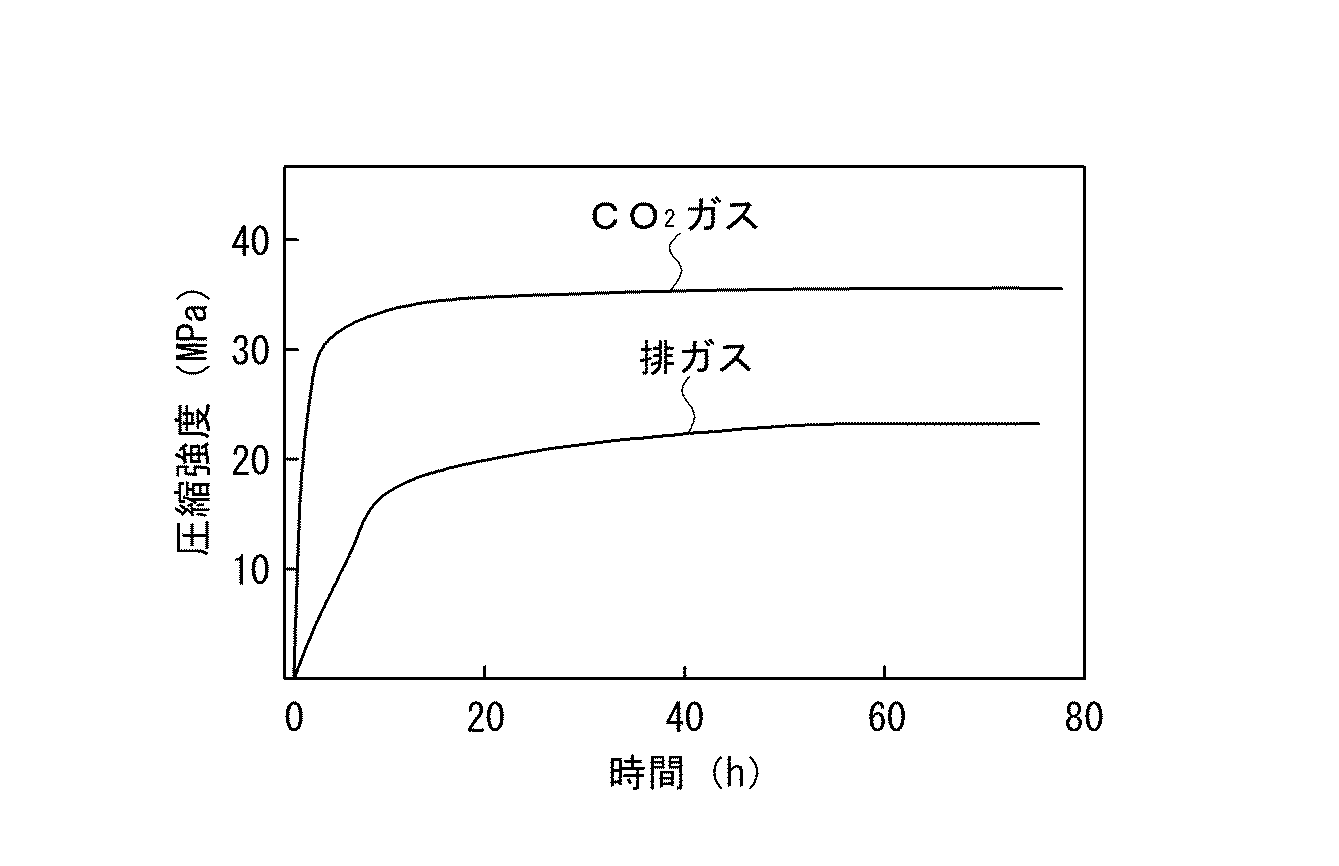
固化工程400において用いられるCO2を含むガスは、十分な圧縮強度を有するCO2固化体を得るという点から、少なくともCO2濃度が8体積%以上であることが好ましい。図2はCO2ガス(純度99.99体積%)と排ガス(CO2濃度が9体積%)を用いた場合のCO2固化体の固化時間と圧縮強度の関係を示すグラフである。図2のグラフに示すように、CO2ガスを用いた場合、処理時間が1〜2時間程度で、圧縮強度が25MPa以上に達している。これに対し、排ガスを用いた場合は、処理時間が4時間程度で、圧縮強度が5MPaを超え、50時間程度で20MPaに達している。
The gas containing CO 2 used in the
図3は、CO2固化体の炭素(C)含有量を種々変えた場合の、C含有量と圧縮強度の関係を示すグラフである。図3に示すグラフは、CO2固化が進みCaCO3成分が多くなる程、圧縮強度が高くなることを示している。図3のグラフに示すように、CO2固化体の圧縮強度を、5MPa以上に形成するには、固化体中のCaCO3に由来するC成分含有量を1.5質量%以上とすることが好ましい。 FIG. 3 is a graph showing the relationship between the C content and the compressive strength when the carbon (C) content of the CO 2 solidified body is variously changed. The graph shown in FIG. 3 shows that the compressive strength increases as the CO 2 solidification progresses and the CaCO 3 component increases. As shown in the graph of FIG. 3, in order to form the compressive strength of the CO 2 solidified body at 5 MPa or more, the C component content derived from CaCO 3 in the solidified body should be 1.5% by mass or more. preferable.
固化工程400でCO2固化されたCO2固化体は、必要に応じて乾燥等を行い、水分量を1.0質量%以下に調節して、造滓材2が得られる。
The CO 2 solidified body obtained by solidifying CO 2 in the solidifying step 400 is dried as necessary, and the water content is adjusted to 1.0% by mass or less to obtain the
図4は本発明造滓材を用いた製鋼方法の一例を示す工程図である。以下、還元スラグの処理方法及び製鋼方法について説明する。図4に示すように、製鋼方法は、先ず、電気炉10において溶鋼の酸化精錬(一次精錬500)を行う。次に、電気炉10から出鋼した溶鋼は溶鋼鍋14に移され、一次精錬500の際に発生した溶融状態の酸化スラグ11を、スラグ鍋12内に排出して酸化スラグ除去550を行う。排出した酸化スラグ11は、専用車両などで処理場に移送する。
FIG. 4 is a process diagram showing an example of a steel making method using the steelmaking material of the present invention. Hereinafter, the processing method of reduced slag and the steel making method will be described. As shown in FIG. 4, in the steelmaking method, first, an oxidative refining (primary refining 500) of molten steel is performed in an
還元精錬(二次精錬600)では、溶鋼が取鍋精錬炉15に移され、生石灰、CaF2、圧延スケール等を装入して成分調整し、二次精錬を行う。次に真空脱ガス装置16で脱ガスを行う。次に連続鋳造工程700では、取鍋精錬炉15に取鍋蓋17を設置し、連続鋳造装置18を用いて連続鋳造を行う。連続鋳造が終わったら、還元スラグ回収工程800で還元スラグ1を取り出して回収する。取り出した還元スラグ1は以下の処理方法により処理する。
In the reduction refining (secondary refining 600), the molten steel is transferred to the
取り出した還元スラグ1の処理方法は、図1に示す造滓材の製造方法で説明したように、還元スラグを冷却する冷却工程100、還元スラグに水分を接触させて脱硫して脱硫還元スラグとする脱硫工程200、脱硫還元スラグとFeO成分を混合する混合工程250、前記混合物を所定形状に成形して成形物とする成形工程300、及び前記成形物を二酸化炭素により固化させてCO2固化体とする固化工程400を順次行うものである。CO2固化体は造滓材2として用いられる。
The processing method of the reduced slag 1 taken out is the cooling
得られた造滓材2は、上記製鋼の工程で二次精錬の初期脱リン用造滓材として用いることができる。例えば造滓材2は、図4中矢印R1で示すように、二次精錬600工程で取鍋精錬炉15に初期脱リン用造滓材として装入して、生石灰、蛍石、及びスケールの代替品として利用できる。このように、製鋼工程で発生する還元スラグは、製鋼工程の造滓材として再利用することが可能である。
The obtained
以下、本発明の実施例を示す。
実施例1
製鋼工程で発生した溶融状態の還元スラグを取り出して、外気温まで冷却後、100〜110℃の水蒸気を7日間接触させて蒸気脱硫を行い、S成分が0.5質量%以下の脱硫還元スラグを得た。この脱硫還元スラグにミルスケールを加えて混合した混合物を得た。ミルスケールの添加量は、FeO成分が造滓材の21質量%になるようにした。次に図1に示すようなブリケット成形装置301を用いて、上記混合物に他の添加剤を加えずにブリケット成形し、直径35mm×高さ15mmの円筒状の成形体を得た。得られた成形体の圧縮強度は0.2MPaであった。次いで、この成形体をCO2濃度8%の排ガスを導入した容器内に載置して、CO2雰囲気下、常温で7時間CO2固化を行って、造滓材を得た。得られた造滓材の成分組成を表3に示す。また表4にこの造滓材の圧縮強度、C成分含有量、及び融点を示す。
Examples of the present invention will be described below.
Example 1
The molten reduced slag generated in the steelmaking process is taken out, cooled to the outside temperature, and then steam desulfurized by contacting with steam at 100 to 110 ° C. for 7 days, and the desulfurized reduced slag having an S component of 0.5% by mass or less. Got. A mill scale was added to the desulfurized and reduced slag and mixed to obtain a mixture. The amount of mill scale added was such that the FeO component was 21% by mass of the ironmaking material. Next, using a
実施例1の造滓材を製鋼の二次精錬(取鍋精錬)における初期脱リン用造滓材として使用して、従来の製鋼方法と比較した。その結果を表5に示す。取鍋精錬の初期脱リンでは、石灰500Kg、ホタル石500kg、及び圧延スケールを200kg装入し脱リンのための精錬を行ったところ、精錬前の鋼中のP成分含有量が0.035質量%であったのが、精錬後には0.026質量%まで減少した。これに対し、従来の石灰、蛍石、及び圧延スケールの代わりに実施例1の造滓材800kgを装入して、同様に精錬を行ったところ、精錬後の鋼中のP成分含有量は従来と同様に0.026質量%まで減少した。本発明の造滓材が、従来の脱リン用造滓材と同等の脱リン能力があることが確認できた。 The steelmaking material of Example 1 was used as a steelmaking material for initial dephosphorization in secondary refining of steelmaking (ladder refining), and compared with a conventional steelmaking method. The results are shown in Table 5. In the initial dephosphorization of ladle refining, when 200 kg of lime, 500 kg of fluorite, and 200 kg of rolling scale were charged and refining for dephosphorization was performed, the P component content in the steel before refining was 0.035 mass. %, But decreased to 0.026% by mass after refining. On the other hand, when 800 kg of the ironmaking material of Example 1 was charged instead of the conventional lime, fluorite, and rolling scale and refined in the same manner, the P component content in the steel after refining is It decreased to 0.026 mass% as before. It has been confirmed that the ironmaking material of the present invention has a dephosphorization ability equivalent to that of a conventional dephosphorizing ironmaking material.
1 還元スラグ
2 造滓材
100 冷却工程
200 脱硫工程
250 混合工程
300 成形工程
400 固化工程
500 一次精錬(酸化精錬)工程
550 酸化スラグ除去工程
600 二次精錬(還元精錬)工程
800 還元スラグ回収工程
DESCRIPTION OF SYMBOLS 1
Claims (6)
Priority Applications (1)
| Application Number | Priority Date | Filing Date | Title |
|---|---|---|---|
| JP2007194647A JP2009030102A (en) | 2007-07-26 | 2007-07-26 | Phosphorous removal material and method for producing the same |
Applications Claiming Priority (1)
| Application Number | Priority Date | Filing Date | Title |
|---|---|---|---|
| JP2007194647A JP2009030102A (en) | 2007-07-26 | 2007-07-26 | Phosphorous removal material and method for producing the same |
Publications (1)
| Publication Number | Publication Date |
|---|---|
| JP2009030102A true JP2009030102A (en) | 2009-02-12 |
Family
ID=40400923
Family Applications (1)
| Application Number | Title | Priority Date | Filing Date |
|---|---|---|---|
| JP2007194647A Pending JP2009030102A (en) | 2007-07-26 | 2007-07-26 | Phosphorous removal material and method for producing the same |
Country Status (1)
| Country | Link |
|---|---|
| JP (1) | JP2009030102A (en) |
Cited By (1)
| Publication number | Priority date | Publication date | Assignee | Title |
|---|---|---|---|---|
| CN115305313A (en) * | 2022-09-16 | 2022-11-08 | 宝武集团鄂城钢铁有限公司 | Converter slag melting agent and preparation method and application thereof |
-
2007
- 2007-07-26 JP JP2007194647A patent/JP2009030102A/en active Pending
Cited By (1)
| Publication number | Priority date | Publication date | Assignee | Title |
|---|---|---|---|---|
| CN115305313A (en) * | 2022-09-16 | 2022-11-08 | 宝武集团鄂城钢铁有限公司 | Converter slag melting agent and preparation method and application thereof |
Similar Documents
| Publication | Publication Date | Title |
|---|---|---|
| JP5573403B2 (en) | Method for recycling steelmaking slag and raw material for phosphate fertilizer | |
| TW200948980A (en) | Producing method of reduced iron | |
| WO2002092537A1 (en) | Material for phosphate fertilizer and method for production thereof | |
| JP2008120607A (en) | Steelmaking slag treatment method | |
| JP4196997B2 (en) | Hot metal processing method | |
| EP0249093A2 (en) | Flux material for steelmaking | |
| JP2009030103A (en) | Deoxidizing ironmaking material and method for producing the same | |
| JP2009030102A (en) | Phosphorous removal material and method for producing the same | |
| JP6201736B2 (en) | Method for producing sintered ore using desulfurized slag | |
| JP5200442B2 (en) | Steelmaking material, steelmaking material manufacturing method, reduced slag processing method, and steelmaking method | |
| CN116042963B (en) | Method for preparing refining slagging agent from casting slag | |
| JP3500975B2 (en) | Method for producing soluble potassium fertilizer | |
| JPH11106821A (en) | Method for producing agglomerate raw material for steelmaking | |
| JP2001348610A (en) | Slag accelerator | |
| CA2630236C (en) | Method for manufacturing metallic iron | |
| KR101863916B1 (en) | Composition of Steelmaking Flux for Desulfurization and Deoxidation Using By-proudut of Magnesium Smelting Process and Waste By-product of Aluminum Smelting Process | |
| JP3263364B2 (en) | Desulfurization and defluoridation of neutralized sludge | |
| JP2009062222A (en) | Aggregate using reduced slag and method for producing the same | |
| JP3606107B2 (en) | Method for producing stabilizer | |
| JP2000185987A (en) | Method for producing slow-release potash fertilizer | |
| JP4637528B2 (en) | Molten iron making material and method of using the same | |
| JPS5819729B2 (en) | Seikorohekiyoukiyuusuruni Textile Kiyoukakaijiyoutaino Seikomirhaikibutsudustkarano Seizouhou | |
| JPH1171611A (en) | Lime flux for smelting metal | |
| TWI398525B (en) | De-sulfur agent for ladle furnace of refining process and method for removing sulfur from the molten steel in ladle furnace | |
| JP2757707B2 (en) | Hot metal dephosphorization slag treatment method |