JP2009059604A - HYBRID MEMBRANE FOR SOLID POLYMER FUEL CELL, PROCESS FOR PRODUCING THE SAME, MEMBRANE-ELECTRODE ASSEMBLE, PROCESS FOR PRODUCING THE SAME, AND SOLID POLYMER TYPE FUEL CELL - Google Patents
HYBRID MEMBRANE FOR SOLID POLYMER FUEL CELL, PROCESS FOR PRODUCING THE SAME, MEMBRANE-ELECTRODE ASSEMBLE, PROCESS FOR PRODUCING THE SAME, AND SOLID POLYMER TYPE FUEL CELL Download PDFInfo
- Publication number
- JP2009059604A JP2009059604A JP2007226410A JP2007226410A JP2009059604A JP 2009059604 A JP2009059604 A JP 2009059604A JP 2007226410 A JP2007226410 A JP 2007226410A JP 2007226410 A JP2007226410 A JP 2007226410A JP 2009059604 A JP2009059604 A JP 2009059604A
- Authority
- JP
- Japan
- Prior art keywords
- polymer electrolyte
- membrane
- electrolyte membrane
- fuel cell
- fluorine
- Prior art date
- Legal status (The legal status is an assumption and is not a legal conclusion. Google has not performed a legal analysis and makes no representation as to the accuracy of the status listed.)
- Pending
Links
Images


Classifications
-
- Y—GENERAL TAGGING OF NEW TECHNOLOGICAL DEVELOPMENTS; GENERAL TAGGING OF CROSS-SECTIONAL TECHNOLOGIES SPANNING OVER SEVERAL SECTIONS OF THE IPC; TECHNICAL SUBJECTS COVERED BY FORMER USPC CROSS-REFERENCE ART COLLECTIONS [XRACs] AND DIGESTS
- Y02—TECHNOLOGIES OR APPLICATIONS FOR MITIGATION OR ADAPTATION AGAINST CLIMATE CHANGE
- Y02E—REDUCTION OF GREENHOUSE GAS [GHG] EMISSIONS, RELATED TO ENERGY GENERATION, TRANSMISSION OR DISTRIBUTION
- Y02E60/00—Enabling technologies; Technologies with a potential or indirect contribution to GHG emissions mitigation
- Y02E60/30—Hydrogen technology
- Y02E60/50—Fuel cells
-
- Y—GENERAL TAGGING OF NEW TECHNOLOGICAL DEVELOPMENTS; GENERAL TAGGING OF CROSS-SECTIONAL TECHNOLOGIES SPANNING OVER SEVERAL SECTIONS OF THE IPC; TECHNICAL SUBJECTS COVERED BY FORMER USPC CROSS-REFERENCE ART COLLECTIONS [XRACs] AND DIGESTS
- Y02—TECHNOLOGIES OR APPLICATIONS FOR MITIGATION OR ADAPTATION AGAINST CLIMATE CHANGE
- Y02P—CLIMATE CHANGE MITIGATION TECHNOLOGIES IN THE PRODUCTION OR PROCESSING OF GOODS
- Y02P70/00—Climate change mitigation technologies in the production process for final industrial or consumer products
- Y02P70/50—Manufacturing or production processes characterised by the final manufactured product
Landscapes
- Fuel Cell (AREA)
- Laminated Bodies (AREA)
- Conductive Materials (AREA)
Abstract
【課題】高分子電解質膜のガス遮断性の問題と高分子電解質膜の化学耐久性(耐ラジカル性)の両者を同時に解決する高分子電解質膜を提供する。
【解決手段】フッ素系高分子電解質膜と炭化水素系高分子電解質膜が溶融圧着で一体化された固体高分子型燃料電池用ハイブリッド膜。特に、フッ素系高分子電解質膜が、加水分解によりプロトン伝導性を発揮する高分子電解質前駆体(F型高分子電解質)からなる固体高分子型燃料電池用ハイブリッド膜。
【選択図】図1The present invention provides a polymer electrolyte membrane that solves both the gas barrier property of the polymer electrolyte membrane and the chemical durability (radical resistance) of the polymer electrolyte membrane at the same time.
A hybrid membrane for a polymer electrolyte fuel cell in which a fluorine polymer electrolyte membrane and a hydrocarbon polymer electrolyte membrane are integrated by fusion bonding. In particular, a hybrid membrane for a solid polymer fuel cell, in which the fluorine polymer electrolyte membrane comprises a polymer electrolyte precursor (F type polymer electrolyte) that exhibits proton conductivity by hydrolysis.
[Selection] Figure 1
Description
本発明は、固体高分子型燃料電池用ハイブリッド膜、その製造方法、固体高分子型燃料電池に使用可能なイオン交換膜の両面に触媒担持ガス拡散電極が接合された膜−電極接合体、その製造方法、及びそれを有する固体高分子型燃料電池に関する。 The present invention relates to a hybrid membrane for a polymer electrolyte fuel cell, a method for producing the same, a membrane-electrode assembly in which a catalyst-carrying gas diffusion electrode is bonded to both surfaces of an ion exchange membrane that can be used in a polymer electrolyte fuel cell, The present invention relates to a manufacturing method and a polymer electrolyte fuel cell having the same.
固体高分子型燃料電池は、将来の新エネルギー技術の柱の一つとして期待されている。電解質として高分子からなるイオン交換膜を用いた固体高分子型燃料電池(PEFCまたはPEMFC)は、低温における作動、小型軽量化が可能などの特徴から、自動車などの移動体および民生用携帯機器への適用が検討されている。特に、固体高分子型燃料電池を搭載した燃料電池自動車は究極のエコロジーカーとして社会的な関心が高まっている。 Solid polymer fuel cells are expected as one of the pillars of future new energy technologies. A polymer electrolyte fuel cell (PEFC or PEMFC) using an ion exchange membrane made of a polymer as an electrolyte can be operated at a low temperature and can be reduced in size and weight. The application of is being considered. In particular, fuel cell vehicles equipped with polymer electrolyte fuel cells are gaining social interest as the ultimate ecological car.
固体高分子電解質は、高分子鎖中にスルホン酸基等の電解質基を有する固体高分子材料であり、特定のイオンと強固に結合したり、陽イオン又は陰イオンを選択的に透過する性質を有している。特に、パーフルオロスルホン酸膜に代表されるフッ素系電解質膜は、化学的安定性が非常に高いことから、過酷な条件下で使用される燃料電池用イオン交換膜として賞用されている。 A solid polymer electrolyte is a solid polymer material having an electrolyte group such as a sulfonic acid group in a polymer chain, and has a property of binding firmly to a specific ion or selectively transmitting a cation or an anion. Have. In particular, a fluorine-based electrolyte membrane typified by a perfluorosulfonic acid membrane is awarded as an ion exchange membrane for fuel cells used under severe conditions because of its very high chemical stability.
例えば、改質ガス燃料電池は、プロトン伝導性のイオン交換膜の両面に一対の電極を設け、メタン、メタノール等、低分子の炭化水素を改質することにより得られる水素ガスを燃料ガスとして一方の電極(燃料極)へ供給し、酸素ガスあるいは空気を酸化剤として異なる電極(空気極)へ供給し、起電力を得るものである。 For example, a reformed gas fuel cell is provided with a pair of electrodes on both sides of a proton-conductive ion exchange membrane and hydrogen gas obtained by reforming low-molecular hydrocarbons such as methane and methanol as fuel gas. Is supplied to the other electrode (fuel electrode), and oxygen gas or air is supplied as an oxidizing agent to a different electrode (air electrode) to obtain an electromotive force.
燃料電池の場合、イオン交換膜と電極の界面に形成された触媒層において過酸化物が生成し、生成した過酸化物が拡散しながら過酸化物ラジカルとなって劣化反応を起こすので、耐酸化性に乏しい炭化水素系電解質膜を使用することができない。そのため、燃料電池や水電解においては、一般に、高いプロトン伝導性を有するパーフルオロスルホン酸膜が用いられている。 In the case of a fuel cell, peroxide is generated in the catalyst layer formed at the interface between the ion exchange membrane and the electrode, and the generated peroxide diffuses into a peroxide radical to cause a degradation reaction. It is impossible to use a hydrocarbon-based electrolyte membrane having poor properties. Therefore, perfluorosulfonic acid membranes having high proton conductivity are generally used in fuel cells and water electrolysis.
現在、固体高分子型燃料電池に使用されるイオン交換膜としては、デュポン社のナフィオン(登録商標)、旭硝子社のフレミオン(登録商標)、旭化成社のアシプレックス(登録商標)に代表されるパーフルオロカーボンスルホン酸膜が用いられている。
これらのイオン交換膜を固体高分子型燃料電池に適用するには、燃料の酸化能、酸化剤の還元能を有する触媒を、前記イオン交換膜の両面にそれぞれ配置し、その外側にガス拡散電極を配置した構造の膜−電極接合体を用いる。
Currently, as ion exchange membranes used in polymer electrolyte fuel cells, Nafion (registered trademark) from DuPont, Flemion (registered trademark) from Asahi Glass, and Aciplex (registered trademark) from Asahi Kasei. A fluorocarbon sulfonic acid membrane is used.
In order to apply these ion exchange membranes to a polymer electrolyte fuel cell, a catalyst having a fuel oxidizing ability and an oxidizing agent reducing ability is disposed on both sides of the ion exchange membrane, and a gas diffusion electrode is provided outside thereof. Is used.
即ち、その構造は、水素イオンを選択的に輸送する高分子電解質膜からなるイオン交換膜の両面に、白金系の金属触媒を担持したカーボン粉末を主成分とする触媒反応層を形成する。次に、触媒反応層の外面に、燃料ガスの通気性と電子伝導性を併せ持つ、ガス拡散層を形成する。一般的にガス拡散層には、カーボンペーパーまたはカーボンクロスが用いられている。前述した触媒反応層とガス拡散層とを併せて電極と呼ぶ。 That is, the structure forms a catalytic reaction layer mainly composed of carbon powder carrying a platinum-based metal catalyst on both surfaces of an ion exchange membrane made of a polymer electrolyte membrane that selectively transports hydrogen ions. Next, a gas diffusion layer having both fuel gas permeability and electronic conductivity is formed on the outer surface of the catalytic reaction layer. Generally, carbon paper or carbon cloth is used for the gas diffusion layer. The catalyst reaction layer and the gas diffusion layer described above are collectively referred to as an electrode.
次に、供給する燃料ガスのリーク、及び二種類の燃料ガスの混合防止に、ガスシール材やガスケットを電極周囲にイオン交換膜を挟む形で配置する。このガスシール材やガスケットと、電極及びイオン交換膜と一体化して予め組み立て、膜−電極接合体(MEA:Membrane−Electrode−Assembly)と呼ぶ。 Next, in order to prevent leakage of the fuel gas to be supplied and to prevent mixing of the two types of fuel gas, a gas seal material and a gasket are arranged around the electrode with an ion exchange membrane interposed therebetween. This gas seal material or gasket is integrated with an electrode and an ion exchange membrane and assembled in advance, and is called a membrane-electrode assembly (MEA).
MEAの外側には、これを機械的に固定するとともに、隣接したMEAを互いに電気的に直列で接続するための導電性と気密性を有するセパレータを配置する。セパレータのMEAと接触する部分には、電極面に反応ガスを供給し、生成ガスや余剰ガスを運び去るためのガス流路を形成する。ガス流路はセパレータと別に設けることもできるが、セパレータの表面に溝を設けてガス流路とする方法が一般的である。この一対のセパレータでMEAを固定した構造を基本単位である単電池とする。 On the outside of the MEA, a separator having electrical conductivity and airtightness for mechanically fixing the MEA and electrically connecting adjacent MEAs to each other in series is disposed. In the portion of the separator that contacts the MEA, a reaction gas is supplied to the electrode surface to form a gas flow path for carrying away the generated gas and surplus gas. Although the gas channel can be provided separately from the separator, a method of providing a gas channel by providing a groove on the surface of the separator is generally used. A structure in which the MEA is fixed by the pair of separators is referred to as a unit cell as a basic unit.
この単電池を直列に複数連結し、燃料ガスを供給する配管治具であるマニホールドを配置し、燃料電池が構成される。 A plurality of the unit cells are connected in series, and a manifold which is a piping jig for supplying fuel gas is arranged to constitute a fuel cell.
ところで、固体高分子形燃料電池(PEFC)は発電時において、(1)アノード側のH2ガスが膜を透過してカソード触媒上でO2ガスと直接反応し、セル性能が低下するという問題と、(2)カソード側の副反応で生成するH2O2により電解質膜が化学劣化し、セル耐久性が低下するという問題があった。 By the way, in the polymer electrolyte fuel cell (PEFC), during power generation, (1) the H 2 gas on the anode side permeates through the membrane and directly reacts with the O 2 gas on the cathode catalyst, resulting in a decrease in cell performance. (2) There was a problem that the electrolyte membrane was chemically deteriorated by H 2 O 2 generated by the side reaction on the cathode side, and the cell durability was lowered.
上記問題が起こる理由として、(1)は膜のガス遮断性の問題、(2)は膜の化学耐久性(耐ラジカル性)の問題が挙げられる。 The reason why the above problem occurs is that (1) is a problem of gas barrier property of the film, and (2) is a problem of chemical durability (radical resistance) of the film.
現在PEFC用電解質膜の主流になっているものとして、炭化水素系電解質膜とフッ素系電解質膜の二者が挙げられる。炭化水素系電解質膜はガス遮断性に優れるが耐ラジカル性に乏しく、一方フッ素系電解質膜は逆に耐ラジカル性に優れるもののガス遮断性が乏しい。すなわち現状では上記2つの問題を同時に解決する様な都合の良い膜が存在しない。 The two mainstream electrolyte membranes for PEFC are hydrocarbon electrolyte membranes and fluorine electrolyte membranes. Hydrocarbon electrolyte membranes have excellent gas barrier properties but poor radical resistance. On the other hand, fluorine electrolyte membranes have excellent radical resistance but poor gas barrier properties. That is, there is no convenient film that can solve the above two problems at the same time.
これら炭化水素系電解質膜とフッ素系電解質膜の特性を下記表1に示す。 The characteristics of these hydrocarbon electrolyte membrane and fluorine electrolyte membrane are shown in Table 1 below.

現状では化学耐久性とガス遮断性の両方に優れた膜が無い。 At present, there is no film excellent in both chemical durability and gas barrier properties.
パーフルオロスルホン酸膜に代表されるフッ素系電解質膜は、C−F結合を有しているために化学的安定性が非常に高く、上述した燃料電池用の他、食塩電解用イオン交換膜、ハロゲン化水素酸電解用の固体高分子電解質膜としても用いられ、さらにはプロトン伝導性を利用して、湿度センサ、ガスセンサ、酸素濃縮器等にも広く応用されているものである。 A fluorine-based electrolyte membrane typified by a perfluorosulfonic acid membrane has a very high chemical stability because it has a C—F bond. In addition to the fuel cell described above, an ion exchange membrane for salt electrolysis, It is also used as a solid polymer electrolyte membrane for hydrohalic acid electrolysis, and further applied to humidity sensors, gas sensors, oxygen concentrators, etc. by utilizing proton conductivity.
しかしながら、フッ素系電解質は製造が困難で、非常に高価であること、耐熱性が低いという欠点がある。そのため、フッ素系電解質膜は、自動車用の低公害動力源としての固体高分子型燃料電池等、民生用への応用を困難なものとしていた。 However, the fluorine-based electrolyte is difficult to manufacture, has a drawback that it is very expensive and has low heat resistance. Therefore, the fluorine-based electrolyte membrane has been difficult to be applied to consumer use such as a polymer electrolyte fuel cell as a low-pollution power source for automobiles.
これに対し、炭化水素系電解質膜は、ナフィオンに代表されるフッ素系電解質膜と比較すると、製造が容易で低コストという利点がある。そこで、フッ素系電解質膜と同等以上の耐酸化性を有し、しかも低コストで製造可能な固体高分子電解質膜を得るために、従来から種々の試みがなされている。 On the other hand, the hydrocarbon-based electrolyte membrane has advantages in that it is easy to manufacture and low in cost as compared with a fluorine-based electrolyte membrane represented by Nafion. Therefore, various attempts have been made in the past to obtain a solid polymer electrolyte membrane that has oxidation resistance equivalent to or higher than that of a fluorine-based electrolyte membrane and can be produced at low cost.
例えば、下記特許文献1には、炭化フッ素系ビニルモノマと炭化水素系ビニルモノマとの共重合によって作られた主鎖と、スルホン酸基を有する炭化水素系側鎖とから構成される、スルホン酸型ポリスチレン−グラフト−エチレン−テトラフルオロエチレン共重合体(ETFE)膜が提案されている。また、前述したスルホン酸型ポリスチレン−グラフト−ETFE膜に類似のスルホン酸型ポリスチレングラフト樹脂膜に架橋を導入することにより、酸化劣化時の低分子量成分の脱離を抑制し、燃料電池用の電解質膜としての耐久性を向上させる試みがなされている。 For example, the following Patent Document 1 discloses a sulfonic acid type polystyrene composed of a main chain made by copolymerization of a fluorocarbon vinyl monomer and a hydrocarbon vinyl monomer, and a hydrocarbon side chain having a sulfonic acid group. -Graft-ethylene-tetrafluoroethylene copolymer (ETFE) membranes have been proposed. In addition, by introducing a crosslink into a sulfonic acid type polystyrene graft resin membrane similar to the sulfonic acid type polystyrene-graft-ETFE membrane described above, desorption of low molecular weight components during oxidative degradation is suppressed, and an electrolyte for a fuel cell Attempts have been made to improve the durability of the membrane.
また、下記特許文献2及び3には、炭化フッ素系ビニルモノマと炭化水素系ビニルモノマとの共重合によって作られた膜に、α,β,β−トリフルオロスチレンをグラフト重合させ、これにスルホン酸基を導入して固体高分子電解質膜とした、スルホン酸型ポリ(トリフルオロスチレン)−グラフト−ETFE膜が提案されている。これは、前記のスルホン酸基を導入したポリスチレン側鎖部の化学的安定性が十分ではないとの認識を前提に、スチレンの代わりに、スチレンをフッ素化したα,β,β-トリフルオロスチレンを用いたものである。 Further, in Patent Documents 2 and 3 below, α, β, β-trifluorostyrene is graft-polymerized on a film made by copolymerization of a fluorocarbon vinyl monomer and a hydrocarbon vinyl monomer, and a sulfonic acid group is added thereto. A sulfonic acid type poly (trifluorostyrene) -graft-ETFE membrane has been proposed in which a solid polymer electrolyte membrane is introduced. This is based on the recognition that the chemical stability of the polystyrene side chain introduced with the sulfonic acid group is not sufficient, instead of styrene, α, β, β-trifluorostyrene obtained by fluorinating styrene. Is used.
この他、炭化水素系イオン交換膜としては、スルホン化ポリエーテルエーテルケトン(下記特許文献4など)、スルホン化ポリエーテルスルホン(下記特許文献5など)、スルホン化ポリスルホン(下記特許文献6など)、スルホン化ポリフェニレンサルファイド(下記特許文献7など)やスルホン化ポリイミド(下記特許文献8など)などの耐熱芳香族高分子のスルホン化物、また、SEBS(スチレン−(エチレン−ブチレン)−スチレンの略)のスルホン化物(下記特許文献9など)、プロトン伝導性付与剤と有機高分子化合物の複合材料からなるプロトン伝導性膜(下記特許文献10など)なども提案されている。 In addition, as the hydrocarbon-based ion exchange membrane, sulfonated polyether ether ketone (the following Patent Document 4 etc.), sulfonated polyethersulfone (the following Patent Document 5 etc.), sulfonated polysulfone (the following Patent Document 6 etc.), Sulfonated heat-resistant aromatic polymers such as sulfonated polyphenylene sulfide (such as Patent Document 7 below) and sulfonated polyimide (such as Patent Document 8 below), and SEBS (styrene- (ethylene-butylene) -styrene). Proton conductive membranes (such as Patent Document 10 below) composed of a sulfonated product (such as Patent Document 9 below) and a composite material of a proton conductivity-imparting agent and an organic polymer compound have also been proposed.
しかしながら、これらの炭化水素系イオン交換膜については、高伝導度が要求され、スルホン酸基を多く含み、高伝導性を発揮するためには、加湿する必要があるにも関わらず、加湿のために、含水膨潤しやすいという性質があった。そのため発電時に加湿を行なう際に、炭化水素系イオン交換膜が膨潤し、イオン交換膜と電極触媒層の剥離が起こるという問題があった。 However, these hydrocarbon ion exchange membranes are required to have high conductivity, contain many sulfonic acid groups, and need to be humidified in order to exhibit high conductivity. In addition, it has the property of being easily swelled with water. Therefore, when humidifying during power generation, the hydrocarbon-based ion exchange membrane swells, and there is a problem that the ion exchange membrane and the electrode catalyst layer are separated.
本発明は、高分子電解質膜のガス遮断性の問題と高分子電解質膜の化学耐久性(耐ラジカル性)の両者を同時に解決する高分子電解質膜を提供することを目的とする。 An object of this invention is to provide the polymer electrolyte membrane which solves both the gas barrier property of a polymer electrolyte membrane, and the chemical durability (radical resistance) of a polymer electrolyte membrane simultaneously.
本発明者は、炭化水素系高分子電解質膜とフッ素系高分子電解質膜の両者の長所である、炭化水素系高分子電解質膜はガス遮断性に優れ、フッ素系高分子電解質膜は耐ラジカル性に優れることに着目し、両者を組み合わせることで、上記の問題を同時に解決する優れた電解質膜が得られることを見出し、本発明に到達した。 The inventor has the advantages of both hydrocarbon polymer electrolyte membranes and fluorine polymer electrolyte membranes. Hydrocarbon polymer electrolyte membranes have excellent gas barrier properties, and fluorine polymer electrolyte membranes have radical resistance. The present inventors have found that an excellent electrolyte membrane that can solve the above-mentioned problems simultaneously can be obtained by combining the two.
即ち、第1に、本発明は、固体高分子型燃料電池用ハイブリッド膜の発明であり、フッ素系高分子電解質膜と炭化水素系高分子電解質膜が溶融圧着で一体化されたハイブリッド膜である。 That is, first, the present invention is an invention of a hybrid membrane for a polymer electrolyte fuel cell, which is a hybrid membrane in which a fluorine-based polymer electrolyte membrane and a hydrocarbon-based polymer electrolyte membrane are integrated by fusion bonding. .
前記フッ素系高分子電解質膜としては、加水分解によりプロトン伝導性を発揮する高分子電解質前駆体(F型高分子電解質)でも、既にプロトン伝導性基を有する高分子電解質(H型高分子電解質)でも良いが、後述するように溶融圧着性と溶融温度の点で、本発明には加水分解によりプロトン伝導性を発揮する高分子電解質前駆体(F型高分子電解質)が好ましい。 As the fluorine-based polymer electrolyte membrane, a polymer electrolyte precursor (F-type polymer electrolyte) that exhibits proton conductivity by hydrolysis, or a polymer electrolyte that already has a proton-conducting group (H-type polymer electrolyte) However, as will be described later, from the viewpoints of melt-bonding property and melting temperature, a polymer electrolyte precursor (F-type polymer electrolyte) that exhibits proton conductivity by hydrolysis is preferred in the present invention.
第2に、本発明は、上記の固体高分子型燃料電池用ハイブリッド膜の製造方法の発明であり、フッ素系高分子電解質膜と炭化水素系高分子電解質膜を溶融圧着(ホットプレス)して一体化することを特徴とする。 Second, the present invention is an invention of a method for producing a hybrid membrane for a solid polymer fuel cell as described above, wherein a fluorine-based polymer electrolyte membrane and a hydrocarbon-based polymer electrolyte membrane are melt-bonded (hot pressed). It is characterized by being integrated.
フッ素系高分子電解質膜として、加水分解によりプロトン伝導性を発揮する高分子電解質前駆体(F型高分子電解質)が好ましいことは上述の通りである。 As described above, as the fluorine-based polymer electrolyte membrane, a polymer electrolyte precursor (F-type polymer electrolyte) that exhibits proton conductivity by hydrolysis is preferable.
−SO3H基を有するフッ素系高分子電解質膜(H型高分子電解質)は、ガラス転移点が約90℃であり、熱分解点が150℃前後である。一方、炭化水素系高分子電解質膜はガラス転移200℃以上と硬い。両者の接着性を良くする為には200℃以上で溶融圧着したいが、フッ素系高分子電解質膜の熱分解点が150℃なのでそれが出来ない。もし、フッ素系高分子電解質膜(H型高分子電解質)を用いて200℃以上で溶融圧着すると、部分的にフッ素高分子電解質系膜の熱分解が発生し、両者の界面抵抗が増大し、発電性能低下の原因になる。そこで、本発明のハイブリッド膜の製造方法では、溶融圧着(ホットプレス)を200℃以上の温度で行うことが可能となり、両者の接着性を向上させることが出来る。 The fluorine-based polymer electrolyte membrane (H-type polymer electrolyte) having —SO 3 H groups has a glass transition point of about 90 ° C. and a thermal decomposition point of about 150 ° C. On the other hand, the hydrocarbon polymer electrolyte membrane is hard with a glass transition of 200 ° C. or higher. In order to improve the adhesiveness between the two, it is desired to perform melt-compression bonding at 200 ° C. or higher. If a fluorine-based polymer electrolyte membrane (H-type polymer electrolyte) is melt-bonded at 200 ° C. or higher, thermal decomposition of the fluorine-based polymer electrolyte membrane partially occurs, and the interface resistance between the two increases. It may cause a decrease in power generation performance. Therefore, in the method for producing a hybrid film of the present invention, it is possible to perform melt compression bonding (hot pressing) at a temperature of 200 ° C. or higher, and to improve the adhesion between them.
第3に、本発明は、一対の電極触媒層と、電極触媒層に挟持された高分子電解質膜とからなる固体高分子型燃料電池用膜−電極接合体(MEA)の発明であって、前記高分子電解質膜は、カソード側にフッ素系高分子電解質膜が配され、アノード側に炭化水素系高分子電解質膜が配され、これらフッ素系高分子電解質膜と炭化水素系高分子電解質膜が溶融圧着で一体化されたハイブリッド膜であることを特徴とする。 Third, the present invention is an invention of a membrane-electrode assembly (MEA) for a polymer electrolyte fuel cell comprising a pair of electrode catalyst layers and a polymer electrolyte membrane sandwiched between the electrode catalyst layers, The polymer electrolyte membrane has a fluorine polymer electrolyte membrane on the cathode side and a hydrocarbon polymer electrolyte membrane on the anode side. The fluorine polymer electrolyte membrane and the hydrocarbon polymer electrolyte membrane are It is a hybrid film integrated by melt-bonding.
フッ素系高分子電解質膜として、加水分解によりプロトン伝導性を発揮する高分子電解質前駆体(F型高分子電解質)が好ましいことは上述の通りである。 As described above, as the fluorine-based polymer electrolyte membrane, a polymer electrolyte precursor (F-type polymer electrolyte) that exhibits proton conductivity by hydrolysis is preferable.
第4に、本発明は、一対の電極触媒層と、電極触媒層に挟持された高分子電解質膜とからなる固体高分子型燃料電池用膜−電極接合体(MEA)の製造方法の発明であって、カソード側にフッ素系高分子電解質膜を配し、アノード側に炭化水素系高分子電解質膜を配し、これらフッ素系高分子電解質膜と炭化水素系高分子電解質膜を溶融圧着(ホットプレス)して一体化することを特徴とする。 Fourth, the present invention is an invention of a method for producing a membrane-electrode assembly (MEA) for a polymer electrolyte fuel cell comprising a pair of electrode catalyst layers and a polymer electrolyte membrane sandwiched between the electrode catalyst layers. A fluorine-based polymer electrolyte membrane on the cathode side and a hydrocarbon-based polymer electrolyte membrane on the anode side, and these fluorine-based polymer electrolyte membrane and hydrocarbon-based polymer electrolyte membrane are melt-bonded (hot) It is characterized by being pressed and integrated.
第5に、本発明は、一対の電極触媒層と、電極触媒層に挟持された高分子電解質膜とからなる固体高分子型燃料電池用膜−電極接合体(MEA)の製造方法の発明であって、カソード側にフッ素系高分子電解質膜を配し、アノード側に炭化水素系高分子電解質膜を配し、これらフッ素系高分子電解質膜と炭化水素系高分子電解質膜からなる高分子電解質膜の両側を、一対の電極触媒層で挟持し、溶融圧着(ホットプレス)して一体化することを特徴とする。この発明では、固体高分子型燃料電池用膜−電極接合体の製造において、フッ素系高分子電解質膜と炭化水素系高分子電解質膜だけでなく、同時に一対の電極触媒層をも溶融圧着(ホットプレス)する。 Fifth, the present invention is an invention of a method for producing a membrane-electrode assembly (MEA) for a polymer electrolyte fuel cell comprising a pair of electrode catalyst layers and a polymer electrolyte membrane sandwiched between the electrode catalyst layers. A polymer electrolyte membrane comprising a fluorine polymer electrolyte membrane on the cathode side and a hydrocarbon polymer electrolyte membrane on the anode side, and comprising the fluorine polymer electrolyte membrane and the hydrocarbon polymer electrolyte membrane. It is characterized in that both sides of the membrane are sandwiched between a pair of electrode catalyst layers, and are integrated by fusion bonding (hot pressing). In this invention, in the production of a membrane-electrode assembly for a solid polymer fuel cell, not only a fluorine-based polymer electrolyte membrane and a hydrocarbon-based polymer electrolyte membrane, but also a pair of electrode catalyst layers are melt-bonded (hot-pressed) simultaneously. Press).
フッ素系高分子電解質膜が、加水分解によりプロトン伝導性を発揮する高分子電解質前駆体(F型高分子電解質)が好ましいことは上述の通りである。 As described above, the fluorine-based polymer electrolyte membrane is preferably a polymer electrolyte precursor (F-type polymer electrolyte) that exhibits proton conductivity by hydrolysis.
第6に、本発明は、上記の膜−電極接合体を有する固体高分子型燃料電池である。 Sixth, the present invention is a polymer electrolyte fuel cell having the membrane-electrode assembly described above.
本発明の、高分子電解質膜は、カソード側にフッ素系高分子電解質膜が配され、アノード側に炭化水素系高分子電解質膜が配され、これらフッ素系高分子電解質膜と炭化水素系高分子電解質膜が溶融圧着で一体化されたハイブリッド膜を用いることで、燃料電池運転時のカソード側での透過水素と酸素の直接反応による電圧降下を抑制するとともに、カソード近傍の電解質化学劣化を抑制する。これにより、燃料電池の出力性能及び耐久性能が向上する。特に、電流密度及びイオン伝導度を維持しつつ、耐久後の出力電圧を向上させる。 The polymer electrolyte membrane of the present invention has a fluorine polymer electrolyte membrane on the cathode side and a hydrocarbon polymer electrolyte membrane on the anode side. These fluorine polymer electrolyte membrane and hydrocarbon polymer By using a hybrid membrane in which the electrolyte membrane is integrated by melt compression, voltage drop due to direct reaction between permeated hydrogen and oxygen on the cathode side during fuel cell operation is suppressed, and electrolyte chemical degradation near the cathode is suppressed. . Thereby, the output performance and durability performance of the fuel cell are improved. In particular, the output voltage after durability is improved while maintaining the current density and ionic conductivity.
又、フッ素系高分子電解質膜と炭化水素系高分子電解質膜が溶融圧着で一体化する際に、フッ素系高分子電解質前駆体を高温溶融圧着することにより両者の界面抵抗が減少し、性能が向上する。 In addition, when the fluoropolymer electrolyte membrane and the hydrocarbon polymer electrolyte membrane are integrated by melt-bonding, the interfacial resistance between the two decreases by high-temperature melt-bonding of the fluoropolymer electrolyte precursor. improves.
図1に、本発明の膜−電極接合体(MEA)の模式図を示す。図1に示すように、炭化水素系高分子電解質膜とフッ素系高分子電解質膜を貼り合せて、ハイブリッド電解質膜を作製する。両高分子電解質の長所を利用し、電池性能向上を実現する。即ち、アノード側に炭化水素系膜を配置し、H2透過を抑制するとともに、カソード側にフッ素系膜を配置し、化学劣化を抑制する。 In FIG. 1, the schematic diagram of the membrane-electrode assembly (MEA) of this invention is shown. As shown in FIG. 1, a hydrocarbon-based polymer electrolyte membrane and a fluorine-based polymer electrolyte membrane are bonded together to produce a hybrid electrolyte membrane. Utilizing the advantages of both polymer electrolytes to improve battery performance. That is, a hydrocarbon-based film is disposed on the anode side to suppress H 2 permeation, and a fluorine-based film is disposed on the cathode side to suppress chemical deterioration.
図2に、本発明のハイブリッド電解質膜の作製の一例を示す。図2では、フッ素系高分子電解質膜として既にプロトン交換基−SO3H基を有するフッ素系電解質膜(H型高分子電解質)を用い、該H型高分子電解質膜と炭化水素系高分子電解質膜をホットプレスによる溶融圧着する。この場合、H型高分子電解質は、ガラス転移点が約90℃であり、熱分解点が150℃前後である。一方、炭化水素系電解質膜はガラス転移200℃以上と硬い。両者の接着性を良くする為には200℃以上で溶融圧着したいが、フッ素電解質系膜の熱分解点が150℃なのでそれが出来ないという問題は残る。 FIG. 2 shows an example of the production of the hybrid electrolyte membrane of the present invention. In FIG. 2, a fluorine-based electrolyte membrane (H-type polymer electrolyte) having a proton exchange group-SO 3 H group is already used as the fluorine-based polymer electrolyte membrane, and the H-type polymer electrolyte membrane and the hydrocarbon-based polymer electrolyte are used. The film is melt bonded by hot pressing. In this case, the H-type polymer electrolyte has a glass transition point of about 90 ° C. and a thermal decomposition point of about 150 ° C. On the other hand, the hydrocarbon electrolyte membrane is hard with a glass transition of 200 ° C. or higher. In order to improve the adhesiveness between the two, it is desired to perform melt-compression bonding at 200 ° C. or higher. However, since the thermal decomposition point of the fluorine electrolyte membrane is 150 ° C., the problem remains that it cannot be achieved.
図3に、本発明のハイブリッド電解質膜の作製の他の例を示す。図3では、プロトン化前の−SO2F型を有するフッ素系電解質膜(F型高分子電解質)を用い、該F型高分子電解質膜と炭化水素系高分子電解質膜をホットプレスによる溶融圧着する。この場合、F型高分子電解質は、ガラス転移点が室温以下であり、熱分解点が300℃前後であり、軟化点が200℃前後であるため、炭化水素系電解質膜のガラス転移200℃以上で溶融圧着できる。このため、両者の接着性が向上する。 FIG. 3 shows another example of the production of the hybrid electrolyte membrane of the present invention. In FIG. 3, a fluorine-based electrolyte membrane (F-type polymer electrolyte) having —SO 2 F type before protonation is used, and the F-type polymer electrolyte membrane and the hydrocarbon-based polymer electrolyte membrane are melt-bonded by hot pressing. To do. In this case, since the F-type polymer electrolyte has a glass transition point of room temperature or lower, a thermal decomposition point of about 300 ° C., and a softening point of about 200 ° C., the glass transition of the hydrocarbon electrolyte membrane is 200 ° C. or higher. Can be melt-bonded. For this reason, both adhesiveness improves.
本発明において用いられるフッ素系高分子電解質の内、プロトン伝導性を有する高分子電解質(H型高分子電解質という)とはスルホン酸基等有し、特に後工程で変性させなくてもそれ自体がプロトン伝導性を有するものである。又、本発明で用いる、加水分解によりプロトン伝導性を発揮する高分子電解質前駆体(単に高分子電解質前駆体やF型高分子電解質という)とは、後工程で加水分解処理や酸型化処理を行うことによってスルホン酸基等のプロトン伝導性基に変性される前駆体基、例えば−SO2F基、−SO2Cl基など、を有するものである。 Among the fluorine-based polymer electrolytes used in the present invention, a proton-conducting polymer electrolyte (referred to as an H-type polymer electrolyte) has a sulfonic acid group and the like, and is itself not particularly modified in a later step. It has proton conductivity. The polymer electrolyte precursor that exhibits proton conductivity by hydrolysis used in the present invention (simply referred to as polymer electrolyte precursor or F-type polymer electrolyte) is a hydrolysis treatment or acidification treatment in a later step. And a precursor group that is modified to a proton conductive group such as a sulfonic acid group, for example, a —SO 2 F group, a —SO 2 Cl group, and the like.
本発明において炭化水素系高分子電解質は、分子鎖のいずれかにC−H結合を有し、かつ電解質基を導入することが可能なものを意味する。また、電解質基とは、スルホン酸基、カルボン酸基等、電解質イオンを有する官能基をいう。 In the present invention, the hydrocarbon-based polymer electrolyte means one having a C—H bond in any of the molecular chains and capable of introducing an electrolyte group. The electrolyte group means a functional group having an electrolyte ion such as a sulfonic acid group or a carboxylic acid group.
炭化水素系高分子電解質の具体例としては、ポリエーテルスルホン樹脂、ポリエーテルエーテルケトン樹脂、直鎖型フェノール−ホルムアルデヒド樹脂、架橋型フェノール−ホルムアルデヒド樹脂、直鎖型ポリスチレン樹脂、架橋型ポリスチレン樹脂、直鎖型ポリ(トリフルオロスチレン)樹脂、架橋型(トリフルオロスチレン)樹脂、ポリ(2、3−ジフェニル−1、4−フェニレンオキシド)樹脂、ポリ(アリルエーテルケトン)樹脂、ポリ(アリレンエーテルスルホン)樹脂、ポリ(フェニルキノサンリン)樹脂、ポリ(ベンジルシラン)樹脂、ポリスチレン−グラフト−エチレンテトラフルオロエチレン樹脂、ポリスチレン−グラフト−ポリフッ化ビニリデン樹脂、ポリスチレン−グラフト−テトラフルオロエチレン樹脂、等が一例として挙げられる。 Specific examples of the hydrocarbon polymer electrolyte include polyethersulfone resin, polyetheretherketone resin, linear phenol-formaldehyde resin, cross-linked phenol-formaldehyde resin, linear polystyrene resin, cross-linked polystyrene resin, Chain-type poly (trifluorostyrene) resin, cross-linked (trifluorostyrene) resin, poly (2,3-diphenyl-1,4-phenylene oxide) resin, poly (allyl ether ketone) resin, poly (arylene ether sulfone) ) Resin, poly (phenylquinosanline) resin, poly (benzylsilane) resin, polystyrene-graft-ethylenetetrafluoroethylene resin, polystyrene-graft-polyvinylidene fluoride resin, polystyrene-graft-tetrafluoroethylene resin, etc. And the like to.
以下、実施例及び比較例により本発明を更に具体的に説明するが、本発明はこれらの実施例によって限定されるものではない。 EXAMPLES Hereinafter, although an Example and a comparative example demonstrate this invention further more concretely, this invention is not limited by these Examples.
下記仕様の高分子電解質膜について、所定の方法により電極触媒を転写後、ペーパー拡散層を貼り合わせ、出力性能及び耐久性能を比較評価した。 About the polymer electrolyte membrane of the following specification, after transferring the electrode catalyst by a predetermined method, the paper diffusion layer was bonded, and the output performance and durability performance were compared and evaluated.
[比較例1]
Nafion1000(商標名)20μmにアノード/カソード電極層をそれぞれ接合した。
[Comparative Example 1]
The anode / cathode electrode layer was bonded to Nafion 1000 (trade name) 20 μm.
[比較例2]
炭化水素系高分子電解質膜であるスルホン酸化ポリエーテルケトン膜を用い、これにアノード/カソード電極層をそれぞれ接合した。
[Comparative Example 2]
A sulfonated polyetherketone membrane, which is a hydrocarbon polymer electrolyte membrane, was used, and an anode / cathode electrode layer was bonded thereto.
[実施例1]
フッ素系高分子電解質膜であるNafion1000(商標名)と炭化水素系高分子電解質膜であるスルホン酸化ポリエーテルケトン膜を130℃でホットプレスしてハイブリッド膜を作製した。これにアノード/カソード電極層をそれぞれ接合した。
[Example 1]
A hybrid membrane was prepared by hot-pressing a fluorinated polymer electrolyte membrane, Nafion 1000 (trade name), and a sulfonated polyetherketone membrane, a hydrocarbon polymer electrolyte membrane, at 130 ° C. The anode / cathode electrode layer was joined to this.
[実施例2]
Nafion1000(商標名)の前駆体(側鎖末端‐SO2F型)とスルホン酸化ポリエーテルケトン膜を230℃でホットプレスした後、アルカリ・酸処理により‐SO2Fをプロトン化したハイブリッド膜を作製した。これにアノード/カソード電極層をそれぞれ接合した。
[Example 2]
After hot-pressing a Nafion 1000 (trade name) precursor (side chain end-SO 2 F type) and a sulfonated polyetherketone membrane at 230 ° C., a hybrid membrane obtained by protonating —SO 2 F by alkali / acid treatment Produced. The anode / cathode electrode layer was joined to this.
ここで、各比較例及び実施例は、膜厚・触媒面積は全て同程度に調整した。
下記表2に、各電流密度における初期出力電圧を示す。又、下記表3に、耐久時間に対する出力電圧@0.1A/cm2を示す。
Here, in each comparative example and example, the film thickness and the catalyst area were all adjusted to the same level.
Table 2 below shows the initial output voltage at each current density. Table 3 below shows the output voltage @ 0.1 A / cm 2 with respect to the durability time.
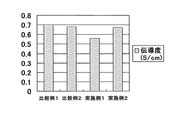
又、図4に、飽和含水時の各電解質膜のイオン伝導度を比較した。 FIG. 4 compares the ionic conductivity of each electrolyte membrane when saturated with water.
表2、表3及び図4の結果より、本発明のハイブリッド膜を用いた燃料電池は、フッ素系高分子電解質のみや炭化水素系高分子電解質のみを高分子電解質交換膜として用いる従来法の燃料電池に比べて、発電性能が向上していることが分る。特に、加水分解によりプロトン伝導性を発揮する高分子電解質前駆体(F型高分子電解質)を用い、高温で溶融圧着した実施例2のハイブリッド膜を用いた燃料電池は、電流密度及びイオン伝導度を維持しつつ、耐久後の出力電圧を向上させることが分かる。 From the results of Tables 2, 3 and 4, the fuel cell using the hybrid membrane of the present invention is a conventional fuel that uses only a fluorine-based polymer electrolyte or only a hydrocarbon-based polymer electrolyte as a polymer electrolyte exchange membrane. It can be seen that the power generation performance is improved compared to the battery. In particular, the fuel cell using the hybrid membrane of Example 2 using a polymer electrolyte precursor (F-type polymer electrolyte) that exhibits proton conductivity by hydrolysis and melt-bonded at a high temperature has a current density and ionic conductivity. It can be seen that the output voltage after durability is improved while maintaining the above.
炭化水素系高分子電解質膜とフッ素系高分子電解質膜を溶融圧着して一体化したハイブリッド膜を用い、カソード側に化学耐久性の高いフッ素系高分子電解質膜を配置し、アノード側にH2透過性の低い炭化水素系高分子電解質膜を配置することで、燃料電池の出力性能及び耐久性能が向上する。特に、電流密度及びイオン伝導度を維持しつつ、耐久後の出力電圧を向上させることが出来る。これにより、燃料電池の実用化と普及に貢献する。 A hybrid membrane in which a hydrocarbon polymer electrolyte membrane and a fluorine polymer electrolyte membrane are fused and bonded together is used, a fluorine polymer electrolyte membrane having high chemical durability is disposed on the cathode side, and H 2 is disposed on the anode side. By arranging the low-permeability hydrocarbon-based polymer electrolyte membrane, the output performance and durability performance of the fuel cell are improved. In particular, the output voltage after durability can be improved while maintaining the current density and ionic conductivity. This contributes to the practical application and spread of fuel cells.
Claims (11)
Priority Applications (1)
| Application Number | Priority Date | Filing Date | Title |
|---|---|---|---|
| JP2007226410A JP2009059604A (en) | 2007-08-31 | 2007-08-31 | HYBRID MEMBRANE FOR SOLID POLYMER FUEL CELL, PROCESS FOR PRODUCING THE SAME, MEMBRANE-ELECTRODE ASSEMBLE, PROCESS FOR PRODUCING THE SAME, AND SOLID POLYMER TYPE FUEL CELL |
Applications Claiming Priority (1)
| Application Number | Priority Date | Filing Date | Title |
|---|---|---|---|
| JP2007226410A JP2009059604A (en) | 2007-08-31 | 2007-08-31 | HYBRID MEMBRANE FOR SOLID POLYMER FUEL CELL, PROCESS FOR PRODUCING THE SAME, MEMBRANE-ELECTRODE ASSEMBLE, PROCESS FOR PRODUCING THE SAME, AND SOLID POLYMER TYPE FUEL CELL |
Publications (1)
| Publication Number | Publication Date |
|---|---|
| JP2009059604A true JP2009059604A (en) | 2009-03-19 |
Family
ID=40555161
Family Applications (1)
| Application Number | Title | Priority Date | Filing Date |
|---|---|---|---|
| JP2007226410A Pending JP2009059604A (en) | 2007-08-31 | 2007-08-31 | HYBRID MEMBRANE FOR SOLID POLYMER FUEL CELL, PROCESS FOR PRODUCING THE SAME, MEMBRANE-ELECTRODE ASSEMBLE, PROCESS FOR PRODUCING THE SAME, AND SOLID POLYMER TYPE FUEL CELL |
Country Status (1)
| Country | Link |
|---|---|
| JP (1) | JP2009059604A (en) |
Cited By (3)
| Publication number | Priority date | Publication date | Assignee | Title |
|---|---|---|---|---|
| WO2012071495A3 (en) * | 2010-11-23 | 2012-09-20 | University Of Delaware | Non-flooding polymer electrolyte fuel cell |
| US10930913B2 (en) | 2018-01-09 | 2021-02-23 | Samsung Electronics Co., Ltd. | Composite membrane, anode structure including the composite membrane, lithium battery including the anode structure, and method of preparing the composite membrane |
| JP2023500598A (en) * | 2020-09-29 | 2023-01-10 | コーロン インダストリーズ インク | Polymer electrolyte membrane, membrane-electrode assembly containing the same, and fuel cell |
-
2007
- 2007-08-31 JP JP2007226410A patent/JP2009059604A/en active Pending
Cited By (3)
| Publication number | Priority date | Publication date | Assignee | Title |
|---|---|---|---|---|
| WO2012071495A3 (en) * | 2010-11-23 | 2012-09-20 | University Of Delaware | Non-flooding polymer electrolyte fuel cell |
| US10930913B2 (en) | 2018-01-09 | 2021-02-23 | Samsung Electronics Co., Ltd. | Composite membrane, anode structure including the composite membrane, lithium battery including the anode structure, and method of preparing the composite membrane |
| JP2023500598A (en) * | 2020-09-29 | 2023-01-10 | コーロン インダストリーズ インク | Polymer electrolyte membrane, membrane-electrode assembly containing the same, and fuel cell |
Similar Documents
| Publication | Publication Date | Title |
|---|---|---|
| JP4327732B2 (en) | Solid polymer fuel cell and manufacturing method thereof | |
| JP3607862B2 (en) | Fuel cell | |
| JP6312666B2 (en) | Ion conductive membrane | |
| KR101392230B1 (en) | Membrane electrode assembly including polymer binder and alkaline membrane fuel cell comprising the same | |
| CN103534852B (en) | Gas diffusion layer for fuel cell and method for producing same | |
| CN103608955B (en) | Microporous layer sheet for fuel cell and method for producing same | |
| JP4890787B2 (en) | Fuel cell and manufacturing method thereof | |
| CN101689648A (en) | Assembly of membrane, electrode, gas diffusion layer and gasket, method for producing the same, and solid polymer fuel cell | |
| JP5532630B2 (en) | Membrane electrode assembly, method for producing the same, and polymer electrolyte fuel cell | |
| KR101312971B1 (en) | Hydrocarbon based polyelectrolyte separation membrane surface-treated with fluorinated ionomer, membrane electrode assembly, and fuel cell | |
| JP2009059604A (en) | HYBRID MEMBRANE FOR SOLID POLYMER FUEL CELL, PROCESS FOR PRODUCING THE SAME, MEMBRANE-ELECTRODE ASSEMBLE, PROCESS FOR PRODUCING THE SAME, AND SOLID POLYMER TYPE FUEL CELL | |
| JP5353337B2 (en) | Polymer electrolyte, membrane electrode assembly and fuel cell | |
| JP5129778B2 (en) | Solid polymer electrolyte, membrane thereof, membrane / electrode assembly using the same, and fuel cell | |
| JP5326458B2 (en) | Membrane electrode assembly, method for producing the same, and polymer electrolyte fuel cell | |
| US10109877B2 (en) | Method for producing fuel cell electrode sheet | |
| JP2004220995A (en) | Membrane-electrode assembly, method for producing the same, and fuel cell | |
| JP2003142124A (en) | Electrolyte membrane and polymer electrolyte fuel cell using the same | |
| JP2010257669A (en) | Membrane electrode assembly, method for producing the same, and polymer electrolyte fuel cell | |
| JP2007273141A (en) | Fuel cell and fuel cell manufacturing method | |
| JP7720625B2 (en) | Laminated electrolyte membrane, membrane electrode assembly and polymer electrolyte fuel cell | |
| JP4019678B2 (en) | Solid polymer electrolyte fuel cell | |
| KR101343077B1 (en) | Electrode for fuel cell, method of fabricating the same, and membrane-electrode assembly for fuel cell and fuel cell system including the same | |
| JP2004273387A (en) | Method for producing gas diffusion layer of membrane-electrode assembly, membrane-electrode assembly, and fuel cell | |
| JP2004288391A (en) | Method for producing membrane-electrode assembly, membrane-electrode assembly, and fuel cell | |
| JP2010161039A (en) | Manufacturing method of membrane-electrode assembly |