JP2009208564A - Vehicular seat pad and its manufacturing method - Google Patents
Vehicular seat pad and its manufacturing method Download PDFInfo
- Publication number
- JP2009208564A JP2009208564A JP2008052373A JP2008052373A JP2009208564A JP 2009208564 A JP2009208564 A JP 2009208564A JP 2008052373 A JP2008052373 A JP 2008052373A JP 2008052373 A JP2008052373 A JP 2008052373A JP 2009208564 A JP2009208564 A JP 2009208564A
- Authority
- JP
- Japan
- Prior art keywords
- seat pad
- vehicle seat
- identification mark
- manufacturing
- pad
- Prior art date
- Legal status (The legal status is an assumption and is not a legal conclusion. Google has not performed a legal analysis and makes no representation as to the accuracy of the status listed.)
- Pending
Links
- 238000004519 manufacturing process Methods 0.000 title claims abstract description 25
- 239000000463 material Substances 0.000 claims abstract description 27
- 239000011342 resin composition Substances 0.000 claims abstract description 20
- 238000000465 moulding Methods 0.000 claims abstract description 16
- 229920005989 resin Polymers 0.000 claims abstract description 6
- 239000011347 resin Substances 0.000 claims abstract description 6
- 239000004744 fabric Substances 0.000 claims description 26
- 230000003014 reinforcing effect Effects 0.000 claims description 20
- 238000000034 method Methods 0.000 claims description 10
- 238000005187 foaming Methods 0.000 claims description 9
- 230000001747 exhibiting effect Effects 0.000 claims description 2
- 239000002184 metal Substances 0.000 abstract 3
- 235000019589 hardness Nutrition 0.000 description 26
- JOYRKODLDBILNP-UHFFFAOYSA-N Ethyl urethane Chemical compound CCOC(N)=O JOYRKODLDBILNP-UHFFFAOYSA-N 0.000 description 14
- 229920005862 polyol Polymers 0.000 description 13
- -1 alcohol compound Chemical class 0.000 description 10
- 239000006260 foam Substances 0.000 description 10
- 229920000642 polymer Polymers 0.000 description 9
- 150000003077 polyols Chemical class 0.000 description 8
- UPMLOUAZCHDJJD-UHFFFAOYSA-N 4,4'-Diphenylmethane Diisocyanate Chemical compound C1=CC(N=C=O)=CC=C1CC1=CC=C(N=C=O)C=C1 UPMLOUAZCHDJJD-UHFFFAOYSA-N 0.000 description 6
- 239000003054 catalyst Substances 0.000 description 5
- PPBRXRYQALVLMV-UHFFFAOYSA-N Styrene Chemical compound C=CC1=CC=CC=C1 PPBRXRYQALVLMV-UHFFFAOYSA-N 0.000 description 4
- 125000002947 alkylene group Chemical group 0.000 description 4
- 239000002245 particle Substances 0.000 description 4
- LYCAIKOWRPUZTN-UHFFFAOYSA-N Ethylene glycol Chemical compound OCCO LYCAIKOWRPUZTN-UHFFFAOYSA-N 0.000 description 3
- 239000004721 Polyphenylene oxide Substances 0.000 description 3
- DNIAPMSPPWPWGF-UHFFFAOYSA-N Propylene glycol Chemical compound CC(O)CO DNIAPMSPPWPWGF-UHFFFAOYSA-N 0.000 description 3
- 238000012644 addition polymerization Methods 0.000 description 3
- 238000010097 foam moulding Methods 0.000 description 3
- 238000007726 management method Methods 0.000 description 3
- 238000002156 mixing Methods 0.000 description 3
- 229920000570 polyether Polymers 0.000 description 3
- DVKJHBMWWAPEIU-UHFFFAOYSA-N toluene 2,4-diisocyanate Chemical compound CC1=CC=C(N=C=O)C=C1N=C=O DVKJHBMWWAPEIU-UHFFFAOYSA-N 0.000 description 3
- XLYOFNOQVPJJNP-UHFFFAOYSA-N water Substances O XLYOFNOQVPJJNP-UHFFFAOYSA-N 0.000 description 3
- NLHHRLWOUZZQLW-UHFFFAOYSA-N Acrylonitrile Chemical compound C=CC#N NLHHRLWOUZZQLW-UHFFFAOYSA-N 0.000 description 2
- IAYPIBMASNFSPL-UHFFFAOYSA-N Ethylene oxide Chemical compound C1CO1 IAYPIBMASNFSPL-UHFFFAOYSA-N 0.000 description 2
- PEDCQBHIVMGVHV-UHFFFAOYSA-N Glycerine Chemical compound OCC(O)CO PEDCQBHIVMGVHV-UHFFFAOYSA-N 0.000 description 2
- 229920005830 Polyurethane Foam Polymers 0.000 description 2
- GOOHAUXETOMSMM-UHFFFAOYSA-N Propylene oxide Chemical compound CC1CO1 GOOHAUXETOMSMM-UHFFFAOYSA-N 0.000 description 2
- 150000001412 amines Chemical class 0.000 description 2
- 230000015572 biosynthetic process Effects 0.000 description 2
- 239000003795 chemical substances by application Substances 0.000 description 2
- 239000004088 foaming agent Substances 0.000 description 2
- 239000000203 mixture Substances 0.000 description 2
- 239000000178 monomer Substances 0.000 description 2
- 229920001228 polyisocyanate Polymers 0.000 description 2
- 239000005056 polyisocyanate Substances 0.000 description 2
- 239000011496 polyurethane foam Substances 0.000 description 2
- 239000002994 raw material Substances 0.000 description 2
- 239000003381 stabilizer Substances 0.000 description 2
- IMNIMPAHZVJRPE-UHFFFAOYSA-N triethylenediamine Chemical compound C1CN2CCN1CC2 IMNIMPAHZVJRPE-UHFFFAOYSA-N 0.000 description 2
- 125000000391 vinyl group Chemical group [H]C([*])=C([H])[H] 0.000 description 2
- 229920002554 vinyl polymer Polymers 0.000 description 2
- RBACIKXCRWGCBB-UHFFFAOYSA-N 1,2-Epoxybutane Chemical compound CCC1CO1 RBACIKXCRWGCBB-UHFFFAOYSA-N 0.000 description 1
- ZPFOZYRWPCWORL-UHFFFAOYSA-N 1-[1-(dimethylamino)ethoxy]-n,n-dimethylethanamine Chemical compound CN(C)C(C)OC(C)N(C)C ZPFOZYRWPCWORL-UHFFFAOYSA-N 0.000 description 1
- RNFJDJUURJAICM-UHFFFAOYSA-N 2,2,4,4,6,6-hexaphenoxy-1,3,5-triaza-2$l^{5},4$l^{5},6$l^{5}-triphosphacyclohexa-1,3,5-triene Chemical compound N=1P(OC=2C=CC=CC=2)(OC=2C=CC=CC=2)=NP(OC=2C=CC=CC=2)(OC=2C=CC=CC=2)=NP=1(OC=1C=CC=CC=1)OC1=CC=CC=C1 RNFJDJUURJAICM-UHFFFAOYSA-N 0.000 description 1
- PQXKWPLDPFFDJP-UHFFFAOYSA-N 2,3-dimethyloxirane Chemical compound CC1OC1C PQXKWPLDPFFDJP-UHFFFAOYSA-N 0.000 description 1
- GTEXIOINCJRBIO-UHFFFAOYSA-N 2-[2-(dimethylamino)ethoxy]-n,n-dimethylethanamine Chemical compound CN(C)CCOCCN(C)C GTEXIOINCJRBIO-UHFFFAOYSA-N 0.000 description 1
- LFQSCWFLJHTTHZ-UHFFFAOYSA-N Ethanol Chemical compound CCO LFQSCWFLJHTTHZ-UHFFFAOYSA-N 0.000 description 1
- 239000004640 Melamine resin Substances 0.000 description 1
- 229920000877 Melamine resin Polymers 0.000 description 1
- 229920002396 Polyurea Polymers 0.000 description 1
- 229920002323 Silicone foam Polymers 0.000 description 1
- AWMVMTVKBNGEAK-UHFFFAOYSA-N Styrene oxide Chemical compound C1OC1C1=CC=CC=C1 AWMVMTVKBNGEAK-UHFFFAOYSA-N 0.000 description 1
- WYURNTSHIVDZCO-UHFFFAOYSA-N Tetrahydrofuran Chemical compound C1CCOC1 WYURNTSHIVDZCO-UHFFFAOYSA-N 0.000 description 1
- GSEJCLTVZPLZKY-UHFFFAOYSA-N Triethanolamine Chemical compound OCCN(CCO)CCO GSEJCLTVZPLZKY-UHFFFAOYSA-N 0.000 description 1
- ZJCCRDAZUWHFQH-UHFFFAOYSA-N Trimethylolpropane Chemical compound CCC(CO)(CO)CO ZJCCRDAZUWHFQH-UHFFFAOYSA-N 0.000 description 1
- 239000004480 active ingredient Substances 0.000 description 1
- 239000000654 additive Substances 0.000 description 1
- 125000005250 alkyl acrylate group Chemical group 0.000 description 1
- 230000003712 anti-aging effect Effects 0.000 description 1
- 239000003963 antioxidant agent Substances 0.000 description 1
- 230000003078 antioxidant effect Effects 0.000 description 1
- 239000002585 base Substances 0.000 description 1
- 125000004432 carbon atom Chemical group C* 0.000 description 1
- 238000004040 coloring Methods 0.000 description 1
- 239000002131 composite material Substances 0.000 description 1
- 150000001875 compounds Chemical class 0.000 description 1
- 229920001577 copolymer Polymers 0.000 description 1
- 239000003431 cross linking reagent Substances 0.000 description 1
- ZBCBWPMODOFKDW-UHFFFAOYSA-N diethanolamine Chemical compound OCCNCCO ZBCBWPMODOFKDW-UHFFFAOYSA-N 0.000 description 1
- 239000000975 dye Substances 0.000 description 1
- 238000004043 dyeing Methods 0.000 description 1
- 239000003995 emulsifying agent Substances 0.000 description 1
- 239000000945 filler Substances 0.000 description 1
- 239000010419 fine particle Substances 0.000 description 1
- 239000003063 flame retardant Substances 0.000 description 1
- 235000011187 glycerol Nutrition 0.000 description 1
- 229920001519 homopolymer Polymers 0.000 description 1
- PQPVPZTVJLXQAS-UHFFFAOYSA-N hydroxy-methyl-phenylsilicon Chemical class C[Si](O)C1=CC=CC=C1 PQPVPZTVJLXQAS-UHFFFAOYSA-N 0.000 description 1
- 239000003999 initiator Substances 0.000 description 1
- 238000002386 leaching Methods 0.000 description 1
- 238000005259 measurement Methods 0.000 description 1
- TXXWBTOATXBWDR-UHFFFAOYSA-N n,n,n',n'-tetramethylhexane-1,6-diamine Chemical compound CN(C)CCCCCCN(C)C TXXWBTOATXBWDR-UHFFFAOYSA-N 0.000 description 1
- 239000004745 nonwoven fabric Substances 0.000 description 1
- 125000006353 oxyethylene group Chemical group 0.000 description 1
- 239000003973 paint Substances 0.000 description 1
- 230000035699 permeability Effects 0.000 description 1
- 239000004033 plastic Substances 0.000 description 1
- 229920003023 plastic Polymers 0.000 description 1
- 239000004014 plasticizer Substances 0.000 description 1
- 238000012643 polycondensation polymerization Methods 0.000 description 1
- 229920000728 polyester Polymers 0.000 description 1
- 229920005906 polyester polyol Polymers 0.000 description 1
- 230000000379 polymerizing effect Effects 0.000 description 1
- 239000004814 polyurethane Substances 0.000 description 1
- 229920002635 polyurethane Polymers 0.000 description 1
- 239000007870 radical polymerization initiator Substances 0.000 description 1
- 230000002787 reinforcement Effects 0.000 description 1
- 238000009958 sewing Methods 0.000 description 1
- 239000013514 silicone foam Substances 0.000 description 1
- 239000006097 ultraviolet radiation absorber Substances 0.000 description 1
- 230000000007 visual effect Effects 0.000 description 1
- 210000002268 wool Anatomy 0.000 description 1
Images
Landscapes
- Seats For Vehicles (AREA)
Abstract
Description
本発明は、自動車等の車両に使用される車両用シートパッド及びその製造方法に関する。 The present invention relates to a vehicle seat pad used for a vehicle such as an automobile and a method for manufacturing the same.
自動車等の車両用シートのクッションパッド、バックパッド等のシートパッドには、一般に、弾力性に富む軟質ポリウレタンフォームの成形品が用いられている。これらのクッションパッドやバックパッドは規格に応じて要求特性が異なることから、それぞれの規格に応じて発泡原料の配合処方が定められている(特許文献1)。 In general, a molded product of flexible polyurethane foam having high elasticity is used for a cushion pad of a vehicle seat such as an automobile and a seat pad such as a back pad. Since these cushion pads and back pads have different required characteristics according to the standards, the blending prescription of the foaming raw material is determined according to the respective standards (Patent Document 1).
例えば、シートパッドの硬度は、1種類のサイズ或いは形状(1規格)に対して1種類とし、そのサイズの硬度の測定結果は帳票に記録して管理される。シートパッドは、社名、製品名、製造番号、規格等の標識が刻印されているので、特定の規格の硬度を知りたい時は上記帳票を調査することにより得られる。 For example, the hardness of the seat pad is set to one type for one size or shape (one standard), and the measurement result of the hardness of the size is recorded and managed in a form. Since the seat pad is engraved with signs such as company name, product name, serial number, and standard, it is possible to obtain the hardness of a specific standard by examining the above form.
また、1種類のサイズ或いは形状(1規格)に対しては、1種類の硬度しか与えられないため、1種類のサイズ或いは形状に対して、2種類の硬度、即ち2規格にするのは困難である。 Further, since only one type of hardness is given to one type of size or shape (one standard), it is difficult to set two types of hardness, ie two standards, to one type of size or shape. It is.
従来においては、シートパッドは1種類のサイズ或いは形状に対して1規格で管理されるため、その規格のシートパッドには1種類の硬度しか与えられないことから、1種類のサイズ或いは形状(1規格)に対して、2種類の硬度、即ち2規格にするのは困難であり、実施する場合は煩雑となる。即ち、1種類の規格に対して1種類の成形用金型を使用しているため、異なる規格、例えば硬度が異なる規格では、金型を変更する必要があった。 Conventionally, since a seat pad is managed with one standard for one type of size or shape, only one type of hardness can be given to a seat pad of that standard, so one type of size or shape (1 It is difficult to set two kinds of hardness, that is, two standards with respect to (standard), and it becomes complicated when implemented. That is, since one type of molding die is used for one type of standard, it is necessary to change the die for different standards, for example, standards having different hardnesses.
本発明は、それぞれの製品の、硬度等の特性情報を容易に知ることができる車両用シートパッドを提供することを目的とする。 An object of this invention is to provide the vehicle seat pad which can know easily characteristic information, such as hardness, of each product.
また本発明は、多品種製造及び製品管理が容易な車両用シートパッドを提供することを目的とする。 Another object of the present invention is to provide a vehicle seat pad that can be easily manufactured and managed in a variety of products.
さらに本発明は、上記車両用シートパッドの製造方法を提供することを目的とする。 Furthermore, an object of the present invention is to provide a method for manufacturing the vehicle seat pad.
上記目的は、
発泡樹脂製の本体と副資材からなる車両用シートパッドであって、
副資材に、シートパッドの特性を表す識別印が視認可能な状態で設けられていることを特徴とする車両用シートパッド;
にある。
The above purpose is
A vehicle seat pad comprising a foamed resin body and auxiliary materials,
A vehicular seat pad, characterized in that an identification mark indicating the characteristic of the seat pad is provided on the auxiliary material in a state where the identification mark is visible;
It is in.
本発明の車両用シートパッドの好ましい態様を以下に列記する。
(1)副資材が補強布(サポータとも言う)である。
(2)識別印が、着色層である。付与が容易であり、視認も容易である。
(3)識別印の色が、副資材の一部に直接着色された層である。付与が容易である。
(4)シートパッドの特性がシートパッドの硬度である。硬度は一般にJIS−K−6400−2による硬度である。
(5)発泡樹脂がウレタンフォームである。
(6)シートパッドがバックパッドである。
Preferred embodiments of the vehicle seat pad of the present invention are listed below.
(1) The auxiliary material is a reinforcing cloth (also called a supporter).
(2) The identification mark is a colored layer. Application is easy and visual recognition is also easy.
(3) The color of the identification mark is a layer colored directly on a part of the auxiliary material. Easy to apply.
(4) The seat pad characteristic is the hardness of the seat pad. The hardness is generally a hardness according to JIS-K-6400-2.
(5) The foamed resin is urethane foam.
(6) The seat pad is a back pad.
また本発明は、
成形用金型を用いて、発泡性樹脂組成物を、シートパッドの特性を表す識別印を有する副資材と共に発泡成形し、識別印を視認可能な状態で有する車両用シートパッドを製造することを特徴とする車両用シートパッドの製造方法;及び
成形用金型を用いて、発泡性樹脂組成物を、シートパッドの特性を表す識別印を有する副資材と共に発泡成形し、識別印を視認可能な状態で有する車両用シートパッドを製造し、且つ上記と同一の成形用金型を用いて、上記と異なる特性を示す発泡性樹脂組成物を、シートパッドが上記と異なる特性を有することを示す上記と異なる識別印を有する副資材と共に成形し、上記と異なる識別印を視認可能な状態で有する車両用シートパッドを製造することを特徴とする車両用シートパッドの製造方法;
にもある。
The present invention also provides
Using a molding die, foaming a resin composition together with a secondary material having an identification mark representing the characteristics of the seat pad, and manufacturing a vehicle seat pad having the identification mark visible. A vehicle seat pad manufacturing method characterized by: and using a molding die, the foamable resin composition is foam-molded together with an auxiliary material having an identification mark representing the characteristics of the seat pad, and the identification mark is visible The vehicle seat pad having a state is manufactured, and the foaming resin composition exhibiting different characteristics from the above using the same molding die as described above, the seat pad having the characteristics different from the above A vehicle seat pad, which is molded together with a secondary material having an identification mark different from the above, and has an identification mark different from the above in a visible state;
There is also.
上記製造方法において、前記本発明の車両用シートパッドの好適態様も適用することができる。 In the above manufacturing method, the preferred embodiment of the vehicle seat pad of the present invention can also be applied.
本発明の車両用シートパッドは、シートパッドの特性情報を示す識別印が副資材により設けられており、例えば個々のシートパッドの硬度等の特性を即座に知ることができるので、1種類のサイズ或いは形状に対して、2種類以上の規格(例えば硬度)にしても、容易に見分けることができるので製造も容易となる。また、副資材(特に補強布)に識別印を設けているので、パッド本体に設ける場合に比べて、小さく軽いので作業性に優れており、従って生産性も向上する。 In the vehicle seat pad of the present invention, an identification mark indicating the seat pad characteristic information is provided as a secondary material. For example, characteristics such as hardness of each seat pad can be immediately known, so that one type of size can be obtained. Alternatively, even if two or more kinds of standards (for example, hardness) are used for the shape, they can be easily distinguished from each other, so that the manufacture is facilitated. In addition, since the identification mark is provided on the auxiliary material (particularly the reinforcing cloth), it is smaller and lighter than the case where it is provided on the pad main body, so that the workability is excellent, and therefore the productivity is improved.
従って、本発明の車両用シートパッドは、多品種製造、製品管理が容易なものであるということができる。 Therefore, it can be said that the vehicle seat pad of the present invention is easy to manufacture various products and manage products.
本発明の車両用シートパッドは、副資材に、シートパッドの特性を表す識別印が視認可能な状態で設けられている。まず、上記本発明の車両用シートパッドの製造方法について説明する。以下、シートパッドのうちバックパッドを例にとって説明する。 The vehicular seat pad of the present invention is provided in an auxiliary material in a state where an identification mark representing the characteristics of the seat pad is visible. First, the manufacturing method of the said vehicle seat pad of this invention is demonstrated. Hereinafter, the back pad of the seat pads will be described as an example.
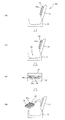
本発明の車両用シートパッドの製造方法の1例を説明するための図を図1(a)〜(d)に示す。成形用金型10は、パッド本体の表面側部分を成形するように凹設された下型12と、下型12の一辺部に配されたヒンジ部を介して回動可能に設けられて下型12の上面開口を開閉する上型13とを備えている。上型13は、パッド本体の裏面側を成形する型であり、下型13の上面開口を閉じることにより、下型12との間にパッド形状に対応する発泡空間であるキャビティを形成する。
The figure for demonstrating one example of the manufacturing method of the vehicle seat pad of this invention is shown to Fig.1 (a)-(d). The
上型13に青色の着色層(着色領域)14aを有する補強布14をセットする(a)。一般に上型13の中子にセットされる。着色層14aはいかなる色でも勿論良い。次いで、注入器(図示せず)を用いて、下型12のキャビティ内にウレタンフォーム形成用樹脂組成物16を注入した後(b)、上型13を閉じてキャビティを密閉し、これによりウレタンフォーム形成用樹脂組成物を、発泡させながらキャビティ内に充填させる(c)。
A reinforcing
このようにしてキャビティ内でポリウレタンフォーム形成用樹脂組成物を発泡充填させることで、ウレタンフォームからなるバックパッド17が発泡成形されるとともに、その裏面に青色の着色層14aを有する補強布14が一体成形される。成形後、上型13を開きしてから脱型することにより、本発明のバックパッド17が得られる(d)。
In this way, by foaming and filling the polyurethane foam-forming resin composition in the cavity, the back pad 17 made of urethane foam is foam-molded, and the reinforcing
発泡成形は、使用するウレタンフォーム形成用樹脂組成物にもよるが、一般に常温〜120℃、1〜30分間(好ましくは常温〜100℃、5〜20分間)の条件で行われる。 Foam molding is generally performed under conditions of room temperature to 120 ° C. and 1 to 30 minutes (preferably room temperature to 100 ° C. and 5 to 20 minutes), although it depends on the resin composition for forming urethane foam.
上記方法では、特定の硬度を有する特定の規格を有する1種類のバックパッド17が得られるが、この同一の金型を用いて、上記と異なる硬度を有するが形状は上記と同じバックパッドを製造することができる。その際、本発明では、補強布14の着色層14aの色を、他の色(例えば赤)に変更し、赤色の着色層を有する補強布14を用いることにより行われる。この着色層の存在により、同じ形状のバックパッドであっても、異なる硬度を有するものであることを極めて容易に視認することができる。
In the above method, one type of back pad 17 having a specific standard having a specific hardness is obtained. Using this same mold, a back pad having a hardness different from the above but the same shape as the above is manufactured. can do. In this case, in the present invention, the color of the
上記着色層14aは、補強布(副資材)に直接着色して形成しても、着色した布等を貼付してもよい。また着色層は、視認可能であれば良く、その位置は限定されない。また、着色層の形状はどのようなものでも良い。或いは着色した数字、文字等を布等に設け貼付してもよい。そしてその数字、文字が他の情報を表すようにしても良い。
The
上記製造方法では、バックパッドについて説明したが、乗員が座るシートクッションパッドについても同様にして製造することができる。 Although the back pad has been described in the above manufacturing method, the seat cushion pad on which an occupant sits can be manufactured in the same manner.
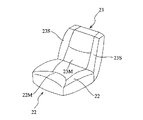
図2に、前記の製造方法により有利に得ることができる本発明の車両用シートパッドを備えた車両用シートの1例の斜視図を示す。車両用シートは、シートクッションパッド22及びバックパッド23とを有する。シートクッションパッド22は、左右幅方向の中央部22Mと、左右のサイド部22Sとを有する。バックパッド23は、左右幅方向の中央部23Mと、左右のサイド部23Sとを有する。左右幅方向の中央部22M,23Mと、左右のサイド部22S,23Sの裏面には、着色層を有する補強布が設けられている。
FIG. 2 shows a perspective view of an example of a vehicle seat provided with the vehicle seat pad of the present invention that can be advantageously obtained by the manufacturing method described above. The vehicle seat includes a
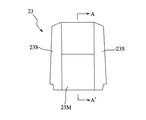
上記図2のシートパッドを構成するバックパッド23の1例の平面図を図3に示す。
FIG. 3 shows a plan view of an example of the
バックパッド23は、左右幅方向の中央部23Mと、左右のサイド部23Sとを有する。左右幅方向の中央部23Mと、左右のサイド部23Sの裏面には、着色層24aを有する補強布24(図4参照)が設けられている。バックパッド本体23の上部には、例えば、ヘッドレスト取付用突部を嵌入するための貫通孔が設けられていてもよい。
The
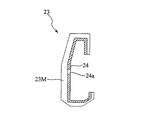
上記バックパッド33の幅方向断面図の1例を図4に示す。図4では、バックパッド23の左右幅方向の中央部23Mと、左右のサイド部23Sの裏面には、着色層24aを有する補強布24が設けられている。
An example of a cross-sectional view in the width direction of the back pad 33 is shown in FIG. In FIG. 4, a reinforcing
上記のように、本発明の車両用シートパッドは、シートパッドの特性情報を示す識別印が補強布等の副資材により設けられている。従って、個々のシートパッドの硬度等の特性を即座に知ることができるので、1種類のサイズ或いは形状に対して、2種類以上の規格(例えば硬度)にしても、容易に製造することができる。即ち、例えば、同一の金型を用いて、形状は同じでも硬度の異なるバックパッドを製造することが容易である。なお、硬度等の変更は、一般に発泡性樹脂組成物の配合や密度の変更により行われる。このように、シートパッドの硬度等の特性を容易に識別できることから、管理も容易にすることができる。 As described above, in the vehicle seat pad of the present invention, the identification mark indicating the characteristic information of the seat pad is provided by the auxiliary material such as the reinforcing cloth. Therefore, since characteristics such as hardness of each seat pad can be immediately known, even if two or more kinds of standards (for example, hardness) are used for one kind of size or shape, it can be easily manufactured. . That is, for example, it is easy to manufacture back pads having the same shape but different hardness using the same mold. In addition, change of hardness etc. is generally performed by the mixing | blending and density change of a foamable resin composition. As described above, since characteristics such as hardness of the seat pad can be easily identified, management can be facilitated.
また、これにより、末端ユーザの嗜好に合った硬度のシートパッドを各ユーザに提供することができ、例えば、末端ユーザが自動車を購入する場合、好みのパッド硬度を指定することが可能となる。尚、従来の管理方法では、同形状(同一規格)のパッドで、多品種の硬度の製品を揃えるには、規格番号を変更して識別しなければならず、新たな金型が必要となる。 In addition, this makes it possible to provide each user with a seat pad having a hardness suitable for the preference of the end user. For example, when the end user purchases an automobile, the preferred pad hardness can be designated. In addition, in the conventional management method, in order to prepare products of various types of hardness with pads of the same shape (same standard), the standard number must be changed and identified, and a new mold is required. .
従って、本発明の車両用シートパッドは、多品種製造、製品管理が容易なものであるということができる。 Therefore, it can be said that the vehicle seat pad of the present invention is easy to manufacture various products and manage products.
また、金型の刻印部のみを付け替え式にして、パットを識別しても良い。 Alternatively, the pad may be identified by replacing only the stamped portion of the mold.
シートパッド本体は発泡樹脂であり、一般にウレタンフォームであり、軟質ウレタンフォーム、半硬質ウレタンフォーム、特に軟質ウレタンフォームであることが好ましい。その材料(発泡性樹脂組成物)は市販のものを使用することができる。 The seat pad body is a foamed resin, generally a urethane foam, and is preferably a flexible urethane foam, a semi-rigid urethane foam, particularly a flexible urethane foam. A commercially available material (foamable resin composition) can be used.
発泡樹脂を形成するための発泡性樹脂組成物はウレタンフォーム形成用樹脂組成物が好ましい。ウレタンフォーム形成用樹脂組成物は、一般にポリエーテルポリオール、ポリエステルポリオール、ポリマーポリオール等のアルコール成分、及び水を含むポリオール成分と、トリレンジイソシアネートとジフェニルメタンジイソシアネート等のポリイソシアネート成分と、発泡剤とを混合してなるものが一般的である。 The foamable resin composition for forming the foamed resin is preferably a urethane foam-forming resin composition. The resin composition for forming urethane foam is generally a mixture of an alcohol component such as polyether polyol, polyester polyol or polymer polyol, and a polyol component containing water, a polyisocyanate component such as tolylene diisocyanate and diphenylmethane diisocyanate, and a foaming agent. What is formed is common.
上記ポリエーテルポリオールとしては、多官能性アルコール系化合物を開始剤に、これにアルキレンオキサイドを付加させたポリオキシアルキレンポリオールが好ましく用いられる。多官能性アルコール系化合物としては、例えばエチレングリコール、プロピレングリコール、グリセリン、トリメチロールプロパン、トリエタノールアミン、ジエタノールアミンやこれらに少量のアルキレンオキサイドが付加した化合物を挙げることができる。また、これに付加重合するアルキレンオキサイドとしては、炭素原子数2個以上のものが好ましく、例えばエチレンオキサイド、1,2−プロピレンオキサイド、1,2−ブチレンオキサイド、2,3−ブチレンオキサイド、スチレンオキサイド等を挙げることができる。これらアルキレンオキサイドのなかでも、プロピレンオキサイド及び/又はブチレンオキサイドと、エチレンオキサイドとを併用し、末端にオキシエチレン単位を含むものが好ましい。 As the polyether polyol, a polyoxyalkylene polyol in which a polyfunctional alcohol compound is used as an initiator and an alkylene oxide is added thereto is preferably used. Examples of the polyfunctional alcohol compound include ethylene glycol, propylene glycol, glycerin, trimethylolpropane, triethanolamine, diethanolamine, and compounds obtained by adding a small amount of alkylene oxide to these. Also, the alkylene oxide that undergoes addition polymerization is preferably one having 2 or more carbon atoms, such as ethylene oxide, 1,2-propylene oxide, 1,2-butylene oxide, 2,3-butylene oxide, styrene oxide. Etc. Among these alkylene oxides, those containing propylene oxide and / or butylene oxide in combination with ethylene oxide and containing an oxyethylene unit at the terminal are preferable.
ポリマーポリオールは、ポリオール化合物中にポリマー粒子を微粒子状にて分散させたものである。ポリマー粒子としては、例えばアクリロニトリル、スチレン、アルキルメタクリレート、アルキルアクリレート等のビニルモノマーのホモポリマー又はコポリマー等の付加重合系ポリマーや、ポリエステル、ポリウレア、メラミン樹脂等の縮重合系ポリマーの粒子が挙げられる。かかるポリマー粒子のポリオール化合物中への導入方法としては、例えばポリマー粒子が付加重合系ポリマーの場合には、ポリオキシアルキレンポリオール等のポリオール中で、ラジカル重合開始剤の存在下に、スチレン、アクリロニトリル等のビニル系モノマーを重合させる方法が挙げられる。 The polymer polyol is obtained by dispersing polymer particles in the form of fine particles in a polyol compound. Examples of the polymer particles include addition polymerization polymers such as homopolymers or copolymers of vinyl monomers such as acrylonitrile, styrene, alkyl methacrylate, and alkyl acrylate, and condensation polymerization polymers such as polyester, polyurea, and melamine resin. As a method for introducing such polymer particles into a polyol compound, for example, when the polymer particles are an addition polymerization polymer, styrene, acrylonitrile, etc. in a polyol such as polyoxyalkylene polyol in the presence of a radical polymerization initiator. And a method of polymerizing the vinyl monomer.
上記ポリイソシアネート成分としては、トリレンジイソシアネート(TDI)とジフェニルメタンジイソシアネート(MDI)(精製MDI(p−MDI)やクルードMDI(c−MDI)がある)との混合物であり、両者の混合比は特に限定されないが、重量比で10/90〜90/10であることが好ましい。 The polyisocyanate component is a mixture of tolylene diisocyanate (TDI) and diphenylmethane diisocyanate (MDI) (including purified MDI (p-MDI) and crude MDI (c-MDI)). Although not limited, it is preferably 10/90 to 90/10 in weight ratio.
水は発泡剤としては使用されるものであり、ポリオール化合物100重量部に対して2〜4重量部配合されることが好ましい。水の配合量4重量部を越えると、減圧成形によりバックパッドを成形する際に発泡しすぎて、充分な硬度を確保しにくくなる。 Water is used as a foaming agent and is preferably blended in an amount of 2 to 4 parts by weight with respect to 100 parts by weight of the polyol compound. When the amount of water exceeds 4 parts by weight, foaming is excessive when forming a back pad by reduced pressure molding, and it becomes difficult to ensure sufficient hardness.
また、上記整泡剤としては、ジメチルシロキサン系、ポリエーテルジメチルシロキサン系、フェニルメチルシロキサン系等の各種のシリコーン整泡剤が好適に用いられ、その使用量はポリオール化合物100重量部に対し有効成分を基準として通常0.01〜5重量部である。 As the foam stabilizer, various silicone foam stabilizers such as dimethylsiloxane, polyether dimethylsiloxane, and phenylmethylsiloxane are preferably used, and the amount used is an active ingredient with respect to 100 parts by weight of the polyol compound. Is usually 0.01 to 5 parts by weight.
ポリウレタンフォーム原料には、通常、上記の他に触媒、などが配合され、更に、架橋剤、乳化剤、酸化防止剤、紫外線吸収剤、老化防止剤、充填剤、難燃剤、可塑剤等の各種添加剤を、必要に応じて添加することもできる。 In addition to the above, the polyurethane foam raw material is usually blended with a catalyst, and various additives such as a crosslinking agent, an emulsifier, an antioxidant, an ultraviolet absorber, an anti-aging agent, a filler, a flame retardant, and a plasticizer. An agent can be added as necessary.
上記触媒としては、トリエチレンジアミン、ビス(N,N−ジメチルアミノ−2−エチル)エーテル、N,N,N',N'−テトラメチルヘキサメチレンジアミン、ビス(2−ジメチルアミノエチル)エーテル等のアミン系触媒が好ましく用いられ、その使用量はポリオール化合物100重量部に対して通常0.05〜10重量部である。特に、初期の泡化を促進するため、ブロック型触媒よりも、ブロックされていない即効性のアミン触媒を使用することが好ましい。 Examples of the catalyst include triethylenediamine, bis (N, N-dimethylamino-2-ethyl) ether, N, N, N ′, N′-tetramethylhexamethylenediamine, and bis (2-dimethylaminoethyl) ether. An amine-based catalyst is preferably used, and the amount used is usually 0.05 to 10 parts by weight with respect to 100 parts by weight of the polyol compound. In particular, in order to promote initial foaming, it is preferable to use an unblocked immediate-acting amine catalyst rather than a block-type catalyst.
補強布(サポータ)は、一般に、バックパッド本体の裏面と、パッド上部の内側面と、「コ」の字の張り出し部の内側面とを覆うように発泡性樹脂組成物の発泡成形により一体化されている。補強布としては、適度な通気性を持ち、かつ、成形時における発泡性樹脂組成物の浸み出しを防止できるものであれば、特に限定されることなく使用することができ、不織布や織編物、あるいはこれらの積層複合体などを使用することができる。さらに、ワリフ、寒冷紗、粗毛フェルト、スラブウレタン等も使用することができる。補強布の厚さは、一般に0.1〜5mm、特に0.5〜2mmの範囲にあることが好ましい。 Reinforcing cloth (supporter) is generally integrated by foam molding of a foamable resin composition so as to cover the back surface of the back pad body, the inner surface of the upper part of the pad, and the inner surface of the overhanging portion of the "U". Has been. The reinforcing fabric can be used without any particular limitation as long as it has appropriate air permeability and can prevent the foamable resin composition from leaching out during molding, and can be used as a nonwoven fabric or a woven or knitted fabric. Or these laminated composites etc. can be used. Furthermore, it is also possible to use walif, cold chill, coarse wool felt, slab urethane and the like. The thickness of the reinforcing fabric is generally in the range of 0.1 to 5 mm, particularly 0.5 to 2 mm.
この補強布は、所定形状に裁断された基布を縫製、あるいはホッチキスやタグピン(プラスチックス製ホッチキスなど一般にタグを留めるために使用されるピン)などの固定具を用いて、一般に袋状に成形されている。補強布は、成形型内に装着されて(例えば、中子に装着される)、バックパッド本体の発泡成形により、その裏面に積層一体化される。 This reinforcing cloth is generally formed into a bag shape by sewing a base fabric cut into a predetermined shape, or using fasteners such as staples and tag pins (pins commonly used for fastening tags such as plastic staples). Has been. The reinforcing cloth is mounted in a mold (for example, mounted on a core) and laminated and integrated on the back surface thereof by foam molding of the back pad main body.
副資材として、補強布以外にはウレタンチップを挙げることができる。 As an auxiliary material, urethane chips can be cited in addition to the reinforcing cloth.
補強布等の副資材への着色層の形成は、各種染料による染色、カラーインク、カラー塗料等による塗布等により行うことができる。或いは着色された、布、紙、フィルム等を貼付しても良い。 Formation of a colored layer on a secondary material such as a reinforcing cloth can be performed by dyeing with various dyes, application with a color ink, a color paint, or the like. Alternatively, a colored cloth, paper, film, or the like may be attached.
上記のように本発明の車両用シートパッドは、硬度等の特性情報を容易に知ることができ、多品種製造及び製品管理が容易となる。 As described above, the vehicle seat pad of the present invention can easily know characteristic information such as hardness, and facilitates multi-product manufacturing and product management.
10 成形用金型
12 下型
13 上型
14、24 補強布
14a、24a 着色層
16 ウレタンフォーム形成用樹脂組成物
17 シートパッド
22 シートクッションパッド
23 バックパッド
23M 中央部
23S サイド部
DESCRIPTION OF
Claims (11)
副資材に、シートパッドの特性を表す識別印が視認可能な状態で設けられていることを特徴とする車両用シートパッド。 A vehicle seat pad comprising a foamed resin body and auxiliary materials,
A vehicular seat pad, characterized in that an identification mark representing the characteristics of the seat pad is provided on the auxiliary material in a state where the identification mark is visible.
Priority Applications (1)
| Application Number | Priority Date | Filing Date | Title |
|---|---|---|---|
| JP2008052373A JP2009208564A (en) | 2008-03-03 | 2008-03-03 | Vehicular seat pad and its manufacturing method |
Applications Claiming Priority (1)
| Application Number | Priority Date | Filing Date | Title |
|---|---|---|---|
| JP2008052373A JP2009208564A (en) | 2008-03-03 | 2008-03-03 | Vehicular seat pad and its manufacturing method |
Publications (1)
| Publication Number | Publication Date |
|---|---|
| JP2009208564A true JP2009208564A (en) | 2009-09-17 |
Family
ID=41182147
Family Applications (1)
| Application Number | Title | Priority Date | Filing Date |
|---|---|---|---|
| JP2008052373A Pending JP2009208564A (en) | 2008-03-03 | 2008-03-03 | Vehicular seat pad and its manufacturing method |
Country Status (1)
| Country | Link |
|---|---|
| JP (1) | JP2009208564A (en) |
Cited By (3)
| Publication number | Priority date | Publication date | Assignee | Title |
|---|---|---|---|---|
| JP2013240967A (en) * | 2012-05-22 | 2013-12-05 | Inoac Corp | Method for manufacturing sheet pad |
| JP2015084967A (en) * | 2013-10-31 | 2015-05-07 | 株式会社イノアックコーポレーション | Vehicle seat pad and its manufacturing method |
| CN115257486A (en) * | 2022-07-28 | 2022-11-01 | 福州联泓交通器材有限公司 | Method for manufacturing seat cover of automobile seat |
-
2008
- 2008-03-03 JP JP2008052373A patent/JP2009208564A/en active Pending
Cited By (4)
| Publication number | Priority date | Publication date | Assignee | Title |
|---|---|---|---|---|
| JP2013240967A (en) * | 2012-05-22 | 2013-12-05 | Inoac Corp | Method for manufacturing sheet pad |
| JP2015084967A (en) * | 2013-10-31 | 2015-05-07 | 株式会社イノアックコーポレーション | Vehicle seat pad and its manufacturing method |
| CN115257486A (en) * | 2022-07-28 | 2022-11-01 | 福州联泓交通器材有限公司 | Method for manufacturing seat cover of automobile seat |
| CN115257486B (en) * | 2022-07-28 | 2023-10-13 | 福州联泓交通器材有限公司 | Manufacturing method of automobile seat cover |
Similar Documents
| Publication | Publication Date | Title |
|---|---|---|
| JP3181279B2 (en) | Seat cushion pad | |
| CN105361524B (en) | Cushion | |
| CN105270227B (en) | cushion pad | |
| CN102267408B (en) | Transitional complex of vehicle seat | |
| CA2447542A1 (en) | Process for producing a multi-layered foam article and articles produced therefrom | |
| CN101541866A (en) | Polyurethane foam article | |
| JP5964098B2 (en) | Method for producing semi-rigid polyurethane foam for automobile interior materials | |
| JP2009208564A (en) | Vehicular seat pad and its manufacturing method | |
| JP5393085B2 (en) | Method for producing polyurethane foam molded article | |
| KR101240394B1 (en) | diaper exchanging table with cushion, and manufacturing method thereof | |
| US20120276338A1 (en) | Shaped article with decorative part | |
| JP6144179B2 (en) | Vehicle seat pad and method of manufacturing the same | |
| WO2002042119A2 (en) | Vehicular headliner and method for production thereof | |
| US20070145634A1 (en) | Mold And Method For Manufacture Thereof | |
| JP6214129B2 (en) | Manufacturing method of different hardness mold foam | |
| JP2009207614A (en) | Vehicle seat pad and method for making it | |
| JPH0768685A (en) | Fibrous reinforcing material and its production | |
| JP2009190516A (en) | Back pad and its manufacturing method | |
| JPS58112715A (en) | Preparation of molded foam with different hardnesses | |
| JP2005313388A (en) | Manufacturing method of seat pad | |
| JP2006008773A (en) | Flexible polyurethane foam and method for producing the same | |
| JP5684045B2 (en) | Flexible polyurethane foam integrally molded with large skin for armrests for vehicle seats | |
| JPS58141937A (en) | Instrument pad for car and manufacture thereof | |
| KR960008599B1 (en) | Method for manufacturing polyurethane foam | |
| JP6742668B2 (en) | Cushion pad for vehicle and manufacturing method thereof |