JP2009242526A - Resin for rubber compounding and rubber composition - Google Patents
Resin for rubber compounding and rubber composition Download PDFInfo
- Publication number
- JP2009242526A JP2009242526A JP2008089647A JP2008089647A JP2009242526A JP 2009242526 A JP2009242526 A JP 2009242526A JP 2008089647 A JP2008089647 A JP 2008089647A JP 2008089647 A JP2008089647 A JP 2008089647A JP 2009242526 A JP2009242526 A JP 2009242526A
- Authority
- JP
- Japan
- Prior art keywords
- phenol
- resin
- rubber
- parts
- polybutadiene
- Prior art date
- Legal status (The legal status is an assumption and is not a legal conclusion. Google has not performed a legal analysis and makes no representation as to the accuracy of the status listed.)
- Pending
Links
Landscapes
- Compositions Of Macromolecular Compounds (AREA)
- Addition Polymer Or Copolymer, Post-Treatments, Or Chemical Modifications (AREA)
Abstract
Description
本発明はゴム配合用樹脂及びゴム組成物に関するものである。 The present invention relates to a rubber compounding resin and a rubber composition.
従来から、天然ゴム及び合成ゴムの未加硫時の粘着付与剤として、石油樹脂、或いは炭素数1〜18のパラ置換のアルキル基を有するフェノール類と、ホルムアルデヒドで合成されたアルキルフェノール−ホルムアルデヒド樹脂が使用されている。中でも未加硫時の粘着性の出にくい合成ゴムについては、より粘着付与性の高いアルキルフェノール−ホルムアルデヒド樹脂が使用されている。(例えば特許文献1参照)これらの粘着付与剤はゴムに粘着性を付与するのみでゴム組成物の力学的特性などには影響を与えてはならない。 Conventionally, as a tackifier when natural rubber and synthetic rubber are not vulcanized, petroleum resins or phenols having a C1-C18 para-substituted alkyl group and alkylphenol-formaldehyde resins synthesized with formaldehyde have been used. in use. Among these, alkylphenol-formaldehyde resins having higher tackifying properties are used for synthetic rubbers that are difficult to stick when unvulcanized. (See, for example, Patent Document 1) These tackifiers only impart tackiness to rubber and should not affect the mechanical properties of the rubber composition.
合成ゴムの種類によっては(例えばブタジエンゴム(BR)、エチレン−プロピレン−ターポリマー(EPDM)など)、アルキルフェノール−ホルムアルデヒド樹脂で粘着性を付与しても、ゴムの粘着性が十分でないケースがある。 Depending on the type of synthetic rubber (for example, butadiene rubber (BR), ethylene-propylene-terpolymer (EPDM), etc.), even when tackiness is imparted with an alkylphenol-formaldehyde resin, there are cases where the rubber is not sufficiently tacky.
通常ゴムと配合物の混錬は100℃前後で行なわれるため、軟化点が高すぎると混錬中も樹脂が融解せずゴム配合物中における樹脂の分散が悪くなる。また軟化点が低すぎると、夏場固結してしまうなどの問題が発生する。
本発明の目的は、従来のアルキルフェノール−ホルムアルデヒド樹脂よりも低い軟化点でかつ高い粘着性を付与することができるゴム配合用樹脂を提供することにある。 An object of the present invention is to provide a rubber compounding resin that has a softening point lower than that of a conventional alkylphenol-formaldehyde resin and can impart high tackiness.
このような目的は、下記の本発明(1)〜(7)により達成される。
(1) 数平均分子量が1200〜2800の液状ポリブタジエンにフェノール類を付加してなるフェノール変性ポリブタジエンからなることを特徴とするゴム配合用樹脂。
(2) 前記フェノール類がフェノール、p−t−ブチルフェノール、p−t−アミルフェノール又はp−t−オクチルフェノールである前記(1)に記載のゴム配合用樹脂。
(3) 前記フェノール変性ポリブタジエンの数平均分子量が1500〜3800である前記(1)又は(2)記載のゴム配合用樹脂。
(4) 前記フェノール変性ポリブタジエンの未反応フェノール分が1%以下である前記(1)〜(3)のいずれか1項に記載のゴム配合用樹脂。
(5) 前記フェノール変性ポリブタジエンの軟化点が92〜120℃である前記(1)〜(4)のいずれか1項に記載のゴム配合用樹脂。
(6) 前記フェノール変性ポリブタジエンの分子量分布(Mw/Mn)が1.5〜2.5である前記(1)〜(5)のいずれか1項に記載のゴム配合用樹脂。
(7) 前記(1)〜(6)のいずれか1項に記載のゴム配合用樹脂を配合してなるゴム組成物。
Such an object is achieved by the following present inventions (1) to (7).
(1) A rubber compounding resin comprising a phenol-modified polybutadiene obtained by adding a phenol to liquid polybutadiene having a number average molecular weight of 1200 to 2800.
(2) The resin for rubber blending according to (1), wherein the phenol is phenol, pt-butylphenol, pt-amylphenol or pt-octylphenol.
(3) The rubber compounding resin according to (1) or (2), wherein the phenol-modified polybutadiene has a number average molecular weight of 1500 to 3800.
(4) The resin for rubber compounding according to any one of (1) to (3), wherein an unreacted phenol content of the phenol-modified polybutadiene is 1% or less.
(5) The resin for rubber compounding according to any one of (1) to (4), wherein the softening point of the phenol-modified polybutadiene is 92 to 120 ° C.
(6) The rubber compounding resin according to any one of (1) to (5), wherein the molecular weight distribution (Mw / Mn) of the phenol-modified polybutadiene is 1.5 to 2.5.
(7) A rubber composition comprising the rubber compounding resin according to any one of (1) to (6).
本発明によれば、従来のアルキルフェノール−ホルムアルデヒド樹脂よりも高い粘着付与性をもつゴム配合用樹脂を得ることができる。 According to the present invention, it is possible to obtain a rubber compounding resin having higher tackifying properties than conventional alkylphenol-formaldehyde resins.
以下、本発明のゴム配合用樹脂について詳細に説明する。 Hereinafter, the rubber compounding resin of the present invention will be described in detail.
本発明のゴム配合用樹脂は、スチレン−ブタジエンゴム骨格と類似構造を有するポリブタジエンを骨格としてゴムとの親和性を向上し、さらにポリブタジエン骨格に粘着性に関わる水酸基の導入を目的としてフェノール類を付加させることで得られるフェノール変性ポリブタジエンをゴム配合用樹脂として用いるものである。 The resin for rubber compounding of the present invention uses a polybutadiene having a structure similar to that of a styrene-butadiene rubber skeleton to improve the affinity with rubber, and also adds phenols for the purpose of introducing hydroxyl groups related to adhesiveness into the polybutadiene skeleton. The phenol-modified polybutadiene obtained by the above process is used as a rubber compounding resin.
本発明に用いるポリブタジエンは液状である分子量700〜4000のポリブタジエンが挙げられ、中でも1200〜2800のポリブタジエンが好適に使用される。
液状ポリブタジエンの分子量が前記下限値未満であると、フェノールを付加しても樹脂化が起こらず、液状ポリブタジエンの分子量が前記上限値を越えると、ポリブタジエンが液状でなくなってしまうため反応が困難であるという問題を生じ好ましくない。
Examples of the polybutadiene used in the present invention include liquid polybutadiene having a molecular weight of 700 to 4000, and among them, 1200 to 2800 polybutadiene is preferably used.
If the molecular weight of the liquid polybutadiene is less than the lower limit, resination does not occur even when phenol is added, and if the molecular weight of the liquid polybutadiene exceeds the upper limit, the polybutadiene becomes no longer liquid and the reaction is difficult. This is undesirable.
本発明に用いるフェノール類としては、p−クレゾール、p−イソプロピルフェノール、p−t−ブチルフェノール、p−t−アミルフェノール、p−t−オクチルフェノール、p−ノニルフェノール、p−ドデシルフェノール、o―クレゾール、m−クレゾール等が挙げられる。中でも、フェノール、p−t−ブチルフェノール、p−t−アミルフェノール、p−t−オクチルフェノールが好適に使用される。 Examples of the phenols used in the present invention include p-cresol, p-isopropylphenol, pt-butylphenol, pt-amylphenol, pt-octylphenol, p-nonylphenol, p-dodecylphenol, o-cresol, m-cresol etc. are mentioned. Of these, phenol, pt-butylphenol, pt-amylphenol, and pt-octylphenol are preferably used.
本発明に用いる酸触媒としては塩酸、硫酸、硝酸などの無機酸およびギ酸、酢酸、シュウ酸などの有機酸などが用いられる。中でも触媒除去の容易さ、反応性などから硫酸が好適に使用される。
本発明のフェノール変性ポリブタジエンは、前記液状ポリブタジエンと、前記フェノール類とを触媒存在下で反応させ、硫酸を中和後、減圧下脱水反応によって未反応のフェノールを除去することで得られる。
As the acid catalyst used in the present invention, inorganic acids such as hydrochloric acid, sulfuric acid and nitric acid and organic acids such as formic acid, acetic acid and oxalic acid are used. Of these, sulfuric acid is preferably used because of its ease of catalyst removal and reactivity.
The phenol-modified polybutadiene of the present invention can be obtained by reacting the liquid polybutadiene with the phenols in the presence of a catalyst, neutralizing sulfuric acid, and then removing unreacted phenol by dehydration under reduced pressure.
本発明のフェノール変性ポリブタジエンは、減圧下脱水反応を行うことで未反応フェノールを1重量%以下にすることが好ましい。未反応フェノールを1重量%を越えると、PRTR法規制物質となるという問題を生じ好ましくない。
本発明のフェノール変性ポリブタジエンは、軟化点が92〜120℃であることが好ましい。軟化点が、92℃未満であると夏場保管する場合に固結してしまうという問題を生じ、また軟化点が120℃を超えるとゴム練り時に溶融せずゴム組成物中での分散性が悪くなるという問題を生じ好ましくない。
The phenol-modified polybutadiene of the present invention is preferably adjusted to 1% by weight or less of unreacted phenol by performing a dehydration reaction under reduced pressure. If the amount of unreacted phenol exceeds 1% by weight, a problem that it becomes a PRTR-regulated substance is undesirable.
The phenol-modified polybutadiene of the present invention preferably has a softening point of 92 to 120 ° C. If the softening point is less than 92 ° C., there will be a problem of solidification when stored in the summer, and if the softening point exceeds 120 ° C., it will not melt when kneaded and the dispersibility in the rubber composition will be poor. This is not preferable.
本発明のフェノール変性ポリブタジエンは、分子量分布(Mw/Mn)が1.5〜2.5であることが好ましい。分子量分布(Mw/Mn)が1.5未満である樹脂の合成は困難であり、また分子量分布(Mw/Mn)が2.5を超えると多分散物質となりゴムとの相溶性が悪くなるという問題を生じ好ましくない。
本発明のゴム配合用樹脂をゴムに配合してゴム組成物を得る方法は、例えば、各種ゴム、カーボンブラックおよび樹脂等を、バンバリーミキサー等であらかじめ150℃前後で混練しておき、引き続いて100℃前後で硫黄、硬化促進剤を加える混練する方法、あるいは上記の配合物をロール等により100℃前後で混練する方法などあるが、特に限定されるものでない。
The phenol-modified polybutadiene of the present invention preferably has a molecular weight distribution (Mw / Mn) of 1.5 to 2.5. It is difficult to synthesize a resin having a molecular weight distribution (Mw / Mn) of less than 1.5, and if the molecular weight distribution (Mw / Mn) exceeds 2.5, it becomes a polydisperse material and the compatibility with rubber is poor. It causes problems and is not preferable.
The rubber compounding resin of the present invention is blended with rubber to obtain a rubber composition. For example, various rubbers, carbon black, resin and the like are previously kneaded at about 150 ° C. with a Banbury mixer or the like, and subsequently 100 There is a method of kneading by adding sulfur and a curing accelerator at around 0 ° C., or a method of kneading the above compound at around 100 ° C. with a roll or the like, but there is no particular limitation.
以下、本発明を実施例により詳細に説明する。ここに記載されている「部」および「%」はすべて「重量部」および「重量%」を示し、本発明はこれら実施例により何ら制約されるものではない。 Hereinafter, the present invention will be described in detail with reference to examples. “Parts” and “%” described herein all represent “parts by weight” and “% by weight”, and the present invention is not limited by these examples.
(実施例1)攪拌装置、還流冷却器及び温度計を備えた反応器に、フェノール1000部、硫酸8部仕込み、昇温した。その後キシレンで希釈した分子量1200の液状ポリブタジエン575部を1時間かけて逐添し、還流条件下で1時間反応させた。その後、炭酸カルシウムで硫酸を中和し、ついで所定の水分及び遊離フェノール量になるまで減圧下で脱水及び脱フェノールを行った後、反応器から取り出し、フェノール変性ポリブタジエンAを得た。このフェノール変性ポリブタジエンAは軟化点92℃、遊離フェノール量(未反応フェノール)が0.2%であった。 (Example 1) A reactor equipped with a stirrer, a reflux condenser and a thermometer was charged with 1000 parts of phenol and 8 parts of sulfuric acid and heated. Thereafter, 575 parts of liquid polybutadiene having a molecular weight of 1200 diluted with xylene were added successively over 1 hour, and the mixture was reacted under reflux conditions for 1 hour. Thereafter, the sulfuric acid was neutralized with calcium carbonate, and then dehydration and dephenolization were performed under reduced pressure until a predetermined amount of water and free phenol were obtained. Thereafter, the resultant was taken out from the reactor to obtain phenol-modified polybutadiene A. This phenol-modified polybutadiene A had a softening point of 92 ° C. and a free phenol amount (unreacted phenol) of 0.2%.
(実施例2)攪拌装置、還流冷却器及び温度計を備えた反応器に、フェノール1000部、硫酸7部仕込み、昇温した。その後キシレンで希釈した分子量1200の液状ポリブタジエン290部を1時間かけて逐添し、還流条件下で1時間反応させた。その後、炭酸カルシウムで硫酸を中和し、ついで所定の水分及び遊離フェノール量になるまで減圧下で脱水及び脱フェノールを行った後、反応器から取り出し、フェノール変性ポリブタジエンBを得た。このフェノール変性ポリブタジエンBは軟化点105℃、遊離フェノール量が0.5%であった。 (Example 2) A reactor equipped with a stirrer, a reflux condenser and a thermometer was charged with 1000 parts of phenol and 7 parts of sulfuric acid and heated. Thereafter, 290 parts of liquid polybutadiene having a molecular weight of 1200 diluted with xylene was added over 1 hour, and the mixture was reacted under reflux conditions for 1 hour. Thereafter, the sulfuric acid was neutralized with calcium carbonate, and then dehydration and dephenol were performed under reduced pressure until a predetermined amount of water and free phenol was obtained. Thereafter, the product was taken out from the reactor to obtain phenol-modified polybutadiene B. This phenol-modified polybutadiene B had a softening point of 105 ° C. and a free phenol content of 0.5%.
(実施例3)攪拌装置、還流冷却器及び温度計を備えた反応器に、フェノール1000部、硫酸8部仕込み、昇温した。その後キシレンで希釈した分子量2800の液状ポリブタジエン575部を1時間かけて逐添し、還流条件下で1時間反応させた。その後、炭酸カルシウムで硫酸を中和し、ついで所定の水分及び遊離フェノール量になるまで減圧下で脱水及び脱フェノールを行った後、反応器から取り出し、フェノール変性ポリブタジエンCを得た。このフェノール変性ポリブタジエンCは軟化点108℃、遊離フェノール量が0.4%であった。 (Example 3) A reactor equipped with a stirrer, a reflux condenser and a thermometer was charged with 1000 parts of phenol and 8 parts of sulfuric acid and heated. Thereafter, 575 parts of liquid polybutadiene having a molecular weight of 2800 diluted with xylene was added successively over 1 hour, and the mixture was reacted under reflux conditions for 1 hour. Thereafter, the sulfuric acid was neutralized with calcium carbonate, and then dehydration and dephenolization were performed under reduced pressure until a predetermined amount of water and free phenol was obtained. Thereafter, the resultant was taken out from the reactor to obtain phenol-modified polybutadiene C. This phenol-modified polybutadiene C had a softening point of 108 ° C. and a free phenol content of 0.4%.
(実施例4)攪拌装置、還流冷却器及び温度計を備えた反応器に、フェノール1000部、硫酸8部仕込み、昇温した。その後キシレンで希釈した分子量2800の液状ポリブタジエン290部を1時間かけて逐添し、還流条件下で1時間反応させた。その後、炭酸カルシウムで硫酸を中和し、ついで所定の水分及び遊離フェノール量になるまで減圧下で脱水及び脱フェノールを行った後、反応器から取り出し、フェノール変性ポリブタジエンDを得た。このフェノール変性ポリブタジエンDは軟化点120℃、遊離フェノール量が0.5%であった。 (Example 4) A reactor equipped with a stirrer, a reflux condenser and a thermometer was charged with 1000 parts of phenol and 8 parts of sulfuric acid and heated. Thereafter, 290 parts of liquid polybutadiene having a molecular weight of 2800 diluted with xylene were added successively over 1 hour, and the mixture was reacted under reflux conditions for 1 hour. Thereafter, the sulfuric acid was neutralized with calcium carbonate, and then dehydration and dephenolization were performed under reduced pressure until a predetermined amount of water and free phenol was obtained. Thereafter, the resultant was taken out from the reactor to obtain phenol-modified polybutadiene D. This phenol-modified polybutadiene D had a softening point of 120 ° C. and a free phenol content of 0.5%.
(実施例5)攪拌装置、還流冷却器及び温度計を備えた反応器に、p-t-オクチルフェノール1000部、硫酸3部仕込み、昇温した。その後キシレンで希釈した分子量1200の液状ポリブタジエン132部を1時間かけて逐添し、還流条件下で1時間反応させた。その後、炭酸カルシウムで硫酸を中和し、ついで所定の水分及び遊離フェノール量になるまで減圧下で脱水及び脱p-t-オクチルフェノールを行った後、反応器から取り出し、フェノール変性ポリブタジエンEを得た。このフェノール変性ポリブタジエンEは軟化点108℃、遊離フェノール量が0.8%であった。 (Example 5) A reactor equipped with a stirrer, a reflux condenser and a thermometer was charged with 1000 parts of p-t-octylphenol and 3 parts of sulfuric acid and heated. Thereafter, 132 parts of liquid polybutadiene having a molecular weight of 1200 diluted with xylene was added successively over 1 hour and reacted under reflux conditions for 1 hour. Thereafter, the sulfuric acid was neutralized with calcium carbonate, and then dehydrated and de-p-t-octylphenol was depressurized under reduced pressure until a predetermined amount of water and free phenol was obtained, and then taken out from the reactor to obtain phenol-modified polybutadiene E. This phenol-modified polybutadiene E had a softening point of 108 ° C. and a free phenol content of 0.8%.
(比較例1)攪拌装置、還流冷却器及び温度計を備えた反応器に、p−t−オクチルフェノール1000部、37%ホルマリン334部及び蓚酸10部を仕込み、還流条件下で3時間反応させた。ついで所定の水分及び遊離モノマー量になるまで減圧下で脱水及び脱p−t−オクチルフェノールを行った後、反応器から取り出し、アルキルフェノール−ホルムアルデヒド樹脂Fを得た。このアルキルフェノール−ホルムアルデヒド樹脂Fは軟化点122℃、遊離p−t−オクチルフェノール量が2.5%であった。 Comparative Example 1 A reactor equipped with a stirrer, a reflux condenser and a thermometer was charged with 1000 parts of pt-octylphenol, 334 parts of 37% formalin and 10 parts of oxalic acid and reacted under reflux conditions for 3 hours. . Subsequently, dehydration and de-pt-octylphenol were performed under reduced pressure until a predetermined amount of water and free monomers were obtained, and then taken out from the reactor to obtain an alkylphenol-formaldehyde resin F. This alkylphenol-formaldehyde resin F had a softening point of 122 ° C. and a free pt-octylphenol content of 2.5%.
(比較例2)攪拌装置、還流冷却器及び温度計を備えた反応器に、p−t−オクチルフェノール1000部、37%ホルマリン373部及び蓚酸10部を仕込み、還流条件下で3時間反応させた。ついで所定の水分及び遊離モノマー量になるまで減圧下で脱水及び脱p−t−オクチルフェノールを行った後、反応器から取り出し、アルキルフェノール−ホルムアルデヒド樹脂Gを得た。このアルキルフェノール−ホルムアルデヒド樹脂Gは軟化点139℃、遊離p−t−オクチルフェノール量が1.5%であった。 (Comparative Example 2) A reactor equipped with a stirrer, a reflux condenser and a thermometer was charged with 1000 parts of pt-octylphenol, 373 parts of 37% formalin and 10 parts of oxalic acid, and reacted for 3 hours under reflux conditions. . Subsequently, dehydration and de-pt-octylphenol were performed under reduced pressure until a predetermined amount of water and free monomers were obtained, and then taken out from the reactor to obtain an alkylphenol-formaldehyde resin G. This alkylphenol-formaldehyde resin G had a softening point of 139 ° C. and a free pt-octylphenol content of 1.5%.
(比較例3)攪拌装置、還流冷却器及び温度計を備えた反応器に、p−t−ブチルフェノール1000部、37%ホルマリン334部及び蓚酸10部を仕込み、還流条件下で3時間反応させた。ついで所定の水分及び遊離モノマー量になるまで減圧下で脱水及び脱p−t−ブチルフェノールを行った後、反応器から取り出し、アルキルフェノール−ホルムアルデヒド樹脂Hを得た。このアルキルフェノール−ホルムアルデヒド樹脂Hは軟化点122℃、遊離p−t−ブチルフェノール量が2.5%であった。 Comparative Example 3 A reactor equipped with a stirrer, a reflux condenser and a thermometer was charged with 1000 parts of pt-butylphenol, 334 parts of 37% formalin and 10 parts of oxalic acid, and reacted under reflux conditions for 3 hours. . Subsequently, dehydration and de-pt-butylphenol were performed under reduced pressure until the predetermined amount of water and free monomers were obtained, and then taken out from the reactor to obtain an alkylphenol-formaldehyde resin H. This alkylphenol-formaldehyde resin H had a softening point of 122 ° C. and a free pt-butylphenol content of 2.5%.
(比較例4)攪拌装置、還流冷却器及び温度計を備えた反応器に、p−t−ブチルフェノール1000部、37%ホルマリン373部及び蓚酸10部を仕込み、還流条件下で3時間反応させた。ついで所定の水分及び遊離モノマー量になるまで減圧下で脱水及び脱p−t−ブチルフェノールを行った後、反応器から取り出し、アルキルフェノール−ホルムアルデヒド樹脂Iを得た。このアルキルフェノール−ホルムアルデヒド樹脂Iは軟化点139℃、遊離p−t−ブチルフェノール量が1.5%であった。 Comparative Example 4 A reactor equipped with a stirrer, a reflux condenser and a thermometer was charged with 1000 parts of pt-butylphenol, 373 parts of 37% formalin and 10 parts of oxalic acid, and reacted for 3 hours under reflux conditions. . Subsequently, dehydration and de-pt-butylphenol were performed under reduced pressure until a predetermined amount of water and free monomers were obtained, and then taken out from the reactor to obtain an alkylphenol-formaldehyde resin I. This alkylphenol-formaldehyde resin I had a softening point of 139 ° C. and a free pt-butylphenol content of 1.5%.
(比較例5)攪拌装置、還流冷却器及び温度計を備えた反応器に、フェノール1000部、硫酸8部仕込み、昇温した。その後キシレンで希釈した分子量600のポリブタジエン290部を1時間かけて逐添し、還流条件下で1時間反応させた。その後、炭酸カルシウムで硫酸を中和し、ついで所定の水分及び遊離フェノール量になるまで減圧下で脱水及び脱フェノールを行った後、反応器から取り出し、フェノール変性ポリブタジエンJを得た。しかしこのこのフェノール変性ポリブタジエンJは樹脂化しなかった。 (Comparative Example 5) A reactor equipped with a stirrer, a reflux condenser and a thermometer was charged with 1000 parts of phenol and 8 parts of sulfuric acid and heated. Thereafter, 290 parts of polybutadiene having a molecular weight of 600 diluted with xylene was added successively over 1 hour, and the mixture was reacted for 1 hour under reflux conditions. Thereafter, the sulfuric acid was neutralized with calcium carbonate, and then dehydration and dephenolization were performed under reduced pressure until a predetermined amount of water and free phenol was obtained. Thereafter, the resultant was taken out from the reactor to obtain phenol-modified polybutadiene J. However, this phenol-modified polybutadiene J was not resinized.
(比較例6)攪拌装置、還流冷却器及び温度計を備えた反応器に、フェノール1000部、硫酸8部仕込み、昇温した。その後キシレンで希釈した分子量5000のポリブタジエン290部を1時間かけて逐添し、還流条件下で1時間反応させた。その後、炭酸カルシウムで硫酸を中和し、ついで所定の水分及び遊離フェノール量になるまで減圧下で脱水及び脱フェノールを行っている最中にゲル化した(フェノール変性ポリブタジエンK)。 (Comparative Example 6) A reactor equipped with a stirrer, a reflux condenser and a thermometer was charged with 1000 parts of phenol and 8 parts of sulfuric acid and heated. Thereafter, 290 parts of polybutadiene having a molecular weight of 5000 diluted with xylene was added over 1 hour, and the mixture was reacted for 1 hour under reflux conditions. Thereafter, the sulfuric acid was neutralized with calcium carbonate, and then gelled (phenol-modified polybutadiene K) during dehydration and dephenolization under reduced pressure until a predetermined amount of water and free phenol was obtained.
<変性樹脂の特性>
実施例1〜5、比較例1〜6で得られた変性樹脂(フェノール変性ポリブタジエン、アルキルフェノール−ホルムアルデヒド樹脂)の重量平均分子量、及び分子量分布(Mw/Mn)を次のGPCにより測定した。その結果を表2に示す。
上記重量平均分子量は、ポリスチレン標準物質を用いて作成した検量線をもとに計算した。GPC測定はテトラヒドロフランを溶出溶媒とし、流量1.0ml/min、カラム温度40℃の条件で示差屈折計を検出器として用いて実施することができる。用いることのできる装置は、例えば、
1)本体:TOSOH社製・「HLC−8020」
2)検出器:波長280nmにセットしたTOSOH社製・「UV−8011」
3)分析用カラム:昭和電工社製・「SHODEX KF−802、KF−803、KF−805」をそれぞれ使用することができる。
また、分子量分布(Mw/Mn)は次のようにして求めることができる。
示差屈折計を検出器として測定し、重量平均分子量(Ww)と数平均分子量を標準ポリスチレンにより換算しMw/Mnを算出した。
<Characteristics of modified resin>
The weight average molecular weight and molecular weight distribution (Mw / Mn) of the modified resins (phenol-modified polybutadiene, alkylphenol-formaldehyde resin) obtained in Examples 1 to 5 and Comparative Examples 1 to 6 were measured by the following GPC. The results are shown in Table 2.
The weight average molecular weight was calculated based on a calibration curve prepared using a polystyrene standard. GPC measurement can be performed using tetrahydrofuran as an elution solvent, a flow rate of 1.0 ml / min, and a column temperature of 40 ° C. using a differential refractometer as a detector. An apparatus that can be used is, for example,
1) Body: "HLC-8020" manufactured by TOSOH
2) Detector: “UV-8011” manufactured by TOSOH with wavelength set to 280 nm
3) Analytical column: “SHODEX KF-802, KF-803, KF-805” manufactured by Showa Denko KK can be used.
The molecular weight distribution (Mw / Mn) can be determined as follows.
A differential refractometer was used as a detector, and the weight average molecular weight (Ww) and the number average molecular weight were converted with standard polystyrene to calculate Mw / Mn.
<ゴム配合テスト>
上記実施例及び比較例で得られたフェノール変性ポリブタジエン、及びアルキルフェノール−ホルムアルデヒド樹脂を、ゴム配合用樹脂としての特長を見るため、ゴムに配合しその物性を確認した。
<Rubber compounding test>
The phenol-modified polybutadiene and alkylphenol-formaldehyde resins obtained in the above Examples and Comparative Examples were blended with rubber to confirm the properties as rubber blending resins, and their physical properties were confirmed.
粘着性を確認するため表1に示す配合(重量部)により混練した各種ゴム組成物をバンバリーミキサーによって混錬し、油圧プレスにて85℃10分間加圧プレスして、厚さ2mmの未加硫ゴムシートを作製した。混錬中の樹脂の状態を目視にて確認した。
○ 樹脂が融解している。
× 樹脂が固形のままである
このゴムシートを用いて、ゴムシート作製後、1日後、3日後、7日後のタック力を確認した。なお、タック力は東洋精機社製ピクマタックテスタで測定した。
Various rubber compositions kneaded according to the formulation (parts by weight) shown in Table 1 to confirm the tackiness were kneaded with a Banbury mixer, and pressed with a hydraulic press at 85 ° C. for 10 minutes. A vulcanized rubber sheet was prepared. The state of the resin during kneading was confirmed visually.
○ The resin is melted.
X Using this rubber sheet in which the resin remains solid, the tack force after 1 day, 3 days, and 7 days after rubber sheet preparation was confirmed. The tack force was measured with a Toyo Seiki Co., Ltd. picuma tack tester.
タック力測定結果を表2に示す。
表2から明らかなように、実施例1〜5で得られたゴム配合用樹脂を配合して得られた組成物は、一般的に用いられているアルキルフェノール−ホルムアルデヒド樹脂である比較例1〜4で得られたゴム配合用樹脂を配合して得られた組成物と比較して、高いタック力が得られている。また低軟化点であることからこれらの樹脂は混錬時に融解し作業性も優れており、融解することからゴムコンパウンド中で均一に分散させることができる。 As is apparent from Table 2, the compositions obtained by blending the rubber compounding resins obtained in Examples 1 to 5 are comparative examples 1 to 4 which are commonly used alkylphenol-formaldehyde resins. Compared with the composition obtained by compounding the resin for rubber compounding obtained in (1), a high tack force is obtained. In addition, since these resins have a low softening point, these resins melt at the time of kneading and have excellent workability, and since they melt, they can be uniformly dispersed in the rubber compound.
ゴム組成物の力学的強度を確認するため表1に示す配合(重量部)により混練した各種ゴム組成物をバンバリーミキサーによって混錬し、油圧プレスにて160℃20分間加圧プレスして、厚さ2mmの加硫ゴムシートを作製した。また力学的強度への影響を確認するため樹脂配合なしのシートも作製した(比較例7)。これらゴムシートを用いて、硬度(JIS、ショアA)、25%引っ張りモジュラス、弾性率を測定した。なお、硬度は東洋精機社製デュロメーターにて測定した。引っ張りモジュラスは島津製作所製オートグラフを用い、引っ張り速度10mm/分で測定した。また、弾性率はセイコーインスツルメント社製DMS6100を用い、測定条件は引張りで、60℃、10Hzで測定した。 In order to confirm the mechanical strength of the rubber composition, various rubber compositions kneaded according to the formulation (parts by weight) shown in Table 1 were kneaded by a Banbury mixer, and pressed by a hydraulic press at 160 ° C. for 20 minutes, A vulcanized rubber sheet having a thickness of 2 mm was produced. In addition, in order to confirm the influence on the mechanical strength, a sheet containing no resin was also prepared (Comparative Example 7). Using these rubber sheets, hardness (JIS, Shore A), 25% tensile modulus, and elastic modulus were measured. The hardness was measured with a durometer manufactured by Toyo Seiki Co., Ltd. The tensile modulus was measured using an autograph manufactured by Shimadzu Corporation at a pulling speed of 10 mm / min. Further, the elastic modulus was measured by using a DMS6100 manufactured by Seiko Instruments Inc. at 60 ° C. and 10 Hz under measurement conditions.
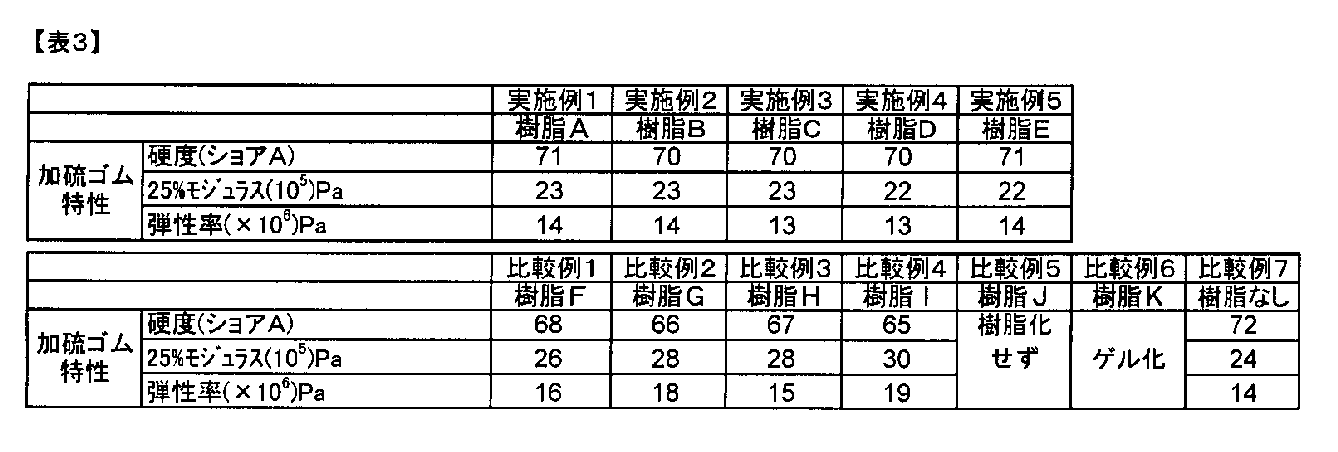
力学的特性測定結果を表3に示す。
表3から明らかなように、実施例1〜5で得られたゴム配合用樹脂を配合して得られた組成物は、樹脂を配合せずに得た比較例7のゴム組成物と比較して変わらない結果となった。これは実施例1〜5で得られたゴム配合用樹脂がゴム組成物の力学的強度に影響を与えないことを示している。一方一般的に用いられているアルキルフェノール−ホルムアルデヒド樹脂である比較例1〜4で得られたゴム配合用樹脂を配合して得られた組成物は、樹脂を配合せずに得た比較例7のゴム組成物と比較して硬度が低くなる結果となった。 As is apparent from Table 3, the composition obtained by blending the rubber compounding resins obtained in Examples 1 to 5 was compared with the rubber composition of Comparative Example 7 obtained without blending the resin. The result was unchanging. This indicates that the rubber compounding resins obtained in Examples 1 to 5 do not affect the mechanical strength of the rubber composition. On the other hand, the composition obtained by blending the rubber compounding resin obtained in Comparative Examples 1 to 4, which is a commonly used alkylphenol-formaldehyde resin, was obtained from Comparative Example 7 obtained without compounding the resin. As a result, the hardness was lower than that of the rubber composition.
Claims (7)
Priority Applications (1)
| Application Number | Priority Date | Filing Date | Title |
|---|---|---|---|
| JP2008089647A JP2009242526A (en) | 2008-03-31 | 2008-03-31 | Resin for rubber compounding and rubber composition |
Applications Claiming Priority (1)
| Application Number | Priority Date | Filing Date | Title |
|---|---|---|---|
| JP2008089647A JP2009242526A (en) | 2008-03-31 | 2008-03-31 | Resin for rubber compounding and rubber composition |
Publications (1)
| Publication Number | Publication Date |
|---|---|
| JP2009242526A true JP2009242526A (en) | 2009-10-22 |
Family
ID=41304816
Family Applications (1)
| Application Number | Title | Priority Date | Filing Date |
|---|---|---|---|
| JP2008089647A Pending JP2009242526A (en) | 2008-03-31 | 2008-03-31 | Resin for rubber compounding and rubber composition |
Country Status (1)
| Country | Link |
|---|---|
| JP (1) | JP2009242526A (en) |
-
2008
- 2008-03-31 JP JP2008089647A patent/JP2009242526A/en active Pending
Similar Documents
| Publication | Publication Date | Title |
|---|---|---|
| JP6541007B2 (en) | Phenol-modified lignin resin, method for producing the same, and resin composition, rubber composition, and cured product | |
| EP3059274B1 (en) | Resin composition and rubber composition | |
| US10138377B2 (en) | Lignin derivative, lignin resin composition, rubber composition, and molding material | |
| CN101535060B (en) | Rubber composition with molding tack | |
| CN103450693B (en) | Composite modified coal tar pitch and preparation method thereof | |
| JPWO2015056757A1 (en) | Resin composition, rubber composition, and cured product | |
| JP6992308B2 (en) | Rubber composition and pneumatic tires | |
| WO2007111109A1 (en) | Resin for blending with rubber, and rubber composition | |
| EP2812364B1 (en) | SULFUR MODIFIED POLYVINYL ACETATE (PVAc) | |
| JP2007321093A (en) | Rubber composition for tire | |
| Pichaiyut et al. | Influence of rice husk ash on the properties of dynamically cured ENR/TPS biocomposites | |
| JP6910321B2 (en) | Method of manufacturing modified phenol resin and modified phenol resin | |
| JP2009242526A (en) | Resin for rubber compounding and rubber composition | |
| CN107001766A (en) | Lignin resin composition, solidfied material and article shaped | |
| JP2015205948A (en) | Rubber composition for coating tire fiber and pneumatic tire using the same | |
| JP2010275411A (en) | Epoxy resin composition | |
| JP2015205968A (en) | Rubber composition for tire bead filler and pneumatic tire using the same | |
| JP2007002032A (en) | Modified phenol resin, method for producing the same, and modified phenol resin composition | |
| CN113214575B (en) | PVC sole and preparation process thereof | |
| JP2009242525A (en) | Resin composition for rubber compounding and rubber composition | |
| JP2014111786A (en) | Rubber composition and pneumatic tire using the same | |
| JP2008248040A (en) | Resin for compounding rubber and rubber composition | |
| JP5244546B2 (en) | Epoxy resin composition and cured epoxy resin | |
| JP2013249402A (en) | Rubber composition | |
| JP2004224898A (en) | Rubber composition |