JP2009242529A - Thermosetting resin composite material, its manufacturing method, and friction material - Google Patents
Thermosetting resin composite material, its manufacturing method, and friction material Download PDFInfo
- Publication number
- JP2009242529A JP2009242529A JP2008089769A JP2008089769A JP2009242529A JP 2009242529 A JP2009242529 A JP 2009242529A JP 2008089769 A JP2008089769 A JP 2008089769A JP 2008089769 A JP2008089769 A JP 2008089769A JP 2009242529 A JP2009242529 A JP 2009242529A
- Authority
- JP
- Japan
- Prior art keywords
- thermosetting resin
- composite material
- resin composite
- organic solvent
- fullerene
- Prior art date
- Legal status (The legal status is an assumption and is not a legal conclusion. Google has not performed a legal analysis and makes no representation as to the accuracy of the status listed.)
- Withdrawn
Links
- 229920001187 thermosetting polymer Polymers 0.000 title claims abstract description 115
- 239000000463 material Substances 0.000 title claims abstract description 73
- 239000000805 composite resin Substances 0.000 title claims abstract description 64
- 239000002783 friction material Substances 0.000 title claims abstract description 32
- 238000004519 manufacturing process Methods 0.000 title claims abstract description 11
- 229920005989 resin Polymers 0.000 claims abstract description 85
- 239000011347 resin Substances 0.000 claims abstract description 85
- XMWRBQBLMFGWIX-UHFFFAOYSA-N C60 fullerene Chemical compound C12=C3C(C4=C56)=C7C8=C5C5=C9C%10=C6C6=C4C1=C1C4=C6C6=C%10C%10=C9C9=C%11C5=C8C5=C8C7=C3C3=C7C2=C1C1=C2C4=C6C4=C%10C6=C9C9=C%11C5=C5C8=C3C3=C7C1=C1C2=C4C6=C2C9=C5C3=C12 XMWRBQBLMFGWIX-UHFFFAOYSA-N 0.000 claims abstract description 51
- 229910003472 fullerene Inorganic materials 0.000 claims abstract description 49
- 239000003960 organic solvent Substances 0.000 claims abstract description 38
- 239000002245 particle Substances 0.000 claims abstract description 22
- 239000002904 solvent Substances 0.000 claims abstract description 19
- 239000006185 dispersion Substances 0.000 claims abstract description 17
- 238000000034 method Methods 0.000 claims abstract description 15
- 239000002131 composite material Substances 0.000 claims abstract description 8
- YXFVVABEGXRONW-UHFFFAOYSA-N Toluene Natural products CC1=CC=CC=C1 YXFVVABEGXRONW-UHFFFAOYSA-N 0.000 claims description 22
- 239000005011 phenolic resin Substances 0.000 claims description 16
- 239000003822 epoxy resin Substances 0.000 claims description 11
- 229920000647 polyepoxide Polymers 0.000 claims description 11
- 150000004945 aromatic hydrocarbons Chemical class 0.000 claims description 10
- 125000005575 polycyclic aromatic hydrocarbon group Chemical group 0.000 claims description 9
- 229920006272 aromatic hydrocarbon resin Polymers 0.000 claims description 7
- LNEPOXFFQSENCJ-UHFFFAOYSA-N haloperidol Chemical compound C1CC(O)(C=2C=CC(Cl)=CC=2)CCN1CCCC(=O)C1=CC=C(F)C=C1 LNEPOXFFQSENCJ-UHFFFAOYSA-N 0.000 claims description 4
- 239000007788 liquid Substances 0.000 claims description 4
- 125000003944 tolyl group Chemical group 0.000 claims description 2
- 239000000945 filler Substances 0.000 abstract description 21
- 238000002156 mixing Methods 0.000 abstract description 15
- 239000011159 matrix material Substances 0.000 abstract description 10
- IISBACLAFKSPIT-UHFFFAOYSA-N bisphenol A Chemical compound C=1C=C(O)C=CC=1C(C)(C)C1=CC=C(O)C=C1 IISBACLAFKSPIT-UHFFFAOYSA-N 0.000 description 18
- 150000002894 organic compounds Chemical class 0.000 description 18
- 239000000835 fiber Substances 0.000 description 16
- PAYRUJLWNCNPSJ-UHFFFAOYSA-N Aniline Chemical compound NC1=CC=CC=C1 PAYRUJLWNCNPSJ-UHFFFAOYSA-N 0.000 description 14
- -1 pt-butylphenol Chemical compound 0.000 description 11
- VKYKSIONXSXAKP-UHFFFAOYSA-N hexamethylenetetramine Chemical compound C1N(C2)CN3CN1CN2C3 VKYKSIONXSXAKP-UHFFFAOYSA-N 0.000 description 10
- 239000003054 catalyst Substances 0.000 description 9
- 150000001875 compounds Chemical class 0.000 description 9
- TZCXTZWJZNENPQ-UHFFFAOYSA-L barium sulfate Chemical compound [Ba+2].[O-]S([O-])(=O)=O TZCXTZWJZNENPQ-UHFFFAOYSA-L 0.000 description 8
- 239000002734 clay mineral Substances 0.000 description 8
- 150000002989 phenols Chemical class 0.000 description 8
- WSFSSNUMVMOOMR-UHFFFAOYSA-N Formaldehyde Chemical compound O=C WSFSSNUMVMOOMR-UHFFFAOYSA-N 0.000 description 7
- ISWSIDIOOBJBQZ-UHFFFAOYSA-N Phenol Chemical compound OC1=CC=CC=C1 ISWSIDIOOBJBQZ-UHFFFAOYSA-N 0.000 description 7
- 150000003141 primary amines Chemical class 0.000 description 7
- OKTJSMMVPCPJKN-UHFFFAOYSA-N Carbon Chemical compound [C] OKTJSMMVPCPJKN-UHFFFAOYSA-N 0.000 description 6
- VYPSYNLAJGMNEJ-UHFFFAOYSA-N Silicium dioxide Chemical compound O=[Si]=O VYPSYNLAJGMNEJ-UHFFFAOYSA-N 0.000 description 6
- MCMNRKCIXSYSNV-UHFFFAOYSA-N Zirconium dioxide Chemical compound O=[Zr]=O MCMNRKCIXSYSNV-UHFFFAOYSA-N 0.000 description 6
- PXKLMJQFEQBVLD-UHFFFAOYSA-N bisphenol F Chemical compound C1=CC(O)=CC=C1CC1=CC=C(O)C=C1 PXKLMJQFEQBVLD-UHFFFAOYSA-N 0.000 description 6
- 239000000428 dust Substances 0.000 description 6
- 238000011156 evaluation Methods 0.000 description 6
- 238000002360 preparation method Methods 0.000 description 6
- RYGMFSIKBFXOCR-UHFFFAOYSA-N Copper Chemical compound [Cu] RYGMFSIKBFXOCR-UHFFFAOYSA-N 0.000 description 5
- 239000003377 acid catalyst Substances 0.000 description 5
- 150000004982 aromatic amines Chemical class 0.000 description 5
- 230000000052 comparative effect Effects 0.000 description 5
- 239000004312 hexamethylene tetramine Substances 0.000 description 5
- 235000010299 hexamethylene tetramine Nutrition 0.000 description 5
- 125000002887 hydroxy group Chemical group [H]O* 0.000 description 5
- 229910052751 metal Inorganic materials 0.000 description 5
- 239000002184 metal Substances 0.000 description 5
- VTYYLEPIZMXCLO-UHFFFAOYSA-L Calcium carbonate Chemical compound [Ca+2].[O-]C([O-])=O VTYYLEPIZMXCLO-UHFFFAOYSA-L 0.000 description 4
- CPLXHLVBOLITMK-UHFFFAOYSA-N Magnesium oxide Chemical compound [Mg]=O CPLXHLVBOLITMK-UHFFFAOYSA-N 0.000 description 4
- 229930040373 Paraformaldehyde Natural products 0.000 description 4
- 150000001412 amines Chemical class 0.000 description 4
- 239000004760 aramid Substances 0.000 description 4
- 239000003795 chemical substances by application Substances 0.000 description 4
- 229920001971 elastomer Polymers 0.000 description 4
- 229920003986 novolac Polymers 0.000 description 4
- 229920002866 paraformaldehyde Polymers 0.000 description 4
- GHMLBKRAJCXXBS-UHFFFAOYSA-N resorcinol Chemical compound OC1=CC=CC(O)=C1 GHMLBKRAJCXXBS-UHFFFAOYSA-N 0.000 description 4
- 238000003756 stirring Methods 0.000 description 4
- 239000000126 substance Substances 0.000 description 4
- KJCVRFUGPWSIIH-UHFFFAOYSA-N 1-naphthol Chemical compound C1=CC=C2C(O)=CC=CC2=C1 KJCVRFUGPWSIIH-UHFFFAOYSA-N 0.000 description 3
- ZWEHNKRNPOVVGH-UHFFFAOYSA-N 2-Butanone Chemical compound CCC(C)=O ZWEHNKRNPOVVGH-UHFFFAOYSA-N 0.000 description 3
- KXGFMDJXCMQABM-UHFFFAOYSA-N 2-methoxy-6-methylphenol Chemical compound [CH]OC1=CC=CC([CH])=C1O KXGFMDJXCMQABM-UHFFFAOYSA-N 0.000 description 3
- BGDOLELXXPTPFX-UHFFFAOYSA-N 3,4-dihydro-2h-1,2-benzoxazine Chemical group C1=CC=C2ONCCC2=C1 BGDOLELXXPTPFX-UHFFFAOYSA-N 0.000 description 3
- 244000226021 Anacardium occidentale Species 0.000 description 3
- UHOVQNZJYSORNB-UHFFFAOYSA-N Benzene Chemical compound C1=CC=CC=C1 UHOVQNZJYSORNB-UHFFFAOYSA-N 0.000 description 3
- OKKJLVBELUTLKV-UHFFFAOYSA-N Methanol Chemical compound OC OKKJLVBELUTLKV-UHFFFAOYSA-N 0.000 description 3
- XAGFODPZIPBFFR-UHFFFAOYSA-N aluminium Chemical compound [Al] XAGFODPZIPBFFR-UHFFFAOYSA-N 0.000 description 3
- PNEYBMLMFCGWSK-UHFFFAOYSA-N aluminium oxide Inorganic materials [O-2].[O-2].[O-2].[Al+3].[Al+3] PNEYBMLMFCGWSK-UHFFFAOYSA-N 0.000 description 3
- 239000011230 binding agent Substances 0.000 description 3
- 235000020226 cashew nut Nutrition 0.000 description 3
- 239000000919 ceramic Substances 0.000 description 3
- 238000006243 chemical reaction Methods 0.000 description 3
- 238000000748 compression moulding Methods 0.000 description 3
- 238000006482 condensation reaction Methods 0.000 description 3
- 239000010949 copper Substances 0.000 description 3
- 229910052802 copper Inorganic materials 0.000 description 3
- 230000018044 dehydration Effects 0.000 description 3
- 238000006297 dehydration reaction Methods 0.000 description 3
- 238000004807 desolvation Methods 0.000 description 3
- JRBPAEWTRLWTQC-UHFFFAOYSA-N dodecylamine Chemical compound CCCCCCCCCCCCN JRBPAEWTRLWTQC-UHFFFAOYSA-N 0.000 description 3
- 235000019256 formaldehyde Nutrition 0.000 description 3
- 239000010439 graphite Substances 0.000 description 3
- 229910002804 graphite Inorganic materials 0.000 description 3
- 238000010438 heat treatment Methods 0.000 description 3
- RAXXELZNTBOGNW-UHFFFAOYSA-N imidazole Natural products C1=CNC=N1 RAXXELZNTBOGNW-UHFFFAOYSA-N 0.000 description 3
- 239000012784 inorganic fiber Substances 0.000 description 3
- 239000000203 mixture Substances 0.000 description 3
- CWQXQMHSOZUFJS-UHFFFAOYSA-N molybdenum disulfide Chemical compound S=[Mo]=S CWQXQMHSOZUFJS-UHFFFAOYSA-N 0.000 description 3
- 229910052982 molybdenum disulfide Inorganic materials 0.000 description 3
- 229920001568 phenolic resin Polymers 0.000 description 3
- 238000006068 polycondensation reaction Methods 0.000 description 3
- 239000000377 silicon dioxide Substances 0.000 description 3
- CDULGHZNHURECF-UHFFFAOYSA-N 2,3-dimethylaniline 2,4-dimethylaniline 2,5-dimethylaniline 2,6-dimethylaniline 3,4-dimethylaniline 3,5-dimethylaniline Chemical group CC1=CC=C(N)C(C)=C1.CC1=CC=C(C)C(N)=C1.CC1=CC(C)=CC(N)=C1.CC1=CC=C(N)C=C1C.CC1=CC=CC(N)=C1C.CC1=CC=CC(C)=C1N CDULGHZNHURECF-UHFFFAOYSA-N 0.000 description 2
- JWAZRIHNYRIHIV-UHFFFAOYSA-N 2-naphthol Chemical compound C1=CC=CC2=CC(O)=CC=C21 JWAZRIHNYRIHIV-UHFFFAOYSA-N 0.000 description 2
- VPWNQTHUCYMVMZ-UHFFFAOYSA-N 4,4'-sulfonyldiphenol Chemical compound C1=CC(O)=CC=C1S(=O)(=O)C1=CC=C(O)C=C1 VPWNQTHUCYMVMZ-UHFFFAOYSA-N 0.000 description 2
- QGZKDVFQNNGYKY-UHFFFAOYSA-N Ammonia Chemical compound N QGZKDVFQNNGYKY-UHFFFAOYSA-N 0.000 description 2
- 229920000049 Carbon (fiber) Polymers 0.000 description 2
- LFQSCWFLJHTTHZ-UHFFFAOYSA-N Ethanol Chemical compound CCO LFQSCWFLJHTTHZ-UHFFFAOYSA-N 0.000 description 2
- YNQLUTRBYVCPMQ-UHFFFAOYSA-N Ethylbenzene Chemical compound CCC1=CC=CC=C1 YNQLUTRBYVCPMQ-UHFFFAOYSA-N 0.000 description 2
- UFWIBTONFRDIAS-UHFFFAOYSA-N Naphthalene Chemical compound C1=CC=CC2=CC=CC=C21 UFWIBTONFRDIAS-UHFFFAOYSA-N 0.000 description 2
- PXHVJJICTQNCMI-UHFFFAOYSA-N Nickel Chemical compound [Ni] PXHVJJICTQNCMI-UHFFFAOYSA-N 0.000 description 2
- REYJJPSVUYRZGE-UHFFFAOYSA-N Octadecylamine Chemical compound CCCCCCCCCCCCCCCCCCN REYJJPSVUYRZGE-UHFFFAOYSA-N 0.000 description 2
- 239000006087 Silane Coupling Agent Substances 0.000 description 2
- HCHKCACWOHOZIP-UHFFFAOYSA-N Zinc Chemical compound [Zn] HCHKCACWOHOZIP-UHFFFAOYSA-N 0.000 description 2
- 239000000853 adhesive Substances 0.000 description 2
- 230000001070 adhesive effect Effects 0.000 description 2
- 125000001931 aliphatic group Chemical group 0.000 description 2
- HPTYUNKZVDYXLP-UHFFFAOYSA-N aluminum;trihydroxy(trihydroxysilyloxy)silane;hydrate Chemical compound O.[Al].[Al].O[Si](O)(O)O[Si](O)(O)O HPTYUNKZVDYXLP-UHFFFAOYSA-N 0.000 description 2
- MWPLVEDNUUSJAV-UHFFFAOYSA-N anthracene Chemical compound C1=CC=CC2=CC3=CC=CC=C3C=C21 MWPLVEDNUUSJAV-UHFFFAOYSA-N 0.000 description 2
- 229920006231 aramid fiber Polymers 0.000 description 2
- 229920003235 aromatic polyamide Polymers 0.000 description 2
- 125000003118 aryl group Chemical group 0.000 description 2
- 239000006227 byproduct Substances 0.000 description 2
- 229910000019 calcium carbonate Inorganic materials 0.000 description 2
- 229910052799 carbon Inorganic materials 0.000 description 2
- 125000004432 carbon atom Chemical group C* 0.000 description 2
- 239000004917 carbon fiber Substances 0.000 description 2
- YCIMNLLNPGFGHC-UHFFFAOYSA-N catechol Chemical compound OC1=CC=CC=C1O YCIMNLLNPGFGHC-UHFFFAOYSA-N 0.000 description 2
- 238000005260 corrosion Methods 0.000 description 2
- 230000007797 corrosion Effects 0.000 description 2
- 238000004132 cross linking Methods 0.000 description 2
- GUJOJGAPFQRJSV-UHFFFAOYSA-N dialuminum;dioxosilane;oxygen(2-);hydrate Chemical compound O.[O-2].[O-2].[O-2].[Al+3].[Al+3].O=[Si]=O.O=[Si]=O.O=[Si]=O.O=[Si]=O GUJOJGAPFQRJSV-UHFFFAOYSA-N 0.000 description 2
- NJLLQSBAHIKGKF-UHFFFAOYSA-N dipotassium dioxido(oxo)titanium Chemical compound [K+].[K+].[O-][Ti]([O-])=O NJLLQSBAHIKGKF-UHFFFAOYSA-N 0.000 description 2
- 239000002657 fibrous material Substances 0.000 description 2
- 239000007789 gas Substances 0.000 description 2
- 229910052621 halloysite Inorganic materials 0.000 description 2
- RLSSMJSEOOYNOY-UHFFFAOYSA-N m-cresol Chemical compound CC1=CC=CC(O)=C1 RLSSMJSEOOYNOY-UHFFFAOYSA-N 0.000 description 2
- 239000000395 magnesium oxide Substances 0.000 description 2
- 238000005259 measurement Methods 0.000 description 2
- 239000012778 molding material Substances 0.000 description 2
- 229910052901 montmorillonite Inorganic materials 0.000 description 2
- QWVGKYWNOKOFNN-UHFFFAOYSA-N o-cresol Chemical compound CC1=CC=CC=C1O QWVGKYWNOKOFNN-UHFFFAOYSA-N 0.000 description 2
- IWDCLRJOBJJRNH-UHFFFAOYSA-N p-cresol Chemical compound CC1=CC=C(O)C=C1 IWDCLRJOBJJRNH-UHFFFAOYSA-N 0.000 description 2
- YNPNZTXNASCQKK-UHFFFAOYSA-N phenanthrene Chemical compound C1=CC=C2C3=CC=CC=C3C=CC2=C1 YNPNZTXNASCQKK-UHFFFAOYSA-N 0.000 description 2
- 239000000843 powder Substances 0.000 description 2
- 239000000047 product Substances 0.000 description 2
- BBEAQIROQSPTKN-UHFFFAOYSA-N pyrene Chemical compound C1=CC=C2C=CC3=CC=CC4=CC=C1C2=C43 BBEAQIROQSPTKN-UHFFFAOYSA-N 0.000 description 2
- 150000003242 quaternary ammonium salts Chemical class 0.000 description 2
- YPMOSINXXHVZIL-UHFFFAOYSA-N sulfanylideneantimony Chemical compound [Sb]=S YPMOSINXXHVZIL-UHFFFAOYSA-N 0.000 description 2
- 150000004992 toluidines Chemical class 0.000 description 2
- UZJQAPIBSXPJON-UHFFFAOYSA-N (2,3-dimethylphenyl)methanediol Chemical group CC1=CC=CC(C(O)O)=C1C UZJQAPIBSXPJON-UHFFFAOYSA-N 0.000 description 1
- WYTZZXDRDKSJID-UHFFFAOYSA-N (3-aminopropyl)triethoxysilane Chemical compound CCO[Si](OCC)(OCC)CCCN WYTZZXDRDKSJID-UHFFFAOYSA-N 0.000 description 1
- BGJSXRVXTHVRSN-UHFFFAOYSA-N 1,3,5-trioxane Chemical compound C1OCOCO1 BGJSXRVXTHVRSN-UHFFFAOYSA-N 0.000 description 1
- FJLUATLTXUNBOT-UHFFFAOYSA-N 1-Hexadecylamine Chemical compound CCCCCCCCCCCCCCCCN FJLUATLTXUNBOT-UHFFFAOYSA-N 0.000 description 1
- MQCPOLNSJCWPGT-UHFFFAOYSA-N 2,2'-Bisphenol F Chemical compound OC1=CC=CC=C1CC1=CC=CC=C1O MQCPOLNSJCWPGT-UHFFFAOYSA-N 0.000 description 1
- SJECZPVISLOESU-UHFFFAOYSA-N 3-trimethoxysilylpropan-1-amine Chemical compound CO[Si](OC)(OC)CCCN SJECZPVISLOESU-UHFFFAOYSA-N 0.000 description 1
- NZGQHKSLKRFZFL-UHFFFAOYSA-N 4-(4-hydroxyphenoxy)phenol Chemical compound C1=CC(O)=CC=C1OC1=CC=C(O)C=C1 NZGQHKSLKRFZFL-UHFFFAOYSA-N 0.000 description 1
- KLPPPIIIEMUEGP-UHFFFAOYSA-N 4-dodecylaniline Chemical compound CCCCCCCCCCCCC1=CC=C(N)C=C1 KLPPPIIIEMUEGP-UHFFFAOYSA-N 0.000 description 1
- ORKQJTBYQZITLA-UHFFFAOYSA-N 4-octylaniline Chemical compound CCCCCCCCC1=CC=C(N)C=C1 ORKQJTBYQZITLA-UHFFFAOYSA-N 0.000 description 1
- WRDWWAVNELMWAM-UHFFFAOYSA-N 4-tert-butylaniline Chemical compound CC(C)(C)C1=CC=C(N)C=C1 WRDWWAVNELMWAM-UHFFFAOYSA-N 0.000 description 1
- 229920002972 Acrylic fiber Polymers 0.000 description 1
- SDDLEVPIDBLVHC-UHFFFAOYSA-N Bisphenol Z Chemical compound C1=CC(O)=CC=C1C1(C=2C=CC(O)=CC=2)CCCCC1 SDDLEVPIDBLVHC-UHFFFAOYSA-N 0.000 description 1
- 229910001369 Brass Inorganic materials 0.000 description 1
- 239000013032 Hydrocarbon resin Substances 0.000 description 1
- 229920000271 Kevlar® Polymers 0.000 description 1
- NTIZESTWPVYFNL-UHFFFAOYSA-N Methyl isobutyl ketone Chemical compound CC(C)CC(C)=O NTIZESTWPVYFNL-UHFFFAOYSA-N 0.000 description 1
- UIHCLUNTQKBZGK-UHFFFAOYSA-N Methyl isobutyl ketone Natural products CCC(C)C(C)=O UIHCLUNTQKBZGK-UHFFFAOYSA-N 0.000 description 1
- CTQNGGLPUBDAKN-UHFFFAOYSA-N O-Xylene Chemical compound CC1=CC=CC=C1C CTQNGGLPUBDAKN-UHFFFAOYSA-N 0.000 description 1
- 239000004642 Polyimide Substances 0.000 description 1
- 239000004113 Sepiolite Substances 0.000 description 1
- 229910000831 Steel Inorganic materials 0.000 description 1
- XMUZQOKACOLCSS-UHFFFAOYSA-N [2-(hydroxymethyl)phenyl]methanol Chemical compound OCC1=CC=CC=C1CO XMUZQOKACOLCSS-UHFFFAOYSA-N 0.000 description 1
- 238000005299 abrasion Methods 0.000 description 1
- CWRYPZZKDGJXCA-UHFFFAOYSA-N acenaphthene Chemical compound C1=CC(CC2)=C3C2=CC=CC3=C1 CWRYPZZKDGJXCA-UHFFFAOYSA-N 0.000 description 1
- 239000002253 acid Substances 0.000 description 1
- 150000001298 alcohols Chemical class 0.000 description 1
- 229910052782 aluminium Inorganic materials 0.000 description 1
- 229910021529 ammonia Inorganic materials 0.000 description 1
- 229940007424 antimony trisulfide Drugs 0.000 description 1
- NVWBARWTDVQPJD-UHFFFAOYSA-N antimony(3+);trisulfide Chemical compound [S-2].[S-2].[S-2].[Sb+3].[Sb+3] NVWBARWTDVQPJD-UHFFFAOYSA-N 0.000 description 1
- 239000010425 asbestos Substances 0.000 description 1
- 125000004429 atom Chemical group 0.000 description 1
- QVGXLLKOCUKJST-UHFFFAOYSA-N atomic oxygen Chemical compound [O] QVGXLLKOCUKJST-UHFFFAOYSA-N 0.000 description 1
- 229960000892 attapulgite Drugs 0.000 description 1
- VCCBEIPGXKNHFW-UHFFFAOYSA-N biphenyl-4,4'-diol Chemical group C1=CC(O)=CC=C1C1=CC=C(O)C=C1 VCCBEIPGXKNHFW-UHFFFAOYSA-N 0.000 description 1
- YXVFYQXJAXKLAK-UHFFFAOYSA-N biphenyl-4-ol Chemical compound C1=CC(O)=CC=C1C1=CC=CC=C1 YXVFYQXJAXKLAK-UHFFFAOYSA-N 0.000 description 1
- RBRXPPLNXDVMKG-GMFCBQQYSA-M bis(2-hydroxyethyl)-methyl-[(z)-octadec-9-enyl]azanium;chloride Chemical compound [Cl-].CCCCCCCC\C=C/CCCCCCCC[N+](C)(CCO)CCO RBRXPPLNXDVMKG-GMFCBQQYSA-M 0.000 description 1
- 239000010951 brass Substances 0.000 description 1
- AXCZMVOFGPJBDE-UHFFFAOYSA-L calcium dihydroxide Chemical compound [OH-].[OH-].[Ca+2] AXCZMVOFGPJBDE-UHFFFAOYSA-L 0.000 description 1
- 239000000920 calcium hydroxide Substances 0.000 description 1
- 229910001861 calcium hydroxide Inorganic materials 0.000 description 1
- VNSBYDPZHCQWNB-UHFFFAOYSA-N calcium;aluminum;dioxido(oxo)silane;sodium;hydrate Chemical compound O.[Na].[Al].[Ca+2].[O-][Si]([O-])=O VNSBYDPZHCQWNB-UHFFFAOYSA-N 0.000 description 1
- 239000002134 carbon nanofiber Substances 0.000 description 1
- 239000003431 cross linking reagent Substances 0.000 description 1
- 230000032798 delamination Effects 0.000 description 1
- 150000004985 diamines Chemical class 0.000 description 1
- 229910003460 diamond Inorganic materials 0.000 description 1
- 239000010432 diamond Substances 0.000 description 1
- ZBCBWPMODOFKDW-UHFFFAOYSA-N diethanolamine Chemical compound OCCNCCO ZBCBWPMODOFKDW-UHFFFAOYSA-N 0.000 description 1
- HPNMFZURTQLUMO-UHFFFAOYSA-N diethylamine Chemical compound CCNCC HPNMFZURTQLUMO-UHFFFAOYSA-N 0.000 description 1
- GYZLOYUZLJXAJU-UHFFFAOYSA-N diglycidyl ether Chemical compound C1OC1COCC1CO1 GYZLOYUZLJXAJU-UHFFFAOYSA-N 0.000 description 1
- REZZEXDLIUJMMS-UHFFFAOYSA-M dimethyldioctadecylammonium chloride Chemical compound [Cl-].CCCCCCCCCCCCCCCCCC[N+](C)(C)CCCCCCCCCCCCCCCCCC REZZEXDLIUJMMS-UHFFFAOYSA-M 0.000 description 1
- 238000001035 drying Methods 0.000 description 1
- 230000007613 environmental effect Effects 0.000 description 1
- GVEPBJHOBDJJJI-UHFFFAOYSA-N fluoranthrene Natural products C1=CC(C2=CC=CC=C22)=C3C2=CC=CC3=C1 GVEPBJHOBDJJJI-UHFFFAOYSA-N 0.000 description 1
- 239000003365 glass fiber Substances 0.000 description 1
- 125000004970 halomethyl group Chemical group 0.000 description 1
- 230000017525 heat dissipation Effects 0.000 description 1
- 229910000271 hectorite Inorganic materials 0.000 description 1
- KWLMIXQRALPRBC-UHFFFAOYSA-L hectorite Chemical compound [Li+].[OH-].[OH-].[Na+].[Mg+2].O1[Si]2([O-])O[Si]1([O-])O[Si]([O-])(O1)O[Si]1([O-])O2 KWLMIXQRALPRBC-UHFFFAOYSA-L 0.000 description 1
- BHEPBYXIRTUNPN-UHFFFAOYSA-N hydridophosphorus(.) (triplet) Chemical compound [PH] BHEPBYXIRTUNPN-UHFFFAOYSA-N 0.000 description 1
- 229920006270 hydrocarbon resin Polymers 0.000 description 1
- 150000002430 hydrocarbons Chemical class 0.000 description 1
- 125000004435 hydrogen atom Chemical group [H]* 0.000 description 1
- 125000004029 hydroxymethyl group Chemical group [H]OC([H])([H])* 0.000 description 1
- 238000009830 intercalation Methods 0.000 description 1
- 230000002687 intercalation Effects 0.000 description 1
- 150000002576 ketones Chemical class 0.000 description 1
- 239000004761 kevlar Substances 0.000 description 1
- 238000004898 kneading Methods 0.000 description 1
- 239000000314 lubricant Substances 0.000 description 1
- 239000000155 melt Substances 0.000 description 1
- 238000002844 melting Methods 0.000 description 1
- 230000008018 melting Effects 0.000 description 1
- VNWKTOKETHGBQD-UHFFFAOYSA-N methane Chemical class C VNWKTOKETHGBQD-UHFFFAOYSA-N 0.000 description 1
- 239000002557 mineral fiber Substances 0.000 description 1
- 239000011490 mineral wool Substances 0.000 description 1
- 239000003607 modifier Substances 0.000 description 1
- 229910052680 mordenite Inorganic materials 0.000 description 1
- 238000000465 moulding Methods 0.000 description 1
- DULAEBAGAYVIDN-UHFFFAOYSA-N n-dodecyl-n-methyldodecan-1-amine;hydrochloride Chemical compound [Cl-].CCCCCCCCCCCC[NH+](C)CCCCCCCCCCCC DULAEBAGAYVIDN-UHFFFAOYSA-N 0.000 description 1
- OVAZZMXASSWARN-UHFFFAOYSA-N naphthalen-1-ylmethanediol Chemical compound C1=CC=C2C(C(O)O)=CC=CC2=C1 OVAZZMXASSWARN-UHFFFAOYSA-N 0.000 description 1
- 229910052759 nickel Inorganic materials 0.000 description 1
- INAMEDPXUAWNKL-UHFFFAOYSA-N nonadecan-1-amine Chemical compound CCCCCCCCCCCCCCCCCCCN INAMEDPXUAWNKL-UHFFFAOYSA-N 0.000 description 1
- 229910000273 nontronite Inorganic materials 0.000 description 1
- 239000001301 oxygen Substances 0.000 description 1
- 229910052760 oxygen Inorganic materials 0.000 description 1
- BHAAPTBBJKJZER-UHFFFAOYSA-N p-anisidine Chemical compound COC1=CC=C(N)C=C1 BHAAPTBBJKJZER-UHFFFAOYSA-N 0.000 description 1
- 229910052625 palygorskite Inorganic materials 0.000 description 1
- DPBLXKKOBLCELK-UHFFFAOYSA-N pentan-1-amine Chemical compound CCCCCN DPBLXKKOBLCELK-UHFFFAOYSA-N 0.000 description 1
- 125000000843 phenylene group Chemical group C1(=C(C=CC=C1)*)* 0.000 description 1
- SNGARVZXPNQWEY-UHFFFAOYSA-N phenylmethanediol Chemical compound OC(O)C1=CC=CC=C1 SNGARVZXPNQWEY-UHFFFAOYSA-N 0.000 description 1
- CCDXIADKBDSBJU-UHFFFAOYSA-N phenylmethanetriol Chemical compound OC(O)(O)C1=CC=CC=C1 CCDXIADKBDSBJU-UHFFFAOYSA-N 0.000 description 1
- 230000000704 physical effect Effects 0.000 description 1
- 229920000058 polyacrylate Polymers 0.000 description 1
- 229920000728 polyester Polymers 0.000 description 1
- 229920001721 polyimide Polymers 0.000 description 1
- 230000003014 reinforcing effect Effects 0.000 description 1
- 239000012783 reinforcing fiber Substances 0.000 description 1
- 229920003987 resole Polymers 0.000 description 1
- 229910052895 riebeckite Inorganic materials 0.000 description 1
- 229910000275 saponite Inorganic materials 0.000 description 1
- 238000000926 separation method Methods 0.000 description 1
- 229910052624 sepiolite Inorganic materials 0.000 description 1
- 235000019355 sepiolite Nutrition 0.000 description 1
- HBMJWWWQQXIZIP-UHFFFAOYSA-N silicon carbide Chemical class [Si+]#[C-] HBMJWWWQQXIZIP-UHFFFAOYSA-N 0.000 description 1
- 229910021647 smectite Inorganic materials 0.000 description 1
- 239000010959 steel Substances 0.000 description 1
- 229910052902 vermiculite Inorganic materials 0.000 description 1
- 239000010455 vermiculite Substances 0.000 description 1
- 235000019354 vermiculite Nutrition 0.000 description 1
- XLYOFNOQVPJJNP-UHFFFAOYSA-N water Substances O XLYOFNOQVPJJNP-UHFFFAOYSA-N 0.000 description 1
- 229910052882 wollastonite Inorganic materials 0.000 description 1
- 239000010456 wollastonite Substances 0.000 description 1
- 239000008096 xylene Substances 0.000 description 1
- 125000002256 xylenyl group Chemical class C1(C(C=CC=C1)C)(C)* 0.000 description 1
Landscapes
- Manufacture Of Macromolecular Shaped Articles (AREA)
- Compositions Of Macromolecular Compounds (AREA)
- Macromolecular Compounds Obtained By Forming Nitrogen-Containing Linkages In General (AREA)
Abstract
Description
本発明は、熱硬化性樹脂複合材料、その製造方法および摩擦材に関する。さらに詳しくは、本発明は、熱硬化性樹脂マトリクス中に、フラーレン粒子を均一に微分散させてなる耐摩耗性を向上させた熱硬化性樹脂複合材料、このものを効率よく製造する方法、および上記熱硬化性樹脂複合材料を用いて得られた耐摩耗性に優れる摩擦材に関するものである。 The present invention relates to a thermosetting resin composite material, a manufacturing method thereof, and a friction material. More specifically, the present invention relates to a thermosetting resin composite material having improved wear resistance obtained by uniformly finely dispersing fullerene particles in a thermosetting resin matrix, a method for efficiently producing the same, and The present invention relates to a friction material having excellent wear resistance obtained by using the thermosetting resin composite material.
自動車等のブレーキパッドに用いられるノンアスベスト系ブレーキ用摩擦材は、例えば、スチール、銅等の金属繊維、セラミック、カーボンファイバ等の無機繊維、アラミド繊維等の強化繊維等からなる基材に、黒鉛、三硫化アンチモン、二硫化モリブデン等の潤滑材、硫酸バリウム、水酸化カルシウム等の充填材、およびカシューダスト、セラミック粉、金属粉末等の摩擦調整材を配合し、かつこれらの成分に結合材を配合して十分攪拌混合後、加熱しつつ圧縮成形を行うことにより作製されている。 Non-asbestos brake friction materials used for brake pads of automobiles, etc. are made of, for example, a base material made of metal fibers such as steel and copper, ceramics, inorganic fibers such as carbon fibers, reinforcing fibers such as aramid fibers, etc. , Antimony trisulfide, molybdenum disulfide, and other lubricants, barium sulfate, calcium hydroxide, and other fillers, and cashew dust, ceramic powder, metal powder, and other friction modifiers. It is prepared by mixing and mixing with sufficient stirring, followed by compression molding while heating.
そして、上記結合材として、フェノール樹脂、ポリベンゾオキサジン樹脂、エポキシ樹脂、縮合多環芳香族炭化水素樹脂などの熱硬化性樹脂が用いられている。 As the binder, thermosetting resins such as phenol resin, polybenzoxazine resin, epoxy resin, and condensed polycyclic aromatic hydrocarbon resin are used.
上記熱硬化性樹脂の中で、特にポリベンゾオキサジン樹脂は、フェノール樹脂やエポキシ樹脂と比較して優れた耐熱性を示し、かつ成形時に副生成物を発生しないなどの特性を有することから、摩擦材の結合材として近年注目されている。 Among the above thermosetting resins, polybenzoxazine resin, in particular, has excellent heat resistance compared to phenolic resin and epoxy resin, and has characteristics such as no generation of by-products during molding. In recent years, it has attracted attention as a binder for materials.
ところで、摩擦材においては、耐熱性、放熱性および耐摩耗性を向上させた熱硬化性樹脂材料が求められており、これまで、例えば充填材としてカーボンナノファイバーやフラーレンを、熱硬化性樹脂マトリクスに含有させることにより、上記要求特性を改善した摩擦材が開示されている(例えば、特許文献1参照)。 By the way, in the friction material, there is a demand for a thermosetting resin material having improved heat resistance, heat dissipation, and wear resistance. Until now, for example, carbon nanofibers and fullerenes have been used as a filler, and a thermosetting resin matrix is used. The friction material which improved the said required characteristic by making it contain in is disclosed (for example, refer patent document 1).
しかしながら、上記特許文献1においては、充填材の添加方法や分散状態についての記載はなく、特性の安定した摩擦材を得ることは困難であると思われる。
本発明は、熱硬化性樹脂マトリクス中に、充填材を均一に微分散させてなる耐摩耗性に優れた熱硬化性樹脂複合材料、このものを効率よく製造する方法、および上記複合材料を用いてなる耐摩耗性に優れた摩擦材を提供することを目的とするものである。 The present invention uses a thermosetting resin composite material excellent in wear resistance obtained by uniformly finely dispersing a filler in a thermosetting resin matrix, a method for efficiently producing the same, and the composite material described above. It is an object to provide a friction material having excellent wear resistance.
本発明者らは、前記目的を達成するために鋭意研究を重ねた結果、熱硬化性樹脂マトリクス中に、フラーレンをあるサイズ以上の凝集塊が存在しない状態で均一に微分散させることにより、耐摩耗性に優れる熱硬化性樹脂複合材料が得られること、そして、該複合材料は、熱硬化性樹脂を含む有機溶媒溶液と、フラーレンの有機溶媒溶液ないし有機溶媒分散液を混合し、次いで溶媒を留去させることにより得られること、さらに、上記熱硬化性樹脂複合材料を用いることにより、耐摩耗性に優れる摩擦材が得られることを見出した。
本発明は、かかる知見に基づいて完成したものである。
As a result of intensive studies to achieve the above object, the present inventors have made it possible to uniformly and fully disperse fullerene in the thermosetting resin matrix in the absence of agglomerates of a certain size or more. A thermosetting resin composite material excellent in abrasion is obtained, and the composite material is prepared by mixing an organic solvent solution containing a thermosetting resin with an organic solvent solution or organic solvent dispersion of fullerene, and then adding a solvent. It has been found that a friction material excellent in wear resistance can be obtained by using the above thermosetting resin composite material.
The present invention has been completed based on such findings.
すなわち、本発明は、
(1) (A)熱硬化性樹脂と、(B)フラーレン粒子とを含み、かつ上記(B)成分のフラーレン粒子が、サイズ500nm以上の凝集塊を含まず、分散状態で存在していることを特徴とする熱硬化性樹脂複合材料、
(2) (A)成分の熱硬化性樹脂が、ポリベンゾオキサジン樹脂、フェノール樹脂、エポキシ樹脂および縮合多環芳香族炭化水素樹脂の中から選ばれる少なくとも1種である上記(1)項に記載の熱硬化性樹脂複合材料、
(3) (A)成分の熱硬化性樹脂が、ポリベンゾオキサジン樹脂である上記(2)項に記載の熱硬化性樹脂複合材料、
(4) (A)成分100質量部に対して、(B)成分0.5〜20質量部を含む上記(1)〜(3)項のいずれか1項に記載の熱硬化性樹脂複合材料、
(5) 熱硬化性樹脂を含む有機溶媒溶液と、フラーレンの有機溶媒溶液ないし有機溶媒分散液を混合し、次いで溶媒を留去させることを特徴とする、上記(1)〜(4)項のいずれか1項に記載の熱硬化性樹脂複合材料の製造方法、
(6) 熱硬化性樹脂を含む有機溶媒溶液、およびフラーレンの有機溶媒溶液ないし有機溶媒分散液における有機溶媒が、芳香族炭化水素系溶媒である上記(5)項に記載の方法、
(7) 芳香族炭化水素系溶媒が、トルエンである上記(6)項に記載の方法、および
(8) 上記(1)〜(4)項のいずれか1項に記載の熱硬化性樹脂複合材料を用いて得られたことを特徴とする摩擦材、
を提供するものである。
That is, the present invention
(1) It contains (A) a thermosetting resin and (B) fullerene particles, and the fullerene particles of the component (B) are present in a dispersed state without containing aggregates having a size of 500 nm or more. Thermosetting resin composite material, characterized by
(2) The thermosetting resin as component (A) is at least one selected from polybenzoxazine resins, phenol resins, epoxy resins and condensed polycyclic aromatic hydrocarbon resins, as described in item (1) above Of thermosetting resin composite material,
(3) The thermosetting resin composite material according to item (2), wherein the thermosetting resin of component (A) is a polybenzoxazine resin,
(4) The thermosetting resin composite material according to any one of (1) to (3) above, comprising 0.5 to 20 parts by mass of component (B) with respect to 100 parts by mass of component (A). ,
(5) An organic solvent solution containing a thermosetting resin and an organic solvent solution or organic solvent dispersion of fullerene are mixed, and then the solvent is distilled off. The manufacturing method of the thermosetting resin composite material of any one of the above,
(6) The method according to (5) above, wherein the organic solvent solution containing the thermosetting resin and the organic solvent in the organic solvent solution or organic solvent dispersion of fullerene are aromatic hydrocarbon solvents,
(7) The method according to (6) above, wherein the aromatic hydrocarbon solvent is toluene, and (8) the thermosetting resin composite according to any one of (1) to (4) above. A friction material characterized by being obtained using a material,
Is to provide.
本発明によれば、熱硬化性樹脂マトリクス中にフラーレン粒子を微分散させてなる耐摩耗性を向上させた熱硬化性樹脂複合材料、このものを効率よく製造する方法、および上記熱硬化性樹脂複合材料を用いて得られた耐摩耗性に優れる摩擦材を提供することができる。 According to the present invention, a thermosetting resin composite material with improved wear resistance obtained by finely dispersing fullerene particles in a thermosetting resin matrix, a method for efficiently producing the same, and the thermosetting resin A friction material having excellent wear resistance obtained by using a composite material can be provided.
まず、本発明の熱硬化性樹脂複合材料について説明する。
[熱硬化性樹脂複合材料]
本発明の熱硬化性樹脂複合材料は、(A)熱硬化性樹脂と、(B)フラーレン粒子とを含み、かつ上記(B)成分のフラーレン粒子が、サイズ500nm以上の凝集塊を含まず、分散状態で存在していることを特徴とする。
((A)熱硬化性樹脂)
本発明の熱硬化性樹脂複合材料において、樹脂マトリクスとして用いられる(A)成分の熱硬化性樹脂に特に制限はなく、従来、摩擦材などにおいて結合材として使用されている公知の熱硬化性樹脂の中から任意のものを適宜選択して用いることができる。このような熱硬化性樹脂としては、例えば、ポリベンゾオキサジン樹脂、フェノール樹脂、エポキシ樹脂および縮合多環芳香族炭化水素樹脂などを挙げることができ、これらは1種を単独で用いてもよく、2種以上を組み合わせて用いてもよい。
<ポリベンゾオキサジン樹脂>
本発明の熱硬化性樹脂複合材料において、(A)成分の熱硬化性樹脂として用いることのできるポリベンゾオキサジン樹脂は、分子内にジヒドロベンゾオキサジン環を有する熱硬化性樹脂であって、例えばフェノール性水酸基を有する化合物と、1級アミン類と、ホルムアルデヒド類とを縮合反応させることにより製造することができる。
First, the thermosetting resin composite material of the present invention will be described.
[Thermosetting resin composite material]
The thermosetting resin composite material of the present invention contains (A) a thermosetting resin and (B) fullerene particles, and the fullerene particles of the component (B) do not contain aggregates having a size of 500 nm or more, It exists in a distributed state.
((A) thermosetting resin)
In the thermosetting resin composite material of the present invention, the thermosetting resin of the component (A) used as a resin matrix is not particularly limited, and is a known thermosetting resin conventionally used as a binder in friction materials and the like. Any of these can be appropriately selected and used. Examples of such thermosetting resins include polybenzoxazine resins, phenol resins, epoxy resins, and condensed polycyclic aromatic hydrocarbon resins, and these may be used alone. Two or more kinds may be used in combination.
<Polybenzoxazine resin>
In the thermosetting resin composite material of the present invention, the polybenzoxazine resin that can be used as the thermosetting resin of the component (A) is a thermosetting resin having a dihydrobenzoxazine ring in the molecule, such as phenol. It can be produced by subjecting a compound having a reactive hydroxyl group, a primary amine, and formaldehyde to a condensation reaction.
前記フェノール性水酸基を有する化合物としては、芳香環上の水酸基のオルト位の少なくとも一方に水素原子を有する1価または2価以上の多価フェノール類を用いることができ、具体的には、フェノール、o−クレゾール、m−クレゾール、p−クレゾール、キシレノール、p−t−ブチルフェノール、α−ナフトール、β−ナフトール、p−フェニルフェノールなどの1価フェノール類;カテコール、レゾルシノール、4,4’−ジヒドロキシジフェニルメタン(ビスフェノールF)、2,2−ビス(4−ヒドロキシフェニル)プロパン(ビスフェノールA)などの2価フェノール類;トリスフェノール化合物、テトラフェノール化合物、フェノール樹脂などの3価以上の多価フェノール類等を挙げることができる。これらの中では、得られるポリベンゾオキサジン樹脂の性能の観点から、ビスフェノールAが好ましい。 As the compound having a phenolic hydroxyl group, a monovalent or divalent or higher polyhydric phenol having a hydrogen atom in at least one of the ortho positions of the hydroxyl group on the aromatic ring can be used. monovalent phenols such as o-cresol, m-cresol, p-cresol, xylenol, pt-butylphenol, α-naphthol, β-naphthol, p-phenylphenol; catechol, resorcinol, 4,4′-dihydroxydiphenylmethane Divalent phenols such as (bisphenol F) and 2,2-bis (4-hydroxyphenyl) propane (bisphenol A); trihydric or higher polyhydric phenols such as trisphenol compounds, tetraphenol compounds, and phenol resins Can be mentioned. Among these, bisphenol A is preferable from the viewpoint of the performance of the obtained polybenzoxazine resin.
一方、1級アミン類としては、脂肪族アミンおよび芳香族アミンがあるが、脂肪族アミンであると、得られるポリベンゾオキサジン樹脂は、耐熱性の劣るものとなり、芳香族アミンが好ましい。この芳香族アミンとしては、例えばアニリン、トルイジン、キシリジン、アニシジンなどを挙げることができる。 On the other hand, primary amines include aliphatic amines and aromatic amines. When aliphatic amines are used, the resulting polybenzoxazine resin is inferior in heat resistance, and aromatic amines are preferred. Examples of the aromatic amine include aniline, toluidine, xylidine, and anisidine.
ホルムアルデヒド類としては、ホルマリン、パラホルムアルデヒド、トリオキサンなどを挙げることができる。 Examples of formaldehydes include formalin, paraformaldehyde, and trioxane.
縮合反応は、全フェノール性水酸基1モルに対し、1級アミン類を0.5〜1.0モル程度、好ましくは0.6〜1.0モル、前記1級アミン類1モルに対し、ホルムアルデヒド類を、好ましくは2モル以上の割合で反応させるのがよい。 In the condensation reaction, about 0.5 to 1.0 mol of primary amines, preferably 0.6 to 1.0 mol, and 1 mol of primary amines with respect to 1 mol of all phenolic hydroxyl groups. The compounds are preferably reacted at a ratio of 2 mol or more.
反応は、適当な溶媒、例えば水、メタノールやエタノールなどの低級アルコール、メチルエチルケトンやメチルイソブチルケトンなどのケトン類、トルエンなどの芳香族炭化水素等の溶媒中において、前記のフェノール性水酸基を有する化合物、1級アミン類およびホルムアルデヒド類を、50〜120℃程度の温度で加熱処理することにより、行うことができる。反応終了後、固液分離し、乾燥することにより、あるいは減圧下で溶媒を留去させることにより、所望のポリベンゾオキサジン樹脂が得られる。 The reaction is carried out in a suitable solvent such as water, lower alcohols such as methanol and ethanol, ketones such as methyl ethyl ketone and methyl isobutyl ketone, aromatic hydrocarbons such as toluene, and the like. Primary amines and formaldehydes can be heat-treated at a temperature of about 50 to 120 ° C. After completion of the reaction, the desired polybenzoxazine resin is obtained by solid-liquid separation and drying, or by distilling off the solvent under reduced pressure.
フェノール性水酸基を有する化合物として、ビスフェノールAを、1級アミンとしてアニリンを用いた場合、下記の式(I) When bisphenol A is used as the compound having a phenolic hydroxyl group and aniline is used as the primary amine, the following formula (I)
このようなポリベンゾオキサジン樹脂は、140〜250℃程度の温度で加熱することにより、ジヒドロベンゾオキサジン環を開環して自己架橋するか、あるいは、架橋性化合物例えば、後述のノボラック型フェノール樹脂や、フェノール核が導入されたコプナ樹脂が存在すると、自己架橋すると共に、該架橋性化合物を架橋して硬化する。したがって硬化時に、硬化触媒に由来する揮発性副生成分が発生しない。
<フェノール樹脂>
本発明の熱硬化性樹脂複合材料において、(A)成分の熱硬化性樹脂として用いることのできるフェノール樹脂としては、ノボラック型、レゾール型のいずれであってもよいが、レゾール型の場合、硬化触媒として酸触媒を必要とするため、機器の腐食などの観点から、ノボラック型が好ましい。ノボラック型フェノール樹脂の場合、硬化剤としては、通常ヘキサメチレンテトラミンが用いられるが、前記のポリベンゾオキサジン樹脂と併用する場合には、ヘキサメチレンテトラミンなどの硬化触媒を用いなくてもよい。
Such a polybenzoxazine resin is heated at a temperature of about 140 to 250 ° C. to open the dihydrobenzoxazine ring and self-crosslink, or a crosslinkable compound such as a novolak type phenol resin described later In the presence of a Copna resin into which phenol nuclei are introduced, self-crosslinking is performed, and the crosslinkable compound is crosslinked and cured. Therefore, no volatile by-product derived from the curing catalyst is generated during curing.
<Phenolic resin>
In the thermosetting resin composite material of the present invention, the phenolic resin that can be used as the thermosetting resin of the component (A) may be either a novolak type or a resol type. Since an acid catalyst is required as a catalyst, the novolak type is preferable from the viewpoint of corrosion of equipment. In the case of a novolak type phenol resin, hexamethylenetetramine is usually used as a curing agent, but when used in combination with the polybenzoxazine resin, a curing catalyst such as hexamethylenetetramine may not be used.
このフェノール樹脂としては、ストレートフェノール樹脂や、ゴムなどによる各種変性フェノール樹脂など、いずれも用いることができる。
<エポキシ樹脂>
本発明の熱硬化性樹脂複合材料において、(A)成分の熱硬化性樹脂として用いることのできるエポキシ樹脂としては、得られる複合材料の性能の観点から、ビフェノールのグリシジルエーテル型のエポキシ樹脂が好適である。
As this phenol resin, any of straight phenol resin and various modified phenol resins made of rubber can be used.
<Epoxy resin>
In the thermosetting resin composite material of the present invention, the epoxy resin that can be used as the thermosetting resin of the component (A) is preferably a glycidyl ether type epoxy resin of biphenol from the viewpoint of the performance of the obtained composite material. It is.
上記ビフェノールとしては、2,2−ビス(4−ヒドロキシフェニル)プロパン(ビスフェノールA)、ビス(ヒドロキシフェニル)メタン(ビスフェノールF)、ビス(4−ヒドロキシフェニル)スルホン(ビスフェノールS)、ビス(4−ヒドロキシフェニル)エーテル、4,4’−ジヒドロキシビフェニル、1,1−ビス(4−ヒドロキシフェニル)シクロヘキサンなどが挙げられる。これらのエポキシ樹脂の場合、硬化剤としてアミン系硬化剤や、酸物水物系硬化剤などが用いられ、また硬化促進剤として、イミダゾール系硬化促進剤などが用いられる。
<縮合多環芳香族炭化水素樹脂>
本発明の熱硬化性樹脂複合材料において、(A)成分の熱硬化性樹脂として用いることのできる縮合多環芳香族炭化水素樹脂(通称コプナ樹脂)としては特に制限はなく、従来公知のコプナ樹脂を挙げることができる。具体的には、ナフタレン、アセナフテン、フェナントレン、アントラセン、ピレンおよびそれらのアルキル置換体などの縮合多環芳香族炭化水素と、架橋剤として少なくとも2個のヒドロキシメチル基またはハロメチル基で置換された芳香族炭化水素化合物、好ましくはジヒドロキシメチルベンゼン(キシリレングリコール)、ジヒドロキシメチルキシレン、トリヒドロキシメチルベンゼン、ジヒドロキシメチルナフタレンなどのヒドロキシメチル化合物とを、酸触媒の存在下で反応させて得られる縮合多環芳香族炭化水素樹脂を挙げることができる。
Examples of the biphenol include 2,2-bis (4-hydroxyphenyl) propane (bisphenol A), bis (hydroxyphenyl) methane (bisphenol F), bis (4-hydroxyphenyl) sulfone (bisphenol S), and bis (4- Hydroxyphenyl) ether, 4,4′-dihydroxybiphenyl, 1,1-bis (4-hydroxyphenyl) cyclohexane and the like. In the case of these epoxy resins, an amine curing agent, an acid hydrate curing agent or the like is used as a curing agent, and an imidazole curing accelerator or the like is used as a curing accelerator.
<Condensed polycyclic aromatic hydrocarbon resin>
In the thermosetting resin composite material of the present invention, there is no particular limitation on the condensed polycyclic aromatic hydrocarbon resin (commonly referred to as “copner resin”) that can be used as the thermosetting resin of component (A). Can be mentioned. Specifically, condensed polycyclic aromatic hydrocarbons such as naphthalene, acenaphthene, phenanthrene, anthracene, pyrene and their alkyl substituents, and aromatics substituted with at least two hydroxymethyl groups or halomethyl groups as a crosslinking agent A condensed polycyclic aromatic obtained by reacting a hydrocarbon compound, preferably a hydroxymethyl compound such as dihydroxymethylbenzene (xylylene glycol), dihydroxymethylxylene, trihydroxymethylbenzene, or dihydroxymethylnaphthalene in the presence of an acid catalyst. Group hydrocarbon resins can be mentioned.
このようなコプナ樹脂は、耐摩耗性及び耐熱性に優れる硬化物を与える熱硬化性樹脂である。しかし、前記コプナ樹脂は、硬化触媒として酸触媒を用いるため、機器の腐食などの問題がある。したがって、酸触媒を用いず、ヘキサメチレンテトラミンなどを硬化触媒とするフェノール核を導入したコプナ樹脂が好ましい。フェノール核の導入は、前記の縮合多環芳香族炭化水素に、フェノール、ナフトール、レゾルシノールなどの芳香族ヒドロキシ化合物を混合して得た混合物と前記の架橋剤とを、酸触媒の存在下に反応させることにより、行うことができる。 Such a copna resin is a thermosetting resin that gives a cured product having excellent wear resistance and heat resistance. However, since the Copna resin uses an acid catalyst as a curing catalyst, there is a problem such as corrosion of equipment. Therefore, a copna resin into which a phenol nucleus using hexamethylenetetramine or the like as a curing catalyst is introduced without using an acid catalyst is preferable. The introduction of the phenol nucleus involves reacting a mixture obtained by mixing an aromatic hydroxy compound such as phenol, naphthol or resorcinol with the above-mentioned condensed polycyclic aromatic hydrocarbon in the presence of an acid catalyst. This can be done.
フェノール核が導入されたコプナ樹脂は、上記したように、ヘキサメチレンテトラミンなどで硬化するが、前述のポリベンゾオキサジン樹脂と併用する場合、該ポリベンゾオキサジン樹脂のジヒドロベンゾオキサジン環が開環して自己架橋する際に、当該コプナ樹脂をも架橋し硬化する。したがって、ポリベンゾオキサジン樹脂と併用する場合、ヘキサメチレンテトラミンなどの硬化触媒を必要としないため、硬化時にアンモニアなどの硬化触媒に由来するガスの発生がなく、環境負荷物質を低減させることができる。 As described above, the copna resin having a phenol nucleus introduced is cured with hexamethylenetetramine or the like, but when used in combination with the polybenzoxazine resin, the dihydrobenzoxazine ring of the polybenzoxazine resin is opened. When self-crosslinking, the COPNA resin is also crosslinked and cured. Therefore, when used in combination with the polybenzoxazine resin, a curing catalyst such as hexamethylenetetramine is not required, so that no gas derived from a curing catalyst such as ammonia is generated at the time of curing, and environmental load substances can be reduced.
本発明の熱硬化性樹脂複合材料における(A)成分の熱硬化性樹脂は、前述したポリベンゾオキサジン樹脂、フェノール樹脂、エポキシ樹脂、コプナ樹脂などを1種単独で用いてもよいが、別途硬化触媒を必要とせず、かつ硬化時のガス発生量が少ない、ポリベンゾオキサジン樹脂単独、並びにこのポリベンゾオキサジン樹脂とノボラック型フェノール樹脂および/またはフェノール核を導入したコプナ樹脂との併用が好適である。
((B)フラーレン粒子)
本発明の熱硬化性樹脂複合材料において、(B)成分として用いられるフラーレン粒子は、炭素のみからなる物質で、その構造はグラファイト構造とダイヤモンド構造との中間的なもので、炭素の6員環を中心とし、一部に5員環が存在する。フラーレンの炭素原子の一部を異元素で置換し、あるいはフラーレンに異元素を付加したものも知られている。さらにボール状のフラーレン分子の内部に金属原子等を内包させたものや、フラーレン分子間に酸素や金属等の異元素を配置したものも知られている。代表的なフラーレンはC60で、これ以外にC70,C76,C78,C82,C84,C240,C540,C720等が知られている。これらは中空のボール状のフラーレンである。本発明においては、これらのフラーレンはいずれも用いることができるが、入手性などの観点から、C60が好適である。
As the thermosetting resin of the component (A) in the thermosetting resin composite material of the present invention, the above-mentioned polybenzoxazine resin, phenol resin, epoxy resin, copna resin and the like may be used alone, but separately cured. A polybenzoxazine resin alone and a combination of this polybenzoxazine resin and a novolac-type phenol resin and / or a copna resin into which a phenol nucleus is introduced are suitable, which does not require a catalyst and generates a small amount of gas during curing. .
((B) fullerene particles)
In the thermosetting resin composite material of the present invention, the fullerene particles used as the component (B) are a substance composed of only carbon, and its structure is intermediate between the graphite structure and the diamond structure, and is a six-membered ring of carbon. And a 5-membered ring exists in part. There are also known fullerenes in which a part of carbon atoms is substituted with a different element or a fullerene is added with a different element. Further, those in which metal atoms or the like are encapsulated inside ball-shaped fullerene molecules and those in which different elements such as oxygen and metal are arranged between fullerene molecules are also known. A typical fullerene is C60, and other than this, C70, C76, C78, C82, C84, C240, C540, C720, etc. are known. These are hollow ball-like fullerenes. In the present invention, any of these fullerenes can be used, but C60 is preferable from the viewpoint of availability.
本発明の熱硬化性樹脂複合材料においては、前述した(A)成分である熱硬化性樹脂マトリクス中に、(B)成分の上記フラーレン粒子が、サイズ500nm以上の凝集塊を含まず、分散状態で存在していることを要す。サイズ500nm以上の凝集塊を含まないフラーレン粒子が均一に微分散していれば、当該熱硬化性樹脂複合材料は、耐摩耗性の優れたものとなる。このようなフラーレン粒子の良好な分散状態は、後述の本発明の熱硬化性樹脂複合材料の製造方法によって、実現することができる。 In the thermosetting resin composite material of the present invention, the fullerene particles of the component (B) do not contain agglomerates having a size of 500 nm or more in the thermosetting resin matrix that is the component (A) described above, and are in a dispersed state. It needs to exist in If the fullerene particles not containing aggregates having a size of 500 nm or more are uniformly and finely dispersed, the thermosetting resin composite material has excellent wear resistance. Such a good dispersion state of fullerene particles can be realized by the method for producing a thermosetting resin composite material of the present invention described later.
また、熱硬化性樹脂マトリクス中に分散しているフラーレン粒子の平均粒径は、通常10〜500nm程度、好ましくは10〜100nmである。 The average particle size of the fullerene particles dispersed in the thermosetting resin matrix is usually about 10 to 500 nm, preferably 10 to 100 nm.
前記のサイズ500nm以上の凝集塊およびフラーレン粒子の平均粒子径は、熱硬化成形体中のフラーレン粒子の分散状態を、SEM(走査型電子顕微鏡)を用いて観察することにより、求めることができる。 The average particle diameter of the agglomerates and fullerene particles having a size of 500 nm or more can be determined by observing the dispersion state of the fullerene particles in the thermosetting molded article using an SEM (scanning electron microscope).
本発明の熱硬化性樹脂複合材料においては、(B)成分のフラーレン粒子の含有量は、当該複合材料の耐摩耗性やその他物性の向上、および経済性のバランスなどの観点から、(A)成分の熱硬化性樹脂100質量部に対して、0.5〜20質量部が好ましく、0.5〜10質量部がより好ましい。 In the thermosetting resin composite material of the present invention, the content of the fullerene particles of the component (B) is (A) from the viewpoint of the wear resistance and other physical properties of the composite material, and the balance of economy. 0.5-20 mass parts is preferable with respect to 100 mass parts of the thermosetting resin of the component, and 0.5-10 mass parts is more preferable.
本発明の熱硬化性樹脂複合材料においては、前記(A)成分および(B)成分以外に、用途に応じて、任意成分として、有機化合物で処理されたフィラー、各種繊維状物質、カシューダスト、ゴムダスト、硬化触媒などを、樹脂材料中に必要に応じて含有させることができる。
(有機化合物で処理されたフィラー)
この有機化合物で処理されたフィラーとしては、例えば膨潤性粘土鉱物を始め、炭酸カルシウム、硫酸バリウム、マグネシア、アルミナ、ジルコニア、シリカ、アルミニウム粉、銅粉、亜鉛粉、黒鉛あるいは二硫化モリブデン、硫化アンチモンなどの、有機化合物による処理物を挙げることができる。この有機化合物による処理によって、前記フィラーは、熱硬化性樹脂複合材料中への分散性が良好となる。
<膨潤性粘土鉱物からなるフィラーの有機化合物による処理>
膨潤性粘土鉱物は層状構造を有し、有機化合物による処理によって、層間化合物を形成すると共に、層間が拡大し、層剥離が生じやすくなり、本発明の熱硬化性樹脂複合材料中への分散性が向上する。
In the thermosetting resin composite material of the present invention, in addition to the components (A) and (B), as an optional component, a filler treated with an organic compound, various fibrous materials, cashew dust, Rubber dust, a curing catalyst, etc. can be contained in the resin material as required.
(Fillers treated with organic compounds)
Examples of fillers treated with this organic compound include swellable clay minerals, calcium carbonate, barium sulfate, magnesia, alumina, zirconia, silica, aluminum powder, copper powder, zinc powder, graphite or molybdenum disulfide, antimony sulfide. The processed material by organic compounds, such as these, can be mentioned. By the treatment with the organic compound, the filler has good dispersibility in the thermosetting resin composite material.
<Treatment of filler made of swellable clay mineral with organic compound>
The swellable clay mineral has a layered structure, forms an intercalation compound by treatment with an organic compound, expands the interlaminar, tends to cause delamination, and is dispersible in the thermosetting resin composite material of the present invention. Will improve.
有機化合物で処理される膨潤性粘土鉱物としては、例えばモンモリロナイト、サポナイト、バイデライト、ノントロナイト、ヘクトライト、スティブンサイト等のスメクタイト系粘土鉱物やバーミキュライト、ハロイサイトなどが挙げられ、これらは天然品であっても、合成品であってもよい。これらの中で、特にモンモリロナイトが、処理されやすく、かつフィラーとしての補強性向上効果などの観点から好適である。 Examples of swellable clay minerals treated with organic compounds include smectite clay minerals such as montmorillonite, saponite, beidellite, nontronite, hectorite, and stevensite, vermiculite, and halloysite. Or a synthetic product. Among these, montmorillonite is particularly preferable from the viewpoints of being easily treated and improving reinforcing properties as a filler.
前記膨潤性粘土鉱物の処理に用いられる有機化合物としては、アミン類や4級アンモニウム塩などが挙げられる。ここで、アミン類としては、例えば炭素数1〜18の脂肪族アミンや芳香族アミンなどを用いることができる。脂肪族アミンの具体例としてはジエチルアミン、アミルアミン、ドデシルアミン、ステアリルアミン、ジドデシルメチルアミンの塩酸塩や臭酸塩などが挙げられ、芳香族アミンの具体例としては、アニリン、トルイジン、キシリジン、フェニレンジアミンなどが挙げられる。これらのアミン類の中では、特にアニリンが好適である。一方、4級アンモニウム塩としては、例えばジメチルジオクタデシルアンモニウムクロリド、オレイルビス(2−ヒドロキシエチル)メチルアンモニウムクロリドなどを好ましく挙げることができる。
<膨潤性粘土鉱物以外のフィラーの有機化合物による処理>
前記の膨潤性粘土鉱物以外のフィラー、例えば炭酸カルシウム、硫酸バリウム、マグネシア、アルミナ、ジルコニア、シリカ、アルミニウム粉、銅粉、亜鉛粉、黒鉛あるいは二硫化モリブデン、硫化アンチモンなどのフィラーの有機化合物による処理は、有機化合物として、炭素数10〜35程度の脂肪族または芳香族1級アミン、あるいは末端に1級アミン基を有するシランカップリング剤などを用いて行うことが好ましい。
Examples of the organic compound used for the treatment of the swellable clay mineral include amines and quaternary ammonium salts. Here, as amines, a C1-C18 aliphatic amine, an aromatic amine, etc. can be used, for example. Specific examples of aliphatic amines include diethylamine, amylamine, dodecylamine, stearylamine, didodecylmethylamine hydrochloride and odorate, and specific examples of aromatic amines include aniline, toluidine, xylidine, and phenylene. Examples include diamines. Of these amines, aniline is particularly preferred. On the other hand, preferred examples of the quaternary ammonium salt include dimethyldioctadecylammonium chloride and oleylbis (2-hydroxyethyl) methylammonium chloride.
<Treatment of fillers other than swellable clay minerals with organic compounds>
Treatment of fillers other than the above swellable clay minerals with organic compounds such as calcium carbonate, barium sulfate, magnesia, alumina, zirconia, silica, aluminum powder, copper powder, zinc powder, graphite or molybdenum disulfide, antimony sulfide. Is preferably carried out using an aliphatic or aromatic primary amine having about 10 to 35 carbon atoms, or a silane coupling agent having a primary amine group at the terminal as the organic compound.
脂肪族または芳香族1級アミンとしては、例えばn−ドデシルアミン、n−ヘキサデシルアミン、n−オクタデシルアミン、n−ノナデシルアミン、p−tert−ブチルアニリン、p−オクチルアニリン、p−ドデシルアニリンなどが挙げられ、シランカップリング剤としては、例えば3−アミノプロピルトリメトキシシラン、3−アミノプロピルトリエトキシシランなどが挙げられる。これらの中で、特にドデシルアミンが好適である。 Examples of the aliphatic or aromatic primary amine include n-dodecylamine, n-hexadecylamine, n-octadecylamine, n-nonadecylamine, p-tert-butylaniline, p-octylaniline, p-dodecylaniline and the like. Examples of the silane coupling agent include 3-aminopropyltrimethoxysilane and 3-aminopropyltriethoxysilane. Of these, dodecylamine is particularly preferred.
前記有機化合物によるフィラーの処理方法に特に制限はなく、当該有機化合物を融液の状態で、そのまま用いて処理する方法、あるいは適当な有機溶媒に当該有機化合物を溶解し、溶液の状態で処理する方法などを用いることができる。 There is no particular limitation on the method of treating the filler with the organic compound, and the organic compound is used as it is in the form of a melt, or the organic compound is dissolved in an appropriate organic solvent, and the solution is treated in a solution. A method or the like can be used.
本発明の熱硬化性樹脂複合材料においては、このようにして有機化合物により処理されたフィラーを1種含有させてもよく、2種以上含有させてもよいが、本発明の熱硬化性樹脂複合材料の用途に応じて、含有させるフィラーの種類や量を、適宜選定すればよい。 In the thermosetting resin composite material of the present invention, one kind of filler thus treated with an organic compound may be contained, or two or more kinds of fillers may be contained. What is necessary is just to select suitably the kind and quantity of the filler to contain according to the use of material.
本発明の熱硬化性樹脂複合材料に、有機化合物により処理されたフィラーを含有させる方法に特に制限はなく、前記の(A)成分及び他の任意成分と、当該成分とを溶融混練する方法を用いることができるが、分散性の観点から、例えば(A)成分としてポリベンゾオキサジン樹脂を用いる場合には、その製造過程において混入されることが好ましい。
<フィラー以外の他の任意成分>
本発明の熱硬化性樹脂複合材料には、その用途に応じて、前記フィラー以外の任意成分として、各種繊維状物質、カシューダスト、ゴムダスト等の中から選ばれる少なくとも1種を、適宜含有させることができる。
There is no particular limitation on the method of adding the filler treated with the organic compound to the thermosetting resin composite material of the present invention, and a method of melting and kneading the component (A) and other optional components and the component. From the viewpoint of dispersibility, for example, when a polybenzoxazine resin is used as the component (A), it is preferably mixed in the production process.
<Other optional components other than fillers>
The thermosetting resin composite material of the present invention appropriately contains at least one selected from various fibrous substances, cashew dust, rubber dust, etc. as an optional component other than the filler, depending on the application. Can do.
前記繊維状物質としては、有機繊維および無機繊維のいずれも用いることができる。有機繊維としては、高強度の芳香族ポリアミド繊維(アラミド繊維;デュポン社製、商品名「ケブラー」など)、耐炎化アクリル繊維、ポリイミド繊維、ポリアクリレート繊維、ポリエステル繊維などを挙げることができる。一方、無機繊維としては、チタン酸カリウムウイスカーや炭化珪素ウイスカーなどの無機ウイスカー;ガラス繊維;炭素繊維;ワラストナイト、セピオライト、アタパルジャイト、ハロイサイト、モルデナイト、ロックウールなどの鉱物繊維;アルミナシリカ系繊維などのセラミック繊維;アルミニウム繊維、ステンレス繊維、銅繊維、黄銅繊維、ニッケル繊維などの金属繊維等を挙げることができる。これらの繊維状物質は1種を単独で用いてもよく、2種以上を組み合わせて用いてもよい。 As the fibrous material, both organic fibers and inorganic fibers can be used. Examples of organic fibers include high-strength aromatic polyamide fibers (aramid fibers; manufactured by DuPont, trade name “Kevlar”, etc.), flame-resistant acrylic fibers, polyimide fibers, polyacrylate fibers, polyester fibers, and the like. On the other hand, inorganic fibers include inorganic whiskers such as potassium titanate whiskers and silicon carbide whiskers; glass fibers; carbon fibers; mineral fibers such as wollastonite, sepiolite, attapulgite, halloysite, mordenite, rock wool; alumina silica-based fibers, etc. Ceramic fibers; metal fibers such as aluminum fibers, stainless fibers, copper fibers, brass fibers, nickel fibers, and the like. These fibrous substances may be used alone or in combination of two or more.
次に、本発明の熱硬化性樹脂複合材料の製造方法について説明する。
[熱硬化性樹脂複合材料の製造方法]
本発明の熱硬化性樹脂複合材料の製造方法は、熱硬化性樹脂を含む有機溶媒溶液と、フラーレンの有機溶媒溶液ないし有機溶媒分散液を混合し、次いで溶媒を留去させることを特徴とする。
Next, the manufacturing method of the thermosetting resin composite material of this invention is demonstrated.
[Method for producing thermosetting resin composite material]
The method for producing a thermosetting resin composite material of the present invention is characterized by mixing an organic solvent solution containing a thermosetting resin and an organic solvent solution or organic solvent dispersion of fullerene, and then distilling off the solvent. .
本発明の方法においては、熱硬化性樹脂を含む有機溶媒溶液、およびフラーレンの有機溶媒溶液ないし有機溶媒分散液における有機溶媒として、芳香族炭化水素系溶媒を用いることが好ましい。 In the method of the present invention, it is preferable to use an aromatic hydrocarbon solvent as the organic solvent solution containing the thermosetting resin and the organic solvent in the organic solvent solution or organic solvent dispersion of fullerene.
上記熱硬化性樹脂として用いられるポリベンゾオキサジン樹脂、フェノール樹脂、エポキシ樹脂および縮合多環芳香族炭化水素樹脂は、いずれも、主要骨格が芳香環であることから、芳香族炭化水素系溶媒が良溶媒となる。一方、芳香族炭化水素系溶媒は、フラーレンの良溶媒であることが知られている。この芳香族炭化水素系溶媒としては、例えばベンゼン、トルエン、キシレン、エチルベンゼンおよびこれらの混合物などを挙げることができる。 The polybenzoxazine resin, phenol resin, epoxy resin, and condensed polycyclic aromatic hydrocarbon resin used as the thermosetting resin are all aromatic hydrocarbon solvents because the main skeleton is an aromatic ring. It becomes a solvent. On the other hand, aromatic hydrocarbon solvents are known to be good solvents for fullerenes. Examples of the aromatic hydrocarbon solvent include benzene, toluene, xylene, ethylbenzene, and mixtures thereof.
熱硬化性樹脂を含む有機溶媒溶液の濃度に特に制限はないが、取扱い性、両成分の混合性などの観点から、通常30〜70質量%程度、好ましくは40〜60質量%である。一方、フラーレンの有機溶媒溶液ないし有機溶媒分散液の濃度に特に制限はないが、溶解性、取扱い性、両成分の混合性などの観点から、通常1〜5質量%程度、好ましくは1〜3質量%である。 Although there is no restriction | limiting in particular in the density | concentration of the organic solvent solution containing a thermosetting resin, From viewpoints, such as a handleability and the mixing property of both components, it is about 30-70 mass% normally, Preferably it is 40-60 mass%. On the other hand, the concentration of the organic solvent solution or organic solvent dispersion of fullerene is not particularly limited, but is usually about 1 to 5% by mass, preferably 1 to 3% from the viewpoints of solubility, handleability, and mixing of both components. % By mass.
熱硬化性樹脂を含む有機溶媒溶液と、フラーレンの有機溶媒溶液ないし有機溶媒分散液との混合温度は、通常20〜50℃程度、好ましくは20〜30℃である。混合後、好ましくは減圧下で脱溶媒することにより、本発明の熱硬化性樹脂複合材料が得られる。 The mixing temperature of the organic solvent solution containing the thermosetting resin and the organic solvent solution or organic solvent dispersion of fullerene is usually about 20 to 50 ° C., preferably 20 to 30 ° C. After mixing, the thermosetting resin composite material of the present invention is obtained by removing the solvent preferably under reduced pressure.
なお、熱硬化性樹脂として、例えばポリベンゾオキサジン樹脂を用いる場合,芳香族炭化水素系溶媒の存在下に縮合反応を行ったのち、得られた反応終了液(ポリベンゾオキサジン樹脂含有液)と、フラーレンの有機溶媒溶液ないし有機溶媒分散液とを混合し、次いで脱溶媒してもよい。この際、必要に応じ、前述の有機化合物で処理されたフィラーを、フラーレンの有機溶媒溶液ないし有機溶媒分散液と共に、混合することもできる。 In addition, when using polybenzoxazine resin as a thermosetting resin, for example, after performing a condensation reaction in the presence of an aromatic hydrocarbon solvent, the obtained reaction completion liquid (polybenzoxazine resin-containing liquid), The organic solvent solution or organic solvent dispersion of fullerene may be mixed and then desolvated. At this time, if necessary, the filler treated with the organic compound can be mixed together with the organic solvent solution or organic solvent dispersion of fullerene.
このようにして得られた本発明の熱硬化性樹脂複合材料は、熱硬化性樹脂マトリクス中に、フラーレン粒子が、あるサイズ以上の凝集塊を含むことなく、均一に微分散しており、その結果、耐摩耗性に優れる熱硬化性成形体を与えることができ、例えば摩擦材、成形材料、機械部品、構造部材、構造用接着剤などの用途に好適である。
[摩擦材]
本発明はまた、前記熱硬化性樹脂複合材料を用いて得られたことを特徴とする摩擦材をも提供する。
In the thermosetting resin composite material of the present invention thus obtained, the fullerene particles are uniformly finely dispersed in the thermosetting resin matrix without containing agglomerates of a certain size or more. As a result, a thermosetting molded article having excellent wear resistance can be provided, and it is suitable for applications such as friction materials, molding materials, mechanical parts, structural members, and structural adhesives.
[Friction material]
The present invention also provides a friction material obtained by using the thermosetting resin composite material.
前記熱硬化性樹脂複合材料を用いて摩擦材を作製するには、例えば当該熱硬化性樹脂複合材料を金型などに充填し、常温にて5〜30MPa程度の圧力で予備成形し、次いで温度130〜190℃程度、圧力10〜100MPa程度の条件で、5〜35分間程度加熱・圧縮成形したのち、必要に応じ160〜270℃程度の温度で1〜10時間程度、熱処理を行うことで、所望の摩擦材を作製することができる。 In order to produce a friction material using the thermosetting resin composite material, for example, the thermosetting resin composite material is filled in a mold or the like, pre-molded at a pressure of about 5 to 30 MPa at room temperature, and then the temperature. After heating and compression molding for about 5 to 35 minutes under conditions of about 130 to 190 ° C. and a pressure of about 10 to 100 MPa, heat treatment is performed at a temperature of about 160 to 270 ° C. for about 1 to 10 hours as necessary. A desired friction material can be produced.
このようにして得られた摩擦材は、優れた耐摩耗性を有している。 The friction material thus obtained has excellent wear resistance.
次に、本発明を実施例により、さらに詳細に説明するが、本発明は、これらの例によってなんら限定されるものではない。 EXAMPLES Next, although an Example demonstrates this invention further in detail, this invention is not limited at all by these examples.
なお、諸特性の評価試験は、以下のようにして行った。
(1)フラーレンの分散性
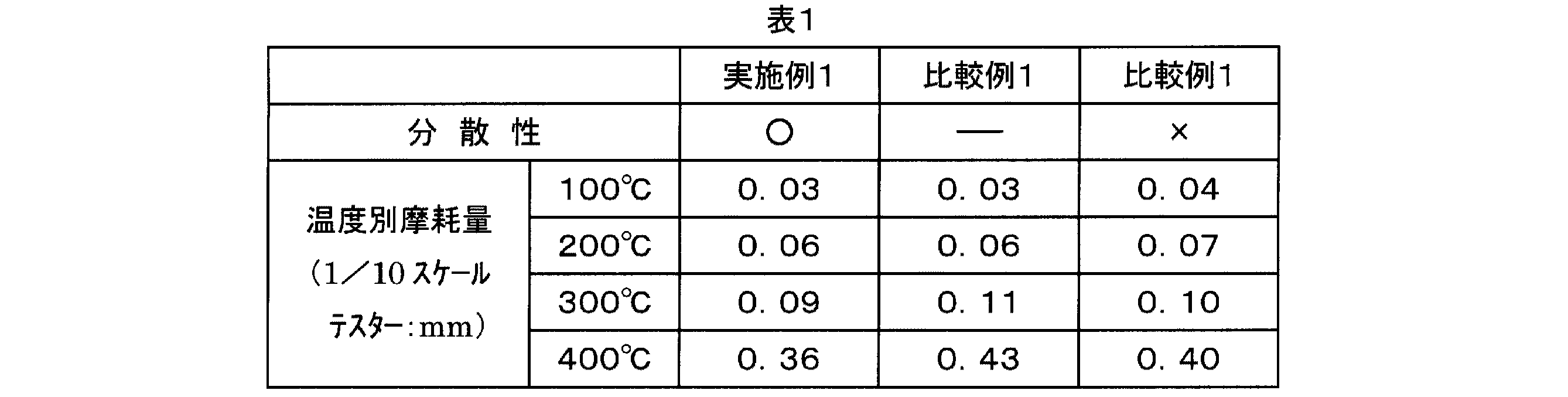
実施例1および比較例2で得られた熱硬化性樹脂複合材料を、250℃で硬化させ、該複合材料中のフラーレンの分散状態を、走査型電子顕微鏡(SEM)[日立ハイテク社製、機種名「S−4300」]にて観察し、下記の基準で評価した。
In addition, the evaluation test of various characteristics was done as follows.
(1) Dispersibility of fullerene The thermosetting resin composite material obtained in Example 1 and Comparative Example 2 was cured at 250 ° C., and the dispersion state of fullerene in the composite material was measured with a scanning electron microscope (SEM). [Observation by Hitachi High-Tech, model name “S-4300”] was evaluated according to the following criteria.
○:サイズ500nm以上の凝集塊が存在しない。
×:サイズ500nm以上の凝集塊が存在する。
(2)温度別摩擦試験
摩擦材から、13mm×25mm×15mmのテストピースを切り出し、摩擦試験機[アケボノエンジニアリング社製、機種名「スケールテスタ」]を用いて、下記条件で温度別摩耗試験を行い、各温度におけるテストピース摩耗量を測定した。
A: There is no aggregate having a size of 500 nm or more.
X: Agglomerates having a size of 500 nm or more exist.
(2) Friction test according to temperature A test piece of 13 mm x 25 mm x 15 mm was cut out from the friction material, and a wear test according to temperature was performed under the following conditions using a friction tester [manufactured by Akebono Engineering Co., Ltd., model name "Scale Tester"]. The test piece wear amount at each temperature was measured.
相手材 :FC250
摩擦回数:500回
摩擦温度:100℃,200℃,300℃,400℃
初速度 :15m/sec
実施例1
(1)熱硬化性樹脂複合材料の調製
ビスフェノールA480g、アニリン390g、パラホルムアルデヒド270g、トルエン480gを4つ口フラスコに入れて攪拌した。40℃で1時間、50℃で1時間、80℃で4時間重縮合反応を行った後に、フラーレン(C60)14.4gを含むトルエン溶液420gを加えた。80℃で1時間攪拌混合した後、0.1MPaで減圧して脱水・脱溶媒を行い、熱硬化性樹脂複合材料を得た。
(2)摩擦材の作製
上記(1)で得た熱硬化性樹脂複合材料8質量部、ゴムダスト8質量部、硫酸バリウム36.5質量部、ジルコニア2質量部、リン状黒鉛5.5質量部、アラミドパルプ4質量部、チタン酸カリウム23質量部および銅繊維13質量部からなる配合物をミキサーで混合後、常温、30MPaで予備成形した。次いで予備成形体を熱プレスに投入し、加熱圧縮成形(180℃、30MPa、10分間)した。得られた熱成形体を250℃で3時間熱処理し、摩擦材を得た。
(3)評価
上記(1)の熱硬化性樹脂複合材料および上記(2)の摩擦材を用い、分散性評価および温度別摩耗量の測定を行った。
Opponent material: FC250
Friction frequency: 500 times Friction temperature: 100 ° C, 200 ° C, 300 ° C, 400 ° C
Initial speed: 15m / sec
Example 1
(1) Preparation of thermosetting resin composite material 480 g of bisphenol A, 390 g of aniline, 270 g of paraformaldehyde, and 480 g of toluene were placed in a four-necked flask and stirred. After polycondensation reaction at 40 ° C. for 1 hour, 50 ° C. for 1 hour, and 80 ° C. for 4 hours, 420 g of a toluene solution containing 14.4 g of fullerene (C60) was added. After stirring and mixing at 80 ° C. for 1 hour, dehydration and desolvation were performed by reducing the pressure at 0.1 MPa to obtain a thermosetting resin composite material.
(2) Preparation of friction material 8 parts by mass of the thermosetting resin composite material obtained in (1) above, 8 parts by mass of rubber dust, 36.5 parts by mass of barium sulfate, 2 parts by mass of zirconia, 5.5 parts by mass of phosphorous graphite Then, a blend of 4 parts by mass of aramid pulp, 23 parts by mass of potassium titanate and 13 parts by mass of copper fiber was mixed with a mixer and then preformed at room temperature and 30 MPa. Next, the preform was put into a hot press and subjected to heat compression molding (180 ° C., 30 MPa, 10 minutes). The obtained thermoformed body was heat treated at 250 ° C. for 3 hours to obtain a friction material.
(3) Evaluation Using the thermosetting resin composite material of the above (1) and the friction material of the above (2), evaluation of dispersibility and measurement of wear amount by temperature were performed.
その結果を表1に示す。
比較例1
(1)熱硬化性樹脂の調製
ビスフェノールA480g、アニリン390g、パラホルムアルデヒド270g、トルエン480gを4つ口フラスコに入れて攪拌した。均一混合後、40℃で1時間、50℃で1時間、80℃で4時間重縮合反応を行った。80℃で1時間攪拌混合した後、0.1MPaで減圧して脱水・脱溶媒を行い、熱硬化性樹脂複合材料を得た。
(2)摩擦材の作製
実施例1(2)において、熱硬化性樹脂複合材料の代わりに、上記(1)の熱硬化性樹脂を用いた以外は、実施例1(2)と同様にして摩擦材を作製した。
(3)評価
上記(2)の摩擦材を用い、温度別摩耗量の測定を行った。その結果を表1に示す。
比較例2
(1)熱硬化性樹脂複合材料の調製
ビスフェノールA480g、アニリン390g、パラホルムアルデヒド270g、トルエン480gを4つ口フラスコに入れて攪拌した。均一混合後、40℃で1時間、50℃で1時間、80℃で4時間重縮合反応を行った。80℃で1時間攪拌混合した後、0.1MPaで減圧して脱水・脱溶媒を行い、熱硬化性樹脂複合材料を得た。
The results are shown in Table 1.
Comparative Example 1
(1) Preparation of thermosetting resin 480 g of bisphenol A, 390 g of aniline, 270 g of paraformaldehyde, and 480 g of toluene were placed in a four-necked flask and stirred. After uniform mixing, a polycondensation reaction was performed at 40 ° C. for 1 hour, 50 ° C. for 1 hour, and 80 ° C. for 4 hours. After stirring and mixing at 80 ° C. for 1 hour, dehydration and desolvation were performed by reducing the pressure at 0.1 MPa to obtain a thermosetting resin composite material.
(2) Preparation of friction material In Example 1 (2), the same procedure as in Example 1 (2) was performed except that the thermosetting resin of (1) was used instead of the thermosetting resin composite material. A friction material was produced.
(3) Evaluation Using the friction material (2), the amount of wear at each temperature was measured. The results are shown in Table 1.
Comparative Example 2
(1) Preparation of thermosetting resin composite material 480 g of bisphenol A, 390 g of aniline, 270 g of paraformaldehyde, and 480 g of toluene were placed in a four-necked flask and stirred. After uniform mixing, a polycondensation reaction was performed at 40 ° C. for 1 hour, 50 ° C. for 1 hour, and 80 ° C. for 4 hours. After stirring and mixing at 80 ° C. for 1 hour, dehydration and desolvation were performed by reducing the pressure at 0.1 MPa to obtain a thermosetting resin composite material.
この熱硬化性樹脂に、フラーレン(C60)14.4gを乾式混合し、熱硬化性樹脂複合材料を調製した。
(2)摩擦材の作製
実施例1(2)において、熱硬化性樹脂複合材料として、上記(1)で得られたものを用いた以外は、実施例1(2)と同様にして摩擦材を作製した。
(3)評価
上記(1)の熱硬化性樹脂複合材料および(2)の摩擦材を用い、分散性評価および温度別摩耗量の測定を行った。
その結果を表1に示す。
To this thermosetting resin, 14.4 g of fullerene (C60) was dry-mixed to prepare a thermosetting resin composite material.
(2) Preparation of friction material Friction material in the same manner as in Example 1 (2), except that the material obtained in (1) above was used as the thermosetting resin composite material in Example 1 (2). Was made.
(3) Evaluation Using the thermosetting resin composite material of (1) and the friction material of (2), evaluation of dispersibility and measurement of wear amount by temperature were performed.
The results are shown in Table 1.
本発明の熱硬化性樹脂複合材料は、耐摩耗性に優れる硬化成形体を与えることができ、例えば摩擦材、成形材料、機械部品、構造部材、構造用接着剤などの用途に好適である。 The thermosetting resin composite material of the present invention can provide a cured molded article having excellent wear resistance, and is suitable for applications such as friction materials, molding materials, mechanical parts, structural members, and structural adhesives.
Claims (8)
Priority Applications (1)
| Application Number | Priority Date | Filing Date | Title |
|---|---|---|---|
| JP2008089769A JP2009242529A (en) | 2008-03-31 | 2008-03-31 | Thermosetting resin composite material, its manufacturing method, and friction material |
Applications Claiming Priority (1)
| Application Number | Priority Date | Filing Date | Title |
|---|---|---|---|
| JP2008089769A JP2009242529A (en) | 2008-03-31 | 2008-03-31 | Thermosetting resin composite material, its manufacturing method, and friction material |
Publications (1)
| Publication Number | Publication Date |
|---|---|
| JP2009242529A true JP2009242529A (en) | 2009-10-22 |
Family
ID=41304818
Family Applications (1)
| Application Number | Title | Priority Date | Filing Date |
|---|---|---|---|
| JP2008089769A Withdrawn JP2009242529A (en) | 2008-03-31 | 2008-03-31 | Thermosetting resin composite material, its manufacturing method, and friction material |
Country Status (1)
| Country | Link |
|---|---|
| JP (1) | JP2009242529A (en) |
Cited By (3)
| Publication number | Priority date | Publication date | Assignee | Title |
|---|---|---|---|---|
| JP2012001709A (en) * | 2010-06-14 | 2012-01-05 | Nanya Plastics Corp | New varnish composition having high glass transition temperature to be applied to glass fiber laminated board |
| CN109890628A (en) * | 2016-10-26 | 2019-06-14 | 米其林集团总公司 | Metallic or metallized reinforcement with polybenzoxazine-coated surface |
| CN113844039A (en) * | 2021-09-27 | 2021-12-28 | 山东金宝电子股份有限公司 | Preparation method of novel low-dielectric-constant copper-clad plate glue solution |
-
2008
- 2008-03-31 JP JP2008089769A patent/JP2009242529A/en not_active Withdrawn
Cited By (4)
| Publication number | Priority date | Publication date | Assignee | Title |
|---|---|---|---|---|
| JP2012001709A (en) * | 2010-06-14 | 2012-01-05 | Nanya Plastics Corp | New varnish composition having high glass transition temperature to be applied to glass fiber laminated board |
| CN109890628A (en) * | 2016-10-26 | 2019-06-14 | 米其林集团总公司 | Metallic or metallized reinforcement with polybenzoxazine-coated surface |
| CN109890628B (en) * | 2016-10-26 | 2020-11-20 | 米其林集团总公司 | Metallic or metallized reinforcement with polybenzoxazine-coated surface |
| CN113844039A (en) * | 2021-09-27 | 2021-12-28 | 山东金宝电子股份有限公司 | Preparation method of novel low-dielectric-constant copper-clad plate glue solution |
Similar Documents
| Publication | Publication Date | Title |
|---|---|---|
| Mahmoud et al. | Design and testing of high‐density polyethylene nanocomposites filled with lead oxide micro‐and nano‐particles: Mechanical, thermal, and morphological properties | |
| CN102070899B (en) | Insulating and heat-conducting polyamide composite material and preparation method thereof | |
| Sun et al. | Simultaneous improvement in strength, toughness, and thermal stability of epoxy/halloysite nanotubes composites by interfacial modification | |
| US8227390B2 (en) | Binder resin for friction material, binder resin composition for friction material, composite material for friction material containing the same, friction material and production method thereof | |
| JP6547277B2 (en) | Molding materials and articles | |
| Gültekin et al. | Structural, thermal, and mechanical properties of silanized boron carbide doped epoxy nanocomposites | |
| Xu et al. | Organomontmorillonite-modified soybean oil-based polyurethane/epoxy resin interpenetrating polymer networks (IPNs) | |
| Wu et al. | Carbon fiber epoxy‐matrix composites with hydrothermal‐carbon‐coated halloysite nanotube filler exhibiting enhanced strength and thermal conductivity | |
| Adem et al. | The effect of nanocarbon inclusion on mechanical, tribological, and thermal properties of phenolic resin‐based composites: An overview | |
| JP6718756B2 (en) | Commitator and method for manufacturing commutator | |
| Ho et al. | Preparation and characterization of covalently functionalized graphene using vinyl‐terminated benzoxazine monomer and associated nanocomposites with low coefficient of thermal expansion | |
| Gogoi et al. | Development of thermally conductive and high‐specific strength polypropylene composites for thermal management applications in automotive | |
| Kocaman et al. | The effect of novel advanced method on the properties of novolac hybrid nanocomposites reinforced with carbon nanotube and glass fiber | |
| Wang et al. | Preparation of HNTs‐e‐POSS hybrid nanoparticles and modification of gallic acid epoxy resin | |
| US7687570B2 (en) | Thermosetting resin material | |
| Klein et al. | Effect of nano-silica and carbon nanotubes on the rheology and flammability behavior of epoxy | |
| JP2017081136A (en) | Fiber reinforced plastic molding | |
| JP5236955B2 (en) | Binder resin composition for friction material, thermosetting resin composite material including the same, and friction material | |
| JP2010144034A (en) | Thermosetting resin composition, method for producing the same, friction material binder, and friction material | |
| Yu et al. | Preparation of phenolic resin/organized expanded vermiculite nanocomposite and its application in brake pad | |
| JP2009001727A (en) | Method for producing thermosetting resin composite material, thermosetting resin composite material obtained by the method, and friction material using the material | |
| Han et al. | Construction of “organic–inorganic” hierarchical structure of carbon fibers and the effect on the properties of epoxy composites | |
| Wang et al. | Fabrication, Morphological, and Thermal Investigation of Epoxy-Polyamide Nanocomposites Reinforced with Carbon Nanotubes | |
| JP2011148675A (en) | Powder particle, method for producing the same and friction material using the powder particle | |
| JP2010168550A (en) | Friction material and method for manufacturing the same |
Legal Events
| Date | Code | Title | Description |
|---|---|---|---|
| A300 | Withdrawal of application because of no request for examination |
Free format text: JAPANESE INTERMEDIATE CODE: A300 Effective date: 20110607 |