JP2009242595A - Thermoplastic resin composition - Google Patents
Thermoplastic resin composition Download PDFInfo
- Publication number
- JP2009242595A JP2009242595A JP2008090907A JP2008090907A JP2009242595A JP 2009242595 A JP2009242595 A JP 2009242595A JP 2008090907 A JP2008090907 A JP 2008090907A JP 2008090907 A JP2008090907 A JP 2008090907A JP 2009242595 A JP2009242595 A JP 2009242595A
- Authority
- JP
- Japan
- Prior art keywords
- weight
- rubber polymer
- parts
- monomer
- polymer
- Prior art date
- Legal status (The legal status is an assumption and is not a legal conclusion. Google has not performed a legal analysis and makes no representation as to the accuracy of the status listed.)
- Granted
Links
Landscapes
- Compositions Of Macromolecular Compounds (AREA)
- Graft Or Block Polymers (AREA)
Abstract
Description
本発明は、ブロンズ現象を解決し、耐衝撃性、耐候性及び顔料着色性に優れた熱可塑性樹脂組成物に関するものである。更に詳しくは、表面外観と耐衝撃性のバランスが良好で、自動車等の車両用内外装部品、各種の家電製品やOA機器のハウジング、その他雑貨分野等、幅広い分野で好適に使用可能な熱可塑性樹脂組成物に関するものである。 The present invention relates to a thermoplastic resin composition that solves the bronze phenomenon and is excellent in impact resistance, weather resistance, and pigment colorability. More specifically, it has a good balance between surface appearance and impact resistance, and can be suitably used in a wide range of fields such as interior and exterior parts for vehicles such as automobiles, housings for various home appliances and OA equipment, and other miscellaneous goods fields. The present invention relates to a resin composition.
ABS樹脂は、耐衝撃性および加工性のバランスに優れた樹脂であり、自動車等の車両用内外装部品、各種の家電製品やOA機器のハウジング、その他雑貨分野等、幅広い分野に使用されている。
しかし、ABS樹脂は、そのゴム成分として使用するブタジエン系ゴム重合体が紫外線等により分解され易いことから、耐候性に劣るという欠点を有している。
そこで、ABS樹脂中のゴム成分をアクリル系ゴム重合体に置換することで耐候性を改良した、AAS樹脂が実用化されている。
通常、このようなゴム強化熱可塑性樹脂は着色剤の配合により着色されており、着色成形品として用いられている。そして、この調色・着色工程において注意すべき事項の一つに“メタメリズム”がある。これは、光源が変わると色が異なる現象である。例えば、室内灯下における色と太陽光下における色とが一致していないといったことがしばしば見受けられる。この現象は、着色剤に起因するものであり、着色剤の選択により解決することができる。又、この現象は、肉眼にて容易に判断できると共に、分光光度計により数値(反射率)又はグラフ(反射率曲線)として確認することができる。
しかしながら、着色成形品においては、前述のメタメリズムのみならず、“ブロンズ現象”といった問題点がある。
“ブロンズ現象”とは、直射日光下でない室内及び室内灯下では色相が良好にもかかわらず、直射日光下や直射日光を通した透明ガラス下においては本来の着色した色相以外に、赤〜黄色の範囲の色が重なって見える現象であり、成形品の外観上、品質イメージを低下させ、商品価値を落とすものである。もちろん、このブロンズ現象とメタメリズムとは異なる現象である。このようなブロンズ現象を解決した耐候性樹脂として、例えば重量平均粒子径が0.20〜0.35μの範囲にあるゴム粒子の合計がゴム総重量に対して20重量%未満にする方法が提案されている(特許文献1:特開昭63−275617号公報)。また、特開2000−17135号公報(特許文献2)においては、重量平均粒子径0.2μ未満のアクリル酸エステル系ゴム重合体を20重量%以上にする方法でブロンズ現象を解決したAAS系樹脂組成物が提案されているが、耐衝撃性では必ずしも満足し得るとはいえなかった。
また、特開2007−77274号公報(特許文献3)においては、重量平均粒子径0.30〜0.45μアクリル酸エステル系ゴム重合体と重量平均粒子径0.15〜0.30μアクリル酸エステル系ゴム重合体を併用することで、ブロンズ現象の解決と耐衝撃性を向上させたAAS系樹脂組成物が提案されているが、新たに顔料着色性が劣るという問題点が見られた。
However, the ABS resin has a disadvantage that the weather resistance is inferior because the butadiene rubber polymer used as the rubber component is easily decomposed by ultraviolet rays or the like.
Therefore, an AAS resin, in which the weather resistance is improved by replacing the rubber component in the ABS resin with an acrylic rubber polymer, has been put into practical use.
Usually, such a rubber-reinforced thermoplastic resin is colored by blending a colorant and is used as a colored molded product. One of the matters to be noted in this toning / coloring process is “metamerism”. This is a phenomenon in which the color changes when the light source changes. For example, it is often seen that the color under room light does not match the color under sunlight. This phenomenon is caused by the colorant and can be solved by selecting the colorant. This phenomenon can be easily determined with the naked eye, and can be confirmed by a spectrophotometer as a numerical value (reflectance) or a graph (reflectance curve).
However, colored molded articles have problems such as “bronze phenomenon” as well as the above-mentioned metamerism.
“Bronze phenomenon” is a red to yellow color other than the original colored hue under direct sunlight or transparent glass through direct sunlight even though the hue is good under indoor sunlight and indoor lighting. This is a phenomenon in which the colors in the range appear to overlap, and the quality image is deteriorated and the commercial value is lowered in the appearance of the molded product. Of course, this bronze phenomenon and metamerism are different phenomena. As a weather-resistant resin that solves such a bronze phenomenon, for example, a method is proposed in which the total amount of rubber particles having a weight average particle diameter in the range of 0.20 to 0.35 μm is less than 20% by weight based on the total weight of rubber. (Patent Document 1: Japanese Patent Laid-Open No. 63-275617). In addition, in Japanese Patent Application Laid-Open No. 2000-17135 (Patent Document 2), an AAS resin in which the bronzing phenomenon is solved by a method in which an acrylic ester rubber polymer having a weight average particle diameter of less than 0.2 μm is made 20% by weight or more Although a composition has been proposed, the impact resistance is not always satisfactory.
In JP 2007-77274 A (Patent Document 3), a weight average particle size of 0.30 to 0.45 μ acrylate rubber polymer and a weight average particle size of 0.15 to 0.30 μ acrylate. Although an AAS resin composition has been proposed in which the bronze phenomenon is solved and the impact resistance is improved by using a rubber-based polymer in combination, there has been a problem that pigment colorability is newly inferior.
本発明は、ブロンズ現象を解決し、耐候性と顔料着色性に優れた熱可塑性樹脂組成物で、更に表面外観と耐衝撃性の良好なバランスに優れた熱可塑性樹脂組成物を提供することを目的とするものである。 The present invention provides a thermoplastic resin composition that solves the bronze phenomenon and is excellent in weather resistance and pigment colorability, and further has a good balance between surface appearance and impact resistance. It is the purpose.
本発明者らは、ゴム成分として、内層に特定の重量平均粒子径のブタジエン系ゴム重合体、外層に特定の厚みを有するアクリル系ゴム重合体である二層構造ゴム重合体と、特定の重量平均粒子径のアクリル系ゴム重合体を併用することで、ブロンズ現象を解決し、耐候性、表面外観と耐衝撃性のバランスが良好で、顔料着色性に優れることを見出し、本発明に到達したものである。
即ち、本発明は、
[1]内層が重量平均粒子径250nm以上〜400nm以下のブタジエン系ゴム重合体で、外層の平均厚さが70nm以上〜180nm以下のアクリル系ゴム重合体である二層構造ゴム質重合体に、芳香族ビニル単量体及びシアン化ビニル単量体を主成分とする単量体をグラフト重合したグラフト重合体(a−1)1〜40重量%、
重量平均粒子径が70nm以上〜180nm以下であるアクリル系ゴム重合体に、芳香族ビニル単量体及びシアン化ビニル単量体を主成分とする単量体をグラフト重合したグラフト重合体(a−2)60〜99重量%からなるグラフト共重合体(A)10〜100重量部と、芳香族ビニル単量体、シアン化ビニル単量体、(メタ)アクリル酸エステル単量体及びその他のビニル単量体からなる群より選ばれる少なくとも一種の単量体を重合してなる熱可塑性樹脂(B)0〜90重量部(但し、(A)と(B)の合計が100重量部)からなる熱可塑性樹脂組成物、
[2]ブタジエン系ゴム重合体が、重量平均粒子径50nm以上〜200nm以下の小粒子径ブタジエン系ゴム重合体ラテックスを重量平均粒子径250nm以上〜400nm以下に凝集肥大化させたブタジエン系ゴム重合体ラテックスを使用してなる[1]に記載の熱可塑性樹脂組成物、
[3]ブタジエン系ゴム重合体が、重量平均粒子径50nm以上〜200nm以下の小粒子径ブタジエン系ゴム重合体ラテックスに酸性物質を加え、ラテックスのpHを7より低くしてラテックス粒子を重量平均粒子径250nm以上〜400nm以下に凝集肥大化させた後、塩基性物質を加えラテックスのpHを7より高くして安定化させたブタジエン系ゴム重合体ラテックスを使用してなる[1]に記載の熱可塑性樹脂組成物を提供するものである。
The present inventors, as rubber components, a butadiene-based rubber polymer having a specific weight average particle diameter in the inner layer, a two-layer structure rubber polymer that is an acrylic rubber polymer having a specific thickness in the outer layer, and a specific weight By using an acrylic rubber polymer with an average particle diameter in combination, the bronze phenomenon was solved, the weather resistance, the surface appearance and the impact resistance were well balanced, and the pigment colorability was excellent, and the present invention was achieved. Is.
That is, the present invention
[1] A two-layer structure rubber polymer in which the inner layer is a butadiene rubber polymer having a weight average particle diameter of 250 nm to 400 nm and the outer layer has an average rubber thickness of 70 nm to 180 nm. 1 to 40% by weight of a graft polymer (a-1) obtained by graft polymerization of a monomer mainly composed of an aromatic vinyl monomer and a vinyl cyanide monomer,
A graft polymer obtained by graft polymerization of an acrylic rubber polymer having a weight average particle diameter of 70 nm to 180 nm with an aromatic vinyl monomer and a monomer mainly composed of vinyl cyanide monomer (a- 2) 10 to 100 parts by weight of the graft copolymer (A) comprising 60 to 99% by weight, an aromatic vinyl monomer, a vinyl cyanide monomer, a (meth) acrylate monomer and other vinyls It consists of 0 to 90 parts by weight of a thermoplastic resin (B) obtained by polymerizing at least one monomer selected from the group consisting of monomers (however, the sum of (A) and (B) is 100 parts by weight). Thermoplastic resin composition,
[2] A butadiene-based rubber polymer in which a butadiene-based rubber polymer is agglomerated and enlarged to a weight-average particle size of 250 nm to 400 nm in a small particle size butadiene rubber polymer latex having a weight average particle size of 50 nm to 200 nm. The thermoplastic resin composition according to [1], which uses latex,
[3] A butadiene-based rubber polymer has a weight-average particle diameter of 50 nm to 200 nm and a small particle diameter butadiene-based rubber polymer latex is added with an acidic substance, and the latex has a pH lower than 7. The heat described in [1], wherein a butadiene-based rubber polymer latex is used which is stabilized by increasing the pH of the latex to be higher than 7 by adding a basic substance after the coagulation and enlargement to a diameter of 250 nm to 400 nm. A plastic resin composition is provided.
本発明は、ブロンズ現象を解決し、耐候性と顔料着色性に優れた熱可塑性樹脂組成物で、更に表面外観と耐衝撃性の良好なバランスに優れた熱可塑性樹脂組成物が得られるという効果を奏する。 The present invention provides a thermoplastic resin composition that solves the bronze phenomenon and is excellent in weather resistance and pigment colorability, and further provides a thermoplastic resin composition that has a good balance between surface appearance and impact resistance. Play.
以下、本発明の熱可塑性樹脂組成物に付き詳細に説明する。 Hereinafter, the thermoplastic resin composition of the present invention will be described in detail.
本発明における上記グラフト重合体(a−1)を構成する二層構造ゴム重合体の内層を形成するブタジエン系ゴム重合体は、例えば1,3−ブタジエン等に代表されるジエン系単量体を50重量%以上含む単量体を重合してなる重合体であり、該ジエン系単量体と共重合可能な他の単量体としては、スチレン等の芳香族ビニル系単量体、アクリロニトリル等のシアン化ビニル系単量体、メチルアクリレート、エチルアクリレート、メチルメタアクリレート等の不飽和カルボン酸アルキルエステル系単量体等が挙げられる。具体的には、ポリブタジエン、ブタジエン−スチレン共重合体、ブタジエン−アクリロニトリル共重合体、ブタジエン−メチルメタアクリレート共重合体が挙げられる。 The butadiene rubber polymer forming the inner layer of the two-layer structure rubber polymer constituting the graft polymer (a-1) in the present invention is a diene monomer represented by, for example, 1,3-butadiene. A polymer obtained by polymerizing a monomer containing 50% by weight or more, and other monomers copolymerizable with the diene monomer include aromatic vinyl monomers such as styrene, acrylonitrile, etc. And an unsaturated carboxylic acid alkyl ester monomer such as methyl acrylate, ethyl acrylate and methyl methacrylate. Specific examples include polybutadiene, butadiene-styrene copolymer, butadiene-acrylonitrile copolymer, and butadiene-methyl methacrylate copolymer.
上記ブタジエン系ゴム重合体としては、重量平均粒子径250nm以上〜400nm以下のブタジエン系ゴム重合体を使用することが必要である。該重量平均粒子径が250nm未満では耐衝撃性と熱安定性に劣り、又400nmを超えると光沢及び黒色に着色した時の漆黒性が劣るので好ましくない。また、上記ブタジエン系ゴム重合体としては、所定の重量平均粒子径を有するゴム重合体(以下、未凝集肥大化ゴムと記す)を使用することも可能であるが、特定粒子径の小粒子径ゴムを凝集させてなる、凝集肥大化ゴムを使用することが好ましい。具体的には、重量平均粒子径50nm以上〜200nm以下の小粒子径ブタジエン系ゴム重合体ラテックスを重量平均粒子径250nm以上〜400nm以下に凝集肥大化させたブタジエン系ゴム重合体ラテックスを使用することが、ブロンズ外観の点で好ましい。
上記の小粒子径ブタジエン系ゴム重合体ラテックスを凝集肥大化する方法としては、従来公知の方法、例えば酸性物質を添加する方法(特公昭42−3112、特公昭55−19246、特公平2−9601、特開昭63−117005、特開昭63−132903、特開平7−157501、特開平8−259777)、酸基含有ラテックスを添加する方法(特開昭56−166201、特開昭59−93701、特開平1−126301、特開平8−59704)等を採用することができ、その方法については特に制限はないが、小粒子径ゴムラテックスに酸性物質を添加してラテックスのpHを7より低くして所定の重量平均粒子径に凝集肥大化させた後、塩基性物質を加えpHを7より高くして安定化させたブタジエン系ゴム重合体ラテックスを使用することが、耐衝撃性と光沢のバランスの面より好ましい。
As the butadiene-based rubber polymer, it is necessary to use a butadiene-based rubber polymer having a weight average particle diameter of 250 nm to 400 nm. When the weight average particle diameter is less than 250 nm, the impact resistance and the thermal stability are inferior, and when it exceeds 400 nm, the gloss and blackness when colored in black are inferior. Further, as the butadiene-based rubber polymer, a rubber polymer having a predetermined weight average particle diameter (hereinafter referred to as unagglomerated and enlarged rubber) can be used. It is preferable to use an agglomerated rubber obtained by agglomerating rubber. Specifically, a butadiene rubber polymer latex obtained by agglomerating a butadiene rubber polymer latex having a weight average particle diameter of 50 nm to 200 nm and having a small particle diameter of 250 nm to 400 nm to be used is used. Is preferable from the viewpoint of bronze appearance.
As a method for agglomerating and enlarging the above-mentioned small particle size butadiene-based rubber polymer latex, a conventionally known method, for example, a method of adding an acidic substance (JP-B 42-3112, JP-B 55-19246, JP-B-2-9601). JP-A-63-117005, JP-A-63-132903, JP-A-7-157501, JP-A-8-259777), a method of adding an acid group-containing latex (JP-A-56-166201, JP-A-59-93701). JP-A-1-126301, JP-A-8-59704) and the like can be employed, and the method is not particularly limited, but an acidic substance is added to a small particle rubber latex to lower the pH of the latex to less than 7. The butadiene rubber polymer rubber is stabilized by adding a basic substance and stabilizing the pH higher than 7 after agglomeration and enlargement to a predetermined weight average particle diameter. It is preferred over the surface of the balance between impact resistance and gloss using the box.
上記ブタジエン系ゴムラテックス(小粒子径ブタジエン系ゴムラテックスおよび未凝集肥大化ゴムラテックス)の製造に使用する乳化剤としては脂肪酸石鹸類のように弱酸強塩基型の塩からなり、pHが7以下の酸性領域で乳化作用を失う界面活性剤を用いることができる。例えば、ラウリン酸、オレイン酸、ステアリン酸、混合脂肪酸、不均化ロジン酸などの1種又は2種以上の酸のナトリウム塩及び/又はカリウム塩が挙げられる。特に好ましくはオレイン酸のカリウム塩又はナトリウム塩、不均化ロジン酸のカリウム塩又はナトリウム塩が挙げられるが、これらに限定されるものではない。
また、該乳化剤の使用量には何ら制限はないが、ゴムラテックスの重合安定性や凝集肥大化工程を行なう際にはその後の凝集肥大化処理効率の面よりゴムラテックス固形分100重量部当たり1.0〜5.0重量部であることが好ましい。
The emulsifier used in the production of the above butadiene rubber latex (small particle size butadiene rubber latex and unagglomerated and enlarged rubber latex) is composed of a weak acid strong base salt such as fatty acid soaps, and has an acidic pH of 7 or less. Surfactants that lose their emulsifying action in the region can be used. For example, sodium salt and / or potassium salt of one or more acids such as lauric acid, oleic acid, stearic acid, mixed fatty acid, disproportionated rosin acid and the like can be mentioned. Particularly preferable examples include potassium salt or sodium salt of oleic acid, and potassium salt or sodium salt of disproportionated rosin acid, but not limited thereto.
Further, the amount of the emulsifier is not limited at all. However, when the polymerization stability of the rubber latex or the coagulation enlargement process is performed, it is 1 per 100 parts by weight of the rubber latex solid content in view of the subsequent coagulation enlargement treatment efficiency. It is preferable that it is 0.0-5.0 weight part.
さらに、上記ブタジエン系ゴムラテックス(小粒子径ブタジエン系ゴムラテックスおよび未凝集肥大化ゴムラテックス)は、上述の界面活性剤を乳化剤として使用してなる公知の乳化重合により得ることができるが、その際、通常の開始剤、分子量調整剤、電解質などの重合助剤を用いることができる。
開始剤としては、例えば、過硫酸カリウム、過硫酸ナトリウム、過硫酸アンモニウムなどの過硫酸塩や、t−ブチルヒドロキシペルオキシド、クメンヒドロキシペルオキシドなどの有機過酸化物と還元剤成分とを組み合わせたレドックス系などが挙げられ、また分子量調整剤としては、メルカプタン類(t−ドデシルメルカプタン、n−ドデシルメルカプタンなど)やターピノレン、α−メチルスチレンダイマーなどが挙げられる。さらに電解質としては、水酸化ナトリウム、水酸化カリウム、水酸化アンモニウムなどの塩基性物質や塩化ナトリウム、硫酸カリウム、酢酸ナトリウム、硫酸ナトリウム、燐酸カリウム、ピロリン酸4カリウムなどが挙げられ、それぞれ単独もしくは2種以上の混合使用が可能である。さらに、重合温度についても制限はないが、50〜80℃の範囲が好ましい。また、上記ブタジエン系ゴムラテックス(小粒子径ブタジエン系ゴムラテックスおよび未凝集肥大化ゴムラテックス)は上記の乳化重合にて得ることができるが、他の方法として、別途重合された固体のゴム状重合体を、例えばホモジナイザー等を用い、その際に上記の界面活性剤を用いて乳化することにより得ることも可能である。
Furthermore, the butadiene rubber latex (small particle diameter butadiene rubber latex and unagglomerated and enlarged rubber latex) can be obtained by a known emulsion polymerization using the above-mentioned surfactant as an emulsifier. Ordinary initiators, molecular weight regulators, polymerization aids such as electrolytes can be used.
Examples of the initiator include persulfates such as potassium persulfate, sodium persulfate, and ammonium persulfate, and redox systems in which organic peroxides such as t-butylhydroxyperoxide and cumenehydroxyperoxide are combined with a reducing agent component. Examples of molecular weight modifiers include mercaptans (t-dodecyl mercaptan, n-dodecyl mercaptan, etc.), terpinolene, α-methylstyrene dimer, and the like. Further, examples of the electrolyte include basic substances such as sodium hydroxide, potassium hydroxide, and ammonium hydroxide, sodium chloride, potassium sulfate, sodium acetate, sodium sulfate, potassium phosphate, and 4 potassium pyrophosphate. Mixed use of more than one species is possible. Furthermore, although there is no restriction | limiting also about polymerization temperature, the range of 50-80 degreeC is preferable. The butadiene rubber latex (small particle size butadiene rubber latex and unagglomerated and enlarged rubber latex) can be obtained by the above emulsion polymerization, but as another method, a separately polymerized solid rubber-like heavy polymer can be obtained. It is also possible to obtain the coalescence by using, for example, a homogenizer and emulsifying with the above surfactant.
上述の小粒子径ブタジエン系ゴムラテックスについては、酸性物質と接触することにより凝集肥大化することができるが、該酸性物質としては、硫酸、塩酸、リン酸等の鉱酸や、硫酸水素ナトリウム、リン酸二水素ナトリウム等の酸性塩類、及び蓚酸、クエン酸、酢酸、蟻酸などの有機酸や無水酢酸等の酸無水物のいずれでも使用でき、これらの2種以上の混合使用も可能であるが、リン酸、硫酸、無水酢酸、酢酸が好ましい。また酸性物質の使用量は、ゴムラテックスを酸性(pH7以下)にするのに必要な量であればよいが、肥大化対象ゴムラテックスの粒子径、乳化剤の種類や量ならびに目標とする肥大化ゴムラテックスの粒子径などによって適宜調整される。また、酸性物質は基本的に脱イオン水で希釈され水溶液として添加されるものであり、その濃度には特に制限はないが、凝集肥大化後のゴムラテックス固形分濃度の極端な低下防止及び凝固物の発生や装置への付着防止のため、0.3〜10重量%であることが好ましく、0.5〜5.0重量%の範囲が特に好ましい。
また、酸性物質を添加する前に、必要に応じて小粒子径ブタジエン系ゴムラテックスへ予め酸性で良好な界面活性能を有する界面活性剤を添加しておいてもよい。予め酸性で良好な界面活性能を有する界面活性剤を添加することにより、凝集肥大化時のラテックスの粒子径制御が容易となる。
このような酸性で良好な界面活性能を有する界面活性剤としては、アルキルベンゼンスルホン酸ナトリウム、アルキルナフタレンスルホン酸ナトリウム、アルキルジフェニルエーテルスルホン酸カリウム、ラウリル硫酸ナトリウムなどが挙げられる。またその添加量については特に制限はないが、凝集肥大化に用いられる酸性物質濃度および小粒子径ブタジエン系ゴムラテックスの種類、固形分濃度などによって適宜調整することができる。好ましい添加量は小粒子径ブタジエン系ゴムラテックス(固形分)100重量部当り0.3重量部以下である。また、凝集肥大化の後、ゴムラテックスに塩基性物質を添加し、ゴムラテックスのpHを7以上、好ましくは8〜11としておくことが、凝集肥大化ゴムラテックスの機械的安定性、即ち凝固物の発生防止の面で好ましい。上記塩基性物質としては、水酸化ナトリウムや水酸化カリウムなどが挙げられ、それらは一種または二種以上用いることができる。また、塩基性物質は基本的に脱イオン水で希釈され、水溶液として添加されるものであり、その濃度には特に制限はないが、凝集肥大化ゴムラテックスの固形分濃度の極端な低下防止及び凝固物の発生や装置への付着防止のため、0.5〜20重量%であることが好ましく、5〜15重量%の範囲が特に好ましい。
The above-mentioned small particle size butadiene rubber latex can be agglomerated and enlarged by contacting with an acidic substance. Examples of the acidic substance include mineral acids such as sulfuric acid, hydrochloric acid and phosphoric acid, sodium hydrogen sulfate, Acidic salts such as sodium dihydrogen phosphate, organic acids such as oxalic acid, citric acid, acetic acid, formic acid, and acid anhydrides such as acetic anhydride can be used, and a mixture of two or more of these can also be used. Phosphoric acid, sulfuric acid, acetic anhydride and acetic acid are preferred. The amount of the acidic substance used may be any amount necessary to make the rubber latex acidic (pH 7 or lower), but the particle size of the rubber latex to be enlarged, the type and amount of the emulsifier, and the target enlarged rubber. It is appropriately adjusted depending on the particle size of the latex. The acidic substance is basically diluted with deionized water and added as an aqueous solution. The concentration of the acidic substance is not particularly limited. In order to prevent generation of substances and adhesion to the apparatus, the content is preferably from 0.3 to 10% by weight, and particularly preferably from 0.5 to 5.0% by weight.
Moreover, before adding an acidic substance, you may add the surfactant which has an acidic and favorable surface active ability previously to a small particle diameter butadiene-type rubber latex as needed. By adding a surfactant that is acidic and has a good surface-active ability in advance, it becomes easy to control the particle size of the latex at the time of agglomeration and enlargement.
Examples of such an acidic surfactant having good surface activity include sodium alkylbenzenesulfonate, sodium alkylnaphthalenesulfonate, potassium alkyldiphenylethersulfonate, and sodium lauryl sulfate. The amount of addition is not particularly limited, but can be appropriately adjusted depending on the concentration of acidic substance used for agglomeration enlargement, the type of small particle diameter butadiene rubber latex, the solid content concentration, and the like. A preferred addition amount is 0.3 parts by weight or less per 100 parts by weight of a small particle size butadiene rubber latex (solid content). Further, after the agglomeration and enlargement, a basic substance is added to the rubber latex, and the pH of the rubber latex is set to 7 or more, preferably 8 to 11. It is preferable in terms of preventing the occurrence of As said basic substance, sodium hydroxide, potassium hydroxide, etc. are mentioned, These can be used 1 type, or 2 or more types. In addition, the basic substance is basically diluted with deionized water and added as an aqueous solution, and there is no particular limitation on the concentration thereof. In order to prevent generation of coagulum and adhesion to the apparatus, the content is preferably 0.5 to 20% by weight, and particularly preferably 5 to 15% by weight.
本発明におけるグラフト重合体(a−1)を構成する二層構造ゴム重合体は、重量平均粒子径250nm以上〜400nm以下のブタジエン系ゴム重合体と、架橋剤の存在下又は非存在下にアルキル基の炭素数が1〜16のアクリル酸エステル系単量体、例えばメチルアクリレート、エチルアクリレート、ブチルアクリレート、2−エチルヘキシルアクリレート等の1種又は2種以上、更には必要に応じて他の共重合可能な単量体、例えばスチレン、アクリロニトリル、メチルメタクリレート等の1種または2種以上を重合してなる内層がブタジエン系ゴム重合体であり、外層がアクリル系ゴム重合体からなる二層構造ゴム重合体である。ここで、使用可能な架橋剤としては、例えばジビニルベンゼン、アリル(メタ)アクリレート、エチレングリコールジ(メタ)アクリレート、ジアリルフタレート、ジシクロペンタジエンジ(メタ)アクリレート、トリメチロールプロパントリ(メタ)アクリレート、ペンタエリスリトールヘキサ(メタ)アクリレート、1,4−ブタンジオールジ(メタ)アクリレート、1,6−ヘキサンジオールジ(メタ)アクリレート、トリアリルシアヌレート、トリアリルイソシアヌレート等が挙げられる。このような二層構造ゴム重合体は、通常、乳化重合にて重合することができ、その際には公知の乳化剤、例えば、ドデシルベンゼンスルホン酸ナトリウム、オレイン酸ナトリウム、アルケニルコハク酸ジカリウム等のアニオン系乳化剤やポリオキシエチレンノニルフェニルエーテル等のノニオン系乳化剤を使用できる。また重合開始剤としては、水溶性、油溶性開始剤の単独系あるいはレドックス系、例えば、過硫酸塩等の無機系開始剤やt−ブチルハイドロパーオキサイド等の有機過酸化物やアゾ化合物等を単独で用いるかあるいは亜硫酸塩、ナトリウムホルムアルデヒドスルホキシレート等と組み合わせてレドックス系開始剤として使用することができる。さらに必要に応じて重合連鎖移動剤、例えばt−ドデシルメルカプタン等を使用することができる。
このようにして得られた上記二層構造ゴム重合体は、内層が重量平均粒子径250nm以上〜400nm以下のブタジエン系ゴム重合体で、外層の平均厚さが70nm以上〜180nm以下のアクリル系ゴム重合体である二層構造ゴム重合体である。
内層のブタジエン系ゴム重合体の重量平均粒子径は、重量平均粒子径が250nm未満では耐衝撃性に劣り、重量平均粒子径が400nmを超えると光沢が劣り、好ましくない。
また外層のアクリル系ゴム重合体の平均厚さは、外層の平均厚さが70nm未満では耐衝撃性と耐候性に劣り、180nmを超えると顔料着色性に劣り好ましくない。
なお、外層のアクリル系ゴム重合体の平均厚さを制御する方法としては、例えば、アクリルゴム重合体を重合する際に、ブタジエン系ゴムとアクリル酸エステル系単量体の比率及び乳化剤の使用量の制御が挙げられる。ブタジエン系ゴム重合体に対してアクリル酸エステル系単量体の比率を上げ、乳化剤使用量を少なくすると外層のアクリル系ゴム重合体の平均厚さは厚くなり、ブタジエン系ゴム重合体に対してアクリル酸エステル系単量体の比率を下げ、乳化剤使用量を多くすると外層のアクリル系ゴム重合体の平均厚さは薄くなる。
The two-layer structure rubber polymer constituting the graft polymer (a-1) in the present invention comprises a butadiene-based rubber polymer having a weight average particle diameter of 250 nm to 400 nm and an alkyl in the presence or absence of a crosslinking agent. Acrylic acid ester monomer having 1 to 16 carbon atoms, for example, one or more of methyl acrylate, ethyl acrylate, butyl acrylate, 2-ethylhexyl acrylate, etc., and other copolymers as required A two-layer rubber weight in which an inner layer formed by polymerizing one or more of possible monomers such as styrene, acrylonitrile, methyl methacrylate and the like is a butadiene rubber polymer and an outer layer is an acrylic rubber polymer. It is a coalescence. Here, as a usable crosslinking agent, for example, divinylbenzene, allyl (meth) acrylate, ethylene glycol di (meth) acrylate, diallyl phthalate, dicyclopentadiene di (meth) acrylate, trimethylolpropane tri (meth) acrylate, Examples include pentaerythritol hexa (meth) acrylate, 1,4-butanediol di (meth) acrylate, 1,6-hexanediol di (meth) acrylate, triallyl cyanurate, triallyl isocyanurate, and the like. Such a two-layer structure rubber polymer can be usually polymerized by emulsion polymerization, in which case a known emulsifier, for example, an anion such as sodium dodecylbenzenesulfonate, sodium oleate, dipotassium alkenyl succinate, etc. Nonionic emulsifiers such as polyemulsifier and polyoxyethylene nonylphenyl ether can be used. As the polymerization initiator, water-soluble and oil-soluble initiators alone or redox-based, for example, inorganic initiators such as persulfate, organic peroxides such as t-butyl hydroperoxide, azo compounds, etc. It can be used alone or in combination with sulfite, sodium formaldehyde sulfoxylate and the like as a redox initiator. Furthermore, if necessary, a polymerization chain transfer agent such as t-dodecyl mercaptan can be used.
The two-layer rubber polymer thus obtained is a butadiene rubber polymer having an inner layer having a weight average particle diameter of 250 nm to 400 nm and an outer layer having an average thickness of 70 nm to 180 nm. It is a two-layer rubber polymer which is a polymer.
The weight average particle size of the butadiene rubber polymer of the inner layer is not preferable because the impact resistance is poor when the weight average particle size is less than 250 nm, and the gloss is poor when the weight average particle size exceeds 400 nm.
The average thickness of the acrylic rubber polymer in the outer layer is not preferable because the impact resistance and the weather resistance are inferior when the average thickness of the outer layer is less than 70 nm, and the pigment colorability is inferior when it exceeds 180 nm.
In addition, as a method for controlling the average thickness of the acrylic rubber polymer of the outer layer, for example, when polymerizing the acrylic rubber polymer, the ratio of the butadiene rubber and the acrylate monomer and the amount of the emulsifier used Control. Increasing the ratio of acrylate monomer to butadiene rubber polymer and reducing the amount of emulsifier used increases the average thickness of the acrylic rubber polymer in the outer layer. When the ratio of the acid ester monomer is decreased and the amount of the emulsifier used is increased, the average thickness of the acrylic rubber polymer in the outer layer is reduced.
本発明におけるグラフト重合体(a−2)を構成するアクリル系ゴム重合体とは、架橋剤の存在下又は非存在下にアルキル基の炭素数が1〜16のアクリル酸エステル系単量体、例えばメチルアクリレート、エチルアクリレート、ブチルアクリレート、2−エチルヘキシルアクリレート等の1種又は2種以上、更には必要に応じて他の共重合可能な単量体、例えばスチレン、アクリロニトリル、メチルメタクリレート等の1種または2種以上を重合してなるゴム重合体である。ここで、使用可能な架橋剤としては、例えばジビニルベンゼン、アリル(メタ)アクリレート、エチレングリコールジ(メタ)アクリレート、ジアリルフタレート、ジシクロペンタジエンジ(メタ)アクリレート、トリメチロールプロパントリ(メタ)アクリレート、ペンタエリスリトールヘキサ(メタ)アクリレート、1,4−ブタンジオールジ(メタ)アクリレート、1,6−ヘキサンジオールジ(メタ)アクリレート、トリアリルシアヌレート、トリアリルイソシアヌレート等が挙げられる。このようなアクリル酸エステル系ゴム重合体は、通常、乳化重合にて重合することができ、その際には公知の乳化剤、例えば、ドデシルベンゼンスルホン酸ナトリウム、オレイン酸ナトリウム、アルケニルコハク酸ジカリウム等のアニオン系乳化剤やポリオキシエチレンノニルフェニルエーテル等のノニオン系乳化剤を使用できる。また重合開始剤としては、水溶性、油溶性開始剤の単独系あるいはレドックス系、例えば、過硫酸塩等の無機系開始剤やt−ブチルハイドロパーオキサイド等の有機過酸化物やアゾ化合物等を単独で用いるかあるいは亜硫酸塩、ナトリウムホルムアルデヒドスルホキシレート等と組み合わせてレドックス系開始剤として使用することができる。さらに必要に応じて重合連鎖移動剤、例えばt−ドデシルメルカプタン等を使用することができる。
上記アクリル系ゴム重合体の重量平均粒子径は70nm以上〜180nm以下である。重量平均粒子径が70nm未満では耐衝撃性と熱安定性に劣り、180nmを超えると顔料着色性に劣り好ましくない。
なお、グラフト重合体(a−2)を構成するアクリル系ゴム重合体は、上記の重合により製造することができるが、〔0012〕で述べた二層構造ゴム重合体の重合時において、二層構造ゴム重合体と共に重合することも可能である。具体的には、二層構造ゴム重合体の重合の際に、アクリル酸エステル系単量体を2段階にて分けて添加し、かつ2段階目にアクリル酸エステル系単量体を添加するに際し、新たな粒子を生成させるべく乳化剤と共に添加することにより、所望の重量平均粒子径を有するアクリル系ゴム重合体を重合することができる。
The acrylic rubber polymer constituting the graft polymer (a-2) in the present invention is an acrylic acid ester monomer having 1 to 16 carbon atoms in the alkyl group in the presence or absence of a crosslinking agent, For example, one or more of methyl acrylate, ethyl acrylate, butyl acrylate, 2-ethylhexyl acrylate and the like, and another copolymerizable monomer as necessary, for example, styrene, acrylonitrile, methyl methacrylate, etc. Or it is a rubber polymer which polymerizes 2 or more types. Here, as a usable crosslinking agent, for example, divinylbenzene, allyl (meth) acrylate, ethylene glycol di (meth) acrylate, diallyl phthalate, dicyclopentadiene di (meth) acrylate, trimethylolpropane tri (meth) acrylate, Examples include pentaerythritol hexa (meth) acrylate, 1,4-butanediol di (meth) acrylate, 1,6-hexanediol di (meth) acrylate, triallyl cyanurate, triallyl isocyanurate, and the like. Such an acrylate rubber polymer can be usually polymerized by emulsion polymerization, in which case a known emulsifier such as sodium dodecylbenzenesulfonate, sodium oleate, dipotassium alkenyl succinate, etc. Nonionic emulsifiers such as anionic emulsifiers and polyoxyethylene nonylphenyl ether can be used. As the polymerization initiator, water-soluble and oil-soluble initiators alone or redox-based, for example, inorganic initiators such as persulfate, organic peroxides such as t-butyl hydroperoxide, azo compounds, etc. It can be used alone or in combination with sulfite, sodium formaldehyde sulfoxylate and the like as a redox initiator. Furthermore, if necessary, a polymerization chain transfer agent such as t-dodecyl mercaptan can be used.
The acrylic rubber polymer has a weight average particle diameter of 70 nm to 180 nm. When the weight average particle diameter is less than 70 nm, the impact resistance and thermal stability are inferior, and when it exceeds 180 nm, the pigment colorability is inferior.
The acrylic rubber polymer constituting the graft polymer (a-2) can be produced by the above-described polymerization. When the two-layer rubber polymer described in [0012] is polymerized, It is also possible to polymerize with a structural rubber polymer. Specifically, when the two-layer structure rubber polymer is polymerized, the acrylate monomer is added in two stages, and the acrylate monomer is added in the second stage. An acrylic rubber polymer having a desired weight average particle diameter can be polymerized by adding it together with an emulsifier to form new particles.
本発明におけるグラフト重合体(A)〔(a−1)および(a−2)〕を構成する芳香族ビニル系単量体としては、スチレン、α−メチルスチレン、p−メチルスチレン、t−ブチルスチレン、ジメチルスチレン等が挙げられ、一種又は二種以上用いることができる。これらのうち特にスチレンが好ましい。またシアン化ビニル系単量体としては、アクリロニトリル、メタクリロニトリル等が挙げられ、一種又は二種以上用いることができる。これらのうち特にアクリロニトリルが好ましい。さらに本発明においてはその効果を妨げない範囲内で上記芳香族ビニル系単量体、シアン化ビニル系単量体と共に、共重合可能な他のビニル系単量体、例えば(メタ)アクリル酸エステル系単量体(メチル(メタ)アクリレート、2−エチルヘキシル(メタ)アクリレート、エチル(メタ)アクリレート、ブチル(メタ)アクリレート等)、不飽和カルボン酸またはその無水物(アクリル酸、メタクリル酸、マレイン酸無水物等)、マレイミド系単量体(マレイミド、メチルマレイミド、エチルマレイミド、N−フェニルマレイミド等)、アミド系単量体(アクリルアミド、メタクリルアミド等)などが例示され、それぞれ一種又は二種以上用いることができる。
上記のグラフト重合体(A)〔(a−1)および(a−2)〕を構成する各成分の組成割合については特に制限はないが、好ましくはそれぞれゴム状重合体5〜70重量%および芳香族ビニル系単量体およびシアン化ビニル系単量体を主成分とする単量体30〜95重量%である。
また、グラフト重合体(A)〔(a−1)および(a−2)〕のグラフト率については特に制限はないが、耐衝撃性等の物性バランス面を考慮すると、20〜100%であることが好ましい。
本発明におけるグラフト重合体(A)〔(a−1)および(a−2)〕の重合方法に制限は無く、公知の乳化重合法、塊状重合法、溶液重合法、懸濁重合法あるいはこれらの重合法を任意に組み合わせた方法を採用することができるが、特に乳化重合が好ましい。
なお、グラフト重合体(A)を構成するグラフト重合体(a−1)およびグラフト重合体(a−2)については、それぞれのゴム重合体の存在下に芳香族ビニル系単量体およびシアン化ビニル系単量体を主成分とする単量体をグラフト重合した後、所定の割合で混合することによりグラフト重合体(A)として使用することができるが、それぞれのゴム重合体である二層構造ゴム重合体およびアクリル系ゴム重合体を所定の割合で混合した混合ゴム重合体の存在下に芳香族ビニル系単量体およびシアン化ビニル系単量体を主成分とする単量体をグラフト重合してなるグラフト重合体をグラフト重合体(A)として使用することも可能である。
Examples of the aromatic vinyl monomer constituting the graft polymer (A) [(a-1) and (a-2)] in the present invention include styrene, α-methylstyrene, p-methylstyrene, and t-butyl. Styrene, dimethyl styrene, etc. are mentioned, 1 type, or 2 or more types can be used. Of these, styrene is particularly preferred. Examples of the vinyl cyanide monomer include acrylonitrile and methacrylonitrile, and one or more of them can be used. Of these, acrylonitrile is particularly preferred. Further, in the present invention, other aromatic vinyl monomers that can be copolymerized with the above aromatic vinyl monomer and vinyl cyanide monomer within a range not hindering the effect thereof, for example, (meth) acrylic acid esters. Monomer (methyl (meth) acrylate, 2-ethylhexyl (meth) acrylate, ethyl (meth) acrylate, butyl (meth) acrylate, etc.)), unsaturated carboxylic acid or anhydride thereof (acrylic acid, methacrylic acid, maleic acid) Anhydrides, etc.), maleimide monomers (maleimide, methylmaleimide, ethylmaleimide, N-phenylmaleimide, etc.), amide monomers (acrylamide, methacrylamide, etc.), etc. be able to.
The composition ratio of each component constituting the graft polymer (A) [(a-1) and (a-2)] is not particularly limited, but preferably 5 to 70% by weight of a rubbery polymer and It is 30 to 95% by weight of a monomer mainly composed of an aromatic vinyl monomer and a vinyl cyanide monomer.
The graft ratio of the graft polymer (A) [(a-1) and (a-2)] is not particularly limited, but is 20 to 100% in view of balance of physical properties such as impact resistance. It is preferable.
There is no restriction | limiting in the polymerization method of graft polymer (A) [(a-1) and (a-2)] in this invention, well-known emulsion polymerization method, block polymerization method, solution polymerization method, suspension polymerization method, or these Although any combination of these polymerization methods can be employed, emulsion polymerization is particularly preferred.
Regarding the graft polymer (a-1) and graft polymer (a-2) constituting the graft polymer (A), an aromatic vinyl monomer and cyanide in the presence of each rubber polymer. The graft polymer (A) can be used by graft polymerization of a monomer mainly composed of a vinyl monomer and then mixed at a predetermined ratio. Grafting of monomers composed mainly of aromatic vinyl monomers and vinyl cyanide monomers in the presence of mixed rubber polymers in which structural rubber polymers and acrylic rubber polymers are mixed at a specified ratio It is also possible to use a graft polymer obtained by polymerization as the graft polymer (A).
本発明のグラフト重合体(A)におけるグラフト重合体(a−1)とグラフト重合体(a−2)の使用割合は、グラフト重合体(a−1)1〜40重量%およびグラフト重合体(a−2)60〜99重量%であり、好ましくは、グラフト重合体(a−1)3〜15重量%、グラフト重合体(a−2)85〜97重量%である。
グラフト重合体(a−1)が1重量%未満(グラフト重合体(a−2)が99重量%を超える)では耐衝撃性に劣り、40重量%(グラフト重合体(a−2)が60重量%未満)を超えると光沢、耐候性に劣り、好ましくない。
The proportion of the graft polymer (a-1) and the graft polymer (a-2) used in the graft polymer (A) of the present invention is 1 to 40% by weight of the graft polymer (a-1) and the graft polymer ( a-2) 60 to 99% by weight, preferably 3 to 15% by weight of the graft polymer (a-1) and 85 to 97% by weight of the graft polymer (a-2).
When the graft polymer (a-1) is less than 1% by weight (the graft polymer (a-2) exceeds 99% by weight), the impact resistance is poor, and 40% by weight (the graft polymer (a-2) is 60%). If it exceeds less than% by weight, the gloss and weather resistance are inferior, which is not preferred.
本発明における熱可塑性樹脂(B)は、芳香族ビニル単量体、シアン化ビニル単量体、(メタ)アクリル酸エステル単量体及びその他のビニル単量体からなる群より選ばれる少なくとも一種の単量体を重合してなる熱可塑性樹脂(B)である。
熱可塑性樹脂(B)を構成する芳香族ビニル系単量体としては、スチレン、α−メチルスチレン、ビニルトルエン等が挙げられ、特にスチレンが好ましい。またシアン化ビニル系単量体としては、アクリロニトリル、メタクリロニトリル等が挙げられ、特にアクリロニトリルが好ましい。さらに(メタ)アクリル酸エステル単量体としては、メチルメタクリレ−ト、2-エチルヘキシルメタクリレ−ト、メチルアクリレ−ト、エチルアクリレ−ト、ブチルアクリレ−ト等が挙げられる。特にメチルメタクリレ−トが好ましい。
また、本発明においては、その効果を妨げない範囲内で上記芳香族ビニル系単量体、シアン化ビニル系単量体ならびに(メタ)アクリル酸エステル単量体と共に、共重合可能な他のビニル系単量体を用いることも可能である。このような他のビニル系単量体としては、アクリル酸、メタクリル酸、マレイン酸無水物などの不飽和カルボン酸またはその無水物、マレイミド、メチルマレイミド、エチルマレイミド、N−フェニルマレイミドなどのマレイミド系単量体、アクリルアミド、メタクリルアミドなどのアミド系単量体等々が例示され、一種又は二種以上用いることができる。また、これら共重合可能な他の単量体については、熱可塑性樹脂(B)中に0〜40重量%の範囲で使用可能である。
なお、熱可塑性樹脂(B)の固有粘度(0.2g/100cc N,Nジメチルホルムアミド溶液として25℃で測定)には特に制限はないが、0.2〜1.2であることが好ましい。
The thermoplastic resin (B) in the present invention is at least one selected from the group consisting of aromatic vinyl monomers, vinyl cyanide monomers, (meth) acrylic acid ester monomers, and other vinyl monomers. It is a thermoplastic resin (B) obtained by polymerizing monomers.
Examples of the aromatic vinyl monomer constituting the thermoplastic resin (B) include styrene, α-methylstyrene, vinyltoluene and the like, and styrene is particularly preferable. Examples of the vinyl cyanide monomer include acrylonitrile and methacrylonitrile, and acrylonitrile is particularly preferable. Furthermore, examples of the (meth) acrylic acid ester monomer include methyl methacrylate, 2-ethylhexyl methacrylate, methyl acrylate, ethyl acrylate, butyl acrylate and the like. In particular, methyl methacrylate is preferred.
In the present invention, other vinyls that can be copolymerized with the above aromatic vinyl monomer, vinyl cyanide monomer and (meth) acrylate monomer within the range not impeding the effect. It is also possible to use a system monomer. Examples of such other vinyl monomers include unsaturated carboxylic acids such as acrylic acid, methacrylic acid, and maleic anhydride or anhydrides thereof, and maleimides such as maleimide, methylmaleimide, ethylmaleimide, and N-phenylmaleimide. Examples include monomers, amide monomers such as acrylamide and methacrylamide, and the like, and one kind or two or more kinds can be used. Further, these other copolymerizable monomers can be used in the range of 0 to 40% by weight in the thermoplastic resin (B).
In addition, although there is no restriction | limiting in particular in the intrinsic viscosity (measured at 25 degreeC as a 0.2g / 100cc N, N dimethylformamide solution) of a thermoplastic resin (B), It is preferable that it is 0.2-1.2.
本発明における熱可塑性樹脂(B)の重合方法に制限はなく、公知の乳化重合法、塊状重合法、溶液重合法、懸濁重合法あるいはこれらの重合法を任意に組み合わせた方法を採用することができる。 There is no restriction | limiting in the polymerization method of the thermoplastic resin (B) in this invention, Adopting the method which combined the well-known emulsion polymerization method, block polymerization method, solution polymerization method, suspension polymerization method, or these polymerization methods arbitrarily. Can do.
本発明における熱可塑性樹脂組成物は、上述のグラフト共重合体(A)10〜100重量部と、熱可塑性樹脂(B)0〜90重量部(但し、(A)と(B)の合計が100重量部)からなるものである。グラフト重合体(A)成分が10重量%未満では耐衝撃性が劣り、好ましくない。 The thermoplastic resin composition in the present invention comprises 10 to 100 parts by weight of the above graft copolymer (A) and 0 to 90 parts by weight of the thermoplastic resin (B) (however, the sum of (A) and (B) is 100 parts by weight). If the graft polymer (A) component is less than 10% by weight, the impact resistance is inferior, which is not preferable.
本発明の熱可塑性樹脂組成物には、必要に応じて各種添加剤、例えば公知の酸化防止剤、光安定剤、滑剤、可塑剤、帯電防止剤、着色剤、難燃剤、艶消し剤、充填剤等を適宜添加することができる。また、混合に際しては、押出し機、ロール、バンバリーミキサー、ニーダー等の公知の混練装置を用いることができる。 The thermoplastic resin composition of the present invention includes various additives as necessary, for example, known antioxidants, light stabilizers, lubricants, plasticizers, antistatic agents, colorants, flame retardants, matting agents, and fillers. An agent or the like can be appropriately added. In mixing, a known kneading apparatus such as an extruder, a roll, a Banbury mixer, or a kneader can be used.
このようにして得られた熱可塑性樹脂組成物は単独で使用できることは勿論であるが、必要に応じて他の熱可塑性樹脂と混合することにより使用することもできる。
このような他の熱可塑性樹脂としては、例えば、ポリカーボネート樹脂、ポリスチレン、スチレン-アクリロニトリル共重合体、スチレン-メタクリル酸メチル共重合体、スチレン-アクリロニトリル-メタクリル酸メチル共重合体、ポリメタクリル酸メチル、スチレン-無水マレイン酸共重合体、スチレン-マレイミド共重合体、アクリロニトリル-スチレン-マレイミド共重合体、ゴム強化ポリスチレン樹脂(HIPS樹脂)、アクリロニトリル-ブタジエン-スチレン樹脂(ABS樹脂)、アクリロニトリル-エチレン・プロピレン-スチレン樹脂(AES樹脂)、メタクリル酸メチル-ブタジエン-スチレン樹脂(MBS樹脂)、などが挙げられる。
The thermoplastic resin composition thus obtained can of course be used alone, but can also be used by mixing with other thermoplastic resins as necessary.
Examples of such other thermoplastic resins include polycarbonate resin, polystyrene, styrene-acrylonitrile copolymer, styrene-methyl methacrylate copolymer, styrene-acrylonitrile-methyl methacrylate copolymer, polymethyl methacrylate, Styrene-maleic anhydride copolymer, styrene-maleimide copolymer, acrylonitrile-styrene-maleimide copolymer, rubber reinforced polystyrene resin (HIPS resin), acrylonitrile-butadiene-styrene resin (ABS resin), acrylonitrile-ethylene propylene -Styrene resin (AES resin), methyl methacrylate-butadiene-styrene resin (MBS resin), and the like.
さらに、本発明の熱可塑性樹脂組成物は、公知の成形方法、例えば射出成形、ブロー成形、プレス成形等により各種成形部品として成形することが可能である。 Furthermore, the thermoplastic resin composition of the present invention can be molded as various molded parts by known molding methods such as injection molding, blow molding, press molding, and the like.
実施例の記述に先立ち、本特許で規定したグラフト重合体(a−1)の内層ブタジエン系ゴム重合体の重量平均粒子径測定方法および外層のアクリル系ゴム重合体の平均厚さ測定法、グラフト重合体(a−2)のアクリル系ゴム重合体の重量平均粒子径測定方法及びグラフト重合体(a−1)とグラフト重合体(a−2)の重量比の測定方法を記述する。 Prior to the description of the examples, the weight average particle diameter measurement method of the inner layer butadiene rubber polymer of the graft polymer (a-1) defined in this patent, the average thickness measurement method of the outer layer acrylic rubber polymer, the graft A method for measuring the weight average particle diameter of the acrylic rubber polymer of the polymer (a-2) and a method for measuring the weight ratio of the graft polymer (a-1) and the graft polymer (a-2) are described.
〔グラフト重合体(a−1)のブタジエン系ゴム重合体の重量平均粒子径とアクリル系ゴム重合体の平均厚さの測定法〕
ISO試験方法294に準拠して成形した該樹脂組成物の成形片からクライオミクロトームを用いて−60℃で超薄切片を切り出す。その後、得られた四酸化オスミウム(OsO4)で染色した後、更に四酸化ルテニウム(RuO4)で染色し、透過型電子顕微鏡を用いてグラフト重合体の分散粒子を観察、写真撮影した。
四酸化オスミウムではブタジエン系ゴム重合体が染色され、さらに、四酸化ルテニウムでブタジエン系ゴム重合体、アクリル系ゴム重合体及びグラフト重合体層が染め分けられるため、二層構造ゴム重合体の観察が可能となる。
ブタジエン系ゴム重合体の重量平均粒子径とアクリル系ゴム重合体の平均厚さの計測は、画像解析処理(装置名:旭化成(株)製 IP−1000PC)を用いて以下の手順で行った。個々のゴム粒子について、表面のアクリル系ゴム重合体層を含む面積の計測からその円相当径(半径)を求め、さらに表面のアクリル系ゴム重合体層を除くブタジエン系ゴム重合体についても同様に円相当径(半径)を求め、ブタジエン系ゴム重合体の重量平均粒子径とアクリル系ゴム重合体の平均厚さを算出した。本発明では二層構造ゴム重合体粒子15個以上について測定した平均値である。
[Method of measuring weight average particle diameter of butadiene rubber polymer and average thickness of acrylic rubber polymer of graft polymer (a-1)]
An ultrathin section is cut out at −60 ° C. using a cryomicrotome from a molded piece of the resin composition molded in accordance with ISO test method 294. Then, after dyeing with the obtained osmium tetroxide (OsO4), it was further dyed with ruthenium tetroxide (RuO4), and the dispersed particles of the graft polymer were observed and photographed using a transmission electron microscope.
Osmium tetroxide dyes butadiene rubber polymer, and ruthenium tetroxide separates butadiene rubber polymer, acrylic rubber polymer and graft polymer layer, allowing observation of two-layer rubber polymer It becomes.
The weight average particle diameter of the butadiene rubber polymer and the average thickness of the acrylic rubber polymer were measured by the following procedure using an image analysis process (device name: IP-1000PC manufactured by Asahi Kasei Corporation). For each rubber particle, the equivalent circle diameter (radius) is obtained from the measurement of the area including the surface acrylic rubber polymer layer, and the same applies to the butadiene rubber polymer excluding the surface acrylic rubber polymer layer. The equivalent circle diameter (radius) was determined, and the weight average particle diameter of the butadiene rubber polymer and the average thickness of the acrylic rubber polymer were calculated. In this invention, it is the average value measured about 15 or more of two-layer structure rubber polymer particles.
〔グラフト重合体(a−2)のアクリル系ゴム重合体の重量平均粒子径の測定法〕
ISO試験方法294に準拠して成形した該樹脂組成物の成形片からクライオミクロトームを用いて−60℃で超薄切片を切り出す。その後、得られた四酸化オスミウム(OsO4)で染色した後、更に四酸化ルテニウム(RuO4)で染色し、透過型電子顕微鏡を用いてグラフト重合体の分散粒子を観察、写真撮影した。
四酸化オスミウムではブタジエン系ゴム重合体が染色され、さらに、四酸化ルテニウムでブタジエン系ゴム重合体、アクリル系ゴム重合体及びグラフト重合体層が染め分けられるため、二層構造のゴム重合体とアクリル系ゴム重合体の判別が可能となる。
アクリル系ゴム重合体の重量平均粒子径の計測は、画像解析処理(装置名:旭化成(株)製 IP−1000PC)を用いて以下の手順で行った。個々のゴム粒子の面積を計測し、その円相当径(半径)を求め、アクリル系ゴム重合体の重量平均粒子径を算出した。
[Method for measuring weight average particle diameter of acrylic rubber polymer of graft polymer (a-2)]
An ultrathin section is cut out at −60 ° C. using a cryomicrotome from a molded piece of the resin composition molded in accordance with ISO test method 294. Then, after dyeing with the obtained osmium tetroxide (OsO4), it was further dyed with ruthenium tetroxide (RuO4), and the dispersed particles of the graft polymer were observed and photographed using a transmission electron microscope.
Osmium tetroxide dyes butadiene rubber polymer, and ruthenium tetroxide separates butadiene rubber polymer, acrylic rubber polymer, and graft polymer layer. The rubber polymer can be identified.
The weight average particle diameter of the acrylic rubber polymer was measured using an image analysis process (apparatus name: IP-1000PC manufactured by Asahi Kasei Co., Ltd.) according to the following procedure. The area of each rubber particle was measured, its equivalent circle diameter (radius) was determined, and the weight average particle diameter of the acrylic rubber polymer was calculated.
〔グラフト重合体(a−1)とグラフト重合体(a−2)の重量比の測定法〕
ISO試験方法294に準拠して成形した該樹脂組成物の成形片からクライオミクロトームを用いて−60℃で超薄切片を切り出す。その後、得られた四酸化オスミウム(OsO4)で染色した後、更に四酸化ルテニウム(RuO4)で染色し、透過型電子顕微鏡を用いてグラフト重合体の分散粒子を観察、写真撮影した。
四酸化オスミウムではブタジエン系ゴム重合体が染色され、さらに、四酸化ルテニウムでブタジエン系ゴム重合体、アクリル系ゴム重合体及びグラフト重合体層が染め分けられるため、二層構造のゴム重合体とアクリル系ゴム重合体の判別が可能となる。
個々の二層構造のゴム重合体とアクリル系ゴム重合体の面積を計測し、重量比を算出した。
[Measurement method of weight ratio of graft polymer (a-1) and graft polymer (a-2)]
An ultrathin section is cut out at −60 ° C. using a cryomicrotome from a molded piece of the resin composition molded in accordance with ISO test method 294. Then, after dyeing with the obtained osmium tetroxide (OsO4), it was further dyed with ruthenium tetroxide (RuO4), and the dispersed particles of the graft polymer were observed and photographed using a transmission electron microscope.
Osmium tetroxide dyes butadiene rubber polymer, and ruthenium tetroxide separates butadiene rubber polymer, acrylic rubber polymer, and graft polymer layer. The rubber polymer can be identified.
The area of each two-layer rubber polymer and acrylic rubber polymer was measured, and the weight ratio was calculated.
以下に実施例を示して本発明を具体的に説明するが、本発明はこれらによって何ら制限されるものではない。なお、実施例中にて示す部および%は重量に基づくものである。 EXAMPLES The present invention will be specifically described below with reference to examples, but the present invention is not limited to these examples. In addition, the part and% which are shown in an Example are based on a weight.
〔参考例−1〕 ブタジエン系ゴム重合体ラテックス(I)の製造
10リットルの耐圧容器の内部を窒素で置換後、1,3−ブタジエン100重量部、n−ドデシルメルカプタン0.5重量部、過硫酸カリウム0.3重量部、不均化ロジン酸ナトリウム0.8重量部、水酸化ナトリウム0.1重量部および脱イオン水130重量部を仕込み、攪拌しつつ70℃で20時間反応させた。その後、不均化ロジン酸ナトリウム0.6重量部、水酸化ナトリウム0.1重量部および脱イオン水5重量部を添加。さらに温度を70℃に維持しながら10時間経過後もう一度不均化ロジン酸ナトリウム0.6重量部、水酸化ナトリウム0.1重量部および脱イオン水5重量部を添加して5時間攪拌を継続して反応を終了した。その後、減圧にして残存1,3−ブタジエンを除去してブタジエン系ゴム重合体ラテックス(I)を得た。
得られたブタジエン系ゴム重合体ラテックス(I)を、四酸化オスミウム(OsO4)で染色し、乾燥後に透過型電子顕微鏡で写真撮影した。画像解析処理(装置名:旭化成(株)製 IP−1000PC)を用いて個々のゴム粒子の面積を計測し、その円相当径(半径)を求め、ブタジエン系ゴム重合体ラテックス(I)の重量平均粒子径を算出した結果、重量平均粒子径は330nmであった。
[Reference Example-1] Production of butadiene rubber polymer latex (I) After replacing the inside of a 10 liter pressure vessel with nitrogen, 100 parts by weight of 1,3-butadiene, 0.5 parts by weight of n-dodecyl mercaptan, excess 0.3 part by weight of potassium sulfate, 0.8 part by weight of disproportionated sodium rosinate, 0.1 part by weight of sodium hydroxide and 130 parts by weight of deionized water were charged and reacted at 70 ° C. for 20 hours while stirring. Thereafter, 0.6 parts by weight of disproportionated sodium rosinate, 0.1 parts by weight of sodium hydroxide and 5 parts by weight of deionized water were added. Further, after 10 hours while maintaining the temperature at 70 ° C., 0.6 parts by weight of disproportionated sodium rosinate, 0.1 parts by weight of sodium hydroxide and 5 parts by weight of deionized water were added and stirring was continued for 5 hours. The reaction was terminated. Thereafter, the remaining 1,3-butadiene was removed under reduced pressure to obtain a butadiene-based rubber polymer latex (I).
The obtained butadiene-based rubber polymer latex (I) was stained with osmium tetroxide (OsO4), dried, and photographed with a transmission electron microscope. The area of each rubber particle is measured using an image analysis process (apparatus name: IP-1000PC manufactured by Asahi Kasei Co., Ltd.), the equivalent circle diameter (radius) is obtained, and the weight of the butadiene rubber polymer latex (I) As a result of calculating the average particle size, the weight average particle size was 330 nm.
〔参考例−2〕
10リットルの耐圧容器の内部を窒素で置換後に、1,3−ブタジエン100重量部、n−ドデシルメルカプタン0.5重量部、過硫酸カリウム0.3重量部、不均化ロジン酸ナトリウム1.8重量部、水酸化ナトリウム0.1重量部、脱イオン水145重量部を仕込み、攪拌しつつ70℃で8時間反応させた。その後、不均化ロジン酸ナトリウム0.2重量部、水酸化ナトリウム0.1重量部および脱イオン水5重量部を添加。さらに温度を70℃に維持しながら6時間攪拌を継続して反応を終了した。その後、減圧にして残存1,3−ブタジエンを除去してブタジエン系ゴム重合体ラテックス(II)を得た。
参考例−1と同様の方法で、ブタジエン系ゴム重合体ラテックス(II)の重量平均粒子径を算出した結果、重量平均粒子径は120nmであった。
[Reference Example-2]
After replacing the inside of the 10 liter pressure vessel with nitrogen, 1,3-butadiene 100 parts by weight, n-dodecyl mercaptan 0.5 parts by weight, potassium persulfate 0.3 parts by weight, disproportionated sodium rosinate 1.8 Part by weight, 0.1 part by weight of sodium hydroxide, and 145 parts by weight of deionized water were added and reacted at 70 ° C. for 8 hours with stirring. Thereafter, 0.2 parts by weight of disproportionated sodium rosinate, 0.1 parts by weight of sodium hydroxide and 5 parts by weight of deionized water were added. Further, stirring was continued for 6 hours while maintaining the temperature at 70 ° C. to complete the reaction. Thereafter, the remaining 1,3-butadiene was removed under reduced pressure to obtain a butadiene-based rubber polymer latex (II).
As a result of calculating the weight average particle diameter of the butadiene-based rubber polymer latex (II) by the same method as in Reference Example-1, the weight average particle diameter was 120 nm.
〔参考例−3〕
10リットルの耐圧容器に、参考例−2で得られたブタジエン系ゴムラテックス(II)270重量部、ドデシルベンゼンスルホン酸ナトリウム0.1重量部を添加して10分間攪拌混合した後、5%リン酸水溶液20重量部を10分間にわたり添加した。次いで10%水酸化カリウム水溶液10重量部を添加し、凝集肥大化したブタジエン系ゴムラテックス(III)を得た。
参考例−1と同様の方法で、ブタジエン系ゴム重合体ラテックス(III)の重量平均粒子径を算出した結果、重量平均粒子径は330nmであった。
[Reference Example-3]
To a 10 liter pressure vessel, 270 parts by weight of the butadiene rubber latex (II) obtained in Reference Example-2 and 0.1 part by weight of sodium dodecylbenzenesulfonate were added and mixed with stirring for 10 minutes. 20 parts by weight of an aqueous acid solution was added over 10 minutes. Next, 10 parts by weight of a 10% aqueous potassium hydroxide solution was added to obtain an agglomerated butadiene rubber latex (III).
As a result of calculating the weight average particle diameter of the butadiene-based rubber polymer latex (III) by the same method as in Reference Example-1, the weight average particle diameter was 330 nm.
〔参考例−4〕
10リットルの耐圧容器に、参考例−2で得られたブタジエン系ゴムラテックス(II)270重量部、ドデシルベンゼンスルホン酸ナトリウム0.03重量部を添加して10分間攪拌混合した後、5%リン酸水溶液20重量部を30分間にわたり添加した。次いで10%水酸化カリウム水溶液10重量部を添加し、凝集肥大化したブタジエン系ゴムラテックス(IV)を得た。
参考例-1と同様の方法で、ブタジエン系ゴム重合体ラテックス(IV)の重量平均粒子径を算出した結果、重量平均粒子径は460nmであった。
[Reference Example-4]
After adding 270 parts by weight of the butadiene rubber latex (II) obtained in Reference Example-2 and 0.03 part by weight of sodium dodecylbenzenesulfonate to a 10 liter pressure vessel, the mixture was stirred for 10 minutes and mixed with 5% phosphorus. 20 parts by weight of an aqueous acid solution was added over 30 minutes. Next, 10 parts by weight of a 10% aqueous potassium hydroxide solution was added to obtain an agglomerated butadiene rubber latex (IV).
As a result of calculating the weight average particle diameter of the butadiene-based rubber polymer latex (IV) by the same method as in Reference Example-1, the weight average particle diameter was 460 nm.
[(アクリル酸エステル系ゴム重合体ラテックス−(1)〜(4))の製造]
窒素置換したガラスリアクターに、脱イオン水 200重量部、ブタジエン系ゴム重合体ラテックス(I)を固形分換算で5重量部、アクリル酸ブチル5重量部、メタクリル酸アリル 0.05重量部、オレイン酸カリウム0.15重量部、過硫酸カリウム0.3重量部を仕込み、攪拌しつつ65℃で1時間反応させた。その後、アクリル酸ブチル90重量部、メタクリル酸アリル0.90重量部の混合液および脱イオン水20重量にオレイン酸カリウム1.0重量部を溶解した乳化剤水溶液を4時間に亘り連続添加した。その後、重合を65℃で3時間継続し、重合を終了し、アクリル酸エステル系ゴム重合体ラテックス−(1)を得た。
また、ブタジエン系ゴム重合体ラテックスを表1に示すように変更した以外は、同様に製造し、アクリル酸エステル系ゴム重合体ラテックス−(2)〜(4)を得た。
[Production of (Acrylate ester-based rubber polymer latex- (1) to (4))]
In a nitrogen-replaced glass reactor, 200 parts by weight of deionized water, 5 parts by weight of butadiene rubber polymer latex (I) in terms of solid content, 5 parts by weight of butyl acrylate, 0.05 parts by weight of allyl methacrylate, oleic acid 0.15 parts by weight of potassium and 0.3 parts by weight of potassium persulfate were added and reacted at 65 ° C. for 1 hour with stirring. Then, an emulsifier aqueous solution in which 1.0 part by weight of potassium oleate was dissolved in 90 parts by weight of butyl acrylate and 0.90 part by weight of allyl methacrylate and 20 parts by weight of deionized water was continuously added over 4 hours. Then, superposition | polymerization was continued at 65 degreeC for 3 hours, superposition | polymerization was complete | finished, and acrylic acid ester system rubber polymer latex- (1) was obtained.
Moreover, except having changed the butadiene type rubber polymer latex as shown in Table 1, it manufactured similarly and obtained acrylic acid ester type rubber polymer latex-(2)-(4).
窒素置換したガラスリアクターに、脱イオン水 200重量部、ブタジエン系ゴム重合体ラテックス(III)を固形分換算で5重量部、アクリル酸ブチル15重量部、メタクリル酸アリル
0.15重量部、過硫酸カリウム0.3重量部を仕込み、攪拌しつつ65℃で1.5時間反応させた。その後、アクリル酸ブチル80重量部、メタクリル酸アリル
0.80重量部の混合液および脱イオン水20重量にオレイン酸カリウム1.2重量部を溶解した乳化剤水溶液を3.5時間に亘り連続添加した。その後、重合を65℃で3時間継続し、重合を終了し、アクリル酸エステル系ゴム重合体ラテックス−(5)
In a nitrogen-replaced glass reactor, 200 parts by weight of deionized water, 5 parts by weight of butadiene rubber polymer latex (III), 15 parts by weight of butyl acrylate, 0.15 parts by weight of allyl methacrylate, persulfate 0.3 parts by weight of potassium was charged and reacted at 65 ° C. for 1.5 hours with stirring. Thereafter, an emulsifier aqueous solution in which 1.2 parts by weight of potassium oleate was dissolved in 80 parts by weight of butyl acrylate and 0.80 part by weight of allyl methacrylate and 20 parts by weight of deionized water was continuously added over 3.5 hours. . Thereafter, the polymerization was continued at 65 ° C. for 3 hours to complete the polymerization, and the acrylic ester rubber polymer latex- (5)
窒素置換したガラスリアクターに、脱イオン水 200重量部、ブタジエン系ゴム重合体ラテックス(III)を固形分換算で5重量部、オレイン酸カリウム0.25重量部、過硫酸カリウム0.3重量部を仕込み、攪拌しつつ65℃まで昇温した。その後、アクリル酸ブチル95重量部、メタクリル酸アリル
0.95重量部の混合液および脱イオン水20重量にオレイン酸カリウム0.9重量部を溶解した乳化剤水溶液を4.5時間に亘り連続添加した。その後、重合を65℃で3時間継続し、重合を終了し、アクリル酸エステル系ゴム重合体ラテックス−(6)
In a nitrogen-replaced glass reactor, 200 parts by weight of deionized water, 5 parts by weight of butadiene rubber polymer latex (III) in terms of solid content, 0.25 parts by weight of potassium oleate, and 0.3 parts by weight of potassium persulfate were added. The temperature was raised to 65 ° C. while charging and stirring. Thereafter, a mixed solution of 95 parts by weight of butyl acrylate and 0.95 part by weight of allyl methacrylate and an aqueous emulsifier solution in which 0.9 part by weight of potassium oleate was dissolved in 20 parts by weight of deionized water were continuously added over 4.5 hours. . Thereafter, the polymerization was continued at 65 ° C. for 3 hours to complete the polymerization, and the acrylic ester rubber polymer latex- (6)
窒素置換したガラスリアクターに、脱イオン水 200重量部、ブタジエン系ゴム重合体ラテックス(III)を固形分換算で5重量部、アクリル酸ブチル5重量部、メタクリル酸アリル 0.05重量部、オレイン酸カリウム0.15重量部、過硫酸カリウム0.3重量部を仕込み、攪拌しつつ65℃で1時間反応させた。その後、アクリル酸ブチル90重量部、メタクリル酸アリル
0.90重量部の混合液および脱イオン水20重量にオレイン酸カリウム0.50重量部を溶解した乳化剤水溶液を4時間に亘り連続添加した。その後、重合を65℃で3時間継続し、重合を終了し、アクリル酸エステル系ゴム重合体ラテックス−(7)を得た。
In a nitrogen-replaced glass reactor, 200 parts by weight of deionized water, 5 parts by weight of butadiene rubber polymer latex (III) in terms of solid content, 5 parts by weight of butyl acrylate, 0.05 parts by weight of allyl methacrylate, oleic acid 0.15 parts by weight of potassium and 0.3 parts by weight of potassium persulfate were added and reacted at 65 ° C. for 1 hour with stirring. Thereafter, a mixed solution of 90 parts by weight of butyl acrylate and 0.90 part by weight of allyl methacrylate and an aqueous emulsifier solution in which 0.50 part by weight of potassium oleate was dissolved in 20 parts by weight of deionized water were continuously added over 4 hours. Then, superposition | polymerization was continued at 65 degreeC for 3 hours, superposition | polymerization was complete | finished, and acrylic acid ester system rubber polymer latex- (7) was obtained.
窒素置換したガラスリアクターに、脱イオン水 200重量部、ブタジエン系ゴム重合体ラテックス(III)を固形分換算で5重量部、アクリル酸ブチル5重量部、メタクリル酸アリル 0.05重量部、オレイン酸カリウム0.15重量部、過硫酸カリウム0.3重量部を仕込み、攪拌しつつ65℃で1時間反応させた。その後、アクリル酸ブチル90重量部、メタクリル酸アリル
0.90重量部の混合液および脱イオン水20重量にオレイン酸カリウム3.0重量部を溶解した乳化剤水溶液を4時間に亘り連続添加した。その後、重合を65℃で3時間継続し、重合を終了し、アクリル酸エステル系ゴム重合体ラテックス−(8)を得た。
In a nitrogen-replaced glass reactor, 200 parts by weight of deionized water, 5 parts by weight of butadiene rubber polymer latex (III) in terms of solid content, 5 parts by weight of butyl acrylate, 0.05 parts by weight of allyl methacrylate, oleic acid 0.15 parts by weight of potassium and 0.3 parts by weight of potassium persulfate were added and reacted at 65 ° C. for 1 hour with stirring. Thereafter, an aqueous emulsifier solution in which 3.0 parts by weight of potassium oleate was dissolved in 90 parts by weight of butyl acrylate and 0.90 parts by weight of allyl methacrylate and 20 parts by weight of deionized water was continuously added over 4 hours. Then, superposition | polymerization was continued at 65 degreeC for 3 hours, superposition | polymerization was complete | finished, and acrylic acid ester system rubber polymer latex- (8) was obtained.
窒素置換したガラスリアクターに、脱イオン水 200重量部、ブタジエン系ゴム重合体ラテックス(III)を固形分換算で50重量部、アクリル酸ブチル25重量部、メタクリル酸アリル
0.25重量部過硫酸カリウム0.3重量部を仕込み、攪拌しつつ65℃で2時間反応させた。その後、アクリル酸ブチル25重量部、メタクリル酸アリル
0.25重量部の混合液および脱イオン水20重量にオレイン酸カリウム0.50重量部を溶解した乳化剤水溶液を2.5時間に亘り連続添加した。その後、重合を65℃で2時間継続し、重合を終了し、アクリル酸エステル系ゴム重合体ラテックス−(9)を得た。
In a nitrogen-replaced glass reactor, 200 parts by weight of deionized water, 50 parts by weight of butadiene rubber polymer latex (III) in terms of solid content, 25 parts by weight of butyl acrylate, 0.25 parts by weight of allyl methacrylate, potassium persulfate 0.3 part by weight was charged and reacted at 65 ° C. for 2 hours with stirring. Thereafter, an emulsifier aqueous solution in which 0.50 part by weight of potassium oleate was dissolved in 25 parts by weight of butyl acrylate and 0.25 part by weight of allyl methacrylate and 20 parts of deionized water was continuously added over 2.5 hours. . Thereafter, the polymerization was continued at 65 ° C. for 2 hours, the polymerization was terminated, and an acrylate rubber polymer latex- (9) was obtained.
窒素置換したガラスリアクターに、脱イオン水 200重量部、アクリル酸ブチル10重量部、メタクリル酸アリル 0.10重量部、オレイン酸カリウム0.15重量部、過硫酸カリウム0.3重量部を仕込み、攪拌しつつ65℃で1時間反応させた。その後、アクリル酸ブチル90重量部、メタクリル酸アリル
0.90重量部の混合液および脱イオン水20重量にオレイン酸カリウム1.50重量部を溶解した乳化剤水溶液を4時間に亘り連続添加した。その後、重合を65℃で3時間継続し、重合を終了し、アクリル酸エステル系ゴム重合体ラテックス−(10)を得た。
A nitrogen-replaced glass reactor was charged with 200 parts by weight of deionized water, 10 parts by weight of butyl acrylate, 0.10 parts by weight of allyl methacrylate, 0.15 parts by weight of potassium oleate, and 0.3 parts by weight of potassium persulfate. The mixture was reacted at 65 ° C. for 1 hour with stirring. Thereafter, an aqueous emulsifier solution in which 1.50 parts by weight of potassium oleate was dissolved in 90 parts by weight of butyl acrylate and 0.90 parts by weight of allyl methacrylate and 20 parts by weight of deionized water was continuously added over 4 hours. Then, superposition | polymerization was continued at 65 degreeC for 3 hours, superposition | polymerization was complete | finished, and acrylic acid ester system rubber polymer latex- (10) was obtained.
〔グラフト重合体(A−1〜10)の製造〕
窒素置換したガラスリアクターに、アクリル酸エステル系ゴム重合体ラテックス−(1)を固形分換算で50重量部と脱イオン水
130重量部、デキストリン0.1重量部、無水ピロリン酸ナトリウム0.1重量部および硫酸第1鉄0.005重量部を溶解した水溶液を添加した後、70℃に昇温した。その後、アクリロニトリル15重量部、スチレン35重量部、クメンハイドロパーオキサイド0.3重量部の混合液および脱イオン水20重量部にオレイン酸カリウム1.0重量部を溶解した乳化剤水溶液を4時間に亘り連続添加した。その後、重合を3時間継続し、重合を終了した。その後、塩析・脱水・乾燥し、グラフト重合体(A−1)を得た。
また、アクリル酸エステル系ゴム重合体ラテックスを表1に示すように変更した以外は、同様に製造し、グラフト重合体A−2〜8を得た。
[Production of Graft Polymer (A-1 to 10)]
Into a nitrogen-replaced glass reactor, 50 parts by weight of acrylate rubber polymer latex (1), 130 parts by weight of deionized water, 0.1 part by weight of dextrin, 0.1 part by weight of anhydrous sodium pyrophosphate And an aqueous solution in which 0.005 part by weight of ferrous sulfate was dissolved, and the temperature was raised to 70 ° C. Thereafter, an emulsifier aqueous solution in which 1.0 part by weight of potassium oleate was dissolved in 15 parts by weight of acrylonitrile, 35 parts by weight of styrene and 0.3 part by weight of cumene hydroperoxide and 20 parts by weight of deionized water was added over 4 hours. Added continuously. Thereafter, the polymerization was continued for 3 hours to complete the polymerization. Thereafter, salting out, dehydration and drying were performed to obtain a graft polymer (A-1).
Moreover, it manufactured similarly except having changed acrylic acid ester system rubber polymer latex as shown in Table 1, and obtained graft polymer A-2-8.
共重合体(B)
SAN樹脂(日本エイアンドエル(株)製、ライタック−A 230PCU)
Copolymer (B)
SAN resin (manufactured by Nippon A & L Co., Ltd., Litec-A 230 PCU)
[実施例1〜3、比較例1〜8]
表2に示す組成割合にてグラフト重合体(A)および共重合体(B)を混合した後、40mm二軸押出機を用いて240℃にて溶融混練してペレット化した。得られたペレットよりISO試験方法294に準拠して各種試験片を成形して各種試験片を作製し、物性を測定した。なお、それぞれの評価方法を以下に示す。
[Examples 1 to 3, Comparative Examples 1 to 8]
After the graft polymer (A) and the copolymer (B) were mixed at the composition ratio shown in Table 2, the mixture was melt-kneaded at 240 ° C. using a 40 mm twin screw extruder to be pelletized. Various test pieces were formed from the obtained pellets in accordance with ISO test method 294 to produce various test pieces, and the physical properties were measured. In addition, each evaluation method is shown below.
(1)耐衝撃性:ISO179に準拠し、4mm厚みで、ノッチ付きシャルピー衝撃値を測定した。単位:kJ/m2
(2)流動性:ISO1133に準拠してメルトボリュームフローレイトを測定した。単位;cm3/10分
(1) Impact resistance: Based on ISO 179, a Charpy impact value with a notch was measured at a thickness of 4 mm. Unit: kJ / m 2
(2) Fluidity: Melt volume flow rate was measured according to ISO1133. Unit; cm 3/10 minutes
表2に示す組成割合のグラフト共重合体(A)および共重合体(B)合計100重量部に対して、carbon#45B(三菱化学(株))を1.0部混合し、40mm二軸押出機を用いて250℃にて溶融混練して着色ペレットを得た。得られた着色ペレットより、250℃に設定した射出成形機にて成形品(150mm×120mm×3mm)を成形した。
(3)光沢:ASTM D−523に準拠して表面光沢を測定した。単位;%
(4)漆黒度;JIS Z8729に準拠した色相測定により評価した。
(5)ブロンズ現象:屋外、直射日光下で、正午にプロンズ現象を目視にて判定した。ブロンズ現象なし○、ブロンズ現象ややあり△、ブロンズ現象が顕著×とした。
1.0 part of carbon # 45B (Mitsubishi Chemical Corporation) is mixed with 100 parts by weight of the graft copolymer (A) and copolymer (B) having the composition ratio shown in Table 2, and 40 mm biaxial. It was melt-kneaded at 250 ° C. using an extruder to obtain colored pellets. A molded product (150 mm × 120 mm × 3 mm) was molded from the obtained colored pellets with an injection molding machine set at 250 ° C.
(3) Gloss: Surface gloss was measured according to ASTM D-523. unit;%
(4) Jetness: evaluated by hue measurement according to JIS Z8729.
(5) Bronze phenomenon: The bronze phenomenon was judged visually at noon outdoors and in direct sunlight. Bronze phenomenon was absent, Bronze phenomenon was slightly present, and bronze phenomenon was marked.
(6)熱安定性:表2に示す組成割合にてグラフト重合体(A)および共重合体(B)を混合した後、40mm二軸押出機を用いて240℃にて溶融混練してペレット化した。射出成型機にて150mm×120mm×3mmの平板を成形し、成型品表面のラバーストリーク発生状態を目視にて判定した。成型機シリンダの設定温度は280℃とし、成型サイクル60秒/1ショットとし、20ショット目のサンプルを目視確認した。ラバーストリーク発生なし○、ラバーストリーク発生×とした。 (6) Thermal stability: After mixing the graft polymer (A) and copolymer (B) at the composition ratio shown in Table 2, the mixture is melt-kneaded at 240 ° C. using a 40 mm twin screw extruder and pellets. Turned into. A 150 mm × 120 mm × 3 mm flat plate was molded with an injection molding machine, and the occurrence of a rubber leak on the surface of the molded product was visually determined. The set temperature of the molding machine cylinder was 280 ° C., the molding cycle was 60 seconds / 1 shot, and the 20th shot sample was visually confirmed. No occurrence of rubber burst leak.
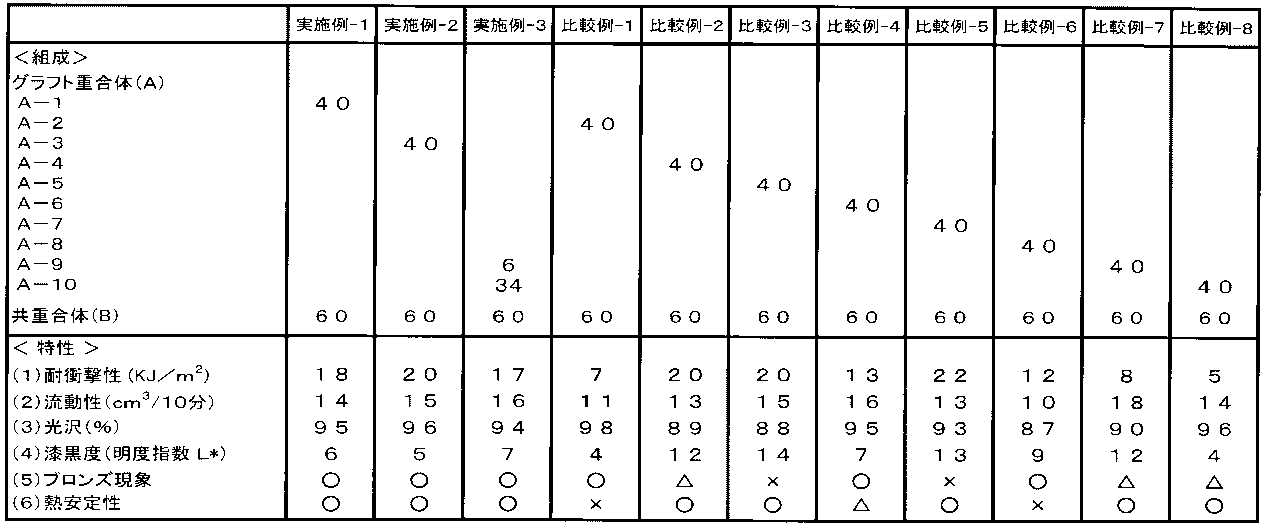
以上のとおり、本発明によれば、ブロンズ現象を解決し、耐候性と顔料着色性に優れた熱可塑性樹脂組成物である。更に、表面外観と耐衝撃性の良好なバランスに優れた熱可塑性樹脂組成物が得られるという効果があり、自動車等の車両用内外装部品、各種の家電製品やOA機器のハウジング、その他雑貨分野等、幅広い分野で好適に使用する事ができる。
As described above, according to the present invention, a thermoplastic resin composition that solves the bronze phenomenon and has excellent weather resistance and pigment colorability. Furthermore, there is an effect that a thermoplastic resin composition having a good balance between surface appearance and impact resistance can be obtained, interior and exterior parts for vehicles such as automobiles, housings for various home appliances and OA equipment, and other miscellaneous goods fields. Etc., and can be suitably used in a wide range of fields.
Claims (3)
重量平均粒子径が70nm以上〜180nm以下であるアクリル系ゴム重合体に、芳香族ビニル単量体及びシアン化ビニル単量体を主成分とする単量体をグラフト重合したグラフト重合体(a−2)60〜99重量%からなるグラフト共重合体(A)10〜100重量部と、芳香族ビニル単量体、シアン化ビニル単量体、(メタ)アクリル酸エステル単量体及びその他のビニル単量体からなる群より選ばれる少なくとも一種の単量体を重合してなる熱可塑性樹脂(B)0〜90重量部(但し、(A)と(B)の合計が100重量部)からなる熱可塑性樹脂組成物。 To the two-layer rubber polymer in which the inner layer is a butadiene rubber polymer having a weight average particle diameter of 250 nm to 400 nm and the outer layer is an acrylic rubber polymer having an average thickness of 70 nm to 180 nm, 1 to 40% by weight of a graft polymer (a-1) obtained by graft polymerization of a monomer and a monomer mainly composed of vinyl cyanide monomer,
A graft polymer obtained by graft polymerization of an acrylic rubber polymer having a weight average particle diameter of 70 nm to 180 nm with an aromatic vinyl monomer and a monomer mainly composed of vinyl cyanide monomer (a- 2) 10 to 100 parts by weight of the graft copolymer (A) comprising 60 to 99% by weight, an aromatic vinyl monomer, a vinyl cyanide monomer, a (meth) acrylate monomer and other vinyls It consists of 0 to 90 parts by weight of a thermoplastic resin (B) obtained by polymerizing at least one monomer selected from the group consisting of monomers (however, the sum of (A) and (B) is 100 parts by weight). Thermoplastic resin composition.
Priority Applications (1)
| Application Number | Priority Date | Filing Date | Title |
|---|---|---|---|
| JP2008090907A JP5354641B2 (en) | 2008-03-31 | 2008-03-31 | Thermoplastic resin composition. |
Applications Claiming Priority (1)
| Application Number | Priority Date | Filing Date | Title |
|---|---|---|---|
| JP2008090907A JP5354641B2 (en) | 2008-03-31 | 2008-03-31 | Thermoplastic resin composition. |
Publications (2)
| Publication Number | Publication Date |
|---|---|
| JP2009242595A true JP2009242595A (en) | 2009-10-22 |
| JP5354641B2 JP5354641B2 (en) | 2013-11-27 |
Family
ID=41304880
Family Applications (1)
| Application Number | Title | Priority Date | Filing Date |
|---|---|---|---|
| JP2008090907A Expired - Fee Related JP5354641B2 (en) | 2008-03-31 | 2008-03-31 | Thermoplastic resin composition. |
Country Status (1)
| Country | Link |
|---|---|
| JP (1) | JP5354641B2 (en) |
Cited By (1)
| Publication number | Priority date | Publication date | Assignee | Title |
|---|---|---|---|---|
| JP2012158623A (en) * | 2011-01-28 | 2012-08-23 | Nippon A&L Inc | Thermoplastic resin composition |
Citations (3)
| Publication number | Priority date | Publication date | Assignee | Title |
|---|---|---|---|---|
| JPH0331352A (en) * | 1989-06-28 | 1991-02-12 | Mitsubishi Rayon Co Ltd | Thermoplastic resin composition with excellent impact resistance, weather resistance, and moldability |
| JPH06107743A (en) * | 1992-09-28 | 1994-04-19 | Monsant Kasei Kk | Production of graft copolymer |
| JP2001098133A (en) * | 1999-09-27 | 2001-04-10 | Mitsubishi Rayon Co Ltd | Thermoplastic resin composition containing graft copolymer |
-
2008
- 2008-03-31 JP JP2008090907A patent/JP5354641B2/en not_active Expired - Fee Related
Patent Citations (3)
| Publication number | Priority date | Publication date | Assignee | Title |
|---|---|---|---|---|
| JPH0331352A (en) * | 1989-06-28 | 1991-02-12 | Mitsubishi Rayon Co Ltd | Thermoplastic resin composition with excellent impact resistance, weather resistance, and moldability |
| JPH06107743A (en) * | 1992-09-28 | 1994-04-19 | Monsant Kasei Kk | Production of graft copolymer |
| JP2001098133A (en) * | 1999-09-27 | 2001-04-10 | Mitsubishi Rayon Co Ltd | Thermoplastic resin composition containing graft copolymer |
Cited By (1)
| Publication number | Priority date | Publication date | Assignee | Title |
|---|---|---|---|---|
| JP2012158623A (en) * | 2011-01-28 | 2012-08-23 | Nippon A&L Inc | Thermoplastic resin composition |
Also Published As
| Publication number | Publication date |
|---|---|
| JP5354641B2 (en) | 2013-11-27 |
Similar Documents
| Publication | Publication Date | Title |
|---|---|---|
| KR102361451B1 (en) | Method for preparing large particle sized rubber latex, and method for preparing abs graft copolymer | |
| KR102465200B1 (en) | Method for preparing graft copolymer and method for preparing thermoplastic resin composition containing thereof | |
| JP3946060B2 (en) | Thermoplastic resin composition | |
| JP2006241283A (en) | Thermoplastic resin composition and resin molded product composed of the same | |
| JP3283461B2 (en) | Rubber modified styrenic resin composition | |
| JP2002003548A (en) | Butadiene rubber reinforced resin and its composition | |
| JP5354641B2 (en) | Thermoplastic resin composition. | |
| JP5453511B2 (en) | Graft copolymer, thermoplastic resin composition, and method for producing graft copolymer | |
| JP2006056961A (en) | Thermoplastic resin composition and resin molding composed of the same | |
| JP2003327639A (en) | Rubber-reinforced resin and resin composition thereof | |
| JP4907930B2 (en) | A thermoplastic resin composition, a vehicle lamp material, and a vehicle lamp housing part. | |
| JP2003049042A (en) | Thermoplastic resin composition excellent in matting property and molded article using the same | |
| JP2000017170A (en) | Thermoplastic resin composition | |
| JPH1160882A (en) | Thermoplastic resin composition | |
| JP2000017135A (en) | Thermoplastic resin composition | |
| JP4969911B2 (en) | Thermoplastic resin composition and molded article | |
| KR20180077435A (en) | Odorless thermoplastic resin composition having good transparency and method for preparing the same | |
| JP3525546B2 (en) | Rubber reinforced thermoplastic resin and thermoplastic resin composition | |
| JP4731948B2 (en) | Composite rubber particles, composite rubber reinforced vinyl resin and thermoplastic resin composition | |
| US4985496A (en) | Thermoplastic resin composition | |
| JP5047494B2 (en) | Thermoplastic resin molded article and thermoplastic resin molded article subjected to surface secondary processing | |
| JP5547795B2 (en) | Thermoplastic resin composition and molded article | |
| JP2007091970A (en) | A thermoplastic resin composition, a vehicle lamp material, and a vehicle lamp housing part. | |
| JP3338557B2 (en) | Thermoplastic resin composition | |
| JP5457573B2 (en) | Thermoplastic resin composition and molded article |
Legal Events
| Date | Code | Title | Description |
|---|---|---|---|
| A621 | Written request for application examination |
Free format text: JAPANESE INTERMEDIATE CODE: A621 Effective date: 20110322 |
|
| A977 | Report on retrieval |
Free format text: JAPANESE INTERMEDIATE CODE: A971007 Effective date: 20120612 |
|
| A131 | Notification of reasons for refusal |
Free format text: JAPANESE INTERMEDIATE CODE: A131 Effective date: 20120619 |
|
| A02 | Decision of refusal |
Free format text: JAPANESE INTERMEDIATE CODE: A02 Effective date: 20121127 |
|
| A61 | First payment of annual fees (during grant procedure) |
Free format text: JAPANESE INTERMEDIATE CODE: A61 Effective date: 20130822 |
|
| R150 | Certificate of patent or registration of utility model |
Ref document number: 5354641 Country of ref document: JP Free format text: JAPANESE INTERMEDIATE CODE: R150 Free format text: JAPANESE INTERMEDIATE CODE: R150 |
|
| LAPS | Cancellation because of no payment of annual fees |