JP2010077182A - Method for treating floor treated with wax - Google Patents
Method for treating floor treated with wax Download PDFInfo
- Publication number
- JP2010077182A JP2010077182A JP2008243889A JP2008243889A JP2010077182A JP 2010077182 A JP2010077182 A JP 2010077182A JP 2008243889 A JP2008243889 A JP 2008243889A JP 2008243889 A JP2008243889 A JP 2008243889A JP 2010077182 A JP2010077182 A JP 2010077182A
- Authority
- JP
- Japan
- Prior art keywords
- wax
- weight
- floor
- group
- carbon atoms
- Prior art date
- Legal status (The legal status is an assumption and is not a legal conclusion. Google has not performed a legal analysis and makes no representation as to the accuracy of the status listed.)
- Granted
Links
Landscapes
- Detergent Compositions (AREA)
Abstract
【課題】ワックス処理された床のワックス効果を簡易に回復、維持できる方法を提供する。
【解決手段】(a)界面活性剤、(b)ワックス、(c)アクリル系樹脂、(d)シリコーン、(e)式(e1)で表される特定のグリコール系溶剤、及び(f)エタノールを、それぞれ特定比率で含有し、25℃におけるpHが6〜8である組成物を、ワックス処理された後、汚染された床に適用し、ワックスが実質的に床から除去されないように前記組成物を拭き取り、ワックス効果の回復を行う、ワックス処理された床の処理方法。
【選択図】なしA method for easily recovering and maintaining the wax effect of a wax-treated floor is provided.
SOLUTION: (a) Surfactant, (b) Wax, (c) Acrylic resin, (d) Silicone, (e) Specific glycol solvent represented by formula (e1), and (f) Ethanol In a specific ratio and having a pH of 6-8 at 25 ° C. applied to the contaminated floor after wax treatment, so that the wax is not substantially removed from the floor. A method of treating a floor treated with wax, which wipes off objects and restores the wax effect.
[Selection figure] None
Description
本発明は、ワックス処理された後に汚染された床のワックス効果を回復させるワックス処理された床の処理方法に関する。 The present invention relates to a method for treating a waxed floor which restores the wax effect of a contaminated floor after being waxed.
家屋のフローリング床及び合成樹脂系の床材に対する保護つや出し剤に関しては、スチレン・アクリル共重合体ラテックス等をベースとした樹脂ポリマーが用いられている。特許文献1には、ポリエトキシ化脂肪族第2級アルコールを添加すると塗り伸ばし性及びレベリング性が向上することが記載されている。また床用つや出剤に洗浄力を付与し、一度の拭きそうじで汚れを落とし、つや出しも行うことができる床用つや出し洗浄剤として特許文献2、3などがある。特許文献2によると、ポリエチレンワックス、ポリプロピレンワックス及びアルカノールアミンを用いることで、洗浄性、つや及び耐傷性を併せ持つつや出し洗浄剤を得ることができる。一方、特許文献3によれば、アルカノールアミンのようなアルカリ剤を用いなくても洗浄性とつや、及び滑りにくさを併せ持つつや出し洗浄剤が得られるとしている。
塗装処理や表面処理、またワックス処理を行った表面には樹脂やワックスが膜状に残留している。このようなワックス表面には、粒子汚れ、油脂汚れなどが付着しやすく、また、微細な傷が付いたりして、徐々にワックス効果が低減していく。汚れが付着したワックス処理床に対して、市販のアルカリ洗剤を用いた場合、その樹脂膜を損傷するだけではなく、樹脂の剥離を引き起こす可能性があった。また、樹脂膜を水拭きしたとしても、樹脂上の汚れを取り除けないだけでなく、拭き取り時の摩擦により、樹脂表面を痛めてしまうという欠点があった。一方、改めてワックス処理を行うには、ワックスの剥離、洗浄、ワックスがけといった大がかりな作業を必要とするため、日常的に簡易に行う方法としては適当とは言い難い。 Resin and wax remain in the form of a film on the surface subjected to the coating treatment, the surface treatment, and the wax treatment. Such a wax surface is likely to have particle stains, oily stains, and the like, and may be finely scratched to gradually reduce the wax effect. When a commercially available alkaline detergent was used for the wax-treated floor on which the dirt adhered, not only the resin film was damaged, but also the resin could be peeled off. Moreover, even if the resin film is wiped with water, not only the stains on the resin cannot be removed, but also the resin surface is damaged due to friction during wiping. On the other hand, re-waxing requires extensive work such as wax removal, washing, and waxing, so it is difficult to say that it is suitable as a simple and routine method.
本発明の課題は、ワックス処理された床のワックス効果を簡易に回復、維持できる方法を提供することである。 An object of the present invention is to provide a method capable of easily recovering and maintaining the wax effect of a wax-treated floor.
本発明は、(a)界面活性剤0.01〜2重量%、(b)ワックス0.1〜5重量%、(c)アクリル系樹脂1〜8重量%、(d)シリコーン0.001〜10重量%、(e)下記式(e1)で表されるグリコール系溶剤0.1〜10重量%、及び(f)エタノール0.01〜20重量%を含有し、25℃におけるpHが6〜8である組成物を、ワックス処理された後、汚染された床に適用し、ワックスが実質的に床から除去されないように前記組成物を拭き取り、ワックス効果の回復を行う、ワックス処理された床の処理方法に関する。
RO−(AO)nH (e1)
(式中、Rは炭素数1〜4のアルキル基又は炭素数2〜4のアルケニル基を示す。AOはエチレンオキシ基又はプロピレンオキシ基を示す。nは1〜3の整数を示す。)
The present invention comprises (a) 0.01 to 2% by weight surfactant, (b) 0.1 to 5% by weight wax, (c) 1 to 8% by weight acrylic resin, and (d) 0.001 to silicone. 10% by weight, (e) 0.1 to 10% by weight of a glycol solvent represented by the following formula (e1), and (f) 0.01 to 20% by weight of ethanol, and the pH at 25 ° C. is 6 to 6%. 8. A waxed floor, wherein the composition is applied to a contaminated floor after being waxed, the composition is wiped so that the wax is not substantially removed from the floor, and the wax effect is restored. It relates to the processing method.
RO- (AO) n H (e1)
(In the formula, R represents an alkyl group having 1 to 4 carbon atoms or an alkenyl group having 2 to 4 carbon atoms. AO represents an ethyleneoxy group or a propyleneoxy group. N represents an integer of 1 to 3)
また、本発明は、ワックス処理された床の汚染状況を監視し、汚染によりワックス効果が低減した状態となったときに、(a)界面活性剤〔以下、(a)成分という〕0.01〜2重量%、(b)ワックス〔以下、(b)成分という〕0.1〜5重量%、(c)アクリル系樹脂〔以下、(c)成分という〕1〜8重量%、(d)シリコーン〔以下、(d)成分という〕0.001〜10重量%、(e)下記式(e1)で表されるグリコール系溶剤〔以下、(e)成分という〕0.1〜10重量%、及び(f)エタノール〔以下、(f)成分という〕0.01〜20重量%を含有し、25℃におけるpHが6〜8である組成物〔以下、組成物(I)という〕を、汚染された床に適用し、ワックスが実質的に床から除去されないように前記組成物を拭き取り、ワックス効果の回復を行う、ワックス処理された床の管理保護方法に関する。
RO−(AO)nH (e1)
(式中、Rは炭素数1〜4のアルキル基又は炭素数2〜4のアルケニル基を示す。AOはエチレンオキシ基又はプロピレンオキシ基を示す。nは1〜3の整数を示す。)
Further, the present invention monitors the contamination status of the wax-treated floor, and when the wax effect is reduced due to the contamination, (a) a surfactant (hereinafter referred to as (a) component) 0.01 ˜2 wt%, (b) wax (hereinafter referred to as “component (b)”) 0.1 to 5 wt%, (c) acrylic resin (hereinafter referred to as “component (c)”) 1 to 8 wt%, (d) 0.001 to 10% by weight of silicone (hereinafter referred to as component (d)), (e) a glycol solvent represented by the following formula (e1) (hereinafter referred to as component (e)) 0.1 to 10% by weight, And (f) a composition containing 0.01 to 20% by weight of ethanol (hereinafter referred to as component (f)) and having a pH of 6 to 8 at 25 ° C. (hereinafter referred to as composition (I)) The composition is applied to a finished floor so that the wax is not substantially removed from the floor. Wiping, performing recovery of the wax effects, for managing protection method floors were waxed.
RO- (AO) n H (e1)
(In the formula, R represents an alkyl group having 1 to 4 carbon atoms or an alkenyl group having 2 to 4 carbon atoms. AO represents an ethyleneoxy group or a propyleneoxy group. N represents an integer of 1 to 3)
本発明によれば、ワックス処理された床のワックス効果を簡易に回復、維持できる方法が提供される。 According to the present invention, there is provided a method capable of easily recovering and maintaining the wax effect of a wax-treated floor.
<組成物(I)>
本発明は、(a)〜(f)成分を含有する特定の組成物(I)を、汚染されたワックス処理された床に適用することで、ワックス効果を回復させるものである。
<Composition (I)>
The present invention restores the wax effect by applying a specific composition (I) containing components (a) to (f) to a contaminated wax-treated floor.
〔(a)成分〕
(a)成分としては、陰イオン性界面活性剤、非イオン性界面活性剤及び両性界面活性剤からなる群から選ばれる1種又は2種以上のものが好ましい。具体的には次のものが挙げられる。
[(A) component]
The component (a) is preferably one or more selected from the group consisting of an anionic surfactant, a nonionic surfactant and an amphoteric surfactant. Specific examples include the following.
陰イオン性界面活性剤としては、アルキルベンゼンスルホン酸塩類、アルキレンオキシド付加アルキル又はアルケニルエーテル硫酸塩類、アルキル又はアルケニル硫酸塩類、オレフィンスルホン酸塩類、アルカンスルホン酸塩類、脂肪酸塩類、アルキレンオキシド付加アルキル又はアルケニルエーテルカルボン酸塩類、α−スルホ脂肪酸塩類及びそのエステル類、ジフェニルエーテルジスルホン酸類等が挙げられる。陰イオン性界面活性剤の対イオンとしては、ナトリウム、カリウム等のアルカリ金属又はアンモニウム塩もしくはモノエタノールアンモニウム、ジエタノールアンモニウム、トリエタノールアンモニウム等のアルカノール置換アンモニウム塩を挙げることができる。 Examples of the anionic surfactant include alkylbenzene sulfonates, alkylene oxide addition alkyl or alkenyl ether sulfates, alkyl or alkenyl sulfates, olefin sulfonates, alkane sulfonates, fatty acid salts, alkylene oxide addition alkyl or alkenyl ethers. Examples thereof include carboxylates, α-sulfo fatty acid salts and esters thereof, and diphenyl ether disulfonic acids. Examples of the counter ion of the anionic surfactant include alkali metals such as sodium and potassium, or ammonium salts or alkanol-substituted ammonium salts such as monoethanolammonium, diethanolammonium, and triethanolammonium.
非イオン性界面活性剤としては、ポリオキシアルキレンアルキル又はアルケニルエーテル類、ポリオキシアルキレンアルキルフェニルエーテル類、蔗糖脂肪酸エステル類、脂肪酸グリセリンエステル類、アミンオキシド類、高級脂肪酸アルカノールアミド類又はそのアルキレンオキシド付加物、次の一般式(a1)で表されるアルキルグリコシド等が挙げられる。
R1a(OR2a)tGu (a1)
〔式中、R1aは炭素数8〜18の直鎖もしくは分岐鎖のアルキル基、アルケニル基又はアルキルフェニル基を示し、R2aは炭素数2〜4のアルキレン基を示し、 Gは炭素数5〜6を有する還元糖に由来する残基を示し、tはその平均値が0〜5の数を示し、uはその平均値が1〜10の数を示す。〕
Nonionic surfactants include polyoxyalkylene alkyl or alkenyl ethers, polyoxyalkylene alkyl phenyl ethers, sucrose fatty acid esters, fatty acid glycerin esters, amine oxides, higher fatty acid alkanolamides or alkylene oxide additions thereof. And alkyl glycosides represented by the following general formula (a1).
R 1a (OR 2a ) t Gu (a1)
[Wherein R 1a represents a linear or branched alkyl group, alkenyl group or alkylphenyl group having 8 to 18 carbon atoms, R 2a represents an alkylene group having 2 to 4 carbon atoms, and G represents a carbon number of 5 The residue derived from the reducing sugar which has -6 is shown, t shows the number whose average value is 0-5, u shows the number whose average value is 1-10. ]
好ましいtの値は0〜2であり、特に好ましくは0である。一方、uはその平均値が1より大きい場合、つまり2糖以上の糖鎖を親水性基とする一般式(a1)で表される界面活性剤を含有する場合、糖鎖の結合様式は1−2、1−3、1−4、1−6結合、更にα−、β−ピラノシド結合又はフラノシド結合及びこれらの混合された結合様式を有する任意の混合物を含むことが可能である。また、一般式(a1)中のuの平均値は1〜10、好ましくは1〜3、より好ましくは1〜1.5であるが、更に好ましい平均値は1.1〜1.4である。なお、yの測定法はプロトンNMR法によるものである。 A preferable value of t is 0 to 2, particularly preferably 0. On the other hand, when u has an average value larger than 1, that is, when it contains a surfactant represented by the general formula (a1) having a sugar chain of two or more sugars as a hydrophilic group, the binding mode of the sugar chain is 1 -2, 1-3, 1-4, 1-6 bonds, as well as α-, β-pyranoside bonds, or furanoside bonds, and any mixtures having these mixed modes of attachment may be included. Moreover, although the average value of u in general formula (a1) is 1-10, Preferably it is 1-3, More preferably, it is 1-1.5, More preferable average value is 1.1-1.4. . In addition, the measuring method of y is based on the proton NMR method.
また、一般式(a1)中のR1aは炭素数8〜18の直鎖又は分岐鎖を有するアルキル基、アルケニル基又はアルキルフェニル基であるが、溶解性、起泡性及び洗浄性向上の点から、好ましいのは炭素数10〜14のアルキル基である。また、R2aは炭素数2〜4のアルキレン基であるが、水溶性の点から好ましい炭素数は2〜3である。更にGは単糖もしくは2糖以上の原料によってその構造が決定されるが、このGの原料としては、単糖ではグルコース、フルクトース、ガラクトース、キシロース、マンノース、リキソース、アラビノース等及びこれらの混合物等が、2糖以上ではマルトース、キシロビオース、イソマルトース、セロビオース、ゲンチビオース、ラクトース、スクロース、ニゲロース、ツラノース、ラフィノース、ゲンチアノース、メレジトース等及びこれらの混合物等が挙げられる。これらのうち、好ましい単糖類原料は、それらの入手容易性及びコストの点から、グルコース及びフルクトースであり、2糖以上ではマルトース及びスクロースである。この中でも、特に入手容易性に点からグルコースが好ましい。更に、ペンタエリスリトール、イソステアリルグリシジルエーテルの1モル付加体、ソルビトール・イソステアリルグリシジルエーテルの1モル付加体、マンニトール・2−オクチルドデシルグリシジルエーテルの1モル付加体、メチルグルコシド・イソステアリルグリシジルエーテルの1モル付加体、ジグリセリン・イソステアリルグリシジルエーテルの1モル付加体、フィタントリオール等の1分子中に少なくとも1個の長鎖分岐アルキル基又はアルケニル基及び少なくとも3個の水酸基を有する非イオン性界面活性剤が挙げられる。 In addition, R 1a in the general formula (a1) is an alkyl group, alkenyl group or alkylphenyl group having a straight or branched chain having 8 to 18 carbon atoms, which improves solubility, foamability and detergency. Therefore, an alkyl group having 10 to 14 carbon atoms is preferable. R 2a is an alkylene group having 2 to 4 carbon atoms, and preferably 2 to 3 carbon atoms from the viewpoint of water solubility. Furthermore, the structure of G is determined by the raw material of monosaccharide or disaccharide or more, and as the raw material of G, glucose, fructose, galactose, xylose, mannose, lyxose, arabinose, etc., and a mixture thereof, etc. For disaccharides or more, maltose, xylobiose, isomaltose, cellobiose, gentibiose, lactose, sucrose, nigerose, turanose, raffinose, gentianose, melezitose and the like, and mixtures thereof can be mentioned. Among these, preferable monosaccharide raw materials are glucose and fructose from the viewpoint of their availability and cost, and maltose and sucrose for two or more sugars. Among these, glucose is particularly preferable from the viewpoint of availability. Furthermore, 1 mol adduct of pentaerythritol and isostearyl glycidyl ether, 1 mol adduct of sorbitol and isostearyl glycidyl ether, 1 mol adduct of mannitol and 2-octyldodecyl glycidyl ether, 1 of methyl glucoside and isostearyl glycidyl ether Mole adduct, 1 mol adduct of diglycerin / isostearyl glycidyl ether, nonionic interface having at least one long-chain branched alkyl group or alkenyl group and at least 3 hydroxyl groups in one molecule such as phytantriol An activator is mentioned.
両性界面活性剤としては、例えば炭素数1〜22、好ましくは8〜18の直鎖又は分岐鎖のアルキル基又はアルケニル基を有するスルホベタイン及びカルボベタイン等が挙げられる。 Examples of the amphoteric surfactant include sulfobetaine and carbobetaine having a linear or branched alkyl group or alkenyl group having 1 to 22 carbon atoms, preferably 8 to 18 carbon atoms.
本発明においては、これらの界面活性剤のうち、洗浄力又は拭き取り性の向上の点から、ジフェニルエーテルジスルホン酸類、高級脂肪酸アルカノールアミド類又はそのアルキレンオキシド付加物、アミンオキシド類、アルキルグリコシド類、スルホベタイン類又はカルボベタイン類、ポリオキシアルキレンアルキル又はアルケニルエーテル類が好ましく、この中でも、特にポリオキシエチレンアルキルエーテル、アルキルグリコシド類が好ましい。 In the present invention, among these surfactants, diphenyl ether disulfonic acids, higher fatty acid alkanolamides or alkylene oxide adducts thereof, amine oxides, alkyl glycosides, sulfobetaines, from the viewpoint of improving detergency or wiping properties. Or carbobetaines, polyoxyalkylene alkyls or alkenyl ethers are preferred, and among them, polyoxyethylene alkyl ethers and alkyl glycosides are particularly preferred.
〔(b)成分〕
(b)成分のワックスは、ワックスと水とを含有するエマルションでもよい。(b)成分中のワックスは、ポリオレフィン系ワックスが好ましい。なかでもポリエチレンワックス、ポリプロピレンワックスが好ましい。
[Component (b)]
The wax as component (b) may be an emulsion containing wax and water. The wax in component (b) is preferably a polyolefin wax. Of these, polyethylene wax and polypropylene wax are preferred.
ポリエチレンワックスは、一般のエチレンの重合によって得る方法、一般成形用の容器等に使用されるポリエチレンを熱分解して得る方法、一般成形用の容器等に使用されるポリエチレンの製造時に副生成される低分子量のポリエチレンを分離生成する方法又は乳化重合方法等により入手可能である。ポリエチレンワックスの誘導体としては、例えば酸化ポリエチレンワックス、即ち空気酸化等の方法によりポリエチレンワックス骨格にカルボキシル基や水酸基等を付与したものの他に、マレイン酸変性、フマル酸変性、イタコン酸変性、又はスチレン変性等の変性体が挙げられる。本発明では、ポリエチレンワックス及び/又は酸化ポリエチレンワックスが好ましい。これらのポリエチレンワックス又はその誘導体は、市販のものを使用することができる。これらポリエチレンワックスを、乳化剤等を用いて水性エマルションとして使用できるが、エマルションの配合量はエマルション中の有効量(Active)に基づいて決めることができる。 Polyethylene wax is a by-product generated during the production of polyethylene used in general molding containers, a method obtained by pyrolyzing polyethylene used in general molding containers, and the like. It can be obtained by a method of separating and producing low molecular weight polyethylene or an emulsion polymerization method. Examples of the polyethylene wax derivative include, for example, oxidized polyethylene wax, that is, a method in which a carboxyl group or a hydroxyl group is added to a polyethylene wax skeleton by a method such as air oxidation, maleic acid modification, fumaric acid modification, itaconic acid modification, or styrene modification. And the like. In the present invention, polyethylene wax and / or oxidized polyethylene wax are preferred. As these polyethylene waxes or derivatives thereof, commercially available products can be used. These polyethylene waxes can be used as an aqueous emulsion using an emulsifier or the like, but the amount of the emulsion can be determined based on the effective amount (Active) in the emulsion.
また、ポリプロピレンワックスは、一般のプロピレンの重合によって得る方法、一般成形用の容器等に使用されるポリプロピレンを熱分解して得る方法、一般成形用の容器等に使用されるポリプロピレンの製造時に副生成される低分子量のポリプロピレンを分離生成する方法等により入手可能である。ポリプロピレンワックスの誘導体としては、上記のポリエチレンワックスの場合と同様に、ポリプロピレンワックス骨格にカルボキシル基や水酸基等を付与した酸化ポリプロピレンワックスの他に、マレイン酸変性、フマル酸変性、イタコン酸変性、又はスチレン変性等の変性体が挙げられる。本発明では、ポリプロピレンワックス及び/又はマレイン酸変性ポリプロピレンワックスが好ましい。これらのポリプロピレンワックス又はその誘導体は、市販のものを使用することができる。これらポリプロピレンワックスを、乳化剤等を用いて水性エマルションとして使用できるが、エマルションの配合量はエマルション中の有効量(Active)に基づいて決めることができる。 In addition, polypropylene wax is a method obtained by polymerization of general propylene, a method obtained by pyrolyzing polypropylene used in general molding containers, etc., and a by-product during the production of polypropylene used in general molding containers It can be obtained by a method of separating and producing low molecular weight polypropylene. As a derivative of polypropylene wax, as in the case of the above-mentioned polyethylene wax, in addition to oxidized polypropylene wax having a carboxyl group or a hydroxyl group added to the polypropylene wax skeleton, maleic acid modification, fumaric acid modification, itaconic acid modification, or styrene Examples include modified products such as modified products. In the present invention, polypropylene wax and / or maleic acid-modified polypropylene wax is preferred. As these polypropylene waxes or derivatives thereof, commercially available products can be used. These polypropylene waxes can be used as an aqueous emulsion using an emulsifier or the like, but the amount of the emulsion can be determined based on the effective amount (Active) in the emulsion.
〔(c)成分〕
(c)成分のアクリル系樹脂としては、アクリロニトリル、メタクリロニトリル、メタクリル酸メチル、メタクリル酸エチル、メタクリル酸ブチル、メタクリル酸2エチルヘキシル、アクリル酸メチル、アクリル酸エチル、アクリル酸ブチル、アクリル酸2エチルヘキシル、メタクリル酸、アクリルアミド、ジメチルアクリルアミド及びアクリル酸から選ばれるアクリル系モノマーから生成されるホモポリマー又はコポリマーや、前記アクリル系モノマーとその他モノマーとして、スチレン、ビニルトルエン、イタコン酸、クロトン酸、フマル酸、マレイン酸のモノマー群から選ばれるモノマーとのコポリマーから選ばれる一種以上の水不溶性の樹脂等が例示され、より好ましくは(i)スチレンと(ii)メタクリレート、アクリレート、メタクリル酸およびアクリル酸から選ばれる一種以上とのコポリマーが例示される。これらアクリル系樹脂は乳化重合により合成することができる。また、アクリル系樹脂は、アクリル系樹脂が水中に分散したアクリル系樹脂エマルションを使用することができる。
[Component (c)]
As the acrylic resin of component (c), acrylonitrile, methacrylonitrile, methyl methacrylate, ethyl methacrylate, butyl methacrylate, 2-ethylhexyl methacrylate, methyl acrylate, ethyl acrylate, butyl acrylate, 2-ethylhexyl acrylate , Homopolymers or copolymers formed from acrylic monomers selected from methacrylic acid, acrylamide, dimethylacrylamide and acrylic acid, and as the acrylic monomers and other monomers, styrene, vinyl toluene, itaconic acid, crotonic acid, fumaric acid, Examples thereof include one or more water-insoluble resins selected from copolymers with monomers selected from a monomer group of maleic acid, and more preferably (i) styrene and (ii) methacrylate, acrylate, Copolymers of one or more selected from acrylic acid and acrylic acid. These acrylic resins can be synthesized by emulsion polymerization. As the acrylic resin, an acrylic resin emulsion in which an acrylic resin is dispersed in water can be used.
なお、アクリル系樹脂としてアクリル系樹脂エマルションを使用する場合は、アクリル系樹脂エマルションの配合量はエマルション中の有効量(Active)に基づいて決めることができる。 In addition, when using an acrylic resin emulsion as an acrylic resin, the compounding quantity of an acrylic resin emulsion can be determined based on the effective amount (Active) in an emulsion.
〔(d)成分〕
(d)成分のシリコーンとしては、ポリオルガノシロキサンオイル、特に25℃における粘度が50mPa・s以上のポリオルガノシロキサンオイルが挙げられる。
[Component (d)]
Examples of the silicone of component (d) include polyorganosiloxane oils, particularly polyorganosiloxane oils having a viscosity at 25 ° C. of 50 mPa · s or more.
好ましくは、ポリオルガノシロキサンオイルであり、ポリオルガノシロキサンオイルとしては、下記一般式(I)及び(I’)で表される構成単位からなるものが挙げられ、ポリオルガノシロキサンオイルのオルガノ基が炭素数1〜80のアルキル基、アミノアルキル基、N−(2−アミノアルキル)アミノアルキル基、メチルポリオキシエチレンアルキル基、アルコキシ基、エポキシアルキル基、カルボキシアルキル基もしくはフェニル基から選ばれる1種以上の基であるものが好ましい。また、固体粒子の運動性を高めるためには、該ポリオルガノシロキサンオイルの25℃における粘度が50mPa・s以上、特に100〜1000mPa・sであることが更に好ましい。 Polyorganosiloxane oil is preferred, and examples of the polyorganosiloxane oil include those composed of structural units represented by the following general formulas (I) and (I ′), and the organo group of the polyorganosiloxane oil is carbon. One or more selected from an alkyl group, an aminoalkyl group, an N- (2-aminoalkyl) aminoalkyl group, a methylpolyoxyethylenealkyl group, an alkoxy group, an epoxyalkyl group, a carboxyalkyl group, or a phenyl group, having 1 to 80 Those which are groups of In order to increase the mobility of the solid particles, the viscosity of the polyorganosiloxane oil at 25 ° C. is 50 mPa · s or more, and more preferably 100 to 1000 mPa · s.
(式中、R1、R2及びR3は同一又は異なって、炭素数1〜100のアルキル基、アルコキシ基、ハイドロキシアルキル基、水酸基、シロキシ基、カルボキシル基、カルボキシアルキル基、N−(2−アミノアルキル)アミノアルキル基、アミノアルキル基、アミノ基、エポキシアルキル基、エポキシ基、メチルポリオキシエチレンアルキル基、ハイドロキシポリオキシエチレンアルキル基、メチルポリオキシエチレン・ポリオキシプロピレン基、ハイドロキシポリオキシエチレン・ポリオキシプロピレン基、アルキルポリオキシエチレン基、ポリオキシエチレン基、フェニル基又はフッ化アルキル基を示す。) (In the formula, R 1 , R 2 and R 3 are the same or different and are each an alkyl group having 1 to 100 carbon atoms, an alkoxy group, a hydroxyalkyl group, a hydroxyl group, a siloxy group, a carboxyl group, a carboxyalkyl group, N- (2 -Aminoalkyl) aminoalkyl group, aminoalkyl group, amino group, epoxyalkyl group, epoxy group, methylpolyoxyethylenealkyl group, hydroxypolyoxyethylenealkyl group, methylpolyoxyethylene / polyoxypropylene group, hydroxypolyoxyethylene -Indicates a polyoxypropylene group, an alkyl polyoxyethylene group, a polyoxyethylene group, a phenyl group or a fluorinated alkyl group.
本発明で用いられるポリオルガノシロキサンオイルの具体例としては、ジアルキルシロキサン、アルキルフェニルシリコーン、ポリエーテル変性シリコーン、アルキル変性シリコーン、アルコキシ変性シリコーン、ヒドロキシ変性シリコーン、カルボキシ変性シリコーン、エポキシ変性シリコーン、アミノ変性シリコーン等が挙げられ、ポリエーテル変性シリコーン、下記一般式(II)で表される化合物が特に好ましい。 Specific examples of the polyorganosiloxane oil used in the present invention include dialkyl siloxane, alkyl phenyl silicone, polyether modified silicone, alkyl modified silicone, alkoxy modified silicone, hydroxy modified silicone, carboxy modified silicone, epoxy modified silicone, amino modified silicone. A polyether-modified silicone and a compound represented by the following general formula (II) are particularly preferable.
(式中、n1及びn2は1〜100、mは1〜5000の整数を示す。) (In the formula, n1 and n2 are 1 to 100, and m is an integer of 1 to 5000.)
これらのポリオルガノシロキサンオイルは、例えば、KF56, KF-412, KF-413,KF-414, KF50, KF53, KF54, KF56, KF-618, KF994, KF995, KF9937, X22-161AS, X22-161A, X22-161B, KF8012, KF393, KF859, KF860, KF861, KF867, KF869, KF880, KF8002, KF8004, KF8005, KF858, KF864, KF865, KF868, KF8003, KF-105, X22-163A, X22-163B, X22-163C, KF-1001, KF101, X22-169AS, X22-169B, KF-102, X22-162A,X22-162C, X22-3701E, X22-3710, X22-160AS, KF6001, KF6002, KF6003,X22-4015, KF-857, KF862, KF8001, X22-3667, X22-3939A(信越化学工業(株)製)、TSF-451, TSF4700, TSF4701(東芝シリコーン(株)製)等の商品名で市販されており、これらを用いることができる。 These polyorganosiloxane oils are, for example, KF56, KF-412, KF-413, KF-414, KF50, KF53, KF54, KF56, KF-618, KF994, KF995, KF9937, X22-161AS, X22-161A, X22-161B, KF8012, KF393, KF859, KF860, KF8601, KF867, KF869, KF880, KF8002, KF8004, KF8005, KF858, KF864, KF865, KF868, KF8003, KF-105, X22-163A, X22-163B, X22- 163C, KF-1001, KF101, X22-169AS, X22-169B, KF-102, X22-162A, X22-162C, X22-3701E, X22-3710, X22-160AS, KF6001, KF6002, KF6003, X22-4015, KF-857, KF862, KF8001, X22-3667, X22-3939A (Shin-Etsu Chemical Co., Ltd.), TSF-451, TSF4700, TSF4701 (Toshiba Silicone Co., Ltd.) These can be used.
〔(e)成分〕
(e)成分の式(e1)で表されるグリコール系溶剤としては、下記一般式(e1−1)で表される化合物が挙げられる。
[(E) component]
(E) As a glycol type solvent represented by the formula (e1) of a component, the compound represented by the following general formula (e1-1) is mentioned.
RO−[(EO)n'/(PO)n'']H (e1−1)
(式中、Rは炭素数1〜4のアルキル基又は炭素数2〜4のアルケニル基を示す。EOはエチレンオキシ基、POはプロピレンオキシ基を示す。n’とn’’は、n’+n’’が1〜3となる整数である。)
RO-[(EO) n ′ / (PO) n ″ ] H (e1-1)
(In the formula, R represents an alkyl group having 1 to 4 carbon atoms or an alkenyl group having 2 to 4 carbon atoms. EO represents an ethyleneoxy group, PO represents a propyleneoxy group. N ′ and n ″ represent n ′. + N ″ is an integer from 1 to 3)
上記一般式(e1−1)において、EO、POの順序は問わない。一般式(e1−1)の化合物の具体例としては、エチレングリコールモノブチルエーテル、ジプロピレングリコールジメチルエーテル、ジエチレングリコールモノエチルエーテル、ジエチレングリコールモノブチルエーテル、プロピレングリコールモノメチルエーテル、プロピレングリコールモノブチルエーテル、プロピレングリコールモノエチルエーテル、プロピレングリコールジメチルエーテル等が挙げられ、なかでもジエチレングリコールモノエチルエーテル、プロピレングリコールモノメチルエーテルが好ましい。 In the general formula (e1-1), the order of EO and PO is not limited. Specific examples of the compound of the general formula (e1-1) include ethylene glycol monobutyl ether, dipropylene glycol dimethyl ether, diethylene glycol monoethyl ether, diethylene glycol monobutyl ether, propylene glycol monomethyl ether, propylene glycol monobutyl ether, propylene glycol monoethyl ether, Examples thereof include propylene glycol dimethyl ether, and among them, diethylene glycol monoethyl ether and propylene glycol monomethyl ether are preferable.
本発明に用いられる組成物(I)は、(a)成分を0.01〜2重量%、好ましくは0.1〜1重量%含有する。また、(b)成分を0.1〜5重量%、好ましくは0.5〜2重量%含有する。また、(c)成分を1〜8重量%、好ましくは2〜7重量%含有する。また、(d)成分を0.001〜10重量%、好ましくは0.01〜5重量%含有する。また、(e)成分を0.1〜10重量%、好ましくは1〜8重量%含有する。また、(f)成分を0.01〜20重量%、好ましくは0.5〜10重量%含有する。 The composition (I) used in the present invention contains the component (a) in an amount of 0.01 to 2% by weight, preferably 0.1 to 1% by weight. Further, the component (b) is contained in an amount of 0.1 to 5% by weight, preferably 0.5 to 2% by weight. Further, the component (c) is contained in an amount of 1 to 8% by weight, preferably 2 to 7% by weight. Further, the component (d) is contained in an amount of 0.001 to 10% by weight, preferably 0.01 to 5% by weight. Further, the component (e) is contained in an amount of 0.1 to 10% by weight, preferably 1 to 8% by weight. Further, the component (f) is contained in an amount of 0.01 to 20% by weight, preferably 0.5 to 10% by weight.
その他、本発明に用いられる組成物(I)に配合できる成分として、色素、香料、キレート剤、ポリマー、安定性向上化剤等が挙げられる。 In addition, as a component which can be mix | blended with the composition (I) used for this invention, a pigment | dye, a fragrance | flavor, a chelating agent, a polymer, a stability improving agent, etc. are mentioned.
本発明に用いられる組成物(I)は、上記(a)〜(f)成分、更に必要に応じて配合されるその他の成分と、水とを含有する。水の含有量は、組成物中70%以上、更に80〜95重量%が好ましい。 The composition (I) used in the present invention contains the above components (a) to (f), other components blended as necessary, and water. The content of water is preferably 70% or more, more preferably 80 to 95% by weight in the composition.
本発明に用いられる組成物(I)は、25℃におけるpHが6〜8である。 The composition (I) used in the present invention has a pH of 6 to 8 at 25 ° C.
<ワックス処理された床の処理方法>
本発明では、上記特定の組成物(I)を、ワックス処理された後、汚染された床に適用し、ワックスが実質的に床から除去されないように組成物(I)を拭き取り、ワックス効果の回復を行う。組成物(I)による処理は、ワックス樹脂膜上の汚れを取り除くだけではなく、痛んだワックス樹脂膜を再生し、容易に補強、維持することを可能とする。
<Method for treating wax-treated floor>
In the present invention, the above-mentioned specific composition (I) is applied to a contaminated floor after being waxed, and the composition (I) is wiped off so that the wax is not substantially removed from the floor. Perform recovery. The treatment with the composition (I) not only removes the dirt on the wax resin film, but also allows the damaged wax resin film to be regenerated and easily reinforced and maintained.
汚染された床への組成物(I)の適用は、スクイズボトル、トリガー式スプレー等により床に直接適用する、あるいはこれらの手段で床に適用した後、雑巾、モップ等の手段で床に塗り拡げる、雑巾、モップ等の手段に担持させて床に適用する、等の方法が挙げられる。床に適用した組成物(I)の拭き取りは、床に過度の負荷を与えない方法により行うことが好ましく、布、紙、不織布等の多孔性で可撓性のシート状部材を用いて、手動により行うことが好ましい。 The composition (I) is applied to the contaminated floor by applying it directly to the floor with a squeeze bottle, trigger spray, etc., or after applying to the floor with these means, it is applied to the floor with means such as a rag or mop Examples of the method include spreading, carrying on a cloth, a mop, etc. and applying to the floor. The wiping of the composition (I) applied to the floor is preferably performed by a method that does not apply an excessive load to the floor, and is manually performed using a porous and flexible sheet-like member such as cloth, paper, and nonwoven fabric. It is preferable to carry out by.
組成物(I)の適用量は、床に処理されたワックスの量や汚れの程度などを考慮して決めることが好ましい。また、組成物(I)中の(a)成分が、床に対して均一となるように、前記組成物を床に適用することができる。 The application amount of the composition (I) is preferably determined in consideration of the amount of wax treated on the floor and the degree of soiling. Moreover, the said composition can be applied to a floor so that (a) component in composition (I) may become uniform with respect to a floor.
本発明の対象となる床の処理に用いられるワックスは、市販の床用つや出し剤などに配合されている成分であり、具体的にはリンレイオール(株式会社リンレイ)、ワックスコートシート(花王株式会社)、つや出しマイペット(花王株式会社)等が挙げられる。かかるワックスは、(b)成分中のワックスと同一でも異なっていてもよい。これらは、通常、床の単位面積あたり、3ml/m2〜20ml/m2の比率で処理されている。 The wax used for floor treatment, which is a subject of the present invention, is a component blended in a commercially available floor polish and the like. Specifically, Linley All (Rinlay Co., Ltd.), Wax Coated Sheet (Kao Corporation) ), Polished my pet (Kao Corporation), and the like. Such a wax may be the same as or different from the wax in component (b). These are usually per unit area of the floor, it is processed at a rate of 3ml / m 2 ~20ml / m 2 .
本発明は、ワックス処理された床の汚染状況を監視し、汚染によりワックス効果が低減した状態となったときに、本発明に係る組成物(I)を、汚染された床に適用し、ワックスが実質的に床から除去されないように前記組成物(I)を拭き取り、ワックス効果の回復を行う、ワックス処理された床の管理保護方法として実施できる。「汚染によりワックス効果が低減した状態」とは、垢やホコリにより表面がやや黒ずんだ状態である状態をいう。ワックス処理された床の汚染状況の監視は、通常、目視で行う。 The present invention monitors the contamination status of a wax-treated floor, and when the wax effect is reduced due to the contamination, the composition (I) according to the present invention is applied to the contaminated floor to obtain a wax. The composition (I) is wiped off so as not to be substantially removed from the floor, and the wax-treated floor is recovered and the wax effect is recovered. The “state in which the wax effect is reduced due to contamination” refers to a state in which the surface is slightly darkened due to dirt or dust. Monitoring the contamination status of the waxed floor is usually done visually.
<評価方法>
(1)汚染床材の作製
ワックス(つや出しマイペット)を5ml/m2処理した床材(松下電工製フローリングKEC625)を、一般家庭の家屋内の通路に3ヶ月放置し、その上を1日に10回以上人間が行き来することにより、表面の光沢が若干失われた状態の汚染床材を得た。
<Evaluation method>
(1) Preparation of contaminated flooring material Flooring material (floating KEC625 made by Matsushita Electric Works) treated with 5 ml / m 2 of wax (glossy Mypet) is left in a passage in a general household for 3 months, and the surface is left for 1 day. As a result of humans going back and forth more than 10 times, a contaminated flooring with a slight loss of surface gloss was obtained.
(2)光沢増分の測定方法
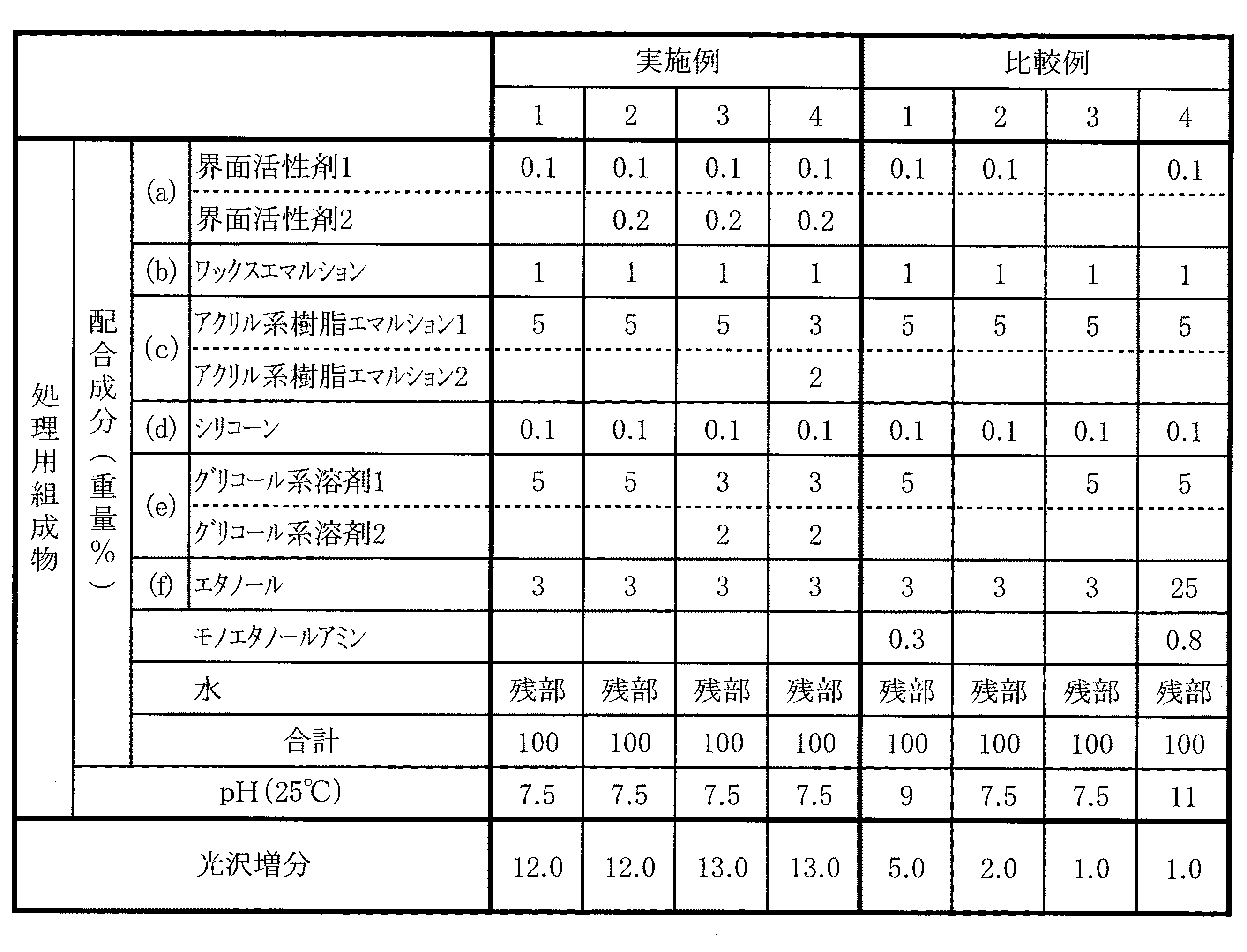
表1の処理用組成物で汚染床材を処理した場合の光沢増分により、ワックス効果の回復を評価した。結果を表1に示す。光沢増分は、スガ試験機株式会社製デジタル変角光沢計UGV−5D型を用い、入射角と受光角をそれぞれ60°に設定して、処理前の汚染床材の光沢と、表1の組成物の塗布(5ml/m2)→軽い拭き取り→乾燥を3回繰り返した後の汚染床材の光沢の差を求めることによって得た。光沢増分が大きいほど、ワックス効果が回復していることを意味する。
(2) Method of measuring gloss increase The recovery of the wax effect was evaluated based on the gloss increase when the contaminated flooring was treated with the treatment composition of Table 1. The results are shown in Table 1. The gloss increment is a digital variable angle gloss meter UGV-5D manufactured by Suga Test Instruments Co., Ltd., and the incident angle and the light receiving angle are set to 60 °, respectively. It was obtained by determining the difference in gloss of the contaminated flooring material after repeating the application of the object (5 ml / m 2 ) → light wiping → drying three times. A larger gloss increment means that the wax effect is restored.
(注)表中の重量%は有効分の濃度を示す。また、表中の成分は以下のものである。
・界面活性剤1:ポリオキシエチレンアルキルエーテル(アルキル基の炭素数が12〜14の2級アルコールに、エチレンオキサイドを平均7モル付加させたもの)
・界面活性剤2:ポリオキシエチレンアルキルエーテル(アルキル基の炭素数が12〜14の2級アルコールに、エチレンオキサイドを平均3モル付加させたもの)
・ワックスエマルション:ポリプロピレンワックスエマルション、ハイテックP−5060(東邦化学工業(株)製、有効分30重量%)
・アクリル系樹脂エマルション1:ローム&ハース社製のポリアクリル系樹脂NT−2624(有効分38.0重量%)
・アクリル系樹脂エマルション2:メタクリル酸20重量%、スチレン3重量%、アクリル酸エチル30重量%、メタクリル酸メチル47重量%を用いて乳化重合法により得られたアクリル系/スチレン共重合体樹脂エマルション(有効分35.0重量%)
・シリコーン:ポリエーテル変性シリコーン(信越化学工業(株)製、KF−618(有効分100重量%))
・グリコール系溶剤1:ジエチレングリコールモノエチルエーテル(20℃における蒸気圧17Pa)
・グリコール系溶剤2:プロピレングリコールモノメチルエーテル
(Note) The weight% in the table indicates the concentration of the effective component. The components in the table are as follows.
・ Surfactant 1: Polyoxyethylene alkyl ether (addition of 7 moles average of ethylene oxide to a secondary alcohol having 12 to 14 carbon atoms in the alkyl group)
Surfactant 2: Polyoxyethylene alkyl ether (average of 3 moles of ethylene oxide added to a secondary alcohol having an alkyl group with 12 to 14 carbon atoms)
-Wax emulsion: Polypropylene wax emulsion, Hitech P-5060 (manufactured by Toho Chemical Co., Ltd., effective 30% by weight)
-Acrylic resin emulsion 1: Polyacrylic resin NT-2624 (effective part 38.0% by weight) manufactured by Rohm & Haas
Acrylic resin emulsion 2: Acrylic / styrene copolymer resin emulsion obtained by emulsion polymerization using 20% by weight of methacrylic acid, 3% by weight of styrene, 30% by weight of ethyl acrylate, and 47% by weight of methyl methacrylate. (Effective portion 35.0% by weight)
Silicone: polyether-modified silicone (manufactured by Shin-Etsu Chemical Co., Ltd., KF-618 (effective weight 100% by weight))
・ Glycol solvent 1: Diethylene glycol monoethyl ether (vapor pressure 17 Pa at 20 ° C.)
・ Glycol solvent 2: Propylene glycol monomethyl ether
Claims (3)
RO−(AO)nH (e1)
(式中、Rは炭素数1〜4のアルキル基又は炭素数2〜4のアルケニル基を示す。AOはエチレンオキシ基又はプロピレンオキシ基を示す。nは1〜3の整数を示す。) (A) Surfactant 0.01-2% by weight, (b) Wax 0.1-5% by weight, (c) Acrylic resin 1-8% by weight, (d) Silicone 0.001-10% by weight, (E) A composition containing 0.1 to 10% by weight of a glycol solvent represented by the following formula (e1) and (f) 0.01 to 20% by weight of ethanol, and having a pH of 6 to 8 at 25 ° C. A method for treating a waxed floor, wherein the object is applied to a contaminated floor after being waxed, the composition is wiped off so that the wax is not substantially removed from the floor, and the wax effect is restored.
RO- (AO) n H (e1)
(In the formula, R represents an alkyl group having 1 to 4 carbon atoms or an alkenyl group having 2 to 4 carbon atoms. AO represents an ethyleneoxy group or a propyleneoxy group. N represents an integer of 1 to 3)
RO−(AO)nH (e1)
(式中、Rは炭素数1〜4のアルキル基又は炭素数2〜4のアルケニル基を示す。AOはエチレンオキシ基又はプロピレンオキシ基を示す。nは1〜3の整数を示す。) The state of contamination of the floor treated with wax was monitored, and when the wax effect was reduced due to contamination, (a) 0.01-2% by weight of surfactant, (b) 0.1-5% by weight of wax %, (C) 1-8% by weight of acrylic resin, (d) 0.001-10% by weight of silicone, (e) 0.1-10% by weight of glycol solvent represented by the following formula (e1), and (F) Applying a composition containing 0.01-20 wt% ethanol and having a pH of 6-8 at 25 ° C. to a contaminated floor so that the wax is not substantially removed from the floor A management and protection method for waxed floors that wipes off objects and restores the wax effect.
RO- (AO) n H (e1)
(In the formula, R represents an alkyl group having 1 to 4 carbon atoms or an alkenyl group having 2 to 4 carbon atoms. AO represents an ethyleneoxy group or a propyleneoxy group. N represents an integer of 1 to 3)
Priority Applications (1)
| Application Number | Priority Date | Filing Date | Title |
|---|---|---|---|
| JP2008243889A JP5422161B2 (en) | 2008-09-24 | 2008-09-24 | Treatment method for waxed floor |
Applications Claiming Priority (1)
| Application Number | Priority Date | Filing Date | Title |
|---|---|---|---|
| JP2008243889A JP5422161B2 (en) | 2008-09-24 | 2008-09-24 | Treatment method for waxed floor |
Publications (2)
| Publication Number | Publication Date |
|---|---|
| JP2010077182A true JP2010077182A (en) | 2010-04-08 |
| JP5422161B2 JP5422161B2 (en) | 2014-02-19 |
Family
ID=42208000
Family Applications (1)
| Application Number | Title | Priority Date | Filing Date |
|---|---|---|---|
| JP2008243889A Active JP5422161B2 (en) | 2008-09-24 | 2008-09-24 | Treatment method for waxed floor |
Country Status (1)
| Country | Link |
|---|---|
| JP (1) | JP5422161B2 (en) |
Cited By (2)
| Publication number | Priority date | Publication date | Assignee | Title |
|---|---|---|---|---|
| JP2019105150A (en) * | 2017-12-08 | 2019-06-27 | 株式会社山根商店 | Temporary warpage inhibitor of wood, and maintenance cleaner for woody floor |
| JP2020519720A (en) * | 2017-05-11 | 2020-07-02 | エコラボ ユーエスエー インコーポレイティド | Compositions and methods for floor cleaning or repair |
Citations (10)
| Publication number | Priority date | Publication date | Assignee | Title |
|---|---|---|---|---|
| JPH0633016A (en) * | 1992-07-21 | 1994-02-08 | Kao Corp | Polishing agent composition for floor |
| JPH0967545A (en) * | 1995-08-30 | 1997-03-11 | Lion Corp | Aqueous floor cleaning polish composition |
| JPH09188853A (en) * | 1995-12-29 | 1997-07-22 | Lion Corp | Floor cleaning polish composition |
| JP2001089713A (en) * | 1999-09-27 | 2001-04-03 | Kao Corp | Floor treatment agent |
| JP2001089714A (en) * | 1999-09-27 | 2001-04-03 | Kao Corp | Floor treatment agent |
| JP2004035651A (en) * | 2002-07-01 | 2004-02-05 | Asahi Kasei Chemicals Corp | Cleaning composition and floor cleaning method using the same |
| JP2005023149A (en) * | 2003-06-30 | 2005-01-27 | Johnson Professional Co Ltd | Gloss restoration agent composition for floor, floor structure using the same, and floor surface maintenance and administration method |
| JP2005054136A (en) * | 2003-08-07 | 2005-03-03 | Kao Corp | Floor cleaning polish composition |
| JP2006111714A (en) * | 2004-10-14 | 2006-04-27 | Kao Corp | Cleaning composition for hard surface |
| JP2007320982A (en) * | 2006-05-30 | 2007-12-13 | Kao Corp | Polishing composition for floor |
-
2008
- 2008-09-24 JP JP2008243889A patent/JP5422161B2/en active Active
Patent Citations (10)
| Publication number | Priority date | Publication date | Assignee | Title |
|---|---|---|---|---|
| JPH0633016A (en) * | 1992-07-21 | 1994-02-08 | Kao Corp | Polishing agent composition for floor |
| JPH0967545A (en) * | 1995-08-30 | 1997-03-11 | Lion Corp | Aqueous floor cleaning polish composition |
| JPH09188853A (en) * | 1995-12-29 | 1997-07-22 | Lion Corp | Floor cleaning polish composition |
| JP2001089713A (en) * | 1999-09-27 | 2001-04-03 | Kao Corp | Floor treatment agent |
| JP2001089714A (en) * | 1999-09-27 | 2001-04-03 | Kao Corp | Floor treatment agent |
| JP2004035651A (en) * | 2002-07-01 | 2004-02-05 | Asahi Kasei Chemicals Corp | Cleaning composition and floor cleaning method using the same |
| JP2005023149A (en) * | 2003-06-30 | 2005-01-27 | Johnson Professional Co Ltd | Gloss restoration agent composition for floor, floor structure using the same, and floor surface maintenance and administration method |
| JP2005054136A (en) * | 2003-08-07 | 2005-03-03 | Kao Corp | Floor cleaning polish composition |
| JP2006111714A (en) * | 2004-10-14 | 2006-04-27 | Kao Corp | Cleaning composition for hard surface |
| JP2007320982A (en) * | 2006-05-30 | 2007-12-13 | Kao Corp | Polishing composition for floor |
Cited By (5)
| Publication number | Priority date | Publication date | Assignee | Title |
|---|---|---|---|---|
| JP2020519720A (en) * | 2017-05-11 | 2020-07-02 | エコラボ ユーエスエー インコーポレイティド | Compositions and methods for floor cleaning or repair |
| JP7144447B2 (en) | 2017-05-11 | 2022-09-29 | エコラボ ユーエスエー インコーポレイティド | Compositions and methods for cleaning or repairing floors |
| US20230080941A1 (en) * | 2017-05-11 | 2023-03-16 | Ecolab Usa Inc. | Compositions and method for floor cleaning or restoration |
| US12275922B2 (en) | 2017-05-11 | 2025-04-15 | Ecolab Usa Inc. | Compositions and method for floor cleaning or restoration |
| JP2019105150A (en) * | 2017-12-08 | 2019-06-27 | 株式会社山根商店 | Temporary warpage inhibitor of wood, and maintenance cleaner for woody floor |
Also Published As
| Publication number | Publication date |
|---|---|
| JP5422161B2 (en) | 2014-02-19 |
Similar Documents
| Publication | Publication Date | Title |
|---|---|---|
| KR101268603B1 (en) | polymers for laundry detergents | |
| CN103328623B (en) | Anti-stain floor cleaner | |
| CN104736760B (en) | Leather and/or vinyl cleaner and wetting agent and method for its manufacture | |
| CA2999035A1 (en) | Hard surface cleaning compositions comprising ethoxylated alkoxylated nonionic surfactants or a copolymer and cleaning pads and methods for using such cleaning compositions | |
| US20160120387A1 (en) | Hard surface premoistened wipes, cleaning implements and methods thereof | |
| JP5422161B2 (en) | Treatment method for waxed floor | |
| JP2008169361A (en) | Resin surface cleaning agent and resin surface cleaning method | |
| JP2521630B2 (en) | Cleaning composition for hard surfaces | |
| JP2006070215A (en) | Cleaning composition | |
| JP2010163553A (en) | Abrasive composition and polishing method | |
| US5043191A (en) | Method of protecting hard surfaces | |
| WO2008125143A1 (en) | Floor cleaning composition with reduced foaming properties | |
| HU218506B (en) | Floor-cleaning agent and method for care of hard surfaces, especially floors | |
| JP4426085B2 (en) | Cloth for coating | |
| JP4422013B2 (en) | Cleaning composition for silicone treatment tool | |
| JP5260210B2 (en) | Polishing detergent composition for floor | |
| JP4318983B2 (en) | Floor cleaning polish composition | |
| TWI871381B (en) | Cleaning or hydrophilizing treatment agent composition, and cleaning or hydrophilizing treatment method for hard surface | |
| JPH0826348B2 (en) | Cleaner composition for hard surfaces | |
| JP5242371B2 (en) | Method for producing cleaning composition for hard surface | |
| JPH04103696A (en) | Liquid cleanser composition | |
| JP4106044B2 (en) | Polishing cleaner for painted surfaces | |
| JP6218509B2 (en) | Polishing composition for aqueous floor | |
| JPH0730304B2 (en) | Anti-fog agent | |
| JP2003064399A (en) | Detergent composition |
Legal Events
| Date | Code | Title | Description |
|---|---|---|---|
| A621 | Written request for application examination |
Free format text: JAPANESE INTERMEDIATE CODE: A621 Effective date: 20110620 |
|
| A977 | Report on retrieval |
Free format text: JAPANESE INTERMEDIATE CODE: A971007 Effective date: 20130627 |
|
| A131 | Notification of reasons for refusal |
Free format text: JAPANESE INTERMEDIATE CODE: A131 Effective date: 20130709 |
|
| TRDD | Decision of grant or rejection written | ||
| A01 | Written decision to grant a patent or to grant a registration (utility model) |
Free format text: JAPANESE INTERMEDIATE CODE: A01 Effective date: 20131112 |
|
| A61 | First payment of annual fees (during grant procedure) |
Free format text: JAPANESE INTERMEDIATE CODE: A61 Effective date: 20131125 |
|
| R151 | Written notification of patent or utility model registration |
Ref document number: 5422161 Country of ref document: JP Free format text: JAPANESE INTERMEDIATE CODE: R151 |
|
| R250 | Receipt of annual fees |
Free format text: JAPANESE INTERMEDIATE CODE: R250 |
|
| R250 | Receipt of annual fees |
Free format text: JAPANESE INTERMEDIATE CODE: R250 |
|
| R250 | Receipt of annual fees |
Free format text: JAPANESE INTERMEDIATE CODE: R250 |
|
| R250 | Receipt of annual fees |
Free format text: JAPANESE INTERMEDIATE CODE: R250 |
|
| R250 | Receipt of annual fees |
Free format text: JAPANESE INTERMEDIATE CODE: R250 |
|
| R250 | Receipt of annual fees |
Free format text: JAPANESE INTERMEDIATE CODE: R250 |
|
| R250 | Receipt of annual fees |
Free format text: JAPANESE INTERMEDIATE CODE: R250 |
|
| R250 | Receipt of annual fees |
Free format text: JAPANESE INTERMEDIATE CODE: R250 |
|
| R250 | Receipt of annual fees |
Free format text: JAPANESE INTERMEDIATE CODE: R250 |