JP2010077185A - Aromatic polyethersulfone having hydroxyphenyl terminal group, and method for producing the same - Google Patents
Aromatic polyethersulfone having hydroxyphenyl terminal group, and method for producing the same Download PDFInfo
- Publication number
- JP2010077185A JP2010077185A JP2008243954A JP2008243954A JP2010077185A JP 2010077185 A JP2010077185 A JP 2010077185A JP 2008243954 A JP2008243954 A JP 2008243954A JP 2008243954 A JP2008243954 A JP 2008243954A JP 2010077185 A JP2010077185 A JP 2010077185A
- Authority
- JP
- Japan
- Prior art keywords
- pes
- hydroxyphenyl
- end group
- reaction
- aromatic
- Prior art date
- Legal status (The legal status is an assumption and is not a legal conclusion. Google has not performed a legal analysis and makes no representation as to the accuracy of the status listed.)
- Pending
Links
Images


Landscapes
- Polyethers (AREA)
Abstract
【課題】 熱可塑性樹脂や熱硬化性樹脂のアロイ化剤として好適な、反応性ヒドロキシフェニル末端基を有する芳香族ポリエーテルスルホン、および該芳香族ポリエーテルスルホンを経済的且つ簡易な方法で短時間に効率よく製造する方法を提供することを課題とする
【解決手段】 アロイ化剤として好適なヒドロキシフェニル末端基を有する芳香族ポリエーテルスルホンを、あらかじめ重合により得た芳香族ポリエーテルスルホンと、二価フェノール化合物および/または水、および塩基性化合物を非プロトン性極性溶媒中で加熱することを特徴とするヒドロキシフェニル末端基を有する芳香族ポリエーテルスルホン、およびその製造方法。
【選択図】なしPROBLEM TO BE SOLVED: To provide an aromatic polyethersulfone having a reactive hydroxyphenyl end group, which is suitable as an alloying agent for thermoplastic resins and thermosetting resins, and to remove the aromatic polyethersulfone in an economical and simple manner in a short time. An aromatic polyether sulfone having a hydroxyphenyl end group suitable as an alloying agent is obtained by polymerizing an aromatic polyether sulfone obtained by polymerization in advance. Aromatic polyether sulfone having a hydroxyphenyl end group, and a method for producing the same, comprising heating a monovalent phenol compound and / or water and a basic compound in an aprotic polar solvent.
[Selection figure] None
Description
本発明は従来の製造方法では製造困難であった芳香族ポリエーテルスルホン(以下PESと略す)とその製造方法に関する。より詳しくは、通常の直接重縮合では製造することが困難な末端基組成、数平均分子量を有するPESとその製造方法に関するものであり、さらに本発明のPESは、従来の直接重縮合により得られるPESとは異なり、熱可塑性樹脂、熱硬化性樹脂アロイ用として相溶化効果に優れる高ヒドロキシフェニル末端基含量のPESである。 The present invention relates to an aromatic polyethersulfone (hereinafter abbreviated as PES), which has been difficult to produce by conventional production methods, and a production method thereof. More specifically, the present invention relates to a PES having a terminal group composition and a number average molecular weight that are difficult to produce by ordinary direct polycondensation and a method for producing the same, and the PES of the present invention is obtained by conventional direct polycondensation. Unlike PES, it is a PES having a high hydroxyphenyl end group content that is excellent in compatibilizing effect for thermoplastic resins and thermosetting resin alloys.
PESは、その優れた耐熱性、機械特性、電気的特性、難燃性、耐薬品性、耐加水分解性、耐放射線性、低誘電特性、成形加工性により、射出成形用の回路基盤、光ディスク、磁気ディスク等のディスク用支持板、電気絶縁性保護膜、集積回路用層間絶縁膜、集積回路基盤材料などの電気、電子部品、自動車部品、航空機部品および医療用機器部品などに幅広く用いられている。 PES has excellent heat resistance, mechanical properties, electrical properties, flame retardancy, chemical resistance, hydrolysis resistance, radiation resistance, low dielectric properties, and molding processability. Widely used in electrical and electronic parts, automotive parts, aircraft parts and medical equipment parts such as magnetic disk and other disk support plates, electrical insulating protective films, interlayer insulating films for integrated circuits, integrated circuit substrate materials, etc. Yes.
また、前記優れた性質を活かし、PESを熱可塑性樹脂や熱硬化性樹脂に配合することにより、熱可塑性樹脂や熱硬化性樹脂の性能を向上させる改質剤としても、幅広く使用されている。 In addition, taking advantage of the above-described excellent properties, it is widely used as a modifier for improving the performance of thermoplastic resins and thermosetting resins by blending PES into thermoplastic resins and thermosetting resins.
PESをアロイ化する方法としては、例えば、(1)熱可塑性樹脂とPESを溶融混練する方法、(2)熱可塑性樹脂とPESを溶媒中でアロイ化する方法のほか、(3)熱硬化性樹脂のプレポリマーにPESを溶媒中、あるいは溶媒非存在下において溶解させ、その後、硬化させることによりアロイ化する方法などが知られている。 Examples of methods for alloying PES include (1) a method of melt-kneading a thermoplastic resin and PES, (2) a method of alloying a thermoplastic resin and PES in a solvent, and (3) thermosetting. A method is known in which PES is dissolved in a prepolymer of a resin in a solvent or in the absence of a solvent and then cured to be alloyed.
(1)熱可塑性樹脂アロイとしては、ポリカーボネートにPESを特定組成でアロイ化し、モルホロジーを制御することにより、ポリカーボネートの耐薬品性を向上させ、かつPESの成形性を改良する方法が開示されている(特許文献1)。 (1) As a thermoplastic resin alloy, a method for improving the chemical resistance of polycarbonate and improving the moldability of PES by alloying PES into polycarbonate with a specific composition and controlling the morphology is disclosed. (Patent Document 1).
(2)熱可塑性樹脂とPESを溶媒中でアロイ化する例として、ポリアミドイミド樹脂にPESをNMP溶液中でアロイ化させ、ポリアミドイミド樹脂の可とう性や耐衝撃性を改良する方法が開示されている(特許文献2)。 (2) As an example of alloying a thermoplastic resin and PES in a solvent, a method is disclosed in which the polyamideimide resin is alloyed with PES in an NMP solution to improve the flexibility and impact resistance of the polyamideimide resin. (Patent Document 2).
(3)熱硬化性樹脂のプレポリマーにPESを溶解させ、硬化させることによりアロイ化する例として、エポキシ樹脂やマレイミド樹脂などの熱硬化性樹脂にPESをアロイ化することにより強靱性を向上させる方法や、熱感光性樹脂や配線板用材料として使用されるエポキシ樹脂やアクリル樹脂などの熱硬化性樹脂にPESをアロイ化することにより、マトリックスの熱硬化性樹脂本来の特性を維持し、機械物性を向上させる方法が開示されている(特許文献3、4)。 (3) As an example of alloying by dissolving PES in a prepolymer of a thermosetting resin and curing it, toughness is improved by alloying PES into a thermosetting resin such as an epoxy resin or a maleimide resin. PES is alloyed with a thermosetting resin such as epoxy resin or acrylic resin that is used as a method or a thermosensitive resin or wiring board material to maintain the original characteristics of the matrix thermosetting resin. Methods for improving physical properties are disclosed (Patent Documents 3 and 4).
アロイ化による樹脂組成物の品質向上のためには、各ポリマー成分の相分離構造を微細化する必要があるが、前記(1)〜(3)の技術では、マトリックスとなる樹脂中にPESが粗大分散しているのが現状であり、アロイ化による品質向上には、さらなる微分散化技術が必要であった。 In order to improve the quality of the resin composition by alloying, it is necessary to refine the phase separation structure of each polymer component. However, in the techniques (1) to (3), PES is contained in the matrix resin. At present, the particles are coarsely dispersed, and further fine dispersion technology is required to improve quality by alloying.
ポリマーの分散性を向上させる方法として、一般的には相溶化剤を使用する方法やアロイ成分を化学反応により分子レベルで結合させることにより、分散性を向上させたり、さらには相溶化させることが知られており、これらの知見は、例えば高分子学会編、東京化学同人出版の「ポリマーアロイ 基礎と応用」などの総説にレビューされている。 As a method for improving the dispersibility of the polymer, generally, a method of using a compatibilizer or a combination of alloy components at the molecular level by a chemical reaction may improve the dispersibility or further compatibilize. These findings are reviewed in reviews such as “Polymer Alloy Fundamentals and Applications” edited by the Society of Polymer Science, Tokyo Chemistry Doujin Publishing.
特許文献5では、前記(3)で述べた方法により、熱硬化性樹脂マトリックス中にPESを、より微分散化させるために熱硬化性樹脂マトリックスの原料として多官能のエポキシ樹脂を用い、PESのポリマー末端にエポキシ基と反応しうる官能基、例えばヒドロキシフェニル末端基を導入することにより、ポリマー間での反応を促進させ、PESを熱硬化性樹脂マトリックス中に微分散化させる方法が開示されている。また本技術を用いたエポキシ樹脂組成物からなる繊維強化複合材料は、PESがマトリックス樹脂中に微分散化されており、さらに該材料の剛性(例えば圧縮強度)、および靭性(例えば、衝撃後圧縮強度)に優れることが開示されている。 In Patent Document 5, a polyfunctional epoxy resin is used as a raw material for a thermosetting resin matrix in order to further finely disperse PES in the thermosetting resin matrix by the method described in (3) above. Disclosed is a method in which a functional group capable of reacting with an epoxy group, for example, a hydroxyphenyl end group, is introduced into a polymer terminal to promote a reaction between polymers and finely disperse PES in a thermosetting resin matrix. Yes. In addition, the fiber reinforced composite material composed of the epoxy resin composition using this technology has PES finely dispersed in a matrix resin, and further the rigidity (for example, compressive strength) and toughness (for example, compression after impact). It is disclosed that it is excellent in strength.
同様に特許文献6、7ではPESのポリマー末端にエポキシと反応しうる官能基として、アミノフェニル末端を導入し、同様の効果が発現することが開示されている。
Similarly,
一般にPESは、有機極性溶媒中、アルカリ金属化合物の存在下、ジハロゲノジフェニルスルホン化合物と二価フェノール化合物との重縮合反応、あるいは、二価フェノール化合物のアルカリ金属二塩をあらかじめ合成しておいて、ジハロゲノジフェニル化合物との重縮合反応によって得られることが知られている(特許文献8、9、10)。 In general, PES is prepared by pre-synthesising a polycondensation reaction between a dihalogenodiphenylsulfone compound and a dihydric phenol compound in an organic polar solvent in the presence of an alkali metal compound or an alkali metal disalt of a dihydric phenol compound. And obtained by a polycondensation reaction with a dihalogenodiphenyl compound (Patent Documents 8, 9, and 10).
通常重縮合反応は、高分子量化するためには二価フェノール化合物に対し、ジハロゲノジフェニル化合物は、通常等モル使用され、この時、理論上ポリマー末端の一方はヒドロキシフェニル末端基、もう片一方がハロゲノフェニル末端基となる。しかしながら、従来技術により重合されるPESは、溶融粘度が高く、通常の押出成形、射出成形可能なエンジニアリングプラスチックに比べると、加工性に課題があった。すなわちガラス転移温度の高い材料であるため、高温条件での溶融加工が必要となり、そのため溶融加工の段階で、溶融粘度が増加することが知られていた。これは、従来の技術で重合されるPESの末端には活性の高いヒドロキシフェニル末端基が含まれており、加熱によってハロゲノフェニル末端と反応したり、あるいはヒドロキシフェニル末端基の熱劣化や酸化劣化により、ヒドロキシフェニル末端が減少するものと考えられている。 Usually, in order to increase the molecular weight of the polycondensation reaction, the dihalogenodiphenyl compound is usually used in an equimolar amount with respect to the dihydric phenol compound. At this time, one of the polymer ends is theoretically a hydroxyphenyl end group and the other end. Becomes a halogenophenyl end group. However, PES polymerized by the prior art has a high melt viscosity, and has a problem in workability as compared with engineering plastics that can be extruded and injection molded. That is, since it is a material having a high glass transition temperature, it has been known that melt processing under high temperature conditions is required, and therefore, melt viscosity increases at the stage of melt processing. This is because the end of PES polymerized by the conventional technique contains a highly active hydroxyphenyl end group, which reacts with the halogenophenyl end by heating, or due to thermal degradation or oxidative degradation of the hydroxyphenyl end group. It is believed that the hydroxyphenyl terminus is reduced.
そのため、PESのヒドロキシフェニル末端基を低減し、溶融安定性を向上させる方法として、例えば特許文献11、12では、二価フェノール化合物、アルカリ金属塩、およびジハロゲノジフェニルスルホンからPESを重合後、クロロメタンを反応させることにより、反応活性なヒドロキシフェニル末端基を封鎖する方法や、特許文献13には、ジハロゲノジフェニルスルホンを二価フェノール化合物よりも過剰に用いて重合後、さらに過剰分のハロゲノフェニル末端に対して、当量以上の一価フェノール化合物を添加して末端封鎖することにより、反応不活性なフェニル基を導入し、溶融可能性を改善する方法が開示されている。 Therefore, as a method for reducing the hydroxyphenyl end group of PES and improving the melt stability, for example, in Patent Documents 11 and 12, after polymerization of PES from a dihydric phenol compound, an alkali metal salt, and dihalogenodiphenyl sulfone, A method of blocking reactive hydroxyphenyl end groups by reacting with methane, or Patent Document 13 discloses that a dihalogenodiphenylsulfone is used in excess of a dihydric phenol compound, followed by polymerization, and then an excess of halogenophenyl. A method for improving meltability by introducing a reaction-inactive phenyl group by adding an equivalent or more monohydric phenol compound to the terminal and blocking the terminal is disclosed.
また特許文献14では、重合時の副反応を抑制し、ポリマーの溶融安定性を向上させることに着想し、1,3−ジメチル−2−イミダゾリジノンを重合溶媒として用いる方法も開示されている。 Patent Document 14 also discloses a method of using 1,3-dimethyl-2-imidazolidinone as a polymerization solvent, conceived to suppress side reactions during polymerization and improve the melt stability of the polymer. .
前述のように、PESの溶融加工性を改良するため様々な工夫が実施されてきたが、その中でも溶融加工性を低下させる原因となるヒドロキシフェニル末端基を低減、あるいは封鎖し、反応不活性なハロゲノフェニル末端にすることが好ましい。しかしながら、PESを熱可塑性樹脂や熱硬化性樹脂のアロイ用改質材として使用する場合は、反応活性なヒドロキシフェニル末端基を有するPESの方が、熱可塑性樹脂や熱硬化性樹脂との反応を促進することが可能となるため、好ましいと考えられるが、ポリマーそのものの製造の問題だけでなく、アロイ化の際の溶融加工性が悪いという問題があった。ポリマー製造面や溶融加工性に優れる、反応不活性なハロゲノフェニル末端のPESをアロイ化剤として使用した場合、前記特許文献1〜3に記載したように、PESが熱可塑性樹脂や熱硬化性樹脂中に分散せず、粗大分散するという課題があった。
As described above, various attempts have been made to improve the melt processability of PES. Among them, the hydroxyphenyl end groups that cause a decrease in melt processability are reduced or blocked, and the reaction is inactive. A halogenophenyl terminal is preferred. However, when PES is used as a modifier for alloying thermoplastic resins or thermosetting resins, PES having reactive hydroxyphenyl end groups reacts with thermoplastic resins or thermosetting resins. Although it is considered preferable because it can be promoted, there is a problem that not only the problem of the production of the polymer itself but also the melt processability at the time of alloying is poor. When a reaction-inactive halogenophenyl-terminated PES is used as an alloying agent, which is excellent in polymer production and melt processability, as described in
一方、特許文献5では、ヒドロキシフェニル末端基のPESを製造する方法については、詳細の記載がないものの、通常公知の方法、すなわち二価フェノール化合物をジハロゲノジフェニルスルホンを原料とした重縮合により製造されている。通常公知の重縮合は、その重縮合理論から二価フェノール化合物をジハロゲノジフェニルスルホンよりも過剰に用いて重合したり、あるいは重合終了時にハロゲノフェニル末端に対して、当量以上の二価フェノール化合物を添加することにより、ハロゲノフェニル末端基よりも、反応活性なヒドロキシフェニル末端基を当量以上導入することが可能となる。理論上、ジハロゲノジフェニルスルホンと二価フェノール化合物の仕込み比が1:1と、当量の場合に、最も高分子量化が可能となり、その時の末端基組成は、ハロゲノフェニル末端基:ヒドロキシフェニル末端基=50:50(モル%)となる)。しかしながら、仕込み比を1:1と、当量仕込んだ場合でも、重合条件によっては、重合途中の成長末端となるアルカリ金属のフェノキシドや二価フェノール化合物のアルカリ金属塩などは、重合時に容易に酸化され、重合時に着色するという課題や、重合時の酸化反応により、仕込みモルバランス、成長末端基バランスが崩れ、高分子量化が困難になるという課題、重合時にヒドロキシフェニル末端が分解し、ハロゲノフェニル末端基量がヒドロキシフェニル末端基量よりも多くなるという課題など、酸化反応により理想的な重縮合反応が妨げられ、分子量制御やヒドロキシ末端基量制御が困難という課題があった。さらに反応性のヒドロキシフェニル末端基量を高めるために、積極的に過剰の二価フェノール化合物を使用した場合では、重縮合理論で知られている通り、2成分のモノマーのモルバランスをずらすことにより、末端基量を微増加することが可能となるものの、同時にポリマー分子量が著しく低下するという課題があった。すなわちヒドロキシフェニル末端基量の増加とポリマー分子量の減少が、同時に進行するという重縮合方法の本質的問題があった。 On the other hand, in Patent Document 5, although there is no detailed description about the method for producing PES having a hydroxyphenyl end group, it is usually produced by a known method, that is, polycondensation of a dihydric phenol compound using dihalogenodiphenylsulfone as a raw material. Has been. Normally known polycondensation is carried out by polymerizing dihydric phenol compound in excess of dihalogenodiphenylsulfone from the polycondensation theory, or by adding more than an equivalent amount of dihydric phenol compound to the halogenophenyl terminal at the end of polymerization. By adding, it becomes possible to introduce an equivalent amount or more of the reactive hydroxyphenyl end group rather than the halogenophenyl end group. Theoretically, when the charge ratio of dihalogenodiphenylsulfone and dihydric phenol compound is 1: 1 and equivalent, the highest molecular weight can be achieved. The terminal group composition at that time is the halogenophenyl terminal group: hydroxyphenyl terminal group. = 50: 50 (mol%)). However, even when the charging ratio is 1: 1, depending on the polymerization conditions, the alkali metal phenoxide or the alkali metal salt of the dihydric phenol compound that becomes the growth terminal during the polymerization is easily oxidized during the polymerization. The problem of coloring at the time of polymerization, the problem that the charged molar balance and the growth terminal group balance are lost due to the oxidation reaction at the time of polymerization, making it difficult to increase the molecular weight, the hydroxyphenyl terminal is decomposed at the time of polymerization, and the halogenophenyl terminal group There was a problem that the ideal polycondensation reaction was hindered by the oxidation reaction, such as the problem that the amount was larger than the amount of hydroxyphenyl end groups, and it was difficult to control the molecular weight and the amount of hydroxy end groups. In order to further increase the amount of reactive hydroxyphenyl end groups, when an excess of dihydric phenol compound is positively used, as is known in the polycondensation theory, the molar balance of the two-component monomers is shifted. However, although the amount of terminal groups can be slightly increased, there is a problem that the molecular weight of the polymer is remarkably reduced at the same time. That is, there is an essential problem of the polycondensation method in which an increase in the amount of hydroxyphenyl end groups and a decrease in the molecular weight of the polymer proceed simultaneously.
また特許文献13(特に4頁18行目以降)に開示されている方法を参考に、重合終了時に二価フェノール化合物を添加し、二価フェノール化合物により末端を封鎖する方法を、本発明者らは検討したが、この場合は、ポリマー中のクロロフェニル末端と二価フェノール化合物の重合が進行し、目的とする高ヒドロキシフェニル末端化が進行せず、むしろ二価フェノールの後添加による酸化反応による分解や着色が進行するという問題があった。 Further, with reference to the method disclosed in Patent Document 13 (particularly, page 4, line 18 and after), the present inventors have described a method of adding a dihydric phenol compound at the end of polymerization and blocking the end with the dihydric phenol compound. However, in this case, the polymerization of the chlorophenyl terminal and the dihydric phenol compound in the polymer proceeds, and the intended high hydroxyphenyl terminalization does not proceed. And there was a problem that the coloring progressed.
さらに、前記のごとく、積極的に過剰の二価のフェノール化合物を重合開始前、重合終了時に使用した場合、得られたPES中に、過剰に加えた酸性の二価フェノール化合物や二価フェノール化合物のアルカリ金属塩、およびアルカリ金属塩そのもののが、ポリマー中に残存し、ポリマーの熱安定性、滞留安定性を低下させるという問題、ヒドロキシフェニル末端基との相互作用により、精製・除去がより困難になるという問題があった。通常、PESは、重合反応後、重合反応溶液をPESを析出させる貧溶媒中に投下することにより、白色固体を析出させ、洗浄・濾過等のクリーン化を実施して、あるいは濾過等を実施することなく、ポリマー粉末を回収するが、ヒドロキシフェニル末端基量を増加させることにより、同時にポリマー分子量を低分子量化させると、高分子量PESのように粉体状態として回収することが困難になり、場合によっては貧溶媒中で軟化し、塊の状態でポリマーが回収されるという課題があった。このようにポリマーを貧溶媒に析出させる段階において、粉体状態として回収することが困難なため、ヒドロキシフェニル末端基を増加させるために、過剰に加えた酸性の二価フェノール化合物や二価フェノール化合物のアルカリ金属塩、あるいはアルカリ金属塩そのものの再沈殿精製・未反応モノマーの除去工程において生産性が顕著に低下するという問題のほか、ヒドロキシフェニル末端基を有するPES中にアルカリ金属塩が残存するという課題があった。このようなPESを熱可塑性樹脂や熱硬化性樹脂とのアロイ化すると、熱可塑性樹脂やエポキシ樹脂の種類によっては、熱分解、アロイ化による着色、加水分解が加速したり、滞留安定性が低下したり、あるいは電気特性が顕著に低下するという問題があり、アロイ用改質剤として使用するには、さらなる純度向上が必要であった。 Furthermore, as described above, when an excessive divalent phenol compound is used positively before the start of polymerization and at the end of the polymerization, an acidic dihydric phenol compound or dihydric phenol compound added excessively in the obtained PES. Alkali metal salts and alkali metal salts themselves remain in the polymer, causing problems such as lowering the thermal stability and residence stability of the polymer, and more difficult to purify and remove due to interaction with hydroxyphenyl end groups There was a problem of becoming. Usually, after PES, the polymerization reaction solution is dropped into a poor solvent for precipitating PES, thereby precipitating a white solid, and performing cleaning such as washing and filtration, or performing filtration or the like. Without recovering the polymer powder, if the molecular weight of the polymer is reduced at the same time by increasing the amount of hydroxyphenyl end groups, it becomes difficult to recover the powder as in the case of high molecular weight PES. Depending on the case, there is a problem that the polymer is softened in a poor solvent and the polymer is recovered in a lump state. In this way, it is difficult to recover the polymer as a powder in the stage of precipitating the polymer in a poor solvent. Therefore, an excessively added acidic dihydric phenol compound or dihydric phenol compound is added to increase the hydroxyphenyl end group. In addition to the problem of significant reduction in productivity in the reprecipitation purification / removal of unreacted monomers of the alkali metal salt or the alkali metal salt itself, the alkali metal salt remains in the PES having hydroxyphenyl end groups. There was a problem. When such PES is alloyed with a thermoplastic resin or a thermosetting resin, depending on the type of thermoplastic resin or epoxy resin, coloring or hydrolysis due to thermal decomposition or alloying is accelerated, or residence stability is reduced. In addition, there is a problem that the electrical characteristics are remarkably deteriorated, and in order to use it as a modifier for alloys, further improvement in purity is required.
一方、特許文献6(12頁右上15行)、7(10頁右上10行)のいずれも、ヒドロキシフェニル末端基よりも、エポキシとの反応性が高いアミノ末端基を導入したPESにより、前記特許文献5と同様の効果が得られることが開示されている。本特許文献6で使用されているアミノ基を導入したPESは、ジハロゲノジフェニルスルホンと二価フェノール化合物のカリウム金属塩との重縮合後、アミノフェノール化合物のカリウム塩との反応により得られることが開示されている。しかしながら特許文献6、7のいずれの方法も前記ヒドロキシフェニル末端基PESの公知例と同様の課題を有しており、さらにアミノフェノール化合物やその金属塩は、二価フェノール化合物やその金属塩よりも、さらに熱分解や酸化分解しやすいという化学的性質を有している。さらにアミノフェノール化合物による末端封鎖の場合、アミノ基、ヒドロキシフェニル基のいずれもが、ポリマー成長末端と反応する。そのため、末端基制御・分子量制御が困難となり、かつ精製・後処理効率も低下するという問題があった。さらに得られるPESは熱安定性、滞留安定性、耐加水分解性がさらに劣るという問題の他、反応性の異なるアミノフェニル末端とヒドロキシフェニル末端の両方が存在するため、熱可塑性樹脂や熱硬化性樹脂とのアロイ化の際に、均一な反応を促進することが困難であり、その結果、分散性の均一化が困難という問題があった。
<特許文献1〜7:PESの熱可塑性樹脂、熱硬化性樹脂アロイに関する公知例>
<特許文献8〜14:PES製造に関する公知例>
<
<Patent Documents 8 to 14: Known examples relating to PES production>
本発明は上記従来技術の課題を解決し、熱可塑性樹脂や熱硬化性樹脂とPESをアロイ化する際に、マトリックス樹脂中のPESを微分散化、さらにはナノサイズに分散化させるのに好適な、反応性のヒドロキシフェニル末端基を有する高純度なPESを、経済的且つ簡易な方法で短時間に効率よく製造する方法を提供することを課題とする。 The present invention solves the above-mentioned problems of the prior art, and is suitable for finely dispersing PES in a matrix resin and further dispersing it in nano-size when a thermoplastic resin or thermosetting resin and PES are alloyed. Another object of the present invention is to provide a method for efficiently producing a high-purity PES having a reactive hydroxyphenyl end group in a short time by an economical and simple method.
上記課題に対し本発明は、
(1)一般式(a―1)および/または(a−2)で表される構造を有し、かつヒドロキシフェニル末端基率(%)(重水素化ジメチルスルホキシド中、1H−NMRにより測定され、[6.9ppmのピーク面積比(ヒドロキシフェニル末端基)/(6.9ppmのピーク面積(ヒドロキシフェニル末端基由来)+7.7ppmのピーク面積(クロロフェニル末端基由来))]×100より算出される)が60%以上であり、毛細管粘度計を用い、DMF溶媒中、25℃、1g/dlの条件で測定した還元粘度が、0.07以上0.45以下の芳香族ポリエーテルスルホン(A)、
In response to the above problems, the present invention
(1) having a structure represented by the general formula (a-1) and / or (a-2), and having a hydroxyphenyl terminal group ratio (%) (determined by 1 H-NMR in deuterated dimethyl sulfoxide) 6.9 ppm peak area ratio (hydroxyphenyl end group) / (6.9 ppm peak area (derived from hydroxyphenyl end group) +7.7 ppm peak area (derived from chlorophenyl end group))] × 100 Aromatic polyether sulfone (A) having a reduced viscosity of 0.07 or more and 0.45 or less measured in a DMF solvent at 25 ° C. and 1 g / dl using a capillary viscometer. ),
(式中のRは、それぞれ同一であっても異なっていてもよく、炭素数1〜6のアルキル基および炭素数6〜8のアリール基から選ばれるいずれかを表し、mは0〜3の整数を表す。Yは直接結合、酸素、硫黄、SO2、CO、C(CH3)2、CH(CH3)、およびCH2から選ばれるいずれかを表す。)
(2)ヒドロキシフェニル末端基比率(%)が70%以上であることを特徴とする(1)記載の芳香族ポリエーテルスルホン(A)、
(3)ヒドロキシフェニル末端基比率(%)が80%以上であることを特徴とする(1)、(2)のいずれか記載の芳香族ポリエーテルスルホン(A)、
(4)一般式(b―1)および/または(b−2)で表される構造を有する芳香族ポリエーテルスルホン(B)と、一般式(c−1)および/または(c−2)で表される二価フェノール化合物(C)、および/または水(D)、および塩基性化合物(E)を非プロトン性極性溶媒中、200℃以下で加熱することにより得られる(1)〜(3)のいずれか1項記載の芳香族ポリエーテルスルホン(A)の製造方法、
(In the formula, each R may be the same or different and represents any one selected from an alkyl group having 1 to 6 carbon atoms and an aryl group having 6 to 8 carbon atoms, and m is 0 to 3). Y represents an integer selected from a direct bond, oxygen, sulfur, SO 2 , CO, C (CH 3 ) 2, CH (CH 3 ), and CH 2 .
(2) The aromatic polyethersulfone (A) according to (1), wherein the hydroxyphenyl terminal group ratio (%) is 70% or more,
(3) The aromatic polyethersulfone (A) according to any one of (1) and (2), wherein the hydroxyphenyl terminal group ratio (%) is 80% or more,
(4) Aromatic polyethersulfone (B) having a structure represented by general formula (b-1) and / or (b-2), and general formula (c-1) and / or (c-2) (1) to (1) to (2) obtained by heating the dihydric phenol compound (C) and / or water (D) represented by the formula (1) and the basic compound (E) at 200 ° C. or less in an aprotic polar solvent. 3) The process for producing an aromatic polyethersulfone (A) according to any one of
(5)二価フェノール化合物(C)の添加量が、芳香族ポリエーテルスルホン(B)1モルに対して、0.01〜0.5倍モルであることを特徴とする(4)記載の芳香族ポリエーテルスルホン(A)の製造方法、
(6)二価フェノール化合物(C)が、ビスフェノール−AまたはビスフェノールSであることを特徴とする(4)、(5)のいずれか記載のポリエーテルスルホン(A)の製造方法、
(7)水(D)の添加量が、芳香族ポリエーテルスルホン(B)1モルに対して、0.1〜30倍モルであることを特徴とする(4)記載のヒドロキシフェニル末端基を有する芳香族ポリエーテルスルホン(A)の製造方法、
(8)塩基性化合物(E)が炭酸ナトリウム、炭酸カリウム、無水炭酸ナトリウムおよび無水炭酸カリウムから選ばれる少なくとも1種である(4)〜(7)のいずれか1項記載の芳香族ポリエーテルスルホン(A)の製造方法、
(9)原料の芳香族ポリエーテルスルホン(B)の、ヒドロキシフェニル末端基組成が50モル%以下(重水素化ジメチルスルホキシド中、1H−NMRにより測定され、[6.9ppmのピーク面積(ヒドロキシフェニル末端基)]/(6.9ppmのピーク面積(ヒドロキシフェニル末端基由来)+7.7ppmのピーク面積(クロロフェニル末端基由来)]×100より算出される)であることを特徴とする(4)〜(8)のいずれか1項記載の芳香族ポリエーテルスルホン(A)の製造方法、
(10)原料の芳香族ポリエーテルスルホン(B)の、ヒドロキシフェニル末端基組成が10モル%以下(重水素化ジメチルスルホキシド中、1H−NMRにより測定され、[6.9ppmのピーク面積(ヒドロキシフェニル末端基)/(6.9ppmのピーク面積(ヒドロキシフェニル末端基由来)+7.7ppmのピーク面積(クロロフェニル末端基由来))]×100より算出される)であることを特徴とする(4)〜(9)のいずれか1項記載の芳香族ポリエーテルスルホン(A)の製造方法、
を提供するものである。
(5) The addition amount of the dihydric phenol compound (C) is 0.01 to 0.5 times mol with respect to 1 mol of the aromatic polyethersulfone (B). Production method of aromatic polyethersulfone (A),
(6) The method for producing a polyethersulfone (A) according to any one of (4) and (5), wherein the dihydric phenol compound (C) is bisphenol-A or bisphenol S,
(7) The hydroxyphenyl end group described in (4) is characterized in that the amount of water (D) added is 0.1 to 30 times mol for 1 mol of aromatic polyethersulfone (B). A process for producing an aromatic polyethersulfone (A),
(8) The aromatic polyether sulfone according to any one of (4) to (7), wherein the basic compound (E) is at least one selected from sodium carbonate, potassium carbonate, anhydrous sodium carbonate and anhydrous potassium carbonate. (A) production method,
(9) The raw material aromatic polyethersulfone (B) has a hydroxyphenyl end group composition of 50 mol% or less (measured by 1 H-NMR in deuterated dimethyl sulfoxide, [6.9 ppm peak area (hydroxy Phenyl end group)] / (peak area of 6.9 ppm (derived from hydroxyphenyl end group) + peak area of 7.7 ppm (derived from chlorophenyl end group)] × 100) (4) A process for producing the aromatic polyethersulfone (A) according to any one of to (8),
(10) The raw material aromatic polyethersulfone (B) has a hydroxyphenyl end group composition of 10 mol% or less (measured by 1 H-NMR in deuterated dimethyl sulfoxide, [6.9 ppm peak area (hydroxy Phenyl end group) / (peak area of 6.9 ppm (derived from hydroxyphenyl end group) + peak area of 7.7 ppm (derived from chlorophenyl end group))] × 100) (4) A process for producing the aromatic polyethersulfone (A) according to any one of to (9),
Is to provide.
本発明によれば、従来の直接重縮合方法では得ることができなかった、高ヒドロキシフェニル末端含量のPESが得られ、かつ本発明のPESは熱可塑性樹脂や熱硬化性樹脂とPESをアロイ化する際に、マトリックス樹脂中のPESを微分散化させるのに好適なPESである。さらに本発明の方法によれば、反応性のヒドロキシフェニル末端基を高含量で有するPESを、経済的且つ簡易な方法で短時間に効率よく製造する方法を提供できる。 According to the present invention, a PES having a high hydroxyphenyl end content, which could not be obtained by a conventional direct polycondensation method, was obtained, and the PES of the present invention alloyed PES with a thermoplastic resin or a thermosetting resin. In this case, the PES is suitable for finely dispersing the PES in the matrix resin. Furthermore, according to the method of the present invention, it is possible to provide a method for efficiently producing PES having a high content of reactive hydroxyphenyl end groups in a short time by an economical and simple method.
以下に、本発明実施の形態を説明する。 Embodiments of the present invention will be described below.
(I)本発明の芳香族ポリエーテルスルホン(A)
本発明の、PES(A)は、一般式(a―1)および/または(a−2)で表される構造を有し、かつヒドロキシフェニル末端基率(%)(重水素化ジメチルスルホキシド中、1H−NMRにより測定され、[6.9ppmのピーク面積比(ヒドロキシフェニル末端基)/(6.9ppmのピーク面積(ヒドロキシフェニル末端基由来)+7.7ppmのピーク面積(クロロフェニル末端基由来))]×100より算出される)が60%以上であり、毛細管粘度計を用い、DMF溶媒中、25℃、1g/dlの条件で測定した還元粘度が、0.07以上0.45以下の芳香族ポリエーテルスルホン(A)。
(I) Aromatic polyethersulfone (A) of the present invention
The PES (A) of the present invention has a structure represented by the general formula (a-1) and / or (a-2), and has a hydroxyphenyl terminal group ratio (%) (in deuterated dimethyl sulfoxide). , Measured by 1 H-NMR, [6.9 ppm peak area ratio (hydroxyphenyl end group) / (6.9 ppm peak area (from hydroxyphenyl end group) +7.7 ppm peak area (from chlorophenyl end group)) )]] Calculated by x100 is 60% or more, and a reduced viscosity measured in a DMF solvent at 25 ° C. and 1 g / dl using a capillary viscometer is 0.07 or more and 0.45 or less. Aromatic polyethersulfone (A).
(式中のRは、それぞれ同一であっても異なっていてもよく、炭素数1〜6のアルキル基および炭素数6〜8のアリール基から選ばれるいずれかを表し、mは0〜3の整数を表す。Yは直接結合、酸素、硫黄、SO2、CO、C(CH3)2、CH(CH3)、およびCH2から選ばれるいずれかを表す。) (In the formula, each R may be the same or different and represents any one selected from an alkyl group having 1 to 6 carbon atoms and an aryl group having 6 to 8 carbon atoms, and m is 0 to 3). Y represents an integer selected from a direct bond, oxygen, sulfur, SO 2 , CO, C (CH 3 ) 2, CH (CH 3 ), and CH 2 .
ここで、PES(A)中のヒドロキシフェニル末端基比率(%)は、例えば、重水素化DMSO溶媒中、400MHz 1H−NMRを用い、積算回数1000回により、7.7ppmにクロル置換された芳香族炭素に隣接するプロトン(1HCl)と、6.9ppmにヒドロキシル基で置換された芳香族炭素に隣接するプロトン(1HOH)、無置換の芳香族炭素に隣接するプロトン(1H)が高分解能で観測できること、1H−NMRの面積比は周知の通り、そのモル数を反映していることから、ヒドロキシフェニル末端基率、クロロフェニル末端基率(モル%)は、下記式により算出することができる。
[ヒドロキシフェニル末端基組成(モル%)]=
[1HOHのピーク面積]/([1HOHのピーク面積]+[1HClのピーク面積])×100
[クロロフェニル末端基組成(モル%)]=
[1HClのピーク面積]/([1HOHのピーク面積]+[1HClのピーク面積])×100
Here, the hydroxyphenyl terminal group ratio (%) in PES (A) was chloro-substituted to 7.7 ppm by, for example, 1000 accumulations using 400 MHz 1 H-NMR in a deuterated DMSO solvent. The proton adjacent to the aromatic carbon (1H Cl ), the proton adjacent to the aromatic carbon substituted with a hydroxyl group at 6.9 ppm (1H OH ), and the proton adjacent to the unsubstituted aromatic carbon (1H) are high. Since it can be observed with resolution, and the area ratio of 1 H-NMR reflects the number of moles, as well known, the hydroxyphenyl terminal group ratio and chlorophenyl terminal group ratio (mol%) should be calculated by the following formulas. Can do.
[Hydroxyphenyl end group composition (mol%)] =
[Peak area of 1H OH ] / ([peak area of 1H OH ] + [peak area of 1H Cl ]) × 100
[Chlorophenyl end group composition (mol%)] =
[1H Cl peak area] / ([1H OH peak area] + [1H Cl peak area]) × 100
すなわち、ヒドロキシフェニル末端基とクロロフェニル末端基が1:1存在する場合は、ヒドロキシフェニル末端基/クロロフェニル末端基組成は、50/50モル%で表すことができる。 That is, when the hydroxyphenyl end group and the chlorophenyl end group are present in a ratio of 1: 1, the hydroxyphenyl end group / chlorophenyl end group composition can be expressed as 50/50 mol%.
このように定量される本発明のPES(A)中のヒドロキシフェニル末端基組成(%)は、60モル%以上であり、好ましくは70モル%、さらに好ましくは80モル%である。 The hydroxyphenyl end group composition (%) in the PES (A) of the present invention thus determined is 60 mol% or more, preferably 70 mol%, more preferably 80 mol%.
上限に制限はなく、後述する本発明の製造方法によれば、ヒドロキシフェニル末端基比率(%)が100%のものも製造することが可能である。 There is no limitation on the upper limit, and according to the production method of the present invention described later, it is possible to produce a product having a hydroxyphenyl end group ratio (%) of 100%.
本発明のヒドロキシフェニル末端基を有するPES(A)は、反応性の高いヒドロキシフェニル末端基を高含有量含んでおり、さらに耐熱性、耐薬品性、難燃性、電気的性質並びに機械的性質に優れ、特に従来の直接重縮合法により得られるPESや、あるいはモルバランスをずらしてヒドロキシフェニル末端基量を増加させた低分子量PESに比べて、生産性に優れ、さらにヒドロキシフェニル末端基量が高く、分子量分布が狭く、且つ、金属含有量が著しく少ないという特徴もある。 The PES (A) having hydroxyphenyl end groups of the present invention contains a high content of highly reactive hydroxyphenyl end groups, and further has heat resistance, chemical resistance, flame retardancy, electrical properties and mechanical properties. In particular, compared to PES obtained by the conventional direct polycondensation method or low molecular weight PES in which the amount of hydroxyphenyl end groups is increased by shifting the molar balance, the productivity is further improved, and the amount of hydroxyphenyl end groups is further increased. It is also characterized by a high molecular weight distribution and a very low metal content.
本発明のヒドロキシフェニル末端基を有するPES(A)の還元粘度は、JIS K2283に準拠し、キャノン・フィスケ、オストワルド、ウベローデなどの、毛細管粘度計を用い、溶媒としてDMF中、25℃、1g/dlで測定した還元粘度が、最終的に得られるポリマーのヒドロキシフェニル末端基量、分子量、ガラス転移温度や、本ポリマーを熱可塑性樹脂や熱硬化性樹脂にアロイ化する際の、末端基反応性のほか、末端基反応による相溶性の向上効果の面から、0.07〜0.45であり、好ましくは0.19〜0.40、さらに好ましくは0.24〜0.40である。 The reduced viscosity of the PES (A) having a hydroxyphenyl end group of the present invention is compliant with JIS K2283, using a capillary viscometer such as Canon Fiske, Ostwald, Ubbelohde, etc. in DMF as a solvent at 25 ° C., 1 g / The reduced viscosity measured by dl is the hydroxyl group end group amount, molecular weight, glass transition temperature of the final polymer, and end group reactivity when this polymer is alloyed into a thermoplastic resin or thermosetting resin. In addition, it is 0.07 to 0.45, preferably 0.19 to 0.40, and more preferably 0.24 to 0.40 from the viewpoint of the effect of improving the compatibility by the end group reaction.
本還元粘度をゲルパーミエーションクロマトグラフィー(GPC)を用い、溶媒としてDMF、標準物質としてポリスチレンより換算した数平均分子量(Mn)に置き換えると、その数平均分子量としては、10000〜61000のものが好ましく、さらに好ましくは26000〜54000、より好ましくは32000〜54000である。 When this reduced viscosity is replaced with DMF as a solvent and number average molecular weight (Mn) converted from polystyrene as a standard substance using gel permeation chromatography (GPC), the number average molecular weight is preferably 10,000 to 1,000,000. More preferably, it is 26000-54000, More preferably, it is 32000-54000.
得られるヒドロキシル基含有PES(A)の還元粘度が0.07よりも低いと、低分子量側のポリマーやオリゴマーが貧溶媒に溶解、あるいは膨潤したりし、その結果、ポリマーの回収率や洗浄効率が低下する傾向が認められる。さらに洗浄効率の低下により、ポリマー中にアルカリ金属化合物などの不純物量が増加するという傾向が認められる。また低分子量化に伴いガラス転移温度が低下し、PESの本来の特徴である耐熱性が低下する場合がある。 When the reduced viscosity of the resulting hydroxyl group-containing PES (A) is lower than 0.07, the polymer or oligomer on the low molecular weight side dissolves or swells in a poor solvent, and as a result, the polymer recovery rate and washing efficiency There is a tendency to decrease. Furthermore, the tendency for the amount of impurities, such as an alkali metal compound, to increase in a polymer by the fall of washing | cleaning efficiency is recognized. In addition, the glass transition temperature is lowered with the reduction in molecular weight, and the heat resistance, which is the original characteristic of PES, may be lowered.
また、PES(A)の還元粘度が0.45よりも高いと、熱可塑性樹脂、熱硬化性樹脂アロイ用として用いる場合に、粘度が高く混練が困難になったり、PESが粗大に分散して十分な相溶効果が得られない場合がある。 Moreover, when the reduced viscosity of PES (A) is higher than 0.45, when used as a thermoplastic resin or thermosetting resin alloy, the viscosity becomes high and kneading becomes difficult, or PES is coarsely dispersed. A sufficient compatibility effect may not be obtained.
(II)本発明で用いる芳香族ポリエーテルスルホン(B)の製造方法
本発明で用いられるPES(B)とは、一般式(b―1)および/または(b−2)で表される構造を有し、式中のRは、それぞれ同一であっても異なっていてもよく、炭素数1〜6のアルキル基および炭素数6〜8のアリール基から選ばれるいずれかを表し、mは0〜3の整数を表す。Yは直接結合、酸素、硫黄、SO2、CO、C(CH3)2、CH(CH3)、およびCH2から選ばれるいずれかを表す。
(II) Method for producing aromatic polyethersulfone (B) used in the present invention PES (B) used in the present invention is a structure represented by the general formula (b-1) and / or (b-2) R in the formulas may be the same or different and each represents one selected from an alkyl group having 1 to 6 carbon atoms and an aryl group having 6 to 8 carbon atoms, and m is 0 Represents an integer of ~ 3. Y represents one selected from a direct bond, oxygen, sulfur, SO 2 , CO, C (CH 3 ) 2, CH (CH 3 ), and CH 2 .
このようなPES(B)は、通常公知の方法により製造することができ、例えば前記特許文献8〜14記載の方法により製造することが可能である。 Such PES (B) can be produced by a generally known method, and can be produced, for example, by the methods described in Patent Documents 8 to 14.
例えば、アルカリ金属化合物の存在下、有機溶媒中、一般式(I)で表されるジハロゲノジフェニル化合物と一般式(II−1)および/または(II−2)で表される二価フェノール化合物とを重縮合させ、あるいはジハロゲノジフェニル化合物と、あらかじめ調製した一般式(II−1)および/または(II−2)で表される二価フェノール化合物とアルカリ金属化合物とを重縮合させることにより製造することができる。 For example, a dihalogenodiphenyl compound represented by general formula (I) and a dihydric phenol compound represented by general formula (II-1) and / or (II-2) in an organic solvent in the presence of an alkali metal compound Or a polyhalogenodiphenyl compound, a dihydric phenol compound represented by general formula (II-1) and / or (II-2) and an alkali metal compound prepared in advance. Can be manufactured.
(式中のXは、ClまたはFを表し、Rは、炭素数1〜6のアルキル基および炭素数6〜8のアリール基から選ばれるいずれかを表し、mは0〜3の整数を表す。Yは直接結合、酸素、硫黄、SO2、CO、C(CH3)2、CH(CH3)、およびCH2から選ばれるいずれかを表す。) (X in the formula represents Cl or F, R represents any one selected from an alkyl group having 1 to 6 carbon atoms and an aryl group having 6 to 8 carbon atoms, and m represents an integer of 0 to 3). Y represents a direct bond, oxygen, sulfur, SO 2 , CO, C (CH 3 ) 2, CH (CH 3 ), or CH 2 .
二価フェノール化合物に対し、ジハロゲノジフェニル化合物は、通常等モル使用される。分子量や末端基組成を微調整するために、二価フェノール化合物を等モルからわずかに過剰量あるいは過小量で使用することもできる。また分子量や末端基組成を調整するために、少量のモノハロゲノジフェニル化合物あるいは一価フェノール化合物を重合溶液中に添加することもできる。 The dihalogenodiphenyl compound is usually used in an equimolar amount with respect to the dihydric phenol compound. In order to finely adjust the molecular weight and the end group composition, the dihydric phenol compound can be used in an equimolar to slightly excess amount or a small amount. In order to adjust the molecular weight and the terminal group composition, a small amount of monohalogenodiphenyl compound or monohydric phenol compound can be added to the polymerization solution.
重縮合の反応温度は、使用する溶媒の特性に依存するが、通常140〜340℃で実施するのが好ましい。340℃以上より高温で重縮合すると、生成ポリマーの分解反応が進行するため、高分子量体や高純度のPESが得られなくなる傾向があり、140℃より低い温度で重縮合すると、高分子量体が得られない傾向にある。 The reaction temperature for polycondensation depends on the characteristics of the solvent used, but it is usually preferable to carry out the reaction at 140 to 340 ° C. When polycondensation is performed at a temperature higher than 340 ° C. or higher, the decomposition reaction of the produced polymer proceeds, so that there is a tendency that a high-molecular-weight body or high-purity PES cannot be obtained. It tends not to be obtained.
反応時間は、反応原料成分の種類、重合反応の形式、反応温度により大幅に変化するが、通常は10分〜100時間の範囲であり、好ましくは30分〜24時間の範囲で実施される。反応雰囲気としては、酸素が存在しないことが好ましく、窒素もしくはその他の不活性ガス中で行うことが好ましい。二価フェノール化合物のアルカリ金属塩は酸素の存在下で加熱すると酸化されやすく、目的とする重合反応が妨げられ、高分子量化が困難になるほか、重合体の着色原因ともなる。 The reaction time varies greatly depending on the type of reaction raw material components, the type of polymerization reaction, and the reaction temperature, but is usually in the range of 10 minutes to 100 hours, preferably in the range of 30 minutes to 24 hours. As a reaction atmosphere, it is preferable that oxygen does not exist, and it is preferable to carry out in nitrogen or other inert gas. Alkali metal salts of dihydric phenol compounds are easily oxidized when heated in the presence of oxygen, hindering the intended polymerization reaction, making it difficult to increase the molecular weight, and also causing coloration of the polymer.
また重縮合反応は、重合終了時に、適当な末端停止剤、例えば、メチルクロライド、t−ブチルクロライド、4,4’−ジクロロジフェニルスルホンのような単官能クロライド、多官能クロライドを、反応溶液に重合体の末端停止剤として添加し、例えば90〜150℃で反応させることによって末端封鎖することができる。 In the polycondensation reaction, an appropriate terminal stopper, for example, a monofunctional chloride such as methyl chloride, t-butyl chloride, or 4,4′-dichlorodiphenylsulfone, or a polyfunctional chloride is added to the reaction solution at the end of the polymerization. It is added as a terminal terminator for coalescence and can be blocked by reacting at 90 to 150 ° C., for example.
ここで、使用される有機溶媒としては、例えばジメチルスルホキシド、ヘキサメチレンスルホキシドなどのスルホキシド系溶媒、N,N−ジメチルホルムアミド、N,N−ジメチルアセトアミドなどのアミド系溶媒、N−メチル−2−ピロリドン、N−メチル−2−ピペリドンなどのピペリドン系溶媒、1,3−ジメチル−2−イミダゾリジノンなどの2−イミダゾリノン系溶媒、ジフェニルエーテル、ジフェニルスルホンなどのジフェニル化合物、塩化メチレン、クロロホルム、ジクロロエタン、テトラクロロエタン、トリクロロエチレンなどのハロゲン系溶媒、γ−ブチロラクトンなどのラクトン系溶媒、スルホランなどのスルホラン系溶媒、これら2種以上の混合物などが挙げられる。 Here, examples of the organic solvent used include sulfoxide solvents such as dimethyl sulfoxide and hexamethylene sulfoxide, amide solvents such as N, N-dimethylformamide and N, N-dimethylacetamide, and N-methyl-2-pyrrolidone. , Piperidone solvents such as N-methyl-2-piperidone, 2-imidazolinone solvents such as 1,3-dimethyl-2-imidazolidinone, diphenyl compounds such as diphenyl ether and diphenyl sulfone, methylene chloride, chloroform, dichloroethane, Examples thereof include halogen solvents such as tetrachloroethane and trichloroethylene, lactone solvents such as γ-butyrolactone, sulfolane solvents such as sulfolane, and mixtures of two or more of these.
また、重合時に微量の水分、反応中に外部から入ってくる水分、重合時に発生する水は重合の進行を阻害するため、これら反応系内の水を分離する目的で、非プロトン性極性溶媒に相溶し、かつ0.101MPa下において、水と共沸混合物を形成する溶媒を用いることが出来る。このような溶媒としては、特に限定されないが、例えば、ペンタン、ヘキサン、ヘプタン、オクタン、シクロヘキサン、ドデカン、ベンゼン、トルエン、キシレン、ナフタレン、エチルベンゼン等の炭化水素系溶媒、ジイソプロピルエーテル、エチルブチルエーテル、ジオキサン等のエーテル系溶媒、アセチルアセトン、メチルエチルケトン等のケトン系溶媒、エタノール、イソプロパノール、n−プロパノール、イソブチルアルコール、ヘキサノール、ベンジルアルコール等のアルコール系溶媒、酢酸エチル、酢酸メチル、酢酸ブチル、酪酸ブチル、安息香酸メチル等のエステル系溶媒等、ギ酸、酢酸、プロピオン酸、吉草酸、安息香酸等のカルボン酸系溶媒、クロロホルム、ブロモホルム、1,2−ジクロロメタン、1,2−ジクロロエタン、四塩化炭素、クロロベンゼン、ヘキサフルオロイソプロパノール等のハロゲン系溶媒、エチレンジアミン、アニリン、ピリジン、メチルピリジン等のアミン系溶媒などが挙げられ、好ましくは、炭化水素、さらに好ましくはベンゼン、トルエン、キシレンから選ばれる少なくとも1種を使用することができる。 In addition, trace amounts of water during polymerization, water entering from the outside during the reaction, and water generated during the polymerization hinder the progress of the polymerization, so in order to separate the water in the reaction system, an aprotic polar solvent is used. A solvent that is compatible and forms an azeotrope with water under 0.101 MPa can be used. Examples of such solvents include, but are not limited to, hydrocarbon solvents such as pentane, hexane, heptane, octane, cyclohexane, dodecane, benzene, toluene, xylene, naphthalene, and ethylbenzene, diisopropyl ether, ethyl butyl ether, dioxane, and the like. Ether solvents, ketone solvents such as acetylacetone and methyl ethyl ketone, alcohol solvents such as ethanol, isopropanol, n-propanol, isobutyl alcohol, hexanol and benzyl alcohol, ethyl acetate, methyl acetate, butyl acetate, butyl butyrate, methyl benzoate Ester solvents such as formic acid, acetic acid, propionic acid, valeric acid, benzoic acid and other carboxylic acid solvents, chloroform, bromoform, 1,2-dichloromethane, 1,2-dichloroe Halogen solvents such as ethylene, carbon tetrachloride, chlorobenzene and hexafluoroisopropanol, and amine solvents such as ethylenediamine, aniline, pyridine and methylpyridine, preferably hydrocarbons, more preferably from benzene, toluene and xylene. At least one selected can be used.
水共沸溶媒の使用量は、系内の水分を除去可能な量であれば特に制限はないが、全モノマーの重量に対して、0.01〜10倍重量の範囲が好ましく、さらに好ましくは0.02〜5倍量である。 The amount of water azeotropic solvent used is not particularly limited as long as it can remove water in the system, but is preferably in the range of 0.01 to 10 times the weight of the total monomer, more preferably The amount is 0.02 to 5 times.
またアルカリ金属化合物としては、例えば、アルカリ金属炭酸塩、アルカリ金属水酸化物、アルカリ金属水素化物、アルカリ金属アルコキシドなどが挙げられる。なかでも炭酸カリウム、炭酸ナトリウムなどのアルカリ金属炭酸塩が好ましく、とりわけ無水炭酸カリウム、無水炭酸ナトリウムなどの無水アルカリ金属塩が好ましい。 Examples of the alkali metal compound include alkali metal carbonates, alkali metal hydroxides, alkali metal hydrides, alkali metal alkoxides, and the like. Of these, alkali metal carbonates such as potassium carbonate and sodium carbonate are preferable, and anhydrous alkali metal salts such as anhydrous potassium carbonate and anhydrous sodium carbonate are particularly preferable.
重縮合により得られた粗PESは、反応溶液中に含まれているアルカリ金属化合物を濾過あるいは遠心分離によって分離した後、あるいは濾過や遠心分離をせずに、反応溶液にPESの貧溶媒を加えて、あるいは貧溶媒に反応溶液を加えて、析出固体として分離することができる。PESの貧溶媒としては、例えばメタノール、エタノール、イソプロパノール、ブタノールなどのアルコール類、アセトニトリルなどのニトリル類、水などを挙げることができる。またこれらの貧溶媒を2種以上混合して用いることができる。また上記の貧溶媒には、ポリマーが析出可能な範囲で、前記の重合反応溶媒などのポリマーの良溶媒が含有されていてもよい。 Crude PES obtained by polycondensation is obtained by adding a poor solvent of PES to the reaction solution after separation of the alkali metal compound contained in the reaction solution by filtration or centrifugation, or without filtration or centrifugation. Alternatively, the reaction solution can be added to a poor solvent and separated as a precipitated solid. Examples of the poor solvent for PES include alcohols such as methanol, ethanol, isopropanol and butanol, nitriles such as acetonitrile, and water. Two or more of these poor solvents can be mixed and used. The poor solvent may contain a good solvent for the polymer such as the polymerization reaction solvent as long as the polymer can be precipitated.
析出固体は貧溶媒で洗浄後、乾燥させることによって、PESの粉末を得ることができる。 The precipitated solid can be washed with a poor solvent and then dried to obtain a PES powder.
本発明で使用されるPES(B)は、前記の方法により製造することが可能であるが、最終的に得られるヒドロキシフェニル末端基を有するPES(A)を効率よく、高純度で製造するためには、PES(B)をJIS K2283に準拠し、キャノン・フィスケ、オストワルド、ウベローデなどの、毛細管粘度計を用い、溶媒としてDMF中、25℃、1g/dlで測定した還元粘度が0.25〜1.0が好ましく、さらに好ましくは0.35〜0.8、より好ましくは0.4〜0.6のものである。 PES (B) used in the present invention can be produced by the above-described method, but in order to produce PES (A) having a hydroxyphenyl end group finally obtained efficiently and with high purity. The PES (B) is based on JIS K2283, and a reduced viscosity measured at 25 ° C. and 1 g / dl in DMF as a solvent using a capillary viscometer such as Canon Fiske, Ostwald, Ubbelohde, etc. To 1.0, more preferably 0.35 to 0.8, and more preferably 0.4 to 0.6.
本還元粘度をゲルパーミエーションクロマトグラフィー(GPC)を用い、溶媒としてDMF、標準物質としてポリスチレンより換算した数平均分子量(Mn)に置き換えると、その数平均分子量としては、33000〜140000のものが好ましく、さらに好ましくは47000〜110000、より好ましくは54000〜80000である。 When this reduced viscosity is replaced with a number average molecular weight (Mn) converted from DMF as a solvent and polystyrene as a standard substance using gel permeation chromatography (GPC), the number average molecular weight is preferably 33,000 to 140000. More preferably, it is 47000-110000, More preferably, it is 54000-80000.
本発明の製造方法で使用するPES(B)の還元粘度が低い(数平均分子量が低い)と、最終的に得られるヒドロキシル基含有PES(A)の分子量が極めて小さくなり、低分子量側のポリマーやオリゴマーが貧溶媒に溶解、あるいは膨潤したりし、その結果、ポリマーの回収率や洗浄効率が低下する傾向が認められる。さらに洗浄効率の低下により、ポリマー中にアルカリ金属化合物などの不純物量が増加するという傾向が認められる。また低分子量化に伴いガラス転移温度が低下し、PESの本来の特徴である耐熱性が低下する場合がある。 When the reduced viscosity of PES (B) used in the production method of the present invention is low (number average molecular weight is low), the molecular weight of the finally obtained hydroxyl group-containing PES (A) becomes extremely small, and the polymer on the low molecular weight side Or the oligomer is dissolved or swollen in a poor solvent, and as a result, the polymer recovery rate and the cleaning efficiency tend to decrease. Furthermore, the tendency for the amount of impurities, such as an alkali metal compound, to increase in a polymer by the fall of washing | cleaning efficiency is recognized. In addition, the glass transition temperature is lowered with the reduction in molecular weight, and the heat resistance, which is the original characteristic of PES, may be lowered.
PES(B)の還元粘度が高い(数平均分子量が高い)と、好ましい範囲の分子量を有するヒドロキシル基含有PES(A)を得るためには、二価フェノール化合物(C)および/または水(D)や塩基性化合物(E)の添加量が増えるため、酸性を示す未反応の二価フェノール化合物(C)や、塩基性化合物(E)がポリマー中に残存したり、ポリマーが着色したり、洗浄・回収・分離が困難となる傾向がある。 When the reduced viscosity of PES (B) is high (number average molecular weight is high), in order to obtain hydroxyl group-containing PES (A) having a preferred range of molecular weight, dihydric phenol compound (C) and / or water (D ) And basic compound (E) are added in an increased amount, so that the unreacted dihydric phenol compound (C) and basic compound (E) exhibiting acidity remain in the polymer, the polymer is colored, It tends to be difficult to clean, collect and separate.
また本発明の製造方法で使用するPES(B)の末端基組成は、PES(B)の製造性や、反応性のヒドロキシフェニル末端基を有するPES(A)を、効率良く製造するためには、ヒドロキシフェニル末端基よりもクロロフェニル末端が相対的に多いPESを使用することが好ましい。より具体的には、PES(B)を原料とし、二価のフェノール化合物(C)および/または水(D)との反応により、ヒドロキシフェニル末端を導入する本発明の方法においては、ヒドロキシフェニル末端導入効率の面、反応後の後処理効率の面から、PES(B)中のヒドロキシフェニル末端基組成は、0〜50モル%が好ましく、より好ましくは0〜30モル%、さらに好ましくは0〜10モル%である。 In addition, the end group composition of PES (B) used in the production method of the present invention is such that PES (B) and PES (A) having a reactive hydroxyphenyl end group can be efficiently produced. It is preferable to use PES having relatively more chlorophenyl ends than hydroxyphenyl end groups. More specifically, in the method of the present invention in which PES (B) is used as a raw material and a hydroxyphenyl terminal is introduced by reaction with a divalent phenol compound (C) and / or water (D), the hydroxyphenyl terminal is introduced. From the aspect of introduction efficiency and post-treatment efficiency after reaction, the hydroxyphenyl end group composition in PES (B) is preferably 0 to 50 mol%, more preferably 0 to 30 mol%, still more preferably 0 to 0 mol%. 10 mol%.
このようなPES(B)としては、前記のごとく公知の方法により製造することが可能であるが、前記の方法により製造されている市販品のPES(例えばBASF社製 “ULTRASON E”シリーズ、住友化学社製 “スミカエクセル”シリーズ)を使用することができる。これらの中で、好ましくはスミカエクセル3600P、4100P、4800P、5003P、5200P、より好ましくはスミカエクセル3600P、4100P、4800P相当品である。 Such PES (B) can be produced by a known method as described above, but a commercially available PES produced by the above method (for example, “ULTRASON E” series manufactured by BASF, Sumitomo “Sumika Excel” series made by Kagaku Co., Ltd.) can be used. Among these, SUMIKAEXCEL 3600P, 4100P, 4800P, 5003P, and 5200P are preferable, and SUMIKAEXCEL 3600P, 4100P, and 4800P equivalents are more preferable.
(III)反応性のヒドロキシフェニル末端基を有するPES(A)の製造方法
本発明の反応性のヒドロキシフェニル末端基を有するPES(A)は、通常公知の方法、すなわち二価フェノール化合物に対し、ジハロゲノジフェニル化合物の重縮合により直接製造したり、重縮合の後半で末端封鎖剤を添加して製造するのではなく、高分子量のPES(B)を原料とし、二価フェノール化合物(C)および/または水(D)、および塩基性化合物(E)を非プロトン性極性溶媒中で加熱することにより、反応性のヒドロキシフェニル末端基を有するPES(A)を製造することを特徴とするものである。
(III) Method for Producing PES (A) Having Reactive Hydroxyphenyl End Group PES (A) having a reactive hydroxyphenyl end group of the present invention is generally known in the method, that is, with respect to a dihydric phenol compound. Rather than being produced directly by polycondensation of dihalogenodiphenyl compounds or by adding an end-capping agent in the latter half of the polycondensation, high molecular weight PES (B) is used as a raw material, and the dihydric phenol compound (C) and PES (A) having a reactive hydroxyphenyl end group is produced by heating water (D) and basic compound (E) in an aprotic polar solvent. is there.
従来の製造方法では、二価フェノール化合物とジハロゲノジフェニル化合物を原料モノマーとするのに対し、本発明の方法では、ジハロゲノジフェニル化合物を反応に使用しない点で大きく異なる。 In the conventional production method, a dihydric phenol compound and a dihalogenodiphenyl compound are used as raw material monomers, whereas in the method of the present invention, the dihalogenodiphenyl compound is greatly different in that it is not used in the reaction.
(式中のXは、ClまたはFを表し、Rは、それぞれ同一であっても異なっていてもよく、炭素数1〜6のアルキル基および炭素数6〜8のアリール基から選ばれるいずれかを表し、mは0〜3の整数を表す。Yは直接結合、酸素、硫黄、SO2、CO、C(CH3)2、CH(CH3)、およびCH2から選ばれるいずれかを表し、nは1以上の整数を表す。)
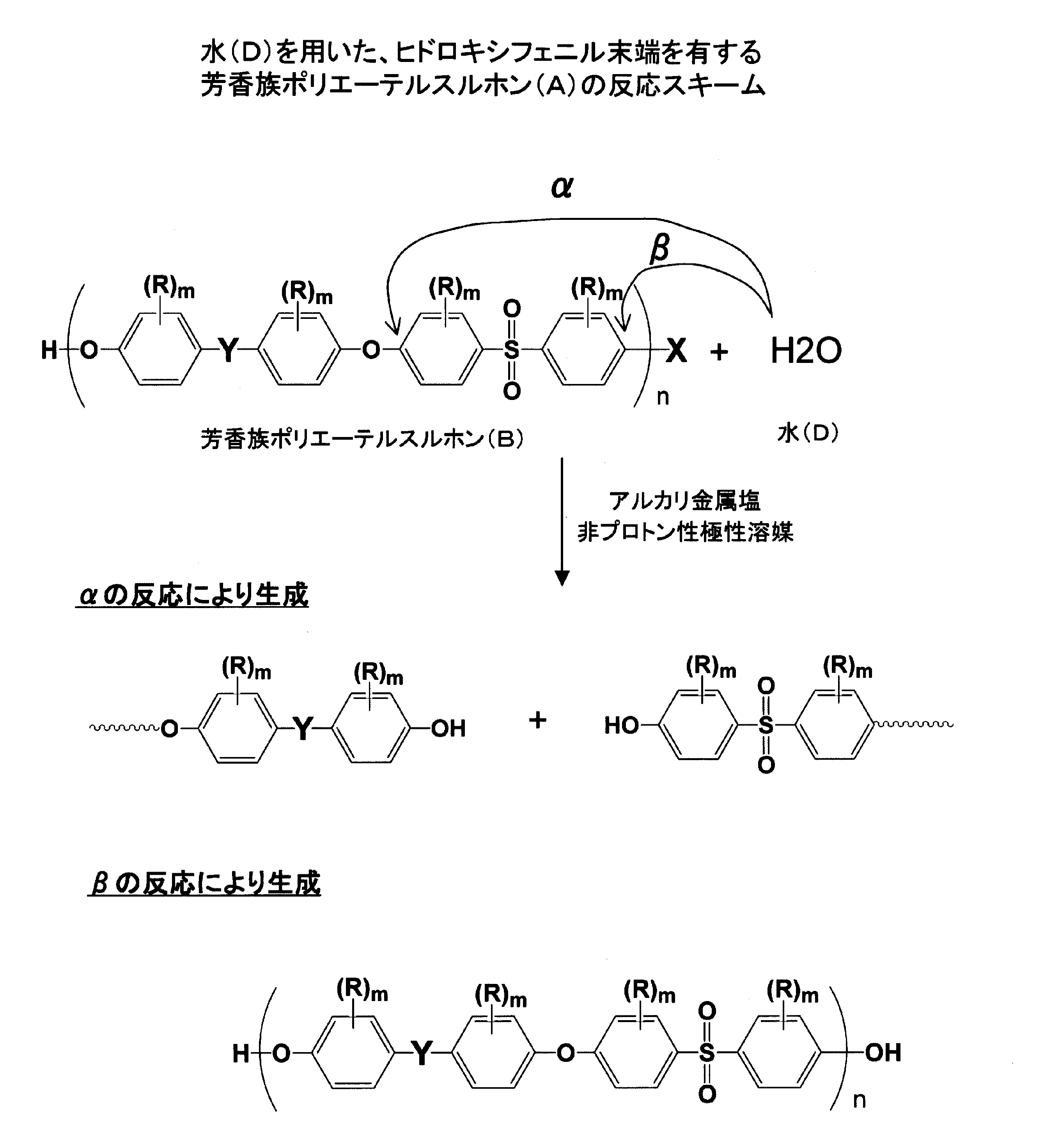
さらに本発明を明確にするため、反応スキームを上記式に示した。まず目的とするヒドロキシフェニル末端基を有するPES(A)よりも、相対的に分子量の高いPES(B)をあらかじめ重合して製造する。ここでは、ジハロゲノジフェニル化合物(I)と二価フェノール化合物(II)(ここではII−1を例示)より、従来公知の方法により重合した後、回収し、その後必要に応じて、洗浄、乾燥したものを使用することができる。重合後の反応溶液には、残存モノマー、溶媒、アルカリ類が残存していることから、本発明で使用するPES(B)は、回収後、洗浄・乾燥したものが特に好ましい。
(In the formula, X represents Cl or F, and each R may be the same or different and is selected from an alkyl group having 1 to 6 carbon atoms and an aryl group having 6 to 8 carbon atoms. M represents an integer of 0 to 3. Y represents a direct bond, oxygen, sulfur, SO 2 , CO, C (CH 3 ) 2, CH (CH 3 ), or CH 2 , N represents an integer of 1 or more.)
In order to further clarify the present invention, the reaction scheme is shown in the above formula. First, PES (B) having a relatively higher molecular weight than PES (A) having a target hydroxyphenyl terminal group is polymerized in advance. Here, it is polymerized by a conventionally known method from a dihalogenodiphenyl compound (I) and a dihydric phenol compound (II) (here, II-1 is exemplified), and then recovered, and then washed and dried as necessary. Can be used. Since residual monomers, solvents and alkalis remain in the reaction solution after polymerization, the PES (B) used in the present invention is particularly preferably washed and dried after recovery.
本ポリマー(B)を中間原料として、二価フェノール化合物(C)(ここではc−1を例示)および/または水(D)、および塩基性化合物(E)を非プロトン性極性溶媒中で加熱することにより、二価フェノール化合物(C)および/または水(D)によるPES(B)のポリマー主鎖への求核置換反応により(式中矢印αの位置)、ヒドロキシフェニル末端基を有するPES(A)を誘導するものである。 Heating the dihydric phenol compound (C) (here c-1 is exemplified) and / or water (D) and the basic compound (E) in an aprotic polar solvent using the present polymer (B) as an intermediate raw material By the nucleophilic substitution reaction of the PES (B) to the polymer main chain with the dihydric phenol compound (C) and / or water (D) (position of the arrow α in the formula), the PES having a hydroxyphenyl end group (A) is induced.
また本発明の反応では、前記ポリマー主鎖への求核置換反応のほかに、ハロゲノフェニル末端と二価フェノール化合物(C)および/または水(D)の求核置換反応によっても(式中βの位置)、ヒドロキシフェニル末端基が生成する。ポリマー主鎖モル数に対し、ハロゲノフェニル末端は、ポリマー末端にのみ極わずかに存在するため、ポリマー主鎖への求核置換反応が確率的に優勢となるが、二価フェノール化合物(C)および/または水(D)の添加量や、塩基性化合物(E)の添加量、反応温度、反応時間を調整することにより、ポリマー主鎖への求核置換反応だけでなく(αの反応)、ハロゲノフェニル末端への求核置換反応(βの反応)も同時に進行させることが可能となり、ヒドロキシフェニル末端基量の高いPES(A)を誘導することができる。 In the reaction of the present invention, in addition to the nucleophilic substitution reaction to the polymer main chain, a nucleophilic substitution reaction of a halogenophenyl end and a dihydric phenol compound (C) and / or water (D) (in the formula, β ), A hydroxyphenyl end group is formed. Since the halogenophenyl terminal is slightly present only at the polymer terminal with respect to the number of moles of the polymer main chain, the nucleophilic substitution reaction to the polymer main chain is stochastically dominant, but the dihydric phenol compound (C) and By adjusting the addition amount of water (D), the addition amount of the basic compound (E), the reaction temperature, and the reaction time, not only the nucleophilic substitution reaction to the polymer main chain (reaction of α), The nucleophilic substitution reaction (β reaction) to the halogenophenyl terminal can also proceed simultaneously, and PES (A) having a high hydroxyphenyl terminal group amount can be induced.
一方、公知の重縮合の場合、二価のフェノール化合物とジハロゲノジフェニルスルホンの仕込みモル比(r)、その時得られるポリマー分子量、ポリマー末端基組成は、高分子化学序論(第2版)(化学同人発行、p206)などに記載されているように、
r=ジハロゲノジフェニルスルホンの仕込みモル数(a)/二価のフェノール化合物の仕込みモル数(b)(ここで過剰成分を分母とし、a/b=rと置く)、反応率をpと置くと、その時得られるポリマーの数平均重合度(Pn)は、
Pn=(1+r)/[2r(1−p)+(1−r)]と表される。
反応率が100%と仮定すると(p=1)、
Pn=(1+r)/(1−r)
この式から、二価のフェノール化合物が1%過剰に存在する場合、その数平均重合度は201となる。また末端基比率は、各モノマー成分の仕込みモル比に準じ、[ハロゲノフェニル末端]/[ヒドロキシフェニル末端]=r=1.0/1.01となり、ヒドロキシフェニル末端基組成は50.2%程度となる(なお反応率が100%以下の場合は、さらに低い値になる)。
On the other hand, in the case of the known polycondensation, the charged molar ratio (r) of the divalent phenol compound and dihalogenodiphenylsulfone, the polymer molecular weight obtained at that time, and the polymer end group composition are as follows. As described in Doujinshi, p206), etc.
r = number of moles of dihalogenodiphenylsulfone charged (a) / number of moles of charged divalent phenol compound (b) (where excess component is the denominator, a / b = r), and reaction rate is p And the number average degree of polymerization (Pn) of the polymer obtained at that time is
Pn = (1 + r) / [2r (1-p) + (1-r)]
Assuming a reaction rate of 100% (p = 1),
Pn = (1 + r) / (1-r)
From this formula, when the divalent phenol compound is present in an excess of 1%, the number average degree of polymerization is 201. The terminal group ratio is [halogenophenyl terminal] / [hydroxyphenyl terminal] = r = 1.0 / 1.01 according to the charged molar ratio of each monomer component, and the hydroxyphenyl terminal group composition is about 50.2%. (In addition, when the reaction rate is 100% or less, it becomes a lower value).
一方、得られるポリマー中のヒドロキシフェニル末端を過剰に生成させるために、二価のフェノール化合物を10%過剰に仕込む場合(r=1.0/1.1)、その数平均重合度は21、ヒドロキシフェニル末端基組成は52.4%程度、さらに二価のフェノール化合物を50%過剰に仕込んだ場合(r=1.0/1.5)、数平均重合度はわずかに5、生成するヒドロキシフェニル末端基組成は60モル%程度であり、その時の理論分子量はきわめて低分子量となってしまい、分子量が高く、高ヒドロキシフェニル末端基組成のポリマーを得ることは、理論的にも不可能であった。 On the other hand, in order to produce an excessive amount of hydroxyphenyl ends in the resulting polymer, when the divalent phenol compound is charged in excess of 10% (r = 1.0 / 1.1), the number average degree of polymerization is 21, Hydroxyphenyl terminal group composition is about 52.4%, and when 50% excess of divalent phenol compound is charged (r = 1.0 / 1.5), the number average degree of polymerization is only 5, The phenyl end group composition is about 60 mol%, and the theoretical molecular weight at that time is very low molecular weight, and it is theoretically impossible to obtain a polymer having a high molecular weight and a high hydroxyphenyl end group composition. It was.
本発明者らは、本反応により効率よく、かつ定量的にヒドロキシフェニル末端を導入できることを見いだし、さらに本反応によれば、高収率で目的のヒドロキシフェニル末端基を有するPESが得られ、さらに好ましいことに、本反応により高ヒドロキシフェニル末端基を有し、従来の方法に比べ高分子量であり、さらに後処理工程が極めて単純化でき、かつ純度の高いPESが得られることを見いだした。 The present inventors have found that the hydroxyphenyl terminal can be efficiently and quantitatively introduced by this reaction, and further, according to this reaction, a PES having the desired hydroxyphenyl terminal group can be obtained in a high yield. Preferably, it has been found that this reaction has a high hydroxyphenyl end group, has a higher molecular weight than the conventional method, can further simplify the post-treatment process, and has a high purity.
本発明で使用される二価フェノール化合物(C)は、下記一般式(c−1)、および/または(c−2)で表されるものである。 The dihydric phenol compound (C) used in the present invention is represented by the following general formula (c-1) and / or (c-2).
(式中のRは、それぞれ同一であっても異なっていてもよく、炭素数1〜6のアルキル基および炭素数6〜8のアリール基から選ばれるいずれかを表し、mは0〜3の整数を表す。Yは直接結合、酸素、硫黄、SO2、CO、C(CH3)2、CH(CH3)、およびCH2から選ばれるいずれかを表す)
このような二価フェノール化合物(C)としては、ハイドロキノン、カテコール、レゾルシン、4,4’−ビフェノール、2,2−ビス(4−ヒドロキシフェニル)プロパン、2,2−ビス(4−ヒドロキシフェニル)メタン、2,2−ビス(4−ヒドロキシフェニル)エタンなどのビス(4−ヒドロキシフェニル)アルカン類、4,4’−ジヒドロキシジフェニルスルホンなどのジヒドロキシジフェニルスルホン類、4,4’−ジヒドロキシジフェニルエーテルなどのジヒドロキシフェニルエーテル類、およびこれらの構造異性体が挙げられるが、これらの中で、入手性や実用性、価格面から、ハイドロキノン、4,4’−ビフェノール、4,4’−ジヒドロキシジフェニルスルホン(ビスフェノール−S)、2,2−ビス(4−ヒドロキシフェニルプロパン)(ビスフェノール−A)、ビス(4−ヒドロキシフェニル)メタン(ビスフェノール−F)、4,4’−エチリデンビスフェノール(ビスフェノール−E)、4,4’−ジヒドロキシジフェニルエーテル、4,4’−ジヒドロキシジフェニルスルホンが好ましく、またこれら二価フェノールの化合物(C)の構造異性体を使用することもできるが、より好ましくは4,4’−ジヒドロキシジフェニルスルホン(ビスフェノール−S)、2,2−ビス(4−ヒドロキシフェニルプロパン)(ビスフェノール−A)、ビス(4−ヒドロキシフェニル)メタン(ビスフェノール−F)、4,4’−エチリデンビスフェノール(ビスフェノール−E)であり、特に好ましくは、4,4’−ジヒドロキシジフェニルスルホン(ビスフェノール−S)、2,2−ビス(4−ヒドロキシフェニルプロパン)(ビスフェノール−A)である。
(In the formula, each R may be the same or different and represents any one selected from an alkyl group having 1 to 6 carbon atoms and an aryl group having 6 to 8 carbon atoms, and m is 0 to 3). Y represents an integer selected from a direct bond, oxygen, sulfur, SO 2 , CO, C (CH 3 ) 2, CH (CH 3 ), and CH 2.
Examples of such dihydric phenol compound (C) include hydroquinone, catechol, resorcin, 4,4′-biphenol, 2,2-bis (4-hydroxyphenyl) propane, and 2,2-bis (4-hydroxyphenyl). Methane, bis (4-hydroxyphenyl) alkanes such as 2,2-bis (4-hydroxyphenyl) ethane, dihydroxydiphenyl sulfones such as 4,4′-dihydroxydiphenylsulfone, 4,4′-dihydroxydiphenyl ether, etc. Examples include dihydroxyphenyl ethers and structural isomers thereof. Among these, hydroquinone, 4,4′-biphenol, 4,4′-dihydroxydiphenylsulfone (bisphenol) from the viewpoint of availability, practicality, and price. -S), 2,2-bis (4-hydroxyphene) Propane (bisphenol-A), bis (4-hydroxyphenyl) methane (bisphenol-F), 4,4′-ethylidenebisphenol (bisphenol-E), 4,4′-dihydroxydiphenyl ether, 4,4′-dihydroxydiphenyl Sulfones are preferred, and structural isomers of these dihydric phenol compounds (C) may be used, but 4,4′-dihydroxydiphenyl sulfone (bisphenol-S), 2,2-bis (4 -Hydroxyphenylpropane) (bisphenol-A), bis (4-hydroxyphenyl) methane (bisphenol-F), 4,4'-ethylidenebisphenol (bisphenol-E), particularly preferably 4,4'-dihydroxy Diphenylsulfone (bisphenol-S) 2,2-bis (4-hydroxyphenylpropane) (bisphenol-A).
本反応で使用する二価フェノール化合物(C)の添加量は、最終的に得ようとするヒドロキシフェニル末端基を有するPES(A)の目標とする末端基量や目標とする分子量によるが、むしろこれらは、二価フェノール化合物(C)の添加量により制御することが可能となる。本反応を定量的に進行させるためには、PES(B)1モルに対し、0.001〜2.0倍モルが好ましく、より好ましくは0.01〜1.5、さらに好ましくは0.01〜1.0倍モル、特に好ましくは0.01〜0.5倍モルである。なおここでPES(B)のモル数は、前記式(b−1)、(b−2)で表される1つの繰り返し単位の分子量を基準に算出されるものである。 The addition amount of the dihydric phenol compound (C) used in this reaction depends on the target end group amount and target molecular weight of the PES (A) having a hydroxyphenyl end group to be finally obtained, but rather These can be controlled by the addition amount of the dihydric phenol compound (C). In order to allow this reaction to proceed quantitatively, the amount is preferably 0.001 to 2.0 times mol, more preferably 0.01 to 1.5, and still more preferably 0.01 to 1 mol of PES (B). It is -1.0 times mole, Most preferably, it is 0.01-0.5 times mole. Here, the number of moles of PES (B) is calculated based on the molecular weight of one repeating unit represented by the formulas (b-1) and (b-2).
二価フェノール化合物(C)の添加量が2.0モル以上になると、得られるヒドロキシフェニル末端基を有する芳香族ポリエールスルホン(A)の分子量が小さくなりすぎ、ポリマーの回収・洗浄が困難となるだけでなく、酸性を示す未反応の二価フェノール化合物(C)や二価フェノール化合物の塩、あるいは塩基性化合物(E)そのものがポリマー中に残存したり、ポリマーが着色する傾向がある。特にヒドロキシフェニル末端基導入量の増加に伴い、ポリマーの溶解性や、塩基性化合物との相互作用が増加するため、洗浄・回収・分離が困難となる傾向がある。一方、0.001以下では、ヒドロキシフェニル末端基を定量的に導入することが困難となる。 When the addition amount of the dihydric phenol compound (C) is 2.0 mol or more, the molecular weight of the resulting aromatic polyethersulfone (A) having a hydroxyphenyl end group becomes too small, and it is difficult to recover and wash the polymer. In addition, the unreacted dihydric phenol compound (C), the salt of the dihydric phenol compound, or the basic compound (E) itself that shows acidity tends to remain in the polymer or the polymer tends to be colored. In particular, with an increase in the amount of hydroxyphenyl end groups introduced, the solubility of the polymer and the interaction with the basic compound increase, so that washing, recovery and separation tend to be difficult. On the other hand, at 0.001 or less, it is difficult to quantitatively introduce the hydroxyphenyl end group.
本発明で使用する水(D)は、特に制限はないが、得られるポリマー中の不純物含量などを考慮すると、出来る限り不純物の少ない水を用いることが好ましい。 The water (D) used in the present invention is not particularly limited, but it is preferable to use water with as few impurities as possible in view of the content of impurities in the resulting polymer.
本反応で使用する水(D)の添加量は、最終的に得ようとするヒドロキシフェニル末端基を有するPES(A)の目標とする末端基量や目標とする分子量によるが、むしろこれらは、水(D)の添加量により制御することが可能となる。本反応を定量的に進行させるためには、PES(B)1モルに対し、0.01〜50倍モルが好ましく、より好ましくは0.1〜40倍、特に好ましくは0.1〜30倍モルである。なおここでPES(B)のモル数は、前記式(b―1)、(b−2)で表される1つの繰り返し単位の分子量を基準に算出されるものである。 The amount of water (D) used in this reaction depends on the target end group amount and target molecular weight of PES (A) having a hydroxyphenyl end group to be finally obtained. It can be controlled by the amount of water (D) added. In order to allow this reaction to proceed quantitatively, the molar amount is preferably 0.01 to 50 times, more preferably 0.1 to 40 times, and particularly preferably 0.1 to 30 times the amount of 1 mol of PES (B). Is a mole. Here, the number of moles of PES (B) is calculated based on the molecular weight of one repeating unit represented by the formulas (b-1) and (b-2).
水(D)の添加量が50倍モル以上になると、得られるヒドロキシフェニル末端基を有する芳香族ポリエールスルホン(A)の分子量が小さくなりすぎ、ポリマーの回収・洗浄が困難となるだけでなく、溶媒へのPES(B)の溶解性が低下して析出しやすくなるため、均一に反応を進行するためには、用いる非プロトン性極性溶媒中のPES(B)の濃度を低下させることが必要となる。しかし、濃度が低下することで反応性が低下するため、反応の進行が長時間になり、さらには溶媒量が増えることでポリマーの回収・洗浄が困難となり、コストも増大するため、工業的に現実的ではない。一方、0.01倍以下では、ヒドロキシフェニル末端基を定量的に導入することが困難となる。 When the amount of water (D) added is 50 times mol or more, the molecular weight of the resulting aromatic polyethersulfone (A) having a hydroxyphenyl end group becomes too small, making it difficult to recover and wash the polymer. Since the solubility of PES (B) in the solvent is reduced and it is likely to be precipitated, the concentration of PES (B) in the aprotic polar solvent to be used may be lowered in order to proceed the reaction uniformly. Necessary. However, since the reactivity decreases as the concentration decreases, the reaction progresses for a long time, and further, the amount of solvent increases, making it difficult to recover and wash the polymer. Not realistic. On the other hand, if it is 0.01 times or less, it is difficult to quantitatively introduce the hydroxyphenyl end group.
なお本発明では添加する水(D)の量や塩基性化合物(E)の量などで目標とするPES(A)の末端基量や分子量を制御するため、原料中に含まれる微量の水分、反応中に外部から入ってくる水分、塩基性化合物調製時の水分などは、本発明の目的の反応、すなわち中間原料であるPES(B)と添加した水(D)の求核置換反応以外に、系内に存在する水による反応が進行することがあるため、ヒドロキシフェニル末端基を有するPES(A)の目標とする末端基量や、目標とする分子量の制御が困難となるため、これらの水分は可能な限り除去することが好ましい。 In the present invention, the amount of water (D) added or the amount of basic compound (E) is used to control the target end group amount or molecular weight of PES (A). Moisture that enters from the outside during the reaction, moisture at the time of preparation of the basic compound, etc., other than the target reaction of the present invention, that is, the nucleophilic substitution reaction of PES (B) as an intermediate raw material and added water (D) Since the reaction with water existing in the system may proceed, it becomes difficult to control the target end group amount of PES (A) having a hydroxyphenyl end group and the target molecular weight. It is preferable to remove moisture as much as possible.
本発明の反応を定量的に進行させるため、本反応の有機溶媒として、非プロトン性極性溶媒を使用する。具体的には、ジメチルスルホキシド、N,N−ジメチルホルムアミド(DMF)、N,N−ジメチルアセトアミド、N−メチル−2−ピロリドン(NMP)、N−メチル−2−ピペリドン、1,3−ジメチル−2−イミダゾリジノン、およびこれら2種以上の混合物などが挙げられるが、特に好ましくは、ジメチルスルホキシド、DMF、NMPが挙げられる。 In order to allow the reaction of the present invention to proceed quantitatively, an aprotic polar solvent is used as the organic solvent for this reaction. Specifically, dimethyl sulfoxide, N, N-dimethylformamide (DMF), N, N-dimethylacetamide, N-methyl-2-pyrrolidone (NMP), N-methyl-2-piperidone, 1,3-dimethyl- 2-Imidazolidinone and a mixture of two or more of these may be mentioned, with dimethyl sulfoxide, DMF and NMP being particularly preferred.
本反応に使用される非プロトン性極性溶媒量は、PES(B)、二価フェノール化合物(C)を溶解させる量であれば、特に制限はないが、全モノマーの重量に対して、0.5〜20倍重量の範囲が好ましい。さらに好ましくは2〜10倍量である。 The amount of the aprotic polar solvent used in this reaction is not particularly limited as long as it dissolves PES (B) and the dihydric phenol compound (C). The range of 5 to 20 times weight is preferable. More preferably, the amount is 2 to 10 times.
0.5倍未満では原料となるPES(B)、二価フェノール化合物(C)が溶解せず、また反応時の攪拌等の操作が困難となり、均一な反応が困難となる。また溶媒量が20倍量を超えると、ポリマー濃度や二価フェノール化合物(C)および/または水(D)の濃度が下がり、反応速度が遅くなったり、再沈殿生成、洗浄、回収が困難になる傾向が認められ、何よりも溶媒量の増加により、生産量の低下、溶媒回収コストに影響する。 If it is less than 0.5 times, the raw material PES (B) and dihydric phenol compound (C) will not dissolve, and operations such as stirring during the reaction will be difficult, and a uniform reaction will be difficult. If the amount of solvent exceeds 20 times, the polymer concentration and the concentration of the dihydric phenol compound (C) and / or water (D) will decrease, the reaction rate will be slow, and reprecipitation, washing and recovery will be difficult. The increase in the amount of solvent affects the decrease in production amount and the solvent recovery cost.
なお本発明では非プロトン性極性溶媒中で本反応を実施することが重要であるが、場合によっては、非プロトン性極性溶媒以外の有機溶媒を併用することもできる。特に、原料中に含まれる微量の水分、反応中に外部から入ってくる水分、使用する塩基性化合物の結合水、塩基性化合物水溶液中、塩基性化合物調製時の水分などは、本発明の目的の反応、すなわち中間原料であるPES(B)と二価フェノール化合物(C)および/または水(D)の求核置換反応以外に、系内に存在する水による加水分解が進行することがある。反応系内の水分は、本発明の反応を阻害することがあることから、これら反応系内の水を分離する目的で、非プロトン性極性溶媒に相溶し、かつ0.101MPa下において、水と共沸混合物を形成する溶媒を用いることが出来る。このような溶媒としては、特に限定されないが、例えば、ペンタン、ヘキサン、ヘプタン、オクタン、シクロヘキサン、ドデカン、ベンゼン、トルエン、キシレン、ナフタレン、エチルベンゼン等の炭化水素系溶媒、ジイソプロピルエーテル、エチルブチルエーテル、ジオキサン等のエーテル系溶媒、アセチルアセトン、メチルエチルケトン等のケトン系溶媒、エタノール、イソプロパノール、n−プロパノール、イソブチルアルコール、ヘキサノール、ベンジルアルコール等のアルコール系溶媒、酢酸エチル、酢酸メチル、酢酸ブチル、酪酸ブチル、安息香酸メチル等のエステル系溶媒等、ギ酸、酢酸、プロピオン酸、吉草酸、安息香酸等のカルボン酸系溶媒、クロロホルム、ブロモホルム、1,2−ジクロロメタン、1,2−ジクロロエタン、四塩化炭素、クロロベンゼン、ヘキサフルオロイソプロパノール等のハロゲン系溶媒、エチレンジアミン、アニリン、ピリジン、メチルピリジン等のアミン系溶媒などが挙げられ、好ましくは、炭化水素、さらに好ましくはベンゼン、トルエン、キシレンから選ばれる少なくとも1種を使用することができる。 In the present invention, it is important to carry out this reaction in an aprotic polar solvent. However, in some cases, an organic solvent other than the aprotic polar solvent can be used in combination. In particular, trace amounts of moisture contained in the raw material, moisture entering from the outside during the reaction, binding water of the basic compound to be used, water in the basic compound aqueous solution, moisture at the time of preparation of the basic compound, etc. In addition to the above reaction, that is, the nucleophilic substitution reaction of PES (B), which is an intermediate raw material, and dihydric phenol compound (C) and / or water (D), hydrolysis by water present in the system may proceed. . Since water in the reaction system may inhibit the reaction of the present invention, it is compatible with an aprotic polar solvent for the purpose of separating the water in the reaction system, and water is used under 0.101 MPa. Solvents that form an azeotrope with can be used. Examples of such solvents include, but are not limited to, hydrocarbon solvents such as pentane, hexane, heptane, octane, cyclohexane, dodecane, benzene, toluene, xylene, naphthalene, and ethylbenzene, diisopropyl ether, ethyl butyl ether, dioxane, and the like. Ether solvents, ketone solvents such as acetylacetone and methyl ethyl ketone, alcohol solvents such as ethanol, isopropanol, n-propanol, isobutyl alcohol, hexanol and benzyl alcohol, ethyl acetate, methyl acetate, butyl acetate, butyl butyrate, methyl benzoate Ester solvents such as formic acid, acetic acid, propionic acid, valeric acid, benzoic acid and other carboxylic acid solvents, chloroform, bromoform, 1,2-dichloromethane, 1,2-dichloroe Halogen solvents such as ethylene, carbon tetrachloride, chlorobenzene and hexafluoroisopropanol, and amine solvents such as ethylenediamine, aniline, pyridine and methylpyridine, preferably hydrocarbons, more preferably from benzene, toluene and xylene. At least one selected can be used.
水共沸溶媒の使用量は、系内の水分を除去可能な量であれば特に制限はないが、全モノマーの重量に対して、0.01〜10倍重量の範囲が好ましく、さらに好ましくは0.02〜5倍量である。また本発明の反応では、反応系に塩基性化合物(E)を添加すると、さらに反応速度を向上させることができる。使用する塩基性化合物(E)としては、例えば水酸化ナトリウム、水酸化カリウム、水酸化リチウム、水酸化ルビジウム、水酸化セシウム、酢酸ナトリウム、酢酸カリウム、炭酸水素ナトリウム、炭酸水素カリウム、炭酸水素リチウム、炭酸ナトリウム、炭酸カリウム、炭酸リチウム、炭酸セシウム、無水炭酸カリウム、無水炭酸ナトリウム等のアルカリ金属化合物、水酸化カルシウム、水酸化マグネシウム、炭酸水素カルシウム、炭酸水素バリウム、炭酸水素マグネシウム、炭酸カルシウム等のアルカリ土類金属化合物、テトラメチルアンモニウムヒドロキシド、テトラエチルアンモニウムヒドロキシド等の4級アンモニウム塩、トリメチルアミン、トリエチルアミン等の三級アミン、N、Nージメチルアミン、N、Nージエチルアミン等の二級アミン、N−メチルアミン、N−エチルアミン等の一級アミン、アンモニアなどが挙げられる。これらの中でも、取り扱い易さから、水酸化ナトリウム、水酸化カリウム、炭酸ナトリウム、炭酸カリウム、無水炭酸ナトリウム、無水炭酸カリウムなどを使用することができ、炭酸ナトリウム、炭酸カリウム、無水炭酸ナトリウム、無水炭酸カリウムから選ばれる1種または2種以上を好ましく使用することができる。 The amount of water azeotropic solvent used is not particularly limited as long as it can remove water in the system, but is preferably in the range of 0.01 to 10 times the weight of the total monomer, more preferably The amount is 0.02 to 5 times. In the reaction of the present invention, the reaction rate can be further improved by adding the basic compound (E) to the reaction system. Examples of the basic compound (E) used include sodium hydroxide, potassium hydroxide, lithium hydroxide, rubidium hydroxide, cesium hydroxide, sodium acetate, potassium acetate, sodium hydrogen carbonate, potassium hydrogen carbonate, lithium hydrogen carbonate, Alkali metal compounds such as sodium carbonate, potassium carbonate, lithium carbonate, cesium carbonate, anhydrous potassium carbonate, anhydrous sodium carbonate, alkalis such as calcium hydroxide, magnesium hydroxide, calcium bicarbonate, barium bicarbonate, magnesium bicarbonate, calcium carbonate Earth metal compounds, quaternary ammonium salts such as tetramethylammonium hydroxide and tetraethylammonium hydroxide, tertiary amines such as trimethylamine and triethylamine, N, N-dimethylamine, N, N-diethylamine and the like Secondary amine, N- methylamine, N- primary amines ethylamine and ammonia. Among these, for ease of handling, sodium hydroxide, potassium hydroxide, sodium carbonate, potassium carbonate, anhydrous sodium carbonate, anhydrous potassium carbonate, etc. can be used, and sodium carbonate, potassium carbonate, anhydrous sodium carbonate, anhydrous carbonate One or more selected from potassium can be preferably used.
塩基性化合物(E)の添加量は、使用する二価フェノール化合物(C)1モルに対し、0.1〜3倍モルの範囲が好ましく、さらに好ましくは0.5〜1倍モルである。 The addition amount of the basic compound (E) is preferably in the range of 0.1 to 3 times mol, more preferably 0.5 to 1 times mol per mol of the dihydric phenol compound (C) used.
塩基性化合物(E)の添加量が二価フェノール化合物(C)1モルに対し、3倍モル以上では、酸性の二価フェノール化合物や二価フェノール化合物の塩、さらには塩基性化合物(E)自身がポリマー中に残存したり、ポリマーが着色する傾向がある。一方、0.5以下では、反応性のヒドロキシフェニル末端基を導入することが困難となる。 When the addition amount of the basic compound (E) is 3 times mol or more with respect to 1 mol of the dihydric phenol compound (C), an acidic dihydric phenol compound or a salt of the dihydric phenol compound, and further the basic compound (E) It tends to remain in the polymer itself or to color the polymer. On the other hand, at 0.5 or less, it becomes difficult to introduce a reactive hydroxyphenyl end group.
また水を用いた場合の塩基性化合物(E)の添加量は、使用する水(D)1モルに対し、0.01〜2倍モルの範囲が好ましく、さらに好ましくは0.01〜1倍モルである。 Moreover, the addition amount of the basic compound (E) when water is used is preferably in the range of 0.01 to 2 moles, more preferably 0.01 to 1 time, with respect to 1 mole of water (D) used. Is a mole.
塩基性化合物(E)の添加量が、水(D)1モルに対し、2倍モル以上では、塩基性化合物(E)が溶媒へ溶解せずに不均一に存在する傾向が見られ、これら過剰な塩基性化合物はポリマー中に残存したり、ポリマーが着色する傾向がある。一方、0.01倍モル以下では、反応性のヒドロキシフェニル末端基を導入することが困難となる。 When the addition amount of the basic compound (E) is 2 mols or more with respect to 1 mol of water (D), the basic compound (E) tends to exist non-uniformly without dissolving in the solvent. Excess basic compound tends to remain in the polymer or the polymer will be colored. On the other hand, at 0.01 mol or less, it becomes difficult to introduce a reactive hydroxyphenyl end group.
加熱温度は、使用する溶媒種、溶媒の沸点、反応溶液の濃度、二価フェノール化合物(C)および/または水(D)の添加量、塩基性化合物(E)の添加量に依存するが、通常100〜250℃で実施するのが好ましく、さらに好ましくは100〜200℃である。250℃以上より高温で反応すると、二価フェノール化合物塩の熱分解、反応系内で生成したヒドロキシフェニル末端基を有するPES(A)そのものの熱分解が進行するため、分子量の制御やヒドロキシフェニル末端基導入量の制御が困難となったり、最終的に得られるPES(A)の熱安定性・滞留安定性の低下や、着色といった傾向が認められるようになる。一方、100℃より低い温度で本反応を行うと、反応が非常に遅くなるという問題がある。 The heating temperature depends on the type of solvent used, the boiling point of the solvent, the concentration of the reaction solution, the addition amount of the dihydric phenol compound (C) and / or water (D), and the addition amount of the basic compound (E). Usually, it is preferable to implement at 100-250 degreeC, More preferably, it is 100-200 degreeC. When the reaction is carried out at a temperature higher than 250 ° C., the thermal decomposition of the dihydric phenol compound salt and the thermal decomposition of the PES (A) itself having a hydroxyphenyl end group generated in the reaction system proceed, so that the molecular weight control and the hydroxyphenyl end Control of the amount of introduced groups becomes difficult, and a tendency such as a decrease in thermal stability and retention stability of the finally obtained PES (A) and coloring are observed. On the other hand, when this reaction is performed at a temperature lower than 100 ° C., there is a problem that the reaction becomes very slow.
反応に要する時間は、二価フェノール化合物(C)の種類・添加量、および/または水(D)の添加量、塩基性化合物(E)の種類・添加量、反応濃度、反応温度により大幅に変化するが、通常は10分〜10時間の範囲であり、好ましくは30分〜5時間の範囲で実施される。反応雰囲気としては、酸素が存在しないことが好ましく、窒素もしくはその他の不活性ガス中で行うとよい結果が得られる。二価フェノール化合物の塩基性化合物は酸素の存在下で加熱すると酸化されやすく、目的とする反応が妨げられ、その結果、分子量制御、ヒドロキシフェニル末端基導入量の制御が困難となるほか、重合体の着色原因ともなる。 The time required for the reaction largely depends on the type / addition amount of the dihydric phenol compound (C) and / or the addition amount of water (D), the type / addition amount of the basic compound (E), the reaction concentration, and the reaction temperature. Although it varies, it is usually in the range of 10 minutes to 10 hours, preferably 30 minutes to 5 hours. As the reaction atmosphere, it is preferable that oxygen does not exist, and good results can be obtained when the reaction is performed in nitrogen or other inert gas. Basic compounds of dihydric phenol compounds are easily oxidized when heated in the presence of oxygen, preventing the intended reaction. As a result, it is difficult to control the molecular weight and the amount of hydroxyphenyl end groups introduced, and the polymer Also causes coloring.
本発明の方法により得られた粗ヒドロキシフェニル末端基を有するPESは、反応溶液中に含まれている塩基性化合物を濾過あるいは遠心分離によって分離した後、あるいは濾過や遠心分離をせずに、反応溶液に貧溶媒を加えて、あるいは貧溶媒に反応溶液を加えて、析出固体として分離することができる。ヒドロキシフェニル末端基を有するPESの貧溶媒としては、例えばメタノール、エタノール、イソプロパノール、ブタノールなどのアルコール類、アセトニトリルなどのニトリル類、水などを挙げることができる。またこれらの貧溶媒を2種以上混合して用いることができる。また上記の貧溶媒には、ポリマーが析出可能な範囲で、前記の重合反応溶媒などのポリマーの良溶媒が含有されていてもよい。 The PES having a crude hydroxyphenyl end group obtained by the method of the present invention can be reacted after the basic compound contained in the reaction solution is separated by filtration or centrifugation, or without filtration or centrifugation. The solution can be separated as a precipitated solid by adding a poor solvent to the solution or adding a reaction solution to the poor solvent. Examples of the poor solvent for PES having a hydroxyphenyl end group include alcohols such as methanol, ethanol, isopropanol and butanol, nitriles such as acetonitrile, and water. Two or more of these poor solvents can be mixed and used. The poor solvent may contain a good solvent for the polymer such as the polymerization reaction solvent as long as the polymer can be precipitated.
本発明のヒドロキシフェニル末端基を有するPES(A)を得るためには、本発明のいずれかの工程において酸を接触させることが好ましい。接触させる工程は特に限定されないが、好ましくは、反応後の溶液あるいは貧溶媒による析出時、あるいは回収後、いずれかの工程で、PESと酸を接触させることで、PESに含まれるアルカリ金属塩を効率よく取り除くことが可能となる。 In order to obtain PES (A) having a hydroxyphenyl terminal group of the present invention, it is preferable to contact an acid in any step of the present invention. The step of contacting is not particularly limited, but preferably, the alkali metal salt contained in PES is brought into contact with PES by contacting the acid with PES at any step after precipitation after the reaction or with a poor solvent or after recovery. It can be removed efficiently.
使用される酸としては、塩酸、硝酸、硫酸、リン酸、過塩素酸、亜硫酸、クロム酸、次亜塩素酸、過塩素酸、シアン化水素、臭素水素酸、ホウ酸などの無機酸、酢酸、蟻酸、シュウ酸、酒石酸、ステアリン酸、ナフテン酸、ピクリン酸、りんご酸などの有機酸から選ばれる1種または2種以上の混酸を用いることができ、酸の種類はこれらに限るものではない。 Acids used include inorganic acids such as hydrochloric acid, nitric acid, sulfuric acid, phosphoric acid, perchloric acid, sulfurous acid, chromic acid, hypochlorous acid, perchloric acid, hydrogen cyanide, bromic acid, boric acid, acetic acid, formic acid One or two or more mixed acids selected from organic acids such as oxalic acid, tartaric acid, stearic acid, naphthenic acid, picric acid, and malic acid can be used, and the type of acid is not limited thereto.
使用する酸の量としては、用いる溶媒への溶解性などの影響を受けるため、特に制限はないが、PES1モルに対し、0.001〜2倍モルの範囲が好ましく、さらに好ましくは0.01〜1倍モルである。酸の量が上記範囲より少ない場合、アルカリ金属塩が十分に取り除くことができず、好ましくない。 The amount of the acid used is not particularly limited because it is affected by the solubility in the solvent used, but is preferably in the range of 0.001 to 2 moles per mole of PES, more preferably 0.01. ˜1 mole. When the amount of the acid is less than the above range, the alkali metal salt cannot be sufficiently removed, which is not preferable.
酸接触後のPESを貧溶媒で洗浄後、乾燥させることによって、ヒドロキシフェニル末端基を有するPES(A)を得ることができる。 PES (A) having a hydroxyphenyl end group can be obtained by washing PES after contact with an acid with a poor solvent and then drying.
例えば150℃、5時間、DMSO中で、好ましい態様によって得られるPES(A)のヒドロキシフェニル末端基量は二価フェノール化合物(C)および/または水(D)の添加量に比例する。また、還元粘度が0.07〜0.45、ヒドロキシフェニル末端基量60〜100%のPES(A)、を得るためには、ヒドロキシフェニル末端基量が50%のPES(B)を用いた場合、好ましいPES(B)の還元粘度はおおよそ0.09〜0.62以上の範囲となり、ヒドロキシフェニル末端基量が0%のPES(B)を用いた場合、好ましいPES(B)の還元粘度はおおよそ0.13〜0.85以上の範囲となる。 For example, the amount of the hydroxyphenyl end group of PES (A) obtained according to a preferred embodiment in DMSO at 150 ° C. for 5 hours is proportional to the amount of dihydric phenol compound (C) and / or water (D) added. Moreover, in order to obtain PES (A) having a reduced viscosity of 0.07 to 0.45 and a hydroxyphenyl end group amount of 60 to 100%, PES (B) having a hydroxyphenyl end group amount of 50% was used. In this case, the preferred reduced viscosity of PES (B) is in the range of about 0.09 to 0.62, and when PES (B) having a hydroxyphenyl end group content of 0% is used, the preferred reduced viscosity of PES (B). Is approximately in the range of 0.13 to 0.85 or more.
しかし、使用するPES(B)の還元粘度が低い(数平均分子量が低い)と、最終的に得られるヒドロキシル基含有PES(A)の分子量が小さくなり、低分子量側のポリマーやオリゴマーが貧溶媒に溶解、あるいは膨潤したりし、その結果、ポリマーの回収率や洗浄効率が低下する傾向が認められる。さらに洗浄効率の低下により、ポリマー中にアルカリ金属化合物などの不純物量が増加するという傾向が認められる。また低分子量化に伴いガラス転移温度が低下し、PESの本来の特徴である耐熱性が低下する場合がある。また、PES(B)の還元粘度が高い(数平均分子量が高い)と、好ましい範囲の分子量を有するヒドロキシル基含有PES(A)を得るためには、二価フェノール化合物(C)および/または水(D)や塩基性化合物(E)の添加量が増えるため、酸性を示す未反応の二価フェノール化合物(C)や、塩基性化合物(E)がポリマー中に残存したり、ポリマーが着色や、洗浄・回収・分離が困難となる傾向があるため、原料のPES(B)の還元粘度は0.4を越え0.6以下のものが最も好ましい。 However, if the reduced viscosity of the PES (B) used is low (number average molecular weight is low), the molecular weight of the finally obtained hydroxyl group-containing PES (A) becomes small, and the low molecular weight polymer or oligomer is a poor solvent. As a result, the polymer recovery rate and the cleaning efficiency tend to decrease. Furthermore, the tendency for the amount of impurities, such as an alkali metal compound, to increase in a polymer by the fall of washing | cleaning efficiency is recognized. In addition, the glass transition temperature is lowered with the reduction in molecular weight, and the heat resistance, which is the original characteristic of PES, may be lowered. In addition, in order to obtain a hydroxyl group-containing PES (A) having a high molecular weight within a preferable range when the reduced viscosity of PES (B) is high (number average molecular weight is high), dihydric phenol compound (C) and / or water Since the amount of addition of (D) or basic compound (E) increases, unreacted dihydric phenol compound (C) showing acidity or basic compound (E) remains in the polymer, or the polymer is colored or Since the cleaning, recovery and separation tend to be difficult, the reduced viscosity of the raw material PES (B) is more preferably more than 0.4 and not more than 0.6.
尚、ここで言う還元粘度とは、JIS K2283に準拠し、キャノン・フィスケ、オストワルド、ウベローデなどの、毛細管粘度計を用い、溶媒としてDMF中、25℃、1g/dlで測定した還元粘度である。 The reduced viscosity referred to here is a reduced viscosity measured at 25 ° C. and 1 g / dl in DMF as a solvent using a capillary viscometer such as Canon Fiske, Ostwald, Ubbelohde, etc. according to JIS K2283. .
またヒドロキシフェニル末端基を有するPES(A)中に残存するアルカリ金属量は、熱可塑性樹脂や熱硬化性樹脂とのアロイ化の際の熱安定性、滞留安定性、着色への影響から、少ないほど好ましい。熱可塑性樹脂や熱硬化性樹脂とのアロイ用として使用目的、および本発明の好ましい態様によって得られる残存アルカリ金属量として、1000ppm以下が好ましく、より好ましくは500ppm、さらに好ましくは100ppm以下である。 Further, the amount of alkali metal remaining in the PES (A) having a hydroxyphenyl terminal group is small because of the influence on thermal stability, residence stability, and coloring when alloying with a thermoplastic resin or a thermosetting resin. The more preferable. The use purpose for alloying with a thermoplastic resin or a thermosetting resin, and the amount of residual alkali metal obtained by a preferred embodiment of the present invention is preferably 1000 ppm or less, more preferably 500 ppm, and still more preferably 100 ppm or less.
また好ましい態様によって得られるヒドロキシフェニル末端基を有するPES(A)は、各種熱可塑性樹脂や熱硬化性樹脂とのアロイ用ポリマーとして、熱安定性、滞留安定性、非着色性などに優れるだけでなく、本発明のヒドロキシフェニル末端基を有するPES(A)をアロイ化した熱可塑性樹脂や熱硬化性樹脂からなる組成物は、PES(A)がポリマーマトリックス中に微分散、さらにはナノサイズにまで分散し、さらに使用するヒドロキシフェニル末端基を有するPES(A)の末端基量、その分子量、配合量によっては完全相溶した構造を呈し、機械特性、耐熱性、および電気的特性が極めて優れた熱可塑性樹脂アロイ、熱硬化性樹脂アロイを提供することが可能となる。 Further, PES (A) having a hydroxyphenyl end group obtained by a preferred embodiment is excellent in thermal stability, retention stability, non-coloring property, etc. as an alloy polymer with various thermoplastic resins and thermosetting resins. The composition comprising a thermoplastic resin or a thermosetting resin alloyed with PES (A) having a hydroxyphenyl end group according to the present invention has a PES (A) finely dispersed in a polymer matrix, and further nanosized. Depending on the amount of end groups, molecular weight and blending amount of PES (A) having hydroxyphenyl end groups to be used, it exhibits a completely compatible structure, and has excellent mechanical properties, heat resistance, and electrical properties. It is possible to provide a thermoplastic resin alloy and a thermosetting resin alloy.
特に本発明の製造方法によれば、これらのアロイ用に好適な、反応性のヒドロキシフェニル末端基を有するPES(A)を、極めて簡易的な方法で、効率よく、かつ所望のヒドロキシフェニル末端基量、所望の分子量のポリマーを定量的に製造することが可能となる。 In particular, according to the production method of the present invention, PES (A) having a reactive hydroxyphenyl end group, suitable for these alloys, can be obtained in a very simple manner, efficiently and with the desired hydroxyphenyl end group. This makes it possible to quantitatively produce a polymer having a desired molecular weight.
以下に実施例を挙げて本発明を更に具体的に説明する。これら例は例示的なものであって限定的なものではない。 The present invention will be described more specifically with reference to the following examples. These examples are illustrative and not limiting.
(1)還元粘度(ηsp/c)
還元粘度は、JIS K2283に準拠し、オストワルド毛細管粘度計を用い、DMF中、25℃、1g/dlの条件で測定した。
(1) Reduced viscosity (η sp / c)
The reduced viscosity was measured according to JIS K2283 using an Ostwald capillary viscometer in DMF at 25 ° C. and 1 g / dl.
なお還元粘度(ηsp/c)は、下記し記に基づき計算し、5回の測定値を平均化した値を使用した。
ηsp/c=(t−t0)/t0/c
t;重合体溶液の粘度計における標線間の通過時間(秒)
t0;純溶媒の粘度計の標線間の通過時間(秒)
c;重合体溶液の濃度(g/dl)
The reduced viscosity (η sp / c) was calculated based on the following description, and a value obtained by averaging five measured values was used.
ηsp / c = (t−t 0 ) / t 0 / c
t; passage time (in seconds) between marked lines in the polymer solution viscometer
t 0 ; transit time (in seconds) between marked lines of viscometer of pure solvent
c: Concentration of polymer solution (g / dl)
(2)アルカリ金属含有量の定量
PES中のアルカリ金属含有量の定量は下記の方法により行った。試料を石英るつぼに秤量し、電気炉を用いて灰化し、灰化物を濃硝酸で溶解した後、希硝酸で定容とした。得られた定容液をICP重量分析法(装置;Agilent製4500)及びICP発光分光分析法(装置;PerkinElmer製Optima4300DV)に処した。
(2) Quantification of alkali metal content The alkali metal content in PES was quantified by the following method. The sample was weighed into a quartz crucible, incinerated using an electric furnace, the incinerated product was dissolved in concentrated nitric acid, and then the volume was made up with dilute nitric acid. The obtained constant volume solution was subjected to ICP gravimetric analysis (apparatus; 4500 manufactured by Agilent) and ICP emission spectroscopic analysis (apparatus; Optima 4300 DV manufactured by PerkinElmer).
(3)PESの加熱時重量減少率の測定
PESの加熱時重量減少率は熱重量分析機を用い、下記条件で行った。なお、試料は2mm以下の細粒物を用いた。
装置:パーキンエルマー社製 TGA7
測定雰囲気:窒素気流下 100℃〜600℃、昇温速度10℃/分。
試料仕込み重量:約10mg
上記条件により測定し、10%重量減量を示した温度を「10%重量減量温度」とし、熱安定性を評価した。
(3) Measurement of weight loss rate during heating of PES The weight loss rate during heating of PES was measured using a thermogravimetric analyzer under the following conditions. In addition, the sample used the fine granule of 2 mm or less.
Apparatus: Perkin Elmer TGA7
Measurement atmosphere: 100 ° C. to 600 ° C. under a nitrogen stream, temperature increase rate 10 ° C./min.
Sample charge weight: about 10mg
The thermal stability was evaluated by measuring the temperature under the above conditions and setting the temperature indicating 10% weight loss as “10% weight loss temperature”.
(4)数平均分子量測定
ポリマーの数平均分子量は、ゲルパーミエーションクロマトグラフィー(GPC)により標準ポリスチレン換算の数平均分子量を求めた。GPC測定は、検出器に株式会社島津製作所製示差屈折計RID−10Aを用い、ポンプにLC−10ADvpを用い、カラムは昭和電工株式会社製GPC用カラム、Shodex KD−806Mを2本接続して行った。測定条件は、流速0.5mL/minとし、溶離液にジメチルホルムアミド(DMF)を用い、試料濃度1mg/mLの溶液を0.1mL注入した。
(4) Number average molecular weight measurement The number average molecular weight of the polymer was determined by gel permeation chromatography (GPC) as the number average molecular weight in terms of standard polystyrene. For GPC measurement, a differential refractometer RID-10A manufactured by Shimadzu Corporation is used for the detector, LC-10ADvp is used for the pump, and two columns for Showa Denko Co., Ltd. GPC and Shodex KD-806M are connected. went. The measurement conditions were a flow rate of 0.5 mL / min, dimethylformamide (DMF) was used as an eluent, and 0.1 mL of a solution having a sample concentration of 1 mg / mL was injected.
(5)PES末端基組成
400MHz 1H−NMR(核磁気共鳴)装置(日本電子株式会社製 AL−400)を用い、試料濃度1mg/mLの重水素化DMSO溶液中、積算回数100回で測定した。
(5) PES terminal group composition Using a 400 MHz 1 H-NMR (Nuclear Magnetic Resonance) apparatus (AL-400 manufactured by JEOL Ltd.), measured in a deuterated DMSO solution with a sample concentration of 1 mg / mL at 100 integrations. did.
7.7ppmにクロロ基に隣接する2つのプロトン(2×HCl)と、6.9ppmにヒドロキシル基に隣接する2つのプロトン(2×HOH)が、観察される。これらのピーク面積比を用い、末端基組成を下記関係式より算出した。
[ヒドロキシフェニル末端基組成(モル%)]=
[HOHのピーク面積]/([HOHのピーク面積]+[HClのピーク面積])×100
[クロロフェニル末端基組成(モル%)]=
[HClのピーク面積]/([HOHのピーク面積]+[HClのピーク面積])×100
Two protons adjacent to the chloro group at 7.7 ppm (2 × H Cl ) and two protons adjacent to the hydroxyl group at 6.9 ppm (2 × H OH ) are observed. Using these peak area ratios, the terminal group composition was calculated from the following relational expression.
[Hydroxyphenyl end group composition (mol%)] =
[H OH peak area] / ([H OH peak area] + [H Cl peak area]) × 100
[Chlorophenyl end group composition (mol%)] =
[H Cl peak area] / ([H OH peak area] + [H Cl peak area]) × 100
(6)熱可塑性樹脂とのアロイ化
東洋精機製小型ブラベンダーを用い、所定温度で15分間配合して溶融混合し、得られた組成物はペレタイズし、乾燥した。
(6) Alloying with thermoplastic resin Using a small Brabender manufactured by Toyo Seiki, blended at a predetermined temperature for 15 minutes, melted and mixed, and the resulting composition was pelletized and dried.
(7)熱可塑性樹脂、熱硬化性樹脂アロイのモルフォロジー観察
透過型電子顕微鏡(HITACHI、ELECTRON MICROSCOPE H−700)を用いて、得られた樹脂組成物の断面についてモルフォロジー観察を行い、写真上に撮影された、分散した個々の球状分散相の最も長い粒子系を30点測定し、それらの値を平均化した値を平均粒径とした。
(7) Morphological observation of thermoplastic resin and thermosetting resin alloy Using a transmission electron microscope (HITACHI, ELECTRON MICROSCOPE H-700), the morphology of the obtained resin composition was observed and photographed on the photograph. The 30 longest particle systems of the dispersed individual spherical dispersed phases were measured, and the value obtained by averaging these values was taken as the average particle diameter.
(8)熱特性測定
セイコー電子工業(株)製ロボットDSCを用い、サンプル量5〜8mg、窒素雰囲気下で、30℃〜280℃まで20℃/分で昇温、5分滞留後、30℃まで20℃/分で降温、5分滞留し、300℃まで20℃/分で昇温して、2回目の昇温時に得られたガラス転移温度(Tg)を測定した。
(8) Measurement of thermal characteristics Using a robot DSC manufactured by Seiko Electronics Industry Co., Ltd., the sample was heated at a rate of 20 ° C./min from 30 ° C. to 280 ° C. in a nitrogen atmosphere at a temperature of 30 ° C. to 280 ° C., and retained at 5 ° C. The temperature was lowered at 20 ° C./min for 5 minutes, the temperature was raised to 300 ° C. at 20 ° C./min, and the glass transition temperature (Tg) obtained at the second temperature rise was measured.
<PES(B)の調製>
[参考例1]PES(B−1)の調製
特許文献14(特開平5−86186)に記載の本文、実施例を参考に、攪拌機、温度計、冷却器、留出物分液器および窒素導入管を備えた1Lの四口フラスコに、4,4’−ジヒドロキシジフェニルスルホン(以下DHDPSと略す)(50.06g、0.20モル)、トルエン100ml、1,3−ジメチル−2−イミダゾリジノン(250.8g)、40%水酸化カリウム水溶液(56.00g、0.39モル)を秤量し、攪拌しながら窒素ガスを通じ、反応系をすべて窒素置換した。窒素ガスを通じながら130℃まで加熱した。反応系の温度が上昇するとともにトルエンの環流が開始され、反応系内の水をトルエンとの共沸で除去し、トルエンを反応系に戻しながら共沸脱水を130℃で4時間行った。この後、4,4’−ジクロロジフェニルスルホン(以下DCDPSと略す)(57.40g、0.20モル)をトルエン40gとともに反応系に加え、反応系を150℃に加熱した。トルエンを留出させながら4時間反応させ、高粘度の茶褐色の溶液を得た。反応液の温度を室温まで冷却し、反応溶液をメタノール1kgに投下し、ポリマー粉を析出させた。濾過によりポリマー粉を回収し、これに水1kgを加え、さらに1Nの塩酸を加え、スラリー溶液をpH3〜4になるまで加え、酸性にした。濾過によりポリマー粉を回収した後、ポリマー粉を水1kgで2回洗浄した。さらにメタノール1kgで洗浄し、150℃で12時間真空乾燥した。得られたポリマー粉は白色粉末状で収量は88.3g(収率95.0%:収率=(88.3/464.53(PES(B)の分子量)/0.2×100より算出)、ガラス転移温度(Tg)=234℃、10%重量減量温度は510℃であった。還元粘度は0.58であった。400MHz 1H−NMRにより測定したクロロフェニル末端基/ヒドロキシフェニル末端基=50/50(モル%)であった。一連の結果を表1に示した。
<Preparation of PES (B)>
[Reference Example 1] Preparation of PES (B-1) With reference to the text and examples described in Patent Document 14 (Japanese Patent Laid-Open No. 5-86186), a stirrer, thermometer, cooler, distillate separator and nitrogen Into a 1 L four-necked flask equipped with an introduction tube, 4,4′-dihydroxydiphenylsulfone (hereinafter abbreviated as DHDPS) (50.06 g, 0.20 mol),
[参考例2]PES(B−2)の調製
特許文献13(特開平5−163352)記載の方法により、PESを調製した。攪拌機、窒素導入管、温度計、冷却管を取り付けた1Lの四口フラスコに、ジフェニルスルホン(611.6g)、DCDPS(57.43g、0.20モル)、DHDPS(47.55g、0.19モル)、無水炭酸カリウム(30.40g、0.2200モル)を秤量し、窒素雰囲気下、130℃まで徐々に加熱した。ジフェニルスルホンが溶解した後、反応溶液を攪拌しながら反応温度を300℃にまで上昇させ、重合を開始した。反応時間2時間で反応を終了し、反応溶液を1kgのアセトン/メタノール1:1混合溶媒に投下し、析出固体を粉砕、1kgの水で洗浄を2回繰り返し、130℃で12時間真空乾燥した。溶液粘度は0.35(g/dl)であった。400MHz 1H−NMRにより測定したクロロフェニル末端基/ヒドロキシフェニル末端基=52/48(モル%)であった。結果を表1に示した。
[Reference Example 2] Preparation of PES (B-2) PES was prepared by the method described in Patent Document 13 (JP-A-5-163352). To a 1 L four-necked flask equipped with a stirrer, a nitrogen inlet tube, a thermometer, and a condenser tube, diphenyl sulfone (611.6 g), DCDPS (57.43 g, 0.20 mol), DHDPS (47.55 g, 0.19) Mol) and anhydrous potassium carbonate (30.40 g, 0.2200 mol) were weighed and gradually heated to 130 ° C. in a nitrogen atmosphere. After the diphenylsulfone was dissolved, the reaction temperature was raised to 300 ° C. while stirring the reaction solution, and polymerization was started. The reaction was completed in 2 hours, the reaction solution was dropped into 1 kg of acetone / methanol 1: 1 mixed solvent, the precipitated solid was pulverized, washed twice with 1 kg of water, and vacuum-dried at 130 ° C. for 12 hours. . The solution viscosity was 0.35 (g / dl). It was chlorophenyl terminal group / hydroxyphenyl terminal group measured by 400 MHz 1 H-NMR = 52/48 (mol%). The results are shown in Table 1.
[参考例3]p−tert−ブチルフェニル末端含有PESの製造(B−3)
参考文献13(特開平5−163352)の方法により、末端封鎖したPESを調製した。攪拌機、窒素導入管、温度計、冷却管を取り付けた1Lの四口フラスコに、ジフェニルスルホン(611.6g)、DCDPS(57.44g、0.20モル)、DHDPS(48.04g、0.19モル)、無水炭酸カリウム(30.40g、0.22モル)、末端封鎖剤としてp−tert―ブチルフェノール(2.44g、0.016モル)を秤量し、窒素雰囲気下、130℃まで徐々に加熱した。ジフェニルスルホンが溶解した後、反応溶液を攪拌しながら反応温度を300℃にまで上昇させ、重合を開始した。反応時間2時間で反応を終了し、反応溶液を1kgのアセトン/メタノール1:1混合溶媒に投下し、析出固体を粉砕、1kgの水で2回洗浄し、130℃で真空乾燥した。結果を表1に示した。
[Reference Example 3] Production of p-tert-butylphenyl terminal-containing PES (B-3)
An end-capped PES was prepared by the method of Reference 13 (Japanese Patent Laid-Open No. 5-163352). To a 1 L four-necked flask equipped with a stirrer, a nitrogen inlet tube, a thermometer, and a condenser tube, diphenyl sulfone (611.6 g), DCDPS (57.44 g, 0.20 mol), DHDPS (48.04 g, 0.19) Mol), anhydrous potassium carbonate (30.40 g, 0.22 mol), and p-tert-butylphenol (2.44 g, 0.016 mol) as an end-capping agent, and gradually heated to 130 ° C. in a nitrogen atmosphere. did. After the diphenylsulfone was dissolved, the reaction temperature was raised to 300 ° C. while stirring the reaction solution, and polymerization was started. The reaction was completed in 2 hours, the reaction solution was dropped into 1 kg of acetone / methanol 1: 1 mixed solvent, the precipitated solid was pulverized, washed twice with 1 kg of water, and vacuum dried at 130 ° C. The results are shown in Table 1.
NMRではフェニルクロロ末端、ヒドロキシフェニル末端基、新たなピークとして1.2ppm付近にt−ブチル基が確認され、このプロトン面積比より、クロロフェニル末端基/ヒドロキシフェニル末端基/p−tert−ブチルフェニル末端=20/10/70(モル%)であった。 In NMR, a phenylchloro terminal, a hydroxyphenyl terminal group, and a t-butyl group near 1.2 ppm as a new peak were confirmed. From this proton area ratio, chlorophenyl terminal group / hydroxyphenyl terminal group / p-tert-butylphenyl terminal = 20/10/70 (mol%).
[参考例4]クロロフェニル末端基を有するPESの製造方法(B−4)
特許文献13(特開平5−163352)の方法により、末端封鎖したPESを調製した。攪拌機、窒素導入管、温度計、冷却管を取り付けた1Lの四口フラスコに、ジフェニルスルホン(611.6g)、DCDPS(57.44g、0.20モル)、DHDPS(48.04g、0.19モル)、無水炭酸カリウム(30.40g、0.22モル)を秤量し、窒素雰囲気下、130℃まで徐々に加熱した。ジフェニルスルホンが溶解した後、反応溶液を攪拌しながら反応温度を300℃にまで上昇させ、重合を開始した。反応時間2時間後、クロロメタン0.096L(0.04モル)を吹き込み、末端封鎖した後、反応溶液を1kgのアセトン/メタノール1:1混合溶媒に投下し、析出固体を粉砕、1kgの水で2回洗浄し、130℃で真空乾燥した。溶液粘度は0.35であった。結果を表1に示した。
[Reference Example 4] Method for producing PES having chlorophenyl terminal group (B-4)
End-capped PES was prepared by the method of Patent Document 13 (Japanese Patent Laid-Open No. 5-163352). To a 1 L four-necked flask equipped with a stirrer, a nitrogen inlet tube, a thermometer, and a condenser tube, diphenyl sulfone (611.6 g), DCDPS (57.44 g, 0.20 mol), DHDPS (48.04 g, 0.19) Mol) and anhydrous potassium carbonate (30.40 g, 0.22 mol) were weighed and gradually heated to 130 ° C. in a nitrogen atmosphere. After the diphenylsulfone was dissolved, the reaction temperature was raised to 300 ° C. while stirring the reaction solution, and polymerization was started. After 2 hours of reaction time, 0.096 L (0.04 mol) of chloromethane was blown and end-capped, then the reaction solution was dropped into 1 kg of acetone / methanol 1: 1 mixed solvent, and the precipitated solid was pulverized and 1 kg of water And then dried in vacuo at 130 ° C. The solution viscosity was 0.35. The results are shown in Table 1.
NMRではヒドロキシフェニル末端基は確認されないことから、全末端がクロロフェニル末端基に変換したと推測される。 Since no hydroxyphenyl end group was confirmed by NMR, it is presumed that all ends were converted to chlorophenyl end groups.
[参考例5]ビスフェノールA型PESの製造(B−5)
参考例1のDHDPS(50.06g、0.20モル)の代わりに2,2−ビス(4−ヒドロキシフェニル)プロパン(以下ビスフェノール−A(bisA)と略す)(45.66g、0.20モル)を使用した以外は参考例1と同様に行った。
[Reference Example 5] Production of bisphenol A type PES (B-5)
2,2-bis (4-hydroxyphenyl) propane (hereinafter abbreviated as bisphenol-A (bisA)) (45.66 g, 0.20 mol) instead of DHDPS (50.06 g, 0.20 mol) in Reference Example 1 ) Was performed in the same manner as Reference Example 1 except that.
得られたポリマー粉は白色粉末状で収量は85.0g(収率96.0%:収率=(85.0/442.55(PESの分子量)/0.2×100)。参考例1〜4とは主鎖骨格が異なるため、ガラス転移温度=191℃、10%重量減量温度は488℃であった。還元粘度は0.56(g/dl)であった。400MHz 1H−NMRにより測定したクロロフェニル末端基/ヒドロキシフェニル末端基=50/50(モル%)であった。 The obtained polymer powder was white powder, and the yield was 85.0 g (yield 96.0%: yield = (85.0 / 442.55 (molecular weight of PES) /0.2×100). Reference Example 1 Since the main chain skeleton was different from ˜4, the glass transition temperature = 191 ° C., the 10% weight loss temperature was 488 ° C. The reduced viscosity was 0.56 (g / dl), 400 MHz 1 H-NMR. Chlorophenyl end group / hydroxyphenyl end group = 50/50 (mol%) measured by the following formula.
[参考例6]
住友化学社製“スミカエクセル 3600P”
還元粘度は0.36、ガラス転移温度224℃、10%重量原料温度510℃、400MHz 1H−NMRより、クロロフェニル末端基のみが観察された。
[Reference Example 6]
"Sumika Excel 3600P" manufactured by Sumitomo Chemical Co., Ltd.
The reduced viscosity was 0.36, glass transition temperature 224 ° C., 10% weight raw material temperature 510 ° C., and 400 MHz 1 H-NMR, only chlorophenyl end groups were observed.
[参考例7]
住友化学社製“スミカエクセル 4800P”
還元粘度 0.48、ガラス転移温度230℃、10%重量減量温度510℃、400MHz 1H−NMRより、クロロフェニル末端基のみが観察された。
[Reference Example 7]
"Sumika Excel 4800P" manufactured by Sumitomo Chemical Co., Ltd.
From a reduced viscosity of 0.48, a glass transition temperature of 230 ° C., a 10% weight loss temperature of 510 ° C., and 400 MHz 1 H-NMR, only chlorophenyl end groups were observed.
<二価フェノール(C)を用いたヒドロキシフェニル末端基を有するPES(A)の製造>
[実施例1]
窒素導入管、温度計、ディーンスターク共沸蒸留装置を取り付けた100mLの三口フラスコに、参考例1で合成したPES(B−1)(5.00g、10.7mmol(5/464.53×1000で計算))に対し、DHDPS(0.27g、1.07mmol)、無水炭酸カリウム(0.15g、1.10mmol)、N−メチル−2−ピロリドン(NMP)50ml、水共沸溶媒としてトルエン5mlを秤量した。窒素フロー下、回転子を入れてNMP反応溶液を攪拌しながら反応温度を150℃にまで上昇させ、水をトルエンとの共沸として取り除きながら、反応時間5時間で反応を終了した。反応溶液を0.1%希塩酸水500mlに滴下することで、粉体状の析出物を得、さらに500mlの水で2回洗浄し、80℃で6時間真空乾燥し、白色微粉末状のポリマー粉を得た。収量は5.1g、収率97.4%(収率は回収したPES重量/(仕込みPES(B−1)重量+仕込みDHDPS)×100により算出)、ガラス転移温度=204℃、10%重量減量温度は470℃、還元粘度(ηsp/c)は0.41であった。1H−NMRではクロロフェニル末端基は確認されず、ヒドロキシフェニル末端基組成が100モル%のPESが得られた。アルカリ金属含量は、80ppmであった。結果を表2、表3にまとめて示す。
<Production of PES (A) having hydroxyphenyl end group using dihydric phenol (C)>
[Example 1]
PES (B-1) synthesized in Reference Example 1 (5.00 g, 10.7 mmol (5 / 464.53 × 1000) was added to a 100 mL three-necked flask equipped with a nitrogen inlet tube, a thermometer, and a Dean-Stark azeotropic distillation apparatus. DHDPS (0.27 g, 1.07 mmol), anhydrous potassium carbonate (0.15 g, 1.10 mmol), N-methyl-2-pyrrolidone (NMP) 50 ml, toluene 5 ml as a water azeotropic solvent Was weighed. Under a nitrogen flow, the reaction temperature was increased to 150 ° C. while stirring the NMP reaction solution with a rotor, and the reaction was completed in 5 hours while removing water as an azeotrope with toluene. The reaction solution is added dropwise to 500 ml of 0.1% dilute hydrochloric acid to obtain a powdery precipitate, which is further washed twice with 500 ml of water and vacuum-dried at 80 ° C. for 6 hours to obtain a white fine powdery polymer. I got a powder. Yield is 5.1 g, yield is 97.4% (yield is calculated by weight of recovered PES / (weight of charged PES (B-1) + charged DHDPS) × 100), glass transition temperature = 204 ° C., 10% weight The weight loss temperature was 470 ° C., and the reduced viscosity (ηsp / c) was 0.41. In 1 H-NMR, no chlorophenyl end group was confirmed, and PES having a hydroxyphenyl end group composition of 100 mol% was obtained. The alkali metal content was 80 ppm. The results are summarized in Tables 2 and 3.
[実施例2、3]
塩基性化合物として、水酸化ナトリウム、水酸化カルシウムを使用した以外は、実施例1と同様に行った。
[Examples 2 and 3]
The same procedure as in Example 1 was performed except that sodium hydroxide and calcium hydroxide were used as the basic compound.
[実施例4、5]
二価フェノール化合物として、DHDPSの代わりにビスフェノール−A、ハイドロキノン(HQ)を使用した以外は、実施例1と同様に行った。結果を表2、表3に示した。
[Examples 4 and 5]
As a dihydric phenol compound, it carried out like Example 1 except having used bisphenol-A and hydroquinone (HQ) instead of DHDPS. The results are shown in Tables 2 and 3.
[実施例6〜9]
DHDPSと無水炭酸カリウムの添加量を変更し、溶媒としてNMPの代わりに、モレキュラーシーブを入れて、1晩以上乾燥処理したDMSOを使用した以外は、実施例1と同様の方法で実施した。結果を表2、表3にまとめて示す。
[Examples 6 to 9]
It was carried out in the same manner as in Example 1, except that the amount of DHDPS and anhydrous potassium carbonate added was changed, and DMSO was used as a solvent in place of NMP instead of NSE and dried overnight or longer. The results are summarized in Tables 2 and 3.
[実施例10〜15]
攪拌機、窒素導入管、温度計、冷却管を取り付けた1Lの四口フラスコに、表2、表3に示した仕込み組成により、参考例2〜5で合成したPES(B−2〜B−5)または市販品のPES(住友化学社製、スミカエクセル3600P、4800P)、DHDPS、無水炭酸カリウムを秤量し、溶媒に、モレキュラーシーブを入れて1晩以上乾燥処理した、ジメチルスルホキシド(DMSO)400ml、水共沸溶媒としてトルエン20mlを添加した。窒素フロー下、DMSO反応溶液を攪拌しながら反応温度を150℃にまで上昇させ、水をトルエンとの共沸として取り除きながら、反応時間5時間で反応を終了した。反応溶液を0.1%希塩酸水4lに滴下することで、粉体状の析出物を得、さらに4lの水で2回洗浄し、80℃で6時間真空乾燥し、白色微粉末状のポリマー粉を得た。結果を表2、表3にまとめて示す。
[Examples 10 to 15]
PES (B-2 to B-5) synthesized in Reference Examples 2 to 5 was prepared in a 1 L four-necked flask equipped with a stirrer, a nitrogen introduction tube, a thermometer, and a cooling tube, using the charging compositions shown in Tables 2 and 3. ) Or commercially available PES (Sumitomo Chemical Co., Ltd., Sumika Excel 3600P, 4800P), DHDPS, anhydrous potassium carbonate, 400 ml of dimethyl sulfoxide (DMSO), which has been subjected to a drying treatment for overnight or longer with molecular sieves added to the solvent. 20 ml of toluene was added as a water azeotropic solvent. While stirring the DMSO reaction solution under a nitrogen flow, the reaction temperature was increased to 150 ° C., and the reaction was completed in 5 hours while removing water as an azeotrope with toluene. The reaction solution was added dropwise to 4 l of 0.1% dilute hydrochloric acid to obtain a powdery precipitate, which was further washed twice with 4 l of water and vacuum-dried at 80 ° C. for 6 hours. I got a powder. The results are summarized in Tables 2 and 3.
[比較例1]
DHDPSとDCDPSの仕込み量を変更し、DHDPS(62.57g、0.25モル)をDCDPS(57.43g、0.20モル)と、DHDPSをDCDPSに対し、1.25倍モル過剰に使用した以外は、参考例1と同様に実施した。得られたポリマー粉は白色粉末状で収量は38.3g(収率41.2%:収率=(38.3/464.53(PESの分子量)/0.2×100)、ガラス転移温度=152℃、10%重量減量温度は299℃であった。還元粘度は0.024dl/gであった。400MHz 1H−NMRにより、クロロフェニル末端基/ヒドロキシフェニル末端基=41/59(モル%)、再沈殿中にポリマーの軟化挙動が認められ、アルカリ金属残存量は、1500ppmであった。
[Comparative Example 1]
The amount of DHDPS and DCDPS was changed, and DHDPS (62.57 g, 0.25 mol) was used in excess of DCDPS (57.43 g, 0.20 mol) and DHDPS in a 1.25-fold molar excess with respect to DCDPS. Except for this, the same procedure as in Reference Example 1 was performed. The obtained polymer powder was white powder and the yield was 38.3 g (yield 41.2%: yield = (38.3 / 464.53 (molecular weight of PES) /0.2×100), glass transition temperature) = 152 ° C., 10% weight loss temperature was 299 ° C. Reduced viscosity was 0.024 dl / g According to 400 MHz 1 H-NMR, chlorophenyl end group / hydroxyphenyl end group = 41/59 (mol%) ), Softening behavior of the polymer was observed during the reprecipitation, and the remaining amount of alkali metal was 1500 ppm.
[比較例2]
DHDPSとDCDPSの仕込み量を変更し、DHDPS(75.08g、0.30モル)、DCDPS(57.40g、0.20モル)と、DHDPSをDCDPSに対し、1.5倍モル過剰に使用した以外は、参考例1と同様に実施した。結果を表2、表3に示す。
[Comparative Example 2]
The charge amount of DHDPS and DCDPS was changed, and DHDPS (75.08 g, 0.30 mol), DCDPS (57.40 g, 0.20 mol), and DHDPS were used in a 1.5-fold molar excess with respect to DCDPS. Except for this, the same procedure as in Reference Example 1 was performed. The results are shown in Tables 2 and 3.
[比較例3]
DHDPSとDCDPSの仕込み量を変更し、DHDPS(52.56g、0.21モル)、DCDPS(57.40g、0.20モル)と、DHDPSをDCDPSに対し、1.05倍モル過剰に使用した以外は、参考例1と同様に実施した。結果を表2、表3に示す。
[Comparative Example 3]
The charge amount of DHDPS and DCDPS was changed, and DHDPS (52.56 g, 0.21 mol), DCDPS (57.40 g, 0.20 mol), and DHDPS were used in a 1.05-fold molar excess with respect to DCDPS. Except for this, the same procedure as in Reference Example 1 was performed. The results are shown in Tables 2 and 3.
[比較例4]
重合終了時に、末端封鎖剤としてp−tert―ブチルフェノール(2.44g、0.016モル)の代わりに、DHDPS(4.00g、0.016モル)を添加した以外は参考例3と同様に実施した。結果を表2、表3に示した。
[Comparative Example 4]
At the end of the polymerization, the same procedure as in Reference Example 3 was carried out except that DHDPS (4.00 g, 0.016 mol) was added instead of p-tert-butylphenol (2.44 g, 0.016 mol) as a terminal blocking agent. did. The results are shown in Tables 2 and 3.
実施例1〜実施例15より、PES(B−1)とDHDPS、ビスフェノール−A、HQなどの二価フェノール化合物(C)を無水炭酸カリウム、水酸化ナトリウム、水酸化カルシウムなどの塩基性化合物(E)の存在下、NMP、DMSOなどの非プロトン性極性溶媒中で反応することにより、原料となるPESの分子量、末端基構造の違いによらず、二価フェノール化合物の添加量に応じ、ヒドロキシフェニル末端基を導入することができ、また回収率も高く、さらにはアルカリ金属含量の低いポリマーが得られることがわかる。 From Examples 1 to 15, PES (B-1) and a dihydric phenol compound (C) such as DHDPS, bisphenol-A, HQ and the like (basic compounds such as anhydrous potassium carbonate, sodium hydroxide, calcium hydroxide ( E) in the presence of NMP, DMSO and other aprotic polar solvents, depending on the amount of dihydric phenol compound added, regardless of the molecular weight and the terminal group structure of the raw material PES. It can be seen that a phenyl end group can be introduced, a recovery rate is high, and a polymer having a low alkali metal content is obtained.
実施例1〜3の結果から、無水炭酸カリウムの代わりに、水酸化ナトリウム、水酸化カルシウムを用いると、若干の収率低下や残存金属量の増加などの傾向は認められるものの、いずれの場合においても高ヒドロキシフェニル末端基含有量のPESが得られており、その熱安定性や残存アルカリ金属含量は低く、熱安定性、ポリマー純度に優れるポリマーが得られたことがわかる。 From the results of Examples 1 to 3, when sodium hydroxide or calcium hydroxide was used instead of anhydrous potassium carbonate, although a tendency such as a slight decrease in yield and an increase in the amount of residual metal was observed, in any case Also, it can be seen that PES having a high hydroxyphenyl end group content was obtained, the thermal stability and residual alkali metal content were low, and a polymer excellent in thermal stability and polymer purity was obtained.
実施例4、5の結果から、二価フェノール化合物としてDHDPSの代わりに、ビスフェノール−AやHQを用いても、同様の結果が得られることが確認された。 From the results of Examples 4 and 5, it was confirmed that similar results were obtained even when bisphenol-A or HQ was used as the dihydric phenol compound instead of DHDPS.
実施例6〜9の結果から、反応溶媒としてNMPの代わりにDMSOを用いても、ほぼ同等の結果が得られることがわかる。また、得られたPES(A)のヒドロキシフェニル末端基組成や還元粘度は、添加した二価フェノールの量に依存していることがわかる。 From the results of Examples 6 to 9, it can be seen that almost the same results can be obtained even when DMSO is used as the reaction solvent instead of NMP. Moreover, it turns out that the hydroxyphenyl terminal group composition and reduced viscosity of obtained PES (A) depend on the quantity of the added dihydric phenol.
また1H−NMRの結果から、原料に用いた参考例1のPESでは確認された、7.7ppm付近に観察されるクロロ基に隣接するプロトン(b)が、反応後の実施例7では観察されず、6.9ppm付近に観察されるヒドロキシル基に隣接するプロトン(a)が増えていることが確認できる。(図1参照)
実施例10〜13の結果から、原料となるPESの分子量、末端基構造の違いによらず、高ヒドロキシフェニル末端基量のポリマーが、高収率で、かつ高純度で得ることが可能となったことがわかる。
Further, from the result of 1 H-NMR, the proton (b) adjacent to the chloro group observed in the vicinity of 7.7 ppm, which was confirmed in the PES of Reference Example 1 used as a raw material, was observed in Example 7 after the reaction. It can be confirmed that the proton (a) adjacent to the hydroxyl group observed near 6.9 ppm is increased. (See Figure 1)
From the results of Examples 10 to 13, a polymer having a high hydroxyphenyl end group amount can be obtained with high yield and high purity regardless of the molecular weight and the end group structure of PES used as a raw material. I understand that.
また実施例14〜15の結果から、通常公知の重縮合法により製造されている市販のPESを使用しても、同様の結果が得られることがわかる。 Moreover, even if it uses the commercially available PES manufactured by the conventionally well-known polycondensation method from the result of Examples 14-15, it turns out that the same result is obtained.
一方、DCDPSとDHDPの仕込みモル比をずらして、直接重縮合した比較例1、2、3では、仕込みモル比をずらしたことにより、ヒドロキシフェニル末端基が増加するものの、その含有量は実施例1〜15に比べ低く、さらにモル比をずらしたことによるポリマー分子量低下は顕著となり、さらに回収工程でのロスが多く、ポリマー収率の顕著な低下が認められた。さらに熱安定性が低下し、ポリマー中不純物であるアルカリ金属残存量が増加していることがわかる。また、重合終了時にDHDPSを添加し、末端封鎖を試みた比較例4では、参考例3と比較しても、特に反応が進行していないことがわかる。 On the other hand, in Comparative Examples 1, 2, and 3 in which the charged molar ratio of DCDPS and DHDP was shifted and polycondensed directly, the amount of hydroxyphenyl end groups was increased by shifting the charged molar ratio. The lowering of the molecular weight due to the shift of the molar ratio was markedly lower than that of 1 to 15. Further, the loss in the recovery process was large, and a remarkable reduction in the polymer yield was observed. Furthermore, it turns out that thermal stability falls and the residual amount of the alkali metal which is an impurity in a polymer is increasing. Further, it can be seen that in Comparative Example 4 in which DHDPS was added at the end of the polymerization and end-capping was attempted, the reaction was not particularly progressed as compared with Reference Example 3.
<水(D)を用いたヒドロキシフェニル末端基を有するPES(A)の製造>
[実施例16]
攪拌機、窒素導入管、温度計、冷却管(ジムロート)を取り付けた1Lの四口フラスコに、参考例1で合成したPES(B−1)(50g、107mmol(50/464.53×1000で計算))に対し、無水炭酸カリウム(2.8g、20.2mmol)、モレキュラーシーブで1晩以上脱水処理したDMSO(400ml)、水(2.7g、150mmol)、を秤量し、窒素フロー下、DMSO反応溶液を攪拌しながら反応温度を150℃にまで上昇させ、反応時間5時間で反応を終了し、反応溶液を0.1%濃度の酸メタノール4lに滴下し、析出粉体、4lの水で2回洗浄し、80℃で6時間真空乾燥した。得られたポリマー粉は白色粉末状で、収量は51.6g、収率98%(収率は回収したPES重量/仕込みPES(B−1)重量×100により算出)、ガラス転移温度=207℃、10%重量減量温度は510℃、還元粘度(ηsp/c)は0.50であった。400MHz 1H−NMRにより、クロロフェニル末端基/ヒドロキシフェニル末端基=33/67(モル%)のPESが得られた。アルカリ金属含量は、20ppmであった。結果を表4,表5に示す。
<Production of PES (A) having hydroxyphenyl end group using water (D)>
[Example 16]
PES (B-1) synthesized in Reference Example 1 (50 g, 107 mmol (50 / 464.53 × 1000) was calculated on a 1 L four-necked flask equipped with a stirrer, nitrogen inlet tube, thermometer, and cooling tube (Dimroth). )), Anhydrous potassium carbonate (2.8 g, 20.2 mmol), DMSO (400 ml) dehydrated with molecular sieves overnight or more, and water (2.7 g, 150 mmol) were weighed, and DMSO under nitrogen flow While stirring the reaction solution, the reaction temperature was raised to 150 ° C., the reaction was completed in 5 hours, and the reaction solution was dropped into 4 l of 0.1% acid methanol, and the precipitated powder was added with 4 l of water. Washed twice and dried in vacuum at 80 ° C. for 6 hours. The obtained polymer powder is in the form of a white powder, the yield is 51.6 g, the yield is 98% (the yield is calculated by the weight of recovered PES / charged PES (B-1) × 100), glass transition temperature = 207 ° C. The 10% weight loss temperature was 510 ° C., and the reduced viscosity (ηsp / c) was 0.50. By 400 MHz 1 H-NMR, PES of chlorophenyl end group / hydroxyphenyl end group = 33/67 (mol%) was obtained. The alkali metal content was 20 ppm. The results are shown in Tables 4 and 5.
[実施例17、18]
水と無水炭酸カリウムの添加量を変更した以外は、実施例16と同様に実施した。結果を表4、表5に示す。
[Examples 17 and 18]
It implemented like Example 16 except having changed the addition amount of water and anhydrous potassium carbonate. The results are shown in Tables 4 and 5.
[実施例19〜22]
原料のPES(B)を、参考例2〜5で合成したPES(B−2〜B−5)に変更し、水と無水炭酸カリウムの添加量を変更した以外は、実施例16と同様に実施した。結果を表4、表5に示す。
[Examples 19 to 22]
The raw material PES (B) was changed to the PES (B-2 to B-5) synthesized in Reference Examples 2 to 5, and the addition amounts of water and anhydrous potassium carbonate were changed, as in Example 16. Carried out. The results are shown in Tables 4 and 5.
[実施例23]
原料のPES(B)を、市販品のPES(住友化学社製、スミカエクセル3600P)を用い、反応溶媒としてDMSOの代わりにNMPを用いた以外は、実施例19〜22と同様に実施した。結果を表4、表5に示す。
[Example 23]
The raw material PES (B) was used in the same manner as in Examples 19 to 22, except that a commercially available PES (manufactured by Sumitomo Chemical Co., Ltd., SUMIKAEXCEL 3600P) was used, and NMP was used instead of DMSO as a reaction solvent. The results are shown in Tables 4 and 5.
[実施例24]
原料のPES(B)を、市販品のPES(住友化学社製、スミカエクセル4800P)を用い、反応温度を180℃とした以外は、実施例23と同様に実施した。結果を表4、表5に示す。
[Example 24]
The raw material PES (B) was used in the same manner as in Example 23 except that a commercially available PES (Sumitomo Chemical Co., Sumika Excel 4800P) was used and the reaction temperature was 180 ° C. The results are shown in Tables 4 and 5.
[実施例25]
原料のPES(B)を、市販品のPES(住友化学社製、スミカエクセル4800P)を用い、水と無水炭酸カリウムの添加量、溶媒をモレキュラーシーブで1晩以上脱水処理したDMSOに変更した以外は、実施例16と同様に実施した。結果を表4、表5に示す。
[Example 25]
The raw material PES (B) was changed to DMSO, which was a commercially available PES (Sumitomo Chemical Co., Sumika Excel 4800P), and the amount of water and anhydrous potassium carbonate added and the solvent was dehydrated over a molecular sieve overnight. Were carried out in the same manner as in Example 16. The results are shown in Tables 4 and 5.
[比較例5]
攪拌機、窒素導入管、温度計、冷却管(ジムロート)を取り付けた100mLの四口フラスコに、参考例1で合成したPES(B−1)(5.0g、10.7mmol(5/464.53×1000で計算))に対し、水(1.35g、75.0mmol)、N−メチル−2−ピロリドン(NMP)50ml、を秤量し、NMP反応溶液を攪拌しながら反応温度を150℃にまで上昇させ、反応時間5時間で反応を終了し、反応溶液を0.1%濃度の酸メタノール500mlに滴下し、析出粉体、500mlの水で2回、500mlのメタノールで1回洗浄し、80℃で6時間真空乾燥し白色粉末状のポリマーを得た。結果を表4、表5に示す。
[Comparative Example 5]
PES (B-1) synthesized in Reference Example 1 (5.0 g, 10.7 mmol (5 / 464.53) was added to a 100 mL four-necked flask equipped with a stirrer, a nitrogen introducing tube, a thermometer, and a cooling tube (Dimroth). × 1000))) and water (1.35 g, 75.0 mmol), 50 ml of N-methyl-2-pyrrolidone (NMP) are weighed, and the reaction temperature is increased to 150 ° C. while stirring the NMP reaction solution. The reaction was completed in 5 hours, and the reaction solution was added dropwise to 500 ml of 0.1% acid methanol, and the precipitate was washed twice with 500 ml of water and once with 500 ml of methanol. The resultant was vacuum-dried at 6 ° C for 6 hours to obtain a white powdery polymer. The results are shown in Tables 4 and 5.
[比較例6]
水を添加せず、無水炭酸カリウム(0.70g、5.06mmol)を添加した以外は、比較例5と同様の方法で実施した。結果を表4、表5に示す。
[Comparative Example 6]
It implemented by the method similar to the comparative example 5 except not adding water and adding anhydrous potassium carbonate (0.70 g, 5.06 mmol). The results are shown in Tables 4 and 5.
実施例16〜25より、PES(B)と水(D)、塩基性化合物(E)を、非プロトン性極性溶媒中で反応することにより、水の添加量に応じ、ヒドロキシフェニル末端基を導入することができ、また回収率も高く、さらにはアルカリ金属含量の低いポリマーが得られることがわかる。 From Examples 16 to 25, by reacting PES (B), water (D), and basic compound (E) in an aprotic polar solvent, a hydroxyphenyl end group was introduced according to the amount of water added. It can be seen that a polymer with a high recovery rate and a low alkali metal content can be obtained.
実施例16〜18の結果から、ヒドロキシフェニル末端や還元粘度は、添加した水の量に依存していることがわかる。 From the results of Examples 16 to 18, it is understood that the hydroxyphenyl terminal and the reduced viscosity depend on the amount of added water.
また、1H−NMRの結果から、原料に用いた参考例1のPESでは確認された、7.7ppm付近に観察されるクロロ基に隣接するプロトン(b)が、反応後の実施例17では僅かに観察される程度になっており、6.9ppm付近に観察されるヒドロキシル基に隣接するプロトン(a)が増えていることが確認できる。(図2参照)
実施例19〜22の結果から、原料となるPESの分子量、末端基構造の違いによらず、高ヒドロキシフェニル末端基量のポリマーが、高収率で、かつ高純度で得ることが可能となったことがわかる。
Further, from the result of 1 H-NMR, the proton (b) adjacent to the chloro group observed in the vicinity of 7.7 ppm, which was confirmed in the PES of Reference Example 1 used as a raw material, was found in Example 17 after the reaction. It can be confirmed that the proton (a) adjacent to the hydroxyl group observed in the vicinity of 6.9 ppm is increased. (See Figure 2)
From the results of Examples 19 to 22, a polymer having a high hydroxyphenyl end group amount can be obtained in a high yield and a high purity regardless of the molecular weight and the end group structure of PES used as a raw material. I understand that.
実施例23の結果から、反応溶媒としてDMSOの代わりにNMPを用いても、ほぼ同等の結果が得られることがわかる。 From the results of Example 23, it can be seen that even if NMP is used instead of DMSO as the reaction solvent, almost equivalent results can be obtained.
実施例24の結果から、反応温度が高くなると反応性が向上する傾向があることがわかる。 From the results of Example 24, it can be seen that the reactivity tends to improve as the reaction temperature increases.
実施例25の結果から、通常公知の重縮合法により製造されている市販のPESを使用しても、同様に水の添加量に応じてヒドロキシフェニル末端基を導入することができることがわかる。 From the results of Example 25, it can be seen that even when a commercially available PES produced by a generally known polycondensation method is used, a hydroxyphenyl end group can be similarly introduced according to the amount of water added.
一方、比較例5、6の結果から、水や塩基性化合物を添加しなかった場合は、反応が全く進行していないことがわかる。 On the other hand, from the results of Comparative Examples 5 and 6, it can be seen that the reaction does not proceed at all when water or a basic compound is not added.
<ヒドロキシフェニル末端基を有するPES(A)と熱可塑性樹脂のアロイ化>
[実施例26〜28、比較例7〜9]
アロイ用熱可塑性樹脂として、下記3種類のポリマーを使用した。
・Tm=255℃、Tmc=178℃、固有粘度1.15(フェノール/テトラクロロエタン=5/5(V/V)、25℃)のポリエチレンテレフタレート樹脂(東レ製T704T)(以下PETと略す)
・Tm=226℃、固有粘度0.85のポリブチレンテレフタレート樹脂(東レ製1100S)(以下PBTと略す)
・Tm=225℃、98%硫酸1g/dlでの相対粘度2.80のナイロン6樹脂(東レ製CM1010)(以下N6と略す)
<Alloyation of PES (A) having a hydroxyphenyl end group and a thermoplastic resin>
[Examples 26 to 28, Comparative Examples 7 to 9]
The following three types of polymers were used as thermoplastic resins for alloys.
Polyethylene terephthalate resin (T704T manufactured by Toray) with Tm = 255 ° C., Tmc = 178 ° C., intrinsic viscosity 1.15 (phenol / tetrachloroethane = 5/5 (V / V), 25 ° C.) (hereinafter abbreviated as PET)
Polybutylene terephthalate resin with Tm = 226 ° C. and intrinsic viscosity 0.85 (Toray 1100S) (hereinafter abbreviated as PBT)
Nylon 6 resin with a relative viscosity of 2.80 at Tm = 225 ° C. and 98% sulfuric acid 1 g / dl (CM1010 manufactured by Toray) (hereinafter abbreviated as N6)
表6に示した条件により、実施例10、参考例1で合成した、各種PES5gと、前記熱可塑性樹脂45gを東洋精機製小型ブラベンダーを用い、所定温度で15分間配合して溶融混合し、得られた組成物はペレタイズした。 Under the conditions shown in Table 6, various PES 5 g synthesized in Example 10 and Reference Example 1 and 45 g of the thermoplastic resin were blended at a predetermined temperature for 15 minutes using a small Brabender manufactured by Toyo Seiki, and melt mixed. The resulting composition was pelletized.
熱可塑性樹脂マトリックス中のPESのモルフォロジー観察は、透過型電子顕微鏡(HITACHI、ELECTRON MICROSCOPE H−700)を用いて、得られた樹脂組成物ペレットの断面についてモルフォロジー観察を行い、写真上に撮影された、分散した個々の球状分散相の最も長い粒子径を測定し、数平均した値を平均粒径とした。 Morphological observation of PES in the thermoplastic resin matrix was performed on a photograph by observing the morphology of the obtained resin composition pellets using a transmission electron microscope (HITACHI, ELECTRON MICROSCOPE H-700). The longest particle diameter of each dispersed spherical dispersed phase was measured, and the number averaged value was taken as the average particle diameter.
一連の結果を表6に示したが、実施例26〜28と比較例7〜9のアロイ化検討結果から、本発明の方法により得られるヒドロキシフェニル末端基を有するPES(A)は、PET、PBTなどのポリエステルやナイロンなどの熱可塑性樹脂とのアロイ化に好適であることがわかった。 Although a series of results are shown in Table 6, from the alloying examination results of Examples 26 to 28 and Comparative Examples 7 to 9, PES (A) having a hydroxyphenyl end group obtained by the method of the present invention is PET, It turned out that it is suitable for alloying with polyesters, such as PBT, and thermoplastic resins, such as nylon.
<ヒドロキシフェニル末端基を有するPES(A)と熱硬化性樹脂のアロイ化>
[実施例29、30、比較例10](熱硬化性樹脂とのアロイ化)
エポキシ樹脂としてテトラグリシジルジアミノジフェニルメタン(Epikote 604)(ジャパンエポキシレジン社製)と実施例15、17で合成したPESと参考例7のPESを、試験管中で130℃に加熱し、3時間以上かけて混合させ均一にした。ついで得られた混合物を80℃まで冷却し、硬化剤として4,4’−ジアミノジフェニルスルホン(以下DDSと略す)を表7に示す割合で添加し、脱泡混練機(株式会社シンキー製:あわとり練太郎ARV−310)を用いて2000rpmで3分混練した後、2000rpmで5分、0.6KPaで減圧・脱泡しながら均一によく混合してエポキシ樹脂組成物を得た。得られたエポキシ樹脂組成物を加熱炉中、180℃で2時間反応、硬化させ、エポキシ樹脂硬化物を得た。エポキシ樹脂中に微分散されているPESの平均粒径測定は、実施例26〜28と同じ方法により測定した。結果を表7に示した。
<Alloyation of PES (A) having a hydroxyphenyl end group and a thermosetting resin>
[Examples 29 and 30, Comparative Example 10] (Alloying with thermosetting resin)
Tetraglycidyldiaminodiphenylmethane (Epikote 604) (manufactured by Japan Epoxy Resin Co., Ltd.) as an epoxy resin, the PES synthesized in Examples 15 and 17, and the PES in Reference Example 7 were heated to 130 ° C. in a test tube and took 3 hours or more. To make it uniform. Subsequently, the obtained mixture was cooled to 80 ° C., and 4,4′-diaminodiphenylsulfone (hereinafter abbreviated as DDS) as a curing agent was added at a ratio shown in Table 7, and a defoaming kneader (manufactured by Shinky Corporation: Awa After kneading at 2000 rpm for 3 minutes using Tori Netaro ARV-310), the mixture was uniformly mixed well under reduced pressure and degassing at 0.6 rpm for 5 minutes at 2000 rpm to obtain an epoxy resin composition. The obtained epoxy resin composition was reacted and cured at 180 ° C. for 2 hours in a heating furnace to obtain a cured epoxy resin. The average particle size of PES finely dispersed in the epoxy resin was measured by the same method as in Examples 26 to 28. The results are shown in Table 7.
実施例29、30で得られたヒドロキシフェニル末端基を有するPESを用いたエポキシ樹脂硬化物は、比較例10のヒドロキシフェニル末端基を含まないPESを用いた場合に比較して、エポキシ樹脂中により微分散していることがわかる。 The epoxy resin cured product using the PES having hydroxyphenyl end groups obtained in Examples 29 and 30 was more in the epoxy resin than the PES containing no hydroxyphenyl end groups of Comparative Example 10. It can be seen that it is finely dispersed.
得られたエポキシ樹脂組成物の断面を透過型電子顕微鏡を用いて観察した結果を図3(参考例7のPES:ヒドロキシフェニル基0%を用いた比較例10)、図4(実施例15のPES:ヒドロキシフェニル基82%を用いた実施例29)、図5(実施例17のPES:ヒドロキシフェニル基92%を用いた実施例30)に示した。 The results of observing the cross section of the obtained epoxy resin composition with a transmission electron microscope are shown in FIG. 3 (Comparative Example 10 using 0% PES: hydroxyphenyl group in Reference Example 7) and FIG. 4 (Example 15). PES: Example 29 using 82% hydroxyphenyl groups) and FIG. 5 (Example 30 using 92% PES: hydroxyphenyl groups in Example 17).
ヒドロキシフェニル末端を有さないPESを混練した比較例10では分散せず、相分離している様子が観察されるのに対し、実施例29、30では10nm以下で微分散していることがわかる。 In Comparative Example 10 in which PES having no hydroxyphenyl terminal was kneaded, it was not dispersed and phase separation was observed, whereas in Examples 29 and 30, it was found that the dispersion was finely dispersed at 10 nm or less. .
Claims (10)
Priority Applications (1)
| Application Number | Priority Date | Filing Date | Title |
|---|---|---|---|
| JP2008243954A JP2010077185A (en) | 2008-09-24 | 2008-09-24 | Aromatic polyethersulfone having hydroxyphenyl terminal group, and method for producing the same |
Applications Claiming Priority (1)
| Application Number | Priority Date | Filing Date | Title |
|---|---|---|---|
| JP2008243954A JP2010077185A (en) | 2008-09-24 | 2008-09-24 | Aromatic polyethersulfone having hydroxyphenyl terminal group, and method for producing the same |
Publications (1)
| Publication Number | Publication Date |
|---|---|
| JP2010077185A true JP2010077185A (en) | 2010-04-08 |
Family
ID=42208002
Family Applications (1)
| Application Number | Title | Priority Date | Filing Date |
|---|---|---|---|
| JP2008243954A Pending JP2010077185A (en) | 2008-09-24 | 2008-09-24 | Aromatic polyethersulfone having hydroxyphenyl terminal group, and method for producing the same |
Country Status (1)
| Country | Link |
|---|---|
| JP (1) | JP2010077185A (en) |
Cited By (9)
| Publication number | Priority date | Publication date | Assignee | Title |
|---|---|---|---|---|
| WO2011016583A1 (en) * | 2009-08-06 | 2011-02-10 | 住友化学株式会社 | Method for producing aromatic polyether |
| DE102011015294A1 (en) | 2010-03-30 | 2011-11-10 | Sumitomo Chemical Company, Limited | Process for producing a thermoplastic resin composition |
| CN104592515A (en) * | 2014-12-17 | 2015-05-06 | 江门市优巨新材料有限公司 | Industrialized synthesis method of polyether sulfone resin |
| WO2016148133A1 (en) * | 2015-03-17 | 2016-09-22 | 住友化学株式会社 | Aromatic polysulfone |
| JP6118009B1 (en) * | 2015-12-02 | 2017-04-19 | 住友化学株式会社 | Method for producing thermoplastic aromatic polysulfone resin, method for producing epoxy composition, and method for producing epoxy cured product |
| WO2017094319A1 (en) * | 2015-12-02 | 2017-06-08 | 住友化学株式会社 | Method for producing thermoplastic aromatic polysulfone resin, method for producing epoxy composition, and method for producing cured epoxy product |
| JP2017141426A (en) * | 2016-02-05 | 2017-08-17 | 住友化学株式会社 | Aromatic polysulfone, prepreg, and method for producing prepreg |
| WO2020137942A1 (en) * | 2018-12-25 | 2020-07-02 | 住友化学株式会社 | Aromatic polysulfone resin, epoxy resin composition, prepreg, and molded body |
| JP2023506977A (en) * | 2019-12-19 | 2023-02-20 | ソルベイ スペシャルティ ポリマーズ ユーエスエー, エルエルシー | Side-chain functionalized poly(aryl ether sulfone) copolymers containing reactive ends |
-
2008
- 2008-09-24 JP JP2008243954A patent/JP2010077185A/en active Pending
Cited By (22)
| Publication number | Priority date | Publication date | Assignee | Title |
|---|---|---|---|---|
| WO2011016583A1 (en) * | 2009-08-06 | 2011-02-10 | 住友化学株式会社 | Method for producing aromatic polyether |
| DE102011015294A1 (en) | 2010-03-30 | 2011-11-10 | Sumitomo Chemical Company, Limited | Process for producing a thermoplastic resin composition |
| CN104592515A (en) * | 2014-12-17 | 2015-05-06 | 江门市优巨新材料有限公司 | Industrialized synthesis method of polyether sulfone resin |
| JPWO2016148133A1 (en) * | 2015-03-17 | 2017-12-28 | 住友化学株式会社 | Aromatic polysulfone |
| WO2016148133A1 (en) * | 2015-03-17 | 2016-09-22 | 住友化学株式会社 | Aromatic polysulfone |
| US10400069B2 (en) | 2015-03-17 | 2019-09-03 | Sumitomo Chemical Company, Limited | Aromatic polysulfone |
| WO2017094319A1 (en) * | 2015-12-02 | 2017-06-08 | 住友化学株式会社 | Method for producing thermoplastic aromatic polysulfone resin, method for producing epoxy composition, and method for producing cured epoxy product |
| JP6118009B1 (en) * | 2015-12-02 | 2017-04-19 | 住友化学株式会社 | Method for producing thermoplastic aromatic polysulfone resin, method for producing epoxy composition, and method for producing epoxy cured product |
| US10870755B2 (en) | 2015-12-02 | 2020-12-22 | Sumitomo Chemical Company, Limited | Method for producing thermoplastic aromatic polysulfone resin, method for producing epoxy composition, and method for producing cured epoxy product |
| CN107075118A (en) * | 2015-12-02 | 2017-08-18 | 住友化学株式会社 | Method for producing thermoplastic aromatic polysulfone resin, method for producing epoxy composition, and method for producing epoxy cured product |
| US10851207B2 (en) | 2016-02-05 | 2020-12-01 | Sumitomo Chemical Company, Limited | Aromatic polysulfone, prepreg, and method for producing prepreg |
| EP3412703A4 (en) * | 2016-02-05 | 2019-08-28 | Sumitomo Chemical Company, Limited | AROMATIC POLYSULFONE, PREPREG AND METHOD FOR PRODUCING A PREPREG |
| JP2017141426A (en) * | 2016-02-05 | 2017-08-17 | 住友化学株式会社 | Aromatic polysulfone, prepreg, and method for producing prepreg |
| WO2020137942A1 (en) * | 2018-12-25 | 2020-07-02 | 住友化学株式会社 | Aromatic polysulfone resin, epoxy resin composition, prepreg, and molded body |
| JP2020100788A (en) * | 2018-12-25 | 2020-07-02 | 住友化学株式会社 | Aromatic polysulfone resin, epoxy resin composition, prepreg and molded product |
| CN113302225A (en) * | 2018-12-25 | 2021-08-24 | 住友化学株式会社 | Aromatic polysulfone resin, epoxy resin composition, prepreg, and molded body |
| EP3904423A4 (en) * | 2018-12-25 | 2022-09-14 | Sumitomo Chemical Company Limited | AROMATIC POLYSULFONE RESIN, EPOXY RESIN COMPOSITION, PREPREG, AND CAST BODY |
| JP7198657B2 (en) | 2018-12-25 | 2023-01-04 | 住友化学株式会社 | Aromatic polysulfone resin, epoxy resin composition, prepreg and molding |
| CN113302225B (en) * | 2018-12-25 | 2023-09-29 | 住友化学株式会社 | Aromatic polysulfone resin, epoxy resin composition, prepreg and molded article |
| US11932731B2 (en) | 2018-12-25 | 2024-03-19 | Sumitomo Chemical Company, Limited | Aromatic polysulfone resin, epoxy resin composition, prepreg, and molded body |
| JP2023506977A (en) * | 2019-12-19 | 2023-02-20 | ソルベイ スペシャルティ ポリマーズ ユーエスエー, エルエルシー | Side-chain functionalized poly(aryl ether sulfone) copolymers containing reactive ends |
| JP7720848B2 (en) | 2019-12-19 | 2025-08-08 | ソルベイ スペシャルティ ポリマーズ ユーエスエー, エルエルシー | Side-chain functionalized poly(aryl ether sulfone) copolymers containing reactive termini |
Similar Documents
| Publication | Publication Date | Title |
|---|---|---|
| EP2189487A1 (en) | Aromatic polyether sulfone having hydroxyphenyl end group and method for producing the same | |
| JP2010077185A (en) | Aromatic polyethersulfone having hydroxyphenyl terminal group, and method for producing the same | |
| EP2346921B1 (en) | High temperature melt processable semi-crystalline poly (aryl ether ketone) containing a (4-hydroxyphenyl) phthalazin-1(2h)-one comonomer unit | |
| US9365680B2 (en) | Method for producing low-chlorine polybiphenyl sulfone polymers | |
| ES2865351T3 (en) | Synthesis and curing additives for phthalonitriles | |
| EP4006079B1 (en) | Polyarylene ether ketone resin, manufacturing method therefor, and molded body | |
| JP2010001446A (en) | Aromatic polyether sulfone having hydroxyphenyl end group, and its manufacturing method | |
| EP0637613A1 (en) | Resin composition | |
| JP2010001447A (en) | Manufacturing method for aromatic polyether sulfone having hydroxyphenyl terminal end group | |
| EP0589644B1 (en) | Resin composition | |
| CN1176971C (en) | Polycyanoaryl ether and preparation method thereof | |
| CN1646603A (en) | Copolymer containing one or more amide segments | |
| JP2010222506A (en) | Aromatic polyethersulfone having hydroxyphenyl end groups and method for producing aromatic polyethersulfone particles | |
| EP4370605B1 (en) | Thermoplastic molding composition with high temperature resistance comprising a thermotropic polymer | |
| KR102579522B1 (en) | Method for producing thermoplastic aromatic polysulfone resin, method for producing epoxy composition, and method for producing epoxy cured product | |
| EP3904423B1 (en) | Aromatic polysulfone resin, epoxy resin composition, prepreg, and molded body | |
| WO2010119885A1 (en) | Polyphenylene ether copolymer and manufacturing method therefor | |
| JPH07207157A (en) | Resin composition | |
| JP7655062B2 (en) | Polyarylene ether ketone resin, its production method, and molded body | |
| JP7700498B2 (en) | Polyarylene ether ketone resin, its production method, and molded body | |
| CN121532445A (en) | Polyether nitrile and polyether nitrile particles | |
| CN111183168A (en) | hardener composition | |
| JPH02222452A (en) | Resin composition | |
| JP2013010345A (en) | Rotation molding method of polyphenylene ether ether ketone and its molded body | |
| US20230220171A1 (en) | Resin composition, cured object, prepreg, method for producing resin composition, and aromatic polysulfone resin |