JP2010077215A - Molded member directly contacted with bio-diesel fuel - Google Patents
Molded member directly contacted with bio-diesel fuel Download PDFInfo
- Publication number
- JP2010077215A JP2010077215A JP2008244727A JP2008244727A JP2010077215A JP 2010077215 A JP2010077215 A JP 2010077215A JP 2008244727 A JP2008244727 A JP 2008244727A JP 2008244727 A JP2008244727 A JP 2008244727A JP 2010077215 A JP2010077215 A JP 2010077215A
- Authority
- JP
- Japan
- Prior art keywords
- diamine
- temperature
- polyamide resin
- acid
- biodiesel fuel
- Prior art date
- Legal status (The legal status is an assumption and is not a legal conclusion. Google has not performed a legal analysis and makes no representation as to the accuracy of the status listed.)
- Pending
Links
Landscapes
- Fuel-Injection Apparatus (AREA)
- Polyamides (AREA)
Abstract
【課題】耐バイオディーゼル燃料性に優れ、低吸水性、耐加水分解性にも優れ、かつ成形可能温度幅が広く、成形加工性に優れたバイオディーゼル燃料と直接接触するポリアミド樹脂成形部材を提供すること。
【解決手段】ジカルボン酸成分が蓚酸からなり、ジアミン成分が1,9−ノナンジアミンと2−メチル−1,8−オクタンジアミンの混合物(以下、「C9ジアミン混合物」という。)及び1,6−ヘキサンジアミン(以下、「C6ジアミン」という。)からなり、C9ジアミン混合物とC6ジアミンのモル比が1:99〜99:1であるポリアミド樹脂を含むことを特徴とするバイオディーゼル燃料と直接接触する成形部材。
【選択図】なし[PROBLEMS] To provide a polyamide resin molded member which is excellent in biodiesel fuel resistance, low water absorption and hydrolysis resistance, has a wide moldable temperature range, and is in direct contact with biodiesel fuel excellent in moldability. To do.
A dicarboxylic acid component comprises oxalic acid, and a diamine component is a mixture of 1,9-nonanediamine and 2-methyl-1,8-octanediamine (hereinafter referred to as “C9 diamine mixture”) and 1,6-hexane. Molding made of diamine (hereinafter referred to as “C6 diamine”), comprising a polyamide resin having a molar ratio of C9 diamine mixture to C6 diamine of 1:99 to 99: 1, which is in direct contact with biodiesel fuel Element.
[Selection figure] None
Description
本発明は、バイオディーゼル燃料と直接接触する成形部材に関する。詳しくは、耐バイオディーゼル燃料に優れ、低吸水性、耐加水分解性にも優れ、かつ成形可能温度幅が広く、成形加工性に優れた新規なポリアミド樹脂を用いたバイオディーゼル燃料と直接接触する成形部材に関するものである。 The present invention relates to a molded member in direct contact with biodiesel fuel. Specifically, it is excellent in biodiesel fuel resistance, has low water absorption and hydrolysis resistance, has a wide moldable temperature range, and is in direct contact with biodiesel fuel using a new polyamide resin with excellent moldability. The present invention relates to a molded member.
ナイロン6、ナイロン66などに代表される結晶性ポリアミドは、その優れた特性と溶融成形の容易さから、衣料用、産業資材用繊維、あるいは汎用のエンジニアリングプラスチックとして広く用いられているが、特にナイロン11、ナイロン12は、耐油性、燃料透過防止性の燃料部品用途に必要な基本性能を有しているので、ガソリン燃料や軽油燃料の燃料タンク、燃料パイプ、燃料搬送ユニット、燃料ポンプモジュール、バルブなどの燃料と接触する成形部材に使用されている。 Crystalline polyamides typified by nylon 6 and nylon 66 are widely used as clothing, industrial material fibers, or general-purpose engineering plastics because of their excellent characteristics and ease of melt molding. 11. Nylon 12 has basic performances required for fuel parts with oil resistance and fuel permeation prevention, so fuel tanks, fuel pipes, fuel transfer units, fuel pump modules, valves for gasoline and light oil fuels It is used for molded members that come into contact with fuel.
近年、二酸化炭素排出量削減に対する期待から、ディーゼルエンジンが見直され、特に、バイオベースの燃料を用いるディーゼルエンジンが積極的に検討されている。ディーゼルエンジン用バイオベースの燃料は、「バイオディーゼル燃料」と呼ばれており、菜種油、ひまわり油、大豆油、コーン油などの植物油や、それらの廃食用油を原油としてメタノールでエステル化してグリセリンを分離除去した脂肪酸メチルエステルからなる燃料である。バイオディーゼル燃料は、一般的には、この脂肪酸メチルエステルを軽油にある割合で混ぜて用いられる。 In recent years, diesel engines have been reviewed from the expectation for carbon dioxide emission reduction, and in particular, diesel engines using bio-based fuels are being actively studied. Bio-based fuels for diesel engines are called “biodiesel fuels”. Vegetable oils such as rapeseed oil, sunflower oil, soybean oil and corn oil, and waste edible oils of these oils are esterified with methanol to produce glycerin. It is a fuel composed of fatty acid methyl ester separated and removed. In general, biodiesel fuel is used by mixing this fatty acid methyl ester in a proportion of light oil.
しかし、ポリアミド樹脂のバイオディーゼル燃料に対する抵抗性は、ガソリンや軽油の従来の燃料に対する抵抗性と異なるものと考えられており、従来の燃料抵抗性を有するものが必ずしもバイオディーゼル燃料に対する抵抗性に優れるとは限らないので、ポリアミド樹脂のバイオディーゼル燃料に対する抵抗性に優れたポリアミド樹脂で製造した燃料部品に需要がある。 However, it is considered that the resistance of polyamide resin to biodiesel fuel is different from the resistance of gasoline and light oil to conventional fuel, and those having conventional fuel resistance are not necessarily excellent in resistance to biodiesel fuel. Therefore, there is a demand for fuel parts made of polyamide resin having excellent resistance to the biodiesel fuel of polyamide resin.
また、燃料部品に用いられるポリアミド樹脂においても、耐燃料性のほかに、吸水による物性変化、酸、高温のアルコール中での劣化などの問題点もあり、より寸法安定性に優れたポリアミドへの要求がある。 In addition to the fuel resistance, polyamide resins used in fuel parts also have problems such as changes in physical properties due to water absorption, deterioration in acid and high-temperature alcohol, and so on. There is a request.
ジカルボン酸成分として蓚酸を用いるポリアミド樹脂はポリオキサミド樹脂と呼ばれ、同じアミノ基濃度の他のポリアミド樹脂と比較して融点が高いこと、吸水率が低いことが知られ(特許文献1)、吸水による物性変化が問題となっていた従来のポリアミドが使用困難な分野での活用が期待される。 A polyamide resin using oxalic acid as a dicarboxylic acid component is called a polyoxamide resin, and is known to have a higher melting point and lower water absorption than other polyamide resins having the same amino group concentration (Patent Document 1). It is expected to be used in fields where the use of conventional polyamides, where changes in physical properties have become a problem, is difficult.
これまでに、ジアミン成分として種々の脂肪族直鎖ジアミンを用いたポリオキサミド樹脂が提案されている。しかしながら、例えば、ジアミン成分として1,6−ヘキサンジアミンを用いたポリオキサミド樹脂は融点(約320℃)が熱分解温度(窒素中の1%重量減少温度;約310℃)より高いため(非特許文献1)、溶融重合、溶融成形が困難であり実用に耐えうるものではなかった。 So far, polyoxamide resins using various aliphatic linear diamines as diamine components have been proposed. However, for example, a polyoxamide resin using 1,6-hexanediamine as a diamine component has a melting point (about 320 ° C.) higher than the thermal decomposition temperature (1% weight loss temperature in nitrogen; about 310 ° C.) (non-patent document). 1) Melt polymerization and melt molding were difficult and could not withstand practical use.
ジアミン成分が1,9−ノナンジアミンであるポリオキサミド樹脂(以後、PA92と略称する)については、L. Francoらが蓚酸源として蓚酸ジエチルを用いた場合の製造法とその結晶構造を開示している(非特許文献2)。ここで得られるPA92は固有粘度が0.97dL/g、融点が246℃のポリマーであるが、強靭な成形体が成形出来ない程度の低分子量体しか得られていない。また、ジカルボン酸エステルとして蓚酸ジブチルを用いた場合について、固有粘度が0.99dL/g、融点が248℃のPA92を製造したことが示されている(特許文献2)。この場合も強靭な成形体が成形出来ない程度の低分子量体しか得られていないという問題点がある。 For a polyoxamide resin whose diamine component is 1,9-nonanediamine (hereinafter abbreviated as PA92), L. Franco et al. Discloses a production method and its crystal structure when diethyl oxalate is used as the oxalic acid source ( Non-patent document 2). The PA 92 obtained here is a polymer having an intrinsic viscosity of 0.97 dL / g and a melting point of 246 ° C., but only a low molecular weight substance that cannot form a tough molded article is obtained. It is also shown that PA92 having an intrinsic viscosity of 0.99 dL / g and a melting point of 248 ° C. was produced when dibutyl oxalate was used as the dicarboxylic acid ester (Patent Document 2). In this case as well, there is a problem that only a low molecular weight body that cannot be formed into a tough molded body is obtained.
本発明者らは、ジカルボン酸成分として蓚酸を用い、ジアミン成分として1,9−ノナンジアミンと2−メチル−1,8−オクタンジアミンを特定の比率で用いたポリアミド樹脂が低吸水性でありながら、溶融成形温度幅が広く、しかも諸特性に優れるポリアミド樹脂(PA92C)であることを開示した(特許文献3)。
しかしながら、このポリアミド樹脂は、ジカルボン酸成分として蓚酸を用い、ジアミン成分として1,9−ノナンジアミン、2−メチル−1,8−オクタンジアミン及び1,6−ヘキサンジアミンの3種のジアミンを特定の比率で用いたポリオキサミド樹脂ではない。
However, this polyamide resin uses oxalic acid as the dicarboxylic acid component, and has a specific ratio of three diamines of 1,9-nonanediamine, 2-methyl-1,8-octanediamine and 1,6-hexanediamine as the diamine component. It is not the polyoxamide resin used in 1.
本発明が解決しようとする課題は、耐バイオディーゼル燃料性に優れ、十分な高分子量化が達成され、融点と熱分解温度の差から見積もられる成形可能温度幅がより広く、溶融成形性により優れ、さらに、脂肪族直鎖ポリオキサミド樹脂に見られる低吸水性を損なうことなく、耐薬品性、柔軟性、耐加水分解性などに優れたバイオディーゼル燃料と直接接触するポリアミド樹脂成形部材を提供することにある。 The problems to be solved by the present invention are excellent in resistance to biodiesel fuel, sufficiently high molecular weight is achieved, the moldable temperature range estimated from the difference between the melting point and the thermal decomposition temperature is wider, and it is more excellent in melt moldability. Furthermore, to provide a polyamide resin molded member that is in direct contact with biodiesel fuel excellent in chemical resistance, flexibility, hydrolysis resistance, etc. without impairing the low water absorption seen in aliphatic linear polyoxamide resin. It is in.
本発明者らは、上記の課題を解決するために鋭意検討を重ねた結果、蓚酸源として蓚酸ジエステルを用い、ジアミン成分が1,9−ノナンジアミンと2−メチル−1,8−オクタンジアミンの混合物(以下において「C9ジアミン混合物」ともいう。)及び1,6−ヘキサンジアミン(以下において「C6ジアミン」ともいう。)からなり、かつC9ジアミン混合物とC6ジアミンのモル比が1:99〜99:1である混合物を用いたポリアミド樹脂(以下において「PA92/62T」ともいう)が、耐バイオディーゼル燃料に優れ、かつ直鎖ポリオキサミド樹脂に見られる低吸水性を損なうことなく、耐加水分解性に優れ、しかも、高分子量で、融点と熱分解温度の差が大きく溶融成形性に優れたてポリアミド樹脂であること、したがって、このポリアミド樹脂を用いれば目的のバイオディーゼル燃料と直接接触するポリアミド樹脂成形部材が提供されることを見出し、本発明を完成した。 As a result of intensive studies to solve the above problems, the present inventors have used oxalic acid diester as the oxalic acid source, and the diamine component is a mixture of 1,9-nonanediamine and 2-methyl-1,8-octanediamine. (Hereinafter also referred to as “C9 diamine mixture”) and 1,6-hexanediamine (hereinafter also referred to as “C6 diamine”), and the molar ratio of C9 diamine mixture to C6 diamine is 1:99 to 99: Polyamide resin using a mixture of 1 (hereinafter also referred to as “PA92 / 62T”) is excellent in resistance to biodiesel, and is resistant to hydrolysis without impairing the low water absorption observed in linear polyoxamide resin. It is an excellent polyamide resin with high molecular weight, large difference between melting point and thermal decomposition temperature, and excellent melt moldability. The the use of the polyamide resin found that polyamide resin molded member in direct contact with an object of biodiesel fuel is provided, and completed the present invention.
本発明によれば、耐バイオディーゼル燃料性に優れ、低吸水性、耐加水分解性にも優れ、かつ成形可能温度幅が広く、成形加工性に優れたバイオディーゼル燃料と直接接触するポリアミド樹脂成形部材が提供される。 According to the present invention, polyamide resin molding is excellent in biodiesel fuel resistance, low water absorption, hydrolysis resistance, wide moldable temperature range, and direct contact with biodiesel fuel excellent in molding processability. A member is provided.
(1)ポリアミド樹脂の構成成分
本発明に用いられるポリアミドPA92/62Tは、ジカルボン酸成分が蓚酸からなり、ジアミン成分が1,9−ノナンジアミンと2−メチル−1,8−オクタンジアミンの混合物(以下、「C9ジアミン混合物」という。)及び1,6−ヘキサンジアミン(以下、「C6ジアミン」という。)からなり、C9ジアミン混合物とC6ジアミンのモル比が1:99〜99:1であるジアミン混合物であるポリアミド樹脂である。
(1) Constituent Component of Polyamide Resin Polyamide PA92 / 62T used in the present invention has a dicarboxylic acid component consisting of oxalic acid, and a diamine component comprising a mixture of 1,9-nonanediamine and 2-methyl-1,8-octanediamine (hereinafter referred to as “polyamide PA92 / 62T”) , "C9 diamine mixture") and 1,6-hexanediamine (hereinafter referred to as "C6 diamine"), and the molar ratio of C9 diamine mixture to C6 diamine is 1:99 to 99: 1. Is a polyamide resin.
このポリアミドの製造に用いられる蓚酸源としては、蓚酸ジエステルが用いられ、これらはアミノ基との反応性を有するものであれば特に制限はなく、蓚酸ジメチル、蓚酸ジエチル、蓚酸ジn−(またはi−)プロピル、蓚酸ジn−(またはi−、またはt−)ブチル等の脂肪族1価アルコールの蓚酸ジエステル、蓚酸ジシクロヘキシル等の脂環式アルコールの蓚酸ジエステル、蓚酸ジフェニル等の芳香族アルコールの蓚酸ジエステル等が挙げられる。 As the oxalic acid source used for the production of this polyamide, oxalic acid diester is used, and there is no particular limitation as long as it has reactivity with an amino group. Dimethyl oxalate, diethyl oxalate, di-n-oxalate (or i Succinic acid diesters of aliphatic monohydric alcohols such as-) propyl, di-n- (or i-, or t-) butyl oxalate, oxalic acid diesters of alicyclic alcohols such as dicyclohexyl oxalate, and oxalic acids of aromatic alcohols such as diphenyl oxalate Examples include diesters.
上記の蓚酸ジエステルの中でも炭素原子数が3を超える脂肪族1価アルコールの蓚酸ジエステル、脂環式アルコールの蓚酸ジエステル、芳香族アルコールの蓚酸ジエステルが好ましく、その中でも蓚酸ジブチル及び蓚酸ジフェニルが特に好ましい。 Among the oxalic acid diesters, oxalic acid diesters of aliphatic monohydric alcohols having more than 3 carbon atoms, oxalic acid diesters of alicyclic alcohols, and oxalic acid diesters of aromatic alcohols are preferred, and among them, dibutyl oxalate and diphenyl oxalate are particularly preferred.
本発明のポリアミド樹脂に用いるC9ジアミン混合物における1,9−ノナンジアミン成分と2−メチル−1,8−オクタンジアミン成分のモル比は、一般的には1:99〜99:1であり、好ましくは5:95〜95:5、より好ましくは5:95〜40:60又は60:40〜95:5、特に5:95〜30:70又は70:30〜90:10である。1,9−ノナンジアミン、2−メチル−1,8−オクタンジアミン及び1,6−ヘキサンジアミンを上記の特定量共重合することにより、成形可能温度幅が広く、溶融成形性に優れ、かつ低吸水性、耐薬品性、耐加水分解性、透明性などにも優れたポリアミドが得られる。 The molar ratio of the 1,9-nonanediamine component to the 2-methyl-1,8-octanediamine component in the C9 diamine mixture used in the polyamide resin of the present invention is generally 1:99 to 99: 1, preferably 5:95 to 95: 5, more preferably 5:95 to 40:60 or 60:40 to 95: 5, especially 5:95 to 30:70 or 70:30 to 90:10. By copolymerizing 1,9-nonanediamine, 2-methyl-1,8-octanediamine and 1,6-hexanediamine in the above specific amounts, the moldable temperature range is wide, the melt moldability is excellent, and the water absorption is low. Polyamide having excellent properties, chemical resistance, hydrolysis resistance, transparency and the like can be obtained.
本発明のポリアミド樹脂においては、ジアミン成分として、上記C9ジアミン混合物(1,9−ノナンジアミンと2−メチル−1,8−オクタンジアミンの混合物)に1,6−ヘキサンジアミンを混合したものを用いる。C9ジアミン混合物と1,6−ヘキサンジアミンのモル比は、1:99〜99:1である。C9ジアミン混合物に対して1,6−ヘキサンジアミンをモル比で1/99以上混合することにより、ジカルボン酸成分として蓚酸、ジアミン成分としてC9ジアミン混合物からなるポリアミド樹脂(PA92C)の上記の優れた効果を実質的に保持しながら(特に溶融成形性、低吸水性を損なうことなく)、ポリアミド樹脂の融点が上昇し特に力学的物性を向上させることができる。C9ジアミン混合物と1,6−ヘキサンジアミンのモル比は、好ましくは5.1:94.9〜99:1、より好ましくは10:90〜99:1、さらに好ましくは20:80〜99:1である。特に30:70〜98:2、さらに30:70〜90:10(さらに30:70〜70:30)であることが好ましい。本ポリアミド樹脂においては、C9ジアミン混合物に対して1,6−ヘキサンジアミンをモル比で1/99以上共重合することによって融点への変化は明瞭に現れ、樹脂の融点は上昇するが、1,6−ヘキサンジアミンがモル比で99/1以内であれば溶融成形性は許容できるものが得られる。また、1,6−ヘキサンジアミンがモル比で80/20以内であればポリアミド樹脂の融点は300℃以下となり、重合及び成形加工(溶融成形性)がより容易であり、70/30以内であれば融点が280℃以下になって、溶融成形性がより容易となるのでより好ましい。 In the polyamide resin of the present invention, as the diamine component, the C9 diamine mixture (1,9-nonanediamine and 2-methyl-1,8-octanediamine) mixed with 1,6-hexanediamine is used. The molar ratio of C9 diamine mixture to 1,6-hexanediamine is 1:99 to 99: 1. By mixing 1,6-hexanediamine in a molar ratio of 1/99 or more with respect to the C9 diamine mixture, the above excellent effect of the polyamide resin (PA92C) comprising oxalic acid as the dicarboxylic acid component and C9 diamine mixture as the diamine component Can be maintained (particularly without impairing melt moldability and low water absorption), the melting point of the polyamide resin can be increased, and particularly the mechanical properties can be improved. The molar ratio of the C9 diamine mixture to 1,6-hexanediamine is preferably 5.1: 94.9 to 99: 1, more preferably 10:90 to 99: 1, and even more preferably 20:80 to 99: 1. It is. In particular, it is preferably 30:70 to 98: 2, and more preferably 30:70 to 90:10 (further 30:70 to 70:30). In this polyamide resin, the change to the melting point appears clearly by copolymerizing 1,6-hexanediamine in a molar ratio of 1/99 or more with respect to the C9 diamine mixture, and the melting point of the resin rises. If 6-hexanediamine is within a molar ratio of 99/1, an acceptable melt moldability can be obtained. If the molar ratio of 1,6-hexanediamine is within 80/20, the melting point of the polyamide resin will be 300 ° C. or lower, and polymerization and molding (melt moldability) will be easier, and within 70/30. It is more preferable because the melting point becomes 280 ° C. or lower and the melt moldability becomes easier.
(2)ポリアミド樹脂の製造
本発明で用いるポリアミド樹脂PA92/62Tは、ポリアミドを製造する方法として知られている任意の方法を用いて製造することができる。本発明者らの研究によれば、ジアミン及び蓚酸ジエステルをバッチ式又は連続式で重縮合反応させることにより得ることができる。具体的には、以下の操作で示されるような、(i)前重縮合工程、(ii)後重縮合工程の順で行うのが好ましい。
(2) Manufacture of polyamide resin Polyamide resin PA92 / 62T used by this invention can be manufactured using the arbitrary methods known as a method of manufacturing polyamide. According to the study by the present inventors, it can be obtained by subjecting diamine and oxalic acid diester to a polycondensation reaction in a batch or continuous manner. Specifically, it is preferable to carry out in the order of (i) pre-polycondensation step and (ii) post-polycondensation step as shown by the following operations.
(i)前重縮合工程:まず反応器内を窒素置換した後、ジアミン(ジアミン成分)及び蓚酸ジエステル(蓚酸源)を混合する。混合する場合にジアミン及び蓚酸ジエステルが共に可溶な溶媒を用いても良い。ジアミン成分及び蓚酸源が共に可溶な溶媒としては、特に制限されないが、トルエン、キシレン、トリクロロベンゼン、フェノール、トリフルオロエタノールなどを用いることができ、特にトルエンを好ましく用いることができる。例えば、ジアミンを溶解したトルエン溶液を50℃に加熱した後、これに対して蓚酸ジエステルを加える。このとき、蓚酸ジエステルと上記ジアミンの仕込み比は、蓚酸ジエステル/上記ジアミンで、0.8〜1.5(モル比)、好ましくは0.91〜1.1(モル比)、更に好ましくは0.99〜1.01(モル比)である。 (I) Pre-polycondensation step: First, the inside of the reactor is purged with nitrogen, and then diamine (diamine component) and oxalic acid diester (oxalic acid source) are mixed. When mixing, a solvent in which both the diamine and the oxalic acid diester are soluble may be used. The solvent in which both the diamine component and the oxalic acid source are soluble is not particularly limited, but toluene, xylene, trichlorobenzene, phenol, trifluoroethanol, and the like can be used, and particularly, toluene can be preferably used. For example, after heating the toluene solution which melt | dissolved diamine to 50 degreeC, oxalic acid diester is added with respect to this. At this time, the charging ratio of the oxalic acid diester and the diamine is oxalic acid diester / the diamine, 0.8 to 1.5 (molar ratio), preferably 0.91 to 1.1 (molar ratio), more preferably 0. .99 to 1.01 (molar ratio).
このように仕込んだ反応器内を攪拌及び/又は窒素バブリングしながら、常圧下で昇温する。反応温度は、最終到達温度が80〜150℃、好ましくは100〜140℃の範囲になるように制御するのが好ましい。最終到達温度での反応時間は3時間〜6時間である。 The temperature in the reactor charged in this way is increased under normal pressure while stirring and / or nitrogen bubbling. The reaction temperature is preferably controlled so that the final temperature reaches 80 to 150 ° C., preferably 100 to 140 ° C. The reaction time at the final temperature reached is 3-6 hours.
(ii)後重縮合工程:更に高分子量化を図るために、前重縮合工程で生成した重合物を常圧下において反応器内で徐々に昇温する。昇温過程において前重縮合工程の最終到達温度、すなわち80〜150℃から、最終的に220℃以上300℃以下、好ましくは230℃以上280℃以下、更に好ましくは240℃以上270℃以下の温度範囲にまで到達させる。昇温時間を含めて1〜8時間、好ましくは2〜6時間保持して反応を行うことが好ましい。さらに後重合工程において、必要に応じて減圧下での重合を行うこともできる。減圧重合を行う場合の好ましい最終到達圧力は0.1MPa未満〜13.3Paである。 (Ii) Post-polycondensation step: In order to further increase the molecular weight, the polymer produced in the pre-polycondensation step is gradually heated in the reactor under normal pressure. In the temperature rising process, the final temperature of the prepolycondensation step, that is, from 80 to 150 ° C, is finally 220 ° C to 300 ° C, preferably 230 ° C to 280 ° C, more preferably 240 ° C to 270 ° C. Reach the range. It is preferable to carry out the reaction for 1 to 8 hours including the temperature raising time, preferably 2 to 6 hours. Furthermore, in the post-polymerization step, polymerization can be performed under reduced pressure as necessary. The preferable final ultimate pressure in the case of performing the vacuum polymerization is less than 0.1 MPa to 13.3 Pa.
本発明に用いるポリアミド樹脂の製造方法の具体的例を説明する。
まず原料の蓚酸ジエステルを容器内に仕込む。容器は、後に行う重縮合反応の温度および圧力に耐え得るものであれば、特に制限されない。その後、容器を原料のジアミンと混合する温度まで昇温させ、次いでジアミンを注入し重縮合反応を開始させる。原料を混合する温度は、原料の蓚酸ジエステルおよびジアミンの融点以上、沸点未満の温度であり、かつ蓚酸ジエステルとジアミンの重縮合反応によって生じるポリオキサミドが熱分解しない温度であれば特に制限されない。例えば、1,9−ノナンジアミン、2−メチル−1,8−オクタンジアミン、1,6−ヘキサンジアミンの混合物からなり、かつC9ジアミン混合物(1,9−ノナンジアミンと2−メチル−1,8−オクタンジアミンの混合物)と1,6−ヘキサンジアミンのモル比が1:99〜99:1であるジアミンと蓚酸ジブチルを原料とするポリオキサミド樹脂の場合、上記混合温度は15℃から300℃が好ましい。また、C9ジアミン混合物(1,9−ノナンジアミンと2−メチル−1,8−オクタンジアミンの混合物)と1,6−ヘキサンジアミンのモル比は、5:95〜90:10の場合、常温で液状か又は50℃程度に加温するだけで液化するので取り扱いやすいためより好ましい。混合温度が縮合反応によって生成するアルコールの沸点以上の場合、アルコールを留去、凝縮する装置を備えた容器を用いるのが望ましい。また、縮合反応によって生成するアルコール存在下で加圧重合する場合には、耐圧容器を用いる。蓚酸ジエステルとジアミンの仕込み比は、蓚酸ジエステル/上記ジアミンで、0.8〜1.2(モル比)、好ましくは0.91〜1.09(モル比)、更に好ましくは0.98〜1.02(モル比)である。
The specific example of the manufacturing method of the polyamide resin used for this invention is demonstrated.
First, the raw oxalic acid diester is charged into the container. The container is not particularly limited as long as it can withstand the temperature and pressure of the polycondensation reaction to be performed later. Thereafter, the container is heated to a temperature at which it is mixed with the raw material diamine, and then the diamine is injected to start the polycondensation reaction. The temperature at which the raw materials are mixed is not particularly limited as long as it is a temperature not lower than the boiling point and lower than the boiling point of the oxalic acid diester and diamine, and the polyoxamide generated by the polycondensation reaction of the oxalic acid diester and diamine is not thermally decomposed. For example, a mixture of 1,9-nonanediamine, 2-methyl-1,8-octanediamine, 1,6-hexanediamine, and a C9 diamine mixture (1,9-nonanediamine and 2-methyl-1,8-octane) In the case of a polyoxamide resin using diamine and dibutyl oxalate as raw materials in which the molar ratio of diamine mixture) to 1,6-hexanediamine is 1:99 to 99: 1, the mixing temperature is preferably 15 ° C to 300 ° C. When the molar ratio of C9 diamine mixture (1,9-nonanediamine and 2-methyl-1,8-octanediamine mixture) and 1,6-hexanediamine is 5:95 to 90:10, it is liquid at room temperature. Or it is more preferable because it is easy to handle because it liquefies only by heating to about 50 ° C. When the mixing temperature is equal to or higher than the boiling point of the alcohol produced by the condensation reaction, it is desirable to use a container equipped with a device for distilling and condensing the alcohol. In addition, when pressure polymerization is performed in the presence of an alcohol generated by a condensation reaction, a pressure vessel is used. The charging ratio of oxalic acid diester to diamine is oxalic acid diester / the above diamine, 0.8 to 1.2 (molar ratio), preferably 0.91 to 1.09 (molar ratio), more preferably 0.98 to 1. 0.02 (molar ratio).
次に、容器内をポリオキサミド樹脂の融点以上かつ熱分解しない温度以下に昇温する。例えば、1,9−ノナンジアミンと2−メチル−1,8−オクタンジアミンと1,6−ヘキサンジアミンからなり、かつC9ジアミン混合物(1,9−ノナンジアミンと2−メチル−1,8−オクタンジアミンの混合物)と1,6−ヘキサンジアミンのモル比が50:50であり、さらに1,9−ノナンジアミンと2−メチル−1,8−オクタンジアミンのモル比が50:50であるジアミンと蓚酸ジブチルを原料とするポリオキサミド樹脂の場合、融点は261℃であることから270℃から300℃に昇温するのが好ましい(圧力は、2MPa〜4MPa)。生成したアルコールを留去しながら、必要に応じて常圧窒素気流下もしくは減圧下において継続して重縮合反応を行う。耐圧容器内で原料を混合し、縮合反応によって生成するアルコール存在下で加圧重合する場合は、まず生成したアルコールを留去しながら放圧する。その後、必要に応じて常圧窒素気流下もしくは減圧下において継続して重縮合反応を行う。減圧重合を行う場合の好ましい最終到達圧力は760〜0.1Torrである。温度は、270〜300℃が好ましい。また、アルコールは水冷コンデンサで冷却して液化し、回収する。 Next, the inside of the container is heated to a temperature not lower than the melting point of the polyoxamide resin and not higher than the temperature at which it is not thermally decomposed. For example, it consists of 1,9-nonanediamine, 2-methyl-1,8-octanediamine and 1,6-hexanediamine, and a C9 diamine mixture (of 1,9-nonanediamine and 2-methyl-1,8-octanediamine). A mixture) and a 1,6-hexanediamine molar ratio of 50:50, and a 1,9-nonanediamine and 2-methyl-1,8-octanediamine molar ratio of 50:50 diamine and dibutyl oxalate. In the case of the polyoxamide resin used as a raw material, the melting point is 261 ° C., so it is preferable to raise the temperature from 270 ° C. to 300 ° C. (pressure is 2 MPa to 4 MPa). While distilling off the produced alcohol, the polycondensation reaction is continued under an atmospheric pressure of nitrogen or reduced pressure as necessary. When the raw materials are mixed in a pressure-resistant vessel and subjected to pressure polymerization in the presence of an alcohol produced by a condensation reaction, the pressure is first released while the produced alcohol is distilled off. Thereafter, the polycondensation reaction is continued under an atmospheric pressure of nitrogen or reduced pressure as necessary. The preferable final pressure in the case of carrying out the vacuum polymerization is 760 to 0.1 Torr. The temperature is preferably 270 to 300 ° C. The alcohol is cooled and liquefied by a water-cooled condenser and recovered.
(3)ポリアミド樹脂の性状及び物性
本発明に用いるポリアミド樹脂PA92/62Tの分子量に特別の制限はないが、96%濃硫酸を溶媒とし、ポリアミド樹脂濃度が1.0g/dlの96%濃硫酸溶液を用い、25℃で測定した相対粘度ηrが1.8〜6.0の範囲内である。好ましくは2.0〜5.5であり、2.5〜4.5が特に好ましい。ηrが1.8より低いと成形物が脆くなり物性が低下する。一方、ηrが6.0より高いと溶融粘度が高くなり、成形加工性が悪くなる。
(3) Properties and properties of polyamide resin There is no particular limitation on the molecular weight of the polyamide resin PA92 / 62T used in the present invention, but 96% concentrated sulfuric acid with 96% concentrated sulfuric acid as a solvent and a polyamide resin concentration of 1.0 g / dl. Using the solution, the relative viscosity ηr measured at 25 ° C. is in the range of 1.8 to 6.0. Preferably it is 2.0-5.5, and 2.5-4.5 is especially preferable. If ηr is lower than 1.8, the molded product becomes brittle and the physical properties deteriorate. On the other hand, if ηr is higher than 6.0, the melt viscosity becomes high, and the molding processability deteriorates.
本発明に用いるポリアミド樹脂は、カルボン酸成分として蓚酸を用い、ジアミン成分として1,9−ノナンジアミンと2−メチル−1,8−オクタンジアミンと1,6−ヘキサンジアミンを共重合することで、蓚酸と1,9−ノナンジアミンからなるポリアミドと比べて、上記相対粘度を増加させること、すなわち分子量を増加させることが可能である。また、本発明に用いるポリアミド樹脂PA92/62Tは、カルボン酸成分として蓚酸を用い、ジアミン成分として1,9−ノナンジアミンと2−メチル−1,8−オクタンジアミンにさらに1,6−ヘキサメチレンジアミンを共重合することで、蓚酸と1,9−ノナンジアミン及び2−メチル−1,8−オクタンジアミンからなるポリアミドと比べて、樹脂の融点を上昇させることが可能である。また、実質的な熱分解の指標である1%重量減少温度(以下、Tdと略す)と融点(以下、Tmと略す)の差(Td−Tm)で表される成形可能温度範囲が、蓚酸と1,9−ノナンジアミンからなるポリアミドと比べて拡大し、好ましくは50℃以上、より好ましくは60℃以上であることができ、さらには90℃以上も可能である。本発明のポリアミド樹脂は、Tdが好ましくは280℃以上、より好ましくは300℃以上、さらに好ましくは320℃以上であり、高い耐熱性を有することを特徴とする。 The polyamide resin used in the present invention uses oxalic acid as the carboxylic acid component, and copolymerizes 1,9-nonanediamine, 2-methyl-1,8-octanediamine, and 1,6-hexanediamine as the diamine component. It is possible to increase the relative viscosity, that is, to increase the molecular weight, as compared with a polyamide comprising 1,9-nonanediamine. The polyamide resin PA92 / 62T used in the present invention uses oxalic acid as the carboxylic acid component, and 1,9-nonanediamine and 2-methyl-1,8-octanediamine as the diamine component and further 1,6-hexamethylenediamine. By copolymerizing, it is possible to raise the melting point of the resin as compared with polyamides composed of succinic acid, 1,9-nonanediamine and 2-methyl-1,8-octanediamine. The moldable temperature range represented by the difference (Td−Tm) between the 1% weight loss temperature (hereinafter abbreviated as Td) and the melting point (hereinafter abbreviated as Tm), which is a substantial thermal decomposition index, is oxalic acid. And a polyamide composed of 1,9-nonanediamine, preferably 50 ° C. or higher, more preferably 60 ° C. or higher, and further 90 ° C. or higher. The polyamide resin of the present invention has a Td of preferably 280 ° C. or higher, more preferably 300 ° C. or higher, and further preferably 320 ° C. or higher, and is characterized by high heat resistance.
さらに、本発明は、ポリアミド樹脂PA92/62Tがバイオディーゼル燃料性に優れることを確認し、完成されたものである。バイオディーゼル燃料は、菜種油、ひまわり油、大豆油、コーン油などの植物油や、それらの廃食用油を原油としてメタノールでエステル化してグリセリンを分離除去した脂肪酸メチルエステルからなる燃料である。 Furthermore, the present invention has been completed after confirming that the polyamide resin PA92 / 62T is excellent in biodiesel fuel properties. Biodiesel fuel is a fuel composed of vegetable oils such as rapeseed oil, sunflower oil, soybean oil and corn oil, and fatty acid methyl esters obtained by esterifying these waste edible oils with crude oil and methanol to separate and remove glycerin.
(4)本発明のポリアミド樹脂に配合できる成分
本発明に用いられるポリアミド樹脂PA92/62Tには、本発明の効果を損なわない範囲で他のジカルボン酸成分を混合する事が出来る。蓚酸以外の他のジカルボン酸成分としては、マロン酸、ジメチルマロン酸、コハク酸、グルタル酸、アジピン酸、2−メチルアジピン酸、トリメチルアジピン酸、ピメリン酸、2,2−ジメチルグルタル酸、3,3−ジエチルコハク酸、アゼライン酸、セバシン酸、スベリン酸などの脂肪族ジカルボン酸、また、1,3−シクロペンタンジカルボン酸、1,4−シクロヘキサンジカルボン酸などの脂環式ジカルボン酸、さらにテレフタル酸、イソフタル酸、2,6−ナフタレンジカルボン酸、2,7−ナフタレンジカルボン酸、1,4−ナフタレンジカルボン酸、1,4−フェニレンジオキシジ酢酸、1,3−フェニレンジオキシジ酢酸、ジ安息香酸、4,4’−オキシジ安息香酸、ジフェニルメタン−4,4’−ジカルボン酸、ジフェニルスルホン−4,4’−ジカルボン酸、4,4’−ビフェニルジカルボン酸などの芳香族ジカルボン酸などを単独で、あるいはこれらの任意の混合物を重縮合反応時に添加することもできる。さらに、トリメリット酸、トリメシン酸、ピロメリット酸などの多価カルボン酸を溶融成形が可能な範囲内で用いることもできる。蓚酸以外の他のジカルボン酸成分の配合量は全ジカルボン酸成分基準に5モル%以下である。
(4) Components that can be blended in the polyamide resin of the present invention The polyamide resin PA92 / 62T used in the present invention can be mixed with other dicarboxylic acid components within a range that does not impair the effects of the present invention. Other dicarboxylic acid components other than succinic acid include malonic acid, dimethylmalonic acid, succinic acid, glutaric acid, adipic acid, 2-methyladipic acid, trimethyladipic acid, pimelic acid, 2,2-dimethylglutaric acid, 3, Aliphatic dicarboxylic acids such as 3-diethylsuccinic acid, azelaic acid, sebacic acid and suberic acid, alicyclic dicarboxylic acids such as 1,3-cyclopentanedicarboxylic acid and 1,4-cyclohexanedicarboxylic acid, and terephthalic acid , Isophthalic acid, 2,6-naphthalenedicarboxylic acid, 2,7-naphthalenedicarboxylic acid, 1,4-naphthalenedicarboxylic acid, 1,4-phenylenedioxydiacetic acid, 1,3-phenylenedioxydiacetic acid, dibenzoic acid Acid, 4,4′-oxydibenzoic acid, diphenylmethane-4,4′-dicarboxylic acid, diphenyls Hong-4,4'-dicarboxylic acid, 4,4'-biphenyl and the like alone aromatic dicarboxylic acids such as dicarboxylic acids, or may be added to any mixture thereof during the polycondensation reaction. Furthermore, polyvalent carboxylic acids such as trimellitic acid, trimesic acid, and pyromellitic acid can be used as long as melt molding is possible. The amount of the dicarboxylic acid component other than oxalic acid is 5 mol% or less based on the total dicarboxylic acid component.
また、本発明に用いられるポリアミド樹脂PA92/62Tには本発明の効果を損なわない範囲で、他のジアミン成分を混合する事が出来る。1,9−ノナンジアミン、2−メチル−1,8−オクタンジアミン及び1,6−ヘキサンジアミン以外の他のジアミン成分としては、エチレンジアミン、プロピレンジアミン、1,4−ブタンジアミン、1,8−オクタンジアミン、1,10−デカンジアミン、1,12−ドデカンジアミン、3−メチル−1,5−ペンタンジアミン、2,2,4−トリメチル−1,6−ヘキサンジアミン、2,4,4−トリメチル−1,6−ヘキサンジアミン、5−メチル−1,9−ノナンジアミンなどの脂肪族ジアミン、さらにシクロヘキサンジアミン、メチルシクロヘキサンジアミン、イソホロンジアミンなどの脂環式ジアミン、さらにp−フェニレンジアミン、m−フェニレンジアミン、p−キシレンジアミン、m−キシレンジアミン、4,4’−ジアミノジフェニルメタン、4,4’−ジアミノジフェニルスルホン、4,4’−ジアミノジフェニルエーテルなどの芳香族ジアミンなどを単独で、あるいはこれらの任意の混合物を重縮合反応時に添加することもできる。1,9−ノナンジアミン、2−メチル−1,8−オクタンジアミン及び1,6−ヘキサンジアミン以外の他のジアミン成分の配合量は全ジアミン成分基準に5モル%以下である。 In addition, other diamine components can be mixed with the polyamide resin PA92 / 62T used in the present invention within a range not impairing the effects of the present invention. Other diamine components other than 1,9-nonanediamine, 2-methyl-1,8-octanediamine and 1,6-hexanediamine include ethylenediamine, propylenediamine, 1,4-butanediamine, and 1,8-octanediamine. 1,10-decanediamine, 1,12-dodecanediamine, 3-methyl-1,5-pentanediamine, 2,2,4-trimethyl-1,6-hexanediamine, 2,4,4-trimethyl-1 , 6-hexanediamine, aliphatic diamines such as 5-methyl-1,9-nonanediamine, alicyclic diamines such as cyclohexanediamine, methylcyclohexanediamine, isophoronediamine, p-phenylenediamine, m-phenylenediamine, p -Xylenediamine, m-xylenediamine, 4,4'-di Mino diphenylmethane, 4,4'-diaminodiphenyl sulfone, 4,4'-and aromatic diamines, such as diaminodiphenyl ether by itself, or may be added to any mixture thereof during the polycondensation reaction. The compounding quantity of other diamine components other than 1,9-nonanediamine, 2-methyl-1,8-octanediamine and 1,6-hexanediamine is 5 mol% or less based on the total diamine component.
本発明の耐バイオディーゼル燃料性に優れる成形部品には、本発明の効果を損なわない範囲で、上記ポリアミド樹脂の一部を、他のポリオキサミドや、芳香族ポリアミド、脂肪族ポリアミド、脂環式ポリアミドなどポリアミド類で置換することが可能である。更に、ポリアミド以外の熱可塑性ポリマー、エラストマーでも置換することができる。しかし、ポリアミド樹脂PA92/62T以外の置換する樹脂は50質量%以下であることが好ましい。 In the molded part excellent in biodiesel fuel resistance of the present invention, a part of the above polyamide resin may be used as a part of other polyoxamides, aromatic polyamides, aliphatic polyamides, and alicyclic polyamides as long as the effects of the present invention are not impaired. It is possible to substitute with polyamides. Further, a thermoplastic polymer other than polyamide or an elastomer can be substituted. However, the resin to be replaced other than the polyamide resin PA92 / 62T is preferably 50% by mass or less.
特に、本発明の耐バイオディーゼル燃料性に優れる成形部品には、バイオディーゼル燃料透過性を減少させる目的で層状ケイ酸塩を添加することができる。 In particular, a layered silicate can be added to the molded part excellent in biodiesel fuel resistance of the present invention for the purpose of reducing biodiesel fuel permeability.
層状ケイ酸塩とは、ケイ酸マグネシウム又はケイ酸アルミニウムの層で構成される層状フィロケイ酸塩等を挙げることができ、1辺の長さが0.002〜1μmで、厚さが6〜20Åの平板が層を形成したものである。 Examples of the layered silicate include a layered phyllosilicate composed of a layer of magnesium silicate or aluminum silicate, and the length of one side is 0.002 to 1 μm and the thickness is 6 to 20 mm. These flat plates form layers.
層状フィロケイ酸塩の具体例としては、たとえば、モンモリロナイト、サボナイト、バイデライト、ノントロナイト、ヘクトライト、スティブンサイト等のスメクタイト系粘土鉱物やバーミキュライト、ハロサイトなどを挙げることができる。これらは天然物でも合成物でもよい。 Specific examples of the layered phyllosilicate include, for example, smectite clay minerals such as montmorillonite, sabonite, beidellite, nontronite, hectorite, and stevensite, vermiculite, and halosite. These may be natural products or synthetic products.
層状ケイ酸塩は、組成物中に分散した際に、平均20Å以上の層間距離を保ち、均一に分散している。ここで層間距離とは層状ケイ酸塩の平板の重心間の距離をいい、均一に分散するとは、層状ケイ酸塩の平板が、平均的に5層以下で重なった多層物が平行に、もしくはランダムに、もしくは平行とランダムが混在した状態で、50質量%以上が、好ましくは70質量%以上が局所的な塊を形成することなく分散した状態をいう。 When the layered silicate is dispersed in the composition, it keeps an average interlayer distance of 20 mm or more and is uniformly dispersed. Here, the interlayer distance refers to the distance between the centers of gravity of the layered silicate flat plates, and uniformly dispersed means that the multilayered layers of layered silicate flat plates that are overlapped on average five layers or less are parallel, or It means a state in which 50% by mass or more, preferably 70% by mass or more, is dispersed without forming a local lump in a state where random or parallel and random are mixed.
層状ケイ酸塩の配合量は、ポリアミド樹脂100質量部に対して、0.05質量部〜10質量部が好ましく、0.05質量部〜5質量部がより好ましい。0.05質量部未満では燃料透過抑制効果が十分でなく、10質量部を超えると、成形が困難になったり、衝撃強度や柔軟性が低下する恐れがある。 0.05 mass part-10 mass parts are preferable with respect to 100 mass parts of polyamide resins, and, as for the compounding quantity of layered silicate, 0.05 mass part-5 mass parts are more preferable. If it is less than 0.05 parts by mass, the fuel permeation suppressing effect is not sufficient, and if it exceeds 10 parts by mass, molding may be difficult, and impact strength and flexibility may be reduced.
本発明の耐バイオディーゼル燃料性に優れる成形部品には、さらに可塑剤を添加することが好ましい。可塑剤としては、たとえば、ベンゼンスルホン酸ブチルアミド、p−ヒドロキシ安息鉱酸と炭素数6〜21の直鎖又は分岐鎖アルコールとのエステル(たとえば、2−エチルヘキシルp−ヒドロキシベンゾエート)等を挙げることができる。
可塑剤の配合量は、ポリアミド樹脂100質量部に対して、0〜30質量部が好ましい。30質量部を超えるときは、ブリードアウトの可能性がある。
It is preferable that a plasticizer is further added to the molded part excellent in biodiesel fuel resistance of the present invention. Examples of the plasticizer include benzenesulfonic acid butyramide, esters of p-hydroxybenzoic acid and linear or branched alcohols having 6 to 21 carbon atoms (for example, 2-ethylhexyl p-hydroxybenzoate) and the like. it can.
As for the compounding quantity of a plasticizer, 0-30 mass parts is preferable with respect to 100 mass parts of polyamide resins. When it exceeds 30 parts by mass, there is a possibility of bleeding out.
さらに、本発明の耐バイオディーゼル燃料性に優れる成形部品には、必要に応じて、ガラス繊維などの補強材、充填材、銅化合物などの安定剤、着色剤、紫外線吸収剤、光安定化剤、酸化防止剤、帯電防止剤、難燃剤、結晶化促進剤、導電材、潤滑剤などを重縮合反応時、またはその後に添加することもできる。 Furthermore, in the molded part excellent in biodiesel fuel resistance of the present invention, if necessary, a reinforcing material such as glass fiber, a filler, a stabilizer such as a copper compound, a colorant, an ultraviolet absorber, and a light stabilizer. Further, an antioxidant, an antistatic agent, a flame retardant, a crystallization accelerator, a conductive material, a lubricant and the like can be added during or after the polycondensation reaction.
(5)成形部品の成形加工
本発明の耐バイオディーゼル燃料性に優れる成形部品の成形方法としては、ポリアミド樹脂あるいはそれに各種の配合成分や添加剤を配合したポリアミド樹脂組成物を射出、押出、中空、プレス、ロール、発泡、真空・圧空、延伸などポリアミドに適用できる公知の成形加工法はすべて可能であり、これらの成形法によってフィルム、シート、成形品、繊維などに加工することができる。
(5) Molding process of molded part As a molding method of the molded part excellent in biodiesel fuel resistance of the present invention, a polyamide resin or a polyamide resin composition blended with various blending components and additives is injected, extruded, and hollow. Any known molding process that can be applied to polyamide, such as press, roll, foaming, vacuum / compressed air, or stretching, is possible, and by these molding processes, films, sheets, molded articles, fibers, and the like can be processed.
(6)耐バイオディーゼル燃料性に優れる成形部品の用途
本発明によって得られる耐バイオディーゼル燃料性に優れる成形部品は、従来のポリアミド樹脂製燃料部品が用いられてきた各種成形部品のいずれにも用いることが可能である。バイオディーゼル燃料と接触する成形部材としては、たとえば、燃料タンク、燃料チューブ、燃料パイプ、燃料搬送ユニット、燃料ポンプモジュール、バルブなどがある。
(6) Use of molded parts excellent in biodiesel fuel resistance The molded parts excellent in biodiesel fuel resistance obtained by the present invention are used for any of various molded parts in which conventional polyamide resin fuel parts have been used. It is possible. Examples of the molded member that comes into contact with the biodiesel fuel include a fuel tank, a fuel tube, a fuel pipe, a fuel transfer unit, a fuel pump module, and a valve.
[物性測定、成形、評価方法]
以下、実施例を挙げて本発明を具体的に説明するが、本発明はこれらにより何ら制限されるものではない。なお、実施例中の測定は以下の方法により行った。
[Physical property measurement, molding, evaluation method]
Hereinafter, the present invention will be specifically described with reference to examples, but the present invention is not limited thereto. In addition, the measurement in an Example was performed with the following method.
(1)相対粘度(ηr)
ηrはポリアミドの96%硫酸溶液(濃度:1.0g/dl)を使用してオストワルド型粘度計を用いて25℃で測定した。
(1) Relative viscosity (ηr)
ηr was measured at 25 ° C. using an Ostwald viscometer using a 96% polyamide sulfuric acid solution (concentration: 1.0 g / dl).
(2)融点(Tm)及び結晶化温度(Tc)
Tm及びTcは、PerkinELmer社製PYRIS Diamond DSC用いて窒素雰囲気下で測定した。30℃から300℃まで10℃/分の速度で昇温し(昇温ファーストランと呼ぶ)、300℃で3分保持したのち、−100℃まで10℃/分の速度で降温し(降温ファーストランと呼ぶ)、次に300℃まで10℃/分の速度で昇温した(昇温セカンドランと呼ぶ)。得られたDSCチャートから降温ファーストランの発熱ピーク温度をTc、昇温セカンドランの吸熱ピーク温度をTmとした。
(2) Melting point (Tm) and crystallization temperature (Tc)
Tm and Tc were measured under a nitrogen atmosphere using a PYRIS Diamond DSC manufactured by PerkinELmer. The temperature was raised from 30 ° C. to 300 ° C. at a rate of 10 ° C./min (referred to as a temperature rise first run), held at 300 ° C. for 3 minutes, and then lowered to −100 ° C. at a rate of 10 ° C./min (temperature fall first). Then, the temperature was raised to 300 ° C. at a rate of 10 ° C./min (called a temperature rising second run). From the obtained DSC chart, the exothermic peak temperature of the temperature decrease first run was Tc, and the endothermic peak temperature of the temperature increase second run was Tm.
(3)1%重量減少温度(Td)
Tdは島津製作所社製THERMOGRAVIMETRIC ANALYZER TGA−50を用い、熱重量分析(TGA)により測定した。20ml/分の窒素気流下室温から500℃まで10℃/分の昇温速度で昇温し、Tdを測定した。
(3) 1% weight loss temperature (Td)
Td was measured by thermogravimetric analysis (TGA) using THERMOGRAVIMETRIC ANALYZER TGA-50 manufactured by Shimadzu Corporation. The temperature was raised from room temperature to 500 ° C. at a rate of 10 ° C./min under a nitrogen stream of 20 ml / min, and Td was measured.
(4)溶融粘度
溶融粘度はティー・エイ・インスツルメント・ジャパン社製溶融粘弾性測定装置ARESに25mmのコーン・プレートを装着して、窒素中、290℃、せん断速度0.1s-1の条件で測定した。
(4) Melt viscosity Melt viscosity was measured by attaching a 25mm cone plate to a melt viscoelasticity measuring device ARES manufactured by TA Instruments Japan Co., Ltd. Measured under conditions.
(5)フィルム成形
東邦マシナリー社製真空プレス機TMB−10を用いてフィルム成形を行った。500〜700Paの減圧雰囲気下290℃(ナイロン6を用いた場合は260℃、ナイロン66を用いた場合は290℃、ナイロン12を用いた場合は230℃)で5分間加熱溶融させた後、5MPaで1分間プレスを行いフィルム成形した。次に減圧雰囲気を常圧まで戻したのち室温5MPaで1分間冷却結晶化させてフィルムを得た。
(5) Film formation Film formation was performed using a vacuum press TMB-10 manufactured by Toho Machinery Co., Ltd. After 5 minutes of heating and melting at 290 ° C. in a reduced pressure atmosphere of 500 to 700 Pa (260 ° C. when nylon 6 is used, 290 ° C. when nylon 66 is used, 230 ° C. when nylon 12 is used), 5 MPa Was pressed for 1 minute to form a film. Next, the reduced-pressure atmosphere was returned to normal pressure, and then cooled and crystallized at room temperature of 5 MPa for 1 minute to obtain a film.
(6)吸水率(飽和吸水率、平衡吸水率)
ポリアミド樹脂を(5)の条件で成形したフィルム(寸法:20mm×10mm、厚さ0.25mm;重量約0.05g)を23℃のイオン交換水に浸漬し、所定時間ごとにフィルムを取り出し、フィルムの重量を測定した。フィルム重量の増加率が0.2%の範囲で3回続いた場合にポリアミド樹脂フィルムへの水分の吸収が飽和に達したと判断して、水に浸漬する前のフィルムの重量(Xg)と飽和に達した時のフィルムの重量(Yg)から式(1)により飽和吸水率(%)を算出した。
飽和吸水率(%)=100(Y−X)/X (1)
なお、上記フィルムの成形直後の重量(Xg)と上記フィルムを成形後に湿度65%、温度23℃で平衡に達したときの重量(Yg)から式(1)により算出した吸水率(平衡吸水率)をウェットでの吸水率として表中に記載した。
(6) Water absorption rate (saturated water absorption rate, equilibrium water absorption rate)
A film (dimensions: 20 mm × 10 mm, thickness 0.25 mm; weight about 0.05 g) obtained by molding the polyamide resin under the conditions of (5) is immersed in ion exchange water at 23 ° C., and the film is taken out every predetermined time. The weight of the film was measured. When the rate of increase in the film weight lasts three times in the range of 0.2%, it is determined that the absorption of water into the polyamide resin film has reached saturation, and the film weight (Xg) before dipping in water The saturated water absorption (%) was calculated from the weight (Yg) of the film when the saturation was reached by the formula (1).
Saturated water absorption (%) = 100 (Y−X) / X (1)
The water absorption rate (equilibrium water absorption rate) calculated by the formula (1) from the weight (Yg) immediately after forming the film and the weight (Yg) when the film reached equilibrium at a humidity of 65% and a temperature of 23 ° C. ) As the wet water absorption.
(7)耐薬品性
本発明によって得られるポリアミドの熱プレスフィルムを以下に列挙する薬品中に7日間浸漬した後に、フィルムの重量残存率(%)及び外観の変化を観測した。濃塩酸、64%硫酸、氷酢酸のそれぞれの溶液においては23℃において浸漬した試料について試験を行った。
(7) Chemical resistance After the polyamide hot press film obtained according to the present invention was immersed in the chemicals listed below for 7 days, changes in the weight residual ratio (%) and appearance of the film were observed. In each of concentrated hydrochloric acid, 64% sulfuric acid, and glacial acetic acid solutions, tests were performed on samples immersed at 23 ° C.
(8)耐加水分解性
本発明によって得られるポリアミドの熱プレスフィルムをオートクレーブに入れ、水(pH=7)、0.5mol/l硫酸(pH=1)、1mol/l水酸化ナトリウム水溶液(pH=14)中でそれぞれ121℃、60分間処理した後の重量残存率(%)、及び外観変化を調べた。
(8) Hydrolysis resistance The polyamide hot press film obtained by the present invention is put in an autoclave, and water (pH = 7), 0.5 mol / l sulfuric acid (pH = 1), 1 mol / l sodium hydroxide aqueous solution (pH). = 14), the weight residual ratio (%) after 60 minutes of treatment at 121 ° C. and the appearance change were examined.
(9)機械的物性
以下に示す〔1〕〜〔4〕の測定は、下記の試験片を樹脂温度290℃(ナイロン6を用いた場合は260℃、ナイロン66を用いた場合は290℃、ナイロン12を用いた場合は230℃)、金型温度80℃の射出成形により成形し、これを用いて行った。成形後直ちに調湿せずに23℃で評価したものをドライ、成形後に湿度65%、温度23℃で調湿した後に23℃で評価したものをウェットとして表中に記載した。
〔1〕 引張試験(引張降伏点強度):ASTM D638に記載のTypeIの試験片を用いてASTM D638に準拠して測定した。
〔2〕 曲げ試験(曲げ弾性率):試験片寸法127mm×12.7mm×3.2mmの試験片を用いてASTM D790に準拠し、23℃で測定した。
〔3〕 アイゾット衝撃強度:試験片寸法127mm×12.7mm×3.2mmの試験片を用いてASTM D256に準拠し、23℃で測定した。
〔4〕 荷重たわみ温度:試験片寸法127mm×12.7mm×3.2mmの試験片を用いてASTM D648に準拠し、荷重1.82MPaで測定した。
(9) Mechanical properties [1] to [4] shown below are measured using a resin temperature of 290 ° C. (260 ° C. when nylon 6 is used, 290 ° C. when nylon 66 is used, When nylon 12 was used, it was formed by injection molding at a mold temperature of 80 ° C. and 230 ° C.). The ones evaluated at 23 ° C. without conditioning immediately after molding are shown in the table as dry, and the ones evaluated at 23 ° C. after conditioning at a humidity of 65% and a temperature of 23 ° C. after molding are shown in the table.
[1] Tensile test (tensile yield point strength): Measured in accordance with ASTM D638 using a Type I test piece described in ASTM D638.
[2] Bending test (flexural modulus): Measured at 23 ° C. in accordance with ASTM D790 using a test piece having dimensions of 127 mm × 12.7 mm × 3.2 mm.
[3] Izod impact strength: Measured at 23 ° C. in accordance with ASTM D256 using a test piece having dimensions of 127 mm × 12.7 mm × 3.2 mm.
[4] Deflection temperature under load: Measured at a load of 1.82 MPa in accordance with ASTM D648 using a test piece having a test piece size of 127 mm × 12.7 mm × 3.2 mm.
(10)耐バイオディーゼル燃料性
有限会社AKM製造のバイオディーゼル燃料を用いて、上記(9)の試験片を140℃で100時間浸漬させた。用いたバイオディーゼル燃料の脂肪酸メチルエステル総量は90.2wt%、密度(15℃)は0.8864g/mL、酸価は0.09mgKOH/gであった。100時間後に取り出した試験片の表面のクラック発生状態を目視で観察した。また、燃料浸漬試験前および燃料浸漬100時間後の試験片の引張強度および引張伸度の保持率を評価した。引張強度(伸度)保持率(%)=[燃料浸漬100時間後の引張強度(伸度)]/[燃料浸漬前の引張強度(伸度)]×100で計算した。
(10) Biodiesel fuel resistance Using the biodiesel fuel manufactured by AKM Co., Ltd., the test piece of (9) was immersed at 140 ° C. for 100 hours. The total amount of fatty acid methyl esters of the biodiesel fuel used was 90.2 wt%, the density (15 ° C.) was 0.8864 g / mL, and the acid value was 0.09 mg KOH / g. The crack generation state on the surface of the test piece taken out after 100 hours was visually observed. Further, the tensile strength and tensile elongation retention rate of the test pieces before and 100 hours after the fuel immersion test were evaluated. Tensile strength (elongation) retention rate (%) = [tensile strength (elongation) after 100 hours of fuel immersion] / [tensile strength (elongation) before fuel immersion] × 100.
[製造例1:PA92/62T−1]
攪拌機、温度計、トルクメーター、圧力計、ダイアフラムポンプを直結した原料投入口、窒素ガス導入口、放圧口、圧力調節装置及びポリマー抜出し口を備えた内容積が約150リットルの圧力容器に蓚酸ジブチル28.230kg(139.56モル)を仕込み、圧力容器の内部を純度が99.9999%の窒素ガスで0.5MPaに加圧した後、次に常圧まで窒素ガスを放出する操作を5回繰り返し、窒素置換を行った後、封圧下、攪拌しながら系内を昇温した。約30分間かけて蓚酸ジブチルの温度を100℃にした後、1,9−ノナンジアミン1.241kg(7.84モル)と2−メチル−1,8−オクタンジアミン19.639kg(124.04モル)と1,6−ヘキサンジアミン0.893kg(7.68モル)の混合物(1,9−ノナンジアミンと2−メチル−1,8−オクタンジアミンと1,6−ヘキサンジアミンのモル比が5.62:88.88:5.50)をダイアフラムフポンプにより流速1.49リットル/分で約17分間かけて反応容器内に供給すると同時に昇温した。供給直後の圧力容器内の内圧は、重縮合反応により生成したブタノールによって0.35MPaまで上昇し、重縮合物の温度は約170℃まで上昇した。その後、1時間かけて温度を235℃まで昇温した。その間、生成したブタノールを放圧口より抜き出しながら、内圧を0.75MPaに調節した。重縮合物の温度が235℃に達した直後から放圧口よりブタノールを約20分間かけて抜き出し、内圧を常圧にした。常圧にしたところから、1.5リットル/分で窒素ガスを流しながら昇温を開始し、約1時間かけて重縮合物の温度を260℃にし、260℃において4.5時間反応させた。その後、攪拌を止めて系内を窒素で1MPaに加圧して約10分間静置した後、内圧0.5MPaまで放圧し、重縮合物を圧力容器下部抜出口より紐状に抜き出した。紐状の重合物は直ちに水冷し、水冷した紐状の樹脂はペレタイザーによってペレット化した。得られたポリアミドは白色の強靭なポリマーであり、ηr=3.13であった。
[Production Example 1: PA92 / 62T-1]
Oxalic acid in a pressure vessel with an internal volume of about 150 liters equipped with a stirrer, thermometer, torque meter, pressure gauge, raw material inlet directly connected to the diaphragm pump, nitrogen gas inlet, pressure outlet, pressure regulator and polymer outlet The operation of charging 28.230 kg (139.56 mol) of dibutyl, pressurizing the inside of the pressure vessel to 0.5 MPa with nitrogen gas having a purity of 99.9999%, and then releasing nitrogen gas to normal pressure is performed 5 times. After repeated nitrogen substitution, the system was heated while stirring under a sealing pressure. After the temperature of dibutyl oxalate was raised to 100 ° C. over about 30 minutes, 1.241 kg (7.84 mol) of 1,9-nonanediamine and 19.639 kg (124.04 mol) of 2-methyl-1,8-octanediamine were obtained. And a mixture of 0.893 kg (7.68 mol) of 1,6-hexanediamine (molar ratio of 1,9-nonanediamine, 2-methyl-1,8-octanediamine and 1,6-hexanediamine is 5.62: 88.88: 5.50) was supplied into the reaction vessel by a diaphragm pump at a flow rate of 1.49 liters / minute for about 17 minutes, and at the same time the temperature was raised. The internal pressure in the pressure vessel immediately after the supply increased to 0.35 MPa by butanol generated by the polycondensation reaction, and the temperature of the polycondensate increased to about 170 ° C. Thereafter, the temperature was raised to 235 ° C. over 1 hour. Meanwhile, the internal pressure was adjusted to 0.75 MPa while extracting the generated butanol from the pressure relief port. Immediately after the temperature of the polycondensate reached 235 ° C., butanol was extracted from the pressure release port over about 20 minutes, and the internal pressure was brought to normal pressure. From the normal pressure, the temperature was raised while flowing nitrogen gas at 1.5 liters / minute, the temperature of the polycondensate was brought to 260 ° C. over about 1 hour, and the reaction was carried out at 260 ° C. for 4.5 hours. . Thereafter, the stirring was stopped and the system was pressurized to 1 MPa with nitrogen and allowed to stand for about 10 minutes, then released to an internal pressure of 0.5 MPa, and the polycondensate was extracted in a string form from the lower outlet of the pressure vessel. The string-like polymer was immediately cooled with water, and the water-cooled string-like resin was pelletized with a pelletizer. The obtained polyamide was a white tough polymer, and ηr = 3.13.
[製造例2:PA92/62T−2]
蓚酸ジブチル28.462kg(140.71モル)を仕込み、1,9−ノナンジアミン16.448kg(103.88モル)と2−メチル−1,8−オクタンジアミン2.903kg(18.34モル)と1,6−ヘキサンジアミン2.150kg(18.50モル)の混合物(1,9−ノナンジアミンと2−メチル−1,8−オクタンジアミンと1,6−ヘキサンジアミンのモル比が73.83:13.03:13.14)を仕込んだほかは、製造例1と同様に反応を行ってポリアミドを得た。得られたポリアミドは白色の強靭なポリマーで、ηr=2.97であった。
[Production Example 2: PA92 / 62T-2]
28.462 kg (140.71 mol) of dibutyl oxalate was charged, 16.448 kg (103.88 mol) of 1,9-nonanediamine, 2.903 kg (18.34 mol) of 2-methyl-1,8-octanediamine and 1 , 6-hexanediamine 2.150 kg (18.50 mol) (mixture ratio of 1,9-nonanediamine, 2-methyl-1,8-octanediamine and 1,6-hexanediamine is 73.83: 13.13. 03: 13.14) was reacted in the same manner as in Production Example 1 to obtain polyamide. The obtained polyamide was a white tough polymer with ηr = 2.97.
[製造例3:PA92/62T−3]
蓚酸ジブチル30.238kg(149.49モル)を仕込み、1,9−ノナンジアミン4.486kg(28.33モル)と2−メチル−1,8−オクタンジアミン4.486kg(28.33モル)と1,6−ヘキサンジアミン10.79kg(92.85モル)の混合物(1,9−ノナンジアミンと2−メチル−1,8−オクタンジアミンと1,6−ヘキサンジアミンのモル比が18.95:18.95:62.10)をダイアフラムフポンプにより流速1.49リットル/分で約17分間かけて反応容器内に供給すると同時に昇温した。供給直後の圧力容器内の内圧は、重縮合反応により生成したブタノールによって0.35MPaまで上昇し、重縮合物の温度は約170℃まで上昇した。その後、1.5時間かけて温度を270℃まで昇温した。その間、生成したブタノールを放圧口より抜き出しながら、内圧を1.00MPaに調節した。重縮合物の温度が270℃に達した直後から放圧口よりブタノールを約20分間かけて抜き出し、内圧を常圧にした。常圧にしたところから、1.5リットル/分で窒素ガスを流しながら昇温を開始し、約1時間かけて重縮合物の温度を285℃にし、285℃において1.5時間反応させた。その後、攪拌を止めて系内を窒素で1MPaに加圧して約10分間静置した後、内圧0.5MPaまで放圧し、重縮合物を圧力容器下部抜出口より紐状に抜き出した。紐状の重合物は直ちに水冷し、水冷した紐状の樹脂はペレタイザーによってペレット化した。得られたポリアミドは白色の強靭なポリマーであり、ηr=2.88であった。
[Production Example 3: PA92 / 62T-3]
30.238 kg (149.49 mol) of dibutyl oxalate was charged, 4.486 kg (28.33 mol) of 1,9-nonanediamine, 4.486 kg (28.33 mol) of 2-methyl-1,8-octanediamine and 1 , 6-hexanediamine 10.79 kg (92.85 mol) (1,9-nonanediamine, 2-methyl-1,8-octanediamine and 1,6-hexanediamine molar ratio of 18.95: 18. 95: 62.10) was supplied into the reaction vessel with a diaphragm pump at a flow rate of 1.49 liters / minute over about 17 minutes, and at the same time the temperature was raised. The internal pressure in the pressure vessel immediately after the supply increased to 0.35 MPa by butanol generated by the polycondensation reaction, and the temperature of the polycondensate increased to about 170 ° C. Thereafter, the temperature was raised to 270 ° C. over 1.5 hours. Meanwhile, the internal pressure was adjusted to 1.00 MPa while extracting the generated butanol from the pressure relief port. Immediately after the temperature of the polycondensate reached 270 ° C., butanol was extracted from the pressure release port over about 20 minutes, and the internal pressure was brought to normal pressure. From the normal pressure, the temperature was raised while flowing nitrogen gas at 1.5 liters / minute, the temperature of the polycondensate was changed to 285 ° C. over about 1 hour, and the reaction was carried out at 285 ° C. for 1.5 hours. . Thereafter, the stirring was stopped and the system was pressurized to 1 MPa with nitrogen and allowed to stand for about 10 minutes, then released to an internal pressure of 0.5 MPa, and the polycondensate was extracted in a string form from the lower outlet of the pressure vessel. The string-like polymer was immediately cooled with water, and the water-cooled string-like resin was pelletized with a pelletizer. The obtained polyamide was a white tough polymer, and ηr = 2.88.
[製造例4:PA92/62T−4]
蓚酸ジブチル29.864kg(147.64モル)を仕込み、1,9−ノナンジアミン5.598kg(35.36モル)と2−メチル−1,8−オクタンジアミン5.598kg(35.36モル)と1,6−ヘキサンジアミン8.941kg(76.92モル)の混合物(1,9−ノナンジアミンと2−メチル−1,8−オクタンジアミンと1,6−ヘキサンジアミンのモル比が23.95:23.95:52.10)をダイアフラムフポンプにより流速1.49リットル/分で約17分間かけて反応容器内に供給すると同時に昇温した。供給直後の圧力容器内の内圧は、重縮合反応により生成したブタノールによって0.35MPaまで上昇し、重縮合物の温度は約170℃まで上昇した。その後、1時間かけて温度を250℃まで昇温した。その間、生成したブタノールを放圧口より抜き出しながら、内圧を1.00MPaに調節した。重縮合物の温度が250℃に達した直後から放圧口よりブタノールを約20分間かけて抜き出し、内圧を常圧にした。常圧にしたところから、1.5リットル/分で窒素ガスを流しながら昇温を開始し、約1時間かけて重縮合物の温度を270℃にし、270℃において2時間反応させた。その後、攪拌を止めて系内を窒素で1MPaに加圧して約10分間静置した後、内圧0.5MPaまで放圧し、重縮合物を圧力容器下部抜出口より紐状に抜き出した。紐状の重合物は直ちに水冷し、水冷した紐状の樹脂はペレタイザーによってペレット化した。得られたポリアミドは白色の強靭なポリマーであり、ηr=2.83であった。
[Production Example 4: PA92 / 62T-4]
29.864 kg (147.64 mol) of dibutyl oxalate was charged, and 5.598 kg (35.36 mol) of 1,9-nonanediamine, 5.598 kg (35.36 mol) of 2-methyl-1,8-octanediamine and 1 , 6-hexanediamine 8.941 kg (76.92 mol) of a mixture (the molar ratio of 1,9-nonanediamine, 2-methyl-1,8-octanediamine and 1,6-hexanediamine was 23.95: 23. 95: 52.10) was supplied to the reaction vessel by a diaphragm pump at a flow rate of 1.49 liters / minute over about 17 minutes, and at the same time the temperature was raised. The internal pressure in the pressure vessel immediately after the supply increased to 0.35 MPa by butanol generated by the polycondensation reaction, and the temperature of the polycondensate increased to about 170 ° C. Thereafter, the temperature was raised to 250 ° C. over 1 hour. Meanwhile, the internal pressure was adjusted to 1.00 MPa while extracting the generated butanol from the pressure relief port. Immediately after the temperature of the polycondensate reached 250 ° C., butanol was extracted from the pressure release port over about 20 minutes, and the internal pressure was brought to normal pressure. The temperature was raised from normal pressure while flowing nitrogen gas at 1.5 liters / minute, and the temperature of the polycondensate was increased to 270 ° C. over about 1 hour and reacted at 270 ° C. for 2 hours. Thereafter, the stirring was stopped and the system was pressurized to 1 MPa with nitrogen and allowed to stand for about 10 minutes, then released to an internal pressure of 0.5 MPa, and the polycondensate was extracted in a string form from the lower outlet of the pressure vessel. The string-like polymer was immediately cooled with water, and the water-cooled string-like resin was pelletized with a pelletizer. The obtained polyamide was a white tough polymer with ηr = 2.83.
[製造例5:PA92/62T−5]
蓚酸ジブチル29.107kg(143.89モル)を仕込み、1,9−ノナンジアミン5.641kg(35.63モル)と2−メチル−1,8−オクタンジアミン10.028kg(63.34モル)と1,6−ヘキサンジアミン5.223kg(44.93モル)の混合物(1,9−ノナンジアミンと2−メチル−1,8−オクタンジアミンと1,6−ヘキサンジアミンのモル比が24.76:44.02:31.22)をダイアフラムフポンプにより流速1.49リットル/分で約17分間かけて反応容器内に供給すると同時に昇温した。供給直後の圧力容器内の内圧は、重縮合反応により生成したブタノールによって0.35MPaまで上昇し、重縮合物の温度は約170℃まで上昇した。その後、1時間かけて温度を250℃まで昇温した。その間、生成したブタノールを放圧口より抜き出しながら、内圧を0.75MPaに調節した。重縮合物の温度が240℃に達した直後から放圧口よりブタノールを約20分間かけて抜き出し、内圧を常圧にした。常圧にしたところから、1.5リットル/分で窒素ガスを流しながら昇温を開始し、約1時間かけて重縮合物の温度を265℃にし、265℃において3時間反応させた。その後、攪拌を止めて系内を窒素で1MPaに加圧して約10分間静置した後、内圧0.5MPaまで放圧し、重縮合物を圧力容器下部抜出口より紐状に抜き出した。紐状の重合物は直ちに水冷し、水冷した紐状の樹脂はペレタイザーによってペレット化した。得られたポリアミドは白色の強靭なポリマーであり、ηr=3.11であった。
[Production Example 5: PA92 / 62T-5]
29.107 kg (143.89 mol) of dibutyl oxalate were charged, 5.641 kg (35.63 mol) of 1,9-nonanediamine, 10.028 kg (63.34 mol) of 2-methyl-1,8-octanediamine and 1 , 6-hexanediamine 5.223 kg (44.93 mol) (1,9-nonanediamine, 2-methyl-1,8-octanediamine, 1,6-hexanediamine molar ratio 24.76: 44. 02: 31.22) was supplied into the reaction vessel over about 17 minutes at a flow rate of 1.49 liters / minute by means of a diaphragm pump, and the temperature was raised. The internal pressure in the pressure vessel immediately after the supply increased to 0.35 MPa by butanol generated by the polycondensation reaction, and the temperature of the polycondensate increased to about 170 ° C. Thereafter, the temperature was raised to 250 ° C. over 1 hour. Meanwhile, the internal pressure was adjusted to 0.75 MPa while extracting the generated butanol from the pressure relief port. Immediately after the temperature of the polycondensate reached 240 ° C., butanol was extracted from the pressure release port over about 20 minutes, and the internal pressure was brought to normal pressure. The temperature was raised from normal pressure while flowing nitrogen gas at 1.5 liters / minute, and the temperature of the polycondensate was adjusted to 265 ° C. over about 1 hour, and the reaction was carried out at 265 ° C. for 3 hours. Thereafter, the stirring was stopped and the system was pressurized to 1 MPa with nitrogen and allowed to stand for about 10 minutes, then released to an internal pressure of 0.5 MPa, and the polycondensate was extracted in a string form from the lower outlet of the pressure vessel. The string-like polymer was immediately cooled with water, and the water-cooled string-like resin was pelletized with a pelletizer. The obtained polyamide was a white tough polymer with ηr = 3.11.
[参考製造例1:PA92C]
蓚酸ジブチル28.40kg(140.4モル)を仕込み、1,9−ノナンジアミン11.11kg(70.2モル)と2−メチル−1,8−オクタンジアミン11.11kg(70.2モル)の混合物をダイアフラムフポンプにより流速1.49リットル/分で約17分間かけて反応容器内に供給すると同時に昇温した。供給直後の圧力容器内の内圧は、重縮合反応により生成したブタノールによって0.35MPaまで上昇し、重縮合物の温度は約170℃まで上昇した。その後、1時間かけて温度を235℃まで昇温した。その間、生成したブタノールを放圧口より抜き出しながら、内圧を0.5MPaに調節した。重縮合物の温度が235℃に達した直後から放圧口よりブタノールを約20分間かけて抜き出し、内圧を常圧にした。常圧にしたところから、1.5リットル/分で窒素ガスを流しながら昇温を開始し、約1時間かけて重縮合物の温度を260℃にし、260℃において4.5時間反応させた。その後、攪拌を止めて系内を窒素で1MPaに加圧して約10分間静置した後、内圧0.5MPaまで放圧し、重縮合物を圧力容器下部抜出口より紐状に抜き出した。紐状の重合物は直ちに水冷し、水冷した紐状の樹脂はペレタイザーによってペレット化した。得られたポリアミドは白色の強靭なポリマーであり、ηr=3.35であった。
[Reference Production Example 1: PA92C]
A mixture of 11.11 kg (70.2 mol) of 1,9-nonanediamine and 11.11 kg (70.2 mol) of 2-methyl-1,8-octanediamine was charged with 28.40 kg (140.4 mol) of dibutyl oxalate. Was supplied into the reaction vessel over about 17 minutes at a flow rate of 1.49 liters / minute by means of a diaphragm pump, and at the same time the temperature was raised. The internal pressure in the pressure vessel immediately after the supply increased to 0.35 MPa by butanol generated by the polycondensation reaction, and the temperature of the polycondensate increased to about 170 ° C. Thereafter, the temperature was raised to 235 ° C. over 1 hour. Meanwhile, the internal pressure was adjusted to 0.5 MPa while extracting the generated butanol from the pressure relief port. Immediately after the temperature of the polycondensate reached 235 ° C., butanol was extracted from the pressure release port over about 20 minutes, and the internal pressure was brought to normal pressure. From the normal pressure, the temperature was raised while flowing nitrogen gas at 1.5 liters / minute, the temperature of the polycondensate was brought to 260 ° C. over about 1 hour, and the reaction was carried out at 260 ° C. for 4.5 hours. . Thereafter, the stirring was stopped and the system was pressurized to 1 MPa with nitrogen and allowed to stand for about 10 minutes, then released to an internal pressure of 0.5 MPa, and the polycondensate was extracted in a string form from the lower outlet of the pressure vessel. The string-like polymer was immediately cooled with water, and the water-cooled string-like resin was pelletized with a pelletizer. The obtained polyamide was a white tough polymer, and ηr = 3.35.
[比較製造例1:PA92の製造]
ジアミン原料として1,9−ノナンジアミン22.25kg(140.4モル)だけを用いて、製造例1と同様に反応を行ってポリアミドを得た。得られた重合物は黄白色のポリマーであり、ηr=2.78であった。
[Comparative Production Example 1: Production of PA92]
Using only 22.25 kg (140.4 mol) of 1,9-nonanediamine as a diamine raw material, a reaction was carried out in the same manner as in Production Example 1 to obtain a polyamide. The obtained polymer was a yellowish white polymer, and ηr = 2.78.
製造例1〜5、参考製造例1及び比較製造例1で製造したポリアミドPA92/62T−1〜PA92/62T−5、PA92C、PA92、並びにナイロン6(宇部興産製、UBEナイロン1015B:PA6)、ナイロン66(宇部興産製、UBEナイロン2020B:PA66)及びナイロン12(宇部興産製、UBESTA3020U:PA12)について、相対粘度、融点、結晶化温度、1%重量減少温度、溶融粘度、飽和吸水率、耐薬品性、耐加水分解性、ドライ及びウェットにおける機械的特性を測定した。結果を表1に示す。 Polyamide PA92 / 62T-1 to PA92 / 62T-5, PA92C, PA92, and nylon 6 (manufactured by Ube Industries, UBE nylon 1015B: PA6) produced in Production Examples 1-5, Reference Production Example 1 and Comparative Production Example 1. For nylon 66 (Ube Industries, UBE nylon 2020B: PA66) and nylon 12 (Ube Industries, UBESTA3020U: PA12), relative viscosity, melting point, crystallization temperature, 1% weight loss temperature, melt viscosity, saturated water absorption, resistance to water Chemical properties, hydrolysis resistance, mechanical properties in dry and wet conditions were measured. The results are shown in Table 1.
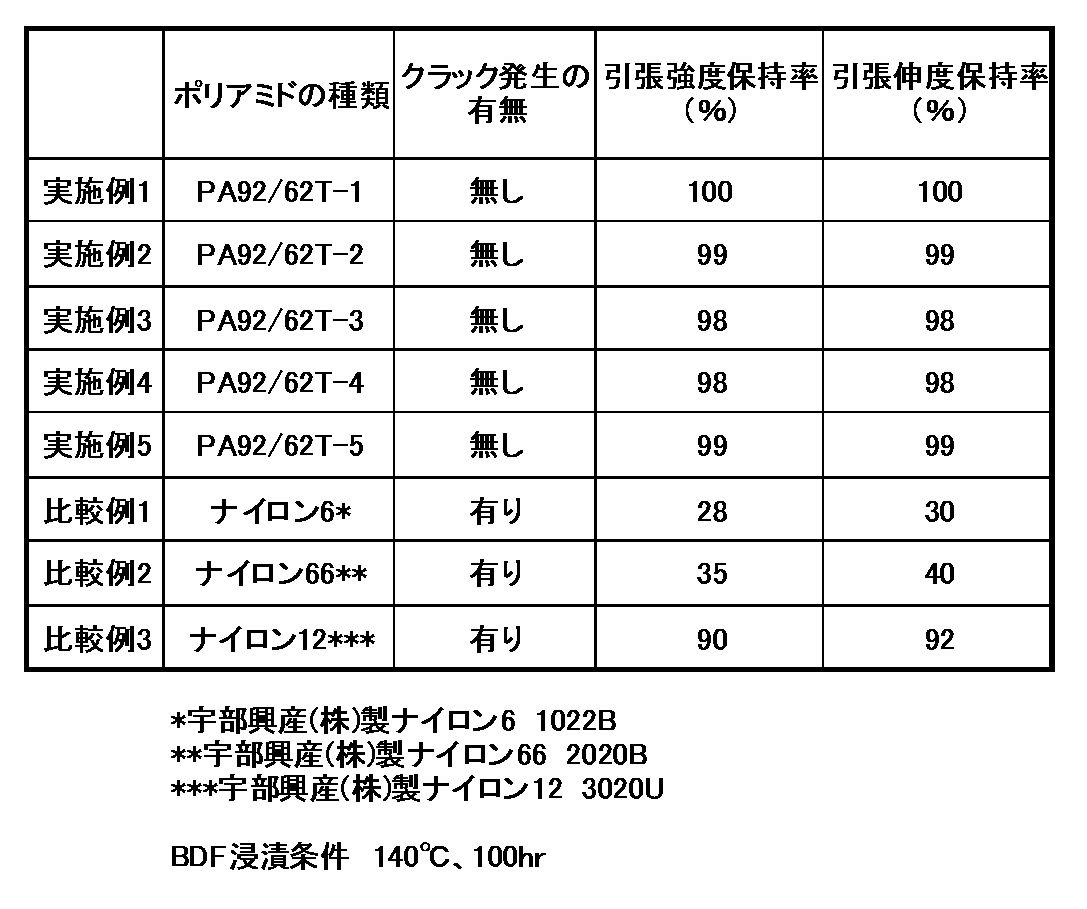
実施例1〜5のポリアミド樹脂PA92/62T−1〜PA92/62T−5、並びに比較例1〜3のナイロン6(宇部興産製、UBEナイロン1015B)、ナイロン66(宇部興産製、UBEナイロン2020B)及びナイロン12(宇部興産製、UBESTA3020U)について、さらに耐バイオディーゼル燃料性を評価した。結果を表2に示す。 Polyamide resins PA92 / 62T-1 to PA92 / 62T-5 of Examples 1 to 5 and Nylon 6 (UBE Nylon 1015B, manufactured by Ube Industries), Nylon 66 (UBE Nylon 2020B, manufactured by Ube Industries) Further, biodiesel fuel resistance was evaluated for nylon 12 (Ube Industries, UBESTA3020U). The results are shown in Table 2.
本発明による成形部品は、耐バイオディーゼル燃料性に優れ、かつ低吸水性、成形加工性等に優れているので、バイオディーゼル燃料と直接に接触する部品に大いに利用されることが期待される。 The molded part according to the present invention is excellent in biodiesel fuel resistance, low water absorption, molding processability, and the like, and thus is expected to be greatly used for parts that are in direct contact with biodiesel fuel.
Claims (4)
Priority Applications (2)
| Application Number | Priority Date | Filing Date | Title |
|---|---|---|---|
| JP2008244727A JP2010077215A (en) | 2008-09-24 | 2008-09-24 | Molded member directly contacted with bio-diesel fuel |
| PCT/JP2009/060979 WO2009151145A1 (en) | 2008-06-10 | 2009-06-10 | Novel polyamide resin composition and polyamide resin-containing product |
Applications Claiming Priority (1)
| Application Number | Priority Date | Filing Date | Title |
|---|---|---|---|
| JP2008244727A JP2010077215A (en) | 2008-09-24 | 2008-09-24 | Molded member directly contacted with bio-diesel fuel |
Publications (1)
| Publication Number | Publication Date |
|---|---|
| JP2010077215A true JP2010077215A (en) | 2010-04-08 |
Family
ID=42208032
Family Applications (1)
| Application Number | Title | Priority Date | Filing Date |
|---|---|---|---|
| JP2008244727A Pending JP2010077215A (en) | 2008-06-10 | 2008-09-24 | Molded member directly contacted with bio-diesel fuel |
Country Status (1)
| Country | Link |
|---|---|
| JP (1) | JP2010077215A (en) |
Citations (5)
| Publication number | Priority date | Publication date | Assignee | Title |
|---|---|---|---|---|
| JPH05506466A (en) * | 1990-02-20 | 1993-09-22 | エクソン・ケミカル・パテンツ・インク | oxygen barrier |
| JPH07228689A (en) * | 1994-02-16 | 1995-08-29 | Kuraray Co Ltd | Polyamide resin |
| JP2000191771A (en) * | 1998-12-25 | 2000-07-11 | Kuraray Co Ltd | Polyamide and its composition |
| JP2004083817A (en) * | 2002-08-29 | 2004-03-18 | Kuraray Co Ltd | polyamide |
| JP2006057033A (en) * | 2004-08-23 | 2006-03-02 | Ube Ind Ltd | Low water absorption member |
-
2008
- 2008-09-24 JP JP2008244727A patent/JP2010077215A/en active Pending
Patent Citations (5)
| Publication number | Priority date | Publication date | Assignee | Title |
|---|---|---|---|---|
| JPH05506466A (en) * | 1990-02-20 | 1993-09-22 | エクソン・ケミカル・パテンツ・インク | oxygen barrier |
| JPH07228689A (en) * | 1994-02-16 | 1995-08-29 | Kuraray Co Ltd | Polyamide resin |
| JP2000191771A (en) * | 1998-12-25 | 2000-07-11 | Kuraray Co Ltd | Polyamide and its composition |
| JP2004083817A (en) * | 2002-08-29 | 2004-03-18 | Kuraray Co Ltd | polyamide |
| JP2006057033A (en) * | 2004-08-23 | 2006-03-02 | Ube Ind Ltd | Low water absorption member |
Similar Documents
| Publication | Publication Date | Title |
|---|---|---|
| JP5056763B2 (en) | Polyamide resin | |
| JP5796573B2 (en) | Polyamide resin | |
| JP2009235225A (en) | Polyamide resin | |
| JP5146124B2 (en) | Fuel tube | |
| JPWO2012036303A1 (en) | Polyoxamide resin with excellent impact resistance and impact resistant parts | |
| JP2009298870A (en) | Internal component of automobile engine room | |
| JP5572921B2 (en) | Molded parts in direct contact with biodiesel fuel | |
| JP2009298853A (en) | Polyamide resin composition | |
| JP5347930B2 (en) | Electrophotographic materials | |
| JP2009235223A (en) | Polyamide resin for automobile member | |
| JP5458846B2 (en) | Electrophotographic member containing a novel polyamide resin | |
| JP2009299206A (en) | Filament | |
| JP2011116889A (en) | Polyamide resin composition for smt connector | |
| JP2009298857A (en) | Polyamide resin composition and molded article formed from the polyamide resin composition | |
| JP5621220B2 (en) | Conductive polyamide resin composition and cable housing | |
| JP5584963B2 (en) | Polyamide resin composition | |
| JP5584964B2 (en) | Composite material including polyamide resin, layered silicate, and hollow molded part | |
| JP5446795B2 (en) | Polyamide resin composition for IC tray and IC tray | |
| JP5584967B2 (en) | Polyamide resin composition and molded article formed from the polyamide resin composition | |
| JP2009298867A (en) | Polyamide film | |
| JP2010018794A (en) | Conductive polyamide resin composition | |
| JP2009298865A (en) | Fuel tank component | |
| JP2009298854A (en) | Composite material containing polyamide resin and layered silicate | |
| JP2011116886A (en) | Industrial tube | |
| JP5577574B2 (en) | INJECTION MOLDING MATERIAL CONTAINING NOVEL POLYAMIDE RESIN AND INJECTION MOLDED PRODUCT MADE FROM THEM |
Legal Events
| Date | Code | Title | Description |
|---|---|---|---|
| A621 | Written request for application examination |
Free format text: JAPANESE INTERMEDIATE CODE: A621 Effective date: 20110830 |
|
| A131 | Notification of reasons for refusal |
Free format text: JAPANESE INTERMEDIATE CODE: A131 Effective date: 20130828 |
|
| A02 | Decision of refusal |
Free format text: JAPANESE INTERMEDIATE CODE: A02 Effective date: 20140129 |