JP2010077367A - Ink composition and inkjet recording method - Google Patents
Ink composition and inkjet recording method Download PDFInfo
- Publication number
- JP2010077367A JP2010077367A JP2008250639A JP2008250639A JP2010077367A JP 2010077367 A JP2010077367 A JP 2010077367A JP 2008250639 A JP2008250639 A JP 2008250639A JP 2008250639 A JP2008250639 A JP 2008250639A JP 2010077367 A JP2010077367 A JP 2010077367A
- Authority
- JP
- Japan
- Prior art keywords
- group
- ink composition
- compound
- examples
- compounds
- Prior art date
- Legal status (The legal status is an assumption and is not a legal conclusion. Google has not performed a legal analysis and makes no representation as to the accuracy of the status listed.)
- Granted
Links
- 0 CN(C(N(*)C(N1N*)=O)=O)C1=O Chemical compound CN(C(N(*)C(N1N*)=O)=O)C1=O 0.000 description 2
- BCTJGEJPLFIRLT-UHFFFAOYSA-N CCC1(COC(CCN)=O)COC1 Chemical compound CCC1(COC(CCN)=O)COC1 BCTJGEJPLFIRLT-UHFFFAOYSA-N 0.000 description 1
- ITZVCZDADBDIMJ-UHFFFAOYSA-N CCC1(COC(NC)=O)COC1 Chemical compound CCC1(COC(NC)=O)COC1 ITZVCZDADBDIMJ-UHFFFAOYSA-N 0.000 description 1
- WCWGHLZDVMIBLS-UHFFFAOYSA-N CCC1(COC(NCc2cc(CNC(O)=O)ccc2)=O)COC1 Chemical compound CCC1(COC(NCc2cc(CNC(O)=O)ccc2)=O)COC1 WCWGHLZDVMIBLS-UHFFFAOYSA-N 0.000 description 1
- ZALXJSOXAYXHJD-UHFFFAOYSA-N CCC1(COC(NCc2cccc(CNC=O)c2)=O)COC1 Chemical compound CCC1(COC(NCc2cccc(CNC=O)c2)=O)COC1 ZALXJSOXAYXHJD-UHFFFAOYSA-N 0.000 description 1
Classifications
-
- C—CHEMISTRY; METALLURGY
- C09—DYES; PAINTS; POLISHES; NATURAL RESINS; ADHESIVES; COMPOSITIONS NOT OTHERWISE PROVIDED FOR; APPLICATIONS OF MATERIALS NOT OTHERWISE PROVIDED FOR
- C09D—COATING COMPOSITIONS, e.g. PAINTS, VARNISHES OR LACQUERS; FILLING PASTES; CHEMICAL PAINT OR INK REMOVERS; INKS; CORRECTING FLUIDS; WOODSTAINS; PASTES OR SOLIDS FOR COLOURING OR PRINTING; USE OF MATERIALS THEREFOR
- C09D11/00—Inks
- C09D11/02—Printing inks
- C09D11/10—Printing inks based on artificial resins
- C09D11/101—Inks specially adapted for printing processes involving curing by wave energy or particle radiation, e.g. with UV-curing following the printing
Landscapes
- Chemical & Material Sciences (AREA)
- Life Sciences & Earth Sciences (AREA)
- Engineering & Computer Science (AREA)
- Materials Engineering (AREA)
- Wood Science & Technology (AREA)
- Organic Chemistry (AREA)
- Ink Jet Recording Methods And Recording Media Thereof (AREA)
- Inks, Pencil-Leads, Or Crayons (AREA)
- Ink Jet (AREA)
Abstract
【課題】吐出性、硬化性、耐擦過性及び柔軟性に優れたインク組成物、並びに、前記インク組成物を用いたインクジェット記録方法を提供すること。
【解決手段】(A)カチオン重合性化合物、(B)放射線の照射により酸を発生する化合物、及び、(C)着色剤を含み、前記(A)カチオン重合性化合物が、−NRCO−結合(Rは、水素原子又は一価の有機基を表す。)を有する多官能オキセタン化合物を含むことを特徴とするインク組成物、並びに、前記インク組成物を用いたインクジェット記録方法。
【選択図】なしTo provide an ink composition excellent in ejection property, curability, scratch resistance and flexibility, and an ink jet recording method using the ink composition.
(A) a cationically polymerizable compound, (B) a compound that generates an acid upon irradiation with radiation, and (C) a colorant, wherein the (A) cationically polymerizable compound comprises an —NRCO— bond ( R represents a hydrogen atom or a monovalent organic group.) An ink composition comprising a polyfunctional oxetane compound having a hydrogen atom or a monovalent organic group, and an ink jet recording method using the ink composition.
[Selection figure] None
Description
本発明は、インクジェット記録用として好適に用いられるインク組成物、及び、インクジェット記録方法に関する。 The present invention relates to an ink composition suitably used for inkjet recording, and an inkjet recording method.
画像データ信号に基づき、紙などの被記録媒体に画像を形成する画像記録方法として、電子写真方式、昇華型及び溶融型熱転写方式、インクジェット方式などがある。中でもインクジェット方式は、安価な装置で実施可能であり、かつ、必要とされる画像部のみにインク組成物を吐出して被記録媒体上に直接画像形成を行うため、インク組成物を効率よく使用でき、ランニングコストが安い。さらに、騒音が少なく、画像記録方式として優れている。
近年、紫外線などの放射線の照射により硬化可能なインク組成物(放射線硬化型インクジェット記録用インク組成物)を、インクジェットにより描画した後、紫外線などの放射線を照射して、インク組成物を硬化する、無溶剤型のインクジェット記録方式が注目されている。一般に、水を希釈剤として含む水性インク組成物や有機溶剤を希釈剤として含む溶剤型インク組成物と比較して、放射線硬化型インク組成物によるインクジェット記録方式は、ガラス、金属、プラスチック基材といった非吸収性基材への描画が可能であり、基材の適応範囲が広い、描画画像の耐擦過性や耐溶剤性に優れる、感度が高い、生産性に優れる、揮発性の溶剤を含まないので臭気等の人体への影響や環境への負荷が小さい、といったメリットを有する。
As an image recording method for forming an image on a recording medium such as paper based on an image data signal, there are an electrophotographic method, a sublimation type and a melt type thermal transfer method, an ink jet method and the like. In particular, the inkjet method can be implemented with an inexpensive device, and the ink composition is ejected only on the required image portion to form an image directly on the recording medium, so the ink composition is used efficiently. Yes, running costs are low. Furthermore, there is little noise and it is excellent as an image recording method.
In recent years, after drawing an ink composition (radiation curable ink jet recording ink composition) that can be cured by irradiation with radiation such as ultraviolet rays, the ink composition is cured by irradiation with radiation such as ultraviolet rays. A solventless ink jet recording system has attracted attention. In general, compared with a water-based ink composition containing water as a diluent and a solvent-type ink composition containing an organic solvent as a diluent, an inkjet recording method using a radiation curable ink composition is a glass, metal, plastic substrate, or the like. It is possible to draw on non-absorbent substrates, and the range of application of the substrate is wide, scratched images and solvent resistance are excellent, sensitivity is high, productivity is high, and volatile solvents are not included. Therefore, it has the merit that the influence on the human body such as odor and the load on the environment is small.
活性放射線硬化型インクの硬化メカニズムとしては、カチオン重合型とラジカル重合型とに大別されるが、カチオン重合型は、ラジカル重合型と比較して、硬化時の体積収縮が小さく、基材への密着性が高い、ラジカル重合型のような酸素による重合阻害がないので、硬化速度が高く、残存するモノマーも少なくなるため、硬化後の印刷物の耐擦過性や耐溶剤性により優れるといったメリットを有しており、実用化に向けた取り組みが活発に行われている。
カチオン重合型の活性放射線硬化型インク組成物は、一般に、カチオン重合性モノマー(例えば、ビニルエーテル化合物、オキシラン化合物、オキセタン化合物等)、活性放射線の作用により酸を発生する化合物(光酸発生剤又は光カチオン重合開始剤ともいう。)及び着色剤を主成分とする。
このような、カチオン重合型の活性放射線硬化型インク組成物として、例えば、特許文献1には、カチオン重合性物質と光カチオン重合開始剤を含有するインクジエット記録方式用紫外線硬化性樹脂組成物が開示されている。
また、特許文献2には、2つ以上のオキセタン環を有する多官能オキセタン化合物を含有する活性エネルギー線硬化性樹脂組成物が開示されている。
特許文献3には、多官能オキセタン化合物、多官能オキシラン化合物、高極性基を有する単官能オキセタン化合物及び/又は高極性基を有する単官能オキシラン化合物、カチオン重合開始剤、及び、着色剤を含有するインク組成物が開示されている。
さらに、特許文献4には、ウレタン変性エポキシ樹脂、光酸発生剤、カチオン重合性モノマー及び顔料を含有する活性光線硬化型インクジェットインク組成物が開示されている。
The curing mechanism of actinic radiation curable ink is roughly classified into a cationic polymerization type and a radical polymerization type. The cationic polymerization type has a smaller volume shrinkage at the time of curing than the radical polymerization type. Since there is no polymerization inhibition by oxygen as in the radical polymerization type, the curing rate is high and the remaining monomer is reduced, so that there are advantages such as better scratch resistance and solvent resistance of the printed matter after curing. Has been actively engaged in practical application.
Cationic polymerization-type actinic radiation curable ink compositions generally include cationically polymerizable monomers (for example, vinyl ether compounds, oxirane compounds, oxetane compounds, etc.), compounds that generate acid by the action of actinic radiation (photoacid generators or light It is also called a cationic polymerization initiator.) And a colorant.
As such a cationic polymerization type active radiation curable ink composition, for example, Patent Document 1 discloses an ultraviolet curable resin composition for an ink jet recording system containing a cationic polymerizable substance and a photocationic polymerization initiator. It is disclosed.
Patent Document 2 discloses an active energy ray-curable resin composition containing a polyfunctional oxetane compound having two or more oxetane rings.
Patent Document 3 contains a polyfunctional oxetane compound, a polyfunctional oxirane compound, a monofunctional oxetane compound having a highly polar group and / or a monofunctional oxirane compound having a highly polar group, a cationic polymerization initiator, and a colorant. An ink composition is disclosed.
Further, Patent Document 4 discloses an actinic ray curable inkjet ink composition containing a urethane-modified epoxy resin, a photoacid generator, a cationic polymerizable monomer, and a pigment.
従来のカチオン重合型の活性放射線硬化型インク組成物、例えば、特許文献1〜4に基記載されたインク組成物は、インクジェットインク組成物に求められる硬化速度、硬化後の印刷物の耐擦過性や柔軟性、吐出性の点で、実用上未だ十分な性能は得られておらず、さらなる改良が求められていた。
本発明の目的は、吐出性、硬化性、耐擦過性及び柔軟性に優れたインク組成物、並びに、前記インク組成物を用いたインクジェット記録方法を提供することである。
Conventional cationic polymerization type actinic radiation curable ink compositions, for example, the ink compositions described in Patent Documents 1 to 4, have a curing rate required for an inkjet ink composition, a scratch resistance of a printed material after curing, In terms of flexibility and dischargeability, practically sufficient performance has not yet been obtained, and further improvements have been demanded.
An object of the present invention is to provide an ink composition excellent in ejectability, curability, scratch resistance and flexibility, and an ink jet recording method using the ink composition.
上記目的は、下記<1>又は<7>に記載の手段により達成された。好ましい実施態様である<2>〜<6>と共に以下に示す。
<1>(A)カチオン重合性化合物、(B)放射線の照射により酸を発生する化合物、及び、(C)着色剤を含み、前記(A)カチオン重合性化合物が、−NRCO−結合(Rは、水素原子又は一価の有機基を表す。)を有する多官能オキセタン化合物を含むことを特徴とするインク組成物、
<2>前記−NRCO−結合を有する多官能オキセタン化合物の含有量が、インク組成物の全重量に対し、2〜30重量%である上記<1>に記載のインク組成物、
<3>前記−NRCO−結合を有する多官能オキセタン化合物の分子量が、400〜100,000である上記<1>又は<2>に記載のインク組成物、
<4>3種類以上のカチオン重合性化合物を含有する上記<1>〜<3>のいずれか1つに記載のインク組成物、
<5>−NRCO−結合を有する多官能オキセタン化合物が1種類以上と、−NRCO−結合を有する多官能オキセタン化合物以外のカチオン重合性化合物が2種類以上とを含有する上記<1>〜<4>のいずれか1つに記載のインク組成物、
<6>アミン化合物を含有する上記<1>〜<5>のいずれか1つに記載のインク組成物、
<7>(a1)被記録媒体上に、上記<1>〜<6>のいずれか1つに記載のインク組成物を吐出する工程、及び、(b1)吐出されたインク組成物に活性放射線を照射して、前記インク組成物を硬化する工程、を含むインクジェット記録方法。
The above object has been achieved by the means described in <1> or <7> below. It is shown below with <2>-<6> which are preferable embodiments.
<1> (A) a cationically polymerizable compound, (B) a compound that generates an acid upon irradiation with radiation, and (C) a colorant, wherein the (A) cationically polymerizable compound is an —NRCO— bond (R Represents a hydrogen atom or a monovalent organic group), and an ink composition comprising a polyfunctional oxetane compound having
<2> The ink composition according to <1>, wherein the content of the polyfunctional oxetane compound having the —NRCO— bond is 2 to 30% by weight with respect to the total weight of the ink composition;
<3> The ink composition according to the above <1> or <2>, wherein the polyfunctional oxetane compound having a —NRCO— bond has a molecular weight of 400 to 100,000.
<4> The ink composition according to any one of <1> to <3>, which contains three or more types of cationically polymerizable compounds;
<5> The above <1> to <4, wherein the polyfunctional oxetane compound having a —NRCO— bond contains at least one kind and the cationically polymerizable compound other than the polyfunctional oxetane compound having a —NRCO— bond contains at least two kinds. > The ink composition according to any one of
<6> The ink composition according to any one of <1> to <5>, which contains an amine compound;
<7> (a 1 ) A step of discharging the ink composition according to any one of the above <1> to <6> on a recording medium, and (b 1 ) the discharged ink composition A step of irradiating actinic radiation to cure the ink composition.
本発明によれば、吐出性、硬化性、耐擦過性及び柔軟性に優れたインク組成物、並びに、前記インク組成物を用いたインクジェット記録方法を提供することができた。 According to the present invention, it was possible to provide an ink composition excellent in ejectability, curability, scratch resistance and flexibility, and an ink jet recording method using the ink composition.
(1)インク組成物
本発明のインク組成物(以下、単に「インク」ともいう。)は、(A)カチオン重合性化合物、(B)放射線の照射により酸を発生する化合物、及び、(C)着色剤を含み、前記(A)カチオン重合性化合物が、−NRCO−結合(Rは、水素原子又は一価の有機基を表す。)を有する多官能オキセタン化合物を含むことを特徴とする。
本発明のインク組成物は、インクジェット記録用インク組成物として好適に使用することができる。
以下、本発明について詳細に説明する。
(1) Ink composition The ink composition of the present invention (hereinafter also simply referred to as “ink”) includes (A) a cationically polymerizable compound, (B) a compound that generates an acid upon irradiation with radiation, and (C And (A) the cationically polymerizable compound includes a polyfunctional oxetane compound having a —NRCO— bond (R represents a hydrogen atom or a monovalent organic group).
The ink composition of the present invention can be suitably used as an ink composition for inkjet recording.
Hereinafter, the present invention will be described in detail.
本発明のインク組成物は、放射線により硬化可能なインク組成物であり、また、油性のインク組成物である。
本発明でいう「放射線」とは、その照射によりインク組成物中において開始種を発生させることができるエネルギーを付与することができる活性放射線であれば、特に制限はなく、広くα線、γ線、X線、紫外線(UV)、可視光線、電子線などを包含するものであるが、中でも、硬化感度及び装置の入手容易性の観点から紫外線及び電子線が好ましく、特に紫外線が好ましい。したがって、本発明のインク組成物としては、放射線として、紫外線を照射することにより硬化可能なインク組成物が好ましい。
The ink composition of the present invention is an ink composition that can be cured by radiation, and is an oil-based ink composition.
The “radiation” as used in the present invention is not particularly limited as long as it is an actinic radiation that can impart energy capable of generating an initiation species in the ink composition by the irradiation, and is broadly α-ray, γ-ray. , X-rays, ultraviolet rays (UV), visible rays, electron beams, etc. Among them, ultraviolet rays and electron beams are preferable from the viewpoint of curing sensitivity and device availability, and ultraviolet rays are particularly preferable. Therefore, the ink composition of the present invention is preferably an ink composition that can be cured by irradiating ultraviolet rays as radiation.
本発明のインク組成物は、カチオン重合性化合物として、−NRCO−結合を有する多官能オキセタン化合物を用いることにより、硬化速度、硬化後の印刷物の耐擦過性や柔軟性、吐出安定性に優れる放射線硬化型インクジェットインクを提供することを見出したものである。
なお、特許文献2及び3には、多官能オキセタン化合物が有していてもよい置換基として、カルバモイル基が挙げられているが、その効果については記載がなく、具体的な化合物の例示も全くない。
The ink composition of the present invention uses a polyfunctional oxetane compound having a —NRCO— bond as the cationic polymerizable compound, so that radiation having excellent curing speed, scratch resistance and flexibility of the printed material after curing, and ejection stability. It has been found that a curable inkjet ink is provided.
In Patent Documents 2 and 3, a carbamoyl group is mentioned as a substituent that the polyfunctional oxetane compound may have, but there is no description about its effect, and examples of specific compounds are also completely absent. Absent.
(A)カチオン重合性化合物
本発明のインク組成物は、(A)カチオン重合性化合物を含有する。
また、本発明のインク組成物における前記(A)カチオン重合性化合物は、−NRCO−結合(Rは、水素原子又は一価の有機基を表す。)を有する多官能オキセタン化合物を少なくとも含有する。
(A) Cationic polymerizable compound The ink composition of the invention contains (A) a cationic polymerizable compound.
The (A) cationically polymerizable compound in the ink composition of the present invention contains at least a polyfunctional oxetane compound having a —NRCO— bond (R represents a hydrogen atom or a monovalent organic group).
<−NRCO−結合を有する多官能オキセタン化合物(特定多官能オキセタン化合物)>
本発明のインク組成物は、カチオン重合性化合物として、−NRCO−結合を有する多官能オキセタン化合物(「特定多官能オキセタン化合物」ともいう。)を含有する。
−NRCO−結合としては、ウレタン結合、ウレア結合、及び、イソシアヌル酸構造(イソシアヌレート基)よりなる群から選ばれた基であることが好ましく、ウレタン結合、及び、イソシアヌル酸構造(イソシアヌレート基)よりなる群から選ばれた基であることがより好ましい。
前記−NRCO−結合を有する多官能オキセタン化合物は、式(L)で表される化合物であることが好ましい。
<Polyfunctional Oxetane Compound Having -NRCO- Bond (Specific Polyfunctional Oxetane Compound)>
The ink composition of the present invention contains a polyfunctional oxetane compound having a —NRCO— bond (also referred to as “specific polyfunctional oxetane compound”) as a cationic polymerizable compound.
The —NRCO— bond is preferably a group selected from the group consisting of a urethane bond, a urea bond, and an isocyanuric acid structure (isocyanurate group), and a urethane bond and an isocyanuric acid structure (isocyanurate group). More preferably, the group is selected from the group consisting of:
The polyfunctional oxetane compound having the —NRCO— bond is preferably a compound represented by the formula (L).
式(L)中、Ra、Rb及びRcはそれぞれ独立に、水素原子又は炭素、水素、窒素、酸素及び硫黄よりなる群から選ばれた元素で構成される一価の有機基を表し(ただし、Ra、Rb及びRcの全てが水素原子であることはない。)、Ra、Rb及びRcのいずれかに、合計で少なくとも2個の式(P)又は式(Q)で表されるオキセタニル基を有する。また、Ra、Rb及びRcよりなる群から選ばれた少なくとも2つは、連結して環を形成していてもよい。 In formula (L), R a , R b and R c each independently represent a monovalent organic group composed of a hydrogen atom or an element selected from the group consisting of carbon, hydrogen, nitrogen, oxygen and sulfur. (However, not all of R a , R b and R c are hydrogen atoms.), Any one of R a , R b and R c has a total of at least two formulas (P) or ( It has an oxetanyl group represented by Q). Further, at least two selected from the group consisting of R a , R b and R c may be linked to form a ring.
式(P)及び式(Q)中、Aは単結合又は炭素、水素、窒素、酸素及び硫黄よりなる群から選ばれた元素で構成される二価の有機基を表し、R1〜R5はそれぞれ独立に、水素原子又は炭素原子数1〜20までの炭化水素基を表す。前記炭化水素基は、炭素数1〜8のアルキル基であることが好ましく、炭素数1〜4のアルキル基であることがより好ましい。 In formula (P) and formula (Q), A represents a single bond or a divalent organic group composed of an element selected from the group consisting of carbon, hydrogen, nitrogen, oxygen and sulfur, and R 1 to R 5 Each independently represents a hydrogen atom or a hydrocarbon group having 1 to 20 carbon atoms. The hydrocarbon group is preferably an alkyl group having 1 to 8 carbon atoms, and more preferably an alkyl group having 1 to 4 carbon atoms.
Ra、Rb又はRcが炭素、水素、窒素、酸素及び硫黄よりなる群から選ばれた元素で構成される一価の有機基である場合には、それを構成する原子の総数は、1〜20,000であることが好ましい(式(P)又は式(Q)で表される置換基を有する場合には、それらを構成する原子数を含む。)。
Aが炭素、水素、窒素、酸素及び硫黄よりなる群から選ばれた元素で構成される二価の有機基である場合には、それを構成する原子の総数は1〜2,000であることが好ましい。
When R a , R b, or R c is a monovalent organic group composed of an element selected from the group consisting of carbon, hydrogen, nitrogen, oxygen and sulfur, the total number of atoms constituting the group is It is preferable that it is 1-20,000 (when it has a substituent represented by Formula (P) or Formula (Q), the number of atoms constituting them is included).
When A is a divalent organic group composed of an element selected from the group consisting of carbon, hydrogen, nitrogen, oxygen and sulfur, the total number of atoms constituting the group is 1 to 2,000. Is preferred.
式(L)が有する式(P)又は式(Q)で表されるオキセタニル基の数は、2個以上であることが好ましく、2〜10個であることがより好ましく、2〜6個であることがさらに好ましく、2〜3個であることが特に好ましい。 The number of oxetanyl groups represented by the formula (P) or the formula (Q) of the formula (L) is preferably 2 or more, more preferably 2 to 10, and 2 to 6 More preferably, it is particularly preferably 2-3.
前記−NRCO−結合を有する多官能オキセタン化合物は、式(M)又は式(N)で表される化合物であることがさらに好ましい。 The polyfunctional oxetane compound having the —NRCO— bond is more preferably a compound represented by the formula (M) or the formula (N).
式(M)中、Raは、式(L)におけるRa及びRbと同義であり、好ましい範囲も同様である。また、式(M)中、Rdは、炭素、水素、窒素、酸素及び硫黄よりなる群から選ばれた元素で構成される一価の有機基を表す。
式(N)中、Ra、Re及びRfはそれぞれ独立に、式(L)におけるRaと同義であり、好ましい範囲も同様である。
In formula (M), R a has the same meaning as R a and R b in formula (L), and the preferred range is also the same. In the formula (M), R d represents a monovalent organic group composed of an element selected from the group consisting of carbon, hydrogen, nitrogen, oxygen and sulfur.
In formula (N), R a , R e and R f each independently have the same meaning as R a in formula (L), and the preferred range is also the same.
前記−NRCO−結合を有する多官能オキセタン化合物の−NRCO−結合は、化合物の末端ではなく、内部に位置する構造であることが好ましい。
すなわち、式(L)においては、Ra及びRcの少なくとも一方、並びに、Rbはそれぞれ独立に、炭素、水素、窒素、酸素及び硫黄よりなる群から選ばれた元素で構成される総原子数1〜20,000の一価の有機基であることが好ましい。
式(M)においては、Ra及びRdはそれぞれ独立に、炭素、水素、窒素、酸素及び硫黄よりなる群から選ばれた元素で構成される総原子数1〜20,000の一価の有機基であることが好ましい。
The —NRCO— bond of the polyfunctional oxetane compound having the —NRCO— bond is preferably a structure located inside rather than the terminal of the compound.
That is, in the formula (L), at least one of R a and R c and R b are each independently a total atom composed of an element selected from the group consisting of carbon, hydrogen, nitrogen, oxygen and sulfur. A monovalent organic group having a number of 1 to 20,000 is preferred.
In the formula (M), R a and R d are each independently a monovalent monovalent group having 1 to 20,000 total atoms composed of an element selected from the group consisting of carbon, hydrogen, nitrogen, oxygen and sulfur. An organic group is preferred.
炭素、水素、窒素、酸素及び硫黄よりなる群から選ばれた元素で構成される一価又は二価の有機基としては、置換基を有していてもよい以下の炭化水素を構成する水素原子(置換基上の水素原子を含む)を1個又は2個除いた有機基を挙げることができる。
前記炭化水素としては、脂肪族炭化水素や芳香族炭化水素が例示できる。
前記脂肪族炭化水素としては、メタン、エタン、プロパン、ブタン、ペンタン、ヘキサン、ヘプタン、オクタン、ノナン、デカン、ドデカン、オクタデカン、シクロプロパン、シクロブタン、シクロペンタン、シクロヘキサン、ビシクロ[3.2.1]オクタン、スピロ[4.5]デカン、アダマンタン、ボルナン、ノルボルナン、cis−又はtrans−ヒドリンダン、cis−又はtrans−デカヒドロナフタレン、exo−又はendo−トリシクロ[5.2.1.02,6]デカン、エチレン、プロピレン、1−ブテン、1−ヘキセン、1−ヘプタデセン、2−ブテン、2−ヘキセン、4−ノネン、7−テトラデセン、ブタジエン、ピペリレン、1,9−デカジエン、シクロペンテン、シクロヘキセン、シクロオクテン、1,4−シクロヘキサジエン、1,5−シクロオクタジエン、1,5,9−シクロドデカトリエン、2−ボルネン、2−ノルボルネン、exo−又はendo−トリシクロ[5.2.1.02,6]デカン−3−エン、オクタヒドロナフタレン、トリシクロ[6.2.1.02,7]ウンデカ−4−エン、テトラシクロ[6.2.1.13,6.02,7]ドデカ−4−エン、ビシクロ[2.2.1]ヘプタ−2,5−ジエン、3a,4,7,7a−テトラヒドロインデン、アセチレン、1−プロピン、2−ヘキシン等の炭素数1から40までの脂肪族炭化水素が好ましく例示できる。
As the monovalent or divalent organic group composed of an element selected from the group consisting of carbon, hydrogen, nitrogen, oxygen and sulfur, a hydrogen atom constituting the following hydrocarbon which may have a substituent The organic group which remove | excluded one or two (including the hydrogen atom on a substituent) can be mentioned.
Examples of the hydrocarbon include aliphatic hydrocarbons and aromatic hydrocarbons.
Examples of the aliphatic hydrocarbon include methane, ethane, propane, butane, pentane, hexane, heptane, octane, nonane, decane, dodecane, octadecane, cyclopropane, cyclobutane, cyclopentane, cyclohexane, and bicyclo [3.2.1]. Octane, spiro [4.5] decane, adamantane, bornane, norbornane, cis- or trans-hydrindane, cis- or trans-decahydronaphthalene, exo- or endo-tricyclo [5.2.1.0 2,6 ] Decane, ethylene, propylene, 1-butene, 1-hexene, 1-heptadecene, 2-butene, 2-hexene, 4-nonene, 7-tetradecene, butadiene, piperylene, 1,9-decadiene, cyclopentene, cyclohexene, cyclooctene 1,4- Black-hexadiene, 1,5-cyclooctadiene, 1,5,9 cyclododecatriene, 2-bornene, 2-norbornene, exo⁻ or endo- tricyclo [5.2.1.0 2, 6] decane -3 - ene, octahydronaphthalene, tricyclo [6.2.1.0 2,7] undec-4-ene, tetracyclo [6.2.1.13,6.0 2,7] dodeca-4-ene, bicyclo [2.2.1] C1-C40 aliphatic hydrocarbons such as hepta-2,5-diene, 3a, 4,7,7a-tetrahydroindene, acetylene, 1-propyne and 2-hexyne are preferred. It can be illustrated.
前記芳香族炭化水素としては、ベンゼン、ナフタレン、アントラセン、フェナントレン、ピレン、アセナフチレン、トリフェニレン、インデン、フルオレン、1,2,3,4−テトラヒドロナフタレン等の芳香族炭化水素が好ましく例示できる。 Preferred examples of the aromatic hydrocarbon include aromatic hydrocarbons such as benzene, naphthalene, anthracene, phenanthrene, pyrene, acenaphthylene, triphenylene, indene, fluorene, and 1,2,3,4-tetrahydronaphthalene.
さらに、前記炭素、水素、窒素、酸素及び硫黄よりなる群から選ばれた元素で構成される一価又は二価の有機基は、これらの炭化水素を2以上組み合わせた炭化水素から水素原子をそれぞれ1個又は2個除した有機基であってもよい。 Furthermore, the monovalent or divalent organic group composed of an element selected from the group consisting of carbon, hydrogen, nitrogen, oxygen and sulfur is a hydrogen atom from a hydrocarbon in which two or more of these hydrocarbons are combined. It may be an organic group divided by one or two.
さらに、このような有機基を構成する任意の炭素原子は、酸素原子、窒素原子、硫黄原子及びその組み合わせ(例えば−SO−、−SO2−等)から選ばれるヘテロ原子(団)で1個以上置換されてもよい。
置換基としては水素原子を除く、一価の非金属原子団を挙げることができ、ハロゲン原子(−F、−Br、−Cl、−I)、ヒドロキシル基、アルコキシ基、アリーロキシ基、メルカプト基、アルキルチオ基、アリールチオ基、アルキルジチオ基、アリールジチオ基、アミノ基、N−アルキルアミノ基、N,N−ジアルキルアミノ基、N−アリールアミノ基、N,N−ジアリールアミノ基、N−アルキル−N−アリールアミノ基、アシルオキシ基、カルバモイルオキシ基、N−アルキルカルバモイルオキシ基、N−アリールカルバモイルオキシ基、N,N−ジアルキルカルバモイルオキシ基、N,N−ジアリールカルバモイルオキシ基、N−アルキル−N−アリールカルバモイルオキシ基、アルキルスルホキシ基、アリールスルホキシ基、アシルチオ基、アシルアミノ基、N−アルキルアシルアミノ基、N−アリールアシルアミノ基、ウレイド基、N’−アルキルウレイド基、N’,N’−ジアルキルウレイド基、N’−アリールウレイド基、N’,N’−ジアリールウレイド基、N’−アルキル−N’−アリールウレイド基、N−アルキルウレイド基、N−アリールウレイド基、N’−アルキル−N−アルキルウレイド基、N’−アルキル−N−アリールウレイド基、N’,N’−ジアルキル−N−アルキルウレイド基、N’,N’−ジアルキル−N−アリールウレイド基、N’−アリール−N−アルキルウレイド基、N’−リール−N−アリールウレイド基、N’,N’−ジアリール−N−アルキルウレイド基、N’,N’−ジアリール−N−アリールウレイド基、N’−アルキル−N’−アリール−N−アルキルウレイド基、N’−アルキル−N’−アリール−N−アリールウレイド基、アルコキシカルボニルアミノ基、アリーロキシカルボニルアミノ基、N−アルキル−N−アルコキシカルボニルアミノ基、N−アルキル−N−アリーロキシカルボニルアミノ基、N−アリール−N−アルコキシカルボニルアミノ基、N−アリール−N−アリーロキシカルボニルアミノ基、ホルミル基、アシル基、カルボキシル基及びその共役塩基基、アルコキシカルボニル基、アリーロキシカルボニル基、カルバモイル基、N−アルキルカルバモイル基、N,N−ジアルキルカルバモイル基、N−アリールカルバモイル基、N,N−ジアリールカルバモイル基、N−アルキル−N−アリールカルバモイル基、アルキルスルフィニル基、アリールスルフィニル基、アルキルスルホニル基、アリールスルホニル基、スルホ基(−SO3H)及びその共役塩基基、アルコキシスルホニル基、アリーロキシスルホニル基、スルフィナモイル基、N−アルキルスルフィナモイル基、N,N−ジアルキルスルフィナモイル基、N−アリールスルフィナモイル基、N,N−ジアリールスルフィナモイル基、N−アルキル−N−アリールスルフィナモイル基、スルファモイル基、N−アルキルスルファモイル基、N,N−ジアルキルスルファモイル基、N−アリールスルファモイル基、N,N−ジアリールスルファモイル基、N−アルキル−N−アリールスルファモイル基、N−アシルスルファモイル基及びその共役塩基基、N−アルキルスルホニルスルファモイル基(−SO2NHSO2(アルキル))及びその共役塩基基、N−アリールスルホニルスルファモイル基(−SO2NHSO2(アリール))及びその共役塩基基、N−アルキルスルホニルカルバモイル基(−CONHSO2(アルキル))及びその共役塩基基、N−アリールスルホニルカルバモイル基(−CONHSO2(アリール))及びその共役塩基基、アルコキシシリル基(−Si(Oアルキル)3)、アリーロキシシリル基(−Si(Oアリール)3)、ヒドロキシシリル基(−Si(OH)3)及びその共役塩基基、ホスホノ基(−PO3H2)及びその共役塩基基、ジアルキルホスホノ基(−PO(Oアルキル)2)、ジアリールホスホノ基(−PO(Oアリール)2)、アルキルアリールホスホノ基(−PO(Oアルキル)(Oアリール))、モノアルキルホスホノ基(−PO(Oアルキル)OH)及びその共役塩基基、モノアリールホスホノ基(−PO(Oアリール)OH)及びその共役塩基基、ホスホノオキシ基(−OPO3H2)及びその共役塩基基、ジアルキルホスホノオキシ基(−OPO(Oアルキル)2)、ジアリールホスホノオキシ基(−OPO(Oアリール)2)、アルキルアリールホスホノオキシ基(−OPO(Oアルキル)(Oアリール))、モノアルキルホスホノオキシ基(−OPO(Oアルキル)OH)及びその共役塩基基、モノアリールホスホノオキシ基(−OPO(Oアリール)OH)及びその共役塩基基、シアノ基、ニトロ基、ジアルキルボリル基(−B(アルキル)2)、ジアリールボリル基(−B(アリール)2)、アルキルアリールボリル基(−B(アルキル)(アリール))、ジヒドロキシボリル基(−B(OH)2)及びその共役塩基基、アルキルヒドロキシボリル基(−B(アルキル)(OH))及びその共役塩基基、アリールヒドロキシボリル基(−B(アリール)(OH))及びその共役塩基基、アリール基、アルキル基、アルケニル基、アルキニル基が挙げられる。
これら置換基は可能であるならば置換基同士、又は、置換している炭化水素基と結合して環を形成してもよく、置換基はさらに置換されていてもよい。
好ましい置換基としては、ハロゲン原子、アルコキシ基、アリーロキシ基、アルキル基、アルケニル基、アルキニル基、アリール基が挙げられる。
Further, any of the carbon atoms constituting such an organic group, an oxygen atom, a nitrogen atom, a sulfur atom and combinations thereof (e.g. -SO -, - etc. - SO 2) 1 or a hetero atom selected from (Dan) The above may be substituted.
Examples of the substituent include a monovalent nonmetallic atomic group excluding a hydrogen atom, a halogen atom (-F, -Br, -Cl, -I), a hydroxyl group, an alkoxy group, an aryloxy group, a mercapto group, Alkylthio group, arylthio group, alkyldithio group, aryldithio group, amino group, N-alkylamino group, N, N-dialkylamino group, N-arylamino group, N, N-diarylamino group, N-alkyl-N -Arylamino group, acyloxy group, carbamoyloxy group, N-alkylcarbamoyloxy group, N-arylcarbamoyloxy group, N, N-dialkylcarbamoyloxy group, N, N-diarylcarbamoyloxy group, N-alkyl-N- Arylcarbamoyloxy, alkylsulfoxy, arylsulfoxy, Ruthio group, acylamino group, N-alkylacylamino group, N-arylacylamino group, ureido group, N′-alkylureido group, N ′, N′-dialkylureido group, N′-arylureido group, N ′, N′-diarylureido group, N′-alkyl-N′-arylureido group, N-alkylureido group, N-arylureido group, N′-alkyl-N-alkylureido group, N′-alkyl-N-aryl Ureido group, N ′, N′-dialkyl-N-alkylureido group, N ′, N′-dialkyl-N-arylureido group, N′-aryl-N-alkylureido group, N′-reel-N-aryl Ureido group, N ′, N′-diaryl-N-alkylureido group, N ′, N′-diaryl-N-arylureido group, N′-alkyl-N′-aryl-N-al Luureido group, N′-alkyl-N′-aryl-N-arylureido group, alkoxycarbonylamino group, aryloxycarbonylamino group, N-alkyl-N-alkoxycarbonylamino group, N-alkyl-N-aryloxycarbonyl Amino group, N-aryl-N-alkoxycarbonylamino group, N-aryl-N-aryloxycarbonylamino group, formyl group, acyl group, carboxyl group and its conjugate base group, alkoxycarbonyl group, aryloxycarbonyl group, carbamoyl Group, N-alkylcarbamoyl group, N, N-dialkylcarbamoyl group, N-arylcarbamoyl group, N, N-diarylcarbamoyl group, N-alkyl-N-arylcarbamoyl group, alkylsulfinyl group, arylsulfinyl group, al Killsulfonyl group, arylsulfonyl group, sulfo group (—SO 3 H) and its conjugate base group, alkoxysulfonyl group, aryloxysulfonyl group, sulfinamoyl group, N-alkylsulfinamoyl group, N, N-dialkylsulfinamoyl Group, N-arylsulfinamoyl group, N, N-diarylsulfinamoyl group, N-alkyl-N-arylsulfinamoyl group, sulfamoyl group, N-alkylsulfamoyl group, N, N-dialkylsulfa Moyl group, N-arylsulfamoyl group, N, N-diarylsulfamoyl group, N-alkyl-N-arylsulfamoyl group, N-acylsulfamoyl group and its conjugate base group, N-alkylsulfonyl a sulfamoyl group (-SO 2 NHSO 2 (alkyl)) and its conjugate base , N- aryl sulfonylsulfamoyl group (-SO 2 NHSO 2 (aryl)) and its conjugated base group, N- alkylsulfonylcarbamoyl group (-CONHSO 2 (alkyl)) and its conjugated base group, N- aryl sulfonyl carbamoyl Group (—CONHSO 2 (aryl)) and its conjugate base group, alkoxysilyl group (—Si (Oalkyl) 3 ), aryloxysilyl group (—Si (Oaryl) 3 ), hydroxysilyl group (—Si (OH) 3 ) and its conjugate base group, phosphono group (—PO 3 H 2 ) and its conjugate base group, dialkylphosphono group (—PO (Oalkyl) 2 ), diarylphosphono group (—PO (Oaryl) 2 ), Alkylarylphosphono group (—PO (Oalkyl) (Oaryl)), monoalkylphosphono group (—PO (O Alkyl) OH) and its conjugate base group, monoaryl phosphono group (-PO (O aryl) OH) and its conjugate base group, a phosphonooxy group (-OPO 3 H 2) and its conjugated base group, a dialkyl phosphono group (—OPO (Oalkyl) 2 ), diarylphosphonooxy group (—OPO (Oaryl) 2 ), alkylarylphosphonooxy group (—OPO (Oalkyl) (Oaryl)), monoalkylphosphonooxy group (—OPO (Oalkyl) OH) and its conjugate base group, monoarylphosphonooxy group (—OPO (Oaryl) OH) and its conjugate base group, cyano group, nitro group, dialkylboryl group (—B (alkyl 2 ), diarylboryl group (—B (aryl) 2 ), alkylarylboryl group (—B (alkyl) (aryl)), dihi Droxyboryl group (—B (OH) 2 ) and its conjugate base group, alkylhydroxyboryl group (—B (alkyl) (OH)) and its conjugate base group, arylhydroxyboryl group (—B (aryl) (OH)) And its conjugate base group, aryl group, alkyl group, alkenyl group, and alkynyl group.
If possible, these substituents may be bonded to each other or with a substituted hydrocarbon group to form a ring, and the substituent may be further substituted.
Preferable substituents include halogen atoms, alkoxy groups, aryloxy groups, alkyl groups, alkenyl groups, alkynyl groups, and aryl groups.
前記−NRCO−結合を有する多官能オキセタン化合物は、従来公知の有機合成法を用いて合成することが可能である。例えば、3−エチル−3−ヒドロキシメチルオキセタン(東亞合成(株)製アロンオキセタンOXT−101)等のヒドロキシル基を有するオキセタン化合物と、2個以上のイソシアナート基を有する化合物を反応させることで、2個以上のオキセタン基がウレタン結合で連結した化合物を合成することができる。 The polyfunctional oxetane compound having the —NRCO— bond can be synthesized using a conventionally known organic synthesis method. For example, by reacting an oxetane compound having a hydroxyl group such as 3-ethyl-3-hydroxymethyloxetane (Aron Oxetane OXT-101 manufactured by Toagosei Co., Ltd.) with a compound having two or more isocyanate groups, A compound in which two or more oxetane groups are linked by a urethane bond can be synthesized.
また、少なくとも1種のジイソシアナート化合物と、少なくとも1種のジオール化合物とから得られるポリウレタン化合物の合成において、イソシアネート化合物のイソシアナート当量がジオール化合物のヒドロキシル基当量よりも過剰になる様に反応させて両末端にイソシアナート基を有するポリウレタンを合成し、その後反応停止剤としてヒドロキシル基を有するオキセタン化合物を添加し、末端イソシアネート基と反応させることで、両末端にオキセタニル基を有するポリウレタン化合物を合成することもできる。 Further, in the synthesis of the polyurethane compound obtained from at least one diisocyanate compound and at least one diol compound, the reaction is carried out so that the isocyanate equivalent of the isocyanate compound is more than the hydroxyl group equivalent of the diol compound. Then, synthesize polyurethane with isocyanate groups at both ends, then add oxetane compound with hydroxyl group as reaction terminator and react with terminal isocyanate group to synthesize polyurethane compound with oxetanyl group at both ends You can also.
ジイソシアナート化合物としては、2,4−トリレンジイソシアナート、2,4−トリレンジイソシアナートの二量体、2,6−トリレンジレンジイソシアナート、p−キシリレンジイソシアナート、m−キシリレンジイソシアナート、4,4’−ジフェニルメタンジイソシアナート、1,5−ナフチレンジイソシアナート、3,3’−ジメチルビフェニル−4,4’−ジイソシアナート等のような芳香族ジイソシアナート化合物、ヘキサメチレンジイソシアナート、トリメチルヘキサメチレンジイソシアナート、リジンジイソシアナート、ダイマー酸ジイソシアナート等のような脂肪族ジイソシアナート化合物、イソホロンジイソシアナート、4,4’−メチレンビス(シクロヘキシルイソシアナート)、メチルシクロヘキサン−2,4(又は2,6)ジイソシアナート、1,3−(イソシアナートメチル)シクロヘキサン等のような脂環族ジイソシアナート化合物、1,3−ブチレングリコール1モルとトリレンジイソシアナート2モルとの付加体等のようなジオールとジイソシアナートとの反応物であるジイソシアナート化合物等が挙げられる。
ジイソシアナート化合物は単独で使用してもよいし、複数を組み合わせて使用してもよい。
Diisocyanate compounds include 2,4-tolylene diisocyanate, dimer of 2,4-tolylene diisocyanate, 2,6-tolylene diisocyanate, p-xylylene diisocyanate, m-xylylene diene Aromatic diisocyanate compounds such as isocyanate, 4,4′-diphenylmethane diisocyanate, 1,5-naphthylene diisocyanate, 3,3′-dimethylbiphenyl-4,4′-diisocyanate, hexa Aliphatic diisocyanate compounds such as methylene diisocyanate, trimethylhexamethylene diisocyanate, lysine diisocyanate, dimer acid diisocyanate, etc., isophorone diisocyanate, 4,4′-methylenebis (cyclohexyl isocyanate), Methylcyclohexane-2,4 (or 2 , 6) Diisocyanates, alicyclic diisocyanate compounds such as 1,3- (isocyanatomethyl) cyclohexane, adducts of 1 mol of 1,3-butylene glycol and 2 mol of tolylene diisocyanate, etc. Examples thereof include a diisocyanate compound which is a reaction product of such a diol and a diisocyanate.
The diisocyanate compound may be used alone or in combination of two or more.
ジオール化合物としては、広くは、ポリエーテルジオール化合物、ポリエステルジオール化合物、ポリカーボネートジオール化合物等が挙げられる。
ポリエーテルジオール化合物としては、ジエチレングリコール、トリエチレングリコール、テトラエチレングリコール、ペンタエチレングリコール、ヘキサエチレングリコール、ヘプタエチレングリコール、オクタエチレングリコール、ジ−1,2−プロピレングリコール、トリ−1,2−プロピレングリコール、テトラ−1,2−プロピレングリコール、ヘキサ−1,2−プロピレングリコール、ジ−1,3−プロピレングリコール、トリ−1,3−プロピレングリコール、テトラ−1,3−プロピレングリコール、ジ−1,3−ブチレングリコール、トリ−1,3−ブチレングリコール、ヘキサ−1,3−ブチレングリコール、ポリエチレングリコール、ポリプロピレングリコール、及び、ポリエチレングリコールとポリプロピレングリコールのブロック共重合体等が挙げられる。
Examples of the diol compound broadly include a polyether diol compound, a polyester diol compound, a polycarbonate diol compound, and the like.
Examples of polyether diol compounds include diethylene glycol, triethylene glycol, tetraethylene glycol, pentaethylene glycol, hexaethylene glycol, heptaethylene glycol, octaethylene glycol, di-1,2-propylene glycol, and tri-1,2-propylene glycol. , Tetra-1,2-propylene glycol, hexa-1,2-propylene glycol, di-1,3-propylene glycol, tri-1,3-propylene glycol, tetra-1,3-propylene glycol, di-1, 3-butylene glycol, tri-1,3-butylene glycol, hexa-1,3-butylene glycol, polyethylene glycol, polypropylene glycol, and polyethylene glycol and polypropylene glycol Block copolymers of Lumpur thereof.
これらポリエーテルジオール化合物としては、三洋化成工業(株)製PTMG650、PTMG1000、PTMG2000、PTMG3000、ニューポールPE−61、ニューポールPE−62、ニューポールPE−64、ニューポールPE−68、ニューポールPE−71、ニューポールPE−74、ニューポールPE−75、ニューポールPE−78、ニューポールPE−108、ニューポールPE−128、ニューポールPE−61、ニューポールBPE−20、ニューポールBPE−20F、ニューポールBPE−20NK、ニューポールBPE−20T、ニューポールBPE−20G、ニューポールBPE−40、ニューポールBPE−60、ニューポールBPE−100、ニューポールBPE−180、ニューポールBPE−2P、ニューポールBPE−23P、ニューポールBPE−3P、ニューポールBPE−5P、ニューポール50HB−100、ニューポール50HB−260、ニューポール50HB−400、ニューポール50HB−660、ニューポール50HB−2000、ニューポール50HB−5100等が市販されている。 As these polyether diol compounds, PTMG650, PTMG1000, PTMG2000, PTMG3000, New Pole PE-61, New Pole PE-62, New Pole PE-64, New Pole PE-68, New Pole PE manufactured by Sanyo Chemical Industries, Ltd. -71, New Pole PE-74, New Pole PE-75, New Pole PE-78, New Pole PE-108, New Pole PE-128, New Pole PE-61, New Pole BPE-20, New Pole BPE-20F , New Pole BPE-20NK, New Pole BPE-20T, New Pole BPE-20G, New Pole BPE-40, New Pole BPE-60, New Pole BPE-100, New Pole BPE-180, New Pole BPE 2P, New Pole BPE-23P, New Pole BPE-3P, New Pole BPE-5P, New Pole 50HB-100, New Pole 50HB-260, New Pole 50HB-400, New Pole 50HB-660, New Pole 50HB-2000, Newpole 50HB-5100 and the like are commercially available.
ポリエステルジオール化合物、ポリカーボネートジオール化合物の具体例としては、以下に示すものが挙げられる。具体例中のnは2以上の整数を表す。 Specific examples of the polyester diol compound and the polycarbonate diol compound include the following. N in the specific examples represents an integer of 2 or more.
ジオール化合物は単独で使用してもよいし、複数を組み合わせて使用してもよい。 A diol compound may be used independently and may be used in combination of multiple.
また、前記−NRCO−結合を有する多官能オキセタン化合物は、−NRCO−結合として、下記式(R)又は式(S)で表される構造を1個以上有することが好ましい。また、式(R)で表される構造を1個以上有する場合は、式(R)で表される構造を2個以上有していることが好ましく、2又は3個有していることがより好ましく、2個有していることがさらに好ましい。なお、式(S)で表される構造は、「イソシアヌル酸構造」又は「イソシアヌレート基」ともいう。 In addition, the polyfunctional oxetane compound having the —NRCO— bond preferably has one or more structures represented by the following formula (R) or formula (S) as the —NRCO— bond. Moreover, when it has one or more structures represented by a formula (R), it is preferable to have two or more structures represented by a formula (R), and it has two or three structures. More preferably, two are more preferable. The structure represented by the formula (S) is also referred to as an “isocyanuric acid structure” or an “isocyanurate group”.
また、前記−NRCO−結合を有する多官能オキセタン化合物は、下記式(M’)で表される化合物、又は、前記式(N)で表される化合物であることが好ましく、下記式(M”)で表される化合物、又は、前記式(N)で表される化合物であることがより好ましい。 Further, the polyfunctional oxetane compound having the —NRCO— bond is preferably a compound represented by the following formula (M ′) or a compound represented by the above formula (N). ) Or a compound represented by the formula (N) is more preferable.
式(M’)中、Rgは、炭素、水素、窒素、酸素及び硫黄よりなる群から選ばれた元素で構成されるn’価の有機基を表し、n’は2以上の整数を表す。また、n’は2〜10の整数であることが好ましく、2〜6の整数であることがより好ましく、2又は3であることがさらに好ましい。また、前記n’価の有機基の総原子数は、1〜20,000であることが好ましく、1〜2,000であることがより好ましい。
式(M”)中、Rhは、炭素、水素、窒素、酸素及び硫黄よりなる群から選ばれた元素で構成される二価の有機基を表す。式(M”)のRhにおける炭素、水素、窒素、酸素及び硫黄よりなる群から選ばれた元素で構成される二価の有機基は、式(P)及び式(Q)のAにおける炭素、水素、窒素、酸素及び硫黄よりなる群から選ばれた元素で構成される二価の有機基と同義であり、好ましい範囲も同様である。
In formula (M ′), R g represents an n′-valent organic group composed of an element selected from the group consisting of carbon, hydrogen, nitrogen, oxygen and sulfur, and n ′ represents an integer of 2 or more. . N ′ is preferably an integer of 2 to 10, more preferably an integer of 2 to 6, and further preferably 2 or 3. Further, the total number of atoms of the n′-valent organic group is preferably 1 to 20,000, and more preferably 1 to 2,000.
In formula (M ″), R h represents a divalent organic group composed of an element selected from the group consisting of carbon, hydrogen, nitrogen, oxygen and sulfur. Carbon in R h of formula (M ″) A divalent organic group composed of an element selected from the group consisting of hydrogen, nitrogen, oxygen and sulfur is composed of carbon, hydrogen, nitrogen, oxygen and sulfur in A of formula (P) and formula (Q). It is synonymous with the divalent organic group comprised by the element chosen from the group, and its preferable range is also the same.
また、前記−NRCO−結合を有する多官能オキセタン化合物は、オキセタン環に含まれるエーテル結合以外のエーテル結合を含まない化合物であることが好ましい。さらに、前記−NRCO−結合を有する多官能オキセタン化合物は、オキセタン環に含まれるエーテル結合、ウレタン結合、ウレア結合、エステル結合、及び/又は、アミド結合以外の酸素原子を含まない化合物であることがより好ましく、オキセタン環に含まれるエーテル結合、ウレタン結合、及び/又は、エステル結合以外の酸素原子を含まない化合物であることがさらに好ましい。
前記−NRCO−結合を有する多官能オキセタン化合物の分子量は、300〜100,000であることが好ましく、400〜100,000であることがより好ましく、400〜50,000であることがさらに好ましく、500〜50,000であることが特に好ましく、1,000〜30,000であることが特に好ましく、5,000〜20,000であることが最も好ましい。上記範囲であると、吐出性、硬化性、耐擦過性及び柔軟性に優れる。
また、前記−NRCO−結合を有する多官能オキセタン化合物の分子量は、1,000未満であることが好ましい。
なお、前記−NRCO−結合を有する多官能オキセタン化合物の分子量は、重量平均分子量(ゲルパーミエーションクロマトグラフィー法で測定したポリスチレン換算)であってもよい。
The polyfunctional oxetane compound having the —NRCO— bond is preferably a compound that does not contain an ether bond other than the ether bond contained in the oxetane ring. Furthermore, the polyfunctional oxetane compound having the —NRCO— bond may be a compound that does not contain an oxygen atom other than an ether bond, a urethane bond, a urea bond, an ester bond, and / or an amide bond contained in the oxetane ring. More preferred is a compound that does not contain an oxygen atom other than an ether bond, a urethane bond, and / or an ester bond contained in the oxetane ring.
The molecular weight of the polyfunctional oxetane compound having a —NRCO— bond is preferably 300 to 100,000, more preferably 400 to 100,000, still more preferably 400 to 50,000, It is particularly preferably 500 to 50,000, particularly preferably 1,000 to 30,000, and most preferably 5,000 to 20,000. It is excellent in discharge property, sclerosis | hardenability, abrasion resistance, and a softness | flexibility as it is the said range.
The molecular weight of the polyfunctional oxetane compound having the —NRCO— bond is preferably less than 1,000.
The molecular weight of the polyfunctional oxetane compound having the —NRCO— bond may be a weight average molecular weight (polystyrene conversion measured by gel permeation chromatography).
前記−NRCO−結合を有する多官能オキセタン化合物の含有量は、インク組成物の全重量に対し、2〜30重量%であることが好ましく、2〜25重量%であることがより好ましく、2〜20重量%であることがさらに好ましく、5〜15重量%であることが特に好ましく、5〜12重量%であることが最も好ましい。上記範囲であると、吐出性、硬化性、耐擦過性及び柔軟性に優れる。 The content of the polyfunctional oxetane compound having a —NRCO— bond is preferably 2 to 30% by weight, more preferably 2 to 25% by weight, based on the total weight of the ink composition. It is more preferably 20% by weight, particularly preferably 5 to 15% by weight, and most preferably 5 to 12% by weight. It is excellent in discharge property, sclerosis | hardenability, abrasion resistance, and a softness | flexibility as it is the said range.
<−NRCO−結合を有する多官能オキセタン化合物以外のカチオン重合性化合物>
本発明のインク組成物は、カチオン重合性化合物として、−NRCO−結合を有する多官能オキセタン化合物以外のカチオン重合性化合物を含有することが好ましい。
また、本発明のインク組成物は、2種類以上のカチオン重合性化合物を含有することが好ましく、3種類以上のカチオン重合性化合物を含有することがより好ましく、−NRCO−結合を有する多官能オキセタン化合物が1種類以上と、−NRCO−結合を有する多官能オキセタン化合物以外のカチオン重合性化合物が2種類以上とを含有することがさらに好ましく、−NRCO−結合を有する多官能オキセタン化合物が1種類と、−NRCO−結合を有する多官能オキセタン化合物以外のカチオン重合性化合物が3〜5種類とを含有することが特に好ましい。
<Cationically polymerizable compound other than polyfunctional oxetane compound having -NRCO- bond>
The ink composition of the present invention preferably contains a cationic polymerizable compound other than the polyfunctional oxetane compound having a —NRCO— bond as the cationic polymerizable compound.
Further, the ink composition of the present invention preferably contains two or more kinds of cationically polymerizable compounds, more preferably contains three or more kinds of cationically polymerizable compounds, and a polyfunctional oxetane having a —NRCO— bond. More preferably, the compound contains one or more compounds and two or more kinds of cationically polymerizable compounds other than the polyfunctional oxetane compound having —NRCO— bond, and one kind of polyfunctional oxetane compound having —NRCO— bond is included. It is particularly preferable that the cationic polymerizable compound other than the polyfunctional oxetane compound having a —NRCO— bond contains 3 to 5 types.
本発明に用いることができるカチオン重合性化合物としては、オキシラン環(「エポキシ環」ともいう。)を有する化合物(「オキシラン化合物」又は「エポキシ化合物」ともいう。)、オキセタン環を有する化合物(「オキセタン化合物」ともいう。)、ビニルエーテル化合物等の公知のカチオン重合化合物を、特に制限はなく用いることができる。
本発明に用いることができるカチオン重合性化合物としては、後述するカチオン重合開始剤から発生するカチオン重合開始種により重合反応を開始し、硬化する化合物であれば特に制限はなく、光カチオン重合性モノマーとして知られる各種公知のカチオン重合性のモノマーを使用することができる。カチオン重合性モノマーとしては、例えば、特開平6−9714号、特開2001−31892号、同2001−40068号、同2001−55507号、同2001−310938号、同2001−310937号、同2001−220526号などの各公報に記載されているエポキシ化合物、ビニルエーテル化合物、オキセタン化合物などが挙げられる。
また、カチオン重合性化合物としては、例えば、カチオン重合系の光硬化性樹脂が知られており、最近では400nm以上の可視光波長域に増感された光カチオン重合系の光硬化性樹脂も、例えば特開平6−43633号、特開平8−324137号の各公報等に公開されている。
Examples of the cationically polymerizable compound that can be used in the present invention include a compound having an oxirane ring (also referred to as “epoxy ring”) (also referred to as “oxirane compound” or “epoxy compound”), and a compound having an oxetane ring (“ Well-known cationic polymerization compounds such as oxetane compounds ") and vinyl ether compounds can be used without particular limitation.
The cationic polymerizable compound that can be used in the present invention is not particularly limited as long as it is a compound that initiates a polymerization reaction by a cationic polymerization initiating species generated from a cationic polymerization initiator described later, and cures. Various known cationically polymerizable monomers known as can be used. Examples of the cationic polymerizable monomer include JP-A-6-9714, JP-A-2001-31892, JP-A-2001-40068, JP-A-2001-55507, JP-A-2001-310938, JP-A-2001-310937, and 2001-2001. Examples thereof include epoxy compounds, vinyl ether compounds, oxetane compounds and the like described in each publication such as No. 220526.
In addition, as the cationic polymerizable compound, for example, a cationic polymerization-based photocurable resin is known, and recently, a photocationic polymerization-based photocurable resin sensitized to a visible light wavelength region of 400 nm or more, For example, they are disclosed in JP-A-6-43633 and JP-A-8-324137.
エポキシ化合物としては、芳香族エポキシド、脂環式エポキシド、脂肪族エポキシドなどが挙げられる。
芳香族エポキシドとしては、少なくとも1個の芳香族核を有する多価フェノールあるいはそのアルキレンオキサイド付加体とエピクロルヒドリンとの反応によって製造されるジ又はポリグリシジルエーテルが挙げられ、例えば、ビスフェノールAあるいはそのアルキレンオキサイド付加体のジ又はポリグリシジルエーテル、水素添加ビスフェノールAあるいはそのアルキレンオキサイド付加体のジ又はポリグリシジルエーテル、並びにノボラック型エポキシ樹脂等が挙げられる。ここでアルキレンオキサイドとしては、エチレンオキサイド及びプロピレンオキサイド等が挙げられる。
Examples of the epoxy compound include aromatic epoxides, alicyclic epoxides, and aliphatic epoxides.
Aromatic epoxides include di- or polyglycidyl ethers produced by the reaction of polyphenols having at least one aromatic nucleus or their alkylene oxide adducts and epichlorohydrin, such as bisphenol A or its alkylene oxides. Examples thereof include di- or polyglycidyl ethers of adducts, di- or polyglycidyl ethers of hydrogenated bisphenol A or its alkylene oxide adducts, and novolak-type epoxy resins. Here, examples of the alkylene oxide include ethylene oxide and propylene oxide.
脂環式エポキシドとしては、少なくとも1個のシクロへキセン環又はシクロペンテン環等のシクロアルカン環を有する化合物を、過酸化水素、過酸等の適当な酸化剤でエポキシ化することによって得られる、シクロヘキセンオキサイド又はシクロペンテンオキサイド含有化合物が好ましく挙げられる。
脂肪族エポキシドとしては、脂肪族多価アルコールあるいはそのアルキレンオキサイド付加体のジ又はポリグリシジルエーテル等が挙げられる。その代表例としては、エチレングリコールのジグリシジルエーテル、プロピレングリコールのジグリシジルエーテル又は1,6−ヘキサンジオールのジグリシジルエーテル等のアルキレングリコールのジグリシジルエーテル、グリセリンあるいはそのアルキレンオキサイド付加体のジ又はトリグリシジルエーテル等の多価アルコールのポリグリシジルエーテル、ポリエチレングリコールあるいはそのアルキレンオキサイド付加体のジグリシジルエーテル、ポリプロピレングリコールあるいはそのアルキレンオキサイド付加体のジグリシジルエーテルに代表されるポリアルキレングリコールのジグリシジルエーテル等が挙げられる。ここでアルキレンオキサイドとしては、エチレンオキサイド及びプロピレンオキサイド等が挙げられる。
As the alicyclic epoxide, cyclohexene obtained by epoxidizing a compound having at least one cycloalkane ring such as cyclohexene ring or cyclopentene ring with a suitable oxidizing agent such as hydrogen peroxide or peracid. Preference is given to oxide or cyclopentene oxide-containing compounds.
Examples of the aliphatic epoxide include an aliphatic polyhydric alcohol or a di- or polyglycidyl ether of an alkylene oxide adduct thereof. Typical examples include diglycidyl ether of ethylene glycol, diglycidyl ether of propylene glycol or diglycidyl ether of 1,6-hexanediol, diglycidyl ether of alkylene glycol, glycerin or its alkylene oxide adduct di- or tri- Polyglycidyl ethers of polyhydric alcohols such as glycidyl ether, diglycidyl ethers of polyethylene glycol or alkylene oxide adducts thereof, diglycidyl ethers of polyalkylene glycols typified by diglycidyl ethers of polypropylene glycol or alkylene oxide adducts thereof, etc. Can be mentioned. Here, examples of the alkylene oxide include ethylene oxide and propylene oxide.
本発明に用いることができる単官能及び多官能のエポキシ化合物を詳しく例示する。
単官能エポキシ化合物の例としては、例えば、フェニルグリシジルエーテル、p−tert−ブチルフェニルグリシジルエーテル、ブチルグリシジルエーテル、2−エチルヘキシルグリシジルエーテル、アリルグリシジルエーテル、1,2−ブチレンオキサイド、1,3−ブタジエンモノオキサイド、1,2−エポキシドデカン、エピクロロヒドリン、1,2−エポキシデカン、スチレンオキサイド、シクロヘキセンオキサイド、3−メタクリロイルオキシメチルシクロヘキセンオキサイド、3−アクリロイルオキシメチルシクロヘキセンオキサイド、3−ビニルシクロヘキセンオキサイド、4−ビニルシクロヘキセンオキサイド等が挙げられる。
The monofunctional and polyfunctional epoxy compounds that can be used in the present invention are exemplified in detail.
Examples of monofunctional epoxy compounds include, for example, phenyl glycidyl ether, p-tert-butylphenyl glycidyl ether, butyl glycidyl ether, 2-ethylhexyl glycidyl ether, allyl glycidyl ether, 1,2-butylene oxide, 1,3-butadiene. Monooxide, 1,2-epoxydodecane, epichlorohydrin, 1,2-epoxydecane, styrene oxide, cyclohexene oxide, 3-methacryloyloxymethylcyclohexene oxide, 3-acryloyloxymethylcyclohexene oxide, 3-vinylcyclohexene oxide, 4-vinylcyclohexene oxide etc. are mentioned.
また、多官能エポキシ化合物の例としては、例えば、ビスフェノールAジグリシジルエーテル、ビスフェノールFジグリシジルエーテル、ビスフェノールSジグリシジルエーテル、臭素化ビスフェノールAジグリシジルエーテル、臭素化ビスフェノールFジグリシジルエーテル、臭素化ビスフェノールSジグリシジルエーテル、エポキシノボラック樹脂、水添ビスフェノールAジグリシジルエーテル、水添ビスフェノールFジグリシジルエーテル、水添ビスフェノールSジグリシジルエーテル、3,4−エポキシシクロヘキシルメチル−3’,4’−エポキシシクロヘキサンカルボキシレート、2−(3,4−エポキシシクロヘキシル−5,5−スピロ−3,4−エポキシ)シクロヘキサン−メタ−ジオキサン、ビス(3,4−エポキシシクロヘキシルメチル)アジペート、ビス(3,4−エポキシ−6−メチルシクロヘキシルメチル)アジペート、3,4−エポキシ−6−メチルシクロヘキシル−3’,4’−エポキシ−6’−メチルシクロヘキサンカルボキシレート、メチレンビス(3,4−エポキシシクロヘキサン)、ジシクロペンタジエンジエポキサイド、エチレングリコールのジ(3,4−エポキシシクロヘキシルメチル)エーテル、エチレンビス(3,4−エポキシシクロヘキサンカルボキシレート)、エポキシヘキサヒドロフタル酸ジオクチル、エポキシヘキサヒドロフタル酸ジ−2−エチルヘキシル、1,4−ブタンジオールジグリシジルエーテル、1,6−ヘキサンジオールジグリシジルエーテル、グリセリントリグリシジルエーテル、トリメチロールプロパントリグリシジルエーテル、ポリエチレングリコールジグリシジルエーテル、ポリプロピレングリコールジグリシジルエーテル類、1,13−テトラデカジエンジオキサイド、リモネンジオキサイド、1,2,7,8−ジエポキシオクタン、1,2,5,6−ジエポキシシクロオクタン等が挙げられる。 Examples of polyfunctional epoxy compounds include, for example, bisphenol A diglycidyl ether, bisphenol F diglycidyl ether, bisphenol S diglycidyl ether, brominated bisphenol A diglycidyl ether, brominated bisphenol F diglycidyl ether, and brominated bisphenol. S diglycidyl ether, epoxy novolac resin, hydrogenated bisphenol A diglycidyl ether, hydrogenated bisphenol F diglycidyl ether, hydrogenated bisphenol S diglycidyl ether, 3,4-epoxycyclohexylmethyl-3 ′, 4′-epoxycyclohexanecarboxy 2- (3,4-epoxycyclohexyl-5,5-spiro-3,4-epoxy) cyclohexane-meta-dioxane, bis (3,4-epoxy Hexylmethyl) adipate, bis (3,4-epoxy-6-methylcyclohexylmethyl) adipate, 3,4-epoxy-6-methylcyclohexyl-3 ′, 4′-epoxy-6′-methylcyclohexanecarboxylate, methylenebis ( 3,4-epoxycyclohexane), dicyclopentadiene diepoxide, di (3,4-epoxycyclohexylmethyl) ether of ethylene glycol, ethylene bis (3,4-epoxycyclohexanecarboxylate), dioctyl epoxyhexahydrophthalate, epoxy Di-2-ethylhexyl hexahydrophthalate, 1,4-butanediol diglycidyl ether, 1,6-hexanediol diglycidyl ether, glycerin triglycidyl ether, trimethylolpropane Liglycidyl ether, polyethylene glycol diglycidyl ether, polypropylene glycol diglycidyl ethers, 1,13-tetradecadiene dioxide, limonene dioxide, 1,2,7,8-diepoxyoctane, 1,2,5,6 -Diepoxycyclooctane and the like.
これらのエポキシ化合物の中でも、芳香族エポキシド及び脂環式エポキシドが、硬化速度に優れるという観点から好ましく、特に脂環式エポキシドが好ましい。 Among these epoxy compounds, aromatic epoxides and alicyclic epoxides are preferable from the viewpoint of excellent curing speed, and alicyclic epoxides are particularly preferable.
ビニルエーテル化合物としては、例えば、エチレングリコールジビニルエーテル、ジエチレングリコールジビニルエーテル、トリエチレングリコールジビニルエーテル、プロピレングリコールジビニルエーテル、ジプロピレングリコールジビニルエーテル、ブタンジオールジビニルエーテル、ヘキサンジオールジビニルエーテル、シクロヘキサンジメタノールジビニルエーテル、トリメチロールプロパントリビニルエーテル等のジ又はトリビニルエーテル化合物、エチルビニルエーテル、n−ブチルビニルエーテル、イソブチルビニルエーテル、オクタデシルビニルエーテル、シクロヘキシルビニルエーテル、ヒドロキシブチルビニルエーテル、2−エチルヘキシルビニルエーテル、シクロヘキサンジメタノールモノビニルエーテル、n−プロピルビニルエーテル、イソプロピルビニルエーテル、イソプロペニルビニルエーテル、ドデシルビニルエーテル、ジエチレングリコールモノビニルエーテル、オクタデシルビニルエーテル等のモノビニルエーテル化合物等が挙げられる。 Examples of the vinyl ether compound include ethylene glycol divinyl ether, diethylene glycol divinyl ether, triethylene glycol divinyl ether, propylene glycol divinyl ether, dipropylene glycol divinyl ether, butanediol divinyl ether, hexanediol divinyl ether, cyclohexanedimethanol divinyl ether, Di- or trivinyl ether compounds such as methylolpropane trivinyl ether, ethyl vinyl ether, n-butyl vinyl ether, isobutyl vinyl ether, octadecyl vinyl ether, cyclohexyl vinyl ether, hydroxybutyl vinyl ether, 2-ethylhexyl vinyl ether, cyclohexane dimethanol monovinyl ether, n-propyl Pills vinyl ether, isopropyl vinyl ether, isopropenyl vinyl ether, dodecyl vinyl ether, diethylene glycol monovinyl ether, and octadecyl vinyl ether.
以下に、単官能ビニルエーテルと多官能ビニルエーテルを詳しく例示する。
単官能ビニルエーテルとしては、例えば、メチルビニルエーテル、エチルビニルエーテル、プロピルビニルエーテル、n−ブチルビニルエーテル、t−ブチルビニルエーテル、2−エチルヘキシルビニルエーテル、n−ノニルビニルエーテル、ラウリルビニルエーテル、シクロヘキシルビニルエーテル、シクロヘキシルメチルビニルエーテル、4−メチルシクロヘキシルメチルビニルエーテル、ベンジルビニルエーテル、ジシクロペンテニルビニルエーテル、2−ジシクロペンテノキシエチルビニルエーテル、メトキシエチルビニルエーテル、エトキシエチルビニルエーテル、ブトキシエチルビニルエーテル、メトキシエトキシエチルビニルエーテル、エトキシエトキシエチルビニルエーテル、メトキシポリエチレングリコールビニルエーテル、テトラヒドロフルフリルビニルエーテル、2−ヒドロキシエチルビニルエーテル、2−ヒドロキシプロピルビニルエーテル、4−ヒドロキシブチルビニルエーテル、4−ヒドロキシメチルシクロヘキシルメチルビニルエーテル、ジエチレングリコールモノビニルエーテル、ポリエチレングリコールビニルエーテル、クロロエチルビニルエーテル、クロロブチルビニルエーテル、クロロエトキシエチルビニルエーテル、フェニルエチルビニルエーテル、フェノキシポリエチレングリコールビニルエーテル等が挙げられる。
Below, monofunctional vinyl ether and polyfunctional vinyl ether are illustrated in detail.
Examples of the monofunctional vinyl ether include methyl vinyl ether, ethyl vinyl ether, propyl vinyl ether, n-butyl vinyl ether, t-butyl vinyl ether, 2-ethylhexyl vinyl ether, n-nonyl vinyl ether, lauryl vinyl ether, cyclohexyl vinyl ether, cyclohexyl methyl vinyl ether, 4-methyl Cyclohexylmethyl vinyl ether, benzyl vinyl ether, dicyclopentenyl vinyl ether, 2-dicyclopentenoxyethyl vinyl ether, methoxyethyl vinyl ether, ethoxyethyl vinyl ether, butoxyethyl vinyl ether, methoxyethoxyethyl vinyl ether, ethoxyethoxyethyl vinyl ether, methoxypolyethylene glycol vinyl ether , Tetrahydrofurfuryl vinyl ether, 2-hydroxyethyl vinyl ether, 2-hydroxypropyl vinyl ether, 4-hydroxybutyl vinyl ether, 4-hydroxymethylcyclohexyl methyl vinyl ether, diethylene glycol monovinyl ether, polyethylene glycol vinyl ether, chloroethyl vinyl ether, chlorobutyl vinyl ether, chloroethoxy Examples include ethyl vinyl ether, phenyl ethyl vinyl ether, phenoxy polyethylene glycol vinyl ether, and the like.
また、多官能ビニルエーテルとしては、例えば、エチレングリコールジビニルエーテル、ジエチレングリコールジビニルエーテル、ポリエチレングリコールジビニルエーテル、プロピレングリコールジビニルエーテル、ブチレングリコールジビニルエーテル、ヘキサンジオールジビニルエーテル、ビスフェノールAアルキレンオキサイドジビニルエーテル、ビスフェノールFアルキレンオキサイドジビニルエーテルなどのジビニルエーテル類;トリメチロールエタントリビニルエーテル、トリメチロールプロパントリビニルエーテル、ジトリメチロールプロパンテトラビニルエーテル、グリセリントリビニルエーテル、ペンタエリスリトールテトラビニルエーテル、ジペンタエリスリトールペンタビニルエーテル、ジペンタエリスリトールヘキサビニルエーテル、エチレンオキサイド付加トリメチロールプロパントリビニルエーテル、プロピレンオキサイド付加トリメチロールプロパントリビニルエーテル、エチレンオキサイド付加ジトリメチロールプロパンテトラビニルエーテル、プロピレンオキサイド付加ジトリメチロールプロパンテトラビニルエーテル、エチレンオキサイド付加ペンタエリスリトールテトラビニルエーテル、プロピレンオキサイド付加ペンタエリスリトールテトラビニルエーテル、エチレンオキサイド付加ジペンタエリスリトールヘキサビニルエーテル、プロピレンオキサイド付加ジペンタエリスリトールヘキサビニルエーテルなどの多官能ビニルエーテル類等が挙げられる。
ビニルエーテル化合物としては、ジ又はトリビニルエーテル化合物が、硬化性、被記録媒体との密着性、形成された画像の表面硬度などの観点から好ましく、特にジビニルエーテル化合物が好ましい。
Examples of the polyfunctional vinyl ether include ethylene glycol divinyl ether, diethylene glycol divinyl ether, polyethylene glycol divinyl ether, propylene glycol divinyl ether, butylene glycol divinyl ether, hexanediol divinyl ether, bisphenol A alkylene oxide divinyl ether, and bisphenol F alkylene oxide. Divinyl ethers such as divinyl ether; trimethylolethane trivinyl ether, trimethylolpropane trivinyl ether, ditrimethylolpropane tetravinyl ether, glycerin trivinyl ether, pentaerythritol tetravinyl ether, dipentaerythritol pentavinyl ether, dipentaerythritol Savinyl ether, ethylene oxide-added trimethylolpropane trivinyl ether, propylene oxide-added trimethylolpropane trivinyl ether, ethylene oxide-added ditrimethylolpropane tetravinyl ether, propylene oxide-added ditrimethylolpropane tetravinyl ether, ethylene oxide-added pentaerythritol tetravinyl ether, propylene oxide addition Examples thereof include polyfunctional vinyl ethers such as pentaerythritol tetravinyl ether, ethylene oxide-added dipentaerythritol hexavinyl ether, and propylene oxide-added dipentaerythritol hexavinyl ether.
As the vinyl ether compound, a di- or trivinyl ether compound is preferable from the viewpoints of curability, adhesion to a recording medium, surface hardness of the formed image, and the like, and a divinyl ether compound is particularly preferable.
本発明に用いることができるオキセタン化合物は、少なくとも1つのオキセタン環を有する化合物を指し、特開2001−220526号、同2001−310937号、同2003−341217号の各公報に記載されているような公知のオキセタン化合物を任意に選択して使用できる。
本発明のインク組成物に用いることができるオキセタン環を有する化合物としては、その構造内にオキセタン環を1〜4個有する化合物が好ましい。このような化合物を使用することで、インク組成物の粘度をハンドリング性の良好な範囲に維持することが容易となり、また、硬化後のインク組成物の被記録媒体との高い密着性を得ることができる。
The oxetane compound that can be used in the present invention refers to a compound having at least one oxetane ring, as described in JP-A Nos. 2001-220526, 2001-310937, and 2003-341217. A known oxetane compound can be arbitrarily selected and used.
As the compound having an oxetane ring that can be used in the ink composition of the present invention, a compound having 1 to 4 oxetane rings in its structure is preferable. By using such a compound, it becomes easy to maintain the viscosity of the ink composition in a good handling range, and to obtain high adhesion of the cured ink composition to the recording medium. Can do.
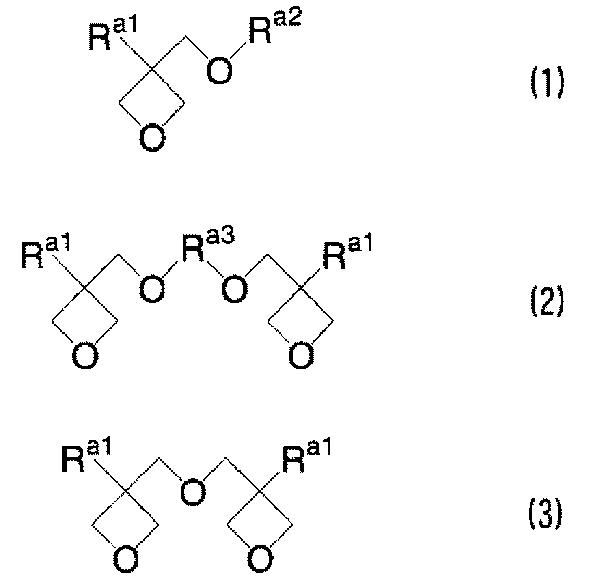
分子内に1〜2個のオキセタン環を有する化合物としては、下記式(1)〜(3)で示される化合物等が挙げられる。 Examples of the compound having 1 to 2 oxetane rings in the molecule include compounds represented by the following formulas (1) to (3).
Ra1は、水素原子、炭素数1〜6のアルキル基、炭素数1〜6のフルオロアルキル基、アリル基、アリール基、フリル基又はチエニル基を表す。分子内に2つのRa1が存在する場合、それらは同じであっても異なるものであってもよい。
アルキル基としては、メチル基、エチル基、プロピル基、ブチル基等が挙げられ、フルオロアルキル基としては、これらアルキル基の水素のいずれかがフッ素原子で置換されたものが好ましく挙げられる。
Ra2は、水素原子、炭素数1〜6個のアルキル基、炭素数2〜6個のアルケニル基、芳香環を有する基、炭素数2〜6個のアルキルカルボニル基、炭素数2〜6個のアルコキシカルボニル基、炭素数2〜6個のN−アルキルカルバモイル基を表す。アルキル基としては、メチル基、エチル基、プロピル基、ブチル基等が挙げられ、アルケニル基としては、1−プロペニル基、2−プロペニル基、2−メチル−1−プロペニル基、2−メチル−2−プロペニル基、1−ブテニル基、2−ブテニル基、3−ブテニル基等が挙げられ、芳香環を有する基としては、フェニル基、ベンジル基、フルオロベンジル基、メトキシベンジル基、フェノキシエチル基等が挙げられる。アルキルカルボニル基としては、エチルカルボニル基、プロピルカルボニル基、ブチルカルボニル基等が、アルキコキシカルボニル基としては、エトキシカルボニル基、プロポキシカルボニル基、ブトキシカルボニル基等が、N−アルキルカルバモイル基としては、エチルカルバモイル基、プロピルカルバモイル基、ブチルカルバモイル基、ペンチルカルバモイル基等が挙げられる。また、Ra2は置換基を有していてもよく、置換基としては、1〜6のアルキル基、フッ素原子が挙げられる。
R a1 represents a hydrogen atom, an alkyl group having 1 to 6 carbon atoms, a fluoroalkyl group having 1 to 6 carbon atoms, an allyl group, an aryl group, a furyl group, or a thienyl group. When two R a1 are present in the molecule, they may be the same or different.
Examples of the alkyl group include a methyl group, an ethyl group, a propyl group, and a butyl group. Preferred examples of the fluoroalkyl group include those in which any hydrogen of these alkyl groups is substituted with a fluorine atom.
R a2 is a hydrogen atom, an alkyl group having 1 to 6 carbon atoms, an alkenyl group having 2 to 6 carbon atoms, a group having an aromatic ring, an alkylcarbonyl group having 2 to 6 carbon atoms, or 2 to 6 carbon atoms. Represents an alkoxycarbonyl group, and an N-alkylcarbamoyl group having 2 to 6 carbon atoms. Examples of the alkyl group include a methyl group, an ethyl group, a propyl group, and a butyl group. Examples of the alkenyl group include a 1-propenyl group, a 2-propenyl group, a 2-methyl-1-propenyl group, and 2-methyl-2. -Propenyl group, 1-butenyl group, 2-butenyl group, 3-butenyl group and the like. Examples of the group having an aromatic ring include phenyl group, benzyl group, fluorobenzyl group, methoxybenzyl group, phenoxyethyl group and the like. Can be mentioned. As the alkylcarbonyl group, an ethylcarbonyl group, a propylcarbonyl group, a butylcarbonyl group, etc., as an alkoxycarbonyl group, an ethoxycarbonyl group, a propoxycarbonyl group, a butoxycarbonyl group, etc., as an N-alkylcarbamoyl group, Examples thereof include an ethylcarbamoyl group, a propylcarbamoyl group, a butylcarbamoyl group, and a pentylcarbamoyl group. R a2 may have a substituent, and examples of the substituent include an alkyl group of 1 to 6 and a fluorine atom.
Ra3は、線状又は分枝状アルキレン基、線状又は分枝状ポリ(アルキレンオキシ)基、線状又は分枝状不飽和炭化水素基、カルボニル基又はカルボニル基を含むアルキレン基、カルボキシル基を含むアルキレン基、カルバモイル基を含むアルキレン基、又は、以下に示す基を表す。アルキレン基としては、例えば、エチレン基、プロピレン基、ブチレン基が挙げられ、ポリ(アルキレンオキシ)基としては、ポリ(エチレンオキシ)基、ポリ(プロピレンオキシ)基等が挙げられる。不飽和炭化水素基としては、プロペニレン基、メチルプロペニレン基、ブテニレン基等が挙げられる。 R a3 represents a linear or branched alkylene group, a linear or branched poly (alkyleneoxy) group, a linear or branched unsaturated hydrocarbon group, a carbonyl group or an alkylene group containing a carbonyl group, a carboxyl group Represents an alkylene group containing, an alkylene group containing a carbamoyl group, or a group shown below. Examples of the alkylene group include an ethylene group, a propylene group, and a butylene group. Examples of the poly (alkyleneoxy) group include a poly (ethyleneoxy) group and a poly (propyleneoxy) group. Examples of the unsaturated hydrocarbon group include a propenylene group, a methylpropenylene group, and a butenylene group.
Ra3が上記多価基である場合、Ra4は、水素原子、炭素数1〜4個のアルキル基、炭素数1〜4個のアルコキシ基、ハロゲン原子、ニトロ基、シアノ基、メルカプト基、低級アルキルカルボキシル基、カルボキシル基、又はカルバモイル基を表す。
Ra5は、酸素原子、硫黄原子、メチレン基、NH、SO、SO2、C(CF3)2、又は、C(CH3)2を表す。
Ra6は、炭素数1〜4個のアルキル基、又は、アリール基を表し、nは0〜2,000の整数である。Ra7は炭素数1〜4個のアルキル基、アリール基、又は、下記構造を有する1価の基を表す。下記式中、Ra8は炭素数1〜4個のアルキル基、又はアリール基であり、mは0〜100の整数である。
When R a3 is the above polyvalent group, R a4 is a hydrogen atom, an alkyl group having 1 to 4 carbon atoms, an alkoxy group having 1 to 4 carbon atoms, a halogen atom, a nitro group, a cyano group, a mercapto group, Represents a lower alkyl carboxyl group, a carboxyl group, or a carbamoyl group.
R a5 represents an oxygen atom, a sulfur atom, a methylene group, NH, SO, SO 2 , C (CF 3 ) 2 , or C (CH 3 ) 2 .
R a6 represents an alkyl group having 1 to 4 carbon atoms or an aryl group, and n is an integer of 0 to 2,000. R a7 represents an alkyl group having 1 to 4 carbon atoms, an aryl group, or a monovalent group having the following structure. In the following formula, R a8 is an alkyl group having 1 to 4 carbon atoms or an aryl group, and m is an integer of 0 to 100.
式(1)で表される化合物として、3−エチル−3−ヒドロキシメチルオキセタン(OXT−101:東亞合成(株)製)、3−エチル−3−(2−エチルヘキシロキシメチル)オキセタン(OXT−212:東亞合成(株)製)、3−エチル−3−フェノキシメチルオキセタン(OXT−211:東亞合成(株)製)が挙げられる。式(2)で表される化合物としては、1,4−ビス[(3−エチル−3−オキセタニルメトキシ)メチル]ベンゼン(OXT−121:東亞合成(株)製)が挙げられる。また、式(3)で表される化合物としては、ビス(3−エチル−3−オキセタニルメチル)エーテル(OXT−221:東亞合成(株)製)が挙げられる。 As a compound represented by the formula (1), 3-ethyl-3-hydroxymethyloxetane (OXT-101: manufactured by Toagosei Co., Ltd.), 3-ethyl-3- (2-ethylhexyloxymethyl) oxetane (OXT) -212: manufactured by Toagosei Co., Ltd.) and 3-ethyl-3-phenoxymethyloxetane (OXT-211: manufactured by Toagosei Co., Ltd.). Examples of the compound represented by the formula (2) include 1,4-bis [(3-ethyl-3-oxetanylmethoxy) methyl] benzene (OXT-121: manufactured by Toagosei Co., Ltd.). Examples of the compound represented by the formula (3) include bis (3-ethyl-3-oxetanylmethyl) ether (OXT-221: manufactured by Toagosei Co., Ltd.).
分子内に3〜4個のオキセタン環を有する化合物としては、下記式(4)で示される化合物が挙げられる。 Examples of the compound having 3 to 4 oxetane rings in the molecule include compounds represented by the following formula (4).
式(4)において、Ra1は、前記式(1)におけるのと同義である。また、多価連結基であるRa9としては、例えば、下記A〜Cで示される基等の炭素数1〜12の分枝状アルキレン基、下記Dで示される基等の分枝状ポリ(アルキレンオキシ)基又は下記Eで示される基等の分枝状ポリシロキシ基等が挙げられる。jは、3又は4である。 In the formula (4), R a1 has the same meaning as in the formula (1). In addition, as R a9 which is a polyvalent linking group, for example, a branched polyalkylene group having 1 to 12 carbon atoms such as groups represented by the following A to C, a branched poly ( An alkyleneoxy) group or a branched polysiloxy group such as a group represented by E below. j is 3 or 4.
上記Aにおいて、Ra10はメチル基、エチル基又はプロピル基を表す。また、上記Dにおいて、pは1〜10の整数である。 In the above A, R a10 represents a methyl group, an ethyl group or a propyl group. Moreover, in said D, p is an integer of 1-10.
また、本発明に好適に用いることができるオキセタン化合物の別の態様として、側鎖にオキセタン環を有する下記式(5)で示される化合物が挙げられる。 Another embodiment of the oxetane compound that can be suitably used in the present invention includes a compound represented by the following formula (5) having an oxetane ring in the side chain.
式(5)において、Ra1及びRa8は前記式におけるのと同義である。Ra11はメチル基、エチル基、プロピル基又はブチル基等の炭素数1〜4のアルキル基又はトリアルキルシリル基であり、rは1〜4である。 In the formula (5), R a1 and R a8 have the same meaning as in the above formula. R a11 is an alkyl group having 1 to 4 carbon atoms such as a methyl group, an ethyl group, a propyl group, or a butyl group, or a trialkylsilyl group, and r is 1 to 4.
このようなオキセタン環を有する化合物については、前記特開2003−341217号公報の段落0021〜0084に詳細に記載され、ここに記載の化合物は本発明にも好適に用いることができる。
特開2004−91556号公報に記載されたオキセタン化合物も本発明に使用することができる。特開2004−91556号公報の段落0022〜0058に詳細に記載されている。
本発明で使用するオキセタン化合物の中でも、インク組成物の粘度と粘着性の観点から、オキセタン環を1個有する化合物を使用することが好ましい。
The compound having such an oxetane ring is described in detail in paragraphs 0021 to 0084 of JP-A No. 2003-341217, and the compound described therein can be suitably used in the present invention.
Oxetane compounds described in JP 2004-91556 A can also be used in the present invention. Details are described in paragraphs 0022 to 0058 of JP-A-2004-91556.
Among the oxetane compounds used in the present invention, it is preferable to use a compound having one oxetane ring from the viewpoint of the viscosity and tackiness of the ink composition.
インク組成物中のカチオン重合性化合物の含有量(−NRCO−結合を有する多官能オキセタン化合物及びその他のカチオン重合性化合物の総含有量)は、インク組成物の全固形分に対し、10〜95重量%が好ましく、30〜90重量%がより好ましく、50〜85重量%がさらに好ましい。インク組成物中のカチオン重合性化合物の含有量が上記範囲であると、硬化性に優れるインク組成物を得ることができる。
なお、インク組成物中のカチオン重合性化合物の含有量が上記範囲となるように、顔料分散物中のカチオン重合性化合物の含有量及びその後に添加するカチオン重合性化合物を適宜調整することが好ましい。
The content of the cationic polymerizable compound in the ink composition (the total content of the polyfunctional oxetane compound having a —NRCO— bond and other cationic polymerizable compounds) is 10 to 95 with respect to the total solid content of the ink composition. % By weight is preferred, 30 to 90% by weight is more preferred, and 50 to 85% by weight is even more preferred. When the content of the cationically polymerizable compound in the ink composition is in the above range, an ink composition having excellent curability can be obtained.
In addition, it is preferable to appropriately adjust the content of the cationic polymerizable compound in the pigment dispersion and the cationic polymerizable compound added thereafter so that the content of the cationic polymerizable compound in the ink composition falls within the above range. .
(B)放射線の照射により酸を発生する化合物
本発明のインク組成物は、放射線の照射により酸を発生する化合物(以下、「光酸発生剤」又は「カチオン重合開始剤」ともいう。)を含有する。
本発明に用いることができる光酸発生剤としては、光カチオン重合の光開始剤、あるいはマイクロレジスト等に使用されている光(400〜200nmの紫外線、遠紫外線、特に好ましくは、g線、h線、i線、KrFエキシマレーザー光)、ArFエキシマレーザー光、電子線、X線、分子線又はイオンビームなどの照射により酸を発生する化合物を適宜選択して使用することができる。
(B) Compound that generates acid upon irradiation with radiation The ink composition of the present invention is a compound that generates an acid upon irradiation with radiation (hereinafter, also referred to as “photoacid generator” or “cationic polymerization initiator”). contains.
Examples of the photoacid generator that can be used in the present invention include a photoinitiator for photocationic polymerization, or light (400-200 nm ultraviolet light, far ultraviolet light, particularly preferably g-ray, h A compound capable of generating an acid upon irradiation with a beam, i-line, KrF excimer laser beam), ArF excimer laser beam, electron beam, X-ray, molecular beam, ion beam, or the like can be used.
このような重合開始剤(好ましくは光酸発生剤)としては、放射線の照射により分解して酸を発生する、ジアゾニウム塩、ホスホニウム塩、スルホニウム塩、ヨードニウム塩などのオニウム塩化合物、イミドスルホネート、オキシムスルホネート、ジアゾジスルホン、ジスルホン、o−ニトロベンジルスルホネート等のスルホネート化合物などを挙げることができる。 Examples of such polymerization initiators (preferably photoacid generators) include onium salt compounds such as diazonium salts, phosphonium salts, sulfonium salts, iodonium salts, imide sulfonates, and oximes that decompose upon irradiation with radiation to generate acids. Examples thereof include sulfonate compounds such as sulfonate, diazodisulfone, disulfone and o-nitrobenzyl sulfonate.
また、その他の重合開始剤としては、例えば、S. I. Schlesinger, Photogr. Sci. Eng., 18, 387 (1974)、T. S. Bal et al, Polymer, 21, 423 (1980)等に記載のジアゾニウム塩、米国特許第4,069,055号、同4,069,056号、同 Re 27,992号の各明細書、又は、特開平3−140140号公報等に記載のアンモニウム塩、D. C. Necker et al, Macromolecules, 17, 2468 (1984)、C. S. Wen et al, Tech, Proc. Conf. Rad. Curing ASIA, p478 Tokyo, Oct (1988)、米国特許第4,069,055号、同4,069,056号の各明細書等に記載のホスホニウム塩、J. V. Crivello et al, Macromolecules, 10(6), 1307 (1977)、Chem. & Eng. News, Nov. 28, p31 (1988)、欧州特許第104,143号、同第339,049号、同第410,201号の各明細書、特開平2−150848号、特開平2−296514号の各公報等に記載のヨードニウム塩、 Examples of other polymerization initiators include diazonium salts described in, for example, SI Schlesinger, Photogr. Sci. Eng., 18, 387 (1974), TS Bal et al, Polymer, 21, 423 (1980), and the like. Patent Nos. 4,069,055, 4,069,056, Re 27,992 or ammonium salts described in JP-A-3-140140, DC Necker et al, Macromolecules , 17, 2468 (1984), CS Wen et al, Tech, Proc. Conf. Rad. Curing ASIA, p478 Tokyo, Oct (1988), US Pat. Nos. 4,069,055 and 4,069,056. Phosphonium salts described in each specification, etc., JV Crivello et al, Macromolecules, 10 (6), 1307 (1977), Chem. & Eng. News, Nov. 28, p31 (1988), European Patent No. 104,143 339,049, 410,201, JP-A-2-150848, JP-A-2-296514 Iodonium salts described in,
J. V. Crivello et al, Polymer J. 17, 73 (1985)、J. V. Crivello et al, J. Org. Chem., 43, 3055 (1978)、W. R. Watt et al, J. Polymer Sci., Polymer Chem. Ed., 22, 1789 (1984)、J. V. Crivello et al, Polymer Bull., 14, 279 (1985)、J. V. Crivello et al, Macromolecules, 14(5), 1141 (1981)、J. V. Crivello et al, J. Polymer Sci., Polymer Chem. Ed., 17, 2877 (1979)、欧州特許第370,693号、同161,811号、同410,201号、同339,049号、同233,567号、同297,443号、同297,442号の各明細書、米国特許第3,902,114号、同4,933,377号、同4,760,013号、同4,734,444号、同2,833,827号の各明細書、独国特許第2,904,626号、同3,604,580号、同3,604,581号の各明細書、又は、特開平7−28237号、同8−27102号の各公報等に記載のスルホニウム塩、 JV Crivello et al, Polymer J. 17, 73 (1985), JV Crivello et al, J. Org. Chem., 43, 3055 (1978), WR Watt et al, J. Polymer Sci., Polymer Chem. Ed. , 22, 1789 (1984), JV Crivello et al, Polymer Bull., 14, 279 (1985), JV Crivello et al, Macromolecules, 14 (5), 1141 (1981), JV Crivello et al, J. Polymer Sci , Polymer Chem. Ed., 17, 2877 (1979), European Patent Nos. 370,693, 161,811, 410,201, 339,049, 233,567, 297, 443, 297,442, U.S. Pat.Nos. 3,902,114, 4,933,377, 4,760,013, 4,734,444, 2, No. 833,827, German Patent No. 2,904,626, No. 3,604,580, No. 3,604,581 or JP-A-7-28237 8- Sulfonium salts described in JP etc. No. 7102,
J. V. Crivello et al, Macromolecules, 10(6), 1307 (1977)、J. V. Crivello et al, J. Polymer Sci., Polymer Chem. Ed., 17, 1047 (1979)等に記載のセレノニウム塩、C. S. Wen et al, Tech, Proc. Conf. Rad. Curing ASIA, p478 Tokyo, Oct (1988)等に記載のアルソニウム塩等のオニウム塩、米国特許第3,905,815号明細書、特公昭46−4605号、特開昭48−36281号、特開昭55−32070号、特開昭60−239736号、特開昭61−169835号、特開昭61−169837号、特開昭62−58241号、特開昭62−212401号、特開昭63−70243号、特開昭63−298339号の各公報等に記載の有機ハロゲン化合物、K. Meier et al, J. Rad. Curing, 13(4), 26 (1986)、T. P. Gill et al, Inorg. Chem., 19, 3007 (1980)、D. Astruc, Acc. Chem. Res., 19(12), 377 (1986)、特開平2−161445号公報等に記載の有機金属/有機ハロゲン化物、 Selenonium salts described in JV Crivello et al, Macromolecules, 10 (6), 1307 (1977), JV Crivello et al, J. Polymer Sci., Polymer Chem. Ed., 17, 1047 (1979), etc., CS Wen et Al, Tech, Proc. Conf. Rad. Curing ASIA, p478 Tokyo, Oct (1988) and the like, onium salts such as arsonium salts, U.S. Pat. No. 3,905,815, Japanese Patent Publication No. 46-4605, JP-A 48-36281, JP-A 55-32070, JP-A 60-239736, JP-A 61-169835, JP-A 61-169837, JP-A 62-58241, JP Organic halogen compounds described in JP-A-62-212401, JP-A-63-70243, JP-A-63-298339, etc., K. Meier et al, J. Rad. Curing, 13 (4), 26 (1986), TP Gill et al, Inorg. Chem., 19, 3007 (1980), D. Astruc, Acc. Chem. Res., 19 (12), 377 (1986), JP-A-2-16144 Organometallic / organic halides described in JP-like,
S. Hayase et al, J. Polymer Sci., 25, 753 (1987)、E. Reichmanis et al, J. Polymer Sci., Polymer Chem. Ed., 23, 1 (1985)、Q. Q. Zhu et al, J. Photochem., 36, 85, 39, 317 (1987)、B. Amit et al, Tetrahedron Lett., (24) 2205 (1973)、D. H. R. Barton et al, J. Chem. Soc., 3571 (1965)、P. M. Collins et al, J. Chem. Soc., Perkin I, 1695 (1975)、M. Rudinstein et al,Tetrahedron Lett., (17), 1445 (1975)、J. W. Walker et al, J. Am. Chem. Soc., 110, 7170 (1988)、S. C. Busman et al, J. Imaging Technol., 11 (4), 191 (1985)、H. M. Houlihan et al, Macromolecules, 21, 2001 (1988)、P. M. Collins et al, J. Chem. Soc., Chem. Commun., 532 (1972)、S. Hayase et al, Macromolecules, 18, 1799 (1985)、E. Reichmanis et al, J. Electrochem. Soc., Solid State Sci. Technol., 130(6)、F. M. Houlihan et al, Macromolecules, 21, 2001 (1988)、欧州特許第0290,750号、同046,083号、同156,535号、同271,851号、同0,388,343号、米国特許第3,901,710号、同4,181,531号の各明細書、又は、特開昭60−198538号、特開昭53−133022号の各公報等に記載のO−ニトロベンジル型保護基を有する重合開始剤、 S. Hayase et al, J. Polymer Sci., 25, 753 (1987), E. Reichmanis et al, J. Polymer Sci., Polymer Chem. Ed., 23, 1 (1985), QQ Zhu et al, J Photochem., 36, 85, 39, 317 (1987), B. Amit et al, Tetrahedron Lett., (24) 2205 (1973), DHR Barton et al, J. Chem. Soc., 3571 (1965), PM Collins et al, J. Chem. Soc., Perkin I, 1695 (1975), M. Rudinstein et al, Tetrahedron Lett., (17), 1445 (1975), JW Walker et al, J. Am. Chem. Soc., 110, 7170 (1988), SC Busman et al, J. Imaging Technol., 11 (4), 191 (1985), HM Houlihan et al, Macromolecules, 21, 2001 (1988), PM Collins et al, J. Chem. Soc., Chem. Commun., 532 (1972), S. Hayase et al, Macromolecules, 18, 1799 (1985), E. Reichmanis et al, J. Electrochem. Soc., Solid State Sci. Technol ., 130 (6), FM Houlihan et al, Macromolecules, 21, 2001 (1988), European Patent Nos. 0290,750, 046,083, 156,535, 271,851, 0, 388,343 O-nitrobenzyl described in U.S. Pat. Nos. 3,901,710 and 4,181,531, or JP-A-60-198538 and JP-A-53-133022 A polymerization initiator having a type protecting group,
M. TUNOOKA et al, Polymer Preprints Japan, 35(8)、G. Berner et al, J. Rad. Curing, 13(4)、W. J. Mijs et al, Coating Technol., 55 (697), 45 (1983)、Akzo H. Adachi et al, Polymer Preprints, Japan, 37(3)、欧州特許第0199,672号、同84515号、同044,115号、同第618,564号、同0101,122号、米国特許第4,371,605号、同4,431,774号の各明細書、又は、特開昭64−18143号、特開平2−245756号、特開平3−140109号の各公報等に記載のイミノスルホネート等に代表される光分解してスルホン酸を発生する化合物、特開昭61−166544号、特開平2−71270号の各公報等に記載のジスルホン化合物、特開平3−103854号、同3−103856号、同4−210960号の各公報等に記載のジアゾケトスルホン、ジアゾジスルホン化合物を挙げることができる。 M. TUNOOKA et al, Polymer Preprints Japan, 35 (8), G. Berner et al, J. Rad. Curing, 13 (4), WJ Mijs et al, Coating Technol., 55 (697), 45 (1983) Akzo H. Adachi et al, Polymer Preprints, Japan, 37 (3), European Patent Nos. 0199,672, 84515, 044,115, 618,564, 0101,122, USA In each specification of Japanese Patent Nos. 4,371,605 and 4,431,774, or in Japanese Patent Laid-Open Nos. 64-18143, 2-245756, 3-140109, etc. A compound capable of generating a sulfonic acid by photolysis represented by the above-mentioned iminosulfonates, disulfone compounds described in JP-A Nos. 61-166544 and 2-71270, JP-A No. 3-103854, The diazoketo described in JP-A-3-103856 and JP-A-4-210960 Sulfone, can be given diazodisulfone compound.
また、これらの光により酸を発生する基、あるいは化合物をポリマーの主鎖又は側鎖に導入した化合物、例えば、M. E. Woodhouse et al, J. Am. Chem. Soc., 104, 5586 (1982)、S. P. Pappas et al, J. Imaging Sci., 30(5), 218 (1986)、S. Kondo et al, Makromol. Chem., Rapid Commun., 9, 625 (1988)、Y. Yamada et al, Makromol. Chem., 152, 153, 163 (1972)、J. V. Crivello et al, J. Polymer Sci., Polymer Chem. Ed., 17, 3845 (1979)、米国特許第3,849,137号、独国特許第3,914,407号の各明細書、又は、特開昭63−26653号、特開昭55−164824号、特開昭62−69263号、特開昭63−146038号、特開昭63−163452号、特開昭62−153853号、特開昭63−146029号の各公報等に記載の化合物を用いることができる。例えば、ジアゾニウム塩、アンモニウム塩、ホスホニウム塩、ヨードニウム塩、スルホニウム塩、セレノニウム塩、アルソニウム塩等のオニウム塩、有機ハロゲン化合物、有機金属/有機ハロゲン化物、o−ニトロベンジル型保護基を有する重合開始剤、イミノスルホネート等に代表される光分解してスルホン酸を発生する化合物、ジスルホン化合物、ジアゾケトスルホン、ジアゾジスルホン化合物を挙げることができる。 Further, a group that generates an acid by these light, or a compound in which a compound is introduced into the main chain or side chain of the polymer, for example, ME Woodhouse et al, J. Am. Chem. Soc., 104, 5586 (1982), SP Pappas et al, J. Imaging Sci., 30 (5), 218 (1986), S. Kondo et al, Makromol. Chem., Rapid Commun., 9, 625 (1988), Y. Yamada et al, Makromol Chem., 152, 153, 163 (1972), JV Crivello et al, J. Polymer Sci., Polymer Chem. Ed., 17, 3845 (1979), US Pat. No. 3,849,137, German patent No. 3,914,407, or JP-A-63-26653, JP-A-55-164824, JP-A-62-69263, JP-A-63-146038, JP-A-63 The compounds described in JP-A Nos. 163452, JP-A-62-153853 and JP-A-63-146029 can be used. For example, diazonium salts, ammonium salts, phosphonium salts, iodonium salts, sulfonium salts, selenonium salts, onium salts such as arsonium salts, organic halogen compounds, organic metal / organic halides, polymerization initiators having o-nitrobenzyl type protecting groups And compounds capable of generating a sulfonic acid by photolysis, such as iminosulfonate, disulfone compounds, diazoketosulfones, and diazodisulfone compounds.
さらにV. N. R. Pillai, Synthesis, (1), 1 (1980)、A. Abad et al, Tetrahedron Lett., (47) 4555 (1971)、D. H. R. Barton et al, J. Chem. Soc., (C), 329 (1970)、米国特許第3,779,778号、欧州特許第126,712号の各明細書等に記載の光により酸を発生する化合物も使用することができる。 Furthermore, VNR Pillai, Synthesis, (1), 1 (1980), A. Abad et al, Tetrahedron Lett., (47) 4555 (1971), DHR Barton et al, J. Chem. Soc., (C), 329 (1970), US Pat. No. 3,779,778, European Patent 126,712, etc., etc., compounds that generate an acid by light can also be used.
本発明に用いることができる重合開始剤として好ましい化合物として、下記式(b1)、(b2)、(b3)で表される化合物を挙げることができる。 Preferred examples of the polymerization initiator that can be used in the present invention include compounds represented by the following formulas (b1), (b2), and (b3).
式(b1)において、R201、R202及びR203は、各々独立に有機基を表す。
X-は、非求核性アニオンを表し、好ましくはスルホン酸アニオン、カルボン酸アニオン、ビス(アルキルスルホニル)アミドアニオン、トリス(アルキルスルホニル)メチドアニオン、BF4 -、PF6 -、SbF6 -や以下に示す基などが挙げられ、好ましくは炭素原子を有する有機アニオンである。
In the formula (b1), R 201 , R 202 and R 203 each independently represents an organic group.
X − represents a non-nucleophilic anion, preferably a sulfonate anion, a carboxylate anion, a bis (alkylsulfonyl) amide anion, a tris (alkylsulfonyl) methide anion, BF 4 − , PF 6 − , SbF 6 − or the following The organic anion which has a carbon atom is preferable.
好ましい有機アニオンとしては、下式に示す有機アニオンが挙げられる。 Preferred organic anions include organic anions represented by the following formula.
Rc1は、有機基を表す。
Rc1における有機基として炭素数1〜30のものが挙げられ、好ましくはアルキル基、シクロアルキル基、アリール基、又はこれらの複数が、単結合、−O−、−CO2−、−S−、−SO3−、−SO2N(Rd1)−などの連結基で連結された基を挙げることができる。
Rc 1 represents an organic group.
Examples of the organic group in Rc 1 include those having 1 to 30 carbon atoms, and preferably an alkyl group, a cycloalkyl group, an aryl group, or a plurality of these are a single bond, —O—, —CO 2 —, —S—. , —SO 3 —, —SO 2 N (Rd 1 ) — and the like.
Rd1は、水素原子、アルキル基を表す。
Rc3、Rc4、Rc5は、各々独立に、有機基を表す。
Rc3、Rc4、Rc5の有機基として、好ましくはRc1における好ましい有機基と同じものを挙げることができ、最も好ましくは炭素数1〜4のパーフルオロアルキル基である。
Rc3とRc4が結合して環を形成していてもよい。
Rc3とRc4が結合して形成される基としてはアルキレン基、アリーレン基が挙げられる。好ましくは炭素数2〜4のパーフルオロアルキレン基である。
Rd 1 represents a hydrogen atom or an alkyl group.
Rc 3 , Rc 4 and Rc 5 each independently represents an organic group.
Preferred examples of the organic group for Rc 3 , Rc 4 , and Rc 5 include the same organic groups as those for Rc 1 , and most preferred are perfluoroalkyl groups having 1 to 4 carbon atoms.
Rc 3 and Rc 4 may combine to form a ring.
Examples of the group formed by combining Rc 3 and Rc 4 include an alkylene group and an arylene group. Preferably it is a C2-C4 perfluoroalkylene group.
Rc1、Rc3〜Rc5の有機基として、最も好ましくは1位がフッ素原子又はフルオロアルキル基で置換されたアルキル基、フッ素原子又はフルオロアルキル基で置換されたフェニル基である。フッ素原子又はフルオロアルキル基を有することにより、光照射によって発生した酸の酸性度が上がり、感度が向上する。 The organic group of Rc 1 and Rc 3 to Rc 5 is most preferably an alkyl group substituted at the 1-position with a fluorine atom or a fluoroalkyl group, or a phenyl group substituted with a fluorine atom or a fluoroalkyl group. By having a fluorine atom or a fluoroalkyl group, the acidity of the acid generated by light irradiation is increased and the sensitivity is improved.
R201、R202及びR203としての有機基の炭素数は、1〜30であることが好ましく、1〜20であることがより好ましい。
また、R201〜R203のうち2つが結合して環構造を形成してもよく、環内に酸素原子、硫黄原子、エステル結合、アミド結合、カルボニル基を含んでいてもよい。R201〜R203の内の2つが結合して形成する基としては、アルキレン基(例えば、ブチレン基、ペンチレン基)を挙げることができる。
The carbon number of the organic group as R 201 , R 202 and R 203 is preferably 1-30, more preferably 1-20.
Two of R 201 to R 203 may be bonded to form a ring structure, and the ring may contain an oxygen atom, a sulfur atom, an ester bond, an amide bond, or a carbonyl group. The two of the group formed by bonding of the R 201 to R 203, there can be mentioned an alkylene group (e.g., butylene, pentylene).
R201、R202及びR203としての有機基の具体例としては、後述する化合物(b1−1)、(b1−2)、(b1−3)における対応する基を挙げることができる。 Specific examples of the organic group as R 201 , R 202 and R 203 include corresponding groups in the compounds (b1-1), (b1-2) and (b1-3) described later.
なお、式(b1)で表される構造を複数有する化合物であってもよい。例えば、式(b1)で表される化合物のR201〜R203のうち少なくともひとつが、式(b1)で表される他の化合物におけるR201〜R203の少なくともひとつと直接、又は、連結基を介して結合した構造を有する化合物であってもよい。 In addition, the compound which has two or more structures represented by Formula (b1) may be sufficient. For example, at least one of R 201 to R 203 of a compound represented by the formula (b1) is at least one directly with R 201 to R 203 of another compound represented by formula (b1), or a linking group It may be a compound having a structure bonded via
さらに好ましい(b1)成分として、以下に説明する化合物(b1−1)、(b1−2)、及び(b1−3)を挙げることができる。 More preferred components (b1) include compounds (b1-1), (b1-2), and (b1-3) described below.
化合物(b1−1)は、上記式(b1)のR201〜R203の少なくとも1つがアリール基である、アリールスルホニム化合物、すなわち、アリールスルホニウムをカチオンとする化合物である。 Compound (b1-1) is in which at least one aryl group R 201 to R 203 in formula (b1), arylsulfonium compound, i.e., compounds containing an arylsulfonium as a cation.
アリールスルホニウム化合物は、R201〜R203の全てがアリール基でもよいし、R201〜R203の一部がアリール基で、残りがアルキル基、シクロアルキル基でもよい。 In the arylsulfonium compound, all of R 201 to R 203 may be an aryl group, or a part of R 201 to R 203 may be an aryl group, and the rest may be an alkyl group or a cycloalkyl group.
アリールスルホニウム化合物としては、例えば、トリアリールスルホニウム化合物、ジアリールアルキルスルホニウム化合物、アリールジアルキルスルホニウム化合物、ジアリールシクロアルキルスルホニウム化合物、アリールジシクロアルキルスルホニウム化合物等を挙げることができる。 Examples of the arylsulfonium compound include triarylsulfonium compounds, diarylalkylsulfonium compounds, aryldialkylsulfonium compounds, diarylcycloalkylsulfonium compounds, aryldicycloalkylsulfonium compounds, and the like.
アリールスルホニウム化合物のアリール基としては、フェニル基、ナフチル基などのアリール基、インドール残基、ピロール残基などのヘテロアリール基が好ましく、さらに好ましくはフェニル基、インドール残基である。アリールスルホニム化合物が2つ以上のアリール基を有する場合に、2つ以上あるアリール基は同一であっても異なっていてもよい。 The aryl group of the arylsulfonium compound is preferably an aryl group such as a phenyl group or a naphthyl group, or a heteroaryl group such as an indole residue or a pyrrole residue, and more preferably a phenyl group or an indole residue. When the arylsulfonium compound has two or more aryl groups, the two or more aryl groups may be the same or different.
アリールスルホニウム化合物が必要に応じて有しているアルキル基としては、炭素数1〜15の直鎖又は分岐状アルキル基が好ましく、例えば、メチル基、エチル基、プロピル基、n−ブチル基、sec−ブチル基、t−ブチル基等を挙げることができる。
アリールスルホニウム化合物が必要に応じて有しているシクロアルキル基としては、炭素数3〜15のシクロアルキル基が好ましく、例えば、シクロプロピル基、シクロブチル基、シクロヘキシル基等を挙げることができる。
As the alkyl group that the arylsulfonium compound has as necessary, a linear or branched alkyl group having 1 to 15 carbon atoms is preferable. For example, a methyl group, an ethyl group, a propyl group, an n-butyl group, sec -A butyl group, a t-butyl group, etc. can be mentioned.
The cycloalkyl group that the arylsulfonium compound has as necessary is preferably a cycloalkyl group having 3 to 15 carbon atoms, and examples thereof include a cyclopropyl group, a cyclobutyl group, and a cyclohexyl group.
R201〜R203のアリール基、アルキル基、シクロアルキル基は、アルキル基(例えば炭素数1〜15)、シクロアルキル基(例えば炭素数3〜15)、アリール基(例えば炭素数6〜14)、アルコキシ基(例えば炭素数1〜15)、ハロゲン原子、水酸基、フェニルチオ基を置換基として有してもよい。好ましい置換基としては、炭素数1〜12の直鎖又は分岐状アルキル基、炭素数3〜12のシクロアルキル基、炭素数1〜12の直鎖、分岐又は環状のアルコキシ基であり、最も好ましくは炭素数1〜4のアルキル基、炭素数1〜4のアルコキシ基である。置換基は、3つのR201〜R203のうち、いずれか1つに置換していてもよいし、3つ全てに置換していてもよい。また、R201〜R203がアリール基の場合に、置換基はアリール基のp−位に置換していることが好ましい。 Aryl group, alkyl group of R 201 to R 203, cycloalkyl group, an alkyl group (for example, 1 to 15 carbon atoms), a cycloalkyl group (for example, 3 to 15 carbon atoms), an aryl group (for example, 6 to 14 carbon atoms) , An alkoxy group (for example, having 1 to 15 carbon atoms), a halogen atom, a hydroxyl group, or a phenylthio group may be substituted. Preferred substituents are linear or branched alkyl groups having 1 to 12 carbon atoms, cycloalkyl groups having 3 to 12 carbon atoms, and linear, branched or cyclic alkoxy groups having 1 to 12 carbon atoms, and most preferred. Is an alkyl group having 1 to 4 carbon atoms and an alkoxy group having 1 to 4 carbon atoms. Substituents, of the three R 201 to R 203, may be substituted on any one, or may be substituted on all of three. When R 201 to R 203 are an aryl group, the substituent is preferably substituted at the p-position of the aryl group.
次に、化合物(b1−2)について説明する。
化合物(b1−2)は、式(b1)におけるR201〜R203が、各々独立に、芳香環を含有しない有機基を表す場合の化合物である。ここで芳香環とは、ヘテロ原子を含有する芳香族環も包含するものである。
R201〜R203としての芳香環を含有しない有機基は、炭素数1〜30であることが好ましく、炭素数1〜20であることがより好ましい。
R201〜R203は、各々独立に、好ましくはアルキル基、シクロアルキル基、アリル基、ビニル基であり、より好ましくは直鎖、分岐又は環状2−オキソアルキル基、アルコキシカルボニルメチル基、特に好ましくは直鎖又は分岐2−オキソアルキル基である。
Next, the compound (b1-2) will be described.
The compound (b1-2) is a compound in the case where R 201 to R 203 in the formula (b1) each independently represents an organic group not containing an aromatic ring. Here, the aromatic ring includes an aromatic ring containing a hetero atom.
The organic group having no aromatic ring as R 201 to R 203 is preferably from 1 to 30 carbon atoms, and more preferably 1 to 20 carbon atoms.
R 201 to R 203 are each independently preferably an alkyl group, a cycloalkyl group, an allyl group or a vinyl group, more preferably a linear, branched or cyclic 2-oxoalkyl group, an alkoxycarbonylmethyl group, particularly preferably Is a linear or branched 2-oxoalkyl group.
R201〜R203としてのアルキル基は、直鎖状、分岐状のいずれであってもよく、好ましくは、炭素数1〜10の直鎖又は分岐アルキル基(例えば、メチル基、エチル基、プロピル基、ブチル基、ペンチル基)を挙げることができ、直鎖、分岐2−オキソアルキル基、アルコキシカルボニルメチル基がより好ましい。 The alkyl group as R 201 to R 203 may be linear, it may be either branched, preferably a straight-chain or branched alkyl group (e.g., methyl group having 1 to 10 carbon atoms, an ethyl group, a propyl Group, a butyl group, a pentyl group), and a linear, branched 2-oxoalkyl group, and an alkoxycarbonylmethyl group are more preferable.
R201〜R203としてのシクロアルキル基は、好ましくは、炭素数3〜10のシクロアルキル基(シクロペンチル基、シクロヘキシル基、ノルボニル基)を挙げることができ、環状2−オキソアルキル基がより好ましい。 The cycloalkyl group as R 201 to R 203 is preferably a cycloalkyl group having 3 to 10 carbon atoms (a cyclopentyl group, a cyclohexyl group, a norbornyl group) can be exemplified, more preferably a cyclic 2-oxoalkyl group.
R201〜R203の直鎖、分岐、環状2−オキソアルキル基としては、好ましくは、上記のアルキル基、シクロアルキル基の2位に>C=Oを有する基を挙げることができる。
R201〜R203としてのアルコキシカルボニルメチル基におけるアルコキシ基としては、好ましくは炭素数1〜5のアルコキシ基(メトキシ基、エトキシ基、プロポキシ基、ブトキシ基、ペントキシ基)を挙げることができる。
R201〜R203は、ハロゲン原子、アルコキシ基(例えば、炭素数1〜5)、水酸基、シアノ基、ニトロ基によってさらに置換されていてもよい。
Linear R 201 to R 203, branched, or cyclic 2-oxoalkyl group, preferably, may be mentioned 2-position group having> C = O at the above-described alkyl or cycloalkyl group.
The alkoxy group in the alkoxycarbonylmethyl group as R 201 to R 203, preferably may be mentioned alkoxy groups having 1 to 5 carbon atoms (a methoxy group, an ethoxy group, a propoxy group, a butoxy group, a pentoxy group).
R 201 to R 203 may be further substituted with a halogen atom, an alkoxy group (eg, having 1 to 5 carbon atoms), a hydroxyl group, a cyano group, or a nitro group.
化合物(b1−3)とは、以下の式(b1−3)で表される化合物であり、フェナシルスルホニウム塩構造を有する化合物である。 The compound (b1-3) is a compound represented by the following formula (b1-3) and is a compound having a phenacylsulfonium salt structure.
式(b1−3)において、R1c〜R5cは、各々独立に、水素原子、アルキル基、シクロアルキル基、アルコキシ基、又はハロゲン原子を表す。
R6c及びR7cは、各々独立に、水素原子、アルキル基又はシクロアルキル基を表す。
Rx及びRyは、各々独立に、アルキル基、シクロアルキル基、アリル基、又はビニル基を表す。
R1c〜R5c中のいずれか2つ以上、R6cとR7c、及びRxとRyは、それぞれ結合して環構造を形成してもよい。
Zc-は、非求核性アニオンを表し、式(b1)におけるX-の非求核性アニオンと同様のものを挙げることができる。
In formula (b1-3), R 1c to R 5c each independently represents a hydrogen atom, an alkyl group, a cycloalkyl group, an alkoxy group, or a halogen atom.
R 6c and R 7c each independently represents a hydrogen atom, an alkyl group or a cycloalkyl group.
R x and R y each independently represents an alkyl group, a cycloalkyl group, an allyl group, or a vinyl group.
Any two or more of R 1c to R 5c , R 6c and R 7c , and R x and R y may be bonded to each other to form a ring structure.
Zc − represents a non-nucleophilic anion, and examples thereof include the same as the non-nucleophilic anion of X − in formula (b1).
R1c〜R7cとしてのアルキル基は、直鎖状、分岐状のいずれであってもよく、例えば炭素数1〜20個、好ましくは炭素数1〜12個の直鎖及び分岐アルキル基(例えば、メチル基、エチル基、直鎖又は分岐プロピル基、直鎖又は分岐ブチル基、直鎖又は分岐ペンチル基)を挙げることができる。 The alkyl group as R 1c to R 7c may be either linear or branched, for example, a linear or branched alkyl group having 1 to 20 carbon atoms, preferably 1 to 12 carbon atoms (for example, Methyl group, ethyl group, linear or branched propyl group, linear or branched butyl group, linear or branched pentyl group).
R1c〜R7cのシクロアルキル基として、好ましくは、炭素数3〜8個のシクロアルキル基(例えば、シクロペンチル基、シクロヘキシル基)を挙げることができる。 Preferred examples of the cycloalkyl group represented by R 1c to R 7c include a cycloalkyl group having 3 to 8 carbon atoms (for example, a cyclopentyl group and a cyclohexyl group).
R1c〜R5cとしてのアルコキシ基は、直鎖、分岐、環状のいずれであってもよく、例えば炭素数1〜10のアルコキシ基、好ましくは、炭素数1〜5の直鎖及び分岐アルコキシ基(例えば、メトキシ基、エトキシ基、直鎖又は分岐プロポキシ基、直鎖又は分岐ブトキシ基、直鎖又は分岐ペントキシ基)、炭素数3〜8の環状アルコキシ基(例えば、シクロペンチルオキシ基、シクロヘキシルオキシ基)を挙げることができる。 The alkoxy group as R 1c to R 5c may be linear, branched or cyclic, for example, an alkoxy group having 1 to 10 carbon atoms, preferably a linear or branched alkoxy group having 1 to 5 carbon atoms. (For example, methoxy group, ethoxy group, linear or branched propoxy group, linear or branched butoxy group, linear or branched pentoxy group), C3-C8 cyclic alkoxy group (for example, cyclopentyloxy group, cyclohexyloxy group) ).
R1c〜R5c中のいずれか2つ以上、R6cとR7c、及びRxとRyが結合して形成する基としては、ブチレン基、ペンチレン基等を挙げることができる。この環構造は、酸素原子、硫黄原子、エステル結合、アミド結合を含んでいてもよい。 Examples of the group formed by combining any two or more of R 1c to R 5c , R 6c and R 7c , and R x and R y include a butylene group and a pentylene group. This ring structure may contain an oxygen atom, a sulfur atom, an ester bond, or an amide bond.
好ましくはR1c〜R5cのうちいずれかが直鎖状若しくは分岐状アルキル基、シクロアルキル基又は直鎖、分岐、環状アルコキシ基であり、さらに好ましくはR1cからR5cの炭素数の和が2〜15である。上記態様であると、溶剤溶解性がより向上し、保存時にパーティクルの発生が抑制される。 Preferably any one of R 1c to R 5c is a linear or branched alkyl group, a cycloalkyl group, or a linear, branched or cyclic alkoxy group, and more preferably the sum of the carbon number of R 1c to R 5c is 2-15. If it is the said aspect, solvent solubility will improve more and generation | occurrence | production of a particle will be suppressed at the time of a preservation | save.
Rx及びRyとしてのアルキル基、シクロアルキル基は、R1c〜R7cとしてのアルキル基、シクロアルキル基と同様のものを挙げることができる。
Rx及びRyは、2−オキソアルキル基、アルコキシカルボニルメチル基であることが好ましい。
2−オキソアルキル基は、R1c〜R5cとしてのアルキル基、シクロアルキル基の2位に>C=Oを有する基を挙げることができる。
アルコキシカルボニルメチル基におけるアルコキシ基については、R1c〜R5cとしてのアルコキシ基と同様のものを挙げることができる。
Examples of the alkyl group and cycloalkyl group as R x and R y include the same alkyl groups and cycloalkyl groups as R 1c to R 7c .
R x and R y are preferably a 2-oxoalkyl group or an alkoxycarbonylmethyl group.
Examples of the 2-oxoalkyl group include a group having> C═O at the 2-position of the alkyl group or cycloalkyl group as R 1c to R 5c .
Examples of the alkoxy group in the alkoxycarbonylmethyl group include the same alkoxy groups as R 1c to R 5c .
Rx、Ryは、好ましくは炭素数4個以上のアルキル基、シクロアルキル基であり、より好ましくは6個以上、さらに好ましくは8個以上のアルキル基、シクロアルキル基である。 R x and R y are preferably an alkyl group or cycloalkyl group having 4 or more carbon atoms, more preferably 6 or more, and still more preferably 8 or more alkyl groups or cycloalkyl groups.
式(b2)、(b3)中、R204〜R207は、各々独立に、アリール基、アルキル基又はシクロアルキル基を表す。X-は、非求核性アニオンを表し、式(b1)におけるX-の非求核性アニオンと同様のものを挙げることができる。 Formula (b2), in (b3), R 204 ~R 207 each independently represents an aryl group, an alkyl group or a cycloalkyl group. X − represents a non-nucleophilic anion, and examples thereof include the same as the non-nucleophilic anion of X − in formula (b1).
R204〜R207のアリール基としては、フェニル基、ナフチル基が好ましく、フェニル基がより好ましい。
R204〜R207としてのアルキル基は、直鎖状、分岐状のいずれであってもよく、好ましくは、炭素数1〜10の直鎖又は分岐アルキル基(例えば、メチル基、エチル基、プロピル基、ブチル基、ペンチル基)を挙げることができる。R204〜R207としてのシクロアルキル基は、好ましくは、炭素数3〜10のシクロアルキル基(シクロペンチル基、シクロヘキシル基、ノルボニル基)を挙げることができる。
R204〜R207が有していてもよい置換基としては、例えば、アルキル基(例えば炭素数1〜15)、シクロアルキル基(例えば炭素数3〜15)、アリール基(例えば炭素数6〜15)、アルコキシ基(例えば炭素数1〜15)、ハロゲン原子、水酸基、フェニルチオ基等を挙げることができる。
The aryl group of R 204 to R 207, a phenyl group, a naphthyl group are preferred, the phenyl group is more preferable.
The alkyl group as R 204 to R 207 may be linear, it may be either branched, preferably a straight-chain or branched alkyl group (e.g., methyl group having 1 to 10 carbon atoms, an ethyl group, a propyl Group, butyl group, pentyl group). The cycloalkyl group as R 204 to R 207 is preferably, and a cycloalkyl group having 3 to 10 carbon atoms (e.g., cyclopentyl, cyclohexyl, norbornyl).
The R 204 to R 207 are substituents which may have, for example, an alkyl group (for example, 1 to 15 carbon atoms), a cycloalkyl group (for example, 3 to 15 carbon atoms), an aryl group (e.g., 6 carbon atoms 15), alkoxy groups (for example, having 1 to 15 carbon atoms), halogen atoms, hydroxyl groups, phenylthio groups and the like.
放射線の照射により酸を発生する化合物として、さらに、下記式(b4)、(b5)、(b6)で表される化合物を挙げることができる。 Examples of the compound that generates an acid upon irradiation with radiation further include compounds represented by the following formulas (b4), (b5), and (b6).
式(b4)〜(b6)中、Ar3及びAr4は、各々独立に、アリール基を表す。
R206、R207及びR208は、各々独立に、アルキル基、シクロアルキル基又はアリール基を表す。
Aは、アルキレン基、アルケニレン基又はアリーレン基を表す。
In formulas (b4) to (b6), Ar 3 and Ar 4 each independently represents an aryl group.
R 206 , R 207 and R 208 each independently represents an alkyl group, a cycloalkyl group or an aryl group.
A represents an alkylene group, an alkenylene group or an arylene group.
前記重合開始剤の中でも好ましいものとしては、式(b1)〜(b3)で表される化合物を挙げることができる。
本発明に用いることができる放射線の照射により酸を発生する化合物の好ましい化合物例〔(b−1)〜(b−96)〕を以下に挙げるが、本発明はこれらに限定されるものではない。
Preferable examples of the polymerization initiator include compounds represented by formulas (b1) to (b3).
Preferable compound examples [(b-1) to (b-96)] of compounds capable of generating an acid upon irradiation with radiation that can be used in the present invention are listed below, but the present invention is not limited thereto. .
また、特開2002−122994号公報の段落0029〜0030に記載のオキサゾール誘導体、s−トリアジン誘導体なども好適に用いられる。
特開2002−122994号公報の段落0037〜0063に例示されるオニウム塩化合物、スルホネート系化合物も本発明に好適に使用することができる。
Further, oxazole derivatives and s-triazine derivatives described in paragraphs 0029 to 0030 of JP-A No. 2002-122994 are also preferably used.
Onium salt compounds and sulfonate compounds exemplified in paragraphs 0037 to 0063 of JP-A-2002-122994 can also be suitably used in the present invention.
光酸発生剤は、1種単独で又は2種以上を組み合わせて使用することができる。
インク組成物中の光酸発生剤の含有量は、インク組成物の全固形分換算で、0.1〜20重量%が好ましく、0.5〜10重量%がより好ましく、1〜9重量%がさらに好ましく、1〜7重量%が特に好ましい。
A photo-acid generator can be used individually by 1 type or in combination of 2 or more types.
The content of the photoacid generator in the ink composition is preferably 0.1 to 20% by weight, more preferably 0.5 to 10% by weight, and more preferably 1 to 9% by weight in terms of the total solid content of the ink composition. Is more preferable, and 1 to 7% by weight is particularly preferable.
(C)着色剤
本発明のインク組成物は、(C)着色剤を含有する。
本発明に用いることができる着色剤としては、特に制限はなく、顔料、油溶性染料、水溶性染料、分散染料等の公知の着色剤から任意に選択して使用することができる。この中でも、着色剤としては、耐候性に優れ、色再現性に富む点から、顔料、及び/又は、油溶性染料であることが好ましく、顔料であることがより好ましい。
本発明のインク組成物に好適に使用し得る着色剤は、活性放射線による硬化反応の感度を低下させないという観点からは、硬化反応である重合反応において重合禁止剤として機能しない化合物を選択することが好ましい。
(C) Colorant The ink composition of the present invention contains (C) a colorant.
The colorant that can be used in the present invention is not particularly limited, and can be arbitrarily selected from known colorants such as pigments, oil-soluble dyes, water-soluble dyes, and disperse dyes. Among these, the colorant is preferably a pigment and / or an oil-soluble dye, more preferably a pigment, from the viewpoint of excellent weather resistance and rich color reproducibility.
The colorant that can be suitably used in the ink composition of the present invention is a compound that does not function as a polymerization inhibitor in a polymerization reaction that is a curing reaction, from the viewpoint of not reducing the sensitivity of the curing reaction by actinic radiation. preferable.
<顔料>
顔料としては、特に制限はなく、目的に応じて適宜選択することができ、例えば、公知の有機顔料及び無機顔料などが挙げられ、また、染料で染色した樹脂粒子、市販の顔料分散体や表面処理された顔料(例えば、顔料を分散媒として水、液状有機化合物や不溶性の樹脂等に分散させたもの、及び、樹脂や顔料誘導体等で顔料表面を処理したもの等)も挙げられる。なお、前記顔料としては、例えば、伊藤征司郎編「顔料の辞典」(2000年、朝倉書店発行)、橋本勲著「有機顔料ハンドブック」(2006年、カラーオフィス発行)、W. Herbst, K. Hunger編「Industrial Organic Pigments」(1992年、Wiley−VHC発行)、特開2002−12607号公報、特開2002−188025号公報、特開2003−26978号公報、特開2003−342503号公報に記載のものが挙げられる。
<Pigment>
The pigment is not particularly limited and may be appropriately selected depending on the purpose. Examples thereof include known organic pigments and inorganic pigments. Resin particles dyed with dyes, commercially available pigment dispersions and surfaces Treated pigments (for example, pigments dispersed in water, liquid organic compounds or insoluble resins, and pigment surfaces treated with resins, pigment derivatives, etc.) are also included. Examples of the pigment include, for example, “The Pigment Dictionary” edited by Seijiro Ito (2000, published by Asakura Shoten), Isao Hashimoto “Organic Pigment Handbook” (2006, published by Color Office), Herbst, K.M. Hunger, “Industrial Organic Pigments” (1992, issued by Wiley-VHC), JP 2002-12607 A, JP 2002-188025 A, JP 2003-26978 A, JP 2003-342503 A Can be mentioned.
前記有機顔料及び無機顔料としては、例えば、黄色顔料、赤色顔料、マゼンタ顔料、青色顔料、シアン顔料、緑色顔料、橙色顔料、紫色顔料、褐色顔料、黒色顔料、白色顔料等が挙げられる。
前記黄色顔料としては、C.I.ピグメントイエロー 1、2、3、4、5、10、65、73、74、75、97、98、111、116、130、167、205等のモノアゾ顔料、61、62、100、168、169、183、191、206、209、212等のモノアゾレーキ顔料、12、13、14、16、17、55、63、77、81、83、106、124、126、127、152、155、170、172、174、176、214、219等のジスアゾ顔料、24、99、108、193、199等のアントラキノン顔料、60等のモノアゾピラゾロン顔料、93、95、128、166等の縮合アゾ顔料、109、110、139、173、185等のイソインドリン顔料、120、151、154、175、180、181、194等のベンズイミダゾロン顔料、117、129、150、153等のアゾメチン金属錯体顔料、138等のキノフタロン顔料、213等のキノキサリン顔料が好ましい。
Examples of the organic pigment and the inorganic pigment include a yellow pigment, a red pigment, a magenta pigment, a blue pigment, a cyan pigment, a green pigment, an orange pigment, a purple pigment, a brown pigment, a black pigment, and a white pigment.
Examples of the yellow pigment include C.I. I. Pigment Yellow 1, 2, 3, 4, 5, 10, 65, 73, 74, 75, 97, 98, 111, 116, 130, 167, 205, monoazo pigments, 61, 62, 100, 168, 169, Monoazo lake pigments such as 183, 191, 206, 209, 212, 12, 13, 14, 16, 17, 55, 63, 77, 81, 83, 106, 124, 126, 127, 152, 155, 170, 172, Disazo pigments such as 174, 176, 214 and 219, anthraquinone pigments such as 24, 99, 108, 193 and 199, monoazopyrazolone pigments such as 60, condensed azo pigments such as 93, 95, 128 and 166, 109, 110, 139, 173, 185 and other isoindoline pigments, 120, 151, 154, 175, 180, 181, 194 and other benz Izoazolone pigments, azomethine metal complex pigments such as 117, 129, 150 and 153, quinophthalone pigments such as 138, and quinoxaline pigments such as 213 are preferred.
前記赤色又はマゼンタ顔料としては、C.I.ピグメントレッド 193等のモノアゾレーキ顔料、38等のジスアゾ顔料、2、5、8、9、10、11、12、14、15、16、17、18、22、23、31、32、112、114、146、147、150、170、184、187、188、210、213、238、245、253、256、258、266、268、269等のナフトールAS顔料、3、4、6等のβ−ナフトール顔料、49、53、68等β−ナフトールレーキ顔料、237、239、247等のナフトールASレーキ顔料、41等のピラゾロン顔料、48、52、57、58、63、64:1、200等のBONAレーキ顔料、81:1、169、172等のキサンテンレーキ顔料、88、181、279等のチオインジゴ顔料、123、149、178、179、190、224等のペリレン顔料、144、166、214、220、221、242、262等の縮合アゾ顔料、168、177、182、226、263等のアントラキノン顔料、83等のアントラキノンレーキ顔料、171、175、176、185、208等のベンズイミダゾロン顔料、122、202(C.I.ピグメントバイオレット 19との混合物を含む)、207、209等のキナクリドン顔料、254、255、264、270、272等のジケトピロロピロール顔料、257、271等のアゾメチン金属錯体顔料が好ましい。 Examples of the red or magenta pigment include C.I. I. Pigment Red 193 and other monoazo lake pigments, 38 and other disazo pigments, 2, 5, 8, 9, 10, 11, 12, 14, 15, 16, 17, 18, 22, 23, 31, 32, 112, 114, Naphthol AS pigments such as 146, 147, 150, 170, 184, 187, 188, 210, 213, 238, 245, 253, 256, 258, 266, 268, 269, etc. β-naphthol pigments such as 3, 4, 6, etc. 49, 53, 68 etc. β-naphthol lake pigments, 237, 239, 247 etc. naphthol AS lake pigments, 41 etc. pyrazolone pigments, 48, 52, 57, 58, 63, 64: 1, 200 etc. BONA lakes Pigment, xanthene lake pigment such as 81: 1, 169, 172, thioindigo pigment such as 88, 181, 279, 123, 149, 17 Perylene pigments such as 179, 190 and 224, condensed azo pigments such as 144, 166, 214, 220, 221, 242, and 262, anthraquinone pigments such as 168, 177, 182, 226, and 263, and anthraquinone lake pigments such as 83 Benzimidazolone pigments such as 171, 175, 176, 185, 208, etc., quinacridone pigments such as 122, 202 (including mixtures with CI Pigment Violet 19), 207, 209, 254, 255, 264, 270 Preferred are diketopyrrolopyrrole pigments such as 272 and azomethine metal complex pigments such as 257 and 271.
前記青色又はシアン顔料としては、C.I.ピグメントブルー 25、26等のナフトールAS顔料、15、15:1、15:2、15:3、15:4、15:6、16、17:1、75、79等のフタロシアニン顔料、1、24:1、56、61、62等の染付けレーキ顔料、60等のアントラキノン系顔料、63等のインジゴ顔料、80等のジオキサジン顔料が好ましい。
前記緑色顔料としては、C.I.ピグメントグリーン 1、4等の染付けレーキ顔料、7、36等のフタロシアニン顔料、8等のアゾメチン金属錯体顔料が好ましい。
前記橙色顔料としては、C.I.ピグメントオレンジ 1等のモノアゾ顔料、2、3、5等のβ−ナフトール顔料、4、24、38、74等のナフトールAS顔料、13、34等のピラゾロン顔料、36、60、62、64、72等のベンズイミダゾロン顔料、15、16等のジスアゾ顔料、17、46等のβ−ナフトールレーキ顔料、19等のナフタレンスルホン酸レーキ顔料、43等のペリノン顔料、48、49等のキナクリドン顔料、51等のアントラキノン系顔料、61等のイソインドリノン顔料、66等のイソインドリン系顔料、68等のアゾメチン金属錯体顔料、71、73、81等のジケトピロロピロール顔料が好ましい。
Examples of the blue or cyan pigment include C.I. I. Naphthol AS pigments such as CI Pigment Blue 25 and 26, phthalocyanine pigments such as 15, 15: 1, 15: 2, 15: 3, 15: 4, 15: 6, 16, 17: 1, 75, and 79 Dye lake pigments such as 1:56, 61, 62, anthraquinone pigments such as 60, indigo pigments such as 63, and dioxazine pigments such as 80 are preferable.
Examples of the green pigment include C.I. I. Dye lake pigments such as CI Pigment Green 1 and 4, phthalocyanine pigments such as 7 and 36, and azomethine metal complex pigments such as 8 are preferable.
Examples of the orange pigment include C.I. I. Monoazo pigments such as CI Pigment Orange 1, β-naphthol pigments such as 2, 3, 5 and the like, naphthol AS pigments such as 4, 24, 38 and 74, pyrazolone pigments such as 13, 34, 36, 60, 62, 64 and 72 Benzimidazolone pigments such as 15 and 16, disazo pigments such as 15 and 16, β-naphthol lake pigments such as 17 and 46, naphthalene sulfonic acid lake pigments such as 19; perinone pigments such as 43, quinacridone pigments such as 48 and 49, 51 Anthraquinone pigments such as 61, isoindolinone pigments such as 61, isoindoline pigments such as 66, azomethine metal complex pigments such as 68, and diketopyrrolopyrrole pigments such as 71, 73 and 81 are preferred.
前記褐色顔料としては、C.I.ピグメントブラウン 5等のBONAレーキ顔料、23、41、42等の縮合アゾ顔料、25、32等のベンズイミダゾロン顔料が好ましい。
前記紫色顔料としては、C.I.ピグメントバイオレット 1、2、3、27等の染付けレーキ顔料、13、17、25、50等のナフトールAS顔料、5:1等のアントラキノンレーキ顔料、19等のキナクリドン顔料、23、37等のジオキサジン顔料、29等のペリレン顔料、32等のベンズイミダゾロン顔料、38等のチオインジゴ顔料が好ましい。
前記黒色顔料としては、C.I.ピグメントブラック 1等のインダジン顔料、7であるカーボンブラック、10であるグラファイト、11であるマグネタイト、20等のアントラキノン顔料、31、32等のペリレン顔料が好ましい。
前記白色顔料としては、C.I.ピグメントホワイト 4である酸化亜鉛、6である酸化チタン、7である硫化亜鉛、12である酸化ジルコニウム(ジルコニウムホワイト)、18である炭酸カルシウム、19である酸化アルミニウム・酸化ケイ素(カオリンクレー)、21又は22である硫酸バリウム、23である水酸化アルミニウム(アルミナホワイト)、27である酸化ケイ素、28であるケイ酸カルシウムが好ましい。
白色顔料に使用される無機粒子は単体でもよいし、ケイ素、アルミニウム、ジルコニウム、チタン等の酸化物や有機金属化合物、有機化合物との複合粒子であってもよい。
中でも前記酸化チタンは、他の白色顔料と比べて比重が小さい、屈折率が大きい、隠蔽力や着色力が大きい、酸やアルカリ、その他の環境に対する耐久性にも優れていることから、好適に使用される。なお、前記酸化チタンに加えて他の白色顔料(上述した白色顔料以外のものであってもよい。)を併用してもよい。
Examples of the brown pigment include C.I. I. BONA lake pigments such as CI Pigment Brown 5, condensed azo pigments such as 23, 41 and 42, and benzimidazolone pigments such as 25 and 32 are preferred.
Examples of the purple pigment include C.I. I. Pigment violet 1, 2, 3, 27 etc. dyed lake pigments, 13, 17, 25, 50 etc. naphthol AS pigments, 5: 1 etc. anthraquinone lake pigments, 19 etc. quinacridone pigments, 23, 37 etc. dioxazine pigments A perylene pigment such as No. 29, benzimidazolone pigment such as No. 32, and a thioindigo pigment such as No. 38 are preferred.
Examples of the black pigment include C.I. I. Indazine pigments such as CI pigment black 1, carbon black as 7, graphite as 10, magnetite as 11, anthraquinone pigment as 20 and perylene pigment as 31 and 32 are preferable.
Examples of the white pigment include C.I. I. Pigment White 4 Zinc oxide, 6 Titanium oxide, 7 Zinc sulfide, 12 Zirconium oxide (zirconium white), 18 Calcium carbonate, 19 Aluminum oxide / silicon oxide (Kaolin clay), 21 Or the barium sulfate which is 22, the aluminum hydroxide (alumina white) which is 23, the silicon oxide which is 27, and the calcium silicate which is 28 are preferable.
The inorganic particles used in the white pigment may be simple substances, or may be oxides such as silicon, aluminum, zirconium, and titanium, organometallic compounds, and composite particles with organic compounds.
Among these, the titanium oxide has a smaller specific gravity than other white pigments, a large refractive index, a large hiding power and coloring power, and is excellent in durability against acids, alkalis and other environments. used. In addition to the titanium oxide, another white pigment (may be other than the above-described white pigment) may be used in combination.
顔料粒子の平均粒径は、好ましくは0.005〜0.5μm、より好ましくは0.01〜0.45μm、さらに好ましくは0.015〜0.4μmとなるよう、顔料、分散剤、媒体の選定、分散条件、ろ過条件を設定することが好ましい。平均粒径が上記の範囲であると、ヘッドノズルの詰まりを抑制し、インク組成物の保存安定性、透明性及び硬化速度を維持することができる。 The average particle diameter of the pigment particles is preferably 0.005 to 0.5 μm, more preferably 0.01 to 0.45 μm, and still more preferably 0.015 to 0.4 μm. It is preferable to set selection, dispersion conditions, and filtration conditions. When the average particle size is in the above range, clogging of the head nozzle can be suppressed, and the storage stability, transparency, and curing speed of the ink composition can be maintained.
<油溶性染料>
以下に、本発明に用いることができる油溶性染料について説明する。
本発明に用いることができる油溶性染料とは、水に実質的に不溶な染料を意味する。具体的には、25℃での水への溶解度(水100gに溶解できる染料の質量)が1g以下であり、好ましくは0.5g以下、より好ましくは0.1g以下であるものを指す。したがって、油溶性染料とは、いわゆる水に不溶性の顔料や油溶性色素を意味し、これらの中でも油溶性色素が好ましい。
<Oil-soluble dye>
The oil-soluble dye that can be used in the present invention will be described below.
The oil-soluble dye that can be used in the present invention means a dye that is substantially insoluble in water. Specifically, the solubility in water at 25 ° C. (the mass of the dye that can be dissolved in 100 g of water) is 1 g or less, preferably 0.5 g or less, more preferably 0.1 g or less. Therefore, the oil-soluble dye means a so-called water-insoluble pigment or oil-soluble dye, and among these, an oil-soluble dye is preferable.
本発明に用いることができる油溶性染料のうち、イエロー染料としては、任意のものを使用することができる。
例えば、カップリング成分としてフェノール類、ナフトール類、アニリン類、ピラゾロン類、ピリドン類、開鎖型活性メチレン化合物類を有するアリール又はヘテリルアゾ染料;例えばカップリング成分として開鎖型活性メチレン化合物類を有するアゾメチン染料;例えばベンジリデン染料やモノメチンオキソノール染料等のようなメチン染料;例えばナフトキノン染料、アントラキノン染料等のようなキノン系染料;等が挙げられ、これ以外の染料種としてはキノフタロン染料、ニトロ・ニトロソ染料、アクリジン染料、アクリジノン染料等を挙げることができる。
Of the oil-soluble dyes that can be used in the present invention, any yellow dye can be used.
For example, phenols, naphthols, anilines, pyrazolones, pyridones, aryl or heteryl azo dyes having open-chain active methylene compounds as coupling components; for example, azomethine dyes having open-chain active methylene compounds as coupling components; Examples include methine dyes such as benzylidene dyes and monomethine oxonol dyes; quinone dyes such as naphthoquinone dyes and anthraquinone dyes; and other dye species such as quinophthalone dyes, nitro / nitroso dyes, Examples include acridine dyes and acridinone dyes.
本発明に用いることができる油溶性染料のうち、マゼンタ染料としては、任意のものを使用することができる。
例えば、カップリング成分としてフェノール類、ナフトール類、アニリン類を有するアリール又はヘテリルアゾ染料;例えばカップリング成分としてピラゾロン類、ピラゾロトリアゾール類を有するアゾメチン染料;例えばアリーリデン染料、スチリル染料、メロシアニン染料、オキソノール染料のようなメチン染料;ジフェニルメタン染料、トリフェニルメタン染料、キサンテン染料のようなカルボニウム染料;例えばナフトキノン、アントラキノン、アントラピリドンなどのようなキノン系染料;例えばジオキサジン染料等のような縮合多環系染料等を挙げることができる。
Of the oil-soluble dyes that can be used in the present invention, any magenta dye can be used.
For example, aryl or heteryl azo dyes having phenols, naphthols, anilines as coupling components; for example, azomethine dyes having pyrazolones, pyrazolotriazoles as coupling components; for example arylidene dyes, styryl dyes, merocyanine dyes, oxonol dyes Methine dyes such as: diphenylmethane dyes, triphenylmethane dyes, carbonium dyes such as xanthene dyes; quinone dyes such as naphthoquinone, anthraquinone and anthrapyridone; condensed polycyclic dyes such as dioxazine dyes, etc. Can be mentioned.
本発明に用いることができる油溶性染料のうち、シアン染料としては、任意のものを使用することができる。
例えば、インドアニリン染料、インドフェノール染料あるいはカップリング成分としてピロロトリアゾール類を有するアゾメチン染料;シアニン染料、オキソノール染料、メロシアニン染料のようなポリメチン染料;ジフェニルメタン染料、トリフェニルメタン染料、キサンテン染料のようなカルボニウム染料;フタロシアニン染料;アントラキノン染料;例えばカップリング成分としてフェノール類、ナフトール類、アニリン類を有するアリール又はヘテリルアゾ染料;インジゴ・チオインジゴ染料等を挙げることができる。
Among the oil-soluble dyes that can be used in the present invention, any cyan dye can be used.
For example, indoaniline dyes, indophenol dyes or azomethine dyes having pyrrolotriazoles as coupling components; polymethine dyes such as cyanine dyes, oxonol dyes, merocyanine dyes; carboniums such as diphenylmethane dyes, triphenylmethane dyes, xanthene dyes Examples include dyes; phthalocyanine dyes; anthraquinone dyes; aryl or heteryl azo dyes having phenols, naphthols, and anilines as coupling components; indigo / thioindigo dyes, and the like.
前記の各染料は、クロモフォア(発色性の原子団)の一部が解離して初めてイエロー、マゼンタ、シアンの各色を呈するものであってもよく、その場合のカウンターカチオンはアルカリ金属や、アンモニウムのような無機のカチオンであってもよいし、ピリジニウム、第四級アンモニウム塩のような有機のカチオンであってもよく、さらにはそれらを構造に有するポリマーカチオンであってもよい。 Each of the above dyes may exhibit yellow, magenta, and cyan colors only after a part of chromophore (chromogenic atomic group) is dissociated. In this case, the counter cation may be an alkali metal or ammonium. Such inorganic cations may be used, organic cations such as pyridinium and quaternary ammonium salts may be used, and polymer cations having such a structure may be used.
以下に限定されるものではないが、好ましい油溶性染料の具体例としては、例えば、C.I.ソルベント・ブラック 3,7,27,29及び34;C.I.ソルベント・イエロー 14,16,19,29,30,56,82,93及び162;C.I.ソルベント・レッド 1,3,8,18,24,27,43,49,51,72,73,109,122,132及び218;C.I.ソルベント・バイオレット 3;C.I.ソルベント・ブルー 2,11,25,35,38,67及び70;C.I.ソルベント・グリーン 3及び7;並びにC.I.ソルベント・オレンジ 2等が挙げられる。
これらの中で特に好ましいものは、Nubian Black PC−0850、Oil Black HBB 、Oil Yellow 129、Oil Yellow 105、Oil Pink 312、Oil Red 5B、Oil Scarlet 308、Vali Fast Blue 2606、Oil Blue BOS(オリエント化学(株)製)、Aizen Spilon Blue GNH(保土ヶ谷化学(株)製)、NeopenYellow 075、Neopen Mazenta SE1378、Neopen Blue 808、Neopen Blue FF4012、Neopen Cyan FF4238(BASF社製)等である。
Although not limited to the following, specific examples of preferable oil-soluble dyes include C.I. I. Solvent Black 3, 7, 27, 29 and 34; C.I. I. Solvent Yellow 14, 16, 19, 29, 30, 56, 82, 93 and 162; C.I. I. Solvent Red 1, 3, 8, 18, 24, 27, 43, 49, 51, 72, 73, 109, 122, 132 and 218; I. Solvent Violet 3; C.I. I. Solvent Blue 2,11,25,35,38,67 and 70; I. Solvent Green 3 and 7; I. Solvent Orange 2 etc. are mentioned.
Among these, particularly preferred are the Black Black PC-0850, Oil Black HBB, Oil Yellow 129, Oil Yellow 105, Oil Pink 312, Oil Red 5B, Oil Scallet 308, Vali Fast Blue chemistry 2606e Bile 2OSe 2B eO (Manufactured by Co., Ltd.), Aizen Spiron Blue GNH (manufactured by Hodogaya Chemical Co., Ltd.), Neopen Yellow 075, Neopen Magenta SE1378, Neopen Blue 808, Neopen Blue FF4012, and Neo42 Cy FF4012.
<分散染料>
また、本発明においては、水非混和性有機溶媒に溶解する範囲で、分散染料を用いることもできる。分散染料は一般に水溶性の染料も包含するが、本発明においては水非混和性有機溶媒に溶解する範囲で用いることが好ましい。
分散染料の好ましい具体例としては、C.I.ディスパースイエロー 5,42,54,64,79,82,83,93,99、100,119,122,124,126,160,184:1,186,198,199,201,204,224及び237;C.I.ディスパーズオレンジ 13,29,31:1,33,49,54,55,66,73,118,119及び163;C.I.ディスパーズレッド 54,60,72,73,86,88,91,92,93,111,126,127,134,135,143,145,152,153,154,159,164,167:1,177,181,204,206,207,221,239,240,258,277,278,283,311,323,343,348,356及び362;C.I.ディスパーズバイオレット 33;C.I.ディスパーズブルー 56,60,73,87,113,128,143,148,154,158,165,165:1,165:2,176,183,185,197,198,201,214,224,225,257,266,267,287,354,358,365及び368;並びにC.I.ディスパーズグリーン 6:1及び9等が挙げられる。
<Disperse dye>
In the present invention, a disperse dye can be used as long as it is soluble in a water-immiscible organic solvent. The disperse dye generally includes a water-soluble dye, but in the present invention, the disperse dye is preferably used as long as it is soluble in a water-immiscible organic solvent.
Preferable specific examples of the disperse dye include C.I. I. Disperse Yellow 5,42,54,64,79,82,83,93,99, 100,119,122,124,126,160,184: 1,186,198,199,201,204,224 and 237 C. I. Disperse Orange 13, 29, 31: 1, 33, 49, 54, 55, 66, 73, 118, 119 and 163; I. Disperse Red 54, 60, 72, 73, 86, 88, 91, 92, 93, 111, 126, 127, 134, 135, 143, 145, 152, 153, 154, 159, 164, 167: 1,177 , 181, 204, 206, 207, 221, 239, 240, 258, 277, 278, 283, 311, 323, 343, 348, 356 and 362; I. Disperse Violet 33; C.I. I. Disperse Blue 56, 60, 73, 87, 113, 128, 143, 148, 154, 158, 165, 165: 1, 165: 2, 176, 183, 185, 197, 198, 201, 214, 224, 225 , 257, 266, 267, 287, 354, 358, 365 and 368; I. Disperse Green 6: 1 and 9 etc. are mentioned.
本発明に用いることができる着色剤は、1種単独で用いてもよいし、2種以上を併用してもよい。
本発明において、着色剤の含有量は、着色剤の物性(比重、着色力や色味等)、インク組成物を何色組み合わせて印刷物を作製するかといった条件により適宜選択することができるが、隠蔽力や着色力の点から、インク組成物全体の重量に対して、0.1〜30重量%であることが好ましく、0.5〜20重量%であることがより好ましく、1〜10重量%であることが特に好ましい。
The colorant that can be used in the present invention may be used alone or in combination of two or more.
In the present invention, the content of the colorant can be appropriately selected depending on the physical properties of the colorant (specific gravity, coloring power, color, etc.), and how many colors of the ink composition are combined to produce a printed material. From the viewpoint of hiding power and coloring power, it is preferably 0.1 to 30% by weight, more preferably 0.5 to 20% by weight, and more preferably 1 to 10% by weight with respect to the weight of the whole ink composition. % Is particularly preferred.
本発明において、着色剤は、インク組成物の調製に際して、各成分とともに直接添加により配合してもよいが、予め汎用の有機溶剤(メチルエチルケトン、トルエン、ブタノール、酢酸ブチル等)あるいは本発明に使用するカチオン重合性化合物のような液体の媒体に添加し、分散させて顔料分散物(「ミルベース」ともいう。)を作製した後、配合することもできる。媒体が硬化画像に残留する場合の耐溶剤性の劣化並びに残留するVOC(Volatile Organic Compound:揮発性有機化合物)の問題を避けるためにも、着色剤は、カチオン重合性化合物中に予め分散して配合することが好ましい。また、配合時の作業性を考慮すると、使用する媒体は、最も低粘度のカチオン重合性化合物を選択することがより好ましい。 In the present invention, the colorant may be directly added together with each component in the preparation of the ink composition, but is used in advance for general-purpose organic solvents (methyl ethyl ketone, toluene, butanol, butyl acetate, etc.) or the present invention. A pigment dispersion (also referred to as “mill base”) may be added to a liquid medium such as a cationic polymerizable compound and dispersed to prepare a pigment dispersion. In order to avoid the problem of the solvent resistance deterioration when the medium remains in the cured image and the problem of the remaining VOC (Volatile Organic Compound), the colorant is dispersed in the cationic polymerizable compound in advance. It is preferable to mix. In consideration of workability at the time of blending, it is more preferable to select a cationically polymerizable compound having the lowest viscosity as the medium to be used.
本発明のインク組成物において、着色剤として顔料を使用することが好ましく、使用する場合には、インク組成物中に安定に顔料を分散させるため、分散剤を含有することが好ましい。
本発明に用いることができる分散剤としては、高分子分散剤が好ましい。なお、本発明における「高分子分散剤」とは、重量平均分子量が1,000以上の分散剤を意味する。
高分子分散剤の主鎖骨格は、特に制限はないが、ポリウレタン骨格、ポリアクリル骨格、ポリエステル骨格、ポリアミド骨格、ポリイミド骨格、ポリウレア骨格等が挙げられ、インク組成物の保存安定性の点で、ポリウレタン骨格、ポリアクリル骨格、ポリエステル骨格が好ましい。また、高分子分散剤の構造に関しても特に制限はないが、ランダム構造、ブロック構造、くし型構造、星型構造等が挙げられ、同様に保存安定性の点で、ブロック構造又はくし型構造が好ましい。
In the ink composition of the present invention, it is preferable to use a pigment as a colorant. When used, it is preferable to contain a dispersant in order to disperse the pigment stably in the ink composition.
As the dispersant that can be used in the present invention, a polymer dispersant is preferable. The “polymer dispersing agent” in the present invention means a dispersing agent having a weight average molecular weight of 1,000 or more.
The main chain skeleton of the polymer dispersant is not particularly limited, and examples thereof include a polyurethane skeleton, a polyacryl skeleton, a polyester skeleton, a polyamide skeleton, a polyimide skeleton, a polyurea skeleton, and the like, in terms of storage stability of the ink composition, A polyurethane skeleton, a polyacryl skeleton, and a polyester skeleton are preferable. The structure of the polymer dispersant is not particularly limited, and examples thereof include a random structure, a block structure, a comb structure, and a star structure. Similarly, in terms of storage stability, a block structure or a comb structure is used. preferable.
高分子分散剤としては、ビックケミー社より市販されている湿潤分散剤DISPERBYKシリーズの101、102、103、106、108、109、110、111、112、116、130、140、142、145、161、162、163、164、166、167、168、170、171、174、180、182、183、184、185、2000、2001、2020、2050、2070、2096、2150、チバ・スペシャルティ・ケミカルズ社より市販されているEFKAシリーズの4008、4009、4010、4015、4020、4046、4047、4050、4055、4060、4080、4300、4330、4340、4400、4401、4402、4403、4406、4800、5010、5044、5054、5055、5063、5064、5065、5066、5070、5244、ルーブリゾール社より市販されているSolsperseシリーズの3000、11200、13240、13650、13940、16000、17000、18000、20000、21000、24000SC、24000GR、26000、28000、31845、32000、32500、32550、32600、33000、34750、35100、35200、36000、36600、37500、38500、39000、53095、54000、55000、56000、71000、楠本化成(株)より市販されているDISPARLONシリーズの1210、1220、1831、1850、1860、2100、2150、2200、7004、KS−260、KS−273N、KS−860、KS−873N、PW−36、DN−900、DA−234、DA−325、DA−375、DA−550、DA−1200、DA−1401、DA−7301、味の素(株)より市販されているアジスパーシリーズのPB−711、PB−821、PB−822、PN−411、PA−111、エアープロダクツ社より市販されているサーフィノールシリーズの104A、104C、104E、104H、104S、104BC、104DPM、104PA、104PG−50、420、440、DF110D、DF110L、DF37、DF58、DF75、DF210、CT111、CT121、CT131、CT136、GA、TG、TGE、日信化学工業(株)より市販されているオルフィンシリーズのSTG、E1004、サンノプコ(株)製SNスパースシリーズの70、2120、2190、ADEKA社より市販されているアデカコール及びアデカトールシリーズ、三洋化成工業(株)より市販されているサンノニックシリーズ、ナロアクティーCLシリーズ、エマルミンシリーズ、ニューポールPEシリーズ、イオネットMシリーズ、イオネットDシリーズ、イオネットSシリーズ、イオネットTシリーズ、サンセパラー100が挙げられる。 As the polymer dispersant, the wet dispersant DISPERBYK series 101, 102, 103, 106, 108, 109, 110, 111, 112, 116, 130, 140, 142, 145, 161, commercially available from Big Chemie, 162, 163, 164, 166, 167, 168, 170, 171, 174, 180, 182, 183, 184, 185, 2000, 2001, 2020, 2050, 2070, 2096, 2150, commercially available from Ciba Specialty Chemicals EFKA Series 4008, 4009, 4010, 4015, 4020, 4046, 4047, 4050, 4055, 4060, 4080, 4300, 4330, 4340, 4400, 4401, 4402, 4403, 4406, 4800, 5400 10, 5044, 5054, 5055, 5063, 5064, 5065, 5066, 5070, 5244, Solsperse series 3000, 11200, 13240, 13650, 13940, 16000, 17000, 18000, 20000, 21000, commercially available from Lubrizol. , 24000SC, 24000GR, 26000, 28000, 31845, 32000, 32500, 32550, 32600, 33000, 34750, 35100, 35200, 36000, 36600, 37500, 38500, 39000, 53095, 54000, 55000, 56000, 71000 DISPARLON series 1210, 1220, 1831, 1850, 18 available from 0, 2100, 2150, 2200, 7004, KS-260, KS-273N, KS-860, KS-873N, PW-36, DN-900, DA-234, DA-325, DA-375, DA-550, DA-1200, DA-1401, DA-7301, Ajisper series PB-711, PB-821, PB-822, PN-411, PA-111, commercially available from Ajinomoto Co., Inc., commercially available from Air Products Surfinol series 104A, 104C, 104E, 104H, 104S, 104BC, 104DPM, 104PA, 104PG-50, 420, 440, DF110D, DF110L, DF37, DF58, DF75, DF210, CT111, CT121, CT131, CT136 , GA, TG, TGE, Olfin series STG commercially available from Nissin Chemical Industry Co., Ltd., E1004, SN Sparse Series 70, 2120, 2190 manufactured by San Nopco Co., Ltd., Adeka Coal and Adekator series commercially available from ADEKA, Examples include Sannonic series, Naroacty CL series, Emarmin series, New Pole PE series, Ionette M series, Ionette D series, Ionette S series, Ionette T series, and Sanseparr 100 available from Sanyo Chemical Industries, Ltd. .
これらの高分子分散剤の中でも、保存安定性と硬化速度のバランスの点で、高分子分散剤の酸価とアミン価との差の絶対値が、0mgKOH/g以上100mgKOH/g以下であることが好ましく、0mgKOH/g以上60mgKOH/g以下であることがより好ましく、0mgKOH/g以上30mgKOH/g以下であることがさらに好ましい。
なお、酸価とは、高分子分散剤固形分1gあたりの酸価を表し、JIS K 0070に準じ、電位差滴定法によって求めることができる。
アミン価とは、高分子分散剤固形分1gあたりのアミン価を表し、0.1Nの塩酸水溶液を用い、電位差滴定法によって求めたのち、水酸化カリウムの当量に換算した値をいう。複数の分散剤を用いる場合はその重量平均として表すことができる。
Among these polymer dispersants, the absolute value of the difference between the acid value and the amine value of the polymer dispersant is 0 mgKOH / g or more and 100 mgKOH / g or less in terms of the balance between storage stability and curing speed. Is preferably 0 mgKOH / g or more and 60 mgKOH / g or less, and more preferably 0 mgKOH / g or more and 30 mgKOH / g or less.
The acid value represents an acid value per 1 g of the solid content of the polymer dispersant, and can be determined by potentiometric titration according to JIS K 0070.
The amine value represents an amine value per gram of the solid content of the polymer dispersant, and is a value converted to an equivalent of potassium hydroxide after being obtained by a potentiometric titration method using a 0.1N hydrochloric acid aqueous solution. When a plurality of dispersants are used, it can be expressed as the weight average.
インク組成物中の分散剤の好ましい添加量は、インク組成物中における顔料の重量をP、インク組成物中における高分子分散剤の重量をDとした場合、その重量比(D/P)が、0.01≦D/P≦2.0であることが好ましく、0.03≦D/P≦1.5であることがより好ましく、0.05≦D/P≦0.6であることがさらに好ましい。上記範囲であると、顔料の凝集・沈降、インク粘度上昇が生じず、保存安定性に優れるインク組成物が得られ、インク粘度が低粘度で吐出安定性にも優れるインク組成物が得られる。 The preferred addition amount of the dispersant in the ink composition is such that the weight ratio (D / P) is P where the weight of the pigment in the ink composition is P and the weight of the polymer dispersant in the ink composition is D. 0.01 ≦ D / P ≦ 2.0 is preferable, 0.03 ≦ D / P ≦ 1.5 is more preferable, and 0.05 ≦ D / P ≦ 0.6 is satisfied. Is more preferable. Within the above range, pigment aggregation / sedimentation and ink viscosity increase do not occur, and an ink composition having excellent storage stability can be obtained, and an ink composition having low ink viscosity and excellent ejection stability can be obtained.
さらに、分散時には、分散剤に加えて、一般にシナジストと呼ばれる分散助剤(例えば、ルーブリゾール社より市販されているSolsperseシリーズの5000、12000、22000、チバ・スペシャルティ・ケミカルズ社より市販されているEFKA6745等)や、各種界面活性剤、消泡剤を添加して、顔料の分散性、濡れ性を向上させることも好ましい。 Further, at the time of dispersion, in addition to the dispersant, a dispersion aid generally called synergist (for example, Solsperse series 5000, 12000, 22000, commercially available from Lubrizol, EFKA 6745, commercially available from Ciba Specialty Chemicals, Inc.) Etc.), various surfactants and antifoaming agents are also added to improve the dispersibility and wettability of the pigment.
本発明において、着色剤に顔料を使用する場合には、顔料と分散剤とを混合した後、カチオン重合性化合物に添加して分散する、又は、カチオン重合性化合物と分散剤とを混合した後、顔料を添加して分散することが好ましい。分散には、例えば、ボールミル、ビーズミル、サンドミル、ソルトミル、アトライター、ロールミル、アジテーター、ヘンシェルミキサー、コロイドミル、超音波ホモジナイザー、パールミル、湿式ジェットミル、ペイントシェーカー等の各分散装置を用いることができる。中でもビーズミル分散装置は、分散性に優れるので好ましい。
ビーズミル分散を行う際に使用するビーズは、好ましくは0.01〜3.0mm、より好ましくは0.05〜1.5mm、さらに好ましくは0.1〜1.0mmの平均径を有するものを用いることにより、安定性に優れた顔料分散物を得ることができる。
In the present invention, when a pigment is used as the colorant, the pigment and the dispersant are mixed and then added to the cationic polymerizable compound and dispersed, or the cationic polymerizable compound and the dispersant are mixed. It is preferable to add and disperse the pigment. For the dispersion, for example, a dispersion device such as a ball mill, a bead mill, a sand mill, a salt mill, an attritor, a roll mill, an agitator, a Henschel mixer, a colloid mill, an ultrasonic homogenizer, a pearl mill, a wet jet mill, or a paint shaker can be used. Among these, a bead mill dispersing device is preferable because of its excellent dispersibility.
The beads used for the bead mill dispersion are preferably those having an average diameter of 0.01 to 3.0 mm, more preferably 0.05 to 1.5 mm, and still more preferably 0.1 to 1.0 mm. Thus, a pigment dispersion having excellent stability can be obtained.
(D)その他の成分
<アミン化合物>
本発明においては、前記の(A)〜(C)の必須成分に加えて、前述したカチオン重合開始剤の暗反応で発生する酸を捕捉し、インク組成物の暗重合による増粘を防止して保存安定性を向上させる目的で、また、漏れ光によってカチオン重合開始剤から発生する酸を補捉して、インク組成物のノズルプレート上での不要な硬化を防止して吐出安定性を向上させる目的で、アミン化合物を使用することが好ましい。
(D) Other components <Amine compound>
In the present invention, in addition to the essential components (A) to (C) described above, the acid generated by the dark reaction of the cationic polymerization initiator described above is captured to prevent thickening of the ink composition due to dark polymerization. In order to improve storage stability and capture the acid generated from the cationic polymerization initiator due to leakage light, preventing unnecessary curing of the ink composition on the nozzle plate and improving ejection stability For this purpose, it is preferable to use an amine compound.
本発明に用いることができるアミン化合物としては、従来公知のアミン化合物であれば特に制限なく使用することができる。
また、アミン化合物は、分子内に1個のアミン部位を有する化合物であっても、分子内に2個以上のアミン部位を有する化合物であってもよく、また、アルキル基、アルケニル基、アルキニル基、ハロゲン原子(−F、−Br、−Cl、−I)、ヒドロキシ基、アルコキシ基、アリーロキシ基、アルキルチオ基、アリールチオ基、アシル基、アシルオキシ基、アルコキシカルボニル基、アリールオキシカルボニル基等の置換基を有していてもよい。
As the amine compound that can be used in the present invention, any conventionally known amine compound can be used without particular limitation.
The amine compound may be a compound having one amine moiety in the molecule or a compound having two or more amine moieties in the molecule, and may be an alkyl group, an alkenyl group, an alkynyl group. , Halogen atoms (—F, —Br, —Cl, —I), hydroxy groups, alkoxy groups, aryloxy groups, alkylthio groups, arylthio groups, acyl groups, acyloxy groups, alkoxycarbonyl groups, aryloxycarbonyl groups, etc. You may have.
本発明に用いることができるアミン化合物は、安全性の観点から、標準大気圧において沸点が120℃以上であることが好ましく、150℃以上であることがより好ましく、180℃以上であることがさらに好ましい。
アミン化合物の分子量は、100〜1,000の範囲であることが好ましく、150〜800の範囲であることがより好ましく、200〜600の範囲であることがさらに好ましい。
From the viewpoint of safety, the amine compound that can be used in the present invention preferably has a boiling point of 120 ° C. or higher at standard atmospheric pressure, more preferably 150 ° C. or higher, and further preferably 180 ° C. or higher. preferable.
The molecular weight of the amine compound is preferably in the range of 100 to 1,000, more preferably in the range of 150 to 800, and even more preferably in the range of 200 to 600.
また、本発明に用いることができるアミン化合物は、一級、二級及び三級のアミン化合物のいずれでもよいが、重合性化合物との副反応や変色反応の抑制の観点から、三級のアミン化合物を使用することが好ましい。また、脂肪族アミン化合物であっても芳香族アミン化合物であってもよいが、酸の捕捉能の観点から、脂肪族アミン化合物であることが好ましい。
したがって、本発明において好適に使用できるアミン化合物は、標準大気圧下で180℃以上の沸点を有し、分子量が200〜600の範囲にある脂肪族の三級アミン化合物である。
In addition, the amine compound that can be used in the present invention may be any of primary, secondary, and tertiary amine compounds, but from the viewpoint of suppressing side reactions and discoloration reactions with polymerizable compounds, tertiary amine compounds. Is preferably used. Moreover, although it may be an aliphatic amine compound or an aromatic amine compound, it is preferably an aliphatic amine compound from the viewpoint of acid scavenging ability.
Therefore, the amine compound that can be suitably used in the present invention is an aliphatic tertiary amine compound having a boiling point of 180 ° C. or higher under standard atmospheric pressure and a molecular weight in the range of 200 to 600.
本発明に用いることができるアミン化合物の具体例を示すが、本発明はこれらに限定されるものではない。
n−ヘキシルアミン、n−オクチルアミン、ジ−n−ブチルアミン、トリ−n−ヘキシルアミン、シクロヘキシルアミン、ジシクロヘキシルアミン、3−(ジ−n−ブチルアミノ)プロピルアミン、3−アミノ−1−フェニルブタン、N−t−ブチルピロリジン、2,6−ジメチルピペリジン、デカヒドロキノリン、デカヒドロイソキノリン、トロピン、2,2,6,6−テトラメチル−4−ピペリドン、1−(2−ピリジル)ピペラジン、N,N’−ジメチルピペラジン、1,4−ジアザビシクロ[2.2.2]オクタン、4−ピロリジノピリジン、クミルアミン、3−ブトキシプロピルアミン、3−メチルチオプロピルアミン、ビス(3−アミノプロピル)エーテル、N,N−ジ−n−プロピルアニリン、N,N−ビス(3−アミノプロピル)メチルアミン、N−(3−アミノプロピル)モルホリン、N−ベンジル−2−メチル−1,3−プロパンジアミン、ヘキサメチレンテトラミン、ヘキサヒドロ−1,3,5−トリフェニル−1,3,5−トリアジン、1,4,7−トリメチル−1,4,7−トリアザシクロノナン、1,4,7,10−テトラアザシクロドデカン、トリス(3−アミノプロピル)アミン、N,N−ジメチルアニリン、1−エチルピロール、2,5−ジメチルピロール、4−(ジメチルアミノ)ピリジン、2,6−ジクロロピリジン、2,6−ジアミノピリジン、2,6−ジメチル−4−ヒドロキシピリジン、2,6−ピリジンジカルボン酸ジエチル、2,4,6−トリメチルピリジン、4−ビニルピリジン、3−アセチルピリジン、2−ベンゾイルピリジン、ニコチン酸メチル、2,2’−ビピリジル、2,2’:6’,2’’−ターピリジン、キノリン、イソキノリン、8−キノリノール、アクリジン、5−アミノインドール、カルバゾール、フェナントリジン、9(10H)−アクリドン、1,6−ナフチリジン、1,8−ナフチリジン、1,10−フェナントロリン、キナクリドン、1H−ピロロ[2,3−b]ピリジン等が例示できる。
Although the specific example of the amine compound which can be used for this invention is shown, this invention is not limited to these.
n-hexylamine, n-octylamine, di-n-butylamine, tri-n-hexylamine, cyclohexylamine, dicyclohexylamine, 3- (di-n-butylamino) propylamine, 3-amino-1-phenylbutane N-t-butylpyrrolidine, 2,6-dimethylpiperidine, decahydroquinoline, decahydroisoquinoline, tropine, 2,2,6,6-tetramethyl-4-piperidone, 1- (2-pyridyl) piperazine, N , N′-dimethylpiperazine, 1,4-diazabicyclo [2.2.2] octane, 4-pyrrolidinopyridine, cumylamine, 3-butoxypropylamine, 3-methylthiopropylamine, bis (3-aminopropyl) ether, N, N-di-n-propylaniline, N, N-bis (3-aminopropyl L) Methylamine, N- (3-aminopropyl) morpholine, N-benzyl-2-methyl-1,3-propanediamine, hexamethylenetetramine, hexahydro-1,3,5-triphenyl-1,3,5 -Triazine, 1,4,7-trimethyl-1,4,7-triazacyclononane, 1,4,7,10-tetraazacyclododecane, tris (3-aminopropyl) amine, N, N-dimethylaniline 1-ethylpyrrole, 2,5-dimethylpyrrole, 4- (dimethylamino) pyridine, 2,6-dichloropyridine, 2,6-diaminopyridine, 2,6-dimethyl-4-hydroxypyridine, 2,6- Diethyl pyridinedicarboxylate, 2,4,6-trimethylpyridine, 4-vinylpyridine, 3-acetylpyridine, 2-benzoylpyridy , Methyl nicotinate, 2,2′-bipyridyl, 2,2 ′: 6 ′, 2 ″ -terpyridine, quinoline, isoquinoline, 8-quinolinol, acridine, 5-aminoindole, carbazole, phenanthridine, 9 (10H ) -Acridone, 1,6-naphthyridine, 1,8-naphthyridine, 1,10-phenanthroline, quinacridone, 1H-pyrrolo [2,3-b] pyridine and the like.
本発明に用いることができるアミン化合物としては、ヒンダードアミン化合物が特に好ましく例示でき、分子内に求核部位を持たないヒンダードアミン化合物が最も好ましく例示できる。 As the amine compound that can be used in the present invention, a hindered amine compound can be particularly preferably exemplified, and a hindered amine compound having no nucleophilic site in the molecule is most preferred.
分子内に求核部位を持たないヒンダードアミン化合物(以下、「特定構造を有するヒンダードアミン化合物」ともいう。)は、立体障害の大きい塩基性窒素原子を除き、他の求核性部位を持たないことを特徴とする。ここで他の求核性部位とは、エステル基、エーテル基、水酸基、アミノ基、チオール基、チオカルボニル基、チオエステル基等の非共有電子対による求核性をもつ官能基を意味する。これら求核性部位は、カチオン重合反応時の生長カチオン末端と反応し、生長反応を阻害すると考えられ、感度低下を引き起こし易い。特定構造を有するヒンダードアミン化合物を使用することで、カチオン重合の生長反応を阻害することなく、暗反応により微量に発生する酸をトラップすることができるため、高感度を維持しながら、安定性を改善することができる。 A hindered amine compound having no nucleophilic site in the molecule (hereinafter also referred to as “hindered amine compound having a specific structure”) has no other nucleophilic site except for a basic nitrogen atom having a large steric hindrance. Features. Here, the other nucleophilic site means a functional group having nucleophilicity by an unshared electron pair such as an ester group, an ether group, a hydroxyl group, an amino group, a thiol group, a thiocarbonyl group, and a thioester group. These nucleophilic sites are considered to inhibit the growth reaction by reacting with the growing cation terminal during the cationic polymerization reaction, and easily cause a decrease in sensitivity. By using a hindered amine compound with a specific structure, it is possible to trap a small amount of acid generated by a dark reaction without hindering the growth reaction of cationic polymerization, improving stability while maintaining high sensitivity. can do.
市販されている光安定剤のHALS(チバ・スペシャルティ・ケミカルズ社製)やサノール(三共(株)製)は、分子内に求核性部位であるエステル構造を持つため、本発明における特定構造を有するヒンダードアミン化合物には含まれない。 Commercially available light stabilizers HALS (manufactured by Ciba Specialty Chemicals Co., Ltd.) and Sanol (manufactured by Sankyo Co., Ltd.) have an ester structure which is a nucleophilic site in the molecule. It is not included in the hindered amine compound which has.
特定構造を有するヒンダードアミン化合物は、カチオン重合反応時の生長カチオン末端との反応による生長反応の阻害を抑制するために、塩基性窒素原子の周りに立体的に嵩高い置換基を有する。この立体的に嵩高い置換基による立体反発により、塩基性窒素原子と生長カチオン末端との反応が抑制され、高感度を維持しながら、安定性を改善することができる。 The hindered amine compound having a specific structure has a sterically bulky substituent around the basic nitrogen atom in order to suppress the inhibition of the growth reaction due to the reaction with the growing cation terminal during the cationic polymerization reaction. The steric repulsion due to this sterically bulky substituent suppresses the reaction between the basic nitrogen atom and the growing cation end, and can improve stability while maintaining high sensitivity.
本発明における特定構造を有するヒンダードアミン化合物は、暗反応よって発生する微量の酸をトラップするため、安定性を改善することができる。また、通常露光により硬化する際には、塩基性窒素原子の周りの立体的に嵩高い置換基による立体反発により、塩基性窒素原子と生長カチオン末端との反応を抑制し、カチオン重合反応の進行を阻害することがなく、高感度を維持することができると考えられる。 Since the hindered amine compound having a specific structure in the present invention traps a trace amount of acid generated by a dark reaction, stability can be improved. In addition, when curing by normal exposure, the reaction between the basic nitrogen atom and the growing cation end is suppressed by steric repulsion due to a sterically bulky substituent around the basic nitrogen atom, and the cationic polymerization reaction proceeds. It is thought that high sensitivity can be maintained without inhibiting the above.
特定構造を有するヒンダードアミン化合物は、分子内に塩基性窒素原子以外の求核部位を持たないものであり、好ましくは炭素原子、水素原子及び窒素原子のみからなる化合物である。該特定構造を有するヒンダードアミン化合物は、下記式I〜VIIのいずれかにより表される化合物であることがより好ましい。 The hindered amine compound having a specific structure does not have a nucleophilic site other than a basic nitrogen atom in the molecule, and is preferably a compound consisting of only a carbon atom, a hydrogen atom and a nitrogen atom. The hindered amine compound having the specific structure is more preferably a compound represented by any one of the following formulas I to VII.
R1は、炭素数3から8の分岐アルキル基、炭素数3から10の環状アルキル基、又は炭素数7から20のアラルキル基を表し、R2は炭素数1から4の直鎖アルキル基、炭素数3から6の分岐アルキル基、又は炭素数6から12のアリール基を表す。R3は、水素原子、炭素数1から20の直鎖アルキル基、炭素数3から6の分岐アルキル基、炭素数3から10の環状アルキル基、炭素数6から12のアリール基、炭素数7から20のアラルキル基、又は炭素数2から20のアルケニル基を表す。ここで1分子中に複数存在するR1及びR2は、同じでも互いに異なっていてもよく、それぞれが互いに結合して環構造を形成してもよい。Zは炭化水素からなる二価の有機基を表す。n及びmは1から3の整数を表す。 R 1 represents a branched alkyl group having 3 to 8 carbon atoms, a cyclic alkyl group having 3 to 10 carbon atoms, or an aralkyl group having 7 to 20 carbon atoms, R 2 is a linear alkyl group having 1 to 4 carbon atoms, A branched alkyl group having 3 to 6 carbon atoms or an aryl group having 6 to 12 carbon atoms is represented. R 3 is a hydrogen atom, a linear alkyl group having 1 to 20 carbon atoms, a branched alkyl group having 3 to 6 carbon atoms, a cyclic alkyl group having 3 to 10 carbon atoms, an aryl group having 6 to 12 carbon atoms, or 7 carbon atoms. To an aralkyl group having from 20 to 20 or an alkenyl group having from 2 to 20 carbon atoms. Here, a plurality of R 1 and R 2 present in one molecule may be the same or different from each other, and may be bonded to each other to form a ring structure. Z represents a divalent organic group made of hydrocarbon. n and m represent an integer of 1 to 3.
R1で表される炭素数3から8の分岐アルキル基としては、イソプロピル基、イソブチル基、tertブチル基、イソペンチル基、2−メチルブチル基、ネオペンチル基、4−メチルペンチル基、3−メチルペンチル基、2−メチルペンチル基、3,3−ジメチルブチル基、1,1−ジメチルブチル基、1,3−ジメチルブチル基、2,3−ジメチルブチル基、1−エチルブチル基、1−エチル−2−メチル−プロピル基、1−メチル−1−エチルプロピル基、1−メチル−2−エチルプロピル基、2−メチル−1−エチルプロピル基又は2−メチル−2−エチルプロピル基などが挙げられ、イソプロピル基、イソブチル基、tertブチル基、イソペンチル基、2−メチルブチル基、ネオペンチル基がより好ましい。
R1で表される炭素数3から10の環状アルキル基としては、シクロプロピル基、シクロブチル基、シクロペンチル基、シクロヘキシル基、ノルボルニル基、などが挙げられ、シクロペンチル基、シクロヘキシル基、ノルボルニル基、がより好ましい。
R1で表される炭素数7から20のアラルキル基としては、ベンジル基、α−メチルベンジル基、α−エチルベンジル基、フェネチル基、α−メチルフェネチル基、β−メチルフェネチル基、α,α−ジメチルベンジル基、α,α−ジメチルフェネチル基、4−メチルフェネチル基、4−メチルベンジル基、3−メチルベンジル基、2−メチルベンジル基、4−エチルベンジル基、2−エチルベンジル基、4−イソプロピルベンジル基、4−tert−ブチルベンジル基、2−tert−ブチルベンジル基、4−tert−ペンチルベンジル基、4−シクロヘキシルベンジル基、4−n−オクチルベンジル基、4−tert−オクチルベンジル基、4−アリルベンジル基、4−ベンジルベンジル基、4−フェネチルベンジル基、4−フェニルベンジル基、4−(4’−メチルフェニル)ベンジル基、2−フルフリル基、ジフェニルメチル基、1−ナフチルメチル基、2−ナフチルメチル基などの置換又は未置換のアラルキル基、等が挙げられ、ベンジル基、α−メチルベンジル基、α−エチルベンジル基、フェネチル基、α−メチルフェネチル基、がより好ましい。
Examples of the branched alkyl group having 3 to 8 carbon atoms represented by R 1 include isopropyl group, isobutyl group, tertbutyl group, isopentyl group, 2-methylbutyl group, neopentyl group, 4-methylpentyl group, and 3-methylpentyl group. 2-methylpentyl group, 3,3-dimethylbutyl group, 1,1-dimethylbutyl group, 1,3-dimethylbutyl group, 2,3-dimethylbutyl group, 1-ethylbutyl group, 1-ethyl-2- Examples include methyl-propyl group, 1-methyl-1-ethylpropyl group, 1-methyl-2-ethylpropyl group, 2-methyl-1-ethylpropyl group, 2-methyl-2-ethylpropyl group, and the like. Group, isobutyl group, tertbutyl group, isopentyl group, 2-methylbutyl group and neopentyl group are more preferred.
Examples of the cyclic alkyl group having 3 to 10 carbon atoms represented by R 1 include a cyclopropyl group, a cyclobutyl group, a cyclopentyl group, a cyclohexyl group, a norbornyl group, and the like. A cyclopentyl group, a cyclohexyl group, and a norbornyl group are more preferable. preferable.
Examples of the aralkyl group having 7 to 20 carbon atoms represented by R 1 include benzyl group, α-methylbenzyl group, α-ethylbenzyl group, phenethyl group, α-methylphenethyl group, β-methylphenethyl group, α, α -Dimethylbenzyl group, α, α-dimethylphenethyl group, 4-methylphenethyl group, 4-methylbenzyl group, 3-methylbenzyl group, 2-methylbenzyl group, 4-ethylbenzyl group, 2-ethylbenzyl group, 4 -Isopropylbenzyl group, 4-tert-butylbenzyl group, 2-tert-butylbenzyl group, 4-tert-pentylbenzyl group, 4-cyclohexylbenzyl group, 4-n-octylbenzyl group, 4-tert-octylbenzyl group 4-allylbenzyl group, 4-benzylbenzyl group, 4-phenethylbenzyl group, 4-phenylbenzyl Group, 4- (4′-methylphenyl) benzyl group, 2-furfuryl group, diphenylmethyl group, 1-naphthylmethyl group, 2-naphthylmethyl group and other substituted or unsubstituted aralkyl groups, and the like. Group, α-methylbenzyl group, α-ethylbenzyl group, phenethyl group, α-methylphenethyl group are more preferable.
R2で表される炭素数1から4の直鎖アルキル基としては、メチル基、エチル基、ブチル基、プロピル基が挙げられる。
R2で表される炭素数3から6の分岐アルキル基としては、イソプロピル基、イソブチル基、tertブチル基、イソペンチル基、2−メチルブチル基、ネオペンチル基、4−メチルペンチル基、3−メチルペンチル基、2−メチルペンチル基、3,3−ジメチルブチル基、1,1−ジメチルブチル基、1,3−ジメチルブチル基、2,3−ジメチルブチル基、1−エチルブチル基、1−エチル−2−メチル−プロピル基、1−メチル−1−エチルプロピル基、1−メチル−2−エチルプロピル基、2−メチル−1−エチルプロピル基又は2−メチル−2−エチルプロピル基などが挙げられ、イソプロピル基、イソブチル基、tertブチル基、イソペンチル基、2−メチルブチル基、ネオペンチル基がより好ましい。
R2で表される炭素数6から12のアリール基としては、フェニル基、トリル基、キシリル基、4−エチルフェニル基、4−tert−ブチルフェニル基、ナフチル基等が挙げられる。
Examples of the linear alkyl group having 1 to 4 carbon atoms represented by R 2 include a methyl group, an ethyl group, a butyl group, and a propyl group.
Examples of the branched alkyl group having 3 to 6 carbon atoms represented by R 2 include isopropyl group, isobutyl group, tertbutyl group, isopentyl group, 2-methylbutyl group, neopentyl group, 4-methylpentyl group, and 3-methylpentyl group. 2-methylpentyl group, 3,3-dimethylbutyl group, 1,1-dimethylbutyl group, 1,3-dimethylbutyl group, 2,3-dimethylbutyl group, 1-ethylbutyl group, 1-ethyl-2- Examples include methyl-propyl group, 1-methyl-1-ethylpropyl group, 1-methyl-2-ethylpropyl group, 2-methyl-1-ethylpropyl group, 2-methyl-2-ethylpropyl group, and the like. Group, isobutyl group, tertbutyl group, isopentyl group, 2-methylbutyl group and neopentyl group are more preferred.
Examples of the aryl group having 6 to 12 carbon atoms represented by R 2 include phenyl group, tolyl group, xylyl group, 4-ethylphenyl group, 4-tert-butylphenyl group, naphthyl group and the like.
R3で表される炭素数1から20の直鎖アルキル基としては、メチル基、エチル基、プロピル基、ブチル基、ペンチル基、ヘキシル基、ヘプチル基、オクチル基、ノニル基、デシル基、ドデシル基、ヘキサデシル基、オクタデシル基、等が挙げられ、オクチル基、ノニル基、デシル基、ドデシル基、ヘキサデシル基、オクタデシル基がより好ましい。
R3で表される炭素数2から20の直鎖アルケニル基としては、ビニル基、アリル基、1−プロペニル基、イソプロペニル基、1−ブテニル基、2−ブテニル基、3−ブテニル基、2−メチル−1−プロペニル基、2−メチルアリル基、1−メチル−1−プロペニル基、1−メチルアリル基、1−ペンテニル基、2−ペンテニル基、1−ヘキセニル基等が挙げられ、アリル基、1−プロペニル基、イソプロペニル基、1−ブテニル基、2−ブテニル基、がより好ましい。
R3で表される炭素数3から6の分岐アルキル基、炭素数3から10の環状アルキル基、炭素数6から12のアリール基、及び炭素数7から20のアラルキル基は、それぞれR1又はR2で表されるものとして上述した置換基と同義であり、好ましい範囲も同様である。
Examples of the linear alkyl group having 1 to 20 carbon atoms represented by R 3 include methyl group, ethyl group, propyl group, butyl group, pentyl group, hexyl group, heptyl group, octyl group, nonyl group, decyl group, dodecyl group. Group, hexadecyl group, octadecyl group, and the like, and octyl group, nonyl group, decyl group, dodecyl group, hexadecyl group, and octadecyl group are more preferable.
Examples of the linear alkenyl group having 2 to 20 carbon atoms represented by R 3 include vinyl group, allyl group, 1-propenyl group, isopropenyl group, 1-butenyl group, 2-butenyl group, 3-butenyl group, 2 -Methyl-1-propenyl group, 2-methylallyl group, 1-methyl-1-propenyl group, 1-methylallyl group, 1-pentenyl group, 2-pentenyl group, 1-hexenyl group and the like. -A propenyl group, an isopropenyl group, a 1-butenyl group, and a 2-butenyl group are more preferable.
The branched alkyl group having 3 to 6 carbon atoms, the cyclic alkyl group having 3 to 10 carbon atoms, the aryl group having 6 to 12 carbon atoms, and the aralkyl group having 7 to 20 carbon atoms represented by R 3 are each represented by R 1 or has the same meaning as above substituents as represented by R 2, preferred ranges are also the same.
炭化水素からなる二価の有機基としては、炭素数1から30の二価の有機基を示す。この場合の二価の有機基には、脂肪族基及び芳香族基が包含される。また、脂肪族基には、鎖状又は環状の飽和若しくは不飽和の二価脂肪族炭化水素基が包含され、その炭素数は1〜30、好ましくは2〜22である。不飽和脂肪族基には、二重結合や三重結合を持ったものが包含される。二価の芳香族基には、1つのベンゼン環を有する単環芳香族炭化水素(ベンゼン、トルエン、キシレン等)から誘導される二価炭化水素基及び2つ以上、通常2〜4個のベンゼン環を有する多環芳香族炭化水素(ナフタレン、ビフェニル、ターフェニル等)から誘導される二価炭化水素基が包含される。 The divalent organic group made of hydrocarbon is a divalent organic group having 1 to 30 carbon atoms. In this case, the divalent organic group includes an aliphatic group and an aromatic group. The aliphatic group includes a chain or cyclic saturated or unsaturated divalent aliphatic hydrocarbon group, and the carbon number thereof is 1 to 30, preferably 2 to 22. Unsaturated aliphatic groups include those having a double bond or triple bond. The divalent aromatic group includes a divalent hydrocarbon group derived from a monocyclic aromatic hydrocarbon having one benzene ring (benzene, toluene, xylene, etc.) and two or more, usually 2 to 4 benzenes. A divalent hydrocarbon group derived from a polycyclic aromatic hydrocarbon having a ring (naphthalene, biphenyl, terphenyl, etc.) is included.
上述した各基は、置換基を導入可能な場合には、炭化水素からなる置換基を有してもよい。 Each group described above may have a substituent composed of a hydrocarbon when a substituent can be introduced.
以下に、本発明に好適に用いる特定構造を有するヒンダードアミン化合物として、具体的には以下の化合物〔(A−1)〜(A−50)〕が挙げられるが、本発明はこれらに限定されるものではない。 Specific examples of the hindered amine compound having a specific structure suitably used in the present invention include the following compounds [(A-1) to (A-50)], but the present invention is limited to these. It is not a thing.
上述した化合物(又は式I〜VII)の中でも、インクジェット吐出性と硬化速度の観点から、式IV、VI又はVIIで表される化合物がより好ましく、式VI又はVIIで表される化合物がさらに好ましく、A−26が特に好ましい。 Among the above-described compounds (or formulas I to VII), from the viewpoint of inkjet discharge properties and curing speed, compounds represented by formula IV, VI or VII are more preferred, and compounds represented by formula VI or VII are more preferred. A-26 is particularly preferred.
また、他のヒンダードアミン化合物としては、以下に示す化合物が例示できる。
ビス(1,2,2,6,6−ペンタメチル−4−ピペリジル)セバケート(Ciba Speciality Chemicals社より”Tinuvin 765”の名で、また三共(株)より”サノール LS−765”の名で販売されている)、ビス(2,2,6,6−テトラメチル−4−ピペリジル)セバケート(Ciba Speciality Chemicals社”Tinuvin 770”の名で、また三共(株)より”サノール LS−770”の名で販売されている)、2,2,6,6−テトラメチル−4−ピペリジルベンゾエート(三共(株)より”サノール LS−744”の名で販売されている)、1,2,2,6,6−ペンタメチル−4−ピペリジルメタクリレート(旭電化工業(株)より”アデカスタブ LA−82”の名で販売されている)、2,2,6,6−テトラメチル−4−ピペリジルメタクリレート(旭電化工業(株)より”アデカスタブ LA−87”の名で販売されている)、1−〔2−{3−(3,5−ジ−tert−ブチル−4−ヒドロキシフェニル)プロピオニルオキシ}エチル〕−4−〔3−(3,5−ジ−tert−ブチル−4−ヒドロキシフェニル)プロピオニルオキシ〕−2,2,6,6−テトラメチルピペリジン(三共(株)より”サノール LS−2626”の名で販売されている)、ビス(1,2,2,6,6−ペンタメチル−4−ピペリジル)2−n−ブチル−2−(3,5−ジ−tert−ブチル−4−ヒドロキシベンジル)マロネート(Ciba Speciality Chemicals社より”Tinuvin 144”の名で販売されている)、ビス(1,2,2,6,6−ペンタメチル−4−ピペリジル)4−メトキシベンジリデンマロネート(Clariant社より”Sanduvor PR−31”の名で販売されている)、
Moreover, as another hindered amine compound, the compound shown below can be illustrated.
Bis (1,2,2,6,6-pentamethyl-4-piperidyl) sebacate (sold by Ciba Specialty Chemicals under the name “Tinvin 765” and Sankyo Co., Ltd. under the name “Sanol LS-765” ), Bis (2,2,6,6-tetramethyl-4-piperidyl) sebacate (Ciba Specialty Chemicals “Tinuvin 770”), and Sankyo Co., Ltd. under the name “Sanol LS-770” 2,2,6,6-tetramethyl-4-piperidylbenzoate (sold by Sankyo Co., Ltd. under the name “Sanol LS-744”), 1,2,2,6 6-Pentamethyl-4-piperidyl methacrylate (from Asahi Denka Kogyo Co., Ltd. "Adekastab LA-82" 2,2,6,6-tetramethyl-4-piperidyl methacrylate (sold under the name "Adekastab LA-87" by Asahi Denka Kogyo Co., Ltd.), 1- [2 -{3- (3,5-di-tert-butyl-4-hydroxyphenyl) propionyloxy} ethyl] -4- [3- (3,5-di-tert-butyl-4-hydroxyphenyl) propionyloxy] -2,2,6,6-tetramethylpiperidine (sold by Sankyo Co., Ltd. under the name "Sanol LS-2626"), bis (1,2,2,6,6-pentamethyl-4-piperidyl ) 2-n-butyl-2- (3,5-di-tert-butyl-4-hydroxybenzyl) malonate (from Ciba Specialty Chemicals "Tinvin 14 "Sold under the name", bis (1,2,2,6,6-pentamethyl-4-piperidyl) -4-methoxybenzylidene malonate (sold by Clariant under the name "Sanduvor PR-31") Is)
2”,2”,6”,6”−テトラメチルシクロドデカンスピロ−2’−オキサゾリジン−5’−スピロ−4”−ピペラジン−4’−オン(また、1−オキサ−3,8−ジアザ−2−ウンデカメチレノ−4−オキソ−7,7,9,9−テトラメチルスピロ[4.5]デカンの名称が与えられることもある;Hoechst社より”Hostavin N 20”の名で販売されている)、8−アセチル−3−ドデシル−7,7,9,9−テトラメチル−1,3,8−トリアザスピロ[4.5]デカン−2,4−ジオン(三共(株)より”サノールLS−440”の名で販売されている)、 2 ", 2", 6 ", 6" -tetramethylcyclododecanespiro-2'-oxazolidine-5'-spiro-4 "-piperazin-4'-one (also 1-oxa-3,8-diaza- 2-undecamemethyleno-4-oxo-7,7,9,9-tetramethylspiro [4.5] decane may be given; sold by Hoechst under the name “Hostavin N 20”) 8-acetyl-3-dodecyl-7,7,9,9-tetramethyl-1,3,8-triazaspiro [4.5] decane-2,4-dione (from Sankyo Co., Ltd., “Sanol LS-440 "Sold under the name"),
テトラキス(1,2,2,6,6−ペンタメチル−4−ピペリジル)1,2,3,4−ブタンテトラカルボキシレート(旭電化工業(株)より”アデカスタブLA−52”の名で販売されている)、テトラキス(2,2,6,6−テトラメチル−4−ピペリジル)1,2,3,4−ブタンテトラカルボキシレート(旭電化工業(株)より”アデカスタブ LA−57”の名で販売されている)、1,2,3,4−ブタンテトラカルボン酸と1,2,2,6,6−ペンタメチル−4−ピペリジノール及び1−トリデカノールとの混合エステル化物(旭電化工業(株)より”アデカスタブ LA−62”の名で販売されている)、1,2,3,4−ブタンテトラカルボン酸と2,2,6,6−テトラメチル−4−ピペリジノール及び1−トリデカノールとの混合エステル化物(旭電化工業(株)より”アデカスタブ LA−67”の名で販売されている)、1,2,3,4−ブタンテトラカルボン酸と1,2,2,6,6−ペンタメチル−4−ピペリジノール及び3,9−ビス(2−ヒドロキシ−1,1−ジメチルエチル)−2,4,8,10−テトラオキサスピロ[5.5]ウンデカンとの混合エステル化物(旭電化工業(株)より”アデカスタブ LA−63”の名で販売されている)、1,2,3,4−ブタンテトラカルボン酸と2,2,6,6−テトラメチル−4−ピペリジノール及び3,9−ビス(2−ヒドロキシ−1,1−ジメチルエチル)−2,4,8,10−テトラオキサスピロ[5.5]ウンデカンとの混合エステル化物(旭電化工業(株)より”アデカスタブ LA−68”の名で販売されている)、 Tetrakis (1,2,2,6,6-pentamethyl-4-piperidyl) 1,2,3,4-butanetetracarboxylate (sold by Asahi Denka Kogyo Co., Ltd. under the name “Adeka Stub LA-52” ), Tetrakis (2,2,6,6-tetramethyl-4-piperidyl) 1,2,3,4-butanetetracarboxylate (sold by Asahi Denka Kogyo Co., Ltd. under the name "Adekastab LA-57") Mixed esterified product of 1,2,3,4-butanetetracarboxylic acid and 1,2,2,6,6-pentamethyl-4-piperidinol and 1-tridecanol (from Asahi Denka Kogyo Co., Ltd.) Sold under the name "Adekastab LA-62"), 1,2,3,4-butanetetracarboxylic acid and 2,2,6,6-tetramethyl-4-piperidinol and 1-tridecano Mixed esterified product (sold by Asahi Denka Kogyo Co., Ltd. under the name of “ADEKA STAB LA-67”), 1,2,3,4-butanetetracarboxylic acid and 1,2,2,6 , 6-Pentamethyl-4-piperidinol and 3,9-bis (2-hydroxy-1,1-dimethylethyl) -2,4,8,10-tetraoxaspiro [5.5] undecane Sold by Asahi Denka Kogyo Co., Ltd. under the name “Adekastab LA-63”), 1,2,3,4-butanetetracarboxylic acid and 2,2,6,6-tetramethyl-4-piperidinol and Mixed esterified product with 3,9-bis (2-hydroxy-1,1-dimethylethyl) -2,4,8,10-tetraoxaspiro [5.5] undecane (from Asahi Denka Kogyo Co., Ltd. “Adekastab” LA- 8 sold under the name "),
ジメチルサクシネートと1−(2−ヒドロキシエチル)−4−ヒドロキシ−2,2,6,6−テトラメチルピペリジンとの重縮合物(また、4−ヒドロキシ−2,2,6,6−テトラメチル)−1−ピペリジノエタノール/スクシン酸コポリマーの名称が与えられることもある;Ciba Speciality Chemicals社より”Tinuvin 622”の名で販売されている)、N,N’−ビス(2,2,6,6−テトラメチル−4−ピペリジル)ヘキサメチレンジアミンと1,2−ジブロモエタンとの重縮合物(また、ポリ〔N,N’−ジ(2,2,6,6−テトラメチル−4−ピペリジル)ヘキサメチレンジアミノ−N’−エチレン〕の名称が与えられることもある;Montefluos社より”Spinuvex A−36”の名で販売されている)ポリ〔{6−(1,1,3,3−テトラメチルブチル)イミノ−1,3,5−トリアジン−2,4−ジイル}{(2,2,6,6−テトラメチル−4−ピペリジル)イミノ}ヘキサメチレン{(2,2,6,6−テトラメチル−4−ピペリジル)イミノ}〕(Ciba Speciality Chemicals社より”Chimassorb 944”の名で販売されている)、ポリ〔(6−モルホリノ−1,3,5−トリアジン−2,4−ジイル){(2,2,6,6−テトラメチル−4−ピペリジル)イミノ}ヘキサメチレン{(2,2,6,6−テトラメチル−4−ピペリジル)イミノ}〕(American Cyanamid社より”Cyasorb UV 3346”の名で販売されている)など。 Polycondensate of dimethyl succinate and 1- (2-hydroxyethyl) -4-hydroxy-2,2,6,6-tetramethylpiperidine (also 4-hydroxy-2,2,6,6-tetramethyl ) -1-piperidinoethanol / succinic acid copolymer may be given the name; sold by Ciba Specialty Chemicals under the name “Tinvin 622”), N, N′-bis (2,2, 6,6-tetramethyl-4-piperidyl) hexamethylenediamine and 1,2-dibromoethane polycondensate (also poly [N, N′-di (2,2,6,6-tetramethyl-4 -Piperidyl) hexamethylenediamino-N'-ethylene]; from Montefluos "Spinuvex A Poly [{6- (1,1,3,3-tetramethylbutyl) imino-1,3,5-triazine-2,4-diyl} {(2,2, 6,6-tetramethyl-4-piperidyl) imino} hexamethylene {(2,2,6,6-tetramethyl-4-piperidyl) imino}] (sold by Ciba Specialty Chemicals under the name “Chimassorb 944”) Poly [(6-morpholino-1,3,5-triazine-2,4-diyl) {(2,2,6,6-tetramethyl-4-piperidyl) imino} hexamethylene {(2, 2,6,6-tetramethyl-4-piperidyl) imino}] (sold under the name “Cyasorb UV 3346” by American Cyanamid) .
アミン化合物は、1種のみ添加してもよく、2種以上を併用してもよい。
アミン化合物(好ましくは特定構造を有するヒンダードアミン化合物)の添加量は、インク組成物の全量に対し、0.1〜10重量%であることが好ましく、0.3〜8重量%であることがより好ましく、0.5〜6重量%であることがさらに好ましい。上記範囲であると、硬化速度が良好で、保存安定性や吐出安定性にも優れるインク組成物を得ることができる。
Only one amine compound may be added, or two or more amine compounds may be used in combination.
The addition amount of the amine compound (preferably a hindered amine compound having a specific structure) is preferably 0.1 to 10% by weight, more preferably 0.3 to 8% by weight, based on the total amount of the ink composition. Preferably, it is 0.5 to 6% by weight. Within the above range, it is possible to obtain an ink composition having a good curing rate and excellent storage stability and ejection stability.
<紫外線吸収剤>
本発明においては、得られる画像の耐候性向上、退色防止の観点から、紫外線吸収剤を用いることができる。
紫外線吸収剤としては、例えば、特開昭58−185677号公報、同61−190537号公報、特開平2−782号公報、同5−197075号公報、同9−34057号公報等に記載されたベンゾトリアゾール系化合物、特開昭46−2784号公報、特開平5−194483号公報、米国特許第3214463号明細書等に記載されたベンゾフェノン系化合物、特公昭48−30492号公報、同56−21141号公報、特開平10−88106号公報等に記載された桂皮酸系化合物、特開平4−298503号公報、同8−53427号公報、同8−239368号公報、同10−182621号公報、特表平8−501291号公報等に記載されたトリアジン系化合物、リサーチディスクロージャーNo.24239号に記載された化合物やスチルベン系、ベンズオキサゾール系化合物に代表される紫外線を吸収して蛍光を発する化合物、いわゆる、蛍光増白剤などが挙げられる。
添加量は目的に応じて適宜選択されるが、インク組成物の全重量に対し、0.5〜15重量%であることが好ましい。
<Ultraviolet absorber>
In the present invention, an ultraviolet absorber can be used from the viewpoint of improving the weather resistance of the obtained image and preventing discoloration.
Examples of the ultraviolet absorber are described in JP-A-58-185679, JP-A-61-190537, JP-A-2-782, JP-A-5-97075, JP-A-9-34057, and the like. Benzotriazole compounds, benzophenone compounds described in JP-A No. 46-2784, JP-A No. 5-194443, US Pat. No. 3,214,463, etc., JP-B No. 48-30492, No. 56-21141 Cinnamic acid compounds described in JP-A-10-88106, JP-A-4-298503, JP-A-8-53427, JP-A-8-239368, JP-A-10-182621, The triazine compounds described in Table 8-850191 and the like, Research Disclosure No. Examples thereof include compounds described in No. 24239, stilbene-based compounds, benzoxazole-based compounds that absorb ultraviolet rays and emit fluorescence, so-called fluorescent brighteners, and the like.
The addition amount is appropriately selected according to the purpose, but is preferably 0.5 to 15% by weight with respect to the total weight of the ink composition.
<酸化防止剤>
インク組成物の安定性向上のため、本発明のインク組成物には、酸化防止剤を添加することができる。
酸化防止剤としては、ヨーロッパ公開特許第223739号明細書、同309401号明細書、同第309402号明細書、同第310551号明細書、同第310552号明細書、同第459416号明細書、ドイツ公開特許第3435443号明細書、特開昭54−48535号公報、同62−262047号公報、同63−113536号公報、同63−163351号公報、特開平2−262654号公報、特開平2−71262号公報、特開平3−121449号公報、特開平5−61166号公報、特開平5−119449号公報、米国特許第4814262号明細書、米国特許第4980275号明細書等に記載のものを挙げることができる。
添加量は目的に応じて適宜選択されるが、インク組成物中に0.1〜8重量%であることが好ましい。
<Antioxidant>
In order to improve the stability of the ink composition, an antioxidant can be added to the ink composition of the present invention.
Examples of the antioxidant include European Patent No. 223739, No. 309401, No. 309402, No. 310551, No. 310552, No. 457416, Germany. Published Patent No. 3435443, JP-A-54-48535, JP-A-62-262047, JP-A-63-113536, JP-A-63-163351, JP-A-2-262654, JP-A-2-262 No. 71262, JP-A-3-121449, JP-A-5-61166, JP-A-5-119449, US Pat. No. 4,814,262, US Pat. No. 4,980,275, etc. be able to.
The addition amount is appropriately selected according to the purpose, but is preferably 0.1 to 8% by weight in the ink composition.
<褪色防止剤>
本発明のインク組成物には、各種の有機系及び金属錯体系の褪色防止剤を使用することができる。
前記有機系の褪色防止剤としては、ハイドロキノン類、アルコキシフェノール類、ジアルコキシフェノール類、フェノール類、アニリン類、アミン類、インダン類、クロマン類、アルコキシアニリン類、ヘテロ環類などが挙げられる。
前記金属錯体系の褪色防止剤としては、ニッケル錯体、亜鉛錯体などが挙げられ、具体的には、リサーチディスクロージャーNo.17643の第VIIのI〜J項、同No.15162、同No.18716の650頁左欄、同No.36544の527頁、同No.307105の872頁、同No.15162に引用された特許に記載された化合物や、特開昭62−215272号公報の127頁〜137頁に記載された代表的化合物の式及び化合物例に含まれる化合物を使用することができる。
添加量は目的に応じて適宜選択されるが、インク組成物中に0.1〜8重量%であることが好ましい。
<Anti-fading agent>
In the ink composition of the present invention, various organic and metal complex anti-fading agents can be used.
Examples of the organic anti-fading agent include hydroquinones, alkoxyphenols, dialkoxyphenols, phenols, anilines, amines, indanes, chromans, alkoxyanilines, and heterocycles.
Examples of the metal complex-based antifading agent include nickel complexes and zinc complexes. No. 17643, Nos. VII to I, J. 15162, ibid. No. 18716, page 650, left column, ibid. No. 36544, page 527, ibid. No. 307105, page 872, ibid. The compounds described in the patent cited in Japanese Patent No. 15162 and the compounds included in the formulas and compound examples of the representative compounds described on pages 127 to 137 of JP-A-62-215272 can be used.
The addition amount is appropriately selected according to the purpose, but is preferably 0.1 to 8% by weight in the ink composition.
<導電性塩類>
本発明のインク組成物には、射出物性の制御を目的として、チオシアン酸カリウム、硝酸リチウム、チオシアン酸アンモニウム、ジメチルアミン塩酸塩などの導電性塩類を添加することができる。
<Conductive salts>
Conductive salts such as potassium thiocyanate, lithium nitrate, ammonium thiocyanate, and dimethylamine hydrochloride can be added to the ink composition of the present invention for the purpose of controlling ejection properties.
<溶剤>
本発明のインク組成物には、被記録媒体との密着性を改良するため、極微量の有機溶剤を添加することも有効である。
溶剤としては、例えば、アセトン、メチルエチルケトン、ジエチルケトン等のケトン系溶剤、メタノール、エタノール、2−プロパノール、1−プロパノール、1−ブタノール、tert−ブタノール等のアルコール系溶剤、クロロホルム、塩化メチレン等の塩素系溶剤、ベンゼン、トルエン等の芳香族系溶剤、酢酸エチル、酢酸ブチル、酢酸イソプロピルなどのエステル系溶剤、ジエチルエーテル、テトラヒドロフラン、ジオキサン等のエーテル系溶剤、エチレングリコールモノメチルエーテル、エチレングリコールジメチルエーテル等のグリコールエーテル系溶剤などが挙げられる。
この場合、耐溶剤性やVOCの問題が起こらない範囲での添加が有効であり、その量は組成物全体に対し、5重量%以下が好ましく、3重量%以下がより好ましく、使用しないことがさらに好ましい。
<Solvent>
In order to improve the adhesion to the recording medium, it is also effective to add a very small amount of an organic solvent to the ink composition of the present invention.
Examples of the solvent include ketone solvents such as acetone, methyl ethyl ketone, and diethyl ketone, alcohol solvents such as methanol, ethanol, 2-propanol, 1-propanol, 1-butanol, and tert-butanol, and chlorine such as chloroform and methylene chloride. Solvents, aromatic solvents such as benzene and toluene, ester solvents such as ethyl acetate, butyl acetate and isopropyl acetate, ether solvents such as diethyl ether, tetrahydrofuran and dioxane, glycols such as ethylene glycol monomethyl ether and ethylene glycol dimethyl ether Examples include ether solvents.
In this case, it is effective to add in a range that does not cause the problem of solvent resistance and VOC, and the amount thereof is preferably 5% by weight or less, more preferably 3% by weight or less, and no use with respect to the whole composition. Further preferred.
<高分子化合物>
本発明のインク組成物には、膜物性を調整するため、各種高分子化合物を添加することができる。
高分子化合物としては、アクリル系重合体、ポリビニルブチラール樹脂、ポリウレタン樹脂、ポリアミド樹脂、ポリエステル樹脂、エポキシ樹脂、フェノール樹脂、ポリカーボネート樹脂、ポリビニルブチラール樹脂、ポリビニルホルマール樹脂、シェラック、ビニル系樹脂、アクリル系樹脂、ゴム系樹脂、ワックス類、その他の天然樹脂等が使用できる。
また、これらは1種単独で使用しても、2種以上併用してもよい。これらのうち、アクリル系のモノマーの共重合によって得られるビニル系共重合体が好ましい。
さらに、高分子化合物の共重合組成として、「カルボキシル基含有モノマー」、「メタクリル酸アルキルエステル」、又は「アクリル酸アルキルエステル」を構造単位として含む共重合体も好ましく用いられる。
<Polymer compound>
Various polymer compounds can be added to the ink composition of the present invention in order to adjust film physical properties.
High molecular compounds include acrylic polymers, polyvinyl butyral resins, polyurethane resins, polyamide resins, polyester resins, epoxy resins, phenol resins, polycarbonate resins, polyvinyl butyral resins, polyvinyl formal resins, shellacs, vinyl resins, acrylic resins. Rubber resins, waxes and other natural resins can be used.
These may be used alone or in combination of two or more. Of these, vinyl copolymers obtained by copolymerization of acrylic monomers are preferred.
Furthermore, as a copolymer composition of the polymer compound, a copolymer containing “carboxyl group-containing monomer”, “alkyl methacrylate ester” or “alkyl acrylate ester” as a structural unit is also preferably used.
<界面活性剤>
本発明のインク組成物には、界面活性剤を添加してもよい。
界面活性剤としては、特開昭62−173463号、同62−183457号の各公報に記載されたものが挙げられる。例えば、ジアルキルスルホコハク酸塩類、アルキルナフタレンスルホン酸塩類、脂肪酸塩類等のアニオン性界面活性剤、ポリオキシエチレンアルキルエーテル類、ポリオキシエチレンアルキルアリルエーテル類、アセチレングリコール類、ポリオキシエチレン・ポリオキシプロピレンブロックコポリマー類、シリコーンオイル等のノニオン性界面活性剤、アルキルアミン塩類、第四級アンモニウム塩類等のカチオン性界面活性剤が挙げられる。なお、前記界面活性剤の代わりに有機フルオロ化合物を用いてもよい。前記有機フルオロ化合物は、疎水性であることが好ましい。前記有機フルオロ化合物としては、例えば、フッ素系界面活性剤、オイル状フッ素系化合物(例、フッ素油)及び固体状フッ素化合物樹脂(例、四フッ化エチレン樹脂)が含まれ、特公昭57−9053号(第8〜17欄)、特開昭62−135826号の各公報に記載されたものが挙げられる。
インク組成物中の界面活性剤の含有量は、インクジェットヘッドの吐出に適した表面張力に適合させるように適宜調整されるが、0〜6重量%が好ましく、0〜4重量%がより好ましく、0〜2重量%がさらに好ましい。
<Surfactant>
A surfactant may be added to the ink composition of the present invention.
Examples of the surfactant include those described in JP-A Nos. 62-173463 and 62-183457. For example, anionic surfactants such as dialkylsulfosuccinates, alkylnaphthalenesulfonates, fatty acid salts, polyoxyethylene alkyl ethers, polyoxyethylene alkyl allyl ethers, acetylene glycols, polyoxyethylene / polyoxypropylene blocks Nonionic surfactants such as copolymers and silicone oils, and cationic surfactants such as alkylamine salts and quaternary ammonium salts. An organic fluoro compound may be used in place of the surfactant. The organic fluoro compound is preferably hydrophobic. Examples of the organic fluoro compounds include fluorine surfactants, oily fluorine compounds (eg, fluorine oil) and solid fluorine compound resins (eg, tetrafluoroethylene resin). No. (columns 8 to 17) and those described in JP-A Nos. 62-135826.
The content of the surfactant in the ink composition is appropriately adjusted so as to match the surface tension suitable for the ejection of the inkjet head, but is preferably 0 to 6% by weight, more preferably 0 to 4% by weight, 0 to 2% by weight is more preferable.
この他にも、必要に応じて、例えば、レベリング添加剤、マット剤、膜物性を調整するためのワックス類、ポリオレフィンやPET等の被記録媒体への密着性を改善するために、重合を阻害しないタッキファイヤー(粘着付与剤)などを含有させることができる。
タッキファイヤーとしては、具体的には、特開2001−49200号公報の5〜6pに記載されている高分子量の粘着性ポリマー(例えば、(メタ)アクリル酸と炭素数1〜20のアルキル基を有するアルコールとのエステル、(メタ)アクリル酸と炭素数3〜14の脂環族アルコールとのエステル、(メタ)アクリル酸と炭素数6〜14の芳香族アルコールとのエステルからなる共重合物)や、重合性不飽和結合を有する低分子量粘着付与性樹脂などである。
In addition to this, if necessary, for example, leveling additives, matting agents, waxes for adjusting film physical properties, polymerization to inhibit the adhesion to recording media such as polyolefin and PET, and the like, The tackifier (tackifier) which does not do etc. can be contained.
As the tackifier, specifically, a high molecular weight adhesive polymer described in JP-A-2001-49200, 5-6p (for example, (meth) acrylic acid and an alkyl group having 1 to 20 carbon atoms). An ester with an alcohol having, an ester of (meth) acrylic acid with an alicyclic alcohol having 3 to 14 carbon atoms, a copolymer comprising an ester of (meth) acrylic acid with an aromatic alcohol having 6 to 14 carbon atoms) And a low molecular weight tackifying resin having a polymerizable unsaturated bond.
<増感剤>
インク組成物には、光酸発生剤の酸発生効率の向上、感光波長の長波長化の目的で、必要に応じ、増感剤を添加してもよい。
増感剤としては、光酸発生剤に対し、電子移動機構又はエネルギー移動機構で増感させるものであれば、特に制限はない。
好ましくは、アントラセン、9,10−ジアルコキシアントラセン、ピレン、ペリレンなどの芳香族多縮環化合物、アセトフェノン、ベンゾフェノン、チオキサントン、ミヒラーケトンなどの芳香族ケトン化合物、フェノチアジン、N−アリールオキサゾリジノンなどのヘテロ環化合物が挙げられる。
添加量は目的に応じて適宜選択されるが、光酸発生剤1モルに対し、0.01〜1モル%であることが好ましく、0.1〜0.5モル%であることがより好ましい。
<Sensitizer>
If necessary, a sensitizer may be added to the ink composition for the purpose of improving the acid generation efficiency of the photoacid generator and increasing the photosensitive wavelength.
The sensitizer is not particularly limited as long as it sensitizes the photoacid generator with an electron transfer mechanism or an energy transfer mechanism.
Preferably, aromatic polycondensed compounds such as anthracene, 9,10-dialkoxyanthracene, pyrene and perylene, aromatic ketone compounds such as acetophenone, benzophenone, thioxanthone and Michlerketone, heterocyclic compounds such as phenothiazine and N-aryloxazolidinone Is mentioned.
Although the addition amount is appropriately selected according to the purpose, it is preferably 0.01 to 1 mol%, more preferably 0.1 to 0.5 mol% with respect to 1 mol of the photoacid generator. .
より好ましい増感剤の例としては、下記式(IX)〜(XIII)で表される化合物が挙げられる。 More preferable examples of the sensitizer include compounds represented by the following formulas (IX) to (XIII).
式(IX)中、A1は硫黄原子又はNR50を表し、R50はアルキル基又はアリール基を表し、L2は隣接するA1及び隣接炭素原子と共同して色素の塩基性核を形成する非金属原子団を表し、R51、R52はそれぞれ独立に水素原子又は一価の非金属原子団を表し、R51、R52は互いに結合して、色素の酸性核を形成してもよい。Wは酸素原子又は硫黄原子を表す。 In the formula (IX), A 1 represents a sulfur atom or NR 50 , R 50 represents an alkyl group or an aryl group, and L 2 forms a basic nucleus of the dye together with the adjacent A 1 and the adjacent carbon atom. R 51 and R 52 each independently represent a hydrogen atom or a monovalent nonmetallic atomic group, and R 51 and R 52 may be bonded to each other to form an acidic nucleus of the dye. Good. W represents an oxygen atom or a sulfur atom.
式(X)中、Ar1及びAr2はそれぞれ独立にアリール基を表し、−L3−による結合を介して連結している。ここでL3は−O−又は−S−を表す。また、Wは式(IX)に示したものと同義である。 In formula (X), Ar 1 and Ar 2 each independently represent an aryl group and are linked via a bond with —L 3 —. Here, L 3 represents —O— or —S—. W is synonymous with that shown in Formula (IX).
式(XI)中、A2は硫黄原子又はNR59を表し、L4は隣接するA2及び炭素原子と共同して色素の塩基性核を形成する非金属原子団を表し、R53、R54、R55、R56、R57及びR58はそれぞれ独立に一価の非金属原子団の基を表し、R59はアルキル基又はアリール基を表す。 In the formula (XI), A 2 represents a sulfur atom or NR 59 , L 4 represents a nonmetallic atomic group that forms a basic nucleus of the dye together with adjacent A 2 and a carbon atom, R 53 , R 54 , R 55 , R 56 , R 57 and R 58 each independently represent a monovalent nonmetallic atomic group, and R 59 represents an alkyl group or an aryl group.
式(XII)中、A3、A4はそれぞれ独立に−S−、−NR62−又は−NR63−を表し、R62、R63はそれぞれ独立に置換若しくは非置換のアルキル基、置換若しくは非置換のアリール基を表し、L5、L6はそれぞれ独立に、隣接するA3、A4及び隣接炭素原子と共同して色素の塩基性核を形成する非金属原子団を表し、R60、R61はそれぞれ独立に水素原子又は一価の非金属原子団であるか又は互いに結合して脂肪族性又は芳香族性の環を形成することができる。 In formula (XII), A 3 and A 4 each independently represent —S—, —NR 62 — or —NR 63 —, wherein R 62 and R 63 each independently represent a substituted or unsubstituted alkyl group, substituted or represents an unsubstituted aryl group, L to 5, L 6 are each independently, together with the adjacent a 3, a 4 and adjacent carbon atoms represents a nonmetallic atom group necessary for forming a basic nucleus of a dye, R 60 , R 61 each independently represents a hydrogen atom or a monovalent non-metallic atomic group, or may be bonded to each other to form an aliphatic or aromatic ring.
式(XIII)中、R66は置換基を有してもよい芳香族環又はヘテロ環を表し、A5は酸素原子、硫黄原子又は=NR67を表す。R64、R65及びR67はそれぞれ独立に水素原子又は一価の非金属原子団を表し、R67とR64、及びR65とR67はそれぞれ互いに脂肪族性又は芳香族性の環を形成するため結合することができる。 In the formula (XIII), R 66 represents an aromatic ring or a hetero ring which may have a substituent, and A 5 represents an oxygen atom, a sulfur atom or ═NR 67 . R 64 , R 65 and R 67 each independently represent a hydrogen atom or a monovalent nonmetallic atomic group, and R 67 and R 64 , and R 65 and R 67 each represent an aliphatic or aromatic ring. Can be combined to form.
式(IX)〜(XIII)で表される化合物の好ましい具体例としては、以下に示す(E−1)〜(E−20)が挙げられる。 Preferable specific examples of the compounds represented by formulas (IX) to (XIII) include (E-1) to (E-20) shown below.
本発明のインク組成物中における増感剤の含有量は、使用目的により適宜選択されるが、インク組成物全体の重量に対し、0.05〜4重量%であることが好ましい。 The content of the sensitizer in the ink composition of the present invention is appropriately selected depending on the purpose of use, but it is preferably 0.05 to 4% by weight with respect to the weight of the entire ink composition.
〔インク物性〕
本発明のインク組成物は、吐出性を考慮し、25℃における粘度が40mPa・s以下であることが好ましく、5〜40mPa・sであることがより好ましく、7〜30mPa・sであることがさらに好ましい。また、吐出温度(好ましくは25〜80℃、より好ましくは25〜50℃)における粘度が、3〜15mPa・sであることが好ましく、3〜13mPa・sであることがより好ましい。本発明のインク組成物は、粘度が上記範囲になるように適宜組成比を調整することが好ましい。室温での粘度を高く設定することにより、多孔質な被記録媒体を用いた場合でも、被記録媒体中へのインク組成物の浸透を回避し、未硬化モノマーの低減が可能となる。さらにインク組成物の液滴着弾時におけるインク組成物の滲みを抑えることができ、その結果として画質が改善されるので好ましい。
[Ink properties]
The ink composition of the present invention has a viscosity at 25 ° C. of preferably 40 mPa · s or less, more preferably 5 to 40 mPa · s, and more preferably 7 to 30 mPa · s in consideration of dischargeability. Further preferred. Moreover, it is preferable that the viscosity in discharge temperature (Preferably 25-80 degreeC, More preferably, 25-50 degreeC) is 3-15 mPa * s, and it is more preferable that it is 3-13 mPa * s. It is preferable that the composition ratio of the ink composition of the present invention is appropriately adjusted so that the viscosity is in the above range. By setting the viscosity at room temperature high, even when a porous recording medium is used, penetration of the ink composition into the recording medium can be avoided, and uncured monomers can be reduced. Furthermore, it is preferable because bleeding of the ink composition at the time of landing of the ink composition droplet can be suppressed, and as a result, the image quality is improved.
本発明のインク組成物の25℃における表面張力は、20〜35mN/mであることが好ましく、23〜33mN/mであることがより好ましい。ポリオレフィン、PET、コート紙、非コート紙など様々な被記録媒体へ記録する場合、滲み及び浸透の観点から、20mN/m以上が好ましく、濡れ性の点では、35mN/m以下が好ましい。 The surface tension of the ink composition of the present invention at 25 ° C. is preferably 20 to 35 mN / m, and more preferably 23 to 33 mN / m. When recording on various recording media such as polyolefin, PET, coated paper, and non-coated paper, 20 mN / m or more is preferable from the viewpoint of bleeding and penetration, and 35 mN / m or less is preferable in terms of wettability.
(2)インクジェット記録方法、インクジェット記録装置及び印刷物
本発明のインクジェット記録方法は、本発明のインク組成物をインクジェット記録用として被記録媒体(支持体、記録材料等)上に吐出し、被記録媒体上に吐出されたインク組成物に活性放射線を照射し、インクを硬化して画像を形成する方法である。
(2) Inkjet recording method, inkjet recording apparatus, and printed material The inkjet recording method of the present invention ejects the ink composition of the present invention onto a recording medium (support, recording material, etc.) for inkjet recording, and the recording medium This is a method of forming an image by irradiating the ink composition discharged above with active radiation and curing the ink.
より具体的には、本発明のインクジェット記録方法は、(a1)被記録媒体上に、本発明のインク組成物を吐出する工程、及び、(b1)吐出されたインク組成物に活性放射線を照射して、前記インク組成物を硬化する工程、を含むことを特徴とする。
本発明のインクジェット記録方法は、上記工程を含むことにより、被記録媒体上において硬化したインク組成物により画像が形成される。
また、本発明の印刷物は、本発明のインクジェット記録方法によって記録された印刷物である。
More specifically, the inkjet recording method of the present invention comprises (a 1 ) a step of ejecting the ink composition of the present invention onto a recording medium, and (b 1 ) actinic radiation on the ejected ink composition. And a step of curing the ink composition.
The ink jet recording method of the present invention includes the steps described above, whereby an image is formed from the ink composition cured on the recording medium.
The printed matter of the present invention is a printed matter recorded by the inkjet recording method of the present invention.
本発明のインクジェット記録方法には、以下に詳述するインクジェット記録装置を用いることができる。 In the ink jet recording method of the present invention, an ink jet recording apparatus described in detail below can be used.
〔インクジェット記録装置〕
本発明のインクジェット記録方法に用いることができるインクジェット記録装置としては、特に制限はなく、目的とする解像度を達成し得る公知のインクジェット記録装置を任意に選択して使用することができる。すなわち、市販品を含む公知のインクジェット記録装置であれば、いずれも、本発明のインクジェット記録方法の(a1)工程における被記録媒体へのインク組成物の吐出を実施することができる。
[Inkjet recording device]
There is no restriction | limiting in particular as an inkjet recording device which can be used for the inkjet recording method of this invention, The well-known inkjet recording device which can achieve the target resolution can be selected arbitrarily and can be used. That is, any known inkjet recording apparatus including a commercially available product can eject the ink composition onto the recording medium in the step (a 1 ) of the inkjet recording method of the present invention.
本発明で用いることができるインクジェット記録装置としては、例えば、インク供給系、温度センサー、活性放射線源を含む装置が挙げられる。
インク供給系は、例えば、本発明のインク組成物を含む元タンク、供給配管、インクジェットヘッド直前のインク供給タンク、フィルター、ピエゾ型のインクジェットヘッドからなる。ピエゾ型のインクジェットヘッドは、好ましくは1〜100pl、より好ましくは8〜30plのマルチサイズドットを、好ましくは320×320〜4,000×4,000dpi、より好ましくは400×400〜1,600×1,600dpi、さらに好ましくは720×720dpiの解像度で吐出できるよう駆動することができる。なお、本発明でいうdpiとは、2.54cm当たりのドット数を表す。
Examples of the ink jet recording apparatus that can be used in the present invention include an apparatus including an ink supply system, a temperature sensor, and an actinic radiation source.
The ink supply system includes, for example, an original tank containing the ink composition of the present invention, a supply pipe, an ink supply tank immediately before the inkjet head, a filter, and a piezo-type inkjet head. The piezo-type inkjet head preferably has a multi-size dot of 1 to 100 pl, more preferably 8 to 30 pl, preferably 320 × 320 to 4,000 × 4,000 dpi, more preferably 400 × 400 to 1,600 ×. It can be driven so that it can discharge at a resolution of 1,600 dpi, more preferably 720 × 720 dpi. In the present invention, dpi represents the number of dots per 2.54 cm.
上述したように、本発明のインク組成物のように放射線硬化型インクは、吐出されるインクを一定温度にすることが望ましいことから、インクジェット記録装置には、インク組成物温度の安定化手段を備えることが好ましい。一定温度にする部位はインクタンク(中間タンクがある場合は中間タンク)からノズル射出面までの配管系、部材の全てが対象となる。すなわち、インク供給タンクからインクジェットヘッド部分までは、断熱及び加温を行うことができる。
温度コントロールの方法としては、特に制約はないが、例えば、温度センサーを各配管部位に複数設け、インク流量、環境温度に応じた加熱制御をすることが好ましい。温度センサーは、インク供給タンク及びインクジェットヘッドのノズル付近に設けることができる。また、加熱するヘッドユニットは、装置本体を外気からの温度の影響を受けないよう、熱的に遮断若しくは断熱されていることが好ましい。加熱に要するプリンター立上げ時間を短縮するため、あるいは熱エネルギーのロスを低減するために、他部位との断熱を行うとともに、加熱ユニット全体の熱容量を小さくすることが好ましい。
As described above, since it is desirable that the radiation curable ink, like the ink composition of the present invention, has a constant temperature for the ejected ink, the ink jet recording apparatus has a means for stabilizing the ink composition temperature. It is preferable to provide. The parts to be kept at a constant temperature are all the piping systems and members from the ink tank (intermediate tank if there is an intermediate tank) to the nozzle ejection surface. That is, heat insulation and heating can be performed from the ink supply tank to the inkjet head portion.
The temperature control method is not particularly limited, but for example, it is preferable to provide a plurality of temperature sensors at each piping site and perform heating control according to the ink flow rate and the environmental temperature. The temperature sensor can be provided near the ink supply tank and the nozzle of the inkjet head. Moreover, it is preferable that the head unit to be heated is thermally shielded or insulated so that the apparatus main body is not affected by the temperature from the outside air. In order to shorten the printer start-up time required for heating or to reduce the loss of thermal energy, it is preferable to insulate from other parts and reduce the heat capacity of the entire heating unit.
前記インクジェット記録装置を用いて、インク組成物の吐出はインク組成物を、好ましくは25〜80℃、より好ましくは25〜50℃に加熱して、インク組成物の粘度を、好ましくは3〜15mPa・s、より好ましくは3〜13mPa・sに下げた後に行うことが好ましい。特に、本発明のインク組成物として、25℃におけるインク粘度が50mPa・s以下であるものを用いると、良好に吐出が行えるので好ましい。この方法を用いることにより、高い吐出安定性を実現することができる。
本発明のインク組成物のような活性放射線硬化型インクジェット記録用インク組成物は、概して通常インクジェット記録用インク組成物で使用される水性インク組成物より粘度が高いため、吐出時の温度変動による粘度変動が大きい。インク組成物の粘度変動は、液滴サイズの変化及び液滴吐出速度の変化に対して大きな影響を与え、ひいては画質劣化を引き起こす。したがって、吐出時のインク組成物の温度はできるだけ一定に保つことが必要である。よって、本発明において、インク組成物の温度の制御幅は、好ましくは設定温度の±5℃、より好ましくは設定温度の±2℃、さらに好ましくは設定温度±1℃とすることが適当である。
Using the ink jet recording apparatus, the ink composition is ejected by heating the ink composition to preferably 25 to 80 ° C., more preferably 25 to 50 ° C., so that the viscosity of the ink composition is preferably 3 to 15 mPa. It is preferable to carry out after lowering to s, more preferably 3 to 13 mPa · s. In particular, it is preferable to use an ink composition having an ink viscosity at 25 ° C. of 50 mPa · s or less as the ink composition of the present invention, since it can be discharged satisfactorily. By using this method, high ejection stability can be realized.
The actinic radiation curable ink composition for ink jet recording such as the ink composition of the present invention is generally higher in viscosity than the water-based ink composition usually used in ink composition for ink jet recording. Fluctuation is large. Viscosity fluctuation of the ink composition has a great influence on the change of the droplet size and the change of the droplet discharge speed, and thus causes the image quality deterioration. Therefore, it is necessary to keep the temperature of the ink composition during ejection as constant as possible. Therefore, in the present invention, the temperature control range of the ink composition is preferably set to ± 5 ° C. of the set temperature, more preferably ± 2 ° C. of the set temperature, and further preferably set temperature ± 1 ° C. .
次に、(b1)吐出されたインク組成物に放射線を照射して、前記インク組成物を硬化する工程について説明する。
被記録媒体上に吐出されたインク組成物は、放射線を照射することによって硬化する。これは、本発明のインク組成物に含まれるカチオン重合開始剤が放射線の照射により分解して、カチオンを発生し、そのカチオンによってカチオン重合性化合物の重合反応が、生起、促進されるためである。このとき、インク組成物においてカチオン重合開始剤ととも増感剤が存在すると、系中の増感剤が放射線を吸収して励起状態となり、カチオン重合開始剤と接触することによってカチオン重合開始剤の分解を促進させ、より高感度の硬化反応を達成させることができる。
Next, (b 1 ) the step of irradiating the ejected ink composition with radiation to cure the ink composition will be described.
The ink composition ejected on the recording medium is cured by irradiation with radiation. This is because the cationic polymerization initiator contained in the ink composition of the present invention is decomposed by irradiation with radiation to generate a cation, and the polymerization reaction of the cation polymerizable compound is caused and accelerated by the cation. . At this time, if a sensitizer is present together with the cationic polymerization initiator in the ink composition, the sensitizer in the system absorbs radiation to be in an excited state and comes into contact with the cationic polymerization initiator, thereby Degradation can be accelerated and a more sensitive curing reaction can be achieved.
ここで、使用される活性放射線は、α線、γ線、電子線、X線、紫外線、可視光又は赤外光などが使用され得る。活性放射線のピーク波長は、増感剤の吸収特性にもよるが、例えば、200〜600nmであることが好ましく、300〜450nmであることがより好ましく、350〜420nmであることがさらに好ましい。 Here, α rays, γ rays, electron beams, X rays, ultraviolet rays, visible light, infrared rays, or the like can be used as the active radiation used. Although the peak wavelength of actinic radiation is based also on the absorption characteristic of a sensitizer, it is preferable that it is 200-600 nm, for example, it is more preferable that it is 300-450 nm, and it is further more preferable that it is 350-420 nm.
また、本発明のインク組成物は、低出力の活性放射線であっても十分な感度を有するものである。したがって、露光面照度が、好ましくは10〜4,000mW/cm2、より好ましくは20〜2,500mW/cm2で硬化させることが適当である。 Further, the ink composition of the present invention has sufficient sensitivity even with a low output actinic radiation. Therefore, it is appropriate to cure the exposed surface with an illuminance of 10 to 4,000 mW / cm 2 , more preferably 20 to 2,500 mW / cm 2 .
活性放射線源としては、水銀ランプやガス・固体レーザー等が主に利用されており、紫外線光硬化型インクジェット記録用インク組成物の硬化に使用される光源としては、水銀ランプ、メタルハライドランプが広く知られている。しかしながら、現在環境保護の観点から水銀フリー化が強く望まれており、GaN系半導体紫外発光デバイスへの置き換えは産業的、環境的にも非常に有用である。さらに、LED(UV−LED),LD(UV−LD)は小型、高寿命、高効率、低コストであり、光硬化型インクジェット用光源として期待されている。
また、発光ダイオード(LED)及びレーザーダイオード(LD)を活性放射線源として用いることが可能である。特に、紫外線源を要する場合、紫外LED及び紫外LDを使用することができる。例えば、日亜化学(株)は、主放出スペクトルが365nmと420nmとの間の波長を有する紫色LEDを上市している。さらに一層短い波長が必要とされる場合、米国特許番号第6,084,250号明細書は、300nmと370nmとの間に中心付けされた活性放射線を放出し得るLEDを開示している。また、他の紫外LEDも、入手可能であり、異なる紫外線帯域の放射を照射することができる。本発明で特に好ましい活性放射線源はUV−LEDであり、特に好ましくは350〜420nmにピーク波長を有するUV−LEDである。
なお、LEDの被記録媒体上での最高照度は、10〜2,000mW/cm2であることが好ましく、20〜1,000mW/cm2であることがより好ましく、50〜800mW/cm2であることが特に好ましい。
Mercury lamps and gas / solid lasers are mainly used as actinic radiation sources, and mercury lamps and metal halide lamps are widely known as light sources used for curing UV photocurable ink jet recording ink compositions. It has been. However, from the viewpoint of environmental protection, mercury-free is strongly desired, and replacement with a GaN-based semiconductor ultraviolet light-emitting device is very useful industrially and environmentally. Furthermore, LED (UV-LED) and LD (UV-LD) are small, have a long lifetime, high efficiency, and low cost, and are expected as light sources for photo-curable ink jets.
Further, a light emitting diode (LED) and a laser diode (LD) can be used as the active radiation source. In particular, when an ultraviolet light source is required, an ultraviolet LED and an ultraviolet LD can be used. For example, Nichia Corporation has introduced a purple LED whose main emission spectrum has a wavelength between 365 nm and 420 nm. When even shorter wavelengths are required, US Pat. No. 6,084,250 discloses an LED that can emit actinic radiation centered between 300 nm and 370 nm. Other ultraviolet LEDs are also available and can emit radiation in different ultraviolet bands. The actinic radiation source particularly preferred in the present invention is a UV-LED, particularly preferably a UV-LED having a peak wavelength at 350 to 420 nm.
The maximum illumination intensity of the LED on a recording medium is preferably 10 to 2,000 mW / cm 2, more preferably 20 to 1,000 mW / cm 2, at 50 to 800 mW / cm 2 It is particularly preferred.
本発明のインク組成物は、このような活性放射線に、好ましくは0.01〜120秒、より好ましくは0.1〜90秒照射されることが適当である。
活性放射線の照射条件並びに基本的な照射方法は、特開昭60−132767号公報に開示されている。具体的には、インク組成物の吐出装置を含むヘッドユニットの両側に光源を設け、いわゆるシャトル方式でヘッドユニットと光源を走査することによって行われる。活性放射線の照射は、インク組成物の着弾後、一定時間(好ましくは0.01〜0.5秒、より好ましくは0.01〜0.3秒、さらに好ましくは0.01〜0.15秒)をおいて行われることになる。このようにインク組成物の着弾から照射までの時間を極短時間に制御することにより、被記録媒体に着弾したインク組成物が硬化前に滲むことを防止するこが可能となる。また、多孔質な被記録媒体に対しても光源の届かない深部までインク組成物が浸透する前に露光することができるため、未反応モノマーの残留を抑えることができるので好ましい。
さらに、駆動を伴わない別光源によって硬化を完了させてもよい。国際公開第99/54415号パンフレットでは、照射方法として、光ファイバーを用いた方法やコリメートされた光源をヘッドユニット側面に設けた鏡面に当て、記録部へUV光を照射する方法が開示されており、このような硬化方法もまた、本発明のインクジェット記録方法に適用することができる。
The ink composition of the present invention is appropriately irradiated with such actinic radiation for 0.01 to 120 seconds, more preferably for 0.1 to 90 seconds.
Actinic radiation irradiation conditions and a basic irradiation method are disclosed in JP-A-60-132767. Specifically, the light source is provided on both sides of the head unit including the ink composition discharge device, and the head unit and the light source are scanned by a so-called shuttle method. Irradiation with actinic radiation is performed for a certain time (preferably 0.01 to 0.5 seconds, more preferably 0.01 to 0.3 seconds, still more preferably 0.01 to 0.15 seconds) after landing of the ink composition. ). In this way, by controlling the time from landing to irradiation of the ink composition to an extremely short time, it is possible to prevent the ink composition that has landed on the recording medium from spreading before curing. In addition, since the ink composition can be exposed to a porous recording medium before the ink composition penetrates to a deep part where the light source does not reach, it is preferable because residual unreacted monomers can be suppressed.
Further, the curing may be completed by another light source that is not driven. International Publication No. 99/54415 pamphlet discloses a method using an optical fiber or a method of irradiating a recording unit with UV light by applying a collimated light source to a mirror surface provided on the side of the head unit as an irradiation method. Such a curing method can also be applied to the ink jet recording method of the present invention.
上述したようなインクジェット記録方法を採用することにより、表面の濡れ性が異なる様々な被記録媒体に対しても、着弾したインク組成物のドット径を一定に保つことができ、画質が向上する。 By adopting the ink jet recording method as described above, the dot diameter of the landed ink composition can be kept constant even on various recording media having different surface wettability, and the image quality is improved.
本発明のインク組成物は、複数の色のインク組成物を組み合わせてインクセットとして使用することもできる。例えば、シアン色のインク組成物、マゼンタ色のインク組成物、イエロー色のインク組成物として使用することが例示できる。
また、ブラック色、ホワイト色のインク組成物とともにインクセットとして使用することもできるし、ライトマゼンタ、ライトシアン等のインク組成物とともにインクセットとして使用することもできる。カラー画像を得るためには、明度の低い色から順に重ねていくことが好ましい。明度の低いインクから順に重ねることにより、下部のインクまで照射線が到達しやすくなり、良好な硬化感度、残留モノマーの低減、密着性の向上が期待できる。また、照射は、全色を吐出してまとめて露光することが可能だが、1色毎に露光するほうが、硬化促進の観点で好ましい。
このようにして、本発明のインク組成物は、活性放射線の照射により高感度で硬化することで、被記録媒体表面に画像を形成することができる。
The ink composition of the present invention can be used as an ink set by combining ink compositions of a plurality of colors. For example, use as a cyan ink composition, a magenta ink composition, and a yellow ink composition can be exemplified.
Further, it can be used as an ink set together with black and white ink compositions, and can also be used as an ink set together with ink compositions such as light magenta and light cyan. In order to obtain a color image, it is preferable to superimpose in order from the lightest color. By superimposing the inks in the order of low lightness, it becomes easier for the irradiation line to reach the lower ink, and good curing sensitivity, reduction of residual monomers, and improvement in adhesion can be expected. In addition, irradiation can be performed by discharging all colors and collectively exposing, but exposure for each color is preferable from the viewpoint of promoting curing.
Thus, the ink composition of the present invention can form an image on the surface of a recording medium by being cured with high sensitivity by irradiation with actinic radiation.
本発明のインクジェット記録方法には、本発明のインク組成物を含むインクセットを好適に使用することができる。吐出する各着色インク組成物の順番は、特に限定されるわけではないが、明度の低い着色インク組成物から被記録媒体に付与することが好ましく、イエロー、シアン、マゼンタ、ブラックを使用する場合には、イエロー→シアン→マゼンタ→ブラックの順で被記録媒体上に付与することが好ましい。さらに、本発明はこれに限定されず、ライトシアン、ライトマゼンタ色のインク組成物とシアン、マゼンタ、グレー、ブラック、ホワイト、イエローの濃色インク組成物の計7色が少なくとも含まれるインクセットをとして使用することもでき、その場合には、ホワイト→ライトシアン→ライトマゼンタ→イエロー→シアン→マゼンタ→ブラックの順で被記録媒体上に付与することが好ましい。 In the ink jet recording method of the present invention, an ink set containing the ink composition of the present invention can be suitably used. The order of each colored ink composition to be ejected is not particularly limited, but it is preferably applied to a recording medium from a colored ink composition having low brightness, and when yellow, cyan, magenta, and black are used. Are preferably applied on the recording medium in the order of yellow → cyan → magenta → black. Furthermore, the present invention is not limited to this, and an ink set including at least a total of seven colors of light cyan and light magenta ink compositions and cyan, magenta, gray, black, white and yellow dark ink compositions is used. In this case, it is preferable that the toner is applied on the recording medium in the order of white → light cyan → light magenta → yellow → cyan → magenta → black.
本発明において、被記録媒体としては、特に限定されず、支持体や記録材料として公知の被記録媒体を使用することができる。
例えば、紙、プラスチック(例えば、ポリエチレン、ポリプロピレン、ポリスチレン等)がラミネートされた紙、金属板(例えば、アルミニウム、亜鉛、銅等)、プラスチックフィルム(例えば、二酢酸セルロース、三酢酸セルロース、プロピオン酸セルロース、酪酸セルロース、酢酸酪酸セルロース、硝酸セルロース、ポリエチレンテレフタレート、ポリエチレン、ポリスチレン、ポリプロピレン、ポリカーボネート、ポリビニルアセタール等)、上述した金属がラミネートされ若しくは蒸着された紙、又は、プラスチックフィルム等が挙げられる。また、本発明における被記録媒体として、非吸収性被記録媒体が好適に使用することができる。
In the present invention, the recording medium is not particularly limited, and a known recording medium can be used as a support or a recording material.
For example, paper, paper laminated with plastic (eg, polyethylene, polypropylene, polystyrene, etc.), metal plate (eg, aluminum, zinc, copper, etc.), plastic film (eg, cellulose diacetate, cellulose triacetate, cellulose propionate) Cellulose butyrate, cellulose acetate butyrate, cellulose nitrate, polyethylene terephthalate, polyethylene, polystyrene, polypropylene, polycarbonate, polyvinyl acetal, etc.), paper on which the above-mentioned metal is laminated or vapor-deposited, or a plastic film. In addition, as the recording medium in the present invention, a non-absorbable recording medium can be preferably used.
以下に実施例及び比較例を示し、本発明をより具体的に説明する。ただし、本発明はこれらの実施例によって限定されるものではない。
なお、以下の記載における「部」とは、特に断りのない限り「重量部」を示すものとする。
Hereinafter, the present invention will be described in more detail with reference to examples and comparative examples. However, the present invention is not limited to these examples.
In the following description, “parts” means “parts by weight” unless otherwise specified.
実施例及び比較例で使用した素材は、下記に示す通りである。
・NOVOPERM YELLOW H2G(イエロー顔料、クラリアント社製)
・NOVOPERM YELLOW 4G01(イエロー顔料、クラリアント社製)
・NOVOPERM YELLOW P−HG(イエロー顔料、クラリアント社製)
・CINQUASIA MAGENTA RT−335 D(マゼンタ顔料、チバ・スペシャルティ・ケミカルズ社製)
・IRGALITE BLUE GLVO(シアン顔料、チバ・スペシャルティ・ケミカルズ社製)
・SPECIAL BLACK 250(ブラック顔料、C.I.ピグメントブラック7、チバ・スペシャルティ・ケミカルズ社製)
・DISPERBYK−168(顔料分散剤、BYK Chemie社製)
・DISPERBYK−2001(顔料分散剤、BYK Chemie社製)
・AJISPER PB822(顔料分散剤、味の素ファインテクノ(株)製)
・SOLSPERSE 5000(顔料分散剤、Lubrizol社製)
・SOLSPERSE 22000(顔料分散剤、Lubrizol社製)
・SOLSPERSE 32000(顔料分散剤、Lubrizol社製)
・RAPI−CURE DVE−3(トリエチレングリコールジビニルエーテル、ISP社製)
・CELLOXIDE 2021P((3’,4’−エポキシシクロヘキサン)メチル−3,4−エポキシシクロヘキサンカルボキシレート、ダイセル・サイテック社製)
・CELLOXIDE 2000(1,2−エポキシ−4−ビニルシクロヘキサン、ダイセル・サイテック社製)
・CELLOXIDE 3000(1,2:8,9−ジエポキシリモネン、ダイセル・サイテック社製)
・アロンオキセタンOXT−221(ビス(3−エチル−3−オキセタニルメチル)エーテル、東亞合成(株)製)
・アロンオキセタンOXT−101(3−エチル−3−ヒドロキシメチルオキセタン、東亞合成(株)製)
The materials used in the examples and comparative examples are as shown below.
・ NOVOPERM YELLOW H2G (yellow pigment, manufactured by Clariant)
・ NOVOPERM YELLOW 4G01 (Yellow pigment, manufactured by Clariant)
・ NOVOPERM YELLOW P-HG (Yellow Pigment, Clariant)
・ CINQUASIA MAGENTA RT-335 D (Magenta pigment, manufactured by Ciba Specialty Chemicals)
・ IRGALITE BLUE GLVO (Cyan Pigment, Ciba Specialty Chemicals)
SPECIAL BLACK 250 (black pigment, CI Pigment Black 7, manufactured by Ciba Specialty Chemicals)
DISPERBYK-168 (pigment dispersant, manufactured by BYK Chemie)
DISPERBYK-2001 (pigment dispersant, manufactured by BYK Chemie)
-AJISPER PB822 (pigment dispersant, manufactured by Ajinomoto Fine Techno Co., Ltd.)
SOLPERSE 5000 (pigment dispersant, manufactured by Lubrizol)
SOLPERSE 22000 (pigment dispersant, manufactured by Lubrizol)
SOLPERSE 32000 (pigment dispersant, manufactured by Lubrizol)
・ RAPI-CURE DVE-3 (triethylene glycol divinyl ether, manufactured by ISP)
CELLOXIDE 2021P ((3 ′, 4′-epoxycyclohexane) methyl-3,4-epoxycyclohexanecarboxylate, manufactured by Daicel Cytec)
・ CELLOXIDE 2000 (1,2-epoxy-4-vinylcyclohexane, manufactured by Daicel-Cytec)
・ CELLOXIDE 3000 (1,2: 8,9-diepoxy limonene, manufactured by Daicel Cytec)
Aron oxetane OXT-221 (bis (3-ethyl-3-oxetanylmethyl) ether, manufactured by Toagosei Co., Ltd.)
Aron oxetane OXT-101 (3-ethyl-3-hydroxymethyloxetane, manufactured by Toagosei Co., Ltd.)
・UVI−6992(スルホニウム塩光酸発生剤(triarylsulfonium hexafluoroantimonate salts in propylene carbonate (mixed))、Dow Chemicals社製)
・トリ−p−トリルスルホニウムヘキサフルオロホスファート(スルホニウム塩光酸発生剤、東京化成工業(株)製)
・Irgacure 250(ヨードニウム塩光酸発生剤、チバ・スペシャルティ・ケミカルズ社製)
・Anthracure UVS−1331(9,10−ジブトキシアントラセン、川崎化成工業(株)製)
・BYK−307(シリコーン系界面活性剤、BYK Chemie社製)
・BYK−331(シリコーン系界面活性剤、BYK Chemie社製)
・KF−351A(シリコーン系界面活性剤、信越化学工業(株)製)
・TINUVIN 770 DF(セバシン酸ビス(2,2,6,6−テトラメチル−4−ピペリジル)、ヒンダードアミン系光安定剤、チバ・スペシャルティ・ケミカルズ社製)
・N,N−ジシクロヘキシルメチルアミン(東京化成工業(株)製)
・化合物A〜C及びR(下記化合物)
UVI-6992 (triarylsulfonium hexafluoroantimonate salts in propylene carbonate (mixed), manufactured by Dow Chemicals)
・ Tri-p-tolylsulfonium hexafluorophosphate (sulfonium salt photoacid generator, manufactured by Tokyo Chemical Industry Co., Ltd.)
・ Irgacure 250 (Iodonium salt photoacid generator, manufactured by Ciba Specialty Chemicals)
・ Anthracure UVS-1331 (9,10-dibutoxyanthracene, manufactured by Kawasaki Chemical Industry Co., Ltd.)
・ BYK-307 (silicone surfactant, manufactured by BYK Chemie)
BYK-331 (silicone surfactant, manufactured by BYK Chemie)
・ KF-351A (silicone surfactant, manufactured by Shin-Etsu Chemical Co., Ltd.)
TINUVIN 770 DF (bis (2,2,6,6-tetramethyl-4-piperidyl) sebacate), hindered amine light stabilizer, manufactured by Ciba Specialty Chemicals)
・ N, N-dicyclohexylmethylamine (manufactured by Tokyo Chemical Industry Co., Ltd.)
Compounds A to C and R (the following compounds)
〔化合物Dの合成〕
ジムロート冷却管と撹拌機を備えた三口丸底フラスコ中でm−キシレンジイソシアナート(東京化成工業(株)製)37.7部、及び、ジラウリン酸ジn−ブチルスズ(東京化成工業(株)製)0.2部をテトラヒドロフラン(関東化学(株)製)445部に溶解した。50℃加熱下、この溶液に、ポリプロピレングリコール(和光純薬工業(株)製、ジオール型、平均分子量1,000)100部をテトラヒドロフラン(関東化学(株)製)89部に溶解した溶液を、1時間かけて滴下した。滴下終了後、加熱還流下、さらに2時間撹拌した後、3−エチル−3−ヒドロキシメチルオキセタン(東亞合成(株)製アロンオキセタンOXT−101)24.0部を添加して、さらに30分加熱還流した。この溶液を水5L中に撹拌しながら投入して白色固体を析出させた。この固体をろ別、水で洗浄後、真空下で乾燥することにより下記構造を有する化合物D(分子量約1,600)を得た。
[Synthesis of Compound D]
37.7 parts of m-xylene diisocyanate (manufactured by Tokyo Chemical Industry Co., Ltd.) and di-n-butyltin dilaurate (Tokyo Chemical Industry Co., Ltd.) in a three-necked round bottom flask equipped with a Dimroth condenser and a stirrer 0.2 part) was dissolved in 445 parts of tetrahydrofuran (manufactured by Kanto Chemical Co., Inc.). A solution in which 100 parts of polypropylene glycol (manufactured by Wako Pure Chemical Industries, Ltd., diol type, average molecular weight 1,000) was dissolved in 89 parts of tetrahydrofuran (manufactured by Kanto Chemical Co., Ltd.) The solution was added dropwise over 1 hour. After completion of the dropwise addition, the mixture was further stirred for 2 hours under reflux with heating, and then 24.0 parts of 3-ethyl-3-hydroxymethyloxetane (Aron Oxetane OXT-101 manufactured by Toagosei Co., Ltd.) was added, followed by heating for 30 minutes. Refluxed. This solution was poured into 5 L of water with stirring to precipitate a white solid. The solid was filtered off, washed with water, and dried under vacuum to obtain Compound D (molecular weight: about 1,600) having the following structure.
〔化合物Eの合成〕
撹拌機を備えた丸底フラスコに分子量530のポリカプロラクトンジオール(ダイセル化学工業(株)製プラクセル205U)53.0部をN,N−ジメチルアセトアミド(関東化学(株)製)469部に溶解した。これにヘキサメチレンジイソシアナート(東京化成工業(株)製)8.5部、4,4’−ジフェニルメタンジイソシアナート(東京化成工業(株)製)12.6部、及び、ジラウリン酸ジn−ブチルスズ(東京化成工業(株)製)0.2部を添加し、100℃にて1時間加熱撹拌した後、3−エチル−3−ヒドロキシメチルオキセタン(東亞合成(株)製アロンオキセタンOXT−101)10.0gを添加して、さらに50℃にて30分加熱撹拌した。その後、N,N−ジメチルアセトアミドをさらに234部加えて希釈し、この溶液を水5L中に撹拌しながら投入して白色のポリマーを析出させた。このポリマーをろ別、水で洗浄後、真空下で乾燥させることにより、両末端にオキセタンニル基を有するポリウレタンポリマーを得た。ゲルパーミエーションクロマトグラフィー法により測定したこのポリマーの重量平均分子量は、ポリスチレン換算で9,000であった。
[Synthesis of Compound E]
In a round bottom flask equipped with a stirrer, 53.0 parts of polycaprolactone diol having a molecular weight of 530 (Placcel 205U manufactured by Daicel Chemical Industries, Ltd.) was dissolved in 469 parts of N, N-dimethylacetamide (manufactured by Kanto Chemical Co., Inc.). . To this, 8.5 parts of hexamethylene diisocyanate (manufactured by Tokyo Chemical Industry Co., Ltd.), 12.6 parts of 4,4′-diphenylmethane diisocyanate (manufactured by Tokyo Chemical Industry Co., Ltd.), and di-n dilaurate -After adding 0.2 part of butyltin (made by Tokyo Chemical Industry Co., Ltd.) and heating and stirring at 100 ° C for 1 hour, 3-ethyl-3-hydroxymethyloxetane (Aron Oxetane OXT manufactured by Toagosei Co., Ltd.) 101) 10.0 g was added and further heated and stirred at 50 ° C. for 30 minutes. Thereafter, 234 parts of N, N-dimethylacetamide was further added for dilution, and this solution was poured into 5 L of water with stirring to precipitate a white polymer. The polymer was separated by filtration, washed with water, and dried under vacuum to obtain a polyurethane polymer having oxetannyl groups at both ends. The weight average molecular weight of this polymer measured by gel permeation chromatography was 9,000 in terms of polystyrene.
〔化合物F、G、H及びIの合成〕
化合物Eの合成において、3−エチル−3−ヒドロキシメチルオキセタンを添加する前の撹拌時間をそれぞれ2時間、4時間、6時間、8時間に変更する以外は、化合物Eの合成と同様にして化合物F、G、H及びIを合成した。重量平均分子量はそれぞれ、18,000、27,000、41,000、52,000であった。
[Synthesis of Compounds F, G, H and I]
Compound E was synthesized in the same manner as Compound E except that the stirring time before adding 3-ethyl-3-hydroxymethyloxetane was changed to 2 hours, 4 hours, 6 hours, and 8 hours, respectively. F, G, H and I were synthesized. The weight average molecular weights were 18,000, 27,000, 41,000 and 52,000, respectively.
〔顔料分散物(ミルベース)の調製〕
<イエローミルベースYM1の調製>
以下の成分を、ミキサー(シルバーソン社製L4R)を用いて3,000回転/分にて10分撹拌した。その後、ビーズミル分散機DISPERMAT SL(VMA−GETZMANN GmbH社製)に入れ、直径0.65mmのジルコニアビーズ(YTZボール、(株)ニッカトー製)を用い、ビーズ充填率80体積%、2,500回転/分で6時間分散を行い、イエローミルベースYM1を作製した。
・NOVOPERM YELLOW H2G 30.0部
・RAPI−CURE DVE−3 28.0部
・DISPERBYK−168 42.0部
[Preparation of pigment dispersion (mill base)]
<Preparation of yellow mill base YM1>
The following components were stirred for 10 minutes at 3,000 rpm using a mixer (Silverson L4R). Then, it is put into a bead mill disperser DISPERMAT SL (manufactured by VMA-GETZMANN GmbH), and zirconia beads having a diameter of 0.65 mm (YTZ ball, manufactured by Nikkato Co., Ltd.) are used. Dispersion was performed for 6 hours in minutes to produce a yellow mill base YM1.
・ NOVOPERM YELLOW H2G 30.0 parts ・ RAPI-CURE DVE-3 28.0 parts ・ DISPERBYK-168 42.0 parts
(実施例1)
以下の成分をミキサー(シルバーソン社製L4R)を用いて2,500回転/分にて15分撹拌して、イエロー色のインク組成物を得た。東機産業(株)製TVE−22LTを用いて測定した25℃における粘度は27.5mPa・sであった。協和界面科学(株)製、全自動表面張力計CBVP−Zを用いて測定した25℃における表面張力は26.6mN/mであった。
・CELLOXIDE 2021P 25.0部
・アロンオキセタンOXT−221 39.5部
・RAPI−CURE DVE−3 8.6部
・化合物A 4.0部
・UVI−6992 9.0部
・Anthracure UVS−1331 3.0部
・N,N−ジシクロヘキシルメチルアミン 0.8部
・BYK−307 0.1部
・イエローミルベースYM1 10.0部
Example 1
The following components were stirred at 2,500 rpm for 15 minutes using a mixer (Silverson L4R) to obtain a yellow ink composition. The viscosity at 25 ° C. measured using TVE-22LT manufactured by Toki Sangyo Co., Ltd. was 27.5 mPa · s. The surface tension at 25 ° C. measured using a fully automatic surface tension meter CBVP-Z manufactured by Kyowa Interface Science Co., Ltd. was 26.6 mN / m.
-CELLOXIDE 2021P 25.0 parts-Aron Oxetane OXT-221 39.5 parts-RAPI-CURE DVE-3 8.6 parts-Compound A 4.0 parts-UVI-6992 9.0 parts-Anthracure UVS-1331 0 part N, N-dicyclohexylmethylamine 0.8 part BYK-307 0.1 part Yellow mill base YM1 10.0 part
<インクジェット吐出性>
インクタンク、供給パイプ、ヘッド直前の前室インクタンク、ピエゾ型インクジェットヘッドKM512L(コニカミノルタ社製)からなるインクジェット記録装置にイエロー色の放射線硬化性インク組成物1を装填し、前室タンク及びヘッド部分の温度が50℃となるように制御を行った。このインクジェット記録装置を用いて、記録媒体(厚み100μmのポリエチレンテレフタレート(PET)フィルム)を自動搬送しながら、記録媒体上にベタ画像を30分間連続印字した。記録媒体は印字された後、露光部に搬送され、出力200Wの超高圧水銀ランプによって200mJ/cm2のエネルギー量で光照射した。なお、光照射は印字後、約0.5秒後に行われるように制御した。
インクジェット吐出性は、30分後の印刷物を観察し、下記基準で評価した。結果を表1に示す。
◎:正常に印字されていた。インクジェット吐出性は極めて良い。
○:わずかに印字の抜けが発生していた。インクジェット吐出性は良い。
△:いくらか印字の抜けが発生していた。インクジェット吐出性はやや悪い。
×:印字の抜けが多数発生していた。インクジェット吐出性は悪い。
<Inkjet ejection properties>
An ink jet recording apparatus comprising an ink tank, a supply pipe, a front chamber ink tank immediately before the head, and a piezo-type ink jet head KM512L (manufactured by Konica Minolta) is loaded with the yellow radiation curable ink composition 1, and the front chamber tank and head Control was performed so that the temperature of the portion was 50 ° C. Using this ink jet recording apparatus, a solid image was continuously printed on the recording medium for 30 minutes while automatically conveying the recording medium (polyethylene terephthalate (PET) film having a thickness of 100 μm). After printing, the recording medium was transported to the exposure unit and irradiated with light at an energy amount of 200 mJ / cm 2 by an ultrahigh pressure mercury lamp with an output of 200 W. The light irradiation was controlled to be performed about 0.5 seconds after printing.
Inkjet ejection properties were evaluated according to the following criteria by observing the printed matter after 30 minutes. The results are shown in Table 1.
A: Printed normally. Inkjet ejection is very good.
○: Slightly missing print occurred. Inkjet ejection is good.
Δ: Some missing print occurred. Inkjet ejection properties are somewhat poor.
×: Many missing prints occurred. Inkjet ejection properties are poor.
<硬化速度>
インクジェット吐出性の評価で作製したベタ画像の表面のべとつき(粘着性)を触診し、下記基準で硬化速度を評価した。なお、表面のべとつき(粘着性)が無いものほど、モノマーの重合が速やかに起こっており、硬化速度が速いことを意味する。結果を表1に示す。
◎:表面にべとつきは全く無かった。硬化速度は極めて速い。
○:表面がわずかにべとついていた。硬化速度は速い。
△:表面がややべとついていた。硬化時間はやや遅い。
×:表面がかなりべとついていた。硬化時間は遅い。
<Curing speed>
The stickiness (adhesiveness) of the surface of the solid image produced by the ink jet discharge evaluation was palpated, and the curing rate was evaluated according to the following criteria. In addition, the thing without surface stickiness (adhesiveness) means that the polymerization of the monomer occurs more rapidly and the curing speed is faster. The results are shown in Table 1.
A: There was no stickiness on the surface. The curing rate is extremely fast.
○: The surface was slightly sticky. Cure speed is fast.
Δ: The surface was slightly sticky. Curing time is somewhat slow.
X: The surface was very sticky. Curing time is slow.
<耐擦過性>
インク組成物を、被記録媒体としてのポリ塩化ビニル(厚み220μm)の表面に、Kハンドコーター(バーNo.2)を用いてウェット膜厚12μmとなるように塗布した。次いで、オゾンレスメタルハライドランプMAN125Lを搭載し、コンベアスピード6m/分、露光強度1,800W/cm2に設定したUVコンベア装置CSOT((株)ジーエス・ユアサ ライティング製)内を、塗布表面の粘着性が無くなるまで繰り返し通過させ、放射線硬化させた。強度は、この硬化塗膜を用いてISO15184(引っかき硬度−鉛筆法)により下記の基準で評価した。結果を表1に示す。
◎:4H以上、耐擦過性は極めて良い。
○:F以上3H以下、耐擦過性は良い。
△:3B以上HB以下、耐擦過性はやや悪い。
×:4B以下、耐擦過性は悪い。
<Abrasion resistance>
The ink composition was applied to the surface of polyvinyl chloride (thickness 220 μm) as a recording medium using a K hand coater (bar No. 2) so as to have a wet film thickness of 12 μm. Next, the inside of UV conveyor device CSOT (manufactured by GS Yuasa Lighting Co., Ltd.) equipped with an ozone-less metal halide lamp MAN125L and set at a conveyor speed of 6 m / min and an exposure intensity of 1,800 W / cm 2 was used. It was repeatedly passed through until it disappeared, and was cured by radiation. The strength was evaluated according to the following criteria by ISO 15184 (scratch hardness-pencil method) using this cured coating film. The results are shown in Table 1.
A: 4H or more, scratch resistance is very good.
○: F or more and 3H or less, good scratch resistance.
(Triangle | delta): 3B or more and HB or less, and abrasion resistance are a little bad.
X: 4B or less, scratch resistance is poor.
<柔軟性>
インク組成物を、被記録媒体としてのポリ塩化ビニル(厚み220μm)の表面に、Kハンドコーター(バーNo.2)を用いてウェット膜厚12μmとなるように塗布した。次いで、オゾンレスメタルハライドランプMAN125Lを搭載し、コンベアスピード6m/分、露光強度1,800W/cm2に設定したUVコンベア装置CSOT((株)ジーエス・ユアサ ライティング製)内を、塗布表面の粘着性が無くなるまで繰り返し通過させ、放射線硬化させた。柔軟性は、この硬化塗膜の同じ場所を5回往復して折り曲げた後に、塗膜に生じた亀裂の程度を下記の基準で評価した。結果を表1に示す。
◎:全く亀裂を生じなかった。柔軟性は極めて高い。
○:わずかに亀裂を生じた。柔軟性は高い。
△:やや大きな亀裂を生じた。柔軟性はやや低い。
×:完全に亀裂を生じた。柔軟性は低い。
<Flexibility>
The ink composition was applied to the surface of polyvinyl chloride (thickness 220 μm) as a recording medium using a K hand coater (bar No. 2) so as to have a wet film thickness of 12 μm. Next, the inside of UV conveyor device CSOT (manufactured by GS Yuasa Lighting Co., Ltd.) equipped with an ozone-less metal halide lamp MAN125L and set at a conveyor speed of 6 m / min and an exposure intensity of 1,800 W / cm 2 was used. It was repeatedly passed through until it disappeared, and was cured by radiation. Flexibility was evaluated by the following criteria for the degree of cracks generated in the coating film after bending the same place of the cured coating film 5 times. The results are shown in Table 1.
A: No crack was generated. Flexibility is extremely high.
○: Slight cracks occurred. Flexibility is high.
Δ: Slightly large cracks occurred. Flexibility is somewhat low.
X: A crack was completely generated. Flexibility is low.
(実施例2〜5及び比較例1)
インク組成物1中の化合物Aの量とアロンオキセタンOXT−221の量とを表1に記載の通りに変更した以外は、インク組成物1と同様にして、インク組成物2〜5及び比較インク組成物C1を作製、評価した。結果を表1に示す。
(Examples 2 to 5 and Comparative Example 1)
Ink compositions 2 to 5 and comparative ink were the same as ink composition 1 except that the amount of compound A and the amount of Aron oxetane OXT-221 in ink composition 1 were changed as shown in Table 1. Composition C1 was prepared and evaluated. The results are shown in Table 1.
(比較例2)
インク組成物2中の化合物Aを化合物R(−NHCO−結合を有する単官能オキセタン化合物)に変更した以外は、インク組成物2と同様にして比較インク組成物C2を作製、評価した。結果を表1に示す。
(Comparative Example 2)
Comparative ink composition C2 was prepared and evaluated in the same manner as ink composition 2 except that compound A in ink composition 2 was changed to compound R (monofunctional oxetane compound having a —NHCO— bond). The results are shown in Table 1.
(実施例6〜13)
インク組成物2中の化合物Aを表3に記載の化合物に変更した以外は、実施例2のインク組成物2と同様にして、インク組成物6〜13を作製、評価した。結果を表2に示す。
(Examples 6 to 13)
Ink compositions 6 to 13 were prepared and evaluated in the same manner as the ink composition 2 of Example 2, except that the compound A in the ink composition 2 was changed to the compounds shown in Table 3. The results are shown in Table 2.
〔顔料分散物(ミルベース)の調製〕
下記組成のミルベースをイエローミルベースYM1と同様に作製した。
[Preparation of pigment dispersion (mill base)]
A mill base having the following composition was prepared in the same manner as the yellow mill base YM1.
<イエローミルベースYM2>
・NOVOPERM YELLOW 4G01 30.0部
・SOLSPERSE 22000 0.5部
・DISPERBYK−168 30.5部
・アロンオキセタンOXT−101 39.0部
<Yellow mill base YM2>
・ NOVOPERM YELLOW 4G01 30.0 parts ・ SOLSPERSE 22000 0.5 part ・ DISPERBYK-168 30.5 parts ・ Aron Oxetane OXT-101 39.0 parts
<イエローミルベースYM3>
・NOVOPERM YELLOW P−HG 30.0部
・DISPERBYK−168 32.0部
・CELLOXIDE 3000 37.0部
<Yellow mill base YM3>
・ NOVOPERM YELLOW P-HG 30.0 parts ・ DISPERBYK-168 32.0 parts ・ CELLOXIDE 3000 37.0 parts
<シアンミルベースCM1>
・IRGALITE BLUE GLVO 30.0部
・SOLSPERSE 5000 1.0部
・SOLSPERSE 32000 13.0部
・CELLOXIDE 2021P 56.0部
<Cyan Mill Base CM1>
・ IRGALITE BLUE GLVO 30.0 parts ・ SOLSPERSE 5000 1.0 part ・ SOLPERSE 32000 13.0 parts ・ CELLOXIDE 2021P 56.0 parts
<マゼンタミルベースMM1>
・CINQUASIA MAGENTA RT−335 D 30.0部
・SOLSPERSE 32000 14.0部
・アロンオキセタンOXT−221 56.0部
<Magenta mill base MM1>
・ CINQUASIA MAGENTA RT-335 D 30.0 parts ・ SOLSPERSE 32000 14.0 parts ・ Aron Oxetane OXT-221 56.0 parts
<ブラックミルベースBM1>
・SPECIAL BLACK 250 40.0部
・SOLSPERSE 32000 15.0部
・CELLOXIDE 3000 45.0部
<Black mill base BM1>
・ SPECIAL BLACK 250 40.0 parts ・ SOLSPERSE 32000 15.0 parts ・ CELLOXIDE 3000 45.0 parts
(実施例14)
実施例1と同様にして、下記組成のインク組成物を作製し、評価した。結果を表3に示す。
・CELLOXIDE 3000 40.1部
・アロンオキセタンOXT−221 20.0部
・化合物D 10.0部
・RAPI−CURE DVE−3 5.0部
・UVI−6992 10.0部
・Anthracure UVS−133 1.8部
・BYK−331 0.1部
・イエローミルベースYM2 13.0部
(Example 14)
In the same manner as in Example 1, an ink composition having the following composition was prepared and evaluated. The results are shown in Table 3.
-CELLOXIDE 3000 40.1 parts-Aron oxetane OXT-221 20.0 parts-Compound D 10.0 parts-RAPI-CURE DVE-3 5.0 parts-UVI-6992 10.0 parts-Anthracure UVS-133 8 parts ・ BYK-331 0.1 part ・ Yellow mill base YM2 13.0 parts
(実施例15)
実施例1と同様にして、下記組成のインク組成物を作製し、評価した。結果を表3に示す。
・CELLOXIDE 2000 20.0部
・アロンオキセタンOXT−101 38.0部
・アロンオキセタンOXT−221 15.5部
・トリ−p−トリルスルホニウムヘキサフルオロホスファート 8.0部
・化合物E 7.0部
・Anthracure UVS−1331 2.0部
・KF−351A 0.5部
・イエローミルベースYM3 9.0部
(Example 15)
In the same manner as in Example 1, an ink composition having the following composition was prepared and evaluated. The results are shown in Table 3.
CELLOXIDE 2000 20.0 parts Aron oxetane OXT-101 38.0 parts Aron oxetane OXT-221 15.5 parts Tri-p-tolylsulfonium hexafluorophosphate 8.0 parts Compound E 7.0 parts Anthracure UVS-1331 2.0 parts, KF-351A 0.5 part, Yellow Mill Base YM3 9.0 parts
(実施例16)
実施例1と同様にして、下記組成のインク組成物を作製し、評価した。結果を表3に示す。
・アロンオキセタンOXT−221 24.4部
・アロンオキセタンOXT−101 23.0部
・RAPI−CURE DVE−3 10.3部
・化合物C 6.0部
・化合物R 6.0部
・UVI−6992 7.0部
・Irgacure 250 2.0部
・Anthracure UVS−1331 3.2部
・BYK−307 0.1部
・N,N−ジシクロヘキシルメチルアミン 5.0部
・マゼンタミルベースMM1 13.0部
(Example 16)
In the same manner as in Example 1, an ink composition having the following composition was prepared and evaluated. The results are shown in Table 3.
Aron oxetane OXT-221 24.4 parts Aron oxetane OXT-101 23.0 parts RAPI-CURE DVE-3 10.3 parts Compound C 6.0 parts Compound R 6.0 parts UVI-6992 7 1.0 part Irgacure 250 2.0 parts Anthracure UVS-1331 3.2 parts BYK-307 0.1 part N, N-dicyclohexylmethylamine 5.0 parts Magenta mill base MM1 13.0 parts
(実施例17)
実施例1と同様にして、下記組成のインク組成物を作製し、評価した。結果を表3に示す。
・CELLOXIDE 2000 20.0部
・CELLOXIDE 3000 19.0部
・アロンオキセタンOXT−101 15.0部
・RAPI−CURE DVE−3 19.7部
・化合物F 9.0部
・Irgacure 250 7.0部
・Anthracure UVS−1331 2.2部
・BYK−307 0.1部
・TINUVIN 770 DF 2.0部
・シアンミルベースCM1 6.0部
(Example 17)
In the same manner as in Example 1, an ink composition having the following composition was prepared and evaluated. The results are shown in Table 3.
・ CELLOXIDE 2000 20.0 parts ・ CELLOXIDE 3000 19.0 parts ・ Aron Oxetane OXT-101 15.0 parts ・ RAPI-CURE DVE-3 19.7 parts ・ Compound F 9.0 parts ・ Irgacure 250 7.0 parts ・Anthracure UVS-1331 2.2 parts BYK-307 0.1 part TINUVIN 770 DF 2.0 parts Cyan Mill Base CM1 6.0 parts
(実施例18)
実施例1と同様にして、下記組成のインク組成物を作製し、評価した。結果を表3に示す。
・CELLOXIDE 3000 25.9部
・アロンオキセタンOXT−101 21.2部
・アロンオキセタンOXT−221 16.2部
・化合物G 16.0部
・UVI−6992 10.0部
・Anthracure UVS−1331 1.6部
・BYK−307 0.1部
・ブラックミルベースBM1 9.0部
(Example 18)
In the same manner as in Example 1, an ink composition having the following composition was prepared and evaluated. The results are shown in Table 3.
CELLOXIDE 3000 25.9 parts Aron Oxetane OXT-101 21.2 parts Aron Oxetane OXT-221 16.2 parts Compound G 16.0 parts UVI-6922 10.0 parts Anthracure UVS-1331 1.6 Part ・ BYK-307 0.1 part ・ Black mill base BM1 9.0 parts
Claims (7)
(B)放射線の照射により酸を発生する化合物、及び、
(C)着色剤を含み、
前記(A)カチオン重合性化合物が、−NRCO−結合(Rは、水素原子又は一価の有機基を表す。)を有する多官能オキセタン化合物を含むことを特徴とする
インク組成物。 (A) a cationically polymerizable compound,
(B) a compound that generates an acid upon irradiation with radiation, and
(C) including a colorant,
The ink composition, wherein the cationic polymerizable compound (A) includes a polyfunctional oxetane compound having an —NRCO— bond (R represents a hydrogen atom or a monovalent organic group).
(b1)吐出されたインク組成物に活性放射線を照射して、前記インク組成物を硬化する工程、を含むインクジェット記録方法。 (A 1) onto a recording medium, a step of discharging the ink composition according to any one of claims 1 to 6 and,
(B 1 ) An inkjet recording method comprising a step of irradiating the discharged ink composition with active radiation to cure the ink composition.
Priority Applications (4)
| Application Number | Priority Date | Filing Date | Title |
|---|---|---|---|
| JP2008250639A JP5461809B2 (en) | 2008-09-29 | 2008-09-29 | Ink composition and inkjet recording method |
| AT09170783T ATE533819T1 (en) | 2008-09-29 | 2009-09-21 | INK COMPOSITION AND INK RECORDING METHOD |
| EP20090170783 EP2169022B1 (en) | 2008-09-29 | 2009-09-21 | Ink composition and inkjet recording method |
| US12/568,440 US20100080926A1 (en) | 2008-09-29 | 2009-09-28 | Ink composition and inkjet recording method |
Applications Claiming Priority (1)
| Application Number | Priority Date | Filing Date | Title |
|---|---|---|---|
| JP2008250639A JP5461809B2 (en) | 2008-09-29 | 2008-09-29 | Ink composition and inkjet recording method |
Publications (2)
| Publication Number | Publication Date |
|---|---|
| JP2010077367A true JP2010077367A (en) | 2010-04-08 |
| JP5461809B2 JP5461809B2 (en) | 2014-04-02 |
Family
ID=41402560
Family Applications (1)
| Application Number | Title | Priority Date | Filing Date |
|---|---|---|---|
| JP2008250639A Expired - Fee Related JP5461809B2 (en) | 2008-09-29 | 2008-09-29 | Ink composition and inkjet recording method |
Country Status (4)
| Country | Link |
|---|---|
| US (1) | US20100080926A1 (en) |
| EP (1) | EP2169022B1 (en) |
| JP (1) | JP5461809B2 (en) |
| AT (1) | ATE533819T1 (en) |
Cited By (2)
| Publication number | Priority date | Publication date | Assignee | Title |
|---|---|---|---|---|
| JP2013538239A (en) * | 2010-06-07 | 2013-10-10 | コーニング インコーポレイテッド | Optical fiber with photoacid coating |
| WO2014157718A1 (en) * | 2013-03-29 | 2014-10-02 | 三菱レイヨン株式会社 | Article |
Families Citing this family (3)
| Publication number | Priority date | Publication date | Assignee | Title |
|---|---|---|---|---|
| CN103358742B (en) | 2012-03-28 | 2017-07-04 | 精工爱普生株式会社 | Inkjet recording method, ultraviolet curable ink, inkjet recording device |
| WO2014051702A1 (en) * | 2012-09-25 | 2014-04-03 | 3M Innovative Properties Company | Radiation curable ink composition |
| WO2025261976A1 (en) * | 2024-06-21 | 2025-12-26 | Arxada Ag | Oxetane-based compounds |
Citations (6)
| Publication number | Priority date | Publication date | Assignee | Title |
|---|---|---|---|---|
| JPH08143806A (en) * | 1994-11-18 | 1996-06-04 | Toagosei Co Ltd | Composition for ink curable by actinic ray |
| JPH11246541A (en) * | 1998-03-06 | 1999-09-14 | Ube Ind Ltd | Multifunctional oxetane compounds |
| JP2000001482A (en) * | 1992-02-18 | 2000-01-07 | Rensselaer Polytechnic Inst | Photocurable oxetane composition |
| JP2004091553A (en) * | 2002-08-30 | 2004-03-25 | Konica Minolta Holdings Inc | Active energy ray-curable resin composition |
| JP2006273876A (en) * | 2005-03-25 | 2006-10-12 | Fuji Photo Film Co Ltd | Ink composition, method for ink jet recording, printed matter, method for preparation of planographic printing plate and planographic printing plate |
| JP2008081516A (en) * | 2006-09-25 | 2008-04-10 | Fujifilm Corp | Radiation curable ink composition for inkjet, inkjet recording method, method for producing lithographic printing plate, and lithographic printing plate |
Family Cites Families (134)
| Publication number | Priority date | Publication date | Assignee | Title |
|---|---|---|---|---|
| US2833827A (en) | 1955-01-17 | 1958-05-06 | Bayer Ag | Tri (3, 5-di lower alkyl-4-hydroxy phenyl)-sulfonium chlorides and method of preparing same |
| US3214463A (en) | 1960-05-12 | 1965-10-26 | Du Pont | Uv-absorbing sulfonated benzophenone derivatives |
| US3902114A (en) | 1967-10-20 | 1975-08-26 | Gunther Alich | Method of and apparatus for measuring the distance between cooperating rollers of a rolling mill |
| BE757036A (en) | 1969-10-07 | 1971-03-16 | Fuji Photo Film Co Ltd | PHOTOSENSITIVE COLOR PHOTOGRAPHY MATERIALS WITH BETTER SOLIDITY TO LIGHT |
| JPS5512586B1 (en) | 1971-03-11 | 1980-04-02 | ||
| US3987037A (en) | 1971-09-03 | 1976-10-19 | Minnesota Mining And Manufacturing Company | Chromophore-substituted vinyl-halomethyl-s-triazines |
| DE2150691C2 (en) | 1971-10-12 | 1982-09-09 | Basf Ag, 6700 Ludwigshafen | Photosensitive mixture and use of a photosensitive mixture for the production of a planographic printing plate |
| US3905815A (en) | 1971-12-17 | 1975-09-16 | Minnesota Mining & Mfg | Photopolymerizable sheet material with diazo resin layer |
| US3779778A (en) | 1972-02-09 | 1973-12-18 | Minnesota Mining & Mfg | Photosolubilizable compositions and elements |
| DE2242106A1 (en) | 1972-08-26 | 1974-03-21 | Agfa Gevaert Ag | LIGHT SENSITIVE PHOTOGRAPHIC MATERIAL |
| USRE27992E (en) | 1973-01-31 | 1974-04-30 | Fig.io | |
| GB1512982A (en) | 1974-05-02 | 1978-06-01 | Gen Electric | Salts |
| US4069056A (en) | 1974-05-02 | 1978-01-17 | General Electric Company | Photopolymerizable composition containing group Va aromatic onium salts |
| JPS5249029A (en) | 1975-10-16 | 1977-04-19 | Fuji Photo Film Co Ltd | Silver halide color photographic light sensitive material |
| DE2718130C2 (en) | 1977-04-23 | 1979-05-17 | Du Pont De Nemours (Deutschland) Gmbh, 4000 Duesseldorf | photosensitive recording material |
| JPS5448535A (en) | 1977-08-31 | 1979-04-17 | Konishiroku Photo Ind Co Ltd | Color photographic material |
| JPS5494319A (en) | 1978-01-09 | 1979-07-26 | Konishiroku Photo Ind Co Ltd | Silver halide photographic material |
| US4173476A (en) | 1978-02-08 | 1979-11-06 | Minnesota Mining And Manufacturing Company | Complex salt photoinitiator |
| US4181531A (en) | 1978-04-07 | 1980-01-01 | E. I. Du Pont De Nemours And Company | Positive non-silver systems containing nitrofuryldihydropyridine |
| JPS6053300B2 (en) | 1978-08-29 | 1985-11-25 | 富士写真フイルム株式会社 | Photosensitive resin composition |
| DE2922746A1 (en) | 1979-06-05 | 1980-12-11 | Basf Ag | POSITIVELY WORKING LAYER TRANSFER MATERIAL |
| DE3166592D1 (en) | 1980-07-14 | 1984-11-15 | Akzo Nv | Thermosetting coating composition containing a blocked acid catalyst |
| US4478967A (en) | 1980-08-11 | 1984-10-23 | Minnesota Mining And Manufacturing Company | Photolabile blocked surfactants and compositions containing the same |
| US4371605A (en) | 1980-12-09 | 1983-02-01 | E. I. Du Pont De Nemours And Company | Photopolymerizable compositions containing N-hydroxyamide and N-hydroxyimide sulfonates |
| US4431774A (en) | 1981-09-14 | 1984-02-14 | Ciba-Geigy Corporation | Process for the curing of stoving lacquers |
| US4510290A (en) | 1982-01-11 | 1985-04-09 | Ciba Geigy Corporation | Acid-curable composition containing a masked curing catalyst, and a process for the curing thereof |
| JPS58185677A (en) | 1982-04-22 | 1983-10-29 | Konishiroku Photo Ind Co Ltd | Uv light absorber |
| DE3364186D1 (en) | 1982-08-09 | 1986-07-24 | Akzo Nv | Thermosetting coating composition containing a blocked acid as catalyst |
| US4518676A (en) | 1982-09-18 | 1985-05-21 | Ciba Geigy Corporation | Photopolymerizable compositions containing diaryliodosyl salts |
| US5073476A (en) | 1983-05-18 | 1991-12-17 | Ciba-Geigy Corporation | Curable composition and the use thereof |
| JPS60132767A (en) | 1983-12-21 | 1985-07-15 | Seikosha Co Ltd | Inkjet printer |
| US4554238A (en) | 1984-03-20 | 1985-11-19 | Minnesota Mining And Manufacturing Company | Spectrally-sensitized imaging system |
| JPS60198538A (en) | 1984-03-22 | 1985-10-08 | Toshiba Corp | Positive type resist material |
| JPS60218309A (en) | 1984-04-16 | 1985-11-01 | Nippon Oil & Fats Co Ltd | Pearly hair rinse |
| JPS60239736A (en) | 1984-05-14 | 1985-11-28 | Fuji Photo Film Co Ltd | Photosensitive composition |
| DE3435443A1 (en) | 1984-09-27 | 1986-04-03 | Agfa-Gevaert Ag, 5090 Leverkusen | PHOTOGRAPHIC RECORDING MATERIAL |
| JPS61169837A (en) | 1985-01-22 | 1986-07-31 | Fuji Photo Film Co Ltd | Photosolubilizable composition |
| JP2525568B2 (en) | 1985-01-18 | 1996-08-21 | 富士写真フイルム株式会社 | Photosolubilizing composition |
| US4587346A (en) | 1985-01-22 | 1986-05-06 | Ciba-Geigy Corporation | Liquid 2-(2-hydroxy-3-higher branched alkyl-5-methyl-phenyl)-2H-benzotriazole mixtures, stabilized compositions and processes for preparing liquid mixtures |
| JPS61169835A (en) | 1985-01-22 | 1986-07-31 | Fuji Photo Film Co Ltd | Photosolubilizable composition |
| JPS62153853A (en) | 1985-12-27 | 1987-07-08 | Toshiba Corp | Photosensitive composition |
| EP0199672B1 (en) | 1985-04-12 | 1988-06-01 | Ciba-Geigy Ag | Oxime sulphonates containing reactive groups |
| JPS6221572A (en) | 1985-07-22 | 1987-01-29 | Canon Inc | recording device |
| JPH0766185B2 (en) | 1985-09-09 | 1995-07-19 | 富士写真フイルム株式会社 | Photosensitive composition |
| JPS6269263A (en) | 1985-09-24 | 1987-03-30 | Toshiba Corp | Photosensitive composition |
| EP0223739A1 (en) | 1985-11-06 | 1987-05-27 | Ciba-Geigy Ag | Dibenzoxaphosphorine |
| JPS62135826A (en) | 1985-12-09 | 1987-06-18 | Konishiroku Photo Ind Co Ltd | Heat developable photosensitive material |
| JPS62173463A (en) | 1986-01-28 | 1987-07-30 | Fuji Photo Film Co Ltd | Image forming method |
| JPS62183457A (en) | 1986-02-07 | 1987-08-11 | Fuji Photo Film Co Ltd | Image forming method |
| DE3604580A1 (en) | 1986-02-14 | 1987-08-20 | Basf Ag | CURABLE MIXTURES CONTAINING N-SULFONYLAMINOSULFONIUM SALTS AS CATIONICALLY EFFECTIVE CATALYSTS |
| DE3604581A1 (en) | 1986-02-14 | 1987-08-20 | Basf Ag | 4-Acylbenzylsulphonium salts, their preparation, and photocurable mixtures and recording materials containing these compounds |
| JPS62212401A (en) | 1986-03-14 | 1987-09-18 | Fuji Photo Film Co Ltd | Photopolymerizable composition |
| GB8610610D0 (en) | 1986-04-30 | 1986-06-04 | Kodak Ltd | Stabilization of dye images |
| JPS6326653A (en) | 1986-07-21 | 1988-02-04 | Tosoh Corp | Photoresist material |
| JPS6370243A (en) | 1986-09-11 | 1988-03-30 | Fuji Photo Film Co Ltd | Photosensitive composition |
| EP0264730B1 (en) | 1986-10-10 | 1993-07-14 | Konica Corporation | Silver halide photographic light-sensitive material to provide dye-image with improved color-fastness to light |
| GB8625149D0 (en) | 1986-10-21 | 1986-11-26 | Kodak Ltd | Stabilisation of dye images |
| JPS63146029A (en) | 1986-12-10 | 1988-06-18 | Toshiba Corp | Photosensitive composition |
| JPS63146038A (en) | 1986-12-10 | 1988-06-18 | Toshiba Corp | Photosensitive composition |
| DE3642855C1 (en) | 1986-12-16 | 1988-06-23 | Du Pont Deutschland | Photosensitive mixture |
| GB8630129D0 (en) | 1986-12-17 | 1987-01-28 | Ciba Geigy Ag | Formation of image |
| JPH0830876B2 (en) | 1986-12-25 | 1996-03-27 | コニカ株式会社 | Silver halide photographic light-sensitive material with improved fastness of dye image |
| US4760013A (en) | 1987-02-17 | 1988-07-26 | International Business Machines Corporation | Sulfonium salt photoinitiators |
| JPH0682188B2 (en) | 1987-03-19 | 1994-10-19 | ザイトロニクス,インコーポレイテツド | Film that visualizes UV exposure and UV exposure dose measurement member |
| JPH0743536B2 (en) | 1987-05-29 | 1995-05-15 | 富士写真フイルム株式会社 | Photosensitive composition |
| DE3721740A1 (en) | 1987-07-01 | 1989-01-12 | Basf Ag | SULFONIUM SALTS WITH ACID LABELING GROUPS |
| DE3721741A1 (en) | 1987-07-01 | 1989-01-12 | Basf Ag | RADIATION-SENSITIVE MIXTURE FOR LIGHT-SENSITIVE COATING MATERIALS |
| JP2582578B2 (en) | 1987-07-14 | 1997-02-19 | 日本化薬株式会社 | Photosensitive resin composition |
| ES2065924T5 (en) | 1987-09-21 | 2002-12-16 | Ciba Sc Holding Ag | STABILIZERS BASED ON N-SUBSTITUTED BLOCKED AMIDAS. |
| EP0309401B2 (en) | 1987-09-21 | 2002-06-05 | Ciba Specialty Chemicals Holding Inc. | Stabilization of coatings with N-hydroxy hindered amines |
| EP0310552B1 (en) | 1987-09-30 | 1992-05-13 | Ciba-Geigy Ag | Stabilizers for colour photographic recording materials |
| DE3887428D1 (en) | 1987-09-30 | 1994-03-10 | Ciba Geigy | Phenolic thiane derivatives. |
| JP2528334B2 (en) | 1987-10-09 | 1996-08-28 | 富士写真フイルム株式会社 | Silver halide color photographic light-sensitive material |
| US4846009A (en) | 1987-10-21 | 1989-07-11 | Caterpillar Inc. | Countershaft transmission |
| EP0323408B1 (en) | 1987-12-28 | 1994-04-06 | Ciba-Geigy Ag | 2-(2-Hydroxyphenyl)-benztriazole derivatives |
| DE3804533A1 (en) | 1988-02-13 | 1989-08-24 | Ciba Geigy Ag | POSITIVE PHOTO RESIST COMPOSITIONS CONTAINING SILICON WITH 1,2-DISULPHONES |
| US4933377A (en) | 1988-02-29 | 1990-06-12 | Saeva Franklin D | Novel sulfonium salts and the use thereof as photoinitiators |
| GB8808694D0 (en) | 1988-04-13 | 1988-05-18 | Kodak Ltd | Stabilization of dye images produced in photographic materials |
| CA2002873A1 (en) | 1988-11-21 | 1990-05-21 | Franklin Donald Saeva | Onium salts and the use thereof as photoinitiators |
| JPH02150848A (en) | 1988-12-02 | 1990-06-11 | Hitachi Ltd | Photobleachable radiation-sensitive composition and pattern formation method using the same |
| US5028519A (en) | 1988-12-06 | 1991-07-02 | Fuji Photo Film Co., Ltd. | Silver halide color photosensitive material |
| JPH02161445A (en) | 1988-12-15 | 1990-06-21 | Fujitsu Ltd | Photosensitive material to be used for recording with visible laser |
| DE69027799T2 (en) | 1989-03-14 | 1997-01-23 | Ibm | Chemically amplified photoresist |
| JP2661671B2 (en) | 1989-03-20 | 1997-10-08 | 株式会社日立製作所 | Pattern forming material and pattern forming method using the same |
| DE3914407A1 (en) | 1989-04-29 | 1990-10-31 | Basf Ag | RADIATION-SENSITIVE POLYMERS AND POSITIVE WORKING RECORDING MATERIAL |
| JPH02296514A (en) | 1989-05-12 | 1990-12-07 | Matsushita Electric Ind Co Ltd | Vehicle suspension control device |
| JPH03121449A (en) | 1989-07-25 | 1991-05-23 | Fuji Photo Film Co Ltd | Silver halide color photographic sensitive material |
| IT1233538B (en) | 1989-07-25 | 1992-04-03 | Dolomite Spa | REAR FIT SKI BOOT |
| DE3930086A1 (en) | 1989-09-09 | 1991-03-21 | Hoechst Ag | POSITIVELY WORKING RADIATION-SENSITIVE MIXTURE AND PRODUCTION OF RADIATION-SENSITIVE RECORDING MATERIAL THEREOF |
| DE3930087A1 (en) | 1989-09-09 | 1991-03-14 | Hoechst Ag | POSITIVELY WORKING RADIATION-SENSITIVE MIXTURE AND PRODUCTION OF RADIATION-SENSITIVE RECORDING MATERIAL THEREOF |
| GB8923480D0 (en) | 1989-10-18 | 1989-12-06 | Moore John A | Improvements relating to hanger support elements |
| JP2845995B2 (en) | 1989-10-27 | 1999-01-13 | 株式会社日立製作所 | Region extraction method |
| JP2500533B2 (en) | 1990-01-30 | 1996-05-29 | 和光純薬工業株式会社 | Novel diazodisulfone compound |
| DE59107294D1 (en) | 1990-05-10 | 1996-03-07 | Ciba Geigy Ag | Radiation curable light stabilized compositions |
| US5254433A (en) | 1990-05-28 | 1993-10-19 | Fuji Photo Film Co., Ltd. | Dye fixing element |
| JPH0561166A (en) | 1991-05-28 | 1993-03-12 | Fuji Photo Film Co Ltd | Silver halide color photographic sensitive material |
| DE59205075D1 (en) | 1991-07-03 | 1996-02-29 | Ciba Geigy Ag | Phenylthiophenyl ketones |
| US5298380A (en) | 1991-09-05 | 1994-03-29 | Ciba-Geigy Corporation | Photographic material which contains a UV absober |
| JP2687264B2 (en) | 1991-10-25 | 1997-12-08 | 富士写真フイルム株式会社 | Silver halide color photographic materials |
| JP3283329B2 (en) | 1992-05-06 | 2002-05-20 | 協和醗酵工業株式会社 | Chemically amplified resist composition |
| JP3178091B2 (en) | 1992-06-29 | 2001-06-18 | 住友化学工業株式会社 | Photopolymerizable composition and method for producing light control plate |
| WO1994005645A1 (en) | 1992-09-07 | 1994-03-17 | Ciba-Geigy Ag | Hydroxyphenyl-s-triazines |
| FR2703553B1 (en) | 1993-04-02 | 1995-05-12 | Gec Alsthom Transport Sa | Method for active control of the noise produced by an apparatus and device for implementing the method. |
| JP2776204B2 (en) | 1993-07-14 | 1998-07-16 | 日本電気株式会社 | Alkylsulfonium salt, photosensitive resin composition for deep ultraviolet exposure, and pattern forming method using the same |
| JP2770740B2 (en) | 1994-07-14 | 1998-07-02 | 日本電気株式会社 | Sulfonium salt compound having bridged cyclic alkyl group and photoacid generator |
| US5556973A (en) | 1994-07-27 | 1996-09-17 | Ciba-Geigy Corporation | Red-shifted tris-aryl-s-triazines and compositions stabilized therewith |
| AU703967B2 (en) | 1994-10-10 | 1999-04-01 | Ciba Specialty Chemicals Holding Inc. | Bisresorcinyltriazines |
| EP0750224A3 (en) | 1995-06-19 | 1997-01-08 | Eastman Kodak Company | 2'-Hydroxyphenyl benzotriazole based UV absorbing polymers with particular substituents and photographic elements containing them |
| JP3667410B2 (en) | 1995-12-28 | 2005-07-06 | 日本化薬株式会社 | Ultraviolet curable resin composition for ink jet recording system and cured product thereof |
| US5882842A (en) * | 1996-02-16 | 1999-03-16 | Kansai Paint Co., Ltd. | Active energy ray-curable resin composition |
| JP3040716B2 (en) | 1996-07-01 | 2000-05-15 | コニカ株式会社 | Image recording body and method of manufacturing the same |
| US5948605A (en) | 1996-08-16 | 1999-09-07 | Eastman Kodak Company | Ultraviolet ray absorbing polymer latex compositions, method of making same, and imaging elements employing such particles |
| GB2319523B (en) | 1996-11-20 | 2000-11-08 | Ciba Sc Holding Ag | Hydroxyphenyltriazines |
| DE59814117D1 (en) | 1997-03-03 | 2007-12-20 | Philips Intellectual Property | WHITE LUMINESCENCE DIODE |
| WO1999054415A1 (en) | 1998-04-15 | 1999-10-28 | Nof Corporation | Method for formation of coating film and coating composition |
| JP2003026978A (en) | 1998-09-08 | 2003-01-29 | Ricoh Co Ltd | Recording liquid |
| JP3726568B2 (en) | 1999-07-23 | 2005-12-14 | 東洋インキ製造株式会社 | UV curable coating composition and use thereof |
| JP2001040068A (en) | 1999-07-27 | 2001-02-13 | Asahi Denka Kogyo Kk | Photopolymerizable composition |
| JP4825992B2 (en) | 1999-08-11 | 2011-11-30 | 綜研化学株式会社 | Acrylic pressure-sensitive adhesive composition, method for producing pressure-sensitive adhesive tape using the composition, and pressure-sensitive adhesive tape |
| JP4358375B2 (en) | 1999-08-19 | 2009-11-04 | 関西ペイント株式会社 | Active energy ray curable composition and film forming method thereof |
| JP3893833B2 (en) | 2000-02-09 | 2007-03-14 | ブラザー工業株式会社 | Energy ray curable composition for ink jet recording system |
| JP2001310937A (en) | 2000-04-27 | 2001-11-06 | Hitachi Chem Co Ltd | Curable oxetane composition, its curing method and cured product obtained by the same |
| JP2001310938A (en) | 2000-04-28 | 2001-11-06 | Showa Denko Kk | Polymerizable composition, its cured product and production method |
| JP4441995B2 (en) | 2000-06-28 | 2010-03-31 | 三菱化学株式会社 | Photopolymerizable composition, photopolymerizable coloring composition and color filter |
| JP4226803B2 (en) | 2000-08-08 | 2009-02-18 | 富士フイルム株式会社 | Positive photosensitive composition |
| JP4061876B2 (en) | 2000-10-10 | 2008-03-19 | 東洋インキ製造株式会社 | Active energy ray curable inkjet ink |
| JP2003341217A (en) | 2002-05-24 | 2003-12-03 | Konica Minolta Holdings Inc | Image forming method, printed matter and recording device |
| JP2003342503A (en) | 2002-05-28 | 2003-12-03 | Konica Minolta Holdings Inc | Black ink for ink-jet recording and method for forming image |
| JP2004091556A (en) | 2002-08-30 | 2004-03-25 | Konica Minolta Holdings Inc | Actinic-radiation-curing composition, actinic-radiation-curing ink, and image formation method and inkjet recorder using the same |
| US7538145B2 (en) * | 2005-11-30 | 2009-05-26 | Xerox Corporation | Curable phase change compositions and methods for using such compositions |
| JP2007224227A (en) | 2006-02-27 | 2007-09-06 | Fujifilm Corp | Ink composition, inkjet recording method, and printed matter |
| EP1829684B1 (en) * | 2006-03-03 | 2011-01-26 | FUJIFILM Corporation | Curable composition, ink composition, inkjet-recording method, and planographic printing plate |
| JP4657147B2 (en) * | 2006-05-24 | 2011-03-23 | 住友化学株式会社 | Colored photosensitive resin composition, color filter, image sensor and camera system |
| JP2008001849A (en) | 2006-06-26 | 2008-01-10 | Konica Minolta Medical & Graphic Inc | Active ray-curable inkjet ink composition, image formation method and ink-jet recording device |
-
2008
- 2008-09-29 JP JP2008250639A patent/JP5461809B2/en not_active Expired - Fee Related
-
2009
- 2009-09-21 AT AT09170783T patent/ATE533819T1/en active
- 2009-09-21 EP EP20090170783 patent/EP2169022B1/en not_active Not-in-force
- 2009-09-28 US US12/568,440 patent/US20100080926A1/en not_active Abandoned
Patent Citations (6)
| Publication number | Priority date | Publication date | Assignee | Title |
|---|---|---|---|---|
| JP2000001482A (en) * | 1992-02-18 | 2000-01-07 | Rensselaer Polytechnic Inst | Photocurable oxetane composition |
| JPH08143806A (en) * | 1994-11-18 | 1996-06-04 | Toagosei Co Ltd | Composition for ink curable by actinic ray |
| JPH11246541A (en) * | 1998-03-06 | 1999-09-14 | Ube Ind Ltd | Multifunctional oxetane compounds |
| JP2004091553A (en) * | 2002-08-30 | 2004-03-25 | Konica Minolta Holdings Inc | Active energy ray-curable resin composition |
| JP2006273876A (en) * | 2005-03-25 | 2006-10-12 | Fuji Photo Film Co Ltd | Ink composition, method for ink jet recording, printed matter, method for preparation of planographic printing plate and planographic printing plate |
| JP2008081516A (en) * | 2006-09-25 | 2008-04-10 | Fujifilm Corp | Radiation curable ink composition for inkjet, inkjet recording method, method for producing lithographic printing plate, and lithographic printing plate |
Cited By (4)
| Publication number | Priority date | Publication date | Assignee | Title |
|---|---|---|---|---|
| JP2013538239A (en) * | 2010-06-07 | 2013-10-10 | コーニング インコーポレイテッド | Optical fiber with photoacid coating |
| WO2014157718A1 (en) * | 2013-03-29 | 2014-10-02 | 三菱レイヨン株式会社 | Article |
| CN105377543A (en) * | 2013-03-29 | 2016-03-02 | 三菱丽阳株式会社 | Article |
| JPWO2014157718A1 (en) * | 2013-03-29 | 2017-02-16 | 三菱レイヨン株式会社 | Article |
Also Published As
| Publication number | Publication date |
|---|---|
| JP5461809B2 (en) | 2014-04-02 |
| ATE533819T1 (en) | 2011-12-15 |
| US20100080926A1 (en) | 2010-04-01 |
| EP2169022A1 (en) | 2010-03-31 |
| EP2169022B1 (en) | 2011-11-16 |
Similar Documents
| Publication | Publication Date | Title |
|---|---|---|
| JP5244424B2 (en) | Ink composition, ink jet recording method and printed matter | |
| JP5334772B2 (en) | Ink composition and inkjet recording method | |
| EP2169018B1 (en) | Ink composition and inkjet recording method | |
| JP5461809B2 (en) | Ink composition and inkjet recording method | |
| JP5147348B2 (en) | Ink composition | |
| JP2009235136A (en) | Curable composition, ink composition, inkjet recording method, and method for preparing curable composition | |
| JP2007253401A (en) | Ink cleaning liquid and cleaning method | |
| JP2009233976A (en) | Method for producing printed material by inkjet recording | |
| JP2010235776A (en) | Pigment dispersion, ink for ink jet recording, method for producing the same, and ink jet recording method | |
| JP2010229169A (en) | Ink composition and inkjet recording method | |
| JP2010070665A (en) | Ink composition, inkjet recording method and printed matter | |
| JP2007254550A (en) | Ink cleaning liquid and cleaning method | |
| JP2010047737A (en) | Ink composition and inkjet recording method | |
| JP2009203308A (en) | Radiation-curable ink composition and method for producing it | |
| JP2010111713A (en) | Ink composition, ink composition for inkjet recording, method for inkjet recording, and recorded matter | |
| JP2007254546A (en) | Ink cleaning liquid and cleaning method | |
| JP5247251B2 (en) | Ink composition for ink jet recording, ink jet recording method and printed matter | |
| JP2010209202A (en) | Ink composition and inkjet recording method | |
| JP2006282875A (en) | Ink composition, image-forming method using the same and recorded matter obtained using the same | |
| JP2010229372A (en) | Ink composition and inkjet recording method | |
| JP2009262524A (en) | Inkjet recording apparatus | |
| JP5215529B2 (en) | Ink composition and inkjet recording method | |
| JP5236157B2 (en) | Ink composition and inkjet recording method | |
| JP5236155B2 (en) | Ink composition, and image forming method and recorded matter using the same | |
| JP2010100832A (en) | Ink composition and inkjet recording method |
Legal Events
| Date | Code | Title | Description |
|---|---|---|---|
| RD03 | Notification of appointment of power of attorney |
Free format text: JAPANESE INTERMEDIATE CODE: A7423 Effective date: 20100624 |
|
| RD04 | Notification of resignation of power of attorney |
Free format text: JAPANESE INTERMEDIATE CODE: A7424 Effective date: 20100928 |
|
| A621 | Written request for application examination |
Free format text: JAPANESE INTERMEDIATE CODE: A621 Effective date: 20110121 |
|
| A977 | Report on retrieval |
Free format text: JAPANESE INTERMEDIATE CODE: A971007 Effective date: 20130111 |
|
| A131 | Notification of reasons for refusal |
Free format text: JAPANESE INTERMEDIATE CODE: A131 Effective date: 20130122 |
|
| A521 | Request for written amendment filed |
Free format text: JAPANESE INTERMEDIATE CODE: A523 Effective date: 20130321 |
|
| TRDD | Decision of grant or rejection written | ||
| A01 | Written decision to grant a patent or to grant a registration (utility model) |
Free format text: JAPANESE INTERMEDIATE CODE: A01 Effective date: 20140107 |
|
| A61 | First payment of annual fees (during grant procedure) |
Free format text: JAPANESE INTERMEDIATE CODE: A61 Effective date: 20140116 |
|
| R150 | Certificate of patent or registration of utility model |
Ref document number: 5461809 Country of ref document: JP Free format text: JAPANESE INTERMEDIATE CODE: R150 Free format text: JAPANESE INTERMEDIATE CODE: R150 |
|
| R250 | Receipt of annual fees |
Free format text: JAPANESE INTERMEDIATE CODE: R250 |
|
| R250 | Receipt of annual fees |
Free format text: JAPANESE INTERMEDIATE CODE: R250 |
|
| R250 | Receipt of annual fees |
Free format text: JAPANESE INTERMEDIATE CODE: R250 |
|
| R250 | Receipt of annual fees |
Free format text: JAPANESE INTERMEDIATE CODE: R250 |
|
| R250 | Receipt of annual fees |
Free format text: JAPANESE INTERMEDIATE CODE: R250 |
|
| LAPS | Cancellation because of no payment of annual fees |