JP2010077455A - Hot-dip galvannealed steel sheet and method for manufacturing the same - Google Patents
Hot-dip galvannealed steel sheet and method for manufacturing the same Download PDFInfo
- Publication number
- JP2010077455A JP2010077455A JP2008243511A JP2008243511A JP2010077455A JP 2010077455 A JP2010077455 A JP 2010077455A JP 2008243511 A JP2008243511 A JP 2008243511A JP 2008243511 A JP2008243511 A JP 2008243511A JP 2010077455 A JP2010077455 A JP 2010077455A
- Authority
- JP
- Japan
- Prior art keywords
- steel sheet
- acidic solution
- oxide layer
- dip galvanized
- galvanized steel
- Prior art date
- Legal status (The legal status is an assumption and is not a legal conclusion. Google has not performed a legal analysis and makes no representation as to the accuracy of the status listed.)
- Granted
Links
Images
Landscapes
- Chemical Treatment Of Metals (AREA)
- Coating With Molten Metal (AREA)
- Other Surface Treatments For Metallic Materials (AREA)
Abstract
【課題】優れたプレス成形性を有する合金化溶融亜鉛めっき鋼板を高速での製造条件においても省スペースで安定的に製造する。
【解決手段】鋼板表面に、酸化剤を含有する酸性溶液を接触させ、接触処理終了後1〜60秒間保持した後、水洗・乾燥を行う。酸化剤としては、例えば、過酸化水素、硝酸塩、過マンガン酸塩の1種もしくは2種以上が挙げられる。以上により、めっき鋼板表面に、平均厚さが10nm以上であり、Znを必須成分として含む酸化物層が形成され、課題が解決される。
【選択図】なしAn alloyed hot-dip galvanized steel sheet having excellent press formability is stably produced in a space-saving manner even under high-speed production conditions.
An acidic solution containing an oxidant is brought into contact with the surface of a steel sheet, and is kept for 1 to 60 seconds after completion of the contact treatment, followed by washing and drying. Examples of the oxidizing agent include one or more of hydrogen peroxide, nitrate, and permanganate. As described above, an oxide layer having an average thickness of 10 nm or more and containing Zn as an essential component is formed on the surface of the plated steel sheet, and the problem is solved.
[Selection figure] None
Description
本発明は、プレス成形時の摺動抵抗が小さく優れたプレス成形性を有する合金化溶融亜鉛めっき鋼板を安定して製造する方法および優れたプレス成形性を有する合金化溶融亜鉛めっき鋼板に関するものである。 The present invention relates to a method for stably producing a galvannealed steel sheet having excellent press formability with a small sliding resistance during press forming, and an galvannealed steel sheet having excellent press formability. is there.
合金化溶融亜鉛めっき鋼板は、合金化処理を施さない亜鉛めっき鋼板と比較して溶接性および塗装性に優れることから、自動車車体用途を中心に広範な分野で広く利用されている。そのような用途での合金化溶融亜鉛めっき鋼板は、プレス成形を施されて使用に供される。しかし、合金化溶融亜鉛めっき鋼板は、冷延鋼板に比べてプレス成形性が劣るという欠点を有する。これはプレス金型での合金化溶融亜鉛めっき鋼板の摺動抵抗が冷延鋼板に比べて大きいことが原因である。すなわち、金型とビードでの摺動抵抗が大きい部分で合金化溶融亜鉛めっき鋼板がプレス金型に流入しにくくなり、鋼板の破断が起こりやすい。 Alloyed hot-dip galvanized steel sheets are widely used in a wide range of fields, mainly for automobile body applications, because they are superior in weldability and paintability compared to galvanized steel sheets not subjected to alloying treatment. The alloyed hot-dip galvanized steel sheet for such applications is subjected to press forming and used. However, the alloyed hot-dip galvanized steel sheet has a disadvantage that its press formability is inferior to that of a cold-rolled steel sheet. This is because the sliding resistance of the alloyed hot-dip galvanized steel sheet in the press die is larger than that of the cold-rolled steel sheet. That is, the alloyed hot-dip galvanized steel sheet is less likely to flow into the press mold at the portion where the sliding resistance between the mold and the bead is large, and the steel sheet tends to break.
合金化溶融亜鉛めっき鋼板は、鋼板に亜鉛めっきを施した後、加熱処理を行い、鋼板中のFeとめっき層中のZnが拡散する合金化反応が生じることにより、Fe−Zn合金相を形成させたものである。このFe−Zn合金相は、通常、Γ相、δ1相、ζ相からなる皮膜であり、Fe濃度が低くなるに従い、すなわち、Γ相→δ1相→ζ相の順で、硬度ならびに融点が低下する傾向がある。このため、摺動性の観点からは、高硬度で、融点が高く凝着の起こりにくい高Fe濃度の皮膜が有効であり、プレス成形性を重視する合金化溶融亜鉛めっき鋼板は皮膜中のFe濃度が高めに製造されている。 An alloyed hot-dip galvanized steel sheet forms a Fe-Zn alloy phase by applying a heat treatment after galvanizing the steel sheet and causing an alloying reaction in which Fe in the steel sheet and Zn in the plating layer diffuse. It has been made. This Fe-Zn alloy phase is usually a film composed of a Γ phase, a δ 1 phase, and a ζ phase. As the Fe concentration decreases, that is, in the order of Γ phase → δ 1 phase → ζ phase, hardness and melting point Tends to decrease. For this reason, from the viewpoint of slidability, a coating with high hardness, high melting point and high Fe concentration is effective, and alloyed hot-dip galvanized steel sheets that place emphasis on press formability are effective for Fe in the coating. Manufactured at a higher concentration.
しかしながら、高Fe濃度皮膜では、めっき鋼板界面に硬くて脆いΓ相が形成されやすく、加工時に界面から剥離する現象、いわゆるパウダリングが生じやすい問題を有している。このため特許文献1に示されているように、摺動性と耐パウダリング性を両立するために上層に第二層として硬質のFe系合金を電気めっきの手法などにより付与する方法などがとられている。
However, a high Fe concentration film has a problem that a hard and brittle Γ phase is likely to be formed at the interface of the plated steel sheet, and a phenomenon of peeling from the interface during processing, that is, so-called powdering is likely to occur. For this reason, as shown in
亜鉛系めっき鋼板使用時のプレス成形性を向上させる方法としては、この他に、高粘度の潤滑油を塗布する方法が広く用いられる。しかし、この方法では、潤滑油の高粘性のために塗装工程で脱脂不良による塗装欠陥が発生したり、また、プレス時の油切れにより、プレス性能が不安定になる等の問題がある。従って、合金化溶融亜鉛めっき鋼板自身のプレス成形性が改善されることが強く要請されている。 In addition to this, as a method for improving the press formability when using a galvanized steel sheet, a method of applying a high-viscosity lubricating oil is widely used. However, this method has problems such as a coating defect due to poor degreasing in the painting process due to the high viscosity of the lubricating oil, and press performance becoming unstable due to oil shortage during pressing. Therefore, there is a strong demand for improving the press formability of the galvannealed steel sheet itself.
上記の問題を解決する方法として、特許文献2および特許文献3には、亜鉛めっき鋼板の表面に電解処理、浸漬処理、塗布酸化処理、または加熱処理を施すことにより、ZnOを主体とする酸化膜を形成させて溶接性、加工性を向上させる技術を開示している。
As a method for solving the above problems, Patent Document 2 and
しかしながら、特許文献2および3の技術を合金化溶融亜鉛めっき鋼板に適用した場合、合金化溶融めっき鋼板はAl酸化物が存在することにより、表面の反応性が劣ること、及び表面の凹凸が大きいためにプレス成形性の改善効果を安定して得ることはできない。即ち、表面の反応性が低いため、電解処理、浸漬処理、塗布酸化処理及び加熱処理等を行っても、所定の皮膜を表面に形成することは困難であり、反応性の低い部分、すなわち、Al酸化物量が多い部分では膜厚が薄くなってしまう。また、表面の凹凸が大きいため、プレス成型時にプレス金型と直接接触するのは表面の凸部となるが、凸部のうち膜厚の薄い部分と金型との接触部での摺動抵抗が大きくなり、プレス成形性の改善効果が十分には得られない。
そこで、特許文献4では、鋼板を溶融亜鉛めっき後、加熱処理により合金化し、さらに調質圧延を施した後に、pH緩衝作用を有する酸性溶液と接触させ、1〜30秒保持し、水洗することで、めっき表層に酸化物層を形成させる技術を開示している。
So, in patent document 4, after hot-dip galvanizing, alloying by heat processing, and performing temper rolling, it is made to contact with the acidic solution which has pH buffer action, hold | maintain for 1 to 30 seconds, and wash with water. Thus, a technique for forming an oxide layer on the plating surface layer is disclosed.
上記特許文献4に開示されている技術を適用した場合、従来の製造条件においては良好なプレス成形性を得ることができるが、近年のさらなる高速での製造条件においては、充分な成膜時間が確保できないために、形成される酸化物層が薄くなり、良好なプレス成形性が得られない場合があることが明らかになった。すなわち特許文献4に記載されている溶液組成では、短時間で十分に酸化物層を形成させることが出来ないという問題点があった。 When the technique disclosed in Patent Document 4 is applied, good press formability can be obtained under conventional manufacturing conditions, but sufficient film formation time can be obtained under recent high-speed manufacturing conditions. Since it cannot be ensured, it has become clear that the oxide layer to be formed becomes thin and good press formability may not be obtained. That is, the solution composition described in Patent Document 4 has a problem that an oxide layer cannot be sufficiently formed in a short time.
本発明は上記の問題点を改善し、優れたプレス成形性を有する合金化溶融亜鉛めっき鋼板を短時間で安定的に製造する製造方法および優れたプレス成形性を有する合金化溶融亜鉛めっき鋼板を提供することを目的とする。 The present invention improves the above problems and provides a production method for stably producing an galvannealed steel sheet having excellent press formability in a short time, and an galvannealed steel sheet having excellent press formability. The purpose is to provide.
本発明者らは、上記の課題を解決すべく、さらに鋭意研究を重ねた。その結果、酸化剤を酸性溶液中に含有させることで、酸化物層の生成時間をさらに短縮することが可能となることを見出した。 The inventors of the present invention made further studies to solve the above problems. As a result, it was found that the generation time of the oxide layer can be further shortened by including an oxidizing agent in the acidic solution.
本発明は、以上の知見に基づきなされたものであり、その要旨は以下の通りである。
[1] 合金化溶融亜鉛めっき鋼板を酸性溶液に接触させ、接触処理終了後1〜60秒間保持した後、水洗・乾燥を行うことにより、合金化溶融亜鉛めっき鋼板表面に酸化物層を形成する合金化溶融亜鉛めっき鋼板の製造方法において、前記酸性溶液は、酸化剤を含有することを特徴とする合金化溶融亜鉛めっき鋼板の製造方法。
[2]前記[1]において、前記酸化剤は過酸化水素、硝酸塩、過マンガン酸塩の1種もしくは2種以上であることを特徴とする合金化溶融亜鉛めっき鋼板の製造方法。
[3]前記[1]または[2]において、前記酸化剤の濃度は0.001〜1mol/Lであることを特徴とする合金化溶融亜鉛めっき鋼板の製造方法。
[4]前記[1]〜[3]のいずれかにおいて、前記酸性溶液は、pH緩衝作用を有し、かつ1リットルの酸性溶液のpHを2.0から5.0まで上昇させるのに必要な1.0mol/L水酸化ナトリウム溶液の量(L)で定義するpH上昇度が0.05〜0.5の範囲にあることを特徴とする合金化溶融亜鉛めっき鋼板の製造方法。
[5]前記[1]〜[4]のいずれかにおいて、前記酸性溶液は、酢酸塩、フタル酸塩、クエン酸塩、コハク酸塩、乳酸塩、酒石酸塩、ホウ酸塩、リン酸塩のうち少なくともを1種類以上を、成分含有量5〜50g/Lの範囲で含有し、pHが0.5〜6.0、液温が20〜70℃の範囲にあることを特徴とする合金化溶融亜鉛めっき鋼板の製造方法。
[6]前記[1]〜[5]のいずれかにおいて、前記酸性溶液に接触させた後の合金化溶融亜鉛めっき鋼板表面に形成する酸性溶液膜が30g/m2以下であることを特徴とする合金化溶融亜鉛めっき鋼板の製造方法。
[7]前記[1]〜[6]のいずれかに記載の合金化溶融亜鉛めっき鋼板の製造方法により製造され、Znを必須成分として含む酸化物層を鋼板表面に平均厚さ10nm以上形成したことを特徴とする合金化溶融亜鉛めっき鋼板。
The present invention has been made based on the above findings, and the gist thereof is as follows.
[1] An alloyed hot-dip galvanized steel sheet is brought into contact with an acidic solution, held for 1 to 60 seconds after completion of the contact treatment, and then washed with water and dried to form an oxide layer on the surface of the alloyed hot-dip galvanized steel sheet. In the manufacturing method of an alloyed hot-dip galvanized steel sheet, the said acidic solution contains an oxidizing agent, The manufacturing method of the alloyed hot-dip galvanized steel sheet characterized by the above-mentioned.
[2] The method for producing an galvannealed steel sheet according to [1], wherein the oxidizing agent is one or more of hydrogen peroxide, nitrate, and permanganate.
[3] The method for producing an galvannealed steel sheet according to [1] or [2], wherein the concentration of the oxidizing agent is 0.001 to 1 mol / L.
[4] In any one of the above [1] to [3], the acidic solution has a pH buffering action, and is 1.0 mol / L necessary for increasing the pH of 1 liter of acidic solution from 2.0 to 5.0. A method for producing an alloyed hot-dip galvanized steel sheet, characterized in that the pH increase defined by the amount (L) of L sodium hydroxide solution is in the range of 0.05 to 0.5.
[5] In any one of the above [1] to [4], the acidic solution includes acetate, phthalate, citrate, succinate, lactate, tartrate, borate, phosphate. Alloyed hot-dip galvanized steel sheet containing at least one of them in a component content of 5 to 50 g / L, pH of 0.5 to 6.0, and liquid temperature of 20 to 70 ° C. Manufacturing method.
[6] In any one of the above [1] to [5], the acidic solution film formed on the surface of the galvannealed steel sheet after contact with the acidic solution is 30 g / m 2 or less. A method for producing a galvannealed steel sheet.
[7] The alloyed hot-dip galvanized steel sheet manufacturing method according to any one of [1] to [6], wherein an oxide layer containing Zn as an essential component is formed on the steel sheet surface with an average thickness of 10 nm or more An alloyed hot-dip galvanized steel sheet.
本発明によれば、例えば、高速での製造条件において酸化物層を形成させる時間が短時間しか確保できない場合においても、プレス成形時の摺動抵抗が小さく優れたプレス成形性を有する合金化溶融亜鉛めっき鋼板を安定して製造することができる。 According to the present invention, for example, even when the time for forming an oxide layer can be ensured only for a short time under high-speed production conditions, the alloying and melting having excellent press formability with small sliding resistance during press forming. A galvanized steel sheet can be manufactured stably.
本発明は、合金化溶融亜鉛めっき鋼板を酸性溶液に接触させ、接触終了後1〜60秒間保持し、水洗・乾燥を行うことにより合金化溶融亜鉛めっき鋼板表面に酸化物層を形成するに際し、前記酸性溶液中に酸化剤を含有する。このように、酸化剤を含有した酸性溶液を用いることは、本発明において、重要な要件であり、特徴である。これにより、良好なプレス成形性を確保するために十分な酸化物層を短時間で形成させることができる。
なお、接触処理終了後とは、浸漬処理の場合は浸漬工程を終了した後を、スプレー処理の場合はスプレー工程が終了した後を、ロール塗布の場合は塗布工程が終了した後を示すものである。
In the present invention, the alloyed hot-dip galvanized steel sheet is brought into contact with an acidic solution, held for 1 to 60 seconds after completion of contact, and washed with water and dried to form an oxide layer on the surface of the alloyed hot-dip galvanized steel sheet. An oxidizing agent is contained in the acidic solution. Thus, the use of an acidic solution containing an oxidizing agent is an important requirement and a feature in the present invention. Thereby, a sufficient oxide layer can be formed in a short time to ensure good press moldability.
The term “after contact treatment” means that after the immersion process is completed in the case of immersion treatment, after the spray process is completed in the case of spray treatment, and after the application step is completed in the case of roll coating. is there.
この酸性溶液中に酸化剤を含有することにより良好なプレス成形性が得られるメカニズムについては明確ではないが、次のように考えることができる。
合金化溶融亜鉛めっき鋼板を酸性溶液に接触させると、鋼板側からは亜鉛の溶解が生じる。この亜鉛の溶解は、同時に水素発生を生じるため、亜鉛の溶解が進行すると、酸性溶液中の水素イオン濃度が減少する。その結果、酸性溶液のpHが上昇し、酸化物(水酸化物)が安定となるpH領域に達すると、合金化溶融亜鉛めっき鋼板表面に酸化物層を形成すると考えられる。この際に酸化剤を含有する酸性溶液を使用すると、亜鉛の溶解が促進され、酸化物層を形成するZnイオン濃度が高くなり、結果として、酸化物(水酸化物)の形成が促進されるものと考えられる。また、このような酸化物の形成方法は、めっき層表面をわずかに溶解させながら進行するものであるため、酸化物を分散させた溶媒を用いた塗布処理などにより得られる層と比較して密着性も良好であり、水酸化物の沈殿反応を利用したものであるため、加熱処理などにより表面を完全被覆することで得られる皮膜と比較すると、厚い皮膜を形成することができる。
The mechanism by which good press formability can be obtained by containing an oxidizing agent in the acidic solution is not clear, but can be considered as follows.
When the galvannealed steel sheet is brought into contact with an acidic solution, zinc is dissolved from the steel sheet side. This dissolution of zinc causes hydrogen generation at the same time. Therefore, as the dissolution of zinc proceeds, the hydrogen ion concentration in the acidic solution decreases. As a result, it is considered that when the pH of the acidic solution rises and reaches a pH range where the oxide (hydroxide) becomes stable, an oxide layer is formed on the surface of the galvannealed steel sheet. In this case, if an acidic solution containing an oxidizing agent is used, the dissolution of zinc is promoted, the concentration of Zn ions forming the oxide layer is increased, and as a result, the formation of an oxide (hydroxide) is promoted. It is considered a thing. In addition, since such an oxide formation method proceeds while slightly dissolving the surface of the plating layer, it is more closely adhered to a layer obtained by a coating process using a solvent in which the oxide is dispersed. Since the property is good and the precipitation reaction of hydroxide is utilized, a thick film can be formed as compared with a film obtained by completely covering the surface by heat treatment or the like.
ここで、酸化剤としては、過酸化水素、硝酸塩、過マンガン酸塩の1種もしくは2種以上であることが好ましい。具体的には、過酸化水素、硝酸、硝酸ナトリウム、硝酸アルミニウム、硝酸アンモニウム、硝酸バリウム、硝酸ビスマス、硝酸セシウム、硝酸コバルト、硝酸インジウム、硝酸ユウロピウム、硝酸鉄、硝酸リチウム、硝酸マグネシウム、硝酸マンガン、硝酸ニッケル、硝酸ストロンチウム、硝酸イットリウム、硝酸亜鉛、過マンガン酸カリウムなどがあげられる。 Here, the oxidizing agent is preferably one or more of hydrogen peroxide, nitrate and permanganate. Specifically, hydrogen peroxide, nitric acid, sodium nitrate, aluminum nitrate, ammonium nitrate, barium nitrate, bismuth nitrate, cesium nitrate, cobalt nitrate, indium nitrate, europium nitrate, iron nitrate, lithium nitrate, magnesium nitrate, manganese nitrate, nitric acid Examples include nickel, strontium nitrate, yttrium nitrate, zinc nitrate, and potassium permanganate.
また、酸化剤の濃度は0.001〜1mol/Lの範囲であることが好ましい。酸化剤の濃度が0.001mol/L未満であると、酸性溶液中に存在する酸化剤が少量であるため、その効果が充分でなく、短時間で良好なプレス成形性を確保するため酸化物層を得られない。一方、1mol/Lを超えると、酸性溶液中に存在する酸化剤が多くなり、膜厚の増加には有効であるが、酸化反応によるめっき層の損傷が激しく、本来の防錆鋼板としての役割も失うことが考えられるためである。更に好ましくは、0.01mol/L〜0.1mol/Lである。 The concentration of the oxidizing agent is preferably in the range of 0.001 to 1 mol / L. If the concentration of the oxidant is less than 0.001 mol / L, the amount of the oxidant present in the acidic solution is small, so that the effect is not sufficient, and the oxide layer in order to ensure good press formability in a short time I can't get it. On the other hand, if it exceeds 1 mol / L, the amount of oxidizing agent present in the acidic solution increases, which is effective for increasing the film thickness. However, the plating layer is severely damaged by the oxidation reaction, and serves as the original rust-proof steel sheet. This is because it is possible to lose. More preferably, it is 0.01 mol / L to 0.1 mol / L.
使用する酸性溶液は、pH=0.5〜6.0の領域においてpH緩衝作用を有するものが好ましい。これは、前記pH範囲でpH緩衝作用を有する酸性溶液を使用すると、酸性溶液に接触後、所定時間保持することで、酸性溶液とめっき層の反応によりZnの溶解とZn系酸化物の形成反応が十分に生じ、鋼板表面に酸化物層を安定して得ることができるためである。 The acidic solution used preferably has a pH buffering action in the range of pH = 0.5 to 6.0. This is because when an acidic solution having a pH buffering action in the above pH range is used, it is kept for a predetermined time after contacting the acidic solution, so that the dissolution of Zn and the formation reaction of Zn-based oxides are caused by the reaction between the acidic solution and the plating layer. This is because the oxide layer is sufficiently generated and the oxide layer can be stably obtained on the surface of the steel sheet.
また、このようなpH緩衝作用の指標として、1リットルの酸性溶液のpHを2.0〜5.0まで上昇させるのに要する1.0mol/L水酸化ナトリウム水溶液の量(L)で定義するpH上昇度で評価でき、この値が0.05〜0.5の範囲にあるとよい。pH上昇度が0.05未満であると、pHの上昇が速やかに起こって酸化物の形成に十分な亜鉛の溶解が得られないため、十分な酸化物層の形成が生じず、一方で、pH上昇度が0.5を超えると、亜鉛の溶解が促進され、酸化物層の形成に長時間を有するだけでなく、めっき層の損傷も激しく、本来の防錆鋼板としての役割も失うことが考えられるためである。ここで、pHが2.0を超える酸性溶液のpH上昇度は、酸性溶液に硫酸などのpH=2.0〜5.0の範囲でほとんど緩衝性を有しない無機酸を添加してpHを一旦2.0に低下させて評価することとする。 In addition, as an index of such pH buffering action, evaluated by the degree of pH increase defined by the amount (L) of 1.0 mol / L sodium hydroxide aqueous solution required to raise the pH of 1 liter acidic solution to 2.0-5.0 This value is preferably in the range of 0.05 to 0.5. If the degree of pH increase is less than 0.05, the pH will rise rapidly and sufficient zinc dissolution for oxide formation will not be obtained, so that sufficient oxide layer formation will not occur, while pH increase If the degree exceeds 0.5, the dissolution of zinc is promoted, and not only does it take a long time to form the oxide layer, but the plating layer is also severely damaged, and the original role as a rust-proof steel sheet may be lost. It is. Here, the pH increase degree of an acidic solution having a pH exceeding 2.0 is obtained by adding an inorganic acid having almost no buffering property in the pH range of 2.0 to 5.0 such as sulfuric acid to the acidic solution, and once reducing the pH to 2.0. We will evaluate it.
このようなpH緩衝作用を有する酸性溶液としては、酢酸ナトリウム(CH3COONa)などの酢酸塩やフタル酸水素カリウム((KOOC)2C6H4)などのフタル酸塩、クエン酸ナトリウム(Na3C6H5O7)やクエン酸二水素カリウム(KH2C6H5O7)などのクエン酸塩、コハク酸ナトリウム(Na2C4H4O4)などのコハク酸塩、乳酸ナトリウム(NaCH3CHOHCO2)などの乳酸塩、酒石酸ナトリウム(Na2C4H4O6)などの酒石酸塩、ホウ酸塩、リン酸塩が挙げられ、これらのうち少なくとも1種類以上を、前記各成分含有量を5〜50g/Lの範囲で含有する水溶液を使用することができる。前記濃度が5g/L未満であると、亜鉛の溶解とともに溶液のpH上昇が比較的すばやく生じるため、摺動性の向上に十分な酸化物層を形成することができず、また50g/Lを超えると、亜鉛の溶解が促進され、酸化物層の形成に長時間を有するだけでなく、めっき層の損傷も激しく、本来の防錆鋼板としての役割も失うことが考えられるためである。 Acidic solutions with such pH buffering action include acetates such as sodium acetate (CH 3 COONa), phthalates such as potassium hydrogen phthalate ((KOOC) 2 C 6 H 4 ), sodium citrate (Na citrate, such as 3 C 6 H 5 O 7) and dihydrogen citrate potassium (KH 2 C 6 H 5 O 7), succinate such as sodium succinate (Na 2 C 4 H 4 O 4), lactate Examples thereof include lactate salts such as sodium (NaCH 3 CHOHCO 2 ), tartrate salts such as sodium tartrate (Na 2 C 4 H 4 O 6 ), borate salts, and phosphate salts. An aqueous solution containing each component content in the range of 5 to 50 g / L can be used. If the concentration is less than 5 g / L, the pH of the solution rises relatively quickly with the dissolution of zinc, so that an oxide layer sufficient for improving the slidability cannot be formed. If it exceeds, dissolution of zinc is promoted and not only it takes a long time to form the oxide layer, but also the plating layer is severely damaged, and it is considered that the role as an original rust-proof steel sheet is lost.
酸性溶液のpHは0.5〜6.0の範囲にあることが望ましい。これはpHが6.0を超えると、溶液中でZnの溶解が十分に生じないため、酸化物の形成が十分でなくなるためである。一方、pHが0.5未満では、亜鉛の溶解が促進され、めっき付着量の減少だけでなく、めっき皮膜に亀裂が生じ加工時に剥離が生じやすくなる。 The pH of the acidic solution is preferably in the range of 0.5 to 6.0. This is because, when the pH exceeds 6.0, Zn is not sufficiently dissolved in the solution, and oxide formation is not sufficient. On the other hand, when the pH is less than 0.5, the dissolution of zinc is promoted, and not only the plating adhesion amount is reduced, but also the plating film is cracked and easily peeled during processing.
酸性溶液の温度については、20〜70℃の範囲であることが好ましい。これは20℃未満であると、酸化物層の生成反応に長時間を有し、生産性の低下を招くためである。一方、70℃を超える場合には、反応は比較的すばやく進行するが、逆に鋼板表面に処理ムラを発生しやすくなる。 About the temperature of an acidic solution, it is preferable that it is the range of 20-70 degreeC. This is because if the temperature is lower than 20 ° C., the production reaction of the oxide layer takes a long time and the productivity is lowered. On the other hand, when the temperature exceeds 70 ° C., the reaction proceeds relatively quickly, but conversely, processing unevenness tends to occur on the steel sheet surface.
なお、本発明では、使用する酸性溶液中に酸化剤を含有していれば、摺動性に優れた酸化物層を安定して形成できるため、酸性溶液中にその他の金属イオンや無機化合物などを不純物として、あるいは故意に含有していても本発明の効果が損なわれるものではない。特にZnイオンは、鋼板と酸性溶液が接触する際に溶出するイオンであるため、操業中に酸性溶液中のZn濃度の増加が認められるが、このZnイオンの濃度の大小は本発明の効果には特に影響を及ぼさない。 In the present invention, if the acidic solution to be used contains an oxidizing agent, an oxide layer excellent in slidability can be stably formed. Therefore, other metal ions, inorganic compounds, etc. in the acidic solution Even if it is contained as an impurity or intentionally, the effect of the present invention is not impaired. In particular, since Zn ions are ions that elute when the steel sheet comes into contact with the acidic solution, an increase in the Zn concentration in the acidic solution is observed during operation, but the magnitude of this Zn ion concentration is effective for the effect of the present invention. Has no particular effect.
合金化溶融亜鉛めっき鋼板を酸性溶液に接触させる方法には特に制限はなく、めっき鋼板を酸性溶液に浸漬する方法、めっき鋼板に酸性溶液をスプレーする方法、塗布ロールを介して酸性溶液をめっき鋼板に塗布する方法等があるが、最終的に薄い液膜状で鋼板表面に存在することが望ましい。これは、鋼板表面に存在する酸性溶液の量が多いと、亜鉛の溶解が生じても溶液のpHが上昇せず、次々と亜鉛の溶解が生じるのみであり、酸化物層を形成するまでに長時間を有するだけでなく、めっき層の損傷も激しく、本来の防錆鋼板としての役割も失うことが考えられるためである。この観点から、酸性溶液接触後鋼板表面に形成する酸性溶液膜の量は、30g/m2以下に調整することが好ましく有効である。より好ましくは、液膜の乾燥を防ぐ目的で3g/m2以上の液膜量が適している。溶液膜量の調整は、絞りロール、エアワイピング等で行うことができる。 There is no particular limitation on the method of bringing the alloyed hot-dip galvanized steel sheet into contact with the acidic solution. The method of immersing the plated steel sheet in the acidic solution, the method of spraying the acidic solution onto the plated steel sheet, and the steel sheet plated with the acidic solution via the coating roll However, it is desirable that it is finally formed in a thin liquid film form on the surface of the steel sheet. This is because when the amount of acidic solution present on the steel sheet surface is large, the pH of the solution does not increase even if zinc dissolution occurs, and only zinc dissolution occurs one after another. This is because it not only has a long time but also severely damages the plating layer, and it is considered that the original role as a rust-proof steel sheet is lost. From this viewpoint, it is preferable and effective that the amount of the acidic solution film formed on the surface of the steel sheet after contact with the acidic solution is adjusted to 30 g / m 2 or less. More preferably, a liquid film amount of 3 g / m 2 or more is suitable for the purpose of preventing the liquid film from drying. The amount of the solution film can be adjusted by a squeeze roll, air wiping or the like.
また、酸性溶液に接触後、水洗までの時間(水洗までの保持時間)は、1〜60秒間必要である。水洗までの時間が1秒未満であると、溶液のpHが上昇し酸化物層が形成される前に、酸性溶液が洗い流されるために、摺動性の向上効果が得られない。一方、60秒を超えても、酸化物層の量に変化が見られない。
以上より、本発明の合金化溶融亜鉛めっき鋼板の表面には、Znを必須成分として含み、平均厚さが10nm以上の酸化物層が得られることになる。
Moreover, after contact with an acidic solution, the time to water washing (retention time to water washing) needs 1 to 60 seconds. If the time until washing with water is less than 1 second, the acidic solution is washed away before the pH of the solution rises and the oxide layer is formed, so that the effect of improving the slidability cannot be obtained. On the other hand, even if it exceeds 60 seconds, no change is observed in the amount of the oxide layer.
As described above, an oxide layer containing Zn as an essential component and having an average thickness of 10 nm or more is obtained on the surface of the galvannealed steel sheet of the present invention.
なお、本発明における酸化物層とは、Znを必須として含んだ酸化物及び/又は水酸化物などからなる層のことである。このようなZnを必須成分として含む酸化物層の平均厚さが10nm以上であることが必要である。酸化物層の平均厚さが10nm未満に薄くなると摺動抵抗を低下させる効果が不十分となる。一方、Znを必須成分として含む酸化物層の平均厚さが200nmを越えると、プレス加工中に皮膜が破壊し摺動抵抗が上昇し、また溶接性が低下する傾向にあるため好ましくない。 The oxide layer in the present invention is a layer made of an oxide and / or hydroxide containing Zn as an essential component. The average thickness of the oxide layer containing Zn as an essential component needs to be 10 nm or more. When the average thickness of the oxide layer is reduced to less than 10 nm, the effect of reducing the sliding resistance becomes insufficient. On the other hand, if the average thickness of the oxide layer containing Zn as an essential component exceeds 200 nm, the coating is destroyed during press working, the sliding resistance increases, and the weldability tends to decrease.
さらに、酸化処理などに使用する処理液中に不純物が含まれることによりS、N、Pb、Cl、Na、Mn、Ca、Mg、Ba、Srなどが酸化物層中に取り込まれても、本発明の効果が損なわれるものではない。 Furthermore, even if impurities such as S, N, Pb, Cl, Na, Mn, Ca, Mg, Ba, and Sr are incorporated into the oxide layer due to the inclusion of impurities in the treatment solution used for oxidation treatment, etc. The effects of the invention are not impaired.
次に、本発明を実施例により更に詳細に説明する。
板厚0.8mmの合金化溶融亜鉛めっき鋼板を、酸化物層形成処理として、酸性溶液に3秒浸漬した。酸性溶液としては、表1に示すように、酢酸ナトリウム30g/Lの酸性水溶液に過酸化水素、硝酸、過マンガン酸カリウムのいずれかの酸化剤を各濃度添加し、pHを硫酸で調整した酸性溶液を用いた。その後、ロール絞りを行い、液量を調整した後、1〜60秒間大気中、室温にて放置し、十分水洗を行った後、乾燥を実施した。
Next, the present invention will be described in more detail with reference to examples.
An alloyed hot-dip galvanized steel sheet having a thickness of 0.8 mm was immersed in an acidic solution for 3 seconds as an oxide layer forming treatment. As shown in Table 1, each acidic solution was prepared by adding an oxidizing agent of hydrogen peroxide, nitric acid or potassium permanganate to an acidic aqueous solution of sodium acetate 30 g / L, and adjusting the pH with sulfuric acid, as shown in Table 1. The solution was used. Then, after carrying out roll squeezing and adjusting the liquid amount, it was allowed to stand at room temperature in the atmosphere for 1 to 60 seconds, sufficiently washed with water, and then dried.
次に、以上により得られた鋼板に対して、自動車用外板として十分な外観を有するかを目視にて判定するとともに、めっき表層の酸化物層の膜厚を測定した。また、プレス成形性を簡易的に評価する手法として摩擦係数の測定した。めっき表層の酸化物層の膜厚測定方法および摩擦係数の測定方法は以下の通りである。 Next, the steel plate obtained as described above was visually determined as to whether it had a sufficient appearance as an automobile outer plate, and the thickness of the oxide layer of the plating surface layer was measured. In addition, the coefficient of friction was measured as a method for simply evaluating press formability. The method for measuring the film thickness of the oxide layer on the plating surface layer and the method for measuring the friction coefficient are as follows.
摺動性評価試験
プレス成形性を評価するために、各供試材の摩擦係数を以下のようにして測定した。
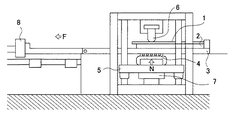
図1は摩擦係数測定装置を示す概略正面図である。同図に示すように、供試材から採取した摩擦係数測定用試料1が試料台2に固定され、試料台2は、水平移動可能なスライドテーブル3の上面に固定されている。スライドテーブル3の下面には、これに接したローラ4を有する上下動可能なスライドテーブル支持台5が設けられ、これを押し上げることによりビード6による摩擦係数測定用試料1への押し付け荷重Nを測定するための第1ロードセル7がスライドテーブル支持台5に取り付けられている。上記押し付け力を作用させた状態でスライドテーブル3を水平方向へ移動させるための摺動抵抗力Fを測定するために第2ロードセル8が、スライドテーブル3の一方の端部に取り付けられている。なお、潤滑油としてスギムラ化学社製のプレス用洗浄油プレトンR352Lを摩擦係数測定用試料1の表面に塗布して試験を行った。
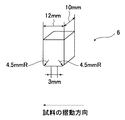
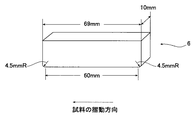
図2、3は使用したビードの形状・寸法を示す概略斜視図である。ビード6の下面が試料1の表面に押し付けられた状態で摺動する。図2に示すビード6の形状は幅10mm、試料の摺動方向長さ12mm、摺動方向両端の下部は曲率4.5mmRの曲面で構成され、試料が押し付けられるビード下面は幅10mm、摺動方向長さ3mmの平面を有する。図3に示すビード6の形状は幅10mm、試料の摺動方向長さ69mm、摺動方向両端の下部は曲率4.5mmRの曲面で構成され、試料が押し付けられるビード下面は幅10mm、摺動方向長さ60mmの平面を有する。
Sliding property evaluation test In order to evaluate press formability, the friction coefficient of each test material was measured as follows.
FIG. 1 is a schematic front view showing a friction coefficient measuring apparatus. As shown in the figure, a friction
2 and 3 are schematic perspective views showing the shape and dimensions of the beads used. The
摩擦係数測定試験は以下に示す2条件で行った。
[条件1]
図2に示すビードを用い、押し付け荷重N:400kgf、試料の引き抜き速度(スライドテーブル3の水平移動速度):100cm/minとした。
[条件2]
図3に示すビードを用い、押し付け荷重N:400kgf、試料の引き抜き速度(スライドテーブル3の水平移動速度):20cm/minとした。
供試材とビードとの間の摩擦係数μは、式:μ=F/Nで算出した。
The friction coefficient measurement test was performed under the following two conditions.
[Condition 1]
The bead shown in FIG. 2 was used, the pressing load N was 400 kgf, and the sample drawing speed (horizontal moving speed of the slide table 3) was 100 cm / min.
[Condition 2]
The bead shown in FIG. 3 was used, the pressing load N was 400 kgf, and the sample drawing speed (horizontal moving speed of the slide table 3) was 20 cm / min.
The coefficient of friction μ between the specimen and the bead was calculated by the formula: μ = F / N.
酸化膜厚の測定
膜厚が96nmの熱酸化SiO2膜が形成されたSiウエハを参照物質として用い、蛍光X線分析装置でO・Kα X線を測定することで、SiO2換算の酸化層の平均厚さを求めた。分析面積は30mmφである。
Measurement of Oxide Thickness Using a Si wafer on which a thermally oxidized SiO 2 film having a thickness of 96 nm is formed as a reference material, and measuring O · Kα X-rays with a fluorescent X-ray analyzer, an oxide layer converted to SiO 2 The average thickness was determined. The analysis area is 30 mmφ.
以上より得られた試験結果を条件と併せて表1に示す。 The test results obtained above are shown in Table 1 together with the conditions.
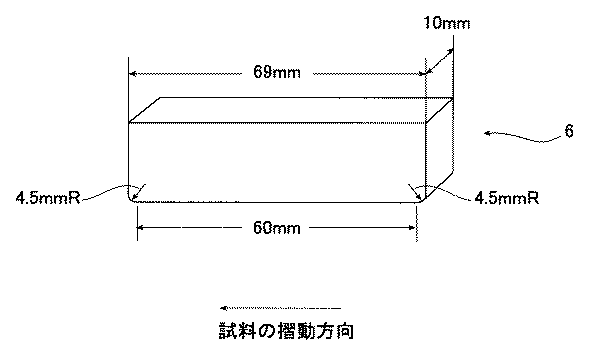
表1に示す試験結果から下記事項が明らかとなった。
No.1は酸性溶液による処理を行っていない比較例である。条件1・条件2において摩擦係数が高い。
No.2〜6は、酸性溶液での処理を行っているものの酸化剤を含まない浴を用いた比較例である。本件発明例と比較して、同じ酸化膜厚を得るための水洗までの時間は明らかに長い。
No.7〜9、21〜23、33〜35は、それぞれ過酸化水素、硝酸、過マンガン酸カリウムを0.1%含有した酸性溶液を用いた本発明例である。いずれの処理においてもNo.4〜6と同じ水洗までの時間で比較して酸化物層の膜厚が厚くなっている。例えば、水洗までの時間が10秒の場合、酸化剤を含まない時の酸化膜厚が18nmであるのに対して、酸化剤を含む場合の酸化膜厚は29〜31nmであり、酸化物層の形成が促進されている。
No. 10〜15、21〜23、30〜32は、含有する硝酸の濃度のみを変化させた酸性溶液の処理を行った例である。添加される硝酸濃度が高くなるほど、同じ水洗までの時間で比較して酸化物層の膜厚が厚くなっている。
No. 16〜18、21〜23、27〜29は酸性溶液の温度のみを変化させた例である。いずれの温度においても本発明例では硝酸の添加による、酸化物層の形成の促進が認められたが、温度が高いほうが成膜速度は早い。
No.19〜26は鋼板と酸性溶液が接触した後にロール絞りによって、鋼板表面の液膜量を変化させた例である。いずれの場合も硝酸の添加酸化物層の形成の促進が認められたが、液膜量の違いによる酸化膜厚の差は無く、安定して早い成膜速度が得られている。
From the test results shown in Table 1, the following matters were clarified.
No. 1 is a comparative example in which treatment with an acidic solution is not performed. The friction coefficient is high in
Nos. 2 to 6 are comparative examples using a bath that is treated with an acidic solution but does not contain an oxidizing agent. Compared with the present invention example, the time until washing with water to obtain the same oxide film thickness is clearly longer.
Nos. 7 to 9, 21 to 23, and 33 to 35 are examples of the present invention using acidic solutions containing 0.1% of hydrogen peroxide, nitric acid, and potassium permanganate, respectively. In any of the treatments, the film thickness of the oxide layer is increased compared with the same time until water washing as in Nos. 4 to 6. For example, when the time until washing with water is 10 seconds, the oxide film thickness when the oxidizer is not included is 18 nm, whereas the oxide film thickness when the oxidizer is included is 29 to 31 nm. The formation of is promoted.
Nos. 10 to 15, 21 to 23, and 30 to 32 are examples in which an acidic solution in which only the concentration of nitric acid contained was changed was processed. The higher the concentration of nitric acid added, the thicker the oxide layer compared to the same time until water washing.
Nos. 16-18, 21-23, and 27-29 are examples in which only the temperature of the acidic solution was changed. At any temperature, in the examples of the present invention, the formation of the oxide layer was promoted by the addition of nitric acid, but the higher the temperature, the faster the film formation rate.
Nos. 19 to 26 are examples in which the amount of liquid film on the steel sheet surface was changed by roll drawing after the steel sheet and the acidic solution contacted each other. In either case, the formation of the added oxide layer of nitric acid was promoted, but there was no difference in the oxide film thickness due to the difference in the amount of liquid film, and a stable and high film formation rate was obtained.
本発明の合金化溶融亜鉛めっき鋼板はプレス成形性に優れることから、自動車車体用途を中心に広範な分野で適用できる。 Since the alloyed hot-dip galvanized steel sheet of the present invention is excellent in press formability, it can be applied in a wide range of fields mainly for automobile body applications.
1 摩擦係数測定用試料
2 試料台
3 スライドテーブル
4 ローラ
5 スライドテーブル支持台
6 ビード
7 第1ロードセル
8 第2ロードセル
N 押付荷重
F 摺動抵抗力
DESCRIPTION OF
Claims (7)
Priority Applications (1)
| Application Number | Priority Date | Filing Date | Title |
|---|---|---|---|
| JP2008243511A JP5593601B2 (en) | 2008-09-24 | 2008-09-24 | Alloyed hot-dip galvanized steel sheet and method for producing the same |
Applications Claiming Priority (1)
| Application Number | Priority Date | Filing Date | Title |
|---|---|---|---|
| JP2008243511A JP5593601B2 (en) | 2008-09-24 | 2008-09-24 | Alloyed hot-dip galvanized steel sheet and method for producing the same |
Publications (2)
| Publication Number | Publication Date |
|---|---|
| JP2010077455A true JP2010077455A (en) | 2010-04-08 |
| JP5593601B2 JP5593601B2 (en) | 2014-09-24 |
Family
ID=42208217
Family Applications (1)
| Application Number | Title | Priority Date | Filing Date |
|---|---|---|---|
| JP2008243511A Active JP5593601B2 (en) | 2008-09-24 | 2008-09-24 | Alloyed hot-dip galvanized steel sheet and method for producing the same |
Country Status (1)
| Country | Link |
|---|---|
| JP (1) | JP5593601B2 (en) |
Cited By (3)
| Publication number | Priority date | Publication date | Assignee | Title |
|---|---|---|---|---|
| WO2019044004A1 (en) * | 2017-08-30 | 2019-03-07 | 奥野製薬工業株式会社 | Dye fixing treatment agent for aluminum alloy anodic oxidation coating, and sealing treatment method |
| CN110552041A (en) * | 2019-09-16 | 2019-12-10 | 歌尔股份有限公司 | Surface treatment method for metal material |
| JP2021191890A (en) * | 2020-06-05 | 2021-12-16 | ▲ろん▼▲鉱▼▲環▼保科技(上海)有限公司Greenore Cleantech (Shanghai) Co., Ltd | Co2 based hydrometallurgical multistage reaction and separation system |
Citations (10)
| Publication number | Priority date | Publication date | Assignee | Title |
|---|---|---|---|---|
| JPH01283384A (en) * | 1987-11-05 | 1989-11-14 | Nippon Steel Corp | Production of galvanized steel sheet having superior spot weldability |
| JPH03287784A (en) * | 1990-04-03 | 1991-12-18 | Nippon Steel Corp | Zinc plated steel sheet having superior press formability, chemical convertibility and weldability |
| JPH04176877A (en) * | 1990-11-10 | 1992-06-24 | Nippon Steel Corp | Production of galvanized steel sheet having excellent press formability and chemical conversion treatability |
| JPH08296015A (en) * | 1995-04-26 | 1996-11-12 | Nippon Steel Corp | Hot-dip galvanized steel sheet with excellent pressability, chemical conversion treatability, and electrodeposition paintability |
| JPH10212563A (en) * | 1997-01-29 | 1998-08-11 | Nkk Corp | Manufacturing method of galvanized steel sheet |
| JP2002012958A (en) * | 1999-07-15 | 2002-01-15 | Nkk Corp | Alloyed hot-dip galvanized steel sheet and method for producing the same |
| JP3346338B2 (en) * | 1999-05-18 | 2002-11-18 | 住友金属工業株式会社 | Galvanized steel sheet and method for producing the same |
| JP3368847B2 (en) * | 1998-10-30 | 2003-01-20 | 日本鋼管株式会社 | Galvanized steel sheet with excellent press formability and adhesion |
| JP2003129209A (en) * | 2001-10-23 | 2003-05-08 | Sumitomo Metal Ind Ltd | Surface-treated steel for hot press forming and its manufacturing method |
| WO2007129678A1 (en) * | 2006-05-02 | 2007-11-15 | Jfe Steel Corporation | Process for producing alloyed hot-dip zinc-plated steel sheet and alloyed hot-dip zinc-plated steel sheet |
-
2008
- 2008-09-24 JP JP2008243511A patent/JP5593601B2/en active Active
Patent Citations (10)
| Publication number | Priority date | Publication date | Assignee | Title |
|---|---|---|---|---|
| JPH01283384A (en) * | 1987-11-05 | 1989-11-14 | Nippon Steel Corp | Production of galvanized steel sheet having superior spot weldability |
| JPH03287784A (en) * | 1990-04-03 | 1991-12-18 | Nippon Steel Corp | Zinc plated steel sheet having superior press formability, chemical convertibility and weldability |
| JPH04176877A (en) * | 1990-11-10 | 1992-06-24 | Nippon Steel Corp | Production of galvanized steel sheet having excellent press formability and chemical conversion treatability |
| JPH08296015A (en) * | 1995-04-26 | 1996-11-12 | Nippon Steel Corp | Hot-dip galvanized steel sheet with excellent pressability, chemical conversion treatability, and electrodeposition paintability |
| JPH10212563A (en) * | 1997-01-29 | 1998-08-11 | Nkk Corp | Manufacturing method of galvanized steel sheet |
| JP3368847B2 (en) * | 1998-10-30 | 2003-01-20 | 日本鋼管株式会社 | Galvanized steel sheet with excellent press formability and adhesion |
| JP3346338B2 (en) * | 1999-05-18 | 2002-11-18 | 住友金属工業株式会社 | Galvanized steel sheet and method for producing the same |
| JP2002012958A (en) * | 1999-07-15 | 2002-01-15 | Nkk Corp | Alloyed hot-dip galvanized steel sheet and method for producing the same |
| JP2003129209A (en) * | 2001-10-23 | 2003-05-08 | Sumitomo Metal Ind Ltd | Surface-treated steel for hot press forming and its manufacturing method |
| WO2007129678A1 (en) * | 2006-05-02 | 2007-11-15 | Jfe Steel Corporation | Process for producing alloyed hot-dip zinc-plated steel sheet and alloyed hot-dip zinc-plated steel sheet |
Cited By (7)
| Publication number | Priority date | Publication date | Assignee | Title |
|---|---|---|---|---|
| WO2019044004A1 (en) * | 2017-08-30 | 2019-03-07 | 奥野製薬工業株式会社 | Dye fixing treatment agent for aluminum alloy anodic oxidation coating, and sealing treatment method |
| JPWO2019044004A1 (en) * | 2017-08-30 | 2020-10-01 | 奥野製薬工業株式会社 | Dye fixing agent for anodic oxide film of aluminum alloy and sealing method |
| TWI741166B (en) * | 2017-08-30 | 2021-10-01 | 日商奧野製藥工業股份有限公司 | Dye fixing treatment agent for anodic oxide film of aluminum alloy and sealing treatment method |
| CN110552041A (en) * | 2019-09-16 | 2019-12-10 | 歌尔股份有限公司 | Surface treatment method for metal material |
| CN110552041B (en) * | 2019-09-16 | 2021-02-19 | 歌尔股份有限公司 | Surface treatment method for metal material |
| JP2021191890A (en) * | 2020-06-05 | 2021-12-16 | ▲ろん▼▲鉱▼▲環▼保科技(上海)有限公司Greenore Cleantech (Shanghai) Co., Ltd | Co2 based hydrometallurgical multistage reaction and separation system |
| JP7018493B2 (en) | 2020-06-05 | 2022-02-10 | ▲ろん▼▲鉱▼▲環▼保科技(上海)有限公司 | Multi-stage reaction and separation system for hydrometallurgy based on carbon dioxide |
Also Published As
| Publication number | Publication date |
|---|---|
| JP5593601B2 (en) | 2014-09-24 |
Similar Documents
| Publication | Publication Date | Title |
|---|---|---|
| CN101437976B (en) | Process for producing alloyed hot-dip zinc-plated steel sheet and alloyed hot-dip zinc-plated steel sheet | |
| JP5354165B2 (en) | Method for producing galvanized steel sheet | |
| WO2007129678A1 (en) | Process for producing alloyed hot-dip zinc-plated steel sheet and alloyed hot-dip zinc-plated steel sheet | |
| KR101788950B1 (en) | Method for manufacturing galvanized steel sheet | |
| JP2010077456A (en) | Hot-dip galvanized steel sheet and method for manufacturing the same | |
| JP5347295B2 (en) | Zinc-based plated steel sheet and method for producing the same | |
| JP5593601B2 (en) | Alloyed hot-dip galvanized steel sheet and method for producing the same | |
| TWI516638B (en) | Galvanized steel sheet and manufacturing method thereof | |
| JP5386842B2 (en) | Zinc-based plated steel sheet and method for producing the same | |
| JP4529592B2 (en) | Process for producing alloyed hot-dip galvanized steel sheet and alloyed hot-dip galvanized steel sheet. | |
| JP4826486B2 (en) | Method for producing galvannealed steel sheet | |
| JP4525252B2 (en) | Method for producing galvannealed steel sheet | |
| JP4517887B2 (en) | Method for producing hot dip galvanized steel sheet and hot dip galvanized steel sheet | |
| JP4604712B2 (en) | Method for producing hot dip galvanized steel sheet and hot dip galvanized steel sheet | |
| JP5434036B2 (en) | Zn-Al-based plated steel sheet and method for producing the same | |
| TWI447263B (en) | Zinc-base plated steel sheet and method for manufacturing the same | |
| JP4998658B2 (en) | Method for producing galvannealed steel sheet | |
| JP5163218B2 (en) | Method for producing galvanized steel sheet | |
| JP5354166B2 (en) | Method for producing galvanized steel sheet | |
| JP5044924B2 (en) | Method for producing alloyed hot-dip galvanized steel sheet and alloyed hot-dip galvanized steel sheet | |
| JP5163217B2 (en) | Method for producing galvanized steel sheet | |
| JP5119734B2 (en) | Galvanized steel sheet | |
| JP5927995B2 (en) | Method for producing galvanized steel sheet | |
| JP6229686B2 (en) | Zinc-based plated steel sheet and method for producing the same | |
| JP5961967B2 (en) | Method for producing hot-dip galvanized steel sheet |
Legal Events
| Date | Code | Title | Description |
|---|---|---|---|
| A621 | Written request for application examination |
Free format text: JAPANESE INTERMEDIATE CODE: A621 Effective date: 20110824 |
|
| RD03 | Notification of appointment of power of attorney |
Free format text: JAPANESE INTERMEDIATE CODE: A7423 Effective date: 20120321 |
|
| RD04 | Notification of resignation of power of attorney |
Free format text: JAPANESE INTERMEDIATE CODE: A7424 Effective date: 20120327 |
|
| A977 | Report on retrieval |
Free format text: JAPANESE INTERMEDIATE CODE: A971007 Effective date: 20130530 |
|
| A131 | Notification of reasons for refusal |
Free format text: JAPANESE INTERMEDIATE CODE: A131 Effective date: 20130611 |
|
| A521 | Request for written amendment filed |
Free format text: JAPANESE INTERMEDIATE CODE: A523 Effective date: 20130807 |
|
| A131 | Notification of reasons for refusal |
Free format text: JAPANESE INTERMEDIATE CODE: A131 Effective date: 20131029 |
|
| A521 | Request for written amendment filed |
Free format text: JAPANESE INTERMEDIATE CODE: A523 Effective date: 20131226 |
|
| A131 | Notification of reasons for refusal |
Free format text: JAPANESE INTERMEDIATE CODE: A131 Effective date: 20140415 |
|
| A521 | Request for written amendment filed |
Free format text: JAPANESE INTERMEDIATE CODE: A523 Effective date: 20140613 |
|
| TRDD | Decision of grant or rejection written | ||
| A01 | Written decision to grant a patent or to grant a registration (utility model) |
Free format text: JAPANESE INTERMEDIATE CODE: A01 Effective date: 20140708 |
|
| A61 | First payment of annual fees (during grant procedure) |
Free format text: JAPANESE INTERMEDIATE CODE: A61 Effective date: 20140721 |
|
| R150 | Certificate of patent or registration of utility model |
Ref document number: 5593601 Country of ref document: JP Free format text: JAPANESE INTERMEDIATE CODE: R150 |
|
| R250 | Receipt of annual fees |
Free format text: JAPANESE INTERMEDIATE CODE: R250 |
|
| R250 | Receipt of annual fees |
Free format text: JAPANESE INTERMEDIATE CODE: R250 |
|
| R250 | Receipt of annual fees |
Free format text: JAPANESE INTERMEDIATE CODE: R250 |
|
| R250 | Receipt of annual fees |
Free format text: JAPANESE INTERMEDIATE CODE: R250 |
|
| R250 | Receipt of annual fees |
Free format text: JAPANESE INTERMEDIATE CODE: R250 |
|
| R250 | Receipt of annual fees |
Free format text: JAPANESE INTERMEDIATE CODE: R250 |