JP2010077459A - Element for thermal fuse, and alloy-type thermal fuse - Google Patents
Element for thermal fuse, and alloy-type thermal fuse Download PDFInfo
- Publication number
- JP2010077459A JP2010077459A JP2008243917A JP2008243917A JP2010077459A JP 2010077459 A JP2010077459 A JP 2010077459A JP 2008243917 A JP2008243917 A JP 2008243917A JP 2008243917 A JP2008243917 A JP 2008243917A JP 2010077459 A JP2010077459 A JP 2010077459A
- Authority
- JP
- Japan
- Prior art keywords
- temperature
- alloy
- fuse element
- thermal fuse
- weight
- Prior art date
- Legal status (The legal status is an assumption and is not a legal conclusion. Google has not performed a legal analysis and makes no representation as to the accuracy of the status listed.)
- Pending
Links
- 229910045601 alloy Inorganic materials 0.000 claims abstract description 42
- 239000000956 alloy Substances 0.000 claims abstract description 42
- 239000000203 mixture Substances 0.000 claims abstract description 24
- 229910052725 zinc Inorganic materials 0.000 claims abstract description 15
- 229910052797 bismuth Inorganic materials 0.000 claims abstract description 9
- 229910052709 silver Inorganic materials 0.000 claims abstract description 6
- 230000004907 flux Effects 0.000 claims description 12
- 239000004020 conductor Substances 0.000 claims description 8
- 239000010408 film Substances 0.000 claims description 7
- 229910052782 aluminium Inorganic materials 0.000 claims description 6
- 229910052802 copper Inorganic materials 0.000 claims description 5
- 229910052732 germanium Inorganic materials 0.000 claims description 5
- 239000013039 cover film Substances 0.000 claims description 4
- 229910052733 gallium Inorganic materials 0.000 claims description 4
- 238000010438 heat treatment Methods 0.000 abstract description 6
- 229910052738 indium Inorganic materials 0.000 abstract 1
- 230000003252 repetitive effect Effects 0.000 abstract 1
- 238000002844 melting Methods 0.000 description 11
- 230000008018 melting Effects 0.000 description 11
- 239000006104 solid solution Substances 0.000 description 9
- RSWGJHLUYNHPMX-UHFFFAOYSA-N Abietic-Saeure Natural products C12CCC(C(C)C)=CC2=CCC2C1(C)CCCC2(C)C(O)=O RSWGJHLUYNHPMX-UHFFFAOYSA-N 0.000 description 8
- KHPCPRHQVVSZAH-HUOMCSJISA-N Rosin Natural products O(C/C=C/c1ccccc1)[C@H]1[C@H](O)[C@@H](O)[C@@H](O)[C@@H](CO)O1 KHPCPRHQVVSZAH-HUOMCSJISA-N 0.000 description 8
- KHPCPRHQVVSZAH-UHFFFAOYSA-N trans-cinnamyl beta-D-glucopyranoside Natural products OC1C(O)C(O)C(CO)OC1OCC=CC1=CC=CC=C1 KHPCPRHQVVSZAH-UHFFFAOYSA-N 0.000 description 8
- 238000001938 differential scanning calorimetry curve Methods 0.000 description 6
- 239000010949 copper Substances 0.000 description 4
- 229910052751 metal Inorganic materials 0.000 description 4
- 239000000523 sample Substances 0.000 description 4
- 239000007788 liquid Substances 0.000 description 3
- 239000000758 substrate Substances 0.000 description 3
- 235000021355 Stearic acid Nutrition 0.000 description 2
- 238000004090 dissolution Methods 0.000 description 2
- 239000000463 material Substances 0.000 description 2
- 238000005259 measurement Methods 0.000 description 2
- 239000002184 metal Substances 0.000 description 2
- QIQXTHQIDYTFRH-UHFFFAOYSA-N octadecanoic acid Chemical compound CCCCCCCCCCCCCCCCCC(O)=O QIQXTHQIDYTFRH-UHFFFAOYSA-N 0.000 description 2
- OQCDKBAXFALNLD-UHFFFAOYSA-N octadecanoic acid Natural products CCCCCCCC(C)CCCCCCCCC(O)=O OQCDKBAXFALNLD-UHFFFAOYSA-N 0.000 description 2
- 239000004033 plastic Substances 0.000 description 2
- 229920003023 plastic Polymers 0.000 description 2
- 239000008117 stearic acid Substances 0.000 description 2
- HMUNWXXNJPVALC-UHFFFAOYSA-N 1-[4-[2-(2,3-dihydro-1H-inden-2-ylamino)pyrimidin-5-yl]piperazin-1-yl]-2-(2,4,6,7-tetrahydrotriazolo[4,5-c]pyridin-5-yl)ethanone Chemical compound C1C(CC2=CC=CC=C12)NC1=NC=C(C=N1)N1CCN(CC1)C(CN1CC2=C(CC1)NN=N2)=O HMUNWXXNJPVALC-UHFFFAOYSA-N 0.000 description 1
- VZSRBBMJRBPUNF-UHFFFAOYSA-N 2-(2,3-dihydro-1H-inden-2-ylamino)-N-[3-oxo-3-(2,4,6,7-tetrahydrotriazolo[4,5-c]pyridin-5-yl)propyl]pyrimidine-5-carboxamide Chemical compound C1C(CC2=CC=CC=C12)NC1=NC=C(C=N1)C(=O)NCCC(N1CC2=C(CC1)NN=N2)=O VZSRBBMJRBPUNF-UHFFFAOYSA-N 0.000 description 1
- LDXJRKWFNNFDSA-UHFFFAOYSA-N 2-(2,4,6,7-tetrahydrotriazolo[4,5-c]pyridin-5-yl)-1-[4-[2-[[3-(trifluoromethoxy)phenyl]methylamino]pyrimidin-5-yl]piperazin-1-yl]ethanone Chemical compound C1CN(CC2=NNN=C21)CC(=O)N3CCN(CC3)C4=CN=C(N=C4)NCC5=CC(=CC=C5)OC(F)(F)F LDXJRKWFNNFDSA-UHFFFAOYSA-N 0.000 description 1
- YLZOPXRUQYQQID-UHFFFAOYSA-N 3-(2,4,6,7-tetrahydrotriazolo[4,5-c]pyridin-5-yl)-1-[4-[2-[[3-(trifluoromethoxy)phenyl]methylamino]pyrimidin-5-yl]piperazin-1-yl]propan-1-one Chemical compound N1N=NC=2CN(CCC=21)CCC(=O)N1CCN(CC1)C=1C=NC(=NC=1)NCC1=CC(=CC=C1)OC(F)(F)F YLZOPXRUQYQQID-UHFFFAOYSA-N 0.000 description 1
- BMYNFMYTOJXKLE-UHFFFAOYSA-N 3-azaniumyl-2-hydroxypropanoate Chemical compound NCC(O)C(O)=O BMYNFMYTOJXKLE-UHFFFAOYSA-N 0.000 description 1
- VDQLTWSIHIWIFQ-UHFFFAOYSA-N 5-chloro-2-(3,4-dimethoxyphenyl)-2-propan-2-ylpentanenitrile Chemical compound COC1=CC=C(C(CCCCl)(C#N)C(C)C)C=C1OC VDQLTWSIHIWIFQ-UHFFFAOYSA-N 0.000 description 1
- 229910016331 Bi—Ag Inorganic materials 0.000 description 1
- RYGMFSIKBFXOCR-UHFFFAOYSA-N Copper Chemical compound [Cu] RYGMFSIKBFXOCR-UHFFFAOYSA-N 0.000 description 1
- HBBGRARXTFLTSG-UHFFFAOYSA-N Lithium ion Chemical compound [Li+] HBBGRARXTFLTSG-UHFFFAOYSA-N 0.000 description 1
- AFCARXCZXQIEQB-UHFFFAOYSA-N N-[3-oxo-3-(2,4,6,7-tetrahydrotriazolo[4,5-c]pyridin-5-yl)propyl]-2-[[3-(trifluoromethoxy)phenyl]methylamino]pyrimidine-5-carboxamide Chemical compound O=C(CCNC(=O)C=1C=NC(=NC=1)NCC1=CC(=CC=C1)OC(F)(F)F)N1CC2=C(CC1)NN=N2 AFCARXCZXQIEQB-UHFFFAOYSA-N 0.000 description 1
- 229910001297 Zn alloy Inorganic materials 0.000 description 1
- 229910007568 Zn—Ag Inorganic materials 0.000 description 1
- 239000012190 activator Substances 0.000 description 1
- 239000013543 active substance Substances 0.000 description 1
- 239000000853 adhesive Substances 0.000 description 1
- 230000001070 adhesive effect Effects 0.000 description 1
- XAGFODPZIPBFFR-UHFFFAOYSA-N aluminium Chemical compound [Al] XAGFODPZIPBFFR-UHFFFAOYSA-N 0.000 description 1
- 239000000919 ceramic Substances 0.000 description 1
- 230000000052 comparative effect Effects 0.000 description 1
- 230000000694 effects Effects 0.000 description 1
- 239000003822 epoxy resin Substances 0.000 description 1
- 238000002474 experimental method Methods 0.000 description 1
- 229910000743 fusible alloy Inorganic materials 0.000 description 1
- 239000012535 impurity Substances 0.000 description 1
- 229910001416 lithium ion Inorganic materials 0.000 description 1
- 238000010309 melting process Methods 0.000 description 1
- 239000002245 particle Substances 0.000 description 1
- 229920000647 polyepoxide Polymers 0.000 description 1
- -1 polyethylene terephthalate Polymers 0.000 description 1
- 229920000139 polyethylene terephthalate Polymers 0.000 description 1
- 239000005020 polyethylene terephthalate Substances 0.000 description 1
- CBPYOHALYYGNOE-UHFFFAOYSA-M potassium;3,5-dinitrobenzoate Chemical compound [K+].[O-]C(=O)C1=CC([N+]([O-])=O)=CC([N+]([O-])=O)=C1 CBPYOHALYYGNOE-UHFFFAOYSA-M 0.000 description 1
- 238000004382 potting Methods 0.000 description 1
- 230000001012 protector Effects 0.000 description 1
- 229910002059 quaternary alloy Inorganic materials 0.000 description 1
- 239000013074 reference sample Substances 0.000 description 1
- 150000003839 salts Chemical class 0.000 description 1
- 239000007790 solid phase Substances 0.000 description 1
- 229910052718 tin Inorganic materials 0.000 description 1
- 238000009736 wetting Methods 0.000 description 1
Images


Landscapes
- Fuses (AREA)
Abstract
Description
本発明は温度ヒューズ用エレメント及び合金型温度ヒューズに関し、携帯電子機器に取り付けて使用されるサーモプロテクタとして有用なものである。 The present invention relates to a thermal fuse element and an alloy-type thermal fuse, and is useful as a thermo protector used by being attached to a portable electronic device.
電子・電気機器のサーモプロテクタとして、合金型温度ヒューズが汎用されている。
合金型温度ヒューズは、リード導体間に低融点可溶合金片(ヒューズエレメント)を接続し、該低融点可溶合金片にフラックスを塗布し、該フラックス塗布低融点可溶合金片を絶縁外皮で封止してなり、電子・電気機器に良好な熱的接触状態で取付け、電子・電気機器が過電流のために所定の限界温度にまで発熱する際に、低融点可溶合金片を溶断させて電子・電気機器への給電を遮断している。
Alloy-type thermal fuses are widely used as thermo-protectors for electronic and electrical equipment.
An alloy-type thermal fuse has a low melting point soluble alloy piece (fuse element) connected between lead conductors, a flux is applied to the low melting point soluble alloy piece, and the flux coated low melting point soluble alloy piece is covered with an insulating sheath. It is sealed and attached to electronic / electrical equipment in good thermal contact, and when the electronic / electrical equipment generates heat to the specified limit temperature due to overcurrent, the low melting point soluble alloy piece is blown out. The power supply to electronic and electrical equipment is cut off.
合金型温度ヒューズの溶断動作の機構は、低融点可溶合金片が溶融され、その溶融合金がリード導体先端部に濡れ拡がり分断されて通電が遮断されることにある。
ヒューズエレメントの溶融過程は、固相線温度で溶解し始め、液相線温度で溶解が終了し、固相線温度と液相線温度との間では、溶解液体に固相体が粒子状で分散した状態、すなわち固液共存状態となる。
ヒューズエレメントの溶断温度は、固相線温度よりも高温側であるが、固液共存物のリード導体への濡れ性や粘度等に左右される。
The mechanism of the fusing operation of the alloy-type thermal fuse is that the low-melting-point fusible alloy piece is melted, the molten alloy wets and spreads at the leading end of the lead conductor, and the conduction is cut off.
In the melting process of the fuse element, the melting starts at the solidus temperature and finishes at the liquidus temperature. Between the solidus temperature and the liquidus temperature, the solid phase in the dissolved liquid is in the form of particles. It becomes a dispersed state, that is, a solid-liquid coexistence state.
The fusing temperature of the fuse element is higher than the solidus temperature, but depends on the wettability of the solid-liquid coexisting material to the lead conductor, the viscosity, and the like.
携帯型電子・電気機器、例えば携帯電話機では、リチウムイオン電池等の二次電池を電源として使用しており、その二次電池の発熱から携帯する者の人体を保護するために、二次電池に温度ヒューズを取り付けて二次電池温度90℃〜99℃で温度ヒューズを動作させ携帯電話機を不能状態とすることが行われている。 In portable electronic / electrical devices such as mobile phones, secondary batteries such as lithium-ion batteries are used as a power source, and in order to protect the human body of the person carrying them from the heat generated by the secondary battery, a secondary battery is used. A temperature fuse is attached and the temperature fuse is operated at a secondary battery temperature of 90 ° C. to 99 ° C. to disable the mobile phone.
温度ヒューズ用エレメントの合金として、Sn−In−Bi−Znの4元合金が提案されている(特許文献1〜3)。
本発明者等においては、鋭意実験を行い、In48〜54%、Bi7〜10%、Zn1.5〜3.0%、残部Snの組成では、固相線温度が79℃〜81℃の範囲内にあること、ピーク温度が94℃〜96℃の範囲内にあり、ヒューズエレメントの溶断が(ピーク温度の±2℃)の範囲内で生じること確認した。
しかしながら、この合金を携帯電話機用温度ヒューズのヒューズエレメントとして使用すると、溶断温度(92℃〜98℃)と固相線温度(79℃〜81℃)との差が大きく、この固相線温度と溶断温度との間では、温度ヒューズが作動しなくてもヒューズエレメントが半溶解され、これが繰り返されると、ヒューズエレメントが損傷して温度ヒューズの所定の作動が保証できなくなる。
The inventors have conducted extensive experiments and found that the composition of In 48 to 54%, Bi 7 to 10%, Zn 1.5 to 3.0%, and the remaining Sn has a solidus temperature in the range of 79 ° C to 81 ° C. It was confirmed that the peak temperature was in the range of 94 ° C. to 96 ° C., and the fusing of the fuse element occurred within the range of (± 2 ° C. of peak temperature).
However, when this alloy is used as a fuse element for a temperature fuse for mobile phones, the difference between the fusing temperature (92 ° C. to 98 ° C.) and the solidus temperature (79 ° C. to 81 ° C.) is large. Between the fusing temperature, even if the thermal fuse does not operate, the fuse element is partially melted. If this is repeated, the fuse element is damaged and the predetermined operation of the thermal fuse cannot be guaranteed.
このように、In48〜54%、Bi7〜10%、Zn1.5〜3.0%、残部Snの組成を携帯電話機用温度ヒューズのヒューズエレメントとして使用すると、二次電池の発熱によりヒューズエレメント温度が92℃〜98℃に達すると、ヒューズエレメントを溶断させて携帯電話機を通電不能として人体を火傷から安全に保護できるが、保護範囲外の溶断温度未満から固相線温度(79℃〜81℃)までの温度での繰返し加熱でも携帯電話機が使用不可となってしまう。 As described above, when the composition of In 48 to 54%, Bi 7 to 10%, Zn 1.5 to 3.0% and the balance Sn is used as the fuse element of the temperature fuse for mobile phones, the fuse element temperature is increased by the heat generated by the secondary battery. When the temperature reaches 92 ° C. to 98 ° C., the fuse element is blown and the mobile phone cannot be energized to safely protect the human body from burns. However, the solidus temperature (79 ° C. to 81 ° C.) is below the fusing temperature outside the protection range. Even with repeated heating at temperatures up to, the mobile phone becomes unusable.
そこで、In48〜54%、Bi7〜10%、Zn1.5〜3.0%、残部Snの組成の合金について、DSCピーク温度を変えることなく、従ってヒューズエレメントの溶断温度を変えることなく固相線温度を高めるべく鋭意検討した結果、Agを0.1〜1.0%添加すれば、細線加工性を充分に保持して固相線温度を2℃〜4℃上昇できることを知った。 Therefore, for alloys having a composition of In 48 to 54%, Bi 7 to 10%, Zn 1.5 to 3.0% and the balance Sn, the solidus line without changing the DSC peak temperature and thus without changing the fusing temperature of the fuse element. As a result of intensive studies to increase the temperature, it was found that if 0.1 to 1.0% of Ag is added, the solidus line temperature can be increased by 2 ° C. to 4 ° C. while sufficiently maintaining the fine wire workability.
合金の機械的強度をアップするために、Ag、Cu、Al、Ge、Ga等の金属を少量添加することは周知手段に属する。 この理由を考察すると次の通りである。a1,……anのn種類の金属元素からなる合金Aにおいては、a1にa2,……anが溶けた固溶体、……、anにa1,a2,……an−1が溶けた固溶体というようにn種類の固溶体が生成し、a1,……an、an+1の(n+1)種類の金属元素からなる合金A’においては、a1にa2,……an,an+1が溶けた固溶体、……、an+1にa1,……anが溶けた固溶体というように(n+1)種類の固溶体が生成し、合金Aの溶解温度の最も低い固溶体の溶解温度に対し合金A’の溶解温度の最も低い固溶体の溶解温度が高いためであると推定できる。
しかしながら、前記Agの添加に代えCu、Al、Ge、Ga等を添加しても、固相線温度の上昇は得られない。
Adding a small amount of metal such as Ag, Cu, Al, Ge, or Ga to increase the mechanical strength of the alloy belongs to a well-known means. The reason for this is as follows. a 1, in ...... a n alloy A consisting of n kinds of metal elements, a 2 to a 1, a solid solution ...... a n had melted, ......, a 1, a 2 to a n, ...... a n types of solid solutions are formed such as a solid solution in which n-1 is dissolved. In an alloy A ′ composed of (n + 1) types of metal elements of a 1 ,..., a n , a n + 1 , a 1 , a 2 , ...... a n, a solid solution a n + 1 is melted, ......, a 1 to a n + 1, and so solid solution ...... a n had melted (n + 1) types of solid solution is produced, the lowest of the melting temperature of the alloy a It can be estimated that this is because the melting temperature of the solid solution having the lowest melting temperature of the alloy A ′ is higher than the melting temperature of the solid solution.
However, even if Cu, Al, Ge, Ga or the like is added in place of the addition of Ag, the solidus temperature cannot be increased.
本発明の目的は、ヒューズエレメントの溶断温度が90℃〜99℃の温度ヒューズにおいて、その溶断温度未満と固相線温度との間の温度で繰返し加熱を受けても、ヒューズエレメントの損傷をよく軽減できる温度ヒューズを提供することにある。 The object of the present invention is to prevent damage to the fuse element even if it is repeatedly heated at a temperature between the temperature below the fusing temperature and the solidus temperature in a temperature fuse having a fusing temperature of 90 ° C. to 99 ° C. The object is to provide a thermal fuse that can be mitigated.
請求項1に係る温度ヒューズ用エレメントは、In48〜54%、Bi7〜10%、Zn1.5〜3.0%、Ag0.1〜1.0%、残部Snの合金組成を有することを特徴とする。
請求項2に係る温度ヒューズ用エレメントは、In48〜54%、Bi7〜10%、Zn1.5〜3.0%、Ag0.1〜1.0%、残部Snの100重量部にCu、Al、Ge、Gaの少なくとも一種以上が合計で0.05重量部以下含有されてなる合金組成を有することを特徴とする。
請求項3に係る温度ヒューズは、ヒューズエレメントが請求項1または2何れかの温度ヒューズ用エレメントであることを特徴とする。
請求項4に係る温度ヒューズは、リード導体間に請求項1または2何れかの温度ヒューズ用エレメントが接続され、該エレメントにフラックスが塗布され、該フラックス塗布エレメントがベースフィルムとカバーフィルムとで封止されていることを特徴とする。
A thermal fuse element according to claim 1 has an alloy composition of In 48 to 54%, Bi 7 to 10%, Zn 1.5 to 3.0%, Ag 0.1 to 1.0%, and remaining Sn. To do.
The thermal fuse element according to claim 2 includes In 48 to 54%, Bi 7 to 10%, Zn 1.5 to 3.0%, Ag 0.1 to 1.0%, and 100 parts by weight of the remaining Sn Cu, Al, It has an alloy composition in which at least one kind of Ge and Ga is contained in a total of 0.05 parts by weight or less.
A thermal fuse according to a third aspect is characterized in that the fuse element is the thermal fuse element according to the first or second aspect.
According to a fourth aspect of the present invention, the thermal fuse element according to the first or second aspect is connected between the lead conductors, a flux is applied to the element, and the flux application element is sealed with a base film and a cover film. It is characterized by being stopped.
In48〜54%、Bi7〜10%、Zn1.5〜3.0%、残部Snの組成を携帯電話機用温度ヒューズのヒューズエレメントとして使用すると、二次電池の発熱によりヒューズエレメント温度が溶断温度90℃〜99℃に達すると、ヒューズエレメントを溶断させて携帯電話機を通電不能として人体を火傷に対し安全に保護できるが、保護範囲外の溶断温度未満から固相線温度(79℃〜81℃)までの温度での繰返し加熱でも携帯電話機が使用不可となってしまう。
本発明では、Agを0.1〜1.0%添加しており、溶断温度92℃〜98℃を殆ど変化させることなく固相線温度(82℃〜85℃))へと2℃〜4℃高めることができ、その高まった範囲では、高める前に前記繰返し加熱により受けていたヒューズエレメントの損傷を排除できる。
When the composition of In 48 to 54%, Bi 7 to 10%, Zn 1.5 to 3.0% and the balance Sn is used as the fuse element of the thermal fuse for mobile phones, the fuse element temperature is blown at 90 ° C. due to the heat generated by the secondary battery. When the temperature reaches ˜99 ° C., the fuse element is blown and the mobile phone cannot be energized to safely protect the human body against burns, but from below the fusing temperature outside the protection range to the solidus temperature (79 ° C. to 81 ° C.) Even with repeated heating at a temperature of 1, the mobile phone becomes unusable.
In the present invention, Ag is added in an amount of 0.1 to 1.0%, and the melting temperature of 92 ° C. to 98 ° C. is hardly changed, and the solidus temperature (82 ° C. to 85 ° C.) is changed to 2 ° C. to 4 ° C. The temperature can be increased, and in the increased range, damage to the fuse element that has been subjected to the repeated heating before the increase can be eliminated.
すなわち、使用危険温度範囲を従来の「ヒューズエレメント溶断温度(90℃〜99℃)と固相線温度(79℃〜81℃)との間の範囲」から「ヒューズエレメント溶断温度(90℃〜99℃)と固相線温度(82℃〜85℃)との間の範囲」に狭めることができる。 That is, the dangerous operating temperature range is changed from the conventional “range between the fuse element fusing temperature (90 ° C. to 99 ° C.) and the solidus temperature (79 ° C. to 81 ° C.)” to the “fuse element fusing temperature (90 ° C. to 99 ° C.). C.) and the solidus temperature (82 ° C. to 85 ° C.) ”.
本発明において使用する合金組成は、In48〜54重量部、Bi7〜10重量部、Zn1.5〜3.0重量部、残部Snの合計100部をベースとし、これにAgを0.1〜1.0重量部添加したものである。
このベース組成の合金においては、固相線温度が79℃〜81℃の範囲内にある、ピーク温度が94℃〜96℃の範囲内にありヒューズエレメントの溶断が(DSCピーク温度の±2℃)の範囲内で生じる、200〜400μmφの細線加工、または厚み20〜40μmの板状加工が可能である等の特長を有する。このベース組成にAgを0.1〜1.0重量部添加する理由は、ベース組成に対DSCピーク温度を殆ど変えずに固相線温度を2℃〜4℃高めるためである。Ag0.1重量部未満では有効な固相線温度アップを得難く、1.0重量部を越えると溶断温度が高温側にシフトしてしまう(溶解金属の粘度が高くなり、濡れによる分断が生じ難くなる)。
Agの添加により固相線温度が上昇する理由は、既述した通り、最低溶解温度の固溶体の溶解温度が高るためである。
The alloy composition used in the present invention is based on a total of 100 parts of 48 to 54 parts by weight of In, 7 to 10 parts by weight of Bi, 1.5 to 3.0 parts by weight of Zn, and the remaining Sn, and 0.1 to 1 of Ag. 0.0 part by weight is added.
In this base composition alloy, the solidus temperature is in the range of 79 ° C. to 81 ° C., the peak temperature is in the range of 94 ° C. to 96 ° C., and the fuse element is blown (± 2 ° C. of DSC peak temperature). ) In the range of 200 to 400 μmφ, or a plate processing with a thickness of 20 to 40 μm is possible. The reason for adding 0.1 to 1.0 part by weight of Ag to the base composition is to increase the solidus temperature by 2 to 4 ° C. without changing the DSC peak temperature with respect to the base composition. Less than 0.1 parts by weight of Ag makes it difficult to increase the effective solidus temperature, and if it exceeds 1.0 parts by weight, the fusing temperature shifts to the high temperature side (the viscosity of the molten metal increases, resulting in breakage due to wetting). It becomes difficult.)
The reason why the solidus temperature is increased by the addition of Ag is that, as described above, the dissolution temperature of the solid solution having the lowest dissolution temperature is high.
請求項2において添加しているCu、Al、Ge、Gaは不可避的不純物であり、その量を0.1〜1.0重量部にしても前記Ag添加の効果は期待できない。
温度ヒューズとしては、帯状リード導体間に板状ヒューズエレメントを接続し、該エレメントにフラックスを塗布し、該フラックス塗布エレメントをベースフィルムとカバーフィルムとでヒートシールや接着剤で封止した薄型とすることが好ましい。
セラミックス基板等の耐熱基板上に一対の膜電極を導電ペーストの印刷焼成により設け、膜電極間に温度ヒューズ用エレメントを接続し、該エレメントにフラックスを塗布し、該フラックス塗布エレメントをエポキシ樹脂などのポッテングにより封止した基板型を使用することもできる。
フラックスには、通常、融点がヒューズエレメントの融点よりも低いものが使用され、例えばロジン90〜60重量部、ステアリン酸10〜40重量部、活性剤0〜3重量部を使用できる。ロジンには、天然ロジン、変性ロジン(水添ロジン、不均化ロジン、重合ロジン等)、または、これらの精製ロジンを使用することができ、活性剤にはジエチルアミンの塩酸塩や臭化水素酸塩等を使用できる。
Cu, Al, Ge, and Ga added in claim 2 are unavoidable impurities, and even if the amount is 0.1 to 1.0 part by weight, the effect of adding Ag cannot be expected.
As a thermal fuse, a plate-like fuse element is connected between strip-shaped lead conductors, a flux is applied to the element, and the flux application element is sealed with a base film and a cover film with a heat seal or an adhesive. It is preferable.
A pair of film electrodes is provided on a heat-resistant substrate such as a ceramic substrate by printing and baking a conductive paste, a thermal fuse element is connected between the film electrodes, a flux is applied to the element, and the flux application element is bonded to an epoxy resin or the like. A substrate mold sealed by potting can also be used.
As the flux, one having a melting point lower than that of the fuse element is usually used. For example, rosin 90-60 parts by weight, stearic acid 10-40 parts by weight, and activator 0-3 parts by weight can be used. As the rosin, natural rosin, modified rosin (hydrogenated rosin, disproportionated rosin, polymerized rosin, etc.), or these purified rosins can be used. Diethylamine hydrochloride or hydrobromic acid is used as the active agent. Salt and the like can be used.
以下の実施例及び比較例においては、温度ヒューズには前記した薄型温度ヒューズを使用した。帯状リード導体の材質はスズメッキ銅とし、巾を1000μm、厚みを10μmとした。フラックスには、ロジン80重量部、ステアリン酸20重量部、ジエチルアミン臭化水素酸塩1重量部の組成を使用し、プラスチックベースフィルム及びプラスチックカバーフィルムには厚み200μmのポリエチレンテレフタレートフィルムを使用した。
ヒューズエレメントには、1ダイスについての引落率6.5%、線引き速度45m/minの条件で300φμmに線引きしたものを使用した。
In the following examples and comparative examples, the above-described thin thermal fuse was used as the thermal fuse. The material of the strip-shaped lead conductor was tin-plated copper, the width was 1000 μm, and the thickness was 10 μm. For the flux, a composition of 80 parts by weight of rosin, 20 parts by weight of stearic acid and 1 part by weight of diethylamine hydrobromide was used, and a polyethylene terephthalate film having a thickness of 200 μm was used for the plastic base film and the plastic cover film.
The fuse element used was drawn to 300 φμm under the conditions of a draw rate of 6.5% per die and a drawing speed of 45 m / min.
固相線温度、ピーク温度、液相線温度は、示差熱測定装置Thermo plus TG8120 リガク社製を使用し、測定試料重量10〜14mg、昇温速度5℃/1分の条件で測定した。
温度ヒューズに0.1アンペアの電流を流しつつ、昇温温度1℃/1分のオイルバス中に浸漬し、溶断による通電遮断時のオイル温度を測定し、この温度を溶断温度とした(帯状リード導体がオイルに接触しており、ヒューズエレメントとオイルとの温度差は無視でまる)。
〔実施例1−1〕
ベース組成に51%In−37%Sn−9%Bi−3%Znを使用した。このベース100重量部にAgを0.5重量部を添加した実施例合金を、1ダイスについての引落率6.5%、線引き速度45m/minの条件で300φμmに線引きしてヒューズエレメントを製作した。断線などなく円滑に伸線できた。
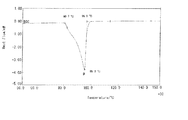
実施例合金のDSC曲線は図1の通りであり、固相線温度が83.7℃、ピーク温度が96.8℃である。
薄型温度ヒューズを製作して溶断温度を測定したところ、94℃±1℃であり、ピーク温度にほぼ一致していた。
図2はベース組成のDSC曲線を示し、固相線温度が80.7℃、ピーク温度が95.3℃であり、固相線温度が実施例合金よりも3.0℃低い。
図3は実施例合金組成からZnを除いた合金のDSC曲線を示し、ピーク温度が99.3℃と高く、作動温度90℃〜99℃の温度ヒューズの温度要件を充足させ難い。
〔実施例1−2〕
ベース組成に51%In−37%Sn−9%Bi−3%Znを使用した。このベース100重量部にAgを1.0重量部を添加した実施例合金を、1ダイスについての引落率6.5%、線引き速度45m/minの条件で300φμmに線引きしてヒューズエレメントを製作した。断線などなく円滑に伸線できた。
実施例合金の固相線温度は84.8℃、ピーク温度は97.9℃であり、ヒューズエレメントの溶断温度は97.1℃であった。
The solidus temperature, the peak temperature, and the liquidus temperature were measured using a differential heat measuring apparatus Thermo plus TG8120 manufactured by Rigaku Corporation under the conditions of a measurement sample weight of 10 to 14 mg and a heating rate of 5 ° C./1 min.
While flowing a current of 0.1 ampere through the thermal fuse, it was immersed in an oil bath at a heating temperature of 1 ° C./1 minute, and the oil temperature when the energization was cut off due to fusing was measured. The lead conductor is in contact with the oil and the temperature difference between the fuse element and the oil is negligible).
[Example 1-1]
The base composition was 51% In-37% Sn-9% Bi-3% Zn. The fuse element was manufactured by drawing the alloy of the example in which 0.5 part by weight of Ag was added to 100 parts by weight of the base to 300 φμm under the conditions of a draw rate of 6.5% per die and a drawing speed of 45 m / min. . The wire could be drawn smoothly without disconnection.
The DSC curve of the example alloy is as shown in FIG. 1. The solidus temperature is 83.7 ° C. and the peak temperature is 96.8 ° C.
When a thin thermal fuse was manufactured and the fusing temperature was measured, it was 94 ° C. ± 1 ° C., which was almost coincident with the peak temperature.
FIG. 2 shows a DSC curve of the base composition. The solidus temperature is 80.7 ° C., the peak temperature is 95.3 ° C., and the solidus temperature is 3.0 ° C. lower than the example alloy.
FIG. 3 shows a DSC curve of an alloy obtained by excluding Zn from the alloy composition of the example, the peak temperature is as high as 99.3 ° C., and it is difficult to satisfy the temperature requirement of the temperature fuse with an operating temperature of 90 ° C. to 99 ° C.
[Example 1-2]
The base composition was 51% In-37% Sn-9% Bi-3% Zn. A fuse element was manufactured by drawing an alloy of Example, in which 1.0 part by weight of Ag was added to 100 parts by weight of this base, at a drawing rate of 6.5% per die and a drawing speed of 45 m / min to 300 μm. . The wire could be drawn smoothly without disconnection.
The solidus temperature of the example alloy was 84.8 ° C., the peak temperature was 97.9 ° C., and the fusing temperature of the fuse element was 97.1 ° C.
〔実施例2−1〕
ベース組成に51%In−38.3%Sn−9%Bi−1.7%Znを使用した。このベース100重量部にAgを0.5重量部を添加した実施例合金を、1ダイスについての引落率6.5%、線引き速度45m/minの条件で300φμmに線引きしてヒューズエレメントを製作した。断線などなく円滑に伸線できた。
実施例合金の固相線温度は83.7℃、ピーク温度は96.7℃であり、ヒューズエレメントの溶断温度は95.4℃であった。
〔実施例2−2〕
ベース組成に51%In−38.3%Sn−9%Bi−1.7%Znを使用した。このベース100重量部にAgを1.0重量部を添加した実施例合金を、1ダイスについての引落率6.5%、線引き速度45m/minの条件で300φμmに線引きしてヒューズエレメントを製作した。断線などなく円滑に伸線できた。
実施例合金の固相線温度は84.8℃、ピーク温度が97.2℃であり、ヒューズエレメントの溶断温度は96.3℃であった。
[Example 2-1]
51% In-38.3% Sn-9% Bi-1.7% Zn was used for the base composition. The fuse element was manufactured by drawing the alloy of the example in which 0.5 part by weight of Ag was added to 100 parts by weight of the base to 300 φμm under the conditions of a draw rate of 6.5% per die and a drawing speed of 45 m / min. . The wire could be drawn smoothly without disconnection.
The solidus temperature of the example alloy was 83.7 ° C., the peak temperature was 96.7 ° C., and the fusing temperature of the fuse element was 95.4 ° C.
[Example 2-2]
51% In-38.3% Sn-9% Bi-1.7% Zn was used for the base composition. A fuse element was manufactured by drawing an alloy of Example, in which 1.0 part by weight of Ag was added to 100 parts by weight of this base, at a drawing rate of 6.5% per die and a drawing speed of 45 m / min to 300 μm. . The wire could be drawn smoothly without disconnection.
The solidus temperature of the example alloy was 84.8 ° C., the peak temperature was 97.2 ° C., and the fusing temperature of the fuse element was 96.3 ° C.
〔実施例3−1〕
ベース組成に53%In−37.0%Sn−7%Bi−3.0%Znを使用した。このベース100重量部にAgを0.5重量部を添加した実施例合金を、1ダイスについての引落率6.5%、線引き速度45m/minの条件で300φμmに線引きしてヒューズエレメントを製作した。断線などなく円滑に伸線できた。
実施例合金の固相線温度は82.6℃、ピーク温度は95.5℃であり、ヒューズエレメントの溶断温度は94.4℃であった。
〔実施例3−2〕
ベース組成に53%In−37.0%Sn−7%Bi−3.0%Znを使用した。このベース100重量部にAgを1.0重量部を添加した実施例合金を、1ダイスについての引落率6.5%、線引き速度45m/minの条件で300φμmに線引きしてヒューズエレメントを製作した。断線などなく円滑に伸線できた。
実施例合金の固相線温度は83.8℃、ピーク温度が98.1℃であり、ヒューズエレメントの溶断温度は97.4℃であった。
[Example 3-1]
53% In-37.0% Sn-7% Bi-3.0% Zn was used for the base composition. The fuse element was manufactured by drawing the alloy of the example in which 0.5 part by weight of Ag was added to 100 parts by weight of this base to 300 φμm under the conditions of a drawing rate of 6.5% per die and a drawing speed of 45 m / min. . The wire could be drawn smoothly without disconnection.
The solidus temperature of the example alloy was 82.6 ° C., the peak temperature was 95.5 ° C., and the fusing temperature of the fuse element was 94.4 ° C.
[Example 3-2]
53% In-37.0% Sn-7% Bi-3.0% Zn was used for the base composition. A fuse element was manufactured by drawing an alloy of Example, in which 1.0 part by weight of Ag was added to 100 parts by weight of this base, at a drawing rate of 6.5% per die and a drawing speed of 45 m / min to 300 μm. . The wire could be drawn smoothly without disconnection.
The solidus temperature of the example alloy was 83.8 ° C., the peak temperature was 98.1 ° C., and the fusing temperature of the fuse element was 97.4 ° C.
p ピーク p peak
Claims (4)
Priority Applications (1)
| Application Number | Priority Date | Filing Date | Title |
|---|---|---|---|
| JP2008243917A JP2010077459A (en) | 2008-09-24 | 2008-09-24 | Element for thermal fuse, and alloy-type thermal fuse |
Applications Claiming Priority (1)
| Application Number | Priority Date | Filing Date | Title |
|---|---|---|---|
| JP2008243917A JP2010077459A (en) | 2008-09-24 | 2008-09-24 | Element for thermal fuse, and alloy-type thermal fuse |
Publications (1)
| Publication Number | Publication Date |
|---|---|
| JP2010077459A true JP2010077459A (en) | 2010-04-08 |
Family
ID=42208221
Family Applications (1)
| Application Number | Title | Priority Date | Filing Date |
|---|---|---|---|
| JP2008243917A Pending JP2010077459A (en) | 2008-09-24 | 2008-09-24 | Element for thermal fuse, and alloy-type thermal fuse |
Country Status (1)
| Country | Link |
|---|---|
| JP (1) | JP2010077459A (en) |
Cited By (1)
| Publication number | Priority date | Publication date | Assignee | Title |
|---|---|---|---|---|
| CN103146976A (en) * | 2013-03-22 | 2013-06-12 | 天津百瑞杰焊接材料有限公司 | Lead-free low-temperature alloy having melting point of 100+/-2 DEG C and preparation method for same |
-
2008
- 2008-09-24 JP JP2008243917A patent/JP2010077459A/en active Pending
Cited By (1)
| Publication number | Priority date | Publication date | Assignee | Title |
|---|---|---|---|---|
| CN103146976A (en) * | 2013-03-22 | 2013-06-12 | 天津百瑞杰焊接材料有限公司 | Lead-free low-temperature alloy having melting point of 100+/-2 DEG C and preparation method for same |
Similar Documents
| Publication | Publication Date | Title |
|---|---|---|
| JP4001757B2 (en) | Alloy type temperature fuse | |
| JP3990169B2 (en) | Alloy type temperature fuse | |
| JP3841257B2 (en) | Alloy type temperature fuse | |
| CN100378891C (en) | Alloy Type Thermal Cutoffs and Fusible Link Elements | |
| JP4369008B2 (en) | Alloy type temperature fuse | |
| JP4360666B2 (en) | Alloy type thermal fuse and wire for thermal fuse element | |
| JP2004176105A (en) | Alloy type thermal fuse, and material for thermal fuse element | |
| JP2004043894A (en) | Alloy type thermal fuse and wire member for thermal fuse element | |
| JP3995058B2 (en) | Alloy type temperature fuse | |
| JP2010077459A (en) | Element for thermal fuse, and alloy-type thermal fuse | |
| JP4409705B2 (en) | Alloy type temperature fuse | |
| JP4409747B2 (en) | Alloy type thermal fuse | |
| JP4387229B2 (en) | Method of using alloy-type thermal fuse and alloy-type thermal fuse | |
| JP4101536B2 (en) | Alloy type thermal fuse | |
| JP2001195963A (en) | Alloy temperature fuse | |
| JP2516469B2 (en) | Alloy type temperature fuse | |
| JP2001325876A (en) | Fuse element | |
| JP2001143592A (en) | Fuse alloy | |
| JP2005171371A (en) | Alloy type thermal fuse and wire material for thermal fuse element | |
| JP2001135216A (en) | Alloy-type thermal fuse | |
| JPH1140025A (en) | Thermal alloy fuse | |
| JP2004059989A (en) | Alloy-type thermal fuse and wire rod for thermal-fuse element | |
| JP2001135215A (en) | Alloy-type thermal fuse | |
| JP2001143588A (en) | Alloy fuse | |
| JP2001143591A (en) | Alloy fuse |