JP2010143864A - Optically responsive azobenzene compound - Google Patents
Optically responsive azobenzene compound Download PDFInfo
- Publication number
- JP2010143864A JP2010143864A JP2008323606A JP2008323606A JP2010143864A JP 2010143864 A JP2010143864 A JP 2010143864A JP 2008323606 A JP2008323606 A JP 2008323606A JP 2008323606 A JP2008323606 A JP 2008323606A JP 2010143864 A JP2010143864 A JP 2010143864A
- Authority
- JP
- Japan
- Prior art keywords
- group
- formula
- site
- spacer
- nucleic acid
- Prior art date
- Legal status (The legal status is an assumption and is not a legal conclusion. Google has not performed a legal analysis and makes no representation as to the accuracy of the status listed.)
- Pending
Links
- 0 Cc(cc1)ccc1C#Cc1c(*)ccc(C#Cc(cc2)ccc2N=Nc2ccc(*)cc2)c1 Chemical compound Cc(cc1)ccc1C#Cc1c(*)ccc(C#Cc(cc2)ccc2N=Nc2ccc(*)cc2)c1 0.000 description 5
- JXLYWLFMXFHTGS-WUKNDPDISA-N Bc(cc1)ccc1/N=N/c(cc1)ccc1SCC(O)=O Chemical compound Bc(cc1)ccc1/N=N/c(cc1)ccc1SCC(O)=O JXLYWLFMXFHTGS-WUKNDPDISA-N 0.000 description 1
- AHCCZWRNFZAWIF-UHFFFAOYSA-N Nc(cc1)ccc1SCCO Chemical compound Nc(cc1)ccc1SCCO AHCCZWRNFZAWIF-UHFFFAOYSA-N 0.000 description 1
Images






Landscapes
- Organic Low-Molecular-Weight Compounds And Preparation Thereof (AREA)
- Low-Molecular Organic Synthesis Reactions Using Catalysts (AREA)
Abstract
【課題】可視光や赤外線二光子に応答する新規な水溶性アゾベンゼン誘導体を提供する。
【解決手段】
式(1):

で表されるアゾベンゼン化合物である。
【選択図】図1A novel water-soluble azobenzene derivative that responds to visible light or infrared two-photon is provided.
[Solution]
Formula (1):
The azobenzene compound represented by these.
[Selection] Figure 1
Description
本発明は、可視光及び/又は赤外線二光子等の光照射によって、シス−トランス異性化する光応答型アゾベンゼン化合物に関する。 The present invention relates to a photoresponsive azobenzene compound that undergoes cis-trans isomerization upon irradiation with light such as visible light and / or infrared two-photon.
アゾベンゼンは、近紫外光(320nm付近)の照射を受けてトランス体からシス体へと幾何異性化し、可視光(440nm付近)の照射を受けてシス体からトランス体へと異性化することが知られている。このような光照射に応答して化学構造を異性化させるフォトスイッチング機能は、有機材料(液晶材料や記憶素子)等に応用できるフォトクロミック分子として注目されている。近年、アゾベンゼンのフォトスイッチング機能を生化学分野へと応用し、細胞内へのイオン内流出(例えば、非特許文献1及び2参照)や、DNAの転写反応を制御する研究が報告されている(例えば、非特許文献3参照)。
It is known that azobenzene undergoes geometrical isomerization from the trans form to the cis form upon irradiation with near ultraviolet light (around 320 nm), and isomerizes from the cis form to the trans form upon irradiation with visible light (around 440 nm). It has been. Such a photo-switching function that isomerizes the chemical structure in response to light irradiation is attracting attention as a photochromic molecule that can be applied to organic materials (liquid crystal materials and memory elements). In recent years, research has been reported in which the photoswitching function of azobenzene is applied to the biochemical field to control the outflow of ions into cells (see, for example,
しかしながら、アゾベンゼン骨格のトランス体をシス体へと異性化させるために照射される紫外光は、組織・細胞浸透性が低く、更に短時間で細胞に重篤な障害をもたらすという問題がある。そのため、可視光に応答するアゾベンゼン誘導体の開発が進められている。しかしながら、可視光応答性のアゾベンゼン誘導体の合成には、複雑な有機合成反応を介してアゾベンゼンに芳香族性置換基を導入し、π電子共役系を拡張する必要であった。このようなアゾベンゼン誘導体は、水にきわめて難溶であり、生体機能制御用研究ツールとして、ペプチド等に導入することができなかった。 However, the ultraviolet light irradiated to isomerize the trans isomer of the azobenzene skeleton into a cis isomer has a problem of low tissue / cell permeability and causes serious damage to cells in a short time. Therefore, the development of azobenzene derivatives that respond to visible light is being promoted. However, in order to synthesize visible light-responsive azobenzene derivatives, it is necessary to introduce an aromatic substituent into azobenzene through a complicated organic synthesis reaction and to expand the π-electron conjugated system. Such an azobenzene derivative is extremely hardly soluble in water and could not be introduced into peptides or the like as a research tool for controlling biological functions.
これまでに、アゾベンゼンのアゾ部位から芳香環を挟んでパラ位に窒素原子が導入されたアミノアゾベンゼンのトランス体の吸収極大波長は、無置換アゾベンゼンのトランス体に比べて約100〜150nm、長波長側の約400〜500nmに特徴的な吸収スペクトルを示すことが知られている。このような、可視光に吸収スペクトルを持つアミノアゾベンゼンは、その約2倍の波長光であり生体透過性に優れる近赤外領域(800〜1000nm)の同時二光子吸収を吸収することが報告されている(例えば、非特許文献4及び5参照)。
So far, the absorption maximum wavelength of the trans isomer of aminoazobenzene in which a nitrogen atom is introduced from the azo site of azobenzene across the aromatic ring is about 100 to 150 nm, longer wavelength than the trans isomer of unsubstituted azobenzene. It is known to show a characteristic absorption spectrum at about 400-500 nm on the side. It is reported that aminoazobenzene having an absorption spectrum in visible light absorbs simultaneous two-photon absorption in the near-infrared region (800 to 1000 nm), which is about twice the wavelength light and has excellent biological permeability. (See, for example, Non-Patent
しかしながら、非特許文献4や非特許文献5に開示されるアミノアゾベンゼンは、光照射によるシス異性化能が低いという問題があった。
本発明は、可視光や赤外線二光子に応答する新規な水溶性アゾベンゼン誘導体及びその製造方法を提供することを課題とする。 An object of the present invention is to provide a novel water-soluble azobenzene derivative that responds to visible light or infrared two-photon and a method for producing the same.
本発明者らは、上記課題を解決すべく、鋭意研究を重ねた結果、可視光や赤外線二光子等の光照射に応答する新規なアゾベンゼン誘導体を見出した。本発明は、このような知見に基づき完成されたものである。 As a result of intensive studies to solve the above problems, the present inventors have found a novel azobenzene derivative that responds to light irradiation such as visible light and infrared two-photon. The present invention has been completed based on such findings.
すなわち、本発明は、下記の新規アゾベンゼン誘導体に係る。 That is, the present invention relates to the following novel azobenzene derivatives.
項1.式(1):
(式(1)中、R1は、水素原子、ハロゲン原子、又は式(1a): (In Formula (1), R 1 is a hydrogen atom, a halogen atom, or Formula (1a):
(式(1a)中、mは1〜5の整数であり、R3は、アミノ基;カルボキシル基;低級アルコキシ基;低級アルコキシカルボニル基;ニトロ基;ペプチド核酸部位を有する基;蛍光部位又は消光部位を有するスペーサーを有する基;芳香族環上にカルボキシル基、低級アルコキシ基、ニトロ基、ペプチド核酸部位を有する基又は蛍光部位もしくは消光部位を有するスペーサーを有する基を有することのある芳香族環を有する低級アルキレン基、低級アルケニレン基又は低級アルキニレン基であって、mが2以上の場合、同じであっても異なっていてもよい)
で表される基であり、
Aは、低級アルキレン基、低級アルケニレン基、低級アルキニレン基、又は直接結合であり、
Xは、−O−R2a、−N−(R2b)2又は−S(O)k−R2cであり、
R2aは、低級アルキル基;ペプチド核酸部位を有する基;蛍光部位又は消光部位を有するスペーサーを有する基;アミノ基、カルボキシル基、低級アルコキシカルボニル基、ヒドロキシル基、ペプチド核酸部位を有する基、又は蛍光部位もしくは消光部位を有するスペーサーを有する基が置換されていてもよい低級アルキル基であり、
R2bは、同じであっても異なっていてもよく、水素原子;低級アルキル基;ペプチド核酸部位を有する基;蛍光部位又は消光部位を有するスペーサーを有する基;アミノ基、カルボキシル基、低級アルコキシカルボニル基、ヒドロキシル基、ペプチド核酸部位を有する基、又は蛍光部位もしくは消光部位を有するスペーサーを有する基が置換されていてもよい低級アルキル基であり、
R2cは、低級アルキル基;ペプチド核酸部位を有する基;蛍光部位又は消光部位を有するスペーサーを有する基;アミノ基、カルボキシル基、低級アルコキシカルボニル基、ヒドロキシル基、ペプチド核酸部位を有する基又は蛍光部位もしくは消光部位を有するスペーサーを有する基、が置換されていてもよい低級アルキル基であって、
kは0〜3の整数である)
で表されるアゾベンゼン化合物。
(In the formula (1a), m is an integer of 1 to 5, and R 3 is an amino group; carboxyl group; lower alkoxy group; lower alkoxycarbonyl group; nitro group; group having a peptide nucleic acid site; fluorescent site or quenching. A group having a spacer having a moiety; an aromatic ring which may have a carboxyl group, a lower alkoxy group, a nitro group, a group having a peptide nucleic acid moiety or a group having a spacer having a fluorescent moiety or a quenching moiety on the aromatic ring. A lower alkylene group, a lower alkenylene group or a lower alkynylene group having the same or different when m is 2 or more)
A group represented by
A is a lower alkylene group, a lower alkenylene group, a lower alkynylene group, or a direct bond,
X is —O—R 2a , —N— (R 2b ) 2 or —S (O) k —R 2c ,
R 2a is a lower alkyl group; a group having a peptide nucleic acid site; a group having a spacer having a fluorescent site or a quenching site; an amino group, a carboxyl group, a lower alkoxycarbonyl group, a hydroxyl group, a group having a peptide nucleic acid site, or a fluorescence A group having a spacer having a moiety or a quenching moiety is a lower alkyl group which may be substituted,
R 2b, which may be the same or different, are a hydrogen atom; a lower alkyl group; a group having a peptide nucleic acid site; a group having a spacer having a fluorescent site or a quenching site; an amino group, a carboxyl group, and a lower alkoxycarbonyl group. A lower alkyl group that may be substituted with a group, a hydroxyl group, a group having a peptide nucleic acid site, or a group having a spacer having a fluorescent site or a quenching site,
R 2c is a lower alkyl group; a group having a peptide nucleic acid site; a group having a spacer having a fluorescent site or a quenching site; an amino group, a carboxyl group, a lower alkoxycarbonyl group, a hydroxyl group, a group having a peptide nucleic acid site or a fluorescent site Or a group having a spacer having a quenching site is a lower alkyl group which may be substituted,
k is an integer of 0 to 3)
An azobenzene compound represented by
項2.式(a1):
(式(a1)中、A及びR1は、前記式と同様である)
と、亜硝酸塩及び酸を添加して、ジアゾニウム塩を形成させ、さらに、前記ジアゾニウム塩と、式(a2):
(In the formula (a1), A and R 1 are the same as the above formula)
And adding a nitrite and an acid to form a diazonium salt, and the diazonium salt and the formula (a2):
(式(a2)中、Xは、前記式と同様である)
を反応させることを特徴とする項1に記載のアゾベンゼン化合物の製造方法。
(In formula (a2), X is the same as the above formula)
項3.式(b1):
(式(b1)中、A及びR1は、前記式と同様である)
と、式(b2):
(In the formula (b1), A and R 1 are the same as the above formula)
And the formula (b2):
(式(b2)中、Xは、前記式と同様である)
を酸性条件下で反応させることを特徴とする項1に記載のアゾベンゼン化合物の製造方法。
(In the formula (b2), X is the same as the above formula)
項4.式(c1):
(式(c1)中、Xは、前記式と同様であって、Yは、ハロゲン原子である)
と、トリメチルシリルアセチレンを反応させ、脱シリル化することによって、式(c2):
(In the formula (c1), X is the same as the above formula, and Y is a halogen atom)
Is reacted with trimethylsilylacetylene and desilylated to obtain the formula (c2):
を得、さらに、式(c3): And further formula (c3):
(式(c3)中、Y、R3及びmは、前記式と同様である)
を反応させることを特徴とする項1に記載のアゾベンゼン化合物の製造方法。
(In formula (c3), Y, R 3 and m are the same as the above formula)
項5.光スイッチング材料として用いられる項1に記載のアゾベンゼン化合物。
項6.mRNA転写反応促進剤又はmRNA転写反応抑制剤として用いられる項1に記載のアゾベンゼン化合物。
本発明は、式(1): The present invention relates to formula (1):
で表される新規なアゾベンゼン化合物である。 It is a novel azobenzene compound represented by.
式(1)中、R1は、水素原子、ハロゲン原子、又は式(1a): In formula (1), R 1 is a hydrogen atom, a halogen atom, or formula (1a):
で表される。 It is represented by
式(1a)中、mは1〜5であり、好ましくは、1〜4である。 In the formula (1a), m is 1 to 5, and preferably 1 to 4.
R3は、mが2以上の場合、同じであっても異なっていてもよい。 R 3 may be the same or different when m is 2 or more.
R3は、アミノ基、カルボキシル基;低級アルコキシ基;低級アルコキシカルボニル基;ニトロ基;ペプチド核酸部位を有する基;蛍光部位又は消光部位を有するスペーサーを有する基;芳香族環上にカルボキシル基、低級アルコキシ基、ニトロ基、ペプチド核酸部位を有する基又は蛍光部位もしくは消光部位を有するスペーサーを有する基を有することのある芳香族環を有する低級アルキレン基、低級アルケニレン基又は低級アルキニレン基である。 R 3 is an amino group, a carboxyl group; a lower alkoxy group; a lower alkoxycarbonyl group; a nitro group; a group having a peptide nucleic acid site; a group having a spacer having a fluorescent site or a quenching site; a carboxyl group on the aromatic ring; A lower alkylene group, a lower alkenylene group or a lower alkynylene group having an aromatic ring which may have an alkoxy group, a nitro group, a group having a peptide nucleic acid site or a group having a spacer having a fluorescent site or a quenching site.
R3における低級アルコキシ基としては、メトキシ基、エトキシ基、n−プロポキシ基、iso−プロポキシ基、n−ブトキシ基、iso−ブトキシ基、tert−ブトキシ基等の炭素数1〜4程度のアルコキシ基が好ましいが、これらの中で、Aがアセチレンの場合において園頭カップリング反応の化学収率が良好であるという点から、メトキシ基、エトキシ基、n−プロポキシ基、n−ブトキシ基等が好ましい。 The lower alkoxy group for R 3 is an alkoxy group having about 1 to 4 carbon atoms such as a methoxy group, an ethoxy group, an n-propoxy group, an iso-propoxy group, an n-butoxy group, an iso-butoxy group, or a tert-butoxy group. Of these, a methoxy group, an ethoxy group, an n-propoxy group, an n-butoxy group, etc. are preferable from the viewpoint that the chemical yield of the Sonogashira coupling reaction is good when A is acetylene. .
R3における低級アルコキシカルボニル基としては、メトキシカルボニル基、エトキシカルボニル基、n−プロポキシカルボニル基、iso−プロポキシカルボニル基、n−ブトキシカルボニル基、iso−ブトキシカルボニル基、tert−ブトキシカルボニル基等の炭素数1〜4程度のアルコキシカルボニル基が好ましいが、これらの中で、分子構造のリジディティーを保持するため、炭素鎖数が1〜2程度のメトキシカルボニル基、エトキシカルボニル基が好ましい。 The lower alkoxycarbonyl group for R 3 includes carbon such as methoxycarbonyl group, ethoxycarbonyl group, n-propoxycarbonyl group, iso-propoxycarbonyl group, n-butoxycarbonyl group, iso-butoxycarbonyl group, tert-butoxycarbonyl group, etc. An alkoxycarbonyl group having a number of about 1 to 4 is preferred, and among these, a methoxycarbonyl group or an ethoxycarbonyl group having a carbon chain number of about 1 to 2 is preferred in order to maintain the rigidity of the molecular structure.
R3における芳香族環を有する低級アルキレン基としては、例えば、メチレン基、エチレン基、プロピレン基、ブチレン基等の炭素数1〜12のアルキレン基が挙げられ、R3における芳香族環を有する低級アルケニレン基としては、例えば、ビニレン基、プロペニレン基、ブテニレン基等の炭素数2〜6のアルケニレン基が挙げられ、R3における芳香族環を有する低級アルキニレン基としては、例えば、エチニレン基、プロピニレン基、ブチニレン基等の炭素数2〜10のアルキニレン基が挙げられる。これらのなかで、二重結合のシス−トランス幾何構造の制御、化学構造安定性という点から、低級アルキニレン基が好ましく、具体的には、エチニレン基、プロペニレン基、ブテニレンが好ましい。 Examples of the lower alkylene group having an aromatic ring in R 3 include alkylene groups having 1 to 12 carbon atoms such as a methylene group, an ethylene group, a propylene group, and a butylene group, and a lower alkylene group having an aromatic ring in R 3 . Examples of the alkenylene group include C2-C6 alkenylene groups such as vinylene group, propenylene group, and butenylene group. Examples of the lower alkynylene group having an aromatic ring in R 3 include ethynylene group, propynylene group, and the like. And alkynylene groups having 2 to 10 carbon atoms such as butynylene group. Of these, a lower alkynylene group is preferable from the viewpoint of control of the cis-trans geometric structure of a double bond and chemical structure stability, and specifically, an ethynylene group, a propenylene group, and butenylene are preferable.
R3における芳香族環上に置換されてもよい低級アルコキシ基としては、前記のものが挙げられる。 Examples of the lower alkoxy group which may be substituted on the aromatic ring in R 3 include those described above.
R3の位置としては、アゾベンゼンのシス−トランス異性化における構造の変化がより顕著に発現できるという観点から、メタ位に置換していることが好ましく、具体的には、 The position of R 3 is preferably substituted at the meta position from the viewpoint that the structural change in the cis-trans isomerization of azobenzene can be more remarkably expressed.
(式中、R3a及びR3bは、R3と同様である)
で表される基であることが好ましく、より具体的には、
(Wherein R 3a and R 3b are the same as R 3 )
It is preferably a group represented by
(式中、R’は、水素原子又は低級アルキル基であり、低級アルキル基は前記と同様のものである)、 (Wherein R ′ is a hydrogen atom or a lower alkyl group, and the lower alkyl group is the same as described above),
(式中、R’は、前記と同様のものである)
であることが好ましい。
(Wherein R ′ is the same as described above)
It is preferable that
Aは、低級アルキレン基、低級アルケニレン基、低級アルキニレン基、又は直接結合である。Aにおける低級アルキレン基、低級アルケニレン基及び低級アルキニレン基は、前記のものが挙げられる。 A is a lower alkylene group, a lower alkenylene group, a lower alkynylene group, or a direct bond. Examples of the lower alkylene group, lower alkenylene group and lower alkynylene group in A include those described above.
Xは、アゾベンゼン化合物のトランス体が可視光領域において光を吸収できるという点から、−O−R2a、−N−(R2b)2又は−S(O)k−R2cである。 X is trans-isomer of the azobenzene compound from the viewpoint capable of absorbing light in the visible light region, a -O-R 2a, -N- (R 2b) 2 , or -S (O) k -R 2c.
R2aは、低級アルキル基;ペプチド核酸部位を有する基;蛍光部位又は消光部位を有するスペーサーを有する基;アミノ基、カルボキシル基、低級アルコキシカルボニル基、ヒドロキシル基、ペプチド核酸部位を有する基又は蛍光部位もしくは消光部位を有するスペーサーを有する基が置換されていてもよい低級アルキル基である。 R 2a is a lower alkyl group; a group having a peptide nucleic acid site; a group having a spacer having a fluorescent site or a quenching site; an amino group, a carboxyl group, a lower alkoxycarbonyl group, a hydroxyl group, a group having a peptide nucleic acid site or a fluorescent site Alternatively, it is a lower alkyl group in which a group having a spacer having a quenching site may be substituted.
R2bは、同じであっても異なっていてもよく、水素原子;低級アルキル基;ペプチド核酸部位を有する基;蛍光部位又は消光部位を有するスペーサーを有する基;アミノ基、カルボキシル基、低級アルコキシカルボニル基、ヒドロキシル基、ペプチド核酸部位を有する基、又は蛍光部位もしくは消光部位を有するスペーサーを有する基が置換されていてもよい低級アルキル基であるが、式(1)中、Aが直接結合であって、R1が水素原子又はハロゲン原子である場合には、低級アルキル基;ペプチド核酸部位を有する基;蛍光部位又は消光部位を有するスペーサーを有する基;カルボキシル基、低級アルコキシカルボニル基、ヒドロキシル基、ペプチド核酸部位を有する基又は蛍光部位もしくは消光部位を有するスペーサーを有する基が置換されていてもよい低級アルキル基である。 R 2b, which may be the same or different, are a hydrogen atom; a lower alkyl group; a group having a peptide nucleic acid site; a group having a spacer having a fluorescent site or a quenching site; an amino group, a carboxyl group, and a lower alkoxycarbonyl group. A group having a group, a hydroxyl group, a peptide nucleic acid site, or a group having a spacer having a fluorescent site or a quenching site, may be substituted, but in formula (1), A is a direct bond. When R 1 is a hydrogen atom or a halogen atom, a lower alkyl group; a group having a peptide nucleic acid site; a group having a spacer having a fluorescent site or a quenching site; a carboxyl group, a lower alkoxycarbonyl group, a hydroxyl group, A group having a peptide nucleic acid site or a group having a spacer having a fluorescent site or a quenching site is placed. It is a lower alkyl group which may be.
R2cは、低級アルキル基;ペプチド核酸部位を有する基;蛍光部位又は消光部位を有するスペーサーを有する基;アミノ基、カルボキシル基、低級アルコキシカルボニル基、ヒドロキシル基、ペプチド核酸部位を有する基、又は蛍光部位もしくは消光部位を有するスペーサーを有する基が置換されていてもよい低級アルキル基であって、kは0〜3の整数である)
R2a、R2b及びR2cにおける低級アルキル基、低級アルコキシ基、低級アルコキシカルボニル基は、前記のものが挙げられる。
R 2c is a lower alkyl group; a group having a peptide nucleic acid site; a group having a spacer having a fluorescent site or a quenching site; an amino group, a carboxyl group, a lower alkoxycarbonyl group, a hydroxyl group, a group having a peptide nucleic acid site, or a fluorescence A group having a spacer having a moiety or a quenching moiety is a lower alkyl group which may be substituted, and k is an integer of 0 to 3)
Examples of the lower alkyl group, lower alkoxy group and lower alkoxycarbonyl group in R 2a , R 2b and R 2c include those described above.
これらの中で、トランス体とシス体の極大吸収波長の差が大きい、シス体への異性化における量子効率が高い、光照射によるシス−トランス異性化の効率が高い、シス異性体の熱安定性が高い、酸性条件下におけるアゾ部位のプロトン化の影響を受けにくいという観点から、−S(O)k−R2cであることが好ましい。 Among these, the difference in maximum absorption wavelength between the trans and cis isomers is large, the quantum efficiency in isomerization to the cis isomer is high, the efficiency of cis-trans isomerization by light irradiation is high, and the thermal stability of the cis isomer high sex, from the viewpoint of not easily influenced by the protonation of the azo site in acidic conditions, preferably a -S (O) k -R 2c.
前記式(1)のより好ましい具体例としては、式(1-1): As a more preferred specific example of the formula (1), the formula (1-1):
(式中、R1及びR2aは、前記式と同様である)、
式(1-2):
(Wherein R 1 and R 2a are the same as the above formula),
Formula (1-2):
(式中、R1及びR2bは、前記式と同様である)
式(1-3):
(Wherein R 1 and R 2b are the same as the above formula)
Formula (1-3):
(式中、R1、R2c及びkは、前記式と同様である)
式(1-4):
(Wherein R 1 , R 2c and k are the same as the above formula)
Formula (1-4):
(式中、R3c、R3dは、前記式R3と同じであり、Xは、前記式と同様である)
式(1-5):
(In the formula, R 3c and R 3d are the same as the above-mentioned formula R 3 , and X is the same as the above-mentioned formula)
Formula (1-5):
(式中、R3c、R3eは、前記式R3と同じであり、Xは、前記式と同様である)
が挙げられる。
(Wherein R 3c and R 3e are the same as those in the above formula R 3 , and X is the same as the above formula)
Is mentioned.
本発明は、アゾベンゼン化合物における置換基としてペプチド核酸(以下、PNAともいう)部位を有する基を有することによって、PNA部位の塩基とDNA又はRNA中の特定の塩基と塩基対を形成させ、転写の発現や抑制を制御させることができる。 The present invention has a group having a peptide nucleic acid (hereinafter, also referred to as PNA) site as a substituent in an azobenzene compound, thereby forming a base pair with a specific base in DNA or RNA by forming a base of the PNA site, and thereby performing transcription. Expression and suppression can be controlled.
PNA部位を有する置換基におけるPNA部位とは、式(2a): The PNA moiety in the substituent having a PNA moiety is the formula (2a):
又は、式(2b): Or formula (2b):
等が挙げられ、アミド結合、アミン結合を介して置換される。 And is substituted through an amide bond or an amine bond.
式中、Qは、6〜23程度が好ましく、6〜17程度がより好ましく、8〜14程度がさらに好ましい。また、アゾベンゼン化合物に2つのPNAが置換された場合のQの数は、同じであってもよく、又は異なっていてよいが、フーグスティン水素結合の形成は、8塩基から効率的に起こるという点(Kaihatsu. K, et al., Extending recognition by Peptide Nucleic Acid: Binding to Duplex DNA and inhibitionof Transcription by Tail-Clamp PNA-Petide Conjugates, Biochemistry, 42, 13996-14003, 2003.参照)、ワトソン−クリック型水素結合がより強固であり、二重鎖DNA中の標的配列に対して5塩基程度で水素結合を形成できる点(Combined Triplex/Duplex Invasion of Double-Stranded DNA by “Tail-Clamp” Peptide Nucleic Acid, Bentin T, et al., Biochemistry, 42, 13987-13995, 2003参照)から、Qの一方が6〜17程度、好ましくは8〜14程度であって、もう一方が3〜8程度、好ましくは3〜6程度であって分子鎖長が異なることが合成の簡便上好ましい。 In the formula, Q is preferably about 6 to 23, more preferably about 6 to 17, and still more preferably about 8 to 14. In addition, when two PNAs are substituted on the azobenzene compound, the number of Q may be the same or different, but the formation of Hoogsteen hydrogen bond efficiently occurs from 8 bases ( Kaihatsu.K, et al., Extending recognition by Peptide Nucleic Acid: Binding to Duplex DNA and inhibition of Transcription by Tail-Clamp PNA-Petide Conjugates, Biochemistry, 42, 13996-14003, 2003.) Is more robust and can form hydrogen bonds with double base DNA in about 5 bases (Combined Triplex / Duplex Invasion of Double-Stranded DNA by “Tail-Clamp” Peptide Nucleic Acid, Bentin T , et al., Biochemistry, 42, 13987-13995, 2003), one of Q is about 6-17, preferably about 8-14, and the other is about 3-8, preferably 3-6. However, the molecular chain length is different because of the ease of synthesis. Arbitrariness.
なお、式(2a)及び(2b)中のBaseとは、塩基を表し、具体的にはシトシン(C)、アデニン(A)、グアニン(G)、チミン(T)等の天然型の塩基、及び2,6−ジアミノプリン(D)、2−チオウラシル(2-Us)等の非天然型の塩基が挙げられる。これらの塩基の組み合わせとしては、対象となるDNA又はRNA中の特定の塩基と塩基対を形成するような組み合わせであればよい。 Note that Base in the formulas (2a) and (2b) represents a base, specifically, a natural base such as cytosine (C), adenine (A), guanine (G), thymine (T), And non-natural bases such as 2,6-diaminopurine (D) and 2-thiouracil (2-Us). The combination of these bases may be a combination that forms a base pair with a specific base in the target DNA or RNA.
また、PNA部位の末端基(式(2a)におけるアミノ基、式(2b)におけるカルボキシ基)については、リシン、アルギニン、ヒスチジン等の塩基性アミノ酸、グリシン、アラニン等の中性アミノ酸の1〜16量体、好ましくは3〜9量体によって置換されていることが、化学合成の簡便性、PNAの水溶性と細胞内導入効率を高めるという観点から好ましい。
Moreover, about the terminal group of the PNA site (amino group in formula (2a), carboxy group in formula (2b)), basic amino acids such as lysine, arginine and histidine, and
PNA部位を有する基は、アゾベンゼン化合物の両末端に置換されていることが好ましく、具体的には、R2a、R2b又はR2cと、R3に置換されていることが好ましい。 The group having a PNA moiety is preferably substituted at both ends of the azobenzene compound. Specifically, R 2a , R 2b or R 2c and R 3 are preferably substituted.
PNA部位を有する基を有するアゾベンゼン化合物の製造方法としては、特に限定されないが、例えば、Fmoc-固相合成法によって製造することができる。Fmoc-固相合成法で使用される、樹脂、カップリング試薬、脱保護試薬、洗浄操作、樹脂からの切り出し、HPLCによる精製等は公知の方法によって製造することができる。 A method for producing an azobenzene compound having a group having a PNA site is not particularly limited, and for example, it can be produced by an Fmoc-solid phase synthesis method. The resin, coupling reagent, deprotection reagent, washing operation, excision from the resin, purification by HPLC, etc. used in the Fmoc-solid phase synthesis method can be produced by known methods.
前記PNA部位を有する基を有するアゾベンゼン化合物の製造方法のほかにも、Boc(t-ブチルカルボニル)固相合成法によっても製造することができる。 In addition to the method for producing an azobenzene compound having a group having a PNA moiety, it can also be produced by a Boc (t-butylcarbonyl) solid phase synthesis method.
また本発明は、アゾベンゼン化合物における置換基として蛍光部位又は消光部位を有するスペーサーを有する基を有することによって、トランス型の場合、蛍光部位由来の蛍光発光が生じ、シス体に異性化すると蛍光部位と消光部位の距離が近くなるため、蛍光発光しなくなるというメカニズムから、分子内スイッチを形成することができる。そのため、アゾベンゼン化合物の方末端が蛍光部位を有するスペーサーを有する基で置換され、もう一方の末端が消光部位を有するスペーサーを有する基で置換されていることが好ましい。 In addition, the present invention has a group having a spacer having a fluorescent site or a quenching site as a substituent in the azobenzene compound, so that in the trans type, fluorescent emission derived from the fluorescent site occurs, and when isomerized into a cis isomer, The intramolecular switch can be formed from the mechanism that the fluorescence is not emitted because the distance between the quenching sites is reduced. For this reason, it is preferable that the azobenzene compound is substituted at the other end with a group having a spacer having a fluorescent moiety, and at the other end with a group having a spacer having a quenching moiety.
蛍光部位としては、例えば、フルオレセイン(以下、FAMともいう)、Cy3及びCy5等のシアニン誘導体、テトラメチルローダミン(TMRともいう)及びTexas Red等のローダミン誘導体等が挙げられ、これらの部位が、スペーサーを介して式(1a)にエステル結合、アミド結合、アミン結合を介して置換される。 Examples of fluorescent sites include fluorescein (hereinafter also referred to as FAM), cyanine derivatives such as Cy3 and Cy5, rhodamine derivatives such as tetramethylrhodamine (also referred to as TMR) and Texas Red, and these sites are spacers. Is substituted into the formula (1a) via an ester bond, an amide bond or an amine bond.
また、消光部位を有する置換基における消光部位とは、前記蛍光部位から発する蛍光を消光できるような部位をいい、例えば、QXLTM520, Black Hole Quencher-2(BHQ-2ともいう), QSY-7, Deep Dark Quencher (DDQ-IIともいう), Black Hole Quencher-3(BHQ-3ともいう)等が挙げられ、これらの部位が、スペーサーを介して式(1a)にエステル結合、アミド結合、アミン結合を介して置換される。 The quenching site in the substituent having a quenching site refers to a site capable of quenching the fluorescence emitted from the fluorescent site, for example, QXL TM520 , Black Hole Quencher-2 (also referred to as BHQ-2), QSY-7 , Deep Dark Quencher (also referred to as DDQ-II), Black Hole Quencher-3 (also referred to as BHQ-3), etc., and these sites are linked to the ester (amide) bond, amine, and amine via formula (1a). Substituted through a bond.
前記スペーサーとしては、PNAのストランドインベージョンに最適な距離が11-33Åであることが報告されているが(Nulf CJ, et al., DNA assembly using bis-peptide nucleic acids (bisPNAs), Nucleic Acids Res. 30, 2782-2789, 2002)、シス型のアゾベンゼン化合物において、蛍光部位による蛍光発光が消光される距離(アゾベンゼン化合物の長さが0〜40Å程度、好ましくは0〜25Å程度)となるものであれば特に限定されない。前記スペーサーの具体例としては、例えば、6−アミノカプロン酸、リシン、及びこれらの組み合わせのものであって、アミド結合、エステル結合、エーテル結合、アミン結合されたものであることが好ましく、6−アミノカプロン酸とリシンがアミド結合したものが好ましい。 As the spacer, it has been reported that the optimal distance for strand invasion of PNA is 11-33 mm (Nulf CJ, et al., DNA assembly using bis-peptide nucleic acids (bisPNAs), Nucleic Acids Res. 30, 2782-2789, 2002), in a cis-type azobenzene compound, the distance at which the fluorescence emission from the fluorescent site is quenched (the length of the azobenzene compound is about 0 to 40 mm, preferably about 0 to 25 mm) If it is, it will not specifically limit. Specific examples of the spacer include, for example, 6-aminocaproic acid, lysine, and combinations thereof, and preferably an amide bond, an ester bond, an ether bond, or an amine bond. An acid and lysine in which an amide bond is formed is preferable.
本発明のアゾベンゼン誘導体のトランス体をシス体に異性化させる際の可視光の波長としては、365〜450nm程度が好ましく、380〜450nm程度がより好ましい。また、本発明のアゾベンゼン誘導体のトランス体をシス体に異性化させる際の赤外線二光子としては、700〜900nm程度が好ましく、780〜820nm程度がより好ましい。 The wavelength of visible light when the trans isomer of the azobenzene derivative of the present invention is isomerized to a cis isomer is preferably about 365 to 450 nm, and more preferably about 380 to 450 nm. In addition, the infrared two-photon upon isomerizing the trans isomer of the azobenzene derivative of the present invention to a cis isomer is preferably about 700 to 900 nm, more preferably about 780 to 820 nm.
本発明のアゾベンゼン誘導体のシス体をトランス体に異性化させる際の可視光としては、470〜510nm程度が好ましく、490〜510nm程度がより好ましい。また、本発明のアゾベンゼン誘導体のシス体をトランス体に異性化させる際の赤外線二光子としては、900〜1040nm程度が好ましく、900〜940nm程度がより好ましい。 Visible light for isomerizing the cis isomer of the azobenzene derivative of the present invention into a trans isomer is preferably about 470 to 510 nm, and more preferably about 490 to 510 nm. In addition, the infrared two-photon upon isomerizing the cis isomer of the azobenzene derivative of the present invention into a trans isomer is preferably about 900 to 1,040 nm, and more preferably about 900 to 940 nm.
蛍光部位又は消光部位を有するスペーサーを有する基を有するアゾベンゼン化合物の製造方法としては、特に限定されないが、例えば、Fmoc-固相合成法によって製造することができる。Fmoc-固相合成法で使用される、樹脂、カップリング試薬、脱保護試薬、洗浄操作、樹脂からの切り出し、HPLCによる精製等は公知の方法によって製造することができる。 A method for producing an azobenzene compound having a group having a spacer having a fluorescent site or a quenching site is not particularly limited, and for example, it can be produced by an Fmoc-solid phase synthesis method. The resin, coupling reagent, deprotection reagent, washing operation, excision from the resin, purification by HPLC, etc. used in the Fmoc-solid phase synthesis method can be produced by known methods.
前記蛍光部位又は消光部位を有するスペーサーを有する基を有するアゾベンゼン化合物の製造方法のほかにも、Boc固相合成法によっても製造することができる。 In addition to the method for producing an azobenzene compound having a group having a spacer having a fluorescent site or a quenching site, it can also be produced by a Boc solid phase synthesis method.
本発明の前記アゾベンゼン化合物は、例えば、式(a1): The azobenzene compound of the present invention includes, for example, the formula (a1):
(式(a1)中、A及びR1は、前記式と同様である)
と、亜硝酸塩及び酸を添加して、ジアゾニウム塩を形成させ、さらに、前記ジアゾニウム塩と、式(a2):
(In the formula (a1), A and R 1 are the same as the above formula)
And adding a nitrite and an acid to form a diazonium salt, and the diazonium salt and the formula (a2):
(式中、Xは、前記式と同様である)
を反応させる方法である反応式(a):
(Wherein X is the same as the above formula)
Reaction formula (a) is a method of reacting:
(反応式(a)中、A及びR1は、前記式と同様である)
によって製造され、また、式(b1):
(In the reaction formula (a), A and R 1 are the same as the above formula)
Also produced by the formula (b1):
(式(b1)中、A及びR1は、前記式と同様である)
と、式(b2):
(In the formula (b1), A and R 1 are the same as the above formula)
And the formula (b2):
(式(b2)中、Xは、前記式と同様である)
を酸性条件下で反応させる反応式(b):
(In the formula (b2), X is the same as the above formula)
Is reacted under acidic conditions (b):
(反応式(b)中、A及びR1は、前記式と同様である)
によって製造される。
(In the reaction formula (b), A and R 1 are the same as the above formula)
Manufactured by.
前記反応式(a)の反応試薬としては、亜硝酸ナトリウム、亜硝酸カリウム等の亜硝酸塩に塩酸等の酸を加えることで酸性条件とし、ジアゾニウム塩を形成させる。 As the reaction reagent of the reaction formula (a), an acid condition such as hydrochloric acid is added to a nitrite such as sodium nitrite or potassium nitrite to form a diazonium salt.
ジアゾニウム塩を形成させる際のpHとしては、2以下が好ましく、1〜2がより好ましい。ジアゾニウム塩を形成させるための反応温度としては、−3〜5℃が好ましく、−3〜0℃がより好ましい。反応時間としては、1〜10時間が好ましく、1〜5時間がより好ましい。 As pH at the time of forming a diazonium salt, 2 or less is preferable and 1-2 is more preferable. The reaction temperature for forming the diazonium salt is preferably −3 to 5 ° C., more preferably −3 to 0 ° C. The reaction time is preferably 1 to 10 hours, more preferably 1 to 5 hours.
前記式(a2)の添加量としては、前記式(a1)で表されるアニリン誘導体1モルに対して、1〜3モルが好ましく、1〜1.2モルがより好ましい。また、亜硝酸塩の添加量としては、前記アニリン誘導体1モルに対して、2〜5モルが好ましく、2〜3モルがより好ましい。 The amount of the formula (a2) added is preferably 1 to 3 mol, more preferably 1 to 1.2 mol, relative to 1 mol of the aniline derivative represented by the formula (a1). Moreover, as addition amount of nitrite, 2-5 mol is preferable with respect to 1 mol of said aniline derivatives, and 2-3 mol is more preferable.
反応溶媒としては、水、メタノール、エタノール等が挙げられる。 Examples of the reaction solvent include water, methanol, ethanol and the like.
前記得られるジアゾニウム塩を、リン酸バッファー(pH8.0)、酢酸ナトリウムと酢酸緩衝液(pH 3.6〜5.6)、炭酸水素ナトリウム緩衝液(pH9.0)を加えることによって、アゾベンゼン化合物を製造することができる。反応条件としては、塩基性条件下で行われることが好ましく、具体的にはpHが7.0〜9.0であることがより好ましい。 An azobenzene compound is produced by adding the obtained diazonium salt to a phosphate buffer (pH 8.0), sodium acetate and an acetate buffer (pH 3.6 to 5.6), and a sodium bicarbonate buffer (pH 9.0). Can do. As reaction conditions, it is preferable to carry out on basic conditions, and, specifically, it is more preferable that pH is 7.0-9.0.
反応温度としては、10〜35℃が好ましく、15〜25℃がより好ましい。反応時間としては、3〜24時間が好ましく、6〜15時間がより好ましい。 As reaction temperature, 10-35 degreeC is preferable and 15-25 degreeC is more preferable. The reaction time is preferably 3 to 24 hours, more preferably 6 to 15 hours.
また、前記反応式(a)における溶媒としては、水等が挙げられ、酸性条件とするために、酢酸等の酸を添加することが好ましい。酸性条件下としては、具体的にはpHが3〜4であることがより好ましい。 Moreover, as a solvent in the said Reaction formula (a), water etc. are mentioned, In order to set it as acidic conditions, it is preferable to add acids, such as an acetic acid. Specifically, the acidic condition is more preferably 3 to 4 in pH.
前記反応式(a)における反応温度としては、10〜35℃が好ましく、15〜25℃がより好ましい。反応時間としては、3〜24時間が好ましく、6〜15時間がより好ましい。 As reaction temperature in the said Reaction formula (a), 10-35 degreeC is preferable and 15-25 degreeC is more preferable. The reaction time is preferably 3 to 24 hours, more preferably 6 to 15 hours.
また、式(b2)で表されるアニリン誘導体の添加量としては、式(b1)で表されるニトロソベンゼン誘導体1モルに対して、1〜3モルが好ましく、1〜1.2モルがより好ましい。 The amount of the aniline derivative represented by the formula (b2) is preferably 1 to 3 moles, more preferably 1 to 1.2 moles per 1 mole of the nitrosobenzene derivative represented by the formula (b1). preferable.
さらに、X及びR1については、公知の反応により、所望の官能基(例えば、アミノ基、カルボキシル基、低級アルコキシカルボニル基、ヒドロキシル基等)に変換することができる。 Further, X and R 1 can be converted into a desired functional group (for example, amino group, carboxyl group, lower alkoxycarbonyl group, hydroxyl group, etc.) by a known reaction.
また、式中Aにおいて、低級アルキレン基、低級アルケニレン基又は低級アルキニレン基を導入する場合や、式中、R1が式(1a)であって、式(1a)におけるR3に芳香族環を有する低級アルキレン基、低級アルケニレン基又は低級アルキニレン基を導入する場合、例えば、園頭カップリング反応、鈴木カップリング反応、Heck反応、Stillアセチレンカップリング反応、Castro-Sthephensアセチレンカップリング反応等の既存の反応によって製造することができる。 In the formula A, when a lower alkylene group, a lower alkenylene group or a lower alkynylene group is introduced, or in the formula, R 1 is the formula (1a), and R 3 in the formula (1a) has an aromatic ring. In the case of introducing a lower alkylene group, lower alkenylene group or lower alkynylene group having, for example, existing Sonogashira coupling reaction, Suzuki coupling reaction, Heck reaction, Still acetylene coupling reaction, Castro-Sthephens acetylene coupling reaction, etc. It can be produced by reaction.
さらに、前記式(1-4)又は式(1-5)のような三重結合を有するアゾベンゼン化合物を製造する方法として、例えば、
式(c1):
Further, as a method for producing an azobenzene compound having a triple bond such as the formula (1-4) or the formula (1-5), for example,
Formula (c1):
(式(c1)中、Xは、前記式と同様であって、Yは、ハロゲン原子である)
と、トリメチルシリルアセチレンとを反応させた後、脱シリル化することによって、式(c2):
(In the formula (c1), X is the same as the above formula, and Y is a halogen atom)
Is reacted with trimethylsilylacetylene and then desilylated to give the formula (c2):
(式(c2)中、Xは、前記式と同様である)
を得、さらに、式(c3):
(In the formula (c2), X is the same as the above formula)
And further formula (c3):
(式(c3)中、Y、R3及びmは、前記式と同様である)
を反応させることによって製造する方法が挙げられる。
(In formula (c3), Y, R 3 and m are the same as the above formula)
The method of manufacturing by making this react is mentioned.
前記式(c2)を製造する際の反応温度としては、10〜65℃が好ましく、35〜65℃がより好ましい。また、反応時間としては、1〜48時間が好ましく、3〜24時間がより好ましい。トリメチルシリルアセチレンの添加量としては、前記式(c1)で表されるアゾベンゼン誘導体1モルに対して、1.5〜5モルが好ましく、1.5〜3モルがより好ましい。 As reaction temperature at the time of manufacturing the said formula (c2), 10-65 degreeC is preferable and 35-65 degreeC is more preferable. Moreover, as reaction time, 1-48 hours are preferable and 3-24 hours are more preferable. The amount of trimethylsilylacetylene added is preferably 1.5 to 5 mol, more preferably 1.5 to 3 mol, per 1 mol of the azobenzene derivative represented by the formula (c1).
さらに、反応触媒として、CuI及びPd(PPh3)2Cl2(式中、Phは、フェニル基を示す)を触媒量添加することが好ましい。 Furthermore, it is preferable to add a catalytic amount of CuI and Pd (PPh 3 ) 2 Cl 2 (wherein Ph represents a phenyl group) as a reaction catalyst.
前記反応における反応溶媒としては、テトラヒドロフラン(THF)、ジエチルエーテル等が挙げられる。 Examples of the reaction solvent in the reaction include tetrahydrofuran (THF), diethyl ether and the like.
前記式(c1):で表されるアゾベンゼン誘導体とトリメチルシリルアセチレンを反応させた後、脱シリル化する際に用いられる脱シリル化剤としては、塩基が挙げられ、例えば、テトラブチルアンモニウムフルオリド(TBAF)、炭酸カリウム、炭酸カルシウム等が挙げられる。 Examples of the desilylating agent used in the desilylation after reacting the azobenzene derivative represented by the formula (c1): with trimethylsilylacetylene include bases such as tetrabutylammonium fluoride (TBAF). ), Potassium carbonate, calcium carbonate and the like.
前記反応によって得られる式(c2)と前記式(c3)で表される化合物を反応させることによって、前記式(1-4)又は式(1-5)のような三重結合を有するアゾベンゼン化合物を製造することができる。なお、反応式(a)及び(b)における原料物質としては、公知の化合物として入手することができ、また、公知の製造方法によっても得ることが可能である。 By reacting the compound represented by the formula (c2) obtained by the reaction with the formula (c3), an azobenzene compound having a triple bond as represented by the formula (1-4) or the formula (1-5) is obtained. Can be manufactured. In addition, as a raw material substance in Reaction Formula (a) and (b), it can obtain as a well-known compound, and can also be obtained by a well-known manufacturing method.
本発明のアゾベンゼン化合物は、シス−トランス異性化が可視光や赤外線二光子の光照射によって発現し、また、水に対して溶解性を示すため、従来の分子内にπ電子共役系を拡張した水溶性のアゾベンゼン誘導体に代わって、低疎水性の生体機能制御ツールとしての応用が期待できる。 In the azobenzene compound of the present invention, cis-trans isomerization is manifested by irradiation with visible light or infrared two-photon light, and is soluble in water. Instead of water-soluble azobenzene derivatives, it can be expected to be applied as a low-hydrophobic biological function control tool.
また、本発明のアゾベンゼン誘導体を皮下組織、細胞に導入すれば、赤外線二光子の照射部位において標的組織や細胞にピンポイントで作用し(空間選択性)、望むべきタイミングで生体機能発現を制御できる(時間選択性)、新しい生化学研究ツール又は治療技術への応用が可能になると期待される。 In addition, when the azobenzene derivative of the present invention is introduced into subcutaneous tissue or cells, it acts on the target tissue or cells pinpointed at the site of infrared two-photon irradiation (spatial selectivity) and can control the expression of biological functions at a desired timing. (Time selectivity), expected to be applicable to new biochemical research tools or therapeutic techniques.
さらに、例えばアゾベンゼン化合物の両末端に、PNAが置換されたものは、アゾベンゼン化合物がトランス体の場合、二重鎖DNAに対してフーズスティン水素結合により会合し、DNA/DNA/PNAの三重鎖を形成する。次にアゾベンゼン化合物に可視光を照射することで、アゾ骨格がシス体へと異性化され、DNAに対してワトソン−クリック塩基対を形成することで、二重鎖DNAにPNAがストランドインベージョンし、PNA/DNA/PNAの三重鎖形成とループアウトした一本鎖DNAを作り、人工的に転写バルブ構造を形成する。 Furthermore, for example, when both ends of the azobenzene compound are substituted with PNA, when the azobenzene compound is in the trans form, it associates with double-stranded DNA by Fousstein hydrogen bonding, and the DNA / DNA / PNA triplex is bound. Form. Next, when the azobenzene compound is irradiated with visible light, the azo skeleton is isomerized into a cis isomer, and Watson-Crick base pairing is formed with respect to the DNA. Then, PNA / DNA / PNA triplex formation and looped-out single-stranded DNA are created to artificially form a transcription valve structure.
ここで、ストランドインベージョンとは、1990年にPeter E. Nielsenらにより報告されたPNAが二重鎖DNAに潜り込む現象(図7参照)をいう。PNAが二重鎖DNA中の相補核酸塩基配列にフーグスティン水素結合を形成した後、ワトソン−クリック水素結合によりPNA/DNA/DNAの三重鎖を形成し、ループアウトした一本鎖DNAを形成する現象をストランドインベージョンと呼ぶ。これにより人工的な一本鎖DNAのループアウト構造が形成されるが、ループアウト鎖にmRNAの鋳型配列がある場合は、そこにDNA転写因子(酵素等)の結合が起こりやすくなるため、mRNAへの転写反応を活性化することができるため、mRNAへの転写反応活性剤として用いることができる。また、PNAが二重鎖DNAに対してフーグスティン水素結合を形成する鎖でPNA/DNA/DNAの三重鎖を形成した場合は、mRNAへの転写反応抑制剤として用いることができる。 Here, strand invasion refers to a phenomenon in which PNA reported in 1990 by Peter E. Nielsen et al. PNA forms a Hoogsteen hydrogen bond in a complementary nucleobase sequence in double-stranded DNA, then forms a PNA / DNA / DNA triplex by Watson-Crick hydrogen bond, forming a looped-out single-stranded DNA Is called strand invasion. This forms an artificial single-stranded DNA loop-out structure, but if there is an mRNA template sequence in the loop-out strand, it is easy for DNA transcription factors (enzymes, etc.) to bind there, so mRNA Can be used as a transcription reaction activator for mRNA. Moreover, when PNA forms a PNA / DNA / DNA triplex with a chain that forms a Hoogsteen hydrogen bond with a double-stranded DNA, it can be used as a transcription reaction inhibitor for mRNA.
また、前述した様に、蛍光部位又は消光部位を有するスペーサーを有する基で置換されたアゾベンゼン化合物は、シス−トランス異性化に伴い、蛍光を発光及び消光させることができるため、光スイッチング材料として用いることができる。 In addition, as described above, an azobenzene compound substituted with a group having a spacer having a fluorescent site or a quenching site can emit and quench fluorescence along with cis-trans isomerization, and thus is used as an optical switching material. be able to.
さらに、本発明のアゾベンゼン誘導体にアミノ基やカルボキシル基を導入し、擬アミノ酸型のアゾベンゼンとし、ペプチド分子や核酸分子に導入すれば、蛋白機能、細胞内シグナル伝達、免疫応答、遺伝子発現、ヒト人工多能性幹(ips)細胞等の細胞分化の光照射技術による制御や、ドラッグデリバリー等幅広い生化学分野に応用が可能である。その他にも、有機材料としては、繊維、高分子樹脂、液晶素子、ブルーレイディスク等の記録媒体への用途にも応用が期待できる。 Furthermore, if an amino group or a carboxyl group is introduced into the azobenzene derivative of the present invention to form a pseudo amino acid type azobenzene and introduced into a peptide molecule or a nucleic acid molecule, protein function, intracellular signal transduction, immune response, gene expression, human artificial It can be applied to a wide range of biochemical fields such as control of cell differentiation of pluripotent stem (ips) cells by light irradiation technology and drug delivery. In addition, the organic material can be expected to be used for recording media such as fibers, polymer resins, liquid crystal elements, and Blu-ray discs.
本発明によると、アゾベンゼンにヘテロ原子を導入することによって、シス−トランス異性化に要する光源を可視領域に長波長シフトでき、さらに、水溶性においても優れる。 According to the present invention, by introducing a heteroatom into azobenzene, the light source required for cis-trans isomerization can be shifted to the visible wavelength for a long wavelength, and it is also excellent in water solubility.
また、本発明のアゾベンゼン骨格に化学装飾を施すことが可能であるため、多様な機能を持つ可視応答型アゾベンゼンが期待できる。 In addition, since the azobenzene skeleton of the present invention can be chemically decorated, a visible response type azobenzene having various functions can be expected.
以下に実施例及び比較例を示して、本発明をさらに具体的に説明する。なお、本発明は、以下の実施形態に限定されるものではない。 The present invention will be described more specifically with reference to the following examples and comparative examples. In addition, this invention is not limited to the following embodiment.
合成例1((E)−N1−メチル−N1−(4−(フェニルジアゼニル)フェニル)エタン−1,2−ジアミン((E)-N1-methyl-N1-(4-(phenyldiazenyl)phenyl)ethane-1,2-diamine)(以下、AZO1ともいう)の合成) Synthesis Example 1 ((E) -N1-methyl-N1- (4- (phenyldiazenyl) phenyl) ethane-1,2-diamine ((E) -N1-methyl-N1- (4- (phenyldiazenyl) phenyl) ethane) -1,2-diamine) (hereinafter also referred to as AZO1)
アニリンと2 -(メチルフェニルアミノ)エタノールを用いてジアゾカップリング反応を行い、化合物(1)を9%の収率で合成した。この化合物(1)にp-トルエンスルホニルクロライド(TsCl)を用いて収率77%でトシル体を合成した後、アジ化ナトリウムによりアジド化し、トリフェニルフォスフィンと共に水中で反応させることによりAZO1を収率99%で合成した。
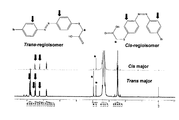
1H NMR (400 MHz, CDCl3): 7.87 (d, 2H,J=9.0 Hz), 7.48 (tm, 2H), 7.38 (tm, 1H, J=7.3 Hz), 6.79 (d, 2H, J=9.1 Hz), 3.51 (t, 2H, J=6.6 Hz), 3.10 (s, 3H), 2.98 (t, 2H, J=6.6 Hz), 1.40(brs, 2H);
13C NMR (100 MHz, CDCl3): 153.1, 151.6, 143.7, 129.4, 128.9, 125.0, 122.2, 111.4, 55.5, 39.6, 39.0
A diazo coupling reaction was performed using aniline and 2- (methylphenylamino) ethanol to synthesize Compound (1) in a yield of 9%. This compound (1) was synthesized with p-toluenesulfonyl chloride (TsCl) in a yield of 77%, then azylated with sodium azide, and reacted with water with triphenylphosphine to collect AZO1. Synthesized at 99% rate.
1 H NMR (400 MHz, CDCl 3 ): 7.87 (d, 2H, J = 9.0 Hz), 7.48 (tm, 2H), 7.38 (tm, 1H, J = 7.3 Hz), 6.79 (d, 2H, J = 9.1 Hz), 3.51 (t, 2H, J = 6.6 Hz), 3.10 (s, 3H), 2.98 (t, 2H, J = 6.6 Hz), 1.40 (brs, 2H);
13 C NMR (100 MHz, CDCl 3 ): 153.1, 151.6, 143.7, 129.4, 128.9, 125.0, 122.2, 111.4, 55.5, 39.6, 39.0
合成例2((E)−N1−(4−((4−ブロモフェニル)ジアゼニル)フェニル)N1−メチルエタン−1,2−ジアミン((E)-N1-(4-((4-bromophenyl)diazenyl)phenyl)-N1-methylethane-1,2-diamine)(以下、AZO2ともいう)の合成) Synthesis Example 2 ((E) -N1- (4-((4-bromophenyl) diazenyl) phenyl) N1-methylethane-1,2-diamine ((E) -N1- (4-((4-bromophenyl) diazenyl) ) phenyl) -N1-methylethane-1,2-diamine) (hereinafter also referred to as AZO2))
4-ブロモアニリンと2-(メチルフェニルアミノ)エタノールを用いてジアゾカップリングを行い、化合物(4)を52%の収率で合成した。この化合物(4)にTsClを用いて収率77%でトシル体(5)を合成した後、アジ化ナトリウムによりアジド化し、トリフェニルフォスフィンと共に水中で反応させることにより(AZO2)を収率99%で合成した。
1H NMR (400 MHz, CDCl3): 7.87 (d, 2H, J=9.3Hz), 7.72 (d, 2H, J=8.8 Hz), 7.59 (d, 1H, J=8.8 Hz), 6.79 (d, 2H, J=9.3 Hz), 3.53 (t, 2H, J=6.8Hz), 3.11 (s, 3H), 2.99 (t, 2H, J=6.8 Hz), 1.40(br, 2H);
13C NMR (100 MHz, CDCl3): 1152.1, 143.7, 132.2, 125.4, 123.9, 123.5, 111.6, 70.7, 55.7, 39.8, 39.2
Diazo coupling was performed using 4-bromoaniline and 2- (methylphenylamino) ethanol to synthesize compound (4) in a yield of 52%. Tosyl compound (5) was synthesized in 77% yield using TsCl for this compound (4), then azide-treated with sodium azide, and reacted in water with triphenylphosphine to yield (AZO2) in 99% yield. % Was synthesized.
1 H NMR (400 MHz, CDCl 3 ): 7.87 (d, 2H, J = 9.3 Hz), 7.72 (d, 2H, J = 8.8 Hz), 7.59 (d, 1H, J = 8.8 Hz), 6.79 (d , 2H, J = 9.3 Hz), 3.53 (t, 2H, J = 6.8 Hz), 3.11 (s, 3H), 2.99 (t, 2H, J = 6.8 Hz), 1.40 (br, 2H);
13 C NMR (100 MHz, CDCl 3 ): 1152.1, 143.7, 132.2, 125.4, 123.9, 123.5, 111.6, 70.7, 55.7, 39.8, 39.2
合成例3((E)−メチル−4−((4−((4−((2−アミノエチル)(メチル)アミノ)フェニル)ジアゼニル)フェニル)エチニル)−2−メトキシベンゾエート ((E)-methyl-4-((4-((4-((2-aminoethyl)(methyl)amino)phenyl)diazenyl)phenyl)ethynyl)-2-methoxybenzoate)(以下、AZO3ともいう)の合成) Synthesis Example 3 ((E) -methyl-4-((4-((4-((2-aminoethyl) (methyl) amino) phenyl) diazenyl) phenyl) ethynyl) -2-methoxybenzoate ((E)- methyl-4-((4-((4-((2-aminoethyl) (methyl) amino) phenyl) diazenyl) phenyl) ethynyl) -2-methoxybenzoate) (hereinafter also referred to as AZO3))
化合物(4)とトリメチルシリルアセチレンを用いて薗頭カップリング反応を行い、化合物(7)を収率60%で合成し、この化合物(7)を炭酸カルシウムにて脱シリル化し、2-メトキシ-4-ブロモ安息香酸メチルとの薗頭カップリング反応により、化合物(9)を2 step 収率54% (2 steps)で合成した。さらに、この化合物(9)をAZO1のときと同様の方法を用いて末端の水酸基をトシル化して化合物(10)を収率87%で変換し、続いてアジド化により化合物(11)を収率79%で、トリフェニルフォスフィンによりアミン体に変換することでAZO3を93%で合成した。
1H NMR (400 MHz, CDCl3): 7.87 (d, 2H, J=9.1 Hz), 7.84 (d, 2H, J=8.4 Hz), 7.80 (d, 1H, J=7.9 Hz), 7.16 (dd, 1H, J=7.9 Hz, 1.3 Hz), 7.14 (br,1H), 3.94 (s, 3H), 3.89 (s, 3H), 3.51 (t, 2H, J=6.6 Hz), 3.09 (s, 3H), 2.98 (t, 2H, J=6.6 Hz), 1.37(br, 2H);
13C NMR (100 MHz, CDCl3):166.1, 158.9, 152.8, 151.9, 143.7, 132.5, 131.8, 128.4, 125.3, 123.4, 123.12, 122.3, 119.6, 114.8, 111.4, 91.9, 90.1, 56.1, 55.5, 39.6, 39.0
Sonogashira coupling reaction was performed using compound (4) and trimethylsilylacetylene, compound (7) was synthesized in 60% yield, this compound (7) was desilylated with calcium carbonate, and 2-methoxy-4 -Compound (9) was synthesized in 2-step yield 54% (2 steps) by Sonogashira coupling reaction with methyl bromobenzoate. Further, this compound (9) was tosylated at the terminal hydroxyl group using a method similar to that for AZO1, to convert compound (10) in a yield of 87%, and then azide yielded compound (11) in yield. In 79%, AZO3 was synthesized in 93% by converting to amine form with triphenylphosphine.
1 H NMR (400 MHz, CDCl 3): 7.87 (d, 2H, J = 9.1 Hz), 7.84 (d, 2H, J = 8.4 Hz), 7.80 (d, 1H, J = 7.9 Hz), 7.16 (dd , 1H, J = 7.9 Hz, 1.3 Hz), 7.14 (br, 1H), 3.94 (s, 3H), 3.89 (s, 3H), 3.51 (t, 2H, J = 6.6 Hz), 3.09 (s, 3H ), 2.98 (t, 2H, J = 6.6 Hz), 1.37 (br, 2H);
13 C NMR (100 MHz, CDCl 3 ): 166.1, 158.9, 152.8, 151.9, 143.7, 132.5, 131.8, 128.4, 125.3, 123.4, 123.12, 122.3, 119.6, 114.8, 111.4, 91.9, 90.1, 56.1, 55.5, 39.6 , 39.0
合成例4((E)−tert−ブチル−4−((3−((4−((4−((2−アミノエチル)(メチル)アミノ)フェニル)ジアゼニル)フェニル)エチニル)フェニル)エチニル)ベンゾエート((E)-tert-butyl-4-((3-((4-((4-((2-aminoethyl)(methyl)amino)phenyl)diazenyl)phenyl)ethynyl) phenyl)ethynyl)benzoate )(以下、AZO4ともいう)の合成) Synthesis Example 4 ((E) -tert-butyl-4-((3-((4-((4-((2-aminoethyl) (methyl) amino) phenyl) diazenyl) phenyl) ethynyl) phenyl) ethynyl) Benzoate ((E) -tert-butyl-4-((3-((4-((4-((2-aminoethyl) (methyl) amino) phenyl) diazenyl) phenyl) ethynyl) phenyl) ethynyl) benzoate) ( (Hereinafter also referred to as AZO4)
化合物(7)のトリメチルシリル基を脱保護し、3−ブロモヨードベンゼンとの園頭カップリング反応により化合物(13)を2段階の収率54%で合成し、続いてテトラメチルシラン(以下、TMSともいう)保護したアセチレンを薗頭カップリング反応により結合させ化合物(14)を収率63%で合成した。この化合物(14)のTMS基をテトラブチルアンモニウムフルオライド(以下、TBAFともいう)にて脱保護し、化合物(12)を園頭カップリング反応にて結合することで化合物(15)を2段階収率76%で合成した。その後、水酸基をトシル化して化合物(16)を収率98%で合成し、続いてアジド化により化合物(17)を収率79%で、トリフェニルフォスフィンによりアミン体に変換することでAZO4を96%で合成した。
1H NMR (400 MHz, CDCl3): 7.98 (d, 2H, J=8.1 Hz), 7.88 (d, 2H, J=9.0 Hz), 7.83 (d, 2H, J=8.3 Hz), 7.75 (br, 1H), 7.62 (d, 2H, J=8.3 Hz), 7.57 (d, 2H, J=8.1 Hz), 7.52 (tm, 2H, J=7.5 Hz), 7.36 (tm, 1H, J=7.5 Hz), 6.8 (d, 2H, J=9.0 Hz), 3.55 (t, 2H, J=6.4 Hz), 3.11 (s, 3H), 3.01 (t, 2H, J=6.4 Hz), 2.89 (br, 2H), 1.61 (s, 9H);
13C NMR(100 MHz, CDCl3): 165.1, 152.6, 151.8, 143.7, 134.7, 132.4, 131.7, 131.5, 131.4, 131.3, 129.3, 128.6, 127.1, 125.3, 123.6, 123.6, 123.1, 122.3, 111.4, 91.0, 90.3, 90.0, 89.4, 81.3, 55.3, 39.5, 39.0, 28.1
The trimethylsilyl group of compound (7) is deprotected and compound (13) is synthesized in a two-stage yield of 54% by Sonogashira coupling reaction with 3-bromoiodobenzene, followed by tetramethylsilane (hereinafter TMS). Protected acetylene was combined by Sonogashira coupling reaction to synthesize Compound (14) in a yield of 63%. The TMS group of the compound (14) is deprotected with tetrabutylammonium fluoride (hereinafter also referred to as TBAF), and the compound (12) is bound by Sonogashira coupling reaction, thereby compounding the compound (15) in two steps. Synthesized in 76% yield. Thereafter, the hydroxyl group is tosylated to synthesize compound (16) with a yield of 98%, and then azidation converts compound (17) to the amine form with triphenylphosphine in a yield of 79%. Synthesized at 96%.
1 H NMR (400 MHz, CDCl 3): 7.98 (d, 2H, J = 8.1 Hz), 7.88 (d, 2H, J = 9.0 Hz), 7.83 (d, 2H, J = 8.3 Hz), 7.75 (br , 1H), 7.62 (d, 2H, J = 8.3 Hz), 7.57 (d, 2H, J = 8.1 Hz), 7.52 (tm, 2H, J = 7.5 Hz), 7.36 (tm, 1H, J = 7.5 Hz ), 6.8 (d, 2H, J = 9.0 Hz), 3.55 (t, 2H, J = 6.4 Hz), 3.11 (s, 3H), 3.01 (t, 2H, J = 6.4 Hz), 2.89 (br, 2H ), 1.61 (s, 9H);
13 C NMR (100 MHz, CDCl 3 ): 165.1, 152.6, 151.8, 143.7, 134.7, 132.4, 131.7, 131.5, 131.4, 131.3, 129.3, 128.6, 127.1, 125.3, 123.6, 123.6, 123.1, 122.3, 111.4, 91.0 , 90.3, 90.0, 89.4, 81.3, 55.3, 39.5, 39.0, 28.1
合成例5((E)−tert−ブチル−4−((5−((4−((4−((2−アミノエチル)(メチル)アミノ)フェニル)ジアゼニル)フェニル)エチニル)−2−ニトロフェニル)エチニル)ベンゾエート((E)-tert-butyl 4-((5-((4-((4-((2-aminoethyl)(methyl)amino)phenyl)diazenyl)phenyl)ethynyl)-2-nitrophenyl)ethynyl)benzoate)(以下、AZO5ともいう)の合成) Synthesis Example 5 ((E) -tert-butyl-4-((5-((4-((4-((2-aminoethyl) (methyl) amino) phenyl) diazenyl) phenyl) ethynyl) -2-nitro Phenyl) ethynyl) benzoate ((E) -tert-butyl 4-((5-((4-((4-((2-aminoethyl) (methyl) amino) phenyl) diazenyl) phenyl) ethynyl) -2-nitrophenyl ) ethynyl) benzoate) (hereinafter also referred to as AZO5))
1-ブロモ-4-ニトロベンゼンをアミノ化して収率59%で化合物(18)を、続いてアミノ基をヨウ素化して収率59%で化合物を合成した。一方で、4-ブロモ安息香酸のターシャリーブチルエステルに園頭カップリング反応によりトリメチルシリルアセチレンを反応させて収率63%で化合物(20)を合成し、化合物(20)のトリメチルシリル基を脱保護し、化合物(19)との園頭カップリング反応により化合物(20)を2段階収率55%で合成した。化合物(20)に対して化合物(8)を薗頭カップリング反応により結合させ化合物(22)を収率55%で合成した。その後、水酸基をトシル化して化合物(23)を収率52%で合成し、続いてアジド化により化合物(24)を収率72%で、トリフェニルフォスフィンによりアミン体に変換することでAZO5を96%で合成し、1H NMR及び13C NMRを測定することによって、AZO5の構造を同定した。 1-Bromo-4-nitrobenzene was aminated to synthesize compound (18) in a yield of 59%, and then the amino group was iodinated to synthesize the compound in a yield of 59%. On the other hand, tertiary butyl ester of 4-bromobenzoic acid was reacted with trimethylsilylacetylene by Sonogashira coupling reaction to synthesize compound (20) in a yield of 63%, and the trimethylsilyl group of compound (20) was deprotected. Compound (20) was synthesized in a two-step yield of 55% by Sonogashira coupling reaction with Compound (19). Compound (8) was combined with compound (20) by Sonogashira coupling reaction to synthesize compound (22) in a yield of 55%. Thereafter, the hydroxyl group is tosylated to synthesize compound (23) in a yield of 52%, and then azidation converts compound (24) into a amine form with triphenylphosphine in a yield of 72%. The structure of AZO5 was identified by synthesis at 96% and measuring 1 H NMR and 13 C NMR.
試験例1〜5(アミノアゾベンゼン(AZO1〜5)の光吸収特性)
合成例1〜5で合成したアミノアゾベンゼン(AZO1〜5)10nmolをジクロロメタン1mlにそれぞれ添加し、濃度10μmol/lのAZO1〜5溶液をそれぞれ調製した。調製した各アミノアゾベンゼン水溶液を可視・紫外分光光度計により、300〜700nmの波長領域で25℃にて測定した。
Test Examples 1 to 5 (light absorption characteristics of aminoazobenzene (AZO1 to 5))
10 nmol of aminoazobenzene (AZO1-5) synthesized in Synthesis Examples 1-5 was added to 1 ml of dichloromethane to prepare AZO1-5 solutions each having a concentration of 10 μmol / l. Each prepared aminoazobenzene aqueous solution was measured with a visible / ultraviolet spectrophotometer at 25 ° C. in a wavelength region of 300 to 700 nm.
なお、紫外領域光によるトランス体からシス体への異性化については、キセノンランプ光源(朝日分光(株)製のMAX-302)を用い、450 nmの可視光を光照射時間: 20, 60, 100, 140, 260, 500秒間光照射することによって行った。 For isomerization from trans form to cis form by ultraviolet light, a xenon lamp light source (MAX-302 manufactured by Asahi Spectrometer Co., Ltd.) was used, and visible light at 450 nm was irradiated for 20, 60, It was performed by irradiating light for 100, 140, 260, 500 seconds.
また、一般にアミノアゾベンゼンは、酸性溶媒中においてプロトンの付加を受けてアゾニウム、またはアンモニウム体を形成することが報告されている(下式参照)。特に、CH2Cl2にUVを照射するとプロトンが発生し、溶液中では局所的に強酸となる。そのため、プロトンのトラップ試薬としてトリエチルアミンを触媒量添加した。 In general, aminoazobenzene has been reported to form an azonium or ammonium form upon addition of a proton in an acidic solvent (see the following formula). In particular, when UV is irradiated to CH 2 Cl 2 , protons are generated and become strong acids locally in the solution. Therefore, a catalytic amount of triethylamine was added as a proton trap reagent.
トランス型及びシス型の極大吸収波長を表1に示す。 Table 1 shows the maximum absorption wavelengths of the trans type and the cis type.
表1より、一般にアゾベンゼンがシス体へ異性化するとトランス体よりも長波長側に新たなスペクトルが生成するが、アミノアゾベンゼンであるAZO1〜5は、短波長側に等吸収点およびシス体由来のスペクトルが現れることがわかった。なお、AZO5に関してはシス体に由来する吸収極大を確認することができなかった。 From Table 1, generally, when azobenzene is isomerized to cis form, a new spectrum is generated on the longer wavelength side than trans form, but AZO1-5, which is aminoazobenzene, is derived from the isoabsorption point and cis form on the short wavelength side. It was found that a spectrum appeared. For AZO5, the absorption maximum derived from the cis body could not be confirmed.
試験例6(AZO4の可視光(450nm)照射後のUVスペクトル測定)
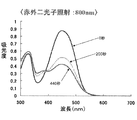
合成例4で合成したAZO4を10nmol、ジクロロメタン1ml、プロトンのトラップ試薬としてトリエチルアミンを触媒量添加し、濃度10μmol/lのAZO4溶液のサンプルを調製した。調製したAZO4溶液に450nmの可視光をキセノンランプ光源(朝日分光(株)製のMAX-302)を用いて、光照射時間として、0,20, 60, 100, 140, 260, 500 秒間照射し、照射後のUVスペクトルを測定した。UVスペクトルを図1に示す。
試験例7(AZO4の赤外線二光子(800nm)照射後のUVスペクトル測定)
試験例6で調製した濃度10μmol/lのAZO4溶液のサンプルにTi-spphire レーザー (Ti:S レーザー)により、160 fs のパルスレーザーから800 nm の光を照射し、集光レンズから焦点までの距離を15 cm に設定し、集光レンズより12 cm の位置で照射することによって、800nmの赤外線二光子を光照射時間として、0, 200, 440 秒間照射し、照射後のUVスペクトルを測定した。UVスペクトルを図2に示す。
Test Example 6 (Measurement of UV spectrum after AZO4 visible light (450 nm) irradiation)
A sample of AZO4 solution having a concentration of 10 μmol / l was prepared by adding 10 nmol of AZO4 synthesized in Synthesis Example 4 and 1 ml of dichloromethane and a catalytic amount of triethylamine as a proton trapping reagent. The prepared AZO4 solution was irradiated with visible light of 450 nm using a xenon lamp light source (MAX-302 manufactured by Asahi Spectrometer Co., Ltd.) for a light irradiation time of 0, 20, 60, 100, 140, 260, 500 seconds. The UV spectrum after irradiation was measured. The UV spectrum is shown in FIG.
Test example 7 (UV spectrum measurement after AZO4 infrared two-photon (800nm) irradiation)
A sample of AZO4 solution with a concentration of 10 μmol / l prepared in Test Example 6 was irradiated with 800 nm light from a 160 fs pulse laser by a Ti-spphire laser (Ti: S laser), and the distance from the condenser lens to the focal point Was set to 15 cm and irradiated at a position of 12 cm from the condensing lens, 800 nm infrared two-photons were irradiated for 0, 200, 440 seconds, and the UV spectrum after irradiation was measured. The UV spectrum is shown in FIG.
図1及び図2より、光照射後のスペクトル変化は波長によって波長シフトは生じず、アゾ骨格のシス異性化に伴い、400nm過ぎに等級終点が出現することがわかった。 From FIG. 1 and FIG. 2, it was found that the spectral change after light irradiation did not cause a wavelength shift depending on the wavelength, and a grade end point appeared after 400 nm with cis isomerization of the azo skeleton.
合成例6(Fmoc-固相合成法によるFRET(Fluorescence Resonance Energy Transfer)ペプチドの合成)
(AZO搭載FRETペプチドの分子設計)
FRETペプチド分子の設計には、光エネルギーのDonorであるFAM(5'-fluorescein:490nmを吸収して520nmの蛍光を発光する)とAcceptorである(QXLTM520 :520nmの蛍光を吸収して消光する)の距離を、アゾベンゼンがトランス体のときにはFAMの蛍光強度が約50%となる約50Åに、アゾベンゼンがシスの時にはFAMの蛍光が約100%消光される30Åになるように設計した。
Synthesis Example 6 (Synthesis of FRET (Fluorescence Resonance Energy Transfer) peptide by Fmoc-solid phase synthesis method)
(Molecular design of FRET peptide mounted on AZO)
FRET peptide molecules are designed by light energy donors FAM (5'-fluorescein: absorbs 490nm and emits 520nm fluorescence) and Acceptor (QXL TM520 : absorbs and extinguishes 520nm fluorescence) ) Was designed to be about 50 mm when the fluorescence intensity of FAM is about 50% when azobenzene is in the trans form, and 30 mm when about 100% of FAM fluorescence is quenched when azobenzene is cis.
実際のペプチド配列はN末端から、FAM-Lys-Cap-AZO4-Cap-Lys(QXLTM520)-OHとした。Capはスペーサーとして6-アミノカプロン酸、アゾベンゼンとしては、合成例4で合成したAZO4を用いた。このアゾベンゼン搭載ペプチドに対して、AZO4が異性化する450nmの可視光を照射した前後のFAMの蛍光強度を観察した。 The actual peptide sequence was FAM-Lys-Cap-AZO4-Cap-Lys (QXL TM520 ) -OH from the N-terminus. Cap used was 6-aminocaproic acid as a spacer, and AZO4 synthesized in Synthesis Example 4 was used as azobenzene. The fluorescence intensity of FAM before and after irradiation of 450 nm visible light for isomerization of AZO4 was observed for this azobenzene-loaded peptide.
ここで、FAM(5'-fluorescein)−は、 Here, FAM (5'-fluorescein)-is
-Lys-(天然型のl−リシン) は、 -Lys- (natural l-lysine) is
Cap(6−アミノカプロン酸)は、−OC−(CH2)5−NH−
を表す。
Cap (6-aminocaproic acid) is —OC— (CH 2 ) 5 —NH—
Represents.
以下に、FAM-Lys-Cap-AZO4-Cap-Lys(QXLTM520)-OHの合成方法を示す。 The synthesis method of FAM-Lys-Cap-AZO4-Cap-Lys (QXL TM520 ) -OH is shown below.
合成例7−1(Dde-Lys (Fmoc)-XAL-PEG-PS 樹脂の合成)
Fmoc-XAL-PEG-PS 樹脂 (2 μmol: PE Biosystems)(ここで、Ddeとは、4,4 - dimethyl - 2,6 - dioxocyclohex - 1 - ylidine]ethylを示し、Fmocとは、9-fluorenylmethylを示し、XALとは、Xanthenylamideを示し、PEGとは、ポリエチレングリコールを示す。) をDMF中に10分ほど放置して湿らせ, Fmoc-保護基をDeblock solution (20% piperidine in DMF : 500 μL)中で5 分間、振トウ反応させることで脱保護し、DMF (500μL)にて5回洗浄した。その後、樹脂をBase solution (2,6-lutidine (0.3 M)及び Diisopropyl ethylamine(0.2 M)/DMF) (500μL) 中で5分インキュベートすることでN末端のアミンの求核性を高めた。一方で、Dde-Lys(Fmoc)-OH (5.3 mg, 10 μmol)にアクティベーター(0.02M HATU/ DMF: 500μL)を加え、5分間インキュベートすることでカルボン酸の反応性を高め、これをBase solution溶液中の樹脂に加えて15分間反応させた。反応後、樹脂をDMF (500μL)にて5回洗浄した。
Synthesis Example 7-1 (Synthesis of Dde-Lys (Fmoc) -XAL-PEG-PS resin)
Fmoc-XAL-PEG-PS resin (2 μmol: PE Biosystems) (where Dde is 4,4-dimethyl-2,6-dioxocyclohex-1 -ylidine] ethyl, Fmoc is 9-fluorenylmethyl XAL stands for Xanthenylamide and PEG stands for polyethylene glycol.) Leave it in DMF for about 10 minutes to moisten it, and remove the Fmoc-protecting group with Deblock solution (20% piperidine in DMF: 500 μL ) For 5 minutes in a shaking tow reaction, and washed 5 times with DMF (500 μL). Thereafter, the resin was incubated in Base solution (2,6-lutidine (0.3 M) and Diisopropyl ethylamine (0.2 M) / DMF) (500 μL) for 5 minutes to enhance the nucleophilicity of the N-terminal amine. On the other hand, an activator (0.02M HATU / DMF: 500 μL) is added to Dde-Lys (Fmoc) -OH (5.3 mg, 10 μmol) and incubated for 5 minutes to increase the reactivity of carboxylic acid. It was made to react for 15 minutes in addition to the resin in a solution. After the reaction, the resin was washed 5 times with DMF (500 μL).
合成例7−2(Dde-Lys (QXL TM520)-XAL-PEG-PS 樹脂の合成)
Dde-Lys (Fmoc)-XAL-PEG-PS 樹脂に対して上記と同様の操作で、リシンのε-アミノ基にあるFmoc-基を脱保護し、先と同様にBase solutionにてアミンの求核性を高めた。これにQXLTM520 520 acid SE, (6.5 mg, 10 μmol, SE:スクシンイミドエステル) を加え、15分インキュベートした。反応後、樹脂をDMF (500μL)にて5回洗浄した。
Synthesis Example 7-2 (Synthesis of Dde-Lys (QXL TM520 ) -XAL-PEG-PS resin)
For the Dde-Lys (Fmoc) -XAL-PEG-PS resin, the Fmoc-group in the ε-amino group of lysine is deprotected by the same operation as above, and the amine is obtained with the Base solution as before. Increased nuclearity. To this, QXL TM520 520 acid SE, (6.5 mg, 10 μmol, SE: succinimide ester) was added and incubated for 15 minutes. After the reaction, the resin was washed 5 times with DMF (500 μL).
合成例7−3(Fmoc-CAP-Lys (QXL TM520)-XAL-PEG-PS 樹脂の合成)
Dde-Lys (QXL TM520)-XAL-PEG-PS樹脂のDde-基を2%のヒドラジン(hydrazine)と10% のアリルアルコール(allylalcohol)のDMF溶液中(500 μL)で10分間 インキュベートすることで脱保護し、その後 DMF (500 μL)で5回洗浄した。続いて上記と同様の操作でリシンのN-末端アミノ基をbase solution で活性化し, Fmoc-6-aminocaproic acid (3.5 mg, 10 μmol)のカルボン酸をアクティベーター添加により活性化させた。反応後、樹脂をDMF (500μL)にて5回洗浄した。
Synthesis Example 7-3 (Synthesis of Fmoc-CAP-Lys (QXL TM520 ) -XAL-PEG-PS resin)
Dde-Lys (QXL TM520) of -XAL-PEG-PS resin Dde- based by incubating DMF solution of 2% hydrazine (Hydrazine) and 10% of the allyl alcohol (allylalcohol) (500 μL) for 10 minutes Deprotection was followed by 5 washes with DMF (500 μL). Subsequently, the N-terminal amino group of lysine was activated with the base solution in the same manner as described above, and the carboxylic acid of Fmoc-6-aminocaproic acid (3.5 mg, 10 μmol) was activated by adding an activator. After the reaction, the resin was washed 5 times with DMF (500 μL).
合成例7−4(Fmoc-AZO4-CAP-Lys (QXLTM520)-XAL-PEG-PS 樹脂)
Fmoc-CAP-Lys (QXL TM520)-XAL-PEG-PS 樹脂に対して上記と同様にFmoc-基の脱保護、Base solutionによるアミノ基の活性化、アクティベーターによるFmoc-AZO4-OH (5.3 mg, 7.5 μmol) のカルボン酸を活性化させたものを調製し、それぞれを反応させた。反応後、樹脂をDMF (500μL)にて5回洗浄した。
Synthesis Example 7-4 (Fmoc-AZO4-CAP-Lys (QXL TM520 ) -XAL-PEG-PS resin)
Fmoc-CAP-Lys (QXL TM520 ) -XAL-PEG-PS For the resin, deprotection of Fmoc-group, activation of amino group with Base solution, Fmoc-AZO4-OH (5.3 mg, 7.5 μmol) activated carboxylic acids were prepared and reacted with each other. After the reaction, the resin was washed 5 times with DMF (500 μL).
合成例7−5(Fmoc-CAP-AZO4-CAP-Lys (QXL TM520)-XAL-PEG-PS 樹脂の合成)
Fmoc-AZO4-CAP-Lys (QXL TM520)-XAL-PEG-PS 樹脂に対して、上記と同様の操作を用いてFmoc-6-aminocaproic acid (3.5 mg, 10μmol) を伸長した。反応後、樹脂をDMF (500μL)にて5回洗浄した。
Synthesis Example 7-5 (Fmoc-CAP-AZO4- CAP-Lys ( Synthesis of QXL TM520) -XAL-PEG-PS resin)
Fmoc-6-aminocaproic acid (3.5 mg, 10 μmol) was extended to Fmoc-AZO4-CAP-Lys (QXL TM520 ) -XAL-PEG-PS resin using the same procedure as described above. After the reaction, the resin was washed 5 times with DMF (500 μL).
合成例7−6(Fmoc-Lys (Boc)-CAP-AZO4-CAP-Lys (QXL TM520)-XAL-PEG-PS 樹脂の合成)
Fmoc-CAP-AZO4-CAP-Lys (QXLTM520)-XAL-PEG-PS 樹脂に対して、上記と同様の操作を用いてFmoc-Lys (Boc)-OH (5.3 mg, 10 μmol) を伸長した。反応後、樹脂をDMF (500μL)にて5回洗浄した。
Synthesis Example 7-6 (Synthesis of Fmoc-Lys (Boc) -CAP-AZO4-CAP-Lys (QXL TM520 ) -XAL-PEG-PS resin)
Fmoc-Lys (Boc) -OH (5.3 mg, 10 μmol) was extended to Fmoc-CAP-AZO4-CAP-Lys (QXL TM520 ) -XAL-PEG-PS resin using the same procedure as above. . After the reaction, the resin was washed 5 times with DMF (500 μL).
合成例7−7(NH2-Lys -CAP-AZO4-CAP-Lys (QXL TM520)-OHの合成)
Fmoc-Lys (Boc)-CAP-AZO4-CAP-Lys (QXL TM520)-XAL-PEG-PS 樹脂に対して、上記と同様の操作でFmoc-基を脱保護した。
Synthesis Example 7-7 (NH 2 -Lys -CAP-AZO4 -CAP-Lys (QXL TM520) Synthesis of -OH)
Fmoc-Lys (Boc) -CAP-AZO4-CAP-Lys (QXL TM520 ) -XAL-PEG-PS resin was deprotected by the same procedure as described above.
その後、樹脂を DMF(500 μL)にて5回洗浄し、イソプロパノール(500 μL)で5回洗浄、続いて窒素ガスにより樹脂を乾燥させた。続いて、樹脂に対してm-cresol/TFA (0.25:10, v/v) (200 μL) を添加し、60分室温で反応させることにより、Boc-基の脱保護とペプチドの樹脂からの切り離しを行った。1時間後、反応液に氷冷したジエチルエーテルを500μL加え、ボルテックスにて撹拌することで、赤褐色のペプチド成分を得た。これをチューブに加え、小型卓上遠心装置により3,000 rpmにて遠心分離すること赤褐色を回収し、窒素ガスにて乾燥後、MALDI-TOFMS にて分子量を解析し、分子量1,515の目的物を確認した。 Thereafter, the resin was washed 5 times with DMF (500 μL), washed 5 times with isopropanol (500 μL), and then dried with nitrogen gas. Subsequently, by adding m-cresol / TFA (0.25: 10, v / v) (200 μL) to the resin and reacting at room temperature for 60 minutes, the Boc-group was deprotected and the peptide was released from the resin. Disconnected. After 1 hour, 500 μL of ice-cooled diethyl ether was added to the reaction solution, and the mixture was stirred by vortex to obtain a reddish brown peptide component. This was added to the tube, and centrifuged at 3,000 rpm with a small desktop centrifuge. The reddish brown color was collected, dried with nitrogen gas, analyzed for molecular weight by MALDI-TOFMS, and the target product having a molecular weight of 1,515 was confirmed.
合成例7−8(FAM-Lys (NH2)-CAP-AZO4-CAP-Lys (QXL TM520)-OHの合成)
Fmoc-Lys (Boc)-CAP-AZO4-CAP-Lys (QXL TM520)-XAL-PEG-PS 樹脂に対して、上記と同様の操作で、FAM (5.3 mg, 10 μmol)を伸長した。
Synthesis Example 7-8 (FAM-Lys (NH 2 ) -CAP-AZO4-CAP-Lys (QXL TM520) Synthesis of -OH)
FAM (5.3 mg, 10 μmol) was extended to Fmoc-Lys (Boc) -CAP-AZO4-CAP-Lys (QXL TM520 ) -XAL-PEG-PS resin in the same manner as described above.
その後、樹脂を DMF(500 μL)にて5回洗浄し、イソプロパノール(500 μL)で5回洗浄、続いて窒素ガスにより樹脂を乾燥させた。続いて、樹脂に対してm-cresol/TFA (0.25:10, v/v) (200 μL) を添加し、60分室温で反応させることにより、Boc-基の脱保護とペプチドの樹脂からの切り離しを行った。1時間後、反応液に氷冷したジエチルエーテルを500μL加え、ボルテックスにて撹拌することで、赤褐色のペプチド成分を得た。これをチューブに加え、小型卓上遠心装置により3,000 rpmにて遠心分離すること赤褐色を回収し、窒素ガスにて乾燥後、MALDI-TOFMS にて分子量を解析し、分子量1,874の目的物を確認した。 Thereafter, the resin was washed 5 times with DMF (500 μL), washed 5 times with isopropanol (500 μL), and then dried with nitrogen gas. Subsequently, by adding m-cresol / TFA (0.25: 10, v / v) (200 μL) to the resin and reacting at room temperature for 60 minutes, the Boc-group was deprotected and the peptide was released from the resin. Disconnected. After 1 hour, 500 μL of ice-cooled diethyl ether was added to the reaction solution, and the mixture was stirred by vortex to obtain a reddish brown peptide component. This was added to a tube, and centrifuged at 3,000 rpm with a small desktop centrifuge to collect reddish brown color. After drying with nitrogen gas, the molecular weight was analyzed with MALDI-TOFMS, and the target product with a molecular weight of 1,874 was confirmed.
試験例8(FAM-Lys (NH2)-CAP-AZO4-CAP-Lys (QXL TM520)(以下、FAM-AZO4-QXL TM520ともいう)のシス−トランス異性化による消光−蛍光観察)
合成例6で合成したFAM-AZO4-QXL TM520(FAM-Lys (NH2)-CAP-AZO4-CAP-Lys (QXL TM520))を10nmol、トリエチルアミン(ペプチドに対して過剰)、ジクロロメタン1mlに添加し、濃度10μmol/lのFAM-AZO4-QXL TM520溶液のサンプルを調製した。調製したFAM-AZO4-QXL TM520溶液にキセノンランプ光源から450nmの可視光を60秒間し、AZO4部位におけるアゾ部位の幾何構造をトランス体からシス体へと異性化させた。そののち、このサンプルを蛍光分析装置に入れ、490nmの励起光によりFAM由来の蛍光発光(520nm)を測定した。図3に光照射前後における蛍光スペクトル変化を示す。
Test Example 8 (- quenching by trans isomerization - FAM-Lys (NH 2) -CAP-AZO4-CAP-Lys (QXL TM520) ( hereinafter, cis refers to as FAM-AZO4-QXL TM520) fluorescence observation)
FAM-AZO4-QXL TM520 (FAM-Lys (NH 2 ) -CAP-AZO4-CAP-Lys (QXL TM520 )) synthesized in Synthesis Example 6 was added to 10 nmol, triethylamine (excess relative to the peptide), and 1 ml of dichloromethane. A sample of the FAM-AZO4-QXL TM520 solution having a concentration of 10 μmol / l was prepared. The prepared FAM-AZO4-QXL TM520 solution was irradiated with 450 nm visible light from a xenon lamp light source for 60 seconds to isomerize the geometric structure of the azo moiety at the AZO4 site from the trans form to the cis form. After that, this sample was put into a fluorescence analyzer, and fluorescence emission (520 nm) derived from FAM was measured with excitation light of 490 nm. FIG. 3 shows changes in fluorescence spectrum before and after light irradiation.
図3より、AZO搭載ペプチドに対して可視光を照射し、アゾ骨格をトランス体からシス体へと異性化させた場合、FAMによる蛍光発光が消光されることが明らかになった。このことは、アゾ骨格の幾何異性化によってペプチド構造が変化し、FAM部位とQXLTM520部位の距離が短くなることでFAMの蛍光がQXL TM520によって消光されたことを示す。 From FIG. 3, it was clarified that the fluorescence emission by FAM is quenched when the AZO peptide is irradiated with visible light and the azo skeleton is isomerized from the trans form to the cis form. This indicates that the peptide structure is changed by geometric isomerization of the azo skeleton, and the distance between the FAM site and the QXL TM520 site is shortened, so that the fluorescence of FAM is quenched by QXL TM520 .
また、450nmの可視光の照射後のシス異性体を加熱すると、トランス異性体へ変化し、蛍光発光が戻ることも明らかとなった。 It was also revealed that when the cis isomer after irradiation with visible light at 450 nm was heated, it changed to the trans isomer and fluorescence emission returned.
合成例8(ペプチド核酸部位を有するアゾベンゼン(K’K’K’-CTTCTTCT-AZO4-TCTTC-K’K’K’(以下、PNA−AZOともいう))の合成)
K’K’K’-CTTCTTCT-AZO4-TCTTC-K’K’K’:
Synthesis Example 8 (Synthesis of azobenzene having a peptide nucleic acid site (K'K'K'-CTTCTTCT-AZO4-TCTTC-K'K'K '(hereinafter also referred to as PNA-AZO)))
K'K'K'-CTTCTTCT-AZO4-TCTTC-K'K'K ':
(ただし、K’はアミノ酸のリシンを一文字表記したものである。ここで、5’末端はPNAのN末端、3’末端はPNAのC末端に相当し、5’は、DNAまたはRNAのデオキシリボースまたはリボース糖の5位の方向に伸長したヌクレオチド末端のことを意味し、3’は、DNAまたはRNAのデオキシリボースまたはリボース糖の3位の方向に伸長したヌクレオチド末端のことを意味する)
K’K’K’−CTTCTTCT−は、
(However, K ′ is a single letter of the amino acid lysine. Here, the 5 ′ end corresponds to the N-terminus of PNA, the 3 ′ end corresponds to the C-terminus of PNA, and 5 ′ represents the deoxy of DNA or RNA. (This means the nucleotide end extended in the direction of
K'K'K'-CTTCTTCT-
−TCTTC-K’K’K’は、 -TCTTC-K’K’K ’
であって、
式中、−Cは、シトシン:
Because
Where -C is cytosine:
を表し、
−Tは、チミン:
Represents
-T is thymine:
を表す)
“AZO4”搭載型ペプチド核酸は、Fmoc-固相合成法により調製した。合成に使用した、樹脂、カップリング試薬、脱保護試薬、洗浄操作、樹脂からの切り出し、HPLCによる精製は定法に従った。PNAの分子量は、MALDI-TOFMSにより解析し、計算分子量が5375.0であるのに対して、検出された分子量は5371.0であった。
試験例9(PNA−AZOの可視光(450nm)照射後のUVスペクトル測定)
合成例8で合成したPNA−AZOを10mMのリン酸ナトリウム緩衝液(pH 6.9)に溶解して、濃度300nMのPNA−AZO溶液のサンプルを調製した。調製したPNA−AZO溶液におけるアゾ骨格の幾何構造を完全にトランス体にするために、95℃で5分加温し、その後サンプルを室温にまで戻した後、キセノンランプ光源により450nmの可視光を10分間、20分間及び30分間それぞれ照射し、光照射後のUVスペクトルを測定した。UVスペクトルを図4に示す。なお、図4における曲線は上から順に0分間、10分間、20分間、30分間光照射した後のUVスペクトルを示す。
Represents
The “AZO4” loaded peptide nucleic acid was prepared by the Fmoc-solid phase synthesis method. The resin, coupling reagent, deprotection reagent, washing operation, excision from the resin, and purification by HPLC used in the synthesis were in accordance with conventional methods. The molecular weight of PNA was analyzed by MALDI-TOFMS. The calculated molecular weight was 5375.0, whereas the detected molecular weight was 5371.0.
Test Example 9 (Measurement of UV spectrum after irradiation of visible light (450 nm) of PNA-AZO)
PNA-AZO synthesized in Synthesis Example 8 was dissolved in 10 mM sodium phosphate buffer (pH 6.9) to prepare a sample of a PNA-AZO solution having a concentration of 300 nM. In order to completely transform the geometric structure of the azo skeleton in the prepared PNA-AZO solution, the sample was heated at 95 ° C. for 5 minutes, and then returned to room temperature, and then 450 nm visible light was emitted from the xenon lamp light source. Irradiation was performed for 10 minutes, 20 minutes, and 30 minutes, respectively, and the UV spectrum after light irradiation was measured. The UV spectrum is shown in FIG. In addition, the curve in FIG. 4 shows the UV spectrum after light irradiation for 0 minutes, 10 minutes, 20 minutes, and 30 minutes in order from the top.
図4より、PNA−AZOに450nmの可視光を照射すると、経時変化に伴い、極大吸収波長である450nmを中心に400-500nmのピークが減少した。その結果より、アゾベンゼン骨格のトランス体からシス体への異性化に伴う構造変化が認められた。 As shown in FIG. 4, when 450 nm visible light was irradiated to PNA-AZO, the peak at 400 to 500 nm decreased centering on the maximum absorption wavelength of 450 nm with time. As a result, structural changes were observed with the isomerization of the azobenzene skeleton from the trans form to the cis form.
試験例10(PNA−AZOとdsDNAの会合様式のアガロースゲルシフトアッセイによる解析)
PNA(5’-CTTCTTCT-AZO4-TCTTC-3’)の標的配列を含む、DNA(a)鎖:3’- CATCCTCGAAGAAGATGGTGCGCTCCTGGA-5’、およびそれに対して核酸塩基相補的なDNA(b)鎖:5’- TCCAGGAGCGCACCATCTTCTTCGAGGATG-3’(Sigma-Genosis製)を10mM リン酸ナトリウム溶液(pH6.9)に溶解し、95℃に5分間加熱後、0.5℃/minの割合で冷却(アニーリング)することで二重鎖DNA(a,b)を形成させた。そして、PNAと二重鎖DNA(a,b)の終濃度がそれぞれ750nM, 250nMになるように混合して、2時間、25℃でインキュベートした。
Test Example 10 (Anarose gel shift assay analysis of PNA-AZO and dsDNA association mode)
DNA (a) strand containing the target sequence of PNA (5'-CTTCTTCT-AZO4-TCTTC-3 '): 3'-CATCCTC GAAGAAGA TGGTGCGCTCCTGGA-5', and DNA (b) strand complementary to it : 5'-TCCAGGAGCGCACCATCTTCTTCGAGGATG-3 '(manufactured by Sigma-Genosis) is dissolved in 10 mM sodium phosphate solution (pH 6.9), heated to 95 ° C for 5 minutes, and then cooled (annealed) at a rate of 0.5 ° C / min. Double-stranded DNA (a, b) was formed with The PNA and double-stranded DNA (a, b) were mixed at final concentrations of 750 nM and 250 nM, respectively, and incubated at 25 ° C. for 2 hours.
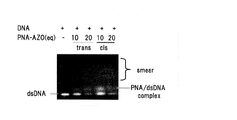
緑色蛍光タンパク(GFP: Green Fluorescent Protein)の遺伝子をコードするプラスミドDNAの転写開始領域上流にはポリプリン配列(アデニンとグアニンからなる)が存在する。このポリプリン配列に相補配列をもつPNA-AZOを調整し、アゾ骨格をトランス型、およびシス型にした場合の標的配列に対する結合能をポリアクリルアミドゲル電気泳動により調べた。なお、プラスミドDNAおよびDNA/PNA会合体の可視化は核酸インターカレーターのエチジウムブロマイドを用いた。図5にPNA−AZOのトランス体及びシス体を作用させたプラスミドDNAのポリアクリル電気泳動を示す。図5より、PNA-AZOの構造がシス型の場合には二重鎖DNAとの会合が効率的に起こることがわかった。しかし、過剰にPNA-AZOを入れた場合はPNA-AZO/dsDNAのコンプレックスが分子間で形成され、凝集することでゲル上にsmearとなって現れることがわかった。 A polypurine sequence (consisting of adenine and guanine) is present upstream of the transcription initiation region of plasmid DNA encoding a gene for green fluorescent protein (GFP). PNA-AZO having a complementary sequence to this polypurine sequence was prepared, and the binding ability to the target sequence was examined by polyacrylamide gel electrophoresis when the azo skeleton was in the trans type and the cis type. For visualization of plasmid DNA and DNA / PNA aggregates, ethidium bromide, a nucleic acid intercalator, was used. FIG. 5 shows polyacryl electrophoresis of plasmid DNA in which the trans form and cis form of PNA-AZO are allowed to act. From FIG. 5, it was found that when the structure of PNA-AZO is cis, association with double-stranded DNA occurs efficiently. However, it was found that when PNA-AZO was added excessively, a PNA-AZO / dsDNA complex was formed between the molecules and aggregated to appear as a smear on the gel.
試験例11(PNA-AZOのトランス体とシス体を用いたGFP遺伝子の細胞内発現の制御)
蛍光顕微鏡観察用のグラスチャンバーにイヌ腎臓(MDCK)細胞を播種し、接着するまで約6時間インキュベートした。次に、1.6μg のGFP発現プラスミドDNA(clontech社製のpAcGFP-C1)を含む10mM リン酸ナトリウム溶液(pH6.9)に溶解させた試料を調製し、ここに予め可視光450nmを照射したPNA-AZO(アゾ骨格がシス型)と非照射のPNA-AZO(アゾ骨格がトランス型)を核酸塩基の数にして100倍等量になるように加えた。このPNA-AZO/GFP発現プラスミドDNAの会合体に対して、Fugene 6(ロシュ・ダイアグノスティック社製)を加え、30分インキュベートし、MDCK細胞に対してトランスフェクションした。蛍光顕微鏡により8時間後のGFP蛋白発現を観測した。図6にPNA-AZOのトランス体及びシス体を作用させたプラスミドDNAの蛍光顕微鏡写真を示す。
Test Example 11 (Control of intracellular expression of GFP gene using trans and cis forms of PNA-AZO)
Dog kidney (MDCK) cells were seeded in a glass chamber for fluorescence microscope observation and incubated for about 6 hours until they adhered. Next, a sample dissolved in 10 mM sodium phosphate solution (pH 6.9) containing 1.6 μg of GFP expression plasmid DNA (pAcGFP-C1 manufactured by clontech) was prepared, and PNA irradiated with visible light 450 nm in advance was prepared here. -AZO (azo skeleton is cis type) and non-irradiated PNA-AZO (azo skeleton is trans type) were added so that the number of nucleobases was 100 times equivalent. Fugene 6 (Roche Diagnostics) was added to the PNA-AZO / GFP expression plasmid DNA aggregate, incubated for 30 minutes, and transfected into MDCK cells. The expression of GFP protein after 8 hours was observed with a fluorescence microscope. FIG. 6 shows a fluorescence micrograph of plasmid DNA in which a trans form and a cis form of PNA-AZO are allowed to act.
PNA-AZOと二重鎖DNAの会合実験(ゲルシフトアッセイ)を行った際に使用したPNA-AZOの標的DNA配列はGFP発現プラスミドの中にも含まれている。PNA-AZOがシス異性化するとGFPプラスミドに人工的に転写バルブが形成され、GFPをコードしDNA鎖に転写因子が結合しやすくなるため、GFP発現量が向上したと予想される(図6右上)。実際、GFPプラスミドに対してPNA-AZO(cis体)を作用させた場合に、GFPの発現効率が向上することが明らかになった。また、GFPプラスミドのみの場合と比べてPNA-AZO(トランス体)を添加した場合にGFP発現活性が高いのは、PNA-AZOにリシンが6個修飾されており、GFPプラスミドにカチオン性のPNA-AZOが結合することで、GFPプラスミドの細胞内導入効率が高くなるからと予想される。 The target DNA sequence of PNA-AZO used in the association experiment (gel shift assay) between PNA-AZO and double-stranded DNA is also included in the GFP expression plasmid. When PNA-AZO is cis-isomerized, a transcription valve is artificially formed in the GFP plasmid, and transcription factors are likely to bind to the DNA strand encoding GFP. ). In fact, it was revealed that the expression efficiency of GFP is improved when PNA-AZO (cis body) is allowed to act on the GFP plasmid. In addition, when PNA-AZO (trans form) was added compared to the case of GFP plasmid alone, the GFP expression activity was higher because 6 lysines were modified in PNA-AZO, and cationic PNA was added to the GFP plasmid. -AZO binding is expected to increase the efficiency of GFP plasmid introduction into cells.
試験例10及び11におけるPNA-AZOとdsDNAの結合様式は、以下のメカニズムにより形成されるものと考えられる。PNA-AZOとdsDNAの結合様式のイメージ図を図7に示す。二重鎖DNAに対してPNA-AZOの5’側のストランドがフーグスティン水素結合により会合し、DNA/DNA/PNAの三重鎖を形成する。次にPNA-AZOに可視光を照射することで、AZO骨格をシス体へと異性化し、3’側のストランドがDNAに対してワトソン−クリック塩基対を形成することで、二重鎖DNAにPNAがストランドインベージョンし、PNA/DNA/PNAの三重鎖形成とループアウトした一本鎖DNAを作り、人工的に転写バルブ構造を形成していることがわかる。
合成例9(2−(4−((4−ブロモフェニル)ジアゼニル)フェニルアミノ)エタノール(2-(4-((4-bromophenyl)diazenyl)phenylamino)ethanol)(以下、N-type,-OHともいう)の合成)
The binding mode of PNA-AZO and dsDNA in Test Examples 10 and 11 is considered to be formed by the following mechanism. An image of the binding mode of PNA-AZO and dsDNA is shown in FIG. The 5 ′ strand of PNA-AZO associates with double-stranded DNA through Hoogsteen hydrogen bonding to form a DNA / DNA / PNA triplex. Next, PNA-AZO is irradiated with visible light to isomerize the AZO skeleton into a cis isomer, and the 3 ′ strand forms a Watson-Crick base pair with the DNA. It can be seen that the PNA strand invades to create a single-stranded DNA that is looped out with the PNA / DNA / PNA triplex formation, forming an artificial transcription valve structure.
Synthesis Example 9 (2- (4-((4-bromophenyl) diazenyl) phenylamino) ethanol) (hereinafter referred to as N-type and -OH) Synthesis)
反応容器にp−ブロモアニリン(p-bromoaniline)(1.63g, 9.48 mmol)、NaNO2(502 mg, 7.28 mmol)、水20 ml及び1N-HCl(350 mg, 9.60 mmol)を加えて0℃で30分攪拌した。炭酸ナトリウム緩衝液(pH=9):エタノール=4:1(体積比)の混合溶液(20ml)に加えて滴下し、12時間室温で攪拌した。結晶を濾過し、エタノールと水で再結晶を行い、収率66 %で目的物を得た。
1H-NMR(400 MHz, CDCl3): 7.82(d, 2H, J=8.9), 7.71(d, 2H, J=8.6), 7.59(d, 2H, J=8.6), 6.69(d, 2H, J=8.9), 3.89(brs, 2H), 3.41(t, 2H, J=5.2)
Add p-bromoaniline (1.63 g, 9.48 mmol), NaNO 2 (502 mg, 7.28 mmol), 20 ml of water and 1N-HCl (350 mg, 9.60 mmol) to the reaction vessel at 0 ° C. Stir for 30 minutes. The solution was added dropwise to a mixed solution (20 ml) of sodium carbonate buffer (pH = 9): ethanol = 4: 1 (volume ratio), and stirred at room temperature for 12 hours. The crystals were filtered and recrystallized with ethanol and water to obtain the desired product in a yield of 66%.
1H-NMR (400 MHz, CDCl 3 ): 7.82 (d, 2H, J = 8.9), 7.71 (d, 2H, J = 8.6), 7.59 (d, 2H, J = 8.6), 6.69 (d, 2H, J = 8.9), 3.89 (brs, 2H), 3.41 (t, 2H, J = 5.2)
合成例10(2−(4−(( 4−ブロモフェニル)ジアゼニル)フェノキシ)エタノール(2-(4-((4-bromophenyl)diazenyl)phenoxy)ethanol)(以下、O-type,-OHともいう)の合成)
合成例10−1
Synthesis Example 10 (2- (4-((4-bromophenyl) diazenyl) phenoxy) ethanol (hereinafter also referred to as O-type, -OH) )
Synthesis Example 10-1
OXONE(KHSO5 /0.5 KHSO4/0.5 K2SO4, 9.00g, 29mmol)をH2O:CH2Cl2=1.2(体積比)の混合液に溶かし、p−ブロモアニリン(p-bromoaniline)(500 mg, 2.91 mmol)を加え、室温で6時間攪拌した。CH2Cl2で抽出し、NH4Cl水溶液、食塩水(Brine)で洗浄したのち、MgSO4で乾燥し、溶媒を留去し、目的物(4−ブロモ−ニトロソベンゼン(4-bromo-nitrosobenzene))を得、次のステップに使用した。
合成例10−2
OXONE (KHSO 5 /0.5 KHSO 4 /0.5 K 2 SO 4 , 9.00 g, 29 mmol) is dissolved in a mixture of H 2 O: CH 2 Cl 2 = 1.2 (volume ratio) and p-bromoaniline (p-bromoaniline) (500 mg, 2.91 mmol) was added and stirred at room temperature for 6 hours. After extracting with CH 2 Cl 2 , washing with NH 4 Cl aqueous solution and brine (Brine), drying with MgSO 4 , the solvent was distilled off, and the desired product (4-bromo-nitrosobenzene (4-bromo-nitrosobenzene) )) And used for the next step.
Synthesis Example 10-2
前記、(4−ブロモ−ニトロソベンゼン(4-bromo-nitrosobenzene)) (107mg, 0.58mmol)を酢酸5mlに溶解させ、2−(4−アミノ−フェノキシ)エタノール((2-(4-amino-phenoxy)ethanol)(80mg, 0.58mmol)を加えて、室温で24時間攪拌した。酢酸を減圧留去し、カラムクロマトグラフィー(Hexane:AcOEt=2:1(体積比))で精製(収率75 % )した。
1H-NMR(400MHz, CDCl3):7.91(d, 2H, J=9.0), 7.76(d, 2H,J=8.7), 7.63(d, 2H, J=8.7), 7.04(d, 2H, J=9.0), 4.18(t, 2H, J=4.2), 4.02(brs, 2H)
(4-bromo-nitrosobenzene) (107 mg, 0.58 mmol) was dissolved in 5 ml of acetic acid, and 2- (4-amino-phenoxy) ethanol ((2- (4-amino-phenoxy) ethanol ethanol) (80 mg, 0.58 mmol) was added, and the mixture was stirred at room temperature for 24 hours, and acetic acid was distilled off under reduced pressure and purified by column chromatography (Hexane: AcOEt = 2: 1 (volume ratio)) (yield 75% )did.
1H-NMR (400 MHz, CDCl 3 ): 7.91 (d, 2H, J = 9.0), 7.76 (d, 2H, J = 8.7), 7.63 (d, 2H, J = 8.7), 7.04 (d, 2H, J = 9.0), 4.18 (t, 2H, J = 4.2), 4.02 (brs, 2H)
合成例11(3−(4−((4−ブロモフェニル)ジアゼニル)フェニル)プロピオン酸(3-(4-((4-bromophenyl)diazenyl)phenyl)propanoic acid)(以下、C-type,-COOHともいう)の合成) Synthesis Example 11 (3- (4-((4-bromophenyl) diazenyl) phenyl) propionic acid (hereinafter referred to as C-type, -COOH (Also called) synthesis)
p−ブロモ−ニトロソ−ベンゼン(p-bromo-nitroso-benzene)(450mg, 2.41 mmol)を酢酸15mlに溶かし、3−フェニルプロピオン酸(3-phenylpropanoic acid)(350 mg, 2.12 mmol)を加えて室温で24時間攪拌した。その後、結晶をろ取し、エタノールおよび水で再結晶を二度行い、収率84 %で目的物を得た。
1H-NMR(400 MHz, CDCl3): 7.86(d, 2H, J=8.3), 7.78(d, 2H, J=8.5), 7.64(d, 2H, J=8.5), 7.36(d, 2H, J=8.3), 3.05(t, 2H, J=7.7), 2.74(t, 2H, J=7.7)
p-Bromo-nitroso-benzene (450 mg, 2.41 mmol) is dissolved in 15 ml of acetic acid and 3-phenylpropanoic acid (350 mg, 2.12 mmol) is added to room temperature. For 24 hours. Thereafter, the crystals were collected by filtration and recrystallized twice with ethanol and water to obtain the desired product in a yield of 84%.
1H-NMR (400 MHz, CDCl 3 ): 7.86 (d, 2H, J = 8.3), 7.78 (d, 2H, J = 8.5), 7.64 (d, 2H, J = 8.5), 7.36 (d, 2H, J = 8.3), 3.05 (t, 2H, J = 7.7), 2.74 (t, 2H, J = 7.7)
合成例12(3−(4−((4−ブロモフェニル)ジアゼニル)フェニル)プロパン−1−オール(3-(4-((4-bromophenyl)diazenyl)phenyl)propan-1-ol)(以下、C-type,-OHともいう)の合成) Synthesis Example 12 (3- (4-((4-bromophenyl) diazenyl) phenyl) propan-1-ol (3- (4-((4-bromophenyl) diazenyl) phenyl) propan-1-ol) C-type, also called -OH))
水素雰囲気下、テトラヒドロフランにパラジウム−活性炭素(Pd 5重量%, 和光純薬工業(株)製)を加え攪拌したのち、合成例10で合成したC-type,-COOHを加え室温で5分攪拌した。反応物をろ過し、ろ液を濃縮し、カラムクロマトグラフィー(Hexane:AcOEt=2:1(体積比))で定量的に目的物を得た。
1H-NMR(400 MHz, CDCl3): 7.90 (d, 2H, J=7.0), 7.86 (d, 2H, J=8.3), 7.50(d, 2H, J=7.7), 7.35 (d, 2H, J=8.3), 3.71 (t, 2H, J=6.3), 2.80 (t, 2H, J=7.0), 1.94 (m, 2H)
Under a hydrogen atmosphere, palladium-activated carbon (
1H-NMR (400 MHz, CDCl 3 ): 7.90 (d, 2H, J = 7.0), 7.86 (d, 2H, J = 8.3), 7.50 (d, 2H, J = 7.7), 7.35 (d, 2H, J = 8.3), 3.71 (t, 2H, J = 6.3), 2.80 (t, 2H, J = 7.0), 1.94 (m, 2H)
合成例13(2−(4−((4−ブロモフェニル)ジアゼニル)フェニルチオ)酢酸(2-(4-((4-bromophenyl)diazenyl)phenylthio)acetic acid)(以下S-type,-COOHともいう)の合成) Synthesis Example 13 (2- (4-((4-bromophenyl) diazenyl) phenylthio) acetic acid) (hereinafter also referred to as S-type, -COOH) )
p−ブロモ−ニトロソ−ベンゼン(p-bromo-nitroso-benzene)(450mg, 2.41 mmol)を酢酸15mlに溶かし、2−(4−アミノフェニル)チオ酢酸(2-(4-aminophenyl)thioacetic acid)(443mg, 2.41 mmol)を加えて室温で24時間攪拌した。その後、結晶をろ過し、エタノールと水で再結晶を二度行い、収率78 %で目的物を得た。
1H-NMR(400 MHz, CDCl3): 7.87(d ,2H, J=8.6), 7.78(d, 2H, J=8.7), 7.64(d, 2H, J=8.7), 7.49 (d, 2H, J=8.6), 3.79 ( s, 2H)
p-Bromo-nitroso-benzene (450 mg, 2.41 mmol) is dissolved in 15 ml of acetic acid and 2- (4-aminophenyl) thioacetic acid (2- (4-aminophenyl) thioacetic acid) ( 443 mg, 2.41 mmol) was added, and the mixture was stirred at room temperature for 24 hours. Thereafter, the crystals were filtered and recrystallized twice with ethanol and water to obtain the desired product in a yield of 78%.
1H-NMR (400 MHz, CDCl 3 ): 7.87 (d, 2H, J = 8.6), 7.78 (d, 2H, J = 8.7), 7.64 (d, 2H, J = 8.7), 7.49 (d, 2H, J = 8.6), 3.79 (s, 2H)
合成例14(2−(4−((4−ブロモフェニル)ジアゼニル)フェニルチオ)エタノール(2-(4-((4-bromophenyl)diazenyl)phenylthio)ethanol)(以下、S-type,-OHともいう)の合成) Synthesis Example 14 (2- (4-((4-bromophenyl) diazenyl) phenylthio) ethanol) (hereinafter also referred to as S-type, -OH) )
水素雰囲気下、テトラヒドロフランにパラジウム−活性炭素(Pd 5重量%)を加え攪拌したのち、(2−(4−((4−ブロモフェニル)ジアゼニル)フェニルチオ)酢酸(2-(4-((4-bromophenyl)diazenyl)phenylthio)acetic acid)を加え室温で5分攪拌した。反応物をろ過し、ろ液を濃縮し、カラムクロマトグラフィー(Hexane:AcOEt=2:1(体積比))で定量的に目的物を得た。
1H-NMR(400 MHz, CDCl3): 7.85 (d, 2H, J=8.3), 7.78 (d, 2H,J=8.7), 7.64 (d, 2H, J=8.6), 7.46 (d, 2H, J=8.3), 3.84 (t, 2H,J=11), 3.24 (t, 2H, J=12)
Under a hydrogen atmosphere, palladium-activated carbon (
1 H-NMR (400 MHz, CDCl 3 ): 7.85 (d, 2H, J = 8.3), 7.78 (d, 2H, J = 8.7), 7.64 (d, 2H, J = 8.6), 7.46 (d, 2H , J = 8.3), 3.84 (t, 2H, J = 11), 3.24 (t, 2H, J = 12)
試験例12〜15(S-type,-OH、C-type,-OH、O-type,-OH及びN-type,-OHの紫外−可視吸収スペクトル測定)
合成例9、10、12及び14で合成したS-type,-OH、C-type,-OH、O-type,-OH及びN-type,-OHを水に添加して濃度20μmol/lの各水溶液を調製し、紫外−可視吸収スペクトルをそれぞれ測定した。紫外−可視吸収スペクトルを図8に示し、表2に測定結果を示す。
Test Examples 12 to 15 (S-type, -OH, C-type, -OH, O-type, -OH and N-type, -OH ultraviolet-visible absorption spectrum measurement)
S-type, —OH, C-type, —OH, O-type, —OH and N-type, —OH synthesized in Synthesis Examples 9, 10, 12 and 14 were added to water to a concentration of 20 μmol / l. Each aqueous solution was prepared, and the ultraviolet-visible absorption spectrum was measured. The ultraviolet-visible absorption spectrum is shown in FIG. 8, and the measurement results are shown in Table 2.
試験例16及び17(S-type,-COOH及びC-type,-COOHの紫外−可視吸収スペクトル測定)
合成例11及び13で合成したS-type,-COOH及びC-type,-COOHを水にそれぞれ添加し、濃度20μmol/lの各水溶液を調製し、紫外−可視吸収スペクトルを測定した。紫外−可視吸収スペクトルを図9に示し、表3に測定結果を示す。
Test Examples 16 and 17 (S-type, -COOH and C-type, -COOH ultraviolet-visible absorption spectrum measurement)
S-type, —COOH and C-type, —COOH synthesized in Synthesis Examples 11 and 13 were added to water, respectively, and aqueous solutions with a concentration of 20 μmol / l were prepared, and ultraviolet-visible absorption spectra were measured. The ultraviolet-visible absorption spectrum is shown in FIG. 9, and the measurement results are shown in Table 3.
試験例18及び19(アゾベンゼン誘導体の量子収率)
合成例9及び13で合成したS-type,-COOH及びC-type,-COOHの量子収率を以下の方法により算出した。
モル吸光係数の算出:サンプルをジメチルスルホキシドに溶解し濃度、40μmol/l, 30μmol/l, 20μmol/l, 15μmol/l, 10μmol/lの各濃度で調整し、95 ℃で30 分加熱した。その後サンプルを石英セルにいれ、UV-Vis分光分析装置でそれぞれの吸光度を測定した。その結果から380 nmの吸収を縦軸に、濃度を横軸にとり、その直線の傾きからモル吸光係数を算出した。
量子収率の算出:パワーメータ(OPHIR Nova, フォトダオードヘッド)でキセノンランプ光源の光量を測定し、その結果から、サンプルを透過した光量を算出した。サンプルをジメチルスルホキシドに溶かし、20μmol/lに調整したサンプルを95 ℃で30分加熱し、その後20 ℃に冷やした。サンプル1.5 ml を石英セルに入れ、UV-Vis分光分析装置でそれぞれの吸光度を測定した。このときの波長 380 nmにおける吸光度から前記で求めたモル吸光係数からサンプルのモル濃度を算出した。サンプルを氷浴中ですみやかに室温に戻し、石英セルに1.5mlはかりとり、キセノンランプ光源から380nmの波長光を一定時間(10,20,30,40秒)照射し、吸光度変化を測定した。測定したデータから横軸に時間(秒)、縦軸に異性化したモル濃度をプロットしたグラフの傾きから異性化速度を算出した。
Test Examples 18 and 19 (quantum yield of azobenzene derivative)
The quantum yields of S-type, -COOH and C-type, -COOH synthesized in Synthesis Examples 9 and 13 were calculated by the following method.
Calculation of molar extinction coefficient: A sample was dissolved in dimethyl sulfoxide, and the concentrations were adjusted to 40 μmol / l, 30 μmol / l, 20 μmol / l, 15 μmol / l, and 10 μmol / l, and heated at 95 ° C. for 30 minutes. Thereafter, the sample was put in a quartz cell, and the absorbance was measured with a UV-Vis spectrometer. From the results, absorption at 380 nm was plotted on the vertical axis and concentration on the horizontal axis, and the molar extinction coefficient was calculated from the slope of the straight line.
Calculation of quantum yield: The amount of light of a xenon lamp light source was measured with a power meter (OPHIR Nova, photodiode head), and the amount of light transmitted through the sample was calculated from the result. The sample was dissolved in dimethyl sulfoxide and the sample adjusted to 20 μmol / l was heated at 95 ° C. for 30 minutes and then cooled to 20 ° C. 1.5 ml of the sample was put in a quartz cell, and the absorbance was measured with a UV-Vis spectroscopic analyzer. The molar concentration of the sample was calculated from the molar extinction coefficient obtained above from the absorbance at a wavelength of 380 nm. The sample was immediately returned to room temperature in an ice bath, 1.5 ml was weighed in a quartz cell, and a light having a wavelength of 380 nm was irradiated from a xenon lamp light source for a certain time (10, 20, 30, 40 seconds), and the change in absorbance was measured. From the measured data, the isomerization rate was calculated from the slope of the graph in which time (seconds) was plotted on the horizontal axis and the isomerized molar concentration was plotted on the vertical axis.
式(1)のνに異性化速度を、I0にパワーメータから算出した光量、Vに測定サンプル体積、Absに380 nmにおける吸光度を代入し、量子収率Φを算出した。結果を表4に示す。なお、表4に示す参考例1である化合物1は、J. Phys. Chem. A 2007, 111, 12072-12080に記載される量子収率であり、参考例2及び3である化合物2及び3は、J. Phys. Chem. B 2006, 110, 24390-24398に記載される量子収率である。また、化合物1〜3の量子収率は、前記の算出方法と同様の方法によって求めたものである。
The quantum yield Φ was calculated by substituting the isomerization rate for ν in formula (1), the light amount calculated from the power meter for I 0 , the measurement sample volume for V, and the absorbance at 380 nm for Abs. The results are shown in Table 4. In addition, the
試験例20(S-type,-COOHのシス−トランス異性化挙動)
合成例13で合成したS-type,-COOHの450nmの光照射前後によるシス−トランス異性化挙動をNMRにより測定した。図10にNMRチャートを示す。
Test Example 20 (S-type, -COOH cis-trans isomerization behavior)
The cis-trans isomerization behavior of S-type, -COOH synthesized in Synthesis Example 13 before and after irradiation with 450 nm light was measured by NMR. FIG. 10 shows an NMR chart.
図10より、光照射後、S-type,-COOHのアゾ骨格からオルト位(チオフェニル基では3位、ブロモフェニル基では2位)の水素原子由来のピークが新たに出現したことにより、S-type,-COOHがシス体からトランス体に異性化していることが確認できた。 FIG. 10 shows that after light irradiation, a new peak derived from the hydrogen atom at the ortho position (3-position for thiophenyl group and 2-position for bromophenyl group) from the azo skeleton of S-type, -COOH appeared. It was confirmed that type, -COOH was isomerized from cis form to trans form.
試験例21(S-type,-OHのシス−トランス異性化の可逆性の確認)
合成例13で合成したS-type,-OHをジメチルスルホキシドに溶解し、20μmol/lに濃度を調整し、UV測定用の石英セルに1.5ml入れ、キセノンランプ光源(朝日分光(株)製:ハイパワーキセノン光源Max-302, 300W)を用いて、波長380nmのバンドパスフィルター(半値幅10nm±2nm)を透過した光のみを5分程度照射した。トランス体のS-type,-OHのスペクトルが減少したことを確認したのち、波長470nmのバンドパスフィルター(半値幅10nm±2nm)を透過した光を5分間照射した。同様の操作を3回ずつ繰り返し、アゾ骨格の異性化が可逆的に起こることを確認した。図11に光照射におけるS-type,-OH溶液の各吸光度を示す。
Test Example 21 (Confirmation of reversibility of cis-trans isomerization of S-type, -OH)
S-type, -OH synthesized in Synthesis Example 13 was dissolved in dimethyl sulfoxide, the concentration was adjusted to 20 μmol / l, and 1.5 ml was put in a quartz cell for UV measurement, and a xenon lamp light source (manufactured by Asahi Spectrometer Co., Ltd .: Using a high-power xenon light source Max-302, 300 W), only light that passed through a bandpass filter with a wavelength of 380 nm (
試験例22(アゾベンゼン誘導体の熱安定性)
合成例9、10、12及び14で合成したS-type,-OH、C-type,-OH、O-type,-OH及びN-type,-OHをそれぞれジメチルスルホキシドに溶解し、20μmol/lの濃度に調整した。上記のキセノンランプ光源を使用し、トランス体由来の最大吸収波長に相当する波長光を各トランス体のスペクトルが減少するまで照射し続けた。その後、各サンプルを恒温セルフォルダの装着したUV-Vis分光分析装置に静置し、40℃で加温した状態で各アゾベンゼンのトランス体由来の最大吸収波長における吸光度の経時変化を調べた。経時変化に対するアゾ骨格のトランス体の存在比を表すグラフを図12に示す。
Test Example 22 (Thermal stability of azobenzene derivatives)
S-type, —OH, C-type, —OH, O-type, —OH, and N-type, —OH synthesized in Synthesis Examples 9, 10, 12, and 14 were dissolved in dimethyl sulfoxide, respectively, and 20 μmol / l. The concentration was adjusted. Using the above xenon lamp light source, light having a wavelength corresponding to the maximum absorption wavelength derived from the transformer was continuously irradiated until the spectrum of each transformer decreased. Thereafter, each sample was allowed to stand in a UV-Vis spectroscopic analyzer equipped with a thermostatic cell folder, and the time-dependent change in absorbance at the maximum absorption wavelength derived from the trans form of each azobenzene was examined while heating at 40 ° C. A graph showing the abundance ratio of the trans form of the azo skeleton with respect to the change with time is shown in FIG.
Claims (6)
で表される基であり、
Aは、低級アルキレン基、低級アルケニレン基、低級アルキニレン基、又は直接結合であり、
Xは、−O−R2a、−N−(R2b)2又は−S(O)k−R2cであり、
R2aは、低級アルキル基;ペプチド核酸部位を有する基;蛍光部位又は消光部位を有するスペーサーを有する基;アミノ基、カルボキシル基、低級アルコキシカルボニル基、ヒドロキシル基、ペプチド核酸部位を有する基、又は蛍光部位もしくは消光部位を有するスペーサーを有する基が置換されていてもよい低級アルキル基であり、
R2bは、同じであっても異なっていてもよく、水素原子;低級アルキル基;ペプチド核酸部位を有する基;蛍光部位又は消光部位を有するスペーサーを有する基;アミノ基、カルボキシル基、低級アルコキシカルボニル基、ヒドロキシル基、ペプチド核酸部位を有する基、又は蛍光部位もしくは消光部位を有するスペーサーを有する基が置換されていてもよい低級アルキル基であり、
R2cは、低級アルキル基;ペプチド核酸部位を有する基;蛍光部位又は消光部位を有するスペーサーを有する基;アミノ基、カルボキシル基、低級アルコキシカルボニル基、ヒドロキシル基、ペプチド核酸部位を有する基又は蛍光部位もしくは消光部位を有するスペーサーを有する基、が置換されていてもよい低級アルキル基であって、
kは0〜3の整数である)
で表されるアゾベンゼン化合物。 Formula (1):
A group represented by
A is a lower alkylene group, a lower alkenylene group, a lower alkynylene group, or a direct bond,
X is —O—R 2a , —N— (R 2b ) 2 or —S (O) k —R 2c ,
R 2a is a lower alkyl group; a group having a peptide nucleic acid site; a group having a spacer having a fluorescent site or a quenching site; an amino group, a carboxyl group, a lower alkoxycarbonyl group, a hydroxyl group, a group having a peptide nucleic acid site, or a fluorescence A group having a spacer having a moiety or a quenching moiety is a lower alkyl group which may be substituted,
R 2b, which may be the same or different, are a hydrogen atom; a lower alkyl group; a group having a peptide nucleic acid site; a group having a spacer having a fluorescent site or a quenching site; an amino group, a carboxyl group, and a lower alkoxycarbonyl group. A lower alkyl group that may be substituted with a group, a hydroxyl group, a group having a peptide nucleic acid site, or a group having a spacer having a fluorescent site or a quenching site,
R 2c is a lower alkyl group; a group having a peptide nucleic acid site; a group having a spacer having a fluorescent site or a quenching site; an amino group, a carboxyl group, a lower alkoxycarbonyl group, a hydroxyl group, a group having a peptide nucleic acid site or a fluorescent site Or a group having a spacer having a quenching site is a lower alkyl group which may be substituted,
k is an integer of 0 to 3)
An azobenzene compound represented by
と、亜硝酸塩及び酸を添加して、ジアゾニウム塩を形成させ、さらに、前記ジアゾニウム塩と、式(a2):
を反応させることを特徴とする請求項1に記載のアゾベンゼン化合物の製造方法。 Formula (a1):
And adding a nitrite and an acid to form a diazonium salt, and the diazonium salt and the formula (a2):
The method for producing an azobenzene compound according to claim 1, wherein:
と、式(b2):
を酸性条件下で反応させることを特徴とする請求項1に記載のアゾベンゼン化合物の製造方法。 Formula (b1):
And the formula (b2):
The method for producing an azobenzene compound according to claim 1, wherein the reaction is carried out under acidic conditions.
と、トリメチルシリルアセチレンを反応させた後、脱シリル化することによって、式(c2):
を反応させることを特徴とする請求項1に記載のアゾベンゼン化合物の製造方法。 Formula (c1):
And trimethylsilylacetylene, followed by desilylation to obtain the formula (c2):
The method for producing an azobenzene compound according to claim 1, wherein:
Priority Applications (1)
| Application Number | Priority Date | Filing Date | Title |
|---|---|---|---|
| JP2008323606A JP2010143864A (en) | 2008-12-19 | 2008-12-19 | Optically responsive azobenzene compound |
Applications Claiming Priority (1)
| Application Number | Priority Date | Filing Date | Title |
|---|---|---|---|
| JP2008323606A JP2010143864A (en) | 2008-12-19 | 2008-12-19 | Optically responsive azobenzene compound |
Publications (1)
| Publication Number | Publication Date |
|---|---|
| JP2010143864A true JP2010143864A (en) | 2010-07-01 |
Family
ID=42564668
Family Applications (1)
| Application Number | Title | Priority Date | Filing Date |
|---|---|---|---|
| JP2008323606A Pending JP2010143864A (en) | 2008-12-19 | 2008-12-19 | Optically responsive azobenzene compound |
Country Status (1)
| Country | Link |
|---|---|
| JP (1) | JP2010143864A (en) |
Cited By (4)
| Publication number | Priority date | Publication date | Assignee | Title |
|---|---|---|---|---|
| JP2012075376A (en) * | 2010-09-30 | 2012-04-19 | Osaka Univ | Method for measuring influenza virus using azobenzene cross-linked peptide nucleic acid |
| JPWO2012029434A1 (en) * | 2010-08-31 | 2013-10-28 | 国立大学法人名古屋大学 | Oligonucleotides and uses thereof |
| JP2015040198A (en) * | 2013-08-23 | 2015-03-02 | 公立大学法人首都大学東京 | Isomerization reaction control method and isomer production method |
| WO2017047807A1 (en) * | 2015-09-17 | 2017-03-23 | 国立大学法人大阪大学 | Tolan compound |
Citations (8)
| Publication number | Priority date | Publication date | Assignee | Title |
|---|---|---|---|---|
| JPH0256456A (en) * | 1988-05-13 | 1990-02-26 | Mitsubishi Kasei Corp | Azo compound and liquid crystal composition containing same compound |
| JPH10287635A (en) * | 1997-04-10 | 1998-10-27 | Dainippon Ink & Chem Inc | Polymerizable optically active photoisomerizable liquid crystalline compound |
| WO2001021637A1 (en) * | 1999-09-20 | 2001-03-29 | Makoto Komiyama | Light-responsive oligonucleotide |
| JP2004196662A (en) * | 2002-11-19 | 2004-07-15 | Credia Japan:Kk | Novel functional peptide nucleic acid and method for producing the same |
| EP1462484A1 (en) * | 2003-03-05 | 2004-09-29 | Universita Degli Studi di Firenze | Colouring agent containing a mono- or disaccharide |
| JP2004277416A (en) * | 2003-02-27 | 2004-10-07 | Masahiro Irie | Diarylethene-based compound, photochromic material and optical functional device |
| JP2007326846A (en) * | 2006-05-11 | 2007-12-20 | Institute Of Physical & Chemical Research | Azobenzene derivative, fluorescent particle and method for producing the same |
| WO2007145213A1 (en) * | 2006-06-12 | 2007-12-21 | Osaka University | Control of the formation of double-stranded dna |
-
2008
- 2008-12-19 JP JP2008323606A patent/JP2010143864A/en active Pending
Patent Citations (8)
| Publication number | Priority date | Publication date | Assignee | Title |
|---|---|---|---|---|
| JPH0256456A (en) * | 1988-05-13 | 1990-02-26 | Mitsubishi Kasei Corp | Azo compound and liquid crystal composition containing same compound |
| JPH10287635A (en) * | 1997-04-10 | 1998-10-27 | Dainippon Ink & Chem Inc | Polymerizable optically active photoisomerizable liquid crystalline compound |
| WO2001021637A1 (en) * | 1999-09-20 | 2001-03-29 | Makoto Komiyama | Light-responsive oligonucleotide |
| JP2004196662A (en) * | 2002-11-19 | 2004-07-15 | Credia Japan:Kk | Novel functional peptide nucleic acid and method for producing the same |
| JP2004277416A (en) * | 2003-02-27 | 2004-10-07 | Masahiro Irie | Diarylethene-based compound, photochromic material and optical functional device |
| EP1462484A1 (en) * | 2003-03-05 | 2004-09-29 | Universita Degli Studi di Firenze | Colouring agent containing a mono- or disaccharide |
| JP2007326846A (en) * | 2006-05-11 | 2007-12-20 | Institute Of Physical & Chemical Research | Azobenzene derivative, fluorescent particle and method for producing the same |
| WO2007145213A1 (en) * | 2006-06-12 | 2007-12-21 | Osaka University | Control of the formation of double-stranded dna |
Non-Patent Citations (4)
| Title |
|---|
| JPN6013045970; SURESH,S. et al.: 'Polyacrylates with new azo dye pendants for nonlinear optics' MCLC S&T, Section B: Nonlinear Optics Vol.23, 2000, p.133-148 * |
| JPN6013045971; KALASHNIKOV,V.V. and SAMUKOV,V.V.: 'Synthesis of C-terminal peptide fragments of the heavy chain of the hemagglutinin of influenza virus' Khimiya Prirondnykh Soedinenii No.5, 1988, p.732-738 * |
| JPN6013045972; 澤田慎二郎、外2名: '可視光応答型アゾベンゼンの合成とその機能評価' 日本化学会第88春季年会-講演予稿集 I , 20080312, p.582 * |
| JPN6013045973; 澤田慎二郎、外2名: '可視光応答型アゾベンゼンを利用した生体機能制御分子の開発' 2007年 日本化学会西日本大会 講演要旨集 , 2007, p.172 * |
Cited By (8)
| Publication number | Priority date | Publication date | Assignee | Title |
|---|---|---|---|---|
| JPWO2012029434A1 (en) * | 2010-08-31 | 2013-10-28 | 国立大学法人名古屋大学 | Oligonucleotides and uses thereof |
| JP2012075376A (en) * | 2010-09-30 | 2012-04-19 | Osaka Univ | Method for measuring influenza virus using azobenzene cross-linked peptide nucleic acid |
| JP2015040198A (en) * | 2013-08-23 | 2015-03-02 | 公立大学法人首都大学東京 | Isomerization reaction control method and isomer production method |
| WO2017047807A1 (en) * | 2015-09-17 | 2017-03-23 | 国立大学法人大阪大学 | Tolan compound |
| CN108026018A (en) * | 2015-09-17 | 2018-05-11 | 国立大学法人大阪大学 | Tolane compound |
| JPWO2017047807A1 (en) * | 2015-09-17 | 2018-08-09 | 国立大学法人大阪大学 | Tolane compounds |
| US10577396B2 (en) | 2015-09-17 | 2020-03-03 | Osaka University | Tolan compound |
| CN108026018B (en) * | 2015-09-17 | 2021-01-15 | 国立大学法人大阪大学 | Diphenylacetylene compound |
Similar Documents
| Publication | Publication Date | Title |
|---|---|---|
| Volkova et al. | Spectroscopic study of squaraines as protein-sensitive fluorescent dyes | |
| US8753570B2 (en) | Structure, synthesis, and applications for oligo phenylene ethynylenes | |
| Strizhak et al. | Two-color fluorescent l-amino acid mimic of tryptophan for probing peptide–nucleic acid complexes | |
| KR101717953B1 (en) | New azo compound, use thereof, and process for preparing of the same | |
| CN114671851B (en) | Naphthalimide-tetrazine compound and preparation method and application thereof | |
| EP2384329A1 (en) | Novel fluorescent boron-substituted dipyrromethenes and use thereof for diagnosis | |
| Talukder et al. | Tryptophan-based fluorophores for studying protein conformational changes | |
| Gebhard et al. | Hybridization-Sensitive Fluorescent Probes for DNA and RNA by a Modular “Click” Approach | |
| JP2010143864A (en) | Optically responsive azobenzene compound | |
| Bell et al. | Synthesis and photophysical properties of benzotriazole-derived unnatural α-amino acids | |
| Buschbeck et al. | Orthogonally protected diaminoterephthalate scaffolds: installation of two functional units at the chromophore | |
| CN102286213A (en) | Near-infrared aza-BODIPY dye as well as preparation method and application thereof | |
| CN116789676B (en) | Synthesis method and application of a new photosensitizer | |
| Ghosh et al. | Design, Synthesis, and DNA Binding Properties of Photoisomerizable Azobenzene− Distamycin Conjugates: An Experimental and Computational Study | |
| FR2934595A1 (en) | MARKING REAGENTS HAVING A PYRIDINE CORE HAVING DIAZOMETHYL FUNCTION, METHODS FOR SYNTHESIZING SUCH REAGENTS AND METHODS FOR DETECTING BIOLOGICAL MOLECULES | |
| JP2005080637A (en) | DNA detection method using molecular beacon using switching between monomer emission and excimer emission of fluorescent molecules | |
| KR101590527B1 (en) | New indocyanine derivatives, composition comprising same, and detection probes for thiol-containing compounds | |
| US20030175988A1 (en) | Method and compounds for the fluorescent labelling of biomolecules and polymer particles | |
| Ikeda et al. | Hybridization-sensitive fluorescence control in the near-infrared wavelength range | |
| EP2397464B1 (en) | Synthesis of novel azo-dyes and their use in oligonucleotide synthesis | |
| CA2718333C (en) | Fluorescence quencher molecules as well as methods and uses involving the same | |
| WO2008075718A1 (en) | Fluorescent molecule | |
| JP5881509B2 (en) | Azobenzene compounds | |
| Aparin et al. | 1-Phenylethynylpyrene (PEPy) as a novel blue-emitting dye for qPCR assay | |
| Wang et al. | Design and synthesis of efficient fluorescent dyes for incorporation into DNA backbone and biomolecule detection |
Legal Events
| Date | Code | Title | Description |
|---|---|---|---|
| A711 | Notification of change in applicant |
Free format text: JAPANESE INTERMEDIATE CODE: A711 Effective date: 20110325 |
|
| A521 | Written amendment |
Free format text: JAPANESE INTERMEDIATE CODE: A821 Effective date: 20110325 |
|
| A621 | Written request for application examination |
Free format text: JAPANESE INTERMEDIATE CODE: A621 Effective date: 20111219 |
|
| A977 | Report on retrieval |
Free format text: JAPANESE INTERMEDIATE CODE: A971007 Effective date: 20130827 |
|
| A131 | Notification of reasons for refusal |
Free format text: JAPANESE INTERMEDIATE CODE: A131 Effective date: 20130917 |
|
| A02 | Decision of refusal |
Free format text: JAPANESE INTERMEDIATE CODE: A02 Effective date: 20140204 |