JP2010143952A - Manufacturing method of powdery composition containing flavor - Google Patents
Manufacturing method of powdery composition containing flavor Download PDFInfo
- Publication number
- JP2010143952A JP2010143952A JP2008319350A JP2008319350A JP2010143952A JP 2010143952 A JP2010143952 A JP 2010143952A JP 2008319350 A JP2008319350 A JP 2008319350A JP 2008319350 A JP2008319350 A JP 2008319350A JP 2010143952 A JP2010143952 A JP 2010143952A
- Authority
- JP
- Japan
- Prior art keywords
- fragrance
- product
- flavor
- powder
- oily substance
- Prior art date
- Legal status (The legal status is an assumption and is not a legal conclusion. Google has not performed a legal analysis and makes no representation as to the accuracy of the status listed.)
- Granted
Links
Landscapes
- Confectionery (AREA)
- General Preparation And Processing Of Foods (AREA)
- Seasonings (AREA)
- Fats And Perfumes (AREA)
Abstract
【課題】
香料の揮散などの散逸がなく、香料が完全に包接され、香りの保存安定性が良く、また、粉末の流動性が高く、高湿度環境下でもブロッキングを起こしにくく、さらには、フレーバーリリースが望ましいタイミングでおこる香料含有粉末状組成物の製造方法を提供すること。
【解決手段】
粉末香料、糖質および軟化点が55℃〜90℃である油性物質を混合し、これらの混合物を加熱して糖質を溶融または半溶融状態とした後、冷却、固化し、粉砕することを特徴とする香料含有粉末状組成物の製造方法。
【選択図】 なし【Task】
There is no dissipation such as volatilization of the fragrance, the fragrance is completely included, the storage stability of the fragrance is good, the flowability of the powder is high, it is difficult to block even in a high humidity environment, and the flavor release is To provide a method for producing a fragrance-containing powdery composition that occurs at a desired timing.
[Solution]
Mixing powdered fragrance, saccharides and oily substances having a softening point of 55 ° C to 90 ° C, heating these mixtures to melt or semi-molten saccharides, and then cooling, solidifying and grinding A method for producing a fragrance-containing powdered composition.
[Selection figure] None
Description
本発明は、香料を含有する粉末状組成物の製造方法に関する。さらに詳しくは、香料の保存安定性に優れ、流動性に優れ、ブロッキングを起こしにくく、かつ、フレーバーリリースが望ましいタイミングでおこる香料含有粉末状組成物の製造方法に関する。 The present invention relates to a method for producing a powdery composition containing a fragrance. More specifically, the present invention relates to a method for producing a fragrance-containing powdered composition having excellent storage stability of a fragrance, excellent fluidity, hardly causing blocking, and performing flavor release at a desirable timing.
従来から、各種食品に賦香の目的で粉末香料が用いられている。粉末香料は、粉末飲料、粉末調味料、粉末スープの素などの粉末食品などに利用できるほか、スナックなどの表面にふりかける素材として、また、チューインガム、キャンディーなどの乾燥した食品などに有用である。特に、チューインガムでは液体香料を用いた場合、チューインガム基材に香料が溶解・吸収されてしまい、口中へ放出されにくくなり、香味発現性が悪くなるなどの不利な面が見られるが、粉末香料を使用した場合、特にカプセル化された粉末香料を使用した場合は、粉末の外殻のカプセルの溶解に伴い、適切なタイミングでフレーバーリリースが行われ、非常に好ましい効果を発揮するなどの有利な点がある。 Conventionally, powdered fragrances have been used in various foods for the purpose of fragrance. Powdered flavors can be used for powdered foods such as powdered beverages, powdered seasonings, and powdered soups, and are useful as a material to be sprinkled on the surface of snacks and dried foods such as chewing gum and candies. In particular, when liquid fragrance is used in chewing gum, the fragrance is dissolved and absorbed in the chewing gum base material, and it is difficult to release into the mouth, and there are disadvantageous aspects such as poor flavor development. When used, especially when encapsulated powdered fragrances are used, it is advantageous in that flavor release is performed at an appropriate timing as the capsule of the powder outer shell dissolves, and a very favorable effect is exhibited. There is.
カプセル化技術は、特に香料分野において、その揮発性および不安定性を解決する方法として古くから盛んに研究が行われており、糖質などの炭水化物のマトリクス中に香料を封じ込める方法としてさまざまな方法が開発されている。 Encapsulation technology has been extensively studied for a long time as a method for solving the volatility and instability, particularly in the perfume field, and there are various methods for enclosing a perfume in a matrix of carbohydrates such as carbohydrates. Has been developed.
例えば、蔗糖等とDE20以下の澱粉水解物および乳化剤からなる混合物を加熱し、これに精油風味剤と食用油脂等の香味成分を混和したものを、冷たい溶媒中に押し出し、香味成分含有油脂のカプセルを成形する方法(特許文献1)、DEが5〜12である澱粉加水分解物と蔗糖の重量比が40:60〜55:45の糖質混合物を加熱溶融し、加熱溶融物に香料などを含有させた食用油を乳化剤などを用いて分散させ、加温したエクストルーダーにて溶融押出造粒することによりカプセル化する食用油脂カプセルの製造法(特許文献2)、香料の押出溶融造粒によるカプセル化において、揮発性成分の多量の揮発を阻止するのに十分な圧力下で溶融物を凝固させることを特徴とする製法(特許文献3)、モノ又はジサッカライドとポリサッカライドと水を混合した混合物に芳香油を均一に混合し、融解押出形成させ、その結果生じる粒子状芳香組成物が、室温以下のガラス転移温度を有することを特徴とする粒子状芳香組成物の製造方法(特許文献4)、香料と賦形剤を含む原材料から調製した粉末香料をローラーで圧縮することにより部分的に溶融状態の板状物を得、板状物を粉砕・造粒することを特徴とする顆粒状香料の製造方法(特許文献5)、食用油脂及びフレーバーオイルからなる群から選ばれる少なくともひとつの油脂と粉末食品をミキサーなどにて均一に混合して、油脂の含有量が0.5%〜40%の混合物を得、得られた混合物をバインダーを用いることなく乾式圧縮造粒法によって処理することを特徴とする油脂含有粉末食品の製造方法(特許文献6)、フレーバー又はフレグランスのデリバリーシステムを製造するホットメルト押出法において、ガラスを形成させるための押出生成物の急冷を−25℃未満の低温冷却剤の冷媒(例えば液体窒素)を用いて行う方法(特許文献7)などが挙げられる。 For example, a mixture of sucrose, starch hydrolyzate of DE20 or less and an emulsifier is heated, and a mixture of essential oil flavor and flavoring ingredients such as edible fats and oils is extruded into a cold solvent, and the flavoring ingredient-containing fats and oils capsules (Patent Document 1), a saccharide mixture having a starch hydrolyzate having a DE of 5 to 12 and sucrose in a weight ratio of 40:60 to 55:45 is heated and melted, and a fragrance or the like is added to the heated melt. Dispersion of edible oil using emulsifier and the like, and production method of edible oil and fat capsules encapsulated by melt extrusion granulation with a heated extruder (Patent Document 2), by extrusion melt granulation of fragrance In encapsulation, a process (Patent Document 3) characterized in that the melt is solidified under a pressure sufficient to prevent a large amount of volatilization of volatile components (Patent Document 3), mono- or disaccharide and polysaccharide. An aromatic oil is uniformly mixed in a mixture of a mixture of a ride and water, melt-extruded, and the resulting particulate aroma composition has a glass transition temperature of room temperature or lower. Production method (Patent Document 4), powdered fragrance prepared from raw materials containing fragrance and excipients are compressed with a roller to obtain a partially melted plate, and the plate is pulverized and granulated A method for producing a granular fragrance characterized by the following: (Patent Document 5), at least one fat selected from the group consisting of edible fats and oils and flavor oil and powdered food are uniformly mixed with a mixer or the like, and the fat content is A method for producing a fat-containing powdered food characterized by obtaining a mixture of 0.5% to 40% and treating the resulting mixture by a dry compression granulation method without using a binder (Patent Document 6), In a hot melt extrusion method for producing a bar or fragrance delivery system, a method of quenching an extruded product to form glass using a low-temperature coolant refrigerant (for example, liquid nitrogen) of less than −25 ° C. (Patent Document) 7).
しかしながら、香料または香料含有油脂を乳化してカプセル化する技術は、香料が直接加熱溶融した糖質と接触し、高温にさらされるため香気が飛散しやすく、また被覆が不完全となりやすいため、経時的に香料の揮散による逸脱や酸化劣化を受け易いという避けられない欠点があった。また、糖質組成にはさまざまな配合による工夫が見られるが、いずれにおいても糖質自体が比較的吸湿性に富むため、保存性に劣り固結しやすい欠点を有している。したがって香料の安定性、粉末の吸湿によるブロッキングなどの課題を解決した香料含有粉末状組成物の出現が強く望まれている。
本発明が解決しようとする課題は、製造時において香料の揮散による散逸がなく、香料が完全に包接され、香りの保存安定性が良く、また、粉末の流動性が高く、高湿度環境下でもブロッキングを起こしにくく、さらには、フレーバーリリースが望ましいタイミングでおこる香料含有粉末状組成物の製造方法を提供することにある。 The problem to be solved by the present invention is that there is no dissipation due to volatilization of the fragrance at the time of manufacture, the fragrance is completely included, the storage stability of the fragrance is good, the flowability of the powder is high, and in a high humidity environment However, it is difficult to cause blocking, and further, it is to provide a method for producing a fragrance-containing powdered composition in which flavor release occurs at a desired timing.
本発明者らは上記課題を解決するために、糖質を溶融して香料をカプセル化する方法について鋭意研究した結果、糖質の溶融物に少量の硬化油やワックスなどの軟化点が常温よりやや高く、かつ、糖質マトリクスの融点より低い油性物質を含有させることにより、得られた香料含有粉末状組成物が油性物質で被覆された状態となり、流動性が良く、高湿度環境下でもブロッキングを起こしにくいことを見出した。さらに、カプセル化に用いる香料原料として従来のような液体の香料ではなく、一旦粉末化した香料を用いることにより、香料の揮散などの散逸がなく、香料が完全に包接され、得られた香料組成物の保存安定性が良い香料含有粉末状組成物が得られることを見出し本発明を完成するに至った。 In order to solve the above-mentioned problems, the present inventors have conducted intensive research on a method for encapsulating a fragrance by melting a saccharide. As a result, the softening point of a small amount of hardened oil, wax, etc. in the saccharide melt is higher than normal temperature. By containing an oily substance that is slightly higher and lower than the melting point of the saccharide matrix, the obtained fragrance-containing powdered composition is coated with the oily substance, has good fluidity, and is blocked even in a high humidity environment. I found it difficult to cause. Furthermore, by using a powdered fragrance instead of a conventional liquid fragrance as a fragrance raw material used for encapsulation, the fragrance is obtained by completely entrapping the fragrance without any dissipation of the fragrance. The inventors found that a fragrance-containing powdery composition having good storage stability of the composition can be obtained and completed the present invention.
すなわち、本発明は、香料、糖質、および、軟化点が55℃〜90℃である油性物質を混合し、これらの混合物を加熱して糖質を溶融または半溶融状態とした後、冷却、固化し、粉砕することを特徴とする香料含有粉末状組成物の製造方法を提供するものである。 That is, the present invention mixes a fragrance, a saccharide, and an oily substance having a softening point of 55 ° C. to 90 ° C., heats the mixture to bring the saccharide into a molten or semi-molten state, and then cools, The present invention provides a method for producing a fragrance-containing powdered composition, which is solidified and pulverized.
また、本発明は、香料含有粉末状組成物の粒度が、目開き寸法425μmを通過する部分が90%以上であることを特徴とする前記の香料含有粉末状組成物の製造方法を提供するものである。 The present invention also provides the method for producing a fragrance-containing powdered composition, wherein the fragrance-containing powdered composition has a particle size of 90% or more passing through an opening size of 425 μm. It is.
さらに、本発明は、軟化点が55℃〜90℃である油性物質を、香料含有粉末状組成物中に質量換算で0.5%〜30%含有することを特徴とする前記の香料含有粉末状組成物の製造方法を提供するものである。 Furthermore, the present invention provides the above-mentioned fragrance-containing powder characterized in that an oily substance having a softening point of 55 ° C to 90 ° C is contained in the fragrance-containing powdered composition in an amount of 0.5% to 30% in terms of mass A method for producing a composition is provided.
また、本発明は、軟化点が55℃〜90℃である油性物質が、食用硬化油脂、植物ステロール、グリセリン脂肪酸エステル、ショ糖脂肪酸エステル、カルナウバロウ、ライスワックス、ミツロウおよびシェラックから選ばれる1種以上であることを特徴とする、前記の香料含有粉末状組成物の製造方法を提供するものである。 In the present invention, the oily substance having a softening point of 55 ° C to 90 ° C is at least one selected from edible hardened fats and oils, plant sterols, glycerin fatty acid esters, sucrose fatty acid esters, carnauba wax, rice wax, beeswax and shellac. The present invention provides a method for producing the above fragrance-containing powdered composition.
さらにまた、本発明は香料が粉末香料であることを特徴とする前記の香料含有粉末状組成物の製造方法を提供するものである。 Furthermore, this invention provides the manufacturing method of the said fragrance | flavor containing powdery composition characterized by a fragrance | flavor being a powder fragrance | flavor.
本発明により得られた香料含有粉末状組成物は、製造時に香気の揮散による散逸が少ないため、原料とした香料の香気を良好に再現している。また、包接が完全にされているため香りの保存安定性が良い。さらに、粉体の表面が固化した油性物質で被覆された状態となっているため、粉末としての流動性が高く、高湿度環境下でもブロッキングを起こしにくい。さらには、チューインガムなどの食品に使用した場合フレーバーリリースが望ましいタイミングでおこり、香気の持続性が高いチューインガムが得られる。 Since the fragrance | flavor containing powdery composition obtained by this invention has little dissipation by the volatilization of fragrance at the time of manufacture, it reproduces the fragrance of the fragrance | flavor used as a raw material favorably. In addition, since the inclusion is complete, the storage stability of the scent is good. Furthermore, since the surface of the powder is covered with the solidified oily substance, the powder has high fluidity and is unlikely to block even in a high humidity environment. Furthermore, when used in foods such as chewing gum, flavor release occurs at a desired timing, and a chewing gum with a high aroma persistence can be obtained.
本発明で用いる香料としては特に制限はなく、各種天然精油、エキストラクト、オレオレジン、レジノイドなどの天然の抽出物、合成香料化合物、またはこれらを調合した調合香料のいずれであっても使用することができる。天然精油としては、例えば、オレンジ、レモン、ライム、グレープフルーツなどの柑橘類精油、花精油、ペパーミント油、スペアミント油、スパイス油などの植物精油が挙げられ、天然物の抽出物としては、例えば、コーラナッツエキストラクト、コーヒーエキストラクト、ワニラエキストラクト、ココアエキストラクト、紅茶エキストラクト、スパイス類エキストラクトなどの油性のエキストラクト、レジノイドおよびびこれらのオレオレジン類などが挙げられ、合成香料化合物としては、例えば、”日本における食品香料化合物の使用実態調査”(平成12年度 厚生科学研究報告書;日本香料工業会 平成13年3月発行)、”合成香料 化学と商品知識”(2005年3月22日増補改訂版発行 印藤元一著 化学工業日報社)等に記載のエステル類、アルコール類、アルデヒド類、ケトン類、フェノール類、エーテル類、ラクトン類、炭化水素類、含窒素及び/又は含硫化合物類、酸類の群から選ばれる少なくとも1種以上の合成香料などが挙げられる。 The fragrance used in the present invention is not particularly limited, and any natural extract such as various natural essential oils, extracts, oleoresin, resinoids, synthetic fragrance compounds, or blended fragrances prepared by using these may be used. Can do. Examples of natural essential oils include citrus essential oils such as orange, lemon, lime, and grapefruit, and plant essential oils such as flower essential oil, peppermint oil, spearmint oil, and spice oil. Examples of natural product extracts include cola nuts. Extracts, coffee extracts, vanilla extracts, cocoa extracts, tea extracts, spices extracts, and other oily extracts, resinoids and oleoresins thereof, and synthetic fragrance compounds include, for example, “Survey on the use of food fragrance compounds in Japan” (FY 2000 Health and Welfare Research Report; issued by the Japan Fragrance Industry Association, March 2001), “Synthetic fragrance chemistry and product knowledge” (Revised on March 22, 2005) Published by Motoichi Into, Chemical Industry Daily, etc.) Esters, alcohols, aldehydes, ketones, phenols, ethers, lactones, hydrocarbons, nitrogen-containing and / or sulfur-containing compounds, at least one synthetic fragrance selected from the group of acids, etc. Is mentioned.
香料原料としては前記香料化合物や天然香料以外にも、各種の油溶性色素類、ビタミン類、機能性物質なども使用することもできる。油溶性色素類としては、例えば、β−カロチン、パプリカ色素、アナトー色素及びクロロフィルなどの油溶性天然色素類が挙げられ、油溶性ビタミン類としては、例えば、肝油、ビタミンA、ビタミンA油、ビタミンD3、ビタミンB2酪酸エステル、ビタミンE、ビタミンFなどが挙げられ、機能性物質としては、例えば、ドコサヘキサエン酸(DHA)、エイコサペンタエン酸(EPA)、DHAおよび/またはEPA含有魚油、リノール酸、γ−リノレン酸、α−リノレン酸、月見草油、ボラージ油、レシチン、オクタコサノール、ローズマリー抽出物、セージ抽出物、γ−オリザノール、β−カロチン、パームカロチン、シソ油などを挙げることができる。 As the perfume raw material, various oil-soluble pigments, vitamins, functional substances and the like can be used in addition to the perfume compound and the natural perfume. Examples of the oil-soluble pigments include oil-soluble natural pigments such as β-carotene, paprika pigment, anato pigment and chlorophyll. Examples of the oil-soluble vitamins include liver oil, vitamin A, vitamin A oil, vitamin D3, vitamin B2 butyric acid ester, vitamin E, vitamin F and the like. Examples of functional substances include docosahexaenoic acid (DHA), eicosapentaenoic acid (EPA), DHA and / or EPA-containing fish oil, linoleic acid, γ -Linolenic acid, α-linolenic acid, evening primrose oil, borage oil, lecithin, octacosanol, rosemary extract, sage extract, γ-oryzanol, β-carotene, palm carotene, perilla oil and the like.
本発明では、原料として用いる香料はあらかじめ噴霧乾燥、真空乾燥、凍結乾燥などの方法により粉末香料としたものを用いることが好ましい。粉末香料を用いることにより、糖質を溶融または半溶融状態とした時点で、軟化点が55℃〜90℃である油性物質と香料成分が混和せず、また、糖質の溶融または半溶融による加熱に伴う香料成分の揮発による散逸、劣化が抑えられる。 In the present invention, it is preferable to use a fragrance used as a raw material in advance as a powder fragrance by a method such as spray drying, vacuum drying, or freeze drying. By using a powdered fragrance, when the saccharide is melted or semi-molten, the oily substance having a softening point of 55 ° C. to 90 ° C. and the fragrance component are not mixed, and the saccharide is melted or semi-molten. Dissipation and deterioration due to volatilization of the fragrance components accompanying heating are suppressed.
粉末香料の調製においては、これらの油性材料混合物を、例えば、脂肪酸モノグリセリド、脂肪酸ジグリセリド、脂肪酸トリグリセリド、プロピレングリコール脂肪酸エステル、ショ糖脂肪酸エステル、ポリグリセリン脂肪酸エステル、レシチン、化工でん粉、ソルビタン脂肪酸エステル、キラヤ抽出物、アラビアガム、トラガントガム、グアーガム、カラヤガム、キサンタンガム、ペクチン、アルギン酸及びその塩類、カラギーナン、ゼラチン、カゼイン、デキストリン、単糖類、二糖類、ポリオール類などの、界面活性剤や適当な賦形剤などを用いて乳化し、噴霧乾燥、真空乾燥、凍結乾燥などの乾燥法により乾燥することにより得ることができる。本発明では、この以上のような方法により、一旦粉末化した香料を、炭水化物マトリクス中に封じ込めるための原料とする点に一つの大きな特徴がある。 In the preparation of powdered fragrances, these oily material mixtures are mixed with, for example, fatty acid monoglyceride, fatty acid diglyceride, fatty acid triglyceride, propylene glycol fatty acid ester, sucrose fatty acid ester, polyglycerin fatty acid ester, lecithin, modified starch, sorbitan fatty acid ester, kiraya. Surfactants and appropriate excipients such as extracts, gum arabic, gum tragacanth, guar gum, karaya gum, xanthan gum, pectin, alginic acid and its salts, carrageenan, gelatin, casein, dextrin, monosaccharides, disaccharides, polyols, etc. Can be obtained by drying using a drying method such as spray drying, vacuum drying or freeze drying. The present invention has one major feature in that the perfume once powdered by the above-described method is used as a raw material for containment in a carbohydrate matrix.
本発明で使用する粉末香料の量は、特に制限はないが、本願の発明品である香料含有粉末状組成物中に質量換算で5%〜50%、好ましくは10%〜40%を挙げることができる。 The amount of the powdered fragrance used in the present invention is not particularly limited, but is 5% to 50%, preferably 10% to 40% in terms of mass in the fragrance-containing powdered composition which is the product of the present invention. Can do.
本発明で粉末香料を封じ込めるための外殻となる糖質マトリクスの原料として用いることのできる糖質は、特に制限はなく、単糖類、単糖類の糖アルコール、二糖類、二糖類の糖アルコール、オリゴ糖類、多糖類などいずれでも使用することができる。これらの糖質の内、好ましい糖質としてはキシリトール、ショ糖、グルコース、フラクトース、ラクトース、トレハロース、エリスリトール、マルチトールなどを挙げることができる。これらの糖質は単独でも使用できるし、2種類以上併用してもよい。 The sugar that can be used as a raw material of the sugar matrix that is an outer shell for containing the powdered fragrance in the present invention is not particularly limited, and is a monosaccharide, a monosaccharide sugar alcohol, a disaccharide, a disaccharide sugar alcohol, Any of oligosaccharides and polysaccharides can be used. Among these saccharides, preferred saccharides include xylitol, sucrose, glucose, fructose, lactose, trehalose, erythritol, maltitol and the like. These carbohydrates can be used alone or in combination of two or more.
使用する糖質の量は、粉末香料を封じ込め、マトリクスとするために十分な量であれば、いかなる量でも採用することができるが、本願の発明品である香料含有粉末状組成物中に質量換算で30%〜90%、好ましくは40%〜85%、さらに好ましくは50%〜80%を挙げることができる。 The amount of sugar used can be any amount as long as it is sufficient to contain the powdered fragrance and form a matrix, but the mass of the saccharide in the fragrance-containing powdered composition of the invention of the present application. 30% to 90% in terms of conversion, preferably 40% to 85%, and more preferably 50% to 80%.
本発明ではマトリクスの組成中に軟化点が55℃〜90℃である油性物質を使用することを一つの大きな特徴とする。また、油性物質を使用するに当たり、粉末香料、糖質および油性物質を混合する際において乳化剤を使用しないことが好ましい。乳化剤を使用せずに溶融した糖質中に油性物質が分散することにより、油性物質は乳化されカプセル化されることなく、溶融した糖質に混練された状態となる。したがって、溶融した糖質を固化した後、粉砕を行うことにより、油性物質は粉砕された糖質マトリクスの表面に存在する状態となり、得られた粉末が油性物質の被膜でコーティングされた状態となる。そのため、得られた粉末は流動性が高く、吸湿しにくく、また、香料成分が殻の外に揮散しにくく、さらに、香料自体が空気に触れにくいため酸化劣化を受けにくい。 The present invention is characterized in that an oily substance having a softening point of 55 ° C. to 90 ° C. is used in the composition of the matrix. Moreover, when using an oily substance, it is preferable not to use an emulsifier when mixing a powdered fragrance | flavor, saccharide | sugar, and an oily substance. By dispersing the oily substance in the molten saccharide without using an emulsifier, the oily substance is kneaded into the molten saccharide without being emulsified and encapsulated. Therefore, by solidifying the molten saccharide and then pulverizing, the oily substance is present on the surface of the pulverized saccharide matrix, and the obtained powder is coated with the oily substance coating. . Therefore, the obtained powder has high fluidity, hardly absorbs moisture, and the fragrance component hardly volatilizes out of the shell, and further, the fragrance itself is not easily exposed to the air, so that it is not easily oxidized and deteriorated.
使用する油性物質は軟化点が55℃〜90℃である油性物質である必要がある。軟化点が55℃未満の場合、糖質のマトリクスが固化後も油性物質が溶解した状態となってしまう。この場合、粉砕後の表面に流動性のある油性物質がコーティングされた状態であるため、べとべとした状態となってしまい、粉末粒子同士が結着してしまい、流動性がなくなり好ましくない。また、軟化点が90℃以上の場合、糖質が溶融または半溶融状態となったときにも油性物質が固体のままであるため、油性物質の粒子が糖質で覆われた状態となり、油性物質が糖質の表面を覆う状態とはならない。 The oily substance to be used must be an oily substance having a softening point of 55 ° C to 90 ° C. When the softening point is lower than 55 ° C., the oleaginous substance is dissolved even after the saccharide matrix is solidified. In this case, since the oily substance having fluidity is coated on the surface after pulverization, the surface becomes sticky, the powder particles are bound to each other, and the fluidity is lost. Further, when the softening point is 90 ° C. or higher, the oily substance remains solid even when the saccharide is in a molten or semi-molten state, so that the oily substance particles are covered with the saccharide and the oily substance The substance does not cover the carbohydrate surface.
本発明で使用できる軟化点が55℃〜90℃である油性物質としては、例えば、食用硬化油脂、植物ステロール、グリセリン脂肪酸エステル、ショ糖脂肪酸エステル、カルナウバロウ(軟化点約78℃〜86℃程度)、ライスワックス(軟化点70℃〜80℃程度)、ミツロウおよびシェラック(軟化点約72℃〜78℃程度)などを例示することができる。また、食用硬化油脂としては、例えば大豆硬化油(軟化点約60℃〜70℃程度)、パーム油硬化油(軟化点約56℃〜70℃程度)、ナタネ油硬化油(軟化点約60℃〜70℃程度)などが例示できる。植物ステロールとしては、スチグマステロール、カンペステロール、ブラシカステロール、フコステロールなどが例示できる。グリセリン脂肪酸エステルとしては、例えば、モノグリセリン脂肪酸エステル、ジグリセリン脂肪酸エステル、ポリグリセリン脂肪酸エステルなどを例示でき、脂肪酸部分がパルミチン酸、ステアリン酸、アラキジン酸、ベヘン酸であるものを例示できる。ショ糖脂肪酸エステルとしては、例えば、脂肪酸部分がパルミチン酸、ステアリン酸、アラキジン酸、ベヘン酸であるものを例示できる。これらの油性物質は単独で、あるいは、数種類を組み合わせて使用しても良い。 Examples of oily substances having a softening point of 55 ° C to 90 ° C that can be used in the present invention include edible hardened fats and oils, plant sterols, glycerin fatty acid esters, sucrose fatty acid esters, and carnauba wax (softening point of about 78 ° C to 86 ° C). Rice wax (softening point of about 70 ° C. to 80 ° C.), beeswax and shellac (softening point of about 72 ° C. to about 78 ° C.) can be exemplified. Examples of edible oils and fats include soybean hardened oil (softening point of about 60 ° C. to 70 ° C.), palm oil hardened oil (softening point of about 56 ° C. to 70 ° C.), rapeseed oil hardened oil (softening point of about 60 ° C.). -About 70 degreeC) etc. can be illustrated. Examples of plant sterols include stigmasterol, campesterol, brassicasterol, and fucosterol. Examples of glycerin fatty acid esters include monoglycerin fatty acid esters, diglycerin fatty acid esters, polyglycerin fatty acid esters, and the like, and examples where the fatty acid moiety is palmitic acid, stearic acid, arachidic acid, and behenic acid. Examples of sucrose fatty acid esters include those in which the fatty acid moiety is palmitic acid, stearic acid, arachidic acid, or behenic acid. These oily substances may be used alone or in combination of several kinds.
使用する油性物質の量は、糖質によるマトリクスが粉砕された後、その表面を覆うことのできる量であれば、いかなる量でも採用することができるが、発明品である香料含有粉末状組成物中に質量換算で0.5%〜30%、好ましくは1%〜20%、さらに好ましくは2%〜15%を挙げることができる。 The amount of the oily substance to be used can be any amount as long as it can cover the surface of the saccharide matrix after it has been pulverized, but it is an inventive fragrance-containing powdered composition. The weight can be 0.5% to 30%, preferably 1% to 20%, and more preferably 2% to 15% in terms of mass.
本発明では、以上の粉末香料、糖質および軟化点が55℃〜90℃である油性物質を混合し、これらの混合物を加熱して糖質を溶融または半溶融状態とする。この際、粉末香料、糖質および油性物質は溶融前にあらかじめ粉体で混合しておくことが好ましい。糖質のみ、あるいは、糖質と油性物質を溶融または半溶融した後に粉末香料を添加した場合、粉末香料自身の外殻の糖質部分が溶融してしまい、その結果、香料成分そのものが溶融した糖質マトリクスと直接接触する状態となり、従来の糖質マトリクスによる香料のカプセル化と大差のないものとなってしまう。また、糖質のみ、あるいは、粉末香料と糖質を溶融または半溶融とした後に油性物質を添加した場合、融解した糖質マトリクスから熱が奪われ、マトリクスの温度が低下する。それを補うためには、糖質マトリクスの融解温度を高く設定する必要があるが、その場合香料が高温にさらされることとなり、香料の安定性、揮散による軽沸点部の散逸の観点から好ましくない。したがって本発明で用いる軟化点が55℃〜90℃である油性物質は、粉末状のものを使用することが好ましく、粉末香料、糖質および油性物質はあらかじめ、攪拌釜、ニーダー、ナウターミキサー、リボンミキサー、エクストルーダーなどの粉体混合機により、粉体混合しておくことが好ましい。 In the present invention, the above-mentioned powdery fragrance, sugar, and oily substance having a softening point of 55 ° C. to 90 ° C. are mixed, and these mixtures are heated to bring the sugar into a molten or semi-molten state. At this time, it is preferable that the powder flavor, sugar and oily substance are mixed in advance with powder before melting. When powdered fragrance is added after melting or semi-melting only saccharides or saccharides and oily substances, the sugar portion of the outer shell of the powdered fragrance itself melts, and as a result, the fragrance components themselves melt. It will be in a state of direct contact with the saccharide matrix, which is not much different from the conventional fragrance encapsulation with a saccharide matrix. In addition, when an oily substance is added after the sugar alone or the powdered fragrance and the sugar are melted or semi-melted, heat is taken away from the melted sugar matrix, and the temperature of the matrix decreases. In order to compensate for this, it is necessary to set the melting temperature of the saccharide matrix high, but in this case, the fragrance is exposed to a high temperature, which is not preferable from the viewpoint of the stability of the fragrance and the dissipation of the light boiling point due to volatilization. . Therefore, it is preferable to use a powdery oily substance having a softening point of 55 ° C to 90 ° C used in the present invention, and the powder flavor, sugar and oily substance are preliminarily stirred, kneader, nauter mixer, It is preferable to mix the powder with a powder mixer such as a ribbon mixer or an extruder.
本発明では、粉末香料、糖質および油性物質の混合物を加熱して、糖質を溶融または半溶融状態とする。この際の糖質を溶融または半溶融とするための温度は80℃〜130℃で、かつ、使用する油性物質の軟化点以上の温度が好ましい。糖質を溶融または半溶融とするための温度が80℃を下回る場合、糖質が融解または半融解状態とならないため、均一なマトリクスを形成することができず好ましくない。また、糖質を溶融または半溶融とするための温度が130℃を上回ってしまう場合、香料の熱劣化が起こる可能性があり好ましくない。糖質を溶融または半溶融状態とするためには必要に応じて、水を使用する。糖質の加熱溶融温度は、糖の種類により異なり、例えば、糖質がキシリトール(融点92℃〜96℃)であれば、93℃程度で融解状態となるため、水を使用する必要は全くない。しかし、糖の種類によっては、水を使用しない場合、溶融または半溶融とするための温度が130℃を上回ってしまう可能性があるため、水を香料含有粉末状組成物中に質量換算で0%〜15%程度使用することで糖質を溶融または半溶融とするための温度を130℃より低い温度とすることができる。水の使用量、糖質を溶融または半溶融とするための温度は、使用する糖質組成、装置などの条件により適宜選択ればよい。なお、水は粉末香料、糖質および油性物質の粉体混合時に混合しておくことが好ましい。 In the present invention, the mixture of powdered fragrance, sugar and oily substance is heated to bring the sugar into a molten or semi-molten state. The temperature for melting or semi-melting the saccharide at this time is preferably 80 ° C. to 130 ° C., and a temperature equal to or higher than the softening point of the oily substance to be used. When the temperature for melting or semi-melting the saccharide is lower than 80 ° C., the saccharide is not in a molten or semi-molten state, and thus a uniform matrix cannot be formed, which is not preferable. In addition, when the temperature for melting or semi-melting the saccharide exceeds 130 ° C., the fragrance may be thermally deteriorated, which is not preferable. Water is used as necessary to bring the saccharide into a molten or semi-molten state. The heating and melting temperature of the saccharide varies depending on the type of saccharide. For example, if the saccharide is xylitol (melting point: 92 ° C. to 96 ° C.), it will be melted at about 93 ° C., so there is no need to use water. . However, depending on the type of sugar, when water is not used, the temperature for melting or semi-melting may exceed 130 ° C., so water is 0 in terms of mass in the fragrance-containing powdered composition. By using about 15% to 15%, the temperature for melting or semi-melting the sugar can be made lower than 130 ° C. The amount of water used and the temperature for melting or semi-melting the saccharide may be appropriately selected according to the conditions such as the saccharide composition to be used and the apparatus. In addition, it is preferable to mix water at the time of powder mixing of a powder fragrance | flavor, sugar, and an oily substance.
これらの、混合物を加熱して糖質を溶融または半溶融状態とするための装置は、粉体混合機がジャケット等の加熱装置を有している場合は、そのまま加熱しても良いし、加温したエクストルーダーに送り込んで加熱と押出を連続的に行っても良い。また、エクストルーダーを使用する場合は、粉体の混合〜加熱による溶融または半溶融〜押しだしを連続的に行うこともできる。 These apparatuses for heating the mixture to melt the sugar into a semi-molten state may be heated as it is when the powder mixer has a heating device such as a jacket. Heating and extrusion may be performed continuously by feeding into a warm extruder. Moreover, when using an extruder, mixing of powder-melting by heating or semi-melting-extrusion can also be performed continuously.
加熱による溶融または半溶融物は装置から抜き出した後、例えば、トレーなどに乗せ、薄膜状またはひも状とすることで固化させることができる。またこの際、トレーなどの裏側を冷却機で冷却することにより、効率よくマトリクスを固化させることができる。また、エクストルーダーなどを用いて押出を行った場合は、冷却雰囲気下への押出、減圧雰囲気下への押出による気化熱を奪われることによる冷却などにより固化することができる。一方、冷却した溶媒(エタノール、イソプロパノールなど)への押出は本発明では、マトリクス表面の油性物質が洗い流されてしまうため、あまり好ましくない。 The molten or semi-melted product by heating can be solidified by taking out from the apparatus and then placing it on a tray or the like to form a thin film or string. At this time, the matrix can be efficiently solidified by cooling the back side of the tray or the like with a cooler. In addition, when extrusion is performed using an extruder or the like, it can be solidified by cooling due to deprivation of heat of vaporization due to extrusion under a cooling atmosphere or extrusion under a reduced pressure atmosphere. On the other hand, extrusion into a cooled solvent (ethanol, isopropanol, etc.) is less preferred in the present invention because the oily substance on the matrix surface is washed away.
本発明では得られた固化物を適当な粉砕機を用いて粉砕し香料含有粉末状組成物を得る。粉砕する装置としては、例えば、振動ミル、ボールミル、フェザーミル、ハンマーミルなどの粉砕機が挙げられる。これらの粉砕機を用いて適当なメッシュサイズまたは目開き寸法の出口を通過させることにより、目開き寸法425μmを通過する部分が90%以上となるように粉砕することができる。この際の出口のメッシュサイズとしては8.6メッシュ〜30メッシュ(JIS Z−8801)程度、すなわち目開き寸法として0.5mm(500μm)〜2mm程度を例示することができ、好ましくは、メッシュサイズとしては16メッシュ〜30メッシュ(JIS Z−8801)程度、すなわち目開き寸法として0.5mm〜1mm程度を例示することができる。粉砕物により得られる香料含有粉末状組成物を、目開き寸法425μmを通過する部分が90%以上とすることで粒子の大きさが均一で、香味発現特性が均一な粉末状の香料含有粉末状組成物とすることができる。 In the present invention, the obtained solidified product is pulverized using an appropriate pulverizer to obtain a fragrance-containing powdery composition. Examples of the pulverizing apparatus include pulverizers such as a vibration mill, a ball mill, a feather mill, and a hammer mill. By passing through an outlet having an appropriate mesh size or opening size using these pulverizers, the portion passing through the opening size of 425 μm can be pulverized to 90% or more. In this case, the mesh size of the exit can be exemplified as about 8.6 mesh to 30 mesh (JIS Z-8801), that is, the opening size can be exemplified as about 0.5 mm (500 μm) to 2 mm, preferably the mesh size. As an example, about 16 to 30 mesh (JIS Z-8801), that is, about 0.5 to 1 mm can be exemplified as the opening size. The fragrance-containing powder-like composition obtained by pulverization is a powder-like fragrance-containing powder that has a uniform particle size and uniform flavor expression characteristics by having a portion passing through an opening size of 425 μm of 90% or more. It can be a composition.
なお、目開き寸法425μmを通過する部分が90%以上とは、目開き寸法425μmである篩を用いて粉体を篩った場合に、元の重量の内90%以上が通過し、メッシュを通過できない部分が篩う前の重量の10%未満であることを意味する。目開き寸法425μmとはJIS Z−8801による36メッシュの目開き基準寸法である。メッシュサイズは金網の目の細かさを表す単位であり、1インチあたりの目の数を表すが、金網の太さが太ければ、同じメッシュサイズであっても目開き寸法は小さくなるため単純に比較することはできないため、目開き寸法により出口の口径を特定することがより好ましい。 In addition, 90% or more of the portion passing through the opening size of 425 μm means that 90% or more of the original weight passes when the powder is sieved using a sieve having an opening size of 425 μm, It means that the part which cannot pass is less than 10% of the weight before sieving. An opening size of 425 μm is a 36-mesh opening size reference size according to JIS Z-8801. The mesh size is a unit that represents the fineness of the mesh of the wire mesh, and represents the number of meshes per inch, but if the wire mesh is thick, the mesh size will be small even if the mesh size is large. Therefore, it is more preferable to specify the outlet diameter based on the opening size.
以上の本発明の方法により得られた香料含有粉末状組成物は、製造時に香気の揮散による散逸が少ないため原料とした香料の香気を良好に再現しており、包接が完全にされているため香りの経時安定性が良く、さらに体の表面がワックスコートされた状態となっているため、粉末としての流動性が高く、高湿度環境下でもブロッキングを起こしにくい。また、フレーバーリリースが望ましいタイミングでおこるという優れた特徴を有する。 The fragrance-containing powdery composition obtained by the above-described method of the present invention has a good reproduction of the fragrance of the fragrance used as a raw material because it is less dissipated due to the evaporation of the fragrance at the time of production, and the inclusion is completely completed. Therefore, the scent of the scent is good over time, and since the surface of the body is in a wax-coated state, the fluidity as a powder is high and blocking is difficult to occur even in a high humidity environment. Moreover, it has the outstanding feature that flavor release occurs at a desired timing.
本発明の香料含有粉末状組成物を添加することのできる飲食品類としては、例えば、チューインガム、錠菓、キャンディ、粉末スープ、スナック食品、食肉水産加工品、調味料、インスタント食品、レトルト食品、調理食品、嗜好飲食品など各種飲食品およびその他の飲食品などが挙げられ、これらの飲食品に、香気香味賦与剤、調味料または調味素材として適当量を添加することにより、加工及び保存時に香気成分の揮散、香気成分・呈味成分などの成分変化が抑えられ、飲食時に食品材料の持つ良質な香気香味が速やかに味わうことができ、満足感を得ることができる飲食品類を提供することができる。
以下に実施例を挙げ、本発明を更に詳細に説明する。
Examples of foods and beverages to which the flavor-containing powdered composition of the present invention can be added include, for example, chewing gum, tablet candy, candy, powder soup, snack food, processed meat products, seasoning, instant food, retort food, cooking Various kinds of foods and beverages such as foods and tastes, and other foods and drinks can be mentioned. By adding appropriate amounts of these foods and beverages as flavoring agents, seasonings or seasonings, flavor components during processing and storage It is possible to provide foods and beverages that can suppress the change of components such as volatilization, flavor components and taste components, can quickly taste the high-quality aroma flavor of food materials during eating and drinking, and can obtain satisfaction. .
The following examples further illustrate the present invention.
参考例1(レモン粉末香料の調製)
軟水1300gに化工デンプン300gおよびデキストリン400gを溶解した後、レモンオイル300gを添加し、ホモミキサーにて乳化粒子経0.5μm〜2μm程度に乳化を行い、O/Wエマルジョンを得た。このエマルジョンをモービルマイナー型スプレードライヤー(ニロジャパン社製)を使用して、熱風入り口温度150℃、排風温度80℃、アトマイザー回転数20000rpmにて噴霧乾燥を行い、レモンオイルを30%含有する粉末香料980gを得た(参考品1)。
Reference Example 1 (Preparation of lemon powder flavor)
After 300 g of modified starch and 400 g of dextrin were dissolved in 1300 g of soft water, 300 g of lemon oil was added, and the mixture was emulsified with a homomixer to a particle size of about 0.5 μm to 2 μm to obtain an O / W emulsion. This emulsion is spray dried using a mobile minor type spray dryer (manufactured by Niro Japan) at a hot air inlet temperature of 150 ° C., an exhaust air temperature of 80 ° C. and an atomizer speed of 20000 rpm, and a powder flavor containing 30% lemon oil 980 g was obtained (reference product 1).
実施例1(本発明品)
キシリトール(融点93℃)700g、参考品1を170gおよび菜種硬化油脂粉末(軟化点67℃)130gを混合した後、2軸エクストルーダーEA−20(スエヒロEPM社製)にて加熱して溶融し、0.8mmの穴を有するダイプレートから押出を行った。
押出条件:混合物を溶融した時の温度:92℃
ダイ面の設定温度:70℃
ダイから押し出された時の品温:81℃
スクリュー回転数:60rpm
押し出された混合物は、ステンレストレーに重なり合わないようにひも状に置き、送風して室温まで冷却し、固化させた後、パワーミル(ダルトン社製)スクリーン口径0.5mmにて粉砕し、香料含有粉末状組成物970gを得た(本発明品1:レモンオイル5.1%含有)。本発明品1をJIS Z−8801による36メッシュ(目開き寸法425μm)にて篩ったところ、96%が通過した。
Example 1 (product of the present invention)
After mixing 700 g of xylitol (melting point: 93 ° C.), 170 g of the reference product 1 and 130 g of rapeseed oil and fat powder (softening point: 67 ° C.), the mixture was heated and melted with a biaxial extruder EA-20 (manufactured by Suehiro EPM). The extrusion was carried out from a die plate having a 0.8 mm hole.
Extrusion conditions: Temperature when the mixture is melted: 92 ° C
Die surface set temperature: 70 ° C
Product temperature when extruded from the die: 81 ° C
Screw rotation speed: 60rpm
The extruded mixture is placed in a string so as not to overlap the stainless steel tray, blown to cool to room temperature, solidified, and then ground with a power mill (Dalton) screen caliber 0.5 mm, containing fragrance 970 g of a powdery composition was obtained (product of the present invention 1: containing lemon oil 5.1%). When the product 1 of the present invention was sieved with 36 mesh (aperture size 425 μm) according to JIS Z-8801, 96% passed.
比較例1(実施例1において油性物質(菜種硬化油脂粉末)を使用せずに固化したもの)
キシリトール(融点93℃)830gおよび参考品1を170gを混合した後、2軸エクストルーダーEA−20(スエヒロEPM社製)にて加熱して溶融し、0.8mmの穴を有するダイプレートから押出を行った。
押出条件:混合物を溶融した時の温度:92℃
ダイ面の設定温度:70℃
ダイから押し出された時の品温:81℃
スクリュー回転数:60rpm
押し出された混合物は、ステンレストレーに重なり合わないようにひも状に置き、送風して室温まで冷却し、固化させた後、パワーミル(ダルトン社製)スクリーン口径0.5mmにて粉砕し、香料含有粉末状組成物970gを得た(比較品1:レモンオイル5.1%含有)。比較品1をJIS Z−8801による36メッシュ(目開き寸法425μm)にて篩ったところ、96%が通過した。
Comparative Example 1 (in Example 1 solidified without using an oily substance (rapeseed hydrogenated fat powder))
After mixing 830 g of xylitol (melting point: 93 ° C.) and 170 g of the reference product 1, it was melted by heating with a biaxial extruder EA-20 (manufactured by Suehiro EPM) and extruded from a die plate having a 0.8 mm hole. Went.
Extrusion conditions: Temperature when the mixture is melted: 92 ° C
Die surface set temperature: 70 ° C
Product temperature when extruded from the die: 81 ° C
Screw rotation speed: 60rpm
The extruded mixture is placed in a string so as not to overlap the stainless steel tray, blown to cool to room temperature, solidified, and then ground with a power mill (Dalton) screen caliber 0.5 mm, containing fragrance 970 g of a powdery composition was obtained (Comparative product 1: containing lemon oil 5.1%). When the comparative product 1 was sieved with 36 mesh (aperture size 425 μm) according to JIS Z-8801, 96% passed.
比較例2(レモンオイルを直接マトリクスに封じ込めたもの)
化工デンプン51g、デキストリン68g、キシリトール700g、レモンオイル51gおよび菜種硬化油脂粉末(軟化点67℃)130gを混合した後、2軸エクストルーダーEA−20(スエヒロEPM社製)にて加熱して溶融し、0.8mmの穴を有するダイプレートから押出を行った。
押出条件:混合物を溶融した時の温度:92℃
ダイ面の設定温度:70℃
ダイから押し出された時の品温:81℃
スクリュー回転数:60rpm
押し出された混合物は、ステンレストレーに重なり合わないようにひも状に置き、送風して室温まで冷却し、固化させた後、パワーミル(ダルトン社製)スクリーン口径0.5mmにて粉砕し、香料含有粉末状組成物970gを得た(比較品2:レモンオイル5.1%含有)。比較品2をJIS Z−8801による36メッシュ(目開き寸法425μm)にて篩ったところ、96%が通過した。
Comparative Example 2 (Lemon oil directly contained in a matrix)
After mixing 51 g of modified starch, 68 g of dextrin, 700 g of xylitol, 51 g of lemon oil and 130 g of rapeseed oil and fat powder (softening point 67 ° C.), the mixture was heated and melted with a biaxial extruder EA-20 (manufactured by Suehiro EPM). The extrusion was carried out from a die plate having a 0.8 mm hole.
Extrusion conditions: Temperature when the mixture is melted: 92 ° C
Die surface set temperature: 70 ° C
Product temperature when extruded from the die: 81 ° C
Screw rotation speed: 60rpm
The extruded mixture is placed in a string so as not to overlap the stainless steel tray, blown to cool to room temperature, solidified, and then ground with a power mill (Dalton) screen caliber 0.5 mm, containing fragrance 970 g of a powdery composition was obtained (Comparative product 2: containing lemon oil 5.1%). When the comparative product 2 was sieved with 36 mesh (aperture size 425 μm) according to JIS Z-8801, 96% passed.
比較例3(実施例1の硬化油に変えて、菜種白しめ油を使用したもの)
キシリトール(融点93℃)700g、参考品1を170gおよび菜種白しめ油(軟化点−10℃)130gを混合した後、2軸エクストルーダーEA−20(スエヒロEPM社製)にて加熱して溶融し、0.8mmの穴を有するダイプレートから押出を行った。
押出条件:混合物を溶融した時の温度:92℃
ダイ面の設定温度:70℃
ダイから押し出された時の品温:81℃
スクリュー回転数:60rpm
押し出された混合物は、ステンレストレーに重なり合わないようにひも状に置き、送風して室温まで冷却し、固化させた後、パワーミル(ダルトン社製)スクリーン口径0.5mmにて粉砕したところ、粉砕物が結着し、スクリーンを通らず、粉砕物を得ることができなかった。
Comparative Example 3 (in which rapeseed white koji oil was used instead of the hardened oil of Example 1)
700 g of xylitol (melting point: 93 ° C.), 170 g of reference product 1 and 130 g of rapeseed white rose oil (softening point—10 ° C.) are mixed and then heated and melted with a biaxial extruder EA-20 (manufactured by Suehiro EPM). Then, extrusion was performed from a die plate having a 0.8 mm hole.
Extrusion conditions: Temperature when the mixture is melted: 92 ° C
Die surface set temperature: 70 ° C
Product temperature when extruded from the die: 81 ° C
Screw rotation speed: 60rpm
The extruded mixture is placed in a string so as not to overlap the stainless steel tray, blown, cooled to room temperature, solidified, and then crushed with a power mill (Dalton) screen caliber of 0.5 mm. Things were bound, did not pass through the screen, and the pulverized product could not be obtained.
実施例2(実施例1の押出溶融に変え、攪拌釜で溶融しトレーで固化したもの)
キシリトール(融点93℃)700g、参考品1を170gおよび菜種硬化油脂粉末(軟化点67℃)130gを混合した後、攪拌しながら加熱し、昇温したところ、60℃〜65℃で硬化油脂が溶解し始め、その後90℃〜94℃でキシリトールが半溶融の状態となったため、94℃の時点で加熱を停止し、20cm×30cmのステンレストレーに流し込み(厚さ約1.6mm)送風して室温まで冷却し、固化させた後、パワーミル(ダルトン社製)スクリーン口径0.5mmにて粉砕し、香料含有粉末状組成物970gを得た(本発明品2:レモンオイル5.1%含有)。本発明品2をJIS Z−8801による36メッシュ(目開き寸法425μm)にて篩ったところ、96%が通過した。
Example 2 (instead of extrusion melting in Example 1, melted in a stirring vessel and solidified in a tray)
After mixing 700 g of xylitol (melting point 93 ° C.), 170 g of Reference product 1 and 130 g of rapeseed hardened oil and fat powder (softening point 67 ° C.), the mixture was heated with stirring and heated up. Since the xylitol was in a semi-molten state at 90 ° C. to 94 ° C. after that, the heating was stopped at 94 ° C., poured into a 20 cm × 30 cm stainless steel tray (thickness: about 1.6 mm) and blown. After cooling to room temperature and solidifying, it was pulverized with a power mill (Dalton) screen aperture of 0.5 mm to obtain 970 g of a fragrance-containing powdered composition (present product 2: containing lemon oil 5.1%). . When the product 2 of the present invention was sieved with 36 mesh (aperture size 425 μm) according to JIS Z-8801, 96% passed.
実施例3(実施例1において糖質をショ糖に、菜種硬化油脂粉末をシェラックに変更したもの)
ショ糖(融点185℃)700g、参考品1を170gおよびシェラック粉末(軟化点75℃)130gおよび水49gを混合した後、2軸エクストルーダーEA−20(スエヒロEPM社製)にて加熱して溶融し、0.8mmの穴を有するダイプレートから押出を行った。
押出条件:混合物を溶融した時の温度:118℃
ダイ面の設定温度:85℃
ダイから押し出された時の品温:104℃
スクリュー回転数:60rpm
押し出された混合物は、ステンレストレーに重なり合わないようにひも状に置き、送風して室温まで冷却し、固化させた後、パワーミル(ダルトン社製)スクリーン口径0.5mmにて粉砕し、香料含有粉末状組成物970gを得た(本発明品3:レモンオイル5.1%含有)。本発明品3をJIS Z−8801による36メッシュ(目開き寸法425μm)にて篩ったところ、96%が通過した。
Example 3 (in Example 1, sugar was changed to sucrose and rapeseed hydrogenated fat powder was changed to shellac)
700 g of sucrose (melting point 185 ° C.), 170 g of Reference product 1 and 130 g of shellac powder (softening point 75 ° C.) and 49 g of water were mixed, and then heated with a biaxial extruder EA-20 (manufactured by Suehiro EPM). It was melted and extruded from a die plate having a 0.8 mm hole.
Extrusion conditions: Temperature when the mixture is melted: 118 ° C
Die surface set temperature: 85 ° C
Product temperature when extruded from the die: 104 ° C
Screw rotation speed: 60rpm
The extruded mixture is placed in a string so as not to overlap the stainless steel tray, blown to cool to room temperature, solidified, and then ground with a power mill (Dalton) screen caliber 0.5 mm, containing fragrance 970 g of a powdery composition was obtained (present product 3: containing lemon oil 5.1%). When the product 3 of the present invention was sieved with 36 mesh (aperture size 425 μm) according to JIS Z-8801, 96% passed.
実施例4(実施例1において糖質をブドウ糖に、菜種硬化油脂粉末をパーム硬化油脂に変更したもの)
ブドウ糖(一水結晶:融点83℃)700g、参考品1を170gおよびパーム硬化油脂粉末(軟化点70℃)130gおよび水70gを混合した後、2軸エクストルーダーEA−20(スエヒロEPM社製)にて加熱して溶融し、0.8mmの穴を有するダイプレートから押出を行った。
押出条件:混合物を溶融した時の温度:81℃
ダイ面の設定温度:65℃
ダイから押し出された時の品温:70℃
スクリュー回転数:60rpm
押し出された混合物は、ステンレストレーに重なり合わないようにひも状に置き、送風して室温まで冷却し、固化させた後、パワーミル(ダルトン社製)スクリーン口径0.5mmにて粉砕し、香料含有粉末状組成物970gを得た(本発明品4:レモンオイル5.1%含有)。本発明品4をJIS Z−8801による36メッシュ(目開き寸法425μm)にて篩ったところ、96%が通過した。
Example 4 (In Example 1, sugar was changed to glucose, and rapeseed hydrogenated fat powder was changed to palm hydrogenated fat)
700 g of glucose (monohydrate crystal: melting point 83 ° C.), 170 g of Reference product 1 and 130 g of hardened palm oil powder (softening point 70 ° C.) and 70 g of water are mixed, and then a biaxial extruder EA-20 (manufactured by Suehiro EPM) The mixture was heated and melted at, and extruded from a die plate having a 0.8 mm hole.
Extrusion conditions: Temperature when the mixture is melted: 81 ° C
Die face set temperature: 65 ° C
Product temperature when extruded from the die: 70 ° C
Screw rotation speed: 60rpm
The extruded mixture is placed in a string so as not to overlap the stainless steel tray, blown to cool to room temperature, solidified, and then ground with a power mill (Dalton) screen caliber 0.5 mm, containing fragrance 970 g of a powdery composition was obtained (invention product 4: containing lemon oil 5.1%). When the product 4 of the present invention was sieved with 36 mesh (aperture size 425 μm) according to JIS Z-8801, 96% passed.
実施例5(実施例1において糖質を果糖に、菜種硬化油脂粉末をカルナウバロウに変更したもの)
果糖(無水:融点104℃)700g、参考品1を170gおよびカルナウバロウ粉末(軟化点84℃)130gを混合した後、2軸エクストルーダーEA−20(スエヒロEPM社製)にて加熱して溶融し、0.8mmの穴を有するダイプレートから押出を行った。
押出条件:混合物を溶融した時の温度:103℃
ダイ面の設定温度:70℃
ダイから押し出された時の品温:88℃
スクリュー回転数:60rpm
押し出された混合物は、ステンレストレーに重なり合わないようにひも状に置き、送風して室温まで冷却し、固化させた後、パワーミル(ダルトン社製)スクリーン口径0.5mmにて粉砕し、香料含有粉末状組成物970gを得た(本発明品5:レモンオイル5.1%含有)。本発明品5をJIS Z−8801による36メッシュ(目開き寸法425μm)にて篩ったところ、96%が通過した。
Example 5 (in Example 1, sugar was changed to fructose and rapeseed oil and fat powder was changed to carnauba wax)
After mixing 700 g of fructose (anhydrous: melting point 104 ° C.), 170 g of Reference product 1 and 130 g of carnauba powder (softening point 84 ° C.), the mixture was heated and melted with a biaxial extruder EA-20 (manufactured by Suehiro EPM). The extrusion was carried out from a die plate having a 0.8 mm hole.
Extrusion conditions: Temperature when the mixture is melted: 103 ° C
Die surface set temperature: 70 ° C
Product temperature when extruded from the die: 88 ° C
Screw rotation speed: 60rpm
The extruded mixture is placed in a string so as not to overlap the stainless steel tray, blown to cool to room temperature, solidified, and then ground with a power mill (Dalton) screen caliber 0.5 mm, containing fragrance 970 g of a powdery composition was obtained (present product 5: containing lemon oil 5.1%). When the product 5 of the present invention was sieved with 36 mesh (aperture size 425 μm) according to JIS Z-8801, 96% passed.
実施例6(実施例1において糖質をトレハロースに、菜種硬化油脂粉末をライスワックスに変更したもの)
トレハロース(二水結晶:融点97℃)700g、参考品1を170gおよびライスワックス粉末(軟化点75℃)130gを混合した後、2軸エクストルーダーEA−20(スエヒロEPM社製)にて加熱して溶融し、0.8mmの穴を有するダイプレートから押出を行った。
押出条件:混合物を溶融した時の温度:97℃
ダイ面の設定温度:70℃
ダイから押し出された時の品温:85℃
スクリュー回転数:60rpm
押し出された混合物は、ステンレストレーに重なり合わないようにひも状に置き、送風して室温まで冷却し、固化させた後、パワーミル(ダルトン社製)スクリーン口径0.5mmにて粉砕し、香料含有粉末状組成物970gを得た(本発明品6:レモンオイル5.1%含有)。本発明品6をJIS Z−8801による36メッシュ(目開き寸法425μm)にて篩ったところ、96%が通過した。
Example 6 (in Example 1, sugar was changed to trehalose and rapeseed hardened fat powder was changed to rice wax)
700 g of trehalose (diwater crystal: melting point 97 ° C.), 170 g of the reference product 1 and 130 g of rice wax powder (softening point 75 ° C.) were mixed and then heated with a biaxial extruder EA-20 (manufactured by Suehiro EPM). And was extruded from a die plate having a 0.8 mm hole.
Extrusion conditions: Temperature when the mixture is melted: 97 ° C
Die surface set temperature: 70 ° C
Product temperature when extruded from the die: 85 ° C
Screw rotation speed: 60rpm
The extruded mixture is placed in a string so as not to overlap the stainless steel tray, blown to cool to room temperature, solidified, and then ground with a power mill (Dalton) screen caliber 0.5 mm, containing fragrance 970 g of a powdery composition was obtained (Product 6 of the present invention: containing lemon oil 5.1%). When the product 6 of the present invention was sieved with 36 mesh (aperture size 425 μm) according to JIS Z-8801, 96% passed.
実施例7(実施例1において糖質を乳糖およびエリスリトールに、菜種硬化油脂粉末を大豆硬化油脂に変更したもの)
乳糖(無水α−D−ラクトース:融点223℃)350g、エリスリトール(無水:融点119℃)350g、参考品1を170gおよび大豆硬化油脂粉末(軟化点68℃)130gおよび水70gを混合した後、2軸エクストルーダーEA−20(スエヒロEPM社製)にて加熱して溶融し、0.8mmの穴を有するダイプレートから押出を行った。
押出条件:混合物を溶融した時の温度:105℃
ダイ面の設定温度:75℃
ダイから押し出された時の品温:95℃
スクリュー回転数:60rpm
押し出された混合物は、ステンレストレーに重なり合わないようにひも状に置き、送風して室温まで冷却し、固化させた後、パワーミル(ダルトン社製)スクリーン口径0.5mmにて粉砕し、香料含有粉末状組成物970gを得た(本発明品7:レモンオイル5.1%含有)。本発明品7をJIS Z−8801による36メッシュ(目開き寸法425μm)にて篩ったところ、96%が通過した。
Example 7 (in Example 1, sugar was changed to lactose and erythritol, and rapeseed hydrogenated fat powder was changed to soybean hardened fat)
After mixing 350 g of lactose (anhydrous α-D-lactose: melting point 223 ° C.), 350 g of erythritol (anhydrous: melting point 119 ° C.), 170 g of reference product 1, 130 g of soybean oil powder (softening point 68 ° C.) and 70 g of water, The mixture was heated and melted with a biaxial extruder EA-20 (manufactured by Suehiro EPM) and extruded from a die plate having a 0.8 mm hole.
Extrusion conditions: Temperature when the mixture is melted: 105 ° C
Die surface set temperature: 75 ° C
Product temperature when extruded from die: 95 ° C
Screw rotation speed: 60rpm
The extruded mixture is placed in a string so as not to overlap the stainless steel tray, blown to cool to room temperature, solidified, and then ground with a power mill (Dalton) screen caliber 0.5 mm, containing fragrance 970 g of a powdery composition was obtained (Product 7 of the present invention: containing 5.1% lemon oil). When the product 7 of the present invention was sieved with 36 mesh (aperture size 425 μm) according to JIS Z-8801, 96% passed.
実施例8(吸湿安定性に関する試験)
参考品1、本発明品および比較品をシャーレに5g採取し、粉末を均一に敷き詰めた後、温度40℃、相対湿度60%にて5時間の吸湿試験を行った。結果を表1に示す。
Example 8 (Test on moisture absorption stability)
5 g of the reference product 1, the product of the present invention and the comparative product were collected in a petri dish, and the powder was uniformly spread, and then a moisture absorption test was performed for 5 hours at a temperature of 40 ° C. and a relative humidity of 60%. The results are shown in Table 1.
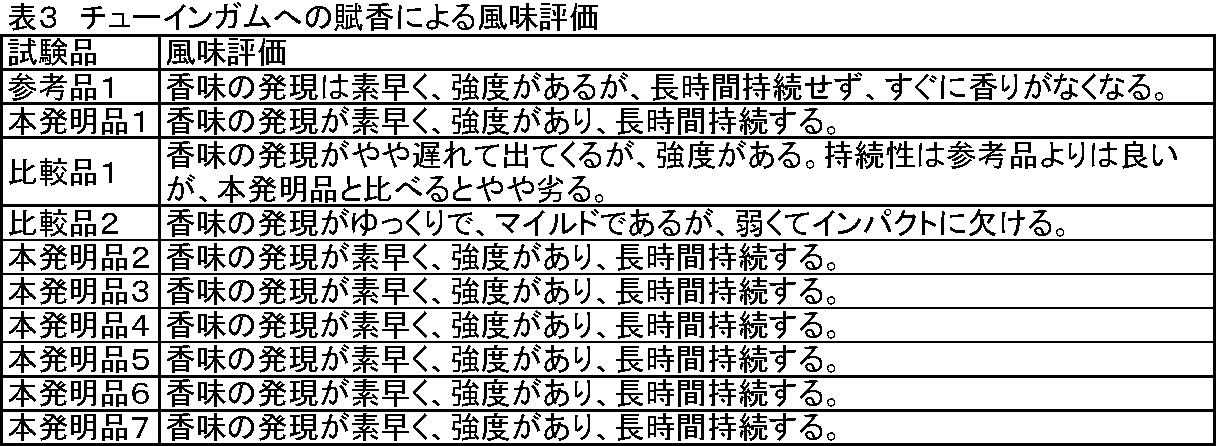
表1に示したとおり比較品1(油性物質を使用しないもの)はブロッキングを形成してしまい、比較品2(レモンオイルを直接マトリクスにカプセル化したもの)もややブロッキングを形成してしまい共に状態は不良であった。また、参考品1(レモンオイルの粉末香料)はブロッキングはしていないが、流動性がやや低下しており、吸湿の影響が見られた。
一方、本発明品1〜7は吸湿試験後も完全に良好な状態を維持しており、高湿度下での安定性が極めて良好であることが判明した。
As shown in Table 1, Comparative Product 1 (without using an oily substance) forms blocking, and Comparative Product 2 (with lemon oil directly encapsulated in a matrix) also forms blocking and is in the same state. Was bad. Moreover, although the reference product 1 (powder flavor of lemon oil) was not blocking, the fluidity was slightly lowered, and the influence of moisture absorption was observed.
On the other hand, it was found that the products 1 to 7 of the present invention maintained a completely good state even after the moisture absorption test, and the stability under high humidity was extremely good.
実施例9(保存安定性に関する試験)
参考品1、本発明品および比較品をそれぞれ30gづつ7cm×11cmのビニール袋に採取し、密閉し、40℃、暗所にて4週間保存試験を行った。保存後のサンプルは0.1%水に希釈し(参考品1のみ0.017%)、10名の良く訓練されたパネラーにより官能評価を行った。10人の平均的な官能評価結果を表2に示す。
Example 9 (Test on storage stability)
Each 30 g of the reference product 1, the product of the present invention, and the comparative product were collected in a 7 cm × 11 cm plastic bag, sealed, and subjected to a storage test at 40 ° C. in a dark place for 4 weeks. The sample after storage was diluted in 0.1% water (0.07% only for the reference product 1), and sensory evaluation was performed by 10 well-trained panelists. Table 2 shows the average sensory evaluation results of 10 people.
表2に示したとおり、参考品1(レモンオイルの粉末香料)は保存によりレモンの劣化臭が強くなってしまい、比較品1(油性物質を使用しないもの)も劣化臭は感じられないものの、ややフレッシュ感が低下してしまった。また、比較品2(レモンオイルを直接マトリクスにカプセル化したもの)はレモンのフレッシュ感がやや弱まったうえ、劣化臭も多少発生した。
一方、本発明品1〜7は保存試験後もレモンのフレッシュで良好な香味を維持し、劣化臭は全く感じられず、非常に保存安定性が良いことが判明した。
As shown in Table 2, the reference product 1 (lemon oil powder fragrance) has a stronger lemon odor due to storage, and the comparative product 1 (which does not use an oily substance) does not feel a deteriorated odor, Slightly fresh feeling has fallen. Moreover, the comparative product 2 (a product obtained by encapsulating lemon oil directly in a matrix) slightly weakened the freshness of the lemon, and produced a slight deterioration odor.
On the other hand, it was found that the products 1 to 7 of the present invention maintained a fresh flavor with a fresh lemon even after the storage test, did not feel any deterioration odor, and had very good storage stability.
実施例10(チューインガムへの賦香試験および官能評価:香味の発現試験)
下記に示すチューインガム基材に参考品1、本発明品または比較品をそれぞれ添加し、高せん断型ミキサーを用いて常法により約50℃で混合し、冷却後ロールにかけて圧展成型し、1枚3gのチューインガムを調製した。
チューインガム基材組成
原料 配合量
チューインガムベース 100部
砂糖 250
ブドウ糖 40
コーンシロップ(Bx85) 60
グリセリン 3
本発明品または比較品 4.5
(なお、参考品1のみは配合量0.765質量部とした)
このチューインガムについて10名の専門パネラーにより官能評価した。10人の平均的な官能評価結果を表3に示す。
Example 10 (Fragrance test and sensory evaluation to chewing gum: flavor expression test)
The reference product 1, the present invention product or a comparative product is added to the chewing gum base shown below, mixed at about 50 ° C. by a conventional method using a high-shear mixer, and after cooling, press-molded on a roll and then 1 sheet. 3 g of chewing gum was prepared.
Chewing gum base composition Raw material Blending amount Chewing gum base 100 parts Sugar 250
Glucose 40
Corn syrup (Bx85) 60
Glycerin 3
Invention product or comparative product 4.5
(Only the reference product 1 had a blending amount of 0.765 parts by mass)
This chewing gum was sensory-evaluated by 10 expert panelists. Table 3 shows the average sensory evaluation results of 10 people.
表3に示したとおり、本発明品は香味の発現が素早く、強度があり、長時間持続した。 一方、参考品1(レモンオイルの粉末香料)は香味の発現は素早く、強度があるが、香味が長時間持続せず、持続性に劣るという欠点を有していた。また、比較品1(油性物質を使用しないもの)は香味の発現の仕方は本発明品と類似していたが、本発明品ほど長時間持続しなかった。また、比較品2(レモンオイルを直接マトリクスにカプセル化したもの)は香味の発現がゆっくりで、マイルドであるが、弱くてインパクトに欠けた。これは、香料成分が油脂で希釈されてさらに乳化されマトリクス中に分散しているためと考えられる。 As shown in Table 3, the product of the present invention had a quick onset of flavor, strength, and persisted for a long time. On the other hand, the reference product 1 (powder flavor of lemon oil) had a shortcoming that the onset of flavor was quick and strong, but the flavor did not last for a long time and was inferior in sustainability. Comparative product 1 (which does not use an oily substance) was similar in flavor to the product of the present invention, but did not last as long as the product of the present invention. Comparative product 2 (a product in which lemon oil was directly encapsulated in a matrix) showed a slow and mild flavor, but was weak and lacked impact. This is presumably because the fragrance component is diluted with oil and fat, further emulsified and dispersed in the matrix.
Claims (5)
Priority Applications (5)
| Application Number | Priority Date | Filing Date | Title |
|---|---|---|---|
| JP2008319350A JP5088890B2 (en) | 2008-12-16 | 2008-12-16 | Process for producing fragrance-containing powdery composition |
| PCT/JP2009/070286 WO2010071026A1 (en) | 2008-12-16 | 2009-12-03 | Method for producing flavor-containing particle composition |
| HK12103136.5A HK1162261B (en) | 2008-12-16 | 2009-12-03 | Method for producing flavor-containing particle composition |
| CN200980155035.XA CN102291996B (en) | 2008-12-16 | 2009-12-03 | Method for producing fragrance-containing particle composition |
| US12/998,825 US20110236557A1 (en) | 2008-12-16 | 2009-12-03 | Manufacturing method of flavor-containing particle composition |
Applications Claiming Priority (1)
| Application Number | Priority Date | Filing Date | Title |
|---|---|---|---|
| JP2008319350A JP5088890B2 (en) | 2008-12-16 | 2008-12-16 | Process for producing fragrance-containing powdery composition |
Publications (2)
| Publication Number | Publication Date |
|---|---|
| JP2010143952A true JP2010143952A (en) | 2010-07-01 |
| JP5088890B2 JP5088890B2 (en) | 2012-12-05 |
Family
ID=42564704
Family Applications (1)
| Application Number | Title | Priority Date | Filing Date |
|---|---|---|---|
| JP2008319350A Active JP5088890B2 (en) | 2008-12-16 | 2008-12-16 | Process for producing fragrance-containing powdery composition |
Country Status (1)
| Country | Link |
|---|---|
| JP (1) | JP5088890B2 (en) |
Cited By (10)
| Publication number | Priority date | Publication date | Assignee | Title |
|---|---|---|---|---|
| JP2011254738A (en) * | 2010-06-08 | 2011-12-22 | T Hasegawa Co Ltd | Method for producing powdery composition |
| JP2014060963A (en) * | 2012-09-21 | 2014-04-10 | Kobayashi Pharmaceutical Co Ltd | Spice extract-containing oral composition, and method for improving flavor and pungent taste of spice extract |
| JP2014064510A (en) * | 2012-09-26 | 2014-04-17 | Meiji Co Ltd | Flavor imparting composition for chewing gum, and flavor imparting composition-containing chewing gum |
| JP2014525734A (en) * | 2011-06-23 | 2014-10-02 | フイルメニツヒ ソシエテ アノニム | Extrusion delivery system |
| JP2014526240A (en) * | 2011-09-09 | 2014-10-06 | フィリップ・モーリス・プロダクツ・ソシエテ・アノニム | Smoking articles containing flavor delivery materials |
| JP2014532085A (en) * | 2011-08-25 | 2014-12-04 | ローディア オペレーションズ | Method for preparing a fragrance composition comprising a compound having two solids having sensory irritation |
| JP2015524279A (en) * | 2012-08-22 | 2015-08-24 | インターコンチネンタル グレート ブランズ エルエルシー | Flavoring pre-blend of chewing gum ingredients, pre-blending ingredients, and method of making the chewing gum composition |
| JP2015174915A (en) * | 2014-03-14 | 2015-10-05 | 長谷川香料株式会社 | Process for producing perfume-containing granular composition |
| JP2019512254A (en) * | 2016-03-25 | 2019-05-16 | インターナショナル フレーバーズ アンド フラグランシズ インコーポレイテッド | Amorphous coolant dispersion composition |
| JP2023547019A (en) * | 2020-11-10 | 2023-11-09 | フイルメニツヒ ソシエテ アノニム | extruded particles |
Citations (2)
| Publication number | Priority date | Publication date | Assignee | Title |
|---|---|---|---|---|
| JPH0541957A (en) * | 1990-07-30 | 1993-02-23 | Asahi Chem Ind Co Ltd | Flavored food |
| JP2003325127A (en) * | 2002-05-08 | 2003-11-18 | Takasago Internatl Corp | Powder composition |
-
2008
- 2008-12-16 JP JP2008319350A patent/JP5088890B2/en active Active
Patent Citations (2)
| Publication number | Priority date | Publication date | Assignee | Title |
|---|---|---|---|---|
| JPH0541957A (en) * | 1990-07-30 | 1993-02-23 | Asahi Chem Ind Co Ltd | Flavored food |
| JP2003325127A (en) * | 2002-05-08 | 2003-11-18 | Takasago Internatl Corp | Powder composition |
Cited By (11)
| Publication number | Priority date | Publication date | Assignee | Title |
|---|---|---|---|---|
| JP2011254738A (en) * | 2010-06-08 | 2011-12-22 | T Hasegawa Co Ltd | Method for producing powdery composition |
| JP2014525734A (en) * | 2011-06-23 | 2014-10-02 | フイルメニツヒ ソシエテ アノニム | Extrusion delivery system |
| JP2014532085A (en) * | 2011-08-25 | 2014-12-04 | ローディア オペレーションズ | Method for preparing a fragrance composition comprising a compound having two solids having sensory irritation |
| JP2014526240A (en) * | 2011-09-09 | 2014-10-06 | フィリップ・モーリス・プロダクツ・ソシエテ・アノニム | Smoking articles containing flavor delivery materials |
| US10470488B2 (en) | 2011-09-09 | 2019-11-12 | Philip Morris Products S.A. | Smoking article comprising a flavour delivery material |
| JP2015524279A (en) * | 2012-08-22 | 2015-08-24 | インターコンチネンタル グレート ブランズ エルエルシー | Flavoring pre-blend of chewing gum ingredients, pre-blending ingredients, and method of making the chewing gum composition |
| JP2014060963A (en) * | 2012-09-21 | 2014-04-10 | Kobayashi Pharmaceutical Co Ltd | Spice extract-containing oral composition, and method for improving flavor and pungent taste of spice extract |
| JP2014064510A (en) * | 2012-09-26 | 2014-04-17 | Meiji Co Ltd | Flavor imparting composition for chewing gum, and flavor imparting composition-containing chewing gum |
| JP2015174915A (en) * | 2014-03-14 | 2015-10-05 | 長谷川香料株式会社 | Process for producing perfume-containing granular composition |
| JP2019512254A (en) * | 2016-03-25 | 2019-05-16 | インターナショナル フレーバーズ アンド フラグランシズ インコーポレイテッド | Amorphous coolant dispersion composition |
| JP2023547019A (en) * | 2020-11-10 | 2023-11-09 | フイルメニツヒ ソシエテ アノニム | extruded particles |
Also Published As
| Publication number | Publication date |
|---|---|
| JP5088890B2 (en) | 2012-12-05 |
Similar Documents
| Publication | Publication Date | Title |
|---|---|---|
| JP5088890B2 (en) | Process for producing fragrance-containing powdery composition | |
| CN102291996B (en) | Method for producing fragrance-containing particle composition | |
| JP5088889B2 (en) | Process for producing a perfume-containing granular composition having a crispy feeling | |
| JP3583380B2 (en) | Coating agents and coating powders | |
| US20090301504A1 (en) | Method for producing flavored particulate solid dispersions | |
| JP3662550B2 (en) | Powder composition | |
| JP3611652B2 (en) | Manufacturing method of coating powder | |
| JP4750162B2 (en) | 1-Menthol-containing emulsifying fragrance | |
| JP5435870B2 (en) | Method for producing particles containing oil containing polyunsaturated fatty acid | |
| JP5904677B2 (en) | Process for producing perfume-containing granular composition | |
| JPH0965850A (en) | Method for producing coating powder | |
| JP6100216B2 (en) | Powdered or granular composition and method for producing the same | |
| JP3122307B2 (en) | Method for producing coating fragrance powder | |
| JPH0856604A (en) | Method for powdering edible oily material | |
| US8828441B2 (en) | Active ingredient delivery system | |
| JP2782561B2 (en) | Powdering method for edible oily material | |
| JP4283500B2 (en) | Oil-soluble compound-containing emulsion composition | |
| JP4205904B2 (en) | Method for producing oil-soluble compound-containing emulsion composition | |
| HK1162261B (en) | Method for producing flavor-containing particle composition | |
| JP4133040B2 (en) | Method for preparing oil-soluble compound-containing emulsified structure | |
| JP5004198B2 (en) | Method for producing powder composition | |
| JP2003024001A (en) | Spherical granule, method for producing the same, and food containing the spherical granule | |
| JP2010035430A (en) | Mineral salt structure containing flavor component, and method for producing the same | |
| JP2000004858A (en) | Heat-resistant sustained-release granulated composition and method for producing the same | |
| JP2018164447A (en) | Hydrophilic polymer particles for candy |
Legal Events
| Date | Code | Title | Description |
|---|---|---|---|
| A621 | Written request for application examination |
Free format text: JAPANESE INTERMEDIATE CODE: A621 Effective date: 20100512 |
|
| A131 | Notification of reasons for refusal |
Free format text: JAPANESE INTERMEDIATE CODE: A131 Effective date: 20120703 |
|
| A521 | Written amendment |
Free format text: JAPANESE INTERMEDIATE CODE: A523 Effective date: 20120821 |
|
| TRDD | Decision of grant or rejection written | ||
| A01 | Written decision to grant a patent or to grant a registration (utility model) |
Free format text: JAPANESE INTERMEDIATE CODE: A01 Effective date: 20120906 |
|
| A01 | Written decision to grant a patent or to grant a registration (utility model) |
Free format text: JAPANESE INTERMEDIATE CODE: A01 |
|
| A61 | First payment of annual fees (during grant procedure) |
Free format text: JAPANESE INTERMEDIATE CODE: A61 Effective date: 20120907 |
|
| FPAY | Renewal fee payment (event date is renewal date of database) |
Free format text: PAYMENT UNTIL: 20150921 Year of fee payment: 3 |
|
| R150 | Certificate of patent or registration of utility model |
Ref document number: 5088890 Country of ref document: JP Free format text: JAPANESE INTERMEDIATE CODE: R150 Free format text: JAPANESE INTERMEDIATE CODE: R150 |