JP2010146878A - Conductive zinc oxide particulate and its manufacturing method - Google Patents
Conductive zinc oxide particulate and its manufacturing method Download PDFInfo
- Publication number
- JP2010146878A JP2010146878A JP2008323604A JP2008323604A JP2010146878A JP 2010146878 A JP2010146878 A JP 2010146878A JP 2008323604 A JP2008323604 A JP 2008323604A JP 2008323604 A JP2008323604 A JP 2008323604A JP 2010146878 A JP2010146878 A JP 2010146878A
- Authority
- JP
- Japan
- Prior art keywords
- zinc oxide
- fine particles
- conductive
- oxide fine
- halogen
- Prior art date
- Legal status (The legal status is an assumption and is not a legal conclusion. Google has not performed a legal analysis and makes no representation as to the accuracy of the status listed.)
- Pending
Links
Landscapes
- Inorganic Compounds Of Heavy Metals (AREA)
- Conductive Materials (AREA)
- Non-Insulated Conductors (AREA)
Abstract
Description
本発明は、導電性塗料、熱線反射塗料などの塗料、着色材、帯電防止材、静電気防止材、電磁波シールド材などの機能性材料の添加剤などとして用いられる分散性が良好な導電性酸化亜鉛微粒子及びその製造方法に関するものである。 The present invention relates to conductive zinc oxide having good dispersibility used as an additive for functional materials such as paints such as conductive paints and heat ray reflective paints, coloring materials, antistatic materials, antistatic materials, and electromagnetic shielding materials. The present invention relates to fine particles and a method for producing the same.
近年、電子材料、触媒、医薬・化粧品などの幅広い分野でナノオーダーの微粒子を製造する技術へのニーズが高まっている。特にITO(錫ドープ酸化インジウム)を主成分とする導電性酸化物微粒子は、その高導電性である特徴を利用し、透明導電性膜への利用が盛んになっている。
この導電性酸化物微粒子を透明導電性皮膜とする方法としては、例えば、一次粒子径約0.2μm以下の導電性酸化物微粒子の粉末を、溶媒とバインダー樹脂とからなる溶液中に分散させ、これを、ガラスやプラスチックなどの基材に塗布、印刷、浸漬、スピンコートあるいは噴霧などの手段で塗工し、乾燥する方法が挙げられる。
こうして作製した透明導電膜は、ガラスやプラスチックなどの帯電防止やほこりの付着防止に有効であり、例えば、ディスプレイや計測器の窓ガラスの帯電防止やほこりの付着防止に利用されている。
さらに、導電性酸化物微粒子は、ICパッケージ回路、クリーンルーム内装材、塗布型透明電極あるいは赤外線遮蔽材料などの用途に利用されはじめてきている。
In recent years, there is a growing need for technologies for producing nano-order fine particles in a wide range of fields such as electronic materials, catalysts, pharmaceuticals and cosmetics. In particular, conductive oxide fine particles mainly composed of ITO (tin-doped indium oxide) are actively used for transparent conductive films because of their high conductivity characteristics.
As a method for making the conductive oxide fine particles into a transparent conductive film, for example, a powder of conductive oxide fine particles having a primary particle diameter of about 0.2 μm or less is dispersed in a solution composed of a solvent and a binder resin. Examples thereof include a method in which this is applied to a substrate such as glass or plastic by means such as coating, printing, dipping, spin coating or spraying and then dried.
The transparent conductive film produced in this way is effective for preventing charging of glass and plastics and preventing adhesion of dust. For example, it is used for preventing charging of window glass of displays and measuring instruments and preventing adhesion of dust.
Furthermore, conductive oxide fine particles have begun to be used for applications such as IC package circuits, clean room interior materials, coated transparent electrodes, and infrared shielding materials.
しかしながらITO微粒子は主原料のInが希少金属であり、高価なことから代替材料が求められている。その代表として酸化亜鉛は従来から検討されてきているが、微粒子としてはITOほどの高い導電性を得ることが困難であり代替できないでいる。
例えば特許文献1には、ZnOに導電性を付与する方法としてアルミニウム、ガリウム又はインジウム元素を水溶性亜鉛塩と混合し、焼成する方法が開示されている。また、特許文献2には、酸化亜鉛、水溶性アルミニウム化合物、炭酸アンモニウム、さらには珪酸塩微粉末などの四種成分を水分散液から共沈させ、ろ過乾燥して600℃以下の温度で加熱処理する方法が開示されている。
しかし、いずれの方法においても、酸化亜鉛単独では導電性が高くならないため、高価なインジウムやガリウムなどの3価の金属元素を添加しており、コストが掛かるという問題点がある。さらに、安定した導電性を得るために、これらの金属元素を水溶液に溶けるような化合物形態にしたり、水溶液から共沈殿させたりなど行われており、製造プロセスが複雑かつ高コストとなる問題点もある。
However, since ITO is a rare metal as the main raw material of ITO fine particles, it is expensive and an alternative material is required. As a representative example, zinc oxide has been studied conventionally, but it is difficult to obtain high conductivity as that of ITO as fine particles, and it cannot be replaced.
For example, Patent Document 1 discloses a method of firing aluminum by mixing aluminum, gallium, or indium with a water-soluble zinc salt as a method for imparting conductivity to ZnO. Patent Document 2 discloses that four kinds of components such as zinc oxide, water-soluble aluminum compound, ammonium carbonate, and silicate fine powder are co-precipitated from an aqueous dispersion, filtered and dried at a temperature of 600 ° C. or less. A method of processing is disclosed.
However, in any of the methods, since zinc oxide alone does not increase the conductivity, expensive trivalent metal elements such as indium and gallium are added, and there is a problem that costs increase. Furthermore, in order to obtain stable conductivity, these metal elements are made into a compound form that can be dissolved in an aqueous solution, or co-precipitated from an aqueous solution, and the manufacturing process is complicated and expensive. is there.
本発明は、上記問題点に鑑みなされたものであり、インジウムなどの高価な金属を用いなくとも、電導性に優れ、かつ水やアルコール、ケトンなどの有機溶媒に対する分散性が良好な導電性微粒子及びその導電性微粒子を効率よく製造する方法を提供することを課題とするものである。 The present invention has been made in view of the above problems, and without using an expensive metal such as indium, the conductive fine particles have excellent electrical conductivity and good dispersibility in organic solvents such as water, alcohol and ketone. It is another object of the present invention to provide a method for efficiently producing conductive fine particles.
本発明者らは鋭意検討した結果、酸化亜鉛とハロゲン元素とを特定の割合で含有する導電性微粒子により上記課題を解決し得ることを見出し、本発明を完成した。
すなわち、本発明は、下記の1〜5を提供する。
As a result of intensive studies, the present inventors have found that the above problems can be solved by conductive fine particles containing zinc oxide and a halogen element in a specific ratio, and have completed the present invention.
That is, this invention provides the following 1-5.
1.酸化亜鉛とハロゲン元素とを含有する導電性微粒子であって、亜鉛(Zn)とハロゲン元素(X)との合計原子数に対するハロゲン元素の原子数の比[X/(Zn+X)]が0.001〜0.05であり、9.81MPaの加圧時の電気伝導度が0.005S/cm以上であることを特徴とする導電性酸化亜鉛微粒子。
2.ゼータ電位が+20mV以上であることを特徴とする上記1に記載の導電性酸化亜鉛微粒子。
3.上記1又は2に記載の導電性酸化亜鉛微粒子を溶媒中に分散させてなることを特徴とする分散液。
4.酸化亜鉛粉末とハロゲン化アンモニウムとを、亜鉛(Zn)とハロゲン元素(X)との合計原子数に対するハロゲン元素の原子数の比[X/(Zn+X)]が0.001〜0.05となるように混合して混合物とし、得られた混合物を不活性ガス又は不活性ガスと水素ガスの存在下に200〜600℃未満にて加熱することを特徴とする導電性酸化亜鉛微粒子の製造方法。
5.ハロゲン化アンモニウムが、臭化アンモニウム及び/又は塩化アンモニウムである上記4に記載の導電性酸化亜鉛微粒子の製造方法。
1. Conductive fine particles containing zinc oxide and a halogen element, wherein the ratio [X / (Zn + X)] of the number of halogen elements to the total number of atoms of zinc (Zn) and halogen elements (X) is 0.001. Conductive zinc oxide fine particles having a conductivity of 0.005 S / cm or more at a pressure of ˜0.05 and a pressure of 9.81 MPa.
2. 2. The conductive zinc oxide fine particles as described in 1 above, wherein the zeta potential is +20 mV or more.
3. 3. A dispersion comprising the conductive zinc oxide fine particles according to 1 or 2 dispersed in a solvent.
4). In the zinc oxide powder and ammonium halide, the ratio of the number of halogen elements to the total number of atoms of zinc (Zn) and halogen element (X) [X / (Zn + X)] is 0.001 to 0.05. A method for producing conductive zinc oxide fine particles, characterized in that the mixture is heated to 200 to 600 ° C. in the presence of an inert gas or an inert gas and hydrogen gas.
5). 5. The method for producing conductive zinc oxide fine particles as described in 4 above, wherein the ammonium halide is ammonium bromide and / or ammonium chloride.
本発明によれば、インジウムなどの高価な金属を用いなくとも、電導性に優れ、かつ水やアルコール、ケトンなどの有機溶媒に対する分散性が良好である導電性酸化亜鉛微粒子を安価に製造することができる。さらに、加熱処理するという簡便な方法で効率よく導電性酸化亜鉛微粒子を製造することができる。 According to the present invention, conductive zinc oxide fine particles having excellent conductivity and good dispersibility in an organic solvent such as water, alcohol, and ketone can be produced at low cost without using an expensive metal such as indium. Can do. Furthermore, conductive zinc oxide fine particles can be efficiently produced by a simple method of heat treatment.
[導電性酸化亜鉛微粒子]
本発明の導電性酸化亜鉛微粒子(以下、単に導電性微粒子ともいう。)には、亜鉛(Zn)とハロゲン元素(X)との合計原子数に対するハロゲン元素の原子数の比[X/(Zn+X)]が0.001〜0.05となるように酸化亜鉛とハロゲン元素とが含まれており、該導電性酸化亜鉛微粒子の電気伝導度は、9.81MPaの加圧時において0.005S/cm以上である。
上記原子数の比[X/(Zn+X)]が0.001未満であると、導電性微粒子の導電性及び分散性を向上させる効果を十分に発揮することができない。一方、分散性向上の効果は飽和する傾向にあるため、原子数の比が0.05超であっても、さらに分散性が向上することは期待できず、導電性においてはむしろ低下してしまう。好ましい原子数の比は、0.001〜0.03であり、より好ましくは0.002〜0.02である。
なお、亜鉛及びハロゲン元素の原子数は、蛍光X線分析などの公知の手段を用いて計測することができる。また、ハロゲン元素(X)の原子数とは、導電性微粒子に含まれるフッ素、塩素、臭素及びヨウ素の少なくとも1種のハロゲン元素の合計原子数をいう。
[Conductive zinc oxide fine particles]
In the conductive zinc oxide fine particles of the present invention (hereinafter also simply referred to as conductive fine particles), the ratio of the number of halogen atoms to the total number of atoms of zinc (Zn) and halogen elements (X) [X / (Zn + X )] Is contained in an amount of 0.001 to 0.05, and the electric conductivity of the conductive zinc oxide fine particles is 0.005 S / at the time of pressurization of 9.81 MPa. cm or more.
When the ratio of the number of atoms [X / (Zn + X)] is less than 0.001, the effect of improving the conductivity and dispersibility of the conductive fine particles cannot be sufficiently exhibited. On the other hand, since the effect of improving dispersibility tends to saturate, even if the ratio of the number of atoms is more than 0.05, it cannot be expected that the dispersibility is further improved, and the conductivity is rather lowered. . The ratio of the number of atoms is preferably 0.001 to 0.03, more preferably 0.002 to 0.02.
The number of atoms of zinc and halogen elements can be measured using a known means such as fluorescent X-ray analysis. The number of atoms of the halogen element (X) refers to the total number of atoms of at least one halogen element of fluorine, chlorine, bromine and iodine contained in the conductive fine particles.
電気伝導度は高い方が好ましいが、9.81MPaの加圧時において0.005S/cm以上であれば、導電性微粒子としての機能を十分発現することができる。
また、本発明の導電性酸化亜鉛微粒子は、ゼータ電位が+20mV以上であることが好ましい。
ゼータ電位は、導電性微粒子の分散性の指標となるものであり、+20mV以上とすることにより、導電性微粒子を分散性が良く、凝集しにくい粒子とすることができる。なお、ゼータ電位の上限は特に制限がないが、通常+50mV程度である。
導電性酸化亜鉛微粒子の平均粒子径は、導電性酸化亜鉛微粒子を含有する分散液やペーストとして用いる観点から、1〜10000nmとすることが好ましく、凝集の防止及び生産性の観点から、10〜1000nmがより好ましい。
Higher electrical conductivity is preferable, but if it is 0.005 S / cm or more at the time of pressurization of 9.81 MPa, the function as the conductive fine particles can be sufficiently expressed.
The conductive zinc oxide fine particles of the present invention preferably have a zeta potential of +20 mV or higher.
The zeta potential is an index of the dispersibility of the conductive fine particles. By setting the zeta potential to +20 mV or more, the conductive fine particles can be made to have good dispersibility and hardly aggregate. The upper limit of the zeta potential is not particularly limited, but is usually about +50 mV.
The average particle diameter of the conductive zinc oxide fine particles is preferably 1 to 10000 nm from the viewpoint of use as a dispersion or paste containing the conductive zinc oxide fine particles, and from the viewpoint of prevention of aggregation and productivity from 10 to 1000 nm. Is more preferable.
[導電性酸化亜鉛微粒子の製造方法]
本発明の導電性酸化亜鉛微粒子の製造方法は、酸化亜鉛粉末とハロゲン化アンモニウムとを、亜鉛(Zn)とハロゲン元素(X)との合計原子数に対するハロゲン元素の原子数の比[X/(Zn+X)]が0.001〜0.05となるように混合して混合物とし、得られた混合物を不活性ガス又は不活性ガスと水素ガスの存在下に200〜600℃未満にて加熱するものである。
[Method for producing conductive zinc oxide fine particles]
In the method for producing conductive zinc oxide fine particles of the present invention, the ratio of the number of halogen atoms to the total number of atoms of zinc oxide (Zn) and halogen element (X) in zinc oxide powder and ammonium halide [X / ( Zn + X)] is mixed to 0.001 to 0.05 to form a mixture, and the resulting mixture is heated at 200 to 600 ° C. in the presence of an inert gas or an inert gas and hydrogen gas. It is.
(混合物)
酸化亜鉛粉末とハロゲン化アンモニウムとの混合物は、原子数の比が前記の範囲となるように、ハロゲン化アンモニウムを溶液にして酸化亜鉛に添加することで得ることができる。また、得られた混合物を遊星ボールミルなどの適当な粉砕機により、粉砕しながら十分混合することで、平均粒子径が1〜1000nmの混合粉体とすることが好ましい。
(blend)
A mixture of zinc oxide powder and ammonium halide can be obtained by adding ammonium halide in solution to zinc oxide so that the ratio of the number of atoms is in the above range. Moreover, it is preferable to obtain a mixed powder having an average particle diameter of 1 to 1000 nm by sufficiently mixing the obtained mixture while pulverizing with an appropriate pulverizer such as a planetary ball mill.
酸化亜鉛粉末は、純度99.0%以上のものが好ましく、その平均粒子径は1〜100nmのものが好ましい。酸化亜鉛粉末は、ハロゲン化アンモニウム含有溶液を添加する前に、予め粉砕しておいてもよい。
ハロゲン化アンモニウムは、溶媒に溶解するものであればよく、具体例としては、臭化アンモニウム、塩化アンモニウム、フッ化アンモニウム及びヨウ化アンモニウムが挙げられる。これらは、1種を単独で用いてもよく、2種以上を組み合わせて用いても良い。取り扱いの容易さ及び価格の点で、臭化アンモニウム及び塩化アンモニウムが好ましい。
ハロゲン化アンモニウムを溶解させる溶媒としては、例えば、水、アセトン及びアルコールなどを用いることができ、溶媒に対するハロゲン化アンモニウムの割合は、通常、0.1〜30質量%が好ましく、0.5〜25質量%がより好ましい。
ハロゲン化アンモニウムを溶媒に溶解させて溶液とするのは、酸化亜鉛粉末の表面に均一にハロゲン元素を付着させ、その後の加熱処理により、導電性微粒子の表面にハロゲン元素を含有させるようにすることが容易だからである。
The zinc oxide powder preferably has a purity of 99.0% or more, and the average particle diameter is preferably 1 to 100 nm. The zinc oxide powder may be pulverized in advance before adding the ammonium halide-containing solution.
Any ammonium halide may be used as long as it is soluble in a solvent. Specific examples thereof include ammonium bromide, ammonium chloride, ammonium fluoride, and ammonium iodide. These may be used alone or in combination of two or more. Ammonium bromide and ammonium chloride are preferable in terms of ease of handling and price.
As the solvent for dissolving the ammonium halide, for example, water, acetone, alcohol and the like can be used, and the ratio of the ammonium halide to the solvent is usually preferably 0.1 to 30% by mass, and preferably 0.5 to 25%. The mass% is more preferable.
The solution of ammonium halide in a solvent is to make the halogen element uniformly adhere to the surface of the zinc oxide powder, and to make the surface of the conductive fine particles contain the halogen element by subsequent heat treatment. Because it is easy.
(加熱処理)
次に、得られた混合物を不活性ガス又は不活性ガスと水素ガスの存在下、200〜600℃未満にて加熱処理する。加熱処理手段は、通常の電気炉やマイクロ波加熱炉などを用いて行うことができる。
加熱処理における、加熱雰囲気、加熱温度及び加熱時間などの加熱処理条件については、下記の条件により処理することが好ましい。
〈加熱雰囲気〉
不活性ガス又は不活性ガスと水素ガスの存在下で行う。
窒素などの不活性ガスに加え、さらに水素ガスを添加することは、反応が促進され、より高い電気伝導度の導電性微粒子が得られるので好ましい。好ましい水素ガスの添加量は全体のガスに対して、0.5〜5体積%程度である。水素ガスの添加量が上記範囲内であれば、反応促進や電気伝導度の改善に効果的であり、安全上においても問題が生じることがない。
また、加熱雰囲気として、大気中でもよいが、より高い導電性を得るためには、低酸素雰囲気が好ましく、酸素濃度は好ましくは1体積%以下であり、より好ましくは0.1体積%以下である。
(Heat treatment)
Next, the obtained mixture is heat-treated at 200 to 600 ° C. in the presence of an inert gas or an inert gas and hydrogen gas. The heat treatment means can be performed using a normal electric furnace, a microwave heating furnace, or the like.
About heat processing conditions, such as a heating atmosphere, heating temperature, and heating time in heat processing, it is preferable to process on the following conditions.
<Heating atmosphere>
The reaction is performed in the presence of an inert gas or an inert gas and hydrogen gas.
It is preferable to add hydrogen gas in addition to an inert gas such as nitrogen because the reaction is accelerated and conductive fine particles with higher electric conductivity can be obtained. A preferable addition amount of hydrogen gas is about 0.5 to 5% by volume with respect to the total gas. If the amount of hydrogen gas added is within the above range, it is effective for promoting the reaction and improving the electrical conductivity, and no problem arises in terms of safety.
The heating atmosphere may be air, but in order to obtain higher conductivity, a low oxygen atmosphere is preferable, and the oxygen concentration is preferably 1% by volume or less, more preferably 0.1% by volume or less. .
〈加熱温度〉
200℃以上であり、好ましくは250℃以上、より好ましくは300℃以上である。
この加熱温度が高すぎると、ハロゲン元素を加えた場合に、加熱によりハロゲン元素の脱離が生じるだけでなく、粒成長が著しくなることがあるので、上限は600℃未満であり、500℃以下にすることが好ましい。
〈加熱時間〉
通常1〜120分程度であり、好ましくは5〜90分、より好ましくは10〜60分である。
加熱時間が長くなると、微粒子が成長する傾向にあるが、加熱温度の影響ほどは微粒子
の成長に影響しない。
<Heating temperature>
It is 200 degreeC or more, Preferably it is 250 degreeC or more, More preferably, it is 300 degreeC or more.
If the heating temperature is too high, when a halogen element is added, not only the halogen element is desorbed by heating, but also grain growth may be significant, so the upper limit is less than 600 ° C., and 500 ° C. or less. It is preferable to make it.
<Heating time>
Usually, it is about 1 to 120 minutes, preferably 5 to 90 minutes, more preferably 10 to 60 minutes.
When the heating time becomes longer, the fine particles tend to grow, but the influence of the heating temperature does not affect the growth of the fine particles.
[導電性酸化亜鉛微粒子の用途]
本発明の導電性酸化亜鉛微粒子の用途としては、例えば、溶媒中に分散させてなる分散液が挙げられる。
溶媒としては、本発明の導電性微粒子を分散させることができるものであれば、特に限定されないが、例えば、水や有機溶媒を用いることができる。
有機溶媒としては、メタノール、エタノール、n−プロパノール、イソプロパノール、エチレングリコール、ジエチレングリコール、トリエチレングリコール、プロピレングリコール及びグリセリンなどのアルコール類、アセトン、メチルエチルケトン、シクロペンタノン及びシクロヘキサンなどのケトン類、トルエン及びキシレンなどの芳香族溶媒などが挙げられる。これらは、1種を単独で用いてもよく、2種以上を組み合わせて用いても良い。
さらに、必要に応じて、スルホン酸アミド系、ε−カプトラクトン系、ハイドロステアリン酸系、ポリカルボン酸系及びポリエステル系などの分散剤を使用することも可能である。
この分散液は、そのまま塗料として使用することができる。また、さらに、ポリエステル樹脂、アクリル樹脂、エポキシ樹脂、アルキド樹脂、シリコン樹脂、ポリエーテル樹脂及びフェノール樹脂などの塗膜形成成分を加えて分散液としたものを塗料として使用することもできる。
[Use of conductive zinc oxide fine particles]
Examples of the use of the conductive zinc oxide fine particles of the present invention include a dispersion liquid dispersed in a solvent.
The solvent is not particularly limited as long as the conductive fine particles of the present invention can be dispersed. For example, water or an organic solvent can be used.
Examples of organic solvents include methanol, ethanol, n-propanol, isopropanol, ethylene glycol, diethylene glycol, triethylene glycol, propylene glycol, glycerol and other alcohols, acetone, methyl ethyl ketone, cyclopentanone and cyclohexane ketones, toluene and xylene. Aromatic solvents such as These may be used alone or in combination of two or more.
Furthermore, it is also possible to use dispersants such as sulfonic acid amide, ε-captolactone, hydrostearic acid, polycarboxylic acid and polyester as required.
This dispersion can be used as a coating as it is. In addition, a coating solution obtained by adding a film-forming component such as a polyester resin, an acrylic resin, an epoxy resin, an alkyd resin, a silicon resin, a polyether resin, or a phenol resin can also be used as a coating material.
以下、本発明について、実施例及び比較例を示してより具体的に説明するが、本発明はこれらによって、制限されるものではない。 EXAMPLES Hereinafter, although an Example and a comparative example are shown and this invention is demonstrated more concretely, this invention is not restrict | limited by these.
なお、実施例及び比較例における、物性測定方法は次のとおりである。
〔原子数の比〕
原子数の比[X/(Zn+X)]は、蛍光X線(型式:ZSX101e、(株)リガク製)を用いて求めた。
〔平均粒子径〕
平均粒子径は、BET法(一点法)による比表面積(m2/g)から測定した。
〔電気伝導度〕
電気伝導度は、粉体抵抗システム((株)ダイアインスツルメント製)を用い、加圧しながら測定し、圧力−電気伝導度のグラフから9.81MPaにおける電気伝導度を測定した。
〔ゼータ電位〕
ゼータ電位は、試料0.02gを入れたサンプル瓶に、10cm3のイオン交換水を入れ、10分間超音波洗浄機にて分散させた後、シメックス(株)製ゼータサイザーナノシリーズを用いて測定した。
In addition, the physical property measuring method in an Example and a comparative example is as follows.
[Atom ratio]
The atomic ratio [X / (Zn + X)] was determined using fluorescent X-rays (model: ZSX101e, manufactured by Rigaku Corporation).
[Average particle size]
The average particle diameter was measured from the specific surface area (m 2 / g) by the BET method (single point method).
[Electric conductivity]
The electrical conductivity was measured while applying pressure using a powder resistance system (manufactured by Dia Instruments Co., Ltd.), and the electrical conductivity at 9.81 MPa was measured from the pressure-electric conductivity graph.
[Zeta potential]
The zeta potential was measured using a Zetasizer Nano series manufactured by Simex Co., Ltd. after 10 cm 3 of ion exchange water was placed in a sample bottle containing 0.02 g of sample and dispersed for 10 minutes with an ultrasonic cleaner. did.
[実施例1]
原料の純度99.8%の酸化亜鉛粉末(ハクスイテック(株)製、第一種)100g(1.228モル)及び炭酸アンモニウム4gを溶解させた水溶液20gをメノウ乳鉢に添加して、原料粉末を混合した。
その後、さらに混合、粉砕をするために、遊星ボールミルで6時間混合、粉砕した後にいったん遊星ボールミルの回転を止め、臭化アンモニウム1.5g(0.0123モル)を溶解させた水溶液20gを追加し、さらに1時間混合を続け、混合粉体を得た。
次に、得られた混合粉体を90℃で3時間乾燥させ、乾燥後、この混合粉体をアルミナボートに入れ、このアルミナボートを管状炉の中に挿入し、処理雰囲気として、水素含有窒素ガスとするために、水素2体積%を混合した窒素ガスを0.5リットル/分の流量で流した。そして、加熱温度を400℃、加熱時間を30分とするために、室温から400℃まで約20分間かけて昇温し、400℃で30分間保持し、その後加熱を止め、アルミナボートを取り出して急冷し、白色の粉体を得た。
[Example 1]
100 g (1.228 mol) of zinc oxide powder having a purity of 99.8% (1st class) and 20 g of an aqueous solution in which 4 g of ammonium carbonate is dissolved are added to an agate mortar. Mixed.
Then, in order to further mix and grind, after mixing and grinding for 6 hours with a planetary ball mill, the planetary ball mill stopped rotating once, and 20 g of an aqueous solution in which 1.5 g (0.0123 mol) of ammonium bromide was dissolved was added. Further, mixing was continued for 1 hour to obtain a mixed powder.
Next, the obtained mixed powder was dried at 90 ° C. for 3 hours, and after drying, this mixed powder was put into an alumina boat, this alumina boat was inserted into a tubular furnace, and hydrogen-containing nitrogen was used as a treatment atmosphere. In order to obtain a gas, nitrogen gas mixed with 2% by volume of hydrogen was flowed at a flow rate of 0.5 liter / min. Then, in order to set the heating temperature to 400 ° C. and the heating time to 30 minutes, the temperature was raised from room temperature to 400 ° C. over about 20 minutes, held at 400 ° C. for 30 minutes, then the heating was stopped, and the alumina boat was taken out. Quenching was performed to obtain a white powder.
[実施例2]
臭化アンモニウムの量を0.5gとした以外は、実施例1と同様の条件で実施し、白色の粉体を得た。
[実施例3]
ハロゲン化アンモニウムとして塩化アンモニウム0.8gとした以外は、実施例1と同様の条件で実施し、白色の粉体を得た。
[実施例4]
臭化アンモニウムの量を3.0gとした以外は、実施例1と同様の条件で実施し、白色の粉体を得た。
[比較例1]
ハロゲン化アンモニウムを添加しなかった以外は、実施例1と同様の条件で実施し、白色の粉体を得た。
[Example 2]
Except that the amount of ammonium bromide was changed to 0.5 g, the reaction was carried out under the same conditions as in Example 1 to obtain a white powder.
[Example 3]
A white powder was obtained under the same conditions as in Example 1 except that 0.8 g of ammonium chloride was used as the ammonium halide.
[Example 4]
Except that the amount of ammonium bromide was changed to 3.0 g, the same procedure as in Example 1 was performed to obtain a white powder.
[Comparative Example 1]
Except not adding ammonium halide, it implemented on the conditions similar to Example 1, and obtained white powder.
上記実施例及び比較例において用いたハロゲン化アンモニウム及びその配合量、加熱処理雰囲気、加熱温度、加熱時間、得られた白色の粉体の物性を測定した結果を表1に示す。 Table 1 shows the results of measuring the physical properties of the ammonium halide used in the above Examples and Comparative Examples, the blending amount thereof, the heat treatment atmosphere, the heating temperature, the heating time, and the obtained white powder.
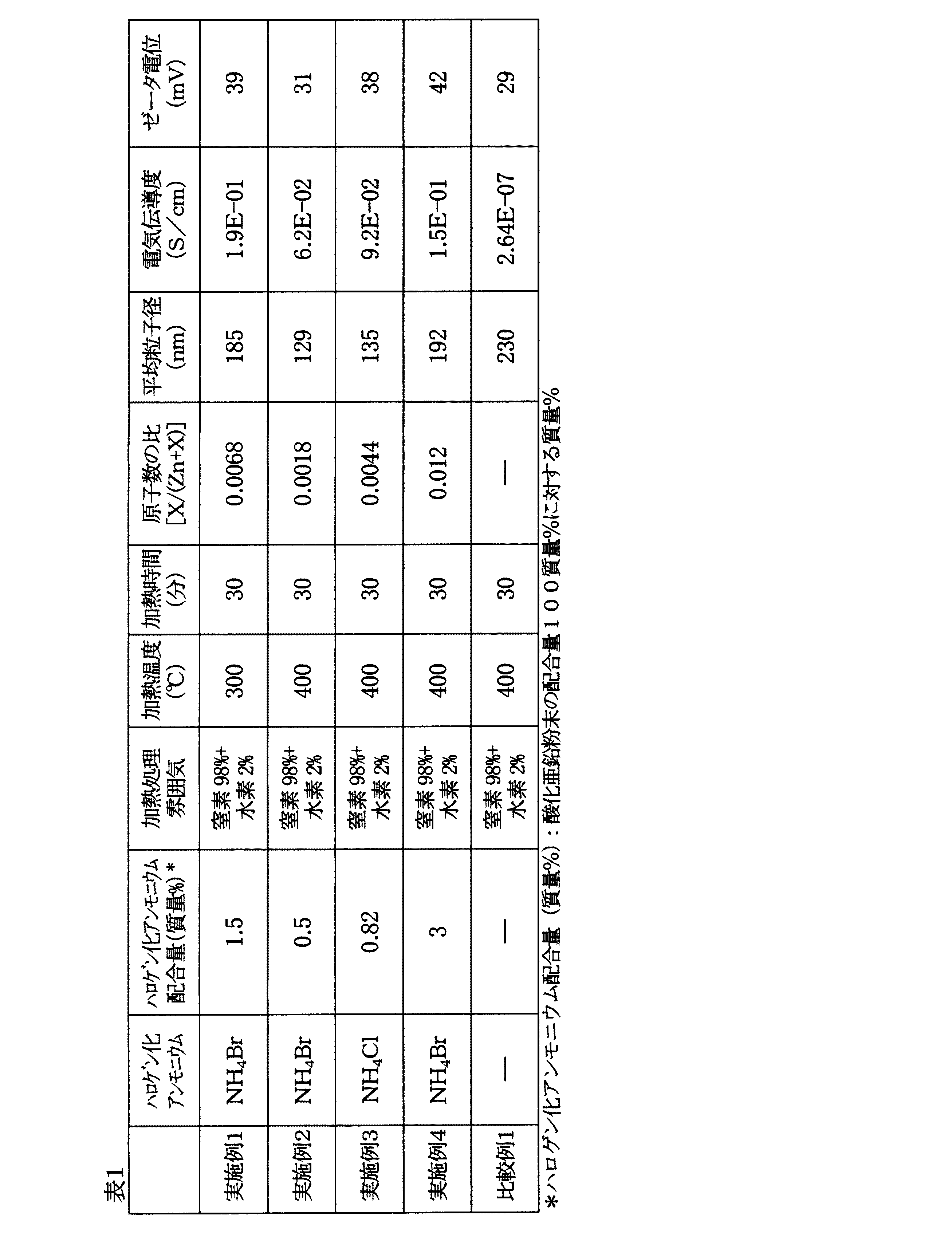
表1から、実施例1〜4で得られた導電性酸化亜鉛微粒子は、良好な電気伝導度を示し、優れたゼータ電位を示すことから分散性が良好であることがわかる。一方、ハロゲン化アンモニウムを添加しなかった比較例1で得られた導電性酸化亜鉛微粒子は、電気伝導度が2.6×10⁻⁷S/cmと非常に低くかつ粒径も大きくなっていた。 From Table 1, it turns out that the electroconductive zinc oxide microparticles | fine-particles obtained in Examples 1-4 show favorable electrical conductivity, and the dispersibility is favorable from showing the outstanding zeta potential. On the other hand, the conductive zinc oxide fine particles obtained in Comparative Example 1 to which no ammonium halide was added had a very low electric conductivity of 2.6 × 10 −7 S / cm and a large particle size. .
本発明の導電性酸化亜鉛微粒子は、電導性に優れ、溶媒に対する分散性が良好であり、安価に効率よく製造することができるので、導電性塗料、熱線反射塗料などの塗料、着色材、帯電防止材、静電気防止材、電磁波シールド材などの機能性材料の添加剤などとして好適に用いられる。 The conductive zinc oxide fine particles of the present invention have excellent electrical conductivity, good dispersibility in solvents, and can be produced efficiently at low cost. It is suitably used as an additive for functional materials such as an antistatic material, an antistatic material, and an electromagnetic shielding material.
Claims (5)
Priority Applications (1)
| Application Number | Priority Date | Filing Date | Title |
|---|---|---|---|
| JP2008323604A JP2010146878A (en) | 2008-12-19 | 2008-12-19 | Conductive zinc oxide particulate and its manufacturing method |
Applications Claiming Priority (1)
| Application Number | Priority Date | Filing Date | Title |
|---|---|---|---|
| JP2008323604A JP2010146878A (en) | 2008-12-19 | 2008-12-19 | Conductive zinc oxide particulate and its manufacturing method |
Publications (1)
| Publication Number | Publication Date |
|---|---|
| JP2010146878A true JP2010146878A (en) | 2010-07-01 |
Family
ID=42567066
Family Applications (1)
| Application Number | Title | Priority Date | Filing Date |
|---|---|---|---|
| JP2008323604A Pending JP2010146878A (en) | 2008-12-19 | 2008-12-19 | Conductive zinc oxide particulate and its manufacturing method |
Country Status (1)
| Country | Link |
|---|---|
| JP (1) | JP2010146878A (en) |
Cited By (2)
| Publication number | Priority date | Publication date | Assignee | Title |
|---|---|---|---|---|
| JP2017043505A (en) * | 2015-08-25 | 2017-03-02 | 住友金属鉱山株式会社 | Manufacturing method of uv light shielding material particulates, uv light shielding material particulate dispersoid using uv light shielding material particulates, and uv light shielding body |
| JP2020158350A (en) * | 2019-03-27 | 2020-10-01 | 三井金属鉱業株式会社 | Zinc oxide particles and their production method. |
-
2008
- 2008-12-19 JP JP2008323604A patent/JP2010146878A/en active Pending
Cited By (3)
| Publication number | Priority date | Publication date | Assignee | Title |
|---|---|---|---|---|
| JP2017043505A (en) * | 2015-08-25 | 2017-03-02 | 住友金属鉱山株式会社 | Manufacturing method of uv light shielding material particulates, uv light shielding material particulate dispersoid using uv light shielding material particulates, and uv light shielding body |
| JP2020158350A (en) * | 2019-03-27 | 2020-10-01 | 三井金属鉱業株式会社 | Zinc oxide particles and their production method. |
| JP7315354B2 (en) | 2019-03-27 | 2023-07-26 | 三井金属鉱業株式会社 | Coated zinc oxide particles and method for producing the same |
Similar Documents
| Publication | Publication Date | Title |
|---|---|---|
| US10481301B2 (en) | Nanometric tin-containing metal oxide particle and dispersion, and preparation method and application thereof | |
| JP5754580B2 (en) | Indium tin oxide powder | |
| Benammar et al. | The effect of rare earth element (Er, Yb) doping and heat treatment on suspension stability of Y2O3 nanoparticles elaborated by sol-gel method | |
| JPWO2002013999A1 (en) | Metal colloid solution, method for producing the same, and paint using the same | |
| JP6828514B2 (en) | Heat ray shielding fine particles, heat ray shielding fine particle dispersion liquid, coating liquid for heat ray shielding film, and heat ray shielding film using these, heat ray shielding resin film, heat ray shielding fine particle dispersion | |
| JP2022155211A (en) | Metal-supported titania nanoparticles and method for producing the same | |
| JPWO2004089829A1 (en) | Composite indium oxide particles, production method thereof, conductive paint, conductive coating film and conductive sheet | |
| CN104263056B (en) | The preparation method of tin-antiomony oxide organic nano slurry | |
| JP2012176859A (en) | Indium tin oxide particle and method for producing the same | |
| JP2010146878A (en) | Conductive zinc oxide particulate and its manufacturing method | |
| Smitha et al. | Optical Properties of Rare‐Earth Doped TiO2 Nanocomposites and Coatings; A Sol‐Gel Strategy towards Multi–functionality | |
| JP2019172526A (en) | Titania nanoparticle and ultraviolet shielding material including the same | |
| CN107746071A (en) | A kind of rare earth doped nano zine oxide and preparation method thereof | |
| JP5407549B2 (en) | Photocatalyst particle dispersion and process for producing the same | |
| JP3976484B2 (en) | Conductive powder organic solvent dispersion and conductive paint | |
| JP2003327920A (en) | Electroconductive coating material, method for producing electroconductive coat using the same, electroconductive coating film and element having electroconductive coating film | |
| JP2019171319A (en) | photocatalyst | |
| JP2005008515A (en) | Metal oxide particle and its manufacturing method | |
| JP6413969B2 (en) | Dispersion for forming solar shading body and solar shading body using the dispersion | |
| JP2010135227A (en) | Conductive zinc oxide particultes, its dispersion solution, paint, and its manufacturing method | |
| JP6635031B2 (en) | Barium titanate fine particle powder, dispersion and coating film | |
| JP5644877B2 (en) | Method for producing dispersion of photocatalyst particles | |
| JP2010208924A (en) | Electroconductive indium oxide fine particle and method for producing the same | |
| JP2010040397A (en) | Conductive particulate and its manufacturing method | |
| JP2003104725A (en) | ITO powder, transparent conductive film and method of forming the same |