JP2010254792A - Polyimide, and polyimide for optical waveguide - Google Patents
Polyimide, and polyimide for optical waveguide Download PDFInfo
- Publication number
- JP2010254792A JP2010254792A JP2009105996A JP2009105996A JP2010254792A JP 2010254792 A JP2010254792 A JP 2010254792A JP 2009105996 A JP2009105996 A JP 2009105996A JP 2009105996 A JP2009105996 A JP 2009105996A JP 2010254792 A JP2010254792 A JP 2010254792A
- Authority
- JP
- Japan
- Prior art keywords
- polyimide
- bis
- aminophenoxy
- dianhydride
- phenyl
- Prior art date
- Legal status (The legal status is an assumption and is not a legal conclusion. Google has not performed a legal analysis and makes no representation as to the accuracy of the status listed.)
- Pending
Links
- 229920001721 polyimide Polymers 0.000 title claims abstract description 89
- 239000004642 Polyimide Substances 0.000 title claims abstract description 73
- 230000003287 optical effect Effects 0.000 title claims description 50
- 238000005259 measurement Methods 0.000 claims abstract description 16
- 230000009477 glass transition Effects 0.000 claims description 15
- 239000002904 solvent Substances 0.000 abstract description 15
- GTDPSWPPOUPBNX-UHFFFAOYSA-N ac1mqpva Chemical compound CC12C(=O)OC(=O)C1(C)C1(C)C2(C)C(=O)OC1=O GTDPSWPPOUPBNX-UHFFFAOYSA-N 0.000 description 43
- 239000000758 substrate Substances 0.000 description 33
- UHOVQNZJYSORNB-UHFFFAOYSA-N Benzene Chemical compound C1=CC=CC=C1 UHOVQNZJYSORNB-UHFFFAOYSA-N 0.000 description 26
- -1 diamines Chemical class 0.000 description 24
- 229920000642 polymer Polymers 0.000 description 22
- KFZMGEQAYNKOFK-UHFFFAOYSA-N Isopropanol Chemical compound CC(C)O KFZMGEQAYNKOFK-UHFFFAOYSA-N 0.000 description 21
- 239000012299 nitrogen atmosphere Substances 0.000 description 21
- SECXISVLQFMRJM-UHFFFAOYSA-N N-Methylpyrrolidone Chemical compound CN1CCCC1=O SECXISVLQFMRJM-UHFFFAOYSA-N 0.000 description 18
- XUIMIQQOPSSXEZ-UHFFFAOYSA-N Silicon Chemical compound [Si] XUIMIQQOPSSXEZ-UHFFFAOYSA-N 0.000 description 18
- 239000010703 silicon Substances 0.000 description 18
- 229910052710 silicon Inorganic materials 0.000 description 18
- IJGRMHOSHXDMSA-UHFFFAOYSA-N Atomic nitrogen Chemical compound N#N IJGRMHOSHXDMSA-UHFFFAOYSA-N 0.000 description 14
- AWJUIBRHMBBTKR-UHFFFAOYSA-N isoquinoline Chemical compound C1=NC=CC2=CC=CC=C21 AWJUIBRHMBBTKR-UHFFFAOYSA-N 0.000 description 14
- RLSSMJSEOOYNOY-UHFFFAOYSA-N m-cresol Chemical compound CC1=CC=CC(O)=C1 RLSSMJSEOOYNOY-UHFFFAOYSA-N 0.000 description 14
- 238000003756 stirring Methods 0.000 description 10
- 150000004985 diamines Chemical class 0.000 description 9
- 238000010438 heat treatment Methods 0.000 description 9
- 239000010410 layer Substances 0.000 description 8
- 239000003054 catalyst Substances 0.000 description 7
- 230000000052 comparative effect Effects 0.000 description 7
- 238000004519 manufacturing process Methods 0.000 description 7
- 229910052757 nitrogen Inorganic materials 0.000 description 7
- ZMXDDKWLCZADIW-UHFFFAOYSA-N N,N-Dimethylformamide Chemical compound CN(C)C=O ZMXDDKWLCZADIW-UHFFFAOYSA-N 0.000 description 6
- 239000004020 conductor Substances 0.000 description 6
- USIUVYZYUHIAEV-UHFFFAOYSA-N diphenyl ether Chemical compound C=1C=CC=CC=1OC1=CC=CC=C1 USIUVYZYUHIAEV-UHFFFAOYSA-N 0.000 description 6
- 238000001035 drying Methods 0.000 description 6
- 239000011521 glass Substances 0.000 description 6
- 239000000463 material Substances 0.000 description 6
- 239000011347 resin Substances 0.000 description 6
- 229920005989 resin Polymers 0.000 description 6
- 239000011248 coating agent Substances 0.000 description 5
- 238000000576 coating method Methods 0.000 description 5
- 239000009719 polyimide resin Substances 0.000 description 5
- 125000002023 trifluoromethyl group Chemical group FC(F)(F)* 0.000 description 5
- UMGYJGHIMRFYSP-UHFFFAOYSA-N 2-(4-aminophenyl)-1,3-benzoxazol-5-amine Chemical compound C1=CC(N)=CC=C1C1=NC2=CC(N)=CC=C2O1 UMGYJGHIMRFYSP-UHFFFAOYSA-N 0.000 description 4
- XKRFYHLGVUSROY-UHFFFAOYSA-N Argon Chemical compound [Ar] XKRFYHLGVUSROY-UHFFFAOYSA-N 0.000 description 4
- RTZKZFJDLAIYFH-UHFFFAOYSA-N Diethyl ether Chemical compound CCOCC RTZKZFJDLAIYFH-UHFFFAOYSA-N 0.000 description 4
- IAZDPXIOMUYVGZ-UHFFFAOYSA-N Dimethylsulphoxide Chemical compound CS(C)=O IAZDPXIOMUYVGZ-UHFFFAOYSA-N 0.000 description 4
- 239000002253 acid Substances 0.000 description 4
- 150000004984 aromatic diamines Chemical class 0.000 description 4
- 239000012792 core layer Substances 0.000 description 4
- 230000001771 impaired effect Effects 0.000 description 4
- 239000000178 monomer Substances 0.000 description 4
- 125000000951 phenoxy group Chemical group [H]C1=C([H])C([H])=C(O*)C([H])=C1[H] 0.000 description 4
- 239000002861 polymer material Substances 0.000 description 4
- 125000006158 tetracarboxylic acid group Chemical group 0.000 description 4
- VLDPXPPHXDGHEW-UHFFFAOYSA-N 1-chloro-2-dichlorophosphoryloxybenzene Chemical compound ClC1=CC=CC=C1OP(Cl)(Cl)=O VLDPXPPHXDGHEW-UHFFFAOYSA-N 0.000 description 3
- OZJYZNVZBUZORU-UHFFFAOYSA-N 4-(4-aminophenyl)aniline;1,1'-biphenyl Chemical compound C1=CC=CC=C1C1=CC=CC=C1.C1=CC(N)=CC=C1C1=CC=C(N)C=C1 OZJYZNVZBUZORU-UHFFFAOYSA-N 0.000 description 3
- CSCPPACGZOOCGX-UHFFFAOYSA-N Acetone Chemical compound CC(C)=O CSCPPACGZOOCGX-UHFFFAOYSA-N 0.000 description 3
- FXHOOIRPVKKKFG-UHFFFAOYSA-N N,N-Dimethylacetamide Chemical compound CN(C)C(C)=O FXHOOIRPVKKKFG-UHFFFAOYSA-N 0.000 description 3
- YXFVVABEGXRONW-UHFFFAOYSA-N Toluene Chemical compound CC1=CC=CC=C1 YXFVVABEGXRONW-UHFFFAOYSA-N 0.000 description 3
- 238000010521 absorption reaction Methods 0.000 description 3
- 125000000217 alkyl group Chemical group 0.000 description 3
- JFDZBHWFFUWGJE-UHFFFAOYSA-N benzonitrile Chemical compound N#CC1=CC=CC=C1 JFDZBHWFFUWGJE-UHFFFAOYSA-N 0.000 description 3
- 125000003236 benzoyl group Chemical group [H]C1=C([H])C([H])=C(C([H])=C1[H])C(*)=O 0.000 description 3
- 239000002131 composite material Substances 0.000 description 3
- 238000001816 cooling Methods 0.000 description 3
- ZUOUZKKEUPVFJK-UHFFFAOYSA-N diphenyl Chemical compound C1=CC=CC=C1C1=CC=CC=C1 ZUOUZKKEUPVFJK-UHFFFAOYSA-N 0.000 description 3
- ANSXAPJVJOKRDJ-UHFFFAOYSA-N furo[3,4-f][2]benzofuran-1,3,5,7-tetrone Chemical compound C1=C2C(=O)OC(=O)C2=CC2=C1C(=O)OC2=O ANSXAPJVJOKRDJ-UHFFFAOYSA-N 0.000 description 3
- 238000002329 infrared spectrum Methods 0.000 description 3
- 125000001997 phenyl group Chemical group [H]C1=C([H])C([H])=C(*)C([H])=C1[H] 0.000 description 3
- 229920003229 poly(methyl methacrylate) Polymers 0.000 description 3
- 239000004926 polymethyl methacrylate Substances 0.000 description 3
- MXPYJVUYLVNEBB-UHFFFAOYSA-N 2-[2-(2-carboxybenzoyl)oxycarbonylbenzoyl]oxycarbonylbenzoic acid Chemical compound OC(=O)C1=CC=CC=C1C(=O)OC(=O)C1=CC=CC=C1C(=O)OC(=O)C1=CC=CC=C1C(O)=O MXPYJVUYLVNEBB-UHFFFAOYSA-N 0.000 description 2
- HLBLWEWZXPIGSM-UHFFFAOYSA-N 4-Aminophenyl ether Chemical compound C1=CC(N)=CC=C1OC1=CC=C(N)C=C1 HLBLWEWZXPIGSM-UHFFFAOYSA-N 0.000 description 2
- YEJRWHAVMIAJKC-UHFFFAOYSA-N 4-Butyrolactone Chemical compound O=C1CCCO1 YEJRWHAVMIAJKC-UHFFFAOYSA-N 0.000 description 2
- WUPRYUDHUFLKFL-UHFFFAOYSA-N 4-[3-(4-aminophenoxy)phenoxy]aniline Chemical compound C1=CC(N)=CC=C1OC1=CC=CC(OC=2C=CC(N)=CC=2)=C1 WUPRYUDHUFLKFL-UHFFFAOYSA-N 0.000 description 2
- SNHKMHUMILUWSJ-UHFFFAOYSA-N 5-(1,3-dioxo-3a,4,5,6,7,7a-hexahydro-2-benzofuran-5-yl)-3a,4,5,6,7,7a-hexahydro-2-benzofuran-1,3-dione Chemical compound C1CC2C(=O)OC(=O)C2CC1C1CC2C(=O)OC(=O)C2CC1 SNHKMHUMILUWSJ-UHFFFAOYSA-N 0.000 description 2
- 229910015363 Au—Sn Inorganic materials 0.000 description 2
- HEDRZPFGACZZDS-UHFFFAOYSA-N Chloroform Chemical compound ClC(Cl)Cl HEDRZPFGACZZDS-UHFFFAOYSA-N 0.000 description 2
- ATUOYWHBWRKTHZ-UHFFFAOYSA-N Propane Chemical compound CCC ATUOYWHBWRKTHZ-UHFFFAOYSA-N 0.000 description 2
- UCKMPCXJQFINFW-UHFFFAOYSA-N Sulphide Chemical compound [S-2] UCKMPCXJQFINFW-UHFFFAOYSA-N 0.000 description 2
- WYURNTSHIVDZCO-UHFFFAOYSA-N Tetrahydrofuran Chemical compound C1CCOC1 WYURNTSHIVDZCO-UHFFFAOYSA-N 0.000 description 2
- 125000003545 alkoxy group Chemical group 0.000 description 2
- 150000008064 anhydrides Chemical class 0.000 description 2
- 229910052786 argon Inorganic materials 0.000 description 2
- 125000003118 aryl group Chemical group 0.000 description 2
- 239000012298 atmosphere Substances 0.000 description 2
- CJYIPJMCGHGFNN-UHFFFAOYSA-N bicyclo[2.2.1]heptane-2,3,5,6-tetracarboxylic acid Chemical compound C1C2C(C(O)=O)C(C(=O)O)C1C(C(O)=O)C2C(O)=O CJYIPJMCGHGFNN-UHFFFAOYSA-N 0.000 description 2
- 235000010290 biphenyl Nutrition 0.000 description 2
- 239000004305 biphenyl Substances 0.000 description 2
- 125000004432 carbon atom Chemical group C* 0.000 description 2
- 238000006243 chemical reaction Methods 0.000 description 2
- 238000005253 cladding Methods 0.000 description 2
- 150000001875 compounds Chemical class 0.000 description 2
- JHIVVAPYMSGYDF-UHFFFAOYSA-N cyclohexanone Chemical compound O=C1CCCCC1 JHIVVAPYMSGYDF-UHFFFAOYSA-N 0.000 description 2
- KZTYYGOKRVBIMI-UHFFFAOYSA-N diphenyl sulfone Chemical compound C=1C=CC=CC=1S(=O)(=O)C1=CC=CC=C1 KZTYYGOKRVBIMI-UHFFFAOYSA-N 0.000 description 2
- 230000002349 favourable effect Effects 0.000 description 2
- 229910052731 fluorine Inorganic materials 0.000 description 2
- 125000001153 fluoro group Chemical group F* 0.000 description 2
- 238000001879 gelation Methods 0.000 description 2
- 239000012948 isocyanate Substances 0.000 description 2
- 150000002513 isocyanates Chemical class 0.000 description 2
- 239000004973 liquid crystal related substance Substances 0.000 description 2
- 230000007257 malfunction Effects 0.000 description 2
- 238000000034 method Methods 0.000 description 2
- 239000000203 mixture Substances 0.000 description 2
- 239000013307 optical fiber Substances 0.000 description 2
- 230000005693 optoelectronics Effects 0.000 description 2
- 238000006068 polycondensation reaction Methods 0.000 description 2
- 238000002360 preparation method Methods 0.000 description 2
- 239000010453 quartz Substances 0.000 description 2
- 239000002994 raw material Substances 0.000 description 2
- 230000000630 rising effect Effects 0.000 description 2
- VYPSYNLAJGMNEJ-UHFFFAOYSA-N silicon dioxide Inorganic materials O=[Si]=O VYPSYNLAJGMNEJ-UHFFFAOYSA-N 0.000 description 2
- 229910000679 solder Inorganic materials 0.000 description 2
- 238000001228 spectrum Methods 0.000 description 2
- 239000000126 substance Substances 0.000 description 2
- 150000003462 sulfoxides Chemical class 0.000 description 2
- STIUJDCDGZSXGO-UHFFFAOYSA-N (3-amino-4-phenoxyphenyl)-(3-aminophenyl)methanone Chemical compound NC1=CC=CC(C(=O)C=2C=C(N)C(OC=3C=CC=CC=3)=CC=2)=C1 STIUJDCDGZSXGO-UHFFFAOYSA-N 0.000 description 1
- GSHMRKDZYYLPNZ-UHFFFAOYSA-N (3-amino-4-phenoxyphenyl)-(4-amino-3-phenoxyphenyl)methanone Chemical compound NC1=CC=C(C(=O)C=2C=C(N)C(OC=3C=CC=CC=3)=CC=2)C=C1OC1=CC=CC=C1 GSHMRKDZYYLPNZ-UHFFFAOYSA-N 0.000 description 1
- PHPTWVBSQRENOR-UHFFFAOYSA-N (3-amino-4-phenoxyphenyl)-(4-aminophenyl)methanone Chemical compound C1=CC(N)=CC=C1C(=O)C(C=C1N)=CC=C1OC1=CC=CC=C1 PHPTWVBSQRENOR-UHFFFAOYSA-N 0.000 description 1
- YKNMIGJJXKBHJE-UHFFFAOYSA-N (3-aminophenyl)-(4-aminophenyl)methanone Chemical compound C1=CC(N)=CC=C1C(=O)C1=CC=CC(N)=C1 YKNMIGJJXKBHJE-UHFFFAOYSA-N 0.000 description 1
- HFAMSBMTCKNPRG-UHFFFAOYSA-N (4-amino-3-phenoxyphenyl)-(3-aminophenyl)methanone Chemical compound NC1=CC=CC(C(=O)C=2C=C(OC=3C=CC=CC=3)C(N)=CC=2)=C1 HFAMSBMTCKNPRG-UHFFFAOYSA-N 0.000 description 1
- NILYJZJYFZUPPO-UHFFFAOYSA-N (4-amino-3-phenoxyphenyl)-(4-aminophenyl)methanone Chemical compound C1=CC(N)=CC=C1C(=O)C1=CC=C(N)C(OC=2C=CC=CC=2)=C1 NILYJZJYFZUPPO-UHFFFAOYSA-N 0.000 description 1
- NSGXIBWMJZWTPY-UHFFFAOYSA-N 1,1,1,3,3,3-hexafluoropropane Chemical compound FC(F)(F)CC(F)(F)F NSGXIBWMJZWTPY-UHFFFAOYSA-N 0.000 description 1
- GEYOCULIXLDCMW-UHFFFAOYSA-N 1,2-phenylenediamine Chemical compound NC1=CC=CC=C1N GEYOCULIXLDCMW-UHFFFAOYSA-N 0.000 description 1
- BCMCBBGGLRIHSE-UHFFFAOYSA-N 1,3-benzoxazole Chemical compound C1=CC=C2OC=NC2=C1 BCMCBBGGLRIHSE-UHFFFAOYSA-N 0.000 description 1
- WZCQRUWWHSTZEM-UHFFFAOYSA-N 1,3-phenylenediamine Chemical compound NC1=CC=CC(N)=C1 WZCQRUWWHSTZEM-UHFFFAOYSA-N 0.000 description 1
- CBCKQZAAMUWICA-UHFFFAOYSA-N 1,4-phenylenediamine Chemical compound NC1=CC=C(N)C=C1 CBCKQZAAMUWICA-UHFFFAOYSA-N 0.000 description 1
- YFOOEYJGMMJJLS-UHFFFAOYSA-N 1,8-diaminonaphthalene Chemical compound C1=CC(N)=C2C(N)=CC=CC2=C1 YFOOEYJGMMJJLS-UHFFFAOYSA-N 0.000 description 1
- YLHUPYSUKYAIBW-UHFFFAOYSA-N 1-acetylpyrrolidin-2-one Chemical compound CC(=O)N1CCCC1=O YLHUPYSUKYAIBW-UHFFFAOYSA-N 0.000 description 1
- CYRDONYNCYQNAL-UHFFFAOYSA-N 1-methylheptane-1,2,4,5-tetracarboxylic acid Chemical compound CCC(C(O)=O)C(C(O)=O)CC(C(O)=O)C(C)C(O)=O CYRDONYNCYQNAL-UHFFFAOYSA-N 0.000 description 1
- VSMRWFMFAFOGGD-UHFFFAOYSA-N 2-(3-aminophenyl)-1,3-benzoxazol-6-amine Chemical compound NC1=CC=CC(C=2OC3=CC(N)=CC=C3N=2)=C1 VSMRWFMFAFOGGD-UHFFFAOYSA-N 0.000 description 1
- IBKFNGCWUPNUHY-UHFFFAOYSA-N 2-(4-aminophenyl)-1,3-benzoxazol-6-amine Chemical compound C1=CC(N)=CC=C1C1=NC2=CC=C(N)C=C2O1 IBKFNGCWUPNUHY-UHFFFAOYSA-N 0.000 description 1
- SVONRAPFKPVNKG-UHFFFAOYSA-N 2-ethoxyethyl acetate Chemical compound CCOCCOC(C)=O SVONRAPFKPVNKG-UHFFFAOYSA-N 0.000 description 1
- QTWJRLJHJPIABL-UHFFFAOYSA-N 2-methylphenol;3-methylphenol;4-methylphenol Chemical compound CC1=CC=C(O)C=C1.CC1=CC=CC(O)=C1.CC1=CC=CC=C1O QTWJRLJHJPIABL-UHFFFAOYSA-N 0.000 description 1
- OLQWMCSSZKNOLQ-UHFFFAOYSA-N 3-(2,5-dioxooxolan-3-yl)oxolane-2,5-dione Chemical compound O=C1OC(=O)CC1C1C(=O)OC(=O)C1 OLQWMCSSZKNOLQ-UHFFFAOYSA-N 0.000 description 1
- LXJLFVRAWOOQDR-UHFFFAOYSA-N 3-(3-aminophenoxy)aniline Chemical compound NC1=CC=CC(OC=2C=C(N)C=CC=2)=C1 LXJLFVRAWOOQDR-UHFFFAOYSA-N 0.000 description 1
- LJGHYPLBDBRCRZ-UHFFFAOYSA-N 3-(3-aminophenyl)sulfonylaniline Chemical compound NC1=CC=CC(S(=O)(=O)C=2C=C(N)C=CC=2)=C1 LJGHYPLBDBRCRZ-UHFFFAOYSA-N 0.000 description 1
- ZBMISJGHVWNWTE-UHFFFAOYSA-N 3-(4-aminophenoxy)aniline Chemical compound C1=CC(N)=CC=C1OC1=CC=CC(N)=C1 ZBMISJGHVWNWTE-UHFFFAOYSA-N 0.000 description 1
- ZMPZWXKBGSQATE-UHFFFAOYSA-N 3-(4-aminophenyl)sulfonylaniline Chemical compound C1=CC(N)=CC=C1S(=O)(=O)C1=CC=CC(N)=C1 ZMPZWXKBGSQATE-UHFFFAOYSA-N 0.000 description 1
- ZDBWYUOUYNQZBM-UHFFFAOYSA-N 3-(aminomethyl)aniline Chemical compound NCC1=CC=CC(N)=C1 ZDBWYUOUYNQZBM-UHFFFAOYSA-N 0.000 description 1
- SHZHLGBQLITWOB-UHFFFAOYSA-N 3-(trifluoromethyl)-6-[2-(trifluoromethyl)phenoxy]phthalic acid Chemical compound C1=CC(C(F)(F)F)=C(C(O)=O)C(C(=O)O)=C1OC1=CC=CC=C1C(F)(F)F SHZHLGBQLITWOB-UHFFFAOYSA-N 0.000 description 1
- CKOFBUUFHALZGK-UHFFFAOYSA-N 3-[(3-aminophenyl)methyl]aniline Chemical compound NC1=CC=CC(CC=2C=C(N)C=CC=2)=C1 CKOFBUUFHALZGK-UHFFFAOYSA-N 0.000 description 1
- FGWQCROGAHMWSU-UHFFFAOYSA-N 3-[(4-aminophenyl)methyl]aniline Chemical compound C1=CC(N)=CC=C1CC1=CC=CC(N)=C1 FGWQCROGAHMWSU-UHFFFAOYSA-N 0.000 description 1
- JAUWPCNIJHYPGO-UHFFFAOYSA-N 3-[2-(2,3-dicarboxyphenoxy)-3,4,5,6-tetrakis(trifluoromethyl)phenoxy]phthalic acid Chemical compound OC(=O)C1=CC=CC(OC=2C(=C(C(=C(C=2OC=2C(=C(C(O)=O)C=CC=2)C(O)=O)C(F)(F)F)C(F)(F)F)C(F)(F)F)C(F)(F)F)=C1C(O)=O JAUWPCNIJHYPGO-UHFFFAOYSA-N 0.000 description 1
- GIDZGEJVGCDPLV-UHFFFAOYSA-N 3-[2-(2,3-dicarboxyphenoxy)-3,4-bis(trifluoromethyl)phenoxy]phthalic acid Chemical compound OC(=O)C1=CC=CC(OC=2C(=C(C(=CC=2)C(F)(F)F)C(F)(F)F)OC=2C(=C(C(O)=O)C=CC=2)C(O)=O)=C1C(O)=O GIDZGEJVGCDPLV-UHFFFAOYSA-N 0.000 description 1
- QBQWCUVAROAAQA-UHFFFAOYSA-N 3-[2-(2,3-dicarboxyphenoxy)-3-(trifluoromethyl)phenoxy]phthalic acid Chemical compound OC(=O)C1=CC=CC(OC=2C(=C(C=CC=2)C(F)(F)F)OC=2C(=C(C(O)=O)C=CC=2)C(O)=O)=C1C(O)=O QBQWCUVAROAAQA-UHFFFAOYSA-N 0.000 description 1
- DKKYOQYISDAQER-UHFFFAOYSA-N 3-[3-(3-aminophenoxy)phenoxy]aniline Chemical compound NC1=CC=CC(OC=2C=C(OC=3C=C(N)C=CC=3)C=CC=2)=C1 DKKYOQYISDAQER-UHFFFAOYSA-N 0.000 description 1
- GBUNNYTXPDCASY-UHFFFAOYSA-N 3-[3-[2-[3-(3-aminophenoxy)phenyl]-1,1,1,3,3,3-hexafluoropropan-2-yl]phenoxy]aniline Chemical compound NC1=CC=CC(OC=2C=C(C=CC=2)C(C=2C=C(OC=3C=C(N)C=CC=3)C=CC=2)(C(F)(F)F)C(F)(F)F)=C1 GBUNNYTXPDCASY-UHFFFAOYSA-N 0.000 description 1
- LBPVOEHZEWAJKQ-UHFFFAOYSA-N 3-[4-(3-aminophenoxy)phenoxy]aniline Chemical compound NC1=CC=CC(OC=2C=CC(OC=3C=C(N)C=CC=3)=CC=2)=C1 LBPVOEHZEWAJKQ-UHFFFAOYSA-N 0.000 description 1
- UQHPRIRSWZEGEK-UHFFFAOYSA-N 3-[4-[1-[4-(3-aminophenoxy)phenyl]ethyl]phenoxy]aniline Chemical compound C=1C=C(OC=2C=C(N)C=CC=2)C=CC=1C(C)C(C=C1)=CC=C1OC1=CC=CC(N)=C1 UQHPRIRSWZEGEK-UHFFFAOYSA-N 0.000 description 1
- PHVQYQDTIMAIKY-UHFFFAOYSA-N 3-[4-[1-[4-(3-aminophenoxy)phenyl]propyl]phenoxy]aniline Chemical compound C=1C=C(OC=2C=C(N)C=CC=2)C=CC=1C(CC)C(C=C1)=CC=C1OC1=CC=CC(N)=C1 PHVQYQDTIMAIKY-UHFFFAOYSA-N 0.000 description 1
- MFTFTIALAXXIMU-UHFFFAOYSA-N 3-[4-[2-[4-(3-aminophenoxy)phenyl]-1,1,1,3,3,3-hexafluoropropan-2-yl]phenoxy]aniline Chemical compound NC1=CC=CC(OC=2C=CC(=CC=2)C(C=2C=CC(OC=3C=C(N)C=CC=3)=CC=2)(C(F)(F)F)C(F)(F)F)=C1 MFTFTIALAXXIMU-UHFFFAOYSA-N 0.000 description 1
- BDROEGDWWLIVJF-UHFFFAOYSA-N 3-[4-[2-[4-(3-aminophenoxy)phenyl]ethyl]phenoxy]aniline Chemical compound NC1=CC=CC(OC=2C=CC(CCC=3C=CC(OC=4C=C(N)C=CC=4)=CC=3)=CC=2)=C1 BDROEGDWWLIVJF-UHFFFAOYSA-N 0.000 description 1
- NYRFBMFAUFUULG-UHFFFAOYSA-N 3-[4-[2-[4-(3-aminophenoxy)phenyl]propan-2-yl]phenoxy]aniline Chemical compound C=1C=C(OC=2C=C(N)C=CC=2)C=CC=1C(C)(C)C(C=C1)=CC=C1OC1=CC=CC(N)=C1 NYRFBMFAUFUULG-UHFFFAOYSA-N 0.000 description 1
- TZFAMRKTHYOODK-UHFFFAOYSA-N 3-[4-[3-[4-(3-aminophenoxy)phenyl]propyl]phenoxy]aniline Chemical compound NC1=CC=CC(OC=2C=CC(CCCC=3C=CC(OC=4C=C(N)C=CC=4)=CC=3)=CC=2)=C1 TZFAMRKTHYOODK-UHFFFAOYSA-N 0.000 description 1
- UCQABCHSIIXVOY-UHFFFAOYSA-N 3-[4-[4-(3-aminophenoxy)phenyl]phenoxy]aniline Chemical group NC1=CC=CC(OC=2C=CC(=CC=2)C=2C=CC(OC=3C=C(N)C=CC=3)=CC=2)=C1 UCQABCHSIIXVOY-UHFFFAOYSA-N 0.000 description 1
- JERFEOKUSPGKGV-UHFFFAOYSA-N 3-[4-[4-(3-aminophenoxy)phenyl]sulfanylphenoxy]aniline Chemical compound NC1=CC=CC(OC=2C=CC(SC=3C=CC(OC=4C=C(N)C=CC=4)=CC=3)=CC=2)=C1 JERFEOKUSPGKGV-UHFFFAOYSA-N 0.000 description 1
- VTHWGYHNEDIPTO-UHFFFAOYSA-N 3-[4-[4-(3-aminophenoxy)phenyl]sulfinylphenoxy]aniline Chemical compound NC1=CC=CC(OC=2C=CC(=CC=2)S(=O)C=2C=CC(OC=3C=C(N)C=CC=3)=CC=2)=C1 VTHWGYHNEDIPTO-UHFFFAOYSA-N 0.000 description 1
- WCXGOVYROJJXHA-UHFFFAOYSA-N 3-[4-[4-(3-aminophenoxy)phenyl]sulfonylphenoxy]aniline Chemical compound NC1=CC=CC(OC=2C=CC(=CC=2)S(=O)(=O)C=2C=CC(OC=3C=C(N)C=CC=3)=CC=2)=C1 WCXGOVYROJJXHA-UHFFFAOYSA-N 0.000 description 1
- YSMXOEWEUZTWAK-UHFFFAOYSA-N 3-[4-[[4-(3-aminophenoxy)phenyl]methyl]phenoxy]aniline Chemical compound NC1=CC=CC(OC=2C=CC(CC=3C=CC(OC=4C=C(N)C=CC=4)=CC=3)=CC=2)=C1 YSMXOEWEUZTWAK-UHFFFAOYSA-N 0.000 description 1
- VXNBGANNWBFTNZ-UHFFFAOYSA-N 3-phenoxy-6-(trifluoromethyl)phthalic acid Chemical compound C1=CC(C(F)(F)F)=C(C(O)=O)C(C(=O)O)=C1OC1=CC=CC=C1 VXNBGANNWBFTNZ-UHFFFAOYSA-N 0.000 description 1
- YBRVSVVVWCFQMG-UHFFFAOYSA-N 4,4'-diaminodiphenylmethane Chemical compound C1=CC(N)=CC=C1CC1=CC=C(N)C=C1 YBRVSVVVWCFQMG-UHFFFAOYSA-N 0.000 description 1
- KEPDHDVZCBKPTD-UHFFFAOYSA-N 4-(4-amino-2-phenylphenyl)-3-phenylaniline Chemical compound C=1C=CC=CC=1C1=CC(N)=CC=C1C1=CC=C(N)C=C1C1=CC=CC=C1 KEPDHDVZCBKPTD-UHFFFAOYSA-N 0.000 description 1
- HSZDEKXXWFNXMN-UHFFFAOYSA-N 4-(4-ethylphenoxy)aniline Chemical compound C1=CC(CC)=CC=C1OC1=CC=C(N)C=C1 HSZDEKXXWFNXMN-UHFFFAOYSA-N 0.000 description 1
- BFWYZZPDZZGSLJ-UHFFFAOYSA-N 4-(aminomethyl)aniline Chemical compound NCC1=CC=C(N)C=C1 BFWYZZPDZZGSLJ-UHFFFAOYSA-N 0.000 description 1
- JCRRFJIVUPSNTA-UHFFFAOYSA-N 4-[4-(4-aminophenoxy)phenoxy]aniline Chemical compound C1=CC(N)=CC=C1OC(C=C1)=CC=C1OC1=CC=C(N)C=C1 JCRRFJIVUPSNTA-UHFFFAOYSA-N 0.000 description 1
- QLSRQQLSYOMIAB-UHFFFAOYSA-N 4-[4-[1-[4-(4-aminophenoxy)phenyl]butyl]phenoxy]aniline Chemical compound C=1C=C(OC=2C=CC(N)=CC=2)C=CC=1C(CCC)C(C=C1)=CC=C1OC1=CC=C(N)C=C1 QLSRQQLSYOMIAB-UHFFFAOYSA-N 0.000 description 1
- DDUOTTYELMRWJE-UHFFFAOYSA-N 4-[4-[1-[4-(4-aminophenoxy)phenyl]propyl]phenoxy]aniline Chemical compound C=1C=C(OC=2C=CC(N)=CC=2)C=CC=1C(CC)C(C=C1)=CC=C1OC1=CC=C(N)C=C1 DDUOTTYELMRWJE-UHFFFAOYSA-N 0.000 description 1
- QXCRYCTXLXDDST-UHFFFAOYSA-N 4-[4-[2-[3-[2-[4-(4-amino-2-fluorophenoxy)phenyl]propan-2-yl]phenyl]propan-2-yl]phenoxy]-3-fluoroaniline Chemical compound C=1C=CC(C(C)(C)C=2C=CC(OC=3C(=CC(N)=CC=3)F)=CC=2)=CC=1C(C)(C)C(C=C1)=CC=C1OC1=CC=C(N)C=C1F QXCRYCTXLXDDST-UHFFFAOYSA-N 0.000 description 1
- RIMWCPQXJPPTHR-UHFFFAOYSA-N 4-[4-[2-[3-[2-[4-[4-amino-2-(trifluoromethyl)phenoxy]phenyl]propan-2-yl]phenyl]propan-2-yl]phenoxy]-3-(trifluoromethyl)aniline Chemical compound C=1C=CC(C(C)(C)C=2C=CC(OC=3C(=CC(N)=CC=3)C(F)(F)F)=CC=2)=CC=1C(C)(C)C(C=C1)=CC=C1OC1=CC=C(N)C=C1C(F)(F)F RIMWCPQXJPPTHR-UHFFFAOYSA-N 0.000 description 1
- KJLPSBMDOIVXSN-UHFFFAOYSA-N 4-[4-[2-[4-(3,4-dicarboxyphenoxy)phenyl]propan-2-yl]phenoxy]phthalic acid Chemical compound C=1C=C(OC=2C=C(C(C(O)=O)=CC=2)C(O)=O)C=CC=1C(C)(C)C(C=C1)=CC=C1OC1=CC=C(C(O)=O)C(C(O)=O)=C1 KJLPSBMDOIVXSN-UHFFFAOYSA-N 0.000 description 1
- FDLMASCMQVDQHD-UHFFFAOYSA-N 4-[4-[2-[4-(4-aminophenoxy)-3,5-dimethylphenyl]propan-2-yl]phenoxy]aniline Chemical compound CC1=CC(C(C)(C)C=2C=CC(OC=3C=CC(N)=CC=3)=CC=2)=CC(C)=C1OC1=CC=C(N)C=C1 FDLMASCMQVDQHD-UHFFFAOYSA-N 0.000 description 1
- ALFOPRUBEYLKCR-UHFFFAOYSA-N 4-[4-[2-[4-(4-aminophenoxy)-3-methylphenyl]propan-2-yl]-2-methylphenoxy]aniline Chemical compound CC1=CC(C(C)(C)C=2C=C(C)C(OC=3C=CC(N)=CC=3)=CC=2)=CC=C1OC1=CC=C(N)C=C1 ALFOPRUBEYLKCR-UHFFFAOYSA-N 0.000 description 1
- USUYHTDSFPTEFF-UHFFFAOYSA-N 4-[4-[2-[4-(4-aminophenoxy)-3-methylphenyl]propan-2-yl]phenoxy]aniline Chemical compound CC1=CC(C(C)(C)C=2C=CC(OC=3C=CC(N)=CC=3)=CC=2)=CC=C1OC1=CC=C(N)C=C1 USUYHTDSFPTEFF-UHFFFAOYSA-N 0.000 description 1
- HHLMWQDRYZAENA-UHFFFAOYSA-N 4-[4-[2-[4-(4-aminophenoxy)phenyl]-1,1,1,3,3,3-hexafluoropropan-2-yl]phenoxy]aniline Chemical compound C1=CC(N)=CC=C1OC1=CC=C(C(C=2C=CC(OC=3C=CC(N)=CC=3)=CC=2)(C(F)(F)F)C(F)(F)F)C=C1 HHLMWQDRYZAENA-UHFFFAOYSA-N 0.000 description 1
- UXBSLADVESNJEO-UHFFFAOYSA-N 4-[4-[2-[4-(4-aminophenoxy)phenyl]butan-2-yl]phenoxy]aniline Chemical compound C=1C=C(OC=2C=CC(N)=CC=2)C=CC=1C(C)(CC)C(C=C1)=CC=C1OC1=CC=C(N)C=C1 UXBSLADVESNJEO-UHFFFAOYSA-N 0.000 description 1
- QZTURPSSWBAQMO-UHFFFAOYSA-N 4-[4-[2-[4-(4-aminophenoxy)phenyl]ethyl]phenoxy]aniline Chemical compound C1=CC(N)=CC=C1OC(C=C1)=CC=C1CCC(C=C1)=CC=C1OC1=CC=C(N)C=C1 QZTURPSSWBAQMO-UHFFFAOYSA-N 0.000 description 1
- KMKWGXGSGPYISJ-UHFFFAOYSA-N 4-[4-[2-[4-(4-aminophenoxy)phenyl]propan-2-yl]phenoxy]aniline Chemical compound C=1C=C(OC=2C=CC(N)=CC=2)C=CC=1C(C)(C)C(C=C1)=CC=C1OC1=CC=C(N)C=C1 KMKWGXGSGPYISJ-UHFFFAOYSA-N 0.000 description 1
- AUOBMHBCOTUSTJ-UHFFFAOYSA-N 4-[4-[2-[4-(4-aminophenoxy)phenyl]propyl]phenoxy]aniline Chemical compound C=1C=C(OC=2C=CC(N)=CC=2)C=CC=1C(C)CC(C=C1)=CC=C1OC1=CC=C(N)C=C1 AUOBMHBCOTUSTJ-UHFFFAOYSA-N 0.000 description 1
- HBVLEOCILWODGB-UHFFFAOYSA-N 4-[4-[3-[4-(4-aminophenoxy)phenyl]butan-2-yl]phenoxy]aniline Chemical compound C=1C=C(OC=2C=CC(N)=CC=2)C=CC=1C(C)C(C)C(C=C1)=CC=C1OC1=CC=C(N)C=C1 HBVLEOCILWODGB-UHFFFAOYSA-N 0.000 description 1
- GIQDBONDPVCPBF-UHFFFAOYSA-N 4-[4-[3-[4-(4-aminophenoxy)phenyl]butyl]phenoxy]aniline Chemical compound C=1C=C(OC=2C=CC(N)=CC=2)C=CC=1C(C)CCC(C=C1)=CC=C1OC1=CC=C(N)C=C1 GIQDBONDPVCPBF-UHFFFAOYSA-N 0.000 description 1
- IEPTWJUEKGSTAQ-UHFFFAOYSA-N 4-[4-[3-[4-(4-aminophenoxy)phenyl]propyl]phenoxy]aniline Chemical compound C1=CC(N)=CC=C1OC(C=C1)=CC=C1CCCC(C=C1)=CC=C1OC1=CC=C(N)C=C1 IEPTWJUEKGSTAQ-UHFFFAOYSA-N 0.000 description 1
- LDFYRFKAYFZVNH-UHFFFAOYSA-N 4-[4-[4-(4-aminophenoxy)phenoxy]phenoxy]aniline Chemical compound C1=CC(N)=CC=C1OC(C=C1)=CC=C1OC(C=C1)=CC=C1OC1=CC=C(N)C=C1 LDFYRFKAYFZVNH-UHFFFAOYSA-N 0.000 description 1
- SXTPNMJRVQKNRN-UHFFFAOYSA-N 4-[4-[4-(4-aminophenoxy)phenyl]sulfanylphenoxy]aniline Chemical compound C1=CC(N)=CC=C1OC(C=C1)=CC=C1SC(C=C1)=CC=C1OC1=CC=C(N)C=C1 SXTPNMJRVQKNRN-UHFFFAOYSA-N 0.000 description 1
- UTDAGHZGKXPRQI-UHFFFAOYSA-N 4-[4-[4-(4-aminophenoxy)phenyl]sulfonylphenoxy]aniline Chemical compound C1=CC(N)=CC=C1OC1=CC=C(S(=O)(=O)C=2C=CC(OC=3C=CC(N)=CC=3)=CC=2)C=C1 UTDAGHZGKXPRQI-UHFFFAOYSA-N 0.000 description 1
- ORIJQRKZCCBPAX-UHFFFAOYSA-N 4-[4-[4-[4-(4-aminophenoxy)phenyl]butyl]phenoxy]aniline Chemical compound C1=CC(N)=CC=C1OC(C=C1)=CC=C1CCCCC(C=C1)=CC=C1OC1=CC=C(N)C=C1 ORIJQRKZCCBPAX-UHFFFAOYSA-N 0.000 description 1
- PJCCVNKHRXIAHZ-UHFFFAOYSA-N 4-[4-[[4-(4-aminophenoxy)phenyl]methyl]phenoxy]aniline Chemical compound C1=CC(N)=CC=C1OC(C=C1)=CC=C1CC(C=C1)=CC=C1OC1=CC=C(N)C=C1 PJCCVNKHRXIAHZ-UHFFFAOYSA-N 0.000 description 1
- XZOQPRNOAGCWNT-UHFFFAOYSA-N 4-[[(3,4-dicarboxyphenyl)-dimethylsilyl]oxy-dimethylsilyl]phthalic acid Chemical compound C=1C=C(C(O)=O)C(C(O)=O)=CC=1[Si](C)(C)O[Si](C)(C)C1=CC=C(C(O)=O)C(C(O)=O)=C1 XZOQPRNOAGCWNT-UHFFFAOYSA-N 0.000 description 1
- YIUKVMOXODOHOJ-UHFFFAOYSA-N 4-chloro-5-(4,5-dicarboxy-2-chlorophenyl)phthalic acid Chemical compound C1=C(C(O)=O)C(C(=O)O)=CC(Cl)=C1C1=CC(C(O)=O)=C(C(O)=O)C=C1Cl YIUKVMOXODOHOJ-UHFFFAOYSA-N 0.000 description 1
- YGYCECQIOXZODZ-UHFFFAOYSA-N 4415-87-6 Chemical compound O=C1OC(=O)C2C1C1C(=O)OC(=O)C12 YGYCECQIOXZODZ-UHFFFAOYSA-N 0.000 description 1
- VQVIHDPBMFABCQ-UHFFFAOYSA-N 5-(1,3-dioxo-2-benzofuran-5-carbonyl)-2-benzofuran-1,3-dione Chemical compound C1=C2C(=O)OC(=O)C2=CC(C(C=2C=C3C(=O)OC(=O)C3=CC=2)=O)=C1 VQVIHDPBMFABCQ-UHFFFAOYSA-N 0.000 description 1
- ZHBXLZQQVCDGPA-UHFFFAOYSA-N 5-[(1,3-dioxo-2-benzofuran-5-yl)sulfonyl]-2-benzofuran-1,3-dione Chemical compound C1=C2C(=O)OC(=O)C2=CC(S(=O)(=O)C=2C=C3C(=O)OC(C3=CC=2)=O)=C1 ZHBXLZQQVCDGPA-UHFFFAOYSA-N 0.000 description 1
- DNQIDXZMLCPYPU-UHFFFAOYSA-N 5-[3,4-dicarboxy-5-(trifluoromethyl)benzoyl]-3-(trifluoromethyl)phthalic acid Chemical compound FC(F)(F)C1=C(C(O)=O)C(C(=O)O)=CC(C(=O)C=2C=C(C(C(O)=O)=C(C(O)=O)C=2)C(F)(F)F)=C1 DNQIDXZMLCPYPU-UHFFFAOYSA-N 0.000 description 1
- JVERADGGGBYHNP-UHFFFAOYSA-N 5-phenylbenzene-1,2,3,4-tetracarboxylic acid Chemical compound OC(=O)C1=C(C(O)=O)C(C(=O)O)=CC(C=2C=CC=CC=2)=C1C(O)=O JVERADGGGBYHNP-UHFFFAOYSA-N 0.000 description 1
- ZAMOUSCENKQFHK-UHFFFAOYSA-N Chlorine atom Chemical compound [Cl] ZAMOUSCENKQFHK-UHFFFAOYSA-N 0.000 description 1
- ZPAKUZKMGJJMAA-UHFFFAOYSA-N Cyclohexane-1,2,4,5-tetracarboxylic acid Chemical compound OC(=O)C1CC(C(O)=O)C(C(O)=O)CC1C(O)=O ZPAKUZKMGJJMAA-UHFFFAOYSA-N 0.000 description 1
- MQJKPEGWNLWLTK-UHFFFAOYSA-N Dapsone Chemical compound C1=CC(N)=CC=C1S(=O)(=O)C1=CC=C(N)C=C1 MQJKPEGWNLWLTK-UHFFFAOYSA-N 0.000 description 1
- 102100025027 E3 ubiquitin-protein ligase TRIM69 Human genes 0.000 description 1
- YCKRFDGAMUMZLT-UHFFFAOYSA-N Fluorine atom Chemical compound [F] YCKRFDGAMUMZLT-UHFFFAOYSA-N 0.000 description 1
- 101000830203 Homo sapiens E3 ubiquitin-protein ligase TRIM69 Proteins 0.000 description 1
- SUAKHGWARZSWIH-UHFFFAOYSA-N N,N‐diethylformamide Chemical compound CCN(CC)C=O SUAKHGWARZSWIH-UHFFFAOYSA-N 0.000 description 1
- CIZGZQWKALUDTJ-UHFFFAOYSA-N Nc(c(-c1ccccc1)c1)cc(-c2ccccc2)c1N Chemical compound Nc(c(-c1ccccc1)c1)cc(-c2ccccc2)c1N CIZGZQWKALUDTJ-UHFFFAOYSA-N 0.000 description 1
- 229920001646 UPILEX Polymers 0.000 description 1
- HJNTWZFZPOUDDG-UHFFFAOYSA-N [2-(3-aminophenoxy)phenyl]-phenylmethanone Chemical compound NC1=CC=CC(OC=2C(=CC=CC=2)C(=O)C=2C=CC=CC=2)=C1 HJNTWZFZPOUDDG-UHFFFAOYSA-N 0.000 description 1
- VSZMHWHJMHITJR-UHFFFAOYSA-N [3-(3-amino-4-phenoxybenzoyl)phenyl]-(3-amino-4-phenoxyphenyl)methanone Chemical compound NC1=CC(C(=O)C=2C=C(C=CC=2)C(=O)C=2C=C(N)C(OC=3C=CC=CC=3)=CC=2)=CC=C1OC1=CC=CC=C1 VSZMHWHJMHITJR-UHFFFAOYSA-N 0.000 description 1
- JYYBEGXDDHNJMX-UHFFFAOYSA-N [3-(4-amino-3-phenoxybenzoyl)phenyl]-(4-amino-3-phenoxyphenyl)methanone Chemical compound NC1=CC=C(C(=O)C=2C=C(C=CC=2)C(=O)C=2C=C(OC=3C=CC=CC=3)C(N)=CC=2)C=C1OC1=CC=CC=C1 JYYBEGXDDHNJMX-UHFFFAOYSA-N 0.000 description 1
- WYYLAHMAYZBJOI-UHFFFAOYSA-N [3-[4-(3-aminophenoxy)benzoyl]phenyl]-[4-(3-aminophenoxy)phenyl]methanone Chemical compound NC1=CC=CC(OC=2C=CC(=CC=2)C(=O)C=2C=C(C=CC=2)C(=O)C=2C=CC(OC=3C=C(N)C=CC=3)=CC=2)=C1 WYYLAHMAYZBJOI-UHFFFAOYSA-N 0.000 description 1
- CTEMSXOAFRWUOU-UHFFFAOYSA-N [4-(3-amino-4-phenoxybenzoyl)phenyl]-(3-amino-4-phenoxyphenyl)methanone Chemical compound NC1=CC(C(=O)C=2C=CC(=CC=2)C(=O)C=2C=C(N)C(OC=3C=CC=CC=3)=CC=2)=CC=C1OC1=CC=CC=C1 CTEMSXOAFRWUOU-UHFFFAOYSA-N 0.000 description 1
- VQXJDOIQDHMFPQ-UHFFFAOYSA-N [4-(4-amino-3-phenoxybenzoyl)phenyl]-(4-amino-3-phenoxyphenyl)methanone Chemical compound NC1=CC=C(C(=O)C=2C=CC(=CC=2)C(=O)C=2C=C(OC=3C=CC=CC=3)C(N)=CC=2)C=C1OC1=CC=CC=C1 VQXJDOIQDHMFPQ-UHFFFAOYSA-N 0.000 description 1
- JAGJCSPSIXPCAK-UHFFFAOYSA-N [4-[4-(3-aminophenoxy)benzoyl]phenyl]-[4-(3-aminophenoxy)phenyl]methanone Chemical compound NC1=CC=CC(OC=2C=CC(=CC=2)C(=O)C=2C=CC(=CC=2)C(=O)C=2C=CC(OC=3C=C(N)C=CC=3)=CC=2)=C1 JAGJCSPSIXPCAK-UHFFFAOYSA-N 0.000 description 1
- 238000009825 accumulation Methods 0.000 description 1
- 150000008065 acid anhydrides Chemical class 0.000 description 1
- 150000007513 acids Chemical class 0.000 description 1
- 150000001408 amides Chemical class 0.000 description 1
- 238000004458 analytical method Methods 0.000 description 1
- RWCCWEUUXYIKHB-UHFFFAOYSA-N benzophenone Chemical compound C=1C=CC=CC=1C(=O)C1=CC=CC=C1 RWCCWEUUXYIKHB-UHFFFAOYSA-N 0.000 description 1
- 239000012965 benzophenone Substances 0.000 description 1
- BKDVBBSUAGJUBA-UHFFFAOYSA-N bicyclo[2.2.2]oct-7-ene-2,3,5,6-tetracarboxylic acid Chemical compound C1=CC2C(C(O)=O)C(C(=O)O)C1C(C(O)=O)C2C(O)=O BKDVBBSUAGJUBA-UHFFFAOYSA-N 0.000 description 1
- 125000006267 biphenyl group Chemical group 0.000 description 1
- SONDVQSYBUQGDH-UHFFFAOYSA-N bis(3-amino-4-phenoxyphenyl)methanone Chemical compound NC1=CC(C(=O)C=2C=C(N)C(OC=3C=CC=CC=3)=CC=2)=CC=C1OC1=CC=CC=C1 SONDVQSYBUQGDH-UHFFFAOYSA-N 0.000 description 1
- TUQQUUXMCKXGDI-UHFFFAOYSA-N bis(3-aminophenyl)methanone Chemical compound NC1=CC=CC(C(=O)C=2C=C(N)C=CC=2)=C1 TUQQUUXMCKXGDI-UHFFFAOYSA-N 0.000 description 1
- LRSFHOCOLGECMQ-UHFFFAOYSA-N bis(4-amino-3-phenoxyphenyl)methanone Chemical compound NC1=CC=C(C(=O)C=2C=C(OC=3C=CC=CC=3)C(N)=CC=2)C=C1OC1=CC=CC=C1 LRSFHOCOLGECMQ-UHFFFAOYSA-N 0.000 description 1
- ZLSMCQSGRWNEGX-UHFFFAOYSA-N bis(4-aminophenyl)methanone Chemical compound C1=CC(N)=CC=C1C(=O)C1=CC=C(N)C=C1 ZLSMCQSGRWNEGX-UHFFFAOYSA-N 0.000 description 1
- BBRLKRNNIMVXOD-UHFFFAOYSA-N bis[4-(3-aminophenoxy)phenyl]methanone Chemical compound NC1=CC=CC(OC=2C=CC(=CC=2)C(=O)C=2C=CC(OC=3C=C(N)C=CC=3)=CC=2)=C1 BBRLKRNNIMVXOD-UHFFFAOYSA-N 0.000 description 1
- 239000000460 chlorine Substances 0.000 description 1
- 229910052801 chlorine Inorganic materials 0.000 description 1
- 238000004891 communication Methods 0.000 description 1
- 229930003836 cresol Natural products 0.000 description 1
- 125000004093 cyano group Chemical group *C#N 0.000 description 1
- AIAQXKGTFNQZJX-UHFFFAOYSA-N cyclohex-2-ene-1,2,4,5-tetracarboxylic acid Chemical compound OC(=O)C1CC(C(O)=O)C(C(O)=O)=CC1C(O)=O AIAQXKGTFNQZJX-UHFFFAOYSA-N 0.000 description 1
- WOSVXXBNNCUXMT-UHFFFAOYSA-N cyclopentane-1,2,3,4-tetracarboxylic acid Chemical compound OC(=O)C1CC(C(O)=O)C(C(O)=O)C1C(O)=O WOSVXXBNNCUXMT-UHFFFAOYSA-N 0.000 description 1
- 230000007547 defect Effects 0.000 description 1
- 239000010432 diamond Substances 0.000 description 1
- 229910003460 diamond Inorganic materials 0.000 description 1
- SBZXBUIDTXKZTM-UHFFFAOYSA-N diglyme Chemical compound COCCOCCOC SBZXBUIDTXKZTM-UHFFFAOYSA-N 0.000 description 1
- 230000009977 dual effect Effects 0.000 description 1
- 238000005516 engineering process Methods 0.000 description 1
- 238000011156 evaluation Methods 0.000 description 1
- 238000001704 evaporation Methods 0.000 description 1
- 230000008020 evaporation Effects 0.000 description 1
- 239000011737 fluorine Substances 0.000 description 1
- 229910052736 halogen Inorganic materials 0.000 description 1
- 125000006343 heptafluoro propyl group Chemical group 0.000 description 1
- 125000004435 hydrogen atom Chemical group [H]* 0.000 description 1
- 150000003949 imides Chemical group 0.000 description 1
- 238000009413 insulation Methods 0.000 description 1
- 150000002576 ketones Chemical class 0.000 description 1
- 238000013035 low temperature curing Methods 0.000 description 1
- 229940018564 m-phenylenediamine Drugs 0.000 description 1
- 238000002156 mixing Methods 0.000 description 1
- 238000000465 moulding Methods 0.000 description 1
- OBKARQMATMRWQZ-UHFFFAOYSA-N naphthalene-1,2,5,6-tetracarboxylic acid Chemical compound OC(=O)C1=C(C(O)=O)C=CC2=C(C(O)=O)C(C(=O)O)=CC=C21 OBKARQMATMRWQZ-UHFFFAOYSA-N 0.000 description 1
- OKBVMLGZPNDWJK-UHFFFAOYSA-N naphthalene-1,4-diamine Chemical compound C1=CC=C2C(N)=CC=C(N)C2=C1 OKBVMLGZPNDWJK-UHFFFAOYSA-N 0.000 description 1
- DOBFTMLCEYUAQC-UHFFFAOYSA-N naphthalene-2,3,6,7-tetracarboxylic acid Chemical compound OC(=O)C1=C(C(O)=O)C=C2C=C(C(O)=O)C(C(=O)O)=CC2=C1 DOBFTMLCEYUAQC-UHFFFAOYSA-N 0.000 description 1
- GOGZBMRXLADNEV-UHFFFAOYSA-N naphthalene-2,6-diamine Chemical compound C1=C(N)C=CC2=CC(N)=CC=C21 GOGZBMRXLADNEV-UHFFFAOYSA-N 0.000 description 1
- HBJPJUGOYJOSLR-UHFFFAOYSA-N naphthalene-2,7-diamine Chemical compound C1=CC(N)=CC2=CC(N)=CC=C21 HBJPJUGOYJOSLR-UHFFFAOYSA-N 0.000 description 1
- YTVNOVQHSGMMOV-UHFFFAOYSA-N naphthalenetetracarboxylic dianhydride Chemical compound C1=CC(C(=O)OC2=O)=C3C2=CC=C2C(=O)OC(=O)C1=C32 YTVNOVQHSGMMOV-UHFFFAOYSA-N 0.000 description 1
- 239000003960 organic solvent Substances 0.000 description 1
- BUZHLYBJNNZTPL-UHFFFAOYSA-N pentane-1,2,4,5-tetracarboxylic acid Chemical compound OC(=O)CC(C(O)=O)CC(C(O)=O)CC(O)=O BUZHLYBJNNZTPL-UHFFFAOYSA-N 0.000 description 1
- 230000010363 phase shift Effects 0.000 description 1
- 230000000704 physical effect Effects 0.000 description 1
- CLYVDMAATCIVBF-UHFFFAOYSA-N pigment red 224 Chemical compound C=12C3=CC=C(C(OC4=O)=O)C2=C4C=CC=1C1=CC=C2C(=O)OC(=O)C4=CC=C3C1=C42 CLYVDMAATCIVBF-UHFFFAOYSA-N 0.000 description 1
- 239000003495 polar organic solvent Substances 0.000 description 1
- 230000010287 polarization Effects 0.000 description 1
- 229920005575 poly(amic acid) Polymers 0.000 description 1
- 239000004417 polycarbonate Substances 0.000 description 1
- 229920000515 polycarbonate Polymers 0.000 description 1
- 239000004431 polycarbonate resin Substances 0.000 description 1
- 229920005668 polycarbonate resin Polymers 0.000 description 1
- 238000012545 processing Methods 0.000 description 1
- 239000001294 propane Substances 0.000 description 1
- JRDBISOHUUQXHE-UHFFFAOYSA-N pyridine-2,3,5,6-tetracarboxylic acid Chemical compound OC(=O)C1=CC(C(O)=O)=C(C(O)=O)N=C1C(O)=O JRDBISOHUUQXHE-UHFFFAOYSA-N 0.000 description 1
- 239000004065 semiconductor Substances 0.000 description 1
- 238000000926 separation method Methods 0.000 description 1
- HXJUTPCZVOIRIF-UHFFFAOYSA-N sulfolane Chemical compound O=S1(=O)CCCC1 HXJUTPCZVOIRIF-UHFFFAOYSA-N 0.000 description 1
- 150000003457 sulfones Chemical class 0.000 description 1
- 150000000000 tetracarboxylic acids Chemical class 0.000 description 1
- YLQBMQCUIZJEEH-UHFFFAOYSA-N tetrahydrofuran Natural products C=1C=COC=1 YLQBMQCUIZJEEH-UHFFFAOYSA-N 0.000 description 1
Landscapes
- Optical Integrated Circuits (AREA)
- Manufacture Of Macromolecular Shaped Articles (AREA)
- Macromolecular Compounds Obtained By Forming Nitrogen-Containing Linkages In General (AREA)
Abstract
Description
本発明は寸法安定性に優れた複屈折の値(X)とIR測定から算出される面配向の値(Y)が特定範囲にある光導波路素子、光ファイバー、レンズ,光ディスク用基板などに使用可能なポリイミドに関し、特に光電子集積回路(OEIC)や光電子混載実装配線板における光導波路の光学材料として使用可能なポリイミドに関する。 The present invention can be used for optical waveguide elements, optical fibers, lenses, optical disk substrates, etc., in which the birefringence value (X) with excellent dimensional stability and the plane orientation value (Y) calculated from IR measurement are in a specific range. In particular, the present invention relates to a polyimide that can be used as an optical material of an optical waveguide in an optoelectronic integrated circuit (OEIC) or an optoelectronic mixed mounting wiring board.
従来、透明な光学材料としては、ガラスが広く利用されてきた。しかし、近年の成形加工性、軽量性、耐衝撃特性などの優れた特徴を生かして光学レンズ、プリズム、ミラー、光ディスク、液晶ディスプレー用のシート・フィルム、液晶表示装置の導光板等の光学部品に透明樹脂材料が利用されるようになった。ポリメタアクリル樹脂、ポリカーボネート樹脂などはその代表例である。
近年、光ファイバー(導波路)についても、樹脂材料を用いて作製しようという試みがなされている。
従来、シリコンやガラス基板上に石英などを用いて導波路を作成した無機光導波路が広く知られている。無機導波路は、光損失が低く、信頼性が高いなどの優れた性質を有する反面、導波路作成時に高温の加熱を必要とするため、製造に特殊な装置を必要とし、製造コストが高いばかりか、電子部品との混載の場合などでは、製造プロセスの自由度が限定されるという問題があった。
Conventionally, glass has been widely used as a transparent optical material. However, taking advantage of the excellent features such as molding processability, light weight, and impact resistance in recent years, optical components such as optical lenses, prisms, mirrors, optical disks, liquid crystal display sheets and films, and light guide plates of liquid crystal display devices are used. Transparent resin materials have come to be used. Typical examples thereof include polymethacrylic resin and polycarbonate resin.
In recent years, an attempt has been made to produce an optical fiber (waveguide) using a resin material.
Conventionally, inorganic optical waveguides in which a waveguide is formed using quartz or the like on a silicon or glass substrate are widely known. Inorganic waveguides have excellent properties such as low optical loss and high reliability, but they require high-temperature heating when creating waveguides, which requires special equipment for manufacturing and is expensive to manufacture. In the case of mixed mounting with electronic parts, there is a problem that the degree of freedom of the manufacturing process is limited.
ポリマー材料を用いるポリマー系光導波路が、最近、数多く提案されている。透明性、耐熱性、低吸湿性等の性質を備えていることから、含フッ素ポリイミド樹脂が光導波路用ポリマー材料として数多く提案されている(特許文献1〜4、参照)。
フッ素化ポリイミド以外のポリマー材料を用いたポリマー光導波路としては、ポリメチルメタクリレート、ポリカーボネートなどを用いた光導波路が提案されている。ポリメチルメタクリレートのポリマー材料は、低価格であり、しかも、加工も容易であるが、ポリメチルメタクリレートは、ガラス転移温度(Tg)が100℃程度と低いので、加工中に熱によって軟化してしまうおそれがあり、屈折率を制御できないという問題も有している。
フッ素化ポリイミドは、通信波長帯(1.3μm、1.55μm)においては、透明性にすぐれるものの、その線膨張係数が高いので、シリコンウエハや合成石英基板上に導波層を形成すれば、基板を歪ませたり基板から剥がれたりすることが多発する。
一方、ユーピレックスに代表される、剛直な骨格を持ったポリイミドは、低熱膨張で寸法安定性に優れ、また、高い耐熱性を有しているため、プリント配線版などに利用されている。しかしながら、その透明性は低く、また、複屈折は高いため、光導波路に適用することは困難である。
また、基板にカール(弯曲)を起こさない、多層化に際してポリイミド層にソルベント・クラックの生じないポリイミドからなるコア層とクラッド層とを備えたポリマー光導波路を提供するために、基板上にポリイミドからなるコア層が2,2’−ジクロロ−4,4’,5,5’−ビフェニルテトラカルボン酸二無水物と芳香族ジアミンとを重縮合して得られる第1のポリイミドとクラッド層が2,2’−ジクロロ−4,4’,5,5’−ビフェニルテトラカルボン酸二無水物を含む芳香族テトラカルボン酸二無水物と芳香族ジアミンとを重縮合して得られる第2のポリイミドとを設けたポリマー光導波路が提案されている(特許文献5、参照)が細密な導体回路と光導波路が混載された複合配線板などにおいて塩素は解離や分解によって構成ポリイミドから発生し、導体回路の絶縁性不良に多大の影響を及ぼす場合が多い。
Many polymer-based optical waveguides using polymer materials have been recently proposed. Since it has properties such as transparency, heat resistance, and low hygroscopicity, many fluorine-containing polyimide resins have been proposed as polymer materials for optical waveguides (see Patent Documents 1 to 4).
As a polymer optical waveguide using a polymer material other than fluorinated polyimide, an optical waveguide using polymethyl methacrylate, polycarbonate, or the like has been proposed. The polymer material of polymethyl methacrylate is inexpensive and easy to process, but polymethyl methacrylate has a glass transition temperature (Tg) as low as about 100 ° C., so it is softened by heat during processing. There is also a problem that the refractive index cannot be controlled.
Although fluorinated polyimide has excellent transparency in the communication wavelength band (1.3 μm, 1.55 μm), its linear expansion coefficient is high, so if a waveguiding layer is formed on a silicon wafer or a synthetic quartz substrate, The substrate is often distorted or peeled off from the substrate.
On the other hand, polyimides having a rigid skeleton represented by Upilex are used for printed wiring boards and the like because they have low thermal expansion, excellent dimensional stability, and high heat resistance. However, it is difficult to apply to an optical waveguide because of its low transparency and high birefringence.
Further, in order to provide a polymer optical waveguide having a core layer and a clad layer made of polyimide which does not cause curl (curvature) in the substrate and does not cause solvent cracks in the polyimide layer when multilayered, the polyimide is formed on the substrate. A core layer comprising a first polyimide obtained by polycondensation of 2,2′-dichloro-4,4 ′, 5,5′-biphenyltetracarboxylic dianhydride and an aromatic diamine and a cladding layer of 2, A second polyimide obtained by polycondensation of an aromatic tetracarboxylic dianhydride containing 2'-dichloro-4,4 ', 5,5'-biphenyltetracarboxylic dianhydride and an aromatic diamine; A provided polymer optical waveguide has been proposed (see Patent Document 5), but in a composite wiring board in which a fine conductor circuit and an optical waveguide are mixed, chlorine is dissociated and decomposed to form a poly Generated from De, often insulative poor great influence of the conductor circuit.
本発明は、かかる従来技術の課題を背景になされたものであり、イミド化に伴う高温処理を要せず、しかも高耐熱性で複屈折の値(X)と面配向の値(Y)がともに小さく、線膨張係数の小さいポリイミドを提供せんとするものである。 The present invention has been made against the background of the problems of the prior art, does not require high-temperature treatment accompanying imidization, and has high heat resistance, birefringence value (X) and plane orientation value (Y). Both are intended to provide a polyimide with a small linear expansion coefficient.
すなわち、本発明は、以下の構成からなる。
1. 溶剤可溶性ポリイミドであって、該ポリイミドをフィルム状物とした際の633nm波長における複屈折の値(X)とIR測定から算出される面配向の値(Y)が、下記式(1)を満足するものであることを特徴とするポリイミド。
That is, this invention consists of the following structures.
1. It is a solvent-soluble polyimide, and the value of birefringence (X) at a wavelength of 633 nm and the plane orientation value (Y) calculated from IR measurement when the polyimide is used as a film satisfy the following formula (1) Polyimide characterized by that.
2.ポリイミドのガラス転移温度が300℃以上である1.のポリイミド。
3.該ポリイミドをフィルム状物とした際の熱膨張係数が50ppm / ℃以下である1.または2.のポリイミド。
4.1.〜3.いずれかの光導波路用ポリイミド。
2. 1. The glass transition temperature of polyimide is 300 ° C. or higher. Polyimide.
3. 1. The coefficient of thermal expansion when the polyimide is used as a film is 50 ppm / ° C. or less. Or 2. Polyimide.
4.1. ~ 3. Any of the polyimides for optical waveguides.
本発明の、溶剤可溶性ポリイミドであって、633nm波長における複屈折の値(X)とIR測定から算出される面配向の値(Y)が、式(1) Y≦−1.49X+0.55を満足するものであることを特徴とするポリイミドは、溶剤を乾燥除去するだけで、容易に面配向する特徴を有しており、導体回路と光導波路が混載された複合配線板などにおいて導体回路の絶縁性不良をも発生し難く、Au−Sn半田における300℃以上においてポリイミドが軟化するなどによって変形し機能不全を招くことがなく、また、複屈折が小さいため、光学部品としての機能性を損なうことがないといった特性を兼ね備えた光学等方性、寸法安定性と低線膨張係数を兼ね備えたポリイミドであり、またガラス基板やケイ素基板の線膨張係数との差が小さいので、これらの基板上にそのようなポリイミドからなるクラック層やコア層を形成した場合も、基板にカールが生じず基板と光導波路との剥離が生じ難く、光学材料特に光導波路として有用である。 The solvent-soluble polyimide of the present invention, wherein the birefringence value (X) at 633 nm wavelength and the plane orientation value (Y) calculated from IR measurement satisfy the formula (1) Y ≦ −1.49X + 0.55 Polyimide, which is characterized by the fact that it is easy to surface-align by simply removing the solvent by drying, insulates the conductor circuit in a composite wiring board in which a conductor circuit and an optical waveguide are mixed. It is difficult to cause defects in properties, and it is not deformed due to softening of polyimide at 300 ° C. or higher in Au—Sn solder, resulting in malfunctions. Also, since birefringence is small, the functionality as an optical component is impaired. It is a polyimide that combines optical isotropy, dimensional stability, and low linear expansion coefficient with the characteristics such as absence of glass, and the difference between the linear expansion coefficients of glass substrates and silicon substrates is small. Yo Case of forming cracks layer and a core layer made of such polyimides, substrate separation between the substrate and the optical waveguide without curling occurs hardly occurs in and is useful as an optical material, especially an optical waveguide.
本発明のポリイミド作成は、ジアミン類(ジアミン、アミド形成性誘導体などを含む)または、イソシアネートとテトラカルボン酸類(酸、無水物、アミド形成性誘導体などを含む)とを反応させて直接イミド化する方法が採用される。この反応に用いられるジアミン類(ジアミン及びアミド結合性誘導体を含む)(骨格としてはイソシアネートであっても同様であり、以下ジアミンをもって述べる)として好ましく使用できるのは、具体的には、化1〜化11の化合物が挙げられるが、これらに限定されるものではない。 Preparation of the polyimide of the present invention involves direct imidization by reacting diamines (including diamines, amide-forming derivatives, etc.) or isocyanates with tetracarboxylic acids (including acids, anhydrides, amide-forming derivatives, etc.). The method is adopted. Specific examples of diamines (including diamines and amide bond derivatives) used in this reaction (which may be the same as the skeleton as an isocyanate, and will be described below with diamines) are specifically, Although the compound of Chemical formula 11 is mentioned, it is not limited to these.
本発明は、下記に例示されるジアミン類を一種又は二種以上、併用してもよい。好ましくは全ジアミン類の50モル%未満、もしくは30モル%未満、さらには20モル%未満が好ましい。
使用できるジアミン類としては、例えば、5−アミノ−2−(p−アミノフェニル)ベンゾオキサゾール、6−アミノ−2−(p−アミノフェニル)ベンゾオキサゾール、5−アミノー2−(m−アミノフェニル)ベンゾオキサゾール、6−アミノ−2−(m−アミノフェニル)ベンゾオキサゾール、4,4’−ビス(3−アミノフェノキシ)ビフェニル、ビス[4−(3−アミノフェノキシ)フェニル]ケトン、ビス[4−(3−アミノフェノキシ)フェニル]スルフィド、ビス[4−(3−アミノフェノキシ)フェニル]スルホン、2,2−ビス[4−(3−アミノフェノキシ)フェニル]プロパン、2,2−ビス[4−(3−アミノフェノキシ)フェニル]−1,1,1,3,3,3−ヘキサフルオロプロパン、m−フェニレンジアミン、o−フェニレンジアミン、p−フェニレンジアミン、m−アミノベンジルアミン、p−アミノベンジルアミン、2,6−ジアミノナフタレン、1,4−ジアミノナフタレン、1,8−ジアミノナフタレン、2,7−ジアミノナフタレン、
In the present invention, one or more diamines exemplified below may be used in combination. Preferably, it is less than 50 mol% of all diamines, or less than 30 mol%, and more preferably less than 20 mol%.
Examples of diamines that can be used include 5-amino-2- (p-aminophenyl) benzoxazole, 6-amino-2- (p-aminophenyl) benzoxazole, and 5-amino-2- (m-aminophenyl). Benzoxazole, 6-amino-2- (m-aminophenyl) benzoxazole, 4,4′-bis (3-aminophenoxy) biphenyl, bis [4- (3-aminophenoxy) phenyl] ketone, bis [4- (3-aminophenoxy) phenyl] sulfide, bis [4- (3-aminophenoxy) phenyl] sulfone, 2,2-bis [4- (3-aminophenoxy) phenyl] propane, 2,2-bis [4- (3-Aminophenoxy) phenyl] -1,1,1,3,3,3-hexafluoropropane, m-phenylenediamine , O-phenylenediamine, p-phenylenediamine, m-aminobenzylamine, p-aminobenzylamine, 2,6-diaminonaphthalene, 1,4-diaminonaphthalene, 1,8-diaminonaphthalene, 2,7-diaminonaphthalene ,
3,3’−ジアミノジフェニルエーテル、3,4’−ジアミノジフェニルエーテル、4,4’−ジアミノジフェニルエーテル、3,3’−ジアミノジフェニルスルフィド、3,3’−ジアミノジフェニルスルホキシド、3,4’−ジアミノジフェニルスルホキシド、4,4’−ジアミノジフェニルスルホキシド、3,3’−ジアミノジフェニルスルホン、3,4’−ジアミノジフェニルスルホン、4,4’−ジアミノジフェニルスルホン、3,3’−ジアミノベンゾフェノン、3,4’−ジアミノベンゾフェノン、4,4’−ジアミノベンゾフェノン、3,3’−ジアミノジフェニルメタン、3,4’−ジアミノジフェニルメタン、4,4’−ジアミノジフェニルメタン、ビス[4−(4−アミノフェノキシ)フェニル]メタン、1,1−ビス[4−(4−アミノフェノキシ)フェニル]エタン、1,2−ビス[4−(4−アミノフェノキシ)フェニル]エタン、1,1−ビス[4−(4−アミノフェノキシ)フェニル]プロパン、1,2−ビス[4−(4−アミノフェノキシ)フェニル]プロパン、1,3−ビス[4−(4−アミノフェノキシ)フェニル]プロパン、2,2−ビス[4−(4−アミノフェノキシ)フェニル]プロパン、 3,3'-diaminodiphenyl ether, 3,4'-diaminodiphenyl ether, 4,4'-diaminodiphenyl ether, 3,3'-diaminodiphenyl sulfide, 3,3'-diaminodiphenyl sulfoxide, 3,4'-diaminodiphenyl sulfoxide 4,4'-diaminodiphenyl sulfoxide, 3,3'-diaminodiphenyl sulfone, 3,4'-diaminodiphenyl sulfone, 4,4'-diaminodiphenyl sulfone, 3,3'-diaminobenzophenone, 3,4'- Diaminobenzophenone, 4,4′-diaminobenzophenone, 3,3′-diaminodiphenylmethane, 3,4′-diaminodiphenylmethane, 4,4′-diaminodiphenylmethane, bis [4- (4-aminophenoxy) phenyl] methane, 1 , 1-Bi [4- (4-aminophenoxy) phenyl] ethane, 1,2-bis [4- (4-aminophenoxy) phenyl] ethane, 1,1-bis [4- (4-aminophenoxy) phenyl] propane, 1 , 2-bis [4- (4-aminophenoxy) phenyl] propane, 1,3-bis [4- (4-aminophenoxy) phenyl] propane, 2,2-bis [4- (4-aminophenoxy) phenyl ]propane,
1,1−ビス[4−(4−アミノフェノキシ)フェニル]ブタン、1,3−ビス[4−(4−アミノフェノキシ)フェニル]ブタン、1,4−ビス[4−(4−アミノフェノキシ)フェニル]ブタン、2,2−ビス[4−(4−アミノフェノシ)フェニル]ブタン、2,3−ビス[4−(4−アミノフェノキシ)フェニル]ブタン、2−[4−(4−アミノフェノキシ)フェニル]−2−[4−(4−アミノフェノキシ)−3−メチルフェニル]プロパン、2,2−ビス[4−(4−アミノフェノキシ)−3−メチルフェニル]プロパン、2−[4−(4−アミノフェノキシ)フェニル]−2−[4−(4−アミノフェノキシ)−3,5−ジメチルフェニル]プロパン、2,2−ビス[4−(4−アミノフェノキシ)−3,5−ジメチルフェニル]プロパン、2,2−ビス[4−(4−アミノフェノキシ)フェニル]−1,1,1,3,3,3−ヘキサフルオロプロパン、 1,1-bis [4- (4-aminophenoxy) phenyl] butane, 1,3-bis [4- (4-aminophenoxy) phenyl] butane, 1,4-bis [4- (4-aminophenoxy) Phenyl] butane, 2,2-bis [4- (4-aminophenoxy) phenyl] butane, 2,3-bis [4- (4-aminophenoxy) phenyl] butane, 2- [4- (4-aminophenoxy) Phenyl] -2- [4- (4-aminophenoxy) -3-methylphenyl] propane, 2,2-bis [4- (4-aminophenoxy) -3-methylphenyl] propane, 2- [4- ( 4-aminophenoxy) phenyl] -2- [4- (4-aminophenoxy) -3,5-dimethylphenyl] propane, 2,2-bis [4- (4-aminophenoxy) -3,5-dimethylphen Le] propane, 2,2-bis [4- (4-aminophenoxy) phenyl] -1,1,1,3,3,3-hexafluoropropane,
1,4−ビス(3−アミノフェノキシ)ベンゼン、1,3−ビス(3−アミノフェノキシ)ベンゼン、1,4−ビス(4−アミノフェノキシ)ベンゼン、4,4’−ビス(4−アミノフェノキシ)ビフェニル、ビス[4−(4−アミノフェノキシ)フェニル]ケトン、ビス[4−(4−アミノフェノキシ)フェニル]スルフィド、ビス[4−(4−アミノフェノキシ)フェニル]スルホキシド、ビス[4−(4−アミノフェノキシ)フェニル]スルホン、ビス[4−(3−アミノフェノキシ)フェニル]エーテル、ビス[4−(4−アミノフェノキシ)フェニル]エーテル、1,3−ビス[4−(4−アミノフェノキシ)ベンゾイル]ベンゼン、1,3−ビス[4−(3−アミノフェノキシ)ベンゾイル]ベンゼン、1,4−ビス[4−(3−アミノフェノキシ)ベンゾイル]ベンゼン、4,4’−ビス[(3−アミノフェノキシ)ベンゾイル]ベンゼン、1,1−ビス[4−(3−アミノフェノキシ)フェニル]プロパン、1,3−ビス[4−(3−アミノフェノキシ)フェニル]プロパン、3,4’−ジアミノジフェニルスルフィド、 1,4-bis (3-aminophenoxy) benzene, 1,3-bis (3-aminophenoxy) benzene, 1,4-bis (4-aminophenoxy) benzene, 4,4′-bis (4-aminophenoxy) ) Biphenyl, bis [4- (4-aminophenoxy) phenyl] ketone, bis [4- (4-aminophenoxy) phenyl] sulfide, bis [4- (4-aminophenoxy) phenyl] sulfoxide, bis [4- ( 4-aminophenoxy) phenyl] sulfone, bis [4- (3-aminophenoxy) phenyl] ether, bis [4- (4-aminophenoxy) phenyl] ether, 1,3-bis [4- (4-aminophenoxy) ) Benzoyl] benzene, 1,3-bis [4- (3-aminophenoxy) benzoyl] benzene, 1,4-bis [4- (3 Aminophenoxy) benzoyl] benzene, 4,4′-bis [(3-aminophenoxy) benzoyl] benzene, 1,1-bis [4- (3-aminophenoxy) phenyl] propane, 1,3-bis [4- (3-aminophenoxy) phenyl] propane, 3,4'-diaminodiphenyl sulfide,
2,2−ビス[3−(3−アミノフェノキシ)フェニル]−1,1,1,3,3,3−ヘキサフルオロプロパン、ビス[4−(3−アミノフェノキシ)フェニル]メタン、1,1−ビス[4−(3−アミノフェノキシ)フェニル]エタン、1,2−ビス[4−(3−アミノフェノキシ)フェニル]エタン、ビス[4−(3−アミノフェノキシ)フェニル]スルホキシド、4,4’−ビス[3−(4−アミノフェノキシ)ベンゾイル]ジフェニルエーテル、4,4’−ビス[3−(3−アミノフェノキシ)ベンゾイル]ジフェニルエーテル、4,4’−ビス[4−(4−アミノ−α,α−ジメチルベンジル)フェノキシ]ベンゾフェノン、4,4’−ビス[4−(4−アミノ−α,α−ジメチルベンジル)フェノキシ]ジフェニルスルホン、ビス[4−{4−(4−アミノフェノキシ)フェノキシ}フェニル]スルホン、1,4−ビス[4−(4−アミノフェノキシ)フェノキシ−α,α−ジメチルベンジル]ベンゼン、1,3−ビス[4−(4−アミノフェノキシ)フェノキシ−α,α−ジメチルベンジル]ベンゼン、1,3−ビス[4−(4−アミノ−6−トリフルオロメチルフェノキシ)−α,α−ジメチルベンジル]ベンゼン、1,3−ビス[4−(4−アミノ−6−フルオロフェノキシ)−α,α−ジメチルベンジル]ベンゼン、1,3−ビス[4−(4−アミノ−6−メチルフェノキシ)−α,α−ジメチルベンジル]ベンゼン、1,3−ビス[4−(4−アミノ−6−シアノフェノキシ)−α,α−ジメチルベンジル]ベンゼン、 2,2-bis [3- (3-aminophenoxy) phenyl] -1,1,1,3,3,3-hexafluoropropane, bis [4- (3-aminophenoxy) phenyl] methane, 1,1 -Bis [4- (3-aminophenoxy) phenyl] ethane, 1,2-bis [4- (3-aminophenoxy) phenyl] ethane, bis [4- (3-aminophenoxy) phenyl] sulfoxide, 4,4 '-Bis [3- (4-aminophenoxy) benzoyl] diphenyl ether, 4,4'-bis [3- (3-aminophenoxy) benzoyl] diphenyl ether, 4,4'-bis [4- (4-amino-α) , Α-dimethylbenzyl) phenoxy] benzophenone, 4,4′-bis [4- (4-amino-α, α-dimethylbenzyl) phenoxy] diphenylsulfone, bis 4- {4- (4-aminophenoxy) phenoxy} phenyl] sulfone, 1,4-bis [4- (4-aminophenoxy) phenoxy-α, α-dimethylbenzyl] benzene, 1,3-bis [4- (4-aminophenoxy) phenoxy-α, α-dimethylbenzyl] benzene, 1,3-bis [4- (4-amino-6-trifluoromethylphenoxy) -α, α-dimethylbenzyl] benzene, 1,3 -Bis [4- (4-amino-6-fluorophenoxy) -α, α-dimethylbenzyl] benzene, 1,3-bis [4- (4-amino-6-methylphenoxy) -α, α-dimethylbenzyl Benzene, 1,3-bis [4- (4-amino-6-cyanophenoxy) -α, α-dimethylbenzyl] benzene,
3,3’−ジアミノ−4,4’−ジフェノキシベンゾフェノン、4,4’−ジアミノ−5,5’−ジフェノキシベンゾフェノン、3,4’−ジアミノ−4,5’−ジフェノキシベンゾフェノン、3,3’−ジアミノ−4−フェノキシベンゾフェノン、4,4’−ジアミノ−5−フェノキシベンゾフェノン、3,4’−ジアミノ−4−フェノキシベンゾフェノン、3,4’−ジアミノ−5’−フェノキシベンゾフェノン、3,3’−ジアミノ−4,4’−ジビフェノキシベンゾフェノン、4,4’−ジアミノ−5,5’−ジビフェノキシベンゾフェノン、3,4’−ジアミノ−4,5’−ジビフェノキシベンゾフェノン、3,3’−ジアミノ−4−ビフェノキシベンゾフェノン、4,4’−ジアミノ−5−ビフェノキシベンゾフェノン、3,4’−ジアミノ−4−ビフェノキシベンゾフェノン、3,4’−ジアミノ−5’−ビフェノキシベンゾフェノン、1,3−ビス(3−アミノ−4−フェノキシベンゾイル)ベンゼン、1,4−ビス(3−アミノ−4−フェノキシベンゾイル)ベンゼン、1,3−ビス(4−アミノ−5−フェノキシベンゾイル)ベンゼン、1,4−ビス(4−アミノ−5−フェノキシベンゾイル)ベンゼン、1,3−ビス(3−アミノ−4−ビフェノキシベンゾイル)ベンゼン、1,4−ビス(3−アミノ−4−ビフェノキシベンゾイル)ベンゼン、1,3−ビス(4−アミノ−5−ビフェノキシベンゾイル)ベンゼン、1,4−ビス(4−アミノ−5−ビフェノキシベンゾイル)ベンゼン、2,6−ビス[4−(4−アミノ−α,α−ジメチルベンジル)フェノキシ]ベンゾニトリル及び上記芳香族ジアミンにおける芳香環上の水素原子の一部もしくは全てがフッ素原子、炭素数1〜3のアルキル基又はアルコキシル基、シアノ基、又はアルキル基又はアルコキシル基の水素原子の一部もしくは全部がフッ素原子で置換された炭素数1〜3のフッ素化アルキル基又はアルコキシル基で置換された芳香族ジアミン等が挙げられるが、これらに限定されるものではない。 3,3′-diamino-4,4′-diphenoxybenzophenone, 4,4′-diamino-5,5′-diphenoxybenzophenone, 3,4′-diamino-4,5′-diphenoxybenzophenone, 3, 3'-diamino-4-phenoxybenzophenone, 4,4'-diamino-5-phenoxybenzophenone, 3,4'-diamino-4-phenoxybenzophenone, 3,4'-diamino-5'-phenoxybenzophenone, 3,3 '-Diamino-4,4'-dibiphenoxybenzophenone, 4,4'-diamino-5,5'-dibiphenoxybenzophenone, 3,4'-diamino-4,5'-dibiphenoxybenzophenone, 3,3'- Diamino-4-biphenoxybenzophenone, 4,4′-diamino-5-biphenoxybenzophenone, 3,4 -Diamino-4-biphenoxybenzophenone, 3,4'-diamino-5'-biphenoxybenzophenone, 1,3-bis (3-amino-4-phenoxybenzoyl) benzene, 1,4-bis (3-amino- 4-phenoxybenzoyl) benzene, 1,3-bis (4-amino-5-phenoxybenzoyl) benzene, 1,4-bis (4-amino-5-phenoxybenzoyl) benzene, 1,3-bis (3-amino) -4-biphenoxybenzoyl) benzene, 1,4-bis (3-amino-4-biphenoxybenzoyl) benzene, 1,3-bis (4-amino-5-biphenoxybenzoyl) benzene, 1,4-bis (4-Amino-5-biphenoxybenzoyl) benzene, 2,6-bis [4- (4-amino-α, α-dimethylbenzyl) pheno Si] benzonitrile and some or all of the hydrogen atoms on the aromatic ring in the aromatic diamine are fluorine atoms, alkyl groups having 1 to 3 carbon atoms or alkoxyl groups, cyano groups, or alkyl groups or alkoxyl group hydrogen atoms. Examples thereof include, but are not limited to, a fluorinated alkyl group having 1 to 3 carbon atoms partially or wholly substituted with a fluorine atom or an aromatic diamine substituted with an alkoxyl group.
テトラカルボン酸二無水物としては、具体的には、化12〜化20の化合物が挙げられるが、これらに限定されるものではない。 Specific examples of the tetracarboxylic dianhydride include, but are not limited to, compounds of Chemical Formulas 12 to 20.
下記に例示されるテトラカルボン酸二無水物を一種又は二種以上、併用してもよい。好ましくは全テトラカルボン酸二無水物の50モル%未満、もしくは30モル%未満、さらには20モル%未満が好ましい。
使用できるテトラカルボン酸二無水物としては、ピロメリット酸無水物や、3,3’, 4,4’―ビフェニルテトラテトラカルボン酸二無水物、2,3’,3,4’―ビフェニルテトラテトラカルボン酸二無水物、2,2’,3,3’―ビフェニルテトラテトラカルボン酸二無水物、3,3‘−4,4’−オキシジフェニルテトラカルボン酸無水物、ベンゾフェノン−3,3’,4,4’―テトラカルボン酸二無水物、ジフェニルスルホン−3,3’,4,4’―テトラカルボン酸二無水物、4,4’−(2,2−ヘキサフルオロイソプロピリデン)ジフタル酸二酸無水物、ジフェニルメロフェニックジアンハイドライド、2,2’−ジフェノキシ−3,3’,4,4’―ビフェニルテトラテトラカルボン酸二無水物、1,2,5,6−ナフタレンテトラカルボン酸二無水物、2,3,6,7−ナフタレンテトラカルボン酸二無水物、2,3,5,6−ピリジンテトラカルボン酸二無水物、1,4,5,8−ナフタレンテトラカルボン酸二無水物、3,4,9,10−ペリレンテトラカルボン酸二無水物、4,4′−スルホニルジフタル酸二無水物、3,3′,4,4′−テトラフェニルシランテトラカルボン酸二無水物、メタ−ターフェニル−3,3″,4,4″−テトラカルボン酸二無水物、3,3′,4,4′−ジフェニルエーテルテトラカルボン酸二無水物、1,3−ビス(3,4−ジカルボキシフェニル)−1,1,3,3−テトラメチルジシロキサン二無水物、1−(2,3−ジカルボキシフェニル)−3−(3,4−ジカルボキシフェニル)−1,1,3,3−テトラメチルジシロキサン二無水物、(トリフルオロメチル)ピロメリット酸二無水物、ジ(トリフルオロメチル)ピロメリット酸二無水物、ジ(ヘプタフルオロプロピル)ピロメリット酸二無水物、ペンタフルオロエチルピロメリット酸二無水物、ビス{3,5−ジ(トリフルオロメチル)フェノキシ}ピロメリット酸二無水物、5,5′−ビス(トリフルオロメチル)−3,3′,4,4′−テトラカルボキシビフェニル二無水物、2,2′−5,5′−テトラキス(トリフルオロメチル)−3,3′,4,4′−テトラカルボキシビフェニル二無水物、5,5′−ビス(トリフルオロメチル)−3,3′,4,4′−テトラカルボキシジフェニルエーテル二無水物、
One or more tetracarboxylic dianhydrides exemplified below may be used in combination. Preferably, less than 50 mol%, or less than 30 mol%, and even less than 20 mol% of all tetracarboxylic dianhydrides are preferred.
Examples of tetracarboxylic dianhydrides that can be used include pyromellitic anhydride, 3,3 ′, 4,4′-biphenyltetratetracarboxylic dianhydride, 2,3 ′, 3,4′-biphenyltetratetra Carboxylic dianhydride, 2,2 ′, 3,3′-biphenyltetratetracarboxylic dianhydride, 3,3′-4,4′-oxydiphenyltetracarboxylic anhydride, benzophenone-3,3 ′, 4,4′-tetracarboxylic dianhydride, diphenylsulfone-3,3 ′, 4,4′-tetracarboxylic dianhydride, 4,4 ′-(2,2-hexafluoroisopropylidene) diphthalic acid Acid anhydride, diphenyl melophene dianhydride, 2,2′-diphenoxy-3,3 ′, 4,4′-biphenyltetratetracarboxylic dianhydride, 1,2,5,6-naphthalenetetracarboxylic Dianhydride, 2,3,6,7-naphthalenetetracarboxylic dianhydride, 2,3,5,6-pyridinetetracarboxylic dianhydride, 1,4,5,8-naphthalenetetracarboxylic dianhydride 3,4,9,10-perylenetetracarboxylic dianhydride, 4,4'-sulfonyldiphthalic dianhydride, 3,3 ', 4,4'-tetraphenylsilanetetracarboxylic dianhydride , Meta-terphenyl-3,3 ", 4,4" -tetracarboxylic dianhydride, 3,3 ', 4,4'-diphenyl ether tetracarboxylic dianhydride, 1,3-bis (3,4 -Dicarboxyphenyl) -1,1,3,3-tetramethyldisiloxane dianhydride, 1- (2,3-dicarboxyphenyl) -3- (3,4-dicarboxyphenyl) -1,1, 3,3-tetramethyldisiloxane Anhydride, (trifluoromethyl) pyromellitic dianhydride, di (trifluoromethyl) pyromellitic dianhydride, di (heptafluoropropyl) pyromellitic dianhydride, pentafluoroethyl pyromellitic dianhydride Bis {3,5-di (trifluoromethyl) phenoxy} pyromellitic dianhydride, 5,5'-bis (trifluoromethyl) -3,3 ', 4,4'-tetracarboxybiphenyl dianhydride 2,2'-5,5'-tetrakis (trifluoromethyl) -3,3 ', 4,4'-tetracarboxybiphenyl dianhydride, 5,5'-bis (trifluoromethyl) -3,3 ', 4,4'-tetracarboxydiphenyl ether dianhydride,
5,5′−ビス(トリフルオロメチル)−3,3′,4,4′−テトラカルボキシベンゾフェノン二無水物、ビス{(トリフルオロメチル)ジカルボキシフェノキシ}ベンゼン二無水物、ビス{(トリフルオロメチル)ジカルボキシフェノキシ}(トリフルオロメチル)ベンゼン二無水物、ビス(ジカルボキシフェノキシ)(トリフルオロメチル)ベンゼン二無水物、ビス(ジカルボキシフェノキシ)ビス(トリフルオロメチル)ベンゼン二無水物、ビス(ジカルボキシフェノキシ)テトラキス(トリフルオロメチル)ベンゼン二無水物、2,2−ビス{(4−(3,4−ジカルボキシフェノキシ)フェニル)ヘキサフルオロプロパン二無水物、ビス{(トリフルオロメチル)ジカルボキシフェノキシ}ビフェニル二無水物、ビス{(トリフルオロメチル)ジカルボキシフェノキシ}ビス(トリフルオロメチル)ビフェニル二無水物、ビス{(トリフルオロメチル)ジカルボキシフェノキシ}ジフェニルエーテル二無水物、ビス(ジカルボキシフェノキシ)ビス(トリフルオロメチル)ビフェニル二無水物、2,2−ビス[4−(3,4−ジカルボキシフェノキシ)フェニル]プロパン等があげられるがいずれも本発明のポリイミドにおいては全酸の30モル%未満で使用される。 5,5′-bis (trifluoromethyl) -3,3 ′, 4,4′-tetracarboxybenzophenone dianhydride, bis {(trifluoromethyl) dicarboxyphenoxy} benzene dianhydride, bis {(trifluoro Methyl) dicarboxyphenoxy} (trifluoromethyl) benzene dianhydride, bis (dicarboxyphenoxy) (trifluoromethyl) benzene dianhydride, bis (dicarboxyphenoxy) bis (trifluoromethyl) benzene dianhydride, bis (Dicarboxyphenoxy) tetrakis (trifluoromethyl) benzene dianhydride, 2,2-bis {(4- (3,4-dicarboxyphenoxy) phenyl) hexafluoropropane dianhydride, bis {(trifluoromethyl) Dicarboxyphenoxy} biphenyl dianhydride, bis {(trif Olomethyl) dicarboxyphenoxy} bis (trifluoromethyl) biphenyl dianhydride, bis {(trifluoromethyl) dicarboxyphenoxy} diphenyl ether dianhydride, bis (dicarboxyphenoxy) bis (trifluoromethyl) biphenyl dianhydride, 2,2-bis [4- (3,4-dicarboxyphenoxy) phenyl] propane and the like can be mentioned, and all of them are used in the polyimide of the present invention at less than 30 mol% of the total acid.
非芳香族のテトラカルボン酸無水物としては、例えば、ブタン−1,2,3,4−テトラカルボン酸二無水物、ペンタン−1,2,4,5−テトラカルボン酸二無水物、シクロブタンテトラカルボン酸二無水物、シクロペンタン−1,2,3,4−テトラカルボン酸二無水物、シクロヘキサン−1,2,4,5−テトラカルボン酸二無水物、シクロヘキサ−1−エン−2,3,5,6−テトラカルボン酸二無水物、3−エチルシクロヘキサ−1−エン−3−(1,2),5,6−テトラカルボン酸二無水物、1−メチル−3−エチルシクロヘキサン−3−(1,2),5,6−テトラカルボン酸二無水物、1−メチル−3−エチルシクロヘキサ−1−エン−3−(1,2),5,6−テトラカルボン酸二無水物、1−エチルシクロヘキサン−1−(1,2),3,4−テトラカルボン酸二無水物、1−プロピルシクロヘキサン−1−(2,3),3,4−テトラカルボン酸二無水物、1,3−ジプロピルシクロヘキサン−1−(2,3),3−(2,3)−テトラカルボン酸二無水物、ジシクロヘキシル−3,4,3’,4’−テトラカルボン酸二無水物、ビシクロ[2.2.1]ヘプタン−2,3,5,6−テトラカルボン酸二無水物、1−プロピルシクロヘキサン−1−(2,3),3,4−テトラカルボン酸二無水物、1,3−ジプロピルシクロヘキサン−1−(2,3),3−(2,3)−テトラカルボン酸二無水物、ジシクロヘキシル−3,4,3’,4’−テトラカルボン酸二無水物、ビシクロ[2.2.1]ヘプタン−2,3,5,6−テトラカルボン酸二無水物、ビシクロ[2.2.2]オクタン−2,3,5,6−テトラカルボン酸二無水物、ビシクロ[2.2.2]オクト−7−エン−2,3,5,6−テトラカルボン酸二無水物等が挙げられる。これらのテトラカルボン酸二無水物は単独で用いてもよいし、二種以上を併用してもよい。 Non-aromatic tetracarboxylic anhydrides include, for example, butane-1,2,3,4-tetracarboxylic dianhydride, pentane-1,2,4,5-tetracarboxylic dianhydride, cyclobutanetetra Carboxylic dianhydride, cyclopentane-1,2,3,4-tetracarboxylic dianhydride, cyclohexane-1,2,4,5-tetracarboxylic dianhydride, cyclohex-1-ene-2,3 , 5,6-tetracarboxylic dianhydride, 3-ethylcyclohex-1-ene-3- (1,2), 5,6-tetracarboxylic dianhydride, 1-methyl-3-ethylcyclohexane- 3- (1,2), 5,6-tetracarboxylic dianhydride, 1-methyl-3-ethylcyclohex-1-ene-3- (1,2), 5,6-tetracarboxylic dianhydride Product, 1-ethylcyclohexane- -(1,2), 3,4-tetracarboxylic dianhydride, 1-propylcyclohexane-1- (2,3), 3,4-tetracarboxylic dianhydride, 1,3-dipropylcyclohexane- 1- (2,3), 3- (2,3) -tetracarboxylic dianhydride, dicyclohexyl-3,4,3 ′, 4′-tetracarboxylic dianhydride, bicyclo [2.2.1] Heptane-2,3,5,6-tetracarboxylic dianhydride, 1-propylcyclohexane-1- (2,3), 3,4-tetracarboxylic dianhydride, 1,3-dipropylcyclohexane-1 -(2,3), 3- (2,3) -tetracarboxylic dianhydride, dicyclohexyl-3,4,3 ', 4'-tetracarboxylic dianhydride, bicyclo [2.2.1] heptane -2,3,5,6-tetracarboxylic dianhydride, Cyclo [2.2.2] octane-2,3,5,6-tetracarboxylic dianhydride, bicyclo [2.2.2] oct-7-ene-2,3,5,6-tetracarboxylic acid A dianhydride etc. are mentioned. These tetracarboxylic dianhydrides may be used alone or in combination of two or more.
本発明における溶剤可溶性とは、N−メチル−2−ピロリドン、N,N−ジメチルホルムアミド、N,N−ジメチルアセトアミド、ジメチルスルホキシド、テトラヒドロフラン、アセトン、クロロホルム、トルエン、γ-ブチロラクトン、シクロヘキサノンのうち少なくとも1種類に3wt%以上溶解することを示す。好ましくは5wt%以上、特に8wt%以上溶解することが好ましい。 Solvent solubility in the present invention means at least one of N-methyl-2-pyrrolidone, N, N-dimethylformamide, N, N-dimethylacetamide, dimethyl sulfoxide, tetrahydrofuran, acetone, chloroform, toluene, γ-butyrolactone, and cyclohexanone. It shows that 3 wt% or more dissolves in the type. It is preferable to dissolve 5 wt% or more, particularly 8 wt% or more.
本発明のポリイミドは、溶剤可溶性ポリイミドであって、フィルム状物とした際の633nm波長における複屈折の値(X)とIR測定から算出される面配向の値(Y)が、式(1) Y≦−1.49X+0.55、かつ0≦X≦0.30を満足するポリイミドである。この関係を満たすことができないポリイミドは、ポリイミドの光学等方性と寸法安定性を両立させることが難しく、導波路として使用できない可能性が高い。
複屈折の値(X)は0以上、0.3以下であり、0.2以下が好ましく、より好ましくは0.15以下、さらに好ましくは0.1以下、特に0.07以下が好ましい。複屈折の値が0.3を超えると、平面方向と垂直方向の光の位相ずれによって、信号品質の低下が起こり、光学部品としての機能性を損なう可能性がある。
The polyimide of the present invention is a solvent-soluble polyimide having a birefringence value (X) at a wavelength of 633 nm and a plane orientation value (Y) calculated from the IR measurement when a film-like product is obtained. It is a polyimide that satisfies Y ≦ −1.49X + 0.55 and 0 ≦ X ≦ 0.30. Polyimides that cannot satisfy this relationship are difficult to achieve both optical isotropy and dimensional stability of polyimides, and are unlikely to be used as waveguides.
The birefringence value (X) is 0 or more and 0.3 or less, preferably 0.2 or less, more preferably 0.15 or less, still more preferably 0.1 or less, and particularly preferably 0.07 or less. If the birefringence value exceeds 0.3, the signal quality is deteriorated due to the phase shift between the light in the plane direction and the vertical direction, and the functionality as an optical component may be impaired.
本発明における面配向度は偏光ATR測定により、下記のようにして行い、定義するものとする。
装置:VARIAN社製FTS-60A/896
1回反射ATRアタッチメント:golden gate
IRE:ダイヤモンド
入射角:45°
分解能:4cm-1
積算回数:128回
測定面:ポリイミドフィルムの空気面
光の入射方向とMD方向(塗工方向)とを一致させてフィルムをセットし、垂直偏光及び平行偏光でIRスペクトルを測定した。得られたスペクトルに対してそれぞれ(TD//E)、(TD⊥E)と表示する。次に、光の入射方向とTD方向(塗工方向に垂直な方向)とを一致させてフィルムをセットし、垂直偏光及び平行偏光でIRスペクトルを測定した。得られたスペクトルに対してそれぞれ(MD//E)、(MD⊥E)と表示する。4本のIRスペクトルにより、各方向の吸収係数(KMD,KTD,KZ)を求め、面配向を評価した。面配向度は、1780cm-1付近のイミド環の吸収係数をそれぞれA⊥ 1, A// 1,A⊥ 2,A// 2とし、下記式より算出される各方向の吸収係数を用い、2KZ/(KMD+KTD)で表した。
The degree of plane orientation in the present invention is defined and determined as follows by polarization ATR measurement.
Equipment: VARIAN FTS-60A / 896
Single reflection ATR attachment: golden gate
IRE: Diamond incident angle: 45 °
Resolution: 4cm -1
Accumulation count: 128 times Measurement surface: The film was set so that the incident direction of air surface light of the polyimide film coincided with the MD direction (coating direction), and the IR spectrum was measured with vertically polarized light and parallel polarized light. The obtained spectrum is indicated as (TD // E) and (TD⊥E), respectively. Next, the film was set so that the incident direction of light coincided with the TD direction (direction perpendicular to the coating direction), and the IR spectrum was measured with vertically polarized light and parallel polarized light. The obtained spectrum is indicated as (MD // E) and (MD⊥E), respectively. The absorption coefficients (K MD , K TD , K Z ) in each direction were determined from the four IR spectra, and the plane orientation was evaluated. Plane orientation degree, and the absorption coefficient of the imide ring around 1780 cm -1, respectively A ⊥ 1, A // 1, A ⊥ 2, A // 2, using the absorption coefficient in each direction to be calculated from the following equation, It was expressed as 2K Z / (K MD + K TD ).
また、ポリイミドの屈折率は、下記式にて算出した。
測定対象のポリイミド樹脂層(フィルム)をガラス基板上に載せ、下記条件にてTE,TM方向の屈折率nTE, nTMを測定し、屈折率n=(2*nTE+nTM)/3により算出した。
装置名 ; メトリコン社製プリズムカプラモデル2010
測定波長 ; 633nm
モード ; Dual Film
Moreover, the refractive index of polyimide was calculated by the following formula.
The polyimide resin layer (film) to be measured was placed on a glass substrate, the refractive indexes nTE and nTM in the TE and TM directions were measured under the following conditions, and the refractive index n = (2 * nTE + nTM) / 3 was calculated.
Device name; Metriccon prism coupler model 2010
Measurement wavelength: 633 nm
Mode ; Dual Film
本発明のポリイミドの面配向の値(Y)は、式(1) Y≦−1.49X+0.55かつ0≦X≦0.30を満足すれば特に限定されるものではないが、0.5以下が好ましく、より好ましくは0.45以下、さらに好ましくは0.4以下、特に0.35以下が好ましい。面配向の値が0.5を超えると、寸法安定性が悪化し、基板にカールが生じ、基板と光導波路との剥離が生じる可能性がある。 The plane orientation value (Y) of the polyimide of the present invention is not particularly limited as long as it satisfies the formula (1) Y ≦ −1.49X + 0.55 and 0 ≦ X ≦ 0.30, but is preferably 0.5 or less. More preferably, it is 0.45 or less, more preferably 0.4 or less, and particularly preferably 0.35 or less. When the value of the plane orientation exceeds 0.5, the dimensional stability is deteriorated, the substrate is curled, and the substrate and the optical waveguide may be separated.
本発明のポリイミドの作成に用いる溶媒は、原料となるモノマー及び生成するポリイミドのいずれをも溶解するものであれば特に限定されないが、極性有機溶媒が好ましく、例えば、クレゾール、N−メチル−2−ピロリドン、N−アセチル−2−ピロリドン、N,N−ジメチルホルムアミド、N,N−ジエチルホルムアミド、N,N−ジメチルアセトアミド、ジメチルスルホキシド、ヘキサメチルホスホリックアミド、エチルセロソルブアセテート、ジエチレングリコールジメチルエーテル、スルホラン、ハロゲン化フェノール類等があげられる。これらの溶媒は、単独あるいは混合して使用することができる。溶媒の使用量は、原料となるモノマーを溶解するのに十分な量であればよく、具体的な使用量としては、モノマーを溶解した溶液に占めるモノマーの質量が、通常2〜40質量%、好ましくは3〜20質量%となるような量が挙げられる。
本発明のポリイミドのフィルム作製時の乾燥温度は、溶媒が乾燥する温度であれば特に限定されないが、低温で予備乾燥をした後に高温で乾燥することが好ましく、予備乾燥温度としては好ましくは150℃以下、より好ましくは120℃以下、さらに好ましくは100℃以下、特に80℃以下が好ましい。150℃以上の高温をかけると、溶媒の激しい蒸発により、面配向が阻害される可能性が高い。また、本乾燥は、好ましくは180℃以上500℃以下、より好ましくは200℃以上400℃以下、特に250℃以上350℃以下が好ましい。180℃以下では、溶媒が完全に除去されない可能性があり、500℃以上では、樹脂の劣化が起こる可能性がある。
本発明におけるポリイミドは、有機溶剤に可溶であって、フィルム状物とした際に式(1)で表される面配向度と複屈折の関係を満たすポリイミドであれば特に限定されるものではないが、特に好ましい具体例としては、2,2‘−ビス(ビフェニル)ベンジジンと3,6−ジフェニルピロメリット酸のような剛直かつ嵩高い構造を有するテトラカルボン酸二酸無水物とジアミンを反応させて得られるポリイミドであり、本発明においては、前記のポリイミドに他の樹脂を混合することは、本発明の面配向度や光学等方性を損なわない限りこれを排除しない。
Although the solvent used for preparation of the polyimide of the present invention is not particularly limited as long as it dissolves both the monomer as a raw material and the polyimide to be produced, a polar organic solvent is preferable, for example, cresol, N-methyl-2- Pyrrolidone, N-acetyl-2-pyrrolidone, N, N-dimethylformamide, N, N-diethylformamide, N, N-dimethylacetamide, dimethyl sulfoxide, hexamethylphosphoric amide, ethyl cellosolve acetate, diethylene glycol dimethyl ether, sulfolane, halogen Phenols and the like. These solvents can be used alone or in combination. The amount of the solvent used may be an amount sufficient to dissolve the monomer as a raw material. As a specific amount used, the mass of the monomer in the solution in which the monomer is dissolved is usually 2 to 40% by mass, The amount is preferably 3 to 20% by mass.
The drying temperature at the time of preparing the polyimide film of the present invention is not particularly limited as long as the solvent is a drying temperature, but it is preferable to dry at a low temperature and then dry at a high temperature, and the preliminary drying temperature is preferably 150 ° C. Below, more preferably 120 ° C. or less, still more preferably 100 ° C. or less, and particularly preferably 80 ° C. or less. When a high temperature of 150 ° C. or higher is applied, there is a high possibility that the plane orientation is hindered by vigorous evaporation of the solvent. The main drying is preferably 180 ° C. or higher and 500 ° C. or lower, more preferably 200 ° C. or higher and 400 ° C. or lower, and particularly preferably 250 ° C. or higher and 350 ° C. or lower. If it is 180 ° C. or lower, the solvent may not be completely removed, and if it is 500 ° C. or higher, the resin may be deteriorated.
The polyimide in the present invention is not particularly limited as long as it is soluble in an organic solvent and satisfies the relationship between the degree of plane orientation and birefringence represented by the formula (1) when formed into a film-like product. As a particularly preferred specific example, there is a reaction between 2,2′-bis (biphenyl) benzidine and a tetracarboxylic dianhydride having a rigid and bulky structure such as 3,6-diphenylpyromellitic acid and a diamine. In the present invention, mixing other resin with the polyimide does not exclude this unless the plane orientation and optical isotropy of the present invention are impaired.
本発明におけるポリイミドのガラス転移温度として、300℃以上が好ましく、より好ましくは320℃以上、さらに好ましくは350℃以上、特に好ましくは400℃以上である。ガラス転移温度が300℃以下のポリイミドは、ICの製造工程で高温に耐えられず、重大な問題を引き起こす可能性が高い。 As a glass transition temperature of the polyimide in this invention, 300 degreeC or more is preferable, More preferably, it is 320 degreeC or more, More preferably, it is 350 degreeC or more, Most preferably, it is 400 degreeC or more. Polyimide having a glass transition temperature of 300 ° C. or lower cannot withstand high temperatures in the IC manufacturing process, and is likely to cause a serious problem.
本発明におけるポリイミドフィルムの熱膨張係数としては、50ppm/℃以下であれば特に限定されるものではないが、40ppm/℃以下が好ましく、より好ましくは30ppm/℃以下、さらに好ましくは20ppm/℃以下、特に10ppm/℃以下が好ましい。 The coefficient of thermal expansion of the polyimide film in the present invention is not particularly limited as long as it is 50 ppm / ° C. or less, but is preferably 40 ppm / ° C. or less, more preferably 30 ppm / ° C. or less, and still more preferably 20 ppm / ° C. or less. In particular, 10 ppm / ° C. or less is preferable.
本発明におけるポリイミド樹脂の用途としては、特に限定されるものではないが、好ましくは光学用途、特に光導波路用樹脂として用いられることが好ましい。
本発明のポリイミドを用いることにより、ICの製造工程で300℃の高温に耐え、線膨張係数が小さく、寸法安定性に優れ、ストレスが小さく、耐久性に優れ、物理的に安定であり、高密度の包装が可能であり、製造コストが安価な高分子系光導波路を得ることができる。
The use of the polyimide resin in the present invention is not particularly limited, but it is preferably used as an optical application, particularly as an optical waveguide resin.
By using the polyimide of the present invention, it can withstand a high temperature of 300 ° C. in the IC manufacturing process, has a low linear expansion coefficient, excellent dimensional stability, low stress, excellent durability, and is physically stable. It is possible to obtain a polymer-based optical waveguide that can be packed with a density and is inexpensive to manufacture.
以下に実施例を示して本発明を具体的に説明するが、本発明は実施例に限定されるものではない。なお、以下の実施例における物性の評価方法は以下の通りである。 EXAMPLES The present invention will be specifically described below with reference to examples, but the present invention is not limited to the examples. In addition, the evaluation method of the physical property in the following examples is as follows.
1.ポリアミド酸、ポリイミドの還元粘度(ηsp/C)
ポリマー濃度が0.2g/dlとなるようにN−メチル−2−ピロリドンに溶解した溶液をウベローデ型の粘度管により25℃で測定した。
2.ポリイミドフィルムの厚さ
マイクロメーター(ファインリューフ社製、ミリトロン1254D)を用いて測定した。
1. Reduced viscosity of polyamic acid and polyimide (ηsp / C)
A solution dissolved in N-methyl-2-pyrrolidone so that the polymer concentration was 0.2 g / dl was measured at 25 ° C. with an Ubbelohde type viscosity tube.
2. The thickness of the polyimide film The thickness was measured using a micrometer (Millitron 1254D manufactured by Fine Reef).
3.ガラス転移点測定
測定対象のポリイミド樹脂層(フィルム)について、下記条件にてガラス転移点(Tg)を測定した。ここで言うガラス転移点は、ステップ状曲線の解析におけるInflection温度を算出した。
装置名 ; テイ―エーインスツルメント社製DSC2920
試料量 ; 10±0.5mg
昇温開始温度 ; 室温
昇温終了温度 ; 450℃
昇温速度 ; 10℃/min
雰囲気 ; アルゴン
なお、剛直な一次構造を持つポリイミドは、上記のDSC測定ではガラス転移点が検出されない場合があった。その場合、上記の平均線膨張係数測定における変曲点をガラス転移点とした。400℃まで変曲点がなければ、ガラス転移点は400℃以上と判断した。
3. Glass transition point measurement About the polyimide resin layer (film) of a measuring object, the glass transition point (Tg) was measured on condition of the following. For the glass transition point referred to here, the Inflection temperature in the analysis of the step-like curve was calculated.
Device name: DSC2920 manufactured by TA Instruments
Sample amount: 10 ± 0.5mg
Temperature rise start temperature; Room temperature Temperature rise end temperature; 450 ° C
Temperature rising rate: 10 ° C / min
Atmosphere: Argon In addition, the polyimide having a rigid primary structure sometimes had no glass transition point detected by the DSC measurement. In that case, the inflection point in the above average linear expansion coefficient measurement was taken as the glass transition point. If there was no inflection point up to 400 ° C, the glass transition point was determined to be 400 ° C or higher.
4.熱膨張係数測定
測定対象のポリイミド樹脂(フィルム)について、下記条件にて30℃〜40℃、40℃〜50℃、…と10℃の間隔での伸縮率/温度を測定し、この測定を400℃まで行い、50℃から200℃までの全測定値の平均値を熱膨張係数(CTE)として算出した。
装置名 ; MACサイエンス社製TMA4000S
試料長さ ; 10mm
試料幅 ; 2mm
昇温開始温度 ; 25℃
昇温終了温度 ; 400℃
昇温速度 ; 5℃/min
雰囲気 ; アルゴン
4). Measurement of thermal expansion coefficient For the polyimide resin (film) to be measured, the expansion rate / temperature at intervals of 30 ° C. to 40 ° C., 40 ° C. to 50 ° C.,. The average value of all measured values from 50 ° C. to 200 ° C. was calculated as the coefficient of thermal expansion (CTE).
Device name: TMA4000S manufactured by MAC Science
Sample length; 10mm
Sample width: 2 mm
Temperature rise start temperature: 25 ° C
Temperature rising end temperature: 400 ° C
Temperature increase rate: 5 ° C / min
Atmosphere: Argon
(実施例1)
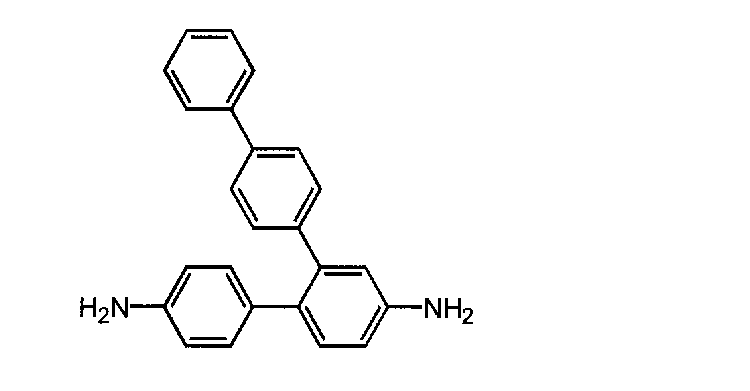
乾燥窒素雰囲気中で、3,6−ジフェニル−ピロメリット酸無水物(1mmol、0.3703g)と2,2’−ビス(ビフェニル)ベンジジン(1mmol、0.4886g)をm−クレゾールに溶解し、4質量%の溶液とした。これを2時間室温で撹拌した後、イソキノリンを触媒として加え、窒素気流下、200℃で30分撹拌し、このポリイミド溶液を2−プロパノール中に再沈すると、黄色の粉状ポリマーが得られた。得られたポリマーは2−プロパノールで洗浄し、乾燥した。ポリマーの還元粘度は、1.38であった。ポリマーをN−メチル−2−ピロリドンに加熱溶解し、10質量%の溶液とし、清浄なシリコン基板上に塗布し、乾燥窒素雰囲気中、120℃で15分、350℃で1時間加熱することにより厚さ6.5μmのポリイミドフィルムが得られた。このフィルムをシリコン基板からはがし、面配向の値を測定したところ、0.33であった。また、このフィルムの複屈折Δn=0.0533(nTE=1.7055、nTM=1.6522)、熱膨張係数は、3.7ppm/℃であった。このポリイミドは、式(1)を満たすことから、高い面配向により良好な寸法安定性を示し、かつ光学等方性をも両立することが分かった。なお、ガラス転移点はDSCで検出できず、TMA測定でも変曲点が見られなかったことから、ガラス転移点は400℃以上と判断した。
Example 1
In a dry nitrogen atmosphere, 3,6-diphenyl-pyromellitic anhydride (1 mmol, 0.3703 g) and 2,2′-bis (biphenyl) benzidine (1 mmol, 0.4886 g) are dissolved in m-cresol, A 4% by mass solution was obtained. After stirring this at room temperature for 2 hours, isoquinoline was added as a catalyst, and the mixture was stirred at 200 ° C. for 30 minutes under a nitrogen stream. When this polyimide solution was reprecipitated in 2-propanol, a yellow powdery polymer was obtained. . The polymer obtained was washed with 2-propanol and dried. The reduced viscosity of the polymer was 1.38. By heating and dissolving the polymer in N-methyl-2-pyrrolidone to make a 10% by mass solution, coating it on a clean silicon substrate, and heating in a dry nitrogen atmosphere at 120 ° C. for 15 minutes and at 350 ° C. for 1 hour. A polyimide film having a thickness of 6.5 μm was obtained. This film was peeled off from the silicon substrate, and the plane orientation value was measured to be 0.33. Further, this film had a birefringence Δn = 0.0533 (nTE = 1.7055, nTM = 1.6522) and a thermal expansion coefficient of 3.7 ppm / ° C. Since this polyimide satisfy | fills Formula (1), it turned out that favorable dimensional stability is shown by high surface orientation, and optical isotropy is compatible. The glass transition point could not be detected by DSC, and no inflection point was found in the TMA measurement, so the glass transition point was determined to be 400 ° C. or higher.
(実施例2)
乾燥窒素雰囲気中で、3,6−ジフェノキシ−ピロメリット酸無水物(1mmol、0.4023g)と2,2‘−ビス(フェニル)ベンジジン(1mmol、0.3364g)をm−クレゾールに溶解し、4質量%の溶液とした。これを2時間室温で撹拌した後、イソキノリンを触媒として加え、窒素気流下、200℃で30分撹拌し、このポリイミド溶液を2−プロパノール中に再沈すると、黄色の粉状ポリマーが得られた。得られたポリマーは2−プロパノールで洗浄し、乾燥した。ポリマーの還元粘度は、1.38であった。ポリマーをN−メチル−2−ピロリドンに加熱溶解し、10質量%の溶液とし、清浄なシリコン基板上に塗布し、乾燥窒素雰囲気中、120℃で15分、350℃で1時間加熱することにより厚さ6.8μmのポリイミドフィルムが得られた。このフィルムをシリコン基板からはがし、面配向の値を測定したところ、0.40であった。また、このフィルムの複屈折Δn=0.0476(nTE=1.6988、nTM=1.6512)、熱膨張係数は、9.4ppm/℃であった。このポリイミドは、式(1)を満たすことから、高い面配向により良好な寸法安定性を示し、かつ光学等方性をも両立することが分かった。なお、ガラス転移点はDSCで検出できず、TMA測定でも変曲点が見られなかったことから、ガラス転移点は400℃以上と判断した。
(Example 2)
In a dry nitrogen atmosphere, 3,6-diphenoxy-pyromellitic anhydride (1 mmol, 0.4023 g) and 2,2′-bis (phenyl) benzidine (1 mmol, 0.3364 g) are dissolved in m-cresol, A 4% by mass solution was obtained. After stirring this at room temperature for 2 hours, isoquinoline was added as a catalyst, and the mixture was stirred at 200 ° C. for 30 minutes under a nitrogen stream. When this polyimide solution was reprecipitated in 2-propanol, a yellow powdery polymer was obtained. . The polymer obtained was washed with 2-propanol and dried. The reduced viscosity of the polymer was 1.38. By heating and dissolving the polymer in N-methyl-2-pyrrolidone to make a 10% by mass solution, coating it on a clean silicon substrate, and heating in a dry nitrogen atmosphere at 120 ° C. for 15 minutes and at 350 ° C. for 1 hour. A polyimide film having a thickness of 6.8 μm was obtained. The film was peeled from the silicon substrate, and the plane orientation value was measured to be 0.40. Further, this film had a birefringence of Δn = 0.0476 (nTE = 1.6988, nTM = 1.512) and a thermal expansion coefficient of 9.4 ppm / ° C. Since this polyimide satisfy | fills Formula (1), it turned out that favorable dimensional stability is shown by high surface orientation, and optical isotropy is compatible. The glass transition point could not be detected by DSC, and no inflection point was found in the TMA measurement, so the glass transition point was determined to be 400 ° C. or higher.
(比較例1)
乾燥窒素雰囲気中で、ピロメリット酸無水物(2.181g)及び1,3−ビス(4−アミノフェノキシ)ベンゼン(2.923g)をm−クレゾールに溶解し、4質量%の溶液とした。これを2時間室温で撹拌した後、イソキノリンを触媒として加え、窒素気流下、200℃で加熱を行ったところ、ゲル化が起こり、あらゆる溶媒に不溶であった。
(比較例2)
乾燥窒素雰囲気中で、ピロメリット酸無水物(2.181g)及び1,3−ビス(4−アミノフェノキシ)ベンゼン(2.923g)をN−メチル−2−ピロリドンに溶解し、12質量%の溶液とした。これを窒素雰囲気下、24時間室温で撹拌すると高粘度の溶液が得られる。得られた溶液の還元粘度は、3.1であった。ポリマー溶液を、清浄なシリコン基板上に塗布し、乾燥窒素雰囲気中、120℃で15分、350℃で1時間加熱することにより厚さ12.2μmのポリイミドフィルムが得られた。このフィルムをシリコン基板からはがし、面配向の値を測定したところ、0.53であった。また、熱膨張係数を測定したところ、42.1ppm/℃、このフィルムの複屈折はΔn=0.0517(nTE=1.7098、nTM=1.6581)であった。
このポリイミドは、式(1)を満たさず、光学等方性には優れるものの、面配向の値(Y)が大きく、寸法安定性が悪化し、位置ずれ、反りなどを生じる可能性が高いことが分かった。
(Comparative Example 1)
In a dry nitrogen atmosphere, pyromellitic anhydride (2.181 g) and 1,3-bis (4-aminophenoxy) benzene (2.923 g) were dissolved in m-cresol to give a 4% by mass solution. After stirring this at room temperature for 2 hours, isoquinoline was added as a catalyst and heated at 200 ° C. under a nitrogen stream. As a result, gelation occurred and it was insoluble in all solvents.
(Comparative Example 2)
In a dry nitrogen atmosphere, pyromellitic anhydride (2.181 g) and 1,3-bis (4-aminophenoxy) benzene (2.923 g) were dissolved in N-methyl-2-pyrrolidone. It was set as the solution. When this is stirred at room temperature for 24 hours in a nitrogen atmosphere, a highly viscous solution is obtained. The resulting solution had a reduced viscosity of 3.1. The polymer solution was applied on a clean silicon substrate and heated in a dry nitrogen atmosphere at 120 ° C. for 15 minutes and 350 ° C. for 1 hour to obtain a 12.2 μm thick polyimide film. This film was peeled off from the silicon substrate, and the plane orientation value was measured to be 0.53. When the thermal expansion coefficient was measured, it was 42.1 ppm / ° C., and the birefringence of this film was Δn = 0.0517 (nTE = 1.07098, nTM = 1.6581).
This polyimide does not satisfy the formula (1) and is excellent in optical isotropy, but has a large plane orientation value (Y), deteriorates dimensional stability, and is highly likely to cause misalignment and warpage. I understood.
(比較例3)
乾燥窒素雰囲気中で、4,4’−(2,2’−ヘキサフルオロイソプロピリデン)ジフタル酸二酸無水物(10mmol、4.442g)及び4,4’−ジアミノジフェニルエーテル(10mmol、2.002g)をm−クレゾールに溶解し、10質量%の溶液とした。これを窒素雰囲気下、3時間室温で撹拌後、イソキノリンを触媒として加え、窒素気流下、200℃で3時間撹拌し、室温まで冷却すると高粘度の溶液が得られる。このポリイミド溶液を2−プロパノール中に再沈すると、白色の繊維状ポリマーが得られた。得られた溶液の還元粘度は、1.31であった。ポリマーをN−メチル−2−ピロリドンに加熱溶解し、10質量%の溶液とし、清浄なシリコン基板上に塗布し、乾燥窒素雰囲気中、120℃で15分、350℃で1時間加熱することにより厚さ36.1μmのポリイミドフィルムが得られた。このフィルムをシリコン基板からはがし、面配向の値を測定したところ、0.645であった。また、このフィルムの複屈折Δn=0.0326(nTE=1.6004、nTM=1.5678)、熱膨張係数は、50.4ppm/℃であった。このポリイミドは、式(1)を満たさず、光学等方性には優れるものの、面配向の値(Y)が大きく、寸法安定性が悪化し、位置ずれ、反りなどを生じる可能性が高いことが分かった。
(Comparative Example 3)
In a dry nitrogen atmosphere, 4,4 ′-(2,2′-hexafluoroisopropylidene) diphthalic dianhydride (10 mmol, 4.442 g) and 4,4′-diaminodiphenyl ether (10 mmol, 2.002 g) Was dissolved in m-cresol to give a 10% by mass solution. After stirring this at room temperature for 3 hours in a nitrogen atmosphere, isoquinoline is added as a catalyst, stirring at 200 ° C. for 3 hours under a nitrogen stream, and cooling to room temperature gives a highly viscous solution. When this polyimide solution was reprecipitated in 2-propanol, a white fibrous polymer was obtained. The reduced viscosity of the obtained solution was 1.31. By heating and dissolving the polymer in N-methyl-2-pyrrolidone to make a 10% by mass solution, coating it on a clean silicon substrate, and heating in a dry nitrogen atmosphere at 120 ° C. for 15 minutes and at 350 ° C. for 1 hour. A polyimide film having a thickness of 36.1 μm was obtained. This film was peeled off from the silicon substrate, and the plane orientation value was measured to be 0.645. Further, this film had a birefringence of Δn = 0.0326 (nTE = 1.004, nTM = 1.5678) and a thermal expansion coefficient of 50.4 ppm / ° C. This polyimide does not satisfy the formula (1) and is excellent in optical isotropy, but has a large plane orientation value (Y), deteriorates dimensional stability, and is highly likely to cause misalignment and warpage. I understood.
(比較例4)
乾燥窒素雰囲気中で、3,3’, 4,4’―ビフェニルテトラテトラカルボン酸二無水物(2.942g)及び5−アミノ−2−(4-アミノフェニル)ベンゾオキサゾール(2.253g)をm−クレゾールに溶解し、4質量%の溶液とした。これを2時間室温で撹拌した後、イソキノリンを触媒として加え、窒素気流下、200℃で加熱を行ったところ、ゲル化が起こり、あらゆる溶媒に不溶であった。
(比較例5)
乾燥窒素雰囲気中で、3,3’, 4,4’―ビフェニルテトラテトラカルボン酸二無水物(2.942g)及び5−アミノ−2−(4-アミノフェニル)ベンゾオキサゾール(2.253g)をジメチルアセトアミドに溶解し、10質量%の溶液とした。これを窒素雰囲気下、24時間室温で撹拌すると高粘度の溶液が得られる。得られた溶液の還元粘度は、0.44であった。ポリマー溶液を、清浄なシリコン基板上に塗布し、乾燥窒素雰囲気中、120℃で15分、350℃で1時間加熱することにより厚さ13.0μmのポリイミドフィルムが得られた。このフィルムをシリコン基板からはがし、面配向の値を測定したところ、0.22であった。また、熱膨張係数を測定したところ、8.31ppm/℃、このフィルムの複屈折はΔn=0.2602(nTE=1.8765、nTM=1.6163)であった。
このポリイミドは、式(1)を満たさず、面配向の値(Y)は大きく、寸法安定性に優れるものの、光学等方性に劣り、光学部品としての機能性を損なう可能性がある。また、ポリイミドとしての溶剤溶解性が無く、低温硬化が難しい。
(Comparative Example 4)
In a dry nitrogen atmosphere, 3,3 ′, 4,4′-biphenyltetratetracarboxylic dianhydride (2.942 g) and 5-amino-2- (4-aminophenyl) benzoxazole (2.253 g) It melt | dissolved in m-cresol and was set as the 4 mass% solution. After stirring this at room temperature for 2 hours, isoquinoline was added as a catalyst and heated at 200 ° C. under a nitrogen stream. As a result, gelation occurred and it was insoluble in all solvents.
(Comparative Example 5)
In a dry nitrogen atmosphere, 3,3 ′, 4,4′-biphenyltetratetracarboxylic dianhydride (2.942 g) and 5-amino-2- (4-aminophenyl) benzoxazole (2.253 g) were added. Dissolved in dimethylacetamide to give a 10% by mass solution. When this is stirred at room temperature for 24 hours in a nitrogen atmosphere, a highly viscous solution is obtained. The reduced viscosity of the obtained solution was 0.44. The polymer solution was applied on a clean silicon substrate and heated in a dry nitrogen atmosphere at 120 ° C. for 15 minutes and at 350 ° C. for 1 hour to obtain a polyimide film having a thickness of 13.0 μm. This film was peeled off from the silicon substrate, and the plane orientation value was measured and found to be 0.22. The coefficient of thermal expansion was measured to be 8.31 ppm / ° C., and the birefringence of this film was Δn = 0.602 (nTE = 1.8765, nTM = 1.6163).
This polyimide does not satisfy the formula (1), has a large plane orientation value (Y) and is excellent in dimensional stability, but is inferior in optical isotropy and may impair the functionality as an optical component. Moreover, there is no solvent solubility as a polyimide, and low temperature curing is difficult.
(比較例6)
乾燥窒素雰囲気中で、4,4’−(2,2’−ヘキサフルオロイソプロピリデン)ジフタル酸二酸無水物(10mmol、4.442g)及び5−アミノ−2−(4-アミノフェニル)ベンゾオキサゾール(2.253g)をm−クレゾールに溶解し、10質量%の溶液とした。これを窒素雰囲気下、3時間室温で撹拌後、イソキノリンを触媒として加え、窒素気流下、200℃で3時間撹拌し、室温まで冷却すると高粘度の溶液が得られる。このポリイミド溶液を2−プロパノール中に再沈すると、白色の繊維状ポリマーが得られた。得られた溶液の還元粘度は、0.357であった。このポリマーをN−メチル−2−ピロリドンに加熱溶解、8質量%の溶液とし、清浄なシリコン基板上に塗布し、乾燥窒素雰囲気中、120℃で15分、350℃で1時間加熱することにより厚さ5.9μmのポリイミドフィルムが得られた。このフィルムをシリコン基板からはがし、面配向の値を測定したところ、0.456であった。また、熱膨張係数を測定したところ、14.1ppm/℃、このフィルムの複屈折Δn=0.0857(nTE=1.7334、nTM=1.6478)であった。このポリイミドは、式(1)を満たさず、このポリイミドは、式(1)を満たさず、面配向の値(Y)は大きく、寸法安定性に優れるものの、光学等方性に劣り、光学部品としての機能性を損なう可能性がある。
(Comparative Example 6)
4,4 ′-(2,2′-hexafluoroisopropylidene) diphthalic dianhydride (10 mmol, 4.442 g) and 5-amino-2- (4-aminophenyl) benzoxazole in a dry nitrogen atmosphere (2.253 g) was dissolved in m-cresol to obtain a 10% by mass solution. After stirring this at room temperature for 3 hours in a nitrogen atmosphere, isoquinoline is added as a catalyst, stirring at 200 ° C. for 3 hours under a nitrogen stream, and cooling to room temperature gives a highly viscous solution. When this polyimide solution was reprecipitated in 2-propanol, a white fibrous polymer was obtained. The reduced viscosity of the obtained solution was 0.357. This polymer is dissolved in N-methyl-2-pyrrolidone by heating to form a 8% by mass solution, which is applied onto a clean silicon substrate and heated in a dry nitrogen atmosphere at 120 ° C. for 15 minutes and 350 ° C. for 1 hour. A polyimide film having a thickness of 5.9 μm was obtained. This film was peeled from the silicon substrate, and the plane orientation value was measured to be 0.456. The coefficient of thermal expansion was measured and found to be 14.1 ppm / ° C., and the birefringence of this film was Δn = 0.0857 (nTE = 1.7334, nTM = 1.6478). This polyimide does not satisfy the formula (1), this polyimide does not satisfy the formula (1), has a large plane orientation value (Y), and is excellent in dimensional stability, but is inferior in optical isotropy, and an optical component As a result, the functionality may be impaired.
(比較例7)
乾燥窒素雰囲気中で、2,2’−ジフェニル−3,3’, 4,4’−ビフェニルテトラテトラカルボン酸二無水物(2.942g)及び2,2’−ビス(ビフェニル)ベンジジン(10mmol、4.886g)をm−クレゾールに溶解し、10質量%の溶液とした。これを窒素雰囲気下、3時間室温で撹拌後、イソキノリンを触媒として加え、窒素気流下、200℃で3時間撹拌し、室温まで冷却すると高粘度の溶液が得られる。このポリイミド溶液を2−プロパノール中に再沈すると、白色の繊維状ポリマーが得られた。得られた溶液の還元粘度は、0.357であった。このポリマーをN−メチル−2−ピロリドンに加熱溶解、10質量%の溶液とし、清浄なシリコン基板上に塗布し、乾燥窒素雰囲気中、120℃で15分、350℃で1時間加熱することにより厚さ20.9μmのポリイミドフィルムが得られた。このフィルムをシリコン基板からはがし、面配向の値を測定したところ、0.628であった。また、熱膨張係数を測定したところ、62.3ppm/℃、このフィルムの複屈折Δn=0.0059(nTE=1.6361、nTM=1.6301)であった。このポリイミドは、式(1)を満たさず、光学等方性には優れるものの、面配向の値(Y)が大きく、寸法安定性が悪化し、位置ずれ、反りなどを生じる可能性が高いことが分かった。
(Comparative Example 7)
In a dry nitrogen atmosphere, 2,2′-diphenyl-3,3 ′, 4,4′-biphenyltetratetracarboxylic dianhydride (2.942 g) and 2,2′-bis (biphenyl) benzidine (10 mmol, 4.886 g) was dissolved in m-cresol to give a 10% by mass solution. After stirring this at room temperature for 3 hours in a nitrogen atmosphere, isoquinoline is added as a catalyst, stirring at 200 ° C. for 3 hours under a nitrogen stream, and cooling to room temperature gives a highly viscous solution. When this polyimide solution was reprecipitated in 2-propanol, a white fibrous polymer was obtained. The reduced viscosity of the obtained solution was 0.357. This polymer is dissolved in N-methyl-2-pyrrolidone by heating to form a 10% by mass solution, applied onto a clean silicon substrate, and heated in a dry nitrogen atmosphere at 120 ° C. for 15 minutes and 350 ° C. for 1 hour. A polyimide film having a thickness of 20.9 μm was obtained. This film was peeled off from the silicon substrate, and the plane orientation value was measured to be 0.628. Further, the coefficient of thermal expansion was measured. As a result, it was 62.3 ppm / ° C., and the birefringence Δn of this film was 0.0059 (nTE = 1.6361, nTM = 1.6301). This polyimide does not satisfy the formula (1) and is excellent in optical isotropy, but has a large plane orientation value (Y), deteriorates dimensional stability, and is highly likely to cause misalignment and warpage. I understood.
本発明のポリイミドは、溶剤可溶性ポリイミドであって、633nm波長における複屈折の値(X)とIR測定から算出される面配向の値(Y)が、式(1) Y≦−1.49X+0.55かつ0≦X≦0.30を満足するものであることを特徴とするポリイミドは、溶剤を乾燥除去するだけで、容易に面配向する特徴を有しており、導体回路と光導波路が混載された複合配線板などにおいて導体回路の絶縁性不良をも発生し難く、Au−Sn半田における300℃以上においてポリイミドが軟化するなどによって変形し機能不全を招くことがなく、また、複屈折が小さいため、光学部品としての機能性を損なうことがないといった特性を兼ね備えた光学等方性、寸法安定性と低線膨張係数を兼ね備えたポリイミドであり、またガラス基板やケイ素基板の線膨張係数との差が小さいので、これらの基板上にそのようなポリイミドからなるクラッド層やコア層を形成した場合も、基板にカールが生じず基板と光導波路との剥離が生じ難く、光学材料特に光導波路として有用である。
半導体の実装技術を光導波路作成にそのまま用いることができ、位置ずれ、反りなどが少ない信頼性の高い光導波路を安価に作成することが可能であり、産業界に大きく寄与することが期待される。
The polyimide of the present invention is a solvent-soluble polyimide, and the birefringence value (X) at a wavelength of 633 nm and the plane orientation value (Y) calculated from IR measurement are expressed by the formula (1) Y ≦ −1.49X + 0.55 In addition, polyimide satisfying 0 ≦ X ≦ 0.30 has a feature that it can be easily oriented by simply removing the solvent by drying, and is a composite in which a conductor circuit and an optical waveguide are mixedly mounted. Insulation failure of the conductor circuit is difficult to occur in the wiring board, etc., and the polyimide is softened at 300 ° C. or higher in the Au—Sn solder so that it is not deformed to cause malfunction, and the birefringence is small. It is a polyimide that combines optical isotropy, dimensional stability, and low linear expansion coefficient with characteristics that do not impair the functionality as a component, and has a small difference from the linear expansion coefficient of glass substrates and silicon substrates. Because When forming these cladding layers and a core layer made of such a polyimide on a substrate is also a substrate peeling between the substrate and the optical waveguide without curling occurs hardly occurs in and is useful as an optical material, especially an optical waveguide.
Semiconductor mounting technology can be used for optical waveguide production as it is, and it is possible to produce highly reliable optical waveguides with little misalignment and warpage at low cost, and it is expected to make a significant contribution to the industry. .
Claims (4)
Priority Applications (1)
| Application Number | Priority Date | Filing Date | Title |
|---|---|---|---|
| JP2009105996A JP2010254792A (en) | 2009-04-24 | 2009-04-24 | Polyimide, and polyimide for optical waveguide |
Applications Claiming Priority (1)
| Application Number | Priority Date | Filing Date | Title |
|---|---|---|---|
| JP2009105996A JP2010254792A (en) | 2009-04-24 | 2009-04-24 | Polyimide, and polyimide for optical waveguide |
Publications (1)
| Publication Number | Publication Date |
|---|---|
| JP2010254792A true JP2010254792A (en) | 2010-11-11 |
Family
ID=43316086
Family Applications (1)
| Application Number | Title | Priority Date | Filing Date |
|---|---|---|---|
| JP2009105996A Pending JP2010254792A (en) | 2009-04-24 | 2009-04-24 | Polyimide, and polyimide for optical waveguide |
Country Status (1)
| Country | Link |
|---|---|
| JP (1) | JP2010254792A (en) |
Cited By (2)
| Publication number | Priority date | Publication date | Assignee | Title |
|---|---|---|---|---|
| JP2013221914A (en) * | 2012-04-19 | 2013-10-28 | Fujifilm Corp | Method for analyzing waveguide spectrum and device therefor |
| WO2017164042A1 (en) * | 2016-03-23 | 2017-09-28 | 旭硝子株式会社 | Composite optical waveguide |
Citations (1)
| Publication number | Priority date | Publication date | Assignee | Title |
|---|---|---|---|---|
| WO2008041636A1 (en) * | 2006-10-02 | 2008-04-10 | Toyo Boseki Kabushiki Kaisha | Polyimide and optical waveguide using the same |
-
2009
- 2009-04-24 JP JP2009105996A patent/JP2010254792A/en active Pending
Patent Citations (1)
| Publication number | Priority date | Publication date | Assignee | Title |
|---|---|---|---|---|
| WO2008041636A1 (en) * | 2006-10-02 | 2008-04-10 | Toyo Boseki Kabushiki Kaisha | Polyimide and optical waveguide using the same |
Cited By (5)
| Publication number | Priority date | Publication date | Assignee | Title |
|---|---|---|---|---|
| JP2013221914A (en) * | 2012-04-19 | 2013-10-28 | Fujifilm Corp | Method for analyzing waveguide spectrum and device therefor |
| WO2017164042A1 (en) * | 2016-03-23 | 2017-09-28 | 旭硝子株式会社 | Composite optical waveguide |
| CN108780192A (en) * | 2016-03-23 | 2018-11-09 | Agc株式会社 | composite optical waveguide |
| JPWO2017164042A1 (en) * | 2016-03-23 | 2019-01-31 | Agc株式会社 | Composite optical waveguide |
| US10393966B2 (en) | 2016-03-23 | 2019-08-27 | AGC Inc. | Composite optical waveguide |
Similar Documents
| Publication | Publication Date | Title |
|---|---|---|
| KR102730124B1 (en) | Polyimide resin, polyimide varnish and polyimide film | |
| US20200031997A1 (en) | Transparent polyimide films and method of preparation | |
| TWI567108B (en) | Polyamic acid solution composition and polyimide | |
| KR102340689B1 (en) | Composition for forming releasing layer | |
| JP4986071B2 (en) | Resin composition, cured product and optical member | |
| JPH0940774A (en) | Polymide and optical part made therefrom | |
| KR102782855B1 (en) | Laminated film, and composition for preparing same | |
| JP7687213B2 (en) | Polyimide resin, varnish and polyimide film | |
| CN113166409B (en) | Polyimide precursor, polyimide, polyimide resin film, and flexible device | |
| JP7687212B2 (en) | Polyimide resin, polyimide varnish and polyimide film | |
| JP2010254792A (en) | Polyimide, and polyimide for optical waveguide | |
| JP2008088287A (en) | Optical polyimide | |
| JP5560526B2 (en) | Polyimide and optical waveguide using the same | |
| JP7775836B2 (en) | Polyimide resin, polyimide varnish and polyimide film | |
| KR102883095B1 (en) | Polyimide resin, polyimide varnish and polyimide film | |
| JP7524894B2 (en) | Polyimide resin, polyimide varnish and polyimide film | |
| JP7509132B2 (en) | Manufacturing method of colorless transparent resin film | |
| JP3506320B2 (en) | Polyimide for optical substrate and method for producing the same | |
| KR20100103034A (en) | Polyimide film | |
| JP5354493B2 (en) | Diamine compound, polyamic acid and imidized polymer produced using the same | |
| KR20220158783A (en) | Polyimide precursor composition and polyimide film/substrate laminate | |
| JP2009269986A (en) | Polymeric-inorganic hybrid optical material | |
| JP7849634B1 (en) | Laminate for optical waveguides, and optical waveguides | |
| JP7666500B2 (en) | Polyimide resin, polyimide varnish and polyimide film | |
| TWI827897B (en) | Low dielectric loss polyimide film |
Legal Events
| Date | Code | Title | Description |
|---|---|---|---|
| A621 | Written request for application examination |
Free format text: JAPANESE INTERMEDIATE CODE: A621 Effective date: 20120406 |
|
| A977 | Report on retrieval |
Free format text: JAPANESE INTERMEDIATE CODE: A971007 Effective date: 20121225 |
|
| A131 | Notification of reasons for refusal |
Free format text: JAPANESE INTERMEDIATE CODE: A131 Effective date: 20130123 |
|
| A521 | Written amendment |
Free format text: JAPANESE INTERMEDIATE CODE: A523 Effective date: 20130322 |
|
| A02 | Decision of refusal |
Free format text: JAPANESE INTERMEDIATE CODE: A02 Effective date: 20130507 |