JP2011528811A - Recording materials for laser printing methods - Google Patents
Recording materials for laser printing methods Download PDFInfo
- Publication number
- JP2011528811A JP2011528811A JP2011519193A JP2011519193A JP2011528811A JP 2011528811 A JP2011528811 A JP 2011528811A JP 2011519193 A JP2011519193 A JP 2011519193A JP 2011519193 A JP2011519193 A JP 2011519193A JP 2011528811 A JP2011528811 A JP 2011528811A
- Authority
- JP
- Japan
- Prior art keywords
- recording material
- synthetic resin
- resin layer
- material according
- layer
- Prior art date
- Legal status (The legal status is an assumption and is not a legal conclusion. Google has not performed a legal analysis and makes no representation as to the accuracy of the status listed.)
- Granted
Links
Classifications
-
- G—PHYSICS
- G03—PHOTOGRAPHY; CINEMATOGRAPHY; ANALOGOUS TECHNIQUES USING WAVES OTHER THAN OPTICAL WAVES; ELECTROGRAPHY; HOLOGRAPHY
- G03G—ELECTROGRAPHY; ELECTROPHOTOGRAPHY; MAGNETOGRAPHY
- G03G7/00—Selection of materials for use in image-receiving members, i.e. for reversal by physical contact; Manufacture thereof
- G03G7/0006—Cover layers for image-receiving members; Strippable coversheets
- G03G7/002—Organic components thereof
- G03G7/0026—Organic components thereof being macromolecular
- G03G7/004—Organic components thereof being macromolecular obtained by reactions only involving carbon-to-carbon unsaturated bonds
-
- G—PHYSICS
- G03—PHOTOGRAPHY; CINEMATOGRAPHY; ANALOGOUS TECHNIQUES USING WAVES OTHER THAN OPTICAL WAVES; ELECTROGRAPHY; HOLOGRAPHY
- G03G—ELECTROGRAPHY; ELECTROPHOTOGRAPHY; MAGNETOGRAPHY
- G03G7/00—Selection of materials for use in image-receiving members, i.e. for reversal by physical contact; Manufacture thereof
- G03G7/0006—Cover layers for image-receiving members; Strippable coversheets
- G03G7/002—Organic components thereof
- G03G7/0026—Organic components thereof being macromolecular
- G03G7/0046—Organic components thereof being macromolecular obtained otherwise than by reactions only involving carbon-to-carbon unsaturated bonds
-
- G—PHYSICS
- G03—PHOTOGRAPHY; CINEMATOGRAPHY; ANALOGOUS TECHNIQUES USING WAVES OTHER THAN OPTICAL WAVES; ELECTROGRAPHY; HOLOGRAPHY
- G03G—ELECTROGRAPHY; ELECTROPHOTOGRAPHY; MAGNETOGRAPHY
- G03G7/00—Selection of materials for use in image-receiving members, i.e. for reversal by physical contact; Manufacture thereof
- G03G7/006—Substrates for image-receiving members; Image-receiving members comprising only one layer
- G03G7/0073—Organic components thereof
- G03G7/008—Organic components thereof being macromolecular
-
- Y—GENERAL TAGGING OF NEW TECHNOLOGICAL DEVELOPMENTS; GENERAL TAGGING OF CROSS-SECTIONAL TECHNOLOGIES SPANNING OVER SEVERAL SECTIONS OF THE IPC; TECHNICAL SUBJECTS COVERED BY FORMER USPC CROSS-REFERENCE ART COLLECTIONS [XRACs] AND DIGESTS
- Y10—TECHNICAL SUBJECTS COVERED BY FORMER USPC
- Y10T—TECHNICAL SUBJECTS COVERED BY FORMER US CLASSIFICATION
- Y10T428/00—Stock material or miscellaneous articles
- Y10T428/24—Structurally defined web or sheet [e.g., overall dimension, etc.]
- Y10T428/24355—Continuous and nonuniform or irregular surface on layer or component [e.g., roofing, etc.]
Landscapes
- Physics & Mathematics (AREA)
- Spectroscopy & Molecular Physics (AREA)
- General Physics & Mathematics (AREA)
- Chemical & Material Sciences (AREA)
- Chemical Kinetics & Catalysis (AREA)
- Paper (AREA)
- Laminated Bodies (AREA)
Abstract
合成樹脂で両側をコーティングされる原紙と、トナー受容層とを含む、電子写真方法用の記録材料であって、
合成樹脂コーティングされた前記紙が、1.5〜13μmの粗さ値Rz及び0.05〜2μmの平均粗さ指数Raにより表される特定の表面トポグラフィーを有していること、前記トナー受容層が、トナー受容エチレンアクリル酸コポリマー(A)と、カルボキシル化されたアクリル酸エステルコポリマー(B)と、ポリマー(C)とからなるポリマーの組み合わせを含むこと、並びに、前記ポリマー(C)が、5〜20μmの平均粒径d50%と、コポリマー(A)の融解範囲よりも高くコポリマー(B)の融解範囲よりも低い融点とを有することを特徴とする、前記記録材料。A recording material for an electrophotographic method, comprising a base paper coated on both sides with a synthetic resin, and a toner receiving layer,
Said toner-coated paper having a specific surface topography represented by a roughness value Rz of 1.5 to 13 μm and an average roughness index Ra of 0.05 to 2 μm; The layer comprises a polymer combination consisting of a toner-accepting ethylene acrylic acid copolymer (A), a carboxylated acrylate copolymer (B), and a polymer (C), and said polymer (C) comprises: The recording material having an average particle diameter d of 5% to 20 μm and a melting point higher than the melting range of the copolymer (A) and lower than the melting range of the copolymer (B).
Description
本発明は、樹脂コーティングされた紙基板と、トナー受容層とを有する、電子写真記録方法(特に、レーザー印刷方法)用の記録材料、並びに、フォトブックの製造用の前記記録材料の使用に関する。 The present invention relates to a recording material for an electrophotographic recording method (particularly a laser printing method) having a resin-coated paper substrate and a toner-receiving layer, and to the use of the recording material for manufacturing a photo book.
電子写真の原理は、レーザープリンターの基礎を形成する。電子写真は、原文書の視像を使用して、光導電体をイメージング又は照射することにより、電荷からなる潜像を作成するものであって、前記潜像は、この後、例えば紙上にトナーを選択的に付与し(現像)、そして、原文書の画像を作成する(複写)のに使用される。電子写真は、直接と間接とで、並びに、湿式と乾式とで区別される。湿式方法は、現像液として、比誘電率をほとんど有さない脂肪族溶剤及びトナーからなる懸濁液を使用するのに対して、乾式方法は粉末を使用する。 The principle of electrophotography forms the basis of laser printers. Electrophotography uses a visual image of an original document to image or irradiate a photoconductor to create a latent image of charges, which is then transferred to, for example, toner on paper. Is selectively applied (development) and used to create (copy) an image of the original document. Electrophotography is distinguished between direct and indirect as well as wet and dry. The wet method uses a suspension composed of an aliphatic solvent and a toner having almost no relative dielectric constant as a developing solution, whereas the dry method uses powder.
指向性レーザービーム及び回転鏡により、所望のページの画像が、感光イメージシリンダー上に描かれる。前記シリンダーは最初に負に帯電させられ、ここで、電荷はレーザービームが出る場所で反転させられる。前記シリンダー上の放電部分の形状は、その後のプリントアウトに相当する。負帯電したトナー(これは、イメージシリンダー上の放電された部分に張り付く)を有するローラーを介して、トナーをシリンダーへ供給する。次に、紙がイメージシリンダー上に導入される。紙は、シリンダーを軽くかすめて通過する。ポテンシャル場は、紙の後ろで集められる。トナーを、紙上に転送して、初めにそこへ放つ。次に、トナーを熱ローラーによって圧力下に融解する。シリンダーを放電して、過剰トナーを回収する。 An image of the desired page is drawn on the photosensitive image cylinder by the directional laser beam and the rotating mirror. The cylinder is initially charged negatively, where the charge is reversed where the laser beam exits. The shape of the discharge part on the cylinder corresponds to a subsequent printout. Toner is supplied to the cylinder via a roller having negatively charged toner (which sticks to the discharged portion on the image cylinder). Next, paper is introduced onto the image cylinder. The paper passes by lightly grabbing the cylinder. The potential field is collected behind the paper. The toner is transferred onto paper and released there first. The toner is then melted under pressure by a hot roller. Discharge the cylinder and collect excess toner.
レーザープリンターにより作成される画像は、写真に匹敵できる品質を得ることが好ましい。この目的により近づくためには、電子写真により作成される画像を、一般的な銀塩写真の触覚及び外観を有する基板上に作成する。このためには、種々の特性(例えば、光沢、剛性、及び不透明度)、高解像度、高画像鮮明度、並びに、良好な耐光性が必要とされる。 The image created by the laser printer is preferably obtained with a quality comparable to that of a photograph. In order to get closer to this purpose, an image created by electrophotography is created on a substrate having the touch and appearance of a typical silver salt photograph. This requires various properties (eg, gloss, stiffness, and opacity), high resolution, high image sharpness, and good light fastness.
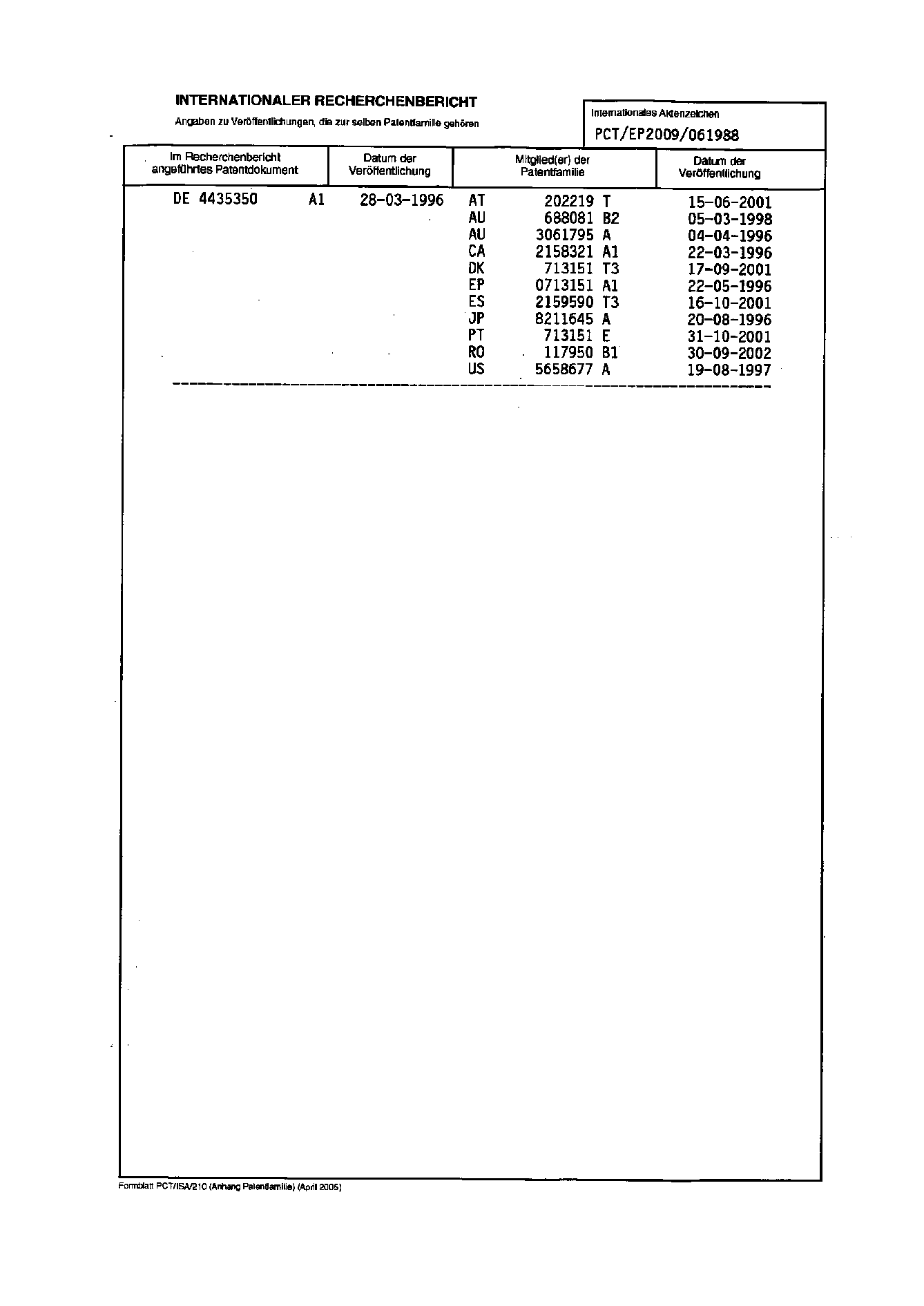
DE4435350C2では、電子写真用の受像材料を開示している。前記受像材料は、熱可塑性物質でコーティングされるベース紙と、トナー受容層と、帯電防止裏側層とを含む。この材料の欠点は、片面のみ印刷可能であること、及び、プリンター内のトナー融解及びトナー挙動に関する改良が必要なことである。 DE 4435350 C2 discloses an image receiving material for electrophotography. The image receiving material includes a base paper coated with a thermoplastic material, a toner receiving layer, and an antistatic backside layer. The disadvantages of this material are that it can only be printed on one side and that improvements regarding toner melting and toner behavior in the printer are required.
記録材料において、基板として使用される樹脂コーティングされたベース紙は、通常、サイジングされた原紙(これは、(共)押し出しによって両側上がポリオレフィンでコーティングされたものが好ましい)からなる。熱可塑性ポリマー(例えば、低密度ポリエチレン(LDPE)、エチレン/α−オレフィンコポリマー(いわゆる、直鎖状低密度ポリエチレン;LLDPE)、高密度ポリエチレン(HDPE)及びポリプロピレン)は、通常、原紙を押し出しコーティングするために使用される。 In the recording material, the resin-coated base paper used as a substrate is usually composed of a sized base paper (which is preferably (co) extruded and coated on both sides with polyolefin). Thermoplastic polymers such as low density polyethylene (LDPE), ethylene / α-olefin copolymers (so-called linear low density polyethylene; LLDPE), high density polyethylene (HDPE) and polypropylene are usually extrusion coated on base paper. Used for.
トナーで印刷される記録紙が印刷後に直接カバーされる場合には、好ましくないことに、上にある材料の裏側へトナー粒子が移転することが生じる。実際には、例えば、新たな印刷物をプラスチックフィルム包装中又はアルバム中で保存する際、あるいは、プリンター内において複数の印刷物を積み重ねる際に、印刷された紙はカバーされる。 If the recording paper to be printed with toner is covered directly after printing, undesirably, the toner particles will be transferred to the back side of the overlying material. In practice, the printed paper is covered, for example, when storing new prints in plastic film packaging or albums, or when stacking multiple prints in a printer.
個々に作成されることができるいわゆるフォトブックは、画像形成の分野において、良い売れ行きを見出す最近の進展に属する。豊富な選択の範囲の印刷技術と、この目的のために使用される記録材料(特に、写真紙)とを、前記フォトブックの作成に利用することができる。 So-called photobooks that can be created individually belong to recent developments that find good sales in the field of imaging. A wide selection of printing techniques and the recording materials (especially photographic paper) used for this purpose can be used for the creation of the photobook.
写真乳剤でコーティングされる写真ベース紙を、前記フォトブックの製造に使用する。この場合に、前記写真ベース紙の表側では、従来の銀塩方法により画像が湿式化学的に作成される。表側で画像を付与された紙シート(複数)を、次の工程において、裏側で一緒に張り合わせて、そして、一緒に結合させてブックを形成する。このことは、手間及び時間のかかるものであって、より高い製造コストに結びつく。従って、コーティングされ、カレンダリングされた紙(これは、両側で印刷が可能であり、電子写真方法により印刷することができる)を、フォトブックの製造に使用する。しかしながら、この方法で作成される画像は、色濃度、光安定性、及びオゾン安定性、並びに印刷デバイスにおける挙動(給紙、搬送、及び積み重ね)に関する改良が必要である。 A photographic base paper coated with a photographic emulsion is used in the production of the photobook. In this case, on the front side of the photographic base paper, an image is created wet-chemically by a conventional silver salt method. In the next step, the paper sheet (s) provided with images on the front side are laminated together on the back side and joined together to form a book. This is time consuming and time consuming and leads to higher manufacturing costs. Thus, coated and calendered paper (which can be printed on both sides and can be printed by electrophotographic methods) is used in the manufacture of photobooks. However, images created with this method require improvements in terms of color density, light stability, and ozone stability, and behavior in the printing device (feed, transport, and stack).
従って、本発明の目的は、両側で印刷することができ、そして、良好な画像品質、保存の際の良好な耐光性及び耐オゾン性、プリンター内での良好な給紙及び運搬態様、並びに、良好な積み重ね性を有する記録材料を提供することである。 Therefore, the object of the present invention is to be able to print on both sides and to have good image quality, good light and ozone resistance during storage, good feeding and transport aspects in the printer, and It is to provide a recording material having good stackability.
前記目的は、合成樹脂で両側をコーティングされる原紙と、トナー受容層とを含む、記録材料であって、
合成樹脂コーティングされた前記紙が、1.5〜13μmの粗さ値Rz及び0.05〜2μmの平均粗さ指数Raにより表される特定の表面トポグラフィーを有しており、前記トナー受容層が、トナー受容エチレンアクリル酸コポリマー(A)と、カルボキシル化されたアクリル酸エステルコポリマー(B)と、ポリマー(C)とからなるポリマーの組み合わせを含み、そして、前記ポリマー(C)が、5〜20μmの平均粒径d50%と、コポリマー(A)の融解範囲よりも高くコポリマー(B)の融解範囲よりも低い融点とを有する、前記記録材料によって達成される。
The object is a recording material comprising a base paper coated on both sides with a synthetic resin, and a toner receiving layer,
The synthetic resin-coated paper has a specific surface topography represented by a roughness value Rz of 1.5 to 13 μm and an average roughness index Ra of 0.05 to 2 μm; Comprises a polymer combination consisting of a toner-accepting ethylene acrylic acid copolymer (A), a carboxylated acrylate copolymer (B), and a polymer (C), and the polymer (C) comprises 5 to 5 This is achieved by the recording material having an average particle size d 50% of 20 μm and a melting point higher than the melting range of the copolymer (A) and lower than the melting range of the copolymer (B).
本発明の目的では、用語「原紙」は、コーティングされていない紙、又は、表面サイジングされた紙を意味するものとして理解される。原紙は、パルプ繊維に加えて、サイズ剤(例えば、アルキルケテンダイマー、脂肪酸及び/又は脂肪酸塩、エポキシ化脂肪酸アミド、アルケニル又はアルキル無水コハク酸)、湿潤強度剤(例えば、ポリアミンポリアミドエピクロロヒドリン)、乾燥強度剤(例えば、アニオン性、カチオン性、又は両性のポリアミド)、蛍光増白剤、充填剤、顔料、染料、消泡剤、並びに、製紙業界で公知のその他の添加剤を含むことができる。原紙は、表面サイジングされることができる。このために適当なサイズ剤は、例えば、ポリビニルアルコール又は酸化デンプンである。原紙は、長網抄紙機又はヤンキー抄紙機(円網抄紙機)で製造することができる。原紙の坪量は50〜250g/m2、特に、80〜180g/m2であることができる。原紙は、非圧縮又は圧縮(カレンダー化)した形態で使用することができる。密度0.8〜1.2g/cm3、特に0.90〜1.1g/cm3を有する原紙が特に好ましい。 For the purposes of the present invention, the term “base paper” is understood to mean uncoated paper or surface-sized paper. In addition to pulp fibers, the base paper is sized (eg, alkyl ketene dimer, fatty acid and / or fatty acid salt, epoxidized fatty acid amide, alkenyl or alkyl succinic anhydride), wet strength agent (eg, polyamine polyamide epichlorohydrin). ), Dry strength agents (eg, anionic, cationic, or amphoteric polyamides), optical brighteners, fillers, pigments, dyes, antifoaming agents, and other additives known in the paper industry. Can do. The base paper can be surface sized. Suitable sizing agents for this are, for example, polyvinyl alcohol or oxidized starch. The base paper can be produced by a long net paper machine or a Yankee paper machine (circular paper machine). The basis weight of the base paper can be 50 to 250 g / m 2 , in particular 80 to 180 g / m 2 . The base paper can be used in an uncompressed or compressed (calendered) form. A base paper having a density of 0.8 to 1.2 g / cm 3 , particularly 0.90 to 1.1 g / cm 3 is particularly preferred.
パルプ繊維としては、例えば、広葉樹晒クラフトパルプ(LBKP)、針葉樹晒クラフトパルプ(NBKP)、広葉樹晒亜硫酸パルプ(LBSP)、又は、針葉樹晒亜硫酸パルプ(NBSP)を使用することができる。これらは、混合した形態で使用されることもできる。しかしながら、100%広葉樹パルプからなるパルプ繊維を特に使用する。砕木していない(ungemahlen)パルプの平均繊維長さは、0.6〜0.85mm(カヤーニ測定)であることが好ましい。更に、パルプは、パルプの質量に基づく、0.05重量%未満(特に、0.01〜0.03重量%)のリグニン含有量を有する。 As the pulp fiber, for example, hardwood bleached kraft pulp (LBKP), softwood bleached kraft pulp (NBKP), hardwood bleached sulfite pulp (LBSP), or softwood bleached sulfite pulp (NBSP) can be used. These can also be used in mixed form. However, pulp fibers made of 100% hardwood pulp are particularly used. The average fiber length of ungemahlen pulp is preferably 0.6 to 0.85 mm (measured by Kajaani). Furthermore, the pulp has a lignin content of less than 0.05% by weight (particularly 0.01 to 0.03% by weight) based on the mass of the pulp.
原紙における充填剤としては、カオリン、自然形態にある炭酸カルシウム(例えば、石灰石、大理石、又はドロマイトれんが(Dolomitstein)、沈降(gefaellt)炭酸カルシウム)、硫酸カルシウム、硫酸バリウム、二酸化チタン、タルク、シリカ、酸化アルミニウム、並びにそれらの混合物を使用することができる。特に好ましいのは、粒子の少なくとも60%が2μm未満であり、多くても40%が1μm未満である粒度分布(Korngroessenverteilung)を有する炭酸カルシウムである。本発明の特別な実施態様において、粒子の約25%が粒径1μm未満を有し、そして、粒子の約85%が粒径2μm未満を有する粒度分布をもつカルサイトが使用される。 Fillers in the base paper include kaolin, natural forms of calcium carbonate (eg, limestone, marble, or dolomite brick, gefaellt calcium carbonate), calcium sulfate, barium sulfate, titanium dioxide, talc, silica, Aluminum oxide, as well as mixtures thereof, can be used. Particularly preferred is calcium carbonate having a particle size distribution (Korngroessenverteilung) in which at least 60% of the particles are less than 2 μm and at most 40% are less than 1 μm. In a particular embodiment of the invention, calcite is used having a particle size distribution in which about 25% of the particles have a particle size of less than 1 μm and about 85% of the particles have a particle size of less than 2 μm.
原紙の両側に配置される合成樹脂層(表側合成樹脂層及び裏側合成樹脂層)は、好ましくは熱可塑性ポリマーを含むことができる。このために特に好ましいのは、ポリオレフィン類(例えば、低密度ポリエチレン(LDPE)、高密度ポリエチレン(HDPE)、エポリプロピレン、4−メチルペンテン−1、及びそれらの混合物)並びに、ポリエステル類(例えば、ポリカーボネート類)である。 The synthetic resin layers (the front side synthetic resin layer and the back side synthetic resin layer) disposed on both sides of the base paper can preferably contain a thermoplastic polymer. Particularly preferred for this purpose are polyolefins such as low density polyethylene (LDPE), high density polyethylene (HDPE), epolypropylene, 4-methylpentene-1, and mixtures thereof and polyesters such as polycarbonate. Kind).
本発明の或る特定の実施態様では、表側合成樹脂層及び裏側合成樹脂層は、0.935g/cm3を超える密度を有する少なくとも40重量%のHDPE(特に、50〜70重量%)を含有する。特に好ましいのは、0.935g/cm3を超える密度を有する50重量%のHDPE及び0.935g/cm3未満の密度を有する50重量%のLDPEからなる組成物である。 In one particular embodiment of the invention, the front side synthetic resin layer and the back side synthetic resin layer contain at least 40% by weight HDPE (especially 50-70% by weight) having a density greater than 0.935 g / cm 3. To do. Particularly preferred is a composition consisting of 50 wt% HDPE having a density greater than 0.935 g / cm 3 and 50 wt% LDPE having a density less than 0.935 g / cm 3 .
合成樹脂層は、白色顔料(例えば、二酸化チタン)、並びに、その他の添加剤(例えば、蛍光増白剤、染料、及び分散剤)を含むことができる。合成樹脂層のコーティング重量は、5〜50g/m2、特に5〜30g/m2であるが、好ましくは10〜20g/m2であることができる。合成樹脂層は、単層として押出されるか、又は、多層として共押し出しされることができる。押し出しコーティングは、最大600m/分の機械速度で実施することができる。 The synthetic resin layer can include a white pigment (for example, titanium dioxide), and other additives (for example, a fluorescent whitening agent, a dye, and a dispersing agent). The coating weight of the synthetic resin layer is 5 to 50 g / m 2 , particularly 5 to 30 g / m 2 , and preferably 10 to 20 g / m 2 . The synthetic resin layer can be extruded as a single layer or coextruded as a multilayer. Extrusion coating can be performed at machine speeds up to 600 m / min.
本発明によると、合成樹脂層は、原紙の両側で対称的に付与される(すなわち、表側合成樹脂層と裏側樹脂層とは同一の組成を有する)。これらの層は、表面トポグラフィーに関しても同一である。 According to the present invention, the synthetic resin layer is provided symmetrically on both sides of the base paper (that is, the front side synthetic resin layer and the back side resin layer have the same composition). These layers are the same with respect to surface topography.
表面構造(トポグラフィー)は、押し出しコーティングの間に使用される冷却シリンダーによってつくられる。これは、粗さ値により特徴付けられる。 The surface structure (topography) is created by a cooling cylinder used during extrusion coating. This is characterized by a roughness value.
或る特定の実施態様では、合成樹脂層の表面が、両側上で、1.8〜11μmの粗さ値Rz及び0.1〜1.8μmの平均粗さ指数Raを有する。 In one particular embodiment, the surface of the synthetic resin layer has a roughness value Rz of 1.8 to 11 μm and an average roughness index Ra of 0.1 to 1.8 μm on both sides.
表面構造をつくるために使用される冷却シリンダーは、公知の方法で製造される。この目的を達成するために、鋼シリンダーの表面を、砂、ガラス、又はその他のブラスティング材料を使用してブラスティングにより処理して、次に、クロムめっきすることができる。しかしながら、前記シリンダーの表面は、従来の方法によりクロム浴中で電解的に形成することができる。 The cooling cylinder used to create the surface structure is manufactured in a known manner. To achieve this goal, the surface of the steel cylinder can be treated by blasting using sand, glass or other blasting material and then chrome plated. However, the surface of the cylinder can be formed electrolytically in a chromium bath by conventional methods.
インク受容層におけるポリマーの組合せのうち、ポリマー(A)は融解範囲70〜100℃を有し、そして、ポリマー(B)は融解範囲160〜210℃を有することが好ましい。 Of the polymer combinations in the ink-receiving layer, it is preferred that polymer (A) has a melting range of 70-100 ° C and polymer (B) has a melting range of 160-210 ° C.
ポリマー(B)は、いわゆる酸価により特徴付けられる。ポリマー中に含有される遊離カルボキシル基の量は、酸価によって規定される。これは、ポリマー1gにおける遊離酸基を中和するのに必要とされる0.1モルのKOH溶液の量(mg)を特定する。本発明により使用されるポリマー(B)は、100を超える酸価を有する。酸価120〜160を有するポリマーが特に適当である。 The polymer (B) is characterized by a so-called acid value. The amount of free carboxyl groups contained in the polymer is defined by the acid value. This specifies the amount (mg) of 0.1 molar KOH solution required to neutralize free acid groups in 1 g of polymer. The polymer (B) used according to the invention has an acid value of more than 100. Polymers having an acid number of 120 to 160 are particularly suitable.
ポリマー(A)とコポリマー(B)とが、70:30〜30:70の比率で使用されることが好ましい。60:40〜40:60の比率で特に良好な作用が得られる。 The polymer (A) and the copolymer (B) are preferably used in a ratio of 70:30 to 30:70. A particularly good effect is obtained at a ratio of 60:40 to 40:60.
ポリマー(C)は、温度範囲120〜150℃における融点を有することが好ましい。ポリエチレンワックス、ポリアミド類、及びそれらの混合物が、この目的のために特に適当である。 The polymer (C) preferably has a melting point in the temperature range of 120 to 150 ° C. Polyethylene waxes, polyamides, and mixtures thereof are particularly suitable for this purpose.
ポリマー(C)は、乾燥した層に基づく0.1〜5重量%、特に1.0〜4.0重量%の量で使用されることが好ましい。 The polymer (C) is preferably used in an amount of 0.1 to 5% by weight, in particular 1.0 to 4.0% by weight, based on the dried layer.
本発明の或る好ましい模範的な実施態様において、トナー受容層は、乾燥した層に基づく0.1〜5.0重量%、特に1.0〜4.0重量%の量で帯電防止剤を含有する。 In certain preferred exemplary embodiments of the present invention, the toner receiving layer contains the antistatic agent in an amount of 0.1 to 5.0% by weight, particularly 1.0 to 4.0% by weight, based on the dried layer. contains.
本発明の更に模範的な実施態様において、トナー受容層は、乾燥した層に基づく0.1〜4.0重量%、特に0.5〜2.5重量%の量で陰イオン性界面活性剤又は非イオン性界面活性剤を含有する。 In a further exemplary embodiment of the invention, the toner-receiving layer is an anionic surfactant in an amount of 0.1 to 4.0% by weight, especially 0.5 to 2.5% by weight, based on the dried layer. Or it contains a nonionic surfactant.
必要に応じて、トナー受容層は、その他の添加剤(例えば、つや消し剤、顔料、染料、架橋剤、抗ブロッキング剤、及びその他の一般的な添加剤)を含有することもできる。 If desired, the toner receiving layer can also contain other additives (eg, matting agents, pigments, dyes, crosslinking agents, antiblocking agents, and other common additives).
トナー受容層を形成するのに使用されるコーティング化合物は、製紙において従来使用される全てのコーティングデバイスを使用してインライン又はオフラインで付与されることができ、ここでその量は、乾燥後にコーティング重量が最大3g/m2、特に0.1〜2g/m2であるか、又は、或る特定の好ましい模範的な実施態様によると、0.3〜0.7g/m2であるように選択される。或る好ましい模範的な実施態様では、コーティング化合物が、押し出しコーティングライン内に一体化される従来のコーティングヘッドの手段により、コーティングとして付与される。3ロール式付与(3-Walzenauftrag)又はドクターブレードデバイスが、この目的のために特に適当である。 The coating compound used to form the toner receptive layer can be applied in-line or off-line using all coating devices conventionally used in papermaking, where the amount is the coating weight after drying. there maximum 3 g / m 2, or in particular 0.1-2 g / m 2, or, according to certain preferred exemplary embodiment, selected to be 0.3 to 0.7 g / m 2 Is done. In one preferred exemplary embodiment, the coating compound is applied as a coating by means of a conventional coating head integrated into an extrusion coating line. A 3-roll application (3-Walzenauftrag) or doctor blade device is particularly suitable for this purpose.
本発明の更に模範的な実施態様では、顔料含有層を原紙と合成樹脂層との間に配置することができる。顔料は、金属酸化物、ケイ酸塩、炭酸塩、硫化物(Sulfid)又は硫酸塩であることができる。例えば、カオリン、タルク、炭酸カルシウム及び/又は硫酸バリウムの顔料が特に適当である。 In a further exemplary embodiment of the present invention, the pigment-containing layer can be disposed between the base paper and the synthetic resin layer. The pigments can be metal oxides, silicates, carbonates, sulfides or sulfates. For example, pigments of kaolin, talc, calcium carbonate and / or barium sulfate are particularly suitable.
顔料粒子の少なくとも70%が1μm未満のサイズである、狭い粒度分布を有する顔料が特に好ましい。顔料の総量に対する狭い粒度分布を有する顔料の割合は、少なくとも5重量%(特に、10〜90重量%)である。特に良好な結果は、全顔料の30〜80重量%の割合により得ることができる。 Particular preference is given to pigments having a narrow particle size distribution, wherein at least 70% of the pigment particles are less than 1 μm in size. The proportion of pigment having a narrow particle size distribution with respect to the total amount of pigment is at least 5% by weight (especially 10 to 90% by weight). Particularly good results can be obtained with a proportion of 30 to 80% by weight of the total pigment.
本発明によると、狭い粒度分布を有する顔料とは、顔料粒子の少なくとも約70重量%が約1μm未満のサイズを有し、そして、これらの顔料粒子の40〜80重量%において、最も大きい粒度(直径)を有する顔料と最も小さい粒度を有する顔料との差が約0.4μm未満である粒度分布を有する顔料として理解されたい。約0.7μmのd50%値を有する炭酸カルシウムが特に有利であることが分かった。 According to the present invention, a pigment having a narrow particle size distribution means that at least about 70% by weight of the pigment particles have a size of less than about 1 μm and the largest particle size (40-80% by weight of these pigment particles) It should be understood as a pigment having a particle size distribution in which the difference between the pigment having a diameter) and the pigment having the smallest particle size is less than about 0.4 μm. Calcium carbonate having a d 50% value of about 0.7 μm has been found to be particularly advantageous.
本発明の或る特定の模範的な実施態様では、前記炭酸カルシウムとカオリンとからなる顔料混合物を顔料含有層に使用することができる。炭酸カルシウム/カオリンの量比は、30:70〜70:30であることが好ましい。 In a particular exemplary embodiment of the invention, a pigment mixture comprising calcium carbonate and kaolin can be used in the pigment-containing layer. The amount ratio of calcium carbonate / kaolin is preferably 30:70 to 70:30.
顔料含有層における結合剤/顔料の量比は、0.1〜2.5、好ましくは、0.2〜1.5であるが、特に、約0.9〜1.3であることができる。 The binder / pigment ratio in the pigment-containing layer is 0.1 to 2.5, preferably 0.2 to 1.5, but in particular can be about 0.9 to 1.3. .
顔料含有層中には、任意の公知の水溶性及び/又は水分散性結合剤を使用することができる。この目的のために特に適当なのは、フィルム形成デンプン(例えば、熱変性デンプン、特に、トウモロコシデンプン又はヒドロキシプロピル化デンプン)である。 Any known water-soluble and / or water-dispersible binder can be used in the pigment-containing layer. Particularly suitable for this purpose are film-forming starches such as heat-denatured starches, in particular corn starch or hydroxypropylated starch.
顔料含有層を、製紙において従来使用される全てのコーティングデバイスを使用してインライン又はオフラインで付与されることができ、ここでその量は、乾燥後にコーティング重量が0.1〜30g/m2、特に1〜20g/m2であるか、又は、或る特定の好ましい模範的な実施態様によると、2〜8g/m2であるように選択される。或る好ましい模範的な実施態様において、顔料含有層を、抄紙機内に一体化される従来のサイズプレス又はフィルムプレスを使用して付与する。 The pigment-containing layer can be applied in-line or off-line using all coating devices conventionally used in papermaking, where the amount is 0.1-30 g / m 2 coating weight after drying, In particular, it is 1-20 g / m 2 or, according to certain preferred exemplary embodiments, is selected to be 2-8 g / m 2 . In certain preferred exemplary embodiments, the pigment-containing layer is applied using a conventional size press or film press that is integrated into the paper machine.
本発明の更なる実施態様において、追加層(例えば、保護層又は光沢改良層)をトナー受容層へ付与することができる。コーティング重量は、1g/m2未満であることが好ましい。 In further embodiments of the present invention, additional layers (eg, protective layers or gloss improving layers) can be applied to the toner receiving layer. The coating weight is preferably less than 1 g / m 2 .
以下の実施例により本発明をより詳しく説明する。 The following examples illustrate the invention in more detail.
原紙の製造
原紙の製造にはユーカリパルプを使用した。砕木のために、35oSRのろ水度まで、約5%水性懸濁液(高濃度紙料)として砕木機により砕木(mahlen)した。平均繊維長さは、0.65mmであった。低濃度紙料中のパルプ繊維の濃度は、パルプ懸濁液の質量に基づく1重量%であった。低濃度紙料に添加物、例えば、0.48重量%の量の中性サイズ剤アルキルケテンダイバー(AKD)、0.36重量%の量の湿潤強度剤ポリアミンポリアミドエピクロロヒドリン樹脂(Kymene(商標))、20重量%の量の天然CaCO3を加えた。量は、パルプ質量に対する量である。pH値を約7.5に調節した低濃度紙料を、ヘッドボックスから抄紙機のワイヤーまで搬送し、そこで、抄紙機のワイヤーセクション中にウェブを脱水することによりシート形成を実施した。プレスセクションでは、ペーパーウェブをウェブの重量に基づく含水量60重量%まで更に脱水した。抄紙機のドライヤーセクションでは、加熱した乾燥シリンダーを使用して追加乾燥を実施した。坪量163g/m2と含水量約6%とを有する原紙を製造した。
Production of base paper Eucalyptus pulp was used for the production of base paper. For crushing, it was mahlen with a crusher as a 5% aqueous suspension (high concentration stock) to a freeness of 35 ° SR. The average fiber length was 0.65 mm. The concentration of pulp fibers in the low-concentration stock was 1% by weight based on the mass of the pulp suspension. Additives to low concentration stocks, for example, neutral sizing agent alkyl ketene diver (AKD) in an amount of 0.48% by weight, wet strength agent polyamine polyamide epichlorohydrin resin in an amount of 0.36% by weight (Kymene ( )), Natural CaCO 3 in an amount of 20% by weight was added. The amount is an amount based on the pulp mass. A low-concentration paper stock having a pH value adjusted to about 7.5 was conveyed from the head box to the wire of the paper machine, where the sheet was formed by dewatering the web into the wire section of the paper machine. In the press section, the paper web was further dewatered to a moisture content of 60% by weight based on the weight of the web. In the dryer section of the paper machine, additional drying was performed using a heated drying cylinder. A base paper having a basis weight of 163 g / m 2 and a water content of about 6% was produced.
実施例B1及びB2
従来の方法により、原紙の両側を、以下の組成からなる合成樹脂混合物でコーティングした:50重量%の低密度ポリエチレン(LDPE、d=0.923g/m2)及び50重量%の高密度ポリエチレン(HDPE、d=0.964g/cm3)。コーティングをラミネーター(タンデム式押し出し機)中に、冷却シリンダー(BEP Service Technologyによる)を使用して押出速度250m/分で実施した。コーティングの表面は、平均Rz値11.03μm及びRa指数1.87μmを有していた。冷却シリンダーの表面を、サンドブラスティング又はその他のブラスティング材料を使用するブラスティングと、クロムめっきとにより作成した。両側でのコーティング重量は、それぞれ、15g/m2であった。
続いて、トナー受容層を、押し出しライン内に一体化されるロールアプリケーターにより付与した。このために、固形分19重量%を有する水性コーティング化合物を、以下の組成物に対して使用した:
《表》
According to a conventional method, both sides of the base paper were coated with a synthetic resin mixture having the following composition: 50% by weight low density polyethylene (LDPE, d = 0.923 g / m 2 ) and 50% by weight high density polyethylene ( HDPE, d = 0.964 g / cm 3 ). The coating was carried out in a laminator (tandem extruder) using a cooling cylinder (according to BEP Service Technology) at an extrusion speed of 250 m / min. The surface of the coating had an average Rz value of 11.03 μm and an Ra index of 1.87 μm. The surface of the cooling cylinder was made by blasting using sandblasting or other blasting material and chrome plating. The coating weight on both sides was 15 g / m 2 , respectively.
Subsequently, the toner receiving layer was applied by a roll applicator that was integrated into the extrusion line. For this, an aqueous coating compound having a solids content of 19% by weight was used for the following composition:
"table"
比較例1
比較のために、電子写真用途のための市販の記録材料(Zander Silver Digital)を使用した。
比較例2
比較のために、電子写真用途のための市販の記録材料(Zander Profi Gloss)を使用した。
Comparative Example 1
For comparison, a commercially available recording material (Zander Silver Digital) for electrophotographic applications was used.
Comparative Example 2
For comparison, a commercially available recording material (Zander Profi Gloss) for electrophotographic applications was used.
《実施例及び比較例により製造される記録材料の試験》
本発明により製造される材料を、イメージ品質、耐光性、及び耐オゾン性について試験した。
カラー印刷物が種々の試験の基準となった。前記カラー印刷物は、HPカラーレーザージェット2605dn(湿潤トナー)レーザープリンター及びコニカミノルタMC5550カラーコピー機を使用して製造した。棒状の領域を、インク含浸率100%で種々の色(シアン、マゼンタ、イエロー、レッド、グリーン、ブルー、及びブラック)に印刷した。
<耐オゾン性>
印刷された紙サンプルを、光、ガス、及び湿度の影響を受けないように、24時間保存した。次に、カラー印刷された領域(Farbflaechen)の比色分析のL*a*b*値を決定した。
次の工程において、サンプルをオゾン室(オゾン濃度3.5ppm、温度20〜22℃、及び相対空気湿度40〜50%)内で24時間保存した。次に、カラー印刷された領域の比色分析のL*a*b*値をもう一度測定して、退色度ΔEを決定した。
L*a*b*値は、X−RiteカラーデジタルSwatchbook(X-Rite Inc.,グランドビル,ミシガン州,アメリカ合衆国)を使用して測定した。色調差ΔEを方程式により計算した:
ΔE=((ΔL*)2+(Δa*)2+(Δb*)2)1/2
試験結果を表1にまとめた。
<耐光性>
印刷された紙サンプルを、温度26℃及び相対耐光性60%で、キセノンランプ下に50時間保持した。前記CIEL*a*b*システムにより評価を行った。
《試験結果》
Materials made according to the present invention were tested for image quality, light resistance, and ozone resistance.
Color prints were the basis for various tests. The color print was produced using a HP color laser jet 2605dn (wet toner) laser printer and a Konica Minolta MC5550 color copier. Bar-shaped areas were printed in various colors (cyan, magenta, yellow, red, green, blue, and black) with an ink impregnation rate of 100%.
<Ozone resistance>
The printed paper samples were stored for 24 hours so that they were not affected by light, gas, and humidity. Next, the colorimetric L * a * b * value of the color printed area (Farbflaechen) was determined.
In the next step, the sample was stored for 24 hours in an ozone chamber (ozone concentration 3.5 ppm, temperature 20-22 ° C., and relative air humidity 40-50%). Next, the colorimetric L * a * b * value of the color printed area was measured once more to determine the degree of fading ΔE.
L * a * b * values were measured using an X-Rite Color Digital Swatchbook (X-Rite Inc., Grandville, Michigan, USA). The color difference ΔE was calculated by the equation:
ΔE = ((ΔL *) 2 + (Δa *) 2 + (Δb *) 2 ) 1/2
The test results are summarized in Table 1.
<Light resistance>
The printed paper sample was held at a temperature of 26 ° C. and a relative light resistance of 60% under a xenon lamp for 50 hours. Evaluation was performed by the CIE L * a * b * system.
"Test results"
Claims (36)
合成樹脂コーティングされた前記紙が、1.5〜13μmの粗さ値Rz及び0.05〜2μmの平均粗さ指数Raにより表される特定の表面トポグラフィーを有していること、前記トナー受容層が、トナー受容エチレンアクリル酸コポリマー(A)と、カルボキシル化されたアクリル酸エステルコポリマー(B)と、ポリマー(C)とからなるポリマーの組み合わせを含むこと、並びに、前記ポリマー(C)が、5〜20μmの平均粒径d50%と、コポリマー(A)の融解範囲よりも高くコポリマー(B)の融解範囲よりも低い融点とを有することを特徴とする、前記記録材料。 A recording material for an electrophotographic method, comprising a base paper coated on both sides with a synthetic resin, and a toner receiving layer,
Said toner-coated paper having a specific surface topography represented by a roughness value Rz of 1.5 to 13 μm and an average roughness index Ra of 0.05 to 2 μm; The layer comprises a polymer combination consisting of a toner-accepting ethylene acrylic acid copolymer (A), a carboxylated acrylate copolymer (B), and a polymer (C), and said polymer (C) comprises: The recording material having an average particle diameter d of 5% to 20 μm and a melting point higher than the melting range of the copolymer (A) and lower than the melting range of the copolymer (B).
以下の作業工程:
− 少なくとも1つの合成樹脂層で原紙の表側及び裏側をコーティングし、ここで、前記合成樹脂層の組成及び表面トポグラフィーは、両側で同じであるものとすること;
− 請求項1〜8に記載のトナー受容層少なくとも1つで、表側の合成樹脂層と裏側の合成樹脂層とをコーティングすること;
を含むことを特徴とする、前記製造方法。 A method for producing a recording material comprising a base paper coated on both sides with a synthetic resin layer and at least one toner receiving layer disposed on both sides,
The following work steps:
The front and back sides of the base paper are coated with at least one synthetic resin layer, where the composition and surface topography of the synthetic resin layer are the same on both sides;
Coating at least one toner receiving layer according to claim 1 with a synthetic resin layer on the front side and a synthetic resin layer on the back side;
The manufacturing method characterized by including.
Applications Claiming Priority (3)
| Application Number | Priority Date | Filing Date | Title |
|---|---|---|---|
| EP08105391.0 | 2008-09-19 | ||
| EP08105391 | 2008-09-19 | ||
| PCT/EP2009/061988 WO2010031782A1 (en) | 2008-09-19 | 2009-09-16 | Recording material for laser printing methods |
Publications (2)
| Publication Number | Publication Date |
|---|---|
| JP2011528811A true JP2011528811A (en) | 2011-11-24 |
| JP5394489B2 JP5394489B2 (en) | 2014-01-22 |
Family
ID=41202285
Family Applications (1)
| Application Number | Title | Priority Date | Filing Date |
|---|---|---|---|
| JP2011519193A Expired - Fee Related JP5394489B2 (en) | 2008-09-19 | 2009-09-16 | Recording materials for laser printing methods |
Country Status (5)
| Country | Link |
|---|---|
| US (1) | US20110163528A1 (en) |
| EP (1) | EP2326992B1 (en) |
| JP (1) | JP5394489B2 (en) |
| CN (1) | CN102159998B (en) |
| WO (1) | WO2010031782A1 (en) |
Cited By (1)
| Publication number | Priority date | Publication date | Assignee | Title |
|---|---|---|---|---|
| JP2018002187A (en) * | 2016-06-28 | 2018-01-11 | 三菱ケミカル株式会社 | Colored sheet for ptp, and ptp package |
Families Citing this family (4)
| Publication number | Priority date | Publication date | Assignee | Title |
|---|---|---|---|---|
| JP2011203672A (en) * | 2010-03-26 | 2011-10-13 | Fuji Xerox Co Ltd | Electrophotographic paper |
| JP5545540B2 (en) * | 2010-07-23 | 2014-07-09 | 株式会社リコー | Recording paper and image forming method |
| EP2428840A1 (en) * | 2010-09-10 | 2012-03-14 | Felix Schoeller jr Foto- und Spezialpapiere GmbH & Co. KG | Support material for photographic silver halide double coated paper |
| CN112482085B (en) * | 2020-11-16 | 2022-05-17 | 乐凯胶片股份有限公司 | Pearlescent printing material and method for preparing pearlescent printing material |
Citations (15)
| Publication number | Priority date | Publication date | Assignee | Title |
|---|---|---|---|---|
| JPH07507974A (en) * | 1992-07-22 | 1995-09-07 | イー・アイ・デュポン・ドゥ・ヌムール・アンド・カンパニー | non-impact printing elements |
| JP2000010327A (en) * | 1998-06-22 | 2000-01-14 | Fuji Photo Film Co Ltd | Electrophotographic image receiving paper |
| JP2002341580A (en) * | 2001-04-27 | 2002-11-27 | Three M Innovative Properties Co | Image recording sheet |
| JP2004070265A (en) * | 2002-06-12 | 2004-03-04 | Fuji Photo Film Co Ltd | Electrophotographic image receiving sheet, and image forming method |
| JP2005148138A (en) * | 2003-11-11 | 2005-06-09 | Fuji Xerox Co Ltd | Electrophotographic label sheet and image forming method using the same |
| JP2005331645A (en) * | 2004-05-19 | 2005-12-02 | Fuji Xerox Co Ltd | Transfer paper for electrophotography and image forming method |
| JP2006098910A (en) * | 2004-09-30 | 2006-04-13 | Nippon Paper Industries Co Ltd | Electrophotographic transfer paper manufacturing method |
| JP2006224487A (en) * | 2005-02-18 | 2006-08-31 | Nippon Paper Industries Co Ltd | Laminated sheet |
| JP2006250979A (en) * | 2005-03-08 | 2006-09-21 | Fuji Xerox Co Ltd | Image forming apparatus |
| JP2006284685A (en) * | 2005-03-31 | 2006-10-19 | Nippon Paper Industries Co Ltd | Stacked sheet |
| JP2007065517A (en) * | 2005-09-02 | 2007-03-15 | Tomoegawa Paper Co Ltd | Water-resistant electrophotographic image-receiving paper |
| JP2007199465A (en) * | 2006-01-27 | 2007-08-09 | Konica Minolta Holdings Inc | Electrophotographic image transfer medium |
| JP2007328034A (en) * | 2006-06-06 | 2007-12-20 | Fuji Xerox Co Ltd | Electrophotographic recording medium and image forming method |
| JP2008083642A (en) * | 2006-09-29 | 2008-04-10 | Fuji Xerox Co Ltd | Transfer paper sheet for electrophotography |
| JP2008175890A (en) * | 2007-01-16 | 2008-07-31 | Oji Paper Co Ltd | Electrophotographic sheet and electrophotographic adhesive sheet |
Family Cites Families (15)
| Publication number | Priority date | Publication date | Assignee | Title |
|---|---|---|---|---|
| US3306863A (en) * | 1964-01-02 | 1967-02-28 | Geigy Chem Corp | Non-ionic polyoxyethylene surfactantethylene-maleic anhydride copolymer printing compositions |
| NL7305261A (en) * | 1973-04-16 | 1974-10-18 | ||
| US4938506A (en) * | 1987-07-31 | 1990-07-03 | Daimatsu Kagaku Kogyo Co., Ltd. | Postcard with revealable indicia and manufacturing method thereof |
| SE466259B (en) * | 1990-05-31 | 1992-01-20 | Arne Forsgren | PROTEIN D - AN IGD BINDING PROTEIN FROM HAEMOPHILUS INFLUENZAE, AND THE USE OF THIS FOR ANALYSIS, VACCINES AND PURPOSE |
| US5244714A (en) * | 1991-12-09 | 1993-09-14 | Xerox Corporation | Coated recording sheets for electrostatic printing processes |
| US5698333A (en) * | 1994-06-27 | 1997-12-16 | Mobil Oil Corporation | Multilayer film structures for use in the production of banknotes or the like |
| DE4435350C2 (en) * | 1994-09-21 | 1998-04-23 | Schoeller Felix Jun Papier | Image-receiving material for electrophotographic processes |
| WO1999020466A1 (en) * | 1997-10-21 | 1999-04-29 | Northstar Print Group | A peelable label, method of use of the label, and method of making the label |
| US20080224462A1 (en) * | 2001-05-01 | 2008-09-18 | Dubner Andrew D | Transparent tamper-indicating data sheet |
| EP1445096A4 (en) * | 2001-07-16 | 2009-01-14 | Yupo Corp | ANTI-FALSIFICATION FILM |
| US7776413B2 (en) * | 2002-09-10 | 2010-08-17 | Yupo Corporation | Melt thermal transfer recording paper |
| US20080124536A1 (en) * | 2004-11-30 | 2008-05-29 | Tomoegawa Co., Ltd. | Water-Resistant Image-Receiving Sheet For Electrophography |
| ATE465020T1 (en) * | 2006-12-07 | 2010-05-15 | Agfa Gevaert | METHOD FOR PRODUCING AN INFORMATION CARRIER |
| US20090084014A1 (en) * | 2007-10-01 | 2009-04-02 | Sloan Dale A | Personalized Photo Costuming Toy |
| US20090295142A1 (en) * | 2008-06-02 | 2009-12-03 | Alan William Maule | Repositionable label and related method |
-
2009
- 2009-09-16 JP JP2011519193A patent/JP5394489B2/en not_active Expired - Fee Related
- 2009-09-16 CN CN2009801368111A patent/CN102159998B/en active Active
- 2009-09-16 EP EP20090783066 patent/EP2326992B1/en active Active
- 2009-09-16 WO PCT/EP2009/061988 patent/WO2010031782A1/en not_active Ceased
- 2009-09-16 US US13/119,465 patent/US20110163528A1/en not_active Abandoned
Patent Citations (15)
| Publication number | Priority date | Publication date | Assignee | Title |
|---|---|---|---|---|
| JPH07507974A (en) * | 1992-07-22 | 1995-09-07 | イー・アイ・デュポン・ドゥ・ヌムール・アンド・カンパニー | non-impact printing elements |
| JP2000010327A (en) * | 1998-06-22 | 2000-01-14 | Fuji Photo Film Co Ltd | Electrophotographic image receiving paper |
| JP2002341580A (en) * | 2001-04-27 | 2002-11-27 | Three M Innovative Properties Co | Image recording sheet |
| JP2004070265A (en) * | 2002-06-12 | 2004-03-04 | Fuji Photo Film Co Ltd | Electrophotographic image receiving sheet, and image forming method |
| JP2005148138A (en) * | 2003-11-11 | 2005-06-09 | Fuji Xerox Co Ltd | Electrophotographic label sheet and image forming method using the same |
| JP2005331645A (en) * | 2004-05-19 | 2005-12-02 | Fuji Xerox Co Ltd | Transfer paper for electrophotography and image forming method |
| JP2006098910A (en) * | 2004-09-30 | 2006-04-13 | Nippon Paper Industries Co Ltd | Electrophotographic transfer paper manufacturing method |
| JP2006224487A (en) * | 2005-02-18 | 2006-08-31 | Nippon Paper Industries Co Ltd | Laminated sheet |
| JP2006250979A (en) * | 2005-03-08 | 2006-09-21 | Fuji Xerox Co Ltd | Image forming apparatus |
| JP2006284685A (en) * | 2005-03-31 | 2006-10-19 | Nippon Paper Industries Co Ltd | Stacked sheet |
| JP2007065517A (en) * | 2005-09-02 | 2007-03-15 | Tomoegawa Paper Co Ltd | Water-resistant electrophotographic image-receiving paper |
| JP2007199465A (en) * | 2006-01-27 | 2007-08-09 | Konica Minolta Holdings Inc | Electrophotographic image transfer medium |
| JP2007328034A (en) * | 2006-06-06 | 2007-12-20 | Fuji Xerox Co Ltd | Electrophotographic recording medium and image forming method |
| JP2008083642A (en) * | 2006-09-29 | 2008-04-10 | Fuji Xerox Co Ltd | Transfer paper sheet for electrophotography |
| JP2008175890A (en) * | 2007-01-16 | 2008-07-31 | Oji Paper Co Ltd | Electrophotographic sheet and electrophotographic adhesive sheet |
Cited By (1)
| Publication number | Priority date | Publication date | Assignee | Title |
|---|---|---|---|---|
| JP2018002187A (en) * | 2016-06-28 | 2018-01-11 | 三菱ケミカル株式会社 | Colored sheet for ptp, and ptp package |
Also Published As
| Publication number | Publication date |
|---|---|
| WO2010031782A1 (en) | 2010-03-25 |
| EP2326992A1 (en) | 2011-06-01 |
| JP5394489B2 (en) | 2014-01-22 |
| CN102159998A (en) | 2011-08-17 |
| EP2326992B1 (en) | 2015-04-22 |
| US20110163528A1 (en) | 2011-07-07 |
| CN102159998B (en) | 2013-11-13 |
Similar Documents
| Publication | Publication Date | Title |
|---|---|---|
| US20080241483A1 (en) | Recording support | |
| EP1748898A1 (en) | Coated multifunctional printing paper | |
| CA2642924C (en) | Support material for recording layer | |
| JP5394489B2 (en) | Recording materials for laser printing methods | |
| US8986818B2 (en) | Recording material for electrophotographic printing methods | |
| JP2008522052A (en) | System and method for inkjet image support media | |
| US20080233369A1 (en) | Recording support | |
| JP4963323B2 (en) | Ink jet recording material having perforated back side synthetic resin layer | |
| JP2012212141A (en) | Recording material for electrophotographic printing | |
| AU2011304441B2 (en) | Recording material for electrophotographic printing processes | |
| JP3850123B2 (en) | Electrophotographic transfer paper | |
| US9604487B2 (en) | Recording material for thermal printing methods | |
| CN116847993A (en) | Recording materials for dye-sublimation printing with better transmission properties | |
| JP2008522053A (en) | Resin coated paper with improved performance | |
| JP2005017843A (en) | Image paper for electrophotography | |
| JPH09315016A (en) | Melting type thermal transfer recording receiving paper | |
| JPH05318947A (en) | Image receiving paper for thermal transfer recording | |
| JPH08276675A (en) | Receiving paper for fusion type thermal transfer recording | |
| JP2005283941A (en) | Electrophotographic paper | |
| JP2006200070A (en) | Support for image recording material | |
| JP2008083642A (en) | Transfer paper sheet for electrophotography | |
| JP2003103944A (en) | Support for thermal transfer image receiving | |
| JP2007121357A (en) | Recording medium | |
| JP2003013392A (en) | Coated paper |
Legal Events
| Date | Code | Title | Description |
|---|---|---|---|
| A131 | Notification of reasons for refusal |
Free format text: JAPANESE INTERMEDIATE CODE: A131 Effective date: 20120918 |
|
| A601 | Written request for extension of time |
Free format text: JAPANESE INTERMEDIATE CODE: A601 Effective date: 20121205 |
|
| A602 | Written permission of extension of time |
Free format text: JAPANESE INTERMEDIATE CODE: A602 Effective date: 20121212 |
|
| A521 | Request for written amendment filed |
Free format text: JAPANESE INTERMEDIATE CODE: A523 Effective date: 20130318 |
|
| TRDD | Decision of grant or rejection written | ||
| A01 | Written decision to grant a patent or to grant a registration (utility model) |
Free format text: JAPANESE INTERMEDIATE CODE: A01 Effective date: 20130924 |
|
| A61 | First payment of annual fees (during grant procedure) |
Free format text: JAPANESE INTERMEDIATE CODE: A61 Effective date: 20131016 |
|
| R150 | Certificate of patent or registration of utility model |
Ref document number: 5394489 Country of ref document: JP Free format text: JAPANESE INTERMEDIATE CODE: R150 Free format text: JAPANESE INTERMEDIATE CODE: R150 |
|
| R250 | Receipt of annual fees |
Free format text: JAPANESE INTERMEDIATE CODE: R250 |
|
| R250 | Receipt of annual fees |
Free format text: JAPANESE INTERMEDIATE CODE: R250 |
|
| R250 | Receipt of annual fees |
Free format text: JAPANESE INTERMEDIATE CODE: R250 |
|
| R250 | Receipt of annual fees |
Free format text: JAPANESE INTERMEDIATE CODE: R250 |
|
| R250 | Receipt of annual fees |
Free format text: JAPANESE INTERMEDIATE CODE: R250 |
|
| R250 | Receipt of annual fees |
Free format text: JAPANESE INTERMEDIATE CODE: R250 |
|
| R250 | Receipt of annual fees |
Free format text: JAPANESE INTERMEDIATE CODE: R250 |
|
| R250 | Receipt of annual fees |
Free format text: JAPANESE INTERMEDIATE CODE: R250 |
|
| LAPS | Cancellation because of no payment of annual fees |