JP2012111702A - Method for producing alcohol - Google Patents
Method for producing alcohol Download PDFInfo
- Publication number
- JP2012111702A JP2012111702A JP2010260588A JP2010260588A JP2012111702A JP 2012111702 A JP2012111702 A JP 2012111702A JP 2010260588 A JP2010260588 A JP 2010260588A JP 2010260588 A JP2010260588 A JP 2010260588A JP 2012111702 A JP2012111702 A JP 2012111702A
- Authority
- JP
- Japan
- Prior art keywords
- alcohol
- catalyst
- reaction
- product
- general formula
- Prior art date
- Legal status (The legal status is an assumption and is not a legal conclusion. Google has not performed a legal analysis and makes no representation as to the accuracy of the status listed.)
- Pending
Links
Classifications
-
- Y—GENERAL TAGGING OF NEW TECHNOLOGICAL DEVELOPMENTS; GENERAL TAGGING OF CROSS-SECTIONAL TECHNOLOGIES SPANNING OVER SEVERAL SECTIONS OF THE IPC; TECHNICAL SUBJECTS COVERED BY FORMER USPC CROSS-REFERENCE ART COLLECTIONS [XRACs] AND DIGESTS
- Y02—TECHNOLOGIES OR APPLICATIONS FOR MITIGATION OR ADAPTATION AGAINST CLIMATE CHANGE
- Y02P—CLIMATE CHANGE MITIGATION TECHNOLOGIES IN THE PRODUCTION OR PROCESSING OF GOODS
- Y02P20/00—Technologies relating to chemical industry
- Y02P20/50—Improvements relating to the production of bulk chemicals
- Y02P20/52—Improvements relating to the production of bulk chemicals using catalysts, e.g. selective catalysts
Landscapes
- Catalysts (AREA)
- Organic Low-Molecular-Weight Compounds And Preparation Thereof (AREA)
- Low-Molecular Organic Synthesis Reactions Using Catalysts (AREA)
Abstract
【課題】貴金属以外の金属を使用した触媒により、高い選択率でアルコールが得られる新規なアルコールの製造方法の提供。
【解決手段】下記一般式(1)で表される触媒の存在下、一酸化炭素及び水素を反応させる工程を有することを特徴とするアルコールの製造方法。
XaCobMocSd ・・・・(1)
(式中、Xはアルカリ金属であり;a、b、c及びdは0より大きい数であり、d/cは1〜3である。)
【選択図】なしThe present invention provides a novel alcohol production method in which an alcohol can be obtained with a high selectivity by a catalyst using a metal other than a noble metal.
A method for producing an alcohol comprising a step of reacting carbon monoxide and hydrogen in the presence of a catalyst represented by the following general formula (1).
X a Co b Mo c S d ···· (1)
(Wherein X is an alkali metal; a, b, c and d are numbers greater than 0 and d / c is 1 to 3)
[Selection figure] None
Description
本発明は、一酸化炭素及び水素を原料とする、選択率が高いアルコールの製造方法に関する。 The present invention relates to a method for producing an alcohol having high selectivity using carbon monoxide and hydrogen as raw materials.
天然ガスの改質で得られた合成ガス(一酸化炭素及び水素の混合ガス)を原料とする炭化水素の合成法は、フィッシャー・トロプシュ(Fischer−Tropsch)法として広く知られ、得られる炭化水素は直鎖状で、芳香族成分を含有せず、硫黄分及び窒素分も含有しないために、クリーンな燃料として有望視されている。
一方で、フィッシャー・トロプシュ法では、副生成物としてアルコールが生じることも知られており、反応条件を調節することによってその選択率を向上させ、アルコールの製造方法として確立する試みが種々為されてきた。
A hydrocarbon synthesis method using a synthesis gas (mixed gas of carbon monoxide and hydrogen) obtained by reforming natural gas as a raw material is widely known as a Fischer-Tropsch method, and the resulting hydrocarbons. Is linear, does not contain aromatic components, and does not contain sulfur or nitrogen, so it is considered promising as a clean fuel.
On the other hand, in the Fischer-Tropsch process, it is also known that alcohol is generated as a by-product, and various attempts have been made to improve the selectivity by adjusting reaction conditions and to establish a method for producing alcohol. It was.
一酸化炭素と水素を反応させてアルコールを得る反応では、アルコールの選択率を向上させる上で、反応条件の中でも、とりわけ触媒の種類が重要となる。
従来は、例えば、貴金属であるロジウム(Rh)が担体に担持された触媒で比較的高いアルコール(エタノール)の選択率が達成されている(特許文献1参照)。しかし、炭化水素の選択率が依然高く、何より触媒が高価であるために、工業レベルでの実用性に乏しいという問題点があった。そこで、貴金属ではなく、遷移金属等の比較的安価な金属を使用した触媒が種々検討されており、例えば、コバルト(Co)、モリブデン(Mo)等含む触媒が検討されている。
In the reaction in which carbon monoxide is reacted with hydrogen to obtain an alcohol, among the reaction conditions, the type of catalyst is particularly important in improving the alcohol selectivity.
Conventionally, for example, a relatively high alcohol (ethanol) selectivity has been achieved with a catalyst in which rhodium (Rh), which is a noble metal, is supported on a carrier (see Patent Document 1). However, since the selectivity of hydrocarbons is still high and the catalyst is expensive above all, there is a problem that the practicality at the industrial level is poor. Thus, various catalysts using relatively inexpensive metals such as transition metals instead of noble metals have been studied. For example, catalysts containing cobalt (Co), molybdenum (Mo), etc. have been studied.
しかし、従来の遷移金属等を使用した触媒においては、副生成物である炭化水素や二酸化炭素の選択率が高かったりするなど、活性が必ずしも満足できるものではなく、安価な触媒を使用して高い選択率でアルコールを製造できる新規な方法が望まれていた。 However, in a catalyst using a conventional transition metal or the like, the activity is not always satisfactory, such as high selectivity of hydrocarbons and carbon dioxide as by-products, and it is high using an inexpensive catalyst. There has been a demand for a new method capable of producing alcohol with selectivity.
本発明は上記事情に鑑みてなされたものであり、貴金属以外の金属を使用した触媒により、高い選択率でアルコールが得られる新規なアルコールの製造方法を提供することを課題とする。 This invention is made | formed in view of the said situation, and makes it a subject to provide the manufacturing method of the novel alcohol with which alcohol can be obtained with high selectivity with the catalyst using metals other than a noble metal.
上記課題を解決するため、
本発明は、下記一般式(1)で表される触媒の存在下、一酸化炭素及び水素を反応させる工程を有することを特徴とするアルコールの製造方法を提供する。
XaCobMocSd ・・・・(1)
(式中、Xはアルカリ金属であり;a、b、c及びdは0より大きい数であり、d/cは1〜3である。)
本発明のアルコールの製造方法においては、前記XがK(カリウム)であることが好ましい。
本発明のアルコールの製造方法においては、前記一般式(1)で表される触媒において、b/cが0.2〜0.7であることが好ましい。
本発明のアルコールの製造方法においては、前記一般式(1)で表される触媒において、a/cが0.05〜0.6であることが好ましい。
本発明のアルコールの製造方法においては、前記一酸化炭素及び水素を、3000〜25000h−1の空間速度で供給して反応させることが好ましい。
本発明のアルコールの製造方法においては、4〜10MPaの加圧条件下で反応させることが好ましい。
本発明のアルコールの製造方法においては、200〜400℃の加熱条件下で反応させることが好ましい。
To solve the above problem,
The present invention provides a method for producing an alcohol, comprising a step of reacting carbon monoxide and hydrogen in the presence of a catalyst represented by the following general formula (1).
X a Co b Mo c S d ···· (1)
(Wherein X is an alkali metal; a, b, c and d are numbers greater than 0 and d / c is 1 to 3)
In the alcohol production method of the present invention, X is preferably K (potassium).
In the method for producing an alcohol of the present invention, in the catalyst represented by the general formula (1), b / c is preferably 0.2 to 0.7.
In the method for producing an alcohol of the present invention, in the catalyst represented by the general formula (1), a / c is preferably 0.05 to 0.6.
In the alcohol production method of the present invention, the carbon monoxide and hydrogen are preferably supplied and reacted at a space velocity of 3000 to 25000 h- 1 .
In the method for producing an alcohol of the present invention, the reaction is preferably performed under a pressure condition of 4 to 10 MPa.
In the method for producing an alcohol of the present invention, the reaction is preferably performed under heating conditions of 200 to 400 ° C.
本発明によれば、貴金属以外の金属を使用した触媒により、高い選択率でアルコールを製造できる。 According to the present invention, an alcohol can be produced with high selectivity by a catalyst using a metal other than a noble metal.
本発明のアルコールの製造方法は、下記一般式(1)で表される触媒(以下、触媒(1)と略記する)の存在下、一酸化炭素(CO)及び水素(H2)を反応させる工程を有することを特徴とする。
XaCobMocSd ・・・・(1)
(式中、Xはアルカリ金属であり;a、b、c及びdは0より大きい数であり、d/cは1〜3である。)
本発明においては、触媒(1)を使用することで、従来よりも炭化水素類や二酸化炭素の生成を抑制し、メタノールを始めとする各種アルコールを高い生成効率で製造できる。
In the method for producing an alcohol of the present invention, carbon monoxide (CO) and hydrogen (H 2 ) are reacted in the presence of a catalyst represented by the following general formula (1) (hereinafter abbreviated as catalyst (1)). It has the process.
X a Co b Mo c S d ···· (1)
(Wherein X is an alkali metal; a, b, c and d are numbers greater than 0 and d / c is 1 to 3)
In the present invention, by using the catalyst (1), production of hydrocarbons and carbon dioxide can be suppressed more than before, and various alcohols including methanol can be produced with high production efficiency.
式中、Xはアルカリ金属であり、リチウム(Li)、ナトリウム(Na)、カリウム(K)、ルビジウム(Rb)、セシウム(Cs)、フランシウム(Fr)が例示でき、カリウムがより好ましい。 In the formula, X is an alkali metal, and lithium (Li), sodium (Na), potassium (K), rubidium (Rb), cesium (Cs), francium (Fr) can be exemplified, and potassium is more preferable.
式中、a、b、c及びdは、それぞれX(アルカリ金属)、Co(コバルト)、Mo(モリブデン)及びS(硫黄)の組成比(原子数の比)を表す数であり、0より大きい数(正の数)である。ただし、d/cは1〜3である。
a〜dは、例えば、触媒(1)の調製方法で調節できる。
例えば、dを2とした場合、b/c、すなわちCo/Moの比(原子数の比)は、0.1〜1であることが好ましく、0.2〜0.7であることがより好ましい。
また、dを2とした場合、a/c、すなわちK/Moの比(原子数の比)は、0.02〜1であることが好ましく、0.05〜0.6であることがより好ましい。
In the formula, a, b, c, and d are numbers representing the composition ratio (ratio of the number of atoms) of X (alkali metal), Co (cobalt), Mo (molybdenum), and S (sulfur), respectively. It is a large number (positive number). However, d / c is 1-3.
a to d can be adjusted by, for example, a method for preparing the catalyst (1).
For example, when d is 2, b / c, that is, the ratio of Co / Mo (ratio of the number of atoms) is preferably 0.1 to 1, more preferably 0.2 to 0.7. preferable.
When d is 2, the ratio of a / c, that is, K / Mo (ratio of the number of atoms) is preferably 0.02-1, more preferably 0.05-0.6. preferable.
本発明において、アルコールとは、炭化水素の一つ以上の水素原子が水酸基(−OH)で置換された化合物全般を指し、直鎖状、分岐鎖状及び環状のいずれでも良いが、直鎖状又は分岐鎖状の飽和脂肪族アルコールが好ましい。また、前記アルコールは、水酸基を一つ有する一価のアルコールが好ましい。そして、炭素数1〜5のアルコールが好ましく、炭素数1〜4のアルコールがより好ましく、メタノール、エタノール、1−プロパノール、2−プロパノール、1−ブタノール、2−ブタノール、2−メチル−1−プロパノール、2−メチル−2−プロパノール等が例示できる。 In the present invention, alcohol refers to all compounds in which one or more hydrogen atoms of a hydrocarbon are substituted with a hydroxyl group (—OH), and may be linear, branched or cyclic, but linear Or a branched saturated aliphatic alcohol is preferred. The alcohol is preferably a monohydric alcohol having one hydroxyl group. And a C1-C5 alcohol is preferable, A C1-C4 alcohol is more preferable, Methanol, ethanol, 1-propanol, 2-propanol, 1-butanol, 2-butanol, 2-methyl-1-propanol And 2-methyl-2-propanol.
本発明においては、主たる副生成物であるメタン(CH4)、エタン(C2H6)、プロパン(C3H8)、ブタン(C4H10)、2−メチルプロパン(CH3CH(CH3)CH3)等の炭化水素;二酸化炭素(CO2)等の副生成量が抑制され、アルコールの生成効率が高い。
上記反応におけるアルコール、炭化水素、二酸化炭素等の特定の生成物についての生成割合は、下記式(2)で算出される「選択率(%)」を算出することで容易に判定できる。
[生成物の選択率(%)]=[生成物の炭素数×生成物の生成流量(モル/時間)]/Σ[生成物の炭素数×生成物の生成流量(モル/時間)]×100 ・・・・(2)
式中、100を乗じる右辺の分子は、選択率を算出する対象の特定の生成物(一種)に関する炭素数と生成流量(モル/時間)との積であり、分母は、すべての生成物に関する炭素数と生成流量(モル/時間)との積の総和である。例えば、「生成物の生成流量(モル/時間)」は、製造装置のガスの出口側において単位時間当たりに通過する生成物のガスの量(モル)を測定することで算出できる。
In the present invention, methane (CH 4 ), ethane (C 2 H 6 ), propane (C 3 H 8 ), butane (C 4 H 10 ), 2-methylpropane (CH 3 CH ( Hydrocarbons such as CH 3 ) CH 3 ); by-products such as carbon dioxide (CO 2 ) are suppressed, and the production efficiency of alcohol is high.
The production ratio for a specific product such as alcohol, hydrocarbon, carbon dioxide in the reaction can be easily determined by calculating “selectivity (%)” calculated by the following formula (2).
[Product selectivity (%)] = [Product carbon number × Product production flow rate (mol / hour)] / Σ [Product carbon number × Product production flow rate (mol / hour)] × 100 (2)
In the formula, the numerator on the right side multiplied by 100 is the product of the carbon number and the production flow rate (mol / hour) for the specific product (one type) for which the selectivity is calculated, and the denominator is related to all the products. It is the sum total of the product of the number of carbon atoms and the production flow rate (mol / hour). For example, the “product production flow rate (mol / hour)” can be calculated by measuring the amount (mol) of product gas that passes per unit time on the gas outlet side of the production apparatus.
本発明においては、製造時の条件を適宜調節することで、アルコールの選択率を容易に30%以上とすることができ、従来にない50%以上という高い値にすることもできる。
また、炭化水素及び二酸化炭素の選択率を、ともに45%以下とすることができる。
In the present invention, the alcohol selectivity can be easily increased to 30% or higher by appropriately adjusting the production conditions, and can be as high as 50% or higher.
Moreover, the selectivity of hydrocarbons and carbon dioxide can both be 45% or less.
また、一酸化炭素等の特定の原料についての消費効率の程度は、下記式(3)で算出される「転化率(%)」を算出することで容易に判定できる。
[原料の転化率(%)]={[原料の供給量(モル/時間)]−原料の回収量(モル/時間)}/[原料の供給量(モル/時間)]×100 ・・・・(3)
式中、100を乗じる右辺の分子は、転化率を算出する対象の特定の原料(一種)に関する、反応時の供給量(モル/時間)と反応後の回収量(モル/時間)の差であり、分母は、前記特定の原料に関する、反応時の供給量(モル/時間)である。例えば、「原料の供給量(モル/時間)」は製造装置のガスの入り口側において単位時間当たりに通過する原料ガスの量(モル)を、「原料の回収量(モル/時間)」は製造装置のガスの出口側において単位時間当たりに通過する未反応の原料ガスの量(モル)を、それぞれ測定することで算出できる。
The degree of consumption efficiency for a specific raw material such as carbon monoxide can be easily determined by calculating the “conversion rate (%)” calculated by the following formula (3).
[Conversion rate of raw material (%)] = {[feed amount of raw material (mol / hour)] − recovered amount of raw material (mol / hour)} / [feed amount of raw material (mol / hour)] × 100・ (3)
In the formula, the molecule on the right side multiplied by 100 is the difference between the supply amount (mol / hour) at the time of reaction and the recovered amount (mol / hour) after the reaction for the specific raw material (one type) whose conversion is to be calculated. Yes, the denominator is the supply amount (mol / hour) at the time of reaction with respect to the specific raw material. For example, “feed amount (mol / hour) of raw material” is the amount (mol) of raw material gas that passes per unit time on the gas inlet side of the production apparatus, and “recovered amount of raw material (mol / hour)” is production. It can be calculated by measuring the amount (moles) of unreacted source gas that passes per unit time on the gas outlet side of the apparatus.
さらに、特定の生成物についての収率は、下記式(4)で算出される「空時収率(g/(h・kg−cat))」を算出することで容易に判定できる。なお、単位「h」は「時間」を表す。
[生成物の空時収率(g/(h・kg−cat))]=[生成物の生成質量流量(g/h)]/[触媒の質量(kg)] ・・・・(4)
式中、右辺の分子は、空時収率を算出する対象の特定の生成物(一種)に関する生成質量流量であり、分母は、使用した触媒の質量である。例えば、「生成物の生成質量流量(g/h)」は、製造装置のガスの出口側において単位時間当たりに通過する生成物のガスの量(質量)を測定することで算出できる。
Furthermore, the yield for a specific product can be easily determined by calculating the “space-time yield (g / (h · kg-cat))” calculated by the following formula (4). The unit “h” represents “time”.
[Space-time yield of product (g / (h · kg-cat))] = [Product mass flow rate of product (g / h)] / [Mass of catalyst (kg)] (4)
In the formula, the numerator on the right side is the generated mass flow rate for the specific product (one type) for which the space-time yield is calculated, and the denominator is the mass of the catalyst used. For example, the “product mass flow rate (g / h)” can be calculated by measuring the amount (mass) of the product gas passing per unit time on the gas outlet side of the production apparatus.
反応は、触媒(1)存在下、一酸化炭素(CO)ガス及び水素(H2)ガスを、同時に又は順次供給しながら、且つ生成物を回収しながら行うことが好ましい。
また、この場合には、一酸化炭素及び水素を、2000〜50000h−1の空間速度で供給することが好ましく、3000〜25000h−1の空間速度で供給することがより好ましい。
The reaction is preferably performed in the presence of the catalyst (1) while simultaneously or sequentially supplying carbon monoxide (CO) gas and hydrogen (H 2 ) gas and recovering the product.
Further, in this case, carbon monoxide and hydrogen, it is preferable to feed at a space velocity of 2000~50000H -1, and more preferably supplied at a space velocity of 3000~25000h -1.
反応時における一酸化炭素(CO)及び水素(H2)の量は、その他の反応条件も考慮して適宜調節すれば良く、特に限定されないが、H2/COの比(モル比)が0.3〜7であることが好ましく、0.5〜5であることがより好ましい。 The amount of carbon monoxide (CO) and hydrogen (H 2 ) at the time of the reaction may be appropriately adjusted in consideration of other reaction conditions, and is not particularly limited, but the H 2 / CO ratio (molar ratio) is 0. 3 to 7 is preferable, and 0.5 to 5 is more preferable.
触媒(1)の使用量は特に限定されず、その他の反応条件を考慮して適宜調節すれば良い。
また、触媒(1)は一種を単独で使用しても良いし、二種以上を併用しても良く、二種以上を併用する場合、その組み合わせ及び比率は、目的に応じて適宜調節すれば良い。
The usage-amount of a catalyst (1) is not specifically limited, What is necessary is just to adjust suitably in consideration of other reaction conditions.
Moreover, catalyst (1) may be used individually by 1 type, may use 2 or more types together, and when using 2 or more types together, the combination and ratio may be suitably adjusted according to the objective. good.
反応は加圧条件下で行うことが好ましく、反応時の圧力は、3〜12MPaであることが好ましく、4〜10MPaであることがより好ましい。 The reaction is preferably carried out under pressure, and the pressure during the reaction is preferably 3 to 12 MPa, more preferably 4 to 10 MPa.
反応は加熱条件下で行うことが好ましく、反応時の温度は、150〜500℃であることが好ましく、200〜400℃であることがより好ましい。 The reaction is preferably performed under heating conditions, and the temperature during the reaction is preferably 150 to 500 ° C, more preferably 200 to 400 ° C.
本発明においては、例えば、触媒(1)を筒状の反応層内部に充填し、温度を調節しつつ、前記反応層の入り口側から原料である一酸化炭素ガス及び水素ガスを供給して反応を行い、前記反応層の出口側から反応生成物と未反応の原料を回収すれば良い。目的物と未反応の原料は、通常混合ガスとして回収されるが、例えば、この混合ガスを冷却することにより、目的物であるアルコールを分離できる。 In the present invention, for example, the catalyst (1) is filled in the cylindrical reaction layer, and the reaction is performed by supplying carbon monoxide gas and hydrogen gas as raw materials from the inlet side of the reaction layer while adjusting the temperature. The reaction product and unreacted raw material may be recovered from the outlet side of the reaction layer. The target product and the unreacted raw material are usually recovered as a mixed gas. For example, by cooling the mixed gas, the target alcohol can be separated.
本発明においては、触媒(1)を使用することで、高い選択率でアルコールを製造できる。特にアルカリ金属を含むことにより、飛躍的にアルコールの生成効率が向上しており、例えば、下記式(i)で表される触媒(以下、触媒(i)と略記する)と活性を比較すると、その差は明らかである。
CopMoqSr ・・・・(i)
(式中、p、q及びrは0より大きい数である。)
In the present invention, alcohol can be produced with high selectivity by using the catalyst (1). In particular, by containing an alkali metal, the production efficiency of alcohol is dramatically improved. For example, when the activity is compared with a catalyst represented by the following formula (i) (hereinafter abbreviated as catalyst (i)), The difference is clear.
Co p Mo q S r ···· ( i)
(Wherein p, q and r are numbers greater than 0)
式中、p、q及びrは0より大きい数であり、一般式(1)におけるb、c及びdと同様である。 In the formula, p, q and r are numbers larger than 0, and are the same as b, c and d in the general formula (1).
また、本発明においては、触媒(1)を使用することで、例えば、活性炭(C)、酸化アルミニウム(Al2O3)等の従来の触媒で汎用されている担体を併用することなく、高い選択率でアルコールを製造できる。通常は、触媒を担体に担持させて表面積を増大させることが、生成物の選択率向上に有利であると考えられるが、本発明においては、全く意外にも、アルコールの選択率向上に担体の併用は不要である。 Further, in the present invention, by using the catalyst (1), it is high without using a carrier widely used in conventional catalysts such as activated carbon (C) and aluminum oxide (Al 2 O 3 ). Alcohol can be produced with selectivity. Usually, it is considered that it is advantageous to improve the selectivity of the product by increasing the surface area by supporting the catalyst on the support. However, in the present invention, surprisingly, the selectivity of the support is improved to improve the selectivity of alcohol. Combination is not necessary.
触媒(1)は、公知の方法で調製できる。好ましい調製方法の具体例としては、以下の方法が挙げられる。
まず、モリブデン酸アンモニウム((NH4)6Mo7O24・4H2O)をアンモニア水溶液と混合し、硫化アンモニウム((NH4)2S)を加えて反応させた後、生じた式「(NH4)2MoO2S2」で表される化合物を取り出し、不活性ガス雰囲気下で加熱処理することでアンモニアを除去し、一般式「MoxOSY(式中、x及びyは0以上の数であり、x+yは1〜3である。)」で表される化合物とする。
次いでこの化合物を、蒸留水、硝酸コバルト(II)・六水和物(Co(NO3)2・6H2O)と混合し、さらに硝酸カリウム(KNO3)等のアルカリ金属硝酸塩を加えて反応させた後、生成物を取り出して乾燥させることにより、式「XaCobMocOeSd」で表される化合物とする。ここで、X、a、b、c、dは、前記式(1)におけるX、a、b、c、dと同じである。また、eは正の数であり、a、b、c、dに依存して決定される。
次いで、得られた化合物を、硫化水素(H2S)ガス雰囲気下で加熱処理して硫化させることにより、触媒(1)(一般式「XaCobMocSd」で表される触媒)が得られる。a、b、c、dは、上記工程の中で硝酸コバルトの使用量、アルカリ金属硝酸塩の使用量、硫化反応の温度及び時間等の条件を調節することにより、適宜調節できる。また、上記調製方法では、アルカリ金属硝酸塩に代えて、アルカリ金属炭酸塩を使用しても良い。
The catalyst (1) can be prepared by a known method. Specific examples of preferred preparation methods include the following methods.
First, ammonium molybdate ((NH 4 ) 6 Mo 7 O 24 · 4H 2 O) was mixed with an aqueous ammonia solution and reacted by adding ammonium sulfide ((NH 4 ) 2 S). A compound represented by “NH 4 ) 2 MoO 2 S 2 ” is taken out, and the ammonia is removed by heat treatment under an inert gas atmosphere. The general formula “Mo x OS Y (wherein x and y are 0 or more) And x + y is 1 to 3.) ”.
Next, this compound is mixed with distilled water and cobalt nitrate (II) hexahydrate (Co (NO 3 ) 2 .6H 2 O), and further reacted with an alkali metal nitrate such as potassium nitrate (KNO 3 ). Thereafter, the product is taken out and dried to obtain a compound represented by the formula “X a Co b Mo c O e S d ”. Here, X, a, b, c, and d are the same as X, a, b, c, and d in the formula (1). Moreover, e is a positive number and is determined depending on a, b, c, and d.
Next, the obtained compound is heat-treated in a hydrogen sulfide (H 2 S) gas atmosphere to be sulfided, whereby catalyst (1) (a catalyst represented by the general formula “X a Co b Mo c S d ”) is obtained. ) Is obtained. a, b, c, and d can be appropriately adjusted by adjusting the conditions such as the amount of cobalt nitrate used, the amount of alkali metal nitrate used, the temperature and time of the sulfurization reaction in the above steps. Moreover, in the said preparation method, it may replace with alkali metal nitrate and may use alkali metal carbonate.
本発明によれば、安価で汎用性が高い金属であるアルカリ金属(X)、コバルト(Co)及びモリブデン(Mo)を使用した触媒(1)の存在下で反応を行うので、貴金属を使用した従来の触媒を選択した場合よりも、安価にアルコールを製造できる。しかも、触媒(1)を使用することで、高い選択率でアルコールを製造できる。また、反応条件を調節することで、メタノール以外にも、エタノールを始めとする炭素数2以上のアルコールが容易に得られる。メタノールはその利用過程で毒性が高い副生成物を生じることがあるが、エタノール等ではこのような副生成物が少ないので、利用価値が高く、本発明の製造方法は、産業上極めて有用である。 According to the present invention, the reaction is carried out in the presence of the catalyst (1) using alkali metal (X), cobalt (Co) and molybdenum (Mo), which are inexpensive and highly versatile metals. The alcohol can be produced at a lower cost than when a conventional catalyst is selected. Moreover, by using the catalyst (1), alcohol can be produced with high selectivity. Moreover, by adjusting the reaction conditions, alcohol having 2 or more carbon atoms including ethanol can be easily obtained in addition to methanol. Methanol may produce a highly toxic by-product in the process of use, but ethanol and the like have few such by-products, so the use value is high, and the production method of the present invention is extremely useful industrially. .
アルカリ金属(X)、コバルト(Co)、モリブデン(Mo)及び硫黄(S)を含む触媒としては、例えば、気相接触酸化反応により(メタ)アクロレイン等の不飽和アルデヒド、(メタ)アクリル酸等の不飽和カルボン酸を合成するための触媒が知られている(例えば、特開平10−066874号公報等)。しかし、これら触媒は酸素(O)を含む複合酸化物であり、また、アルコール合成活性を有することも知られていない。
これに対して、本発明における触媒(1)は、アルコールを主生成物とするアルコール合成反応の触媒として、全く新規なものである。
Examples of the catalyst containing alkali metal (X), cobalt (Co), molybdenum (Mo), and sulfur (S) include unsaturated aldehydes such as (meth) acrolein, (meth) acrylic acid, etc. by gas phase catalytic oxidation reaction. A catalyst for synthesizing an unsaturated carboxylic acid is known (for example, JP-A-10-066874). However, these catalysts are complex oxides containing oxygen (O) and are not known to have alcohol synthesis activity.
On the other hand, the catalyst (1) in the present invention is completely novel as a catalyst for alcohol synthesis reaction using alcohol as a main product.
以下、具体的実施例により、本発明についてさらに詳しく説明する。ただし、本発明は、以下に示す実施例に何ら限定されるものではない。 Hereinafter, the present invention will be described in more detail with reference to specific examples. However, the present invention is not limited to the following examples.
<触媒(1)の調製>
[製造例1]
(dを2とした場合、b/cが0.4で且つa/cが0.2である触媒(1)の調製)
モリブデン酸アンモニウム((NH4)6Mo7O24・4H2O)(22.08g)と、25質量%アンモニア水溶液(56ml)と、蒸留水(34ml)とを混合し、ここに40〜48質量%の硫化アンモニウム((NH4)2S)水溶液(50ml)を加えて、室温で反応させた。
次いで、生じた沈殿をろ別し、25℃で6時間真空乾燥させることにより、式「(NH4)2MoO2S2」で表される化合物(9.61g)を得た。
次いで、この化合物を、流量15ml/分の窒素ガス雰囲気下、500℃で2時間加熱処理することにより、アンモニアを除去して、一般式「MoxOSY(式中、x及びyは上記と同じである。)」で表される化合物を得た。そして、得られた化合物を圧力60MPaで3分間成型処理した後、20〜80メッシュに粉砕処理して、粉末状とした。
得られた粉末状の前記化合物(5.29g)に、硝酸コバルト(II)・六水和物(Co(NO3)2・6H2O)(3.50g)と蒸留水(1.5ml)とを加え、さらに硝酸カリウム(KNO3)(0.61g)と蒸留水(2.5ml)とを加えて反応させた後、得られた生成物をろ別して、さらに成型処理した後、20〜80メッシュに粉砕処理して、粉末状とした。さらに、得られた粉末を流量30ml/分の窒素ガス雰囲気下、500℃で4時間乾燥させることにより、一般式「KaCobMocOeSd(a、b、c、d、eは上記と同じである。)」で表される化合物を得た。
次いで、この化合物を、流量30ml/分の硫化水素(H2S)ガス雰囲気下において400℃で3時間加熱処理することで硫化を行い、Xがカリウムである場合の触媒(1)を得た。
得られた生成物が触媒(1)であることは、蛍光X線分析法(XPS)により確認した。
<Preparation of catalyst (1)>
[Production Example 1]
(Preparation of catalyst (1) where b / c is 0.4 and a / c is 0.2 when d is 2)
Ammonium molybdate ((NH 4 ) 6 Mo 7 O 24 · 4H 2 O) (22.08 g), a 25% by mass aqueous ammonia solution (56 ml), and distilled water (34 ml) were mixed, and 40 to 48 were mixed therein. A mass% ammonium sulfide ((NH 4 ) 2 S) aqueous solution (50 ml) was added and allowed to react at room temperature.
Next, the resulting precipitate was filtered off and vacuum dried at 25 ° C. for 6 hours to obtain a compound (9.61 g) represented by the formula “(NH 4 ) 2 MoO 2 S 2 ”.
Next, this compound was heat-treated at 500 ° C. for 2 hours under a nitrogen gas atmosphere at a flow rate of 15 ml / min to remove ammonia, and the general formula “Mo x OS Y (wherein x and y are the same as above). It is the same.) The obtained compound was molded at a pressure of 60 MPa for 3 minutes and then pulverized to 20 to 80 mesh to obtain a powder.
To the obtained powdery compound (5.29 g), cobalt (II) nitrate hexahydrate (Co (NO 3 ) 2 .6H 2 O) (3.50 g) and distilled water (1.5 ml) were added. Further, potassium nitrate (KNO 3 ) (0.61 g) and distilled water (2.5 ml) were added and reacted, and the resulting product was filtered and further molded, and then 20-80 The mesh was pulverized to form powder. Furthermore, the obtained powder was dried at 500 ° C. for 4 hours under a nitrogen gas atmosphere at a flow rate of 30 ml / min, whereby the general formula “K a Co b Mo c O e S d (a, b, c, d, e Is the same as above.) ”Was obtained.
Next, this compound was subjected to sulfidation by heat treatment at 400 ° C. for 3 hours in a hydrogen sulfide (H 2 S) gas atmosphere at a flow rate of 30 ml / min to obtain a catalyst (1) when X is potassium. .
It was confirmed by fluorescent X-ray analysis (XPS) that the obtained product was a catalyst (1).
[製造例2]
(dを2とした場合、b/cが0.6で且つa/cが0.2である触媒(1)の調製)
粉末状の一般式「MoxOSY(式中、x及びyは上記と同じである。)」で表される化合物(5.29g)に、硝酸コバルト(II)・六水和物(Co(NO3)2・6H2O)(5.25g)と蒸留水(2ml)とを加え、さらに硝酸カリウム(KNO3)(0.61g)と蒸留水(2.5ml)とを加えて反応させたこと以外は、製造例1と同様の方法で触媒(1)を得た。
得られた生成物が触媒(1)であることは、蛍光X線分析法(XPS)により確認した。
[Production Example 2]
(Preparation of catalyst (1) where b / c is 0.6 and a / c is 0.2 when d is 2)
To a compound (5.29 g) represented by a powdered general formula “Mo x OS Y (wherein x and y are the same as above)”, cobalt (II) nitrate hexahydrate (Co (NO 3) 2 · 6H 2 O) and added (5.25 g) and distilled water (2 ml), and further potassium nitrate (KNO 3) (the reaction by adding and 0.61 g) and distilled water (2.5 ml) A catalyst (1) was obtained in the same manner as in Production Example 1 except that.
It was confirmed by fluorescent X-ray analysis (XPS) that the obtained product was a catalyst (1).
[製造例3]
(dを2とした場合、b/cが0.4で且つa/cが0.1である触媒(1)の調製)
粉末状の一般式「MoxOSY(式中、x及びyは上記と同じである。)」で表される化合物(5.23g)に、硝酸コバルト(II)・六水和物(Co(NO3)2・6H2O)(3.46g)と蒸留水(1.5ml)とを加え、さらに硝酸カリウム(KNO3)(0.30g)と蒸留水(1.5ml)とを加えて反応させたこと以外は、製造例1と同様の方法で触媒(1)を得た。
得られた生成物が触媒(1)であることは、蛍光X線分析法(XPS)により確認した。
[Production Example 3]
(Preparation of catalyst (1) where b / c is 0.4 and a / c is 0.1 when d is 2)
To a compound (5.23 g) represented by a powdery general formula “Mo x OS Y (wherein x and y are the same as above)”, cobalt (II) nitrate hexahydrate (Co (NO 3) 2 · 6H 2 O) and added (3.46 g) and distilled water (1.5 ml), further potassium nitrate (KNO 3) (0.30g) and added to distilled water (1.5 ml) A catalyst (1) was obtained in the same manner as in Production Example 1, except that the reaction was performed.
It was confirmed by fluorescent X-ray analysis (XPS) that the obtained product was a catalyst (1).
[製造例4]
(dを2とした場合、b/cが0.4で且つa/cが0.4である触媒(1)の調製)
粉末状の一般式「MoxOSY(式中、x及びyは上記と同じである。)」で表される化合物(5.23g)に、硝酸コバルト(II)・六水和物(Co(NO3)2・6H2O)(3.46g)と蒸留水(1.5ml)とを加え、さらに硝酸カリウム(KNO3)(1.20g)と蒸留水(5ml)とを加えて反応させたこと以外は、製造例1と同様の方法で触媒(1)を得た。
得られた生成物が触媒(1)であることは、蛍光X線分析法(XPS)により確認した。
[Production Example 4]
(Preparation of catalyst (1) where b / c is 0.4 and a / c is 0.4 when d is 2)
To a compound (5.23 g) represented by a powdery general formula “Mo x OS Y (wherein x and y are the same as above)”, cobalt (II) nitrate hexahydrate (Co (NO 3) 2 · 6H 2 O) and added (3.46 g) and distilled water (1.5 ml), and further potassium nitrate (KNO 3) (the reaction by adding and 1.20 g) and distilled water (5ml) A catalyst (1) was obtained in the same manner as in Production Example 1 except that.
It was confirmed by fluorescent X-ray analysis (XPS) that the obtained product was a catalyst (1).
<アルコールの製造>
[実施例1〜19]
触媒(1)3.0gを使用し、表1に示す条件でアルコールを製造した。結果を表2〜3に示す。なお、表2〜3中、「MeOH」はメタノール、「EtOH」はエタノール、「PrOH」は1−プロパノール、「BuOH」は1−ブタノールをそれぞれ示す。
また、生成物は下記装置と標準物質を使用して、ガスクロマトグラフィー(GC)、ガスクロマトグラフ質量分析(GC−MS)により同定した。
(GC)
・GC−9A(島津製作所社製)、検出器:水素炎イオン化検出器(FID)、カラム:G−250
・GC−323(ジーエルサイエンス社製)、検出器:熱伝導度検出器(TCD)、カラム:Porpak Q
(GC−MS)
・QP5050(島津製作所社製)
なお、生成物のうち、アルコールと、アルコール以外の酸素原子含有化合物と、炭素数5以上の炭化水素は、上記「GC−9A」を使用して定量した。また、一酸化炭素、二酸化炭素、炭素数4以下の炭化水素は、上記「GC−323」を使用して定量した。
<Manufacture of alcohol>
[Examples 1 to 19]
Using 3.0 g of catalyst (1), alcohol was produced under the conditions shown in Table 1. The results are shown in Tables 2-3. In Tables 2 and 3, “MeOH” represents methanol, “EtOH” represents ethanol, “PrOH” represents 1-propanol, and “BuOH” represents 1-butanol.
Further, the product was identified by gas chromatography (GC) and gas chromatograph mass spectrometry (GC-MS) using the following apparatus and standard substance.
(GC)
GC-9A (manufactured by Shimadzu Corporation), detector: flame ionization detector (FID), column: G-250
GC-323 (manufactured by GL Sciences Inc.), detector: thermal conductivity detector (TCD), column: Porpak Q
(GC-MS)
・ QP5050 (manufactured by Shimadzu Corporation)
In addition, alcohol, oxygen atom containing compounds other than alcohol, and C5 or more hydrocarbon were quantified using said "GC-9A" among products. Carbon monoxide, carbon dioxide, and hydrocarbons having 4 or less carbon atoms were quantified using the above-mentioned “GC-323”.
[比較例1〜3]
触媒(1)に代えて触媒(i)(rを2とした場合、p/qが0.1であるもの)を使用し、反応条件を表1に示す通りとしたこと以外は、実施例1と同様の方法でアルコールを製造した。結果を表2〜3に示す。
[Comparative Examples 1-3]
Example 1 except that catalyst (i) (p / q is 0.1 when r is 2) was used instead of catalyst (1) and the reaction conditions were as shown in Table 1. In the same manner as in Example 1, alcohol was produced. The results are shown in Tables 2-3.
[比較例4〜6]
触媒(1)に代えて、下記一般式(ii)で表される触媒を担体である酸化アルミニウム(Al2O3)に担持させた触媒(XαCoβMoγ/Al2O3)を使用し、反応条件を表1に示す通りとしたこと以外は、実施例1と同様の方法でアルコールを製造した。結果を表2〜3に示す。
XαCoβMoγ ・・・・(ii)
(式中、Xはアルカリ金属であり;α、β及びγは0より大きい数である。)
[Comparative Examples 4 to 6]
Instead of catalyst (1), the following general formula a catalyst aluminum oxide is a carrier represented by (ii) catalyst supported on (Al 2 O 3) (X α Co β Mo γ / Al 2 O 3) Alcohol was produced in the same manner as in Example 1 except that the reaction conditions were as shown in Table 1. The results are shown in Tables 2-3.
X α Co β Mo γ (ii)
(Wherein X is an alkali metal; α, β and γ are numbers greater than 0.)
式中、Xはアルカリ金属であり、一般式(1)におけるXと同様である。
式中、α、β及びγは0より大きい数であり、一般式(1)におけるa、b及びcと同様である。
In the formula, X is an alkali metal, and is the same as X in the general formula (1).
In the formula, α, β and γ are numbers larger than 0, and are the same as a, b and c in the general formula (1).
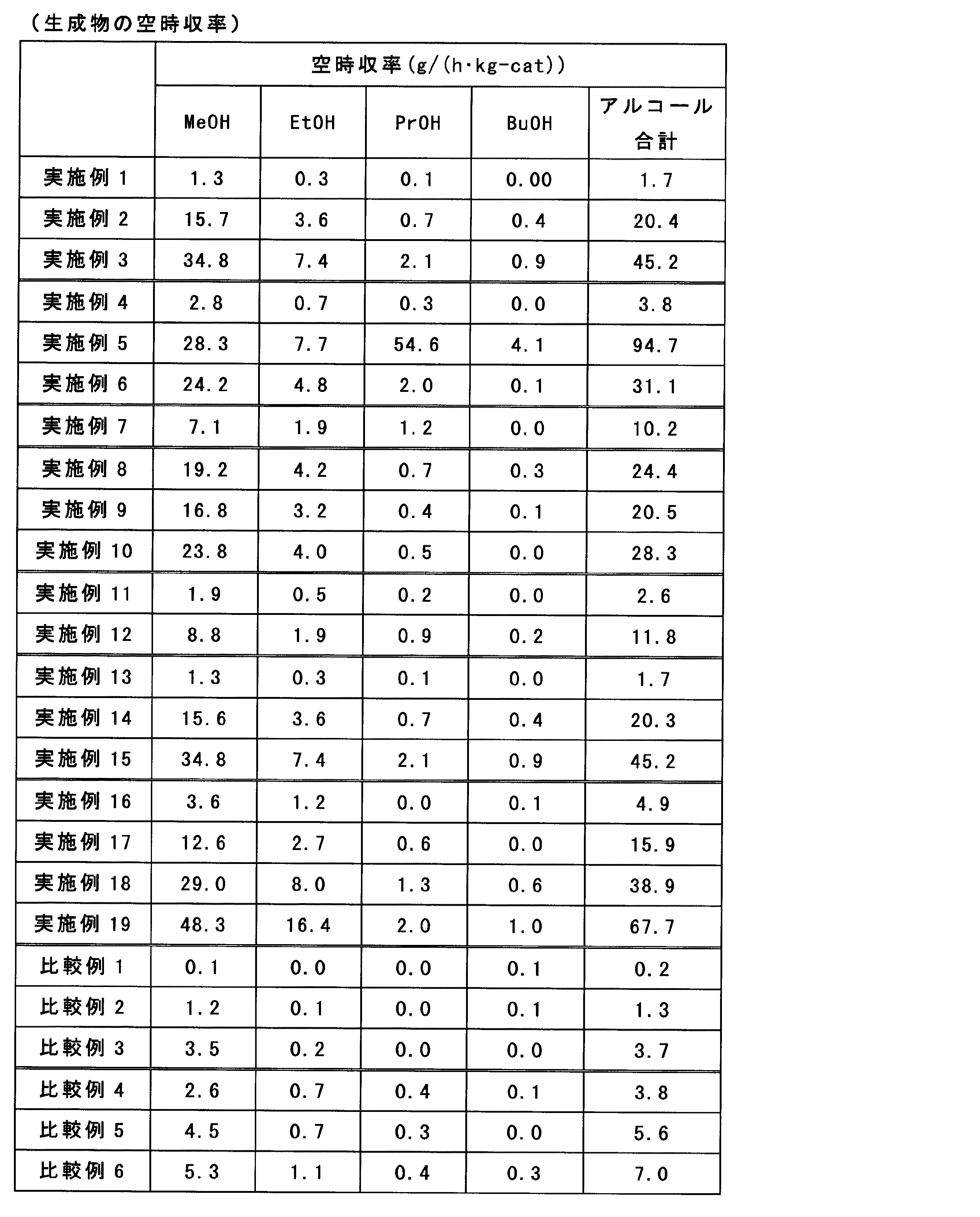
表1〜2から明らかなように、アルコールの選択率は、触媒(1)を使用することで、触媒(i)及び(ii)を使用した場合よりも顕著に高くなった。
また、実施例1〜10より、b/cが0.4の場合、圧力が8MPaの場合、温度が250〜300℃の場合に、アルコールの選択率がより向上する傾向が見られた。一方、二酸化炭素(CO2)の選択率は、b/cが0.6の場合に、より抑制される傾向が見られた。そして、H2/CO(モル比)の増加に伴って一酸化炭素(CO)の転化率が増加し、H2/CO(モル比)の減少に伴ってエタノールの選択率が向上する傾向が見られた。
一方、実施例11〜19より、a/cの増加に伴ってアルコールの選択率がより向上し、a/cの減少に伴って一酸化炭素(CO)の転化率が上昇する傾向が見られた。
As is clear from Tables 1 and 2, the selectivity of alcohol was significantly higher when the catalyst (1) was used than when the catalysts (i) and (ii) were used.
Further, from Examples 1 to 10, when b / c was 0.4, when the pressure was 8 MPa, and when the temperature was 250 to 300 ° C., the alcohol selectivity tended to be further improved. On the other hand, the selectivity of carbon dioxide (CO 2 ) tended to be further suppressed when b / c was 0.6. Then, tends with increasing H 2 / CO (molar ratio) increases the conversion of carbon monoxide (CO), ethanol selectivity is improved with decreasing H 2 / CO (molar ratio) It was seen.
On the other hand, from Examples 11 to 19, the alcohol selectivity was further improved as a / c was increased, and the conversion rate of carbon monoxide (CO) was increased as a / c was decreased. It was.
本発明は、各種アルコールの製造に利用可能である。 The present invention can be used for the production of various alcohols.
Claims (7)
XaCobMocSd ・・・・(1)
(式中、Xはアルカリ金属であり;a、b、c及びdは0より大きい数であり、d/cは1〜3である。) The manufacturing method of alcohol characterized by having the process of making carbon monoxide and hydrogen react in presence of the catalyst represented by following General formula (1).
X a Co b Mo c S d ···· (1)
(Wherein X is an alkali metal; a, b, c and d are numbers greater than 0 and d / c is 1 to 3)
Priority Applications (1)
| Application Number | Priority Date | Filing Date | Title |
|---|---|---|---|
| JP2010260588A JP2012111702A (en) | 2010-11-22 | 2010-11-22 | Method for producing alcohol |
Applications Claiming Priority (1)
| Application Number | Priority Date | Filing Date | Title |
|---|---|---|---|
| JP2010260588A JP2012111702A (en) | 2010-11-22 | 2010-11-22 | Method for producing alcohol |
Publications (1)
| Publication Number | Publication Date |
|---|---|
| JP2012111702A true JP2012111702A (en) | 2012-06-14 |
Family
ID=46496326
Family Applications (1)
| Application Number | Title | Priority Date | Filing Date |
|---|---|---|---|
| JP2010260588A Pending JP2012111702A (en) | 2010-11-22 | 2010-11-22 | Method for producing alcohol |
Country Status (1)
| Country | Link |
|---|---|
| JP (1) | JP2012111702A (en) |
-
2010
- 2010-11-22 JP JP2010260588A patent/JP2012111702A/en active Pending
Similar Documents
| Publication | Publication Date | Title |
|---|---|---|
| AU2010254196B2 (en) | Methanol steam reforming catalysts | |
| JP6120835B2 (en) | Improved carbon-supported cobalt and molybdenum catalysts and their use to produce lower alcohols | |
| CN101985103B (en) | Catalyst for synthesizing methyl formate by selective oxidation of methanol and preparation method thereof | |
| CN104192794A (en) | Catalytic hydrogenation of carbon dioxide into syngas mixture | |
| CN104736239A (en) | Method for obtaining higher alcohols | |
| JP5861024B2 (en) | Method for producing glycol from polyhydric alcohol | |
| JP2013508423A5 (en) | ||
| JPWO2018169076A1 (en) | Metal carrier, supported metal catalyst, method for producing ammonia, method for producing hydrogen, and method for producing cyanamide compound | |
| CN103459020B (en) | Catalysts for the conversion of synthesis gas to alcohols | |
| ES2877136T3 (en) | Fischer-Tropsch process using reduced cobalt catalyst | |
| ES2788715T3 (en) | Fischer-Tropsch process using a reduction activated cobalt catalyst | |
| EP2694206A1 (en) | Catalysts for the conversion of synthesis gas to alcohols | |
| JP5264084B2 (en) | Methanol synthesis catalyst, method for producing the catalyst, and method for producing methanol | |
| WO2007094468A1 (en) | Methanol synthesis catalyst, method for producing such catalyst and method for producing methanol | |
| Hu et al. | Promoting behaviors of alkali compounds in low temperature methanol synthesis over copper-based catalyst | |
| JP2012111702A (en) | Method for producing alcohol | |
| WO2007094471A1 (en) | Methanol synthesis catalyst, method for producing such catalyst and method for producing methanol | |
| JP5626077B2 (en) | Methanol production method and methanol production catalyst | |
| JP4012965B2 (en) | Catalyst for high temperature CO shift reaction | |
| JP6089894B2 (en) | Catalyst for producing synthesis gas and method for producing synthesis gas | |
| JP5777043B2 (en) | Method for producing methanol | |
| JP2010173970A (en) | METHOD FOR PRODUCING alpha-AMINOKETONE COMPOUND | |
| JP5843250B2 (en) | Method for producing methanol | |
| JP4512748B2 (en) | Catalyst for water gas conversion reaction | |
| CN104710280A (en) | Method for production of methanol and co-production of C2-C4 alcohols |