JP2012131902A - Semiconductor sealing epoxy resin composition and semiconductor device using the same - Google Patents
Semiconductor sealing epoxy resin composition and semiconductor device using the same Download PDFInfo
- Publication number
- JP2012131902A JP2012131902A JP2010285197A JP2010285197A JP2012131902A JP 2012131902 A JP2012131902 A JP 2012131902A JP 2010285197 A JP2010285197 A JP 2010285197A JP 2010285197 A JP2010285197 A JP 2010285197A JP 2012131902 A JP2012131902 A JP 2012131902A
- Authority
- JP
- Japan
- Prior art keywords
- epoxy resin
- resin composition
- component
- semiconductor
- curing accelerator
- Prior art date
- Legal status (The legal status is an assumption and is not a legal conclusion. Google has not performed a legal analysis and makes no representation as to the accuracy of the status listed.)
- Pending
Links
Images

Classifications
-
- C—CHEMISTRY; METALLURGY
- C08—ORGANIC MACROMOLECULAR COMPOUNDS; THEIR PREPARATION OR CHEMICAL WORKING-UP; COMPOSITIONS BASED THEREON
- C08L—COMPOSITIONS OF MACROMOLECULAR COMPOUNDS
- C08L61/00—Compositions of condensation polymers of aldehydes or ketones; Compositions of derivatives of such polymers
- C08L61/04—Condensation polymers of aldehydes or ketones with phenols only
- C08L61/06—Condensation polymers of aldehydes or ketones with phenols only of aldehydes with phenols
-
- C—CHEMISTRY; METALLURGY
- C08—ORGANIC MACROMOLECULAR COMPOUNDS; THEIR PREPARATION OR CHEMICAL WORKING-UP; COMPOSITIONS BASED THEREON
- C08K—Use of inorganic or non-macromolecular organic substances as compounding ingredients
- C08K5/00—Use of organic ingredients
- C08K5/04—Oxygen-containing compounds
- C08K5/13—Phenols; Phenolates
-
- C—CHEMISTRY; METALLURGY
- C08—ORGANIC MACROMOLECULAR COMPOUNDS; THEIR PREPARATION OR CHEMICAL WORKING-UP; COMPOSITIONS BASED THEREON
- C08K—Use of inorganic or non-macromolecular organic substances as compounding ingredients
- C08K5/00—Use of organic ingredients
- C08K5/54—Silicon-containing compounds
-
- C—CHEMISTRY; METALLURGY
- C08—ORGANIC MACROMOLECULAR COMPOUNDS; THEIR PREPARATION OR CHEMICAL WORKING-UP; COMPOSITIONS BASED THEREON
- C08L—COMPOSITIONS OF MACROMOLECULAR COMPOUNDS
- C08L63/00—Compositions of epoxy resins; Compositions of derivatives of epoxy resins
-
- H—ELECTRICITY
- H10—SEMICONDUCTOR DEVICES; ELECTRIC SOLID-STATE DEVICES NOT OTHERWISE PROVIDED FOR
- H10W—GENERIC PACKAGES, INTERCONNECTIONS, CONNECTORS OR OTHER CONSTRUCTIONAL DETAILS OF DEVICES COVERED BY CLASS H10
- H10W74/00—Encapsulations, e.g. protective coatings
- H10W74/40—Encapsulations, e.g. protective coatings characterised by their materials
-
- H—ELECTRICITY
- H10—SEMICONDUCTOR DEVICES; ELECTRIC SOLID-STATE DEVICES NOT OTHERWISE PROVIDED FOR
- H10W—GENERIC PACKAGES, INTERCONNECTIONS, CONNECTORS OR OTHER CONSTRUCTIONAL DETAILS OF DEVICES COVERED BY CLASS H10
- H10W74/00—Encapsulations, e.g. protective coatings
- H10W74/40—Encapsulations, e.g. protective coatings characterised by their materials
- H10W74/47—Encapsulations, e.g. protective coatings characterised by their materials comprising organic materials, e.g. plastics or resins
-
- H—ELECTRICITY
- H10—SEMICONDUCTOR DEVICES; ELECTRIC SOLID-STATE DEVICES NOT OTHERWISE PROVIDED FOR
- H10W—GENERIC PACKAGES, INTERCONNECTIONS, CONNECTORS OR OTHER CONSTRUCTIONAL DETAILS OF DEVICES COVERED BY CLASS H10
- H10W74/00—Encapsulations, e.g. protective coatings
- H10W74/40—Encapsulations, e.g. protective coatings characterised by their materials
- H10W74/47—Encapsulations, e.g. protective coatings characterised by their materials comprising organic materials, e.g. plastics or resins
- H10W74/473—Encapsulations, e.g. protective coatings characterised by their materials comprising organic materials, e.g. plastics or resins containing a filler
-
- H—ELECTRICITY
- H10—SEMICONDUCTOR DEVICES; ELECTRIC SOLID-STATE DEVICES NOT OTHERWISE PROVIDED FOR
- H10W—GENERIC PACKAGES, INTERCONNECTIONS, CONNECTORS OR OTHER CONSTRUCTIONAL DETAILS OF DEVICES COVERED BY CLASS H10
- H10W72/00—Interconnections or connectors in packages
- H10W72/50—Bond wires
- H10W72/531—Shapes of wire connectors
- H10W72/536—Shapes of wire connectors the connected ends being ball-shaped
-
- H—ELECTRICITY
- H10—SEMICONDUCTOR DEVICES; ELECTRIC SOLID-STATE DEVICES NOT OTHERWISE PROVIDED FOR
- H10W—GENERIC PACKAGES, INTERCONNECTIONS, CONNECTORS OR OTHER CONSTRUCTIONAL DETAILS OF DEVICES COVERED BY CLASS H10
- H10W72/00—Interconnections or connectors in packages
- H10W72/50—Bond wires
- H10W72/531—Shapes of wire connectors
- H10W72/5363—Shapes of wire connectors the connected ends being wedge-shaped
-
- H—ELECTRICITY
- H10—SEMICONDUCTOR DEVICES; ELECTRIC SOLID-STATE DEVICES NOT OTHERWISE PROVIDED FOR
- H10W—GENERIC PACKAGES, INTERCONNECTIONS, CONNECTORS OR OTHER CONSTRUCTIONAL DETAILS OF DEVICES COVERED BY CLASS H10
- H10W72/00—Interconnections or connectors in packages
- H10W72/50—Bond wires
- H10W72/551—Materials of bond wires
- H10W72/552—Materials of bond wires comprising metals or metalloids, e.g. silver
- H10W72/5522—Materials of bond wires comprising metals or metalloids, e.g. silver comprising gold [Au]
Landscapes
- Chemical & Material Sciences (AREA)
- Health & Medical Sciences (AREA)
- Chemical Kinetics & Catalysis (AREA)
- Medicinal Chemistry (AREA)
- Polymers & Plastics (AREA)
- Organic Chemistry (AREA)
- Epoxy Resins (AREA)
- Structures Or Materials For Encapsulating Or Coating Semiconductor Devices Or Solid State Devices (AREA)
- Compositions Of Macromolecular Compounds (AREA)
Abstract
【課題】高温高湿信頼性および成形性に優れた半導体封止用エポキシ樹脂組成物を提供する。
【解決手段】下記の(A)〜(E)成分を含有する半導体封止用エポキシ樹脂組成物である。そして、下記の(C)成分の含有量が、エポキシ樹脂組成物の有機成分に対して0.8〜30.0重量%とする。(A)エポキシ樹脂。(B)フェノール樹脂〔ただし、下記(C)成分を除く。〕。(C)特定のシラン変性フェノール樹脂。(D)硬化促進剤。(E)無機質充填剤。
【選択図】なしTo provide an epoxy resin composition for semiconductor encapsulation excellent in high temperature and high humidity reliability and moldability.
An epoxy resin composition for semiconductor encapsulation containing the following components (A) to (E). And content of the following (C) component shall be 0.8-30.0 weight% with respect to the organic component of an epoxy resin composition. (A) Epoxy resin. (B) Phenolic resin [However, the following component (C) is excluded. ]. (C) A specific silane-modified phenol resin. (D) Curing accelerator. (E) Inorganic filler.
[Selection figure] None
Description
本発明は、成形性および硬化性に優れた半導体封止用エポキシ樹脂組成物およびそれを用いて得られる半導体装置に関するものである。 The present invention relates to an epoxy resin composition for semiconductor encapsulation excellent in moldability and curability and a semiconductor device obtained using the same.
従来から、トランジスタ、IC、LSI等の各種半導体素子は、外部環境からの保護および半導体素子のハンドリングを官能にするという観点から、プラスチックパッケージ、例えば、熱硬化性エポキシ樹脂組成物を用いて樹脂封止され半導体装置化されている。 Conventionally, various semiconductor elements such as transistors, ICs, and LSIs have been encapsulated with plastic packages, for example, thermosetting epoxy resin compositions, from the viewpoint of protecting the external environment and handling the semiconductor elements. It is stopped and it has become a semiconductor device.
上記熱硬化性エポキシ樹脂組成物等の半導体封止用樹脂材料の重要な要求特性として、高温高湿における信頼性があげられる。例えば、高温または多湿環境下においては、エポキシ樹脂組成物中に含まれる塩素イオン等のイオン性不純物が動きやすくなるため、半導体素子上の配線の腐食が進み易く、従来の半導体封止用エポキシ樹脂組成物では、高温高湿信頼性に関して難点があった。この高温高湿信頼性の不良原因となるエポキシ樹脂組成物中に含まれる塩素イオン等のイオン性不純物は、エポキシ樹脂の製造工程におけるフェノールのエピハロヒドリンによるグリシジルエーテル化に起因する。従来のクレゾールノボラック型エポキシ樹脂では、溶剤に対する溶解性が高いため、水洗が可能となり、より低塩素含有の(高純度な)エポキシ樹脂を得ることができるが、無機質充填剤の高充填化のために用いられる低粘度結晶性エポキシ樹脂は溶剤に対する溶解性が低いことから、高純度なエポキシ樹脂を得ることが困難であった(例えば、特許文献1参照)。 An important required characteristic of a semiconductor sealing resin material such as the thermosetting epoxy resin composition is reliability at high temperature and high humidity. For example, in high temperature or high humidity environment, ionic impurities such as chlorine ions contained in the epoxy resin composition are easy to move. In the composition, there was a difficulty regarding high temperature and high humidity reliability. The ionic impurities such as chlorine ions contained in the epoxy resin composition causing the poor reliability of high temperature and high humidity result from glycidyl etherification of phenol with epihalohydrin in the epoxy resin production process. Conventional cresol novolac type epoxy resin has high solubility in solvents, so it can be washed with water, and a low chlorine content (high purity) epoxy resin can be obtained. Since the low-viscosity crystalline epoxy resin used in the above has low solubility in a solvent, it has been difficult to obtain a high-purity epoxy resin (see, for example, Patent Document 1).
そして、上記高温高湿信頼性の不良原因となるエポキシ樹脂組成物中に含まれるイオン性不純物を捕捉するために、例えば、Bi系無機化合物を含んだイオン捕捉剤やハイドロタルサイト類化合物を用いて陰イオン性不純物を捕捉することが提案されている(例えば、特許文献2,3,4参照)。
And in order to capture | recover the ionic impurity contained in the epoxy resin composition used as the cause of the high-temperature, high-humidity reliability defect, for example, an ion scavenger or a hydrotalcite compound containing a Bi-based inorganic compound is used. It has been proposed to capture anionic impurities (see, for example,
しかしながら、上記のような方法では、充分な高温高湿信頼性の向上効果を得ることは困難であり、また高粘度化してしまい成形性に対して悪影響を与える等の問題も有している。 However, it is difficult to obtain a sufficient improvement effect of high temperature and high humidity reliability by the above method, and there is a problem that the viscosity is increased and the moldability is adversely affected.
本発明は、このような事情に鑑みなされたもので、高温高湿信頼性および成形性に優れた半導体封止用エポキシ樹脂組成物およびそれを用いて得られる半導体装置の提供をその目的とする。 The present invention has been made in view of such circumstances, and an object thereof is to provide an epoxy resin composition for semiconductor encapsulation excellent in high-temperature and high-humidity reliability and moldability, and a semiconductor device obtained using the same. .
上記目的を達成するため、本発明は、下記の(A)〜(E)成分を含有する半導体封止用エポキシ樹脂組成物であって、上記(C)成分の含有量が、エポキシ樹脂組成物の有機成分に対して0.8〜30.0重量%である半導体封止用エポキシ樹脂組成物を第1の要旨とする。 In order to achieve the above object, the present invention provides an epoxy resin composition for semiconductor encapsulation containing the following components (A) to (E), wherein the content of the component (C) is an epoxy resin composition: The first gist is an epoxy resin composition for semiconductor encapsulation that is 0.8 to 30.0% by weight based on the organic component.
(A)エポキシ樹脂。
(B)フェノール樹脂〔ただし、下記(C)成分を除く。〕。
(C)下記の一般式(1)で表されるシラン変性フェノール樹脂。
(E)無機質充填剤。
(A) Epoxy resin.
(B) Phenolic resin [However, the following component (C) is excluded. ].
(C) A silane-modified phenol resin represented by the following general formula (1).
(E) Inorganic filler.
そして、本発明は、上記半導体封止用エポキシ樹脂組成物を用いて、半導体素子を樹脂封止してなる半導体装置を第2の要旨とする。 And this invention makes the 2nd summary the semiconductor device formed by resin-sealing a semiconductor element using the said epoxy resin composition for semiconductor sealing.
本発明者らは、成形性を低下させることなく高温高湿信頼性に優れた半導体封止材料を得るために鋭意検討を重ねた。その結果、硬化剤成分として、通常のフェノール樹脂とともに前記特定のシラン変性フェノール樹脂〔(C)成分〕を用いると、その構造部分のシラン変性部分が、エポキシ樹脂組成物が溶融して流動している最中に、界面活性効果を示すことにより、粘度の上昇を抑制することが可能となり、良好な成形性とともに高温高湿信頼性が向上することを見出し本発明に到達した。 The inventors of the present invention have made extensive studies in order to obtain a semiconductor sealing material excellent in high-temperature and high-humidity reliability without reducing moldability. As a result, when the specific silane-modified phenol resin [component (C)] is used together with a normal phenol resin as the curing agent component, the epoxy resin composition melts and flows when the silane-modified portion of the structural portion melts. In the meantime, by showing the surface active effect, it was possible to suppress the increase in viscosity, and it was found that high temperature and high humidity reliability was improved along with good moldability, and the present invention was reached.
このように、本発明は、前記特定のシラン変性フェノール樹脂〔(C)成分〕を特定量含有する半導体封止用エポキシ樹脂組成物である。このため、優れた高温高湿信頼性が得られるとともに、低粘度化が図られ良好な成形性が付与された、例えば、金線ワイヤー流れ発生が抑制された高信頼性を備えた半導体装置を得ることができる。 Thus, the present invention is an epoxy resin composition for semiconductor encapsulation containing a specific amount of the specific silane-modified phenol resin [component (C)]. For this reason, an excellent high temperature and high humidity reliability is obtained, a low viscosity is achieved, and a good moldability is imparted, for example, a highly reliable semiconductor device with suppressed generation of gold wire flow. Obtainable.
そして、硬化促進剤〔(D)成分〕として、特定のリン系硬化促進剤を用いると、より一層優れた高温高湿信頼性が得られる。 Further, when a specific phosphorus-based curing accelerator is used as the curing accelerator [component (D)], further excellent high temperature and high humidity reliability can be obtained.
つぎに、本発明を実施するための形態について説明する。 Next, an embodiment for carrying out the present invention will be described.
本発明の半導体封止用エポキシ樹脂組成物(以下、「エポキシ樹脂組成物」と略すことがある)は、エポキシ樹脂(A成分)と、フェノール樹脂(B成分)と、特定のシラン変性フェノール樹脂(C成分)と、硬化促進剤(D成分)と、無機質充填剤(E成分)とを用いて得られるものであって、通常、粉末状もしくはこれを打錠したタブレット状になっている。 The epoxy resin composition for semiconductor encapsulation of the present invention (hereinafter sometimes abbreviated as “epoxy resin composition”) includes an epoxy resin (component A), a phenol resin (component B), and a specific silane-modified phenol resin. It is obtained using (C component), a curing accelerator (D component), and an inorganic filler (E component), and is usually in the form of a powder or a tablet obtained by tableting this.
上記エポキシ樹脂(A成分)としては、特に限定されるものではなく、例えば、ビスフェノールA型エポキシ樹脂、フェノールノボラック型エポキシ樹脂、クレゾールノボラック型エポキシ樹脂、ビフェニル型エポキシ樹脂、トリフェニルメタン型エポキシ樹脂等があげられる。これらは単独でもしくは2種以上併せて用いられる。そして、これらエポキシ樹脂の中でも、ビフェニル基を有するビフェニル型エポキシ樹脂や、低級アルキル基をフェニル環に付加したような低吸湿型のエポキシ樹脂を用いることが、信頼性・成形性の点から好ましい。このようなエポキシ樹脂としては、例えば、エポキシ当量150〜250、軟化点もしくは融点が50〜130℃のものが好適に用いられる。 The epoxy resin (component A) is not particularly limited. For example, bisphenol A type epoxy resin, phenol novolac type epoxy resin, cresol novolac type epoxy resin, biphenyl type epoxy resin, triphenylmethane type epoxy resin, etc. Can be given. These may be used alone or in combination of two or more. Among these epoxy resins, it is preferable from the viewpoint of reliability and moldability to use a biphenyl type epoxy resin having a biphenyl group or a low moisture absorption type epoxy resin in which a lower alkyl group is added to a phenyl ring. As such an epoxy resin, for example, those having an epoxy equivalent of 150 to 250 and a softening point or melting point of 50 to 130 ° C. are suitably used.
上記エポキシ樹脂(A成分)とともに用いられるフェノール樹脂(B成分)は、上記エポキシ樹脂(A成分)の硬化剤としての作用を有するものであり、後述の特定のシラン変性フェノール樹脂(C成分)を除くフェノール樹脂であって、一分子中に2個以上のフェノール性水酸基を有するモノマー、オリゴマー、ポリマー全般をいう。例えば、フェノールノボラック樹脂、クレゾールノボラック樹脂、ビフェニル型ノボラック樹脂、トリフェニルメタン型フェノール樹脂、ナフトールノボラック樹脂、フェノールアラルキル樹脂、ビフェニルアラルキル樹脂等があげられる。これらは単独でもしくは2種以上併せて用いられる。そして、これらフェノール樹脂の中でも、フェノールアラルキル樹脂、ビフェニルアラルキル樹脂のような低吸湿性のものを用いることが信頼性・成形性の点から好ましい。 The phenol resin (B component) used together with the epoxy resin (component A) has a function as a curing agent for the epoxy resin (component A), and a specific silane-modified phenol resin (component C) described later is used. It is a phenol resin to be removed, and refers to all monomers, oligomers and polymers having two or more phenolic hydroxyl groups in one molecule. For example, phenol novolak resin, cresol novolak resin, biphenyl type novolak resin, triphenylmethane type phenol resin, naphthol novolak resin, phenol aralkyl resin, biphenyl aralkyl resin and the like can be mentioned. These may be used alone or in combination of two or more. Among these phenol resins, it is preferable from the viewpoint of reliability and moldability to use a low hygroscopic material such as a phenol aralkyl resin or a biphenyl aralkyl resin.
上記エポキシ樹脂(A成分)とフェノール樹脂(B成分)との配合割合は、エポキシ樹脂中のエポキシ基1当量あたり、フェノール樹脂(B成分)中の水酸基当量が0.5〜1.5当量となるように配合することが好ましい。より好ましくは0.7〜1.1当量であり、特に好ましくは0.8〜1.0当量である。 The mixing ratio of the epoxy resin (component A) and the phenol resin (component B) is such that the hydroxyl group equivalent in the phenol resin (component B) is 0.5 to 1.5 equivalents per equivalent of epoxy group in the epoxy resin. It is preferable to blend so as to be. More preferably, it is 0.7-1.1 equivalent, Most preferably, it is 0.8-1.0 equivalent.
上記A成分およびB成分とともに用いられる特定のシラン変性フェノール樹脂(C成分)は、下記の一般式(1)で表されるものである。 The specific silane-modified phenol resin (C component) used together with the A component and the B component is represented by the following general formula (1).
上記式(1)において、R1〜R4は水素原子または上記構造式(a)で表される1価の官能基であるが、R1〜R4のうち少なくとも二つは水素原子であり、残りのうち少なくとも一つは上記構造式(a)で表される官能基である。特に好ましくは、R1〜R4のうちR1,R2,R4が水素原子であり、R3が上記構造式(a)で表される官能基となる構造である。 In the above formula (1), R 1 to R 4 are hydrogen atoms or monovalent functional groups represented by the above structural formula (a), but at least two of R 1 to R 4 are hydrogen atoms. At least one of the remaining is a functional group represented by the structural formula (a). Particularly preferably, R 1, R 2, R 4 of R 1 to R 4 is a hydrogen atom, R 3 is a structure comprising a functional group represented by the structural formula (a).
また、上記構造式(a)において、R5はアルコキシル基、R6はアルコキシル基またはアルキル基、R7はアルキル基であるが、特に好ましくはR5がメトキシ基、R6がメチル基またはメトキシ基、R7がメチル基である。そして、繰り返し数nは1〜50の正数であるが、より好ましくは1〜30の正数、特に好ましくは1〜9の正数である。 In the structural formula (a), R 5 is an alkoxyl group, R 6 is an alkoxyl group or an alkyl group, and R 7 is an alkyl group. Particularly preferably, R 5 is a methoxy group, and R 6 is a methyl group or a methoxy group. The group R 7 is a methyl group. The number of repetitions n is a positive number of 1 to 50, more preferably a positive number of 1 to 30, and particularly preferably a positive number of 1 to 9.
上記特定のシラン変性フェノール樹脂(C成分)としては、具体的には、荒川化学工業社製の商品名「コンポセランP501」、「コンポセランP502」等があげられる。 Specific examples of the specific silane-modified phenolic resin (component C) include trade names “Composeran P501” and “Composeran P502” manufactured by Arakawa Chemical Industries, Ltd.
上記特定のシラン変性フェノール樹脂(C成分)の含有量は、エポキシ樹脂組成物の有機成分に対して0.8〜30.0重量%でなければならない。より好ましくは1.5〜25重量%であり、特に好ましくは5.0〜10重量%である。すなわち、C成分の含有量が多すぎると、硬化反応時に副生するアルコールに起因したボイド発生の影響によりワイヤー流れが生じ、半導体素子を破壊してしまう傾向がみられる。また、C成分の含有量が少なすぎると、高温高湿信頼性および成形性の充分な向上効果が得られにくいという傾向がみられるからである。これは、成形時の流動過程においてエポキシ樹脂組成物中にボイドが発生すると、それがワイヤーに捕捉され抗力を増大させるためである。また、一般に、高粘度のエポキシ樹脂組成物はその流動過程においてワイヤーにかかる抗力を増大させるため、ワイヤー流れ量を増大させることとなる。 Content of the said specific silane modification phenol resin (C component) must be 0.8-30.0 weight% with respect to the organic component of an epoxy resin composition. More preferably, it is 1.5-25 weight%, Most preferably, it is 5.0-10 weight%. That is, when there is too much content of C component, the wire flow will arise by the influence of the void generation | occurrence | production resulting from the alcohol byproduced at the time of hardening reaction, and the tendency which destroys a semiconductor element is seen. Moreover, when there is too little content of C component, it is because the tendency for the high temperature and high humidity reliability and the improvement effect of a moldability to be hard to be acquired is seen. This is because if voids are generated in the epoxy resin composition during the flow process during molding, they are trapped by the wire and increase the drag. In general, a high-viscosity epoxy resin composition increases the drag applied to the wire in the flow process, and therefore increases the amount of wire flow.
上記A〜C成分とともに用いられる硬化促進剤(D成分)としては、各種硬化促進剤が用いられるが、高温高湿信頼性の観点から、リン系硬化促進剤を用いることが好ましい。 Although various hardening accelerators are used as a hardening accelerator (D component) used with said AC component, it is preferable to use a phosphorus hardening accelerator from a viewpoint of high temperature and high humidity reliability.
上記リン系硬化促進剤としては、例えば、下記の一般式(2)で表されるリン系硬化促進剤、下記の一般式(3)で表されるリン系硬化促進剤および下記の一般式(4)で表されるリン系硬化促進剤等があげられる。これらは単独でもしくは2種以上併せて用いられる。 Examples of the phosphorus-based curing accelerator include a phosphorus-based curing accelerator represented by the following general formula (2), a phosphorus-based curing accelerator represented by the following general formula (3), and the following general formula ( Examples thereof include phosphorus-based curing accelerators represented by 4). These may be used alone or in combination of two or more.
そして、上記リン系硬化促進剤としては、具体的には、トリフェニルホスフィン、ジフェニル(p−トリル)ホスフィン、トリス(アルキルフェニル)ホスフィン、トリス(アルコキシフェニル)ホスフィン、トリス(アルキル・アルコキシフェニル)ホスフィン、トリス(ジアルキル)ホスフィン、トリス(トリアルキルフェニル)ホスフィン、トリス(テトラアルキルフェニル)ホスフィン、トリス(ジアルコキシフェニル)ホスフィン、トリス(トリアルコキシフェニル)ホスフィン、トリス(テトラアルコキシフェニル)ホスフィン、トリアルキルホスフィン、ジアルキルアリールホスフィン、アルキルジアリールホスフィン等の有機ホスフィン類等のホスフィン化合物、またはこれらホスフィン化合物と有機ボロン類との錯体や、これらホスフィン化合物と無水マレイン酸、1,4−ベンゾキノン、2,5−トルキノン、1,4−ナフトキノン、2,3−ジメチルベンゾキノン、2,6−ジメチルベンゾキノン、2,3−ジメトキシ−5−メチル−1,4−ベンゾキノン、2,3−ジメトキシ−1,4−ベンゾキノン、フェニル−1,4−ベンゾキノン等のキノン化合物、ジアゾフェニルメタン等のπ結合をもつ化合物を付加してなる、分子内分極を有する化合物、これらホスフィン化合物と4−ブロモフェノール、3−ブロモフェノール、2−ブロモフェノール、4−クロロフェノール、3−クロロフェノール、2−クロロフェノール、4−ヨウ化フェノール、3−ヨウ化フェノール、2−ヨウ化フェノール、4−ブロモ−2−メチルフェノール、4−ブロモ−3−メチルフェノール、4−ブロモ−2,6−ジメチルフェノール、4−ブロモ−3,5−ジメチルフェノール、4−ブロモ−2,6−ジ−tert−ブチルフェノール、4−クロロ−1−ナフトール、1−ブロモ−2−ナフトール、6−ブロモ−2−ナフトール、4−ブロモ−4′−ヒドロキシビフェニル等のハロゲン化フェノール化合物を反応させた後、脱ハロゲン化水素の工程を経て得られる分子内分極を有する化合物等があげられる。 Specific examples of the phosphorus curing accelerator include triphenylphosphine, diphenyl (p-tolyl) phosphine, tris (alkylphenyl) phosphine, tris (alkoxyphenyl) phosphine, and tris (alkylalkoxyphenyl) phosphine. , Tris (dialkyl) phosphine, tris (trialkylphenyl) phosphine, tris (tetraalkylphenyl) phosphine, tris (dialkoxyphenyl) phosphine, tris (trialkoxyphenyl) phosphine, tris (tetraalkoxyphenyl) phosphine, trialkylphosphine Phosphine compounds such as organic phosphines such as dialkylarylphosphine and alkyldiarylphosphine, or complexes of these phosphine compounds with organic borons, These phosphine compounds and maleic anhydride, 1,4-benzoquinone, 2,5-toluquinone, 1,4-naphthoquinone, 2,3-dimethylbenzoquinone, 2,6-dimethylbenzoquinone, 2,3-dimethoxy-5-methyl Intramolecular polarization formed by adding a quinone compound such as -1,4-benzoquinone, 2,3-dimethoxy-1,4-benzoquinone and phenyl-1,4-benzoquinone, and a compound having a π bond such as diazophenylmethane. Compounds having these, phosphine compounds and 4-bromophenol, 3-bromophenol, 2-bromophenol, 4-chlorophenol, 3-chlorophenol, 2-chlorophenol, 4-iodophenol, 3-iodophenol, 2-iodophenol, 4-bromo-2-methylphenol, 4-bromo-3-methyl Ruphenol, 4-bromo-2,6-dimethylphenol, 4-bromo-3,5-dimethylphenol, 4-bromo-2,6-di-tert-butylphenol, 4-chloro-1-naphthol, 1-bromo A compound having intramolecular polarization obtained by reacting a halogenated phenol compound such as 2-naphthol, 6-bromo-2-naphthol, 4-bromo-4'-hydroxybiphenyl, etc. and then dehydrohalogenating Etc.
さらに、上記リン系硬化促進剤として、テトラフェニルホスホニウム・テトラフェニルボレート、テトラフェニルホスホニウム・テトラ−p−トリルボレート、テトラフェニルホスホニウム・チオシアネート、テトラフェニルホスホニウム・ジシアンアミド、テトラフェニルホスホニウム・アセテート、テトラフェニルホスホニウム・テトラフルオロボレート、テトラフェニルホスホニウム・ヘキサフルオロアンチモネート、p−トリルトリフェニルホスホニウム・テトラ−p−トリルボレート、テトラ−p−トリルホスホニウム・テトラフェニルボレート、テトラ−p−tert−ブチルフェニルホスホニウム・テトラフェニルボレート、テトラ−p−メトキシフェニルホスホニウム・テトラフェニルボレート等のテトラ置換ホスホニウム塩等があげられる。 Further, as the phosphorus curing accelerator, tetraphenylphosphonium / tetraphenylborate, tetraphenylphosphonium / tetra-p-tolylborate, tetraphenylphosphonium / thiocyanate, tetraphenylphosphonium / dicyanamide, tetraphenylphosphonium / acetate, tetraphenylphosphonium Tetrafluoroborate, tetraphenylphosphonium, hexafluoroantimonate, p-tolyltriphenylphosphonium, tetra-p-tolylborate, tetra-p-tolylphosphonium, tetraphenylborate, tetra-p-tert-butylphenylphosphonium, tetra Tetra-substituted phosphoniums such as phenylborate, tetra-p-methoxyphenylphosphonium and tetraphenylborate And the like.
上記硬化促進剤(D成分)の含有量は、上記エポキシ樹脂(A成分)に対して0.001〜8.0重量%に設定することが好ましく、より好ましくは0.01〜3.0重量%である。すなわち、D成分の含有量が少なすぎると、充分な硬化促進効果を得られない場合があり、またD成分の含有量が多すぎると、得られる硬化物に変色がみられる傾向があるからである。 The content of the curing accelerator (component D) is preferably set to 0.001 to 8.0% by weight, more preferably 0.01 to 3.0% by weight with respect to the epoxy resin (component A). %. That is, if the content of the D component is too small, there may be a case where a sufficient curing accelerating effect cannot be obtained, and if the content of the D component is too large, the resulting cured product tends to be discolored. is there.
上記A〜D成分とともに用いられる無機質充填剤(E成分)としては、例えば、石英ガラス、タルク、シリカ粉末(溶融シリカ粉末や結晶性シリカ粉末等)、アルミナ粉末、窒化アルミニウム粉末、窒化珪素粉末等があげられる。これら無機質充填剤は、破砕状、球状、あるいは摩砕処理したもの等いずれのものでも使用可能である。そして、これら無機質充填剤は単独でもしくは2種以上併せて用いられる。なかでも、得られる硬化物の線膨張係数を低減できるという点から上記シリカ粉末を用いることか好ましく、上記シリカ粉末の中でも溶融シリカ粉末を用いることが、高充填性、高流動性という点から特に好ましい。上記溶融シリカ粉末としては、球状溶融シリカ粉末、破砕溶融シリカ粉末があげられるが、流動性という観点から、球状溶融シリカ粉末を用いることが好ましい。 Examples of the inorganic filler (E component) used together with the components A to D include quartz glass, talc, silica powder (such as fused silica powder and crystalline silica powder), alumina powder, aluminum nitride powder, and silicon nitride powder. Can be given. These inorganic fillers can be used in any form such as crushed, spherical, or ground. And these inorganic fillers are used individually or in combination of 2 or more types. Among these, it is preferable to use the silica powder from the viewpoint that the linear expansion coefficient of the obtained cured product can be reduced. preferable. Examples of the fused silica powder include spherical fused silica powder and crushed fused silica powder. From the viewpoint of fluidity, spherical fused silica powder is preferably used.
また、無機質充填剤(E成分)としては、平均粒径5〜40μmの範囲のものを用いることが、流動性を良好にするという点から好ましい。なお、上記無機質充填剤(E成分)の平均粒径は、例えば、母集団から任意の測定試料を取り出し、市販のレーザー回折散乱式粒度分布測定装置を用いて測定することができる。 Moreover, as an inorganic filler (E component), it is preferable to use a thing with the average particle diameter of the range of 5-40 micrometers from the point of making fluidity | liquidity favorable. The average particle diameter of the inorganic filler (E component) can be measured, for example, by taking an arbitrary measurement sample from the population and using a commercially available laser diffraction / scattering particle size distribution measuring apparatus.
そして、上記無機質充填剤(E成分)の含有量は、エポキシ樹脂組成物全体の70〜95重量%の範囲に設定することが好ましく、特に好ましくは85〜92重量%である。すなわち、無機質充填剤(E成分)の含有量が少なすぎると、エポキシ樹脂組成物の粘度が低くなりすぎて成形時の外観不良(ボイド)が発生しやすくなる傾向がみられ、逆に含有量が多すぎると、エポキシ樹脂組成物の流動性が低下し、ワイヤー流れや未充填が発生する傾向がみられるからである。 And it is preferable to set content of the said inorganic filler (E component) in the range of 70 to 95 weight% of the whole epoxy resin composition, Most preferably, it is 85 to 92 weight%. That is, when the content of the inorganic filler (component E) is too small, the viscosity of the epoxy resin composition tends to be too low, and the appearance defect (void) at the time of molding tends to occur. This is because if the amount is too large, the fluidity of the epoxy resin composition decreases, and there is a tendency that wire flow or unfilling occurs.
さらに、本発明の半導体封止用エポキシ樹脂組成物には、前記A〜E成分以外に、必要に応じて、シランカップリング剤、難燃剤、難燃助剤、離型剤、イオントラップ剤、カーボンブラック等の顔料や着色料、低応力化剤、粘着付与剤等の他の添加剤を適宜配合することができる。 Furthermore, in the epoxy resin composition for semiconductor encapsulation of the present invention, in addition to the components A to E, if necessary, a silane coupling agent, a flame retardant, a flame retardant aid, a release agent, an ion trap agent, Other additives such as a pigment such as carbon black, a colorant, a stress reducing agent, and a tackifier can be appropriately blended.
上記シランカップリング剤としては、2個以上のアルコキシ基を有するものが好適に用いられる。具体的には、3−メタクリロキシプロピルトリメトキシシラン、β−(3,4−エポキシシクロヘキシル)エチルトリメトキシシラン、γ−グリシドキシプロピルトリメトキシシラン、γ−メルカプトプロピルトリメトキシシラン、γ−(2−アミノエチル)アミノプロピルトリメトキシシラン、γ−メルカプトプロピルメチルジメトキシシラン、γ−アニリノプロピルトリメトキシシラン、ヘキサメチルジシラザン等があげられる。これらは単独でもしくは2種以上併せて用いられる。 As the silane coupling agent, those having two or more alkoxy groups are preferably used. Specifically, 3-methacryloxypropyltrimethoxysilane, β- (3,4-epoxycyclohexyl) ethyltrimethoxysilane, γ-glycidoxypropyltrimethoxysilane, γ-mercaptopropyltrimethoxysilane, γ- ( 2-aminoethyl) aminopropyltrimethoxysilane, γ-mercaptopropylmethyldimethoxysilane, γ-anilinopropyltrimethoxysilane, hexamethyldisilazane and the like. These may be used alone or in combination of two or more.
上記難燃剤としては、ノボラック型ブロム化エポキシ樹脂や金属水酸化物等があげられる。さらに、上記難燃助剤としては、三酸化二アンチモンや五酸化二アンチモン等が用いられる。これらは単独でもしくは2種以上併せて用いられる。 Examples of the flame retardant include novolac-type brominated epoxy resins and metal hydroxides. Furthermore, as the flame retardant aid, antimony trioxide, diantimony pentoxide, or the like is used. These may be used alone or in combination of two or more.
上記離型剤としては、高級脂肪酸、高級脂肪酸エステル、高級脂肪酸カルシウム等の化合物があげられ、例えば、カルナバワックスやポリエチレン系ワックス等が用いられ、これらは単独でもしくは2種以上併せて用いられる。 Examples of the mold release agent include compounds such as higher fatty acid, higher fatty acid ester, higher fatty acid calcium and the like. For example, carnauba wax and polyethylene wax are used, and these are used alone or in combination of two or more.
上記イオントラップ剤としては、イオントラップ能力を有する公知の化合物全てが使用でき、例えば、ハイドロタルサイト類、水酸化ビスマス、イットリウム酸化物等が用いられる。これらは単独でもしくは2種以上併せて用いられる。 As the ion trapping agent, all known compounds having ion trapping ability can be used. For example, hydrotalcites, bismuth hydroxide, yttrium oxide and the like are used. These may be used alone or in combination of two or more.
上記低応力化剤としては、例えば、アクリル酸メチル−ブタジエン−スチレン共重合体、メタクリル酸メチル−ブタジエン−スチレン共重合体等のブタジエン系ゴムやシリコーン化合物等があげられる。これらは単独でもしくは2種以上併せて用いられる。 Examples of the stress reducing agent include butadiene rubbers such as methyl acrylate-butadiene-styrene copolymer and methyl methacrylate-butadiene-styrene copolymer, and silicone compounds. These may be used alone or in combination of two or more.
本発明の半導体封止用エポキシ樹脂組成物は、例えば、つぎのようにして製造することができる。すなわち、上記A〜E成分、さらに必要に応じて他の添加剤を配合し混合した後、ミキシングロール機等の混練機にかけ加熱状態で溶融混練する。ついで、これを室温に冷却固化させた後、公知の手段によって粉砕し、必要に応じて打錠するという一連の工程により目的とするエポキシ樹脂組成物を製造することができる。 The epoxy resin composition for semiconductor encapsulation of the present invention can be produced, for example, as follows. That is, the above components A to E and other additives as necessary are mixed and mixed, and then melt kneaded in a heated state in a kneader such as a mixing roll machine. Subsequently, after cooling and solidifying this to room temperature, it can grind | pulverize by a well-known means and can manufacture the target epoxy resin composition by a series of processes of tableting as needed.
このようにして得られるエポキシ樹脂組成物を用いての半導体素子の封止方法は、特に制限するものではなく、通常のトランスファー成形等の公知のモールド方法により行うことができ、半導体装置化することができる。このようにして得られる半導体装置としては、ICやLSI等の半導体装置等があげられる。 The method for sealing a semiconductor element using the epoxy resin composition thus obtained is not particularly limited, and can be performed by a known molding method such as ordinary transfer molding, thereby forming a semiconductor device. Can do. Examples of the semiconductor device thus obtained include semiconductor devices such as IC and LSI.
つぎに、実施例について比較例と併せて説明する。ただし、本発明は、これら実施例に限定されるものではない。 Next, examples will be described together with comparative examples. However, the present invention is not limited to these examples.
まず、実施例に先立って下記に示す各成分を準備した。 First, the following components were prepared prior to the examples.
〔エポキシ樹脂a1〕
ビフェニル型エポキシ樹脂(エポキシ当量192、融点105℃:YX−4000、三菱化学社製)。
〔エポキシ樹脂a2〕
トリフェニルメタン型多官能エポキシ樹脂(エポキシ当量169、融点60℃:EPPN−501HY、日本化薬社製)。
[Epoxy resin a1]
Biphenyl type epoxy resin (epoxy equivalent 192, melting point 105 ° C .: YX-4000, manufactured by Mitsubishi Chemical Corporation).
[Epoxy resin a2]
Triphenylmethane type polyfunctional epoxy resin (epoxy equivalent 169, melting point 60 ° C .: EPPN-501HY, manufactured by Nippon Kayaku Co., Ltd.).
〔フェノール樹脂b1〕
ビフェニルアラルキル型フェノール樹脂(水酸基当量203、軟化点65℃:MH7851SS、明和化成社製)。
〔フェノール樹脂b2〕
フェノールノボラック樹脂(水酸基当量104、軟化点60℃:VR−8210、三井化学社製)。
[Phenolic resin b1]
Biphenyl aralkyl type phenolic resin (hydroxyl equivalent 203, softening point 65 ° C .: MH7851SS, manufactured by Meiwa Kasei Co., Ltd.).
[Phenolic resin b2]
Phenol novolac resin (hydroxyl equivalent 104, softening point 60 ° C .: VR-8210, manufactured by Mitsui Chemicals).
〔シラン変性フェノール樹脂c1〕
トリアルコキシシラン縮合物変性フェノール樹脂〔水酸基当量270:コンポセランP501(商品名)、荒川化学工業社製:式(1)中、R1は水素原子、R2は水素原子、R3は構造式(a)で表される官能基、R4は水素原子であり、式(1)中の構造式(a)において、R5はメトキシ基、R6はメチル基、R7はメチル基、nは平均で5である。〕。
〔シラン変性フェノール樹脂c2〕
トリアルコキシシラン縮合物変性フェノール樹脂〔水酸基当量300:コンポセランP502(商品名)、荒川化学工業社製:式(1)中、R1は水素原子、R2は水素原子、R3は構造式(a)で表される官能基、R4は水素原子であり、式(1)中の構造式(a)において、R5はメトキシ基、R6はメトキシ基、R7はメチル基、nは平均で5である。〕。
[Silane-modified phenolic resin c1]
Trialkoxysilane condensate-modified phenolic resin [Hydroxyl equivalent 270: Composelane P501 (trade name), manufactured by Arakawa Chemical Industries, Ltd .: in formula (1), R 1 is a hydrogen atom, R 2 is a hydrogen atom, R 3 is a structural formula ( The functional group represented by a), R 4 is a hydrogen atom, and in structural formula (a) in formula (1), R 5 is a methoxy group, R 6 is a methyl group, R 7 is a methyl group, and n is An average of 5. ].
[Silane-modified phenolic resin c2]
Trialkoxysilane condensate-modified phenolic resin [Hydroxyl equivalent 300: Composeran P502 (trade name), manufactured by Arakawa Chemical Industries, Ltd .: In formula (1), R 1 is a hydrogen atom, R 2 is a hydrogen atom, R 3 is a structural formula ( The functional group represented by a), R 4 is a hydrogen atom, and in structural formula (a) in formula (1), R 5 is a methoxy group, R 6 is a methoxy group, R 7 is a methyl group, and n is An average of 5. ].
〔硬化促進剤d1〕
トリフェニルホスフィン(北興化学社製)。
〔硬化促進剤d2〕
テトラフェニルホスホニウム・テトラフェニルボレート(北興化学社製)。
〔硬化促進剤d3〕
トリフェニルホスフィン−トリフェニルボラン錯体(北興化学社製)。
〔硬化促進剤d4〕
2−フェニル−4−メチル−5−ヒドロキシメチルイミダゾール(四国化成社製)。
[Curing accelerator d1]
Triphenylphosphine (made by Hokuko Chemical Co., Ltd.).
[Curing accelerator d2]
Tetraphenylphosphonium tetraphenylborate (manufactured by Hokuko Chemical Co., Ltd.).
[Curing accelerator d3]
Triphenylphosphine-triphenylborane complex (manufactured by Hokuko Chemical Co., Ltd.).
[Curing accelerator d4]
2-phenyl-4-methyl-5-hydroxymethylimidazole (manufactured by Shikoku Chemicals).
〔無機質充填剤〕
球状溶融シリカ粉末(平均粒径13μm)。
[Inorganic filler]
Spherical fused silica powder (average particle size 13 μm).
〔顔料〕
カーボンブラック。
[Pigment]
Carbon black.
〔難燃剤〕
水酸化マグネシウム。
〔Flame retardants〕
Magnesium hydroxide.
〔シランカップリング剤〕
3−メタクリロキシプロピルトリメトキシシラン。
〔Silane coupling agent〕
3-Methacryloxypropyltrimethoxysilane.
〔離型剤〕
酸化ポリエチレンワックス。
〔Release agent〕
Oxidized polyethylene wax.
〔実施例1〜10、比較例1〜3〕
後記の表1〜表2に示す各成分を同表に示す割合で配合しミキサーにて充分混合した後、2軸混練機を用い100℃にて2分間溶融混練した。つぎに、この溶融物を冷却した後、固体状になったものを粉末状に粉砕することにより目的とする粉末状エポキシ樹脂組成物を作製した。
[Examples 1 to 10, Comparative Examples 1 to 3]
The components shown in Tables 1 and 2 below were blended in the proportions shown in the same table and mixed thoroughly with a mixer, and then melt kneaded at 100 ° C. for 2 minutes using a biaxial kneader. Next, after this melt was cooled, the solid powder was pulverized into a powdery epoxy resin composition of interest.
このようにして得られた実施例および比較例の各エポキシ樹脂組成物を用い、下記に示す方法に従って、ゲル化時間を測定した。また、上記各エポキシ樹脂組成物を用いて、半導体装置を製造し、このときのワイヤー流れの状況を下記の方法に従って評価した。さらに、作製したサンプル(半導体装置)の高温高湿信頼性の状況を下記の方法に従って評価した。これらの結果を後記の表1〜表2に併せて示す。 Using the epoxy resin compositions of Examples and Comparative Examples thus obtained, the gelation time was measured according to the method shown below. Moreover, the semiconductor device was manufactured using each said epoxy resin composition, and the condition of the wire flow at this time was evaluated in accordance with the following method. Furthermore, the high-temperature and high-humidity reliability of the produced sample (semiconductor device) was evaluated according to the following method. These results are also shown in Tables 1 and 2 below.
〈ゲル化時間〉
175℃の熱板上にて各エポキシ樹脂組成物を溶融させ、ゲル化するまでの時間を測定した。硬化性を考慮した場合、一般に、ゲル化時間は60秒以下が妥当である。
<Gelification time>
Each epoxy resin composition was melted on a hot plate at 175 ° C., and the time until gelation was measured. In consideration of curability, it is generally appropriate that the gel time is 60 seconds or less.
〈ワイヤー流れ〉
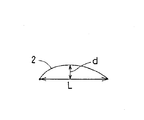
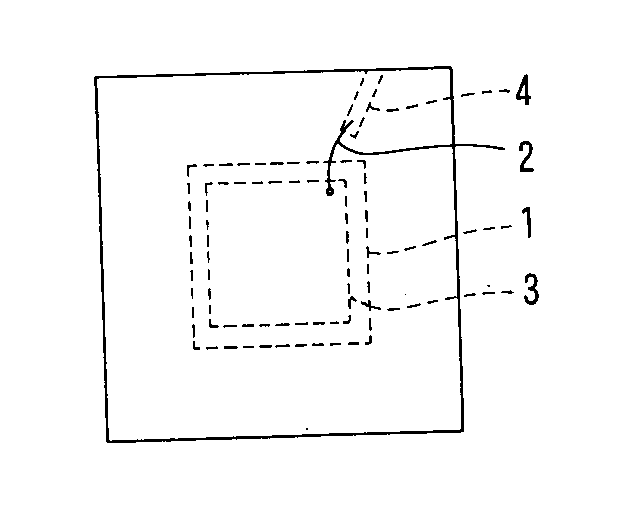
各エポキシ樹脂組成物を用い、金線ワイヤー(ワイヤー径23μm、ワイヤー長6mm)を張ったLQFP−144(大きさ:20mm×20mm×厚み1.4mm)を、TOWA社製の自動成型機(CPS−40L)により成形(条件:175℃×90秒)し、175℃×3時間で後硬化することにより半導体装置を製造した。すなわち、上記半導体装置の作製時において、図1に示すように、ダイパッド1を有するLQFP−144のパッケージフレームに金線ワイヤー2を張り、これを用い上記エポキシ樹脂組成物により樹脂封止してパッケージを作製した。図1において、3は半導体素子、4はリードピンである。そして、作製したパッケージを軟X線解析装置を用いて、金線ワイヤー流れ量を測定した。測定は、各パッケージから10本ずつ金線ワイヤーを選定して測定し、図2に示すように、正面方向からの金線ワイヤー2の流れ量を測定した。そして、金線ワイヤー2の流れ量の最大部分となる値をそのパッケージの金線ワイヤー流れ量の値(dmm)とし、金線流れ率〔(d/L)×100〕を算出した。なお、Lは金線ワイヤー2間の距離(mm)を示す。そして、上記金線流れ率が6%以上のものを×、6%未満4%以上のものを△、4%未満のものを○として表示した。
<Wire flow>
Using each epoxy resin composition, an LQFP-144 (size: 20 mm × 20 mm × thickness 1.4 mm) with a gold wire (wire diameter 23 μm, wire length 6 mm) is used as an automatic molding machine (CPS) manufactured by TOWA. −40 L) (conditions: 175 ° C. × 90 seconds) and post-cured at 175 ° C. × 3 hours to manufacture a semiconductor device. That is, at the time of manufacturing the semiconductor device, as shown in FIG. 1, a
〈高温高湿信頼性〉
上記のようにして作製した半導体装置に対して、130℃×85%RH環境下でのHAST試験(Highly Accelerated Steam and Temperatuer Test:半導体装置を130℃×85%RHの条件下で暴露しながら一定時間毎の抵抗値を測定:バイアスなし)を行なった。そして、HAST試験処理後の抵抗値の測定を行ない、この抵抗値の上昇率が10%以上であった場合を断線不良と判定し、この断線不良が発生するHAST処理時間を高温高湿信頼性における信頼性寿命時間とした。
<High temperature and high humidity reliability>
HAST test (Highly Accelerated Steam and Temperatuer Test: Highly Accelerated Steam and Temperatuer Test: 130 ° C x 85% RH, constant exposure to the semiconductor device manufactured as described above. The resistance value for each time was measured: no bias). Then, the resistance value after the HAST test processing is measured, and when the rate of increase in the resistance value is 10% or more, it is determined that the disconnection is defective, and the HAST processing time in which the disconnection failure occurs is determined as a high temperature and high humidity reliability. Reliable lifetime in
上記結果から、実施例品は、いずれも良好な硬化性を示しワイヤー流れに関しても良好な結果が得られた。また、高温高湿信頼性テストにおいても優れた結果が得られた。このことから、信頼性の高い半導体装置が得られたことがわかる。 From the above results, all of the example products showed good curability, and good results were obtained with respect to the wire flow. Excellent results were also obtained in the high temperature and high humidity reliability test. This shows that a highly reliable semiconductor device was obtained.
これに対して、シラン変性フェノール樹脂(C成分)が配合されていない比較例1品は、高温高湿信頼性テストにおいて非常に劣る評価結果が得られた。また、シラン変性フェノール樹脂(C成分)の配合量が特定範囲を外れ多すぎる設定である比較例2品は、硬化性に劣り、大きくワイヤー流れが発生してしまった。さらに、シラン変性フェノール樹脂(C成分)の配合量が特定範囲を外れ少なすぎる設定である比較例3品は、高温高湿信頼性テストにおいて非常に劣る評価結果が得られた。 On the other hand, the comparative example 1 product in which the silane-modified phenol resin (component C) was not blended gave a very poor evaluation result in the high temperature and high humidity reliability test. Moreover, the comparative example 2 goods which are the setting which the compounding quantity of a silane modified phenol resin (C component) remove | deviates from a specific range and is too much are inferior in sclerosis | hardenability, and the wire flow generate | occur | produced largely. Furthermore, the comparative example 3 product in which the blending amount of the silane-modified phenolic resin (component C) is too small outside the specific range gave a very poor evaluation result in the high temperature and high humidity reliability test.
本発明の半導体封止用エポキシ樹脂組成物は、成形性および高温高湿信頼性に優れた特性を示すものであり、各種半導体素子の封止材料として有用である。 The epoxy resin composition for semiconductor encapsulation of the present invention exhibits properties excellent in moldability and high temperature and high humidity reliability, and is useful as a sealing material for various semiconductor elements.
Claims (4)
(A)エポキシ樹脂。
(B)フェノール樹脂〔ただし、下記(C)成分を除く。〕。
(C)下記の一般式(1)で表されるシラン変性フェノール樹脂。
(E)無機質充填剤。 It is an epoxy resin composition for semiconductor sealing containing the following (A)-(E) component, Comprising: Content of the said (C) component is 0.8-30 with respect to the organic component of an epoxy resin composition. An epoxy resin composition for encapsulating a semiconductor, characterized by being 0.0% by weight.
(A) Epoxy resin.
(B) Phenolic resin [However, the following component (C) is excluded. ].
(C) A silane-modified phenol resin represented by the following general formula (1).
(E) Inorganic filler.
Priority Applications (6)
| Application Number | Priority Date | Filing Date | Title |
|---|---|---|---|
| JP2010285197A JP2012131902A (en) | 2010-12-21 | 2010-12-21 | Semiconductor sealing epoxy resin composition and semiconductor device using the same |
| CN2011104286165A CN102532807A (en) | 2010-12-21 | 2011-12-20 | Epoxy resin composition for semiconductor encapsulation and semiconductor device obtained using the same |
| SG2011094885A SG182115A1 (en) | 2010-12-21 | 2011-12-20 | Epoxy resin composition for semiconductor encapsulation and semiconductor device obtained using the same |
| US13/333,050 US20120153512A1 (en) | 2010-12-21 | 2011-12-21 | Epoxy resin composition for semiconductor encapsulation and semiconductor device obtained using the same |
| TW100147846A TW201245322A (en) | 2010-12-21 | 2011-12-21 | Epoxy resin composition for semiconductor encapsulation and semiconductor device obtained using the same |
| KR1020110139053A KR20120070526A (en) | 2010-12-21 | 2011-12-21 | Epoxy resin composition for semiconductor encapsulation and semiconductor device obtained using the same |
Applications Claiming Priority (1)
| Application Number | Priority Date | Filing Date | Title |
|---|---|---|---|
| JP2010285197A JP2012131902A (en) | 2010-12-21 | 2010-12-21 | Semiconductor sealing epoxy resin composition and semiconductor device using the same |
Publications (1)
| Publication Number | Publication Date |
|---|---|
| JP2012131902A true JP2012131902A (en) | 2012-07-12 |
Family
ID=46233345
Family Applications (1)
| Application Number | Title | Priority Date | Filing Date |
|---|---|---|---|
| JP2010285197A Pending JP2012131902A (en) | 2010-12-21 | 2010-12-21 | Semiconductor sealing epoxy resin composition and semiconductor device using the same |
Country Status (6)
| Country | Link |
|---|---|
| US (1) | US20120153512A1 (en) |
| JP (1) | JP2012131902A (en) |
| KR (1) | KR20120070526A (en) |
| CN (1) | CN102532807A (en) |
| SG (1) | SG182115A1 (en) |
| TW (1) | TW201245322A (en) |
Families Citing this family (6)
| Publication number | Priority date | Publication date | Assignee | Title |
|---|---|---|---|---|
| KR101252063B1 (en) | 2011-08-25 | 2013-04-12 | 한국생산기술연구원 | Epoxy Compound Having Alkoxysilyl Group, Preparing Method Thereof, Composition Comprising the Same and Cured Product and Use Thereof |
| WO2013066078A1 (en) | 2011-11-01 | 2013-05-10 | 한국생산기술연구원 | Isocyanurate epoxy compound having alkoxysilyl group, method of preparing same, composition including same, cured product of the composition, and use of the composition |
| EP2826777B1 (en) | 2012-03-14 | 2020-08-05 | Korea Institute of Industrial Technology | Epoxy compound having alkoxy silyl group, composition comprising same, cured product, use thereof and method for preparing epoxy compound having alkoxy silyl group |
| US10689482B2 (en) | 2012-04-02 | 2020-06-23 | Korea Institute Of Industrial Technology | Epoxy compound having alkoxysilyl group, composition and hardened material comprising same, use for same, and production method for epoxy compound having alkoxysilyl group |
| KR101863111B1 (en) * | 2012-07-06 | 2018-06-01 | 한국생산기술연구원 | Novolac-based epoxy compound, preparing method thereof, composition, cured product thereof, and use thereof |
| KR102232340B1 (en) | 2019-11-15 | 2021-03-26 | 한국생산기술연구원 | Composition of alkoxysilyl-functionalized epoxy resin and composite thereof |
Citations (6)
| Publication number | Priority date | Publication date | Assignee | Title |
|---|---|---|---|---|
| JPS6481848A (en) * | 1987-09-22 | 1989-03-28 | Sumitomo Chemical Co | Modified curing agent-containing epoxy resin composition |
| JPH02120315A (en) * | 1988-10-31 | 1990-05-08 | Sumitomo Bakelite Co Ltd | Epoxy resin composition |
| JPH03177416A (en) * | 1989-12-05 | 1991-08-01 | Denki Kagaku Kogyo Kk | Epoxy resin composition for semiconductor sealing use |
| JP2001002745A (en) * | 1999-04-22 | 2001-01-09 | Arakawa Chem Ind Co Ltd | Production of methoxy group-bearing silane-modified phenol resin |
| JP2005290191A (en) * | 2004-03-31 | 2005-10-20 | Tdk Corp | Resin composition, electronic part, coil body and inductor |
| JP2007132482A (en) * | 2005-11-14 | 2007-05-31 | Tokai Rubber Ind Ltd | Seismic isolation rubber laminate |
-
2010
- 2010-12-21 JP JP2010285197A patent/JP2012131902A/en active Pending
-
2011
- 2011-12-20 CN CN2011104286165A patent/CN102532807A/en active Pending
- 2011-12-20 SG SG2011094885A patent/SG182115A1/en unknown
- 2011-12-21 KR KR1020110139053A patent/KR20120070526A/en not_active Withdrawn
- 2011-12-21 US US13/333,050 patent/US20120153512A1/en not_active Abandoned
- 2011-12-21 TW TW100147846A patent/TW201245322A/en unknown
Patent Citations (6)
| Publication number | Priority date | Publication date | Assignee | Title |
|---|---|---|---|---|
| JPS6481848A (en) * | 1987-09-22 | 1989-03-28 | Sumitomo Chemical Co | Modified curing agent-containing epoxy resin composition |
| JPH02120315A (en) * | 1988-10-31 | 1990-05-08 | Sumitomo Bakelite Co Ltd | Epoxy resin composition |
| JPH03177416A (en) * | 1989-12-05 | 1991-08-01 | Denki Kagaku Kogyo Kk | Epoxy resin composition for semiconductor sealing use |
| JP2001002745A (en) * | 1999-04-22 | 2001-01-09 | Arakawa Chem Ind Co Ltd | Production of methoxy group-bearing silane-modified phenol resin |
| JP2005290191A (en) * | 2004-03-31 | 2005-10-20 | Tdk Corp | Resin composition, electronic part, coil body and inductor |
| JP2007132482A (en) * | 2005-11-14 | 2007-05-31 | Tokai Rubber Ind Ltd | Seismic isolation rubber laminate |
Also Published As
| Publication number | Publication date |
|---|---|
| SG182115A1 (en) | 2012-07-30 |
| TW201245322A (en) | 2012-11-16 |
| US20120153512A1 (en) | 2012-06-21 |
| CN102532807A (en) | 2012-07-04 |
| KR20120070526A (en) | 2012-06-29 |
Similar Documents
| Publication | Publication Date | Title |
|---|---|---|
| JP4692744B2 (en) | Epoxy resin composition for semiconductor encapsulation and semiconductor device | |
| JP5923942B2 (en) | Epoxy resin composition for semiconductor encapsulation and semiconductor device using the same | |
| TWI774852B (en) | Method of producing electronic component device | |
| JP7571814B2 (en) | Epoxy resin composition and electronic component device | |
| JP7571815B2 (en) | Encapsulating composition and semiconductor device | |
| JP2012131902A (en) | Semiconductor sealing epoxy resin composition and semiconductor device using the same | |
| JP5228496B2 (en) | Epoxy resin composition for semiconductor encapsulation and semiconductor device | |
| JP2024096265A (en) | Resin composition and electronic component device | |
| JP2017031371A (en) | Resin composition for encapsulating semiconductor and semiconductor device | |
| CN105551980B (en) | The preparation method of semiconductor device | |
| JP5386836B2 (en) | Semiconductor sealing resin composition and semiconductor device | |
| JP5169285B2 (en) | Epoxy resin composition for semiconductor encapsulation and semiconductor device | |
| JP5386837B2 (en) | Semiconductor sealing resin composition and semiconductor device | |
| JP7589435B2 (en) | Encapsulating resin composition, electronic component device, and method for manufacturing electronic component device | |
| JP5169288B2 (en) | Epoxy resin composition for semiconductor encapsulation and semiconductor device | |
| JP4452071B2 (en) | Method for producing epoxy resin composition for semiconductor encapsulation | |
| JP3582771B2 (en) | Epoxy resin composition and semiconductor device | |
| JP6953973B2 (en) | Curable resin composition, electronic component device and method for manufacturing electronic component device | |
| JP2024055627A (en) | Molding resin composition and electronic component device | |
| JP2006335835A (en) | Epoxy resin composition and semiconductor device | |
| JP2004026961A (en) | Epoxy resin composition and semiconductor device | |
| JP2003213090A (en) | Epoxy resin composition and semiconductor device | |
| JP2003261747A (en) | Epoxy resin composition for semiconductor encapsulation and semiconductor device using the same | |
| JP2003128763A (en) | Epoxy resin composition and semiconductor device |
Legal Events
| Date | Code | Title | Description |
|---|---|---|---|
| A621 | Written request for application examination |
Free format text: JAPANESE INTERMEDIATE CODE: A621 Effective date: 20120712 |
|
| A977 | Report on retrieval |
Free format text: JAPANESE INTERMEDIATE CODE: A971007 Effective date: 20130117 |
|
| A131 | Notification of reasons for refusal |
Free format text: JAPANESE INTERMEDIATE CODE: A131 Effective date: 20130122 |
|
| A02 | Decision of refusal |
Free format text: JAPANESE INTERMEDIATE CODE: A02 Effective date: 20130716 |