JP2012143233A - Composition and method to prevent aav vector aggregation - Google Patents
Composition and method to prevent aav vector aggregation Download PDFInfo
- Publication number
- JP2012143233A JP2012143233A JP2012040561A JP2012040561A JP2012143233A JP 2012143233 A JP2012143233 A JP 2012143233A JP 2012040561 A JP2012040561 A JP 2012040561A JP 2012040561 A JP2012040561 A JP 2012040561A JP 2012143233 A JP2012143233 A JP 2012143233A
- Authority
- JP
- Japan
- Prior art keywords
- aggregation
- vector
- virion
- ionic strength
- aav
- Prior art date
- Legal status (The legal status is an assumption and is not a legal conclusion. Google has not performed a legal analysis and makes no representation as to the accuracy of the status listed.)
- Granted
Links
Images

Classifications
-
- C—CHEMISTRY; METALLURGY
- C12—BIOCHEMISTRY; BEER; SPIRITS; WINE; VINEGAR; MICROBIOLOGY; ENZYMOLOGY; MUTATION OR GENETIC ENGINEERING
- C12N—MICROORGANISMS OR ENZYMES; COMPOSITIONS THEREOF; PROPAGATING, PRESERVING, OR MAINTAINING MICROORGANISMS; MUTATION OR GENETIC ENGINEERING; CULTURE MEDIA
- C12N7/00—Viruses; Bacteriophages; Compositions thereof; Preparation or purification thereof
-
- C—CHEMISTRY; METALLURGY
- C12—BIOCHEMISTRY; BEER; SPIRITS; WINE; VINEGAR; MICROBIOLOGY; ENZYMOLOGY; MUTATION OR GENETIC ENGINEERING
- C12N—MICROORGANISMS OR ENZYMES; COMPOSITIONS THEREOF; PROPAGATING, PRESERVING, OR MAINTAINING MICROORGANISMS; MUTATION OR GENETIC ENGINEERING; CULTURE MEDIA
- C12N2750/00—MICROORGANISMS OR ENZYMES; COMPOSITIONS THEREOF; PROPAGATING, PRESERVING, OR MAINTAINING MICROORGANISMS; MUTATION OR GENETIC ENGINEERING; CULTURE MEDIA ssDNA viruses
- C12N2750/00011—Details
- C12N2750/14011—Parvoviridae
- C12N2750/14111—Dependovirus, e.g. adenoassociated viruses
-
- C—CHEMISTRY; METALLURGY
- C12—BIOCHEMISTRY; BEER; SPIRITS; WINE; VINEGAR; MICROBIOLOGY; ENZYMOLOGY; MUTATION OR GENETIC ENGINEERING
- C12N—MICROORGANISMS OR ENZYMES; COMPOSITIONS THEREOF; PROPAGATING, PRESERVING, OR MAINTAINING MICROORGANISMS; MUTATION OR GENETIC ENGINEERING; CULTURE MEDIA
- C12N2750/00—MICROORGANISMS OR ENZYMES; COMPOSITIONS THEREOF; PROPAGATING, PRESERVING, OR MAINTAINING MICROORGANISMS; MUTATION OR GENETIC ENGINEERING; CULTURE MEDIA ssDNA viruses
- C12N2750/00011—Details
- C12N2750/14011—Parvoviridae
- C12N2750/14111—Dependovirus, e.g. adenoassociated viruses
- C12N2750/14151—Methods of production or purification of viral material
Landscapes
- Health & Medical Sciences (AREA)
- Life Sciences & Earth Sciences (AREA)
- Chemical & Material Sciences (AREA)
- Wood Science & Technology (AREA)
- Genetics & Genomics (AREA)
- Organic Chemistry (AREA)
- Engineering & Computer Science (AREA)
- Bioinformatics & Cheminformatics (AREA)
- Zoology (AREA)
- Biochemistry (AREA)
- General Health & Medical Sciences (AREA)
- Microbiology (AREA)
- Immunology (AREA)
- Biomedical Technology (AREA)
- Medicinal Chemistry (AREA)
- General Engineering & Computer Science (AREA)
- Biotechnology (AREA)
- Virology (AREA)
- Medicines Containing Material From Animals Or Micro-Organisms (AREA)
- Medicinal Preparation (AREA)
- Micro-Organisms Or Cultivation Processes Thereof (AREA)
- Medicines That Contain Protein Lipid Enzymes And Other Medicines (AREA)
- Lubricants (AREA)
- Curing Cements, Concrete, And Artificial Stone (AREA)
Abstract
Description
発明の分野
本発明は、凝集を防ぐ、AAVビリオンの製造および保存用組成物および方法に関するものである。
FIELD OF THE INVENTION This invention relates to AAV virion production and storage compositions and methods that prevent aggregation.
背景
組換えアデノ随伴ウイルス(rAAV)は、ヒト遺伝子導入のための有望なベクターである。Grimm, D., and Kleinschmidt, J. A. (1999) Hum Gene Ther. 10:2445-2450;High, K. A. (2001) Ann. N. Y. Acad. Sci. 953:64-67;Pfeifer, A., and Verma, I. M. (2001) Ann. Rev. Genomics Hum. Genet. 2:177-211を参照されたい。AAVは、パルボウイルスのディペンドウイルス(Dependovirus)属のメンバーである。AAV血清型2(AAV2)は、末端逆方向反復(ITR)配列にフランクした複製(rep)およびキャプシド形成(cap)遺伝子をコードする4680ヌクレオチドの1本鎖DNA分子から構成される。Berns, K. I. (1996) in Fields Virology (B. N. Fields et. al. Eds.), pp. 2173-2197. Lippincott-Raven Publishers, Philadelphiaを参照されたい。ゲノムは、cap遺伝子産物のアミノ末端変異体である3個のキャプシドタンパク質(VP1、VP2、およびVP3)によりパッケージされる。得られた正二十面体のウイルス粒子は直径〜26nmを有する。AAV2の高分解結晶構造が報告された。Xie, Q. et al. (2002) Proc. Natl. Acad. Sci. U.S.A. 99:10405-10410を参照されたい。
Background Recombinant adeno-associated virus (rAAV) is a promising vector for human gene transfer. Grimm, D., and Kleinschmidt, JA (1999) Hum Gene Ther. 10: 2445-2450; High, KA (2001) Ann. NY Acad. Sci. 953: 64-67; Pfeifer, A., and Verma, IM (2001) See Ann. Rev. Genomics Hum. Genet. 2: 177-211. AAV is a member of the genus Dependovirus of parvovirus. AAV serotype 2 (AAV2) is composed of a 4680 nucleotide single-stranded DNA molecule encoding a replication (rep) and capsid formation (cap) gene flanked by terminal inverted repeat (ITR) sequences. See Berns, KI (1996) in Fields Virology (BN Fields et. Al. Eds.), Pp. 2173-2197. Lippincott-Raven Publishers, Philadelphia. The genome is packaged by three capsid proteins (VP1, VP2, and VP3) that are amino terminal variants of the cap gene product. The resulting icosahedral virus particles have a diameter of ˜26 nm. A high resolution crystal structure of AAV2 has been reported. See Xie, Q. et al. (2002) Proc. Natl. Acad. Sci. USA 99: 10405-10410.
精製AAV2ウイルス粒子の溶解性には限界があり、そしてAAV2粒子の凝集が問題とされてきた。Croyle, M. A. et al. (2001) Gene Therapy 8:1281-1290;Huang, J. et al. (2000) Mol. Therapy 1: S286;Wright, J. F. et al. (2003) Curr. Opin. Drug Disc. Dev. 6:174-178;Xie, Q. et al. (2004) J. Virol. Methods 122:17-27を参照。通常用いられる緩衝食塩水溶液中では、有意な凝集は密度1013粒子/mLで生じ、密度が高くなればなるほど、凝集は増大する。Huangと共同研究者らは、AAVベクターが濃度依存性で凝集することを報告した。Huang, J. et al. (2000) Mol. Therapy 1:S286を参照。同様に、Xieと共同研究者ら(Xie, Q. et al. (2004) J. Virol. Methods 122: 17-27)は、0.1mg/mLを超える濃度で、AAV2ベクターが、凝集を防ぐための塩の濃度の上昇を必要とすることを報告した。AAV2ベクターの凝集は、リン酸緩衝食塩水およびTris緩衝食塩水のような通常用いられる中性緩衝溶液中1013粒子/mLを超える粒子密度で生じる。これは、タンパク質濃度〜0.06mg/mLに該当し、これらの条件下でAAV2の溶解性が低いこをを強調するものである。過剰のエンプティー(empty)キャプシドは同時に精製され、粒子密度に関与するので、カラムクロマトグラフィー技術を用いて精製されたベクターについての有効なベクター濃度の限界は、なおさらに低いかもしれない。 The solubility of purified AAV2 virus particles is limited, and aggregation of AAV2 particles has been a problem. Croyle, MA et al. (2001) Gene Therapy 8: 1281-1290; Huang, J. et al. (2000) Mol. Therapy 1: S286; Wright, JF et al. (2003) Curr. Opin. Drug Disc. Dev. 6: 174-178; Xie, Q. et al. (2004) J. Virol. Methods 122: 17-27. In the commonly used buffered saline solution, significant aggregation occurs at a density of 10 13 particles / mL, and the higher the density, the greater the aggregation. Huang and co-workers reported that AAV vectors aggregate in a concentration-dependent manner. See Huang, J. et al. (2000) Mol. Therapy 1: S286. Similarly, Xie and co-workers (Xie, Q. et al. (2004) J. Virol. Methods 122: 17-27) show that AAV2 vectors prevent aggregation at concentrations above 0.1 mg / mL. In order to report the need for increased salt concentration. Aggregation of AAV2 vectors occurs at particle densities greater than 10 13 particles / mL in commonly used neutral buffer solutions such as phosphate buffered saline and Tris buffered saline. This corresponds to a protein concentration of ~ 0.06 mg / mL and emphasizes the low solubility of AAV2 under these conditions. Since excess empty capsid is simultaneously purified and contributes to particle density, the limit of effective vector concentration for vectors purified using column chromatography techniques may be even lower.
粒子の凝集は有意なものであり、その上アデノウイルスベクターについては完全に解決された課題ではない。最近確立されたアデノウイルス関連材料(ARN)の安定性が最近報告された。Adadevoh, K. et al. (2002) BioProcessing 1(2):62-69を参照されたい。20mM Tris、25mM NaCl、および2.5% グリセロール(pH8.0)中で形成された関連材料の凝集が、動的光散乱法、光子相関分光法、および外観により評価された。凍結融解サイクルまたは非凍結保存を行った後、ベクターの凝集のレベルが変動し得ることが観察された。このことから、ARMの使用プロトコールは制限される。 Particle aggregation is significant, and adenoviral vectors are not a completely solved problem. The stability of recently established adenovirus-related material (ARN) has been recently reported. See Adadevoh, K. et al. (2002) BioProcessing 1 (2): 62-69. Aggregation of related materials formed in 20 mM Tris, 25 mM NaCl, and 2.5% glycerol (pH 8.0) was evaluated by dynamic light scattering, photon correlation spectroscopy, and appearance. It was observed that the level of vector aggregation could vary after freeze-thaw cycles or non-freeze storage. This limits the use protocol of ARM.
凝集は、精製中の損失、および精製されたベクター調製物の試験における矛盾を生じ得る。中枢神経系のようなある種の部位へのAAV2ベクターのインビボ投与は少量の高濃度ベクターを必要とし、最大達成可能用量は低いベクター溶解性により制限され得る。 Aggregation can result in loss during purification and inconsistencies in testing purified vector preparations. In vivo administration of AAV2 vectors to certain sites, such as the central nervous system, requires small amounts of high concentration vectors, and the maximum achievable dose can be limited by low vector solubility.
ベクターの凝集はまた、インビボ投与後の生体内分布に影響し、投与後にベクターに対して逆の免疫応答を引き起こすようである。タンパク質について報告(Braun, A. et al. (1997) Pharm. Res. 14:1472-1478)されたように、ベクターの凝集は、ベクターを抗原提示細胞にターゲティングし、キャプシドタンパク質および導入遺伝子産物に対する免疫応答の増強を誘発することにより、免疫原性を増大し得る。前臨床(Chenuaud, P. et al. (2004) Blood 103: 3303-3304;Flotte, T. R. (2004) Human Gene Ther. 15:716-717;Gao, G. et al. (2004) Blood 103:3300-3302)および臨床(High, K. A. et al. (2004) Blood 104:121a)研究におけるAAVベクターに対する免疫応答の報告は、ベクターの免疫原性に関与し得る全ての因子に対処する必要があることを説明するものである。 Aggregation of vectors also affects biodistribution after in vivo administration and appears to cause a reverse immune response against the vector after administration. As reported for proteins (Braun, A. et al. (1997) Pharm. Res. 14: 1472-1478), vector aggregation targets the vector to antigen-presenting cells and is directed against capsid proteins and transgene products. By inducing an enhanced immune response, immunogenicity can be increased. Preclinical (Chenuaud, P. et al. (2004) Blood 103: 3303-3304; Flotte, TR (2004) Human Gene Ther. 15: 716-717; Gao, G. et al. (2004) Blood 103: 3300 -3302) and reporting of immune responses to AAV vectors in clinical (High, KA et al. (2004) Blood 104: 121a) studies need to address all factors that may be involved in vector immunogenicity Is described.
精製ベクターを特徴付けるためのプロトコールの試験は、ベクターの凝集によっても影響されるようである。ベクターの感染価の決定はベクターの凝集に高感受性であることが報告された。Zhen, Z. et al. (2004) Human Gene Ther. 15: 709-715を参照されたい。重大な関心事は、ベクター凝集物は、それらの導入効率、生体内分布、および免疫原性が単量体粒子とは異なり得るので、インビボ投与後の有害な結果を有し得ることである。例えば、AAV2ベクターの肝細胞への血管内デリバリーには、ベクターが肝類洞壁の有窓内皮細胞を通ることが必要である。これらの有窓細胞は、単量体AAVベクター(直径〜26nm)の通過は可能だが、より大きなベクター凝集物の通過を防ぐと予想される、50から150nmの範囲の半径を有する(Meijer, K. D. F., and Molema, G. (1995) Sem. Liver Dis. 15:206)。マウスにおける生体内分布の研究では、蛍光分子Cy3で標識された凝集AAV2ベクターは、血管デリバリーの後、肝マクロファージにおいて補足された。Huang, J. et al. (2000) Mol. Therapy 1:S286を参照。 Testing protocols to characterize purified vectors appears to be affected by vector aggregation. Determination of vector infectivity was reported to be highly sensitive to vector aggregation. See Zhen, Z. et al. (2004) Human Gene Ther. 15: 709-715. Of significant concern is that vector aggregates can have deleterious consequences after in vivo administration because their transduction efficiency, biodistribution, and immunogenicity can differ from monomeric particles. For example, intravascular delivery of AAV2 vectors to hepatocytes requires that the vectors pass through fenestrated endothelial cells in the sinusoidal wall of the liver. These fenestrated cells have a radius in the range of 50 to 150 nm, which is expected to prevent passage of larger vector aggregates, although it can pass monomeric AAV vectors (diameter ˜26 nm) (Meijer, KDF , and Molema, G. (1995) Sem. Liver Dis. 15: 206). In biodistribution studies in mice, aggregated AAV2 vectors labeled with the fluorescent molecule Cy3 were captured in hepatic macrophages after vascular delivery. See Huang, J. et al. (2000) Mol. Therapy 1: S286.
ウイルスベースの導入ベクターのための製剤の開発は比較的最近の研究分野であり、AAVベクターの製剤および安定性を最適化するための組織的努力を記載した2、3の研究が報告されているのみである。Croyle, M. A. et al. (2001) Gene Therapy 8:1281-1290;Wright, J. F. et al. (2003) Curr. Opin. Drug Disc. Dev. 6:174-178;Xie, Q. et al. (2004) J. Virol. Methods 122:17-27を参照されたい。ベクター調製物における変化を最小化する、前臨床上および臨床上の適用に適合可能な製剤を決定することが、一貫して高いベクターの安定性および機能的特徴を達成するに重要な必要条件である。タンパク質療法について十分に確立されている(Chen, B. et al. (1994) J. Pharm. Sci. 83:1657-1661;Shire, S. J. et al. (2004) J. Pharm. Sci. 93:1390-1402;Wang, W. (1999) Int. J. Pharm. 185:129-188;Won, C. M. et al. (1998) Int. J. Pharm. 167:25-36)のように、ベクターの安定性の重要な見地は製造および保存中の溶解性であり、ベクターの凝集は完全に対処されることを必要とする問題である。ベクターの凝集はベクター精製中の損失を生じる一方、凝集物はろ過により除去され、収量における損失は、より高いコスト、および前臨床および臨床研究用のベクターを生成する場合のキャパシティーの限界となる。凝集物を除去するためのろ過の後でさえ、新たな凝集物が、緩衝食塩水溶液中のAAV2ベクターの高濃度調製物において形成され得る。 Development of formulations for virus-based transfer vectors is a relatively recent area of research, and a few studies have been reported that describe the formulation and organizational efforts to optimize the stability of AAV vectors. Only. Croyle, MA et al. (2001) Gene Therapy 8: 1281-1290; Wright, JF et al. (2003) Curr. Opin. Drug Disc. Dev. 6: 174-178; Xie, Q. et al. (2004 ) See J. Virol. Methods 122: 17-27. Determining formulations that are compatible with preclinical and clinical applications that minimize changes in vector preparations is an important requirement to achieve consistently high vector stability and functional characteristics. is there. Protein therapy is well established (Chen, B. et al. (1994) J. Pharm. Sci. 83: 1657-1661; Shire, SJ et al. (2004) J. Pharm. Sci. 93: 1390 -1402; Wang, W. (1999) Int. J. Pharm. 185: 129-188; Won, CM et al. (1998) Int. J. Pharm. 167: 25-36). An important aspect of sex is solubility during manufacture and storage, and vector aggregation is a problem that needs to be fully addressed. Aggregation of vectors results in losses during vector purification, while aggregates are removed by filtration, yield losses result in higher costs and capacity limitations when generating vectors for preclinical and clinical research . Even after filtration to remove aggregates, new aggregates can be formed in high concentration preparations of AAV2 vectors in buffered saline solution.
ウイルス粒子の凝集を防ぐ、rAAV2のようなAAVベクターの精製および保存のための改良された製剤および方法に対する必要がある。 There is a need for improved formulations and methods for purification and storage of AAV vectors, such as rAAV2, that prevent viral particle aggregation.
発明の概要
当該技術分野におけるこれらの要求および他の要求が本発明によって満たされ、そしてそれは、凍結融解サイクル後でさえ高い感染価および導入効率が維持されるAAVベクターの製造および保存において使用するための高いイオン強度溶液を提供する。
SUMMARY OF THE INVENTION These and other needs in the art are met by the present invention, which is for use in the production and storage of AAV vectors that maintain high infectivity and transduction efficiency even after freeze-thaw cycles. Provides a high ionic strength solution.
1つの態様において、本発明は、賦形剤を添加して、凝集を防ぐのに十分な高イオン強度を達成することにより、ビリオン調製物におけるビリオンの凝集を防ぐ方法に関するものである。別の態様において、本発明は、凝集を防ぐのに十分な高イオン強度を有するビリオン組成物に関するものである。 In one aspect, the present invention relates to a method of preventing virion aggregation in a virion preparation by adding excipients to achieve a high ionic strength sufficient to prevent aggregation. In another aspect, the invention relates to a virion composition having a high ionic strength sufficient to prevent aggregation.
本発明のある種の実施態様において、イオン強度は、少なくとも約150mM、200mM、250mM、300mM、350mM、400mM、450mM、500mM、600mM、700mMまたはそれ以上である。ある実施態様において、このイオン強度は、1種類以上の多価イオン、例えば、クエン酸塩、硫酸塩、マグネシウム、または硫酸塩を含む賦形剤を用いて達成される。 In certain embodiments of the invention, the ionic strength is at least about 150 mM, 200 mM, 250 mM, 300 mM, 350 mM, 400 mM, 450 mM, 500 mM, 600 mM, 700 mM or more. In certain embodiments, this ionic strength is achieved using an excipient comprising one or more multivalent ions, such as citrate, sulfate, magnesium, or sulfate.
さらなる実施態様において、イオン強度がビリオンの凝集を防ぐのに十分に高いものであったとしても、ビリオン調製物の浸透圧は、似通った等浸透圧レベル、例えば、200mOsm、250mOsm、280mOsm、300mOsm、350mOsm、または400mOsmで維持される。 In a further embodiment, even if the ionic strength is high enough to prevent aggregation of virions, the osmotic pressure of the virion preparation will be at a similar isosmotic level, eg, 200 mOsm, 250 mOsm, 280 mOsm, 300 mOsm, It is maintained at 350 mOsm or 400 mOsm.
ある実施態様において、ビリオンは、アデノ随伴ウイルス(AAV)ビリオン、例えば、AAV−2である。 In certain embodiments, the virion is an adeno-associated virus (AAV) virion, eg, AAV-2.
本発明の方法の他の実施態様において、ビリオン調製物は、ヌクレアーゼ、例えば、Benzonase[登録商標]で処理される。さらなる実施態様において、ヌクレアーゼ処理は、凝集を防ぐのに十分に高いイオン強度を達成する賦形剤の添加と組合わされる。 In another embodiment of the method of the invention, the virion preparation is treated with a nuclease, such as Benzonase®. In a further embodiment, nuclease treatment is combined with the addition of an excipient that achieves a sufficiently high ionic strength to prevent aggregation.
本発明のある実施態様において、界面活性剤Pluronic[登録商標]F68が、例えば、0.001%までビリオン調製物に添加される。1つの実施態様において、組成物は、精製ウイルス粒子、10mM Tris pH8.0、100mM クエン酸ナトリウム、および0.001% Pluronic[登録商標]F68を含む。 In certain embodiments of the invention, the surfactant Pluronic® F68 is added to the virion preparation, for example, up to 0.001%. In one embodiment, the composition comprises purified virus particles, 10 mM Tris pH 8.0, 100 mM sodium citrate, and 0.001% Pluronic® F68.
1つの実施態様において、AAVベクターは、1×10¹³vg/mLを超える濃度、例えば、2×1013、3×1013、4×1013、5×1013、および6.4×1013vg/mLまでの濃度で有意な凝集を示すことなく本発明の組成物として保存され得る。ある実施態様において、本発明の方法および組成物を用いて保存されたAAVベクターは、4℃にて5日間保存されたとき、有意な凝集を示さない。他の実施態様において、かかる組成物として保存されたAAVベクターは、−20℃または−80℃で凍結融解サイクルを1回、5回、10回、またはそれ以上行った後、有意な凝集を示さない。 In one embodiment, the AAV vector has a concentration greater than 1 × 10 13 vg / mL, such as 2 × 10 13 , 3 × 10 13 , 4 × 10 13 , 5 × 10 13 , and 6.4 × 10 13. It can be stored as a composition of the invention without showing significant aggregation at concentrations up to vg / mL. In certain embodiments, AAV vectors stored using the methods and compositions of the invention do not show significant aggregation when stored at 4 ° C. for 5 days. In other embodiments, AAV vectors stored as such compositions exhibit significant aggregation after one, five, ten, or more freeze-thaw cycles at -20 ° C or -80 ° C. Absent.
ある実施態様において、本発明の方法および組成物により保存されたビリオン調製物は、動的光散乱により測定された場合に平均的粒子半径(Rh)を示す。これは、ビリオンの有意な凝集が全く起こらなかったことを示す。ある実施態様において、本発明の方法および組成物により保存されたビリオン調製物は、約15nm、20nm、または30nmより大きい平均的粒子半径(Rh)を示す。 In certain embodiments, virion preparations stored by the methods and compositions of the present invention exhibit an average particle radius (Rh) as measured by dynamic light scattering. This indicates that no significant aggregation of virions occurred. In certain embodiments, virion preparations stored by the methods and compositions of the invention exhibit an average particle radius (Rh) greater than about 15 nm, 20 nm, or 30 nm.
ある実施態様において、本発明の方法および組成物により保存されたビリオン調製物からのビリオンの回収率は、0.22μmのフィルターを通してろ過した後、約85%、90%、または95%より高い。 In certain embodiments, the recovery of virions from virion preparations stored by the methods and compositions of the present invention is greater than about 85%, 90%, or 95% after filtration through a 0.22 μm filter.
なお別の実施態様において、本発明は、本発明の高いイオン強度製剤を含むキットに関するものである。1つの実施態様において、キットは、予め混合された賦形剤溶液を含む。別の実施態様において、キットは、本発明の高いイオン強度組成物の2種類以上の成分を別々に含み、これは使用者により混合され得る。ある実施態様において、キットは、クエン酸ナトリウム、Tris[登録商標]、およびPluronic[登録商標]F68を含む。他の実施態様において、キットは、本発明の組成物の製造、あるいは本発明の方法の実施のための指示書をさらに含む。 In yet another embodiment, the present invention relates to a kit comprising the high ionic strength formulation of the present invention. In one embodiment, the kit includes a premixed excipient solution. In another embodiment, the kit includes two or more components of the high ionic strength composition of the present invention separately, which can be mixed by the user. In certain embodiments, the kit comprises sodium citrate, Tris®, and Pluronic® F68. In other embodiments, the kit further comprises instructions for the manufacture of the composition of the invention or the performance of the method of the invention.
発明の詳細な説明
AAV2ベクターの凝集は、ベクターの高濃度調製物において頻繁に観察され、そして精製、回収、およびインビボでの能力および安全性に影響を及ぼし得る。ゆえに、AAV2ベクターの開発にとって重要な目的は、高濃度ストックが調製されるときにベクターの凝集を防ぐ方法および製剤を同定することである。
DETAILED DESCRIPTION OF THE INVENTION Aggregation of AAV2 vectors is frequently observed in high concentration preparations of vectors and can affect purification, recovery, and in vivo performance and safety. Thus, an important objective for the development of AAV2 vectors is to identify methods and formulations that prevent vector aggregation when high concentration stocks are prepared.
特に示さない限り、本明細書において用いられる用語「ベクター」は、組換えAAVビリオン、またはウイルス粒子に言及し、「ベクター」が頻繁に用いられるにも関わらず、他の文脈においてはプラスミドのような非ウイルスDNA分子にも言及する。 Unless otherwise indicated, the term “vector” as used herein refers to recombinant AAV virions, or virions, and in other contexts like plasmids, although “vectors” are frequently used. Reference is also made to non-viral DNA molecules.
本発明は、凝集過程におけるウイルス粒子間のイオン相互作用の関与を示唆する、溶液のイオン強度がAAVベクター凝集の重要なパラメーターであるという知見に一部基づくものである。イオン強度の上昇が、荷電賦形剤の同一性に関わらず、AAV2ベクターの溶解性を増大させるという知見は、特定のイオン種に関与する相互作用よりむしろ溶液自体のイオン強度が、関連する物理化学的パラメーターであるという仮説を支持するものである。少なくとも200mMの閾値イオン強度が、本明細書で調べられるベクター粒子密度での凝集を防ぐのに必要とされる。 The present invention is based in part on the finding that solution ionic strength is an important parameter for AAV vector aggregation, suggesting the involvement of ionic interactions between virus particles in the aggregation process. The finding that an increase in ionic strength, regardless of the identity of the charged excipient, increases the solubility of the AAV2 vector is that the ionic strength of the solution itself, rather than the interaction involved in a particular ionic species, is related to the physical It supports the hypothesis that it is a chemical parameter. A threshold ionic strength of at least 200 mM is required to prevent aggregation at the vector particle density investigated herein.
実際的な関心事のうち、通常用いられる緩衝食塩水溶液は、1013粒子/mLを超える密度でのAAV2ベクターの凝集を防ぐのに十分なイオン強度を有する。高い塩濃度は、AAV2ベクターの溶解性を増大させることが知られている(例えば、勾配から回収された高濃度AAV2ベクターは、一般に、高濃度CsClに溶解性のままである)。しかしながら、前臨床および臨床研究に最適な製剤は、特に、高張液の希釈が遅い可能性のある部位へのベクターのインビボ投与のため、等張(280〜400mOsm)近くであるべきである。本発明の実施態様において、イオン強度の荷電価数との指数関数的関係を用いて、高いイオン強度を有する等張製剤が開発される。ヒト非経腸製剤における賦形剤として通常用いられる複数の電荷価数を有する塩種(例えば、硫酸塩、クエン酸塩、およびリン酸塩)は、等張濃度で用いられるとき、AAV2ベクターの凝集を防ぐために必要とされるイオン強度レベルをもたらし得る。等張(150mM)塩化ナトリウムは、イオン強度150mM(高いベクター濃度でのAAV2の溶解性を維持するのに十分な値である)を有する一方、イオン強度〜500mMを有する等張クエン酸ナトリウムは、少なくとも6.4×1013vg/mLのAAV2ベクター濃度を凝集することなく支持することができる。 Of practical concern, commonly used buffered saline solutions have sufficient ionic strength to prevent aggregation of AAV2 vectors at densities greater than 10 13 particles / mL. High salt concentrations are known to increase the solubility of AAV2 vectors (eg, high concentration AAV2 vectors recovered from a gradient generally remain soluble in high concentration CsCl). However, the optimal formulation for preclinical and clinical studies should be close to isotonic (280-400 mOsm), especially for in vivo administration of the vector to sites where hypertonic solution dilution may be slow. In an embodiment of the invention, an isotonic formulation with high ionic strength is developed using an exponential relationship between ionic strength and charge valence. Salt species with multiple charge valences commonly used as excipients in human parenteral preparations (eg, sulfate, citrate, and phosphate), when used at isotonic concentrations, It can result in the ionic strength level required to prevent agglomeration. Isotonic (150 mM) sodium chloride has an ionic strength of 150 mM (a value sufficient to maintain the solubility of AAV2 at high vector concentrations), while an isotonic sodium citrate having an ionic strength of ~ 500 mM is AAV2 vector concentrations of at least 6.4 × 10 13 vg / mL can be supported without aggregation.
理論により制限されることを意図するのではないが、AAV2粒子の低い溶解性は、凝集物における隣接粒子間の相補的に荷電した領域の安定効果と併せてそれらの高度に対称的な性質により引き起こされ得る。AAV2の結晶構造に基づく表面電荷密度(Xie, Q. et al. (2002) Proc. Natl. Acad. Sci. U.S.A. 99:10405-10410)は、ウイルス表面上の正および負の電荷パターンを示す。従前の報告により、AAV2ベクターの凝集がpH依存性であることが示され、荷電した側鎖基を有するアミノ酸が粒子間結合に関与するとの仮説が立てられた。Qu, G. et al. (2003) Mol. Therapy 7:S238を参照。これらの報告により、荷電したアミノ酸側鎖がベクターの凝集に関与するなら、高濃度の遊離アミノ酸がベクター粒子の相互作用をブロックし得るとの仮説が立てられた。しかしながら、本発明者らは、荷電した側鎖を有するアミノ酸は、それらのイオン強度への関与を超えてAAV2ベクターの凝集を防ぐ際に有効でないことを見出した。 While not intending to be limited by theory, the low solubility of AAV2 particles is due to their highly symmetric nature in conjunction with the stabilizing effects of complementary charged regions between adjacent particles in the aggregate. Can be caused. Surface charge density based on the crystal structure of AAV2 (Xie, Q. et al. (2002) Proc. Natl. Acad. Sci. U.S.A. 99: 10405-10410) shows positive and negative charge patterns on the virus surface. Previous reports have shown that aggregation of AAV2 vectors is pH dependent and hypothesized that amino acids with charged side chain groups are involved in interparticle binding. See Qu, G. et al. (2003) Mol. Therapy 7: S238. These reports hypothesized that if charged amino acid side chains are involved in vector aggregation, high concentrations of free amino acids may block vector particle interactions. However, the inventors have found that amino acids with charged side chains are not effective in preventing AAV2 vector aggregation beyond their involvement in ionic strength.
低いイオン強度でのベクターの凝集は、精製ベクター粒子の有効なヌクレアーゼ処理により低減されるが、阻止されないことも見出した。精製過程の初期工程における消化(清澄化HEK細胞溶解物)は、ベクター精製後の凝集を低減しなかった。核酸基質に対する酵素の割合がより高いので、既に精製されたビリオンの消化はより有効なようである。これらの結果を説明する1つのメカニズムは、ベクター表面に結合した残りの核酸不純物(例えば、宿主細胞およびプラスミドDNA)が、隣接するウイルス粒子上の結合部位をもたらし、これにより凝集を生じ得るということである。精製AAV2ベクター(エンプティーキャプシドなし)は、約1%の非ベクターDNAを含有することが報告された。Smith, P. et al. (2003) Mol. Therapy 7:S348を参照。この非ベクターDNAの>50%が、ヌクレアーゼ耐性であり、キャプシド粒子内にパッケージされることが報告された。一方、不純物DNAのうち、ヌクレアーゼ耐性であり、精製ベクター粒子の表面と結合するように思われるものもあった。有効なヌクレアーゼ処理がベクターの凝集を低減し得るという知見により、1個のベクター粒子当たり25ヌクレオチド以下の平均的レベルでベクター表面と結合する核酸がAAVベクターの凝集に関与し得ることが示唆される。 It has also been found that vector aggregation at low ionic strength is reduced but not prevented by effective nuclease treatment of purified vector particles. Digestion in the early stages of the purification process (clarified HEK cell lysate) did not reduce aggregation after vector purification. Digestion of already purified virions appears to be more effective because of the higher enzyme to nucleic acid substrate ratio. One mechanism that accounts for these results is that residual nucleic acid impurities (eg, host cells and plasmid DNA) bound to the vector surface can result in binding sites on adjacent viral particles, which can result in aggregation. It is. Purified AAV2 vector (no empty capsid) was reported to contain about 1% non-vector DNA. See Smith, P. et al. (2003) Mol. Therapy 7: S348. It has been reported that> 50% of this non-vector DNA is nuclease resistant and packaged in capsid particles. On the other hand, some impurity DNAs are nuclease resistant and appear to bind to the surface of purified vector particles. The finding that effective nuclease treatment can reduce vector aggregation suggests that nucleic acids that bind to the vector surface at an average level of 25 nucleotides or less per vector particle may be involved in AAV vector aggregation. .
要約すると、AAV2ベクターの精製中の高いイオン強度溶液の使用および最終製剤、ならびに残りのベクター表面DNAの有効な除去は、前臨床および臨床研究において使用するためのAAV2ベクターの高濃度溶液を達成するための2つの有効なストラテジーである。高いイオン強度溶液およびヌクレアーゼ処理は、組み合わせて、または別々に用いられ得る。データはAAV2ベクターを用いて得られたものだが、本発明の組成物および方法は、他のAAV血清型/変異体、またはアデノウイルス、レンチウイルス、およびレトロウイルスのような他のウイルスベクターにも有用であり得る。 In summary, the use and final formulation of high ionic strength solutions during the purification of AAV2 vectors, and the effective removal of the remaining vector surface DNA, achieves high concentration solutions of AAV2 vectors for use in preclinical and clinical studies. There are two effective strategies for this. High ionic strength solutions and nuclease treatments can be used in combination or separately. Although the data was obtained using AAV2 vectors, the compositions and methods of the invention apply to other AAV serotypes / variants or other viral vectors such as adenoviruses, lentiviruses, and retroviruses. Can be useful.
賦形剤の濃度の関数としてのAAVの凝集
AAVベクターの凝集の機序を明らかにし、凝集を低減/阻止し得る賦形剤の種類を同定するために、最初のスクリーニング実験を行う。低い濃度の緩衝液(20mM リン酸ナトリウム,pH7.2)を含む中性緩衝食塩水においてベクターを希釈(5倍)して、ベクターの凝集を引き起こすことができる。希釈液に含まれるとき、ベクターの凝集を防ぐことができる賦形剤を同定するための「希釈圧力(dilution-stress)」法を用いて、賦形剤をスクリーニングする。スクリーニングのため、動的光散乱(DLS)により凝集を測定する。調べた賦形剤の種類は、選択した無機塩類、アミノ酸、非荷電炭水化物、および界面活性剤を含むものであった。結果を表1に表す。
Aggregation of AAV as a Function of Excipient Concentration Initial screening experiments are performed to elucidate the mechanism of AAV vector aggregation and identify the types of excipients that can reduce / prevent aggregation. The vector can be diluted (5-fold) in neutral buffered saline containing a low concentration of buffer (20 mM sodium phosphate, pH 7.2) to cause vector aggregation. Excipients are screened using a “dilution-stress” method to identify excipients that can prevent vector aggregation when included in the diluent. For screening, aggregation is measured by dynamic light scattering (DLS). The types of excipients investigated included selected inorganic salts, amino acids, uncharged carbohydrates, and surfactants. The results are shown in Table 1.
表1
希釈圧力法を用いた、AAV2ベクターの凝集を防ぐ賦形剤についてのスクリーニング
Screening for excipients that prevent aggregation of AAV2 vectors using the dilution pressure method
表1に示す通り、荷電した賦形剤(無機塩およびアミノ酸)は、十分な濃度で存在するとき、凝集を防ぐ。しかしながら、ベクターの凝集を防ぐのに必要な塩濃度は変動し、それは、硫酸マグネシウムについて180mOsmから塩化ナトリウムについて320mOsmの範囲に及ぶ。アミノ酸のアルギニン、アスパラギン酸、グルタミン酸、グリシン、ヒスチジン、およびリジンは、200mOsmで凝集を阻止しないが、リジン、アスパラギン酸、およびグルタミン酸は、300〜320mOsmで凝集を防ぐ。アルギニン、グリシン、およびヒスチジンは、200mOsm以外の濃度で試験しなかった。選択した炭水化物は、5%w/vまでの濃度で存在するとき、ベクター粒子の凝集に対する効果を全く有さない。例えば、5%w/v グリセロール(543mOsm)は凝集を阻止しない。界面活性剤のポリソルベート80(1%w/v)およびPluronic[登録商標]F68(10%w/v)は、同様に、「希釈圧力」法を用いた凝集に対する効果を全く有さない。 As shown in Table 1, charged excipients (inorganic salts and amino acids) prevent aggregation when present in sufficient concentrations. However, the salt concentration required to prevent vector aggregation varies, ranging from 180 mOsm for magnesium sulfate to 320 mOsm for sodium chloride. The amino acids arginine, aspartic acid, glutamic acid, glycine, histidine, and lysine do not prevent aggregation at 200 mOsm, whereas lysine, aspartic acid, and glutamic acid prevent aggregation at 300-320 mOsm. Arginine, glycine, and histidine were not tested at concentrations other than 200 mOsm. Selected carbohydrates have no effect on vector particle aggregation when present at concentrations up to 5% w / v. For example, 5% w / v glycerol (543 mOsm) does not prevent aggregation. The surfactants polysorbate 80 (1% w / v) and Pluronic® F68 (10% w / v) likewise have no effect on aggregation using the “dilution pressure” method.
浸透圧およびイオン強度の関数としてのAAVの凝集
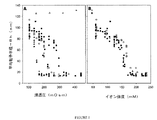
図1Aおよび1Bは、ベクターの凝集のより詳細な分析の結果を種々の塩の濃度の関数として示す。図1Aは、ベクターの凝集を選択した賦形剤の浸透圧の関数として示す。荷電した種について、AAV2ベクターの凝集の濃度依存性阻害を観察する。多価イオンを有する塩は、1価の塩化ナトリウムより低い濃度で同程度の凝集阻害を達成する。例えば、硫酸マグネシウムは200mOsmで凝集を防ぐが、塩化ナトリウムは同様の効果を達成するのに350mOsmを必要とする。クエン酸ナトリウム、硫酸ナトリウム、およびリン酸ナトリウムは、ベクター凝集を防ぐそれらの有効性の中間である。
Aggregation of AAV as a Function of Osmotic Pressure and Ionic Strength FIGS. 1A and 1B show the results of a more detailed analysis of vector aggregation as a function of various salt concentrations. FIG. 1A shows vector aggregation as a function of osmolarity of selected excipients. For charged species, observe concentration-dependent inhibition of AAV2 vector aggregation. Salts with multivalent ions achieve the same degree of aggregation inhibition at lower concentrations than monovalent sodium chloride. For example, magnesium sulfate prevents aggregation at 200 mOsm, whereas sodium chloride requires 350 mOsm to achieve a similar effect. Sodium citrate, sodium sulfate, and sodium phosphate are intermediate between their effectiveness in preventing vector aggregation.
図1Aおよび表1の結果は、グリセロールおよび5%までの濃度でのある種の糖の、低いイオン強度により誘発されるAAV2ベクターの凝集に対する効果を全く示していないが、データにより、5%より高いグリセロール濃度でのAAV2の溶解性の改善を除外することはできない。例えば、Xieと共同研究者らは、25%(w/v) グリセロールが、低いイオン強度溶液においてAAV2を非常に高濃度(4.4から18×1014粒子/ml)まで濃縮できることを報告した。Xie, Q. et al. (2004) J. Virol. Methods 122:17-27を参照されたい。 The results in FIG. 1A and Table 1 show no effect of glycerol and certain sugars at concentrations up to 5% on aggregation of AAV2 vectors induced by low ionic strength, but the data show that An improvement in the solubility of AAV2 at high glycerol concentrations cannot be ruled out. For example, Xie and co-workers have reported that 25% (w / v) glycerol can concentrate AAV2 to very high concentrations (4.4 to 18 × 10 14 particles / ml) in low ionic strength solutions. . See Xie, Q. et al. (2004) J. Virol. Methods 122: 17-27.
図1Bは、図1Aのデータを、それぞれの賦形剤について浸透圧ではなく計算したイオン強度の関数としてプロットしたものを示す。図1Bは、用いる塩に関わらず、イオン強度が200mM以上のとき、ベクターの凝集は阻止されることを示している。これらのデータは、溶質濃度および電荷価数の両方に依存するパラメーターである溶液のイオン強度(μ)が、凝集に影響する1次因子であることを示唆するものであった。 FIG. 1B shows a plot of the data of FIG. 1A as a function of calculated ionic strength rather than osmotic pressure for each excipient. FIG. 1B shows that vector aggregation is prevented when the ionic strength is 200 mM or higher, regardless of the salt used. These data suggested that the ionic strength (μ) of the solution, a parameter that depends on both solute concentration and charge valence, is the primary factor affecting aggregation.
本発明の実施態様において凝集を防ぐのに有用なイオン強度は、例えば、250mM、300mM、350mM、400mM、450mM、500mM、600mM、700mM、またはそれより高いイオン強度を含む。本発明の方法および製剤においてこれらのイオン強度を達成するには多価イオンが好ましく、例えば、2価、3価、4価、5価のイオン、およびそれより高い価数のイオンである。本発明の溶液および製剤におけるpHバッファーは、リン酸塩、Tris、またはHEPES(または他の良好なバッファー)であってもよく、任意の他の適当なpHバッファーが用いられてもよい。好ましい実施態様において、製造されるベクターの標的組織と相性のよい多価イオンおよびバッファーが選択される。 Ionic strengths useful for preventing aggregation in embodiments of the present invention include, for example, ionic strengths of 250 mM, 300 mM, 350 mM, 400 mM, 450 mM, 500 mM, 600 mM, 700 mM, or higher. Multivalent ions are preferred to achieve these ionic strengths in the methods and formulations of the present invention, such as divalent, trivalent, tetravalent, pentavalent, and higher valence ions. The pH buffer in the solutions and formulations of the present invention may be phosphate, Tris, or HEPES (or other good buffer), and any other suitable pH buffer may be used. In a preferred embodiment, multivalent ions and buffers that are compatible with the target tissue of the vector to be produced are selected.
本発明の方法および組成物における多価イオンの使用により、比較的低い浸透圧だが、高いイオン強度の組成物を生成することが可能になる。本発明の高いイオン強度の組成物は、ほぼ等張であってもよく、例えば、約200mOsm、250mOsm、280mOsm、300mOsm、350mOsm、または400mOsmであってもよいが、他の浸透圧は、組成物のある種の使用に許容され得る。 The use of multivalent ions in the methods and compositions of the present invention makes it possible to produce compositions with relatively low osmotic pressure but high ionic strength. The high ionic strength compositions of the present invention may be approximately isotonic, for example, about 200 mOsm, 250 mOsm, 280 mOsm, 300 mOsm, 350 mOsm, or 400 mOsm, although other osmotic pressures may be May be acceptable for certain uses.
AAVの精製方法の関数としてのAAVの凝集
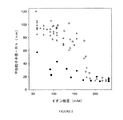
異なる方法(例えば、密度勾配精製対イオン交換クロマトグラフィー)により精製された組換えAAV2は、異なる不純物プロファイルを有すると予測される。図2は、精製方法の異なるいくつかのAAV調製物について、イオン強度の関数としてベクターの凝集を示す。精製方法は実施例1に記載されている。塩化ナトリウムを用いて、イオン強度を変動させる。2回塩化セシウム勾配超遠心(方法1)、陽イオン交換カラムクロマトグラフィー(方法2)、または合わせたカラムおよび塩化セシウム勾配超遠心(方法3)により精製されたAAV2−FIXベクターはそれぞれ、イオン強度が低減するにつれ、類似の凝集応答を示す。対照的に、カラム方法による精製、次に、ヌクレアーゼ消化工程(方法2+ヌクレアーゼ)の対象とされたAAV2−FIXは、低いイオン濃度での凝集の低減を示す。
Aggregation of AAV as a function of AAV purification methods Recombinant AAV2 purified by different methods (eg, density gradient purification versus ion exchange chromatography) is expected to have different impurity profiles. FIG. 2 shows vector aggregation as a function of ionic strength for several AAV preparations with different purification methods. The purification method is described in Example 1. Sodium chloride is used to vary the ionic strength. AAV2-FIX vectors purified by double cesium chloride gradient ultracentrifugation (Method 1), cation exchange column chromatography (Method 2), or combined column and cesium chloride gradient ultracentrifugation (Method 3) each have ionic strength. Shows a similar aggregation response as. In contrast, AAV2-FIX targeted for purification by column method followed by nuclease digestion step (Method 2+ Nuclease) shows reduced aggregation at low ion concentrations.
製造的スケールでのAAVの凝集
表1、および図1A、1B、および2のデータは、分析的スケール(凝集を測定するためのDLSを利用する)でのベクターの凝集に関連する。対照的に、表2は、製造的スケールのベクター精製に相当する、ベクターの凝集を誘発し、定量するための方法を用いて、ラージスケールでのAAV2ベクターの凝集に対する上昇したイオン強度およびヌクレアーゼ処理の効果を示す。実験の詳細を実施例2に記載する。精製AAVベクターを、種々のイオン強度の溶液中にダイアフィルトレーションし、容量を低減して、高いベクター濃度を達成し、次に、0.22μmのフィルターを通してろ過した後のベクターの回収率を測定することにより、凝集を評価する。方法1ないし第2のCsCl勾配遠心工程(91mL中1.8×10¹⁵vg、〜3M CsCl中1.8×10¹³vg/mL)により精製したAAV2−AADCベクターの単一プールからのアリコートを、ダイアフィルトレーション実験の出発材料として用いる。中空糸を用いたタンジェンシャルフローフィルトレーションをダイアフィルトレーションのために用いる。なぜなら、それはスケールの拡大縮小が可能であり、様々な容量(最小1.4mL)の調製も可能であるため、中性緩衝食塩水中で凝集が生じると予測される濃度にAAVを濃縮できるからである。
Aggregation of AAV on a Production Scale The data in Table 1 and FIGS. 1A, 1B, and 2 are related to the aggregation of vectors on an analytical scale (utilizing DLS to measure aggregation). In contrast, Table 2 shows increased ionic strength and nuclease treatment for AAV2 vector aggregation on a large scale using a method for inducing and quantifying vector aggregation, corresponding to production-scale vector purification. The effect of Experimental details are described in Example 2. Purified AAV vectors are diafiltered into solutions of various ionic strengths to reduce the volume to achieve high vector concentrations and then vector recovery after filtration through a 0.22 μm filter. Aggregation is evaluated by measuring. Aliquots from a single pool of AAV2-AADC vectors purified by Method 1 through the second CsCl gradient centrifugation step (1.8 × 10 15 vg in 91 mL, 1.8 × 10 13 vg / mL in 3M CsCl) Used as starting material for diafiltration experiments. Tangential flow filtration using hollow fibers is used for diafiltration. Because it can scale up and down, and can be prepared in various volumes (minimum 1.4 mL), it can concentrate AAV to the concentration expected to aggregate in neutral buffered saline. is there.
実験1において、3個の中空糸単位を用いて、製剤CF、TF1、またはTF2においてAAV2−AADCベクターをダイアフィルトレーションし、容量を目標の2.5×10¹³vg/mLまで低減する。実施例2を参照されたい。次に、試料を0.22μmのフィルターを通してろ過する。結果を表2に示す。上昇したイオン強度製剤TF1(95±7.4%)およびTF2(93±7.4%)両方についてのベクター回収率(「収率%」)は、対照製剤CFを用いた回収率(77±6.6%)より有意に高い。 In Experiment 1, three hollow fiber units are used to diafilter the AAV2-AADC vector in the formulation CF, TF1, or TF2 to reduce the volume to the target 2.5 × 10 13 vg / mL. See Example 2. The sample is then filtered through a 0.22 μm filter. The results are shown in Table 2. Vector recovery (“yield%”) for both elevated ionic strength formulations TF1 (95 ± 7.4%) and TF2 (93 ± 7.4%) is the recovery using control formulation CF (77 ± 6.6%).
表2
処理スケールでのAAVベクターの回収率
Recovery rate of AAV vectors at processing scale
実験2において、AAV2−AADCをCFまたはTF2においてより高い目標値(6.7×10¹³vg/mL)まで濃縮する。TF2を用いたベクターの回収率(96±4.4%)は、再度、CFを用いた回収率(59±6.0%)より有意に高い。用いたアッセイの変化内、TF2を用い目標濃度の両方でベクターを完全に回収した。これは、凝集が阻止されたことを示す。対照において、CFを用いた目標濃度の両方で有意な凝集を観察し、凝集の程度(すなわち、0.22μmろ過後の損失)は、目標ベクター濃度が高くなるほど、高くなった。さらなる実験(示していない)において、実験2の濃縮後、0.22μmろ過工程前にAAV2ベクター試料50μLを採取し、次に、光学顕微鏡により調べる。CFにおいて濃縮したベクターは、明らかな量の目に見える物質を含有し(示していない)、一方、かかる物質は、TF2において濃縮したベクターにおいて全く観察されない。
In Experiment 2, AAV2-AADC is concentrated to a higher target value (6.7 × 10 13 vg / mL) in CF or TF2. The recovery rate of the vector using TF2 (96 ± 4.4%) is again significantly higher than the recovery rate using CF (59 ± 6.0%). Within the variation of the assay used, the vector was fully recovered at both target concentrations using TF2. This indicates that aggregation has been prevented. In controls, significant aggregation was observed at both target concentrations with CF, and the degree of aggregation (ie loss after 0.22 μm filtration) increased with higher target vector concentration. In a further experiment (not shown), after enrichment of
実験3は、精製ベクターのヌクレアーゼ消化前の凝集に対する効果を調べるものである。ヌクレアーゼ消化がない場合、CFにおけるAAV2−AADCの回収率は、68±11%であり、これは実験1および2における回収率に類似する。対照において、ヌクレアーゼ処理し、次に、CFにおいて濃縮した精製ベクターはより高い回収率(91±12%)となる。これらの製造用スケールの結果は、「希釈圧力」(分析的スケール)法を用いた図2に示すヌクレアーゼ消化の効果と同じ効果を反映する。 Experiment 3 examines the effect of the purified vector on aggregation prior to nuclease digestion. In the absence of nuclease digestion, the recovery of AAV2-AADC in CF is 68 ± 11%, which is similar to the recovery in experiments 1 and 2. In the control, the purified vector treated with nuclease and then concentrated in CF has a higher recovery (91 ± 12%). These production scale results reflect the same effect as the nuclease digestion effect shown in FIG. 2 using the “dilution pressure” (analytical scale) method.
表2に表す結果は、本発明の方法および組成物が、AAVベクターの回収率を増大させることを示す。例えば、本発明の種々の実施態様において、回収率は、約80%未満から少なくとも約85%、90%、95%、またはそれ以上まで改善される。 The results presented in Table 2 indicate that the methods and compositions of the present invention increase AAV vector recovery. For example, in various embodiments of the invention, recovery is improved from less than about 80% to at least about 85%, 90%, 95%, or more.
保存または凍結融解サイクル後のAAVの安定性および活性
Croyleと共同研究者らは、リン酸ナトリウム緩衝液において凍結融解サイクルを複数回行った後のAAVおよびアデノウイルスのタイターの有意な損失を報告し、リン酸カリウムによりもたらされるより良好なpHの緩衝化により、凍結融解サイクル中のタイターの損失が阻止されることを示した。Croyle, M. A. et al. (2001) Gene Therapy 8: 1281-1290を参照されたい。本発明者らのリン酸ナトリウムを用いた凍結融解の安定性の研究の結果は、これらの知見を支持するものである。本発明者らは、150mM リン酸ナトリウムが、高濃度のAAV2−AADCベクターの調製および非凍結保存中の凝集を防ぐのに十分なイオン強度をもたらすが、−20または−80℃での1回の凍結融解サイクルでさえ凝集を生じることを見出した。
AAV stability and activity after storage or freeze-thaw cycles
Croyle and co-workers reported a significant loss of AAV and adenovirus titer after multiple freeze-thaw cycles in sodium phosphate buffer, with better pH buffering provided by potassium phosphate. It has been shown that crystallization prevents the loss of titer during freeze-thaw cycles. See Croyle, MA et al. (2001) Gene Therapy 8: 1281-1290. The results of our study of freeze-thaw stability using sodium phosphate support these findings. We have shown that 150 mM sodium phosphate provides sufficient ionic strength to prevent aggregation during the preparation and non-freezing storage of high concentrations of AAV2-AADC vector, but once at -20 or -80 ° C. It has been found that even freeze-thaw cycles of this cause aggregation.
保存または凍結融解(F/T)サイクル後のAAVの安定性を、本発明の緩衝液において次の通り評価する。CF、TF1、およびTF2において調製した高濃度のベクター(表2、実験1)を短期間の安定性の研究の対象とし、凝集が冷蔵保存中または複数回の凍結融解(F/T)サイクル後に生じ得るかどうかを評価する。未希釈の試料を用いたDLSにより凝集を評価し、Rh値>20nmがあるレベルの凝集の発生を示すとみなす。 The stability of AAV after storage or freeze-thaw (F / T) cycles is evaluated in the buffer of the invention as follows. High concentrations of vectors prepared in CF, TF1, and TF2 (Table 2, Experiment 1) were the subject of short-term stability studies, where aggregation occurred during refrigeration or after multiple freeze-thaw (F / T) cycles. Evaluate whether it can occur. Aggregation is assessed by DLS using undiluted samples and is considered to exhibit a certain level of aggregation with Rh values> 20 nm.
表3
AAV2ベクターの概要
ベクター濃度(vg/mL):CF:1.93E13、TF1:2.38E13、TF2:2.33E13
TH:過剰の凝集のため、シグナル強度があまりに高く測定できない
Table 3
Overview of AAV2 vectors
TH: Signal intensity is too high to measure due to excessive aggregation
表3に示すとおり、CFにおいて調製したAAV2−AADCベクターは、4℃で5日間の保存後、ならびに−20または−80℃での1回以上のF/Tサイクル後にいくらかの凝集を示す。TF1において調製したベクターについては、4℃で5日間保存後に凝集は全く生じなかったが、−20または−80℃での1回のF/Tサイクル後に凝集が生じる(測定するにはシグナル強度があまりに高く、DLSにより示す)。これらの試料の外観検査は若干の懸濁を示し、そしてそれは凝集と一致する。TF2において調製したベクターについては、4℃での保存後または−20℃でのF/Tサイクル10回まで、凝集は全く観察されない。−80℃での5および10回のF/Tサイクル後、凝集がいくらか観察される。 As shown in Table 3, AAV2-AADC vectors prepared in CF show some aggregation after 5 days storage at 4 ° C and after one or more F / T cycles at -20 or -80 ° C. For the vectors prepared in TF1, no aggregation occurred after storage at 4 ° C. for 5 days, but aggregation occurred after one F / T cycle at −20 or −80 ° C. Too high, indicated by DLS). Visual inspection of these samples showed some suspension, which is consistent with agglomeration. For vectors prepared in TF2, no aggregation is observed after storage at 4 ° C. or up to 10 F / T cycles at −20 ° C. Some aggregation is observed after 5 and 10 F / T cycles at −80 ° C.
TF2における保存またはF/Tサイクル後のAAV活性を、次の通り評価する。上述の通り、高いイオン強度、等張な製剤TF2は、濃縮および保存中のベクターの凝集を効果的に防ぎ、それゆえ、さらなる研究の前途有望な候補を表している。重要な疑問は、高いイオン強度のTF2におけるベクターの調製および保存が、その機能活性に反対に影響するかどうかということである。これを評価するために、TF2において長時間調製し、保存したベクターの感染価および導入効率を測定するためのアッセイを行う。 AAV activity after storage in TF2 or after F / T cycle is assessed as follows. As mentioned above, the high ionic strength, isotonic formulation TF2 effectively prevents aggregation of the vector during concentration and storage and therefore represents a promising candidate for further study. An important question is whether the preparation and storage of the vector in high ionic strength TF2 adversely affects its functional activity. To evaluate this, an assay is performed to measure the infectivity and transfer efficiency of the vector prepared and stored for a long time in TF2.
感染性については、1回の感染現象を検出可能な高感度の感染性アッセイを用いる。Zhen, Z. et al. (2004) Human Gene Ther. 15:709-715を参照されたい。AAV2−AADCを濃度6.4×10¹³vg/mLにてTF2中に調製する。4℃にて45日間保存後、調製物は、感染単位に対するベクターゲノムの比(vg/IU)13を有し、これに対して参照ベクターの値は16vg/IUである。この差は、報告されたこのアッセイの変動性(RSD〜50%)を与えるほど有意ではない。 For infectivity, a highly sensitive infectivity assay capable of detecting a single infectious phenomenon is used. See Zhen, Z. et al. (2004) Human Gene Ther. 15: 709-715. AAV2-AADC is prepared in TF2 at a concentration of 6.4 × 10 13 vg / mL. After 45 days storage at 4 ° C., the preparation has a vector genome to infectious unit ratio (vg / IU) of 13, whereas the reference vector value is 16 vg / IU. This difference is not significant enough to give the reported variability of this assay (RSD-50%).
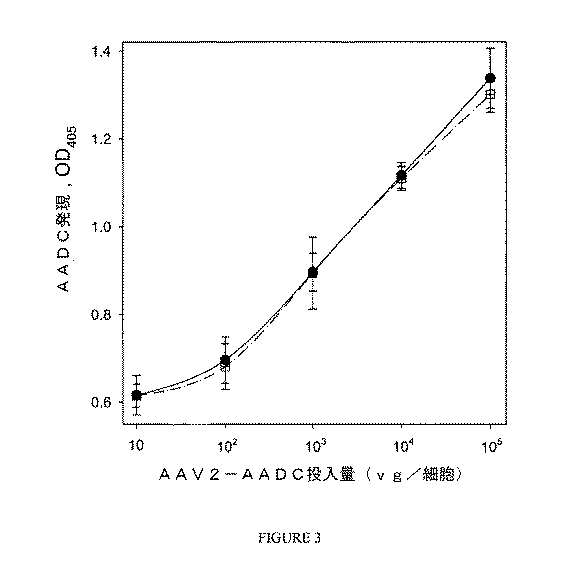
D7/4細胞を形質導入後、ELISAによりAADCタンパク質の発現を測定することにより、形質導入効率を評価する。図3は、10から105vg/細胞までの範囲のベクター投入量について、TF2において調製したベクターと参照対照との間で有意差がないことを示す。さらに、これらのデータは、高いイオン強度のTF2におけるAAV2ベクターの調製および保存が、ベクターの感染性または導入効率に対して有害な効果を有さないことを示す。 After transduction of D7 / 4 cells, the transduction efficiency is evaluated by measuring the expression of AADC protein by ELISA. FIG. 3 shows that there is no significant difference between the vector prepared in TF2 and the reference control for vector inputs ranging from 10 to 10 5 vg / cell. Furthermore, these data indicate that the preparation and storage of AAV2 vectors in high ionic strength TF2 has no detrimental effect on vector infectivity or transfer efficiency.
結論
ウイルス粒子の相互作用に対するイオン強度(μ)の効果を決定し、ベクターの凝集の機序を解明する。中性緩衝等張食塩水(μ=150mM)のイオン強度は、〜1013粒子/mLを超える密度での勾配超遠心または陽イオン交換クロマトグラフィーにより精製したAAV2ベクターの凝集を防ぐのに十分である。5%(w/v)までの濃度の糖(ソルビトール、スクロース、マンニトール、トレハロース、グリセロール)または界面活性剤Tween80[登録商標](1%)またはPluronic[登録商標]F68(10%)の含有は、ベクター粒子の凝集を阻止しない。
Conclusions Determine the effect of ionic strength (μ) on viral particle interactions and elucidate the mechanism of vector aggregation. The ionic strength of neutral buffered isotonic saline (μ = 150 mM) is sufficient to prevent aggregation of AAV2 vectors purified by gradient ultracentrifugation or cation exchange chromatography at densities greater than −10 13 particles / mL. is there. Containing up to 5% (w / v) sugars (sorbitol, sucrose, mannitol, trehalose, glycerol) or surfactant Tween 80 [1] (1%) or Pluronic [R] F68 (10%) Does not prevent aggregation of vector particles.
対照的に、精製中および最終ベクター製剤のために、上昇したイオン強度の溶液(μ>200mM)を用いるとき、ベクター粒子は依然溶解性である。インビボ投与のための等張賦形剤濃縮物を用いた上昇したイオン強度の溶液を、クエン酸ナトリウム、リン酸ナトリウム、および硫酸マグネシウムを含む多価イオンの塩を用いて調製する。10mM Tris、100mM クエン酸ナトリウム、0.001% Pluronic[登録商標]F68、pH8.0(μ〜500mM)を含有する等張製剤により、AAV2−AADCベクターを6.4×10¹³vg/mLまで濃縮可能であり、調製中および−20℃で凍結融解サイクルを10回行った後に観察される凝集が全くない。以下の表3および付随の考察を参照されたい。上昇したイオン強度の製剤にて長時間調製し、保存したAAV2−AADCベクターは、高い感染価(13IU/vg)および導入効率を保持する。 In contrast, vector particles are still soluble when using elevated ionic strength solutions (μ> 200 mM) during purification and for final vector formulations. Elevated ionic strength solutions using isotonic excipient concentrates for in vivo administration are prepared using salts of multivalent ions including sodium citrate, sodium phosphate, and magnesium sulfate. An isotonic formulation containing 10 mM Tris, 100 mM sodium citrate, 0.001% Pluronic® F68, pH 8.0 (μ-500 mM) allows the AAV2-AADC vector to be up to 6.4 × 10 13 vg / mL It can be concentrated and there is no aggregation observed during preparation and after 10 freeze-thaw cycles at −20 ° C. See Table 3 below and accompanying discussion. The AAV2-AADC vector prepared and stored for a long time in a formulation with increased ionic strength retains a high infectivity titer (13 IU / vg) and transduction efficiency.
精製AAV2ベクターのヌクレアーゼ処理は、ベクターの凝集の程度を低減し、このことは粒子間相互作用におけるベクター表面の核酸不純物の関与を示唆する。ゆえに、上昇したイオン強度の等張製剤の使用と組み合わせた、ベクター表面の残りの核酸を有効に除去するための精製方法が、AAV2ベクターの凝集を防ぐのに有用な方法である。 Nuclease treatment of purified AAV2 vectors reduces the degree of vector aggregation, suggesting the involvement of vector surface nucleic acid impurities in particle-particle interactions. Therefore, a purification method to effectively remove the remaining nucleic acid on the vector surface in combination with the use of an isotonic formulation with increased ionic strength is a useful method to prevent AAV2 vector aggregation.
実施例1
AAV精製方法
ヒト凝固因子IX(FIX)またはヒトアミノ酸デカルボキシラーゼ(AADC)を発現するAAV2ベクターを、既に記載(Matsushita, T. et al. (1998) Gene Therapy 5:938-945)の通り(変更含む)、HEK293細胞のトリプルトランスフェクションにより生成する。ラージスケールの調製のため、細胞を850mm2のローラーボトル(Corning)にて培養し、トランスフェクションする。ベクターを3種類の方法のうちの1つで精製する。
Example 1
AAV purification method AAV2 vectors expressing human coagulation factor IX (FIX) or human amino acid decarboxylase (AADC) have been modified as previously described (Matsushita, T. et al. (1998) Gene Therapy 5: 938-945). And) by triple transfection of HEK293 cells. For large scale preparation, cells are cultured and transfected in 850 mm 2 roller bottles (Corning). The vector is purified in one of three ways.
精製方法1(Matsushitaから変更されている)において、ローラーボトル中のトランスフェクションしたHEK293細胞を遠心(1000g、15分)により回収し、10mM リン酸ナトリウム、500mM 塩化ナトリウム,pH7.2に再懸濁し、次に、3回の凍結融解サイクル(エタノール/ドライアイスバスおよび37℃のウォーターバスを交互)により溶解する。細胞溶解物を遠心(8000g、15分)により清澄化する。次に、10mM リン酸ナトリウム,pH7.2を添加して、上清を200mM NaClまで希釈し、Benzonase[登録商標](Merck, Purity Grade 1;200U/mL、1時間、37℃)を用いて消化する。溶解物を25mM CaCI2まで1M ストック溶液を用いて調節し、4℃で1時間インキュベーションする。 In purification method 1 (modified from Matsushita), transfected HEK293 cells in roller bottles are recovered by centrifugation (1000 g, 15 min) and resuspended in 10 mM sodium phosphate, 500 mM sodium chloride, pH 7.2. Next, thaw by three freeze / thaw cycles (alternating ethanol / dry ice bath and 37 ° C. water bath). The cell lysate is clarified by centrifugation (8000 g, 15 min). Next, 10 mM sodium phosphate, pH 7.2 is added, the supernatant is diluted to 200 mM NaCl, and Benzonase® (Merck, Purity Grade 1; 200 U / mL, 1 hour, 37 ° C.) is used. Digest. Lysates are adjusted with 1M stock solution to 25 mM CaCI 2 and incubated at 4 ° C. for 1 hour.
混合物を遠心(8000g、15分)し、ベクターを含有する上清を回収する。清澄化した細胞溶解物からウイルスを沈殿させるために、ポリエチレングリコール(PEG8000)を最終濃度8%まで添加し、混合物を4℃にて3時間インキュベーションし、次に遠心(8000g、15分)する。ベクターを含有するペレットを、混合しながら0.15M NaCl、50mM Hepes、25mM EDTA、pH8.0中に再懸濁し、4℃で16時間インキュベーションする。再懸濁した材料をプールし、固体塩化セシウムを最終密度1.40gm/mlまで添加する。次に、BeckmanモデルLE−80遠心機を用いた超遠心(SW28、27000rpm、24時間、20℃)により、ベクターをバンド化する。遠心チューブを画分化し、ベクターを含有する密度1.38から1.42gm/mL部分をプールする。この材料を超遠心(NVT65ローター、65000rpm、16時間、20℃)によって2回目のバンド化し、精製AAV2ベクターを含有する分画をプールする。ベクターを濃縮し、バッファー交換を行うために、高濃度塩化セシウム溶液中のベクターを、以下(実施例2)に記載のタンジェンシャルフローフィルトレーションによる限外ろ過/ダイアフィルトレーション(UF/DF)の対象とする。 The mixture is centrifuged (8000 g, 15 min) and the supernatant containing the vector is collected. In order to precipitate the virus from the clarified cell lysate, polyethylene glycol (PEG 8000) is added to a final concentration of 8%, the mixture is incubated at 4 ° C. for 3 hours, and then centrifuged (8000 g, 15 minutes). The pellet containing the vector is resuspended in 0.15 M NaCl, 50 mM Hepes, 25 mM EDTA, pH 8.0 with mixing and incubated at 4 ° C. for 16 hours. Pool the resuspended material and add solid cesium chloride to a final density of 1.40 gm / ml. Next, the vector is banded by ultracentrifugation (SW28, 27000 rpm, 24 hours, 20 ° C.) using a Beckman model LE-80 centrifuge. The centrifuge tube is fractionated and the density 1.38 to 1.42 gm / mL portion containing the vector is pooled. This material is banded a second time by ultracentrifugation (NVT65 rotor, 65000 rpm, 16 hours, 20 ° C.) and fractions containing purified AAV2 vector are pooled. In order to concentrate the vector and perform buffer exchange, the vector in the high concentration cesium chloride solution was subjected to ultrafiltration / diafiltration (UF / DF) by tangential flow filtration as described below (Example 2). ).
精製方法2において、AAVを含有する細胞回収物をマイクロ流動化し、続いて、0.65および0.22μmのフィルター(Sartorius)を通してろ過する。既に記載のPoros HS50樹脂を用いた陽イオン交換クロマトグラフィーにより、ウイルスを清澄化細胞溶解物から精製する。米国特許第6,593,123号を参照。図2に記載のヌクレアーゼ消化のために、カラム精製ベクターを、100U/mL Benzonaseおよび10U/mL DNAse I(RNAseフリー、Roche Diagnostics, Indianapolis, Indiana)と共にインキュベーション(4時間、室温)する。 In purification method 2, the cell harvest containing AAV is microfluidized and subsequently filtered through 0.65 and 0.22 μm filters (Sartorius). Virus is purified from clarified cell lysates by cation exchange chromatography using the previously described Poros HS50 resin. See U.S. Patent No. 6,593,123. For the nuclease digestion described in FIG. 2, the column purification vector is incubated (4 hours, room temperature) with 100 U / mL Benzonase and 10 U / mL DNAse I (RNAse free, Roche Diagnostics, Indianapolis, Indiana).
精製方法3のため、陽イオン交換クロマトグラフィーにより精製したAAV2ベクターを、さらに塩化セシウム勾配超遠心工程(SW28、27000rpm、20時間)の対象とし、UF/DF前にエンプティーキャプシドを除去する。 For purification method 3, the AAV2 vector purified by cation exchange chromatography is further subjected to a cesium chloride gradient ultracentrifugation step (SW28, 27000 rpm, 20 hours), and the empty capsid is removed before UF / DF.
リアルタイム定量的PCR(Q−PCR)を用いて、上述のAAV調製物を定量する。Sommer, J. M. et al. (2003) Mol. Therapy 7:122-128を参照。3種類の方法それぞれにより精製したベクターを、SDS−PAGE/銀染色分析により分析し、全てのケースで、VP1、VP2、およびVP3が予測した割合で存在し、さらに、キャプシドタンパク質は走査濃度測定により決定した総タンパク質の>95%を表す。しかしながら、方法2(カラムクロマトグラフィー)により精製したベクターは、方法1および3により精製した勾配精製AAV2ベクター同様、エンプティーキャプシドを含有し、これは1ベクターゲノム当たり3〜10個のエンプティーキャプシド範囲に渡る。 Real-time quantitative PCR (Q-PCR) is used to quantify the AAV preparation described above. See Sommer, J. M. et al. (2003) Mol. Therapy 7: 122-128. Vectors purified by each of the three methods were analyzed by SDS-PAGE / silver staining analysis, and in all cases, VP1, VP2, and VP3 were present in the expected proportions, and capsid protein was determined by scanning concentration measurement. Represents> 95% of the determined total protein. However, the vector purified by Method 2 (column chromatography), like the gradient purified AAV2 vector purified by Methods 1 and 3, contains an empty capsid, which ranges from 3 to 10 empty capsids per vector genome. .
実施例2
AAV2の凝集を検出するための限外ろ過およびダイアフィルトレーション
使い捨ての中空糸タンジェンシャルフローフィルトレーション装置(Amersham BioSciences 8" Midgee、100kDaの通常の孔サイズ)を用いて、上述の方法および表2に記載のUF/DF実験について記載の方法により精製したAAV2ベクターを濃縮し、ダイアフィルトレーションする。全UF/DF方法のため、10×生成物容量に該当するダイアフィルトレーションバッファー容量を用い、それを〜1mLずつの増加にて添加し、ほぼ連続してダイアフィルトレーションする。この方法を用いて、ダイアフィルトレーション後に計測した残りのCsClは、<0.5mMである。
Example 2
Ultrafiltration and diafiltration to detect AAV2 aggregation Using the disposable hollow fiber tangential flow filtration device (Amersham BioSciences 8 "Midgee, 100 kDa typical pore size), the method and table above. Concentrate and diafilter the AAV2 vector purified by the method described for the UF / DF experiment described in 2. For all UF / DF methods, use a diafiltration buffer volume corresponding to 10 × product volume. And add it in ˜1 mL increments and diafiltered almost continuously, using this method, the remaining CsCl measured after diafiltration is <0.5 mM.
UF/DFについては、次の3種類の製剤:対照製剤(CF:140mM 塩化ナトリウム、10mM リン酸ナトリウム、5% ソルビトール、pH7.3);試験製剤1(TF1:150mM リン酸ナトリウム、pH7.5);および試験製剤2(TF2:100mM クエン酸ナトリウム、10mM Tris、pH8.0)を用いた。表2に示す実験について、ベクター濃度1×10¹³vg/mLに該当する容量でダイアフィルトレーションを行い、ダイアフィルトレーション後、2.5×1013vg/mL(ベクターの損失は全くないと仮定)に該当する値まで容量を低減する。 For UF / DF, the following three formulations: Control formulation (CF: 140 mM sodium chloride, 10 mM sodium phosphate, 5% sorbitol, pH 7.3); Test formulation 1 (TF1: 150 mM sodium phosphate, pH 7.5) ); And test formulation 2 (TF2: 100 mM sodium citrate, 10 mM Tris, pH 8.0). For the experiments shown in Table 2, diafiltration was performed at a volume corresponding to a vector concentration of 1 × 10 13 vg / mL, and after diafiltration, 2.5 × 10 13 vg / mL (no loss of vector) The capacity is reduced to a value corresponding to
実験2について、2×10¹³vg/mLに該当する容量でダイアフィルトレーションを行い、次に、容量を6.7×1013vg/mLに該当する値に低減する。 For experiment 2, diafiltration is performed at a volume corresponding to 2 × 10 13 vg / mL, and then the volume is reduced to a value corresponding to 6.7 × 10 13 vg / mL.
実験3(CF±Bz)について、AAV2−AADC(約1.2×10¹⁴vg)をまず、TF1(ヌクレアーゼ活性と適合し得る製剤)にダイアフィルトレーションし、次に、0.22μmのフィルターに通す。この材料のタイターを決定し、容量を濃度1×10¹³vg/mLになるよう調節する。この材料10mLに、MgCl2を濃度2mMまで添加し、次に2つの等しいアリコートに分配する。第1のアリコートをBenzonase(200U/mL、4時間、RT)と共にインキュベーションし、第2のアリコートを偽インキュベーションする。次に、それぞれのアリコートを、ベクター濃度2×1013vg/mLに該当する容量でダイアフィルトレーションし、次に、目標3.6×1013vg/mLまで濃縮する。全UF/DFプロトコールの後、1% ストックのPluronic[登録商標]F−68(BASF Corp., Mount Olive, NJ)を最終濃度0.001%までベクター生成物に添加し、溶液を0.22μmのシリンジフィルター(Sartorius)に通す。全UF/DF方法を、ラミナーフローキャビネット内で行う。 For experiment 3 (CF ± Bz), AAV2-AADC (approximately 1.2 × 10 14 vg) is first diafiltered into TF1 (a formulation compatible with nuclease activity) and then a 0.22 μm filter. Pass through. Determine the titer of this material and adjust the volume to a concentration of 1 × 10 13 vg / mL. To 10 mL of this material, add MgCl 2 to a concentration of 2 mM and then distribute into two equal aliquots. The first aliquot is incubated with Benzonase (200 U / mL, 4 hours, RT) and the second aliquot is mock-incubated. Each aliquot is then diafiltered at a volume corresponding to a vector concentration of 2 × 10 13 vg / mL and then concentrated to a target of 3.6 × 10 13 vg / mL. After the entire UF / DF protocol, 1% stock Pluronic® F-68 (BASF Corp., Mount Olive, NJ) is added to the vector product to a final concentration of 0.001% and the solution is 0.22 μm. Pass through a syringe filter (Sartorius). All UF / DF methods are performed in a laminar flow cabinet.
実施例3
動的光散乱によるベクターの凝集の測定
Protein Solutions DynaPro 99(λ=825.4nm)を用いた動的光散乱(DLS)により、精製ベクターを凝集について分析する。1次データ(粒子半径−Rh、30サイクル、10サイクル/分に渡り測定した平均値)を、報告した分析全てについて用いる。「希釈圧力」法を用いて、ベクター凝集に対する種々の賦形剤の効果を評価する。この方法において、試験希釈液80μLをベクター溶液20μLに、DLS測定のために用いる実測用キュベット中で混合しながら添加し、データの収集を混合10秒以内に開始する。試験希釈物の添加前に、AAV2ベクター調製物のRh値を測定し、<15nmであることを確かめ、出発材料が単量体であることを確認する。100%単量体でない試料は、0.22μmのシリンジディスクフィルター(Sartorius、低タンパク質結合)に通して凝集物を除去する。
Example 3
Measurement of vector aggregation by dynamic light scattering.
The purified vector is analyzed for aggregation by dynamic light scattering (DLS) using Protein Solutions DynaPro 99 (λ = 825.4 nm). Primary data (particle radius—Rh, average measured over 30 cycles, 10 cycles / min) is used for all reported analyses. The “dilution pressure” method is used to evaluate the effect of various excipients on vector aggregation. In this method, 80 μL of test diluent is added to 20 μL of vector solution with mixing in a measurement cuvette used for DLS measurement, and data collection begins within 10 seconds of mixing. Prior to the addition of the test dilution, the Rh value of the AAV2 vector preparation is measured to confirm that it is <15 nm and to confirm that the starting material is monomeric. Samples that are not 100% monomer are passed through a 0.22 μm syringe disc filter (Sartorius, low protein binding) to remove aggregates.
図1および2において示す浸透圧およびイオン強度値を、混合物(すなわち、重量:試験希釈液(80%)および出発ベクター製剤(20%))に存在する全ての賦形剤を用いて計算する。浸透圧を、方程式:
実施例4
AAVビリオンの感染性
AAV2−AADCベクターの感染性を既に記載の高感度アッセイを用いて決定する。Zhen, Z. et al. (2004) Human Gene Ther. 15:709-715を参照されたい。簡単に言うと、試料を連続希釈(10倍希釈、10複製物/希釈)し、10% FBSを含有するDMEM培地中96ウェル組織培養プレート(Falcon,カタログ番号353227)にて成長させたD7/4細胞(AAVrepおよびcapを発現する改変HeLa細胞)に添加する。アデノウイルス(Ad−5、100vp/細胞)を各ウェルに添加し、ヘルパー機能を提供する。48時間後、各ウェルにおけるAAVベクターの複製を、導入遺伝子特異的プライマーおよびプローブを用いたQ−PCRにより定量し、限界希釈における感染頻度を、Karber法により分析し、感染価を計算する。CFにおいて予め調製し、−80℃で保存した参照AAV2−AADCと同時に、試験試料を実施する。
Example 4
AAV virion infectivity The infectivity of the AAV2-AADC vector is determined using a sensitive assay as previously described. See Zhen, Z. et al. (2004) Human Gene Ther. 15: 709-715. Briefly, D7 / samples were serially diluted (10-fold dilution, 10 replicates / dilution) and grown in 96-well tissue culture plates (Falcon, catalog number 353227) in DMEM medium containing 10% FBS. Add to 4 cells (modified HeLa cells expressing AAVrep and cap). Adenovirus (Ad-5, 100 vp / cell) is added to each well to provide helper function. After 48 hours, AAV vector replication in each well is quantified by Q-PCR using transgene-specific primers and probes, and the frequency of infection at limiting dilution is analyzed by the Karber method to calculate the infectivity titer. Test samples are run simultaneously with a reference AAV2-AADC prepared in CF and stored at −80 ° C.
AAV2ベクターの導入効率を、全細胞ELISAにより定量する。10から105vg/細胞投入量(5複製物/希釈)に該当する試験試料および参照ベクターの10倍連続希釈物を用いて、96ウェルプレートで成長させたD7/4細胞を感染させる。48時間後、培地を除去し、細胞をPBS(10mM リン酸ナトリウム、140mM 塩化ナトリウム,pH7.2)200μLで2回洗浄する。次に、細胞を透過処理し、0.5% Triton X−100および4% パラホルムアルデヒドを含有するPBS 100μLを各ウェルに添加(15分)して、固定する。固定液を除去し、0.5% TritonX−100を含有するPBSで2回、細胞を洗浄する。3% ウシ血清アルブミン(BSA)および0.5% TritonX−100を含有するPBSを添加して、非特異的部位をブロックする(60分間)。 The introduction efficiency of the AAV2 vector is quantified by whole cell ELISA. D7 / 4 cells grown in 96-well plates are infected with test samples corresponding to 10 to 10 5 vg / cell input (5 replicates / dilution) and a 10-fold serial dilution of the reference vector. After 48 hours, the medium is removed and the cells are washed twice with 200 μL of PBS (10 mM sodium phosphate, 140 mM sodium chloride, pH 7.2). The cells are then permeabilized and fixed by adding 100 μL of PBS containing 0.5% Triton X-100 and 4% paraformaldehyde to each well (15 minutes). Remove fixative and wash cells twice with PBS containing 0.5% Triton X-100. PBS containing 3% bovine serum albumin (BSA) and 0.5% Triton X-100 is added to block non-specific sites (60 minutes).
洗浄後、細胞をウサギ抗AADC IgG抗体(Chemicon, AB136)と共に1時間インキュベーションし、洗浄する。次に、細胞をアルカリホスファターゼ結合ヤギ抗ウサギIgGと共に1時間インキュベーションし、洗浄する。抗体を1% BSA、0.5% Triton X−100を含有するPBSに1:1000希釈する。次に、基質(PNPP, Pierce、カタログ番号34047)を添加(1×ジエタノールアミン基質バッファー中1mg/mL、Pierce、カタログ番号34064)し、30分間インキュベーション後、開裂した基質濃度を分光光度法(λ=405nm)により測定する。ベクター投入量の関数としてのヒトAADC発現を、スプライン曲線(SigmaPlot)を用いて近似させる。AAV2−AADC参照ベクターを試験試料と同時に測定する。 After washing, the cells are incubated with a rabbit anti-AADC IgG antibody (Chemicon, AB136) for 1 hour and washed. The cells are then incubated with alkaline phosphatase-conjugated goat anti-rabbit IgG for 1 hour and washed. The antibody is diluted 1: 1000 in PBS containing 1% BSA, 0.5% Triton X-100. Substrate (PNPP, Pierce, catalog number 34047) was then added (1 mg / mL in 1 × diethanolamine substrate buffer, Pierce, catalog number 34064), and after incubation for 30 minutes, the cleaved substrate concentration was determined spectrophotometrically (λ = 405 nm). Human AADC expression as a function of vector input is approximated using a spline curve (SigmaPlot). The AAV2-AADC reference vector is measured simultaneously with the test sample.
本発明の好ましい実例となる実施態様が記載されているが、種々の変更および修飾が、本発明から逸脱することなくその中で成され得ることは当業者に明らかであり、かつ添付の請求の範囲において、本発明の真の精神および範囲内にあるかかる変更および修飾全てをカバーすることが意図される。 While preferred illustrative embodiments of the invention have been described, it will be apparent to those skilled in the art that various changes and modifications can be made therein without departing from the invention. In scope, it is intended to cover all such changes and modifications that fall within the true spirit and scope of the invention.
Claims (20)
pHバッファー;および
1種類以上の多価イオン
を含む賦形剤を含む精製ウイルス粒子の保存用組成物であって、イオン強度が約200mMより高い、組成物。 Purified virus particles;
A composition for storage of purified virus particles comprising a pH buffer; and an excipient comprising one or more multivalent ions, the ionic strength being greater than about 200 mM.
Applications Claiming Priority (4)
| Application Number | Priority Date | Filing Date | Title |
|---|---|---|---|
| US57599704P | 2004-06-01 | 2004-06-01 | |
| US60/575,997 | 2004-06-01 | ||
| US63922204P | 2004-12-22 | 2004-12-22 | |
| US60/639,222 | 2004-12-22 |
Related Parent Applications (1)
| Application Number | Title | Priority Date | Filing Date |
|---|---|---|---|
| JP2007515525A Division JP2008501339A (en) | 2004-06-01 | 2005-06-01 | Composition and method for preventing AAV vector aggregation |
Related Child Applications (1)
| Application Number | Title | Priority Date | Filing Date |
|---|---|---|---|
| JP2014014070A Division JP2014111625A (en) | 2004-06-01 | 2014-01-29 | Compositions and methods to prevent aav vector aggregation |
Publications (3)
| Publication Number | Publication Date |
|---|---|
| JP2012143233A true JP2012143233A (en) | 2012-08-02 |
| JP2012143233A5 JP2012143233A5 (en) | 2013-05-09 |
| JP5769650B2 JP5769650B2 (en) | 2015-08-26 |
Family
ID=35462907
Family Applications (5)
| Application Number | Title | Priority Date | Filing Date |
|---|---|---|---|
| JP2007515525A Pending JP2008501339A (en) | 2004-06-01 | 2005-06-01 | Composition and method for preventing AAV vector aggregation |
| JP2012040561A Expired - Lifetime JP5769650B2 (en) | 2004-06-01 | 2012-02-27 | Composition and method for preventing AAV vector aggregation |
| JP2014014070A Pending JP2014111625A (en) | 2004-06-01 | 2014-01-29 | Compositions and methods to prevent aav vector aggregation |
| JP2016058761A Pending JP2016195587A (en) | 2004-06-01 | 2016-03-23 | Composition and method for preventing AAV vector aggregation |
| JP2018218970A Pending JP2019058177A (en) | 2004-06-01 | 2018-11-22 | Compositions and methods to prevent aav vector aggregation |
Family Applications Before (1)
| Application Number | Title | Priority Date | Filing Date |
|---|---|---|---|
| JP2007515525A Pending JP2008501339A (en) | 2004-06-01 | 2005-06-01 | Composition and method for preventing AAV vector aggregation |
Family Applications After (3)
| Application Number | Title | Priority Date | Filing Date |
|---|---|---|---|
| JP2014014070A Pending JP2014111625A (en) | 2004-06-01 | 2014-01-29 | Compositions and methods to prevent aav vector aggregation |
| JP2016058761A Pending JP2016195587A (en) | 2004-06-01 | 2016-03-23 | Composition and method for preventing AAV vector aggregation |
| JP2018218970A Pending JP2019058177A (en) | 2004-06-01 | 2018-11-22 | Compositions and methods to prevent aav vector aggregation |
Country Status (11)
| Country | Link |
|---|---|
| US (4) | US7704721B2 (en) |
| EP (3) | EP1751275B1 (en) |
| JP (5) | JP2008501339A (en) |
| BR (1) | BRPI0511764B8 (en) |
| CA (1) | CA2569244C (en) |
| CY (1) | CY1125798T1 (en) |
| DK (2) | DK1751275T3 (en) |
| ES (2) | ES2932278T3 (en) |
| HU (2) | HUE060433T2 (en) |
| MX (3) | MXPA06014030A (en) |
| WO (1) | WO2005118792A1 (en) |
Cited By (2)
| Publication number | Priority date | Publication date | Assignee | Title |
|---|---|---|---|---|
| JP2021532071A (en) * | 2018-07-11 | 2021-11-25 | バクスアルタ インコーポレイテッド | AAV composition |
| US12257277B2 (en) | 2016-11-04 | 2025-03-25 | Takeda Pharmaceutical Company Limited | Adeno-associated virus formulations |
Families Citing this family (111)
| Publication number | Priority date | Publication date | Assignee | Title |
|---|---|---|---|---|
| DK2099485T3 (en) * | 2006-11-03 | 2018-05-22 | Alphavax Inc | Alphavirus and alphavirus replica particle formulations and associated methods |
| US20090111099A1 (en) * | 2007-10-27 | 2009-04-30 | Yongsheng Ma | Promoter Detection and Analysis |
| US8067241B2 (en) * | 2009-08-26 | 2011-11-29 | General Electric Company | Method and apparatus for antigen retrieval process |
| WO2011094198A1 (en) * | 2010-01-28 | 2011-08-04 | The Children's Hospital Of Philadelphia Research Institute, Abramson Research Center | A scalable manufacturing platform for viral vector purification and viral vectors so purified for use in gene therapy |
| BR112012026095A2 (en) | 2010-04-14 | 2015-09-15 | Emd Millipore Corp | methods of producing high purity virus stocks and high titers and methods of using them. |
| WO2012018628A1 (en) | 2010-07-26 | 2012-02-09 | Board Of Regents, The University Of Texas System | Methods for inducing an immune response via buccal and/or sublingual administration of a vaccine |
| CA2829774C (en) * | 2011-03-14 | 2019-09-24 | National Research Council Of Canada | Method of viral production in cells |
| HK1202434A1 (en) | 2011-11-22 | 2015-10-02 | The Children's Hospital Of Philadelphia | Virus vectors for highly efficient transgene delivery |
| WO2013090409A1 (en) | 2011-12-12 | 2013-06-20 | The Children's Hospital Of Philadelphia | Large commercial scale lentiviral vector production system and vectors produced thereby |
| US9974850B2 (en) | 2013-01-25 | 2018-05-22 | Board Of Regents, The University Of Texas System | Immunogenic compositions and uses thereof |
| RS57864B1 (en) * | 2013-06-17 | 2018-12-31 | De Staat Der Nederlanden Vert Door De Minister Van Vws Ministerie Van Volksgezondheid Welzijn En Spo | Methods for the prevention of aggregation of viral components |
| CN105765066B (en) * | 2013-11-29 | 2018-12-14 | 宝生物工程株式会社 | Method for quantifying adeno-associated virus |
| CN114395559A (en) | 2014-04-25 | 2022-04-26 | 吉尼松公司 | Treatment of hyperbilirubinemia |
| EP3151866B1 (en) | 2014-06-09 | 2023-03-08 | Voyager Therapeutics, Inc. | Chimeric capsids |
| WO2016004319A1 (en) * | 2014-07-02 | 2016-01-07 | University Of Florida Research Foundation, Inc. | Compositions and methods for purifying recombinant adeno-associated virus |
| RU2716991C2 (en) | 2014-11-05 | 2020-03-17 | Вояджер Терапьютикс, Инк. | Aadc polynucleotides for treating parkinson's disease |
| WO2016077687A1 (en) | 2014-11-14 | 2016-05-19 | Voyager Therapeutics, Inc. | Compositions and methods of treating amyotrophic lateral sclerosis (als) |
| KR20230145206A (en) | 2014-11-14 | 2023-10-17 | 보이저 테라퓨틱스, 인크. | Modulatory polynucleotides |
| US11697825B2 (en) | 2014-12-12 | 2023-07-11 | Voyager Therapeutics, Inc. | Compositions and methods for the production of scAAV |
| US9862936B2 (en) | 2015-01-13 | 2018-01-09 | Alfa Wassermann, Inc. | Methods of purifying adeno-associated virus (AAV) and/or recombinant adeno-associated virus (rAAV) and gradients and flow-through buffers therefore |
| EP3054007A1 (en) | 2015-02-09 | 2016-08-10 | Institut National De La Sante Et De La Recherche Medicale (Inserm) | Recombinant adeno-associated virus particle purification comprising an immuno-affinity purification step |
| WO2017075335A1 (en) | 2015-10-28 | 2017-05-04 | Voyager Therapeutics, Inc. | Regulatable expression using adeno-associated virus (aav) |
| KR102877920B1 (en) | 2015-11-16 | 2025-10-30 | 더 리서치 인스티튜트 앳 네이션와이드 칠드런스 하스피탈 | Materials and methods for the treatment of titin-based myopathy and other titinopathies |
| ES2934848T3 (en) * | 2015-12-11 | 2023-02-27 | Univ Pennsylvania | Scalable purification method for AAV8 |
| FI3436593T3 (en) * | 2016-03-28 | 2023-03-16 | Ultragenyx Pharmaceutical Inc | Methods of heat inactivation of adenovirus |
| US11299751B2 (en) | 2016-04-29 | 2022-04-12 | Voyager Therapeutics, Inc. | Compositions for the treatment of disease |
| EP3448874A4 (en) | 2016-04-29 | 2020-04-22 | Voyager Therapeutics, Inc. | Compositions for the treatment of disease |
| KR102427379B1 (en) | 2016-05-18 | 2022-08-02 | 보이저 테라퓨틱스, 인크. | Compositions and methods for treating Huntington's disease |
| KR20240056729A (en) | 2016-05-18 | 2024-04-30 | 보이저 테라퓨틱스, 인크. | Modulatory polynucleotides |
| IL301963A (en) * | 2016-07-21 | 2023-06-01 | Spark Therapeutics Inc | Scalable high recovery methods for producing high yield recombinant adeno-associated viral (raav) vector and recombinant adeno-associated viral (raav) vectors produced thereby |
| EP3510161A4 (en) | 2016-08-23 | 2020-04-22 | Akouos, Inc. | COMPOSITIONS AND METHODS FOR TREATING NON-AGE-ASSOCIATED HEARING DEFICIENCY IN A HUMAN SUBJECT |
| WO2018044933A1 (en) | 2016-08-30 | 2018-03-08 | The Regents Of The University Of California | Methods for biomedical targeting and delivery and devices and systems for practicing the same |
| EP3293203A1 (en) | 2016-09-12 | 2018-03-14 | Genethon | Acid-alpha glucosidase variants and uses thereof |
| EP3293260A1 (en) | 2016-09-12 | 2018-03-14 | Genethon | Acid-alpha glucosidase variants and uses thereof |
| WO2018046774A1 (en) | 2016-09-12 | 2018-03-15 | Genethon | Acid-alpha glucosidase variants and uses thereof |
| EP3293259A1 (en) | 2016-09-12 | 2018-03-14 | Genethon | Acid-alpha glucosidase variants and uses thereof |
| US11166915B2 (en) | 2016-09-16 | 2021-11-09 | Leukocare Ag | Method for obtaining efficient viral vector-based compositions for vaccination or gene therapy |
| US10626376B2 (en) | 2016-11-14 | 2020-04-21 | St. Jude Children's Research Hospital | Method for isolating and purifying adeno-associated virus particles using salt |
| US10294452B2 (en) * | 2016-11-22 | 2019-05-21 | Dao-Yao He | Lysis, extraction and purification of adeno-associated virus and adenovirus from host cells |
| EP3576796A1 (en) | 2017-02-01 | 2019-12-11 | Centre National De La Recherche Scientifique | Particles and compositions comprising the same for transfection |
| WO2018162748A1 (en) | 2017-03-10 | 2018-09-13 | Genethon | Treatment of glycogen storage disease iii |
| JP2020518258A (en) | 2017-05-05 | 2020-06-25 | ボイジャー セラピューティクス インコーポレイテッドVoyager Therapeutics,Inc. | Amyotrophic lateral sclerosis (ALS) treatment composition and method |
| JP2020518259A (en) | 2017-05-05 | 2020-06-25 | ボイジャー セラピューティクス インコーポレイテッドVoyager Therapeutics,Inc. | Huntington's disease treatment compositions and methods |
| JOP20190269A1 (en) | 2017-06-15 | 2019-11-20 | Voyager Therapeutics Inc | Aadc polynucleotides for the treatment of parkinson's disease |
| CA3070087A1 (en) | 2017-07-17 | 2019-01-24 | Voyager Therapeutics, Inc. | Trajectory array guide system |
| EP3808849A1 (en) | 2017-08-03 | 2021-04-21 | Voyager Therapeutics, Inc. | Compositions and methods for delivery of aav |
| AU2018338728B2 (en) | 2017-09-29 | 2025-01-02 | Centre National De La Recherche Scientifique (Cnrs) | Rescue of central and peripheral neurological phenotype of Friedreich's Ataxia by intravenous delivery |
| TW202413649A (en) | 2017-10-16 | 2024-04-01 | 美商航海家醫療公司 | Treatment of amyotrophic lateral sclerosis (als) |
| EP3697908A1 (en) | 2017-10-16 | 2020-08-26 | Voyager Therapeutics, Inc. | Treatment of amyotrophic lateral sclerosis (als) |
| WO2019094253A1 (en) * | 2017-11-08 | 2019-05-16 | Avexis Inc. | Means and method for preparing viral vectors and uses of same |
| JP2021505610A (en) * | 2017-12-05 | 2021-02-18 | アプライド ジェネティック テクノロジーズ コーポレイション | Formulation optimization for viral particles |
| AR114350A1 (en) | 2018-01-31 | 2020-08-26 | Res Institute At Nationwide ChildrenS Hospital | GENETIC THERAPY FOR TYPE 2C MUSCULAR WAIST DYSTROPHY |
| CN111902539B (en) | 2018-02-07 | 2025-05-16 | 吉尼松公司 | Hybrid regulatory element |
| EP3762500A1 (en) | 2018-03-06 | 2021-01-13 | Voyager Therapeutics, Inc. | Insect cell manufactured partial self-complementary aav genomes |
| CA3097192A1 (en) | 2018-04-27 | 2019-10-31 | Voyager Therapeutics, Inc. | Methods for measuring the potency of aadc viral vectors |
| KR20210019996A (en) | 2018-05-15 | 2021-02-23 | 보이저 테라퓨틱스, 인크. | Composition and method for the treatment of Parkinson's disease |
| US20210207167A1 (en) | 2018-05-16 | 2021-07-08 | Voyager Therapeutics, Inc. | Aav serotypes for brain specific payload delivery |
| US20210214749A1 (en) | 2018-05-16 | 2021-07-15 | Voyager Therapeutics, Inc. | Directed evolution |
| EP3801638A1 (en) | 2018-06-08 | 2021-04-14 | Novartis AG | Cell-based assay for measuring drug product potency |
| CN113528510A (en) | 2018-06-29 | 2021-10-22 | 武汉纽福斯生物科技有限公司 | Compositions and methods for treating hereditary optic neuropathy |
| KR20210028162A (en) | 2018-06-29 | 2021-03-11 | 더 리서치 인스티튜트 앳 네이션와이드 칠드런스 하스피탈 | Recombinant adeno-associated virus products and methods for the treatment of rhomboid muscle dystrophy type 2A |
| US20210254103A1 (en) | 2018-07-02 | 2021-08-19 | Voyager Therapeutics, Inc. | Treatment of amyotrophic lateral sclerosis and disorders associated with the spinal cord |
| CN112770812A (en) | 2018-07-24 | 2021-05-07 | 沃雅戈治疗公司 | System and method for producing gene therapy formulations |
| CN112654698A (en) | 2018-08-08 | 2021-04-13 | 吉尼松公司 | Small-sized GDE for treatment of glycogen storage disease III |
| EP3833745A1 (en) * | 2018-08-10 | 2021-06-16 | REGENXBIO Inc. | Scalable method for recombinant aav production |
| SG11202101032VA (en) | 2018-08-20 | 2021-02-25 | Wuhan Neurophth Biotechnology Ltd Company | Compositions and methods for treating leber's hereditary optic neuropathy |
| EP3856762A1 (en) | 2018-09-28 | 2021-08-04 | Voyager Therapeutics, Inc. | Frataxin expression constructs having engineered promoters and methods of use thereof |
| WO2020072849A1 (en) | 2018-10-04 | 2020-04-09 | Voyager Therapeutics, Inc. | Methods for measuring the titer and potency of viral vector particles |
| SG11202107645RA (en) | 2019-01-18 | 2021-08-30 | Voyager Therapeutics Inc | Methods and systems for producing aav particles |
| AU2020229340A1 (en) | 2019-02-26 | 2021-09-16 | Research Institute At Nationwide Children's Hospital | Adeno-associated virus vector delivery of B-sarcoglycan and the treatment of muscular dystrophy |
| KR20210148273A (en) | 2019-04-08 | 2021-12-07 | 제네똥 | Hybrid promoters for muscle expression |
| TW202332458A (en) * | 2019-04-19 | 2023-08-16 | 美商銳進科斯生物股份有限公司 | Adeno-associated virus vector formulations and methods |
| JP7654562B2 (en) | 2019-04-19 | 2025-04-01 | ジェネトン | Gene therapy for fibroblast growth factor 23-associated hypophosphatemic disorders |
| EP3962536A1 (en) | 2019-04-29 | 2022-03-09 | Voyager Therapeutics, Inc. | Systems and methods for producing baculoviral infected insect cells (biics) in bioreactors |
| EP4004213A1 (en) | 2019-07-25 | 2022-06-01 | Novartis AG | Regulatable expression systems |
| EP4010465A1 (en) | 2019-08-09 | 2022-06-15 | Voyager Therapeutics, Inc. | Cell culture medium for use in producing gene therapy products in bioreactors |
| WO2021028559A1 (en) | 2019-08-14 | 2021-02-18 | Leukocare Ag | Method for obtaining efficient compositions comprising viral vectors for vaccination or gene therapy |
| US11155835B2 (en) * | 2019-08-19 | 2021-10-26 | The Catholic University Of America | Prokaryotic-eukaryotic hybrid viral vector for delivery of large cargos of genes and proteins into human cells |
| US11401530B2 (en) | 2019-08-19 | 2022-08-02 | The Catholic University Of America | Bacteriophage-based artificial viruses for human genome remodeling |
| RS65421B1 (en) | 2019-08-21 | 2024-05-31 | Res Inst Nationwide Childrens Hospital | Adeno-associated virus vector delivery of alpha-sarcoglycan and the treatment of muscular dystrophy |
| EP4022070A1 (en) | 2019-08-26 | 2022-07-06 | Voyager Therapeutics, Inc. | Controlled expression of viral proteins |
| WO2021071835A1 (en) | 2019-10-07 | 2021-04-15 | Regenxbio Inc. | Adeno-associated virus vector pharmaceutical composition and methods |
| WO2021078834A1 (en) | 2019-10-22 | 2021-04-29 | Genethon | Chimeric acid-alpha glucosidase polypeptides and uses thereof |
| JP7719060B2 (en) | 2019-10-22 | 2025-08-05 | ジェネトン | Chimeric polypeptides and uses thereof |
| CN113025633B (en) | 2019-12-09 | 2024-08-27 | 武汉纽福斯生物科技有限公司 | Nucleic acid encoding human NADH dehydrogenase subunit 1 protein and its application |
| KR102167829B1 (en) * | 2020-02-10 | 2020-10-20 | 주식회사 이노테라피 | Stabilizers for adeno-associated viruses and methods for stabilizing adeno-associated viruses using the Same |
| KR20220157944A (en) | 2020-02-21 | 2022-11-29 | 아카우오스, 인크. | Compositions and methods for treating non-age-related hearing impairment in human subjects |
| WO2021236908A2 (en) | 2020-05-20 | 2021-11-25 | Biomarin Pharmaceutical Inc. | Use of regulatory proteins for the production of adeno-associated virus |
| EP3913060A1 (en) | 2020-05-22 | 2021-11-24 | Genethon | Vectors encoding a glucose-6-phosphatase (g6pase-a) for gene therapy |
| CN116096867A (en) * | 2020-06-02 | 2023-05-09 | 詹森生物科技公司 | Materials and methods for virus purification |
| WO2022032153A1 (en) | 2020-08-06 | 2022-02-10 | Voyager Therapeutics, Inc. | Cell culture medium for use in producing gene therapy products in bioreactors |
| CA3190596A1 (en) * | 2020-08-07 | 2022-02-10 | Janssen Biotech, Inc. | Formulations for highly purified viral particles |
| US20230313152A1 (en) | 2020-08-24 | 2023-10-05 | Genethon | C-terminal truncated gde for the treatment of glycogen storage disease iii |
| US20230407328A1 (en) | 2020-11-02 | 2023-12-21 | Biomarin Pharmaceutical Inc. | Process for enriching adeno-associated virus |
| EP4259790A1 (en) | 2020-12-09 | 2023-10-18 | Genethon | Lysosomal acid lipase variants and uses thereof |
| WO2022187548A1 (en) | 2021-03-03 | 2022-09-09 | Voyager Therapeutics, Inc. | Controlled expression of viral proteins |
| WO2022187473A2 (en) | 2021-03-03 | 2022-09-09 | Voyager Therapeutics, Inc. | Controlled expression of viral proteins |
| US20240307553A1 (en) * | 2021-04-01 | 2024-09-19 | Pfizer Inc. | Pharmaceutical compositions containing adeno-associated viral vector |
| WO2022236008A1 (en) * | 2021-05-07 | 2022-11-10 | Board Of Regents, The University Of Texas System | Methods and compositions for transport, storage, and delivery of adeno-associated viral vector and other molecules |
| EP4381077A1 (en) | 2021-08-04 | 2024-06-12 | Genethon | Hybrid promoters for gene expression in muscles and in the cns |
| WO2023042104A1 (en) | 2021-09-16 | 2023-03-23 | Novartis Ag | Novel transcription factors |
| EP4219726A1 (en) | 2021-10-15 | 2023-08-02 | Research Institute at Nationwide Children's Hospital | Self-complementary adeno-associated virus vector and its use in treatment of muscular dystrophy |
| WO2023073526A1 (en) | 2021-10-25 | 2023-05-04 | Novartis Ag | Methods for improving adeno-associated virus (aav) delivery |
| EP4514839A1 (en) | 2022-03-17 | 2025-03-05 | Innoskel | Hybrid promoters and their use in osteolysis syndrome |
| EP4511392A1 (en) | 2022-03-17 | 2025-02-26 | Innoskel | Polynucleotides encoding the alpha-1 chain of human type ii collagen and methods of their use |
| US20250353883A1 (en) | 2022-05-06 | 2025-11-20 | Novartis Ag | Novel recombinant aav vp2 fusion polypeptides |
| WO2023237731A1 (en) | 2022-06-09 | 2023-12-14 | Genethon | N-terminal truncated gde for the treatment of glycogen storage disease iii |
| US20260085328A1 (en) | 2022-09-08 | 2026-03-26 | Voyager Therapeutics, Inc. | Controlled expression of viral proteins |
| TW202426017A (en) * | 2022-11-24 | 2024-07-01 | 俄羅斯聯邦商拜奧卡德聯合股份公司 | Pharmaceutical composition of non-enveloped virus |
| CN121420060A (en) | 2023-06-29 | 2026-01-27 | 吉尼松公司 | N-terminally truncated glycogen debranching enzymes used to treat glycogen storage disease III |
| EP4606892A1 (en) | 2024-02-23 | 2025-08-27 | Merck Patent GmbH | Methods for the production of viral particles |
Citations (1)
| Publication number | Priority date | Publication date | Assignee | Title |
|---|---|---|---|---|
| WO1999061643A1 (en) * | 1998-05-27 | 1999-12-02 | University Of Florida | Method of preparing recombinant adeno-associated virus compositions by using an iodixananol gradient |
Family Cites Families (7)
| Publication number | Priority date | Publication date | Assignee | Title |
|---|---|---|---|---|
| SE420977B (en) * | 1976-03-18 | 1981-11-16 | Kabi Ab | PROCEDURE FOR CLEANING AND INSULATING HEPATITVIRUS FOR VACCINE PREPARATION |
| US7732129B1 (en) * | 1998-12-01 | 2010-06-08 | Crucell Holland B.V. | Method for the production and purification of adenoviral vectors |
| WO1998022588A2 (en) * | 1996-11-20 | 1998-05-28 | Introgen Therapeutics, Inc. | An improved method for the production and purification of adenoviral vectors |
| US6566118B1 (en) * | 1997-09-05 | 2003-05-20 | Targeted Genetics Corporation | Methods for generating high titer helper-free preparations of released recombinant AAV vectors |
| JP5118798B2 (en) * | 2000-03-07 | 2013-01-16 | メルク・シャープ・エンド・ドーム・コーポレイション | Adenovirus preparation |
| US6593123B1 (en) * | 2000-08-07 | 2003-07-15 | Avigen, Inc. | Large-scale recombinant adeno-associated virus (rAAV) production and purification |
| ATE360683T1 (en) * | 2002-05-14 | 2007-05-15 | Merck & Co Inc | METHOD FOR PURIFYING ADENOVIRUS |
-
2005
- 2005-06-01 BR BRPI0511764A patent/BRPI0511764B8/en active IP Right Grant
- 2005-06-01 EP EP05755269.7A patent/EP1751275B1/en not_active Expired - Lifetime
- 2005-06-01 ES ES17186206T patent/ES2932278T3/en not_active Expired - Lifetime
- 2005-06-01 CA CA2569244A patent/CA2569244C/en not_active Expired - Lifetime
- 2005-06-01 HU HUE17186206A patent/HUE060433T2/en unknown
- 2005-06-01 ES ES05755269.7T patent/ES2647477T3/en not_active Expired - Lifetime
- 2005-06-01 US US11/141,996 patent/US7704721B2/en not_active Expired - Lifetime
- 2005-06-01 DK DK05755269.7T patent/DK1751275T3/en active
- 2005-06-01 MX MXPA06014030A patent/MXPA06014030A/en active IP Right Grant
- 2005-06-01 MX MX2014006734A patent/MX360727B/en unknown
- 2005-06-01 JP JP2007515525A patent/JP2008501339A/en active Pending
- 2005-06-01 EP EP22193904.4A patent/EP4170024A1/en active Pending
- 2005-06-01 HU HUE05755269A patent/HUE035418T2/en unknown
- 2005-06-01 WO PCT/US2005/019235 patent/WO2005118792A1/en not_active Ceased
- 2005-06-01 EP EP17186206.3A patent/EP3290513B1/en not_active Expired - Lifetime
- 2005-06-01 DK DK17186206.3T patent/DK3290513T3/en active
-
2006
- 2006-11-30 MX MX2019006353A patent/MX2019006353A/en unknown
-
2010
- 2010-03-19 US US12/661,553 patent/US9051542B2/en not_active Expired - Lifetime
-
2012
- 2012-02-27 JP JP2012040561A patent/JP5769650B2/en not_active Expired - Lifetime
-
2014
- 2014-01-29 JP JP2014014070A patent/JP2014111625A/en active Pending
-
2015
- 2015-05-01 US US14/702,008 patent/US20160083694A1/en not_active Abandoned
-
2016
- 2016-03-23 JP JP2016058761A patent/JP2016195587A/en active Pending
- 2016-10-06 US US15/287,037 patent/US20170247664A1/en not_active Abandoned
-
2018
- 2018-11-22 JP JP2018218970A patent/JP2019058177A/en active Pending
-
2022
- 2022-12-07 CY CY20221100777T patent/CY1125798T1/en unknown
Patent Citations (1)
| Publication number | Priority date | Publication date | Assignee | Title |
|---|---|---|---|---|
| WO1999061643A1 (en) * | 1998-05-27 | 1999-12-02 | University Of Florida | Method of preparing recombinant adeno-associated virus compositions by using an iodixananol gradient |
Non-Patent Citations (2)
| Title |
|---|
| JPN6011008926; Molecular Therapy Vol.9, Sup.1, 200405, p.S163, #425 * |
| JPN6011008947; Journal of General Virology Vol.78, 1997, pp.1453-1462 * |
Cited By (3)
| Publication number | Priority date | Publication date | Assignee | Title |
|---|---|---|---|---|
| US12257277B2 (en) | 2016-11-04 | 2025-03-25 | Takeda Pharmaceutical Company Limited | Adeno-associated virus formulations |
| JP2021532071A (en) * | 2018-07-11 | 2021-11-25 | バクスアルタ インコーポレイテッド | AAV composition |
| US12553062B2 (en) | 2018-07-11 | 2026-02-17 | Takeda Pharmaceutical Company Limited | AAV compositions |
Also Published As
| Publication number | Publication date |
|---|---|
| MX2019006353A (en) | 2022-06-27 |
| US20110076744A1 (en) | 2011-03-31 |
| JP2019058177A (en) | 2019-04-18 |
| BRPI0511764B8 (en) | 2021-05-25 |
| ES2932278T3 (en) | 2023-01-17 |
| US9051542B2 (en) | 2015-06-09 |
| EP1751275A1 (en) | 2007-02-14 |
| EP3290513A1 (en) | 2018-03-07 |
| EP3290513B1 (en) | 2022-09-07 |
| MX360727B (en) | 2018-11-14 |
| JP2016195587A (en) | 2016-11-24 |
| US20060035364A1 (en) | 2006-02-16 |
| CA2569244C (en) | 2017-02-14 |
| BRPI0511764B1 (en) | 2017-10-24 |
| EP1751275B1 (en) | 2017-08-16 |
| HUE035418T2 (en) | 2018-05-02 |
| JP5769650B2 (en) | 2015-08-26 |
| US7704721B2 (en) | 2010-04-27 |
| JP2014111625A (en) | 2014-06-19 |
| HUE060433T2 (en) | 2023-03-28 |
| EP1751275A4 (en) | 2008-01-23 |
| US20170247664A1 (en) | 2017-08-31 |
| EP4170024A1 (en) | 2023-04-26 |
| BRPI0511764A (en) | 2008-01-08 |
| CA2569244A1 (en) | 2005-12-15 |
| DK1751275T3 (en) | 2017-11-27 |
| JP2008501339A (en) | 2008-01-24 |
| WO2005118792A1 (en) | 2005-12-15 |
| ES2647477T3 (en) | 2017-12-21 |
| MXPA06014030A (en) | 2007-10-08 |
| US20160083694A1 (en) | 2016-03-24 |
| DK3290513T3 (en) | 2022-12-12 |
| CY1125798T1 (en) | 2026-02-25 |
Similar Documents
| Publication | Publication Date | Title |
|---|---|---|
| JP5769650B2 (en) | Composition and method for preventing AAV vector aggregation | |
| US11013774B2 (en) | Methods of heat inactivation of adenovirus | |
| Yan et al. | Distinct transduction difference between adeno-associated virus type 1 and type 6 vectors in human polarized airway epithelia | |
| US10294452B2 (en) | Lysis, extraction and purification of adeno-associated virus and adenovirus from host cells | |
| Lagor et al. | Adeno-associated viruses as liver-directed gene delivery vehicles: focus on lipoprotein metabolism | |
| CN108085301A (en) | The method and its component and kit of adeno-associated virus and adenovirus are extracted and purified from host cell | |
| KR102205026B1 (en) | Methods for purification of a virus produced in vitro and clearance assay for the virus | |
| CN101018858A (en) | Compositions and methods to prevent AAV vector aggregation | |
| HK40091911A (en) | Compositions and methods to prevent aav vector aggregation | |
| JP7591579B2 (en) | Method for determining the loading state of AAV particles by nuclear magnetic resonance relaxometry | |
| Tamura et al. | Production of Adeno-Associated Virus Vector Serotype rh. 10 and Optimization of Its Purification via Chloroform Extraction | |
| US20230374468A1 (en) | Formulations for viral vectors |
Legal Events
| Date | Code | Title | Description |
|---|---|---|---|
| A131 | Notification of reasons for refusal |
Free format text: JAPANESE INTERMEDIATE CODE: A131 Effective date: 20130730 |
|
| A601 | Written request for extension of time |
Free format text: JAPANESE INTERMEDIATE CODE: A601 Effective date: 20131029 |
|
| A602 | Written permission of extension of time |
Free format text: JAPANESE INTERMEDIATE CODE: A602 Effective date: 20131101 |
|
| A601 | Written request for extension of time |
Free format text: JAPANESE INTERMEDIATE CODE: A601 Effective date: 20131126 |
|
| A602 | Written permission of extension of time |
Free format text: JAPANESE INTERMEDIATE CODE: A602 Effective date: 20131129 |
|
| RD04 | Notification of resignation of power of attorney |
Free format text: JAPANESE INTERMEDIATE CODE: A7424 Effective date: 20140120 |
|
| A521 | Request for written amendment filed |
Free format text: JAPANESE INTERMEDIATE CODE: A523 Effective date: 20140129 |
|
| A131 | Notification of reasons for refusal |
Free format text: JAPANESE INTERMEDIATE CODE: A131 Effective date: 20140812 |
|
| A601 | Written request for extension of time |
Free format text: JAPANESE INTERMEDIATE CODE: A601 Effective date: 20141111 |
|
| A602 | Written permission of extension of time |
Free format text: JAPANESE INTERMEDIATE CODE: A602 Effective date: 20141114 |
|
| TRDD | Decision of grant or rejection written | ||
| A01 | Written decision to grant a patent or to grant a registration (utility model) |
Free format text: JAPANESE INTERMEDIATE CODE: A01 Effective date: 20150602 |
|
| A61 | First payment of annual fees (during grant procedure) |
Free format text: JAPANESE INTERMEDIATE CODE: A61 Effective date: 20150623 |
|
| R150 | Certificate of patent or registration of utility model |
Ref document number: 5769650 Country of ref document: JP Free format text: JAPANESE INTERMEDIATE CODE: R150 |
|
| R250 | Receipt of annual fees |
Free format text: JAPANESE INTERMEDIATE CODE: R250 |
|
| R250 | Receipt of annual fees |
Free format text: JAPANESE INTERMEDIATE CODE: R250 |
|
| R250 | Receipt of annual fees |
Free format text: JAPANESE INTERMEDIATE CODE: R250 |
|
| R250 | Receipt of annual fees |
Free format text: JAPANESE INTERMEDIATE CODE: R250 |
|
| R250 | Receipt of annual fees |
Free format text: JAPANESE INTERMEDIATE CODE: R250 |
|
| R250 | Receipt of annual fees |
Free format text: JAPANESE INTERMEDIATE CODE: R250 |
|
| R250 | Receipt of annual fees |
Free format text: JAPANESE INTERMEDIATE CODE: R250 |
|
| EXPY | Cancellation because of completion of term |