JP2012143809A - Ni POWDER FOR COVERED ARC WELDING ELECTRODE, AND LOW-HYDROGEN TYPE COVERED ARC WELDING ELECTRODE - Google Patents
Ni POWDER FOR COVERED ARC WELDING ELECTRODE, AND LOW-HYDROGEN TYPE COVERED ARC WELDING ELECTRODE Download PDFInfo
- Publication number
- JP2012143809A JP2012143809A JP2011006046A JP2011006046A JP2012143809A JP 2012143809 A JP2012143809 A JP 2012143809A JP 2011006046 A JP2011006046 A JP 2011006046A JP 2011006046 A JP2011006046 A JP 2011006046A JP 2012143809 A JP2012143809 A JP 2012143809A
- Authority
- JP
- Japan
- Prior art keywords
- powder
- arc welding
- welding electrode
- amount
- low
- Prior art date
- Legal status (The legal status is an assumption and is not a legal conclusion. Google has not performed a legal analysis and makes no representation as to the accuracy of the status listed.)
- Pending
Links
Landscapes
- Nonmetallic Welding Materials (AREA)
- Powder Metallurgy (AREA)
Abstract
Description
本発明は、被覆アーク溶接棒の被覆剤原料として添加されるNi粉および低水素系被覆アーク溶接棒に関し、特にアークの安定性を良好にしてスパッタの発生量を減少すると共に、かつ生産性に優れ、良好な溶着金属の靭性を確保できる被覆アーク溶接棒用Ni粉およびそれを使用した低水素系被覆アーク溶接棒(以下、低水素系棒という)に関するものである。 The present invention relates to Ni powder added as a coating material for a coated arc welding rod and a low hydrogen-based coated arc welding rod, and in particular, improves the stability of the arc, reduces the amount of spatter, and increases the productivity. The present invention relates to a Ni powder for a coated arc welding rod capable of ensuring excellent and good weld metal toughness and a low hydrogen-based coated arc welding rod (hereinafter referred to as a low hydrogen-based rod) using the same.
金属炭酸塩、金属弗化物を主成分とする低水素系棒は、耐割れ性や靭性が良好であるため大型構造物用鋼材へ適用され、低温用鋼や耐熱鋼などの溶接に使用されている。 Low hydrogen rods mainly composed of metal carbonates and metal fluorides have good cracking resistance and toughness, so they are applied to steel for large structures and are used for welding low temperature steels and heat resistant steels. Yes.
低水素系棒は、作業能率向上を目的として高電流を使用する場合もある。その際は被溶接物への深い溶け込みが得られる反面、アーク力が過剰に強くなり、スパッタの発生量が多くなって鋼板への付着が激しくなり、スパッタの除去作業に手間が掛かるという問題があった。 The low hydrogen rod may use a high current for the purpose of improving work efficiency. In that case, while deep penetration into the work piece is obtained, the arc force becomes excessively strong, the amount of spatter generated increases, the adhesion to the steel plate becomes intense, and the spatter removal work takes time. there were.
このような低水素系棒の問題点の改善策としては種々提案されている。例えば特開昭58−209499号公報(特許文献1)には、被覆剤中に細粒のアトマイズ原料を使用することでアークを安定させスパッタの発生量を低減する技術の提案があるが、被覆剤が緻密となり、乾燥工程で被覆割れ生じ、生産性の問題がある。 Various measures for improving the problems of such low hydrogen rods have been proposed. For example, Japanese Patent Application Laid-Open No. 58-209499 (Patent Document 1) proposes a technique for stabilizing the arc and reducing the amount of spatter generated by using a fine atomized material in the coating. The agent becomes dense, resulting in coating cracks in the drying process, resulting in productivity problems.
また、特開平5−169296号公報(特許文献2)には、被覆剤に使用する珪砂の平均粒度を制限することでアークが安定してスパッタ発生量の低減を図る技術の提案がある。しかし珪砂を適用するため溶着金属中のSiが多くなって良好な溶着金属の靭性が得られず、耐割れ性にも問題があった。 Japanese Patent Application Laid-Open No. 5-169296 (Patent Document 2) proposes a technique for stabilizing the arc and reducing the amount of spatter generated by limiting the average particle size of silica sand used for the coating material. However, since silica sand is applied, the amount of Si in the weld metal increases, and good weld metal toughness cannot be obtained, and there is a problem in crack resistance.
一方、特開昭58−116991号公報(特許文献3)では、鋼心線および被覆剤のMn量と鋼心線のC量を限定することでスパッタの発生量を減少させている。しかし、この提案は非低水素系溶接棒に係わるものであり、この手法を低水素系棒に適用しても殆ど効果が見られなかった。また、スパッタ発生量の低減には被覆剤に電離電圧の低い成分のK2O、CaOを含有する原材料(カリ長石、珪灰石など)を適用することが知れているが、これらは結晶水を含むため拡散性水素量が多くなり、耐割れ性の劣化を招くようになる。 On the other hand, in JP-A-58-116991 (Patent Document 3), the amount of spatter is reduced by limiting the amount of Mn in the steel core wire and coating and the amount of C in the steel core wire. However, this proposal relates to a non-low hydrogen welding rod, and even if this method is applied to a low hydrogen welding rod, almost no effect was observed. In addition, it is known to use raw materials (such as potassium feldspar and wollastonite) containing K 2 O and CaO having a low ionization voltage as a coating material to reduce the amount of spatter generated. As a result, the amount of diffusible hydrogen increases, leading to deterioration of crack resistance.
このように、現状の低水素系棒において諸性能を満足しつつ、アークの安定性が向上し、スパッタ発生量を低減させることは非常に困難であった。低水素系棒を使用する各業界からは、作業能率の点からスパッタ発生量の少ない溶接棒が強く求められていた。 As described above, it has been very difficult to improve the arc stability and reduce the amount of spatter generated while satisfying various performances of the current low hydrogen rod. Each industry using low hydrogen rods strongly demanded welding rods with less spatter generation from the viewpoint of work efficiency.
本発明は、生産性が良好で、アークの安定性およびスパッタの発生量を低減できるなど溶接作業性が優れると共に、溶接金属の靭性を確保できる被覆アーク溶接棒用Ni粉および低水素系被覆アーク溶接棒を提供することを目的とする。 The present invention is excellent in welding workability such as good productivity, reduced arc stability and spatter generation, and can ensure the toughness of the weld metal. Ni powder for coated arc welding rod and low hydrogen-based coated arc The object is to provide a welding rod.
本発明の要旨は、以下の通りである。
(1)被覆アーク溶接棒を製造する際に被覆剤に添加されるNi粉であって、Cが0.020質量%以下で、残部がNiおよび不可避不純物からなり、平均粒径が35〜120μmであることを特徴とする被覆アーク溶接棒用Ni粉。
(2)鋼心線に被覆剤が塗装されている低水素系被覆アーク溶接棒において、前記被覆剤はCが0.020質量%以下、残部がNiおよび不可避不純物からなり、平均粒径が35〜120μmであるNi粉を、被覆剤全質量に対して、3.5〜12.5質量%含有し、その他は金属炭酸塩、金属弗化物、アーク安定剤、スラグ生成剤、脱酸剤、合金剤、固着剤および不可避不純物であることを特徴とする低水素系被覆アーク溶接棒。
The gist of the present invention is as follows.
(1) Ni powder added to a coating agent when manufacturing a coated arc welding rod, C is 0.020% by mass or less, the balance is Ni and inevitable impurities, and the average particle size is 35 to 120 μm. Ni powder for coated arc welding rods, characterized in that
(2) In a low hydrogen-based coated arc welding rod in which a coating is applied to the steel core wire, the coating comprises 0.020% by mass or less of C, the balance is Ni and inevitable impurities, and the average particle size is 35 Ni powder which is ~ 120 μm is contained in an amount of 3.5 to 12.5% by mass based on the total mass of the coating agent, and the others are metal carbonate, metal fluoride, arc stabilizer, slag generator, deoxidizer, A low hydrogen-based arc welding rod characterized by being an alloying agent, a fixing agent and inevitable impurities.
本発明の被覆アーク溶接棒用Ni粉およびそれを使用した低水素系棒によれば、生産性と溶接作業性および溶着金属の靭性が良好で、スパッタ発生量が少ないので溶接作業能率が大幅に改善でき、産業上寄与するところは大きなものがある。 According to the Ni powder for a coated arc welding rod of the present invention and a low hydrogen rod using the same, the productivity, welding workability and toughness of the weld metal are good, and the spatter generation amount is small, so the welding work efficiency is greatly improved. There are significant areas that can be improved and contribute to the industry.
本発明者らは、諸性能を確保しつつ、低水素系棒のスパッタ発生量を低減させる手段を鋭意研究した。
スパッタの発生原因は、アーク発生時のプラズマ気流やアーク力が過剰に強い場合、または溶滴のガス爆発などで生じることが知られており、特に高電流での溶接時に溶滴が肥大化し易く、アークが不安定となり、スパッタ発生量が多くなるのである。従って、スパッタ発生量の低減には溶滴の離脱を良くして細粒化させることが有効であると考えられ、被覆剤原料の粒度と不純物に着眼した。
The present inventors diligently studied means for reducing the amount of spatter generated from a low hydrogen rod while ensuring various performances.
The cause of spatter is known to be caused by excessively strong plasma flow or arc force at the time of arc generation, or by gas explosion of droplets, etc., especially when welding at high currents The arc becomes unstable and the amount of spatter generated increases. Therefore, it is considered effective to improve the detachment of the droplets and reduce the size of the spatter, and attention was paid to the particle size and impurities of the coating material.
まず、低水素系棒の主原料である金属炭酸塩の炭酸カルシウムと金属弗化物の蛍石の粒度について検討したが、いずれも細粒のものを使用することによりアークは安定し、スパッタ発生量が低減することが判った。しかし、被覆剤全体の粒度構成が細粒化するため、被覆が緻密となり生産時に乾燥割れが生じるという問題があった。また、蛍石は結晶水、S、Pなどの不純物が少ない高純度品も検討したがスパッタ発生量の低減には効果がなかった。 First, the particle size of the metal carbonate calcium carbonate and metal fluoride fluorite, which are the main raw materials for low-hydrogen rods, was examined. By using fine particles, the arc was stabilized and the amount of spatter generated was reduced. Was found to be reduced. However, since the particle size composition of the entire coating agent is reduced, there is a problem that the coating becomes dense and dry cracks occur during production. In addition, fluorite was also studied for high-purity products with few impurities such as crystal water, S, and P, but was not effective in reducing the amount of spatter generated.
次いで、脱酸剤として一般的に使用するFe−Siの粒度についても検討したが、炭酸カルシウムと蛍石とは逆に粗粒のものを使用した方がアークが安定してスパッタ発生量が減るが、アークが過剰に弱くなり溶け込み不足が生じるようになった。 Next, the particle size of Fe-Si generally used as a deoxidizer was also examined, but the reverse of calcium carbonate and fluorite, the more stable the arc, the lower the amount of spatter generated. However, the arc was weakened excessively, resulting in insufficient penetration.
更に、低水素系棒の溶着金属の低温靭性に有効なNi粉について検討し、篩い分けにより平均粒度を変化させ、スパッタの発生量と諸性能について調査した結果、特定の平均粒径範囲でスパッタの発生量が減少することを突き止めた。Ni粉は細粒域では酸化し易く、表面に酸化Niが形成されるようになる。この酸化Niの溶融点は、Niが約1450℃に対して高く、2000℃程度であるため被覆剤に細粒Ni粉を使用すると溶接時に溶滴のスラグの粘性が高くなり、これに伴い溶滴の離脱が悪くなるためスパッタの発生量が多くなるのである。 Furthermore, Ni powder effective for low-temperature toughness of weld metal of low hydrogen rods was investigated, the average particle size was changed by sieving, and the amount of spatter generated and various performances were investigated. It was found out that the amount of generation decreased. Ni powder is easily oxidized in the fine-grained region, and Ni oxide is formed on the surface. The melting point of Ni oxide is higher than about 1450 ° C and about 2000 ° C. Therefore, when fine Ni powder is used for the coating, the viscosity of the slag of the droplets increases during welding, and the melting point is increased accordingly. Since the drop detachment becomes worse, the amount of spatter generated increases.
逆にNi粉が過剰に粗い場合は酸化反応が少なくなるため溶滴のスラグの粘性が低下し、溶滴の離脱が容易となりスパッタ発生量は減少するが、溶接棒の製造時には被覆剤の固着性が劣化し、輸送中に被覆が脱落し易くなる。従って、適正な平均粒径とすることは重要である。さらに、Ni粉のC含有量を限定することも平均粒径と合わせて低水素系棒のスパッタ発生量の低減に欠かせない。Ni粉のC含有量が多いと溶融スラグの粘性が高くなりスラグが先行し易くなって安定したアークが得られずスパッタ発生の原因となることが判明した。 Conversely, when Ni powder is excessively rough, the oxidation reaction is reduced, so the viscosity of the slag of the droplets is reduced, the detachment of the droplets is facilitated and the amount of spatter is reduced, but the coating agent is fixed when the welding rod is manufactured. Deteriorates and the coating is easily removed during transportation. Therefore, it is important to set an appropriate average particle diameter. Furthermore, limiting the C content of the Ni powder is indispensable for reducing the spatter generation amount of the low hydrogen rod together with the average particle size. It has been found that if the C content of the Ni powder is high, the viscosity of the molten slag increases and the slag tends to precede and a stable arc cannot be obtained, causing spattering.
以下、本発明の被覆アーク溶接棒用Ni粉および低水素系棒について、Ni粉の平均粒径、成分組成および被覆剤中における含有量の限定理由について説明する。
Ni粉の平均粒径が35μm未満では溶滴の離脱が悪くなるのでアークが不安定となりスパッタの発生量が多くなる。一方、120μmを超えると被覆剤に締りが無くなり製造の乾燥工程で被覆に割れが生じて被覆が脱落するようになる。
Hereinafter, the reason for limiting the average particle diameter of Ni powder, the component composition, and the content in the coating agent of the Ni powder for a coated arc welding rod and the low hydrogen rod of the present invention will be described.
If the average particle size of the Ni powder is less than 35 μm, the detachment of the droplets becomes worse, so the arc becomes unstable and the amount of spatter generated increases. On the other hand, if the thickness exceeds 120 μm, the coating agent is not tightened, and the coating is cracked in the manufacturing drying process, and the coating comes off.
また、Ni粉のC含有量が0.020質量%(以下、%という。)を超えると溶融スラグの粘性が高くなりスラグが先行してアークが不安定になりスパッタ発生量が多くなる。
前記Ni粉の被覆剤への含有量が、被覆剤全質量に対して3.5%未満では良好な低温靭性が得られない。一方、12.5%を超えると過剰にアーク力が弱くなり溶滴の離脱が悪化してスパッタ発生量が増加し、ビードに広がりがなくなりビード形状も不良となる。
On the other hand, when the C content of the Ni powder exceeds 0.020 mass% (hereinafter referred to as “%”), the viscosity of the molten slag becomes high, the slag is preceded and the arc becomes unstable, and the amount of spatter generated increases.
When the content of the Ni powder in the coating material is less than 3.5% with respect to the total mass of the coating material, good low temperature toughness cannot be obtained. On the other hand, if it exceeds 12.5%, the arc force becomes excessively weak, the detachment of the droplets deteriorates, the amount of spatter increases, the bead does not spread, and the bead shape becomes poor.
また、被覆剤に使用する他の原材料のうち、金属炭酸塩は大気を遮断するために添加するが、含有量が少ない場合は溶接金属中の酸素や窒素が多くなり、一方、過剰に添加するとアーク状態やビード形状が劣化するので、金属炭酸塩の含有量は35〜60%が望ましい。 In addition, among other raw materials used for the coating agent, metal carbonate is added to block the atmosphere, but if the content is low, oxygen and nitrogen in the weld metal will increase, while on the other hand if excessively added Since the arc state and the bead shape deteriorate, the content of the metal carbonate is preferably 35 to 60%.
さらに、金属弗化物は良好なスラグ流動性を得るのに欠かせないもので、その含有量が少ないと効果がなく、過剰な場合はアーク状態とスラグ剥離性が劣化するので、その添加量は10〜35%が望ましい。その他、低水素系被覆原材料としてアーク安定剤、スラグ生成剤、固着剤は通常用いられるものである。なお、以上説明した本発明における被覆剤の成分の効果を得るには、被覆率(溶接棒全質量に対する被覆剤の質量%)は20〜50%が適当である。 Furthermore, metal fluoride is indispensable for obtaining good slag fluidity, and if its content is low, there is no effect, and if it is excessive, the arc state and slag peelability deteriorate, so the amount added is 10 to 35% is desirable. In addition, arc stabilizers, slag forming agents, and sticking agents are usually used as low hydrogen-based coating raw materials. In addition, in order to acquire the effect of the component of the coating material in this invention demonstrated above, 20-50% is suitable for a coverage (mass% of the coating material with respect to the welding rod total mass).
本発明の効果を実施例により具体的に説明する。
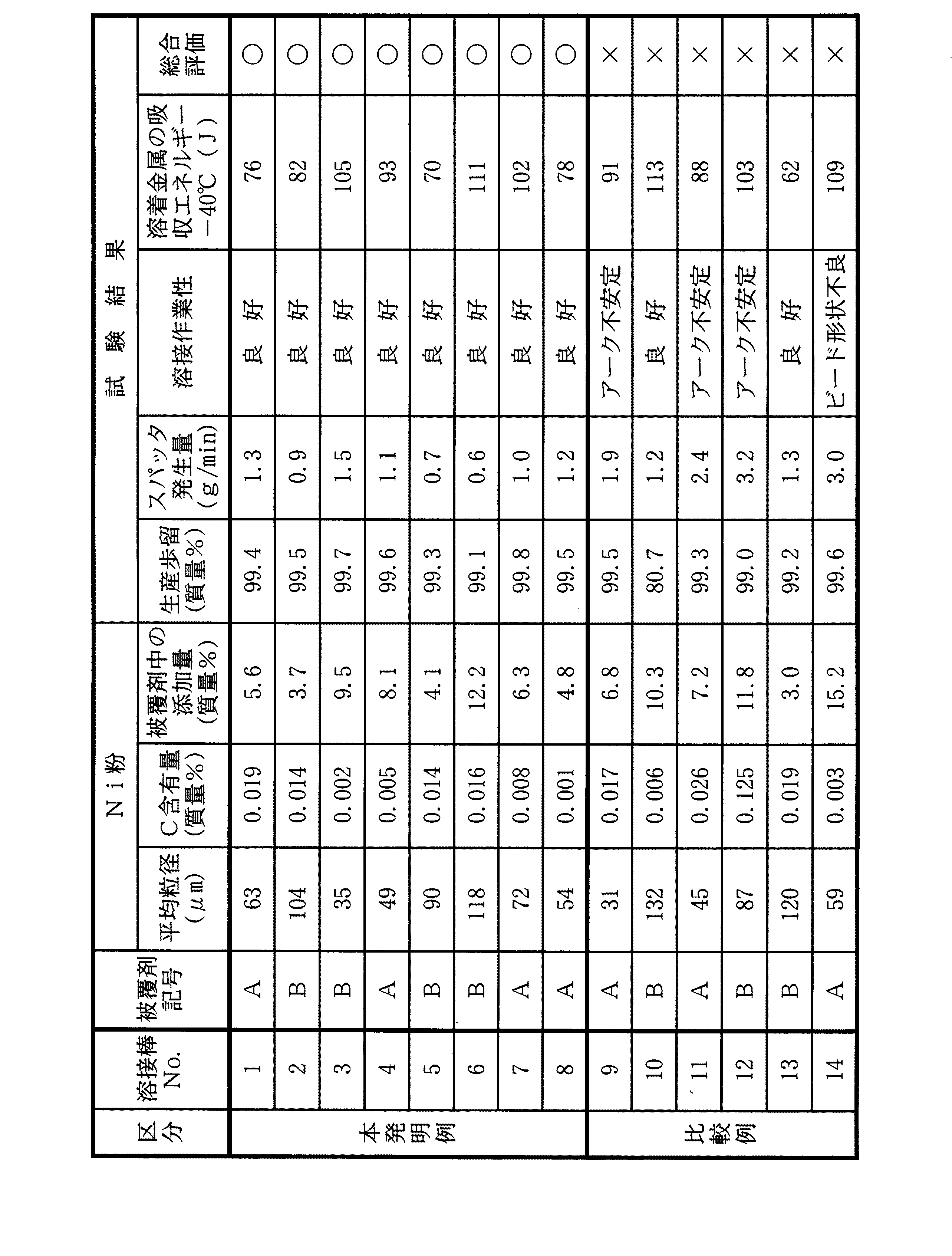
表1に示す780MPa級低水素系棒の被覆剤に対して、表2に示すように平均粒径とC含有量を変化させたNi粉を添加して、各種の低水素系棒を試作した。直径4.0mm、長さ400mmのJIS G3523 SWY11の鋼心線に被覆塗装後、乾燥して被覆率31%とし、生産性、スパッタ発生量、溶接作業性および溶着金属の靭性を調査した。
The effects of the present invention will be specifically described with reference to examples.
Various low-hydrogen rods were made by adding Ni powders having different average particle sizes and C contents as shown in Table 2 to the coating for the 780 MPa class low-hydrogen rods shown in Table 1. . JIS G3523 SWY11 steel core wire having a diameter of 4.0 mm and a length of 400 mm was coated and then dried to a coverage of 31%, and productivity, spatter generation, welding workability, and weld metal toughness were investigated.
生産性の試験は、溶接棒約100kgを製造し、塗装時または乾燥工程において被覆に疵、へこみ、割れがないものを良品とし、製造した全溶接棒に対する良品の割合を生産歩留とし、その値が99.0%以上であったものを良好とし、99.0%未満を不良とした。 The productivity test consists of manufacturing approximately 100 kg of welding rods, making good ones with no wrinkles, dents or cracks in the coating or in the drying process, and making the production yield the ratio of good products to all manufactured welding rods. A value of 99.0% or more was regarded as good, and a value less than 99.0% was regarded as defective.
スパッタ発生量の調査は、幅200mm、長さ600mm、高さ200mmの銅板の捕集箱内部に板厚20mm、幅50mm、長さ450mmの490MPa級の試験鋼板を立て、この捕集箱の長手方向にスリットを開け、ここに調査溶接棒を挿入して試験鋼板の板厚面の溶接を行った。溶接条件は電流190A、速度15cm/minとし、スパッタ発生量が1.5g/min以下を良好とした。 The amount of spatter generated was investigated by placing a 490 MPa class test steel plate having a thickness of 20 mm, a width of 50 mm, and a length of 450 mm inside a copper plate collection box having a width of 200 mm, a length of 600 mm, and a height of 200 mm. A slit was opened in the direction, and an inspection welding rod was inserted here to weld the plate thickness surface of the test steel plate. The welding conditions were a current of 190 A, a speed of 15 cm / min, and a sputter generation amount of 1.5 g / min or less.
溶接作業性調査は、板厚16mm、幅100mm、長さ450mmの780MPa級鋼板をT型に組み、交流溶接機を用い、水平すみ肉溶接は電流170A、立向姿勢溶接は150Aの条件で溶接した。これによりアーク状態(安定性、吹付け強さ)、スラグ剥離性(流動性、被包性、剥離性)、ビードの形状などを調査した。 Welding workability survey was conducted by assembling a T-shaped 780MPa class steel plate with a plate thickness of 16mm, width of 100mm and length of 450mm, using an AC welding machine, horizontal fillet welding with a current of 170A, and vertical position welding of 150A. did. As a result, the arc state (stability, spray strength), slag peelability (fluidity, encapsulation, peelability), bead shape, and the like were investigated.
また、溶着金属の衝撃靭性は、電流170A(AC)、予熱・パス間温度90〜130℃、平均入熱17kJ/cmとし、JIS Z3211の溶着金属試験に準じて溶接を行い、溶着金属中央部よりJIS Z2202の4号衝撃試験片を採取した。試験温度は−40℃で各6本試験を行い、その吸収エネルギーの平均値が70J以上を良好とした。これらの結果も表2にまとめて示す。 The weld metal has an impact toughness of 170 A (AC) current, 90-130 ° C pre-pass / pass temperature, 17 kJ / cm average heat input, and welded according to the weld metal test of JIS Z3211. Thus, a No. 4 impact test piece of JIS Z2202 was collected. The test temperature was −40 ° C., and six tests were performed, and the average value of the absorbed energy was 70 J or more. These results are also summarized in Table 2.
表2中、溶接棒No.1〜No.8は本発明例、溶接棒No.9〜No.14は比較例である。本発明例である溶接棒No.1〜No.8は、被覆剤中のNi粉の平均粒径とNi粉中のC含有量が適正であるのでアークの安定性に優れスパッタ発生量が少なかった。また、被覆剤中のNi粉の添加量が適正であるのでアーク状態などの溶接作業性も良く、溶着金属の吸収エネルギーも高く、極めて満足な結果であった。 In Table 2, welding rod No. 1-No. No. 8 is an example of the present invention, welding rod no. 9-No. 14 is a comparative example. The welding rod no. 1-No. In No. 8, since the average particle diameter of the Ni powder in the coating material and the C content in the Ni powder were appropriate, the arc stability was excellent and the amount of spatter generated was small. Further, since the amount of Ni powder added to the coating material was appropriate, welding workability such as arcing was good and the absorbed energy of the deposited metal was high, which was a very satisfactory result.
比較例中、溶接棒No.9は、Ni粉の平均粒径が細かいので溶滴の移行性が悪く、アークが不安定となってスパッタ発生量が多かった。
溶接棒No.10は、Ni粉の平均粒径が粗いので生産時に被覆剤の固着性が悪く、乾燥時に被覆割れが生じて生産歩留が低かった。
In the comparative example, the welding rod No. In No. 9, since the average particle diameter of the Ni powder was fine, the transferability of the droplets was poor, the arc became unstable, and the amount of spatter generated was large.
Welding rod no. In No. 10, since the average particle diameter of the Ni powder was coarse, the fixability of the coating agent was poor at the time of production, and the coating cracked at the time of drying, resulting in a low production yield.
溶接棒No.11および溶接棒No.12は、Ni粉のC含有量が多いので溶融スラグの粘性が高くなりスラグが先行してアークが不安定となりスパッタ発生量が多かった。 Welding rod no. 11 and welding rod no. In No. 12, since the C content of the Ni powder was large, the viscosity of the molten slag was high, the slag was preceded, the arc became unstable, and the amount of spatter was large.
溶接棒No.13は、被覆剤中のNi粉の添加量が少ないので吸収エネルギーが低かった。
溶接棒No.14は、被覆剤中のNi添加量が多いのでアークが弱くなり溶滴の離脱が悪くスパッタ発生量が多かった。また、ビードに広がりがなくビード形状も不良であった。
Welding rod no. No. 13 had a low absorbed energy because the amount of Ni powder added in the coating was small.
Welding rod no. In No. 14, since the amount of Ni added in the coating was large, the arc was weakened, the droplets were not easily detached, and the amount of spatter was large. Moreover, the bead did not spread and the bead shape was also poor.
Claims (2)
Priority Applications (1)
| Application Number | Priority Date | Filing Date | Title |
|---|---|---|---|
| JP2011006046A JP2012143809A (en) | 2011-01-14 | 2011-01-14 | Ni POWDER FOR COVERED ARC WELDING ELECTRODE, AND LOW-HYDROGEN TYPE COVERED ARC WELDING ELECTRODE |
Applications Claiming Priority (1)
| Application Number | Priority Date | Filing Date | Title |
|---|---|---|---|
| JP2011006046A JP2012143809A (en) | 2011-01-14 | 2011-01-14 | Ni POWDER FOR COVERED ARC WELDING ELECTRODE, AND LOW-HYDROGEN TYPE COVERED ARC WELDING ELECTRODE |
Publications (1)
| Publication Number | Publication Date |
|---|---|
| JP2012143809A true JP2012143809A (en) | 2012-08-02 |
Family
ID=46787920
Family Applications (1)
| Application Number | Title | Priority Date | Filing Date |
|---|---|---|---|
| JP2011006046A Pending JP2012143809A (en) | 2011-01-14 | 2011-01-14 | Ni POWDER FOR COVERED ARC WELDING ELECTRODE, AND LOW-HYDROGEN TYPE COVERED ARC WELDING ELECTRODE |
Country Status (1)
| Country | Link |
|---|---|
| JP (1) | JP2012143809A (en) |
Cited By (1)
| Publication number | Priority date | Publication date | Assignee | Title |
|---|---|---|---|---|
| JP2017042811A (en) * | 2015-08-28 | 2017-03-02 | 株式会社神戸製鋼所 | Flux-cored wire for gas shielded arc welding |
Citations (2)
| Publication number | Priority date | Publication date | Assignee | Title |
|---|---|---|---|---|
| JPS60216995A (en) * | 1984-04-13 | 1985-10-30 | Nippon Steel Corp | Low hydrogen covered electrode |
| JPH07251294A (en) * | 1994-03-14 | 1995-10-03 | Kobe Steel Ltd | Low hydrogen type coated electrode |
-
2011
- 2011-01-14 JP JP2011006046A patent/JP2012143809A/en active Pending
Patent Citations (2)
| Publication number | Priority date | Publication date | Assignee | Title |
|---|---|---|---|---|
| JPS60216995A (en) * | 1984-04-13 | 1985-10-30 | Nippon Steel Corp | Low hydrogen covered electrode |
| JPH07251294A (en) * | 1994-03-14 | 1995-10-03 | Kobe Steel Ltd | Low hydrogen type coated electrode |
Cited By (7)
| Publication number | Priority date | Publication date | Assignee | Title |
|---|---|---|---|---|
| JP2017042811A (en) * | 2015-08-28 | 2017-03-02 | 株式会社神戸製鋼所 | Flux-cored wire for gas shielded arc welding |
| WO2017038610A1 (en) * | 2015-08-28 | 2017-03-09 | 株式会社神戸製鋼所 | Flux-cored wire for gas-shielded arc welding |
| KR20180034590A (en) * | 2015-08-28 | 2018-04-04 | 가부시키가이샤 고베 세이코쇼 | Flux cored wire for gas shield arc welding |
| CN107921590A (en) * | 2015-08-28 | 2018-04-17 | 株式会社神户制钢所 | Flux-cored wire for gas-shielded arc welding |
| EP3342531A4 (en) * | 2015-08-28 | 2019-01-09 | Kabushiki Kaisha Kobe Seiko Sho (Kobe Steel, Ltd.) | FIRED YARN FOR ARC WELDING WITH GAS PROTECTION |
| KR101984441B1 (en) * | 2015-08-28 | 2019-05-30 | 가부시키가이샤 고베 세이코쇼 | Flux cored wire for gas shield arc welding |
| US10427249B2 (en) | 2015-08-28 | 2019-10-01 | Kobe Steel, Ltd. | Flux-cored wire for gas-shielded arc welding |
Similar Documents
| Publication | Publication Date | Title |
|---|---|---|
| JP5207994B2 (en) | Metal flux cored wire for Ar-CO2 mixed gas shielded arc welding | |
| CN106077992B (en) | A kind of micro- slag gas-shielded flux-cored wire suitable for mold electric arc increasing material manufacturing | |
| JP5205115B2 (en) | MIG flux-cored wire for pure Ar shield gas welding and MIG arc welding method | |
| JP6969705B1 (en) | Steel wire for gas shielded arc welding, gas shielded arc welding method, and manufacturing method of gas shielded arc welded joint | |
| JP7711803B2 (en) | Positive polarity MAG welding method using positive polarity MAG welding wire | |
| CN107000104A (en) | Systems and methods for welding workpieces with rolled scale | |
| KR20180034590A (en) | Flux cored wire for gas shield arc welding | |
| JP6051086B2 (en) | Low hydrogen coated arc welding rod | |
| WO2014030454A1 (en) | Low-hydrogen coated arc welding electrode | |
| JP4531617B2 (en) | Flux-cored wire for gas shielded arc welding | |
| KR101600174B1 (en) | Flux cored wire for gas shielded arc welding | |
| JP6188626B2 (en) | Two-electrode horizontal fillet gas shielded arc welding method | |
| JP2015139784A (en) | Two-electrode horizontal fillet gas shielded arc welding method | |
| JP6046022B2 (en) | Low hydrogen coated arc welding rod | |
| JP2003225792A (en) | Carbon dioxide shielded arc welding wire | |
| CN103659045A (en) | Titaniferous metal flux-cored wire for carbon dioxide arc welding | |
| JP5448497B2 (en) | Flux-cored wire for 2-electrode horizontal fillet gas shielded arc welding | |
| JP5157653B2 (en) | Low hydrogen type coated arc welding rod for DC power welding machine | |
| JP2008161899A (en) | Plasma arc hybrid welding method to improve joint fatigue strength of lap fillet welded joint | |
| CN110508969B (en) | Alkaline all-position CO2Gas shielded flux-cored wire | |
| JP2011235299A (en) | Solid wire for gas-shielded arc welding | |
| JP2015136720A (en) | Two electrode horizontal fillet gas shield arc welding method | |
| JP2006224178A (en) | Flux-cored wire for gas shielded arc fillet welding | |
| JP5698648B2 (en) | Coated arc welding rod for horizontal fillet welding | |
| JP5133089B2 (en) | Mg alloy powder for coated arc welding rod and low hydrogen-based coated arc welding rod |
Legal Events
| Date | Code | Title | Description |
|---|---|---|---|
| A621 | Written request for application examination |
Free format text: JAPANESE INTERMEDIATE CODE: A621 Effective date: 20130603 |
|
| A977 | Report on retrieval |
Free format text: JAPANESE INTERMEDIATE CODE: A971007 Effective date: 20140513 |
|
| A131 | Notification of reasons for refusal |
Free format text: JAPANESE INTERMEDIATE CODE: A131 Effective date: 20140701 |
|
| A02 | Decision of refusal |
Free format text: JAPANESE INTERMEDIATE CODE: A02 Effective date: 20141104 |