JP2012149192A - Self-adhesive tape for protecting surface of semiconductor component - Google Patents
Self-adhesive tape for protecting surface of semiconductor component Download PDFInfo
- Publication number
- JP2012149192A JP2012149192A JP2011010066A JP2011010066A JP2012149192A JP 2012149192 A JP2012149192 A JP 2012149192A JP 2011010066 A JP2011010066 A JP 2011010066A JP 2011010066 A JP2011010066 A JP 2011010066A JP 2012149192 A JP2012149192 A JP 2012149192A
- Authority
- JP
- Japan
- Prior art keywords
- pressure
- adhesive tape
- sensitive adhesive
- adhesive layer
- release
- Prior art date
- Legal status (The legal status is an assumption and is not a legal conclusion. Google has not performed a legal analysis and makes no representation as to the accuracy of the status listed.)
- Granted
Links
Classifications
-
- H—ELECTRICITY
- H10—SEMICONDUCTOR DEVICES; ELECTRIC SOLID-STATE DEVICES NOT OTHERWISE PROVIDED FOR
- H10W—GENERIC PACKAGES, INTERCONNECTIONS, CONNECTORS OR OTHER CONSTRUCTIONAL DETAILS OF DEVICES COVERED BY CLASS H10
- H10W74/00—Encapsulations, e.g. protective coatings
- H10W74/40—Encapsulations, e.g. protective coatings characterised by their materials
- H10W74/47—Encapsulations, e.g. protective coatings characterised by their materials comprising organic materials, e.g. plastics or resins
- H10W74/476—Organic materials comprising silicon
-
- C—CHEMISTRY; METALLURGY
- C09—DYES; PAINTS; POLISHES; NATURAL RESINS; ADHESIVES; COMPOSITIONS NOT OTHERWISE PROVIDED FOR; APPLICATIONS OF MATERIALS NOT OTHERWISE PROVIDED FOR
- C09J—ADHESIVES; NON-MECHANICAL ASPECTS OF ADHESIVE PROCESSES IN GENERAL; ADHESIVE PROCESSES NOT PROVIDED FOR ELSEWHERE; USE OF MATERIALS AS ADHESIVES
- C09J7/00—Adhesives in the form of films or foils
- C09J7/20—Adhesives in the form of films or foils characterised by their carriers
- C09J7/201—Adhesives in the form of films or foils characterised by their carriers characterised by the release coating composition on the carrier layer
-
- B—PERFORMING OPERATIONS; TRANSPORTING
- B32—LAYERED PRODUCTS
- B32B—LAYERED PRODUCTS, i.e. PRODUCTS BUILT-UP OF STRATA OF FLAT OR NON-FLAT, e.g. CELLULAR OR HONEYCOMB, FORM
- B32B27/00—Layered products comprising a layer of synthetic resin
- B32B27/36—Layered products comprising a layer of synthetic resin comprising polyesters
-
- B—PERFORMING OPERATIONS; TRANSPORTING
- B32—LAYERED PRODUCTS
- B32B—LAYERED PRODUCTS, i.e. PRODUCTS BUILT-UP OF STRATA OF FLAT OR NON-FLAT, e.g. CELLULAR OR HONEYCOMB, FORM
- B32B27/00—Layered products comprising a layer of synthetic resin
-
- B—PERFORMING OPERATIONS; TRANSPORTING
- B32—LAYERED PRODUCTS
- B32B—LAYERED PRODUCTS, i.e. PRODUCTS BUILT-UP OF STRATA OF FLAT OR NON-FLAT, e.g. CELLULAR OR HONEYCOMB, FORM
- B32B7/00—Layered products characterised by the relation between layers; Layered products characterised by the relative orientation of features between layers, or by the relative values of a measurable parameter between layers, i.e. products comprising layers having different physical, chemical or physicochemical properties; Layered products characterised by the interconnection of layers
- B32B7/04—Interconnection of layers
- B32B7/06—Interconnection of layers permitting easy separation
-
- C—CHEMISTRY; METALLURGY
- C09—DYES; PAINTS; POLISHES; NATURAL RESINS; ADHESIVES; COMPOSITIONS NOT OTHERWISE PROVIDED FOR; APPLICATIONS OF MATERIALS NOT OTHERWISE PROVIDED FOR
- C09J—ADHESIVES; NON-MECHANICAL ASPECTS OF ADHESIVE PROCESSES IN GENERAL; ADHESIVE PROCESSES NOT PROVIDED FOR ELSEWHERE; USE OF MATERIALS AS ADHESIVES
- C09J183/00—Adhesives based on macromolecular compounds obtained by reactions forming in the main chain of the macromolecule a linkage containing silicon, with or without sulfur, nitrogen, oxygen, or carbon only; Adhesives based on derivatives of such polymers
- C09J183/04—Polysiloxanes
-
- C—CHEMISTRY; METALLURGY
- C09—DYES; PAINTS; POLISHES; NATURAL RESINS; ADHESIVES; COMPOSITIONS NOT OTHERWISE PROVIDED FOR; APPLICATIONS OF MATERIALS NOT OTHERWISE PROVIDED FOR
- C09J—ADHESIVES; NON-MECHANICAL ASPECTS OF ADHESIVE PROCESSES IN GENERAL; ADHESIVE PROCESSES NOT PROVIDED FOR ELSEWHERE; USE OF MATERIALS AS ADHESIVES
- C09J7/00—Adhesives in the form of films or foils
- C09J7/20—Adhesives in the form of films or foils characterised by their carriers
- C09J7/22—Plastics; Metallised plastics
-
- C—CHEMISTRY; METALLURGY
- C09—DYES; PAINTS; POLISHES; NATURAL RESINS; ADHESIVES; COMPOSITIONS NOT OTHERWISE PROVIDED FOR; APPLICATIONS OF MATERIALS NOT OTHERWISE PROVIDED FOR
- C09J—ADHESIVES; NON-MECHANICAL ASPECTS OF ADHESIVE PROCESSES IN GENERAL; ADHESIVE PROCESSES NOT PROVIDED FOR ELSEWHERE; USE OF MATERIALS AS ADHESIVES
- C09J7/00—Adhesives in the form of films or foils
- C09J7/30—Adhesives in the form of films or foils characterised by the adhesive composition
- C09J7/38—Pressure-sensitive adhesives [PSA]
-
- C—CHEMISTRY; METALLURGY
- C09—DYES; PAINTS; POLISHES; NATURAL RESINS; ADHESIVES; COMPOSITIONS NOT OTHERWISE PROVIDED FOR; APPLICATIONS OF MATERIALS NOT OTHERWISE PROVIDED FOR
- C09J—ADHESIVES; NON-MECHANICAL ASPECTS OF ADHESIVE PROCESSES IN GENERAL; ADHESIVE PROCESSES NOT PROVIDED FOR ELSEWHERE; USE OF MATERIALS AS ADHESIVES
- C09J7/00—Adhesives in the form of films or foils
- C09J7/40—Adhesives in the form of films or foils characterised by release liners
-
- C—CHEMISTRY; METALLURGY
- C09—DYES; PAINTS; POLISHES; NATURAL RESINS; ADHESIVES; COMPOSITIONS NOT OTHERWISE PROVIDED FOR; APPLICATIONS OF MATERIALS NOT OTHERWISE PROVIDED FOR
- C09J—ADHESIVES; NON-MECHANICAL ASPECTS OF ADHESIVE PROCESSES IN GENERAL; ADHESIVE PROCESSES NOT PROVIDED FOR ELSEWHERE; USE OF MATERIALS AS ADHESIVES
- C09J7/00—Adhesives in the form of films or foils
- C09J7/40—Adhesives in the form of films or foils characterised by release liners
- C09J7/401—Adhesives in the form of films or foils characterised by release liners characterised by the release coating composition
-
- H—ELECTRICITY
- H10—SEMICONDUCTOR DEVICES; ELECTRIC SOLID-STATE DEVICES NOT OTHERWISE PROVIDED FOR
- H10P—GENERIC PROCESSES OR APPARATUS FOR THE MANUFACTURE OR TREATMENT OF DEVICES COVERED BY CLASS H10
- H10P72/00—Handling or holding of wafers, substrates or devices during manufacture or treatment thereof
- H10P72/70—Handling or holding of wafers, substrates or devices during manufacture or treatment thereof for supporting or gripping
- H10P72/74—Handling or holding of wafers, substrates or devices during manufacture or treatment thereof for supporting or gripping using temporarily an auxiliary support
- H10P72/7402—Wafer tapes, e.g. grinding or dicing support tapes
-
- B—PERFORMING OPERATIONS; TRANSPORTING
- B32—LAYERED PRODUCTS
- B32B—LAYERED PRODUCTS, i.e. PRODUCTS BUILT-UP OF STRATA OF FLAT OR NON-FLAT, e.g. CELLULAR OR HONEYCOMB, FORM
- B32B2307/00—Properties of the layers or laminate
- B32B2307/70—Other properties
- B32B2307/748—Releasability
-
- B—PERFORMING OPERATIONS; TRANSPORTING
- B32—LAYERED PRODUCTS
- B32B—LAYERED PRODUCTS, i.e. PRODUCTS BUILT-UP OF STRATA OF FLAT OR NON-FLAT, e.g. CELLULAR OR HONEYCOMB, FORM
- B32B2405/00—Adhesive articles, e.g. adhesive tapes
-
- C—CHEMISTRY; METALLURGY
- C08—ORGANIC MACROMOLECULAR COMPOUNDS; THEIR PREPARATION OR CHEMICAL WORKING-UP; COMPOSITIONS BASED THEREON
- C08G—MACROMOLECULAR COMPOUNDS OBTAINED OTHERWISE THAN BY REACTIONS ONLY INVOLVING UNSATURATED CARBON-TO-CARBON BONDS
- C08G77/00—Macromolecular compounds obtained by reactions forming a linkage containing silicon with or without sulfur, nitrogen, oxygen or carbon in the main chain of the macromolecule
- C08G77/04—Polysiloxanes
- C08G77/20—Polysiloxanes containing silicon bound to unsaturated aliphatic groups
-
- C—CHEMISTRY; METALLURGY
- C09—DYES; PAINTS; POLISHES; NATURAL RESINS; ADHESIVES; COMPOSITIONS NOT OTHERWISE PROVIDED FOR; APPLICATIONS OF MATERIALS NOT OTHERWISE PROVIDED FOR
- C09J—ADHESIVES; NON-MECHANICAL ASPECTS OF ADHESIVE PROCESSES IN GENERAL; ADHESIVE PROCESSES NOT PROVIDED FOR ELSEWHERE; USE OF MATERIALS AS ADHESIVES
- C09J2203/00—Applications of adhesives in processes or use of adhesives in the form of films or foils
- C09J2203/326—Applications of adhesives in processes or use of adhesives in the form of films or foils for bonding electronic components such as wafers, chips or semiconductors
-
- Y—GENERAL TAGGING OF NEW TECHNOLOGICAL DEVELOPMENTS; GENERAL TAGGING OF CROSS-SECTIONAL TECHNOLOGIES SPANNING OVER SEVERAL SECTIONS OF THE IPC; TECHNICAL SUBJECTS COVERED BY FORMER USPC CROSS-REFERENCE ART COLLECTIONS [XRACs] AND DIGESTS
- Y10—TECHNICAL SUBJECTS COVERED BY FORMER USPC
- Y10T—TECHNICAL SUBJECTS COVERED BY FORMER US CLASSIFICATION
- Y10T428/00—Stock material or miscellaneous articles
- Y10T428/14—Layer or component removable to expose adhesive
- Y10T428/1452—Polymer derived only from ethylenically unsaturated monomer
- Y10T428/1457—Silicon
Landscapes
- Chemical & Material Sciences (AREA)
- Organic Chemistry (AREA)
- Chemical Kinetics & Catalysis (AREA)
- Adhesive Tapes (AREA)
- Adhesives Or Adhesive Processes (AREA)
- Laminated Bodies (AREA)
Abstract
【課題】半導体部品の製造工程において、被着体(部品)への転写異物が少ない表面保護用粘着テープを提供する。
【解決手段】少なくとも基材フィルム、粘着剤層、剥離ライナーから構成される粘着テープにおいて、基材フィルムの片面に粘着剤層を有し、該粘着剤層上に離型層を含有しない未処理プラスチックフィルムが用いられた剥離ライナーが形成されている表面保護用粘着テープ。
【選択図】なしThe present invention provides a surface protecting adhesive tape with less foreign matter transferred to an adherend (component) in a manufacturing process of a semiconductor component.
An adhesive tape comprising at least a base film, an adhesive layer, and a release liner has an adhesive layer on one side of the base film, and does not contain a release layer on the adhesive layer An adhesive tape for surface protection on which a release liner using a plastic film is formed.
[Selection figure] None
Description
本発明は、半導体部品の表面保護用粘着テープに関し、特に固体撮像デバイスを用いた映像センサを生産する際に該映像センサの受光部側を保護する目的で使用され、被着体(映像センサの受光部側)への転写異物低減を可能とする表面保護用の粘着テープに関する。 The present invention relates to an adhesive tape for protecting a surface of a semiconductor component, and is used for the purpose of protecting the light receiving part of the image sensor particularly when producing an image sensor using a solid-state imaging device. The present invention relates to an adhesive tape for surface protection that can reduce transfer foreign matter to the light receiving part side).
特許文献1〜3に示されるように、電気、電子部品、半導体部品を生産する際に、生産工程において部品の固定や保護を目的とする粘着テープが知られている。このような粘着テープとしては、基材フィルムに再剥離性のアクリル系粘着剤層が設けられたものや、加熱工程時には高い耐熱性を有するシリコーン系粘着剤層が設けられたものがある。該粘着テープは所定の処理工程が終了すると剥離されるが、このとき部品への粘着剤層からの転写異物が発生する。 As shown in Patent Documents 1 to 3, pressure-sensitive adhesive tapes are known for the purpose of fixing and protecting parts in the production process when producing electrical, electronic parts, and semiconductor parts. As such an adhesive tape, there are one in which a releasable acrylic adhesive layer is provided on a base film, and one in which a silicone adhesive layer having high heat resistance is provided in the heating step. The pressure-sensitive adhesive tape is peeled off when a predetermined processing step is completed. At this time, a transfer foreign matter from the pressure-sensitive adhesive layer to the part is generated.
また、携帯電話等に搭載される小型カメラにおいては、CCD型やCMOS型の営巣センサー(固体撮像装置)が広く使用されている。この小型カメラは、一般に、撮像素子、赤外カットフィルター、光学レンズ、レンズホルダーなどの各構成要素から組み立てられている。このようなカメラに関し、その高解像度化に伴う要求の一つとして、撮像素子に付着する埃等付着によるノイズ低減があげられる。 In small cameras mounted on mobile phones and the like, CCD type or CMOS type nesting sensors (solid-state imaging devices) are widely used. This small camera is generally assembled from components such as an image sensor, an infrared cut filter, an optical lens, and a lens holder. With regard to such a camera, one of the requirements associated with higher resolution is noise reduction due to adhesion of dust or the like adhering to the image sensor.
このため、上記電気、電子部品、半導体部品と同様に、映像センサの受光部側に、映像センサ表面の傷つきやゴミの付着を防止する目的で粘着テープを貼り合わせることで、実装および製造工程における傷つきやゴミとしての転写異物の付着を避ける手法が採られる。この転写異物が存在すると該映像センサにおける撮像に直接影響する可能性が高い。
この転写異物の発生原因は主に粘着剤由来であると考えられており、低分子量成分を除去したポリマーを粘着剤層に用いた表面保護粘着テープや、半田付け等の加熱工程での耐熱性を向上させるために各種添加剤を粘着剤層に混合した表面保護粘着テープを使用して、粘着剤層由来の転写異物の低減を図っている。
For this reason, in the mounting and manufacturing process, the adhesive tape is bonded to the light receiving portion side of the image sensor for the purpose of preventing scratches on the image sensor surface and adhesion of dust, as in the case of the electrical, electronic components, and semiconductor components. A technique for avoiding adhesion of transfer foreign matter such as scratches or dust is employed. If this transferred foreign matter is present, there is a high possibility of directly affecting the image pick-up by the image sensor.
It is thought that the cause of the generation of this transfer foreign material is mainly derived from the adhesive, and it is a surface protective adhesive tape using a polymer from which low molecular weight components have been removed for the adhesive layer, and heat resistance during heating processes such as soldering In order to improve the quality, the surface protective adhesive tape in which various additives are mixed in the adhesive layer is used to reduce the transfer foreign matter derived from the adhesive layer.
ところが、剥離ライナー付き粘着テープの場合には、慣用の剥離ライナーにおける離型層として用いられている離型層(例えば、シリコーン系離型層やフルオロシリコーン系離型層など)の離型剤が粘着剤層へ転写し、この転写離型剤が被着体へ再転写することによって、被着体表面の異物として検出されることがある。このため、より粘着剤層への転写を防止した離型剤の検討が行われているが、離型剤転写の不安は払拭されていない状況である。 However, in the case of a pressure-sensitive adhesive tape with a release liner, a release agent for a release layer (such as a silicone release layer or a fluorosilicone release layer) used as a release layer in a conventional release liner is used. When transferred to the pressure-sensitive adhesive layer and this transfer release agent is re-transferred to the adherend, it may be detected as foreign matter on the adherend surface. For this reason, although the release agent which prevented the transcription | transfer to an adhesive layer is examined more, the anxiety of a release agent transfer is not wiped away.
本発明は、半導体部品の製造工程において、被着体(部品)への転写異物が少ない表面保護用粘着テープを提供することを目的とする。 An object of the present invention is to provide a surface-protective pressure-sensitive adhesive tape with less transfer foreign matter to an adherend (component) in a semiconductor component manufacturing process.
本発明者らは、上記の目的を達成するために鋭意検討を行った結果、
1.少なくとも基材フィルム、粘着剤層、剥離ライナーから構成される粘着テープにおいて、基材フィルムの片面に粘着剤層を有し、該粘着剤層上に、離型層を設けない未処理プラスチックフィルムによる剥離ライナーが積層されている表面保護用粘着テープ。
2.剥離ライナーはポリエチレンテレフタレート又はポリエチレンナフタレートである1に記載の表面保護用粘着テープ。
3.該粘着剤層が付加反応型シリコーン系粘着剤層である1又は2に記載の表面保護用粘着テープ。
4.該粘着剤層面からの剥離ライナーの剥離力が1N/50mm以下、好ましくは0.5N/50mm以下であることを特徴とする1〜3のいずれかに記載の表面保護用粘着テープ。
5.常温での初期粘着力が0.05N/20mm以下、260℃リフロー後の初期粘着力が0.50N/20mm以下である1〜4のいずれかに記載の表面保護用粘着テープ。
As a result of intensive studies to achieve the above object, the present inventors
1. In an adhesive tape composed of at least a base film, an adhesive layer, and a release liner, with an untreated plastic film having an adhesive layer on one side of the base film, and no release layer on the adhesive layer Adhesive tape for surface protection with release liner laminated.
2. 2. The adhesive tape for surface protection according to 1, wherein the release liner is polyethylene terephthalate or polyethylene naphthalate.
3. The pressure-sensitive adhesive tape for surface protection according to 1 or 2, wherein the pressure-sensitive adhesive layer is an addition reaction type silicone pressure-sensitive adhesive layer.
4). The adhesive tape for surface protection according to any one of 1 to 3, wherein the release force of the release liner from the surface of the adhesive layer is 1 N / 50 mm or less, preferably 0.5 N / 50 mm or less.
5. The adhesive tape for surface protection according to any one of 1 to 4, wherein the initial adhesive strength at room temperature is 0.05 N / 20 mm or less and the initial adhesive strength after reflow at 260 ° C. is 0.50 N / 20 mm or less.
本発明の半導体表面保護用粘着テープは、少なくとも基材フィルム、粘着剤層、剥離ライナーから構成される粘着テープにおいて、基材フィルムの片面に粘着剤層を有し、該粘着剤層上に離型層を含有しない未処理プラスチックフィルムが用いられた剥離ライナーが形成されている。該剥離ライナーに離型層を含有しないことにより、粘着剤層面への離型剤の転写が発生しない、すなわち、被着体への再転写を防ぐことが可能であり、結果的に被着体への転写異物が低減される。
特に粘着剤層が付加反応型シリコーン系粘着剤層である場合、シリコーンゴム成分とシリコーンレジン成分の配合比率を調整して粘着力を制御でき、他の樹脂からなる粘着剤よりも低い粘着力とした場合には、特に剥離ライナーに対しても粘着力が低下するので、剥離ライナー自体に剥離剤層を設けることなく、ひいては粘着剤層面への離型剤の転写を発生させることがない。
さらに該粘着剤層面からの剥離ライナーの剥離力が1N/50mm以下、好ましくは0.50N/50mm以下としたり、常温での初期粘着力を0.05N/20mm以下とすること、つまり、粘着剤層の粘着力を低下させることにより、剥離ライナーには剥離剤層を設ける必要がないことになる。
The pressure-sensitive adhesive tape for protecting a semiconductor surface of the present invention is a pressure-sensitive adhesive tape comprising at least a base film, a pressure-sensitive adhesive layer, and a release liner, and has a pressure-sensitive adhesive layer on one side of the base film, and is separated on the pressure-sensitive adhesive layer. A release liner using an untreated plastic film containing no mold layer is formed. By not including a release layer in the release liner, transfer of the release agent to the pressure-sensitive adhesive layer surface does not occur, that is, retransfer to the adherend can be prevented, and as a result, the adherend Transfer foreign matter to the surface is reduced.
In particular, when the pressure-sensitive adhesive layer is an addition reaction type silicone pressure-sensitive adhesive layer, the adhesive force can be controlled by adjusting the blending ratio of the silicone rubber component and the silicone resin component, and the adhesive strength is lower than that of pressure-sensitive adhesives made of other resins. In this case, since the adhesive force is lowered particularly with respect to the release liner, a release agent layer is not provided on the release liner itself, and as a result, transfer of the release agent to the surface of the adhesive layer is not generated.
Furthermore, the release force of the release liner from the surface of the pressure-sensitive adhesive layer is 1 N / 50 mm or less, preferably 0.50 N / 50 mm or less, or the initial adhesive force at room temperature is 0.05 N / 20 mm or less. By reducing the adhesive strength of the layer, it is not necessary to provide a release agent layer on the release liner.
本発明の表面保護用粘着テープにおける剥離ライナーは、剥離ライナーにおける離型層として公知の離型剤(例えば、シリコーン系離型剤やフルオロシリコーン系離型剤等)による処理や、剥離性を付与するための何らかの処理が施されておらず、表面が未処理である状態のプラスチックフィルムからなる剥離ライナーである。
このような剥離ライナーとしては、例えば、ポリエチレン、ポリプロピレン等のポリオレフィン系樹脂、ポリエチレンテレフタレート、ポリエチレンナフタレート等のポリエステル系樹脂等のフィルムを使用できる。そして、これらのフィルムのなかでも特にポリエチレンテレフタレートやポリエチレンナフタレートが好ましい。
剥離ライナーの厚さは、取扱性等を損なわない範囲で適宜選択できるが、一般に10〜200μm程度、好ましくは20〜100μm程度である。
The release liner in the surface-protective pressure-sensitive adhesive tape of the present invention imparts a treatment with a known release agent (for example, a silicone release agent or a fluorosilicone release agent) as a release layer in the release liner, or provides release properties. It is a release liner made of a plastic film that has not been subjected to any treatment for the purpose and has an untreated surface.
As such a release liner, for example, a film of a polyolefin resin such as polyethylene or polypropylene, or a polyester resin such as polyethylene terephthalate or polyethylene naphthalate can be used. Of these films, polyethylene terephthalate and polyethylene naphthalate are particularly preferable.
The thickness of the release liner can be appropriately selected within a range that does not impair the handleability and the like, but is generally about 10 to 200 μm, preferably about 20 to 100 μm.
本発明の表面保護用粘着テープにおける基材フィルムとしては、粘着テープに通常用いられる基材であればよく、例えば、ポリエチレン等のポリオレフィン系樹脂、ポリエチレンテレフタレートやポリエチレンナフタレート等のポリエステル系樹脂、塩化ビニル系樹脂、酢酸ビニル系樹脂、ポリイミド系樹脂、フッ素系樹脂、セロハンなどのプラスチックからなるプラスチックフィルム;クラフト紙、和紙等の紙;マニラ麻、パルプ、レーヨン、アセテート繊維、ポリエステル繊維、ポリビニルアルコール繊維、ポリアミド繊維、ポリオレフィン繊維などの天然繊維、半合成繊維又は合成繊維の繊維状物質などからなる単独又は混紡などの織布や不織布等の布;天然ゴム、ブチルゴム等からなるゴムシート;ポリウレタン、ポリクロロプレンゴム等からなる発泡体による発泡体シート;アルミニウム箔、銅箔等の金属箔;これらの複合体などが挙げられる。 The base film in the surface-protective pressure-sensitive adhesive tape of the present invention may be any base material commonly used for pressure-sensitive adhesive tapes, such as polyolefin resins such as polyethylene, polyester resins such as polyethylene terephthalate and polyethylene naphthalate, and chloride. Plastic film made of plastic such as vinyl resin, vinyl acetate resin, polyimide resin, fluorine resin, cellophane; paper such as kraft paper, Japanese paper; Manila hemp, pulp, rayon, acetate fiber, polyester fiber, polyvinyl alcohol fiber, Natural fibers such as polyamide fibers, polyolefin fibers, semi-synthetic fibers or fibrous materials such as synthetic fibers, woven or non-woven fabrics such as single or mixed spinning; rubber sheets made of natural rubber, butyl rubber, etc .; polyurethane, polychloroprene Aluminum foil, metal foil such as copper foil; foam sheet by foam consisting beam or the like, etc. These complexes thereof.
これらの基材フィルムの中でも、加熱工程がない、もしくは比較的低温(160℃以下)での加熱工程においても使用するにはポリエチレン製フィルムやポリエステル製フィルム(ポリエチレンテレフタレート製フィルム等)などのプラスチックフィルムを、200℃以下の加熱工程において使用するにはポリエステル製フィルム(ポリエチレンナフタレート製フィルム等)、200℃以上の加熱工程で使用するにはポリイミド系樹脂を好適に用いる等、使用される工程に合わせて基材を使い分けることが可能である。なお、基材は透明、半透明、不透明のうちいずれであってもよい。 Among these base films, plastic films such as polyethylene films and polyester films (polyethylene terephthalate films, etc.) are not used in heating processes at relatively low temperatures (160 ° C or lower). In a heating process at 200 ° C. or lower, a polyester film (polyethylene naphthalate film or the like), and in a heating process at 200 ° C. or higher, a polyimide resin is preferably used. It is possible to use different base materials together. The base material may be any of transparent, translucent, and opaque.
粘着剤の投錨力を高めるために、基材に表面処理を行ってもよく、表面処理としては、コロナ放電処理、スパッタ処理、低圧UV処理、プラズマ処理、アルカリ金属エッチング処理等の表面処理が挙げられる。これら表面処理法のなかでも耐熱性が良く、物理的に表面を荒らして接着層を形成する表面積を増やすことのできるスパッタ処理が良好である。
基材の厚さは、取扱性等を損なわない範囲で適宜選択できるが、一般に10〜500μm程度、好ましくは20〜100μm程度である。
In order to increase the anchoring force of the adhesive, the substrate may be subjected to a surface treatment, and examples of the surface treatment include surface treatments such as corona discharge treatment, sputtering treatment, low-pressure UV treatment, plasma treatment, and alkali metal etching treatment. It is done. Among these surface treatment methods, heat resistance is good, and a sputtering treatment that can physically rough the surface and increase the surface area for forming the adhesive layer is good.
Although the thickness of a base material can be suitably selected in the range which does not impair handleability etc., generally it is about 10-500 micrometers, Preferably it is about 20-100 micrometers.
本発明の表面保護用粘着テープの粘着剤層は、基材フィルムの片面に塗布した後、乾燥し、架橋させて硬化させることにより得ることができる。粘着剤層の厚さは、1〜30μmが好ましく、より好ましくは3〜30μm、さらに好ましくは5〜20μmであることが望ましい。1μm未満の場合、高温雰囲気中においてセンサから剥がれてしまう。また、30μmを超える場合には、剥離する際に、剥離することができない。 The pressure-sensitive adhesive layer of the pressure-sensitive adhesive tape for surface protection according to the present invention can be obtained by applying to one side of a base film, drying, crosslinking, and curing. As for the thickness of an adhesive layer, 1-30 micrometers is preferable, More preferably, it is 3-30 micrometers, More preferably, it is desirable that it is 5-20 micrometers. If it is less than 1 μm, it will be peeled off from the sensor in a high temperature atmosphere. Moreover, when exceeding 30 micrometers, when peeling, it cannot peel.
上記粘着剤層に用いられる粘着剤ベースポリマーは、粘着テープに通常用いられる粘着剤であればよく、例えば、ゴム系粘着剤、アクリル系粘着剤、シリコーン系粘着剤などが挙げられる。特に、再剥離性に優れるアクリル系粘着剤やシリコーン系粘着剤が好まれる。例えば、シリコーン系粘着剤としては、加熱工程に対して耐熱性を有するものであれば良く、例えば、特開2003−193226号公報に記載の、トルエン不溶分が35%以上のシリコーン系粘着剤などを用いることができる。また、耐熱性に優れたアクリル系粘着剤でもよい。 The pressure-sensitive adhesive base polymer used for the pressure-sensitive adhesive layer may be a pressure-sensitive adhesive usually used for pressure-sensitive adhesive tapes, and examples thereof include rubber-based pressure-sensitive adhesives, acrylic pressure-sensitive adhesives, and silicone-based pressure-sensitive adhesives. In particular, an acrylic pressure-sensitive adhesive or a silicone pressure-sensitive adhesive having excellent removability is preferred. For example, the silicone-based pressure-sensitive adhesive is not particularly limited as long as it has heat resistance with respect to the heating step. For example, a silicone-based pressure-sensitive adhesive having a toluene insoluble content of 35% or more described in JP-A-2003-193226, etc. Can be used. Moreover, the acrylic adhesive excellent in heat resistance may be sufficient.
本発明の粘着剤層については、粘着性及び耐熱性を有するものであれば、特に限定されないが、例えば、付加反応型シリコーン系粘着剤やアクリル系粘着剤層等が挙げられる。
その付加反応型シリコーン粘着剤層としては、例えばオルガノポリシロキサンを主成分とするシリコーンゴムやシリコーンレジンを含有してなり、これに架橋剤を添加してキュアーすることにより粘着剤層を形成することができる。このように、粘着剤は通常架橋剤を添加して、3次元構造化して凝集力を上げている。その他、粘着剤には必要に応じて、タッキファイヤー、酸化防止剤、その他の添加剤等を配合することが出来る。
Although it will not specifically limit if it has adhesiveness and heat resistance about the adhesive layer of this invention, For example, an addition reaction type silicone adhesive, an acrylic adhesive layer, etc. are mentioned.
As the addition reaction type silicone pressure-sensitive adhesive layer, for example, it contains a silicone rubber or silicone resin mainly composed of organopolysiloxane, and a pressure-sensitive adhesive layer is formed by adding a crosslinking agent to this and curing it. Can do. Thus, the pressure-sensitive adhesive usually has a three-dimensional structure by adding a cross-linking agent to increase the cohesive force. In addition, a tackifier, antioxidant, other additives, etc. can be mix | blended with an adhesive as needed.
シリコーンゴムとしては、シリコーン系感圧接着剤に使用されている各種のものを特に制限なく使用できる。たとえば、ジメチルシロキサンを主な構成単位とするオルガノポリシロキサンを好ましく使用できる。オルガノポリシロキサンには必要に応じてビニル基、その他の官能基が導入されていてもよい。オルガノポリシロキサンの重量平均分子量は通常10万以上であるが、望ましくは10万から100万、特に15万から50万のものが好適である。 As the silicone rubber, various types used for silicone pressure-sensitive adhesives can be used without particular limitation. For example, an organopolysiloxane having dimethylsiloxane as a main constituent unit can be preferably used. A vinyl group and other functional groups may be introduced into the organopolysiloxane as necessary. The weight average molecular weight of the organopolysiloxane is usually 100,000 or more, preferably 100,000 to 1,000,000, particularly 150,000 to 500,000.
シリコーンレジンとしては、シリコーン系感圧接着剤に使用されている各種のものを特に制限なく使用できる。たとえば、M単位(R3 SiO1/2 )と、Q単位(SiO2 )、T単位(RSiO3/2 )およびD単位(R2 SiO)から選ばれるいずれか少なくとも1種の単位(前記単位中、Rは一価炭化水素基または水酸基を示す)を有する共重合体からなるオルガノポリシロキサンを好ましく使用できる。前記共重合体からなるオルガノポリシロキサンは、OH基を有する他に、必要に応じてビニル基等の種々の官能基が導入されていてもよい。導入する官能基は架橋反応を起こすものであってもよい。前記共重合体としてはM単位とQ単位からなるMQレジンが好ましい。M単位と、Q単位、T単位またはD単位の比(モル比)は特に制限されないが、前者:後者=0.3:1〜1.5:1程度、好ましくは0.5:1〜1.3:1程度のものを使用するのが好適である。 As the silicone resin, various materials used for silicone pressure-sensitive adhesives can be used without particular limitation. For example, at least one unit selected from M unit (R 3 SiO 1/2 ), Q unit (SiO 2 ), T unit (RSiO 3/2 ), and D unit (R 2 SiO) (said unit) Among them, an organopolysiloxane composed of a copolymer having a monovalent hydrocarbon group or a hydroxyl group) can be preferably used. In addition to the OH group, the organopolysiloxane made of the copolymer may have various functional groups such as a vinyl group introduced as necessary. The functional group to be introduced may cause a crosslinking reaction. The copolymer is preferably an MQ resin comprising M units and Q units. The ratio (molar ratio) of M unit to Q unit, T unit or D unit is not particularly limited, but the former: the latter = about 0.3: 1 to 1.5: 1, preferably 0.5: 1 to 1. It is preferable to use a product of about 3: 1.
シリコーンゴムとシリコーンレジンの配合割合(重量比)は、前者:後者=100:0〜100:220程度が好ましく、100:0〜100:180程度のものを使用するのがより好ましく、さらに100:0〜100:100のものを使用することがさらに好ましい。シリコーンゴムとシリコーンレジンは、単にそれらを配合して使用してもよく、それらの部分縮合物であってもよい。 The blending ratio (weight ratio) of the silicone rubber and the silicone resin is preferably about the former: the latter = 100: 0 to 100: 220, more preferably about 100: 0 to 100: 180, and more preferably 100: It is more preferable to use a 0-100: 100 thing. The silicone rubber and the silicone resin may be used simply by blending them or may be a partial condensate thereof.
前記配合物には、それを架橋構造物とするために、通常、架橋剤を含む。架橋剤としては、SiH基を有するシロキサン系架橋剤、過酸化物系架橋剤などが挙げられる。過酸化物架橋剤としては、従来よりシリコーン系感圧接着剤に使用されている各種のものを特に制限なく使用できる。たとえば、過酸化ベンゾイル、t−ブチルパーオキシベンゾエート、ジクミルパーオキサイド、t−ブチルクミルパーオキサイド、t−ブチルオキサイド、2,5−ジメチル−2,5−ジ−t−ブチルパーオキシヘキサン、2,4−ジクロロ−ベンゾイルパーオキサイド、ジ−t−ブチルパーオキシ−ジ−イソプロピルベンゼン、1,1−ビス(t−ブチルパーオキシ)−3,3,5−トリメチル−シクロヘキサン、2,5−ジメチル−2,5−ジ−t−ブチルパーオキシヘキシン−3等があげられる。 The formulation usually contains a cross-linking agent to make it a cross-linked structure. Examples of the crosslinking agent include a siloxane-based crosslinking agent having a SiH group and a peroxide-based crosslinking agent. As the peroxide cross-linking agent, various types conventionally used for silicone pressure-sensitive adhesives can be used without particular limitation. For example, benzoyl peroxide, t-butylperoxybenzoate, dicumyl peroxide, t-butylcumyl peroxide, t-butyl oxide, 2,5-dimethyl-2,5-di-t-butylperoxyhexane, 2 , 4-dichloro-benzoyl peroxide, di-t-butylperoxy-diisopropylbenzene, 1,1-bis (t-butylperoxy) -3,3,5-trimethyl-cyclohexane, 2,5-dimethyl -2,5-di-t-butylperoxyhexyne-3 and the like.
また、シロキサン系架橋剤として、たとえば、ケイ素原子に結合した水素原子を分子中に少なくとも平均2個有するポリオルガノハイドロジエンシロキサンが用いられる。ケイ素原子に結合した有機基としてはアルキル基、フェニル基、ハロゲン化アルキル基等があげられるが、合成および取り扱いが容易なことから、メチル基が好ましい。シロキサン骨格構造は、直鎖状、分岐状、環状のいずれであってもよいが、直鎖状が良く用いられる。 As the siloxane-based crosslinking agent, for example, polyorganohydrodienesiloxane having an average of at least two hydrogen atoms bonded to silicon atoms in the molecule is used. Examples of the organic group bonded to the silicon atom include an alkyl group, a phenyl group, and a halogenated alkyl group, and a methyl group is preferable because it is easy to synthesize and handle. The siloxane skeleton structure may be linear, branched or cyclic, but linear is often used.
アクリル系粘着剤としては、具体的には、少なくともアルキル(メタ)アクリレートを含むモノマーの共重合から得られたアクリル系ポリマーからなる粘着剤である。ここでいうアルキル(メタ)アクリレートの例としては、メチル(メタ)アクリレート,エチル(メタ)アクリレート,ブチル(メタ)アクリレート,イソアミル(メタ)アクリレート,n−ヘキシル(メタ)アクリレート,2−エチルヘキシル(メタ)アクリレート,イソオクチル(メタ)アクリレート,イソノニル(メタ)アクリレート,デシシル(メタ)アクリレート,ドデシル(メタ)アクリレートなどが挙げられる。前記アクリル系粘着剤は比較的耐熱性も高く、本発明に最も好適な粘着剤である。 Specifically, the acrylic pressure-sensitive adhesive is a pressure-sensitive adhesive made of an acrylic polymer obtained by copolymerization of a monomer containing at least an alkyl (meth) acrylate. Examples of the alkyl (meth) acrylate herein include methyl (meth) acrylate, ethyl (meth) acrylate, butyl (meth) acrylate, isoamyl (meth) acrylate, n-hexyl (meth) acrylate, 2-ethylhexyl (meth) ) Acrylate, isooctyl (meth) acrylate, isononyl (meth) acrylate, decyl (meth) acrylate, dodecyl (meth) acrylate, and the like. The acrylic pressure-sensitive adhesive has relatively high heat resistance and is the most suitable pressure-sensitive adhesive for the present invention.
前記アクリル系ポリマーは、凝集力、耐熱性などの改質を目的として、必要に応じ、前記(メタ)アクリル酸アルキルエステルと共重合可能な他のモノマー成分に対応する単位を含んでいてもよい。このようなモノマー成分として、例えば、アクリル酸、メタクリル酸、カルボキシエチル(メタ)アクリレート、カルボキシペンチル(メタ)アクリレート、イタコン酸、マレイン酸、フマル酸、クロトン酸などのカルボキシル基含有モノマー;無水マレイン酸、無水イタコン酸などの酸無水物モノマー;(メタ)アクリル酸2−ヒドロキシエチル、(メタ)アクリル酸2−ヒドロキシプロピル、(メタ)アクリル酸4−ヒドロキシブチル、(メタ)アクリル酸6−ヒドロキシヘキシル、(メタ)アクリル酸8−ヒドロキシオクチル、(メタ)アクリル酸10−ヒドロキシデシル、(メタ)アクリル酸12−ヒドロキシラウリル、(4−ヒドロキシメチルシクロヘキシル)メチル(メタ)アクリレートなどのヒドロキシル基含有モノマー;スチレンスルホン酸、アリルスルホン酸、2−(メタ)アクリルアミド−2−メチルプロパンスルホン酸、(メタ)アクリルアミドプロパンスルホン酸、スルホプロピル(メタ)アクリレート、(メタ)アクリロイルオキシナフタレンスルホン酸などのスルホン酸基含有モノマー;2−ヒドロキシエチルアクリロイルホスフェートなどのリン酸基含有モノマー;(メタ)アクリル酸グリシジルエステル、(メタ)アクリルアミド、(メタ)アクリル酸N−ヒドロキシメチルアミド、(メタ)アクリル酸アルキルアミノアルキルエステル(例えば、ジメチルアミノエチルメタクリレート、t−ブチルアミノエチルメタクリレート等)、N−ビニルピロリドン,アクリロイルモルフォリン、酢酸ビニル、プロピオン酸ビニル、スチレン、アクリロニトリル;(メタ)アクリル酸シクロアルキルエステル(例えば、シクロペンチルエステル、シクロヘキシルエステルなど)などがあげられる。これら共重合可能なモノマー成分は、1種又は2種以上使用できる。前記共重合可能なモノマーの使用量は、全モノマー成分の70重量%以下が好ましく、40重量%以下がより好ましい。 The acrylic polymer may contain units corresponding to other monomer components copolymerizable with the (meth) acrylic acid alkyl ester, if necessary, for the purpose of modifying cohesive force, heat resistance and the like. . Examples of such monomer components include carboxyl group-containing monomers such as acrylic acid, methacrylic acid, carboxyethyl (meth) acrylate, carboxypentyl (meth) acrylate, itaconic acid, maleic acid, fumaric acid, and crotonic acid; maleic anhydride Acid anhydride monomers such as itaconic anhydride; 2-hydroxyethyl (meth) acrylate, 2-hydroxypropyl (meth) acrylate, 4-hydroxybutyl (meth) acrylate, 6-hydroxyhexyl (meth) acrylate Hydroxyl group-containing monomers such as 8-hydroxyoctyl (meth) acrylate, 10-hydroxydecyl (meth) acrylate, 12-hydroxylauryl (meth) acrylate, (4-hydroxymethylcyclohexyl) methyl (meth) acrylate; The Sulfonic acid groups such as lensulfonic acid, allylsulfonic acid, 2- (meth) acrylamide-2-methylpropanesulfonic acid, (meth) acrylamidepropanesulfonic acid, sulfopropyl (meth) acrylate, (meth) acryloyloxynaphthalenesulfonic acid Containing monomer; Phosphoric acid group-containing monomer such as 2-hydroxyethylacryloyl phosphate; (meth) acrylic acid glycidyl ester, (meth) acrylamide, (meth) acrylic acid N-hydroxymethylamide, (meth) acrylic acid alkylaminoalkyl ester (For example, dimethylaminoethyl methacrylate, t-butylaminoethyl methacrylate, etc.), N-vinylpyrrolidone, acryloylmorpholine, vinyl acetate, vinyl propionate, styrene, acryloni Lil; (meth) acrylic acid cycloalkyl esters (e.g., cyclopentyl ester and cyclohexyl ester) and the like, such as. One or more of these copolymerizable monomer components can be used. The amount of the copolymerizable monomer used is preferably 70% by weight or less, more preferably 40% by weight or less based on the total monomer components.
さらに、前記アクリル系ポリマーは、架橋させるため、多官能性モノマーなども、必要に応じて共重合用モノマー成分として含むことができる。このような多官能性モノマーとして、例えば、ヘキサンジオールジ(メタ)アクリレート、(ポリ)エチレングリコールジ(メタ)アクリレート、(ポリ)プロピレングリコールジ(メタ)アクリレート、ネオペンチルグリコールジ(メタ)アクリレート、ペンタエリスリトールジ(メタ)アクリレート、トリメチロールプロパントリ(メタ)アクリレート、ペンタエリスリトールトリ(メタ)アクリレート、ジペンタエリスリトールヘキサ(メタ)アクリレート、エポキシ(メタ)アクリレート、ポリエステル(メタ)アクリレート、ウレタン(メタ)アクリレートなどがあげられる。これらの多官能性モノマーも1種又は2種以上用いることができる。多官能性モノマーの使用量は、粘着特性等の点から、全モノマー成分の70重量%以下が好ましく、30重量%以下がより好ましい。 Furthermore, since the acrylic polymer is crosslinked, a polyfunctional monomer or the like can be included as a monomer component for copolymerization as necessary. Examples of such polyfunctional monomers include hexanediol di (meth) acrylate, (poly) ethylene glycol di (meth) acrylate, (poly) propylene glycol di (meth) acrylate, neopentyl glycol di (meth) acrylate, Pentaerythritol di (meth) acrylate, trimethylolpropane tri (meth) acrylate, pentaerythritol tri (meth) acrylate, dipentaerythritol hexa (meth) acrylate, epoxy (meth) acrylate, polyester (meth) acrylate, urethane (meth) Examples include acrylates. These polyfunctional monomers can also be used alone or in combination of two or more. The amount of the polyfunctional monomer used is preferably 70% by weight or less, more preferably 30% by weight or less of the total monomer components from the viewpoint of adhesive properties and the like.
また、これらのアクリル系粘着剤には適宜な架橋剤を含有しうる。例えば一例として、イソシアネート架橋剤、エポキシ架橋剤、アジリジン系化合物、キレート系架橋剤などである。
架橋剤の使用量は特に制限されるものではないが、例えば、前記アクリル系ポリマー100重量部に対して、0.1〜15重量部が好ましく、1〜10重量部がより好ましい。
Further, these acrylic pressure-sensitive adhesives can contain an appropriate crosslinking agent. For example, an isocyanate crosslinking agent, an epoxy crosslinking agent, an aziridine-based compound, a chelate-based crosslinking agent and the like are examples.
Although the usage-amount of a crosslinking agent in particular is not restrict | limited, For example, 0.1-15 weight part is preferable with respect to 100 weight part of said acrylic polymers, and 1-10 weight part is more preferable.
粘着剤層は必要に応じて、タッキファイヤー、酸化防止剤、充填剤、顔料、染料、シランカップリング剤等の各種の添加剤等を含んでいてもよい。 The pressure-sensitive adhesive layer may contain various additives such as a tackifier, an antioxidant, a filler, a pigment, a dye, and a silane coupling agent as necessary.
本発明において、粘着剤層面からの剥離ライナーの剥離力が1N/50mm以下であると、剥離ライナーから表面保護用粘着テープを容易に剥離することができるので作業性が向上する。また、ガラスに対する常温での初期粘着力が0.05N/20mm以下、260℃リフロー後の初期粘着力が0.50N/20mm以下であれば、表面保護用粘着テープのリワーク時やリフロー後の剥離除去時において、保護される表面から剥がしやすく、しかも保護される表面での粘着剤の糊残りを生じない。
このような性質は、粘着力が弱いシリコーン系粘着剤層、架橋密度が高いアルキル系粘着剤層によって実現され、しかもこのような粘着力を有する粘着剤によって、離型層を有しない未処理プラスチックフィルムを剥離ライナーとすることが可能となった。
In the present invention, when the peeling force of the release liner from the pressure-sensitive adhesive layer surface is 1 N / 50 mm or less, the surface protection pressure-sensitive adhesive tape can be easily peeled off from the release liner, so that workability is improved. Also, if the initial adhesive strength at normal temperature to glass is 0.05 N / 20 mm or less and the initial adhesive strength after reflowing at 260 ° C. is 0.50 N / 20 mm or less, the surface protecting adhesive tape is peeled off during reworking or after reflowing At the time of removal, it is easy to peel off from the surface to be protected, and adhesive residue on the surface to be protected does not occur.
Such a property is realized by a silicone pressure-sensitive adhesive layer having a low adhesive strength and an alkyl pressure-sensitive adhesive layer having a high cross-linking density. Moreover, an untreated plastic having no release layer by the pressure-sensitive adhesive having such an adhesive strength. It became possible to use the film as a release liner.
以下本発明を実施例に基づいてさらに詳細に説明し、比較例と共に性能試験例を示し、本発明の優れた効果を明示するが、本発明はこれらに限定されるものではない。 EXAMPLES Hereinafter, although this invention is demonstrated further in detail based on an Example, the performance test example is shown with a comparative example, and the outstanding effect of this invention is clarified, this invention is not limited to these.
〔実施例1〕
ポリイミドフィルム(東レデュポン社製カプトン200H:厚さ50μm)の片面に、付加反応型シリコーン系粘着剤(シリコーンゴム:シリコーンレジン=95:5)100部に白金系触媒0.5部を加えた18重量%トルエン溶液を塗布し、150℃で3分間加熱して厚さ6μmのシリコーン系粘着層を形成した。該シリコーン系粘着層上に、剥離ライナーとして離型処理していないポリエチレンテレフタレートフィルム(商品名「ルミラーS−10」東レ社製;厚さ:50μm)を貼り合わせ、表面保護用粘着テープを得た。
[Example 1]
18 parts obtained by adding 0.5 part of a platinum-based catalyst to 100 parts of an addition reaction type silicone adhesive (silicone rubber: silicone resin = 95: 5) on one side of a polyimide film (Kapton 200H manufactured by Toray DuPont Co., Ltd .: thickness 50 μm) 18 A weight% toluene solution was applied and heated at 150 ° C. for 3 minutes to form a 6 μm thick silicone adhesive layer. A polyethylene terephthalate film (trade name “Lumirror S-10” manufactured by Toray Industries, Inc .; thickness: 50 μm) not subjected to release treatment as a release liner was bonded to the silicone-based adhesive layer to obtain an adhesive tape for surface protection. .
〔比較例1〕
上記実施例1において、剥離ライナーとしてフルオロシリコーン系離型層を有するポリエステルフィルム(商品名「MRS−50」三菱化学(株)製;厚さ:50μm)にした以外は実施例1と同様にして表面保護用粘着テープを得た。
[Comparative Example 1]
Example 1 In the same manner as in Example 1 except that a polyester film having a fluorosilicone release layer (trade name “MRS-50” manufactured by Mitsubishi Chemical Corporation; thickness: 50 μm) was used as the release liner. An adhesive tape for surface protection was obtained.
〔比較例2〕
上記実施例1において、剥離ライナーとしてシリコーン系離型層を有するポリエステルフィルム(商品名「セラピールMD(A)(R)」東洋メタライジング(株)製;厚さ:38μm)にした以外は実施例1と同様にして表面保護用粘着テープを得た。
[Comparative Example 2]
Example 1 except that in Example 1 above, a polyester film having a silicone release layer as a release liner (trade name “Therapy MD (A) (R)” manufactured by Toyo Metallizing Co., Ltd .; thickness: 38 μm) was used. In the same manner as in No. 1, an adhesive tape for surface protection was obtained.
〔比較例3〕
上記実施例1において、剥離ライナーを貼り合わせていないこと以外は実施例1と同様にして表面保護用粘着テープを得た。
〔実施例2〕
ポリイミドフィルム(東レデュポン社製カプトン200H:厚さ50μm)の片面に、付加反応型シリコーン系粘着剤(シリコーンゴム:シリコーンレジン=80:20)100部に白金系触媒0.5部を加えた20重量%トルエン溶液を塗布し、150℃で3分間加熱して厚さ10μmのシリコーン系粘着層を形成した。該シリコーン系粘着層上に、剥離ライナーとして離型処理していないポリエチレンテレフタレートフィルム(商品名「ルミラーS−10」東レ社製;厚さ:50μm)を貼り合わせ、表面保護用粘着テープを得た。
〔比較例4〕
上記実施例2において、剥離ライナーとしてフルオロシリコーン系離型層を有するポリエステルフィルム(商品名「MRS−50」三菱化学(株)製;厚さ:50μm)にした以外は実施例1と同様にして表面保護用粘着テープを得た。
[Comparative Example 3]
In Example 1 above, a surface-protective pressure-sensitive adhesive tape was obtained in the same manner as Example 1 except that no release liner was bonded.
[Example 2]
20 to which 100 parts of an addition reaction type silicone pressure-sensitive adhesive (silicone rubber: silicone resin = 80: 20) is added to 0.5 part of a platinum-based catalyst on one side of a polyimide film (Kapton 200H manufactured by Toray Du Pont Co., Ltd .: 50 μm thick) A weight% toluene solution was applied and heated at 150 ° C. for 3 minutes to form a silicone adhesive layer having a thickness of 10 μm. A polyethylene terephthalate film (trade name “Lumirror S-10” manufactured by Toray Industries, Inc .; thickness: 50 μm) not subjected to release treatment as a release liner was bonded to the silicone-based adhesive layer to obtain an adhesive tape for surface protection. .
[Comparative Example 4]
Example 2 was the same as Example 1 except that a polyester film having a fluorosilicone release layer (trade name “MRS-50” manufactured by Mitsubishi Chemical Corporation; thickness: 50 μm) was used as the release liner. An adhesive tape for surface protection was obtained.
〔表面保護用粘着テープの性能試験〕
上記実施例1および比較例1、2、3で得られた各粘着テープについて、以下に示す各試験により、表面汚染性(パーティクル)、初期粘着力、を評価したところ、表1の結果を得た。
[Performance test of adhesive tape for surface protection]
About each adhesive tape obtained by the said Example 1 and the comparative examples 1, 2, and 3, when the surface contamination (particle) and initial stage adhesive force were evaluated by each test shown below, the result of Table 1 was obtained. It was.
(1)表面汚染性(パーティクル)
半導体ウエハに粘着テープを貼付し、これをNORITAKE社製加熱装置(型番CLF-104C)を用いてTop260℃リフロー加熱後、粘着テープを剥離した。粘着テープ剥離後の該ウエハ上の1.6μm以上のパーティクルの数を表面異物検査装置(商品名「Surfscan6200」、KLA−Tencor社製)を用いて測定した。
(1) Surface contamination (particles)
An adhesive tape was affixed to the semiconductor wafer, and the adhesive tape was peeled off after reflow heating at Top 260 ° C. using a heating apparatus (model number CLF-104C) manufactured by NORITAKE. The number of particles of 1.6 μm or more on the wafer after the adhesive tape was peeled was measured using a surface foreign matter inspection apparatus (trade name “Surfscan 6200”, manufactured by KLA-Tencor).
(2)粘着力
常温及びNORITAKE社製加熱装置(型番CLF-104C)を用いて260℃リフロー後のそれぞれの粘着力を引っ張り試験機にて測定した。試験用の被着体はガラス面とし、試験は180゜剥離、剥離速度300mm/分で行った。
(2) Adhesive strength
Each adhesive force after reflowing at 260 ° C. was measured with a tensile tester at room temperature and using a heating device (model number CLF-104C) manufactured by NORITAKE. The test adherend was a glass surface, and the test was performed at 180 ° peeling and a peeling speed of 300 mm / min.
(3)剥離ライナーの剥離力
基材フィルムの背面側をステンレスに仮圧着し、引っ張り試験機にて、上記サンプルの剥離ライナー剥離力(180°剥離、剥離速度300mm/分)を測定した。
(3) Peeling force of release liner The back side of the base film was temporarily pressure-bonded to stainless steel, and the release liner peeling force (180 ° peeling, peeling speed 300 mm / min) of the sample was measured with a tensile tester.
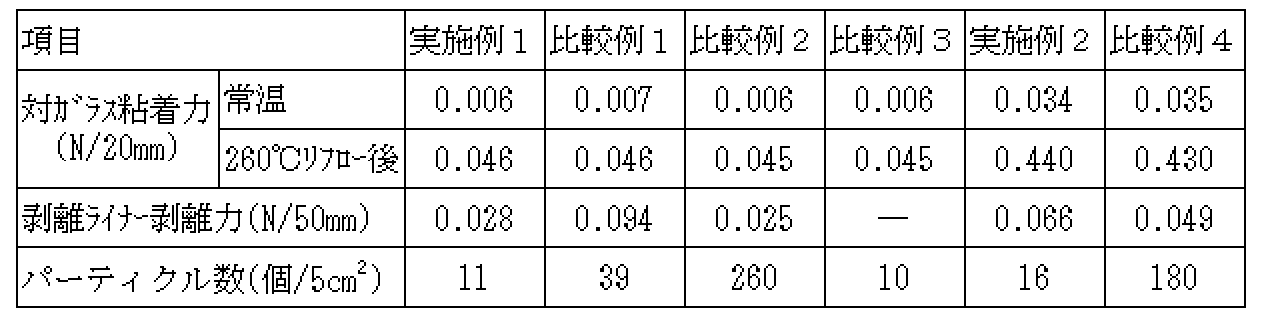
表1より明らかなように、実施例1及び比較例1〜3による常温と260℃リフロー後の耐ガラス粘着力をみると、どの例も同程度の結果となり、剥離ライナーの有無や、離型剤層の有無はこの耐ガラス粘着力には影響を及ぼさないことがわかる。
しかしながら、剥離ライナーを貼り合わせていない比較例3の粘着テープと比較して、シリコーン系離型層やフルオロシリコーン系離型層の離型処理をした剥離ライナーを用いた比較例1及び2の粘着テープは、転写異物が多くなっており、この結果によれば比較例1及び2に記載の剥離ライナーの剥離面に形成された離型剤層から、離型剤が再転写していることがわかる。
これに対し、実施例1の結果から明らかなように、剥離ライナーとして離型処理していないポリエチレンテレフタレートフィルムを用いた本発明の表面保護用粘着テープは、剥離ライナーを使用しない比較例3と同程度のパーティクル数を示すので、実施例1によれば離型剤の再転写が発生することなく、転写異物低減が可能であることがわかる。
実施例2及び比較例4による常温と260℃リフロー後の耐ガラス粘着力をみると、いずれの例も同程度の結果となり、剥離ライナーの有無や、離型剤層の有無はこの耐ガラス粘着力には影響を及ぼさないことがわかる。
しかしながら、剥離ライナーとして離型処理していないポリエチレンテレフタレートフィルムを用いた実施例2とフルオロシリコーン系離型層の離型処理をした剥離ライナーを用いた比較例4のパーティクル数を比べると、実施例2は離型剤の再転写が発生することなく、転写異物低減が可能であることがわかる。
As can be seen from Table 1, when the normal temperature and the glass adhesive strength after reflowing at 260 ° C. according to Example 1 and Comparative Examples 1 to 3 were observed, all the examples had the same results, the presence or absence of a release liner, and release It can be seen that the presence or absence of the agent layer does not affect the glass adhesive strength.
However, as compared with the adhesive tape of Comparative Example 3 in which no release liner is bonded, the adhesives of Comparative Examples 1 and 2 using a release liner subjected to a release treatment of a silicone release layer or a fluorosilicone release layer. The tape has a large amount of transferred foreign matter, and according to this result, the release agent is retransferred from the release agent layer formed on the release surface of the release liner described in Comparative Examples 1 and 2. Recognize.
On the other hand, as is clear from the results of Example 1, the surface-protective pressure-sensitive adhesive tape of the present invention using a polyethylene terephthalate film not subjected to release treatment as the release liner is the same as Comparative Example 3 in which no release liner is used. Since the number of particles is approximately, it can be seen that transfer foreign matter can be reduced according to Example 1 without causing retransfer of the release agent.
When the glass adhesive strength after reflow at room temperature and 260 ° C. according to Example 2 and Comparative Example 4 was observed, both examples showed similar results. The presence or absence of a release liner and the presence or absence of a release agent layer were the same. It turns out that it does not affect force.
However, when comparing the number of particles in Example 2 using a polyethylene terephthalate film not subjected to release treatment as a release liner and Comparative Example 4 using a release liner subjected to release treatment of a fluorosilicone release layer, No. 2 shows that transfer foreign matter can be reduced without retransfer of the release agent.
Claims (5)
The pressure-sensitive adhesive tape for surface protection according to any one of claims 1 to 4, which has an adhesive strength at room temperature of 0.05 N / 20 mm or less and an adhesive strength after reflow at 260 ° C of 0.50 N / 20 mm or less.
Priority Applications (6)
| Application Number | Priority Date | Filing Date | Title |
|---|---|---|---|
| JP2011010066A JP5759729B2 (en) | 2011-01-20 | 2011-01-20 | Adhesive tape for surface protection of semiconductor parts |
| CN2012800039570A CN103237858A (en) | 2011-01-20 | 2012-01-18 | Surface protection adhesive tape of semiconductor component |
| US13/991,998 US20130344274A1 (en) | 2011-01-20 | 2012-01-18 | Pressure-sensitive adhesive tape for protecting surface of semiconductor parts |
| KR1020137013044A KR20140018191A (en) | 2011-01-20 | 2012-01-18 | Adhesive tape for protecting surface of semiconductor component |
| PCT/JP2012/050949 WO2012099158A1 (en) | 2011-01-20 | 2012-01-18 | Adhesive tape for protecting surface of semiconductor component |
| TW101102733A TW201235222A (en) | 2011-01-20 | 2012-01-20 | Adhesive tape for protecting surface of semiconductor parts |
Applications Claiming Priority (1)
| Application Number | Priority Date | Filing Date | Title |
|---|---|---|---|
| JP2011010066A JP5759729B2 (en) | 2011-01-20 | 2011-01-20 | Adhesive tape for surface protection of semiconductor parts |
Publications (2)
| Publication Number | Publication Date |
|---|---|
| JP2012149192A true JP2012149192A (en) | 2012-08-09 |
| JP5759729B2 JP5759729B2 (en) | 2015-08-05 |
Family
ID=46515781
Family Applications (1)
| Application Number | Title | Priority Date | Filing Date |
|---|---|---|---|
| JP2011010066A Expired - Fee Related JP5759729B2 (en) | 2011-01-20 | 2011-01-20 | Adhesive tape for surface protection of semiconductor parts |
Country Status (6)
| Country | Link |
|---|---|
| US (1) | US20130344274A1 (en) |
| JP (1) | JP5759729B2 (en) |
| KR (1) | KR20140018191A (en) |
| CN (1) | CN103237858A (en) |
| TW (1) | TW201235222A (en) |
| WO (1) | WO2012099158A1 (en) |
Cited By (4)
| Publication number | Priority date | Publication date | Assignee | Title |
|---|---|---|---|---|
| JP2015117348A (en) * | 2013-12-20 | 2015-06-25 | フジコピアン株式会社 | Adsorption film |
| JP2015193162A (en) * | 2014-03-31 | 2015-11-05 | リンテック株式会社 | Carrier sheet and laminate |
| JP2016124944A (en) * | 2014-12-26 | 2016-07-11 | 大王製紙株式会社 | Adhesive sheet for electric and electronic apparatus and electric and electronic apparatus using it |
| WO2022009965A1 (en) * | 2020-07-10 | 2022-01-13 | 日東電工株式会社 | Silicone-based adhesive and adhesive tape |
Families Citing this family (4)
| Publication number | Priority date | Publication date | Assignee | Title |
|---|---|---|---|---|
| KR102544301B1 (en) * | 2014-03-26 | 2023-06-15 | 린텍 가부시키가이샤 | Laminate for resin film formation sheet |
| JP6783106B2 (en) * | 2016-09-29 | 2020-11-11 | 日東電工株式会社 | Conductive adhesive tape |
| JP6582013B2 (en) * | 2017-03-31 | 2019-09-25 | 古河電気工業株式会社 | Mask protection surface protection tape with release liner |
| CN115367303B (en) * | 2019-08-16 | 2024-06-28 | 日东电工株式会社 | Cover member and component supply assembly having the cover member |
Citations (5)
| Publication number | Priority date | Publication date | Assignee | Title |
|---|---|---|---|---|
| JP2003003132A (en) * | 2001-06-19 | 2003-01-08 | Lintec Corp | Adhesive sheet and adhesive |
| JP2005089609A (en) * | 2003-09-17 | 2005-04-07 | Nitto Denko Corp | Adhesive tape application method and application device |
| JP2006052384A (en) * | 2004-07-12 | 2006-02-23 | Lintec Corp | Silicone rubber adhesive sheet |
| JP2006213810A (en) * | 2005-02-03 | 2006-08-17 | Shin Etsu Chem Co Ltd | Silicone composition for pressure-sensitive adhesive and pressure-sensitive adhesive tape obtained from the composition |
| JP2007099858A (en) * | 2005-10-03 | 2007-04-19 | Furukawa Electric Co Ltd:The | Semiconductor processing tape |
Family Cites Families (6)
| Publication number | Priority date | Publication date | Assignee | Title |
|---|---|---|---|---|
| JP2000303046A (en) * | 1999-04-20 | 2000-10-31 | Nitto Denko Corp | Acrylic pressure-sensitive adhesive composition for bonding polyester film and its adhesive sheets |
| JP3987720B2 (en) * | 2001-12-19 | 2007-10-10 | 日東電工株式会社 | Cleaning sheet and method for cleaning substrate processing apparatus using the same |
| JP2006003676A (en) * | 2004-06-18 | 2006-01-05 | Lintec Corp | Functional film for display screen and manufacturing method for same |
| JP5101919B2 (en) * | 2007-04-09 | 2012-12-19 | 日東電工株式会社 | Double-sided adhesive tape or sheet for printed circuit board and printed circuit board with double-sided adhesive tape |
| KR20120046305A (en) * | 2009-08-20 | 2012-05-09 | 가부시키가이샤 시세이도 | Hair-dressing cosmetic |
| JP5551568B2 (en) * | 2009-11-12 | 2014-07-16 | 日東電工株式会社 | Resin-sealing adhesive tape and method for manufacturing resin-sealed semiconductor device using the same |
-
2011
- 2011-01-20 JP JP2011010066A patent/JP5759729B2/en not_active Expired - Fee Related
-
2012
- 2012-01-18 KR KR1020137013044A patent/KR20140018191A/en not_active Withdrawn
- 2012-01-18 WO PCT/JP2012/050949 patent/WO2012099158A1/en not_active Ceased
- 2012-01-18 US US13/991,998 patent/US20130344274A1/en not_active Abandoned
- 2012-01-18 CN CN2012800039570A patent/CN103237858A/en active Pending
- 2012-01-20 TW TW101102733A patent/TW201235222A/en unknown
Patent Citations (5)
| Publication number | Priority date | Publication date | Assignee | Title |
|---|---|---|---|---|
| JP2003003132A (en) * | 2001-06-19 | 2003-01-08 | Lintec Corp | Adhesive sheet and adhesive |
| JP2005089609A (en) * | 2003-09-17 | 2005-04-07 | Nitto Denko Corp | Adhesive tape application method and application device |
| JP2006052384A (en) * | 2004-07-12 | 2006-02-23 | Lintec Corp | Silicone rubber adhesive sheet |
| JP2006213810A (en) * | 2005-02-03 | 2006-08-17 | Shin Etsu Chem Co Ltd | Silicone composition for pressure-sensitive adhesive and pressure-sensitive adhesive tape obtained from the composition |
| JP2007099858A (en) * | 2005-10-03 | 2007-04-19 | Furukawa Electric Co Ltd:The | Semiconductor processing tape |
Cited By (6)
| Publication number | Priority date | Publication date | Assignee | Title |
|---|---|---|---|---|
| JP2015117348A (en) * | 2013-12-20 | 2015-06-25 | フジコピアン株式会社 | Adsorption film |
| JP2015193162A (en) * | 2014-03-31 | 2015-11-05 | リンテック株式会社 | Carrier sheet and laminate |
| JP2016124944A (en) * | 2014-12-26 | 2016-07-11 | 大王製紙株式会社 | Adhesive sheet for electric and electronic apparatus and electric and electronic apparatus using it |
| WO2022009965A1 (en) * | 2020-07-10 | 2022-01-13 | 日東電工株式会社 | Silicone-based adhesive and adhesive tape |
| JP2022016052A (en) * | 2020-07-10 | 2022-01-21 | 日東電工株式会社 | Silicone-based adhesive and adhesive tape |
| JP7427552B2 (en) | 2020-07-10 | 2024-02-05 | 日東電工株式会社 | Silicone adhesive and adhesive tape |
Also Published As
| Publication number | Publication date |
|---|---|
| WO2012099158A1 (en) | 2012-07-26 |
| KR20140018191A (en) | 2014-02-12 |
| CN103237858A (en) | 2013-08-07 |
| TW201235222A (en) | 2012-09-01 |
| JP5759729B2 (en) | 2015-08-05 |
| US20130344274A1 (en) | 2013-12-26 |
Similar Documents
| Publication | Publication Date | Title |
|---|---|---|
| JP5759729B2 (en) | Adhesive tape for surface protection of semiconductor parts | |
| JP7177811B2 (en) | Film adhesive, semiconductor processing sheet, and method for manufacturing semiconductor device | |
| JP4417460B2 (en) | Semiconductor wafer protective adhesive sheet and semiconductor wafer grinding method | |
| JP6270736B2 (en) | Protective film forming film | |
| CN101842455A (en) | Adhesive, adhesive sheet, multi-layered adhesive sheet, and production method for electronic part | |
| KR101370771B1 (en) | Dicing die-bonding film | |
| CN101518887B (en) | Adhesive sheet for grinding back surface of semiconductor wafer and method for grinding back surface of semiconductor wafer using the same | |
| KR20100015290A (en) | Dicing.die bonding film | |
| KR20100014180A (en) | Dicing.die bonding film | |
| KR101908390B1 (en) | Base material film for semiconductor processing sheet, semiconductor processing sheet, and method for manufacturing semiconductor device | |
| JP5313837B2 (en) | Removable adhesive sheet | |
| CN107001876B (en) | Sheet for resin film formation and composite sheet for resin film formation | |
| KR20100134734A (en) | Dicing die bond film | |
| JP7656400B2 (en) | Film-like adhesive composite sheet and method for manufacturing semiconductor device | |
| JP4518535B2 (en) | Dicing adhesive sheet, dicing adhesive sheet, semiconductor element manufacturing method, semiconductor element | |
| CN114586141B (en) | Semiconductor device manufacturing sheets | |
| WO2013108703A1 (en) | Semiconductor part surface protection adhesive tape | |
| JP7426260B2 (en) | Adhesive tape | |
| TWI736196B (en) | Sheet for forming resin film, composite sheet for forming resin film, and method for regenerating silicon wafer | |
| KR101675054B1 (en) | Adhesive tape for component-embedded print circuit board and method for preparing the same | |
| JP2012012506A (en) | Pressure-sensitive adhesive composition easily releasable with energy ray | |
| JP2019075449A (en) | Dicing die bonding sheet and manufacturing method of semiconductor chip | |
| JP2023001915A (en) | Adhesive sheet for semiconductor wafer processing | |
| JP2008045091A (en) | Adhesive sheet for processing | |
| JP2012031316A (en) | Heat-resistant temporary adhesion adhesive tape |
Legal Events
| Date | Code | Title | Description |
|---|---|---|---|
| A621 | Written request for application examination |
Free format text: JAPANESE INTERMEDIATE CODE: A621 Effective date: 20131016 |
|
| A131 | Notification of reasons for refusal |
Free format text: JAPANESE INTERMEDIATE CODE: A131 Effective date: 20140701 |
|
| A521 | Request for written amendment filed |
Free format text: JAPANESE INTERMEDIATE CODE: A821 Effective date: 20140822 Free format text: JAPANESE INTERMEDIATE CODE: A523 Effective date: 20140822 |
|
| A131 | Notification of reasons for refusal |
Free format text: JAPANESE INTERMEDIATE CODE: A131 Effective date: 20141014 |
|
| A521 | Request for written amendment filed |
Free format text: JAPANESE INTERMEDIATE CODE: A821 Effective date: 20141119 Free format text: JAPANESE INTERMEDIATE CODE: A523 Effective date: 20141119 |
|
| TRDD | Decision of grant or rejection written | ||
| A01 | Written decision to grant a patent or to grant a registration (utility model) |
Free format text: JAPANESE INTERMEDIATE CODE: A01 Effective date: 20150602 |
|
| A61 | First payment of annual fees (during grant procedure) |
Free format text: JAPANESE INTERMEDIATE CODE: A61 Effective date: 20150608 |
|
| R150 | Certificate of patent or registration of utility model |
Ref document number: 5759729 Country of ref document: JP Free format text: JAPANESE INTERMEDIATE CODE: R150 |
|
| R250 | Receipt of annual fees |
Free format text: JAPANESE INTERMEDIATE CODE: R250 |
|
| R250 | Receipt of annual fees |
Free format text: JAPANESE INTERMEDIATE CODE: R250 |
|
| R250 | Receipt of annual fees |
Free format text: JAPANESE INTERMEDIATE CODE: R250 |
|
| R250 | Receipt of annual fees |
Free format text: JAPANESE INTERMEDIATE CODE: R250 |
|
| R250 | Receipt of annual fees |
Free format text: JAPANESE INTERMEDIATE CODE: R250 |
|
| R250 | Receipt of annual fees |
Free format text: JAPANESE INTERMEDIATE CODE: R250 |
|
| R250 | Receipt of annual fees |
Free format text: JAPANESE INTERMEDIATE CODE: R250 |
|
| LAPS | Cancellation because of no payment of annual fees |