JP2012158493A - Fine particle low valence niobium oxide composition, and method for producing the same - Google Patents
Fine particle low valence niobium oxide composition, and method for producing the same Download PDFInfo
- Publication number
- JP2012158493A JP2012158493A JP2011019046A JP2011019046A JP2012158493A JP 2012158493 A JP2012158493 A JP 2012158493A JP 2011019046 A JP2011019046 A JP 2011019046A JP 2011019046 A JP2011019046 A JP 2011019046A JP 2012158493 A JP2012158493 A JP 2012158493A
- Authority
- JP
- Japan
- Prior art keywords
- niobium oxide
- low
- valence
- carbon
- oxide composition
- Prior art date
- Legal status (The legal status is an assumption and is not a legal conclusion. Google has not performed a legal analysis and makes no representation as to the accuracy of the status listed.)
- Pending
Links
Images

Landscapes
- Inorganic Compounds Of Heavy Metals (AREA)
Abstract
【課題】スパッタ時に異常放電が発生することがない低原子価酸化ニオブドープ酸化亜鉛ターゲットを作製するのに好適な微粒子低原子価酸化ニオブ組成物、および該微粒子低原子価酸化ニオブ組成物を極めて安価に作製することが可能な製造方法を提供する。
【解決手段】X線回折プロファイルにおいて、ニオブの原子価が5価より低い低原子価酸化ニオブのピークを有し、一次粒子径が50nm〜1μmである微粒子低原子価酸化ニオブ組成物であり、酸化ニオブと、カーボンとの混合物を、内圧上昇時に内部の気体を外部に放出できる機能を有する閉鎖系容器中において、大気含有ガス気流中1000〜1600℃で焼成する工程を経て製造することができる。
【選択図】図1A fine particle low valence niobium oxide composition suitable for producing a low valence niobium oxide doped zinc oxide target that does not cause abnormal discharge during sputtering, and the fine particle low valence niobium oxide composition is extremely inexpensive. A manufacturing method capable of being manufactured is provided.
A fine-particle low-valence niobium oxide composition having a peak of low-valence niobium oxide whose niobium valence is lower than pentavalent in an X-ray diffraction profile and having a primary particle diameter of 50 nm to 1 μm. A mixture of niobium oxide and carbon can be manufactured through a step of firing at 1000 to 1600 ° C. in an air-containing gas stream in a closed container having a function of releasing the internal gas to the outside when the internal pressure is increased. .
[Selection] Figure 1
Description
本発明は、微粒子低原子価酸化ニオブ組成物およびその製造方法に関し、さらに詳しくは、安価に酸化亜鉛系透明導電性材料のドーパント源として利用できる微粒子低原子価酸化ニオブ組成物およびその量産可能な製造方法に関する。 The present invention relates to a fine particle low-valent niobium oxide composition and a method for producing the same, and more specifically, a fine particle low-valent niobium oxide composition that can be used as a dopant source for a zinc oxide-based transparent conductive material and its mass production. It relates to a manufacturing method.
導電性と光透過性とを兼ね備えた透明導電膜は、これまでから、太陽電池、液晶表示素子、その他各種受光素子における電極などとして利用されているほか、自動車窓や建築用の熱線反射膜、帯電防止膜、冷凍ショーケース等における防曇用透明発熱体など、幅広い用途に利用されている。特に、低抵抗で導電性に優れた透明導電膜は、太陽電池や、液晶、有機エレクトロルミネッセンス、無機エレクトロルミネッセンスなどの液晶表示素子や、タッチパネルなどに好適であることが知られている。 Transparent conductive films that combine electrical conductivity and light transmission have been used as electrodes in solar cells, liquid crystal display elements, and other various light receiving elements, as well as automotive window and heat ray reflective films for buildings, It is used for a wide range of applications such as anti-static films and transparent heating elements for anti-fogging in frozen showcases. In particular, it is known that a transparent conductive film having low resistance and excellent conductivity is suitable for a solar cell, a liquid crystal display element such as a liquid crystal, organic electroluminescence, and inorganic electroluminescence, a touch panel, and the like.
従来、透明導電膜としては、例えば、アンチモンドープ酸化スズ(ATO)膜などの酸化スズ(SnO2)系の薄膜、アルミニウムドープ酸化亜鉛(AZO)膜などの酸化亜鉛(ZnO)系の薄膜、スズドープ酸化インジウム(ITO;Indium Tin Oxide)膜などの酸化インジウム(In2O3)系の薄膜が知られている。
中でも、最も工業的に利用されているのは酸化インジウム系の透明導電膜であり、とりわけITO膜は、低抵抗で導電性に優れることから、幅広く実用化されている。
Conventionally, as the transparent conductive film, for example, a tin oxide (SnO 2 ) -based thin film such as an antimony-doped tin oxide (ATO) film, a zinc oxide (ZnO) -based thin film such as an aluminum-doped zinc oxide (AZO) film, tin-doped Indium oxide (In 2 O 3 ) -based thin films such as indium oxide (ITO) films are known.
Among them, the most industrially used is an indium oxide-based transparent conductive film, and in particular, an ITO film is widely used because of its low resistance and excellent conductivity.
しかし、ITO膜の如き酸化インジウム系の透明導電膜は、その必須原料であるIn(インジウム)が、希少金属であるため高価で且つ資源枯渇のおそれがあり、しかも毒性を有し環境や人体に対して悪影響を及ぼす可能性がある。そのため、近年、ITO膜に代替し得る工業的に汎用可能な透明導電膜が要望されている。そのような中、スパッタリング法による工業的製造も可能である酸化亜鉛系透明導電膜が注目されており、その導電性能を高めるべく研究が進められている。 However, an indium oxide-based transparent conductive film such as an ITO film is expensive and may be depleted of resources because In (indium), which is an essential raw material, is a rare metal, and has toxicity and is harmful to the environment and the human body. It may have an adverse effect on it. Therefore, in recent years, an industrially versatile transparent conductive film that can be substituted for an ITO film has been demanded. Under such circumstances, a zinc oxide-based transparent conductive film that can be industrially manufactured by a sputtering method has attracted attention, and research is being conducted to improve its conductive performance.
非特許文献1には、導電性を高めるべくZnOに種々のドーパントをドープさせる試みが報告されている。 Non-Patent Document 1 reports an attempt to dope various dopants into ZnO in order to increase conductivity.
また、本発明者らは、酸化ニオブ(II)、酸化ニオブ(III)、酸化ニオブ(IV)等の低原子価酸化ニオブが酸化亜鉛系透明導電膜に有効なドーパントであることを新規に見出している。この低原子価酸化ニオブをドープした酸化亜鉛系透明導電膜は、低抵抗を実現し、化学的耐久性に優れ、太陽電池用透明導電膜に好適な近赤外領域の高透過性という特長を有している。 In addition, the present inventors have newly found that low-valence niobium oxides such as niobium oxide (II), niobium oxide (III), niobium oxide (IV) are effective dopants for the zinc oxide-based transparent conductive film. ing. This zinc oxide-based transparent conductive film doped with low-valence niobium oxide realizes low resistance, excellent chemical durability, and high transmittance in the near infrared region suitable for transparent conductive films for solar cells. Have.
このようなNbO(II)、Nb2O3(III)、NbO2(IV)等の低原子価酸化ニオブは、現在までのところ、工業的規模では得られていない。これは、以下に示すように、酸化ニオブ(Nb2O5)を還元して微粒子低原子価酸化ニオブを工業的に製造することが難しいことに基づいている。
低原子価酸化ニオブの製造方法としては、Nb2O5(V)を強還元雰囲気で焼成するのが一般的な作製方法であり、白熱水素中で還元するものである(非特許文献2参照)。そのため安全上、取り扱い性に注意を要する水素を必須とし、高コストな製造プロセスになってしまう問題もある。
従って、工業的規模で微粒子状の低原子価酸化ニオブを得ることは難しく、微粒子低原子価酸化ニオブ組成物を工業的規模で製造することはいまだ行われていない。
To date, low-valence niobium oxides such as NbO (II), Nb 2 O 3 (III), and NbO 2 (IV) have not been obtained on an industrial scale. As described below, this is based on the fact that niobium oxide (Nb 2 O 5 ) is reduced and it is difficult to industrially produce fine-particle low-valent niobium oxide.
As a method for producing low-valence niobium oxide, Nb 2 O 5 (V) is generally prepared by firing in a strong reducing atmosphere, and is reduced in incandescent hydrogen (see Non-Patent Document 2). ). Therefore, for safety, hydrogen requiring attention to handling is essential, and there is a problem that the manufacturing process becomes expensive.
Therefore, it is difficult to obtain fine-particle low-valence niobium oxide on an industrial scale, and production of a fine-particle low-valence niobium oxide composition on an industrial scale has not yet been performed.
前記した低原子価酸化ニオブをドーパントとして用いた酸化亜鉛系透明導電膜は、酸化亜鉛粉と低原子価酸化ニオブを膜原料としたターゲット(焼結体)を用いて各種真空プロセス(スパッタリング法、イオンプレーティング法、パルスレーザー堆積(PLD)法、エレクトロンビーム(EB)蒸着法など)で作製される。
しかし、膜原料である酸化亜鉛粉と従来の製造方法で得られる低原子価酸化ニオブを焼結すると、酸化亜鉛粉の一次粒子径は数十nmのナノ粒子から1μm程度であるのに対して、従来の製造方法で得られる低原子価酸化ニオブの一次粒子径は少なくとも40μm以上であり、双方の一次粒子径のオーダーが異なるため、膜原料が均一に固相焼結しない。そのため、焼結して得られるターゲットには、焼結密度が低いため生成する空孔と、高抵抗である未反応の低原子価酸化ニオブが存在してしまう。
このような焼結密度が低く空孔が存在するターゲットを用いたスパッタリングでは、ターゲットを含む放電系のインピーダンスがスパッタリング中に変動することに起因して発生するため、スパッタリング装置内で異常放電が多発し、酸化亜鉛系透明導電膜を安定に成膜するのが困難であった。
この異常放電を抑制するには、膜原料を均一に固相焼結し、空孔の生成を抑制する必要があり、そのためには、酸化亜鉛粉と低原子価酸化ニオブの一次粒子径ができるだけ差がない、すなわち同じサイズである酸化亜鉛粉と低原子価酸化ニオブを用いることが好ましい。
The above-described zinc oxide-based transparent conductive film using low-valent niobium oxide as a dopant is prepared by using various vacuum processes (sputtering method, sputtering) using a target (sintered body) made of zinc oxide powder and low-valent niobium oxide as film raw materials. The ion plating method, the pulse laser deposition (PLD) method, the electron beam (EB) vapor deposition method, etc.).
However, when zinc oxide powder, which is a film raw material, and low-valent niobium oxide obtained by a conventional manufacturing method are sintered, the primary particle diameter of zinc oxide powder is from about several tens of nanometers to about 1 μm. The primary particle diameter of the low-valence niobium oxide obtained by the conventional manufacturing method is at least 40 μm or more, and the order of the primary particle diameters of the two is different, so that the film raw material is not uniformly solid-phase sintered. Therefore, the target obtained by sintering has voids generated due to low sintering density, and unreacted low-valence niobium oxide having high resistance.
In sputtering using a target having such a low sintered density and voids, the impedance of the discharge system including the target changes due to fluctuations during sputtering, so abnormal discharge frequently occurs in the sputtering apparatus. However, it has been difficult to stably form a zinc oxide-based transparent conductive film.
In order to suppress this abnormal discharge, it is necessary to solid-phase sinter the film raw material uniformly to suppress the generation of vacancies. For this purpose, the primary particle diameter of zinc oxide powder and low-valence niobium oxide can be as small as possible. It is preferable to use zinc oxide powder and low-valence niobium oxide that are not different, that is, have the same size.
そこで、本発明の課題は、スパッタ時に異常放電が発生することがない低原子価酸化ニオブドープ酸化亜鉛ターゲットを作製するのに、好適な微粒子低原子価酸化ニオブ組成物と、該酸化ニオブ組成物を安価に、工業的レベルで作製することが可能な製造方法とを提供することにある。 Therefore, an object of the present invention is to prepare a fine particle low-valence niobium oxide composition suitable for producing a low-valence niobium oxide-doped zinc oxide target in which abnormal discharge does not occur during sputtering, and the niobium oxide composition. An object of the present invention is to provide a manufacturing method that can be manufactured at an industrial level at low cost.
本発明者は、上記問題を解決すべく種々検討した結果、本発明を完成するに到った。 As a result of various studies to solve the above problems, the present inventors have completed the present invention.
すなわち、本発明は、以下の構成からなる。
(1)X線回折プロファイルにおいて、ニオブの原子価が5価より低い低原子価酸化ニオブのピークを有し、一次粒子径が50nm〜1μmであることを特徴とする微粒子低原子価酸化ニオブ組成物。
(2)NbO(II)、Nb2O3(III)およびNbO2(IV)から選ばれる低原子価酸化ニオブの混合物からなる前記(1)に記載の微粒子低原子価酸化ニオブ組成物。
(3)酸化ニオブと、カーボンとの混合物を、内圧上昇時に内部の気体を外部に放出できる機能を有する閉鎖系容器中において、酸素含有ガス気流中1000〜1600℃で焼成する工程を含む、前記(1)または(2)に記載の微粒子低原子価酸化ニオブ組成物を製造することを特徴とする微粒子低原子価酸化ニオブ組成物の製造方法。
(4)前記カーボンが、粒径50nm〜150μmの粉である前記(3)に記載の微粒子低原子価酸化ニオブ組成物の製造方法。
That is, this invention consists of the following structures.
(1) Fine particle low-valence niobium oxide composition having a low-valence niobium oxide peak having a niobium valence lower than pentavalent in the X-ray diffraction profile and a primary particle diameter of 50 nm to 1 μm object.
(2) The fine-particle low-valence niobium oxide composition according to (1), comprising a mixture of low-valence niobium oxide selected from NbO (II), Nb 2 O 3 (III) and NbO 2 (IV).
(3) including a step of firing a mixture of niobium oxide and carbon in an oxygen-containing gas stream at 1000 to 1600 ° C. in a closed container having a function of releasing an internal gas to the outside when the internal pressure increases. (1) A method for producing a fine particle low valence niobium oxide composition according to (1) or (2), wherein the fine particle low valence niobium oxide composition is produced.
(4) The method for producing a fine particle low-valence niobium oxide composition according to (3), wherein the carbon is a powder having a particle size of 50 nm to 150 μm.
本発明の微粒子低原子価酸化ニオブ組成物を用いると、スパッタリング法、イオンプレーティング法、PLD法、EB蒸着法等によって異常放電の発生がなく、安定に成膜をすることができるターゲットを作製することが可能になる。
また、本発明の製造方法によれば、上記微粒子低原子価酸化ニオブ組成物を安価に作製できるという利点も有するので、工業的規模で製造(量産)することが可能となり、工業的に極めて有用である。
When the fine particle low-valence niobium oxide composition of the present invention is used, a target capable of stably forming a film without causing abnormal discharge by sputtering, ion plating, PLD, EB vapor deposition or the like is produced. It becomes possible to do.
Further, according to the production method of the present invention, since the fine particle low-valence niobium oxide composition can be produced at low cost, it can be produced (mass produced) on an industrial scale and is extremely useful industrially. It is.
以下、本発明の一実施形態を詳細に説明するが、本発明の要旨を外れない限り、本発明は以下の記載により制限を受けるものではない。 Hereinafter, although one embodiment of the present invention is described in detail, the present invention is not limited by the following description unless it departs from the gist of the present invention.
本発明の微粒子低原子価酸化ニオブは、X線回折プロファイルにおいて、低原子価酸化ニオブのピークを有し、一次粒子径が所定範囲のものであり、酸化ニオブ(V)とカーボンとの混合物を、所定の閉鎖系容器中で、所定条件のもとで焼成する、カーボンによる酸化ニオブの還元工程を経て得られる。 The fine particle low valence niobium oxide of the present invention has a low valence niobium oxide peak in the X-ray diffraction profile and a primary particle diameter within a predetermined range, and a mixture of niobium oxide (V) and carbon is used. It is obtained through a reduction process of niobium oxide with carbon, which is baked under a predetermined condition in a predetermined closed system container.
出発原料となる酸化ニオブは、酸化ニオブ(V)を用いる。
酸化ニオブの粒子径は、特に限定されないが、粒径の小さい微粒子低原子価酸化ニオブを得るには、酸化ニオブ(V)も粒径の小さいものほど好ましく、例えば、レーザー回折・散乱法等による粒度分布の測定から平均一次粒子径で1μm以下のものが好ましく、また、取扱い性を考慮すると、上記のような平均一次粒子径が50nm以上で800nm以下のものが好ましい。
Niobium oxide (V) is used as the starting material niobium oxide.
The particle diameter of niobium oxide is not particularly limited, but niobium oxide (V) having a smaller particle diameter is preferable for obtaining fine particle low-valence niobium oxide having a small particle diameter, for example, by laser diffraction / scattering method or the like. From the measurement of the particle size distribution, those having an average primary particle diameter of 1 μm or less are preferable. In consideration of handleability, those having an average primary particle diameter of 50 nm to 800 nm are preferable.
また、本発明におけるカーボンとしては、カーボンからなるものであればよく、例えば、カーボンブラック、カーボンダイヤモンド、グラファイト、ロンズデーライト、フラーレン、コークス、無定形炭素(活性炭、カーボンブラック)、カーボンナノチューブ、グラフェン等のカーボンの同素体が挙げられ、主成分がこのようなカーボンの同素体から構成されるものなら、何でも適用可能である。なかでも、安価に入手可能な観点から、無定形炭素(活性炭、カーボンブラック)、黒鉛を用いるのが好ましい。 The carbon in the present invention may be any carbon as long as it is made of carbon. For example, carbon black, carbon diamond, graphite, ronsdaylite, fullerene, coke, amorphous carbon (activated carbon, carbon black), carbon nanotube, graphene Any carbon allotrope may be used as long as the main component is composed of such a carbon allotrope. Of these, amorphous carbon (activated carbon, carbon black) and graphite are preferably used from the viewpoint of availability at low cost.
カーボンは、粉末状態であるものが好ましく、粒径は50nm〜150μm、好ましくは100nm〜100μm、より好ましくは200nm〜50μmであるのがよい。粒径が小さすぎると、取り扱い性が悪くなるので、上記範囲内となる適度な粒径であることが望ましい。また、粒径が150μmを超える粒状のカーボンを用いるのは好ましくない。このような粒状のカーボンを使用しても酸化ニオブの還元反応を進行させることは可能であるが、酸化ニオブを十分に被覆することができず、一部空気に触れて酸化ニオブを十分に還元できないおそれがあるためである。
上記粉末状態のカーボンの粒度分布は特に指定はないが、すべて上記粒径範囲になくても、その80質量%以上、特に90質量%以上が上記範囲内にあればよい。
The carbon is preferably in a powder state, and the particle size may be 50 nm to 150 μm, preferably 100 nm to 100 μm, more preferably 200 nm to 50 μm. When the particle size is too small, the handleability is deteriorated, so that it is desirable that the particle size is within the above range. In addition, it is not preferable to use granular carbon having a particle size exceeding 150 μm. Even if such granular carbon is used, the reduction reaction of niobium oxide can proceed, but niobium oxide cannot be covered sufficiently, and the niobium oxide is sufficiently reduced by touching part of the air. This is because there is a possibility that it cannot be done.
The particle size distribution of the powdered carbon is not particularly specified, but even if it is not all in the above particle size range, 80% by mass or more, particularly 90% by mass or more may be in the above range.
本発明では、上記酸化ニオブとカーボンとをあらかじめ混合する。使用する酸化ニオブは、粉状であってもよいが、カーボン粉末との分離を容易に行ううえで、酸化ニオブ粉末をあらかじめ加圧などによって所定の形状に成形しておくのが好ましい。形状は、錠剤型など任意な形状であればよい。また、成形物の大きさもカーボン粉末で覆うことができる程度の大きさであれば、特に制限されない。 In the present invention, the niobium oxide and carbon are mixed in advance. The niobium oxide to be used may be in the form of powder, but it is preferable that the niobium oxide powder is formed into a predetermined shape by pressurization or the like in advance for easy separation from the carbon powder. The shape may be any shape such as a tablet shape. Further, the size of the molded product is not particularly limited as long as it can be covered with carbon powder.
酸化ニオブ(V)に対するカーボンの混合割合は、還元力に影響を与えるため、カーボンで酸化ニオブをできるだけ覆うように、重量比で酸化ニオブ:カーボン=1:5〜1:50であるのがよい。カーボンの混合量が少なすぎると、充分に酸化ニオブの還元反応が進行せず目的とする低原子価酸化ニオブ組成物が得られにくくなるおそれがあり、カーボンの混合量が多すぎると、酸化ニオブの還元反応がいきすぎ、金属ニオブが生成したり、未反応のカーボンが残存することになり、経済的でなくなるおそれがある。 Since the mixing ratio of carbon to niobium oxide (V) affects the reducing power, it is preferable that niobium oxide: carbon = 1: 5 to 1:50 by weight ratio so that niobium oxide is covered with carbon as much as possible. . If the amount of carbon mixed is too small, the reduction reaction of niobium oxide may not proceed sufficiently, making it difficult to obtain the desired low-valence niobium oxide composition. If the amount of carbon mixed is excessive, Therefore, there is a possibility that metal niobium is generated or unreacted carbon remains, which is not economical.
混合物におけるカーボンの混合割合が上記範囲内であれば、カーボンで酸化ニオブを十分被覆できるので、酸化ニオブの還元反応の際、カーボンは、還元反応または空気中の酸素と反応することによって、消費されるが、酸化ニオブの還元反応終了後も十分酸化ニオブを被覆されている量が存在すればよい。なお、予め、カーボンが還元反応によって消費されることを想定して多量に加えておくことが好ましい。このようにすることによって、大気中で焼成しても、酸化ニオブは酸化されずに、低原子価酸化ニオブを作製することが可能になる。そのため、通常の大気雰囲気の炉で、カーボン粉を酸化ニオブ(V)で緻密に覆うことによって、大がかりな不活性雰囲気炉や還元性ガスを用いずに酸化ニオブ(V)を還元できるので、低コストで低原子価酸化ニオブを製造することが可能となる。 If the mixing ratio of the carbon in the mixture is within the above range, the niobium oxide can be sufficiently covered with the carbon. Therefore, during the reduction reaction of niobium oxide, the carbon is consumed by reacting with the reduction reaction or oxygen in the air. However, it suffices that there is a sufficient amount of niobium oxide after the reduction reaction of niobium oxide. It is preferable to add a large amount in advance assuming that carbon is consumed by the reduction reaction. By doing so, even when baked in the air, niobium oxide is not oxidized and low-valence niobium oxide can be produced. Therefore, niobium oxide (V) can be reduced without using a large inert atmosphere furnace or reducing gas by densely covering the carbon powder with niobium oxide (V) in a normal air atmosphere furnace. It becomes possible to produce low-valence niobium oxide at a low cost.
本発明では、混合物を反応容器に入れて酸化ニオブ(V)の還元反応を進行させる。反応容器としては、容器内部の圧力が上昇したときに容器内部の気体を外部に放出して容器内部の圧力を下げる機能を有する閉鎖系容器を使用するのがよい。このように、内圧上昇時に容器内部の気体を外部に放出する機能を有する閉鎖系容器を用いるのは、カーボンによる還元反応が始まると急激に還元反応が進行し、それに伴って温度が上昇して、容器内部の気体が膨張し、それによって、容器の破裂が生じて危険を招くおそれがあることから、容器内部の圧力が上昇したときに容器内部の気体を外部に放出して容器内部の圧力を下げ、安全性を確保するためである。
なお、酸化ニオブの還元反応中に閉鎖系容器内に発生する気体は、後述する還元メカニズムの考察により、主として二酸化炭素および一酸化炭素であると考えられる。
In the present invention, the mixture is placed in a reaction vessel and the reduction reaction of niobium oxide (V) proceeds. As the reaction vessel, it is preferable to use a closed vessel having a function of lowering the pressure inside the vessel by releasing the gas inside the vessel to the outside when the pressure inside the vessel rises. In this way, the use of a closed container having a function of releasing the gas inside the container to the outside when the internal pressure rises causes the reduction reaction to proceed rapidly when the carbon reduction reaction starts, and the temperature rises accordingly. The gas inside the container expands, which may cause a risk of rupture of the container, so that the gas inside the container is released to the outside when the pressure inside the container rises. This is to reduce safety and ensure safety.
The gas generated in the closed vessel during the reduction reaction of niobium oxide is considered to be mainly carbon dioxide and carbon monoxide based on the consideration of the reduction mechanism described later.
また、閉鎖系容器は、反応物が積極的に大気中の酸素と反応して、還元され生成した低原子価酸化ニオブが、さらに酸化され、元の酸化ニオブ(V)に戻ることを防ぐ機能、すなわち閉鎖系容器内への酸素の流入を抑制する機能を有する。
閉鎖系容器における閉鎖系とは、完全に密閉化していてもよいし、また、完全に密閉化されていなくても、大気に触れるのをある程度抑制できればよいという意味であり、また、必要時に閉鎖系になっていればよいという意味であって、当然、混合物の充填や反応物の取出しにあたっては、その閉鎖系が解除できるものである。
このように、本発明では、混合物を焼成する工程において、閉鎖系容器中でカーボンが酸化ニオブを緻密に覆い、かつ閉鎖系容器により容器内への酸素の流入を抑制できるので、大気中で混合物を焼成しても、還元された酸化ニオブがさらに酸化されるのを防ぐことができる。
In addition, the closed system vessel prevents the reactant from reacting with oxygen in the atmosphere and reducing the low-valent niobium oxide, which is produced by further reduction, to return to the original niobium oxide (V). That is, it has a function of suppressing the inflow of oxygen into the closed system container.
The closed system in a closed container means that the container may be completely sealed, or even if it is not completely sealed, it is only necessary to suppress exposure to the air to some extent, and it is closed when necessary. In other words, the closed system can be canceled when filling the mixture or taking out the reactant.
As described above, in the present invention, in the step of firing the mixture, the carbon covers niobium oxide densely in the closed container and the inflow of oxygen into the container can be suppressed by the closed container. Even if calcined, the reduced niobium oxide can be prevented from being further oxidized.
本発明における焼成は、混合物が充填された所定の閉鎖系容器を、焼成炉内に入れ行なう。
焼成炉としては、特に限定されず、例えば、電気炉など各種焼成炉が挙げられる。
微粒子低原子価酸化ニオブを生成させるための焼成温度、すなわちカーボンによる還元反応(以下、簡略化して、「上記還元反応」または「還元反応」という場合がある)時の温度は、1000℃以上1600℃以下が好ましく、特に1100℃以上1400℃以下であるのがよい。焼成温度が1000℃より低いと、カーボンの還元作用が発現しないおそれがあり、焼成温度が1600℃より高いと、焼結が進んで緻密化し、得られた低原子価酸化ニオブは機械的粉砕では解砕することができず、微粒子が得られなくなるとなるおそれがある。
焼成時間、すなわち還元反応時間は、焼成温度や酸化ニオブの量などによって適宜調整すればよく、通常30分〜4時間、より好ましくは1時間〜2時間程度であるのがよい。
The firing in the present invention is performed by placing a predetermined closed system container filled with the mixture in a firing furnace.
It does not specifically limit as a baking furnace, For example, various baking furnaces, such as an electric furnace, are mentioned.
The firing temperature for generating fine particle low-valent niobium oxide, that is, the temperature during the reduction reaction with carbon (hereinafter sometimes referred to simply as “the above reduction reaction” or “reduction reaction”) is 1000 ° C. or higher and 1600 ° C. The temperature is preferably 1 ° C. or lower, particularly 1100 ° C. or higher and 1400 ° C. or lower. When the firing temperature is lower than 1000 ° C, there is a possibility that the reduction action of carbon may not be exhibited. When the firing temperature is higher than 1600 ° C, the sintering proceeds and becomes dense, and the obtained low-valence niobium oxide is not obtained by mechanical grinding. There is a possibility that it cannot be crushed and fine particles cannot be obtained.
The firing time, that is, the reduction reaction time, may be appropriately adjusted depending on the firing temperature, the amount of niobium oxide, and the like, and is usually 30 minutes to 4 hours, more preferably about 1 hour to 2 hours.
還元メカニズムとしては、カーボンが直接、酸化ニオブ(V)と反応して、酸化ニオブ(V)を還元し、カーボンは二酸化炭素となる反応と、カーボンが大気中の酸素に酸化され、生成した一酸化炭素が酸化ニオブ(V)と反応して、酸化ニオブ(V)を還元する反応との2種類の反応が主に進行していると考えられる。
また、後者の反応は、一酸化炭素の還元能力を利用しており、カーボンを一酸化炭素にするために、大気雰囲気で行う必要がある。
As a reduction mechanism, carbon directly reacts with niobium oxide (V) to reduce niobium oxide (V), carbon becomes carbon dioxide, and carbon is oxidized to oxygen in the atmosphere. It is considered that two types of reactions, ie, a reaction in which carbon oxide reacts with niobium oxide (V) and reduces niobium oxide (V) mainly proceed.
Further, the latter reaction utilizes the reducing ability of carbon monoxide, and it is necessary to perform it in an air atmosphere in order to convert carbon to carbon monoxide.
得られた反応物は、反応容器から取り出し、最終的には室温まで冷却した後、カーボンと低原子価酸化ニオブを分離する。
カーボンと低原子価酸化ニオブを分離する方法としては、特に限定されず、例えば、酸化ニオブを錠剤状とした混合物を用いた場合には錠剤を選択的に取り出す方法;篩による方法;乾燥機に送風した気流により微粉を分離しサイクロン、バッグフィルターなどで回収する風力分級による方法などが挙げられる。
The obtained reaction product is taken out from the reaction vessel and finally cooled to room temperature, and then carbon and low-valent niobium oxide are separated.
The method for separating carbon and low-valent niobium oxide is not particularly limited. For example, when a mixture of niobium oxide in tablet form is used, a method of selectively removing tablets; a method using a sieve; For example, a method by air classification in which fine powder is separated by a blown air flow and collected by a cyclone, a bag filter, or the like.
分離した低原子価酸化ニオブは、粉砕処理が施されてもよい。
粉砕処理する方法としては、後述する微粒子低原子価酸化ニオブ組成物の一次粒子径の範囲内に粉砕することができれば特に限定されず、例えば、メディアを使用する場合、ビーズミル、ボールミル、遊星ミル、サンドグラインダー、振動ミルまたはアトライター等の装置を備えた粉砕機による方法;メディアを使用しないジェットミル、ナノマイザー、スターバースト等の湿式超高圧微粒化装置による方法などが挙げられる。
The separated low-valence niobium oxide may be pulverized.
The method of pulverization is not particularly limited as long as it can be pulverized within the range of the primary particle diameter of the fine particle low-valence niobium oxide composition described later. For example, when using media, a bead mill, a ball mill, a planetary mill, Examples thereof include a method using a pulverizer equipped with an apparatus such as a sand grinder, a vibration mill, or an attritor; a method using a wet ultrahigh pressure atomizer such as a jet mill, nanomizer, or starburst that does not use media.
このようにして、得られた微粒子低原子価酸化ニオブ組成物は、X線回折プロファイルにおいて、低原子価酸化ニオブのピークを有する。
前記した低原子価酸化ニオブ組成物とは、ニオブの原子価が5価より低い酸化ニオブであり、Nb2O5(V)は含まれず、NbO(II)、Nb2O3(III)、NbO2(IV)などが挙げられ、NbO(II)、Nb2O3(III)およびNbO2(IV)から選ばれるのが好ましい。この低原子価酸化ニオブの構造は、X線回折装置(X−Ray Diffraction、 XRD)、X線光電子分光装置(X−ray Photoelectron Spectroscopy、 XPS)などの機器分析の結果によって確認することができる。
Thus, the obtained fine particle low valence niobium oxide composition has a peak of low valence niobium oxide in the X-ray diffraction profile.
The low-valence niobium oxide composition described above is niobium oxide having a valence of niobium lower than pentavalent, does not include Nb 2 O 5 (V), and includes NbO (II), Nb 2 O 3 (III), NbO 2 (IV) and the like can be mentioned, and it is preferably selected from NbO (II), Nb 2 O 3 (III) and NbO 2 (IV). The structure of this low-valence niobium oxide can be confirmed by the results of instrumental analysis such as an X-ray diffraction apparatus (X-Ray Diffraction, XRD) and an X-ray photoelectron spectrometer (X-ray Photoelectron Spectroscopy, XPS).
本発明の微粒子低原子価酸化ニオブ組成物の一次粒子径は、レーザー回折・散乱法による粒度分布の測定から50nm〜1μm、好ましくは100nm〜700nmのサイズである。一次粒子径が50nmよりも小さい場合は、原料である酸化ニオブ(V)の一次粒子径を50nmより小さくする必要があり、カーボンによる還元反応の工程において酸化ニオブの焼結が進行し緻密化するため、機械的粉砕等で砕くことも不可能な実質的に粗大粒子である焼結体となってしまう。そのため、本発明では、機械的粉砕が可能な観点から原料酸化ニオブの一次粒子径は50nm以上であることが好ましい。
一次粒子径が1μmより大きいと、ドーパントとして用いた際に、焼結して得られるターゲット(焼結体)の焼結密度が低下するおそれがある。
The primary particle size of the fine particle low-valence niobium oxide composition of the present invention is 50 nm to 1 μm, preferably 100 nm to 700 nm, as measured by particle size distribution by a laser diffraction / scattering method. When the primary particle diameter is smaller than 50 nm, it is necessary to make the primary particle diameter of niobium oxide (V), which is a raw material, smaller than 50 nm, and niobium oxide is sintered and densified in the reduction reaction process using carbon. Therefore, the sintered body is substantially coarse particles which cannot be crushed by mechanical pulverization or the like. Therefore, in the present invention, the primary particle diameter of the raw material niobium oxide is preferably 50 nm or more from the viewpoint of enabling mechanical pulverization.
If the primary particle diameter is larger than 1 μm, the sintering density of the target (sintered body) obtained by sintering may be reduced when used as a dopant.
本発明の微粒子低原子価酸化ニオブ組成物は、例えば、スパッタ時に異常放電が発生することがない低原子価酸化ニオブドープ酸化亜鉛系透明導電膜ターゲットを作製するのに、好適な微粒であり、上述したように酸化ニオブを原料として極めて安価に、工業的レベルで製造することできる。
また、本発明の微粒子低原子価酸化ニオブ組成物は、高屈折率な膜が得られる特徴を活かして反射防止膜用原料にも好適に用いられる。
The fine particle low-valence niobium oxide composition of the present invention is a fine particle suitable for producing, for example, a low-valence niobium oxide-doped zinc oxide-based transparent conductive film target in which abnormal discharge does not occur during sputtering. As described above, niobium oxide can be produced at an industrial level at a very low cost using niobium oxide as a raw material.
Further, the fine particle low-valence niobium oxide composition of the present invention is also suitably used as a raw material for an antireflection film, taking advantage of the fact that a film having a high refractive index is obtained.
つぎに、実施例を挙げて本発明をより具体的に説明する。ただし、本発明は実施例に例示のものに限られることはない。 Next, the present invention will be described more specifically with reference to examples. However, the present invention is not limited to the examples illustrated in the examples.
実施例および比較例における各物性の評価は、以下の方法で行った。 The physical properties in Examples and Comparative Examples were evaluated by the following methods.
(X線回折分析)
X線回折プロファイルを求めるためのX線回折分析は、スペクトリス(株)製のX線回折装置「X'Pert PRO」(商品名)により、CuKα線を用いて印加電圧45kV,印加電流40mAで、θ−2θ法で行った。
(X-ray diffraction analysis)
X-ray diffraction analysis for obtaining an X-ray diffraction profile was performed using an X-ray diffractometer “X'Pert PRO” (trade name) manufactured by Spectris Co., Ltd., with an applied voltage of 45 kV and an applied current of 40 mA using CuKα rays. The θ-2θ method was used.
(一次粒子径測定)
低原子価酸化ニオブの一次粒子径は、マイクロトラック粒度分布計(日機装(株)製の「MT−3000II」)にて、低原子価酸化ニオブをヘキサメタリン酸ナトリウム溶液中に入れ、ホモジナイザで10分間分散した試料にレーザー光線を照射し、その回折(散乱)を測定して求めた。
(Primary particle size measurement)
The primary particle size of the low valence niobium oxide was determined by placing the low valence niobium oxide in the sodium hexametaphosphate solution with a microtrack particle size distribution analyzer ("MT-3000II" manufactured by Nikkiso Co., Ltd.) and using a homogenizer for 10 minutes. The dispersed sample was irradiated with a laser beam and its diffraction (scattering) was measured.
(実施例1)
酸化ニオブ(V)(和光純薬工業(株)製、平均粒径:0.5μm)20gを金型に入れ、1MPaで軽く加圧し、直径30mmで厚み5mmの円盤型の錠剤を得た。
該円盤型の錠剤20gと活性炭〔大平化学産業(株)製、平均粒径:20〜30μm〕の200gをステンレス鋼製容器に入れ、該容器を電気炉に入れた後、大気雰囲気中で1200℃、2時間で加熱処理を行った。
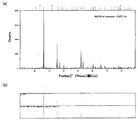
加熱処理後、室温まで自然放冷を行った。その後、錠剤を取り出し、該錠剤と2mmφジルコニア製ボールと溶媒としてエタノールを入れ、錠剤の粉砕を行い、粉末状の酸化ニオブを得た。ついで、得られた酸化ニオブを用いてX線回折プロファイルを求めた。その結果を図1および図2に示す。
Example 1
20 g of niobium oxide (V) (manufactured by Wako Pure Chemical Industries, Ltd., average particle size: 0.5 μm) was placed in a mold and lightly pressurized at 1 MPa to obtain a disk-shaped tablet having a diameter of 30 mm and a thickness of 5 mm.
20 g of the disk-shaped tablet and 200 g of activated carbon (manufactured by Ohira Chemical Sangyo Co., Ltd., average particle size: 20 to 30 μm) were placed in a stainless steel container, and the container was placed in an electric furnace, and then 1200 in the atmosphere. Heat treatment was performed at 2 ° C. for 2 hours.
After the heat treatment, it was naturally cooled to room temperature. Then, the tablet was taken out, ethanol was added as the tablet, a 2 mmφ zirconia ball and a solvent, and the tablet was pulverized to obtain powdered niobium oxide. Next, an X-ray diffraction profile was obtained using the obtained niobium oxide. The results are shown in FIG. 1 and FIG.
なお、上記ステンレス鋼製容器は、加熱により容器内部の気体が膨張して圧力が上昇したときに、フタがその圧力によって持ち上がり、容器内部の気体を外部に放出し、容器内部の圧力が低下すると、フタの自重で容器本体を覆うので、内圧上昇時に容器内部の気体を外部に放出できる機能を有する閉鎖系容器である。 In addition, when the gas inside the container expands due to heating and the pressure rises due to the heating, the lid lifts by the pressure, releases the gas inside the container to the outside, and the pressure inside the container decreases. Since the container body is covered with its own weight, it is a closed container having a function of releasing the gas inside the container to the outside when the internal pressure is increased.
図1(a)は実施例1で得られた酸化ニオブのX線回折測定結果を示した図であり、(b)は、上から該測定結果、NbO2のピークリストを示した図である。図2は、実施例1で得られた酸化ニオブの同定パターンリストである。
図1および図2のX線回折プロファイルに示すように、実施例1の酸化ニオブは、NbO2(IV)の単相、すなわち低原子価酸化ニオブであることが確認された。
また、上記のようにして得られたNbO2(IV)の一次粒子径を測定したところ、0.67μmであった。
FIG. 1A is a diagram showing the X-ray diffraction measurement result of niobium oxide obtained in Example 1, and FIG. 1B is a diagram showing the measurement result and a peak list of NbO 2 from above. . FIG. 2 is an identification pattern list of niobium oxide obtained in Example 1.
As shown in the X-ray diffraction profiles of FIGS. 1 and 2, it was confirmed that the niobium oxide of Example 1 was a single phase of NbO 2 (IV), that is, a low-valence niobium oxide.
The primary particle diameter of NbO 2 (IV) obtained as described above was measured and found to be 0.67 μm.
粒子サイズも小さく(0.67μm)、微粒子低原子価酸化ニオブを大気雰囲気にて、活性炭を用いるという極めてシンプルかつ安価な方法で得ることができた。酸化亜鉛焼結体を作製する際のドーパントとして好適な粒子サイズであった。 The particle size was small (0.67 μm), and the fine particle low-valence niobium oxide could be obtained by an extremely simple and inexpensive method using activated carbon in the air atmosphere. The particle size was suitable as a dopant for producing a zinc oxide sintered body.
(比較例1)
酸化ニオブ(V)(和光純薬工業(株)製 平均粒径0.5μm)20gを金型に入れ、1MPaで軽く加圧し、実施例1と同様にして円盤型の錠剤を得、該円盤型の錠剤のみをステンレス鋼製容器に入れた他は実施例1と同様にして、粉末状の酸化ニオブを得た。
カーボンをステンレス鋼製容器に入れずに大気中で焼成したため、焼成後も白色の酸化ニオブ(V)のままで変化なかった。
(Comparative Example 1)
20 g of niobium oxide (V) (average particle size 0.5 μm, manufactured by Wako Pure Chemical Industries, Ltd.) was placed in a mold and lightly pressurized at 1 MPa to obtain a disk-shaped tablet in the same manner as in Example 1. Powdered niobium oxide was obtained in the same manner as in Example 1 except that only the tablet of the mold was placed in a stainless steel container.
Since carbon was baked in the air without being placed in a stainless steel container, the white niobium oxide (V) remained unchanged after baking.
以上、本発明の実施形態について説明したが、本発明は上記実施形態に限定されるものではなく、本発明の要旨を外れない限りにおいて、種々の改良や変更が可能であることはいうまでもない。 As mentioned above, although embodiment of this invention was described, it cannot be overemphasized that this invention is not limited to the said embodiment, A various improvement and change are possible unless it deviates from the summary of this invention. Absent.
Claims (4)
Priority Applications (1)
| Application Number | Priority Date | Filing Date | Title |
|---|---|---|---|
| JP2011019046A JP2012158493A (en) | 2011-01-31 | 2011-01-31 | Fine particle low valence niobium oxide composition, and method for producing the same |
Applications Claiming Priority (1)
| Application Number | Priority Date | Filing Date | Title |
|---|---|---|---|
| JP2011019046A JP2012158493A (en) | 2011-01-31 | 2011-01-31 | Fine particle low valence niobium oxide composition, and method for producing the same |
Publications (1)
| Publication Number | Publication Date |
|---|---|
| JP2012158493A true JP2012158493A (en) | 2012-08-23 |
Family
ID=46839344
Family Applications (1)
| Application Number | Title | Priority Date | Filing Date |
|---|---|---|---|
| JP2011019046A Pending JP2012158493A (en) | 2011-01-31 | 2011-01-31 | Fine particle low valence niobium oxide composition, and method for producing the same |
Country Status (1)
| Country | Link |
|---|---|
| JP (1) | JP2012158493A (en) |
Cited By (2)
| Publication number | Priority date | Publication date | Assignee | Title |
|---|---|---|---|---|
| WO2014077198A1 (en) * | 2012-11-13 | 2014-05-22 | Jx日鉱日石金属株式会社 | NbO2 SINTERED BODY, SPUTTERING TARGET COMPRISING SINTERED BODY AND METHOD OF PRODUCING NbO2 SINTERED BODY |
| CN110963529A (en) * | 2018-09-30 | 2020-04-07 | 中国科学院上海硅酸盐研究所 | Pure-phase niobium lower-valence oxide nano powder and preparation method and application thereof |
-
2011
- 2011-01-31 JP JP2011019046A patent/JP2012158493A/en active Pending
Cited By (7)
| Publication number | Priority date | Publication date | Assignee | Title |
|---|---|---|---|---|
| WO2014077198A1 (en) * | 2012-11-13 | 2014-05-22 | Jx日鉱日石金属株式会社 | NbO2 SINTERED BODY, SPUTTERING TARGET COMPRISING SINTERED BODY AND METHOD OF PRODUCING NbO2 SINTERED BODY |
| KR20150034777A (en) * | 2012-11-13 | 2015-04-03 | 제이엑스 닛코 닛세키 킨조쿠 가부시키가이샤 | NbO2 SINTERED BODY, SPUTTERING TARGET COMPRISING SINTERED BODY AND METHOD OF PRODUCING NbO2 SINTERED BODY |
| JP5845343B2 (en) * | 2012-11-13 | 2016-01-20 | Jx日鉱日石金属株式会社 | NbO2 sintered body, sputtering target comprising the sintered body, and method for producing NbO2 sintered body |
| KR101702790B1 (en) | 2012-11-13 | 2017-02-06 | 제이엑스금속주식회사 | NbO2 SINTERED BODY, SPUTTERING TARGET COMPRISING SINTERED BODY AND METHOD OF PRODUCING NbO2 SINTERED BODY |
| US10347471B2 (en) | 2012-11-13 | 2019-07-09 | Jx Nippon Mining & Metals Corporation | NbO2 sintered compact, sputtering target comprising the sintered compact, and method of producing NbO2 sintered compact |
| CN110963529A (en) * | 2018-09-30 | 2020-04-07 | 中国科学院上海硅酸盐研究所 | Pure-phase niobium lower-valence oxide nano powder and preparation method and application thereof |
| CN110963529B (en) * | 2018-09-30 | 2021-12-07 | 中国科学院上海硅酸盐研究所 | Pure-phase niobium lower-valence oxide nano powder and preparation method and application thereof |
Similar Documents
| Publication | Publication Date | Title |
|---|---|---|
| Liu et al. | Niobium-doped titania nanoparticles: synthesis and assembly into mesoporous films and electrical conductivity | |
| Hu et al. | Large-scale rapid oxidation synthesis of SnO2 nanoribbons | |
| Corr et al. | Controlled reduction of vanadium oxide nanoscrolls: crystal structure, morphology, and electrical properties | |
| Zhang et al. | ZnO-carbon nanofibers for stable, high response, and selective H2S sensors | |
| Barad et al. | Lattice variation as a function of concentration and grain size in MgO–NiO solid solution system | |
| Heiba et al. | Investigating the structural, linear/nonlinear optical, and photoluminescence characteristics of CuO/ZnMn2O4 nanocomposite for physicochemical applications | |
| JP6076105B2 (en) | Method for producing non-stoichiometric oxide particles | |
| JP2012148920A (en) | Low valence titanium oxide composition, and method for producing the same | |
| JP5392633B2 (en) | Target for ZnO-based transparent conductive film and method for producing the same | |
| JP2012158493A (en) | Fine particle low valence niobium oxide composition, and method for producing the same | |
| JP2009097090A (en) | ZnO vapor deposition material, manufacturing method thereof, ZnO film, etc. | |
| JP5381725B2 (en) | Method for producing ZnO vapor deposition material | |
| JP5381724B2 (en) | Method for producing ZnO vapor deposition material | |
| JP2009097089A (en) | ZnO vapor deposition material, manufacturing method thereof, ZnO film, etc. | |
| JP2018177553A (en) | Method for producing titanium suboxide particles and titanium suboxide particles | |
| JP2012184158A (en) | Low valence titanium oxide powder and zinc oxide-based sintered body | |
| JP5993700B2 (en) | Method for producing zinc oxide-based sintered body | |
| JP4793537B2 (en) | Visible light transmission type particle-dispersed conductor, conductive particles, visible light transmission type conductive article, and manufacturing method thereof | |
| JP2012106880A (en) | Zinc oxide-based transparent conductive film-forming material, method for manufacturing the same, target using the same, and method for forming zinc oxide-based transparent conductive film | |
| JP2012193073A (en) | Oxide molded product, oxide sintered compact, and transparent conductive film-forming material | |
| Nilavazhagan et al. | Cu-doping effect on the structural, optical and photoluminescence properties of Sn0. 98Cr0. 02O2 nanoparticles by co-precipitation method | |
| JP6146773B2 (en) | Oxide sintered body and manufacturing method thereof | |
| JP4251448B2 (en) | Aluminum-substituted tin-containing indium oxide particles and method for producing the same, and conductive paint, conductive coating film and conductive sheet using the particles | |
| JP5562000B2 (en) | Oxide sintered body and manufacturing method thereof | |
| JP2012148926A (en) | Method for producing particulate titanium(ii) monoxide |