JP2012158593A - Tetrahydropyran compound, liquid crystal composition, and liquid crystal display device containing the liquid crystal composition - Google Patents
Tetrahydropyran compound, liquid crystal composition, and liquid crystal display device containing the liquid crystal composition Download PDFInfo
- Publication number
- JP2012158593A JP2012158593A JP2012043433A JP2012043433A JP2012158593A JP 2012158593 A JP2012158593 A JP 2012158593A JP 2012043433 A JP2012043433 A JP 2012043433A JP 2012043433 A JP2012043433 A JP 2012043433A JP 2012158593 A JP2012158593 A JP 2012158593A
- Authority
- JP
- Japan
- Prior art keywords
- formula
- compound
- independently
- liquid crystal
- alkyl
- Prior art date
- Legal status (The legal status is an assumption and is not a legal conclusion. Google has not performed a legal analysis and makes no representation as to the accuracy of the status listed.)
- Granted
Links
- 239000000203 mixture Substances 0.000 title claims abstract description 156
- 239000004973 liquid crystal related substance Substances 0.000 title claims abstract description 89
- -1 Tetrahydropyran compound Chemical class 0.000 title claims abstract description 70
- 150000001875 compounds Chemical class 0.000 claims abstract description 285
- 125000000217 alkyl group Chemical group 0.000 claims abstract description 55
- 125000004955 1,4-cyclohexylene group Chemical group [H]C1([H])C([H])([H])C([H])([*:1])C([H])([H])C([H])([H])C1([H])[*:2] 0.000 claims abstract description 45
- 125000001140 1,4-phenylene group Chemical group [H]C1=C([H])C([*:2])=C([H])C([H])=C1[*:1] 0.000 claims abstract description 29
- 125000002947 alkylene group Chemical group 0.000 claims abstract description 10
- 229910052731 fluorine Inorganic materials 0.000 claims description 164
- 125000003342 alkenyl group Chemical group 0.000 claims description 30
- 125000004432 carbon atom Chemical group C* 0.000 claims description 29
- UFHFLCQGNIYNRP-UHFFFAOYSA-N Hydrogen Chemical compound [H][H] UFHFLCQGNIYNRP-UHFFFAOYSA-N 0.000 claims description 28
- 239000001257 hydrogen Substances 0.000 claims description 28
- 229910052739 hydrogen Inorganic materials 0.000 claims description 28
- 239000011737 fluorine Substances 0.000 claims description 26
- YCKRFDGAMUMZLT-UHFFFAOYSA-N Fluorine atom Chemical compound [F] YCKRFDGAMUMZLT-UHFFFAOYSA-N 0.000 claims description 22
- 125000003545 alkoxy group Chemical group 0.000 claims description 14
- 125000003302 alkenyloxy group Chemical group 0.000 claims description 5
- 125000004183 alkoxy alkyl group Chemical group 0.000 claims description 5
- 125000001153 fluoro group Chemical group F* 0.000 claims description 4
- 125000005714 2,5- (1,3-dioxanylene) group Chemical group [H]C1([H])OC([H])([*:1])OC([H])([H])C1([H])[*:2] 0.000 claims description 3
- 230000000694 effects Effects 0.000 claims description 3
- ZAMOUSCENKQFHK-UHFFFAOYSA-N Chlorine atom Chemical compound [Cl] ZAMOUSCENKQFHK-UHFFFAOYSA-N 0.000 claims description 2
- 239000000460 chlorine Substances 0.000 claims description 2
- 229910052801 chlorine Inorganic materials 0.000 claims description 2
- 239000011159 matrix material Substances 0.000 claims description 2
- 229910052799 carbon Inorganic materials 0.000 claims 4
- OKTJSMMVPCPJKN-UHFFFAOYSA-N Carbon Chemical compound [C] OKTJSMMVPCPJKN-UHFFFAOYSA-N 0.000 claims 3
- 125000004956 cyclohexylene group Chemical group 0.000 claims 2
- 125000005819 alkenylalkoxy group Chemical group 0.000 claims 1
- 230000003287 optical effect Effects 0.000 abstract description 32
- 230000000704 physical effect Effects 0.000 abstract description 28
- 238000000034 method Methods 0.000 description 31
- RTZKZFJDLAIYFH-UHFFFAOYSA-N Diethyl ether Chemical compound CCOCC RTZKZFJDLAIYFH-UHFFFAOYSA-N 0.000 description 30
- 238000006243 chemical reaction Methods 0.000 description 25
- WYURNTSHIVDZCO-UHFFFAOYSA-N Tetrahydrofuran Chemical compound C1CCOC1 WYURNTSHIVDZCO-UHFFFAOYSA-N 0.000 description 22
- 230000015572 biosynthetic process Effects 0.000 description 19
- YXFVVABEGXRONW-UHFFFAOYSA-N Toluene Chemical compound CC1=CC=CC=C1 YXFVVABEGXRONW-UHFFFAOYSA-N 0.000 description 18
- 239000000243 solution Substances 0.000 description 18
- 238000010898 silica gel chromatography Methods 0.000 description 16
- XLYOFNOQVPJJNP-UHFFFAOYSA-N water Substances O XLYOFNOQVPJJNP-UHFFFAOYSA-N 0.000 description 16
- YMWUJEATGCHHMB-UHFFFAOYSA-N Dichloromethane Chemical compound ClCCl YMWUJEATGCHHMB-UHFFFAOYSA-N 0.000 description 15
- IMNFDUFMRHMDMM-UHFFFAOYSA-N N-Heptane Chemical compound CCCCCCC IMNFDUFMRHMDMM-UHFFFAOYSA-N 0.000 description 15
- MZRVEZGGRBJDDB-UHFFFAOYSA-N N-Butyllithium Chemical compound [Li]CCCC MZRVEZGGRBJDDB-UHFFFAOYSA-N 0.000 description 14
- 125000005647 linker group Chemical group 0.000 description 14
- 239000012044 organic layer Substances 0.000 description 13
- 239000003054 catalyst Substances 0.000 description 11
- NLXLAEXVIDQMFP-UHFFFAOYSA-N Ammonia chloride Chemical compound [NH4+].[Cl-] NLXLAEXVIDQMFP-UHFFFAOYSA-N 0.000 description 10
- BWHMMNNQKKPAPP-UHFFFAOYSA-L potassium carbonate Chemical compound [K+].[K+].[O-]C([O-])=O BWHMMNNQKKPAPP-UHFFFAOYSA-L 0.000 description 10
- 239000002904 solvent Substances 0.000 description 10
- 238000003786 synthesis reaction Methods 0.000 description 10
- 125000000876 trifluoromethoxy group Chemical group FC(F)(F)O* 0.000 description 10
- WEVYAHXRMPXWCK-UHFFFAOYSA-N Acetonitrile Chemical compound CC#N WEVYAHXRMPXWCK-UHFFFAOYSA-N 0.000 description 9
- MUBZPKHOEPUJKR-UHFFFAOYSA-N Oxalic acid Chemical compound OC(=O)C(O)=O MUBZPKHOEPUJKR-UHFFFAOYSA-N 0.000 description 9
- 238000002360 preparation method Methods 0.000 description 9
- 239000007787 solid Substances 0.000 description 9
- KFZMGEQAYNKOFK-UHFFFAOYSA-N Isopropanol Chemical compound CC(C)O KFZMGEQAYNKOFK-UHFFFAOYSA-N 0.000 description 8
- PAFZNILMFXTMIY-UHFFFAOYSA-N cyclohexylamine Chemical compound NC1CCCCC1 PAFZNILMFXTMIY-UHFFFAOYSA-N 0.000 description 8
- 239000007788 liquid Substances 0.000 description 8
- AQRLNPVMDITEJU-UHFFFAOYSA-N triethylsilane Chemical compound CC[SiH](CC)CC AQRLNPVMDITEJU-UHFFFAOYSA-N 0.000 description 8
- 125000001495 ethyl group Chemical group [H]C([H])([H])C([H])([H])* 0.000 description 7
- JIGUQPWFLRLWPJ-UHFFFAOYSA-N Ethyl acrylate Chemical compound CCOC(=O)C=C JIGUQPWFLRLWPJ-UHFFFAOYSA-N 0.000 description 6
- QIGBRXMKCJKVMJ-UHFFFAOYSA-N Hydroquinone Chemical compound OC1=CC=C(O)C=C1 QIGBRXMKCJKVMJ-UHFFFAOYSA-N 0.000 description 6
- 239000002019 doping agent Substances 0.000 description 6
- 239000011521 glass Substances 0.000 description 6
- VLKZOEOYAKHREP-UHFFFAOYSA-N n-Hexane Chemical compound CCCCCC VLKZOEOYAKHREP-UHFFFAOYSA-N 0.000 description 6
- PNJWIWWMYCMZRO-UHFFFAOYSA-N pent‐4‐en‐2‐one Natural products CC(=O)CC=C PNJWIWWMYCMZRO-UHFFFAOYSA-N 0.000 description 6
- 150000004714 phosphonium salts Chemical class 0.000 description 6
- 229920006395 saturated elastomer Polymers 0.000 description 6
- VEXZGXHMUGYJMC-UHFFFAOYSA-N Hydrochloric acid Chemical compound Cl VEXZGXHMUGYJMC-UHFFFAOYSA-N 0.000 description 5
- 235000019270 ammonium chloride Nutrition 0.000 description 5
- 229910000027 potassium carbonate Inorganic materials 0.000 description 5
- 238000001953 recrystallisation Methods 0.000 description 5
- 238000003756 stirring Methods 0.000 description 5
- 230000002194 synthesizing effect Effects 0.000 description 5
- 125000004973 1-butenyl group Chemical group C(=CCC)* 0.000 description 4
- 125000006023 1-pentenyl group Chemical group 0.000 description 4
- 125000006017 1-propenyl group Chemical group 0.000 description 4
- PCAYLZGYISOBSR-UHFFFAOYSA-N 2-(4-pentylcyclohexyl)acetaldehyde Chemical compound CCCCCC1CCC(CC=O)CC1 PCAYLZGYISOBSR-UHFFFAOYSA-N 0.000 description 4
- JAKXPABVLYVMSD-UHFFFAOYSA-N 2-[2-(4-ethylcyclohexyl)ethenyl]-5-(4-pentylcyclohexyl)oxane Chemical compound C1CC(CCCCC)CCC1C1COC(C=CC2CCC(CC)CC2)CC1 JAKXPABVLYVMSD-UHFFFAOYSA-N 0.000 description 4
- 125000004974 2-butenyl group Chemical group C(C=CC)* 0.000 description 4
- RBSMGLCOSONUIZ-UHFFFAOYSA-N 2-ethenyl-5-(4-pentylcyclohexyl)oxane Chemical compound C1CC(CCCCC)CCC1C1COC(C=C)CC1 RBSMGLCOSONUIZ-UHFFFAOYSA-N 0.000 description 4
- JBZHWFCACYMJCA-UHFFFAOYSA-N 2-ethyl-5-(4-pentylcyclohexyl)oxane Chemical compound C1CC(CCCCC)CCC1C1COC(CC)CC1 JBZHWFCACYMJCA-UHFFFAOYSA-N 0.000 description 4
- 125000006024 2-pentenyl group Chemical group 0.000 description 4
- VHYFNPMBLIVWCW-UHFFFAOYSA-N 4-Dimethylaminopyridine Chemical compound CN(C)C1=CC=NC=C1 VHYFNPMBLIVWCW-UHFFFAOYSA-N 0.000 description 4
- DKCLSUJQRNDQPX-UHFFFAOYSA-N 5-[4-(4-ethenylcyclohexyl)cyclohexyl]-2-propyloxane Chemical compound C1OC(CCC)CCC1C1CCC(C2CCC(CC2)C=C)CC1 DKCLSUJQRNDQPX-UHFFFAOYSA-N 0.000 description 4
- QGZKDVFQNNGYKY-UHFFFAOYSA-N Ammonia Chemical compound N QGZKDVFQNNGYKY-UHFFFAOYSA-N 0.000 description 4
- KZMGYPLQYOPHEL-UHFFFAOYSA-N Boron trifluoride etherate Chemical compound FB(F)F.CCOCC KZMGYPLQYOPHEL-UHFFFAOYSA-N 0.000 description 4
- ZMXDDKWLCZADIW-UHFFFAOYSA-N N,N-Dimethylformamide Chemical compound CN(C)C=O ZMXDDKWLCZADIW-UHFFFAOYSA-N 0.000 description 4
- PCLIMKBDDGJMGD-UHFFFAOYSA-N N-bromosuccinimide Chemical compound BrN1C(=O)CCC1=O PCLIMKBDDGJMGD-UHFFFAOYSA-N 0.000 description 4
- 239000004990 Smectic liquid crystal Substances 0.000 description 4
- 239000000654 additive Substances 0.000 description 4
- QVGXLLKOCUKJST-UHFFFAOYSA-N atomic oxygen Chemical compound [O] QVGXLLKOCUKJST-UHFFFAOYSA-N 0.000 description 4
- 238000002156 mixing Methods 0.000 description 4
- 229910052760 oxygen Inorganic materials 0.000 description 4
- 239000001301 oxygen Substances 0.000 description 4
- 239000000758 substrate Substances 0.000 description 4
- FFUXOPYUHKPYOL-UHFFFAOYSA-N 2-[2-(4-ethylcyclohexyl)ethyl]-5-(4-pentylcyclohexyl)oxane Chemical compound C1CC(CCCCC)CCC1C1COC(CCC2CCC(CC)CC2)CC1 FFUXOPYUHKPYOL-UHFFFAOYSA-N 0.000 description 3
- HJFWWAVLHVSZJF-UHFFFAOYSA-N 2-[2-(4-ethylcyclohexyl)ethynyl]-5-(4-pentylcyclohexyl)oxane Chemical compound C1CC(CCCCC)CCC1C1COC(C#CC2CCC(CC)CC2)CC1 HJFWWAVLHVSZJF-UHFFFAOYSA-N 0.000 description 3
- WSPXHNNUQPMMLQ-UHFFFAOYSA-N 2-ethenyl-5-(4-propylcyclohexyl)oxane Chemical compound C1CC(CCC)CCC1C1COC(C=C)CC1 WSPXHNNUQPMMLQ-UHFFFAOYSA-N 0.000 description 3
- WASUQWKINNHAJO-UHFFFAOYSA-N 2-ethynyl-5-(4-pentylcyclohexyl)oxane Chemical compound C1CC(CCCCC)CCC1C1COC(C#C)CC1 WASUQWKINNHAJO-UHFFFAOYSA-N 0.000 description 3
- 125000003903 2-propenyl group Chemical group [H]C([*])([H])C([H])=C([H])[H] 0.000 description 3
- 125000004975 3-butenyl group Chemical group C(CC=C)* 0.000 description 3
- 125000005451 3-fluoro-1,4-phenylene group Chemical group [H]C1=C([*:1])C([H])=C(F)C([*:2])=C1[H] 0.000 description 3
- JNOPVLNJHFJSNT-UHFFFAOYSA-N 5-(4-pentylcyclohexyl)oxan-2-one Chemical compound C1CC(CCCCC)CCC1C1COC(=O)CC1 JNOPVLNJHFJSNT-UHFFFAOYSA-N 0.000 description 3
- 239000002253 acid Substances 0.000 description 3
- 238000009835 boiling Methods 0.000 description 3
- 125000000484 butyl group Chemical group [H]C([*])([H])C([H])([H])C([H])([H])C([H])([H])[H] 0.000 description 3
- CSJLBAMHHLJAAS-UHFFFAOYSA-N diethylaminosulfur trifluoride Chemical compound CCN(CC)S(F)(F)F CSJLBAMHHLJAAS-UHFFFAOYSA-N 0.000 description 3
- 239000000706 filtrate Substances 0.000 description 3
- 229910052736 halogen Inorganic materials 0.000 description 3
- 150000002367 halogens Chemical group 0.000 description 3
- 125000003187 heptyl group Chemical group [H]C([*])([H])C([H])([H])C([H])([H])C([H])([H])C([H])([H])C([H])([H])C([H])([H])[H] 0.000 description 3
- 125000004051 hexyl group Chemical group [H]C([H])([H])C([H])([H])C([H])([H])C([H])([H])C([H])([H])C([H])([H])* 0.000 description 3
- 239000005457 ice water Substances 0.000 description 3
- 230000001965 increasing effect Effects 0.000 description 3
- 125000002347 octyl group Chemical group [H]C([*])([H])C([H])([H])C([H])([H])C([H])([H])C([H])([H])C([H])([H])C([H])([H])C([H])([H])[H] 0.000 description 3
- 235000006408 oxalic acid Nutrition 0.000 description 3
- 125000001147 pentyl group Chemical group C(CCCC)* 0.000 description 3
- 125000001436 propyl group Chemical group [H]C([*])([H])C([H])([H])C([H])([H])[H] 0.000 description 3
- BEOOHQFXGBMRKU-UHFFFAOYSA-N sodium cyanoborohydride Chemical compound [Na+].[B-]C#N BEOOHQFXGBMRKU-UHFFFAOYSA-N 0.000 description 3
- 239000007858 starting material Substances 0.000 description 3
- ZWKSTRHZAMUTBG-UHFFFAOYSA-N 1-ethenyl-4-[4-(2-methoxyethenyl)cyclohexyl]cyclohexane Chemical group C1CC(C=COC)CCC1C1CCC(C=C)CC1 ZWKSTRHZAMUTBG-UHFFFAOYSA-N 0.000 description 2
- AOQGFMMZNMYBQE-UHFFFAOYSA-N 2-[4-(4-ethenylcyclohexyl)cyclohexyl]acetaldehyde Chemical compound C1CC(C=C)CCC1C1CCC(CC=O)CC1 AOQGFMMZNMYBQE-UHFFFAOYSA-N 0.000 description 2
- KMLYQUYYDILWAC-UHFFFAOYSA-N 2-[4-(4-propylcyclohexyl)cyclohexyl]acetaldehyde Chemical compound C1CC(CCC)CCC1C1CCC(CC=O)CC1 KMLYQUYYDILWAC-UHFFFAOYSA-N 0.000 description 2
- VSUKYLKHZAZGOI-UHFFFAOYSA-N 2-ethenyl-5-[4-(4-propylcyclohexyl)cyclohexyl]oxane Chemical compound C1CC(CCC)CCC1C1CCC(C2COC(CC2)C=C)CC1 VSUKYLKHZAZGOI-UHFFFAOYSA-N 0.000 description 2
- MVQNKFQSVWCRQC-UHFFFAOYSA-N 2-ethyl-5-[4-(4-propylcyclohexyl)cyclohexyl]oxane Chemical compound C1CC(CCC)CCC1C1CCC(C2COC(CC)CC2)CC1 MVQNKFQSVWCRQC-UHFFFAOYSA-N 0.000 description 2
- 125000005449 2-fluoro-1,4-phenylene group Chemical group [H]C1=C([*:2])C([H])=C(F)C([*:1])=C1[H] 0.000 description 2
- XVTCJLOCKXILLS-UHFFFAOYSA-N 5-(4-pentylcyclohexyl)-2-(2-trimethylsilylethynyl)oxan-2-ol Chemical compound C1CC(CCCCC)CCC1C1COC(O)(C#C[Si](C)(C)C)CC1 XVTCJLOCKXILLS-UHFFFAOYSA-N 0.000 description 2
- CSCPPACGZOOCGX-UHFFFAOYSA-N Acetone Chemical compound CC(C)=O CSCPPACGZOOCGX-UHFFFAOYSA-N 0.000 description 2
- IJGRMHOSHXDMSA-UHFFFAOYSA-N Atomic nitrogen Chemical compound N#N IJGRMHOSHXDMSA-UHFFFAOYSA-N 0.000 description 2
- LLABFPMOBLQUAW-UHFFFAOYSA-N C(=C)C1CCC(CC1)C1CCC(CC1)C1CCC(OC1)=O Chemical compound C(=C)C1CCC(CC1)C1CCC(CC1)C1CCC(OC1)=O LLABFPMOBLQUAW-UHFFFAOYSA-N 0.000 description 2
- MWIYQEGWYURIGS-UHFFFAOYSA-N CCCCCC1CCC(CC1)C2CCC(OC2)(C#CC3CCC(CC3)CC)O Chemical compound CCCCCC1CCC(CC1)C2CCC(OC2)(C#CC3CCC(CC3)CC)O MWIYQEGWYURIGS-UHFFFAOYSA-N 0.000 description 2
- CURLTUGMZLYLDI-UHFFFAOYSA-N Carbon dioxide Chemical compound O=C=O CURLTUGMZLYLDI-UHFFFAOYSA-N 0.000 description 2
- LFQSCWFLJHTTHZ-UHFFFAOYSA-N Ethanol Chemical compound CCO LFQSCWFLJHTTHZ-UHFFFAOYSA-N 0.000 description 2
- ZHNUHDYFZUAESO-UHFFFAOYSA-N Formamide Chemical compound NC=O ZHNUHDYFZUAESO-UHFFFAOYSA-N 0.000 description 2
- WHXSMMKQMYFTQS-UHFFFAOYSA-N Lithium Chemical compound [Li] WHXSMMKQMYFTQS-UHFFFAOYSA-N 0.000 description 2
- CSNNHWWHGAXBCP-UHFFFAOYSA-L Magnesium sulfate Chemical compound [Mg+2].[O-][S+2]([O-])([O-])[O-] CSNNHWWHGAXBCP-UHFFFAOYSA-L 0.000 description 2
- KDLHZDBZIXYQEI-UHFFFAOYSA-N Palladium on carbon Substances [Pd] KDLHZDBZIXYQEI-UHFFFAOYSA-N 0.000 description 2
- SMWDFEZZVXVKRB-UHFFFAOYSA-N Quinoline Chemical compound N1=CC=CC2=CC=CC=C21 SMWDFEZZVXVKRB-UHFFFAOYSA-N 0.000 description 2
- VYPSYNLAJGMNEJ-UHFFFAOYSA-N Silicium dioxide Chemical compound O=[Si]=O VYPSYNLAJGMNEJ-UHFFFAOYSA-N 0.000 description 2
- DHXVGJBLRPWPCS-UHFFFAOYSA-N Tetrahydropyran Chemical group C1CCOCC1 DHXVGJBLRPWPCS-UHFFFAOYSA-N 0.000 description 2
- 150000001299 aldehydes Chemical class 0.000 description 2
- 150000001412 amines Chemical class 0.000 description 2
- 238000001816 cooling Methods 0.000 description 2
- 229910052802 copper Inorganic materials 0.000 description 2
- 239000010949 copper Substances 0.000 description 2
- 239000013078 crystal Substances 0.000 description 2
- 238000010511 deprotection reaction Methods 0.000 description 2
- 125000006232 ethoxy propyl group Chemical group [H]C([H])([H])C([H])([H])OC([H])([H])C([H])([H])C([H])([H])* 0.000 description 2
- 125000005448 ethoxyethyl group Chemical group [H]C([H])([H])C([H])([H])OC([H])([H])C([H])([H])* 0.000 description 2
- 125000005745 ethoxymethyl group Chemical group [H]C([H])([H])C([H])([H])OC([H])([H])* 0.000 description 2
- 125000000219 ethylidene group Chemical group [H]C(=[*])C([H])([H])[H] 0.000 description 2
- OOYGSFOGFJDDHP-KMCOLRRFSA-N kanamycin A sulfate Chemical group OS(O)(=O)=O.O[C@@H]1[C@@H](O)[C@H](O)[C@@H](CN)O[C@@H]1O[C@H]1[C@H](O)[C@@H](O[C@@H]2[C@@H]([C@@H](N)[C@H](O)[C@@H](CO)O2)O)[C@H](N)C[C@@H]1N OOYGSFOGFJDDHP-KMCOLRRFSA-N 0.000 description 2
- 229910052744 lithium Inorganic materials 0.000 description 2
- 238000005259 measurement Methods 0.000 description 2
- WVOBFCYHBHKRQO-UHFFFAOYSA-N n-cyclohexyl-2-(4-pentylcyclohexyl)ethanimine Chemical compound C1CC(CCCCC)CCC1CC=NC1CCCCC1 WVOBFCYHBHKRQO-UHFFFAOYSA-N 0.000 description 2
- PIBWKRNGBLPSSY-UHFFFAOYSA-L palladium(II) chloride Chemical compound Cl[Pd]Cl PIBWKRNGBLPSSY-UHFFFAOYSA-L 0.000 description 2
- NFHFRUOZVGFOOS-UHFFFAOYSA-N palladium;triphenylphosphane Chemical compound [Pd].C1=CC=CC=C1P(C=1C=CC=CC=1)C1=CC=CC=C1.C1=CC=CC=C1P(C=1C=CC=CC=1)C1=CC=CC=C1.C1=CC=CC=C1P(C=1C=CC=CC=1)C1=CC=CC=C1.C1=CC=CC=C1P(C=1C=CC=CC=1)C1=CC=CC=C1 NFHFRUOZVGFOOS-UHFFFAOYSA-N 0.000 description 2
- 125000005815 pentoxymethyl group Chemical group [H]C([H])([H])C([H])([H])C([H])([H])C([H])([H])C([H])([H])OC([H])([H])* 0.000 description 2
- 230000010287 polarization Effects 0.000 description 2
- 229920000642 polymer Polymers 0.000 description 2
- 238000006116 polymerization reaction Methods 0.000 description 2
- LPNYRYFBWFDTMA-UHFFFAOYSA-N potassium tert-butoxide Chemical compound [K+].CC(C)(C)[O-] LPNYRYFBWFDTMA-UHFFFAOYSA-N 0.000 description 2
- 125000005767 propoxymethyl group Chemical group [H]C([H])([H])C([H])([H])C([H])([H])[#8]C([H])([H])* 0.000 description 2
- 238000000746 purification Methods 0.000 description 2
- 238000010992 reflux Methods 0.000 description 2
- 239000000126 substance Substances 0.000 description 2
- 239000006228 supernatant Substances 0.000 description 2
- 239000000725 suspension Substances 0.000 description 2
- 238000001308 synthesis method Methods 0.000 description 2
- 125000000391 vinyl group Chemical group [H]C([*])=C([H])[H] 0.000 description 2
- 229920002554 vinyl polymer Polymers 0.000 description 2
- JIAARYAFYJHUJI-UHFFFAOYSA-L zinc dichloride Chemical compound [Cl-].[Cl-].[Zn+2] JIAARYAFYJHUJI-UHFFFAOYSA-L 0.000 description 2
- DYLIWHYUXAJDOJ-OWOJBTEDSA-N (e)-4-(6-aminopurin-9-yl)but-2-en-1-ol Chemical compound NC1=NC=NC2=C1N=CN2C\C=C\CO DYLIWHYUXAJDOJ-OWOJBTEDSA-N 0.000 description 1
- CYNYIHKIEHGYOZ-UHFFFAOYSA-N 1-bromopropane Chemical compound CCCBr CYNYIHKIEHGYOZ-UHFFFAOYSA-N 0.000 description 1
- ZVLRQSXLSGMDDA-UHFFFAOYSA-N 1-cyclohexyl-4-ethenylcyclohexane Chemical group C1CC(C=C)CCC1C1CCCCC1 ZVLRQSXLSGMDDA-UHFFFAOYSA-N 0.000 description 1
- FALLTGVTJOEUFL-UHFFFAOYSA-N 1-cyclohexyl-4-propylcyclohexane Chemical group C1CC(CCC)CCC1C1CCCCC1 FALLTGVTJOEUFL-UHFFFAOYSA-N 0.000 description 1
- PPXBTAUKVXDFHF-UHFFFAOYSA-N 1-ethyl-4-ethynylcyclohexane Chemical compound CCC1CCC(C#C)CC1 PPXBTAUKVXDFHF-UHFFFAOYSA-N 0.000 description 1
- 125000006039 1-hexenyl group Chemical group 0.000 description 1
- CBOZMZUOCWAUQX-UHFFFAOYSA-N 2-(4-propylcyclohexyl)acetaldehyde Chemical compound CCCC1CCC(CC=O)CC1 CBOZMZUOCWAUQX-UHFFFAOYSA-N 0.000 description 1
- GVNVAWHJIKLAGL-UHFFFAOYSA-N 2-(cyclohexen-1-yl)cyclohexan-1-one Chemical compound O=C1CCCCC1C1=CCCCC1 GVNVAWHJIKLAGL-UHFFFAOYSA-N 0.000 description 1
- HPJQRZAJVJMMHC-UHFFFAOYSA-N 2-[4-(4-pentylcyclohexyl)phenyl]benzonitrile Chemical compound C1CC(CCCCC)CCC1C1=CC=C(C=2C(=CC=CC=2)C#N)C=C1 HPJQRZAJVJMMHC-UHFFFAOYSA-N 0.000 description 1
- 125000006040 2-hexenyl group Chemical group 0.000 description 1
- CEBKHWWANWSNTI-UHFFFAOYSA-N 2-methylbut-3-yn-2-ol Chemical compound CC(C)(O)C#C CEBKHWWANWSNTI-UHFFFAOYSA-N 0.000 description 1
- MGADZUXDNSDTHW-UHFFFAOYSA-N 2H-pyran Chemical compound C1OC=CC=C1 MGADZUXDNSDTHW-UHFFFAOYSA-N 0.000 description 1
- BMYNFMYTOJXKLE-UHFFFAOYSA-N 3-azaniumyl-2-hydroxypropanoate Chemical compound NCC(O)C(O)=O BMYNFMYTOJXKLE-UHFFFAOYSA-N 0.000 description 1
- 125000006041 3-hexenyl group Chemical group 0.000 description 1
- NSGMZTNTQKRAFA-UHFFFAOYSA-N 4-(4-heptylcyclohexyl)benzonitrile Chemical compound C1CC(CCCCCCC)CCC1C1=CC=C(C#N)C=C1 NSGMZTNTQKRAFA-UHFFFAOYSA-N 0.000 description 1
- FURZYCFZFBYJBT-UHFFFAOYSA-N 4-(4-pentylcyclohexyl)benzonitrile Chemical compound C1CC(CCCCC)CCC1C1=CC=C(C#N)C=C1 FURZYCFZFBYJBT-UHFFFAOYSA-N 0.000 description 1
- XXUSEPRYHRDKFV-UHFFFAOYSA-N 4-(4-propylcyclohexyl)benzonitrile Chemical compound C1CC(CCC)CCC1C1=CC=C(C#N)C=C1 XXUSEPRYHRDKFV-UHFFFAOYSA-N 0.000 description 1
- 229960000549 4-dimethylaminophenol Drugs 0.000 description 1
- JRKLRIAIMIKGHT-UHFFFAOYSA-N 8-bromoquinoline-4-carbaldehyde Chemical compound C1=CN=C2C(Br)=CC=CC2=C1C=O JRKLRIAIMIKGHT-UHFFFAOYSA-N 0.000 description 1
- GBLVEEGAUSKYLP-UHFFFAOYSA-N CCC(C(CC1)CCC1C(CC1)COC1C=C)I Chemical compound CCC(C(CC1)CCC1C(CC1)COC1C=C)I GBLVEEGAUSKYLP-UHFFFAOYSA-N 0.000 description 1
- BVKZGUZCCUSVTD-UHFFFAOYSA-L Carbonate Chemical compound [O-]C([O-])=O BVKZGUZCCUSVTD-UHFFFAOYSA-L 0.000 description 1
- 101150065749 Churc1 gene Proteins 0.000 description 1
- QOSSAOTZNIDXMA-UHFFFAOYSA-N Dicylcohexylcarbodiimide Chemical compound C1CCCCC1N=C=NC1CCCCC1 QOSSAOTZNIDXMA-UHFFFAOYSA-N 0.000 description 1
- KRHYYFGTRYWZRS-UHFFFAOYSA-N Fluorane Chemical compound F KRHYYFGTRYWZRS-UHFFFAOYSA-N 0.000 description 1
- ISWSIDIOOBJBQZ-UHFFFAOYSA-N Phenol Chemical compound OC1=CC=CC=C1 ISWSIDIOOBJBQZ-UHFFFAOYSA-N 0.000 description 1
- 102100038239 Protein Churchill Human genes 0.000 description 1
- DPOPAJRDYZGTIR-UHFFFAOYSA-N Tetrazine Chemical compound C1=CN=NN=N1 DPOPAJRDYZGTIR-UHFFFAOYSA-N 0.000 description 1
- 239000008186 active pharmaceutical agent Substances 0.000 description 1
- 238000007259 addition reaction Methods 0.000 description 1
- 229910021529 ammonia Inorganic materials 0.000 description 1
- PYKYMHQGRFAEBM-UHFFFAOYSA-N anthraquinone Natural products CCC(=O)c1c(O)c2C(=O)C3C(C=CC=C3O)C(=O)c2cc1CC(=O)OC PYKYMHQGRFAEBM-UHFFFAOYSA-N 0.000 description 1
- 150000004056 anthraquinones Chemical class 0.000 description 1
- 239000007864 aqueous solution Substances 0.000 description 1
- 125000000751 azo group Chemical group [*]N=N[*] 0.000 description 1
- 125000005337 azoxy group Chemical group [N+]([O-])(=N*)* 0.000 description 1
- 125000002619 bicyclic group Chemical group 0.000 description 1
- YNHIGQDRGKUECZ-UHFFFAOYSA-L bis(triphenylphosphine)palladium(ii) dichloride Chemical compound [Cl-].[Cl-].[Pd+2].C1=CC=CC=C1P(C=1C=CC=CC=1)C1=CC=CC=C1.C1=CC=CC=C1P(C=1C=CC=CC=1)C1=CC=CC=C1 YNHIGQDRGKUECZ-UHFFFAOYSA-L 0.000 description 1
- 239000001569 carbon dioxide Substances 0.000 description 1
- 229910002092 carbon dioxide Inorganic materials 0.000 description 1
- OEERIBPGRSLGEK-UHFFFAOYSA-N carbon dioxide;methanol Chemical compound OC.O=C=O OEERIBPGRSLGEK-UHFFFAOYSA-N 0.000 description 1
- 150000001732 carboxylic acid derivatives Chemical class 0.000 description 1
- 239000003638 chemical reducing agent Substances 0.000 description 1
- 239000003795 chemical substances by application Substances 0.000 description 1
- 238000007796 conventional method Methods 0.000 description 1
- 125000000113 cyclohexyl group Chemical group [H]C1([H])C([H])([H])C([H])([H])C([H])(*)C([H])([H])C1([H])[H] 0.000 description 1
- 230000007423 decrease Effects 0.000 description 1
- 125000004786 difluoromethoxy group Chemical group [H]C(F)(F)O* 0.000 description 1
- 125000005594 diketone group Chemical group 0.000 description 1
- 238000010438 heat treatment Methods 0.000 description 1
- 229910000040 hydrogen fluoride Inorganic materials 0.000 description 1
- 230000001939 inductive effect Effects 0.000 description 1
- 239000003112 inhibitor Substances 0.000 description 1
- 150000002596 lactones Chemical group 0.000 description 1
- CFHGBZLNZZVTAY-UHFFFAOYSA-N lawesson's reagent Chemical compound C1=CC(OC)=CC=C1P1(=S)SP(=S)(C=2C=CC(OC)=CC=2)S1 CFHGBZLNZZVTAY-UHFFFAOYSA-N 0.000 description 1
- 239000011981 lindlar catalyst Substances 0.000 description 1
- 239000000463 material Substances 0.000 description 1
- 238000002844 melting Methods 0.000 description 1
- 230000008018 melting Effects 0.000 description 1
- DZVCFNFOPIZQKX-LTHRDKTGSA-M merocyanine Chemical compound [Na+].O=C1N(CCCC)C(=O)N(CCCC)C(=O)C1=C\C=C\C=C/1N(CCCS([O-])(=O)=O)C2=CC=CC=C2O\1 DZVCFNFOPIZQKX-LTHRDKTGSA-M 0.000 description 1
- VNWKTOKETHGBQD-UHFFFAOYSA-N methane Natural products C VNWKTOKETHGBQD-UHFFFAOYSA-N 0.000 description 1
- UKVIEHSSVKSQBA-UHFFFAOYSA-N methane;palladium Chemical compound C.[Pd] UKVIEHSSVKSQBA-UHFFFAOYSA-N 0.000 description 1
- SJFNDMHZXCUXSA-UHFFFAOYSA-M methoxymethyl(triphenyl)phosphanium;chloride Chemical compound [Cl-].C=1C=CC=CC=1[P+](C=1C=CC=CC=1)(COC)C1=CC=CC=C1 SJFNDMHZXCUXSA-UHFFFAOYSA-M 0.000 description 1
- 125000002496 methyl group Chemical group [H]C([H])([H])* 0.000 description 1
- 125000001624 naphthyl group Chemical group 0.000 description 1
- 229910052757 nitrogen Inorganic materials 0.000 description 1
- HVRUGFJYCAFAAN-UHFFFAOYSA-N o-C2H5C6H4Br Natural products CCC1=CC=CC=C1Br HVRUGFJYCAFAAN-UHFFFAOYSA-N 0.000 description 1
- 125000000962 organic group Chemical group 0.000 description 1
- 238000006053 organic reaction Methods 0.000 description 1
- 125000000843 phenylene group Chemical group C1(=C(C=CC=C1)*)* 0.000 description 1
- LFGREXWGYUGZLY-UHFFFAOYSA-N phosphoryl Chemical group [P]=O LFGREXWGYUGZLY-UHFFFAOYSA-N 0.000 description 1
- 239000002244 precipitate Substances 0.000 description 1
- GRJJQCWNZGRKAU-UHFFFAOYSA-N pyridin-1-ium;fluoride Chemical compound F.C1=CC=NC=C1 GRJJQCWNZGRKAU-UHFFFAOYSA-N 0.000 description 1
- IZMJMCDDWKSTTK-UHFFFAOYSA-N quinoline yellow Chemical compound C1=CC=CC2=NC(C3C(C4=CC=CC=C4C3=O)=O)=CC=C21 IZMJMCDDWKSTTK-UHFFFAOYSA-N 0.000 description 1
- 238000007363 ring formation reaction Methods 0.000 description 1
- 239000012279 sodium borohydride Substances 0.000 description 1
- 229910000033 sodium borohydride Inorganic materials 0.000 description 1
- HPALAKNZSZLMCH-UHFFFAOYSA-M sodium;chloride;hydrate Chemical class O.[Na+].[Cl-] HPALAKNZSZLMCH-UHFFFAOYSA-M 0.000 description 1
- 239000007921 spray Substances 0.000 description 1
- 229910001220 stainless steel Inorganic materials 0.000 description 1
- 239000010935 stainless steel Substances 0.000 description 1
- 125000005504 styryl group Chemical group 0.000 description 1
- QHMQWEPBXSHHLH-UHFFFAOYSA-N sulfur tetrafluoride Chemical compound FS(F)(F)F QHMQWEPBXSHHLH-UHFFFAOYSA-N 0.000 description 1
- BFKJFAAPBSQJPD-UHFFFAOYSA-N tetrafluoroethene Chemical group FC(F)=C(F)F BFKJFAAPBSQJPD-UHFFFAOYSA-N 0.000 description 1
- YLQBMQCUIZJEEH-UHFFFAOYSA-N tetrahydrofuran Natural products C=1C=COC=1 YLQBMQCUIZJEEH-UHFFFAOYSA-N 0.000 description 1
- 229920001187 thermosetting polymer Polymers 0.000 description 1
- 239000010409 thin film Substances 0.000 description 1
- 230000007704 transition Effects 0.000 description 1
- 238000002834 transmittance Methods 0.000 description 1
- CWMFRHBXRUITQE-UHFFFAOYSA-N trimethylsilylacetylene Chemical group C[Si](C)(C)C#C CWMFRHBXRUITQE-UHFFFAOYSA-N 0.000 description 1
- 239000011592 zinc chloride Substances 0.000 description 1
- 235000005074 zinc chloride Nutrition 0.000 description 1
Classifications
-
- C—CHEMISTRY; METALLURGY
- C07—ORGANIC CHEMISTRY
- C07D—HETEROCYCLIC COMPOUNDS
- C07D309/00—Heterocyclic compounds containing six-membered rings having one oxygen atom as the only ring hetero atom, not condensed with other rings
- C07D309/02—Heterocyclic compounds containing six-membered rings having one oxygen atom as the only ring hetero atom, not condensed with other rings having no double bonds between ring members or between ring members and non-ring members
- C07D309/04—Heterocyclic compounds containing six-membered rings having one oxygen atom as the only ring hetero atom, not condensed with other rings having no double bonds between ring members or between ring members and non-ring members with only hydrogen atoms, hydrocarbon or substituted hydrocarbon radicals, directly attached to ring carbon atoms
-
- C—CHEMISTRY; METALLURGY
- C07—ORGANIC CHEMISTRY
- C07D—HETEROCYCLIC COMPOUNDS
- C07D309/00—Heterocyclic compounds containing six-membered rings having one oxygen atom as the only ring hetero atom, not condensed with other rings
- C07D309/02—Heterocyclic compounds containing six-membered rings having one oxygen atom as the only ring hetero atom, not condensed with other rings having no double bonds between ring members or between ring members and non-ring members
- C07D309/04—Heterocyclic compounds containing six-membered rings having one oxygen atom as the only ring hetero atom, not condensed with other rings having no double bonds between ring members or between ring members and non-ring members with only hydrogen atoms, hydrocarbon or substituted hydrocarbon radicals, directly attached to ring carbon atoms
- C07D309/06—Radicals substituted by oxygen atoms
-
- C—CHEMISTRY; METALLURGY
- C07—ORGANIC CHEMISTRY
- C07D—HETEROCYCLIC COMPOUNDS
- C07D309/00—Heterocyclic compounds containing six-membered rings having one oxygen atom as the only ring hetero atom, not condensed with other rings
- C07D309/02—Heterocyclic compounds containing six-membered rings having one oxygen atom as the only ring hetero atom, not condensed with other rings having no double bonds between ring members or between ring members and non-ring members
- C07D309/08—Heterocyclic compounds containing six-membered rings having one oxygen atom as the only ring hetero atom, not condensed with other rings having no double bonds between ring members or between ring members and non-ring members with hetero atoms or with carbon atoms having three bonds to hetero atoms with at the most one bond to halogen, e.g. ester or nitrile radicals, directly attached to ring carbon atoms
- C07D309/10—Oxygen atoms
-
- C—CHEMISTRY; METALLURGY
- C09—DYES; PAINTS; POLISHES; NATURAL RESINS; ADHESIVES; COMPOSITIONS NOT OTHERWISE PROVIDED FOR; APPLICATIONS OF MATERIALS NOT OTHERWISE PROVIDED FOR
- C09K—MATERIALS FOR MISCELLANEOUS APPLICATIONS, NOT PROVIDED FOR ELSEWHERE
- C09K19/00—Liquid crystal materials
- C09K19/04—Liquid crystal materials characterised by the chemical structure of the liquid crystal components, e.g. by a specific unit
- C09K19/06—Non-steroidal liquid crystal compounds
- C09K19/34—Non-steroidal liquid crystal compounds containing at least one heterocyclic ring
- C09K19/3402—Non-steroidal liquid crystal compounds containing at least one heterocyclic ring having oxygen as hetero atom
-
- G—PHYSICS
- G02—OPTICS
- G02F—OPTICAL DEVICES OR ARRANGEMENTS FOR THE CONTROL OF LIGHT BY MODIFICATION OF THE OPTICAL PROPERTIES OF THE MEDIA OF THE ELEMENTS INVOLVED THEREIN; NON-LINEAR OPTICS; FREQUENCY-CHANGING OF LIGHT; OPTICAL LOGIC ELEMENTS; OPTICAL ANALOGUE/DIGITAL CONVERTERS
- G02F1/00—Devices or arrangements for the control of the intensity, colour, phase, polarisation or direction of light arriving from an independent light source, e.g. switching, gating or modulating; Non-linear optics
- G02F1/01—Devices or arrangements for the control of the intensity, colour, phase, polarisation or direction of light arriving from an independent light source, e.g. switching, gating or modulating; Non-linear optics for the control of the intensity, phase, polarisation or colour
- G02F1/13—Devices or arrangements for the control of the intensity, colour, phase, polarisation or direction of light arriving from an independent light source, e.g. switching, gating or modulating; Non-linear optics for the control of the intensity, phase, polarisation or colour based on liquid crystals, e.g. single liquid crystal display cells
-
- G—PHYSICS
- G02—OPTICS
- G02F—OPTICAL DEVICES OR ARRANGEMENTS FOR THE CONTROL OF LIGHT BY MODIFICATION OF THE OPTICAL PROPERTIES OF THE MEDIA OF THE ELEMENTS INVOLVED THEREIN; NON-LINEAR OPTICS; FREQUENCY-CHANGING OF LIGHT; OPTICAL LOGIC ELEMENTS; OPTICAL ANALOGUE/DIGITAL CONVERTERS
- G02F1/00—Devices or arrangements for the control of the intensity, colour, phase, polarisation or direction of light arriving from an independent light source, e.g. switching, gating or modulating; Non-linear optics
- G02F1/01—Devices or arrangements for the control of the intensity, colour, phase, polarisation or direction of light arriving from an independent light source, e.g. switching, gating or modulating; Non-linear optics for the control of the intensity, phase, polarisation or colour
- G02F1/13—Devices or arrangements for the control of the intensity, colour, phase, polarisation or direction of light arriving from an independent light source, e.g. switching, gating or modulating; Non-linear optics for the control of the intensity, phase, polarisation or colour based on liquid crystals, e.g. single liquid crystal display cells
- G02F1/137—Devices or arrangements for the control of the intensity, colour, phase, polarisation or direction of light arriving from an independent light source, e.g. switching, gating or modulating; Non-linear optics for the control of the intensity, phase, polarisation or colour based on liquid crystals, e.g. single liquid crystal display cells characterised by the electro-optical or magneto-optical effect, e.g. field-induced phase transition, orientation effect, guest-host interaction or dynamic scattering
- G02F1/139—Devices or arrangements for the control of the intensity, colour, phase, polarisation or direction of light arriving from an independent light source, e.g. switching, gating or modulating; Non-linear optics for the control of the intensity, phase, polarisation or colour based on liquid crystals, e.g. single liquid crystal display cells characterised by the electro-optical or magneto-optical effect, e.g. field-induced phase transition, orientation effect, guest-host interaction or dynamic scattering based on orientation effects in which the liquid crystal remains transparent
-
- C—CHEMISTRY; METALLURGY
- C09—DYES; PAINTS; POLISHES; NATURAL RESINS; ADHESIVES; COMPOSITIONS NOT OTHERWISE PROVIDED FOR; APPLICATIONS OF MATERIALS NOT OTHERWISE PROVIDED FOR
- C09K—MATERIALS FOR MISCELLANEOUS APPLICATIONS, NOT PROVIDED FOR ELSEWHERE
- C09K19/00—Liquid crystal materials
- C09K19/04—Liquid crystal materials characterised by the chemical structure of the liquid crystal components, e.g. by a specific unit
- C09K19/06—Non-steroidal liquid crystal compounds
- C09K19/34—Non-steroidal liquid crystal compounds containing at least one heterocyclic ring
- C09K19/3402—Non-steroidal liquid crystal compounds containing at least one heterocyclic ring having oxygen as hetero atom
- C09K2019/3422—Non-steroidal liquid crystal compounds containing at least one heterocyclic ring having oxygen as hetero atom the heterocyclic ring being a six-membered ring
-
- C—CHEMISTRY; METALLURGY
- C09—DYES; PAINTS; POLISHES; NATURAL RESINS; ADHESIVES; COMPOSITIONS NOT OTHERWISE PROVIDED FOR; APPLICATIONS OF MATERIALS NOT OTHERWISE PROVIDED FOR
- C09K—MATERIALS FOR MISCELLANEOUS APPLICATIONS, NOT PROVIDED FOR ELSEWHERE
- C09K2323/00—Functional layers of liquid crystal optical display excluding electroactive liquid crystal layer characterised by chemical composition
Landscapes
- Chemical & Material Sciences (AREA)
- Organic Chemistry (AREA)
- Physics & Mathematics (AREA)
- Crystallography & Structural Chemistry (AREA)
- Nonlinear Science (AREA)
- General Physics & Mathematics (AREA)
- Optics & Photonics (AREA)
- Engineering & Computer Science (AREA)
- Materials Engineering (AREA)
- Liquid Crystal Substances (AREA)
- Heterocyclic Carbon Compounds Containing A Hetero Ring Having Oxygen Or Sulfur (AREA)
- Pyrane Compounds (AREA)
Abstract
Description
本発明は液晶組成物、液晶性化合物および液晶表示素子に関する。さらに詳しくはテトラヒドロピラン化合物、これを含有し、そしてネマチック相を有する液晶組成物およびこの組成物を含有する液晶表示素子に関する。 The present invention relates to a liquid crystal composition, a liquid crystal compound, and a liquid crystal display device. More specifically, the present invention relates to a tetrahydropyran compound, a liquid crystal composition containing the tetrahydropyran compound and having a nematic phase, and a liquid crystal display device containing the composition.
液晶表示素子は液晶物質がもつ光学異方性および誘電率異方性を利用したものである。その表示様式によってTN型(ねじれネマチック型)、DS型(動的散乱型)、ゲスト・ホスト型、DAP型(配向相変型)、STN型(超ねじれネマチック型)およびTFT型(薄膜トランジスタ型)など各種の方式に分けられるが、最近はTN型、STN型およびTFT型の3種類が主流となっている。いずれの表示素子に用いられる液晶材料も、水分、空気、熱、光等に安定であることが必要であるうえ、室温を中心としてできるだけ広い温度範囲で液晶相を示し、低粘性であり、最適な誘電率異方性値(Δε)を持ち、最適な屈折率異方性値(Δn)、最適な弾性定数Kおよび弾性定数比K33/K1l(K33:ベンド弾性定数、K11:スプレイ弾性定数)を持たなければならない。現在のところ単一化合物ではこのような条件をすべて満たす物質はなく、数種から、数十種の液晶性化合物を混合して要求特性に合致させているのが現状である。液晶組成物を調製する際、前述の特性をすべて満たさなければならないため、例えばΔεが小さいため、または、Δnが大きいために要求特性を満たせない場合がある。
現在、液晶表示素子の高性能化を達成するため、液晶組成物の特性に対する要求が非常に厳しくなってきている。このような要求を満足させる目的で、液晶組成物の物性を高度に調整するための液晶化合物が必要とされている。
The liquid crystal display element utilizes the optical anisotropy and dielectric anisotropy of the liquid crystal substance. TN type (twisted nematic type), DS type (dynamic scattering type), guest / host type, DAP type (alignment phase change type), STN type (super twisted nematic type), TFT type (thin film transistor type), etc. Although it can be divided into various methods, three types of TN type, STN type and TFT type have become mainstream recently. The liquid crystal material used for any display element must be stable to moisture, air, heat, light, etc., and it exhibits a liquid crystal phase in the widest possible temperature range centering on room temperature, has low viscosity, and is optimal Has an appropriate dielectric anisotropy value (Δε), an optimal refractive index anisotropy value (Δn), an optimal elastic constant K and an elastic constant ratio K33 / K1l (K33: bend elastic constant, K11: splay elastic constant) Must have. At present, there is no substance that satisfies all of these conditions with a single compound, and at present, several to several tens of liquid crystal compounds are mixed to meet the required characteristics. When preparing the liquid crystal composition, all of the above-mentioned characteristics must be satisfied. For example, the required characteristics may not be satisfied because Δε is small or Δn is large.
Currently, in order to achieve high performance of liquid crystal display elements, the requirements for the characteristics of the liquid crystal composition have become very strict. For the purpose of satisfying such requirements, a liquid crystal compound for highly adjusting the physical properties of the liquid crystal composition is required.
また現在、液晶ディスプレイには低温での駆動が可能であることが求められている。通常、低Δnの組成物中の化合物にはシクロヘキサン環が多く用いられており、このような組成物は低温において相溶性が良くないため、スメクチック相または結晶が析出しやすい。これらのことからΔεが小さく透明点の高い液晶性化合物、またはΔεが小さく相溶性に優れる液晶性化合物の開発が求められている。 Currently, liquid crystal displays are required to be capable of being driven at a low temperature. Usually, a cyclohexane ring is often used as a compound in a composition having a low Δn. Since such a composition is not compatible at a low temperature, a smectic phase or a crystal is likely to precipitate. For these reasons, development of a liquid crystalline compound having a small Δε and a high clearing point, or a liquid crystalline compound having a small Δε and excellent compatibility is required.
従来、このような目的に供するための液晶化合物として、例えば下記の化合物(16)が報告されている。(特許文献ドイツ特許第3306960号明細書)しかしながら、この化合物(16)はΔnが大きく、低温における相溶性が十分とはいえなかった。
従来の技術は下記のとおりである。さらに好ましい液晶性化合物、液晶組成物および液晶表示素子が望まれている。 The conventional techniques are as follows. Further preferred liquid crystalline compounds, liquid crystal compositions and liquid crystal display elements are desired.
本発明の第一の目的は、ネマチック相の広い温度範囲、小さな粘度、適切な光学異方性、および低いしきい値電圧を有する液晶組成物である。第二の目的は、化合物に必要な一般的物性、小さな粘度、適切な光学異方性、適切な誘電率異方性、および他の液晶性化合物との優れた相溶性を有する液晶性化合物である。第三の目的は、この組成物を含有し、短い応答時間、小さな消費電力、大きなコントラスト、および高い電圧保持率を有する液晶表示素子を提供することにある。 The first object of the present invention is a liquid crystal composition having a wide temperature range of a nematic phase, a small viscosity, a suitable optical anisotropy, and a low threshold voltage. The second purpose is a liquid crystal compound having general physical properties necessary for the compound, small viscosity, appropriate optical anisotropy, appropriate dielectric anisotropy, and excellent compatibility with other liquid crystal compounds. is there. A third object is to provide a liquid crystal display element containing this composition and having a short response time, a small power consumption, a large contrast, and a high voltage holding ratio.
本発明は下記の項1から項25のとおりである。化合物(1)における末端基および結合基に関して好ましい例も述べる。 The present invention is as the following items 1 to 25. Preferred examples of the terminal group and the linking group in compound (1) are also described.
1.式(1)で表される化合物。
nが0のときZ4は単結合であり;i+k+nが1のとき、T1、T2およびT3はテトラヒドロピラン−2,5−ジイルであり;i+j+k+m+nが2のとき、A1およびA2は独立して1,4−シクロヘキシレンまたはデカヒドロナフタレン−2,6−ジイルであり、これらの環において一つの−CH2−は、−O−、−S−、−CO−、または−SiH2−で置き換えられてもよく;i+j+k+m+nが3のとき、独立したA1およびA2の少なくとも1つは1,4−シクロヘキシレンまたはデカヒドロナフタレン−2,6−ジイルであり、これらの環において一つの−CH2−は、−O−、−S−、−CO−、または−SiH2−で置き換えられてもよく;i+j+k+m+nが4のとき、独立したA1およびA2の少なくとも2つは1,4−シクロヘキシレンまたはデカヒドロナフタレン−2,6−ジイルであり、これらの環において一つの−CH2−は、−O−、−S−、−CO−、または−SiH2−で置き換えられてもよく;i+j+k+m+nが3、i+kが0、A1が1,4−シクロヘキシレン、そしてA2が1,4−フェニレンのとき、R1およびR2の少なくとも一つはアルケニルであり;i+j+k+m+nが3、i+kが0、A1が1,4−シクロヘキシレン、そしてA2が2−フルオロ−1,4−フェニレンのとき、R2はアルコキシまたはアルケニルである。
1. The compound represented by Formula (1).
When n is 0, Z 4 is a single bond; when i + k + n is 1, T 1 , T 2 and T 3 are tetrahydropyran-2,5-diyl; when i + j + k + m + n is 2, A 1 and A 2 Is independently 1,4-cyclohexylene or decahydronaphthalene-2,6-diyl, in which one —CH 2 — represents —O—, —S—, —CO—, or —SiH. 2- i may be substituted; when i + j + k + m + n is 3, at least one of independent A 1 and A 2 is 1,4-cyclohexylene or decahydronaphthalene-2,6-diyl, in these rings One —CH 2 — may be replaced by —O—, —S—, —CO—, or —SiH 2 —; when i + j + k + m + n is 4, independent A 1 and A 2 At least two of them are 1,4-cyclohexylene or decahydronaphthalene-2,6-diyl, in which one —CH 2 — represents —O—, —S—, —CO—, or — SiH 2 - may be replaced by; i + j + k + m + n is 3, i + k is 0, a 1 is 1,4-cyclohexylene, and when a 2 is 1,4-phenylene, at least one of R 1 and R 2 When i + j + k + m + n is 3, i + k is 0, A 1 is 1,4-cyclohexylene, and A 2 is 2-fluoro-1,4-phenylene, R 2 is alkoxy or alkenyl.
「アルキルにおいて任意の−CH2−は、−O−、−S−、−CO−、または−SiH2−で置き換えられてもよく、任意の−(CH2)2−は−CH=CH−、または−C≡C−で置き換えられてもよい」の句の意味を一例で示す。C4H9−において任意の−CH2−を−O−、または任意の−(CH2)2−を−CH=CH−で置き換えた基の例は、C3H7O−、CH3−O−(CH2)2−、CH3−O−CH2−O−、H2C=CH−(CH2)2−、CH3−CH=CH−CH2−、CH2=CH−CH2−O−などである。このように「任意の」語は、「区別なく選択された少なくとも一つの」を意味する。化合物の安定性を考慮して、酸素と酸素とが隣接したCH3−O−O−CH2−よりも、酸素と酸素とが隣接しないCH3−O−CH2−O−の方が好ましい。 “In the alkyl, any —CH 2 — may be replaced by —O—, —S—, —CO—, or —SiH 2 —, and any — (CH 2 ) 2 — represents —CH═CH— , Or may be replaced by —C≡C— ”by way of example. Examples of a group in which any —CH 2 — in C 4 H 9 — is replaced with —O— or any — (CH 2 ) 2 — with —CH═CH— are C 3 H 7 O—, CH 3 -O- (CH 2) 2 -, CH 3 -O-CH 2 -O-, H 2 C = CH- (CH 2) 2 -, CH 3 -CH = CH-CH 2 -, CH 2 = CH- CH 2 —O— and the like. Thus, the term “arbitrary” means “at least one selected without distinction”. Considering the stability of the compound, CH 3 —O—CH 2 —O— in which oxygen and oxygen are not adjacent to each other is preferable to CH 3 —O—O—CH 2 — in which oxygen and oxygen are adjacent to each other. .
好ましいR1またはR2は、炭素数2〜10のアルキル、アルケニル、アルコキシ、アルコキシアルキル、アルケニルオキシ、ポリフルオロアルキル、ポリフルオロアルコキシ、およびポリフルオロアルケニルである。これらの基において分岐よりも直鎖の方が好ましい。R1およびR2が分岐の基であっても光学活性であるときは好ましい。より好ましいR1またはR2は、炭素数2〜10のアルキル、アルケニル、アルコキシ、アルコキシアルキル、またはアルケニルオキシである。最も好ましいR1およびR2は炭素数2〜10のアルキル、アルコキシ、またはアルケニルである。 Preferable R 1 or R 2 is alkyl, alkenyl, alkoxy, alkoxyalkyl, alkenyloxy, polyfluoroalkyl, polyfluoroalkoxy and polyfluoroalkenyl having 2 to 10 carbon atoms. In these groups, straight chain is preferable to branch. Even when R 1 and R 2 are branched groups, they are preferable when they are optically active. More preferred R 1 or R 2 is alkyl, alkenyl, alkoxy, alkoxyalkyl or alkenyloxy having 2 to 10 carbon atoms. Most preferred R 1 and R 2 are alkyl, alkoxy or alkenyl having 2 to 10 carbon atoms.
アルケニルにおける−CH=CH−の好ましい立体配置は、二重結合の位置に依存する。1−プロペニル、1−ブテニル、1−ペンテニル、1−ヘキセニル、3−ペンテニル、3−ヘキセニルのようなアルケニルにおいてはトランス配置が好ましい。2−ブテニル、2−ペンテニル、2−ヘキセニルのようなアルケニルにおいてはシス配置が好ましい。 The preferred configuration of —CH═CH— in alkenyl depends on the position of the double bond. In alkenyl such as 1-propenyl, 1-butenyl, 1-pentenyl, 1-hexenyl, 3-pentenyl and 3-hexenyl, the trans configuration is preferable. In alkenyl such as 2-butenyl, 2-pentenyl and 2-hexenyl, the cis configuration is preferable.
具体的なR1またはR2は、メチル、エチル、プロピル、ブチル、ペンチル、ヘキシル、ヘプチル、オクチル、メトキシ、エトキシ、プロポキシ、ブトキシ、ペンチルオキシ、ヘキシルオキシ、ヘプチルオキシ、メトキシメチル、メトキシエチル、メトキシプロピル、エトキシメチル、エトキシエチル、エトキシプロピル、プロポキシメチル、ブトキシメチル、ペントキシメチル、ビニル、1−プロペニル、2−プロペニル、1−ブテニル、2−ブテニル、3−ブテニル、1−ペンテニル、2−ペンテニル、3−ペンテニル、4−ペンテニル、2−プロペニルオキシ、2−ブテニルオキシ、2−ペンテニルオキシ、−CH2F、−CHF2、−CF3、−(CH2)2F、−CF2CH2F、−CF2CHF2、−CH2CF3、−CF2CF3、−(CH2)3F、−(CF2)2CF3、−CF2CHFCF3、−CHFCF2CF3、−OCF3、−OCHF2、−OCH2F、−OCF2CF3、−OCF2CHF2、−OCF2CH2F、−OCF2CF2CF3、−OCF2CHFCF3、−OCHFCF2CF3、−CH=CHF、−CH=CF2、−CF=CHF、−CH=CHCH2F、−CH=CHCF3、および−(CH2)2CH=CF2である。 Specific R 1 or R 2 is methyl, ethyl, propyl, butyl, pentyl, hexyl, heptyl, octyl, methoxy, ethoxy, propoxy, butoxy, pentyloxy, hexyloxy, heptyloxy, methoxymethyl, methoxyethyl, methoxy Propyl, ethoxymethyl, ethoxyethyl, ethoxypropyl, propoxymethyl, butoxymethyl, pentoxymethyl, vinyl, 1-propenyl, 2-propenyl, 1-butenyl, 2-butenyl, 3-butenyl, 1-pentenyl, 2-pentenyl , 3-pentenyl, 4-pentenyl, 2-propenyloxy, 2-butenyloxy, 2-pentenyloxy, —CH 2 F, —CHF 2 , —CF 3 , — (CH 2 ) 2 F, —CF 2 CH 2 F , -CF 2 CHF 2, -CH 2 CF 3, -CF 2 CF 3, - (CH 2) 3 F, - (CF 2) 2 CF 3, -CF 2 CHFCF 3, -CHFCF 2 CF 3, -OCF 3, -OCHF 2, -OCH 2 F, -OCF 2 CF 3, -OCF 2 CHF 2, -OCF 2 CH 2 F, -OCF 2 CF 2 CF 3, -OCF 2 CHFCF 3, -OCHFCF 2 CF 3, -CH = CHF, -CH = CF 2, -CF = CHF, -CH = CHCH 2 F, -CH = CHCF 3, and - (CH 2) a 2 CH = CF 2.
より好ましいR1またはR2は、エチル、プロピル、ブチル、ペンチル、ヘキシル、ヘプチル、オクチル、メトキシ、エトキシ、プロポキシ、ブトキシ、ペンチルオキシ、ヘキシルオキシ、ヘプチルオキシ、メトキシメチル、メトキシエチル、メトキシプロピル、エトキシメチル、エトキシエチル、エトキシプロピル、プロポキシメチル、ブトキシメチル、ペントキシメチル、ビニル、1−プロペニル、2−プロペニル、1−ブテニル、2−ブテニル、3−ブテニル、1−ペンテニル、2−ペンテニル、3−ペンテニル、4−ペンテニル、2−プロペニルオキシ、2−ブテニルオキシ、および2−ペンテニルオキシである。最も好ましいR1またはR2は、エチル、プロピル、ブチル、ペンチル、ヘキシル、ヘプチル、オクチル、メトキシ、エトキシ、プロポキシ、ブトキシ、ペンチルオキシ、ヘキシルオキシ、ヘプチルオキシ、ビニル、1−プロペニル、2−プロペニル、1−ブテニル、2−ブテニル、3−ブテニル、1−ペンテニル、2−ペンテニル、3−ペンテニル、および4−ペンテニルである。 More preferred R 1 or R 2 is ethyl, propyl, butyl, pentyl, hexyl, heptyl, octyl, methoxy, ethoxy, propoxy, butoxy, pentyloxy, hexyloxy, heptyloxy, methoxymethyl, methoxyethyl, methoxypropyl, ethoxy Methyl, ethoxyethyl, ethoxypropyl, propoxymethyl, butoxymethyl, pentoxymethyl, vinyl, 1-propenyl, 2-propenyl, 1-butenyl, 2-butenyl, 3-butenyl, 1-pentenyl, 2-pentenyl, 3- Pentenyl, 4-pentenyl, 2-propenyloxy, 2-butenyloxy, and 2-pentenyloxy. Most preferred R 1 or R 2 is ethyl, propyl, butyl, pentyl, hexyl, heptyl, octyl, methoxy, ethoxy, propoxy, butoxy, pentyloxy, hexyloxy, heptyloxy, vinyl, 1-propenyl, 2-propenyl, 1-butenyl, 2-butenyl, 3-butenyl, 1-pentenyl, 2-pentenyl, 3-pentenyl, and 4-pentenyl.
A1、およびA2は独立して1,4−シクロヘキシレン、1,4−フェニレン、デカヒドロナフタレン−2,6−ジイル、1,2,3,4−テトラヒドロナフタレンー2,6−ジイル、またはナフタレン−2,6−ジイルであり、これらの環において一つの−CH2−は、−O−、−S−、−CO−、または−SiH2−で置き換えられてもよく、任意の−(CH2)2−は−CH=CH−で置き換えられてもよく、1,4−フェニレンにおいて一つの−CH=は−N=で置き換えられてもよく、そしてこれらの環において一つの水素はハロゲン、−CF3、−CHF2、−CH2F、−OCF3、−OCHF2、または−OCH2Fで置き換えられてもよい。 A 1 and A 2 are independently 1,4-cyclohexylene, 1,4-phenylene, decahydronaphthalene-2,6-diyl, 1,2,3,4-tetrahydronaphthalene-2,6-diyl, Or naphthalene-2,6-diyl, in which one —CH 2 — may be replaced by —O—, —S—, —CO—, or —SiH 2 —, and any — (CH 2 ) 2 — may be replaced with —CH═CH—, one —CH═ in 1,4-phenylene may be replaced with —N═, and one hydrogen in these rings is halogen, -CF 3, -CHF 2, -CH 2 F, -OCF 3, -OCHF 2, or may be replaced by -OCH 2 F.
好ましいA1、およびA2は1,4−シクロヘキシレン、1,4−フェニレン、2−フルオロ−1,4−フェニレン、3−フルオロ−1,4−フェニレン、デカヒドロナフタレン−2,6−ジイル、1,2,3,4−テトラヒドロナフタレンー2,6−ジイル、またはナフタレン−2,6−ジイルである。より好ましいA1、およびA2は1,4−シクロヘキシレン、1,4−フェニレン、2−フルオロ−1,4−フェニレン、および3−フルオロ−1,4−フェニレンである。最も好ましいA1、およびA2は1,4−シクロヘキシレンおよび1,4−フェニレンである。 Preferred A 1 and A 2 are 1,4-cyclohexylene, 1,4-phenylene, 2-fluoro-1,4-phenylene, 3-fluoro-1,4-phenylene, decahydronaphthalene-2,6-diyl. 1,2,3,4-tetrahydronaphthalene-2,6-diyl or naphthalene-2,6-diyl. More preferable A 1 and A 2 are 1,4-cyclohexylene, 1,4-phenylene, 2-fluoro-1,4-phenylene, and 3-fluoro-1,4-phenylene. Most preferred A 1 and A 2 are 1,4-cyclohexylene and 1,4-phenylene.
Z1、Z2、Z3、およびZ4は独立して単結合または炭素数1〜4のアルキレンであり、このアルキレンにおいて任意の−CH2−は−O−、−S−、−CO−、または−SiH2−で置き換えられてもよく、任意の−(CH2)2−は−CH=CH−、または−C≡C−、−CO−、または−SiH2−で置き換えられてもよい。 Z 1 , Z 2 , Z 3 , and Z 4 are each independently a single bond or alkylene having 1 to 4 carbon atoms, and in this alkylene, any —CH 2 — is —O—, —S—, —CO—. Or —SiH 2 — and any — (CH 2 ) 2 — may be replaced with —CH═CH—, or —C≡C—, —CO—, or —SiH 2 —. .
好ましいZ1、Z2、Z3、およびZ4は、単結合、−(CH2)2−、−CH=CH−、−CH2O−、−OCH2−、−(CH2)4−、−C≡C−、−COO−、−OCO−、−CH2CO−、−COCH2−、−CH2SiH2−、−SiH2CH2−、−O(CH2)2O−、−(CH2)2COO−、−(CH2)2OCO−、−COO(CH2)2−、−OCO(CH2)2−、−CH=CH−CH2O−、および−OCH2−CH=CH−である。−CH=CH−、−CH=CH−CH2O−、および−OCH2−CH=CH−のような結合基の二重結合に関する立体配置はシスよりもトランスが好ましい。 Preferred Z 1 , Z 2 , Z 3 and Z 4 are a single bond, — (CH 2 ) 2 —, —CH═CH—, —CH 2 O—, —OCH 2 —, — (CH 2 ) 4 —. , —C≡C—, —COO—, —OCO—, —CH 2 CO—, —COCH 2 —, —CH 2 SiH 2 —, —SiH 2 CH 2 —, —O (CH 2 ) 2 O—, - (CH 2) 2 COO - , - (CH 2) 2 OCO -, - COO (CH 2) 2 -, - OCO (CH 2) 2 -, - CH = CH-CH 2 O-, and -OCH 2 -CH = CH-. The configuration of the linking group such as —CH═CH—, —CH═CH—CH 2 O—, and —OCH 2 —CH═CH— is preferably trans rather than cis.
さらに好ましいZ1、Z2、Z3、およびZ4は、単結合、−(CH2)2−、−CH=CH−、−CH2O−、−OCH2−、−(CH2)4−、および−C≡C−である。最も好ましいZ1、Z2、Z3、およびZ4は、単結合、−(CH2)2−、および−CH=CH−である。 Further preferred Z 1 , Z 2 , Z 3 and Z 4 are a single bond, — (CH 2 ) 2 —, —CH═CH—, —CH 2 O—, —OCH 2 —, — (CH 2 ) 4. -, And -C≡C-. Most preferred Z 1 , Z 2 , Z 3 , and Z 4 are a single bond, — (CH 2 ) 2 —, and —CH═CH—.
2.式(1−1)、式(1−2)、式(1−4)〜式(1−6)、および式(1−11)〜式(1−14)で表される項1に記載の化合物。
式(1−1)、式(1−2)、式(1−4)〜式(1−6)、および式(1−11)〜式(1−14)において、R1、R2、およびR4は独立して水素または炭素数1〜10のアルキルであり、このアルキルにおいて任意の−CH2−は、−O−、−S−、−CO−、または−SiH2−で置き換えられてもよく、任意の−(CH2)2−は−CH=CH−または−C≡C−で置き換えられてもよく;R3およびR5は独立して炭素数1〜10のアルキルであり、このアルキルにおいて任意の−CH2−は、−O−、−S−、−CO−、または−SiH2−で置き換えられてもよく、任意の−(CH2)2−は−CH=CH−または−C≡C−で置き換えられてもよく;A1およびA2は独立して1,4−シクロヘキシレン、1,4−フェニレン、デカヒドロナフタレン−2,6−ジイル、1,2,3,4−テトラヒドロナフタレン−2,6−ジイル、またはナフタレン−2,6−ジイルであり、これらの環において一つの−CH2−は−O−、−S−、−CO−、または−SiH2−で置き換えられてもよく、任意の−(CH2)2−は−CH=CH−で置き換えられてもよく、1,4−フェニレンにおいて一つの−CH=は−N=で置き換えられてもよく、そしてこれらの環において一つの水素はハロゲン、−CF3、−CHF2、−CH2F、−OCF3、−OCHF2、または−OCH2Fで置き換えられてもよく;Z1、Z2、Z3、およびZ4は独立して単結合または炭素数1〜4のアルキレンであり、このアルキレンにおいて任意の−CH2−は−O−、−S−、−CO−、または−SiH2−で置き換えられてもよく、そして任意の−(CH2)2−は−CH=CH−または、−C≡C−で置き換えられてもよく;式(1−1)においてA2が1,4−フェニレンのとき、R3およびR4の少なくとも一つはアルケニルであり;式(1−2)においてA1が1,4−フェニレンのとき、R3およびR4の少なくとも一つはアルケニルであり;式(1−4)においてA1およびA2が1,4−フェニレンのとき、R3およびR4の少なくとも一つはアルケニルであり;式(1−6)においてA1が1,4−シクロヘキシレン、そしてA2が1,4−フェニレンのとき、R3およびR4の少なくとも一つはアルケニルであり;式(1−6)においてA1が1,4−シクロヘキシレン、そしてA2が2−フルオロ−1,4−フェニレンのとき、R3はアルコキシまたはアルケニルであり;式(1−6)においてA1、A2が1,4−フェニレンのとき、R3およびR4の少なくとも一つはアルケニルであり;式(1−14)においてA1が1,4−シクロヘキシレンであり、A2が1,4−フェニレンのとき、R3およびR4の少なくとも一つはアルケニルである。
2. Item 1 represented by Formula (1-1), Formula (1-2), Formula (1-4) to Formula (1-6), and Formula (1-11) to Formula (1-14) Compound.
In Formula (1-1), Formula (1-2), Formula (1-4) to Formula (1-6), and Formula (1-11) to Formula (1-14), R 1 , R 2 , And R 4 is independently hydrogen or alkyl having 1 to 10 carbons, and in this alkyl, arbitrary —CH 2 — is replaced by —O—, —S—, —CO—, or —SiH 2 —. And any — (CH 2 ) 2 — may be replaced by —CH═CH— or —C≡C—; R 3 and R 5 are independently alkyl having 1 to 10 carbons. In this alkyl, any —CH 2 — may be replaced by —O—, —S—, —CO—, or —SiH 2 —, and any — (CH 2 ) 2 — may be —CH═CH -Or -C≡C- may be substituted; A 1 and A 2 are independently 1,4-cyclohexylene 1,4-phenylene, decahydronaphthalene-2,6-diyl, 1,2,3,4-tetrahydronaphthalene-2,6-diyl, or naphthalene-2,6-diyl, in these rings One —CH 2 — may be replaced with —O—, —S—, —CO—, or —SiH 2 —, and any — (CH 2 ) 2 — may be replaced with —CH═CH—. In the 1,4-phenylene, one —CH═ may be replaced by —N═, and one hydrogen in these rings is halogen, —CF 3 , —CHF 2 , —CH 2 F, — OCF 3 , —OCHF 2 , or —OCH 2 F may be substituted; Z 1 , Z 2 , Z 3 , and Z 4 are each independently a single bond or alkylene having 1 to 4 carbon atoms, and the alkylene In Meaning -CH 2 - is -O -, - S -, - CO-, or -SiH 2 - may be replaced by, and any - (CH 2) 2 - is -CH = CH- or - C≡C— may be substituted; in formula (1-1), when A 2 is 1,4-phenylene, at least one of R 3 and R 4 is alkenyl; in formula (1-2) When A 1 is 1,4-phenylene, at least one of R 3 and R 4 is alkenyl; when A 1 and A 2 are 1,4-phenylene in formula (1-4), R 3 and R 4 is at least one alkenyl; when A 1 is 1,4-cyclohexylene and A 2 is 1,4-phenylene in formula (1-6), at least one of R 3 and R 4 is alkenyl In formula (1-6), A 1 Is 1,4-cyclohexylene and A 2 is 2-fluoro-1,4-phenylene, R 3 is alkoxy or alkenyl; in formula (1-6), A 1 and A 2 are 1,4- When phenylene, at least one of R 3 and R 4 is alkenyl; in formula (1-14), when A 1 is 1,4-cyclohexylene and A 2 is 1,4-phenylene, R 3 And at least one of R 4 is alkenyl.
3.項2に記載の式(1−1)、式(1−2)、式(1−4)〜式(1−6)、および式(1−11)〜式(1−14)において、R1〜R5が独立して炭素数2から10のアルキル、炭素数2から10のアルケニル、炭素数1から9のアルコキシ、炭素数2から9のアルコキシアルキル、炭素数3から9のアルケニルオキシ、炭素数2から10のポリフルオロアルキル、炭素数1から9のポリフルオロアルコキシ、または炭素数2から10のポリフルオロアルケニルであり;A1およびA2が独立して1,4−シクロヘキシレン、1,4−フェニレン、2−フルオロ−1,4−フェニレン、3−フルオロ−1,4−フェニレン、デカヒドロナフタレン−2,6−ジイル、1,2,3,4−テトラヒドロナフタレン−2,6−ジイル、またはナフタレン−2,6−ジイルであり;Z1、Z2、Z3、およびZ4が独立して単結合、−(CH2)2−、−CH=CH−、−CH2O−、−OCH2−、−(CH2)4−、−C≡C−、−COO−、−OCO−、−C≡C−、−CH2CO−、−COCH2−、−CH2SiH2−、−SiH2CH2−、−O(CH2)2O−、−(CH2)2COO−、−(CH2)2OCO−、−COO(CH2)2−、−OCO(CH2)2−、−CH=CH−CH2O−、または−OCH2−CH=CH−である項2に記載の化合物。 3. In Formula (1-1), Formula (1-2), Formula (1-4) to Formula (1-6), and Formula (1-11) to Formula (1-14) described in Item 2, R 1 to R 5 are independently alkyl having 2 to 10 carbons, alkenyl having 2 to 10 carbons, alkoxy having 1 to 9 carbons, alkoxyalkyl having 2 to 9 carbons, alkenyloxy having 3 to 9 carbons, A polyfluoroalkyl having 2 to 10 carbons, a polyfluoroalkoxy having 1 to 9 carbons, or a polyfluoroalkenyl having 2 to 10 carbons; A 1 and A 2 are independently 1,4-cyclohexylene, 1 , 4-phenylene, 2-fluoro-1,4-phenylene, 3-fluoro-1,4-phenylene, decahydronaphthalene-2,6-diyl, 1,2,3,4-tetrahydronaphthalene-2,6- Jil or Be Futaren-2,6-diyl; Z 1, Z 2, Z 3, and Z 4 are independently a single bond, - (CH 2) 2 - , - CH = CH -, - CH 2 O -, - OCH 2 —, — (CH 2 ) 4 —, —C≡C—, —COO—, —OCO—, —C≡C—, —CH 2 CO—, —COCH 2 —, —CH 2 SiH 2 —, -SiH 2 CH 2 -, - O (CH 2) 2 O -, - (CH 2) 2 COO -, - (CH 2) 2 OCO -, - COO (CH 2) 2 -, - OCO (CH 2) 2 -, - CH = CH- CH 2 O-, or a compound according to claim 2 is -OCH 2 -CH = CH-.
4.項2に記載の式(1−1)、式(1−2)、式(1−4)〜式(1−6)、および式(1−11)〜式(1−14)において、R1〜R5が独立して炭素数2〜10のアルキル、炭素数2〜10のアルケニル、炭素数1〜9のアルコキシ、炭素数2〜9のアルコキシアルキル、または炭素数3〜9のアルケニルオキシであり;A1およびA2が独立して1,4−シクロヘキシレン、1,4−フェニレン、2−フルオロ−1,4−フェニレン、または3−フルオロ−1,4−フェニレンであり;Z1、Z2、Z3、およびZ4が独立して単結合、−(CH2)2−、−CH=CH−、−CH2O−、−OCH2−、−(CH2)4−、または−C≡C−である項2に記載の化合物。 4). In Formula (1-1), Formula (1-2), Formula (1-4) to Formula (1-6), and Formula (1-11) to Formula (1-14) described in Item 2, R 1 to R 5 are independently alkyl having 2 to 10 carbon atoms, alkenyl having 2 to 10 carbon atoms, alkoxy having 1 to 9 carbon atoms, alkoxyalkyl having 2 to 9 carbon atoms, or alkenyloxy having 3 to 9 carbon atoms. A 1 and A 2 are independently 1,4-cyclohexylene, 1,4-phenylene, 2-fluoro-1,4-phenylene, or 3-fluoro-1,4-phenylene; Z 1 , Z 2 , Z 3 , and Z 4 are each independently a single bond, — (CH 2 ) 2 —, —CH═CH—, —CH 2 O—, —OCH 2 —, — (CH 2 ) 4 —, Or the compound according to item 2, wherein -C≡C-.
5.項2に記載の式(1−1)、式(1−2)、式(1−4)〜式(1−6)、および式(1−11)〜式(1−14)において、R1〜R5が独立して炭素数2〜10のアルキル、炭素数2〜10のアルケニル、または炭素数1〜9のアルコキシであり;A1およびA2が独立して1,4−シクロヘキシレンまたは1,4−フェニレンであり;Z1、Z2、Z3、およびZ4が独立して単結合、−(CH2)2−、または−CH=CH−である項2に記載の化合物。 5. In Formula (1-1), Formula (1-2), Formula (1-4) to Formula (1-6), and Formula (1-11) to Formula (1-14) described in Item 2, R 1 to R 5 are independently alkyl having 2 to 10 carbons, alkenyl having 2 to 10 carbons, or alkoxy having 1 to 9 carbons; A 1 and A 2 are independently 1,4-cyclohexylene Or the compound according to item 2, wherein Z 1 , Z 2 , Z 3 , and Z 4 are each independently a single bond, — (CH 2 ) 2 —, or —CH═CH—. .
6.項2に記載の式(1−1)および式(1−2)において、A1およびA2が1,4−シクロヘキシレンであり;項2に記載の式(1−4)〜式(1−6)において、A1およびA2が独立して1,4−シクロヘキシレンまたは1,4−フェニレンであり、A1およびA2の少なくとも1つが1,4−シクロヘキシレンであり;項2に記載の式(1−11)〜式(1−14)において、A1およびA2が独立して1,4−シクロヘキシレンまたは1,4−フェニレンであり、A1およびA2の少なくとも2つが1,4−シクロヘキシレンである項2に記載の化合物。 6). In Formula (1-1) and Formula (1-2) described in Item 2, A 1 and A 2 are 1,4-cyclohexylene; Formula (1-4) to Formula (1) described in Item 2 -6), A 1 and A 2 are each independently 1,4-cyclohexylene or 1,4-phenylene, and at least one of A 1 and A 2 is 1,4-cyclohexylene; In formula (1-11) to formula (1-14), A 1 and A 2 are independently 1,4-cyclohexylene or 1,4-phenylene, and at least two of A 1 and A 2 are Item 3. The compound according to Item 2, which is 1,4-cyclohexylene.
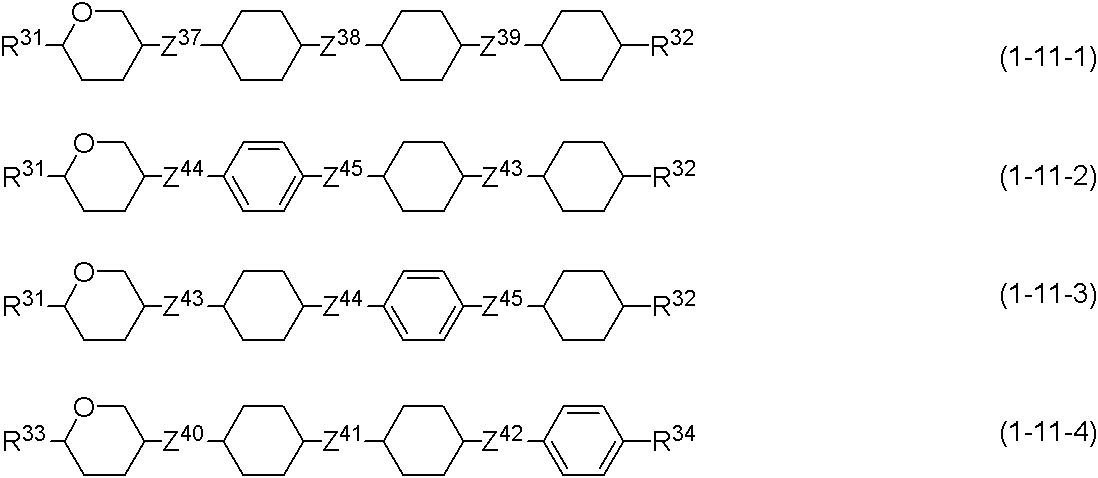
7.式(1−1−1)、式(1−2−1)、式(1−4−1)〜式(1−4−3)、式(1−5−1)〜式(1−5−3)、式(1−6−1)〜式(1−6−3)、式(1−11−1)〜式(1−11−4)、式(1−12−1)〜式(1−12−4)、式(1−13−1)〜式(1−13−4)、式(1−14−1)〜式(1−14−4)のいずれか1つで表される項2〜6のいずれか1項に記載の化合物。
8.式(1−1−1)および(1−2−1)のいずれか一つで表される化合物。
9.式(1−4−1)、(1−5−1)および(1−6−1)のいずれか一つで表される化合物。
10.式中のR31およびR32の一方がアルキルであり、もう一方がアルケニルである項8または9記載の化合物。 10. Item 10. The compound according to Item 8 or 9, wherein one of R 31 and R 32 is alkyl and the other is alkenyl.
11.式中のR31およびR32がアルケニルである項8または9記載の化合物。 11. Item 10. The compound according to Item 8 or 9, wherein R 31 and R 32 are alkenyl.
12.項1〜11のいずれか1項に記載した少なくとも1つの化合物を含有する液晶組成物。 12 Item 12. A liquid crystal composition containing at least one compound according to any one of items 1 to 11.
13.下記の式(2)、(3)および(4)で表される化合物の群から選択された少なくとも一つの化合物をさらに含有する項12に記載の液晶組成物。
14.下記の式(5)および(6)で表される化合物の群から選択された少なくとも一つの化合物をさらに含有する項12に記載の液晶組成物。
15.下記の式(7)、(8)、(9)、(10)、および(11)で表される化合物の群から選択された少なくとも一つの化合物をさらに含有する項12に記載の液晶組成物。
16.下記の式(12)、(13)および(14)で表される化合物の群から選択された少なくとも一つの化合物をさらに含有する項12に記載の液晶組成物。
17.項14に記載の式(5)および(6)で表される化合物の群から選択された少なくとも一つの化合物をさらに含有する項13に記載の組成物。 17. Item 14. The composition according to item 13, further comprising at least one compound selected from the group of compounds represented by formulas (5) and (6) according to item 14.
18.項16に記載の式(12)、(13)および(14)で表される化合物の群から選択された少なくとも1つの化合物をさらに含有する項13に記載の組成物。 18. Item 14. The composition according to item 13, further comprising at least one compound selected from the group of compounds represented by formulas (12), (13) and (14) according to item 16.
19.項16に記載の式(12)、(13)および(14)で表される化合物の群から選択された少なくとも1つの化合物をさらに含有する項14に記載の組成物。 19. Item 15. The composition according to item 14, further comprising at least one compound selected from the group of compounds represented by formulas (12), (13) and (14) according to item 16.
20.項16に記載の式(12)、(13)および(14)で表される化合物の群から選択された少なくとも1つの化合物をさらに含有する項15に記載の組成物。 20. Item 16. The composition according to item 15, further comprising at least one compound selected from the group of compounds represented by formulas (12), (13) and (14) according to item 16.
21.少なくとも一つの光学活性化合物をさらに含有する項12〜20のいずれか1項に記載の液晶組成物。 21. Item 21. The liquid crystal composition according to any one of items 12 to 20, further containing at least one optically active compound.
22.液晶性化合物の全重量に基づいて、第一成分の割合が5〜90重量%の範囲である項12〜21のいずれか1項に記載の液晶組成物。 22. Item 22. The liquid crystal composition according to any one of items 12 to 21, wherein the ratio of the first component is in the range of 5 to 90% by weight based on the total weight of the liquid crystal compound.
23.項12〜22のいずれか1項に記載の液晶組成物を含有する液晶表示素子。 23. Item 23. A liquid crystal display device comprising the liquid crystal composition according to any one of items 12 to 22.
24.VAまたはECB効果に基づくアクティブマトリックス駆動を有する項23に記載の液晶表示素子。 24. Item 24. The liquid crystal display device according to item 23, having active matrix driving based on a VA or ECB effect.
25.項12〜22のいずれか1項に記載の液晶組成物の液晶表示素子における使用。 25. Item 23. Use of the liquid crystal composition according to any one of items 12 to 22 in a liquid crystal display device.
本発明の化合物は、化合物に必要な一般的物性、熱、光などに対する安定性、適切な光学異方性、適切な誘電率異方性、他の液晶性化合物との優れた相溶性を有する。本発明の液晶組成物は、これらの化合物の少なくとも一つを含有し、そしてネマチック相の高い上限温度、ネマチック相の低い下限温度、小さな粘度、適切な光学異方性、低いしきい値電圧を有する。本発明の液晶表示素子は、この組成物を含有し、そして使用できる広い温度範囲、短い応答時間、大きなコントラスト比、低い駆動電圧を有する。 The compound of the present invention has general physical properties necessary for the compound, stability to heat, light, etc., appropriate optical anisotropy, appropriate dielectric anisotropy, and excellent compatibility with other liquid crystal compounds. . The liquid crystal composition of the present invention contains at least one of these compounds, and has a high maximum temperature of the nematic phase, a low minimum temperature of the nematic phase, a small viscosity, an appropriate optical anisotropy, and a low threshold voltage. Have. The liquid crystal display element of the present invention contains this composition and has a wide temperature range that can be used, a short response time, a large contrast ratio, and a low driving voltage.
この明細書における用語の使い方は次のとおりである。液晶性化合物は、ネマチック相、スメクチック相などの液晶相を有する化合物および液晶相を有しないが液晶組成物の成分として有用な化合物の総称である。液晶性化合物、液晶組成物、液晶表示素子をそれぞれ化合物、組成物、素子と略すことがある。液晶表示素子は液晶表示パネルおよび液晶表示モジュールの総称である。ネマチック相の上限温度はネマチック相−等方相の相転移温度であり、そして単に上限温度と略すことがある。ネマチック相の下限温度を単に下限温度と略すことがある。式(1)で表わされる化合物を化合物(1)と略すことがある。この略記は式(2)などで表される化合物にも適用することがある。式(1)から式(11)において、A1、B1、E、Mなどの記号はそれぞれ環A1、環B1、環E、環Mなどに対応する。成分または液晶性化合物の割合(百分率)は、液晶性化合物の全重量に基づいた重量百分率(重量%)である。以下に本発明をさらに説明する。 Terms used in this specification are as follows. A liquid crystal compound is a generic term for a compound having a liquid crystal phase such as a nematic phase or a smectic phase and a compound having no liquid crystal phase but useful as a component of a liquid crystal composition. A liquid crystal compound, a liquid crystal composition, and a liquid crystal display element may be abbreviated as a compound, a composition, and an element, respectively. A liquid crystal display element is a general term for a liquid crystal display panel and a liquid crystal display module. The upper limit temperature of the nematic phase is the phase transition temperature of the nematic phase-isotropic phase, and may simply be abbreviated as the upper limit temperature. The lower limit temperature of the nematic phase may simply be abbreviated as the lower limit temperature. The compound represented by formula (1) may be abbreviated as compound (1). This abbreviation may also apply to compounds represented by formula (2) and the like. In formulas (1) to (11), symbols such as A 1 , B 1 , E, and M correspond to ring A 1 , ring B 1 , ring E, and ring M, respectively. The ratio (percentage) of the component or the liquid crystal compound is a weight percentage (% by weight) based on the total weight of the liquid crystal compound. The present invention is further described below.
第一に、本発明の化合物(1)をさらに説明する。ナフタレン環などの縮合環は一環と数える。化合物(1)はテトラヒドロピラン環を有する二環、三環および四環の化合物である。この化合物は、素子が通常使用される条件下において物理的および化学的に極めて安定であり、そして他の液晶性化合物との相溶性がよい。この化合物を含有する組成物は素子が通常使用される条件下で安定である。この組成物を低い温度で保管しても、この化合物が結晶(またはスメクチック相)として析出することがない。この化合物は、化合物に必要な一般的物性、適切な光学異方性、そして適切な誘電率異方性を有する。 First, the compound (1) of the present invention will be further described. A condensed ring such as a naphthalene ring is counted as one part. Compound (1) is a bicyclic, tricyclic or tetracyclic compound having a tetrahydropyran ring. This compound is extremely physically and chemically stable under the conditions under which the device is normally used, and has good compatibility with other liquid crystal compounds. A composition containing this compound is stable under conditions in which the device is normally used. Even when the composition is stored at a low temperature, the compound does not precipitate as crystals (or a smectic phase). This compound has general physical properties necessary for the compound, appropriate optical anisotropy, and appropriate dielectric anisotropy.
化合物(1)の末端基、環および結合基を適切に選択することによって、光学異方性などの物性を任意に調整することが可能である。末端基R1およびR2、環A1およびA2、結合基Z1、Z2、Z3、およびZ4の種類が、化合物(1)の物性に与える効果を以下に説明する。 It is possible to arbitrarily adjust physical properties such as optical anisotropy by appropriately selecting the terminal group, ring, and bonding group of compound (1). The effects of the types of terminal groups R 1 and R 2 , rings A 1 and A 2 , linking groups Z 1 , Z 2 , Z 3 , and Z 4 on the physical properties of compound (1) will be described below.
R1またはR2が直鎖であるときは液晶相の温度範囲が広くそして粘度が小さい。R1またはR2が分岐鎖であるときは他の液晶性化合物との相溶性がよい。R1またはR2が光学活性基である化合物は、キラルドーパントとして有用である。この化合物を組成物に添加することによって、素子に発生するリバース・ツイスト・ドメイン(Reverse twisted domain)を防止することができる。R1またはR2が光学活性基でない化合物は組成物の成分として有用である。R1またはR2がアルケニルであるとき、好ましい立体配置は二重結合の位置に依存する。好ましい立体配置を有するアルケニル化合物は、高い上限温度または液晶相の広い温度範囲を有する。Mol. Cryst. Liq. Cryst., 1985, 131, 109およびMol. Cryst. Liq. Cryst., 1985, 131, 327に詳細な説明がある。 When R 1 or R 2 is linear, the temperature range of the liquid crystal phase is wide and the viscosity is small. When R 1 or R 2 is a branched chain, compatibility with other liquid crystal compounds is good. A compound in which R 1 or R 2 is an optically active group is useful as a chiral dopant. By adding this compound to the composition, a reverse twisted domain generated in the device can be prevented. A compound in which R 1 or R 2 is not an optically active group is useful as a component of the composition. When R 1 or R 2 is alkenyl, the preferred configuration depends on the position of the double bond. An alkenyl compound having a preferred configuration has a high maximum temperature or a wide temperature range of the liquid crystal phase. Mol. Cryst. Liq. Cryst., 1985, 131, 109 and Mol. Cryst. Liq. Cryst., 1985, 131, 327 have detailed descriptions.
環A1またはA2が、1,4−フェニレン、2−フルオロ−1,4−フェニレン、または3−フルオロ−1,4−フェニレンであるときは光学異方性が大きい。環A1およびA2が、1,4−シクロヘキシレンであるときは光学異方性が小さい。 When ring A 1 or A 2 is 1,4-phenylene, 2-fluoro-1,4-phenylene, or 3-fluoro-1,4-phenylene, the optical anisotropy is large. When rings A 1 and A 2 are 1,4-cyclohexylene, the optical anisotropy is small.
少なくとも二つの環が1,4−シクロヘキシレンであるときは、上限温度が高く、光学異方性が小さく、そして粘度が小さい。少なくとも一つの環が1,4−フェニレンのときは、光学異方性が比較的大きく、そして配向秩序パラメーター(orientational order parameter)が大きい。 When at least two rings are 1,4-cyclohexylene, the maximum temperature is high, the optical anisotropy is small, and the viscosity is small. When at least one ring is 1,4-phenylene, the optical anisotropy is relatively large and the orientational order parameter is large.
結合基Z1、Z2、Z3、またはZ4が単結合、−(CH2)2−、−CH2O−−CH=CH−、または−(CH2)4−であるときは粘度が小さい。結合基が単結合、−(CH2)2−、または−CH=CH−であるときは粘度がより小さい。結合基が−CH=CH−であるときは液晶相の温度範囲が広く、そして弾性定数比K33/K11(K33:ベンド弾性定数、K11:スプレイ弾性定数)が大きい。結合基が−C≡C−のときは光学異方性が大きい。 Viscosity when the linking group Z 1 , Z 2 , Z 3 , or Z 4 is a single bond, — (CH 2 ) 2 —, —CH 2 O——CH═CH—, or — (CH 2 ) 4 —. Is small. When the bonding group is a single bond, — (CH 2 ) 2 —, or —CH═CH—, the viscosity is smaller. When the bonding group is —CH═CH—, the temperature range of the liquid crystal phase is wide, and the elastic constant ratio K 33 / K 11 (K 33 : bend elastic constant, K 11 : spray elastic constant) is large. When the bonding group is —C≡C—, the optical anisotropy is large.
化合物(1)が二環または三環を有するときは粘度が小さい。化合物(1)が三環または四環を有するときは上限温度が高い。以上のように、末端基、環および結合基の種類、環の数を適当に選択することにより目的の物性を有する化合物を得ることができる。したがって、化合物(1)はPC、TN、STN、ECB、OCB、IPS、VAなどの素子に用いられる組成物の成分として有用である。 When compound (1) has two or three rings, the viscosity is small. When compound (1) has a tricyclic or tetracyclic ring, the maximum temperature is high. As described above, a compound having desired physical properties can be obtained by appropriately selecting the types of terminal groups, rings and bonding groups, and the number of rings. Therefore, the compound (1) is useful as a component of a composition used for devices such as PC, TN, STN, ECB, OCB, IPS, and VA.
化合物(1)の好ましい例は、本発明の項2に記載した化合物(1−1)、(1−2)、(1−4)〜(1−6)、および(1−11)〜(1−14)である。これらの化合物におけるR1、R2、R3、R4、R5、R6、A1、A2、Z1、Z2、Z3、およびZ4の記号の意味は、項2に記載した記号の意味と同一である。 Preferred examples of compound (1) include compounds (1-1), (1-2), (1-4) to (1-6), and (1-11) to (1-11) described in item 2 of the present invention. 1-14). The meanings of the symbols R 1 , R 2 , R 3 , R 4 , R 5 , R 6 , A 1 , A 2 , Z 1 , Z 2 , Z 3 , and Z 4 in these compounds are described in Item 2. The meaning of the symbol is the same.
化合物(1)は有機合成化学における手法を適切に組み合わせることにより合成する。出発物に目的の末端基、環および結合基を導入する方法は、オーガニックシンセシス(Organic Syntheses, John Wiley & Sons, Inc)、オーガニック・リアクションズ(Organic Reactions, John Wiley & Sons, Inc)、コンプリヘンシブ・オーガニック・シンセシス(Comprehensive Organic Synthesis, Pergamon Press)、新実験化学講座(丸善)などの成書に記載されている。 Compound (1) is synthesized by appropriately combining techniques in organic synthetic chemistry. Methods for introducing the desired end groups, rings and linking groups into the starting materials are Organic Syntheses (John Wiley & Sons, Inc), Organic Reactions (John Wiley & Sons, Inc), Comprehensive・ It is described in books such as Organic Synthesis (Pergamon Press) and New Experimental Chemistry Course (Maruzen).
結合基Z1、Z2、Z3またはZ4を生成する方法の一例に関して、最初にスキームを示し、次に項(I)〜項(XI)でスキームを説明する。このスキームにおいて、MSG1またはMSG2は少なくとも一つの環を有する1価の有機基である。スキームで用いた複数のMSG1(またはMSG2)は、同一であってもよいし、または異なってもよい。化合物(1A)から(1K)は化合物(1)に相当する。 With respect to an example of a method for generating the linking group Z 1 , Z 2 , Z 3 or Z 4 , the scheme is first shown, and then the scheme is described in terms (I) to (XI). In this scheme, MSG 1 or MSG 2 is a monovalent organic group having at least one ring. A plurality of MSG 1 (or MSG 2 ) used in the scheme may be the same or different. Compounds (1A) to (1K) correspond to compound (1).
(I)単結合の生成
アリールホウ酸(21)と公知の方法で合成される化合物(22)とを、炭酸塩水溶液とテトラキス(トリフェニルホスフィン)パラジウムのような触媒の存在下で反応させて化合物(1A)を合成する。この化合物(1A)は、公知の方法で合成される化合物(23)にn−ブチルリチウムを、次いで塩化亜鉛を反応させ、ジクロロビス(トリフェニルホスフィン)パラジウムのような触媒の存在下で化合物(22)を反応させることによっても合成される。
(I) Formation of Single Bond A compound obtained by reacting arylboric acid (21) with compound (22) synthesized by a known method in the presence of a carbonate aqueous solution and a catalyst such as tetrakis (triphenylphosphine) palladium. Synthesize (1A). This compound (1A) is obtained by reacting compound (23) synthesized by a known method with n-butyllithium and then with zinc chloride, and in the presence of a catalyst such as dichlorobis (triphenylphosphine) palladium. ) Is also reacted.
(II)−COO−と−OCO−の生成
化合物(23)にn−ブチルリチウムを、続いて二酸化炭素を反応させてカルボン酸(24)を得る。化合物(24)と、公知の方法で合成されるフェノール(25)とをDDC(1,3−ジシクロヘキシルカルボジイミド)とDMAP(4−ジメチルアミノピリジン)の存在下で脱水させて−COO−を有する化合物(1B)を合成する。この方法によって−OCO−を有する化合物も合成する。
(II) Formation of —COO— and —OCO— The compound (23) is reacted with n-butyllithium and subsequently with carbon dioxide to obtain a carboxylic acid (24). Compound having —COO— by dehydrating compound (24) and phenol (25) synthesized by a known method in the presence of DDC (1,3-dicyclohexylcarbodiimide) and DMAP (4-dimethylaminopyridine) Synthesize (1B). A compound having —OCO— is also synthesized by this method.
(III)−CF2O−と−OCF2−の生成
化合物(1B)をローソン試薬のような硫黄化剤で処理して化合物(26)を得る。化合物(26)をフッ化水素ピリジン錯体とNBS(N−ブロモスクシンイミド)でフッ素化し、−CF2O−を有する化合物(1C)を合成する。M. Kuroboshi et al., Chem. Lett., 1992,827.を参照。化合物(1C)は化合物(26)を(ジエチルアミノ)サルファートリフルオリド(DAST)でフッ素化しても合成される。W. H. Bunnelle et al., J. Org. Chem. 1990, 55, 768.を参照。この方法によって−OCF2−を有する化合物も合成する。Peer. Kirsch et al., Anbew. Chem. Int. Ed. 2001, 40, 1480.に記載の方法によってこれらの結合基を生成させることも可能である。
(III) Formation of —CF 2 O— and —OCF 2 — Compound (1B) is treated with a sulfurizing agent such as Lawesson's reagent to obtain compound (26). The compound (26) is fluorinated with a hydrogen fluoride pyridine complex and NBS (N-bromosuccinimide) to synthesize a compound (1C) having —CF 2 O—. See M. Kuroboshi et al., Chem. Lett., 1992, 827. Compound (1C) can also be synthesized by fluorinating compound (26) with (diethylamino) sulfur trifluoride (DAST). See WH Bunnelle et al., J. Org. Chem. 1990, 55, 768. A compound having —OCF 2 — is also synthesized by this method. These linking groups can also be generated by the method described in Peer. Kirsch et al., Anbew. Chem. Int. Ed. 2001, 40, 1480.
(IV)−CH=CH−の生成
化合物(23)をn−ブチルリチウムで処理した後、N,N−ジメチルホルムアミド(DMF)などのホルムアミドと反応させてアルデヒド(28)を得る。公知の方法で合成されるホスホニウム塩(27)をカリウムtert−ブトキシドのような塩基で処理して発生させたリンイリドを、アルデヒド(28)に反応させて化合物(1D)を合成する。反応条件によってはシス体が生成するので、必要に応じて公知の方法によりシス体をトランス体に異性化する。
(IV) Formation of —CH═CH— The compound (23) is treated with n-butyllithium and then reacted with formamide such as N, N-dimethylformamide (DMF) to obtain the aldehyde (28). A phosphoryl ylide generated by treating a phosphonium salt (27) synthesized by a known method with a base such as potassium tert-butoxide is reacted with an aldehyde (28) to synthesize a compound (1D). Since a cis isomer is generated depending on the reaction conditions, the cis isomer is isomerized to a trans isomer by a known method as necessary.
(V)−(CH2)2−の生成
化合物(1D)をパラジウム炭素のような触媒の存在下で水素化することにより、化合物(1E)を合成する。
(V) Formation of — (CH 2 ) 2 — Compound (1E) is synthesized by hydrogenating compound (1D) in the presence of a catalyst such as palladium carbon.
(VI)−(CH2)4−の生成
ホスホニウム塩(27)の代わりにホスホニウム塩(29)を用い、項(IV)の方法に従って−(CH2)2−CH=CH−を有する化合物を得る。これを接触水素化して化合物(1F)を合成する。
(VI) Formation of — (CH 2 ) 4 — A compound having — (CH 2 ) 2 —CH═CH— is obtained by using the phosphonium salt (29) instead of the phosphonium salt (27) and according to the method of the item (IV). obtain. This is catalytically hydrogenated to synthesize compound (1F).
(VII)−C≡C−の生成
ジクロロパラジウムとハロゲン化銅との触媒存在下で、化合物(23)に2−メチル−3−ブチン−2−オールを反応させたのち、塩基性条件下で脱保護して化合物(30)を得る。ジクロロパラジウムとハロゲン化銅との触媒存在下、化合物(30)を化合物(22)と反応させて、化合物(1G)を合成する。
(VII) Formation of -C≡C- After reacting compound (23) with 2-methyl-3-butyn-2-ol in the presence of a catalyst of dichloropalladium and copper halide, under basic conditions Deprotection yields compound (30). Compound (1G) is synthesized by reacting compound (30) with compound (22) in the presence of a catalyst of dichloropalladium and copper halide.
(VIII)−CF=CF−の生成
化合物(23)をn−ブチルリチウムで処理したあと、テトラフルオロエチレンを反応させて化合物(31)を得る。化合物(22)をn−ブチルリチウムで処理したあと化合物(31)と反応させて化合物(1H)を合成する。
(VIII) Formation of —CF═CF— The compound (23) is treated with n-butyllithium and then reacted with tetrafluoroethylene to obtain the compound (31). Compound (22) is treated with n-butyllithium and then reacted with compound (31) to synthesize compound (1H).
(IX)−CH2O−または−OCH2−の生成
化合物(28)を水素化ホウ素ナトリウムなどの還元剤で還元して化合物(32)を得る。これを臭化水素酸などでハロゲン化して化合物(33)を得る。炭酸カリウムなどの存在下で、化合物(33)を化合物(25)と反応させて化合物(1J)を合成する。
(IX) Formation of —CH 2 O— or —OCH 2 — Compound (32) is obtained by reducing compound (28) with a reducing agent such as sodium borohydride. This is halogenated with hydrobromic acid or the like to obtain compound (33). Compound (1J) is synthesized by reacting compound (33) with compound (25) in the presence of potassium carbonate or the like.
(X)−(CH2)3O−または−O(CH2)3−の生成
化合物(32)の代わりに化合物(34)を用いて、項(IX)の方法に従って化合物(1K)を合成する。
Formation of (X)-(CH 2 ) 3 O— or —O (CH 2 ) 3 — Compound (1K) was synthesized according to the method of Item (IX) using Compound (34) instead of Compound (32). To do.
(XI)−(CF2)2−の生成
J. Am. Chem. Soc., 2001, 123, 5414.に記載された方法に従い、ジケトン(−COCO−)をフッ化水素触媒の存在下、四フッ化硫黄でフッ素化して−(CF2)2−を有する化合物を得る。
Formation of (XI)-(CF 2 ) 2-
According to the method described in J. Am. Chem. Soc., 2001, 123, 5414., a diketone (—COCO—) is fluorinated with sulfur tetrafluoride in the presence of a hydrogen fluoride catalyst to produce — (CF 2 ). A compound having 2- is obtained.
次にi=0、k>0、そしてn=0のとき、式(1)で表されるテトラヒドロピラン化合物を合成する方法の一例を下記のスキームに示す。初めにラクトン骨格を有する合成中間体(39)を合成するスキームを説明し、次いで(39)を出発物質としたテトラヒドロピラン化合物(42)を合成する方法の一例を述べる。 Next, an example of a method for synthesizing the tetrahydropyran compound represented by the formula (1) when i = 0, k> 0, and n = 0 is shown in the following scheme. First, a scheme for synthesizing a synthetic intermediate (39) having a lactone skeleton will be described, and then an example of a method for synthesizing a tetrahydropyran compound (42) using (39) as a starting material will be described.
化合物(36)〜(39)において、Q2は式(1)の構造単位である。構造単位はスキームに示した。これらの化合物におけるR1、A2、およびZ2の記号の意味は、項1に記載した記号の意味と同一である。 In the compounds (36) to (39), Q 2 is a structural unit of the formula (1). The structural unit is shown in the scheme. The meanings of the symbols R 1 , A 2 , and Z 2 in these compounds are the same as the meanings of the symbols described in item 1.
すなわち、化合物(37)は、化合物(36)とシクロヘキシルアミンとの反応によって合成する。これらの反応は、好ましくはジエチルエーテル等の溶媒中、炭酸カリウムなどの塩基の存在下、室温から溶媒の沸点までの間の温度で行う。化合物(38)は、化合物(37)にアクリル酸エチルを付加させた後、脱保護することにによって合成する。この反応は、アクリル酸エチル自身を溶媒として用いるのが好ましいが、化合物(37)やアクリル酸エチルと反応しないトルエンなどを溶媒として使用しても良い。アクリル酸エチルの重合を防ぐため、ヒドロキノンなどの重合禁止剤を共存させることが好ましい。この反応は、通常のガラス反応器を用いる場合は室温から溶媒の沸点までの間の温度で行うが、ステンレス製オートクレーブなどの耐圧反応器を用いて溶媒の沸点以上の温度で反応を行うこともできる。付加反応が十分に進行した後、シュウ酸などの酸を添加することにより、シクロヘキシルアミンを脱離させ、化合物(38)を得る。化合物(39)は、化合物(38)の環化反応によって合成する。この反応は、好ましくはイソプロパノールなどの溶媒中、シアノ水素化ホウ素ナトリウムの存在下、室温程度の温度で行う。反応を促進させるために塩酸などの酸を添加してもよい。
出発物である化合物(36)は有機合成化学の方法に従って容易に合成することができる。
That is, the compound (37) is synthesized by reacting the compound (36) with cyclohexylamine. These reactions are preferably carried out in a solvent such as diethyl ether in the presence of a base such as potassium carbonate at a temperature between room temperature and the boiling point of the solvent. Compound (38) is synthesized by adding ethyl acrylate to compound (37), followed by deprotection. In this reaction, ethyl acrylate itself is preferably used as a solvent, but compound (37), toluene which does not react with ethyl acrylate, or the like may be used as a solvent. In order to prevent the polymerization of ethyl acrylate, it is preferable to coexist a polymerization inhibitor such as hydroquinone. This reaction is performed at a temperature between room temperature and the boiling point of the solvent when a normal glass reactor is used, but the reaction may be performed at a temperature higher than the boiling point of the solvent using a pressure resistant reactor such as a stainless steel autoclave. it can. After the addition reaction has sufficiently progressed, cyclohexylamine is eliminated by adding an acid such as oxalic acid to obtain compound (38). Compound (39) is synthesized by cyclization reaction of compound (38). This reaction is preferably carried out in a solvent such as isopropanol in the presence of sodium cyanoborohydride at a temperature around room temperature. An acid such as hydrochloric acid may be added to accelerate the reaction.
The starting compound (36) can be easily synthesized according to the method of organic synthetic chemistry.
次に、化合物(42)に関する合成法の一例を示す。
化合物(39)〜(42)において、Q1またはQ2は式(1)の構造単位である。構造単位はスキームに示した。これらの化合物におけるR1、R2、A1、A2、Z2、およびZ3の記号の意味は、項1に記載した記号の意味と同一である。
Next, an example of the synthesis method regarding a compound (42) is shown.
In the compounds (39) to (42), Q 1 or Q 2 is a structural unit of the formula (1). The structural unit is shown in the scheme. The meanings of the symbols R 1 , R 2 , A 1 , A 2 , Z 2 , and Z 3 in these compounds are the same as the meanings of the symbols described in item 1.
すなわち、化合物(41)は、化合物(39)と化合物(40)との反応によって合成する。この反応は、好ましくはテトラヒドロフラン等の溶媒中、−30℃の温度で行う。化合物(42)は、化合物(41)をジクロロメタンなどの溶媒中、トリエチルシラン、三フッ化ホウ素ジエチルエーテル錯体の共存下、−50℃以下の温度で反応させることによって合成する。
化合物(40)は有機合成化学の方法に従って容易に合成することができる。
That is, the compound (41) is synthesized by a reaction between the compound (39) and the compound (40). This reaction is preferably carried out in a solvent such as tetrahydrofuran at a temperature of −30 ° C. The compound (42) is synthesized by reacting the compound (41) in a solvent such as dichloromethane at a temperature of −50 ° C. or lower in the presence of triethylsilane and boron trifluoride diethyl ether complex.
Compound (40) can be easily synthesized according to the method of organic synthetic chemistry.
i=0、k>0、そしてn=0以外のとき、式(1)で表されるテトラヒドロピラン化合物についても、同様の方法で合成することができる。 When i = 0, k> 0, and n = 0, the tetrahydropyran compound represented by the formula (1) can be synthesized by the same method.
次に、テトラヒドロピラン化合物(46)を合成する方法の一例を述べる。
化合物(44)は、化合物(43)をDIBAL−Hで還元することにより得られる。この反応は、好ましくはトルエン等の溶媒中、−60℃以下の温度で行う。化合物(46)は、炭酸カリウムなどの存在下で、化合物(44)を化合物(45)と反応させることにより合成する。
化合物(45)は有機合成化学の方法に従って容易に合成することができる。
Compound (44) can be obtained by reducing compound (43) with DIBAL-H. This reaction is preferably carried out in a solvent such as toluene at a temperature of −60 ° C. or lower. Compound (46) is synthesized by reacting compound (44) with compound (45) in the presence of potassium carbonate or the like.
Compound (45) can be easily synthesized according to the method of organic synthetic chemistry.
第二に、本発明の組成物をさらに説明する。好ましい組成物は化合物(1)から選択された少なくとも一つの化合物を1〜99%の割合で含有する。この組成物は化合物(2)〜(14)の群から選択された成分を主として含有する。 Secondly, the composition of the present invention will be further described. A preferred composition contains 1 to 99% of at least one compound selected from the compound (1). This composition mainly contains a component selected from the group of compounds (2) to (14).
化合物(1)を含有する好ましい組成物は次のとおりである。好ましい組成物は化合物(2)、(3)および(4)の群から選択された少なくとも一つの化合物を含有する。別の好ましい組成物は、化合物(5)および(6)の群から選択された少なくとも一つの化合物を含有する。別の好ましい組成物は、このような二つの群のそれぞれから選択された少なくとも二つの化合物を含有する。これらの組成物は、液晶相の温度範囲、粘度、光学異方性、誘電率異方性、しきい値電圧などを調整する目的で、化合物(12)、(13)および(14)の群から選択された少なくとも一つの化合物をさらに含有してもよい。この組成物は、物性をさらに調整する目的で、化合物(7)〜(11)の群から選択された少なくとも一つの化合物をさらに含有してもよい。この組成物は、AM−TN素子、STN素子などに適合させる目的で、その他の液晶性化合物、添加物などの化合物をさらに含有してもよい。 A preferred composition containing the compound (1) is as follows. Preferred compositions contain at least one compound selected from the group of compounds (2), (3) and (4). Another preferred composition contains at least one compound selected from the group of compounds (5) and (6). Another preferred composition contains at least two compounds selected from each of these two groups. These compositions are a group of compounds (12), (13) and (14) for the purpose of adjusting the temperature range, viscosity, optical anisotropy, dielectric anisotropy, threshold voltage and the like of the liquid crystal phase. It may further contain at least one compound selected from This composition may further contain at least one compound selected from the group of the compounds (7) to (11) for the purpose of further adjusting the physical properties. This composition may further contain compounds such as other liquid crystalline compounds and additives for the purpose of adapting to AM-TN devices, STN devices and the like.
別の好ましい組成物は、化合物(7)〜(11)の群から選択された少なくとも一つの化合物を含有する。この組成物は、化合物(12)、(13)および(14)の群から選択された少なくとも一つの化合物をさらに含有してもよい。この組成物は、物性をさらに調整する目的で、化合物(2)〜(6)の群から選択された少なくとも一つの化合物をさらに含有してもよい。この組成物は、VA素子などに適合させる目的で、その他の液晶性化合物、添加物などの化合物をさらに含有してもよい。 Another preferred composition contains at least one compound selected from the group of compounds (7) to (11). This composition may further contain at least one compound selected from the group of compounds (12), (13) and (14). This composition may further contain at least one compound selected from the group of the compounds (2) to (6) for the purpose of further adjusting the physical properties. This composition may further contain compounds such as other liquid crystal compounds and additives for the purpose of adapting to VA devices and the like.
化合物(2)、(3)および(4)は、誘電率異方性が正で大きいので、AM−TN素子用の組成物に主として用いられる。この組成物において、これらの化合物の量は1〜99%である。好ましい量は10〜97%である。より好ましい量は40〜95%である。この組成物に化合物(12)、(13)または(14)をさらに添加する場合、この化合物の好ましい量は60%以下である。より好ましい量は40%以下である。 Compounds (2), (3) and (4) have a positive and large dielectric anisotropy, and are therefore mainly used in compositions for AM-TN devices. In this composition, the amount of these compounds is 1-99%. A preferred amount is 10-97%. A more preferred amount is 40 to 95%. When compound (12), (13) or (14) is further added to this composition, the preferred amount of this compound is 60% or less. A more preferred amount is 40% or less.
化合物(5)および(6)は、誘電率異方性が正で非常に大きいので、STN素子用の組成物に主として用いられる。この組成物において、これらの化合物の量は1〜99%である。好ましい量は10〜97%である。より好ましい量は40〜95%である。この組成物に化合物(12)、(13)または(14)をさらに添加する場合、この化合物の好ましい量は60%以下である。より好ましい量は40%以下である。 Since the compounds (5) and (6) have a positive dielectric anisotropy and are very large, they are mainly used in compositions for STN devices. In this composition, the amount of these compounds is 1-99%. A preferred amount is 10-97%. A more preferred amount is 40 to 95%. When compound (12), (13) or (14) is further added to this composition, the preferred amount of this compound is 60% or less. A more preferred amount is 40% or less.
化合物(7)、(8)、(9)、(10)、および(11)は、誘電率異方性が負であるので、VA素子用の組成物に主として用いられる。これらの化合物の好ましい量は80%以下である。より好ましい量は40〜80%である。この組成物に化合物(12)、(13)または(14)をさらに添加する場合、この化合物の好ましい量は60%以下である。より好ましい量は40%以下である。 Since the compounds (7), (8), (9), (10), and (11) have a negative dielectric anisotropy, they are mainly used in compositions for VA devices. The preferred amount of these compounds is 80% or less. A more preferred amount is 40 to 80%. When compound (12), (13) or (14) is further added to this composition, the preferred amount of this compound is 60% or less. A more preferred amount is 40% or less.
化合物(12)、(13)および(14)の誘電率異方性は小さい。化合物(12)は粘度または光学異方性を調整する目的で主に使用される。化合物(13)および(14)は上限温度を上げて液晶相の温度範囲を広げる、または光学異方性を調整する目的で使用される。化合物(12)、(13)および(14)の量を増加させると組成物のしきい値電圧が高くなり、粘度が小さくなる。したがって、組成物のしきい値電圧の要求値を満たすかぎり多量に使用してもよい。 The dielectric anisotropy of the compounds (12), (13) and (14) is small. The compound (12) is mainly used for the purpose of adjusting viscosity or optical anisotropy. Compounds (13) and (14) are used for the purpose of increasing the maximum temperature to widen the temperature range of the liquid crystal phase or adjusting the optical anisotropy. Increasing the amount of compounds (12), (13) and (14) increases the threshold voltage of the composition and decreases the viscosity. Accordingly, a large amount may be used as long as the threshold voltage requirement of the composition is satisfied.
好ましい化合物(2)〜(14)は、それぞれ化合物(2−1)〜(2−9)、化合物(3−1)〜(3−97)、化合物(4−1)〜(4−33)、化合物(5−1)〜(5−56)、化合物(6−1)〜(6−3)、化合物(7−1)〜(7−4)、化合物(8−1)〜(8−6)、化合物(9−1)〜(9−4)、化合物(10−1)、化合物(11−1)、化合物(12−1)〜(12−11)、化合物(13−1)〜(13−21)、および化合物(14−1)〜(14−6)である。これらの化合物において、R7、R9、X1およびX2の記号の意味は、化合物(2)〜(14)におけるこれらの記号の意味と同一である。 Desirable compounds (2) to (14) are respectively the compounds (2-1) to (2-9), the compounds (3-1) to (3-97), and the compounds (4-1) to (4-33). , Compounds (5-1) to (5-56), compounds (6-1) to (6-3), compounds (7-1) to (7-4), compounds (8-1) to (8- 6), compounds (9-1) to (9-4), compound (10-1), compound (11-1), compounds (12-1) to (12-11), compound (13-1) to (13-21) and compounds (14-1) to (14-6). In these compounds, the meanings of the symbols R 7 , R 9 , X 1 and X 2 are the same as those in the compounds (2) to (14).
本発明の組成物は公知の方法によって調製される。例えば、成分である化合物を混合し、加熱によって互いに溶解させる。組成物に適当な添加物を加えて組成物の物性を調整してもよい。このような添加物は当業者によく知られている。メロシアニン、スチリル、アゾ、アゾメチン、アゾキシ、キノフタロン、アントラキノン、テトラジンなどの化合物である二色性色素を添加してGH素子用の組成物を調製してもよい。一方、液晶のらせん構造を誘起して必要なねじれ角を与える目的でキラルドーパントが添加される。キラルドーパントの例は上記の光学活性化合物(Op−1)〜(Op−13)である。 The composition of the present invention is prepared by a known method. For example, the component compounds are mixed and dissolved in each other by heating. Appropriate additives may be added to the composition to adjust the physical properties of the composition. Such additives are well known to those skilled in the art. A composition for a GH device may be prepared by adding a dichroic dye which is a compound such as merocyanine, styryl, azo, azomethine, azoxy, quinophthalone, anthraquinone, and tetrazine. On the other hand, a chiral dopant is added for the purpose of inducing a helical structure of the liquid crystal to give a necessary twist angle. Examples of the chiral dopant are the optically active compounds (Op-1) to (Op-13).
キラルドーパントを組成物に添加してねじれのピッチを調整する。TN素子およびTN−TFT素子用の好ましいピッチは40〜200μmの範囲である。STN素子用の好ましいピッチは6〜20μmの範囲である。BTN素子用の好ましいピッチは1.5〜4μmの範囲である。PC素子用の組成物にはキラルドーパントを比較的多量に添加する。ピッチの温度依存性を調整する目的で少なくとも二つのキラルドーパントを添加してもよい。 A chiral dopant is added to the composition to adjust the twist pitch. A preferred pitch for TN elements and TN-TFT elements is in the range of 40-200 μm. A preferred pitch for STN elements is in the range of 6-20 μm. A preferred pitch for the BTN device is in the range of 1.5-4 μm. A relatively large amount of chiral dopant is added to the composition for the PC element. At least two chiral dopants may be added for the purpose of adjusting the temperature dependence of the pitch.
本発明の組成物は、PC、TN、STN、BTN,ECB、OCB、IPS、VAなどの素子に使用できる。これらの素子は駆動方式がPMであってもよいし、またはAMであってもよい。この組成物をマイクロカプセル化して作製したNCAP(nematic curvilinear aligned phase)素子や、組成物中に三次元の網目状高分子を形成させたPD(polymer dispersed)素子、例えばPN(polymer network)素子にも使用できる。 The composition of the present invention can be used for devices such as PC, TN, STN, BTN, ECB, OCB, IPS, and VA. These elements may be driven by PM or AM. NCAP (nematic curvilinear aligned phase) elements produced by microencapsulating this composition, and PD (polymer dispersed) elements in which a three-dimensional network polymer is formed in the composition, for example, PN (polymer network) elements Can also be used.
実施例により本発明を詳細に説明する。本発明は下記の実施例によって限定されない。No.1などの化合物番号は、実施例5において表で示した化合物のそれと対応する。表において、1,4−シクロヘキシレンおよび1,3−ジオキサン−2,5−ジイルに関する立体配置はトランスである。−CH=CH−の結合基に関する立体配置はトランスである。実施例において記号の後にあるかっこ内の番号は好ましい化合物の番号に対応する。(−)の記号はその他の化合物を意味する。化合物の割合(百分率)は、組成物の全重量に基づいた重量百分率(重量%)である。最後に、組成物の特性値をまとめた。 The present invention will be described in detail by examples. The present invention is not limited by the following examples. No. Compound numbers such as 1 correspond to those of the compounds shown in the table in Example 5. In the table, the configuration for 1,4-cyclohexylene and 1,3-dioxane-2,5-diyl is trans. The configuration regarding the bonding group of —CH═CH— is trans. In the examples, the number in parentheses after the symbol corresponds to the number of the preferred compound. The symbol (−) means other compounds. The proportion (percentage) of the compound is a weight percentage (% by weight) based on the total weight of the composition. Finally, the characteristic values of the composition are summarized.
特性値の測定は下記の方法にしたがった。それらの多くは、日本電子機械工業会規格(Standard of Electric Industries Association of Japan)EIAJ・ED−2521Aに記載された方法、またはこれを修飾した方法である。 The characteristic values were measured according to the following method. Many of them are the method described in the Standard of Electric Industries Association of Japan EIAJ ED-2521A or a modified method thereof.
ネマチック相の上限温度(NI;℃):偏光顕微鏡を備えた融点測定装置のホットプレートに試料を置き、1℃/分の速度で加熱した。試料の一部がネマチック相から等方性液体に変化したときの温度を測定した。ネマチック相の上限温度を「上限温度」と略すことがある。 Maximum temperature of nematic phase (NI; ° C.): A sample was placed on a hot plate of a melting point measuring apparatus equipped with a polarizing microscope and heated at a rate of 1 ° C./min. The temperature was measured when a part of the sample changed from a nematic phase to an isotropic liquid. The upper limit temperature of the nematic phase may be abbreviated as “upper limit temperature”.
ネマチック相の下限温度(Tc;℃):ネマチック相を有する試料を0℃、−10℃、−20℃、−30℃、および−40℃のフリーザー中に10日間保管したあと、液晶相を観察した。例えば、試料が−20℃ではネマチック相のままであり、−30℃では結晶またはスメクチック相に変化したとき、TCを≦−20℃と記載した。ネマチック相の下限温度を「下限温度」と略すことがある。 Minimum temperature of nematic phase (Tc; ° C.): A sample having a nematic phase is stored in a freezer at 0 ° C., −10 ° C., −20 ° C., −30 ° C., and −40 ° C. did. For example, when the sample remained in a nematic phase at −20 ° C. and changed to a crystalline or smectic phase at −30 ° C., the TC was described as ≦ −20 ° C. The lower limit temperature of the nematic phase may be abbreviated as “lower limit temperature”.
光学異方性(屈折率異方性;Δn;25℃で測定):測定は、波長589nmの光を用い、接眼鏡に偏光板を取り付けたアッベ屈折計により行なった。主プリズムの表面を一方向にラビングしたあと、試料を主プリズムに滴下した。屈折率n‖は偏光の方向がラビングの方向と平行であるときに測定した。屈折率n⊥は偏光の方向がラビングの方向と垂直であるときに測定した。光学異方性の値は、Δn=n‖−n⊥、の式から計算した。試料が組成物のときはこの方法によって光学異方性を測定した。試料が化合物のときは、化合物を適切な組成物に混合したあと光学異方性を測定した。化合物の光学異方性は外挿値である。 Optical anisotropy (refractive index anisotropy; Δn; measured at 25 ° C.): Measurement was performed with an Abbe refractometer using a light having a wavelength of 589 nm and a polarizing plate attached to an eyepiece. After rubbing the surface of the main prism in one direction, the sample was dropped on the main prism. The refractive index n‖ was measured when the polarization direction was parallel to the rubbing direction. The refractive index n⊥ was measured when the polarization direction was perpendicular to the rubbing direction. The value of optical anisotropy was calculated from the equation: Δn = n∥−n⊥. When the sample was a composition, the optical anisotropy was measured by this method. When the sample was a compound, the optical anisotropy was measured after mixing the compound with an appropriate composition. The optical anisotropy of the compound is an extrapolated value.
粘度(η;20℃と−10℃で測定;mPa・s):測定にはE型粘度計を用いた。20℃で測定した値をη(20℃)、−10℃で測定した値をη(−10℃)と表記した。 Viscosity (η; measured at 20 ° C. and −10 ° C .; mPa · s): An E-type viscometer was used for measurement. The value measured at 20 ° C. was expressed as η (20 ° C.), and the value measured at −10 ° C. was expressed as η (−10 ° C.).
誘電率異方性(Δε;25℃で測定)
△εの値が正の組成物の場合:2枚のガラス基板の間隔(セルギャップ)が9μmであり、そしてツイスト角が80度のTN素子に試料を入れた。このTN素子に10ボルトを印加して、液晶分子の長軸方向における誘電率(ε‖)を測定した。0.5ボルトを印加して、液晶分子の短軸方向における誘電率(ε⊥)を測定した。誘電率異方性の値は、Δε=ε‖−ε⊥、の式から計算した。正の誘電率異方性を有する組成物をこの方法によって測定した。試料が化合物のときは、化合物を適切な組成物に混合したあと誘電率異方性を測定した。化合物の誘電率異方性は外挿値である。
Dielectric anisotropy (Δε; measured at 25 ° C)
In the case of a composition having a positive Δε value: A sample was put in a TN device in which the distance between two glass substrates (cell gap) was 9 μm and the twist angle was 80 degrees. A voltage of 10 volts was applied to the TN device, and the dielectric constant (ε‖) in the major axis direction of the liquid crystal molecules was measured. 0.5 V was applied, and the dielectric constant (ε⊥) in the minor axis direction of the liquid crystal molecules was measured. The value of dielectric anisotropy was calculated from the equation: Δε = ε∥−ε⊥. Compositions having positive dielectric anisotropy were measured by this method. When the sample was a compound, the dielectric anisotropy was measured after mixing the compound with an appropriate composition. The dielectric anisotropy of the compound is an extrapolated value.
△εの値が負の組成物の場合:2枚のガラス基板の間隔(セルギャップ)が20μmであるVA素子に試料を入れた。このVA素子に0.5ボルトを印加して、液晶分子の長軸方向における誘電率(ε‖)を測定した。2枚のガラス基板の間隔が9μmであるTN素子に試料を入れた。このTN素子に0.5ボルトを印加して、液晶分子の短軸方向における誘電率(ε⊥)を測定した。誘電率異方性の値は、Δε=ε‖−ε⊥の式から計算した。負の誘電率異方性を有する組成物をこの方法によって測定した。試料が化合物のときは、化合物を適切な組成物に混合したあと誘電率異方性を測定した。化合物の誘電率異方性は外挿値である。 In the case of a composition having a negative Δε value: A sample was placed in a VA device in which the distance between two glass substrates (cell gap) was 20 μm. 0.5 volt was applied to the VA element, and the dielectric constant (ε‖) in the major axis direction of the liquid crystal molecules was measured. A sample was put in a TN device in which the distance between two glass substrates was 9 μm. 0.5 volt was applied to this TN device, and the dielectric constant (ε⊥) in the minor axis direction of the liquid crystal molecules was measured. The value of dielectric anisotropy was calculated from the equation: Δε = ε∥−ε⊥. A composition having negative dielectric anisotropy was measured by this method. When the sample was a compound, the dielectric anisotropy was measured after mixing the compound with an appropriate composition. The dielectric anisotropy of the compound is an extrapolated value.
しきい値電圧(Vth;25℃で測定;V):2枚のガラス基板の間隔(セルギャップ)が(0.5/Δn)μmであり、ツイスト角が80度であるノーマリーホワイトモード(normally white mode)の液晶表示素子に試料を入れた。Δnは上記の方法で測定した光学異方性の値である。この素子に周波数が32Hzである矩形波を印加した。印加電圧を上昇させ、TN素子を通過する光の透過率が90%になったときの電圧の値を測定した。 Threshold voltage (Vth; measured at 25 ° C .; V): a normally white mode in which the distance between two glass substrates (cell gap) is (0.5 / Δn) μm and the twist angle is 80 degrees ( A sample was put in a liquid crystal display element of normally white mode. Δn is a value of optical anisotropy measured by the above method. A rectangular wave having a frequency of 32 Hz was applied to this element. The voltage value was measured when the applied voltage was increased and the transmittance of light passing through the TN device reached 90%.
らせんピッチ(20℃で測定;μm):らせんピッチの測定には、カノのくさび型セル法を用いた。カノのくさび型セルに試料を注入し、セルから観察されるディスクリネーションラインの間隔(a;単位はμm)を測定した。らせんピッチ(P)は、式P=2・a・tanθから算出した。θは、くさび型セルのおける2枚のガラス板の間の角度である。 Helical pitch (measured at 20 ° C .; μm): Kano's wedge cell method was used to measure the helical pitch. A sample was injected into a Kano wedge-shaped cell, and the distance (a; unit: μm) between disclination lines observed from the cell was measured. The helical pitch (P) was calculated from the formula P = 2 · a · tan θ. θ is an angle between two glass plates in the wedge-shaped cell.
実施例1
2−エチル−5−(4−ペンチルシクロヘキシル)テトラヒドロピラン(化合物No.1−1−1−1)の合成
Synthesis of 2-ethyl-5- (4-pentylcyclohexyl) tetrahydropyran (Compound No. 1-1-1-1)
第一工程
(4−ペンチルシクロヘキシル)アセトアルデヒド(30.1g)をジエチルエーテ(40ml)に溶解し、シクロヘキシルアミン(15.2g)と炭酸カリウム(12g)を加え、室温で一晩撹拌した。この懸濁液をセライトろ過し、ろ液を減圧下で濃縮した。得られた黄色油状のシクロヘキシル−[2−(4−ペンチルシクロヘキシル)エチリデン]アミン(40.6g)を精製することなく第二工程に用いた。
First step (4-pentylcyclohexyl) acetaldehyde (30.1 g) was dissolved in diethyl ether (40 ml), cyclohexylamine (15.2 g) and potassium carbonate (12 g) were added, and the mixture was stirred overnight at room temperature. The suspension was filtered through celite, and the filtrate was concentrated under reduced pressure. The resulting yellow oily cyclohexyl- [2- (4-pentylcyclohexyl) ethylidene] amine (40.6 g) was used in the second step without purification.
第二工程
第一工程で得られた粗製のシクロヘキシル−[2−(4−ペンチルシクロヘキシル)エチリデン]アミン(40.6g)をアクリル酸エチル(40ml)に溶解し、ヒドロキノン(0.6g)を加え、105℃で10時間加熱還流した。室温まで冷却し、THF(500ml)を加え、飽和シュウ酸水溶液(300ml)を徐々に加え、ジエチルエーテルで抽出した。有機層を水で洗浄し、無水硫酸マグネシウムで乾燥した後、減圧下に濃縮した。得られた褐色の残渣(44.93g)をシリカゲルカラムクロマトグラフィーにて精製し、黄色油状の5−オキサ−4−(4−ペンチルシクロヘキシル)ペンタン酸エチル(27.4g)を得た。
Second Step Crude cyclohexyl- [2- (4-pentylcyclohexyl) ethylidene] amine (40.6 g) obtained in the first step is dissolved in ethyl acrylate (40 ml), and hydroquinone (0.6 g) is added. The mixture was heated to reflux at 105 ° C. for 10 hours. After cooling to room temperature, THF (500 ml) was added, saturated aqueous oxalic acid solution (300 ml) was gradually added, and the mixture was extracted with diethyl ether. The organic layer was washed with water, dried over anhydrous magnesium sulfate, and concentrated under reduced pressure. The obtained brown residue (44.93 g) was purified by silica gel column chromatography to obtain yellow oily ethyl 5-oxa-4- (4-pentylcyclohexyl) pentanoate (27.4 g).
第三工程
第二工程で得られた5−オキサ−4−(4−ペンチルシクロヘキシル)ペンタン酸エチル(27.4g)をイソプロパノール(200ml)に溶解し、シアノ水素化ホウ素ナトリウム(6.5g)を加え、HCl(2N)で常にphが約3になるよう調整しながら室温で3時間撹拌した。反応液に水(100ml)を加え、トルエンで抽出した。有機層を水で洗浄し、減圧下に濃縮した。得られた橙色の残渣(23.3g)をシリカゲルカラムクロマトグラフィーにて精製し、淡黄色油状の5−(4−ペンチルシクロヘキシル)テトラヒドロピラン−2−オン(14.0g)を得た。
Third Step Ethyl 5-oxa-4- (4-pentylcyclohexyl) pentanoate (27.4 g) obtained in the second step was dissolved in isopropanol (200 ml), and sodium cyanoborohydride (6.5 g) was dissolved. In addition, the mixture was stirred at room temperature for 3 hours while constantly adjusting ph to about 3 with HCl (2N). Water (100 ml) was added to the reaction solution and extracted with toluene. The organic layer was washed with water and concentrated under reduced pressure. The obtained orange residue (23.3 g) was purified by silica gel column chromatography to obtain 5- (4-pentylcyclohexyl) tetrahydropyran-2-one (14.0 g) as a pale yellow oil.
第四工程
トリメチルシリルアセチレン(16.8ml)をTHF(300ml)に溶解した後、−70℃でn−ブチルリチウム(1.5M、ヘキサン溶液、74.2ml)を滴下し、同温度で1時間撹拌した。この溶液に第三工程で得られた5−(4−ペンチルシクロヘキシル)テトラヒドロピラン−2−オン(14.0g)を−70℃で滴下し、さらに1時間同温度で撹拌し、その後徐々に室温まで昇温した。反応物を飽和塩化アンモニウム水溶液300mlに注ぎ、ジエチルエーテルで抽出した。有機層を水で洗浄し、減圧下に濃縮した。得られた褐色の残渣(20.2g)をシリカゲルカラムクロマトグラフィーにて精製し、褐色固体5−(4−ペンチルシクロヘキシル)−2−トリメチルシラニルエチニルテトラヒドロピラン−2−オール(13.9g)を得た。
Fourth Step After trimethylsilylacetylene (16.8 ml) was dissolved in THF (300 ml), n-butyllithium (1.5 M, hexane solution, 74.2 ml) was added dropwise at −70 ° C., and the mixture was stirred at the same temperature for 1 hour. did. To this solution, 5- (4-pentylcyclohexyl) tetrahydropyran-2-one (14.0 g) obtained in the third step was added dropwise at −70 ° C., and the mixture was further stirred for 1 hour at the same temperature. The temperature was raised to. The reaction was poured into 300 ml of saturated aqueous ammonium chloride and extracted with diethyl ether. The organic layer was washed with water and concentrated under reduced pressure. The obtained brown residue (20.2 g) was purified by silica gel column chromatography to obtain brown solid 5- (4-pentylcyclohexyl) -2-trimethylsilanylethynyltetrahydropyran-2-ol (13.9 g). Obtained.
第五工程
第四工程で得られた5−(4−ペンチルシクロヘキシル)−2−トリメチルシラニルエチニルテトラヒドロピラン−2−オール(13.9g)をジクロロメタン(150ml)とアセトニトリル(30ml)に溶解し、−50℃でトリエチルシラン(11.8ml)を滴下し、続けて3フッ化ホウ素−ジエチルエーテル錯体(7ml)を滴下した。ゆっくり0℃に昇温した後、氷水300ml中に注ぎ、n−ヘプタンで抽出した。有機層を水で洗浄し、減圧下に濃縮した。得られた褐色の残渣(11.0g)をシリカゲルカラムクロマトグラフィーにて精製し、黄色油状の2−エチニル−5−(4−ペンチルシクロヘキシル)テトラヒドロピラン(8.9g)を得た。
Fifth Step 5- (4-Pentylcyclohexyl) -2-trimethylsilanylethynyltetrahydropyran-2-ol (13.9 g) obtained in the fourth step was dissolved in dichloromethane (150 ml) and acetonitrile (30 ml). Triethylsilane (11.8 ml) was added dropwise at −50 ° C., and then boron trifluoride-diethyl ether complex (7 ml) was added dropwise. After slowly raising the temperature to 0 ° C., the mixture was poured into 300 ml of ice water and extracted with n-heptane. The organic layer was washed with water and concentrated under reduced pressure. The obtained brown residue (11.0 g) was purified by silica gel column chromatography to obtain 2-ethynyl-5- (4-pentylcyclohexyl) tetrahydropyran (8.9 g) as a yellow oil.
第六工程
第五工程で得られた2−エチニル−5−(4−ペンチルシクロヘキシル)テトラヒドロピラン(2.9g)をイソプロパノール(50ml)に溶解し、Pd−C触媒0.15gを加えた。真空ポンプで反応容器を減圧にした後、水素を常圧で導入し、常温で一晩撹拌した。反応液をろ過し、触媒を取り除いた後、減圧下に濃縮した。得られた無色の残渣(2.7g)をシリカゲルカラムクロマトグラフィーにて精製し、無色油状の2−エチル−5−(4−ペンチルシクロヘキシル)テトラヒドロピラン(2.4g)を得た。このものをさらに再結晶を繰り返すことにより精製し、純粋な2−エチル−5−(4−ペンチルシクロヘキシル)テトラヒドロピラン(0.5g)をえた。
Sixth Step 2-Ethynyl-5- (4-pentylcyclohexyl) tetrahydropyran (2.9 g) obtained in the fifth step was dissolved in isopropanol (50 ml), and 0.15 g of a Pd—C catalyst was added. After reducing the pressure of the reaction vessel with a vacuum pump, hydrogen was introduced at normal pressure and stirred overnight at room temperature. The reaction solution was filtered to remove the catalyst, and then concentrated under reduced pressure. The obtained colorless residue (2.7 g) was purified by silica gel column chromatography to obtain colorless oily 2-ethyl-5- (4-pentylcyclohexyl) tetrahydropyran (2.4 g). This was further purified by repeated recrystallization to give pure 2-ethyl-5- (4-pentylcyclohexyl) tetrahydropyran (0.5 g).
実施例2
2−ビニル−5−(4−ペンチルシクロヘキシル)テトラヒドロピラン(化合物No.1−1−1−4)の合成
Synthesis of 2-vinyl-5- (4-pentylcyclohexyl) tetrahydropyran (Compound No. 1-1-1-4)
実施例1の第五工程で得られた2−エチニル−5−(4−ペンチルシクロヘキシル)テトラヒドロピラン(2.7g)をn−ヘプタン(30ml)に溶解し、キノリン(0.4ml)とLindlar触媒0.04gを加えた。真空ポンプで反応容器を減圧にした後、水素を常圧で導入し、常温で90分撹拌した。反応液をろ過し、触媒を取り除いた後、減圧下に濃縮した。得られた淡黄色の残渣(2.5g)をシリカゲルカラムクロマトグラフィーにて精製し、無色油状の2−ビニル−5−(4−ペンチルシクロヘキシル)テトラヒドロピラン(2.2g)を得た。このものをさらに再結晶を繰り返すことにより精製し、純粋な2−ビニル−5−(4−ペンチルシクロヘキシル)テトラヒドロピラン(1.2g)を得た。 2-Ethynyl-5- (4-pentylcyclohexyl) tetrahydropyran (2.7 g) obtained in the fifth step of Example 1 was dissolved in n-heptane (30 ml), quinoline (0.4 ml) and Lindlar catalyst. 0.04 g was added. After reducing the pressure of the reaction vessel with a vacuum pump, hydrogen was introduced at normal pressure and stirred at room temperature for 90 minutes. The reaction solution was filtered to remove the catalyst, and then concentrated under reduced pressure. The obtained pale yellow residue (2.5 g) was purified by silica gel column chromatography to obtain colorless oily 2-vinyl-5- (4-pentylcyclohexyl) tetrahydropyran (2.2 g). This was further purified by repeated recrystallization to obtain pure 2-vinyl-5- (4-pentylcyclohexyl) tetrahydropyran (1.2 g).
実施例3
2−ビニル−5−(4−プロピルシクロヘキシル)テトラヒドロピラン(化合物No.1−1−1−5)の合成
Synthesis of 2-vinyl-5- (4-propylcyclohexyl) tetrahydropyran (Compound No. 1-1-1-5)
(4−ペンチルシクロヘキシル)アセトアルデヒドに替えて(4−プロピルシクロヘキシル)アセトアルデヒドを用い、実施例2と同様に合成を行うことにより2−ビニル−5−(4−プロピルシクロヘキシル)テトラヒドロピランを合成した。 2-vinyl-5- (4-propylcyclohexyl) tetrahydropyran was synthesized by synthesizing in the same manner as in Example 2 except that (4-propylcyclohexyl) acetaldehyde was used instead of (4-pentylcyclohexyl) acetaldehyde.
実施例4
2−エチル−5−(4’−プロピル−ビシクロヘキシル−4−イル)テトラヒドロピラン(化合物No.1−4−1−2)の合成
Synthesis of 2-ethyl-5- (4′-propyl-bicyclohexyl-4-yl) tetrahydropyran (Compound No. 1-4-1-2)
(4−ペンチルシクロヘキシル)アセトアルデヒドに替えて(4’−プロピルビシクロヘキシル−4−イル)アセトアルデヒドを用い、実施例1と同様に合成を行うことにより2−エチル−5−(4’−プロピルビシクロヘキシル−4−イル)テトラヒドロピランを合成した。 2-Ethyl-5- (4′-propylbicyclohexyl) was synthesized in the same manner as in Example 1 except that (4′-propylbicyclohexyl-4-yl) acetaldehyde was used instead of (4-pentylcyclohexyl) acetaldehyde. -4-yl) tetrahydropyran was synthesized.
実施例5
5−(4’−プロピルビシクロヘキシル−4−イル)−2−ビニル−テトラヒドロピラン(化合物No.1−4−1−6)の合成
Synthesis of 5- (4′-propylbicyclohexyl-4-yl) -2-vinyl-tetrahydropyran (Compound No. 1-4-1-6)
(4−ペンチルシクロヘキシル)アセトアルデヒドに替えて(4’−プロピルビシクロヘキシル−4−イル)アセトアルデヒドを用い、実施例2と同様に合成を行うことにより5−(4’−プロピルビシクロヘキシル−4−イル)−2−ビニル−テトラヒドロピランを合成した。 5- (4′-propylbicyclohexyl-4-yl) was synthesized in the same manner as in Example 2 using (4′-propylbicyclohexyl-4-yl) acetaldehyde instead of (4-pentylcyclohexyl) acetaldehyde. ) -2-Vinyl-tetrahydropyran was synthesized.
実施例6
2−プロピル−5−(4’−ビニルビシクロヘキシル−4−イル)−テトラヒドロピラン(化合物No.1−4−1−4)の合成
Synthesis of 2-propyl-5- (4′-vinylbicyclohexyl-4-yl) -tetrahydropyran (Compound No. 1-4-1-4)
第一工程
塩化メトキシメチルトリフェニルホスホニウム(17.9g)をTHF(150ml)に懸濁し、−20℃でカリウム−t−ブトキシド(5.8g)のTHF(150ml)溶液を滴下した。−20℃で30分撹拌した後、同温度で4’−ビニルビシクロヘキシルー4−カルボアルデヒド(9.0g)のTHF100ml溶液を滴下し、同温度で1時間撹拌した。室温まで昇温し、反応液に水(300ml)を加え、トルエンで抽出した。有機層を水で洗浄し、減圧下に約300mlまで濃縮し、n−ヘプタン(1000ml)に強く撹拌しながら投入し、減圧ろ過した。ろ液を減圧下に濃縮し、得られた淡黄色の残渣をシリカゲルカラムクロマトグラフィーにて精製し、淡黄色油状の4−(2−メトキシビニル)−4’−ビニルビシクロヘキシル(8.9g)を得た。
First Step Methoxymethyltriphenylphosphonium chloride (17.9 g) was suspended in THF (150 ml), and a solution of potassium t-butoxide (5.8 g) in THF (150 ml) was added dropwise at -20 ° C. After stirring at −20 ° C. for 30 minutes, a 100 ml THF solution of 4′-vinylbicyclohexyl lu 4-carbaldehyde (9.0 g) was added dropwise at the same temperature, and the mixture was stirred at the same temperature for 1 hour. The temperature was raised to room temperature, water (300 ml) was added to the reaction solution, and the mixture was extracted with toluene. The organic layer was washed with water, concentrated to about 300 ml under reduced pressure, poured into n-heptane (1000 ml) with vigorous stirring, and filtered under reduced pressure. The filtrate was concentrated under reduced pressure, and the resulting pale yellow residue was purified by silica gel column chromatography to give pale yellow oil 4- (2-methoxyvinyl) -4′-vinylbicyclohexyl (8.9 g). Got.
第二工程
第一工程で得られた4−(2−メトキシビニル)−4’−ビニルビシクロヘキシル(8.9g)をアセトン(100ml)に溶解し、HCl(2N)6mlを加え室温で2時間撹拌した。反応液に水(100ml)を加え、トルエンで抽出した。有機層を水で洗浄し、減圧下に濃縮し、得られた淡黄色の残渣をシリカゲルカラムクロマトグラフィーにて精製し、淡黄色油状の(4’−ビニル−ビシクロヘキシル−4−イル)−アセトアルデヒド(8.2g)を得た。
Second Step 4- (2-Methoxyvinyl) -4′-vinylbicyclohexyl (8.9 g) obtained in the first step was dissolved in acetone (100 ml), 6 ml of HCl (2N) was added, and 2 hours at room temperature. Stir. Water (100 ml) was added to the reaction solution and extracted with toluene. The organic layer was washed with water and concentrated under reduced pressure, and the resulting pale yellow residue was purified by silica gel column chromatography to give (4′-vinyl-bicyclohexyl-4-yl) -acetaldehyde as a pale yellow oil. (8.2 g) was obtained.
第三工程
第一工程で得られた(4’−ビニル−ビシクロヘキシル−4−イル)−アセトアルデヒド(8.2g)をTHF(100ml)に溶解し、シクロヘキシルアミン(3.5g)と炭酸カリウム(3g)を加え、室温で一晩撹拌した。この懸濁液をセライトろ過し、ろ液を減圧下で濃縮した。得られた黄色油状のシクロヘキシル−[2−(4’−ビニルシクロヘキシル−4−イル)エチリデン]アミン(11.3g)を精製することなく第四工程に用いた。
Third Step (4′-Vinyl-bicyclohexyl-4-yl) -acetaldehyde (8.2 g) obtained in the first step was dissolved in THF (100 ml), and cyclohexylamine (3.5 g) and potassium carbonate ( 3 g) was added and stirred at room temperature overnight. The suspension was filtered through celite, and the filtrate was concentrated under reduced pressure. The resulting yellow oily cyclohexyl- [2- (4′-vinylcyclohexyl-4-yl) ethylidene] amine (11.3 g) was used in the fourth step without purification.
第四工程
第一工程で得られた粗製のシクロヘキシル−[2−(4’−ビニルシクロヘキシル−4−イル)エチリデン]アミン(11.3g)をアクリル酸エチル(20ml)に溶解し、ヒドロキノン(0.2g)を加え、110℃で15時間加熱還流した。室温まで冷却し、THF(50ml)を加え、飽和シュウ酸水溶液(100ml)を徐々に加え、ジエチルエーテルで抽出した。有機層を飽和食塩水で洗浄し、無水硫酸マグネシウムで乾燥した後、減圧下に濃縮した。得られた黄色の残渣(11.9g)をシリカゲルカラムクロマトグラフィーにて精製し、無色油状の5−オキサ−4−(4’−ビニルビシクロヘキシル−4−イル)ペンタン酸エチル(7.8g)を得た。
Fourth Step Crude cyclohexyl- [2- (4′-vinylcyclohexyl-4-yl) ethylidene] amine (11.3 g) obtained in the first step was dissolved in ethyl acrylate (20 ml) and hydroquinone (0 .2 g) was added and heated to reflux at 110 ° C. for 15 hours. After cooling to room temperature, THF (50 ml) was added, saturated aqueous oxalic acid solution (100 ml) was gradually added, and the mixture was extracted with diethyl ether. The organic layer was washed with saturated brine, dried over anhydrous magnesium sulfate, and concentrated under reduced pressure. The obtained yellow residue (11.9 g) was purified by silica gel column chromatography to obtain colorless oily ethyl 5-oxa-4- (4′-vinylbicyclohexyl-4-yl) pentanoate (7.8 g). Got.
第五工程
第四工程で得られた5−オキサ−4−(4’−ビニルビシクロヘキシル−4−イル)ペンタン酸エチル(7.8g)イソプロパノール(40ml)に溶解し、シアノ水素化ホウ素ナトリウム(1.2g)を加え、HCl(2N)で常にphが約3になるよう調整しながら室温で3時間撹拌した。反応液に水(100ml)を加え、トルエンで抽出した。有機層を水で洗浄し、減圧下に濃縮した。得られた無色の残渣(7.3g)をシリカゲルカラムクロマトグラフィーにて精製し、無色油状の5−(4’−ビニルビシクロヘキシル−4−イル)テトラヒドロピラン−2−オン(6.0g)を得た。
Fifth Step Dissolved in ethyl 5-oxa-4- (4′-vinylbicyclohexyl-4-yl) pentanoate (7.8 g) isopropanol (40 ml) obtained in the fourth step, sodium cyanoborohydride ( 1.2 g) was added, and the mixture was stirred at room temperature for 3 hours while constantly adjusting ph to about 3 with HCl (2N). Water (100 ml) was added to the reaction solution and extracted with toluene. The organic layer was washed with water and concentrated under reduced pressure. The obtained colorless residue (7.3 g) was purified by silica gel column chromatography to obtain colorless oily 5- (4′-vinylbicyclohexyl-4-yl) tetrahydropyran-2-one (6.0 g). Obtained.
第六工程
細かく切り分けた金属リチウム(0.85g)をジエチルエーテル(50ml)にくわえ、室温で1−ブロモプロパン(7.4g)のTHF(30ml)溶液を反応液が緩やかに還流するようゆっくり滴下し、同温度で1時間撹拌したのち、室温で静置し固体を沈殿させ、上澄みを次の反応に用いた。別の反応装置に第五工程で得られた5−(4’−ビニルビシクロヘキシル−4−イル)テトラヒドロピラン−2−オン(6.0g)のTHF溶液を投入し、−70℃に冷却し、先ほど得られた上澄みを滴下、さらに1時間同温度で撹拌し、その後徐々に室温まで昇温した。反応物を飽和塩化アンモニウム水溶液100mlに注ぎ、ジエチルエーテルで抽出した。有機層を水で洗浄し、減圧下に濃縮した。得られた白色の固体(5.4g)をシリカゲルカラムクロマトグラフィーにて精製し、白色固体2−プロピル−5−(4’−ビニルビシクロヘキシル−4−イル)−2−テトラヒドロピラン−2−オール(1.8g)を得た。
Sixth step Finely divided metallic lithium (0.85 g) was added to diethyl ether (50 ml), and 1-bromopropane (7.4 g) in THF (30 ml) was slowly added dropwise at room temperature so that the reaction solution was gently refluxed. After stirring at the same temperature for 1 hour, the mixture was allowed to stand at room temperature to precipitate a solid, and the supernatant was used for the next reaction. In a separate reactor, the THF solution of 5- (4′-vinylbicyclohexyl-4-yl) tetrahydropyran-2-one (6.0 g) obtained in the fifth step was charged and cooled to −70 ° C. The supernatant obtained above was added dropwise, stirred for another hour at the same temperature, and then gradually warmed to room temperature. The reaction was poured into 100 ml of saturated aqueous ammonium chloride and extracted with diethyl ether. The organic layer was washed with water and concentrated under reduced pressure. The obtained white solid (5.4 g) was purified by silica gel column chromatography to obtain white solid 2-propyl-5- (4′-vinylbicyclohexyl-4-yl) -2-tetrahydropyran-2-ol. (1.8 g) was obtained.
第七工程
第六工程で得られた2−プロピル−5−(4’−ビニルビシクロヘキシル−4−イル)−2−テトラヒドロピラン−2−オール(1.8g)をジクロロメタン(50ml)とアセトニトリル(10ml)に溶解し、−50℃でトリエチルシラン(1.5ml)を滴下し、続けて3フッ化ホウ素−ジエチルエーテル錯体(0.9ml)を滴下した。ゆっくり0℃に昇温した後、氷水50ml中に注ぎ、ジエチルエーテルで抽出した。有機層を水で洗浄し、減圧下に濃縮した。得られた白色固体(1.8g)をシリカゲルカラムクロマトグラフィーにて精製し、白色固体の2−プロピル−5−(4’−ビニルビシクロヘキシル−4−イル)−テトラヒドロピラン(1.4g)を得た。このものをさらに再結晶を繰り返すことにより精製し、純粋な2−プロピル−5−(4’−ビニルビシクロヘキシル−4−イル)−テトラヒドロピラン(0.6g)を得た。
Seventh Step 2-Propyl-5- (4′-vinylbicyclohexyl-4-yl) -2-tetrahydropyran-2-ol (1.8 g) obtained in the sixth step was mixed with dichloromethane (50 ml) and acetonitrile ( 10 ml), triethylsilane (1.5 ml) was added dropwise at −50 ° C., and boron trifluoride-diethyl ether complex (0.9 ml) was added dropwise. After slowly raising the temperature to 0 ° C., the mixture was poured into 50 ml of ice water and extracted with diethyl ether. The organic layer was washed with water and concentrated under reduced pressure. The resulting white solid (1.8 g) was purified by silica gel column chromatography, and white solid 2-propyl-5- (4′-vinylbicyclohexyl-4-yl) -tetrahydropyran (1.4 g) was obtained. Obtained. This was further purified by repeated recrystallization to obtain pure 2-propyl-5- (4′-vinylbicyclohexyl-4-yl) -tetrahydropyran (0.6 g).
実施例7
2−[2−(4−エチルシクロヘキシル)エチル]−5−(4−ペンチルシクロヘキシル)テトラヒドロピラン(化合物No.1−5−1−10)の合成
1−エチル−4−エチニルシクロヘキサン(3.5g)をTHF(100ml)に溶解した後、−70℃でn−ブチルリチウム(1.5M、ヘキサン溶液、16.0ml)を滴下し、同温度で1時間撹拌した。この溶液に実施例1の第三工程で得られた5−(4−ペンチルシクロヘキシル)テトラヒドロピラン−2−オン(5.4g)を−70℃で滴下し、さらに1時間同温度で撹拌し、その後徐々に室温まで昇温した。反応物を飽和塩化アンモニウム水溶液100mlに注ぎ、ジエチルエーテルで抽出した。有機層を水で洗浄し、減圧下に濃縮した。得られた褐色の残渣(7.9g)をシリカゲルカラムクロマトグラフィーにて精製し、褐色固体2−(4−エチルシクロヘキシルエチニル)−5−(4−ペンチルシクロヘキシル)−テトラヒドロピラン−2−オール(7.4g)を得た。
Example 7
Synthesis of 2- [2- (4-ethylcyclohexyl) ethyl] -5- (4-pentylcyclohexyl) tetrahydropyran (Compound No. 1-5-1-10)
第二工程
第一工程で得られた2−(4−エチルシクロヘキシルエチニル)−5−(4−ペンチルシクロヘキシル)−テトラヒドロピラン−2−オール(7.4g)をジクロロメタン(50ml)とアセトニトリル(10ml)に溶解し、−50℃でトリエチルシラン(5.4ml)を滴下し、続けて3フッ化ホウ素−ジエチルエーテル錯体(3.2ml)を滴下した。ゆっくり0℃に昇温した後、氷水50ml中に注ぎ、n−ヘプタンで抽出した。有機層を水で洗浄し、減圧下に濃縮した。得られた褐色の残渣(7.2g)をシリカゲルカラムクロマトグラフィーにて精製し、黄色油状の2−(4−エチルシクロヘキシルエチニル)−5−(4−ペンチルシクロヘキシル)−テトラヒドロピラン(6.6g)を得た。
Second Step 2- (4-Ethylcyclohexylethynyl) -5- (4-pentylcyclohexyl) -tetrahydropyran-2-ol (7.4 g) obtained in the first step was added to dichloromethane (50 ml) and acetonitrile (10 ml). And triethylsilane (5.4 ml) was added dropwise at −50 ° C., followed by dropwise addition of boron trifluoride-diethyl ether complex (3.2 ml). After slowly raising the temperature to 0 ° C., the mixture was poured into 50 ml of ice water and extracted with n-heptane. The organic layer was washed with water and concentrated under reduced pressure. The obtained brown residue (7.2 g) was purified by silica gel column chromatography to give 2- (4-ethylcyclohexylethynyl) -5- (4-pentylcyclohexyl) -tetrahydropyran (6.6 g) as a yellow oil. Got.
第三工程
第二工程で得られた2−(4−エチルシクロヘキシルエチニル)−5−(4−ペンチルシクロヘキシル)−テトラヒドロピラン(3.0g)をn−ヘプタン(30ml)に溶解し、Pd−C触媒0.15gを加えた。真空ポンプで反応容器を減圧にした後、水素を常圧で導入し、常温で一晩撹拌した。反応液をろ過し、触媒を取り除いた後、減圧下に濃縮した。得られた淡黄色の残渣(2.8g)をシリカゲルカラムクロマトグラフィーにて精製し、無色固体の2−[2−(4−エチルシクロヘキシル)−エチル]−5−(4−ペンチルシクロヘキシル)−テトラヒドロピラン(2.5g)を得た。このものをさらに再結晶を繰り返すことにより精製し、純粋な2−[2−(4−エチルシクロヘキシル)エチル]−5−(4−ペンチルシクロヘキシル)テトラヒドロピラン(1.5g)を得た。
Third Step 2- (4-Ethylcyclohexylethynyl) -5- (4-pentylcyclohexyl) -tetrahydropyran (3.0 g) obtained in the second step was dissolved in n-heptane (30 ml), and Pd—C 0.15 g of catalyst was added. After reducing the pressure of the reaction vessel with a vacuum pump, hydrogen was introduced at normal pressure and stirred overnight at room temperature. The reaction solution was filtered to remove the catalyst, and then concentrated under reduced pressure. The obtained pale yellow residue (2.8 g) was purified by silica gel column chromatography, and colorless solid 2- [2- (4-ethylcyclohexyl) -ethyl] -5- (4-pentylcyclohexyl) -tetrahydro was obtained. Pyran (2.5 g) was obtained. This was further purified by repeated recrystallization to obtain pure 2- [2- (4-ethylcyclohexyl) ethyl] -5- (4-pentylcyclohexyl) tetrahydropyran (1.5 g).
実施例8
2−[2−(4−エチルシクロヘキシル)ビニル]−5−(4−ペンチルシクロヘキシル)テトラヒドロピラン(化合物No.1−5−1−19)の合成
Synthesis of 2- [2- (4-ethylcyclohexyl) vinyl] -5- (4-pentylcyclohexyl) tetrahydropyran (Compound No. 1-5-1-19)
実施例7の第二工程で得られた2−(4−エチルシクロヘキシルエチニル)−5−(4−ペンチルシクロヘキシル)−テトラヒドロピラン(3.6g)をジエチルエーテル(10ml)およびエタノール(10ml)に溶解させた。Dewar冷却器にドライアイスメタノールを入れ、系内に乾燥アンモニアガスを導入し、液体アンモニア約100mlを溜め、リチウム0.7gを少しずつ加えた。3時間撹拌後、塩化アンモニウム50gを加え、Dewar冷却器を取り外し
、チッソ気流下アンモニアを系内から除去した。残渣に飽和塩化アンモニウム水溶液100mlを加え、ジクロロメタンで抽出した。有機層を水で洗浄し、減圧下に濃縮した。得られた黄色の残渣(3.3g)をシリカゲルカラムクロマトグラフィーにて精製し、無色固体の2−[2−(4−エチルシクロヘキシル)ビニル]−5−(4−ペンチルシクロヘキシル)テトラヒドロピラン(2.9g)を得た。このものをさらに再結晶を繰り返すことにより精製し、純粋な2−[2−(4−エチルシクロヘキシル)ビニル]−5−(4−ペンチルシクロヘキシル)テトラヒドロピラン(1.8g)を得た。
2- (4-Ethylcyclohexylethynyl) -5- (4-pentylcyclohexyl) -tetrahydropyran (3.6 g) obtained in the second step of Example 7 was dissolved in diethyl ether (10 ml) and ethanol (10 ml). I let you. Dry ice methanol was put into a Dewar cooler, dry ammonia gas was introduced into the system, about 100 ml of liquid ammonia was pooled, and 0.7 g of lithium was added little by little. After stirring for 3 hours, 50 g of ammonium chloride was added, the Dewar cooler was removed, and ammonia was removed from the system under a nitrogen flow. To the residue was added 100 ml of saturated aqueous ammonium chloride solution, and the mixture was extracted with dichloromethane. The organic layer was washed with water and concentrated under reduced pressure. The obtained yellow residue (3.3 g) was purified by silica gel column chromatography, and colorless solid 2- [2- (4-ethylcyclohexyl) vinyl] -5- (4-pentylcyclohexyl) tetrahydropyran (2 0.9 g) was obtained. This was further purified by repeated recrystallization to obtain pure 2- [2- (4-ethylcyclohexyl) vinyl] -5- (4-pentylcyclohexyl) tetrahydropyran (1.8 g).
実施例9
実施例1〜4、さらに記載した合成法をもとに、下記の化合物No.1−1−1−1〜1−6−3−27を合成する。実施例1〜4で得られた化合物(No.1−1−1−1、No.1−1−1−4、No.1−5−1−10、No.1−5−1−19)もリストアップした。
Example 9
Based on Examples 1-4 and the synthesis method further described, the following compound No. 1-1-1-1 to 1-6-3-27 are synthesized. Compounds obtained in Examples 1 to 4 (No. 1-1-1-1, No. 1-1-1-4, No. 1-5-1-10, No. 1-5-1-19 ) Was also listed.
調製例
4つの化合物を混合して、ネマチック相を有する組成物A(母液晶)を調製した。4つの化合物は、4−(4−プロピルシクロヘキシル)ベンゾニトリル(24%)、4−(4−ペンチルシクロヘキシル)ベンゾニトリル(36%)、4−(4−ヘプチルシクロヘキシル)ベンゾニトリル(25%)、4−(4−(4−ペンチルシクロヘキシル)フェニルベンゾニトリル(15%)である。組成物Aの物性値は次のとおりであった。上限温度(NI)=71.7℃、粘度(η20)=27.0mPa・s、誘電率異方性(Δε)=11.0、光学異方性(Δn)=0.137。
Preparation Example Composition A (mother liquid crystal) having a nematic phase was prepared by mixing four compounds. The four compounds are 4- (4-propylcyclohexyl) benzonitrile (24%), 4- (4-pentylcyclohexyl) benzonitrile (36%), 4- (4-heptylcyclohexyl) benzonitrile (25%), 4- (4- (4-pentylcyclohexyl) phenylbenzonitrile (15%) The physical properties of composition A were as follows: upper limit temperature (NI) = 71.7 ° C., viscosity (η 20 ) = 27.0 mPa · s, dielectric anisotropy (Δε) = 11.0, optical anisotropy (Δn) = 0.137.
実施例10
調製例に記載した組成物Aの85%と実施例1で得られた2−エチル−5−(4−ペンチルシクロヘキシル)テトラヒドロピラン(化合物No.1−1−1−1)の15%とからなる組成物Bを調製した。測定した組成物Bの物性値を外挿して化合物No.1−1−1−1の物性値を算出した。上限温度(NI)=31.0、誘電率異方性(Δε)=−0.6、光学異方性(Δn)=0.024。
Example 10
From 85% of the composition A described in the preparation examples and 15% of 2-ethyl-5- (4-pentylcyclohexyl) tetrahydropyran (compound No. 1-1-1-1) obtained in Example 1. A composition B was prepared. By extrapolating the measured physical property values of Composition B, Compound No. The physical property value of 1-1-1-1 was calculated. Maximum temperature (NI) = 31.0, dielectric anisotropy (Δε) = − 0.6, optical anisotropy (Δn) = 0.024.
実施例11
調製例に記載した組成物Aの85%と実施例2で得られた2−ビニル−5−(4−ペンチルシクロヘキシル)テトラヒドロピラン(化合物No.1−1−1−4)の15%とからなる組成物Cを調製した。測定した組成物Cの物性値を外挿して化合物No.1−1−1−4の物性値を算出した。上限温度(NI)=51.0、粘度(η;mPa・s)−2.8、誘電率異方性(Δε)=0.3、光学異方性(Δn)=0.050。
Example 11
From 85% of the composition A described in the preparation examples and 15% of 2-vinyl-5- (4-pentylcyclohexyl) tetrahydropyran (compound No. 1-1-1-4) obtained in Example 2. A composition C was prepared. By extrapolating the measured physical property value of the composition C, the compound No. The physical property value of 1-1-1-4 was calculated. Maximum temperature (NI) = 51.0, viscosity (η; mPa · s) −2.8, dielectric anisotropy (Δε) = 0.3, optical anisotropy (Δn) = 0.050.
実施例12
調製例に記載した組成物Aの85%と実施例3で得られた2−ビニル−5−(4−プロピルシクロヘキシル)テトラヒドロピラン(化合物No.1−1−1−5)の15%とからなる組成物Dを調製した。測定した組成物Dの物性値を外挿して化合物No.1−1−1−5の物性値を算出した。上限温度(NI)=37.7、誘電率異方性(Δε)=−0.4、光学異方性(Δn)=0.044。
Example 12
From 85% of Composition A described in the Preparation Examples and 15% of 2-vinyl-5- (4-propylcyclohexyl) tetrahydropyran (Compound No. 1-1-1-5) obtained in Example 3 A composition D was prepared. By extrapolating the measured physical property value of the composition D, the compound No. The physical property value of 1-1-1-5 was calculated. Maximum temperature (NI) = 37.7, dielectric anisotropy (Δε) = − 0.4, optical anisotropy (Δn) = 0.044.
実施例13
調製例に記載した組成物Aの85%と実施例4で得られた2−エチル−5−(4’−プロピル−ビシクロヘキシル−4−イル)テトラヒドロピラン(化合物No.1−4−1−2)の15%とからなる組成物Eを調製した。測定した組成物Eの物性値を外挿して化合物No.1−4−1−2の物性値を算出した。上限温度(NI)=175.0、粘度(η;mPa・s)45.5、誘電率異方性(Δε)=0.3、光学異方性(Δn)=0.077。
Example 13
85% of the composition A described in the preparation examples and 2-ethyl-5- (4′-propyl-bicyclohexyl-4-yl) tetrahydropyran (Compound No. 1-4-1-1) obtained in Example 4 A composition E consisting of 15% of 2) was prepared. By extrapolating the measured physical property value of Composition E, Compound No. The physical property value of 1-4-1-2 was calculated. Maximum temperature (NI) = 175.0, viscosity (η; mPa · s) 45.5, dielectric anisotropy (Δε) = 0.3, optical anisotropy (Δn) = 0.077.
実施例14
調製例に記載した組成物Aの85%と実施例5で得られた5−(4’−プロピルビシクロヘキシル−4−イル)−2−ビニル−テトラヒドロピラン(化合物No.1−4−1−6)の15%とからなる組成物Fを調製した。測定した組成物Fの物性値を外挿して化合物No.1−4−1−6の物性値を算出した。上限温度(NI)=196.4、誘電率異方性(Δε)=2.1、光学異方性(Δn)=0.097。
Example 14
85% of the composition A described in the preparation examples and 5- (4′-propylbicyclohexyl-4-yl) -2-vinyl-tetrahydropyran obtained in Example 5 (Compound No. 1-4-1) A composition F consisting of 15% of 6) was prepared. By extrapolating the measured physical property value of the composition F, the compound No. The physical property value of 1-4-1-6 was calculated. Maximum temperature (NI) = 196.4, dielectric anisotropy (Δε) = 2.1, optical anisotropy (Δn) = 0.097.
実施例15
調製例に記載した組成物Aの85%と実施例6で得られた2−プロピル−5−(4’−ビニルビシクロヘキシル−4−イル)−テトラヒドロピラン(化合物No.1−4−1−4)の15%とからなる組成物Gを調製した。測定した組成物Gの物性値を外挿して化合物No.1−4−1−4の物性値を算出した。上限温度(NI)=182.4、誘電率異方性(Δε)=1.4、光学異方性(Δn)=0.084。
Example 15
85% of the composition A described in the preparation examples and 2-propyl-5- (4′-vinylbicyclohexyl-4-yl) -tetrahydropyran (Compound No. 1-4-1-1) obtained in Example 6 A composition G comprising 15% of 4) was prepared. By extrapolating the measured physical property value of the composition G, the compound No. The physical property value of 1-4-1-4 was calculated. Maximum temperature (NI) = 182.4, dielectric anisotropy (Δε) = 1.4, optical anisotropy (Δn) = 0.084.
実施例16
調製例に記載した組成物Aの85%と実施例7で得られた2−[2−(4−エチルシクロヘキシル)エチル]−5−(4−ペンチルシクロヘキシル)テトラヒドロピラン(化合物No.1−5−1−10)の15%とからなる組成物Hを調製した。測定した組成物Hの物性値を外挿して化合物No.1−5−1−10の物性値を算出した。上限温度(NI)=141.0、粘度(η;mPa・s)36.5、誘電率異方性(Δε)=−1.7、光学異方性(Δn)=0.044。
Example 16
85% of the composition A described in the preparation examples and 2- [2- (4-ethylcyclohexyl) ethyl] -5- (4-pentylcyclohexyl) tetrahydropyran (Compound No. 1-5) obtained in Example 7 A composition H consisting of 15% of -1-10) was prepared. By extrapolating the measured physical property values of composition H, compound no. The physical property value of 1-5-1-10 was calculated. Maximum temperature (NI) = 141.0, viscosity (η; mPa · s) 36.5, dielectric anisotropy (Δε) = -1.7, optical anisotropy (Δn) = 0.044.
実施例17
調製例に記載した組成物Aの85%と実施例8で得られた2−[2−(4−エチルシクロヘキシル)ビニル]−5−(4−ペンチルシクロヘキシル)テトラヒドロピラン(化合物No.1−5−1−19)の15%とからなる組成物Iを調製した。測定した組成物Iの物性値を外挿して化合物No.1−5−1−19の物性値を算出した。上限温度(NI)=174.4、粘度(η;mPa・s)34.3、誘電率異方性(Δε)=1.4、光学異方性(Δn)=0.070
Example 17
85% of the composition A described in the preparation examples and 2- [2- (4-ethylcyclohexyl) vinyl] -5- (4-pentylcyclohexyl) tetrahydropyran (Compound No. 1-5) obtained in Example 8 A composition I consisting of 15% of -1-19) was prepared. By extrapolating the measured physical property values of Composition I, Compound No. The physical property value of 1-5-1-19 was calculated. Maximum temperature (NI) = 174.4, viscosity (η; mPa · s) 34.3, dielectric anisotropy (Δε) = 1.4, optical anisotropy (Δn) = 0.070
本発明の代表的な組成物を組成物例1〜15にまとめた。最初に、組成物の成分である化合物とその量(重量%)を示した。化合物は下記の表1の取り決めに従い、左末端基、結合基、環構造、および右末端基の記号によって表示した。 Representative compositions of the present invention are summarized in Composition Examples 1-15. First, compounds that are components of the composition and their amounts (% by weight) are shown. The compounds were indicated by the symbols of the left terminal group, the linking group, the ring structure, and the right terminal group according to the conventions in Table 1 below.
組成物例1
5−Hdh2H−2 (1−5−1−10) 10%
2−HdhH−3 (1−5−1−3) 5%
5−HB−CL (2−1) 16%
3−HH−4 (12−1) 12%
3−HH−5 (12−1) 4%
3−HHB−F (3−1) 4%
3−HHB−CL (3−1) 3%
4−HHB−CL (3−1) 4%
3−HHB(F)−F (3−2) 5%
4−HHB(F)−F (3−2) 5%
5−HHB(F)−F (3−2) 5%
7−HHB(F)−F (3−2) 5%
5−HBB(F)−F (3−23) 5%
1O1−HBBH−5 (14−1) 3%
3−HHBB(F,F)−F (4−6) 2%
4−HHBB(F,F)−F (4−6) 3%
5−HHBB(F,F)−F (4−6) 3%
3−HH2BB(F,F)−F (4−15) 3%
4−HH2BB(F,F)−F (4−15) 3%
NI=121.2℃;Δn=0.087;η(20℃)=20.8mPa・s;Δε=2.7;Vth=2.84V.
上記組成物100部にOp−05を0.25部添加したときのピッチは60.0μmであった。
Composition Example 1
5-Hdh2H-2 (1-5-1-10) 10%
2-HdhH-3 (1-5-1-3) 5%
5-HB-CL (2-1) 16%
3-HH-4 (12-1) 12%
3-HH-5 (12-1) 4%
3-HHB-F (3-1) 4%
3-HHB-CL (3-1) 3%
4-HHB-CL (3-1) 4%
3-HHB (F) -F (3-2) 5%
4-HHB (F) -F (3-2) 5%
5-HHB (F) -F (3-2) 5%
7-HHB (F) -F (3-2) 5%
5-HBB (F) -F (3-23) 5%
1O1-HBBH-5 (14-1) 3%
3-HHBB (F, F) -F (4-6) 2%
4-HHBB (F, F) -F (4-6) 3%
5-HHBB (F, F) -F (4-6) 3%
3-HH2BB (F, F) -F (4-15) 3%
4-HH2BB (F, F) -F (4-15) 3%
NI = 121.2 ° C .; Δn = 0.087; η (20 ° C.) = 20.8 mPa · s; Δε = 2.7; Vth = 2.84 V.V.
The pitch when 0.25 part of Op-05 was added to 100 parts of the composition was 60.0 μm.
組成物例2
5−Hdh−V (1−1−1−4) 3%
V−Hdh−5 (1−1−1−7) 3%
V−HdhVH−3 (1−5−1−23) 3%
3−HHB(F,F)−F (3−3) 9%
3−H2HB(F,F)−F (3−15) 9%
4−H2HB(F,F)−F (3−15) 8%
5−H2HB(F,F)−F (3−15) 8%
3−HBB(F,F)−F (3−24) 20%
5−HBB(F,F)−F (3−24) 14%
3−H2BB(F,F)−F (3−27) 7%
5−HHBB(F,F)−F (4−6) 3%
5−HHEBB−F (4) 2%
3−HH2BB(F,F)−F (4−15) 3%
1O1−HBBH−4 (14−1) 4%
1O1−HBBH−5 (14−1) 4%
Composition Example 2
5-Hdh-V (1-1-1-4) 3%
V-Hdh-5 (1-1-1-7) 3%
V-HdhVH-3 (1-5-1-23) 3%
3-HHB (F, F) -F (3-3) 9%
3-H2HB (F, F) -F (3-15) 9%
4-H2HB (F, F) -F (3-15) 8%
5-H2HB (F, F) -F (3-15) 8%
3-HBB (F, F) -F (3-24) 20%
5-HBB (F, F) -F (3-24) 14%
3-H2BB (F, F) -F (3-27) 7%
5-HHBB (F, F) -F (4-6) 3%
5-HHEBB-F (4) 2%
3-HH2BB (F, F) -F (4-15) 3%
1O1-HBBH-4 (14-1) 4%
1O1-HBBH-5 (14-1) 4%
組成物例3
5−Hdh−2 (1−1−1−1) 5%
5−Hdh2B−2 (1−5−2−8) 5%
5−HB−F (2−1) 12%
6−HB−F (2−1) 9%
7−HB−F (2−1) 7%
2−HHB−OCF3 (3−1) 7%
3−HHB−OCF3 (3−1) 7%
4−HHB−OCF3 (3−1) 7%
5−HHB−OCF3 (3−1) 5%
3−HH2B−OCF3 (3−4) 4%
5−HH2B−OCF3 (3−4) 4%
3−HHB(F,F)−OCF2H (3−3) 4%
3−HHB(F,F)−OCF3 (3−3) 5%
3−HH2B(F)−F (3−5) 3%
3−HBB(F)−F (3−23) 5%
5−HBB(F)−F (3−23) 5%
5−HBBH−3 (14−1) 3%
3−HB(F)BH−3 (14−2) 3%
Composition Example 3
5-Hdh-2 (1-1-1-1) 5%
5-Hdh2B-2 (1-5-2-8) 5%
5-HB-F (2-1) 12%
6-HB-F (2-1) 9%
7-HB-F (2-1) 7%
2-HHB-OCF3 (3-1) 7%
3-HHB-OCF3 (3-1) 7%
4-HHB-OCF3 (3-1) 7%
5-HHB-OCF3 (3-1) 5%
3-HH2B-OCF3 (3-4) 4%
5-HH2B-OCF3 (3-4) 4%
3-HHB (F, F) -OCF2H (3-3) 4%
3-HHB (F, F) -OCF3 (3-3) 5%
3-HH2B (F) -F (3-5) 3%
3-HBB (F) -F (3-23) 5%
5-HBB (F) -F (3-23) 5%
5-HBBH-3 (14-1) 3%
3-HB (F) BH-3 (14-2) 3%
組成物例4
5−Hdh−1V (1−1−1−6) 5%
3−HdhB−2 (1−5−2) 4%
5−HB−CL (2−1) 7%
3−HH−4 (12−1) 8%
3−HHB−1 (13−1) 5%
3−HHB(F,F)−F (3−3) 8%
3−HBB(F,F)−F (3−24) 20%
5−HBB(F,F)−F (3−24) 10%
3−HHEB(F,F)−F (3−12) 10%
4−HHEB(F,F)−F (3−12) 3%
5−HHEB(F,F)−F (3−12) 3%
2−HBEB(F,F)−F (3−36) 3%
3−HBEB(F,F)−F (3−36) 5%
5−HBEB(F,F)−F (3−36) 3%
3−HHBB(F,F)−F (4−6) 6%
Composition Example 4
5-Hdh-1V (1-1-1-6) 5%
3-HdhB-2 (1-5-2) 4%
5-HB-CL (2-1) 7%
3-HH-4 (12-1) 8%
3-HHB-1 (13-1) 5%
3-HHB (F, F) -F (3-3) 8%
3-HBB (F, F) -F (3-24) 20%
5-HBB (F, F) -F (3-24) 10%
3-HHEB (F, F) -F (3-12) 10%
4-HHEB (F, F) -F (3-12) 3%
5-HHEB (F, F) -F (3-12) 3%
2-HBEB (F, F) -F (3-36) 3%
3-HBEB (F, F) -F (3-36) 5%
5-HBEB (F, F) -F (3-36) 3%
3-HHBB (F, F) -F (4-6) 6%
組成物例5
V−Hdh2H−3 (1−5−1−13) 4%
5−Hdh2B−2 (1−5−2−8) 6%
3−HB−CL (2−1) 3%
5−HB−CL (2−1) 2%
3−HHB−OCF3 (3−1) 5%
3−H2HB−OCF3 (3−13) 5%
5−H4HB−OCF3 (3−19) 15%
V−HHB(F)−F (3−2) 5%
3−HHB(F)−F (3−2) 5%
5−HHB(F)−F (3−2) 5%
3−H4HB(F,F)−CF3 (3−21) 8%
5−H4HB(F,F)−CF3 (3−21) 10%
5−H2HB(F,F)−F (3−15) 5%
5−H4HB(F,F)−F (3−15) 7%
2−H2BB(F)−F (3−26) 5%
3−H2BB(F)−F (3−26) 5%
3−HBEB(F,F)−F (3−36) 5%
Composition Example 5
V-Hdh2H-3 (1-5-1-13) 4%
5-Hdh2B-2 (1-5-2-8) 6%
3-HB-CL (2-1) 3%
5-HB-CL (2-1) 2%
3-HHB-OCF3 (3-1) 5%
3-H2HB-OCF3 (3-13) 5%
5-H4HB-OCF3 (3-19) 15%
V-HHB (F) -F (3-2) 5%
3-HHB (F) -F (3-2) 5%
5-HHB (F) -F (3-2) 5%
3-H4HB (F, F) -CF3 (3-21) 8%
5-H4HB (F, F) -CF3 (3-21) 10%
5-H2HB (F, F) -F (3-15) 5%
5-H4HB (F, F) -F (3-15) 7%
2-H2BB (F) -F (3-26) 5%
3-H2BB (F) -F (3-26) 5%
3-HBEB (F, F) -F (3-36) 5%
組成物例6
5−Hdh−V (1−1−1−4) 4%
5−Hdh2H−2 (1−5−1−10) 5%
3−HdhB−2 (1−5−2) 5%
5−HB−CL (2−1) 13%
7−HB(F,F)−F (2−3) 3%
3−HH−4 (12−1) 10%
3−HH−5 (12−1) 5%
3−HB−O2 (12−5) 5%
3−HHB−1 (13−1) 8%
3−HHB−O1 (13−1) 5%
2−HHB(F)−F (3−2) 7%
3−HHB(F)−F (3−2) 7%
5−HHB(F)−F (3−2) 7%
3−HHB(F,F)−F (3−3) 6%
3−H2HB(F,F)−F (3−15) 5%
4−H2HB(F,F)−F (3−15) 5%
Composition Example 6
5-Hdh-V (1-1-1-4) 4%
5-Hdh2H-2 (1-5-1-10) 5%
3-HdhB-2 (1-5-2) 5%
5-HB-CL (2-1) 13%
7-HB (F, F) -F (2-3) 3%
3-HH-4 (12-1) 10%
3-HH-5 (12-1) 5%
3-HB-O2 (12-5) 5%
3-HHB-1 (13-1) 8%
3-HHB-O1 (13-1) 5%
2-HHB (F) -F (3-2) 7%
3-HHB (F) -F (3-2) 7%
5-HHB (F) -F (3-2) 7%
3-HHB (F, F) -F (3-3) 6%
3-H2HB (F, F) -F (3-15) 5%
4-H2HB (F, F) -F (3-15) 5%
組成物例7
2−HdhH−3 (1−5−1−3) 5%
V−HdhVH−3 (1−5−1−23) 5%
5−HB−CL (2−1) 3%
7−HB(F)−F (2−2) 7%
3−HH−4 (12−1) 9%
3−HH−EMe (−) 13%
3−HHEB−F (3−10) 8%
5−HHEB−F (3−10) 8%
3−HHEB(F,F)−F (3−12) 10%
4−HHEB(F,F)−F (3−12) 5%
4−HGB(F,F)−F (3−91) 5%
5−HGB(F,F)−F (3−91) 6%
2−H2GB(F,F)−F (3−94) 4%
3−H2GB(F,F)−F (3−94) 5%
5−GHB(F,F)−F (3−97) 7%
Composition Example 7
2-HdhH-3 (1-5-1-3) 5%
V-HdhVH-3 (1-5-1-23) 5%
5-HB-CL (2-1) 3%
7-HB (F) -F (2-2) 7%
3-HH-4 (12-1) 9%
3-HH-EMe (-) 13%
3-HHEB-F (3-10) 8%
5-HHEB-F (3-10) 8%
3-HHEB (F, F) -F (3-12) 10%
4-HHEB (F, F) -F (3-12) 5%
4-HGB (F, F) -F (3-91) 5%
5-HGB (F, F) -F (3-91) 6%
2-H2GB (F, F) -F (3-94) 4%
3-H2GB (F, F) -F (3-94) 5%
5-GHB (F, F) -F (3-97) 7%
組成物例8
5−Hdh−1V (1−1−1−6) 5%
5−HdhVH−2 (1−5−1−19) 5%
3−HH−4 (12−1) 8%
3−HHB−1 (13−1) 6%
3−HHB(F,F)−F (3−3) 10%
3−H2HB(F,F)−F (3−15) 9%
3−HBB(F,F)−F (3−24) 15%
3−BB(F,F)XB(F,F)−F (3−85) 25%
1O1−HBBH−5 (14−1) 7%
2−HHBB(F,F)−F (4−6) 3%
3−HHBB(F,F)−F (4−6) 3%
3−HH2BB(F,F)−F (4−15) 4%
NI=90.6℃;Δn=0.108;η(20℃)=26.3mPa・s;Δε=9.6;Vth=1.52V.
Composition Example 8
5-Hdh-1V (1-1-1-6) 5%
5-HdhVH-2 (1-5-1-19) 5%
3-HH-4 (12-1) 8%
3-HHB-1 (13-1) 6%
3-HHB (F, F) -F (3-3) 10%
3-H2HB (F, F) -F (3-15) 9%
3-HBB (F, F) -F (3-24) 15%
3-BB (F, F) XB (F, F) -F (3-85) 25%
1O1-HBBH-5 (14-1) 7%
2-HHBB (F, F) -F (4-6) 3%
3-HHBB (F, F) -F (4-6) 3%
3-HH2BB (F, F) -F (4-15) 4%
NI = 90.6 ° C .; Δn = 0.108; η (20 ° C.) = 26.3 mPa · s; Δε = 9.6; Vth = 1.52 V.
組成物例9
5−Hdh2H−2 (1−5−1−10) 4%
2−HdhH−3 (1−5−1−3) 4%
3−HH−4 (12−1) 5%
3−HH−5 (12−1) 5%
3−HH−O1 (12−1) 6%
3−HH−O3 (12−1) 6%
3−HB−O1 (12−5) 5%
3−HB−O2 (12−5) 5%
3−HB(2F,3F)−O2 (7−1) 10%
5−HB(2F,3F)−O2 (7−1) 10%
3−HHEH−3 (13−20) 4%
3−HHEH−5 (13−20) 3%
4−HHEH−3 (13−20) 3%
2−HHB(2F,3F)−1 (8−1) 4%
3−HHB(2F,3F)−2 (8−1) 4%
3−HHB(2F,3F)−O2 (8−1) 12%
5−HHB(2F,3F)−O2 (8−1) 10%
NI=85.6℃;Δn=0.075;η(20℃)=27.4mPa・s;Δε=−3.3.
Composition Example 9
5-Hdh2H-2 (1-5-1-10) 4%
2-HdhH-3 (1-5-1-3) 4%
3-HH-4 (12-1) 5%
3-HH-5 (12-1) 5%
3-HH-O1 (12-1) 6%
3-HH-O3 (12-1) 6%
3-HB-O1 (12-5) 5%
3-HB-O2 (12-5) 5%
3-HB (2F, 3F) -O2 (7-1) 10%
5-HB (2F, 3F) -O2 (7-1) 10%
3-HHEH-3 (13-20) 4%
3-HHEH-5 (13-20) 3%
4-HHEH-3 (13-20) 3%
2-HHB (2F, 3F) -1 (8-1) 4%
3-HHB (2F, 3F) -2 (8-1) 4%
3-HHB (2F, 3F) -O2 (8-1) 12%
5-HHB (2F, 3F) -O2 (8-1) 10%
NI = 85.6 ° C .; Δn = 0.075; η (20 ° C.) = 27.4 mPa · s; Δε = −3.3.
組成物例10
2−HdhH−3 (1−5−1−3) 5%
3−dh2BH−2 (1−6−3−20) 5%
5−HB−CL (2−1) 3%
7−HB(F)−F (5−3) 7%
3−HH−4 (12−1) 9%
3−HH−EMe (−) 13%
3−HHEB−F (3−10) 8%
5−HHEB−F (3−10) 8%
3−HHEB(F,F)−F (3−12) 10%
4−HHEB(F,F)−F (3−12) 5%
4−HGB(F,F)−F (3−91) 5%
5−HGB(F,F)−F (3−91) 6%
2−H2GB(F,F)−F (3−94) 4%
3−H2GB(F,F)−F (3−94) 5%
5−GHB(F,F)−F (3−97) 7%
Composition Example 10
2-HdhH-3 (1-5-1-3) 5%
3-dh2BH-2 (1-6-3-20) 5%
5-HB-CL (2-1) 3%
7-HB (F) -F (5-3) 7%
3-HH-4 (12-1) 9%
3-HH-EMe (-) 13%
3-HHEB-F (3-10) 8%
5-HHEB-F (3-10) 8%
3-HHEB (F, F) -F (3-12) 10%
4-HHEB (F, F) -F (3-12) 5%
4-HGB (F, F) -F (3-91) 5%
5-HGB (F, F) -F (3-91) 6%
2-H2GB (F, F) -F (3-94) 4%
3-H2GB (F, F) -F (3-94) 5%
5-GHB (F, F) -F (3-97) 7%
組成物例11
3−dhdh−V (1−3) 5%
3−HdhB−2 (1−5−2) 4%
5−HB−CL (2−1) 7%
3−HH−4 (12−1) 8%
3−HHB−1 (13−1) 5%
3−HHB(F,F)−F (3−3) 8%
3−HBB(F,F)−F (3−24) 20%
5−HBB(F,F)−F (3−24) 10%
3−HHEB(F,F)−F (3−12) 10%
4−HHEB(F,F)−F (3−12) 3%
5−HHEB(F,F)−F (3−12) 3%
2−HBEB(F,F)−F (3−36) 3%
3−HBEB(F,F)−F (3−36) 5%
5−HBEB(F,F)−F (3−36) 3%
3−HHBB(F,F)−F (4−6) 6%
Composition Example 11
3-dhdh-V (1-3) 5%
3-HdhB-2 (1-5-2) 4%
5-HB-CL (2-1) 7%
3-HH-4 (12-1) 8%
3-HHB-1 (13-1) 5%
3-HHB (F, F) -F (3-3) 8%
3-HBB (F, F) -F (3-24) 20%
5-HBB (F, F) -F (3-24) 10%
3-HHEB (F, F) -F (3-12) 10%
4-HHEB (F, F) -F (3-12) 3%
5-HHEB (F, F) -F (3-12) 3%
2-HBEB (F, F) -F (3-36) 3%
3-HBEB (F, F) -F (3-36) 5%
5-HBEB (F, F) -F (3-36) 3%
3-HHBB (F, F) -F (4-6) 6%
組成物例12
5−Hdh−1V (1−1−1−6) 4%
5−Hdh2H−2 (1−5−1−10) 4%
5−HdhVH−2 (1−5−1−19) 3%
2−BEB(F)−C (5) 5%
3−BEB(F)−C (5) 4%
4−BEB(F)−C (5) 12%
1V2−BEB(F,F)−C (5) 16%
3−HB−O2 (12−5) 3%
3−HH−4 (12−1) 3%
3−HHB−F (3−1) 3%
3−HHB−1 (13−1) 4%
3−HHB−O1 (13−1) 4%
3−HBEB−F (3−34) 4%
3−HHEB−F (3−34) 7%
5−HHEB−F (3−34) 7%
3−H2BTB−2 (13−15) 4%
3−H2BTB−3 (13−15) 4%
3−H2BTB−4 (13−15) 4%
3−HB(F)TB−2 (13−14) 5%
NI=92.7℃;Δn=0.138;η(20℃)=41.7mPa・s;Δε=28.0;Vth=1.07V.
Composition Example 12
5-Hdh-1V (1-1-1-6) 4%
5-Hdh2H-2 (1-5-1-10) 4%
5-HdhVH-2 (1-5-1-19) 3%
2-BEB (F) -C (5) 5%
3-BEB (F) -C (5) 4%
4-BEB (F) -C (5) 12%
1V2-BEB (F, F) -C (5) 16%
3-HB-O2 (12-5) 3%
3-HH-4 (12-1) 3%
3-HHB-F (3-1) 3%
3-HHB-1 (13-1) 4%
3-HHB-O1 (13-1) 4%
3-HBEB-F (3-34) 4%
3-HHEB-F (3-34) 7%
5-HHEB-F (3-34) 7%
3-H2BTB-2 (13-15) 4%
3-H2BTB-3 (13-15) 4%
3-H2BTB-4 (13-15) 4%
3-HB (F) TB-2 (13-14) 5%
NI = 92.7 ° C .; Δn = 0.138; η (20 ° C.) = 41.7 mPa · s; Δε = 28.0; Vth = 1.07 V.
組成物例13
V−Hdh−5 (1−1−1−7) 10%
5−Hdh2B−2 (1−5−2−8) 5%
3−BEB(F)−C (5) 8%
3−HB−C (5−2) 8%
V−HB−C (5−2) 8%
1V−HB−C (5−2) 8%
3−HB−O2 (12−5) 3%
3−HH−2V (12−1) 9%
3−HH−2V1 (12−1) 3%
V2−HHB−1 (13−1) 9%
3−HHB−1 (13−1) 5%
3−HHEB−F (3−10) 7%
3−H2BTB−2 (13−15) 6%
3−H2BTB−3 (13−15) 6%
3−H2BTB−4 (13−15) 5%
Composition Example 13
V-Hdh-5 (1-1-1-7) 10%
5-Hdh2B-2 (1-5-2-8) 5%
3-BEB (F) -C (5) 8%
3-HB-C (5-2) 8%
V-HB-C (5-2) 8%
1V-HB-C (5-2) 8%
3-HB-O2 (12-5) 3%
3-HH-2V (12-1) 9%
3-HH-2V1 (12-1) 3%
V2-HHB-1 (13-1) 9%
3-HHB-1 (13-1) 5%
3-HHEB-F (3-10) 7%
3-H2BTB-2 (13-15) 6%
3-H2BTB-3 (13-15) 6%
3-H2BTB-4 (13-15) 5%
組成物例14
V−Hdh2H−3 (1−5−1−13)10%
V−HdhVH−3 (1−5−1−23) 8%
5−BEB(F)−C (5) 5%
V−HB−C (5−2) 11%
5−PyB−C (5−8) 6%
4−BB−3 (12−8) 11%
3−HH−2V (12−1) 10%
5−HH−V (12−1) 11%
V−HHB−1 (13−3) 7%
V2−HHB−1 (13−3) 3%
3−HHB−1 (13−3) 3%
1V2−HBB−2 (13−4) 10%
3−HHEBH−3 (14−6) 5%
Composition Example 14
V-Hdh2H-3 (1-5-1-13) 10%
V-HdhVH-3 (1-5-1-23) 8%
5-BEB (F) -C (5) 5%
V-HB-C (5-2) 11%
5-PyB-C (5-8) 6%
4-BB-3 (12-8) 11%
3-HH-2V (12-1) 10%
5-HH-V (12-1) 11%
V-HHB-1 (13-3) 7%
V2-HHB-1 (13-3) 3%
3-HHB-1 (13-3) 3%
1V2-HBB-2 (13-4) 10%
3-HHEBH-3 (14-6) 5%
組成物例15
5−Hdh−2 (1−1−1−1) 5%
V−Hdh−5 (1−1−1−7) 6%
1V2−BEB(F,F)−C (5) 8%
3−HB−C (5−2) 18%
2−BTB−1 (12−10) 10%
5−HH−VFF (12−1) 20%
3−HHB−1 (13−1) 6%
VFF−HHB−1 (13−1) 6%
VFF2−HHB−1 (13−1) 6%
3−H2BTB−2 (13−15) 5%
3−H2BTB−3 (13−15) 5%
3−H2BTB−4 (13−15) 5%
Composition Example 15
5-Hdh-2 (1-1-1-1) 5%
V-Hdh-5 (1-1-1-7) 6%
1V2-BEB (F, F) -C (5) 8%
3-HB-C (5-2) 18%
2-BTB-1 (12-10) 10%
5-HH-VFF (12-1) 20%
3-HHB-1 (13-1) 6%
VFF-HHB-1 (13-1) 6%
VFF2-HHB-1 (13-1) 6%
3-H2BTB-2 (13-15) 5%
3-H2BTB-3 (13-15) 5%
3-H2BTB-4 (13-15) 5%
Δεが小さく透明点の高い液晶性化合物、またはΔεが小さく相溶性に優れる液晶性化合物となる液晶性化合物であり、優れた液晶組成物となる、さらにいろんなモードの液晶表示素子となる。 It is a liquid crystalline compound having a small Δε and a high clearing point, or a liquid crystalline compound that is a liquid crystalline compound having a small Δε and excellent compatibility, and it becomes a liquid crystal display element of various modes that is an excellent liquid crystal composition.
Claims (21)
式(1−4)〜式(1−6)において、R1、R2、およびR4は独立して炭素数1〜10のアルキルであり、このアルキルにおいて任意の−CH2−は、−O−、−S−、−CO−、または−SiH2−で置き換えられてもよく、任意の−(CH2)2−は−CH=CH−または−C≡C−で置き換えられてもよく;R3 は炭素数1〜10のアルキルであり、このアルキルにおいて任意の−CH2−は、−O−、−S−、−CO−、または−SiH2−で置き換えられてもよく、任意の−(CH2)2−は−CH=CH−または−C≡C−で置き換えられてもよく;A1およびA2は独立して1,4−シクロヘキシレンまたは1,4−フェニレンであり、;ただし、A 1 およびA 2 の少なくとも1つは1,4−シクロヘキシレンであり;Z1、Z2、Z3、およびZ4は独立して単結合または炭素数2のアルキレンであり、このアルキレンにおいて任意の−(CH2)2−は−CH=CH−で置き換えられてもよく;式(1−6)においてA1が1,4−シクロヘキシレン、そしてA2が1,4−フェニレンのとき、R3およびR4の少なくとも一つはアルケニルである。 A compound according to claim 1 of the formula (1-4) to (1-6).
Oite the formula (1-4) to Formula (1-6), R 1, R 2, and R 4 are independently alkyl having a carbon number of 1 to 10 and, any -CH 2 - in the alkyl can , —O—, —S—, —CO—, or —SiH 2 —, where any — (CH 2 ) 2 — is replaced by —CH═CH— or —C≡C—. R 3 is alkyl having 1 to 10 carbon atoms, and in this alkyl, arbitrary —CH 2 — may be replaced by —O—, —S—, —CO—, or —SiH 2 —. Any — (CH 2 ) 2 — may be replaced by —CH═CH— or —C≡C—; A 1 and A 2 are independently 1,4-cyclohexylene or 1,4-phenylene. , and the proviso that at least one of a 1 and a 2 are 1,4 Shikurohe Be a cyclohexylene; Z 1, Z 2, Z 3, and Z 4 are independently a single bond or an alkylene having 2 carbon atoms, the alkylene smell Te arbitrary - (CH 2) 2 - is -CH = CH- may be replaced by; when a 1 is 1,4-cyclohexylene, and a 2 is 1,4-phenylene in formula (1-6), at least one of R 3 and R 4 Ru alkenyl der .
式(1−4−1)〜式(1−4−3)、式(1−5−1)〜式(1−5−3)、式(1−6−1)〜式(1−6−3)において、R31、R32、およびR33は独立して炭素数2〜10のアルキル、炭素数1〜9のアルコキシまたは炭素数2〜10のアルケニルであり;R34は炭素数2〜10のアルキル、炭素数1〜9のアルコキシ、または1−アルケニル以外の炭素数2〜10のアルケニルであり;R31およびR32のいずれか1つはアルキルであり;R33またはR34のいずれか1つはアルキルであり;Z31,Z32 またはZ33は独立して単結合、−(CH2)2−、または−CH=CH−であり;Z34,Z35 またはZ36は独立して単結合、または−(CH2)2−であり;Z31およびZ32のいずれか1つは単結合であり;Z33およびZ34のいずれか1つは単結合であり;Z35およびZ36のいずれか1つは単結合であり;式(1−6−3)において、R 31 またはR 32 の少なくともひとつはアルケニルである。 Formula (1-4-1) to Formula (1-4-3), Formula (1-5-1) to Formula (1-5-3), Formula (1-6-1) to Formula (1-6) a compound according to any one of claims 2-4 represented by any one of -3).
Formula (1-4-1) to Formula (1-4-3), Formula (1-5-1) to Formula (1-5-3), Formula (1-6-1) to Formula (1-6) Oite to -3), R 31, R 32 , and R 33 are each independently alkyl of 2 to 10 carbon atoms, alkenyl alkoxy or C2-10 having 1 to 9 carbon atoms; R 34 is a carbon An alkyl having 2 to 10 carbons, an alkoxy having 1 to 9 carbons or an alkenyl having 2 to 10 carbons other than 1-alkenyl; any one of R 31 and R 32 is alkyl; R 33 or R Any one of 34 is alkyl; Z 31 , Z 32 or Z 33 is independently a single bond, — (CH 2 ) 2 —, or —CH═CH—; Z 34 , Z 35 or Z 36 is independently a single bond, or — (CH 2 ) 2 —; in Z 31 and Z 32 Any one is a single bond; any one of Z 33 and Z 34 is a single bond; any one of Z 35 and Z 36 is a single bond; formula (1-6-3) In which at least one of R 31 or R 32 is alkenyl.
Priority Applications (1)
| Application Number | Priority Date | Filing Date | Title |
|---|---|---|---|
| JP2012043433A JP5488628B2 (en) | 2004-10-04 | 2012-02-29 | Tetrahydropyran compound, liquid crystal composition, and liquid crystal display device containing the liquid crystal composition |
Applications Claiming Priority (3)
| Application Number | Priority Date | Filing Date | Title |
|---|---|---|---|
| JP2004291570 | 2004-10-04 | ||
| JP2004291570 | 2004-10-04 | ||
| JP2012043433A JP5488628B2 (en) | 2004-10-04 | 2012-02-29 | Tetrahydropyran compound, liquid crystal composition, and liquid crystal display device containing the liquid crystal composition |
Related Parent Applications (1)
| Application Number | Title | Priority Date | Filing Date |
|---|---|---|---|
| JP2006539246A Division JP4997972B2 (en) | 2004-10-04 | 2005-09-29 | Tetrahydropyran compound, liquid crystal composition, and liquid crystal display device containing the liquid crystal composition |
Publications (2)
| Publication Number | Publication Date |
|---|---|
| JP2012158593A true JP2012158593A (en) | 2012-08-23 |
| JP5488628B2 JP5488628B2 (en) | 2014-05-14 |
Family
ID=36124641
Family Applications (2)
| Application Number | Title | Priority Date | Filing Date |
|---|---|---|---|
| JP2006539246A Expired - Fee Related JP4997972B2 (en) | 2004-10-04 | 2005-09-29 | Tetrahydropyran compound, liquid crystal composition, and liquid crystal display device containing the liquid crystal composition |
| JP2012043433A Expired - Fee Related JP5488628B2 (en) | 2004-10-04 | 2012-02-29 | Tetrahydropyran compound, liquid crystal composition, and liquid crystal display device containing the liquid crystal composition |
Family Applications Before (1)
| Application Number | Title | Priority Date | Filing Date |
|---|---|---|---|
| JP2006539246A Expired - Fee Related JP4997972B2 (en) | 2004-10-04 | 2005-09-29 | Tetrahydropyran compound, liquid crystal composition, and liquid crystal display device containing the liquid crystal composition |
Country Status (7)
| Country | Link |
|---|---|
| US (1) | US7842357B2 (en) |
| EP (2) | EP1798228B1 (en) |
| JP (2) | JP4997972B2 (en) |
| KR (2) | KR101226396B1 (en) |
| CN (2) | CN101560398B (en) |
| TW (1) | TWI373515B (en) |
| WO (1) | WO2006038522A1 (en) |
Families Citing this family (14)
| Publication number | Priority date | Publication date | Assignee | Title |
|---|---|---|---|---|
| JP4997972B2 (en) * | 2004-10-04 | 2012-08-15 | Jnc石油化学株式会社 | Tetrahydropyran compound, liquid crystal composition, and liquid crystal display device containing the liquid crystal composition |
| JP5098250B2 (en) * | 2006-08-10 | 2012-12-12 | Jnc株式会社 | Liquid crystal composition and liquid crystal display element |
| DE502007006165D1 (en) | 2006-10-04 | 2011-02-17 | Merck Patent Gmbh | Liquid crystalline medium |
| EP2272837B1 (en) * | 2008-05-09 | 2014-12-17 | JNC Corporation | Liquid crystalline compound with negative dielectric anisotropy, liquid crystal composition, and liquid crystal display device |
| CN102718736B (en) * | 2012-06-07 | 2014-08-06 | 北京八亿时空液晶科技股份有限公司 | Pyran fluorinated compound, preparation method and application of pyran fluorinated compound |
| WO2014030481A1 (en) * | 2012-08-22 | 2014-02-27 | Dic株式会社 | Nematic liquid crystal composition |
| CN104736670A (en) * | 2012-10-23 | 2015-06-24 | Dic株式会社 | Liquid crystal composition, liquid crystal display element, and liquid crystal display |
| KR102019189B1 (en) * | 2013-03-19 | 2019-09-06 | 엘지디스플레이 주식회사 | Liquid Crystal Display Device |
| CN104560054B (en) * | 2013-10-22 | 2017-05-03 | 江苏和成显示科技股份有限公司 | Liquid crystal composition and liquid crystal display device |
| US20170212389A1 (en) * | 2014-07-31 | 2017-07-27 | Sharp Kabushiki Kaisha | Liquid crystal display device and method for producing the same |
| KR20160052898A (en) | 2014-10-29 | 2016-05-13 | 삼성디스플레이 주식회사 | Liquid crystal compositon and liquid crystal display device including the same |
| KR102312261B1 (en) | 2015-04-30 | 2021-10-13 | 삼성디스플레이 주식회사 | Liquid crystal composition and liquid crystal display including the same |
| JP2017214589A (en) * | 2017-07-03 | 2017-12-07 | Dic株式会社 | Liquid crystal composition, liquid crystal display element and liquid crystal display |
| EP4617343A1 (en) * | 2024-03-11 | 2025-09-17 | Merck Patent GmbH | Liquid-crystal medium |
Citations (12)
| Publication number | Priority date | Publication date | Assignee | Title |
|---|---|---|---|---|
| JPS59164788A (en) * | 1983-02-28 | 1984-09-17 | メルク・パテント・ゲゼルシヤフト・ミツト・ベシユレンクテル・ハフツング | Tetrahydropyrane derivative |
| JPH0725866A (en) * | 1993-05-19 | 1995-01-27 | Basf Ag | Chiral compound |
| US5443755A (en) * | 1991-12-26 | 1995-08-22 | Kashima Oil Company | Optically active tetrahydropyrane derivatives, liquid crystal composition and liquid crystal device containing the same |
| WO1998032721A1 (en) * | 1997-01-22 | 1998-07-30 | Chisso Corporation | Liquid-crystal compounds, liquid-crystal composition containing the same, and liquid-crystal display element containing the same |
| JPH10237000A (en) * | 1997-02-25 | 1998-09-08 | Chisso Corp | Liquid crystal compound having negative dielectric anisotropy, liquid crystal composition containing the liquid crystal compound and liquid crystal display element produced by using the liquid crystal composition |
| JPH10236989A (en) * | 1997-02-27 | 1998-09-08 | Chisso Corp | Liquid crystal compound having negative anisotropic value of dielectric constant, liquid crystal composition containing the same and liquid crystal display element using the composition |
| JPH10236990A (en) * | 1997-02-27 | 1998-09-08 | Chisso Corp | Liquid crystal compound having negative anisotropic value of dielectric constant, liquid crystal composition containing the same and liquid crystal display element using the composition |
| WO1999021816A1 (en) * | 1997-10-24 | 1999-05-06 | Chisso Corporation | Novel liquid-crystal compounds having large negative value of permittivity anisotropy, liquid-crystal composition, and liquid-crystal display element |
| JP2000008040A (en) * | 1998-06-25 | 2000-01-11 | Chisso Corp | Liquid crystal compound having a negative dielectric anisotropy value, liquid crystal composition containing the liquid crystal compound, and liquid crystal display device using the liquid crystal composition |
| JP2001115161A (en) * | 1999-10-13 | 2001-04-24 | Chisso Corp | Liquid crystal composition and liquid crystal display device |
| JP2001262145A (en) * | 2000-03-15 | 2001-09-26 | Chisso Corp | Liquid crystal composition and liquid crystal display device |
| JP4997972B2 (en) * | 2004-10-04 | 2012-08-15 | Jnc石油化学株式会社 | Tetrahydropyran compound, liquid crystal composition, and liquid crystal display device containing the liquid crystal composition |
Family Cites Families (17)
| Publication number | Priority date | Publication date | Assignee | Title |
|---|---|---|---|---|
| KR900009936A (en) | 1988-12-28 | 1990-07-06 | 우메모토 요시마사 | Optically active compound, liquid crystal composition containing this compound, and liquid crystal light modulator using this composition |
| WO1991005029A1 (en) | 1989-10-02 | 1991-04-18 | MERCK Patent Gesellschaft mit beschränkter Haftung | Electro-optical liquid crystal system |
| WO1992013928A1 (en) | 1991-02-12 | 1992-08-20 | MERCK Patent Gesellschaft mit beschränkter Haftung | Liquid-crystal compounds |
| DE4222371A1 (en) | 1991-08-20 | 1994-01-13 | Merck Patent Gmbh | New liq. crystal cpds. with terminal chloro or mono-, di- or tri-fluoro gp. - having low viscosity, relatively high dielectric ansiotropy and nematogenity, good performance at low tenmps. and good suppression of smectic phases |
| DE4132006A1 (en) | 1991-09-26 | 1993-04-01 | Merck Patent Gmbh | New liq. crystal tetra:hydro:pyran or dioxan cpds. - are useful in mixts. for super-twist displays |
| DE4238377B4 (en) | 1992-11-13 | 2006-07-27 | Merck Patent Gmbh | Liquid crystalline medium |
| CN1125158C (en) | 1995-02-03 | 2003-10-22 | 默克专利股份有限公司 | Electro-optic liquid crystal display |
| FI97197C (en) | 1995-04-19 | 1996-11-11 | Olavi Penttinen | Procedure for preparing a smoking marinade |
| GB2310669B (en) | 1996-02-27 | 2000-09-27 | Merck Patent Gmbh | An electrooptical liquid crystal display of the IPS type containing a liquid crystalline medium having positive dielectric anisotropy and such a medium |
| DE19611096B4 (en) | 1996-03-21 | 2005-09-08 | Merck Patent Gmbh | Liquid-crystalline medium and its use |
| DE19625100A1 (en) | 1996-06-24 | 1998-01-08 | Merck Patent Gmbh | In-plane switching liquid crystal display with high voltage holding ratio |
| JP4091987B2 (en) * | 1996-11-28 | 2008-05-28 | チッソ株式会社 | Chlorobenzene derivative, liquid crystal composition, and liquid crystal display device |
| DE19733199A1 (en) | 1997-08-01 | 1999-02-04 | Merck Patent Gmbh | Nematic liquid crystal composition for plasma-addressed displays |
| DE19950194A1 (en) | 1998-10-20 | 2000-05-18 | Merck Patent Gmbh | In Plane Switching electrooptical liquid crystal displays with low threshold voltage and low temperature stability have positive dielectric anisotropy medium containing bis-cyclohexylene compounds |
| JP2002020344A (en) * | 2000-07-07 | 2002-01-23 | Chisso Corp | Difluorovinyl compound, liquid crystal composition and liquid crystal display device |
| DE10150198A1 (en) | 2001-10-12 | 2003-04-24 | Merck Patent Gmbh | Liquid crystalline medium |
| ATE353097T1 (en) * | 2002-12-21 | 2007-02-15 | Merck Patent Gmbh | LIQUID CRYSTALLINE MEDIUM |
-
2005
- 2005-09-29 JP JP2006539246A patent/JP4997972B2/en not_active Expired - Fee Related
- 2005-09-29 KR KR1020077007050A patent/KR101226396B1/en not_active Expired - Fee Related
- 2005-09-29 CN CN2009101364235A patent/CN101560398B/en not_active Expired - Fee Related
- 2005-09-29 EP EP05787513A patent/EP1798228B1/en not_active Expired - Lifetime
- 2005-09-29 KR KR1020127016121A patent/KR101258384B1/en not_active Expired - Fee Related
- 2005-09-29 CN CN200580031337.8A patent/CN101035779B/en not_active Expired - Fee Related
- 2005-09-29 WO PCT/JP2005/017990 patent/WO2006038522A1/en not_active Ceased
- 2005-09-29 EP EP09010278.1A patent/EP2128149B1/en not_active Expired - Lifetime
- 2005-10-03 TW TW094134475A patent/TWI373515B/en not_active IP Right Cessation
- 2005-10-04 US US11/244,243 patent/US7842357B2/en not_active Expired - Fee Related
-
2012
- 2012-02-29 JP JP2012043433A patent/JP5488628B2/en not_active Expired - Fee Related
Patent Citations (12)
| Publication number | Priority date | Publication date | Assignee | Title |
|---|---|---|---|---|
| JPS59164788A (en) * | 1983-02-28 | 1984-09-17 | メルク・パテント・ゲゼルシヤフト・ミツト・ベシユレンクテル・ハフツング | Tetrahydropyrane derivative |
| US5443755A (en) * | 1991-12-26 | 1995-08-22 | Kashima Oil Company | Optically active tetrahydropyrane derivatives, liquid crystal composition and liquid crystal device containing the same |
| JPH0725866A (en) * | 1993-05-19 | 1995-01-27 | Basf Ag | Chiral compound |
| WO1998032721A1 (en) * | 1997-01-22 | 1998-07-30 | Chisso Corporation | Liquid-crystal compounds, liquid-crystal composition containing the same, and liquid-crystal display element containing the same |
| JPH10237000A (en) * | 1997-02-25 | 1998-09-08 | Chisso Corp | Liquid crystal compound having negative dielectric anisotropy, liquid crystal composition containing the liquid crystal compound and liquid crystal display element produced by using the liquid crystal composition |
| JPH10236989A (en) * | 1997-02-27 | 1998-09-08 | Chisso Corp | Liquid crystal compound having negative anisotropic value of dielectric constant, liquid crystal composition containing the same and liquid crystal display element using the composition |
| JPH10236990A (en) * | 1997-02-27 | 1998-09-08 | Chisso Corp | Liquid crystal compound having negative anisotropic value of dielectric constant, liquid crystal composition containing the same and liquid crystal display element using the composition |
| WO1999021816A1 (en) * | 1997-10-24 | 1999-05-06 | Chisso Corporation | Novel liquid-crystal compounds having large negative value of permittivity anisotropy, liquid-crystal composition, and liquid-crystal display element |
| JP2000008040A (en) * | 1998-06-25 | 2000-01-11 | Chisso Corp | Liquid crystal compound having a negative dielectric anisotropy value, liquid crystal composition containing the liquid crystal compound, and liquid crystal display device using the liquid crystal composition |
| JP2001115161A (en) * | 1999-10-13 | 2001-04-24 | Chisso Corp | Liquid crystal composition and liquid crystal display device |
| JP2001262145A (en) * | 2000-03-15 | 2001-09-26 | Chisso Corp | Liquid crystal composition and liquid crystal display device |
| JP4997972B2 (en) * | 2004-10-04 | 2012-08-15 | Jnc石油化学株式会社 | Tetrahydropyran compound, liquid crystal composition, and liquid crystal display device containing the liquid crystal composition |
Non-Patent Citations (3)
| Title |
|---|
| AYALA, L., ET AL.: ""Stereochemistry of Nucleophilic Substitution Reactions Depending upon Substituent: Evidence for Ele", JOURNAL OF THE AMERICAN CHEMICAL SOCIETY, vol. 125, no. 50, JPN6011046042, 2003, pages 15521 - 15528, ISSN: 0002731277 * |
| ROMERO, J. A. C., ET AL.: ""Stereochemical Reversal of Nucleophilic Substitution Reactions Depending upon Substituent: Reaction", JOURNAL OF THE AMERICAN CHEMICAL SOCIETY, vol. 122, no. 1, JPN6011046044, 2000, pages 168 - 169, XP002995212, ISSN: 0002731278, DOI: 10.1021/ja993366o * |
| TVAROSKA, I., ET AL.: ""One-bond carbon-proton coupling constants: angular dependence in α-linked oligosaccharides"", CARBOHYDRATE RESEARCH, vol. 221, no. 1, JPN6011046048, 1991, pages 83 - 94, XP026730674, ISSN: 0002731279, DOI: 10.1016/0008-6215(91)80050-W * |
Also Published As
| Publication number | Publication date |
|---|---|
| TW200613528A (en) | 2006-05-01 |
| EP2128149B1 (en) | 2013-07-24 |
| JP5488628B2 (en) | 2014-05-14 |
| EP1798228B1 (en) | 2012-11-14 |
| EP1798228A4 (en) | 2009-06-03 |
| JP4997972B2 (en) | 2012-08-15 |
| KR101258384B1 (en) | 2013-04-30 |
| US7842357B2 (en) | 2010-11-30 |
| EP1798228A1 (en) | 2007-06-20 |
| KR20120079486A (en) | 2012-07-12 |
| TWI373515B (en) | 2012-10-01 |
| CN101035779B (en) | 2015-06-03 |
| KR101226396B1 (en) | 2013-01-24 |
| KR20070074556A (en) | 2007-07-12 |
| JPWO2006038522A1 (en) | 2008-05-15 |
| EP2128149A1 (en) | 2009-12-02 |
| CN101560398A (en) | 2009-10-21 |
| US20060071194A1 (en) | 2006-04-06 |
| CN101035779A (en) | 2007-09-12 |
| CN101560398B (en) | 2013-11-13 |
| WO2006038522A1 (en) | 2006-04-13 |
Similar Documents
| Publication | Publication Date | Title |
|---|---|---|
| JP5488628B2 (en) | Tetrahydropyran compound, liquid crystal composition, and liquid crystal display device containing the liquid crystal composition | |
| JP5817734B2 (en) | Cyclohexene-3,6-diyl compound, liquid crystal composition, and liquid crystal display device | |
| JP4244556B2 (en) | Liquid crystalline compound having bis (trifluoromethyl) phenyl ring, liquid crystal composition and liquid crystal display device | |
| JP5145753B2 (en) | Compound having fluoroisopropyl group as side chain and liquid crystal composition using the same | |
| JP2004115475A (en) | Liquid crystalline compound having difluoromethyl and trifluoromethyl groups on benzene ring, liquid crystal composition and liquid crystal display device | |
| JP2009292730A (en) | Pentacyclic liquid crystal compound, liquid crystal composition, and liquid crystal display element | |
| JP4492206B2 (en) | Compound having perfluoropropenyl, liquid crystal composition, and liquid crystal display device | |
| JP4442179B2 (en) | Allyl ether compound, liquid crystal composition containing this compound, and liquid crystal display device containing this liquid crystal composition | |
| JP4961700B2 (en) | Naphthalene derivative having terminal hydrogen, liquid crystal composition containing the derivative, and liquid crystal display device containing the liquid crystal composition | |
| JP4513351B2 (en) | Liquid crystal compound having fluorinated alkyl group as bonding group, liquid crystal composition, and liquid crystal display device | |
| JP4311055B2 (en) | Liquid crystalline compound in which one of terminal groups is hydrogen, composition thereof, and liquid crystal display device containing the same | |
| JP5544940B2 (en) | Compound having indole ring, liquid crystal composition, and liquid crystal display device | |
| JP4423877B2 (en) | 2-trifluoromethyldihydropyran derivative, liquid crystal composition and liquid crystal display device | |
| JP4042423B2 (en) | Fluoroazomethine compound, liquid crystal composition, and liquid crystal display device | |
| JP4892853B2 (en) | Liquid crystal compound having carbonate bond group, liquid crystal composition containing this compound, and liquid crystal display device containing this liquid crystal composition | |
| JP4432320B2 (en) | Liquid crystalline 3,4-substituted pyrrole | |
| JP4774950B2 (en) | Dihydrocoumarin derivative, liquid crystal composition containing the same, and liquid crystal display device | |
| JP4419457B2 (en) | Dihydropyran compound, liquid crystal composition containing the compound, and liquid crystal display device containing the liquid crystal composition | |
| JP2006232727A (en) | Coumarin derivative, liquid crystal composition containing this compound, and liquid crystal display device containing this liquid crystal composition | |
| JP4978017B2 (en) | Benzodioxin derivative, liquid crystal composition containing the same, and liquid crystal display device | |
| JP2007153815A (en) | Coumarin derivative, liquid crystal composition containing this compound, and liquid crystal display device containing this liquid crystal composition |
Legal Events
| Date | Code | Title | Description |
|---|---|---|---|
| A131 | Notification of reasons for refusal |
Free format text: JAPANESE INTERMEDIATE CODE: A131 Effective date: 20131119 |
|
| A521 | Request for written amendment filed |
Free format text: JAPANESE INTERMEDIATE CODE: A523 Effective date: 20131226 |
|
| TRDD | Decision of grant or rejection written | ||
| A01 | Written decision to grant a patent or to grant a registration (utility model) |
Free format text: JAPANESE INTERMEDIATE CODE: A01 Effective date: 20140128 |
|
| A61 | First payment of annual fees (during grant procedure) |
Free format text: JAPANESE INTERMEDIATE CODE: A61 Effective date: 20140210 |
|
| R150 | Certificate of patent or registration of utility model |
Ref document number: 5488628 Country of ref document: JP Free format text: JAPANESE INTERMEDIATE CODE: R150 |
|
| R250 | Receipt of annual fees |
Free format text: JAPANESE INTERMEDIATE CODE: R250 |
|
| R250 | Receipt of annual fees |
Free format text: JAPANESE INTERMEDIATE CODE: R250 |
|
| R250 | Receipt of annual fees |
Free format text: JAPANESE INTERMEDIATE CODE: R250 |
|
| R250 | Receipt of annual fees |
Free format text: JAPANESE INTERMEDIATE CODE: R250 |
|
| R250 | Receipt of annual fees |
Free format text: JAPANESE INTERMEDIATE CODE: R250 |
|
| LAPS | Cancellation because of no payment of annual fees |