JP2012186593A - Image processing system, image processing method, and program - Google Patents
Image processing system, image processing method, and program Download PDFInfo
- Publication number
- JP2012186593A JP2012186593A JP2011047360A JP2011047360A JP2012186593A JP 2012186593 A JP2012186593 A JP 2012186593A JP 2011047360 A JP2011047360 A JP 2011047360A JP 2011047360 A JP2011047360 A JP 2011047360A JP 2012186593 A JP2012186593 A JP 2012186593A
- Authority
- JP
- Japan
- Prior art keywords
- image
- processing
- moving subject
- processing unit
- unit
- Prior art date
- Legal status (The legal status is an assumption and is not a legal conclusion. Google has not performed a legal analysis and makes no representation as to the accuracy of the status listed.)
- Ceased
Links
Images


Classifications
-
- H—ELECTRICITY
- H04—ELECTRIC COMMUNICATION TECHNIQUE
- H04N—PICTORIAL COMMUNICATION, e.g. TELEVISION
- H04N5/00—Details of television systems
- H04N5/14—Picture signal circuitry for video frequency region
- H04N5/144—Movement detection
- H04N5/145—Movement estimation
-
- H—ELECTRICITY
- H04—ELECTRIC COMMUNICATION TECHNIQUE
- H04N—PICTORIAL COMMUNICATION, e.g. TELEVISION
- H04N23/00—Cameras or camera modules comprising electronic image sensors; Control thereof
- H04N23/80—Camera processing pipelines; Components thereof
- H04N23/81—Camera processing pipelines; Components thereof for suppressing or minimising disturbance in the image signal generation
-
- H—ELECTRICITY
- H04—ELECTRIC COMMUNICATION TECHNIQUE
- H04N—PICTORIAL COMMUNICATION, e.g. TELEVISION
- H04N23/00—Cameras or camera modules comprising electronic image sensors; Control thereof
- H04N23/95—Computational photography systems, e.g. light-field imaging systems
- H04N23/951—Computational photography systems, e.g. light-field imaging systems by using two or more images to influence resolution, frame rate or aspect ratio
-
- H—ELECTRICITY
- H04—ELECTRIC COMMUNICATION TECHNIQUE
- H04N—PICTORIAL COMMUNICATION, e.g. TELEVISION
- H04N5/00—Details of television systems
- H04N5/14—Picture signal circuitry for video frequency region
- H04N5/21—Circuitry for suppressing or minimising disturbance, e.g. moiré or halo
- H04N5/213—Circuitry for suppressing or minimising impulsive noise
Landscapes
- Engineering & Computer Science (AREA)
- Multimedia (AREA)
- Signal Processing (AREA)
- Computing Systems (AREA)
- Theoretical Computer Science (AREA)
- Studio Devices (AREA)
- Image Processing (AREA)
- Image Analysis (AREA)
Abstract
Description
本開示は、画像処理装置、および画像処理方法、並びにプログラムに関する。特に、画像のノイズ低減や解像度を高める処理を行う画像処理装置、および画像処理方法、並びにプログラムに関する。 The present disclosure relates to an image processing device, an image processing method, and a program. In particular, the present invention relates to an image processing apparatus, an image processing method, and a program for performing processing for reducing image noise and increasing resolution.
画像のノイズ低減処理(NR:Noise Reduction)、あるいは低解像度の画像から高解像度の画像を生成する例えば超解像処理(SR:Super Resolution)と呼ばれる高解像化処理などの画像処理を実行する場合、例えば同じ被写体を含む連続撮影された複数枚の画像を適用した処理が行われる。なお、複数の画像を利用したノイズ低減等の画像処理技術を開示した従来技術としては、例えば、特許文献1(特開2009−194700)、あるいは特許文献2(特開2009−290827号公報)等がある。 Image noise reduction processing (NR: Noise Reduction) or image processing such as super-resolution processing (SR: Super Resolution) that generates a high-resolution image from a low-resolution image is executed. In this case, for example, a process using a plurality of continuously shot images including the same subject is performed. In addition, as a prior art which disclosed image processing techniques, such as noise reduction using a some image, patent document 1 (Unexamined-Japanese-Patent No. 2009-194700) or patent document 2 (Unexamined-Japanese-Patent No. 2009-290827) etc., for example. There is.
特許文献1(特開2009−194700)には、複数枚の画像を画像間の動き情報を参考に重ね合わせることでノイズ低減を図る撮像装置について開示している。特に、加算枚数が少ない部分に残留するノイズを除去する方法について開示している。具体的には、加算の程度に応じてノイズ除去フィルタ特性を変えた処理を行っている。画素毎に加算された枚数を記憶しておき、加算終了後にその枚数に応じたコアリング設定をおこなって、高周波の色ノイズを除去するよう構成されているが、画素ごとに加算枚数の記録を行う記憶領域が必要であるのと、加算枚数に応じたコアリング設定を用意する必要があるために、加算枚数・画素数が増えた場合にそれに応じて記憶領域・回路規模が増加してしまう問題があった。また、このような加算終了後のノイズ除去処理では、低周波の色ノイズの除去を行う場合に大きなタップのフィルタ処理を必要とするなど、回路規模上の問題がある。 Japanese Patent Laid-Open No. 2009-194700 discloses an imaging apparatus that reduces noise by superimposing a plurality of images with reference to motion information between images. In particular, a method for removing noise remaining in a portion where the number of added sheets is small is disclosed. Specifically, processing is performed in which the noise removal filter characteristics are changed according to the degree of addition. The number of pixels added for each pixel is stored, and after completion of addition, coring is set according to the number of images to remove high-frequency color noise. Since the storage area to be used is necessary and the coring setting according to the number of added sheets needs to be prepared, if the number of added sheets / pixels increases, the storage area / circuit scale will increase accordingly. There was a problem. In addition, such noise removal processing after the addition has a problem in circuit scale such as requiring large tap filter processing when removing low-frequency color noise.
ノイズ低減処理、あるいは高解像化処理を行う場合、より多くの画像を利用することで、効果的なノイズ低減や高解像化が実現されることが知られている。従って、高品質の画像を生成する装置には、多くの枚数の画像を格納するメモリが必要となる。 When performing noise reduction processing or high resolution processing, it is known that effective noise reduction and high resolution can be realized by using more images. Therefore, a device for generating a high-quality image requires a memory for storing a large number of images.
しかし、画像格納メモリを画像処理装置に多数、備えることはハードウェアの大型化やコスト高を招くことになる。従って、小型化や低コストの要請が大きい撮像装置に、このような多数のメモリを備えるのは難しいという問題がある。 However, providing a large number of image storage memories in the image processing apparatus leads to an increase in hardware size and cost. Therefore, there is a problem that it is difficult to provide such a large number of memories in an imaging apparatus that is highly demanded for miniaturization and low cost.
また、画像内に動く被写体、すなわち動被写体領域がある場合、複数の画像の重ね合わせを行ってもノイズの低減効果は少なく、かえってノイズを増加させてしまう場合があるといった問題がある。 Further, when there is a moving subject in the image, that is, a moving subject region, there is a problem that even if a plurality of images are superimposed, the noise reduction effect is small, and the noise may be increased.
本開示は、例えば上記問題点に鑑みてなされたものであり、簡略化したハードウェア構成を用いて、複数の画像を利用した重ね併せ処理によるノイズ低減あるいは高解像化処理を実現可能とした画像処理装置、および画像処理方法、並びにプログラムを提供することを目的とする。 The present disclosure has been made in view of, for example, the above-described problems, and enables noise reduction or high resolution processing by superimposing processing using a plurality of images using a simplified hardware configuration. An object is to provide an image processing apparatus, an image processing method, and a program.
また、本開示の一実施例では、動被写体と推定される領域については例えばLPF(ローパスフィルタ)を適用したノイズ低減処理を実行する構成としてして、動被写体領域においてもノイズの少ない画像を生成可能とした画像処理装置、および画像処理方法、並びにプログラムを提供することを目的とする。 In an embodiment of the present disclosure, a noise reduction process using, for example, an LPF (low-pass filter) is applied to a region estimated as a moving subject, and an image with less noise is generated even in the moving subject region. It is an object of the present invention to provide an image processing apparatus, an image processing method, and a program that are made possible.
本開示の第1の側面は、
複数の連続撮影画像のブレンド処理を実行する重ね合わせ処理部を有し、
前記重ね合わせ処理部は、
画像の動被写体領域を検出し、画像領域単位の動被写体情報を生成する動被写体検出部と、
前記動被写体情報に基づいて、静止被写体領域において高いブレンド比率とし、動被写体領域において低いブレンド比率とした複数画像のブレンド処理を実行して重ね合わせ画像を生成するブレンド処理部と、
前記重ね合わせ画像に対して、前記動被写体情報に基づいて、動被写体領域においてより強い画素値平滑化処理を実行するノイズリダクション処理部と、
を有する画像処理装置にある。
The first aspect of the present disclosure is:
It has an overlay processing unit that executes blend processing of a plurality of continuously shot images,
The overlay processing unit
A moving subject detection unit that detects a moving subject region of an image and generates moving subject information in units of image regions;
Based on the moving subject information, a blend processing unit that generates a superimposed image by executing a blending process of a plurality of images having a high blend ratio in the stationary subject region and a low blend ratio in the moving subject region;
A noise reduction processing unit that executes a stronger pixel value smoothing process in the moving subject region based on the moving subject information on the superimposed image;
In an image processing apparatus.
さらに、本開示の画像処理装置の一実施態様において、前記ノイズリダクション処理部は、ローパスフィルタを適用した画素値更新処理を実行する。 Furthermore, in an embodiment of the image processing device according to the present disclosure, the noise reduction processing unit executes a pixel value update process to which a low-pass filter is applied.
さらに、本開示の画像処理装置の一実施態様において、前記ノイズリダクション処理部は、動被写体領域においてより高いノイズ低減効果を奏する前記動被写体情報に依存した係数を持つローパスフィルタを適用した画素値更新処理を実行する。 Furthermore, in an embodiment of the image processing apparatus according to the present disclosure, the noise reduction processing unit applies a low-pass filter having a low-pass filter having a coefficient depending on the moving subject information that exhibits a higher noise reduction effect in the moving subject region. Execute the process.
さらに、本開示の画像処理装置の一実施態様において、前記重ね合わせ処理部は、連続撮影された複数の画像のグローバル動きベクトル(GMV)を算出するGMV算出部と、前記グローバル動きベクトル(GMV)に従って、参照画像の被写体位置を基準画像の位置に合わせた動き補償画像を生成する位置合わせ処理部を有し、前記動被写体検出部は、前記位置合わせ処理部の位置合わせ結果として得られる動き補償画像と基準画像との対応画素の画素差分に基づいて動被写体情報を取得し、前記ブレンド処理部は、前記基準画像と動き補償画像とを前記動被写体情報に基づくブレンド比率に基づいてブレンドして重ね合わせ画像を生成する。 Furthermore, in an embodiment of the image processing device of the present disclosure, the overlay processing unit includes a GMV calculation unit that calculates global motion vectors (GMV) of a plurality of images that are continuously captured, and the global motion vector (GMV). And a moving image detecting unit that generates a motion compensated image in which the subject position of the reference image is aligned with the position of the standard image, and the moving subject detecting unit is a motion compensation obtained as a result of the alignment of the alignment processing unit. The moving subject information is acquired based on a pixel difference between corresponding pixels of the image and the reference image, and the blend processing unit blends the reference image and the motion compensated image based on a blend ratio based on the moving subject information. A superimposed image is generated.
さらに、本開示の画像処理装置の一実施態様において、前記動被写体検出部は、前記位置合わせ処理部の位置合わせ結果として得られる動き補償画像と基準画像との対応画素の画素差分に基づいて動被写体情報を示すα値を画素単位の動被写体情報として算出し、前記ブレンド処理部は、前記α値の値に応じて動被写体である可能性の高い画素については前記動き補償画像のブレンド比率を低くし、動被写体である可能性の低い画素については前記動き補償画像のブレンド比率を高く設定したブレンド処理を実行する。 Furthermore, in an embodiment of the image processing device according to the present disclosure, the moving subject detection unit moves based on a pixel difference between corresponding pixels of a motion compensated image and a reference image obtained as a result of alignment of the alignment processing unit. An α value indicating subject information is calculated as moving subject information in units of pixels, and the blend processing unit calculates a blend ratio of the motion compensation image for a pixel that is highly likely to be a moving subject according to the α value. For pixels that are low and are not likely to be moving subjects, blend processing is performed in which the blend ratio of the motion compensated image is set high.
さらに、本開示の画像処理装置の一実施態様において、前記重ね合わせ処理部は、処理対象画像の高解像化処理を実行する高解像度化処理部を有し、前記ブレンド処理部は、前記高解像度化処理部において高解像度化された画像の重ね合わせを実行する。 Furthermore, in an embodiment of the image processing apparatus according to the present disclosure, the superimposition processing unit includes a high resolution processing unit that performs a high resolution processing of the processing target image, and the blend processing unit includes the high processing unit. In the resolution processing unit, superimposition of the images with high resolution is executed.
さらに、本開示の画像処理装置の一実施態様において、前記画像処理装置は、前記GMV算出部がRAW画像に基づいて算出した画像のグローバル動きベクトル(GMV)を格納するGMV記録部を有し、前記重ね合わせ処理部がフルカラー画像を処理対象とした重ね合わせ処理を実行する際に前記GMV記録部に格納されたグローバル動きベクトル(GMV)を利用して処理を行う。 Furthermore, in an embodiment of the image processing device of the present disclosure, the image processing device includes a GMV recording unit that stores a global motion vector (GMV) of an image calculated by the GMV calculation unit based on a RAW image, When the superimposition processing unit performs a superimposition process on a full-color image as a processing target, processing is performed using a global motion vector (GMV) stored in the GMV recording unit.
さらに、本開示の画像処理装置の一実施態様において、前記重ね合わせ処理部は、処理対象画像としてRAW画像、またはフルカラー画像の輝度信号情報を選択的に入力して重ね合わせ処理を行う構成であり、2つの画像フレームを格納するメモリに格納するデータを順次更新して任意枚数の画像重ね合わせを可能とした処理を行う。 Furthermore, in an embodiment of the image processing apparatus according to the present disclosure, the overlay processing unit is configured to perform overlay processing by selectively inputting luminance signal information of a RAW image or a full-color image as a processing target image. Data stored in a memory for storing two image frames is sequentially updated to perform a process that enables an arbitrary number of images to be superimposed.
さらに、本開示の画像処理装置の一実施態様において、前記重ね合わせ処理部は、前記メモリの一部に、重ね合わせ処理後の画像を上書き格納し、該メモリに格納した重ね合わせ処理画像を次回以降の重ね合わせ処理に使用する処理を行う。 Furthermore, in an embodiment of the image processing apparatus according to the present disclosure, the overlay processing unit overwrites and stores the image after the overlay processing in a part of the memory, and the overlay processed image stored in the memory is stored next time. Processes used for the subsequent overlay process are performed.
さらに、本開示の画像処理装置の一実施態様において、前記重ね合わせ処理部は、RAW画像を処理対象とする場合は前記メモリにRAW画像の各画素対応の画素値データを格納し、RAW画像の各画素対応の画素値データに基づく重ね合わせ処理を実行し、フルカラー画像を処理対象とする場合は前記メモリに各画素対応の輝度信号値データを格納し、フルカラー画像の各画素対応の輝度値データに基づく重ね合わせ処理を実行する。 Furthermore, in an embodiment of the image processing apparatus according to the present disclosure, when the RAW image is a processing target, the overlay processing unit stores pixel value data corresponding to each pixel of the RAW image in the memory. When superimposing processing based on pixel value data corresponding to each pixel is executed and a full color image is to be processed, luminance signal value data corresponding to each pixel is stored in the memory, and luminance value data corresponding to each pixel of the full color image is stored. The superimposition process based on is executed.
さらに、本開示の第2の側面は、
画像処理装置において実行する画像処理方法であり、
重ね合わせ処理部が、複数の連続撮影画像のブレンド処理を実行する重ね合わせ処理ステップを実行し、
前記重ね合わせ処理ステップは、
画像の動被写体領域を検出し、画像領域単位の動被写体情報を生成する動被写体検出処理と、
前記動被写体情報に基づいて、静止被写体領域において高いブレンド比率とし、動被写体領域において低いブレンド比率とした複数画像のブレンド処理を実行して重ね合わせ画像を生成するブレンド処理と、
前記重ね合わせ画像に対して、前記動被写体情報に基づいて、動被写体領域においてより強い画素値平滑化処理を実行するノイズリダクション処理を実行する画像処理方法にある。
Furthermore, the second aspect of the present disclosure is:
An image processing method executed in an image processing apparatus,
The overlay processing unit executes an overlay processing step for performing blend processing of a plurality of continuously shot images,
The superposition processing step includes
A moving subject detection process for detecting a moving subject region of an image and generating moving subject information for each image region;
Based on the moving subject information, a blending process for generating a superimposed image by executing a blending process of a plurality of images with a high blend ratio in the stationary subject area and a low blend ratio in the moving subject area;
In the image processing method, noise reduction processing is executed on the superimposed image based on the moving subject information to execute stronger pixel value smoothing processing in the moving subject region.
さらに、本開示の第3の側面は、
画像処理装置において画像処理を実行させるプログラムであり、
重ね合わせ処理部に、複数の連続撮影画像のブレンド処理を実行する重ね合わせ処理ステップを実行させ、
前記重ね合わせ処理ステップにおいて、
画像の動被写体領域を検出し、画像領域単位の動被写体情報を生成する動被写体検出処理と、
前記動被写体情報に基づいて、静止被写体領域において高いブレンド比率とし、動被写体領域において低いブレンド比率とした複数画像のブレンド処理を実行して重ね合わせ画像を生成するブレンド処理と、
前記重ね合わせ画像に対して、前記動被写体情報に基づいて、動被写体領域においてより強い画素値平滑化処理を実行するノイズリダクション処理を実行させるプログラムにある。
Furthermore, the third aspect of the present disclosure is:
A program for executing image processing in an image processing apparatus;
Let the superposition processing unit execute a superposition processing step for performing blend processing of a plurality of continuously shot images,
In the overlay process step,
A moving subject detection process for detecting a moving subject region of an image and generating moving subject information for each image region;
Based on the moving subject information, a blending process for generating a superimposed image by executing a blending process of a plurality of images with a high blend ratio in the stationary subject area and a low blend ratio in the moving subject area;
A program for executing a noise reduction process for executing a stronger pixel value smoothing process in the moving subject region on the superimposed image based on the moving subject information.
なお、本開示のプログラムは、例えば、様々なプログラム・コードを実行可能な情報処理装置やコンピュータ・システムに対して、コンピュータ可読な形式で提供する記憶媒体、通信媒体によって提供可能なプログラムである。このようなプログラムをコンピュータ可読な形式で提供することにより、情報処理装置やコンピュータ・システム上でプログラムに応じた処理が実現される。 Note that the program of the present disclosure is a program that can be provided by, for example, a storage medium or a communication medium provided in a computer-readable format to an information processing apparatus or a computer system that can execute various program codes. By providing such a program in a computer-readable format, processing corresponding to the program is realized on the information processing apparatus or the computer system.
本開示のさらに他の目的、特徴や利点は、後述する本開示の実施例や添付する図面に基づくより詳細な説明によって明らかになるであろう。なお、本明細書においてシステムとは、複数の装置の論理的集合構成であり、各構成の装置が同一筐体内にあるものには限らない。 Other objects, features, and advantages of the present disclosure will become apparent from a more detailed description based on embodiments of the present disclosure described below and the accompanying drawings. In this specification, the system is a logical set configuration of a plurality of devices, and is not limited to one in which the devices of each configuration are in the same casing.
本開示の一実施例の構成によれば、動被写体領域と静止被写体領域の双方について効果的なノイズ低減を実行する装置および方法が実現される。
具体的には、複数の連続撮影画像のブレンド処理を実行する重ね合わせ処理部を有する。重ね合わせ処理部は、画像の動被写体領域を検出し、画像領域単位の動被写体情報を生成し、動被写体情報に基づいて、静止被写体領域において高いブレンド比率とし、動被写体領域において低いブレンド比率とした複数画像のブレンド処理を実行して重ね合わせ画像を生成し、さらに重ね合わせ画像に対して、動被写体情報に基づいて、動被写体領域においてより強いノイズリダクション処理を実行する。ノイズリダクション処理においては、例えば動被写体領域においてより高いノイズ低減効果を奏する前記動被写体情報に依存した係数を持つローパスフィルタを適用した画素値更新処理を実行する。
これらの処理により動被写体領域、静止被写体領域の双方においてノイズリダクションのなされた画像を生成することが可能となる。
According to the configuration of an embodiment of the present disclosure, an apparatus and a method for performing effective noise reduction for both a moving subject region and a stationary subject region are realized.
Specifically, the image processing apparatus includes an overlay processing unit that executes blend processing of a plurality of continuously shot images. The overlay processing unit detects a moving subject area of the image, generates moving subject information in units of image areas, and sets a high blend ratio in the stationary subject area and a low blend ratio in the moving subject area based on the moving subject information. The blended processing of the plurality of images is executed to generate a superimposed image, and a stronger noise reduction process is performed on the superimposed image in the moving subject region based on the moving subject information. In the noise reduction process, for example, a pixel value update process using a low-pass filter having a coefficient depending on the moving subject information that exhibits a higher noise reduction effect in the moving subject region is executed.
With these processes, it is possible to generate an image with noise reduction in both the moving subject region and the stationary subject region.
以下、図面を参照しながら本開示の画像処理装置、および画像処理方法、並びにプログラムの詳細について説明する。なお、説明は以下の項目に従って行う。
1.RAW画像とフルカラー画像の重ね合わせ処理を同一回路で実行する実施例
(1−1)撮影時のRAW画像に対する処理
(1−2)再生時のフルカラー画像に対する処理
2.重ね合わせ処理に利用するハードウェア構成例について
(2−1)固体撮像素子からの入力画像(RAW画像)に対する処理例
(2−2)記録再生部からの入力画像(YUV画像)に対する処理例
3.その他の実施例
(3−1)高解像度化処理部を設定した実施例
(3−2)RAW画像の重ね合わせ処理時に算出したGMVをフルカラー画像の重ね合わせ処理に際して利用する実施例
4.画像処理装置のハードウェア構成例について
5.本開示の構成のまとめ
The details of the image processing apparatus, the image processing method, and the program of the present disclosure will be described below with reference to the drawings. The description will be made according to the following items.
1. 1. Embodiment in which RAW image and full-color image superimposition processing are executed by the same circuit (1-1) Processing for RAW image during shooting (1-2) Processing for full-color image during reproduction Example of hardware configuration used for superimposition processing (2-1) Example of processing for input image (RAW image) from solid-state imaging device (2-2) Example of processing for input image (YUV image) from recording /
[1.RAW画像とフルカラー画像の重ね合わせ処理を同一回路で実行する実施例]
まず、本開示の画像処理装置の第1実施例として、RAW画像とフルカラー画像の重ね合わせ処理を同一回路で実行する実施例について説明する。
なお、本開示の画像処理装置は、たとえば撮像装置、あるいはPC等において実現されるが。以下では、本開示に従った画像処理を撮像装置において実行する場合の処理例について説明する。
図1は、本開示の画像処理装置の一例である撮像装置100の構成例を示している。撮像装置100は、画像撮影時に、撮影されるRAW画像、すなわちモザイク画像を入力して、ノイズ低減あるいは高解像化を実現するための画像重ね合わせ処理を行う。
このRAW画像に対する重ね合わせ処理を実行するのが図1に示す撮像装置100の重ね合わせ処理部a105である。
[1. Embodiment in which RAW image and full color image are overlapped by the same circuit]
First, as a first embodiment of the image processing apparatus according to the present disclosure, an embodiment in which a RAW image and a full-color image are superimposed using the same circuit will be described.
Note that the image processing apparatus of the present disclosure is realized by, for example, an imaging apparatus or a PC. Hereinafter, a processing example in a case where image processing according to the present disclosure is executed in the imaging apparatus will be described.
FIG. 1 illustrates a configuration example of an
The superimposition processing unit a105 of the
また、本開示の画像処理装置の一例である撮像装置100は、RAW画像に基づいて生成されたフルカラー画像に対して、ノイズ低減あるいは高解像化を実現するための画像重ね合わせ処理を行う。
このフルカラー画像に対する重ね合わせ処理を実行するのが図1に示す撮像装置100の重ね合わせ処理部b108である。
In addition, the
The superimposition processing unit b108 of the
なお、重ね合わせ処理部a105と、重ね合わせ処理部b108は、図1においては、別ブロックとして示しているが、これらは共通のハードウェアを利用した回路構成として設定される。具体的な回路構成については後段で説明する。 Note that the superimposition processing unit a105 and the superimposition processing unit b108 are shown as separate blocks in FIG. 1, but these are set as a circuit configuration using common hardware. A specific circuit configuration will be described later.
以下では、まず、
(1−1)撮影時のRAW画像に対する処理
(1−2)再生時のフルカラー画像に対する処理
これらの処理について順次説明する。
In the following,
(1-1) Processing for RAW Image at the Time of Shooting (1-2) Processing for Full Color Image at the Time of Reproduction These processing will be sequentially described.
(1−1)撮影時のRAW画像に対する処理
まず、図1を参照して、本開示の画像処理装置の一例である撮像装置において、撮像時にN+1枚のRAW画像を重ね合わせる処理について説明する。Nは1以上の整数である。なお、RAW画像に対する重ね合わせ処理は、静止画、動画いずれに対しても可能であるが、以下の実施例では、静止画に対する処理例について説明する。
(1-1) Processing for Raw Image at the Time of Shooting First, with reference to FIG. 1, processing for superimposing N + 1 RAW images at the time of imaging in an imaging device which is an example of the image processing device of the present disclosure will be described. N is an integer of 1 or more. In addition, although the superimposition process with respect to a RAW image is possible also with respect to both a still image and a moving image, the process example with respect to a still image is demonstrated in the following Examples.
図1は、本開示の画像処理装置の一構成例としての撮像装置100の構成を示している。シャッタ等のユーザ入力部100の操作により、撮像を開始したタイミングで、固体撮像素子103は、レンズ(光学系)102から入射された光学像を2次元の電気信号(以下、画像データ)に変換する。なお。固体撮像素子103は、例えば、CCD(Charge Coupled Device)やCMOS(Complementary Metal OxideSemiconductor)である。
FIG. 1 illustrates a configuration of an
単板方式固体撮像素子の場合は、出力は例えば図2に示すベイヤー配列のRAW画像となる。すなわち、カラーフィルタの構成に応じたRGBのいずれかの信号のみが、各画素の信号として生成される。この画像は例えばモザイク画像と呼ばれ、このモザイク画像を利用して、全ての画素にRGBの全画素値を設定する補間処理によってフルカラー画像が生成される。なお、この画素値補間処理は、例えばデモザイク処理と呼ばれる。 In the case of a single-plate type solid-state imaging device, the output is, for example, a RAW image having the Bayer arrangement shown in FIG. That is, only one of RGB signals corresponding to the configuration of the color filter is generated as a signal of each pixel. This image is called, for example, a mosaic image, and a full color image is generated by interpolation processing for setting all pixel values of RGB for all pixels using this mosaic image. Note that this pixel value interpolation processing is called demosaic processing, for example.
前述したように、ノイズ低減処理、あるいは高解像化処理を行う場合、同じ被写体を含むより多くの画像を利用することで、効果的なノイズ低減や高解像化が実現されることが知られている。たとえば、これらのノイズ低減や高解像化のための画像処理に、例えばN+1枚の画像を利用する場合は、N+1枚の画像を連続撮影して、N+1枚のRAW画像を撮影し、N+1枚のRAW画像を適用した処理、あるいはN+1枚のRAW画像を適用して生成したN+1枚のフルカラー画像を適用した処理を行う。 As described above, when performing noise reduction processing or high resolution processing, it is known that effective noise reduction and high resolution can be realized by using more images including the same subject. It has been. For example, when N + 1 images are used for image processing for noise reduction and high resolution, for example, N + 1 images are continuously captured, N + 1 RAW images are captured, and N + 1 images are captured. The process to which the RAW image is applied, or the process to which the N + 1 full-color image generated by applying the N + 1 RAW image is applied.
プリ処理部104では、撮影画像に含まれる例えば縦筋、横筋補正などイメージセンサの欠陥を補正する処理が行われる。プリ処理部104から出力された画像は、重ね合わせ処理部a105に入力され、N+1枚の画像の重ね合わせ処理を行う。ポスト処理部106では、RAW画像からフルカラー画像に変換する色補間処理(デモザイク処理)や、ホワイトバランス、色再現性を高めるリニアマトリクス、視認性を向上する輪郭強調処理などが行われ、JPEGなどの圧縮コーデックでエンコード後、記録再生部(SDメモリなど)107に保存される。
In the
重ね合わせ処理部a105の実行する処理について、図3に示すフローチャートを参照して説明する。
ステップS101において、N枚の画像の重ね合わせ処理を開始する。
なお、以下では、撮像装置が連続撮影したN+1枚の画像のうち、位置合わせの基準となる画像データを基準フレームと呼ぶ。基準フレームは、例えばシャッタが押下された直後に撮像された1枚の画像フレームを使用する。その後のN枚の画像フレームが参照フレームとなる。
N+1枚の画像のうち、重ね合わせ処理に使用されるフレームを参照フレームと呼ぶ。
Processing executed by the superimposition processing unit a105 will be described with reference to a flowchart shown in FIG.
In step S101, the overlay processing of N images is started.
In the following, image data serving as a reference for alignment among N + 1 images continuously captured by the imaging device is referred to as a reference frame. As the reference frame, for example, one image frame captured immediately after the shutter is pressed is used. Subsequent N image frames serve as reference frames.
Of the N + 1 images, a frame used for the overlay process is referred to as a reference frame.
ステップS102ではグローバル動きベクトル(GMV)算出処理を実行する。このGMV算出処理は、基準フレームと参照フレームを入力とし、2枚のフレーム間の大域的(画像全体)な動きベクトル(Global Motion Vector)を算出する処理である。例えばカメラの動きに相当する動きベクトルを求める。 In step S102, a global motion vector (GMV) calculation process is executed. The GMV calculation process is a process of calculating a global (entire image) motion vector (Global Motion Vector) between two frames by using a base frame and a reference frame as inputs. For example, a motion vector corresponding to the camera motion is obtained.
次のステップS103では、位置合わせ処理を実行する。この位置合わせ処理は、基準フレームと、グローバル動きベクトル(GMV)を求めた1枚の参照フレームを読み出し、GMV算出処理において求められたGMVを用いて、参照フレームを基準フレームに位置合わせする処理である。この処理、すなわちGMVに基づいて参照フレームを基準フレームに位置合わせして生成した画像を動き補償画像とよぶ。 In the next step S103, alignment processing is executed. This alignment process is a process of reading the reference frame and one reference frame for which the global motion vector (GMV) is obtained, and aligning the reference frame with the reference frame using the GMV obtained in the GMV calculation process. is there. An image generated by aligning the reference frame with the base frame based on this processing, that is, GMV, is called a motion compensated image.
ステップS104では、動被写体検出処理を実行する。この処理は、基準フレームと基準フレームに位置合わせされた参照フレーム画像(動き補償画像)間の差分をとり、動被写体を検出する処理である。 In step S104, a moving subject detection process is executed. This process is a process for detecting a moving subject by taking a difference between a reference frame and a reference frame image (motion compensated image) aligned with the reference frame.
基準フレームと、基準フレームに位置合わせされた参照フレームは、被写体がすべて静止していれば、ステップS103における位置合わせによって2つの画像の対応画素位置には同じ被写体の同一部分が撮影されていることになり、2つの画像の画素値差分はほぼ0となる。しかし、例えば被写体が車や人などの動被写体が含まれる場合は、これ等の動被写体の画素部分は、画像全体の動きベクトルである前述のGMVとは異なる動きを持つ。従ってGMVに基づいて位置合わせを行っても、2つの画像に含まれる動被写体を含む対応画素位置には同じ被写体の同一部分が位置しないことになり、2つの画像の画素値差分は大きくなる。 In the reference frame and the reference frame aligned with the reference frame, if the subject is all stationary, the same portion of the same subject is captured at the corresponding pixel position of the two images by the alignment in step S103. The pixel value difference between the two images is almost zero. However, for example, when the subject includes a moving subject such as a car or a person, the pixel portion of the moving subject has a motion different from the above-described GMV that is the motion vector of the entire image. Therefore, even if alignment is performed based on GMV, the same portion of the same subject is not located at the corresponding pixel position including the moving subject included in the two images, and the pixel value difference between the two images becomes large.
ステップS104では、このように、基準フレームと、基準フレームに位置合わせされた参照フレーム対応画素の差分を取得して動被写体検出処理を実行する。検出結果は、各画素単位の動き検出情報:α値(0<=α<=1,0:動きあり判定、1:静止(動きなし)判定)として出力する。 In step S104, the difference between the reference frame and the reference frame-corresponding pixel aligned with the reference frame is acquired in this way, and the moving subject detection process is executed. The detection result is output as motion detection information for each pixel: α value (0 <= α <= 1, 0: determination with motion, 1: determination with motion (no motion)).
ステップS105では、ステップS104において算出した各画素単位の動き検出情報:α値に基づいて、基準フレームと、GMVに基づく位置合わせ後の参照フレーム画像(動き補償画像)の重ね合わせ(ブレンド)を実行して、重ね合わせフレーム(ブレンド画像)を生成する。 In step S105, based on the motion detection information: α value calculated in step S104, superimposition (blending) of the reference frame and the reference frame image (motion compensation image) after alignment based on GMV is executed. Thus, a superimposed frame (blend image) is generated.
1枚の初期的な基準画像に対して、N枚の参照画像の重ね合わせを実行する場合は、ステップS102〜S106の処理をN回繰り返す。ステップS106において生成した重ね合わせフレームであるブレンド画像は、次の重ね合わせ処理の基準フレームとして利用される。 When superimposing N reference images on one initial standard image, the processes in steps S102 to S106 are repeated N times. The blend image that is the superimposed frame generated in step S106 is used as a reference frame for the next overlapping process.
ステップS105における基準フレームと、GMVに基づく位置合わせ後の参照フレーム画像(動き補償画像)の重ね合わせ(ブレンド)処理の詳細について説明する。
N回目の重ね合わせ処理時の基準フレーム(N−1回重ね合わせ処理がされたフレーム)および参照フレーム(N+1枚目のフレーム)の注目画素の画素値を、
基準フレーム:mltN−1、
参照フレーム:frmN+1、
と表す。なお、(N−1),(N+1)等のインデックスが大きいほど時間的に後に撮像されたことを意味する。
また、注目画素の動被写体検出結果をαとする。
以上のデータを用いたN回目の重ね合わせ処理時のブレンド式(式1)を以下に示す。
Details of the superimposition (blending) processing of the reference frame in step S105 and the reference frame image (motion compensation image) after alignment based on GMV will be described.
The pixel value of the target pixel of the reference frame (the frame that has been subjected to the N-1th overlap process) and the reference frame (the (N + 1) th frame) at the time of the Nth overlap process,
Reference frame: mlt N−1
Reference frame: frm N + 1 ,
It expresses. In addition, it means that it imaged later in time, so that indexes, such as (N-1) and (N + 1), are large.
Also, let α be the moving subject detection result of the target pixel.
The blend formula (formula 1) at the N-th overlay process using the above data is shown below.
上記式(式1)に従って、基準画像と、位置合わせ参照画像(動き補償画像)の対応画素の画素値をブレンドして重ね合わせフレーム(ブレンド画像)を生成する。 In accordance with the above formula (formula 1), the pixel values of the corresponding pixels of the base image and the alignment reference image (motion compensation image) are blended to generate a superimposed frame (blend image).
ブレンド処理は、このように、N+1枚の静止画を処理対象としてN回の重ね合わせ処理を実行する場合、N回目の重ね合わせ処理を、
N−1回目の重ね合わせ処理画像mltN−1と、
N+1枚目の重ね合わせ未処理画像frmN+1を適用して上記式に従って実行する。
In this way, in the blending process, when N overlapping processes are performed on N + 1 still images as processing targets, the Nth overlapping process is performed.
N-1th superimposition processing image mlt N-1 ,
The N + 1-th superimposed unprocessed image frm N + 1 is applied and executed according to the above formula.
各画素単位の動き検出情報:α値が大きい場合、すなわち静止被写体と推定される画素位置では、位置合わせ参照画像(動き補償画像)のブレンド比率が大きく設定されるが、各画素単位の動き検出情報:α値が小さい場合、すなわち動被写体と推定される画素位置では、位置合わせ参照画像(動き補償画像)のブレンド比率が小さく設定される。このようにして画素単位の動き情報に応じたブレンド処理が行われる。 Motion detection information for each pixel: When the α value is large, that is, at the pixel position estimated as a still subject, the blend ratio of the alignment reference image (motion compensation image) is set to be large. Information: When the α value is small, that is, at the pixel position estimated to be a moving subject, the blend ratio of the alignment reference image (motion compensation image) is set small. In this way, the blending process according to the pixel-by-pixel motion information is performed.
ステップS105において、上記のブレンド処理が行われた後に、ステップS106において、さらにノイズリダクション処理を行う。
ステップS106の処理は、N=2以上の場合に、以下の式(式2)に従って実行する画素値の平滑化を伴う画素値更新処理である。
先のステップS105におけるブレンド処理において算出したブレンド画像の画素値:mltNの画像を以下の式(式2)に従って更新する。
mltN=LPF(α)※mltN
・・・(式2)
In step S105, after the blending process is performed, a noise reduction process is further performed in step S106.
The process of step S106 is a pixel value update process with pixel value smoothing executed according to the following formula (formula 2) when N = 2 or more.
The image of the blend image pixel value: mlt N calculated in the blend process in the previous step S105 is updated according to the following formula (formula 2).
mlt N = LPF (α) * mlt N
... (Formula 2)
ただし、上記式(式2)において、
※は、(LPF(α))で定義された2次元データと、mltNという2次元画像との畳み込み演算(コンボルーション)を意味している。
αは、各画素単位の動き検出情報:α値(0<=α<=1,0:動きあり判定、1:静止(動きなし)判定)である。
LPF(α)は、αが大きい値になればなるほど、より低域成分のみを通すローパスフィルタのフィルタ係数であり、αが小さい値のときは、ほぼ全周波数帯域(即ち、高域成分も含めて)を通すフィルタ係数である。ローパスフィルタの具体的な数値例は、例えば図4に示す3×3個の2次元データからなるローパスフィルタである。
However, in the above formula (Formula 2),
※ means a (LPF (alpha)) and two-dimensional data as defined by the convolution operation between the two-dimensional image of mlt N (convolution).
α is motion detection information for each pixel: α value (0 <= α <= 1, 0: determination of presence of motion, 1: determination of stillness (no motion)).
LPF (α) is a filter coefficient of a low-pass filter that passes only lower frequency components as α becomes larger. When α is small, almost all frequency bands (that is, high frequency components are included). Filter coefficient to pass through. A specific numerical example of the low-pass filter is, for example, a low-pass filter composed of 3 × 3 two-dimensional data shown in FIG.
図4に示すローパスフィルタは3×3画素に対応するローパスフィルタである。例えば処理画像の画像領域から更新画素を中心とした3×3画素を選択して、選択された3×3=9画素に対して、図4に示す9個のフィルタ係数を、それぞれ乗算して、加算した結果を更新画素値とするフィルタである。 The low pass filter shown in FIG. 4 is a low pass filter corresponding to 3 × 3 pixels. For example, 3 × 3 pixels centered on the update pixel are selected from the image area of the processed image, and the 9 × 3 filter coefficients shown in FIG. 4 are multiplied by the selected 3 × 3 = 9 pixels, respectively. , A filter that uses the addition result as an updated pixel value.
図4に示すように、係数は、動き検出情報:αに依存して設定される。すなわち、LPF(α)は、αが大きい値になればなるほど、より低域成分のみを通すローパスフィルタのフィルタ係数であり、αが小さい値のときは、ほぼ全周波数帯域(即ち、高域成分も含めて)を通すフィルタ係数である。 As shown in FIG. 4, the coefficient is set depending on the motion detection information: α. That is, LPF (α) is a filter coefficient of a low-pass filter that passes only lower frequency components as α becomes larger. When α is smaller, almost all frequency bands (that is, high frequency components). Filter coefficients that pass through.
すなわち、α値が大きい場合、すなわち静止被写体と推定される画素位置では、LPF処理後の更新値は、中心画素の画素値依存度が高くなり、LPFを適用した変化率は小さくなる。
一方、α値が大きい場合、すなわち動被写体と推定される画素位置では、周囲画素の依存度が高くなり、LPFを適用した変化率が大きく表れる。すなわち画素値が平滑化される。
結果として、動被写体領域に対するノイズ低減効果がより大きくなる。
That is, when the α value is large, that is, at the pixel position estimated as a still subject, the updated value after LPF processing has a higher pixel value dependency of the center pixel, and the rate of change to which the LPF is applied becomes smaller.
On the other hand, when the α value is large, that is, at the pixel position estimated as a moving subject, the degree of dependence of surrounding pixels is high, and the rate of change to which the LPF is applied appears greatly. That is, the pixel value is smoothed.
As a result, the noise reduction effect on the moving subject region is further increased.
なお、N=1のときは、mltNの更新は行わない。各画素単位の動き検出情報:α値が大きい場合、すなわち静止被写体と推定される画素位置では、ローパスフィルタの通過帯域は全周波数帯域となり、実質、画像の更新は行われないので、鮮明な画像のままとなる。一方、各画素単位の動き検出情報:α値が小さい場合、すなわち動被写体と推定される画素位置では、ローパスフィルタの通過帯域は低周波数成分のみに限定され、画像をスムーズにする処理が行われる。 When N = 1, mlt N is not updated. Motion detection information for each pixel: When the α value is large, that is, at a pixel position estimated as a stationary subject, the pass band of the low-pass filter is the entire frequency band, and the image is not actually updated. Will remain. On the other hand, motion detection information for each pixel: When the α value is small, that is, at a pixel position estimated as a moving subject, the pass band of the low-pass filter is limited to only low frequency components, and processing for smoothing the image is performed. .
ステップS105におけるブレンド処理は、静止被写体領域では重ね合わせによるノイズリダクション効果が十分な効果として現れるが、動被写体領域では重ね合わせによるノイズリダクション効果が少ない。
しかし、このステップS106の処理を行うことで、ブレンド処理にて重ね合わせが行われなかった部分、例えば動被写体領域についてLPFによるノイズリダクションが行われ、結果として、α値によらず、すべての画素について、ノイズリダクションが行われることになる。
In the blending process in step S105, the noise reduction effect due to the overlapping appears as a sufficient effect in the still subject region, but the noise reduction effect due to the overlapping is small in the moving subject region.
However, by performing the processing in step S106, noise reduction by LPF is performed on a portion that has not been superposed in the blending process, for example, a moving subject region, and as a result, all pixels are independent of the α value. Noise reduction will be performed for.
すなわち、静止被写体領域についてはステップS105における画像重ね合わせによるノイズリダクションの効果が発揮され、一方、動被写体領域については、ステップS106におけるローパスフィルタ等を適用したノイズリダクション効果が発揮されることになる。
結果として、静止被写体領域、動被写体領域のいずれの領域においてもノイズ低減効果が発揮されることになる。
That is, the noise reduction effect by image superposition in step S105 is exhibited for the stationary subject region, while the noise reduction effect using the low-pass filter or the like in step S106 is exhibited for the moving subject region.
As a result, the noise reduction effect is exhibited in both the stationary subject region and the moving subject region.
(1−2)再生時のフルカラー画像に対する処理
続いて、フルカラー画像に対する処理例について説明する。この処理は、例えば図1に示す撮像装置100の表示部109に画像を表示する場合に実行される。なお、フルカラー画像に対する重ね合わせ処理は、静止画、動画いずれに対しても可能であるが、以下の実施例では、動画に対する処理例について説明する。
(1-2) Processing for Full Color Image During Reproduction Next, a processing example for a full color image will be described. This process is executed, for example, when an image is displayed on the
図1に示す撮像装置100のポスト処理部106では、RAW画像からフルカラー画像に変換する色補間処理(デモザイク処理)や、ホワイトバランス、色再現性を高めるリニアマトリクス、視認性を向上する輪郭強調処理などが行われ、JPEGなどの圧縮コーデックでエンコード(動画コーデック(H.264、MPEG−2など))後、記録再生部(SDメモリなど)107に保存される。
In the
表示部109には、例えば記録再生部(SDメモリなど)107に格納済みのフルカラー画像に対応するサムネイル画像の一覧が表示される。ユーザによりあるサムネイル画像の選択、再生指示が入力されると、記録再生部107において選択されたサムネイルに対応する画像のデコードが行われる。デコードされた画像は例えば、RGB等のフルカラー画像フォーマットや、輝度、色差のYUV画像フォーマットを持つ画像データとなる。デコードされた画像は重ね合わせ処理部b108に入力される。
On the
重ね合わせ処理部b108では、フルカラー画像等のデコード画像を入力してノイズ低減や高解像化のための画像重ね合わせ処理を実行する。この重ね合わせ処理の結果が表示部109に送られ、表示される。
In the superimposition processing unit b108, a decoded image such as a full-color image is input and image superimposition processing for noise reduction and high resolution is executed. The result of this superposition process is sent to the
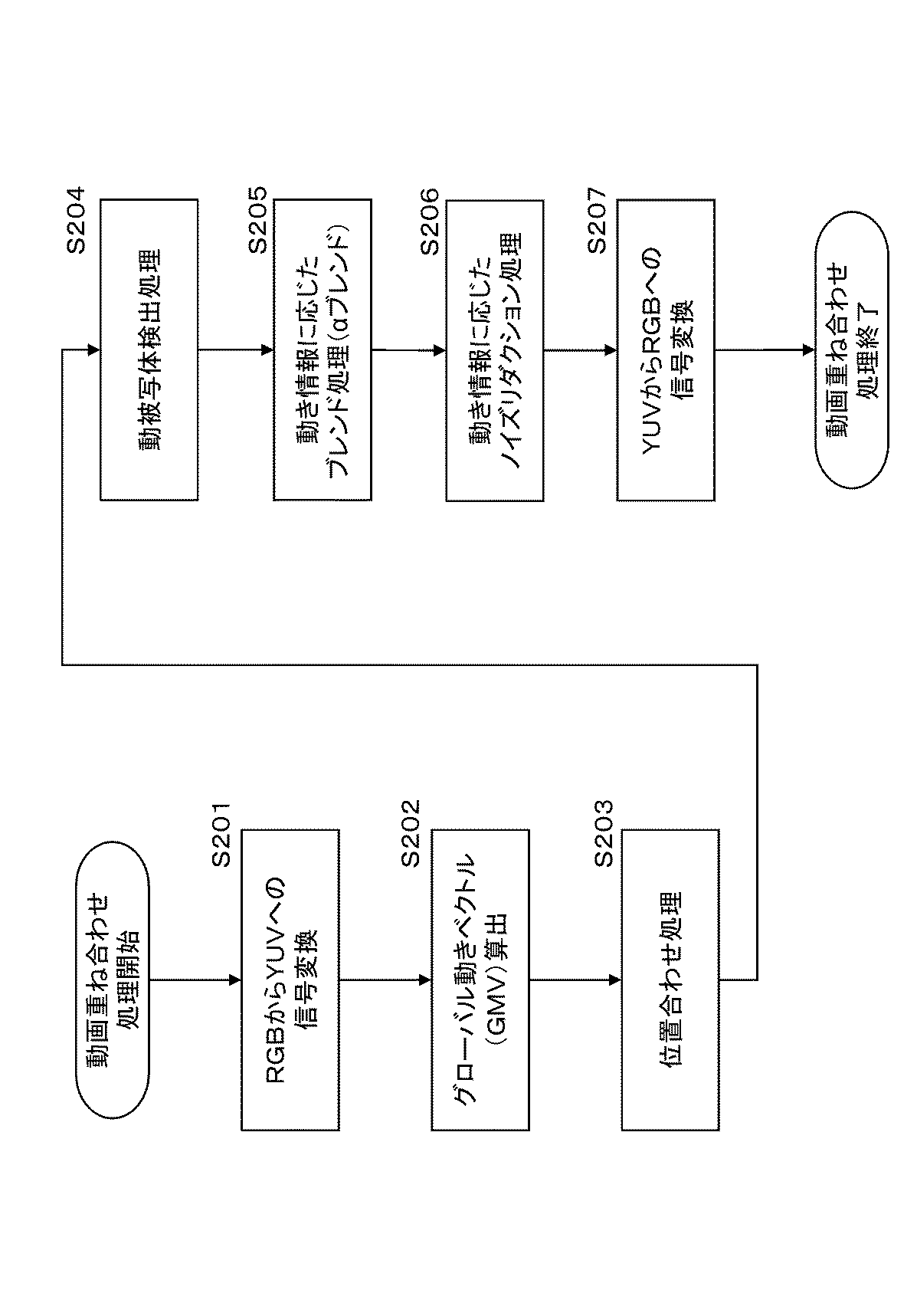
重ね合わせ処理部b108の実行する処理の手順について、図5に示すフローチャートを参照して説明する。なお、以下に説明する処理例は動画の再生処理例として説明する、動画再生は一定の時間間隔で撮影された静止画を連続表示することで行われる。動画処理の再生時重ね合わせの場合は、例えば基準フレームとしては記録再生部107から入力する最も新しいフレームを基準フレームとし、基準フレームの前のフレームを参照フレームとする。
A procedure of processing executed by the superimposition processing unit b108 will be described with reference to a flowchart shown in FIG. Note that the processing example described below will be described as a moving image reproduction processing example. The moving image reproduction is performed by continuously displaying still images taken at regular time intervals. In the case of superimposition at the time of reproduction of moving image processing, for example, as a reference frame, the newest frame input from the recording / reproducing
記録再生部107からの入力画像がフルカラーフォーマット(RGB)で入力された時は、ステップS201において、RGB→YUV変換処理が実行され、輝度、色差信号に変換される。一方、YUVフォーマットで入力された時はステップS201のRGB→YUV変換処理は省略される。
When the input image from the recording /
ステップS202では。グローバル動きベクトル(GMV)算出処理を実行する。このGMV算出処理は、基準フレームと参照フレームを入力とし、2枚のフレーム間の大域的(画像全体)な動きベクトル(Global Motion Vector)を算出する処理である。例えばカメラの動きに相当する動きベクトルを求める。 In step S202. A global motion vector (GMV) calculation process is executed. The GMV calculation process is a process of calculating a global (entire image) motion vector (Global Motion Vector) between two frames by using a base frame and a reference frame as inputs. For example, a motion vector corresponding to the camera motion is obtained.
次のステップS203では、位置合わせ処理を実行する。この位置合わせ処理は、基準フレームと、グローバル動きベクトル(GMV)を求めた1枚の参照フレームを読み出し、GMV算出処理において求められたGMVを用いて、参照フレームを基準フレームに位置合わせする処理である。この処理、すなわちGMVに基づいて参照フレームを基準フレームに位置合わせして生成した画像を動き補償画像とよぶ。 In the next step S203, alignment processing is executed. This alignment process is a process of reading the reference frame and one reference frame for which the global motion vector (GMV) is obtained, and aligning the reference frame with the reference frame using the GMV obtained in the GMV calculation process. is there. An image generated by aligning the reference frame with the base frame based on this processing, that is, GMV, is called a motion compensated image.
ステップS204では、動被写体検出処理を実行する。この処理は、基準フレームと基準フレームに位置合わせされた参照フレーム画像(動き補償画像)間の差分をとり、動被写体を検出する処理である。検出結果は、各画素単位の動き検出情報:α値(0<=α<=1,0:動きあり判定、1:静止(動きなし)判定)として出力する。 In step S204, a moving subject detection process is executed. This process is a process for detecting a moving subject by taking a difference between a reference frame and a reference frame image (motion compensated image) aligned with the reference frame. The detection result is output as motion detection information for each pixel: α value (0 <= α <= 1, 0: determination with motion, 1: determination with motion (no motion)).
ステップS205では、ステップS204において算出した各画素単位の動き検出情報:α値に基づいて、基準フレームと、GMVに基づく位置合わせ後の参照フレーム画像(動き補償画像)をブレンドして、重ね合わせフレーム(ブレンド画像)を生成する。 In step S205, based on the motion detection information for each pixel calculated in step S204: α value, the reference frame and the reference frame image (motion compensation image) after alignment based on GMV are blended, and the superimposed frame (Blend image) is generated.
ステップS205におけるαブレンド処理(重ね合わせ処理)は、動被写体検出部から得られたα値に応じて、基準フレーム(N+1枚目のフレームfrmN+1)と参照フレーム(N−1回目の重ね合わせフレームmltN−1)をブレンドする。αブレンド処理(重ね合わせ処理)に際しては、YUVフォーマットの輝度(Y)信号に対してのみ重ね合わせ処理を行う。N回目の重ね合わせ処理の式(式3)を以下に示す。 The α blending process (superposition process) in step S205 is performed according to the α value obtained from the moving subject detection unit and the reference frame (N + 1 frame fr N + 1 ) and the reference frame (N-1th superimposition frame). mlt N-1 ). In the α blend process (superimposition process), the superimposition process is performed only on the luminance (Y) signal in the YUV format. The formula (Formula 3) of the Nth overlay process is shown below.
上記式(式3)に従って、基準画像と、位置合わせ参照画像(動き補償画像)の対応画素の画素値をブレンドして重ね合わせフレーム(ブレンド画像)を生成する。 According to the above equation (Equation 3), the pixel values of the corresponding pixels of the base image and the alignment reference image (motion compensation image) are blended to generate a superimposed frame (blend image).
ブレンド処理は、このように、N+1枚の動画を処理対象としてN回の重ね合わせ処理を実行する場合、N回目の重ね合わせ処理を、
N−1回目の重ね合わせ処理画像mltN−1と、
N+1枚目の重ね合わせ未処理画像frmN+1を適用して上記式に従って実行する。
In this way, in the blending process, when N overlay processes are executed on N + 1 moving images, the Nth overlay process is performed.
N-1th superimposition processing image mlt N-1 ,
The N + 1-th superimposed unprocessed image frm N + 1 is applied and executed according to the above formula.
各画素単位の動き検出情報:α値が大きい場合、すなわち静止被写体と推定される画素位置では、位置合わせ参照画像(動き補償画像)のブレンド比率が大きく設定されるが、各画素単位の動き検出情報:α値が小さい場合、すなわち動被写体と推定される画素位置では、位置合わせ参照画像(動き補償画像)のブレンド比率が小さく設定される。このようにして画素単位の動き情報に応じたブレンド処理が行われる。 Motion detection information for each pixel: When the α value is large, that is, at the pixel position estimated as a still subject, the blend ratio of the alignment reference image (motion compensation image) is set to be large. Information: When the α value is small, that is, at the pixel position estimated to be a moving subject, the blend ratio of the alignment reference image (motion compensation image) is set small. In this way, the blending process according to the pixel-by-pixel motion information is performed.
ステップS205において、上記のブレンド処理が行われた後に、ステップS206において、さらにノイズリダクション処理を行う。
ステップS206の処理は、N=2以上の場合に、以下の式(式4)に従って実行する画素値の平滑化を伴う画素値更新処理である。
先のステップS205におけるブレンド処理において算出したブレンド画像の画素値:mltNの画像を以下の式(式4)に従って更新する。
mltN=LPF(α)※mltN
・・・(式4)
After the blend process is performed in step S205, a noise reduction process is further performed in step S206.
The process of step S206 is a pixel value update process involving smoothing of pixel values that is executed according to the following formula (formula 4) when N = 2 or more.
The image of the blend image pixel value: mlt N calculated in the blend process in the previous step S205 is updated according to the following formula (formula 4).
mlt N = LPF (α) * mlt N
... (Formula 4)
ただし、上記式(式4)において、
※は、(LPF(α))で定義された2次元データと、mltNという2次元画像との畳み込み演算(コンボルーション)を意味している。
αは、各画素単位の動き検出情報:α値(0<=α<=1,0:動きあり判定、1:静止(動きなし)判定)である。
なお、上記式(式4)は先に図3のフローのステップS106の処理において説明した式(式2)と同様の式である。
However, in the above formula (formula 4),
※ means a (LPF (alpha)) and two-dimensional data as defined by the convolution operation between the two-dimensional image of mlt N (convolution).
α is motion detection information for each pixel: α value (0 <= α <= 1, 0: determination of presence of motion, 1: determination of stillness (no motion)).
The above formula (formula 4) is the same formula as the formula (formula 2) described above in the processing of step S106 in the flow of FIG.
LPF(α)は、αが大きい値になればなるほど、より低域成分のみを通すローパスフィルタのフィルタ係数であり、αが小さい値のときは、ほぼ全周波数帯域(即ち、高域成分も含めて)を通すフィルタ係数である。ローパスフィルタの具体的な数値例は、例えば図4に示す3×3個の2次元データである。 LPF (α) is a filter coefficient of a low-pass filter that passes only lower frequency components as α becomes larger. When α is small, almost all frequency bands (that is, high frequency components are included). Filter coefficient to pass through. A specific numerical example of the low-pass filter is, for example, 3 × 3 two-dimensional data shown in FIG.
なお、N=1のときは、mltNの更新は行わない。各画素単位の動き検出情報:α値が大きい場合、すなわち静止被写体と推定される画素位置では、ローパスフィルタの通過帯域は全周波数帯域となり、実質、画像の更新は行われないので、鮮明な画像のままとなる。一方、各画素単位の動き検出情報:α値が小さい場合、すなわち動被写体と推定される画素位置では、ローパスフィルタの通過帯域は低周波数成分のみに限定され、画像をスムーズにする処理が行われる。 When N = 1, mlt N is not updated. Motion detection information for each pixel: When the α value is large, that is, at a pixel position estimated as a stationary subject, the pass band of the low-pass filter is the entire frequency band, and the image is not actually updated. Will remain. On the other hand, motion detection information for each pixel: When the α value is small, that is, at a pixel position estimated as a moving subject, the pass band of the low-pass filter is limited to only low frequency components, and processing for smoothing the image is performed. .
ステップS205におけるブレンド処理は、静止被写体領域では重ね合わせによるノイズリダクション効果が十分な効果として現れるが、動被写体領域では重ね合わせによるノイズリダクション効果が少ない。
しかし、このステップS206の処理を行うことで、ブレンド処理にて重ね合わせが行われなかった部分、例えば動被写体領域についてLPFによるノイズリダクションが行われ、結果として、α値によらず、すべての画素について、ノイズリダクションが行われることになる。
In the blending process in step S205, the noise reduction effect due to the superimposition appears as a sufficient effect in the still subject area, but the noise reduction effect due to the superposition is small in the moving subject area.
However, by performing the process of step S206, noise reduction by LPF is performed on a portion that has not been superposed in the blending process, for example, a moving subject area, and as a result, all pixels are independent of the α value. Noise reduction will be performed for.
すなわち、静止被写体領域についてはステップS205における画像重ね合わせによるノイズリダクションの効果が発揮され、一方、動被写体領域については、ステップS206におけるローパスフィルタ等を適用した画素値平滑化によるノイズリダクション効果が発揮されることになる。
結果として、静止被写体領域、動被写体領域のいずれの領域においてもノイズ低減効果が発揮されることになる。
That is, the noise reduction effect by the image superposition in step S205 is exhibited for the stationary subject region, while the noise reduction effect by the pixel value smoothing using the low-pass filter or the like in step S206 is exhibited for the moving subject region. Will be.
As a result, the noise reduction effect is exhibited in both the stationary subject region and the moving subject region.
ステップS206の処理によって生成される重ね合わせフレームは次の重ね合わせ処理の参照フレームとなる。次フレームである最新フレームを基準フレームとして新たな重ね合わせ処理が行われる。 The superimposed frame generated by the process of step S206 becomes a reference frame for the next overlapping process. A new overlay process is performed using the latest frame as the next frame as a reference frame.
最後に、ステップS207において、重ね合わせ処理が施された輝度信号(Y)と、RGB→YUV変換部より出力された色差信号(UV)に対してYUV→RGB変換処理を実行してフルカラーフォーマットに変換し、フルカラー画像を表示部109において表示する。
Finally, in step S207, a YUV → RGB conversion process is performed on the luminance signal (Y) subjected to the overlay process and the color difference signal (UV) output from the RGB → YUV conversion unit to obtain a full color format. The full color image is displayed on the
上述した処理例は、
(1−1)撮影時のRAW画像に対する処理
(1−2)再生時のフルカラー画像に対する処理
これらの処理例であるが、再生時のフルカラー画像に対する処理に際しては、例えば、RGB→YUV変換し、YUVフォーマットの輝度(Y)信号に対してのみ重ね合わせ処理を行う。
このような処理を行うことで、重ね合わせ処理を実行する各画素単位の信号は、
(1−1)撮影時のRAW画像に対する処理の場合は、RAW画像の構成画素に設定された信号(例えばRGBのいずれかの信号)となる。
(1−2)再生時のフルカラー画像に対する処理の場合は、フルカラー画像を構成する各画素各々について、YUVフォーマットの輝度(Y)信号のみとなる。
The above processing example is
(1-1) Processing for a RAW image at the time of shooting (1-2) Processing for a full-color image at the time of reproduction In these processing examples, for example, when processing a full-color image at the time of reproduction, RGB → YUV conversion, Only the luminance (Y) signal in the YUV format is overlaid.
By performing such a process, the signal of each pixel unit for executing the overlay process is
(1-1) In the case of processing for a RAW image at the time of shooting, a signal (for example, one of RGB signals) set in the constituent pixels of the RAW image.
(1-2) In the case of processing for a full-color image at the time of reproduction, only the luminance (Y) signal in the YUV format is provided for each pixel constituting the full-color image.
すなわち、RAW画像に対する重ね合わせ処理、フルカラー画像に対する重ね合わせ処理もいずれの場合も画像の構成画素各々について1つの信号値を用いて処理を行うことが可能となる。
この結果、RAW画像に対する重ね合わせ処理を実行する重ね合わせ処理部a105と、フルカラー画像に対する重ね合わせ処理を実行する重ね合わせ処理部b108は入力信号をRAW画像の各画素値とするか、フルカラー画像の各画素の輝度値(Y)とするかのみを異ならせることで、重ね合わせ処理の実行回路としては同一のものを利用することが可能となる。
In other words, in both the overlay process for the RAW image and the overlay process for the full-color image, it is possible to perform the process using one signal value for each pixel constituting the image.
As a result, the superimposition processing unit a105 that performs superimposition processing on the RAW image and the superimposition processing unit b108 that performs superimposition processing on the full-color image use the input signal as each pixel value of the RAW image, or By changing only the luminance value (Y) of each pixel, the same circuit can be used as the execution circuit for the overlay process.
この構成により、RAW画像、フルカラー画像の2つの異なる画像データに対して1つの重ね合わせ処理回路を利用した処理が実現される。 With this configuration, processing using one superimposition processing circuit is realized for two different image data of a RAW image and a full color image.
また、本実施例においては、動被写体が投影された為に、重ね合わせ効果によるノイズリダクション効果が期待できない画素については、空間的LPFにより、ノイズリダクションを行うことで、動被写体の有無にかかわらず、全ての画素について、ノイズのない画像を出力することが出来る。 In this embodiment, since a moving subject is projected, pixels that cannot be expected to have a noise reduction effect due to the overlay effect are subjected to noise reduction by a spatial LPF, regardless of the presence or absence of the moving subject. A noise-free image can be output for all pixels.
なお、先に従来技術として説明した特許文献1(特開2009−194700)では、重ねる枚数をカウントしておき、最後に、その枚数に依存してノイズリダクションの強弱を可変にしている。この従来技術では、重ねる枚数が少ないところは、ノイズリダクションの強めの効果をかけなくてはいけない。強めのノイズリダクションは、LPFのフィルタのタップ数(フィルタの大きさ)を大きくする必要があり、これは、回路規模や演算量の増大になってしまっていた。 In Patent Document 1 (Japanese Patent Application Laid-Open No. 2009-194700) described above as the prior art, the number of sheets to be overlapped is counted, and finally, the strength of noise reduction is made variable depending on the number of sheets. In this conventional technique, the effect of strengthening noise reduction must be applied where the number of stacked sheets is small. Strong noise reduction requires an increase in the number of LPF filter taps (filter size), which increases the circuit scale and the amount of computation.
一方、本開示によれば、ノイズリダクション処理部2060でのLPFのフィルタのタップ数は少なくてよい。なぜなら、重ねる枚数が少ない場合には、画像が入力される毎に、ノイズリダクション処理部2060での処理が行わることになるからである。換言すれば、タップ数の少ないフィルタを複数回処理することになり、結果として、タップ数の多いフィルタ処理をしたことになるからである。このように、本開示の構成では、回路規模や演算量は少なくて済む。 On the other hand, according to the present disclosure, the number of LPF filter taps in the noise reduction processing unit 2060 may be small. This is because when the number of sheets to be overlapped is small, the noise reduction processing unit 2060 performs processing every time an image is input. In other words, a filter with a small number of taps is processed a plurality of times, and as a result, a filter process with a large number of taps is performed. As described above, in the configuration of the present disclosure, the circuit scale and the calculation amount are small.
なお、処理対象画像は、動画、静止画のいずれでもよい。上述の例では、静止画のRAW画像と、動画のフルカラー画像に対する処理例を説明したが、動画のRAW画像や、静止画のフルカラー画像に対しても1つの共通回路を用いた重ね合わせ処理が可能となる。具体的な回路構成については、次の項目で説明する。 Note that the processing target image may be either a moving image or a still image. In the above-described example, the processing example for the still image RAW image and the moving image full color image has been described. However, the overlapping processing using one common circuit is also applied to the moving image RAW image and the still image full color image. It becomes possible. A specific circuit configuration will be described in the next item.
[2.重ね合わせ処理に利用するハードウェア構成例について]
次に、重ね合わせ処理に利用するハードウェア構成例について説明する。
以下では、
(2−1)固体撮像素子からの入力画像(RAW画像)に対する処理例
(2−2)記録再生部からの入力画像(フルカラー画像(YUV画像))に対する処理例
これら2つの処理例について順次説明する。
なお、以下のハードウェアの説明では、RAW画像に対する処理とフルカラー画像に対する処理が1つの共通する回路構成で実現されることとともに、本開示の構成のもう一つの特徴である、重ね合わせ処理において必要となるメモリ容量の削減処理についても説明する。
[2. Example of hardware configuration used for overlay processing]
Next, a hardware configuration example used for the overlay process will be described.
Below,
(2-1) Processing Example for Input Image (RAW Image) from Solid-State Image Sensor (2-2) Processing Example for Input Image (Full Color Image (YUV Image)) from Recording / Reproducing Unit These two processing examples are sequentially described. To do.
In the following description of the hardware, the processing for the RAW image and the processing for the full-color image are realized by one common circuit configuration, and are necessary for the overlay processing, which is another feature of the configuration of the present disclosure. The memory capacity reduction process will be described.
(2−1)固体撮像素子からの入力画像(RAW画像)に対する処理例
まず、図6〜図10を参照して固体撮像素子からの入力画像(RAW画像)に対する画像重ね合わせ(ブレンド)処理の処理例について説明する。
(2-1) Processing Example for Input Image (RAW Image) from Solid-State Image Sensor First, with reference to FIGS. 6 to 10, an image overlay (blending) process for an input image (RAW image) from the solid-state image sensor is performed. A processing example will be described.
図6は、図1に示す重ね合わせ処理部a105と重ね合わせ処理部b108として利用される共通の具体的回路構成である。 FIG. 6 shows a common specific circuit configuration used as the overlay processing unit a105 and the overlay processing unit b108 shown in FIG.
図6に示すグローバル動きベクトル(GMV)算出部203は、図3に示すフローのステップS102の処理や、図5に示すフローのステップS202の処理を実行する。
図6に示す位置合わせ処理部204は、図3に示すフローのステップS103の処理や、図5に示すフローのステップS203の処理を実行する。
図6に示す動被写体検出部205は、図3に示すフローのステップS104の処理や、図5に示すフローのステップS204の処理を実行する。
図6に示すブレンド処理部206は、図3に示すフローのステップS105の処理や、図5に示すフローのステップS205の処理を実行する。
図6に示すノイズリダクション処理部207は、図3に示すフローのステップS106の処理や、図5に示すフローのステップS206の処理を実行する。
The global motion vector (GMV)
The
The moving
The
The noise
図6に示す重ね合わせ処理部200が図1に示す重ね合わせ処理部a105として機能する場合、固体撮像素子201(=図1の固体撮像素子103)からRAW画像を入力してRAW画像の重ね合わせ処理を実行する。
一方、図1に示す重ね合わせ処理部b108として機能する場合、記録再生部202(=図1の記録再生部107)からYUV画像の輝度信号(Y)を入力してフルカラー画像の重ね合わせ処理を実行する。
When the
On the other hand, when functioning as the overlay processing unit b108 shown in FIG. 1, the luminance signal (Y) of the YUV image is input from the recording / playback unit 202 (= recording /
図6中のフレームメモリa211、メモリb212はそれぞれ、
、固体撮像素子201(=図1の固体撮像素子103)の出力するRAW画像、または、
記録再生部202(=図1の記録再生部107)の出力するフルカラー画像を保存しておくメモリである。
The frame memory a211 and memory b212 in FIG.
RAW image output from the solid-state image sensor 201 (= the solid-
This is a memory for storing a full-color image output from the recording / reproducing unit 202 (= recording / reproducing
以下では、まず、図1に示す重ね合わせ処理部a105、すなわち、図3に示すフローチャートを参照して説明した処理を実行する場合の処理例について説明する。
図6に示す重ね合わせ処理部が、RAW画像の重ね合わせ処理を実行する場合の処理のタイミングチャートを図7に示す。
In the following, a processing example in the case where the processing described with reference to the overlay processing unit a105 shown in FIG. 1, that is, the flowchart shown in FIG.
FIG. 7 shows a timing chart of processing when the overlay processing unit shown in FIG. 6 executes RAW image overlay processing.
図7は左から右に、時間経過、時間T0,T1,T2・・・を示している。
また、上から、以下の(1)〜(6)の各処理を示している。
(1)固体撮像素子201からメモリa211,メモリb212に対するRAW画像の書き込み(Write)処理、
(2)グローバル動きベクトル(GMV)算出部203に対する固体撮像素子201からの画像の入力処理、
(3)グローバル動きベクトル(GMV)算出部203によるメモリa211からの画像の読み取り(Read)処理、
(4)位置合わせ処理部204、動被写体検出部205、ブレンド処理部206、ノイズリダクション処理部207によるメモリa211からの画像読み取り(Read)処理、
(5)位置合わせ処理部204、動被写体検出部205、ブレンド処理部206、ノイズリダクション処理部207によるメモリb212からの画像読み取り(Read)処理、
(6)ブレンド処理部206、ノイズリダクション処理部207によるメモリa211に対する画像書き込み(Write)処理、
FIG. 7 shows the elapsed time, time T0, T1, T2,... From left to right.
Also, from the top, the following processes (1) to (6) are shown.
(1) RAW image write processing from the solid-
(2) Image input processing from the solid-
(3) Image reading (Read) processing from the memory a211 by the global motion vector (GMV)
(4) Image reading (Read) processing from the memory a 211 by the
(5) Image reading (Read) processing from the memory b212 by the
(6) Image writing (Write) processing to the memory a211 by the
なお、メモリa211,メモリb212に対して書き込まれる画像信号はRAW画像、またはRAW画像に基づいて生成される重ね合わせ画像であり、1つの画素に対してRGBいずれか1つの画素値である。すなわち1画素について1つの信号値のみが格納される。 Note that the image signal written to the memory a211 and the memory b212 is a RAW image or a superimposed image generated based on the RAW image, and one pixel value of RGB for one pixel. That is, only one signal value is stored for one pixel.
図7に示すfrm1、frm2、frm3・・・は、重ね合わせ処理において利用される重ね合わせ処理前の画像フレーム(RAW画像)を示し、mlt1、mlt2、mlt3、・・・は重ね合わせ処理のなされた画像フレームを示している。 In FIG. 7, frm1, frm2, frm3,... Indicate image frames (RAW images) before superimposition processing used in the superimposition processing, and mlt1, mlt2, mlt3,. The image frame is shown.
画像フレーム(frm1)と、画像フレーム(frm2)によって生成される最初の重ね合わせフレームが画像フレーム(mlt1)である。
これは、図7に示すタイミングチャートのT1〜T2の(4)と(5)に示す画像フレーム(frm1)と、画像フレーム(frm2)によって、(6)に示す最初の重ね合わせ画像フレーム(mlt1)が生成される処理に対応する。
The first superimposed frame generated by the image frame (frm1) and the image frame (frm2) is the image frame (mlt1).
This is because the first superimposed image frame (mlt1) shown in (6) by the image frame (frm1) shown in (4) and (5) of T1 to T2 in the timing chart shown in FIG. 7 and the image frame (frm2). ) Corresponds to the generated process.
次の、タイミングT2〜T3では、図7に示すタイミングチャートのT2〜T3の(4)と(5)に示す最初の重ね合わせ画像フレーム(mlt1)と、画像フレーム(frm3)によって、(6)に示す2番目の重ね合わせ画像フレーム(mlt2)が生成される。 At the next timing T2 to T3, (6) by the first superimposed image frame (mlt1) and the image frame (frm3) shown in (4) and (5) of T2 to T3 in the timing chart shown in FIG. A second superimposed image frame (mlt2) shown in FIG.
このようにして、時間経過に伴い、直前で生成された重ね合わせ画像フレーム(mltn)と最新の入力画像(frmn+2)とを利用して、新たな重ね合わせ画像フレーム(mltn+1)が順次、生成され、更新されることになる。例えばN+1枚の画像を利用してN回の重ね合わせを実行する場合には、N回の重ね合わせ処理の後に生成される重ね合わせ画像フレーム(mltN)を生成して1単位の処理が終了する。 In this way, with the passage of time, a new superimposed image frame (mltn + 1) is sequentially generated using the superimposed image frame (mltn) generated immediately before and the latest input image (frmn + 2). Will be updated. For example, when N overlays are executed using N + 1 images, a superimposed image frame (mltN) generated after N overlay processes is generated, and one unit of processing is completed. .
以下、図6に示す重ね合わせ処理部200(=図1の重ね合わせ処理部a105=重ね合わせ処理部b108)において実行するRAW画像に対する重ね合わせ処理の処理シーケンスについて、図7のタイミングチャートと、図8〜図10の各タイミングにおける状態図を参照して説明する。 FIG. 7 is a timing chart and FIG. 7 shows a processing sequence of superposition processing performed on a RAW image executed in the superposition processing unit 200 (= superimposition processing unit a105 = superimposition processing unit b108 in FIG. 1) shown in FIG. 8 to 10 will be described with reference to the state diagrams at the respective timings.
シャッタが押下されるなどして、撮像を開始したタイミングT0〜T1(図7参照)では、図6に示す固体撮像素子201から出力された画像データ(frm1)がフレームメモリa211に書き込まれる。
このタイミングT0〜T1の状態を示したのが図8である。
At timings T0 to T1 (see FIG. 7) when imaging is started by pressing the shutter, image data (frm1) output from the solid-
FIG. 8 shows the state at the timings T0 to T1.
続いてタイミングT1では、2枚目の画像データ(frm2)が固体撮像素子201より送信され、今度はフレームメモリb212に書き込まれると同時にGMV算出部203に入力される。同時に、1枚目の画像データ(frm1)がフレームメモリa211よりGMV算出部203に入力され、GMV算出部203において1枚目の画像データ(frm1)と2枚目の画像データ(frm2)との2フレーム間のグローバル動きベクトル(GMV)が求められる。
このタイミングT1〜T2の状態を示したのが図9である。
Subsequently, at the timing T1, the second image data (frm2) is transmitted from the solid-
FIG. 9 shows the state at the timings T1 and T2.
タイミングT2では、位置合わせ部204にフレームメモリb212から2枚目の画像データ(frm2)が入力される。
さらに、GMV算出部203が算出したGMV、すなわち、タイミングT1〜T2で求められた1枚目の画像データ(frm1)と2枚目の画像データ(frm2)間のGMVが入力されて、この入力GMVに基づいて2枚目の画像データ(frm2)を、1枚目の画像データ(frm1)の被写体位置に合わせる位置合わせ処理が行われる。すなわち動き補償画像の生成がなされる。
At timing T2, the second image data (frm2) is input from the frame memory b212 to the
Further, the GMV calculated by the
なお、本処理例は、静止画に対する重ね合わせ処理例である。静止画の場合は、先行画像を基準画像として後続画像を参照画像とし、後続の参照画像を先行する基準画像の位置に合わせる位置合わせを行う。 Note that this processing example is a superimposition processing example for a still image. In the case of a still image, the preceding image is used as a standard image, the subsequent image is used as a reference image, and the subsequent reference image is aligned with the position of the preceding standard image.
位置合わせされた2枚目の画像データ(frm2)は、1枚目の画像データ(frm1)と共に動被写体検出部205とブレンド処理部206に入力される。
The aligned second image data (frm2) is input to the moving
動被写体検出部205は、1枚目の画像データ(frm1)と位置合わせされた2枚目の画像データ(frm2)との対応位置の画素値比較を実行して差分に応じた画素単位の動き検出情報:α値(0<=α<=1,0:動きあり判定、1:静止(動きなし)判定)を生成してブレンド処理部206に出力する。
The moving
ブレンド処理部206は、動被写体検出部205において求められた画素単位の動き検出情報:α値(0<=α<=1)を用いて、1枚目の画像データ(frm1)と位置合わせされた2枚目の画像データ(frm2)とのブレンド処理を実行して重ね合わせフレームの生成を行う。
先に説明した式(式1)に従って、基準画像と、位置合わせ参照画像(動き補償画像)の対応画素の画素値をブレンドして重ね合わせフレーム(ブレンド画像)を生成する。
The
According to the equation (Equation 1) described above, the pixel value of the corresponding pixel of the base image and the alignment reference image (motion compensation image) is blended to generate a superimposed frame (blend image).
1枚目の画像データ(frm1)と位置合わせされた2枚目の画像データ(frm2)とのブレンド処理によって生成される1枚目のブレンド画像である重ね合わせフレーム(mlt1)が生成される。 A superimposed frame (mlt1) that is a first blend image generated by blending the first image data (frm1) and the second image data (frm2) that has been aligned is generated.
さらに、ノイズリダクション処理部207におけるノイズリダクション処理が実行される。すなわち、上記のブレンド処理が行われた後に、先に図3のフローにおいて説明したステップS106のノイズリダクション処理が実行される。
N=2以上の場合に、先に説明した式(式2)に従って画素値更新処理が行われる。すなわち、例えば図4に示すような係数を持つローパスフィルタによるノイズ提言処理が実行される。このLPFを適用した処理は、各画素単位の動き検出情報:α値が小さい場合、すなわち動被写体と推定される画素位置でローパスフィルタの通過帯域が低周波数成分のみに限定され、画像をスムーズにする効果が発揮されることになる。
このノイズリダクション処理部207の処理画像は、フレームメモリa211に上書きされる。
このタイミングT2〜T3の状態を示したのが図10である。
Further, noise reduction processing in the noise
When N = 2 or more, the pixel value update processing is performed according to the equation (Equation 2) described above. That is, for example, noise recommendation processing is performed by a low-pass filter having a coefficient as shown in FIG. The processing using this LPF is a motion detection information for each pixel unit: when the α value is small, that is, the pass band of the low-pass filter is limited to only low frequency components at the pixel position estimated as a moving subject, and the image is smoothed. Effect will be demonstrated.
The processed image of the noise
FIG. 10 shows the state at the timings T2 to T3.
図6〜図10を参照して説明した処理から理解されるように、図6に示す重ね合わせ処理部200を利用した重ね合わせ処理においては、2つの画像を格納する2つのメモリ、すなわちメモリa211、メモリb212を利用しているのみで、任意枚数、例えばN枚の画像の重ね合わせ処理を実現している。
As can be understood from the processing described with reference to FIGS. 6 to 10, in the superimposition processing using the
このように、本実施例では、重ね合わせ枚数によらず、フレームメモリに保存される最大の枚数はフレームメモリa,b分の2枚となる。本実施例ではフレームメモリ容量を節約しつつ、N+1枚全てをフレームメモリに保存する場合と同等の効果が得られる。 As described above, in this embodiment, the maximum number stored in the frame memory is two for the frame memories a and b, regardless of the number of superimposed images. In this embodiment, the same effect as that in the case where all N + 1 images are stored in the frame memory can be obtained while saving the frame memory capacity.
(2−2)記録再生部からの入力画像(フルカラー画像(YUV画像))に対する処理例
続いて、記録再生部からの入力画像(フルカラー画像(YUV画像))に対する処理例について図11〜図13を参照して説明する。
(2-2) Processing Example for Input Image (Full Color Image (YUV Image)) from Recording / Reproducing Unit Next, a processing example for an input image (full color image (YUV image)) from the recording / reproducing unit will be described with reference to FIGS. Will be described with reference to FIG.
図11は、先に図6を参照して説明した回路とほぼ同様の回路であり、図1に示す重ね合わせ処理部a105と重ね合わせ処理部b108として利用される共通の回路構成である。ただし、重ね合わせ処理部b108として利用する場合、結線部251の接続構成を変更し、さらに入力を記録再生部202からの入力構成に変更している。これらはこれらの結線部251や記録再生部202の接続部に設定したスイッチの切り替え等によって実現される。
FIG. 11 is a circuit substantially similar to the circuit described above with reference to FIG. 6 and has a common circuit configuration used as the overlay processing unit a105 and the overlay processing unit b108 shown in FIG. However, when used as the overlay processing unit b108, the connection configuration of the
以下では、図1に示す重ね合わせ処理部b108において実行する処理、すなわち、図5に示すフローチャートを参照して説明した処理を実行する場合の処理例について説明する。
図11の重ね合わせ処理部が、フルカラー画像に基づいて生成されるYUV画像の輝度信号(Y)を適用して重ね合わせ処理を実行する場合の処理のタイミングチャートを図12に示す。
Hereinafter, a process example in the case of executing the process executed in the superimposition processing unit b108 shown in FIG. 1, that is, the process described with reference to the flowchart shown in FIG.
FIG. 12 shows a processing timing chart when the overlay processing unit in FIG. 11 executes the overlay process by applying the luminance signal (Y) of the YUV image generated based on the full color image.
図12は、図7と同様のタイミングチャートであり、左から右に、時間経過、時間T0,T1,T2・・・を示している。
また、上から、以下の(1)〜(6)の各処理を示している。
(1)記録再生部202からメモリa211,メモリb212に対するYUV画像中の輝度信号(Y)の書き込み(Write)処理、
(2)グローバル動きベクトル(GMV)算出部203に対する記録再生部202からのYUV画像中の輝度信号(Y)の入力処理、
(3)グローバル動きベクトル(GMV)算出部203によるメモリa211からの画像信号(輝度信号(Y))の読み取り(Read)処理、
(4)位置合わせ処理部204、動被写体検出部205、ブレンド処理部206、ノイズリダクション処理部207によるメモリa211からの画像信号(輝度信号(Y))読み取り(Read)処理、
(5)位置合わせ処理部204、動被写体検出部205、ブレンド処理部206、ノイズリダクション処理部207によるメモリb212からの画像信号(輝度信号(Y))読み取り(Read)処理、
(6)ブレンド処理部206、ノイズリダクション処理部207によるメモリa211に対する画像信号(輝度信号(Y))書き込み(Write)処理、
FIG. 12 is a timing chart similar to FIG. 7, and shows the elapsed time, time T0, T1, T2,... From left to right.
Also, from the top, the following processes (1) to (6) are shown.
(1) Write (Write) processing of the luminance signal (Y) in the YUV image from the recording / reproducing
(2) Input processing of the luminance signal (Y) in the YUV image from the recording / reproducing
(3) Reading (Read) processing of an image signal (luminance signal (Y)) from the memory a211 by the global motion vector (GMV)
(4) Image signal (luminance signal (Y)) reading (Read) processing from the memory a 211 by the
(5) Image signal (luminance signal (Y)) reading (Read) processing from the
(6) Image signal (luminance signal (Y)) writing (Write) processing to the memory a211 by the
なお、メモリa211,メモリb212に対して書き込まれる画像信号はYUV画像中の輝度信号(Y)画像、またはYUV画像中の輝度信号(Y)画像に基づいて生成される重ね合わせ画像であり、1つの画素に対して輝度信号(Y)1つの画素値である。すなわち1画素について1つの信号値のみが格納される。 Note that the image signal written to the memory a211 and the memory b212 is a luminance signal (Y) image in the YUV image or a superimposed image generated based on the luminance signal (Y) image in the YUV image. One pixel value of the luminance signal (Y) for one pixel. That is, only one signal value is stored for one pixel.
図12に示すfrm1、frm2、frm3・・・は、重ね合わせ処理において利用される重ね合わせ処理前の画像フレームを示し、mlt1、mlt2、mlt3、・・・は重ね合わせ処理のなされた画像フレームを示している。 In FIG. 12, frm1, frm2, frm3,... Indicate image frames before overlay processing used in the overlay processing, and mlt1, mlt2, mlt3,. Show.
画像フレーム(frm1)と、画像フレーム(frm2)によって生成される最初の重ね合わせフレームが画像フレーム(mlt1)である。
これは、図12に示すタイミングチャートのT1〜T2の(4)と(5)に示す画像フレーム(frm1)と、画像フレーム(frm2)によって、(6)に示す最初の重ね合わせ画像フレーム(mlt1)が生成される処理に対応する。
The first superimposed frame generated by the image frame (frm1) and the image frame (frm2) is the image frame (mlt1).
This is based on the image frame (frm1) shown in (4) and (5) of T1 to T2 in the timing chart shown in FIG. 12, and the first superimposed image frame (mlt1) shown in (6) by the image frame (frm2). ) Corresponds to the generated process.
次の、タイミングT2〜T3では、図12に示すタイミングチャートのT2〜T3の(4)と(5)に示す最初の重ね合わせ画像フレーム(mlt1)と、画像フレーム(frm3)によって、(6)に示す2番目の重ね合わせ画像フレーム(mlt2)が生成される。 At the next timing T2 to T3, (6) by the first superimposed image frame (mlt1) and the image frame (frm3) shown in (4) and (5) of T2 to T3 in the timing chart shown in FIG. A second superimposed image frame (mlt2) shown in FIG.
このようにして、時間経過に伴い、直前で生成された重ね合わせ画像フレーム(mltn)と最新の入力画像(frmn+2)とを利用して、新たな重ね合わせ画像フレーム(mltn+1)が順次、生成され、更新されることになる。例えばN+1枚の画像を利用してN回の重ね合わせを実行する場合には、N回の重ね合わせ処理の後に生成される重ね合わせ画像フレーム(mltN)を生成して1単位の処理が終了する。 In this way, with the passage of time, a new superimposed image frame (mltn + 1) is sequentially generated using the superimposed image frame (mltn) generated immediately before and the latest input image (frmn + 2). Will be updated. For example, when N overlays are executed using N + 1 images, a superimposed image frame (mltN) generated after N overlay processes is generated, and one unit of processing is completed. .
以下、図11に示す重ね合わせ処理部200(=図1の重ね合わせ処理部b108=重ね合わせ処理部b105)において実行するYUV画像に対する重ね合わせ処理の処理シーケンスについて、図12のタイミングチャートを参照して説明する。 Hereinafter, with reference to the timing chart of FIG. 12, the processing sequence of the superimposition processing performed on the YUV image executed in the superimposition processing unit 200 (= superimposition processing unit b108 = superimposition processing unit b105 in FIG. 1) shown in FIG. I will explain.
先に図6〜図10を参照して説明したRAW画像に対する処理と異なる部分を中心として説明する。
この処理では、図11、図12に示すように、重ね合わせ処理部200に対する入力は固体撮像素子201ではなく、記録再生部202から行われる。
A description will be given centering on differences from the processing for the RAW image described above with reference to FIGS.
In this processing, as shown in FIGS. 11 and 12, the input to the
例えばユーザ選択によって選択された再生対象画像が記録再生部107においてメモリから選択取得され、重ね合わせ処理部200に対して出力される。なお。記録再生部107は必要に応じてRGBフォーマットからからYUVフォーマットへのフォーマット変換が実行され、生成された輝度信号(Y)がメモリa211、メモリb212に供給されて処理を開始する。
For example, the playback target image selected by the user selection is selected and acquired from the memory in the recording /
タイミングT0〜T1(図12参照)では、図11に示す記録再生部202から出力された画像データ(frm1)がフレームメモリa211に書き込まれる。なお、本例では、フレームメモリa211,フレームメモリb212へは輝度信号(Y)の書き込みが行われる。
このタイミングT0〜T1の状態は、先に説明した図8において、記録再生部202からデータが出力される点が異なるものとなる。
At timings T0 to T1 (see FIG. 12), the image data (frm1) output from the recording /
The timings T0 to T1 are different in that data is output from the recording / reproducing
続いてタイミングT1では、2枚目の画像データ(frm2)が記録再生部202から出力され、今度はフレームメモリb212に書き込まれると同時にGMV算出部203に入力される。同時に、1枚目の画像データ(frm1)がフレームメモリa211よりGMV算出部203に入力され、GMV算出部203において1枚目の画像データ(frm1)と2枚目の画像データ(frm2)との2フレーム間のグローバル動きベクトル(GMV)が求められる。
このタイミングT1〜T2の状態は、先に説明した図9において、記録再生部202からデータが出力される点が異なるものとなる。
Subsequently, at the timing T1, the second image data (frm2) is output from the recording /
The states of the timings T1 to T2 are different in that data is output from the recording / reproducing
タイミングT2では、位置合わせ部204にフレームメモリa211から1枚目の画像データ(frm1)が入力され、T1〜T2で求められた1枚目の画像データ(frm1)と2枚目の画像データ(frm2)間のGMVが入力されて、この入力GMVに基づいて1枚目の画像データ(frm1)を、2枚目の画像データ(frm2)の被写体位置に合わせる位置合わせ処理が行われる。すなわち動き補償画像の生成がなされる。
At timing T2, the first image data (frm1) is input from the frame memory a211 to the
なお、本処理例は、動画に対する重ね合わせ処理例である。動画の場合は、後続画像を基準画像として先行画像を参照画像とし、先行の参照画像を後続の基準画像の位置に合わせる位置合わせを行う。 This processing example is an example of overlay processing for a moving image. In the case of a moving image, the subsequent image is used as a standard image, the preceding image is used as a reference image, and the preceding reference image is aligned with the position of the subsequent standard image.
位置合わせされた1枚目の画像データ(frm1)は、2枚目の画像データ(frm2)と共に動被写体検出部205とブレンド処理部206に入力される。
The aligned first image data (frm1) is input to the moving
動被写体検出部205は、位置合わせされた1枚目の画像データ(frm1)と2枚目の画像データ(frm2)との対応位置の画素値比較を実行して差分に応じた画素単位の動き検出情報:α値(0<=α<=1,0:動きあり判定、1:静止(動きなし)判定)を生成してブレンド処理部206に出力する。
The moving
ブレンド処理部206は、動被写体検出部205において求められた画素単位の動き検出情報:α値(0<=α<=1)を用いて、位置合わせのなされた1枚目の画像データ(frm1)と2枚目の画像データ(frm2)とのブレンド処理を実行して重ね合わせフレームの生成を行う。
先に説明した式(式3)に従って、基準画像と、位置合わせ参照画像(動き補償画像)の対応画素の画素値をブレンドして重ね合わせフレーム(ブレンド画像)を生成する。
The
According to the equation (Equation 3) described above, the pixel value of the corresponding pixel of the base image and the alignment reference image (motion compensated image) is blended to generate a superimposed frame (blended image).
位置合わせのなされた1枚目の画像データ(frm1)と2枚目の画像データ(frm2)とのブレンド処理によって生成される1枚目のブレンド画像である重ね合わせフレーム(mlt1)が生成される。 A superimposed frame (mlt1) that is a first blend image generated by blending the first image data (frm1) and the second image data (frm2) that have been aligned is generated. .
さらに、ノイズリダクション処理部207におけるノイズリダクション処理が実行される。すなわち、上記のブレンド処理が行われた後に、先に図3のフローにおいて説明したステップS106のノイズリダクション処理が実行される。
N=2以上の場合に、先に説明した式(式4)に従って画素値更新処理が行われる。すなわち、例えば図4に示すような係数を持つローパスフィルタによるノイズ提言処理が実行される。このLPFを適用した処理は、各画素単位の動き検出情報:α値が小さい場合、すなわち動被写体と推定される画素位置でローパスフィルタの通過帯域が低周波数成分のみに限定され、画像をスムーズにする効果が発揮されることになる。
このノイズリダクション処理部207の処理画像は、フレームメモリa211に上書きされ、かつ表示部109に出力される。
このタイミングT2〜T3の状態を示したのが図13である。
Further, noise reduction processing in the noise
When N = 2 or more, the pixel value update processing is performed according to the equation (Equation 4) described above. That is, for example, noise recommendation processing is performed by a low-pass filter having a coefficient as shown in FIG. The processing using this LPF is a motion detection information for each pixel unit: when the α value is small, that is, the pass band of the low-pass filter is limited to only low frequency components at the pixel position estimated as a moving subject, and the image is smoothed. Effect will be demonstrated.
The processed image of the noise
FIG. 13 shows the state at the timings T2 to T3.
図6〜図10を参照して説明したRAW画像に対する重ね合わせ処理、さらに、図11〜図13を参照して説明したフルカラー画像に対する重ね合わせ処理から理解されるように、図6、図11に示す共通の重ね合わせ処理部200を利用してRAW画像に対する重ね合わせ処理と、フルカラー画像に対する重ね合わせ処理が実行される。
6 and 11, as can be understood from the overlay process for the RAW image described with reference to FIGS. 6 to 10 and the overlay process for the full-color image described with reference to FIGS. 11 to 13. A superimposition process for a RAW image and a superimposition process for a full-color image are executed using a common
さらに、これ等の異なる画像に対する重ね合わせ処理においては、2つの画像を格納する2つのメモリ、すなわちメモリa211、メモリb212を利用しているのみで、任意枚数、例えばN枚の画像の重ね合わせ処理が実現される。 Furthermore, in the superimposing process for these different images, only two memories for storing two images, that is, the memory a211 and the memory b212 are used, and an arbitrary number of images, for example, N images are superimposed. Is realized.
[3.その他の実施例]
次にその他の実施例について説明する。
(3−1)高解像度化処理部を設定した実施例
まず、図14を参照して重ね合わせ処理部に高解像度化処理部を設定した実施例について説明する。
[3. Other Examples]
Next, other embodiments will be described.
(3-1) Embodiment in which High Resolution Processing Unit is Set First, an embodiment in which a high resolution processing unit is set in the superposition processing unit will be described with reference to FIG.
図14に示す重ね合わせ処理部300は、先に図6、図11を参照して説明した重ね合わせ処理部200に高解像度化処理部301、画像サイズ調整部302,303を追加した構成である。図1に示す重ね合わせ処理部a105と重ね合わせ処理部b108として利用される共通の回路構成である。ただし、静止画に対する重ね合わせ処理部a105として利用する場合、結線部351の接続構成を、図6を参照して説明したと同様に設定(図14の結線部351の点線)する。また、動画に対する重ね合わせ処理部b108として利用する場合、結線部351の接続構成を図11を参照して説明したと同様に設定(図14の結線部351の実線)する。
The
さらに入力画像についても、静止画に対する重ね合わせ処理部a105として利用する場合、固体撮像素子201からの入力設定とし、動画に対する重ね合わせ処理部b108として利用する場合、記録再生部202からの入力構成に変更する。これらはこれらの結線部351や、固体撮像素子201と記録再生部202の接続部に設定したスイッチの切り替え等によって実現される。
Further, when the input image is used as the superimposition processing unit a105 for the still image, the input setting from the solid-
高解像度化処理部301は、解像度変換を行う。アップサンプル部11では、例えば1画素を4画素に設定する等の処理等の拡大画像の生成手法を適用して解像度変換を行う。
The high
画像サイズ調整部302は、メモリa211からの入力画像を、GMV算出部203でのGMV算出対象となる記録再生部202からの入力画像のサイズに合わせる処理を行う。これは、高解像度化処理部301における高解像度化に際して、画像の拡大が行われる場合があり、この拡大された画像をGMV算出部203でのGMV算出対象となる記録再生部202からの入力画像のサイズに合わせるための処理である。
The image
画像サイズ調整部303も、その後の処理で実行される画像の位置合わせ等のために2つの画像のサイズを調整する処理を行う。
The image
本実施例で実行するシーケンスは、以下のようになる。
RAW画像に対する処理では、先に図3を参照して説明したフローチャートに従った処理を基本処理とし、ステップS103とステップS104の間に高解像度化処理を実行する。さらに、各ステップの前段に必要に応じて画像サイズ調整処理を実行する設定となる。
The sequence executed in this embodiment is as follows.
In the process for the RAW image, the process according to the flowchart described above with reference to FIG. Furthermore, it is set to execute image size adjustment processing as necessary before each step.
また、フルカラー画像に対する処理では、先に図5を参照して説明したフローチャートに従った処理を基本処理とし、ステップS203とステップS204の間に高解像度化処理を実行する。さらに、各ステップの前段に必要に応じて画像サイズ調整処理を実行する設定となる。 In the process for a full-color image, the process according to the flowchart described above with reference to FIG. 5 is used as the basic process, and the high resolution process is executed between steps S203 and S204. Furthermore, it is set to execute image size adjustment processing as necessary before each step.
本実施例では、入力フレームを高解像度化後に重ね合わせ処理を行う。これにより、拡大によって生ずる、エッジ部のジャギー(ぎざぎざ)を低減することができる。なお、GMV算出部203で得られたGMVは高解像度画像の動き量に変換して使用する。
また、本実施例の変形として、高解像度化によるぼけを補償するため、入力フレームにラプラシアンフィルタなどのHPFをかける構成としてもよい。
In this embodiment, the superimposition process is performed after the resolution of the input frame is increased. Thereby, jaggies (jagged edges) caused by enlargement can be reduced. Note that the GMV obtained by the
In addition, as a modification of the present embodiment, an HPF such as a Laplacian filter may be applied to the input frame in order to compensate for blur due to high resolution.
(3−2)RAW画像の重ね合わせ処理時に算出したGMVをフルカラー画像の重ね合わせ処理に際して利用する実施例
次に、RAW画像の重ね合わせ処理時に算出したGMVをフルカラー画像の重ね合わせ処理に際して利用する実施例について説明する。
(3-2) Embodiment in which GMV calculated during RAW image overlay processing is used during full color image overlay processing Next, GMV calculated during RAW image overlay processing is used during full color image overlay processing. Examples will be described.
先に説明した実施例では、RAW画像の重ね合わせ処理においてもGMVの算出を逐次実行しており、さらにフルカラー画像の重ね合わせ処理においてもGMVの算出処理を逐次、実行する構成としていた。 In the embodiment described above, the GMV calculation is sequentially executed even in the RAW image overlay process, and the GMV calculation process is sequentially executed in the full-color image overlay process.
しかし、フルカラー画像はRAW画像から生成したものであり、GMVの算出対象となる2つの画像のペアがおなじであればRAW画像から算出したGMVもフルカラー画像から算出したGMVも同じになるはずである。従って、例えば撮影の際にRAW画像の重ね合わせ処理において算出したGMVを各画像に対応づけたデータとしてメモリに記録しておけば、フルカラー画像の重ね合わせ処理に際して、このGMVデータを取得することが可能となり、新たにGMVを算出する処理を行う必要がなくなり処理が簡略化され高速化することがてきる。 However, the full color image is generated from the RAW image, and if the pair of two images to be GMV calculation is the same, the GMV calculated from the RAW image and the GMV calculated from the full color image should be the same. . Accordingly, for example, if the GMV calculated in the RAW image overlay process at the time of shooting is recorded in the memory as data associated with each image, the GMV data can be acquired in the full color image overlay process. As a result, it is not necessary to perform a new GMV calculation process, and the process can be simplified and speeded up.
この処理を実行する画像処理装置の構成例を図15に示す。
図15は、本開示の画像処理装置の一例である撮像装置500の構成例を示している。撮像装置500は、先に説明した図1に示す画像処理装置100と同様、画像撮影時に、撮影されるRAW画像、およびRAW画像に基づいて生成されたフルカラー画像に対して、ノイズ低減あるいは高解像化を実現するための画像重ね合わせ処理を行う。
A configuration example of an image processing apparatus that executes this processing is shown in FIG.
FIG. 15 illustrates a configuration example of an
RAW画像に対する重ね合わせ処理を実行するのが図15に示す撮像装置500の重ね合わせ処理部a105である。フルカラー画像に対する重ね合わせ処理を実行するのが図15に示す撮像装置500の重ね合わせ処理部b108である。これらは2つのブロックとして示してあるが、先に説明したように共通の回路を利用して構成される。
The superimposition processing unit a105 of the
図1を参照して説明した画像処理装置100との差異は、図15に示す画像処理装置500は、GMV記録部501を有する点である。
A difference from the
GMV記録部501は、重ね合わせ処理部a105において実行するRAW画像の重ね合わせ処理時に算出したGMVを記録する記憶部(メモリ)である。フルカラー画像に対する重ね合わせ処理を実行する重ね合わせ処理部b108は、GMV算出を実行せず、GMV記録部501に記録されたGMVを利用する。
The
GMV記録部501には、GMVのデータが、GMV算出のなされた2つの画像フレーム識別子情報に対応づけて格納される。フルカラー画像に対する重ね合わせ処理を実行する重ね合わせ処理部b108は、GMV算出対象となる画像のペアの識別子に基づいてGMV記録部501に記録されたGMVを選択して利用する。
The
この実施例によれば、フルカラー画像の重ね合わせ処理に際して、このGMVデータを取得することが可能となり、新たにGMVを算出する処理を行う必要がなくなり処理が簡略化され高速化することがてきる。また、コーデック前の画像を使うことで、GMVの精度を向上させることができるというメリットもある。 According to this embodiment, it is possible to acquire this GMV data during the full color image superimposing process, and it becomes unnecessary to perform a new GMV calculation process, thereby simplifying and speeding up the process. . Also, there is an advantage that the accuracy of GMV can be improved by using an image before the codec.
[4.画像処理装置のハードウェア構成例について]
最後に、図16を参照して、上述した処理を実行する画像処理装置の1つのハードウェア構成例について説明する。CPU(Central Processing Unit)901は、ROM(Read Only Memory)902、または記憶部908に記憶されているプログラムに従って各種の処理を実行する。例えば、上述の各実施例において説明した画像重ね合わせ(ブレンド)処理やLPF(ローパスフィルタ)によるによるノイズ低減や高解像化のための画像処理を実行する。RAM(Random Access Memory)903には、CPU901が実行するプログラムやデータなどが適宜記憶される。これらのCPU901、ROM902、およびRAM903は、バス904により相互に接続されている。
[4. Example of hardware configuration of image processing apparatus]
Finally, with reference to FIG. 16, one hardware configuration example of the image processing apparatus that performs the above-described processing will be described. A CPU (Central Processing Unit) 901 executes various processes according to a program stored in a ROM (Read Only Memory) 902 or a
CPU901はバス904を介して入出力インタフェース905に接続され、入出力インタフェース905には、キーボード、マウス、マイクロホンなどよりなる入力部906、ディスプレイ、スピーカなどよりなる出力部907が接続されている。CPU901は、入力部906から入力される指令に対応して各種の処理を実行し、処理結果を例えば出力部907に出力する。
The
入出力インタフェース905に接続されている記憶部908は、例えばハードディスクからなり、CPU901が実行するプログラムや各種のデータを記憶する。通信部909は、インターネットやローカルエリアネットワークなどのネットワークを介して外部の装置と通信する。
A
入出力インタフェース905に接続されているドライブ910は、磁気ディスク、光ディスク、光磁気ディスク、或いは半導体メモリなどのリムーバブルメディア911を駆動し、記録されているプログラムやデータなどを取得する。取得されたプログラムやデータは、必要に応じて記憶部908に転送され記憶される。
A
[5.本開示の構成のまとめ]
以上、特定の実施例を参照しながら、本開示の実施例について詳解してきた。しかしながら、本開示の要旨を逸脱しない範囲で当業者が実施例の修正や代用を成し得ることは自明である。すなわち、例示という形態で本発明を開示してきたのであり、限定的に解釈されるべきではない。本開示の要旨を判断するためには、特許請求の範囲の欄を参酌すべきである。
[5. Summary of composition of the present disclosure]
As described above, the embodiments of the present disclosure have been described in detail with reference to specific embodiments. However, it is obvious that those skilled in the art can make modifications and substitutions of the embodiments without departing from the gist of the present disclosure. In other words, the present invention has been disclosed in the form of exemplification, and should not be interpreted in a limited manner. In order to determine the gist of the present disclosure, the claims should be taken into consideration.
なお、本明細書において開示した技術は、以下のような構成をとることができる。
(1)複数の連続撮影画像のブレンド処理を実行する重ね合わせ処理部を有し、
前記重ね合わせ処理部は、
画像の動被写体領域を検出し、画像領域単位の動被写体情報を生成する動被写体検出部と、
前記動被写体情報に基づいて、静止被写体領域において高いブレンド比率とし、動被写体領域において低いブレンド比率とした複数画像のブレンド処理を実行して重ね合わせ画像を生成するブレンド処理部と、
前記重ね合わせ画像に対して、前記動被写体情報に基づいて、動被写体領域においてより強い画素値平滑化処理を実行するノイズリダクション処理部と、
を有する画像処理装置。
The technology disclosed in this specification can take the following configurations.
(1) having an overlay processing unit that executes blend processing of a plurality of continuously shot images;
The overlay processing unit
A moving subject detection unit that detects a moving subject region of an image and generates moving subject information in units of image regions;
Based on the moving subject information, a blend processing unit that generates a superimposed image by executing a blending process of a plurality of images having a high blend ratio in the stationary subject region and a low blend ratio in the moving subject region;
A noise reduction processing unit that executes a stronger pixel value smoothing process in the moving subject region based on the moving subject information on the superimposed image;
An image processing apparatus.
(2)前記ノイズリダクション処理部は、ローパスフィルタを適用した画素値更新処理を実行する前記(1)に記載の画像処理装置。
(3)前記ノイズリダクション処理部は、動被写体領域においてより高いノイズ低減効果を奏する前記動被写体情報に依存した係数を持つローパスフィルタを適用した画素値更新処理を実行する前記(1)または(2)に記載の画像処理装置。
(4)前記重ね合わせ処理部は、連続撮影された複数の画像のグローバル動きベクトル(GMV)を算出するGMV算出部と、前記グローバル動きベクトル(GMV)に従って、参照画像の被写体位置を基準画像の位置に合わせた動き補償画像を生成する位置合わせ処理部を有し、前記動被写体検出部は、前記位置合わせ処理部の位置合わせ結果として得られる動き補償画像と基準画像との対応画素の画素差分に基づいて動被写体情報を取得し、前記ブレンド処理部は、前記基準画像と動き補償画像とを前記動被写体情報に基づくブレンド比率に基づいてブレンドして重ね合わせ画像を生成する前記(1)〜(3)いずれかに記載の画像処理装置。
(2) The image processing device according to (1), wherein the noise reduction processing unit executes pixel value update processing to which a low-pass filter is applied.
(3) The noise reduction processing unit executes the pixel value update processing using a low-pass filter having a coefficient dependent on the moving subject information that exhibits a higher noise reduction effect in the moving subject region. ).
(4) The superimposition processing unit calculates a global motion vector (GMV) of a plurality of continuously shot images, and determines a reference image subject position of the reference image according to the global motion vector (GMV). A registration processing unit configured to generate a motion compensated image according to a position, wherein the moving subject detection unit includes a pixel difference between corresponding pixels of a motion compensation image obtained as a result of the registration of the registration processing unit and a reference image. The moving subject information is acquired based on the blending unit, and the blend processing unit blends the reference image and the motion compensated image based on the blending ratio based on the moving subject information to generate a superimposed image. (3) The image processing apparatus according to any one of the above.
(5)前記動被写体検出部は、前記位置合わせ処理部の位置合わせ結果として得られる動き補償画像と基準画像との対応画素の画素差分に基づいて動被写体情報を示すα値を画素単位の動被写体情報として算出し、前記ブレンド処理部は、前記α値の値に応じて動被写体である可能性の高い画素については前記動き補償画像のブレンド比率を低くし、動被写体である可能性の低い画素については前記動き補償画像のブレンド比率を高く設定したブレンド処理を実行する前記(4)に記載の画像処理装置。 (5) The moving subject detection unit calculates an α value indicating moving subject information on a pixel-by-pixel basis based on a pixel difference between corresponding pixels of a motion compensated image and a reference image obtained as an alignment result of the alignment processing unit. Calculated as subject information, and the blend processing unit lowers the blend ratio of the motion compensated image for a pixel that is likely to be a moving subject according to the α value, and is less likely to be a moving subject. The image processing apparatus according to (4), wherein a blending process in which a blend ratio of the motion compensated image is set high is executed for pixels.
(6)前記重ね合わせ処理部は、処理対象画像の高解像化処理を実行する高解像度化処理部を有し、前記ブレンド処理部は、前記高解像度化処理部において高解像度化された画像の重ね合わせを実行する前記(4)または(5)に記載の画像処理装置。
(7)前記画像処理装置は、前記GMV算出部がRAW画像に基づいて算出した画像のグローバル動きベクトル(GMV)を格納するGMV記録部を有し、前記重ね合わせ処理部がフルカラー画像を処理対象とした重ね合わせ処理を実行する際に前記GMV記録部に格納されたグローバル動きベクトル(GMV)を利用して処理を行う前記(4)〜(6)いずれかに記載の画像処理装置。
(6) The superimposition processing unit includes a high resolution processing unit that executes a high resolution processing of the processing target image, and the blend processing unit is an image that has been increased in resolution by the high resolution processing unit. The image processing apparatus according to (4) or (5), wherein the superimposing is performed.
(7) The image processing apparatus includes a GMV recording unit that stores a global motion vector (GMV) of an image calculated by the GMV calculation unit based on a RAW image, and the superimposition processing unit processes a full-color image. The image processing apparatus according to any one of (4) to (6), wherein the processing is performed using a global motion vector (GMV) stored in the GMV recording unit when executing the superposition processing described above.
(8)前記重ね合わせ処理部は、処理対象画像としてRAW画像、またはフルカラー画像の輝度信号情報を選択的に入力して重ね合わせ処理を行う構成であり、2つの画像フレームを格納するメモリに格納するデータを順次更新して任意枚数の画像重ね合わせを可能とした処理を行う前記(1)〜(7)いずれかに記載の画像処理装置。
(9)前記重ね合わせ処理部は、前記メモリの一部に、重ね合わせ処理後の画像を上書き格納し、該メモリに格納した重ね合わせ処理画像を次回以降の重ね合わせ処理に使用する処理を行う前記(8)に記載の画像処理装置。
(10)前記重ね合わせ処理部は、RAW画像を処理対象とする場合は前記メモリにRAW画像の各画素対応の画素値データを格納し、RAW画像の各画素対応の画素値データに基づく重ね合わせ処理を実行し、フルカラー画像を処理対象とする場合は前記メモリに各画素対応の輝度信号値データを格納し、フルカラー画像の各画素対応の輝度値データに基づく重ね合わせ処理を実行する前記(8)または(9)に記載の画像処理装置。
(8) The overlay processing unit is configured to selectively input a luminance signal information of a RAW image or a full-color image as a processing target image and perform overlay processing, and stores the image in a memory that stores two image frames. The image processing apparatus according to any one of (1) to (7), wherein the data to be processed is sequentially updated to perform processing that enables an arbitrary number of images to be superimposed.
(9) The overlay processing unit overwrites and stores the image after the overlay processing in a part of the memory, and performs a process of using the overlay processed image stored in the memory for the subsequent overlay processing. The image processing apparatus according to (8).
(10) When the RAW image is to be processed, the overlay processing unit stores pixel value data corresponding to each pixel of the RAW image in the memory, and overlay based on the pixel value data corresponding to each pixel of the RAW image. When the processing is executed and a full-color image is to be processed, the luminance signal value data corresponding to each pixel is stored in the memory, and the overlay processing based on the luminance value data corresponding to each pixel of the full-color image is executed (8 ) Or (9).
また、明細書中において説明した一連の処理はハードウェア、またはソフトウェア、あるいは両者の複合構成によって実行することが可能である。ソフトウェアによる処理を実行する場合は、処理シーケンスを記録したプログラムを、専用のハードウェアに組み込まれたコンピュータ内のメモリにインストールして実行させるか、あるいは、各種処理が実行可能な汎用コンピュータにプログラムをインストールして実行させることが可能である。例えば、プログラムは記録媒体に予め記録しておくことができる。記録媒体からコンピュータにインストールする他、LAN(Local Area Network)、インターネットといったネットワークを介してプログラムを受信し、内蔵するハードディスク等の記録媒体にインストールすることができる。 The series of processing described in the specification can be executed by hardware, software, or a combined configuration of both. When executing processing by software, the program recording the processing sequence is installed in a memory in a computer incorporated in dedicated hardware and executed, or the program is executed on a general-purpose computer capable of executing various processing. It can be installed and run. For example, the program can be recorded in advance on a recording medium. In addition to being installed on a computer from a recording medium, the program can be received via a network such as a LAN (Local Area Network) or the Internet, and installed on a recording medium such as a built-in hard disk.
なお、明細書に記載された各種の処理は、記載に従って時系列に実行されるのみならず、処理を実行する装置の処理能力あるいは必要に応じて並列的にあるいは個別に実行されてもよい。また、本明細書においてシステムとは、複数の装置の論理的集合構成であり、各構成の装置が同一筐体内にあるものには限らない。 Note that the various processes described in the specification are not only executed in time series according to the description, but may be executed in parallel or individually according to the processing capability of the apparatus that executes the processes or as necessary. Further, in this specification, the system is a logical set configuration of a plurality of devices, and the devices of each configuration are not limited to being in the same casing.
以上、説明したように、本開示の一実施例の構成によれば、動被写体領域と静止被写体領域の双方について効果的なノイズ低減を実行する装置および方法が実現される。
具体的には、複数の連続撮影画像のブレンド処理を実行する重ね合わせ処理部を有する。重ね合わせ処理部は、画像の動被写体領域を検出し、画像領域単位の動被写体情報を生成し、動被写体情報に基づいて、静止被写体領域において高いブレンド比率とし、動被写体領域において低いブレンド比率とした複数画像のブレンド処理を実行して重ね合わせ画像を生成し、さらに重ね合わせ画像に対して、動被写体情報に基づいて、動被写体領域においてより強いノイズリダクション処理を実行する。ノイズリダクション処理においては、例えば動被写体領域においてより高いノイズ低減効果を奏する前記動被写体情報に依存した係数を持つローパスフィルタを適用した画素値更新処理を実行する。
これらの処理により動被写体領域、静止被写体領域の双方においてノイズリダクションのなされた画像を生成することが可能となる。
As described above, according to the configuration of the embodiment of the present disclosure, an apparatus and a method for performing effective noise reduction for both the moving subject region and the stationary subject region are realized.
Specifically, the image processing apparatus includes an overlay processing unit that executes blend processing of a plurality of continuously shot images. The overlay processing unit detects a moving subject area of the image, generates moving subject information in units of image areas, and sets a high blend ratio in the stationary subject area and a low blend ratio in the moving subject area based on the moving subject information. The blended processing of the plurality of images is executed to generate a superimposed image, and a stronger noise reduction process is performed on the superimposed image in the moving subject region based on the moving subject information. In the noise reduction process, for example, a pixel value update process using a low-pass filter having a coefficient depending on the moving subject information that exhibits a higher noise reduction effect in the moving subject region is executed.
With these processes, it is possible to generate an image with noise reduction in both the moving subject region and the stationary subject region.
100 画像処理装置
101 ユーザ入力部
102 レンズ
103 固体撮像素子
104 プリ処理部
105 重ね合わせ処理部a
106 ポスト処理部
107 記録再生部
108 重ね合わせ処理部b
109 表示部
200 重ね合わせ処理部
201 固体撮像素子
202 記録再生部
203 GMV算出部
204 位置合わせ処理部
205 動被写体検出部
206 ブレンド処理部
207 ノイズリダクション処理部
211,212 メモリ
300 重ね合わせ処理部
301 高解像度化処理部
302,303 画像サイズ調整部
500 画像処理装置
501 GMV記録部
901 CPU
902 ROM
903 RAM
904 バス
905 入出力インタフェース
906 入力部
907 出力部
908 記憶部
909 通信部
910 ドライブ
911 リムーバブルメディア
DESCRIPTION OF
106
DESCRIPTION OF
902 ROM
903 RAM
904 Bus 905 I /
Claims (12)
前記重ね合わせ処理部は、
画像の動被写体領域を検出し、画像領域単位の動被写体情報を生成する動被写体検出部と、
前記動被写体情報に基づいて、静止被写体領域において高いブレンド比率とし、動被写体領域において低いブレンド比率とした複数画像のブレンド処理を実行して重ね合わせ画像を生成するブレンド処理部と、
前記重ね合わせ画像に対して、前記動被写体情報に基づいて、動被写体領域においてより強い画素値平滑化処理を実行するノイズリダクション処理部と、
を有する画像処理装置。 It has an overlay processing unit that executes blend processing of a plurality of continuously shot images,
The overlay processing unit
A moving subject detection unit that detects a moving subject region of an image and generates moving subject information in units of image regions;
Based on the moving subject information, a blend processing unit that generates a superimposed image by executing a blending process of a plurality of images having a high blend ratio in the stationary subject region and a low blend ratio in the moving subject region;
A noise reduction processing unit that executes a stronger pixel value smoothing process in the moving subject region based on the moving subject information on the superimposed image;
An image processing apparatus.
連続撮影された複数の画像のグローバル動きベクトル(GMV)を算出するGMV算出部と、
前記グローバル動きベクトル(GMV)に従って、参照画像の被写体位置を基準画像の位置に合わせた動き補償画像を生成する位置合わせ処理部を有し、
前記動被写体検出部は、
前記位置合わせ処理部の位置合わせ結果として得られる動き補償画像と基準画像との対応画素の画素差分に基づいて動被写体情報を取得し、
前記ブレンド処理部は、
前記基準画像と動き補償画像とを前記動被写体情報に基づくブレンド比率に基づいてブレンドして重ね合わせ画像を生成する請求項1に記載の画像処理装置。 The overlay processing unit
A GMV calculation unit that calculates global motion vectors (GMV) of a plurality of continuously shot images;
In accordance with the global motion vector (GMV), an alignment processing unit that generates a motion compensated image in which the subject position of the reference image is aligned with the position of the standard image,
The moving subject detection unit
Acquiring moving subject information based on a pixel difference between corresponding pixels of a motion compensated image and a reference image obtained as an alignment result of the alignment processing unit;
The blend processing unit
The image processing apparatus according to claim 1, wherein the reference image and the motion compensated image are blended based on a blend ratio based on the moving subject information to generate a superimposed image.
前記位置合わせ処理部の位置合わせ結果として得られる動き補償画像と基準画像との対応画素の画素差分に基づいて動被写体情報を示すα値を画素単位の動被写体情報として算出し、
前記ブレンド処理部は、
前記α値の値に応じて動被写体である可能性の高い画素については前記動き補償画像のブレンド比率を低くし、動被写体である可能性の低い画素については前記動き補償画像のブレンド比率を高く設定したブレンド処理を実行する請求項4に記載の画像処理装置。 The moving subject detection unit
An α value indicating moving subject information is calculated as pixel-based moving subject information based on a pixel difference between corresponding pixels of the motion compensated image and the reference image obtained as a result of the alignment by the alignment processing unit;
The blend processing unit
Depending on the α value, the blend ratio of the motion compensated image is lowered for pixels that are likely to be moving subjects, and the blend ratio of the motion compensated image is increased for pixels that are less likely to be moving subjects. The image processing apparatus according to claim 4, wherein the set blend process is executed.
処理対象画像の高解像化処理を実行する高解像度化処理部を有し、
前記ブレンド処理部は、前記高解像度化処理部において高解像度化された画像の重ね合わせを実行する請求項4に記載の画像処理装置。 The overlay processing unit
It has a high resolution processing unit that executes high resolution processing of the processing target image,
The image processing apparatus according to claim 4, wherein the blend processing unit performs superimposition of the images that have been increased in resolution by the resolution increase processing unit.
前記GMV算出部がRAW画像に基づいて算出した画像のグローバル動きベクトル(GMV)を格納するGMV記録部を有し、
前記重ね合わせ処理部がフルカラー画像を処理対象とした重ね合わせ処理を実行する際に前記GMV記録部に格納されたグローバル動きベクトル(GMV)を利用して処理を行う請求項4に記載の画像処理装置。 The image processing apparatus includes:
A GMV recording unit for storing a global motion vector (GMV) of the image calculated by the GMV calculation unit based on the RAW image;
The image processing according to claim 4, wherein when the superimposition processing unit performs a superimposition process on a full-color image as a processing target, the image processing is performed using a global motion vector (GMV) stored in the GMV recording unit. apparatus.
処理対象画像としてRAW画像、またはフルカラー画像の輝度信号情報を選択的に入力して重ね合わせ処理を行う構成であり、
2つの画像フレームを格納するメモリに格納するデータを順次更新して任意枚数の画像重ね合わせを可能とした処理を行う請求項1に記載の画像処理装置。 The overlay processing unit
It is a configuration for selectively inputting luminance signal information of a RAW image or a full-color image as a processing target image and performing an overlay process.
The image processing apparatus according to claim 1, wherein data stored in a memory storing two image frames is sequentially updated to perform processing for enabling an arbitrary number of images to be superimposed.
前記メモリの一部に、重ね合わせ処理後の画像を上書き格納し、該メモリに格納した重ね合わせ処理画像を次回以降の重ね合わせ処理に使用する処理を行う請求項8に記載の画像処理装置。 The overlay processing unit
The image processing apparatus according to claim 8, wherein an image after superimposition processing is overwritten and stored in a part of the memory, and the superimposition processing image stored in the memory is used for subsequent superimposition processing.
RAW画像を処理対象とする場合は前記メモリにRAW画像の各画素対応の画素値データを格納し、RAW画像の各画素対応の画素値データに基づく重ね合わせ処理を実行し、
フルカラー画像を処理対象とする場合は前記メモリに各画素対応の輝度信号値データを格納し、フルカラー画像の各画素対応の輝度値データに基づく重ね合わせ処理を実行する請求項8に記載の画像処理装置。 The overlay processing unit
When a RAW image is a processing target, pixel value data corresponding to each pixel of the RAW image is stored in the memory, and superposition processing based on pixel value data corresponding to each pixel of the RAW image is performed.
9. The image processing according to claim 8, wherein when a full color image is to be processed, luminance signal value data corresponding to each pixel is stored in the memory, and an overlay process based on the luminance value data corresponding to each pixel of the full color image is executed. apparatus.
重ね合わせ処理部が、複数の連続撮影画像のブレンド処理を実行する重ね合わせ処理ステップを実行し、
前記重ね合わせ処理ステップは、
画像の動被写体領域を検出し、画像領域単位の動被写体情報を生成する動被写体検出処理と、
前記動被写体情報に基づいて、静止被写体領域において高いブレンド比率とし、動被写体領域において低いブレンド比率とした複数画像のブレンド処理を実行して重ね合わせ画像を生成するブレンド処理と、
前記重ね合わせ画像に対して、前記動被写体情報に基づいて、動被写体領域においてより強い画素値平滑化処理を実行するノイズリダクション処理を実行する画像処理方法。 An image processing method executed in an image processing apparatus,
The overlay processing unit executes an overlay processing step for performing blend processing of a plurality of continuously shot images,
The superposition processing step includes
A moving subject detection process for detecting a moving subject region of an image and generating moving subject information for each image region;
Based on the moving subject information, a blending process for generating a superimposed image by executing a blending process of a plurality of images with a high blend ratio in the stationary subject area and a low blend ratio in the moving subject area;
An image processing method for executing noise reduction processing for executing stronger pixel value smoothing processing in a moving subject region based on the moving subject information on the superimposed image.
重ね合わせ処理部に、複数の連続撮影画像のブレンド処理を実行する重ね合わせ処理ステップを実行させ、
前記重ね合わせ処理ステップにおいて、
画像の動被写体領域を検出し、画像領域単位の動被写体情報を生成する動被写体検出処理と、
前記動被写体情報に基づいて、静止被写体領域において高いブレンド比率とし、動被写体領域において低いブレンド比率とした複数画像のブレンド処理を実行して重ね合わせ画像を生成するブレンド処理と、
前記重ね合わせ画像に対して、前記動被写体情報に基づいて、動被写体領域においてより強い画素値平滑化処理を実行するノイズリダクション処理を実行させるプログラム。 A program for executing image processing in an image processing apparatus;
Let the superposition processing unit execute a superposition processing step for performing blend processing of a plurality of continuously shot images,
In the overlay process step,
A moving subject detection process for detecting a moving subject region of an image and generating moving subject information for each image region;
Based on the moving subject information, a blending process for generating a superimposed image by executing a blending process of a plurality of images with a high blend ratio in the stationary subject area and a low blend ratio in the moving subject area;
A program for executing a noise reduction process for executing a stronger pixel value smoothing process in a moving subject region on the superimposed image based on the moving subject information.
Priority Applications (3)
| Application Number | Priority Date | Filing Date | Title |
|---|---|---|---|
| JP2011047360A JP2012186593A (en) | 2011-03-04 | 2011-03-04 | Image processing system, image processing method, and program |
| US13/404,997 US20120224766A1 (en) | 2011-03-04 | 2012-02-24 | Image processing apparatus, image processing method, and program |
| CN2012100461371A CN102655564A (en) | 2011-03-04 | 2012-02-24 | Image processing apparatus, image processing method, and program |
Applications Claiming Priority (1)
| Application Number | Priority Date | Filing Date | Title |
|---|---|---|---|
| JP2011047360A JP2012186593A (en) | 2011-03-04 | 2011-03-04 | Image processing system, image processing method, and program |
Publications (2)
| Publication Number | Publication Date |
|---|---|
| JP2012186593A true JP2012186593A (en) | 2012-09-27 |
| JP2012186593A5 JP2012186593A5 (en) | 2014-04-03 |
Family
ID=46731085
Family Applications (1)
| Application Number | Title | Priority Date | Filing Date |
|---|---|---|---|
| JP2011047360A Ceased JP2012186593A (en) | 2011-03-04 | 2011-03-04 | Image processing system, image processing method, and program |
Country Status (3)
| Country | Link |
|---|---|
| US (1) | US20120224766A1 (en) |
| JP (1) | JP2012186593A (en) |
| CN (1) | CN102655564A (en) |
Cited By (12)
| Publication number | Priority date | Publication date | Assignee | Title |
|---|---|---|---|---|
| JP2014174834A (en) * | 2013-03-11 | 2014-09-22 | Toshiba Corp | Information processor, cloud platform, information processing method and program thereof |
| JP2015162759A (en) * | 2014-02-26 | 2015-09-07 | キヤノン株式会社 | Image processing apparatus, control method, and recording medium |
| US9142007B2 (en) | 2013-04-10 | 2015-09-22 | Kabushiki Kaisha Toshiba | Electronic apparatus and image processing method |
| WO2016052250A1 (en) * | 2014-10-03 | 2016-04-07 | ソニー株式会社 | Signal processing device, signal processing method, imaging device, electronic device, and program |
| US9313403B2 (en) | 2013-08-22 | 2016-04-12 | Olympus Corporation | Image processing device, image processing method, and program |
| JP2017502551A (en) * | 2013-11-01 | 2017-01-19 | 華為技術有限公司Huawei Technologies Co.,Ltd. | Temporal noise reduction method and related apparatus for noise images |
| US9672608B2 (en) | 2013-08-22 | 2017-06-06 | Olympus Corporation | Image processing device, endoscope apparatus, image processing method, and program |
| JP2018200506A (en) * | 2017-05-25 | 2018-12-20 | キヤノン株式会社 | Image processing apparatus and image processing method |
| JP2019083467A (en) * | 2017-10-31 | 2019-05-30 | キヤノン株式会社 | Image processing apparatus, image processing method, and program |
| JP2019161272A (en) * | 2018-03-07 | 2019-09-19 | キヤノン株式会社 | Imaging apparatus, imaging method, program and recording medium |
| JP2021097420A (en) * | 2019-11-15 | 2021-06-24 | キヤノン株式会社 | Image processing device, imaging device, image processing method, program, and recording medium |
| JP2023123126A (en) * | 2022-02-24 | 2023-09-05 | キヤノン株式会社 | Image processing device, imaging device and image processing method |
Families Citing this family (5)
| Publication number | Priority date | Publication date | Assignee | Title |
|---|---|---|---|---|
| JP2017099616A (en) * | 2015-12-01 | 2017-06-08 | ソニー株式会社 | Surgical control device, surgical control method and program, and surgical system |
| DE112017007815T5 (en) * | 2017-08-03 | 2020-04-16 | Eizo Corporation | Image processing device, image processing method and image processing program |
| CN108648679B (en) * | 2018-05-18 | 2020-06-26 | 京东方科技集团股份有限公司 | Display panel driving method and device, and display device |
| US11880902B2 (en) * | 2020-12-30 | 2024-01-23 | Waymo Llc | Systems, apparatus, and methods for enhanced image capture |
| WO2022178715A1 (en) * | 2021-02-24 | 2022-09-01 | 深圳市大疆创新科技有限公司 | Image processing method and device |
Citations (3)
| Publication number | Priority date | Publication date | Assignee | Title |
|---|---|---|---|---|
| JP2008005084A (en) * | 2006-06-21 | 2008-01-10 | Sony Corp | Image processing apparatus, image processing method, imaging apparatus, and imaging method |
| JP2009076984A (en) * | 2007-09-18 | 2009-04-09 | Sony Corp | Image processing apparatus, image processing method, program, and recording medium |
| JP2009194700A (en) * | 2008-02-15 | 2009-08-27 | Olympus Corp | Image processor and image processing program |
Family Cites Families (10)
| Publication number | Priority date | Publication date | Assignee | Title |
|---|---|---|---|---|
| GB2283385B (en) * | 1993-10-26 | 1998-04-01 | Sony Uk Ltd | Motion compensated video signal processing |
| US20060291751A1 (en) * | 2004-12-16 | 2006-12-28 | Peyman Milanfar | Robust reconstruction of high resolution grayscale images from a sequence of low-resolution frames (robust gray super-resolution) |
| US20060291750A1 (en) * | 2004-12-16 | 2006-12-28 | Peyman Milanfar | Dynamic reconstruction of high resolution video from low-resolution color-filtered video (video-to-video super-resolution) |
| JP2007215114A (en) * | 2006-02-13 | 2007-08-23 | Sony Corp | Captured image distortion correction method, captured image distortion correction apparatus, and imaging apparatus |
| JP4623111B2 (en) * | 2008-03-13 | 2011-02-02 | ソニー株式会社 | Image processing apparatus, image processing method, and program |
| JP4506875B2 (en) * | 2008-05-19 | 2010-07-21 | ソニー株式会社 | Image processing apparatus and image processing method |
| DE102008034979B4 (en) * | 2008-07-25 | 2011-07-07 | EADS Deutschland GmbH, 85521 | Method and device for generating error-reduced high-resolution and contrast-enhanced images |
| JP2010140460A (en) * | 2008-11-13 | 2010-06-24 | Sony Corp | Apparatus, method and program for processing image |
| JP2012004908A (en) * | 2010-06-17 | 2012-01-05 | Sony Corp | Image processing device, image processing method and program |
| JP2012142829A (en) * | 2011-01-05 | 2012-07-26 | Sony Corp | Image processing device and image processing method |
-
2011
- 2011-03-04 JP JP2011047360A patent/JP2012186593A/en not_active Ceased
-
2012
- 2012-02-24 US US13/404,997 patent/US20120224766A1/en not_active Abandoned
- 2012-02-24 CN CN2012100461371A patent/CN102655564A/en active Pending
Patent Citations (3)
| Publication number | Priority date | Publication date | Assignee | Title |
|---|---|---|---|---|
| JP2008005084A (en) * | 2006-06-21 | 2008-01-10 | Sony Corp | Image processing apparatus, image processing method, imaging apparatus, and imaging method |
| JP2009076984A (en) * | 2007-09-18 | 2009-04-09 | Sony Corp | Image processing apparatus, image processing method, program, and recording medium |
| JP2009194700A (en) * | 2008-02-15 | 2009-08-27 | Olympus Corp | Image processor and image processing program |
Cited By (18)
| Publication number | Priority date | Publication date | Assignee | Title |
|---|---|---|---|---|
| US9177359B2 (en) | 2013-03-11 | 2015-11-03 | Kabushiki Kaisha Toshiba | Information processor, cloud platform, information processing method, and computer program product thereof |
| JP2014174834A (en) * | 2013-03-11 | 2014-09-22 | Toshiba Corp | Information processor, cloud platform, information processing method and program thereof |
| US9142007B2 (en) | 2013-04-10 | 2015-09-22 | Kabushiki Kaisha Toshiba | Electronic apparatus and image processing method |
| US9313403B2 (en) | 2013-08-22 | 2016-04-12 | Olympus Corporation | Image processing device, image processing method, and program |
| US9672608B2 (en) | 2013-08-22 | 2017-06-06 | Olympus Corporation | Image processing device, endoscope apparatus, image processing method, and program |
| US9721330B2 (en) | 2013-11-01 | 2017-08-01 | Huawei Technologies Co., Ltd. | Temporal noise reduction method for noisy image and related apparatus |
| JP2017502551A (en) * | 2013-11-01 | 2017-01-19 | 華為技術有限公司Huawei Technologies Co.,Ltd. | Temporal noise reduction method and related apparatus for noise images |
| JP2015162759A (en) * | 2014-02-26 | 2015-09-07 | キヤノン株式会社 | Image processing apparatus, control method, and recording medium |
| WO2016052250A1 (en) * | 2014-10-03 | 2016-04-07 | ソニー株式会社 | Signal processing device, signal processing method, imaging device, electronic device, and program |
| JP2018200506A (en) * | 2017-05-25 | 2018-12-20 | キヤノン株式会社 | Image processing apparatus and image processing method |
| JP2019083467A (en) * | 2017-10-31 | 2019-05-30 | キヤノン株式会社 | Image processing apparatus, image processing method, and program |
| JP7005280B2 (en) | 2017-10-31 | 2022-01-21 | キヤノン株式会社 | Image processing equipment, image processing methods and programs |
| JP2019161272A (en) * | 2018-03-07 | 2019-09-19 | キヤノン株式会社 | Imaging apparatus, imaging method, program and recording medium |
| US10887515B2 (en) | 2018-03-07 | 2021-01-05 | Canon Kabushiki Kaisha | Image capturing apparatus, image capturing method, and storage medium to generate a panoramic image having a high dynamic range |
| JP2021097420A (en) * | 2019-11-15 | 2021-06-24 | キヤノン株式会社 | Image processing device, imaging device, image processing method, program, and recording medium |
| JP2022020660A (en) * | 2019-11-15 | 2022-02-01 | キヤノン株式会社 | Image processing device, imaging device, image processing method, program, and recording medium |
| JP7379438B2 (en) | 2019-11-15 | 2023-11-14 | キヤノン株式会社 | Image processing device, imaging device, image processing method, program and recording medium |
| JP2023123126A (en) * | 2022-02-24 | 2023-09-05 | キヤノン株式会社 | Image processing device, imaging device and image processing method |
Also Published As
| Publication number | Publication date |
|---|---|
| US20120224766A1 (en) | 2012-09-06 |
| CN102655564A (en) | 2012-09-05 |
Similar Documents
| Publication | Publication Date | Title |
|---|---|---|
| JP2012186593A (en) | Image processing system, image processing method, and program | |
| JP2012004908A (en) | Image processing device, image processing method and program | |
| US9094648B2 (en) | Tone mapping for low-light video frame enhancement | |
| US8130278B2 (en) | Method for forming an improved image using images with different resolutions | |
| US9210391B1 (en) | Sensor data rescaler with chroma reduction | |
| JP4720859B2 (en) | Image processing apparatus, image processing method, and program | |
| US9756266B2 (en) | Sensor data rescaler for image signal processing | |
| US9307212B2 (en) | Tone mapping for low-light video frame enhancement | |
| JP5845464B2 (en) | Image processing apparatus, image processing method, and digital camera | |
| CN102868890B (en) | Image processing equipment, imaging device and image processing method | |
| JP2014002635A (en) | Image processing apparatus, imaging apparatus, image processing method, and program | |
| JP2009194896A (en) | Image processing apparatus and method, and imaging apparatus | |
| JP2012142827A (en) | Image processing device and image processing method | |
| WO2014017153A1 (en) | Image processing device, image processing method, and program | |
| JP5959194B2 (en) | Imaging device | |
| JP5829122B2 (en) | Imaging apparatus and evaluation value generation apparatus | |
| JP5919086B2 (en) | Image processing apparatus, control method therefor, and program | |
| JP5950755B2 (en) | Image processing apparatus, control method, program, and storage medium | |
| JP5820720B2 (en) | Imaging device | |
| JP2012142828A (en) | Image processing apparatus and image processing method | |
| JP2022174568A (en) | Image processing apparatus, image processing method, and program | |
| JP2010028607A (en) | Image processing apparatus, image capturing apparatus and image processing mehtod | |
| JP2012142826A (en) | Image processing device and image processing method |
Legal Events
| Date | Code | Title | Description |
|---|---|---|---|
| A521 | Request for written amendment filed |
Free format text: JAPANESE INTERMEDIATE CODE: A523 Effective date: 20140217 |
|
| A621 | Written request for application examination |
Free format text: JAPANESE INTERMEDIATE CODE: A621 Effective date: 20140217 |
|
| A977 | Report on retrieval |
Free format text: JAPANESE INTERMEDIATE CODE: A971007 Effective date: 20141023 |
|
| A131 | Notification of reasons for refusal |
Free format text: JAPANESE INTERMEDIATE CODE: A131 Effective date: 20141028 |
|
| A521 | Request for written amendment filed |
Free format text: JAPANESE INTERMEDIATE CODE: A523 Effective date: 20141222 |
|
| A01 | Written decision to grant a patent or to grant a registration (utility model) |
Free format text: JAPANESE INTERMEDIATE CODE: A01 Effective date: 20150602 |
|
| A045 | Written measure of dismissal of application [lapsed due to lack of payment] |
Free format text: JAPANESE INTERMEDIATE CODE: A045 Effective date: 20151027 |