JP2012196626A - Treatment equipment and treatment method of acid liquid - Google Patents
Treatment equipment and treatment method of acid liquid Download PDFInfo
- Publication number
- JP2012196626A JP2012196626A JP2011062804A JP2011062804A JP2012196626A JP 2012196626 A JP2012196626 A JP 2012196626A JP 2011062804 A JP2011062804 A JP 2011062804A JP 2011062804 A JP2011062804 A JP 2011062804A JP 2012196626 A JP2012196626 A JP 2012196626A
- Authority
- JP
- Japan
- Prior art keywords
- liquid
- treatment
- neutralization
- chamber
- water
- Prior art date
- Legal status (The legal status is an assumption and is not a legal conclusion. Google has not performed a legal analysis and makes no representation as to the accuracy of the status listed.)
- Withdrawn
Links
Images
Classifications
-
- Y—GENERAL TAGGING OF NEW TECHNOLOGICAL DEVELOPMENTS; GENERAL TAGGING OF CROSS-SECTIONAL TECHNOLOGIES SPANNING OVER SEVERAL SECTIONS OF THE IPC; TECHNICAL SUBJECTS COVERED BY FORMER USPC CROSS-REFERENCE ART COLLECTIONS [XRACs] AND DIGESTS
- Y02—TECHNOLOGIES OR APPLICATIONS FOR MITIGATION OR ADAPTATION AGAINST CLIMATE CHANGE
- Y02W—CLIMATE CHANGE MITIGATION TECHNOLOGIES RELATED TO WASTEWATER TREATMENT OR WASTE MANAGEMENT
- Y02W10/00—Technologies for wastewater treatment
- Y02W10/10—Biological treatment of water, waste water, or sewage
Landscapes
- Separation Using Semi-Permeable Membranes (AREA)
- Activated Sludge Processes (AREA)
- Purification Treatments By Anaerobic Or Anaerobic And Aerobic Bacteria Or Animals (AREA)
Abstract
Description
本発明は、非イオン性又はカチオン性の水溶性の有機物及び/又は窒素化合物を含有する酸性液を、効率的に中和脱塩処理して生物処理する装置と方法に関する。詳しくは原子力発電所や火力発電所の復水脱塩装置の再生時に排出されるモノエタノールアミン含有希塩酸性液等の非イオン性又はカチオン性の水溶性の有機物及び/又は窒素化合物を含有する酸性液を、効率的かつ経済的に中和脱塩処理して生物処理する装置と方法に関する。 The present invention relates to an apparatus and a method for biologically treating an acidic liquid containing a nonionic or cationic water-soluble organic substance and / or a nitrogen compound by efficiently neutralizing and desalting. Specifically, non-ionic or cationic water-soluble organic substances such as monoethanolamine-containing dilute hydrochloric acid discharged at the time of regeneration of condensate demineralizers of nuclear power plants and thermal power plants and / or acidic compounds containing nitrogen compounds The present invention relates to an apparatus and a method for biologically treating a liquid by neutralizing and desalting efficiently and economically.
原子力発電や火力発電の復水工程では、モノエタノールアミン(MEA)などのアミン類が蒸気生成ラインの防食剤として用いられている。通常、これらのアミン類は、ライン中に設けられた復水脱塩装置(以下「コンデミ」と称す場合がある。)のカチオン交換樹脂に捕捉され、復水脱塩装置の再生の際に再生廃液に含まれて排出される。排出されたアミン類は、COD源や富栄養化源となって河川や湖沼を汚染するため、これを処理する必要がある。 In the condensate process of nuclear power generation and thermal power generation, amines such as monoethanolamine (MEA) are used as anticorrosives for steam generation lines. Usually, these amines are captured by the cation exchange resin of a condensate demineralizer (hereinafter sometimes referred to as “condemi”) provided in the line and regenerated when the condensate demineralizer is regenerated. It is contained in the waste liquid and discharged. The discharged amines become COD sources and eutrophication sources and contaminate rivers and lakes, so it is necessary to treat them.
一般に、排水処理において、有機物や窒素成分などの処理は、設備費や維持費が安いことから主に生物処理が採用され広く用いられている。しかし、生物処理は微生物の働きによる処理であるために、被処理排水が微生物の生存環境としてふさわしくない場合は、処理がうまくいかないか、あるいは微生物を死滅させてしまうことがある。その阻害因子としては、代表的なものに水温、pH、塩類濃度などがあるが、他に有害物質として酸化剤、還元剤、毒性物質などを含む場合も微生物の生存環境として適さない。このため、このような阻害因子を含む排水を生物処理に供する場合は、生物処理に先立ち適切な前処理を行うことで、微生物の生育環境を整える必要がある。 In general, in wastewater treatment, treatment of organic matter, nitrogen components, and the like is mainly used because biological treatment is mainly adopted because of low equipment costs and maintenance costs. However, since biological treatment is treatment by the action of microorganisms, if the wastewater to be treated is not suitable as a living environment for microorganisms, the treatment may not be successful or the microorganisms may be killed. Typical examples of the inhibitor include water temperature, pH, and salt concentration, but other toxic substances such as oxidizing agents, reducing agents, and toxic substances are not suitable as living environments for microorganisms. For this reason, when the wastewater containing such an inhibitor is subjected to biological treatment, it is necessary to prepare a microorganism growth environment by performing an appropriate pretreatment prior to the biological treatment.
特に、排水のpHが酸性やアルカリ性である場合は、pH調整によりpHを中性付近にする必要がある。しかし、排水にpH調整剤を添加してpH調整を行うと、排水の塩類濃度が高くなるために、一般に生物処理が可能とされる塩類濃度3重量%以下まで、さらに希釈する必要がある。この場合には、希釈により排水量が多くなるため、装置を大幅に大型化する必要があり、広い敷地面積が必要になったり、設備費が高くなる問題があった。 In particular, when the pH of the wastewater is acidic or alkaline, it is necessary to adjust the pH to near neutrality by adjusting the pH. However, when pH adjustment is performed by adding a pH adjuster to the wastewater, the salt concentration of the wastewater becomes high, and therefore, it is necessary to further dilute to a salt concentration of 3% by weight or less, which generally allows biological treatment. In this case, since the amount of drainage increases due to dilution, it is necessary to greatly increase the size of the apparatus, and there is a problem that a large site area is required and the facility cost is increased.
近年、経済の高度化に伴う水需要の増大の一方で、環境保全への配慮から、工場廃水などを水回収する取り組みが盛んに行われている。世界的にも一部の地域においては水需要の逼迫により水の価格が高騰しており、廃水からの水回収率を高めることが求められている。こうした世の中の動向に鑑み、生物処理においても、希釈のための水を新たに加えずに、良好な処理環境が維持できることが望まれる。 In recent years, while the demand for water has increased along with the sophistication of the economy, efforts have been actively made to collect water from factory wastewater, etc. in consideration of environmental conservation. In some parts of the world, the price of water has risen due to tight water demand, and there is a need to increase the rate of water recovery from wastewater. In view of these trends in the world, it is desirable that a good treatment environment can be maintained even in biological treatment without newly adding water for dilution.
従来、このような技術として、排水を蒸発処理して塩類を濃縮し、凝縮水を生物処理する方法や、逆浸透膜で塩類を透過させて有機物を残す方式が提案されている。 Conventionally, as such a technique, a method of evaporating waste water to concentrate salts and biologically treating condensed water, or a method of allowing salts to permeate through a reverse osmosis membrane to leave an organic substance has been proposed.
例えば、特許文献1には、生活排水を浄化処理して得られた清澄な処理水を塩類除去率の高い逆浸透膜により逆浸透処理して塩類及び有機物を濃縮すると共に中水として利用可能な透過水を得、塩類及び有機物が濃縮された非透過水を次いで塩類除去率の低い逆浸透膜により逆浸透処理して塩類の大部分を透過させ有機物を非透過成分として残す生活排水の高度処理方法が提案されている。
For example,
特許文献2には、廃水中の固形物を乾燥処理する乾燥装置と、該乾燥装置で発生する蒸気を凝縮する復水器と、該復水器で生じた凝縮水を生物処理する生物処理装置とを有する廃水処理装置が提案されている。 Patent Document 2 discloses a drying device for drying solids in wastewater, a condenser for condensing steam generated in the drying device, and a biological treatment device for biologically treating the condensed water generated in the condenser. A wastewater treatment apparatus having the following has been proposed.
特許文献3には、新水もしくは排水を原水とし、これを処理する純水製造装置からの濃縮廃水を蒸発濃縮して得られる揮発性成分を含む凝縮水を生物処理し、その後固液分離する純水製造装置からの濃縮廃水の処理方法において、生物処理を、ミネラル含有水を添加した状態で行うと共に、固液分離後の処理水を前記原水と共に純水製造装置に供給する方法が提案されている。
In
しかし、特許文献1のような塩類除去率の低い逆浸透膜による処理では、低分子の物質が同時に抜けてしまうので生物処理対象の物質がリークするという問題がある。また、特許文献2,3のような蒸発乾燥ないし濃縮処理では、水分を蒸発させるために大量の熱が必要であり、高温となった濃縮水中の塩類の影響で装置部材の腐食の影響が大きくなるという問題がある。
However, in the treatment with a reverse osmosis membrane having a low salt removal rate as in
本発明は、非イオン性又はカチオン性の水溶性の有機物及び/又は窒素化合物を含有する酸性液を生物処理するに当たり、pH、塩類濃度の調整に、希釈水を用いることなく、或いは少ない希釈水量で生物処理可能な水に調整して生物処理に供する処理装置と方法を提供することを課題とする。 In the present invention, when an acidic liquid containing a nonionic or cationic water-soluble organic substance and / or a nitrogen compound is biologically treated, the dilution water is not used for adjusting pH and salt concentration, or a small amount of dilution water is used. It is an object of the present invention to provide a treatment apparatus and a method for adjusting to water that can be biologically treated and using it for biological treatment.
本発明者は上記課題を解決すべく鋭意検討した結果、アニオン交換膜及びアルカリ溶液を用いた中和透析処理で、非イオン性又はカチオン性の水溶性の有機物及び/又は窒素化合物を含有する酸性液の中和と脱塩を行うことができ、得られた中和脱塩処理液を生物処理に供することが可能となることを見出した。 As a result of intensive studies to solve the above problems, the present inventor has found that an acid containing a nonionic or cationic water-soluble organic substance and / or nitrogen compound in a neutralization dialysis treatment using an anion exchange membrane and an alkaline solution. It was found that the solution can be neutralized and desalted, and the resulting neutralized desalting solution can be subjected to biological treatment.
本発明はこのような知見に基いて達成されたものであり、以下を要旨とする。 The present invention has been achieved on the basis of such findings, and the gist thereof is as follows.
[1] 非イオン性又はカチオン性の水溶性の有機物及び/又は窒素化合物を含有する酸性液の処理装置であって、アニオン交換膜によって一方の室と他方の室とに隔てられた前記一方の室に該酸性液を通水すると共に、前記他方の室にアルカリ溶液を通水して該酸性液を中和及び脱塩する中和脱塩装置と、該中和脱塩装置で中和及び脱塩された中和脱塩処理液を生物処理する生物処理装置とを有することを特徴とする酸性液の処理装置。 [1] A treatment apparatus for an acidic liquid containing a nonionic or cationic water-soluble organic substance and / or a nitrogen compound, wherein the one of the chambers is separated into one chamber and the other chamber by an anion exchange membrane. A neutralization and desalting apparatus for neutralizing and desalting the acidic liquid by passing an alkaline solution through the chamber and passing an alkaline solution through the other chamber; A treatment apparatus for an acidic liquid, comprising a biological treatment apparatus for biologically treating a desalted neutralized desalting treatment liquid.
[2] [1]において、前記中和脱塩処理液の溶存物質濃度の測定手段と、測定された溶存物質濃度が設定値以下となるように該中和脱塩処理液の希釈を行う希釈手段とを備え、該希釈手段で希釈された中和脱塩処理液が前記生物処理装置に導入されることを特徴とする酸性液の処理装置。 [2] In [1], dilution means for diluting the neutralized desalting treatment solution so that the dissolved substance concentration in the neutralized desalting treatment solution is measured and the measured dissolved substance concentration is not more than a set value. And a neutralization desalting treatment liquid diluted by the dilution means is introduced into the biological treatment apparatus.
[3] [2]において、前記溶存物質濃度の測定手段が電気伝導率計であることを特徴とする酸性液の処理装置。 [3] The acidic liquid treatment apparatus according to [2], wherein the dissolved substance concentration measuring means is an electric conductivity meter.
[4] [1]ないし[3]のいずれかにおいて、前記生物処理装置に導入される中和脱塩処理液のpHが6〜8であることを特徴とする酸性液の処理装置。 [4] The acidic liquid treatment apparatus according to any one of [1] to [3], wherein the neutralization desalination treatment liquid introduced into the biological treatment apparatus has a pH of 6 to 8.
[5] 非イオン性又はカチオン性の水溶性の有機物及び/又は窒素化合物を含有する酸性液の処理方法であって、アニオン交換膜によって一方の室と他方の室とに隔てられた前記一方の室に該酸性液を通水すると共に、前記他方の室にアルカリ溶液を通水して該酸性液を中和及び脱塩する中和脱塩工程と、該中和脱塩工程で中和及び脱塩された中和脱塩処理液を生物処理する生物処理工程とを有することを特徴とする酸性液の処理方法。 [5] A method for treating an acidic liquid containing a nonionic or cationic water-soluble organic substance and / or a nitrogen compound, wherein the one of the chambers is separated into one chamber and the other chamber by an anion exchange membrane. The acidic liquid is passed through the chamber, and an alkaline solution is passed through the other chamber to neutralize and desalinate the acidic liquid. And a biological treatment step of biologically treating the desalted neutralized desalting treatment solution.
[6] [5]において、前記中和脱塩処理液の溶存物質濃度を測定し、測定された溶存物質濃度が設定値以下となるように該中和脱塩処理液を希釈した後前記生物処理工程に送給することを特徴とする酸性液の処理方法。 [6] In [5], the dissolved substance concentration of the neutralized desalting treatment solution is measured, and the neutralized desalting treatment solution is diluted so that the measured dissolved substance concentration is equal to or lower than a set value. The acidic liquid processing method characterized by sending to a processing process.
[7] [6]において、前記溶存物質濃度の測定手段が電気伝導率計であることを特徴とする酸性液の処理方法。 [7] A method for treating an acidic liquid according to [6], wherein the dissolved substance concentration measuring means is an electric conductivity meter.
[8] [5]ないし[7]のいずれかにおいて、前記生物処理工程に導入される中和脱塩処理液のpHが6〜8であることを特徴とする酸性液の処理方法。 [8] The method for treating an acidic solution according to any one of [5] to [7], wherein the pH of the neutralized desalting treatment solution introduced into the biological treatment step is 6 to 8.
本発明によれば、非イオン性又はカチオン性の水溶性の有機物及び/又は窒素化合物を含有する酸性液(以下、非イオン性又はカチオン性の水溶性の有機物を「非イオン/カチオン性水溶性有機物」と称し、非イオン性又はカチオン性の水溶性の有機物及び/又は窒素化合物を含有する酸性液を「非イオン/カチオン性水溶性有機物・窒素化合物含有酸性液」又は「原水」と称す場合がある。)を、アニオン交換膜を介するアルカリ溶液による中和透析処理で、中和及び脱塩処理することにより、希釈を行うことなく、或いは少量の希釈水を添加するのみで、生物処理に適用可能な低塩類濃度かつほぼ中性の液に調整することができる(請求項1,5)。
According to the present invention, nonionic or cationic water-soluble organic substances and / or acidic liquids containing nitrogen compounds (hereinafter referred to as nonionic or cationic water-soluble organic substances are referred to as “nonionic / cationic water-soluble substances”). In the case of “organic matter”, an acidic liquid containing a nonionic or cationic water-soluble organic substance and / or nitrogen compound is called “nonionic / cationic water-soluble organic substance / nitrogen compound-containing acidic liquid” or “raw water” In the neutralization dialysis treatment with an alkaline solution through an anion exchange membrane, neutralization and desalination treatment can be used for biological treatment without dilution or by adding a small amount of dilution water. It can be adjusted to an applicable low salt concentration and almost neutral solution (
即ち、非イオン/カチオン性水溶性有機物・窒素化合物含有酸性液に直接アルカリを添加して中和すると、Na+などのアルカリ金属イオンが増加し、塩類濃度が高くなるが、本発明によるアニオン交換膜を用いる中和透析処理は、直接アルカリを添加して中和する方法とは異なり、中和処理液の総イオン量を上げることがない。
このため、生物処理可能な塩類濃度となるように中和処理液を希釈する必要がないか、或いは希釈を要する場合であっても、必要な希釈水量はごく少量で足りるようになる。
That is, when an alkali is directly added to a nonionic / cationic water-soluble organic / nitrogen compound-containing acidic solution and neutralized, alkali metal ions such as Na + increase and the salt concentration increases. The neutralization dialysis treatment using a membrane does not increase the total ion amount of the neutralization treatment solution, unlike the method of neutralizing by directly adding alkali.
For this reason, it is not necessary to dilute the neutralization solution so as to obtain a biologically treatable salt concentration, or even if dilution is required, a very small amount of dilution water is sufficient.
本発明において、生物処理に供される中和脱塩処理液のpHは6〜8であることが好ましい(請求項4,8)。
In this invention, it is preferable that the pH of the neutralization desalination process liquid used for biological treatment is 6-8 (
本発明においては、中和及び脱塩処理された中和脱塩処理液の溶存物質濃度を測定し、測定された溶存物質濃度が所定値以下となるように必要に応じて該中和脱塩処理液を希釈して生物処理に供するようにしてもよく、このようにすることにより、塩類濃度の高い中和脱塩処理液が生物処理に供されることによる生物処理阻害を確実に防止することができる(請求項2,6)。この場合、溶存物質濃度の測定手段としては、電気伝導率計を用いることができる(請求項3,7)。
In the present invention, the concentration of the dissolved substance in the neutralized and desalted neutralized desalting solution is measured, and the neutralized desalting is performed as necessary so that the measured dissolved substance concentration is not more than a predetermined value. The treatment liquid may be diluted and used for biological treatment. By doing so, inhibition of biological treatment due to the use of the neutralized desalination treatment liquid with a high salt concentration for biological treatment is surely prevented. (Claims 2 and 6). In this case, an electric conductivity meter can be used as a means for measuring the dissolved substance concentration (
以下に本発明の酸性液の処理装置及び処理方法の実施の形態を図面を参照して詳細に説明する。 Embodiments of an acidic liquid treatment apparatus and treatment method of the present invention will be described below in detail with reference to the drawings.
なお、本明細書では、本発明で処理する非イオン/カチオン性水溶性有機物・窒素化合物含有酸性液が、酸として塩酸(HCl)を含み、このような非イオン/カチオン性水溶性有機物・窒素化合物含有酸性液をアルカリ溶液として水酸化ナトリウム水溶液を用いて中和脱塩処理する場合を例示して、本発明を説明するが、本発明で処理対象とする非イオン/カチオン性水溶性有機物・窒素化合物含有酸性液に含まれる酸は、塩酸に限らず、硫酸等の他の酸であってもよい。非イオン/カチオン性水溶性有機物・窒素化合物含有酸性液に含まれる酸が硫酸等の他の酸の場合、以下の説明において、Cl−イオンはSO4 2−イオン等の酸のH+の対となるアニオンであり、また、アルカリ溶液として水酸化ナトリウム水溶液以外のアルカリ溶液を用いた場合、以下の説明において、Na+イオンはK+イオン等のアルカリのOH−の対となるカチオンである。 In the present specification, the nonionic / cationic water-soluble organic substance / nitrogen compound-containing acidic liquid to be treated in the present invention contains hydrochloric acid (HCl) as an acid, and such nonionic / cationic water-soluble organic substance / nitrogen is used. The present invention will be described by exemplifying the case where the compound-containing acidic solution is neutralized and desalted using an aqueous sodium hydroxide solution as an alkaline solution. The nonionic / cationic water-soluble organic matter to be treated in the present invention is described below. The acid contained in the nitrogen compound-containing acidic solution is not limited to hydrochloric acid but may be other acids such as sulfuric acid. When the acid contained in the nonionic / cationic water-soluble organic substance / nitrogen compound-containing acidic solution is another acid such as sulfuric acid, in the following description, the Cl − ion is a H + pair of an acid such as SO 4 2- ion. When an alkaline solution other than an aqueous sodium hydroxide solution is used as the alkaline solution, in the following description, Na + ions are cations that form a pair of alkaline OH − such as K + ions.
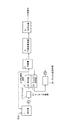
図1は、本発明の酸性液の処理装置の実施の形態を示す系統図であり、この装置は、原水槽1、中和透析装置2、中継槽3、生物処理装置4及び処理水槽5で主に構成される。
FIG. 1 is a system diagram showing an embodiment of an acidic liquid treatment apparatus according to the present invention. This apparatus comprises a
[非イオン/カチオン性水溶性有機物・窒素化合物含有酸性液]
本発明の処理対象となる非イオン/カチオン性水溶性有機物・窒素化合物含有酸性液としては、特に制限はないが、例えば、以下の(1)〜(3)が挙げられる。
(1) 窒素化合物含有酸性液
(2) 金属イオン含有酸性液
(3) 界面活性剤、洗浄剤含有酸性液
[Non-ionic / cationic water-soluble organic compound / nitrogen compound-containing acidic solution]
Although there is no restriction | limiting in particular as a nonionic / cationic water-soluble organic substance and nitrogen compound containing acidic liquid used as the process target of this invention, For example, the following (1)-(3) is mentioned.
(1) Nitrogen compound-containing acidic liquid (2) Metal ion-containing acidic liquid (3) Surfactant, detergent-containing acidic liquid
(1)窒素化合物含有酸性液としては、例えば火力発電所や加圧水型原子力発電所などにおいて、防食剤としてモノエタノールアミン(MEA)やモルホリンなどの有機アミンを添加した復水の脱塩装置(コンデミ)に用いられるカチオン交換樹脂を再生した酸性廃液(以下「コンデミ再生酸性廃液」と称す場合がある。)を挙げることができる。 (1) As a nitrogen compound-containing acidic liquid, for example, in a thermal power plant or a pressurized water nuclear power plant, a condensate demineralizer (condemi) containing an organic amine such as monoethanolamine (MEA) or morpholine as an anticorrosive agent is used. And an acidic waste liquid regenerated from the cation exchange resin used in the above (hereinafter sometimes referred to as “condemi-regenerated acidic waste liquid”).
カチオン交換樹脂の再生には、塩酸や硫酸等の酸が用いられるため、このコンデミ再生酸性廃液には脱着した有機アミン(正確には有機アミンの酸塩)と再生薬品としての塩酸や硫酸などの酸のほか、微量の銅イオン、鉄イオン、また有機アミンの分解物であるアンモニアなどが含まれている。 Since acids such as hydrochloric acid and sulfuric acid are used to regenerate the cation exchange resin, the dehydrated acid waste solution contains organic amines that have been desorbed (accurately, acid salts of organic amines) and regenerated chemicals such as hydrochloric acid and sulfuric acid. In addition to acid, it contains trace amounts of copper ions, iron ions, and ammonia, which is a decomposition product of organic amines.
このようなコンデミ再生酸性廃液の有機アミンやその他の水質成分の濃度やpHは、その廃液の種類によって異なるが、例えば以下のような水質である。 The concentration and pH of the organic amine and other water quality components in such a condensate regeneration acidic waste liquid vary depending on the type of the waste liquid, but have the following water quality, for example.
(2)金属イオン含有酸性液としては、製鉄工場や金属材加工工場などにおける揮発性酸による酸洗工程から排出される金属溶解酸排液などが挙げられる。 (2) Examples of the metal ion-containing acidic liquid include a metal-dissolved acid drainage discharged from a pickling process using a volatile acid in an iron factory, a metal material processing factory, or the like.
(3)界面活性剤、洗浄剤含有酸性液としては、例えば、半導体製造プラントから排出されるリンス排水などが挙げられる。
即ち、半導体製造プラントからは、pH2.5〜3.5、H2O2濃度10〜30ppmで、TOC成分として界面活性剤、アセトン、イソプロパノール、酢酸等のカルボン酸などを1〜3ppm含有するリンス排水が排出される。従来、このような半導体リンス排水は、第1の活性炭吸着塔、弱塩基性アニオン交換樹脂塔、強酸性カチオン交換樹脂塔、強塩基性アニオン交換樹脂塔、逆浸透膜処理装置、高圧紫外線照射装置、第2の活性炭吸着塔、真空脱気塔、混床式イオン交換樹脂塔に順次通水して処理されているが、このような従来の半導体リンス排水の処理方法においては、pH2.5〜3.5の酸性のリンス排水を処理するため、第1の活性炭吸着塔の性能が経時により低下して、第1の活性炭吸着塔のH2O2分解性能が低下し、活性炭吸着塔から流出したH2O2が、弱塩基性アニオン樹脂塔の樹脂をH2O2による酸化で劣化させ、弱塩基性アニオン交換樹脂塔の性能を低下させる;第1の活性炭吸着塔のH2O2分解性能が低下すると、リンス排水中の界面活性剤の吸着性能も低下し、後段の強塩基性アニオン交換樹脂塔の性能低下を引き起こす;といった問題があったが、本発明によれば、このような酸性液を効率的に処理することができる。
(3) Examples of the surfactant and the cleaning agent-containing acidic liquid include rinse waste water discharged from a semiconductor manufacturing plant.
That is, the semiconductor from the manufacturing plant, PH2.5~3.5, in concentration of H 2 O 2 10 to 30 ppm, the surfactant as TOC component, acetone, isopropanol, rinsed for 1~3ppm containing a carboxylic acid such as acetic acid Waste water is discharged. Conventionally, such semiconductor rinsing waste water is obtained by using a first activated carbon adsorption tower, a weakly basic anion exchange resin tower, a strongly acidic cation exchange resin tower, a strongly basic anion exchange resin tower, a reverse osmosis membrane treatment apparatus, and a high-pressure ultraviolet irradiation apparatus. The second activated carbon adsorption tower, the vacuum degassing tower, and the mixed bed type ion exchange resin tower are sequentially passed through the water, and in such a conventional method for treating semiconductor rinse wastewater, the pH is 2.5 to Since the acidic rinse wastewater of 3.5 is treated, the performance of the first activated carbon adsorption tower is deteriorated with time, the H 2 O 2 decomposition performance of the first activated carbon adsorption tower is lowered, and it flows out from the activated carbon adsorption tower. H 2 O 2 degrades the weak base anion resin tower resin by oxidation with H 2 O 2 and reduces the performance of the weak base anion exchange resin tower; H 2 O 2 of the first activated carbon adsorption tower Rinse when degradation performance deteriorates However, according to the present invention, such an acidic liquid can be efficiently treated. However, according to the present invention, there is a problem that the adsorption performance of the surfactant in water is also lowered and the performance of the latter strongly basic anion exchange resin tower is lowered. can do.
[中和脱塩処理]
本発明においては、まず、アニオン交換膜によって一方の室と他方の室とに隔てられた一方の室に原水である非イオン/カチオン性水溶性有機物・窒素化合物含有酸性液を通水すると共に、他方の室にアルカリ溶液を通水して原水を中和及び脱塩する。
[Neutralization desalination treatment]
In the present invention, first, a nonionic / cationic water-soluble organic substance / nitrogen compound-containing acidic liquid, which is raw water, is passed through one chamber separated by the anion exchange membrane into one chamber and the other chamber, The alkaline solution is passed through the other chamber to neutralize and desalinate the raw water.
この原水の中和脱塩処理に用いる装置としては、アニオン交換膜を用いた中和透析装置(拡散透析装置)2が好適に使用される。 A neutralization dialysis apparatus (diffusion dialysis apparatus) 2 using an anion exchange membrane is preferably used as the apparatus used for the neutralization and desalting treatment of the raw water.
図1は、原水の中和脱塩処理に、中和透析装置(拡散透析装置)2を用いた例を示し、原水槽1内の原水は、ポンプP1により、プレフィルター11で微粒子成分が除去された後、内部がアニオン交換膜21で原水室22とアルカリ溶液室23とに仕切られた中和透析装置2の原水室22に導入される。ここでプレフィルター11は必要に応じて設けられるものである。一方、アルカリ溶液室23には、アルカリ溶液貯槽24から、ポンプP2によりアルカリ溶液が導入される。
FIG. 1 shows an example in which a neutralization dialysis device (diffusion dialysis device) 2 is used for the neutralization and desalting treatment of raw water. The raw water in the
このアルカリ溶液としては、水酸化ナトリウム(NaOH)、水酸化カリウム、水酸化リチウム、炭酸ナトリウム等の溶解性アルカリ化合物の水溶液を用いることができる。 As this alkaline solution, an aqueous solution of a soluble alkali compound such as sodium hydroxide (NaOH), potassium hydroxide, lithium hydroxide, sodium carbonate or the like can be used.
一般に、コンデミに用いられる樹脂比率はアニオン交換樹脂よりもカチオン交換樹脂の方が高く、コンデミ再生廃液としてはカチオン交換樹脂の再生酸性廃液よりも、NaOHを含むアニオン交換樹脂の再生廃液(以下「コンデミ再生アルカリ廃液」と称す場合がある。)の方が過剰となっている。
コンデミにおいて、アニオン交換樹脂とカチオン交換樹脂との混床樹脂を分離するために、16重量%のNaOH水溶液を用いてアニオン交換樹脂とカチオン交換樹脂の比重差を利用して分離する技術を用いている現場では、別途、この分離に用いたアルカリ廃液が排出される。
このようにコンデミの再生現場では、アルカリ廃液が過剰に排出される場合があり、本発明においては、このようなコンデミ再生アルカリ廃液等のアルカリ廃液をアルカリ溶液として用いることもできる。
アルカリ溶液としては、更に他の施設から排出されるアルカリ廃液を用いてもよい。
In general, the ratio of the resin used for the condemi is higher in the cation exchange resin than in the anion exchange resin. It is sometimes called “recycled alkaline waste liquid”).
In order to separate the mixed bed resin of the anion exchange resin and the cation exchange resin in the condemi, using a technique of separating by utilizing a specific gravity difference between the anion exchange resin and the cation exchange resin using a 16 wt% NaOH aqueous solution. In other locations, the alkaline waste liquid used for the separation is separately discharged.
As described above, an alkaline waste liquid may be excessively discharged at a condensate regeneration site. In the present invention, an alkaline waste liquid such as such a condemi regeneration alkaline waste liquid may be used as an alkaline solution.
As the alkaline solution, an alkaline waste liquid discharged from another facility may be used.
中和透析装置2では、原水室22に導入された原水中のCl−イオンがアニオン交換膜21を透過してアルカリ溶液室23に移動することにより脱塩され、一方、アルカリ溶液室23内のOH−イオンがアニオン交換膜21を透過して原水室22に移動することにより原水が中和される。原水室22の流出液は原水槽1に返送され、原水は循環処理される。一方、アルカリ溶液室23からの流出液もアルカリ溶液貯槽24に返送されて循環される。
In the neutralization dialysis device 2, the Cl − ions in the raw water introduced into the raw water chamber 22 pass through the anion exchange membrane 21 and move to the
このような中和透析装置2による中和脱塩処理においては、次のような態様を採用することが好ましい。 In such neutralization and desalting treatment by the neutralization dialysis apparatus 2, it is preferable to adopt the following aspect.
(1) アニオン交換膜21としては、耐酸性、耐アルカリ性に優れた膜を用いる。また、中和透析装置2の接液面も、耐腐食性に優れた材料で構成されていることが好ましく、例えば、ポリテトラフルオロエチレン等のフッ素樹脂でライニングしたものが好ましい。 (1) As the anion exchange membrane 21, a membrane excellent in acid resistance and alkali resistance is used. Further, the wetted surface of the neutralization dialysis apparatus 2 is also preferably made of a material having excellent corrosion resistance. For example, a lining made of a fluororesin such as polytetrafluoroethylene is preferable.
(2) アニオン交換膜膜面には濃度分極層が形成され、これが物質の拡散律速となり、Cl−イオン、OH−イオン及び水の透過移動速度が制限される。これを防止して透過移動速度を高めるために、アニオン交換膜面近傍の濃度分極を低減するべく、膜面流速を高めることが好ましく、具体的には、原水室22側及びアルカリ溶液室23側の膜面流速をそれぞれ0.1cm/sec以上、例えば1〜8cm/secとすることが好ましい。膜面流速が低いとCl−イオン及びOH−イオンの移動速度を速くすることができず、所望の中和脱塩処理液を得るために長時間を要するようになる。ただし、膜面流速を過度に高くすることは、装置構成上現実的ではない。このような膜面流速を得るために、原水ポンプP1及びアルカリ溶液ポンプP2としては、高流速送液が可能なダイヤフラムポンプ等を用いることが好ましい。
(2) A concentration polarization layer is formed on the surface of the anion exchange membrane, and this becomes the diffusion limiting rate of the substance, and the permeation transfer rate of Cl − ions, OH − ions and water is limited. In order to prevent this and increase the permeation transfer speed, it is preferable to increase the membrane surface flow velocity in order to reduce the concentration polarization in the vicinity of the anion exchange membrane surface, specifically, the raw water chamber 22 side and the
(3) アルカリ溶液としては、中和に必要な酸消費の総量(mg−CaCO3)が、原水のアルカリ消費の総量(mg−CaCO3)の1倍以上のものを用いる。
なお、アニオン交換膜でのCl−とOH−の移動速度は、極限モル伝導率で示されるイオンの移動のしやすさで決定され、Cl−とOH−の極限モル伝導率はそれぞれ198.3Scm2・mol−1、76.35Scm2・mol−1である。したがって、OH−はCl−の2.6倍移動しやすいことが分かる。このことより、酸性液からのCl−のアルカリ溶液側への移動速度を高く維持するには、アルカリ溶液のOH−濃度は少なくとも酸性液のCl−濃度の1/2.6倍以上とすることが望ましい。
アルカリ(NaOH)の濃度を高くするとアルカリ溶液の浸透圧が原水の浸透圧よりも高くなり、原水中の水がアニオン交換膜を透過してアルカリ溶液側へ移動し、原水が濃縮されるようになる。このような濃縮は、得られる中和脱塩処理液の塩類濃度が生物処理可能な塩類濃度を超えない範囲、例えば3重量%以下の範囲であれば原水量を減容化でき、好ましい。
(3) As the alkaline solution, a solution having a total amount of acid consumption (mg-CaCO 3 ) required for neutralization more than 1 times the total amount of alkali consumption of raw water (mg-CaCO 3 ) is used.
Note that the migration rate of Cl − and OH − in the anion exchange membrane is determined by the ease of ion migration represented by the ultimate molar conductivity, and the ultimate molar conductivity of Cl − and OH − is 198.3 Scm, respectively. 2 · mol −1 , 76.35 Scm 2 · mol −1 . Therefore, it can be seen that OH − can easily move 2.6 times as much as Cl − . Therefore, in order to maintain a high transfer rate of Cl − from the acidic solution to the alkaline solution side, the OH − concentration of the alkaline solution should be at least 1 / 2.6 times the Cl − concentration of the acidic solution. Is desirable.
When the alkali (NaOH) concentration is increased, the osmotic pressure of the alkaline solution becomes higher than the osmotic pressure of the raw water, so that the water in the raw water passes through the anion exchange membrane and moves to the alkaline solution side, so that the raw water is concentrated. Become. Such concentration is preferable because the amount of raw water can be reduced if the salt concentration of the resulting neutralized desalting solution does not exceed the salt concentration capable of biological treatment, for example, 3% by weight or less.
従って、前述のコンデミ再生アルカリ廃液等のアルカリ廃液をアルカリ溶液として用いる場合において、アルカリ濃度が不足する場合には、必要に応じてNaOH等のアルカリを添加してその濃度を調整することが好ましい。 Accordingly, in the case where an alkaline waste solution such as the above-mentioned condemi regeneration alkaline waste solution is used as the alkaline solution, when the alkali concentration is insufficient, it is preferable to adjust the concentration by adding an alkali such as NaOH as necessary.
(4) 中和脱塩処理は、得られる中和脱塩処理液(原水室22からの流出液)のpHが中性、例えば6〜8程度になった時点で終了し、得られた中和脱塩処理液は次の生物処理に供することが好ましい。
この中和脱塩処理液のpHが6未満でも8を超えても、中和脱塩処理が不十分であり、後段の生物処理に不適当である。
(4) The neutralization and desalting treatment is completed when the pH of the resulting neutralization and desalting treatment liquid (the effluent from the raw water chamber 22) is neutral, for example, about 6 to 8, and is obtained. The Japanese desalting solution is preferably subjected to the next biological treatment.
Even if the pH of this neutralization desalting treatment solution is less than 6 or more than 8, the neutralization desalination treatment is insufficient and is unsuitable for the subsequent biological treatment.
このpH管理の目的で、中和透析装置2の原水室22の流出配管に通液型pH計を設置して、原水室22の流出液のpHを監視し、このpH値が所定値に達したら、原水室22の流出液の送液を、原水槽1から生物処理装置4の中継槽3に切り換えるようにしても良い。
For the purpose of pH control, a flow-through pH meter is installed in the outflow pipe of the raw water chamber 22 of the neutralization dialysis apparatus 2 to monitor the pH of the effluent in the raw water chamber 22, and this pH value reaches a predetermined value. Then, you may make it switch the liquid supply of the effluent of the raw | natural water chamber 22 from the raw |
アニオン交換膜21であってもカチオン成分を透過することは一般的に知られており、上述のような中和脱塩処理で、アルカリ溶液23側から原水室22へのカチオン成分(例えばNaOHのNa+イオン)の移動が、また、原水室22側からアルカリ溶液室23へのカチオン成分の移動がある。
従って、原水の中和脱塩処理に使用されたアルカリ溶液(以下、「アルカリ廃液」と称す場合がある)は、原水から透析したCl−イオンを含み、原水の中和(原水室へのOH−イオンの透析)でpHが低下した弱アルカリ性の液であると共に、原水室22からアニオン交換膜21を透過した若干量のカチオン性水溶性有機物や窒素化合物といったカチオン成分を含むものである。ただし、この透過したカチオン成分濃度は低いことから、このアルカリ廃液は、触媒酸化装置等でカチオン成分を分解した後、酸で中和して放流することができる。
It is generally known that even the anion exchange membrane 21 permeates the cation component, and the cation component (for example, NaOH) from the
Therefore, the alkaline solution used for neutralization and desalting treatment of raw water (hereinafter sometimes referred to as “alkaline waste liquid”) contains Cl − ions dialyzed from the raw water, and neutralizes the raw water (OH to the raw water chamber). - with the pH is weakly alkaline solution was reduced by dialysis ion) are those containing a cation component such as raw water chamber 22 a small amount of the cationic water-soluble organic substances and nitrogen compounds passing through the anion exchange membrane 21 from. However, since the permeated cation component concentration is low, this alkaline waste liquid can be discharged after neutralizing with an acid after decomposing the cation component with a catalytic oxidation apparatus or the like.
なお、中和透析装置2における原水室22の原水流通方向とアルカリ溶液室23のアルカリ溶液の流通方向は、並流であっても向流であってもよいが、酸性液のアルカリ消費量とアルカリ性液の酸消費量に差をつけて、出口水質を中性に近づけるには、図1に示すように向流通水であることが好ましい。
The flow direction of the raw water in the raw water chamber 22 and the flow direction of the alkaline solution in the
また、原水及びアルカリ溶液は一過式で通水することも可能であるが、一般的には、一過式の通水では十分な中和透析を行えないことから、図1に示すような循環通水とすることが好ましい。
バッチ式ではなく、連続処理を行う場合には、原水槽1に原水を導入すると共に、中和透析装置2の原水室22から返送された中和脱塩処理液を原水槽1に受け、この原水槽1から槽内液の一部を取り出して次の濃縮処理に供することが好ましい。
In addition, the raw water and the alkaline solution can be passed through in a transient manner, but generally, neutralization dialysis cannot be performed sufficiently in a transient manner as shown in FIG. Circulating water is preferable.
When continuous treatment is performed instead of batch processing, raw water is introduced into the
図1において、中和透析装置2には、1枚のアニオン交換膜21により原水室22とアルカリ溶液室23とがそれぞれ1室ずつ形成されているが、中和透析装置2の構成はこれに何ら限定されず、例えば、アルカリ溶液室/アニオン交換膜/原水室/アニオン交換膜/アルカリ溶液室/アルカリ交換膜/原水室/アニオン交換膜/アルカリ溶液室というように、複数枚のアニオン交換膜により、複数の原水室とアルカリ溶液室とが交互に形成されたものであってもよい。
In FIG. 1, the neutralization dialysis apparatus 2 has a raw water chamber 22 and an
本発明によれば、このような中和透析装置を用いた中和脱塩処理により、原水を、前述の如く、pH6〜8(pH7程度)の中性に中和すると共に、好ましくはCl−イオン濃度が原水のCl−イオン濃度の30〜50%にまで低減した中和脱塩処理液を得ることができる。 According to the present invention, the raw water is neutralized to pH 6 to 8 (about pH 7) as described above by neutralization and desalting using such a neutralization dialysis apparatus, and preferably Cl −. A neutralized desalting solution having an ion concentration reduced to 30 to 50% of the Cl − ion concentration of the raw water can be obtained.
[希釈処理]
上述のような中和脱塩処理により、原水のpHが中性に中和され、塩類濃度も低減された中和脱塩処理液が得られるが、原水中のカチオン性水溶性有機物であるアミンなどの有機物や、アンモニア、ヒドラジンなどの窒素成分が高濃度の場合には、これらの成分により、中和脱塩処理後の中和脱塩処理液の塩類濃度が3重量%を超える場合があるため、このような場合には、生物処理に先立ち、この中和脱塩処理液を希釈することが好ましい。このような希釈を行う場合であっても、希釈水量は、原水に直接アルカリ液を添加することにより中和を行う場合に比べて極めて少なくて足りるため、総液量の増加も少なく、設備を大型化する必要は殆どない。
[Dilution processing]
By the neutralization and desalting treatment as described above, a neutralized desalting treatment solution is obtained in which the pH of the raw water is neutralized and the salt concentration is reduced, but the amine is a cationic water-soluble organic substance in the raw water. When the concentration of organic substances such as ammonia and nitrogen components such as ammonia and hydrazine is high, these components may cause the salt concentration of the neutralized desalting solution after neutralizing and desalting to exceed 3% by weight. Therefore, in such a case, it is preferable to dilute the neutralized desalting treatment solution prior to the biological treatment. Even in the case of such dilution, the amount of dilution water is very small compared to the case of neutralization by adding an alkaline solution directly to the raw water, so the increase in the total liquid amount is small and the equipment is installed. There is almost no need to increase the size.
この場合は、例えば、図1の中継槽3に電気伝導率計などの塩類濃度測定手段を設け、生物処理に供する水の塩類濃度が予め設定した値以下となるように、中継槽3に水を添加して希釈することが好ましい。
In this case, for example, the
この希釈には、工水、市水などを用いることができるが、塩類を含まない、その他の排水であってもよい。 For this dilution, industrial water, city water, and the like can be used, but other waste water that does not contain salts may be used.
[生物処理]
必要に応じて希釈することにより、pH6〜8で、塩類濃度が3重量%以下、好ましくは1〜2重量%程度に低減された中和脱塩処理液は、中継槽3を経て次いで生物処理装置4に導入され生物処理される。
この生物処理には特に制限はなく、好気(有機物酸化)処理、嫌気処理、硝化処理、脱窒処理、アナモックスなどの処理方式があり、生物処理に供される中和脱塩処理液の有機物あるいは窒素濃度により適切な処理方式を単独であるいは複数種組み合わせて行うことができる。
[Biological treatment]
The neutralized and desalted solution having a pH of 6 to 8 and having a salt concentration reduced to 3% by weight or less, preferably about 1 to 2% by dilution, if necessary, is passed through the
There are no particular restrictions on this biological treatment, and there are treatment methods such as aerobic (organic oxidation) treatment, anaerobic treatment, nitrification treatment, denitrification treatment, anammox, etc. Alternatively, an appropriate treatment method depending on the nitrogen concentration can be performed alone or in combination of two or more.
生物処理水は処理水槽5を経て、必要に応じて濾過、活性炭処理などの処理を施した後に系外へ排出される。
Biologically treated water passes through the treated
以下に実施例及び比較例を挙げて本発明をより具体的に説明する。 Hereinafter, the present invention will be described more specifically with reference to Examples and Comparative Examples.
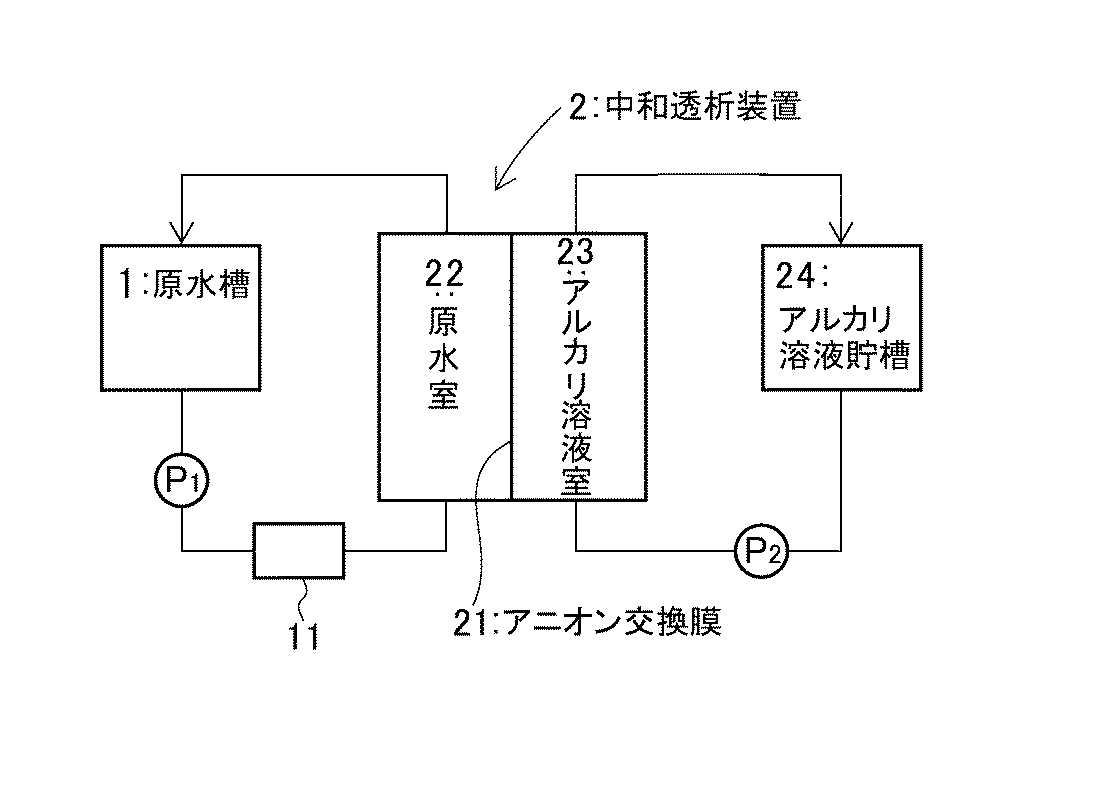
なお、以下において、原水としては、復水脱塩装置のカチオン樹脂再生模擬排液を下記表2に示す組成に調整したもの(いか「模擬原水」と称す。)を用いた。 In the following, raw water was prepared by adjusting the cation resin regeneration simulated effluent of the condensate demineralizer to the composition shown in Table 2 below (called “simulated raw water”).
また、以下において、中和透析装置による中和脱塩処理は、原水及びアルカリ溶液の全量を循環通水することによって行われているが、本発明における中和脱塩処理は何ら全量循環通水処理に限定されるものではなく、原水、アルカリ溶液の一部のみを循環通水するものであってもよく、また、全量を一過式で通水するものであってもよい。 Further, in the following, neutralization desalting treatment by the neutralization dialysis apparatus is performed by circulating the whole amount of raw water and alkaline solution, but the neutralization desalting treatment in the present invention is not performed at all. It is not limited to a process, You may circulate only a part of raw | natural water and an alkaline solution, and the whole amount may be passed in a transient manner.
[実施例1]
模擬原水を、接液面がポリテトラフルオロエチレンでコーティングされた中和透析装置((株)アストム製)に通して中和脱塩処理した。
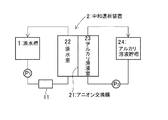
この中和透析装置の系統図を図2に示す。図2において、図1に示す部材と同一機能を奏する部材には同一符号を付してある。
[Example 1]
The simulated raw water was neutralized and desalted by passing through a neutralization dialysis apparatus (manufactured by Astom Co., Ltd.) whose wetted surface was coated with polytetrafluoroethylene.
A system diagram of this neutralization dialysis machine is shown in FIG. In FIG. 2, members having the same functions as those shown in FIG.
この中和透析装置では、原水槽1内の被処理液をポンプP1で原水室22に導入した後、原水槽1に循環通水する一方で、アルカリ溶液貯槽24内のアルカリ溶液をアルカリ溶液室23に循環通水するように構成されている。
In this neutralization dialysis apparatus, the liquid to be treated in the
中和透析は、以下のように実施した。
アニオン交換膜21としては、耐酸、耐アルカリ性に優れた(株)アストム製アニオン交換膜「ネオセプタAHA」を用いた。
模擬原水5Lを原水槽1に入れて原水室22に循環通水し、一方、アルカリ溶液としては、pH14のNaOH水溶液(NaOH濃度10重量%、模擬原水のHClモル濃度に対して約5.5倍)を1.1L準備し、中和透析装置2のアルカリ溶液室23に導入し、アルカリ溶液貯槽24を経て循環通水した。
Neutralization dialysis was performed as follows.
As the anion exchange membrane 21, an anion exchange membrane “Neocepta AHA” manufactured by Astom Co., Ltd. having excellent acid resistance and alkali resistance was used.
5 L of simulated raw water is placed in the
原水循環ポンプP1及びアルカリ溶液循環ポンプP2としては、ダイヤフラムポンプを用い、原水室22及びアルカリ溶液室23の膜面流速がいずれも4cm/secとなるように通水した。
A diaphragm pump was used as the raw water circulation pump P 1 and the alkaline solution circulation pump P 2 , and water was passed so that the membrane surface flow rates of the raw water chamber 22 and the
原水ポンプP1の出口側には、孔径10μmのプレフィルター(保安フィルター)11を設けて原水中の微粒子成分を除去した。 On the outlet side of the raw water pump P1, a pre-filter (security filter) 11 having a pore diameter of 10 μm was provided to remove particulate components in the raw water.
この処理中に、原水槽1内の液pHを測定し、pHが7まで低下したときに、循環通水を停止し、得られた中和脱塩処理液を生物処理原水とした。この生物処理原水の水質及び水量を表4に示す。
During this treatment, the pH of the solution in the
また、模擬原水と中和脱塩処理液の水質及び水量と、中和脱塩処理前後のアルカリ溶液(アルカリ廃液)の水質及び水量を表3に示した。 In addition, Table 3 shows the water quality and amount of the simulated raw water and the neutralization desalting treatment liquid, and the water quality and water amount of the alkaline solution (alkaline waste liquid) before and after the neutralization desalting treatment.
[比較例1]
原水にアルカリ溶液を添加することによりpH調整を行って表4に示す水質及び水量としたpH調整水を生物処理原水とした。
[Comparative Example 1]
PH adjustment was performed by adding an alkaline solution to the raw water, and the pH adjusted water having the water quality and water amount shown in Table 4 was used as the biological treatment raw water.
[比較例2]
原水にアルカリ溶液を添加することによりpH調整を行った後、実施例1で得られた中和脱塩処理液と同等の塩類濃度(TDS)になるように水道水で希釈して生物処理原水とした。この生物処理原水の水質及び水量を表4に示す。
[Comparative Example 2]
After adjusting the pH by adding an alkaline solution to the raw water, the biologically treated raw water is diluted with tap water so that the salt concentration (TDS) is the same as that of the neutralized desalting solution obtained in Example 1. It was. Table 4 shows the quality and amount of this biologically treated raw water.
[考察]
実施例1では、中和透析により中和と脱塩が行われ、さらに脱水により生物処理原水の水量は3.6Lとなり、生物処理原水量は、模擬原水量の72%に減容化された。塩類濃度は生物処理可能な3重量%以下であった。
比較例1では、pH調整により中和が行われたが、アルカリ溶液の添加により塩類濃度が増加し、生物処理には不適当である。
比較例2では、pH調整と希釈により中和と塩類濃度の調整が行われ、塩類濃度も生物処理可能な3重量%であった。しかし、実施例1相当の塩類濃度に調整するのに多量の希釈水を必要とし、水量が8.6Lに増加し、模擬原水量の172%に増量した。
生物処理可能な塩類濃度は実施例1と比較例2であるが、比較例2は生物処理原水量が実施例1の2.4倍もあり、後段処理の生物処理、濾過、活性炭処理などの設備が大型化する。
実施例1では中和透析でアルカリ廃液が2.8L排出されるが、このアルカリ廃液はわずかに有機物などの透過成分を含むが、水量が少なく、pHがアルカリ性なので触媒酸化により小さい設備で効率よく処理が可能であり、また、他の施設にアルカリとして利用することも可能である。
[Discussion]
In Example 1, neutralization and desalting were performed by neutralization dialysis, and the amount of biologically treated raw water was 3.6 L by dehydration, and the volume of biologically treated raw water was reduced to 72% of the amount of simulated raw water. . The salt concentration was 3% by weight or less which can be biologically treated.
In Comparative Example 1, neutralization was performed by adjusting the pH, but the salt concentration increased due to the addition of the alkaline solution, which is inappropriate for biological treatment.
In Comparative Example 2, neutralization and salt concentration adjustment were performed by pH adjustment and dilution, and the salt concentration was also 3% by weight capable of biological treatment. However, a large amount of diluted water was required to adjust to the salt concentration corresponding to Example 1, the amount of water increased to 8.6 L, and increased to 172% of the amount of simulated raw water.
The biological treatment-possible salt concentrations are Example 1 and Comparative Example 2, but Comparative Example 2 has 2.4 times the amount of raw water for biological treatment as in Example 1, and biological treatment, filtration, activated carbon treatment, etc. in the latter stage treatment Larger equipment.
In Example 1, 2.8 L of alkaline waste liquid is discharged by neutralization dialysis, but this alkaline waste liquid slightly contains permeation components such as organic substances, but since the amount of water is small and the pH is alkaline, it is efficiently used with smaller equipment for catalytic oxidation. It can be treated and can also be used as alkali in other facilities.
1 原水槽
2 中和透析装置
3 中継槽
4 生物処理装置
5 処理水槽
21 アニオン交換膜
22 原水室
23 アルカリ溶液室
24 アルカリ溶液貯槽
DESCRIPTION OF
Claims (8)
アニオン交換膜によって一方の室と他方の室とに隔てられた前記一方の室に該酸性液を通水すると共に、前記他方の室にアルカリ溶液を通水して該酸性液を中和及び脱塩する中和脱塩装置と、
該中和脱塩装置で中和及び脱塩された中和脱塩処理液を生物処理する生物処理装置と
を有することを特徴とする酸性液の処理装置。 An apparatus for treating an acidic liquid containing nonionic or cationic water-soluble organic substances and / or nitrogen compounds,
The acidic solution is passed through the one chamber separated by the anion exchange membrane into one chamber and the other chamber, and the alkaline solution is passed through the other chamber to neutralize and remove the acidic solution. Neutralizing and desalting equipment for salting;
A treatment apparatus for acidic liquid, comprising: a biological treatment apparatus for biologically treating the neutralized and desalted treatment liquid neutralized and desalted by the neutralization and desalination apparatus.
アニオン交換膜によって一方の室と他方の室とに隔てられた前記一方の室に該酸性液を通水すると共に、前記他方の室にアルカリ溶液を通水して該酸性液を中和及び脱塩する中和脱塩工程と、
該中和脱塩工程で中和及び脱塩された中和脱塩処理液を生物処理する生物処理工程と
を有することを特徴とする酸性液の処理方法。 A method for treating an acidic liquid containing a nonionic or cationic water-soluble organic substance and / or a nitrogen compound,
The acidic solution is passed through the one chamber separated by the anion exchange membrane into one chamber and the other chamber, and the alkaline solution is passed through the other chamber to neutralize and remove the acidic solution. Neutralizing and desalting step to salt;
And a biological treatment step of biologically treating the neutralized and desalted treatment solution neutralized and desalted in the neutralization and desalting step.
Priority Applications (1)
| Application Number | Priority Date | Filing Date | Title |
|---|---|---|---|
| JP2011062804A JP2012196626A (en) | 2011-03-22 | 2011-03-22 | Treatment equipment and treatment method of acid liquid |
Applications Claiming Priority (1)
| Application Number | Priority Date | Filing Date | Title |
|---|---|---|---|
| JP2011062804A JP2012196626A (en) | 2011-03-22 | 2011-03-22 | Treatment equipment and treatment method of acid liquid |
Publications (1)
| Publication Number | Publication Date |
|---|---|
| JP2012196626A true JP2012196626A (en) | 2012-10-18 |
Family
ID=47179394
Family Applications (1)
| Application Number | Title | Priority Date | Filing Date |
|---|---|---|---|
| JP2011062804A Withdrawn JP2012196626A (en) | 2011-03-22 | 2011-03-22 | Treatment equipment and treatment method of acid liquid |
Country Status (1)
| Country | Link |
|---|---|
| JP (1) | JP2012196626A (en) |
Cited By (3)
| Publication number | Priority date | Publication date | Assignee | Title |
|---|---|---|---|---|
| JP2019048262A (en) * | 2017-09-08 | 2019-03-28 | 水ing株式会社 | Processing method and device of organic waste water |
| JP2021036781A (en) * | 2019-08-30 | 2021-03-11 | 学校法人 東洋大学 | Culture method, culture equipment, wastewater treatment method and wastewater treatment equipment |
| CN118579965A (en) * | 2024-08-06 | 2024-09-03 | 山东千源多品种盐业有限公司 | A fish salt wastewater treatment device and treatment process thereof |
-
2011
- 2011-03-22 JP JP2011062804A patent/JP2012196626A/en not_active Withdrawn
Cited By (5)
| Publication number | Priority date | Publication date | Assignee | Title |
|---|---|---|---|---|
| JP2019048262A (en) * | 2017-09-08 | 2019-03-28 | 水ing株式会社 | Processing method and device of organic waste water |
| JP7094674B2 (en) | 2017-09-08 | 2022-07-04 | 水ing株式会社 | Organic wastewater treatment method and treatment equipment |
| JP2021036781A (en) * | 2019-08-30 | 2021-03-11 | 学校法人 東洋大学 | Culture method, culture equipment, wastewater treatment method and wastewater treatment equipment |
| JP7268860B2 (en) | 2019-08-30 | 2023-05-08 | 学校法人 東洋大学 | Culture method, culture device, wastewater treatment method and wastewater treatment device |
| CN118579965A (en) * | 2024-08-06 | 2024-09-03 | 山东千源多品种盐业有限公司 | A fish salt wastewater treatment device and treatment process thereof |
Similar Documents
| Publication | Publication Date | Title |
|---|---|---|
| Long et al. | NaHCO3 addition enhances water permeance and Ca/haloacetic acids selectivity of nanofiltration membranes for drinking water treatment | |
| JP3321179B2 (en) | Method and apparatus for high efficiency reverse infiltration treatment | |
| KR100874269B1 (en) | High efficiency seawater electrolysis apparatus and electrolysis method including pretreatment process | |
| JP5549591B2 (en) | Fresh water production method and fresh water production apparatus | |
| US20030173296A1 (en) | High recovery reverse osmosis process and apparatus | |
| JP2011131210A (en) | Device and method for treating nitrogen compound-containing acidic solutions | |
| EP2119675A1 (en) | Method for the treatment with reverse osmosis membrane | |
| Koo et al. | Recycling of oleochemical wastewater for boiler feed water using reverse osmosis membranes—A case study | |
| AU2018266639A1 (en) | Water treatment of sodic, high salinity, or high sodium waters for agricultural applications | |
| JP2002136994A (en) | Boiler feedwater treatment apparatus and boiler feedwater treatment method | |
| JP2016128142A (en) | Method to improve the rejection rate of semipermeable membrane | |
| WO2020054862A1 (en) | Water treatment apparatus | |
| JP2011131209A (en) | Method and apparatus for treating acidic solution | |
| JP3137831B2 (en) | Membrane processing equipment | |
| WO2013038933A1 (en) | Water treatment method | |
| JP2004108240A (en) | Power generation plant and power generation method | |
| JPWO2008059824A1 (en) | Water treatment apparatus and water treatment method | |
| JP2012196626A (en) | Treatment equipment and treatment method of acid liquid | |
| JP6657720B2 (en) | Steam power plant wastewater recovery method and device | |
| JP2008132421A (en) | Water treatment apparatus and water treatment method | |
| JP2012196630A (en) | Treatment equipment and treatment method of acid liquid | |
| JP3773187B2 (en) | Desalination wastewater treatment method and apparatus | |
| JP7261711B2 (en) | Ultrapure water production system and ultrapure water production method | |
| JPWO2016111371A1 (en) | Method of improving semi-permeable membrane blocking performance, semi-permeable membrane, semi-permeable membrane water generator | |
| KR100398417B1 (en) | A method for treating electrogalvanizing wastewaters |
Legal Events
| Date | Code | Title | Description |
|---|---|---|---|
| A300 | Withdrawal of application because of no request for examination |
Free format text: JAPANESE INTERMEDIATE CODE: A300 Effective date: 20140603 |