JP2012201738A - Defoaming agent composition-containing thermoplastic resin aqueous dispersion, and coated article using the same - Google Patents
Defoaming agent composition-containing thermoplastic resin aqueous dispersion, and coated article using the same Download PDFInfo
- Publication number
- JP2012201738A JP2012201738A JP2011065852A JP2011065852A JP2012201738A JP 2012201738 A JP2012201738 A JP 2012201738A JP 2011065852 A JP2011065852 A JP 2011065852A JP 2011065852 A JP2011065852 A JP 2011065852A JP 2012201738 A JP2012201738 A JP 2012201738A
- Authority
- JP
- Japan
- Prior art keywords
- aqueous dispersion
- thermoplastic resin
- weight
- dispersion
- composition
- Prior art date
- Legal status (The legal status is an assumption and is not a legal conclusion. Google has not performed a legal analysis and makes no representation as to the accuracy of the status listed.)
- Withdrawn
Links
Landscapes
- Degasification And Air Bubble Elimination (AREA)
- Paints Or Removers (AREA)
Abstract
【課題】疎水性シリカや鉱物油と高分子乳化剤とを用いた消泡剤組成物水性分散液を熱可塑性樹脂水性分散液に混合させたときに、混合性を向上させ、十分な消泡効果を得ることを目的とする。
【解決手段】カチオン性高分子乳化剤を含有し、機械乳化分散法によって得られた熱可塑性樹脂水性分散液、及び疎水性シリカ及び鉱物油の少なくとも一方を含有する消泡剤組成物をカチオン性高分子乳化剤によって分散させた消泡剤組成物水性分散液を含有する消泡剤組成物含有熱可塑性樹脂水性分散液を用いる。
【選択図】なしAn antifoamer composition aqueous dispersion using hydrophobic silica or mineral oil and a polymer emulsifier is mixed with a thermoplastic resin aqueous dispersion to improve the mixing property and to have a sufficient antifoaming effect. The purpose is to obtain.
An aqueous anti-foaming agent composition containing a cationic polymer emulsifier and containing an aqueous dispersion of a thermoplastic resin obtained by a mechanical emulsification dispersion method and at least one of hydrophobic silica and mineral oil. An antifoamer composition-containing thermoplastic resin aqueous dispersion containing an antifoamer composition aqueous dispersion dispersed with a molecular emulsifier is used.
[Selection figure] None
Description
この発明は、消泡剤組成物含有熱可塑性樹脂水性分散液、及びこれを用いた塗工物に関する。 The present invention relates to a defoamer composition-containing thermoplastic resin aqueous dispersion and a coated product using the same.
従来から、合成樹脂エマルジョンを主体とした塗工用組成物を、紙やフィルム等に塗工する場合、この塗工用組成物が泡立たないように、消泡剤が添加される場合がある。このような消泡剤としては、鉱物油系の消泡剤や、有機系の消泡剤があげられる。この有機系の消泡剤としては、ポリエーテル系消泡剤を用い、これにポリエチレングリコールを含有させた消泡剤組成物(特許文献1)、消泡剤として、炭素数2〜3のオキシアルキレン基及びオキシブチレン基を有する化合物を用いる例(特許文献2)、消泡剤として、無機珪酸微粒子及び炭素数2〜3のオキシアルキレン化合物を用いる例(特許文献3)等が挙げられる。 Conventionally, when a coating composition mainly composed of a synthetic resin emulsion is applied to paper or a film, an antifoaming agent may be added so that the coating composition does not foam. Examples of such antifoaming agents include mineral oil-based antifoaming agents and organic-based antifoaming agents. As this organic type antifoaming agent, a polyether type antifoaming agent is used, and an antifoaming agent composition (Patent Document 1) containing polyethylene glycol in the polyether antifoaming agent. An example using a compound having an alkylene group and an oxybutylene group (Patent Document 2), an example using an inorganic silicic acid fine particle and an oxyalkylene compound having 2 to 3 carbon atoms as an antifoaming agent (Patent Document 3), and the like.
しかし、上記のいずれの消泡剤も、泡立ちを抑制することができるが、分散性が不十分な場合、紙やフィルム等に塗工した場合に、フィッシュアイ状のハジキを生じることがある。このハジキを抑えるため、消泡剤の添加量を少なくすると、消泡効果が不足して、塗工時に泡立ちが生じやすくなる。 However, any of the antifoaming agents described above can suppress foaming, but when dispersibility is insufficient, fish-eye repelling may occur when applied to paper or film. If the addition amount of the antifoaming agent is reduced in order to suppress this repellency, the defoaming effect is insufficient and foaming is likely to occur during coating.
これに対し、泡立ちと分散性とのバランスをとるため、変性シリコーンタイプの消泡剤を用いることが知られている(特許文献4)。 On the other hand, in order to balance foaming and dispersibility, it is known to use a modified silicone type antifoaming agent (Patent Document 4).
しかし、上記変性シリコーンタイプの消泡剤は、分散性は十分であるものの、消泡性が不十分となる傾向がある。このため、高速で塗工を行おうとすると、泡の巻き込みに起因する塗工ムラ(スジ引き)が発生し、塗工不良が生じるおそれがある。さらに、消泡剤のエマルジョン中の分散状態が悪化し、ハジキが発生することがある。 However, although the modified silicone type antifoaming agent has sufficient dispersibility, the antifoaming property tends to be insufficient. For this reason, when it is going to apply at high speed, the coating nonuniformity (striking) resulting from the entrainment of a bubble will generate | occur | produce and there exists a possibility that a coating defect may arise. Furthermore, the dispersion state of the antifoaming agent in the emulsion may deteriorate and repelling may occur.
これに対し、分散性を高め、塗工時のハジキを抑え、消泡性を向上させる目的で、消泡剤として、疎水性シリカや鉱物油と高分子乳化剤とを用いた消泡剤組成物を含有する水性分散液を用いることが知られている(特許文献5)。 On the other hand, an antifoaming agent composition using hydrophobic silica or mineral oil and a polymer emulsifier as an antifoaming agent for the purpose of improving dispersibility, suppressing repelling during coating, and improving antifoaming properties. It is known to use an aqueous dispersion liquid containing benzene (Patent Document 5).
ところで、特許文献5に記載の消泡剤組成物の水性分散液を、機械乳化分散法により得られた熱可塑性樹脂水性分散液に使用する場合、この消泡剤組成物水性分散液と熱可塑性樹脂水性分散液との混合性が不十分なために、凝集が発生したり、十分な消泡効果が得られない場合がある。 By the way, when using the aqueous dispersion of the antifoamer composition of patent document 5 for the thermoplastic resin aqueous dispersion obtained by the mechanical emulsification dispersion method, this antifoamer composition aqueous dispersion and thermoplasticity are used. Since the miscibility with the aqueous resin dispersion is insufficient, aggregation may occur or a sufficient defoaming effect may not be obtained.
そこで、この発明は、機械乳化分散法により得られた熱可塑性樹脂水性分散液に、疎水性シリカ、鉱物油及び高分子乳化剤を含む消泡剤組成物の水性分散液を混合させたときに、混合性を向上させ、十分な消泡効果を得ることを目的とする。 Therefore, the present invention, when an aqueous dispersion of an antifoam composition containing hydrophobic silica, mineral oil and a polymer emulsifier is mixed with an aqueous dispersion of a thermoplastic resin obtained by a mechanical emulsion dispersion method, The purpose is to improve the mixing property and to obtain a sufficient defoaming effect.
この発明は、機械乳化分散法によって得られた、カチオン性高分子乳化剤を含有する熱可塑性樹脂水性分散液からなる(A)成分、及び疎水性シリカ及び鉱物油の少なくとも一方を含有する消泡剤をカチオン性高分子乳化剤によって分散させた消泡剤組成物水性分散液からなる(B)成分を混合させることにより、上記課題を解決したのである。 The present invention relates to a component (A) comprising a thermoplastic resin aqueous dispersion containing a cationic polymer emulsifier obtained by a mechanical emulsion dispersion method, and an antifoaming agent containing at least one of hydrophobic silica and mineral oil The above-mentioned problem was solved by mixing the component (B) comprising an aqueous dispersion of an antifoaming agent composition in which the above was dispersed with a cationic polymer emulsifier.
この発明によれば、消泡剤組成物水性分散液に用いられる乳化剤、及び熱可塑性樹脂水性分散液に用いられる乳化剤として、いずれもカチオン性高分子乳化剤を用いるので、混合性が向上し、十分な消泡効果を得ることができる。 According to this invention, as the emulsifier used in the antifoam composition aqueous dispersion and the emulsifier used in the thermoplastic resin aqueous dispersion, the cationic polymer emulsifier is used, so the mixing property is improved and sufficient. A defoaming effect can be obtained.
以下、この発明について詳細に説明する。
この発明にかかる消泡剤組成物含有熱可塑性樹脂水性分散液は、所定の熱可塑性樹脂水性分散液((A)成分)、及び所定の消泡剤組成物水性分散液((B)成分)を含有する水性分散液である。
The present invention will be described in detail below.
The defoamer composition-containing thermoplastic resin aqueous dispersion according to the present invention includes a predetermined thermoplastic resin aqueous dispersion (component (A)) and a predetermined antifoam composition aqueous dispersion (component (B)). An aqueous dispersion containing
[消泡剤組成物含有熱可塑性樹脂水性分散液]
この発明にかかる消泡剤組成物含有熱可塑性樹脂水性分散液は、上記の(A)成分と(B)成分とを混合した水性分散液である。この(A)成分と(B)成分との混合比は、固形分比で、(A)成分100重量部に対し、(B)成分は、0.01重量部以上が好ましく、0.02重量部以上がより好ましい。0.01重量部より少ないと、消泡効果が不十分となりやすい。一方、混合比の上限は、1.0重量部が好ましく、0.5重量部がより好ましい。1.0重量部より多いと、消泡剤組成物含有熱可塑性樹脂水性分散液を塗布して得られるフィルム等の塗工物の外観(ハジキ、フィッシュアイ等)が悪化することがある。
[Antifoam composition-containing thermoplastic resin aqueous dispersion]
The defoamer composition-containing thermoplastic resin aqueous dispersion according to the present invention is an aqueous dispersion obtained by mixing the component (A) and the component (B). The mixing ratio of the component (A) and the component (B) is a solid content ratio, and the amount of the component (B) is preferably 0.01 parts by weight or more with respect to 100 parts by weight of the component (A). Part or more is more preferable. If it is less than 0.01 part by weight, the defoaming effect tends to be insufficient. On the other hand, the upper limit of the mixing ratio is preferably 1.0 part by weight, and more preferably 0.5 part by weight. When the amount is more than 1.0 part by weight, the appearance (repellency, fish eye, etc.) of the coated product such as a film obtained by applying the aqueous dispersion of the thermoplastic resin aqueous dispersion containing the antifoaming agent composition may be deteriorated.
[(A)成分]
上記の(A)成分は、カチオン性高分子乳化剤を含有する、機械乳化分散法によって得られた熱可塑性樹脂水性分散液をいう。
[(A) component]
Said (A) component says the thermoplastic resin aqueous dispersion obtained by the mechanical emulsion dispersion method containing a cationic polymer emulsifier.
[機械乳化分散法]
上記機械乳化分散法としては、例えば、押出機中で、熱可塑性樹脂を乳化する方法や、乳化剤水溶液の存在下で、ニーダー、インクロール等で混練したり、ホモジナイザー、ディスパー等で均質化処理を行ったりする方法があげられる。
[Mechanical emulsification dispersion method]
Examples of the mechanical emulsification dispersion method include, for example, a method of emulsifying a thermoplastic resin in an extruder, kneading with a kneader, an ink roll, etc. in the presence of an aqueous emulsifier solution, and homogenization with a homogenizer, a disper, or the like. And how to go.
上記押出機としては、単軸、二軸以上の多軸の押出機があるが、混練の程度、速度等から、二軸の押出機が好ましい。 As the above-mentioned extruder, there are single-screw and multi-screw extruders of two or more axes, but a twin-screw extruder is preferable from the viewpoint of kneading degree and speed.
この押出機により機械乳化をする方法としては、具体的には、まず、上記押出機に、上記熱可塑性樹脂を投入する。上記押出機に投入する位置は、ホッパーやベント口からでよい。そして、別のベント口から、上記カチオン性高分子乳化剤を投入して混合し、乳化させる。 Specifically, as a method of mechanical emulsification with this extruder, first, the thermoplastic resin is charged into the extruder. The position for feeding into the extruder may be from a hopper or a vent port. Then, the cationic polymer emulsifier is introduced from another vent port, mixed and emulsified.
上記押出機のシリンダー温度は、80〜270℃がよい。また、処理時間は、20秒間〜数分間で十分である。 80-270 degreeC is good for the cylinder temperature of the said extruder. Further, a treatment time of 20 seconds to several minutes is sufficient.
[熱可塑性樹脂]
上記熱可塑性樹脂としては、融点が180℃以下の熱可塑性物質、ビカット軟化点(JISK6924−2)が180℃以下のゴム物質、タッキファイヤーの環球法(JIS K−2207)による軟化点が180℃以下の化合物等が挙げられる。
[Thermoplastic resin]
As the thermoplastic resin, a thermoplastic material having a melting point of 180 ° C. or less, a rubber material having a Vicat softening point (JISK6924-2) of 180 ° C. or less, and a softening point by Tackfire's ring and ball method (JIS K-2207) is 180 ° C. The following compounds etc. are mentioned.
上記の熱可塑性樹脂の、融点、ビカット軟化点、又はタッキファイヤーの環球法による軟化点が180℃を越えると、得られる水性分散液のエマルジョン粒子が不定形で粒子径が大きくなり、水性分散液の静置安定性が悪くなる傾向があり、好ましくない。 When the melting point, Vicat softening point, or softening point by Tackfire's ring-and-ball method of the above thermoplastic resin exceeds 180 ° C., the emulsion particles of the resulting aqueous dispersion are indefinite and the particle size becomes large, and the aqueous dispersion This is not preferable because the static stability of the resin tends to be poor.
上記融点が180℃以下の熱可塑性物質としては、低密度ポリエチレン等のポリエチレン、エチレン・酢酸ビニル共重合体、エチレン・アクリル酸共重合体及びそのエステル、あるいはその塩、エチレン・メタクリル酸共重合体あるいはその塩、エチレン・メタクリル酸エステル共重合体あるいはその塩、エチレン・アクリル酸エチル・無水マレイン酸共重合体、エチレン・プロピレンランダム共重合体等のいわゆるエチレンを主体とした結晶性エチレン系共重合体、プロピレン・ヘキセン共重合体、プロピレン・ブテン共重合体等のプロピレンを主体とした結晶性プロピレン系共重合体、ポリエチレンワックス、エステル系ワックス、カルナバワックス、フィッシャートロプスワックス、マイクロクリスタリンワックス、パラフィンワックス及びそれらの酸化物、低分子量ポリアミド、脂肪酸アミド等のアミド化合物、塩素化ポリエチレン、塩素化ポリプロピレン等のハロゲン化ポリオレフィン、不飽和カルボン酸変性ポリオレフィン等が挙げられる。 Examples of the thermoplastic material having a melting point of 180 ° C. or lower include polyethylene such as low density polyethylene, ethylene / vinyl acetate copolymer, ethylene / acrylic acid copolymer and ester thereof, or salt thereof, and ethylene / methacrylic acid copolymer. Or a crystalline ethylene copolymer mainly composed of so-called ethylene such as a salt thereof, an ethylene / methacrylic acid ester copolymer or a salt thereof, an ethylene / ethyl acrylate / maleic anhydride copolymer, an ethylene / propylene random copolymer, etc. Crystalline, propylene-based copolymers mainly composed of propylene such as propylene / hexene copolymer, propylene / butene copolymer, polyethylene wax, ester wax, carnauba wax, Fischer-Trops wax, microcrystalline wax, paraffin Wack And their oxides, low molecular weight polyamides, amide compounds such as fatty acid amides, chlorinated polyethylene, halogenated polyolefins such as chlorinated polypropylene, unsaturated carboxylic acid-modified polyolefin, and the like.
上記ビカット軟化点が180℃以下のゴム物質としては、ポリブチレン、ポリイソブチレン、エチレン・プロピレン共重合ゴム、ポリブタジエン及びその変性物、エチレン・プロピレン・ジエン三元共重合体ゴム等が挙げられる。 Examples of the rubber material having a Vicat softening point of 180 ° C. or lower include polybutylene, polyisobutylene, ethylene / propylene copolymer rubber, polybutadiene and modified products thereof, and ethylene / propylene / diene terpolymer rubber.
上記タッキファイヤーの環球法による軟化点が180℃以下の化合物としては、テルペン及びその誘導体、ロジン及びその誘導体、石油樹脂及びその誘導体、低分子量スチレン系樹脂及びその誘導体等で、上記条件を満たすものを用いればよい。 Compounds having a softening point of 180 ° C. or less by the Tackfire ring and ball method include terpenes and derivatives thereof, rosin and derivatives thereof, petroleum resins and derivatives thereof, low molecular weight styrene resins and derivatives thereof, and the like satisfying the above conditions May be used.
これらの中でも、エチレン・酢酸ビニル共重合体、エチレン・アクリル酸共重合体、エチレン・アクリル酸エチル・無水マレイン酸共重合体、ハロゲン化ポリオレフィン、不飽和カルボン酸変性ポリオレフィン、カルナバワックス、エステル系ワックス、テルペン誘導体、ロジン誘導体が適度の極性基をもっているため、特に安定性の良い水性分散液が得られるので好ましい。 Among these, ethylene / vinyl acetate copolymer, ethylene / acrylic acid copolymer, ethylene / ethyl acrylate / maleic anhydride copolymer, halogenated polyolefin, unsaturated carboxylic acid-modified polyolefin, carnauba wax, ester wax Since terpene derivatives and rosin derivatives have an appropriate polar group, an aqueous dispersion having particularly good stability can be obtained.
[カチオン性高分子乳化剤]
上記カチオン性高分子乳化剤は、カチオン性単量体由来の構造単位を有する高分子乳化剤をいい、中でも、カチオン性(メタ)アクリル系共重合体からなるものが好ましい。このカチオン性(メタ)アクリル系共重合体を構成するカチオン性単量体としては、(メタ)アクリル酸アルキルアミノアルキル等があげられる。
[Cationic polymer emulsifier]
The cationic polymer emulsifier refers to a polymer emulsifier having a structural unit derived from a cationic monomer, and among these, one made of a cationic (meth) acrylic copolymer is preferable. Examples of the cationic monomer constituting the cationic (meth) acrylic copolymer include alkylaminoalkyl (meth) acrylate.
この(メタ)アクリル酸アルキルアミノアルキルのアルキルアミノ基で置換されるアルキル基は、炭素原子数が1〜6のアルキル基がよく、具体例としては、(メタ)アクリル酸N,N−ジメチルアミノエチル、(メタ)アクリル酸N,N−ジエチルアミノエチル、(メタ)アクリル酸N,N−ジメチルアミノ−2−アミノエチル等が挙げられる。これらは、1種のみを用いてもよく、2種以上を混合して使用しても構わない。 The alkyl group substituted with the alkylamino group of the alkylaminoalkyl (meth) acrylate is preferably an alkyl group having 1 to 6 carbon atoms, and specific examples include N, N-dimethylamino (meth) acrylate. Examples include ethyl, N, N-diethylaminoethyl (meth) acrylate, and N, N-dimethylamino-2-aminoethyl (meth) acrylate. These may use only 1 type and may mix and use 2 or more types.
上記の(メタ)アクリル酸アルキルアミノアルキル以外のカチオン性単量体としては、N−アミノアルキル(メタ)アクリルアミド類、例えば、N,N−ジメチルアミノエチル(メタ)アクリルアミド等が挙げられる。 Examples of the cationic monomer other than the above-mentioned alkylaminoalkyl (meth) acrylate include N-aminoalkyl (meth) acrylamides such as N, N-dimethylaminoethyl (meth) acrylamide.
このような単量体から得られるカチオン性高分子乳化剤としては、ジアルキルアミノアルキル(メタ)アクリレート−アルキル(メタ)アクリレート共重合体、ジアルキルアミノアルキル(メタ)アクリルアミド−アルキル(メタ)アクリレート共重合体等があげられる。 As cationic polymer emulsifiers obtained from such monomers, dialkylaminoalkyl (meth) acrylate-alkyl (meth) acrylate copolymers, dialkylaminoalkyl (meth) acrylamide-alkyl (meth) acrylate copolymers Etc.
これらの中でも、熱可塑性樹脂分散液から得られる皮膜の耐水性の観点から、皮膜に残存しにくい蒸気圧の高い中和剤、例えば、蟻酸、酢酸を用いて中和したジアルキルアミノアルキル(メタ)アクリレート−アルキル(メタ)アクリレート共重合体が、カチオン性高分子乳化剤としてより好ましい。 Among these, from the viewpoint of water resistance of the film obtained from the thermoplastic resin dispersion, a neutralizing agent which is difficult to remain in the film and has been neutralized with a high vapor pressure neutralizing agent such as formic acid or acetic acid (meth) An acrylate-alkyl (meth) acrylate copolymer is more preferable as the cationic polymer emulsifier.
中和剤は、カチオン性を示す官能基に対して、60モル%〜150モル%使用することが望ましい。60モル%より少ないと、熱可塑性樹脂水性分散液の安定性が悪くなる傾向があり、150モル%を超えると、熱可塑性樹脂水性分散液の安定性が悪くなる傾向がある。 The neutralizing agent is desirably used in an amount of 60 mol% to 150 mol% with respect to the functional group exhibiting cationic properties. When the amount is less than 60 mol%, the stability of the aqueous thermoplastic resin dispersion tends to deteriorate, and when the amount exceeds 150 mol%, the stability of the aqueous thermoplastic resin dispersion tends to deteriorate.
上記カチオン性高分子乳化剤中のカチオン性単量体由来の構造単位の含有量は、共重合性成分として1モル%以上が必要で、2モル%以上が好ましい。1モル%より少ないと、分散安定性が低下する傾向がある。一方、含有割合の上限は85モル%がよく、80モル%が好ましい。85モル%より多いと、分散安定化効果が低下することがある。 The content of the structural unit derived from the cationic monomer in the cationic polymer emulsifier is required to be 1 mol% or more as a copolymerizable component, and preferably 2 mol% or more. When it is less than 1 mol%, the dispersion stability tends to be lowered. On the other hand, the upper limit of the content is preferably 85 mol%, and preferably 80 mol%. When it is more than 85 mol%, the dispersion stabilizing effect may be lowered.
上記高分子乳化剤を構成する共重合体は、各成分をそれぞれ秤量し、次に、重合器に各成分を個別に添加して重合するか、または各単量体をあらかじめ混合した上で重合器に添加して重合する。これにより、共重合体を製造することができる。この共重合反応は、重合開始剤の存在下に0〜180℃、好ましくは40〜120℃で、0.5〜20時間の条件で行われる。この共重合は、エタノール、イソプロパノール、セルソルブ等の親水性溶媒や水の存在下で行うのが好ましい。 The copolymer constituting the polymer emulsifier is obtained by weighing each component and then polymerizing by adding each component individually to the polymerizer, or by mixing each monomer in advance. Is added to polymerize. Thereby, a copolymer can be manufactured. This copolymerization reaction is carried out in the presence of a polymerization initiator at 0 to 180 ° C., preferably 40 to 120 ° C., for 0.5 to 20 hours. This copolymerization is preferably carried out in the presence of a hydrophilic solvent such as ethanol, isopropanol or cellosolve or water.
上記重合開始剤としては、過硫酸アンモニウム、過硫酸カリウム、過硫酸ナトリウム等の過硫酸塩からなる開始剤、上記過硫酸塩に亜硫酸塩、チオ硫酸塩の還元剤等を併用したレドックス系開始剤、ラウロイルペルオキシド、t−ブチルヒドロペルオキシド、クメンヒドロペルオキシド等の有機過酸化物、あるいはこれらと鉄(II)塩、亜硫酸塩、チオ硫酸塩の還元剤等を併用したレドックス系開始剤、2,2′−アゾビス(イソブチロニトリル)、2,2′−アゾビス[2−メチル−N−(2−ヒドロキシエチル)プロピオンアミド]、2,2′−アゾビス[2−(2−イミダゾリン−2−イル)プロパン]ジヒドロクロライド、2,2′−アゾビス(2−メチルプロピオンアミジン)ジヒドロクロライド等のアゾ系化合物、t−ブチルパーオキシイソブチレート、1,1−ビス(t−ブチルパーオキシ)シクロヘキセン、t−ブチルパーオキシベンゾエート等が挙げられる。この重合開始剤の使用量は、使用される単量体全量に対して、0.01〜10重量%が好ましい。 As the polymerization initiator, an initiator comprising a persulfate such as ammonium persulfate, potassium persulfate, sodium persulfate, etc., a redox initiator using the persulfate in combination with a sulfite, a thiosulfate reducing agent, Redox initiators using organic peroxides such as lauroyl peroxide, t-butyl hydroperoxide, cumene hydroperoxide, etc., or iron (II) salt, sulfite, thiosulfate reducing agents, etc. -Azobis (isobutyronitrile), 2,2'-azobis [2-methyl-N- (2-hydroxyethyl) propionamide], 2,2'-azobis [2- (2-imidazolin-2-yl) Propane] dihydrochloride, 2,2'-azobis (2-methylpropionamidine) dihydrochloride and other azo compounds, t-butyl Over oxy isobutyrate, 1,1-bis (t-butylperoxy) cyclohexene, t- butyl peroxybenzoate, and the like. The amount of the polymerization initiator used is preferably 0.01 to 10% by weight based on the total amount of monomers used.
なお、熱流動特性を改良するために、連鎖移動剤等を用いて分子量を低減することも可能である。その際には、重合度調節のため、公知の連鎖移動剤であるメルカプタン類、メチルアルコール等の低級アルコールを使用することができる。 In order to improve the heat flow characteristics, it is also possible to reduce the molecular weight using a chain transfer agent or the like. In that case, in order to adjust the degree of polymerization, a known chain transfer agent such as mercaptans or lower alcohols such as methyl alcohol can be used.
得られるカチオン性高分子乳化剤の重量平均分子量は、5000以上が好ましく、8000以上がより好ましい。5000より小さいと、安定性が不十分となって、良好な分散液が得られ難くなる場合がある。一方、重量平均分子量の上限は、100000が好ましく、60000がより好ましい。100000より大きいと、水溶性が低下して、やはり分散液の安定性が不十分となる場合がある。 The weight average molecular weight of the obtained cationic polymer emulsifier is preferably 5000 or more, and more preferably 8000 or more. If it is less than 5000, the stability may be insufficient and a good dispersion may be difficult to obtain. On the other hand, the upper limit of the weight average molecular weight is preferably 100,000 and more preferably 60000. If it is greater than 100,000, the water solubility is lowered, and the stability of the dispersion may also be insufficient.
上記カチオン性高分子乳化剤の使用量は、得られる熱可塑性樹脂水性分散液の安定性、及び皮膜の耐水性の面で、熱可塑性樹脂100重量部に対し、2〜40重量部が好ましく、より好ましくは3〜20重量部である。2重量部より少ないと、得られる熱可塑性樹脂水性分散液の安定性が低下するおそれがある。一方、40重量部より多いと、得られる皮膜の耐水性が低下するおそれがある。 The amount of the cationic polymer emulsifier used is preferably 2 to 40 parts by weight with respect to 100 parts by weight of the thermoplastic resin in terms of the stability of the resulting aqueous dispersion of the thermoplastic resin and the water resistance of the film. Preferably it is 3-20 weight part. If it is less than 2 parts by weight, the stability of the resulting aqueous thermoplastic resin dispersion may be reduced. On the other hand, if it is more than 40 parts by weight, the water resistance of the resulting film may be lowered.
[(B)成分]
上記(B)成分は、特定の消泡剤をカチオン性高分子乳化剤によって分散させた消泡剤組成物水性分散液である。
[Component (B)]
The component (B) is a defoamer composition aqueous dispersion in which a specific defoamer is dispersed with a cationic polymer emulsifier.
上記消泡剤としては、疎水性シリカと鉱物油との両方を含有する剤が好ましく用いられる。上記鉱物油としては、いわゆる「ミネラルスピリット(出光興産(株))」等の商品名で販売されている炭化水素系のものを使用することができる。 As the antifoaming agent, an agent containing both hydrophobic silica and mineral oil is preferably used. As the mineral oil, a hydrocarbon-based oil sold under a trade name such as so-called “mineral spirit (Idemitsu Kosan Co., Ltd.)” can be used.
上記の疎水性シリカとは、主に親水性シリカを疎水化剤で処理して製造される。例えば、親水性シリカとメチルクロロシランやシランカップリグ剤を反応させて疎水性シリカを得る方法、親水性シリカを高分子量オルガノポリシロキサンで疎水化する方法、親水性シリカをヘキサメチルジシラザン(HMDS)とオルガノポリシロキサンで疎水化する方法等があげられる。 The hydrophobic silica is produced mainly by treating hydrophilic silica with a hydrophobizing agent. For example, a method of obtaining hydrophobic silica by reacting hydrophilic silica with methylchlorosilane or a silane coupling agent, a method of hydrophobizing hydrophilic silica with high molecular weight organopolysiloxane, and hexamethyldisilazane (HMDS) And a method of hydrophobizing with organopolysiloxane.
さらに、疎水性シリカに鉱物油を配合した消泡剤も、(株)アデカ等の添加剤メーカーから、例えば「アデカネートB−940」等の商品として販売されている。 Furthermore, an antifoaming agent in which mineral oil is blended with hydrophobic silica is also sold as a product such as “Adecanate B-940” from an additive manufacturer such as Adeka.
上記消泡剤組成物中の疎水性シリカの含有量は、上記鉱物油100重量部当たり1重量部以上がよく、5重量部以上が好ましい。1重量部より少ないと、消泡効果が不十分となる傾向がある。一方、混合割合の上限は、15重量部がよく、10重量部が好ましい。15重量部より多いと、ハジキが起きやすいという問題点を有する。 The content of hydrophobic silica in the antifoam composition is preferably 1 part by weight or more per 100 parts by weight of the mineral oil, and preferably 5 parts by weight or more. When the amount is less than 1 part by weight, the defoaming effect tends to be insufficient. On the other hand, the upper limit of the mixing ratio is preferably 15 parts by weight, and preferably 10 parts by weight. When the amount is more than 15 parts by weight, there is a problem that repelling easily occurs.
上記消泡剤組成物には、上記消泡剤組成物水性分散液としたとき、この発明の目的を阻害しない範囲で、上記の疎水性シリカ及び鉱物油以外に、シリコーン系の消泡剤等を添加してもよい。 In the antifoam composition, when the antifoam composition aqueous dispersion is used, in addition to the above-described hydrophobic silica and mineral oil, a silicone-based antifoam, etc. May be added.
上記カチオン性高分子乳化剤としては、上記したカチオン性高分子乳化剤を用いることができる。 As the cationic polymer emulsifier, the above-described cationic polymer emulsifier can be used.
上記カチオン性高分子乳化剤の添加量(不揮発分)は、得られる消泡剤組成物水性分散液の安定性の面で、上記消泡剤組成物100重量部当たり、2重量部以上がよく、5重量部以上が好ましい。2重量部より少ないと、消泡剤組成物水性分散液の安定性が低下するおそれがある。一方、添加量の上限は、200重量部がよく、100重量部が好ましい。200重量部より多いと、消泡効果が損なわれるおそれがある。 The addition amount (nonvolatile content) of the cationic polymer emulsifier is preferably 2 parts by weight or more per 100 parts by weight of the defoamer composition in terms of the stability of the resulting antifoam composition aqueous dispersion. 5 parts by weight or more is preferable. If the amount is less than 2 parts by weight, the stability of the aqueous antifoam composition may decrease. On the other hand, the upper limit of the addition amount is preferably 200 parts by weight, and preferably 100 parts by weight. When the amount is more than 200 parts by weight, the defoaming effect may be impaired.
この発明にかかる消泡剤組成物含有熱可塑性樹脂水性分散液には、この発明の効果を阻害しない範囲で、ノニオン界面活性剤やアルコール等を添加することができる。 A nonionic surfactant, alcohol, etc. can be added to the antifoam composition-containing thermoplastic resin aqueous dispersion according to the present invention as long as the effects of the present invention are not impaired.
この発明にかかる消泡剤組成物含有熱可塑性樹脂水性分散液は、紙又は樹脂フィルム又は金属箔に塗布され、これを乾燥することにより塗工物を得ることができる。この塗工物は、ヒートシール可能なシート状製品として使用することができる。 The aqueous antifoam composition-containing thermoplastic resin dispersion according to the present invention is applied to paper, a resin film, or a metal foil, and dried to obtain a coated product. This coated product can be used as a heat-sealable sheet product.
上記樹脂フィルムとしては、ポリオレフィンフィルム、ポリエチレンテレフタレートフィルム等をあげることができ、また金属箔としては、アルミ箔等をあげることができる。 Examples of the resin film include a polyolefin film and a polyethylene terephthalate film, and examples of the metal foil include an aluminum foil.
以下、実施例を用いて、この発明をより具体的に説明する。まず、評価方法及び使用した原材料について説明する。 Hereinafter, the present invention will be described more specifically with reference to examples. First, the evaluation method and the raw materials used will be described.
<<評価方法>>
<高分子乳化剤の測定方法>
[中和度]
カチオン性高分子乳化剤は、中和に使用した酸性成分(酢酸)のモル数を、重合体中のアルカリ性単量体成分(例えばN,N-ジメチルアミノエチルメタクリレート等)の合計モル数で除して、百分率(%)で示す。
<< Evaluation method >>
<Method for measuring polymer emulsifier>
[Neutralization degree]
The cationic polymer emulsifier is obtained by dividing the number of moles of the acidic component (acetic acid) used for neutralization by the total number of moles of the alkaline monomer component (such as N, N-dimethylaminoethyl methacrylate) in the polymer. And expressed as a percentage (%).
[固形分]
水性分散液約1gを精秤し熱風循環乾燥機にて105℃×3時間乾燥させた後、デシケーターの中で放冷しその重量を測定した。そして、下記の式に従い、固形分を算出した。
固形分(重量%)=(乾燥後の試料の重量/乾燥前の試料の重量)×100
[Solid content]
About 1 g of the aqueous dispersion was precisely weighed and dried in a hot air circulating dryer at 105 ° C. for 3 hours, and then allowed to cool in a desiccator, and its weight was measured. And solid content was computed according to the following formula.
Solid content (% by weight) = (weight of sample after drying / weight of sample before drying) × 100
[重量平均分子量]
高分子乳化剤の重量平均分子量は、以下の手順に従ってゲルパーミエイションクロマトグラフィー(GPC)法によって測定した。
1)サンプル調整
サンプルを室温で24時間乾燥した後、常温にて5時間減圧乾燥した(真空乾燥機LHV−122(タバイエスペック(株)製)使用)。
得られた重合体サンプルをテトラヒドロフラン(THF)に溶解して0.2重量%溶液として、これを測定試料とした。
2)GPC測定
上記のようにして調製した測定試料を、島津製作所(株)製:GPC−6Aを使用し、下記の条件で測定した。
・流速:1ml/min
・展開溶媒:THF(テトラヒドロフラン)
・カラム:PLゲル10μmミックスB(ポリマー・ラボラトリー社製)
・標準試料:単分散PS(ポリマー・ラボラトリー社製)
・リファレンス:Sumilizer BHT(住友化学(株)製、分子量:220)
・検出器:RI、UV
[Weight average molecular weight]
The weight average molecular weight of the polymer emulsifier was measured by gel permeation chromatography (GPC) according to the following procedure.
1) Sample preparation The sample was dried at room temperature for 24 hours, and then dried under reduced pressure at room temperature for 5 hours (using a vacuum dryer LHV-122 (manufactured by Tabay Espec)).
The obtained polymer sample was dissolved in tetrahydrofuran (THF) to obtain a 0.2 wt% solution, which was used as a measurement sample.
2) GPC measurement The measurement sample prepared as described above was measured under the following conditions using Shimadzu Corporation GPC-6A.
・ Flow rate: 1 ml / min
・ Developing solvent: THF (tetrahydrofuran)
Column: PL gel 10 μm mix B (manufactured by Polymer Laboratories)
Standard sample: monodispersed PS (manufactured by Polymer Laboratories)
Reference: Sumilizer BHT (Sumitomo Chemical Co., Ltd., molecular weight: 220)
・ Detector: RI, UV
<熱可塑性樹脂水性分散液の測定方法>
[固形分]
水性分散液約1gを精秤し熱風循環乾燥機にて105℃×3時間乾燥させた後、デシケーターの中で放冷しその重量を測定した。そして、下記の式に従い、固形分を算出した。
固形分(重量%)=(乾燥後の試料の重量/乾燥前の試料の重量)×100
<Measuring method of aqueous dispersion of thermoplastic resin>
[Solid content]
About 1 g of the aqueous dispersion was precisely weighed and dried in a hot air circulating dryer at 105 ° C. for 3 hours, and then allowed to cool in a desiccator, and its weight was measured. And solid content was computed according to the following formula.
Solid content (% by weight) = (weight of sample after drying / weight of sample before drying) × 100
[粘度]
水性分散液約400gを500mlのポリエチレン製瓶に入れて、蓋をした後、25℃の恒温槽に3時間放置して、温度が25℃になったところで、B型粘度計(TOKI SANGYO Co.製、TV−10M型)で粘度を測定した。
[viscosity]
About 400 g of the aqueous dispersion was put in a 500 ml polyethylene bottle, capped, and left in a thermostatic bath at 25 ° C. for 3 hours. When the temperature reached 25 ° C., a B-type viscometer (TOKI SANGYO Co. (Manufactured, TV-10M type).
[体積平均粒子径]
レーザー回折型粒度分布測定装置(島津社製:SALD−2100)を用いて体積平均粒子径を測定した。
[Volume average particle diameter]
The volume average particle size was measured using a laser diffraction type particle size distribution analyzer (manufactured by Shimadzu Corporation: SALD-2100).
<消泡剤組成物の測定方法>
[配合安定性]
得られた消泡剤組成物含有機械乳化分散液を目視し、凝集が見られるか否かで判断する。
○:凝集は見られない。
×:凝集が見られる。
<Measurement method of antifoam composition>
[Compounding stability]
The obtained anti-foaming agent composition-containing mechanical emulsified dispersion is visually observed to determine whether or not aggregation is observed.
○: Aggregation is not observed.
X: Aggregation is observed.
[ハジキ]
得られた消泡剤組成物含有機械乳化分散液を、ワイヤーバーにて塗布量8g/m2(dry)となるようにOPPフィルム(コロナ未処理面)(グンゼ(株)製、商品名 シルファンA1、50μ厚、表面張力31dyn/cm)に塗工する。塗工後、目視にて塗工面にフィッシュアイ等のハジキが生じているか否かを判断する。
○:ハジキの発生なし。
×:ハジキの発生あり。
[Repel]
The obtained defoamer composition-containing mechanical emulsified dispersion is OPP film (corona-untreated surface) (trade name: Sylphan, manufactured by Gunze Co., Ltd.) so that the coating amount is 8 g / m 2 (dry) with a wire bar. (A1, thickness 50 μ, surface tension 31 dyn / cm). After coating, it is visually determined whether repelling such as fish eyes has occurred on the coated surface.
○: No repelling occurred.
×: Repelling occurred.
[抑泡性]
得られた消泡剤組成物含有機械乳化分散液100g(有姿)を、300gポリカップ(300mlディスポカップ、ポリプロピレン製、上径×下径×高さ φ91mm×φ67mm×96mm)に入れる。そして、ポリカップ中の機械乳化分散液の上面を基準面とし、その高さを測定する。
次に、ディスパー攪拌機で2000rpmにて5分間攪拌した後、直ちに、泡立ちによって上昇した上面の高さを測定する。そして、下記の式で抑泡性を算出する。
抑泡性(倍)=泡立ち後の高さ / 基準面の高さ
[Foam suppression]
100 g (solid) of the obtained antifoam composition-containing mechanical emulsion dispersion is put into a 300 g polycup (300 ml disposable cup, made of polypropylene, upper diameter × lower diameter × height φ91 mm × φ67 mm × 96 mm). Then, using the upper surface of the mechanically emulsified dispersion in the polycup as a reference surface, the height is measured.
Next, after stirring for 5 minutes at 2000 rpm with a disper stirrer, the height of the upper surface raised by foaming is measured immediately. And foam suppression property is computed by the following formula.
Foam suppression (times) = height after foaming / height of reference plane
[消泡性]
抑泡性試験にて泡立ちの後、消泡によって熱可塑性樹脂水性分散液の上面が基準面まで低下する時間を測定する。
[Defoaming]
After foaming in the foam suppression test, the time for the top surface of the aqueous thermoplastic resin dispersion to drop to the reference surface due to defoaming is measured.
<原材料>
<カチオン性高分子乳化剤水溶液の製造方法>
冷却器、窒素導入管、攪拌機及びモノマー滴下ロート及び加熱用のジャケットを装備した150L反応器に攪拌下、下記の表1に記した各成分を、この表1に記した量仕込み、窒素置換後、内部温度を80℃まで上昇させた。更に、下記表1に記載の量の重合開始剤(2,2′−アゾビスイソブチロニトリル)を添加して、重合を開始した。温度を80℃に保って4時間重合を継続させた。次いで、得られた共重合体を表1に記載の量の中和剤で中和した後、イソプロパノール(IPA)を留去しながら水を添加して置換し、粘稠なアクリル系共重合体からなるカチオン性高分子乳化剤(RUN1)を得た(収率は97%)。
<Raw materials>
<Method for Producing Cationic Polymer Emulsifier Aqueous Solution>
While stirring in a 150 L reactor equipped with a cooler, a nitrogen introducing tube, a stirrer, a monomer dropping funnel and a heating jacket, the components described in Table 1 below were charged in the amounts shown in Table 1, and after nitrogen replacement The internal temperature was raised to 80 ° C. Furthermore, the polymerization initiator (2,2′-azobisisobutyronitrile) in the amount shown in Table 1 below was added to initiate polymerization. The polymerization was continued for 4 hours while maintaining the temperature at 80 ° C. Subsequently, after neutralizing the obtained copolymer with the neutralizing agent in the amount shown in Table 1, water was added while distilling off isopropanol (IPA) to replace the viscous acrylic copolymer. A cationic polymer emulsifier (RUN1) was obtained (yield 97%).
なお、使用した各成分は、下記の通りである。
・N,N-ジメチルアミノエチルメタクリレート…三洋化成工業(株)製、メタクリレートDMA、以下「DMA」と略する。
・ラウリルメタクリレート…三菱レイヨン(株)製、以下「SLMA」と略する。
・ブチルメタクリレート…三菱レイヨン(株)製、以下、「BMA」と略する。
・イソプロパノール…(株)トクヤマ製:トクソーIPA(登録商標)、以下「IPA」と略する。
In addition, each component used is as follows.
N, N-dimethylaminoethyl methacrylate: Sanyo Chemical Industries, Ltd., methacrylate DMA, hereinafter abbreviated as “DMA”.
Lauryl methacrylate: manufactured by Mitsubishi Rayon Co., Ltd., hereinafter abbreviated as “SLMA”.
-Butyl methacrylate: Mitsubishi Rayon Co., Ltd., hereinafter abbreviated as "BMA".
Isopropanol: manufactured by Tokuyama Corporation: Tokuso IPA (registered trademark), hereinafter abbreviated as “IPA”.
<熱可塑性樹脂水性分散液((A)成分)>
[EM1作製方法]
エチレン−酢酸ビニル共重合体(三井デュポン(株)製;商品名 エバフレックス220、酢酸ビニル含有量28重量%)70重量部、エチレン−メタクリル酸共重合体(三井デュポン社製;商品名 ニュクレル N1050H、メタクリル酸含有量10重量%)30重量部を混合して、二軸押出機(池貝鉄鋼社製;型式番号PCM45 L/D=30、注入口 2箇所)のホッパーから、100重量部/時間の割合で押出機内に連続的に供給した。次いで、第1の注入口から、高分子乳化剤としてRUN1を固形分換算で10重量部/時間、第2の注入口から水84重量部/時間を連続的に供給し、100℃の温度で押し出して乳白色の熱可塑性樹脂水性分散液を得た。下記の表2に示す固形分濃度になるように、得られた水性分散液に温水を添加して調整した。その結果を表2に示す。
<A thermoplastic resin aqueous dispersion (component (A))>
[EM1 production method]
Ethylene-vinyl acetate copolymer (manufactured by Mitsui DuPont Co., Ltd .; trade name Evaflex 220, vinyl acetate content 28 wt%) 70 parts by weight, ethylene-methacrylic acid copolymer (manufactured by Mitsui DuPont Co., Ltd .; trade name Nucrel N1050H 100 parts by weight / hour from a hopper of a twin-screw extruder (manufactured by Ikekai Steel Corporation; model number PCM45 L / D = 30, two injection ports) Was continuously fed into the extruder at a rate of. Next, RUN1 as a polymer emulsifier is continuously supplied at 10 parts by weight / hour as a polymer emulsifier from the first inlet, and 84 parts by weight of water is supplied from the second inlet at a temperature of 100 ° C. A milky white aqueous thermoplastic resin dispersion was obtained. It adjusted by adding warm water to the obtained aqueous dispersion so that it might become the solid content concentration shown in Table 2 below. The results are shown in Table 2.
[EM2作製方法]
エチレン−酢酸ビニル共重合体(三井デュポン(株)製;商品名 エバフレックス220、酢酸ビニル含有量28重量%)70重量部、エチレン−メタクリル酸共重合体(三井デュポン社製;商品名 ニュクレル N1050H、メタクリル酸含有量10重量%)20重量部、塩素化ポリプロピレン共重合体(東洋紡績製;商品名 ハードレン 13LLP、塩素含有量26重量%)10重量部を混合して、二軸押出機(池貝鉄鋼社製;型式番号PCM45 L/D=30、注入口 2箇所)のホッパーから、100重量部/時間の割合で押出機内に連続的に供給した。次いで、第1の注入口から、高分子乳化剤としてRUN1を固形分換算で10重量部/時間、第2の注入口から水84重量部/時間を連続的に供給し、100℃の温度で押し出して乳白色の熱可塑性樹脂水性分散液を得た。下記の表2に示す固形分濃度になるように、得られた水性分散液に温水を添加して調整した。その結果を表2に示す。
[EM2 manufacturing method]
Ethylene-vinyl acetate copolymer (manufactured by Mitsui DuPont Co., Ltd .; trade name Evaflex 220, vinyl acetate content 28 wt%) 70 parts by weight, ethylene-methacrylic acid copolymer (manufactured by Mitsui DuPont Co., Ltd .; trade name Nucrel N1050H 20 parts by weight of a methacrylic acid content of 10% by weight) and 10 parts by weight of a chlorinated polypropylene copolymer (manufactured by Toyobo Co., Ltd .; trade name HARDLENE 13LLP, chlorine content of 26% by weight) are mixed into a twin screw extruder (Ikekai It was continuously fed into the extruder at a rate of 100 parts by weight / hour from a hopper manufactured by Steel Co., Ltd .; model number PCM45 L / D = 30, two injection ports). Next, RUN1 as a polymer emulsifier is continuously supplied at 10 parts by weight / hour as a polymer emulsifier from the first inlet, and 84 parts by weight of water is supplied from the second inlet at a temperature of 100 ° C. A milky white aqueous thermoplastic resin dispersion was obtained. It adjusted by adding warm water to the obtained aqueous dispersion so that it might become the solid content concentration shown in Table 2 below. The results are shown in Table 2.
<消泡剤組成物水性分散液((B)成分)>
[消泡剤混合物(DF)の作製]
疎水性シリカ20重量部、鉱物油100重合部、ノニオン系界面活性剤20重量部、及びイオン交換水80重量部を混合し、消泡剤混合物(DF)を調整した。
なお、各成分の銘柄等は下記の通りである。
・疎水性シリカ…旭化成ワッカーシリコーン(株)製、商品名:WACKER HDK H18、オルガノポリシロキサンで疎水化
・鉱物油…出光興産(株)製:ミネラルスピリット
・ノニオン系界面活性剤…ポリオキシエチレンアルキル(C12〜15)エーテル、花王(株)製、エマルゲン1118S−70(70重量%品)
<Antifoamer composition aqueous dispersion (component (B))>
[Preparation of antifoam mixture (DF)]
Antifoaming agent mixture (DF) was prepared by mixing 20 parts by weight of hydrophobic silica, 100 parts by weight of mineral oil, 20 parts by weight of nonionic surfactant, and 80 parts by weight of ion-exchanged water.
The brands of each component are as follows.
・ Hydrophobic silica: Asahi Kasei Wacker Silicone Co., Ltd., trade name: WACKER HDK H18, hydrophobized with organopolysiloxane ・ Mineral oil: Idemitsu Kosan Co., Ltd .: Mineral Spirit Nonionic surfactant ... Polyoxyethylene alkyl (C 12-15 ) Ether, Kao Corporation, Emulgen 1118S-70 (70% by weight product)
[消泡剤組成物水性分散液((B)成分)の作製]
消泡剤混合物として上記DFを用い、カチオン性高分子乳化剤水溶液として上記RUN1を用い、下記表3に示す割合で混合し、消泡剤組成物水性分散液((B)成分)を作製した。
[Preparation of antifoam composition aqueous dispersion (component (B))]
The DF was used as the defoamer mixture, the RUN1 was used as the cationic polymer emulsifier aqueous solution, and mixed at a ratio shown in Table 3 below to prepare an antifoam composition aqueous dispersion (component (B)).
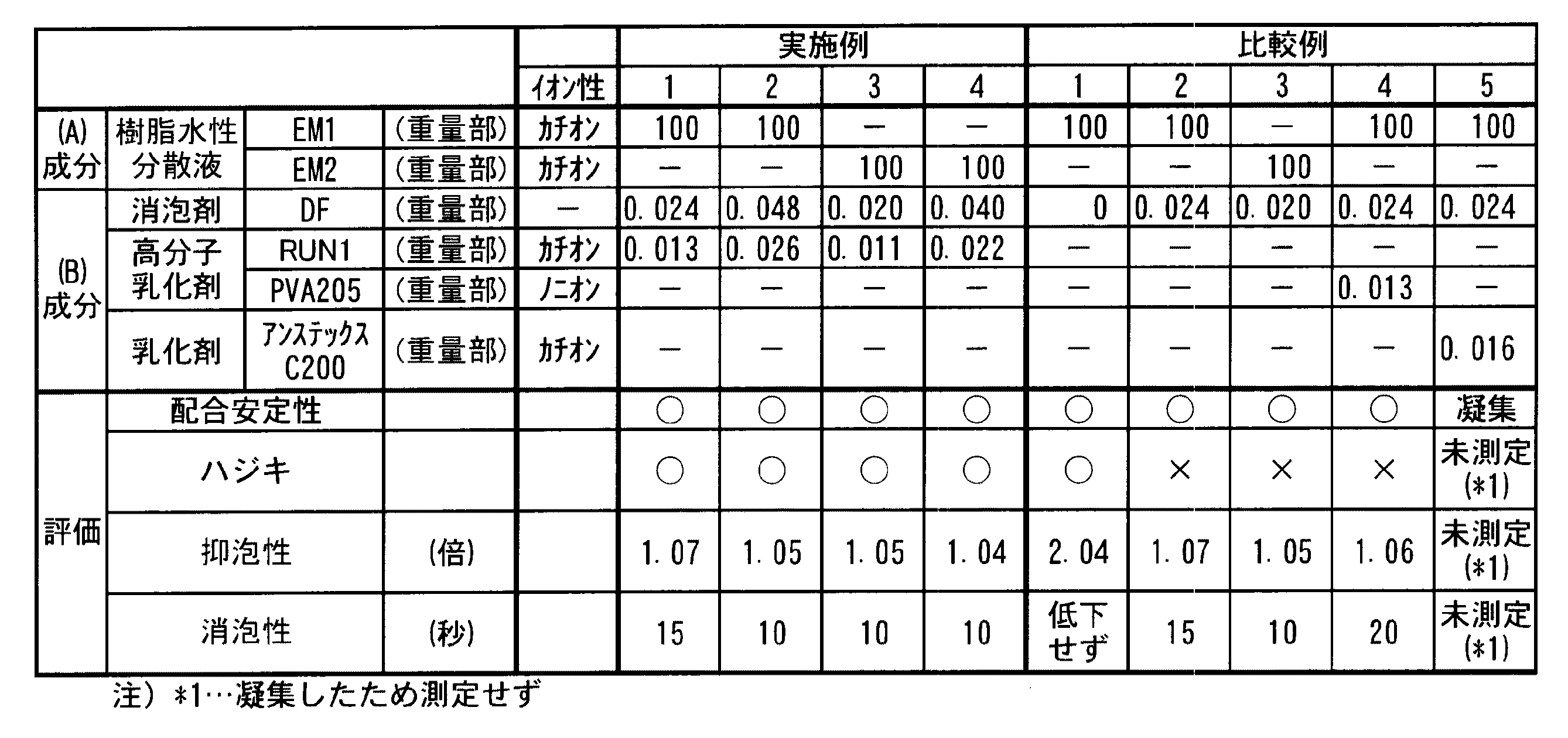
(実施例1〜4、比較例1〜3)
(A)成分及び(B)成分を下記表3に示す割合で混合し、消泡剤組成物含有熱可塑性樹脂水性分散液を調整した。
得られた消泡剤組成物含有熱可塑性樹脂水性分散液を用いて、上記の各物性を測定した。その結果を表3に示す。
(Examples 1-4, Comparative Examples 1-3)
(A) component and (B) component were mixed in the ratio shown in following Table 3, and the antifoamer composition containing thermoplastic resin aqueous dispersion was adjusted.
Each physical property was measured using the obtained antifoam composition-containing thermoplastic resin aqueous dispersion. The results are shown in Table 3.
(比較例4)
消泡剤組成物水性分散液に用いる乳化剤として、上記RUN1のかわりに、(株)クラレ製:PVA205(けん化度:約87.0〜89.0mol%、重合度:500)を用いたものを作製し、これと(A)成分とを下記表3に示す割合で混合し、消泡剤組成物含有熱可塑性樹脂水性分散液を調整した。
得られた消泡剤組成物含有熱可塑性樹脂水性分散液を用いて、上記の各物性を測定した。その結果を表3に示す。
(Comparative Example 4)
As an emulsifier used in the aqueous defoamer composition dispersion, a product using Kuraray Co., Ltd .: PVA205 (degree of saponification: about 87.0-89.0 mol%, degree of polymerization: 500) instead of RUN1 above. The antifoam composition-containing thermoplastic resin aqueous dispersion was prepared by mixing and mixing this and the component (A) in the proportions shown in Table 3 below.
Each physical property was measured using the obtained antifoam composition-containing thermoplastic resin aqueous dispersion. The results are shown in Table 3.
(比較例5)
消泡剤組成物水性分散液に用いる乳化剤として、上記RUN1に代えて、市販のカチオン性乳化剤であるアンステックス C−200を使用したものを作製し、これと(A)成分とを下記表3に示す割合で混合し、消泡剤組成物含有熱可塑性樹脂水性分散液を調製した。これを用いて、上記の各物性を測定した。その結果を表3に示す。
なお、アンステックス C−200(商品名)は、東邦化学工業(株)製:ポリオキシエチレントリアルキルアンモニウム硝酸塩であり、ポリオキシエチレントリアルキルアンモニウム硝酸塩50%とイソプロピルアルコール20〜25%と水(残部)を含む。
(Comparative Example 5)
As an emulsifier to be used in the antifoam composition aqueous dispersion, a commercially available cationic emulsifier, Anstex C-200, was used instead of RUN1, and this and the component (A) are shown in Table 3 below. The mixture was mixed at a ratio shown in the following to prepare an aqueous antifoam composition-containing thermoplastic resin dispersion. Using this, each physical property described above was measured. The results are shown in Table 3.
Anstex C-200 (trade name) is manufactured by Toho Chemical Industry Co., Ltd .: polyoxyethylene trialkylammonium nitrate, 50% polyoxyethylene trialkylammonium nitrate, 20-25% isopropyl alcohol and water ( The remainder).
Claims (3)
(A)カチオン性高分子乳化剤を含有し、機械乳化分散法によって得られた熱可塑性樹脂水性分散液。
(B)疎水性シリカ及び鉱物油の少なくとも一方を含有する消泡剤組成物をカチオン性高分子乳化剤によって分散させた消泡剤組成物水性分散液。 An antifoam composition-containing thermoplastic resin aqueous dispersion containing the following components (A) and (B):
(A) An aqueous thermoplastic resin dispersion containing a cationic polymer emulsifier and obtained by a mechanical emulsion dispersion method.
(B) A defoamer composition aqueous dispersion in which a defoamer composition containing at least one of hydrophobic silica and mineral oil is dispersed with a cationic polymer emulsifier.
Priority Applications (1)
| Application Number | Priority Date | Filing Date | Title |
|---|---|---|---|
| JP2011065852A JP2012201738A (en) | 2011-03-24 | 2011-03-24 | Defoaming agent composition-containing thermoplastic resin aqueous dispersion, and coated article using the same |
Applications Claiming Priority (1)
| Application Number | Priority Date | Filing Date | Title |
|---|---|---|---|
| JP2011065852A JP2012201738A (en) | 2011-03-24 | 2011-03-24 | Defoaming agent composition-containing thermoplastic resin aqueous dispersion, and coated article using the same |
Publications (1)
| Publication Number | Publication Date |
|---|---|
| JP2012201738A true JP2012201738A (en) | 2012-10-22 |
Family
ID=47183079
Family Applications (1)
| Application Number | Title | Priority Date | Filing Date |
|---|---|---|---|
| JP2011065852A Withdrawn JP2012201738A (en) | 2011-03-24 | 2011-03-24 | Defoaming agent composition-containing thermoplastic resin aqueous dispersion, and coated article using the same |
Country Status (1)
| Country | Link |
|---|---|
| JP (1) | JP2012201738A (en) |
Cited By (3)
| Publication number | Priority date | Publication date | Assignee | Title |
|---|---|---|---|---|
| CN109173350A (en) * | 2018-10-19 | 2019-01-11 | 苏州恒康新材料有限公司 | Mineral oil antifoam agent and preparation method |
| CN113546452A (en) * | 2021-04-28 | 2021-10-26 | 淄博惠生工贸有限公司 | Modified organic silicon defoaming agent and preparation method thereof |
| CN117504369A (en) * | 2024-01-05 | 2024-02-06 | 江苏赛欧信越消泡剂有限公司 | A mineral oil-based defoaming agent and its preparation method |
-
2011
- 2011-03-24 JP JP2011065852A patent/JP2012201738A/en not_active Withdrawn
Cited By (3)
| Publication number | Priority date | Publication date | Assignee | Title |
|---|---|---|---|---|
| CN109173350A (en) * | 2018-10-19 | 2019-01-11 | 苏州恒康新材料有限公司 | Mineral oil antifoam agent and preparation method |
| CN113546452A (en) * | 2021-04-28 | 2021-10-26 | 淄博惠生工贸有限公司 | Modified organic silicon defoaming agent and preparation method thereof |
| CN117504369A (en) * | 2024-01-05 | 2024-02-06 | 江苏赛欧信越消泡剂有限公司 | A mineral oil-based defoaming agent and its preparation method |
Similar Documents
| Publication | Publication Date | Title |
|---|---|---|
| US20090118416A1 (en) | Aqueous liquid dispersion, method for producing same, composition, adhesive, and coating material | |
| JP5403387B2 (en) | Polymer emulsifier and polyolefin resin emulsion using the same | |
| JP7570707B2 (en) | Amine-Based Primer Coatings for Electrophotographic Printing | |
| JPH05105791A (en) | Propylene polymer aqueous dispersion | |
| JP5692626B2 (en) | Polymer emulsifier and polyolefin resin emulsion using the same | |
| JP2008024755A (en) | Thermoplastic resin aqueous dispersion | |
| JPH0226631A (en) | Dispersant for manufacturing aqueous dispersion | |
| JP4750892B2 (en) | Process for producing solvolysis composition of ethylene-vinyl ester copolymer | |
| JP2010209249A (en) | Polymer emulsifier and resin dispersion using the same | |
| JP3466316B2 (en) | Woodworking adhesive | |
| JP3713482B2 (en) | Process for producing ethylene-glycidyl acrylate compound copolymer aqueous emulsion | |
| JP2008184495A (en) | Crosslinkable aqueous dispersion, method for producing the same, and adhesive and coating agent | |
| JP3441187B2 (en) | Aqueous emulsion | |
| JP5192133B2 (en) | Thermoplastic resin aqueous dispersion using cationic polymer dispersant | |
| JP6026769B2 (en) | Method for producing aqueous dispersion of thermoplastic resin | |
| JP2014201646A (en) | Dispersion liquid of particle fixation inhibitor, method of production the same and method of preventing particle fixation using the same | |
| JP5692625B2 (en) | Polymer emulsifier and polyolefin resin emulsion using the same | |
| JP4864366B2 (en) | Aqueous emulsion composition | |
| JP5718686B2 (en) | Thermoplastic resin aqueous dispersion and water-resistant film using the same | |
| JP2008184494A (en) | Aqueous dispersion and method for producing the same, and adhesive and coating agent | |
| JP2017061657A (en) | Additive for suspension polymerization and its aqueous dispersion, and method for producing vinyl resin using them | |
| JPH0159294B2 (en) | ||
| JP2013035955A (en) | Adhesive laminate and manufacturing method thereof | |
| JPH0133214B2 (en) | ||
| JP5615634B2 (en) | Aqueous emulsion |
Legal Events
| Date | Code | Title | Description |
|---|---|---|---|
| A300 | Withdrawal of application because of no request for examination |
Free format text: JAPANESE INTERMEDIATE CODE: A300 Effective date: 20140603 |