JP2012202058A - Method for reinforcing strength of steel material - Google Patents
Method for reinforcing strength of steel material Download PDFInfo
- Publication number
- JP2012202058A JP2012202058A JP2011065877A JP2011065877A JP2012202058A JP 2012202058 A JP2012202058 A JP 2012202058A JP 2011065877 A JP2011065877 A JP 2011065877A JP 2011065877 A JP2011065877 A JP 2011065877A JP 2012202058 A JP2012202058 A JP 2012202058A
- Authority
- JP
- Japan
- Prior art keywords
- electrode
- steel material
- concrete
- hydrogen
- steel
- Prior art date
- Legal status (The legal status is an assumption and is not a legal conclusion. Google has not performed a legal analysis and makes no representation as to the accuracy of the status listed.)
- Pending
Links
Images
Landscapes
- Working Measures On Existing Buildindgs (AREA)
- Rod-Shaped Construction Members (AREA)
- Reinforcement Elements For Buildings (AREA)
Abstract
Description
本発明は、鋼材の水素による脆化を防止して鋼材の強度を増加する方法に関するものである。 The present invention relates to a method for increasing the strength of a steel material by preventing embrittlement of the steel material due to hydrogen.
鋼材(鉄鋼)は、鉄骨や鉄筋などとして建築物などの建築要素(固定構造体)の部材として用いられている。この鋼材が、構造体が配置されている環境の影響で発生した水素により脆化して、強度が低下する場合があることが知られている。一方で、熱力学的平衡量以上の可飽和の水素を含む鋼材は、強度が向上することが確認されている(非特許文献1参照)。 Steel materials (steel) are used as members of building elements (fixed structures) such as buildings as steel frames and reinforcing bars. It is known that this steel material may become brittle due to the hydrogen generated by the influence of the environment in which the structure is disposed, resulting in a decrease in strength. On the other hand, it has been confirmed that the strength of a steel material containing saturable hydrogen equal to or greater than the thermodynamic equilibrium amount is improved (see Non-Patent Document 1).
上述したように、水素を過飽和の状態にすることで、鋼材の水素脆化が抑制され強度が増大することが見いだされているが、例えば、bcc結晶構造の金属では、結晶格子内の水素が拡散する速度が大きく、過飽和の状態を保つことは難しい。また、マルテンサイト系の高強度鋼では、常温(20〜25℃)では、水素は数日でmmオーダーの移動をし、「拡散性水素」として知られるトラップエネルギー準位の小さい成分の水素が、鋼材の内外の出入りを繰り返す。 As described above, it has been found that by making hydrogen supersaturated, hydrogen embrittlement of the steel material is suppressed and the strength is increased. For example, in a metal having a bcc crystal structure, hydrogen in the crystal lattice is reduced. It is difficult to maintain supersaturation because the diffusion rate is high. In martensitic high-strength steel, hydrogen moves in the order of millimeters within a few days at room temperature (20 to 25 ° C.), and hydrogen with a small trap energy level known as “diffusible hydrogen” , Repeatedly going in and out of steel.
このため、鋼材を水素が過飽和となる状態に保つことは、容易ではないという問題がある。また、鉄筋コンクリートなど、コンクリート中に埋設されている鋼材においては、上述した鋼材を水素が過飽和となる状態に保つことは特に困難である。このように、従来の技術では、含有する水素を可飽和の状態とすることで、鉄筋コンクリートなどの状態で構造物の建築要素として用いられる鋼材の強度を増加することは、容易ではないという問題があった。 For this reason, there is a problem that it is not easy to keep the steel material in a state where hydrogen is supersaturated. Moreover, in steel materials embedded in concrete such as reinforced concrete, it is particularly difficult to keep the above-described steel materials in a state where hydrogen is supersaturated. As described above, in the conventional technology, it is not easy to increase the strength of the steel material used as a building element of the structure in a state such as reinforced concrete by making the contained hydrogen saturable. there were.
本発明は、以上のような問題点を解消するためになされたものであり、鉄筋コンクリートなどの状態で構造物の建築要素として用いられる鋼材の強度が増加できるようにすることを目的とする。 This invention is made | formed in order to eliminate the above problems, and it aims at enabling it to increase the intensity | strength of the steel materials used as a building element of a structure in states, such as a reinforced concrete.
本発明に係る鋼材の強度増強方法は、コンクリート中に埋設された鋼材に第1電極を接続し、コンクリートに第2電極を接して設け、第1電極を陰極として第1電極および第2電極の間に電流を流して鋼材表面において水の電気分解により水素を発生させ、鋼材に熱力学的平衡量以上の水素が含まれる状態とする。 According to the steel material strength increasing method of the present invention, a first electrode is connected to a steel material embedded in concrete, a second electrode is provided in contact with the concrete, the first electrode is used as a cathode, and the first electrode and the second electrode are connected. An electric current is passed between them to generate hydrogen by electrolysis of water on the surface of the steel material so that the steel material contains hydrogen in excess of the thermodynamic equilibrium amount.
以上説明したように、本発明によれば、鋼材に接続する第1電極を陰極として第1電極および第2電極の間に電流を流すようにしたので、鉄筋コンクリートなどの状態で構造物の建築要素として用いられる鋼材の強度が増加できるようになるという優れた効果が得られる。 As described above, according to the present invention, since the current is passed between the first electrode and the second electrode using the first electrode connected to the steel material as the cathode, the building element of the structure in the state of reinforced concrete or the like As a result, it is possible to obtain an excellent effect that the strength of the steel material used can be increased.
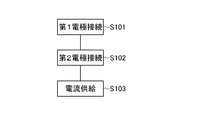
以下、本発明の実施の形態について図を参照して説明する。図1は、本発明の実施の形態における鋼材の強度増強方法を説明するためのフローチャートである。まず、ステップS10で、コンクリート中に埋設された鋼材に第1電極を接続する。次に、ステップS102で、コンクリートに第2電極を接して設ける。以上のように各電極を接続した後、ステップS103で、第1電極を陰極として第1電極および第2電極の間に電流を流し、鋼材表面において水の電気分解により水素を発生させ、鋼材に熱力学的平衡量以上の水素が含まれる状態とする。 Hereinafter, embodiments of the present invention will be described with reference to the drawings. FIG. 1 is a flowchart for explaining a steel material strength increasing method according to an embodiment of the present invention. First, in step S10, the first electrode is connected to the steel material embedded in the concrete. Next, in step S102, the second electrode is provided in contact with the concrete. After connecting the electrodes as described above, in step S103, a current is passed between the first electrode and the second electrode using the first electrode as a cathode, hydrogen is generated by electrolysis of water on the steel material surface, A state in which hydrogen exceeding the thermodynamic equilibrium amount is included.
コンクリートには水が含まれているため、埋設されている鋼材が陰極側となるように電流を流すことで、鋼材表面において水の電気分解により水素を発生させれば、鋼材表面近傍における水素分圧を高めることができる。これにより、鋼材内部からの水素の放出を抑制し、鋼材内部においては、熱力学的平衡量以上の可飽和の水素が含まれた状態とする。このように、本実施の形態によれば、鋼材中の水素を可飽和とすることができるので、コンクリート中に埋設された鋼材の強度を増加させることができる。 Since concrete contains water, if hydrogen is generated by electrolysis of water on the steel surface by flowing an electric current so that the embedded steel is on the cathode side, the hydrogen content in the vicinity of the steel surface The pressure can be increased. As a result, the release of hydrogen from the inside of the steel material is suppressed, and the steel material is in a state in which saturable hydrogen equal to or greater than the thermodynamic equilibrium amount is included. Thus, according to this Embodiment, since hydrogen in steel materials can be made saturable, the intensity | strength of the steel materials embed | buried in concrete can be increased.
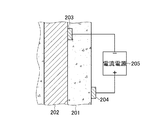
次に、上述した方法を実現する装置について、図2を用いて説明する。図2は、実施の形態における鋼材の強度増強方法を実現する装置の構成を示す構成図である。この装置は、まず、コンクリート201中に埋設された鋼材202に接続する第1電極203を備える。また、コンクリート201に接して設けられた第2電極204を備える。第2電極204は、コンクリート201に埋設してもよい。また、第1電極203を陰極側として、第1電極203と第2電極204との間に電流を流す直流電源205を備える。
Next, an apparatus for realizing the above-described method will be described with reference to FIG. FIG. 2 is a configuration diagram showing a configuration of an apparatus for realizing the steel material strength increasing method according to the embodiment. The apparatus first includes a
ここで、第1電極203は、コンクリート201のアルカリ性でマイナス極(陰極)とした時に容易に溶解しないような材料を用いれば好適であり、例えば、炭素から構成すればよい。また、第2電極204は、コンクリート201のアルカリ性でプラス極とした時に容易に溶解しない材料を用いれば好適であり、例えば、炭素および白金から構成すればよい。
Here, the
直流電源205は、例えば、乾電池から構成すればよい。また、燃料電池および太陽電池であってもよい。また、商用の交流電源を整流して直流とする電源であってもよい。前述したように、鋼材202に熱力学的平衡量以上の水素が含まれる状態とするためには、2つの電極間に、例えば1mA/cm2の電流を流せばよい。この電流値は、コンクリート201の抵抗、および電気分解により発生する水素の量を計算して適宜設計すればよい。
The direct current power source 205 may be constituted by, for example, a dry battery. Moreover, a fuel cell and a solar cell may be sufficient. Moreover, the power supply which rectifies | straightens commercial alternating current power supply and makes it direct current may be sufficient. As described above, in order to bring the
上述した本発明により、コンクリートに埋設されている鋼材(鉄鋼)に、常時水素を供給することができるため、過飽和の状況を保つことができ、鋼材の強度を増加させることができる。なお、本発明は以上に説明した実施の形態に限定されるものではなく、本発明の技術的思想内で、当分野において通常の知識を有する者により、多くの変形および組み合わせが実施可能であることは明白である。 According to the present invention described above, hydrogen can be constantly supplied to a steel material (steel) embedded in concrete, so that a supersaturated state can be maintained and the strength of the steel material can be increased. The present invention is not limited to the embodiment described above, and many modifications and combinations can be implemented by those having ordinary knowledge in the art within the technical idea of the present invention. It is obvious.
201…コンクリート、202…鋼材、203…第1電極、204…第2電極、205…直流電源。 201 ... concrete, 202 ... steel, 203 ... first electrode, 204 ... second electrode, 205 ... DC power supply.
Claims (1)
前記コンクリートに第2電極を接して設ける第2ステップと、
前記第1電極を陰極として前記第1電極および前記第2電極の間に電流を流して前記鋼材表面において水の電気分解により水素を発生させ、前記鋼材に熱力学的平衡量以上の水素が含まれる状態とする第3ステップと
を備えることを特徴とする鋼材の強度増強方法。 A first step of connecting a first electrode to a steel material embedded in concrete;
A second step of providing a second electrode in contact with the concrete;
Using the first electrode as a cathode, current is passed between the first electrode and the second electrode to generate hydrogen by electrolysis of water on the surface of the steel material, and the steel material contains more than a thermodynamic equilibrium amount of hydrogen. And a third step of bringing the steel material into a state of being strengthened.
Priority Applications (1)
| Application Number | Priority Date | Filing Date | Title |
|---|---|---|---|
| JP2011065877A JP2012202058A (en) | 2011-03-24 | 2011-03-24 | Method for reinforcing strength of steel material |
Applications Claiming Priority (1)
| Application Number | Priority Date | Filing Date | Title |
|---|---|---|---|
| JP2011065877A JP2012202058A (en) | 2011-03-24 | 2011-03-24 | Method for reinforcing strength of steel material |
Publications (1)
| Publication Number | Publication Date |
|---|---|
| JP2012202058A true JP2012202058A (en) | 2012-10-22 |
Family
ID=47183352
Family Applications (1)
| Application Number | Title | Priority Date | Filing Date |
|---|---|---|---|
| JP2011065877A Pending JP2012202058A (en) | 2011-03-24 | 2011-03-24 | Method for reinforcing strength of steel material |
Country Status (1)
| Country | Link |
|---|---|
| JP (1) | JP2012202058A (en) |
Cited By (1)
| Publication number | Priority date | Publication date | Assignee | Title |
|---|---|---|---|---|
| WO2015079837A1 (en) | 2013-11-29 | 2015-06-04 | 稔 中川 | Continuously variable transmission |
Citations (1)
| Publication number | Priority date | Publication date | Assignee | Title |
|---|---|---|---|---|
| JPH10317682A (en) * | 1997-05-16 | 1998-12-02 | Denki Kagaku Kogyo Kk | Recycling method of prestressed concrete |
-
2011
- 2011-03-24 JP JP2011065877A patent/JP2012202058A/en active Pending
Patent Citations (1)
| Publication number | Priority date | Publication date | Assignee | Title |
|---|---|---|---|---|
| JPH10317682A (en) * | 1997-05-16 | 1998-12-02 | Denki Kagaku Kogyo Kk | Recycling method of prestressed concrete |
Non-Patent Citations (1)
| Title |
|---|
| JPN6014036545; 独立行政法人 産業技術総合研究所 広報部 報道室: 水素で金属材料の強度が向上 , 20100701 * |
Cited By (1)
| Publication number | Priority date | Publication date | Assignee | Title |
|---|---|---|---|---|
| WO2015079837A1 (en) | 2013-11-29 | 2015-06-04 | 稔 中川 | Continuously variable transmission |
Similar Documents
| Publication | Publication Date | Title |
|---|---|---|
| Jeremiasse et al. | Microbial electrolysis cell with a microbial biocathode | |
| Geise et al. | Salt concentration differences alter membrane resistance in reverse electrodialysis stacks | |
| Hatzell et al. | Capacitive mixing power production from salinity gradient energy enhanced through exoelectrogen-generated ionic currents | |
| Kim et al. | Proof-of-concept experiments of an acid-base junction flow battery by reverse bipolar electrodialysis for an energy conversion system | |
| CN109214121B (en) | Reinforced concrete structure corrosion electric drive unified control method | |
| JP2018519420A5 (en) | ||
| EA201890645A1 (en) | SYSTEM AND METHOD OF MANUFACTURE OF GAS-HYDROGEN AND GAS-OXYGEN | |
| Virkar et al. | Reversible high temperature cells for power generation and hydrogen production using mixed ionic electronic conducting solid electrolytes | |
| Kato et al. | Epitaxial p-type SiC as a self-driven photocathode for water splitting | |
| Liu et al. | Effect of anolyte pH and cathode Pt loading on electricity and hydrogen co-production performance of the bio-electrochemical system | |
| JP2015537116A5 (en) | ||
| Jia et al. | Enhancing hydrogen production efficiency in microbial electrolysis cell with membrane electrode assembly cathode | |
| Okonkwo et al. | Effect of electrode material on the hydrogen production using a low-cost home-made alkaline electrolyzer | |
| Sleutels et al. | Effect of mass and charge transport speed and direction in porous anodes on microbial electrolysis cell performance | |
| Kim et al. | Addition of carbon dioxide enhances electrical power production in a microbial reverse electrodialysis cell | |
| WO2017071320A1 (en) | Battery utilizing ion exchange membrane and microfluidic technique to realize multi-electrolyte structure | |
| CN108603298B (en) | Method and device for electrochemical reduction of carbon dioxide | |
| CN105655619A (en) | Flow battery capacity automatic recovery device | |
| JP2012017993A (en) | Determination method of passivation | |
| Sleutels et al. | Reduction of pH buffer requirement in bioelectrochemical systems | |
| JP2016527387A (en) | Hydrogen recycling apparatus and operation method | |
| TWI535891B (en) | Hydrogen producing method and system for applying the same | |
| KR102526366B1 (en) | Generator sustainably generating power | |
| Park et al. | Bi-layer electrolyte for preventing solid oxide fuel cell stack degradation | |
| Minfang et al. | H_2O/CO_2 co-electrolysis in solid oxide electrolysis cells |
Legal Events
| Date | Code | Title | Description |
|---|---|---|---|
| A621 | Written request for application examination |
Free format text: JAPANESE INTERMEDIATE CODE: A621 Effective date: 20130315 |
|
| A977 | Report on retrieval |
Free format text: JAPANESE INTERMEDIATE CODE: A971007 Effective date: 20131217 |
|
| A131 | Notification of reasons for refusal |
Free format text: JAPANESE INTERMEDIATE CODE: A131 Effective date: 20140121 |
|
| A131 | Notification of reasons for refusal |
Free format text: JAPANESE INTERMEDIATE CODE: A131 Effective date: 20140902 |
|
| A02 | Decision of refusal |
Free format text: JAPANESE INTERMEDIATE CODE: A02 Effective date: 20150113 |