JP2012207191A - Method of manufacturing pigment composition, and pigment composition manufactured by the manufacturing method - Google Patents
Method of manufacturing pigment composition, and pigment composition manufactured by the manufacturing method Download PDFInfo
- Publication number
- JP2012207191A JP2012207191A JP2011075891A JP2011075891A JP2012207191A JP 2012207191 A JP2012207191 A JP 2012207191A JP 2011075891 A JP2011075891 A JP 2011075891A JP 2011075891 A JP2011075891 A JP 2011075891A JP 2012207191 A JP2012207191 A JP 2012207191A
- Authority
- JP
- Japan
- Prior art keywords
- weight
- parts
- ink
- pigment composition
- copper phthalocyanine
- Prior art date
- Legal status (The legal status is an assumption and is not a legal conclusion. Google has not performed a legal analysis and makes no representation as to the accuracy of the status listed.)
- Withdrawn
Links
Landscapes
- Inks, Pencil-Leads, Or Crayons (AREA)
Abstract
Description
本発明はβ型銅フタロシアニン顔料の印刷インキを製造する際に、銅フタロシアニンのβ型結晶形態を経由することなく、粗製銅フタロシアニンから直接印刷インキを製造するための顔料組成物の製造方法および該製造方法により製造された顔料組成物ならびに該顔料組成物を含有してなる平版印刷インキに関わるものである。 The present invention relates to a method for producing a pigment composition for producing a printing ink directly from crude copper phthalocyanine, without going through the β-type crystal form of copper phthalocyanine when producing printing ink of β-type copper phthalocyanine pigment, and The present invention relates to a pigment composition produced by the production method and a lithographic printing ink containing the pigment composition.
通常、合成後の銅フタロシアニンは粗製銅フタロシアニンと呼ばれ、10〜200μm程度の巨大β型結晶粒子のため、そのまま印刷インキ用顔料として使用することはできない。この粗製銅フタロシアニンを印刷インキとして使用可能な大きさ(0.02〜0.1μm程度)まで微細化(顔料化)しなければならない。顔料化には種々の方法がある。 Usually, the synthesized copper phthalocyanine is called crude copper phthalocyanine, and cannot be used as it is as a pigment for printing ink because it is a large β-type crystal particle of about 10 to 200 μm. The crude copper phthalocyanine must be refined (pigmented) to a size that can be used as a printing ink (about 0.02 to 0.1 μm). There are various methods for pigmentation.
最も一般的なのがソルベントソルトミリング法と呼ばれる方法である。この方法は粗製銅フタロシアニンに食塩などの磨砕剤とβ型への結晶転移を促進させる有機溶剤を加え磨砕する方法である。この方法によるβ型銅フタロシアニン顔料はアスペクト比(一次粒子の短径と長径の比)が1〜3で、緑味鮮明で高着色力など印刷インキに適しており、広く使用されている。しかし顔料の数倍量の磨砕剤が必要であり、この磨砕剤や有機溶剤を回収する工程に多くの時間と労力を必要とする。 The most common method is called a solvent salt milling method. This is a method in which crude copper phthalocyanine is ground by adding a grinding agent such as salt and an organic solvent that promotes crystal transition to β-form. The β-type copper phthalocyanine pigment obtained by this method has an aspect ratio (ratio of primary particle minor axis to major axis) of 1 to 3, and is widely used for printing inks such as vivid green and high coloring power. However, a grinding agent several times the amount of the pigment is required, and much time and labor are required for the process of recovering the grinding agent and the organic solvent.
これに対して粗製銅フタロシアニンを乾式で粉砕した後に有機溶剤等で処理するする方法も知られている。この場合、粉砕時に機械的な力を加えることでβ型結晶の一部がα型結晶へ転移するため、再びβ型に転移させるために、この磨砕物を有機溶剤と共に加熱処理しなければならない。この方法はソルベントソルトミリング法に比べて工程が簡略化され、コスト的に有利であるが、有機溶剤で加熱処理する際に粒子が針状に成長しアスペクト比が大きくなり、インキ化した際の顔料分散性が必ずしも良好ではなく、色相が赤味になることや流動性劣化など品質面で問題がある。 On the other hand, a method of treating crude copper phthalocyanine with an organic solvent after pulverizing the crude copper phthalocyanine is also known. In this case, since a part of the β-type crystal is transferred to the α-type crystal by applying a mechanical force at the time of pulverization, the ground product must be heat-treated with an organic solvent in order to transfer to the β-type again. . This method has a simplified process compared to the solvent salt milling method and is advantageous in terms of cost. However, when heat-treated with an organic solvent, the particles grow in a needle shape and the aspect ratio increases, resulting in an ink. The pigment dispersibility is not always good, and there are problems in terms of quality such as red hue and fluidity deterioration.
一方、顔料から印刷インキを製造する方法としては乾燥顔料を用いる方法と水分を40〜70重量%含んだウエットケーキ顔料を用いる方法が一般的である。乾燥顔料を用いるインキ化方法は乾燥顔料を印刷インキワニス、溶剤、添加剤などと混合した後、ビーズミル、3本ロールなどを用いて顔料を分散させる方法であるが、乾燥顔料は一次粒子の凝集が強いため顔料を分散させるために多くのエネルギーを必要とする。ウエットケーキ顔料を用いる方法はフラッシング法と呼ばれている。フラッシング法はウエットケーキ顔料を印刷インキワニス、溶剤、添加剤などと混合し顔料を水相からワニス相へ転換させる方法であり、乾燥顔料のインキ化工程のエネルギーは必要としないもののニーダーなどの大型装置が必要となり、またフラッシングの工程においては排水も発生する。 On the other hand, as a method for producing printing ink from a pigment, a method using a dry pigment and a method using a wet cake pigment containing 40 to 70% by weight of water are generally used. The ink-making method using a dry pigment is a method in which a dry pigment is mixed with a printing ink varnish, a solvent, an additive, etc., and then the pigment is dispersed using a bead mill, three rolls, etc. Because it is strong, it requires a lot of energy to disperse the pigment. A method using a wet cake pigment is called a flushing method. The flushing method is a method in which wet cake pigments are mixed with printing ink varnish, solvent, additives, etc. to convert the pigment from the aqueous phase to the varnish phase. In addition, waste water is generated in the flushing process.
この様にβ型銅フタロシアニンの印刷インキを製造するためには、顔料化工程とインキ化工程で非常に多くの時間とエネルギーが必要である。 Thus, in order to produce a printing ink of β-type copper phthalocyanine, very much time and energy are required in the pigmenting process and the ink forming process.
低コストの印刷インキを提供するためには、顔料の形態を経由せずに粗製銅フタロシアニンから直接インキを製造することが考えられ、実際に粗製銅フタロシアニンを印刷インキ用ワニスまたは印刷インキ用溶剤と混合した後、ビーズミルを用いてインキ化と同時に顔料化を行う方法が知られている。しかしながら、印刷インキワニス中での顔料化は摩砕効率が低いため、超微細なビーズを用いた分散ミルなどを必要とし、エネルギー効率、品質などの点で問題が多い。 In order to provide low-cost printing ink, it is conceivable to produce ink directly from crude copper phthalocyanine without going through the form of pigment, and actually use crude copper phthalocyanine as a varnish for printing ink or a solvent for printing ink. A method is known in which, after mixing, pigmentation is performed simultaneously with ink formation using a bead mill. However, pigmentation in a printing ink varnish has a low grinding efficiency, which requires a dispersion mill using ultrafine beads, and has many problems in terms of energy efficiency and quality.
特公昭55−6670号公報には、粗製銅フタロシアニンを一度乾式で磨砕した後、そのままインキ化する方法が記載されている。乾式の磨砕は効率的に行われるため、非常に有効な方法である。しかしながら乾式粉砕した磨砕物は強固な凝集体であり、またα/β型結晶の混合物となってしまうため、インキ中での磨砕物の分散やβ型結晶への再転移は非常に困難である。 Japanese Examined Patent Publication No. 55-6670 describes a method in which crude copper phthalocyanine is once ground by a dry method and then converted into an ink as it is. Dry grinding is a very effective method because it is performed efficiently. However, since the dry-ground pulverized product is a strong agglomerate and becomes a mixture of α / β-type crystals, it is very difficult to disperse the pulverized product in ink and to re-transfer to β-type crystals. .
この様な問題を解決するため、英国特許第1224627号公報には、粗製銅フタロシアニンを乾式で摩砕する際に1〜8倍量の樹脂を添加する方法が、また、特許第3159049号公報では、粗製銅フタロシアニンに対して、樹脂を1〜200重量%、および溶剤を該樹脂に対して0.5〜20重量%添加し、70〜90℃で乾式粉砕する方法が記載されている。これらの方法は、添加した樹脂の効果により銅フタロシアニン粒子の凝集を防止する意味と添加した樹脂が後に使用する樹脂と同じものを使用できる点で非常に有効な方法と言える。 In order to solve such problems, British Patent No. 1224627 discloses a method of adding 1 to 8 times the amount of resin when crude copper phthalocyanine is milled in a dry process, and Japanese Patent No. 3159049 discloses A method of adding 1 to 200% by weight of a resin and 0.5 to 20% by weight of a solvent to crude copper phthalocyanine and dry-grinding at 70 to 90 ° C. is described. These methods can be said to be very effective in terms of preventing the aggregation of the copper phthalocyanine particles due to the effect of the added resin and that the added resin can be the same as the resin used later.
しかしながら、多くの樹脂は室温で保存した場合でも酸化による劣化が起こることが知られている。即ち、これらの特許の方法では添加した樹脂は粉砕されることで表面積が増大することや衝撃による瞬間的な熱により、例え冷却したとしても粉砕時の樹脂の酸化を避けることはできない。樹脂は酸化されることでその溶解性や色調、その他の物性が変化してしまうため、従来の使用されてきた樹脂をそのまま適用したとしても同じインキの性能を引き出すことは不可能である。具体的には、樹脂の劣化により平版印刷インキの分散性劣化、乾燥性劣化、乳化適性の劣化に繋がる。 However, many resins are known to deteriorate due to oxidation even when stored at room temperature. That is, in the methods of these patents, the resin added is increased in surface area by being pulverized, and even if it is cooled due to instantaneous heat due to impact, oxidation of the resin during pulverization cannot be avoided. When the resin is oxidized, its solubility, color tone, and other physical properties change, so that it is impossible to bring out the same ink performance even if the conventionally used resin is applied as it is. Specifically, deterioration of the resin leads to deterioration of dispersibility, drying property, and emulsification ability of the lithographic printing ink.
この問題に関し、特開平9−291221号公報記載の脱酸素雰囲気下で乾式粉砕する方法は、磨砕時の樹脂の酸化防止に対して有効であるものの、磨砕後の顔料組成物を印刷インキに使用するまでの経時劣化に対しては効果がない。 Regarding this problem, the dry pulverization method in a deoxygenated atmosphere described in JP-A-9-291221 is effective for preventing oxidation of the resin during grinding, but the ground pigment composition is used as a printing ink. There is no effect on deterioration over time until use.
本発明は、生産性やコストの面で非常に有効な手段である、粗製銅フタロシアニンの乾式粉砕した摩砕物および該摩砕物を用い直接印刷インキを製造する方法において、酸化による経時劣化のない高品位のβ型銅フタロシアニン顔料組成物の製造方法および該製造方法により製造された顔料組成物ならびに該顔料組成物を含有してなる平版印刷インキを提供することを目的とする。 The present invention is a very effective means in terms of productivity and cost, and is a method of producing a printing ink using a dry pulverized product of crude copper phthalocyanine and a direct printing ink using the crushed product. It is an object of the present invention to provide a method for producing a high-quality β-type copper phthalocyanine pigment composition, a pigment composition produced by the production method, and a lithographic printing ink comprising the pigment composition.
本発明者等は、上記課題を解決するために、鋭意検討を行った結果、特定の製造方法によって製造された顔料組成物は、酸化により経時劣化のない高品位であり、該顔料組成物を含有してなる平版印刷インキは、分散性、乾燥性、乳化適性等の優れた物性を有することを見出し、本発明を完成するに至った。 As a result of intensive studies to solve the above problems, the present inventors have found that the pigment composition produced by a specific production method is high-grade without deterioration over time due to oxidation. The lithographic printing ink contained has been found to have excellent physical properties such as dispersibility, drying property, emulsification suitability, etc., and the present invention has been completed.
すなわち本発明の第1の発明は、粗製銅フタロシアニン、樹脂および酸化防止剤を、脱酸素雰囲気下で乾式粉砕する顔料組成物の製造方法であって、
樹脂が、粗製銅フタロシアニンに対して、1〜200重量%
であり、かつ
酸化防止剤が、粗製銅フタロシアニンに対して、0.01〜3重量%
であることを特徴とする顔料組成物の製造方法に関するものである。
That is, the first invention of the present invention is a method for producing a pigment composition comprising dry pulverizing crude copper phthalocyanine, a resin and an antioxidant in a deoxygenated atmosphere,
1 to 200% by weight of resin based on crude copper phthalocyanine
And the antioxidant is 0.01 to 3% by weight based on the crude copper phthalocyanine
It is related with the manufacturing method of the pigment composition characterized by these.
また、本発明の第2の発明は、樹脂が、ロジン変性フェノール樹脂であることを特徴とする第1の発明記載の顔料組成物の製造方法に関するものである。 The second invention of the present invention relates to the method for producing a pigment composition according to the first invention, wherein the resin is a rosin-modified phenol resin.
さらに、本発明の第3の発明は、酸化防止剤が、フェノール系酸化防止剤であることを特徴とする第1の発明または第2の発明記載の顔料組成物の製造方法に関するものである。 Furthermore, the third invention of the present invention relates to the method for producing a pigment composition according to the first invention or the second invention, wherein the antioxidant is a phenolic antioxidant.
また、本発明の第4の発明は、第1の発明〜第3の発明いずれか記載の顔料の製造方法により製造してなる顔料組成物に関するものである。 The fourth invention of the present invention relates to a pigment composition produced by the method for producing a pigment according to any one of the first invention to the third invention.
さらに、本発明の第5の発明は、第4の発明記載の顔料組成物を含有してなる平版印刷インキに関するものである。 Furthermore, the fifth invention of the present invention relates to a lithographic printing ink comprising the pigment composition according to the fourth invention.
本発明の製造方法によって、粗製銅フタロシアニンを乾式粉砕する方法でも酸化による経時変化のない高品位のβ型銅フタロシアニン顔料組成物を得ることができ、またこの顔料組成物を用いることで安定的に高品位の平版印刷インキを得ることが可能となった。 According to the production method of the present invention, it is possible to obtain a high-quality β-type copper phthalocyanine pigment composition that does not change over time due to oxidation even by dry pulverization of crude copper phthalocyanine, and stably using this pigment composition. It became possible to obtain high-quality lithographic printing inks.
本発明における乾式粉砕物は、ビーズ等の粉砕メディアを内蔵した粉砕機を使用して、実質的に液状物質を介在させないで粗製銅フタロシアニンを粉砕するものである。粉砕は、粉砕メディア同士の衝突による粉砕力や破壊力を利用して行なわれる。乾式粉砕装置としては、乾式のアトライター、ボールミル、振動ミルなどの公知の方法を用いることができる。また、窒素ガスなどを流すことなどにより乾式粉砕装置内部を脱酸素雰囲気として乾式粉砕を行う。 The dry pulverized product according to the present invention is obtained by pulverizing crude copper phthalocyanine using a pulverizer having a built-in pulverizing medium such as beads, without substantially interposing a liquid substance. The pulverization is performed by using a pulverization force and a destructive force caused by collision between the pulverization media. As the dry pulverizer, known methods such as a dry attritor, a ball mill, and a vibration mill can be used. Also, dry pulverization is performed with the inside of the dry pulverizer as a deoxygenated atmosphere by flowing nitrogen gas or the like.
また、乾式粉砕は60〜180℃が好ましく、加熱下で行ってもよい。乾式粉砕を行うことにより粗製銅フタロシアニンのβ型結晶の一部がα型へ結晶転移し、粉砕物はα/β混合型結晶となる。この際、乾式で粉砕する場合の温度を低温で行うと磨砕物中のα型結晶の割合が増加し、後工程で再びβ型結晶へと転移させるための負担が増加するばかりか、最終的なβ型結晶粒子のアスペクト比が大きくなってしまい好ましくない。また、この温度を高温で行うと乾式粉砕装置内部での樹脂の固着が生じる危険性が高くなる。樹脂の固着は装置内部を閉塞させ、生産に支障をきたすことがあり注意しなくてはならない。
本発明で乾式粉砕時に添加される酸化防止剤は、製品中の成分の酸化を抑える効果のあるものであれば特に制約はなく単独あるいは2種類以上の組み合わせで任意に使用できるが、フェノール系酸化防止剤が特に好適であり、ジブチルヒドロキシトルエン、ブチルヒドロキシアニソール、ハイドロキノン、メチルハイドロキノン、t−ブチルハイドロキノンなどが例示され得る。フェノール系酸化防止剤は平版印刷インキの添加剤として一般的に用いられているものであり印刷適性への悪影響が全くない。添加量は粗製銅フタロシアニンに対して、0.01〜3重量%であり、好ましくは0.1〜1重量%である。添加量が0.01重量%未満では所望の酸価防止の効果が得られず、添加量が3重量%を超えると平版印刷インキの乾燥性劣化を招く恐れがある。
Moreover, 60-180 degreeC is preferable and dry pulverization may be performed under a heating. By performing dry pulverization, a part of the β-type crystal of the crude copper phthalocyanine undergoes crystal transition to α-type, and the pulverized product becomes α / β mixed-type crystal. At this time, if the temperature when dry grinding is performed at a low temperature, the proportion of α-type crystals in the ground product increases, and not only does the burden of transferring again to β-type crystals in the subsequent process increase, but finally The aspect ratio of such β-type crystal grains is undesirably increased. In addition, when this temperature is high, there is a high risk of resin sticking inside the dry pulverizer. It must be noted that the resin sticking may block the inside of the apparatus and hinder production.
The antioxidant added at the time of dry pulverization in the present invention is not particularly limited as long as it has an effect of suppressing the oxidation of the components in the product, and can be arbitrarily used alone or in combination of two or more. Inhibitors are particularly suitable, and examples include dibutylhydroxytoluene, butylhydroxyanisole, hydroquinone, methylhydroquinone, and t-butylhydroquinone. Phenol-based antioxidants are generally used as additives for lithographic printing inks and have no adverse effect on printability. The addition amount is 0.01 to 3% by weight, preferably 0.1 to 1% by weight, based on the crude copper phthalocyanine. If the addition amount is less than 0.01% by weight, the desired effect of preventing the acid value cannot be obtained. If the addition amount exceeds 3% by weight, the drying property of the lithographic printing ink may be deteriorated.
本発明で乾式粉砕時に添加される樹脂は特に制約はないが、平版印刷インキ用として最も利用されているロジンフェノール樹脂が好適である。添加量は粗製銅フタロシアニンに対して、1〜200重量%であり、好ましくは20〜80重量%である。樹脂の添加量が少ないとインキの中での分散性が悪くなり、添加量が多すぎると乾式粉砕装置内部での樹脂の固着が生じる危険性が高くなり生産に支障をきたす。また、装置内部を低温に保つと固着は防止できるが、β型結晶粒子のアスペクト比が大きくなり、得られたインキの色相は赤味となってしまうため好ましくない。 The resin added at the time of dry pulverization in the present invention is not particularly limited, but a rosin phenol resin most utilized for lithographic printing ink is preferable. The addition amount is 1 to 200% by weight, preferably 20 to 80% by weight, based on the crude copper phthalocyanine. If the added amount of the resin is small, the dispersibility in the ink is deteriorated, and if the added amount is too large, there is a high risk of the resin sticking inside the dry pulverizer, which hinders production. Further, if the inside of the apparatus is kept at a low temperature, fixing can be prevented, but the aspect ratio of the β-type crystal particles becomes large, and the hue of the obtained ink becomes reddish.
当該ロジン変性フェノール樹脂の原料としては特に制約はなく、ロジンとしてはガムロジン、ウッドロジン、トール油ロジンなど、フェノール樹脂としてはノボラック型、レゾール型、ノボラック−レゾール複合型のフェノール樹脂など、ポリオールとしてはグリセリン、ペンタエリスリトールなどが代表的に使用できる。また、前記原料を用いたロジン変性フェノール樹脂の製法や樹脂粘度の調整方法に関して、樹脂原料の投入順、反応触媒、温度や時間などの反応条件に特に制限はない。 The raw material of the rosin-modified phenolic resin is not particularly limited. Examples of rosin include gum rosin, wood rosin and tall oil rosin. Pentaerythritol and the like can be typically used. Moreover, regarding the production method of the rosin-modified phenolic resin using the raw materials and the method for adjusting the resin viscosity, there are no particular limitations on the reaction conditions such as the order of charging the resin raw materials, reaction catalyst, temperature and time.
本発明の顔料組成物中の銅フタロシアニンはα/β混合結晶型であるため、印刷インキ溶剤又はワニスと混合し加熱処理することで全てをβ型結晶型へ転移させる必要がある。このβ型への結晶転移は、緩やかな攪拌で十分に進行し、特に分散機などは必要としない。摩砕物の十分な分散とα型結晶のβ転移は使用する印刷インキ用溶剤によって異なるが数10分〜3時間程度で完了し、次に簡単な分散機を通すことでベースインキの作成は完了する。 Since the copper phthalocyanine in the pigment composition of the present invention is an α / β mixed crystal type, it is necessary to transfer it all to the β type crystal type by mixing with a printing ink solvent or varnish and heat treatment. This crystal transition to β-type proceeds sufficiently with gentle stirring and does not require a disperser or the like. Sufficient dispersion of the milled product and β transition of α-type crystals can be completed in several tens of minutes to 3 hours depending on the printing ink solvent used, and then the preparation of the base ink is completed through a simple disperser. To do.
しかし、特にこの工程の時間短縮を希望する場合は、従来から使用されているビーズミル分散機などを用いて前述の温度条件で処理することで、その時間は大幅に短縮することも可能である。 However, especially when it is desired to shorten the time of this process, the time can be significantly shortened by processing at the above-mentioned temperature conditions using a bead mill disperser conventionally used.
本発明の顔料組成物を用いて印刷インキを製造する場合の印刷インキ用溶剤またはワニス中の溶剤としては、高沸点石油系溶剤、脂肪族炭化水素溶剤、高級アルコール系溶剤など印刷インキに適した溶剤であれば芳香族を含まない溶剤であっても単独あるいは2種類以上の組み合わせで任意に使用できる。 As a printing ink solvent or a varnish solvent when producing a printing ink using the pigment composition of the present invention, it is suitable for printing inks such as high boiling point petroleum solvents, aliphatic hydrocarbon solvents, higher alcohol solvents. If it is a solvent, even if it is a solvent which does not contain an aromatic, it can be arbitrarily used individually or in combination of 2 or more types.
また、同様に印刷インキを製造する場合の印刷インキワニス用樹脂としては、ロジン変性フェノール樹脂、ロジン変性マレイン酸樹脂、石油樹脂、アルキド樹脂など印刷インキに適した樹脂が使用でき、大豆油、桐油、アマニ油など印刷インキに適した乾性油や重合乾性油、その他印刷インキ用の添加剤などと共に任意に単独または2種類以上を組み合わせて使用できる。 Similarly, as a resin for printing ink varnish when producing printing ink, resins suitable for printing ink such as rosin-modified phenol resin, rosin-modified maleic resin, petroleum resin, alkyd resin, soybean oil, tung oil, It can be used alone or in combination of two or more kinds together with a drying oil suitable for printing ink such as linseed oil, a polymerization drying oil, and other additives for printing ink.
上述の顔料組成物と印刷インキ用ワニス或いは印刷インキ用溶剤、補助剤を定法に従い、混合することで目的となる平版印刷インキが得られる。 The target lithographic printing ink can be obtained by mixing the above-described pigment composition, printing ink varnish or printing ink solvent and auxiliary agent according to a conventional method.
本発明によって、粗製銅フタロシアニンを乾式粉砕する方法でも酸化による経時変化のない高品位のβ型銅フタロシアニン顔料組成物を得ることができ、またこの顔料組成物を用いて平版印刷インキを生産することで、分散性劣化、乾燥性劣化、乳化適性の劣化のない、高品位のインキを安定して供給することが可能となることが確認された。 According to the present invention, it is possible to obtain a high-quality β-type copper phthalocyanine pigment composition that does not change with time due to oxidation even by a method of dry pulverizing crude copper phthalocyanine, and to produce a lithographic printing ink using this pigment composition Thus, it was confirmed that it was possible to stably supply a high-quality ink without deterioration in dispersibility, drying property, and emulsification ability.
次に、本発明を実施例に基づいて説明するが、本発明はこれらの実施例に限定されるもではない。なお、本発明において、特に断らない限り、「部」とは「重量部」であり、「%」とは「重量%」である。 EXAMPLES Next, although this invention is demonstrated based on an Example, this invention is not what is limited to these Examples. In the present invention, “parts” means “parts by weight” and “%” means “% by weight” unless otherwise specified.
〔実施例1〕
乾式アトライターに、粗製銅フタロシアニン70重量部、ロジン変性フェノール樹脂30重量部、ハイドロキノン(和光純薬株式会社製)0.35重量部を仕込み、窒素気流下において160℃で1時間粉砕を行った。得られた摩砕物を常温で一週間保管後、得られた摩砕物24重量部に、印刷インキ用ワニス13重量部、大豆油13重量部を加え120℃にて1時間緩やかに攪拌した後、60℃の3本ロールで一回練肉したところ、顔料粒子径が、7.5μm以下に分散されたベースインキ1が得られた。次に、得られたベースインキ1を70重量部、ゲルワニス35重量部、大豆油10重量部、AF5号ソルベント(日本石油株式会社製)5重量部、酸化重合触媒としての金属ドライヤー2重量部を混合後、更にAF5号ソルベントを少量添加して粘度75〜80Pa・s(25℃)に調整した平版印刷インキ1を得た。
[Example 1]
A dry type attritor was charged with 70 parts by weight of crude copper phthalocyanine, 30 parts by weight of rosin-modified phenolic resin, and 0.35 parts by weight of hydroquinone (manufactured by Wako Pure Chemical Industries, Ltd.), and pulverized at 160 ° C. for 1 hour in a nitrogen stream. . After storing the obtained ground product for one week at room temperature, after adding 13 parts by weight of varnish for printing ink and 13 parts by weight of soybean oil to 24 parts by weight of the obtained ground product, gently stirring at 120 ° C. for 1 hour, When the mixture was kneaded once with three rolls at 60 ° C., the base ink 1 in which the pigment particle diameter was dispersed to 7.5 μm or less was obtained. Next, 70 parts by weight of the obtained base ink 1, 35 parts by weight of gel varnish, 10 parts by weight of soybean oil, 5 parts by weight of AF5 solvent (manufactured by Nippon Oil Co., Ltd.), 2 parts by weight of a metal dryer as an oxidation polymerization catalyst After mixing, a small amount of AF5 solvent was further added to obtain a lithographic printing ink 1 having a viscosity adjusted to 75 to 80 Pa · s (25 ° C.).
〔実施例2〕
乾式アトライターに、粗製銅フタロシアニン70重量部、ロジン変性フェノール樹脂30重量部、t−ブチルハイドロキノン(和光純薬株式会社製)0.35重量部を仕込み、窒素気流下において160℃で1時間粉砕を行った。得られた摩砕物を常温で一週間保管後、得られた摩砕物24重量部に、印刷インキ用ワニス13重量部、大豆油13重量部を加え120℃にて1時間緩やかに攪拌した後、60℃の3本ロールで一回練肉したところ、顔料粒子径が7.5μm以下に分散されたベースインキ2が得られた。次に、得られたベースインキ2を70重量部、ゲルワニス35重量部、大豆油10重量部、AF5号ソルベント(日本石油株式会社製)5重量部、酸化重合触媒としての金属ドライヤー2重量部を混合後、更にAF5号ソルベントを少量添加して粘度75〜80Pa・s(25℃)に調整した平版印刷インキ2を得た。
[Example 2]
A dry-type attritor is charged with 70 parts by weight of crude copper phthalocyanine, 30 parts by weight of rosin-modified phenolic resin, and 0.35 parts by weight of t-butyl hydroquinone (manufactured by Wako Pure Chemical Industries, Ltd.), and pulverized at 160 ° C. for 1 hour in a nitrogen stream. Went. After storing the obtained ground product for one week at room temperature, after adding 13 parts by weight of varnish for printing ink and 13 parts by weight of soybean oil to 24 parts by weight of the obtained ground product, gently stirring at 120 ° C. for 1 hour, When the mixture was kneaded once with three rolls at 60 ° C., the base ink 2 in which the pigment particle size was dispersed to 7.5 μm or less was obtained. Next, 70 parts by weight of the obtained base ink 2, 35 parts by weight of gel varnish, 10 parts by weight of soybean oil, 5 parts by weight of AF5 solvent (manufactured by Nippon Oil Co., Ltd.), 2 parts by weight of a metal dryer as an oxidation polymerization catalyst After mixing, a small amount of AF5 solvent was further added to obtain a lithographic printing ink 2 having a viscosity adjusted to 75 to 80 Pa · s (25 ° C.).
〔実施例3〕
乾式アトライターに、粗製銅フタロシアニン70重量部、ロジン変性フェノール樹脂30重量部、ハイドロキノン(和光純薬株式会社製)0.35重量部を仕込み、窒素気流下において160℃で1時間粉砕を行った。得られた摩砕物を70℃で一週間保管後、摩砕物24重量部に、印刷インキ用ワニス13重量部、大豆油13重量部を加え120℃にて1時間緩やかに攪拌した後、60℃の3本ロールで一回練肉したところ、顔料粒子径が7.5μm以下に分散されたベースインキ3が得られた。次に、得られたベースインキ3を70重量部、ゲルワニス35重量部、大豆油10重量部、AF5号ソルベント(日本石油株式会社製)5重量部、酸化重合触媒としての金属ドライヤー2重量部を混合後、更にAF5号ソルベントを少量添加して粘度75〜80Pa・s(25℃)に調整した平版印刷インキ3を得た。
Example 3
A dry type attritor was charged with 70 parts by weight of crude copper phthalocyanine, 30 parts by weight of rosin-modified phenolic resin, and 0.35 parts by weight of hydroquinone (manufactured by Wako Pure Chemical Industries, Ltd.), and pulverized at 160 ° C. for 1 hour in a nitrogen stream. . The obtained ground product was stored at 70 ° C. for one week, and then 13 parts by weight of varnish for printing ink and 13 parts by weight of soybean oil were added to 24 parts by weight of the ground product, and after gently stirring at 120 ° C. for 1 hour, 60 ° C. As a result, the base ink 3 in which the pigment particle diameter was dispersed to 7.5 μm or less was obtained. Next, 70 parts by weight of the obtained base ink 3, 35 parts by weight of gel varnish, 10 parts by weight of soybean oil, 5 parts by weight of AF5 solvent (manufactured by Nippon Oil Co., Ltd.), 2 parts by weight of a metal dryer as an oxidation polymerization catalyst After mixing, a small amount of AF5 solvent was further added to obtain a lithographic printing ink 3 adjusted to a viscosity of 75-80 Pa · s (25 ° C.).
〔実施例4〕
乾式アトライターに、粗製銅フタロシアニン70重量部、ロジン変性フェノール樹脂30重量部、ハイドロキノン(和光純薬株式会社製)0.7重量部を仕込み、窒素気流下において160℃で1時間粉砕を行った。得られた摩砕物を70℃で一週間保管後、摩砕物24重量部に、印刷インキ用ワニス13重量部、大豆油13重量部を加え120℃にて1時間緩やかに攪拌した後、60℃の3本ロールで一回練肉したところ、顔料粒子径が7.5μm以下に分散されたベースインキ4が得られた。次に、得られたベースインキ4を70重量部、ゲルワニス35重量部、大豆油10重量部、AF5号ソルベント(日本石油株式会社製)5重量部、酸化重合触媒としての金属ドライヤー2重量部を混合後、更にAF5号ソルベントを少量添加して粘度75〜80Pa・s(25℃)に調整した平版印刷インキ4を得た。
Example 4
A dry-type attritor was charged with 70 parts by weight of crude copper phthalocyanine, 30 parts by weight of rosin-modified phenol resin, and 0.7 parts by weight of hydroquinone (manufactured by Wako Pure Chemical Industries, Ltd.), and pulverized at 160 ° C. for 1 hour in a nitrogen stream. . The obtained ground product was stored at 70 ° C. for one week, and then 13 parts by weight of varnish for printing ink and 13 parts by weight of soybean oil were added to 24 parts by weight of the ground product, and after gently stirring at 120 ° C. for 1 hour, 60 ° C. As a result, the base ink 4 in which the pigment particle diameter was dispersed to 7.5 μm or less was obtained. Next, 70 parts by weight of the obtained base ink 4, 35 parts by weight of gel varnish, 10 parts by weight of soybean oil, 5 parts by weight of AF5 solvent (manufactured by Nippon Oil Co., Ltd.), 2 parts by weight of a metal dryer as an oxidation polymerization catalyst After mixing, a small amount of AF5 solvent was further added to obtain a lithographic printing ink 4 adjusted to a viscosity of 75-80 Pa · s (25 ° C.).
〔比較例1〕
乾式アトライターに、粗製銅フタロシアニン70重量部、ロジン変性フェノール樹脂30重量部を仕込み、窒素気流下において160℃で1時間粉砕を行った。得られた摩砕物を常温で一週間保管後、得られた摩砕物24重量部に、印刷インキ用ワニス13重量部、大豆油13重量部を加え120℃にて1時間緩やかに攪拌した後、60℃の3本ロールで一回練肉したところ、顔料粒子径が10.0μm以下に分散されたベースインキ5が得られた。次に、得られたベースインキ5を70重量部、ゲルワニス35重量部、大豆油10重量部、AF5号ソルベント(日本石油株式会社製)5重量部、酸化重合触媒としての金属ドライヤー2重量部を混合後、更にAF5号ソルベントを少量添加して粘度75〜80Pa・s(25℃)に調整した平版印刷インキ5を得た。
[Comparative Example 1]
A dry attritor was charged with 70 parts by weight of crude copper phthalocyanine and 30 parts by weight of rosin-modified phenolic resin, and pulverized at 160 ° C. for 1 hour in a nitrogen stream. After storing the obtained ground product for one week at room temperature, after adding 13 parts by weight of varnish for printing ink and 13 parts by weight of soybean oil to 24 parts by weight of the obtained ground product, gently stirring at 120 ° C. for 1 hour, When the mixture was kneaded once with three rolls at 60 ° C., the base ink 5 in which the pigment particle size was dispersed to 10.0 μm or less was obtained. Next, 70 parts by weight of the obtained base ink 5, 35 parts by weight of gel varnish, 10 parts by weight of soybean oil, 5 parts by weight of AF5 solvent (manufactured by Nippon Oil Co., Ltd.), 2 parts by weight of a metal dryer as an oxidation polymerization catalyst After mixing, a small amount of AF5 solvent was further added to obtain a lithographic printing ink 5 adjusted to a viscosity of 75 to 80 Pa · s (25 ° C.).
〔比較例2〕
乾式アトライターに、粗製銅フタロシアニン70重量部、ロジン変性フェノール樹脂30重量部を仕込み、窒素気流下において160℃で1時間粉砕を行った。得られた摩砕物を70℃で一週間保管後、摩砕物24重量部に、印刷インキ用ワニス13重量部、大豆油13重量部を加え120℃にて1時間緩やかに攪拌した後、60℃の3本ロールで一回練肉したところ、顔料粒子径が12.5μm以下に分散されたベースインキ6が得られた。次に、得られたベースインキ6を70重量部、ゲルワニス35重量部、大豆油10重量部、AF5号ソルベント(日本石油株式会社製)5重量部、酸化重合触媒としての金属ドライヤー2重量部を混合後、更にAF5号ソルベントを少量添加して粘度75〜80Pa・s(25℃)に調整した平版印刷インキ6を得た。
[Comparative Example 2]
A dry attritor was charged with 70 parts by weight of crude copper phthalocyanine and 30 parts by weight of rosin-modified phenolic resin, and pulverized at 160 ° C. for 1 hour in a nitrogen stream. The obtained ground product was stored at 70 ° C. for one week, and then 13 parts by weight of varnish for printing ink and 13 parts by weight of soybean oil were added to 24 parts by weight of the ground product, and after gently stirring at 120 ° C. for 1 hour, 60 ° C. As a result, the base ink 6 in which the pigment particle diameter was dispersed to 12.5 μm or less was obtained. Next, 70 parts by weight of the obtained base ink 6, 35 parts by weight of gel varnish, 10 parts by weight of soybean oil, 5 parts by weight of AF5 solvent (manufactured by Nippon Oil Co., Ltd.), 2 parts by weight of a metal dryer as an oxidation polymerization catalyst After mixing, a small amount of AF5 solvent was further added to obtain a lithographic printing ink 6 having a viscosity adjusted to 75 to 80 Pa · s (25 ° C.).
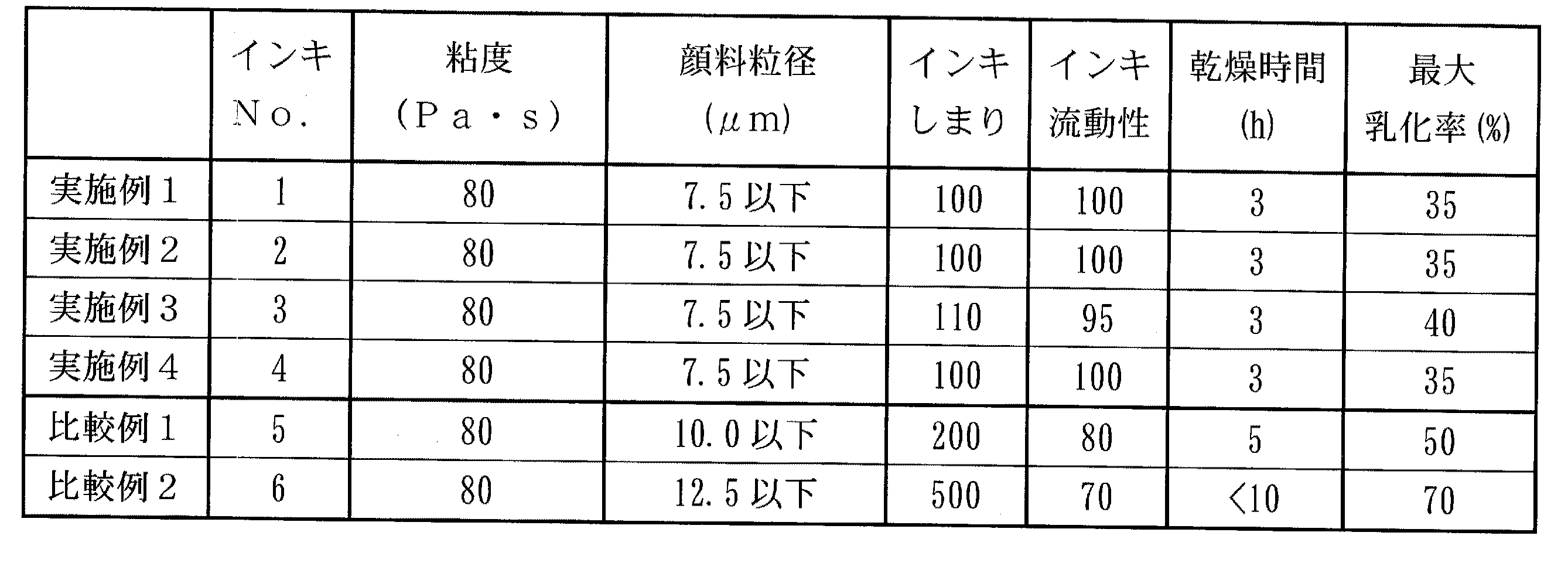
(評価結果)
上記実施例および比較例それぞれのインキについて、下記の粘度、分散性、インキしまり、インキ流動性、乾燥性および乳化適性について評価を実施し、結果を表1に示した。
(Evaluation results)
For the inks of the above Examples and Comparative Examples, the following viscosity, dispersibility, ink crease, ink fluidity, drying property and emulsification ability were evaluated, and the results are shown in Table 1.
<粘度の測定方法>
Thermo Haake社製粘度計のHAAKE RheoStress 600を用いて測定する。(測定条件:25℃、コーン径20mm、角度5°ずり速度120/sec )。
<Measurement method of viscosity>
Measure using a HAAKE RheoStress 600 viscometer from Thermo Haake. (Measurement conditions: 25 ° C., cone diameter 20 mm, angle 5 ° shear rate 120 / sec).
<分散性の評価方法>
それぞれのインキについてグラインドメーター(粒ゲージ)にてGRを測定し、インキ中に含まれる顔料粒子がどの程度の大きさであるか判断する。顔料粒子が小さいほど、同じ機械的エネルギーを与えた際に、より容易に顔料が分散され得ることを示す。
<Dispersibility evaluation method>
About each ink, GR is measured with a grind meter (granular gauge), and it is judged how big the pigment particle contained in ink is. Smaller pigment particles indicate that pigments can be more easily dispersed when given the same mechanical energy.
<インキしまりの評価方法>
レオメトリックス社レオメーターDynamic Analyzer RDA-3を用いて、Dynamic Time Sweep Modeにて、貯蔵弾性率G’の経時変化を測定、このとき6分と60分のG’の比(G’[60分]/G’[6分])を求める。この比率が高い程、インキ中に蓄えられるエネルギーが多くなりインキがしまりやすい、即ち分散安定性に劣るということになる。なお、インキ1の値を100とした場合の値を表示する。
<Evaluation method of ink seal>
Rheometrics Rheometer Dynamic Analyzer RDA-3 is used to measure the change in storage elastic modulus G 'over time in Dynamic Time Sweep Mode. At this time, the ratio of G' to 6 minutes and G '(G' [60 minutes ] / G '[6 minutes]). The higher this ratio is, the more energy is stored in the ink and the more easily the ink is tight, that is, the dispersion stability is poor. In addition, the value when the value of ink 1 is 100 is displayed.
<スプレッドメーターによるインキ流動性の評価方法>
スプレッドメーターに一定容量の試験インキを測り盛り、測定開始後1分後にインキが流動した中心からの距離を計測する。測定値の大きいものを流動性が高いと判定する。なお、実施例1で得られたインキ1の測定値を100とした場合の値を表示する。
<Evaluation method of ink fluidity by spread meter>
Measure a certain amount of test ink in a spread meter, and measure the distance from the center where the ink has flowed one minute after the start of the measurement. A sample having a large measured value is determined to have high fluidity. In addition, the value when the measured value of the ink 1 obtained in Example 1 is set to 100 is displayed.
<乾燥性の評価方法>
インキをRIテスターにてアート紙に展色し、朝陽会乾燥試験機にて乾燥時間を評価する。乾燥に要する時間が短いものほど乾燥性に優れていることを示す。
<Drying evaluation method>
The ink is developed on art paper with an RI tester, and the drying time is evaluated with a Chaoyang drying tester. The shorter the time required for drying, the better the drying property.
<乳化適性の評価方法>
一定量のインキに水を一定速度で滴下しながら攪拌・混合する。水の滴下を続けると、インキがそれ以上乳化することができず、水と乳化インキの層に分かれるようになる。この、インキがそれ以上乳化することができなくなった際のインキの乳化率を最大乳化率と定義する。インキの最大乳化率が50%以上となるインキは、実印刷機上で汚れなど印刷トラブルが発生しやすくなるため、乳化適性の劣るインキと判断される。
<Evaluation method of emulsification suitability>
Stir and mix while dropping water at a constant speed into a certain amount of ink. If the dripping of water is continued, the ink cannot be emulsified any more and the water and emulsified ink layers are separated. The emulsification rate of the ink when the ink can no longer be emulsified is defined as the maximum emulsification rate. An ink having a maximum emulsification rate of 50% or more is likely to cause a printing trouble such as a stain on an actual printing machine, and thus is determined to be an ink having poor emulsification ability.
粗製銅フタロシアニンを乾式粉砕する方法でも酸化による経時変化のない高品位のβ型銅フタロシアニン顔料組成物を得ることができ、またこの顔料組成物を用いて平版印刷インキを生産することで、分散性劣化、乾燥性劣化、乳化適性の劣化のない、高品位のインキを安定して供給することが可能となる。 A high quality β-type copper phthalocyanine pigment composition that does not change over time due to oxidation can be obtained even by dry pulverization of crude copper phthalocyanine, and by using this pigment composition to produce lithographic printing ink, dispersibility It is possible to stably supply high-quality ink that does not deteriorate, dryness, and emulsification ability.
Claims (5)
樹脂が、粗製銅フタロシアニンに対して、1〜200重量%
であり、かつ
酸化防止剤が、粗製銅フタロシアニンに対して、0.01〜3重量%
であることを特徴とする顔料組成物の製造方法。 A method for producing a pigment composition comprising dry pulverizing crude copper phthalocyanine, a resin and an antioxidant under a deoxygenated atmosphere,
1 to 200% by weight of resin based on crude copper phthalocyanine
And the antioxidant is 0.01 to 3% by weight based on the crude copper phthalocyanine
A method for producing a pigment composition, wherein
A lithographic printing ink comprising the pigment composition according to claim 4.
Priority Applications (1)
| Application Number | Priority Date | Filing Date | Title |
|---|---|---|---|
| JP2011075891A JP2012207191A (en) | 2011-03-30 | 2011-03-30 | Method of manufacturing pigment composition, and pigment composition manufactured by the manufacturing method |
Applications Claiming Priority (1)
| Application Number | Priority Date | Filing Date | Title |
|---|---|---|---|
| JP2011075891A JP2012207191A (en) | 2011-03-30 | 2011-03-30 | Method of manufacturing pigment composition, and pigment composition manufactured by the manufacturing method |
Publications (1)
| Publication Number | Publication Date |
|---|---|
| JP2012207191A true JP2012207191A (en) | 2012-10-25 |
Family
ID=47187210
Family Applications (1)
| Application Number | Title | Priority Date | Filing Date |
|---|---|---|---|
| JP2011075891A Withdrawn JP2012207191A (en) | 2011-03-30 | 2011-03-30 | Method of manufacturing pigment composition, and pigment composition manufactured by the manufacturing method |
Country Status (1)
| Country | Link |
|---|---|
| JP (1) | JP2012207191A (en) |
-
2011
- 2011-03-30 JP JP2011075891A patent/JP2012207191A/en not_active Withdrawn
Similar Documents
| Publication | Publication Date | Title |
|---|---|---|
| CN1232247C (en) | Process for producing printing oil ink | |
| US8754148B2 (en) | Pigment composition for printing ink, method for producing the same and method for producing printing ink | |
| KR100257627B1 (en) | Process for preparing pigment composition, pigment composition and use thereof | |
| CN107429077B (en) | Process for producing quinacridone pigment composition | |
| JPWO2006109430A1 (en) | Method for producing ink composition for offset printing and ink composition for offset printing obtained from the production method | |
| JP2014094971A (en) | Production of pigment composition and planographic printing ink manufactured by using this pigment composition | |
| JP5534325B2 (en) | Method for producing copper phthalocyanine pigment composition and method for producing printing ink | |
| JP4123416B2 (en) | Manufacturing method of printing ink | |
| KR102313716B1 (en) | intaglio ink for improving printability and usability and method for preparing the same | |
| JP5002887B2 (en) | Printing ink | |
| JP5759249B2 (en) | Method for producing ink composition for offset printing | |
| US7780775B2 (en) | Process for the preparation of a novel pigmented composition for use in offset inks | |
| JP2006282774A (en) | Printing ink and printed matter using the same | |
| JP2006096923A (en) | Method for producing pigment composition and printing ink using the same | |
| JP2008280512A (en) | Method for producing base ink for planographic printing ink, base ink for planographic printing ink obtained by the production method, and planographic printing ink using the base ink for planographic printing ink | |
| JP2007186643A (en) | Printing ink | |
| JP2006206804A (en) | Printing ink | |
| JP2006096921A (en) | Method for producing pigment composition and printing ink using the same | |
| CN110591411A (en) | Preparation method of carbazole di-dumb-oxazine organic pigment | |
| JP4362887B2 (en) | Disazo pigment additive and pigment composition | |
| JP3470558B2 (en) | Production method of offset printing ink | |
| JP2009155582A (en) | Method for producing base ink for planographic printing ink, base ink for planographic printing ink obtained by the production method, and planographic printing ink using the base ink for planographic printing ink | |
| JPS63230776A (en) | Manufacture of particulate coloring agent | |
| JPS63275668A (en) | Production of pigment having excellent dispersibility | |
| JPH1135841A (en) | Method for producing pigment composition, pigment composition and use thereof |
Legal Events
| Date | Code | Title | Description |
|---|---|---|---|
| A300 | Withdrawal of application because of no request for examination |
Free format text: JAPANESE INTERMEDIATE CODE: A300 Effective date: 20140603 |