JP2012252995A - Metal air secondary battery - Google Patents
Metal air secondary battery Download PDFInfo
- Publication number
- JP2012252995A JP2012252995A JP2011178515A JP2011178515A JP2012252995A JP 2012252995 A JP2012252995 A JP 2012252995A JP 2011178515 A JP2011178515 A JP 2011178515A JP 2011178515 A JP2011178515 A JP 2011178515A JP 2012252995 A JP2012252995 A JP 2012252995A
- Authority
- JP
- Japan
- Prior art keywords
- metal
- secondary battery
- air secondary
- electrode material
- positive electrode
- Prior art date
- Legal status (The legal status is an assumption and is not a legal conclusion. Google has not performed a legal analysis and makes no representation as to the accuracy of the status listed.)
- Withdrawn
Links
Images

Classifications
-
- Y—GENERAL TAGGING OF NEW TECHNOLOGICAL DEVELOPMENTS; GENERAL TAGGING OF CROSS-SECTIONAL TECHNOLOGIES SPANNING OVER SEVERAL SECTIONS OF THE IPC; TECHNICAL SUBJECTS COVERED BY FORMER USPC CROSS-REFERENCE ART COLLECTIONS [XRACs] AND DIGESTS
- Y02—TECHNOLOGIES OR APPLICATIONS FOR MITIGATION OR ADAPTATION AGAINST CLIMATE CHANGE
- Y02E—REDUCTION OF GREENHOUSE GAS [GHG] EMISSIONS, RELATED TO ENERGY GENERATION, TRANSMISSION OR DISTRIBUTION
- Y02E60/00—Enabling technologies; Technologies with a potential or indirect contribution to GHG emissions mitigation
- Y02E60/10—Energy storage using batteries
Landscapes
- Catalysts (AREA)
- Inert Electrodes (AREA)
- Hybrid Cells (AREA)
Abstract
【課題】良好なサイクル特性を得ることを可能にする金属空気二次電池を提供することを目的とする。
【解決手段】本発明は、金属イオンを吸蔵・放出する負極材と、酸素を活物質とする正極材と、前記負極材と前記正極材の間に設置された電解質膜を有する金属空気二次電池において、正極材の一部に、酸素還元と酸素発生の両機能を備える触媒として、粒径が1nm〜30nmの金属粒子または金属酸化物粒子を用いており、1nm〜1μmの細孔径分布において、2nm〜30nmのみに極大細孔径を有する炭素材料を、金属空気二次電池の正極に用いることにより、上記課題を解決する。
【選択図】図6An object of the present invention is to provide a metal-air secondary battery capable of obtaining good cycle characteristics.
The present invention relates to a metal air secondary having a negative electrode material that absorbs and releases metal ions, a positive electrode material that uses oxygen as an active material, and an electrolyte membrane that is disposed between the negative electrode material and the positive electrode material. In the battery, a metal particle or metal oxide particle having a particle size of 1 nm to 30 nm is used as a catalyst having both functions of oxygen reduction and oxygen generation in a part of the positive electrode material, and in a pore size distribution of 1 nm to 1 μm. The above-mentioned problems are solved by using a carbon material having a maximum pore diameter only in 2 nm to 30 nm for the positive electrode of the metal-air secondary battery.
[Selection] Figure 6
Description
本発明は負極に金属,正極活物質として空気または酸素を用いた金属空気二次電池に関するものであり、更に詳細にはサイクル特性の向上を目的として、触媒の粒径と、導電剤または触媒担体の炭素材料に関するものである。 The present invention relates to a metal-air secondary battery using a metal as a negative electrode and air or oxygen as a positive electrode active material, and more specifically, for the purpose of improving cycle characteristics, the particle size of a catalyst, a conductive agent or a catalyst carrier. This is related to the carbon material.
近年、環境保護と省エネルギー化の意識の高まりから、自動車業界においては、従来のガソリンを燃料とした自動車に代わって、駆動源としてガソリンエンジンと、電気で駆動するモータを併用するハイブリッド電気自動車(HEV)や、モータのみで動く電気自動車(EV)の開発競争が激化している。電気エネルギーの供給源である蓄電池の特性は、これらの自動車の性能を大きく左右する。鉛電池やニッケル水素二次電池に比べリチウムイオン二次電池は、その軽量,高出力という特徴から、上記の自動車の蓄電池としての利用が、最も期待されている。しかし、その重量エネルギー密度は、250〜300Wh/kgが理論的上限と考えられている。電気自動車の本格的な普及には、約500Wh/kgの重量エネルギー密度が必要であると言われており、現在、蓄電池の研究開発の中心であるリチウムイオン二次電池とは、作動原理が全く異なり、より大きな重量エネルギー密度が期待できる革新型電池の開発が求められている。リチウムイオン二次電池の重量エネルギー密度を制約している要因の一つとして、コバルト酸リチウムに代表される含リチウム遷移金属酸化物の正極材料がある。その構成元素である遷移金属元素は、重金属であるため、蓄電池として組み込むと重量が増加し、結果として重量エネルギー密度が小さくなってしまう。そこで、正極材料に大気中の酸素を利用し、負極材料に金属を利用する金属空気電池が注目されている。さらに、電力貯蔵用途としても、重量低減によるコスト低減を見込めるため、金属空気電池に対する期待が高まっている。例えば、負極活物質として金属リチウムを用いたリチウム空気二次電池では、以下の反応原理により、電池としての機能を発現する。 In recent years, due to the growing awareness of environmental protection and energy saving, in the automobile industry, instead of conventional gasoline fueled vehicles, hybrid electric vehicles (HEV) that use a gasoline engine as a drive source and a motor driven by electricity. ) And development competition for electric vehicles (EVs) that run only on motors is intensifying. The characteristics of storage batteries, which are sources of electrical energy, greatly affect the performance of these vehicles. Compared to lead batteries and nickel metal hydride secondary batteries, lithium ion secondary batteries are most expected to be used as storage batteries for automobiles because of their light weight and high output. However, the weight energy density is considered to be a theoretical upper limit of 250 to 300 Wh / kg. It is said that a weight energy density of about 500 Wh / kg is necessary for full-scale diffusion of electric vehicles, and the operating principle is completely different from the lithium ion secondary battery, which is currently the center of research and development of storage batteries. In contrast, there is a need for the development of innovative batteries that can be expected to have a greater weight energy density. One of the factors that limit the weight energy density of a lithium ion secondary battery is a positive electrode material of a lithium-containing transition metal oxide typified by lithium cobaltate. Since the transition metal element which is the constituent element is a heavy metal, when it is incorporated as a storage battery, the weight increases, resulting in a decrease in weight energy density. Therefore, attention has been paid to metal-air batteries that utilize oxygen in the atmosphere as the positive electrode material and metal as the negative electrode material. Furthermore, since it can anticipate the cost reduction by weight reduction also as a power storage use, the expectation with respect to a metal air battery is increasing. For example, in a lithium-air secondary battery using metallic lithium as the negative electrode active material, the function as a battery is expressed by the following reaction principle.
(放電反応)
(負極側)2Li→2Li++2e- …(1) (正極側)O2+2Li++2e-→Li2O2 …(2) (全反応)2Li+O2→Li2O2 …(3) (充電反応)
(負極側)2Li←2Li++2e- …(4) (正極側)O2+2Li++2e-←Li2O2 …(5) (全反応)2Li+O2←Li2O2 …(6)
(Discharge reaction)
(Negative electrode side) 2Li → 2Li + + 2e − (1) (Positive electrode side) O 2 + 2Li + + 2e − → Li 2 O 2 (2) (All reactions) 2Li + O 2 → Li 2 O 2 (3) (Charging) reaction)
(Negative electrode side) 2Li ← 2Li + + 2e − (4) (Positive electrode side) O 2 + 2Li + + 2e − ← Li 2 O 2 (5) (All reactions) 2Li + O 2 ← Li 2 O 2 (6)
金属空気電池においては、これまで補聴器電源の亜鉛空気電池に代表されるように、一次電池としての実用化に留まっており、充放電可能な二次電池としての実用化は未だであった。 In the metal-air battery, as represented by a zinc-air battery of a hearing aid power source, the practical use as a secondary battery capable of being charged and discharged has not been achieved yet.
一次電池としての性能、すなわち放電特性と、触媒担体である炭素材料の物理的特性の関係は、特許文献1において報告されている。特許文献1では、アルカリ賦活処理を行った炭素材料を用いて、その放電特性の評価を行っている。アルカリ賦活処理により、炭素材料に無数の細孔が生成し、その結果、2400m2/gを超える比表面積をもつ。この大きな比表面積と、細孔容積、さらに全細孔容積に占める一次細孔容積が大きい程、大きな放電容量が得られたと報告している。しかしながら、充電反応についての言及はなく、上記の特性とサイクル特性、すなわち二次電池特性との関連についての報告はされていない。
The relationship between the performance as a primary battery, that is, the discharge characteristics, and the physical characteristics of the carbon material that is the catalyst carrier is reported in
二次電池化を阻む大きな障害として、充電時において過電圧が大きいことが挙げられる。例えば、非特許文献1では、理論開回路電圧2.96Vに対して、放電電位が2.5〜2.7Vであるものの、充電電位が4.0V以上と高く、充電過電圧が高いことが報告されている。充電過電圧が高いと、不可逆容量も大きくなり、サイクル特性も悪化すると考えられる。
One of the major obstacles preventing the use of secondary batteries is that the overvoltage is large during charging. For example, Non-Patent
これに対して、非特許文献2において、触媒に白金粒子を、触媒担体にカーボンブラックであるVulcanXC72Rを用いた正極材では、VulcanXC72Rの炭素材料単独正極材に比較して、充電過電圧が約0.7V低減し、充電電位が約3.6Vであったと報告している。しかし、本文献は初期サイクルのみの報告であり、2サイクル目以降のサイクル特性についての報告はない。さらに、触媒担体である炭素材料はVulcanXC72Rのみであり、炭素材料の構造的特徴、例えば比表面積や、細孔径分布,細孔容積の差異による二次電池特性の違いについての言及はない。
さらに、特許文献2では、金属空気二次電池の空気極に用いる触媒として、粒径が2〜500nmのペロブスカイト酸化物を用いており、粒径の規定はあるものの、触媒を担持する炭素材料の細孔または細孔径についての記述はない。
On the other hand, in Non-Patent
Furthermore, in
以上により、触媒粒子と触媒担体がどのような構造的特徴を有すれば、金属空気電池のサイクル特性が向上するかについて、明らかになっていないと言える。 From the above, it can be said that it is not clear what structural characteristics the catalyst particles and the catalyst carrier have to improve the cycle characteristics of the metal-air battery.
本発明は負極に金属,正極活物質として空気または酸素を用いた金属空気二次電池において、サイクル特性の向上を目的として、触媒の粒径と同時に、導電剤または触媒担体の炭素材料が有する細孔径を規定するものである。 In the metal-air secondary battery using a metal as a negative electrode and air or oxygen as a positive electrode active material, the present invention aims to improve cycle characteristics, and at the same time as the particle size of the catalyst, the conductive material or the carbon material of the catalyst carrier has a fine particle. It defines the hole diameter.
本発明の目的は負極に金属,正極活物質として空気または酸素を用いた金属空気二次電池において、サイクル特性の向上を実現することである。 An object of the present invention is to realize improvement in cycle characteristics in a metal-air secondary battery using a metal as a negative electrode and air or oxygen as a positive electrode active material.
本発明では、金属イオンを吸蔵・放出する負極材と、酸素を活物質とする正極材と、前記負極材と前記正極材の間に設置された電解質膜を有する金属空気二次電池において、正極材の一部に、酸素還元と酸素発生の両機能を備える触媒として、粒径が1nm〜30nmの金属粒子または金属酸化物粒子を用いており、1nm〜1μmにおける極大細孔径が少なくとも1乃至2つ存在し、且つ2nm〜30nmの範囲に存在する炭素材料を用いることを特徴とする。 In the present invention, in a metal-air secondary battery having a negative electrode material that occludes / releases metal ions, a positive electrode material using oxygen as an active material, and an electrolyte membrane disposed between the negative electrode material and the positive electrode material, A metal particle or metal oxide particle having a particle diameter of 1 nm to 30 nm is used as a catalyst having both functions of oxygen reduction and oxygen generation in a part of the material, and the maximum pore diameter at 1 nm to 1 μm is at least 1 to 2 And a carbon material existing in the range of 2 nm to 30 nm.
本発明では、正極材として、1nm〜1μmにおける極大細孔径が2nm〜30nmの領域に存在し、それ以外の領域における微分細孔容積が、前記極大細孔径の微分細孔容積の70%以下である炭素材料を用いることを特徴とする。 In the present invention, as the positive electrode material, the maximum pore diameter at 1 nm to 1 μm exists in the region of 2 nm to 30 nm, and the differential pore volume in the other region is 70% or less of the differential pore volume of the maximum pore diameter. A certain carbon material is used.
本発明では、前記炭素材料が、導電剤または触媒の担体であることを特徴とする。 In the present invention, the carbon material is a carrier for a conductive agent or a catalyst.
本発明では、窒素吸脱着法と水銀ポロシメータにより求めた細孔径を有する炭素材料を用いることを特徴とする。 The present invention is characterized by using a carbon material having a pore diameter determined by a nitrogen adsorption / desorption method and a mercury porosimeter.
本発明では、酸素還元と酸素発生の両機能を備える触媒として白金微粒子を用いることを特徴とする。 In the present invention, platinum fine particles are used as a catalyst having both functions of oxygen reduction and oxygen generation.
本発明では、3.6nm〜200nmにおける累積細孔容積の、3.6nm〜1μmにおける累積細孔容積に対する割合が70%以上である前記炭素材料を用いることを特徴とする。 In the present invention, the carbon material is used in which the ratio of the cumulative pore volume at 3.6 nm to 200 nm to the cumulative pore volume at 3.6 nm to 1 μm is 70% or more.
本発明では、触媒に白金粒子を用いた場合、2.0V〜4.0Vの範囲において、作動させることを特徴とする。
また、本発明では、金属イオンを吸蔵・放出する負極材と、酸素を活物質とする正極材と、前記負極材と前記正極材の間に設置された電解質膜を有する金属空気二次電池において、正極材は、粒子径が1nm〜500nmの金属粒子または金属酸化物粒子と、1nm〜1μmの細孔径分布において2nm〜30nmの範囲に極大細孔径が存在する炭素材料と、を有することを特徴とする。
In the present invention, when platinum particles are used as the catalyst, the catalyst is operated in the range of 2.0 V to 4.0 V.
Further, in the present invention, in a metal-air secondary battery having a negative electrode material that occludes / releases metal ions, a positive electrode material that uses oxygen as an active material, and an electrolyte membrane disposed between the negative electrode material and the positive electrode material. The positive electrode material includes metal particles or metal oxide particles having a particle diameter of 1 nm to 500 nm, and a carbon material having a maximum pore diameter in the range of 2 nm to 30 nm in a pore diameter distribution of 1 nm to 1 μm. And
本発明によれば、負極に金属,正極活物質として空気または酸素を用いた金属空気二次電池において、導電剤または触媒担体の炭素材料が有する細孔径と、触媒の粒径を規定することでサイクル特性の向上を達成することができる。なお、上記した以外の課題、構成及び効果は、以下の実施形態の説明により明らかにされる。 According to the present invention, in a metal-air secondary battery using a metal for the negative electrode and air or oxygen as the positive electrode active material, the pore diameter of the conductive material or the carbon material of the catalyst carrier and the particle diameter of the catalyst are defined. Improved cycle characteristics can be achieved. Problems, configurations, and effects other than those described above will be clarified by the following description of the embodiments.
本発明は、一定範囲内のみに極大細孔径を有する導電剤または触媒担体の炭素材料と、一定範囲内の粒径をもつ触媒粒子を用いることにより、良好なサイクル特性に寄与する金属空気二次電池であることを特徴とする。 The present invention provides a metal-air secondary material that contributes to good cycle characteristics by using a conductive material or a catalyst carrier carbon material having a maximum pore diameter only within a certain range and catalyst particles having a particle size within a certain range. It is a battery.
本発明では、1nm〜1μmの細孔径分布において、2nm〜30nmのみに極大細孔径を有する炭素材料を、導電剤または触媒担体として用いる。 In the present invention, a carbon material having a maximum pore size of only 2 nm to 30 nm in a pore size distribution of 1 nm to 1 μm is used as a conductive agent or a catalyst carrier.
本発明に用いる金属粒子または金属酸化物粒子は、金属空気二次電池における酸素触媒活性がある物質であればいずれでも構わない。金属では、例えば白金(Pt),金(Au),銀(Ag)などを用いることが可能である。金属酸化物では、二酸化マンガン(MnO2),酸化鉄(FeO,Fe2O3,Fe3O4),酸化コバルト(Co3O4),酸化銀(Ag2O),酸化銅(CuO),ABO3で表わされるペロブスカイト型酸化物,AB2X4で表わされるスピネル型化合物などが可能である。
金属粒子または金属酸化物粒子は、1nm〜500nmの粒子径が望ましく、特に、1nm〜30nmの粒子径が望ましい。粒子径は、透過型電子顕微鏡(TEM)により測定した。本発明に用いる1nm〜30nmの粒子径をもつ金属粒子または金属酸化物粒子を炭素材表面に担持させる方法として、スパッタリング法、蒸着法が挙げられる。特に、白金微粒子については、塩化白金酸(H2PtCl6)を用いた無電解めっき法が有効である。
The metal particles or metal oxide particles used in the present invention may be any substance as long as it has oxygen catalytic activity in a metal-air secondary battery. As the metal, for example, platinum (Pt), gold (Au), silver (Ag), or the like can be used. Among metal oxides, manganese dioxide (MnO 2 ), iron oxide (FeO, Fe 2 O 3 , Fe 3 O 4 ), cobalt oxide (Co 3 O 4 ), silver oxide (Ag 2 O), copper oxide (CuO) Perovskite type oxide represented by ABO 3 , spinel type compound represented by AB 2 X 4 , and the like are possible.
The metal particles or metal oxide particles preferably have a particle diameter of 1 nm to 500 nm, and particularly preferably have a particle diameter of 1 nm to 30 nm. The particle diameter was measured with a transmission electron microscope (TEM). Examples of a method for supporting metal particles or metal oxide particles having a particle diameter of 1 nm to 30 nm on the surface of the carbon material used in the present invention include a sputtering method and a vapor deposition method. In particular, for platinum fine particles, an electroless plating method using chloroplatinic acid (H 2 PtCl 6 ) is effective.
本発明に用いる触媒粒子は、導電剤または触媒担体の炭素材料の表面上に、担持されている構造が、一般的であるが、触媒粒子と上記炭素材料が混合している構造でも構わない。 The catalyst particles used in the present invention generally have a structure that is supported on the surface of a carbon material of a conductive agent or a catalyst carrier, but may have a structure in which catalyst particles and the above carbon material are mixed.
本発明に用いる正極材に含まれる導電剤または担体は、一般に黒鉛,メソフェ−ズ炭素,カーボンブラック,活性炭,非結晶性炭素,炭素繊維,気相成長法炭素繊維,カーボンナノチューブ,ピッチ系炭素質材料,ポリアクリロニトリル系炭素繊維などの導電性を伴う炭素材料であればいずれでも構わない。特に、比表面積が大きい炭素材料を用いることが望ましい。比表面積が大きいと、触媒粒子の分散性が向上し、過電圧の低減とサイクル特性の向上に寄与するからである。比表面積は、1m2/g〜1500m2/g、特に100m2/g〜1500m2/gが望ましい。一次粒子径は、1nm〜100nm、特に1nm〜50nmが望ましい。二次粒子径は、1μm以下であることが望ましい。1μm以上になると、二次粒子間の隙間が細孔として存在する可能性があるからである。ただし、導電剤の役割のみを担う炭素材料については、導電性があれば、細孔径、比表面積に関わらず、用いることができる。
比表面積は、窒素ガス吸脱着法で測定し、粒子径は、透過型電子顕微鏡(TEM)により測定した。一次粒子径及び二次粒子径は、それぞれ平均粒子径であり、粉体の粒径分布において,ある粒子径より大きい個数又は体積が,全粉体のそれの50%をしめるときの粒子径で定義される(D50)。粒子の形状が一様でないため、粒径を粒子の輪郭線上の任意の2点間距離のうち、最大の長さとし、平均粒径は30個から求めた平均値とした。
The conductive agent or carrier contained in the positive electrode material used in the present invention is generally graphite, mesophase carbon, carbon black, activated carbon, amorphous carbon, carbon fiber, vapor grown carbon fiber, carbon nanotube, or pitch-based carbonaceous material. Any carbon material may be used as long as the material is a carbon material with conductivity such as polyacrylonitrile-based carbon fiber. In particular, it is desirable to use a carbon material having a large specific surface area. This is because when the specific surface area is large, the dispersibility of the catalyst particles is improved, which contributes to reduction of overvoltage and improvement of cycle characteristics. Specific surface area, 1m 2 / g~1500m 2 / g , in particular 100m 2 / g~1500m 2 / g is desirable. The primary particle size is preferably 1 nm to 100 nm, particularly 1 nm to 50 nm. The secondary particle diameter is desirably 1 μm or less. This is because if it is 1 μm or more, there is a possibility that gaps between secondary particles exist as pores. However, a carbon material that plays a role of only a conductive agent can be used regardless of pore diameter and specific surface area as long as it has conductivity.
The specific surface area was measured by a nitrogen gas adsorption / desorption method, and the particle diameter was measured by a transmission electron microscope (TEM). The primary particle diameter and the secondary particle diameter are average particle diameters, respectively. In the particle size distribution of the powder, the number or volume larger than a certain particle diameter is 50% of the total powder. Defined (D50). Since the shape of the particles is not uniform, the particle size is the maximum length of any distance between two points on the particle outline, and the average particle size is an average value obtained from 30 particles.
本発明における負極金属としては、リチウムの他に、リチウムとの合金を用いても良い。また、金属空気二次電池として使われる負極金属であればいずれでも構わない。 As the negative electrode metal in the present invention, an alloy with lithium may be used in addition to lithium. Further, any negative electrode metal used as a metal-air secondary battery may be used.
本発明に用いる正極材に含まれる導電剤または担体は、バインダと混合後、スラリーを作製してカーボンペーパに塗布するか、または金属性のフォームに含浸しても構わない。
また混合した粉末をペレット成形して正極材として用いても構わない。
The conductive agent or carrier contained in the positive electrode material used in the present invention may be mixed with a binder, then a slurry is produced and applied to carbon paper, or impregnated in a metallic foam.
The mixed powder may be formed into a pellet and used as a positive electrode material.
本発明に用いる電解液としては、一般的にリチウムイオン二次電池などで用いる非水系電解液を用いることができる。例えばプロピレンカーボネート,エチレンカーボネート,ブチレンカーボネート,ビニレンカーボネート,γ−ブチロラクトン,ジメチルカーボネート,ジエチルカーボネート,メチルエチルカーボネート,1,2−ジメトキシエタン,2−メチルテトラヒドロフラン,ジメチルスルフォキシド,1,3−ジオキソラン,ホルムアミド,ジメチルホルムアミド,プロピオン酸メチル,プロピオン酸エチル,リン酸トリエステル,トリメトキシメタン,ジオキソラン,ジエチルエーテル,スルホラン,3−メチル−2−オキサゾリジノン,テトラヒドロフラン,1,2−ジエトキシエタン,クロルエチレンカーボネート,クロルプロピレンカーボネートより選択された一種類の溶媒または複数の混合物でも構わない。望ましくは、高沸点の環状化合物を用いるのが良い。さらに、エチレンオキシド,アクリロニトリル,フッ化ビニリデン,メタクリル酸メチル,ヘキサフルオロプロピレンなどの高分子に保持させた固体電解質や、イオン液体を、非水電解液の代わりに使用しても良い。 As the electrolytic solution used in the present invention, a non-aqueous electrolytic solution generally used in a lithium ion secondary battery or the like can be used. For example, propylene carbonate, ethylene carbonate, butylene carbonate, vinylene carbonate, γ-butyrolactone, dimethyl carbonate, diethyl carbonate, methyl ethyl carbonate, 1,2-dimethoxyethane, 2-methyltetrahydrofuran, dimethyl sulfoxide, 1,3-dioxolane, Formamide, dimethylformamide, methyl propionate, ethyl propionate, phosphoric acid triester, trimethoxymethane, dioxolane, diethyl ether, sulfolane, 3-methyl-2-oxazolidinone, tetrahydrofuran, 1,2-diethoxyethane, chloroethylene carbonate , One kind of solvent selected from chloropropylene carbonate or a mixture thereof may be used. Desirably, a high boiling point cyclic compound is used. Furthermore, a solid electrolyte held in a polymer such as ethylene oxide, acrylonitrile, vinylidene fluoride, methyl methacrylate, hexafluoropropylene, or an ionic liquid may be used instead of the non-aqueous electrolyte.
本発明に用いる電解質としては、一般的にリチウムイオン二次電池などで用いる電解質を用いることができる。例えば、化学式でLiPF6,LiBF4,LiClO4,LiCF3SO3,LiCF3CO2,LiAsF6,LiSbF6,LiTFSI、あるいはリチウムトリフルオロメタンスルホンイミドで代表されるリチウムのイミド塩などの多種類のリチウム塩などが可能である。
As the electrolyte used in the present invention, an electrolyte generally used in a lithium ion secondary battery or the like can be used. For example, in the formula LiPF 6, LiBF 4, LiClO 4 ,
また、エチレンオキシド,アクリロニトリル,フッ化ビニリデン,メタクリル酸メチル,ヘキサフルオロプロピレンの高分子内に、上述した非水電解液を含浸させたゲル電解質を、使用しても良い。 Moreover, you may use the gel electrolyte which impregnated the nonaqueous electrolyte mentioned above in the polymer of ethylene oxide, acrylonitrile, vinylidene fluoride, methyl methacrylate, and hexafluoropropylene.
本発明に用いる正極材に含まれる結着材としては、一般的にリチウムイオン二次電池などで用いる結着材を用いることができる。例えばポリフッ化ビニリデン(PVDF),ポリテトラフルオロエチレン(PTFE)などのフッ素系樹脂,スチレンブタジエンゴム(SBR)などを用いることが可能である。 As the binder contained in the positive electrode material used in the present invention, a binder generally used in a lithium ion secondary battery or the like can be used. For example, a fluorine resin such as polyvinylidene fluoride (PVDF) or polytetrafluoroethylene (PTFE), styrene butadiene rubber (SBR), or the like can be used.
本発明に用いるセパレータとしては、一般的にリチウムイオン二次電池などで用いるセパレータを用いることができる。例えばポリエチレン,ポリプロピレンなどの多孔質セパレータや、金属イオン導電性を有するガラスセラミックスなどを用いることが可能である。 As a separator used in the present invention, a separator generally used in a lithium ion secondary battery or the like can be used. For example, porous separators such as polyethylene and polypropylene, glass ceramics having metal ion conductivity, and the like can be used.
本発明に用いる集電体は、SUSメッシュの他、ニッケルメッシュ,ステンレスメッシュ,金メッシュなど導電性のある金属性のメッシュであればいずれでも構わない。 The current collector used in the present invention may be any conductive metallic mesh such as nickel mesh, stainless steel mesh, and gold mesh in addition to the SUS mesh.
本発明に用いるセルの形体は、金属空気電池反応が確認できるものであれば、スエジロック型,平板型,円筒型などのいずれでも構わない。すなわち本発明は、セルの形体に依存しない。 The shape of the cell used in the present invention may be any of swedilock type, flat plate type, cylindrical type, etc. as long as the metal-air battery reaction can be confirmed. That is, the present invention does not depend on the shape of the cell.
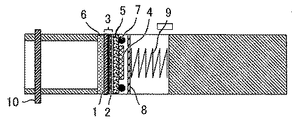
図1に本発明の実施例による金属空気二次電池を示す。以下、負極として金属リチウムを用い、電解液として非水溶媒を用いたリチウム空気二次電池について説明する。 FIG. 1 shows a metal-air secondary battery according to an embodiment of the present invention. Hereinafter, a lithium-air secondary battery using metallic lithium as the negative electrode and a nonaqueous solvent as the electrolytic solution will be described.
以下、本発明の好ましい実施形態を詳細に説明する。実施例に相当する炭素材料の一例として、1nm〜1μmの範囲において、2nm〜30nmのみに極大細孔径を有するカーボンAを用いた。実施例1、2は、担体である炭素材の細孔径のみの規定であり、実施例3は、炭素材の細孔径に加えて、触媒の粒径を規定したものである。 Hereinafter, preferred embodiments of the present invention will be described in detail. As an example of the carbon material corresponding to the examples, carbon A having a maximum pore diameter of only 2 nm to 30 nm was used in the range of 1 nm to 1 μm. Examples 1 and 2 specify only the pore diameter of the carbon material as a support, and Example 3 defines the particle diameter of the catalyst in addition to the pore diameter of the carbon material.
本実施例においては、スエジロック型セルのリチウム空気二次電池を作製した。図1に、スエジロック型セルの模式図を示す。セルの組み立ては、グローブボックス内で行った。 In this example, a lithium air secondary battery of a swedilock type cell was produced. FIG. 1 shows a schematic diagram of a swedilock type cell. The cell was assembled in a glove box.
厚さ370μm,直径12mmのカーボンペーパ1には、白金微粒子,カーボンAとバインダであるポリフッ化ビニリデン(PVDF)の複合材(カーボン塗布層2)が塗布してある。これをカーボンペーパ正極材3とした。カーボンペーパ正極材3と負極のリチウム金属4は、ポリエチレン製セパレータ5により絶縁した。負極のリチウム金属4は、直径8mm,厚さ1mmにくり抜いたものを使用した。ポリエチレン製セパレータ5は、直径14mmにくり抜いたものを使用した。リチウム金属4の表面と、カーボン塗布層2の表面に、電解液を数滴滴下し、ポリエチレン製セパレータ5に含浸した。電解液は、電解質である1M LiTFSIを含んだエチレンカーボネート(EC)/ジエチルカーボネート(DEC)=3/7を用いた。カーボンペーパ1の反対側には、厚さ1mmのSUS製メッシュ(100メッシュ)からなる集電体6を配置した。リチウム金属の周りにOリング7を配置し、リチウム金属4の後ろから、押さえ板8をあて、その後ろに絞め付けバネ9をおいた。これにより、リチウム金属4−セパレータ5−カーボンペーパ正極材3が密着される構造となる。次に、集電体6の外部から酸素ガス(99.9%)を流量500ml/分でセル内部に流した。約60分酸素ガスを流し、セルに付けた酸素封入弁10を閉じ、セル内部に酸素ガスを封入した。
A
次に、正極の作製方法を詳述する。カーボンA50重量部と、白金微粒子(平均粒径5nm)40重量部,ポリフッ化ビニリデン(PVDF)40重量部,少量のN−メチル−2−ピロリドン(NMP)をメノウ乳鉢に添加し、良くかき混ぜた。生成したスラリー液を、φ12mmのPTFE処理済みのカーボンペーパに塗布し、大気中80℃、1時間乾燥後、さらに真空中120℃、3時間乾燥を行い、カーボンペーパ正極材3とした。
Next, a method for producing the positive electrode will be described in detail. 50 parts by weight of carbon A, 40 parts by weight of platinum fine particles (
上記正極材を組み込んで、作製したセルを端子付きデシケータにいれ、デシケータ内部にアルゴンガスを封入した。デシケータの外側端子を充放電評価装置にとりつけ、セルの充放電評価を実施した。充放電条件は、放電:CC 0.1mA/cm2 2.0Vカットオフ、充電:CC 0.1mA/cm2 4.0Vカットオフ、休止時間は充放電後それぞれ1時間とし、10サイクル試験を行った。
The positive electrode material was incorporated, and the produced cell was placed in a desiccator with a terminal, and argon gas was sealed inside the desiccator. The outer terminal of the desiccator was attached to a charge / discharge evaluation apparatus, and the charge / discharge evaluation of the cell was performed. The charge / discharge conditions are: discharge: CC 0.1 mA / cm 2 2.0 V cut-off, charge: CC 0.1 mA / cm 2 4.0 V cut-off,
〔比較例1〜4〕
実施例1において、正極材の担体であるカーボンAに替えて、カーボンB,カーボンC,カーボンD,VulcanXC72R、のいずれかを用いた以外は同様である。
[Comparative Examples 1-4]
In Example 1, it replaces with carbon A which is a support | carrier of a positive electrode material, and is the same except having used any of carbon B, carbon C, carbon D, and VulcanXC72R.
実施例1において、触媒である白金微粒子に替えて、電解二酸化マンガン粒子(平均粒径3μm)を用いた以外は同様である。 In Example 1, it replaces with the platinum fine particle which is a catalyst, and is the same except having used the electrolytic manganese dioxide particle (average particle diameter of 3 micrometers).
〔比較例5〕
実施例2において、正極材の担体であるカーボンAに替えて、カーボンCを用いた以外は同様である。
[Comparative Example 5]
In Example 2, it is the same except that carbon C is used instead of carbon A which is a carrier of the positive electrode material.
(細孔径分布の測定)
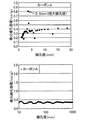
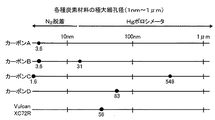
まず、1〜20nmの範囲は窒素ガス吸脱着法を用いて、20nm〜1μmの範囲は水銀ポロシメータを用いることにより、各種担体である炭素材料の細孔径分布を調べた。窒素ガス吸脱着法による測定では、脱着のデータを採用した。表1に、各種炭素材料の比表面積,細孔径分布において極大値を示した細孔径と微分細孔容積,一定の細孔径範囲における累積細孔容積を示す。また、図2に、カーボンAの細孔径分布を示す。二次粒子間の隙間を除くため、1μm以上の細孔径は除外した。この細孔径分布に示すように、カーボンAは3.6nmに極大細孔径を有し、その微分細孔容積は0.81cc/gである。この細孔径以外の領域においては、0.41cc/g以下であり、前記微分細孔容積の70%以下である。このため、カーボンAは、より優先して2〜30nmの領域に細孔が多い材料である。
(Measurement of pore size distribution)
First, the pore size distribution of carbon materials as various carriers was examined by using a nitrogen gas adsorption / desorption method in the range of 1 to 20 nm and using a mercury porosimeter in the range of 20 nm to 1 μm. Desorption data was used in the measurement by the nitrogen gas adsorption / desorption method. Table 1 shows the pore size and differential pore volume that showed maximum values in the specific surface area and pore size distribution of various carbon materials, and the cumulative pore volume in a certain pore diameter range. FIG. 2 shows the pore size distribution of carbon A. In order to remove gaps between secondary particles, pore diameters of 1 μm or more were excluded. As shown in this pore size distribution, carbon A has a maximum pore size of 3.6 nm, and its differential pore volume is 0.81 cc / g. In a region other than the pore diameter, it is 0.41 cc / g or less, and 70% or less of the differential pore volume. For this reason, carbon A is a material having many pores in the region of 2 to 30 nm with higher priority.
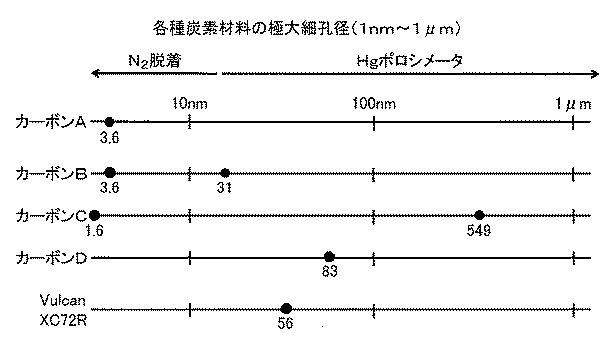
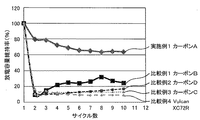
図3に、実施例1と比較例1〜4の放電容量維持率の結果を、表2に初回サイクルのR値を示す。ここで、R値とは(充電容量/放電容量)×100(%)で定義される値であり、リチウムイオン二次電池における充放電効率に相当する。 FIG. 3 shows the results of the discharge capacity retention rates of Example 1 and Comparative Examples 1 to 4, and Table 2 shows the R value of the first cycle. Here, the R value is a value defined by (charge capacity / discharge capacity) × 100 (%), and corresponds to the charge / discharge efficiency in the lithium ion secondary battery.
カーボンAを用いると、2サイクル目の放電容量維持率は約80%であり、その後も良好なサイクル特性が得られた。その初期サイクルのR値は65%であった。一方、それ以外の炭素材料を用いた場合には、2サイクル目の放電容量維持率は約20%以下、初期サイクルのR値もVulcanXC72Rを除くと20%以下と低く、カーボンAを用いた時と比較して、サイクル特性が良くないことがわかった。カーボンAは1nm〜1μmの細孔径分布において、2〜30nmのみに極大細孔径を有するため、放電生成物であるリチウム酸化物(Li2O,Li2O2)が細かく分散する。また、3.6nm〜200nmにおける累積細孔容積が、3.6nm〜1μmにおける累積細孔容積の70%以上を占めるため、細かいリチウム酸化物の生成量も多くなる。これらの細かいリチウム酸化物は、充電反応において分解され易いため、サイクル特性が向上したと考えられる。一方、それ以外の炭素材料では、細孔径が30nm以上の大きな細孔を有するため、放電反応において、粗大化したリチウム酸化物が生成する。このリチウム酸化物は絶縁物であるため、充電反応において、これらを分解するために多大なエネルギーを要し、分解されないリチウム酸化物が残存すると考えられる。この原因のため、サイクル特性が悪化したと考えられる。 When carbon A was used, the discharge capacity retention rate at the second cycle was about 80%, and good cycle characteristics were obtained thereafter. The R value of the initial cycle was 65%. On the other hand, when other carbon materials are used, the discharge capacity maintenance rate in the second cycle is about 20% or less, and the R value in the initial cycle is also as low as 20% or less excluding VulcanXC72R. It was found that the cycle characteristics were not good compared with. Since carbon A has a maximum pore size of only 2 to 30 nm in a pore size distribution of 1 nm to 1 μm, lithium oxide (Li 2 O, Li 2 O 2 ), which is a discharge product, is finely dispersed. Further, since the cumulative pore volume at 3.6 nm to 200 nm occupies 70% or more of the cumulative pore volume at 3.6 nm to 1 μm, the amount of fine lithium oxide produced is also increased. Since these fine lithium oxides are easily decomposed in the charging reaction, it is considered that the cycle characteristics are improved. On the other hand, since other carbon materials have large pores having a pore diameter of 30 nm or more, coarse lithium oxide is generated in the discharge reaction. Since this lithium oxide is an insulator, it is considered that a large amount of energy is required to decompose these in the charging reaction, and lithium oxide that is not decomposed remains. For this reason, it is considered that the cycle characteristics deteriorated.
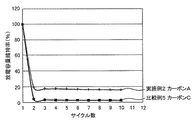
次に、図4に、実施例2と比較例5の放電容量維持率の結果を示す。触媒である二酸化マンガン粒子の平均粒径は3μmであり、図3の白金微粒子程には粒径が細かくないため、粒子が粗大化していると思われる。しかしながら、二酸化マンガンを用いても、実施例2にあるカーボンAの方が、比較例5にあるカーボンCよりもサイクル特性が良い。尚、二酸化マンガンの粒径を1nm〜30nmにすれば、実施例2よりもさらに良好な結果が得られると期待される。従って、触媒の種類,触媒の粒径に関わらず、カーボンAの有効性が証明された。以上により、2nm〜30nmの範囲にのみに、極大細孔径を有する炭素材料を担体に用いることにより、サイクル特性を向上することができる。なお、極大細孔径の数は、1個に限定されるものではなく、上記範囲内に複数存在してもよい。 Next, FIG. 4 shows the results of the discharge capacity retention rates of Example 2 and Comparative Example 5. The average particle size of the manganese dioxide particles as the catalyst is 3 μm, and the particle size is not as fine as that of the platinum fine particles in FIG. However, even if manganese dioxide is used, the carbon A in Example 2 has better cycle characteristics than the carbon C in Comparative Example 5. In addition, if the particle diameter of manganese dioxide is set to 1 nm to 30 nm, it is expected that a better result than Example 2 can be obtained. Therefore, the effectiveness of carbon A was proved regardless of the type of catalyst and the particle size of the catalyst. As described above, the cycle characteristics can be improved by using the carbon material having the maximum pore diameter only in the range of 2 nm to 30 nm as the carrier. The number of maximum pore diameters is not limited to one, and a plurality of maximum pore diameters may exist within the above range.
実施例1、2において、触媒粒径の規定はなかった。透過型電子顕微鏡により触媒である白金粒子を観察したところ、数ナノメートルの微粒子と同時に、100nm以上の粗大粒子も見つかった。そこで、以下のような無電解めっき法を用いることにより、粒径数nmの白金微粒子のみを炭素材表面に担持させた。
1Lビーカーに、カーボンA 1gと純水(イオン交換水)600ccを混合し、超音波を加えながら約30分撹拌した。その後、撹拌しながら、塩化白金酸(H2PtCl6)溶液3.55gを少しずつ添加し、さらに1時間撹拌した。次に、錯化剤であるL−酒石酸0.077gと還元剤である次亜リン酸(H3PO2)1.35gを添加し、1M NaOH水溶液により、PHを4付近に調整した。その後、純水を加えて、全溶液量を500mlにしてから、90℃のウォーターバスに投入し、溶液の温度を90℃に昇温した。そのまま、溶液の温度を90℃に保ちながら、撹拌を4時間続けた。塩化白金酸(H2PtCl6)の還元に伴い、PHが低下するため、1M NaOH水溶液を添加することにより、溶液のPHを4付近に維持した。塩化白金酸(H2PtCl6)が完全に消滅し、反応が終了したら、溶液をろ過し、純水(200ml/回)による洗浄、ろ過を5回以上繰り返した。洗浄後の作製サンプルは、恒温槽にて大気中、80℃で12時間乾燥させた。乾燥後のサンプルは、乳鉢にて粉砕してから、電極作製用に用いた。透過型電子顕微鏡による観察により、カーボンAに担持された白金微粒子の粒径は1nm〜3nmであった。電極作製方法は、実施例1と同様である。
In Examples 1 and 2, the catalyst particle size was not specified. Observation of platinum particles as a catalyst with a transmission electron microscope revealed coarse particles of 100 nm or more simultaneously with fine particles of several nanometers. Therefore, by using the following electroless plating method, only platinum fine particles having a particle diameter of several nm were supported on the carbon material surface.
In a 1 L beaker, 1 g of carbon A and 600 cc of pure water (ion exchange water) were mixed and stirred for about 30 minutes while applying ultrasonic waves. Thereafter, 3.55 g of chloroplatinic acid (H 2 PtCl 6 ) solution was added little by little with stirring, and the mixture was further stirred for 1 hour. Next, 0.077 g of L-tartaric acid as a complexing agent and 1.35 g of hypophosphorous acid (H 3 PO 2 ) as a reducing agent were added, and the pH was adjusted to around 4 with a 1M NaOH aqueous solution. Thereafter, pure water was added to bring the total solution amount to 500 ml, and the solution was then poured into a 90 ° C. water bath to raise the temperature of the solution to 90 ° C. The stirring was continued for 4 hours while keeping the temperature of the solution at 90 ° C. Since PH decreased with the reduction of chloroplatinic acid (H 2 PtCl 6 ), the pH of the solution was maintained at around 4 by adding 1 M NaOH aqueous solution. When chloroplatinic acid (H 2 PtCl 6 ) completely disappeared and the reaction was completed, the solution was filtered, washed with pure water (200 ml / times), and filtered five times or more. The prepared sample after washing was dried at 80 ° C. for 12 hours in the air in a thermostatic bath. The dried sample was pulverized in a mortar and then used for electrode preparation. As a result of observation with a transmission electron microscope, the particle size of the platinum fine particles supported on the carbon A was 1 nm to 3 nm. The electrode manufacturing method is the same as in Example 1.
〔参考例1〕
実施例1における10サイクルまでのR値を参考例とする。
図6に、実施例3と参考例のR値の推移を示す。実施例3では、参考例に比べて、触媒である白金粒子の粒径が、さらに小さくなったことにより、放電反応に伴って白金粒子表面に生成するリチウム酸化物も、微粒子化される。さらに、白金粒子の微粒子化と同時に、2nm〜30nmの範囲内にある炭素材の細孔径のために、サイクル経過に伴う白金粒子の粗大化も抑制されると考えられる。透過型電子顕微鏡による観察の結果、30サイクル経過後の白金粒子の粒径は、最大30nmであった。以上の効果により、充電反応におけるリチウム酸化物の分解が、円滑に進行するようになった結果、充放電効率に相当するR値の向上につながったと推察される。
[Reference Example 1]
The R value up to 10 cycles in Example 1 is used as a reference example.
FIG. 6 shows the transition of the R value between Example 3 and the reference example. In Example 3, as compared with the reference example, the particle diameter of the platinum particles as the catalyst is further reduced, so that the lithium oxide generated on the surface of the platinum particles along with the discharge reaction is also made fine. Furthermore, it is considered that the coarsening of the platinum particles with the progress of the cycle is suppressed due to the pore diameter of the carbon material in the range of 2 nm to 30 nm simultaneously with the micronization of the platinum particles. As a result of observation with a transmission electron microscope, the maximum particle size of the platinum particles after 30 cycles was 30 nm. As a result of the above effects, it is speculated that the decomposition of lithium oxide in the charging reaction proceeded smoothly, resulting in an improvement in the R value corresponding to the charge / discharge efficiency.
上述のように、本発明では、金属イオンを吸蔵・放出する負極材と、酸素を活物質とする正極材と、前記負極材と前記正極材の間に設置された電解質膜を有する金属空気二次電池において、正極材は、粒子径が1nm〜500nmの金属粒子または金属酸化物粒子と、1nm〜1μmの細孔径分布において2nm〜30nmの範囲に極大細孔径が存在する炭素材料と、を有することを特徴とする。
本発明によれば、金属粒子又は金属酸化物粒子の粒子径と、炭素材料の細孔径を、上記範囲に規定した正極材を、金属空気二次電池に用いることで、サイクル特性の向上を達成することができる。
なお、炭素材料の極大細孔径は1つに限定されるものではなく、複数存在してもよい。
As described above, according to the present invention, the negative electrode material that occludes / releases metal ions, the positive electrode material that uses oxygen as an active material, and the metal air having the electrolyte membrane disposed between the negative electrode material and the positive electrode material. In the secondary battery, the positive electrode material includes metal particles or metal oxide particles having a particle diameter of 1 nm to 500 nm, and a carbon material having a maximum pore diameter in the range of 2 nm to 30 nm in a pore diameter distribution of 1 nm to 1 μm. It is characterized by that.
According to the present invention, the positive electrode material in which the particle diameter of the metal particles or metal oxide particles and the pore diameter of the carbon material are defined in the above range is used for the metal-air secondary battery, thereby improving the cycle characteristics. can do.
The maximum pore diameter of the carbon material is not limited to one, and a plurality of carbon materials may exist.
1 カーボンペーパ
2 カーボン塗布層
3 カーボンペーパ正極材
4 負極(リチウム金属)
5 ポリエチレン製セパレータ
6 集電体
7 Oリング
8 押さえ板
9 絞め付けバネ
10 酸素封入弁
DESCRIPTION OF
5
Claims (10)
前記正極材は、
粒子径が1nm〜500nmの金属粒子または金属酸化物粒子と、
1nm〜1μmの細孔径分布において2nm〜30nmの範囲に極大細孔径が存在する炭素材料と、
を有することを特徴とする金属空気二次電池。 In a metal-air secondary battery having a negative electrode material that occludes / releases metal ions, a positive electrode material using oxygen as an active material, and an electrolyte membrane installed between the negative electrode material and the positive electrode material,
The positive electrode material is
Metal particles or metal oxide particles having a particle diameter of 1 nm to 500 nm;
A carbon material having a maximum pore size in the range of 2 nm to 30 nm in a pore size distribution of 1 nm to 1 μm;
A metal-air secondary battery comprising:
Priority Applications (1)
| Application Number | Priority Date | Filing Date | Title |
|---|---|---|---|
| JP2011178515A JP2012252995A (en) | 2011-05-10 | 2011-08-17 | Metal air secondary battery |
Applications Claiming Priority (3)
| Application Number | Priority Date | Filing Date | Title |
|---|---|---|---|
| JP2011104839 | 2011-05-10 | ||
| JP2011104839 | 2011-05-10 | ||
| JP2011178515A JP2012252995A (en) | 2011-05-10 | 2011-08-17 | Metal air secondary battery |
Publications (1)
| Publication Number | Publication Date |
|---|---|
| JP2012252995A true JP2012252995A (en) | 2012-12-20 |
Family
ID=47525611
Family Applications (1)
| Application Number | Title | Priority Date | Filing Date |
|---|---|---|---|
| JP2011178515A Withdrawn JP2012252995A (en) | 2011-05-10 | 2011-08-17 | Metal air secondary battery |
Country Status (1)
| Country | Link |
|---|---|
| JP (1) | JP2012252995A (en) |
Cited By (4)
| Publication number | Priority date | Publication date | Assignee | Title |
|---|---|---|---|---|
| JP2013206723A (en) * | 2012-03-28 | 2013-10-07 | Honda Motor Co Ltd | Secondary battery |
| WO2013179807A1 (en) * | 2012-05-30 | 2013-12-05 | 株式会社 日立製作所 | Metal-air secondary battery |
| JP2017157505A (en) * | 2016-03-04 | 2017-09-07 | 日本電信電話株式会社 | Lithium air secondary battery |
| WO2020235638A1 (en) * | 2019-05-23 | 2020-11-26 | 国立研究開発法人物質・材料研究機構 | Porous carbon structure, manufacturing method therefor, positive electrode material using same, and battery using same |
-
2011
- 2011-08-17 JP JP2011178515A patent/JP2012252995A/en not_active Withdrawn
Cited By (7)
| Publication number | Priority date | Publication date | Assignee | Title |
|---|---|---|---|---|
| JP2013206723A (en) * | 2012-03-28 | 2013-10-07 | Honda Motor Co Ltd | Secondary battery |
| WO2013179807A1 (en) * | 2012-05-30 | 2013-12-05 | 株式会社 日立製作所 | Metal-air secondary battery |
| JP2017157505A (en) * | 2016-03-04 | 2017-09-07 | 日本電信電話株式会社 | Lithium air secondary battery |
| WO2020235638A1 (en) * | 2019-05-23 | 2020-11-26 | 国立研究開発法人物質・材料研究機構 | Porous carbon structure, manufacturing method therefor, positive electrode material using same, and battery using same |
| JPWO2020235638A1 (en) * | 2019-05-23 | 2020-11-26 | ||
| JP7177547B2 (en) | 2019-05-23 | 2022-11-24 | 国立研究開発法人物質・材料研究機構 | Porous carbon structure, manufacturing method thereof, positive electrode material using same, and battery using same |
| US12272826B2 (en) | 2019-05-23 | 2025-04-08 | National Institute For Materials Science | Porous carbon structure, manufacturing method therefor, positive electrode material using same, and battery using same |
Similar Documents
| Publication | Publication Date | Title |
|---|---|---|
| CN102948006B (en) | lithium air battery | |
| US20120115048A1 (en) | Positive electrode for lithium air battery, method of preparing the positive electrode, and lithium air battery including the positive electrode | |
| KR101851317B1 (en) | porous carbonaceous composite material, cathode and lithium air battery comprsing the material, and preparation method thereof | |
| JP5373966B2 (en) | Air electrode and metal air battery | |
| JP5625059B2 (en) | Metal-air secondary battery | |
| KR101484503B1 (en) | Cathode Catalyst for Lithium-Air Battery, Method of Manufacturing the Same, and Lithium-Air Battery Comprising the Same | |
| US20120115047A1 (en) | Positive electrode for lithium air battery, method of preparing the same, and lithium air battery employing the positive electrode | |
| JP5273256B2 (en) | Non-aqueous electrolyte and metal-air battery | |
| JP5580931B2 (en) | Cathode catalyst for metal-air secondary battery and metal-air secondary battery | |
| KR20150020227A (en) | Process for producing a carbon-supported manganese oxide catalyst and its use in rechargeable lithium-air batteries | |
| JP5427661B2 (en) | Metal-air secondary battery | |
| JPWO2016132932A1 (en) | Catalyst for oxygen reduction reaction and air electrode for metal-air secondary battery | |
| US9318783B2 (en) | Positive electrode for lithium air battery, method of preparing same, and lithium air battery including same | |
| KR20160010852A (en) | Lithium air battery, and method of fabricating the same | |
| JP2022076603A (en) | Electrolytic solution for lithium-sulfur secondary battery and lithium-sulfur secondary battery | |
| JP2012252995A (en) | Metal air secondary battery | |
| JP2013118145A (en) | Metal-air secondary battery | |
| WO2020255489A1 (en) | Anode material, anode and battery cell | |
| KR102231210B1 (en) | Positive electrode for lithium air battery, method of preparing the same and lithium air battery including the same | |
| KR20140122003A (en) | Cathode active material for Sodium secondary battery and method for preparing the same | |
| JP2010177036A (en) | Air electrode layer | |
| JP5593169B2 (en) | Metal-air secondary battery | |
| JP2014022210A (en) | Carbon material for metal air secondary battery, positive electrode member for metal air secondary battery including the same, and metal air secondary battery | |
| KR101466397B1 (en) | A cathode electrode of a lithium secondary battery, a production method thereof, and a lithium secondary battery including the cathode electrode | |
| CN113422076B (en) | A fast-charge lithium-air battery with autocatalytic activity |
Legal Events
| Date | Code | Title | Description |
|---|---|---|---|
| A300 | Application deemed to be withdrawn because no request for examination was validly filed |
Free format text: JAPANESE INTERMEDIATE CODE: A300 Effective date: 20141104 |