JP2012502015A - Method for delivering a pharmaceutical composition to a patient in need thereof - Google Patents
Method for delivering a pharmaceutical composition to a patient in need thereof Download PDFInfo
- Publication number
- JP2012502015A JP2012502015A JP2011525623A JP2011525623A JP2012502015A JP 2012502015 A JP2012502015 A JP 2012502015A JP 2011525623 A JP2011525623 A JP 2011525623A JP 2011525623 A JP2011525623 A JP 2011525623A JP 2012502015 A JP2012502015 A JP 2012502015A
- Authority
- JP
- Japan
- Prior art keywords
- dose
- administered
- esomeprazole
- hours
- time
- Prior art date
- Legal status (The legal status is an assumption and is not a legal conclusion. Google has not performed a legal analysis and makes no representation as to the accuracy of the status listed.)
- Pending
Links
Images


Classifications
-
- A—HUMAN NECESSITIES
- A61—MEDICAL OR VETERINARY SCIENCE; HYGIENE
- A61K—PREPARATIONS FOR MEDICAL, DENTAL OR TOILETRY PURPOSES
- A61K31/00—Medicinal preparations containing organic active ingredients
- A61K31/33—Heterocyclic compounds
- A61K31/395—Heterocyclic compounds having nitrogen as a ring hetero atom, e.g. guanethidine or rifamycins
- A61K31/435—Heterocyclic compounds having nitrogen as a ring hetero atom, e.g. guanethidine or rifamycins having six-membered rings with one nitrogen as the only ring hetero atom
- A61K31/44—Non condensed pyridines; Hydrogenated derivatives thereof
-
- A—HUMAN NECESSITIES
- A61—MEDICAL OR VETERINARY SCIENCE; HYGIENE
- A61K—PREPARATIONS FOR MEDICAL, DENTAL OR TOILETRY PURPOSES
- A61K9/00—Medicinal preparations characterised by special physical form
- A61K9/20—Pills, tablets, discs, rods
- A61K9/2072—Pills, tablets, discs, rods characterised by shape, structure or size; Tablets with holes, special break lines or identification marks; Partially coated tablets; Disintegrating flat shaped forms
- A61K9/2086—Layered tablets, e.g. bilayer tablets; Tablets of the type inert core-active coat
- A61K9/209—Layered tablets, e.g. bilayer tablets; Tablets of the type inert core-active coat containing drug in at least two layers or in the core and in at least one outer layer
-
- A—HUMAN NECESSITIES
- A61—MEDICAL OR VETERINARY SCIENCE; HYGIENE
- A61K—PREPARATIONS FOR MEDICAL, DENTAL OR TOILETRY PURPOSES
- A61K31/00—Medicinal preparations containing organic active ingredients
- A61K31/185—Acids; Anhydrides, halides or salts thereof, e.g. sulfur acids, imidic, hydrazonic or hydroximic acids
- A61K31/19—Carboxylic acids, e.g. valproic acid
- A61K31/192—Carboxylic acids, e.g. valproic acid having aromatic groups, e.g. sulindac, 2-aryl-propionic acids, ethacrynic acid
-
- A—HUMAN NECESSITIES
- A61—MEDICAL OR VETERINARY SCIENCE; HYGIENE
- A61K—PREPARATIONS FOR MEDICAL, DENTAL OR TOILETRY PURPOSES
- A61K31/00—Medicinal preparations containing organic active ingredients
- A61K31/33—Heterocyclic compounds
- A61K31/395—Heterocyclic compounds having nitrogen as a ring hetero atom, e.g. guanethidine or rifamycins
- A61K31/41—Heterocyclic compounds having nitrogen as a ring hetero atom, e.g. guanethidine or rifamycins having five-membered rings with two or more ring hetero atoms, at least one of which being nitrogen, e.g. tetrazole
- A61K31/415—1,2-Diazoles
-
- A—HUMAN NECESSITIES
- A61—MEDICAL OR VETERINARY SCIENCE; HYGIENE
- A61K—PREPARATIONS FOR MEDICAL, DENTAL OR TOILETRY PURPOSES
- A61K31/00—Medicinal preparations containing organic active ingredients
- A61K31/33—Heterocyclic compounds
- A61K31/395—Heterocyclic compounds having nitrogen as a ring hetero atom, e.g. guanethidine or rifamycins
- A61K31/435—Heterocyclic compounds having nitrogen as a ring hetero atom, e.g. guanethidine or rifamycins having six-membered rings with one nitrogen as the only ring hetero atom
- A61K31/44—Non condensed pyridines; Hydrogenated derivatives thereof
- A61K31/4427—Non condensed pyridines; Hydrogenated derivatives thereof containing further heterocyclic ring systems
- A61K31/4439—Non condensed pyridines; Hydrogenated derivatives thereof containing further heterocyclic ring systems containing a five-membered ring with nitrogen as a ring hetero atom, e.g. omeprazole
-
- A—HUMAN NECESSITIES
- A61—MEDICAL OR VETERINARY SCIENCE; HYGIENE
- A61K—PREPARATIONS FOR MEDICAL, DENTAL OR TOILETRY PURPOSES
- A61K9/00—Medicinal preparations characterised by special physical form
- A61K9/0012—Galenical forms characterised by the site of application
- A61K9/0053—Mouth and digestive tract, i.e. intraoral and peroral administration
-
- A—HUMAN NECESSITIES
- A61—MEDICAL OR VETERINARY SCIENCE; HYGIENE
- A61K—PREPARATIONS FOR MEDICAL, DENTAL OR TOILETRY PURPOSES
- A61K9/00—Medicinal preparations characterised by special physical form
- A61K9/20—Pills, tablets, discs, rods
- A61K9/28—Dragees; Coated pills or tablets, e.g. with film or compression coating
-
- A—HUMAN NECESSITIES
- A61—MEDICAL OR VETERINARY SCIENCE; HYGIENE
- A61P—SPECIFIC THERAPEUTIC ACTIVITY OF CHEMICAL COMPOUNDS OR MEDICINAL PREPARATIONS
- A61P1/00—Drugs for disorders of the alimentary tract or the digestive system
- A61P1/04—Drugs for disorders of the alimentary tract or the digestive system for ulcers, gastritis or reflux esophagitis, e.g. antacids, inhibitors of acid secretion, mucosal protectants
-
- A—HUMAN NECESSITIES
- A61—MEDICAL OR VETERINARY SCIENCE; HYGIENE
- A61P—SPECIFIC THERAPEUTIC ACTIVITY OF CHEMICAL COMPOUNDS OR MEDICINAL PREPARATIONS
- A61P19/00—Drugs for skeletal disorders
-
- A—HUMAN NECESSITIES
- A61—MEDICAL OR VETERINARY SCIENCE; HYGIENE
- A61P—SPECIFIC THERAPEUTIC ACTIVITY OF CHEMICAL COMPOUNDS OR MEDICINAL PREPARATIONS
- A61P19/00—Drugs for skeletal disorders
- A61P19/02—Drugs for skeletal disorders for joint disorders, e.g. arthritis, arthrosis
-
- A—HUMAN NECESSITIES
- A61—MEDICAL OR VETERINARY SCIENCE; HYGIENE
- A61P—SPECIFIC THERAPEUTIC ACTIVITY OF CHEMICAL COMPOUNDS OR MEDICINAL PREPARATIONS
- A61P25/00—Drugs for disorders of the nervous system
- A61P25/04—Centrally acting analgesics, e.g. opioids
-
- A—HUMAN NECESSITIES
- A61—MEDICAL OR VETERINARY SCIENCE; HYGIENE
- A61P—SPECIFIC THERAPEUTIC ACTIVITY OF CHEMICAL COMPOUNDS OR MEDICINAL PREPARATIONS
- A61P29/00—Non-central analgesic, antipyretic or antiinflammatory agents, e.g. antirheumatic agents; Non-steroidal antiinflammatory drugs [NSAID]
Landscapes
- Health & Medical Sciences (AREA)
- Life Sciences & Earth Sciences (AREA)
- Animal Behavior & Ethology (AREA)
- Veterinary Medicine (AREA)
- Chemical & Material Sciences (AREA)
- Pharmacology & Pharmacy (AREA)
- Public Health (AREA)
- Medicinal Chemistry (AREA)
- General Health & Medical Sciences (AREA)
- Epidemiology (AREA)
- Engineering & Computer Science (AREA)
- Bioinformatics & Cheminformatics (AREA)
- Chemical Kinetics & Catalysis (AREA)
- Organic Chemistry (AREA)
- Nuclear Medicine, Radiotherapy & Molecular Imaging (AREA)
- General Chemical & Material Sciences (AREA)
- Rheumatology (AREA)
- Pain & Pain Management (AREA)
- Physical Education & Sports Medicine (AREA)
- Physiology (AREA)
- Nutrition Science (AREA)
- Biomedical Technology (AREA)
- Immunology (AREA)
- Orthopedic Medicine & Surgery (AREA)
- Neurosurgery (AREA)
- Neurology (AREA)
- Medicinal Preparation (AREA)
- Acyclic And Carbocyclic Compounds In Medicinal Compositions (AREA)
- Pharmaceuticals Containing Other Organic And Inorganic Compounds (AREA)
Abstract
本開示は、単位用量形態の医薬組成物の製造におけるナプロキセン、またはそれらの薬学的に受容可能な塩、およびエソメプラゾール、またはそれらの薬学的に受容可能な塩の使用に向けられ、ここで該エソメプラゾール、またはそれらの薬学的に受容可能な塩は、特定のpHで該単位用量形態から放出され、ここで特定の薬物動的プロファイルを標的とするために、一つの単位用量形態はAM用量として投与され、そして第二の単位用量形態はPM用量として約10時間後に投与される。 The present disclosure is directed to the use of naproxen, or a pharmaceutically acceptable salt thereof, and esomeprazole, or a pharmaceutically acceptable salt thereof, in the manufacture of a pharmaceutical composition in unit dosage form. The esomeprazole, or a pharmaceutically acceptable salt thereof, is released from the unit dosage form at a specific pH, where one unit dosage form is targeted to target a specific pharmacokinetic profile. Administered as an AM dose, and the second unit dosage form is administered approximately 10 hours later as a PM dose.
Description
本開示は、必要がある患者に医薬組成物を送達するための方法であって、ナプロキセン、またはそれらの薬学的に受容可能な塩、およびエソメプラゾール、またはそれらの薬学的に受容可能な塩を含む単位用量形態の医薬組成物を該患者に投与する、上記方法に向けられている。 The present disclosure is a method for delivering a pharmaceutical composition to a patient in need comprising naproxen, or a pharmaceutically acceptable salt thereof, and esomeprazole, or a pharmaceutically acceptable salt thereof. Wherein the pharmaceutical composition in unit dosage form is administered to the patient.
1500万人以上の米国人が、疼痛または炎症の治療として、非ステロイド系抗炎症薬(NSAID)を毎日服用する。残念ながら、多くのNSAIDは、高頻度で消化管の合併症(胃炎、消化不良、胃十二指腸潰瘍、穿孔、および出血を含む)を伴う。消化管病変の発生をもたらす多くの因子は、胃および上部小腸における酸の存在と考えられる。 Over 15 million Americans take nonsteroidal anti-inflammatory drugs (NSAIDs) daily as a treatment for pain or inflammation. Unfortunately, many NSAIDs are frequently associated with gastrointestinal complications, including gastritis, dyspepsia, gastroduodenal ulcers, perforations, and bleeding. Many factors leading to the development of gastrointestinal lesions are thought to be the presence of acid in the stomach and upper small intestine.
近年、例えば、プロトンポンプ阻害薬のような胃酸分泌を阻害する薬剤をNSAIDと共に投与することにより、NSAIDの服用に伴う胃腸障害の危険性を減らす試みが行われている。例えば、特許文献1は、NSAID後に患者の消化管のpHを上昇させるプロトンポンプ阻害薬を含む少なくとも1つの薬物投薬形態に関する。この製剤、および類似する製剤は、所望の薬力学反応および薬物動態値(pharmacokinetic value)を生じるエソメプラゾールおよびナプロキセンの投薬を介して、NSAID耐性を改善するのに有効であり得る。所望の薬力学反応および薬物動態値に影響を及ぼし得るパラメータとしては、例えば、個々の投薬量;薬物吸収の程度;薬物分布の程度、および薬物投与期間が挙げられるが、これらに限定されない。 In recent years, for example, attempts have been made to reduce the risk of gastrointestinal disorders associated with taking NSAIDs by administering a drug that inhibits gastric acid secretion, such as a proton pump inhibitor, together with NSAIDs. For example, U.S. Patent No. 6,057,059 relates to at least one drug dosage form that includes a proton pump inhibitor that raises the pH of a patient's gastrointestinal tract after NSAID. This formulation, and similar formulations, may be effective in improving NSAID resistance through the administration of esomeprazole and naproxen that produces the desired pharmacodynamic response and pharmacokinetic values. Parameters that can affect the desired pharmacodynamic response and pharmacokinetic values include, but are not limited to, individual dosage; degree of drug absorption; degree of drug distribution, and duration of drug administration.
約4以上の胃内(instragastric)pHおよび有効なナプロキセンの血漿レベルを達成するのに十分な期間、ナプロキセン、またはそれらの薬学的に受容可能な塩、およびエソメプラゾール、またはそれらの薬学的に受容可能な塩を含む単位用量形態の医薬組成物をその必要がある患者に送達する、臨床的に有効な治療が必要である。 Naproxen, or a pharmaceutically acceptable salt thereof, and esomeprazole, or a pharmaceutically acceptable salt thereof, for a period of time sufficient to achieve an intragastric pH of about 4 or more and an effective plasma level of naproxen. There is a need for a clinically effective treatment that delivers a pharmaceutical composition in unit dosage form containing an acceptable salt to a patient in need thereof.
(発明の要旨)
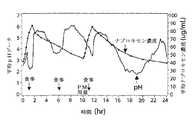
1つの局面において、本開示は、単位用量形態の医薬組成物の製造におけるナプロキセン、またはそれらの薬学的に受容可能な塩、およびエソメプラゾール、またはそれらの薬学的に受容可能な塩の使用に関し、ここで、該エソメプラゾール、またはそれらの薬学的に受容可能な塩は、約0以上のpHで該単位用量形態から標的に放出され:少なくとも約41%の、胃内pHが約24時間、約4.0以上のままである平均%時間。
(Summary of the Invention)
In one aspect, the present disclosure relates to the use of naproxen, or a pharmaceutically acceptable salt thereof, and esomeprazole, or a pharmaceutically acceptable salt thereof, in the manufacture of a pharmaceutical composition in unit dosage form. Wherein the esomeprazole, or a pharmaceutically acceptable salt thereof, is released to the target from the unit dosage form at a pH of about 0 or higher: at least about 41% gastric pH is about 24 hours , Average% time staying above about 4.0.
別の実施形態において、胃内pHが約24時間、約4.0以上のままである平均%時間は、少なくとも約60%、少なくとも約71%、または少なくとも約77%である。 In another embodiment, the average% time that the gastric pH remains above about 4.0 for about 24 hours is at least about 60%, at least about 71%, or at least about 77%.
別の実施形態において、医薬組成物は、ナプロキセンについて、約76μg/mlまたは約79μg/mlの平均最大血漿濃度(Cmax)を有する薬物動態(pk)プロファイルをさらに標的とする。 In another embodiment, the pharmaceutical composition further targets a pharmacokinetic (pk) profile with a mean maximum plasma concentration (C max ) of about 76 μg / ml or about 79 μg / ml for naproxen.
別の実施形態において、医薬組成物は、エソメプラゾールについて、約1500hr*μg/mL、約2134hr*μg/mLまたは約4911hr*μg/mLの、第一の用量が投与される時間0から第一の用量が投与された約24時間後までの平均血漿中濃度時間曲線下面積(AUC0-24)を有する薬物動態(pk)プロファイルを標的とする。
In another embodiment, the pharmaceutical composition is about 1500 hr * μg / mL, about 2134 hr * μg / mL, or about 4911 hr * μg / mL for esomeprazole from
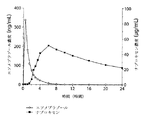
1つの局面において、本開示は、その必要がある患者に送達するための単位用量形態の医薬組成物の製造におけるナプロキセン、またはそれらの薬学的に受容可能な塩、およびエソメプラゾール、またはそれらの薬学的に受容可能な塩の使用に関し、ここで、第一の単位用量形態はAM用量(AM dose)として標的に投与され、そして第二の単位用量形態はPM用量(PM dose)として、約10時間後に投与される:
i)ナプロキセンについての薬物動態(pk)プロファイル:
a)AM用量は約81μg/mLのCmaxの平均値および約2.5〜約4時間の最大濃度までの時間(Tmax)の中央値を有し、そして
b)PM用量は約76.2μg/mLのCmaxの平均値および約10〜約14時間のTmaxの中央値を有する;および
ii)エソメプラゾールについての薬物動態(pk)プロファイル:
a)AM用量は、約850hr*μg/mLの、AM用量が投与される時間0からAM用量が投与された約10時間後までの平均血漿中濃度時間曲線下面積(AUC0-10,am)を有し、そして
b)PM用量は、約650hr*μg/mLの、PM用量が投与される時間0からPM用量が投与された約14時間後までの平均血漿中濃度時間曲線下面積(AUC0-14,pm)を有する。
In one aspect, the present disclosure provides naproxen, or a pharmaceutically acceptable salt thereof, and esomeprazole, or thereof, in the manufacture of a unit dose form pharmaceutical composition for delivery to a patient in need thereof With respect to the use of a pharmaceutically acceptable salt, where the first unit dosage form is administered to the target as an AM dose and the second unit dosage form is about PM as a PM dose. Administered 10 hours later:
i) Pharmacokinetic (pk) profile for naproxen:
a) AM dose has an average C max of about 81 μg / mL and a median time to maximum concentration (T max ) of about 2.5 to about 4 hours, and b) PM dose is about 76. Having an average C max of 2 μg / mL and a median T max of about 10 to about 14 hours; and ii) Pharmacokinetic (pk) profile for esomeprazole:
a) AM dose is about 850 hr * μg / mL, the area under the mean plasma concentration time curve from
1つの実施形態において、医薬組成物は、以下を提供する:
a)ナプロキセンの前記AM用量についてのCmaxの平均値が、約86.2μg/mLまたは約80.9μg/mLであり、そして前記Tmaxの中央値が約3.0時間であり;そして
a)前記PM用量についてのCmaxの平均値が、約76.8μg/mLまたは約76.2μg/mLであり、そして前記Tmaxの中央値が約10時間である。
In one embodiment, the pharmaceutical composition provides:
a) the mean value of C max for the AM dose of naproxen is about 86.2 μg / mL or about 80.9 μg / mL and the median T max is about 3.0 hours; and a ) The mean value of C max for the PM dose is about 76.8 μg / mL or about 76.2 μg / mL, and the median T max is about 10 hours.
別の実施形態において、上記の医薬組成物は、以下を提供する:
a)エソメプラゾールの前記AM用量について、AM用量が投与される時間0からAM用量が投与された約10時間後までの平均血漿中濃度時間曲線下面積(AUC0-10,am)が約1216hr*μg/mLまたは約2779hr*μg/mLであり、そして
b)エソメプラゾールの前記PM用量について、PM用量が投与される時間0からPM用量が投与された約14時間後までの平均血漿中濃度時間曲線下面積(AUC0-14,pm)が、約919hr*μg/mLまたは約2066hr*μg/mLである。
In another embodiment, the above pharmaceutical composition provides:
a) For the AM dose of esomeprazole, the area under the mean plasma concentration time curve (AUC 0-10, am ) from
別の実施形態において、医薬組成物は、エソメプラゾールについて、約1500hr*μg/mL、約2000hr*μg/mL、または約4911hr*μg/mLの、第一の用量が投与される時間0から第一の用量が投与された約24時間後までの平均血漿中濃度時間曲線下面積(AUC0-24)を有する薬物動態(pk)プロファイルを標的とする。
In another embodiment, the pharmaceutical composition is about 1500 hr * μg / mL, about 2000 hr * μg / mL, or about 4911 hr * μg / mL for esomeprazole from
医薬組成物は、少なくとも約41%、約60%、約71%、または約77%の、定常状態に達した後、約24時間、胃内pHが約4.0以上のままである平均%時間をさらに標的とする、請求項19〜26のいずれか1項に記載の使用。 The pharmaceutical composition has an average% of at least about 41%, about 60%, about 71%, or about 77% that the gastric pH remains above about 4.0 for about 24 hours after reaching steady state. 27. Use according to any one of claims 19 to 26, further targeting time.
1つの実施形態において、用量形態が、少なくとも1種のコアならびに少なくとも第一の層および第二の層を含む多層錠であり、ここで:
i)該コアは、ナプロキセン、またはそれらの薬学的に受容可能な塩を含み;
ii)該第一の層は、周囲媒質のpHが約3.5以上である場合に、ナプロキセン、またはそれらの薬学的に受容可能な塩を少なくとも放出し始めるコーティングであり;そして
iii)該第二の層は、エソメプラゾールを含み、ここで、前記エソメプラゾールは約0以上のpHで放出される。
In one embodiment, the dosage form is a multilayer tablet comprising at least one core and at least a first layer and a second layer, where:
i) the core comprises naproxen, or a pharmaceutically acceptable salt thereof;
ii) the first layer is a coating that begins to release at least naproxen, or a pharmaceutically acceptable salt thereof, when the pH of the surrounding medium is about 3.5 or higher; and iii) the first The second layer includes esomeprazole, wherein the esomeprazole is released at a pH of about 0 or higher.
別の実施形態において、用量形態は、約1以上のpH、約0〜約2のpH、または約2〜4のpHでエソメプラゾールの放出をもたらす。別の実施形態において、エソメプラゾール、またはそれらの薬学的に受容可能な塩の少なくとも一部分は、腸溶コーティングでコートされていない。別の実施形態において、第一の層が腸溶コーティングである。なお別の実施形態において、多層錠は、重炭酸ナトリウムを実質的に含まない。1つの実施形態において、第一の層は、周囲媒質のpHが約4.0または約4.5以上である場合に、ナプロキセンを放出し始める。 In another embodiment, the dosage form provides release of esomeprazole at a pH of about 1 or higher, a pH of about 0 to about 2, or a pH of about 2-4. In another embodiment, at least a portion of esomeprazole, or a pharmaceutically acceptable salt thereof, is not coated with an enteric coating. In another embodiment, the first layer is an enteric coating. In yet another embodiment, the multilayer tablet is substantially free of sodium bicarbonate. In one embodiment, the first layer begins to release naproxen when the pH of the surrounding medium is about 4.0 or greater than about 4.5.
別の実施形態において、単位用量形態の医薬組成物は、約500mgの前記ナプロキセン、またはそれらの薬学的に受容可能な塩、および約20mgまたは約30mgの前記エソメプラゾール、またはそれらの薬学的に受容可能な塩を含む。 In another embodiment, the pharmaceutical composition in unit dosage form comprises about 500 mg of said naproxen, or a pharmaceutically acceptable salt thereof, and about 20 mg or about 30 mg of said esomeprazole, or a pharmaceutically thereof. Contains acceptable salts.
別の実施形態において、医薬組成物は、1日に2回を少なくとも約6日間または1日に2回を少なくとも9日間投与される。 In another embodiment, the pharmaceutical composition is administered twice a day for at least about 6 days or twice a day for at least 9 days.
別の実施形態において、医薬組成物は、危険な状態にある患者に投与される。 In another embodiment, the pharmaceutical composition is administered to a patient at risk.
危険な状態にある患者は、疼痛および炎症から選択される疾患または障害の治療を受けている患者であり得るか、または変形性関節症、関節リウマチ、強直性脊椎炎、またはそれらの組み合わせの治療を受けている患者であり得る。 The patient at risk may be a patient undergoing treatment for a disease or disorder selected from pain and inflammation, or treatment of osteoarthritis, rheumatoid arthritis, ankylosing spondylitis, or a combination thereof Can be a patient undergoing
1つの局面において、本開示は、その必要がある患者に医薬組成物を送達するための方法に関し、該方法は、ナプロキセン、またはそれらの薬学的に受容可能な塩、およびエソメプラゾール、またはそれらの薬学的に受容可能な塩を含む単位用量形態の医薬組成物を該患者に投与することを包含し、ここで、該エソメプラゾール、またはそれらの薬学的に受容可能な塩は、約0以上のpHで該単位用量形態から標的に放出され:少なくとも約41%の、定常状態に達した後、約24時間、胃内pHが約4.0以上のままである平均%時間。 In one aspect, the present disclosure relates to a method for delivering a pharmaceutical composition to a patient in need thereof, the method comprising naproxen, or a pharmaceutically acceptable salt thereof, and esomeprazole, or Administering to the patient a unit dosage form of a pharmaceutical composition comprising a pharmaceutically acceptable salt, wherein the esomeprazole, or a pharmaceutically acceptable salt thereof, is about 0 Release from the unit dose form to the target at the above pH: at least about 41%, the average% time that the gastric pH remains above about 4.0 for about 24 hours after reaching steady state.
別の局面において、本開示は、その必要がある患者に医薬組成物を送達するための方法に関し、該方法は、ナプロキセン、またはそれらの薬学的に受容可能な塩、およびエソメプラゾール、またはそれらの薬学的に受容可能な塩を含む単位用量形態の医薬組成物を該患者に投与することを包含し、ここで、該エソメプラゾール、またはそれらの薬学的に受容可能な塩は、約0以上のpHで該単位用量形態から放出され、ここで、ある単位用量形態が標的にAM用量として投与され、そして第二の用量がPM用量として約10時間後に投与され
i)ナプロキセンについてのpkプロファイル:
a)AM用量は、約81μg/mLのCmaxの平均値および約2.5〜約4時間の最大濃度までの時間(Tmax)の中央値を有し、そして
b)PM用量は、約76.2μg/mLのCmaxの平均値および約10〜約14時間のTmaxの中央値を有する;および
ii)エソメプラゾールについてのpkプロファイル:
a)AM用量は、約850hr*μg/mLの、AM用量が投与される時間0からAM用量が投与された約10時間後までの平均血漿中濃度時間曲線下面積(AUC0-10,am)
を有し、そして
b)PM用量は、約650hr*μg/mLの、PM用量が投与される時間0からPM用量が投与された約14時間後までの平均血漿中濃度時間曲線下面積(AUC0-14,pm)を有する。
In another aspect, the present disclosure relates to a method for delivering a pharmaceutical composition to a patient in need thereof, the method comprising naproxen, or a pharmaceutically acceptable salt thereof, and esomeprazole, or Administering to the patient a unit dosage form of a pharmaceutical composition comprising a pharmaceutically acceptable salt, wherein the esomeprazole, or a pharmaceutically acceptable salt thereof, is about 0 Released from the unit dosage form at the above pH, where one unit dosage form is administered to the target as an AM dose and the second dose is administered after about 10 hours as a PM dose i) pk profile for naproxen :
a) AM dose has a mean C max of about 81 μg / mL and a median time to maximum concentration (T max ) of about 2.5 to about 4 hours, and b) PM dose is about Having an average C max of 76.2 μg / mL and a median T max of about 10 to about 14 hours; and ii) pk profile for esomeprazole:
a) AM dose is about 850 hr * μg / mL, the area under the mean plasma concentration time curve from
And b) the PM dose is about 650 hr * μg / mL, the area under the mean plasma concentration time curve (AUC) from
なお別の局面は、疼痛および炎症から選択される疾患または障害の治療を受けている患者に、本明細書中に開示される薬力学反応および/または薬物動態値を提供する単位用量形態の医薬組成物を送達することに関する。 Yet another aspect is a unit dosage form of a medicament that provides a pharmacodynamic response and / or pharmacokinetic value disclosed herein to a patient undergoing treatment for a disease or disorder selected from pain and inflammation It relates to delivering the composition.
さらなる局面は、変形性関節症、関節リウマチ、強直性脊椎炎、またはそれらの組み合わせの治療を受けている患者に、本明細書中に開示される薬力学反応および/または薬物動態値を提供する単位用量形態の医薬組成物を送達することに関する。 Further aspects provide pharmacodynamic responses and / or pharmacokinetic values disclosed herein to patients undergoing treatment of osteoarthritis, rheumatoid arthritis, ankylosing spondylitis, or combinations thereof It relates to delivering a pharmaceutical composition in unit dosage form.
なおさらなる局面は、危険な状態にある患者に、本明細書中に開示される薬力学反応および/または薬物動態値を提供する単位用量形態の医薬組成物を送達することに関する。 A still further aspect relates to delivering a unit dose form of the pharmaceutical composition that provides the pharmacodynamic response and / or pharmacokinetic values disclosed herein to a patient at risk.
別の局面は、疼痛および炎症から選択される疾患または障害の治療を受けている危険な状態にある患者に、本明細書中に開示される薬力学反応および/または薬物動態値を提供する単位用量形態の医薬組成物を送達することに関する。 Another aspect is a unit that provides a pharmacodynamic response and / or pharmacokinetic value disclosed herein to a patient at risk for treatment of a disease or disorder selected from pain and inflammation It relates to delivering pharmaceutical compositions in dosage form.
さらなる局面は、変形性関節症、関節リウマチ、強直性脊椎炎、またはそれらの組み合わせの治療を受けている危険な状態にある患者に、本明細書中に開示される薬力学反応および/または薬物動態値を提供する単位用量形態の医薬組成物を送達することに関する。 Further aspects include a pharmacodynamic response and / or drug disclosed herein for patients at risk for treatment of osteoarthritis, rheumatoid arthritis, ankylosing spondylitis, or combinations thereof It relates to delivering pharmaceutical compositions in unit dosage forms that provide kinetic values.
なお別の局面は、少なくとも1種のコアならびに少なくとも第一の層および第二の層を含む多層錠を介して、本明細書中に開示される薬力学反応および/または薬物動態値を提供する単位投薬形態の医薬組成物を送達することに関し、ここで:
i)該コアは、ナプロキセン、またはそれらの薬学的に受容可能な塩を含み;
ii)該第一の層は、周囲媒質のpHが約3.5以上である場合に、ナプロキセン、またはそれらの薬学的に受容可能な塩を少なくとも放出し始めるコーティングであり;そして
iii)該第二の層は、エソメプラゾール、またはそれらの薬学的に受容可能な塩であり、ここで、該エソメプラゾール、またはそれらの薬学的に受容可能な塩は約0以上のpHで放出される。
Yet another aspect provides the pharmacodynamic responses and / or pharmacokinetic values disclosed herein via a multilayer tablet comprising at least one core and at least a first layer and a second layer. Regarding delivering the pharmaceutical composition in unit dosage form, where:
i) the core comprises naproxen, or a pharmaceutically acceptable salt thereof;
ii) the first layer is a coating that begins to release at least naproxen, or a pharmaceutically acceptable salt thereof, when the pH of the surrounding medium is about 3.5 or higher; and iii) the first The second layer is esomeprazole, or a pharmaceutically acceptable salt thereof, wherein the esomeprazole, or a pharmaceutically acceptable salt thereof, is released at a pH of about 0 or higher. .
本明細書中で使用され得る略語および/または特殊用語は、表1および以下の本文中に示される。 Abbreviations and / or special terms that may be used herein are set forth in Table 1 and the following text.

用語「危険な状態にある患者」とは、年齢または胃潰瘍の確認された病歴、またはLDA(低用量アスピリン)の同時投与に起因して、NSAID関連潰瘍の危険がある患者をいう。1つの実施形態において、危険な状態にある患者は、50歳以上の年齢に起因して、NSAID関連潰瘍の危険がある患者である。別の実施形態において、危険な状態にある患者は、アスピリンの併用に起因して、NSAID関連潰瘍の危険がある患者である。なお別の実施形態において、危険な状態にある患者は、上部消化管(UGI)の潰瘍または出血の病歴に起因して、NSAID関連潰瘍の危険がある患者である。
The term “patient at risk” refers to a patient at risk for NSAID-related ulcers due to age or a confirmed history of gastric ulcers, or concomitant administration of LDA (low dose aspirin). In one embodiment, a patient at risk is a patient at risk for an NSAID-related ulcer due to
本明細書中で使用される場合、用語「薬学的に受容可能な」とは、「薬学的に受容可能」として同定された材料が、患者/被験者への投与に適切であり、かつ生理学的に受容可能であることを意味する。例えば、用語「薬学的に受容可能な塩」とは、適切でかつ生理学的に受容可能な塩を意味する。 As used herein, the term “pharmaceutically acceptable” means that the material identified as “pharmaceutically acceptable” is suitable for administration to a patient / subject and is physiological. Is acceptable. For example, the term “pharmaceutically acceptable salt” means a suitable and physiologically acceptable salt.
語句「ナプロキセン、またはそれらの薬学的に受容可能な塩」とは、ナプロキセンの遊離塩基、ナプロキセンの薬学的に受容可能な塩、および/またはナプロキセンの遊離塩基および少なくとも1種のナプロキセンの薬学的に受容可能な塩の混合物をいう。 The phrase “naproxen, or a pharmaceutically acceptable salt thereof” refers to the free base of naproxen, the pharmaceutically acceptable salt of naproxen, and / or the free base of naproxen and at least one naproxen pharmaceutically. It refers to a mixture of acceptable salts.
語句「エソメプラゾール、またはそれらの薬学的に受容可能な塩」とは、エソメプラゾールの遊離塩基、エソメプラゾールの薬学的に受容可能な塩、および/またはエソメプラゾールの遊離塩基および少なくとも1種のエソメプラゾールの薬学的に受容可能な塩の混合物をいう。 The phrase “esomeprazole, or a pharmaceutically acceptable salt thereof” refers to the free base of esomeprazole, the pharmaceutically acceptable salt of esomeprazole, and / or the free base of esomeprazole and at least A mixture of pharmaceutically acceptable salts of one esomeprazole.
本明細書中で使用される場合、用語「単位投薬形態」(または「単位用量形態」)とは、薬物投与のための単一体をいう。例えば、エソメプラゾールおよびナプロキセンの両方を含む単一錠剤またはカプセル剤は、単位投薬形態である。本開示の単位投薬形態は、胃内pHを上昇させ、そして胃十二指腸粘膜に対するナプロキセンの有害効果を減らす方法で連続的な薬物放出を提供する、すなわち、エソメプラゾールが初めに放出され、そしてGI管中のpHが3.5以上に上昇するまで、ナプロキセンの放出が先延ばしされる。「単位投薬形態」(または「単位用量形態」)はまた、「固定投薬形態」(または「固定用量形態」)または固定投薬混合剤(fixed dosage combination)(または「固定用量混合剤(fixed dose combination)」)ともいい、そして他と互換性である。 As used herein, the term “unit dosage form” (or “unit dosage form”) refers to a single entity for drug administration. For example, a single tablet or capsule containing both esomeprazole and naproxen is a unit dosage form. The unit dosage forms of the present disclosure provide continuous drug release in a manner that increases gastric pH and reduces the adverse effects of naproxen on the gastroduodenal mucosa, ie esomeprazole is first released and GI Naproxen release is postponed until the pH in the tube rises above 3.5. “Unit dosage form” (or “unit dosage form”) is also referred to as “fixed dosage form” (or “fixed dosage form”) or fixed dosage combination (or “fixed dose combination”). ) ”), And compatible with others.
本明細書中に示される値について、用語「約」とは、所定の数が少なくとも5%変更され得ることを意味し、10%、15%または20%の変動が可能である。 For the values given herein, the term “about” means that the predetermined number can be changed by at least 5%, and variations of 10%, 15% or 20% are possible.
本明細書中に示される薬物動態および/または薬力学の値に関して、変動の程度は、SDおよび%CV値で表される。%CV=SD/平均×100;SD=(%CV×平均)÷100。患者の約68%が、1つの平均値のSD内にあり、そして患者の約95%が2つの平均値のSD内にあることが期待され得る。本明細書中に示される薬物動態および薬力学の値は、小数点第1位で四捨五入して整数にした平均値であり、そして複数の個人から得た結果に基づく。結果として、本明細書中に示される値は、患者によって異なり得る。この変動量は、用語「約」で表される。 With respect to the pharmacokinetic and / or pharmacodynamic values presented herein, the degree of variation is expressed as SD and% CV values. % CV = SD / average × 100; SD = (% CV × average) ÷ 100. It can be expected that about 68% of patients are within one mean SD and about 95% of patients are within two mean SDs. The pharmacokinetic and pharmacodynamic values shown herein are average values rounded to the first decimal place and made an integer, and are based on results obtained from multiple individuals. As a result, the values shown herein may vary from patient to patient. This variation is represented by the term “about”.
ナプロキセン、またはそれらの薬学的に受容可能な塩および/またはエソメプラゾール、またはそれらの薬学的に受容可能な塩の各投薬量に関して、用語「約」とは、当該分野で受容可能な明確に同定された投薬量からの変動量を表すことを意味する。 With respect to each dosage of naproxen, or a pharmaceutically acceptable salt thereof and / or esomeprazole, or a pharmaceutically acceptable salt thereof, the term “about” is expressly acceptable in the art. It is meant to represent the amount of variation from the identified dosage.
本明細書中で言及される期間に関して、用語「約」とは、当該分野で受容可能な明確に同定された期間からの変動量を表すことを意味する。 With respect to time periods referred to herein, the term “about” is meant to represent a variation from a clearly identified time period acceptable in the art.
本明細書中で使用される%変動係数および/または範囲に関して、用語「約」とは、規定された数として実質的に同じ結果を達成し得る規定された数値および/または範囲の上下の変動量を表すことを意味する。 As used herein, with respect to the percent variation coefficient and / or range, the term “about” means the variation above and below a specified number and / or range that can achieve substantially the same result as the specified number. Means representing quantity.
本明細書中で言及されるpH値および/または範囲に関して、用語「約」とは、規定された数として実質的に同じ結果を達成し得る規定された数の上下の変動量を捕捉することを意味する。 With respect to the pH values and / or ranges referred to herein, the term “about” captures a defined number of up and down variations that can achieve substantially the same result as the defined number. Means.
語句「実質的に含まない」と共に使用される用語数値に関して、用語は、規定された数として実質的に同じ結果を達成し得る規定された数の上下の変動量を捕捉することを意味する。 With respect to the term value used with the phrase “substantially free”, the term is meant to capture a defined number of up and down variations that can achieve substantially the same result as the defined number.
語句「実質的に含まない」とは、約95%〜約99.99%含まないことを意味する。1つの実施形態において、実質的に含まないとは、約95%含まないことを意味する。別の実施形態において、用語、実質的に含まないとは、約96%含まないことを意味する。なお別の実施形態において、用語、実質的に含まないとは、約97%含まないことを意味する。なお別の実施形態において、用語、実質的に含まないとは、約98%含まないことを意味する。さらなる実施形態において、用語、実質的に含まないとは、約99%含まないことを意味する。なおさらなる実施形態において、用語、実質的に含まないとは、約99.99%含まないことを意味する。 The phrase “substantially free” means about 95% to about 99.99% free. In one embodiment, substantially free means about 95% free. In another embodiment, the term substantially free means about 96% free. In yet another embodiment, the term substantially free means about 97% free. In yet another embodiment, the term substantially free means about 98% free. In a further embodiment, the term substantially free means about 99% free. In still further embodiments, the term substantially free means free of about 99.99%.
本開示において、それぞれ、様々に規定された範囲は、各範囲の規定された最小値と最大値との間の各数値パラメータを包含するように連続的であることを意味する。例えば、約1〜約4の範囲は、約1、1、約2、2、約3、3、約4、および4を包含する。 In the present disclosure, each variously defined range is meant to be continuous to encompass each numerical parameter between the defined minimum and maximum values of each range. For example, the range of about 1 to about 4 includes about 1, 1, about 2, 2, about 3, 3, about 4, and 4.
1つの実施形態において、本開示は、単位用量形態の医薬組成物の製造におけるナプロキセン、またはそれらの薬学的に受容可能な塩、およびエソメプラゾール、またはそれらの薬学的に受容可能な塩の使用に関し、ここで、該エソメプラゾール、またはそれらの薬学的に受容可能な塩は、約0以上のpHで該単位用量形態から標的に放出される:少なくとも約41%の、約24時間、胃内pHが約4.0以上のままである平均%時間。 In one embodiment, the disclosure provides the use of naproxen, or a pharmaceutically acceptable salt thereof, and esomeprazole, or a pharmaceutically acceptable salt thereof, in the manufacture of a pharmaceutical composition in unit dosage form. Wherein the esomeprazole, or a pharmaceutically acceptable salt thereof, is released to the target from the unit dosage form at a pH of about 0 or higher: at least about 41% for about 24 hours in the stomach Average% time during which the internal pH remains above about 4.0.
別の実施形態において、約24時間、胃内pHが約4.0以上のままである平均%時間は、少なくとも約60%、少なくとも約71%、または少なくとも約77%である。 In another embodiment, the average% time that the gastric pH remains above about 4.0 for about 24 hours is at least about 60%, at least about 71%, or at least about 77%.
別の実施形態において、医薬組成物は、ナプロキセンについて約76μg/mlまたは約79μg/mlの平均最大血漿濃度(Cmax)を有する薬物動態(pk)プロファイルをさらに標的とする。 In another embodiment, the pharmaceutical composition further targets a pharmacokinetic (pk) profile having an average maximum plasma concentration (C max ) of about 76 μg / ml or about 79 μg / ml for naproxen.
別の実施形態において、医薬組成物は、エソメプラゾールについて、約1500hr*μg/mL、約2134hr*μg/mLまたは約4911hr*μg/mLの、第一の用量が投与される時間0から第一の用量が投与された約24時間後までの平均血漿中濃度時間曲線下面積(AUC0-24)を有する薬物動態(pk)プロファイルを標的とする。
In another embodiment, the pharmaceutical composition is about 1500 hr * μg / mL, about 2134 hr * μg / mL, or about 4911 hr * μg / mL for esomeprazole from
1つの局面において、本開示は、その必要がある患者に送達するための単位用量形態の医薬組成物の製造におけるナプロキセン、またはそれらの薬学的に受容可能な塩、およびエソメプラゾール、またはそれらの薬学的に受容可能な塩の使用に関し、ここで、第一の単位用量形態が標的にAM用量として投与され、そして第二の単位用量形態がPM用量として約10時間後に投与される:
i)ナプロキセンについての薬物動態(pk)プロファイル:
a)AM用量は、約81μg/mLのCmaxの平均値および約2.5〜約4時間の最大濃度までの時間(Tmax)の中央値を有し、そして
b)PM用量は、約76.2μg/mLのCmaxの平均値および約10〜約14時間のTmaxの中央値を有する;および
ii)エソメプラゾールについての薬物動態(pk)プロファイル:
a)AM用量は、約850hr*μg/mLの、AM用量が投与される時間0からAM用量が投与された約10時間後までの平均血漿中濃度時間曲線下面積(AUC0-10,am)を有し、そして
b)PM用量は、約650hr*μg/mLの、PM用量が投与される時間0からPM用量が投与された約14時間後までの平均血漿中濃度時間曲線下面積(AUC0-14,pm)を有する。
In one aspect, the present disclosure provides naproxen, or a pharmaceutically acceptable salt thereof, and esomeprazole, or thereof, in the manufacture of a unit dose form pharmaceutical composition for delivery to a patient in need thereof With respect to the use of a pharmaceutically acceptable salt, where the first unit dosage form is administered to the target as an AM dose and the second unit dosage form is administered as a PM dose after about 10 hours:
i) Pharmacokinetic (pk) profile for naproxen:
a) AM dose has a mean C max of about 81 μg / mL and a median time to maximum concentration (T max ) of about 2.5 to about 4 hours, and b) PM dose is about Having a mean C max of 76.2 μg / mL and a median T max of about 10 to about 14 hours; and ii) Pharmacokinetic (pk) profile for esomeprazole:
a) AM dose is about 850 hr * μg / mL, the area under the mean plasma concentration time curve from
1つの実施形態において、医薬組成物は以下を提供する:
a)ナプロキセンの前記AM用量についてのCmaxの平均値が約86.2μg/mLまたは約80.9μg/mLであり、そして前記Tmaxの中央値が約3.0時間であり;そして
b)前記PM用量についてのCmaxの平均値が約76.8μg/mLまたは約76.2μg/mL であり、そして前記Tmaxの中央値が約10時間である。
In one embodiment, the pharmaceutical composition provides:
a) the mean value of C max for the AM dose of naproxen is about 86.2 μg / mL or about 80.9 μg / mL and the median T max is about 3.0 hours; and b) The mean C max for the PM dose is about 76.8 μg / mL or about 76.2 μg / mL and the median T max is about 10 hours.
別の実施形態において、上記の医薬組成物は以下を提供する:
a)エソメプラゾールの前記AM用量について、AM用量が投与される時間0からAM用量が投与された約10時間後までの平均血漿中濃度時間曲線下面積(AUC0-10,am)が約1216hr*μg/mLまたは約2779hr*μg/mLであり、そして
b)エソメプラゾールの前記PM用量について、PM用量が投与される時間0からPM用量が投与された約14時間後までの平均血漿中濃度時間曲線下面積(AUC0-14,pm)が約919hr*μg/mLまたは約2066hr*μg/mLである。
In another embodiment, the above pharmaceutical composition provides:
a) For the AM dose of esomeprazole, the area under the mean plasma concentration time curve (AUC 0-10, am ) from
別の実施形態において、医薬組成物は、エソメプラゾールについて、約1500hr*μg/mL、約2000hr*μg/mL、または約4911hr*μg/mLの、第一の用量が投与される時間0から第一の用量が投与された約24時間後までの平均血漿中濃度時間曲線下面積(AUC0-24)を有する薬物動態(pk)プロファイルを標的とする。
In another embodiment, the pharmaceutical composition is about 1500 hr * μg / mL, about 2000 hr * μg / mL, or about 4911 hr * μg / mL for esomeprazole from
医薬組成物が、少なくとも約41、約60%、約71%、または約77%の、定常状態に達した後、約24時間、胃内pHが約4.0以上のままである平均%時間をさらに標的とする、請求項19〜26のいずれか1項に記載の使用。 Average% time that the gastric pH remains above about 4.0 for about 24 hours after the pharmaceutical composition has reached a steady state of at least about 41, about 60%, about 71%, or about 77% 27. Use according to any one of claims 19 to 26, further targeted.
一般に、本明細書中に開示される単位用量形態の医薬組成物の[1日に2回の]送達後、約4〜5日、約5〜6日、約6〜7日、約7〜8日、約8〜9日、または約9〜10日でナプロキセンまたはエソメプラゾールの定常状態レベルに達する。他の実施形態において、約4日、約5日、約6日、約7日、約8日、約9日、または約10日でナプロキセンまたはエソメプラゾールの定常状態レベルに達する。 Generally, after delivery [twice a day] of a pharmaceutical composition in unit dosage form disclosed herein, about 4-5 days, about 5-6 days, about 6-7 days, about 7- Steady state levels of naproxen or esomeprazole are reached at 8 days, about 8-9 days, or about 9-10 days. In other embodiments, a steady state level of naproxen or esomeprazole is reached at about 4, about 5, about 6, about 7, about 8, about 9, or about 10 days.
1つの実施形態において、用量形態は、少なくとも1種のコアならびに少なくとも第一の層および第二の層を含む多層錠であり、ここで:
i)該コアは、ナプロキセン、またはそれらの薬学的に受容可能な塩を含み;
ii)該第一の層は、周囲媒質のpHが約3.5以上である場合に、ナプロキセン、またはそれらの薬学的に受容可能な塩を少なくとも放出し始めるコーティングであり;そして
iii)該第二の層は、エソメプラゾールを含み、ここで、前記エソメプラゾール
は約0以上のpHで放出される。
In one embodiment, the dosage form is a multilayer tablet comprising at least one core and at least a first layer and a second layer, where:
i) the core comprises naproxen, or a pharmaceutically acceptable salt thereof;
ii) the first layer is a coating that begins to release at least naproxen, or a pharmaceutically acceptable salt thereof, when the pH of the surrounding medium is about 3.5 or higher; and iii) the first The second layer includes esomeprazole, wherein the esomeprazole is released at a pH of about 0 or higher.
別の実施形態において、用量形態は、約1以上のpH、約0〜約2のpH、または約2〜4のpHで、エソメプラゾールの放出をもたらす。別の実施形態において、エソメプラゾール、またはそれらの薬学的に受容可能な塩の少なくとも一部は、腸溶コーティングでコーティングされていない。別の実施形態において、第一の層は、腸溶コーティングである。なお別の実施形態において、多層錠は重炭酸ナトリウムを実質的に含まない。1つの実施形態において、第一の層は、周囲媒質のpHが約4.0または約4.5以上である場合に、ナプロキセンを放出し始める。 In another embodiment, the dosage form provides release of esomeprazole at a pH of about 1 or higher, a pH of about 0 to about 2, or a pH of about 2-4. In another embodiment, at least a portion of esomeprazole, or a pharmaceutically acceptable salt thereof, is not coated with an enteric coating. In another embodiment, the first layer is an enteric coating. In yet another embodiment, the multilayer tablet is substantially free of sodium bicarbonate. In one embodiment, the first layer begins to release naproxen when the pH of the surrounding medium is about 4.0 or greater than about 4.5.
別の実施形態において、単位用量形態の医薬組成物は、約500mgの前記ナプロキセン、またはそれらの薬学的に受容可能な塩、および約20mgまたは約30mgの前記エソメプラゾール、またはそれらの薬学的に受容可能な塩を含む。 In another embodiment, the pharmaceutical composition in unit dosage form comprises about 500 mg of said naproxen, or a pharmaceutically acceptable salt thereof, and about 20 mg or about 30 mg of said esomeprazole, or a pharmaceutically thereof. Contains acceptable salts.
別の実施形態において、医薬組成物は、1日に2回を少なくとも約6日間または1日に2回を少なくとも9日間投与される。 In another embodiment, the pharmaceutical composition is administered twice a day for at least about 6 days or twice a day for at least 9 days.
別の実施形態において、医薬組成物は危険な状態にある患者に投与される。危険な状態にある患者は、疼痛および炎症から選択される疾患または障害の治療を受けている患者であり得るか、または変形性関節症、関節リウマチ、強直性脊椎炎、またはそれらの組み合わせの治療を受けている患者であり得る。 In another embodiment, the pharmaceutical composition is administered to a patient at risk. The patient at risk may be a patient undergoing treatment for a disease or disorder selected from pain and inflammation, or treatment of osteoarthritis, rheumatoid arthritis, ankylosing spondylitis, or a combination thereof Can be a patient undergoing
1つの実施形態は、その必要がある患者に医薬組成物を送達するための方法に関し、該方法は、ナプロキセン、またはそれらの薬学的に受容可能な塩、およびエソメプラゾール、またはそれらの薬学的に受容可能な塩を含む単位用量形態の医薬組成物を該患者に投与することを包含し、ここで、該エソメプラゾール、またはそれらの薬学的に受容可能な塩は、約0以上のpHで該単位用量形態から標的に放出される:少なくとも約41%の、定常状態に達した後、約24時間、胃内pHが約4.0以上のままである平均%時間。 One embodiment relates to a method for delivering a pharmaceutical composition to a patient in need thereof, the method comprising naproxen, or a pharmaceutically acceptable salt thereof, and esomeprazole, or a pharmaceutical thereof Administering to the patient a unit dosage form of a pharmaceutical composition comprising an acceptable salt, wherein the esomeprazole, or a pharmaceutically acceptable salt thereof, has a pH of about 0 or greater. From the unit dose form to the target: at least about 41%, the average% time that the gastric pH remains above about 4.0 for about 24 hours after reaching steady state.
他の実施形態において、定常状態に達した後、24時間、胃内pHが約4.0以上のままである平均%時間は、少なくとも約40%、約45%、約50%、約55%、約60%、約65%、約70%、約71%、約75%、約77%、約80%、約85%、約90%、または約95%である。 In other embodiments, the average% time that the gastric pH remains above about 4.0 for 24 hours after reaching steady state is at least about 40%, about 45%, about 50%, about 55% About 60%, about 65%, about 70%, about 71%, about 75%, about 77%, about 80%, about 85%, about 90%, or about 95%.
別の実施形態は、その必要がある患者に医薬組成物を送達するための方法に関し、該方法は、ナプロキセン、またはそれらの薬学的に受容可能な塩、およびエソメプラゾール、またはそれらの薬学的に受容可能な塩を含む単位用量形態の医薬組成物を該患者に投与することを包含し、ここで、該エソメプラゾール、またはそれらの薬学的に受容可能な塩は、約0以上のpHで該単位用量形態から標的に放出される:少なくとも約41%の、定常状態に達した後、約24時間、胃内pHが約4.0以上のままである平均%時間およびナプロキセンについて、17〜23の%変動係数範囲で、少なくとも76μg/mLの平均最大血漿濃度(Cmax)を有する薬物動態(pk)プロファイル。 Another embodiment relates to a method for delivering a pharmaceutical composition to a patient in need thereof, the method comprising naproxen, or a pharmaceutically acceptable salt thereof, and esomeprazole, or a pharmaceutical thereof Administering to the patient a unit dosage form of a pharmaceutical composition comprising an acceptable salt, wherein the esomeprazole, or a pharmaceutically acceptable salt thereof, has a pH of about 0 or greater. Release from the unit dose form to the target: at least about 41%, after reaching steady state, about 24 hours after gastric pH remains above about 4.0 and naproxen for 17% Pharmacokinetic (pk) profile with a mean maximum plasma concentration (C max ) of at least 76 μg / mL, with a% coefficient of variation range of ˜23.
さらなる実施形態は、その必要がある患者に医薬組成物を送達するための方法に関し、該方法は、ナプロキセン、またはそれらの薬学的に受容可能な塩、およびエソメプラゾール、またはそれらの薬学的に受容可能な塩を含む単位用量形態の医薬組成物を該患者に投与することを包含し、ここで、該エソメプラゾール、またはそれらの薬学的に受容可能な塩は、約0以上のpHで該単位用量形態から標的に放出される:少なくとも約41%の、定常状態に達した後、約24時間、胃内pHが約4.0以上のままである平均%時間およびナプロキセンについて、約76μg/mLの平均最大血漿濃度(Cmax)を有する薬物動態(pk)プロファイル。 Further embodiments relate to a method for delivering a pharmaceutical composition to a patient in need thereof, the method comprising naproxen, or a pharmaceutically acceptable salt thereof, and esomeprazole, or a pharmaceutically thereof Administering to the patient a unit dosage form of a pharmaceutical composition comprising an acceptable salt, wherein the esomeprazole, or a pharmaceutically acceptable salt thereof, has a pH of about 0 or greater. Released from the unit dosage form to the target: at least about 41%, about 76 μg for naproxen and the average% time that the gastric pH remains above about 4.0 for about 24 hours after reaching steady state Pharmacokinetic (pk) profile with a mean maximum plasma concentration (C max ) / mL.
なお別の実施形態は、その必要がある患者に医薬組成物を送達するための方法に関し、該方法は、ナプロキセン、またはそれらの薬学的に受容可能な塩、およびエソメプラゾール、またはそれらの薬学的に受容可能な塩を含む単位用量形態の医薬組成物を該患者に投与することを包含し、ここで前記エソメプラゾール、またはそれらの薬学的に受容可能な塩は、pH0以上で該単位用量形態から標的に放出される:少なくとも約41%の、定常状態に達した後、約24時間、胃内pHが約4.0以上のままである平均%時間およびエソメプラゾールについて、40〜80の%変動係数範囲で、少なくとも1500hr*μg/mLの、第一の用量が投与される時間0から第一の用量が投与された約24時間後までの平均血漿中濃度時間曲線下面積(AUC0-24)を有する薬物動態(pk)プロファイル。
Yet another embodiment relates to a method for delivering a pharmaceutical composition to a patient in need thereof, wherein the method includes naproxen, or a pharmaceutically acceptable salt thereof, and esomeprazole, or a pharmaceutical thereof Administering to the patient a pharmaceutical composition in unit dosage form comprising a pharmaceutically acceptable salt, wherein said esomeprazole, or a pharmaceutically acceptable salt thereof, has a pH of 0 or more. Released from the dosage form to the target: at least about 41%, after reaching steady state, about 24 hours, average% time that gastric pH remains above about 4.0 and esomeprazole Below the mean plasma concentration time curve from the
なおさらなる実施形態は、その必要がある患者に医薬組成物を送達するための方法に関し、該方法は、ナプロキセン、またはそれらの薬学的に受容可能な塩、およびエソメプラゾール、またはそれらの薬学的に受容可能な塩を含む単位用量形態の医薬組成物を該患者に投与することを包含し、ここで、該エソメプラゾール、またはそれらの薬学的に受容可能な塩は、0以上のpHで該単位用量形態から標的に放出される:少なくとも約41%の、定常状態に達した後、約24時間、胃内pHが約4.0以上のままである平均%時間およびエソメプラゾールについて、約1500hr*μg/mLの第一の用量が投与される時間0から第一の用量が投与された約24時間後までの平均血漿中濃度時間曲線下面積(AUC0-24)を有する薬物動態(pk)プロファイル。
Still further embodiments relate to a method for delivering a pharmaceutical composition to a patient in need thereof, the method comprising naproxen, or a pharmaceutically acceptable salt thereof, and esomeprazole, or a pharmaceutical thereof Administering to the patient a unit dose form of a pharmaceutical composition comprising an acceptable salt, wherein the esomeprazole, or a pharmaceutically acceptable salt thereof, is at a pH of 0 or greater. Released from the unit dosage form to the target: for at least about 41%, after reaching steady state, about 24 hours after gastric pH remains above about 4.0 and esomeprazole Pharmacokinetics with an area under the mean plasma concentration time curve (AUC 0-24 ) from
なお別の実施形態は、その必要がある患者に医薬組成物を送達するための方法に関し、該方法は、ナプロキセン、またはそれらの薬学的に受容可能な塩、およびエソメプラゾール、またはそれらの薬学的に受容可能な塩を含む単位用量形態の医薬組成物を該患者に投与することを包含し、ここで、該エソメプラゾール、またはそれらの薬学的に受容可能な塩は、約0以上のpHで該単位用量形態から標的に放出される:少なくとも約41%の、定常状態に達した後、約24時間、胃内pHが約4.0以上のままである平均%時間;およびナプロキセンについて、17〜23の%変動係数範囲で、少なくとも76μg/mLの平均最大血漿濃度(Cmax)およびエソメプラゾールについて、40〜80の%変動係数範囲で、少なくとも1500hr*μg/mLの第一の用量が投与される時間0から第一の用量が投与された約24時間後までの平均血漿中濃度時間曲線下面積(AUC0-24)を有する薬物動態(pk)プロファイル。
Yet another embodiment relates to a method for delivering a pharmaceutical composition to a patient in need thereof, wherein the method comprises naproxen, or a pharmaceutically acceptable salt thereof, and esomeprazole, or a pharmaceutical thereof Administering to the patient a pharmaceutical composition in unit dosage form comprising a pharmaceutically acceptable salt, wherein the esomeprazole, or a pharmaceutically acceptable salt thereof, is about zero or more. released to the target from the unit dosage form at pH: at least about 41%, average time of about 24 hours after reaching steady state, gastric pH remains above about 4.0; and for naproxen For a mean maximum plasma concentration (C max ) of at least 76 μg / mL with a% coefficient of variation range of 17-23 and for esomeprazole at least 1500 h with a% coefficient of variation range of 40-80 Pharmacokinetics having an area under the mean plasma concentration time curve (AUC 0-24 ) from
さらになお別の実施形態は、その必要がある患者に医薬組成物を送達するための方法に関し、該方法は、ナプロキセン、またはそれらの薬学的に受容可能な塩、およびエソメプラゾール、またはそれらの薬学的に受容可能な塩を含む単位用量形態の医薬組成物を該患者に投与することを包含し、ここで、該エソメプラゾール、またはそれらの薬学的に受容可能な塩は、約0以上のpHで該単位用量形態から標的に放出される:少なくとも約41%の、定常状態に達した後、約24時間、胃内pHが約4.0以上のままである平均%時間;およびナプロキセンについて、約76μg/mLの平均最大血漿濃度(Cmax)およびエソメプラゾールについて、約1500hr*μg/mLの、第一の用量が投与される時間0から第一の用量が投与された約24時間後までの平均血漿中濃度時間曲線下面積(AUC0-24)を有する薬物動態(pk)プロファイル。
Yet another embodiment relates to a method for delivering a pharmaceutical composition to a patient in need thereof, the method comprising naproxen, or a pharmaceutically acceptable salt thereof, and esomeprazole, or a Administering to the patient a pharmaceutical composition in unit dosage form comprising a pharmaceutically acceptable salt, wherein the esomeprazole, or a pharmaceutically acceptable salt thereof, is about 0 or more. Released from the unit dosage form to a target at a pH of: at least about 41%, an average% time for which the gastric pH remains above about 4.0, after reaching steady state, for about 24 hours; and naproxen For the mean maximum plasma concentration (C max ) of about 76 μg / mL and for esomeprazole, about 1500 hr * μg / mL, the first dose was administered from
なおさらなる実施形態は、その必要がある患者に医薬組成物を送達するための方法に関し、該方法は、ナプロキセン、またはそれらの薬学的に受容可能な塩、およびエソメプラゾール、またはそれらの薬学的に受容可能な塩を含む単位用量形態の医薬組成物を該患者に投与することを包含し、ここで、該エソメプラゾール、またはそれらの薬学的に受容可能な塩は、約0以上のpHで該単位用量形態から標的に放出される:ナプロキセンについて、17〜23の%変動係数範囲で、少なくとも76μg/mLの平均最大血漿濃度(Cmax)を有する薬物動態(pk)プロファイル。 Still further embodiments relate to a method for delivering a pharmaceutical composition to a patient in need thereof, the method comprising naproxen, or a pharmaceutically acceptable salt thereof, and esomeprazole, or a pharmaceutical thereof Administering to the patient a unit dosage form of a pharmaceutical composition comprising an acceptable salt, wherein the esomeprazole, or a pharmaceutically acceptable salt thereof, has a pH of about 0 or greater. Released from the unit dose form to the target: a pharmacokinetic (pk) profile for naproxen with a mean maximum plasma concentration (C max ) of at least 76 μg / mL in the% coefficient of variation range of 17-23.
なおさらなる実施形態は、その必要がある患者に医薬組成物を送達するための方法に関し、該方法は、ナプロキセン、またはそれらの薬学的に受容可能な塩、およびエソメプラゾール、またはそれらの薬学的に受容可能な塩を含む単位用量形態の医薬組成物を該患者に投与することを包含し、ここで、該エソメプラゾール、またはそれらの薬学的に受容可能な塩は、約0以上のpHで該単位用量形態から標的に放出される:ナプロキセンについて、約76μg/mLの平均最大血漿濃度(Cmax)を有する薬物動態(pk)プロファイル。 Still further embodiments relate to a method for delivering a pharmaceutical composition to a patient in need thereof, the method comprising naproxen, or a pharmaceutically acceptable salt thereof, and esomeprazole, or a pharmaceutical thereof Administering to the patient a unit dosage form of a pharmaceutical composition comprising an acceptable salt, wherein the esomeprazole, or a pharmaceutically acceptable salt thereof, has a pH of about 0 or greater. From the unit dose form to the target: a pharmacokinetic (pk) profile for naproxen with a mean maximum plasma concentration (C max ) of about 76 μg / mL.
なおさらなる実施形態は、その必要がある患者に医薬組成物を送達するための方法に関し、該方法は、ナプロキセン、またはそれらの薬学的に受容可能な塩、およびエソメプラゾール、またはそれらの薬学的に受容可能な塩を含む単位用量形態の医薬組成物を該患者に投与することを包含し、ここで、該エソメプラゾール、またはそれらの薬学的に受容可能な塩は、約0以上のpHで該単位用量形態から標的に放出される:およびエソメプラゾールについて、40〜80の%変動係数範囲で、少なくとも1500hr*μg/mLの第一の用量が投与される時間0から第一の用量が投与された約24時間後までの平均血漿中濃度時間曲線下面積(AUC0-24)を有する薬物動態(pk)プロファイル。 Still further embodiments relate to a method for delivering a pharmaceutical composition to a patient in need thereof, the method comprising naproxen, or a pharmaceutically acceptable salt thereof, and esomeprazole, or a pharmaceutical thereof Administering to the patient a unit dosage form of a pharmaceutical composition comprising an acceptable salt, wherein the esomeprazole, or a pharmaceutically acceptable salt thereof, has a pH of about 0 or greater. From the unit dose form to the target: and for esomeprazole, a first dose of 0 to 1 hour at which a first dose of at least 1500 hr * μg / mL is administered with a% coefficient of variation range of 40-80 Pharmacokinetic (pk) profile with the area under the mean plasma concentration time curve (AUC 0-24 ) up to about 24 hours after administration of.
なおさらなる実施形態は、その必要がある患者に医薬組成物を送達するための方法に関し、該方法は、ナプロキセン、またはそれらの薬学的に受容可能な塩、およびエソメプラゾール、またはそれらの薬学的に受容可能な塩を含む単位用量形態の医薬組成物を該患者に投与することを包含し、ここで、該エソメプラゾール、またはそれらの薬学的に受容可能な塩は、約0以上のpHで該単位用量形態から標的に放出される:およびエソメプラゾールについて、約1500hr*μg/mLの、第一の用量が投与される時間0から第一の用量が投与された約24時間後までの平均血漿中濃度時間曲線下面積(AUC0-24)を有する薬物動態(pk)プロファイル。
Still further embodiments relate to a method for delivering a pharmaceutical composition to a patient in need thereof, the method comprising naproxen, or a pharmaceutically acceptable salt thereof, and esomeprazole, or a pharmaceutical thereof Administering to the patient a unit dosage form of a pharmaceutical composition comprising an acceptable salt, wherein the esomeprazole, or a pharmaceutically acceptable salt thereof, has a pH of about 0 or greater. From the unit dose form to the target: and for esomeprazole, about 1500 hr * μg / mL, from
さらなる実施形態は、その必要がある患者に医薬組成物を送達するための方法に関し、該方法は、ナプロキセン、またはそれらの薬学的に受容可能な塩、およびエソメプラゾール、またはそれらの薬学的に受容可能な塩を含む単位用量形態の医薬組成物を該患者に投与することを包含し、ここで、該エソメプラゾール、またはそれらの薬学的に受容可能な塩は、約0以上のpHで該単位用量形態から放出され、ここである単位用量形態は標的にAM用量として投与され、そして第二の用量が、PM用量として約10時間後に投与される:
i)ナプロキセンについてのpkプロファイル:
a)AM用量は、22〜23の%変動係数範囲で、少なくとも81μg/mLのCmaxの平均値および約2.5〜約4時間の最大濃度までの時間(Tmax)の中央値を有し、そして
b)PM用量は、18〜23の%変動係数範囲で、少なくとも76.2μg/mLのCmaxの平均値および約10〜約14時間のTmaxの中央値を有する;および
ii)エソメプラゾールについてのpkプロファイル:
a)AM用量は、45〜70の%変動係数範囲で、少なくとも850hr*μg/mLの、AM用量が投与される時間0からAM用量が投与された約10時間後までの平均血漿中濃度時間曲線下面積(AUC0-10,am)を有し、そして
b)PM用量は、50〜85の%変動係数範囲で、少なくとも650hr*μg/mLの、PM用量が投与される時間0からPM用量が投与された約14時間後までの平均血漿中濃度時間曲線下面積(AUC0-14,pm)を有する。
Further embodiments relate to a method for delivering a pharmaceutical composition to a patient in need thereof, the method comprising naproxen, or a pharmaceutically acceptable salt thereof, and esomeprazole, or a pharmaceutically thereof Administering to the patient a unit dosage form of a pharmaceutical composition comprising an acceptable salt, wherein the esomeprazole, or a pharmaceutically acceptable salt thereof, has a pH of about 0 or greater. Released from the unit dose form, where the unit dose form is administered to the target as an AM dose and the second dose is administered as a PM dose after about 10 hours:
i) pk profile for naproxen:
a) AM dose has a mean value of C max of at least 81 μg / mL and a median time to maximum concentration (T max ) of about 2.5 to about 4 hours, with a% coefficient of variation range of 22-23. And b) the PM dose has a mean value of C max of at least 76.2 μg / mL and a median T max of about 10 to about 14 hours with a% coefficient of variation range of 18-23; and ii) Pk profile for esomeprazole:
a) AM dose is in the range of 45-70% variation, at least 850 hr * μg / mL, mean plasma concentration time from
なおさらなる実施形態は、その必要がある患者に医薬組成物を送達するための方法に関し、該方法は、ナプロキセン、またはそれらの薬学的に受容可能な塩、およびエソメプラゾール、またはそれらの薬学的に受容可能な塩を含む単位用量形態の医薬組成物を該患者に投与することを包含し、ここで、該エソメプラゾール、またはそれらの薬学的に受容可能な塩は、0以上のpHで該単位用量形態から放出され、ここで、ある単位用量形態は標的にAM用量として投与され、そして第二の用量が、PM用量として約10時間後に投与される:
i)ナプロキセンについてのpkプロファイル:
a)AM用量は、約81μg/mLのCmaxの平均値および約2.5〜約4時間の最大濃度までの時間(Tmax)の中央値を有し、そして
b)PM用量は、約76.2μg/mLのCmaxの平均値および約10〜約14時間のTmaxの中央値を有する;および
ii)エソメプラゾールについてのpkプロファイル:
a)AM用量は、約850hr*μg/mLの、AM用量が投与される時間0からAM用量が投与された約10時間後までの平均血漿中濃度時間曲線下面積(AUC0-10,am)を有し、そして
b)PM用量は、約650hr*μg/mLの、PM用量が投与される時間0からPM用量が投与された約14時間後までの平均血漿中濃度時間曲線下面積(AUC0-14,pm)を有する。
Still further embodiments relate to a method for delivering a pharmaceutical composition to a patient in need thereof, the method comprising naproxen, or a pharmaceutically acceptable salt thereof, and esomeprazole, or a pharmaceutical thereof Administering to the patient a unit dose form of a pharmaceutical composition comprising an acceptable salt, wherein the esomeprazole, or a pharmaceutically acceptable salt thereof, is at a pH of 0 or greater. Released from the unit dose form, where one unit dose form is administered to the target as an AM dose and a second dose is administered as a PM dose after about 10 hours:
i) pk profile for naproxen:
a) AM dose has a mean C max of about 81 μg / mL and a median time to maximum concentration (T max ) of about 2.5 to about 4 hours, and b) PM dose is about Having an average C max of 76.2 μg / mL and a median T max of about 10 to about 14 hours; and ii) pk profile for esomeprazole:
a) AM dose is about 850 hr * μg / mL, the area under the mean plasma concentration time curve from
なおさらなる実施形態は、その必要がある患者に医薬組成物を送達するための方法に関し、該方法は、ナプロキセン、またはそれらの薬学的に受容可能な塩、およびエソメプラゾール、またはそれらの薬学的に受容可能な塩を含む単位用量形態の医薬組成物を該患者に投与することを包含し、ここで、該エソメプラゾール、またはそれらの薬学的に受容可能な塩は、約0以上のpHで該単位用量形態から放出され、ここで、ある単位用量形態は、標的にAM用量として投与され、そして第二の用量は、PM用量として約10時間後に投与される:
i)ナプロキセンについてのpkプロファイル:
a)AM用量は、22〜23の%変動係数範囲で、少なくとも81μg/mLのCmaxの平均値および約2.5〜約4時間の最大濃度までの時間(Tmax)の中央値を有し、そして
b)PM用量は、18〜23の%変動係数範囲で、少なくとも76.2μg/mLのCmaxの平均値および約10〜約14時間のTmaxの中央値を有する。
Still further embodiments relate to a method for delivering a pharmaceutical composition to a patient in need thereof, the method comprising naproxen, or a pharmaceutically acceptable salt thereof, and esomeprazole, or a pharmaceutical thereof Administering to the patient a unit dosage form of a pharmaceutical composition comprising an acceptable salt, wherein the esomeprazole, or a pharmaceutically acceptable salt thereof, has a pH of about 0 or greater. Is released from the unit dose form, where one unit dose form is administered to the target as an AM dose and the second dose is administered as a PM dose after about 10 hours:
i) pk profile for naproxen:
a) AM dose has a mean value of C max of at least 81 μg / mL and a median time to maximum concentration (T max ) of about 2.5 to about 4 hours, with a% coefficient of variation range of 22-23. And b) the PM dose has a mean value of C max of at least 76.2 μg / mL and a median T max of about 10 to about 14 hours with a% coefficient of variation range of 18-23.
なおさらなる実施形態は、その必要がある患者に医薬組成物を送達するための方法に関し、該方法は、ナプロキセン、またはそれらの薬学的に受容可能な塩、およびエソメプラゾール、またはそれらの薬学的に受容可能な塩を含む単位用量形態の医薬組成物を該患者に投与することを包含し、ここで、該エソメプラゾール、またはそれらの薬学的に受容可能な塩は、約0以上のpHで該単位用量形態から放出され、ここで、ある単位用量形態は、標的にAM用量として投与され、そして第二の用量は、PM用量として約10時間後に投与される:
i)ナプロキセンについてのpkプロファイル:
a)AM用量は、約81μg/mLのCmaxの平均値および約2.5〜約4時間の最大濃度までの時間(Tmax)の中央値を有し、そして
b)PM用量は、約76.2μg/mLのCmaxの平均値および約10〜約14時間のTmaxの中央値を有する。
Still further embodiments relate to a method for delivering a pharmaceutical composition to a patient in need thereof, the method comprising naproxen, or a pharmaceutically acceptable salt thereof, and esomeprazole, or a pharmaceutical thereof Administering to the patient a unit dosage form of a pharmaceutical composition comprising an acceptable salt, wherein the esomeprazole, or a pharmaceutically acceptable salt thereof, has a pH of about 0 or greater. Is released from the unit dose form, where one unit dose form is administered to the target as an AM dose and the second dose is administered as a PM dose after about 10 hours:
i) pk profile for naproxen:
a) AM dose has a mean C max of about 81 μg / mL and a median time to maximum concentration (T max ) of about 2.5 to about 4 hours, and b) PM dose is about It has an average C max of 76.2 μg / mL and a median T max of about 10 to about 14 hours.
なおさらなる実施形態は、その必要がある患者に医薬組成物を送達するための方法に関し、該方法は、ナプロキセン、またはそれらの薬学的に受容可能な塩、およびエソメプラゾール、またはそれらの薬学的に受容可能な塩を含む単位用量形態の医薬組成物を該患者に投与することを包含し、ここで、該エソメプラゾール、またはそれらの薬学的に受容可能な塩は、約0以上のpHで該単位用量形態から放出され、ここで、ある単位用量形態は、標的にAM用量として投与され、そして第二の用量は、PM用量として約10時間後に投与される:
i)エソメプラゾールについてのpkプロファイル:
a)AM用量は、45〜70の%変動係数範囲で、少なくとも850hr*μg/mLの、AM用量が投与される時間0からAM用量が投与された約10時間後までの平均血漿中濃度時間曲線下面積(AUC0-10,am)を有し、そして
b)PM用量は、50〜85の%変動係数範囲で、少なくとも650hr*μg/mLの、PM用量が投与される時間0からPM用量が投与された約14時間後までの平均血漿中濃度時間曲線下面積(AUC0-14,pm)を有する。
Still further embodiments relate to a method for delivering a pharmaceutical composition to a patient in need thereof, the method comprising naproxen, or a pharmaceutically acceptable salt thereof, and esomeprazole, or a pharmaceutical thereof Administering to the patient a unit dosage form of a pharmaceutical composition comprising an acceptable salt, wherein the esomeprazole, or a pharmaceutically acceptable salt thereof, has a pH of about 0 or greater. Is released from the unit dose form, where one unit dose form is administered to the target as an AM dose and the second dose is administered as a PM dose after about 10 hours:
i) pk profile for esomeprazole:
a) AM dose is in the range of 45-70% variation, at least 850 hr * μg / mL, mean plasma concentration time from
さらなる実施形態は、その必要がある患者に医薬組成物を送達するための方法に関し、該方法は、ナプロキセン、またはそれらの薬学的に受容可能な塩、およびエソメプラゾール、またはそれらの薬学的に受容可能な塩を含む単位用量形態の医薬組成物を該患者に投与することを包含し、ここで、該エソメプラゾール、またはそれらの薬学的に受容可能な塩は、約0以上のpHで該単位用量形態から放出され、ここで、ある単位用量形態は、標的にAM用量として投与され、そして第二の用量は、PM用量として約10時間後に投与される:
i)エソメプラゾールについてのpkプロファイル:
a)AM用量は、約850hr*μg/mLの、AM用量が投与される時間0からAM用量が投与された約10時間後までの平均血漿中濃度時間曲線下面積(AUC0-10,am)を有し、そして
b)PM用量は、約650hr*μg/mLの、PM用量が投与される時間0からPM用量が投与された約14時間後までの平均血漿中濃度時間曲線下面積(AUC0-14,pm)を有する。
Further embodiments relate to a method for delivering a pharmaceutical composition to a patient in need thereof, the method comprising naproxen, or a pharmaceutically acceptable salt thereof, and esomeprazole, or a pharmaceutically thereof Administering to the patient a unit dosage form of a pharmaceutical composition comprising an acceptable salt, wherein the esomeprazole, or a pharmaceutically acceptable salt thereof, has a pH of about 0 or greater. Released from the unit dosage form, where one unit dosage form is administered to the target as an AM dose and the second dose is administered as a PM dose after about 10 hours:
i) pk profile for esomeprazole:
a) AM dose is about 850 hr * μg / mL, the area under the mean plasma concentration time curve from
なおさらなる実施形態は、その必要がある患者に医薬組成物を送達するための方法に関し、該方法は、ナプロキセン、またはそれらの薬学的に受容可能な塩、およびエソメプラゾール、またはそれらの薬学的に受容可能な塩を含む単位用量形態の医薬組成物を該患者に投与することを包含し、ここで、該エソメプラゾール、またはそれらの薬学的に受容可能な塩は、約0以上のpHで該単位用量形態から放出され、ここで、ある単位用量形態は、標的にAM用量として投与され、そして第二の用量は、PM用量として約10時間後に投与される:
i)ナプロキセンについてのpkプロファイル:
a)AM用量は、22〜23の%変動係数範囲で、少なくとも81μg/mLのCmaxの平均値および約2.5〜約4時間の最大濃度までの時間(Tmax)の中央値を有し、そして
b)PM用量は、18〜23の%変動係数範囲で、少なくとも76.2μg/mLのCmaxの平均値および約10〜約14時間のTmaxの中央値を有する;
ii)エソメプラゾールについてのpkプロファイル:
a)AM用量は、45〜70の%変動係数範囲で、少なくとも850hr*μg/mLの、AM用量が投与される時間0からAM用量が投与された約10時間後までの平均血漿中濃度時間曲線下面積(AUC0-10,am)を有し、そして
b)PM用量は、50〜85の%変動係数範囲で、少なくとも650hr*μg/mLの、PM用量が投与される時間0からPM用量が投与された約14時間後までの平均血漿中濃度時間曲線下面積(AUC0-14,pm)を有する;および
iii)少なくとも約41%の、定常状態に達した後、約24時間、胃内pHが約4.0以上のままである平均%時間。
Still further embodiments relate to a method for delivering a pharmaceutical composition to a patient in need thereof, the method comprising naproxen, or a pharmaceutically acceptable salt thereof, and esomeprazole, or a pharmaceutical thereof Administering to the patient a unit dosage form of a pharmaceutical composition comprising an acceptable salt, wherein the esomeprazole, or a pharmaceutically acceptable salt thereof, has a pH of about 0 or greater. Is released from the unit dose form, where one unit dose form is administered to the target as an AM dose and the second dose is administered as a PM dose after about 10 hours:
i) pk profile for naproxen:
a) AM dose has a mean value of C max of at least 81 μg / mL and a median time to maximum concentration (T max ) of about 2.5 to about 4 hours, with a% coefficient of variation range of 22-23. And b) the PM dose has a mean value of C max of at least 76.2 μg / mL and a median T max of about 10 to about 14 hours with a% coefficient of variation range of 18-23;
ii) pk profile for esomeprazole:
a) AM dose is in the range of 45-70% variation, at least 850 hr * μg / mL, mean plasma concentration time from
なおさらなる実施形態は、その必要がある患者に医薬組成物を送達するための方法に関し、該方法は、ナプロキセン、またはそれらの薬学的に受容可能な塩、およびエソメプラゾール、またはそれらの薬学的に受容可能な塩を含む単位用量形態の医薬組成物を該患者に投与することを包含し、ここで、該エソメプラゾール、またはそれらの薬学的に受容可能な塩は、約0以上のpHで該単位用量形態から放出され、ここで、ある単位用量形態は、標的にAM用量として投与され、そして第二の用量は、PM用量として約10時間後に投与される:
i)ナプロキセンについてのpkプロファイル:
a)AM用量は、少なくとも約(about least)81μg/mLのCmaxの平均値および約2.5〜約4時間の最大濃度までの時間(Tmax)の中央値を有し、そして
b)PM用量は、約76.2μg/mLのCmaxの平均値および約10〜約14時間のTmaxの中央値を有する;
ii)エソメプラゾールについてのpkプロファイル:
a)AM用量は、約850hr*μg/mLの、AM用量が投与される時間0からAM用量が投与された約10時間後までの平均血漿中濃度時間曲線下面積(AUC0-10,am)を有し、そして
b)PM用量は、約650hr*μg/mLの、PM用量が投与される時間0からPM用量が投与された約14時間後までの平均血漿中濃度時間曲線下面積(AUC0-14,pm)を有する;および
iii)少なくとも約41%の、定常状態に達した後、約24時間、胃内pHが約4.0以上のままである平均%時間。
Still further embodiments relate to a method for delivering a pharmaceutical composition to a patient in need thereof, the method comprising naproxen, or a pharmaceutically acceptable salt thereof, and esomeprazole, or a pharmaceutical thereof Administering to the patient a unit dosage form of a pharmaceutical composition comprising an acceptable salt, wherein the esomeprazole, or a pharmaceutically acceptable salt thereof, has a pH of about 0 or greater. Is released from the unit dose form, where one unit dose form is administered to the target as an AM dose and the second dose is administered as a PM dose after about 10 hours:
i) pk profile for naproxen:
a) AM dose has a mean value of C max of at least about 81 μg / mL and a median time to maximum concentration (T max ) of about 2.5 to about 4 hours, and b) The PM dose has a mean C max of about 76.2 μg / mL and a median T max of about 10 to about 14 hours;
ii) pk profile for esomeprazole:
a) AM dose is about 850 hr * μg / mL, the area under the mean plasma concentration time curve from
なおさらに別の実施形態は、その必要がある患者に医薬組成物を送達するための方法に関し、該方法は、ナプロキセン、またはそれらの薬学的に受容可能な塩、およびエソメプラゾール、またはそれらの薬学的に受容可能な塩を含む単位用量形態の医薬組成物を該患者に投与することを包含し、ここで、該エソメプラゾール、またはそれらの薬学的に受容可能な塩は、約0以上のpHで該単位用量形態から放出され、ここで、ある単位用量形態は、標的にAM用量として投与され、そして第二の用量は、PM用量として約10時間後に投与される:
i)ナプロキセンについてのpkプロファイル:
a)AM用量は、22〜23の%変動係数範囲で、少なくとも81μg/mLのCmaxの平均値および約2.5〜約4時間の最大濃度までの時間(Tmax)の中央値を有し、そして
b)PM用量は、18〜23の%変動係数範囲で、少なくとも76.2μg/mLのCmaxの平均値および約10〜約14時間のTmaxの中央値を有する;および
ii)少なくとも約41%の、定常状態に達した後、約24時間、胃内pHが約4.0以上のままである平均%時間。
Still yet another embodiment relates to a method for delivering a pharmaceutical composition to a patient in need thereof, the method comprising naproxen, or a pharmaceutically acceptable salt thereof, and esomeprazole, or a thereof Administering to the patient a pharmaceutical composition in unit dosage form comprising a pharmaceutically acceptable salt, wherein the esomeprazole, or a pharmaceutically acceptable salt thereof, is about 0 or more. Is released from the unit dose form, where one unit dose form is administered to the target as an AM dose and the second dose is administered after about 10 hours as a PM dose:
i) pk profile for naproxen:
a) AM dose has a mean value of C max of at least 81 μg / mL and a median time to maximum concentration (T max ) of about 2.5 to about 4 hours, with a% coefficient of variation range of 22-23. And b) the PM dose has a mean value of C max of at least 76.2 μg / mL and a median T max of about 10 to about 14 hours with a% coefficient of variation range of 18-23; and ii) At least about 41% of the average% time that the gastric pH remains above about 4.0 for about 24 hours after reaching steady state.
なおさらなる実施形態は、その必要がある患者に医薬組成物を送達するための方法に関し、該方法は、ナプロキセン、またはそれらの薬学的に受容可能な塩、およびエソメプラゾール、またはそれらの薬学的に受容可能な塩を含む単位用量形態の医薬組成物を該患者に投与することを包含し、ここで、該エソメプラゾール、またはそれらの薬学的に受容可能な塩は、約0以上のpHで該単位用量形態から放出され、ここで、ある単位用量形態は、標的にAM用量として投与され、そして第二の用量は、PM用量として約10時間後に投与される:
i)ナプロキセンについてのpkプロファイル:
a)AM用量は、約81μg/mLのCmaxの平均値および約2.5〜約4時間の最大濃度までの時間(Tmax)の中央値を有し、そして
b)PM用量は、約76.2μg/mLのCmaxの平均値および約10〜約14時間のTmaxの中央値を有する;および
ii)少なくとも約41%の、定常状態に達した後、約24時間、胃内pHが約4.0以上のままである平均%時間。
Still further embodiments relate to a method for delivering a pharmaceutical composition to a patient in need thereof, the method comprising naproxen, or a pharmaceutically acceptable salt thereof, and esomeprazole, or a pharmaceutical thereof Administering to the patient a unit dosage form of a pharmaceutical composition comprising an acceptable salt, wherein the esomeprazole, or a pharmaceutically acceptable salt thereof, has a pH of about 0 or greater. Is released from the unit dose form, where one unit dose form is administered to the target as an AM dose and the second dose is administered as a PM dose after about 10 hours:
i) pk profile for naproxen:
a) AM dose has a mean C max of about 81 μg / mL and a median time to maximum concentration (T max ) of about 2.5 to about 4 hours, and b) PM dose is about Having an average C max of 76.2 μg / mL and a median T max of about 10 to about 14 hours; and ii) gastric pH of about 24 hours after reaching steady state of at least about 41% Is the average% time that remains above about 4.0.
なおさらなる実施形態は、その必要がある患者に医薬組成物を送達するための方法に関し、該方法は、ナプロキセン、またはそれらの薬学的に受容可能な塩、およびエソメプラゾール、またはそれらの薬学的に受容可能な塩を含む単位用量形態の医薬組成物を該患者に投与することを包含し、ここで、該エソメプラゾールは、0以上のpHで該単位用量形態から放出され、ここで、ある単位用量形態は、標的にAM用量として投与され、そして第二の用量は、PM用量として約10時間後に投与される:
i)エソメプラゾールについてのpkプロファイル:
a)AM用量は、45〜70の%変動係数範囲で、少なくとも850hr*μg/mLの、AM用量が投与される時間0からAM用量が投与された約10時間後までの平均血漿中濃度時間曲線下面積(AUC0-10,am)を有し、そして
b)PM用量は、50〜85の%変動係数範囲で、少なくとも650hr*μg/mLの、PM用量が投与される時間0からPM用量が投与された約14時間後までの平均血漿中濃度時間曲線下面積(AUC0-14,pm)を有する;および
ii)少なくとも約41%の、定常状態に達した後、約24時間、胃内pHが約4.0以上のままである平均%時間。
Still further embodiments relate to a method for delivering a pharmaceutical composition to a patient in need thereof, the method comprising naproxen, or a pharmaceutically acceptable salt thereof, and esomeprazole, or a pharmaceutical thereof Administering to the patient a unit dosage form of a pharmaceutical composition comprising an acceptable salt, wherein the esomeprazole is released from the unit dosage form at a pH of 0 or greater, wherein One unit dosage form is administered to the target as an AM dose, and the second dose is administered about 10 hours later as a PM dose:
i) pk profile for esomeprazole:
a) AM dose is in the range of 45-70% variation, at least 850 hr * μg / mL, mean plasma concentration time from
なおさらなる実施形態は、その必要がある患者に医薬組成物を送達するための方法に関し、該方法は、ナプロキセン、またはそれらの薬学的に受容可能な塩、およびエソメプラゾール、またはそれらの薬学的に受容可能な塩を含む単位用量形態の医薬組成物を該患者に投与することを包含し、ここで、該エソメプラゾールは、0以上のpHで該単位用量形態から放出され、ここで、ある単位用量形態は、標的にAM用量として投与され、そして第二の用量は、PM用量として約10時間後に投与される:
i)エソメプラゾールについてのpkプロファイル:
a)AM用量は、約850hr*μg/mLの、AM用量が投与される時間0からAM用量が投与された約10時間後までの平均血漿中濃度時間曲線下面積(AUC0-10,am)を有し、そして
b)PM用量は、約650hr*μg/mLの、PM用量が投与される時間0からPM用量が投与された約14時間後までの平均血漿中濃度時間曲線下面積(AUC0-14,pm)を有する;および
ii)少なくとも約41%の、定常状態に達した後、約24時間、胃内pHが約4.0以上のままである平均%時間。
Still further embodiments relate to a method for delivering a pharmaceutical composition to a patient in need thereof, the method comprising naproxen, or a pharmaceutically acceptable salt thereof, and esomeprazole, or a pharmaceutical thereof Administering to the patient a unit dosage form of a pharmaceutical composition comprising an acceptable salt, wherein the esomeprazole is released from the unit dosage form at a pH of 0 or greater, wherein One unit dosage form is administered to the target as an AM dose, and the second dose is administered about 10 hours later as a PM dose:
i) pk profile for esomeprazole:
a) AM dose is about 850 hr * μg / mL, the area under the mean plasma concentration time curve from
なおさらなる実施形態は、その必要がある患者に医薬組成物を送達するための方法に関し、該方法は、ナプロキセン、またはそれらの薬学的に受容可能な塩、およびエソメプラゾール、またはそれらの薬学的に受容可能な塩を含む単位用量形態の医薬組成物を該患者に投与することを包含し、ここで、該エソメプラゾール、またはそれらの薬学的に受容可能な塩は、約0以上のpHで該単位用量形態から放出され、ここで、ある単位用量形態は、標的にAM用量として投与され、そして第二の用量は、PM用量として約10時間後に投与される:
i)ナプロキセンについてのpkプロファイル:
a)AM用量は、22〜23の%変動係数範囲で、少なくとも81μg/mLのCmaxの平均値および約2.5〜約4時間の最大濃度までの時間(Tmax)の中央値を有し、そして
b)PM用量は、18〜23の%変動係数範囲で、少なくとも76.2μg/mLのCmaxの平均値および約10〜約14時間のTmaxの中央値を有する;
ii)エソメプラゾールについてのpkプロファイル:
a)AM用量は、45〜70の%変動係数範囲で、少なくとも850hr*μg/mLの、AM用量が投与される時間0からAM用量が投与された10時間後までの平均血漿中濃度時間曲線下面積(AUC0-10,am)を有し、そして
b)PM用量は、50〜85の%変動係数範囲で、少なくとも650hr*μg/mLの、PM用量が投与される時間0からPM用量が投与された約14時間後までの平均血漿中濃度時間曲線下面積(AUC0-14,pm)を有する;
iii)少なくとも約41%の、定常状態に達した後、約24時間、胃内pHが約4.0以上のままである平均%時間;および
iv)エソメプラゾールについて、40〜80の%変動係数範囲で、少なくとも1500hr*μg/mLの、第一の用量が投与される時間0から第一の用量が投与された約24時間後までの平均血漿中濃度時間曲線下面積(AUC0-24)を有する薬物動態(pk)プロファイル。
Still further embodiments relate to a method for delivering a pharmaceutical composition to a patient in need thereof, the method comprising naproxen, or a pharmaceutically acceptable salt thereof, and esomeprazole, or a pharmaceutical thereof Administering to the patient a unit dosage form of a pharmaceutical composition comprising an acceptable salt, wherein the esomeprazole, or a pharmaceutically acceptable salt thereof, has a pH of about 0 or greater. Is released from the unit dose form, where one unit dose form is administered to the target as an AM dose and the second dose is administered as a PM dose after about 10 hours:
i) pk profile for naproxen:
a) AM dose has a mean value of C max of at least 81 μg / mL and a median time to maximum concentration (T max ) of about 2.5 to about 4 hours, with a% coefficient of variation range of 22-23. And b) the PM dose has a mean value of C max of at least 76.2 μg / mL and a median T max of about 10 to about 14 hours with a% coefficient of variation range of 18-23;
ii) pk profile for esomeprazole:
a) Mean plasma concentration time curve from AM time when AM dose is administered to 10 hours after AM dose is administered, with AM dose ranging from 45 to 70% coefficient of variation, at least 850 hr * μg / mL the area under (AUC 0-10, am) has, and b) PM dose, the% coefficient of
iii) at least about 41% average% time about 24 hours after reaching steady state, gastric pH remains above about 4.0; and iv) 40% to 80% variation for esomeprazole Area under the mean plasma concentration time curve (AUC 0-24) at a coefficient range of at least 1500 hr * μg / mL from
別の実施形態は、その必要がある患者に医薬組成物を送達するための方法に関し、該方法は、ナプロキセン、またはそれらの薬学的に受容可能な塩、およびエソメプラゾール、またはそれらの薬学的に受容可能な塩を含む単位用量形態の医薬組成物を該患者に投与することを包含し、ここで、該エソメプラゾール、またはそれらの薬学的に受容可能な塩は、約0以上のpHで該単位用量形態から放出され、ここで、ある単位用量形態は、標的にAM用量として投与され、そして第二の用量は、PM用量として約10時間後に投与される:
i)ナプロキセンについてのpkプロファイル:
a)AM用量は、少なくとも約(about least)81μg/mLのCmaxの平均値および約2.5〜約4時間の最大濃度までの時間(Tmax)の中央値を有し、そして
b)PM用量は、約76.2μg/mLのCmaxの平均値および約10〜約14時間のTmaxの中央値を有する;
ii)エソメプラゾールについてのpkプロファイル:
a)AM用量は、約850hr*μg/mLの、AM用量が投与される時間0からAM用量が投与された約10時間後までの平均血漿中濃度時間曲線下面積(AUC0-10,am)を有し、そして
b)PM用量は、約650hr*μg/mLの、PM用量が投与される時間0からPM用量が投与された約14時間後までの平均血漿中濃度時間曲線下面積(AUC0-14,pm)を有する;
iii)少なくとも約41%の、定常状態に達した後、24時間、胃内pHが約4.0以上のままである平均%時間;および
iv)エソメプラゾールについて、約1500hr*μg/mLの、第一の用量が投与される時間0から第一の用量が投与された約24時間後までの平均血漿中濃度時間曲線下面積(AUC0-24)を有する薬物動態(pk)プロファイル。
Another embodiment relates to a method for delivering a pharmaceutical composition to a patient in need thereof, the method comprising naproxen, or a pharmaceutically acceptable salt thereof, and esomeprazole, or a pharmaceutical thereof Administering to the patient a unit dosage form of a pharmaceutical composition comprising an acceptable salt, wherein the esomeprazole, or a pharmaceutically acceptable salt thereof, has a pH of about 0 or greater. Is released from the unit dose form, where one unit dose form is administered to the target as an AM dose and the second dose is administered as a PM dose after about 10 hours:
i) pk profile for naproxen:
a) AM dose has a mean value of C max of at least about 81 μg / mL and a median time to maximum concentration (T max ) of about 2.5 to about 4 hours, and b) The PM dose has a mean C max of about 76.2 μg / mL and a median T max of about 10 to about 14 hours;
ii) pk profile for esomeprazole:
a) AM dose is about 850 hr * μg / mL, the area under the mean plasma concentration time curve from
iii) an average% time at which the gastric pH remains above about 4.0 for 24 hours after reaching steady state, at least about 41%; and iv) for esomeprazole, about 1500 hr * μg / mL A pharmacokinetic (pk) profile having an area under the mean plasma concentration time curve (AUC 0-24 ) from
さらなる実施形態は、その必要がある患者に医薬組成物を送達するための方法に関し、該方法は、ナプロキセン、またはそれらの薬学的に受容可能な塩、およびエソメプラゾール、またはそれらの薬学的に受容可能な塩を含む単位用量形態の医薬組成物を該患者に投与することを包含し、ここで、該エソメプラゾール、またはそれらの薬学的に受容可能な塩は、約0以上のpHで該単位用量形態から放出され、ここで、ある単位用量形態は、標的にAM用量として投与され、そして第二の用量は、PM用量として約10時間後に投与される:
i)ナプロキセンについてのpkプロファイル:
a)AM用量は、22〜23の%変動係数範囲で、少なくとも81μg/mLのCmaxの平均値および約2.5〜約4時間の最大濃度までの時間(Tmax)の中央値を有し、そして
b)PM用量は、18〜23の%変動係数範囲で、少なくとも76.2μg/mLのCmaxの平均値および約10〜約14時間のTmaxの中央値を有する;
ii)エソメプラゾールについてのpkプロファイル:
a)AM用量は、45〜70の%変動係数範囲で、少なくとも850hr*μg/mLの、AM用量が投与される時間0からAM用量が投与された約10時間後までの平均血漿中濃度時間曲線下面積(AUC0-10,am)を有し、そして
b)PM用量は、50〜85の%変動係数範囲で、少なくとも650hr*μg/mLの、PM用量が投与される時間0からPM用量が投与された約14時間後までの平均血漿中濃度時間曲線下面積(AUC0-14,pm)を有する;および
iii)エソメプラゾールについて、40〜80の%変動係数範囲で、少なくとも1500hr*μg/mLの、第一の用量が投与される時間0から第一の用量が投与された約24時間後までの平均血漿中濃度時間曲線下面積(AUC0-24)を有する薬物動態(pk)プロファイル。
Further embodiments relate to a method for delivering a pharmaceutical composition to a patient in need thereof, the method comprising naproxen, or a pharmaceutically acceptable salt thereof, and esomeprazole, or a pharmaceutically thereof Administering to the patient a unit dosage form of a pharmaceutical composition comprising an acceptable salt, wherein the esomeprazole, or a pharmaceutically acceptable salt thereof, has a pH of about 0 or greater. Released from the unit dosage form, where one unit dosage form is administered to the target as an AM dose and the second dose is administered as a PM dose after about 10 hours:
i) pk profile for naproxen:
a) AM dose has a mean value of C max of at least 81 μg / mL and a median time to maximum concentration (T max ) of about 2.5 to about 4 hours, with a% coefficient of variation range of 22-23. And b) the PM dose has a mean value of C max of at least 76.2 μg / mL and a median T max of about 10 to about 14 hours with a% coefficient of variation range of 18-23;
ii) pk profile for esomeprazole:
a) AM dose is in the range of 45-70% variation, at least 850 hr * μg / mL, mean plasma concentration time from
なおさらなる実施形態は、その必要がある患者に医薬組成物を送達するための方法に関し、該方法は、ナプロキセン、またはそれらの薬学的に受容可能な塩、およびエソメプラゾール、またはそれらの薬学的に受容可能な塩を含む単位用量形態の医薬組成物を該患者に投与することを包含し、ここで、該エソメプラゾール、またはそれらの薬学的に受容可能な塩は、約0以上のpHで該単位用量形態から放出され、ここで、ある単位用量形態は、標的にAM用量として投与され、そして第二の用量は、PM用量として約10時間後に投与される:
i)ナプロキセンについてのpkプロファイル:
a)AM用量は、約81μg/mLのCmaxの平均値および約2.5〜約4時間の最大濃度までの時間(Tmax)の中央値を有し、そして
b)PM用量は、約76.2μg/mLのCmaxの平均値および約10〜約14時間のTmaxの中央値を有する;
ii)エソメプラゾールについてのpkプロファイル:
a)AM用量は、約850hr*μg/mLの、AM用量が投与される時間0からAM用量が投与された約10時間後までの平均血漿中濃度時間曲線下面積(AUC0-10,am)を有し、そして
b)PM用量は、約650hr*μg/mLの、PM用量が投与される時間0からPM用量が投与された約14時間後までの平均血漿中濃度時間曲線下面積(AUC0-14,pm)を有する;および
iii)エソメプラゾールについて、約1500hr*μg/mLの、第一の用量が投与される時間0から第一の用量が投与された約24時間後までの平均血漿中濃度時間曲線下面積(AUC0-24)を有する薬物動態(pk)プロファイル。
Still further embodiments relate to a method for delivering a pharmaceutical composition to a patient in need thereof, the method comprising naproxen, or a pharmaceutically acceptable salt thereof, and esomeprazole, or a pharmaceutical thereof Administering to the patient a unit dosage form of a pharmaceutical composition comprising an acceptable salt, wherein the esomeprazole, or a pharmaceutically acceptable salt thereof, has a pH of about 0 or greater. Is released from the unit dose form, where one unit dose form is administered to the target as an AM dose and the second dose is administered as a PM dose after about 10 hours:
i) pk profile for naproxen:
a) AM dose has a mean C max of about 81 μg / mL and a median time to maximum concentration (T max ) of about 2.5 to about 4 hours, and b) PM dose is about Having an average C max of 76.2 μg / mL and a median T max of about 10 to about 14 hours;
ii) pk profile for esomeprazole:
a) AM dose is about 850 hr * μg / mL, the area under the mean plasma concentration time curve from
なおさらなる実施形態は、その必要がある患者に医薬組成物を送達するための方法に関し、該方法は、ナプロキセン、またはそれらの薬学的に受容可能な塩、およびエソメプラゾール、またはそれらの薬学的に受容可能な塩を含む単位用量形態の医薬組成物を該患者に投与することを包含し、ここで、該エソメプラゾール、またはそれらの薬学的に受容可能な塩は、約0以上のpHで該単位用量形態から放出され、ここで、ある単位用量形態は、標的にAM用量として投与され、そして第二の用量は、PM用量として約10時間後に投与される:
i)エソメプラゾールについてのpkプロファイル:
a)AM用量は、45〜70の%変動係数範囲で、少なくとも850hr*μg/mLの、AM用量が投与される時間0からAM用量が投与された約10時間後までの平均血漿中濃度時間曲線下面積(AUC0-10,am)を有し、そして
b)PM用量は、50〜85の%変動係数範囲で、少なくとも650hr*μg/mLの、PM用量が投与される時間0からPM用量が投与された約14時間後までの平均血漿中濃度時間曲線下面積(AUC0-14,pm)を有する;および
ii)エソメプラゾールについて、40〜80の%変動係数範囲で、少なくとも1500hr*μg/mLの、第一の用量が投与される時間0から第一の用量が投与された約24時間後までの平均血漿中濃度時間曲線下面積(AUC0-24)を有する薬物動態(pk)プロファイル。
Still further embodiments relate to a method for delivering a pharmaceutical composition to a patient in need thereof, the method comprising naproxen, or a pharmaceutically acceptable salt thereof, and esomeprazole, or a pharmaceutical thereof Administering to the patient a unit dosage form of a pharmaceutical composition comprising an acceptable salt, wherein the esomeprazole, or a pharmaceutically acceptable salt thereof, has a pH of about 0 or greater. Is released from the unit dose form, where one unit dose form is administered to the target as an AM dose and the second dose is administered as a PM dose after about 10 hours:
i) pk profile for esomeprazole:
a) AM dose is in the range of 45-70% variation, at least 850 hr * μg / mL, mean plasma concentration time from
なおさらなる実施形態は、その必要がある患者に医薬組成物を送達するための方法に関し、該方法は、ナプロキセン、またはそれらの薬学的に受容可能な塩、およびエソメプラゾール、またはそれらの薬学的に受容可能な塩を含む単位用量形態の医薬組成物を該患者に投与することを包含し、ここで、該エソメプラゾール、またはそれらの薬学的に受容可能な塩は、約0以上のpHで該単位用量形態から放出され、ここで、ある単位用量形態は、標的にAM用量として投与され、そして第二の用量は、PM用量として約10時間後に投与される:
i)エソメプラゾールについてのpkプロファイル:
a)AM用量は、約850hr*μg/mLの、AM用量が投与される時間0からAM用量が投与された約10時間後までの平均血漿中濃度時間曲線下面積(AUC0-10,am)を有し、そして
b)PM用量は、約650hr*μg/mLの、PM用量が投与される時間0からPM用量が投与された約14時間後までの平均血漿中濃度時間曲線下面積(AUC0-14,pm)を有する;および
ii)エソメプラゾールについて、約1500hr*μg/mLの、第一の用量が投与される時間0から第一の用量が投与された約24時間後までの平均血漿中濃度時間曲線下面積(AUC0-24)を有する薬物動態(pk)プロファイル。
Still further embodiments relate to a method for delivering a pharmaceutical composition to a patient in need thereof, the method comprising naproxen, or a pharmaceutically acceptable salt thereof, and esomeprazole, or a pharmaceutical thereof Administering to the patient a unit dosage form of a pharmaceutical composition comprising an acceptable salt, wherein the esomeprazole, or a pharmaceutically acceptable salt thereof, has a pH of about 0 or greater. Is released from the unit dose form, where one unit dose form is administered to the target as an AM dose and the second dose is administered as a PM dose after about 10 hours:
i) pk profile for esomeprazole:
a) AM dose is about 850 hr * μg / mL, the area under the mean plasma concentration time curve from
なお別の実施形態は、その必要がある患者に医薬組成物を送達するための方法に関し、該方法は、ナプロキセン、またはそれらの薬学的に受容可能な塩、およびエソメプラゾール、またはそれらの薬学的に受容可能な塩を含む単位用量形態の医薬組成物を該患者に投与することを包含し、ここで、該エソメプラゾール、またはそれらの薬学的に受容可能な塩は、約0以上のpHで該単位用量形態から放出され、ここで、ある単位用量形態は、標的にAM用量として投与され、そして第二の用量は、PM用量として約10時間後に投与される:
i)ナプロキセンについてのpkプロファイル:
a)AM用量は、22〜23の%変動係数範囲で、少なくとも81μg/mLのCmaxの平均値および約2.5〜約4時間の最大濃度までの時間(Tmax)の中央値を有し、そして
b)PM用量は、18〜23の%変動係数範囲で、少なくとも76.2μg/mLのCmaxの平均値および約10〜約14時間のTmaxの中央値を有する;および
ii)エソメプラゾールについて、40〜80の%変動係数範囲で、少なくとも1500hr*μg/mLの、第一の用量が投与される時間0から第一の用量が投与された約24時間後までの平均血漿中濃度時間曲線下面積(AUC0-24)を有する薬物動態(pk)プロファイル。
Yet another embodiment relates to a method for delivering a pharmaceutical composition to a patient in need thereof, wherein the method comprises naproxen, or a pharmaceutically acceptable salt thereof, and esomeprazole, or a pharmaceutical thereof Administering to the patient a pharmaceutical composition in unit dosage form comprising a pharmaceutically acceptable salt, wherein the esomeprazole, or a pharmaceutically acceptable salt thereof, is about zero or more. Released from the unit dose form at pH, where one unit dose form is administered as an AM dose to the target and the second dose is administered after about 10 hours as a PM dose:
i) pk profile for naproxen:
a) AM dose has a mean value of C max of at least 81 μg / mL and a median time to maximum concentration (T max ) of about 2.5 to about 4 hours, with a% coefficient of variation range of 22-23. And b) the PM dose has a mean value of C max of at least 76.2 μg / mL and a median T max of about 10 to about 14 hours with a% coefficient of variation range of 18-23; and ii) For esomeprazole, mean plasma over the% coefficient of variation range of 40-80, at least 1500 hr * μg / mL, from
なおさらに別の実施形態は、その必要がある患者に医薬組成物を送達するための方法に関し、該方法は、ナプロキセン、またはそれらの薬学的に受容可能な塩、およびエソメプラゾール、またはそれらの薬学的に受容可能な塩を含む単位用量形態の医薬組成物を該患者に投与することを包含し、ここで、該エソメプラゾール、またはそれらの薬学的に受容可能な塩は、約0以上のpHで該単位用量形態から放出され、ここで、ある単位用量形態は、標的にAM用量として投与され、そして第二の用量は、PM用量として約10時間後に投与される:
i)ナプロキセンについてのpkプロファイル:
a)AM用量は、約81μg/mLのCmaxの平均値および約2.5〜約4時間の最大濃度までの時間(Tmax)の中央値を有し、そして
b)PM用量は、約76.2μg/mLのCmaxの平均値および約10〜約14時間のTmaxの中央値を有する;および
ii)エソメプラゾールについて、約1500hr*μg/mLの、第一の用量が投与される時間0から第一の用量が投与された約24時間後までの平均血漿中濃度時間曲線下面積(AUC0-24)を有する薬物動態(pk)プロファイル。
Still yet another embodiment relates to a method for delivering a pharmaceutical composition to a patient in need thereof, the method comprising naproxen, or a pharmaceutically acceptable salt thereof, and esomeprazole, or a thereof Administering to the patient a pharmaceutical composition in unit dosage form comprising a pharmaceutically acceptable salt, wherein the esomeprazole, or a pharmaceutically acceptable salt thereof, is about 0 or more. Is released from the unit dose form, where one unit dose form is administered to the target as an AM dose and the second dose is administered after about 10 hours as a PM dose:
i) pk profile for naproxen:
a) AM dose has a mean C max of about 81 μg / mL and a median time to maximum concentration (T max ) of about 2.5 to about 4 hours, and b) PM dose is about Having an average C max of 76.2 μg / mL and a median T max of about 10 to about 14 hours; and ii) For esomeprazole, a first dose of about 1500 hr * μg / mL is administered Pharmacokinetic (pk) profile with mean plasma concentration time curve area (AUC 0-24 ) from
なおさらなる実施形態は、その必要がある患者に医薬組成物を送達するための方法に関し、該方法は、ナプロキセン、またはそれらの薬学的に受容可能な塩、およびエソメプラゾール、またはそれらの薬学的に受容可能な塩を含む単位用量形態の医薬組成物を該患者に投与することを包含し、ここで、該エソメプラゾール、またはそれらの薬学的に受容可能な塩は、約0以上のpHで該単位用量形態から放出され、ここで、ある単位用量形態は、標的にAM用量として投与され、そして第二の用量は、PM用量として約10時間後に投与される:
i)エソメプラゾールについてのpkプロファイル:
a)AM用量は、45〜70の%変動係数範囲で、少なくとも850hr*μg/mLの、AM用量が投与される時間0からAM用量が投与された約10時間後までの平均血漿中濃度時間曲線下面積(AUC0-10,am)を有し、そして
b)PM用量は、50〜85の%変動係数範囲で、少なくとも650hr*μg/mLの、PM用量が投与される時間0からPM用量が投与された約14時間後までの平均血漿中濃度時間曲線下面積(AUC0-14,pm)を有する;
ii)少なくとも約41%の、定常状態に達した後、約24時間、胃内pHが約4.0以上のままである平均%時間;および
iii)エソメプラゾールについて、40〜80の%変動係数範囲で、少なくとも1500hr*μg/mLの、第一の用量が投与される時間0から第一の用量が投与された約24時間後までの平均血漿中濃度時間曲線下面積(AUC0-24)を有する薬物動態(pk)プロファイル。
Still further embodiments relate to a method for delivering a pharmaceutical composition to a patient in need thereof, the method comprising naproxen, or a pharmaceutically acceptable salt thereof, and esomeprazole, or a pharmaceutical thereof Administering to the patient a unit dosage form of a pharmaceutical composition comprising an acceptable salt, wherein the esomeprazole, or a pharmaceutically acceptable salt thereof, has a pH of about 0 or greater. Is released from the unit dose form, where one unit dose form is administered to the target as an AM dose and the second dose is administered as a PM dose after about 10 hours:
i) pk profile for esomeprazole:
a) AM dose is in the range of 45-70% variation, at least 850 hr * μg / mL, mean plasma concentration time from
ii) at least about 41% average% time that gastric pH remains above about 4.0 for about 24 hours after reaching steady state; and iii) 40-80% variation for esomeprazole Area under the mean plasma concentration time curve (AUC 0-24) at a coefficient range of at least 1500 hr * μg / mL from
なおさらなる実施形態は、その必要がある患者に医薬組成物を送達するための方法に関し、該方法は、ナプロキセン、またはそれらの薬学的に受容可能な塩、およびエソメプラゾール、またはそれらの薬学的に受容可能な塩を含む単位用量形態の医薬組成物を該患者に投与することを包含し、ここで、該エソメプラゾール、またはそれらの薬学的に受容可能な塩は、約0以上のpHで該単位用量形態から放出され、ここで、ある単位用量形態は、標的にAM用量として投与され、そして第二の用量は、PM用量として約10時間後に投与される:
i)エソメプラゾールについてのpkプロファイル:
a)AM用量は、約850hr*μg/mLの、AM用量が投与される時間0からAM用量が投与された約10時間後までの平均血漿中濃度時間曲線下面積(AUC0-10,am)を有し、そして
b)PM用量は、約650hr*μg/mLの、PM用量が投与される時間0からPM用量が投与された約14時間後までの平均血漿中濃度時間曲線下面積(AUC0-14,pm)を有する;
ii)少なくとも約41%の、定常状態に達した後、約24時間、胃内pHが約4.0以上のままである平均%時間;および
iii)エソメプラゾールについて、約1500hr*μg/mLの、第一の用量が投与される時間0から第一の用量が投与された約24時間後までの平均血漿中濃度時間曲線下面積(AUC0-24)を有する薬物動態(pk)プロファイル。
Still further embodiments relate to a method for delivering a pharmaceutical composition to a patient in need thereof, the method comprising naproxen, or a pharmaceutically acceptable salt thereof, and esomeprazole, or a pharmaceutical thereof Administering to the patient a unit dosage form of a pharmaceutical composition comprising an acceptable salt, wherein the esomeprazole, or a pharmaceutically acceptable salt thereof, has a pH of about 0 or greater. Is released from the unit dose form, where one unit dose form is administered to the target as an AM dose and the second dose is administered as a PM dose after about 10 hours:
i) pk profile for esomeprazole:
a) AM dose is about 850 hr * μg / mL, the area under the mean plasma concentration time curve from
ii) at least about 41%, mean time for about 24 hours after reaching steady state, gastric pH remains above about 4.0; and iii) for esomeprazole, about 1500 hr * μg / mL A pharmacokinetic (pk) profile having an area under the mean plasma concentration time curve (AUC 0-24 ) from
なお別の実施形態は、その必要がある患者に医薬組成物を送達するための方法に関し、該方法は、ナプロキセン、またはそれらの薬学的に受容可能な塩、およびエソメプラゾール、またはそれらの薬学的に受容可能な塩を含む単位用量形態の医薬組成物を該患者に投与することを包含し、ここで、該エソメプラゾール、またはそれらの薬学的に受容可能な塩は、約0以上のpHで該単位用量形態から放出され、ここで、ある単位用量形態は、標的にAM用量として投与され、そして第二の用量は、PM用量として約10時間後に投与される:
i)ナプロキセンについてのpkプロファイル:
a)AM用量は、22〜23の%変動係数範囲で、少なくとも81μg/mLのCmaxの平均値および約2.5〜約4時間の最大濃度までの時間(Tmax)の中央値を有し、そして
b)PM用量は、18〜23の%変動係数範囲で、少なくとも76.2μg/mLのCmaxの平均値および約10〜約14時間のTmaxの中央値を有する;
ii)少なくとも約41%の、定常状態に達した後、約24時間、胃内pHが約4.0以上のままである平均%時間;および
iii)エソメプラゾールについて、40〜80の%変動係数範囲で、少なくとも1500hr*μg/mLの、第一の用量が投与される時間0から第一の用量が投与された約24時間後までの平均血漿中濃度時間曲線下面積(AUC0-24)を有する薬物動態(pk)プロファイル。
Yet another embodiment relates to a method for delivering a pharmaceutical composition to a patient in need thereof, wherein the method comprises naproxen, or a pharmaceutically acceptable salt thereof, and esomeprazole, or a pharmaceutical thereof Administering to the patient a pharmaceutical composition in unit dosage form comprising a pharmaceutically acceptable salt, wherein the esomeprazole, or a pharmaceutically acceptable salt thereof, is about zero or more. Released from the unit dose form at pH, where one unit dose form is administered as an AM dose to the target and the second dose is administered after about 10 hours as a PM dose:
i) pk profile for naproxen:
a) AM dose has a mean value of C max of at least 81 μg / mL and a median time to maximum concentration (T max ) of about 2.5 to about 4 hours, with a% coefficient of variation range of 22-23. And b) the PM dose has a mean value of C max of at least 76.2 μg / mL and a median T max of about 10 to about 14 hours with a% coefficient of variation range of 18-23;
ii) at least about 41% average% time that gastric pH remains above about 4.0 for about 24 hours after reaching steady state; and iii) 40-80% variation for esomeprazole Area under the mean plasma concentration time curve (AUC 0-24) at a coefficient range of at least 1500 hr * μg / mL from
なおさらに別の実施形態は、その必要がある患者に医薬組成物を送達するための方法に関し、該方法は、ナプロキセン、またはそれらの薬学的に受容可能な塩、およびエソメプラゾール、またはそれらの薬学的に受容可能な塩を含む単位用量形態の医薬組成物を該患者に投与することを包含し、ここで、該エソメプラゾール、またはそれらの薬学的に受容可能な塩は、約0以上のpHで該単位用量形態から放出され、ここで、ある単位用量形態は、標的にAM用量として投与され、そして第二の用量は、PM用量として約10時間後に投与される:
i)ナプロキセンについてのpkプロファイル:
a)AM用量は、約81μg/mLのCmaxの平均値および約2.5〜約4時間の最大濃度までの時間(Tmax)の中央値を有し、そして
b)PM用量は、約76.2μg/mLのCmaxの平均値および約10〜約14時間のTmaxの中央値を有する;
ii)少なくとも約41%の、定常状態に達した後、約24時間、胃内pHが約4.0以上のままである平均%時間;そして
iii)エソメプラゾールについて、約1500hr*μg/mLの、第一の用量が投与される時間0から第一の用量が投与された約24時間後までの平均血漿中濃度時間曲線下面積(AUC0-24)を有する薬物動態(pk)プロファイル。
Still yet another embodiment relates to a method for delivering a pharmaceutical composition to a patient in need thereof, the method comprising naproxen, or a pharmaceutically acceptable salt thereof, and esomeprazole, or a thereof Administering to the patient a pharmaceutical composition in unit dosage form comprising a pharmaceutically acceptable salt, wherein the esomeprazole, or a pharmaceutically acceptable salt thereof, is about 0 or more. Is released from the unit dose form, where one unit dose form is administered to the target as an AM dose and the second dose is administered after about 10 hours as a PM dose:
i) pk profile for naproxen:
a) AM dose has a mean C max of about 81 μg / mL and a median time to maximum concentration (T max ) of about 2.5 to about 4 hours, and b) PM dose is about Having an average C max of 76.2 μg / mL and a median T max of about 10 to about 14 hours;
ii) at least about 41%, the average% time that the gastric pH remains above about 4.0 for about 24 hours after reaching steady state; and iii) for esomeprazole, about 1500 hr * μg / mL A pharmacokinetic (pk) profile having an area under the mean plasma concentration time curve (AUC 0-24 ) from
別の実施形態において、ナプロキセンは、約500mgからの量で遊離塩基として存在し得る。 In another embodiment, naproxen can be present as the free base in an amount from about 500 mg.
なお別の実施形態において、ナプロキセンは、約500mgの量で遊離塩基として存在し得る。 In yet another embodiment, naproxen can be present as the free base in an amount of about 500 mg.
なお別の実施形態において、ナプロキセンは、当量のナプロキセンの薬学的に受容可能な塩、例えば、ナプロキセンナトリウムで存在し得る。 In yet another embodiment, naproxen can be present in an equivalent amount of a pharmaceutically acceptable salt of naproxen, such as naproxen sodium.
さらなる実施形態において、エソメプラゾールは、マグネシウム塩として存在し得る。 In further embodiments, esomeprazole can be present as a magnesium salt.
なおさらなる実施形態において、エソメプラゾール、またはそれらの薬学的に受容可能な塩は、約10mg〜約30mgのエソメプラゾールを提供する量で存在し得る。 In still further embodiments, esomeprazole, or a pharmaceutically acceptable salt thereof, may be present in an amount that provides about 10 mg to about 30 mg of esomeprazole.
さらなる実施形態において、エソメプラゾール、またはそれらの薬学的に受容可能な塩は、約15mgのエソメプラゾールを提供する量で存在し得る。 In a further embodiment, esomeprazole, or a pharmaceutically acceptable salt thereof, may be present in an amount that provides about 15 mg esomeprazole.
なおさらなる実施形態において、エソメプラゾール、またはそれらの薬学的に受容可能な塩は、約20mgのエソメプラゾールを提供する量で存在し得る。 In still further embodiments, esomeprazole, or a pharmaceutically acceptable salt thereof, may be present in an amount that provides about 20 mg esomeprazole.
なおさらに別の実施形態において、エソメプラゾール、またはそれらの薬学的に受容可能な塩は、約30mgのエソメプラゾールを提供する量で存在し得る。 In still yet another embodiment, esomeprazole, or a pharmaceutically acceptable salt thereof, may be present in an amount that provides about 30 mg esomeprazole.
なお別の実施形態において、定常状態に達した後、約24時間、胃内pHが約4.0以上のままである平均%時間は、少なくとも約60%である。 In yet another embodiment, the average% time that the gastric pH remains at about 4.0 or greater after about 24 hours after reaching steady state is at least about 60%.
なお別の実施形態において、定常状態に達した後、約24時間、胃内pHが約4.0以上のままである平均%時間は、少なくとも約71%である。 In yet another embodiment, the average% time that the gastric pH remains above about 4.0 after about 24 hours after reaching steady state is at least about 71%.
なおさらなる実施形態において、定常状態に達した後、約24時間、胃内pHが約4.0以上のままである平均%時間は、少なくとも約77%である。 In still further embodiments, the average% time that the gastric pH remains at about 4.0 or greater after about 24 hours after reaching steady state is at least about 77%.
なおさらなる実施形態において、ナプロキセンについて、平均最大血漿濃度(Cmax)は、17〜23の%変動係数範囲で、少なくとも79μg/mLである。 In yet a further embodiment, for naproxen, the mean maximum plasma concentration (C max ) is at least 79 μg / mL with a% coefficient of variation range of 17-23.
さらなる実施形態において、ナプロキセンについて、平均最大血漿濃度(Cmax)は、約79μg/mLである。 In a further embodiment, for naproxen, the mean maximum plasma concentration (C max ) is about 79 μg / mL.
なおさらなる実施形態において、エソメプラゾールについて、第一の用量が投与される時間0から第一の用量が投与された約24時間後までの平均血漿中濃度時間曲線下面積(AUC0-24)は、74の%変動係数で、2134hr*μg/mLである。
In a still further embodiment, for esomeprazole, the area under the mean plasma concentration time curve (AUC 0-24 ) from
別の実施形態において、エソメプラゾールについて、第一の用量が投与される時間0から第一の用量が投与された約24時間後までの平均血漿中濃度時間曲線下面積(AUC0-24)は、約2134hr*μg/mLである。
In another embodiment, for esomeprazole, the area under the mean plasma concentration time curve (AUC 0-24 ) from
なお別の実施形態において、エソメプラゾールについて、第一の用量が投与される時間0から第一の用量が投与された約24時間後までの平均血漿中濃度時間曲線下面積(AUC0-24)は、40〜80の%変動係数範囲で、約2000hr*μg/mLである。
In yet another embodiment, for esomeprazole, the area under the mean plasma concentration time curve (AUC 0-24) from
なお別の実施形態において、エソメプラゾールについて、第一の用量が投与される時間0から第一の用量が投与された約24時間後までの平均血漿中濃度時間曲線下面積(AUC0-24)は、約2000hr*μg/mLである。
In yet another embodiment, for esomeprazole, the area under the mean plasma concentration time curve (AUC 0-24) from
なお別の実施形態において、エソメプラゾールについて、第一の用量が投与される時間0から第一の用量が投与された約24時間後までの平均血漿中濃度時間曲線下面積(AUC0-24)は、約1500hr*μg/mLである。
In yet another embodiment, for esomeprazole, the area under the mean plasma concentration time curve (AUC 0-24) from
なおさらなる実施形態において、エソメプラゾールについて、第一の用量が投与される時間0から第一の用量が投与された約24時間後までの平均血漿中濃度時間曲線下面積(AUC0-24)は、42の%変動係数で、4911hr*μg/mLである。
In a still further embodiment, for esomeprazole, the area under the mean plasma concentration time curve (AUC 0-24 ) from
なおさらなる実施形態において、エソメプラゾールについて、第一の用量が投与される時間0から第一の用量が投与された約24時間後までの平均血漿中濃度時間曲線下面積(AUC0-24)は約4911hr*μg/mLである。
In a still further embodiment, for esomeprazole, the area under the mean plasma concentration time curve (AUC 0-24 ) from
1つの実施形態において、単位用量形態の医薬組成物は、約500mgの前記ナプロキセン、またはそれらの薬学的に受容可能な塩、および約20mgの前記エソメプラゾール、またはそれらの薬学的に受容可能な塩を含む。 In one embodiment, the pharmaceutical composition in unit dosage form comprises about 500 mg of said naproxen, or a pharmaceutically acceptable salt thereof, and about 20 mg of said esomeprazole, or a pharmaceutically acceptable thereof. Contains salt.
別の実施形態において、単位用量形態の医薬組成物は、約500mgの前記ナプロキセン、またはそれらの薬学的に受容可能な塩、および約30mgの前記エソメプラゾール、またはそれらの薬学的に受容可能な塩を含む。 In another embodiment, the pharmaceutical composition in unit dosage form comprises about 500 mg of said naproxen, or a pharmaceutically acceptable salt thereof, and about 30 mg of said esomeprazole, or a pharmaceutically acceptable thereof. Contains salt.
なお別の実施形態において、単位用量形態は、1日に2回を少なくとも6日間投与される。 In yet another embodiment, the unit dosage form is administered twice a day for at least 6 days.
なお別の実施形態において、単位用量形態は、1日に2回を少なくとも9日間投与される。 In yet another embodiment, the unit dosage form is administered twice a day for at least 9 days.
なおさらに別の実施形態において、その必要がある患者は、危険な状態にある患者である。 In yet another embodiment, the patient in need thereof is a patient at risk.
なお別の実施形態において、危険な状態にある患者は、疼痛および炎症から選択される疾患または障害の治療を受けている。 In yet another embodiment, the patient at risk is undergoing treatment for a disease or disorder selected from pain and inflammation.
さらなる実施形態において、危険な状態にある患者は、変形性関節症、関節リウマチ、強直性脊椎炎、またはそれらの組み合わせの治療を受けている。 In further embodiments, the at-risk patient is being treated for osteoarthritis, rheumatoid arthritis, ankylosing spondylitis, or a combination thereof.
別の実施形態において、その必要がある患者は、疼痛および炎症から選択される疾患または障害の治療を受けている。 In another embodiment, the patient in need thereof is undergoing treatment for a disease or disorder selected from pain and inflammation.
なお別の実施形態において、その必要がある患者は、変形性関節症、関節リウマチ、強直性脊椎炎、またはそれらの組み合わせの治療を受けている。 In yet another embodiment, the patient in need thereof is undergoing treatment for osteoarthritis, rheumatoid arthritis, ankylosing spondylitis, or a combination thereof.
なお別の実施形態において、ナプロキセンの前記AM用量についてのCmaxの平均値が22の%変動係数で、86.2μg/mLであり、そして前記Tmaxの中央値が約3.0時間であり;そして前記PM用量についてのCmaxの平均値が18の%変動係数で、76.8μg/mLであり、そして前記Tmaxの中央値が約10時間である。 In yet another embodiment, the mean C max for the AM dose of naproxen is 86.2 μg / mL with a% coefficient of variation of 22, and the median T max is about 3.0 hours And the mean value of C max for the PM dose is 76.8 μg / mL with a coefficient of variation of 18 and the median T max is about 10 hours.
別の実施形態において、ナプロキセンの前記AM用量についてのCmaxの平均値が約86.2μg/mLであり、そして前記Tmaxの中央値が約3.0時間であり;そして前記PM用量についてのCmaxの平均値が約76.8μg/mLであり、そして前記Tmaxの中央値が約10時間である。 In another embodiment, the mean C max for the AM dose of naproxen is about 86.2 μg / mL and the median T max is about 3.0 hours; and for the PM dose The average C max is about 76.8 μg / mL and the median T max is about 10 hours.
なお別の実施形態において、ナプロキセンの前記AM用量についてのCmaxの平均値が23の%変動係数で、80.9μg/mLであり、そして前記Tmaxの中央値が約3.0時間であり;そしてb)前記PM用量についてのCmaxの平均値が23の%変動係数で、76.2μg/mLであり、そして前記Tmaxの中央値が約10.4時間である。 In yet another embodiment, the mean C max for the AM dose of naproxen is 80.9 μg / mL with a% coefficient of variation of 23, and the median T max is about 3.0 hours And b) the mean value of C max for the PM dose is 76.2 μg / mL with a% coefficient of variation of 23, and the median T max is about 10.4 hours.
なおさらに別の実施形態において、ナプロキセンの前記AM用量についてのCmaxの平均値が約80.9μg/mLであり、そして前記Tmaxの中央値が約3.0時間であり;そしてb)前記PM用量についてのCmaxの平均値が約76.2μg/mLであり、そして前記Tmaxの中央値が約10.4時間である。 In yet another embodiment, the mean C max for the AM dose of naproxen is about 80.9 μg / mL and the median T max is about 3.0 hours; and b) The mean value of C max for the PM dose is about 76.2 μg / mL and the median T max is about 10.4 hours.
なおさならる別の実施形態において、エソメプラゾールの前記AM用量について、AM用量が投与される時間0からAM用量が投与された約10時間後までの平均血漿中濃度時間曲線下面積(AUC0-10,am)が、69の%変動係数で、1216hr*μg/mLであり、そしてエソメプラゾールの前記PM用量について、PM用量が投与される時間0からPM用量が投与された約14時間後までの平均血漿中濃度時間曲線下面積(AUC0-14,pm)が、84の%変動係数で、919hr*μg/mLである。
In yet another embodiment, for the AM dose of esomeprazole, the area under the mean plasma concentration time curve (AUC 0) from
さらなる実施形態において、PM用量は、50〜85の%変動係数範囲で、少なくとも900hr*μg/mLの、PM用量が投与される時間0からPM用量が投与された約14時間後までの平均血漿中濃度時間曲線下面積(AUC0-14,pm)を有する。
In a further embodiment, the PM dose is in the% coefficient of variation range of 50-85 and is at least 900 hr * μg / mL of mean plasma from
なおさらなる実施形態において、PM用量は、約900hr*μg/mLの、PM用量が投与される時間0からPM用量が投与された約14時間後までの平均血漿中濃度時間曲線下面積(AUC0-14,pm)を有する。
In still further embodiments, the PM dose is about 900 hr * μg / mL, the area under the mean plasma concentration time curve (AUC 0) from
なおさらなる実施形態において、PM用量は、約2100hr*μg/mLの、PM用量が投与される時間0からPM用量が投与された約14時間後までの平均血漿中濃度時間曲線下面積(AUC0-14,pm)を有する。
In still further embodiments, the PM dose is about 2100 hr * μg / mL, the area under the mean plasma concentration time curve (AUC 0) from
なお別の実施形態において、エソメプラゾールの前記AM用量について、AM用量が投与される時間0からAM用量が投与された約10時間後までの平均血漿中濃度時間曲線下面積(AUC0-10,am)は約1216hr*μg/mLであり、そしてエソメプラゾールの前記PM用量について、PM用量が投与される時間0からPM用量が投与された約14時間後までの平均血漿中濃度時間曲線下面積(AUC0-14,pm)は約919hr*μg/mLである。
In yet another embodiment, for the AM dose of esomeprazole, the area under the mean plasma concentration time curve (AUC 0-10) from
なおさらなる実施形態において、AM用量は、45〜70の%変動係数範囲で、少なくとも1200hr*μg/mLの、AM用量が投与される時間0からAM用量が投与された約10時間後までの平均血漿中濃度時間曲線下面積(AUC0-10,am)を有する。
In still further embodiments, the AM dose is an average from 45 hours to 70 percent variation coefficient range of at least 1200 hr * μg / mL from
なおさらなる実施形態において、AM用量は、約1200hr*μg/mLの、AM用量が投与される時間0からAM用量が投与された約10時間後までの平均血漿中濃度時間曲線下面積(AUC0-10,am)を有する。
In still further embodiments, the AM dose is about 1200 hr * μg / mL, the area under the mean plasma concentration time curve (AUC 0) from
なおさらなる実施形態において、AM用量は、約2800hr*μg/mLの、AM用量が投与される時間0からAM用量が投与された約10時間後までの平均血漿中濃度時間曲線下面積(AUC0-10,am)を有する。
In still further embodiments, the AM dose is about 2800 hr * μg / mL, the area under the mean plasma concentration time curve (AUC 0) from
なおさらなる実施形態において、エソメプラゾールの前記AM用量について、AM用量が投与される時間0からAM用量が投与された約10時間後までの平均血漿中濃度時間曲線下面積(AUC0-10,am)は、45の%変動係数で、2779hr*μg/mLであり、そしてエソメプラゾールの前記PM用量について、PM用量が投与される時間0からPM用量が投与された約14時間後までの平均血漿中濃度時間曲線下面積(AUC0-14,pm)は、53の%変動係数で、2066hr*μg/mLである。
In still further embodiments, for the AM dose of esomeprazole, the area under the mean plasma concentration time curve (AUC 0-10, from
なおさらなる実施形態において、エソメプラゾールの前記AM用量について、AM用量が投与される時間0からAM用量が投与された約10時間後までの平均血漿中濃度時間曲線下面積(AUC0-10,am)は、約2779hr*μg/mLであり、そしてエソメプラゾールの前記PM用量について、PM用量が投与される時間0からPM用量が投与された約14時間後までの平均血漿中濃度時間曲線下面積(AUC0-14,pm)は約2066hr*μg/mLである。
In still further embodiments, for the AM dose of esomeprazole, the area under the mean plasma concentration time curve (AUC 0-10, from
なおさらなる実施形態において、単位用量形態の医薬組成物は、少なくとも1種のコアならびに少なくとも第一の層および第二の層を含む多層錠であり、ここで、該コアは、ナプロキセン、またはそれらの薬学的に受容可能な塩を含み;該第一の層は、周囲媒質のpHが約3.5以上である場合に、ナプロキセン、またはそれらの薬学的に受容可能な塩を少なくとも放出し始めるコーティングであり;該第二の層は、エソメプラゾール、またはそれらの薬学的に受容可能な塩であり、ここで、該エソメプラゾール、またはそれらの薬学的に受容可能な塩は約0以上のpHで放出される。 In still further embodiments, the pharmaceutical composition in unit dosage form is a multilayer tablet comprising at least one core and at least a first layer and a second layer, wherein the core is naproxen, or their A coating comprising a pharmaceutically acceptable salt; wherein the first layer begins to release at least naproxen, or a pharmaceutically acceptable salt thereof, when the pH of the surrounding medium is about 3.5 or higher. The second layer is esomeprazole, or a pharmaceutically acceptable salt thereof, wherein the esomeprazole, or a pharmaceutically acceptable salt thereof, is about zero or more. Released at pH.
なおさらなる実施形態において、エソメプラゾール、またはそれらの薬学的に受容可能な塩は、0以上のpHで放出される。 In still further embodiments, esomeprazole, or a pharmaceutically acceptable salt thereof, is released at a pH of 0 or higher.
別の実施形態において、エソメプラゾール、またはそれらの薬学的に受容可能な塩は、約1以上のpHで放出される。 In another embodiment, esomeprazole, or a pharmaceutically acceptable salt thereof, is released at a pH of about 1 or higher.
さらなる実施形態において、エソメプラゾール、またはそれらの薬学的に受容可能な塩は、1以上のpHで放出される。 In further embodiments, esomeprazole, or a pharmaceutically acceptable salt thereof, is released at one or more pH.
なお別の実施形態において、エソメプラゾール、またはそれらの薬学的に受容可能な塩は、約0〜約2のpHで放出される。 In yet another embodiment, esomeprazole, or a pharmaceutically acceptable salt thereof, is released at a pH of about 0 to about 2.
なおさらなる実施形態において、エソメプラゾール、またはそれらの薬学的に受容可能な塩は、0〜2のpHで放出される。 In still further embodiments, esomeprazole, or a pharmaceutically acceptable salt thereof, is released at a pH of 0-2.
なおさらなる別の実施形態において、前記エソメプラゾール、またはそれらの薬学的に受容可能な塩の少なくとも一部は、腸溶コーティングでコーティングされていない。 In still yet another embodiment, at least a portion of the esomeprazole, or pharmaceutically acceptable salt thereof, is not coated with an enteric coating.
なおさらなる別の実施形態において、第一の層は、腸溶コーティングである。 In still yet another embodiment, the first layer is an enteric coating.
なおさらなる実施形態において、単位用量形態の医薬組成物は、ナプロキセン、またはそれらの薬学的に受容可能な塩を含むコア、および周囲媒質のpHが約3.5以上である場合に、ナプロキセンを少なくとも放出し始めるコーティングを含む第一の層およびエソメプラゾール、またはそれらの薬学的に受容可能な塩を含む第二の層(該エソメプラゾール、またはそれらの薬学的に受容可能な塩の少なくとも一部は、腸溶コーティングで囲まれていない)を含む多層錠である。 In still further embodiments, the pharmaceutical composition in unit dosage form comprises naproxen, or a core comprising a pharmaceutically acceptable salt thereof, and naproxen at least when the pH of the surrounding medium is about 3.5 or higher. A first layer comprising a coating that begins to release and a second layer comprising esomeprazole, or a pharmaceutically acceptable salt thereof (at least one of said esomeprazole, or a pharmaceutically acceptable salt thereof) Part is a multi-layered tablet containing (not surrounded by an enteric coating).
別の実施形態において、第一の層は、周囲媒質のpHが約4.0、4.5、5.0以上である場合に、ナプロキセンを少なくとも放出し始めるコーティングである。 In another embodiment, the first layer is a coating that begins to release at least naproxen when the pH of the surrounding medium is about 4.0, 4.5, 5.0 or greater.
なおさらに別の実施形態において、前記第一の層は、周囲媒質のpHが約4.0以上である場合に、ナプロキセンを放出し始める。 In still yet another embodiment, the first layer begins to release naproxen when the pH of the surrounding medium is about 4.0 or higher.
さらなる実施形態において、前記第一の層は、周囲媒質のpHが約4.5以上である場合に、ナプロキセンを放出し始める。 In a further embodiment, the first layer begins to release naproxen when the pH of the surrounding medium is about 4.5 or greater.
なおさらなる実施形態において、前記第一の層は、周囲媒質のpHが約5.0以上である場合に、ナプロキセンを放出し始める。 In still further embodiments, the first layer begins to release naproxen when the pH of the surrounding medium is about 5.0 or greater.
1つの実施形態において、少なくとも約95%のエソメプラゾール、またはそれらの薬学的に受容可能な塩は、腸溶コーティングで囲まれていない。 In one embodiment, at least about 95% esomeprazole, or a pharmaceutically acceptable salt thereof, is not surrounded by an enteric coating.
別の実施形態において、少なくとも約99%のエソメプラゾール、またはそれらの薬学的に受容可能な塩は、腸溶コーティングで囲まれていない。なお別の実施形態において、少なくとも約99.5%のエソメプラゾール、またはそれらの薬学的に受容可能な塩は、腸溶コーティングで囲まれていない。 In another embodiment, at least about 99% esomeprazole, or a pharmaceutically acceptable salt thereof, is not surrounded by an enteric coating. In yet another embodiment, at least about 99.5% esomeprazole, or a pharmaceutically acceptable salt thereof, is not surrounded by an enteric coating.
なお別の実施形態において、多層錠は、重炭酸ナトリウムを実質的に含まない。 In yet another embodiment, the multilayer tablet is substantially free of sodium bicarbonate.
なお別の実施形態において、多層錠は、重炭酸ナトリウムを全く(すなわち、100%)含まない。 In yet another embodiment, the multilayer tablet does not contain any sodium bicarbonate (ie, 100%).
1つの実施形態において、投与計画は、1日に2回である。 In one embodiment, the dosing schedule is twice a day.
別の実施形態において、投薬は、少なくとも約10時間の間隔が開けられ得る。 In another embodiment, dosing can be spaced at least about 10 hours.
別の実施形態において、単位用量形態の医薬組成物は、患者が食事を摂取する約1時間前に投与される。 In another embodiment, the unit dosage form of the pharmaceutical composition is administered about 1 hour before the patient ingests the meal.
別の実施形態において、本開示の医薬組成物は、短期間または長期間にわたって(例えば、慢性的に)、患者に治療的に投与され得る。 In another embodiment, a pharmaceutical composition of the present disclosure can be administered therapeutically to a patient over a short or long period (eg, chronically).
他の実施形態において、本明細書中に開示される医薬組成物の長期または慢性投与は、短期投与に対して、24時間当たりより高い%時間で、少なくとも約4.0以上の胃内pHをもたらし得る。例えば、特定の医薬組成物の投与は、治療の日1に対して、日9の治療では、約4.0以上の胃内pHのより高い%時間をもたらし得る。
In other embodiments, long-term or chronic administration of a pharmaceutical composition disclosed herein has a gastric pH of at least about 4.0 or greater at a higher% time per 24 hours than for short-term administration. Can bring. For example, administration of a particular pharmaceutical composition can result in a higher% time of gastric pH of about 4.0 or greater for
別の実施形態において、その必要がある患者に医薬組成物を送達ための方法は、ナプロキセン、またはそれらの薬学的に受容可能な塩、およびエソメプラゾール、またはそれらの薬学的に受容可能な塩を含む単位用量形態の医薬組成物を患者に投与することを包含し、ここで、胃内pHは、投与の1時間以内に少なくとも約4.0まで上昇する。 In another embodiment, a method for delivering a pharmaceutical composition to a patient in need thereof is naproxen, or a pharmaceutically acceptable salt thereof, and esomeprazole, or a pharmaceutically acceptable salt thereof. Wherein the gastric pH is increased to at least about 4.0 within 1 hour of administration.
別の実施形態において、胃内pHは、投与の30または45分以内に少なくとも約4.0以上まで上昇する。 In another embodiment, the gastric pH rises to at least about 4.0 or more within 30 or 45 minutes of administration.
本明細書中に開示される医薬組成物としては、例えば、当該分野で標準的な方法に従って製造され得る錠剤およびカプセル剤が挙げられるが、これらに限定されない(例えば、Remington’s Pharmaceutical Sciences,16th ed.,A Oslo editor,Easton,Pa.(1980)を参照のこと)。 Pharmaceutical compositions disclosed herein include, but are not limited to, for example, tablets and capsules that can be manufactured according to standard methods in the art (eg, Remington's Pharmaceutical Sciences , 16 th ed., A Oslo editor, Easton, Pa. (1980)).
適切な担体としては、以下が挙げられるが、これらに限定されない:水;食塩水;アルコール;アラビアゴム;植物油;ベンジルアルコール;ポリエチレングリコール;ゼラチン;炭水化物(例えば、ラクトース、アミロースまたはデンプン);ステアリン酸マグネシウム;タルク;ケイ酸;パラフィン;香油;脂肪酸エステル;ヒドロキシメチルセルロース;ポリビニルピロリドン;など。 Suitable carriers include, but are not limited to: water; saline; alcohol; gum arabic; vegetable oil; benzyl alcohol; polyethylene glycol; gelatin; carbohydrates (eg, lactose, amylose or starch); Magnesium; talc; silicic acid; paraffin; perfume oil; fatty acid ester; hydroxymethyl cellulose;
本明細書中に開示される医薬組成物は、滅菌され得、必要に応じて、例えば、例えば、保存料;安定化剤;緩衝剤;着色料;および香味剤のような助剤と混合され得る。 The pharmaceutical compositions disclosed herein can be sterilized and, if necessary, mixed with adjuvants such as, for example, preservatives; stabilizers; buffers; colorants; and flavoring agents. obtain.
1つの実施形態において、本明細書中に開示される医薬組成物を含む少なくとも一方の層は、標準的なコーティング技術を使用して塗付され得る。層材料は、有機または水性溶媒中に溶解されるか、または分散され得る。層材料は、例えば、1種またはそれ以上の以下の材料を含み得るが、これらに限定されない:メタクリル酸共重合体、セラック、ヒドロキシプロピルメチルセルロースフタレート(hydroxypropylmethcellulose phthalate)、ポリビニルアセテートフタレート、ヒドロキシプロピルメチルセルローストリメリテート、カルボキシメチルエチル−セルロース、酢酸フタル酸セルロース、および/または他の適切なポリマー。第一の層が溶解するpHは、選択されるポリマーまたはポリマーの組み合わせ、および/またはペンダント基の割合によって制御され得る。例えば、エステル基に対する遊離カルボキシル基の割合によって、ポリマーフィルムの溶解特性を変更し得る。層はまた、例えば、クエン酸トリエチル、フタル酸ジブチル、トリアセチン、ポリエチレングリコール、ポリソルベートまたはその他の可塑剤ような薬学的に受容可能な可塑剤を含み得る。例えば、分散剤、着色料、付着防止剤(anti−adhering)、および消泡剤のような添加物をまた使用し得る。 In one embodiment, at least one layer comprising a pharmaceutical composition disclosed herein can be applied using standard coating techniques. The layer material can be dissolved or dispersed in an organic or aqueous solvent. The layer material may include, for example, but is not limited to one or more of the following materials: methacrylic acid copolymer, shellac, hydroxypropylmethylcellulose phthalate, polyvinyl acetate phthalate, hydroxypropyl methylcellulose trimethylate. Melitate, carboxymethylethyl-cellulose, cellulose acetate phthalate, and / or other suitable polymers. The pH at which the first layer dissolves can be controlled by the polymer or combination of polymers selected and / or the proportion of pendant groups. For example, the solubility characteristics of the polymer film can be altered by the ratio of free carboxyl groups to ester groups. The layer may also include a pharmaceutically acceptable plasticizer such as, for example, triethyl citrate, dibutyl phthalate, triacetin, polyethylene glycol, polysorbate or other plasticizer. For example, additives such as dispersants, colorants, anti-adhering, and antifoaming agents may also be used.
1つの実施形態において、本明細書中に開示される医薬組成物は、二層錠または多層錠の形態であり得る。二層錠において、錠剤の第一の部分/層は、適切な添加剤、溶解を補助する薬剤、滑沢剤、充填剤などと共に必要な用量でエソメプラゾール、またはそれらの薬学的に受容可能な塩を含み;そして錠剤の第二の部分/層は、他の添加剤、溶解剤、滑沢剤、充填剤などと共に必要な用量でNSAIDを含む。 In one embodiment, the pharmaceutical composition disclosed herein may be in the form of a bilayer tablet or a multilayer tablet. In a bilayer tablet, the first part / layer of the tablet is esomeprazole, or a pharmaceutically acceptable thereof, at the required dose with appropriate additives, dissolution aids, lubricants, fillers, etc. And the second part / layer of the tablet contains the NSAID at the required dose along with other additives, solubilizers, lubricants, fillers, and the like.
別の実施形態において、ナプロキセン部分/層は、少なくとも約3.5以上のpHで溶解するポリマーコーティングで囲まれる。 In another embodiment, the naproxen portion / layer is surrounded by a polymer coating that dissolves at a pH of at least about 3.5 or higher.
なお別の実施形態において、ナプロキセン部分/層は、少なくとも約4以上のpHで溶解するポリマーコーティングで囲まれる。 In yet another embodiment, the naproxen portion / layer is surrounded by a polymer coating that dissolves at a pH of at least about 4 or higher.
ナプロキセン、またはそれらの薬学的に受容可能な塩は、遷延性の(slugging)造粒法、低または高せん断造粒法、湿式造粒法、または流動層造粒のような方法により粒状にされ得る。これらのプロセスのうち、遷延性の造粒法が、一般に、堅くなく、かつよりもろい錠剤を製造する。低せん断造粒法、高せん断造粒法、湿式造粒法および流動層造粒が、一般に、より堅く、もろくない錠剤を製造する。 Naproxen, or a pharmaceutically acceptable salt thereof, is granulated by methods such as slugging granulation, low or high shear granulation, wet granulation, or fluidized bed granulation. obtain. Of these processes, the persistent granulation method generally produces tablets that are less stiff and brittle. Low shear granulation, high shear granulation, wet granulation and fluid bed granulation generally produce tablets that are stiffer and less brittle.
本発明は、以下の実施例においてさらに明確にされる。当然のことながら、実施例は例証の目的でのみ示される。前記の議論および実施例から、当業者は、本発明の本質的特徴を確認し得、そしてその趣旨および範囲から逸脱することなく、種々の用途および状態に対して本発明を適合させるために様々に変更し、そして改変し得る。結果として、本発明は、以下に示される例証的な実施例によっては限定されず、むしろ本明細書に添付した特許請求の範囲により定められる。 The invention will be further clarified in the following examples. It will be appreciated that the examples are given for illustrative purposes only. From the foregoing discussion and examples, those skilled in the art can ascertain the essential characteristics of the present invention and various modifications to adapt the invention to various applications and conditions without departing from the spirit and scope thereof. And can be modified. As a result, the invention is not limited by the illustrative examples set forth below, but rather is defined by the claims appended hereto.
実施例1
腸溶コーティングなしのナプロキセン錠剤500mgの1日に2回の別個の経口投与およびECエソメプラゾール(20mg)カプセル剤(Nexium(R) 20mgカプセル剤)の1日1回の別個の経口投与に対する3つのPN 400製剤(腸溶コーティングなしのエソメプラゾール10、20、または30mgと組み合わせの腸溶コーティングのナプロキセン500mg)の1日に2回の経口投与の健常者の24時間胃内pHおよび薬物動態パラメータ(すなわち、Cmax、Tmax、AUC0-10,am、AUC0-14,pm、AUC0-24、AUC0-t,am、およびAUC0-t,pm)に及ぼす日1および日9の効果を評価するための無作為化非盲検4−ウェイクロスオーバー試験。PN400錠剤は、腸溶コーティングを含む第一層および腸溶コーティングなしのエソメプラゾールを含む第二の層で囲まれた内部コアにナプロキセンを含む多層錠である。
Example 1
Two separate oral and EC esomeprazole (20 mg) capsules a day of naproxen tablets 500mg without enteric coating (
試験は、1日に2回(BID)投与の腸溶コーティングなしのナプロキセンおよび1日1回投与のECエソメプラゾール(20mg)の組み合わせに対する3つのPN 400製剤のBID投与の日9の胃内pHの薬力学(PD)測定(pH>4.0の%時間)を比較するために設計された。
The study was performed on the
試験はまた、BID投与の腸溶コーティングなしのナプロキセンおよび1日1回投与のECエソメプラゾールの組み合わせに対する3つのPN400製剤のBID投与の、日1の胃内pHのPD測定(pH>4.0の%時間)を比較するために設計され;そして各治療群における日1および日9のエソメプラゾールおよびナプロキセンの薬物動態を評価した。
The study also included PD measurements of gastric pH at
これは、28人の成人健常者における単一施設試験であった。この試験は、4回の9日間の治療期間からなる。第一、第二および第三治療期間の後に、少なくとも12日間のウォッシュアウト期間を設けた。適格な被験者は、スクリーニングの日0のPMに第1相試験ユニット(Phase 1 unit)に報告された。
This was a single center study in 28 healthy adults. This study consists of four 9-day treatment periods. There was a washout period of at least 12 days after the first, second and third treatment periods. Eligible subjects were reported to the
スクリーニング手順は、インフォームドコンセントの受領、病歴および薬歴、健康診断、バイタルサイン、12誘導心電図(ECG)、臨床検査(clinical laboratory testing)、尿中薬物スクリーニング、出産可能な女性の妊娠テスト、およびヘリコバクターピロリの呼気検査を含んだ。臨床検査、健康診断、および生命徴候の測定は、スクリーニングおよび最終来院時に行なった。12誘導心電図(ECG)およびヘリコバクターピロリ感染の可能性について検査するための13C−尿素呼気試験をスクリーニング時に行なった。全ての被験者についての尿素薬物スクリーニングおよび出産可能な女性の尿妊娠テスト(urine pregnancy test)を、各治療期間の日0および日8に行なった。各治療期間の日1および日9に、薬物動態(PK)評価のために24時間採血を行なった。被験者は、スクリーニング手順の開始から14日内に第1相試験ユニットに報告するように指示された。
Screening procedures include receipt of informed consent, medical history and medication history, medical examination, vital signs, 12-lead electrocardiogram (ECG), clinical laboratory testing, urinary drug screening, fertility female pregnancy test, and A breath test for Helicobacter pylori was included. Laboratory tests, physical examination, and vital signs measurements were performed at screening and at the final visit. A 12-lead electrocardiogram (ECG) and a 13C-urea breath test to test for the possibility of Helicobacter pylori infection were performed at screening. Urea drug screening and a feminine female urine pregnancy test for all subjects were performed on
28人の被験者が、計画の対象とされ、無作為化され、そして治療を受け、そして25人の被験者のデータが、パープロトコル(PP)集団として解析され;包括解析(ITT)、安全性およびPK集団は、28人の全被験者を含んだ。被験者は、BMI値が19〜32kg/m2である18〜55歳の健常な男性または授乳しておらず、妊娠していない女性であり、ヘリコバクターピロリ(H.pylori)陰性であり、そして消化性潰瘍疾患または他の酸関連胃腸(GI)症状の病歴がなく概ね健康であった。 Twenty-eight subjects were targeted for planning, randomized, and treated, and 25 subject data were analyzed as a per-protocol (PP) population; comprehensive analysis (ITT), safety and The PK population included all 28 subjects. The subject is a 18-55 year old healthy male with a BMI value of 19-32 kg / m 2 or a non-lactating and non-pregnant woman, negative for Helicobacter pylori (H. pylori) and digestion She was generally healthy with no history of ulcer disease or other acid-related gastrointestinal (GI) symptoms.
被験者の登録および内訳を表2に要約する。28人の被験者を無作為化し、そして1つの臨床試験実施センター(investigational center)で治療した;これらの被験者がPK集団を構成した。1人の被験者は、3回の治療期間(治療A[PN 400/E30]、B[PN 400/E20]およびD[EC E20+ナプロキセン])を終えた後、個人的な理由で試験から脱落した。PP集団は、25人の被験者を含んだ。
Subject registration and breakdown are summarized in Table 2. Twenty-eight subjects were randomized and treated at one investigative center; these subjects constituted the PK population. One subject dropped out of the study for personal reasons after completing three treatment periods (Treatment A [
スクリーニングでのITT集団の人口統計学的特性を表3に要約する。試験集団は68%が男性であり、そして平均年齢は約25歳であった。被験者の全員が、ヒスパニック系でない白人であった。 The demographic characteristics of the ITT population at screening are summarized in Table 3. The test population was 68% male and the average age was about 25 years. All of the subjects were non-Hispanic whites.
スクリーニング中のいずれかの時点で、しかし少なくとも第一治療期間の日1よりも前に、被験者は、pHプローブの正確な位置を決定するために下部食道括約筋(LES)位置決めを行なった。
At any time during the screening, but at least prior to
被験者に以下の毎日の治療計画の9日コースの各々をクロスオーバー形式で投与するために、第一治療期間の日1に彼らを4つの投薬シーケンス(dosing sequences)のうちの1つに無作為化した:
治療A:1錠 PN 400/E30(ECナプロキセン 500mgおよび非−ECエソメプラゾール 30mg)BID。
治療B:1錠 PN 400/E20(ECナプロキセン 500mgおよび非−ECエソメプラゾール 20mg)BID。
治療C:1錠 PN 400/E10(ECナプロキセン 500mgおよび非−ECエソメプラゾール 10mg)BID。
治療D:EC E20+ナプロキセン(AMに1錠 非−ECナプロキセン 500mgおよび1カプセル ECエソメプラゾール 20mg、ならびにPMに1錠 非−ECナプロキセン 500mg)。
Randomize them to one of four dosing sequences on
Treatment A: 1
Treatment B: 1
Treatment C: 1
Treatment D: EC E20 + Naproxen (1 tablet non-EC naproxen 500 mg and 1 capsule EC esomeprazole 20 mg and 1 tablet non-EC naproxen 500 mg in PM).
全ての治療剤は、食事の60分前に試験担当者により投与された(すなわち、投与は9日間、朝食の60分前(AM用量のため、一晩の絶食後)および/または夕食の60分前(PM用量のため)に受けた)。BID投与される試験薬物を、約10時間開けて投与した。試験薬物の日1のAM用量の投与前に、24時間胃内pHをモニターするためにpHプローブを配置した。LESロケーターを使用して、そして/または治験責任医師による正規の食道マノメトリーの使用により、遠位電極(distal electrode)をLESの10cm下に配置し、近位電極(proximal electrode)をLESの5cm上に配置した。鼻腔からの電極距離の位置を、24時間の胃内pH評価を容易にするために記録した。
All therapeutic agents were administered by
さらに、AM用量前の血液サンプルを採取した。PK評価のために、AM用量後の血液サンプルを、約:10、20、30および45分、ならびに1、1.5、2、2.5、3、4、6、8、10(PM用量前血液サンプル)、10.17、10.33、10.5、10.75、11、11.5、12、12.5、13、14、16、18、20および24時間に採取した。被験者は、日2のAM用量後、第1相試験ユニットから退院し、そして日2のPMに次の投薬のために戻り、日3〜8にAMおよびPM服用量を受けることを指示された。被験者は、日9の24時間PKおよびpH評価に備えて、日8のPMに第1相試験ユニットに拘束された。日9のpHのモニタリングおよび血液サンプル採取は、日1の上述した通りに行われた。pHプローブを日10のAMに取り出した。最終PKサンプルを日10のAMに採取した。
In addition, a blood sample before the AM dose was collected. For the PK evaluation, blood samples after AM dose were collected at approximately: 10, 20, 30 and 45 minutes and 1, 1.5, 2, 2.5, 3, 4, 6, 8, 10 (PM dose Pre-blood samples) were taken at 10.17, 10.33, 10.5, 10.75, 11, 11.5, 12, 12.5, 13, 14, 16, 18, 20 and 24 hours. Subjects were instructed to leave the
被験者は、後続の治療期間のために第1相試験ユニットに戻ることを指示され、そして次の治療期間の時期を伝えられた(すなわち、治療間の少なくとも12日間のウォッシュアウト期間)。後続の各治療期間において、第一期間と同様の手順が行なわれ、そして最後の試験手順は、最終治療期間の日10に、または被験者が試験を中断したときにその都度行われた。
Subjects were instructed to return to the
この試験において使用したPK測定は、第1相試験で一般に使用される評価である。
The PK measurement used in this test is a commonly used evaluation in
胃内pHの測定
胃内pHを測定するために使用した手順は、制酸薬の薬力学的効果を評価するのに一般に使用される標準法である。Medtronics Digitrapper pHデータロガー(Medtronics,Minneapolis,MN)を使用して、pHを記録した。24時間pH評価を、日1および日9に行なった。pH記録システムは、プローブのチップ中の記録電極と参照電極との間の電位差を測定し、そして数秒毎にこの値を保存した。pHデータを、治療群の割付けを伏せて第三者に提供した。第三者は、データを評価して以下の診断基準に基づいて、pH記録の有効性を決定した:少なくとも20時間分の有効なpHデータが予め特定された参照範囲内にあること;pH記録に技術的な失敗が見られないこと;および連続1時間以上pHデータが参照範囲から外れていないこと。
Measurement of gastric pH The procedure used to measure gastric pH is a standard method commonly used to evaluate the pharmacodynamic effects of antacids. The pH was recorded using a Medtronics Digitrapper pH data logger (Medtronics, Minneapolis, Minn.). A 24 hour pH assessment was performed on
サンプルの採取
PK血液サンプルを、6mLのヘパリンナトリウムVACUTAINER管に採取し、そしてサンプル採取の30分以内に、約4℃で維持した冷凍遠心器中、約10分間、3000rpm(約1800×g)で遠心分離するまで、氷上に貯蔵した。血漿上清を回収し、そして回収の60分以内に−20℃またはそれ以下に凍結した。サンプルを2当量のアリコートに分け、一方の管をナプロキセン分析に使用し、そして他方をエソメプラゾール分析に使用した。サンプルを−20℃で凍結したまま、試験の終わりに解析するためPPD Development,Richmond VAに一夜で輸送した。
Sample Collection PK blood samples are collected in 6 mL heparin sodium VACUTAINER tubes and within 30 minutes of sample collection in a refrigerated centrifuge maintained at about 4 ° C. for about 10 minutes at 3000 rpm (about 1800 × g). Stored on ice until centrifuged. Plasma supernatants were collected and frozen to −20 ° C. or below within 60 minutes of collection. The sample was divided into 2 equivalent aliquots, one tube was used for naproxen analysis and the other was used for esomeprazole analysis. Samples were kept frozen at −20 ° C. and transported overnight to PPD Development, Richmond VA for analysis at the end of the study.
血漿中のエソメプラゾールの分析
アッセイ方法
エソメプラゾールは光学的に安定であり、そしてヒトにおいてSからRエナンチオマーへの変換の程度はごくわずかである。従って、エソメプラゾールについてのサンプル分析を、オメプラゾール用にバリデートされた(validated)高速液体クロマトグラフィータンデム質量分析(HPLC/MS/MS)法を使用して行なった。この方法は、PPD Development,Richmond,VAにより開発され、そして検証された。
Analysis of esomeprazole in plasma
Assay Method Esomeprazole is optically stable and has a negligible degree of conversion of S to R enantiomers in humans. Therefore, sample analysis for esomeprazole was performed using a validated high performance liquid chromatography tandem mass spectrometry (HPLC / MS / MS) method for omeprazole. This method was developed and validated by PPD Development, Richmond, VA.
アッセイ方法は概ね、本明細書中以下に本質的に記載されるように行なった:
抗凝固剤(ヘパリンナトリウム)および被検体を含むヒト血漿のアリコート(100μL)に内部標準(オメプラゾールの重水素化されたアナログ)を強化した(fortify)。被検体をPhenomenex Strata−X(10mg)96−ウェルSPEプレートを使用して、固相抽出(SPE)で単離した。Micromass Quattro Micro、トリプル四重極計器を使用して、最終抽出物をMS/MS検出器を備えるHPLCで分析した。被検体のクロマトグラフ保持および分離を、勾配移動相プログラムを使用するBetasil Silica−100分析カラム(3×50mm、5μm粒経)上で行った。移動相Aは、アセトニトリル中0.1% ギ酸からなり、そして移動相Bは0.1% ギ酸からなる。被検体は、多重反応モニタリング(MRM)モードのポジティブエレクトロスプレーイオン化(positive electrospray ionization)を備えるMS/MSにより検出され、イオンはオメプラゾール(m/z 346→198)および重水素化オメプラゾール(m/z 349→198)についてモニターした。
The assay method was generally performed as essentially described herein below:
An internal standard (deuterated analog of omeprazole) was fortified in an aliquot (100 μL) of human plasma containing an anticoagulant (sodium heparin) and the subject. Analytes were isolated by solid phase extraction (SPE) using Phenomenex Strata-X (10 mg) 96-well SPE plates. The final extract was analyzed on an HPLC equipped with a MS / MS detector using a Micromass Quattro Micro, triple quadrupole instrument. The chromatographic retention and separation of analytes was performed on a Betasil Silica-100 analytical column (3 × 50 mm, 5 μm particle size) using a gradient mobile phase program. Mobile phase A consists of 0.1% formic acid in acetonitrile and mobile phase B consists of 0.1% formic acid. The analyte is detected by MS / MS with positive electrospray ionization in multiple reaction monitoring (MRM) mode, the ions being omeprazole (m / z 346 → 198) and deuterated omeprazole (m / z 349 → 198).
定量化は、被検体対内部標準のピーク面積比によるものであった。定量化の線形範囲はヒト血漿において1〜1000ng/mLであり、定量化の下限値(LLOQ)は1ng/mLであった。アッセイを特異性、精度(precision)、真度(accuracy)、およびサンプル安定性に関して検証した。 Quantification was by the peak area ratio of analyte to internal standard. The linear range of quantification was 1-1000 ng / mL in human plasma and the lower limit of quantification (LLOQ) was 1 ng / mL. The assay was verified for specificity, precision, accuracy, and sample stability.
アッセイ性能
1.00〜1000ng/mLの範囲の8つの較正標準および各被検体を5つの異なる濃度(2.60、8.00、30.0、130、および750ng/mL)で含む品質管理(QC)サンプルを調製し、そして−20℃で保存した。QCサンプルの分析についてのバッチ間精度および真度を、この試験における臨床サンプルのバッチ分析から決定した。精度を、各QCレベルについて得られた一連の値の%変動係数(%CV)として測定した。真度を、各QCレベルでの理論濃度から平均値の%差として表した。
Quality management including eight calibration standards and the analyte in the range of assay performance 1.00~1000ng / mL at five different concentrations (2.60,8.00,30.0,130, and 750 ng / mL) ( QC) Samples were prepared and stored at -20 ° C. The batch-to-batch accuracy and accuracy for the analysis of QC samples was determined from the batch analysis of clinical samples in this study. Accuracy was measured as the% coefficient of variation (% CV) of a series of values obtained for each QC level. The accuracy was expressed as the% difference of the mean from the theoretical concentration at each QC level.
オメプラゾールラン(run)についてのQCのアッセイ間(inter−assay)CVは、3.44%〜5.88%の範囲であり、理論値(theoretical)との平均%差は0.32 9%〜1.80%の範囲であった。公称の値と逆算による較正曲線の値との差は−2.87%〜1.54%の範囲であった。希釈された被験者サンプルを含む分析ランについては、研究サンプルの希釈を検証するのと同様の様式で、適正レベル品質管理プールを希釈し、そして分析した。このランにおける希釈QCの%CVは、0.599%〜2.74%の範囲であり、理論値との平均%差は、−1.24%〜3.99%の範囲であった。 The inter-assay CV for QC for omeprazole run ranges from 3.44% to 5.88%, with an average% difference from theoretical of 0.329% The range was 1.80%. The difference between the nominal value and the value of the calibration curve by back calculation ranged from -2.87% to 1.54%. For analytical runs containing diluted subject samples, the appropriate level quality control pool was diluted and analyzed in a manner similar to verifying dilution of study samples. The% CV of diluted QC in this run was in the range of 0.599% to 2.74%, and the average% difference from the theoretical value was in the range of -1.24% to 3.99%.
血漿中のナプロキセンの分析
アッセイ方法
ヒト血漿中のナプロキセンの濃度は、概ね本明細書以下に本質的に記載されるようにして、PPD Development,Richmond,VAで開発され、そして検証された蛍光検出を用いるバリデートされたHPLC法を使用して決定した。
Analysis of naproxen in plasma
Assay Method The concentration of naproxen in human plasma was validated by a validated HPLC method developed with PPD Development, Richmond, VA and validated fluorescence detection, generally as described essentially below. Determined using.
ヘパリンナトリウムおよび被検体を含むヒト血漿のアリコート(100μL)を、内部標準溶液(2−ナフチル酢酸)と混合し、そして塩化カリウムで希釈した。液−液抽出を使用して、被検体および内部標準を分離した。被検体のクロマトグラフ保持および分離を、45% アセトニトリル:55% 14.8mM リン酸緩衝液からなる定組織移動相を使用するSymmetry C18カラム(4.6×150mm、5μm粒経)で行った。それぞれ、230nmおよび370nmの励起波長および発光波長を使用する蛍光により被検体を検出した。 An aliquot of human plasma (100 μL) containing sodium heparin and subject was mixed with an internal standard solution (2-naphthylacetic acid) and diluted with potassium chloride. Liquid-liquid extraction was used to separate the analyte and the internal standard. The chromatographic retention and separation of the analyte was performed on a Symmetry C18 column (4.6 × 150 mm, 5 μm particle size) using a constant tissue mobile phase consisting of 45% acetonitrile: 55% 14.8 mM phosphate buffer. The analyte was detected by fluorescence using excitation and emission wavelengths of 230 nm and 370 nm, respectively.
定量化は、被検体対内部標準のピーク高さ比によるものであった。この方法の公称の範囲は、ヒト血漿におけるナプロキセンについて0.10〜100μg/mLであり、LLOQは0.10μg/mLであった。 Quantification was by the peak height ratio of analyte to internal standard. The nominal range for this method was 0.10-100 μg / mL for naproxen in human plasma and LLOQ was 0.10 μg / mL.
アッセイ性能
0.1〜100ng/mLの範囲の8つの較正基準および被検体を5つの異なる濃度(0.28、0.80、3.0、12.0および76.0μg/mL)で含むQCサンプルを調製し、そして−20℃で保存した。QCサンプルの分析についてのバッチ間精度および真度を、この試験における臨床サンプルのバッチ分析から決定した。精度を、各QCレベルについて得られた一連の値の%CVとして測定した。真度を、各QCレベルでの理論濃度から平均値の%差として示した。
Assay performance QC with 8 calibration standards ranging from 0.1 to 100 ng / mL and analyte at 5 different concentrations (0.28, 0.80, 3.0, 12.0 and 76.0 μg / mL) Samples were prepared and stored at -20 ° C. The batch-to-batch accuracy and accuracy for the analysis of QC samples was determined from the batch analysis of clinical samples in this study. The accuracy was measured as the% CV of the series of values obtained for each QC level. The accuracy was shown as the% difference of the mean value from the theoretical concentration at each QC level.
ナプロキセンランのQCのアッセイ間CVは、2.22%〜9.59%の範囲であり、理論値との平均%差異は−3.59%〜0.933%の範囲であった。公称の値と逆算による較正曲線値との差異は−4.73%〜3.79%の範囲であった。希釈された被験者サンプルを含む分析ランについては、試験サンプルの希釈を検証するのと同様の様式で、適正レベルのQCサンプルを希釈し、そして分析した。このランにおける希釈QCの%CVは、4.12%であり、理論値との平均%差は、−1.54%の範囲であった。 The interassay CV for naproxenlan QC ranged from 2.22% to 9.59%, with a mean% difference from the theoretical value ranging from -3.59% to 0.933%. The difference between the nominal value and the calibration curve value by back calculation ranged from -4.73% to 3.79%. For analytical runs containing diluted subject samples, appropriate levels of QC samples were diluted and analyzed in a manner similar to verifying dilution of test samples. The% CV of diluted QC in this run was 4.12%, and the average% difference from the theoretical value was in the range of -1.54%.
統計および解析
データは、分類的および序数的な測定については各分類における被験者の数および割合を、そして連続的な測定については平均、標準偏差または標準誤差、中央値、および範囲を報告することにより要約した。全ての統計解析およびデータリストは、SAS(R) system,version8.2またはそれ以上を使用して仕上げた。
Statistical and analytical data are reported by reporting the number and percentage of subjects in each classification for categorical and ordinal measurements, and the mean, standard deviation or standard error, median, and range for continuous measurements. Summarized. All statistical analysis and data list, SAS (R) system, finished using version8.2 or more.
分析のために3つの解析集団を使用した:
1)包括解析(ITT)集団:少なくとも1つの治療期間に関する有効なpHデータを有する全ての無作為化された被験者。被験者がプロトコル毎の試験医薬の全投薬を受け、臨床治験責任医師により決定された有効なpHデータを少なくとも20時間有し、pH記録の技術的失敗がなく、そして参照範囲外のpHデータを連続1時間以上有さない場合、被験者は、各治療期間について、有効なpHデータを有するとした。
2)パープロトコル(PP)集団:4つ全ての治療期間に関する有効なpHデータを有し、そしてPD評価項目の評価に有意な影響を与えるかたちでプロトコルから逸脱しなかった全てのITT被験者。
3)PK集団:少なくとも1つの治療期間の間、試験医薬の全投薬を受け、そしてその試験薬物のPKパラメータを決定するのに十分な採血が行われた全ての無作為化された被験者。
Three analysis populations were used for analysis:
1) Global analysis (ITT) population: All randomized subjects with valid pH data for at least one treatment period. Subject received full dose of study medication per protocol, had valid pH data determined by the clinical investigator for at least 20 hours, no technical failure of pH recording, and continuous out of reference pH data In the absence of more than 1 hour, the subject was deemed to have valid pH data for each treatment period.
2) Per-Protocol (PP) population: All ITT subjects who have valid pH data for all four treatment periods and did not deviate from the protocol in a way that significantly affects the assessment of the PD endpoint.
3) PK population: All randomized subjects who received a full dose of study drug for at least one treatment period and had enough blood drawn to determine the PK parameters for that study drug.
薬力学的評価項目
各Digitrapperセッションにおいて、各被験者について食道pHおよび胃内pHの記録の別々のプロットを作成し、そして有効でないpHデータについて検討した。0.6〜8.0の範囲外の記録されたpH値に特に注意を払った。その方法において合理的に予想されるばらつきにより生じたとは考え難いと治験責任医師により判断され、そして計器の一時的な信頼性の低下の可能性を示唆していると思われる程度に続いた値を特定し、データベースから削除した。他の明らかな「フラット−ライニング(flat−lining)」のpH記録もまた、有効でないデータとみなした。
Pharmacodynamic endpoints In each Digitrapper session, separate plots of esophageal and gastric pH records were made for each subject and ineffective pH data was examined. Particular attention was paid to recorded pH values outside the range of 0.6 to 8.0. A value that is determined by the investigator to be unlikely to have been caused by a reasonably expected variation in the method, and to the extent that it may indicate a possible temporary loss of instrument reliability Was identified and deleted from the database. Other obvious “flat-lining” pH records were also considered invalid data.
PD評価項目を治療毎に集約し、そして分散分析(ANOVA)により解析した。ANOVAモデルには、母数効果としてのシーケンス、期間、および治療、ならびに変量効果としてのシーケンス内の被験者が含まれた。各治療についての最小二乗(LS)平均、各PN 400治療と実対照薬との間のLS平均の差、および全ての治療差異の95%信頼区間(CI)が計算された。ITTおよびPP集団の両方が、PD解析に使用された。PP集団が、主な解析集団であった。さらに、日1および日9のpH>3.0および>5.0の%時間が、pH>4.0の%時間と同様の様式で解析された。日1および日9の24時間にわたる平均pHデータが、治療毎にプロットされた。
PD endpoints were aggregated by treatment and analyzed by analysis of variance (ANOVA). The ANOVA model included the sequence, duration, and treatment as a parameter effect, and subjects within the sequence as a random effect. The least squares (LS) mean for each treatment, the difference in LS mean between each
予備的試験から、pH>4.0の%時間の被験者内標準偏差(SD)は10%であった。本研究は、解析のために評価可能な被験者を24人とすることを目標として、28人の被験者を登録するよう計画した。合計24人の被験者は、24時間にわたるpH>4.0の%時間における各PN 400治療と実対照薬との間の差が≦−8%であるという帰無仮説を片側有意水準0.05のペアワイズt検定(pairwise t−test)を使用して棄却するための検出力80%を提供する。
From preliminary studies, the within-subject standard deviation (SD) for% time at pH> 4.0 was 10%. The study planned to enroll 28 subjects with the goal of 24 subjects that could be evaluated for analysis. A total of 24 subjects tested the null hypothesis that the difference between each
主要薬力学的評価項目:日9の胃内pH>4.0の%時間
日9の結果を表4に示す。日9にPN 400/E30およびPN 400/E20治療の両方が、EC E20+ナプロキセンでの治療よりも大きな胃内pH>4.0の%時間をもたらした。PN 400/E10は、最も低い胃内pH>4.0の%時間を有し、そしてまた、表4において高い%CVからも明らかなように最も変動がある治療であった。
Table 4 shows the results of% pharmacokinetic endpoint:
日1に、胃内pH>4.0のLS平均%時間は、PN 400/E10の13%〜PN 400/E30の28%の範囲であった。EC E20+ナプロキセンと比較した治療差は、小さかった。PN 400/E30(28%)だけが、EC E20+ナプロキセン(21%)と比較して、統計的に有意なより大きいpH>4.0の%時間を有した。
On
図1に示されるように、1日を通して3回のpHの上昇があり、これは、それぞれ、朝食、昼食および夕食の1、6および11時間での食物摂取と関連していた。全ての治療について、各食事の約1時間後にpHの上昇が起こった。日9のPN 400のAM用量後、食事により誘導されるpHの上昇よりも約1時間早く、pHの上昇が起こった(図2もまた参照のこと)。EC E20+ナプロキセンのAM用量後、PN 400よりも少なくとも30分遅く、pH上昇が起こった。
As shown in FIG. 1, there were three pH increases throughout the day, which were associated with food intake at 1, 6 and 11 hours for breakfast, lunch and dinner, respectively. For all treatments, an increase in pH occurred approximately 1 hour after each meal. After an AM dose of
日9のpHプロファイルは全体として、食物摂取の影響を上回る胃内pHに対するエソメプラゾール投薬関連の効果を示した。胃内pHプロファイルに対する効果は、PN 400/E30とPN 400/E 20間で類似しており、各これらの治療は、PN400/E10またはEC E20+ナプロキセン治療のどちらよりも、食物摂取後の胃内容物の低pHレベルへのより緩やかな戻りを反映している。
The
ITT集団についての日9の結果は、PP集団からの結果と類似していた。全治療における日9の最初のpH測定は、一晩の絶食後の平均胃内pHが2.0〜3.0であったことを示し、これは日1の最初のpHよりも高かった(1.0〜2.0)(図2)。
図4に示されるように、この試験の主要PD応答、すなわち、日9の胃内pH>4.0の%時間は、PN400治療におけるエソメプラゾール量と共に増加した。しかし、エソメプラゾール量をPN 400において10から20mgに増加させた場合は、さらに大きな主要PD応答の増加が観察された(すなわち、40.9から76.5%へ)。エソメプラゾール量をPN 400において20から30mgに増加した場合では、胃内pH>4.0は71.4から76.5%への小さい増加のみであった。
As shown in FIG. 4, the primary PD response of this study, ie the% time of
副次的薬力学的評価項目:日1の胃内pH>4.0の%時間
日1の結果を表5に示す。胃内pH>4.0のLS平均%時間は、PN 400/E10の約13%〜PN 400/E30の約28%の範囲であった。
Secondary pharmacodynamic endpoint: Table 5 shows the results for
日1の24時間にわたる平均pHデータを図2に示す。日1のpHプロファイルは、一晩の絶食後、いずれの治療前の平均ベースラインの胃内pHが1.0〜2.0で低いことを示した。1日を通してpH4.0を超える3回のpH上昇があり、これは、1、6および11時間での食物摂取と関連していた。胃内pHの上昇は、全治療について各食事の約1時間後に起こった。治療の日1の初めの24時間を通して、食事の効果を超える程度の胃内pHに対する効果はいずれの試験治療においてもほとんど認められなかった。
Average pH data over 24 hours on
他の薬力学的所見
日9のpH>3.0および>5.0の%時間の解析は、PP集団についての日9のpH>4の%時間の主要評価項目のものと統計的に類似のパターンをもたらし、PN400/E30およびPN400/E20は、EC E20+ナプロキセンよりも大きな制酸能力(acid−reducing capacity)を示し、これはLS平均差および95% CIに基づけばPN400/E10よりも大きな能力であった。日1のpH>3.0および>5.0の%時間の解析結果は、PP集団に基づけば、日1のpH>4の%時間の主要評価効果の結果と類似していた。ITT集団の結果は、PP集団のものと類似していた。
Analysis of other
PN 400をBID投薬する場合、この投薬計画に対応する個々の時間間隔、すなわち、0〜10時間および10〜24時間を、日9の胃内pH>4.0の%時間について解析した。0〜10時間について、PN 400/E30治療は、EC E20+ナプロキセン(71%)での治療よりも大きな胃内pH>4.0の%時間(84%)をもたらしたことを、この結果が示した。PN 400/E20はまた、胃内pH>4.0の高い%時間(79%)を有したが、結果はEC E20+ナプロキセン治療と統計的に有意な差ではなかった。PN400/E30およびPN400/E20のBID投薬はどちらも、10〜24時間の治療間隔で、EC E20+ナプロキセンでの治療(47%)と比較して、より大きな胃内pH>4.0の%時間(それぞれ、71%および66%)を有した。PN400/E10治療は、0〜10時間(52%)および10〜24時間(33%)の両方の治療間隔で、EC E20+ナプロキセンでの治療と比較して、より低い胃内pH>4.0の%時間を有した。
When
薬物動態評価項目
日1に、PN 400/E30、PN 400/E20およびEC E20+ナプロキセンを終了する28人の被験者;およびPN 400/E10を終了する27人の被験者から得たエソメプラゾールおよびナプロキセン血漿プロファイルについて、PKデータ解析を行なった。
Esomeprazole and naproxen plasma from 28 subjects who completed
日9に、PN 400/E30およびEC E20+ナプロキセンを終了する28人の被験者、ならびにPN 400/E20およびPN 400/E10を終了する27人の被験者からのエソメプラゾールまたはナプロキセン血漿プロファイルについて、PKデータ解析を行なった。
On
3つの異なるPN 400治療後にエソメプラゾールについてのPKパラメータを決定し、そして各4つの治療後にナプロキセンについてのPKパラメータを決定し、このPKパラメータには、日1および日9のピーク血漿濃度(Cmax);日1および日9のピーク血漿濃度までの時間(tmax);日1および日9の時間0から薬物濃度が測定可能な最終時点までの血漿中濃度時間曲線下面積(AUC0-t);および可能な場合、日1および日9のAMおよびPM用量の両方後の消失半減期(terminal half−life)(t1/2)が含まれる。さらに、日1および日9に、時間0(投薬時)からAM用量10時間後のAUC(AUC0-10,am)および時間0(投薬時)からPM用量14時間後のAUC(AUC0-14,pm)ならびに一日の総AUC(AUC0-24)を決定した。EC E20+ナプロキセン後のエソメプラゾールについてのPKパラメータには、日1および日9の両日のAM用量後のCmax、tmax、AUC0-t、t1/2、およびAUC0-24が含まれる。
A PK parameter for esomeprazole was determined after 3
ナプロキセンおよびエソメプラゾールの両方についての以下のパラメータ:Cmax,am、Cmax,pm、AUC0-10,am、AUC0-14,pm、およびAUC0-24についての日9対日1の比率の推定値および90% CIを決定するために、分散分析(ANOVA)を使用して、統計解析を行なった。
The following parameters for both naproxen and esomeprazole: ratio of
血漿エソメプラゾールおよびナプロキセン濃度時間データを、治療、試験の日および被験者によりリストアップする。平均値、SD、%CV、中央値、最小値および最大値を含む記述統計学を使用して、治療および試験の日の各公称の(または予定された)採取時間により、濃度データを要約した。LLOQ(すなわち、エソメプラゾールについて1ng/mL、およびナプロキセンについて0.10μg/mL)を下回る血漿濃度は、記述統計学の計算上、0値として処理された。LLOQを下回る(BQL)値を1またはそれ以上有する時点の平均/中央値は、その平均/中央値がアッセイのLLOQを下回らない限り報告し、下回る場合は、その値をBQLとして報告した。個々の被験者の血漿中濃度時間曲線を実際の採取時間に対してプロットし、そして平均/中央値の血漿中濃度時間曲線を治療による公称の採取時間に対してプロットした。 Plasma esomeprazole and naproxen concentration time data are listed by treatment, study date and subject. Concentration data was summarized by descriptive statistics including mean, SD,% CV, median, minimum and maximum values, with each nominal (or scheduled) collection time on the day of treatment and study. . Plasma concentrations below the LLOQ (ie, 1 ng / mL for esomeprazole and 0.10 μg / mL for naproxen) were treated as zero values for descriptive statistics calculations. Mean / median time points with one or more values below the LLOQ (BQL) were reported as long as the mean / median value did not fall below the LLOQ of the assay, and if so, that value was reported as BQL. Individual subject plasma concentration time curves were plotted against actual collection times, and mean / median plasma concentration time curves were plotted against nominal collection times by treatment.
WinNonlinバージョン4.1(Pharsight Corporation,Mountain View,CA)を使用して、各被検体の血漿中濃度時間データを、非コンパートメント解析に供した。各サンプルについての実際の採血時間を、PKデータ解析に使用した。BID投薬、すなわち、治療A、B、およびCにおけるエソメプラゾールまたは4つ全ての治療におけるナプロキセンから得られた被検体濃度について、AMおよびPM用量後に得られた血漿プロファイルについて別々にPK解析を行なった。従って、PM用量後の濃度時間プロファイルについての実際の投薬後採取時間は、PM用量の実際の投薬時間からの経過時間に基づいて計算された。 Using WinNonlin version 4.1 (Pharsight Corporation, Mountain View, Calif.), Plasma concentration time data for each subject was subjected to non-compartmental analysis. The actual blood collection time for each sample was used for PK data analysis. Separate PK analysis for plasma profiles obtained after AM and PM doses for BID dosing, ie, esomeprazole in treatments A, B, and C or naproxen in all four treatments It was. Therefore, the actual post-dose collection time for the concentration time profile after the PM dose was calculated based on the elapsed time from the actual dose time of the PM dose.
PK解析について、各被検体の個々のプロファイルにおいてLLOQを下回る血漿濃度(BQL値)を以下のように処理した。その値がプロファイルに現れたのが、そのプロファイルの吸収相(absorptive phase)の間、すなわち、そのプロファイルにおいて最大濃度を観察する前である場合、0濃度の値を代入した。プロファイルの吸収相ではなく2つの測定可能な被検体濃度間に生じた単一のBQL値は、原則的に省かれた。2またはそれ以上のBQL値が連続してピーク時間後(または排出相の間)に生じた場合、そのプロファイルは、そのプロファイルの測定可能な被検体濃度が得られた最後の時点で終了したと決定した。 For PK analysis, plasma concentrations below the LLOQ (BQL value) in each individual subject's profile were processed as follows. If the value appeared in the profile during the absorptive phase of the profile, i.e. before observing the maximum concentration in the profile, a value of 0 concentration was substituted. Single BQL values that occurred between two measurable analyte concentrations rather than the absorption phase of the profile were in principle omitted. If two or more BQL values occur consecutively after the peak time (or during the drain phase), the profile has been terminated at the last time a measurable analyte concentration for that profile was obtained. Were determined.
日1および日9に、エソメプラゾールについて(各3つのPN400治療後)、およびナプロキセンについて(各4つの治療後)計算したPKパラメータには以下が含まれる:AM用量後(Cmax,am)およびPM用量後(Cmax,pm)に観察された最大血漿濃度;AM用量後(tmax,am)およびPM用量後(tmax,pm)のピーク血漿濃度までの時間;AM用量後(tlag,am)およびPM用量後(tlag,pm)の最初に測定可能な血漿濃度までの時間;WinNonlinにおいてリニアアップ(linear−up)およびログダウン(log−down)台形法を使用して計算した、AM用量後(AUC0-t,am)およびPM用量後(AUC0-t,pm)の時間0から薬物濃度が測定可能な最終時点(tlast)までの血漿中濃度時間曲線下面積(AUC);データが認められる場合、少なくとも3つの時点を使用して、血漿薬物濃度時間曲線の見掛けの最終対数線形相(terminal log−linear phase)の傾きにより決定される見かけの一次消失速度定数(λz,amおよびλz,pm);データが認められる場合、AMおよびPM用量後の0.693/λzとして決定される見かけの血中濃度半減期(t1/2)、すなわち、それぞれ、t1/2,amおよびt1/2,pm;必要ならば、tlastからAM用量10時間後までのλz,am推量を使用する外挿法を用いる時間0(AM用量の時間)からAM用量10時間後までのAUC(AUC0-10,am);必要ならば、tlastからPM用量14時間後までのλz,pm推量を使用する外捜法を用いる時間0(PM用量の時間)からPM用量14時間後までのAUC(AUC0-14,pm);およびAUC0-10,am+AUC0-14,pmとして決定される時間0(AM用量の時間)からAM用量24時間後までの1日の総AUC(AUC0-24)。
On
日1および日9に、治療DのエソメプラゾールについてAM用量後に計算したPKパラメータには、Cmax、tmax、AUC0-t、t1/2およびAUC0-24が含まれた。上記と同じ方法を適用した。
On
治療および試験の日に、ナプロキセンおよびエソメプラゾールの全PKパラメータについて記述統計学(平均、SD、%CV、中央値、最小値および最大値を含む)を計算した。幾何平均および関連95%信頼区間(CI)をまた、tmaxを除いて全PKパラメータについて計算した。 On the day of treatment and study, descriptive statistics (including mean, SD,% CV, median, minimum and maximum) were calculated for all PK parameters for naproxen and esomeprazole. Geometric means and associated 95% confidence intervals (CI) were also calculated for all PK parameters, excluding t max .
以下のパラメータについての日9対日1の比率の推定値および関連90% CIを決定するために、ANOVAを使用して、統計解析を行なった:各3つのPN400治療におけるエソメプラゾールデータについて、および各4つの治療におけるナプロキセンデータについて、Cmax,am、Cmax,pm、AUC0-10,am、AUC0-14,pm、およびAUC0-24。治療Dからのエソメプラゾールデータについて、CmaxおよびAUC0-24についての日9対
日1の比率を決定した。自然対数変換CmaxおよびAUC値を解析に使用し、これによって、各パラメータについての幾何最小二乗平均比(geometric least−squares mean ratio)を決定した。
Statistical analysis was performed using ANOVA to determine an estimate of the ratio of
3つのPN400治療からのエソメプラゾールのCmax,am、Cmax,pm、AUC0-10,am、AUC0-14,pm、およびAUC0-24における用量比例性を、以下のような検出力モデルを使用して、日1および日9に別々に解析した:
y=a*(用量)b
ln(y)=ln(a)+ b*ln(用量)
ここで、yはPKパラメータ値であり、そしてlnは自然対数である。検出力モデルには、母数効果としてのln(用量)および期間ならびに変量効果としての被験者が含まれた。
Dose proportionality of esomeprazole from 3 PN400 treatments at C max, am , C max, pm , AUC 0-10, am , AUC 0-14, pm , and AUC 0-24 was detected as follows A force model was used and analyzed separately on
y = a * (dose) b
ln (y) = ln (a) + b * ln (dose)
Where y is the PK parameter value and ln is the natural logarithm. The power model included ln (dose) and duration as a parameter effect and subjects as a random effect.
エソメプラゾール
表6は、それぞれ、日1および日9のPN 400/E30およびEC E20+ナプロキセン治療を終えた28人の被験者ならびにPN 400/E10治療を終えた27人の被験者;ならびに、日1および日9のPN 400/E20治療を終えた28、および27人の被験者についてのエソメプラゾール血漿中濃度時間データについて行なった、PK解析からの結果を要約する。
Esomeprazole Table 6 shows 28 subjects who completed
日1のPN 400の経口投与後、エソメプラゾール濃度は、AM用量10分後、およびPM用量20〜30分後に測定可能となった。PM用量後の血漿エソメプラゾール濃度は、両日ともにAM用量後よりも低かった。エソメプラゾールのCmaxおよびAUCは、日1のAM用量後、ほぼ用量比例で増加したが、日1のPM用量ならびに日9のAMおよびPM用量後、用量比例を上回った。エソメプラゾール濃度は、各PN 400治療の日1よりも日9でかなり高かった。日9対日1の幾何最小二乗平均AUC0-24比は、PN 400/E30、PN 400/E20、およびPN 400/E10での治療について、それぞれ、7.13、4.10、および2.26であった。
After oral administration of
EC E20+ナプロキセン治療後、最初に測定可能なエソメプラゾール濃度は、投薬の0.5〜1.5時間後であった。EC E20+ナプロキセン治療群におけるEC E20に対して、PN400/E20治療群におけるエソメプラゾールの効果を評価するために、PN400/E20およびEC E20+ナプロキセン治療群からのPKパラメータを比較した。日1のエソメプラゾールCmax,amの平均値は、PN400/E20およびEC E20+ナプロキセン治療とほぼ等しかった(それぞれ、292および282ng/mL)。PN400/E20治療の日1のAUC0-10の平均値は、EC E20+ナプロキセン治療の約3分の2であった(それぞれ、350対520hr・ng/mL)。しかし、日9のPN400/E20治療群についてのエソメプラゾールAUC0-10は、EC
E20+ナプロキセン治療群よりも大きく(それぞれ、1216対1046hr・ng/mL)、そしてPN400/E20治療群についてのCmax,amは、EC E20+ナプロキセン治療群のほぼ2倍であった(それぞれ、715対435ng/mL)。
After EC E20 + naproxen treatment, the first mesosome concentrations that could be measured were 0.5-1.5 hours after dosing. To evaluate the effect of esomeprazole in the PN400 / E20 treatment group versus EC E20 in the EC E20 + naproxen treatment group, PK parameters from the PN400 / E20 and EC E20 + naproxen treatment groups were compared. The mean of
Larger than the E20 + naproxen treatment group (1216 vs. 1046 hr · ng / mL, respectively), and the C max, am for the PN400 / E20 treatment group was almost twice that of the EC E20 + naproxen treatment group (715 pairs each). 435 ng / mL).
4つ全ての治療後の血漿エソメプラゾール濃度時間プロファイルの平均および中央値をプロットし、そして平均プロットを図3および4に示す。これらの図は、日1または日9のAMまたはPM用量後のエソメプラゾール濃度が、PN 400治療におけるエソメプラゾール量と共に増加したことを示す。さらに、日1および日9の両日のAM用量後のエソメプラゾール濃度は、各PN 400治療のPM用量後よりも高かった。EC E20+ナプロキセン治療後の平均プロファイルは、PN 400と比較して、日1および日9の両日で遅れた吸収ピークを示す。さらに、EC E20+ナプロキセン治療後のピークエソメプラゾール濃度は、特に日9のPN 400/E20後よりも低かった(約50%低い)。
The mean and median of plasma esomeprazole concentration time profiles after all four treatments are plotted, and the mean plots are shown in FIGS. These figures show that esomeprazole concentration after
各治療群の日1および日9のAMおよびPM用量後のエソメプラゾールの薬物動態パラメータを、以下の表7から10に要約する。
The pharmacokinetic parameters of esomeprazole after
ナプロキセン
表11は、それぞれ、日1および日9のPN 400/E30およびEC E20+ナプロキセン治療を終えた28人の被験者ならびにPN 400/E10治療を終えた27人の被験者;ならびに、日1および日9のPN 400/E20治療を終えた28、および27人の被験者についてのナプロキセン血漿中濃度時間データについて行なった、PK解析からの結果を要約する。
Naproxen Table 11 shows 28 subjects who completed
日1のPN 400の経口投与後、最初に測定可能なナプロキセン濃度は、AM用量約2時間後に生じた。ナプロキセンに対する血漿暴露は、3つのPN400治療間で同程度であった。PN 400の反復投与後、日9対日1のナプロキセン濃度比は、ナプロキセンの半減期推量に基づいて期待された蓄積量と一致した。AMとPM用量間のナプロキセンAUCにおける変動性は、日1よりも日9でより小さく、これはナプロキセンレベルが反復投与によりほぼ定常状態になったことを示す。Cmax値は、日9と比較して、日1のAMおよびPM用量間でよりやや可変であり、平均AMレベルは、日1の全ての治療についての平均PMレベルよりも低く、そして平均AMレベルは、日9の全ての治療についての平均PMレベルよりも少し高かった。
After oral administration of
日1の治療Dの初めの(AM)投薬後、血漿ナプロキセン濃度は、初めの採取時間、すなわち、投薬の10分後からAM用量24時間後(またはPM用量の14時間)まで全ての被験者で測定可能であり、これは腸溶コーティングされていないナプロキセンの典型的な性能を示した。
After the first (AM) dosing of
4つ全ての治療後の血漿ナプロキセン濃度対時間プロファイルの平均および中央値を図5および6に示す。 The mean and median plasma naproxen concentration versus time profile after all four treatments is shown in FIGS.
各治療について、日1および日9のAMおよびPM用量後のナプロキセンのPKパラメータを、以下の表12から15に要約した。
For each treatment, the PK parameters for naproxen after
薬力学測定に関連する薬物濃度または薬物動態
図7に示されるように、エソメプラゾールに対する平均総血漿暴露、すなわち、日9のAUC0-24(定常状態暴露を示す)、と日9の胃内pH>4.0の平均%時間(主要PD評価項目)との関係を、以下に定義される典型的な薬理学的最大反応(pharmacological maximal response)(Emax)モデルにより表し得る:
作用=(Emax *AUC0-24)/(EC50+AUC0-24)、ここで、
作用=日9の胃内pH>4.0の平均%時間(エソメプラゾールAUC0-24 が0である場合、胃内pH>4.0も0時間であると仮定する)
Emax=最大作用
EC50=最大作用の50%を示すのに必要な血漿平均AUC0-24
Emaxは、定常状態で1日の胃内pH>4.0時間の90.4%であると見積もられた。最大反応の半分(または50%)を達成するのに必要なAUC0-24値は、713hr*ng/mLであると見積もられた。PN 400/E20後、PD反応は、最大反応の約80%に達しており、これはPN 400/E30により達成されるものよりもわずかに低いだけであった(Emaxの85%)。
Drug Concentration or Pharmacokinetics Related to Pharmacodynamic Measurements As shown in FIG. 7, mean total plasma exposure to esomeprazole, ie, AUC 0-24 on day 9 (indicating steady state exposure), and stomach on
Action = (E max * AUC 0-24 ) / (EC50 + AUC 0-24 ), where
Action = Mean% time of
E max = maximum effect EC50 = maximum required displaying 50% of the working plasma mean AUC 0-24
E max was estimated to be 90.4% at steady state steady state daily gastric pH> 4.0 hours. The AUC 0-24 value required to achieve half of the maximum response (or 50%) was estimated to be 713 hr * ng / mL. After
PN 400/E30およびPN 400/E20の反復投与は、EC E20+ナプロキセン(投薬約1.5時間後)よりもより早い胃内pHの上昇の出現をもたらした(投薬約1時間後)(図1)。
Repeated administration of
図8Aに示されるように、PN 400からのナプロキセンの放出は、AM用量の1.5〜2時間後に生じた。ナプロキセンがPN 400治療後のピーク濃度に吸収される前に、すでに、胃内pHはpH 4.0を優に上回る高レベルに達していた(図8A)。実際、食事の1時間前に行われたPN 400/E20のBID計画により、胃内pHは、24時間の間の70%以上で4.0以上を維持し、この間にこの日の全ての血漿ナプロキセン濃度の上昇が含まれる。
As shown in FIG. 8A, the release of naproxen from
対照的に、EC E20+ナプロキセンは、胃内pHの上昇よりも前にピークナプロキセン濃度を示した(図8B)。実際、ピークナプロキセン濃度は投薬の1〜2時間後に生じ、これは胃内pHが最低である期間と一致していた(図8B)。 In contrast, EC E20 + naproxen showed peak naproxen concentrations prior to an increase in gastric pH (FIG. 8B). Indeed, peak naproxen concentrations occurred 1-2 hours after dosing, which was consistent with the period during which the gastric pH was lowest (Figure 8B).
実施例2
PN400、腸溶コーティングナプロキセン 500mg+腸溶コーティングエソメプラゾール 20mg、腸溶コーティングナプロキセン 500mg単独、および腸溶コーティングエソメプラゾール 20mg単独の経口投与後の、健常者におけるナプロキセンおよびエソメプラゾール血漿レベルを評価するために、無作為化非盲検4−ウェイクロスオーバー試験を行った。この試験は、少なくとも12日間のウォッシュアウト期間を含む4回の単回投与治療期間からなる。被験者は、10時間の一晩絶食後、バランスの取れた治療シーケンスを含む無作為化スケジュールに基づいたクロスオーバー形式で、以下の各4つの治療の単回投与を受けた。
Example 2
Assess naproxen and esomeprazole plasma levels in healthy individuals following oral administration of PN400, enteric
各治療後、投薬後72時間にわたる頻回採血の解析から、ナプロキセンの血漿濃度対時間プロファイルを得た。治療A(PN 400)、治療B(ECナプロキセン+ECエソメプラゾール)、および治療D(ECエソメプラゾール単独)後、投薬後12時間にわたる採血の解析から、エソメプラゾールの血漿濃度時間プロファイルを得た。 After each treatment, naproxen plasma concentration versus time profiles were obtained from analysis of frequent blood draws over 72 hours after dosing. Plasma concentration time profiles of esomeprazole were obtained from analysis of blood collection over 12 hours after treatment A after treatment A (PN 400), treatment B (EC naproxen + EC esomeprazole alone), and treatment D (EC esomeprazole alone). It was.
非コンパートメント法を使用して、血漿濃度対時間プロファイルからナプロキセンおよびエソメプラゾールの薬物動態(PK)パラメータを決定した。PKパラメータには、最大血漿濃度(Cmax)、最大濃度までの時間(tmax)、吸収における遅延時間(tlag)、時間0から薬物濃度が測定可能な最終時点までの血漿濃度時間曲線下面積(AUC0-t)、外捜法を用いた時間0から無限までのAUC(AUC0-inf)、薬物濃度が測定可能な最終時点から無限までを外捜するAUC0-infの%(%AUCextrap)、および終末相消失半減期(terminal elimination half−life)(t1/2)が含まれた。
Naproxen and esomeprazole pharmacokinetic (PK) parameters were determined from plasma concentration versus time profiles using a non-compartmental method. PK parameters include maximum plasma concentration (C max ), time to maximum concentration (t max ), delay time in absorption (t lag ), below the plasma concentration time curve from
治療A対治療B、および治療A対治療DについてのエソメプラゾールのAUC0-t、AUC0-inf、およびCmaxの比率により、PN 400からのエソメプラゾールの相対的バイオアベイラビリティを決定した。治療A対治療B、および治療A対治療CについてのナプロキセンのAUC0-t、AUC0-inf、およびCmaxの比率により、PN 400からのナプロキセンの相対的バイオアベイラビリティを決定した。母数効果としてのシーケンス、期間、および治療、ならびに変量効果としてのシーケンス内の被験者を用いて、loge−変換パラメータの分散分析(ANOVA)から比率を見積もった。各治療比較についての治療とAUCおよびCmaxに対する関連90%信頼区間との幾何最小二乗平均(GLSM)比を計算した。
The relative bioavailability of esomeprazole from
全員で40人の被験者が登録され、そして37人の被験者が、4つ全ての治療受けて計画通りに研究を終えた。血漿濃度時間プロファイルは、それぞれ、治療A、B、C、およびDを終えた38人、39人、39人、および39人の被験者から入手できた。5人の被験者が、1または3の投薬期間の間、投薬前血漿サンプルにおいて、測定可能なナプロキセン濃度(>0.1μg/mL)を有した。最も大きな測定可能な投薬前濃度は、各プロファイルにおける最大濃度の5%未満であり、そしてこれらはPKパラメータ推定値にほとんど影響を与えないので、PK解析に含まれた。しかし、2人の被験者(被験者1003および1018)は、1または3つ全ての投薬期間において、プロファイルの最大濃度の>5%である測定可能な投薬前ナプロキン濃度を有した。これら2人の被験者において、各プロファイルにおける各時点でのナプロキセン濃度は、測定濃度から残留濃度を減算することにより補正した(時間0(投薬前)濃度からの減衰曲線に基づいて計算した)。その後、PKデータ解析は、これら2人の被験者において補正されたナプロキセン濃度に基づいた。 A total of 40 subjects were enrolled, and 37 subjects received all four treatments and completed the study as planned. Plasma concentration time profiles were available from 38, 39, 39, and 39 subjects who completed treatments A, B, C, and D, respectively. Five subjects had measurable naproxen concentrations (> 0.1 μg / mL) in pre-dose plasma samples for 1 or 3 dosing periods. The largest measurable pre-dose concentrations were less than 5% of the maximum concentration in each profile and were included in the PK analysis because they have little effect on PK parameter estimates. However, two subjects (subjects 1003 and 1018) had measurable pre-medication naprokin concentrations that were> 5% of the maximum profile concentration in one or all three dosing periods. In these two subjects, the naproxen concentration at each time point in each profile was corrected by subtracting the residual concentration from the measured concentration (calculated based on the decay curve from the time 0 (pre-dose) concentration). Subsequently, PK data analysis was based on naproxen concentrations corrected in these two subjects.
一般に、血漿ナプロキセン濃度は、治療Aを受けた大多数の被験者において、投薬2時間後の前、または治療BまたはCを受けた大多数の被験者において、投薬後1.5時間前の採取時間では測定可能でなかった。血漿ナプロキセン濃度は、各治療後、全ての被験者において投薬72時間後まで測定可能であった。3つ全ての治療は、非常に類似した血漿ナプロキセンプロファイルの平均/中央値を示し、治療A(PN 400)は、わずかに右方向にシフトした(遅延した)プロファイルを示す(図9を参照のこと)。 In general, plasma naproxen concentrations were measured in the majority of subjects who received Treatment A, 2 hours before dosing, or in the majority of subjects who received Treatment B or C, at the collection time 1.5 hours before dosing. It was not measurable. Plasma naproxen concentrations were measurable up to 72 hours after dosing in all subjects after each treatment. All three treatments show very similar median / median plasma naproxen profiles, treatment A (PN 400) shows a slightly right-shifted (delayed) profile (see FIG. 9) thing).
1人の被験者を除いて1つの投薬期間において、投薬前血漿サンプルのどれもが定量化可能なエソメプラゾール濃度を有さなかった(全て<1ng/mLであった)。治療A(PN 400)後、概ね、38人の被験者のうち32人において、最初の採取時間(投薬10分後)で血漿エソメプラゾール濃度が血漿中に直ちに現れた。治療Aの投薬20分後、全ての被験者において、血漿エソメプラゾール濃度は測定可能であった。しかし、治療BまたはD後、血漿エソメプラゾール濃度は、概ね、投薬0.75〜1.0時間後まで測定可能でなかった。血漿において測定可能なエソメプラゾール濃度の持続時間は、治療A後の約8時間であり、そして治療BまたはDの投薬後の10〜11時間までであった。
None of the pre-dose plasma samples had quantifiable esomeprazole concentrations (all were <1 ng / mL) in one dosing period except for one subject. Following treatment A (PN 400), plasma esomeprazole concentrations immediately appeared in plasma in approximately 32 of 38 subjects at the first collection time (10 minutes after dosing). Plasma esomeprazole concentrations were measurable in all
被験者1036(治療Bを受けた)および被験者1037(治療Dを受けた)について、期間4の間に採取された投薬8時間後サンプルは、心ならずも取り違えられたようであった。しかし、このサンプル取り違えの可能性は証明できなかったので、両方の被験者において、この時点を含めたり、除外したりすることによりPKデータ解析を実施した。治療A(PN 400)では、エソメプラゾール血漿プロファイルにおいて即時放出型特性を示し、そして治療BおよびDでは、右方向にシフトした曲線でエソメプラゾール血漿プロファイルにおいて遅延放出特性を示した(図10を参照のこと)。
For subject 1036 (received treatment B) and subject 1037 (received treatment D), the 8 hour post-dose sample taken during
治療によるナプロキセンおよびエソメプラゾールのPKパラメータの要約を以下の表16および17に示す。 A summary of naproxen and esomeprazole PK parameters by treatment is shown in Tables 16 and 17 below.
PN 400の経口投薬後、エソメプラゾールはわずかな遅延時間もなく直ちに吸収された。予想通りに、ECエソメプラゾール単独またはECナプロキセンとの組み合わせ投与後、エソメプラゾールの遅延吸収があった。ECエソメプラゾール製剤の投与後のエソメプラゾールのtmaxの中央値は、エソメプラゾールの即時放出型製剤を含むPN 400の投与後よりも約2時間長かった。エソメプラゾールのCmaxおよびAUC値において、被験者間の大きな変動性はあったが、全ての治療についてt1/2の値ではなかった。
After oral administration of
全ての治療比較について、ナプロキセンおよびエソメプラゾールのバイオアベイラビリティパラメータの統計解析結果を、以下の表18〜20に示す。 The results of statistical analysis of naproxen and esomeprazole bioavailability parameters for all treatment comparisons are shown in Tables 18-20 below.
プロファイルのCmaxが投薬前ナプロキセン濃度>5%である2人の被験者(1003および1018)を除くことにより、以下の表19に示され得るように、類似の結果が得られた。 Similar results were obtained by removing two subjects (1003 and 1018) whose profile C max had pre-drug naproxen concentrations> 5%, as can be seen in Table 19 below.
全ての治療比較について、ナプロキセンのAUC0-infおよびCmaxの幾何最小二乗法平均(GLSM)比の90%信頼区間(CI)は、0.80〜1.25限界の範囲内にあり、これはナプロキセンバイオアベイラビリティパラメータに関して、治療間の生物学的同等性を示した。 For all treatment comparisons, the 90% confidence interval (CI) of the geometric least squares mean (GLSM) ratio of naproxen AUC 0-inf and C max is within the limits of 0.80-1.25, Showed bioequivalence between treatments with respect to naproxen bioavailability parameters.
治療B対治療Dについて、エソメプラゾールのAUC0-infのGLSM比(試験/参照)の90% CIは、0.80〜1.25限界の範囲内にあり、これはECエソメプラゾール(ナプロキセンを併用するか、または併用しない)での2つの治療についてのエソメプラゾールAUC値が生物学的に同等であることを示した。推定値および90% CIに基づいて、治療A(PN 400中即時放出型エソメプラゾール)について、エソメプラゾールのAUC0-infは、単回投薬後の治療BまたはD(すなわち、ECエソメプラゾール)よりも約50%低かった。 For Treatment B vs. Treatment D, the 90% CI of the esomeprazole AUC 0-inf GLSM ratio (test / reference) is within the 0.80-1.25 limit, which is the EC esomeprazole ( The esomeprazole AUC values for the two treatments with or without naproxen were shown to be bioequivalent. Based on estimates and 90% CI, for treatment A (immediate release esomeprazole in PN 400), esomeprazole AUC 0-inf is given for treatment B or D (ie EC esome after single dose). About 50% lower than that of prazole).
有害(aderse)事象(AE)の慨説を以下の表21に表示する。重篤な有害事象(SAE)もなく、またAEによる脱落もなかった。全てのAEの罹患率は、治療Cの3%から治療Bの15%の範囲であった。最も頻度の高いAEは、目眩、頭痛、および吐き気または咽喉の疼痛であった。ほとんどのAEにおいて、重症度は軽度であった。 A review of adverse events (AE) is displayed in Table 21 below. There were no serious adverse events (SAE) and no AE dropout. The prevalence of all AEs ranged from 3% for treatment C to 15% for treatment B. The most frequent AEs were dizziness, headache, and nausea or sore throat. In most AEs, the severity was mild.
器官別大分類(SOC)によりAEデータを要約し、そして以下の表22に示す。総合的な発生率は、他の治療(3〜8%)よりも治療B(15%)が特に大きかった。治療期間あたり1人より多い被験者で生じたAEは、目眩(これは、治療Bで2人の被験者(5%)で生じた);頭痛(これは、治療Bで2人の被験者で生じた);および咽喉の疼痛(これは、治療Bで3人(8%)の被験者で生じた)のみであった。 AE data is summarized by organ classification (SOC) and is shown in Table 22 below. The overall incidence was particularly greater for Treatment B (15%) than the other treatments (3-8%). AEs that occurred in more than one subject per treatment period were dizziness (this occurred in 2 subjects (5%) in Treatment B); headache (this occurred in 2 subjects in Treatment B) ); And sore throat (which occurred in 3 subjects (8%) with treatment B).
治験責任医師によって治療関連として判断されたAEは、一人の被験者における吐き気、目眩および頭痛ならびに別の被験者における頭痛および発熱のみであり、それぞれ治療B中に生じた。 The only AEs determined by the investigator as treatment-related were nausea, dizziness and headache in one subject and headache and fever in another subject, each occurring during treatment B.
Claims (20)
i)ナプロキセンについての薬物動態(pk)プロファイル:
a)AM用量は、約81μg/mLのCmaxの平均値および約2.5〜約4時間の最大濃度までの時間(Tmax)の中央値を有し、そして
b)PM用量は、約76.2μg/mLのCmaxの平均値および約10〜約14時間のTmaxの中央値を有し;そして
ii)エソメプラゾールについての薬物動態(pk)プロファイル:
a)AM用量は、約850hr*μg/mLの、AM用量が投与される時間0からAM用量が投与された約10時間後までの平均血漿中濃度時間曲線下面積(AUC0-10,am)を有し、そして
b)PM用量は、約650hr*μg/mLのPM用量が投与される時間0からPM用量が投与された約14時間後までの平均血漿中濃度時間曲線下面積(AUC0-14,pm)を有する:を標的とするため、第一の単位用量形態がAM用量として投与され、そして第二の単位用量形態がPM用量として約10時間後に投与される、上記使用。 Use of naproxen or a pharmaceutically acceptable salt thereof and esomeprazole or a pharmaceutically acceptable salt thereof in the manufacture of a pharmaceutical composition in unit dosage form, wherein said esomeprazole or a pharmaceutical thereof Acceptable salt is released from the unit dosage form at a pH of about 0 or greater, wherein
i) Pharmacokinetic (pk) profile for naproxen:
a) AM dose has a mean C max of about 81 μg / mL and a median time to maximum concentration (T max ) of about 2.5 to about 4 hours, and b) PM dose is about Having a mean C max of 76.2 μg / mL and a median T max of about 10 to about 14 hours; and ii) Pharmacokinetic (pk) profile for esomeprazole:
a) AM dose is about 850 hr * μg / mL, the area under the mean plasma concentration time curve from time 0 when AM dose is administered to about 10 hours after AM dose is administered (AUC 0-10, am And b) the PM dose is the area under the mean plasma concentration time curve (AUC) from time 0 when the PM dose of about 650 hr * μg / mL is administered to about 14 hours after the PM dose is administered The above uses, wherein the first unit dosage form is administered as an AM dose and the second unit dosage form is administered as a PM dose after about 10 hours.
b)前記PM用量についてのCmaxの平均値が約76.8μg/mLであり、そして前記Tmaxの中央値が約10時間である、請求項1に記載の使用。 a) the mean C max for the AM dose of naproxen is about 86.2 μg / mL, the median T max is about 3.0 hours; and b) the C max for the PM dose The use according to claim 1, wherein the mean value is about 76.8 μg / mL and the median T max is about 10 hours.
b)前記PM用量についてのCmaxの平均値が約76.2μg/mLであり、そして前記Tmaxの中央値が約10.4時間である、請求項1に記載の使用。 a) the mean C max for the AM dose of naproxen is about 80.9 μg / mL, and the median T max is about 3.0 hours; and b) the C max for the PM dose The use according to claim 1, wherein the mean value of is about 76.2 μg / mL and the median T max is about 10.4 hours.
b)エソメプラゾールの前記PM用量について、PM用量が投与される時間0からPM用量が投与された約14時間後までの平均血漿中濃度時間曲線下面積(AUC0-14,pm)が約919hr*μg/mLである、請求項1〜3のいずれか1項に記載の使用。 a) For the AM dose of esomeprazole, the area under the mean plasma concentration time curve (AUC 0-10, am ) from time 0 when the AM dose is administered to about 10 hours after the AM dose is administered is about 1216Hr * a [mu] g / mL, and b) above for PM dose, the mean plasma concentration-time area under the curve from time 0 to PM dose is administered to about 14 hours after the PM dose is administered esomeprazole ( Use according to any one of claims 1 to 3 , wherein AUC 0-14, pm ) is about 919 hr * μg / mL.
b)エソメプラゾールの前記PM用量について、PM用量が投与される時間0からPM用量が投与された約14時間後までの平均血漿中濃度時間曲線下面積(AUC0-14,pm)が約2066hr*μg/mLである、請求項1〜3のいずれか1項に記載の使用。 a) For the AM dose of esomeprazole, the area under the mean plasma concentration time curve (AUC 0-10, am ) from time 0 when the AM dose is administered to about 10 hours after the AM dose is administered is about 2779Hr * a [mu] g / mL, and b) above for PM dose, the mean plasma concentration-time area under the curve from time 0 to PM dose is administered to about 14 hours after the PM dose is administered esomeprazole ( Use according to any one of claims 1 to 3 , wherein AUC 0-14, pm ) is about 2066 hr * μg / mL.
i)該コアは、ナプロキセン、またはそれらの薬学的に受容可能な塩を含み;
ii)該第一の層は、周囲媒質のpHが約3.5以上である場合に、ナプロキセン、またはそれらの薬学的に受容可能な塩を少なくとも放出し始めるコーティングであり;そして
iii)該第二の層は、エソメプラゾールを含み、ここで、該エソメプラゾールは約0以上のpHで放出される、請求項1〜17のいずれか1項に記載の使用。 The unit dosage form is a multilayer tablet comprising at least one core and at least a first layer and a second layer, wherein:
i) the core comprises naproxen, or a pharmaceutically acceptable salt thereof;
ii) the first layer is a coating that begins to release at least naproxen, or a pharmaceutically acceptable salt thereof, when the pH of the surrounding medium is about 3.5 or higher; and iii) the first 18. Use according to any one of claims 1 to 17, wherein the two layers comprise esomeprazole, wherein the esomeprazole is released at a pH of about 0 or higher.
Applications Claiming Priority (3)
| Application Number | Priority Date | Filing Date | Title |
|---|---|---|---|
| US9558408P | 2008-09-09 | 2008-09-09 | |
| US61/095,584 | 2008-09-09 | ||
| PCT/GB2009/051108 WO2010029335A1 (en) | 2008-09-09 | 2009-09-03 | Method for delivering a pharmaceutical composition to patient in need thereof |
Publications (2)
| Publication Number | Publication Date |
|---|---|
| JP2012502015A true JP2012502015A (en) | 2012-01-26 |
| JP2012502015A5 JP2012502015A5 (en) | 2012-10-18 |
Family
ID=41217579
Family Applications (1)
| Application Number | Title | Priority Date | Filing Date |
|---|---|---|---|
| JP2011525623A Pending JP2012502015A (en) | 2008-09-09 | 2009-09-03 | Method for delivering a pharmaceutical composition to a patient in need thereof |
Country Status (13)
| Country | Link |
|---|---|
| US (3) | US9220698B2 (en) |
| EP (1) | EP2344139A1 (en) |
| JP (1) | JP2012502015A (en) |
| KR (1) | KR20110079641A (en) |
| CN (1) | CN102209529A (en) |
| AU (1) | AU2009290712A1 (en) |
| BR (1) | BRPI0918492A2 (en) |
| CA (1) | CA2736547C (en) |
| EA (1) | EA201100313A1 (en) |
| MA (1) | MA32692B1 (en) |
| MX (1) | MX2011002515A (en) |
| WO (1) | WO2010029335A1 (en) |
| ZA (1) | ZA201102645B (en) |
Families Citing this family (83)
| Publication number | Priority date | Publication date | Assignee | Title |
|---|---|---|---|---|
| US8206741B2 (en) | 2001-06-01 | 2012-06-26 | Pozen Inc. | Pharmaceutical compositions for the coordinated delivery of NSAIDs |
| US9265732B2 (en) * | 2006-03-06 | 2016-02-23 | Pozen Inc. | Dosage forms for administering combinations of drugs |
| KR20110079641A (en) | 2008-09-09 | 2011-07-07 | 아스트라제네카 아베 | How to deliver a pharmaceutical composition to a patient in need |
| US20100305163A1 (en) * | 2009-05-20 | 2010-12-02 | Pramod Dattatray Yedurkar | Pharmaceutical formulations comprising nsaid and proton pump inhibitor drugs |
| MX2011013467A (en) * | 2009-06-25 | 2012-02-13 | Astrazeneca Ab | Method for treating a patient at risk for developing an nsaid-associated ulcer. |
| NZ597534A (en) * | 2009-06-25 | 2013-09-27 | Pozen Inc | Method for treating a patient in need of aspirin therapy |
| US9539214B2 (en) | 2011-12-28 | 2017-01-10 | Pozen Inc. | Compositions and methods for delivery of omeprazole plus acetylsalicylic acid |
| US9590889B2 (en) | 2014-10-08 | 2017-03-07 | Dell Products L.P. | Multicast routing via non-minimal paths |
| US10933136B2 (en) | 2015-02-10 | 2021-03-02 | Axsome Therapeutics, Inc. | Pharmaceutical compositions comprising meloxicam |
| US10695430B2 (en) | 2015-02-10 | 2020-06-30 | Axsome Therapeutics, Inc. | Pharmaceutical compositions comprising meloxicam |
| US10653777B2 (en) | 2015-02-10 | 2020-05-19 | Axsome Therapeutics, Inc. | Pharmaceutical compositions comprising meloxicam |
| US10729774B1 (en) | 2015-02-10 | 2020-08-04 | Axsome Therapeutics, Inc. | Pharmaceutical compositions comprising meloxicam |
| US10695429B2 (en) | 2015-02-10 | 2020-06-30 | Axsome Therapeutics, Inc. | Pharmaceutical compositions comprising meloxicam |
| US11110173B2 (en) | 2015-02-10 | 2021-09-07 | Axsome Therapeutics, Inc | Pharmaceutical compositions comprising meloxicam |
| US11045549B2 (en) | 2015-02-10 | 2021-06-29 | Axsome Therapeutics, Inc. | Pharmaceutical compositions comprising meloxicam |
| US10537642B1 (en) | 2015-02-10 | 2020-01-21 | Axsome Therapeutics, Inc. | Pharmaceutical compositions comprising meloxicam |
| US10729773B2 (en) | 2015-02-10 | 2020-08-04 | Axsome Therapeutics, Inc. | Pharmaceutical compositions comprising meloxicam |
| US10058614B2 (en) | 2015-02-10 | 2018-08-28 | Axsome Therapeutics, Inc. | Pharmaceutical compositions comprising meloxicam |
| US12485176B2 (en) | 2015-02-10 | 2025-12-02 | Axsome Therapeutics, Inc. | Pharmaceutical compositions comprising meloxicam |
| US10722583B2 (en) | 2015-02-10 | 2020-07-28 | Axsome Therapeutics, Inc. | Pharmaceutical compositions comprising meloxicam |
| US11607456B2 (en) | 2015-02-10 | 2023-03-21 | Axsome Therapeutics, Inc. | Pharmaceutical compositions comprising meloxicam |
| US10933137B2 (en) | 2015-02-10 | 2021-03-02 | Axsome Therapeutics, Inc. | Pharmaceutical compositions comprising meloxicam |
| US10780165B2 (en) | 2015-02-10 | 2020-09-22 | Axsome Therapeutics, Inc. | Pharmaceutical compositions comprising meloxicam |
| US11738085B2 (en) | 2015-02-10 | 2023-08-29 | Axsome Therapeutics, Inc. | Pharmaceutical compositions comprising meloxicam |
| US11013806B2 (en) | 2015-02-10 | 2021-05-25 | Axsome Therapeutics, Inc. | Pharmaceutical compositions comprising meloxicam |
| US10780166B2 (en) | 2015-02-10 | 2020-09-22 | Axsome Therapeutics, Inc. | Pharmaceutical compositions comprising meloxicam |
| US10532101B1 (en) | 2015-02-10 | 2020-01-14 | Axsome Therapeutics, Inc. | Pharmaceutical compositions comprising meloxicam |
| US11602563B2 (en) | 2015-02-10 | 2023-03-14 | Axsome Therapeutics, Inc. | Pharmaceutical compositions comprising meloxicam |
| US10512692B2 (en) | 2015-02-10 | 2019-12-24 | Axsome Therapeutics, Inc. | Pharmaceutical compositions comprising meloxicam |
| US10799588B2 (en) | 2015-02-10 | 2020-10-13 | Axsome Therapeutics, Inc. | Pharmaceutical compositions comprising meloxicam |
| US10702602B2 (en) | 2015-02-10 | 2020-07-07 | Axsome Therapeutics, Inc. | Pharmaceutical compositions comprising meloxicam |
| US10517950B1 (en) | 2015-02-10 | 2019-12-31 | Axsome Therapeutics, Inc. | Pharmaceutical compositions comprising meloxicam |
| US11013805B2 (en) | 2015-02-10 | 2021-05-25 | Axsome Therapeutics, Inc. | Pharmaceutical compositions comprising meloxicam |
| US10821181B2 (en) | 2015-02-10 | 2020-11-03 | Axsome Therapeutics, Inc. | Pharmaceutical compositions comprising meloxicam |
| US10758618B2 (en) | 2015-02-10 | 2020-09-01 | Axsome Therapeutics, Inc. | Pharmaceutical compositions comprising meloxicam |
| JP2019508037A (en) | 2016-02-16 | 2019-03-28 | イェール ユニバーシティーYale Universit | Compositions for enhancing targeted gene editing and methods of use thereof |
| KR101884230B1 (en) * | 2016-02-29 | 2018-08-01 | 주식회사 유영제약 | Formulation containing esomeprazole |
| US11801250B2 (en) | 2017-01-04 | 2023-10-31 | Axsome Therapeutics, Inc. | Pharmaceutical compositions comprising meloxicam |
| US11471465B2 (en) | 2017-01-04 | 2022-10-18 | Axsome Therapeutics, Inc. | Pharmaceutical compositions comprising meloxicam |
| US11266657B2 (en) | 2017-01-04 | 2022-03-08 | Axsome Therapeutics, Inc. | Pharmaceutical compositions comprising meloxicam |
| US10905693B2 (en) | 2017-01-04 | 2021-02-02 | Axsome Therapeutics, Inc. | Pharmaceutical compositions comprising meloxicam |
| US11433079B2 (en) | 2017-01-04 | 2022-09-06 | Axsome Therapeutics, Inc. | Pharmaceutical compositions comprising meloxicam |
| US10561664B1 (en) | 2017-01-04 | 2020-02-18 | Axsome Therapeutics, Inc. | Pharmaceutical compositions comprising meloxicam |
| US11207327B2 (en) | 2017-01-04 | 2021-12-28 | Axsome Therapeutics, Inc. | Pharmaceutical compositions comprising meloxicam |
| US11806354B2 (en) | 2017-01-04 | 2023-11-07 | Axsome Therapeutics, Inc. | Pharmaceutical compositions comprising meloxicam |
| US10729697B2 (en) | 2017-01-04 | 2020-08-04 | Axsome Therapeutics, Inc. | Pharmaceutical compositions comprising meloxicam |
| US10583144B2 (en) | 2017-01-04 | 2020-03-10 | Axsome Therapeutics, Inc. | Pharmaceutical compositions comprising meloxicam |
| DK3565550T3 (en) | 2017-01-04 | 2021-01-18 | Axsome Therapeutics Inc | PHARMACEUTICAL COMPOSITIONS INCLUDING MELOXICAM AND RIZATRIPTANE |
| US11617755B2 (en) | 2017-01-04 | 2023-04-04 | Axsome Therapeutics, Inc. | Pharmaceutical compositions comprising meloxicam |
| US10583088B2 (en) | 2017-01-04 | 2020-03-10 | Axsome Therapeutics, Inc. | Pharmaceutical compositions comprising meloxicam |
| US10729696B2 (en) | 2017-01-04 | 2020-08-04 | Axsome Therapeutics, Inc. | Pharmaceutical compositions comprising meloxicam |
| US10821182B2 (en) | 2017-06-29 | 2020-11-03 | Axsome Therapeutics, Inc. | Pharmaceutical compositions comprising meloxicam |
| US11433078B2 (en) | 2017-01-04 | 2022-09-06 | Axsome Therapeutics, Inc. | Pharmaceutical compositions comprising meloxicam |
| US10940153B2 (en) | 2017-01-04 | 2021-03-09 | Axsome Therapeutics, Inc. | Pharmaceutical compositions comprising meloxicam |
| US10894053B2 (en) | 2017-01-04 | 2021-01-19 | Axsome Therapeutics, Inc. | Pharmaceutical compositions comprising meloxicam |
| US10471014B2 (en) | 2017-01-04 | 2019-11-12 | Axsome Therapeutics, Inc. | Pharmaceutical compositions comprising meloxicam |
| WO2018187493A1 (en) | 2017-04-04 | 2018-10-11 | Yale University | Compositions and methods for in utero delivery |
| US10987358B2 (en) | 2017-06-29 | 2021-04-27 | Axsome Therapeutics, Inc. | Pharmaceutical compositions comprising meloxicam |
| US12691123B2 (en) | 2017-06-29 | 2026-07-28 | Axsome Therapeutics, Inc. | Pharmaceutical compositions comprising meloxicam |
| US10688185B2 (en) | 2017-06-29 | 2020-06-23 | Axsome Therapeutics, Inc. | Pharmaceutical compositions comprising meloxicam |
| US10758617B2 (en) | 2017-06-29 | 2020-09-01 | Axsome Therapeutics, Inc. | Pharmaceutical compositions comprising meloxicam |
| US10918722B2 (en) | 2017-06-29 | 2021-02-16 | Axsome Therapeutics, Inc. | Pharmaceutical compositions comprising meloxicam |
| US11617756B2 (en) | 2017-06-29 | 2023-04-04 | Axsome Therapeutics, Inc. | Pharmaceutical compositions comprising meloxicam |
| US11617791B2 (en) | 2017-06-29 | 2023-04-04 | Axsome Therapeutics, Inc. | Pharmaceutical compositions comprising meloxicam |
| US10512693B2 (en) | 2017-06-29 | 2019-12-24 | Axsome Therapeutics, Inc. | Pharmaceutical compositions comprising meloxicam |
| US11865117B2 (en) | 2017-06-29 | 2024-01-09 | Axsome Therapeutics, Inc | Pharmaceutical compositions comprising meloxicam |
| US10688102B2 (en) | 2017-06-29 | 2020-06-23 | Axsome Therapeutics, Inc. | Combination treatment for migraine and other pain |
| US11510927B2 (en) | 2017-06-29 | 2022-11-29 | Axsome Therapeutics, Inc. | Pharmaceutical compositions comprising meloxicam |
| US11185550B2 (en) | 2017-06-29 | 2021-11-30 | Axsome Therapeutics, Inc. | Pharmaceutical compositions comprising meloxicam |
| US11219626B2 (en) | 2017-06-29 | 2022-01-11 | Axsome Therapeutics, Inc. | Pharmaceutical compositions comprising meloxicam |
| US11759522B2 (en) | 2017-06-29 | 2023-09-19 | Axsome Therapeutics, Inc. | Pharmaceutical compositions comprising meloxicam |
| KR102006777B1 (en) | 2018-01-29 | 2019-10-08 | 주식회사 종근당 | Pharmaceutical formulation comprising esomeprazole and sodium bicarbonate |
| KR102080023B1 (en) | 2018-01-29 | 2020-02-21 | 주식회사 종근당 | Stable pharmaceutical composition comprising esomeprazole and sodium bicarbonate |
| JP2021533177A (en) | 2018-08-23 | 2021-12-02 | チョン クン ダン ファーマシューティカル コーポレイション | A pharmaceutical formulation with excellent dissolving properties, including esomeprazole and sodium bicarbonate. |
| DE102019100527A1 (en) * | 2019-01-10 | 2020-07-16 | Hans-Peter Wilfer | Cover element for covering an LED installed in a flat device surface |
| BR112022001287A2 (en) * | 2019-07-26 | 2022-04-12 | Chong Kun Dang Pharmaceutical Corp | pharmaceutical composition |
| US20240058354A1 (en) | 2020-04-06 | 2024-02-22 | Axsome Therapeutics, Inc. | Pharmaceutical compositions comprising meloxicam |
| US12128052B2 (en) | 2020-05-28 | 2024-10-29 | Axsome Therapeutics, Inc. | Pharmaceutical compositions comprising meloxicam |
| KR20230125826A (en) | 2020-12-31 | 2023-08-29 | 액섬 테라퓨틱스, 인크. | Pharmaceutical composition comprising meloxicam |
| US12370196B2 (en) | 2020-12-31 | 2025-07-29 | Axsome Therapeutics, Inc. | Pharmaceutical compositions comprising meloxicam |
| CN113450890B (en) * | 2021-02-02 | 2022-07-05 | 中南大学湘雅医院 | Drug database creation method and device, computer equipment and storage medium |
| US12005118B2 (en) | 2022-05-19 | 2024-06-11 | Axsome Therapeutics, Inc. | Pharmaceutical compositions comprising meloxicam |
| US12544383B1 (en) | 2025-01-30 | 2026-02-10 | Axsome Therapeutics, Inc. | Methods of treating migraines with a combination of a meloxicam and a rizatriptan |
Citations (1)
| Publication number | Priority date | Publication date | Assignee | Title |
|---|---|---|---|---|
| JP2004536809A (en) * | 2001-06-01 | 2004-12-09 | ポーゼン インコーポレイテッド | Pharmaceutical compositions for coordinated delivery of NSAIDs |
Family Cites Families (170)
| Publication number | Priority date | Publication date | Assignee | Title |
|---|---|---|---|---|
| SE7804231L (en) | 1978-04-14 | 1979-10-15 | Haessle Ab | Gastric acid secretion |
| IE48715B1 (en) | 1978-12-22 | 1985-05-01 | Elan Corp Plc | New galencial forms for administration of medicaments by oral route,with programmed release and processes for preparing same |
| US4198390A (en) | 1979-01-31 | 1980-04-15 | Rider Joseph A | Simethicone antacid tablet |
| FR2470599A1 (en) | 1979-12-07 | 1981-06-12 | Panoz Donald | IMPROVEMENTS IN PROCESSES FOR THE PREPARATION OF GALENIC SHAPES WITH DELAYED ACTION AND PROGRAMMED RELEASE AND GALENIC FORMS OF MEDICAMENTS THUS OBTAINED |
| US4344929A (en) | 1980-04-25 | 1982-08-17 | Alza Corporation | Method of delivering drug with aid of effervescent activity generated in environment of use |
| GB2105193B (en) | 1981-09-04 | 1984-09-12 | Glaxo Group Ltd | Pharmaceutical compositions containing non-steroidal anti-inflammatory agents |
| SE8301182D0 (en) | 1983-03-04 | 1983-03-04 | Haessle Ab | NOVEL COMPOUNDS |
| JPS59227870A (en) | 1983-06-07 | 1984-12-21 | Yamanouchi Pharmaceut Co Ltd | Novel 2-guanidinothiazoline derivative and its preparation |
| US4554276A (en) | 1983-10-03 | 1985-11-19 | Pfizer Inc. | 2-Amino-5-hydroxy-4-methylpyrimidine derivatives |
| SE442264B (en) | 1983-12-23 | 1985-12-16 | Bengt Gustavsson | AMPOULE |
| US4522826A (en) | 1984-02-08 | 1985-06-11 | Richardson-Vicks Inc. | Analgesic and anti-inflammatory compositions comprising diphenhydramine and methods of using same |
| US4552899A (en) | 1984-04-09 | 1985-11-12 | Analgesic Associates | Cough/cold mixtures comprising non-steroidal anti-inflammatory drugs |
| IL75400A (en) | 1984-06-16 | 1988-10-31 | Byk Gulden Lomberg Chem Fab | Dialkoxypyridine methyl(sulfinyl or sulfonyl)benzimidazoles,processes for the preparation thereof and pharmaceutical compositions containing the same |
| IT1196190B (en) | 1984-07-12 | 1988-11-10 | Lisapharma Spa | ORAL SOLID PHARMACEUTICAL FORM WITH SEQUENTIAL ACTION FOR THE ADMINISTRATION OF DRUGS WITH ULCEROGENOUS COLLATERAL EFFECT |
| JPS6150978A (en) | 1984-08-16 | 1986-03-13 | Takeda Chem Ind Ltd | Pyridine derivative and preparation thereof |
| AU4640985A (en) | 1984-08-31 | 1986-03-06 | Nippon Chemiphar Co. Ltd. | Benzimidazole derivatives |
| US4766117A (en) | 1984-10-11 | 1988-08-23 | Pfizer Inc. | Antiinflammatory compositions and methods |
| US4704278A (en) | 1984-10-17 | 1987-11-03 | American Home Products Corp (Del) | Fluidized magaldrate suspension |
| US4676984A (en) | 1985-08-14 | 1987-06-30 | American Home Products Corp. | Rehydratable antacid composition |
| DE3603576A1 (en) | 1986-02-06 | 1987-08-13 | Code Kaffee Handel | USE OF TANNING SUBSTANCES AND / OR CHLOROIC ACID AND FOOD, ENJOYMENT AND / OR MEDICINAL PRODUCTS WITH ADDITIVES OF TANNING AGENT AND / OR CHLOROGENIC ACID |
| CA1327010C (en) | 1986-02-13 | 1994-02-15 | Tadashi Makino | Stabilized solid pharmaceutical composition containing antiulcer benzimidazole compound and its production |
| US5043358A (en) | 1986-03-04 | 1991-08-27 | Bristol-Myers Squibb Company | Gastroprotective process |
| US5037815A (en) | 1986-03-04 | 1991-08-06 | Bristol-Myers Squibb Co. | Non-steroidal anti-inflammatory compositions protected against gastrointestinal injury with a combination of certain H1 - and H2 -receptor blockers |
| US4965065A (en) | 1986-04-29 | 1990-10-23 | Bristol-Myers Squibb Company | Gastroprotective process and compositions |
| US4757060A (en) | 1986-03-04 | 1988-07-12 | Bristol-Myers Company | Non-steroidal anti-inflammatory compositions protected against gastrointestinal injury with a combination of certain H1 and H2, receptor blockers |
| GB2189699A (en) | 1986-04-30 | 1987-11-04 | Haessle Ab | Coated acid-labile medicaments |
| GB2189698A (en) | 1986-04-30 | 1987-11-04 | Haessle Ab | Coated omeprazole tablets |
| US5260333A (en) | 1986-08-08 | 1993-11-09 | Bristol Myers Squibb Company | Effect of a combination of a terbutaline, diphenhydramine and ranitidine composition on gastrointestinal injury produced by nonsteroidal anti-inflammatory compositions |
| US5026560A (en) | 1987-01-29 | 1991-06-25 | Takeda Chemical Industries, Ltd. | Spherical granules having core and their production |
| EP0320550A1 (en) | 1987-12-18 | 1989-06-21 | Bristol-Myers Company | Non steroidal anti-inflammatory drug composition containing H1 blockers, H2 blockers, beta adrenergic agonists or combinations thereof and an alkalizing agent |
| GB8805268D0 (en) | 1988-03-04 | 1988-04-07 | Glaxo Group Ltd | Medicaments |
| JPH0768125B2 (en) | 1988-05-18 | 1995-07-26 | エーザイ株式会社 | Oral formulation of acid labile compounds |
| SE8804629D0 (en) | 1988-12-22 | 1988-12-22 | Ab Haessle | NEW THERAPEUTICALLY ACTIVE COMPOUNDS |
| US4948581A (en) | 1989-02-17 | 1990-08-14 | Dojin Iyaku-Kako Co., Ltd. | Long acting diclofenac sodium preparation |
| US5204118A (en) | 1989-11-02 | 1993-04-20 | Mcneil-Ppc, Inc. | Pharmaceutical compositions and methods for treating the symptoms of overindulgence |
| IN171746B (en) | 1989-11-02 | 1992-12-26 | Mcneil Ppc Inc | |
| WO1991016895A1 (en) | 1990-05-03 | 1991-11-14 | G.D. Searle & Co. | Pharmaceutical composition |
| WO1991016896A1 (en) | 1990-05-03 | 1991-11-14 | G.D. Searle & Co. | Pharmaceutical composition for use in treating pain |
| WO1991016886A1 (en) | 1990-05-03 | 1991-11-14 | G.D. Searle & Co. | Pharmaceutical composition containing ibuprofen and a prostaglandin |
| SE9002206D0 (en) | 1990-06-20 | 1990-06-20 | Haessle Ab | NEW COMPOUNDS |
| WO1991019712A1 (en) | 1990-06-20 | 1991-12-26 | Aktiebolaget Astra | Dialkoxy-pyridinyl-benzimidazole derivatives, process for their preparation and their pharmaceutical use |
| DE4035455A1 (en) | 1990-11-08 | 1992-05-14 | Byk Gulden Lomberg Chem Fab | ENANTIOMER SEPARATION |
| CA2104684A1 (en) | 1991-03-04 | 1992-09-05 | Mahdi B. Fawzi | Salts/ion pairs of non-steroidal anti-inflammatory drugs in various dosage forms |
| US5409709A (en) | 1991-11-29 | 1995-04-25 | Lion Corporation | Antipyretic analgesic preparation containing ibuprofen |
| DK0550083T3 (en) | 1991-12-06 | 1999-10-11 | Glaxo Group Ltd | Medicines for the treatment of inflammatory conditions or for analgesia and containing an NSAID and ranitidine bismuth citra |
| CA2125579C (en) | 1991-12-17 | 2005-06-21 | Richard C. Fuisz | Ulcer prevention treatment composition and method |
| WO1993012817A1 (en) | 1991-12-20 | 1993-07-08 | Warner-Lambert Company | Therapeutic combinations useful in the treatment of gastroesophageal reflux disease |
| US5294433A (en) | 1992-04-15 | 1994-03-15 | The Procter & Gamble Company | Use of H-2 antagonists for treatment of gingivitis |
| GR1002332B (en) | 1992-05-21 | 1996-05-16 | Mcneil-Ppc Inc. | Novel simethicone containing pharmaceutical compositions. |
| CA2144155A1 (en) | 1992-09-29 | 1994-04-14 | Robert T. Sims | Ibuprofen-h2 antagonist combinations |
| CA2110313C (en) | 1992-12-01 | 2004-10-26 | Edward John Roche | Pharmaceutical compositions containing a guanidinothiazole compound and antacids |
| US5686105A (en) | 1993-10-19 | 1997-11-11 | The Procter & Gamble Company | Pharmaceutical dosage form with multiple enteric polymer coatings for colonic delivery |
| US5877192A (en) | 1993-05-28 | 1999-03-02 | Astra Aktiebolag | Method for the treatment of gastric acid-related diseases and production of medication using (-) enantiomer of omeprazole |
| US6875872B1 (en) | 1993-05-28 | 2005-04-05 | Astrazeneca | Compounds |
| SE9301830D0 (en) | 1993-05-28 | 1993-05-28 | Ab Astra | NEW COMPOUNDS |
| DK66493D0 (en) | 1993-06-08 | 1993-06-08 | Ferring A S | PREPARATIONS FOR USE IN TREATMENT OF INFLAMMATORY GAS DISORDERS OR TO IMPROVE IMPROVED HEALTH |
| SE9302396D0 (en) | 1993-07-09 | 1993-07-09 | Ab Astra | A NOVEL COMPOUND FORM |
| SE9302395D0 (en) | 1993-07-09 | 1993-07-09 | Ab Astra | NEW PHARMACEUTICAL FORMULATION |
| EP0724441A1 (en) | 1993-10-19 | 1996-08-07 | The Procter & Gamble Company | Picosulphate dosage form |
| US5514663A (en) | 1993-10-19 | 1996-05-07 | The Procter & Gamble Company | Senna dosage form |
| US6025395A (en) | 1994-04-15 | 2000-02-15 | Duke University | Method of preventing or delaying the onset and progression of Alzheimer's disease and related disorders |
| US5643960A (en) | 1994-04-15 | 1997-07-01 | Duke University | Method of delaying onset of alzheimer's disease symptoms |
| FR2719999B1 (en) | 1994-05-17 | 1996-08-02 | Georges Serge Grimberg | Pharmaceutical composition based on guar gum and a neutralizing antacid, to which can be added a series of therapeutic active ingredients. |
| TNSN95062A1 (en) | 1994-05-27 | 1996-02-06 | Astra Ab | NEW DIALKOXY-PYRIDINYLE-BENZIMIDAZOLE DERIVATIVES |
| DK1078628T3 (en) | 1994-07-08 | 2009-02-23 | Astrazeneca Ab | Tabulated multi-unit dosage form |
| US5702723A (en) | 1994-08-02 | 1997-12-30 | Griffin; David | Multi-stage delivery system for ingestible medications or nutrients |
| AU3343295A (en) | 1994-08-12 | 1996-03-07 | Byk Gulden Lomberg Chemische Fabrik Gmbh | Imidazopyridine salt |
| EP0775120B1 (en) | 1994-08-13 | 2003-06-04 | Yuhan Corporation | Novel pyrimidine derivatives and processes for the preparation thereof |
| ZA959469B (en) | 1994-11-15 | 1996-05-15 | South African Druggists Ltd | Pharmaceutical composition |
| EP1214940B1 (en) | 1995-01-27 | 2009-03-11 | Board of Regents, The University of Texas System | Methods of enhancing the therapeutic activity of NSAIDs and compositions of zwitterionic phospholipids useful therein |
| SE9500422D0 (en) | 1995-02-06 | 1995-02-06 | Astra Ab | New oral pharmaceutical dosage forms |
| SE9500478D0 (en) | 1995-02-09 | 1995-02-09 | Astra Ab | New pharmaceutical formulation and process |
| US5955451A (en) | 1995-05-12 | 1999-09-21 | The University Of Texas System Board Of Regents | Methods of enhancing the therapeutic activity of NSAIDS and compositions of zwitterionic phospholipids useful therein |
| US6132768A (en) | 1995-07-05 | 2000-10-17 | Byk Gulden Lomberg Chemische Fabrik Gmbh | Oral pharmaceutical composition with delayed release of active ingredient for reversible proton pump inhibitors |
| WO1997011701A1 (en) | 1995-09-27 | 1997-04-03 | Merck-Frosst Canada Inc. | Compositions for treating inflammation containing certain prostaglandins and a selective cyclooxygenase-2 inhibitor |
| US6699885B2 (en) | 1996-01-04 | 2004-03-02 | The Curators Of The University Of Missouri | Substituted benzimidazole dosage forms and methods of using same |
| US6645988B2 (en) | 1996-01-04 | 2003-11-11 | Curators Of The University Of Missouri | Substituted benzimidazole dosage forms and method of using same |
| US20050054682A1 (en) | 1996-01-04 | 2005-03-10 | Phillips Jeffrey O. | Pharmaceutical compositions comprising substituted benzimidazoles and methods of using same |
| US6489346B1 (en) | 1996-01-04 | 2002-12-03 | The Curators Of The University Of Missouri | Substituted benzimidazole dosage forms and method of using same |
| US5840737A (en) | 1996-01-04 | 1998-11-24 | The Curators Of The University Of Missouri | Omeprazole solution and method for using same |
| SE9600071D0 (en) | 1996-01-08 | 1996-01-08 | Astra Ab | New oral formulation of two active ingredients I |
| SE9600070D0 (en) | 1996-01-08 | 1996-01-08 | Astra Ab | New oral pharmaceutical dosage forms |
| SE9600072D0 (en) | 1996-01-08 | 1996-01-08 | Astra Ab | New oral formulation of two active ingredients II |
| US6231888B1 (en) | 1996-01-18 | 2001-05-15 | Perio Products Ltd. | Local delivery of non steroidal anti inflammatory drugs (NSAIDS) to the colon as a treatment for colonic polyps |
| US5872145A (en) | 1996-08-16 | 1999-02-16 | Pozen, Inc. | Formulation of 5-HT agonist and NSAID for treatment of migraine |
| US8022095B2 (en) | 1996-08-16 | 2011-09-20 | Pozen, Inc. | Methods of treating headaches using 5-HT agonists in combination with long-acting NSAIDs |
| US6077539A (en) | 1996-11-12 | 2000-06-20 | Pozen, Inc. | Treatment of migraine headache |
| EP0941102A1 (en) | 1996-11-22 | 1999-09-15 | The Procter & Gamble Company | Compositions for the treatment of gastrointestinal disorders containing bismuth and nsaid |
| WO1998022117A1 (en) | 1996-11-22 | 1998-05-28 | The Procter & Gamble Company | Compositions for the treatment of gastrointestinal disorders containing bismuth, and nsaid and one or more antimicrobials |
| SE510666C2 (en) | 1996-12-20 | 1999-06-14 | Astra Ab | New Crystal Modifications |
| US6160020A (en) | 1996-12-20 | 2000-12-12 | Mcneill-Ppc, Inc. | Alkali metal and alkaline-earth metal salts of acetaminophen |
| SE510650C2 (en) | 1997-05-30 | 1999-06-14 | Astra Ab | New association |
| SE510643C2 (en) | 1997-06-27 | 1999-06-14 | Astra Ab | Thermodynamically stable omeprazole sodium form B |
| AU9062998A (en) | 1997-09-11 | 1999-03-29 | Nycomed Danmark A/S | Modified release multiple-units compositions of non-steroid anti-inflammatory drug substances (nsaids) |
| US6326028B1 (en) | 1997-10-31 | 2001-12-04 | Monsanto Company | Alginate and gellan gum as tablet coating |
| ATE500815T1 (en) | 1997-12-08 | 2011-03-15 | Dietrich Rango | NEW SUPPOSITORY FORM WITH ACID-SENSITIVE ACTIVE INGREDIENTS |
| SE9704870D0 (en) | 1997-12-22 | 1997-12-22 | Astra Ab | New pharmaceutical formulation I |
| FR2772615B1 (en) | 1997-12-23 | 2002-06-14 | Lipha | MULTILAYER TABLET FOR INSTANT RELEASE THEN PROLONGED ACTIVE SUBSTANCES |
| DE19801811B4 (en) | 1998-01-19 | 2004-12-23 | Stada Arzneimittel Ag | Pharmaceutical preparation for oral administration |
| AU2481899A (en) | 1998-01-30 | 1999-08-16 | Sepracor, Inc. | S-lansoprazole compositions and methods |
| JP2002501897A (en) | 1998-01-30 | 2002-01-22 | セプラコール, インク. | R-lansoprazole compositions and methods |
| US6350470B1 (en) | 1998-04-29 | 2002-02-26 | Cima Labs Inc. | Effervescent drug delivery system for oral administration |
| GB9814215D0 (en) | 1998-07-01 | 1998-09-02 | Norton Healthcare Ltd | Anti-inflammatory pharmaceutical formulations |
| US6093734A (en) | 1998-08-10 | 2000-07-25 | Partnership Of Michael E. Garst, George Sachs, And Jai Moo Shin | Prodrugs of proton pump inhibitors |
| US20020090395A1 (en) | 1998-09-10 | 2002-07-11 | Austen John Woolfe | Anti-inflammatory pharmaceutical formulations |
| EA004032B1 (en) | 1998-09-10 | 2003-12-25 | Нюкомед Данмарк А/С | Quick release pharmaceutical compositions of drug substances |
| US6387410B1 (en) | 1998-09-10 | 2002-05-14 | Norton Healthcare Ltd | Anti-inflammatory pharmaceutical formulations |
| US8231899B2 (en) | 1998-09-10 | 2012-07-31 | Nycomed Danmark Aps | Quick release pharmaceutical compositions of drug substances |
| WO2000018377A1 (en) | 1998-09-28 | 2000-04-06 | Warner-Lambert Company | Enteric and colonic delivery using hpmc capsules |
| US6485747B1 (en) | 1998-10-30 | 2002-11-26 | Monsanto Company | Coated active tablet(s) |
| SE9803772D0 (en) | 1998-11-05 | 1998-11-05 | Astra Ab | Pharmaceutical formulation |
| US6797283B1 (en) | 1998-12-23 | 2004-09-28 | Alza Corporation | Gastric retention dosage form having multiple layers |
| DE19901687B4 (en) | 1999-01-18 | 2006-06-01 | Grünenthal GmbH | Opioid controlled release analgesics |
| US6183779B1 (en) | 1999-03-22 | 2001-02-06 | Pharmascience Inc. | Stabilized pharmaceutical composition of a nonsteroidal anti-inflammatory agent and a prostaglandin |
| ES2222895T3 (en) | 1999-03-26 | 2005-02-16 | Pozen, Inc. | HIGH POWER DIHYDROERGOTAMINE COMPOSITIONS. |
| IL145220A0 (en) | 1999-05-20 | 2002-06-30 | Par Pharmaceutical Inc | Stabilized composition based on pyridinyl-sulfinyl-benzimidazoles and process |
| TWI243672B (en) | 1999-06-01 | 2005-11-21 | Astrazeneca Ab | New use of compounds as antibacterial agents |
| US6632451B2 (en) | 1999-06-04 | 2003-10-14 | Dexcel Pharma Technologies Ltd. | Delayed total release two pulse gastrointestinal drug delivery system |
| SE9902386D0 (en) | 1999-06-22 | 1999-06-22 | Astra Ab | New formulation |
| CA2277407A1 (en) | 1999-07-14 | 2001-01-14 | Bernard Charles Sherman | Pharmaceutical tablet comprising an nsaid and misoprostol |
| GB9923436D0 (en) | 1999-10-04 | 1999-12-08 | American Home Prod | Pharmaceutical compositions |
| US6787164B2 (en) | 2000-02-23 | 2004-09-07 | Bioselect Innovations, Inc. | Composition and method for treating the effects of diseases and maladies |
| SE0000773D0 (en) | 2000-03-08 | 2000-03-08 | Astrazeneca Ab | New formulation |
| US20020044962A1 (en) | 2000-06-06 | 2002-04-18 | Cherukuri S. Rao | Encapsulation products for controlled or extended release |
| SE0002476D0 (en) | 2000-06-30 | 2000-06-30 | Astrazeneca Ab | New compounds |
| US7029701B2 (en) | 2000-09-11 | 2006-04-18 | Andrx Pharmaceuticals, Llc | Composition for the treatment and prevention of ischemic events |
| US6544556B1 (en) | 2000-09-11 | 2003-04-08 | Andrx Corporation | Pharmaceutical formulations containing a non-steroidal antiinflammatory drug and a proton pump inhibitor |
| US20020045184A1 (en) | 2000-10-02 | 2002-04-18 | Chih-Ming Chen | Packaging system |
| US6749867B2 (en) | 2000-11-29 | 2004-06-15 | Joseph R. Robinson | Delivery system for omeprazole and its salts |
| AU2002257582A1 (en) | 2001-02-14 | 2002-09-04 | Glaxo Wellcome S.A. | Pharmaceutical formulation |
| SE0101379D0 (en) | 2001-04-18 | 2001-04-18 | Diabact Ab | Composition that inhibits gastric acid secretion |
| US20100172983A1 (en) | 2001-06-01 | 2010-07-08 | Plachetka John R | Pharmaceutical Compositions for the Coordinated Delivery of Naproxen and Esomeprazole |
| US8206741B2 (en) | 2001-06-01 | 2012-06-26 | Pozen Inc. | Pharmaceutical compositions for the coordinated delivery of NSAIDs |
| US20030068356A1 (en) | 2001-07-10 | 2003-04-10 | Pather S. Indiran | Sequential drug delivery systems |
| AR036354A1 (en) | 2001-08-31 | 2004-09-01 | Takeda Chemical Industries Ltd | SOLID PREPARATION |
| US6930099B2 (en) | 2001-09-07 | 2005-08-16 | Advanced Medical Instruments | Composition for the treatment and prevention of endothelial dysfunction |
| SE0203065D0 (en) | 2002-10-16 | 2002-10-16 | Diabact Ab | Gastric acid secretion inhibiting composition |
| FR2845917B1 (en) | 2002-10-21 | 2006-07-07 | Negma Gild | PHARMACEUTICAL COMPOSITION COMPRISING TENATOPRAZOLE AND ANTI-INFLAMMATORY |
| US20040121004A1 (en) | 2002-12-20 | 2004-06-24 | Rajneesh Taneja | Dosage forms containing a PPI, NSAID, and buffer |
| US20070243251A1 (en) | 2002-12-20 | 2007-10-18 | Rajneesh Taneja | Dosage Forms Containing A PPI, NSAID, and Buffer |
| US20040131676A1 (en) | 2002-12-20 | 2004-07-08 | Rajneesh Taneja | Dosage forms containing a PPI, NSAID, and buffer |
| ES2380827T3 (en) | 2002-12-26 | 2012-05-18 | Pozen, Inc. | Dosage forms with multiple layers containing naproxen and triptans |
| WO2004062552A2 (en) | 2003-01-09 | 2004-07-29 | Galephar M/F | Pharmaceutical composition containing a nsaid and a benzimidazole derivative |
| CA2554012A1 (en) | 2003-01-21 | 2004-08-05 | Smartrix Technologies Inc. | Oral dosage formulation |
| JP2005145894A (en) | 2003-11-17 | 2005-06-09 | Takeda Chem Ind Ltd | Solid preparation |
| US20050163847A1 (en) | 2004-01-21 | 2005-07-28 | Andrx Pharmaceuticals, Llc | Pharmaceutical formulations containing a non-steroidal antiinflammatory drug and an antiulcerative drug |
| WO2005074930A1 (en) | 2004-01-28 | 2005-08-18 | Altana Pharma Ag | Pharmaceutical combinations of (s) -pantoprazole with nsaid or corticosteroids |
| WO2005074536A2 (en) | 2004-01-30 | 2005-08-18 | Eisai Co., Ltd. | Compositions and methods using proton pump inhibitors |
| EP1718303A4 (en) * | 2004-02-10 | 2010-09-01 | Santarus Inc | Combination of proton pump inhibitor, buffering agent, and nonsteroidal anti-inflammatory agent |
| US20050227949A1 (en) | 2004-04-07 | 2005-10-13 | Nasrola Edalatpour | Compositions and methods for treatment of viral and bacterial infections |
| WO2006044202A2 (en) | 2004-10-19 | 2006-04-27 | State Of Oregon Acting By And Through The State Board Of Higher Education On Behalf Of Oregon State University | Enteric coated compositions that release active ingredient(s) in gastric fluid and intestinal fluid |
| US20060165797A1 (en) | 2005-01-12 | 2006-07-27 | Pozen Inc. | Dosage form for treating gastrointestinal disorders |
| US20060178348A1 (en) | 2005-01-24 | 2006-08-10 | Pozen Inc. | Compositions and therapeutic methods utilizing a combination of a protein extravasation inhibitor and an NSAID |
| US20060178349A1 (en) | 2005-01-24 | 2006-08-10 | Pozen Inc. | Compositions and therapeutic methods utilizing a combination of a 5-HT1F inhibitor and an NSAID |
| US20060177504A1 (en) | 2005-02-08 | 2006-08-10 | Renjit Sundharadas | Combination pain medication |
| EP1726301A1 (en) | 2005-05-24 | 2006-11-29 | Flamel Technologies | Oral pharmaceutical composition for treating a COX-2 mediated condition |
| EP1726300A1 (en) | 2005-05-24 | 2006-11-29 | Flamel Technologies | Oral pharmaceutical formulation for the prevention and/or the treatment of cardiovascular and inflammatory diseases |
| AR057181A1 (en) | 2005-11-30 | 2007-11-21 | Astra Ab | NEW COMBINATION DOSAGE FORM |
| EP1965774A2 (en) | 2005-12-30 | 2008-09-10 | Cogentus Pharmaceuticals, Inc. | Oral pharmaceutical formulations containing non-steroidal anti-inflammatory drugs and acid inhibitors |
| US20070207200A1 (en) | 2006-03-06 | 2007-09-06 | Pozen Inc. | Dosage forms for administering combinations of drugs |
| RU2008152196A (en) | 2006-06-15 | 2010-07-20 | Новартис АГ (CH) | COMPOSITIONS, INCLUDING TAGASEROD IN SEPARATELY OR IN COMBINATION WITH A PROTON PUMP INHIBITOR, FOR TREATMENT OR PREVENTION OF GASTRONOMAL INJURIES |
| US20080103169A1 (en) | 2006-10-27 | 2008-05-01 | The Curators Of The University Of Missouri | Compositions comprising acid labile proton pump inhibiting agents, at least one other pharmaceutically active agent and methods of using same |
| WO2008101060A1 (en) | 2007-02-14 | 2008-08-21 | Logical Therapeutics, Inc. | Method of treating arthritis, pain or inflammation with naproxen 2(methanesulfonyl)ethyl ester and a proton pump inhibitor |
| US20080031950A1 (en) | 2007-04-27 | 2008-02-07 | Nectid Inc. | Novel anelgesic combination |
| WO2009012393A1 (en) | 2007-07-18 | 2009-01-22 | The Curators Of The University Of Missouri | Pharmaceutical composition comprising a proton pump inhibitor and protein component |
| US20090280173A1 (en) | 2008-05-09 | 2009-11-12 | Ishwar Chauhan | Multilayer Omeprazole Tablets |
| WO2009145905A1 (en) | 2008-05-30 | 2009-12-03 | Pozen Inc. | Dosage forms for the rapid and sustained elevation of gastric ph |
| KR20110079641A (en) * | 2008-09-09 | 2011-07-07 | 아스트라제네카 아베 | How to deliver a pharmaceutical composition to a patient in need |
| MX2011013467A (en) | 2009-06-25 | 2012-02-13 | Astrazeneca Ab | Method for treating a patient at risk for developing an nsaid-associated ulcer. |
| NZ597534A (en) | 2009-06-25 | 2013-09-27 | Pozen Inc | Method for treating a patient in need of aspirin therapy |
-
2009
- 2009-09-03 KR KR1020117008107A patent/KR20110079641A/en not_active Withdrawn
- 2009-09-03 US US12/553,107 patent/US9220698B2/en active Active
- 2009-09-03 BR BRPI0918492A patent/BRPI0918492A2/en not_active Application Discontinuation
- 2009-09-03 CN CN2009801444257A patent/CN102209529A/en active Pending
- 2009-09-03 JP JP2011525623A patent/JP2012502015A/en active Pending
- 2009-09-03 CA CA2736547A patent/CA2736547C/en active Active
- 2009-09-03 MX MX2011002515A patent/MX2011002515A/en not_active Application Discontinuation
- 2009-09-03 EA EA201100313A patent/EA201100313A1/en unknown
- 2009-09-03 EP EP09785567A patent/EP2344139A1/en not_active Withdrawn
- 2009-09-03 WO PCT/GB2009/051108 patent/WO2010029335A1/en not_active Ceased
- 2009-09-03 AU AU2009290712A patent/AU2009290712A1/en not_active Abandoned
-
2011
- 2011-04-05 MA MA33745A patent/MA32692B1/en unknown
- 2011-04-08 ZA ZA2011/02645A patent/ZA201102645B/en unknown
-
2015
- 2015-12-28 US US14/980,639 patent/US9393208B2/en active Active
-
2016
- 2016-07-12 US US15/207,623 patent/US9801824B2/en not_active Expired - Fee Related
Patent Citations (1)
| Publication number | Priority date | Publication date | Assignee | Title |
|---|---|---|---|---|
| JP2004536809A (en) * | 2001-06-01 | 2004-12-09 | ポーゼン インコーポレイテッド | Pharmaceutical compositions for coordinated delivery of NSAIDs |
Non-Patent Citations (2)
| Title |
|---|
| JPN6013057018; A 6-Month, Phase 3, Randomized, Double-Blind, Parallel-Group, Controlled, Multi-Center Study to Eval * |
| JPN6013057019; A 12-Month, Phase 3, Open-Label, Multi-Center Study to Evaluate the Long-Term Safety of PN 400 * |
Also Published As
| Publication number | Publication date |
|---|---|
| US20100062064A1 (en) | 2010-03-11 |
| BRPI0918492A2 (en) | 2015-12-01 |
| EA201100313A1 (en) | 2011-10-31 |
| EP2344139A1 (en) | 2011-07-20 |
| CA2736547A1 (en) | 2010-03-18 |
| ZA201102645B (en) | 2014-03-26 |
| WO2010029335A1 (en) | 2010-03-18 |
| KR20110079641A (en) | 2011-07-07 |
| US20160106678A1 (en) | 2016-04-21 |
| US20170071861A1 (en) | 2017-03-16 |
| US9393208B2 (en) | 2016-07-19 |
| US9801824B2 (en) | 2017-10-31 |
| CN102209529A (en) | 2011-10-05 |
| MX2011002515A (en) | 2011-04-07 |
| MA32692B1 (en) | 2011-10-02 |
| US9220698B2 (en) | 2015-12-29 |
| CA2736547C (en) | 2016-11-01 |
| AU2009290712A1 (en) | 2010-03-18 |
Similar Documents
| Publication | Publication Date | Title |
|---|---|---|
| US9393208B2 (en) | Method for delivering a pharmaceutical composition to patient in need thereof | |
| US10603283B2 (en) | Compositions and methods for delivery of omeprazole plus acetylsalicylic acid | |
| AU2017312660B2 (en) | Methods of treating eosinophilic esophagitis | |
| Danvish et al. | Comparison of equivalent doses of fentanyl buccal tablets and arteriovenous differences in fentanyl pharmacokinetics | |
| JP2012531409A (en) | Methods for treating patients at risk of developing NSAID-related ulcers | |
| BRPI0708059A2 (en) | low flush niacin formulation | |
| Gresele et al. | Effect on walking distance and atherosclerosis progression of a nitric oxide-donating agent in intermittent claudication | |
| PT1807156T (en) | New pharmaceutical formulations useful in the treatment of insomnia | |
| JP7366108B2 (en) | Oral pharmaceutical composition containing loxoprofen or its salt and vitamin B12s | |
| KR20160091348A (en) | Fixed dose combination for pain relief without edema | |
| JP7676152B2 (en) | Drugs that improve gastric or duodenal submucosal microinflammation and gastric emptying ability | |
| HK1162345A (en) | Method for delivering a pharmaceutical composition to patient in need thereof | |
| DK2651392T3 (en) | Solid compositions containing flurbiprofen, processes for their preparation, and their use | |
| Souza et al. | Evaluation of the relative bioavailability between two formulations of olmesartan medoxomil 40mg, in orodispersible tablet form and coated tablet form, in healthy participants of both sexes | |
| US20130078287A1 (en) | Pharmaceutical compositions of ibuprofen and an h2 receptor antagonist | |
| US20190125727A1 (en) | Fixed dose combination for pain relief without edema | |
| Van Nieuwenhoven et al. | Efficacy of 20 mg oral rabeprazole vs. 40 mg omeprazole intravenously on 24 h gastric pH in healthy volunteers: a randomized, double-blind, placebo-controlled, cross-over study | |
| Bothe et al. | Randomized clinical trial: Randomized, controlled, single-blind, three-way crossover study to evaluate the efficacy and safety of a new preparation for post-prandial heartburn |
Legal Events
| Date | Code | Title | Description |
|---|---|---|---|
| A521 | Request for written amendment filed |
Free format text: JAPANESE INTERMEDIATE CODE: A523 Effective date: 20120829 |
|
| A621 | Written request for application examination |
Free format text: JAPANESE INTERMEDIATE CODE: A621 Effective date: 20120829 |
|
| A02 | Decision of refusal |
Free format text: JAPANESE INTERMEDIATE CODE: A02 Effective date: 20140422 |