JP2012507293A5 - - Google Patents
Download PDFInfo
- Publication number
- JP2012507293A5 JP2012507293A5 JP2011534663A JP2011534663A JP2012507293A5 JP 2012507293 A5 JP2012507293 A5 JP 2012507293A5 JP 2011534663 A JP2011534663 A JP 2011534663A JP 2011534663 A JP2011534663 A JP 2011534663A JP 2012507293 A5 JP2012507293 A5 JP 2012507293A5
- Authority
- JP
- Japan
- Prior art keywords
- seq
- hpv
- sequence
- gene
- polymerase chain
- Prior art date
- Legal status (The legal status is an assumption and is not a legal conclusion. Google has not performed a legal analysis and makes no representation as to the accuracy of the status listed.)
- Pending
Links
- 241000701806 Human papillomavirus Species 0.000 claims description 48
- 238000000034 method Methods 0.000 claims description 46
- 238000003752 polymerase chain reaction Methods 0.000 claims description 28
- 101150029662 E1 gene Proteins 0.000 claims description 22
- 239000000203 mixture Substances 0.000 claims description 22
- 239000000523 sample Substances 0.000 claims description 15
- 108020004707 nucleic acids Proteins 0.000 claims description 14
- 150000007523 nucleic acids Chemical class 0.000 claims description 14
- 102000039446 nucleic acids Human genes 0.000 claims description 14
- 210000002700 urine Anatomy 0.000 claims description 14
- 230000000295 complement effect Effects 0.000 claims description 12
- 239000003550 marker Substances 0.000 claims description 9
- 238000001514 detection method Methods 0.000 claims description 7
- 230000002068 genetic effect Effects 0.000 claims description 7
- 239000002773 nucleotide Substances 0.000 claims description 7
- 125000003729 nucleotide group Chemical group 0.000 claims description 7
- 238000001914 filtration Methods 0.000 claims description 6
- 230000002441 reversible effect Effects 0.000 claims description 6
- ZRALSGWEFCBTJO-UHFFFAOYSA-N Guanidine Chemical compound NC(N)=N ZRALSGWEFCBTJO-UHFFFAOYSA-N 0.000 claims description 4
- 238000009396 hybridization Methods 0.000 claims description 4
- 238000007894 restriction fragment length polymorphism technique Methods 0.000 claims description 4
- XMIIGOLPHOKFCH-UHFFFAOYSA-N 3-phenylpropionic acid Chemical compound OC(=O)CCC1=CC=CC=C1 XMIIGOLPHOKFCH-UHFFFAOYSA-N 0.000 claims description 2
- KCXVZYZYPLLWCC-UHFFFAOYSA-N EDTA Chemical compound OC(=O)CN(CC(O)=O)CCN(CC(O)=O)CC(O)=O KCXVZYZYPLLWCC-UHFFFAOYSA-N 0.000 claims description 2
- DGAQECJNVWCQMB-PUAWFVPOSA-M Ilexoside XXIX Chemical compound C[C@@H]1CC[C@@]2(CC[C@@]3(C(=CC[C@H]4[C@]3(CC[C@@H]5[C@@]4(CC[C@@H](C5(C)C)OS(=O)(=O)[O-])C)C)[C@@H]2[C@]1(C)O)C)C(=O)O[C@H]6[C@@H]([C@H]([C@@H]([C@H](O6)CO)O)O)O.[Na+] DGAQECJNVWCQMB-PUAWFVPOSA-M 0.000 claims description 2
- BACYUWVYYTXETD-UHFFFAOYSA-N N-Lauroylsarcosine Chemical compound CCCCCCCCCCCC(=O)N(C)CC(O)=O BACYUWVYYTXETD-UHFFFAOYSA-N 0.000 claims description 2
- CHJJGSNFBQVOTG-UHFFFAOYSA-N N-methyl-guanidine Natural products CNC(N)=N CHJJGSNFBQVOTG-UHFFFAOYSA-N 0.000 claims description 2
- 101710163270 Nuclease Proteins 0.000 claims description 2
- 108091034117 Oligonucleotide Proteins 0.000 claims description 2
- 208000009608 Papillomavirus Infections Diseases 0.000 claims description 2
- 239000003463 adsorbent Substances 0.000 claims description 2
- 230000015556 catabolic process Effects 0.000 claims description 2
- 238000006243 chemical reaction Methods 0.000 claims description 2
- 150000001875 compounds Chemical class 0.000 claims description 2
- 239000000356 contaminant Substances 0.000 claims description 2
- 125000004122 cyclic group Chemical group 0.000 claims description 2
- 230000003247 decreasing effect Effects 0.000 claims description 2
- 238000006731 degradation reaction Methods 0.000 claims description 2
- SWSQBOPZIKWTGO-UHFFFAOYSA-N dimethylaminoamidine Natural products CN(C)C(N)=N SWSQBOPZIKWTGO-UHFFFAOYSA-N 0.000 claims description 2
- MOTZDAYCYVMXPC-UHFFFAOYSA-N dodecyl hydrogen sulfate Chemical compound CCCCCCCCCCCCOS(O)(=O)=O MOTZDAYCYVMXPC-UHFFFAOYSA-N 0.000 claims description 2
- 229940043264 dodecyl sulfate Drugs 0.000 claims description 2
- 230000000694 effects Effects 0.000 claims description 2
- YQOKLYTXVFAUCW-UHFFFAOYSA-N guanidine;isothiocyanic acid Chemical compound N=C=S.NC(N)=N YQOKLYTXVFAUCW-UHFFFAOYSA-N 0.000 claims description 2
- 230000002779 inactivation Effects 0.000 claims description 2
- 208000015181 infectious disease Diseases 0.000 claims description 2
- 230000002401 inhibitory effect Effects 0.000 claims description 2
- 238000002955 isolation Methods 0.000 claims description 2
- 239000000463 material Substances 0.000 claims description 2
- 108090000623 proteins and genes Proteins 0.000 claims description 2
- 238000003753 real-time PCR Methods 0.000 claims description 2
- 230000002829 reductive effect Effects 0.000 claims description 2
- 150000003839 salts Chemical class 0.000 claims description 2
- 108700004121 sarkosyl Proteins 0.000 claims description 2
- 238000004062 sedimentation Methods 0.000 claims description 2
- 229910052708 sodium Inorganic materials 0.000 claims description 2
- 239000011734 sodium Substances 0.000 claims description 2
- 239000007787 solid Substances 0.000 claims description 2
- 238000003556 assay Methods 0.000 description 3
- 238000001712 DNA sequencing Methods 0.000 description 1
- 230000003321 amplification Effects 0.000 description 1
- 238000006073 displacement reaction Methods 0.000 description 1
- 238000010369 molecular cloning Methods 0.000 description 1
- 238000003199 nucleic acid amplification method Methods 0.000 description 1
- 238000011002 quantification Methods 0.000 description 1
Description
具体的には、本発明は、配列番号:69、70、71、72、73、74、75、76、77、78、79、80、81、82、83、84、85、86、87、88、89、90、91、92、93、94、95または96によってコードされる配列を含むヒトパピローマウイルス(HPV)に対する単離した遺伝子マーカーを含む組成物を提供する。あるいは、または加えて、本発明は、配列番号:69、70、71、72、73、74、75、76、77、78、79、80、81、82、83、84、85、86、87、88、89、90、91、92、93、94、95または96の相補的配列を含む組成物を提供する。好ましい態様において、本発明は、配列番号:69、70、71、72、73、74、75、76、77、78、79、80、81、82、83、84、または85によってコードされる配列を含有する高リスクのヒトパピローマウイルス(HPV)に対する単離した遺伝子マーカーを含む組成物を提供する。 Specifically, the present invention relates to SEQ ID NOs: 69, 70, 71, 72, 73, 74, 75, 76, 77, 78, 79, 80, 81, 82, 83, 84, 85, 86, 87, providing a composition comprising an isolated gene marker for human papillomavirus (HPV) including 88,89,90,91,92,93,94,95 or 9 6 Hence encoded sequence. Alternatively or in addition, the present invention provides SEQ ID NOs: 69, 70, 71, 72, 73, 74, 75, 76, 77, 78, 79, 80, 81, 82, 83, 84, 85, 86, 87. provides a composition comprising the complementary sequence of 88,89,90,91,92,93,94,95 or 9 6. In a preferred embodiment, the invention provides a sequence encoded by SEQ ID NO: 69, 70, 71, 72, 73, 74, 75, 76, 77, 78, 79, 80, 81, 82, 83, 84, or 85. A composition comprising an isolated genetic marker for high-risk human papillomavirus (HPV) is provided.
さらに本発明は、HPVのE1遺伝子に対して相同な配列を含むヒトパピローマウイルス(HPV)に対する単離した遺伝子マーカーを含む組成物を提供する。一態様において、当該配列はHPVのE1遺伝子のヌクレオチド987〜1135を含む。別の態様において、当該配列は配列番号:69、70、71、72、73、74、75、76、77、78、79、80、81、82、83、84、85、86、87、88、89、90、91、92、93、94、95または96によってコードされる。本発明は、HPVのE1遺伝子に対して少なくとも50%、55%、60%、65%、70%、75%、80%、85%、90%、95%、100%同一である、またはその間の任意のパーセンテージポイントである配列を包含する。好ましい実施形態において、当該配列はHPVのE1遺伝子に対して少なくとも70%同一である。本発明は、HPVのE1遺伝子に対して少なくとも50%、55%、60%、65%、70%、75%、80%、85%、90%、95%、100%相同である、またはその間の任意のパーセンテージポイントである配列を包含する。好ましい実施形態において、当該配列はHPVのE1遺伝子に対して少なくとも70%相同である。 The present invention further provides a composition comprising an isolated genetic marker for human papillomavirus (HPV) comprising a sequence homologous to the E1 gene of HPV. In one embodiment, the sequence comprises nucleotides 987 to 1135 of the HPV E1 gene. In another embodiment, the sequence is SEQ ID NO: 69, 70, 71, 72, 73, 74, 75, 76, 77, 78, 79, 80, 81, 82, 83, 84, 85, 86, 87, 88. , it is thus encoded in 89,90,91,92,93,94,95 or 9 6. The present invention is at least 50%, 55%, 60%, 65%, 70%, 75%, 80%, 85%, 90%, 95%, 100% identical to, or between, the E1 gene of HPV Sequences that are any percentage point of In a preferred embodiment, the sequence is at least 70% identical to the E1 gene of HPV. The present invention is at least 50%, 55%, 60%, 65%, 70%, 75%, 80%, 85%, 90%, 95%, 100% homologous to, or between, the HPV E1 gene Sequences that are any percentage point of In a preferred embodiment, the sequence is at least 70% homologous to the HPV E1 gene.
当該検出工程は、HPVのE1遺伝子中の配列とハイブリダイズするのに十分に相補的なプライマーの対を使用するポリメラーゼ連鎖反応を含む。さらに、当該検出工程は、配列番号:69、70、71、72、73、74、75、76、77、78、79、80、81、82、83、84、85、86、87、88、89、90、91、92、93、94、95または96によってコードされる配列とハイブリダイズするのに十分に相補的なプライマーの対を使用するポリメラーゼ連鎖反応を含む。あるいは、または加えて、当該検出工程は、配列番号:1、2、3、4、5、6、7、8、9、10、11、12、13、14、または15によってコードされる配列、あるいはその相補的な配列とハイブリダイズするのに十分に相補的なプライマーの対を使用するポリメラーゼ連鎖反応を含む。本明細書に記載される方法がポリメラーゼ連鎖反応(PCR)に基づく方法を用いてHPVを検出する場合、当該ポリメラーゼ連鎖反応は配列番号:41および42のプライマーの対を使用する。配列番号:41および42のプライマーの対は、高リスク形態のHPVを分別して検出する。あるいは、当該ポリメラーゼ連鎖反応は、以下の配列番号:43と55、44と56、45と30、46と57、47と58、48と33、49と34、50と36、51と59、52と38、53と39、または54と40によってコードされるプライマーの対の少なくとも1つを使用する。ある実施形態において、当該ポリメラーゼ連鎖反応は、配列番号:43、44、45、46、47、48、49、50、51、52、53、および54からなる群から選択される少なくとも1つの正方向プライマー、ならびに配列番号:55、56、30、57、58、33、34、35、36、59、38、39、および40からなる群から選択される少なくとも1つの逆方向プライマーを使用する。当該ポリメラーゼ連鎖反応は、さらに、以下の配列番号:43と55、44と56、45と30、46と57、48と33、50と36、51と59、および52と38によってコードされるプライマーの対の少なくとも1つを使用する。ある態様において、当該ポリメラーゼ連鎖反応は、配列番号:43、44、45、46、47、48、49、50、51、52、および54からなる群から選択される少なくとも1つの正方向プライマー、ならびに配列番号:55、56、30、57、58、33、35、36、59、38、および39からなる群から選択される少なくとも1つの逆方向プライマーを使用する。 The detection step involves a polymerase chain reaction that uses a pair of primers that are sufficiently complementary to hybridize with a sequence in the E1 gene of HPV. Furthermore, the said detection process is sequence number: 69,70,71,72,73,74,75,76,77,78,79,80,81,82,83,84,85,86,87,88, the 89,90,91,92,93,94,95 or 9 6 Hence for sequences that hybridize encoded polymerase chain reaction using a pair of fully complementary primer. Alternatively or additionally, the detection step comprises a sequence encoded by SEQ ID NO: 1, 2, 3, 4, 5, 6, 7, 8, 9, 10, 11, 12, 13, 14, or 15. Alternatively, it includes a polymerase chain reaction that uses a pair of primers that are sufficiently complementary to hybridize with their complementary sequences. When the method described herein detects HPV using a polymerase chain reaction (PCR) based method, the polymerase chain reaction uses the primer pair of SEQ ID NOs: 41 and 42. The primer pairs of SEQ ID NOs: 41 and 42 fractionately detect high-risk forms of HPV. Alternatively, the polymerase chain reaction is carried out by the following SEQ ID NOs: 43 and 55, 44 and 56, 45 and 30, 46 and 57, 47 and 58, 48 and 33, 49 and 34, 50 and 36, 51 and 59, 52 And at least one of the primer pairs encoded by 38, 53 and 39, or 54 and 40. In certain embodiments, the polymerase chain reaction is at least one positive direction selected from the group consisting of SEQ ID NOs: 43, 44, 45, 46, 47, 48, 49, 50, 51, 52, 53, and 54. Primers and at least one reverse primer selected from the group consisting of SEQ ID NOs: 55, 56, 30, 57, 58, 33, 34, 35, 36, 59, 38, 39, and 40 are used. The polymerase chain reaction further comprises primers encoded by the following SEQ ID NOs: 43 and 55, 44 and 56, 45 and 30, 46 and 57, 48 and 33, 50 and 36, 51 and 59, and 52 and 38 Use at least one of the pair. In certain embodiments, the polymerase chain reaction comprises at least one forward primer selected from the group consisting of SEQ ID NOs: 43, 44, 45, 46, 47, 48, 49, 50, 51, 52, and 54, and At least one reverse primer selected from the group consisting of SEQ ID NOs: 55, 56, 30, 57, 58, 33, 35, 36, 59, 38, and 39 is used.
またこの方法は、前記核酸を定量化する工程をさらに含めている。定量化は、当該技術分野において既知の方法によって達成される。
本発明の好ましい実施形態では、例えば以下が提供される:
(項目1)
配列番号:69、70、71、72、73、74、75、76、77、78、79、80、81、82、83、84、85、86、87、88、89、90、91、92、93、94、95、96、または97によってコードされる配列を含む、ヒトパピローマウイルス(HPV)に対する単離した遺伝子マーカーを含む組成物。
(項目2)
配列番号:69、70、71、72、73、74、75、76、77、78、79、80、81、82、83、84、85、86、87、88、89、90、91、92、93、94、95、96、または97の相補的配列を含む組成物。
(項目3)
配列番号:69、70、71、72、73、74、75、76、77、78、79、80、81、82、83、84、または85によってコードされる配列を含む、高リスクのヒトパピローマウイルス(HPV)に対する単離した遺伝子マーカーを含む組成物。
(項目4)
配列番号:1、2、3、4、5、6、7、8、9、10、11、12、13、14、または15による配列によってコードされるオリゴヌクレオチドを含む組成物。
(項目5)
配列番号:1、2、3、4、5、6、7、8、9、10、11、12、13、14、または15の相補的配列を含む組成物。
(項目6)
HPVのE1遺伝子に対して相同な配列を含む、ヒトパピローマウイルス(HPV)に対する単離した遺伝子マーカーを含む組成物。
(項目7)
前記配列がHPVのE1遺伝子のヌクレオチド987〜1135を含む、項目6に記載の組成物。
(項目8)
前記配列が配列番号:69、70、71、72、73、74、75、76、77、78、79、80、81、82、83、84、85、86、87、88、89、90、91、92、93、94、95、96、または97によってコードされる、項目6に記載の組成物。
(項目9)
前記配列がHPVのE1遺伝子に対して少なくとも70%同一である、項目6または7に記載の組成物。
(項目10)
前記配列がHPVのE1遺伝子に対して少なくとも70%相同である、項目6または7に記載の組成物。
(項目11)
患者におけるヒトパピローマウイルス(HPV)感染を診断する方法であって、
(a)該患者から尿サンプルを入手する工程;および
(b)該尿サンプルにおいてHPVのE1遺伝子の1つ以上の配列を検出する工程;
を含み、HPVのE1遺伝子の1つ以上の配列を検出することが、少なくとも1つのヒトパピローマウイルスの存在を示し、それによって患者におけるHPV感染を診断する、方法。
(項目12)
前記核酸がDNAである、項目11に記載の方法。
(項目13)
前記DNAが経腎臓性DNAである、項目12に記載の方法。
(項目14)
前記検出工程が、ハイブリダイゼーション;ポリメラーゼ連鎖反応(PCR);ネステッ
ドプライマーPCR;リアルタイムPCR;NAハイブリダイゼーション;サイクリックプローブ反応;一本鎖高次構造多型(SSCP);鎖置換増幅(STA);および制限断片長多型(RFLP)からなる群から選択される技術を含む、項目11に記載の方法。
(項目15)
前記検出工程が、HPVのE1遺伝子中の配列とハイブリダイズするのに十分に相補的なプライマーの対を使用するポリメラーゼ連鎖反応を含む、項目11に記載の方法。
(項目16)
前記検出工程が、配列番号:69、70、71、72、73、74、75、76、77、78、79、80、81、82、83、84、85、86、87、88、89、90、91、92、93、94、95、96、または97によってコードされる配列とハイブリダイズするのに十分に相補的なプライマーの対を使用するポリメラーゼ連鎖反応を含む、項目11に記載の方法。
(項目17)
前記ポリメラーゼ連鎖反応が、配列番号:41および42のプライマーの対を使用する、項目15または16に記載の方法。
(項目18)
前記ポリメラーゼ連鎖反応が、以下の配列番号:43と55、44と56、45と30、46と57、47と58、48と33、49と34、50と36、51と59、52と38、53と39、または54と40によってコードされるプライマーの対の少なくとも1つを使用する、項目16または17に記載の方法。
(項目19)
前記ポリメラーゼ連鎖反応が、配列番号:43、44、45、46、47、48、49、50、51、52、53、および54からなる群から選択される少なくとも1つの正方向プライマー、ならびに配列番号:55、56、30、57、58、33、34、35、36、59、38、39、および40からなる群から選択される少なくとも1つの逆方向プライマーを使用する、項目16または17に記載の方法。
(項目20)
前記ポリメラーゼ連鎖反応が、以下の配列番号:43と55、44と56、45と30、46と57、48と33、50と36、51と59、および52と38によってコードされるプライマーの対の少なくとも1つを使用する、項目16または17に記載の方法。
(項目21)
前記ポリメラーゼ連鎖反応が、配列番号:43、44、45、46、47、48、49、50、51、52、および54からなる群から選択される少なくとも1つの正方向プライマー、ならびに配列番号:55、56、30、57、58、33、35、36、59、38、および39からなる群から選択される少なくとも1つの逆方向プライマーを使用する、項目16または17に記載の方法。
(項目22)
前記尿サンプルにおける核酸分解を減少させる、項目11に記載の方法。
(項目23)
核酸分解を減少させることが、上昇させたpH、増大させた塩濃度、熱不活性化によって、または前記尿サンプルを、エチレンジアミン四酢酸、グアニジンHCI、グアニジンイソチオシアネート、N−ラウロイルサルコシン、およびドデシル硫酸ナトリウムからなる群から選択される化合物で処理することによって、ヌクレアーゼ活性を阻害することを含む、項目22に記載の方法。
(項目24)
工程(b)が、前記尿サンプル中の前記核酸を実質的に単離する工程を含む、項目11に記載の方法。
(項目25)
前記単離が、沈降によるまたは固形吸着物質を用いることによるものである、項目24に記載の方法。
(項目26)
夾雑物を除去するために前記尿サンプルを濾過する工程をさらに含む、項目1に記載の方法。
(項目27)
前記濾過によって、約1000超のヌクレオチドを含む核酸が除去される、項目26に記載の方法。
(項目28)
前記濾過によって、約300超のヌクレオチドを含む核酸が除去される、項目26に記載の方法。
(項目29)
前記核酸を定量化する工程をさらに含む、項目11に記載の方法。
The method further includes a step of quantifying the nucleic acid. Quantification is accomplished by methods known in the art.
In a preferred embodiment of the present invention, for example, the following is provided:
(Item 1)
SEQ ID NO: 69, 70, 71, 72, 73, 74, 75, 76, 77, 78, 79, 80, 81, 82, 83, 84, 85, 86, 87, 88, 89, 90, 91, 92 , 93, 94, 95, 96, or a composition comprising an isolated genetic marker for human papillomavirus (HPV) comprising the sequence encoded by.
(Item 2)
SEQ ID NO: 69, 70, 71, 72, 73, 74, 75, 76, 77, 78, 79, 80, 81, 82, 83, 84, 85, 86, 87, 88, 89, 90, 91, 92 , 93, 94, 95, 96, or 97.
(Item 3)
High-risk human papillomavirus comprising the sequence encoded by SEQ ID NO: 69, 70, 71, 72, 73, 74, 75, 76, 77, 78, 79, 80, 81, 82, 83, 84, or 85 A composition comprising an isolated genetic marker for (HPV).
(Item 4)
A composition comprising an oligonucleotide encoded by a sequence according to SEQ ID NO: 1, 2, 3, 4, 5, 6, 7, 8, 9, 10, 11, 12, 13, 14, or 15.
(Item 5)
A composition comprising the complementary sequence of SEQ ID NOs: 1, 2, 3, 4, 5, 6, 7, 8, 9, 10, 11, 12, 13, 14, or 15.
(Item 6)
A composition comprising an isolated genetic marker for human papillomavirus (HPV) comprising a sequence homologous to the E1 gene of HPV.
(Item 7)
The composition according to item 6, wherein the sequence comprises nucleotides 987 to 1135 of the E1 gene of HPV.
(Item 8)
The sequence is SEQ ID NO: 69, 70, 71, 72, 73, 74, 75, 76, 77, 78, 79, 80, 81, 82, 83, 84, 85, 86, 87, 88, 89, 90, 91. The composition of item 6, encoded by 91, 92, 93, 94, 95, 96, or 97.
(Item 9)
The composition according to item 6 or 7, wherein the sequence is at least 70% identical to the E1 gene of HPV.
(Item 10)
8. A composition according to item 6 or 7, wherein the sequence is at least 70% homologous to the E1 gene of HPV.
(Item 11)
A method of diagnosing a human papillomavirus (HPV) infection in a patient comprising:
(A) obtaining a urine sample from the patient; and
(B) detecting one or more sequences of the HPV E1 gene in the urine sample;
And detecting one or more sequences of the E1 gene of HPV indicates the presence of at least one human papillomavirus, thereby diagnosing HPV infection in the patient.
(Item 12)
Item 12. The method according to Item 11, wherein the nucleic acid is DNA.
(Item 13)
Item 13. The method according to Item 12, wherein the DNA is transrenal DNA.
(Item 14)
The detection step comprises hybridization; polymerase chain reaction (PCR);
Selected from the group consisting of: deprimer PCR; real-time PCR; NA hybridization; cyclic probe reaction; single strand conformation polymorphism (SSCP); strand displacement amplification (STA); and restriction fragment length polymorphism (RFLP) Item 12. The method according to Item 11, comprising the following technique.
(Item 15)
12. A method according to item 11, wherein the detecting step comprises a polymerase chain reaction using a pair of primers that are sufficiently complementary to hybridize with a sequence in the E1 gene of HPV.
(Item 16)
The detection step is SEQ ID NO: 69, 70, 71, 72, 73, 74, 75, 76, 77, 78, 79, 80, 81, 82, 83, 84, 85, 86, 87, 88, 89, 12. A method according to item 11, comprising a polymerase chain reaction using a pair of primers sufficiently complementary to hybridize with a sequence encoded by 90, 91, 92, 93, 94, 95, 96, or 97. .
(Item 17)
The method of item 15 or 16, wherein the polymerase chain reaction uses a pair of primers of SEQ ID NOs: 41 and 42.
(Item 18)
The polymerase chain reaction is carried out by the following SEQ ID NOs: 43 and 55, 44 and 56, 45 and 30, 46 and 57, 47 and 58, 48 and 33, 49 and 34, 50 and 36, 51 and 59, 52 and 38. 18. The method of item 16 or 17, wherein at least one of the primer pairs encoded by 53, 39, or 54 and 40 is used.
(Item 19)
At least one forward primer selected from the group consisting of SEQ ID NO: 43, 44, 45, 46, 47, 48, 49, 50, 51, 52, 53, and 54; and SEQ ID NO: 18: Item 16 or 17 using at least one reverse primer selected from the group consisting of 55, 56, 30, 57, 58, 33, 34, 35, 36, 59, 38, 39, and 40 the method of.
(Item 20)
The polymerase chain reaction is a pair of primers encoded by SEQ ID NOs: 43 and 55, 44 and 56, 45 and 30, 46 and 57, 48 and 33, 50 and 36, 51 and 59, and 52 and 38. 18. A method according to item 16 or 17, wherein at least one of the following is used.
(Item 21)
The polymerase chain reaction is at least one forward primer selected from the group consisting of SEQ ID NOs: 43, 44, 45, 46, 47, 48, 49, 50, 51, 52, and 54; and SEQ ID NO: 55 18. The method of item 16 or 17, wherein at least one reverse primer selected from the group consisting of: 56, 30, 57, 58, 33, 35, 36, 59, 38, and 39 is used.
(Item 22)
12. A method according to item 11, wherein nucleic acid degradation in the urine sample is reduced.
(Item 23)
Decreasing nucleolysis can be achieved by increasing pH, increasing salt concentration, heat inactivation, or treating the urine sample with ethylenediaminetetraacetic acid, guanidine HCI, guanidine isothiocyanate, N-lauroyl sarcosine, and dodecyl sulfate. 24. The method of item 22, comprising inhibiting nuclease activity by treatment with a compound selected from the group consisting of sodium.
(Item 24)
Item 12. The method of item 11, wherein step (b) comprises substantially isolating the nucleic acid in the urine sample.
(Item 25)
25. A method according to item 24, wherein the isolation is by sedimentation or by using a solid adsorbent material.
(Item 26)
The method of item 1, further comprising the step of filtering the urine sample to remove contaminants.
(Item 27)
27. The method of item 26, wherein the filtration removes nucleic acids comprising more than about 1000 nucleotides.
(Item 28)
27. The method of item 26, wherein the filtration removes nucleic acids comprising more than about 300 nucleotides.
(Item 29)
Item 12. The method according to Item 11, further comprising the step of quantifying the nucleic acid.
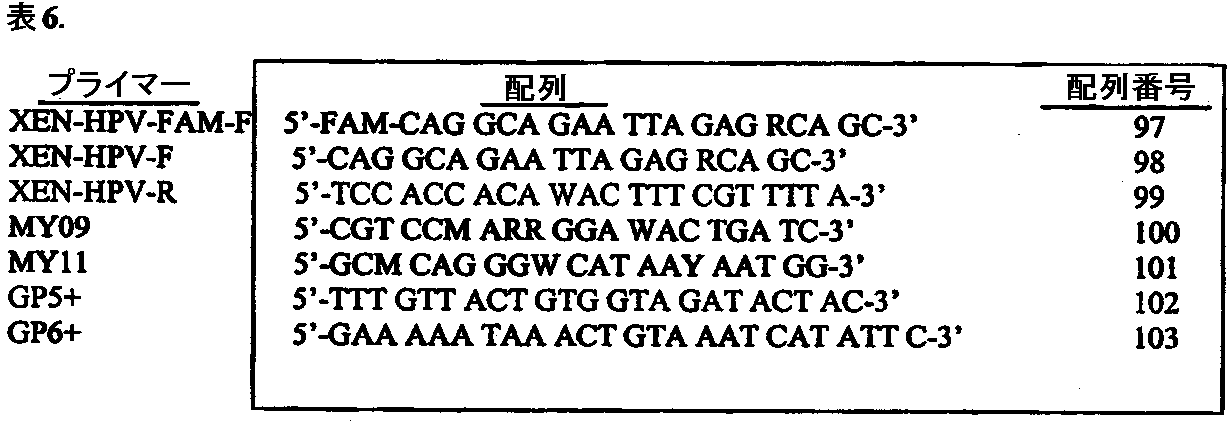
本発明の実施に有用な核酸操作のための技術には、Molecular Cloning:A Laboratory Manual,2nd ed.,Vol.1−3,eds.Sambrookら、Cold Spring Harbor Laboratory Press(1989);およびCurrent Protocols in Molecular Biology,eds.Ausubelら、Greene Publishing and Wiley−Interscience:New York(1987)、ならびに定期的に更新したものが含まれるが、これに制限されない様々な参考
文献に記載されている。特定の記載は、本発明の範囲を制限することを意図するものではないが、本発明のある態様を実施する際に指針を提供する。
Techniques for nucleic acid manipulation useful in the practice of the present invention include Molecular Cloning: A Laboratory Manual, 2nd ed. , Vol. 1-3, eds. Sambrook et al., Cold Spring Harbor Laboratory Press (1989); and Current Protocols in Molecular Biology, eds. Ausubel et al., Green Publishing and Wiley-Interscience: New York (1987), and various references, including but not limited to, regularly updated. The particular description is not intended to limit the scope of the invention, but provides guidance in practicing certain embodiments of the invention.
結果
計320の尿サンプルを、対応する子宮頸部試料のhc2アッセイおよび細胞診検査の結果と比較するために、XenomicsのCEアッセイによって分析した。hc2に関する比較の結果を表7に示す。一致率は248/320(77.5%)であった。320の尿サンプルのうち、72は適合させた子宮頸部試料のhc2アッセイと不一致の結果を出し、DNAシークエンシングによってさらに検証された。
Results A total of 320 urine samples were analyzed by Xenomics CE assay to compare with the results of the corresponding cervical sample hc2 assay and cytology. Table 7 shows the result of comparison for hc2. The coincidence rate was 248/320 (77.5%). Of the 320 urine samples, 72 produced inconsistent results with the matched cervical sample hc2 assay and were further verified by DNA sequencing.
Claims (29)
該尿サンプルにおいてHPVのE1遺伝子の1つ以上の配列を検出する工程
を含み、HPVのE1遺伝子の1つ以上の配列を検出することが、少なくとも1つのヒトパピローマウイルスの存在を示し、それによって該患者におけるHPV感染を示す、方法。 One or more sequences of E1 gene of HPV in urine samples from the patient, a method for the human papillomavirus (HPV) indicator of infection in the patient,
Includes <br/> as engineering detecting one or more sequences of E1 gene of HPV in the urine sample, detecting one or more sequences of E1 gene of HPV is the presence of at least one human papillomavirus It is shown, thereby indicating the HPV infection in the patient.
ドプライマーPCR;リアルタイムPCR;NAハイブリダイゼーション;サイクリックプローブ反応;一本鎖高次構造多型(SSCP);鎖置換増幅(STA);および制限断片長多型(RFLP)からなる群から選択される技術を含む、請求項11に記載の方法。 The detection step includes hybridization; polymerase chain reaction (PCR); nested primer PCR; real-time PCR; NA hybridization; cyclic probe reaction; single-strand conformation polymorphism (SSCP); 12. The method of claim 11, comprising a technique selected from the group consisting of and restriction fragment length polymorphism (RFLP).
Applications Claiming Priority (3)
| Application Number | Priority Date | Filing Date | Title |
|---|---|---|---|
| US19785008P | 2008-10-31 | 2008-10-31 | |
| US61/197,850 | 2008-10-31 | ||
| PCT/US2009/062114 WO2010051261A2 (en) | 2008-10-31 | 2009-10-26 | A genetic marker for detection of human papillomavirus |
Related Child Applications (1)
| Application Number | Title | Priority Date | Filing Date |
|---|---|---|---|
| JP2015013489A Division JP6092906B2 (en) | 2008-10-31 | 2015-01-27 | Genetic markers for detecting human papillomavirus |
Publications (2)
| Publication Number | Publication Date |
|---|---|
| JP2012507293A JP2012507293A (en) | 2012-03-29 |
| JP2012507293A5 true JP2012507293A5 (en) | 2012-12-13 |
Family
ID=42045205
Family Applications (2)
| Application Number | Title | Priority Date | Filing Date |
|---|---|---|---|
| JP2011534663A Pending JP2012507293A (en) | 2008-10-31 | 2009-10-26 | Genetic markers for detecting human papillomavirus |
| JP2015013489A Expired - Fee Related JP6092906B2 (en) | 2008-10-31 | 2015-01-27 | Genetic markers for detecting human papillomavirus |
Family Applications After (1)
| Application Number | Title | Priority Date | Filing Date |
|---|---|---|---|
| JP2015013489A Expired - Fee Related JP6092906B2 (en) | 2008-10-31 | 2015-01-27 | Genetic markers for detecting human papillomavirus |
Country Status (9)
| Country | Link |
|---|---|
| US (3) | US8642261B2 (en) |
| EP (1) | EP2358915B1 (en) |
| JP (2) | JP2012507293A (en) |
| CN (2) | CN105385784A (en) |
| AU (1) | AU2009308943A1 (en) |
| CA (1) | CA2741762C (en) |
| ES (1) | ES2588251T3 (en) |
| HK (1) | HK1221749A1 (en) |
| WO (1) | WO2010051261A2 (en) |
Families Citing this family (8)
| Publication number | Priority date | Publication date | Assignee | Title |
|---|---|---|---|---|
| WO2013144344A2 (en) | 2012-03-30 | 2013-10-03 | Istituto Europeo Di Oncologia S.R.L. | Biomarkers for hpv infections, related diagnostic methods and kits |
| US20150376725A1 (en) * | 2013-09-04 | 2015-12-31 | Trovagene, Inc. | HPV Detection in Urine |
| TWI895765B (en) | 2014-07-18 | 2025-09-01 | 香港中文大學 | Methylation pattern analysis of tissues in a dna mixture |
| WO2017019751A1 (en) | 2015-07-27 | 2017-02-02 | The Johns Hopkins University | Method to use viral and host methylation markers for cervical cancer screening and triage in liquid prep, serum/plasma, and urine: pcr and sequencing based process methods |
| CA3039685A1 (en) | 2016-11-30 | 2018-06-07 | The Chinese University Of Hong Kong | Analysis of cell-free dna in urine and other samples |
| WO2019013613A2 (en) | 2017-07-09 | 2019-01-17 | Hakken Enterprise Sa De Cv | Methods and kids for determining a risk of cancer |
| SG11202106788UA (en) * | 2019-01-03 | 2021-07-29 | Hangzhou New Horizon Health Tech Co Ltd | Compositions and methods for urine sample storage and dna extraction |
| KR102286565B1 (en) * | 2020-01-13 | 2021-08-05 | 대한민국 | Oligomer for extracting trDNA of Mycobacterium tuberculosis in urine sample |
Family Cites Families (9)
| Publication number | Priority date | Publication date | Assignee | Title |
|---|---|---|---|---|
| FR2629458B2 (en) * | 1987-07-31 | 1991-08-09 | Ire Celltarg Sa | NEW NUCLEIC ACID PROBES SPECIFIC TO DIFFERENT TYPES OF HUMAN PAPILLOMA VIRUS |
| US5447839A (en) * | 1988-09-09 | 1995-09-05 | Hoffmann-La Roche Inc. | Detection of human papillomavirus by the polymerase chain reaction |
| AUPN443995A0 (en) * | 1995-07-27 | 1995-08-17 | Csl Limited | Papillomavirus polyprotein |
| US20020119478A1 (en) * | 1997-05-30 | 2002-08-29 | Diagen Corporation | Methods for detection of nucleic acid sequences in urine |
| JP2008524990A (en) * | 2004-12-23 | 2008-07-17 | ヒューマン ジェネティック シグネチャーズ ピーティーワイ リミテッド | Detection of human papillomavirus |
| KR20080084809A (en) * | 2005-11-15 | 2008-09-19 | 게노이드 케이에프티. | How to detect pathogens |
| CN1814796A (en) * | 2005-12-02 | 2006-08-09 | 浙江大学 | Method for detecting and typing 26 human papillomaviruses |
| DE102006041970A1 (en) * | 2006-08-28 | 2008-03-06 | Genome Identification Diagnostics Gmbh | Method and means for detecting human papillomavirus |
| EP2184368A1 (en) * | 2008-11-07 | 2010-05-12 | DKFZ Deutsches Krebsforschungszentrum | Diagnostic transcript and splice patterns of HPV16 in different cervical lesions |
-
2009
- 2009-10-26 US US13/126,081 patent/US8642261B2/en not_active Expired - Fee Related
- 2009-10-26 CN CN201510671553.4A patent/CN105385784A/en active Pending
- 2009-10-26 EP EP09797216.0A patent/EP2358915B1/en not_active Not-in-force
- 2009-10-26 AU AU2009308943A patent/AU2009308943A1/en not_active Abandoned
- 2009-10-26 WO PCT/US2009/062114 patent/WO2010051261A2/en not_active Ceased
- 2009-10-26 CA CA2741762A patent/CA2741762C/en not_active Expired - Fee Related
- 2009-10-26 CN CN200980153183.8A patent/CN102333892B/en not_active Expired - Fee Related
- 2009-10-26 JP JP2011534663A patent/JP2012507293A/en active Pending
- 2009-10-26 ES ES09797216.0T patent/ES2588251T3/en active Active
-
2014
- 2014-02-04 US US14/172,793 patent/US9453265B2/en not_active Expired - Fee Related
-
2015
- 2015-01-27 JP JP2015013489A patent/JP6092906B2/en not_active Expired - Fee Related
-
2016
- 2016-07-25 US US15/218,177 patent/US20170016078A1/en not_active Abandoned
- 2016-08-19 HK HK16109959.2A patent/HK1221749A1/en unknown
Similar Documents
| Publication | Publication Date | Title |
|---|---|---|
| US9809864B2 (en) | Dual sequence-capture method for quantifying trans renal HPV DNA in urine | |
| EP3350351B1 (en) | Virome capture sequencing platform, methods of designing and constructing and methods of using | |
| EP1826269B1 (en) | Method of detecting h5 avian influenza virus | |
| JP2012518421A5 (en) | ||
| JP2012245004A5 (en) | ||
| JP2013055956A5 (en) | ||
| JP2000505295A (en) | Isolation and amplification of nucleic acid material | |
| EP3388532B1 (en) | Integrated capture and amplification of target nucleic acid for sequencing | |
| CA2872479C (en) | Ion torrent genomic sequencing | |
| EP3511426B1 (en) | Asymmetric hairpin target capture oligomers | |
| HK1221749A1 (en) | A genetic marker for detection of human papillomavirus | |
| EP2481812A1 (en) | Molecular sexing of avian subjects | |
| JP6407292B2 (en) | Universal control for sequencing assays | |
| JP2005505289A5 (en) | ||
| JP2011505844A (en) | Cryptospodium detection method | |
| WO2015034764A1 (en) | Hpv detection in urine | |
| JP2006508671A5 (en) | ||
| CN106929601B (en) | High-sensitivity human papilloma virus 6,11 type nucleic acid detection kit | |
| JP5787337B2 (en) | Marker group, test method and test kit for predicting therapeutic effect of hepatitis C | |
| JP2004344065A (en) | Oligonucleotides and method for detecting Mycobacterium tuberculosis complex using the same | |
| JP4388061B2 (en) | Nucleic acid primer set for LAMP amplification for detecting hepatitis E virus | |
| KR102366554B1 (en) | RT-LAMP pirmer set for discriminating SARS-CoV-2 delta variant and uses thereof | |
| JP2007000040A (en) | Method for detecting hepatitis B virus | |
| JP2004248508A5 (en) | ||
| CN112239791A (en) | Human immunodeficiency virus detection kit |