JP2012520004A - Method and apparatus for prioritization in a peer-to-peer network - Google Patents
Method and apparatus for prioritization in a peer-to-peer network Download PDFInfo
- Publication number
- JP2012520004A JP2012520004A JP2011552904A JP2011552904A JP2012520004A JP 2012520004 A JP2012520004 A JP 2012520004A JP 2011552904 A JP2011552904 A JP 2011552904A JP 2011552904 A JP2011552904 A JP 2011552904A JP 2012520004 A JP2012520004 A JP 2012520004A
- Authority
- JP
- Japan
- Prior art keywords
- peer
- urgency
- data content
- requesting
- request
- Prior art date
- Legal status (The legal status is an assumption and is not a legal conclusion. Google has not performed a legal analysis and makes no representation as to the accuracy of the status listed.)
- Pending
Links
- 238000000034 method Methods 0.000 title claims abstract description 39
- 238000012913 prioritisation Methods 0.000 title description 3
- 239000000872 buffer Substances 0.000 claims abstract description 34
- 230000007246 mechanism Effects 0.000 claims abstract description 29
- 238000012423 maintenance Methods 0.000 claims description 15
- 238000007726 management method Methods 0.000 claims description 7
- 230000003139 buffering effect Effects 0.000 claims description 5
- 238000004891 communication Methods 0.000 description 12
- 238000010586 diagram Methods 0.000 description 7
- 230000006978 adaptation Effects 0.000 description 2
- 238000013459 approach Methods 0.000 description 2
- 230000005540 biological transmission Effects 0.000 description 2
- 238000012545 processing Methods 0.000 description 2
- 239000007787 solid Substances 0.000 description 2
- 125000002066 L-histidyl group Chemical group [H]N1C([H])=NC(C([H])([H])[C@](C(=O)[*])([H])N([H])[H])=C1[H] 0.000 description 1
- 230000002776 aggregation Effects 0.000 description 1
- 238000004220 aggregation Methods 0.000 description 1
- 230000009286 beneficial effect Effects 0.000 description 1
- 230000015556 catabolic process Effects 0.000 description 1
- 230000001186 cumulative effect Effects 0.000 description 1
- 238000006731 degradation reaction Methods 0.000 description 1
- 230000009191 jumping Effects 0.000 description 1
- 238000012544 monitoring process Methods 0.000 description 1
- 230000000750 progressive effect Effects 0.000 description 1
Images



Classifications
-
- H—ELECTRICITY
- H04—ELECTRIC COMMUNICATION TECHNIQUE
- H04L—TRANSMISSION OF DIGITAL INFORMATION, e.g. TELEGRAPHIC COMMUNICATION
- H04L67/00—Network arrangements or protocols for supporting network services or applications
- H04L67/01—Protocols
- H04L67/10—Protocols in which an application is distributed across nodes in the network
- H04L67/104—Peer-to-peer [P2P] networks
-
- H—ELECTRICITY
- H04—ELECTRIC COMMUNICATION TECHNIQUE
- H04L—TRANSMISSION OF DIGITAL INFORMATION, e.g. TELEGRAPHIC COMMUNICATION
- H04L65/00—Network arrangements, protocols or services for supporting real-time applications in data packet communication
- H04L65/80—Responding to QoS
-
- H—ELECTRICITY
- H04—ELECTRIC COMMUNICATION TECHNIQUE
- H04L—TRANSMISSION OF DIGITAL INFORMATION, e.g. TELEGRAPHIC COMMUNICATION
- H04L67/00—Network arrangements or protocols for supporting network services or applications
- H04L67/50—Network services
- H04L67/60—Scheduling or organising the servicing of application requests, e.g. requests for application data transmissions using the analysis and optimisation of the required network resources
- H04L67/61—Scheduling or organising the servicing of application requests, e.g. requests for application data transmissions using the analysis and optimisation of the required network resources taking into account QoS or priority requirements
-
- H—ELECTRICITY
- H04—ELECTRIC COMMUNICATION TECHNIQUE
- H04L—TRANSMISSION OF DIGITAL INFORMATION, e.g. TELEGRAPHIC COMMUNICATION
- H04L69/00—Network arrangements, protocols or services independent of the application payload and not provided for in the other groups of this subclass
- H04L69/30—Definitions, standards or architectural aspects of layered protocol stacks
- H04L69/32—Architecture of open systems interconnection [OSI] 7-layer type protocol stacks, e.g. the interfaces between the data link level and the physical level
- H04L69/322—Intralayer communication protocols among peer entities or protocol data unit [PDU] definitions
- H04L69/329—Intralayer communication protocols among peer entities or protocol data unit [PDU] definitions in the application layer [OSI layer 7]
-
- H—ELECTRICITY
- H04—ELECTRIC COMMUNICATION TECHNIQUE
- H04L—TRANSMISSION OF DIGITAL INFORMATION, e.g. TELEGRAPHIC COMMUNICATION
- H04L65/00—Network arrangements, protocols or services for supporting real-time applications in data packet communication
- H04L65/60—Network streaming of media packets
- H04L65/61—Network streaming of media packets for supporting one-way streaming services, e.g. Internet radio
- H04L65/612—Network streaming of media packets for supporting one-way streaming services, e.g. Internet radio for unicast
Landscapes
- Engineering & Computer Science (AREA)
- Computer Networks & Wireless Communication (AREA)
- Signal Processing (AREA)
- Multimedia (AREA)
- Computer Security & Cryptography (AREA)
- Information Transfer Between Computers (AREA)
- Computer And Data Communications (AREA)
- Data Exchanges In Wide-Area Networks (AREA)
- Communication Control (AREA)
Abstract
本発明は、データコンテンツを共有するピアツーピアネットワークと組み合わせて使用されるノード及び方法に関する。優先順位機構は、緊急度の観点からのデータコンテンツに対する必要性に基づいて対応する要求ピアを選択してもよいサービングピアを利用して導入される。要求ピアは、例えばビデオバッファにおいて再生のために使用可能なバッファリングされたデータの量であってもよいデータコンテンツに対する要求に緊急度指標を含んでもよい。サービングピアは、要求から緊急度指標を抽出してもよく(52)、データコンテンツをアップロードするピアを選択するように緊急度指標を使用する優先順位機構を適用してもよい(53)。 The present invention relates to nodes and methods used in combination with peer-to-peer networks that share data content. A priority mechanism is introduced utilizing a serving peer that may select a corresponding requesting peer based on the need for data content in terms of urgency. The requesting peer may include an urgency indicator in the request for data content, which may be, for example, the amount of buffered data available for playback in the video buffer. The serving peer may extract the urgency index from the request (52) and may apply a priority mechanism that uses the urgency index to select peers to upload the data content (53).
Description
本発明は、ピアツーピア(すなわち、P2P)ネットワークにおいて使用される方法及び装置に関し、特に、P2Pネットワークにおいて優先順位付けをサポートする方法及び装置に関する。 The present invention relates to a method and apparatus used in a peer-to-peer (ie, P2P) network, and more particularly to a method and apparatus that supports prioritization in a P2P network.
P2Pコンピュータネットワークにおいて、ピアノード(すなわち、ピア)は、互いにデータコンテンツを配信するように協働する。ピアの種々の接続性及び累積帯域幅は、例えばオーディオ、ビデオ、データ又はデジタル形式のあらゆるものを含むファイル、電話トラフィック、ビデオストリーミング、あるいはビデオダウンロード等のデータコンテンツを共有するために使用される。P2Pネットワークは、多くの場合、相対的に数の少ない集中サービサーがデータコンテンツをエンドノードに提供する階層ネットワークトポロジよりもデータコンテンツをはるかに効率的に配信する。ピュアP2Pネットワークにおいて、クライアント又はサーバの概念はなく、あるのは同等のピアだけである。しかし、種々のネットワーク構造が種々のタスクに対して好まれる可能性があるために、クライアント/サーバ構造をP2P構造と組み合わせる多くの種類のハイブリッドP2Pネットワークがある。以下において、P2Pネットワークという用語は、ピュアP2Pネットワーク及びハイブリッドP2Pネットワークを含むことを意図する。 In a P2P computer network, peer nodes (ie, peers) cooperate to distribute data content with each other. The various connectivity and cumulative bandwidth of peers are used to share data content such as files, telephone traffic, video streaming, or video downloads, including anything in audio, video, data or digital formats, for example. P2P networks often distribute data content much more efficiently than a hierarchical network topology in which a relatively small number of centralized servicers provide data content to end nodes. In a pure P2P network, there is no concept of a client or server, only an equivalent peer. However, because different network structures may be preferred for different tasks, there are many types of hybrid P2P networks that combine client / server structures with P2P structures. In the following, the term P2P network is intended to include pure P2P networks and hybrid P2P networks.
P2P通信に対して使用されうる多数の種々のプロトコル、例えばBitTorrent、Gnutella、CAN、FastTrack及びJXTAがある。BitTorrentプロトコルは、最も広範に使用されたP2Pプロトコルのうちの1つであり、2008年2月28日に最後に編集され、「http://www.bittorrent.org/beps/bep_0003.html」で入手可能であるCohen、Bramによる「The BitTorrent Protocol Specification」、バージョン11031において説明される。 There are a number of different protocols that can be used for P2P communication, such as BitTorrent, Gnutella, CAN, FastTrack and JXTA. The BitTorrent protocol is one of the most widely used P2P protocols, which was last edited on February 28, 2008 and is "http://www.bittorrent.org/beps/bep_0003.html". Available in “The BitTorrent Protocol Specification”, version 11031 by Cohen, Bram, available.
BitTorrentプロトコル及び他の多くのP2Pプロトコルは、最初にP2Pオーバレイネットワークを介してファイル共有できるように設計された。ファイル共有の場合、ユーザは可能な限り高速にファイルをダウンロードすることを望むものであり、一般にファイルの末尾がファイルの先頭の前にダウンロードされるかは少しも重要ではない。 The BitTorrent protocol and many other P2P protocols were originally designed to allow file sharing over P2P overlay networks. In the case of file sharing, the user wants to download the file as fast as possible, and it is generally not at all important whether the end of the file is downloaded before the beginning of the file.
ビデオオンデマンド(VoD)及びライブストリーミングP2Pシステムが昨今普及するにつれ、これらの普及しているサービスにも対処できるようにBitTorrent等のファイル共有のためのP2Pプロトコルを変更することに関心がある。しかし、VoD又はビデオストリーミングの場合、ファイル共有の場合以外に考慮すべき他の要素がある。VoDの場合、ユーザは、コンテンツの再生を開始するためにファイルの先頭を最初にダウンロードすることを望む。その後ユーザは、コンテンツの後続部分等を要求する。従って、コンテンツのダウンロードは、ある自由度である程度連続している。VoDサービスのユーザにとって、起動遅延は経験品質(QoE)の重要な部分である。起動遅延は、ビデオのダウンロードを開始してからそのファイルの再生が開始するまでにかかる時間である。VoDサービスの継続性は更に重要である。1つ又は複数の最初の部分が入手可能である限り、ビデオファイルの再生はファイル全体がダウンロードされる前に開始する。しかし、再生ポイントがビデオファイルの後続部分に到達する前に後続部分がダウンロードされていることが重要である。そうでないと、ビデオはフリーズする。コンテンツのダウンロードに対してVoDと同様の要望をする可能性のあるアプリケーションの他の例は、オーディオストリーミング及びビデオストリーミング、ゲーミング、並びに場合によってはソフトウェア更新である。 As video-on-demand (VoD) and live streaming P2P systems become more popular, there is an interest in changing the P2P protocol for file sharing, such as BitTorrent, to accommodate these popular services. However, for VoD or video streaming, there are other factors to consider other than file sharing. In the case of VoD, the user wants to download the beginning of the file first to start playing the content. Thereafter, the user requests a subsequent part of the content. Therefore, the content download is continued to some extent with a certain degree of freedom. For VoD service users, startup delay is an important part of quality of experience (QoE). The startup delay is the time taken from the start of video download to the start of playback of the file. The continuity of the VoD service is even more important. As long as one or more initial parts are available, playback of the video file begins before the entire file is downloaded. However, it is important that the subsequent part is downloaded before the playback point reaches the subsequent part of the video file. Otherwise, the video will freeze. Other examples of applications that may make similar demands to VoD for content download are audio and video streaming, gaming, and possibly software updates.
元のBitTorrentプロトコルは、いわゆるしっぺ返し手法(tit-for-tat approch)を使用する。しっぺ返し手法は、より貢献するピアがより高速にダウンロードできるようにする動機付けアルゴリズムである。サービングピア、すなわち他の関心ピア、すなわち要求ピアがダウンロードできるデータコンテンツを有するピアは、サービングピアに最も多くアップロードした要求ピアを優先するだろう。従って、しっぺ返しアルゴリズムは、最も多くアップロードするピアをより優先するために公正であるという概念を有する。それに加え、アルゴリズムが、時々、アップロードしないピアに機会を与えることにより、コンテンツを有さないピアはコンテンツの取得及び共有を開始できる。しっぺ返し手法は、元々ファイル共有に対して更に開発されたものであり、上述したようにダウンロードの実行に対する要望が異なるため、VoD等のサービスに対して最適化されない。 The original BitTorrent protocol uses a so-called tit-for-tat approch. The wrapping method is a motivational algorithm that allows more contributing peers to download faster. A serving peer, i.e. a peer with other interested peers, i.e. a peer with data content that can be downloaded by a requesting peer, will give priority to the requesting peer that has uploaded the most to the serving peer. Thus, the rip-back algorithm has the notion that it is fair to give preference to the most uploading peers. In addition, the algorithm sometimes gives peers who do not upload, so that peers without content can begin to acquire and share content. The clip-back method was originally developed for file sharing, and the request for execution of download is different as described above, so it is not optimized for services such as VoD.
従って、P2P共有に対する従来技術の機構に関する問題は、それらが、VoD、プログレッシブダウンロード、並びにオーディオストリーミング及びビデオストリーミング等の他の種類のサービスに対してではなく、ファイル共有の場合に対して設計されることである。 Thus, the problems with prior art mechanisms for P2P sharing are designed for the case of file sharing rather than for other types of services such as VoD, progressive download, and audio and video streaming. That is.
従来技術の上記の説明から、例えばVoD、並びにオーディオストリーミング及びビデオストリーミングの要望のうちの少なくともいくつかに適応されるP2P共有のための別の方法及び装置に対する必要性があるのは明らかである。本発明の目的は、ファイル共有以外のサービスの場合にP2Pネットワークにおいてデータコンテンツをより効率的に共有できるようにする方法及び装置を提供することである From the above description of the prior art, it is clear that there is a need for another method and apparatus for P2P sharing adapted to, for example, VoD and at least some of audio and video streaming needs. An object of the present invention is to provide a method and apparatus for enabling data content to be shared more efficiently in a P2P network in the case of services other than file sharing.
上述の目的は、独立請求項に記載された方法、ネットワークノード、並びに運用及び保守システムを利用して達成される。 The above objective is accomplished by utilizing the method, network node and operation and maintenance system described in the independent claims.
本発明の第1の実施形態は、クライアントアプリケーションを含むネットワークノードにおける方法を提供する。クライアントアプリケーションは、データコンテンツを共有するピアツーピアネットワークのサービングピアとして動作する。方法において、データコンテンツに対する少なくとも1つの要求は、多数の要求ピアから受信される。要求から緊急度指標が抽出される。緊急度指標は、緊急度に関してデータコンテンツに対する要求ピアの必要性を示す。要求されたデータコンテンツは要求ピアに配信されるが、優先順位機構は配信に適用される。優先順位機構は、対応する要求ピアを判定するために緊急度指標が使用されることを示す。 The first embodiment of the present invention provides a method in a network node including a client application. Client applications operate as serving peers in peer-to-peer networks that share data content. In the method, at least one request for data content is received from multiple requesting peers. An urgency index is extracted from the request. The urgency indicator indicates the need of the requesting peer for data content in terms of urgency. The requested data content is delivered to the requesting peer, but the priority mechanism is applied to the delivery. The priority mechanism indicates that the urgency index is used to determine the corresponding requesting peer.
本発明の第2の実施形態は、クライアントアプリケーションを含むネットワークノードにおける方法を更に提供する。しかし、第2の実施形態によると、クライアントアプリケーションは、データコンテンツを共有するピアツーピアネットワークの要求ピアとして動作する。方法において、データコンテンツに対する要求はサービングピアに送出される。緊急度指標は要求に含まれる。方法は、この緊急度指標を判定することを更に含む。緊急度指標は、緊急度に関してデータコンテンツに対する要求ピアの必要性を示す。 The second embodiment of the present invention further provides a method in a network node including a client application. However, according to the second embodiment, the client application operates as a requesting peer in a peer-to-peer network that shares data content. In the method, a request for data content is sent to a serving peer. The urgency index is included in the request. The method further includes determining the urgency index. The urgency indicator indicates the need of the requesting peer for data content in terms of urgency.
本発明の第3の実施形態は、クライアントアプリケーションを含むネットワークノードを提供する。クライアントアプリケーションは、データコンテンツを共有するピアツーピアネットワークのサービングピアとして動作するように構成される。ネットワークノードは、多数の要求ピアからデータコンテンツに対する少なくとも1つの要求を受信し、且つ要求されたデータコンテンツを要求ピアに配信するように構成される。更にクライアントアプリケーションは、要求から緊急度指標を抽出するように構成される。緊急度指標は、緊急度に関してデータコンテンツに対する要求ピアの必要性を示す。クライアントアプリケーションは優先順位機構を含む。優先順位機構は、対応する要求ピアを判定するために緊急度指標を使用することにより、要求されたデータコンテンツの配信を制御するように構成される。 The third embodiment of the present invention provides a network node including a client application. The client application is configured to operate as a serving peer in a peer-to-peer network that shares data content. The network node is configured to receive at least one request for data content from a number of requesting peers and to deliver the requested data content to the requesting peers. Further, the client application is configured to extract an urgency index from the request. The urgency indicator indicates the need of the requesting peer for data content in terms of urgency. The client application includes a priority mechanism. The priority mechanism is configured to control delivery of the requested data content by using the urgency index to determine the corresponding requesting peer.
本発明の第4の実施形態は、クライアントアプリケーションを含むネットワークノードを提供する。クライアントアプリケーションは、データコンテンツを共有するピアツーピアネットワークの要求ピアとして動作するように構成される。ネットワークノードは、データコンテンツに対する要求をサービングピアに送出するように構成される。クライアントアプリケーションは、緊急度指標を要求に含むように構成される。クライアントアプリケーションは、緊急度指標を判定するように更に構成される。緊急度指標は、緊急度に関してデータコンテンツに対する要求ピアの必要性を示す。 The fourth embodiment of the present invention provides a network node including a client application. The client application is configured to operate as a requesting peer in a peer-to-peer network that shares data content. The network node is configured to send a request for data content to the serving peer. The client application is configured to include an urgency indicator in the request. The client application is further configured to determine the urgency indicator. The urgency indicator indicates the need of the requesting peer for data content in terms of urgency.
本発明の第5の実施形態は、データコンテンツを共有するピアツーピアネットワークを管理する運用及び保守システムを提供する。運用及び保守システムは、ピアツーピアネットワークにおいて要求ピアから少なくとも1つのメッセージを受信するように構成される。要求ピアは、ピアツーピアネットワークにおいてサービングピアからデータコンテンツを要求している。運用及び保守システムは、要求ピアから受信したメッセージから緊急度指標を抽出するように構成される。緊急度指標は、データコンテンツに対する要求ピアの必要性を示し、緊急度に関してサービングピアから要求している。運用及び保守システムは、ピアツーピアネットワークの管理に関して判断するために緊急度指標使用するように更に構成される。 The fifth embodiment of the present invention provides an operation and maintenance system for managing a peer-to-peer network sharing data content. The operations and maintenance system is configured to receive at least one message from the requesting peer in a peer-to-peer network. A requesting peer is requesting data content from a serving peer in a peer-to-peer network. The operations and maintenance system is configured to extract the urgency index from the message received from the requesting peer. The urgency indicator indicates the need of the requesting peer for data content and is requested from the serving peer for urgency. The operations and maintenance system is further configured to use the urgency index to make decisions regarding management of the peer-to-peer network.
本発明の実施形態の利点は、要求ピアの必要性に従ってデータコンテンツを効率的に配信する手段を提供することにより、QoE低下に対するリスクを軽減することである。それにより、従来技術に係る解決方法を用いる場合よりも満足した要求ピア(高レベルのQoE)及びユーザコンテンツを維持することが可能である。 An advantage of embodiments of the present invention is that it reduces the risk of QoE degradation by providing a means to efficiently deliver data content according to the needs of the requesting peer. Thereby, it is possible to maintain the requested peer (high level QoE) and the user content more satisfactory than when using the solution according to the prior art.
本発明の実施形態の別の利点は、ビデオにおけるいわゆるシーク動作がより高速に開始することである。ユーザが再生ポイントを変更し且つビデオにおいて後続部分へのジャンプを開始する場合にシーク動作が行われる。これは、まだダウンロードされていないビデオファイルのセクションを緊急にダウンロードする要求をトリガしてもよい。所望のセクションの迅速なダウンロードが達成されるように、このような緊急の要求は、本発明の実施形態に従って考慮され、ネットワークリソース(すなわち、サービングピア)を割り当てる。 Another advantage of embodiments of the present invention is that so-called seek operations in the video start faster. A seek operation occurs when the user changes the playback point and starts jumping to a subsequent part in the video. This may trigger a request to urgently download a section of the video file that has not yet been downloaded. Such urgent requests are considered according to embodiments of the present invention and allocate network resources (ie, serving peers) so that a desired section can be quickly downloaded.
本発明の実施形態の別の利点は、システムリソースがより知的に使用されてもよいことである。本発明の実施形態により、使用可能なリソースを現時点でそれらが最も必要とされる場所に集中させることが可能となるため、これは可能である。データコンテンツを緊急に必要とする他のピアがある場合、データを即座に必要としないピアにデータコンテンツをアップロードするのにネットワークリソースを使用中にしたままにするのは無駄である。緊急に必要とするピアへのデータコンテンツ配信を優先することにより、ネットワークリソースをより効率的に使用できる。 Another advantage of embodiments of the present invention is that system resources may be used more intelligently. This is possible because embodiments of the present invention allow the available resources to be concentrated where they are currently most needed. If there are other peers that need data content urgently, it is useless to leave network resources in use to upload data content to peers that do not need data immediately. Network resources can be used more efficiently by prioritizing data content delivery to urgently needed peers.
本発明の一実施形態の更に別の利点は、一実施形態が、データコンテンツを共有するピアツーピアネットワークにおいてボトルネック及びトラフィック輻輳を管理するツールを提供することである。データコンテンツを緊急に必要としないピアがトラフィック輻輳の場合にデータコンテンツの要求を停止することを要求されるように、これは、種々のピアのデータコンテンツに対する必要性に関する情報を運用及び保守システムに提供することにより達成される。 Yet another advantage of one embodiment of the present invention is that one embodiment provides a tool for managing bottlenecks and traffic congestion in peer-to-peer networks that share data content. This allows information on the need for data content of various peers to the operation and maintenance system so that peers that do not need data content urgently are required to stop requesting data content in the event of traffic congestion. Achieved by providing.
本発明の実施形態の更なる利点及び特徴は、図面と共に以下の詳細な説明を読むことにより明らかとなるだろう。 Further advantages and features of embodiments of the present invention will become apparent upon reading the following detailed description in conjunction with the drawings.
次に、本発明の実施形態が好適に示される添付の図面を参照して、本発明を以下に更に詳細に説明する。しかし、本発明は、多くの種々の形態で具体化されてもよく、本明細書において説明された実施形態に限定されるものとして解釈されるべきではない。これらの実施形態は、その開示内容が完璧で完全なものとなり、本発明の範囲が当業者に完全に理解されるように提供される。図中、同一の図中符号は同一の要素を示す。 The present invention will now be described in more detail below with reference to the accompanying drawings, in which embodiments of the invention are preferably shown. However, the present invention may be embodied in many different forms and should not be construed as limited to the embodiments set forth herein. Rather, these embodiments are provided so that this disclosure will be thorough and complete, and will fully convey the scope of the invention to those skilled in the art. In the drawings, the same reference numerals denote the same elements.
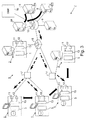
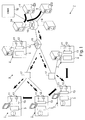
図1は、メディアサービスをクライアントエンドノード1に配信するシステム7の一例を示す。図1において、本発明の実施形態が実現されてもよい。クライアントエンドノードは、この例ではネットワーク5を介するVoDサーバ8及びライブストリーミングサーバ9であるヘッドエンドサーバと通信できる。ネットワーク5は、この場合、クライアント−サーバモデルに従ってクライアントエンドノード1がヘッドエンドサーバ8及び9と通信できるようにし、且つP2Pモデルに従ってクライアントエンドノード1が互いに通信できるようにするかあるいはネットワークにおいてキャッシュサーバ2等の他のノードと通信できるようにするハイブリッドP2Pネットワークである。図1において、実線の太字の双方向の矢印はノード間のP2P通信を概略的に示し、実線の太字の一方向の矢印はユニキャスト通信トラフィックを概略的に示し、且つ破線の一方向の矢印はマルチキャスト通信トラフィックを概略的に示すために使用される。
FIG. 1 shows an example of a system 7 that delivers media services to
図1に示された例において、ネットワーク5は、例えばTVサービス及びVoDサービスをクライアントエンドノード1のユーザに提供するオペレータの管理ネットワークであってもよい。TVサービスは、ライブストリーミングサーバ9からクライアントエンドノード1へのマルチキャスト送信を利用して提供されてもよい。VoDサービスは、VoDサーバ8からのユニキャスト送信を利用してクライアントエンドノードに提供されてもよい。図1のシステム7において、クライアントエンドノードが、P2P通信を利用して他のクライアントエンドノード又はキャッシュサーバ2からビデオファイル又はビデオファイルのセクション取得することが更に可能である。クライアントエンドノード1とVoDサーバ8との間のユニキャスト通信は必要なネットワークリソースの点でP2P通信より高いため、クライアントエンドノード1がP2P通信を利用して要求されたビデオファイルを取得するのがオペレータの観点から好ましい。
In the example shown in FIG. 1, the
例えばクライアントエンドノード1は、電気通信機能を提供する入力ユニット11と、出力ユニット12と、処理ユニット13とを備える格納機能を有するセットトップボックス、コンピュータ又は他の何らかの種類の電子機器であってもよい。例えばキャッシュサーバ2は、例えば最も試聴したTVプログラムに関連する人気のコンテンツをキャッシュするために使用されることにより、タイムシフトTVサービス、すなわちTVプログラムの実際の放送時間後にユーザが選択する時間にそのTVプログラムを視聴することを要求できるサービスを提供してもよい。キャッシュサーバ2は、入力ユニット11と、出力ユニット12と、処理ユニット13とを更に備える。クライアントエンドノード1及びキャッシュサーバ2は、それぞれクライアントアプリケーション3及び4を更に含む。クライアントアプリケーション3、4は、一般にソフトウェアで実現されるが、ハードウェア又はファームウェア、あるいはそれらの組合せで更に実現できる。図1のシステム7において、クライアントエンドノード1のクライアントアプリケーション3は、通信に対するP2Pモデルに従って要求ピア及びサービングピアの双方として動作するように構成され、クライアントアプリケーション4は、サービングピアとしてのみ動作するように構成される。クライアントアプリケーションは、ネットワークの別のピアからクライアントエンドノードにコンテンツを要求することに関連した動作を実行する場合に要求ピアとして動作する。クライアントアプリケーションは、コンテンツを要求ピアに提供することに関連する動作を実行している場合にサービングピアとして動作すると言われている。
For example, the
図1は、この例では管理コンテンツトラッカであるコンテンツトラッカ6を備えるネットワーク5を更に示す。コンテンツトラッカの機能は、異なるコンテンツが格納されるネットワークの場所を追跡することである。要求ピアは、コンテンツトラッカに接続し、コンテンツのある特定のピースを取得できる1つ又は複数のサービングピアを見つけ出す。実際には、コンテンツトラッカ6は、この場合はオペレータにより制御される管理手段である。また、図1のシステム7は、ネットワーク5の中央監視及びトラフィック管理を実行するように構成される運用及び保守(Operation and Management;O&M)システムを含む。ネットワーク5において概略的に示される他の機器は、プロキシサーバ14、エッジルータ15、集約スイッチ(aggregation switch)16及びアクセスノード17である。これらの種々の機器は、当業者には既知である機能及び実現例を有するため、本明細書において詳細に説明しない。
FIG. 1 further shows a
背景の節で説明されたように、P2P通信に対する従来技術の解決方法は、しっぺ返し手法を使用してもよい。例えば、サービングピアが、5つの他の要求ピアからビデオチャンク等のコンテンツのピースに対する要求を受信したと仮定する。次にサービングピアは、しっぺ返し手法に従って、例えば以前にサービングピアに最も多くのコンテンツをアップロードした3つの要求ピアにアップロードし且つ他の2つの要求ピアをチョーク(choke)する(すなわち、要求ピアにいわゆるアンチョークメッセージを受信するまでコンテンツの要求を停止するように伝えるいわゆるチョークメッセージを送出する)ことを選択する。しかし、チョークされた要求ピアのうちの1つは、関連付けられたビデオバッファが殆ど空になっているために緊急にビデオチャンクを必要とすると仮定する。このビデオチャンクが取得されない場合、ユーザはサービスの中断を経験する可能性がある。すなわち、ビデオは画面においてフリーズする。更に、対応されている全ての他のピアがほぼ満杯のバッファを有すると仮定する。従来技術の解決方法によると、この状況により、対応されている要求ピアと関連付けられたちょうど3つのコンテンツユーザが得られる一方、他の2つの要求ピアと関連付けられたユーザは、サービスが中断されるために非常に不満を有するだろう。しかし、本発明の実施形態は、最初に対応する要求ピアを判断する際に要求ピアの必要性を考慮することにより、全ての5つの要求ピアコンテンツのユーザを追跡する手段を提供する。従って、本発明の実施形態は、ビデオチャンクを最も必要とするピアにビデオチャンクを送出するために適用される優先順位機構を提供する。この優先順位機構を実現するために、要求ピアは、コンテンツに対するP2P要求メッセージにおいて緊急度指標(urgent indicator)を含んでもよい。要求メッセージを受信する場合、サービングピアは、要求ピアと関連付けられた緊急度指標を保存してもよく、要求ピアをソートして交換レートをアップロード又は増加するピアを判断するためにこの情報を使用してもよい。 As explained in the background section, the prior art solution for P2P communication may use a repeat approach. For example, suppose a serving peer has received requests for pieces of content such as video chunks from five other requesting peers. The serving peer then follows a wrap-up approach, eg uploads to the three requesting peers that have previously uploaded the most content to the serving peer and chokes the other two requesting peers (ie so-called to the requesting peer Send a so-called choke message telling the content request to stop until an unchoke message is received. However, assume that one of the choked requesting peers urgently needs a video chunk because the associated video buffer is almost empty. If this video chunk is not acquired, the user may experience a service interruption. That is, the video freezes on the screen. Further assume that all other peers that are supported have nearly full buffers. According to the prior art solution, this situation results in just three content users associated with the corresponding requesting peers, while users associated with the other two requesting peers are interrupted in service. Would be very dissatisfied for. However, embodiments of the present invention provide a means to keep track of users of all five requesting peer content by considering the requesting peer's need in determining the first corresponding requesting peer. Thus, embodiments of the present invention provide a priority mechanism that is applied to send video chunks to peers that need them most. To implement this priority mechanism, the requesting peer may include a urgent indicator in the P2P request message for the content. When receiving a request message, the serving peer may store the urgency indicator associated with the request peer and use this information to sort the request peers to determine which peers will upload or increase the exchange rate. May be.
緊急度指標は、本発明の種々の実施形態に従って多くの種々の情報を含んでもよい。緊急度指標は、例えばVoDアプリケーションにおいて要求ピアのビデオバッファがどのくらい空であるかに関する情報、例えば再生のために既に使用可能なバッファリングされたデータの量、バッファが空になるまでの残りの再生時間の表示、ビデオの次の部分のバッファ空き量の表示又はバッファリングされたデータの多数の事前定義された間隔のうちの1つを示す空きレベルの分類であってもよい。緊急度指標に含まれた情報の種類に関係なく、サービングピアにより解釈されてもよいコンテンツの緊急度のある種類の測定値を提供することが重要である。その後サービングピアは、最初に最も高い緊急度を示した要求ピアにアップロードすることを選択する。 The urgency indicator may include a number of different information in accordance with various embodiments of the invention. The urgency indicator is, for example, information about how empty the requesting peer's video buffer is in a VoD application, eg the amount of buffered data already available for playback, the remaining playback until the buffer is empty It may be an indication of time, an indication of the buffer free space in the next part of the video, or a free level classification indicating one of a number of predefined intervals of buffered data. Regardless of the type of information included in the urgency indicator, it is important to provide some type of measure of content urgency that may be interpreted by the serving peer. The serving peer then chooses to upload to the requesting peer that initially showed the highest urgency.
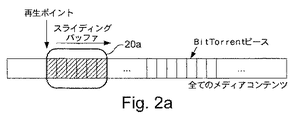
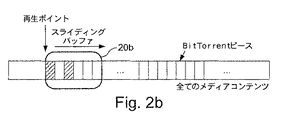
図2a及び図2bは、2つの要求ピアのメディアコンテンツに対するビデオバッファの概略図であり、本発明の実施形態が種々のピアを優先順位付けするために使用されてもよい方法を示す。図2a及び図2bは、それぞれ2つのスライディングバッファ20a及び20bを示す。バッファ20a及び20bにおいて、破線の長方形は、ダウンロードされており且つ再生のために使用可能なビデオピース(この例ではいわゆるBitTorrentピース)を示し、白の長方形は、ダウンロードされないで残っているビデオピースを示す。従って、図2aは満杯のバッファ20aを示し、図2bはほぼ空のバッファを示す。従って、バッファ20aを含む要求ピアへのあらゆるアップロードに低い優先順位を与え、バッファ20bを含む要求ピアがより緊急にビデオピースを必要とするために高い優先順位を与えられるべきであることは、道理にかなうだろう。この種の優先順位付けは、本発明の実施形態に従って可能であり、P2Pネットワークにおいて十分なリソースがある場合に再生時間中の中断を回避できる。
2a and 2b are schematic diagrams of video buffers for the media content of two requesting peers, illustrating how embodiments of the present invention may be used to prioritize various peers. Figures 2a and 2b show two sliding
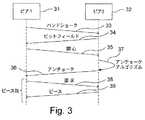
次に、元のBitTorrentプロトコルの変更を含む本発明の一実施形態を説明する。BitTorrentプロトコルに従って、あるコンテンツを要求したいピア(すなわち、要求ピア)は、最初に図1のコンテンツトラッカ6等のトラッカから所望のコンテンツ又はその一部を有する他のピアのリストを取得する。その後、要求ピアとコンテンツを含むピア(すなわち、サービングピア)と直接通信し始める。図3は、要求ピア31とサービングピア32との間のBitTorrentプロトコルに従うメッセージ交換を概略的に示す。要求ピア31は、最初にハンドシェークメッセージ33をサービングピアに送出する。サービングピアは、サービングピアが有するコンテンツのピースを示すビットの集合であるビットフィールド34を用いて応答すべきである。この情報に基づいて、要求ピアは、サービングピアが必要なあるピースを有する場合には関心メッセージ35を送出する。しかし、関心メッセージ35を受信する場合、サービングピアは、サービングピアが有するあるデータに関心のある他の全てのピアと共に要求ピアをリストに追加し、要求ピアのうちのいくつかをアンチョークするアンチョーク機構37を周期的に実行する。要求ピアをアンチョークする場合、サービングピアは、コンテンツのピースを要求し始めることがOKであることを要求ピアに示すアンチョークメッセージ36を送出する。次に要求ピアは、コンテンツの特定のピースを要求する要求メッセージ38を送出する。サービングノードは、メッセージ39において要求されたコンテンツのピースを送出することにより応答する。要求ピアは、サービングンピアから関心のあったコンテンツの全てのピースを受信するまで、あるいはアンチョークメッセージが受信されるまでコンテンツの要求を停止すべきであることを示すチョークメッセージを受信するまでコンテンツのピースを要求し続ける。
Next, an embodiment of the present invention including changes to the original BitTorrent protocol will be described. According to the BitTorrent protocol, a peer that wants to request some content (ie, a requesting peer) first obtains a list of other peers that have the desired content or parts thereof from a tracker such as the content tracker 6 of FIG. It then begins communicating directly with the requesting peer and the peer that contains the content (ie, the serving peer). FIG. 3 schematically shows a message exchange according to the BitTorrent protocol between the requesting
元のBitTorrentプロトコルに従って、アンチョークアルゴリズムは、各要求ピアがサービングピアにアップロードした量に基づいて「アンチョークを待つ」ピアのリストが格納されるしっぺ返し手法を考慮し、アンチョークメッセージは、リストと共に制限された数の要求ピアに送出される。このように、サービングピアに最も貢献する要求ピアは、サービングピアからダウンロードすることを許可される。 In accordance with the original BitTorrent protocol, the unchalk algorithm considers a replay technique where a list of peers that “wait for unchalk” is stored based on the amount each requesting peer has uploaded to the serving peer, Sent to a limited number of requesting peers. In this way, the requesting peer that contributes most to the serving peer is allowed to download from the serving peer.
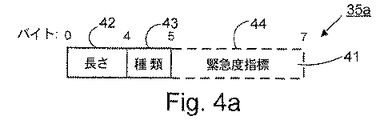
本発明の本実施形態によると、元のBitTorrentプロトコルにより送出される関心メッセージ35及び要求メッセージ38は、上述の緊急度指標を含むように変更される。図4a及び図4bは、それぞれそのように変更された関心メッセージ35a及びそのように変更された要求メッセージ38aの例を概略的に示す。関心メッセージ35aは、長さフィールド42と、種類フィールド43と、更に本実施形態に従って例えば上述したようにビデオバッファにおけるバッファ量であってもよい緊急度指標41を含むフィールド44とを含む。要求メッセージ38aは、長さフィールド45と、種類フィールド46と、ピースインデックスフィールド47と、開始オフセットフィールド48と、ピース長フィールド49と、更に本実施形態に従って緊急度指標41を含むフィールド50とを含む。
According to this embodiment of the invention, the
上述したように全てのコンテンツをダウンロードし終える前に再生を開始するP2P VoD配信等の例に対して理想的でない従来のしっぺ返し手法を使用するだけでなく、緊急度指標41を関心メッセージ35a及び要求メッセージ38aに追加することにより、サービングピアは、データを最も必要とする要求ピアに対してアップロードする手段を得る。
As described above, in addition to using the conventional non-ideal return method for an example such as P2P VoD distribution in which playback is started before all content is downloaded, the
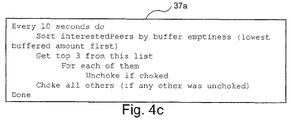
本実施形態の場合に関心メッセージ35a及び要求メッセージ38aに含まれた緊急度指標が、要求ピアのビデオバッファにおけるバッファ量であると仮定すると、図3のアンチョーク機構37は、例えば図4cに示されるように変更されてもよい。図4cは、擬似コードに示された本発明の一実施形態に係るアンチョーク機構37aの概略図である。アンチョーク機構は、全ての要求ピアを周期的にソートするように機能する。関心メッセージは、要求ピアの示されたバッファ空き量により受信されている(すなわち、いわゆる関心ピア)。最も低いバッファ量を示した関心ピアは、リストにおいて最初に配置される。リストから最初の3つの関心ピアが選択される。選択されたピアはチョークされる場合にアンチョークされ、選択されなかった他の全ての関心ピアはチョークされる。当然、アンチョーク機構37aは、本発明の一実施形態の一例にすぎない。本発明に従って可能である他の実施形態の例を挙げるために、緊急度指標は、緊急度に関して要求ピアの必要性を示すバッファ量以外の他の情報を含んでもよく、アンチョーク機構に従って選択されるピアの数は、3つに限定されず、特定の実現例に適切であると仮定されるあらゆる数であってもよく、他の可能な別のアルゴリズムがあるために、緊急度指標に基づいて対応する要求ピアを判定するために使用される優先順位機構を実現するようにアンチョーク機構を更に適用する必要はないことが言及されてもよい。
Assuming that the urgency index included in the
緊急度指標が関心メッセージ35a及び要求メッセージ38aに含まれるバッファ量である上述の実施形態において、バッファ量情報は、要求ピアが既にダウンロードしたがまだ再生していないビデオブロックの数である。この情報に対して2バイトを使用することは、1秒等の非常に小さいビデオブロックサイズに対してであっても、数時間のバッファリングされたデータに等しい216個のビデオブロック通知するのに十分である。一方、これらのメッセージに2バイトを追加することは、関心メッセージ及び要求メッセージに対してそれぞれ75バイト又は87バイトのうちから2バイトを示すため、大きなオーバヘッドを生成しない。
In the above embodiment where the urgency indicator is the buffer amount contained in the
本発明の実施形態は、自身の優先順位に影響を与える手段を含む要求ピアを提供する。悪意のあるピアが他のピアに誤った情報を伝える(すなわち、実際よりも高い緊急度を示すように緊急度指標を改竄する)ことによってより高い優先順位を取得できるため、これはP2Pネットワークにおいて一般的な例ではなく、且つ全てのピアが高い優先順位を示す場合、結果として優先順位がなくなることは明らかである。しかし、上述した図1のVoDの例等の多くの例において、不要な部分のみがより高速にダウンロードされるため、ユーザは自身の優先順位に対してなりすましを行う。また、図1に関連して説明された例は管理されたメディア配信サービスを考慮し、クライアントアプリケーション3、4はオペレータの制御下にある(ノード1は、例えば高信頼セットトップボックスである)。
Embodiments of the present invention provide a requesting peer that includes means for influencing its priority. This can be achieved in a P2P network because a malicious peer can get higher priority by communicating false information to other peers (ie, tampering with an urgency index to indicate a higher urgency than actual). If this is not a general example and all peers show a high priority, it is clear that the result is no priority. However, in many examples such as the VoD example of FIG. 1 described above, only the unnecessary part is downloaded at a higher speed, so the user impersonates his / her priority. Also, the example described in connection with FIG. 1 considers a managed media distribution service, and
緊急度指標に含まれた情報は、ネットワークにおいてサービングピア以外の第三者にとって関心のあるものであってもよい。運用及び保守(O&M)システム(図1におけるO&Mシステム10等)は、緊急度指標を通知される場合、ネットワークが輻輳する場合にネットワークの中断を回避するために、データを緊急に必要としない要求ピアがピースの要求を停止する(例えば、所定の期間)ことを要求してもよい。これは、本発明のある特定の実施形態に係るオプションの機能であり、クライアントアプリケーション3が所定の緊急度を下回るあるレベルの低い緊急度に到達する時、例えばビデオの次の5分間のデータがバッファリングされる時をO&Mシステムに通知するようにクライアントアプリケーション3を変更すること等により実現されてもよい。O&Mシステムは、関連付けられたピアの緊急度指標を含むメッセージにより通知されてもよい。
The information included in the urgency indicator may be of interest to third parties other than the serving peer in the network. An operation and maintenance (O & M) system (such as the O &
図5は、本発明の一実施形態に係る方法の一実施形態を示すフローチャートである。図5の方法は、P2Pネットワークのサービングピアとして動作するクライアントアプリケーションを含むネットワークノードにおいて実行される。ステップ51において、データコンテンツに対する1つ又は複数の要求は、P2Pネットワークにおいて多数の要求ピアから受信される。例えばこれらの要求は、上述したような関心メッセージ35a又は要求メッセージ38aであってもよく、要求ピアと関連付けられた緊急度指標を含んでもよい。緊急度指標は、緊急度の観点からデータコンテンツに対する要求ピアの必要性を示している。ステップ52において、緊急度指標は要求から抽出される。次に、ステップ53において、優先順位機構は、対応するピアを判定するために使用される緊急度指標に適用される。上述したように、例えばこのステップは、バッファ空き量に従って要求ピアをソートすることと、バッファリングされたデータの量が最も少ない3つのピアを選択することとを含んでもよい。ステップ54において、データコンテンツは、ステップ53において選択したこれらのピアに配信される。
FIG. 5 is a flowchart illustrating an embodiment of a method according to an embodiment of the present invention. The method of FIG. 5 is performed in a network node that includes a client application that operates as a serving peer of a P2P network. In
図6は、本発明の別の実施形態に係る方法の一実施形態を示すフローチャートである。図6の方法は、P2Pネットワークの要求ピアとして動作しているクライアントアプリケーションを含むネットワークノードにおいて実行される。ステップ61において、サービングピアからデータコンテンツを要求する前に、データの緊急度が判定され且つ緊急度指標に変換される。例えばこのステップは、ビデオバッファにおいてバッファリングされたデータの量を判定すること又は使用可能なデータの残りの再生時間を推定することを含む。オプションのステップ62において、緊急度がある所定の緊急度xを下回るか否かが判定されてもよく、下回る場合、オプションのステップ63において、上述したように緊急度がO&Mシステムに報告されてもよい。その後、ステップ64において、データコンテンツに対する要求が作成され、緊急度指標は要求に含まれる。例えば要求は、関心メッセージ35a又は要求メッセージ38aであってもよい。ステップ65において、要求はサービングピアに送出される。
FIG. 6 is a flow chart illustrating one embodiment of a method according to another embodiment of the invention. The method of FIG. 6 is performed at a network node that includes a client application that is operating as a requesting peer of a P2P network. In
図1のクライアントアプリケーション3等、殆どのクライアントアプリケーションがサービングピア及び要求ピアの双方として動作するように構成されるため、図5の方法及び図6の方法は、同一のノードにおいて同時に実行されることが可能である。
Since most client applications, such as
本発明の実施形態を説明することにより、本発明を上述した。しかし、当業者により理解されるように、可能である多くの変更例がある。本発明の実施形態に係る上述の方法の実現例は、P2Pネットワークで使用される従来技術のネットワークノードを何らか適応することを必要とする。そのような適応は、一般に、図1のクライアントアプリケーション3又は4等のクライアントアプリケーションを適応することのみを必要とする。ファームウェア、ハードウェア又はそれらの組合せにおける実現例が更に可能であるが、新しいソフトウェアを利用してクライアントアプリケーションを適応することを選択するのが普通である。更に、図6のオプションのステップ62及び63の実現例は、O&Mシステムを適応して、ピアからのメッセージから緊急度指標を抽出及び解釈し、且つネットワーク管理を判断するために緊急度指標を使用することを示す。O&Mシステムを適応することは、ソフトウェア更新のみを含むのが好ましい。
The present invention has been described above by describing embodiments of the invention. However, as will be appreciated by those skilled in the art, there are many variations that are possible. The implementation of the above-described method according to an embodiment of the invention requires some adaptation of the prior art network nodes used in P2P networks. Such adaptation generally requires only adapting a client application such as
図1は、本発明を実現するのが有益となる可能性のある例を示す。しかし、当然、本発明の実施形態が使用されてもよい他の多くの例がある。データコンテンツの文字が、データコンテンツの種々のピースがダウンロードされる順序が重要であるようなデータコンテンツのP2P配信の例において、本発明の一実施形態に従って優先順位機構を実現するのが有利である場合が多い。そのような例は、例えばオーディオコンテンツ又はビデオコンテンツを配信するためのライブストリーミングサービス、VoDサービス及びいくつかの例においてはゲーミング又はソフトウェアの更新に関連したダウンロードである。緊急度指標として使用される情報の種類は、実際の応用例に依存する。また、緊急度の順序で対応されるピアに従って上述した優先順位機構をしっぺ返し手法と組み合わせることが可能である。緊急度指標により示されたような緊急度は、選択されたピアがソートされる第1基準及びしっぺ返し手法の第2基準又はその逆であってもよい。それにより、複数の要求ピアが同一の緊急度を示している場合、サービングピアは、過去に最も多くのデータをサービングピアにアップロードしたデータを緊急に必要とする要求ピアに対応することを選択してもよい。 FIG. 1 shows an example where it may be beneficial to implement the present invention. However, of course, there are many other examples in which embodiments of the present invention may be used. In the example of P2P delivery of data content where the characters of the data content are important in the order in which the various pieces of data content are downloaded, it is advantageous to implement a priority mechanism according to one embodiment of the present invention. There are many cases. Such examples are, for example, live streaming services for delivering audio or video content, VoD services and in some examples downloads related to gaming or software updates. The type of information used as an urgency index depends on the actual application. Also, it is possible to combine the above-described priority mechanism with the repayment method according to peers corresponding in order of urgency. The urgency as indicated by the urgency index may be a first criterion by which the selected peers are sorted and a second criterion of the flipping method or vice versa. Thus, if multiple requesting peers show the same urgency, the serving peer chooses to respond to the requesting peer that urgently needs the data that has uploaded the most data to the serving peer in the past. May be.
上記の説明から、説明された本発明の種々の実施形態を実現するためにどのようなソフトウェア、ファームウェア及び/又はハードウェアの変形例が必要であるかは、当業者には理解されるだろう。 From the above description, one of ordinary skill in the art will understand what software, firmware and / or hardware variations are required to implement the various embodiments of the invention described. .
図面及び明細書において、本発明の一般的に好適な実施形態が開示されており、特定の用語が採用されるが、それらは限定するためではなく一般的且つ記述的な意味でのみ使用され、本発明の範囲は以下の請求の範囲において説明される。 In the drawings and specification, there are disclosed generally preferred embodiments of the invention and specific terminology is employed, which is used in a general and descriptive sense only, not for purposes of limitation, The scope of the invention is set forth in the following claims.
Claims (24)
多数の要求ピア(31)からデータコンテンツに対する少なくとも1つの要求(35、38)を受信するステップ(51)と、
前記要求されたデータコンテンツを前記多数の要求ピアに配信するステップ(54)とを有し、
緊急度に関して前記データコンテンツに対する前記要求ピアの必要性を示す緊急度指標(41)を前記少なくとも1つの要求から抽出するステップ(52)と、
対応する前記多数の要求ピアを判定するために前記緊急度指標を使用する優先順位機構(37a)を前記要求されたデータコンテンツの前記配信に適用するステップ(53)とを有することを特徴とする方法。 A method in a network node (1, 2) comprising a client application (3, 4) operating as a serving peer (32) of a peer-to-peer network (5) sharing data content comprising:
Receiving (51) at least one request (35, 38) for data content from a number of requesting peers (31);
Delivering the requested data content to the multiple requesting peers (54),
Extracting from the at least one request an urgency index (41) indicating the necessity of the requesting peer for the data content with respect to urgency;
Applying a priority mechanism (37a) that uses the urgency index to determine the corresponding multiple requesting peers to the delivery of the requested data content (53). Method.
前記サービングピアからコンテンツをダウンロードすることに関心のある要求ピアをチェックするステップと、
前記関心ピアを報告された緊急度指標によりソートするステップと、
データに対して最も高い緊急度を示す緊急度指標を有する多数の関心ピアを選択するステップと、
チョークされる選択された関心ピアをアンチョークするステップ(36)と、
選択されなかったあらゆるアンチョークされた関心ピアをチョークするステップと
を周期的に実行するアンチョーク機構(37a)に適用されることを特徴とする請求項1乃至4のいずれか1項に記載の方法。 The priority mechanism is:
Checking requesting peers interested in downloading content from the serving peer;
Sorting the interested peers by a reported urgency index;
Selecting a number of interested peers with an urgency index indicating the highest urgency for the data;
Unchoking selected interest peers to be choked (36);
5. Application according to claim 1, characterized in that it is applied to an unchoking mechanism (37 a) that periodically performs the step of choking any unchoked peer of interest that has not been selected. Method.
緊急度に関して前記データコンテンツに対する前記要求ピアの必要性を示す緊急度指標を判定するステップ(61)と、
前記要求に前記緊急度指標を含めるステップ(64)と
を更に有することを特徴とする方法。 A method in a network node (1) comprising a client application (3) acting as a requesting peer (31) of a peer-to-peer network (5) sharing data content, wherein the request for data content (35, 38) is served by a serving peer ( 32) sending to
Determining (61) an urgency index indicating the need of the requesting peer for the data content with respect to urgency;
And (64) including the urgency index in the request.
多数の要求ピア(31)からデータコンテンツに対する少なくとも1つの要求(35、38)を受信し、
前記要求されたデータコンテンツを前記多数の要求ピアに配信するように構成され、
前記クライアントアプリケーション(3、4)は、緊急度に関して前記データコンテンツに対する前記要求ピアの必要性を示す緊急度指標(41)を前記少なくとも1つの要求から抽出するように構成され、
前記クライアントアプリケーションは、対応する前記多数の要求ピアを判定するために前記緊急度指標を使用することにより、前記要求されたデータコンテンツの前記配信を制御する優先順位機構(37a)を含む
ことを特徴とするネットワークノード。 A network node (1, 2) comprising a client application (3, 4) configured to operate as a serving peer (32) of a peer-to-peer network (5) sharing data content,
Receiving at least one request (35, 38) for data content from a number of requesting peers (31);
Configured to deliver the requested data content to the multiple requesting peers;
The client application (3, 4) is configured to extract an urgency indicator (41) from the at least one request indicating the need of the requesting peer for the data content with respect to urgency;
The client application includes a priority mechanism (37a) that controls the delivery of the requested data content by using the urgency index to determine the corresponding multiple requesting peers. Network node.
前記サービングピアからコンテンツをダウンロードすることに関心のある要求ピアをチェックし、
前記関心ピアを、報告された緊急度指標によりソートし、
データに対して最も高い緊急度を示す緊急度指標を有する多数の関心ピアを選択し、
チョークされる選択された関心ピアをアンチョークし、
選択されなかったあらゆるアンチョークされた関心ピアをチョークする
アンチョーク機構(37a)を含む
ことを特徴とする請求項12乃至15のいずれか1項に記載のネットワークノード。 The priority mechanism periodically checks requesting peers interested in downloading content from the serving peer,
Sorting the interested peers by the reported urgency index;
Select a number of interested peers with urgency indicators that indicate the highest urgency for the data,
Unchalk selected interest peers to be choked,
A network node according to any one of claims 12 to 15, comprising an unchalk mechanism (37a) that chokes any unchoked interest peers that were not selected.
前記クライアントアプリケーションは、緊急度に関して前記データコンテンツに対する前記要求ピアの必要性を示す緊急度指標(41)を判定するように更に構成され、
前記クライアントアプリケーションは、前記緊急度指標を前記要求に含むように構成されることを特徴とするネットワークノード。 A network node (1) comprising a client application (3) configured to operate as a requesting peer (31) of a peer-to-peer network (5) sharing data content, said network node requesting data content (35) , 38) to the serving peer (32),
The client application is further configured to determine an urgency indicator (41) indicating the need of the requesting peer for the data content with respect to urgency;
The network node, wherein the client application is configured to include the urgency indicator in the request.
前記ピアツーピアネットワークにおいて少なくとも1つのメッセージを前記ピアツーピアネットワークにおいてサービングピア(32)からデータコンテンツを要求している要求ピア(31)から受信し、
緊急度の関して前記データコンテンツに対する前記要求ピアの必要性を示す緊急度指標(41)を前記少なくとも1つのメッセージから抽出し、
前記ピアツーピアネットワークの管理に関して判断するために前記緊急度指標使用するように構成される運用及び保守システム。 An operation and maintenance system (10) for managing a peer-to-peer network (5) sharing data content comprising:
Receiving at least one message in the peer-to-peer network from a requesting peer (31) requesting data content from a serving peer (32) in the peer-to-peer network;
Extracting an urgency indicator (41) from the at least one message indicating the need of the requesting peer for the data content in terms of urgency;
An operation and maintenance system configured to use the urgency index to make decisions regarding management of the peer-to-peer network.
Applications Claiming Priority (1)
| Application Number | Priority Date | Filing Date | Title |
|---|---|---|---|
| PCT/SE2009/050226 WO2010101496A1 (en) | 2009-03-03 | 2009-03-03 | Methods and arrangements for prioritization in a peer-to-peer network |
Publications (1)
| Publication Number | Publication Date |
|---|---|
| JP2012520004A true JP2012520004A (en) | 2012-08-30 |
Family
ID=40718522
Family Applications (1)
| Application Number | Title | Priority Date | Filing Date |
|---|---|---|---|
| JP2011552904A Pending JP2012520004A (en) | 2009-03-03 | 2009-03-03 | Method and apparatus for prioritization in a peer-to-peer network |
Country Status (5)
| Country | Link |
|---|---|
| US (1) | US9313268B2 (en) |
| EP (1) | EP2404431B1 (en) |
| JP (1) | JP2012520004A (en) |
| ES (1) | ES2430345T3 (en) |
| WO (1) | WO2010101496A1 (en) |
Families Citing this family (10)
| Publication number | Priority date | Publication date | Assignee | Title |
|---|---|---|---|---|
| CN102907065B (en) | 2010-05-20 | 2017-04-26 | 瑞典爱立信有限公司 | System and method for managing data delivery in a peer-to-peer network |
| KR101719165B1 (en) * | 2010-10-27 | 2017-03-23 | 삼성전자주식회사 | METHOD AND APPARATUS FOR A TRANSMISSION/RECEPTION OF A WLAN NETWORK SHARING DATA IN A Wi-Fi P2P GROUP |
| US8775533B2 (en) * | 2011-05-20 | 2014-07-08 | Microsoft Corporation | Auto connect in peer-to-peer network |
| US9699236B2 (en) | 2013-12-17 | 2017-07-04 | At&T Intellectual Property I, L.P. | System and method of adaptive bit-rate streaming |
| US20160026788A1 (en) * | 2014-07-28 | 2016-01-28 | Iboss, Inc. | Selectively introducing security issues in a sandbox environment to elicit malicious application behavior |
| US10404781B2 (en) * | 2015-01-14 | 2019-09-03 | Cisco Technology, Inc. | Flow characteristic based peer-to-peer system |
| US10587496B2 (en) | 2017-02-10 | 2020-03-10 | Microsoft Technology Licensing, Llc | Localizing traffic using network topology |
| CN108881051B (en) * | 2018-06-07 | 2022-05-10 | 南京邮电大学 | Node load balancing method based on request queue in P2P streaming media on-demand system |
| CN108964845B (en) * | 2018-07-03 | 2021-04-16 | 网宿科技股份有限公司 | A method and device for acquiring BT resource information |
| CN114301848B (en) * | 2021-12-10 | 2023-08-29 | 阿里巴巴(中国)有限公司 | CDN-based communication method, system, equipment and storage medium |
Citations (3)
| Publication number | Priority date | Publication date | Assignee | Title |
|---|---|---|---|---|
| WO2005062566A1 (en) * | 2003-12-22 | 2005-07-07 | Hitachi, Ltd. | Information transmission terminal and receiving terminal |
| JP2006197601A (en) * | 2005-01-12 | 2006-07-27 | Thomson Licensing | Method for assigning priority to data transmission in a network and network using the method |
| JP2007259374A (en) * | 2006-03-27 | 2007-10-04 | Matsushita Electric Ind Co Ltd | Network transceiver |
Family Cites Families (6)
| Publication number | Priority date | Publication date | Assignee | Title |
|---|---|---|---|---|
| DE60211524T2 (en) * | 2001-08-04 | 2006-12-14 | Kontiki, Inc., Sunnyvale | METHOD AND DEVICE FOR THE DISTRIBUTED DELIVERY OF CONTENT WITHIN A COMPUTER NETWORK |
| DE10214581A1 (en) * | 2002-04-02 | 2003-10-23 | Infineon Technologies Ag | Demodulation of a digital frequency-modulated analog received signal by evaluating the time intervals between the zero crossings |
| US20080098123A1 (en) * | 2006-10-24 | 2008-04-24 | Microsoft Corporation | Hybrid Peer-to-Peer Streaming with Server Assistance |
| US8089503B2 (en) * | 2006-11-03 | 2012-01-03 | At&T Intellectual Property I, L.P. | System and method of message notification and access via a video distribution network |
| US8082358B2 (en) * | 2008-09-30 | 2011-12-20 | Microsoft Corporation | ISP-friendly rate allocation for P2P applications |
| US7991906B2 (en) * | 2008-12-09 | 2011-08-02 | Hong Kong Applied Science And Technology Research Institute Co., Ltd. | Method of data request scheduling in peer-to-peer sharing networks |
-
2009
- 2009-03-03 WO PCT/SE2009/050226 patent/WO2010101496A1/en not_active Ceased
- 2009-03-03 JP JP2011552904A patent/JP2012520004A/en active Pending
- 2009-03-03 EP EP09788499.3A patent/EP2404431B1/en not_active Not-in-force
- 2009-03-03 US US13/254,374 patent/US9313268B2/en not_active Expired - Fee Related
- 2009-03-03 ES ES09788499T patent/ES2430345T3/en active Active
Patent Citations (3)
| Publication number | Priority date | Publication date | Assignee | Title |
|---|---|---|---|---|
| WO2005062566A1 (en) * | 2003-12-22 | 2005-07-07 | Hitachi, Ltd. | Information transmission terminal and receiving terminal |
| JP2006197601A (en) * | 2005-01-12 | 2006-07-27 | Thomson Licensing | Method for assigning priority to data transmission in a network and network using the method |
| JP2007259374A (en) * | 2006-03-27 | 2007-10-04 | Matsushita Electric Ind Co Ltd | Network transceiver |
Non-Patent Citations (3)
| Title |
|---|
| CSNG200701292002; 近藤 浩介他: 'Grid-Over-P2P環境における計算時間実行時間最適化のためのファイル転送手法の検討' 電子情報通信学会技術研究報告 Vol.107 No.221 第107巻 第221号, 20070913, pp.5-10, 社団法人電子情報通信学会 * |
| JPN5012008790; YANG GUO: 'SUPPORTING VCR OPERATION IN A MESH-BASED P2P VOD SYSTEM' 5TH IEEE CONFERENCE ON CONSUMER COMMUNICATIONS AND NETWORKING , 20080101, P452-457, IEEE * |
| JPN6013038497; 近藤 浩介他: 'Grid-Over-P2P環境における計算時間実行時間最適化のためのファイル転送手法の検討' 電子情報通信学会技術研究報告 Vol.107 No.221 第107巻 第221号, 20070913, pp.5-10, 社団法人電子情報通信学会 * |
Also Published As
| Publication number | Publication date |
|---|---|
| US20120030303A1 (en) | 2012-02-02 |
| EP2404431B1 (en) | 2013-07-24 |
| US9313268B2 (en) | 2016-04-12 |
| WO2010101496A1 (en) | 2010-09-10 |
| EP2404431A1 (en) | 2012-01-11 |
| WO2010101496A9 (en) | 2011-11-10 |
| ES2430345T3 (en) | 2013-11-20 |
Similar Documents
| Publication | Publication Date | Title |
|---|---|---|
| CN101715650B (en) | Set-top box peer-assisted video-on-demand | |
| JP2012520004A (en) | Method and apparatus for prioritization in a peer-to-peer network | |
| JP5181031B2 (en) | Resilient service quality within a managed multimedia distribution network | |
| US11689596B2 (en) | Method for broadcasting streaming contents in a peer-to-peer network | |
| US9332051B2 (en) | Media manifest file generation for adaptive streaming cost management | |
| US8826349B2 (en) | Multicast adaptive stream switching for delivery of over the top video content | |
| KR20150083793A (en) | Method for downloading, at a client terminal, an upcoming sequence of segments of a multimedia content, and corresponding terminal | |
| Janardhan et al. | Peer assisted VoD for set-top box based IP network | |
| EP3092816A1 (en) | Method for obtaining network information by a client terminal configured for receiving a multimedia content divided into segments | |
| EP2252057A1 (en) | Method and system for storing and distributing electronic content | |
| US9386056B1 (en) | System, method and computer readable medium for providing media stream fragments | |
| WO2022123066A1 (en) | Method for playing on a player of a client device a content streamed in a network | |
| US20260046327A1 (en) | Server-side adaptive bitrate streaming (ABR) with manifest file encoding | |
| WO2015104149A1 (en) | Method for obtaining network information by a client terminal configured for receiving a multimedia content divided into segments | |
| WO2015104145A1 (en) | Method for obtaining network information by a client terminal configured for receiving a multimedia content divided into segments | |
| TW202123720A (en) | Server-side adaptive media streaming | |
| O’Neill | Peer Assisted Multicast Streaming for On-Demand Applications | |
| Arockia Xavier Annie et al. | Enhancing Scalability in On‐Demand Video Streaming Services for P2P Systems | |
| WO2015104147A1 (en) | Method for obtaining network information by a client terminal configured for receiving a multimedia content divided into segments | |
| KR20160100886A (en) | System and method for packetizing data stream in streaming service based on peer to peer |
Legal Events
| Date | Code | Title | Description |
|---|---|---|---|
| A977 | Report on retrieval |
Free format text: JAPANESE INTERMEDIATE CODE: A971007 Effective date: 20130718 |
|
| A131 | Notification of reasons for refusal |
Free format text: JAPANESE INTERMEDIATE CODE: A131 Effective date: 20130805 |
|
| A601 | Written request for extension of time |
Free format text: JAPANESE INTERMEDIATE CODE: A601 Effective date: 20131105 |
|
| A602 | Written permission of extension of time |
Free format text: JAPANESE INTERMEDIATE CODE: A602 Effective date: 20131112 |
|
| A521 | Request for written amendment filed |
Free format text: JAPANESE INTERMEDIATE CODE: A523 Effective date: 20131213 |
|
| A131 | Notification of reasons for refusal |
Free format text: JAPANESE INTERMEDIATE CODE: A131 Effective date: 20140328 |
|
| A02 | Decision of refusal |
Free format text: JAPANESE INTERMEDIATE CODE: A02 Effective date: 20141014 |