JP2012521902A - Biaxially oriented metallized polylactic acid film with high metal adhesion and high barrier properties - Google Patents
Biaxially oriented metallized polylactic acid film with high metal adhesion and high barrier properties Download PDFInfo
- Publication number
- JP2012521902A JP2012521902A JP2012502253A JP2012502253A JP2012521902A JP 2012521902 A JP2012521902 A JP 2012521902A JP 2012502253 A JP2012502253 A JP 2012502253A JP 2012502253 A JP2012502253 A JP 2012502253A JP 2012521902 A JP2012521902 A JP 2012521902A
- Authority
- JP
- Japan
- Prior art keywords
- skin layer
- layer
- multilayer film
- film
- polylactic acid
- Prior art date
- Legal status (The legal status is an assumption and is not a legal conclusion. Google has not performed a legal analysis and makes no representation as to the accuracy of the status listed.)
- Granted
Links
Classifications
-
- B—PERFORMING OPERATIONS; TRANSPORTING
- B32—LAYERED PRODUCTS
- B32B—LAYERED PRODUCTS, i.e. PRODUCTS BUILT-UP OF STRATA OF FLAT OR NON-FLAT, e.g. CELLULAR OR HONEYCOMB, FORM
- B32B27/00—Layered products comprising a layer of synthetic resin
- B32B27/36—Layered products comprising a layer of synthetic resin comprising polyesters
-
- B—PERFORMING OPERATIONS; TRANSPORTING
- B32—LAYERED PRODUCTS
- B32B—LAYERED PRODUCTS, i.e. PRODUCTS BUILT-UP OF STRATA OF FLAT OR NON-FLAT, e.g. CELLULAR OR HONEYCOMB, FORM
- B32B15/00—Layered products comprising a layer of metal
- B32B15/04—Layered products comprising a layer of metal comprising metal as the main or only constituent of a layer, which is next to another layer of the same or of a different material
- B32B15/08—Layered products comprising a layer of metal comprising metal as the main or only constituent of a layer, which is next to another layer of the same or of a different material of synthetic resin
-
- B—PERFORMING OPERATIONS; TRANSPORTING
- B32—LAYERED PRODUCTS
- B32B—LAYERED PRODUCTS, i.e. PRODUCTS BUILT-UP OF STRATA OF FLAT OR NON-FLAT, e.g. CELLULAR OR HONEYCOMB, FORM
- B32B27/00—Layered products comprising a layer of synthetic resin
- B32B27/06—Layered products comprising a layer of synthetic resin as the main or only constituent of a layer, which is next to another layer of the same or of a different material
- B32B27/08—Layered products comprising a layer of synthetic resin as the main or only constituent of a layer, which is next to another layer of the same or of a different material of synthetic resin
-
- B—PERFORMING OPERATIONS; TRANSPORTING
- B32—LAYERED PRODUCTS
- B32B—LAYERED PRODUCTS, i.e. PRODUCTS BUILT-UP OF STRATA OF FLAT OR NON-FLAT, e.g. CELLULAR OR HONEYCOMB, FORM
- B32B27/00—Layered products comprising a layer of synthetic resin
- B32B27/18—Layered products comprising a layer of synthetic resin characterised by the use of special additives
-
- C—CHEMISTRY; METALLURGY
- C08—ORGANIC MACROMOLECULAR COMPOUNDS; THEIR PREPARATION OR CHEMICAL WORKING-UP; COMPOSITIONS BASED THEREON
- C08G—MACROMOLECULAR COMPOUNDS OBTAINED OTHERWISE THAN BY REACTIONS ONLY INVOLVING UNSATURATED CARBON-TO-CARBON BONDS
- C08G63/00—Macromolecular compounds obtained by reactions forming a carboxylic ester link in the main chain of the macromolecule
- C08G63/02—Polyesters derived from hydroxycarboxylic acids or from polycarboxylic acids and polyhydroxy compounds
- C08G63/06—Polyesters derived from hydroxycarboxylic acids or from polycarboxylic acids and polyhydroxy compounds derived from hydroxycarboxylic acids
- C08G63/08—Lactones or lactides
-
- C—CHEMISTRY; METALLURGY
- C08—ORGANIC MACROMOLECULAR COMPOUNDS; THEIR PREPARATION OR CHEMICAL WORKING-UP; COMPOSITIONS BASED THEREON
- C08J—WORKING-UP; GENERAL PROCESSES OF COMPOUNDING; AFTER-TREATMENT NOT COVERED BY SUBCLASSES C08B, C08C, C08F, C08G or C08H
- C08J5/00—Manufacture of articles or shaped materials containing macromolecular substances
- C08J5/18—Manufacture of films or sheets
-
- B—PERFORMING OPERATIONS; TRANSPORTING
- B32—LAYERED PRODUCTS
- B32B—LAYERED PRODUCTS, i.e. PRODUCTS BUILT-UP OF STRATA OF FLAT OR NON-FLAT, e.g. CELLULAR OR HONEYCOMB, FORM
- B32B2250/00—Layers arrangement
- B32B2250/24—All layers being polymeric
- B32B2250/244—All polymers belonging to those covered by group B32B27/36
-
- B—PERFORMING OPERATIONS; TRANSPORTING
- B32—LAYERED PRODUCTS
- B32B—LAYERED PRODUCTS, i.e. PRODUCTS BUILT-UP OF STRATA OF FLAT OR NON-FLAT, e.g. CELLULAR OR HONEYCOMB, FORM
- B32B2255/00—Coating on the layer surface
- B32B2255/10—Coating on the layer surface on synthetic resin layer or on natural or synthetic rubber layer
-
- B—PERFORMING OPERATIONS; TRANSPORTING
- B32—LAYERED PRODUCTS
- B32B—LAYERED PRODUCTS, i.e. PRODUCTS BUILT-UP OF STRATA OF FLAT OR NON-FLAT, e.g. CELLULAR OR HONEYCOMB, FORM
- B32B2255/00—Coating on the layer surface
- B32B2255/20—Inorganic coating
- B32B2255/205—Metallic coating
-
- B—PERFORMING OPERATIONS; TRANSPORTING
- B32—LAYERED PRODUCTS
- B32B—LAYERED PRODUCTS, i.e. PRODUCTS BUILT-UP OF STRATA OF FLAT OR NON-FLAT, e.g. CELLULAR OR HONEYCOMB, FORM
- B32B2264/00—Composition or properties of particles which form a particulate layer or are present as additives
- B32B2264/10—Inorganic particles
- B32B2264/104—Oxysalt, e.g. carbonate, sulfate, phosphate or nitrate particles
-
- B—PERFORMING OPERATIONS; TRANSPORTING
- B32—LAYERED PRODUCTS
- B32B—LAYERED PRODUCTS, i.e. PRODUCTS BUILT-UP OF STRATA OF FLAT OR NON-FLAT, e.g. CELLULAR OR HONEYCOMB, FORM
- B32B2307/00—Properties of the layers or laminate
- B32B2307/30—Properties of the layers or laminate having particular thermal properties
- B32B2307/308—Heat stability
-
- B—PERFORMING OPERATIONS; TRANSPORTING
- B32—LAYERED PRODUCTS
- B32B—LAYERED PRODUCTS, i.e. PRODUCTS BUILT-UP OF STRATA OF FLAT OR NON-FLAT, e.g. CELLULAR OR HONEYCOMB, FORM
- B32B2307/00—Properties of the layers or laminate
- B32B2307/30—Properties of the layers or laminate having particular thermal properties
- B32B2307/31—Heat sealable
-
- B—PERFORMING OPERATIONS; TRANSPORTING
- B32—LAYERED PRODUCTS
- B32B—LAYERED PRODUCTS, i.e. PRODUCTS BUILT-UP OF STRATA OF FLAT OR NON-FLAT, e.g. CELLULAR OR HONEYCOMB, FORM
- B32B2307/00—Properties of the layers or laminate
- B32B2307/50—Properties of the layers or laminate having particular mechanical properties
- B32B2307/514—Oriented
- B32B2307/518—Oriented bi-axially
-
- B—PERFORMING OPERATIONS; TRANSPORTING
- B32—LAYERED PRODUCTS
- B32B—LAYERED PRODUCTS, i.e. PRODUCTS BUILT-UP OF STRATA OF FLAT OR NON-FLAT, e.g. CELLULAR OR HONEYCOMB, FORM
- B32B2307/00—Properties of the layers or laminate
- B32B2307/50—Properties of the layers or laminate having particular mechanical properties
- B32B2307/538—Roughness
-
- B—PERFORMING OPERATIONS; TRANSPORTING
- B32—LAYERED PRODUCTS
- B32B—LAYERED PRODUCTS, i.e. PRODUCTS BUILT-UP OF STRATA OF FLAT OR NON-FLAT, e.g. CELLULAR OR HONEYCOMB, FORM
- B32B2307/00—Properties of the layers or laminate
- B32B2307/50—Properties of the layers or laminate having particular mechanical properties
- B32B2307/558—Impact strength, toughness
-
- B—PERFORMING OPERATIONS; TRANSPORTING
- B32—LAYERED PRODUCTS
- B32B—LAYERED PRODUCTS, i.e. PRODUCTS BUILT-UP OF STRATA OF FLAT OR NON-FLAT, e.g. CELLULAR OR HONEYCOMB, FORM
- B32B2307/00—Properties of the layers or laminate
- B32B2307/70—Other properties
- B32B2307/704—Crystalline
-
- B—PERFORMING OPERATIONS; TRANSPORTING
- B32—LAYERED PRODUCTS
- B32B—LAYERED PRODUCTS, i.e. PRODUCTS BUILT-UP OF STRATA OF FLAT OR NON-FLAT, e.g. CELLULAR OR HONEYCOMB, FORM
- B32B2307/00—Properties of the layers or laminate
- B32B2307/70—Other properties
- B32B2307/724—Permeability to gases, adsorption
- B32B2307/7242—Non-permeable
- B32B2307/7246—Water vapor barrier
-
- B—PERFORMING OPERATIONS; TRANSPORTING
- B32—LAYERED PRODUCTS
- B32B—LAYERED PRODUCTS, i.e. PRODUCTS BUILT-UP OF STRATA OF FLAT OR NON-FLAT, e.g. CELLULAR OR HONEYCOMB, FORM
- B32B2307/00—Properties of the layers or laminate
- B32B2307/70—Other properties
- B32B2307/75—Printability
-
- B—PERFORMING OPERATIONS; TRANSPORTING
- B32—LAYERED PRODUCTS
- B32B—LAYERED PRODUCTS, i.e. PRODUCTS BUILT-UP OF STRATA OF FLAT OR NON-FLAT, e.g. CELLULAR OR HONEYCOMB, FORM
- B32B2439/00—Containers; Receptacles
- B32B2439/70—Food packaging
-
- B—PERFORMING OPERATIONS; TRANSPORTING
- B32—LAYERED PRODUCTS
- B32B—LAYERED PRODUCTS, i.e. PRODUCTS BUILT-UP OF STRATA OF FLAT OR NON-FLAT, e.g. CELLULAR OR HONEYCOMB, FORM
- B32B2451/00—Decorative or ornamental articles
-
- B—PERFORMING OPERATIONS; TRANSPORTING
- B32—LAYERED PRODUCTS
- B32B—LAYERED PRODUCTS, i.e. PRODUCTS BUILT-UP OF STRATA OF FLAT OR NON-FLAT, e.g. CELLULAR OR HONEYCOMB, FORM
- B32B2519/00—Labels, badges
-
- B—PERFORMING OPERATIONS; TRANSPORTING
- B32—LAYERED PRODUCTS
- B32B—LAYERED PRODUCTS, i.e. PRODUCTS BUILT-UP OF STRATA OF FLAT OR NON-FLAT, e.g. CELLULAR OR HONEYCOMB, FORM
- B32B2553/00—Packaging equipment or accessories not otherwise provided for
-
- Y—GENERAL TAGGING OF NEW TECHNOLOGICAL DEVELOPMENTS; GENERAL TAGGING OF CROSS-SECTIONAL TECHNOLOGIES SPANNING OVER SEVERAL SECTIONS OF THE IPC; TECHNICAL SUBJECTS COVERED BY FORMER USPC CROSS-REFERENCE ART COLLECTIONS [XRACs] AND DIGESTS
- Y02—TECHNOLOGIES OR APPLICATIONS FOR MITIGATION OR ADAPTATION AGAINST CLIMATE CHANGE
- Y02W—CLIMATE CHANGE MITIGATION TECHNOLOGIES RELATED TO WASTEWATER TREATMENT OR WASTE MANAGEMENT
- Y02W90/00—Enabling technologies or technologies with a potential or indirect contribution to greenhouse gas [GHG] emissions mitigation
- Y02W90/10—Bio-packaging, e.g. packing containers made from renewable resources or bio-plastics
-
- Y—GENERAL TAGGING OF NEW TECHNOLOGICAL DEVELOPMENTS; GENERAL TAGGING OF CROSS-SECTIONAL TECHNOLOGIES SPANNING OVER SEVERAL SECTIONS OF THE IPC; TECHNICAL SUBJECTS COVERED BY FORMER USPC CROSS-REFERENCE ART COLLECTIONS [XRACs] AND DIGESTS
- Y10—TECHNICAL SUBJECTS COVERED BY FORMER USPC
- Y10T—TECHNICAL SUBJECTS COVERED BY FORMER US CLASSIFICATION
- Y10T428/00—Stock material or miscellaneous articles
- Y10T428/24—Structurally defined web or sheet [e.g., overall dimension, etc.]
- Y10T428/24479—Structurally defined web or sheet [e.g., overall dimension, etc.] including variation in thickness
-
- Y—GENERAL TAGGING OF NEW TECHNOLOGICAL DEVELOPMENTS; GENERAL TAGGING OF CROSS-SECTIONAL TECHNOLOGIES SPANNING OVER SEVERAL SECTIONS OF THE IPC; TECHNICAL SUBJECTS COVERED BY FORMER USPC CROSS-REFERENCE ART COLLECTIONS [XRACs] AND DIGESTS
- Y10—TECHNICAL SUBJECTS COVERED BY FORMER USPC
- Y10T—TECHNICAL SUBJECTS COVERED BY FORMER US CLASSIFICATION
- Y10T428/00—Stock material or miscellaneous articles
- Y10T428/24—Structurally defined web or sheet [e.g., overall dimension, etc.]
- Y10T428/24942—Structurally defined web or sheet [e.g., overall dimension, etc.] including components having same physical characteristic in differing degree
- Y10T428/2495—Thickness [relative or absolute]
- Y10T428/24967—Absolute thicknesses specified
- Y10T428/24975—No layer or component greater than 5 mils thick
-
- Y—GENERAL TAGGING OF NEW TECHNOLOGICAL DEVELOPMENTS; GENERAL TAGGING OF CROSS-SECTIONAL TECHNOLOGIES SPANNING OVER SEVERAL SECTIONS OF THE IPC; TECHNICAL SUBJECTS COVERED BY FORMER USPC CROSS-REFERENCE ART COLLECTIONS [XRACs] AND DIGESTS
- Y10—TECHNICAL SUBJECTS COVERED BY FORMER USPC
- Y10T—TECHNICAL SUBJECTS COVERED BY FORMER US CLASSIFICATION
- Y10T428/00—Stock material or miscellaneous articles
- Y10T428/25—Web or sheet containing structurally defined element or component and including a second component containing structurally defined particles
-
- Y—GENERAL TAGGING OF NEW TECHNOLOGICAL DEVELOPMENTS; GENERAL TAGGING OF CROSS-SECTIONAL TECHNOLOGIES SPANNING OVER SEVERAL SECTIONS OF THE IPC; TECHNICAL SUBJECTS COVERED BY FORMER USPC CROSS-REFERENCE ART COLLECTIONS [XRACs] AND DIGESTS
- Y10—TECHNICAL SUBJECTS COVERED BY FORMER USPC
- Y10T—TECHNICAL SUBJECTS COVERED BY FORMER US CLASSIFICATION
- Y10T428/00—Stock material or miscellaneous articles
- Y10T428/25—Web or sheet containing structurally defined element or component and including a second component containing structurally defined particles
- Y10T428/256—Heavy metal or aluminum or compound thereof
-
- Y—GENERAL TAGGING OF NEW TECHNOLOGICAL DEVELOPMENTS; GENERAL TAGGING OF CROSS-SECTIONAL TECHNOLOGIES SPANNING OVER SEVERAL SECTIONS OF THE IPC; TECHNICAL SUBJECTS COVERED BY FORMER USPC CROSS-REFERENCE ART COLLECTIONS [XRACs] AND DIGESTS
- Y10—TECHNICAL SUBJECTS COVERED BY FORMER USPC
- Y10T—TECHNICAL SUBJECTS COVERED BY FORMER US CLASSIFICATION
- Y10T428/00—Stock material or miscellaneous articles
- Y10T428/26—Web or sheet containing structurally defined element or component, the element or component having a specified physical dimension
- Y10T428/263—Coating layer not in excess of 5 mils thick or equivalent
- Y10T428/264—Up to 3 mils
- Y10T428/265—1 mil or less
-
- Y—GENERAL TAGGING OF NEW TECHNOLOGICAL DEVELOPMENTS; GENERAL TAGGING OF CROSS-SECTIONAL TECHNOLOGIES SPANNING OVER SEVERAL SECTIONS OF THE IPC; TECHNICAL SUBJECTS COVERED BY FORMER USPC CROSS-REFERENCE ART COLLECTIONS [XRACs] AND DIGESTS
- Y10—TECHNICAL SUBJECTS COVERED BY FORMER USPC
- Y10T—TECHNICAL SUBJECTS COVERED BY FORMER US CLASSIFICATION
- Y10T428/00—Stock material or miscellaneous articles
- Y10T428/28—Web or sheet containing structurally defined element or component and having an adhesive outermost layer
- Y10T428/2813—Heat or solvent activated or sealable
-
- Y—GENERAL TAGGING OF NEW TECHNOLOGICAL DEVELOPMENTS; GENERAL TAGGING OF CROSS-SECTIONAL TECHNOLOGIES SPANNING OVER SEVERAL SECTIONS OF THE IPC; TECHNICAL SUBJECTS COVERED BY FORMER USPC CROSS-REFERENCE ART COLLECTIONS [XRACs] AND DIGESTS
- Y10—TECHNICAL SUBJECTS COVERED BY FORMER USPC
- Y10T—TECHNICAL SUBJECTS COVERED BY FORMER US CLASSIFICATION
- Y10T428/00—Stock material or miscellaneous articles
- Y10T428/28—Web or sheet containing structurally defined element or component and having an adhesive outermost layer
- Y10T428/2813—Heat or solvent activated or sealable
- Y10T428/2817—Heat sealable
-
- Y—GENERAL TAGGING OF NEW TECHNOLOGICAL DEVELOPMENTS; GENERAL TAGGING OF CROSS-SECTIONAL TECHNOLOGIES SPANNING OVER SEVERAL SECTIONS OF THE IPC; TECHNICAL SUBJECTS COVERED BY FORMER USPC CROSS-REFERENCE ART COLLECTIONS [XRACs] AND DIGESTS
- Y10—TECHNICAL SUBJECTS COVERED BY FORMER USPC
- Y10T—TECHNICAL SUBJECTS COVERED BY FORMER US CLASSIFICATION
- Y10T428/00—Stock material or miscellaneous articles
- Y10T428/28—Web or sheet containing structurally defined element or component and having an adhesive outermost layer
- Y10T428/2813—Heat or solvent activated or sealable
- Y10T428/2817—Heat sealable
- Y10T428/2826—Synthetic resin or polymer
-
- Y—GENERAL TAGGING OF NEW TECHNOLOGICAL DEVELOPMENTS; GENERAL TAGGING OF CROSS-SECTIONAL TECHNOLOGIES SPANNING OVER SEVERAL SECTIONS OF THE IPC; TECHNICAL SUBJECTS COVERED BY FORMER USPC CROSS-REFERENCE ART COLLECTIONS [XRACs] AND DIGESTS
- Y10—TECHNICAL SUBJECTS COVERED BY FORMER USPC
- Y10T—TECHNICAL SUBJECTS COVERED BY FORMER US CLASSIFICATION
- Y10T428/00—Stock material or miscellaneous articles
- Y10T428/31504—Composite [nonstructural laminate]
- Y10T428/31678—Of metal
- Y10T428/31681—Next to polyester, polyamide or polyimide [e.g., alkyd, glue, or nylon, etc.]
-
- Y—GENERAL TAGGING OF NEW TECHNOLOGICAL DEVELOPMENTS; GENERAL TAGGING OF CROSS-SECTIONAL TECHNOLOGIES SPANNING OVER SEVERAL SECTIONS OF THE IPC; TECHNICAL SUBJECTS COVERED BY FORMER USPC CROSS-REFERENCE ART COLLECTIONS [XRACs] AND DIGESTS
- Y10—TECHNICAL SUBJECTS COVERED BY FORMER USPC
- Y10T—TECHNICAL SUBJECTS COVERED BY FORMER US CLASSIFICATION
- Y10T428/00—Stock material or miscellaneous articles
- Y10T428/31504—Composite [nonstructural laminate]
- Y10T428/31678—Of metal
- Y10T428/31681—Next to polyester, polyamide or polyimide [e.g., alkyd, glue, or nylon, etc.]
- Y10T428/31685—Natural source polyamide [e.g., casein, gelatin, etc.]
-
- Y—GENERAL TAGGING OF NEW TECHNOLOGICAL DEVELOPMENTS; GENERAL TAGGING OF CROSS-SECTIONAL TECHNOLOGIES SPANNING OVER SEVERAL SECTIONS OF THE IPC; TECHNICAL SUBJECTS COVERED BY FORMER USPC CROSS-REFERENCE ART COLLECTIONS [XRACs] AND DIGESTS
- Y10—TECHNICAL SUBJECTS COVERED BY FORMER USPC
- Y10T—TECHNICAL SUBJECTS COVERED BY FORMER US CLASSIFICATION
- Y10T428/00—Stock material or miscellaneous articles
- Y10T428/31504—Composite [nonstructural laminate]
- Y10T428/31786—Of polyester [e.g., alkyd, etc.]
Landscapes
- Chemical & Material Sciences (AREA)
- Engineering & Computer Science (AREA)
- Manufacturing & Machinery (AREA)
- Health & Medical Sciences (AREA)
- Chemical Kinetics & Catalysis (AREA)
- Medicinal Chemistry (AREA)
- Polymers & Plastics (AREA)
- Organic Chemistry (AREA)
- Materials Engineering (AREA)
- Laminated Bodies (AREA)
Abstract
【課題】バリアー性状と金属付着性が改良された金属化多層二軸配向ポリ乳酸ベースポリマー(BOPLA)フィルムの提供。
【解決手段】該フィルムは、結晶性のポリ乳酸ベースポリマーからなるコア層、本質的にアモルファスのポリ乳酸ベースポリマーからなる第一のスキン層、その第一のスキン層上にある金属層を含む。該フィルムは、本質的にアモルファスのポリ乳酸ベースポリマーからなる第二のスキン層を含んでもよい。
【選択図】なしProvided is a metallized multilayer biaxially oriented polylactic acid base polymer (BOPLA) film having improved barrier properties and metal adhesion.
The film includes a core layer made of a crystalline polylactic acid-based polymer, a first skin layer made of an essentially amorphous polylactic acid-based polymer, and a metal layer on the first skin layer. . The film may include a second skin layer consisting essentially of an amorphous polylactic acid-based polymer.
[Selection figure] None
Description
本発明は、新規な金属化配合により、バリアー性状と金属付着性が改良された金属化多層二軸配向ポリ乳酸ベースポリマー(BOPLA)フィルムに関する。 The present invention relates to a metallized multilayer biaxially oriented polylactic acid base polymer (BOPLA) film with improved barrier properties and metal adhesion by a novel metallization formulation.
二軸配向ポリプロピレン(BOPP)フィルム、二軸配向ポリエチレンテレフタレート(BOPET)フィルムなど、従来の石油化学系ポリマーから作成された二軸配向フィルムが、包装、装飾およびラベルの用途に使用されており、また、多くの場合には多機能用途に利用されている。
たとえば、積層品に、印刷適性、透明性・無光沢性の外観、スリップ性などを付与し、ガス・湿気バリアー性を有する有機・無機塗料のコーティングに適した表面を与え、またバッグの成形用・封止用に適したヒートシール可能層や、塗装・積層による接着剤への被着性に適した層を形成することが可能である。
Biaxially oriented films made from conventional petrochemical polymers such as biaxially oriented polypropylene (BOPP) film and biaxially oriented polyethylene terephthalate (BOPET) film are used for packaging, decoration and labeling applications, and In many cases, it is used for multifunctional purposes.
For example, it gives printability, transparency / matte appearance, slipping properties, etc. to laminated products, gives a surface suitable for coating organic and inorganic paints with gas / moisture barrier properties, and for bag molding -It is possible to form a heat-sealable layer suitable for sealing and a layer suitable for adherence to an adhesive by painting and lamination.
近年、「環境に優しい」包装材が現れている。生物学的に誘導されたポリマーから製造された包装材が増加しているのは、再生可能な資源、原材料および温室効果ガスに対する懸念によるものである。生物学に基づくポリマーは、一旦その利用が本格的に拡大すれば、石油への依存を減少させ、また温室効果ガスの製造量を減少させるために役立つとともに、微生物分解性を有することが可能である。コーンスターチに由来し、したがって再生可能な資源に由来するものと考えられるポリ乳酸などの生物学に基づくポリマーも、包装フィルム向けのより一般的な商業製品の一つである。 In recent years, “environmentally friendly” packaging materials have emerged. The increase in packaging materials made from biologically derived polymers is due to concerns about renewable resources, raw materials and greenhouse gases. Biologically-based polymers can be used to reduce their dependence on petroleum and reduce greenhouse gas production once they are fully utilized, and they can be biodegradable. is there. Biologically-based polymers such as polylactic acid that are derived from corn starch and are therefore considered to be derived from renewable resources are among the more common commercial products for packaging films.
生物学に基づくポリマーフィルムをスナック食品など多数の包装用途に適したものとする場合、生物学に基づくポリマーフィルムは、たとえばヒートシール可能性、印刷適性、制御COF、金属化可能性、ガスバリアー性などを持つことで知られるBOPPやBOPETから製造したフィルムに匹敵する多数の属性を有することが望まれる。しかし、二軸配向ポリ乳酸ベースポリマー(BOPLA)フィルムは、現在の石油系包装フィルムよりも、熱安定性が低く、湿気バリアー性状に劣り、金属付着性が弱くなる場合がある。これら欠点の一部については、包装用ラミネート構造に関するBOPLAフィルムの短所を補うために石油化学系あるいは非微生物分解系のベース成分を使用することが可能である。たとえば、ポリエチレン系あるいはポリプロピレン系の材料を用いれば、印刷可能表面を有するがシール性やバリアー性を持たないBOPLAフィルムからなる単純構造のBOPLA外層フィルムにそれを積層することにより、包装用ラミネート構造にヒートシール性と良好なガスバリアー性を与えることが可能である。 When making a biological polymer film suitable for many packaging applications such as snack foods, the biological polymer film may be heat sealable, printable, controlled COF, metallizable, gas barrier, for example. It is desirable to have many attributes comparable to films made from BOPP and BOPET known to have However, the biaxially oriented polylactic acid base polymer (BOPLA) film has lower thermal stability than the current petroleum-based packaging film, may have poor moisture barrier properties, and may have poor metal adhesion. For some of these disadvantages, petrochemical or non-microbial degradation base components can be used to compensate for the shortcomings of BOPLA film for packaging laminate structures. For example, if a polyethylene-based or polypropylene-based material is used, a laminate structure for packaging can be obtained by laminating it on a BOPLA outer layer film having a simple structure having a printable surface but not having a sealing property or barrier property. It is possible to provide heat sealing properties and good gas barrier properties.
しかし、最近は、「環境に優しい」包装材への要求が高まり、100%の堆肥化可能性、生物分解性あるいは再生可能性を持つ設計の包装用フィルムが求められるようになっている。
この形態において、BOPLAフィルムを用いた成分は、従来の石油化学系樹脂やフィルムに頼ることなく望ましい性能を付与できると考えられる。
したがって、BOPLAフィルムには、商業的に売れる費用効果の高い包装製品を製造可能とするべく、より高い機能性が要求されている。BOPLAフィルムは、単体シートとして、良好なガスバリアー性やヒートシール性など多様な機能を有する必要がある。高バリアー性包装材に関する重要な問題点として、BOPLAの不良な防湿バリアー性がある。PLAの有極性が、良好な防湿バリアー性の達成に対する障害になることが多いのである。いかなる理論によるものでないが、水分子(それ自身が極性を持っている)は、非極性のポリマーフィルムよりも極性のポリマーフィルム内部において、より容易に移動できるのではないかと考えられる。さらに、単純型結晶性BOPLAフィルムを用いると、ヒートシーリングやバッグ製造などの下流側における加工プロセスにおいて、PLAポリマー自体の低耐衝撃性、低熱抵抗性および低成形性のほか、二軸配向プロセスから生じる表面結晶性の上昇により困難が生じる。
However, recently, the demand for “environmentally friendly” packaging materials has increased, and a packaging film designed with 100% compostability, biodegradability or reproducibility has been demanded.
In this form, it is considered that the component using the BOPLA film can impart desirable performance without depending on conventional petrochemical resins and films.
Therefore, BOPLA films are required to have higher functionality in order to be able to manufacture commercially sellable cost-effective packaging products. The BOPLA film needs to have various functions such as good gas barrier properties and heat sealability as a single sheet. An important problem with high barrier packaging materials is the poor moisture barrier properties of BOPLA. The polar nature of PLA often becomes an obstacle to achieving good moisture barrier properties. Without being bound by any theory, it is believed that water molecules (which themselves have polarity) can move more easily within a polar polymer film than a nonpolar polymer film. Furthermore, when using simple crystalline BOPLA film, the PLA polymer itself has low impact resistance, low thermal resistance and low moldability in the downstream processing processes such as heat sealing and bag manufacturing. Difficulties arise due to the resulting increase in surface crystallinity.
上記の要求を解決するべく、種々の試みがなされてきた。
たとえば、米国特許第6,713,175号明細書では、延伸安定性とともにヒートシール性を持つ単層BOPLAフィルムが開示され、そのポリマーは特異な貯蔵弾性率を有している。また米国特許第6,153,276号明細書では、ヒートシール性を持つPLAからなり、アモルファスのPLA層と結晶性のPLA基層を有するポリマーラミネートが開示されている。WIPO国際公開第2008/020726号は、B/AおよびB/A/Bの層構造を持つヒートシール性BOPLAフィルムを開示している。また日本国特許出願特開2004−358721号公報でも、油剤などの潤滑剤を含有するヒートシール性のPLAスキン層をコア層上に形成したPLAフィルムが記載されている。
Various attempts have been made to solve the above requirements.
For example, US Pat. No. 6,713,175 discloses a single-layer BOPLA film that has heat stability and stretch stability, the polymer having a unique storage modulus. U.S. Pat. No. 6,153,276 discloses a polymer laminate made of PLA having heat-sealability and having an amorphous PLA layer and a crystalline PLA base layer. WIPO International Publication No. 2008/020726 discloses a heat-sealable BOPLA film having a layer structure of B / A and B / A / B. Japanese Patent Application No. 2004-358721 also describes a PLA film in which a heat-sealable PLA skin layer containing a lubricant such as an oil agent is formed on a core layer.
さらに、米国特許第7,368,160号明細書では、屈曲性、製造性およびエンドユーザー向け性能に優れた共押出しBOPLAフィルムが開示されている。米国特許第6,600,008号明細書は、包装用途に適した比表面性、熱特性および配向性を持つ脂肪族ポリエステルフィルムおよびガスバリアー性フィルムが開示されている。米国特許7,390,558号明細書は、下塗りを施し、アモルファスのスキン層を持つ二軸配向脂肪族ポリエステルフィルム、およびそれに無機物質を蒸着させたガス酸素透過率が約3〜5cc/m2 /日のフィルムを開示している。また、米国特許出願公開第2010/0040904号明細書では、CuやNiなど金属の種物質を含む結晶性のコアPLA層上に金属化された共押出しBOPLAフィルムが開示されている。 Furthermore, US Pat. No. 7,368,160 discloses a coextruded BOPLA film that is excellent in flexibility, manufacturability and end-user performance. US Pat. No. 6,600,008 discloses an aliphatic polyester film and a gas barrier film having specific surface properties, thermal characteristics and orientation suitable for packaging applications. U.S. Pat. No. 7,390,558 discloses a biaxially oriented aliphatic polyester film with an undercoat and an amorphous skin layer, and a gas oxygen permeability of about 3 to 5 cc / m < 2 > deposited thereon with an inorganic substance. / Day film is disclosed. US 2010/0040904 also discloses a co-extruded BOPLA film metallized on a crystalline core PLA layer containing a metal seed such as Cu or Ni.
本発明者らは、上記の高バリアー性金属化BOPLAフィルム製作の問題を解決しようとするものである。 The inventors of the present invention are to solve the above-mentioned problem of manufacturing a high barrier metallized BOPLA film.
新規の金属化機能を有し、バリアー性と金属付着性が向上した金属化多層二軸配向ポリ乳酸ベースポリマー(BOPLA)フィルムについて説明する。この高バリアー性配合物は、金属付着性を大幅に向上させるためのアモルファスPLA層を含み、金属化湿気・酸素バリアー性を向上させることもできる。より具体的には、多層BOPLAフィルムは、高バリアー性と生産性を損なうことなく、ヒートシール性をも有している。 A metallized multilayer biaxially oriented polylactic acid base polymer (BOPLA) film having a novel metallization function and improved barrier properties and metal adhesion will be described. This high-barrier compound contains an amorphous PLA layer for greatly improving metal adhesion, and can also improve metallized moisture / oxygen barrier properties. More specifically, the multilayer BOPLA film also has heat sealing properties without impairing high barrier properties and productivity.
アモルファスPLAスキン層は粘着性の表面を有することが多い。これにより、特に両面ともにアモルファスPLAであるBOPLAフィルムなど、これらフィルムの扱いが困難になることがある。その理由は、粘着性によって、しわやロッキングなどのプロセス問題が生じることにある。高バリアー性用途にとって特に大きい問題は「金属ピックオフ」である。金属ピックオフとは、金属化層に生じる損傷の一種で、これにより、フィルムをロール状に巻いた際に、フィルムの裏面によって金属蒸着層から蒸着金属が剥がされるものであり、フィルム表面の粘着性によって生じうる。金属化BOPLAフィルムは、このような問題を解決し、包装フィルム用途に要求される広範囲のプロセス性やヒートシール性とともに高バリアー性を付与する。 Amorphous PLA skin layers often have a sticky surface. This can make it difficult to handle these films, particularly BOPLA films that are amorphous PLA on both sides. The reason is that process problems such as wrinkles and locking occur due to the adhesiveness. A particularly significant problem for high barrier applications is “metal pickoff”. Metal pick-off is a type of damage that occurs in the metallized layer. When the film is wound into a roll, the deposited metal is peeled off from the deposited metal layer by the back of the film. Can occur. The metallized BOPLA film solves such problems and imparts a high barrier property together with a wide range of processability and heat sealability required for packaging film applications.
実施形態の一つとして、本質的に結晶性のPLAコア層の片面に設けたアモルファスPLA層から(完全に、あるいはほとんど完全に)なる金属蒸着層を含んでなる金属化PLAフィルムがある。この金属蒸着層配合物は、アルミニウム層の金属付着性を顕著に向上させ、金属蒸着用配合物を持たないアルミニウム金属化PLAフィルムと比較して、金属化PLAフィルムのガスバリアー性も向上させる。 One embodiment is a metallized PLA film comprising a metal deposition layer consisting of an amorphous PLA layer (completely or almost completely) provided on one side of an essentially crystalline PLA core layer. This metal vapor deposition layer formulation significantly improves the metal adhesion of the aluminum layer and also improves the gas barrier properties of the metallized PLA film compared to an aluminum metallized PLA film without the metal vapor deposition formulation.
この金属化BOPLAフィルムは、積層など、下流側で行う他の構成材やフィルムへの加工プロセスの機能性を向上させるために、実質的に結晶性のPLAコア層の裏面に第二のアモルファスPLA層を設けてもよい。より具体的には、この第二の表面は当該表面自体へのヒートシール性(フィン型シール性と呼ばれる)を有し、また、特に金属化層が適切にパターン化されてアモルファスPLA金属蒸着層の表面が露出する場合には、第一の表面へのヒートシール性(ラップ型シール性と呼ばれる)を有することが可能となる。 This metallized BOPLA film has a second amorphous PLA on the back side of a substantially crystalline PLA core layer in order to improve the functionality of other constituents and film processing processes downstream such as lamination. A layer may be provided. More specifically, the second surface has heat sealability (referred to as fin-type sealability) to the surface itself, and in particular, the metallized layer is appropriately patterned to form an amorphous PLA metal deposition layer. When the surface is exposed, it becomes possible to have a heat sealability (called a wrap-type sealability) to the first surface.
他の実施形態として、ポリ乳酸ベースポリマーと、本質的にアモルファスポリ乳酸ベースポリマーからなる第一のスキン層と、第一のスキン層上に形成された金属層とを含むコア層を含んでなる多層フィルムがある。当該コア層は、結晶性ポリ乳酸ベースポリマーを含んでいてもよい。 Another embodiment comprises a core layer comprising a polylactic acid base polymer, a first skin layer consisting essentially of an amorphous polylactic acid base polymer, and a metal layer formed on the first skin layer. There is a multilayer film. The core layer may include a crystalline polylactic acid base polymer.
当該多層フィルムはさらに、本質的にアモルファスポリ乳酸ベースポリマーからなる第二のスキン層を含んでいてもよい。第一のスキン層は一般に2μm以下の厚さである。第二のスキン層は一般に2μm以上の厚さを有している。第一のスキン層と第二のスキン層の厚さの合計は、一般に結晶性コア層の厚さに対する比が0.5以下である。 The multilayer film may further include a second skin layer consisting essentially of an amorphous polylactic acid base polymer. The first skin layer is generally less than 2 μm thick. The second skin layer generally has a thickness of 2 μm or more. The total thickness of the first skin layer and the second skin layer generally has a ratio of 0.5 or less to the thickness of the crystalline core layer.
第一のスキン層は、平均粒子サイズが0.1〜3μmの粒子を、一般に0.01〜0.3wt%含んでいる。第二のスキン層は、平均粒子サイズが1〜5μmの粒子を、一般に0.05〜0.5wt%含んでいる。第一のスキン層および第二のスキン層の粒子はともに、厚さ(t)と直径(d)の比が、一般に0.25≦t/d≦1の関係である。第一の層に含まれる粒子は、一般にアルミノケイ酸塩の粒子である。 The first skin layer generally contains 0.01 to 0.3 wt% of particles having an average particle size of 0.1 to 3 μm. The second skin layer generally contains 0.05 to 0.5 wt% of particles having an average particle size of 1 to 5 μm. Both the particles of the first skin layer and the second skin layer generally have a relationship of the ratio of thickness (t) to diameter (d) of 0.25 ≦ t / d ≦ 1. The particles contained in the first layer are generally aluminosilicate particles.
当該多層フィルムは(MVTR)、好ましくは1.0g/m2 /日以下の透湿度を有する。当該多層フィルムは、フィン型シール性およびラップ型シール性であってもよい。当該多層フィルムは、好ましくは二軸配向フィルムである。 The multilayer film (MVTR), preferably has a water vapor transmission rate of 1.0 g / m 2 / day or less. The multilayer film may have a fin-type sealing property and a wrap-type sealing property. The multilayer film is preferably a biaxially oriented film.
さらに別の実施形態として、多層フィルムの作成方法がある。当該方法は、ポリ乳酸ベースポリマーからなるコア層と本質的にアモルファスポリ乳酸ベースポリマーからなる第一のスキン層との共押出し段階を含む。第一のスキン層には金属層が蒸着される。 As yet another embodiment, there is a method for producing a multilayer film. The method includes a coextrusion step of a core layer composed of a polylactic acid base polymer and a first skin layer consisting essentially of an amorphous polylactic acid base polymer. A metal layer is deposited on the first skin layer.
新規の配合物による金属化BOPLAフィルム、およびその製造方法と使用方法について説明する。これらのフィルムは、バリアー性、金属付着およびヒートシール性が向上している。 The metallized BOPLA film with a new formulation and its production and use are described. These films have improved barrier properties, metal adhesion and heat sealability.
PLAフィルムの一つの実施形態として、アモルファスPLAベースポリマーを含む金属蒸着用スキン層(スキン層A)と当該スキン層Aの一方の面に設けたアルミニウム層からなる二軸配向フィルムがある。当該スキン層Aは、アモルファスPLAのみからなっていてもよく、また本質的にアモルファスPLAベースポリマーからなっていてもよい。 As an embodiment of the PLA film, there is a biaxially oriented film comprising a metal deposition skin layer (skin layer A) containing an amorphous PLA base polymer and an aluminum layer provided on one surface of the skin layer A. The skin layer A may be composed only of amorphous PLA or may be essentially composed of amorphous PLA base polymer.
金属化BOPLAフィルムの好ましい構造は、少なくとも一つのコア層(コア層C)、コア層Cの両面に配置される二つのスキン層AおよびB、ならびにスキン層Aの両面のうちコア層Cとは反対側の面に配置される金属化アルミニウムガスバリアー層からなる。二つのスキン層のうち一方は金属蒸着層(スキン層A)で、金属化アルミニウム層に隣接しており、もう一方のスキン層はスキン層Bである。スキン層Bは、コア層Cの両面のうちスキン層Aとは反対側の面に配置されている。 The preferred structure of the metallized BOPLA film is that at least one core layer (core layer C), two skin layers A and B disposed on both sides of the core layer C, and the core layer C out of both sides of the skin layer A are It consists of a metallized aluminum gas barrier layer disposed on the opposite surface. One of the two skin layers is a metal vapor deposition layer (skin layer A), adjacent to the metallized aluminum layer, and the other skin layer is skin layer B. The skin layer B is disposed on the opposite surface of the core layer C from the skin layer A.
各層を形成する樹脂は、主としてポリ乳酸または乳酸から導出されるポリマーを主成分として含有している。各層のポリ乳酸含有量は、各層のポリマー成分合計量に対して、一般に95wt%以上、好ましくは98wt%以上、最も好ましくは100wt%である。 The resin forming each layer contains polylactic acid or a polymer derived from lactic acid as a main component. The polylactic acid content in each layer is generally 95 wt% or more, preferably 98 wt% or more, and most preferably 100 wt%, based on the total amount of polymer components in each layer.
上記の乳酸から導出されるポリマーは、グリコール、ジカルボン酸、ヒドロキシカルボン酸およびラクトンなどの一種類または二種類以上のモノマーと乳酸との共重合によって製造される。好適なグリコールとしては、たとえば、エチレングリコール、プロピレングリコール、ブタンジオール、ヘプタンジオール、ヘキサンジオール、ジオール、ノナンジオール、デカンジオール、1,4−シクロヘキサンジメタノール、ネオペンチルグリコール、グリセロール、ペンタエリトリトール、ビスフェノールA、ポリエチレングリコール、ポリプロピレングリコールおよびポリテトラメチレングリコールなどが挙げられる。好適なジカルボン酸としては、たとえば、シュウ酸、アジピン酸、セバシン酸、アゼライン酸、ドデカンジオン酸、マロン酸、グルタル酸、シクロヘキサンジカルボン酸、テレフタル酸、イソフタル酸、フタル酸、ナフタリンジカルボン酸、ビス(p−カルボキシフェニル)メタン、アントラセンジカルボン酸、4,4’−ビフェニルエーテルカルボン酸、ナトリウム5−スルホイソフタレートおよび5−テトラブチルホスホニウムイソフタル酸などが挙げられる。好適なヒドロキシカルボン酸としては、たとえば、グリコール酸、ヒドロキシプロピオン酸、ヒドロキシバレリック酸、ヒドロキシカプロン酸およびヒドロキシ安息香酸などが挙げられる。好適なラクトンとしては、たとえば、カプロラクトン、バレロラクトン、プロピオラクトン、ウンデカラクトンおよびl,5−オキセパン−2−オンなどが挙げられる。熱抵抗、フィルム作製における加工性およびコストの観点から、これらのモノマーの含有量は、上記の乳酸から導出されるポリマー中のモノマー単位合計量を100mol%として、好ましくは20mol%未満、より好ましくは15mol%未満である。 The polymer derived from the above lactic acid is produced by copolymerization of one or more monomers such as glycol, dicarboxylic acid, hydroxycarboxylic acid and lactone with lactic acid. Suitable glycols include, for example, ethylene glycol, propylene glycol, butanediol, heptanediol, hexanediol, diol, nonanediol, decanediol, 1,4-cyclohexanedimethanol, neopentyl glycol, glycerol, pentaerythritol, bisphenol A. Polyethylene glycol, polypropylene glycol and polytetramethylene glycol. Suitable dicarboxylic acids include, for example, oxalic acid, adipic acid, sebacic acid, azelaic acid, dodecanedioic acid, malonic acid, glutaric acid, cyclohexanedicarboxylic acid, terephthalic acid, isophthalic acid, phthalic acid, naphthalene dicarboxylic acid, bis ( p-carboxyphenyl) methane, anthracene dicarboxylic acid, 4,4′-biphenyl ether carboxylic acid, sodium 5-sulfoisophthalate and 5-tetrabutylphosphonium isophthalic acid. Suitable hydroxycarboxylic acids include, for example, glycolic acid, hydroxypropionic acid, hydroxyvaleric acid, hydroxycaproic acid and hydroxybenzoic acid. Suitable lactones include, for example, caprolactone, valerolactone, propiolactone, undecalactone and l, 5-oxepan-2-one. From the viewpoint of thermal resistance, processability in film production and cost, the content of these monomers is preferably less than 20 mol%, more preferably less than 20 mol%, with the total amount of monomer units in the polymer derived from lactic acid as 100 mol%. It is less than 15 mol%.
少なくとも一つのコア層(すなわちコア層C)には、二軸配向プロセスにおいて、また積層やバッグ成形などの下流側加工において、機械的荷重および熱処理に対する剛性、平面性および耐久性を付与するために結晶性PLAが含まれていてもよい。PLAを結晶性とするためには、PLAにおけるD−乳酸とL−乳酸の含有量比率が0:100〜10:90であることが好ましい。PLAが本質的にL−乳酸のみを含むものであっても深刻な問題とはならないであろうが、結晶性PLAの量が多すぎるとフィルム製作プロセスが不良になり得るため、D−乳酸とL−乳酸のより好ましい含有量比率は1:99〜5:95であり、さらに好ましい比率は2:98〜4:96である。コア層Cに使用できる結晶性PLA樹脂の好ましい例としては、たとえば、Nature Works(登録商標)社のIngeo(商標)4032D(Dレベル=1.4mol%)、4042D(Dレベル=4.2mol%)などが挙げられる。D−L比率を所定レベルに調整するには、それら各成分の混合、あるいはIngeo(商標)4060D(Dレベル=12mol%)などのD成分比の高い銘柄との混合によって行うことができる。コア層Cの結晶化度を保持できる場合には、BOPLAフィルムの再生ペレットを使用することもできる。 At least one core layer (ie, core layer C) is provided with rigidity, flatness and durability against mechanical load and heat treatment in a biaxial orientation process and in downstream processing such as lamination and bag forming. Crystalline PLA may be included. In order to make PLA crystalline, it is preferable that the content ratio of D-lactic acid and L-lactic acid in PLA is 0: 100 to 10:90. Even if PLA essentially contains only L-lactic acid, it will not be a serious problem. However, if the amount of crystalline PLA is too large, the film production process may be deteriorated. A more preferable content ratio of L-lactic acid is 1:99 to 5:95, and a more preferable ratio is 2:98 to 4:96. Preferred examples of the crystalline PLA resin that can be used for the core layer C include, for example, Ingeo (trademark) 4032D (D level = 1.4 mol%) and 4042D (D level = 4.2 mol%) from Nature Works (registered trademark). ) And the like. The D-L ratio can be adjusted to a predetermined level by mixing these components or by mixing with a brand having a high D component ratio such as Ingeo (trademark) 4060D (D level = 12 mol%). If the crystallinity of the core layer C can be maintained, recycled pellets of BOPLA film can be used.
PLA樹脂が結晶性のPLAかどうかを確認するには以下の方法を利用することができる(ただし、この方法に限るものではない)。コア層Cからの採取フィルムまたは樹脂のサンプルを作成するために使用する原料PLAチップを、130℃で10時間加熱した後、急速に冷却する。次に、DSC(示差走査熱分析)法を実質的にASTM D 3418−97に準拠して使用し、急冷したサンプルを10℃/minの速度で20℃から220℃に加熱する。微結晶の低温結晶化および/または溶融によるピークが5J/g以上である場合、当該PLAチップまたは樹脂のサンプルは結晶性のPLAである。 In order to confirm whether or not the PLA resin is crystalline PLA, the following method can be used (however, the method is not limited to this method). A raw material PLA chip used for preparing a sample of a film collected from the core layer C or a resin sample is heated at 130 ° C. for 10 hours, and then rapidly cooled. The DSC (Differential Scanning Calorimetry) method is then used substantially in accordance with ASTM D 3418-97, and the quenched sample is heated from 20 ° C. to 220 ° C. at a rate of 10 ° C./min. When the peak due to low-temperature crystallization and / or melting of the microcrystal is 5 J / g or more, the PLA chip or resin sample is crystalline PLA.
スキン層AおよびBは、ともに、完全にまたは本質的にアモルファスのPLAであることが好ましい。スキン層Aの場合、本質的にアモルファスのPLA配合物を用いると、当該金属蒸着層と金属ガスバリアー層との間に望ましい高付着強度を達成できる。この高付着強度により、当該層が金属化後のプロセスにおいてロールや冷却ドラムなどの加工器具との接触・摩擦を受けた際においても、ガスバリアー層のピックオフが減少する。 Both skin layers A and B are preferably fully or essentially amorphous PLA. In the case of skin layer A, the use of an essentially amorphous PLA formulation can achieve the desired high adhesion strength between the metal deposition layer and the metal gas barrier layer. This high adhesion strength reduces the pick-off of the gas barrier layer even when the layer is subjected to contact / friction with a processing tool such as a roll or a cooling drum in the process after metallization.
これにより、ピックオフ欠陥が少ないフィルムに高度かつ着実なガスバリアー性を付与することができる。スキン層Bの場合も、本質的にアモルファスのPLAを使用すると、下流側の加工プロセスで、シーリング温度範囲が広くなど、多様な利便性が得られ、高生産性かつ費用効果の高いバッグ・ポーチ製造が可能になる。PLAのアモルファス樹脂を作製するには、上述した他のモノマー成分を共重合する方法に加えて、当該アモルファスPLAにおけるD−乳酸とL−乳酸の含有量比率が10:90〜15:85、好ましくは11:89〜13:87であることが好ましい。スキン層AおよびBに用いるアモルファスPLA樹脂の好ましい例としては、たとえば、Nature Works(登録商標)社のIngeo(商標)4060D(Dレベル=12mol%)が挙げられる。 Thereby, a high and steady gas barrier property can be imparted to a film with few pick-off defects. In the case of skin layer B as well, the use of an essentially amorphous PLA provides various conveniences such as a wide sealing temperature range in the downstream processing process, and is a highly productive and cost-effective bag / pouch. Manufacturing becomes possible. In order to produce an amorphous resin of PLA, in addition to the method of copolymerizing the other monomer components described above, the content ratio of D-lactic acid and L-lactic acid in the amorphous PLA is 10:90 to 15:85, preferably Is preferably 11:89 to 13:87. Preferable examples of the amorphous PLA resin used for the skin layers A and B include, for example, Ingeo (trademark) 4060D (D level = 12 mol%) manufactured by Nature Works (registered trademark).
PLA樹脂がアモルファスのPLAかどうかを確認するには以下の方法を適用することができる(ただし、この方法に限るものではない)。スキン層AまたはBからの採取フィルムまたは樹脂のサンプルを作成するために使用する原料PLAチップを、130℃で10時間加熱した後、急速に冷却する。次に、DSC法を実質的にASTM D 3418−97に準拠して使用し、急冷したサンプルを10℃/minの速度で20℃から220℃に加熱する。このDSC法において微結晶の低温結晶化および/または溶融による熱ピークがまったく認められない場合、当該PLAチップまたは樹脂のサンプルはアモルファスのPLAであると決定される。 The following method can be applied to confirm whether the PLA resin is an amorphous PLA (however, the method is not limited to this method). The raw material PLA chip used to make a sample of the film or resin collected from the skin layer A or B is heated at 130 ° C. for 10 hours and then rapidly cooled. The DSC method is then used substantially in accordance with ASTM D 3418-97, and the rapidly cooled sample is heated from 20 ° C. to 220 ° C. at a rate of 10 ° C./min. If no thermal peaks due to low temperature crystallization and / or melting of microcrystals are observed in this DSC method, the PLA chip or resin sample is determined to be amorphous PLA.
金属蒸着を受けるスキン層Aの厚さは、好ましくは2μm以下、より好ましくは1μm以下、さらに好ましくは0.5μm以下である。厚さが2μmを超えると、加熱硬化プロセス、金属化プロセスなどのフィルム製作プロセスや、印刷および/または積層プロセスなどの乾燥プロセスにおいて加えられる熱によって、平面性が不良になり、あるいは熱安定性が低下する。特に、金属化の熱による損傷によって金属蒸着層Aが劣化すると、バリアー性が低下することがある。 The thickness of the skin layer A subjected to metal vapor deposition is preferably 2 μm or less, more preferably 1 μm or less, and still more preferably 0.5 μm or less. When the thickness exceeds 2 μm, the flatness becomes poor due to heat applied in a film production process such as a heat curing process or a metallization process, or a drying process such as a printing and / or laminating process, or the thermal stability is deteriorated. descend. In particular, when the metal vapor deposition layer A is deteriorated due to damage due to heat of metallization, the barrier property may be lowered.
これとは対照的に、ヒートシール層Bの厚さは、たとえば特定のシーリング温度におけるヒートシール強度など、優れたヒートシール性を賦与するために、2μm以上が好ましいが、1.0μm超あるいは1.0〜1.5μmなど、より薄い層を使用することも可能である。許容可能なヒートシール強度の好適な値は、250°F(121°C)のシール温度で400g/25mm以上であるが、これは層Bの厚さが2μm以上であれば容易に得ることができる。低いSIT(シール開始温度)や大きい熱間粘着強度など、バッグ製作プロセスでの使用に適した性状を得るためには、層Bの厚さを2.5μm以上にすることができる。開始温度は230°F(110°C)以下であることが好ましい。熱間粘着度の好ましい値は、250°F(121°C)のシール温度において140g/25mm以上である。層の厚さが、たとえば4μm以上などと大き過ぎる場合には、上述したようなフィルムプロファイルの平面性劣化、屈曲の問題、熱安定性の低下などのプロセス不良が発生することがある。 In contrast, the thickness of the heat seal layer B is preferably 2 μm or more in order to give excellent heat seal properties such as heat seal strength at a specific sealing temperature, but more than 1.0 μm or 1 It is also possible to use thinner layers, such as 0.0 to 1.5 μm. A suitable value for acceptable heat seal strength is 400 g / 25 mm or more at a seal temperature of 250 ° F. (121 ° C.), which can be easily obtained if the thickness of layer B is 2 μm or more. it can. In order to obtain properties suitable for use in the bag manufacturing process, such as low SIT (sealing start temperature) and high hot adhesive strength, the thickness of the layer B can be 2.5 μm or more. The starting temperature is preferably 230 ° F. (110 ° C.) or less. A preferred value for the hot tack is 140 g / 25 mm or more at a seal temperature of 250 ° F. (121 ° C.). When the thickness of the layer is too large, for example, 4 μm or more, a process failure such as the above-described deterioration in flatness of the film profile, a problem of bending, and a decrease in thermal stability may occur.
結晶性コア層Cおよびアモルファススキン層AおよびBの各厚さの間の関係は調整することが好ましい。スキン層AおよびB(アモルファスPLA層)の厚さの合計が大き過ぎる場合、あるいはコア層C(結晶性PLA層)が薄すぎる場合には、フィルムのプロファイルの平面性が劣化し、熱安定性が低下する。「(アモルファススキン層の厚さの合計/結晶性コア層の厚さの合計)」の好ましい範囲は、0.5以下、より好ましくは0.3以下、さらに好ましくは0.2以下である。この比が0.5を超えると、加熱硬化プロセス、金属化プロセスなどのフィルム製作プロセスや、印刷および積層プロセスなどの乾燥プロセスにおいて加えられる熱によって、フィルムプロファイルの平面性が不良になり、熱安定性が低下する。(アモルファススキン層の厚さの合計/結晶性コア層の厚さの合計)を低い範囲に抑えるためには、スキン層AおよびBの構造を非対称にする(スキン層AおよびBの厚さを異なる値にする)ことも好ましい。最適なヒートシール性を確保するためには、スキン層Bの厚さを、上述したように、たとえば2μm以上とするなど、比較的大きくすることも好ましい(ただし、上記のヒートシール性を確保できる厚さ以下にするのが好ましい)。アモルファス層の厚さの合計を可能な限り小さくするためには、スキン層Aは薄い方が好適である。 The relationship between the thicknesses of the crystalline core layer C and the amorphous skin layers A and B is preferably adjusted. If the total thickness of the skin layers A and B (amorphous PLA layer) is too large, or if the core layer C (crystalline PLA layer) is too thin, the flatness of the film profile deteriorates and the thermal stability is increased. Decreases. A preferable range of “(total thickness of amorphous skin layer / total thickness of crystalline core layer)” is 0.5 or less, more preferably 0.3 or less, and still more preferably 0.2 or less. If this ratio exceeds 0.5, the heat applied in the film manufacturing process such as heat curing process and metallization process and the drying process such as printing and laminating process will cause the flatness of the film profile to become poor and stable Sexuality decreases. In order to keep (total thickness of amorphous skin layer / total thickness of crystalline core layer) in a low range, the structure of skin layers A and B is made asymmetric (the thickness of skin layers A and B is reduced). It is also preferable to use different values. In order to ensure the optimum heat sealability, it is also preferable to make the thickness of the skin layer B relatively large, for example, 2 μm or more as described above (however, the heat sealability can be ensured). It is preferable to make the thickness below. In order to make the total thickness of the amorphous layers as small as possible, the skin layer A is preferably thinner.
フィルムに好ましい取扱い性を付与し、機能的な摩擦係数性状を達成するため、スキン層AおよびBには、無機または有機の粒子を含ませる。特に、これらのスキン層は両方ともアモルファスPLAからなり、一般的な結晶性PLAよりも粘着性を持つ傾向があるため、粒子のサイズと含有量を適切に調整すべきである。さらに、適切な種類の粒子を選択すべきである。そうでないと、しわ、エッジ部のたるみ、フライ・ワインディング、ブロッキングなどが、巻き取り、金属化、スリッティング、積層などのプロセス中に発生しうる。このような好ましくない状態が起こると、ガスバリアー層に損傷が生じ、ピンホール、金属ピックオフ、「ライトスポット」(金属化フィルムをバックライトユニットの上にのせると光のスポットとして検出される金属化アルミニウム層の欠点)がガスバリアー層に発生して、所定の高ガスバリアー性の達成が阻止されてしまう。上述したように、フィルムは非対称構造を持つ(スキン層AおよびBの厚さを異なる値にする)ことが好ましいため、スキン層AおよびBの粒子のサイズと含有量も互いに異なっていてもよい。 Skin layers A and B contain inorganic or organic particles in order to give the film favorable handling properties and achieve functional friction coefficient properties. In particular, these skin layers are both made of amorphous PLA and tend to be more sticky than common crystalline PLA, so the size and content of the particles should be adjusted appropriately. In addition, the appropriate type of particles should be selected. Otherwise, wrinkles, sagging edges, fly-winding, blocking, etc. may occur during processes such as winding, metallization, slitting, and lamination. When such an unfavorable condition occurs, the gas barrier layer is damaged, and pinholes, metal pickoffs, “light spots” (metals detected as light spots when the metallized film is placed on the backlight unit) The disadvantage of the aluminum fluoride layer) occurs in the gas barrier layer, and the achievement of a predetermined high gas barrier property is prevented. As described above, since the film preferably has an asymmetric structure (the thicknesses of the skin layers A and B have different values), the size and content of the particles of the skin layers A and B may be different from each other. .
スキン層A(粒子A)の粒子サイズは、平均直径が好ましくは0.1〜3μm、より好ましくは0.5〜2μmである。スキン層Aに加える粒子Aの含有量は、好ましくはスキン層の0.01〜0.3wt%、より好ましくは0.01〜0.1wt%である。スキン層Aの粒子が(サイズおよび含有量について)上記の範囲より大きい場合には、金属化後にあまりにも多数の大きい突起によって「ライトスポット」が発生することにより、必要とされる高バリアー性が損なわれることがある。スキン層B内の粒子(粒子B)の平均直径は、好ましくは1〜5μm、より好ましくは2〜4μmである。スキン層Bに加える粒子Bの含有量は、好ましくは0.05〜0.5wt%、より好ましくは0.1〜0.3wt%である。スキン層Bの粒子が(サイズおよび含有量について)上記の範囲より大きい場合には、フィルムがロール形状に巻きとられる際に、あまりにも多数の大きい突起によってガスバリアー層上に転写欠陥(たとえば掻き傷やピンホール)が発生することにより、高バリアー性が損なわれることがある。スキン層AおよびB内の粒子が(サイズおよび/または含有量について)上記の範囲より小さい場合、必要とされる取扱い性の維持に十分に寄与することができず、また巻き取り、金属化、スリッティング、積層などのプロセス中にブロッキングを引き起こすことがある。 The average particle diameter of the skin layer A (particle A) is preferably 0.1 to 3 μm, and more preferably 0.5 to 2 μm. The content of the particles A added to the skin layer A is preferably 0.01 to 0.3 wt%, more preferably 0.01 to 0.1 wt% of the skin layer. If the particles of the skin layer A are larger (in terms of size and content) than the above ranges, the “light spot” is generated by too many large protrusions after metallization, which results in the required high barrier properties. It may be damaged. The average diameter of the particles (particles B) in the skin layer B is preferably 1 to 5 μm, more preferably 2 to 4 μm. The content of the particles B added to the skin layer B is preferably 0.05 to 0.5 wt%, more preferably 0.1 to 0.3 wt%. If the particles of skin layer B are larger (in terms of size and content) than the above ranges, transfer defects (eg scratches) on the gas barrier layer due to too many large protrusions when the film is wound into a roll shape. High barrier properties may be impaired by the occurrence of scratches or pinholes. If the particles in skin layers A and B are smaller than the above ranges (in terms of size and / or content), they cannot fully contribute to maintaining the required handling properties, Blocking may occur during processes such as slitting and lamination.
スキン層AおよびBの内部に均一な突起を形成するには、粒子サイズ(dμm)とスキンの厚さ(tμm)との関係が、好ましくは0.25≦t/d≦l、より好ましくは0.4≦t/d≦0.9、さらに好ましくは0.5≦t/d≦0.8である。t/dが0.25未満であると、スキン層内の粒子が、フィルムの製作・プロセス中に層から脱落して、加工機器を汚染し、性状要件を満たせなくなることがある。t/dが1を越えると、粒子によって表面が均一性を失い、フィルムの取扱い性を向上 させる効果的な突起が形成されず、上記のブロッキングなど、実施不可能な状況を引き起こすことがある。 In order to form uniform protrusions in the skin layers A and B, the relationship between the particle size (d μm) and the thickness of the skin (t μm) is preferably 0.25 ≦ t / d ≦ l, more preferably 0.4 ≦ t / d ≦ 0.9, more preferably 0.5 ≦ t / d ≦ 0.8. If t / d is less than 0.25, particles in the skin layer may fall off the layer during film production and processing, contaminate the processing equipment, and fail to meet the property requirements. When t / d exceeds 1, the surface loses uniformity due to the particles, and effective protrusions that improve the handleability of the film are not formed, which may cause an infeasible situation such as blocking.
上記のバリアー性にとって有害な大きい突起がスキン層Aに形成されることを抑制するため、実施可能なフィルムの取扱い性がスキン層Bあるいはコア層Cによって確保される場合、スキン層Aは粒子を含まない方が好ましいこともある。コア層C内の粒子は、スキン層Aが粒子を含まない場合であても、特に層Aが薄いときには、スキン層Aの表面的特徴を制御するために役立つことがある。これは、コア層C内の粒子(粒子C)、特に薄いスキン層Aの界面付近の粒子が薄いスキン層Aの内部へ突出して、スキン層Aがなだらかに傾斜した突起を有するようになり得ることを意味する。このようななだらかに傾斜した突起があっても、ガスバリアー層がこれらのなだらかな傾斜を被覆して覆い隠すため、金属化の後に「ライトスポット」を発生させない。 In order to suppress the formation of large protrusions on the skin layer A that are harmful to the barrier properties, when the handleability of the feasible film is ensured by the skin layer B or the core layer C, the skin layer A contains particles. It may be preferable not to include it. The particles in the core layer C may help to control the surface characteristics of the skin layer A, especially when the layer A is thin, even if the skin layer A contains no particles. This is because particles in the core layer C (particles C), particularly particles in the vicinity of the interface of the thin skin layer A, protrude into the thin skin layer A, and the skin layer A may have gently inclined protrusions. Means that. Even with such gently sloping protrusions, the gas barrier layer covers and covers these gentle slopes so that no “light spots” are generated after metallization.
このようななだらかに傾斜した突起を形成するには、スキン層Aの厚さ(ta)と粒子Cの直径(dc)が、ta/dc≦1/3の関係を満たしていることが好ましい。スキン層Aの厚さが大き過ぎる場合、または粒子Cの直径が小さすぎる場合には、コア層C内の粒子がスキン層Aの内部へ突出することはないであろう。(すなわち、スキン層Aが厚いと、小さい粒子はスキン層Aの下に隠れてしまうであろう。) In order to form such a gently inclined protrusion, it is preferable that the thickness (ta) of the skin layer A and the diameter (dc) of the particle C satisfy the relationship ta / dc ≦ 1/3. If the thickness of the skin layer A is too large, or if the diameter of the particles C is too small, the particles in the core layer C will not protrude into the skin layer A. (That is, if skin layer A is thick, small particles will be hidden under skin layer A.)
フィルムの有効範囲と加工性が保たれる限り、各層に好適な無機粒子として、たとえば、ゼオライト、炭酸カルシウム、炭酸マグネシウム、アルミナ、シリカ、ケイ酸アルミニウム、水酸化バリウム、カオリン、カオリナイト、タルク、クレー、珪藻土、モンモリロナイト、チタンオキサイドおよびこれらの混合物が挙げられる。また、各層に好適な有機粒子としては、たとえば、ポリメトキシシラン化合物、ポリスチレン化合物、アクリル化合物、ポリウレタン化合物、ポリエステル化合物、フッ素化合物架橋粒子およびこれらの混合物などの架橋ポリマー粒子が挙げられる。 As long as the effective range and processability of the film are maintained, suitable inorganic particles for each layer include, for example, zeolite, calcium carbonate, magnesium carbonate, alumina, silica, aluminum silicate, barium hydroxide, kaolin, kaolinite, talc, Examples include clay, diatomaceous earth, montmorillonite, titanium oxide, and mixtures thereof. Examples of organic particles suitable for each layer include crosslinked polymer particles such as polymethoxysilane compounds, polystyrene compounds, acrylic compounds, polyurethane compounds, polyester compounds, fluorine compound crosslinked particles, and mixtures thereof.
好ましい粒子はケイ酸アルミニウム粒子である。ケイ酸アルミニウムは、配合法(溶融ブレンド法)を用いるとPLA内に均一に分散させることができることが見いだされた。この方法はスキン層AおよびB内の突起を抑制することができるものである。また、ケイ酸アルミニウムはPLAと良好な相溶性を示し、特に、上述したように、スキン層が比較的薄くて表面構造を均一に保持できる場合には、脱落した粒子によって加工装置が汚染されるのを抑制することができる。このような相溶性があると、粒子周辺の空洞が減少するので、フィルムの曇りが減少する。これらフィルムに使用するケイ酸アルミニウムの好ましい例としては、たとえば、水澤化学工業のシルトン(商標)JCシリーズおよびシルトン(商標)AMTシリーズなどがある。 Preferred particles are aluminum silicate particles. It has been found that aluminum silicate can be uniformly dispersed in PLA using a blending method (melt blending method). This method can suppress protrusions in the skin layers A and B. In addition, aluminum silicate shows good compatibility with PLA. In particular, as described above, when the skin layer is relatively thin and the surface structure can be kept uniform, the processing apparatus is contaminated by the dropped particles. Can be suppressed. Such compatibility reduces film haze as voids around the particles are reduced. Preferable examples of aluminum silicate used in these films include, for example, the Shiruton (trademark) JC series and Shiruton (trademark) AMT series manufactured by Mizusawa Chemical.
これと比較して、一般的なシリカスラリーは凝集を生じやすく、一般的なシリコーン粒子はPLAと不相溶で粒子の周辺に空洞やくぼみを生じやすいことが観察された。その結果、このような望ましくない粒子を含んだこのようなフィルムはバリアー性が不良で、くもりが顕著になる。 In comparison with this, it was observed that a general silica slurry tends to agglomerate, and that general silicone particles are incompatible with PLA and easily form cavities and depressions around the particles. As a result, such a film containing such undesirable particles has poor barrier properties and becomes cloudy.
得られた表面性状において、好ましいCoF(摩擦係数)の範囲は0.3〜0.8、より好ましくは0.4〜0.7である。CoFが0.8を越えると、フィルムの粘着性が増加し、ブロッキングや巻き取り不良が生じて、金属の損傷が発生することがある。CoFが0.3未満であると、フィルムの表面が粗くなり、大きい突起あるいは多数の突起ができてバリアー性が低下したり、掻き傷が派生することがある。 In the obtained surface texture, a preferable CoF (friction coefficient) range is 0.3 to 0.8, and more preferably 0.4 to 0.7. When CoF exceeds 0.8, the adhesiveness of the film increases, blocking or winding failure occurs, and metal damage may occur. If the CoF is less than 0.3, the surface of the film becomes rough, large protrusions or a large number of protrusions are formed, and the barrier property may be lowered or scratches may be derived.
スキン層Aの表面粗さの好ましい範囲は、SRa(表面平均粗さ)10〜50nmSRz(5カ所の最高ピークと最低点)が1500nm未満、より好ましくはSraが20〜45nm、SRzが1000nm未満である。スキン層Aの表面のSRaが10nm未満であると、フィルムの粘着性が過大になって、ブロッキング、巻き取り不良、表面の静電気などが発生し、それによって金属の損傷が生じることがある。スキン層Aの表面の表面粗さが、SRaで50nmよりも大きいか、またはSRzで1500nmよりも高いと、突起のサイズまたは数が大きくなって、フィルムが粗くなりすぎるか、またはバリアー性が劣化する。 The preferable range of the surface roughness of the skin layer A is that SRa (surface average roughness) of 10 to 50 nm SRz (5 highest peaks and lowest points) is less than 1500 nm, more preferably Sra is 20 to 45 nm and SRz is less than 1000 nm. is there. If the SRa on the surface of the skin layer A is less than 10 nm, the adhesiveness of the film becomes excessive, and blocking, winding failure, static electricity on the surface, etc. may occur, thereby causing metal damage. When the surface roughness of the surface of the skin layer A is larger than 50 nm in SRa or higher than 1500 nm in SRz, the size or number of protrusions becomes large, the film becomes too rough, or the barrier property is deteriorated. To do.
大きい突起の形成や金属の付着強度の低下によって上記の「ライトスポット」や金属ピックオフ欠陥が発生すると、防湿バリアー性が著しく低下する。基本的に、PLAベースフィルムからは防湿バリアー性の寄与はまったく期待できないため、金属化PLAフィルムの金属損傷を制御することは、金属化したOPPやPETのフィルムの場合よりはるかに重要である。粒子のタイプとサイズおよびキン層Aの厚さを適切に選ぶことによって、「ライトスポット」欠陥を減少させ、薄い金属化層で覆われない大きい突起の数を減らすことができる。本質的にアモルファスのスキン層Aは、フィルム作製プロセス中の熱硬化プロセスで部分的に溶融して、鋭い突起を滑らかにするよう役立ち、その結果、金属化層は平坦かつ連続状態になる。 When the above-mentioned “light spot” or metal pick-off defect occurs due to the formation of large protrusions or a decrease in the adhesion strength of the metal, the moisture barrier property is significantly reduced. Basically, no contribution of moisture barrier properties can be expected from PLA base films, so controlling metal damage of metallized PLA films is much more important than metallized OPP and PET films. By proper selection of the particle type and size and the thickness of the kin layer A, “light spot” defects can be reduced and the number of large protrusions not covered by a thin metallization layer can be reduced. The essentially amorphous skin layer A is partially melted during the thermosetting process during the film making process to help smooth the sharp protrusions, so that the metallized layer is flat and continuous.
本フィルムの望ましい特性を損なうことがない限り他の添加剤を加えることも可能である。たとえばコア層Cは、コア層の1.0〜5.0wt%の加工助剤を含んでいてもよい。デュポン社製のBiomax(商標)Strong120などの加工助剤を添加すると、配向処理、特に横方向の配向処理の際に内部応力を減少させることに役立つ。この加工助剤を用いると、横方向の配向率を4〜5TDXとすることが可能で、7〜10.5TDXまで達成されている。この加工助剤の使用により、配向PLAフィルム製作の生産性を向上させることができる。コア層Cの20wt%まで、任意量のアモルファスPLAを加えてもよい。これは二軸配向PLAフィルムの脆性を低下させるために望ましい。使用可能な他の添加剤としては、難燃剤、熱安定剤、光安定剤、酸化防止剤、疎水性物、質剥離剤、カップリング剤、連鎖延長剤、末端基キャッピング剤、酸素吸収剤、吸湿剤、耐着色剤、紫外線吸収剤、静電防止剤、可塑剤、成核剤、滑剤、接着向上剤、顔料などがある。このような添加剤の一般的な量は、各層の合計ポリマー成分量の0〜5wt%である。 Other additives can be added as long as the desired properties of the film are not impaired. For example, the core layer C may contain a processing aid of 1.0 to 5.0 wt% of the core layer. Addition of processing aids such as DuPont's Biomax ™ Strong 120 helps to reduce internal stress during the alignment process, particularly the lateral alignment process. When this processing aid is used, the orientation ratio in the lateral direction can be 4 to 5 TDX, and 7 to 10.5 TDX has been achieved. By using this processing aid, productivity of oriented PLA film production can be improved. An arbitrary amount of amorphous PLA may be added up to 20 wt% of the core layer C. This is desirable in order to reduce the brittleness of the biaxially oriented PLA film. Other additives that can be used include flame retardants, heat stabilizers, light stabilizers, antioxidants, hydrophobics, debonding agents, coupling agents, chain extenders, end group capping agents, oxygen absorbers, There are hygroscopic agents, anti-coloring agents, ultraviolet absorbers, antistatic agents, plasticizers, nucleating agents, lubricants, adhesion improvers, pigments and the like. The general amount of such additives is 0-5 wt% of the total polymer component amount of each layer.
ガスバリアー層の形成は、物理的蒸気蒸着や化学的蒸気蒸着など、いかなる蒸着法を用いても行うことができる。最も一般的な方法は真空中におけるアルミニウム層の物理的蒸気蒸着であり、アルミニウムを好ましくは10-3mba未満の絶対圧で加熱して行う。圧力を低下させることにより、アルミニウムを著しく低い温度で蒸発させ、フィルムに熱による損傷を与えることなく蒸着させることができる。アルミニウムはワイヤー状とし、ボートと呼ばれる電気加熱したセラミック板の表面に供給することができる。または、塊状のアルミニウムを坩堝内で加熱することも可能である。アルミニウムの蒸気は開放したフィルム表面上に凝縮させ、あるいはフィルムを冷却したロールに接触させて蒸気の熱を散逸させる。アルミニウム蒸気が凝縮すると、全厚さが50〜1000オングストロームの固体アルミニウム粒子を形成する。アルミニウム層の厚さは300〜500オングストロームの範囲であることが好ましい。アルミニウム層が薄いとあまり高度のガスバリアー性を得ることはできないのに対し、厚いアルミニウム層の形成は困難かつ非効率で、実際のところ厚さを大きくしても性能は低下する。アルミニウム層の実際の厚さより、光学濃度(OD)を用いるほうがよい。好ましいODの範囲は1.5〜3.5、より好ましくは2.0〜3.0である。 The gas barrier layer can be formed by any deposition method such as physical vapor deposition or chemical vapor deposition. The most common method is physical vapor deposition of an aluminum layer in a vacuum, which is performed by heating the aluminum preferably at an absolute pressure of less than 10 −3 mba. By reducing the pressure, the aluminum can be evaporated at a significantly lower temperature and deposited without causing thermal damage to the film. Aluminum can be wire-like and supplied to the surface of an electrically heated ceramic plate called a boat. Alternatively, massive aluminum can be heated in the crucible. The aluminum vapor is condensed on the open film surface or the film is brought into contact with a cooled roll to dissipate the heat of the vapor. When the aluminum vapor is condensed, solid aluminum particles having a total thickness of 50 to 1000 angstroms are formed. The thickness of the aluminum layer is preferably in the range of 300 to 500 angstroms. If the aluminum layer is thin, a very high gas barrier property cannot be obtained. On the other hand, the formation of a thick aluminum layer is difficult and inefficient, and in fact, the performance decreases even if the thickness is increased. It is better to use optical density (OD) than the actual thickness of the aluminum layer. The preferred OD range is 1.5 to 3.5, more preferably 2.0 to 3.0.
さらに大きい金属付着強度を達成するためには、主バリアー層の金属化を行う前に、Cu種子やNi種子などの蒸着固定層を追加して設けてもよい。米国特許出願公開第2010/0040904号明細書に記載されているとおり、蒸着固定層の形成は、放電電極として機能するカソード金属を、金属の蒸気蒸着で一般に用いられる真空チェンバー内のグロー放電下において第一スキン層の片面にスパッタリングして行うが、ここでは第一スキン層の表面も同時に活性化または放電処理される。フィルムの処理は、このような方法により、通常、巻戻したフィルムロールを設置した金属化チャンバーの低真空圧セクションで行われ、フィルムはこのグロー放電処理装置を通過した後、蒸気蒸着用の蒸発ボートを設置した金属化装置の高真空セクションに入る。グロー放電処理装置では、陽極・陰極間の高電圧を利用して自由電子を発生させる。次に、気体が処理装置に導入され、自由電子がそのガスと結合してイオンを発生する。この気体のイオンは磁場によって誘導・加速されて金属の陰極ターゲットに到達し、金属のイオンを放出する。これらの金属イオンは、次に、第一スキン層上に蒸着し固定層を形成するが、これは一般に当該金属原子の単原子層であり、不完全な接触状態または閉鎖状態の層となる。放電雰囲気内の放電ガスとして好適な気体は、酸素、チッ素、アルゴン、二酸化炭素、水蒸気およびこれらの混合物から選ばれる。選ぶ気体としては酸素またはチッ素が好ましく、より好ましくはチッ素である。 In order to achieve a higher metal adhesion strength, a vapor deposition fixing layer such as Cu seed or Ni seed may be additionally provided before metallization of the main barrier layer. As described in US 2010/0040904, the formation of a deposition pinned layer involves the cathode metal functioning as a discharge electrode under glow discharge in a vacuum chamber commonly used in metal vapor deposition. Sputtering is performed on one surface of the first skin layer. Here, the surface of the first skin layer is also activated or discharged at the same time. Film processing is usually carried out in this way in the low vacuum section of the metallization chamber where the unrolled film roll is installed, and after passing through this glow discharge treatment device, the film is evaporated for vapor deposition. Enter the high vacuum section of the metallizer where the boat is installed. In the glow discharge treatment apparatus, free electrons are generated using a high voltage between the anode and the cathode. Next, a gas is introduced into the processing apparatus, and free electrons combine with the gas to generate ions. The gaseous ions are induced and accelerated by the magnetic field, reach the metal cathode target, and release the metal ions. These metal ions are then deposited on the first skin layer to form a pinned layer, which is generally a monoatomic layer of the metal atoms, resulting in an incompletely contacted or closed layer. A gas suitable as the discharge gas in the discharge atmosphere is selected from oxygen, nitrogen, argon, carbon dioxide, water vapor and mixtures thereof. The gas to be selected is preferably oxygen or nitrogen, more preferably nitrogen.
上で述べたように、高バリアー性を得るためには金属ピックオフ欠陥を抑制することが重要である。金属層が大きい金属付着強度を持っていると、金属ピックオフの発生機会が大幅に減少する。好ましい金属付着強度は100g/インチ以上、より好ましくは200g/インチ以上である。金属の付着が不良であると、ガスバリアー性が低下するとともに、下流側での加工やバッグ製作プロセスにおいて層間剥離が起こることがある。 As described above, it is important to suppress metal pick-off defects in order to obtain a high barrier property. If the metal layer has a high metal adhesion strength, the chance of occurrence of metal pick-off is greatly reduced. The metal adhesion strength is preferably 100 g / inch or more, more preferably 200 g / inch or more. If the metal adhesion is poor, the gas barrier property is lowered, and delamination may occur in downstream processing or bag manufacturing process.
一般に、MVTRの好適な値は、38℃および90%相対湿度において、2.0g/m2 /日以下、より好ましくは1.0g/m2 /日以下、さらに好ましくは0.5g/m2 /日以下である。一般に、O2 TRの好適な値は、23℃および0%相対湿度において、4cc/m2 /日未満、好ましくは3cc/m2 /日以下である。 In general, a suitable value for MVTR is 2.0 g / m 2 / day or less, more preferably 1.0 g / m 2 / day or less, more preferably 0.5 g / m 2 at 38 ° C. and 90% relative humidity. / Day or less. In general, suitable values for O 2 TR are less than 4 cc / m 2 / day, preferably not more than 3 cc / m 2 / day at 23 ° C. and 0% relative humidity.
本発明を、以下の実施例に基づいて、より明快に説明する。実施例は、本発明の全体的な適用範囲内における具体的な実施態様を説明するためのものである。 The invention will be described more clearly on the basis of the following examples. The examples are intended to illustrate specific embodiments within the general scope of the invention.
試験方法:各実施例における種々の性状および品質は、以下の方法によって測定した。 Test method: Various properties and quality in each example were measured by the following methods.
フィルムの摩擦係数は、ASTM Dl894−95により、Testing Machine社のスリップ試験機(TMI−Model #32−06)を用いて測定した。フィルムは所定のサイズに切断した。フィルムの一片を、サンプルの所定テスト表面を上にして、MD(縦方向)18インチおよびTD(横方向)6インチのガラス板に取り付けた。フィルムの別の一片を、サンプルの所定テスト表面を下にして、両面テープによって2.5インチ×2.5インチ、200gのそり状器具に取り付けた。そり状器具はガラス板上に置いて荷重検出器に取り付けた。次に、そり状器具をガラス板上のフィルムの上を6インチ/分で移動させた。動摩擦係数の場合、静電気の値を計算するために使用した測定距離は1インチおよび4インチであった。 The coefficient of friction of the film was measured by ASTM Dl894-95 using a testing machine manufactured by Testing Machine (TMI-Model # 32-06). The film was cut to a predetermined size. A piece of film was mounted on a glass plate of MD (longitudinal) 18 inches and TD (transverse) 6 inches with the predetermined test surface of the sample facing up. Another piece of film was attached to a 2.5 inch x 2.5 inch, 200 g sled with double-sided tape, with the predetermined test surface of the sample down. The sled tool was placed on a glass plate and attached to a load detector. The sled tool was then moved over the film on the glass plate at 6 inches / minute. For the dynamic coefficient of friction, the measurement distances used to calculate the static value were 1 inch and 4 inches.
SRaおよびSRz。フィルムの表面粗さは、触針タイプの表面粗さ計ET−30HKと表面粗さ分析装置SPA−11(小坂研究室社)を用いて測定した。測定のパラメーターは以下の通りであった。
モード:STYLUS、ROUGHNESS P−Mode、Y−Scan
触針直径:0.5μm
加重:10mg
カットオフ値:50μm
X−Scanスピード:20μm/sec
X−Scanピッチ:1μm
測定長さ:500μm
Y−Scanライン数:41
Y−Scanピッチ:5μm
ゲイン:1
スロープComp:オフ
基準面積:0.1mm2 、(測定面積:0.102mm2 )
SRa and SRz. The surface roughness of the film was measured using a stylus type surface roughness meter ET-30HK and a surface roughness analyzer SPA-11 (Kosaka Laboratory). The measurement parameters were as follows.
Mode: STYLUS, ROUGHNESS P-Mode, Y-Scan
Stylus diameter: 0.5 μm
Weight: 10mg
Cut-off value: 50 μm
X-Scan speed: 20 μm / sec
X-Scan pitch: 1 μm
Measurement length: 500 μm
Number of Y-Scan lines: 41
Y-Scan pitch: 5 μm
Gain: 1
Slope Comp: Off-reference area: 0.1 mm 2 (Measurement area: 0.102 mm 2 )
フィルムのヒートシール強度の測定は、Sentinel社の12ASL型シーラーを、30psi、0.5秒の滞留時間において、テフロン被覆した加熱式の平面型上部シール固定具およびゴム製でガラスクロス被覆した非加熱式の下部シール固定具とともに用いて行った。フィルムは、所定のシール温度範囲および増分(たとえば180−290°Fの範囲で10°Fずつの増分)において、シール材側同士でヒートシールし、それぞれのシール強度をインストロン4201型の引張り試験機で測定した。ヒートシールしたサンプルを1インチ幅の短冊に切り出し、シールされていない二つの端部をインストロン試験機の上部と下部のクランプに取り付け、シールした端部をシールされていない二つの端部に対して90°の角度で支持し、90°のT式剥離試験を行う。最大シール強度と平均シール強度を記録する。ヒートシール開始温度は、200g/インチ以上のシール強度を達成できる最低温度とする。フィン型シールの強度の場合には、スキン層B側とスキン層B側が使用され、ラップ型シールの強度の場合には、スキン層A側とスキン層B側がそれぞれ使用される。 The heat seal strength of the film was measured using a Sentinel 12ASL type sealer with a Teflon-coated heated flat top seal fixture and rubber glass cloth-coated non-heated at 30 psi and 0.5 second residence time. Used with a lower seal fixture of the formula. The film is heat sealed between the sealing material sides within a predetermined seal temperature range and increments (eg, increments of 10 ° F. in the range of 180-290 ° F.) and the strength of each seal is determined by the Instron 4201 tensile test. Measured with a machine. Cut the heat-sealed sample into 1 inch wide strips, attach the two unsealed ends to the upper and lower clamps of the Instron machine, and the sealed end against the two unsealed ends And 90 ° T-type peel test. Record maximum seal strength and average seal strength. The heat seal start temperature is the lowest temperature at which a seal strength of 200 g / inch or more can be achieved. In the case of the strength of the fin type seal, the skin layer B side and the skin layer B side are used, and in the case of the strength of the wrap type seal, the skin layer A side and the skin layer B side are used.
フィルムの熱間粘着強度の測定は、Lako Tool社のSL10熱間粘着/シーラーを、30psi、0.5秒の滞留時間において、テフロン被覆した加熱式の平面型上部シール固定具および非加熱式の下部シール固定具とともに、遅延時間を0秒にセットして行った。フィルムサンプルは、長さ13インチ、幅1インチの短冊に切り出し、Lako Tool社のSL10フィルムフォルダーに固定する。次に、フィルムは、Lako社製シーラーで、所定のシール温度範囲および増分(たとえば180−290°Fの範囲で10°Fずつの増分)において、シール材側同士でヒートシールした後、それぞれの熱間粘着強度をLako社製シーラーで自動的に測定する。最大熱間粘着強度を記録する。250°Fシール温度における許容熱間粘着の好適な値は150g/インチ以上である。 The measurement of the film's hot tack strength was done by using a LacoTool SL10 hot tack / sealer with a Teflon coated heated flat top seal fixture and a non-heated SL10 hot tack / sealer at a residence time of 30 psi, 0.5 seconds. Along with the lower seal fixture, the delay time was set to 0 seconds. The film sample is cut into a strip of 13 inches long and 1 inch wide and secured to a SL10 film folder from Lako Tool. Next, the film is heat sealed on the sealing material sides in a predetermined sealing temperature range and increments (for example, increments of 10 ° F. each in the range of 180-290 ° F.) with a Lako sealer. Hot adhesion strength is automatically measured with a Lako sealer. Record the maximum hot tack strength. A suitable value for allowable hot tack at 250 ° F. seal temperature is 150 g / inch or more.
ヒートシールおよび熱間粘着シールの開始温度(SIT)は、Sentinel社製12ASL型またはLako Tool社製SL10型の熱間粘着シーラーを使用し、上記の方法によって測定した。ヒートシール開始温度は、200g/インチ以上のシール強度を達成できる最低温度とする。熱間粘着開始温度は、150g/インチ以上の熱間粘着を達成できる最低温度とする。 The starting temperature (SIT) of the heat seal and the hot adhesive seal was measured by the above method using a 12ASL type manufactured by Sentinel or an SL10 type hot sealer manufactured by Lako Tool. The heat seal start temperature is the lowest temperature at which a seal strength of 200 g / inch or more can be achieved. The hot tack initiation temperature is the lowest temperature at which hot tack of 150 g / inch or more can be achieved.
フィルム平面性は、フィルム作製プロセスのTD延伸テンターからフィルムが出てきた時点で(テンターの出口で)観測し、以下に定義する5つのレベルに評価した。
レベル5:平面性の歪曲は観測されなかった。
レベル4:微少な凸凹または平面性の歪曲が観測されたが、下流側の加工ではまったく問題が発生しなかった。
レベル3:明らかな凸凹または平面性の歪曲が観測された。ウェブ損傷など、下流側の加工での重大な問題は発生しなかったが、良好な顧客向けロールとみなせるものではなかった。
レベル2:非常に深刻な凸凹または平面性の歪曲が観測された。下流側の加工を行うことは非情に困難である。
レベル1:平面性が低いことによる穴やフィルムの損傷が観測された。下流側の加工を行うための巻き取り可能なウェブを得ることができなかった。
The film flatness was observed (at the exit of the tenter) when the film came out from the TD stretched tenter of the film production process, and was evaluated at five levels defined below.
Level 5: No planar distortion was observed.
Level 4: Slight unevenness or planar distortion was observed, but no problem occurred in downstream processing.
Level 3: Obvious unevenness or flatness distortion was observed. Although there were no serious problems in downstream processing such as web damage, it was not considered a good customer roll.
Level 2: Very severe unevenness or flatness distortion was observed. It is extremely difficult to perform downstream processing.
Level 1: Damage to holes and films due to low flatness was observed. It was not possible to obtain a rollable web for downstream processing.
金属付着力の測定は、シール温度220°F(104.4℃)滞留時間15秒、シール固定具圧力15psi(103.42kPa)においてSentinel社製12ASL型シーラーを使用して、厚さ1ミル(25μm)のエチレン・アクリル酸ポリマーフィルム(EAA)片を金属化フィルムの単一シートの金属化した表面にヒートシールし、AIMCAL(Association of Industrial Metallizers, Coaters, and Laminators)のテスト手順TP−105−92にほぼ準拠して基板から金属を剥離する180°剥離強度を測定した。テスト手順と材料キットはAIMCALのウェブサイトwww.aimcal.comから入手可能である。このMetal Adhesion Test Kitは、TP−105−92によってテストを実施できるよう設計されたものである。本テストキットには、2ロールの3M(商標)社製#610テープ、2ロールのEAAフィルムおよびAIMCALのMetallizing Technical Reference Manualが同梱されている。テストキットには、Technical Reference Manual(TP−105−92)に記載されたテストを100以上実施するに十分な材料が含まれている。本明細書の実施例で使用するサンプルのテストは、AIMCAL Metallizing Technical Reference(第3版、2001年)に記載されたテスト手順による。 Metal adhesion was measured using a Sentinel 12ASL sealer at a seal temperature of 220 ° F. (104.4 ° C.) residence time of 15 seconds and a seal fixture pressure of 15 psi (103.42 kPa). A 25 μm) piece of ethylene-acrylic acid polymer film (EAA) was heat sealed to the metallized surface of a single sheet of metallized film, and the test procedure TP-105- of AIMCAL (Association of Industrial Metallicers, Coates, and Laminator). The 180 ° peel strength at which the metal was peeled from the substrate was measured in accordance with 92. Test procedures and material kits are available on the AIMCAL website www. aimcal. com. This Metal Adhesion Test Kit is designed to allow testing by TP-105-92. The test kit includes two rolls of 3M ™ # 610 tape, two rolls of EAA film, and AIMCAL's Metallizing Technical Reference Manual. The test kit contains enough material to perform more than 100 tests as described in the Technical Reference Manual (TP-105-92). The testing of the samples used in the examples herein is according to the test procedure described in AIMCAL Metallizing Technical Reference (3rd edition, 2001).
フィルムの透湿速度は、MOCON社製のPermatran 3/31ユニットを使用し、ASTM F 1249に準拠して測定する。20μmの二軸配向PLAフィルムEvlon(登録商標)を用いた金属化PLAフィルムから手作業で積層品を作製した。これはBi−Ax社から購入したもので、主として結晶性PLAで構成され、金属化したフィルム表面が取扱いによる損傷を受けないようEvlon(登録商標)フィルムの処理表面に粘着剤が塗布されていた。(通常、本業界においては、1〜2ミル(25−50μm)の粘着剤付きポリオレフィン・キャストフィルム(たとえば3M CompanyのStarmark(商標)、他の例としてはBerry Plastics社が販売する1ミル(25μm)の粘着剤付きLDPEキャストフィルム、アクリル系粘着剤付き透明LDPEテープ502Aがある)が保護フィルムとして使用されている。
しかし、このようなポリオレフィンフィルムは、それ自体が高い防湿バリアー性を有しているため、金属化PLAフィルムの正しいMVTR数を適切に評価することはできないことが多い。そのため、80gaのPLAフィルムを保護フィルムとして使用した。PLA保護フィルム自体が非常に大きいMVTR値(>10g/m2 /day)を持っている限り、PLA保護フィルムの種類に制限はない。)PLA保護フィルムの粘着剤側を実施例用フィルムの金属化側に接着するには、エアーポケット、気泡、しわなどを防ぐためにゴム製のローラーを用いるのがよい。ガスバリアー層側を湿気ガス流側に向ける。
The moisture permeation rate of the film is measured according to ASTM F 1249 using a Permatran 3/31 unit manufactured by MOCON. Laminated products were produced manually from metallized PLA films using 20 μm biaxially oriented PLA film Evlon (registered trademark). This was purchased from Bi-Ax, and was composed mainly of crystalline PLA and had an adhesive applied to the treated surface of the Evlon® film so that the metalized film surface was not damaged by handling. . (Typically in the industry, a 1-2 mil (25-50 μm) adhesive-coated polyolefin cast film (eg 3M Company Starmark ™, another example being 1 mil (25 μm sold by Berry Plastics) ) And a transparent LDPE tape 502A with an acrylic adhesive) are used as protective films.
However, since such a polyolefin film itself has a high moisture barrier property, the correct MVTR number of a metallized PLA film cannot be appropriately evaluated in many cases. Therefore, 80 ga PLA film was used as a protective film. As long as the PLA protective film itself has a very large MVTR value (> 10 g / m 2 / day), the type of the PLA protective film is not limited. ) In order to adhere the pressure-sensitive adhesive side of the PLA protective film to the metallized side of the example film, it is preferable to use a rubber roller to prevent air pockets, bubbles, wrinkles and the like. The gas barrier layer side is directed to the moisture gas flow side.
フィルムの酸素透過速度の測定は、MOCON社製のOxtran 2/20ユニットを使用し、ほぼASTM D3985に準拠して行った。金属化したフィルム表面が取扱いによる損傷を受けないよう上記と同じPLA保護フィルムを用いた金属化PLAフィルムから手作業で積層品を作製した。保護フィルムの粘着剤側を実施例用フィルムの金属化側に接着するには、エアーポケット、気泡、しわなどを防ぐためにゴム製のローラーを用いるのがよい。ガスバリアー層側を湿気酸素流側に向ける。
材料
The oxygen permeation rate of the film was measured according to ASTM D3985 using an Otran 2/20 unit manufactured by MOCON. A laminated product was prepared manually from a metallized PLA film using the same PLA protective film as described above so that the metallized film surface was not damaged by handling. In order to adhere the pressure-sensitive adhesive side of the protective film to the metallized side of the example film, it is preferable to use a rubber roller in order to prevent air pockets, bubbles, wrinkles and the like. The gas barrier layer side faces the moisture oxygen flow side.
material
実施例および比較例でBOPLAフィルムを作製するために使用した材料を以下にまとめる。
結晶性のポリ乳酸、PLA4032D(Natureworks社製)、相対的粘度4.0、1.4mol%D
アモルファスのポリ乳酸、PLA4060D(Natureworks社製)、相対的粘度3.5、12.0mol%D
ケイ酸アルミニウム粒子、シルトンJC−20(水澤化学工業製)、平均サイズは2μm
ケイ酸アルミニウム粒子、シルトンJC−30(水澤化学工業製)、平均サイズは3μm
ケイ酸アルミニウム粒子、シルトンJC−40(水澤化学工業製)、平均サイズは4μm
ケイ酸アルミニウム粒子、シルトンAMT−08L(水澤化学工業製)、平均サイズは0.9μm
シリコーン粒子、トスパール120(東芝シリコーン製)、平均サイズは2μm
シリカスラリー、シリシア310(富士シリシア製)、平均サイズは2.5μm
The materials used to make BOPLA films in the examples and comparative examples are summarized below.
Crystalline polylactic acid, PLA4032D (manufactured by Natureworks), relative viscosity 4.0, 1.4 mol% D
Amorphous polylactic acid, PLA 4060D (manufactured by Natureworks), relative viscosity 3.5, 12.0 mol% D
Aluminum silicate particles, Shilton JC-20 (manufactured by Mizusawa Chemical Industry), average size is 2 μm
Aluminum silicate particles, Shilton JC-30 (manufactured by Mizusawa Chemical), average size is 3 μm
Aluminum silicate particles, Shilton JC-40 (manufactured by Mizusawa Chemical Industry), average size is 4 μm
Aluminum silicate particles, Shilton AMT-08L (manufactured by Mizusawa Chemical Industry), average size is 0.9μm
Silicone particles, Tospearl 120 (made by Toshiba Silicone), average size is 2μm
Silica slurry, Silysia 310 (made by Fuji Silysia), average size is 2.5 μm
フィルムを作製する前に、上記の粒子を4032D結晶性PLAまたは4060DアモルファスPLAと以下のように混合してマスターバッチを作っておく。どのキャリア樹脂を使用するかの選択は、粒子をどの層に使用するかに依存する。たとえば、粒子スキン層AおよびB(すなわち、ほぼアモルファスのPLA層)に使用する場合、一般に、粒子マスターバッチに用いるキャリア樹脂はアモルファスのPLAである。同様に、ほぼ結晶性のコア層Cに粒子を使用する場合には、一般に、粒子マスターバッチに用いるキャリアPLA樹脂は結晶性のPLAである。キャリアPLAのペレットおよび粒子の粉末は、表1に示す混合比であらかじめブレンドしておき、通常のタンブラーミキサーで混合する。ブレンドした材料は、押出機温度を370°F〜390°Fとした共回転式二軸スクリュー押出機に供給した。ポリマー溶融物は415°Fに調整した6孔ストランド金型から押出したが、ポリマー流の実際の温度は約420°F〜440°Fであった。溶融物ストランドは、水浴中で冷却して固化させた後、Berlinger社製のマルチナイフカッターでペレット化した。得られたマスターバッチの粒子のサイズは約40〜60個/グラムであった。ペレット乾燥および/または(結晶化が可能な場合には)結晶化し、次に、貯蔵中に吸湿しないよう金属箔で裏打したバッグの中でシールした。
実施例1a、1b、1e〜1iおよび比較例1c、1d
Before producing a film, the above particles are mixed with 4032D crystalline PLA or 4060D amorphous PLA as follows to make a master batch. The choice of which carrier resin to use depends on which layer the particles are used in. For example, when used for particle skin layers A and B (ie, a substantially amorphous PLA layer), the carrier resin used in the particle masterbatch is typically amorphous PLA. Similarly, when particles are used for the substantially crystalline core layer C, the carrier PLA resin used for the particle master batch is generally crystalline PLA. Carrier PLA pellets and particle powders are blended in advance at a mixing ratio shown in Table 1, and mixed with a normal tumbler mixer. The blended material was fed to a co-rotating twin screw extruder having an extruder temperature of 370 ° F to 390 ° F. The polymer melt was extruded from a six-hole strand mold adjusted to 415 ° F, but the actual temperature of the polymer stream was about 420 ° F to 440 ° F. The melt strand was cooled and solidified in a water bath, and then pelletized with a multi-knife cutter manufactured by Berliner. The resulting masterbatch had a particle size of about 40-60 particles / gram. The pellets were dried and / or crystallized (if crystallization was possible) and then sealed in a metal foil lined bag to prevent moisture absorption during storage.
Examples 1a, 1b, 1e-1i and Comparative Examples 1c, 1d
各材料は表2に従ってブレンドし、通常のオーブンを用いて200ppm以下の湿気含有量まで十分に乾燥する。湿気含有量はカールフィッシャー滴定法によって測定した。押出機の流入ゾーンの加工温度を190℃、ダイ中の残りの押出システム部分を210℃として、多層共押出ラミネートシートを共押出しによって作製した。各層のスクリュー押出量は、厚さの所定比率に従って調整した。カーテン状の溶融物を、表面温度25℃にセットした冷却ドラム上に流延し、無配向ラミネートシート状に固化した。この無配向ラミネートシートを、70℃で延伸比率を元の長さの3倍として縦方向に延伸し、得られた延伸シートを冷却して25℃でアニールすることにより、一軸配向したラミネートシートを得た。この一軸配向したラミネートシートをテンターに導入し、65℃で予備加熱し、75℃で延伸比率を元の長さの4倍として横方向(TD)に延伸し、次に140℃でヒートセットし、次に120℃で横方向(TD)に緩和(3%)することによって、配向による内部応力を低下させ、収縮を最小限に抑え、熱的に比較的安定な二軸配向シートを作製した。二軸配向を行った後の共押出フィルムの厚さ、性状およびプロセスのフィージビリティを総合的に表3Aおよび4Aにまとめる。実施例1iのフィルムは、平面性が非常に低く、ウェブ損傷があるため、ロール状に巻き取ることができず、それを用いてさらなる下流側の加工を行うこともできなかった。 Each material is blended according to Table 2 and thoroughly dried using a conventional oven to a moisture content of 200 ppm or less. The moisture content was measured by Karl Fischer titration. A multilayer coextrusion laminate sheet was prepared by coextrusion at a processing temperature of 190 ° C. in the inflow zone of the extruder and 210 ° C. of the remaining extrusion system in the die. The screw extrusion amount of each layer was adjusted according to a predetermined ratio of thickness. The curtain-like melt was cast on a cooling drum set at a surface temperature of 25 ° C. and solidified into a non-oriented laminate sheet. This non-oriented laminate sheet was stretched in the longitudinal direction at a stretching ratio of 3 times the original length at 70 ° C., and the obtained stretched sheet was cooled and annealed at 25 ° C. to obtain a uniaxially oriented laminate sheet. Obtained. This uniaxially oriented laminate sheet is introduced into a tenter, preheated at 65 ° C., stretched in the transverse direction (TD) at a stretch ratio of 4 times the original length at 75 ° C., and then heat set at 140 ° C. Then, by relaxing (3%) in the transverse direction (TD) at 120 ° C., the internal stress due to orientation was reduced, shrinkage was minimized, and a thermally relatively stable biaxially oriented sheet was produced. . Tables 3A and 4A summarize the thickness, properties and process feasibility of the coextruded film after biaxial orientation. The film of Example 1i had very low flatness and had web damage, so it could not be wound into a roll and could not be further processed downstream.
金属化を施すベースフィルムとして、真空チャンバー式金属化装置の内部にロールを設置し、アルミニウムを用いて蒸気蒸着金属化を行った。アルミニウム蒸着に先だって、銅陰極を用いたスパッタリングによってフィルムを処理した。この処理装置は巻戻しロールが設置されている金属化装置の低真空セクションにセットされ、フィルムはこの処理装置を通過した後、蒸発ボートが設置された金属化装置の高真空セクションに入る。処理装置内では、陽極と陰極の間の高電圧を利用して自由電子を発生させる。窒素気体が処理装置に導入され、自由電子がこの気体と結合してイオンを形成する。このイオンは磁場によって誘導・加速されて金属の陰極ターゲットに到達し、400kWの電圧および1.5L/分の酸素または窒素の気体流速において銅のイオンを放出する。これらの銅イオンがポリ乳酸ポリマーの下地に蒸着し、厚さが約20ng/cm2 (ナノグラム/平方センチメートル)の銅の単原子層を形成する。 As a base film to be metallized, a roll was installed inside a vacuum chamber type metallization apparatus, and vapor deposition metallization was performed using aluminum. Prior to aluminum deposition, the film was processed by sputtering using a copper cathode. The processor is set in the low vacuum section of the metallizer where the rewind roll is installed, and after passing through the processor, the film enters the high vacuum section of the metalizer where the evaporation boat is installed. In the processing apparatus, free electrons are generated using a high voltage between the anode and the cathode. Nitrogen gas is introduced into the processing apparatus and free electrons combine with this gas to form ions. The ions are induced and accelerated by a magnetic field to reach the metal cathode target and release copper ions at a voltage of 400 kW and a gas flow rate of oxygen or nitrogen of 1.5 L / min. These copper ions are deposited on a polylactic acid polymer substrate to form a copper monoatomic layer having a thickness of about 20 ng / cm 2 (nanogram / square centimeter).
フィルムは、次に、金属化装置の高真空蒸着チャンバー内に通し、吸光度が名目目標値2.4となるようアルミニウムを用いて金属化した。金属化したロールはフィルムスリッターで裁断し、試験によって性状を調べた。結果は金属化フィルムの品質とともに表4Aにまとめられている。実施例1a、1bおよび1e〜1hでは、アモルファスのスキン層Aを金属化し、目標とするガスバリアー性が得られた。金属付着が顕著に改良されており、ライトスポットも非常に少ない。金属付着の改良は金属ピックオフ発生の可能性を低下させるよう役立ち、それはバリアー性の向上に役立つ。一方、比較例1cおよび1dでは本質的にアモルファスではないPLA層を金属化したが、防湿バリアー性は目標値に満たず、金属付着が低いために多量の金属ピックオフが観測された。実施例1a、1b、1eおよび1hではアモルファスのスキン層Bが好適なフィン式ヒートシール強度を達成しているが、実施例1fおよび1gでは達成できていない。
実施例2a〜2i
The film was then metallized with aluminum so that the absorbance was a nominal target value of 2.4, passing through the high vacuum deposition chamber of the metallizer. The metallized roll was cut with a film slitter and examined for properties by testing. The results are summarized in Table 4A along with the quality of the metallized film. In Examples 1a, 1b and 1e to 1h, the amorphous skin layer A was metallized, and the target gas barrier property was obtained. Metal adhesion is significantly improved and there are very few light spots. Improving metal adhesion helps to reduce the possibility of metal pickoff occurrence, which helps improve barrier properties. On the other hand, in Comparative Examples 1c and 1d, a PLA layer that was not essentially amorphous was metallized, but the moisture barrier property was less than the target value, and a large amount of metal pickoff was observed due to low metal adhesion. In Examples 1a, 1b, 1e and 1h, the amorphous skin layer B achieves a suitable fin-type heat seal strength, but not in Examples 1f and 1g.
Examples 2a-2i
表2に示すように異なる層ブレンドを使用した以外は実施例1と同様にしてBOPLAフィルムを作製した。共押出フィルムの厚さ、性状およびプロセスフィージビリティーを総合的に表3Bおよび4Bにまとめる。実施例2cのフィルムは、平面性が低いため、さらなる下流側の加工を行うことができなかった。次に、実施例1と同様の方法で金属化したBOPLAフィルムを作製した。金属化したロールはフィルムスリッターで裁断し、試験に供した。結果を金属化フィルムの品質とともに表4Bにまとめる。実施例2aおよび2bでは、好適な層配合のアモルファススキン層Aが最良の防湿バリアー性を示した。これら以外の実施例では、防湿バリアー性が不十分で、好ましくないプロセス問題のために観測可能量の金属ピックオフや金属化層の「ライトスポット」があった。
実施例3a〜3d
A BOPLA film was prepared in the same manner as in Example 1 except that different layer blends were used as shown in Table 2. The thickness, properties and process feasibility of the coextruded film are summarized in Tables 3B and 4B. Since the film of Example 2c had low flatness, further downstream processing could not be performed. Next, a metallized BOPLA film was produced in the same manner as in Example 1. The metallized roll was cut with a film slitter and subjected to the test. The results are summarized in Table 4B along with the quality of the metallized film. In Examples 2a and 2b, the amorphous skin layer A with a suitable layer formulation showed the best moisture barrier properties. In other examples, the moisture barrier properties were insufficient and there were observable amounts of metal pickoff and metallized layer “light spots” due to undesirable process problems.
Examples 3a-3d
表2に示すように異なる層ブレンドを使用した以外は実施例1と同様にしてBOPLAフィルムを作製した。これらのサンプルのスキン層Aは、本質的に粒子を含んでいなかった。共押出フィルムの厚さ、性状およびプロセスのフィージビリティを総合的に表3Cおよび4Cにまとめる。次に、実施例1と同様の方法によって金属化BOPLAフィルムを作成した。金属化したロールは次にフィルムスリッターで裁断し、試験に供した。これらのテストの結果を金属化フィルムの品質とともに表4Cにまとめる。実施例3bおよび3cでは、好適な層配合のアモルファススキン層Aが最良の防湿バリアー性を示した。これら以外の実施例では、防湿バリアー性が不十分で、好ましくないプロセス問題のために観測可能量の金属ピックオフや金属化層の「ライトスポット」があった。
実施例4aおよび4b
A BOPLA film was prepared in the same manner as in Example 1 except that different layer blends were used as shown in Table 2. The skin layer A of these samples was essentially free of particles. The thickness, properties and process feasibility of the coextruded film are summarized in Tables 3C and 4C. Next, a metallized BOPLA film was prepared by the same method as in Example 1. The metallized roll was then cut with a film slitter and subjected to testing. The results of these tests are summarized in Table 4C along with the metallized film quality. In Examples 3b and 3c, the amorphous skin layer A with a suitable layer formulation showed the best moisture barrier properties. In other examples, the moisture barrier properties were insufficient and there were observable amounts of metal pickoff and metallized layer “light spots” due to undesirable process problems.
Examples 4a and 4b
表2に示すように異なる層ブレンドを使用した以外は実施例1と同様にしてBOPLAフィルムを作製した。これらのサンプルのスキン層Aは、異なるタイプの粒子を含んでいた。共押出フィルムの厚さ、性状およびプロセスのフィージビリティを総合的に表3Cおよび4Cにまとめる。次に、実施例1と同様の方法によって金属化BO−PLAフィルムを作成した。金属化したロールは次にフィルムスリッターで裁断し、試験に供した。これらのテストの結果を金属化フィルムの品質とともに表4Cにまとめる。実施例4aおよび4bでは、防湿バリアー性が不十分で、粒子によって形成された好ましくない突起のために一定量の金属化層の「ライトスポット」があった。
実施例5
A BOPLA film was prepared in the same manner as in Example 1 except that different layer blends were used as shown in Table 2. The skin layer A of these samples contained different types of particles. The thickness, properties and process feasibility of the coextruded film are summarized in Tables 3C and 4C. Next, a metallized BO-PLA film was prepared by the same method as in Example 1. The metallized roll was then cut with a film slitter and subjected to testing. The results of these tests are summarized in Table 4C along with the metallized film quality. In Examples 4a and 4b, the moisture barrier barrier was inadequate and there was a certain amount of “light spot” in the metallized layer due to undesirable protrusions formed by the particles.
Example 5
金属化チャンバー内で銅スパッターを使用しなかったことを除いて実施例1aを繰り返した。また、電圧および酸素気体流をゼロおよびオフにした。スキン層Aへのアルミニウム蒸気蒸着のみを行った。実施例5の防湿バリアー性は実施例1aほど良好なものではなかった。結果は表4Cに示されている。 Example 1a was repeated except that no copper sputter was used in the metallization chamber. Also, the voltage and oxygen gas flow were zero and off. Only aluminum vapor deposition on the skin layer A was performed. The moisture barrier properties of Example 5 were not as good as Example 1a. The results are shown in Table 4C.
実施例1〜5を以下の表1、2、3A〜3Cおよび4A〜4Cに示す。
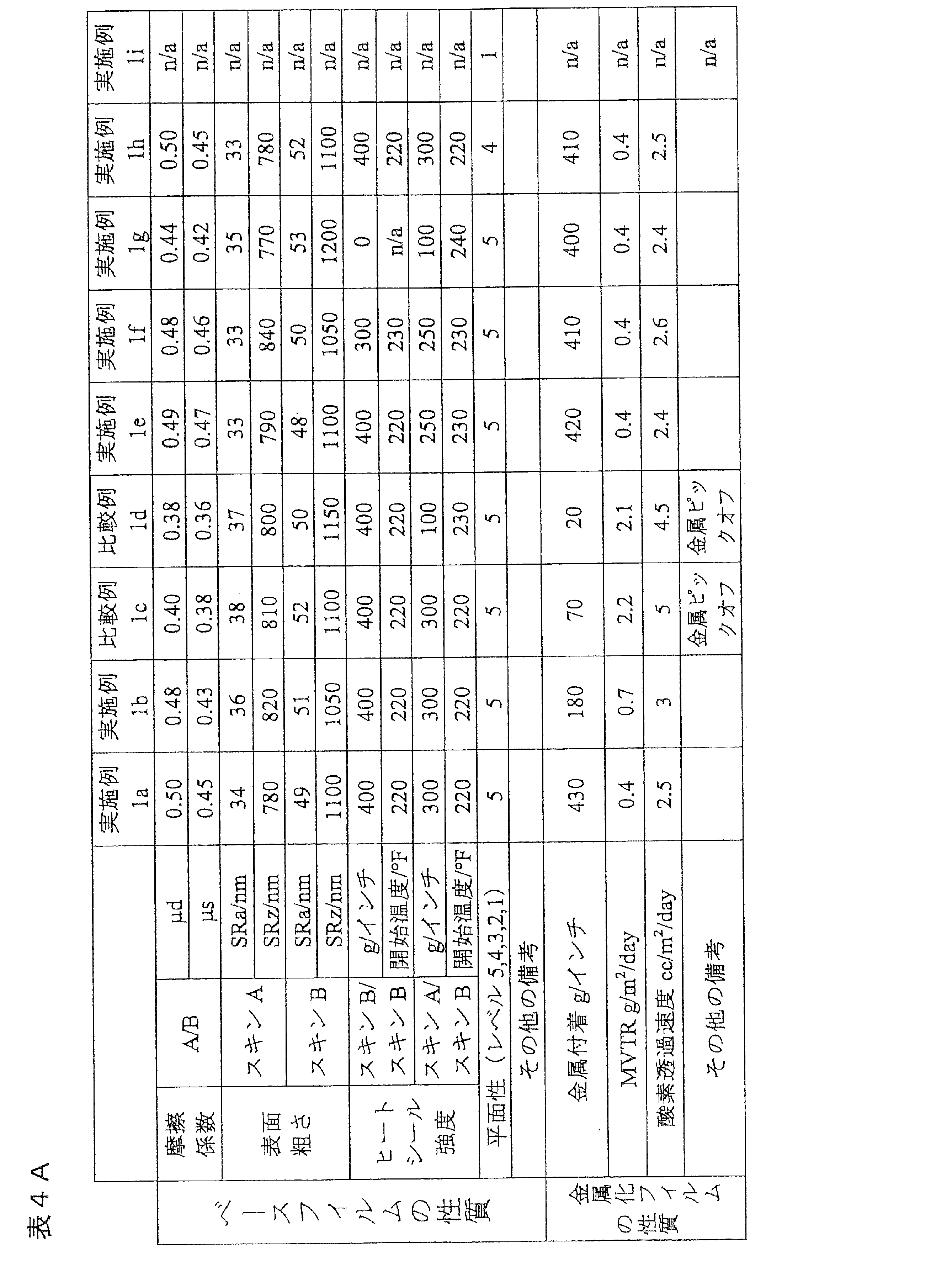
以上、二軸配向ポリ乳酸ポリマーのベースフィルム、および高金属付着力、高バリアー性、そして特に優れたヒートシール性を有する金属化フィルムについて説明した。これらフィルムはまた、耐熱性、取扱い性および平面性など、食品包装業にとって好適な性状と本質を有し、フィルム製造プロセスおよび下流側の加工プロセスにとって高いフィージビリティーを持っている。 In the above, the base film of the biaxially oriented polylactic acid polymer and the metallized film having a high metal adhesion, a high barrier property, and a particularly excellent heat seal property have been described. These films also have properties and essence suitable for the food packaging industry, such as heat resistance, handleability and flatness, and have high feasibility for film manufacturing processes and downstream processing processes.
本発明は、本文と図面内でいくつかの数値範囲を開示している。本発明は開示した数値範囲の全体にわたって実施可能であるため、明確な範囲の限界を明細書内において個々に記載してはいないが、開示されている数値範囲は、本質的に、当該の開示数値範囲内のあらゆる範囲や数値を保証するものである。 The present invention discloses several numerical ranges in the text and drawings. Since the present invention can be practiced throughout the disclosed numerical ranges, no explicit range limits are specifically recited in the specification, but the disclosed numerical ranges are inherent in the disclosure. All ranges and numerical values within the numerical range are guaranteed.
上記の記載内容は、当該技術に熟達した者が本発明を実施・利用できるように提示したものであり、また特定の出願とその要件に関連して提供したものである。当該技術に熟達した者にとっては、好適な実施態様に対する様々な改変を容易に行うことが可能であり、本明細書で明記した一般的原則は、本発明の趣旨と範囲から逸脱することなく、他の実施態様や応用に適用することができる。このように、本発明は提示した実施態様に制限されるものではなく、ここに開示した原則と特徴とに整合し得る最大の範囲に適合させるべきものである。最後に、本明細書で参照した特許および出版物における開示内容は、その全体がその参照によって本明細書に組み込まれる。 The above descriptions are presented so that those skilled in the art can implement and use the present invention, and the information is provided in relation to specific applications and requirements. Those skilled in the art can readily make various modifications to the preferred embodiments, and the general principles specified herein may be used without departing from the spirit and scope of the present invention. It can be applied to other embodiments and applications. Thus, the present invention is not limited to the embodiments presented, but is to be accorded the widest scope consistent with the principles and features disclosed herein. Finally, the disclosures in the patents and publications referred to herein are hereby incorporated by reference in their entirety.
Claims (31)
前記第一のスキン層が平均粒子サイズ0.1〜3μmの粒子を0.01〜0.3wt%含み、前記第二のスキン層が平均粒子サイズ1〜5μm粒子を0.05〜0.5wt%含む請求項24記載の多層フィルムの製造方法。
The first skin layer contains 0.01 to 0.3 wt% of particles having an average particle size of 0.1 to 3 μm, and the second skin layer contains 0.05 to 0.5 wt of particles having an average particle size of 1 to 5 μm. The manufacturing method of the multilayer film of Claim 24 containing%.
Applications Claiming Priority (3)
| Application Number | Priority Date | Filing Date | Title |
|---|---|---|---|
| US16417709P | 2009-03-27 | 2009-03-27 | |
| US61/164,177 | 2009-03-27 | ||
| PCT/US2010/028685 WO2010111501A1 (en) | 2009-03-27 | 2010-03-25 | Biaxially oriented metallized polylactic acid film with high metal adhesion and high barrier properties |
Publications (2)
| Publication Number | Publication Date |
|---|---|
| JP2012521902A true JP2012521902A (en) | 2012-09-20 |
| JP5513604B2 JP5513604B2 (en) | 2014-06-04 |
Family
ID=42781511
Family Applications (1)
| Application Number | Title | Priority Date | Filing Date |
|---|---|---|---|
| JP2012502253A Active JP5513604B2 (en) | 2009-03-27 | 2010-03-25 | Biaxially oriented metallized polylactic acid film with high metal adhesion and high barrier properties |
Country Status (8)
| Country | Link |
|---|---|
| US (1) | US8652626B2 (en) |
| EP (1) | EP2411224B1 (en) |
| JP (1) | JP5513604B2 (en) |
| KR (1) | KR20110138358A (en) |
| CN (1) | CN102365171A (en) |
| CA (1) | CA2766816C (en) |
| TW (1) | TWI490116B (en) |
| WO (1) | WO2010111501A1 (en) |
Cited By (2)
| Publication number | Priority date | Publication date | Assignee | Title |
|---|---|---|---|---|
| WO2015170446A1 (en) * | 2014-05-07 | 2015-11-12 | パナソニックIpマネジメント株式会社 | Piezoelectric device and method for manufacturing same |
| JP2018144483A (en) * | 2017-03-07 | 2018-09-20 | 東洋紡株式会社 | Polyethylene film for vapor deposition substrate and vapor deposition film using the same |
Families Citing this family (19)
| Publication number | Priority date | Publication date | Assignee | Title |
|---|---|---|---|---|
| US8911870B2 (en) | 2008-06-13 | 2014-12-16 | Toray Plastics (America), Inc. | Method to produce matte and opaque biaxially oriented polylactic acid film |
| CA2733581A1 (en) | 2008-08-15 | 2010-02-18 | Toray Plastics (America), Inc. | Biaxially oriented polylactic acid film with high barrier |
| US9150004B2 (en) * | 2009-06-19 | 2015-10-06 | Toray Plastics (America), Inc. | Biaxially oriented polylactic acid film with improved heat seal properties |
| US9221213B2 (en) | 2009-09-25 | 2015-12-29 | Toray Plastics (America), Inc. | Multi-layer high moisture barrier polylactic acid film |
| EP2480710B1 (en) | 2009-09-25 | 2018-01-24 | Toray Plastics (America) , Inc. | Multi-layer high moisture barrier polylactic acid film and its method of forming |
| EP2547505A1 (en) * | 2010-03-16 | 2013-01-23 | Andersen Corporation | Sustainable compositions, related methods, and members formed therefrom |
| US9492962B2 (en) | 2010-03-31 | 2016-11-15 | Toray Plastics (America), Inc. | Biaxially oriented polylactic acid film with reduced noise level and improved moisture barrier |
| WO2011123165A1 (en) | 2010-03-31 | 2011-10-06 | Toray Plastics (America), Inc. | Biaxially oriented polyactic acid film with reduced noise level |
| US20140227513A1 (en) * | 2011-09-27 | 2014-08-14 | Nec Corporation | Bioplastic molded body and method for producing bioplastic molded body |
| US20140287212A1 (en) * | 2011-11-29 | 2014-09-25 | Polyone Corporation | Biopolyester compositions with good transparency and sliding properties |
| US20170144813A1 (en) * | 2015-11-25 | 2017-05-25 | Advanced Extrusion, Inc. | Compostable product packaging |
| CN110435277A (en) * | 2019-07-26 | 2019-11-12 | 广东华通新材料科技有限公司 | Full-biodegradable high-barrier vacuum evaporation film and preparation method thereof |
| CN110774714B (en) * | 2019-11-20 | 2021-07-13 | 江阴中达软塑新材料股份有限公司 | Degradable two-way stretching polylactic acid cigarette film and preparation method thereof |
| JP7341107B2 (en) * | 2020-09-01 | 2023-09-08 | 信越化学工業株式会社 | Heat-resistant coated member package and method for packaging heat-resistant coated members |
| CN113172974A (en) * | 2021-05-26 | 2021-07-27 | 海南赛诺实业有限公司 | Biaxially oriented degradable film and preparation method thereof |
| CN116278287A (en) * | 2022-09-08 | 2023-06-23 | 厦门长塑实业有限公司 | A kind of reinforced aluminized BOPLA film and preparation method thereof |
| US20250178321A1 (en) * | 2023-11-30 | 2025-06-05 | Toray Plastics (America), Inc. | Biodegradable composite film with high moisture barrier |
| WO2025234662A1 (en) * | 2024-05-09 | 2025-11-13 | 에스케이마이크로웍스 주식회사 | Laminated film and method for manufacturing same |
| TWI910779B (en) * | 2024-08-19 | 2026-01-01 | 佳必琪國際股份有限公司 | Circuit board |
Family Cites Families (17)
| Publication number | Priority date | Publication date | Assignee | Title |
|---|---|---|---|---|
| JPH10151715A (en) * | 1996-11-22 | 1998-06-09 | Dainippon Ink & Chem Inc | Heat-fusible lactic acid-based polymer laminate |
| JPH11344521A (en) * | 1998-06-01 | 1999-12-14 | Jsr Corp | Laminated connector device and circuit board inspection device |
| DE69942600D1 (en) | 1998-07-22 | 2010-09-02 | Toyo Boseki | Aliphatic polyester film and gas barrier film |
| JP3258302B2 (en) | 1999-10-26 | 2002-02-18 | 三菱樹脂株式会社 | Biodegradable biaxially stretched film |
| US20030039775A1 (en) | 2001-08-17 | 2003-02-27 | Dan-Cheng Kong | Multilayer sleeve labels |
| JP3847145B2 (en) * | 2001-11-16 | 2006-11-15 | 東京中井商事株式会社 | Vapor deposition biodegradable film material and method for producing the same |
| JP2004358721A (en) | 2003-06-03 | 2004-12-24 | Mitsui Chemicals Inc | Lactic acid-based polymer multilayered film |
| KR101118441B1 (en) * | 2003-07-18 | 2012-03-06 | 미쓰비시 쥬시 가부시끼가이샤 | Aliphatic polyester films and packaging material |
| CA2472420C (en) * | 2004-06-23 | 2011-11-08 | Thomas L. Inglis | An improved packaging film |
| US20060068200A1 (en) * | 2004-09-24 | 2006-03-30 | Cleckner Michael D | Surface-treated multi-layered polymer film |
| US7824030B2 (en) | 2005-08-23 | 2010-11-02 | Eastman Kodak Company | Extruded open-celled ink-receiving layer comprising hydrophilic polymer for use in inkjet recording |
| US7943218B2 (en) | 2006-08-14 | 2011-05-17 | Frito-Lay North America, Inc. | Environmentally-friendly multi-layer flexible film having barrier properties |
| KR100786005B1 (en) | 2006-08-18 | 2007-12-14 | 에스케이씨 주식회사 | Multilayer Aliphatic Polyester Film |
| EP2065178B1 (en) * | 2006-09-22 | 2014-06-25 | Toray Industries, Inc. | Gas barrier film |
| EP2222459A4 (en) | 2007-12-10 | 2012-12-05 | Toray Plastics America Inc | HIGH-LOCKING BIAXIALLY ORIENTED POLYMILIC ACID FILM |
| WO2009076541A1 (en) * | 2007-12-11 | 2009-06-18 | Toray Plastics (America), Inc. | Process to produce biaxially oriented polylactic acid film at high transverse orientation rates |
| CA2733581A1 (en) * | 2008-08-15 | 2010-02-18 | Toray Plastics (America), Inc. | Biaxially oriented polylactic acid film with high barrier |
-
2010
- 2010-03-25 EP EP10756851.1A patent/EP2411224B1/en active Active
- 2010-03-25 WO PCT/US2010/028685 patent/WO2010111501A1/en not_active Ceased
- 2010-03-25 CN CN2010800148367A patent/CN102365171A/en active Pending
- 2010-03-25 CA CA 2766816 patent/CA2766816C/en active Active
- 2010-03-25 KR KR1020117022471A patent/KR20110138358A/en not_active Ceased
- 2010-03-25 US US12/731,925 patent/US8652626B2/en not_active Expired - Fee Related
- 2010-03-25 JP JP2012502253A patent/JP5513604B2/en active Active
- 2010-03-26 TW TW099109143A patent/TWI490116B/en active
Cited By (4)
| Publication number | Priority date | Publication date | Assignee | Title |
|---|---|---|---|---|
| WO2015170446A1 (en) * | 2014-05-07 | 2015-11-12 | パナソニックIpマネジメント株式会社 | Piezoelectric device and method for manufacturing same |
| JPWO2015170446A1 (en) * | 2014-05-07 | 2017-04-20 | パナソニックIpマネジメント株式会社 | Piezoelectric device and manufacturing method thereof |
| JP2018144483A (en) * | 2017-03-07 | 2018-09-20 | 東洋紡株式会社 | Polyethylene film for vapor deposition substrate and vapor deposition film using the same |
| JP6996339B2 (en) | 2017-03-07 | 2022-01-17 | 東洋紡株式会社 | Polyethylene film for vapor deposition base material and vapor deposition film using it |
Also Published As
| Publication number | Publication date |
|---|---|
| KR20110138358A (en) | 2011-12-27 |
| US20100247886A1 (en) | 2010-09-30 |
| JP5513604B2 (en) | 2014-06-04 |
| TW201038397A (en) | 2010-11-01 |
| EP2411224B1 (en) | 2017-06-21 |
| US8652626B2 (en) | 2014-02-18 |
| EP2411224A1 (en) | 2012-02-01 |
| WO2010111501A1 (en) | 2010-09-30 |
| CA2766816A1 (en) | 2010-09-30 |
| CN102365171A (en) | 2012-02-29 |
| CA2766816C (en) | 2014-09-16 |
| TWI490116B (en) | 2015-07-01 |
| EP2411224A4 (en) | 2013-05-29 |
Similar Documents
| Publication | Publication Date | Title |
|---|---|---|
| JP5513604B2 (en) | Biaxially oriented metallized polylactic acid film with high metal adhesion and high barrier properties | |
| EP2323788B1 (en) | Biaxially oriented polylactic acid film with high barrier | |
| US7951438B2 (en) | Biaxially oriented polylactic acid film with high barrier | |
| EP2222456B1 (en) | Process to produce biaxially oriented polylactic acid film at high transverse orientation rates | |
| CA2774653C (en) | Biodegradable composite barrier film | |
| US20100330382A1 (en) | Biaxially oriented polylactic acid film with improved moisture barrier | |
| EP2285902A1 (en) | Matte biaxially oriented polylactic acid film | |
| WO2011103452A1 (en) | Multi-layer high moisture barrier polylactic acid film | |
| JP2013199059A (en) | Laminated film | |
| JP2018001422A (en) | Laminated film, laminated body, and package | |
| JP4102584B2 (en) | Laminated body and packaging bag using the same | |
| JP2001293833A (en) | Gas barrier polyester film | |
| JP2004216824A (en) | Laminated biaxially oriented polyester film with excellent hand-cutting properties | |
| JP2004025484A (en) | Easy tear film excellent in gas barrier performance | |
| JP4944915B2 (en) | Laminated film and method for producing the same | |
| JP2006299078A (en) | Transparent vapor deposition film and transparent vapor deposition polyester film | |
| WO2025004892A1 (en) | Biaxially oriented polyester film, laminate stack, packaging, and top seal member | |
| JP2007160943A (en) | Aliphatic polyester film and moisture-proof aliphatic polyester film | |
| JP2009292158A (en) | Aliphatic polyester-based film and moistureproof aliphatic polyester-based film |
Legal Events
| Date | Code | Title | Description |
|---|---|---|---|
| A621 | Written request for application examination |
Free format text: JAPANESE INTERMEDIATE CODE: A621 Effective date: 20130212 |
|
| A977 | Report on retrieval |
Free format text: JAPANESE INTERMEDIATE CODE: A971007 Effective date: 20131127 |
|
| A131 | Notification of reasons for refusal |
Free format text: JAPANESE INTERMEDIATE CODE: A131 Effective date: 20131203 |
|
| A521 | Request for written amendment filed |
Free format text: JAPANESE INTERMEDIATE CODE: A523 Effective date: 20140203 |
|
| TRDD | Decision of grant or rejection written | ||
| A01 | Written decision to grant a patent or to grant a registration (utility model) |
Free format text: JAPANESE INTERMEDIATE CODE: A01 Effective date: 20140304 |
|
| A61 | First payment of annual fees (during grant procedure) |
Free format text: JAPANESE INTERMEDIATE CODE: A61 Effective date: 20140327 |
|
| R150 | Certificate of patent or registration of utility model |
Ref document number: 5513604 Country of ref document: JP Free format text: JAPANESE INTERMEDIATE CODE: R150 |
|
| R250 | Receipt of annual fees |
Free format text: JAPANESE INTERMEDIATE CODE: R250 |
|
| R250 | Receipt of annual fees |
Free format text: JAPANESE INTERMEDIATE CODE: R250 |
|
| R250 | Receipt of annual fees |
Free format text: JAPANESE INTERMEDIATE CODE: R250 |
|
| R250 | Receipt of annual fees |
Free format text: JAPANESE INTERMEDIATE CODE: R250 |
|
| R250 | Receipt of annual fees |
Free format text: JAPANESE INTERMEDIATE CODE: R250 |
|
| R250 | Receipt of annual fees |
Free format text: JAPANESE INTERMEDIATE CODE: R250 |
|
| R250 | Receipt of annual fees |
Free format text: JAPANESE INTERMEDIATE CODE: R250 |
|
| R250 | Receipt of annual fees |
Free format text: JAPANESE INTERMEDIATE CODE: R250 |
|
| R250 | Receipt of annual fees |
Free format text: JAPANESE INTERMEDIATE CODE: R250 |
|
| R250 | Receipt of annual fees |
Free format text: JAPANESE INTERMEDIATE CODE: R250 |