JP2013018954A - Conductive polymer precursor and conductive polymer - Google Patents
Conductive polymer precursor and conductive polymer Download PDFInfo
- Publication number
- JP2013018954A JP2013018954A JP2011259203A JP2011259203A JP2013018954A JP 2013018954 A JP2013018954 A JP 2013018954A JP 2011259203 A JP2011259203 A JP 2011259203A JP 2011259203 A JP2011259203 A JP 2011259203A JP 2013018954 A JP2013018954 A JP 2013018954A
- Authority
- JP
- Japan
- Prior art keywords
- group
- conductive polymer
- salt
- compound
- polymer precursor
- Prior art date
- Legal status (The legal status is an assumption and is not a legal conclusion. Google has not performed a legal analysis and makes no representation as to the accuracy of the status listed.)
- Pending
Links
- 229920001940 conductive polymer Polymers 0.000 title claims abstract description 164
- 239000002243 precursor Substances 0.000 title claims abstract description 59
- 150000003839 salts Chemical class 0.000 claims abstract description 48
- 230000002378 acidificating effect Effects 0.000 claims abstract description 39
- 125000003277 amino group Chemical group 0.000 claims abstract description 27
- 125000004435 hydrogen atom Chemical group [H]* 0.000 claims abstract description 27
- 230000000379 polymerizing effect Effects 0.000 claims abstract description 17
- 125000000217 alkyl group Chemical group 0.000 claims abstract description 15
- 229910052757 nitrogen Inorganic materials 0.000 claims abstract description 8
- 125000000467 secondary amino group Chemical group [H]N([*:1])[*:2] 0.000 claims abstract description 7
- 125000001302 tertiary amino group Chemical group 0.000 claims abstract description 7
- 125000004433 nitrogen atom Chemical group N* 0.000 claims abstract description 6
- 125000005843 halogen group Chemical group 0.000 claims description 13
- 125000005196 alkyl carbonyloxy group Chemical group 0.000 claims description 11
- 125000000449 nitro group Chemical group [O-][N+](*)=O 0.000 claims description 9
- 125000004093 cyano group Chemical group *C#N 0.000 claims description 8
- 125000002887 hydroxy group Chemical group [H]O* 0.000 claims description 8
- 125000001424 substituent group Chemical group 0.000 abstract description 4
- 150000001875 compounds Chemical class 0.000 description 70
- 238000000034 method Methods 0.000 description 43
- OKKJLVBELUTLKV-UHFFFAOYSA-N Methanol Chemical compound OC OKKJLVBELUTLKV-UHFFFAOYSA-N 0.000 description 42
- 239000000243 solution Substances 0.000 description 40
- YXFVVABEGXRONW-UHFFFAOYSA-N Toluene Natural products CC1=CC=CC=C1 YXFVVABEGXRONW-UHFFFAOYSA-N 0.000 description 32
- 238000006116 polymerization reaction Methods 0.000 description 31
- 150000007514 bases Chemical class 0.000 description 29
- -1 organic acid salts Chemical class 0.000 description 26
- 238000006243 chemical reaction Methods 0.000 description 22
- XLYOFNOQVPJJNP-UHFFFAOYSA-N water Substances O XLYOFNOQVPJJNP-UHFFFAOYSA-N 0.000 description 22
- HEMHJVSKTPXQMS-UHFFFAOYSA-M Sodium hydroxide Chemical compound [OH-].[Na+] HEMHJVSKTPXQMS-UHFFFAOYSA-M 0.000 description 21
- 230000008569 process Effects 0.000 description 19
- XEKOWRVHYACXOJ-UHFFFAOYSA-N Ethyl acetate Chemical compound CCOC(C)=O XEKOWRVHYACXOJ-UHFFFAOYSA-N 0.000 description 18
- 239000002904 solvent Substances 0.000 description 18
- VEXZGXHMUGYJMC-UHFFFAOYSA-N Hydrochloric acid Chemical compound Cl VEXZGXHMUGYJMC-UHFFFAOYSA-N 0.000 description 16
- 239000007800 oxidant agent Substances 0.000 description 16
- ZMANZCXQSJIPKH-UHFFFAOYSA-N Triethylamine Chemical compound CCN(CC)CC ZMANZCXQSJIPKH-UHFFFAOYSA-N 0.000 description 15
- 239000002253 acid Substances 0.000 description 15
- 229920000642 polymer Polymers 0.000 description 15
- PAYRUJLWNCNPSJ-UHFFFAOYSA-N Aniline Chemical compound NC1=CC=CC=C1 PAYRUJLWNCNPSJ-UHFFFAOYSA-N 0.000 description 14
- QAOWNCQODCNURD-UHFFFAOYSA-N Sulfuric acid Chemical compound OS(O)(=O)=O QAOWNCQODCNURD-UHFFFAOYSA-N 0.000 description 13
- 238000004519 manufacturing process Methods 0.000 description 12
- 238000000746 purification Methods 0.000 description 12
- 239000002002 slurry Substances 0.000 description 12
- LFQSCWFLJHTTHZ-UHFFFAOYSA-N Ethanol Chemical compound CCO LFQSCWFLJHTTHZ-UHFFFAOYSA-N 0.000 description 11
- 125000003545 alkoxy group Chemical group 0.000 description 10
- 125000003118 aryl group Chemical group 0.000 description 10
- 238000003756 stirring Methods 0.000 description 10
- WEVYAHXRMPXWCK-UHFFFAOYSA-N Acetonitrile Chemical compound CC#N WEVYAHXRMPXWCK-UHFFFAOYSA-N 0.000 description 9
- ROOXNKNUYICQNP-UHFFFAOYSA-N ammonium persulfate Chemical compound [NH4+].[NH4+].[O-]S(=O)(=O)OOS([O-])(=O)=O ROOXNKNUYICQNP-UHFFFAOYSA-N 0.000 description 9
- 239000007864 aqueous solution Substances 0.000 description 9
- 239000012046 mixed solvent Substances 0.000 description 9
- 239000007787 solid Substances 0.000 description 9
- 229910021642 ultra pure water Inorganic materials 0.000 description 9
- 239000012498 ultrapure water Substances 0.000 description 9
- KDLHZDBZIXYQEI-UHFFFAOYSA-N Palladium Chemical compound [Pd] KDLHZDBZIXYQEI-UHFFFAOYSA-N 0.000 description 8
- JUJWROOIHBZHMG-UHFFFAOYSA-N Pyridine Chemical compound C1=CC=NC=C1 JUJWROOIHBZHMG-UHFFFAOYSA-N 0.000 description 8
- FAPWRFPIFSIZLT-UHFFFAOYSA-M Sodium chloride Chemical compound [Na+].[Cl-] FAPWRFPIFSIZLT-UHFFFAOYSA-M 0.000 description 8
- 150000001412 amines Chemical class 0.000 description 8
- 125000004432 carbon atom Chemical group C* 0.000 description 8
- VLKZOEOYAKHREP-UHFFFAOYSA-N n-Hexane Chemical compound CCCCCC VLKZOEOYAKHREP-UHFFFAOYSA-N 0.000 description 8
- 239000012074 organic phase Substances 0.000 description 8
- MFRIHAYPQRLWNB-UHFFFAOYSA-N sodium tert-butoxide Chemical compound [Na+].CC(C)(C)[O-] MFRIHAYPQRLWNB-UHFFFAOYSA-N 0.000 description 8
- 238000006277 sulfonation reaction Methods 0.000 description 8
- KFZMGEQAYNKOFK-UHFFFAOYSA-N Isopropanol Chemical compound CC(C)O KFZMGEQAYNKOFK-UHFFFAOYSA-N 0.000 description 7
- 238000011033 desalting Methods 0.000 description 7
- 125000006239 protecting group Chemical group 0.000 description 7
- 239000000126 substance Substances 0.000 description 7
- QTBSBXVTEAMEQO-UHFFFAOYSA-N Acetic acid Chemical compound CC(O)=O QTBSBXVTEAMEQO-UHFFFAOYSA-N 0.000 description 6
- 150000007513 acids Chemical class 0.000 description 6
- 239000003153 chemical reaction reagent Substances 0.000 description 6
- 238000005859 coupling reaction Methods 0.000 description 6
- 125000004122 cyclic group Chemical group 0.000 description 6
- 239000000539 dimer Substances 0.000 description 6
- 238000001914 filtration Methods 0.000 description 6
- 239000011259 mixed solution Substances 0.000 description 6
- 239000000203 mixture Substances 0.000 description 6
- BASFCYQUMIYNBI-UHFFFAOYSA-N platinum Chemical compound [Pt] BASFCYQUMIYNBI-UHFFFAOYSA-N 0.000 description 6
- 230000009257 reactivity Effects 0.000 description 6
- 230000009467 reduction Effects 0.000 description 6
- 238000000108 ultra-filtration Methods 0.000 description 6
- BSKHPKMHTQYZBB-UHFFFAOYSA-N 2-methylpyridine Chemical compound CC1=CC=CC=N1 BSKHPKMHTQYZBB-UHFFFAOYSA-N 0.000 description 5
- FKNQCJSGGFJEIZ-UHFFFAOYSA-N 4-methylpyridine Chemical compound CC1=CC=NC=C1 FKNQCJSGGFJEIZ-UHFFFAOYSA-N 0.000 description 5
- WQDUMFSSJAZKTM-UHFFFAOYSA-N Sodium methoxide Chemical compound [Na+].[O-]C WQDUMFSSJAZKTM-UHFFFAOYSA-N 0.000 description 5
- HCHKCACWOHOZIP-UHFFFAOYSA-N Zinc Chemical compound [Zn] HCHKCACWOHOZIP-UHFFFAOYSA-N 0.000 description 5
- 229910052783 alkali metal Inorganic materials 0.000 description 5
- 239000003054 catalyst Substances 0.000 description 5
- 239000002019 doping agent Substances 0.000 description 5
- 238000005259 measurement Methods 0.000 description 5
- WBIQQQGBSDOWNP-UHFFFAOYSA-N 2-dodecylbenzenesulfonic acid Chemical compound CCCCCCCCCCCCC1=CC=CC=C1S(O)(=O)=O WBIQQQGBSDOWNP-UHFFFAOYSA-N 0.000 description 4
- IJGRMHOSHXDMSA-UHFFFAOYSA-N Atomic nitrogen Chemical compound N#N IJGRMHOSHXDMSA-UHFFFAOYSA-N 0.000 description 4
- ROSDSFDQCJNGOL-UHFFFAOYSA-N Dimethylamine Chemical compound CNC ROSDSFDQCJNGOL-UHFFFAOYSA-N 0.000 description 4
- XEEYBQQBJWHFJM-UHFFFAOYSA-N Iron Chemical compound [Fe] XEEYBQQBJWHFJM-UHFFFAOYSA-N 0.000 description 4
- AFVFQIVMOAPDHO-UHFFFAOYSA-N Methanesulfonic acid Chemical compound CS(O)(=O)=O AFVFQIVMOAPDHO-UHFFFAOYSA-N 0.000 description 4
- YNAVUWVOSKDBBP-UHFFFAOYSA-N Morpholine Chemical compound C1COCCN1 YNAVUWVOSKDBBP-UHFFFAOYSA-N 0.000 description 4
- PXHVJJICTQNCMI-UHFFFAOYSA-N Nickel Chemical compound [Ni] PXHVJJICTQNCMI-UHFFFAOYSA-N 0.000 description 4
- WYURNTSHIVDZCO-UHFFFAOYSA-N Tetrahydrofuran Chemical compound C1CCOC1 WYURNTSHIVDZCO-UHFFFAOYSA-N 0.000 description 4
- QGZKDVFQNNGYKY-UHFFFAOYSA-O ammonium group Chemical group [NH4+] QGZKDVFQNNGYKY-UHFFFAOYSA-O 0.000 description 4
- 229910001870 ammonium persulfate Inorganic materials 0.000 description 4
- 239000000969 carrier Substances 0.000 description 4
- 239000011248 coating agent Substances 0.000 description 4
- 238000000576 coating method Methods 0.000 description 4
- 238000004440 column chromatography Methods 0.000 description 4
- 230000000052 comparative effect Effects 0.000 description 4
- 238000001816 cooling Methods 0.000 description 4
- 230000008878 coupling Effects 0.000 description 4
- 238000010168 coupling process Methods 0.000 description 4
- 229940060296 dodecylbenzenesulfonic acid Drugs 0.000 description 4
- 239000012535 impurity Substances 0.000 description 4
- 238000005342 ion exchange Methods 0.000 description 4
- UKVIEHSSVKSQBA-UHFFFAOYSA-N methane;palladium Chemical compound C.[Pd] UKVIEHSSVKSQBA-UHFFFAOYSA-N 0.000 description 4
- 230000001590 oxidative effect Effects 0.000 description 4
- 229910052763 palladium Inorganic materials 0.000 description 4
- 239000002244 precipitate Substances 0.000 description 4
- 238000000425 proton nuclear magnetic resonance spectrum Methods 0.000 description 4
- UMJSCPRVCHMLSP-UHFFFAOYSA-N pyridine Natural products COC1=CC=CN=C1 UMJSCPRVCHMLSP-UHFFFAOYSA-N 0.000 description 4
- 229920006395 saturated elastomer Polymers 0.000 description 4
- 239000011780 sodium chloride Substances 0.000 description 4
- 125000000542 sulfonic acid group Chemical group 0.000 description 4
- GEYOCULIXLDCMW-UHFFFAOYSA-N 1,2-phenylenediamine Chemical group NC1=CC=CC=C1N GEYOCULIXLDCMW-UHFFFAOYSA-N 0.000 description 3
- LBLYYCQCTBFVLH-UHFFFAOYSA-N 2-Methylbenzenesulfonic acid Chemical class CC1=CC=CC=C1S(O)(=O)=O LBLYYCQCTBFVLH-UHFFFAOYSA-N 0.000 description 3
- ITQTTZVARXURQS-UHFFFAOYSA-N 3-methylpyridine Chemical compound CC1=CC=CN=C1 ITQTTZVARXURQS-UHFFFAOYSA-N 0.000 description 3
- CSCPPACGZOOCGX-UHFFFAOYSA-N Acetone Chemical compound CC(C)=O CSCPPACGZOOCGX-UHFFFAOYSA-N 0.000 description 3
- VHUUQVKOLVNVRT-UHFFFAOYSA-N Ammonium hydroxide Chemical class [NH4+].[OH-] VHUUQVKOLVNVRT-UHFFFAOYSA-N 0.000 description 3
- IAZDPXIOMUYVGZ-UHFFFAOYSA-N Dimethylsulphoxide Chemical compound CS(C)=O IAZDPXIOMUYVGZ-UHFFFAOYSA-N 0.000 description 3
- WMFOQBRAJBCJND-UHFFFAOYSA-M Lithium hydroxide Chemical compound [Li+].[OH-] WMFOQBRAJBCJND-UHFFFAOYSA-M 0.000 description 3
- GRYLNZFGIOXLOG-UHFFFAOYSA-N Nitric acid Chemical compound O[N+]([O-])=O GRYLNZFGIOXLOG-UHFFFAOYSA-N 0.000 description 3
- KWYUFKZDYYNOTN-UHFFFAOYSA-M Potassium hydroxide Chemical compound [OH-].[K+] KWYUFKZDYYNOTN-UHFFFAOYSA-M 0.000 description 3
- RWRDLPDLKQPQOW-UHFFFAOYSA-N Pyrrolidine Chemical compound C1CCNC1 RWRDLPDLKQPQOW-UHFFFAOYSA-N 0.000 description 3
- 150000003863 ammonium salts Chemical class 0.000 description 3
- 239000008346 aqueous phase Substances 0.000 description 3
- 239000002585 base Substances 0.000 description 3
- 239000012295 chemical reaction liquid Substances 0.000 description 3
- 239000003638 chemical reducing agent Substances 0.000 description 3
- 238000010511 deprotection reaction Methods 0.000 description 3
- 239000003792 electrolyte Substances 0.000 description 3
- 229910052731 fluorine Inorganic materials 0.000 description 3
- 125000001153 fluoro group Chemical group F* 0.000 description 3
- 238000010438 heat treatment Methods 0.000 description 3
- 229910052739 hydrogen Inorganic materials 0.000 description 3
- 239000001257 hydrogen Substances 0.000 description 3
- 229960004592 isopropanol Drugs 0.000 description 3
- 238000005374 membrane filtration Methods 0.000 description 3
- 229910017604 nitric acid Inorganic materials 0.000 description 3
- 239000003973 paint Substances 0.000 description 3
- 229910052697 platinum Inorganic materials 0.000 description 3
- 229920000767 polyaniline Polymers 0.000 description 3
- 238000003825 pressing Methods 0.000 description 3
- 125000002924 primary amino group Chemical group [H]N([H])* 0.000 description 3
- 239000000523 sample Substances 0.000 description 3
- 238000007086 side reaction Methods 0.000 description 3
- GETQZCLCWQTVFV-UHFFFAOYSA-N trimethylamine Chemical compound CN(C)C GETQZCLCWQTVFV-UHFFFAOYSA-N 0.000 description 3
- HTDQSWDEWGSAMN-UHFFFAOYSA-N 1-bromo-2-methoxybenzene Chemical compound COC1=CC=CC=C1Br HTDQSWDEWGSAMN-UHFFFAOYSA-N 0.000 description 2
- MEKOFIRRDATTAG-UHFFFAOYSA-N 2,2,5,8-tetramethyl-3,4-dihydrochromen-6-ol Chemical compound C1CC(C)(C)OC2=C1C(C)=C(O)C=C2C MEKOFIRRDATTAG-UHFFFAOYSA-N 0.000 description 2
- GVBHRNIWBGTNQA-UHFFFAOYSA-N 2-methoxy-4-nitroaniline Chemical compound COC1=CC([N+]([O-])=O)=CC=C1N GVBHRNIWBGTNQA-UHFFFAOYSA-N 0.000 description 2
- RSEBUVRVKCANEP-UHFFFAOYSA-N 2-pyrroline Chemical compound C1CC=CN1 RSEBUVRVKCANEP-UHFFFAOYSA-N 0.000 description 2
- VQCWSOYHHXXWSP-UHFFFAOYSA-N 4-bromo-2-fluoro-1-nitrobenzene Chemical compound [O-][N+](=O)C1=CC=C(Br)C=C1F VQCWSOYHHXXWSP-UHFFFAOYSA-N 0.000 description 2
- HYLOSPCJTPLXSF-UHFFFAOYSA-N 5-amino-2-anilinobenzenesulfonic acid Chemical compound OS(=O)(=O)C1=CC(N)=CC=C1NC1=CC=CC=C1 HYLOSPCJTPLXSF-UHFFFAOYSA-N 0.000 description 2
- QTBSBXVTEAMEQO-UHFFFAOYSA-M Acetate Chemical compound CC([O-])=O QTBSBXVTEAMEQO-UHFFFAOYSA-M 0.000 description 2
- QGZKDVFQNNGYKY-UHFFFAOYSA-N Ammonia Chemical compound N QGZKDVFQNNGYKY-UHFFFAOYSA-N 0.000 description 2
- WKBOTKDWSSQWDR-UHFFFAOYSA-N Bromine atom Chemical group [Br] WKBOTKDWSSQWDR-UHFFFAOYSA-N 0.000 description 2
- BVKZGUZCCUSVTD-UHFFFAOYSA-L Carbonate Chemical compound [O-]C([O-])=O BVKZGUZCCUSVTD-UHFFFAOYSA-L 0.000 description 2
- QUSNBJAOOMFDIB-UHFFFAOYSA-N Ethylamine Chemical compound CCN QUSNBJAOOMFDIB-UHFFFAOYSA-N 0.000 description 2
- BDAGIHXWWSANSR-UHFFFAOYSA-M Formate Chemical compound [O-]C=O BDAGIHXWWSANSR-UHFFFAOYSA-M 0.000 description 2
- UFHFLCQGNIYNRP-UHFFFAOYSA-N Hydrogen Chemical compound [H][H] UFHFLCQGNIYNRP-UHFFFAOYSA-N 0.000 description 2
- MHAJPDPJQMAIIY-UHFFFAOYSA-N Hydrogen peroxide Chemical compound OO MHAJPDPJQMAIIY-UHFFFAOYSA-N 0.000 description 2
- BAVYZALUXZFZLV-UHFFFAOYSA-N Methylamine Chemical compound NC BAVYZALUXZFZLV-UHFFFAOYSA-N 0.000 description 2
- 229910019142 PO4 Inorganic materials 0.000 description 2
- NQRYJNQNLNOLGT-UHFFFAOYSA-N Piperidine Chemical compound C1CCNCC1 NQRYJNQNLNOLGT-UHFFFAOYSA-N 0.000 description 2
- XBDQKXXYIPTUBI-UHFFFAOYSA-M Propionate Chemical compound CCC([O-])=O XBDQKXXYIPTUBI-UHFFFAOYSA-M 0.000 description 2
- SMWDFEZZVXVKRB-UHFFFAOYSA-N Quinoline Chemical compound N1=CC=CC2=CC=CC=C21 SMWDFEZZVXVKRB-UHFFFAOYSA-N 0.000 description 2
- PMZURENOXWZQFD-UHFFFAOYSA-L Sodium Sulfate Chemical compound [Na+].[Na+].[O-]S([O-])(=O)=O PMZURENOXWZQFD-UHFFFAOYSA-L 0.000 description 2
- UIIMBOGNXHQVGW-UHFFFAOYSA-M Sodium bicarbonate Chemical compound [Na+].OC([O-])=O UIIMBOGNXHQVGW-UHFFFAOYSA-M 0.000 description 2
- QAOWNCQODCNURD-UHFFFAOYSA-L Sulfate Chemical compound [O-]S([O-])(=O)=O QAOWNCQODCNURD-UHFFFAOYSA-L 0.000 description 2
- ATJFFYVFTNAWJD-UHFFFAOYSA-N Tin Chemical compound [Sn] ATJFFYVFTNAWJD-UHFFFAOYSA-N 0.000 description 2
- 125000002723 alicyclic group Chemical group 0.000 description 2
- 150000001340 alkali metals Chemical class 0.000 description 2
- 229910052784 alkaline earth metal Inorganic materials 0.000 description 2
- 125000002490 anilino group Chemical group [H]N(*)C1=C([H])C([H])=C([H])C([H])=C1[H] 0.000 description 2
- HSDAJNMJOMSNEV-UHFFFAOYSA-N benzyl chloroformate Chemical compound ClC(=O)OCC1=CC=CC=C1 HSDAJNMJOMSNEV-UHFFFAOYSA-N 0.000 description 2
- MUALRAIOVNYAIW-UHFFFAOYSA-N binap Chemical group C1=CC=CC=C1P(C=1C(=C2C=CC=CC2=CC=1)C=1C2=CC=CC=C2C=CC=1P(C=1C=CC=CC=1)C=1C=CC=CC=1)C1=CC=CC=C1 MUALRAIOVNYAIW-UHFFFAOYSA-N 0.000 description 2
- 230000015572 biosynthetic process Effects 0.000 description 2
- 125000000484 butyl group Chemical group [H]C([*])([H])C([H])([H])C([H])([H])C([H])([H])[H] 0.000 description 2
- MIOPJNTWMNEORI-UHFFFAOYSA-N camphorsulfonic acid Chemical compound C1CC2(CS(O)(=O)=O)C(=O)CC1C2(C)C MIOPJNTWMNEORI-UHFFFAOYSA-N 0.000 description 2
- 238000009903 catalytic hydrogenation reaction Methods 0.000 description 2
- 229910052801 chlorine Inorganic materials 0.000 description 2
- 238000006880 cross-coupling reaction Methods 0.000 description 2
- YRIUSKIDOIARQF-UHFFFAOYSA-N dodecyl benzenesulfonate Chemical compound CCCCCCCCCCCCOS(=O)(=O)C1=CC=CC=C1 YRIUSKIDOIARQF-UHFFFAOYSA-N 0.000 description 2
- 229940071161 dodecylbenzenesulfonate Drugs 0.000 description 2
- 230000000694 effects Effects 0.000 description 2
- 125000001495 ethyl group Chemical group [H]C([H])([H])C([H])([H])* 0.000 description 2
- LIWAQLJGPBVORC-UHFFFAOYSA-N ethylmethylamine Chemical compound CCNC LIWAQLJGPBVORC-UHFFFAOYSA-N 0.000 description 2
- 239000000706 filtrate Substances 0.000 description 2
- 239000011521 glass Substances 0.000 description 2
- 150000007529 inorganic bases Chemical class 0.000 description 2
- 125000001449 isopropyl group Chemical group [H]C([H])([H])C([H])(*)C([H])([H])[H] 0.000 description 2
- AWJUIBRHMBBTKR-UHFFFAOYSA-N isoquinoline Chemical compound C1=NC=CC2=CC=CC=C21 AWJUIBRHMBBTKR-UHFFFAOYSA-N 0.000 description 2
- 239000007788 liquid Substances 0.000 description 2
- 239000012528 membrane Substances 0.000 description 2
- 125000000956 methoxy group Chemical group [H]C([H])([H])O* 0.000 description 2
- 125000002496 methyl group Chemical group [H]C([H])([H])* 0.000 description 2
- DAZXVJBJRMWXJP-UHFFFAOYSA-N n,n-dimethylethylamine Chemical compound CCN(C)C DAZXVJBJRMWXJP-UHFFFAOYSA-N 0.000 description 2
- 125000004108 n-butyl group Chemical group [H]C([H])([H])C([H])([H])C([H])([H])C([H])([H])* 0.000 description 2
- GNVRJGIVDSQCOP-UHFFFAOYSA-N n-ethyl-n-methylethanamine Chemical compound CCN(C)CC GNVRJGIVDSQCOP-UHFFFAOYSA-N 0.000 description 2
- 125000004123 n-propyl group Chemical group [H]C([H])([H])C([H])([H])C([H])([H])* 0.000 description 2
- 229910052759 nickel Inorganic materials 0.000 description 2
- 239000003960 organic solvent Substances 0.000 description 2
- YJVFFLUZDVXJQI-UHFFFAOYSA-L palladium(ii) acetate Chemical compound [Pd+2].CC([O-])=O.CC([O-])=O YJVFFLUZDVXJQI-UHFFFAOYSA-L 0.000 description 2
- VLTRZXGMWDSKGL-UHFFFAOYSA-N perchloric acid Chemical compound OCl(=O)(=O)=O VLTRZXGMWDSKGL-UHFFFAOYSA-N 0.000 description 2
- NBIIXXVUZAFLBC-UHFFFAOYSA-K phosphate Chemical compound [O-]P([O-])([O-])=O NBIIXXVUZAFLBC-UHFFFAOYSA-K 0.000 description 2
- 239000010452 phosphate Substances 0.000 description 2
- 229920000172 poly(styrenesulfonic acid) Polymers 0.000 description 2
- 238000001556 precipitation Methods 0.000 description 2
- 238000010926 purge Methods 0.000 description 2
- 125000002914 sec-butyl group Chemical group [H]C([H])([H])C([H])([H])C([H])(*)C([H])([H])[H] 0.000 description 2
- 150000003335 secondary amines Chemical class 0.000 description 2
- CHQMHPLRPQMAMX-UHFFFAOYSA-L sodium persulfate Chemical compound [Na+].[Na+].[O-]S(=O)(=O)OOS([O-])(=O)=O CHQMHPLRPQMAMX-UHFFFAOYSA-L 0.000 description 2
- 239000007858 starting material Substances 0.000 description 2
- 238000006467 substitution reaction Methods 0.000 description 2
- 239000000758 substrate Substances 0.000 description 2
- 238000000967 suction filtration Methods 0.000 description 2
- HIFJUMGIHIZEPX-UHFFFAOYSA-N sulfuric acid;sulfur trioxide Chemical compound O=S(=O)=O.OS(O)(=O)=O HIFJUMGIHIZEPX-UHFFFAOYSA-N 0.000 description 2
- 238000003786 synthesis reaction Methods 0.000 description 2
- 230000002194 synthesizing effect Effects 0.000 description 2
- 125000000999 tert-butyl group Chemical group [H]C([H])([H])C(*)(C([H])([H])[H])C([H])([H])[H] 0.000 description 2
- 150000003512 tertiary amines Chemical class 0.000 description 2
- YLQBMQCUIZJEEH-UHFFFAOYSA-N tetrahydrofuran Natural products C=1C=COC=1 YLQBMQCUIZJEEH-UHFFFAOYSA-N 0.000 description 2
- JOXIMZWYDAKGHI-UHFFFAOYSA-N toluene-4-sulfonic acid Chemical compound CC1=CC=C(S(O)(=O)=O)C=C1 JOXIMZWYDAKGHI-UHFFFAOYSA-N 0.000 description 2
- 238000005406 washing Methods 0.000 description 2
- MIOPJNTWMNEORI-GMSGAONNSA-N (S)-camphorsulfonic acid Chemical compound C1C[C@@]2(CS(O)(=O)=O)C(=O)C[C@@H]1C2(C)C MIOPJNTWMNEORI-GMSGAONNSA-N 0.000 description 1
- NWUYHJFMYQTDRP-UHFFFAOYSA-N 1,2-bis(ethenyl)benzene;1-ethenyl-2-ethylbenzene;styrene Chemical compound C=CC1=CC=CC=C1.CCC1=CC=CC=C1C=C.C=CC1=CC=CC=C1C=C NWUYHJFMYQTDRP-UHFFFAOYSA-N 0.000 description 1
- 238000005160 1H NMR spectroscopy Methods 0.000 description 1
- NGNBDVOYPDDBFK-UHFFFAOYSA-N 2-[2,4-di(pentan-2-yl)phenoxy]acetyl chloride Chemical compound CCCC(C)C1=CC=C(OCC(Cl)=O)C(C(C)CCC)=C1 NGNBDVOYPDDBFK-UHFFFAOYSA-N 0.000 description 1
- ZMCHBSMFKQYNKA-UHFFFAOYSA-N 2-aminobenzenesulfonic acid Chemical compound NC1=CC=CC=C1S(O)(=O)=O ZMCHBSMFKQYNKA-UHFFFAOYSA-N 0.000 description 1
- LBLYYCQCTBFVLH-UHFFFAOYSA-M 2-methylbenzenesulfonate Chemical compound CC1=CC=CC=C1S([O-])(=O)=O LBLYYCQCTBFVLH-UHFFFAOYSA-M 0.000 description 1
- DJKPQYBFSAJUBS-UHFFFAOYSA-N 4-bromo-2-methoxy-1-nitrobenzene Chemical compound COC1=CC(Br)=CC=C1[N+]([O-])=O DJKPQYBFSAJUBS-UHFFFAOYSA-N 0.000 description 1
- XVMSFILGAMDHEY-UHFFFAOYSA-N 6-(4-aminophenyl)sulfonylpyridin-3-amine Chemical compound C1=CC(N)=CC=C1S(=O)(=O)C1=CC=C(N)C=N1 XVMSFILGAMDHEY-UHFFFAOYSA-N 0.000 description 1
- ZCYVEMRRCGMTRW-UHFFFAOYSA-N 7553-56-2 Chemical group [I] ZCYVEMRRCGMTRW-UHFFFAOYSA-N 0.000 description 1
- LSNNMFCWUKXFEE-UHFFFAOYSA-M Bisulfite Chemical compound OS([O-])=O LSNNMFCWUKXFEE-UHFFFAOYSA-M 0.000 description 1
- OYPRJOBELJOOCE-UHFFFAOYSA-N Calcium Chemical compound [Ca] OYPRJOBELJOOCE-UHFFFAOYSA-N 0.000 description 1
- ZAMOUSCENKQFHK-UHFFFAOYSA-N Chlorine atom Chemical compound [Cl] ZAMOUSCENKQFHK-UHFFFAOYSA-N 0.000 description 1
- RYGMFSIKBFXOCR-UHFFFAOYSA-N Copper Chemical compound [Cu] RYGMFSIKBFXOCR-UHFFFAOYSA-N 0.000 description 1
- IAZDPXIOMUYVGZ-WFGJKAKNSA-N Dimethyl sulfoxide Chemical compound [2H]C([2H])([2H])S(=O)C([2H])([2H])[2H] IAZDPXIOMUYVGZ-WFGJKAKNSA-N 0.000 description 1
- DGAQECJNVWCQMB-PUAWFVPOSA-M Ilexoside XXIX Chemical compound C[C@@H]1CC[C@@]2(CC[C@@]3(C(=CC[C@H]4[C@]3(CC[C@@H]5[C@@]4(CC[C@@H](C5(C)C)OS(=O)(=O)[O-])C)C)[C@@H]2[C@]1(C)O)C)C(=O)O[C@H]6[C@@H]([C@H]([C@@H]([C@H](O6)CO)O)O)O.[Na+] DGAQECJNVWCQMB-PUAWFVPOSA-M 0.000 description 1
- WHXSMMKQMYFTQS-UHFFFAOYSA-N Lithium Chemical compound [Li] WHXSMMKQMYFTQS-UHFFFAOYSA-N 0.000 description 1
- FYYHWMGAXLPEAU-UHFFFAOYSA-N Magnesium Chemical compound [Mg] FYYHWMGAXLPEAU-UHFFFAOYSA-N 0.000 description 1
- BAVYZALUXZFZLV-UHFFFAOYSA-O Methylammonium ion Chemical compound [NH3+]C BAVYZALUXZFZLV-UHFFFAOYSA-O 0.000 description 1
- 238000005481 NMR spectroscopy Methods 0.000 description 1
- NBIIXXVUZAFLBC-UHFFFAOYSA-N Phosphoric acid Chemical group OP(O)(O)=O NBIIXXVUZAFLBC-UHFFFAOYSA-N 0.000 description 1
- NQRYJNQNLNOLGT-UHFFFAOYSA-O Piperidinium(1+) Chemical compound C1CC[NH2+]CC1 NQRYJNQNLNOLGT-UHFFFAOYSA-O 0.000 description 1
- ZLMJMSJWJFRBEC-UHFFFAOYSA-N Potassium Chemical compound [K] ZLMJMSJWJFRBEC-UHFFFAOYSA-N 0.000 description 1
- RWRDLPDLKQPQOW-UHFFFAOYSA-O Pyrrolidinium ion Chemical compound C1CC[NH2+]C1 RWRDLPDLKQPQOW-UHFFFAOYSA-O 0.000 description 1
- 229910021607 Silver chloride Inorganic materials 0.000 description 1
- 229920002125 Sokalan® Polymers 0.000 description 1
- 150000008065 acid anhydrides Chemical class 0.000 description 1
- 239000000853 adhesive Substances 0.000 description 1
- 230000001070 adhesive effect Effects 0.000 description 1
- 238000007754 air knife coating Methods 0.000 description 1
- 150000001447 alkali salts Chemical class 0.000 description 1
- 150000001342 alkaline earth metals Chemical class 0.000 description 1
- 229910021529 ammonia Inorganic materials 0.000 description 1
- 239000012935 ammoniumperoxodisulfate Substances 0.000 description 1
- 229940058302 antinematodal agent piperazine and derivative Drugs 0.000 description 1
- 239000002216 antistatic agent Substances 0.000 description 1
- 125000004429 atom Chemical group 0.000 description 1
- SRSXLGNVWSONIS-UHFFFAOYSA-N benzenesulfonic acid Chemical compound OS(=O)(=O)C1=CC=CC=C1 SRSXLGNVWSONIS-UHFFFAOYSA-N 0.000 description 1
- 229940092714 benzenesulfonic acid Drugs 0.000 description 1
- 125000001584 benzyloxycarbonyl group Chemical group C(=O)(OCC1=CC=CC=C1)* 0.000 description 1
- WTEOIRVLGSZEPR-UHFFFAOYSA-N boron trifluoride Chemical compound FB(F)F WTEOIRVLGSZEPR-UHFFFAOYSA-N 0.000 description 1
- GDTBXPJZTBHREO-UHFFFAOYSA-N bromine Substances BrBr GDTBXPJZTBHREO-UHFFFAOYSA-N 0.000 description 1
- 229910052794 bromium Inorganic materials 0.000 description 1
- 230000001680 brushing effect Effects 0.000 description 1
- QCOGKXLOEWLIDC-UHFFFAOYSA-O butyl(methyl)azanium Chemical compound CCCC[NH2+]C QCOGKXLOEWLIDC-UHFFFAOYSA-O 0.000 description 1
- HQABUPZFAYXKJW-UHFFFAOYSA-O butylazanium Chemical compound CCCC[NH3+] HQABUPZFAYXKJW-UHFFFAOYSA-O 0.000 description 1
- 239000011575 calcium Substances 0.000 description 1
- 229910052791 calcium Inorganic materials 0.000 description 1
- 239000003990 capacitor Substances 0.000 description 1
- 125000003178 carboxy group Chemical group [H]OC(*)=O 0.000 description 1
- 238000004210 cathodic protection Methods 0.000 description 1
- 238000005341 cation exchange Methods 0.000 description 1
- 239000003729 cation exchange resin Substances 0.000 description 1
- 238000005119 centrifugation Methods 0.000 description 1
- 230000008859 change Effects 0.000 description 1
- 239000007810 chemical reaction solvent Substances 0.000 description 1
- 239000000460 chlorine Substances 0.000 description 1
- 125000001309 chloro group Chemical group Cl* 0.000 description 1
- 239000004020 conductor Substances 0.000 description 1
- 229920001577 copolymer Polymers 0.000 description 1
- 229910052802 copper Inorganic materials 0.000 description 1
- 239000010949 copper Substances 0.000 description 1
- 238000002425 crystallisation Methods 0.000 description 1
- 230000008025 crystallization Effects 0.000 description 1
- 238000007766 curtain coating Methods 0.000 description 1
- JQVDAXLFBXTEQA-UHFFFAOYSA-O dibutylazanium Chemical compound CCCC[NH2+]CCCC JQVDAXLFBXTEQA-UHFFFAOYSA-O 0.000 description 1
- HPNMFZURTQLUMO-UHFFFAOYSA-N diethylamine Chemical compound CCNCC HPNMFZURTQLUMO-UHFFFAOYSA-N 0.000 description 1
- HPNMFZURTQLUMO-UHFFFAOYSA-O diethylammonium Chemical compound CC[NH2+]CC HPNMFZURTQLUMO-UHFFFAOYSA-O 0.000 description 1
- UAOMVDZJSHZZME-UHFFFAOYSA-N diisopropylamine Chemical compound CC(C)NC(C)C UAOMVDZJSHZZME-UHFFFAOYSA-N 0.000 description 1
- 238000003618 dip coating Methods 0.000 description 1
- WEHWNAOGRSTTBQ-UHFFFAOYSA-O dipropylazanium Chemical compound CCC[NH2+]CCC WEHWNAOGRSTTBQ-UHFFFAOYSA-O 0.000 description 1
- 238000000909 electrodialysis Methods 0.000 description 1
- 125000006575 electron-withdrawing group Chemical group 0.000 description 1
- 238000009503 electrostatic coating Methods 0.000 description 1
- 125000001301 ethoxy group Chemical group [H]C([H])([H])C([H])([H])O* 0.000 description 1
- QUSNBJAOOMFDIB-UHFFFAOYSA-O ethylaminium Chemical compound CC[NH3+] QUSNBJAOOMFDIB-UHFFFAOYSA-O 0.000 description 1
- 238000011156 evaluation Methods 0.000 description 1
- 238000001125 extrusion Methods 0.000 description 1
- 239000000835 fiber Substances 0.000 description 1
- 239000011737 fluorine Substances 0.000 description 1
- 238000007756 gravure coating Methods 0.000 description 1
- GLUUGHFHXGJENI-UHFFFAOYSA-O hydron piperazine Chemical compound [H+].C1CNCCN1 GLUUGHFHXGJENI-UHFFFAOYSA-O 0.000 description 1
- SMWDFEZZVXVKRB-UHFFFAOYSA-O hydron;quinoline Chemical compound [NH+]1=CC=CC2=CC=CC=C21 SMWDFEZZVXVKRB-UHFFFAOYSA-O 0.000 description 1
- 150000004679 hydroxides Chemical class 0.000 description 1
- 230000006872 improvement Effects 0.000 description 1
- 229910052500 inorganic mineral Inorganic materials 0.000 description 1
- 230000010354 integration Effects 0.000 description 1
- 229910052740 iodine Inorganic materials 0.000 description 1
- PNDPGZBMCMUPRI-UHFFFAOYSA-N iodine Chemical compound II PNDPGZBMCMUPRI-UHFFFAOYSA-N 0.000 description 1
- 150000002500 ions Chemical class 0.000 description 1
- 229910052742 iron Inorganic materials 0.000 description 1
- 125000003253 isopropoxy group Chemical group [H]C([H])([H])C([H])(O*)C([H])([H])[H] 0.000 description 1
- JJWLVOIRVHMVIS-UHFFFAOYSA-O isopropylaminium Chemical compound CC(C)[NH3+] JJWLVOIRVHMVIS-UHFFFAOYSA-O 0.000 description 1
- AWJUIBRHMBBTKR-UHFFFAOYSA-O isoquinolin-2-ium Chemical compound C1=[NH+]C=CC2=CC=CC=C21 AWJUIBRHMBBTKR-UHFFFAOYSA-O 0.000 description 1
- 229910052744 lithium Inorganic materials 0.000 description 1
- 239000011777 magnesium Substances 0.000 description 1
- 229910052749 magnesium Inorganic materials 0.000 description 1
- 239000000463 material Substances 0.000 description 1
- 238000000691 measurement method Methods 0.000 description 1
- 229910052751 metal Inorganic materials 0.000 description 1
- 239000002184 metal Substances 0.000 description 1
- 150000002739 metals Chemical class 0.000 description 1
- 229940098779 methanesulfonic acid Drugs 0.000 description 1
- GVWISOJSERXQBM-UHFFFAOYSA-O methyl(propyl)azanium Chemical compound CCC[NH2+]C GVWISOJSERXQBM-UHFFFAOYSA-O 0.000 description 1
- 235000010755 mineral Nutrition 0.000 description 1
- 239000011707 mineral Substances 0.000 description 1
- 239000000178 monomer Substances 0.000 description 1
- YNAVUWVOSKDBBP-UHFFFAOYSA-O morpholinium Chemical compound [H+].C1COCCN1 YNAVUWVOSKDBBP-UHFFFAOYSA-O 0.000 description 1
- 125000006606 n-butoxy group Chemical group 0.000 description 1
- QHCCDDQKNUYGNC-UHFFFAOYSA-N n-ethylbutan-1-amine Chemical compound CCCCNCC QHCCDDQKNUYGNC-UHFFFAOYSA-N 0.000 description 1
- XCVNDBIXFPGMIW-UHFFFAOYSA-N n-ethylpropan-1-amine Chemical compound CCCNCC XCVNDBIXFPGMIW-UHFFFAOYSA-N 0.000 description 1
- RIVIDPPYRINTTH-UHFFFAOYSA-N n-ethylpropan-2-amine Chemical compound CCNC(C)C RIVIDPPYRINTTH-UHFFFAOYSA-N 0.000 description 1
- XHFGWHUWQXTGAT-UHFFFAOYSA-N n-methylpropan-2-amine Chemical compound CNC(C)C XHFGWHUWQXTGAT-UHFFFAOYSA-N 0.000 description 1
- 125000003506 n-propoxy group Chemical group [H]C([H])([H])C([H])([H])C([H])([H])O* 0.000 description 1
- 230000007935 neutral effect Effects 0.000 description 1
- 238000006386 neutralization reaction Methods 0.000 description 1
- 238000000655 nuclear magnetic resonance spectrum Methods 0.000 description 1
- VMPITZXILSNTON-UHFFFAOYSA-N o-anisidine Chemical compound COC1=CC=CC=C1N VMPITZXILSNTON-UHFFFAOYSA-N 0.000 description 1
- ATGUVEKSASEFFO-UHFFFAOYSA-N p-aminodiphenylamine Chemical compound C1=CC(N)=CC=C1NC1=CC=CC=C1 ATGUVEKSASEFFO-UHFFFAOYSA-N 0.000 description 1
- JRKICGRDRMAZLK-UHFFFAOYSA-N peroxydisulfuric acid Chemical compound OS(=O)(=O)OOS(O)(=O)=O JRKICGRDRMAZLK-UHFFFAOYSA-N 0.000 description 1
- 238000007747 plating Methods 0.000 description 1
- 239000004584 polyacrylic acid Substances 0.000 description 1
- 229940005642 polystyrene sulfonic acid Drugs 0.000 description 1
- 229910052700 potassium Inorganic materials 0.000 description 1
- 239000011591 potassium Substances 0.000 description 1
- RPDAUEIUDPHABB-UHFFFAOYSA-N potassium ethoxide Chemical compound [K+].CC[O-] RPDAUEIUDPHABB-UHFFFAOYSA-N 0.000 description 1
- BDAWXSQJJCIFIK-UHFFFAOYSA-N potassium methoxide Chemical compound [K+].[O-]C BDAWXSQJJCIFIK-UHFFFAOYSA-N 0.000 description 1
- USHAGKDGDHPEEY-UHFFFAOYSA-L potassium persulfate Chemical compound [K+].[K+].[O-]S(=O)(=O)OOS([O-])(=O)=O USHAGKDGDHPEEY-UHFFFAOYSA-L 0.000 description 1
- LPNYRYFBWFDTMA-UHFFFAOYSA-N potassium tert-butoxide Chemical compound [K+].CC(C)(C)[O-] LPNYRYFBWFDTMA-UHFFFAOYSA-N 0.000 description 1
- CUQOHAYJWVTKDE-UHFFFAOYSA-N potassium;butan-1-olate Chemical compound [K+].CCCC[O-] CUQOHAYJWVTKDE-UHFFFAOYSA-N 0.000 description 1
- WQKGAJDYBZOFSR-UHFFFAOYSA-N potassium;propan-2-olate Chemical compound [K+].CC(C)[O-] WQKGAJDYBZOFSR-UHFFFAOYSA-N 0.000 description 1
- 239000000843 powder Substances 0.000 description 1
- 238000011085 pressure filtration Methods 0.000 description 1
- WGYKZJWCGVVSQN-UHFFFAOYSA-O propan-1-aminium Chemical compound CCC[NH3+] WGYKZJWCGVVSQN-UHFFFAOYSA-O 0.000 description 1
- BDERNNFJNOPAEC-UHFFFAOYSA-N propan-1-ol Chemical compound CCCO BDERNNFJNOPAEC-UHFFFAOYSA-N 0.000 description 1
- JUJWROOIHBZHMG-UHFFFAOYSA-O pyridinium Chemical compound C1=CC=[NH+]C=C1 JUJWROOIHBZHMG-UHFFFAOYSA-O 0.000 description 1
- ZVJHJDDKYZXRJI-UHFFFAOYSA-N pyrroline Natural products C1CC=NC1 ZVJHJDDKYZXRJI-UHFFFAOYSA-N 0.000 description 1
- 239000002994 raw material Substances 0.000 description 1
- 230000035484 reaction time Effects 0.000 description 1
- 125000005920 sec-butoxy group Chemical group 0.000 description 1
- BHRZNVHARXXAHW-UHFFFAOYSA-N sec-butylamine Chemical compound CCC(C)N BHRZNVHARXXAHW-UHFFFAOYSA-N 0.000 description 1
- 229910052709 silver Inorganic materials 0.000 description 1
- 239000004332 silver Substances 0.000 description 1
- HKZLPVFGJNLROG-UHFFFAOYSA-M silver monochloride Chemical compound [Cl-].[Ag+] HKZLPVFGJNLROG-UHFFFAOYSA-M 0.000 description 1
- 229910052708 sodium Inorganic materials 0.000 description 1
- 239000011734 sodium Substances 0.000 description 1
- 235000017557 sodium bicarbonate Nutrition 0.000 description 1
- 229910000030 sodium bicarbonate Inorganic materials 0.000 description 1
- QDRKDTQENPPHOJ-UHFFFAOYSA-N sodium ethoxide Chemical compound [Na+].CC[O-] QDRKDTQENPPHOJ-UHFFFAOYSA-N 0.000 description 1
- SYXYWTXQFUUWLP-UHFFFAOYSA-N sodium;butan-1-olate Chemical compound [Na+].CCCC[O-] SYXYWTXQFUUWLP-UHFFFAOYSA-N 0.000 description 1
- WBQTXTBONIWRGK-UHFFFAOYSA-N sodium;propan-2-olate Chemical compound [Na+].CC(C)[O-] WBQTXTBONIWRGK-UHFFFAOYSA-N 0.000 description 1
- 238000005507 spraying Methods 0.000 description 1
- 238000003860 storage Methods 0.000 description 1
- BDHFUVZGWQCTTF-UHFFFAOYSA-M sulfonate Chemical compound [O-]S(=O)=O BDHFUVZGWQCTTF-UHFFFAOYSA-M 0.000 description 1
- 150000003457 sulfones Chemical class 0.000 description 1
- 238000010189 synthetic method Methods 0.000 description 1
- YBRBMKDOPFTVDT-UHFFFAOYSA-N tert-butylamine Chemical compound CC(C)(C)N YBRBMKDOPFTVDT-UHFFFAOYSA-N 0.000 description 1
- CBXCPBUEXACCNR-UHFFFAOYSA-N tetraethylammonium Chemical compound CC[N+](CC)(CC)CC CBXCPBUEXACCNR-UHFFFAOYSA-N 0.000 description 1
- OZAPNNUDYHYFTO-UHFFFAOYSA-N tetrakis(hydroxymethyl)azanium Chemical compound OC[N+](CO)(CO)CO OZAPNNUDYHYFTO-UHFFFAOYSA-N 0.000 description 1
- QEMXHQIAXOOASZ-UHFFFAOYSA-N tetramethylammonium Chemical compound C[N+](C)(C)C QEMXHQIAXOOASZ-UHFFFAOYSA-N 0.000 description 1
- 238000004809 thin layer chromatography Methods 0.000 description 1
- 150000003623 transition metal compounds Chemical class 0.000 description 1
- ZMANZCXQSJIPKH-UHFFFAOYSA-O triethylammonium ion Chemical compound CC[NH+](CC)CC ZMANZCXQSJIPKH-UHFFFAOYSA-O 0.000 description 1
- ITMCEJHCFYSIIV-UHFFFAOYSA-M triflate Chemical compound [O-]S(=O)(=O)C(F)(F)F ITMCEJHCFYSIIV-UHFFFAOYSA-M 0.000 description 1
- ITMCEJHCFYSIIV-UHFFFAOYSA-N triflic acid Chemical compound OS(=O)(=O)C(F)(F)F ITMCEJHCFYSIIV-UHFFFAOYSA-N 0.000 description 1
- 229920002554 vinyl polymer Polymers 0.000 description 1
Images

Classifications
-
- Y—GENERAL TAGGING OF NEW TECHNOLOGICAL DEVELOPMENTS; GENERAL TAGGING OF CROSS-SECTIONAL TECHNOLOGIES SPANNING OVER SEVERAL SECTIONS OF THE IPC; TECHNICAL SUBJECTS COVERED BY FORMER USPC CROSS-REFERENCE ART COLLECTIONS [XRACs] AND DIGESTS
- Y02—TECHNOLOGIES OR APPLICATIONS FOR MITIGATION OR ADAPTATION AGAINST CLIMATE CHANGE
- Y02E—REDUCTION OF GREENHOUSE GAS [GHG] EMISSIONS, RELATED TO ENERGY GENERATION, TRANSMISSION OR DISTRIBUTION
- Y02E60/00—Enabling technologies; Technologies with a potential or indirect contribution to GHG emissions mitigation
- Y02E60/10—Energy storage using batteries
-
- Y—GENERAL TAGGING OF NEW TECHNOLOGICAL DEVELOPMENTS; GENERAL TAGGING OF CROSS-SECTIONAL TECHNOLOGIES SPANNING OVER SEVERAL SECTIONS OF THE IPC; TECHNICAL SUBJECTS COVERED BY FORMER USPC CROSS-REFERENCE ART COLLECTIONS [XRACs] AND DIGESTS
- Y02—TECHNOLOGIES OR APPLICATIONS FOR MITIGATION OR ADAPTATION AGAINST CLIMATE CHANGE
- Y02E—REDUCTION OF GREENHOUSE GAS [GHG] EMISSIONS, RELATED TO ENERGY GENERATION, TRANSMISSION OR DISTRIBUTION
- Y02E60/00—Enabling technologies; Technologies with a potential or indirect contribution to GHG emissions mitigation
- Y02E60/30—Hydrogen technology
- Y02E60/50—Fuel cells
Landscapes
- Macromolecular Compounds Obtained By Forming Nitrogen-Containing Linkages In General (AREA)
- Inert Electrodes (AREA)
- Battery Electrode And Active Subsutance (AREA)
Abstract
Description
本発明は、導電性ポリマーの前駆体として好適な導電性ポリマー前駆体、およびこれを重合させて得られる導電性ポリマーに関する。 The present invention relates to a conductive polymer precursor suitable as a conductive polymer precursor, and a conductive polymer obtained by polymerizing the conductive polymer precursor.
多様な用途で用いられる導電性ポリマーとしては、ポリアニリン系の導電性ポリマーが知られている。
一般的に、導電性ポリマーの導電性(σ)は、キャリアの電荷(q)、キャリアの数(n)、ならびにキャリアの分子鎖間および分子鎖内の易動度(μ)に依存し、下記式(I)より導き出される。
σ=qnμ ・・・(I)
As a conductive polymer used in various applications, a polyaniline-based conductive polymer is known.
In general, the conductivity (σ) of a conductive polymer depends on the charge (q) of the carrier, the number of carriers (n), and the mobility (μ) between and within the molecular chains of the carrier, It is derived from the following formula (I).
σ = qnμ (I)
ポリアニリン系の導電性ポリマーの場合、キャリアの電荷(q)はキャリアの種類によって決まる固有値となるため、導電性を向上させるためには、キャリアの数(n)、および易動度(μ)を増大させることが重要である。
易動度(μ)を増大させるには、ポリマーの分子量を高くすること等が有効であると考えられている。
一方、キャリアの数(n)を増大させるには、スルホン酸基などの酸性基を導入し、ドープを阻害する塩基を除去すること等が有効であると考えられている。
In the case of a polyaniline-based conductive polymer, the carrier charge (q) is an eigenvalue determined by the type of carrier. Therefore, in order to improve conductivity, the number of carriers (n) and mobility (μ) must be It is important to increase.
Increasing the molecular weight of the polymer is considered effective for increasing the mobility (μ).
On the other hand, in order to increase the number (n) of carriers, it is considered effective to introduce an acidic group such as a sulfonic acid group and remove a base that inhibits dope.
酸性基を導入したポリアニリン系の導電性ポリマーとしては、酸性基を有する自己ドープ型のアニリンと非自己ドープ型のアニリンとの共重合体が提案されている。
例えば非特許文献1には、導電性ポリマーの前駆体(導電性ポリマー前駆体)として、p−アミノジフェニルアミンとo−アミノベンゼンスルホン酸を用い、これらを任意の重合比で共重合させた導電性ポリマーが開示されている。
また、非特許文献2には、導電性ポリマー前駆体として下記に示す化合物(18):4−アミノジフェニルアミン−2−スルホン酸を用い、これを重合させた導電性ポリマーが開示されている。
As a polyaniline-based conductive polymer into which an acidic group is introduced, a copolymer of a self-doped aniline having an acidic group and a non-self-doped aniline has been proposed.
For example, in Non-Patent Document 1, p-aminodiphenylamine and o-aminobenzenesulfonic acid are used as a conductive polymer precursor (conductive polymer precursor), and these are copolymerized at an arbitrary polymerization ratio. A polymer is disclosed.
Non-Patent Document 2 discloses a conductive polymer obtained by polymerizing a compound (18): 4-aminodiphenylamine-2-sulfonic acid shown below as a conductive polymer precursor.
しかしながら、非特許文献1、2に記載の導電性ポリマーは、導電性を十分に満足するものではなかった。
特に、非特許文献1の場合、特定の導電性ポリマー前駆体の組み合わせによって重合比を制御しているため、使用できる導電性ポリマー前駆体の汎用性に欠ける。
However, the conductive polymers described in Non-Patent Documents 1 and 2 did not sufficiently satisfy the conductivity.
In particular, in Non-Patent Document 1, since the polymerization ratio is controlled by a combination of specific conductive polymer precursors, the versatility of usable conductive polymer precursors is lacking.
本発明は上記事情に鑑みてなされたもので、高い導電性を有する導電性ポリマーの前駆体として好適な導電性ポリマー前駆体、およびこの導電性ポリマー前駆体を重合させて得られる導電性ポリマーを提供することを目的とする。 The present invention has been made in view of the above circumstances, and includes a conductive polymer precursor suitable as a conductive polymer precursor having high conductivity, and a conductive polymer obtained by polymerizing the conductive polymer precursor. The purpose is to provide.
本発明者らは鋭意検討した結果、例えば下記一般式(3)に示すように、直鎖状の導電性ポリマーとすることで、キャリアの数(n)を増やしつつ、導電性を高めることができることを見出した。 As a result of intensive studies, the inventors of the present invention can improve conductivity while increasing the number of carriers (n) by using a linear conductive polymer as shown in the following general formula (3), for example. I found out that I can do it.
このような直鎖状の導電性ポリマーは、モノマーを出発物質として重合するよりも、例えば化合物(18)のようなダイマーを出発物質として重合させる方が得られやすい傾向にある。
しかしながら、上述したように、化合物(18)を重合させた導電性ポリマーは導電性を十分に満足するものではなかった。これは、化合物(18)の場合、アニリンの重合反応性が低く、重合したときに直鎖状の導電性ポリマーが形成されにくいことが原因である可能性がある。
そこで、本発明者らはさらに検討を重ねた結果、直鎖状の導電性ポリマーを得るには、ダイマーに1つ以上の電子供与性基を導入して、アニリンの重合反応性を向上させればよいとの着想に基づき、本発明を完成するに至った。
Such a linear conductive polymer tends to be more easily obtained by polymerizing a dimer such as the compound (18) as a starting material than polymerizing the monomer as a starting material.
However, as described above, the conductive polymer obtained by polymerizing the compound (18) did not sufficiently satisfy the conductivity. In the case of the compound (18), this may be caused by the fact that the polymerization reactivity of aniline is low and it is difficult to form a linear conductive polymer when polymerized.
Therefore, as a result of further studies, the present inventors have been able to improve the polymerization reactivity of aniline by introducing one or more electron donating groups into the dimer in order to obtain a linear conductive polymer. The present invention has been completed based on the idea that it should be.
すなわち、本発明の導電性ポリマー前駆体は、下記一般式(1)で表されることを特徴とする。 That is, the conductive polymer precursor of the present invention is represented by the following general formula (1).
式(1)中、R1は水素原子、または直鎖もしくは分岐のアルキル基であり、ここで、R1が結合する窒素原子は、2級もしくは3級のアミノ基またはその塩を形成してもよく、R2〜R11はそれぞれ独立して、水素原子、電子供与性基、ヒドロキシル基、ニトロ基、ハロゲン原子、シアノ基、アルキルカルボニルオキシ基、アミノ基またはその塩および酸性基またはその塩よりなる群から選ばれ、R2〜R11のうち、少なくとも1つは水素原子であり、少なくとも1つは電子供与性基であり、少なくとも1つはアミノ基またはその塩であり、少なくとも1つは酸性基またはその塩である。 In formula (1), R 1 is a hydrogen atom or a linear or branched alkyl group, wherein the nitrogen atom to which R 1 is bonded forms a secondary or tertiary amino group or a salt thereof. R 2 to R 11 are each independently a hydrogen atom, an electron donating group, a hydroxyl group, a nitro group, a halogen atom, a cyano group, an alkylcarbonyloxy group, an amino group or a salt thereof, and an acidic group or a salt thereof. At least one of R 2 to R 11 is a hydrogen atom, at least one is an electron donating group, at least one is an amino group or a salt thereof, and at least one of R 2 to R 11 is selected from the group consisting of Is an acidic group or a salt thereof.
特に、下記一般式(2)で表されることが好ましい。 In particular, it is preferably represented by the following general formula (2).
式(2)中、R12〜R19はそれぞれ独立して、水素原子、電子供与性基、ヒドロキシル基、ニトロ基、ハロゲン原子、シアノ基、アルキルカルボニルオキシ基および酸性基またはその塩よりなる群から選ばれ、R12〜R19のうち、少なくとも1つは電子供与性基であり、少なくとも1つは酸性基またはその塩であり、R20はアミノ基またはその塩である。 In formula (2), R 12 to R 19 are each independently a group consisting of a hydrogen atom, an electron donating group, a hydroxyl group, a nitro group, a halogen atom, a cyano group, an alkylcarbonyloxy group and an acidic group or a salt thereof. And at least one of R 12 to R 19 is an electron donating group, at least one is an acidic group or a salt thereof, and R 20 is an amino group or a salt thereof.
また、本発明の導電性ポリマーは、前記導電性ポリマー前駆体を重合させて得られることを特徴とする。 The conductive polymer of the present invention is obtained by polymerizing the conductive polymer precursor.
本発明の導電性ポリマー前駆体は、高い導電性を有する導電性ポリマーの前駆体として好適である。
また、本発明の導電性ポリマーは、高い導電性を有する。
The conductive polymer precursor of the present invention is suitable as a precursor of a conductive polymer having high conductivity.
Moreover, the conductive polymer of this invention has high electroconductivity.
以下、本発明を詳細に説明する。
[導電性ポリマー前駆体]
本発明の導電性ポリマー前駆体は、下記一般式(1)で表される化合物(以下、「化合物(1)」という。)である。
なお、本発明において「導電性」とは、109Ω・cm以下の体積抵抗率を有することである。
Hereinafter, the present invention will be described in detail.
[Conductive polymer precursor]
The conductive polymer precursor of the present invention is a compound represented by the following general formula (1) (hereinafter referred to as “compound (1)”).
In the present invention, “conductivity” means having a volume resistivity of 10 9 Ω · cm or less.
式(1)中、R1は水素原子、または直鎖もしくは分岐のアルキル基である。
アルキル基としては、炭素数1〜8の直鎖もしくは分岐のアルキル基が好ましく、例えばメチル基、エチル基、n−プロピル基、iso−プロピル基、n−ブチル基 、sec−ブチル基、t−ブチル基などが挙げられる。
R1としては、高い直線性のポリマーが得られやすい観点から、水素原子が好ましい。
In formula (1), R 1 is a hydrogen atom or a linear or branched alkyl group.
As the alkyl group, a linear or branched alkyl group having 1 to 8 carbon atoms is preferable. For example, a methyl group, an ethyl group, an n-propyl group, an iso-propyl group, an n-butyl group, a sec-butyl group, a t-butyl group. A butyl group etc. are mentioned.
R 1 is preferably a hydrogen atom from the viewpoint of easily obtaining a highly linear polymer.
また、R1が結合する窒素原子は、2級もしくは3級のアミノ基またはその塩を形成してもよい。
R1が結合する窒素原子が2級もしくは3級のアミノ基の塩を形成する場合、アミノ基の塩としては2級もしくは3級のアミノ基の有機酸塩および無機酸塩等が挙げられる。具体的には2級もしくは3級のアミノ基の塩酸塩、硫酸塩、リン酸塩、炭酸塩、ホウ化フッ素酸塩、蟻酸塩、酢酸塩、プロピオン酸塩、メタンスルホン酸塩、トルエンスルホン酸塩、トリフルオロメタンスルホン酸塩、カンファスルホン酸塩、ドデシルベンゼンスルホン酸塩などが挙げられる。
Further, the nitrogen atom to which R 1 is bonded may form a secondary or tertiary amino group or a salt thereof.
When the nitrogen atom to which R 1 is bonded forms a secondary or tertiary amino group salt, examples of the amino group salt include organic acid salts and inorganic acid salts of secondary or tertiary amino groups. Specifically, secondary or tertiary amino group hydrochloride, sulfate, phosphate, carbonate, borofluoride, formate, acetate, propionate, methanesulfonate, toluenesulfonic acid Salt, trifluoromethanesulfonate, camphorsulfonate, dodecylbenzenesulfonate, and the like.
式(1)中、R2〜R11はそれぞれ独立して、水素原子、電子供与性基、ヒドロキシル基、ニトロ基、ハロゲン原子、シアノ基、アルキルカルボニルオキシ基、アミノ基またはその塩および酸性基またはその塩よりなる群から選ばれる。 In formula (1), R 2 to R 11 are each independently a hydrogen atom, an electron donating group, a hydroxyl group, a nitro group, a halogen atom, a cyano group, an alkylcarbonyloxy group, an amino group or a salt thereof, and an acidic group. Or it is chosen from the group which consists of the salt.
電子供与性基としては、アルコキシ基、アルキル基などが挙げられる。
アルコキシ基としては、炭素数1〜8の直鎖もしくは分岐のアルキル基を有するアルコキシ基が好ましく、例えばメトキシ基、エトキシ基、n−プロポキシ基、iso−プロポキシ基、n−ブトキシ基、sec−ブトキシ基、t−ブトキシ基などが挙げられるが、特に限定されるものではない。
アルキル基としては、炭素数1〜8の直鎖もしくは分岐のアルキル基が好ましく、例えばメチル基、エチル基、n−プロピル基、iso−プロピル基、n−ブチル基 、sec−ブチル基、t−ブチル基などが挙げられるが、特に限定されるものではない。
電子供与性基としては、より高い重合性を示す観点から、アルコキシ基が好ましい。
Examples of the electron donating group include an alkoxy group and an alkyl group.
As the alkoxy group, an alkoxy group having a linear or branched alkyl group having 1 to 8 carbon atoms is preferable. For example, a methoxy group, an ethoxy group, an n-propoxy group, an iso-propoxy group, an n-butoxy group, or a sec-butoxy group. Group, t-butoxy group and the like are exemplified, but the group is not particularly limited.
As the alkyl group, a linear or branched alkyl group having 1 to 8 carbon atoms is preferable. For example, a methyl group, an ethyl group, an n-propyl group, an iso-propyl group, an n-butyl group, a sec-butyl group, a t-butyl group. Although a butyl group etc. are mentioned, it is not specifically limited.
As the electron donating group, an alkoxy group is preferable from the viewpoint of higher polymerizability.
ハロゲン原子としては、フッ素原子、塩素原子、臭素原子、ヨウ素原子が挙げられる。
アルキルカルボニルオキシ基としては、例えばメチルカルボニルオキシ基、エチルカルボニルオキシ基、n−プロピルカルボニルオキシ基、iso−プロピルカルボニルオキシ基、n−ブチルカルボニルオキシ基などが挙げられる。
Examples of the halogen atom include a fluorine atom, a chlorine atom, a bromine atom, and an iodine atom.
Examples of the alkylcarbonyloxy group include a methylcarbonyloxy group, an ethylcarbonyloxy group, an n-propylcarbonyloxy group, an iso-propylcarbonyloxy group, and an n-butylcarbonyloxy group.
アミノ基としては、1級のアミノ基が挙げられる。
アミノ基の塩としては、1級のアミノ基の有機酸塩および無機酸塩等が挙げられる。具体的には1級のアミノ基の塩酸塩、硫酸塩、リン酸塩、炭酸塩、ホウ化フッ素酸塩、蟻酸塩、酢酸塩、プロピオン酸塩、メタンスルホン酸塩、トルエンスルホン酸塩、トリフルオロメタンスルホン酸塩、カンファスルホン酸塩、ドデシルベンゼンスルホン酸塩などが挙げられる。
Examples of the amino group include a primary amino group.
Examples of the amino group salts include organic acid salts and inorganic acid salts of primary amino groups. Specifically, primary amino group hydrochloride, sulfate, phosphate, carbonate, borofluoride, formate, acetate, propionate, methanesulfonate, toluenesulfonate, trifluoro Examples include lomethane sulfonate, camphor sulfonate, and dodecylbenzene sulfonate.
酸性基としては、スルホン酸基、カルボキシル基、リン酸基などが挙げられる。これらの中でも、特に水に対する親和性を高めることができ、導電性ポリマーとなったときに、さらに高い導電性を発現できる観点で、スルホン酸基が好ましい。
酸性基の塩としては、酸性基のアルカリ金属塩、アルカリ土類金属塩、アンモニウム塩、置換アンモニウム塩などが挙げられる。
Examples of the acidic group include a sulfonic acid group, a carboxyl group, and a phosphoric acid group. Among these, a sulfonic acid group is preferable from the viewpoint that the affinity for water can be increased, and when a conductive polymer is obtained, higher conductivity can be exhibited.
Examples of the acid group salt include an alkali metal salt, an alkaline earth metal salt, an ammonium salt, and a substituted ammonium salt.
アルカリ金属としては、例えばリチウム、ナトリウム、カリウムなどが挙げられる。
アルカリ土類金属としては、例えばマグネシウム、カルシウムなどが挙げられる。
置換アンモニウムとしては、例えば脂式アンモニウム類、環式飽和アンモニウム類、環式不飽和アンモニウム類などが挙げられる。
前記脂式アンモニウム類としては、下式一般式(4)で表されるアンモニウムが挙げられる。
Examples of the alkali metal include lithium, sodium, and potassium.
Examples of the alkaline earth metal include magnesium and calcium.
Examples of substituted ammonium include alicyclic ammoniums, cyclic saturated ammoniums, and cyclic unsaturated ammoniums.
Examples of the fatty ammoniums include ammonium represented by the following general formula (4).
式(4)中、R21〜R24はそれぞれ独立して、水素原子、または炭素数1〜4のアルキル基である。
このような脂式アンモニウム類としては、具体的にメチルアンモニウム、ジメチルアンモニウム、トリメチルアンモニウム、エチルアンモニウム、ジエチルアンモニウム、トリエチルアンモニウム、メチルエチルアンモニウム、ジエチルメチルアンモニウム、ジメチルエチルアンモニウム、プロピルアンモニウム、ジプロピルアンモニウム、イソプロピルアンモニウム、ジイソプロピルアンモニウム、ブチルアンモニウム、ジブチルアンモニウム、メチルプロピルアンモニウム、エチルプロピルアンモニウム、メチルイソプロピルアンモニウム、エチルイソプロピルアンモニウム、メチルブチルアンモニウム、エチルブチルアンモニウム、テトラメチルアンモニウム、テトラメチロールアンモニウム、テトラエチルアンモニウム、テトラn−ブチルアンモニウム、テトラsec−ブチルアンモニウム、テトラt−ブチルアンモニウムなどを例示することができる。なかでも、溶解性の観点から、R21〜R24のうち1つが水素原子、他の3つが炭素数1〜4のアルキル基の場合が最も好ましく、次いでR21〜R24のうち2つが水素原子、他の2つが炭素数1〜4のアルキル基の場合が好ましい。
In Formula (4), R 21 to R 24 are each independently a hydrogen atom or an alkyl group having 1 to 4 carbon atoms.
Specific examples of such fatty ammoniums include methylammonium, dimethylammonium, trimethylammonium, ethylammonium, diethylammonium, triethylammonium, methylethylammonium, diethylmethylammonium, dimethylethylammonium, propylammonium, dipropylammonium, Isopropylammonium, diisopropylammonium, butylammonium, dibutylammonium, methylpropylammonium, ethylpropylammonium, methylisopropylammonium, ethylisopropylammonium, methylbutylammonium, ethylbutylammonium, tetramethylammonium, tetramethylolammonium, tetraethylammonium, tetran- Chill ammonium, tetra sec- butyl ammonium, and the like can be exemplified tetra t- butyl ammonium. Among these, from the viewpoint of solubility, it is most preferable that one of R 21 to R 24 is a hydrogen atom and the other three are alkyl groups having 1 to 4 carbon atoms, and then two of R 21 to R 24 are hydrogen. The case where the atom and the other two are alkyl groups having 1 to 4 carbon atoms is preferred.
環式飽和アンモニウム類としては、例えばピペリジニウム、ピロリジニウム、モルホリニウム、ピペラジニウムおよびこれらの骨格を有する誘導体などが挙げられる。
環式不飽和アンモニウム類としては、例えばピリジニウム、α−ピコリニウム、β−ピコリニウム、γ−ピコリニウム、キノリニウム、イソキノリニウム、ピロリニウム及びこれらの骨格を有する誘導体などが挙げられる。
Examples of the cyclic saturated ammoniums include piperidinium, pyrrolidinium, morpholinium, piperazinium, and derivatives having these skeletons.
Examples of the cyclic unsaturated ammonium include pyridinium, α-picolinium, β-picolinium, γ-picolinium, quinolinium, isoquinolinium, pyrrolinium, and derivatives having these skeletons.
化合物(1)は、R2〜R11のうち、少なくとも1つは水素原子であり、少なくとも1つは電子供与性基であり、少なくとも1つはアミノ基またはその塩であり、少なくとも1つは酸性基またはその塩である。
重合性に優れ、導電性ポリマーとなったときに導電性がより向上する観点から、R4およびR9のいずれか一方が水素原子であり、他方がアミノ基またはその塩であることが好ましい。
In the compound (1), at least one of R 2 to R 11 is a hydrogen atom, at least one is an electron donating group, at least one is an amino group or a salt thereof, and at least one is An acidic group or a salt thereof.
From the viewpoint of excellent polymerizability and improved conductivity when it becomes a conductive polymer, it is preferable that either one of R 4 and R 9 is a hydrogen atom and the other is an amino group or a salt thereof.
また、残りの置換基(R2、R3、R5〜R8、R10、R11)は、水素原子や、アミノ基またはその塩以外の置換基であることが好ましい。特に、R2〜R6のうち、少なくとも1つが電子供与性基であり、R7〜R11のうち、少なくとも1つが電子供与性基であることが好ましい。
さらに、R2〜R11のうち、少なくとも1つが酸性基またはその塩であれば、その位置や数については特に制限されず、例えばR2〜R6とR7〜R11とにそれぞれ1つ以上でもよいし、R2〜R6とR7〜R11のどちらか一方に1つ以上でもよい。特に、重合性に優れ、導電性ポリマーとなったときに導電性がより向上する観点から、R2〜R6とR7〜R11にそれぞれ1つずつ、または、R2〜R6とR7〜R11のどちらか一方に1つが好ましく、導電性がさらに向上する観点から、R2〜R6とR7〜R11のどちらか一方に1つがより好ましい。すなわち、R2〜R11のうち、1つが酸性基またはその塩であることがより好ましい。
なお、アミノ基またはその塩、ならびに酸性基またはその塩を除く、R2〜R6、R7〜R9は互いに結合して、脂環または芳香環を形成していてもよい。
Further, the remaining substituents (R 2 , R 3 , R 5 to R 8 , R 10 , R 11 ) are preferably hydrogen atoms, substituents other than amino groups or salts thereof. In particular, it is preferable that at least one of R 2 to R 6 is an electron donating group, and at least one of R 7 to R 11 is an electron donating group.
Furthermore, as long as at least one of R 2 to R 11 is an acidic group or a salt thereof, the position and number thereof are not particularly limited, and for example, one each for R 2 to R 6 and R 7 to R 11. it may be a more, R 2 to R 6 and may be one or more one or the other to the R 7 to R 11. In particular, from the viewpoint of excellent polymerizability and improved conductivity when it becomes a conductive polymer, one each for R 2 to R 6 and R 7 to R 11 , or R 2 to R 6 and R, respectively. One to 7 to R 11 is preferable, and one of R 2 to R 6 and R 7 to R 11 is more preferable from the viewpoint of further improving the conductivity. That is, it is more preferable that one of R 2 to R 11 is an acidic group or a salt thereof.
In addition, R < 2 > -R < 6 >, R < 7 > -R < 9 > except an amino group or its salt, and an acidic group or its salt may couple | bond together, and may form an alicyclic ring or an aromatic ring.
化合物(1)の中でも、特に下記一般式(2)で表される化合物(以下、「化合物(2)」という。)が好ましい。 Among the compounds (1), a compound represented by the following general formula (2) (hereinafter referred to as “compound (2)”) is particularly preferable.
式(2)中、R12〜R19はそれぞれ独立して、水素原子、電子供与性基、ヒドロキシル基、ニトロ基、ハロゲン原子、シアノ基、アルキルカルボニルオキシ基および酸性基またはその塩よりなる群から選ばれ、R20はアミノ基またはその塩である。
電子供与性基、ハロゲン原子、アルキルカルボニルオキシ基、酸性基は、化合物(1)の説明において先に例示した電子供与性基、ハロゲン原子、アルキルカルボニルオキシ基、酸性基である。
化合物(2)は、R12〜R19のうち、少なくとも1つは電子供与性基であり、少なくとも1つは酸性基またはその塩である。
In formula (2), R 12 to R 19 are each independently a group consisting of a hydrogen atom, an electron donating group, a hydroxyl group, a nitro group, a halogen atom, a cyano group, an alkylcarbonyloxy group and an acidic group or a salt thereof. R 20 is an amino group or a salt thereof.
The electron donating group, halogen atom, alkylcarbonyloxy group, and acidic group are the electron donating group, halogen atom, alkylcarbonyloxy group, and acidic group exemplified above in the description of the compound (1).
In the compound (2), at least one of R 12 to R 19 is an electron donating group, and at least one is an acidic group or a salt thereof.
また、R12〜R19は、水素原子以外の置換基であることが好ましい。特に、R12〜R15のうち、少なくとも1つが電子供与性基であり、R16〜R19のうち、少なくとも1つが電子供与性基であることが好ましい。
また、R12〜R19のうち、少なくとも1つが酸性基またはその塩であれば、その位置や数については特に制限されず、例えばR12〜R15とR16〜R19にそれぞれ1つ以上でもよいし、R12〜R15とR16〜R19のどちらか一方に1つ以上でもよい。特に、重合性に優れ、導電性ポリマーとなったときに導電性がより向上する観点から、R12〜R15とR16〜R19にそれぞれ1つずつ、または、R12〜R15とR16〜R19のどちらか一方に1つが好ましく、導電性がさらに向上する観点から、R12〜R15とR16〜R19のどちらか一方に1つがより好ましい。すなわち、R12〜R19のうち、1つが酸性基またはその塩であることがより好ましい。
なお、アミノ基またはその塩、ならびに酸性基またはその塩を除く、R12〜R15、R16〜R19は互いに結合して、脂環または芳香環を形成していてもよい。
Moreover, it is preferable that R < 12 > -R < 19 > is substituents other than a hydrogen atom. In particular, it is preferable that at least one of R 12 to R 15 is an electron donating group, and at least one of R 16 to R 19 is an electron donating group.
Further, among R 12 to R 19, if at least one acidic group or a salt thereof is not particularly limited as to its position and number, for example, R 12 to R 15 and each of the one or more R 16 to R 19 Alternatively, one or more of R 12 to R 15 and R 16 to R 19 may be used. In particular, from the viewpoint of excellent polymerizability and improved conductivity when it becomes a conductive polymer, one each of R 12 to R 15 and R 16 to R 19 , or R 12 to R 15 and R One from 16 to R 19 is preferred, and one from R 12 to R 15 and R 16 to R 19 is more preferred from the viewpoint of further improving the conductivity. That is, it is more preferable that one of R 12 to R 19 is an acidic group or a salt thereof.
In addition, R < 12 > -R < 15 >, R < 16 > -R < 19 > except an amino group or its salt, and an acidic group or its salt may couple | bond together, and may form an alicyclic ring or an aromatic ring.
<化合物(1)の製造方法>
化合物(1)は、例えば以下に示す(a)〜(e)工程を経て製造する。ただし、以下に示す方法は、一般式(1)中、R1が水素原子、R2〜R11はそれぞれ独立して、水素原子、電子供与性基、ヒドロキシル基、シアノ基、アルキルカルボニルオキシ基、アミノ基またはその塩および酸性基またはその塩よりなる群から選ばれ、R2〜R6のうち1つがアミノ基、R7〜R11のうち1つが酸性基、である化合物(以下、「化合物(1−1)」という。)を製造する方法である。
なお、以下に示す反応式中、Xはハロゲン原子であり、Pは保護基であり、R25〜R32は水素原子、電子供与性基、ヒドロキシル基、シアノ基、アルキルカルボニルオキシ基、よりなる群から選ばれ、R25〜R32のうち、少なくとも1つは水素原子であり、少なくとも1つは電子供与性基である。
<Method for Producing Compound (1)>
Compound (1) is produced, for example, through the following steps (a) to (e). However, in the method shown below, in general formula (1), R 1 is a hydrogen atom, and R 2 to R 11 are each independently a hydrogen atom, an electron donating group, a hydroxyl group, a cyano group, an alkylcarbonyloxy group. , An amino group or a salt thereof and an acid group or a salt thereof, wherein one of R 2 to R 6 is an amino group and one of R 7 to R 11 is an acidic group (hereinafter, “ Compound (1-1) ").
In the reaction formulas shown below, X is a halogen atom, P is a protective group, and R 25 to R 32 are each composed of a hydrogen atom, an electron donating group, a hydroxyl group, a cyano group, and an alkylcarbonyloxy group. Selected from the group, at least one of R 25 to R 32 is a hydrogen atom, and at least one is an electron donating group.
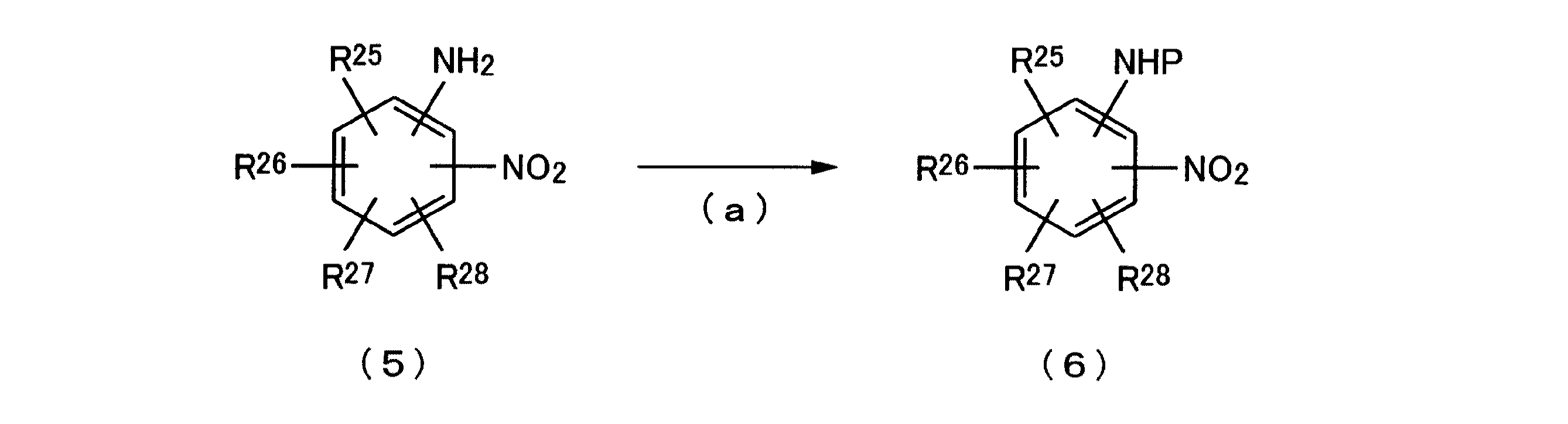
(a)工程:
(a)工程は、化合物(5)中のアミノ基を保護基(P)にて保護して、化合物(6)を得る保護工程である。
(A) Process:
Step (a) is a protection step in which the amino group in compound (5) is protected with a protecting group (P) to obtain compound (6).
保護基(P)としては、アミノ基に対する一般的な保護基を用いることができる。具体的には、t−ブトキシカルボニル基、ベンジルオキシカルボニル基、9−フルオレニルメチルオキシカルボニル基、2,2,2−トリクロロエトキシカルボニル基、アリルオキシカルボニル基などが挙げられる。
また、保護工程で用いる試薬についても、アミノ基に対する一般的な試薬を用いることができ、酸無水物や酸クロライドなど特に限定されるものではない。
保護工程における反応条件は、アミノ基に対する一般的な反応条件であれば、特に限定されない。
As the protecting group (P), a general protecting group for an amino group can be used. Specific examples include t-butoxycarbonyl group, benzyloxycarbonyl group, 9-fluorenylmethyloxycarbonyl group, 2,2,2-trichloroethoxycarbonyl group, allyloxycarbonyl group and the like.
In addition, as a reagent used in the protection step, a general reagent for an amino group can be used, and the acid anhydride and acid chloride are not particularly limited.
The reaction conditions in the protection step are not particularly limited as long as they are general reaction conditions for amino groups.
(b)工程:
(b)工程は、化合物(6)を還元して、化合物(7)を得る還元工程である。
(B) Process:
Step (b) is a reduction step in which compound (6) is reduced to obtain compound (7).
還元工程における反応条件は、ニトロ基に対する一般的な還元条件であれば、特に限定されない。具体的には、酸性条件下、亜鉛粉やスズ等の還元剤の使用や、白金、パラジウム、ニッケル等の触媒存在下での接触水素化などが挙げられる。ただし、(a)工程でアミノ基を保護した保護基の種類によっては、用いる還元剤やその反応条件に注意を要する。 The reaction conditions in the reduction step are not particularly limited as long as they are general reduction conditions for nitro groups. Specifically, use of a reducing agent such as zinc powder or tin, catalytic hydrogenation in the presence of a catalyst such as platinum, palladium, nickel, etc. under acidic conditions. However, depending on the type of the protecting group in which the amino group is protected in the step (a), attention should be paid to the reducing agent used and the reaction conditions.
(c)工程:
(c)工程は、化合物(7)と化合物(8)をカップリングして、化合物(9)を得るカップリング工程である。
(C) Process:
Step (c) is a coupling step in which compound (7) and compound (8) are coupled to obtain compound (9).
カップリング工程における反応は、2級もしくは3級アミン類を合成する一般的なカップリング反応であれば、特に限定されない。具体的には、パラジウム触媒を用いたBuchward−Hartwigクロスカップリング反応などが挙げられる。 The reaction in the coupling step is not particularly limited as long as it is a general coupling reaction for synthesizing secondary or tertiary amines. Specifically, a Buchward-Hartwig cross-coupling reaction using a palladium catalyst is exemplified.
(d)工程:
(d)工程は、化合物(9)中のアミノ基の保護基(P)を脱保護して、化合物(10)を得る脱保護工程である。
(D) Process:
Step (d) is a deprotection step in which compound (10) is obtained by deprotecting the protecting group (P) of the amino group in compound (9).
脱保護工程における反応は、一般的な脱保護反応を用いることができ、保護基(P)に応じて条件を選定すればよい。 For the reaction in the deprotection step, a general deprotection reaction can be used, and the conditions may be selected according to the protective group (P).
(e)工程:
(e)工程は、化合物(10)をスルホン化して、化合物(1−1)を得るスルホン化工程である。
(E) Process:
The step (e) is a sulfonation step for sulfonating the compound (10) to obtain the compound (1-1).
スルホン化工程で用いる試薬は、芳香環に対するスルホン化において一般的に用いられている試薬であれば、特に限定せずに使用することができる。具体的には、硫酸や発煙硫酸などが挙げられる。
スルホン化反応条件は、芳香環に対する一般的な反応条件であれば、特に限定されない。
The reagent used in the sulfonation step can be used without particular limitation as long as it is a reagent generally used in sulfonation of aromatic rings. Specific examples include sulfuric acid and fuming sulfuric acid.
The sulfonation reaction condition is not particularly limited as long as it is a general reaction condition for an aromatic ring.
<他の実施形態>
化合物(1−1)は、例えば以下に示す(f)〜(i)工程を経て製造することもできる。
<Other embodiments>
Compound (1-1) can also be produced, for example, through the following steps (f) to (i).
(f)工程:
(f)工程は、化合物(11)と化合物(12)をカップリングして、化合物(13)を得るカップリング工程である。
(F) Process:
Step (f) is a coupling step in which compound (11) and compound (12) are coupled to obtain compound (13).
カップリング工程における反応は、2級もしくは3級アミン類を合成する一般的なカップリング反応であれば、特に限定されない。具体的には、パラジウム触媒を用いたBuchward−Hartwigクロスカップリング反応などが挙げられる。 The reaction in the coupling step is not particularly limited as long as it is a general coupling reaction for synthesizing secondary or tertiary amines. Specifically, a Buchward-Hartwig cross-coupling reaction using a palladium catalyst is exemplified.
(g)工程:
(g)工程は、化合物(13)を還元して、化合物(10)を得る還元工程である。
(G) Process:
Step (g) is a reduction step in which compound (13) is reduced to obtain compound (10).
還元工程における反応条件は、ニトロ基に対する一般的な還元条件であれば、特に限定されない。具体的には、酸性条件下、亜鉛粉やスズ等の還元剤の使用や、白金、パラジウム、ニッケル等の触媒存在下での接触水素化などが挙げられる。 The reaction conditions in the reduction step are not particularly limited as long as they are general reduction conditions for nitro groups. Specifically, use of a reducing agent such as zinc powder or tin, catalytic hydrogenation in the presence of a catalyst such as platinum, palladium, nickel, etc. under acidic conditions.
(h)工程:
(h)工程は、化合物(10)をスルホン化して、化合物(1−1)を得るスルホン化工程である。
(H) Process:
Step (h) is a sulfonation step in which compound (10) is sulfonated to obtain compound (1-1).
スルホン化工程で用いる試薬は、芳香環に対するスルホン化において一般的に用いられている試薬であれば、特に限定せずに使用することができる。具体的には、硫酸や発煙硫酸などが挙げられる。
スルホン化反応条件は、芳香環に対する一般的な反応条件であれば、特に限定されない。
The reagent used in the sulfonation step can be used without particular limitation as long as it is a reagent generally used in sulfonation of aromatic rings. Specific examples include sulfuric acid and fuming sulfuric acid.
The sulfonation reaction condition is not particularly limited as long as it is a general reaction condition for an aromatic ring.
また、化合物(1−1)において、R25〜R28のうち少なくとも1つが電子供与性基である場合は、以下に示す(i)工程により得られる化合物(11’)を(f)工程に供してもよい。この方法は、ニトロ基に対してオルト位およびパラ位、またはそのどちらかの位置にアルコキシ基が存在する化合物を製造する場合において特に有効である。
なお、(i)工程中、−OR25’はアルコキシ基であり、X’はフッ素原子を除くハロゲン原子であり、Mはアルカリ金属である。
In the compound (1-1), when at least one of R 25 to R 28 is an electron donating group, the compound (11 ′) obtained by the step (i) shown below is used as the step (f). May be provided. This method is particularly effective in the case of producing a compound in which an alkoxy group is present at the ortho-position and para-position, or at either position relative to the nitro group.
In the step (i), -OR 25 ' is an alkoxy group, X' is a halogen atom excluding a fluorine atom, and M is an alkali metal.
(i)工程:
(i)工程は、化合物(14)中のフッ素をアルコキシ基に置換して、化合物(11’)を得る工程である。
(I) Process:
Step (i) is a step of obtaining compound (11 ′) by substituting fluorine in compound (14) with an alkoxy group.
置換反応は、アルカリ金属アルコキシド(R25’OM)の存在下で行われる。アルカリ金属アルコキシドとしては、例えばナトリウムメトキシド、ナトリウムエトキシド、ナトリウムイソプロポキシド、ナトリウムブトキシド、ナトリウム−t−ブトキシド、カリウムメトキシド、カリウムエトキシド、カリウムイソプロポキシド、カリウムブトキシド、カリウム−t−ブトキシドなどが挙げられる。
置換反応は公知の方法を採用できるので、その条件は特に限定されないが、例えば反応溶媒は、メタノール、エタノール、プロパノールなどのアルコール系溶媒が好ましい。また、反応温度は−10℃〜50℃であることが好ましい。
The substitution reaction is performed in the presence of an alkali metal alkoxide (R 25 ′ OM). Examples of the alkali metal alkoxide include sodium methoxide, sodium ethoxide, sodium isopropoxide, sodium butoxide, sodium tert-butoxide, potassium methoxide, potassium ethoxide, potassium isopropoxide, potassium butoxide, potassium tert-butoxide. Etc.
Since a known method can be employed for the substitution reaction, the conditions are not particularly limited. For example, the reaction solvent is preferably an alcohol solvent such as methanol, ethanol, or propanol. Moreover, it is preferable that reaction temperature is -10 degreeC-50 degreeC.
<作用効果>
以上説明した、本発明の導電性ポリマー前駆体は、分子内に1つ以上のアミノ基またはその塩と、1つ以上の酸性基またはその塩に加え、1つ以上の電子供与性基を有する。すなわち、電子供与性基によって置換された芳香環は電子リッチな状態になるため、アニリンの重合反応性が良好となる。また、酸性基をはじめとする電子吸引性基に結合された芳香環の電子不足を補う点で有効である。特に、電子供与性基の中でもアルコキシ基は電子供与性が強いので、アルコキシ基によって置換された芳香環は電子リッチな状態になりやすく、アニリンの重合反応性がより良好なものとなる。さらに、2つの芳香環がそれぞれ電子供与性基(特にアルコキシ基)によって置換されていれば、アニリンの重合反応性が特に良好なものとなる。
<Effect>
The conductive polymer precursor of the present invention described above has one or more amino groups or a salt thereof and one or more acidic groups or a salt thereof in addition to one or more electron donating groups in the molecule. . That is, since the aromatic ring substituted by the electron donating group becomes electron rich, the polymerization reactivity of aniline is improved. Further, it is effective in compensating for the electron shortage of the aromatic ring bonded to the electron-withdrawing group including an acidic group. In particular, among the electron donating groups, the alkoxy group has a strong electron donating property, so that the aromatic ring substituted with the alkoxy group is likely to be in an electron-rich state, and the polymerization reactivity of aniline becomes better. Furthermore, if the two aromatic rings are each substituted by an electron donating group (particularly an alkoxy group), the polymerization reactivity of aniline is particularly good.
従って、本発明の導電性ポリマー前駆体を重合すると、直鎖状の導電性ポリマーが得られ、高い導電性を発現すると考えられる。特に、分子内に1つの酸性基またはその塩を有する導電性ポリマー前駆体であれば(すなわち、上記一般式(1)中、R2〜R11のうち、1つが酸性基またはその塩であれば)、詳しくは後述するが、直鎖状で、かつ、アニリン単位を基準としたときに1つ置きに酸性基が導入された導電性ポリマーが得られ、該導電性ポリマーは、より高い導電性を発現すると考えられる。
よって、本発明の導電性ポリマー前駆体は、高い導電性を有する導電性ポリマーの前駆体(原料)として好適である。
Therefore, it is considered that when the conductive polymer precursor of the present invention is polymerized, a linear conductive polymer is obtained and high conductivity is expressed. In particular, if it is a conductive polymer precursor having one acidic group or a salt thereof in the molecule (that is, in the general formula (1), one of R 2 to R 11 may be an acidic group or a salt thereof). As will be described in detail later, a conductive polymer is obtained which is linear and has an acidic group introduced every other aniline unit. The conductive polymer has higher conductivity. It is thought to express sex.
Therefore, the conductive polymer precursor of the present invention is suitable as a precursor (raw material) for a conductive polymer having high conductivity.
[導電性ポリマー]
本発明の導電性ポリマーは、本発明の導電性ポリマー前駆体を重合させて得られる。
本発明の導電性ポリマーの製造方法としては特に限定されず、化学重合や電解重合などの各種合成法を適用できる。
以下、本発明の導電性ポリマーを化学重合により製造する方法の一例について、具体的に説明する。
[Conductive polymer]
The conductive polymer of the present invention is obtained by polymerizing the conductive polymer precursor of the present invention.
The method for producing the conductive polymer of the present invention is not particularly limited, and various synthetic methods such as chemical polymerization and electrolytic polymerization can be applied.
Hereinafter, an example of a method for producing the conductive polymer of the present invention by chemical polymerization will be specifically described.
本発明の導電性ポリマーは、例えば塩基性化合物の存在下、本発明の導電性ポリマー前駆体を酸化剤により重合させて得られる。
なお、導電性ポリマー前駆体は、1種単独で用いてもよく、一般式(1)に該当する範囲で異なる2種以上を任意の割合で混合して用いてもよい。
The conductive polymer of the present invention can be obtained, for example, by polymerizing the conductive polymer precursor of the present invention with an oxidizing agent in the presence of a basic compound.
In addition, a conductive polymer precursor may be used individually by 1 type, and 2 or more types different in the range applicable to General formula (1) may be mixed and used in arbitrary ratios.
<塩基性化合物>
塩基性化合物としては、アンモニア、脂式アミン類、環式飽和アミン類、環式不飽和アミン類、無機塩基などが用いられる。特に、入手の容易性から、脂式アミン類、環式飽和アミン類、環式不飽和アミン類が好ましい。
<Basic compound>
As the basic compound, ammonia, fatty amines, cyclic saturated amines, cyclic unsaturated amines, inorganic bases and the like are used. In particular, aliphatic amines, cyclic saturated amines, and cyclic unsaturated amines are preferred because of their availability.
脂式アミン類としては、下記一般式(15)で表される化合物、または下記一般式(16)で表されるアンモニウムヒドロキシド化合物などが挙げられる。 Examples of the fatty amines include compounds represented by the following general formula (15), ammonium hydroxide compounds represented by the following general formula (16), and the like.
式(15)中、R33〜R35は、それぞれ独立して、炭素数1〜4のアルキル基である。 In formula (15), R 33 to R 35 are each independently an alkyl group having 1 to 4 carbon atoms.
式(16)中、R36〜R39は、それぞれ独立して、水素原子、または炭素数1〜4のアルキル基である。 In formula (16), R 36 to R 39 are each independently a hydrogen atom or an alkyl group having 1 to 4 carbon atoms.
環式飽和アミン類としては、ピペリジン、ピロリジン、モルホリン、ピペラジンおよびこれらの骨格を有する誘導体、ならびにこれらのアンモニウムヒドロキシド化合物などが、溶解性の観点から好ましく用いられる。
環式不飽和アミン類としては、ピリジン、α−ピコリン、β−ピコリン、γ−ピコリン、キノリン、イソキノリン、ピロリンおよびこれらの骨格を有する誘導体、ならびにこれらのアンモニウムヒドロキシド化合物などが、溶解性の観点から好ましく用いられる。
無機塩基としては、水酸化ナトリウム、水酸化カリウム、水酸化リチウムなどの水酸化物の塩などが挙げられる。
As the cyclic saturated amines, piperidine, pyrrolidine, morpholine, piperazine and derivatives having these skeletons, and ammonium hydroxide compounds thereof are preferably used from the viewpoint of solubility.
Cyclic unsaturated amines include pyridine, α-picoline, β-picoline, γ-picoline, quinoline, isoquinoline, pyrroline, derivatives having these skeletons, and ammonium hydroxide compounds thereof from the viewpoint of solubility. Are preferably used.
Examples of inorganic bases include hydroxide salts such as sodium hydroxide, potassium hydroxide, and lithium hydroxide.
これら塩基性化合物の中でも、メチルアミン、ジメチルアミン、トリメチルアミン、エチルアミン、ジエチルアミン、トリエチルアミン、エチルメチルアミン、エチルジメチルアミン、ジエチルメチルアミン、ピリジン、α−ピコリン、β−ピコリン、γ−ピコリン等が特に好ましく用いられる。これら塩基性化合物を用いた場合、特に高導電性、かつ高純度な導電性ポリマーを得ることができる。
これら塩基性化合物は、1種単独で用いてもよく、2種以上を任意の割合で混合して用いてもよい。
Among these basic compounds, methylamine, dimethylamine, trimethylamine, ethylamine, diethylamine, triethylamine, ethylmethylamine, ethyldimethylamine, diethylmethylamine, pyridine, α-picoline, β-picoline, γ-picoline and the like are particularly preferable. Used. When these basic compounds are used, a highly conductive and highly pure conductive polymer can be obtained.
These basic compounds may be used individually by 1 type, and 2 or more types may be mixed and used for them in arbitrary ratios.
塩基性化合物の濃度は0.1mol/L以上が好ましく、より好ましくは0.1〜10.0mol/Lであり、特に好ましくは0.2〜8.0mol/Lである。塩基性化合物の濃度が0.1mol/L以上であれば、導電性ポリマーを高収率で得ることができる。一方、塩基性化合物の濃度が10.0mol/L以下であれば、得られる導電性ポリマーの導電性が向上する傾向にある。 The concentration of the basic compound is preferably 0.1 mol / L or more, more preferably 0.1 to 10.0 mol / L, and particularly preferably 0.2 to 8.0 mol / L. When the concentration of the basic compound is 0.1 mol / L or more, the conductive polymer can be obtained in high yield. On the other hand, if the concentration of the basic compound is 10.0 mol / L or less, the conductivity of the obtained conductive polymer tends to be improved.
導電性ポリマー前駆体と塩基性化合物のモル比は、導電性ポリマー前駆体:塩基性化合物=1:0.5〜1:2であることが好ましく、より好ましくは1:0.75〜1:1.2である。ここで、塩基性化合物の割合が低いと、溶媒に対する溶解度が低くなり、反応性が低下したり、得られる導電性ポリマーの導電性が低下したりすることがある。一方、塩基性化合物の割合が高いと、得られる導電性ポリマー中の酸性基と塩基性化合物が塩を形成する割合が高くなり、導電性ポリマーの導電性が低下することがある。 The molar ratio of the conductive polymer precursor to the basic compound is preferably conductive polymer precursor: basic compound = 1: 0.5 to 1: 2, more preferably 1: 0.75 to 1: 1.2. Here, when the ratio of a basic compound is low, the solubility with respect to a solvent will become low, the reactivity may fall, and the electroconductivity of the conductive polymer obtained may fall. On the other hand, when the proportion of the basic compound is high, the proportion of the acidic group and the basic compound in the resulting conductive polymer forming a salt may increase, and the conductivity of the conductive polymer may be reduced.
<酸化剤>
酸化剤としては、標準電極電位が0.6V以上である酸化剤であれば限定はないが、例えばペルオキソ二硫酸、ペルオキソ二硫酸アンモニウム、ペルオキソ二硫酸ナトリウム、ペルオキソ二硫酸カリウム等のペルオキソ二硫酸類;過酸化水素等を用いることが好ましい。
これら酸化剤は、1種単独で用いてもよく、2種以上を任意の割合で混合して用いてもよい。
<Oxidizing agent>
The oxidizing agent is not particularly limited as long as the standard electrode potential is 0.6 V or more. For example, peroxodisulfuric acids such as peroxodisulfuric acid, ammonium peroxodisulfate, sodium peroxodisulfate, and potassium peroxodisulfate; It is preferable to use hydrogen peroxide or the like.
These oxidizing agents may be used individually by 1 type, and 2 or more types may be mixed and used for them in arbitrary ratios.
酸化剤の使用量は、導電性ポリマー前駆体1モルに対して1〜5モルが好ましく、より好ましくは1〜3モルである。酸化剤の使用量が上記範囲内であれば、導電性ポリマーの高分子量化や、主鎖の酸化を十分に行うことができる。
なお、触媒として、鉄、銅などの遷移金属化合物を酸化剤と併用することも有効である。
1-5 mol is preferable with respect to 1 mol of conductive polymer precursors, and, as for the usage-amount of an oxidizing agent, More preferably, it is 1-3 mol. When the amount of the oxidizing agent used is within the above range, the conductive polymer can be sufficiently polymerized and the main chain can be oxidized sufficiently.
It is also effective to use a transition metal compound such as iron or copper in combination with an oxidizing agent as a catalyst.
<重合工程>
上述した導電性ポリマー前駆体を、塩基性化合物を含む溶液中で酸化剤により化学酸化重合することで、導電性ポリマーを得る(重合工程)。
具体的には、酸化剤溶液中に導電性ポリマー前駆体と塩基性化合物の混合溶液を滴下する方法、導電性ポリマー前駆体と塩基性化合物の混合溶液に酸化剤溶液を滴下する方法、反応容器等に導電性ポリマー前駆体と塩基性化合物の混合溶液と、酸化剤溶液を同時に滴下する方法、反応容器等に導電性ポリマー前駆体と塩基性化合物の混合溶液と、酸化剤溶液を連続的に供給し、押し出し流れで重合させるなどの方法によって、導電性ポリマーを得る。特に、副反応抑制の観点から、酸化剤溶液中に導電性ポリマー前駆体と塩基性化合物の混合溶液を滴下する方法が好ましい。
<Polymerization process>
The conductive polymer precursor is chemically oxidatively polymerized with an oxidizing agent in a solution containing a basic compound to obtain a conductive polymer (polymerization step).
Specifically, a method of dropping a mixed solution of a conductive polymer precursor and a basic compound into an oxidant solution, a method of dropping an oxidant solution into a mixed solution of a conductive polymer precursor and a basic compound, a reaction vessel For example, a method in which a mixed solution of a conductive polymer precursor and a basic compound and an oxidizing agent solution are dropped simultaneously, etc., a mixed solution of a conductive polymer precursor and a basic compound, and an oxidizing agent solution are continuously added to a reaction vessel or the like. The conductive polymer is obtained by a method such as feeding and polymerizing by an extrusion flow. In particular, from the viewpoint of suppressing side reactions, a method of dropping a mixed solution of a conductive polymer precursor and a basic compound into an oxidant solution is preferable.
重合の際には、水、または水と水溶性有機溶剤との混合溶媒を用いることができる。水溶性有機溶媒としては、水と混合するものであれば限定されないが、安価で入手が容易である観点から、例えばメタノール、エタノール、iso−プロパノール、アセトン、アセトニトリル等が好ましく用いられる。
なお、混合溶媒を用いる場合、水の割合は混合溶媒100体積%中、30体積%以上であることが好ましい。水の割合が30体積%以上であれば、酸化剤の析出を抑制できる。
In the polymerization, water or a mixed solvent of water and a water-soluble organic solvent can be used. The water-soluble organic solvent is not limited as long as it is mixed with water, but from the viewpoint of being inexpensive and easily available, for example, methanol, ethanol, iso-propanol, acetone, acetonitrile and the like are preferably used.
In addition, when using a mixed solvent, it is preferable that the ratio of water is 30 volume% or more in 100 volume% of mixed solvents. If the ratio of water is 30% by volume or more, precipitation of the oxidizing agent can be suppressed.
また、重合時は、重合反応系内のpHが7以下となるように調整することが好ましく、より好ましくはpHが6以下である。ここで、重合反応系内のpHが7以下であれば、副反応の進行を抑制でき、その結果、不純物やオリゴマー(但し、ダイマーを除く)成分の生成を低減でき、得られるポリマーの導電性、成膜性、純度等が向上する。 Moreover, at the time of superposition | polymerization, it is preferable to adjust so that pH in a polymerization reaction system may be 7 or less, More preferably, pH is 6 or less. Here, if the pH in the polymerization reaction system is 7 or less, the progress of the side reaction can be suppressed, and as a result, the generation of impurities and oligomer (excluding dimer) components can be reduced, and the conductivity of the resulting polymer can be reduced. , Film formability, purity and the like are improved.
重合時の反応系内のpHは、プロトン酸の添加により調整できる。
プロトン酸としては、塩酸、硝酸、硫酸、ホウ化フッ素酸等の鉱酸類、トリフルオロメタンスルホン酸等の超強酸類、メタンスルホン酸、ドデシルベンゼンスルホン酸、トルエンスルホン酸、カンファスルホン酸等の有機スルホン酸類、およびポリスチレンスルホン酸、ポリアクリル酸、ポリビニルスルホン酸、ポリ−2−メチルプロパン−2−アクリルアミドスルホン酸等の高分子酸類などが挙げられる。これらの中でも、安価で入手が容易である観点から、塩酸、硝酸、硫酸、p−トルエンスルホン酸等が好ましい。
The pH in the reaction system during the polymerization can be adjusted by adding a protonic acid.
Protic acids include mineral acids such as hydrochloric acid, nitric acid, sulfuric acid and boric fluoride, super strong acids such as trifluoromethanesulfonic acid, organic sulfones such as methanesulfonic acid, dodecylbenzenesulfonic acid, toluenesulfonic acid and camphorsulfonic acid. Examples thereof include acids and polymer acids such as polystyrene sulfonic acid, polyacrylic acid, polyvinyl sulfonic acid, poly-2-methylpropane-2-acrylamide sulfonic acid, and the like. Among these, hydrochloric acid, nitric acid, sulfuric acid, p-toluenesulfonic acid and the like are preferable from the viewpoint of being inexpensive and easily available.
プロトン酸の添加量は、酸化剤の析出がない範囲であれば特に限定されないが、モル比でプロトン酸:酸化剤=0.01:100〜50:100が好ましく、0.01:100〜45:100がより好ましい。ここで、プロトン酸の添加量が上記範囲内であれば、反応進行の妨げとなりにくく、ダイマーの析出を抑制できる。その結果、不純物やオリゴマー成分の生成が抑制され、得られる導電性ポリマーの導電性、成膜性、純度等が向上する。 The amount of the protonic acid added is not particularly limited as long as no oxidizing agent is precipitated, but the molar ratio is preferably protonic acid: oxidant = 0.01: 100 to 50: 100, 0.01: 100 to 45 : 100 is more preferable. Here, if the addition amount of the protonic acid is within the above range, it is difficult to hinder the progress of the reaction, and the precipitation of the dimer can be suppressed. As a result, the generation of impurities and oligomer components is suppressed, and the conductivity, film formability, purity, and the like of the resulting conductive polymer are improved.
重合反応の内温は50℃以下が好ましく、より好ましくは−15〜50℃、さらに好ましくは−10〜20℃、最も好ましくは−5〜15℃の範囲が適用される。特に、20℃以下であれば、副反応の進行や、主鎖の酸化還元構造の変化による導電性の低下を抑止できる。また、−15℃以上では十分な反応速度を維持でき、反応時間を短縮できる。 The internal temperature of the polymerization reaction is preferably 50 ° C. or less, more preferably −15 to 50 ° C., further preferably −10 to 20 ° C., and most preferably −5 to 15 ° C. In particular, when the temperature is 20 ° C. or lower, it is possible to suppress a decrease in conductivity due to a side reaction or a change in the redox structure of the main chain. Moreover, sufficient reaction rate can be maintained above -15 degreeC, and reaction time can be shortened.
<精製工程>
導電性ポリマーは、溶媒に溶解または分散したポリマー溶液の状態で得られる。導電性ポリマーは、溶媒を除去した後、そのまま各種用途に用いてもよいが、ポリマー溶液には未反応のダイマー、オリゴマー、不純物などが含まれる場合がある。従って、導電性ポリマーを精製してから用いるのが好ましい(精製工程)。
以下、精製前の導電性ポリマーを「未精製の導電性ポリマー」という。
<Purification process>
The conductive polymer is obtained in the state of a polymer solution dissolved or dispersed in a solvent. The conductive polymer may be used as it is for various applications after removing the solvent, but the polymer solution may contain unreacted dimers, oligomers, impurities, and the like. Therefore, it is preferable to use the conductive polymer after purification (purification step).
Hereinafter, the conductive polymer before purification is referred to as “unpurified conductive polymer”.
未精製の導電性ポリマーを精製する方法としては、膜濾過法、陽イオン交換法などが挙げられる。中でも、精製効率に優れる観点から、膜濾過法が好ましい。
膜濾過の方式としては、クロスフロー方式、加圧濾過方式などの濾過方式が挙げられる。
未精製の導電性ポリマーを上述した方法で精製する場合は、ポリマー溶液をそのまま精製に用いることができる。
Examples of a method for purifying an unpurified conductive polymer include a membrane filtration method and a cation exchange method. Among these, a membrane filtration method is preferable from the viewpoint of excellent purification efficiency.
Examples of the membrane filtration method include filtration methods such as a cross flow method and a pressure filtration method.
When purifying an unpurified conductive polymer by the above-described method, the polymer solution can be used for purification as it is.
<脱塩工程>
導電性ポリマーは、上述したように、塩基性化合物の存在下、導電性ポリマー前駆体を重合することで得られる。そのため、導電性ポリマー中の酸性基の一部が、塩基性化合物と塩を形成し、導電性がすることがある。酸性基と塩基性化合物が塩を形成すると、導電性が低下する場合がある。
<Desalting step>
As described above, the conductive polymer is obtained by polymerizing a conductive polymer precursor in the presence of a basic compound. Therefore, some of the acidic groups in the conductive polymer may form a salt with the basic compound, and may become conductive. When an acidic group and a basic compound form a salt, the conductivity may decrease.
塩基性化合物は、未精製の導電性ポリマーを精製する際に、低分子量体や不純物と共に概ね除去されるが、塩基性化合物をより除去する目的で、精製工程の後に、さらに脱塩処理を行ってもよい(脱塩工程)。なお、脱塩処理を行う際は、精製工程後の試料液をそのまま用いることができる。
脱塩処理の方法としてはイオン交換法が挙げられ、具体的には、陽イオン交換樹脂を用いたイオン交換法、電気透析法などである。
Basic compounds are generally removed together with low molecular weight substances and impurities when purifying an unpurified conductive polymer. For the purpose of further removing basic compounds, further desalting treatment is performed after the purification step. (Desalting step). In addition, when performing a desalting process, the sample liquid after a refinement | purification process can be used as it is.
Examples of the desalting treatment include an ion exchange method, and specific examples include an ion exchange method using a cation exchange resin and an electrodialysis method.
脱塩処理により、導電性ポリマーから塩基性化合物を効果的に除去することができ、導電性ポリマーの導電性がより向上する。
なお、精製工程や脱塩処理を行った後の導電性ポリマーは、水などの溶媒に溶解した状態であるので、エバポレータなどで溶媒を除去すれば固体状の導電性ポリマーが得られるが、溶媒に溶解した状態のものを導電性ポリマー溶液としてそのまま用いてもよい。
By the desalting treatment, the basic compound can be effectively removed from the conductive polymer, and the conductivity of the conductive polymer is further improved.
In addition, since the conductive polymer after the purification step and the desalting treatment is in a state dissolved in a solvent such as water, a solid conductive polymer can be obtained by removing the solvent with an evaporator or the like. You may use the thing in the state melt | dissolved in as a conductive polymer solution as it is.
<他の実施形態>
導電性ポリマーの製造方法は、上述した方法に限定されない。上述した製造方法は、化学重合により導電性ポリマーを製造する方法であるが、例えば電解重合により導電性ポリマーを製造してもよい。
電解重合により導電性ポリマーを製造する場合、例えば本発明の導電性ポリマー前駆体、電解質、塩基性化合物を含む電解重合溶液を調製し、該電解重合溶液中に作用極、対極、参照極を浸漬させる。この状態で、作用極と対極との間に電圧を印加して、作用極上に導電性ポリマーからなるフィルムを形成し、該フィルムを作用極から剥がして導電性ポリマーを得る。得られた導電性ポリマーは、必要に応じて精製してもよい。
電解重合に用いる電解質としては、通常の電解重合に用いられる電解質を使用できるが、例えば無水硫酸ナトリウムなどが挙げられる。
また、塩基性化合物としては、化学重合の説明において先に例示した塩基性化合物が挙げられる。
精製の方法としては、化学重合の説明において先に例示した精製方法(精製工程)が挙げられる。
<Other embodiments>
The manufacturing method of a conductive polymer is not limited to the method mentioned above. Although the manufacturing method mentioned above is a method of manufacturing a conductive polymer by chemical polymerization, you may manufacture a conductive polymer by electrolytic polymerization, for example.
When producing a conductive polymer by electrolytic polymerization, for example, an electrolytic polymerization solution containing the conductive polymer precursor of the present invention, an electrolyte, and a basic compound is prepared, and a working electrode, a counter electrode, and a reference electrode are immersed in the electrolytic polymerization solution. Let In this state, a voltage is applied between the working electrode and the counter electrode to form a film made of a conductive polymer on the working electrode, and the film is peeled off from the working electrode to obtain a conductive polymer. You may refine | purify the obtained conductive polymer as needed.
As an electrolyte used for electrolytic polymerization, an electrolyte used for normal electrolytic polymerization can be used, and examples thereof include anhydrous sodium sulfate.
Moreover, as a basic compound, the basic compound illustrated previously in description of chemical polymerization is mentioned.
Examples of the purification method include the purification method (purification step) exemplified above in the description of chemical polymerization.
<作用効果>
このようにして得られる導電性ポリマーは、本発明の導電性ポリマー前駆体を重合して得られる。本発明の導電性ポリマー前駆体は、上述したように、分子内に1つ以上の電子供与性基を有するダイマーである。従って、本発明の導電性ポリマーは、直鎖状の構造を有しており、高い導電性を示すと考えられる。
<Effect>
The conductive polymer thus obtained is obtained by polymerizing the conductive polymer precursor of the present invention. As described above, the conductive polymer precursor of the present invention is a dimer having one or more electron donating groups in the molecule. Therefore, the conductive polymer of the present invention has a linear structure and is considered to exhibit high conductivity.
特に、分子内に1つの酸性基またはその塩を有する導電性ポリマー前駆体を重合して得られる導電性ポリマーは、例えば下記化合物(17)のように、直鎖状で、かつ、アニリン単位を基準としたときに1つ置きに酸性基が導入された構造を有していると考えられるため、より高い導電性を示すと考えられる。
なお、化合物(17)は、導電性ポリマー前駆体として、一般式(1)中、R1、R2、R5〜R7、R9、R10が水素原子であり、R3、R11がメトキシ基(電子供与性基)であり、R4がアミノ基であり、R8がスルホン酸基(酸性基)である、下記化合物(1−2)を重合して得られるポリマーである。
In particular, a conductive polymer obtained by polymerizing a conductive polymer precursor having one acidic group or a salt thereof in the molecule is linear and has aniline units, for example, as in the following compound (17). Since it is considered that it has a structure in which every other acidic group is introduced when it is used as a reference, it is considered that it exhibits higher conductivity.
The compound (17), as the conductive polymer precursor, in the general formula (1), R 1, R 2, R 5 ~R 7, R 9,
化合物(17)中のyは重合度を示す。
この化合物(17)は、フェニレンジアミン構造(還元型)とキノジイミン構造(酸化型)を有していると考えられ、フェニレンジアミン構造(還元型)とキノジイミン構造(酸化型)は、酸化もしくは還元により任意の比率で可逆的に変換させることが可能である。フェニレンジアミン構造とキノジイミン構造の比率(x)は、0.1≦x≦0.9の範囲が導電性および溶解性の面から好ましく、0.2≦x≦0.8がより好ましく、0.3≦x≦0.7がさらに好ましい。
Y in the compound (17) indicates the degree of polymerization.
This compound (17) is considered to have a phenylenediamine structure (reduced form) and a quinodiimine structure (oxidized form), and the phenylenediamine structure (reduced form) and the quinodiimine structure (oxidized form) are oxidized or reduced. It is possible to convert reversibly at an arbitrary ratio. The ratio (x) of the phenylenediamine structure to the quinodiimine structure is preferably in the range of 0.1 ≦ x ≦ 0.9 from the viewpoint of conductivity and solubility, more preferably 0.2 ≦ x ≦ 0.8, and More preferably, 3 ≦ x ≦ 0.7.
なお、本発明の導電性ポリマーは、単なる水、塩基および塩基性塩を含む水、酸を含む水、またはメタノール、エタノール、iso−プロパノール等の溶媒、またはそれらの混合物に溶解することができ、加工性にも優れる。 The conductive polymer of the present invention can be dissolved in mere water, water containing a base and a basic salt, water containing an acid, or a solvent such as methanol, ethanol, iso-propanol, or a mixture thereof. Excellent workability.
本発明においては、上記方法で得られた導電性ポリマーをそのまま使用してもよいし、外部ドーパントを添加してもよい。外部ドーパントとしては特に限定されないが、ハロゲン原子(例えばヨウ素、臭素、塩素等のハロゲン原子類)、プロトン酸(例えば塩酸、硫酸、過塩素酸、硝酸、ホウフッ化水素酸、ベンゼンスルホン酸、p一トルエンスルホン酸、ドデシルベンゼンスルホン酸、ポリ(スチレンスルホン酸)等)、錯イオン(例えばヘキサシアノ鉄(II)イオン、テトラクロロ白金(II)イオン等)などが挙げられる。また、これらの外部ドーパントは、1種単独で用いてもよく、2種以上を任意の割合で混合して用いてもよい。
外部ドーパントを添加する場合、その添加量は導電性ポリマーの窒素原子1モルに対して、導電性や成膜性の観点から、0.1〜1.0モルが好ましい。
In the present invention, the conductive polymer obtained by the above method may be used as it is, or an external dopant may be added. Although it does not specifically limit as an external dopant, For example, halogen atoms (for example, halogen atoms, such as iodine, bromine, and chlorine), protonic acid (for example, hydrochloric acid, sulfuric acid, perchloric acid, nitric acid, borofluoric acid, benzenesulfonic acid, p 1 And toluene ions such as toluenesulfonic acid, dodecylbenzenesulfonic acid, poly (styrenesulfonic acid), and complex ions (eg, hexacyanoiron (II) ion, tetrachloroplatinum (II) ion, etc.). Moreover, these external dopants may be used individually by 1 type, and may mix and use 2 or more types by arbitrary ratios.
When adding an external dopant, the addition amount is preferably 0.1 to 1.0 mol with respect to 1 mol of the nitrogen atom of the conductive polymer from the viewpoint of conductivity and film formability.
本発明の導電性ポリマーは、スプレーコート法、デイップコート法、ロールコート法、グラビアコート法、リバースコート法、ロールブラッシュ法、エアーナイフコート法、カーテンコート法等の簡便な手法で導電体を形成することができる。
また、導電性ポリマーを主成分とする組成物は、各種帯電防止剤、コンデンサー、電池、EMIシールド、化学センサー、表示素子、非線形材料、防食、接着剤、繊維、帯電防止塗料、防食塗料、電着塗料、メッキプライマー、静電塗装の下地、電気防食、電池の蓄電能力向上等に適応可能である。
The conductive polymer of the present invention forms a conductor by a simple method such as spray coating, dip coating, roll coating, gravure coating, reverse coating, roll brushing, air knife coating, or curtain coating. can do.
Compositions based on conductive polymers include various antistatic agents, capacitors, batteries, EMI shields, chemical sensors, display elements, nonlinear materials, anticorrosion, adhesives, fibers, antistatic paints, anticorrosion paints, electric It can be applied to coating paint, plating primer, electrostatic coating base, cathodic protection, and battery storage capacity improvement.
以下、実施例により本発明を具体的に説明するが、本発明はこれら実施例に限定されるものではない。
なお、実施例および比較例における測定・評価方法は、以下の通りである。
EXAMPLES Hereinafter, although an Example demonstrates this invention concretely, this invention is not limited to these Examples.
In addition, the measurement / evaluation method in an Example and a comparative example is as follows.
(導電性ポリマー前駆体の同定)
1H−NMRスペクトルの測定により導電性ポリマー前駆体の同定を行った。この測定は、FT−NMR(日本電子株式会社製、「JNM−GX270」)を用いて、重水素化ジメチルスルホキシドと水酸化ナトリウムの重水溶液の混合液に、濃度が約5質量%になるように導電性ポリマー前駆体を溶解したものを、直径5mmΦの試験管に入れ、測定温度25℃、測定周波数270MHz、シングルパルスモードにて64回の積算回数で行った。
(Identification of conductive polymer precursor)
The conductive polymer precursor was identified by measuring the 1 H-NMR spectrum. This measurement is carried out using FT-NMR (“JNM-GX270” manufactured by JEOL Ltd.) so that the concentration of the mixed solution of deuterated dimethyl sulfoxide and sodium hydroxide is about 5% by mass. A solution in which the conductive polymer precursor was dissolved was placed in a test tube having a diameter of 5 mmΦ, and the measurement was performed at a measurement temperature of 25 ° C., a measurement frequency of 270 MHz, and a single pulse mode with 64 integrations.
(表面抵抗値の測定)
5cm×5cmのガラス基板上に、導電性ポリマー溶液をスピンコート塗布(300rpm×5sec、続いて2000rpm×30sec)し、ホットプレート上で120℃×10分間加熱して、厚さ0.1μmの塗膜がガラス基板上に形成された試験片を得た。
得られた試験片の表面抵抗値(初期値)を、抵抗率計(株式会社三菱アナリテック製、「ロレスタGP」)に直列四探針プローブを装着して測定した。
(Measurement of surface resistance)
A conductive polymer solution is spin-coated on a 5 cm × 5 cm glass substrate (300 rpm × 5 sec, then 2000 rpm × 30 sec), and heated on a hot plate at 120 ° C. for 10 minutes to form a coating having a thickness of 0.1 μm. A test piece having a film formed on a glass substrate was obtained.
The surface resistance value (initial value) of the obtained test piece was measured by attaching a series four-probe probe to a resistivity meter (manufactured by Mitsubishi Analytech Co., Ltd., “Loresta GP”).
[実施例1]
<導電性ポリマー前駆体の合成>
(a)工程:
2−メトキシ−4−ニトロアニリン(5−1)25g(149mmol)をテトラヒドロフラン(THF)200mLに溶解した。これに、4Mの水酸化ナトリウム水溶液45mL(180mmol)を添加した後、氷冷しながらクロロ蟻酸ベンジル(P)28.5g(167mmol)添加し、室温まで昇温して2時間撹拌した。さらに水酸化ナトリウム水溶液およびクロロ蟻酸ベンジル(P)の添加、室温での2時間撹拌の作業を2度繰り返して実施した。
その後、2Nの塩酸にて反応液を中性に調製して、室温にて撹拌した。続いて、トルエン300mLで3回反応液を抽出して、得られた有機相を塩化ナトリウム水溶液100mLで2回洗浄した。その後、減圧下、溶媒を留去し、残渣をカラムクロマトグラフィー(展開溶媒:n−ヘキサンと酢酸エチルの混合溶媒)にて精製し、化合物(6−1)39.8gを得た(収率89%)。
[Example 1]
<Synthesis of conductive polymer precursor>
(A) Process:
25 g (149 mmol) of 2-methoxy-4-nitroaniline (5-1) was dissolved in 200 mL of tetrahydrofuran (THF). To this was added 45 mL (180 mmol) of 4M aqueous sodium hydroxide solution, and then 28.5 g (167 mmol) of benzyl chloroformate (P) was added with ice cooling, and the mixture was warmed to room temperature and stirred for 2 hours. Further, an operation of adding an aqueous sodium hydroxide solution and benzyl chloroformate (P) and stirring for 2 hours at room temperature were repeated twice.
Thereafter, the reaction solution was neutralized with 2N hydrochloric acid and stirred at room temperature. Subsequently, the reaction solution was extracted three times with 300 mL of toluene, and the obtained organic phase was washed twice with 100 mL of a sodium chloride aqueous solution. Thereafter, the solvent was distilled off under reduced pressure, and the residue was purified by column chromatography (developing solvent: mixed solvent of n-hexane and ethyl acetate) to obtain 39.8 g of compound (6-1) (yield). 89%).
(b)工程:
(b)工程の前に、まず、亜鉛粉末の前処理を実施した。1Nの塩酸150mLに亜鉛粉末60.08gを加えて、室温にて10分程度撹拌した。吸引濾過した後、水でリンスを行い、そのまま吸引濾過して湿粉として取得した。
ついで、化合物(6−1)31.8g(105mmol)をトルエン320mLに溶解した。さらに酢酸88mLを添加した後に、氷冷しながら前処理を実施した亜鉛粉末を徐々に加えた。室温まで昇温して2時間撹拌した後、濾過により固形分を除去し、トルエン200mLで固形分を洗浄して有機相を得た。有機相に水50mLを加えた後に、水酸化ナトリウム水溶液にて中和を行った。その後、有機相を分離して、水相を酢酸エチル100mLで2回抽出を行った。得られた有機相を合わせて、飽和炭酸水素ナトリウム水溶液で水相が中性になるまで洗浄した。その後、減圧下、溶媒を留去し、残渣をカラムクロマトグラフィー(展開溶媒:n−ヘキサンと酢酸エチルの混合溶媒)にて精製し、化合物(7−1)21.9gを得た(収率76%)。
(B) Process:
(B) Before the step, first, pretreatment of zinc powder was performed. To 150 mL of 1N hydrochloric acid was added 60.08 g of zinc powder, and the mixture was stirred at room temperature for about 10 minutes. After suction filtration, rinsing with water was performed, and suction filtration was performed as it was to obtain a wet powder.
Subsequently, 31.8 g (105 mmol) of the compound (6-1) was dissolved in 320 mL of toluene. Further, 88 mL of acetic acid was added, and then the zinc powder that had been pretreated while cooling with ice was gradually added. After raising the temperature to room temperature and stirring for 2 hours, the solid content was removed by filtration, and the solid content was washed with 200 mL of toluene to obtain an organic phase. After adding 50 mL of water to the organic phase, neutralization was performed with an aqueous sodium hydroxide solution. Thereafter, the organic phase was separated, and the aqueous phase was extracted twice with 100 mL of ethyl acetate. The obtained organic phases were combined and washed with a saturated aqueous solution of sodium bicarbonate until the aqueous phase became neutral. Thereafter, the solvent was distilled off under reduced pressure, and the residue was purified by column chromatography (developing solvent: mixed solvent of n-hexane and ethyl acetate) to obtain 21.9 g of compound (7-1) (yield). 76%).
(c)工程:
フラスコに酢酸パラジウム0.18g(0.8mmol)、および(±)−2,2’−ビス(ジフェニルホスフィノ)−1,1’−ビナフチル0.75g(1.2mmol)を量りとり、フラスコ内を窒素置換した後に、トルエン20mLおよびトリエチルアミン20mLを添加した。50℃で1時間撹拌した後に、2−ブロモアニソール(8−1)9.37g(50mmol)を添加して30分撹拌した。
続いて、化合物(7−1)10.4g(38mmol)をトルエン60mLに溶解させて添加し、さらにナトリウムt−ブトキシド(tBuONa)5.45g(57mmol)を添加した。90℃まで昇温して5時間撹拌した後に、室温まで冷却し、反応液を吸引濾過して固形分を除去した。固形分はトルエンで洗浄した。得られた有機相を水20mLで2回洗浄した。減圧下、溶媒を留去し、残渣をカラムクロマトグラフィー(展開溶媒:n−ヘキサンと酢酸エチルの混合溶媒)にて精製し、化合物(9−1)3.3gを得た(収率23%)。
(C) Process:
Into the flask was weighed 0.18 g (0.8 mmol) of palladium acetate and 0.75 g (1.2 mmol) of (±) -2,2′-bis (diphenylphosphino) -1,1′-binaphthyl. After purging with nitrogen, 20 mL of toluene and 20 mL of triethylamine were added. After stirring at 50 ° C. for 1 hour, 9.37 g (50 mmol) of 2-bromoanisole (8-1) was added and stirred for 30 minutes.
Subsequently, 10.4 g (38 mmol) of compound (7-1) was dissolved in 60 mL of toluene and added, and 5.45 g (57 mmol) of sodium t-butoxide (tBuONa) was further added. After heating up to 90 degreeC and stirring for 5 hours, it cooled to room temperature, the reaction liquid was suction-filtered and solid content was removed. The solid content was washed with toluene. The resulting organic phase was washed twice with 20 mL of water. The solvent was distilled off under reduced pressure, and the residue was purified by column chromatography (developing solvent: mixed solvent of n-hexane and ethyl acetate) to obtain 3.3 g of Compound (9-1) (23% yield). ).
(d)工程:
フラスコに化合物(9−1)3.24g(8.6mmol)を量りとり、これにメタノール30mL、酢酸30mL、水10mL、5%パラジウム炭素(Pd−C)0.16g(5質量%)を添加した。フラスコ内を水素置換した後、室温(25℃)にて4時間撹拌した。反応液の濾過を行い、固形分をメタノールで洗浄した。得られた液を水酸化ナトリウム水溶液で中和して、水相をトルエン80mLで3回抽出した。得られた有機相を合わせて塩化ナトリウム水溶液20mLで洗浄した。減圧下、溶媒を留去し、残渣をカラムクロマトグラフィー(展開溶媒:n−ヘキサンと酢酸エチルの混合溶媒)にて精製し、化合物(10−1)1.07gを得た(収率51%)。
(D) Process:
3.24 g (8.6 mmol) of compound (9-1) is weighed into a flask, and 30 mL of methanol, 30 mL of acetic acid, 10 mL of water, and 0.16 g (5% by mass) of 5% palladium carbon (Pd-C) are added thereto. did. After purging the flask with hydrogen, the mixture was stirred at room temperature (25 ° C.) for 4 hours. The reaction solution was filtered, and the solid content was washed with methanol. The obtained liquid was neutralized with an aqueous sodium hydroxide solution, and the aqueous phase was extracted three times with 80 mL of toluene. The obtained organic phases were combined and washed with 20 mL of a sodium chloride aqueous solution. The solvent was distilled off under reduced pressure, and the residue was purified by column chromatography (developing solvent: mixed solvent of n-hexane and ethyl acetate) to obtain 1.07 g of compound (10-1) (51% yield). ).
(e)工程:
フラスコに化合物(10−1)0.65g(2.7mmol)を量りとり、濃硫酸28gに添加して室温(25℃)にて撹拌した。薄層クロマトグラフィーにより化合物(10−1)の消費を確認した後で、10質量%の塩化ナトリウム水溶液300gに反応液を滴下して、約5℃で冷却した。生成した沈殿物を濾過し、水でリンスを行った。その後、40℃に加熱しながら減圧下で乾燥を行い、化合物(1−2)0.78gを得た(収率90%)。
(E) Process:
0.65 g (2.7 mmol) of compound (10-1) was weighed into a flask, added to 28 g of concentrated sulfuric acid, and stirred at room temperature (25 ° C.). After confirming the consumption of the compound (10-1) by thin layer chromatography, the reaction solution was added dropwise to 300 g of a 10% by mass sodium chloride aqueous solution and cooled at about 5 ° C. The formed precipitate was filtered and rinsed with water. Then, it dried under reduced pressure, heating at 40 degreeC, and obtained 0.78g of compounds (1-2) (yield 90%).
化合物(1−2)の1H−NMRスペクトルを図1に示すとともに、NMRスペクトルの帰属を下記に示す。
1H−NMR(270MHz in DMSO/D2O):δ7.18(s,1H)、δ6.97(d,1H,J=8.2Hz)、δ6.83(d,1H,J=8.4Hz)、δ6.62(d,1H,J=8.1Hz)、δ6.60(s,1H)、δ6.52(d,1H,J=8.1Hz)、δ3.70(s,3H)、δ3.67(s,3H).
The 1 H-NMR spectrum of the compound (1-2) is shown in FIG. 1, and the assignment of the NMR spectrum is shown below.
1 H-NMR (270 MHz in DMSO / D 2 O): δ 7.18 (s, 1H), δ 6.97 (d, 1H, J = 8.2 Hz), δ 6.83 (d, 1H, J = 8. 4 Hz), δ 6.62 (d, 1 H, J = 8.1 Hz), δ 6.60 (s, 1 H), δ 6.52 (d, 1 H, J = 8.1 Hz), δ 3.70 (s, 3 H) , Δ 3.67 (s, 3H).
<導電性ポリマー(P−1)の製造>
導電性ポリマー前駆体(化合物(1−2))50mmolとトリエチルアミン50mmolを、水:アセトニトリル=1:1(体積比)の混合溶媒26gに溶解した。
別途、過硫酸アンモニウム50mmolと98質量%硫酸0.25gを、水:アセトニトリル=1:1(体積比)の混合溶媒52gに溶解した溶液を、氷浴で冷却した。これに対して導電性ポリマー前駆体(化合物(1−2))とトリエチルアミンの溶液を1時間かけて滴下した。この時の撹拌速度は200rpmであった。
滴下終了後、1時間冷却を保持した後、内温25℃に戻して1時間更に撹拌し、ポリマーのスラリーを得た。
<Manufacture of conductive polymer (P-1)>
50 mmol of the conductive polymer precursor (compound (1-2)) and 50 mmol of triethylamine were dissolved in 26 g of a mixed solvent of water: acetonitrile = 1: 1 (volume ratio).
Separately, a solution obtained by dissolving 50 mmol of ammonium persulfate and 0.25 g of 98% by mass sulfuric acid in 52 g of a mixed solvent of water: acetonitrile = 1: 1 (volume ratio) was cooled in an ice bath. On the other hand, the conductive polymer precursor (compound (1-2)) and triethylamine solution were added dropwise over 1 hour. The stirring speed at this time was 200 rpm.
After completion of the dropwise addition, the system was kept cooled for 1 hour, then returned to an internal temperature of 25 ° C., and further stirred for 1 hour to obtain a polymer slurry.
ついで、得られたポリマーのスラリー35gを、超純水(ミリポア)で8倍に希釈し、280gの水溶液を得た。
分画分子量が10000Daの加圧式限外濾過膜(アドバンテック株式会社製、「ウルトラフィルターQ0100」)を備えた加圧式限外濾過ユニット(アドバンテック株式会社製、「撹拌型ウルトラホルダー」)に、得られた水溶液をセットし、スラリーが30gになるまで0.35MPaの圧力で加圧しながら濾過した。その後、圧力を解除し、濃縮されたスラリーに超純水(ミリポア)を250g加え、再度加圧しながら濾過した。この操作を3回繰り返して未精製の導電性ポリマーを精製し、濾残を凍結乾燥して導電性ポリマーとして回収した。
Subsequently, 35 g of the obtained polymer slurry was diluted 8 times with ultrapure water (Millipore) to obtain 280 g of an aqueous solution.
It is obtained in a pressure type ultrafiltration unit (Advantech Co., Ltd., “Agitated Ultra Holder”) equipped with a pressure type ultrafiltration membrane (Advantech Co., Ltd., “Ultra Filter Q0100”) having a molecular weight cut off of 10,000 Da. The aqueous solution was set and filtered while pressurizing at a pressure of 0.35 MPa until the slurry became 30 g. Thereafter, the pressure was released, 250 g of ultrapure water (Millipore) was added to the concentrated slurry, and filtration was performed while applying pressure again. This operation was repeated three times to purify the unpurified conductive polymer, and the filter residue was lyophilized and recovered as a conductive polymer.
ついで、凍結乾燥した導電性ポリマー0.5gに1Mピリジン溶液10mLを加えて溶解させ、これを限外濾過器にて濾別した。さらに15mLの0.1M塩酸水溶液と15mLのエタノールを加え、限外濾過器にて濾別する操作を3回繰り返した。引き続いて30mLの1Mピリジン水溶液で3回限外濾過器にて濾別した後、30mLの超純水(ミリポア)で限外濾過器にて3回濾別し、得られたスラリーを凍結乾燥してイオン交換した導電性ポリマー(P−1)0.373gを得た(イオン交換処理)。
イオン交換処理した後の導電性ポリマー(P−1)0.2gをメタノール10mLに溶解させて導電性ポリマー(P−1)溶液とし、表面抵抗値を測定した。結果を表1に示す。
Next, 10 mL of a 1M pyridine solution was added to 0.5 g of the lyophilized conductive polymer and dissolved, and this was filtered off with an ultrafilter. Furthermore, 15 mL of 0.1 M hydrochloric acid aqueous solution and 15 mL of ethanol were added, and the operation of separating with an ultrafilter was repeated three times. Subsequently, the solution was filtered with 30 mL of 1M pyridine aqueous solution three times with an ultrafilter, and then filtered with 30 mL of ultrapure water (Millipore) three times with an ultrafilter, and the resulting slurry was lyophilized. Thus, 0.373 g of the ion-exchanged conductive polymer (P-1) was obtained (ion exchange treatment).
0.2 g of the conductive polymer (P-1) after the ion exchange treatment was dissolved in 10 mL of methanol to obtain a conductive polymer (P-1) solution, and the surface resistance value was measured. The results are shown in Table 1.
[実施例2]
<導電性ポリマー前駆体の合成>
(i)工程:
4−ブロモ−2−フルオロ−1−ニトロベンゼン(14−1)25g(114mmol)をメタノール500mLに溶解した。これに、28質量%ナトリウムメトキシド(MeONa)のメタノール溶液26g(136mmol)を内温20〜25℃の範囲で30分かけて滴下し、2時間撹拌した。反応液を濃縮し、酢酸エチル250mLで2回抽出した後、純水300mLで洗浄した。その後、減圧下、溶媒を留去し、4−ブロモ−2−メトキシ−1−ニトロベンゼン(化合物(11’−1))24.6gを得た(収率93%)。
[Example 2]
<Synthesis of conductive polymer precursor>
(I) Process:
25 g (114 mmol) of 4-bromo-2-fluoro-1-nitrobenzene (14-1) was dissolved in 500 mL of methanol. To this, 26 g (136 mmol) of a methanol solution of 28% by mass sodium methoxide (MeONa) was added dropwise over 30 minutes at an internal temperature in the range of 20 to 25 ° C., followed by stirring for 2 hours. The reaction solution was concentrated, extracted twice with 250 mL of ethyl acetate, and then washed with 300 mL of pure water. Thereafter, the solvent was distilled off under reduced pressure to obtain 24.6 g of 4-bromo-2-methoxy-1-nitrobenzene (compound (11′-1)) (yield 93%).
(f)工程:
フラスコに酢酸パラジウム0.35g(1.6mmol)、および(±)−2,2’−ビス(ジフェニルホスフィノ)−1,1’−ビナフチル1.55g(2.5mmol)を量りとり、フラスコ内を窒素置換した後に、トルエン36mLおよびトリエチルアミン18mLを添加した。50℃で1時間撹拌した後に、化合物(11’−1)18.0g(77.6mmol)を添加して30分撹拌した。
続いて、o−アニシジン(化合物(12−1))9.6g(77.6mmol)をトルエン45mLに溶解させて添加し、さらにナトリウムt−ブトキシド(tBuONa)11.2g(116.3mmol)を添加した。80℃まで昇温して5時間撹拌した後に、室温まで冷却し、反応液を吸引濾過して固形分を除去した。固形分はトルエンで洗浄した。得られた有機相を水20mLで2回洗浄した。減圧下、溶媒を留去した後、2−プロパノールで結晶化を行い、化合物(13−1)15.3gを得た(収率72%)。
(F) Process:
Into the flask was weighed 0.35 g (1.6 mmol) of palladium acetate and 1.55 g (2.5 mmol) of (±) -2,2′-bis (diphenylphosphino) -1,1′-binaphthyl. After replacing with nitrogen, 36 mL of toluene and 18 mL of triethylamine were added. After stirring at 50 ° C. for 1 hour, 18.0 g (77.6 mmol) of the compound (11′-1) was added and stirred for 30 minutes.
Subsequently, 9.6 g (77.6 mmol) of o-anisidine (compound (12-1)) was added after being dissolved in 45 mL of toluene, and 11.2 g (116.3 mmol) of sodium t-butoxide (tBuONa) was further added. did. After heating up to 80 degreeC and stirring for 5 hours, it cooled to room temperature, the reaction liquid was suction-filtered and solid content was removed. The solid content was washed with toluene. The resulting organic phase was washed twice with 20 mL of water. After distilling off the solvent under reduced pressure, crystallization was performed with 2-propanol to obtain 15.3 g of Compound (13-1) (yield 72%).
(g)工程:
フラスコに化合物(13−1)6.0g(21.9mmol)を量りとり、これにメタノール120mL、5質量%パラジウム炭素(Pd−C)0.6g(10質量%)を添加した。フラスコ内を0.4MPaまで水素加圧した後、40〜45℃にて8時間撹拌した。その後、室温まで冷却し、反応液の濾過を行い、固形分をメタノールで洗浄した。得られた濾液を減圧下、溶媒を留去し、化合物(10−1)5.0gを得た(収率93%)。
(G) Process:
To the flask, 6.0 g (21.9 mmol) of the compound (13-1) was weighed, and 120 mL of methanol and 0.6 g (10 mass%) of 5% by mass palladium carbon (Pd—C) were added thereto. The inside of the flask was pressurized with hydrogen to 0.4 MPa, and then stirred at 40 to 45 ° C. for 8 hours. Then, it cooled to room temperature, filtered the reaction liquid, and wash | cleaned solid content with methanol. The solvent was distilled off from the obtained filtrate under reduced pressure to obtain 5.0 g of Compound (10-1) (yield 93%).
(h)工程:
実施例1の(e)工程と同様にして、化合物(10−1)をスルホン化し、化合物(1−2)0.78gを得た(収率90%)。
(H) Process:
In the same manner as in the step (e) of Example 1, the compound (10-1) was sulfonated to obtain 0.78 g of the compound (1-2) (yield 90%).
実施例2で得られた化合物(1−2)の1H−NMRスペクトルは、実施例1で得られた化合物(1−2)と同じであった。 The 1 H-NMR spectrum of the compound (1-2) obtained in Example 2 was the same as that of the compound (1-2) obtained in Example 1.
<導電性ポリマー(P−2)の製造>
実施例2で得られた導電性ポリマー前駆体(化合物(1−2))50mmolとピリジン50mmolを水80gに溶解した溶液を、氷浴で冷却した。これに対して過硫酸アンモニウム50mmolを水50gに溶解した溶液を、5時間かけて滴下した。この時の撹拌速度は200rpmであった。
滴下終了後、48時間冷却を保持し、ポリマーのスラリーを得た。
<Manufacture of conductive polymer (P-2)>
A solution prepared by dissolving 50 mmol of the conductive polymer precursor (compound (1-2)) obtained in Example 2 and 50 mmol of pyridine in 80 g of water was cooled in an ice bath. On the other hand, a solution obtained by dissolving 50 mmol of ammonium persulfate in 50 g of water was added dropwise over 5 hours. The stirring speed at this time was 200 rpm.
After completion of dropping, cooling was maintained for 48 hours to obtain a polymer slurry.
ついで、得られたポリマーのスラリーを遠心分離して、青緑色のゲル状沈殿を得た。
得られたゲル状沈殿を水100gに再分散させ、分画分子量が10000Daの加圧式限外濾過膜(アドバンテック株式会社製、「ウルトラフィルターQ0100」)を備えた加圧式限外濾過ユニット(アドバンテック株式会社製、「撹拌型ウルトラホルダー」)にセットし、スラリーが30gになるまで0.35MPaの圧力で加圧しながら濾過した。その後、圧力を解除し、濃縮されたスラリーに超純水(ミリポア)を250g加え、再度加圧しながら濾過した。
この操作を3回繰り返して未精製の導電性ポリマーを精製し、濾残を凍結乾燥して導電性ポリマー(P−2)として回収した。
Subsequently, the obtained polymer slurry was centrifuged to obtain a blue-green gel-like precipitate.
The obtained gel-like precipitate was re-dispersed in 100 g of water, and a pressure-type ultrafiltration unit (Advantech Co., Ltd.) equipped with a pressure-type ultrafiltration membrane (Advantech Co., Ltd., “Ultrafilter Q0100”) with a molecular weight cut off of 10,000 Da. It was set in a company, “stirring type ultra holder”) and filtered while being pressurized at a pressure of 0.35 MPa until the slurry became 30 g. Thereafter, the pressure was released, 250 g of ultrapure water (Millipore) was added to the concentrated slurry, and filtration was performed while applying pressure again.
This operation was repeated three times to purify the unpurified conductive polymer, and the filter residue was lyophilized and recovered as a conductive polymer (P-2).
ついで、凍結乾燥した導電性ポリマー(P−2)0.2gをメタノール10mLに溶解させて導電性ポリマー(P−2)溶液とし、表面抵抗値を測定した。結果を表1に示す。 Subsequently, 0.2 g of freeze-dried conductive polymer (P-2) was dissolved in 10 mL of methanol to obtain a conductive polymer (P-2) solution, and the surface resistance value was measured. The results are shown in Table 1.
[実施例3]
<導電性ポリマー(P−3)の製造>
実施例2と同様にして、実施例2で得られた導電性ポリマー前駆体(化合物(1−2))を用いてポリマーのスラリーを調製し、遠心分離により得られたゲル状沈殿物を精製し、残渣を凍結乾燥して導電性ポリマー(P−2)として回収した。
ついで、凍結乾燥した導電性ポリマー(P−2)0.2gとドデシルベンゼンスルホン酸0.05gとをメタノール10mLに溶解させて導電性ポリマー(P−3)溶液とし、表面抵抗値を測定した。結果を表1に示す。
[Example 3]
<Production of conductive polymer (P-3)>
In the same manner as in Example 2, a polymer slurry was prepared using the conductive polymer precursor (Compound (1-2)) obtained in Example 2, and the gel-like precipitate obtained by centrifugation was purified. The residue was lyophilized and recovered as a conductive polymer (P-2).
Next, 0.2 g of freeze-dried conductive polymer (P-2) and 0.05 g of dodecylbenzenesulfonic acid were dissolved in 10 mL of methanol to obtain a conductive polymer (P-3) solution, and the surface resistance value was measured. The results are shown in Table 1.
[実施例4]
<導電性ポリマー(P−4)の製造>
実施例2で得られた導電性ポリマー前駆体(化合物(1−2))0.1281gと、モルホリン0.1307gと、無水硫酸ナトリウム0.4261gとを超純水15mLに溶解させて電解重合溶液を調製した。
電解重合の作用極、対極としては、いずれも1cm×2cmの白金板(北斗電工株式会社製)を用いた。また、参照極としては銀/塩化銀電極(3MのNaCl水溶液)(ビー・エー・エス株式会社製)を用いた。
電解重合溶液に作用極、対極、参照極を浸漬させ、作用極と対極との間に1.4Vの定電圧を印加して30分間電解重合を行い、作用極上に導電性ポリマーからなるフィルムを形成した。
得られたフィルムを超純水で洗浄することにより作用極から剥離し、これを分画分子量が10000MWCOの限外濾過ユニット(アドバンテック東洋株式会社製の「USY−1」)を用いて、溶液がなくなるまで濾過した。さらに、濾過物に超純水を2mL添加し、濾過・洗浄する作業を3回繰り返し、導電性ポリマー(P−4)を得た。
得られた導電性ポリマー(P−4)をメタノール0.3mLに溶解させて導電性ポリマー(P−4)溶液とし、表面抵抗値を測定した。結果を表1に示す。
[Example 4]
<Manufacture of conductive polymer (P-4)>
An electropolymerization solution obtained by dissolving 0.1281 g of the conductive polymer precursor (compound (1-2)) obtained in Example 2, 0.1307 g of morpholine, and 0.4261 g of anhydrous sodium sulfate in 15 mL of ultrapure water. Was prepared.
As the working electrode and the counter electrode for electrolytic polymerization, a platinum plate (manufactured by Hokuto Denko Co., Ltd.) having a size of 1 cm × 2 cm was used. As a reference electrode, a silver / silver chloride electrode (3M NaCl aqueous solution) (manufactured by BAS Co., Ltd.) was used.
A working electrode, a counter electrode, and a reference electrode are immersed in an electrolytic polymerization solution, a constant voltage of 1.4 V is applied between the working electrode and the counter electrode, and electropolymerization is performed for 30 minutes, and a film made of a conductive polymer is formed on the working electrode. Formed.
The resulting film was peeled off from the working electrode by washing with ultrapure water, and this was removed using an ultrafiltration unit (“USY-1” manufactured by Advantech Toyo Co., Ltd.) having a molecular weight cut off of 10,000 MWCO. Filter until no more. Furthermore, 2 mL of ultrapure water was added to the filtrate, and the operation of filtering and washing was repeated three times to obtain a conductive polymer (P-4).
The obtained conductive polymer (P-4) was dissolved in 0.3 mL of methanol to obtain a conductive polymer (P-4) solution, and the surface resistance value was measured. The results are shown in Table 1.
[比較例1]
<導電性ポリマー(P−5)の製造>
過硫酸アンモニウム0.56gを3M塩酸水溶液98.0mLに溶解した溶液を、氷浴で冷却した。
別途、4−アミノジフェニルアミン−2−スルホン酸2.00gを1M水酸化ナトリウム水溶液29.4mLと超純水(ミリポア)294mLに溶解し、氷浴で冷却した。これに対して過硫酸アンモニウムの溶液を5分間かけて滴下し、マグネチックスターラーで撹拌した。
滴下終了後、2時間冷却を保持した後、内温25℃に戻した。
[Comparative Example 1]
<Manufacture of conductive polymer (P-5)>
A solution prepared by dissolving 0.56 g of ammonium persulfate in 98.0 mL of 3M aqueous hydrochloric acid was cooled in an ice bath.
Separately, 2.00 g of 4-aminodiphenylamine-2-sulfonic acid was dissolved in 29.4 mL of 1M aqueous sodium hydroxide and 294 mL of ultrapure water (Millipore), and cooled in an ice bath. On the other hand, a solution of ammonium persulfate was dropped over 5 minutes and stirred with a magnetic stirrer.
After completion of the dropwise addition, cooling was maintained for 2 hours, and then the internal temperature was returned to 25 ° C.
ついで、得られた溶液を分画分子量が10000Daの加圧式限外濾過膜(アドバンテック株式会社製、「ウルトラフィルターQ0100」)を備えた加圧式限外濾過ユニット(アドバンテック株式会社製、「撹拌型ウルトラホルダー」)にセットし、スラリーが30gになるまで0.35MPaの圧力で加圧しながら濾過した。その後、圧力を解除し、濃縮されたスラリーに超純水(ミリポア)を250g加え、再度加圧しながら濾過した。この操作を3回繰り返して未精製の導電性ポリマーを精製し、濾残を凍結乾燥して0.86gの導電性ポリマー(P−5)を回収した。
得られた導電性ポリマー(P−5)0.2gをメタノール10mLに溶解させて導電性ポリマー(P−5)溶液とし、表面抵抗値を測定した。結果を表1に示す。
Subsequently, the obtained solution was subjected to a pressurized ultrafiltration unit (Advantech Co., Ltd., “Ultra Filter Q0100”) having a molecular weight cut-off of 10,000 Da. It was set in a holder “) and filtered while being pressurized at a pressure of 0.35 MPa until the slurry became 30 g. Thereafter, the pressure was released, 250 g of ultrapure water (Millipore) was added to the concentrated slurry, and filtration was performed while applying pressure again. This operation was repeated three times to purify the unpurified conductive polymer, and the filter residue was lyophilized to recover 0.86 g of the conductive polymer (P-5).
0.2 g of the obtained conductive polymer (P-5) was dissolved in 10 mL of methanol to obtain a conductive polymer (P-5) solution, and the surface resistance value was measured. The results are shown in Table 1.
表1から明らかなように、実施例1〜4で得られた導電性ポリマー(P−1)〜(P−4)は、表面抵抗値が3.1×10⁷Ω/□以下であり、高い導電性を示していた。特に、外部ドーパントとしてドデシルベンゼンスルホン酸を添加した導電性ポリマー(P−3)や電解重合で得られた導電性ポリマー(P−4)は、高い導電性を示していた。
一方、比較例1で得られた導電性ポリマー(P−5)は、抵抗が大きすぎたため、表面抵抗値を測定することができなかった。すなわち、比較例1の導電性ポリマー(P−5)は、実施例1〜4の導電性ポリマー(P−1)〜(P−4)に比べて導電性が不十分であることが示された。
As is clear from Table 1, the conductive polymers (P-1) to (P-4) obtained in Examples 1 to 4 have a surface resistance value of 3.1 × 10 7 Ω / □ or less, It showed high conductivity. In particular, the conductive polymer (P-3) to which dodecylbenzenesulfonic acid was added as an external dopant and the conductive polymer (P-4) obtained by electrolytic polymerization showed high conductivity.
On the other hand, since the resistance of the conductive polymer (P-5) obtained in Comparative Example 1 was too large, the surface resistance value could not be measured. That is, it is shown that the conductive polymer (P-5) of Comparative Example 1 has insufficient conductivity compared to the conductive polymers (P-1) to (P-4) of Examples 1 to 4. It was.
Claims (3)
Priority Applications (1)
| Application Number | Priority Date | Filing Date | Title |
|---|---|---|---|
| JP2011259203A JP2013018954A (en) | 2010-12-02 | 2011-11-28 | Conductive polymer precursor and conductive polymer |
Applications Claiming Priority (5)
| Application Number | Priority Date | Filing Date | Title |
|---|---|---|---|
| JP2010269622 | 2010-12-02 | ||
| JP2010269622 | 2010-12-02 | ||
| JP2011135213 | 2011-06-17 | ||
| JP2011135213 | 2011-06-17 | ||
| JP2011259203A JP2013018954A (en) | 2010-12-02 | 2011-11-28 | Conductive polymer precursor and conductive polymer |
Publications (1)
| Publication Number | Publication Date |
|---|---|
| JP2013018954A true JP2013018954A (en) | 2013-01-31 |
Family
ID=47690700
Family Applications (1)
| Application Number | Title | Priority Date | Filing Date |
|---|---|---|---|
| JP2011259203A Pending JP2013018954A (en) | 2010-12-02 | 2011-11-28 | Conductive polymer precursor and conductive polymer |
Country Status (1)
| Country | Link |
|---|---|
| JP (1) | JP2013018954A (en) |
-
2011
- 2011-11-28 JP JP2011259203A patent/JP2013018954A/en active Pending
Similar Documents
| Publication | Publication Date | Title |
|---|---|---|
| JP6902876B2 (en) | Polythiophene and its compositions, and their uses | |
| TWI537306B (en) | Conductive aniline-type polymer, method for producing thereof, and method for producing conductive film | |
| JP2016188348A (en) | Thiophene polymer, composition thereof, and use therefor | |
| JP2014015550A (en) | Conductive composition and conductor using the conductive composition | |
| JP2017511415A (en) | Hydroxide stable ionene | |
| JP7094137B2 (en) | A method for synthesizing a sulfonic acid ester having a 3,4-ethylenedioxythiophene structure and a poly (3,4-ethylenedioxythiophene) derivative derived from the sulfonic acid ester. | |
| JP3631910B2 (en) | Method for producing highly conductive aniline polymer | |
| JPH11279279A (en) | Transparent electroconductive polymer | |
| JP3402961B2 (en) | Method for producing high-purity soluble aniline-based conductive polymer | |
| JP5492413B2 (en) | Conductive polyaniline composition and method for producing the same | |
| WO2012173148A1 (en) | Conductive polymer precursor, conductive polymer, and solid electrolyte capacitor | |
| Saraswat et al. | Electrochemical assisted synthesis and characterization of perchloric acid-doped aniline-functionalized copolymers | |
| JP7297618B2 (en) | (7-halo-2,3-dihydrothieno[3,4-b][1,4]dioxin-2-yl)methanol | |
| CN105199124A (en) | Side-long-chain quaternization polyphenyl ether anion exchange membrane and preparation method thereof | |
| JP2019196443A (en) | Aqueous conductive polymer solution and conductive polymer film | |
| JP3475017B2 (en) | High-purity soluble aniline-based conductive polymer and method for producing the same | |
| JP3592991B2 (en) | Compensated sulfonated polyaniline and method for its preparation | |
| WO2014061482A1 (en) | Ionic liquid | |
| JP2010202836A (en) | Method for producing soluble electroconductive aniline polymer | |
| JP6303263B2 (en) | Method for producing acidic group-substituted conductive polymer | |
| JP6753191B2 (en) | Thiophene compound | |
| JP2014221883A (en) | Conductive polymer precursor, conductive polymer, and method for producing conductive polymer | |
| CN114106032B (en) | Preparation method of thiophene monomer and application of thiophene monomer in preparation of polythiophene anti-corrosion coating | |
| JP2014201733A (en) | Production method for aniline-based conductive polymer | |
| JP2001206938A (en) | Method for producing soluble conductive polymer having acidic group |