JP2013176366A - Vegfr1-originated peptide and vaccine containing the same - Google Patents
Vegfr1-originated peptide and vaccine containing the same Download PDFInfo
- Publication number
- JP2013176366A JP2013176366A JP2013037763A JP2013037763A JP2013176366A JP 2013176366 A JP2013176366 A JP 2013176366A JP 2013037763 A JP2013037763 A JP 2013037763A JP 2013037763 A JP2013037763 A JP 2013037763A JP 2013176366 A JP2013176366 A JP 2013176366A
- Authority
- JP
- Japan
- Prior art keywords
- peptide
- present
- ctl
- peptides
- apc
- Prior art date
- Legal status (The legal status is an assumption and is not a legal conclusion. Google has not performed a legal analysis and makes no representation as to the accuracy of the status listed.)
- Pending
Links
- 108090000765 processed proteins & peptides Proteins 0.000 title claims abstract description 439
- 229960005486 vaccine Drugs 0.000 title description 24
- 238000000034 method Methods 0.000 claims abstract description 152
- 210000000612 antigen-presenting cell Anatomy 0.000 claims abstract description 147
- 108091033319 polynucleotide Proteins 0.000 claims abstract description 101
- 102000040430 polynucleotide Human genes 0.000 claims abstract description 101
- 239000002157 polynucleotide Substances 0.000 claims abstract description 101
- 208000037265 diseases, disorders, signs and symptoms Diseases 0.000 claims abstract description 94
- 201000010099 disease Diseases 0.000 claims abstract description 93
- 239000008194 pharmaceutical composition Substances 0.000 claims abstract description 77
- 206010028980 Neoplasm Diseases 0.000 claims abstract description 65
- 230000001939 inductive effect Effects 0.000 claims abstract description 63
- 230000001404 mediated effect Effects 0.000 claims abstract description 41
- 230000008685 targeting Effects 0.000 claims abstract description 9
- 102000004196 processed proteins & peptides Human genes 0.000 claims description 153
- 210000004027 cell Anatomy 0.000 claims description 106
- 239000000427 antigen Substances 0.000 claims description 70
- 108091007433 antigens Proteins 0.000 claims description 70
- 102000036639 antigens Human genes 0.000 claims description 70
- 230000033115 angiogenesis Effects 0.000 claims description 60
- 150000001413 amino acids Chemical group 0.000 claims description 53
- 210000001808 exosome Anatomy 0.000 claims description 51
- 239000013598 vector Substances 0.000 claims description 43
- 230000027455 binding Effects 0.000 claims description 42
- 201000011510 cancer Diseases 0.000 claims description 42
- 210000001744 T-lymphocyte Anatomy 0.000 claims description 37
- 108091008874 T cell receptors Proteins 0.000 claims description 34
- 102000016266 T-Cell Antigen Receptors Human genes 0.000 claims description 34
- 230000028993 immune response Effects 0.000 claims description 30
- 238000011282 treatment Methods 0.000 claims description 26
- 238000000338 in vitro Methods 0.000 claims description 23
- 239000000203 mixture Substances 0.000 claims description 23
- 238000001727 in vivo Methods 0.000 claims description 19
- 230000002265 prevention Effects 0.000 claims description 18
- 239000012634 fragment Substances 0.000 claims description 17
- 208000002780 macular degeneration Diseases 0.000 claims description 11
- FFEARJCKVFRZRR-BYPYZUCNSA-N L-methionine Chemical compound CSCC[C@H](N)C(O)=O FFEARJCKVFRZRR-BYPYZUCNSA-N 0.000 claims description 9
- ROHFNLRQFUQHCH-UHFFFAOYSA-N Leucine Natural products CC(C)CC(N)C(O)=O ROHFNLRQFUQHCH-UHFFFAOYSA-N 0.000 claims description 9
- 229930182817 methionine Natural products 0.000 claims description 9
- 208000007014 Retinitis pigmentosa Diseases 0.000 claims description 8
- 210000003161 choroid Anatomy 0.000 claims description 8
- 238000012258 culturing Methods 0.000 claims description 8
- 201000001320 Atherosclerosis Diseases 0.000 claims description 7
- 206010003694 Atrophy Diseases 0.000 claims description 7
- ROHFNLRQFUQHCH-YFKPBYRVSA-N L-leucine Chemical compound CC(C)C[C@H](N)C(O)=O ROHFNLRQFUQHCH-YFKPBYRVSA-N 0.000 claims description 7
- 201000004681 Psoriasis Diseases 0.000 claims description 7
- 206010064930 age-related macular degeneration Diseases 0.000 claims description 7
- 230000037444 atrophy Effects 0.000 claims description 7
- 230000002401 inhibitory effect Effects 0.000 claims description 7
- 208000008798 osteoma Diseases 0.000 claims description 7
- 206010039073 rheumatoid arthritis Diseases 0.000 claims description 7
- 206010012689 Diabetic retinopathy Diseases 0.000 claims description 6
- 206010027476 Metastases Diseases 0.000 claims description 6
- 208000024080 Myopic macular degeneration Diseases 0.000 claims description 6
- 230000006806 disease prevention Effects 0.000 claims description 6
- 230000009401 metastasis Effects 0.000 claims description 6
- 238000001356 surgical procedure Methods 0.000 claims description 6
- KZSNJWFQEVHDMF-UHFFFAOYSA-N Valine Natural products CC(C)C(N)C(O)=O KZSNJWFQEVHDMF-UHFFFAOYSA-N 0.000 claims description 5
- 239000004474 valine Substances 0.000 claims description 5
- 208000032398 Retinal pigment epitheliopathy Diseases 0.000 claims description 4
- 208000038015 macular disease Diseases 0.000 claims description 4
- KZSNJWFQEVHDMF-BYPYZUCNSA-N L-valine Chemical compound CC(C)[C@H](N)C(O)=O KZSNJWFQEVHDMF-BYPYZUCNSA-N 0.000 claims description 3
- 125000001433 C-terminal amino-acid group Chemical group 0.000 claims description 2
- 230000005907 cancer growth Effects 0.000 claims 1
- 101000851018 Homo sapiens Vascular endothelial growth factor receptor 1 Proteins 0.000 abstract description 97
- 102100033178 Vascular endothelial growth factor receptor 1 Human genes 0.000 abstract description 76
- 125000003275 alpha amino acid group Chemical group 0.000 abstract description 28
- 230000003053 immunization Effects 0.000 abstract description 13
- 238000002649 immunization Methods 0.000 abstract description 8
- 229940023041 peptide vaccine Drugs 0.000 abstract description 2
- 206010029113 Neovascularisation Diseases 0.000 abstract 3
- 230000000259 anti-tumor effect Effects 0.000 abstract 1
- 210000001151 cytotoxic T lymphocyte Anatomy 0.000 description 158
- 108090000623 proteins and genes Proteins 0.000 description 46
- 235000001014 amino acid Nutrition 0.000 description 45
- 229940024606 amino acid Drugs 0.000 description 43
- 239000004480 active ingredient Substances 0.000 description 29
- 235000018102 proteins Nutrition 0.000 description 27
- 102000004169 proteins and genes Human genes 0.000 description 27
- 102100028972 HLA class I histocompatibility antigen, A alpha chain Human genes 0.000 description 24
- 108010075704 HLA-A Antigens Proteins 0.000 description 24
- 210000004443 dendritic cell Anatomy 0.000 description 23
- 230000000694 effects Effects 0.000 description 23
- 210000003556 vascular endothelial cell Anatomy 0.000 description 20
- 125000000539 amino acid group Chemical group 0.000 description 15
- 230000004048 modification Effects 0.000 description 14
- 238000012986 modification Methods 0.000 description 14
- 230000008569 process Effects 0.000 description 14
- 108010073929 Vascular Endothelial Growth Factor A Proteins 0.000 description 12
- 239000013604 expression vector Substances 0.000 description 12
- 150000007523 nucleic acids Chemical class 0.000 description 12
- 241000588724 Escherichia coli Species 0.000 description 11
- 102000005789 Vascular Endothelial Growth Factors Human genes 0.000 description 11
- 108010019530 Vascular Endothelial Growth Factors Proteins 0.000 description 11
- 102100033177 Vascular endothelial growth factor receptor 2 Human genes 0.000 description 11
- 230000006870 function Effects 0.000 description 11
- 239000002609 medium Substances 0.000 description 11
- 102000039446 nucleic acids Human genes 0.000 description 11
- 108020004707 nucleic acids Proteins 0.000 description 11
- 101000851007 Homo sapiens Vascular endothelial growth factor receptor 2 Proteins 0.000 description 10
- 239000002671 adjuvant Substances 0.000 description 10
- 238000004519 manufacturing process Methods 0.000 description 10
- 239000000463 material Substances 0.000 description 10
- 239000000126 substance Substances 0.000 description 10
- 238000002965 ELISA Methods 0.000 description 9
- 238000003556 assay Methods 0.000 description 9
- 108091005601 modified peptides Proteins 0.000 description 9
- 239000000047 product Substances 0.000 description 9
- 238000006467 substitution reaction Methods 0.000 description 9
- 241001465754 Metazoa Species 0.000 description 8
- 229940079593 drug Drugs 0.000 description 8
- 239000003814 drug Substances 0.000 description 8
- 229920001184 polypeptide Polymers 0.000 description 8
- 210000002966 serum Anatomy 0.000 description 8
- 210000001519 tissue Anatomy 0.000 description 8
- 108020004705 Codon Proteins 0.000 description 7
- 108010021625 Immunoglobulin Fragments Proteins 0.000 description 7
- 102000008394 Immunoglobulin Fragments Human genes 0.000 description 7
- 241000124008 Mammalia Species 0.000 description 7
- 230000001472 cytotoxic effect Effects 0.000 description 7
- 210000004408 hybridoma Anatomy 0.000 description 7
- 230000005764 inhibitory process Effects 0.000 description 7
- 210000004698 lymphocyte Anatomy 0.000 description 7
- 125000003729 nucleotide group Chemical group 0.000 description 7
- 238000010647 peptide synthesis reaction Methods 0.000 description 7
- 150000003839 salts Chemical class 0.000 description 7
- 208000024891 symptom Diseases 0.000 description 7
- 238000003786 synthesis reaction Methods 0.000 description 7
- 208000005590 Choroidal Neovascularization Diseases 0.000 description 6
- 206010060823 Choroidal neovascularisation Diseases 0.000 description 6
- 108020004414 DNA Proteins 0.000 description 6
- 102100037850 Interferon gamma Human genes 0.000 description 6
- 108010074328 Interferon-gamma Proteins 0.000 description 6
- 108010002350 Interleukin-2 Proteins 0.000 description 6
- 150000001875 compounds Chemical class 0.000 description 6
- 210000002865 immune cell Anatomy 0.000 description 6
- 230000002163 immunogen Effects 0.000 description 6
- 208000033810 Choroidal dystrophy Diseases 0.000 description 5
- 102000004190 Enzymes Human genes 0.000 description 5
- 108090000790 Enzymes Proteins 0.000 description 5
- 108091008605 VEGF receptors Proteins 0.000 description 5
- 102000009484 Vascular Endothelial Growth Factor Receptors Human genes 0.000 description 5
- 238000004458 analytical method Methods 0.000 description 5
- 230000008901 benefit Effects 0.000 description 5
- 239000012472 biological sample Substances 0.000 description 5
- 210000004369 blood Anatomy 0.000 description 5
- 239000008280 blood Substances 0.000 description 5
- 208000003571 choroideremia Diseases 0.000 description 5
- 229940088598 enzyme Drugs 0.000 description 5
- 238000009169 immunotherapy Methods 0.000 description 5
- 239000002773 nucleotide Substances 0.000 description 5
- 238000010561 standard procedure Methods 0.000 description 5
- 230000000638 stimulation Effects 0.000 description 5
- 238000012360 testing method Methods 0.000 description 5
- 230000001225 therapeutic effect Effects 0.000 description 5
- 230000004614 tumor growth Effects 0.000 description 5
- 108010047041 Complementarity Determining Regions Proteins 0.000 description 4
- IAZDPXIOMUYVGZ-UHFFFAOYSA-N Dimethylsulphoxide Chemical compound CS(C)=O IAZDPXIOMUYVGZ-UHFFFAOYSA-N 0.000 description 4
- 241000283973 Oryctolagus cuniculus Species 0.000 description 4
- 206010035226 Plasma cell myeloma Diseases 0.000 description 4
- 230000004913 activation Effects 0.000 description 4
- 238000007792 addition Methods 0.000 description 4
- 230000001772 anti-angiogenic effect Effects 0.000 description 4
- 230000004071 biological effect Effects 0.000 description 4
- 230000007910 cell fusion Effects 0.000 description 4
- 238000011161 development Methods 0.000 description 4
- 229910052739 hydrogen Inorganic materials 0.000 description 4
- 230000001900 immune effect Effects 0.000 description 4
- 230000005847 immunogenicity Effects 0.000 description 4
- 230000006698 induction Effects 0.000 description 4
- 239000004615 ingredient Substances 0.000 description 4
- 238000003780 insertion Methods 0.000 description 4
- 230000037431 insertion Effects 0.000 description 4
- 150000002632 lipids Chemical class 0.000 description 4
- 238000002156 mixing Methods 0.000 description 4
- 210000001616 monocyte Anatomy 0.000 description 4
- 201000000050 myeloid neoplasm Diseases 0.000 description 4
- 230000036961 partial effect Effects 0.000 description 4
- 210000005259 peripheral blood Anatomy 0.000 description 4
- 239000011886 peripheral blood Substances 0.000 description 4
- 210000003819 peripheral blood mononuclear cell Anatomy 0.000 description 4
- 229920000642 polymer Polymers 0.000 description 4
- 238000002360 preparation method Methods 0.000 description 4
- 230000001105 regulatory effect Effects 0.000 description 4
- 230000004044 response Effects 0.000 description 4
- 210000001525 retina Anatomy 0.000 description 4
- 230000004936 stimulating effect Effects 0.000 description 4
- 108091032973 (ribonucleotides)n+m Proteins 0.000 description 3
- 241000282693 Cercopithecidae Species 0.000 description 3
- 108010017213 Granulocyte-Macrophage Colony-Stimulating Factor Proteins 0.000 description 3
- 102100039620 Granulocyte-macrophage colony-stimulating factor Human genes 0.000 description 3
- QNAYBMKLOCPYGJ-REOHCLBHSA-N L-alanine Chemical compound C[C@H](N)C(O)=O QNAYBMKLOCPYGJ-REOHCLBHSA-N 0.000 description 3
- 241000699670 Mus sp. Species 0.000 description 3
- 108091028043 Nucleic acid sequence Proteins 0.000 description 3
- 108010076504 Protein Sorting Signals Proteins 0.000 description 3
- 241000283984 Rodentia Species 0.000 description 3
- 101710120037 Toxin CcdB Proteins 0.000 description 3
- 241000700618 Vaccinia virus Species 0.000 description 3
- 235000004279 alanine Nutrition 0.000 description 3
- 238000013459 approach Methods 0.000 description 3
- 210000003719 b-lymphocyte Anatomy 0.000 description 3
- 238000004587 chromatography analysis Methods 0.000 description 3
- 238000012217 deletion Methods 0.000 description 3
- 230000037430 deletion Effects 0.000 description 3
- 239000003085 diluting agent Substances 0.000 description 3
- 210000002889 endothelial cell Anatomy 0.000 description 3
- 238000005516 engineering process Methods 0.000 description 3
- 238000003114 enzyme-linked immunosorbent spot assay Methods 0.000 description 3
- 238000001415 gene therapy Methods 0.000 description 3
- 238000010353 genetic engineering Methods 0.000 description 3
- 238000004128 high performance liquid chromatography Methods 0.000 description 3
- 238000003384 imaging method Methods 0.000 description 3
- 238000010324 immunological assay Methods 0.000 description 3
- 230000001965 increasing effect Effects 0.000 description 3
- 108010045069 keyhole-limpet hemocyanin Proteins 0.000 description 3
- 210000002540 macrophage Anatomy 0.000 description 3
- 239000003550 marker Substances 0.000 description 3
- 210000002433 mononuclear leukocyte Anatomy 0.000 description 3
- 239000004033 plastic Substances 0.000 description 3
- 229920003023 plastic Polymers 0.000 description 3
- 230000035755 proliferation Effects 0.000 description 3
- 238000000746 purification Methods 0.000 description 3
- 238000003127 radioimmunoassay Methods 0.000 description 3
- 239000000523 sample Substances 0.000 description 3
- 230000011664 signaling Effects 0.000 description 3
- 108700028369 Alleles Proteins 0.000 description 2
- 150000008574 D-amino acids Chemical class 0.000 description 2
- 206010059866 Drug resistance Diseases 0.000 description 2
- 238000011510 Elispot assay Methods 0.000 description 2
- DHMQDGOQFOQNFH-UHFFFAOYSA-N Glycine Chemical compound NCC(O)=O DHMQDGOQFOQNFH-UHFFFAOYSA-N 0.000 description 2
- 108060003951 Immunoglobulin Proteins 0.000 description 2
- 108010050904 Interferons Proteins 0.000 description 2
- 102000014150 Interferons Human genes 0.000 description 2
- QIVBCDIJIAJPQS-VIFPVBQESA-N L-tryptophane Chemical compound C1=CC=C2C(C[C@H](N)C(O)=O)=CNC2=C1 QIVBCDIJIAJPQS-VIFPVBQESA-N 0.000 description 2
- NWIBSHFKIJFRCO-WUDYKRTCSA-N Mytomycin Chemical compound C1N2C(C(C(C)=C(N)C3=O)=O)=C3[C@@H](COC(N)=O)[C@@]2(OC)[C@@H]2[C@H]1N2 NWIBSHFKIJFRCO-WUDYKRTCSA-N 0.000 description 2
- 108010046117 N-palmitoyl-5,6-dipalmitoyl-S-glycerylcysteinyl-seryl-serine Proteins 0.000 description 2
- 108010038807 Oligopeptides Proteins 0.000 description 2
- 102000015636 Oligopeptides Human genes 0.000 description 2
- 108700020796 Oncogene Proteins 0.000 description 2
- 241000282579 Pan Species 0.000 description 2
- 241000282520 Papio Species 0.000 description 2
- 108010033276 Peptide Fragments Proteins 0.000 description 2
- 102000007079 Peptide Fragments Human genes 0.000 description 2
- 239000002202 Polyethylene glycol Substances 0.000 description 2
- 241000700159 Rattus Species 0.000 description 2
- 108020004511 Recombinant DNA Proteins 0.000 description 2
- 208000017442 Retinal disease Diseases 0.000 description 2
- 206010038923 Retinopathy Diseases 0.000 description 2
- 101100221606 Saccharomyces cerevisiae (strain ATCC 204508 / S288c) COS7 gene Proteins 0.000 description 2
- IQFYYKKMVGJFEH-XLPZGREQSA-N Thymidine Chemical compound O=C1NC(=O)C(C)=CN1[C@@H]1O[C@H](CO)[C@@H](O)C1 IQFYYKKMVGJFEH-XLPZGREQSA-N 0.000 description 2
- QIVBCDIJIAJPQS-UHFFFAOYSA-N Tryptophan Natural products C1=CC=C2C(CC(N)C(O)=O)=CNC2=C1 QIVBCDIJIAJPQS-UHFFFAOYSA-N 0.000 description 2
- 241000700605 Viruses Species 0.000 description 2
- 230000002411 adverse Effects 0.000 description 2
- 238000001042 affinity chromatography Methods 0.000 description 2
- 125000003277 amino group Chemical group 0.000 description 2
- 230000003321 amplification Effects 0.000 description 2
- 230000000890 antigenic effect Effects 0.000 description 2
- 239000002585 base Substances 0.000 description 2
- 230000015572 biosynthetic process Effects 0.000 description 2
- 238000001815 biotherapy Methods 0.000 description 2
- 229910052799 carbon Inorganic materials 0.000 description 2
- 125000003178 carboxy group Chemical group [H]OC(*)=O 0.000 description 2
- 239000000969 carrier Substances 0.000 description 2
- 238000006243 chemical reaction Methods 0.000 description 2
- 239000011651 chromium Substances 0.000 description 2
- 239000002299 complementary DNA Substances 0.000 description 2
- 238000012790 confirmation Methods 0.000 description 2
- 238000001514 detection method Methods 0.000 description 2
- LOKCTEFSRHRXRJ-UHFFFAOYSA-I dipotassium trisodium dihydrogen phosphate hydrogen phosphate dichloride Chemical compound P(=O)(O)(O)[O-].[K+].P(=O)(O)([O-])[O-].[Na+].[Na+].[Cl-].[K+].[Cl-].[Na+] LOKCTEFSRHRXRJ-UHFFFAOYSA-I 0.000 description 2
- 239000003937 drug carrier Substances 0.000 description 2
- 238000004520 electroporation Methods 0.000 description 2
- 230000002708 enhancing effect Effects 0.000 description 2
- 238000002474 experimental method Methods 0.000 description 2
- 229910052731 fluorine Inorganic materials 0.000 description 2
- 239000011888 foil Substances 0.000 description 2
- 238000009472 formulation Methods 0.000 description 2
- 230000004927 fusion Effects 0.000 description 2
- 230000002068 genetic effect Effects 0.000 description 2
- 230000013595 glycosylation Effects 0.000 description 2
- 238000006206 glycosylation reaction Methods 0.000 description 2
- 239000008187 granular material Substances 0.000 description 2
- 230000002209 hydrophobic effect Effects 0.000 description 2
- FDGQSTZJBFJUBT-UHFFFAOYSA-N hypoxanthine Chemical compound O=C1NC=NC2=C1NC=N2 FDGQSTZJBFJUBT-UHFFFAOYSA-N 0.000 description 2
- 230000036039 immunity Effects 0.000 description 2
- 238000010166 immunofluorescence Methods 0.000 description 2
- 102000018358 immunoglobulin Human genes 0.000 description 2
- 229940079322 interferon Drugs 0.000 description 2
- 238000010253 intravenous injection Methods 0.000 description 2
- 238000004255 ion exchange chromatography Methods 0.000 description 2
- 210000001821 langerhans cell Anatomy 0.000 description 2
- 125000001909 leucine group Chemical group [H]N(*)C(C(*)=O)C([H])([H])C(C([H])([H])[H])C([H])([H])[H] 0.000 description 2
- 230000000670 limiting effect Effects 0.000 description 2
- 239000002502 liposome Substances 0.000 description 2
- 239000006166 lysate Substances 0.000 description 2
- 229910052751 metal Inorganic materials 0.000 description 2
- 239000002184 metal Substances 0.000 description 2
- 230000035772 mutation Effects 0.000 description 2
- 238000003199 nucleic acid amplification method Methods 0.000 description 2
- 230000003647 oxidation Effects 0.000 description 2
- 238000007254 oxidation reaction Methods 0.000 description 2
- 239000002245 particle Substances 0.000 description 2
- 239000000546 pharmaceutical excipient Substances 0.000 description 2
- 239000002953 phosphate buffered saline Substances 0.000 description 2
- 229910052698 phosphorus Inorganic materials 0.000 description 2
- 230000026731 phosphorylation Effects 0.000 description 2
- 238000006366 phosphorylation reaction Methods 0.000 description 2
- 239000002504 physiological saline solution Substances 0.000 description 2
- 239000013612 plasmid Substances 0.000 description 2
- 229920001223 polyethylene glycol Polymers 0.000 description 2
- 229910052700 potassium Inorganic materials 0.000 description 2
- 238000004393 prognosis Methods 0.000 description 2
- 230000000644 propagated effect Effects 0.000 description 2
- 238000011321 prophylaxis Methods 0.000 description 2
- 108020003175 receptors Proteins 0.000 description 2
- 102000005962 receptors Human genes 0.000 description 2
- 238000010188 recombinant method Methods 0.000 description 2
- 230000009467 reduction Effects 0.000 description 2
- 238000000926 separation method Methods 0.000 description 2
- 239000007790 solid phase Substances 0.000 description 2
- 239000000243 solution Substances 0.000 description 2
- 238000007920 subcutaneous administration Methods 0.000 description 2
- 235000000346 sugar Nutrition 0.000 description 2
- 229910052717 sulfur Inorganic materials 0.000 description 2
- 230000001629 suppression Effects 0.000 description 2
- 239000000725 suspension Substances 0.000 description 2
- 238000007910 systemic administration Methods 0.000 description 2
- 239000003053 toxin Substances 0.000 description 2
- 231100000765 toxin Toxicity 0.000 description 2
- 230000009261 transgenic effect Effects 0.000 description 2
- 238000013519 translation Methods 0.000 description 2
- XVQKZSLOGHBCET-INVHGPFASA-N tripalmitoyl-S-glyceryl-cysteinyl-seryl-serine Chemical compound CCCCCCCCCCCCCCCC(=O)N[C@H](C(=O)N[C@@H](CO)C(=O)N[C@@H](CO)C(O)=O)CSCC(OC(=O)CCCCCCCCCCCCCCC)COC(=O)CCCCCCCCCCCCCCC XVQKZSLOGHBCET-INVHGPFASA-N 0.000 description 2
- 229910052721 tungsten Inorganic materials 0.000 description 2
- 241001430294 unidentified retrovirus Species 0.000 description 2
- 125000002987 valine group Chemical group [H]N([H])C([H])(C(*)=O)C([H])(C([H])([H])[H])C([H])([H])[H] 0.000 description 2
- 230000002792 vascular Effects 0.000 description 2
- 230000003612 virological effect Effects 0.000 description 2
- XLYOFNOQVPJJNP-UHFFFAOYSA-N water Substances O XLYOFNOQVPJJNP-UHFFFAOYSA-N 0.000 description 2
- 229910052727 yttrium Inorganic materials 0.000 description 2
- UKAUYVFTDYCKQA-UHFFFAOYSA-N -2-Amino-4-hydroxybutanoic acid Natural products OC(=O)C(N)CCO UKAUYVFTDYCKQA-UHFFFAOYSA-N 0.000 description 1
- LEBVLXFERQHONN-UHFFFAOYSA-N 1-butyl-N-(2,6-dimethylphenyl)piperidine-2-carboxamide Chemical compound CCCCN1CCCCC1C(=O)NC1=C(C)C=CC=C1C LEBVLXFERQHONN-UHFFFAOYSA-N 0.000 description 1
- BFSVOASYOCHEOV-UHFFFAOYSA-N 2-diethylaminoethanol Chemical compound CCN(CC)CCO BFSVOASYOCHEOV-UHFFFAOYSA-N 0.000 description 1
- XZKIHKMTEMTJQX-UHFFFAOYSA-N 4-Nitrophenyl Phosphate Chemical compound OP(O)(=O)OC1=CC=C([N+]([O-])=O)C=C1 XZKIHKMTEMTJQX-UHFFFAOYSA-N 0.000 description 1
- TVZGACDUOSZQKY-LBPRGKRZSA-N 4-aminofolic acid Chemical compound C1=NC2=NC(N)=NC(N)=C2N=C1CNC1=CC=C(C(=O)N[C@@H](CCC(O)=O)C(O)=O)C=C1 TVZGACDUOSZQKY-LBPRGKRZSA-N 0.000 description 1
- 102100027241 Adenylyl cyclase-associated protein 1 Human genes 0.000 description 1
- 102000002260 Alkaline Phosphatase Human genes 0.000 description 1
- 108020004774 Alkaline Phosphatase Proteins 0.000 description 1
- 240000002022 Anthriscus cerefolium Species 0.000 description 1
- 239000004475 Arginine Substances 0.000 description 1
- 206010003210 Arteriosclerosis Diseases 0.000 description 1
- 206010003445 Ascites Diseases 0.000 description 1
- DCXYFEDJOCDNAF-UHFFFAOYSA-N Asparagine Natural products OC(=O)C(N)CC(N)=O DCXYFEDJOCDNAF-UHFFFAOYSA-N 0.000 description 1
- 101100136076 Aspergillus oryzae (strain ATCC 42149 / RIB 40) pel1 gene Proteins 0.000 description 1
- 208000037260 Atherosclerotic Plaque Diseases 0.000 description 1
- 208000023275 Autoimmune disease Diseases 0.000 description 1
- 241000304886 Bacilli Species 0.000 description 1
- 241000193738 Bacillus anthracis Species 0.000 description 1
- 244000063299 Bacillus subtilis Species 0.000 description 1
- 235000014469 Bacillus subtilis Nutrition 0.000 description 1
- DWRXFEITVBNRMK-UHFFFAOYSA-N Beta-D-1-Arabinofuranosylthymine Natural products O=C1NC(=O)C(C)=CN1C1C(O)C(O)C(CO)O1 DWRXFEITVBNRMK-UHFFFAOYSA-N 0.000 description 1
- 241000283690 Bos taurus Species 0.000 description 1
- 108010077333 CAP1-6D Proteins 0.000 description 1
- 102100035793 CD83 antigen Human genes 0.000 description 1
- 101100381481 Caenorhabditis elegans baz-2 gene Proteins 0.000 description 1
- 101100314454 Caenorhabditis elegans tra-1 gene Proteins 0.000 description 1
- UXVMQQNJUSDDNG-UHFFFAOYSA-L Calcium chloride Chemical compound [Cl-].[Cl-].[Ca+2] UXVMQQNJUSDDNG-UHFFFAOYSA-L 0.000 description 1
- 241000282472 Canis lupus familiaris Species 0.000 description 1
- 241000283707 Capra Species 0.000 description 1
- OKTJSMMVPCPJKN-UHFFFAOYSA-N Carbon Chemical compound [C] OKTJSMMVPCPJKN-UHFFFAOYSA-N 0.000 description 1
- 208000005623 Carcinogenesis Diseases 0.000 description 1
- 241000282692 Catarrhini Species 0.000 description 1
- 241000700198 Cavia Species 0.000 description 1
- 241001227713 Chiron Species 0.000 description 1
- 102000009016 Cholera Toxin Human genes 0.000 description 1
- 108010049048 Cholera Toxin Proteins 0.000 description 1
- 208000033379 Chorioretinopathy Diseases 0.000 description 1
- VYZAMTAEIAYCRO-UHFFFAOYSA-N Chromium Chemical compound [Cr] VYZAMTAEIAYCRO-UHFFFAOYSA-N 0.000 description 1
- 108091026890 Coding region Proteins 0.000 description 1
- 241000699800 Cricetinae Species 0.000 description 1
- 108090000695 Cytokines Proteins 0.000 description 1
- 102000004127 Cytokines Human genes 0.000 description 1
- 241000702421 Dependoparvovirus Species 0.000 description 1
- 206010061818 Disease progression Diseases 0.000 description 1
- 238000012286 ELISA Assay Methods 0.000 description 1
- 241000196324 Embryophyta Species 0.000 description 1
- 102000004533 Endonucleases Human genes 0.000 description 1
- 108010042407 Endonucleases Proteins 0.000 description 1
- 241000283086 Equidae Species 0.000 description 1
- 241000282326 Felis catus Species 0.000 description 1
- 239000004606 Fillers/Extenders Substances 0.000 description 1
- 241000700662 Fowlpox virus Species 0.000 description 1
- WHUUTDBJXJRKMK-UHFFFAOYSA-N Glutamic acid Natural products OC(=O)C(N)CCC(O)=O WHUUTDBJXJRKMK-UHFFFAOYSA-N 0.000 description 1
- 239000004471 Glycine Substances 0.000 description 1
- 241000238631 Hexapoda Species 0.000 description 1
- 101000946856 Homo sapiens CD83 antigen Proteins 0.000 description 1
- 101000595923 Homo sapiens Placenta growth factor Proteins 0.000 description 1
- 101000914484 Homo sapiens T-lymphocyte activation antigen CD80 Proteins 0.000 description 1
- PMMYEEVYMWASQN-DMTCNVIQSA-N Hydroxyproline Chemical compound O[C@H]1CN[C@H](C(O)=O)C1 PMMYEEVYMWASQN-DMTCNVIQSA-N 0.000 description 1
- UGQMRVRMYYASKQ-UHFFFAOYSA-N Hypoxanthine nucleoside Natural products OC1C(O)C(CO)OC1N1C(NC=NC2=O)=C2N=C1 UGQMRVRMYYASKQ-UHFFFAOYSA-N 0.000 description 1
- 108700005091 Immunoglobulin Genes Proteins 0.000 description 1
- 108010067060 Immunoglobulin Variable Region Proteins 0.000 description 1
- 102000017727 Immunoglobulin Variable Region Human genes 0.000 description 1
- 108010002586 Interleukin-7 Proteins 0.000 description 1
- 108010063738 Interleukins Proteins 0.000 description 1
- 102000015696 Interleukins Human genes 0.000 description 1
- DCXYFEDJOCDNAF-REOHCLBHSA-N L-asparagine Chemical compound OC(=O)[C@@H](N)CC(N)=O DCXYFEDJOCDNAF-REOHCLBHSA-N 0.000 description 1
- CKLJMWTZIZZHCS-REOHCLBHSA-N L-aspartic acid Chemical compound OC(=O)[C@@H](N)CC(O)=O CKLJMWTZIZZHCS-REOHCLBHSA-N 0.000 description 1
- UKAUYVFTDYCKQA-VKHMYHEASA-N L-homoserine Chemical compound OC(=O)[C@@H](N)CCO UKAUYVFTDYCKQA-VKHMYHEASA-N 0.000 description 1
- AGPKZVBTJJNPAG-WHFBIAKZSA-N L-isoleucine Chemical compound CC[C@H](C)[C@H](N)C(O)=O AGPKZVBTJJNPAG-WHFBIAKZSA-N 0.000 description 1
- LRQKBLKVPFOOQJ-YFKPBYRVSA-N L-norleucine Chemical compound CCCC[C@H]([NH3+])C([O-])=O LRQKBLKVPFOOQJ-YFKPBYRVSA-N 0.000 description 1
- COLNVLDHVKWLRT-QMMMGPOBSA-N L-phenylalanine Chemical compound OC(=O)[C@@H](N)CC1=CC=CC=C1 COLNVLDHVKWLRT-QMMMGPOBSA-N 0.000 description 1
- OUYCCCASQSFEME-QMMMGPOBSA-N L-tyrosine Chemical compound OC(=O)[C@@H](N)CC1=CC=C(O)C=C1 OUYCCCASQSFEME-QMMMGPOBSA-N 0.000 description 1
- 241000283953 Lagomorpha Species 0.000 description 1
- 239000012097 Lipofectamine 2000 Substances 0.000 description 1
- 108090001030 Lipoproteins Proteins 0.000 description 1
- 102000004895 Lipoproteins Human genes 0.000 description 1
- 239000004472 Lysine Substances 0.000 description 1
- KDXKERNSBIXSRK-UHFFFAOYSA-N Lysine Natural products NCCCCC(N)C(O)=O KDXKERNSBIXSRK-UHFFFAOYSA-N 0.000 description 1
- 102000043129 MHC class I family Human genes 0.000 description 1
- 108091054437 MHC class I family Proteins 0.000 description 1
- 241000282567 Macaca fascicularis Species 0.000 description 1
- 241000282560 Macaca mulatta Species 0.000 description 1
- 208000035719 Maculopathy Diseases 0.000 description 1
- 241000699666 Mus <mouse, genus> Species 0.000 description 1
- 241000699660 Mus musculus Species 0.000 description 1
- 108091061960 Naked DNA Proteins 0.000 description 1
- 229930193140 Neomycin Natural products 0.000 description 1
- 206010061309 Neoplasm progression Diseases 0.000 description 1
- 108091034117 Oligonucleotide Proteins 0.000 description 1
- 102000043276 Oncogene Human genes 0.000 description 1
- 108700026244 Open Reading Frames Proteins 0.000 description 1
- 238000012408 PCR amplification Methods 0.000 description 1
- 108090000526 Papain Proteins 0.000 description 1
- 241001494479 Pecora Species 0.000 description 1
- 102000057297 Pepsin A Human genes 0.000 description 1
- 108090000284 Pepsin A Proteins 0.000 description 1
- 108091005804 Peptidases Proteins 0.000 description 1
- 102000035195 Peptidases Human genes 0.000 description 1
- 241000235648 Pichia Species 0.000 description 1
- 102100035194 Placenta growth factor Human genes 0.000 description 1
- 241000288906 Primates Species 0.000 description 1
- 239000004365 Protease Substances 0.000 description 1
- 101100372762 Rattus norvegicus Flt1 gene Proteins 0.000 description 1
- 108090000873 Receptor Protein-Tyrosine Kinases Proteins 0.000 description 1
- 102000004278 Receptor Protein-Tyrosine Kinases Human genes 0.000 description 1
- 108020005091 Replication Origin Proteins 0.000 description 1
- 240000004808 Saccharomyces cerevisiae Species 0.000 description 1
- 241000607142 Salmonella Species 0.000 description 1
- 241000293871 Salmonella enterica subsp. enterica serovar Typhi Species 0.000 description 1
- 229920002684 Sepharose Polymers 0.000 description 1
- MTCFGRXMJLQNBG-UHFFFAOYSA-N Serine Natural products OCC(N)C(O)=O MTCFGRXMJLQNBG-UHFFFAOYSA-N 0.000 description 1
- 206010040925 Skin striae Diseases 0.000 description 1
- 108020004459 Small interfering RNA Proteins 0.000 description 1
- 241000282887 Suidae Species 0.000 description 1
- 102100027222 T-lymphocyte activation antigen CD80 Human genes 0.000 description 1
- 101710137500 T7 RNA polymerase Proteins 0.000 description 1
- 239000004098 Tetracycline Substances 0.000 description 1
- AYFVYJQAPQTCCC-UHFFFAOYSA-N Threonine Natural products CC(O)C(N)C(O)=O AYFVYJQAPQTCCC-UHFFFAOYSA-N 0.000 description 1
- 239000004473 Threonine Substances 0.000 description 1
- 206010064390 Tumour invasion Diseases 0.000 description 1
- 206010046865 Vaccinia virus infection Diseases 0.000 description 1
- 108010073925 Vascular Endothelial Growth Factor B Proteins 0.000 description 1
- 102100039037 Vascular endothelial growth factor A Human genes 0.000 description 1
- 102100038217 Vascular endothelial growth factor B Human genes 0.000 description 1
- 210000000683 abdominal cavity Anatomy 0.000 description 1
- 230000002159 abnormal effect Effects 0.000 description 1
- 238000002835 absorbance Methods 0.000 description 1
- 238000011481 absorbance measurement Methods 0.000 description 1
- 125000002777 acetyl group Chemical group [H]C([H])([H])C(*)=O 0.000 description 1
- 238000005377 adsorption chromatography Methods 0.000 description 1
- 230000002776 aggregation Effects 0.000 description 1
- 238000004220 aggregation Methods 0.000 description 1
- 239000000556 agonist Substances 0.000 description 1
- 125000001931 aliphatic group Chemical group 0.000 description 1
- 229910052783 alkali metal Inorganic materials 0.000 description 1
- 150000001340 alkali metals Chemical class 0.000 description 1
- 230000000172 allergic effect Effects 0.000 description 1
- 229940037003 alum Drugs 0.000 description 1
- WNROFYMDJYEPJX-UHFFFAOYSA-K aluminium hydroxide Chemical compound [OH-].[OH-].[OH-].[Al+3] WNROFYMDJYEPJX-UHFFFAOYSA-K 0.000 description 1
- ILRRQNADMUWWFW-UHFFFAOYSA-K aluminium phosphate Chemical compound O1[Al]2OP1(=O)O2 ILRRQNADMUWWFW-UHFFFAOYSA-K 0.000 description 1
- 150000001408 amides Chemical class 0.000 description 1
- 229960003896 aminopterin Drugs 0.000 description 1
- 238000012870 ammonium sulfate precipitation Methods 0.000 description 1
- 229960000723 ampicillin Drugs 0.000 description 1
- AVKUERGKIZMTKX-NJBDSQKTSA-N ampicillin Chemical compound C1([C@@H](N)C(=O)N[C@H]2[C@H]3SC([C@@H](N3C2=O)C(O)=O)(C)C)=CC=CC=C1 AVKUERGKIZMTKX-NJBDSQKTSA-N 0.000 description 1
- 230000000202 analgesic effect Effects 0.000 description 1
- 239000004037 angiogenesis inhibitor Substances 0.000 description 1
- 229940121369 angiogenesis inhibitor Drugs 0.000 description 1
- 210000004102 animal cell Anatomy 0.000 description 1
- 239000005557 antagonist Substances 0.000 description 1
- 230000003110 anti-inflammatory effect Effects 0.000 description 1
- 210000000628 antibody-producing cell Anatomy 0.000 description 1
- 230000030741 antigen processing and presentation Effects 0.000 description 1
- 239000002246 antineoplastic agent Substances 0.000 description 1
- ODKSFYDXXFIFQN-UHFFFAOYSA-N arginine Natural products OC(=O)C(N)CCCNC(N)=N ODKSFYDXXFIFQN-UHFFFAOYSA-N 0.000 description 1
- 125000003118 aryl group Chemical group 0.000 description 1
- 235000009582 asparagine Nutrition 0.000 description 1
- 229960001230 asparagine Drugs 0.000 description 1
- 235000003704 aspartic acid Nutrition 0.000 description 1
- 208000010668 atopic eczema Diseases 0.000 description 1
- 230000002238 attenuated effect Effects 0.000 description 1
- 230000001580 bacterial effect Effects 0.000 description 1
- 239000011324 bead Substances 0.000 description 1
- 102000015736 beta 2-Microglobulin Human genes 0.000 description 1
- 108010081355 beta 2-Microglobulin Proteins 0.000 description 1
- IQFYYKKMVGJFEH-UHFFFAOYSA-N beta-L-thymidine Natural products O=C1NC(=O)C(C)=CN1C1OC(CO)C(O)C1 IQFYYKKMVGJFEH-UHFFFAOYSA-N 0.000 description 1
- OQFSQFPPLPISGP-UHFFFAOYSA-N beta-carboxyaspartic acid Natural products OC(=O)C(N)C(C(O)=O)C(O)=O OQFSQFPPLPISGP-UHFFFAOYSA-N 0.000 description 1
- 230000036770 blood supply Effects 0.000 description 1
- 210000004204 blood vessel Anatomy 0.000 description 1
- 230000037396 body weight Effects 0.000 description 1
- 239000000872 buffer Substances 0.000 description 1
- 229960003150 bupivacaine Drugs 0.000 description 1
- 210000004900 c-terminal fragment Anatomy 0.000 description 1
- 239000001110 calcium chloride Substances 0.000 description 1
- 229910001628 calcium chloride Inorganic materials 0.000 description 1
- 239000001506 calcium phosphate Substances 0.000 description 1
- 229910000389 calcium phosphate Inorganic materials 0.000 description 1
- 235000011010 calcium phosphates Nutrition 0.000 description 1
- 238000004422 calculation algorithm Methods 0.000 description 1
- 230000036952 cancer formation Effects 0.000 description 1
- 230000009400 cancer invasion Effects 0.000 description 1
- 150000001732 carboxylic acid derivatives Chemical class 0.000 description 1
- 231100000504 carcinogenesis Toxicity 0.000 description 1
- -1 cationic lipid Chemical class 0.000 description 1
- 238000004113 cell culture Methods 0.000 description 1
- 230000010261 cell growth Effects 0.000 description 1
- 230000022534 cell killing Effects 0.000 description 1
- 230000007969 cellular immunity Effects 0.000 description 1
- 230000008859 change Effects 0.000 description 1
- 239000003153 chemical reaction reagent Substances 0.000 description 1
- 239000003795 chemical substances by application Substances 0.000 description 1
- 229960005091 chloramphenicol Drugs 0.000 description 1
- WIIZWVCIJKGZOK-RKDXNWHRSA-N chloramphenicol Chemical compound ClC(Cl)C(=O)N[C@H](CO)[C@H](O)C1=CC=C([N+]([O-])=O)C=C1 WIIZWVCIJKGZOK-RKDXNWHRSA-N 0.000 description 1
- 229910052804 chromium Inorganic materials 0.000 description 1
- 238000003776 cleavage reaction Methods 0.000 description 1
- 238000004440 column chromatography Methods 0.000 description 1
- 238000010668 complexation reaction Methods 0.000 description 1
- 239000012141 concentrate Substances 0.000 description 1
- 230000001268 conjugating effect Effects 0.000 description 1
- 230000021615 conjugation Effects 0.000 description 1
- 238000007796 conventional method Methods 0.000 description 1
- 238000012136 culture method Methods 0.000 description 1
- 239000012228 culture supernatant Substances 0.000 description 1
- 235000018417 cysteine Nutrition 0.000 description 1
- XUJNEKJLAYXESH-UHFFFAOYSA-N cysteine Natural products SCC(N)C(O)=O XUJNEKJLAYXESH-UHFFFAOYSA-N 0.000 description 1
- 230000009089 cytolysis Effects 0.000 description 1
- 229940127089 cytotoxic agent Drugs 0.000 description 1
- 230000003013 cytotoxicity Effects 0.000 description 1
- 231100000135 cytotoxicity Toxicity 0.000 description 1
- 230000034994 death Effects 0.000 description 1
- 230000007423 decrease Effects 0.000 description 1
- 230000001934 delay Effects 0.000 description 1
- 238000013461 design Methods 0.000 description 1
- 206010012601 diabetes mellitus Diseases 0.000 description 1
- 238000000502 dialysis Methods 0.000 description 1
- 229910003460 diamond Inorganic materials 0.000 description 1
- 239000010432 diamond Substances 0.000 description 1
- 238000010790 dilution Methods 0.000 description 1
- 239000012895 dilution Substances 0.000 description 1
- 230000005750 disease progression Effects 0.000 description 1
- 208000035475 disorder Diseases 0.000 description 1
- 238000010494 dissociation reaction Methods 0.000 description 1
- 230000005593 dissociations Effects 0.000 description 1
- PMMYEEVYMWASQN-UHFFFAOYSA-N dl-hydroxyproline Natural products OC1C[NH2+]C(C([O-])=O)C1 PMMYEEVYMWASQN-UHFFFAOYSA-N 0.000 description 1
- 239000002552 dosage form Substances 0.000 description 1
- 230000004064 dysfunction Effects 0.000 description 1
- 239000012636 effector Substances 0.000 description 1
- 239000000839 emulsion Substances 0.000 description 1
- 238000000605 extraction Methods 0.000 description 1
- 125000000524 functional group Chemical group 0.000 description 1
- UHBYWPGGCSDKFX-VKHMYHEASA-N gamma-carboxy-L-glutamic acid Chemical compound OC(=O)[C@@H](N)CC(C(O)=O)C(O)=O UHBYWPGGCSDKFX-VKHMYHEASA-N 0.000 description 1
- 238000002523 gelfiltration Methods 0.000 description 1
- 238000003197 gene knockdown Methods 0.000 description 1
- 239000011521 glass Substances 0.000 description 1
- 235000013922 glutamic acid Nutrition 0.000 description 1
- 239000004220 glutamic acid Substances 0.000 description 1
- ZDXPYRJPNDTMRX-UHFFFAOYSA-N glutamine Natural products OC(=O)C(N)CCC(N)=O ZDXPYRJPNDTMRX-UHFFFAOYSA-N 0.000 description 1
- 230000012010 growth Effects 0.000 description 1
- 239000003102 growth factor Substances 0.000 description 1
- 230000006801 homologous recombination Effects 0.000 description 1
- 238000002744 homologous recombination Methods 0.000 description 1
- 239000001257 hydrogen Substances 0.000 description 1
- 125000004435 hydrogen atom Chemical class [H]* 0.000 description 1
- 125000002887 hydroxy group Chemical group [H]O* 0.000 description 1
- 229960002591 hydroxyproline Drugs 0.000 description 1
- 210000000987 immune system Anatomy 0.000 description 1
- 230000002998 immunogenetic effect Effects 0.000 description 1
- 229940027941 immunoglobulin g Drugs 0.000 description 1
- 229940072221 immunoglobulins Drugs 0.000 description 1
- 230000001771 impaired effect Effects 0.000 description 1
- 230000001976 improved effect Effects 0.000 description 1
- 238000000126 in silico method Methods 0.000 description 1
- 238000010348 incorporation Methods 0.000 description 1
- 239000003112 inhibitor Substances 0.000 description 1
- 230000003993 interaction Effects 0.000 description 1
- 230000003834 intracellular effect Effects 0.000 description 1
- 238000007912 intraperitoneal administration Methods 0.000 description 1
- 239000007928 intraperitoneal injection Substances 0.000 description 1
- 238000002955 isolation Methods 0.000 description 1
- 229960000310 isoleucine Drugs 0.000 description 1
- AGPKZVBTJJNPAG-UHFFFAOYSA-N isoleucine Natural products CCC(C)C(N)C(O)=O AGPKZVBTJJNPAG-UHFFFAOYSA-N 0.000 description 1
- 229960000318 kanamycin Drugs 0.000 description 1
- 229930027917 kanamycin Natural products 0.000 description 1
- SBUJHOSQTJFQJX-NOAMYHISSA-N kanamycin Chemical compound O[C@@H]1[C@@H](O)[C@H](O)[C@@H](CN)O[C@@H]1O[C@H]1[C@H](O)[C@@H](O[C@@H]2[C@@H]([C@@H](N)[C@H](O)[C@@H](CO)O2)O)[C@H](N)C[C@@H]1N SBUJHOSQTJFQJX-NOAMYHISSA-N 0.000 description 1
- 229930182823 kanamycin A Natural products 0.000 description 1
- 230000002147 killing effect Effects 0.000 description 1
- 101150066555 lacZ gene Proteins 0.000 description 1
- 210000000265 leukocyte Anatomy 0.000 description 1
- 239000003446 ligand Substances 0.000 description 1
- 238000001638 lipofection Methods 0.000 description 1
- 239000007788 liquid Substances 0.000 description 1
- 239000007791 liquid phase Substances 0.000 description 1
- 244000144972 livestock Species 0.000 description 1
- 125000003588 lysine group Chemical group [H]N([H])C([H])([H])C([H])([H])C([H])([H])C([H])([H])C([H])(N([H])[H])C(*)=O 0.000 description 1
- 238000004949 mass spectrometry Methods 0.000 description 1
- 239000012528 membrane Substances 0.000 description 1
- LSDPWZHWYPCBBB-UHFFFAOYSA-O methylsulfide anion Chemical compound [SH2+]C LSDPWZHWYPCBBB-UHFFFAOYSA-O 0.000 description 1
- 239000000693 micelle Substances 0.000 description 1
- 150000007522 mineralic acids Chemical class 0.000 description 1
- 229960004857 mitomycin Drugs 0.000 description 1
- 238000002715 modification method Methods 0.000 description 1
- 102000035118 modified proteins Human genes 0.000 description 1
- 108091005573 modified proteins Proteins 0.000 description 1
- 238000010369 molecular cloning Methods 0.000 description 1
- 238000012544 monitoring process Methods 0.000 description 1
- 208000001491 myopia Diseases 0.000 description 1
- 230000004379 myopia Effects 0.000 description 1
- 210000004898 n-terminal fragment Anatomy 0.000 description 1
- 229920005615 natural polymer Polymers 0.000 description 1
- 229960004927 neomycin Drugs 0.000 description 1
- 230000009826 neoplastic cell growth Effects 0.000 description 1
- 229910052757 nitrogen Inorganic materials 0.000 description 1
- 238000005457 optimization Methods 0.000 description 1
- 210000000056 organ Anatomy 0.000 description 1
- 150000007524 organic acids Chemical class 0.000 description 1
- 150000007530 organic bases Chemical class 0.000 description 1
- IPCSVZSSVZVIGE-UHFFFAOYSA-N palmitic acid group Chemical group C(CCCCCCCCCCCCCCC)(=O)O IPCSVZSSVZVIGE-UHFFFAOYSA-N 0.000 description 1
- 229940055729 papain Drugs 0.000 description 1
- 235000019834 papain Nutrition 0.000 description 1
- 230000001575 pathological effect Effects 0.000 description 1
- 230000037361 pathway Effects 0.000 description 1
- 101150040383 pel2 gene Proteins 0.000 description 1
- 101150050446 pelB gene Proteins 0.000 description 1
- 229940111202 pepsin Drugs 0.000 description 1
- 210000001322 periplasm Anatomy 0.000 description 1
- COLNVLDHVKWLRT-UHFFFAOYSA-N phenylalanine Natural products OC(=O)C(N)CC1=CC=CC=C1 COLNVLDHVKWLRT-UHFFFAOYSA-N 0.000 description 1
- 239000008363 phosphate buffer Substances 0.000 description 1
- BZQFBWGGLXLEPQ-REOHCLBHSA-N phosphoserine Chemical compound OC(=O)[C@@H](N)COP(O)(O)=O BZQFBWGGLXLEPQ-REOHCLBHSA-N 0.000 description 1
- 210000002826 placenta Anatomy 0.000 description 1
- 238000007694 polyacrylamide gel isoelectric focusing Methods 0.000 description 1
- 239000003755 preservative agent Substances 0.000 description 1
- 230000002335 preservative effect Effects 0.000 description 1
- 125000002924 primary amino group Chemical group [H]N([H])* 0.000 description 1
- 230000009862 primary prevention Effects 0.000 description 1
- 230000001737 promoting effect Effects 0.000 description 1
- 108010031970 prostasin Proteins 0.000 description 1
- 235000019833 protease Nutrition 0.000 description 1
- 238000000159 protein binding assay Methods 0.000 description 1
- 238000012514 protein characterization Methods 0.000 description 1
- 238000001742 protein purification Methods 0.000 description 1
- 230000006798 recombination Effects 0.000 description 1
- 239000000790 retinal pigment Substances 0.000 description 1
- 230000001177 retroviral effect Effects 0.000 description 1
- 238000004366 reverse phase liquid chromatography Methods 0.000 description 1
- 238000004007 reversed phase HPLC Methods 0.000 description 1
- 238000012552 review Methods 0.000 description 1
- 238000005185 salting out Methods 0.000 description 1
- 230000007017 scission Effects 0.000 description 1
- 238000012216 screening Methods 0.000 description 1
- 230000028327 secretion Effects 0.000 description 1
- 239000006152 selective media Substances 0.000 description 1
- 230000019491 signal transduction Effects 0.000 description 1
- 230000037432 silent mutation Effects 0.000 description 1
- 238000002415 sodium dodecyl sulfate polyacrylamide gel electrophoresis Methods 0.000 description 1
- 239000007787 solid Substances 0.000 description 1
- 238000010532 solid phase synthesis reaction Methods 0.000 description 1
- 239000002904 solvent Substances 0.000 description 1
- 210000000952 spleen Anatomy 0.000 description 1
- 239000003381 stabilizer Substances 0.000 description 1
- 238000010186 staining Methods 0.000 description 1
- 210000000130 stem cell Anatomy 0.000 description 1
- 238000010254 subcutaneous injection Methods 0.000 description 1
- 239000007929 subcutaneous injection Substances 0.000 description 1
- 239000000758 substrate Substances 0.000 description 1
- 150000008163 sugars Chemical class 0.000 description 1
- 150000003462 sulfoxides Chemical class 0.000 description 1
- 125000004434 sulfur atom Chemical group 0.000 description 1
- 239000004094 surface-active agent Substances 0.000 description 1
- 230000002194 synthesizing effect Effects 0.000 description 1
- 229920001059 synthetic polymer Polymers 0.000 description 1
- 229960002180 tetracycline Drugs 0.000 description 1
- 229930101283 tetracycline Natural products 0.000 description 1
- 235000019364 tetracycline Nutrition 0.000 description 1
- 150000003522 tetracyclines Chemical class 0.000 description 1
- 229940126622 therapeutic monoclonal antibody Drugs 0.000 description 1
- 229940104230 thymidine Drugs 0.000 description 1
- FGMPLJWBKKVCDB-UHFFFAOYSA-N trans-L-hydroxy-proline Natural products ON1CCCC1C(O)=O FGMPLJWBKKVCDB-UHFFFAOYSA-N 0.000 description 1
- 238000013518 transcription Methods 0.000 description 1
- 230000035897 transcription Effects 0.000 description 1
- 238000010361 transduction Methods 0.000 description 1
- 230000026683 transduction Effects 0.000 description 1
- 238000001890 transfection Methods 0.000 description 1
- 238000012546 transfer Methods 0.000 description 1
- 238000011830 transgenic mouse model Methods 0.000 description 1
- QORWJWZARLRLPR-UHFFFAOYSA-H tricalcium bis(phosphate) Chemical compound [Ca+2].[Ca+2].[Ca+2].[O-]P([O-])([O-])=O.[O-]P([O-])([O-])=O QORWJWZARLRLPR-UHFFFAOYSA-H 0.000 description 1
- 230000005747 tumor angiogenesis Effects 0.000 description 1
- 230000005751 tumor progression Effects 0.000 description 1
- OUYCCCASQSFEME-UHFFFAOYSA-N tyrosine Natural products OC(=O)C(N)CC1=CC=C(O)C=C1 OUYCCCASQSFEME-UHFFFAOYSA-N 0.000 description 1
- 238000000108 ultra-filtration Methods 0.000 description 1
- 241000701161 unidentified adenovirus Species 0.000 description 1
- 241000701447 unidentified baculovirus Species 0.000 description 1
- 241001515965 unidentified phage Species 0.000 description 1
- 208000007089 vaccinia Diseases 0.000 description 1
- 229910052720 vanadium Inorganic materials 0.000 description 1
- 239000003981 vehicle Substances 0.000 description 1
- 239000013603 viral vector Substances 0.000 description 1
- 238000005406 washing Methods 0.000 description 1
- ONSIBMFFLJKTPT-UHFFFAOYSA-L zinc;2,3,4,5,6-pentachlorobenzenethiolate Chemical compound [Zn+2].[S-]C1=C(Cl)C(Cl)=C(Cl)C(Cl)=C1Cl.[S-]C1=C(Cl)C(Cl)=C(Cl)C(Cl)=C1Cl ONSIBMFFLJKTPT-UHFFFAOYSA-L 0.000 description 1
Landscapes
- Micro-Organisms Or Cultivation Processes Thereof (AREA)
- Medicines Containing Antibodies Or Antigens For Use As Internal Diagnostic Agents (AREA)
- Peptides Or Proteins (AREA)
Abstract
Description
本発明は、血管新生の阻害ならびに血管新生により媒介される疾患の治療および予防に有効なペプチドに関する。本発明はまた、これらのペプチドを含む血管新生阻害剤ならびに血管新生により媒介される疾患の治療および/または予防のための薬学的組成物およびワクチンに関する。 The present invention relates to peptides that are effective in inhibiting angiogenesis and treating and preventing diseases mediated by angiogenesis. The present invention also relates to angiogenesis inhibitors comprising these peptides and pharmaceutical compositions and vaccines for the treatment and / or prevention of diseases mediated by angiogenesis.
腫瘍増殖は一般に、血管が新生される血液供給がない場合は1〜2mm3 に制限されており、血管形成は、腫瘍の浸潤、増殖、および転移において重大な役割を有している(非特許文献1-4)。腫瘍血管形成の阻害が、腫瘍進行の抑制に関連していることも示されている。血管形成の抑制を達成するため、多数の研究者が、血管形成の過程の調節において重大な役割を果たしている血管内皮増殖因子(VEGF)およびVEGF受容体(VEGFR)を標的とした治療戦略を調査してきた。これらの研究は、モノクローナル抗体、組換え受容体、またはシグナル伝達の阻害剤を使用して、インビトロまたはインビボで、腫瘍増殖が成功裡に抑制され得ることを示した(非特許文献5-10)。しかしながら、これらの戦略は、比較的高い用量レベルで高頻度にまたは連続的に試薬を投与することを必要とし、これは、かなりの不便さおよび有害作用に関連し得る。 Tumor growth is generally limited to 1-2 mm 3 in the absence of a blood supply in which blood vessels are born, and angiogenesis has a critical role in tumor invasion, growth, and metastasis (non-patented Reference 1-4). It has also been shown that inhibition of tumor angiogenesis is associated with suppression of tumor progression. To achieve angiogenesis inhibition, a number of researchers are investigating therapeutic strategies targeting vascular endothelial growth factor (VEGF) and VEGF receptor (VEGFR) that play a critical role in regulating the process of angiogenesis I have done it. These studies have shown that tumor growth can be successfully suppressed in vitro or in vivo using monoclonal antibodies, recombinant receptors, or inhibitors of signaling (Non-Patent Documents 5-10). . However, these strategies require frequent or continuous administration of reagents at relatively high dose levels, which can be associated with considerable inconvenience and adverse effects.
VEGFは、腫瘍組織内の内皮細胞に強発現するが、正常組織においてはそうではない2つの関連するチロシンキナーゼ受容体である、VEGFR1(Flt-1)およびVEGFR2(KDR)に結合する(非特許文献11-14)。VEGFR1は、最初に同定されたVEGF受容体であり(非特許文献15)、VEGF(VEGF-A)、ならびにVEGFファミリーの他の2つのメンバーである、VEGF-B(非特許文献16)および胎盤増殖因子(PlGF)(非特許文献17)と相互作用する。PlGFは、VEGFR1からVEGFを移動させることにより、より多くのVEGFがVEGFR2に結合してVEGFR2を活性化できるようにし、それによりVEGFにより駆動される血管形成を増強すると予想されている(非特許文献18)。その他の研究は、PlGF-/-マウスにおける腫瘍形成障害および血管漏出により証明されるように、特に病理学的状況においては、インビボのVEGFとPlGFとの間に相乗作用が存在することを示している(非特許文献19)。 VEGF binds to two related tyrosine kinase receptors, VEGFR1 (Flt-1) and VEGFR2 (KDR), which are strongly expressed on endothelial cells in tumor tissues but not in normal tissues (non-patented) Reference 11-14). VEGFR1 is the first identified VEGF receptor (15), VEGF (VEGF-A), and two other members of the VEGF family, VEGF-B (16) and placenta It interacts with growth factor (PlGF) (Non-patent Document 17). PlGF is expected to move VEGF from VEGFR1 so that more VEGF can bind to VEGFR2 and activate VEGFR2, thereby enhancing angiogenesis driven by VEGF (non-patent literature). 18). Other studies have shown that there is a synergy between VEGF and PlGF in vivo, especially in pathological situations, as evidenced by impaired tumorigenesis and vascular leakage in PlGF-/-mice. (Non-patent Document 19).
また、VEGFのこの2種類の受容体は、ヒト脈絡膜血管新生(CNV)膜においても発現する。しかしながら、CNVにおけるVEGFR1シグナル伝達経路の役割については、依然として議論の余地がある。例えばある研究では、抗体の経口投与、遺伝子ノックダウン、またはsiRNAによるVEGFR1シグナル伝達の阻害により、CNVが阻害されると報告している。別の研究では、眼内において、VEGF、またはVEGFR2のリガンドである胎盤増殖因子1(PIGF1)によるVEGFR1の活性化により、SPARCによるVEGFR2の活性化を介してCNVが活性化されると報告している。一方でVEGFR2については、VEGFR2シグナル伝達の活性化によりCNV増殖が促進されるという知見が一般に受け入れられている。 These two receptors for VEGF are also expressed in human choroidal neovascularization (CNV) membranes. However, the role of the VEGFR1 signaling pathway in CNV remains controversial. For example, one study reports that CNV is inhibited by oral administration of antibodies, gene knockdown, or inhibition of VEGFR1 signaling by siRNA. In another study, activation of VEGFR1 by VEGF or placental growth factor 1 (PIGF1), a ligand of VEGFR2, activates CNV in the eye via activation of VEGFR2 by SPARC. Yes. On the other hand, regarding VEGFR2, the knowledge that CNV proliferation is promoted by activation of VEGFR2 signaling is generally accepted.
最近では、細胞傷害性T細胞(CTL)誘導能を有するVEGFR1またはVEGFR2由来のペプチド断片が複数同定されており、これらのペプチドが血管新生阻害効果を有することが報告されている(特許文献1-2、非特許文献20)。また、これらのペプチドが、腫瘍(非特許文献21)や黄班変性症(特許文献3-4)などの血管新生によって媒介される疾患の治療に有効であることも報告されている。 Recently, a plurality of peptide fragments derived from VEGFR1 or VEGFR2 having the ability to induce cytotoxic T cells (CTL) have been identified, and it has been reported that these peptides have angiogenesis inhibitory effect (Patent Document 1- 2, Non-Patent Document 20). It has also been reported that these peptides are effective for the treatment of diseases mediated by angiogenesis such as tumors (Non-patent Document 21) and macular degeneration (Patent Documents 3-4).
本発明は、内因的にVEGFR1を発現する内皮細胞に対し、細胞傷害性T細胞(CTL)を誘導するペプチドに関する。これらのペプチドが、HLA抗原によって抗原提示細胞(APC)上に提示されると、VEGFR1発現細胞に特異的な細胞傷害活性を有するCTLが誘導される。以下に詳述するように、健常ドナーから得られた末梢血単核細胞(PBMC)を、VEGFR1由来のHLA-A*0201結合候補ペプチドを用いて刺激する。その後、各候補ペプチドをパルスしたHLA-A02陽性標的細胞に対する特異的細胞傷害性を有するCTL株が樹立される。これらの結果から、これらのペプチドが、VEGFR1を発現する細胞に対して強力かつ特異的な免疫応答を誘導し得るHLA-A02拘束性エピトープペプチドであることが実証される。 The present invention relates to peptides that induce cytotoxic T cells (CTLs) against endothelial cells that endogenously express VEGFR1. When these peptides are presented on antigen-presenting cells (APCs) by HLA antigens, CTLs having cytotoxic activity specific to VEGFR1-expressing cells are induced. As described in detail below, peripheral blood mononuclear cells (PBMC) obtained from healthy donors are stimulated with a VEGFR1-derived HLA-A * 0201 binding candidate peptide. Thereafter, a CTL line having specific cytotoxicity against HLA-A02 positive target cells pulsed with each candidate peptide is established. These results demonstrate that these peptides are HLA-A02 restricted epitope peptides that can induce a strong and specific immune response against cells expressing VEGFR1.
したがって、HLA抗原に結合する単離されたVEGFR1由来の免疫原性ペプチドを提供することは、本発明の1つの目的である。これらのペプチドはCTL誘導能を有すると予測され、したがってCTLをエクスビボで誘導するために用いることができ、または、VEGFR1を発現する血管内皮細胞に対する免疫応答を誘導する目的で対象に投与するために用いることができる。好ましいペプチドはノナペプチドまたはデカペプチドであり、より好ましくは、配列番号:1〜153の中より選択されるアミノ酸配列を有するものである。 Accordingly, it is an object of the present invention to provide an isolated VEGFR1-derived immunogenic peptide that binds to an HLA antigen. These peptides are predicted to be capable of inducing CTL and can therefore be used to induce CTL ex vivo or for administration to a subject for the purpose of inducing an immune response against vascular endothelial cells expressing VEGFR1 Can be used. Preferred peptides are nonapeptides or decapeptides, more preferably those having an amino acid sequence selected from among SEQ ID NOs: 1-153.
本発明のペプチドは、結果として生じた改変ペプチドが元のCTL誘導能を保持する限り、1個、2個、またはそれ以上のアミノ酸が置換、欠失、挿入および/または付加されているペプチドも包含する。 The peptide of the present invention may be a peptide in which one, two, or more amino acids are substituted, deleted, inserted and / or added as long as the resulting modified peptide retains the original ability to induce CTL. Include.
本発明はまた、本発明のペプチドのいずれか1つをコードする単離されたポリヌクレオチドを提供する。これらのポリヌクレオチドは、本発明のペプチドとほぼ同様に、CTL誘導能を有するAPCを誘導するために用いることができ、またはVEGFR1を発現する血管内皮細胞に対する免疫応答を誘導するために対象に投与することができる。 The present invention also provides an isolated polynucleotide encoding any one of the peptides of the present invention. These polynucleotides can be used to induce APCs that have the ability to induce CTL, or administered to a subject to induce an immune response against vascular endothelial cells that express VEGFR1, in much the same way as the peptides of the present invention. can do.
対象に投与した場合、本発明のペプチドは、APCの表面上に提示され、それにより該ペプチドを標的とするCTLが誘導される。したがって、CTLを誘導する組成物であって、本発明の1種類もしくは複数種のペプチドまたは該ペプチドをコードするポリヌクレオチドを含む組成物を提供することは、本発明のさらなる目的である。本発明はさらに、血管新生により媒介される疾患の治療および/または予防、ならびに術後のその再発の予防のために製剤化された、本発明の1種類もしくは複数種のペプチドまたはそのようなペプチドをコードする1種類もしくは複数種のポリヌクレオチドを含む薬学的組成物を提供する。 When administered to a subject, the peptides of the invention are presented on the surface of the APC, thereby inducing CTL targeting the peptide. Accordingly, it is a further object of the present invention to provide a composition that induces CTL, comprising one or more peptides of the present invention or a polynucleotide encoding the peptide. The present invention further provides one or more peptides of the present invention or such peptides formulated for the treatment and / or prevention of diseases mediated by angiogenesis and the prevention of their recurrence after surgery A pharmaceutical composition comprising one or more polynucleotides encoding is provided.
CTL誘導能を有するAPCを誘導する方法であって、APCを本発明の1種類もしくは複数種のペプチドと接触させる段階、または本発明のペプチドのいずれか1つをコードするポリヌクレオチドをAPCに導入する段階を含む方法を提供することは、本発明のさらなる目的である。 A method for inducing APC having the ability to induce CTL, comprising contacting APC with one or more peptides of the present invention, or introducing a polynucleotide encoding any one of the peptides of the present invention into APC It is a further object of the present invention to provide a method comprising the steps of:
本発明はまた、CD8陽性T細胞を、HLA抗原と本発明のペプチドとの複合体を自身の表面上に提示するAPCと共培養する段階、CD8陽性T細胞を、HLA抗原と本発明のペプチドとの複合体を自身の表面上に提示するエキソソームと共培養する段階、または細胞表面上にHLA抗原により提示された本発明のペプチドに結合し得るT細胞受容体(TCR)の各サブユニットをコードするポリヌクレオチドを含むベクターをCD8陽性T細胞に導入する段階を含む、CTLを誘導する方法を提供する。 The present invention also comprises a step of co-culturing a CD8-positive T cell with APC that presents a complex of the HLA antigen and the peptide of the present invention on its surface; Co-cultured with exosomes presenting the complex with exosomes on their surface, or each T cell receptor (TCR) subunit capable of binding to the peptide of the invention presented by the HLA antigen on the cell surface Provided is a method for inducing CTL comprising the step of introducing a vector containing the encoding polynucleotide into CD8-positive T cells.
HLA抗原と本発明のペプチドとの複合体を自身の表面上に提示する単離されたAPCを提供することは、本発明のさらに別の目的である。本発明はさらに、本発明のペプチドを標的とする単離されたCTLを提供する。これらのAPCおよびCTLは、血管新生により媒介される疾患に対する免疫療法に用いることができる。 It is yet another object of the present invention to provide an isolated APC that presents a complex of HLA antigen and a peptide of the present invention on its surface. The invention further provides an isolated CTL that targets the peptide of the invention. These APCs and CTLs can be used for immunotherapy against diseases mediated by angiogenesis.
対象においてVEGFR1を発現する血管内皮細胞に対する免疫応答を誘導する方法であって、本発明のペプチドまたは該ペプチドをコードするポリヌクレオチドを含む組成物を該対象に投与する段階を含む方法を提供することは、本発明の別の目的である。 A method for inducing an immune response against vascular endothelial cells expressing VEGFR1 in a subject, comprising the step of administering to the subject a composition comprising the peptide of the present invention or a polynucleotide encoding the peptide. Is another object of the present invention.
上記に加え、本発明の他の目的および特徴は、添付の図表および実施例と併せて以下の詳細な説明を読むことによって、より十分に明らかになる。しかしながら、前述の発明の概要および以下の詳細な説明はいずれも例示的な態様であり、本発明または本発明のその他の代替的な態様を限定するものではないことが理解されるべきである。特に、本発明をいくつかの特定の態様を参照して本明細書において説明するが、その説明は本発明を例証するものであり、本発明を限定するものとして構成されていないことが理解されよう。添付の特許請求の範囲によって記載される本発明の精神および範囲から逸脱することなく、当業者は様々な変更および適用に想到することができる。同様に、本発明のその他の目的、特徴、利益、および利点は、本概要および以下に記載する特定の態様から明らかになり、当業者には容易に明白になるであろう。そのような目的、特徴、利益、および利点は、添付の実施例、データ、図表、およびそれらから引き出されるあらゆる妥当な推論と併せて上記から、単独で、または本明細書に組み入れられる参考文献を考慮して、明らかになるであろう。 In addition to the foregoing, other objects and features of the invention will become more fully apparent when the following detailed description is read in conjunction with the accompanying figures and examples. However, it is to be understood that both the foregoing summary of the invention and the following detailed description are exemplary embodiments, and are not restrictive of the invention or other alternative embodiments of the invention. In particular, while the invention is described herein with reference to certain specific embodiments, it is understood that the description is illustrative of the invention and is not to be construed as limiting the invention. Like. Various modifications and applications can occur to those skilled in the art without departing from the spirit and scope of the invention as described by the appended claims. Similarly, other objects, features, benefits and advantages of the present invention will become apparent from the present summary and specific embodiments described below and will be readily apparent to those skilled in the art. Such objectives, features, benefits and advantages can be found in the accompanying examples, data, charts, and references incorporated by reference herein, either alone or in combination with any reasonable inferences drawn from them. It will be clear in consideration.
態様の説明
本発明の態様を実施または試験するにあたって、本明細書に記載の方法および材料と類似のまたは同等の任意の方法および材料を用いることができるが、好ましい方法、装置、および材料をここに記載する。しかしながら、本発明の材料および方法について記載する前に、本明細書に記載の特定の大きさ、形状、寸法、材料、方法論、プロトコール等は慣例的な実験法および最適化に応じて変更可能であるため、本発明がこれらに限定されないことが理解されるべきである。本記載に使用する専門用語は特定の型または態様のみを説明する目的のためのものであり、添付の特許請求の範囲によってのみ限定される本発明の範囲を限定することは意図されないことも、また理解されるべきである。
DESCRIPTION OF EMBODIMENTS Although any methods and materials similar or equivalent to those described herein can be used in the practice or testing of embodiments of the present invention, the preferred methods, devices, and materials are described herein. It describes. However, prior to describing the materials and methods of the present invention, the specific sizes, shapes, dimensions, materials, methodologies, protocols, etc. described herein may vary according to routine experimentation and optimization. As such, it should be understood that the invention is not limited thereto. The terminology used in the description is for the purpose of describing particular types or embodiments only, and is not intended to limit the scope of the invention which is limited only by the appended claims. It should also be understood.
I.定義
本明細書で用いる「1つの」および「その」という単語は、他に特記されない限り「少なくとも1つ」を意味する。
I. Definitions As used herein, the words “one” and “that” mean “at least one” unless specifically stated otherwise.
「ポリペプチド」、「ペプチド」、および「タンパク質」という用語は、本明細書で互換的に用いられ、アミノ酸残基のポリマーを指す。本用語は、1個または複数個のアミノ酸残基が修飾された残基であるか、または対応する天然アミノ酸の人工的な化学的模倣体などの非天然残基であるアミノ酸ポリマー、ならびに天然アミノ酸ポリマーに適用される。 The terms “polypeptide”, “peptide”, and “protein” are used interchangeably herein and refer to a polymer of amino acid residues. The term refers to amino acid polymers in which one or more amino acid residues are modified or are non-natural residues such as artificial chemical mimetics of the corresponding natural amino acids, as well as natural amino acids Applied to polymer.
本明細書で用いる「アミノ酸」という用語は、天然アミノ酸および合成アミノ酸、ならびに天然アミノ酸と同様に機能するアミノ酸類似体およびアミノ酸模倣体を指す。天然アミノ酸とは、遺伝暗号によってコードされるアミノ酸、および細胞内で翻訳後に修飾されたアミノ酸(例えば、ヒドロキシプロリン、γ-カルボキシグルタミン酸、およびO-ホスホセリン)である。「アミノ酸類似体」という語句は、天然アミノ酸と同じ基本化学構造(水素、カルボキシ基、アミノ基、およびR基に結合したα炭素)を有するが、修飾されたR基または修飾された骨格を有する化合物(例えば、ホモセリン、ノルロイシン、メチオニン、スルホキシド、メチオニンメチルスルホニウム)を指す。「アミノ酸模倣体」という語句は、一般的なアミノ酸とは異なる構造を有するが、同様の機能を有する化合物を指す。 As used herein, the term “amino acid” refers to naturally occurring and synthetic amino acids, as well as amino acid analogs and amino acid mimetics that function in a manner similar to the naturally occurring amino acids. Natural amino acids are those encoded by the genetic code and amino acids that are post-translationally modified in cells (eg, hydroxyproline, γ-carboxyglutamic acid, and O-phosphoserine). The phrase “amino acid analog” has the same basic chemical structure as a natural amino acid (hydrogen, carboxy group, amino group, and alpha carbon attached to the R group), but has a modified R group or modified backbone. Refers to a compound (eg, homoserine, norleucine, methionine, sulfoxide, methionine methylsulfonium). The phrase “amino acid mimetic” refers to a compound that has a structure that is different from a common amino acid but that has a similar function.
アミノ酸は、本明細書において、IUPAC-IUB生化学命名法委員会(Biochemical Nomenclature Commission)の推奨する、一般に公知の3文字表記または1文字表記により参照されてもよい。 Amino acids may be referred to herein by generally known three letter symbols or by one-letter symbols recommended by the IUPAC-IUB Biochemical Nomenclature Commission.
「遺伝子」、「ポリヌクレオチド」、「オリゴヌクレオチド」、および「核酸」という用語は、本明細書において互換的に用いられ、他に特記しない限り、一般に受け入れられている1文字コードにより参照される。 The terms “gene”, “polynucleotide”, “oligonucleotide”, and “nucleic acid” are used interchangeably herein and are referred to by the generally accepted one-letter code unless otherwise noted. .
本明細書で使用する「組成物」という用語は、特定量の特定成分を含む生成物、および特定量の特定成分の組み合わせから直接または間接的に生じる任意の生成物を包含することが意図される。薬学的組成物に関するそのような用語は、有効成分と担体を構成する不活性成分とを含む生成物、ならびに任意の2つもしくはそれ以上の成分の組み合わせ、複合体形成、もしくは凝集から、1つもしくは複数の成分の解離から、または1つもしくは複数の成分の他の種類の反応もしくは相互作用から直接または間接的に生じる任意の生成物を包含することが意図される。したがって、本発明の薬学的組成物は、本発明の化合物と薬学的または生理学的に許容される担体とを混合することにより作製される任意の組成物を包含する。本明細書で使用する「薬学的に許容される担体」または「生理学的に許容される担体」という語句は、液体もしくは固体増量剤、希釈剤、賦形剤、溶媒、または封入材料を含むがこれらに限定されない、薬学的または生理学的に許容される材料、組成物、物質、または媒体を意味する。 As used herein, the term “composition” is intended to encompass a product containing a specific amount of a specific component and any product that results directly or indirectly from a combination of a specific amount of a specific component. The Such term for a pharmaceutical composition is one from a product comprising an active ingredient and an inert ingredient that constitutes a carrier, as well as a combination, complexation or aggregation of any two or more ingredients. Alternatively, it is intended to encompass any product that results directly or indirectly from the dissociation of multiple components or from other types of reactions or interactions of one or more components. Accordingly, the pharmaceutical compositions of the present invention encompass any composition made by admixing a compound of the present invention and a pharmaceutically or physiologically acceptable carrier. As used herein, the phrase “pharmaceutically acceptable carrier” or “physiologically acceptable carrier” includes liquid or solid extenders, diluents, excipients, solvents, or encapsulating materials. It means a pharmaceutically or physiologically acceptable material, composition, substance, or vehicle that is not limited thereto.
特記しない限り、「血管新生により媒介される疾患」という用語は、疾患の発生および/または進展に血管新生が関与する疾患を指し、その例としては、各種がん、脈絡膜における血管新生に関連する疾患(新生血管黄斑症:加齢黄班変性症、近視性黄斑変性症、網膜色素線条症、中心性滲出性網脈絡膜症、種々の網膜色素上皮症、脈絡膜萎縮症、コロイデレミア、脈絡膜骨腫など)、糖尿病性網膜症、慢性関節リウマチ、乾癬、およびアテローム性動脈硬化などが含まれるが、これらに限定されない。より具体的には、VEGFR1遺伝子の発現が関与する血管新生により媒介される疾患を指す。これらの疾患の疾患部位では、血管内皮細胞において、VEGFR1遺伝子が発現されている。 Unless otherwise indicated, the term “disease mediated by angiogenesis” refers to a disease in which angiogenesis is involved in the development and / or progression of the disease, examples of which are related to angiogenesis in various cancers and choroids. Diseases (neovascular macular disease: age-related macular degeneration, myopic macular degeneration, retinitis pigmentosa, central exudative chorioretinopathy, various retinitis pigmentosa, choroidal atrophy, choroideremia, choroidal osteoma Etc.), diabetic retinopathy, rheumatoid arthritis, psoriasis, and atherosclerosis. More specifically, it refers to a disease mediated by angiogenesis involving the expression of the VEGFR1 gene. At the diseased sites of these diseases, the VEGFR1 gene is expressed in vascular endothelial cells.
特記しない限り、「細胞傷害性Tリンパ球」、「細胞傷害性T細胞」、および「CTL」という用語は本明細書において互換的に用いられ、特に別段の定めのない限り、非自己細胞(例えば、腫瘍/がん細胞、ウイルス感染細胞)を認識し、そのような細胞の死滅を誘導することができるTリンパ球の亜群を指す。 Unless otherwise specified, the terms “cytotoxic T lymphocyte”, “cytotoxic T cell”, and “CTL” are used interchangeably herein and, unless otherwise specified, non-self cells ( For example, it refers to a sub-group of T lymphocytes that can recognize tumor / cancer cells, virus-infected cells) and induce the death of such cells.
特記しない限り、「HLA-A02」という用語は、HLA-A* 0201およびHLA-A*
0206などのサブタイプを含むHLA-A02型を指す。
Unless otherwise noted, the term “HLA-A02” refers to HLA-A * 0201 and HLA-A *
Refers to the HLA-A02 type including subtypes such as 0206.
本発明の方法および組成物ががんなどの血管新生により媒介される疾患の「治療」との関連において有用である限り、治療が、対象において、VEGFR1遺伝子の発現の低下、血管新生の阻害または血管新生により媒介される疾患の症状の軽減などの臨床的利点をもたらす場合に、治療は「有効である」と見なされる。治療を予防的に適用する場合、「有効な」とは、治療によって、疾患への罹患が遅延するもしくは妨げられるか、または疾患の臨床症状が妨げられるもしくは緩和されることを意味する。有効性は、特定の疾患の種類を診断または治療するための任意の公知の方法と関連して決定される。 本発明の方法および組成物が血管新生により媒介される疾患の「予防」との関連において有用である限り、「予防」という用語は本明細書において、疾患による死亡率または罹患率の負荷を軽減させる任意の働きを含む。予防は、「第一次、第二次、および第三次の予防レベル」で行われ得る。第一次の予防は疾患の発生を回避するのに対し、第二次および第三次レベルの予防は、疾患の進行および症状の出現を予防することに加え、機能を回復させ、かつ疾患関連の合併症を減少させることによって、既存の疾患の悪影響を低下させることを目的とした働きを包含する。あるいは、予防は、特定の障害の重症度を緩和すること、例えば腫瘍の増殖および転移を減少させることを目的とした広範囲の予防的治療を含み得る。 As long as the methods and compositions of the invention are useful in the context of a “treatment” of a disease mediated by angiogenesis, such as cancer, treatment may reduce the expression of the VEGFR1 gene, inhibit angiogenesis, or A treatment is considered “effective” if it provides a clinical benefit, such as a reduction in the symptoms of a disease mediated by angiogenesis. When the treatment is applied prophylactically, “effective” means that the treatment delays or prevents the onset of the disease or prevents or alleviates the clinical symptoms of the disease. Efficacy is determined in connection with any known method for diagnosing or treating a particular disease type. As long as the methods and compositions of the invention are useful in the context of “prevention” of diseases mediated by angiogenesis, the term “prevention” is used herein to reduce the mortality or morbidity burden due to the disease. Including any work to be made. Prevention can take place at “primary, secondary, and tertiary prevention levels”. Primary prevention avoids the development of disease, whereas secondary and tertiary level prevention, in addition to preventing disease progression and the appearance of symptoms, restores function and is disease-related Including the aim of reducing the adverse effects of existing diseases by reducing the complications of Alternatively, prophylaxis can include a wide range of prophylactic treatment aimed at reducing the severity of a particular disorder, eg, reducing tumor growth and metastasis.
本発明との関連において、がんの治療および/もしくは予防、ならびに/または術後のその再発の予防は、以下の段階、がん細胞の外科的切除、がん細胞の増殖阻害、腫瘍の退行または退縮、寛解の誘導およびがんの発生の抑制、腫瘍退縮、ならびに転移の低減または阻害などの段階のいずれかを含む。がんの効果的な治療および/または予防は、死亡率を減少させ、がんを有する個体の予後を改善し、血中の腫瘍マーカーのレベルを低下させ、かつがんに伴う検出可能な症状を緩和する。例えば、症状の軽減または改善は効果的な治療および/または予防を構成し、10%、20%、30%、もしくはそれ以上の軽減もしくは症状が安定した状態を含む。 In the context of the present invention, cancer treatment and / or prevention and / or prevention of its recurrence after surgery includes the following stages: surgical excision of cancer cells, inhibition of cancer cell growth, tumor regression Or any of the stages such as regression, induction of remission and suppression of cancer development, tumor regression, and reduction or inhibition of metastasis. Effective treatment and / or prevention of cancer reduces mortality, improves the prognosis of individuals with cancer, decreases the level of tumor markers in the blood, and detectable symptoms associated with cancer To ease. For example, symptom relief or amelioration constitutes effective treatment and / or prevention, including 10%, 20%, 30%, or more relief or symptom stability.
本発明との関連において、「抗体」という用語は、指定のタンパク質またはそのペプチドと特異的に反応する免疫グロブリンおよびその断片を指す。抗体には、ヒト抗体、霊長類化抗体、キメラ抗体、二重特異性抗体、ヒト化抗体、他のタンパク質または放射標識と融合させた抗体、および抗体断片が含まれ得る。さらに、本明細書において「抗体」は広義で使用され、具体的にはインタクトなモノクローナル抗体、ポリクローナル抗体、2以上のインタクトな抗体から形成される多重特異性抗体(例えば、二重特異性抗体)を包含し、また所望の生物活性を示す限り、抗体断片を包含する。「抗体」は、すべてのクラス(例えば、IgA、IgD、IgE、IgG、およびIgM)を示す。 In the context of the present invention, the term “antibody” refers to immunoglobulins and fragments thereof that specifically react with the designated protein or peptide thereof. Antibodies can include human antibodies, primatized antibodies, chimeric antibodies, bispecific antibodies, humanized antibodies, antibodies fused with other proteins or radiolabels, and antibody fragments. Furthermore, in the present specification, “antibody” is used in a broad sense, specifically, an intact monoclonal antibody, a polyclonal antibody, a multispecific antibody formed from two or more intact antibodies (for example, a bispecific antibody). And antibody fragments as long as they exhibit the desired biological activity. “Antibody” refers to all classes (eg, IgA, IgD, IgE, IgG, and IgM).
特記しない限り、本明細書で使用する技術用語および科学用語はすべて、本発明が属する技術分野の当業者によって共通して理解されている用語と同じ意味を有する。 Unless defined otherwise, all technical and scientific terms used herein have the same meaning as commonly understood by one of ordinary skill in the art to which this invention belongs.
II.ペプチド
VEGFR1由来のペプチドがCTLによって認識される抗原として機能することを実証するために、VEGFR1(配列番号:155)由来のペプチドを分析して、それらが、通常見られるHLAアリルであるHLA-A02によって拘束される抗原エピトープであるかどうかを判定した(Date Y et al., Tissue Antigens 47: 93-101, 1996;Kondo A et al., J Immunol 155: 4307-12, 1995;Kubo RT et al., J Immunol 152: 3913-24, 1994)。
II. peptide
To demonstrate that VEGFR1-derived peptides function as antigens recognized by CTL, peptides from VEGFR1 (SEQ ID NO: 155) were analyzed and they were analyzed by HLA-A02, which is a commonly found HLA allele. It was determined whether it was a constrained antigen epitope (Date Y et al., Tissue Antigens 47: 93-101, 1996; Kondo A et al., J Immunol 155: 4307-12, 1995; Kubo RT et al. , J Immunol 152: 3913-24, 1994).
VEGFR1由来のHLA-A02結合ペプチドの候補を、HLA-A02に対するそれらの結合親和性に基づいて同定した。候補ペプチドは配列番号:1〜153の中より選択されるアミノ酸配列を有するペプチドである。 VEGFR1-derived HLA-A02 binding peptides candidates were identified based on their binding affinity for HLA-A02. The candidate peptide is a peptide having an amino acid sequence selected from SEQ ID NOs: 1 to 153.
これらのペプチドでパルスした樹状細胞(DC)によるT細胞のインビトロでの刺激により、これらのペプチドに特異的な細胞傷害活性を有するCTLが樹立され得る。樹立されたCTLは、各ペプチドをパルスした標的細胞に対して特異的細胞傷害活性を示す。 In vitro stimulation of T cells by dendritic cells (DC) pulsed with these peptides can establish CTLs with cytotoxic activity specific for these peptides. Established CTLs show specific cytotoxic activity against target cells pulsed with each peptide.
VEGFR1遺伝子は、血管新生により媒介される疾患において、疾患部位の血管内皮細胞で強発現しているが、ほとんどの正常器官では発現しないため、免疫療法のための優れた標的である。したがって本発明は、CTLに認識されるVEGFR1由来のエピトープに相当するノナペプチド(アミノ酸残基9個からなるペプチド)およびデカペプチド(アミノ酸残基10個からなるペプチド)を提供する。本発明のノナペプチドおよびデカペプチドの特に好ましい例には、配列番号:1〜153の中より選択されるアミノ酸配列を有するペプチドが含まれる。さらに好ましい例には、配列番号:1〜153の中より選択されるアミノ酸配列からなるペプチドが含まれる。 The VEGFR1 gene is a good target for immunotherapy because it is strongly expressed in vascular endothelial cells at the disease site in diseases mediated by angiogenesis, but is not expressed in most normal organs. Therefore, the present invention provides a nonapeptide (a peptide consisting of 9 amino acid residues) and a decapeptide (a peptide consisting of 10 amino acid residues) corresponding to the VEGFR1-derived epitope recognized by CTL. Particularly preferred examples of the nonapeptide and decapeptide of the present invention include peptides having an amino acid sequence selected from SEQ ID NOs: 1 to 153. Further preferred examples include peptides consisting of an amino acid sequence selected from SEQ ID NOs: 1 to 153.
一般的に、Parker KC et al., J Immunol 1994 Jan
1, 152(1): 163-75およびNielsen M et al., Protein Sci 2003;
12: 1007-17に記載されているソフトウェアプログラムのような、例えばインターネット上で現在利用可能なソフトウェアプログラムを用いて、インシリコで様々なペプチドとHLA抗原との間の結合親和性を算出することができる。例えば、Lafuente EM et
al., Current Pharmaceutical Design, 2009, 15, 3209-3220等に要約されているParker KC et al., J Immunol 1994 Jan 1, 152(1): 163-75、Kuzushima K et al., Blood 2001, 98(6): 1872-81、Larsen MV et al. BMC Bioinformatics. 2007 Oct 31; 8: 424、Buus S et al. Tissue Antigens., 62:378-84, 2003、Nielsen M et al., Protein Sci 2003; 12: 1007-17、およびNielsen M et al. PLoS ONE 2007; 2: e796や、Lin
HH et al. BMC Immunol. 2008 Mar 16;9:8.に記載されているように、HLA抗原との結合親和性を測定することができる。結合親和性を決定する方法は、例えば、Journal of Immunological Methods, 1995, 185: 181-190;Protein Science, 2000, 9: 1838-1846に記載されている。したがって、そのようなソフトウェアプログラムを使用して、HLAと高い結合親和性を有するVEGFR1由来の断片を選択することができる。したがって本発明は、そのような公知のプログラムによってHLA抗原と結合すると判定される、VEGFR1由来の任意の断片から構成されるペプチドを包含する。さらに、そのようなペプチドは、全長VEGFR1からなるペプチドを含み得る。
Generally, Parker KC et al., J Immunol 1994 Jan
1, 152 (1): 163-75 and Nielsen M et al., Protein Sci 2003;
12: Calculate the binding affinity between various peptides and HLA antigens in silico using, for example, software programs currently available on the Internet, such as the software program described in 1007-17. it can. For example, Lafuente EM et
al., Current Pharmaceutical Design, 2009, 15, 3209-3220 etc. Parker KC et al., J Immunol 1994 Jan 1, 152 (1): 163-75, Kuzushima K et al., Blood 2001, 98 (6): 1872-81, Larsen MV et al. BMC Bioinformatics. 2007 Oct 31; 8: 424, Buus S et al. Tissue Antigens., 62: 378-84, 2003, Nielsen M et al., Protein Sci 2003; 12: 1007-17, and Nielsen M et al. PLoS ONE 2007; 2: e796 and Lin
The binding affinity with the HLA antigen can be measured as described in HH et al. BMC Immunol. 2008 Mar 16; 9: 8. Methods for determining binding affinity are described, for example, in Journal of Immunological Methods, 1995, 185: 181-190; Protein Science, 2000, 9: 1838-1846. Thus, such software programs can be used to select VEGFR1-derived fragments that have a high binding affinity for HLA. Accordingly, the present invention encompasses a peptide composed of any fragment derived from VEGFR1 that is determined to bind to an HLA antigen by such a known program. Furthermore, such peptides may include peptides consisting of full length VEGFR1.
本発明のノナペプチドおよびデカペプチドには、結果として生じるペプチドがそのCTL誘導能を保持する限り、付加的なアミノ酸残基を隣接させることができる。付加的なアミノ酸残基は、それらが元のペプチドのCTL誘導能を損なわない限り、任意の種類のアミノ酸から構成され得る。したがって本発明は、VEGFR1由来のペプチドを含む、HLA抗原に対する結合親和性を有するペプチドを包含する。そのようなペプチドは、例えば約40アミノ酸未満であり、多くの場合には約20アミノ酸未満であり、通常は約15アミノ酸未満である。 The nonapeptides and decapeptides of the present invention can be flanked by additional amino acid residues as long as the resulting peptide retains its ability to induce CTL. Additional amino acid residues can be composed of any type of amino acid as long as they do not impair the ability of the original peptide to induce CTL. Accordingly, the present invention encompasses peptides having binding affinity for HLA antigens, including peptides derived from VEGFR1. Such peptides are, for example, less than about 40 amino acids, often less than about 20 amino acids, and usually less than about 15 amino acids.
一般的に、あるペプチド中の1個、2個、またはそれ以上のアミノ酸の改変は該ペプチドの機能に影響を及ぼさず、場合によっては元のペプチドの所望の機能を増強することさえある。実際に、改変ペプチド(すなわち、元の参照配列と比較して、1個、2個、または数個のアミノ酸残基が改変された(すなわち、置換、欠失、挿入および/または付加された)アミノ酸配列から構成されるペプチド)は、元のペプチドの生物活性を保持することが知られている(Mark et al., Proc Natl Acad Sci USA 1984, 81: 5662-6;Zoller and Smith, Nucleic Acids Res 1982, 10: 6487-500;Dalbadie-McFarland et al., Proc Natl Acad Sci USA 1982, 79: 6409-13)。したがって、一態様において、本発明のペプチドは、配列番号:1〜153の中より選択されるアミノ酸配列において1個、2個、またはそれ以上のアミノ酸が置換、欠失、挿入および/または付加されたアミノ酸配列を含み、かつCTL誘導能を有するペプチドであり得る。 In general, modification of one, two, or more amino acids in a peptide does not affect the function of the peptide and in some cases even enhances the desired function of the original peptide. Indeed, a modified peptide (ie, one, two, or a few amino acid residues were modified (ie, substituted, deleted, inserted and / or added) compared to the original reference sequence) Peptides composed of amino acid sequences) are known to retain the biological activity of the original peptide (Mark et al., Proc Natl Acad Sci USA 1984, 81: 5662-6; Zoller and Smith, Nucleic Acids Res 1982, 10: 6487-500; Dalbadie-McFarland et al., Proc Natl Acad Sci USA 1982, 79: 6409-13). Thus, in one embodiment, the peptides of the invention have one, two or more amino acids substituted, deleted, inserted and / or added in an amino acid sequence selected from among SEQ ID NOs: 1-153. And a peptide having an ability to induce CTLs.
当業者は、元のアミノ酸側鎖の特性の保存をもたらす傾向がある、単一のアミノ酸またはわずかな割合のアミノ酸を変更する、アミノ酸配列に対する個々の置換を認識することができる。したがって、それらはしばしば「保存的置換」または「保存的改変」と称され、この場合、タンパク質の変化により元のタンパク質の類似の機能を有する改変タンパク質が生じる。機能的に類似しているアミノ酸を提示する保存的置換の表は、当技術分野において周知である。保存するのが望ましいアミノ酸側鎖の特性の例には、例えば、疎水性アミノ酸(A、I、L、M、F、P、W、Y、V)、親水性アミノ酸(R、D、N、C、E、Q、G、H、K、S、T)、ならびに以下の官能基または特徴を共通して有する側鎖が含まれる:脂肪族側鎖(G、A、V、L、I、P);ヒドロキシル基含有側鎖(S、T、Y);硫黄原子含有側鎖(C、M);カルボン酸およびアミド含有側鎖(D、N、E、Q);塩基含有側鎖(R、K、H);ならびに芳香族含有側鎖(H、F、Y、W)。加えて、以下の8群はそれぞれ、相互に保存的置換であるとして当技術分野で認められているアミノ酸を含む:
1)アラニン(A)、グリシン(G);
2)アスパラギン酸(D)、グルタミン酸(E);
3)アスパラギン(N)、グルタミン(Q);
4)アルギニン(R)、リジン(K);
5)イソロイシン(I)、ロイシン(L)、メチオニン(M)、バリン(V);
6)フェニルアラニン(F)、チロシン(Y)、トリプトファン(W);
7)セリン(S)、スレオニン(T);および
8)システイン(C)、メチオニン(M)(例えば、Creighton, Proteins 1984を参照されたい)。
One skilled in the art can recognize individual substitutions to an amino acid sequence that alter a single amino acid or a small percentage of amino acids that tend to conserve the properties of the original amino acid side chain. Thus, they are often referred to as “conservative substitutions” or “conservative modifications”, where a change in the protein results in a modified protein having a similar function to the original protein. Conservative substitution tables providing functionally similar amino acids are well known in the art. Examples of amino acid side chain properties that are desirable to preserve include, for example, hydrophobic amino acids (A, I, L, M, F, P, W, Y, V), hydrophilic amino acids (R, D, N, C, E, Q, G, H, K, S, T), as well as side chains having the following functional groups or characteristics in common: aliphatic side chains (G, A, V, L, I, P); hydroxyl group-containing side chains (S, T, Y); sulfur atom-containing side chains (C, M); carboxylic acid and amide-containing side chains (D, N, E, Q); base-containing side chains (R) , K, H); and aromatic-containing side chains (H, F, Y, W). In addition, the following eight groups each contain amino acids recognized in the art as conservative substitutions for each other:
1) Alanine (A), Glycine (G);
2) Aspartic acid (D), glutamic acid (E);
3) Asparagine (N), glutamine (Q);
4) Arginine (R), Lysine (K);
5) Isoleucine (I), leucine (L), methionine (M), valine (V);
6) phenylalanine (F), tyrosine (Y), tryptophan (W);
7) serine (S), threonine (T); and
8) Cysteine (C), methionine (M) (see, for example, Creighton, Proteins 1984).
このような保存的改変ペプチドもまた、本発明のペプチドに包含される。しかしながら、本発明のペプチドはこれらに限定されず、改変ペプチドが元のペプチドのCTL誘導能を保持する限り、非保存的な改変を含み得る。さらに、改変ペプチドは、VEGFR1の多型変異体、種間相同体、および対立遺伝子由来のCTL誘導可能なペプチドを排除しない。 Such conservatively modified peptides are also encompassed by the peptides of the present invention. However, the peptide of the present invention is not limited to these, and may contain non-conservative modifications as long as the modified peptide retains the CTL-inducing ability of the original peptide. Furthermore, the modified peptides do not exclude polymorphic variants of VEGFR1, interspecies homologues, and allele-derived CTL inducible peptides.
必要なCTL誘導能を保持する限り、少数の(例えば、1個、2個、または数個の)またはわずかな割合のアミノ酸を改変する(置換、欠失、挿入および/または付加する)ことができる。本明細書において、「数個」という用語は、5個またはそれ未満のアミノ酸、例えば4個もしくは3個またはそれ未満を意味する。改変するアミノ酸の割合は、好ましくは20%もしくはそれ未満、より好ましくは15%もしくはそれ未満、さらにより好ましくは10%もしくはそれ未満、または1〜5%である。 A small number (eg, one, two, or several) or a small percentage of amino acids can be modified (substitutions, deletions, insertions and / or additions) as long as they retain the required CTL inducibility it can. As used herein, the term “several” means 5 or fewer amino acids, such as 4 or 3 or fewer. The percentage of amino acids to be modified is preferably 20% or less, more preferably 15% or less, even more preferably 10% or less, or 1 to 5%.
免疫療法との関連で用いられた場合、本発明のペプチドは、好ましくはHLA抗原との複合体として、細胞またはエキソソームの表面上に提示されるべきである。したがって、CTLを誘導するばかりでなく、HLA抗原に対する高い結合親和性を有するペプチドを選択することが好ましい。そのために、アミノ酸残基の置換、欠失、挿入および/または付加によってペプチドを改変して、結合親和性が改善された改変ペプチドを得ることができる。天然に提示されるペプチドに加えて、HLA抗原への結合によって提示されるペプチドの配列の規則性は既知であることから(J
Immunol 1994, 152: 3913;Immunogenetics 1995, 41: 178;J Immunol 1994, 155: 4307)、そのような規則性に基づいた改変を本発明の免疫原性ペプチドに導入することができる。
When used in the context of immunotherapy, the peptides of the invention should be presented on the surface of cells or exosomes, preferably as a complex with HLA antigens. Therefore, it is preferable to select a peptide that not only induces CTL but also has a high binding affinity for the HLA antigen. To that end, peptides can be modified by substitution, deletion, insertion and / or addition of amino acid residues to obtain modified peptides with improved binding affinity. In addition to naturally presented peptides, the regularity of the sequence of peptides presented by binding to HLA antigens is known (J
Immunol 1994, 152: 3913; Immunogenetics 1995, 41: 178; J Immunol 1994, 155: 4307), modifications based on such regularity can be introduced into the immunogenic peptides of the present invention.
例えば、HLA-A02結合親和性を増大させるためには、N末端から2番目のアミノ酸をロイシンもしくはメチオニンで置換すること、および/またはC末端のアミノ酸をバリンもしくはロイシンで置換することが望ましい可能性がある。したがって、配列番号:1〜153の中から選択されるアミノ酸配列のN末端から2番目のアミノ酸がロイシンもしくはメチオニンで置換されている、および/または配列番号:1〜153の中から選択されるアミノ酸配列のC末端がバリンもしくはロイシンで置換されている、アミノ酸配列を含むペプチドは、本発明によって包含される。好ましい態様では、本発明のペプチドは、配列番号:1〜153の中から選択されるアミノ酸配列のN末端から2番目のアミノ酸がロイシンもしくはメチオニンで置換されている、および/または配列番号:1〜153の中から選択されるアミノ酸配列のC末端がバリンもしくはロイシンで置換されている、アミノ酸配列からなるペプチドであり得る。 For example, to increase HLA-A02 binding affinity, it may be desirable to replace the second amino acid from the N-terminus with leucine or methionine and / or the C-terminal amino acid with valine or leucine. There is. Accordingly, the second amino acid from the N-terminal of the amino acid sequence selected from SEQ ID NOs: 1 to 153 is substituted with leucine or methionine, and / or the amino acids selected from SEQ ID NOs: 1 to 153 Peptides comprising an amino acid sequence in which the C-terminus of the sequence is substituted with valine or leucine are encompassed by the present invention. In a preferred embodiment, the peptide of the present invention is such that the second amino acid from the N-terminus of the amino acid sequence selected from SEQ ID NOs: 1 to 153 is substituted with leucine or methionine, and / or SEQ ID NOs: 1 to It may be a peptide consisting of an amino acid sequence in which the C-terminus of the amino acid sequence selected from 153 is substituted with valine or leucine.
末端のアミノ酸においてだけでなく、ペプチドの潜在的なT細胞受容体(TCR)認識部位においても、置換を導入することができる。いくつかの研究は、例えばCAP1、p53(264-272)、Her-2/neu(369-377)、またはgp100(209-217)など、アミノ酸置換を有するペプチドが元のものと同等であるかまたはより優れたものであり得ることを実証している(Zaremba et al. Cancer
Res. 57, 4570-4577, 1997、T.
K. Hoffmann et al. J Immunol. (2002) Feb 1;168(3):1338-47.、S. O. Dionne et al. Cancer Immunol immunother. (2003) 52: 199-206、およびS. O. Dionne et al. Cancer Immunology, Immunotherapy (2004) 53,
307-314)。
Substitutions can be introduced not only at the terminal amino acids but also at the potential T cell receptor (TCR) recognition site of the peptide. Some studies have shown that peptides with amino acid substitutions are comparable to the original, such as CAP1, p53 (264-272) , Her-2 / neu (369-377) , or gp100 (209-217) Or prove that it can be better (Zaremba et al. Cancer
Res. 57, 4570-4577, 1997, T.
K. Hoffmann et al. J Immunol. (2002) Feb 1; 168 (3): 1338-47., SO Dionne et al. Cancer Immunol immunother. (2003) 52: 199-206, and SO Dionne et al. Cancer Immunology, Immunotherapy (2004) 53,
307-314).
本発明はまた、1個、2個、または数個のアミノ酸の付加もまた、本発明のペプチドのN末端および/またはC末端に付加することができることを企図する。高いHLA抗原結合親和性を有し、かつCTL誘導能を保持するそのような改変ペプチドもまた、本発明に含まれる。 The present invention also contemplates that the addition of one, two, or several amino acids can also be added to the N-terminus and / or C-terminus of the peptides of the present invention. Such modified peptides having high HLA antigen binding affinity and retaining CTL inducibility are also included in the present invention.
しかしながら、ペプチド配列が、異なる機能を有する内因性または外因性タンパク質のアミノ酸配列の一部と同一である場合、自己免疫障害および/または特定の物質に対するアレルギー症状などの副作用が誘発される可能性がある。したがって、ペプチドの配列が別のタンパク質のアミノ酸配列と一致する状況を回避するために、まず第一に、利用可能なデータベースを用いて相同性検索を行うことが好ましい。相同性検索から、対象ペプチドと比較して1個または2個のアミノ酸が異なるペプチドさえも存在しないことが明らかになった場合には、そのような副作用の危険を伴うことなしに、HLA抗原とのその結合親和性を増大させるため、および/またはそのCTL誘導能を増大させるために、該対象ペプチドを改変することができる。 However, if the peptide sequence is identical to part of the amino acid sequence of an endogenous or exogenous protein with different functions, side effects such as autoimmune disorders and / or allergic symptoms to certain substances may be induced. is there. Therefore, in order to avoid the situation where the peptide sequence matches the amino acid sequence of another protein, it is preferable to first perform a homology search using an available database. If the homology search reveals that there is not even a peptide that differs by one or two amino acids compared to the peptide of interest, without the risk of such side effects, The peptide of interest can be modified to increase its binding affinity and / or to increase its ability to induce CTLs.
上記のようにHLA抗原に対する高い結合親和性を有するペプチドは、非常に効果的であると予測されるが、高い結合親和性の存在を指標として選択された候補ペプチドを、CTL誘導能の有無についてさらに調べる。本明細書において「CTL誘導能」という語句は、抗原提示細胞(APC)上に提示された場合に、細胞傷害性T細胞(CTL)を誘導するペプチドの能力を示す。さらに、「CTL誘導能」は、CTL活性化を誘導する、CTL増殖を誘導する、CTLによる標的細胞の溶解を促進する、およびCTLのIFN-γ産生を増加させる、ペプチドの能力を含む。 Peptides with high binding affinity for HLA antigens are expected to be very effective as described above, but candidate peptides selected using the presence of high binding affinity as an index are used for the presence or absence of CTL inducibility. Check further. As used herein, the phrase “CTL inducibility” refers to the ability of a peptide to induce cytotoxic T cells (CTL) when presented on antigen presenting cells (APC). Furthermore, “CTL inducibility” includes the ability of a peptide to induce CTL activation, induce CTL proliferation, promote lysis of target cells by CTL, and increase IFN-γ production of CTL.
CTL誘導能の確認は、ヒトMHC抗原を保有するAPC(例えば、Bリンパ球、マクロファージ、および樹状細胞(DC))、またはより具体的にはヒト末梢血単核白血球由来のDCを誘導し、ペプチドで刺激した後、CD8陽性T細胞と混合し、その後、標的細胞に対してCTLによって放出されたIFN-γを測定することにより達成される。反応系として、ヒトMHC抗原(HLA抗原)を発現するように作製されたトランスジェニック動物(例えば、BenMohamed L, Krishnan R, Longmate J, Auge C, Low L, Primus J,
Diamond DJ, Hum Immunol 2000 Aug, 61(8): 764-79, Related Articles, Books,
Linkout Induction of CTL response by a minimal epitope vaccine in HLA A*0201/DR1
transgenic mice: dependence on HLA class II restricted T(H) responseに記載されているもの)を用いることができる。例えば、標的細胞を51Cr等で放射標識することが可能であり、標的細胞から放出された放射能から細胞傷害活性を算出することができる。あるいは、固定化したペプチドを保有するAPCの存在下で、CTLによって産生および放出されたIFN-γを測定し、抗IFN-γモノクローナル抗体を用いて培地上の阻止帯を可視化することによって、CTL誘導能を評価することができる。
Confirmation of the ability to induce CTLs induces APC (eg, B lymphocytes, macrophages, and dendritic cells (DC)) carrying human MHC antigens, or more specifically DCs derived from human peripheral blood mononuclear leukocytes. After stimulation with peptide, mixing with CD8 positive T cells and then measuring IFN-γ released by CTL against target cells. As a reaction system, a transgenic animal prepared to express human MHC antigen (HLA antigen) (for example, BenMohamed L, Krishnan R, Longmate J, Auge C, Low L, Primus J,
Diamond DJ, Hum Immunol 2000 Aug, 61 (8): 764-79, Related Articles, Books,
Linkout Induction of CTL response by a minimal epitope vaccine in HLA A * 0201 / DR1
transgenic mice: dependence on HLA class II restricted T (H) response) can be used. For example, the target cell can be radiolabeled with 51 Cr or the like, and the cytotoxic activity can be calculated from the radioactivity released from the target cell. Alternatively, by measuring the IFN-γ produced and released by CTL in the presence of APC carrying the immobilized peptide and visualizing the inhibition zone on the medium using anti-IFN-γ monoclonal antibody, CTL Inducibility can be evaluated.
さらに、相同性分析の結果から、これらのペプチドが任意の他の公知のヒト遺伝子産物に由来するペプチドと有意な相同性を有していないかを確認することができる。これにより、免疫療法に用いた場合に、未知のまたは望ましくない免疫応答が起きる可能性を低くすることができる。したがって、この局面からもまた、これらのペプチドは患者においてVEGFR1に対する免疫を誘導するのに使用され得る。 Furthermore, from the results of homology analysis, it can be confirmed whether these peptides have significant homology with peptides derived from any other known human gene products. This can reduce the likelihood of an unknown or undesirable immune response when used in immunotherapy. Thus, also from this aspect, these peptides can be used to induce immunity against VEGFR1 in patients.
上記の改変に加えて、本発明のペプチドは、結果として生じる連結ペプチドが元のペプチドの必要なCTL誘導能を保持する限り、他のペプチドに連結させることもできる。適切なペプチドの例には、本発明のペプチド、または腫瘍関連抗原(TAA)に由来するCTL誘導性ペプチドが含まれる。ペプチド間の適切なリンカーは当技術分野で周知であり、これには、例えばAAY(P. M. Daftarian et al., J Trans Med
2007, 5:26)、AAA、NKRK(R. P. M. Sutmuller et al., J Immunol. 2000, 165: 7308-7315)、またはK(S. Ota et al., Can Res. 62, 1471-1476、K. S.
Kawamura et al., J Immunol. 2002, 168: 5709-5715)が含まれる。
In addition to the above modifications, the peptides of the present invention can be linked to other peptides as long as the resulting linked peptide retains the required CTL inducibility of the original peptide. Examples of suitable peptides include the peptides of the present invention or CTL inducible peptides derived from tumor associated antigens (TAA). Suitable linkers between peptides are well known in the art and include, for example, AAY (PM Daftarian et al., J Trans Med
2007, 5:26), AAA, NKRK (RPM Sutmuller et al., J Immunol. 2000, 165: 7308-7315), or K (S. Ota et al., Can Res. 62, 1471-1476, KS
Kawamura et al., J Immunol. 2002, 168: 5709-5715).
例えば、がん細胞に対するHLAクラスIおよび/またはクラスIIを介した免疫応答を増大させるために、腫瘍関連抗原ペプチドを実質的に同時に使用することもできる。がん細胞が2種類以上の腫瘍関連遺伝子を発現し得ることは、十分に確立されている。したがって、特定の対象が特定の腫瘍関連遺伝子を発現するかどうかを判定すること、ならびに続いて本発明によるVEGFR1組成物またはワクチン中に、そのような遺伝子の発現産物に由来するHLAクラスIおよび/またはHLAクラスII結合ペプチドを含めることは、当業者の慣例的な実験法の範囲内である。 For example, tumor-associated antigenic peptides can be used substantially simultaneously to increase the immune response via HLA class I and / or class II against cancer cells. It is well established that cancer cells can express more than one tumor-related gene. Thus, determining whether a particular subject expresses a particular tumor associated gene, and subsequently in a VEGFR1 composition or vaccine according to the invention, HLA class I and / or derived from the expression product of such gene Or including HLA class II binding peptides is within the routine experimentation of one of ordinary skill in the art.
また、血管新生に関与する血管内皮細胞に対するHLAクラスIおよび/またはクラスIIを介した免疫応答を増大させるために、VEGFR2などの他のVEGF受容体に由来するHLAクラスIおよび/またはHLAクラスII結合ペプチドを実質的に同時に使用することもできる。また、本発明のVEGFR1組成物またはワクチン中に、そのようなペプチドを含めることもできる。 Also, HLA class I and / or HLA class II derived from other VEGF receptors such as VEGFR2 to increase immune response via HLA class I and / or class II against vascular endothelial cells involved in angiogenesis Binding peptides can also be used substantially simultaneously. Such peptides can also be included in the VEGFR1 compositions or vaccines of the invention.
HLAクラスIおよびHLAクラスII結合ペプチドの例は当業者に公知であり(例えば、Coulie, Stem Cells 13:393-403, 1995を参照されたい)、本明細書に開示したものと同様の様式で本発明において用いることができる。したがって当業者は、1種類もしくは複数種のVEGFR1ペプチドおよびVEGFR1ではないペプチドの1種類もしくは複数種を含むポリペプチド、またはそのようなポリペプチドをコードする核酸を、分子生物学の標準的な手順を用いて容易に調製することができる。 Examples of HLA class I and HLA class II binding peptides are known to those skilled in the art (see, eg, Coulie, Stem Cells 13: 393-403, 1995) and in a manner similar to that disclosed herein. It can be used in the present invention. Accordingly, one of ordinary skill in the art can use a standard procedure in molecular biology to convert a polypeptide comprising one or more VEGFR1 peptides and one or more of the non-VEGFR1 peptides, or a nucleic acid encoding such a polypeptide, to molecular biology. And can be easily prepared.
そのような上記の連結ペプチドを本明細書では「ポリトープ」と称し、これはすなわち、様々な配置(例えば、連鎖状、重複)で連結され得る、2つまたはそれ以上の潜在的な免疫原性または免疫応答刺激性ペプチドの群である。ポリトープ(または該ポリトープをコードする核酸)を標準的な免疫化プロトコールで例えば動物に投与して、免疫応答の促進、増強、および/または誘発における該ポリトープの有効性を試験することができる。 Such a linking peptide as described above is referred to herein as a “polytope”, that is, two or more potential immunogenicities that can be linked in various configurations (eg, linked, overlapping). Or a group of immune response stimulating peptides. A polytope (or nucleic acid encoding the polytope) can be administered to a standard immunization protocol, for example, to an animal to test the effectiveness of the polytope in promoting, enhancing, and / or inducing an immune response.
ペプチドを直接的にまたはリンカー配列の使用により連結してポリトープを形成することができ、またポリトープのワクチンとしての使用は当技術分野において周知である(例えば、Thomson et al., Proc. Natl. Acad. Sci USA 92(13):5845-5849, 1995;Gilbert et al., Nature Biotechnol. 15(12):1280-1284, 1997;Thomson et al., J Immunol. 157(2):822-826, 1996;Tarn et al., J Exp. Med. 171(1):299-306, 1990を参照されたい)。様々な数および組み合わせのエピトープを含むポリトープを調製することができ、CTLによる認識について、および免疫応答の増大における有効性について試験することができる。 Peptides can be linked directly or by use of linker sequences to form polytopes, and the use of polytopes as vaccines is well known in the art (eg, Thomson et al., Proc. Natl. Acad Sci USA 92 (13): 5845-5849, 1995; Gilbert et al., Nature Biotechnol. 15 (12): 1280-1284, 1997; Thomson et al., J Immunol. 157 (2): 822-826, 1996; see Tarn et al., J Exp. Med. 171 (1): 299-306, 1990). Polytopes containing various numbers and combinations of epitopes can be prepared and tested for recognition by CTLs and for efficacy in increasing immune responses.
本発明のペプチドはまた、結果として生じる連結ペプチドが元のペプチドの必要なCTL誘導能を保持する限り、他の物質に連結させることもできる。適切な物質の例には、例えば、ペプチド、脂質、糖および糖鎖、アセチル基、天然および合成のポリマー等が含まれる。ペプチドは、修飾によって元のペプチドの生物活性が損なわれない限り、糖鎖付加、側鎖酸化、またはリン酸化などの修飾を含み得る。このような種類の修飾を行って、付加的な機能(例えば、標的化機能および送達機能)を付与すること、またはペプチドを安定化することができる。 The peptides of the invention can also be linked to other substances so long as the resulting linking peptide retains the necessary CTL inducing ability of the original peptide. Examples of suitable materials include, for example, peptides, lipids, sugars and sugar chains, acetyl groups, natural and synthetic polymers, and the like. A peptide can include modifications such as glycosylation, side chain oxidation, or phosphorylation, as long as the modification does not compromise the biological activity of the original peptide. Such types of modifications can be made to provide additional functions (eg, targeting and delivery functions) or to stabilize the peptide.
例えば、ペプチドのインビボ安定性を高めるために、D-アミノ酸、アミノ酸模倣体、または非天然アミノ酸を導入することが当技術分野において公知であり、この概念を本発明のペプチドに適合させることもできる。ペプチドの安定性は、いくつかの方法でアッセイすることができる。例えば、ペプチダーゼ、ならびにヒトの血漿および血清などの様々な生体媒質を用いて、安定性を試験することができる(例えば、Verhoef et al., Eur J Drug Metab Pharmacokin 1986, 11: 291-302を参照されたい)。 For example, it is known in the art to introduce D-amino acids, amino acid mimetics, or unnatural amino acids to increase the in vivo stability of the peptides, and this concept can also be adapted to the peptides of the present invention. . Peptide stability can be assayed in several ways. For example, peptidases and various biological media such as human plasma and serum can be used to test stability (see, eg, Verhoef et al., Eur J Drug Metab Pharmacokin 1986, 11: 291-302). I want to be)
さらに、上述したように、1個、2個、または数個のアミノ酸残基により置換、欠失、挿入および/または付加されている改変ペプチドの中から、元のペプチドと比較して同じかまたはそれよりも高い活性を有するものをスクリーニングまたは選択することができる。したがって本発明はまた、元のものと比較して同じかまたはそれよりも高い活性を有する改変ペプチドをスクリーニングまたは選択する方法を提供する。例示的な方法は以下の段階を含む:
a:本発明のペプチドの少なくとも1つのアミノ酸残基を置換もしくは欠失する段階、および/または本発明のペプチドに対して少なくとも1つのアミノ酸残基を付加もしくは挿入する段階、
b:段階aで生成されたペプチドの活性を決定する段階、
c:元のペプチドの活性と比較して同じかまたはそれよりも高い活性を有するペプチドを選択する段階。
Further, as described above, among the modified peptides that are substituted, deleted, inserted and / or added by one, two, or several amino acid residues, the same as or compared to the original peptide Those having higher activity can be screened or selected. Accordingly, the present invention also provides a method for screening or selecting for a modified peptide having the same or higher activity compared to the original. An exemplary method includes the following steps:
a: substituting or deleting at least one amino acid residue of the peptide of the present invention, and / or adding or inserting at least one amino acid residue to the peptide of the present invention,
b: determining the activity of the peptide produced in step a,
c: selecting a peptide having the same or higher activity compared to the activity of the original peptide.
上記の段階bにおいて決定する活性には、HLA結合活性、APCまたはCTL誘導能、および生体内における免疫誘導活性が含まれ得る。 The activity determined in the above step b can include HLA binding activity, APC or CTL inducing ability, and immunity inducing activity in vivo.
本明細書において、本発明のペプチドはまた、「VEGFR1ペプチド」または「VEGFR1ポリペプチド」とも記載される。 Herein, the peptides of the present invention are also described as “VEGFR1 peptides” or “VEGFR1 polypeptides”.
III.VEGFR1ペプチドの調製
周知の技法を用いて、本発明のペプチドを調製することができる。例えば、組換えDNA技術または化学合成を用いて、本発明のペプチドを調製することができる。本発明のペプチドは、個々に、または2つもしくはそれ以上のペプチドを含むより長いポリペプチドとして、合成することができる。その後、宿主細胞または合成反応物から、本発明のペプチドを単離することができる。すなわち、他の天然の宿主細胞タンパク質およびそれらの断片、または他のいかなる化学物質も実質的に含まないように、本発明のペプチドを精製または単離することができる。
III. Preparation of VEGFR1 peptides The peptides of the present invention can be prepared using well-known techniques. For example, the peptides of the invention can be prepared using recombinant DNA technology or chemical synthesis. The peptides of the present invention can be synthesized individually or as longer polypeptides comprising two or more peptides. The peptide of the invention can then be isolated from the host cell or the synthesis reaction. That is, the peptides of the invention can be purified or isolated so that they are substantially free of other natural host cell proteins and fragments thereof, or any other chemicals.
本発明のペプチドは、修飾によって元のペプチドの生物活性が損なわれない限り、糖鎖付加、側鎖酸化、またはリン酸化などの修飾を含み得る。他の例示的な修飾には、例えば当該ペプチドの血清半減期を延長させるために用いることができる、D-アミノ酸または他のアミノ酸模倣体の取り込みが含まれる。 The peptide of the present invention may contain modifications such as glycosylation, side chain oxidation, or phosphorylation as long as the modification does not impair the biological activity of the original peptide. Other exemplary modifications include the incorporation of D-amino acids or other amino acid mimetics that can be used, for example, to increase the serum half-life of the peptide.
選択されたアミノ酸配列に基づいた化学合成によって、本発明のペプチドを得ることができる。該合成に適合させることのできる従来のペプチド合成法の例には、以下のような文献に記載の方法が含まれる:
(i)Peptide Synthesis, Interscience, New York, 1966;
(ii)The Proteins, Vol. 2, Academic Press, New York,
1976;
(iii)「ペプチド合成」(日本語), 丸善, 1975;
(iv)「ペプチド合成の基礎と実験」(日本語), 丸善,
1985;
(v)「続医薬品の開発」(日本語), 第14巻(ペプチド合成),
広川書店, 1991;
(vi)WO99/67288;および
(vii)Barany G. & Merrifield R.B., Peptides Vol. 2,
Solid Phase Peptide Synthesis, Academic Press, New York, 1980, 100-118。
The peptide of the present invention can be obtained by chemical synthesis based on the selected amino acid sequence. Examples of conventional peptide synthesis methods that can be adapted for the synthesis include those described in the literature as follows:
(I) Peptide Synthesis, Interscience, New York, 1966;
(Ii) The Proteins, Vol. 2, Academic Press, New York,
1976;
(Iii) “Peptide Synthesis” (Japanese), Maruzen, 1975;
(Iv) “Basics and Experiments of Peptide Synthesis” (Japanese), Maruzen,
1985;
(V) “Development of follow-up drugs” (Japanese), Volume 14 (peptide synthesis),
Hirokawa Shoten, 1991;
(Vi) WO99 / 67288; and (vii) Barany G. & Merrifield RB, Peptides Vol. 2,
Solid Phase Peptide Synthesis, Academic Press, New York, 1980, 100-118.
あるいは、ペプチドを産生するための任意の公知の遺伝子工学的方法を適合させて、本発明のペプチドを得ることもできる(例えば、Morrison J, J Bacteriology 1977, 132: 349-51;Clark-Curtiss & Curtiss, Methods in Enzymology (Wu et al.編) 1983, 101: 347-62)。例えば、最初に、目的のペプチドを発現可能な形態で(例えば、プロモーター配列に相当する調節配列の下流に)コードするポリヌクレオチドを有する適切なベクターを調製し、適切な宿主細胞に形質転換する。次いで、該宿主細胞を培養して、関心対象のペプチドを産生させる。インビトロ翻訳系を用いて、ペプチドをインビトロで作製することもできる。 Alternatively, any known genetic engineering method for producing peptides can be adapted to obtain the peptides of the invention (eg Morrison J, J Bacteriology 1977, 132: 349-51; Clark-Curtiss & Curtiss, Methods in Enzymology (Edited by Wu et al.) 1983, 101: 347-62). For example, first, an appropriate vector having a polynucleotide encoding the peptide of interest in a form that can be expressed (eg, downstream of a regulatory sequence corresponding to a promoter sequence) is prepared and transformed into an appropriate host cell. The host cell is then cultured to produce the peptide of interest. Peptides can also be generated in vitro using an in vitro translation system.
IV.ポリヌクレオチド
本発明はまた、前述の本発明のペプチドのいずれかをコードするポリヌクレオチドを提供する。これらには、天然VEGFR1遺伝子(GenBankアクセッション番号NM_002019.4, NM_001159920.1,
NM_001160030.1,
NM_001160031.1, (例えば配列番号:154))由来のポリヌクレオチド、およびその保存的に改変されたヌクレオチド配列を有するポリヌクレオチドが含まれる。本明細書において「保存的に改変されたヌクレオチド配列」という語句は、同一のまたは本質的に同一のアミノ酸配列をコードする配列を指す。遺伝暗号の縮重のため、数多くの機能的に同一の核酸が任意の特定のタンパク質をコードする。例えば、コドンGCA、GCC、GCG、およびGCUはすべて、アミノ酸のアラニンをコードする。したがって、あるコドンによってアラニンが指定される任意の位置において、コードされるポリペプチドを変化させることなく、該コドンを記載された対応するコドンのいずれかに変更することができる。そのような核酸の変異は「サイレント変異」であり、保存的に改変された変異の一種である。ペプチドをコードする本明細書中のあらゆる核酸配列は、該核酸のあらゆる可能なサイレント変異をも表す。核酸中の各コドン(通常メチオニンに対する唯一のコドンであるAUG、および通常トリプトファンに対する唯一のコドンであるTGGを除く)を改変して、機能的に同一の分子を得ることができることを、当業者は認識するであろう。したがって、ペプチドをコードする核酸の各サイレント変異は、開示した各配列において非明示的に記載されている。
IV. Polynucleotides The present invention also provides polynucleotides that encode any of the aforementioned peptides of the present invention. These include the natural VEGFR1 gene (GenBank accession numbers NM_002019.4, NM_001159920.1,
NM_001160030.1,
Polynucleotides derived from NM — 001160031.1, (eg, SEQ ID NO: 154), and polynucleotides having conservatively modified nucleotide sequences thereof. As used herein, the phrase “conservatively modified nucleotide sequence” refers to sequences that encode the same or essentially the same amino acid sequence. Because of the degeneracy of the genetic code, a large number of functionally identical nucleic acids encode any particular protein. For example, the codons GCA, GCC, GCG, and GCU all encode the amino acid alanine. Thus, at any position where an alanine is specified by a codon, the codon can be changed to any of the corresponding codons described without altering the encoded polypeptide. Such nucleic acid mutations are “silent mutations” and are a type of mutation conservatively modified. Every nucleic acid sequence herein that encodes a peptide also represents every possible silent variation of the nucleic acid. Those skilled in the art will be able to modify each codon in the nucleic acid (except AUG, which is usually the only codon for methionine, and TGG, which is usually the only codon for tryptophan) to obtain a functionally identical molecule. You will recognize. Accordingly, each silent variation of a nucleic acid that encodes a peptide is implicitly described in each disclosed sequence.
本発明のポリヌクレオチドは、DNA、RNA、およびそれらの誘導体から構成され得る。DNAはA、T、C、およびGなどの塩基から適切に構成され、RNAではTはUに置き換えられる。 The polynucleotide of the present invention can be composed of DNA, RNA, and derivatives thereof. DNA is appropriately composed of bases such as A, T, C, and G, and in RNA, T is replaced with U.
本発明のポリヌクレオチドは、介在するアミノ酸配列を間に伴って、または伴わずに、本発明の複数のペプチドをコードし得る。例えば、介在するアミノ酸配列は、ポリヌクレオチドまたは翻訳されたペプチドの切断部位(例えば、酵素認識配列)を提供し得る。さらに、ポリヌクレオチドは、本発明のペプチドをコードするコード配列に対する任意の付加的配列を含み得る。例えば、ポリヌクレオチドは、ペプチドの発現に必要な調節配列を含む組換えポリヌクレオチドであってよく、またはマーカー遺伝子等を有する発現ベクター(プラスミド)であってもよい。一般に、例えばポリメラーゼおよびエンドヌクレアーゼを用いる従来の組換え技法によりポリヌクレオチドを操作することによって、そのような組換えポリヌクレオチドを調製することができる。 A polynucleotide of the present invention may encode a plurality of peptides of the present invention with or without intervening amino acid sequences in between. For example, the intervening amino acid sequence can provide a cleavage site (eg, an enzyme recognition sequence) for the polynucleotide or translated peptide. Furthermore, the polynucleotide may comprise any additional sequence to the coding sequence that encodes a peptide of the invention. For example, the polynucleotide may be a recombinant polynucleotide containing regulatory sequences necessary for expression of the peptide, or may be an expression vector (plasmid) having a marker gene or the like. In general, such recombinant polynucleotides can be prepared, for example, by manipulating the polynucleotide by conventional recombinant techniques using polymerases and endonucleases.
組換え技法および化学合成技法のいずれを用いても、本発明のポリヌクレオチドを作製することができる。例えば、適切なベクターに挿入することによってポリヌクレオチドを作製することができ、これはコンピテント細胞にトランスフェクトした場合に発現され得る。あるいは、PCR技法または適切な宿主内での発現を用いて、ポリヌクレオチドを増幅することもできる(例えば、Sambrook et al., Molecular Cloning: A Laboratory Manual, Cold Spring
Harbor Laboratory, New York, 1989を参照されたい)。あるいは、Beaucage
SL & Iyer RP, Tetrahedron 1992, 48: 2223-311;Matthes
et al., EMBO J 1984, 3: 801-5に記載されている固相技法を用いて、ポリヌクレオチドを合成することもできる。
The polynucleotides of the present invention can be produced using either recombinant techniques or chemical synthesis techniques. For example, a polynucleotide can be made by inserting into an appropriate vector, which can be expressed when transfected into competent cells. Alternatively, polynucleotides can be amplified using PCR techniques or expression in an appropriate host (eg, Sambrook et al., Molecular Cloning: A Laboratory Manual, Cold Spring
(See Harbor Laboratory, New York, 1989). Or Beaucage
SL & Iyer RP, Tetrahedron 1992, 48: 2223-311; Matthes
Polynucleotides can also be synthesized using the solid phase technique described in et al., EMBO J 1984, 3: 801-5.
V.エキソソーム
本発明はさらに、本発明のペプチドとHLA抗原との間に形成された複合体を自身の表面上に提示する、エキソソームと称される細胞内小胞を提供する。エキソソームは、例えば公表特許公報 特表平11−510507号およびWO99/03499に詳述されている方法を用いて調製することができ、治療および/または予防の対象となる患者から得られたAPCを用いて調製することができる。本発明のエキソソームは、本発明のペプチドと同様の様式で、ワクチンとして接種することができる。
V. Exosomes The present invention further provides intracellular vesicles, called exosomes, that present complexes formed between the peptides of the present invention and HLA antigens on their surface. Exosomes can be prepared using, for example, the methods described in detail in Japanese Patent Publication No. 11-510507 and WO99 / 03499, and APC obtained from a patient to be treated and / or prevented can be prepared. Can be prepared. The exosomes of the present invention can be vaccinated as a vaccine in the same manner as the peptides of the present invention.
前記複合体中に含まれるHLA抗原の型は、治療および/または予防を必要とする対象のものと一致しなければならない。例えば日本人集団では、HLA-A02、特にHLA-A*0201およびHLA-A*0206が広く一般的であり、したがって日本人患者の治療に適していると考えられる。日本人および白人の間で高発現するA02型の使用は、有効な結果を得るのに好ましく、HLA-A*0201およびHLA-A*0206などのサブタイプもまた使用される。典型的には、クリニックにおいて、治療を必要とする患者のHLA抗原の型を予め調べることにより、特定の抗原に対して高レベルの結合親和性を有する、または抗原提示によるCTL誘導能を有するペプチドの適切な選択が可能となる。さらに、高い結合親和性およびCTL誘導能の両方を有するペプチドを取得するために、天然のVEGFR1部分ペプチドのアミノ酸配列に基づいて、1個、2個、または数個のアミノ酸の置換、欠失、挿入および/または付加を行うことができる。 The type of HLA antigen contained in the complex must match that of the subject in need of treatment and / or prevention. For example, in the Japanese population, HLA-A02, especially HLA-A * 0201 and HLA-A * 0206 are widely prevalent and are therefore considered suitable for the treatment of Japanese patients. The use of type A02 that is highly expressed between Japanese and Caucasians is preferred for obtaining effective results, and subtypes such as HLA-A * 0201 and HLA-A * 0206 are also used. Typically, peptides that have a high level of binding affinity for a particular antigen or have the ability to induce CTLs by antigen presentation by pre-examining the type of HLA antigen of the patient in need of treatment at the clinic Appropriate selection is possible. Further, in order to obtain a peptide having both high binding affinity and CTL inducing ability, one, two, or several amino acid substitutions, deletions, based on the amino acid sequence of the natural VEGFR1 partial peptide, Insertions and / or additions can be made.
本発明のエキソソームに対してA02型HLA抗原を用いる場合、配列番号:1〜153の中より選択されるアミノ酸配列を有するペプチドが使用される。 When the A02 type HLA antigen is used for the exosome of the present invention, a peptide having an amino acid sequence selected from SEQ ID NOs: 1 to 153 is used.
VI.抗原提示細胞(APC)
本発明はまた、HLA抗原と本発明のペプチドとの間に形成された複合体を自身の表面上に提示する単離された抗原提示細胞(APC)を提供する。APCは、治療および/または予防の対象となる患者に由来してもよく、かつ単独で、または本発明のペプチド、エキソソーム、もしくはCTLを含む他の薬物と併用して、ワクチンとして投与することができる。
VI. Antigen presenting cell (APC)
The present invention also provides an isolated antigen presenting cell (APC) that presents on its surface the complex formed between the HLA antigen and the peptide of the present invention. APC may be derived from a patient to be treated and / or prevented and administered as a vaccine alone or in combination with other drugs, including peptides, exosomes, or CTLs of the present invention. it can.
前記APCは特定の種類の細胞に限定されず、これには、リンパ球によって認識されるように自身の細胞表面上にタンパク質性抗原を提示することが知られている樹状細胞(DC)、ランゲルハンス細胞、マクロファージ、B細胞、および活性化T細胞が含まれる。DCは、APCの中で最も強力なCTL誘導作用を有する代表的なAPCであるため、DCは本発明のAPCとして好ましく使用され得る。 The APC is not limited to a particular type of cell, including dendritic cells (DCs) known to present proteinaceous antigens on their cell surface as recognized by lymphocytes, Langerhans cells, macrophages, B cells, and activated T cells are included. Since DC is a representative APC having the strongest CTL inducing action among APCs, DC can be preferably used as the APC of the present invention.
例えば、末梢血単球からDCを誘導し、次にそれらをインビトロ、エクスビボ、またはインビボで本発明のペプチドで刺激することによって、本発明のAPCを得ることができる。本発明のペプチドを対象に投与した場合、本発明のペプチドを提示するAPCが該対象の体内で誘導される。「APCを誘導する」という語句は、細胞を本発明のペプチドまたは本発明のペプチドをコードするヌクレオチドで刺激して、HLA抗原と本発明のペプチドとの間に形成された複合体を該細胞の表面上に提示させることを含む。したがって、本発明のAPCは、本発明のペプチドを対象に投与した後、該対象からAPCを回収することによって得ることができる。あるいは、本発明のAPCは、対象から回収されたAPCを本発明のペプチドと接触させることによって得ることもできる。 For example, the APCs of the invention can be obtained by inducing DCs from peripheral blood monocytes and then stimulating them with the peptides of the invention in vitro, ex vivo, or in vivo. When the peptide of the present invention is administered to a subject, APC presenting the peptide of the present invention is induced in the subject's body. The phrase “inducing APC” refers to stimulating a cell with a peptide of the present invention or a nucleotide encoding the peptide of the present invention to form a complex formed between the HLA antigen and the peptide of the present cell. Including presenting on the surface. Therefore, the APC of the present invention can be obtained by administering the peptide of the present invention to a subject and then recovering the APC from the subject. Alternatively, the APC of the present invention can be obtained by contacting APC recovered from a subject with the peptide of the present invention.
対象において、VEGFR1を発現する血管内皮細胞に対する免疫応答を誘導するために、本発明のAPCを単独で、または本発明のペプチド、エキソソーム、もしくはCTLを含む他の薬剤と併用して、対象に投与することができる。例えば、エクスビボ投与は以下の段階を含み得る:
a:第1の対象からAPCを回収する段階、
b:段階aのAPCをペプチドと接触させる段階、および
c:段階bのAPCを第2の対象に投与する段階。
In a subject, the APC of the invention is administered to the subject alone or in combination with other agents including peptides, exosomes, or CTLs of the invention to induce an immune response against vascular endothelial cells that express VEGFR1 can do. For example, ex vivo administration may include the following steps:
a: recovering APC from the first subject;
b: contacting the APC of step a with a peptide; and
c: administering the bpc of step b to a second subject.
第1の対象と第2の対象は同一の個体であってもよく、または異なる個体であってもよい。第1の対象と第2の対象が異なる個体である場合、第1の対象と第2の対象のHLAは同一であることが好ましい。上記の段階bによって得られたAPCは、血管新生により媒介される疾患を治療および/または予防するためのワクチンとなり得る。 The first subject and the second subject may be the same individual or different individuals. When the first object and the second object are different individuals, the HLA of the first object and the second object is preferably the same. The APC obtained by step b above can be a vaccine for treating and / or preventing diseases mediated by angiogenesis.
また、本発明によれば、抗原提示細胞を誘導する薬学的組成物を製造するための本発明のペプチドの使用が提供される。加えて、本発明は、抗原提示細胞を誘導する薬学的組成物を製造するための方法または工程を提供する。さらに、本発明はまた、抗原提示細胞を誘導するための本発明のペプチドを提供する。 The present invention also provides use of the peptide of the present invention for producing a pharmaceutical composition for inducing antigen-presenting cells. In addition, the present invention provides a method or process for producing a pharmaceutical composition that induces antigen-presenting cells. Furthermore, the present invention also provides a peptide of the present invention for inducing antigen-presenting cells.
上記のような方法によって得られた、本発明のAPCは高レベルのCTL誘導能を有する。「高レベルのCTL誘導能」という用語における高レベルとは、ペプチドと接触させていないAPC、またはCTLを誘導することができないペプチドと接触させたAPCによるCTL誘導能のレベルと比較したものである。高レベルのCTL誘導能を有するそのようなAPCは、上記の方法に加え、本発明のペプチドをコードするポリヌクレオチドをインビトロでAPCに導入する段階を含む方法によって調製することもできる。導入するポリヌクレオチドは、DNAまたはRNAの形態であってよい。導入の方法の例には、特に限定されることなく、リポフェクション、エレクトロポレーション、およびリン酸カルシウム法などの、当分野において従来より実施されている様々な方法が含まれる。より具体的には、Cancer Res 1996, 56: 5672-7;J Immunol 1998,
161: 5607-13;J Exp Med 1996, 184: 465-72;公表特許公報第2000-509281号に記載されているように、それを実施することができる。遺伝子をAPCに導入することによって、該遺伝子は細胞内で転写、翻訳等を受け、次いで、得られたタンパク質はMHCクラスIまたはクラスIIによってプロセシングされて、提示経路を経て本発明の部分ペプチドが提示される。
The APC of the present invention obtained by the method as described above has a high level of CTL inducing ability. The high level in the term “high level of CTL inducibility” is compared to the level of CTL inducibility by APC that has not been contacted with a peptide or APC that has been contacted with a peptide that cannot induce CTL. . Such an APC having a high level of CTL inducibility can be prepared by a method including the step of introducing a polynucleotide encoding the peptide of the present invention into APC in vitro in addition to the above method. The polynucleotide to be introduced may be in the form of DNA or RNA. Examples of introduction methods include, but are not limited to, various methods conventionally practiced in the art, such as lipofection, electroporation, and the calcium phosphate method. More specifically, Cancer Res 1996, 56: 5672-7; J Immunol 1998,
161: 5607-13; J Exp Med 1996, 184: 465-72; it can be performed as described in published patent publication 2000-509281. By introducing the gene into APC, the gene undergoes transcription, translation, etc. in the cell, and then the obtained protein is processed by MHC class I or class II, and the partial peptide of the present invention passes through the presentation pathway. Presented.
好ましい態様において、本発明のAPCは、HLA-A02(より好ましくはHLA-A*0201)と本発明のペプチドとの間に形成される複合体を、自身の細胞表面上に提示しているAPCである。また、本発明のAPCは、好ましくは、以下のaまたはbに記載される段階を含む方法によって誘導されるAPCである:
a: HLA-A02(より好ましくはHLA-A*0201)を発現しているAPCを本発明のペプチドと接触させる段階;
b:HLA-A02(より好ましくはHLA-A*0201)を発現しているAPCに、本発明のペプチドをコードするポリヌクレオチドを導入する段階。
In a preferred embodiment, the APC of the present invention is an APC presenting a complex formed between HLA-A02 (more preferably HLA-A * 0201) and the peptide of the present invention on its cell surface. It is. Also, the APC of the present invention is preferably an APC derived by a method comprising the steps described in a or b below:
a: contacting APC expressing HLA-A02 (more preferably HLA-A * 0201) with the peptide of the present invention;
b: introducing a polynucleotide encoding the peptide of the present invention into APC expressing HLA-A02 (more preferably HLA-A * 0201).
VII.細胞傷害性Tリンパ球(CTL)
本発明のペプチドのいずれか1つに対して誘導されたCTLは、インビボでVEGFR1を発現する血管内皮細胞を標的とする免疫応答を増強するため、ペプチド自体と同様の様式でワクチンとして用いることができる。したがって本発明は、本発明のペプチドのいずれか1つによって特異的に誘導または活性化された、単離されたCTLを提供する。
VII. Cytotoxic T lymphocyte (CTL)
CTLs induced against any one of the peptides of the invention can be used as vaccines in a manner similar to the peptides themselves to enhance immune responses targeting vascular endothelial cells that express VEGFR1 in vivo. it can. Accordingly, the present invention provides an isolated CTL specifically induced or activated by any one of the peptides of the present invention.
そのようなCTLは、(1)本発明のペプチドを対象に投与すること、または(2)対象由来のAPC、およびCD8陽性T細胞、もしくは末梢血単核白血球をインビトロで本発明のペプチドで刺激すること、または(3)CD8陽性T細胞もしくは末梢血単核白血球を、HLA抗原と前記ペプチドとの複合体を自身の表面上に提示するAPCもしくはエキソソームとインビトロで接触させること、または(4)細胞表面上にHLA抗原により提示された本発明のペプチドに結合し得るT細胞受容体(TCR)の各サブユニットをコードするポリヌクレオチドを含むベクターを導入することによって得ることができる。上記(2)または(3)の方法で使用されるAPCまたはエキソソームは、上記「VI.抗原提示細胞(APC)」の章に記載の方法によって調製することができ、上記(4)の方法の詳細は「VIII.T細胞受容体(TCR)」の章において以下に記載する。 Such CTLs are (1) administered a peptide of the present invention to a subject, or (2) stimulated APC and CD8 positive T cells or peripheral blood mononuclear leukocytes derived from the subject with the peptide of the present invention in vitro. Or (3) contacting CD8 positive T cells or peripheral blood mononuclear leukocytes in vitro with APC or exosomes that present a complex of HLA antigen and said peptide on their surface, or (4) It can be obtained by introducing a vector comprising a polynucleotide encoding each subunit of the T cell receptor (TCR) capable of binding to the peptide of the present invention presented by the HLA antigen on the cell surface. The APC or exosome used in the method (2) or (3) can be prepared by the method described in the section “VI. Antigen-presenting cell (APC)”. Details are described below in the section “VIII. T Cell Receptor (TCR)”.
本発明のCTLは、治療および/または予防の対象となる患者に由来してよく、かつ単独で投与すること、または効果を調節する目的で本発明のペプチド、APCもしくはエキソソームを含む他の薬物と併用して投与することができる。本発明のCTLは、本発明のペプチド、例えば本発明のCTLの誘導に用いたものと同一のペプチドを提示する標的細胞に対して特異的に作用する。標的細胞は、腫瘍組織の内皮細胞のようにVEGFR1を内因的に発現する細胞、またはVEGFR1遺伝子をトランスフェクトした細胞であってよく、かつ本発明のペプチドによる刺激によって該ペプチドを細胞表面上に提示する細胞もまた、活性化されたCTLの攻撃の標的となり得る。 The CTL of the present invention may be derived from a patient to be treated and / or prevented and is administered alone or with other drugs including the peptide of the present invention, APC or exosome for the purpose of modulating the effect. Can be administered in combination. The CTL of the present invention specifically acts on a target cell presenting the peptide of the present invention, for example, the same peptide used for induction of the CTL of the present invention. The target cell may be a cell that endogenously expresses VEGFR1, such as an endothelial cell of tumor tissue, or a cell transfected with the VEGFR1 gene, and the peptide is presented on the cell surface by stimulation with the peptide of the present invention. Cells can also be targeted by activated CTL attacks.
好ましい態様において、本発明のCTLは、HLA-A02(より好ましくはHLA-A*0201)とVEGFR1の両方を発現している細胞を特異的に標的とする。また、本発明のCTLは、好ましくは、細胞表面上に提示されたHLA-A02(より好ましくはHLA-A*0201)と本発明のペプチドとの間に形成される複合体に、TCRを介して結合することができるCTLである。また、本発明のCTLは、好ましくは、以下のaまたはbに記載される段階を含む方法によって誘導されたCTLである:
a: CD8陽性T細胞を、HLA-A02(より好ましくはHLA-A*0201)と本発明のペプチドとの複合体を自身の表面上に提示するAPCまたはエキソソームとインビトロで接触させる段階;
b: CD8陽性T細胞に、細胞表面上にHLA-A02(より好ましくはHLA-A*0201)により提示された本発明のペプチドに結合し得るTCRの各サブユニットをコードするポリヌクレオチドを含むベクターを導入する段階。
In a preferred embodiment, the CTLs of the present invention specifically target cells expressing both HLA-A02 (more preferably HLA-A * 0201) and VEGFR1. In addition, the CTL of the present invention preferably has a complex formed between HLA-A02 (more preferably HLA-A * 0201) displayed on the cell surface and the peptide of the present invention via TCR. CTL that can be combined. In addition, the CTL of the present invention is preferably a CTL induced by a method comprising the steps described in the following a or b:
a: contacting CD8 positive T cells in vitro with APC or exosomes presenting a complex of HLA-A02 (more preferably HLA-A * 0201) and a peptide of the invention on its surface;
b: a vector comprising a polynucleotide encoding each subunit of TCR capable of binding to the peptide of the present invention presented on CD8 positive T cells by HLA-A02 (more preferably HLA-A * 0201) on the cell surface Stage to introduce.
VIII.T細胞受容体(TCR)
本発明はまた、細胞表面上にHLA抗原により提示された本発明のペプチドに結合し得るT細胞受容体(TCR)の各サブユニットをコードするポリヌクレオチドを含む組成物、およびそれを使用する方法を提供する。該ポリヌクレオチドは、細胞表面上にHLA抗原により提示された本発明のペプチドに結合し得るTCRを形成させることにより、VEGFR1を発現する血管内皮細胞に対する特異性をCD8陽性T細胞に付与する。当技術分野における公知の方法を用いることにより、本発明のペプチドで誘導されたCTLのTCRサブユニットとしてのα鎖およびβ鎖をコードするポリヌクレオチドを同定することができる(WO2007/032255、およびMorgan et al., J Immunol,
171, 3288 (2003))。例えば、TCRを分析するためにはPCR法が好ましい。分析のためのPCRプライマーは、例えば、5’側プライマーとしての5’-Rプライマー(5'-gtctaccaggcattcgcttcat-3')(配列番号:156)、および3’側プライマーとしての、TCRα鎖C領域に特異的な3-TRa-Cプライマー(5'-tcagctggaccacagccgcagcgt-3')(配列番号:157)、TCRβ鎖C1領域に特異的な3-TRb-C1プライマー(5'-tcagaaatcctttctcttgac-3')(配列番号:158)、またはTCRβ鎖C2領域に特異的な3-TRβ-C2プライマー(5'-ctagcctctggaatcctttctctt-3')(配列番号:159)であってよいが、これらに限定されない。同定されたポリヌクレオチドをCD8陽性T細胞に導入することによって形成されるTCRは、本発明のペプチドを提示する標的細胞と高い結合力で結合することができ、かつ、本発明のペプチドを提示する標的細胞の効率的な殺傷をインビボおよびインビトロで媒介する。
VIII. T cell receptor (TCR)
The present invention also includes a composition comprising a polynucleotide encoding each subunit of a T cell receptor (TCR) capable of binding to the peptide of the present invention presented by the HLA antigen on the cell surface, and a method of using the same I will provide a. The polynucleotide confers CD8 positive T cells with specificity for vascular endothelial cells expressing VEGFR1 by forming a TCR on the cell surface that can bind to the peptides of the present invention presented by the HLA antigen. By using known methods in the art, polynucleotides encoding α and β chains as TCR subunits of CTL induced by the peptides of the present invention can be identified (WO2007 / 032255, and Morgan et al., J Immunol,
171, 3288 (2003)). For example, the PCR method is preferable for analyzing TCR. PCR primers for analysis include, for example, a 5′-R primer (5′-gtctaccaggcattcgcttcat-3 ′) (SEQ ID NO: 156) as a 5 ′ primer, and a TCR α chain C region as a 3 ′ primer. Specific 3-TRa-C primer (5'-tcagctggaccacagccgcagcgt-3 ') (SEQ ID NO: 157), 3-TRb-C1 primer specific for TCRβ chain C1 region (5'-tcagaaatcctttctcttgac-3') (sequence) No. 158), or a 3-TRβ-C2 primer (5′-ctagcctctggaatcctttctctt-3 ′) (SEQ ID NO: 159) specific for the TCR β chain C2 region, but is not limited thereto. A TCR formed by introducing the identified polynucleotide into a CD8-positive T cell can bind with high binding force to a target cell presenting the peptide of the present invention, and presents the peptide of the present invention. Mediates efficient killing of target cells in vivo and in vitro.
TCRの各サブユニットをコードするポリヌクレオチドは、適切なベクター、例えばレトロウイルスベクターに組み込むことができる。これらのベクターは、当技術分野において周知である。該ポリヌクレオチドまたはそれらを発現可能な形態で含むベクターを、CD8陽性T細胞、例えば患者由来のCD8陽性T細胞に導入することができる。有利には、本発明は、患者自身のT細胞(または別の哺乳動物のT細胞)の迅速な改変により、優れた血管内皮細胞殺傷特性を有する改変T細胞を迅速かつ容易に作製することを可能にする既成の組成物を提供する。 The polynucleotide encoding each subunit of the TCR can be incorporated into an appropriate vector, such as a retroviral vector. These vectors are well known in the art. The polynucleotide or a vector containing them in an expressible form can be introduced into a CD8-positive T cell, eg, a patient-derived CD8-positive T cell. Advantageously, the present invention provides for the rapid and easy generation of modified T cells with superior vascular endothelial cell killing properties by rapid modification of the patient's own T cells (or another mammalian T cell). Provide ready-made compositions that enable.
本明細書において、特異的TCRとは、該TCRがCD8陽性T細胞の表面上に存在する場合に、標的細胞表面上に提示された本発明のペプチドとHLA抗原との複合体を特異的に認識して、標的細胞に対する特異的な細胞傷害活性を付与し得るTCRである。上記複合体の特異的認識は任意の公知の方法によって確認することができ、その好ましい例には、HLA分子および本発明のペプチドを用いるHLA多量体染色分析、ならびにELISPOTアッセイ法が含まれる。ELISPOTアッセイを行うことにより、上記ポリヌクレオチドを導入したT細胞がTCRによって標的細胞を特異的に認識すること、およびシグナルが細胞内で伝達されることを確認することができる。上記TCRがCD8陽性T細胞表面上に存在する場合に、該TCRが、CD8陽性T細胞に対して、標的細胞特異的な細胞細胞傷害活性を付与し得るという確認もまた、公知の方法によって行うことができる。好ましい方法には、例えば、クロム放出アッセイ法などにより標的細胞に対する細胞傷害活性を測定することが含まれる。 In the present specification, the specific TCR specifically indicates a complex of the peptide of the present invention and the HLA antigen presented on the surface of a target cell when the TCR is present on the surface of a CD8-positive T cell. It is a TCR that can recognize and confer specific cytotoxic activity on target cells. Specific recognition of the complex can be confirmed by any known method, and preferred examples include HLA multimer staining analysis using HLA molecules and peptides of the present invention, and ELISPOT assay. By performing the ELISPOT assay, it can be confirmed that the T cell introduced with the polynucleotide specifically recognizes the target cell by TCR and that the signal is transmitted intracellularly. When the TCR is present on the surface of a CD8-positive T cell, confirmation that the TCR can impart a target cell-specific cytotoxic activity to the CD8-positive T cell is also performed by a known method. be able to. Preferred methods include measuring cytotoxic activity against target cells, such as by a chromium release assay.
また本発明は、VEGFR1ペプチド、例えばHLA-A02との関連では配列番号:1〜153の中から選択されるアミノ酸配列を有するペプチドに結合するTCRの各サブユニットをコードするポリヌクレオチドを形質導入することによって調製されるCTLを提供する。 The present invention also transduces a polynucleotide encoding each subunit of TCR that binds to a VEGFR1 peptide, eg, a peptide having an amino acid sequence selected from SEQ ID NOs: 1-153 in the context of HLA-A02. CTLs prepared by the method are provided.
形質導入されたCTLは、インビボでホーミングすることができ、かつ周知のインビトロ培養法によって増殖させることができる(例えば、Kawakami et al., J Immunol., 142, 3452-3461 (1989))。本発明のCTLは、治療または予防を必要としている患者における疾患の治療または予防に有用な免疫原性組成物を形成するために使用することができる(その内容が参照により本明細書に組み入れられるWO2006/031221を参照されたい)。 Transduced CTL can be homed in vivo and can be propagated by well-known in vitro culture methods (eg, Kawakami et al., J Immunol., 142, 3452-3461 (1989)). The CTLs of the invention can be used to form immunogenic compositions useful for the treatment or prevention of disease in patients in need of treatment or prevention, the contents of which are hereby incorporated by reference. (See WO2006 / 031221).
IX.薬学的組成物
VEGFR1の発現は、正常組織と比較して、血管新生により媒介される疾患において、疾患部位の血管内皮細胞で上昇する。そのため、本発明のペプチドまたは該ペプチドをコードするポリヌクレオチドを、血管新生により媒介される疾患の治療および/もしくは予防、ならびに/または術後のその再発の予防に用いることができる。したがって本発明は、血管新生により媒介される疾患の治療および/もしくは予防、ならびに/または術後のその再発の予防のための薬学的組成物であって、本発明のペプチドまたはポリヌクレオチドの1種類または複数種を有効成分として含む組成物を提供する。あるいは、薬学的組成物として用いるために、本発明のペプチドを、前述のエキソソームまたはAPCなどの細胞のいずれかの表面上に発現させることができる。加えて、本発明のペプチドのいずれか1つを標的とする前述のCTLもまた、本発明の薬学的組成物の有効成分として用いることができる。
IX. Pharmaceutical composition
VEGFR1 expression is elevated in vascular endothelial cells at disease sites in diseases mediated by angiogenesis compared to normal tissues. Therefore, the peptide of the present invention or a polynucleotide encoding the peptide can be used for treatment and / or prevention of a disease mediated by angiogenesis and / or prevention of its recurrence after surgery. Accordingly, the present invention provides a pharmaceutical composition for the treatment and / or prevention of a disease mediated by angiogenesis and / or prevention of its recurrence after surgery, comprising one kind of the peptide or polynucleotide of the present invention Or the composition which contains multiple types as an active ingredient is provided. Alternatively, the peptides of the invention can be expressed on the surface of any of the aforementioned exosomes or cells such as APC for use as a pharmaceutical composition. In addition, the above-mentioned CTL targeting any one of the peptides of the present invention can also be used as an active ingredient of the pharmaceutical composition of the present invention.
本発明の薬学的組成物はまた、ワクチンとして使用され得る。本発明との関連において、「ワクチン」(「免疫原性組成物」とも称される)という語句は、動物に接種した際に、抗血管新生作用をもたらす免疫応答を誘導する機能を有する組成物を指す。 The pharmaceutical composition of the present invention may also be used as a vaccine. In the context of the present invention, the phrase “vaccine” (also referred to as “immunogenic composition”) is a composition having the function of inducing an immune response that provides an anti-angiogenic effect when inoculated into an animal. Point to.
本発明の薬学的組成物は、ヒト、ならびに非限定的にマウス、ラット、モルモット、ウサギ、ネコ、イヌ、ヒツジ、ヤギ、ブタ、ウシ、ウマ、サル、ヒヒ、およびチンパンジー、特に商業的に重要な動物または家畜を含む任意の他の哺乳動物を含む対象または患者において、血管新生により媒介される疾患を治療および/もしくは予防するため、ならびに/または術後のその再発を予防するために用いることができる。 The pharmaceutical compositions of the present invention are human, and not limited to mice, rats, guinea pigs, rabbits, cats, dogs, sheep, goats, pigs, cows, horses, monkeys, baboons, and chimpanzees, especially commercially important To treat and / or prevent a disease mediated by angiogenesis and / or to prevent its recurrence after surgery in a subject or patient comprising a non-human animal or any other mammal, including livestock Can do.
別の態様において、本発明はまた、血管新生により媒介される疾患を治療または予防するための薬学的組成物の製造における、以下の中より選択される有効成分の使用を提供する:
(a)本発明のペプチド;
(b)本発明のペプチドを発現可能な形態でコードするポリヌクレオチド;
(c)本発明のペプチドを自身の表面上に提示するAPCまたはエキソソーム;および
(d)本発明のCTL。
In another aspect, the present invention also provides the use of an active ingredient selected from among the following in the manufacture of a pharmaceutical composition for treating or preventing a disease mediated by angiogenesis:
(A) the peptide of the present invention;
(B) a polynucleotide encoding the peptide of the present invention in an expressible form;
(C) APC or exosome presenting the peptide of the invention on its surface; and (d) CTL of the invention.
あるいは、本発明はさらに、血管新生により媒介される疾患の治療または予防において用いるための、以下の中より選択される有効成分を提供する:
(a)本発明のペプチド;
(b)本発明のペプチドを発現可能な形態でコードするポリヌクレオチド;
(c)本発明のペプチドを自身の表面上に提示するAPCまたはエキソソーム;および
(d)本発明のCTL。
Alternatively, the present invention further provides an active ingredient selected from the following for use in the treatment or prevention of diseases mediated by angiogenesis:
(A) the peptide of the present invention;
(B) a polynucleotide encoding the peptide of the present invention in an expressible form;
(C) APC or exosome presenting the peptide of the invention on its surface; and (d) CTL of the invention.
あるいは、本発明はさらに、血管新生により媒介される疾患を治療または予防するための薬学的組成物を製造するための方法または工程であって、以下の中より選択される有効成分と、薬学的にまたは生理学的に許容される担体とを製剤化する段階を含む方法または工程を提供する:
(a)本発明のペプチド;
(b)本発明のペプチドを発現可能な形態でコードするポリヌクレオチド;
(c)本発明のペプチドを自身の表面上に提示するAPCまたはエキソソーム;および
(d)本発明のCTL。
Alternatively, the present invention further provides a method or process for producing a pharmaceutical composition for treating or preventing a disease mediated by angiogenesis, comprising an active ingredient selected from the following: Or a method comprising the steps of formulating a physiologically acceptable carrier:
(A) the peptide of the present invention;
(B) a polynucleotide encoding the peptide of the present invention in an expressible form;
(C) APC or exosome presenting the peptide of the invention on its surface; and (d) CTL of the invention.
別の態様において、本発明はまた、血管新生により媒介される疾患を治療または予防するための薬学的組成物を製造するための方法または工程であって、以下の中より選択される有効成分を薬学的にまたは生理学的に許容される担体と混合する段階を含む方法または工程を提供する:
(a)本発明のペプチド;
(b)本発明のペプチドを発現可能な形態でコードするポリヌクレオチド;
(c)本発明のペプチドを自身の表面上に提示するAPCまたはエキソソーム;および
(d)本発明のCTL。
In another aspect, the present invention also provides a method or process for producing a pharmaceutical composition for treating or preventing a disease mediated by angiogenesis, comprising an active ingredient selected from A method or process is provided that comprises mixing with a pharmaceutically or physiologically acceptable carrier:
(A) the peptide of the present invention;
(B) a polynucleotide encoding the peptide of the present invention in an expressible form;
(C) APC or exosome presenting the peptide of the invention on its surface; and (d) CTL of the invention.
本明細書に開示された実施例において、配列番号:1〜153の中より選択されるアミノ酸配列を有するペプチドは、強力かつ特異的な免疫応答を誘導し得るHLA-A02拘束性エピトープペプチドまたはその候補として同定された。したがって、配列番号:1〜153の中より選択されるアミノ酸配列を有するペプチドの少なくとも1つを含む本発明の薬学的組成物は、HLA抗原としてHLA-A02を有する対象への投与に特に適している。同じことが、これらのペプチドのいずれかをコードするポリヌクレオチド(すなわち、本発明のポリヌクレオチド)を含む薬学的組成物にも当てはまる。 In the examples disclosed herein, the peptide having an amino acid sequence selected from SEQ ID NOs: 1 to 153 is an HLA-A02 restricted epitope peptide or its peptide capable of inducing a strong and specific immune response. Identified as a candidate. Accordingly, the pharmaceutical composition of the present invention comprising at least one peptide having an amino acid sequence selected from among SEQ ID NOs: 1 to 153 is particularly suitable for administration to a subject having HLA-A02 as an HLA antigen. Yes. The same applies to pharmaceutical compositions comprising a polynucleotide encoding any of these peptides (ie, a polynucleotide of the present invention).
本発明の薬学的組成物によって治療および/または予防される疾患は、特に限定されず、各種がん、脈絡膜における血管新生に関連する疾患(新生血管黄斑症:加齢黄班変性症、近視性黄斑変性症、網膜色素線条症、中心性滲出性網脈絡膜症、種々の網膜色素上皮症、脈絡膜萎縮症、コロイデレミア、脈絡膜骨腫など)、糖尿病性網膜症、慢性関節リウマチ、乾癬、またはアテローム性動脈硬化などを含む、VEGFR1が関与するあらゆる種類の血管新生により媒介される疾患を含む。 Diseases to be treated and / or prevented by the pharmaceutical composition of the present invention are not particularly limited, and various cancers, diseases related to angiogenesis in the choroid (neovascular maculopathy: age-related macular degeneration, myopia) Macular degeneration, retinitis pigmentosa, central exudative retina choroidopathy, various retinal pigment epitheliopathy, choroidal atrophy, choroideremia, choroidal osteoma, etc.), diabetic retinopathy, rheumatoid arthritis, psoriasis, or atheroma Includes all types of angiogenesis-mediated diseases involving VEGFR1, including atherosclerosis and the like.
また、腫瘍部位における血管新生は、固形腫瘍の増殖および転移とも密接に関連している(Folkman,J.
(1995)Nature Med.1:27-31; Bicknell et al.,(1996)Curr.Opin.Oncol.8:60-5)。そのため、本発明の薬学的組成物は、がん(固形腫瘍)の増殖および/または転移を抑制するためにも使用され得る。
Angiogenesis at the tumor site is also closely associated with solid tumor growth and metastasis (Folkman, J. et al.
(1995) Nature Med. 1: 27-31; Bicknell et al., (1996) Curr. Opin. Oncol. 8: 60-5). Therefore, the pharmaceutical composition of the present invention can also be used to suppress the growth and / or metastasis of cancer (solid tumor).
本発明の薬学的組成物は、前述の有効成分に加えて、疾患部位の血管内皮細胞に対するCTLを誘導する能力を有するその他のペプチド(例えばVEGFR2由来のペプチド)、該その他のペプチドをコードするその他のポリヌクレオチド、該その他のペプチドを提示するその他の細胞等を含み得る。また、本発明の薬学的組成物が、特にがんを治療および/または予防するためのものである場合には、本発明の薬学的組成物は、がん細胞に対するCTLを誘導する能力を有するペプチド、該ペプチドをコードするポリヌクレオチド、該ペプチドを提示する細胞等を含んでもよい。本明細書において、がん細胞に対するCTLを誘導する能力を有するその他のペプチドは、がん特異的抗原(例えば、同定されたTAA)によって例示されるが、これに限定されない。 The pharmaceutical composition of the present invention comprises, in addition to the above-mentioned active ingredient, other peptides (for example, peptides derived from VEGFR2) having the ability to induce CTLs against vascular endothelial cells at disease sites, and others encoding the other peptides And other cells presenting the other peptides, and the like. In addition, when the pharmaceutical composition of the present invention is particularly for treating and / or preventing cancer, the pharmaceutical composition of the present invention has the ability to induce CTL against cancer cells. A peptide, a polynucleotide encoding the peptide, a cell presenting the peptide, and the like may be included. As used herein, other peptides having the ability to induce CTLs against cancer cells are exemplified by, but not limited to, cancer specific antigens (eg, identified TAAs).
必要に応じて、本発明の薬学的組成物は、その他の治療物質が、例えば本発明のペプチドのいずれかなどの有効成分の抗血管新生効果を阻害しない限り、有効成分として該治療物質を任意に含み得る。例えば、本発明の薬学的組成物は、抗炎症組成物、鎮痛剤、化学療法薬等を任意に含み得る。本発明の薬学的組成物自体にその他の治療物質を含めることに加えて、本発明の薬学的組成物を、1つまたは複数のその他の薬学的組成物と連続してまたは同時に投与することもできる。本発明の薬学的組成物およびその他の薬学的組成物の投与量は、例えば、使用する薬学的組成物の種類、治療する疾患、ならびに投与のスケジュールおよび経路に依存する。 If necessary, the pharmaceutical composition of the present invention may optionally contain the therapeutic substance as an active ingredient unless the other therapeutic substance inhibits the anti-angiogenic effect of the active ingredient such as any of the peptides of the present invention. Can be included. For example, the pharmaceutical composition of the present invention may optionally include an anti-inflammatory composition, an analgesic, a chemotherapeutic agent and the like. In addition to including other therapeutic substances in the pharmaceutical composition itself of the present invention, the pharmaceutical composition of the present invention may also be administered sequentially or simultaneously with one or more other pharmaceutical compositions. it can. The dosage of the pharmaceutical composition of the present invention and other pharmaceutical compositions depends, for example, on the type of pharmaceutical composition used, the disease to be treated, and the schedule and route of administration.
本明細書において具体的に言及される成分に加えて、本発明の薬学的組成物は、製剤の種類を考慮して、当技術分野において慣例的なその他の成分も含み得ることが理解されるべきである。 In addition to the ingredients specifically mentioned herein, it is understood that the pharmaceutical compositions of the invention may also contain other ingredients customary in the art in view of the type of formulation. Should.
本発明の一態様において、本発明の薬学的組成物を、例えばがんなどの治療されるべき疾患の病態を治療するのに有用な材料を含む製品またはキットに含めることができる。該製品またはキットは、ラベルを有する本発明の薬学的組成物のいずれかを収容した容器を含み得る。適切な容器には、ボトル、バイアル、および試験管が含まれる。該容器は、ガラスまたはプラスチックなどの様々な材料から形成され得る。容器上のラベルには、薬学的組成物が、疾患の1つまたは複数の状態の治療または予防のために用いられることが示されるべきである。ラベルはまた、投与等に関する指示も示し得る。 In one embodiment of the invention, the pharmaceutical composition of the invention can be included in a product or kit comprising materials useful for treating the condition of the disease to be treated, such as cancer. The product or kit can include a container containing any of the pharmaceutical compositions of the invention having a label. Suitable containers include bottles, vials, and test tubes. The container may be formed from a variety of materials such as glass or plastic. The label on the container should indicate that the pharmaceutical composition is used for the treatment or prevention of one or more conditions of the disease. The label may also indicate directions for administration and the like.
本発明の薬学的組成物を含むキットは、上記の容器に加えて、任意で、薬学的に許容される希釈剤を収容した第2の容器をさらに含み得る。それは、他の緩衝液、希釈剤、フィルター、注射針、シリンジ、および使用説明書を備えた添付文書を含む、商業上の観点および使用者の観点から望ましいその他の材料をさらに含み得る。 The kit containing the pharmaceutical composition of the present invention may optionally further comprise a second container containing a pharmaceutically acceptable diluent in addition to the containers described above. It may further include other materials desirable from a commercial and user standpoint, including other buffers, diluents, filters, needles, syringes, and package inserts with instructions for use.
必要に応じて、有効成分を含む1つまたは複数の単位剤形を含み得るパックまたはディスペンサー装置にて、本発明の薬学的組成物を提供することができる。該パックは、例えば、ブリスターパックのように金属ホイルまたはプラスチックホイルを含み得る。パックまたはディスペンサー装置には、投与に関する説明書が添付され得る。 If desired, the pharmaceutical compositions of the invention can be provided in packs or dispenser devices that may contain one or more unit dosage forms containing the active ingredients. The pack may include metal foil or plastic foil, such as a blister pack. The pack or dispenser device can be accompanied by instructions for administration.
(1)有効成分としてペプチドを含む薬学的組成物
本発明のペプチドは、本発明の薬学的組成物として直接投与することができ、または必要であれば、従来の製剤化法によって製剤化することもできる。後者の場合、本発明のペプチドに加えて、薬物に通常用いられる担体、賦形剤等が特に制限なく必要に応じて含まれ得る。そのような担体の例は、滅菌水、生理食塩水、リン酸緩衝液、培養液等である。さらに、本発明の薬学的組成物は、必要に応じて、安定剤、懸濁液、保存剤、界面活性剤等を含み得る。本発明の薬学的組成物は、抗血管新生目的に用いることができる。
(1) Pharmaceutical composition containing peptide as active ingredient The peptide of the present invention can be directly administered as the pharmaceutical composition of the present invention or, if necessary, formulated by a conventional formulation method. You can also. In the latter case, in addition to the peptide of the present invention, carriers, excipients and the like that are usually used for drugs can be included as needed without particular limitation. Examples of such carriers are sterilized water, physiological saline, phosphate buffer, culture solution and the like. Furthermore, the pharmaceutical composition of the present invention may contain a stabilizer, a suspension, a preservative, a surfactant and the like, if necessary. The pharmaceutical composition of the present invention can be used for anti-angiogenic purposes.
インビボでCTLを誘導するために、本発明のペプチドを、本発明のペプチドの2種類またはそれ以上から構成される組み合わせとして調製することができる。ペプチドの組み合わせはカクテルの形態をとってよく、または標準的な技法を用いて互いに結合させてもよい。例えば、該ペプチドを化学的に結合させても、または単一の融合ポリペプチド配列として発現させてもよい。組み合わせにおけるペプチドは、同一であってもよいし、または異なっていてもよい。本発明のペプチドを投与することによって、該ペプチドはHLA抗原によってAPC上に高密度で提示され、次いで、提示されたペプチドと該HLA抗原との間に形成された複合体に対して特異的に反応するCTLが誘導される。あるいは、対象からAPC(例えば、DC)を取り出し、次に本発明のペプチドにより刺激して、本発明のペプチドのいずれかを自身の細胞表面上に提示するAPCを得る。これらのAPCを対象に再度投与して、該対象においてCTLを誘導し、結果として、VEGFR1を発現する血管内皮細胞に対する攻撃性を増大させることができる。 In order to induce CTL in vivo, the peptides of the invention can be prepared as a combination composed of two or more of the peptides of the invention. The peptide combination may take the form of a cocktail or may be conjugated to each other using standard techniques. For example, the peptides can be chemically conjugated or expressed as a single fusion polypeptide sequence. The peptides in the combination may be the same or different. By administering the peptides of the present invention, the peptides are presented at high density on the APC by the HLA antigen, and then specifically directed to the complex formed between the presented peptide and the HLA antigen. Reacting CTL is induced. Alternatively, APC (eg, DC) is removed from the subject and then stimulated with the peptides of the invention to obtain APCs that present any of the peptides of the invention on their cell surface. These APCs can be re-administered to a subject to induce CTL in the subject, resulting in increased aggressiveness against vascular endothelial cells that express VEGFR1.
有効成分として本発明のペプチドを含む、血管新生により媒介される疾患の治療および/または予防のための薬学的組成物は、細胞性免疫を効率的に確立することが知られているアジュバントもまた含み得る。あるいは、本発明の薬学的組成物は、他の有効成分と共に投与することができ、または顆粒へ製剤化することによって投与することもできる。アジュバントとは、免疫学的活性を有するタンパク質と共に(または連続して)投与した場合に、該タンパク質に対する免疫応答を増強する化合物を指す。本明細書において企図されるアジュバントには、文献(例えばClin Microbiol Rev 1994, 7: 277-89)に記載されているものが含まれる。適切なアジュバントの例には、リン酸アルミニウム、水酸化アルミニウム、ミョウバン、コレラ毒素、サルモネラ毒素、不完全フロイントアジュバント(IFA)、完全フロイントアジュバント(CFA)、ISCOMatrix、GM−CSF、CpG、水中油型エマルション等が含まれるが、これらに限定されない。 A pharmaceutical composition for the treatment and / or prevention of diseases mediated by angiogenesis comprising the peptide of the present invention as an active ingredient is also an adjuvant known to efficiently establish cellular immunity. May be included. Alternatively, the pharmaceutical composition of the present invention can be administered together with other active ingredients, or can be administered by formulating into granules. An adjuvant refers to a compound that enhances the immune response to the protein when administered together (or sequentially) with the protein having immunological activity. Adjuvants contemplated herein include those described in the literature (eg, Clin Microbiol Rev 1994, 7: 277-89). Examples of suitable adjuvants include aluminum phosphate, aluminum hydroxide, alum, cholera toxin, salmonella toxin, incomplete Freund's adjuvant (IFA), complete Freund's adjuvant (CFA), ISCOMAtrix, GM-CSF, CpG, oil-in-water type Although emulsion etc. are included, it is not limited to these.
さらに、リポソーム製剤、直径数マイクロメートルのビーズにペプチドが結合している顆粒製剤、およびペプチドに脂質が結合している製剤を好都合に用いてもよい。 Furthermore, liposome preparations, granule preparations in which peptides are bound to beads having a diameter of several micrometers, and preparations in which lipids are bound to peptides may be used advantageously.
本発明の別の態様において、本発明のペプチドはまた、薬学的に許容される塩の形態で投与してもよい。塩の好ましい例には、アルカリ金属との塩、金属との塩、有機塩基との塩、有機酸との塩、および無機酸との塩が含まれる。 In another aspect of the invention, the peptides of the invention may also be administered in the form of a pharmaceutically acceptable salt. Preferred examples of the salt include a salt with an alkali metal, a salt with a metal, a salt with an organic base, a salt with an organic acid, and a salt with an inorganic acid.
いくつかの態様において、本発明の薬学的組成物は、CTLを刺激する成分をさらに含み得る。脂質は、ウイルス抗原に対してインビボでCTLを刺激し得る物質として同定された。例えば、パルミチン酸残基をリジン残基のεアミノ基およびαアミノ基に付着させ、次に本発明のペプチドに連結させることができる。次いで、脂質付加したペプチドを、ミセルもしくは粒子の状態で直接投与するか、リポソーム中に取り込ませて投与するか、またはアジュバント中に乳化させて投与することができる。CTL応答の脂質による刺激の別の例として、適切なペプチドに共有結合している場合、トリパルミトイル-S-グリセリルシステイニル-セリル-セリン(P3CSS)などの大腸菌(E.coli)リポタンパク質を用いてCTLを刺激することができる(例えば、Deres et al., Nature
1989, 342: 561-4を参照されたい)。
In some embodiments, the pharmaceutical composition of the invention may further comprise a component that stimulates CTL. Lipids have been identified as substances that can stimulate CTLs in vivo against viral antigens. For example, palmitic acid residues can be attached to the ε and α amino groups of lysine residues and then linked to the peptides of the invention. The lipidated peptide can then be administered directly in the form of micelles or particles, administered in liposomes, or emulsified in an adjuvant. Another example of lipid stimulation of the CTL response is when E. coli lipoproteins such as tripalmitoyl-S-glycerylcysteinyl-seryl-serine (P3CSS) are used when covalently bound to the appropriate peptide. Can be used to stimulate CTL (eg, Deres et al., Nature
1989, 342: 561-4).
投与方法は、経口、皮内、皮下、静脈内注射等、および全身投与または標的部位の近傍への局所投与であってよい。投与は、単回投与によって行うこともできるし、または複数回投与によってブーストすることもできる。本発明のペプチドの用量は、治療される疾患、患者の年齢、体重、投与方法等に応じて適宜調整することができ、これは通常0.001mg〜1000mg、例えば0.001mg〜1000mg、例えば0.1mg〜10mgであり、数日〜数ヶ月に1度投与することができる。当業者は、適切な用量を適宜選択することができる。 The method of administration may be oral, intradermal, subcutaneous, intravenous injection, etc., and systemic administration or local administration in the vicinity of the target site. Administration can be by a single dose or can be boosted by multiple doses. The dose of the peptide of the present invention can be appropriately adjusted according to the disease to be treated, the age, body weight, administration method and the like of the patient, and is usually 0.001 mg to 1000 mg, such as 0.001 mg to 1000 mg, such as 0.1 mg to 0.1 mg. 10 mg, which can be administered once every few days to several months. Those skilled in the art can appropriately select an appropriate dose.
(2)有効成分としてポリヌクレオチドを含む薬学的組成物
本発明の薬学的組成物はまた、本発明のペプチドを発現可能な形態でコードするポリヌクレオチドを含み得る。本明細書において、「発現可能な形態で」という語句は、ポリヌクレオチドが、細胞に導入された場合に、抗血管新生作用をもたらす免疫応答を誘導するポリペプチドとしてインビボで発現されることを意味する。例示的な態様において、関心対象のポリヌクレオチドの配列は、該ポリヌクレオチドの発現に必要な調節エレメントを含む。ポリヌクレオチドには、標的細胞のゲノムへの安定した挿入が達成されるように、必要なものを備えさせることができる(相同組換えカセットベクターの説明に関しては、例えばThomas KR & Capecchi MR, Cell 1987, 51: 503-12を参照されたい)。例えば、Wolff et al., Science 1990, 247: 1465-8;米国特許第5,580,859号;第5,589,466号;第5,804,566号;第5,739,118号;第5,736,524号;第5,679,647号;およびWO98/04720を参照されたい。DNAに基づく送達技術の例には、「naked DNA」、促進された(ブピバカイン、ポリマー、ペプチド媒介性)送達、カチオン性脂質複合体、および粒子媒介性(「遺伝子銃」)または圧力媒介性の送達が含まれる(例えば、米国特許第5,922,687号を参照されたい)。
(2) Pharmaceutical composition comprising polynucleotide as active ingredient The pharmaceutical composition of the present invention may also comprise a polynucleotide encoding the peptide of the present invention in a form capable of expression. As used herein, the phrase “in expressible form” means that the polynucleotide is expressed in vivo as a polypeptide that, when introduced into a cell, induces an immune response that results in an anti-angiogenic effect. To do. In an exemplary embodiment, the sequence of the polynucleotide of interest includes regulatory elements necessary for expression of the polynucleotide. The polynucleotide can be provided with the necessary ones so that stable insertion into the genome of the target cell is achieved (for a description of homologous recombination cassette vectors, see eg, Thomas KR & Capecchi MR, Cell 1987 , 51: 503-12). See, for example, Wolff et al., Science 1990, 247: 1465-8; US Pat. Nos. 5,580,859; 5,589,466; 5,804,566; 5,739,118; 5,736,524; 5,679,647; and WO98 / 04720 I want to be. Examples of DNA-based delivery technologies include “naked DNA”, facilitated (bupivacaine, polymer, peptide-mediated) delivery, cationic lipid complexes, and particle-mediated (“gene gun”) or pressure-mediated Delivery is included (see, eg, US Pat. No. 5,922,687).
ウイルスベクターまたは細菌ベクターによって、本発明のペプチドを発現させることもできる。発現ベクターの例には、ワクシニアウイルスまたは鶏痘ウイルスなどの弱毒化ウイルス宿主が含まれる。このアプローチは、例えば、ペプチドをコードするヌクレオチド配列を発現させるためのベクターとして、ワクシニアウイルスの使用を伴う。宿主に導入すると、組換えワクシニアウイルスは免疫原性ペプチドを発現し、それによって免疫応答を誘発する。免疫化プロトコールに有用なワクシニアベクターおよび方法は、例えば米国特許第4,722,848号に記載されている。別のベクターはBCG(カルメット・ゲラン桿菌)である。BCGベクターは、Stover et al., Nature 1991, 351:
456-60に記載されている。治療的な投与または免疫化に有用である多種多様な他のベクター、例えばアデノウイルスベクターおよびアデノ随伴ウイルスベクター、レトロウイルスベクター、チフス菌(Salmonella typhi)ベクター、無毒化炭疽毒素ベクター等が明らかである。例えば、Shata et al., Mol Med Today 2000, 6: 66-71;Shedlock
et al., J Leukoc Biol 2000, 68: 793-806;Hipp et al., In
Vivo 2000, 14: 571-85を参照されたい。
The peptides of the present invention can also be expressed by viral vectors or bacterial vectors. Examples of expression vectors include attenuated viral hosts such as vaccinia virus or fowlpox virus. This approach involves the use of vaccinia virus, for example, as a vector to express nucleotide sequences encoding peptides. When introduced into a host, recombinant vaccinia virus expresses an immunogenic peptide, thereby eliciting an immune response. Vaccinia vectors and methods useful for immunization protocols are described, for example, in US Pat. No. 4,722,848. Another vector is BCG (Bacilli Calmette Guerin). BCG vectors are described in Stover et al., Nature 1991, 351:
456-60. A wide variety of other vectors useful for therapeutic administration or immunization are evident, such as adenovirus and adeno-associated virus vectors, retrovirus vectors, Salmonella typhi vectors, detoxified anthrax toxin vectors, etc. . For example, Shata et al., Mol Med Today 2000, 6: 66-71; Shedlock
et al., J Leukoc Biol 2000, 68: 793-806; Hipp et al., In
See Vivo 2000, 14: 571-85.
ポリヌクレオチドの患者内への送達は、直接的であってもよく、この場合にはポリヌクレオチドを保有するベクターに患者を直接曝露し、または間接的であってもよく、この場合にはまずインビトロで細胞を関心対象のポリヌクレオチドで形質転換し、次いで該細胞を患者内に移植する。これら2つのアプローチはそれぞれ、インビボおよびエクスビボの遺伝子治療として公知である。 Delivery of the polynucleotide into the patient may be direct, in which case the patient may be directly exposed to a vector carrying the polynucleotide or indirect, in which case first in vitro. The cells are transformed with the polynucleotide of interest and then transplanted into the patient. Each of these two approaches is known as in vivo and ex vivo gene therapy.
遺伝子治療の方法の一般的な総説に関しては、Goldspiel et al.,
Clinical Pharmacy 1993, 12: 488-505;Wu and Wu,
Biotherapy 1991, 3: 87-95;Tolstoshev, Ann Rev Pharmacol
Toxicol 1993, 33: 573-96;Mulligan, Science 1993, 260:
926-32;Morgan & Anderson, Ann Rev Biochem 1993, 62:
191-217;Trends in Biotechnology 1993, 11(5): 155-215を参照されたい。本発明にも用いることのできる、組換えDNA技術の分野において一般に公知の方法は、Ausubel et al.編, Current Protocols in Molecular Biology, John Wiley & Sons, NY,
1993;およびKrieger, Gene Transfer and Expression, A
Laboratory Manual, Stockton Press, NY, 1990に記載されている。投与方法は、経口、皮内、皮下、静脈内注射等であってよく、全身投与または標的部位の近傍への局所投与が使用される。投与は、単回投与によって行うこともできるし、または複数回投与によってブーストすることもできる。適切な担体中のポリヌクレオチドの用量、または本発明のペプチドをコードするポリヌクレオチドで形質転換された細胞中のポリヌクレオチドの用量は、治療される疾患、患者の年齢、体重、投与方法等に応じて適宜調整することができ、これは通常0.001mg〜1000mg、例えば0.001mg〜1000mg、例えば0.1mg〜10mgであり、数日に1度〜数ヶ月に1度投与することができる。当業者は、適切な用量を適宜選択することができる。
For a general review of gene therapy methods, see Goldspiel et al.,
Clinical Pharmacy 1993, 12: 488-505; Wu and Wu,
Biotherapy 1991, 3: 87-95; Tolstoshev, Ann Rev Pharmacol
Toxicol 1993, 33: 573-96; Mulligan, Science 1993, 260:
926-32; Morgan & Anderson, Ann Rev Biochem 1993, 62:
191-217; Trends in Biotechnology 1993, 11 (5): 155-215. Methods generally known in the field of recombinant DNA technology that can also be used in the present invention are described in Ausubel et al., Ed., Current Protocols in Molecular Biology, John Wiley & Sons, NY,
1993; and Krieger, Gene Transfer and Expression, A
Laboratory Manual, Stockton Press, NY, 1990. The administration method may be oral, intradermal, subcutaneous, intravenous injection or the like, and systemic administration or local administration in the vicinity of the target site is used. Administration can be by a single dose or can be boosted by multiple doses. The dosage of the polynucleotide in a suitable carrier, or the dosage of the polynucleotide in a cell transformed with a polynucleotide encoding a peptide of the invention will depend on the disease being treated, the age, weight of the patient, method of administration, etc. It is usually 0.001 mg to 1000 mg, such as 0.001 mg to 1000 mg, such as 0.1 mg to 10 mg, and can be administered once every few days to once every several months. Those skilled in the art can appropriately select an appropriate dose.
X.ペプチド、エキソソーム、APC、およびCTLを用いる方法
本発明のペプチドおよびポリヌクレオチドを用いて、APCおよびCTLを誘導することができる。本発明のエキソソームおよびAPCを用いて、CTLを誘導することもできる。ペプチド、ポリヌクレオチド、エキソソーム、およびAPCは、それらのCTL誘導能を任意の他の化合物が阻害しない限り、該化合物と組み合わせて用いることができる。したがって、前述の本発明の薬学的組成物のいずれかを用いてCTLを誘導することができ、それに加えて、前記ペプチドおよびポリヌクレオチドを含むものを用いてAPCを誘導することもできる。
X. Methods Using Peptides, Exosomes, APCs, and CTLs The peptides and polynucleotides of the present invention can be used to induce APCs and CTLs. CTLs can also be induced using the exosomes and APCs of the present invention. Peptides, polynucleotides, exosomes, and APCs can be used in combination with the compound as long as any other compound does not inhibit their ability to induce CTL. Therefore, CTL can be induced using any of the aforementioned pharmaceutical compositions of the present invention, and in addition, APC can be induced using those containing the peptide and polynucleotide.
(1)抗原提示細胞(APC)を誘導する方法
本発明は、本発明のペプチドまたはポリヌクレオチドを用いて、高いCTL誘導能を有するAPCを誘導する方法を提供する。
(1) Method for Inducing Antigen Presenting Cell (APC) The present invention provides a method for inducing APC having high CTL inducing ability using the peptide or polynucleotide of the present invention.
本発明の方法は、APCを本発明のペプチドとインビトロ、エクスビボ、またはインビボで接触させる段階を含む。例えば、APCを該ペプチドとエクスビボで接触させる方法は、以下の段階を含み得る:
a:対象からAPCを回収する段階;および
b:段階aのAPCを該ペプチドと接触させる段階。
The method of the invention comprises contacting APC with a peptide of the invention in vitro, ex vivo or in vivo. For example, a method of contacting APC with the peptide ex vivo may comprise the following steps:
a: recovering APC from the subject; and
b: contacting the APC of step a with the peptide.
前記APCは特定の種類の細胞に限定されず、リンパ球によって認識されるように自身の細胞表面上にタンパク質性抗原を提示することが知られているDC、ランゲルハンス細胞、マクロファージ、B細胞、および活性化T細胞を含む。DCはAPCの中で最も強力なCTL誘導能を有するため、好ましくはDCを用いることができる。本発明の任意のペプチドを単独で、または本発明の他のペプチドと共に用いることができる。 The APC is not limited to a particular type of cell, but is known to present proteinaceous antigens on its cell surface as recognized by lymphocytes, DCs, Langerhans cells, macrophages, B cells, and Contains activated T cells. Since DC has the strongest CTL inducing ability among APCs, DC can be preferably used. Any peptide of the invention can be used alone or with other peptides of the invention.
一方、本発明のペプチドを対象に投与した場合、APCは該ペプチドとインビボで接触し、結果的に、高いCTL誘導能を有するAPCが該対象の体内で誘導される。したがって本発明の方法は、本発明のペプチドを対象に投与する段階を含み得る。同様に、本発明のポリヌクレオチドを発現可能な形態で対象に投与した場合、本発明のペプチドがインビボで発現し、これがAPCとインビボで接触し、結果的に、高いCTL誘導能を有するAPCが該対象の体内で誘導される。したがって本発明はまた、本発明のポリヌクレオチドを対象に投与する段階を含み得る。「発現可能な形態」については、「IX.薬学的組成物 (2)有効成分としてポリヌクレオチドを含む薬学的組成物」の章において上述した。 On the other hand, when the peptide of the present invention is administered to a subject, APC comes into contact with the peptide in vivo, and as a result, APC having high CTL inducing ability is induced in the body of the subject. Thus, the methods of the invention can include the step of administering to the subject a peptide of the invention. Similarly, when the polynucleotide of the present invention is administered to a subject in an expressible form, the peptide of the present invention is expressed in vivo, which comes into contact with APC in vivo, and as a result, APC having a high CTL inducing ability is produced. Induced in the subject's body. Thus, the present invention can also include the step of administering a polynucleotide of the present invention to a subject. The “expressible form” is described above in the section “IX. Pharmaceutical composition (2) Pharmaceutical composition comprising a polynucleotide as an active ingredient”.
本発明はまた、CTL誘導能を有するAPCを誘導するために、本発明のポリヌクレオチドをAPCに導入する段階を含み得る。例えば、本方法は以下の段階を含み得る:
a:対象からAPCを回収する段階;および
b:本発明のペプチドをコードするポリヌクレオチドを段階aのAPCに導入する段階。
段階bは、「VI.抗原提示細胞」の章に上述したように行うことができる。
The present invention can also include the step of introducing the polynucleotide of the present invention into APC in order to induce APC having CTL inducing ability. For example, the method may include the following steps:
a: recovering APC from the subject; and
b: introducing a polynucleotide encoding the peptide of the present invention into the APC of step a.
Step b can be performed as described above in section "VI. Antigen-presenting cells".
したがって、一態様において、本発明は、以下のaまたはbの段階を含む、CTL誘導能を有するAPCを誘導する方法を提供する:
a:APCを本発明のペプチドで接触させる段階;
b:本発明のペプチドをコードするポリヌクレオチドをAPCに導入する段階。
Accordingly, in one embodiment, the present invention provides a method for inducing APC having CTL inducing ability, comprising the following steps a or b:
a: contacting APC with a peptide of the invention;
b: introducing a polynucleotide encoding the peptide of the present invention into APC.
上記の方法は、インビトロ、エクスビボ、またはインビボ のいずれでも行うことができるが、インビトロまたはエクスビボで行うことが好ましい。上記方法で使用されるAPCは、誘導されたAPCの投与が予定されている対象に由来するものであってもよいが、異なる対象に由来するものであってもよい。投与が予定されている対象とは異なる対象(ドナー)に由来するAPCを使用する場合、投与対象者とドナーのHLAは、同一である必要がある。本発明の方法においては、投与対象者とドナーのHLAは、いずれもHLA-A02(より好ましくはHLA-A*0201)であることが好ましい。あるいは、上記の方法で使用するAPCは、HLA-A02(より好ましくはHLA-A*0201)を発現しているAPCであることが好ましい。 The above methods can be performed in vitro, ex vivo, or in vivo, but are preferably performed in vitro or ex vivo. The APC used in the above method may be derived from a subject to whom administration of induced APC is scheduled, but may be derived from a different subject. When using APC derived from a subject (donor) that is different from the subject to be administered, the HLA of the subject and the donor must be the same. In the method of the present invention, the HLA of the administration subject and the donor is preferably HLA-A02 (more preferably HLA-A * 0201). Alternatively, the APC used in the above method is preferably an APC expressing HLA-A02 (more preferably HLA-A * 0201).
別の態様において、本発明はまた本発明のペプチドまたは該ペプチドをコードするポリヌクレオチドを含む、CTL誘導能を有するAPCを誘導するための薬学的組成物を提供する。 In another embodiment, the present invention also provides a pharmaceutical composition for inducing APC having CTL inducibility, comprising the peptide of the present invention or a polynucleotide encoding the peptide.
あるいは、本発明はさらに、CTL誘導能を有するAPCを誘導するするための薬学的組成物の製造における、本発明のペプチドまたは該ペプチドをコードするポリヌクレオチドの使用を提供する。 Alternatively, the present invention further provides use of the peptide of the present invention or a polynucleotide encoding the peptide in the manufacture of a pharmaceutical composition for inducing APC having CTL inducing ability.
あるいは、本発明はさらに、CTL誘導能を有するAPCの誘導において用いるための、本発明のペプチドまたは該ペプチドをコードするポリヌクレオチドを提供する。 Alternatively, the present invention further provides a peptide of the present invention or a polynucleotide encoding the peptide for use in inducing APC having the ability to induce CTL.
あるいは、本発明はさらに、APCを誘導するための薬学的組成物を製造するための方法または工程であって、本発明のペプチドまたは該ペプチドをコードするポリヌクレオチドと、薬学的にまたは生理学的に許容される担体とを製剤化する段階を含む方法または工程を。 Alternatively, the present invention further relates to a method or process for producing a pharmaceutical composition for inducing APC comprising a peptide of the present invention or a polynucleotide encoding the peptide, pharmaceutically or physiologically. A method or process comprising formulating an acceptable carrier.
別の態様において、本発明はまた、CTL誘導能を有するAPCを誘導するための薬学的組成物を製造するための方法または工程であって、本発明のペプチドまたは該ペプチドをコードするポリヌクレオチドを薬学的にまたは生理学的に許容される担体と混合する段階を含む方法または工程を提供する。 In another embodiment, the present invention also provides a method or process for producing a pharmaceutical composition for inducing APC having CTL inducing ability, comprising the peptide of the present invention or a polynucleotide encoding the peptide. A method or process is provided that comprises admixing with a pharmaceutically or physiologically acceptable carrier.
(2)CTLを誘導する方法
本発明はまた、本発明のペプチド、ポリヌクレオチド、またはエキソソームもしくはAPCを用いてCTLを誘導する方法を提供する。
(2) Method for Inducing CTL The present invention also provides a method for inducing CTL using the peptide, polynucleotide, exosome or APC of the present invention.
本発明のペプチド、ポリヌクレオチド、APC、またはエキソソームを対象に投与すると、該対象の体内でCTLが誘導され、VEGFR1を発現する血管内皮細胞を標的とする免疫応答の強度が増強される。したがって本発明の方法は、本発明のペプチド、ポリヌクレオチド、APC、またはエキソソームを対象に投与する段階を含み得る。 When the peptide, polynucleotide, APC, or exosome of the present invention is administered to a subject, CTL is induced in the subject's body, and the strength of the immune response targeting vascular endothelial cells expressing VEGFR1 is enhanced. Thus, the methods of the invention can include administering to the subject a peptide, polynucleotide, APC, or exosome of the invention.
あるいは、それらをインビトロまたはエクスビボで用いることによってCTLを誘導し、その後にCTLを対象に戻すこともできる。例えば、本方法は以下の段階を含み得る:
a.対象からAPCを回収する段階、
b.段階aのAPCを本発明のペプチドと接触させる段階、および
c.段階bのAPCをCD8陽性T細胞と共培養する段階。
Alternatively, CTLs can be induced by using them in vitro or ex vivo and then returned to the subject. For example, the method may include the following steps:
a. Recovering APC from the subject,
b. Contacting the APC of step a with a peptide of the invention, and
c. Co-culturing the APC of step b with CD8 positive T cells.
上記の段階cにおいてCD8陽性T細胞と共培養するAPCは、「VI.抗原提示細胞」の章に上述したように、本発明のポリヌクレオチドを含む遺伝子をAPCに導入することによって調製することもできる。しかしながら、本発明はこれに限定されず、HLA抗原と本発明のペプチドとの複合体を自身の表面上に提示する任意のAPCを包含する。 APC co-cultured with CD8-positive T cells in the above step c may be prepared by introducing a gene containing the polynucleotide of the present invention into APC as described above in the section “VI. Antigen-presenting cells”. it can. However, the present invention is not limited to this, and includes any APC that presents a complex of the HLA antigen and the peptide of the present invention on its surface.
そのようなAPCの代わりに、HLA抗原と本発明のペプチドとの複合体を自身の表面上に提示するエキソソームを用いることもできる。すなわち、本発明は、HLA抗原と本発明のペプチドとの複合体を自身の表面上に提示するエキソソームを共培養する段階を含み得る。そのようなエキソソームは、「V.エキソソーム」の章に上述した方法によって調製することができる。 Instead of such APC, an exosome that presents a complex of the HLA antigen and the peptide of the present invention on its surface can also be used. That is, the present invention can include the step of co-culturing exosomes that present a complex of HLA antigen and the peptide of the present invention on its surface. Such exosomes can be prepared by the methods described above in the section “V. Exosomes”.
さらに、細胞表面上にHLA抗原により提示された本発明のペプチドに結合し得るTCRの各サブユニットをコードするポリヌクレオチドを含むベクターをCD8陽性T細胞に導入することによって、CTLを誘導することもできる。そのような形質導入は、「VIII.T細胞受容体(TCR)」の章に上述したように行うことができる。 Furthermore, CTL can be induced by introducing a vector containing a polynucleotide encoding each subunit of TCR capable of binding to the peptide of the present invention presented by the HLA antigen on the cell surface into CD8-positive T cells. it can. Such transduction can be performed as described above in the section “VIII. T Cell Receptor (TCR)”.
したがって、一態様において、本発明は、以下の中より選択される段階を含む、CTLを誘導する方法を提供する:
a:CD8陽性T細胞を、HLA抗原と本発明のペプチドとの複合体を自身の表面上に提示するAPCとを共培養する段階;
b:CD8陽性T細胞を、HLA抗原と本発明のペプチドとの複合体を自身の表面上に提示するエキソソームとを共培養する段階;および
c:細胞表面上にHLA抗原により提示された本発明のペプチドに結合し得るTCRの各サブユニットをコードするポリヌクレオチドを含むベクターを、CD8陽性T細胞に導入する段階。
Accordingly, in one aspect, the present invention provides a method for inducing CTL comprising the step selected from:
a: co-culturing CD8 positive T cells with APC presenting a complex of HLA antigen and the peptide of the present invention on its surface;
b: co-culturing CD8 positive T cells with exosomes presenting a complex of HLA antigen and a peptide of the invention on its surface; and c: the present invention presented by HLA antigen on the cell surface Introducing into a CD8-positive T cell a vector comprising a polynucleotide encoding each subunit of TCR that can bind to the peptide of.
上記の方法は、インビトロ、エクスビボ、またはインビボ のいずれでも行うことができるが、インビトロまたはエクスビボで行うことが好ましい。上記方法で使用されるAPCもしくはエキソソームおよび/またはCD8陽性T細胞は、誘導されたCTLの投与が予定されている対象に由来するものであってもよいが、異なる対象に由来するものであってもよい。投与が予定されている対象とは異なる対象(ドナー)に由来するAPCもしくはエキソソームおよび/またはCD8陽性T細胞を使用する場合、投与対象者とドナーのHLAは、同一である必要がある。本発明の方法においては、投与対象者とドナーのHLAは、いずれもHLA-A02(より好ましくはHLA-A*0201)であることが好ましい。あるいは、上記の方法で使用するAPCまたはエキソソームは、HLA-A02(より好ましくはHLA-A*0201)と本発明のペプチドとの複合体を自身の表面上に提示するAPCまたはエキソソームであることが好ましい。 The above methods can be performed in vitro, ex vivo, or in vivo, but are preferably performed in vitro or ex vivo. The APC or exosome and / or CD8 positive T cell used in the above method may be derived from a subject to whom induced CTL administration is scheduled, but is derived from a different subject. Also good. When using APC or exosomes and / or CD8 positive T cells derived from a different subject (donor) than the subject to be administered, the HLA of the subject and the donor needs to be the same. In the method of the present invention, the HLA of the administration subject and the donor is preferably HLA-A02 (more preferably HLA-A * 0201). Alternatively, the APC or exosome used in the above method may be an APC or exosome that presents a complex of HLA-A02 (more preferably HLA-A * 0201) and the peptide of the present invention on its surface. preferable.
別の態様において、本発明はまた、以下の中より選択される有効成分を含む、CTL誘導するための薬学的組成物を提供する:
(a)本発明のペプチド;
(b)本発明のペプチドを発現可能な形態でコードするポリヌクレオチド;および
(c)本発明のペプチドを自身の表面上に提示するAPCまたはエキソソーム。
In another aspect, the present invention also provides a pharmaceutical composition for inducing CTL comprising an active ingredient selected from the following:
(A) the peptide of the present invention;
(B) a polynucleotide encoding the peptide of the invention in an expressible form; and (c) an APC or exosome presenting the peptide of the invention on its surface.
別の態様において、本発明はまた、CTL誘導するための薬学的組成物の製造における、以下の中より選択される有効成分の使用を提供する:
(a)本発明のペプチド;
(b)本発明のペプチドを発現可能な形態でコードするポリヌクレオチド;および
(c)本発明のペプチドを自身の表面上に提示するAPCまたはエキソソーム。
In another aspect, the present invention also provides the use of an active ingredient selected from the following in the manufacture of a pharmaceutical composition for inducing CTL:
(A) the peptide of the present invention;
(B) a polynucleotide encoding the peptide of the invention in an expressible form; and (c) an APC or exosome presenting the peptide of the invention on its surface.
あるいは、本発明はさらに、CTLの誘導において用いるための、以下の中より選択される有効成分を提供する:
(a)本発明のペプチド;
(b)本発明のペプチドを発現可能な形態でコードするポリヌクレオチド;および
(c)本発明のペプチドを自身の表面上に提示するAPCまたはエキソソーム。
Alternatively, the present invention further provides an active ingredient selected from among the following for use in the induction of CTL:
(A) the peptide of the present invention;
(B) a polynucleotide encoding the peptide of the invention in an expressible form; and (c) an APC or exosome presenting the peptide of the invention on its surface.
あるいは、本発明はさらに、CTL誘導するための薬学的組成物を製造するための方法または工程であって、以下の中より選択される有効成分と、薬学的にまたは生理学的に許容される担体とを製剤化する段階を含む方法または工程を提供する:
(a)本発明のペプチド;
(b)本発明のペプチドを発現可能な形態でコードするポリヌクレオチド;および
(c)本発明のペプチドを自身の表面上に提示するAPCまたはエキソソーム。
Alternatively, the present invention further relates to a method or process for producing a pharmaceutical composition for inducing CTL, comprising an active ingredient selected from the following and a pharmaceutically or physiologically acceptable carrier A method or process comprising the step of formulating:
(A) the peptide of the present invention;
(B) a polynucleotide encoding the peptide of the invention in an expressible form; and (c) an APC or exosome presenting the peptide of the invention on its surface.
別の態様において、本発明はまた、CTL誘導するための薬学的組成物を製造するための方法または工程であって、以下の中より選択される有効成分を薬学的にまたは生理学的に許容される担体と混合する段階を含む方法または工程を提供する:
(a)本発明のペプチド;
(b)本発明のペプチドを発現可能な形態でコードするポリヌクレオチド;および
(c)本発明のペプチドを自身の表面上に提示するAPCまたはエキソソーム。
In another embodiment, the present invention also provides a method or process for producing a pharmaceutical composition for inducing CTL, wherein the active ingredient selected from the following is pharmaceutically or physiologically acceptable. A method or process comprising the step of mixing with a carrier is provided:
(A) the peptide of the present invention;
(B) a polynucleotide encoding the peptide of the invention in an expressible form; and (c) an APC or exosome presenting the peptide of the invention on its surface.
XI.免疫応答を誘導する方法
さらに本発明は、VEGFR1に関連する疾患に対する免疫応答を誘導する方法を提供する。適切な疾患は、血管新生により媒介される疾患であり、これには各種がん、脈絡膜における血管新生に関連する疾患(新生血管黄斑症:加齢黄班変性症、近視性黄斑変性症、網膜色素線条症、中心性滲出性網脈絡膜症、種々の網膜色素上皮症、脈絡膜萎縮症、コロイデレミア、脈絡膜骨腫など)、糖尿病性網膜症、慢性関節リウマチ、乾癬、およびアテローム性動脈硬化などが含まれるが、これらに限定されない。
XI. Methods for Inducing Immune Responses The present invention further provides methods for inducing immune responses against diseases associated with VEGFR1. Suitable diseases are those mediated by angiogenesis, including various cancers, diseases related to angiogenesis in the choroid (neovascular macular disease: age-related macular degeneration, myopic macular degeneration, retina) Pigmentary striae, central exudative reticulochoroidal disease, various retinal pigment epitheliosis, choroidal atrophy, choroideremia, choroidal osteoma), diabetic retinopathy, rheumatoid arthritis, psoriasis, and atherosclerosis Including, but not limited to.
本発明はまた、VEGFR1を発現する血管内皮細胞に対する免疫応答を誘導する方法を提供する。VEGFR1は、上記のような血管新生により媒介される疾患において、疾患部位の血管内皮細胞で強発現していることが認められる。そのため、VEGFR1を発現する血管内皮細胞に対する免疫応答が誘導されると、その結果として、疾患部位における血管新生が阻害される。したがって、本発明はまた、血管新生により媒介される疾患の疾患部位において、血管新生を阻害する方法も提供する。 The present invention also provides a method of inducing an immune response against vascular endothelial cells that express VEGFR1. In the diseases mediated by angiogenesis as described above, VEGFR1 is found to be strongly expressed in vascular endothelial cells at the disease site. Therefore, when an immune response against vascular endothelial cells expressing VEGFR1 is induced, angiogenesis at the disease site is inhibited as a result. Thus, the present invention also provides a method of inhibiting angiogenesis at a disease site of a disease mediated by angiogenesis.
本発明の方法は、本発明のペプチドのいずれかまたはそれらをコードするポリヌクレオチドを含む組成物を投与する段階を含み得る。本発明の方法はまた、本発明のペプチドのいずれかを提示するエキソソームまたはAPCの投与を企図する。詳細については、「IX.薬学的組成物」の項、特に本発明の薬学的組成物のワクチンとしての使用について記載している部分を参照されたい。加えて、免疫応答を誘導するために本発明の方法に使用することができるエキソソームおよびAPCは、前記の「V.エキソソーム」、「VI.抗原提示細胞(APC)」、ならびに「X.ペプチド、エキソソーム、APC、およびCTLを用いる方法」の(1)および(2)の項において詳述されている。 The methods of the invention can include administering a composition comprising any of the peptides of the invention or a polynucleotide encoding them. The methods of the present invention also contemplate administration of exosomes or APCs that present any of the peptides of the present invention. For details, please refer to the section “IX. Pharmaceutical composition”, in particular the part describing the use of the pharmaceutical composition of the invention as a vaccine. In addition, exosomes and APCs that can be used in the methods of the invention to induce an immune response include the aforementioned “V. exosomes”, “VI. Antigen presenting cells (APCs)”, and “X. It is described in detail in the sections (1) and (2) of “Method Using Exosome, APC, and CTL”.
別の態様において、本発明はまた、血管新生により媒介されるし疾患に対する免疫応答を誘導するための薬学的組成物またはワクチンであって、以下の中より選択される有効成分を含む、薬学的組成物またはワクチンを提供する:
(a)本発明のペプチド;
(b)本発明のペプチドを発現可能な形態でコードするポリヌクレオチド;
(c)本発明のペプチドを自身の表面上に提示するAPCまたはエキソソーム;および
(d)本発明のCTL。
In another aspect, the invention also provides a pharmaceutical composition or vaccine for inducing an immune response mediated by angiogenesis and against a disease, comprising an active ingredient selected from: Provide a composition or vaccine:
(A) the peptide of the present invention;
(B) a polynucleotide encoding the peptide of the present invention in an expressible form;
(C) APC or exosome presenting the peptide of the invention on its surface; and (d) CTL of the invention.
あるいは、本発明はさらに、VEGFR1を発現する血管内皮細胞に対する免疫応答を誘導するための薬学的組成物またはワクチンであって、以下の中より選択される有効成分を含む、薬学的組成物またはワクチンを提供する:
(a)本発明のペプチド;
(b)本発明のペプチドを発現可能な形態でコードするポリヌクレオチド;
(c)本発明のペプチドを自身の表面上に提示するAPCまたはエキソソーム;および
(d)本発明のCTL。
Alternatively, the present invention further relates to a pharmaceutical composition or vaccine for inducing an immune response against vascular endothelial cells expressing VEGFR1, which comprises an active ingredient selected from the following: I will provide a:
(A) the peptide of the present invention;
(B) a polynucleotide encoding the peptide of the present invention in an expressible form;
(C) APC or exosome presenting the peptide of the invention on its surface; and (d) CTL of the invention.
あるいは、本発明はさらに、血管新生により媒介される疾患の疾患部位において、血管新生を阻害するための薬学的組成物またはワクチンであって、以下の中より選択される有効成分を含む、薬学的組成物またはワクチンを提供する:
(a)本発明のペプチド;
(b)本発明のペプチドを発現可能な形態でコードするポリヌクレオチド;
(c)本発明のペプチドを自身の表面上に提示するAPCまたはエキソソーム;および
(d)本発明のCTL。
Alternatively, the present invention further relates to a pharmaceutical composition or vaccine for inhibiting angiogenesis at a disease site of a disease mediated by angiogenesis, which comprises an active ingredient selected from the following: Provide a composition or vaccine:
(A) the peptide of the present invention;
(B) a polynucleotide encoding the peptide of the present invention in an expressible form;
(C) APC or exosome presenting the peptide of the invention on its surface; and (d) CTL of the invention.
別の態様において、本発明はまた、血管新生により媒介されるし疾患に対する免疫応答を誘導するための薬学的組成物またはワクチンの製造における、以下の中より選択される有効成分の使用を提供する:
(a)本発明のペプチド;
(b)本発明のペプチドを発現可能な形態でコードするポリヌクレオチド;
(c)本発明のペプチドを自身の表面上に提示するAPCまたはエキソソーム;および
(d)本発明のCTL。
In another aspect, the present invention also provides the use of an active ingredient selected from among the following in the manufacture of a pharmaceutical composition or vaccine for inducing an immune response mediated by angiogenesis and against a disease: :
(A) the peptide of the present invention;
(B) a polynucleotide encoding the peptide of the present invention in an expressible form;
(C) APC or exosome presenting the peptide of the invention on its surface; and (d) CTL of the invention.
あるいは、本発明はさらに、VEGFRを発現する血管内皮細胞に対する免疫応答を誘導するための薬学的組成物またはワクチンの製造における、以下の中より選択される有効成分の使用を提供する:
(a)本発明のペプチド;
(b)本発明のペプチドを発現可能な形態でコードするポリヌクレオチド;
(c)本発明のペプチドを自身の表面上に提示するAPCまたはエキソソーム;および
(d)本発明のCTL。
Alternatively, the present invention further provides the use of an active ingredient selected from among the following in the manufacture of a pharmaceutical composition or vaccine for inducing an immune response against vascular endothelial cells expressing VEGFR:
(A) the peptide of the present invention;
(B) a polynucleotide encoding the peptide of the present invention in an expressible form;
(C) APC or exosome presenting the peptide of the invention on its surface; and (d) CTL of the invention.
あるいは、本発明はさらに、血管新生により媒介される疾患の疾患部位において、血管新生を阻害するための薬学的組成物またはワクチンの製造における、以下の中より選択される有効成分の使用を提供する:
(a)本発明のペプチド;
(b)本発明のペプチドを発現可能な形態でコードするポリヌクレオチド;
(c)本発明のペプチドを自身の表面上に提示するAPCまたはエキソソーム;および
(d)本発明のCTL。
Alternatively, the present invention further provides the use of an active ingredient selected from among the following in the manufacture of a pharmaceutical composition or vaccine for inhibiting angiogenesis at a disease site of a disease mediated by angiogenesis: :
(A) the peptide of the present invention;
(B) a polynucleotide encoding the peptide of the present invention in an expressible form;
(C) APC or exosome presenting the peptide of the invention on its surface; and (d) CTL of the invention.
本発明はまた、免疫応答を誘導する薬学的組成物を製造するための方法または工程であって、本発明のペプチドを薬学的に許容される担体と共に混合または製剤化する段階を含み得る方法を提供する。 The present invention also provides a method or process for producing a pharmaceutical composition that induces an immune response, which may comprise mixing or formulating a peptide of the present invention with a pharmaceutically acceptable carrier. provide.
あるいは、本発明の方法は、以下を含むワクチンまたは薬学的組成物を投与する段階を含み得る:
(a)本発明のペプチド;
(b)本発明のペプチドを発現可能な形態でコードするポリヌクレオチド;
(c)本発明のペプチドを自身の表面上に提示するAPCまたはエキソソーム;または
(d)本発明のCTL。
Alternatively, the method of the invention may comprise administering a vaccine or pharmaceutical composition comprising:
(A) the peptide of the present invention;
(B) a polynucleotide encoding the peptide of the present invention in an expressible form;
(C) APC or exosome presenting the peptide of the invention on its surface; or (d) CTL of the invention.
本発明との関連において、VEGFR1発現に関連する血管新生により媒介される疾患をこれらの有効成分で治療することができる。そのような疾患の例には、各種がん、脈絡膜における血管新生に関連する疾患(新生血管黄斑症:加齢黄班変性症、近視性黄斑変性症、網膜色素線条症、中心性滲出性網脈絡膜症、種々の網膜色素上皮症、脈絡膜萎縮症、コロイデレミア、脈絡膜骨腫など)、糖尿病性網膜症、慢性関節リウマチ、乾癬、およびアテローム性動脈硬化などが含まれるが、これらに限定されない。したがって、有効成分を含むワクチンまたは薬学的組成物を投与する前に、治療する対象におけるVEGFR1の発現レベルが増強されているかどうかを確認することが好ましい。したがって一態様において、本発明は、VEGFR1を(過剰)発現する疾患の治療を必要とする患者において該疾患を治療する方法を提供し、そのような方法は以下の段階を含む:
i)治療すべき疾患を有する対象から得られた生体試料中のVEGFR1の発現レベルを測定する段階;
ii)VEGFR1の発現レベルを正常対照と比較する段階;および
iii)上記の(a)〜(d)からなる群より選択される少なくとも1つの成分を、正常対照と比較してVEGFR1を過剰発現する疾患を有する対象に投与する段階。
In the context of the present invention, angiogenesis-mediated diseases associated with VEGFR1 expression can be treated with these active ingredients. Examples of such diseases include various cancers, diseases related to angiogenesis in the choroid (neovascular macular disease: age-related macular degeneration, myopic macular degeneration, retinitis pigmentosa, central exudation Retinopathy of the retina, various retinitis pigmentosa, choroidal atrophy, choroideremia, choroidal osteoma, etc.), diabetic retinopathy, rheumatoid arthritis, psoriasis, and atherosclerosis. Therefore, it is preferable to confirm whether the expression level of VEGFR1 in the subject to be treated is enhanced before administering a vaccine or pharmaceutical composition comprising the active ingredient. Accordingly, in one aspect, the invention provides a method of treating a disease in a patient in need of treatment of a disease that (over) expresses VEGFR1, and such method comprises the following steps:
i) measuring the expression level of VEGFR1 in a biological sample obtained from a subject having a disease to be treated;
ii) comparing the expression level of VEGFR1 with a normal control; and iii) overexpressing VEGFR1 as compared to a normal control with at least one component selected from the group consisting of (a) to (d) above Administering to a subject having a disease.
あるいは、本発明はまた、を有する対象に投与するための、上記の(a)〜(d)からなる群より選択される少なくとも1つの成分を含むワクチンまたは薬学的組成物を提供する。換言すれば、本発明はさらに、本発明のペプチドで治療する対象を同定する方法であって、対象由来の生体試料中のVEGFR1の発現レベルを測定する段階を含んでよく、該レベルが前記遺伝子の正常対照レベルと比較して上昇していることにより、対象が本発明のペプチドで治療され得る疾患を有している可能性があることが示される方法を提供する。本発明の疾患を治療する方法を、以下、より詳細に説明する。 Alternatively, the present invention also provides a vaccine or pharmaceutical composition comprising at least one component selected from the group consisting of (a) to (d) above for administration to a subject having. In other words, the present invention further includes a method for identifying a subject to be treated with the peptide of the present invention, the method comprising the step of measuring the expression level of VEGFR1 in a biological sample derived from the subject, wherein the level is the gene. Provides an indication that a subject may have a disease that can be treated with a peptide of the present invention by being elevated relative to a normal control level. The method for treating the disease of the present invention will be described in more detail below.
本発明に従って、対象から得られた生体試料中のVEGFR1の発現レベルを測定することができる。 According to the present invention, the expression level of VEGFR1 in a biological sample obtained from a subject can be measured.
一態様において、本発明は、(i)対象が治療すべき疾患を有する疑いがあるかどうかを診断する、および/または(ii)疾患の治療のための対象を選択する方法を提供し、そのような方法は以下の段階を含む:
a)治療すべき疾患を有する疑いのある対象から得られた生体試料中のVEGFR1の発現レベルを測定する段階;
b)VEGFR1の発現レベルを正常対照レベルと比較する段階;
c)VEGFR1の発現レベルが正常対照レベルと比較して上昇している場合に、該対象が治療すべき疾患を有すると診断する段階;および
d)段階c)において対象が治療すべき疾患を有すると診断される場合に、該対象を疾患治療のために選択する段階。
In one aspect, the invention provides a method of (i) diagnosing whether a subject is suspected of having a disease to be treated, and / or (ii) selecting a subject for treatment of a disease, Such a method includes the following steps:
a) measuring the expression level of VEGFR1 in a biological sample obtained from a subject suspected of having the disease to be treated;
b) comparing the expression level of VEGFR1 to a normal control level;
c) diagnosing the subject as having a disease to be treated when the expression level of VEGFR1 is elevated compared to a normal control level; and
d) selecting the subject for treatment of a disease if the subject is diagnosed in step c) as having a disease to be treated.
あるいは、そのような方法は以下の段階を含み得る:
a)治療すべき疾患を有する疑いのある対象から得られた生体試料中のVEGFR1の発現レベルを測定する段階;
b)VEGFR1の発現レベルを疾患対照レベルと比較する段階;
c)VEGFR1の発現レベルが疾患対照レベルと比較して類似しているかまたは同等である場合に、該対象が治療すべき疾患を有すると診断する段階;および
d)段階c)において対象が治療すべき疾患を有すると診断される場合に、該対象を疾患治療のために選択する段階。
Alternatively, such a method may include the following steps:
a) measuring the expression level of VEGFR1 in a biological sample obtained from a subject suspected of having the disease to be treated;
b) comparing the expression level of VEGFR1 to the disease control level;
c) diagnosing the subject as having a disease to be treated if the expression level of VEGFR1 is similar or equivalent compared to the disease control level; and
d) selecting the subject for treatment of a disease if the subject is diagnosed in step c) as having a disease to be treated.
XII.抗体
本発明はさらに、本発明のペプチドに結合する抗体を提供する。好ましい抗体は本発明のペプチドに特異的に結合し、本発明のペプチドではないものには結合しない(または弱く結合する)。本発明のペプチドに対する抗体は、疾患の診断および予後診断のアッセイ、ならびに画像化方法論において使用され得る。
XII. Antibodies The present invention further provides antibodies that bind to the peptides of the present invention. Preferred antibodies specifically bind to peptides of the invention and do not bind (or bind weakly) to non-peptides of the invention. Antibodies against the peptides of the invention can be used in disease diagnostic and prognostic assays, and imaging methodologies.
本発明はまた、VEGFR1ポリペプチド(配列番号:155)もしくはその断片、または本発明のペプチドもしくはその断片を検出および/または定量するための様々な免疫学的アッセイ法を提供する。そのようなアッセイ法は、必要に応じて、VEGFR1タンパク質もしくはその断片、また本発明のペプチドもしくはその断片を認識してそれと結合し得る1種類または複数種の抗VEGFR1抗体を含み得る。本発明との関連において、VEGFR1ポリペプチドに結合する抗VEGFR1抗体は、好ましくは、本発明のペプチドを認識する。抗体の結合特異性は、阻害試験で確認することができる。すなわち、分析する抗体と全長VEGFR1ポリペプチドとの間の結合が、本発明のペプチドの存在下で阻害される場合、この抗体が本発明のペプチドに特異的に結合することが示される。本発明との関連において、そのような免疫学的アッセイ法は、様々な型の放射免疫測定法、免疫クロマトグラフ技法、酵素結合免疫吸着測定法(ELISA)、酵素結合免疫蛍光測定法(ELIFA)等を含むがこれらに限定されない、当技術分野で周知の様々な免疫学的アッセイ形式の範囲内で行われる。 The present invention also provides various immunological assays for detecting and / or quantifying the VEGFR1 polypeptide (SEQ ID NO: 155) or fragments thereof, or the peptides or fragments thereof of the present invention. Such assays can optionally include one or more anti-VEGFR1 antibodies that can recognize and bind to the VEGFR1 protein or fragment thereof, or the peptide of the invention or fragment thereof. In the context of the present invention, an anti-VEGFR1 antibody that binds to a VEGFR1 polypeptide preferably recognizes a peptide of the invention. The binding specificity of the antibody can be confirmed by an inhibition test. That is, if the binding between the antibody to be analyzed and the full-length VEGFR1 polypeptide is inhibited in the presence of the peptide of the invention, this indicates that the antibody specifically binds to the peptide of the invention. In the context of the present invention, such immunological assays include various types of radioimmunoassay, immunochromatographic techniques, enzyme-linked immunosorbent assay (ELISA), enzyme-linked immunofluorescence assay (ELIFA). Performed within a variety of immunological assay formats well known in the art, including but not limited to.
本発明の免疫学的であるが非抗体性の関連アッセイ法には、T細胞免疫原性アッセイ法(阻害性または刺激性)およびMHC結合アッセイ法もまた含まれ得る。加えて、本発明は、VEGFR1を発現する疾患を検出し得る免疫学的画像化法を企図し、その例には、本発明の標識抗体を使用する放射性シンチグラフィー画像化法が含まれるが、これに限定されない。そのようなアッセイ法は、VEGFR1を発現する疾患の検出、モニタリング、および予後診断において臨床的に使用され、そのような疾患の例には、各種がん、脈絡膜における血管新生に関連する疾患(新生血管黄斑症:加齢黄班変性症、近視性黄斑変性症、網膜色素線条症、中心性滲出性網脈絡膜症、種々の網膜色素上皮症、脈絡膜萎縮症、コロイデレミア、脈絡膜骨腫など)、糖尿病性網膜症、慢性関節リウマチ、乾癬、およびアテローム性動脈硬化などが含まれるが、これらに限定されない。 Immunological but non-antibody related assays of the invention can also include T cell immunogenicity assays (inhibitory or stimulatory) and MHC binding assays. In addition, the present invention contemplates immunological imaging methods that can detect diseases that express VEGFR1, examples of which include radioscintigraphic imaging methods that use the labeled antibodies of the present invention, It is not limited to this. Such assays are used clinically in the detection, monitoring, and prognosis of diseases that express VEGFR1, and examples of such diseases include various cancers, diseases associated with angiogenesis in the choroid (neoplasia) Vascular macular degeneration: age-related macular degeneration, myopic macular degeneration, retinitis pigmentosa, central exudative retinochoroidosis, various retinal pigment epitheliopathy, choroidal atrophy, colloideremia, choroidal osteoma) These include, but are not limited to diabetic retinopathy, rheumatoid arthritis, psoriasis, and atherosclerosis.
本発明の抗体は、例えばモノクローナル抗体またはポリクローナル抗体などの任意の形態で用いることができ、ウサギなどの動物を本発明のペプチドで免疫することにより得られる抗血清、すべてのクラスのポリクローナル抗体およびモノクローナル抗体、ヒト抗体、ならびに遺伝子組換えにより作製されたヒト化抗体をさらに含み得る。 The antibody of the present invention can be used in any form such as a monoclonal antibody or a polyclonal antibody, for example, antiserum obtained by immunizing animals such as rabbits with the peptide of the present invention, all classes of polyclonal antibodies and monoclonal antibodies. It may further include antibodies, human antibodies, and humanized antibodies produced by genetic recombination.
抗体を得るための抗原として用いられるVEGFR1ポリペプチドもしくはその断片、または本発明のペプチドもしくはその断片は、、本明細書に開示するヌクレオチド配列またはアミノ酸配列に基づいて、化学合成により、または遺伝子工学的手法により得ることができる。 The VEGFR1 polypeptide or fragment thereof used as an antigen for obtaining an antibody, or the peptide or fragment thereof of the present invention can be produced by chemical synthesis or genetic engineering based on the nucleotide sequence or amino acid sequence disclosed herein. It can be obtained by a technique.
本発明によれば、免疫抗原として用いられるペプチドは、完全なタンパク質または該タンパク質の部分ペプチドであってよい。部分ペプチドは、例えば、VEGFR1ポリペプチドまたは本発明のペプチドのアミノ(N)末端断片またはカルボキシ(C)末端断片を含み得る。 According to the present invention, a peptide used as an immunizing antigen may be a complete protein or a partial peptide of the protein. The partial peptide can comprise, for example, a VEGFR1 polypeptide or an amino (N) terminal fragment or a carboxy (C) terminal fragment of a peptide of the invention.
本明細書では、本発明の抗体を、VEGFR1ペプチドの全長または断片のいずれかと反応するタンパク質と定義する。好ましい態様において、本発明の抗体は、本発明のペプチドを認識し得る。オリゴペプチドを合成する方法は、当技術分野において周知である。合成後、免疫原として使用する前にペプチドを任意に精製してもよい。本発明との関連において、免疫原性を高めるために、オリゴペプチド(例えば、9merまたは10mer)を担体と結合または連結させてもよい。担体として、キーホールリンペットヘモシアニン(KLH)が周知である。KLHとペプチドを結合する方法もまた、当技術分野において周知である。 As used herein, an antibody of the invention is defined as a protein that reacts with either the full length or a fragment of the VEGFR1 peptide. In a preferred embodiment, the antibody of the present invention can recognize the peptide of the present invention. Methods for synthesizing oligopeptides are well known in the art. After synthesis, the peptide may optionally be purified before use as an immunogen. In the context of the present invention, oligopeptides (eg 9 mer or 10 mer) may be bound or linked to a carrier in order to increase immunogenicity. As a carrier, keyhole limpet hemocyanin (KLH) is well known. Methods for conjugating KLH and peptides are also well known in the art.
あるいは、本発明のペプチドまたはその断片をコードする遺伝子を公知の発現ベクターに挿入することができ、次にこれを用いて本明細書に記載のように宿主細胞を形質転換する。所望のペプチドまたはその断片を、任意の標準的な方法により宿主細胞の外部または内部から回収することができ、後にこれを抗原として用いることができる。あるいは、ペプチドを発現する細胞全体もしくはそれらの溶解物、または化学合成したペプチドを抗原として用いてもよい。 Alternatively, a gene encoding a peptide of the invention or a fragment thereof can be inserted into a known expression vector, which is then used to transform host cells as described herein. The desired peptide or fragment thereof can be recovered from the exterior or interior of the host cell by any standard method and can later be used as an antigen. Alternatively, whole cells expressing a peptide or a lysate thereof, or a chemically synthesized peptide may be used as an antigen.
任意の哺乳動物を前記抗原で免疫することができるが、細胞融合に用いられる親細胞との適合性を考慮に入れることが好ましい。一般に、齧歯目(Rodentia)、ウサギ目(Lagomorpha)、または霊長目(Primate)の動物を使用することができる。齧歯目科の動物には、例えばマウス、ラット、およびハムスターが含まれる。ウサギ目科の動物には、例えばウサギが含まれる。霊長目科の動物には、例えばカニクイザル(Macaca fascicularis)、アカゲザル、マントヒヒ、およびチンパンジーなどの狭鼻下目(Catarrhini))(旧世界ザル)のサルが含まれる。 Although any mammal can be immunized with the antigen, it is preferred to take into account compatibility with the parental cell used for cell fusion. In general, Rodentia, Lagomorpha, or Primate animals can be used. Rodent animals include, for example, mice, rats, and hamsters. Rabbits include, for example, rabbits. Primatological animals include, for example, monkeys from the Macaca fascicularis, rhesus monkeys, baboons, and chimpanzees (Catarrhini) (old world monkeys).
動物を抗原で免疫する方法は、当技術分野で公知である。抗原の腹腔内注射または皮下注射は、哺乳動物を免疫するための標準的な方法である。より具体的には、抗原を適量のリン酸緩衝食塩水(PBS)、生理食塩水等で希釈し、懸濁させる。必要に応じて、抗原懸濁液を、フロイント完全アジュバントなどの適量の標準的アジュバントと混合し、乳化した後、哺乳動物に投与することができる。その後、適量のフロイント不完全アジュバントと混合した抗原を、4〜21日ごとに数回投与することが好ましい。免疫化には、適切な担体を用いてもよい。上記のように免疫した後、血清を、所望の抗体の量の増加に関して標準的方法で調べることができる。 Methods for immunizing animals with antigens are known in the art. Intraperitoneal or subcutaneous injection of antigen is a standard method for immunizing mammals. More specifically, the antigen is diluted with an appropriate amount of phosphate buffered saline (PBS), physiological saline or the like and suspended. If desired, the antigen suspension can be mixed with an appropriate amount of a standard adjuvant, such as Freund's complete adjuvant, emulsified and administered to a mammal. Thereafter, the antigen mixed with an appropriate amount of Freund's incomplete adjuvant is preferably administered several times every 4 to 21 days. A suitable carrier may be used for immunization. After immunization as described above, serum can be examined by standard methods for increasing amounts of the desired antibody.
本発明のペプチドに対するポリクローナル抗体は、血清中の所望の抗体の増加に関して調べた免疫後の哺乳動物から血液を回収し、任意の従来法により血液から血清を分離することによって、調製することができる。ポリクローナル抗体はポリクローナル抗体を含む血清を含んでよく、またポリクローナル抗体を含む画分を該血清から単離してもよい。免疫グロブリンGまたはMは、本発明のペプチドのみを認識する画分から、例えば、本発明のペプチドを結合させたアフィニティーカラムを用いた上で、この画分をプロテインAまたはプロテインGカラムを用いてさらに精製して、調製することができる。 Polyclonal antibodies against the peptides of the present invention can be prepared by recovering blood from the immunized mammal examined for an increase in the desired antibody in the serum and separating the serum from the blood by any conventional method. . Polyclonal antibodies may include serum containing polyclonal antibodies, and fractions containing polyclonal antibodies may be isolated from the serum. Immunoglobulin G or M is obtained from a fraction that recognizes only the peptide of the present invention by using, for example, an affinity column to which the peptide of the present invention is bound, and further using this protein A or protein G column. It can be purified and prepared.
モノクローナル抗体を調製するには、抗原で免疫した哺乳動物から免疫細胞を回収し、上記のように血清中の所望の抗体のレベル上昇について確かめた上で、細胞融合に供する。細胞融合に用いる免疫細胞は、好ましくは脾臓から得ることができる。上記の免疫細胞と融合させるもう一方の好ましい親細胞には、例えば、哺乳動物の骨髄腫細胞、およびより好ましくは薬物による融合細胞の選択のための特性を獲得した骨髄腫細胞が含まれる。 In order to prepare a monoclonal antibody, immune cells are collected from a mammal immunized with an antigen, confirmed for an increase in the level of a desired antibody in serum as described above, and subjected to cell fusion. The immune cells used for cell fusion can be preferably obtained from the spleen. Other preferred parental cells to be fused with the above immune cells include, for example, mammalian myeloma cells, and more preferably myeloma cells that have acquired properties for selection of fusion cells with drugs.
公知の方法、例えば、Milstein et al.(Galfre and Milstein, Methods Enzymol 73: 3-46 (1981))の方法に従って、上記の免疫細胞と骨髄腫細胞を融合させることができる。 According to a known method, for example, the method of Milstein et al. (Galfre and Milstein, Methods Enzymol 73: 3-46 (1981)), the above immune cells and myeloma cells can be fused.
細胞融合によって結果として得られたハイブリドーマは、それらをHAT培地(ヒポキサンチン、アミノプテリン、およびチミジンを含む培地)などの標準的な選択培地中で培養することによって選択することができる。細胞培養は典型的に、HAT培地中で、所望のハイブリドーマを除く他のすべての細胞(非融合細胞)が死滅するのに十分な期間である数日間から数週間にわたって継続する。その後、標準的な限界希釈を行い、所望の抗体を産生するハイブリドーマ細胞をスクリーニングおよびクローニングすることができる。 The resulting hybridomas from cell fusion can be selected by culturing them in a standard selective medium such as HAT medium (medium containing hypoxanthine, aminopterin, and thymidine). Cell culture typically continues in HAT medium for days to weeks, a period sufficient for all other cells (non-fused cells) except the desired hybridoma to die. Thereafter, standard limiting dilution can be performed to screen and clone hybridoma cells producing the desired antibody.
ハイブリドーマを調製するために非ヒト動物を抗原で免疫する上記の方法に加えて、EBウイルスに感染したリンパ球などのヒトリンパ球を、ペプチド、ペプチドを発現している細胞、またはそれらの溶解物でインビトロにおいて免疫することもできる。次いで、免疫後のリンパ球を、U266などの無限に分裂可能なヒト由来骨髄腫細胞と融合させて、該ペプチドに結合し得る所望のヒト抗体を産生するハイブリドーマを得ることができる(特開昭63-17688号)。 In addition to the above methods of immunizing non-human animals with antigens to prepare hybridomas, human lymphocytes such as lymphocytes infected with EB virus can be transformed with peptides, cells expressing the peptides, or lysates thereof. It is also possible to immunize in vitro. Subsequently, the lymphocyte after immunization is fused with an infinitely-dividable human-derived myeloma cell such as U266 to obtain a hybridoma that produces a desired human antibody that can bind to the peptide (Japanese Patent Application Laid-Open No. Sho A). 63-17688).
続いて、得られたハイブリドーマをマウスの腹腔内に移植し、腹水を抽出する。得られたモノクローナル抗体は、例えば、硫酸アンモニウム沈殿、プロテインAもしくはプロテインGカラム、DEAEイオン交換クロマトグラフィー、または本発明のペプチドを結合させたアフィニティーカラムにより精製することができる。本発明の抗体は、本発明のペプチドの精製および検出のためだけでなく、本発明のペプチドのアゴニストおよびアンタゴニストの候補としても使用することができる。 Subsequently, the obtained hybridoma is transplanted into the abdominal cavity of the mouse, and ascites is extracted. The obtained monoclonal antibody can be purified by, for example, ammonium sulfate precipitation, protein A or protein G column, DEAE ion exchange chromatography, or an affinity column to which the peptide of the present invention is bound. The antibodies of the present invention can be used not only for purification and detection of the peptides of the present invention but also as candidates for agonists and antagonists of the peptides of the present invention.
あるいは、免疫したリンパ球などの、抗体を産生する免疫細胞を癌遺伝子によって不死化し、モノクローナル抗体の調製に用いることもできる。 Alternatively, immune cells that produce antibodies, such as immunized lymphocytes, can be immortalized by oncogenes and used to prepare monoclonal antibodies.
このようにして得られるモノクローナル抗体は、遺伝子操作技法を用いて組換えにより調製することもできる(例えば、MacMillan Publishers LTD (1990)により英国で刊行された、Borrebaeck
and Larrick, Therapeutic Monoclonal Antibodiesを参照されたい)。例えば、抗体をコードするDNAを、抗体を産生するハイブリドーマまたは免疫化リンパ球などの免疫細胞からクローニングし、適切なベクターに挿入した上で、宿主細胞に導入して、組換え抗体を調製することができる。本発明はまた、上記のようにして調製された組換え抗体を提供する。
The monoclonal antibodies thus obtained can also be prepared recombinantly using genetic engineering techniques (eg Borrebaeck, published in the UK by MacMillan Publishers LTD (1990)).
and Larrick, Therapeutic Monoclonal Antibodies). For example, DNA encoding an antibody is cloned from an immune cell such as an antibody-producing hybridoma or immunized lymphocyte, inserted into an appropriate vector, and then introduced into a host cell to prepare a recombinant antibody. Can do. The present invention also provides a recombinant antibody prepared as described above.
さらに、本発明の抗体は、本発明のペプチドの1種類または複数種に結合する限り、抗体の断片または修飾抗体であってもよい。例えば、抗体断片は、Fab、F(ab‘)2、Fv、またはH鎖およびL鎖由来のFv断片が適切なリンカーによって連結されている一本鎖Fv(scFv)であってよい(Huston
et al., Proc Natl Acad Sci USA 85: 5879-83 (1988))。より具体的には、抗体断片は、抗体をパパインまたはペプシンなどの酵素で処理することにより作製することができる。あるいは、抗体断片をコードする遺伝子を構築し、発現ベクターに挿入し、適切な宿主細胞内で発現させることができる(例えば、Co et al., J Immunol 152: 2968-76 (1994);Better
and Horwitz, Methods Enzymol 178: 476-96 (1989);Pluckthun
and Skerra, Methods Enzymol 178: 497-515 (1989);Lamoyi,
Methods Enzymol 121: 652-63 (1986);Rousseaux et al.,
Methods Enzymol 121: 663-9 (1986);Bird and Walker,
Trends Biotechnol 9: 132-7 (1991)を参照されたい)。
Furthermore, the antibody of the present invention may be an antibody fragment or a modified antibody as long as it binds to one or more of the peptides of the present invention. For example, an antibody fragment may be Fab, F (ab ′) 2 , Fv, or a single chain Fv (scFv) in which Fv fragments from H and L chains are linked by a suitable linker (Huston
et al., Proc Natl Acad Sci USA 85: 5879-83 (1988)). More specifically, an antibody fragment can be prepared by treating an antibody with an enzyme such as papain or pepsin. Alternatively, a gene encoding the antibody fragment can be constructed, inserted into an expression vector, and expressed in a suitable host cell (eg, Co et al., J Immunol 152: 2968-76 (1994); Better
and Horwitz, Methods Enzymol 178: 476-96 (1989); Pluckthun
and Skerra, Methods Enzymol 178: 497-515 (1989); Lamoyi,
Methods Enzymol 121: 652-63 (1986); Rousseaux et al.,
Methods Enzymol 121: 663-9 (1986); Bird and Walker,
Trends Biotechnol 9: 132-7 (1991)).
抗体は、ポリエチレングリコール(PEG)などの様々な分子との結合によって修飾することができる。本発明は、そのような修飾抗体を提供する。修飾抗体は、抗体を化学的に修飾することによって得ることができる。これらの修飾法は、当技術分野で慣例的である。 Antibodies can be modified by conjugation with various molecules such as polyethylene glycol (PEG). The present invention provides such modified antibodies. Modified antibodies can be obtained by chemically modifying antibodies. These modification methods are routine in the art.
あるいは、本発明の抗体は、非ヒト抗体に由来する可変領域とヒト抗体に由来する定常領域との間のキメラ抗体として、または非ヒト抗体に由来する相補性決定領域(CDR)と、ヒト抗体に由来するフレームワーク領域(FR)および定常領域とを含むヒト化抗体として得ることもできる。そのような抗体は、公知の技術に従って調製することができる。ヒト化は、齧歯類のCDRまたはCDR配列でヒト抗体の対応する配列を置換することによって行うことができる(例えば、Verhoeyen et al., Science 239:1534-1536 (1988)を参照されたい)。したがって、そのようなヒト化抗体は、実質的に完全には満たないヒト可変ドメインが、非ヒト種由来の対応する配列によって置換されたキメラ抗体である。 Alternatively, the antibody of the present invention is a chimeric antibody between a variable region derived from a non-human antibody and a constant region derived from a human antibody, or a complementarity determining region (CDR) derived from a non-human antibody and a human antibody. It can also be obtained as a humanized antibody comprising a framework region (FR) derived from and a constant region. Such antibodies can be prepared according to known techniques. Humanization can be performed by replacing the corresponding sequence of a human antibody with a rodent CDR or CDR sequence (see, eg, Verhoeyen et al., Science 239: 1534-1536 (1988)). . Accordingly, such humanized antibodies are chimeric antibodies in which substantially less than a human variable domain has been replaced by the corresponding sequence from a non-human species.
ヒトのフレームワーク領域および定常領域に加えて、ヒト可変領域をも含む完全なヒト抗体を用いることもできる。そのような抗体は、当技術分野で公知の様々な技法を用いて作製することができる。例えば、インビトロの方法には、バクテリオファージ上に提示されたヒト抗体断片の組換えライブラリーの使用が含まれる(例えば、Hoogenboom & Winter, J. Mol. Biol. 227: 381 (1991))。同様に、ヒト免疫グロブリン遺伝子座を、内因性免疫グロブリン遺伝子が部分的または完全に不活性化されたトランスジェニック動物、例えばマウスに導入することによって、ヒト抗体を作製することもできる。このアプローチは、例えば米国特許第6,150,584号、第5,545,807号;第5,545,806号;第5,569,825号;第5,625,126号;第5,633,425号;第5,661,016号に記載されている。 In addition to human framework and constant regions, fully human antibodies that also contain human variable regions can be used. Such antibodies can be generated using various techniques known in the art. For example, in vitro methods include the use of recombinant libraries of human antibody fragments displayed on bacteriophages (eg, Hoogenboom & Winter, J. Mol. Biol. 227: 381 (1991)). Similarly, human antibodies can be made by introducing human immunoglobulin loci into transgenic animals, such as mice, in which the endogenous immunoglobulin genes are partially or completely inactivated. This approach is described, for example, in US Pat. Nos. 6,150,584, 5,545,807; 5,545,806; 5,569,825; 5,625,126; 5,633,425;
上記のようにして得られた抗体は、均一になるまで精製してもよい。例えば、一般的なタンパク質に対して用いられる分離法および精製法に従って、抗体の分離および精製を行うことができる。例えば、これらに限定されないが、アフィニティークロマトグラフィーなどのカラムクロマトグラフィー、フィルター、限外濾過、塩析、透析、SDSポリアクリルアミドゲル電気泳動、および等電点電気泳動の使用を適切に選択しかつ組み合わせることにより、抗体を分離および単離することができる(Antibodies: A Laboratory Manual. Ed Harlow and David Lane, Cold
Spring Harbor Laboratory (1988))。プロテインAカラムおよびプロテインGカラムをアフィニティーカラムとして使用することができる。用いられるべき例示的なプロテインAカラムには、例えば、Hyper D、POROS、およびSepharose F.F.(Pharmacia)が含まれる。
The antibody obtained as described above may be purified to homogeneity. For example, separation and purification of antibodies can be performed according to separation and purification methods used for general proteins. For example, but not limited to, appropriately selecting and combining the use of column chromatography such as affinity chromatography, filters, ultrafiltration, salting out, dialysis, SDS polyacrylamide gel electrophoresis, and isoelectric focusing Antibodies can be separated and isolated (Antibodies: A Laboratory Manual. Ed Harlow and David Lane, Cold
Spring Harbor Laboratory (1988)). Protein A and protein G columns can be used as affinity columns. Exemplary protein A columns to be used include, for example, Hyper D, POROS, and Sepharose F.M. F. (Pharmacia) is included.
例示的なクロマトグラフィーには、アフィニティークロマトグラフィー以外に、例えば、イオン交換クロマトグラフィー、疎水性クロマトグラフィー、ゲル濾過、逆相クロマトグラフィー、吸着クロマトグラフィー等が含まれる(Strategies for Protein Purification and Characterization: A
Laboratory Course Manual. Ed Daniel R. Marshak et al., Cold Spring
Harbor Laboratory Press
(1996))。クロマトグラフィー手順は、HPLCおよびFPLCなどの液相クロマトグラフィーによって行うことができる。
Exemplary chromatography includes, in addition to affinity chromatography, for example, ion exchange chromatography, hydrophobic chromatography, gel filtration, reverse phase chromatography, adsorption chromatography, etc. (Strategies for Protein Purification and Characterization: A
Laboratory Course Manual. Ed Daniel R. Marshak et al., Cold Spring
Harbor Laboratory Press
(1996)). Chromatographic procedures can be performed by liquid phase chromatography such as HPLC and FPLC.
例えば、吸光度の測定、酵素結合免疫吸着測定法(ELISA)、酵素免疫測定法(EIA)、放射免疫測定法(RIA)、および/または免疫蛍光法を用いて、本発明の抗体の抗原結合活性を測定することができる。ELISAの場合、本発明の抗体をプレート上に固定化し、本発明のペプチドを該プレートに添加し、次に抗体産生細胞の培養上清または精製抗体といった所望の抗体を含む試料を添加する。次いで、一次抗体を認識し、アルカリホスファターゼなどの酵素で標識された二次抗体を添加し、プレートをインキュベートする。続いて洗浄後に、p-ニトロフェニルリン酸などの酵素基質を該プレートに添加し、吸光度を測定して、試料の抗原結合活性を評価する。抗体の結合活性を評価するために、C末端またはN末端断片などのペプチドの断片を抗原として用いてもよい。本発明の抗体の活性を評価するために、BIAcore(Pharmacia)を用いてもよい。 For example, the antigen-binding activity of the antibody of the present invention using absorbance measurement, enzyme-linked immunosorbent assay (ELISA), enzyme-linked immunosorbent assay (EIA), radioimmunoassay (RIA), and / or immunofluorescence. Can be measured. In the case of ELISA, the antibody of the present invention is immobilized on a plate, the peptide of the present invention is added to the plate, and then a sample containing a desired antibody such as a culture supernatant of antibody-producing cells or a purified antibody is added. A secondary antibody that recognizes the primary antibody and is labeled with an enzyme such as alkaline phosphatase is then added and the plate is incubated. Subsequently, after washing, an enzyme substrate such as p-nitrophenyl phosphate is added to the plate, the absorbance is measured, and the antigen binding activity of the sample is evaluated. In order to evaluate the binding activity of an antibody, a peptide fragment such as a C-terminal or N-terminal fragment may be used as an antigen. In order to evaluate the activity of the antibody of the present invention, BIAcore (Pharmacia) may be used.
本発明の抗体を本発明のペプチドを含むと考えられる試料に対して曝露し、該抗体と該ペプチドとによって形成される免疫複合体を検出または測定することにより、上記の方法によって本発明のペプチドの検出または測定が可能になる。本発明によるペプチドを検出または測定する方法はペプチドを特異的に検出または測定することができるため、この方法は、該ペプチドを使用する種々の実験において使用され得る。 By exposing the antibody of the present invention to a sample considered to contain the peptide of the present invention, and detecting or measuring an immune complex formed by the antibody and the peptide, the peptide of the present invention can be obtained by the above method. Can be detected or measured. Since the method for detecting or measuring a peptide according to the present invention can specifically detect or measure a peptide, this method can be used in various experiments using the peptide.
XIII.ベクターおよび宿主細胞
本発明はまた、本発明のペプチドをコードするヌクレオチドが導入されたベクターおよび宿主細胞を提供する。本発明のベクターは、宿主細胞中に本発明のヌクレオチド、特にDNAを保持するため、本発明のペプチドを発現させるため、または遺伝子治療用に本発明のヌクレオチドを投与するために使用され得る。
XIII. Vectors and host cells The present invention also provides vectors and host cells into which nucleotides encoding the peptides of the present invention have been introduced. The vectors of the invention can be used to retain the nucleotides of the invention, in particular DNA, in host cells, to express the peptides of the invention, or to administer the nucleotides of the invention for gene therapy.
大腸菌が宿主細胞であり、ベクターを大腸菌(例えば、JM109、DH5α、HB101、またはXL1Blue)内で増幅して大量に生成する場合、ベクターは、大腸菌内で増幅するための「複製起点」と、形質転換された大腸菌を選択するためのマーカー遺伝子(例えば、アンピシリン、テトラサイクリン、カナマイシン、クロラムフェニコール等の薬物によって選択される薬物耐性遺伝子)とを有する必要がある。例えば、M13系ベクター、pUC系ベクター、pBR322、pBluescript、pCR-Script等を用いることができる。加えて、pGEM-T、pDIRECT、およびpT7もまた上記のベクターと同様に、cDNAのサブクローニングおよび抽出に用いることができる。ベクターを本発明のタンパク質の産生に用いる場合には、発現ベクターが使用され得る。例えば、大腸菌内で発現させる発現ベクターは、大腸菌内で増幅するために上記の特徴を有する必要がある。JM109、DH5α、HB101、またはXL1 Blueなどの大腸菌を宿主細胞として用いる場合、ベクターは、大腸菌内で所望の遺伝子を効率的に発現し得るプロモーター、例えば、lacZプロモーター(Ward et al., Nature 341: 544-6
(1989);FASEB J 6: 2422-7 (1989))、araBプロモーター(Better et al., Science 240: 1041-3
(1988))、T7プロモーター等を有する必要がある。この点に関して、例えば、pGEX-5X-1(Pharmacia)、「QIAexpressシステム」(Qiagen)、pEGFP、およびpET(この場合、宿主は好ましくはT7 RNAポリメラーゼを発現するBL21である)を上記のベクターの代わりに用いることができる。さらにベクターは、ペプチド分泌のためのシグナル配列を含んでもよい。ペプチドを大腸菌のペリプラズムに分泌させる例示的なシグナル配列は、pelBシグナル配列(Lei et al., J Bacteriol 169: 4379
(1987))である。ベクターを標的宿主細胞に導入する手段には、例えば塩化カルシウム法およびエレクトロポレーション法が含まれる。
When E. coli is the host cell and the vector is amplified in large quantities by amplification in E. coli (eg, JM109, DH5α, HB101, or XL1Blue), the vector is a “replication origin” for amplification in E. coli, It is necessary to have a marker gene (for example, a drug resistance gene selected by a drug such as ampicillin, tetracycline, kanamycin, chloramphenicol) for selecting the transformed E. coli. For example, M13 vectors, pUC vectors, pBR322, pBluescript, pCR-Script and the like can be used. In addition, pGEM-T, pDIRECT, and pT7 can also be used for cDNA subcloning and extraction, similar to the vectors described above. When the vector is used for production of the protein of the present invention, an expression vector can be used. For example, an expression vector to be expressed in E. coli must have the above characteristics in order to amplify in E. coli. When E. coli such as JM109, DH5α, HB101, or XL1 Blue is used as the host cell, the vector can be a promoter that can efficiently express the desired gene in E. coli, such as the lacZ promoter (Ward et al., Nature 341: 544-6
(1989); FASEB J 6: 2422-7 (1989)), araB promoter (Better et al., Science 240: 1041-3
(1988)), it is necessary to have a T7 promoter and the like. In this regard, for example, pGEX-5X-1 (Pharmacia), “QIAexpress system” (Qiagen), pEGFP, and pET (where the host is preferably BL21 expressing T7 RNA polymerase) of the above vector. Can be used instead. Furthermore, the vector may contain a signal sequence for peptide secretion. An exemplary signal sequence that causes the peptide to be secreted into the periplasm of E. coli is the pelB signal sequence (Lei et al., J Bacteriol 169: 4379
(1987)). Means for introducing the vector into the target host cell include, for example, the calcium chloride method and the electroporation method.
大腸菌に加えて、例えば、哺乳動物由来の発現ベクター(例えば、pcDNA3(Invitrogen)、およびpEGF-BOS(Nucleic Acids Res 18(17): 5322 (1990))、pEF、pCDM8)、昆虫細胞由来の発現ベクター(例えば、「Bac-to-BACバキュロウイルス発現系」(GIBCO BRL)、pBacPAK8)、植物由来の発現ベクター(例えば、pMH1、pMH2)、動物ウイルス由来の発現ベクター(例えば、pHSV、pMV、pAdexLcw)、レトロウイルス由来の発現ベクター(例えば、pZIpneo)、酵母由来の発現ベクター(例えば、「ピキア(Pichia)発現キット」(Invitrogen)、pNV11、SP-Q01)、および枯草菌(Bacillus subtilis)由来の発現ベクター(例えば、pPL608、pKTH50)を、本発明のポリペプチドの産生に使用することができる。 In addition to E. coli, for example, expression vectors derived from mammals (eg, pcDNA3 (Invitrogen), and pEGF-BOS (Nucleic Acids Res 18 (17): 5322 (1990)), pEF, pCDM8), expression from insect cells Vectors (eg, “Bac-to-BAC baculovirus expression system” (GIBCO BRL), pBacPAK8), plant-derived expression vectors (eg, pMH1, pMH2), animal virus-derived expression vectors (eg, pHSV, pMV, pAdexLcw) ), Retrovirus-derived expression vectors (eg, pZIpneo), yeast-derived expression vectors (eg, “Pichia expression kit” (Invitrogen), pNV11, SP-Q01), and Bacillus subtilis Expression vectors (eg, pPL608, pKTH50) can be used for production of the polypeptides of the invention.
ベクターをCHO、COS、またはNIH3T3細胞などの動物細胞内で発現させるためには、ベクターはこのような細胞における発現に必要なプロモーター、例えば、SV40プロモーター(Mulligan et al., Nature 277: 108
(1979))、MMLV-LTRプロモーター、EF1αプロモーター(Mizushima et al., Nucleic Acids Res 18: 5322 (1990))、CMVプロモーター等、および好ましくは形質転換体を選択するためのマーカー遺伝子(例えば、薬物(例えば、ネオマイシン、G418)によって選択される薬物耐性遺伝子)を有する必要がある。これらの特徴を有する公知のベクターの例には、例えばpMAM、pDR2、pBK-RSV、pBK-CMV、pOPRSV、およびpOP13が含まれる。
In order for a vector to be expressed in animal cells such as CHO, COS, or NIH3T3 cells, the vector must be a promoter required for expression in such cells, such as the SV40 promoter (Mulligan et al., Nature 277: 108
(1979)), MMLV-LTR promoter, EF1α promoter (Mizushima et al., Nucleic Acids Res 18: 5322 (1990)), CMV promoter and the like, and preferably a marker gene for selecting a transformant (eg, drug (For example, a drug resistance gene selected by neomycin, G418). Examples of known vectors having these characteristics include, for example, pMAM, pDR2, pBK-RSV, pBK-CMV, pOPRSV, and pOP13.
本発明をその特定の態様に関して本明細書において詳細に説明してきたが、前述の説明は事実上、例示的かつ説明的なものであって、本発明およびその好ましい態様を説明することを意図していることが理解されるべきである。当業者は、慣例的な実験を通して、本発明の精神および範囲から逸脱することなく様々な変更および修正がその中でなされ得ることを容易に理解するであろう。したがって本発明は、上記の説明によって規定されるのではなく、添付の特許請求の範囲およびそれらの等価物によって規定されることが意図される。 Although the present invention has been described in detail herein with reference to specific embodiments thereof, the foregoing description is illustrative and explanatory in nature and is intended to describe the invention and preferred embodiments thereof. It should be understood that Those skilled in the art will readily appreciate through routine experimentation that various changes and modifications can be made therein without departing from the spirit and scope of the invention. Accordingly, the invention is intended to be defined not by the above description, but by the following claims and their equivalents.
VEGFR1由来のペプチドの候補選択
HLA-A*0201分子に結合するVEGFR1由来の9merおよび10merのペプチドを、結合予測ソフトウェア「BIMAS」(www.bimas.cit.nih.gov/molbio/hla_bind)(Parker
et al. (J Immunol 1994, 152(1): 163-75)、Kuzushima et al. (Blood 2001, 98(6): 1872-81))および「NetMHC」(www.cbs.dtu.dk/services/NetMHC/)
(Buus et al., Tissue Antigens. 2003 Nov, 62(5):378-84; Nielsen et al., Protein
Sci. 2003 May, 12(5):1007-17, Bioinformatics. 2004 Jun 12:20(9):1388-97)を用いて予測した。
Candidate selection of peptides derived from VEGFR1
The 9mer and 10mer peptides derived from VEGFR1 that bind to the HLA-A * 0201 molecule are linked to the binding prediction software “BIMAS” (www.bimas.cit.nih.gov/molbio/hla_bind) (Parker
et al. (J Immunol 1994, 152 (1): 163-75), Kuzushima et al. (Blood 2001, 98 (6): 1872-81)) and “NetMHC” (www.cbs.dtu.dk/services / NetMHC /)
(Buus et al., Tissue Antigens. 2003 Nov, 62 (5): 378-84; Nielsen et al., Protein
Sci. 2003 May, 12 (5): 1007-17, Bioinformatics. 2004 Jun 12:20 (9): 1388-97).
表1および2は、VEGFR1のHLA-A02結合9merおよび10merペプチドを、結合親和性の高い順に示す。潜在的なHLA-A02結合能を有する合計153種類のペプチドを選択した。 Tables 1 and 2 show the HLA-A02 binding 9mer and 10mer peptides of VEGFR1 in descending order of binding affinity. A total of 153 peptides with potential HLA-A02 binding ability were selected.
(表1−1)VEGFR1に由来するHLA-A02結合9merペプチド
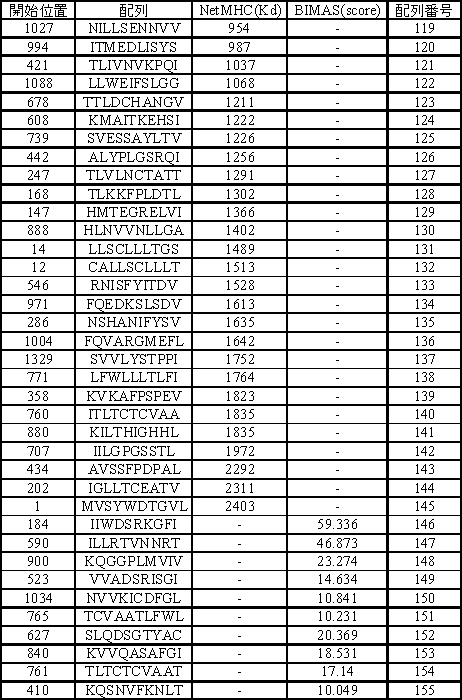
(表1−2)VEGFR1に由来するHLA-A02結合9merペプチド
(表2−1)VEGFR1に由来するHLA-A02結合10merペプチド
(表2−2)VEGFR1に由来するHLA-A02結合10merペプチド
ペプチドの合成
これらのペプチドは、標準的な固相合成法に従って合成し、逆相高速液体クロマトグラフィー(HPLC)によって精製することができる。該ペプチドの純度(>90%)および同一性は、それぞれ分析用HPLCおよび質量分析によって測定することができる。ペプチドはジメチルスルホキシド(DMSO)に20mg/mlで溶解し、-80℃で保存することができる。
Peptide Synthesis These peptides can be synthesized according to standard solid phase synthesis methods and purified by reverse phase high performance liquid chromatography (HPLC). The purity (> 90%) and identity of the peptides can be measured by analytical HPLC and mass spectrometry, respectively. The peptide can be dissolved in dimethyl sulfoxide (DMSO) at 20 mg / ml and stored at -80 ° C.
インビトロでのCTL誘導
単球由来の樹状細胞(DC)を抗原提示細胞(APC)として用いて、ヒト白血球抗原(HLA)上に提示されたペプチドに対する細胞傷害性Tリンパ球(CTL)応答を誘導する。他所に記載されているように、DCはインビトロで作製される(Nakahara S et al., Cancer Res
2003 Jul 15, 63(14): 4112-8)。具体的には、Ficoll-Plaque(Pharmacia)溶液によって健常ボランティア(HLA-A*0201陽性)から単離した末梢血単核細胞(PBMC)を、プラスチック製の組織培養ディッシュ(Becton Dickinson)へ付着させることによって分離し、それらを単球画分として濃縮する。2%の加熱非動化した自己血清(AS)を含むAIM-V培地(Invitrogen)中、1000U/mlの顆粒球マクロファージコロニー刺激因子(GM-CSF)(R&D System)および1000U/mlのインターロイキン(IL)-4(R&D System)の存在下で、単球が濃縮された集団を培養する。7日間の培養後、サイトカインで誘導したDCに、AIM-V培地中で37℃で3時間、3μg/mlのβ2-ミクログロブリンの存在下で20μg/mlの各合成ペプチドをパルスする。作製された細胞は、自身の細胞表面上に、CD80、CD83、CD86、およびHLAクラスIIなどのDC関連分子を発現する。次いで、ペプチドパルスしたこれらのDCをX線照射(20Gy)により不活化し、CD8 positive Isolation Kit(Dynal)を用いた陽性選択によって得られた自己CD8陽性T細胞と1:20の比率で混合する。これらの培養物を48ウェルプレート(Corning)中に準備し、各ウェルは、0.5mlのAIM-V/2%AS培地中に、1.5×104個のペプチドパルスしたDC、3×105個のCD8陽性T細胞、および10ng/mlのIL-7(R&D System)を含むようにする。3日後、これらの培養物に、IL-2(CHIRON)を最終濃度20IU/mlまで添加する。7日目及び14日目に、ペプチドパルスした自己DCでT細胞をさらに刺激する。該DCは上記と同じ方法によって毎回調製する。21日目に、3回目のペプチド刺激後、ペプチドパルスしたTISI細胞またはT2細胞に対してCTLを試験する(Tanaka H et al., Br J Cancer 2001 Jan 5, 84(1): 94-9;Umano Y et al., Br J Cancer 2001 Apr 20, 84(8): 1052-7;Uchida N et al., Clin Cancer Res 2004 Dec 15, 10(24): 8577-86;Suda T et al., Cancer Sci 2006 May, 97(5): 411-9;Watanabe T et al., Cancer Sci 2005 Aug, 96(8): 498-506)。ペプチド特異的なCTL活性はインターフェロン(IFN)-γ酵素結合免疫スポット(ELISPOT)アッセイによって決定する。
Using in vitro CTL-derived monocyte-derived dendritic cells (DCs) as antigen-presenting cells (APCs), cytotoxic T lymphocyte (CTL) responses to peptides presented on human leukocyte antigen (HLA) Induce. DCs are generated in vitro as described elsewhere (Nakahara S et al., Cancer Res
2003 Jul 15, 63 (14): 4112-8). Specifically, peripheral blood mononuclear cells (PBMC) isolated from healthy volunteers (HLA-A * 0201 positive) with Ficoll-Plaque (Pharmacia) solution are attached to plastic tissue culture dishes (Becton Dickinson) And concentrate them as monocyte fractions. 1000 U / ml granulocyte macrophage colony stimulating factor (GM-CSF) (R & D System) and 1000 U / ml interleukin in AIM-V medium (Invitrogen) containing 2% heat-inactivated autoserum (AS) A population enriched for monocytes is cultured in the presence of (IL) -4 (R & D System). After 7 days of culture, cytokine-induced DCs are pulsed with 20 μg / ml of each synthetic peptide in AIM-V medium at 37 ° C. for 3 hours in the presence of 3 μg / ml β2-microglobulin. The generated cells express DC related molecules such as CD80, CD83, CD86, and HLA class II on their cell surface. These peptide-pulsed DCs are then inactivated by X-ray irradiation (20 Gy) and mixed with autologous CD8-positive T cells obtained by positive selection using CD8 positive Isolation Kit (Dynal) at a ratio of 1:20. . These cultures were prepared in 48-well plates (Corning), each well containing 3 × 10 5 DCs pulsed with 1.5 × 10 4 peptide pulses in 0.5 ml AIM-V / 2% AS medium. Of CD8 + T cells and 10 ng / ml IL-7 (R & D System). After 3 days, IL-2 (CHIRON) is added to these cultures to a final concentration of 20 IU / ml. On day 7 and 14, T cells are further stimulated with peptide-pulsed autologous DCs. The DC is prepared each time by the same method as above. On day 21, after the third peptide stimulation, CTL are tested against peptide-pulsed TISI cells or T2 cells (Tanaka H et al., Br J Cancer 2001 Jan 5, 84 (1): 94-9; Umano Y et al., Br J Cancer 2001 Apr 20, 84 (8): 1052-7; Uchida N et al., Clin Cancer Res 2004 Dec 15, 10 (24): 8577-86; Suda T et al., Cancer Sci 2006 May, 97 (5): 411-9; Watanabe T et al., Cancer Sci 2005 Aug, 96 (8): 498-506). Peptide-specific CTL activity is determined by an interferon (IFN) -γ enzyme-linked immunospot (ELISPOT) assay.
CTLの増殖
Riddell ら(Walter EA et al., N
Engl J Med 1995 Oct 19, 333(16): 1038-44;Riddell SR et
al., Nat Med 1996 Feb, 2(2): 216-23)によって記載されている方法と類似の方法を用いて、上記IELISPOTアッセイにおいてペプチド特異的なCTL活性が確認されたCTLを培養下で増殖させる。40ng/mlの抗CD3モノクローナル抗体(Pharmingen)の存在下で、マイトマイシンCによって不活化した2種類のヒトBリンパ芽球様細胞株と共に、合計5×104個のCTLを25mlのAIM-V/5%AS培地中に懸濁する。培養開始1日後に、120IU/mlのIL-2を培養物に添加する。5、8、および11日目に、30IU/mlのIL-2を含む新たなAIM-V/5%AS培地を、該培養物に供給する(Tanaka H et al., Br J Cancer 2001 Jan 5, 84(1): 94-9;Umano Y et al., Br J Cancer 2001 Apr 20, 84(8): 1052-7;Uchida N et al., Clin Cancer Res 2004 Dec 15, 10(24): 8577-86;Suda T et al., Cancer Sci 2006 May, 97(5): 411-9;Watanabe T et al., Cancer Sci 2005 Aug, 96(8): 498-506)。上記のように増殖したCTL株のペプチド特異的なCTL活性をIFN-γ ELISAアッセイによって測定する。
CTL proliferation
Riddell et al. (Walter EA et al., N
Engl J Med 1995 Oct 19, 333 (16): 1038-44; Riddell SR et
al., Nat Med 1996 Feb, 2 (2): 216-23), using a method similar to that described in the above IELISPOT assay, CTL in which peptide-specific CTL activity was confirmed in culture. Proliferate. In the presence of 40 ng / ml anti-CD3 monoclonal antibody (Pharmingen), together with two human B lymphoblastoid cell lines inactivated by mitomycin C, a total of 5 × 10 4 CTLs in 25 ml AIM-V / Suspend in 5% AS medium. One day after the start of culture, 120 IU / ml IL-2 is added to the culture. On days 5, 8, and 11, fresh AIM-V / 5% AS medium containing 30 IU / ml IL-2 is fed to the culture (Tanaka H et al., Br J Cancer 2001 Jan 5 , 84 (1): 94-9; Umano Y et al., Br J Cancer 2001 Apr 20, 84 (8): 1052-7; Uchida N et al., Clin Cancer Res 2004 Dec 15, 10 (24): 8577-86; Suda T et al., Cancer Sci 2006 May, 97 (5): 411-9; Watanabe T et al., Cancer Sci 2005 Aug, 96 (8): 498-506). The peptide-specific CTL activity of the CTL line grown as described above is measured by IFN-γ ELISA assay.
CTLクローンの樹立
上記のようにペプチド特異的なCTL活性が確認されたCTLからCTLクローンを樹立する。96丸底マイクロタイタープレート(Nalge Nunc International)においてCTLが0.3個、1個、および3個/ウェルとなるように、希釈する。CTLを、1×104個細胞/ウェルの2種類のヒトBリンパ芽球様細胞株、30ng/mlの抗CD3抗体、および125U/mlのIL−2と共に、合計150μl/ウェルの5%AS含有AIM−V培地中で培養する。10日後、50μl/ウェルのIL-2を、IL-2の最終濃度が125U/mlに到達するように該培地に添加する。14日目にCTL活性を試験し、ペプチド特異的なCTL活性が確認されたCTLクローンを上記と同じ方法を用いて増殖させる(Uchida N et al., Clin Cancer Res 2004 Dec 15, 10(24): 8577-86;Suda T et al., Cancer Sci 2006 May, 97(5): 411-9;Watanabe T et al., Cancer Sci 2005 Aug, 96(8): 498-506)。樹立したCTLクローンのペプチド特異的なCTL活性は、ペプチドをパルスした標的細胞に対するCTLクローンからのIFN-γ産生を、IFN-γ酵素結合免疫吸着アッセイ(ELISA)によって測定する。
Establishment of a CTL clone A CTL clone is established from a CTL in which peptide-specific CTL activity has been confirmed as described above. Dilute to 0.3, 1, and 3 / well CTL in 96 round bottom microtiter plates (Nalge Nunc International). CTL was combined with 2 human B lymphoblastoid cell lines at 1 × 10 4 cells / well, 30 ng / ml anti-CD3 antibody, and 125 U / ml IL-2 for a total of 150 μl / well of 5% AS Culture in AIM-V medium. After 10 days, 50 μl / well of IL-2 is added to the medium so that the final concentration of IL-2 reaches 125 U / ml. On day 14, CTL activity was tested, and CTL clones with confirmed peptide-specific CTL activity were propagated using the same method as above (Uchida N et al., Clin Cancer Res 2004 Dec 15, 10 (24) : 8577-86; Suda T et al., Cancer Sci 2006 May, 97 (5): 411-9; Watanabe T et al., Cancer Sci 2005 Aug, 96 (8): 498-506). The peptide-specific CTL activity of established CTL clones is measured by IFN-γ enzyme-linked immunosorbent assay (ELISA) for IFN-γ production from CTL clones against peptide-pulsed target cells.
VEGFR1およびHLA-A*0201を発現する標的細胞に対する特異的CTL活性
VEGFR1およびHLA-A*0201を発現する標的細胞の調整は以下のようにして行うことができる。VEGFR1遺伝子、およびHLA-A*0201のオープンリーディングフレームをコードするcDNAをPCRによって増幅する。PCR増幅産物をpCAGGSベクターにクローニングする。製造業者の推奨する手順に従ってリポフェクタミン2000(Invitrogen)を用いて、VEGFR1遺伝子およびHLA-A02の陰性細胞株であるCOS7に該プラスミドをトランスフェクトする。トランスフェクションから2日後、トランスフェクトした細胞をベルセン(Invitrogen)を用いて回収し、CTL活性アッセイのための標的細胞(5×10⁴個細胞/ウェル)として使用する。
Specific CTL activity against target cells expressing VEGFR1 and HLA-A * 0201
Adjustment of target cells expressing VEGFR1 and HLA-A * 0201 can be performed as follows. A cDNA encoding the VEGFR1 gene and the open reading frame of HLA-A * 0201 is amplified by PCR. The PCR amplification product is cloned into the pCAGGS vector. The plasmid is transfected into COS7, a negative cell line for the VEGFR1 gene and HLA-A02, using Lipofectamine 2000 (Invitrogen) according to the manufacturer's recommended procedure. Two days after transfection, transfected cells are harvested using Invitrogen and used as target cells (5 × 10 4 cells / well) for CTL activity assay.
上記のように樹立されたCTLクローンをエフェクター細胞として用いて、標的細胞に対する特異的CTL活性を測定する。標的細胞に対する対照としては、VEGFR1遺伝子またはHLA-A*0201のいずれか一方のみをトランスフェクトしたCOS7細胞を使用することができる。 Using the CTL clone established as described above as an effector cell, the specific CTL activity against the target cell is measured. As a control for the target cells, COS7 cells transfected with either the VEGFR1 gene or HLA-A * 0201 can be used.
抗原ペプチドの相同性解析
上記のようにペプチド特異的なCTL活性を有するCTLを誘導できたペプチドの免疫原性は、ヒト免疫系を感作させることが知られている他の分子に由来するペプチドと相同的であるという事実に起因する可能性がある。この可能性を否定するために、BLASTアルゴリズム(www.ncbi.nlm.nih.gov/blast/blast.cgi)を用いて、クエリーとしてのこれらのペプチド配列に対して相同性解析を行う。
Homology analysis of antigenic peptides As mentioned above, the immunogenicity of peptides that could induce CTLs with peptide-specific CTL activity is derived from other molecules known to sensitize the human immune system May be due to the fact that it is homologous. To negate this possibility, homology analysis is performed on these peptide sequences as queries using the BLAST algorithm (www.ncbi.nlm.nih.gov/blast/blast.cgi).
産業上の利用可能性
本発明は、異常な血管新生を伴う疾患部位の血管内皮細胞に対して、強力かつ特異的な免疫応答を誘導することができ、血管新生により媒介される幅広い種類の疾患に対する適用性を有し得る、VEGFR1由来の新規ペプチドを提供する。このようなペプチドは、VEGFR1に関連した血管新生により媒介される疾患に対するペプチドワクチンとして有用であり得、そのような疾患の例には、各種がん、脈絡膜における血管新生に関連する疾患(新生血管黄斑症:加齢黄班変性症、近視性黄斑変性症、網膜色素線条症、中心性滲出性網脈絡膜症、種々の網膜色素上皮症、脈絡膜萎縮症、コロイデレミア、脈絡膜骨腫など)、糖尿病性網膜症、慢性関節リウマチ、乾癬、およびアテローム性動脈硬化などが含まれるが、これらに限定されない。
INDUSTRIAL APPLICABILITY The present invention is capable of inducing a strong and specific immune response against vascular endothelial cells at a disease site with abnormal angiogenesis, and a wide variety of diseases mediated by angiogenesis. A novel peptide derived from VEGFR1 is provided. Such peptides may be useful as peptide vaccines against diseases mediated by angiogenesis associated with VEGFR1, and examples of such diseases include various cancers, diseases associated with angiogenesis in the choroid (neovascular Macular dysfunction: age-related macular degeneration, myopic macular degeneration, retinitis pigmentosa, central exudative retina choroidopathy, various retinal pigment epitheliopathy, choroidal atrophy, choroideremia, choroidal osteoma, etc.), diabetes Include, but are not limited to, retinopathy, rheumatoid arthritis, psoriasis, and atherosclerosis.
Claims (18)
(a)配列番号:1〜153からなる群より選択されるアミノ酸配列;および
(b)配列番号:1〜153からる群より選択されるアミノ酸配列において、1個、2個、または数個のアミノ酸が置換、欠失、挿入および/または付加されているアミノ酸配列。 An isolated peptide having the ability to induce CTL, comprising an amino acid sequence selected from the following group:
(A) an amino acid sequence selected from the group consisting of SEQ ID NO: 1 to 153; and (b) one, two, or several amino acid sequences selected from the group consisting of SEQ ID NO: 1 to 153 An amino acid sequence in which amino acids are substituted, deleted, inserted and / or added.
(a)N末端から2番目のアミノ酸が、ロイシンおよびメチオニンからなる群より選択されるアミノ酸であるか、または該アミノ酸であるように改変されている、および
(b)C末端のアミノ酸が、バリンおよびロイシンからなる群より選択されるアミノ酸であるか、または該アミノ酸であるように改変されている。 3. An isolated peptide according to claim 1 or 2 having one or both of the following characteristics:
(A) the second amino acid from the N-terminus is an amino acid selected from the group consisting of leucine and methionine, or has been modified to be the amino acid, and (b) the C-terminal amino acid is valine And an amino acid selected from the group consisting of leucine or modified to be said amino acid.
(a)APCを、請求項1〜3のいずれか一項記載のペプチドとインビトロ、エクスビボ、またはインビボで接触させる段階、および
(b)請求項1〜3のいずれか一項記載のペプチドをコードするポリヌクレオチドをAPCに導入する段階。 A method for inducing antigen-presenting cells (APC) having CTL inducing ability, comprising a step selected from the group consisting of
(A) contacting APC with the peptide according to any one of claims 1 to 3 in vitro, ex vivo or in vivo; and (b) encoding the peptide according to any one of claims 1 to 3. Introducing a polynucleotide to APC.
(a)CD8陽性T細胞を、HLA抗原と請求項1〜3のいずれか一項記載のペプチドとの複合体を自身の表面上に提示するAPCと共培養する段階、
(b)CD8陽性T細胞を、HLA抗原と請求項1〜3のいずれか一項記載のペプチドとの複合体を自身の表面上に提示するエキソソームと共培養する段階、および
(c)細胞表面上にHLA抗原により提示された請求項1〜3のいずれか一項記載のペプチドに結合し得るT細胞受容体(TCR)のサブユニットをコードするポリヌクレオチドを含むベクターをCD8陽性T細胞に導入する段階。 A method of inducing CTL comprising one stage selected from the group consisting of:
(A) co-culturing CD8 positive T cells with APC presenting a complex of the HLA antigen and the peptide according to any one of claims 1 to 3 on its surface;
(B) co-culturing a CD8 positive T cell with an exosome presenting a complex of HLA antigen and the peptide of any one of claims 1 to 3 on its surface; and (c) a cell surface A vector comprising a polynucleotide encoding a T cell receptor (TCR) subunit capable of binding to the peptide according to any one of claims 1 to 3 presented above by an HLA antigen is introduced into a CD8-positive T cell. Stage to do.
Applications Claiming Priority (2)
| Application Number | Priority Date | Filing Date | Title |
|---|---|---|---|
| US201213604209P | 2012-02-28 | 2012-02-28 | |
| US61/604,209 | 2012-02-28 |
Publications (1)
| Publication Number | Publication Date |
|---|---|
| JP2013176366A true JP2013176366A (en) | 2013-09-09 |
Family
ID=49268736
Family Applications (1)
| Application Number | Title | Priority Date | Filing Date |
|---|---|---|---|
| JP2013037763A Pending JP2013176366A (en) | 2012-02-28 | 2013-02-27 | Vegfr1-originated peptide and vaccine containing the same |
Country Status (1)
| Country | Link |
|---|---|
| JP (1) | JP2013176366A (en) |
Cited By (1)
| Publication number | Priority date | Publication date | Assignee | Title |
|---|---|---|---|---|
| CN105175527A (en) * | 2015-10-09 | 2015-12-23 | 深圳市康尔诺生物技术有限公司 | Heat shock protein complex for breast cancer specificity and application of complex |
-
2013
- 2013-02-27 JP JP2013037763A patent/JP2013176366A/en active Pending
Cited By (1)
| Publication number | Priority date | Publication date | Assignee | Title |
|---|---|---|---|---|
| CN105175527A (en) * | 2015-10-09 | 2015-12-23 | 深圳市康尔诺生物技术有限公司 | Heat shock protein complex for breast cancer specificity and application of complex |
Similar Documents
| Publication | Publication Date | Title |
|---|---|---|
| JP6295491B2 (en) | KNTC2 peptide and vaccine containing the same | |
| JP5799394B2 (en) | NEIL3 peptide and vaccine containing the same | |
| JP2021118702A (en) | FOXM1-derived peptide and vaccine containing it | |
| JP5884104B2 (en) | Modified MELK peptide and vaccine containing the same | |
| JP2013523084A (en) | CDCA5 peptide and vaccine containing the same | |
| JP2014519311A (en) | SEMA5B peptide and vaccine containing the same | |
| JP7070945B2 (en) | KOC1-derived peptide and vaccine containing it | |
| US12195559B2 (en) | CDCA1-derived peptide and vaccine containing same | |
| JP6934250B2 (en) | DEPDC1-derived peptide and vaccine containing it | |
| JP5786178B2 (en) | TTK peptide and vaccine containing the same | |
| JP2016222676A (en) | TOMM34 peptide and vaccine containing the same | |
| JP2012519470A (en) | VANGL1 peptide and vaccine containing the same | |
| JP6999185B2 (en) | CDCA1-derived peptide and vaccine containing it | |
| WO2016021510A1 (en) | Urlc10-derived peptide and vaccine containing same | |
| JP2013176367A (en) | Vegfr1-originated peptide and vaccine containing the same | |
| JP2013176368A (en) | Vegfr2-originated peptide and vaccine containing the same | |
| JP2013513549A (en) | TMEM22 peptide and vaccine containing the same | |
| JP2013512659A (en) | MYBL2 peptide and vaccine containing the same | |
| JP2013176366A (en) | Vegfr1-originated peptide and vaccine containing the same | |
| JP2014500001A (en) | C18ORF54 peptide and vaccine containing the same | |
| JP2017042047A (en) | Vegfr2-derived peptide and vaccine comprising the same | |
| JP6857909B2 (en) | MPHOSPH1-derived peptide and vaccine containing it |