JP2014005461A - Copolymer, organic semiconductor material, organic electronic device, and solar cell module - Google Patents
Copolymer, organic semiconductor material, organic electronic device, and solar cell module Download PDFInfo
- Publication number
- JP2014005461A JP2014005461A JP2013114476A JP2013114476A JP2014005461A JP 2014005461 A JP2014005461 A JP 2014005461A JP 2013114476 A JP2013114476 A JP 2013114476A JP 2013114476 A JP2013114476 A JP 2013114476A JP 2014005461 A JP2014005461 A JP 2014005461A
- Authority
- JP
- Japan
- Prior art keywords
- group
- copolymer
- substituent
- less
- preferable
- Prior art date
- Legal status (The legal status is an assumption and is not a legal conclusion. Google has not performed a legal analysis and makes no representation as to the accuracy of the status listed.)
- Pending
Links
- 0 **(*)(c1c-2[s]cc1)c1c-2[s]cc1 Chemical compound **(*)(c1c-2[s]cc1)c1c-2[s]cc1 0.000 description 3
- PFMZNXNFQFEBMQ-UHFFFAOYSA-N CCCCCCCCCCCCN(C(c(c1c([s]2)Br)c2Br)=O)C1=O Chemical compound CCCCCCCCCCCCN(C(c(c1c([s]2)Br)c2Br)=O)C1=O PFMZNXNFQFEBMQ-UHFFFAOYSA-N 0.000 description 1
- KYUJPWULVGOGDU-UHFFFAOYSA-N CCCCCCCCCCCCN(C(c1c(C)[s]c(-c2cc([Si](CCCCCCCC)(CC(CC)CCCC)c3c-4[s]c(C)c3)c-4[s]2)c11)=O)C1=O Chemical compound CCCCCCCCCCCCN(C(c1c(C)[s]c(-c2cc([Si](CCCCCCCC)(CC(CC)CCCC)c3c-4[s]c(C)c3)c-4[s]2)c11)=O)C1=O KYUJPWULVGOGDU-UHFFFAOYSA-N 0.000 description 1
- SGZBYWSWNMVWOJ-UHFFFAOYSA-N CCCCCCCC[S-](c1c-2[s]cc1)c1c-2[s]cc1 Chemical compound CCCCCCCC[S-](c1c-2[s]cc1)c1c-2[s]cc1 SGZBYWSWNMVWOJ-UHFFFAOYSA-N 0.000 description 1
Images
Classifications
-
- Y—GENERAL TAGGING OF NEW TECHNOLOGICAL DEVELOPMENTS; GENERAL TAGGING OF CROSS-SECTIONAL TECHNOLOGIES SPANNING OVER SEVERAL SECTIONS OF THE IPC; TECHNICAL SUBJECTS COVERED BY FORMER USPC CROSS-REFERENCE ART COLLECTIONS [XRACs] AND DIGESTS
- Y02—TECHNOLOGIES OR APPLICATIONS FOR MITIGATION OR ADAPTATION AGAINST CLIMATE CHANGE
- Y02E—REDUCTION OF GREENHOUSE GAS [GHG] EMISSIONS, RELATED TO ENERGY GENERATION, TRANSMISSION OR DISTRIBUTION
- Y02E10/00—Energy generation through renewable energy sources
- Y02E10/50—Photovoltaic [PV] energy
- Y02E10/549—Organic PV cells
Landscapes
- Electroluminescent Light Sources (AREA)
- Polyoxymethylene Polymers And Polymers With Carbon-To-Carbon Bonds (AREA)
- Photovoltaic Devices (AREA)
Abstract
Description
本発明はコポリマー、並びにコポリマーを含む有機半導体材料、有機電子デバイス及び太陽電池モジュールに関する。 The present invention relates to copolymers, and organic semiconductor materials, organic electronic devices and solar cell modules containing the copolymers.
有機太陽電池、有機EL素子、有機薄膜トランジスタ、及び有機発光センサー等の有機電子デバイスの半導体材料として、π共役高分子が用いられている。特に有機太陽電池においては、太陽光の吸収効率を向上させることが望まれており、長波長(600nm以上)の光を吸収できるポリマーの開発が重要である。吸収波長の長波長化をなしとげるために、ドナー性モノマーとアクセプター性モノマーの共重合体(以後、コポリマーということがある)を光電変換素子に用いた例が報告されている。 A π-conjugated polymer is used as a semiconductor material for organic electronic devices such as organic solar cells, organic EL elements, organic thin film transistors, and organic light emitting sensors. In particular, in an organic solar cell, it is desired to improve sunlight absorption efficiency, and it is important to develop a polymer that can absorb light having a long wavelength (600 nm or more). In order to achieve a longer absorption wavelength, an example in which a copolymer of a donor monomer and an acceptor monomer (hereinafter sometimes referred to as a copolymer) is used for a photoelectric conversion element has been reported.
具体的には、非特許文献1にはイミドチオフェン骨格とジチエノシクロペンタジエン骨格を有するコポリマーを使用した光電変換素子が記載されている。また、非特許文献1,2,3及び特許文献1には、イミドチオフェン骨格とジチエノシロール骨格を有するコポリマーを使用した光電変換素子が記載されている。さらに非特許文献2には、イミドチオフェン骨格とジチエノゲルモール骨格を有するコポリマーを使用した光電変換素子が記載されている。 Specifically, Non-Patent Document 1 describes a photoelectric conversion element using a copolymer having an imidothiophene skeleton and a dithienocyclopentadiene skeleton. Non-Patent Documents 1, 2, 3 and Patent Document 1 describe photoelectric conversion elements using a copolymer having an imidothiophene skeleton and a dithienosilole skeleton. Further, Non-Patent Document 2 describes a photoelectric conversion element using a copolymer having an imidothiophene skeleton and a dithienogermol skeleton.
有機電子デバイスをより容易に作製するためには、有機半導体材料を溶解させた溶液(以下、インクということある)を作製し、このインクを塗布する等して有機半導体材料を成膜することが望ましい。しかしながら本願発明者らが検討したところ、より大きい分子量を有するように合成した上記のコポリマーと有機溶媒とを含有するインクは、室温にて数分間静置するだけでゲル化するという課題が見出された。 In order to fabricate an organic electronic device more easily, a solution in which an organic semiconductor material is dissolved (hereinafter sometimes referred to as ink) is produced, and the organic semiconductor material is formed by applying the ink. desirable. However, as a result of studies by the inventors of the present application, an ink containing the above-described copolymer synthesized with a higher molecular weight and an organic solvent has found a problem that it gels only by standing at room temperature for a few minutes. It was done.
本発明は、半導体材料として使用可能な、溶液としたときに安定性が高いコポリマーを提供することを目的とする。 An object of the present invention is to provide a copolymer that can be used as a semiconductor material and has high stability when in solution.
本願発明者らは上記課題を解決すべく鋭意検討した結果、ジオキソピロール縮合環骨格を有する繰り返し単位と、ジチエノ縮合環骨格を有する繰り返し単位とを含有するコポリマーであって、ジオキソピロール縮合環が炭素数10以上の直鎖アルキル基を有し、ジチエノ縮合環が分岐アルキル基を有するコポリマーは、溶液とした時に安定性が高いことを見出し、この知見に基づいて本発明を完成した。 As a result of intensive studies to solve the above-mentioned problems, the present inventors have found a copolymer containing a repeating unit having a dioxopyrrole condensed ring skeleton and a repeating unit having a dithieno condensed ring skeleton, wherein the dioxopyrrole condensed ring A copolymer having a linear alkyl group having 10 or more carbon atoms and a dithieno condensed ring having a branched alkyl group was found to have high stability when in solution, and the present invention was completed based on this finding.
即ち、本発明の要旨は、以下に存する。
[1]下記式(1A)で表される繰り返し単位と式(1B)で表される繰り返し単位とを含むことを特徴とするコポリマー。
[2]下記式(2)で表される繰り返し単位を含むことを特徴とする、[1]に記載のコポリマー。
[3][1]又は[2]に記載のコポリマーを含むことを特徴とする、有機半導体材料。
[4][3]に記載の有機半導体材料を含むことを特徴とする、有機電子デバイス。
[5]光電変換素子であることを特徴とする、[4]に記載の有機電子デバイス。
[6]太陽電池であることを特徴とする、[4]に記載の有機電子デバイス。
[7][6]に記載の有機電子デバイスを備えることを特徴とする、太陽電池モジュール。
That is, the gist of the present invention is as follows.
[1] A copolymer comprising a repeating unit represented by the following formula (1A) and a repeating unit represented by the formula (1B).
[2] The copolymer according to [1], comprising a repeating unit represented by the following formula (2).
[3] An organic semiconductor material comprising the copolymer according to [1] or [2].
[4] An organic electronic device comprising the organic semiconductor material according to [3].
[5] The organic electronic device according to [4], which is a photoelectric conversion element.
[6] The organic electronic device according to [4], which is a solar cell.
[7] A solar cell module comprising the organic electronic device according to [6].
半導体材料として使用可能な、溶液としたときに安定性が高いコポリマーを提供することができる。 A copolymer that can be used as a semiconductor material and has high stability when in solution can be provided.
以下に、本発明の実施の形態を詳細に説明する。以下に記載する構成要件の説明は、本発明の実施形態の一例(代表例)であり、本発明はその要旨を超えない限り、これらの内容に特定はされない。 Hereinafter, embodiments of the present invention will be described in detail. The description of the constituent requirements described below is an example (representative example) of an embodiment of the present invention, and the present invention is not specified in these contents unless it exceeds the gist.
<1.本発明に係るコポリマー>
本発明に係るコポリマーは、下記式(1A)で表される繰り返し単位及び式(1B)で表される繰り返し単位を含む。本発明に係るコポリマーは、溶解させた際にゲル化しにくいため、塗布成膜するために適している。また、本発明に係るコポリマーは、光吸収波長領域がより長波長にあり、かつ光吸収性が高く、さらに高い移動度を有する点から好ましい。また、本発明に係るコポリマーは、高分子量のものを得やすい点で好ましい。
<1. Copolymer according to the present invention>
The copolymer according to the present invention includes a repeating unit represented by the following formula (1A) and a repeating unit represented by the formula (1B). The copolymer according to the present invention is suitable for coating film formation because it is difficult to gel when dissolved. Further, the copolymer according to the present invention is preferable in that the light absorption wavelength region is at a longer wavelength, the light absorption is high, and the mobility is higher. Further, the copolymer according to the present invention is preferable in that a high molecular weight product is easily obtained.
式(1A)中、Aは周期表第16族から選ばれる原子を表す。Aとして具体的には、酸素原子、硫黄原子、セレン原子又はテルル原子が挙げられる。なかでも、合成の容易性の点で好ましくは酸素原子、硫黄原子又はセレン原子であり、より好ましくは、硫黄原子又は酸素原子であり、特に好ましくは硫黄原子である。 In formula (1A), A represents an atom selected from Group 16 of the periodic table. Specific examples of A include an oxygen atom, a sulfur atom, a selenium atom, and a tellurium atom. Among these, an oxygen atom, a sulfur atom or a selenium atom is preferred from the viewpoint of ease of synthesis, more preferably a sulfur atom or an oxygen atom, and particularly preferably a sulfur atom.
式(1B)中、Qは周期表第14族元素から選ばれる原子を表す。周期表第14族元素から選ばれる原子として具体的には、炭素原子、ケイ素原子、ゲルマニウム原子、スズ原子及び鉛原子が挙げられる。Qとして好ましくは、炭素原子、ケイ素原子、ゲルマニウム原子及びスズ原子であり、より好ましくは、炭素原子、ケイ素原子及びゲルマニウム原子である。さらに好ましくは、ケイ素原子又はゲルマニウム原子である。ケイ素原子及びゲルマニウム原子は炭素原子と比較して原子半径が大きいことから、π−πスタッキングを阻害するような置換基R3〜R4による立体障害が低減されうる。このことは、コポリマー間の分子間相互作用が適度に維持されうる点で好ましい。
In formula (1B), Q represents an atom selected from
式(1A)中、R1は直接結合又は置換基を有していてもよい2価の有機基を表す。2価の有機基の炭素数は、1以上20以下であることが好ましい。2価の有機基としては、アルキレン基、アルケニレン基、アルキニレン基、アリーレン基又はヘテロアリーレン基等が挙げられる。なかでも、R1は、直接結合、アルキレン基又はアリーレン基であることが、本発明に係るコポリマーの安定性の点で好ましく、直接結合又はアリーレン基であることが特に好ましい。 In Formula (1A), R 1 represents a divalent organic group which may have a direct bond or a substituent. The number of carbon atoms of the divalent organic group is preferably 1 or more and 20 or less. Examples of the divalent organic group include an alkylene group, an alkenylene group, an alkynylene group, an arylene group, and a heteroarylene group. Among these, R 1 is preferably a direct bond, an alkylene group or an arylene group from the viewpoint of the stability of the copolymer according to the present invention, and particularly preferably a direct bond or an arylene group.
アルキレン基としては、メチレン基、エチレン基、プロピレン基、ブチレン基、ペンチレン基若しくはヘキシレン基等の直鎖アルキレン基;シクロプロピレン基、シクロブチレン基、シクロペンチレン基、シクロヘキシレン基、シクロヘプチレン基、シクロオクチレン基、ジシクロペンチレン基若しくはトリシクロペンチレン基等のシクロアルキレン基;又はメチルエチレン基等の分岐アルキレン基が挙げられる。なかでも、シクロアルキレン基又は分岐アルキレン基が、溶解度向上の点で好ましい。 Examples of the alkylene group include a linear alkylene group such as a methylene group, an ethylene group, a propylene group, a butylene group, a pentylene group, or a hexylene group; a cyclopropylene group, a cyclobutylene group, a cyclopentylene group, a cyclohexylene group, a cycloheptylene group, a cyclo A cycloalkylene group such as an octylene group, a dicyclopentylene group or a tricyclopentylene group; or a branched alkylene group such as a methylethylene group. Of these, a cycloalkylene group or a branched alkylene group is preferable in terms of improving solubility.
アルケニレン基としては、ビニレン基又はプロペニレン等が挙げられる。なかでも、ビニレン基が好ましい。 Examples of the alkenylene group include vinylene group and propenylene. Of these, a vinylene group is preferable.
アリーレン基としては、1,4−フェニレン基、1,3−フェニレン基、1,2−フェニレン基、ナフチレン基、アントリレン基、ピレニレン基、フェナントリレン基、ビフェニレン基又はトリフェニレン基等が挙げられる。なかでも、1,4−フェニレン基、1,3−フェニレン基、1,2−フェニレン基、又はナフチレン基がより好ましい。本発明に係るコポリマーの溶解性を向上させる観点から、アリーレン基はフェニレン基であることが特に好ましい。 Examples of the arylene group include 1,4-phenylene group, 1,3-phenylene group, 1,2-phenylene group, naphthylene group, anthrylene group, pyrenylene group, phenanthrylene group, biphenylene group, and triphenylene group. Of these, a 1,4-phenylene group, a 1,3-phenylene group, a 1,2-phenylene group, or a naphthylene group is more preferable. From the viewpoint of improving the solubility of the copolymer according to the present invention, the arylene group is particularly preferably a phenylene group.
ヘテロアリーレン基としては、チエニレン基、フリレン基、ピリジレン基等が挙げられる。本発明に係るコポリマーの溶解性を向上させる観点から、アリーレン基は単環複素環基であることが好ましく、チエニレン基であることが特に好ましい。 Examples of the heteroarylene group include a thienylene group, a furylene group, and a pyridylene group. From the viewpoint of improving the solubility of the copolymer according to the present invention, the arylene group is preferably a monocyclic heterocyclic group, and particularly preferably a thienylene group.
本明細書において、各基が「有していてもよい」置換基としては、本発明の効果を損なわない限り特に限定はないが、好ましくは、ハロゲン原子、水酸基、カルボキシル基、カルバモイル基、アシル基、アルコキシカルボニル基、アリールオキシカルボニル基、アルキルスルホニル基、アリールスルホニル基、ボリル基、アルキル基、アルケニル基、アルキニル基、アルコキシ基、アリールオキシ基、アルキルチオ基、アリールチオ基、アミノ基、置換アミノ基、シリル基、置換シリル基、脂肪族複素環基、芳香族炭化水素基又は芳香族複素環基等が挙げられる。なかでも好ましくは、本発明に係るコポリマーの分子内極性をコントロールしうる点で、アルコキシ基又はアルキルチオ基である。 In the present specification, the substituent that each group may “have” is not particularly limited as long as the effects of the present invention are not impaired, but preferably a halogen atom, a hydroxyl group, a carboxyl group, a carbamoyl group, an acyl group. Group, alkoxycarbonyl group, aryloxycarbonyl group, alkylsulfonyl group, arylsulfonyl group, boryl group, alkyl group, alkenyl group, alkynyl group, alkoxy group, aryloxy group, alkylthio group, arylthio group, amino group, substituted amino group , A silyl group, a substituted silyl group, an aliphatic heterocyclic group, an aromatic hydrocarbon group or an aromatic heterocyclic group. Among these, an alkoxy group or an alkylthio group is preferable because the intramolecular polarity of the copolymer according to the present invention can be controlled.
式(1A)中、R2は置換基を有していてもよい炭素数10以上の直鎖アルキル基を表す。直鎖アルキル基の炭素数は、10以上、好ましくは12以上であり、一方、通常40以下であり、好ましくは25以下、より好ましくは20以下、さらに好ましくは16以下である。 In Formula (1A), R 2 represents a linear alkyl group having 10 or more carbon atoms which may have a substituent. The linear alkyl group has 10 or more carbon atoms, preferably 12 or more, and is usually 40 or less, preferably 25 or less, more preferably 20 or less, still more preferably 16 or less.
直鎖アルキル基の例としては、n−デシル基、n−ウンデシル基、n−ドデシル基、n−トリデシル基、n−テトラデシル基、n−ペンタデシル基、n−ヘキサデシル基、n−ヘプタデシル基、n−オクタデシル基、n−ノナデシル基、n−イコシル基、n−ヘンイコシル基、n−ドコシル基、n−トリコシル基、n−テトラコシル基、n−ペンタコシル基、n−ヘキサコシル基、n−ヘプタコシル基、n−オクタコシル基、n−ノナコシル基、n−トリアコンチル基、n−ヘントリアコンチル基、n−ドトリアコンチル基、n−トリトリアコンチル基、n−テトラトリアコンチル基、n−ペンタトリアコンチル基、n−ヘキサトリアコンチル基又はn−テトラコンチル基等が挙げられる。なかでも、好ましくは、n−デシル基、n−ウンデシル基、n−ドデシル基、n−トリデシル基、n−テトラデシル基、n−ペンタデシル基、n−ヘキサデシル基、n−ヘプタデシル基、n−オクタデシル基、n−ノナデシル基、n−イコシル基、n−ヘンイコシル基、n−ドコシル基、n−トリコシル基、n−テトラコシル基又はn−ペンタコシル基であり、さらに好ましくは、n−デシル基、n−ウンデシル基、n−ドデシル基、n−トリデシル基、n−テトラデシル基、n−ペンタデシル基又はn−ヘキサデシル基である。 Examples of linear alkyl groups include n-decyl, n-undecyl, n-dodecyl, n-tridecyl, n-tetradecyl, n-pentadecyl, n-hexadecyl, n-heptadecyl, n -Octadecyl group, n-nonadecyl group, n-icosyl group, n-henicosyl group, n-docosyl group, n-tricosyl group, n-tetracosyl group, n-pentacosyl group, n-hexacosyl group, n-heptacosyl group, n -Octacosyl group, n-nonacosyl group, n-triacontyl group, n-hentriacontyl group, n-dotriacontyl group, n-tritriacontyl group, n-tetratriacontyl group, n-pentatriacontyl group, n -A hexatriacontyl group or an n-tetracontyl group is exemplified. Among these, n-decyl group, n-undecyl group, n-dodecyl group, n-tridecyl group, n-tetradecyl group, n-pentadecyl group, n-hexadecyl group, n-heptadecyl group, n-octadecyl group are preferable. , N-nonadecyl group, n-icosyl group, n-henicosyl group, n-docosyl group, n-tricosyl group, n-tetracosyl group or n-pentacosyl group, more preferably n-decyl group, n-undecyl group Group, n-dodecyl group, n-tridecyl group, n-tetradecyl group, n-pentadecyl group or n-hexadecyl group.
R2が有していてもよい置換基のうちの好ましい例としては、ハロゲン原子のような、水素原子とヘテロ原子とを含む群から選択された原子からなる置換基が挙げられる。R2が置換基を有さない直鎖アルキル基であることもまた好ましい。 Preferable examples of the substituent that R 2 may have include a substituent composed of an atom selected from the group containing a hydrogen atom and a hetero atom, such as a halogen atom. It is also preferable that R 2 is a linear alkyl group having no substituent.
R2が炭素数10以上の直鎖アルキル基であることは、本発明に係るコポリマーの有機溶媒への溶解性が向上しやすく、本発明に係るコポリマーが塗布成膜しやすくなりうる点で好ましい。また、本発明に係るコポリマーを溶液とした時にコポリマーが析出したりゲル化したりすることが抑制され、保存安定性が向上しうる点でも好ましい。 It is preferable that R 2 is a linear alkyl group having 10 or more carbon atoms in that the solubility of the copolymer according to the present invention in an organic solvent can be easily improved and the copolymer according to the present invention can be easily formed by coating. . Further, it is also preferable in that storage stability can be improved by suppressing the precipitation or gelation of the copolymer when the copolymer according to the present invention is used as a solution.
式(1B)中、R3は、分岐アルキル基を表す。R3が分岐アルキル基であることは、本発明に係るコポリマーの有機溶媒への溶解度が向上するために、高分子量のコポリマーが得やすくなり、及びコポリマーを溶液とした時にゲル化が抑制されて保存安定性が向上しうる点で好ましい。 In formula (1B), R 3 represents a branched alkyl group. Since R 3 is a branched alkyl group, the solubility of the copolymer according to the present invention in an organic solvent is improved, so that a high molecular weight copolymer is easily obtained, and gelation is suppressed when the copolymer is used as a solution. It is preferable in that the storage stability can be improved.
分岐アルキル基としては、分岐1級アルキル基、分岐2級アルキル基又は分岐3級アルキル基が挙げられる。分岐1級アルキル基とは、遊離原子価を有する炭素原子に結合する水素原子が2つである分岐アルキル基を意味する。分岐2級アルキル基とは、遊離原子価を有する炭素原子に結合する水素原子が1つである分岐アルキル基を意味する。また分岐3級アルキル基とは、遊離原子価を有する炭素原子に結合する水素原子が無い分岐アルキル基を意味する。ここで、遊離原子価とは、有機化学・生化学命名法(上)(改訂第2版、南江堂、1992年発行)に記載のとおり、他の遊離原子価と結合を形成できるものをいう。 Examples of the branched alkyl group include a branched primary alkyl group, a branched secondary alkyl group, and a branched tertiary alkyl group. The branched primary alkyl group means a branched alkyl group having two hydrogen atoms bonded to a carbon atom having a free valence. The branched secondary alkyl group means a branched alkyl group having one hydrogen atom bonded to a carbon atom having a free valence. The branched tertiary alkyl group means a branched alkyl group having no hydrogen atom bonded to a carbon atom having a free valence. Here, the free valence refers to a substance that can form a bond with another free valence as described in the organic chemistry / biochemical nomenclature (above) (Revised 2nd edition, Nankodo, 1992).
分岐1級アルキル基としては、例えば、2−エチルヘキシル基、2−メチルプロピル基、2−エチルヘキシル基、2,2−ジメチルプロピル基、2−メチルブチル基、2−エチルブチル基、2,4−ジメチルヘキシル基、2−メチルペンチル基、2,4,4−トリメチルペンチル基、2,3−ジメチルブチル基、2,6−ジメチルへプチル基、2−ヘキシルデシル基、2,2−ジメチルブチル基、2−メチルヘプチル基、2−メチルヘキサデシル基、2−ブチルオクチル基、2−メチルノニル基、2−プロピルペンチル基、2−メチルウンデシル基、2−ヘキシルオクチル基、2−メチルオクチル基、2−メチルデシル基、2−メチルドデシル基又は2,5−ジメチルヘキシル基等が挙げられる。なかでも、2−エチルヘキシル基、2,4−ジメチルヘキシル基、2,4,4−トリメチルペンチル基、2,6−ジメチルへプチル基、2−ヘキシルデシル基、2−メチルヘプチル基、2−ブチルオクチル基、2−メチルノニル基、2−プロピルペンチル基、2−メチルウンデシル基、2−ヘキシルオクチル基、2−メチルオクチル基、2−メチルデシル基、2−メチルドデシル基又は2,5−ジメチルヘキシル基が好ましく、より好ましくは2−エチルヘキシル基、2−ヘキシルデシル基、2−ブチルオクチル基又は2−ヘキシルオクチル基である。 Examples of the branched primary alkyl group include 2-ethylhexyl group, 2-methylpropyl group, 2-ethylhexyl group, 2,2-dimethylpropyl group, 2-methylbutyl group, 2-ethylbutyl group, and 2,4-dimethylhexyl. Group, 2-methylpentyl group, 2,4,4-trimethylpentyl group, 2,3-dimethylbutyl group, 2,6-dimethylheptyl group, 2-hexyldecyl group, 2,2-dimethylbutyl group, 2 -Methylheptyl group, 2-methylhexadecyl group, 2-butyloctyl group, 2-methylnonyl group, 2-propylpentyl group, 2-methylundecyl group, 2-hexyloctyl group, 2-methyloctyl group, 2- Examples thereof include a methyldecyl group, a 2-methyldodecyl group, and a 2,5-dimethylhexyl group. Among them, 2-ethylhexyl group, 2,4-dimethylhexyl group, 2,4,4-trimethylpentyl group, 2,6-dimethylheptyl group, 2-hexyldecyl group, 2-methylheptyl group, 2-butyl Octyl group, 2-methylnonyl group, 2-propylpentyl group, 2-methylundecyl group, 2-hexyloctyl group, 2-methyloctyl group, 2-methyldecyl group, 2-methyldodecyl group or 2,5-dimethylhexyl Group is preferable, and 2-ethylhexyl group, 2-hexyldecyl group, 2-butyloctyl group or 2-hexyloctyl group is more preferable.
分岐2級アルキル基としては、例えば、イソプロピル基、1−メチルプロピル基、1−メチルブチル基、1−メチルヘプチル基、1−プロピルペンチル基、1−エチルヘキシル基、1−エチルプロピル基、1−メチルペンチル基、1−エチルペンチル基、1−ブチルペンチル基、1−メチルオクチル基、1−エチルブチル基、1−エチル−2−メチルプロピル基、1,5−ジメチルヘキシル基、1−ブチルヘプチル基、1−メチルウンデシル基、1,2−ジメチルプロピル基、1,3−ジメチルブチル基、1−エチルオクチル基、1−プロピルヘキシル基、1,2−ジメチルペンチル基、4−エチル−1−メチルオクチル基、1−エチルウンデシル基、4−メチル−1−プロピルヘキシル基、1−ヘキシルヘプチル基、1,3−ジメチルペンチル基、1−エチル−2−メチルペンチル基、1,2−ジメチルペンチル基、1−ブチルヘキシル基、1−メチルトリデシル基、1−メチルペンタデシル基、1,3−ジメチルデシル基、1,3,5−トリメチルヘキシル基、3−エチル−1,5−ジメチルノニル基又は1−プロピルヘプチル基等が挙げられる。なかでも、1−メチルプロピル基、1−メチルブチル基、1−メチルヘプチル基、1−プロピルペンチル基、1−エチルヘキシル基、1−メチルペンチル基、1−エチルペンチル基、1−メチルオクチル基、1−エチルブチル基、1−エチル−2−メチルプロピル基、1,5−ジメチルヘキシル基、1−ブチルヘプチル基、1,2−ジメチルプロピル基、1,3−ジメチルブチル基、1−エチルオクチル基、1−プロピルヘキシル基、1,2−ジメチルペンチル基、4−エチル−1−メチルオクチル基、4−メチル−1−プロピルヘキシル基、1,3−ジメチルペンチル基、1−エチル−2−メチルペンチル基、1,2−ジメチルペンチル基、1−ブチルヘキシル基、1,3,5−トリメチルヘキシル基、3−エチル−1,5−ジメチルノニル基又は1−プロピルヘプチル基が好ましく、より好ましくは1−プロピルペンチル基、1−エチルヘキシル基、1−エチルペンチル基、1−エチルブチル基、1−エチル−2−メチルプロピル基、1−ブチルヘプチル基、1−エチルオクチル基、1−プロピルヘキシル基、4−エチル−1−メチルオクチル基、4−メチル−1−プロピルヘキシル基、1−エチル−2−メチルペンチル基、1−ブチルヘキシル基、3−エチル−1,5−ジメチルノニル基又は1−プロピルヘプチル基である。 Examples of the branched secondary alkyl group include isopropyl group, 1-methylpropyl group, 1-methylbutyl group, 1-methylheptyl group, 1-propylpentyl group, 1-ethylhexyl group, 1-ethylpropyl group, 1-methyl. Pentyl group, 1-ethylpentyl group, 1-butylpentyl group, 1-methyloctyl group, 1-ethylbutyl group, 1-ethyl-2-methylpropyl group, 1,5-dimethylhexyl group, 1-butylheptyl group, 1-methylundecyl group, 1,2-dimethylpropyl group, 1,3-dimethylbutyl group, 1-ethyloctyl group, 1-propylhexyl group, 1,2-dimethylpentyl group, 4-ethyl-1-methyl Octyl group, 1-ethylundecyl group, 4-methyl-1-propylhexyl group, 1-hexylheptyl group, 1,3-dimethylpen Group, 1-ethyl-2-methylpentyl group, 1,2-dimethylpentyl group, 1-butylhexyl group, 1-methyltridecyl group, 1-methylpentadecyl group, 1,3-dimethyldecyl group, 1 , 3,5-trimethylhexyl group, 3-ethyl-1,5-dimethylnonyl group, 1-propylheptyl group and the like. Among them, 1-methylpropyl group, 1-methylbutyl group, 1-methylheptyl group, 1-propylpentyl group, 1-ethylhexyl group, 1-methylpentyl group, 1-ethylpentyl group, 1-methyloctyl group, 1 -Ethylbutyl group, 1-ethyl-2-methylpropyl group, 1,5-dimethylhexyl group, 1-butylheptyl group, 1,2-dimethylpropyl group, 1,3-dimethylbutyl group, 1-ethyloctyl group, 1-propylhexyl group, 1,2-dimethylpentyl group, 4-ethyl-1-methyloctyl group, 4-methyl-1-propylhexyl group, 1,3-dimethylpentyl group, 1-ethyl-2-methylpentyl Group, 1,2-dimethylpentyl group, 1-butylhexyl group, 1,3,5-trimethylhexyl group, 3-ethyl-1,5-dimethylnonyl Group or 1-propylheptyl group, more preferably 1-propylpentyl group, 1-ethylhexyl group, 1-ethylpentyl group, 1-ethylbutyl group, 1-ethyl-2-methylpropyl group, 1-butylheptyl group. 1-ethyloctyl group, 1-propylhexyl group, 4-ethyl-1-methyloctyl group, 4-methyl-1-propylhexyl group, 1-ethyl-2-methylpentyl group, 1-butylhexyl group, 3 -Ethyl-1,5-dimethylnonyl group or 1-propylheptyl group.
分岐3級アルキル基としては、例えば、t−ブチル基、1−(1−メチルエチル)−1−メチルペンチル基、1−エチル−1,3,3−トリメチルブチル基、1−エチル−1,3−ジメチルペンチル基、3−エチル−1,1−ジメチルペンチル基、2−エチル−1,1−ジメチルペンチル基、1,1,3,4−テトラメチルペンチル基、1,1,3,3−テトラメチルペンチル基、1,1,4−トリメチルヘキシル基、1,1,3−トリメチルヘキシル基、1,1,2−トリメチルヘキシル基、1,1−ジエチル−2−メチルプロピル基、1−エチル−1,2−ジメチルプロピル基、1,1−ジプロピルペンチル基、1,1−ジメチルドデシル基、1,1,5−トリメチルヘキシル基、1,1−ジブチルドデシル基、1−ブチル−1−エチルヘキシル基、1,1,4−トリメチルペンチル基、1−(2−メチルプロピル)−1−メチルペンチル基、1,3−ジメチル−1−(2−メチルプロピル)ブチル基、3−メチル−1−(2−メチルプロピル)ブチル基、2,2−ジメチルテトラコシル基、1−エチル−1−プロピルペンチル基、1,3,3,5,5−ペンタメチルヘキシル基、1−エチル−1,2,2−トリメチルプロピル基、1,1,2,3,3−ペンタメチルヘキシル基、1,1−ジメチルノニル基、1−エチル−1,4−ジメチルペンチル基、1,1,2−トリメチルプロピル基、1,1−ジメチルヘプチル基、1−エチル−1−メチルペンチル基、1,1−ジメチルデシル基、1,1−ジメチルオクチル基、1,1−ビス(1−メチルエチル)−2−メチルプロピル基、1−(1−メチルエチル)−1,2−ジメチルブチル基、1,1−ジメチルオクタデシル基、1−(2−メチルプロピル)−1,3,3−トリメチルブチル基、1−エチル−1,3−ジメチルブチル基、1,1−ジメチルウンデシル基、1,1−ジエチルプロピル基、1,1−ジメチルペンチル基、1−プロピル−1,2−ジメチルブチル基、2−メチル−1−(1−メチルエチル)プロピル基、1,1−ジブチルペンチル基、1−ブチル−1−プロピルペンチル基、1,1−ジプロピルブチル基、1,1,3,3−テトラメチルブチル基、1,1−ジメチルヘキサデシル基、1,1−ジブチル−4−メチルペンチル基、1,4−ジメチル−1−(2−メチルプロピル)ペンチル基、1−ブチル−1,4−ジメチルペンチル基、1−ブチル−1−エチルペンチル基、1−ブチル−1−メチルペンチル基、1−エチル−1−メチルヘキシル基、1−メチル−1−プロピルペンチル基、1−ヘキシル−1−メチルノニル基、1−エチル−1−メチルプロピル基、1−(2−エチルヘキシル)−1−メチルドデシル基、1,1−ビス(2−エチルヘキシル)−3−エチルヘプチル基、1,1−ジオクチルノニル基又は1,1,2,2−テトラメチルプロピル基等が挙げられる。なかでも、t−ブチル基又は1,1−ジメチルプロピル基が好ましく、より好ましくはt−ブチル基である。 Examples of the branched tertiary alkyl group include a t-butyl group, 1- (1-methylethyl) -1-methylpentyl group, 1-ethyl-1,3,3-trimethylbutyl group, 1-ethyl-1, 3-dimethylpentyl group, 3-ethyl-1,1-dimethylpentyl group, 2-ethyl-1,1-dimethylpentyl group, 1,1,3,4-tetramethylpentyl group, 1,1,3,3 -Tetramethylpentyl group, 1,1,4-trimethylhexyl group, 1,1,3-trimethylhexyl group, 1,1,2-trimethylhexyl group, 1,1-diethyl-2-methylpropyl group, 1- Ethyl-1,2-dimethylpropyl group, 1,1-dipropylpentyl group, 1,1-dimethyldodecyl group, 1,1,5-trimethylhexyl group, 1,1-dibutyldodecyl group, 1-butyl-1 -Ethyl Xyl group, 1,1,4-trimethylpentyl group, 1- (2-methylpropyl) -1-methylpentyl group, 1,3-dimethyl-1- (2-methylpropyl) butyl group, 3-methyl-1 -(2-methylpropyl) butyl group, 2,2-dimethyltetracosyl group, 1-ethyl-1-propylpentyl group, 1,3,3,5,5-pentamethylhexyl group, 1-ethyl-1 , 2,2-trimethylpropyl group, 1,1,2,3,3-pentamethylhexyl group, 1,1-dimethylnonyl group, 1-ethyl-1,4-dimethylpentyl group, 1,1,2- Trimethylpropyl group, 1,1-dimethylheptyl group, 1-ethyl-1-methylpentyl group, 1,1-dimethyldecyl group, 1,1-dimethyloctyl group, 1,1-bis (1-methylethyl)- 2-methylpropi Group, 1- (1-methylethyl) -1,2-dimethylbutyl group, 1,1-dimethyloctadecyl group, 1- (2-methylpropyl) -1,3,3-trimethylbutyl group, 1-ethyl- 1,3-dimethylbutyl group, 1,1-dimethylundecyl group, 1,1-diethylpropyl group, 1,1-dimethylpentyl group, 1-propyl-1,2-dimethylbutyl group, 2-methyl-1 -(1-methylethyl) propyl group, 1,1-dibutylpentyl group, 1-butyl-1-propylpentyl group, 1,1-dipropylbutyl group, 1,1,3,3-tetramethylbutyl group, 1,1-dimethylhexadecyl group, 1,1-dibutyl-4-methylpentyl group, 1,4-dimethyl-1- (2-methylpropyl) pentyl group, 1-butyl-1,4-dimethylpentyl group, 1-Buchi 1-ethylpentyl group, 1-butyl-1-methylpentyl group, 1-ethyl-1-methylhexyl group, 1-methyl-1-propylpentyl group, 1-hexyl-1-methylnonyl group, 1-ethyl -1-methylpropyl group, 1- (2-ethylhexyl) -1-methyldodecyl group, 1,1-bis (2-ethylhexyl) -3-ethylheptyl group, 1,1-dioctylnonyl group or 1,1, Examples include 2,2-tetramethylpropyl group. Of these, a t-butyl group or a 1,1-dimethylpropyl group is preferable, and a t-butyl group is more preferable.
R3が有していてもよい置換基のうちの好ましい例としては、ハロゲン原子のような、水素原子とヘテロ原子とを含む群から選択された原子からなる置換基が挙げられる。R3が置換基を有さない分岐アルキル基であることもまた好ましい。 Preferable examples of the substituent that R 3 may have include a substituent made of an atom selected from the group containing a hydrogen atom and a hetero atom, such as a halogen atom. It is also preferable that R 3 is a branched alkyl group having no substituent.
式(1B)中、R4は置換基を有していてもよい直鎖アルキル基、置換基を有していてもよい分岐アルキル基、置換基を有していてもよいシクロアルキル基、置換基を有していてもよい芳香族炭化水素基、置換基を有していてもよい脂肪族複素環基又は置換基を有していてもよい芳香族複素環基を表す。特に、本発明に係るコポリマーの溶解性が向上しうる点で、R4が置換基を有していてもよい直鎖アルキル基、置換基を有していてもよい芳香族炭化水素基、又は置換基を有していてもよい芳香族複素環基であることが好ましい。有していてもよい置換基として好ましくは、ハロゲン原子のような、水素原子とヘテロ原子とを含む群から選択された原子からなる置換基が挙げられる。また、シクロアルキル基、芳香族炭化水素基、脂肪族複素環基及び脂肪族芳香環基が有していてもよい置換基として好ましくは、2−エチルヘキシル基のような分岐アルキル基、又はn−オクチル基のような直鎖アルキル基も挙げられる。 In formula (1B), R 4 represents a linear alkyl group which may have a substituent, a branched alkyl group which may have a substituent, a cycloalkyl group which may have a substituent, a substituted group. An aromatic hydrocarbon group which may have a group, an aliphatic heterocyclic group which may have a substituent, or an aromatic heterocyclic group which may have a substituent. In particular, R 4 may have a linear alkyl group that may have a substituent, an aromatic hydrocarbon group that may have a substituent, or the point that the solubility of the copolymer according to the present invention can be improved. An aromatic heterocyclic group which may have a substituent is preferable. The substituent which may have is preferably a substituent consisting of an atom selected from the group containing a hydrogen atom and a hetero atom, such as a halogen atom. Further, as a substituent which the cycloalkyl group, aromatic hydrocarbon group, aliphatic heterocyclic group and aliphatic aromatic ring group may have, a branched alkyl group such as 2-ethylhexyl group, or n- A linear alkyl group such as an octyl group is also included.
分岐アルキル基としては、R3について挙げたものと同様のものが挙げられる。R4が分岐アルキル基である場合、R4はR3と同じあっても異なっていてもよい。 Examples of the branched alkyl group include the same as those mentioned for R 3 . When R 4 is a branched alkyl group, R 4 may be the same as or different from R 3 .
直鎖アルキル基としては、例えば、炭素数が1以上、好ましくは3以上、より好ましくは4以上、一方、炭素数が40以下、好ましくは20以下、より好ましくは16以下、更に好ましくは12以下のものが挙げられる。直鎖アルキル基の例としては、メチル基、エチル基、n−プロピル基、n−ブチル基、n−ペンチル基、n−ヘキシル基、n−ヘプチル基、n−オクチル基、n−ノニル基、n−デシル基、n−ウンデシル基、n−ドデシル基、n−トリデシル基、n−テトラデシル基、n−ペンタデシル基、n−ヘキサデシル基、n−ヘプタデシル基、n−オクタデシル基、n−ノナデシル基、n−イコシル基、n−ヘンイコシル基、n−ドコシル基、n−トリコシル基、n−テトラコシル基、n−ペンタコシル基、n−ヘキサコシル基、n−ヘプタコシル基、n−オクタコシル基、n−ノナコシル基、n−トリアコンチル基、n−ヘントリアコンチル基、n−ドトリアコンチル基、n−トリトリアコンチル基、n−テトラトリアコンチル基、n−ペンタトリアコンチル基、n−ヘキサトリアコンチル基又はn−テトラコンチル基等が挙げられる。 The linear alkyl group has, for example, 1 or more carbon atoms, preferably 3 or more, more preferably 4 or more, and 40 or less, preferably 20 or less, more preferably 16 or less, and still more preferably 12 or less. Can be mentioned. Examples of linear alkyl groups include methyl, ethyl, n-propyl, n-butyl, n-pentyl, n-hexyl, n-heptyl, n-octyl, n-nonyl, n-decyl group, n-undecyl group, n-dodecyl group, n-tridecyl group, n-tetradecyl group, n-pentadecyl group, n-hexadecyl group, n-heptadecyl group, n-octadecyl group, n-nonadecyl group, n-icosyl group, n-henicosyl group, n-docosyl group, n-tricosyl group, n-tetracosyl group, n-pentacosyl group, n-hexacosyl group, n-heptacosyl group, n-octacosyl group, n-nonacosyl group, n-triacontyl group, n-hentriacontyl group, n-dotriacontyl group, n-tritriacontyl group, n-tetratriacontyl group, n-pentato Akonchiru group, n- hex triacontyl group or n- tetracontyl group.
なかでも好ましくは、n−プロピル基、n−ブチル基、n−ペンチル基、n−ヘキシル基、n−ヘプチル基、n−オクチル基、n−ノニル基、n−デシル基、n−ウンデシル基、n−ドデシル基、n−トリデシル基、n−テトラデシル基、n−ペンタデシル基、n−ヘキサデシル基、n−ヘプタデシル基、n−オクタデシル基、n−ノナデシル基、n−イコシル基、n−ヘンイコシル基、n−ドコシル基、n−トリコシル基、n−テトラコシル基、n−ペンタコシル基、n−ヘキサコシル基、n−ヘプタコシル基、n−オクタコシル基、n−ノナコシル基、n−トリアコンチル基、n−ヘントリアコンチル基、n−ドトリアコンチル基、n−トリトリアコンチル基、n−テトラトリアコンチル基、n−ペンタトリアコンチル基、n−ヘキサトリアコンチル基又はn−テトラコンチル基であり、より好ましくは、本発明に係るコポリマーの溶解度を高く維持しつつ、かつ、電荷移動を促進するようにコポリマーの分子間距離を離しすぎない点で、n−ブチル基、n−ペンチル基、n−ヘキシル基、n−ヘプチル基、n−オクチル基、n−ノニル基、n−デシル基、n−ウンデシル基、又はn−ドデシル基である。 Among these, n-propyl group, n-butyl group, n-pentyl group, n-hexyl group, n-heptyl group, n-octyl group, n-nonyl group, n-decyl group, n-undecyl group, n-dodecyl group, n-tridecyl group, n-tetradecyl group, n-pentadecyl group, n-hexadecyl group, n-heptadecyl group, n-octadecyl group, n-nonadecyl group, n-icosyl group, n-henicosyl group, n-docosyl group, n-tricosyl group, n-tetracosyl group, n-pentacosyl group, n-hexacosyl group, n-heptacosyl group, n-octacosyl group, n-nonacosyl group, n-triacontyl group, n-hentriacontyl group Group, n-dotriacontyl group, n-tritriacontyl group, n-tetratriacontyl group, n-pentatriacontyl group, n-hexato An acontyl group or an n-tetracontyl group, more preferably n-- in that the intermolecular distance of the copolymer is not too great so as to maintain high solubility of the copolymer according to the present invention and promote charge transfer. It is a butyl group, n-pentyl group, n-hexyl group, n-heptyl group, n-octyl group, n-nonyl group, n-decyl group, n-undecyl group or n-dodecyl group.
シクロアルキル基としては、例えば、シクロプロピル基、シクロブチル基、シクロペンチル基、シクロヘキシル基、シクロヘプチル基、シクロオクチル基、シクロノニル基、シクロデシル基又はシクロラウリル基等が挙げられる。なかでも、シクロペンチル基、シクロヘキシル基、シクロヘプチル基又はシクロオクチル基が好ましい。 Examples of the cycloalkyl group include a cyclopropyl group, a cyclobutyl group, a cyclopentyl group, a cyclohexyl group, a cycloheptyl group, a cyclooctyl group, a cyclononyl group, a cyclodecyl group, and a cyclolauryl group. Of these, a cyclopentyl group, a cyclohexyl group, a cycloheptyl group or a cyclooctyl group is preferable.
芳香族炭化水素基としては、例えば、炭素原子数が6以上であり、30以下、好ましくは20以下、より好ましくは14以下であるものが挙げられる。このような芳香族炭化水素基としては、例えば、フェニル基、ナフチル基、インダン基、インデン基、フルオレン基、アントラセン基又はアズレン基等が挙げられる。なかでも、フェニル基又はナフチル基が好ましい。 Examples of the aromatic hydrocarbon group include those having 6 or more carbon atoms and 30 or less, preferably 20 or less, more preferably 14 or less. Examples of such an aromatic hydrocarbon group include a phenyl group, a naphthyl group, an indane group, an indene group, a fluorene group, an anthracene group, and an azulene group. Of these, a phenyl group or a naphthyl group is preferable.
脂肪族複素環基としては、例えば、炭素原子数が2以上であり、20以下、好ましくは14以下、より好ましくは12以下、さらに好ましくは10以下、特に好ましくは6以下であるものが挙げられる。このような脂肪族複素環基としては、例えば、オキセタニル基、ピロリジニル基、テトラヒドロフリル基、テトラヒドロチエニル基、ピペリジニル基、テトラヒドロピラニル基又はテトラヒドロチオピラニル基等が挙げられる。 Examples of the aliphatic heterocyclic group include those having 2 or more carbon atoms, 20 or less, preferably 14 or less, more preferably 12 or less, still more preferably 10 or less, and particularly preferably 6 or less. . Examples of such an aliphatic heterocyclic group include an oxetanyl group, a pyrrolidinyl group, a tetrahydrofuryl group, a tetrahydrothienyl group, a piperidinyl group, a tetrahydropyranyl group, and a tetrahydrothiopyranyl group.
芳香族複素環基としては、例えば、炭素原子数が2以上であり、30以下、好ましくは20以下、より好ましくは14以下であるものが挙げられる。このような芳香族複素環基としては、例えば、チエニル基、フラニル基、ピリジル基、ピリミジル基、チアゾリル基、オキサゾリル基、トリアゾリル基、ベンゾチオフェニル基、ベンゾフラニル基、ベンゾチアゾリル基、ベンゾオキサゾリル基又はベンゾトリアゾリル基等が挙げられる。なかでも、チエニル基、ピリジル基、ピリミジル基、チアゾリル基又はオキサゾリル基が好ましい。 Examples of the aromatic heterocyclic group include those having 2 or more carbon atoms and 30 or less, preferably 20 or less, more preferably 14 or less. Examples of such aromatic heterocyclic groups include thienyl, furanyl, pyridyl, pyrimidyl, thiazolyl, oxazolyl, triazolyl, benzothiophenyl, benzofuranyl, benzothiazolyl, and benzoxazolyl groups. Or a benzotriazolyl group etc. are mentioned. Of these, a thienyl group, a pyridyl group, a pyrimidyl group, a thiazolyl group, or an oxazolyl group is preferable.
ジオキソピロール縮合環上の置換基(R1及びR2)が炭素数10以上の直鎖アルキル基を有することにより、置換基(R1及びR2)の自由度がより大きくなり、コポリマー同士の距離が適度に離れうる。また、ジチエノ縮合環が置換基として分岐アルキル基を有することにより、ジチエノ縮合環周辺に適度な立体障害が導入される。ジオキソピロール縮合環上の置換基が炭素数10以上の直鎖アルキル基を有し、かつジチエノ縮合環が置換基として分岐アルキル基を有することにより、複数のコポリマー鎖間において、ジチエノ縮合環とジオキソピロール縮合環との間、及び/又はジチエノ縮合環同士の分子間相互作用が適切に調整される。このため、本発明に係るコポリマーは、高分子量であったとしても、溶解度が向上し、コポリマーの凝集、結晶化又はゲル化が抑制されるために、コポリマーを含有するインクの安定性が向上しうる。 When the substituents (R 1 and R 2 ) on the dioxopyrrole fused ring have a linear alkyl group having 10 or more carbon atoms, the degree of freedom of the substituents (R 1 and R 2 ) is further increased, The distance can be moderately separated. Further, when the dithieno condensed ring has a branched alkyl group as a substituent, an appropriate steric hindrance is introduced around the dithieno condensed ring. Since the substituent on the dioxopyrrole condensed ring has a linear alkyl group having 10 or more carbon atoms and the dithieno condensed ring has a branched alkyl group as a substituent, a dithieno condensed ring is formed between a plurality of copolymer chains. The intermolecular interaction between the dioxopyrrole fused rings and / or between the dithieno fused rings is appropriately adjusted. Therefore, even if the copolymer according to the present invention has a high molecular weight, the solubility is improved and the aggregation, crystallization, or gelation of the copolymer is suppressed, so that the stability of the ink containing the copolymer is improved. sell.
本発明に係るコポリマーは、式(1A)で表される繰り返し単位及び式(1B)で表される繰り返し単位のうち1以上のそれぞれを、2種以上含んでいてもよい。 The copolymer according to the present invention may contain two or more of each one or more of the repeating unit represented by the formula (1A) and the repeating unit represented by the formula (1B).
本発明に係るコポリマーは、本発明の効果を損なわない範囲で、式(1A)又は(1B)で表される繰り返し単位以外の繰り返し単位を含んでいてもよい。式(1A)で表される繰り返し単位及び式(1B)で表される繰り返し単位の合計が、本発明に係るコポリマーを構成する繰り返し単位に占める比率は、特段の制限は無いが、通常2モル%以上、好ましくは10モル%以上、より好ましくは25モル%以上、より好ましくは50モル%以上、さらに好ましくは70モル%以上、よりさらに好ましくは90%以上である。特に好ましくは、本発明に係るコポリマーは、式(1A)で表される繰り返し単位及び式(1B)で表される繰り返し単位を含みかつこれらの繰り返し単位のみで構成されるか、又はこれらの繰り返し単位を含みかつこれらの繰り返し単位のみで構成されるポリマー鎖を含む。 The copolymer according to the present invention may contain a repeating unit other than the repeating unit represented by the formula (1A) or (1B) as long as the effects of the present invention are not impaired. The ratio of the total of the repeating units represented by the formula (1A) and the repeating units represented by the formula (1B) to the repeating units constituting the copolymer according to the present invention is not particularly limited, but is usually 2 mol. % Or more, preferably 10 mol% or more, more preferably 25 mol% or more, more preferably 50 mol% or more, still more preferably 70 mol% or more, and even more preferably 90% or more. Particularly preferably, the copolymer according to the present invention comprises a repeating unit represented by the formula (1A) and a repeating unit represented by the formula (1B) and is composed only of these repeating units, or these repeating units. A polymer chain containing units and composed only of these repeating units is included.
本発明に係るコポリマーを構成する繰り返し単位に占める、式(1A)で表される繰り返し単位の比率は、特段の制限は無いが、通常1モル%以上、好ましくは2モル%以上、より好ましくは10モル%以上、さらに好ましくは30モル%以上である。一方、通常99モル%以下、好ましくは90モル%以下、より好ましくは70モル%以下である。 The ratio of the repeating unit represented by the formula (1A) in the repeating unit constituting the copolymer according to the present invention is not particularly limited, but is usually 1 mol% or more, preferably 2 mol% or more, more preferably It is 10 mol% or more, more preferably 30 mol% or more. On the other hand, it is usually 99 mol% or less, preferably 90 mol% or less, more preferably 70 mol% or less.
本発明に係るコポリマーを構成する繰り返し単位に占める、式(1B)で表される繰り返し単位の比率は、特段の制限は無いが、通常1モル%以上、好ましくは10モル%以上、より好ましくは30モル%以上である。一方、通常99モル%以下、好ましくは90モル%以下、より好ましくは70モル%以下である。 The ratio of the repeating unit represented by the formula (1B) to the repeating units constituting the copolymer according to the present invention is not particularly limited, but is usually 1 mol% or more, preferably 10 mol% or more, more preferably It is 30 mol% or more. On the other hand, it is usually 99 mol% or less, preferably 90 mol% or less, more preferably 70 mol% or less.
本発明に係るコポリマーにおける、式(1A)で表される繰り返し単位の数に対する、式(1B)で表される繰り返し単の位の数比(1B/1A)は、特段の制限は無いが、通常0.01以上、好ましくは0.1以上、より好ましくは0.5以上である。一方、通常100以下、好ましくは10以下、より好ましくは2以下である。 The number ratio of repeating units represented by the formula (1B) to the number of repeating units represented by the formula (1A) in the copolymer according to the present invention (1B / 1A) is not particularly limited. Usually, it is 0.01 or more, preferably 0.1 or more, more preferably 0.5 or more. On the other hand, it is usually 100 or less, preferably 10 or less, more preferably 2 or less.
本発明に係るコポリマーにおける、式(1A)及び式(1B)で表される繰り返し単位の配列状態は、交互、ブロック又はランダムのいずれでもよい。すなわち、本発明に係るコポリマーは、交互コポリマー、ブロックコポリマー又はランダムコポリマーのいずれでもよい。また、これらのコポリマーのうち中間的な構造を有するコポリマー、例えばブロック性を帯びたランダムコポリマーであってもよい。また、主鎖に枝分かれがあり末端部が3つ以上あるコポリマー、及びデンドリマーも含まれる。 In the copolymer according to the present invention, the arrangement state of the repeating units represented by the formula (1A) and the formula (1B) may be alternating, block, or random. That is, the copolymer according to the present invention may be an alternating copolymer, a block copolymer, or a random copolymer. In addition, a copolymer having an intermediate structure among these copolymers, for example, a random copolymer having a block property may be used. Also included are copolymers and dendrimers that are branched in the main chain and have three or more terminal portions.
なかでも、本発明に係るコポリマーは、下記式(2)で表される繰り返し単位を有することが好ましい。下記式(2)で表される繰り返し単位を有するコポリマーは、電荷分離状態をより容易に維持しうる点で好ましい。 Especially, it is preferable that the copolymer which concerns on this invention has a repeating unit represented by following formula (2). A copolymer having a repeating unit represented by the following formula (2) is preferable in that the charge separation state can be more easily maintained.
式(2)中、Aは周期表第16族元素から選ばれる原子を表す。Aは、式(1A)におけるAと同様のものである。Qは周期表第14族元素から選ばれる原子を表す。Qは、式(1B)におけるQと同様のものである。R1は直接結合又は置換基を有していてもよい2価の有機基を表す。R2は置換基を有していてもよい炭素数10以上の直鎖アルキル基を表す。R3は置換基を有していてもよい分岐アルキル基を表す。R4は置換基を有していてもよい直鎖アルキル基、置換基を有していてもよい分岐アルキル基、置換基を有していてもよいシクロアルキル基、置換基を有していてもよい芳香族炭化水素基、置換基を有していてもよい脂肪族複素環基又は置換基を有していてもよい芳香族複素環基を表す。R1〜R4は、式(1A)及び(1B)におけるR1〜R4と同様である。
In formula (2), A represents an atom selected from Group 16 elements of the periodic table. A is the same as A in Formula (1A). Q represents an atom selected from
本発明に係るコポリマーは、式(2)で表される繰り返し単位を2種以上含んでいてもよい。また本発明に係るコポリマーは、本発明の効果を損なわない範囲で、式(2)で表される繰り返し単位以外の繰り返し単位を含んでいてもよい。式(2)で表される繰り返し単位が、本発明に係るコポリマーを構成する繰り返し単位に占める比率は、特段の制限は無いが、通常2モル%以上、好ましくは10モル%以上、より好ましくは25モル%以上、より好ましくは50モル%以上、さらに好ましくは70モル%以上、よりさらに好ましくは90%以上である。特に好ましくは、本発明に係るコポリマーは、式(2)で表される繰り返し単位のみで構成されるか、又はこの繰り返し単位のみで構成されるポリマー鎖を含む。 The copolymer according to the present invention may contain two or more repeating units represented by the formula (2). Moreover, the copolymer which concerns on this invention may contain repeating units other than the repeating unit represented by Formula (2) in the range which does not impair the effect of this invention. The ratio of the repeating unit represented by the formula (2) to the repeating unit constituting the copolymer according to the present invention is not particularly limited, but is usually 2 mol% or more, preferably 10 mol% or more, more preferably It is 25 mol% or more, more preferably 50 mol% or more, still more preferably 70 mol% or more, and still more preferably 90% or more. Particularly preferably, the copolymer according to the present invention comprises only a repeating unit represented by the formula (2) or contains a polymer chain composed only of this repeating unit.
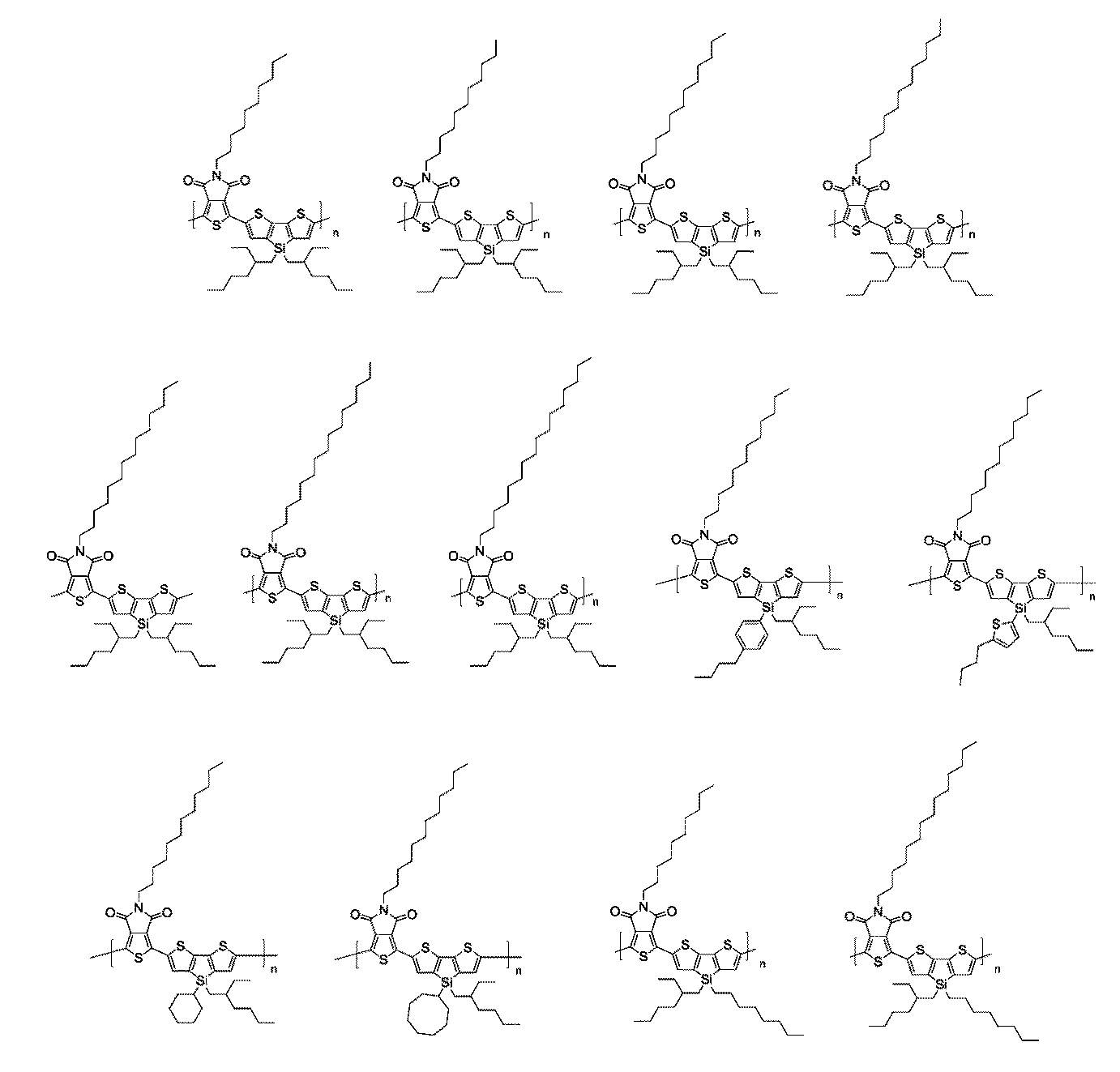
本発明に係るコポリマーの好ましい具体例を以下に示す。しかしながら、本発明に係るコポリマーが以下の例示に限られるわけではない。 Preferred specific examples of the copolymer according to the present invention are shown below. However, the copolymer according to the present invention is not limited to the following examples.
本発明に係るコポリマーのポリスチレン換算の重量平均分子量(Mw)は、通常2.0×10⁴以上、好ましくは3.0×10⁴以上、より好ましくは4.0×10⁴以上、さらに好ましくは5.0×10⁴以上、よりさらに好ましくは7.0×10⁴以上、特に好ましくは1.0×10⁵以上である。一方、好ましくは1.0×10⁷以下、より好ましくは1.0×10⁶以下、特に好ましくは5.0×10⁵以下である。光吸収波長を長波長化するという観点、高い吸光度を実現するという観点、高いキャリア移動を実現できるという観点、及び有機溶媒への溶解度の観点から、重量平均分子量がこの範囲にあることが好ましい。 The polystyrene-converted weight average molecular weight (Mw) of the copolymer according to the present invention is usually 2.0 × 10 4 or more, preferably 3.0 × 10 4 or more, more preferably 4.0 × 10 4 or more, and still more preferably. It is 5.0 × 10 4 or more, more preferably 7.0 × 10 4 or more, and particularly preferably 1.0 × 10 5 or more. On the other hand, it is preferably 1.0 × 10 7 or less, more preferably 1.0 × 10 6 or less, and particularly preferably 5.0 × 10 5 or less. The weight average molecular weight is preferably in this range from the viewpoint of increasing the light absorption wavelength, from the viewpoint of realizing high absorbance, from the viewpoint of realizing high carrier movement, and from the viewpoint of solubility in an organic solvent.
本発明に係るコポリマーのポリスチレン換算の数平均分子量(Mn)は、通常5.0×10³以上、好ましくは1.0×10⁴以上、より好ましくは2.0×10⁴以上、さらに好ましくは2.5×10⁴以上、特に好ましくは3.0×10⁴以上である。一方、好ましくは1.0×10⁷以下、より好ましくは1.0×10⁶以下、さらに好ましくは5.0×10⁵以下、殊更に好ましくは2.0×10⁵以下、特に好ましくは1.0×10⁵以下である。光吸収波長を長波長化するという観点、高い吸光度を実現するという観点、高いキャリア移動を実現できるという観点、及び有機溶媒への溶解度の観点から、数平均分子量がこの範囲にあることが好ましい。 The polystyrene-reduced number average molecular weight (Mn) of the copolymer according to the present invention is usually 5.0 × 10 3 or more, preferably 1.0 × 10 4 or more, more preferably 2.0 × 10 4 or more, and still more preferably. It is 2.5 × 10 4 or more, particularly preferably 3.0 × 10 4 or more. On the other hand, it is preferably 1.0 × 10 7 or less, more preferably 1.0 × 10 6 or less, further preferably 5.0 × 10 5 or less, even more preferably 2.0 × 10 5 or less, and particularly preferably 1 0.0 × 10 5 or less. The number average molecular weight is preferably in this range from the viewpoint of increasing the light absorption wavelength, from the viewpoint of realizing high absorbance, from the viewpoint of realizing high carrier movement, and from the viewpoint of solubility in an organic solvent.
本発明に係るコポリマーの分子量分布(PDI,(重量平均分子量/数平均分子量(Mw/Mn)))は、通常1.0以上、好ましくは1.1以上、より好ましくは1.2以上、さらに好ましくは1.3以上である。一方、好ましくは20.0以下、より好ましくは15.0以下、さらに好ましくは10.0以下である。コポリマーの溶解度が塗布に適した範囲になりうるという点で、分子量分布がこの範囲にあることが好ましい。 The molecular weight distribution (PDI, (weight average molecular weight / number average molecular weight (Mw / Mn))) of the copolymer according to the present invention is usually 1.0 or more, preferably 1.1 or more, more preferably 1.2 or more, Preferably it is 1.3 or more. On the other hand, it is preferably 20.0 or less, more preferably 15.0 or less, and still more preferably 10.0 or less. The molecular weight distribution is preferably in this range in that the solubility of the copolymer can be in a range suitable for coating.
本発明に係るコポリマーのポリスチレン換算の重量平均分子量、数平均分子量、及び分子量分布は、ゲル浸透クロマトグラフィー(GPC)により求めることができる。具体的には、カラムとして、PolymerLaboratories GPC用カラム(PLgel MIXED−B 10μm 内径7.5mm,長さ30cm)を2本直列に繋げて用い、ポンプとしてLC−10AT(島津製作所社製)、オーブンとしてCTO−10A(島津製作所社製)、検出器として示差屈折率検出器(島津製作所製:RID−10A)、及びUV−vis検出器(島津製作所製:SPD−10A)を用いることにより測定できる。測定方法としては、測定対象のコポリマー(1mg)をクロロホルム(200mg)に溶解させ、得られた溶液1μLをカラムに注入する。移動相としてクロロホルムを用い、1.0mL/minの流速で測定を行う。解析にはLC−Solution(島津製作所製)を用いる。
The polystyrene-reduced weight average molecular weight, number average molecular weight, and molecular weight distribution of the copolymer according to the present invention can be determined by gel permeation chromatography (GPC). Specifically, two Polymer Laboratories GPC columns (PLgel MIXED-
本発明に係るコポリマーは、好ましくは光吸収極大波長(λmax)が通常470nm以上、好ましくは480nm以上にあり、一方、通常1200nm以下、好ましくは1000nm以下、より好ましくは900nm以下にある。また、350nmから850nmの範囲で最も長波長側にある吸収極大波長の半値幅が通常10nm以上、好ましくは20nm以上であり、一方、通常300nm以下である。また、本発明に係るコポリマーを太陽電池用途に用いる場合、コポリマーの吸収波長領域は太陽光の波長領域に近いほど望ましい。 The copolymer according to the present invention preferably has a light absorption maximum wavelength (λ max ) of usually 470 nm or more, preferably 480 nm or more, while usually 1200 nm or less, preferably 1000 nm or less, more preferably 900 nm or less. Further, the full width at half maximum of the absorption maximum wavelength on the longest wavelength side in the range of 350 nm to 850 nm is usually 10 nm or more, preferably 20 nm or more, and usually 300 nm or less. Moreover, when using the copolymer which concerns on this invention for a solar cell use, it is so desirable that the absorption wavelength range of a copolymer is near the wavelength range of sunlight.
本発明に係るコポリマーの溶解度は、特に限定は無いが、好ましくは25℃におけるクロロベンゼンに対する溶解度が通常0.1質量%以上、好ましくは0.5質量%以上、さらに好ましくは1質量%以上であり、一方、通常30質量%以下、好ましくは20質量%である。溶解性が高いことは、塗布によりより厚い膜を成膜できるために好ましい。 The solubility of the copolymer according to the present invention is not particularly limited, but preferably the solubility in chlorobenzene at 25 ° C. is usually 0.1% by mass or more, preferably 0.5% by mass or more, more preferably 1% by mass or more. On the other hand, it is usually 30% by mass or less, preferably 20% by mass. High solubility is preferable because a thicker film can be formed by coating.
本発明に係るコポリマーは、分子間で適度な相互作用が起こることが好ましい。本明細書において、分子間で相互作用するということは、分子間でのπ−πスタッキング等の相互作用によってポリマー鎖間の距離が短くなることを意味する。相互作用が強いほど、高い移動度及び/又は結晶性を示す傾向があるため、半導体材料として好適であるものと考えられる。すなわち、分子間で相互作用するコポリマーにおいては分子間での電子移動が起こりやすいため、例えば光電変換素子において活性層中に本発明に係るコポリマーを用いた場合に、活性層内のp型半導体化合物とn型半導体化合物との界面で生成した正孔(ホール)を効率よく電極(アノード)へ輸送できると考えられる。 The copolymer according to the present invention preferably has an appropriate interaction between molecules. In the present specification, the interaction between molecules means that the distance between polymer chains is shortened by an interaction such as π-π stacking between molecules. The stronger the interaction, the higher the mobility and / or crystallinity, and the more suitable the semiconductor material is. That is, in a copolymer that interacts between molecules, electron transfer between molecules is likely to occur. For example, when the copolymer according to the present invention is used in an active layer in a photoelectric conversion element, a p-type semiconductor compound in the active layer is used. It is considered that holes generated at the interface between the n-type semiconductor compound and the n-type semiconductor compound can be efficiently transported to the electrode (anode).
結晶性の測定方法としてはX線回折法(XRD)が挙げられる。本明細書において結晶性を有するとは、XRD測定により得られたX線回折スペクトルが回折ピークを有することを意味する。結晶性を有することは、分子同士が配列した積層構造を有することを意味すると考えられ、後述する活性層を厚膜化できる傾向がある点で好ましい。XRD測定は公知文献(X線結晶解析の手引き(応用物理学選書4))に記載の方法に基づいて行うことができる。 An example of a crystallinity measuring method is an X-ray diffraction method (XRD). In this specification, having crystallinity means that an X-ray diffraction spectrum obtained by XRD measurement has a diffraction peak. Having crystallinity is considered to mean that it has a laminated structure in which molecules are arranged, and is preferable in that the active layer described later tends to be thickened. XRD measurement can be performed based on a method described in a known document (X-ray crystal analysis guide (applied physics selection book 4)).
本発明に係るコポリマーの正孔移動度(ホール移動度と記す場合がある)は、通常1.0×10⁻⁷cm2/Vs以上、好ましくは1.0×10−6cm2/Vs以上、より好ましくは1.0×10−5cm2/Vs以上、特に好ましくは1.0×10−4cm2/Vs以上である。一方、本発明に係るコポリマーの正孔移動度は通常1.0×104cm2/Vs以下、好ましくは1.0×103cm2/Vs以下であり、より好ましくは1.0×102cm2/Vs以下であり、特に好ましくは1.0×10cm2/Vs以下である。正孔移動度がこの範囲にあることにより、本発明に係るコポリマーは半導体材料として好適に用いられる。また、光電変換素子において高い変換効率を得るためには、n型半導体化合物の移動度と、p型半導体化合物の移動度とのバランスが重要である。本発明に係るコポリマーを光電変換素子においてp型半導体化合物として用いる場合、本発明に係るコポリマーの正孔移動度とn型半導体化合物の電子移動度とを近づける観点から、本発明に係るコポリマーの正孔移動度がこの範囲にあることが好ましい。正孔移動度の測定方法としてはFET法が挙げられる。FET法は公知文献(特開2010−045186号公報)に記載の方法により行うことができる。 The hole mobility of the copolymer according to the present invention (sometimes referred to as hole mobility) is usually 1.0 × 10 −7 cm 2 / Vs or more, preferably 1.0 × 10 −6 cm 2 / Vs or more. More preferably, it is 1.0 × 10 −5 cm 2 / Vs or more, and particularly preferably 1.0 × 10 −4 cm 2 / Vs or more. On the other hand, the hole mobility of the copolymer according to the present invention is usually 1.0 × 10 4 cm 2 / Vs or less, preferably 1.0 × 10 3 cm 2 / Vs or less, and more preferably 1.0 × 10 6. 2 cm 2 / Vs or less, particularly preferably 1.0 × 10 cm 2 / Vs or less. When the hole mobility is in this range, the copolymer according to the present invention is suitably used as a semiconductor material. Further, in order to obtain high conversion efficiency in the photoelectric conversion element, it is important to balance the mobility of the n-type semiconductor compound and the mobility of the p-type semiconductor compound. When the copolymer according to the present invention is used as a p-type semiconductor compound in a photoelectric conversion element, from the viewpoint of bringing the hole mobility of the copolymer according to the present invention close to the electron mobility of the n-type semiconductor compound, the copolymer according to the present invention is positive. The hole mobility is preferably within this range. As a method for measuring the hole mobility, there is an FET method. The FET method can be performed by a method described in a known document (Japanese Patent Laid-Open No. 2010-045186).
一方で、本発明に係るコポリマーは溶液状態での保存安定性が高いことが好ましい。保存安定性が高いとは、溶液とした時に凝集しにくいことを意味する。より具体的には、本発明に係るコポリマー2mgを2mLのスクリューバイアルに入れ、1.5質量%の濃度になるようにo−キシレンに加熱溶解させてから室温まで冷却した際に、冷却を開始してから5分間以上ゲル化しないことが好ましく、1時間以上ゲル化しないことがより好ましい。 On the other hand, the copolymer according to the present invention preferably has high storage stability in a solution state. High storage stability means that it is difficult to aggregate when made into a solution. More specifically, 2 mg of the copolymer according to the present invention was placed in a 2 mL screw vial, dissolved in o-xylene to a concentration of 1.5% by mass, and then cooled to room temperature. Then, it is preferable not to gel for 5 minutes or more, and it is more preferable not to gel for 1 hour or more.
本発明に係るコポリマー中の不純物は極力少ないほうが好ましい。特に、パラジウム、銅等の遷移金属触媒が残っていると、遷移金属の重原子効果による励起子トラップが生じるために電荷移動が阻害され、結果として本発明に係るコポリマーを光電変換素子に用いた際に光電変換効率を低下させるおそれがある。遷移金属触媒の濃度は、コポリマー1gあたり、通常1000ppm以下、好ましくは500pm以下、より好ましくは100ppm以下である。一方、通常0ppmより大きく、1ppm以上であってもよく、3ppm以上であってもよい。 The impurities in the copolymer according to the present invention are preferably as few as possible. In particular, when a transition metal catalyst such as palladium or copper remains, exciton trapping occurs due to the heavy atom effect of the transition metal, which inhibits charge transfer. As a result, the copolymer according to the present invention was used in a photoelectric conversion element. In some cases, the photoelectric conversion efficiency may be reduced. The concentration of the transition metal catalyst is usually 1000 ppm or less, preferably 500 pm or less, more preferably 100 ppm or less, per 1 g of the copolymer. On the other hand, it is usually larger than 0 ppm and may be 1 ppm or more, or 3 ppm or more.
本発明に係るコポリマー中の、末端残基(例えば、後述する式(3A)及び(3B)におけるX及びY)を構成する原子の残存量は、特段の制限は無いが、コポリマー1gあたり、通常6000ppm以下、好ましくは4000ppm以下、より好ましくは3000ppm以下、さらに好ましくは2000ppm以下、よりさらに好ましくは1000ppm以下、特に好ましくは500ppm以下、最も好ましくは200ppm以下である。一方、通常0ppmより大きく、好ましくは1ppm以上、より好ましくは3ppm以上である。 The residual amount of atoms constituting the terminal residue (for example, X and Y in the formulas (3A) and (3B) described later) in the copolymer according to the present invention is not particularly limited, It is 6000 ppm or less, preferably 4000 ppm or less, more preferably 3000 ppm or less, further preferably 2000 ppm or less, still more preferably 1000 ppm or less, particularly preferably 500 ppm or less, and most preferably 200 ppm or less. On the other hand, it is usually greater than 0 ppm, preferably 1 ppm or more, more preferably 3 ppm or more.
特に、本発明に係るコポリマー中のSn原子の残存量としては、コポリマー1gあたり、通常5000ppm以下、好ましくは4000ppm以下、より好ましくは2500ppm以下、さらに好ましくは1000ppm以下、よりさらに好ましくは750ppm以下、特に好ましくは500ppm以下、最も好ましくは100ppm以下である。一方、通常0ppmより大きく、好ましくは1ppm以上、より好ましくは3ppm以上である。Sn原子の残存量が5000ppm以下であることは、熱分解しやすいアルキルスタニル基等が少ないことを意味し、安定性の点で高い性能を得ることができるために、好ましい。 In particular, the residual amount of Sn atoms in the copolymer according to the present invention is usually 5000 ppm or less, preferably 4000 ppm or less, more preferably 2500 ppm or less, further preferably 1000 ppm or less, even more preferably 750 ppm or less, especially per 1 g of the copolymer. Preferably it is 500 ppm or less, and most preferably 100 ppm or less. On the other hand, it is usually greater than 0 ppm, preferably 1 ppm or more, more preferably 3 ppm or more. The remaining amount of Sn atoms of 5000 ppm or less is preferable because it means that there are few alkylstannyl groups and the like that are easily thermally decomposed, and high performance can be obtained in terms of stability.
また、本発明に係るコポリマー中のハロゲン原子の残存量は、コポリマー1gあたり、通常5000ppm以下、好ましくは4000ppm以下、より好ましくは2500ppm以下、さらに好ましくは1000ppm以下、よりさらに好ましくは750ppm以下、特に好ましくは500ppm以下、最も好ましくは100ppm以下である。一方、通常0ppmより大きく、好ましくは1ppm以上、より好ましくは3ppm以上である。ハロゲン原子の残存量を5000ppm以下にすることは、コポリマーの光電変換特性及び耐久性等の性能が向上する傾向にあるため、好ましい。 Further, the residual amount of halogen atoms in the copolymer according to the present invention is usually 5000 ppm or less, preferably 4000 ppm or less, more preferably 2500 ppm or less, further preferably 1000 ppm or less, even more preferably 750 ppm or less, and particularly preferably, per 1 g of the copolymer. Is 500 ppm or less, most preferably 100 ppm or less. On the other hand, it is usually greater than 0 ppm, preferably 1 ppm or more, more preferably 3 ppm or more. It is preferable to set the residual amount of halogen atoms to 5000 ppm or less because performances such as the photoelectric conversion characteristics and durability of the copolymer tend to be improved.
コポリマー中の、末端残基(例えば、後述する式(3A)及び(3B)におけるX及びY)を構成する原子の残存量は、元素量を測定することにより決定できる。コポリマーの元素分析は、例えばPd及びSnについてはICP質量分析法で実施することができ、臭素イオン(Br−)及びヨウ素イオン(I−)についても、ICP質量分析法で実施することができる。 The residual amount of atoms constituting the terminal residue (for example, X and Y in the formulas (3A) and (3B) described later) in the copolymer can be determined by measuring the element amount. The elemental analysis of the copolymer can be carried out by ICP mass spectrometry for Pd and Sn, for example, and can also be carried out by ICP mass spectrometry for bromine ions (Br − ) and iodine ions (I − ).
ICP質量分析法は、公知文献(「プラズマイオン源質量分析」(学会出版センター))に記載されている方法により実施できる。具体的には、Pd及びSnについては、試料を湿式分解後、分解液中のPd,SnをICP質量分析装置(Agilent Technologies社製 ICP質量分析装置 7500ce型)を用いて検量線法により定量することができる。又、Br−及びI−については、試料を試料燃焼装置(三菱化学アナリテック社製 試料燃焼装置 QF−02型)にて燃焼し、燃焼ガスを還元剤入りのアルカリ吸収液に吸収させた後、吸収液中のBr−及びI−をICP質量分析装置(Agilent Technologies社製 ICP質量分析装置 7500ce型)を用いて検量線法により定量することができる。 ICP mass spectrometry can be carried out by a method described in a known document (“Plasma ion source mass spectrometry” (Academic Publishing Center)). Specifically, for Pd and Sn, after wet decomposition of the sample, Pd and Sn in the decomposition solution are quantified by a calibration curve method using an ICP mass spectrometer (ICP mass spectrometer 7500ce type manufactured by Agilent Technologies). be able to. For Br − and I − , the sample was burned with a sample combustion device (sample combustion device QF-02 type manufactured by Mitsubishi Chemical Analytech Co., Ltd.), and the combustion gas was absorbed into an alkaline absorbent containing a reducing agent. Br − and I − in the absorbing solution can be quantified by a calibration curve method using an ICP mass spectrometer (ICP mass spectrometer 7500ce type manufactured by Agilent Technologies).
<2.本発明に係るコポリマーの製造方法>
本発明に係るコポリマーの製造方法には特に限定はなく、例えばジオキソピロール縮合環を有する化合物と、ジチエノ縮合環を有する化合物と、を用いて公知の方法で製造することができる。好ましい方法としては、下記一般式(3A)で表される化合物と、下記一般式(3B)で表される化合物とを、必要であれば適当な触媒の存在下で、重合する方法が挙げられる。
<2. Method for producing copolymer according to the present invention>
The method for producing the copolymer according to the present invention is not particularly limited. For example, the copolymer can be produced by a known method using a compound having a dioxopyrrole condensed ring and a compound having a dithieno condensed ring. Preferable methods include a method of polymerizing a compound represented by the following general formula (3A) and a compound represented by the following general formula (3B) in the presence of an appropriate catalyst if necessary. .
式(3A)中、R1、R2及びAは、式(1A)と同義である。式(3B)中、R3、R4及びQは、式(1B)と同義である。 In formula (3A), R 1 , R 2 and A have the same meaning as in formula (1A). In formula (3B), R 3 , R 4 and Q have the same meaning as in formula (1B).
式(3A)及び(3B)中、X及びYは、重合反応の種類に応じて適宜選択できる。例えば、本発明に係るコポリマーは、カップリング反応を用いた重合反応により製造することができる。使用可能な反応としては、Suzuki−Miyauraクロスカップリング反応方法、Stilleカップリング反応方法、Yamamotoカップリング反応方法、Grignard反応方法、ヘック反応方法、薗頭反応方法、FeCl3等の酸化剤を用いる反応方法、電気化学的な酸化反応を用いる方法、適当な脱離基を有する中間体化合物の分解による反応方法等が挙げられる。これらの中でも、Suzuki−Miyauraカップリング反応方法、Stilleカップリング反応方法、Yamamotoカップリング反応方法、Grignard反応方法が、構造制御がしやすい点で好ましい。特に、Suzuki−Miyauraクロスカップリング反応方法、Stilleカップリング反応方法、Grignard反応方法が、材料の入手しやすさ、反応操作の簡便さの点からも好ましい。これらの反応は、「クロスカップリング−基礎と産業応用−(CMC出版)」、「有機合成のための遷移金属触媒反応(辻二郎著:有機合成化学協会編)」、「有機合成のための触媒反応103(檜山為次郎:東京化学同人)」等の公知文献の記載の方法に従って行うことができる。 In the formulas (3A) and (3B), X and Y can be appropriately selected depending on the type of polymerization reaction. For example, the copolymer according to the present invention can be produced by a polymerization reaction using a coupling reaction. Usable reactions include a Suzuki-Miyaura cross-coupling reaction method, a Stille coupling reaction method, a Yamamoto coupling reaction method, a Grignard reaction method, a Heck reaction method, a Sonogashira reaction method, and a reaction using an oxidizing agent such as FeCl 3. And a method using an electrochemical oxidation reaction, a reaction method by decomposition of an intermediate compound having an appropriate leaving group, and the like. Among these, the Suzuki-Miyaura coupling reaction method, the Stille coupling reaction method, the Yamamoto coupling reaction method, and the Grignard reaction method are preferable in terms of easy structure control. In particular, the Suzuki-Miyaura cross-coupling reaction method, the Stille coupling reaction method, and the Grignard reaction method are preferable from the viewpoint of easy availability of materials and easy reaction operation. These reactions are described in "Cross Coupling-Fundamentals and Industrial Applications (CMC Publishing)", "Transition Metal Catalyzed Reactions for Organic Synthesis (edited by Jiro Jiro: edited by Organic Synthetic Chemistry Association)", "For Organic Synthesis" The reaction can be carried out according to a method described in known literature such as “catalytic reaction 103 (Teijiro Hatakeyama: Tokyo Kagaku Dojin)”.
X及びYの例としては、それぞれ独立して、ハロゲン原子、アルキルスタニル基、アルキルスルホ基、アリールスルホ基、アリールアルキルスルホ基、ホウ酸エステル残基、スルホニウムメチル基、ホスホニウムメチル基、ホスホネートメチル基、モノハロゲン化メチル基、ホウ酸残基(−B(OH)2)、ホルミル基、シリル基、アルケニル基又はアルキニル基等が挙げられる。 Examples of X and Y are each independently a halogen atom, alkylstannyl group, alkylsulfo group, arylsulfo group, arylalkylsulfo group, boric acid ester residue, sulfoniummethyl group, phosphoniummethyl group, phosphonatemethyl Group, monohalogenated methyl group, boric acid residue (-B (OH) 2 ), formyl group, silyl group, alkenyl group or alkynyl group.
ハロゲン原子としては、臭素原子又はヨウ素原子が好ましい。アルケニル基としては、例えば炭素数2以上12以下のアルケニル基が挙げられる。 As the halogen atom, a bromine atom or an iodine atom is preferable. Examples of the alkenyl group include alkenyl groups having 2 to 12 carbon atoms.
ホウ酸エステル残基としては、例えば、下式で示されるものが挙げられる。下式において、Meはメチル基を表し、Etはエチル基を表す。
アルキルスタニル基としては、例えば、下式で示されるものが挙げられる。下式において、Meはメチル基を表し、Buはn−ブチル基を表す。
式(3A)及び(3B)で表される化合物の合成上の観点及び反応のし易さの観点から、XとYとの一方がハロゲン原子であり、他方がアルキルスタニル基、ホウ酸エステル残基、又はホウ酸残基(−B(OH)2)であることが好ましい。 From the viewpoint of the synthesis of the compounds represented by formulas (3A) and (3B) and the ease of reaction, one of X and Y is a halogen atom, and the other is an alkylstannyl group or borate ester. It is preferably a residue or a boric acid residue (—B (OH) 2 ).
重合反応は公知の方法に従って行うことができる。例えば、X又はYがアルキルスタニル基である場合には公知のStilleカップリング反応の条件に従って反応を行えばよい。また、X又はYがホウ酸エステル残基又はホウ酸残基である場合には公知のSuzuki−Miyauraカップリング反応の条件に従って反応を行えばよい。さらに、X又はYがシリル基である場合には公知のHiyamaカップリング反応の条件に従って反応を行えばよい。カップリング反応の触媒としては例えば、パラジウム等の遷移金属と、配位子(例えばトリフェニルホスフィン等のホスフィン配位子)との組み合わせを用いることができる。 The polymerization reaction can be performed according to a known method. For example, when X or Y is an alkylstannyl group, the reaction may be performed in accordance with known Stille coupling reaction conditions. In addition, when X or Y is a boric acid ester residue or a boric acid residue, the reaction may be performed according to the conditions of a known Suzuki-Miyaura coupling reaction. Furthermore, when X or Y is a silyl group, the reaction may be carried out in accordance with known Hiyama coupling reaction conditions. As a catalyst for the coupling reaction, for example, a combination of a transition metal such as palladium and a ligand (for example, a phosphine ligand such as triphenylphosphine) can be used.
以下では、Stilleカップリング反応方法を用いて本発明に係るコポリマーを製造する方法について述べる。Stilleカップリング反応方法を用いる場合、式(3A)及び(3B)において、Xがハロゲン原子でありかつYがアルキルスタニル基であるか、Xがアルキルスタニル基でありかつYがハロゲン原子であることが好ましい。 Hereinafter, a method for producing the copolymer according to the present invention using the Stille coupling reaction method will be described. When the Stille coupling reaction method is used, in the formulas (3A) and (3B), X is a halogen atom and Y is an alkylstannyl group, or X is an alkylstannyl group and Y is a halogen atom. Preferably there is.
重合反応において用いられる、式(3A)で表される化合物の量に対する、式(3B)で表される化合物の量の比(3B/3A)は、モル比換算にして、通常0.90以上、好ましくは0.95以上であり、一方、通常1.3以下、好ましくは1.2以下である。比率がこのような範囲内にあることは、より高い収率で高分子量体を取得しうる点で好ましい。 The ratio (3B / 3A) of the amount of the compound represented by the formula (3B) to the amount of the compound represented by the formula (3A) used in the polymerization reaction is usually 0.90 or more in terms of molar ratio. , Preferably 0.95 or more, and usually 1.3 or less, preferably 1.2 or less. It is preferable that the ratio is in such a range in that a high molecular weight product can be obtained with a higher yield.
本発明に係るコポリマーが高純度であることが望ましい場合には、重合前のモノマー(式(3A)及び(3B)で表される化合物)を精製した後に、重合反応を行うことが好ましい。精製方法としては、例えば、蒸留、昇華精製、カラムクロマトグラフィー又は再結晶等が挙げられる。 When it is desirable that the copolymer according to the present invention has a high purity, it is preferable to carry out the polymerization reaction after purifying the monomer before polymerization (compounds represented by formulas (3A) and (3B)). Examples of the purification method include distillation, sublimation purification, column chromatography, recrystallization, and the like.
例えば本発明に係るコポリマーを有機光電変換素子用の材料として用いる場合、その純度が高いことにより素子特性が向上しうるため、コポリマーが高純度であることが望ましい。本発明に係るコポリマーを有機光電変換素子用の材料として用いる場合、式(3A)及び(3B)で表される化合物のそれぞれの純度は通常90%以上、好ましくは95%以上である。 For example, when the copolymer according to the present invention is used as a material for an organic photoelectric conversion device, it is desirable that the copolymer has a high purity since the device characteristics can be improved due to its high purity. When the copolymer according to the present invention is used as a material for an organic photoelectric conversion element, the purity of each of the compounds represented by formulas (3A) and (3B) is usually 90% or more, preferably 95% or more.
重合反応において重合促進のために用いる触媒としては、遷移金属触媒等が挙げられる。遷移金属触媒は、重合の種類に応じて選択すればよい。遷移金属触媒としては、均一系遷移金属触媒と不均一系遷移金属触媒とが挙げられる。 Examples of the catalyst used for the promotion of polymerization in the polymerization reaction include transition metal catalysts. What is necessary is just to select a transition metal catalyst according to the kind of superposition | polymerization. Examples of transition metal catalysts include homogeneous transition metal catalysts and heterogeneous transition metal catalysts.
均一系遷移金属触媒としては、重合反応に用いる溶媒に十分に溶解するものが好ましい。好ましい例としては、特に、パラジウム、ニッケル、鉄、又は銅を含む、後周期遷移金属錯体触媒が挙げられる。具体的な例としては、テトラキス(トリフェニルホスフィン)パラジウム(Pd(PPh3)4)又はトリス(ジベンジリデンアセトン)ジパラジウム(Pd2(dba)3)等の0価のパラジウム触媒;ビス(トリフェニルホスフィン)塩化パラジウム(PdCl2((PPh3))2)又は酢酸パラジウム等の2価のパラジウム触媒等のパラジウム(Pd)触媒;Ni(dppp)Cl2又はNi(dppe)Cl2等のニッケル触媒;塩化鉄等の鉄触媒;ヨウ化銅等の銅触媒等が挙げられる。ここで、dbaはジベンジリデンアセトンを表し、dpppは1,2−ビス(ジフェニルホスフィノ)プロパンを表し、dppeは1,2−ビス(ジフェニルホスフィノ)エタンを表す。 The homogeneous transition metal catalyst is preferably one that is sufficiently soluble in the solvent used for the polymerization reaction. Preferred examples include late transition metal complex catalysts containing palladium, nickel, iron, or copper, among others. Specific examples include zero-valent palladium catalysts such as tetrakis (triphenylphosphine) palladium (Pd (PPh 3 ) 4 ) or tris (dibenzylideneacetone) dipalladium (Pd 2 (dba) 3 ); bis (tri Palladium (Pd) catalysts such as phenylphosphine) palladium chloride (PdCl 2 ((PPh 3 )) 2 ) or divalent palladium catalysts such as palladium acetate; nickel such as Ni (dppp) Cl 2 or Ni (dppe) Cl 2 Catalysts: iron catalysts such as iron chloride; copper catalysts such as copper iodide. Here, dba represents dibenzylideneacetone, dppp represents 1,2-bis (diphenylphosphino) propane, and dppe represents 1,2-bis (diphenylphosphino) ethane.
0価のPd触媒として具体的には、Pd(PPh3)4、Pd(P(o−tolyl)3)4、Pd(PCy3)2、Pd2(dba)3、PdCl2(PPh3))2等が挙げられる。PdCl2((PPh3))2又は酢酸パラジウム等の2価のPd触媒を用いる場合には、PPh3やP(o−tolyl)3等の有機配位子と併せて使用することが好ましい。ここで、Phはフェニル基を表し、Cyはシクロヘキシル基を表し、o−tolylは2−トリル基を表す。 Specific examples of the zero-valent Pd catalyst include Pd (PPh 3 ) 4 , Pd (P (o-tolyl) 3 ) 4 , Pd (PCy 3 ) 2 , Pd 2 (dba) 3, PdCl 2 (PPh 3 ) ) 2 etc. are mentioned. When a divalent Pd catalyst such as PdCl 2 ((PPh 3 )) 2 or palladium acetate is used, it is preferably used in combination with an organic ligand such as PPh 3 or P (o-tolyl) 3 . Here, Ph represents a phenyl group, Cy represents a cyclohexyl group, and o-tolyl represents a 2-tolyl group.
不均一系遷移金属触媒としては、上述のような均一系遷移金属触媒を、担体に担持させることによって得られる触媒が挙げられる。不均一系遷移金属触媒が含む遷移金属の好ましい例としては、パラジウム、ニッケル、鉄、又は銅を含む、後周期遷移金属が挙げられる。不均一系遷移金属錯体触媒が有する有機配位子としては、均一系遷移金属錯体触媒について挙げたものと同様のものを用いることができる。また、公知文献(Strem社,”Heterogeneous Catalysts”(2011年))記載の有機配位子を用いることもできる。担体の例としては、金属、ナノコロイド、ナノ粒子、磁性化合物、金属酸化物、多孔質物質、粘土、例えば尿素樹脂のようなポリマー、及びデンドリマー等が挙げられる。多孔質物質の具体的な例としては、ミクロ孔物質、メソ孔物質、活性炭、シリカゲル、アルミナ、及びゼオライト等が挙げられる。特に、ポリマーに担持された不均一系遷移金属錯体触媒を用いることは、不均一系遷移金属錯体触媒の回収が容易であるために好ましい。また、ポリマーが多孔性であることは、反応を促進する点でより好ましい。 Examples of the heterogeneous transition metal catalyst include a catalyst obtained by supporting a homogeneous transition metal catalyst as described above on a carrier. Preferable examples of the transition metal included in the heterogeneous transition metal catalyst include late transition metals including palladium, nickel, iron, or copper. As an organic ligand which a heterogeneous transition metal complex catalyst has, the same thing as what was mentioned about the homogeneous transition metal complex catalyst can be used. In addition, organic ligands described in known literature (Strem, “Heterogeneous Catalysts” (2011)) can also be used. Examples of the carrier include metals, nanocolloids, nanoparticles, magnetic compounds, metal oxides, porous materials, clays, polymers such as urea resins, and dendrimers. Specific examples of the porous material include microporous material, mesoporous material, activated carbon, silica gel, alumina, and zeolite. In particular, it is preferable to use a heterogeneous transition metal complex catalyst supported on a polymer because the heterogeneous transition metal complex catalyst can be easily recovered. Moreover, it is more preferable that the polymer is porous in terms of promoting the reaction.
重合反応においては、2種以上の遷移金属錯体触媒を用いることが、高分子量のコポリマーが得られうる点で好ましい。例えば、2種以上の均一系遷移金属錯体を用いてもよいし、2種以上の不均一系遷移金属錯体を用いてもよいし、均一系遷移金属錯体と不均一系遷移金属錯体とを組み合わせて用いてもよい。この2種以上の遷移金属錯体触媒のうち、少なくとも1種は不均一系金属錯体触媒であることが、カップリング反応条件下でモノマーをすばやくオリゴマーに変換することができる点で好ましい。また、オリゴマーになると不均一系金属触媒による重合反応速度が落ちる傾向にあるため、オリゴマーからポリマーへの誘導を均一系金属触媒で行う方が、高分子量体を得るために好ましい。この観点から、2種以上の遷移金属錯体触媒のうち、少なくとも1種が不均一系金属錯体触媒であり、かつ少なくとも1種が均一系金属錯体触媒であることがより好ましい。 In the polymerization reaction, it is preferable to use two or more transition metal complex catalysts in that a high molecular weight copolymer can be obtained. For example, two or more kinds of homogeneous transition metal complexes may be used, two or more kinds of heterogeneous transition metal complexes may be used, or a combination of a homogeneous transition metal complex and a heterogeneous transition metal complex may be used. May be used. Of these two or more transition metal complex catalysts, at least one of them is preferably a heterogeneous metal complex catalyst in that a monomer can be quickly converted into an oligomer under coupling reaction conditions. In addition, since oligomerization tends to decrease the polymerization reaction rate due to the heterogeneous metal catalyst, it is preferable to induce the oligomer to the polymer with the homogeneous metal catalyst in order to obtain a high molecular weight product. From this viewpoint, it is more preferable that at least one of the two or more transition metal complex catalysts is a heterogeneous metal complex catalyst and at least one is a homogeneous metal complex catalyst.
式(3A)及び(3B)で表される化合物の量の合計に対する遷移金属錯体の使用量は、通常1×10⁻⁴mol%以上、好ましくは1×10⁻³mol%以上、より好ましくは1×10⁻²mol%以上であり、一方、通常1×10²mol%以下、より好ましくは5mol%以下である。触媒の使用量がこの範囲にあることは、より低コストかつ高い収率で、より高分子量のコポリマーが得られる傾向にある点で好ましい。 The amount of the transition metal complex used relative to the total amount of the compounds represented by formulas (3A) and (3B) is usually 1 × 10 −4 mol% or more, preferably 1 × 10 −3 mol% or more, more preferably and a 1 × 10 -2 mol% or more, whereas, usually 1 × 10 2 mol%, more preferably at most 5 mol%. It is preferable that the amount of the catalyst used be in this range because a higher molecular weight copolymer tends to be obtained at a lower cost and a higher yield.
遷移金属触媒を使用する場合に、アルカリ、補触媒又は相間移動触媒を併用してもよい。 When a transition metal catalyst is used, an alkali, a cocatalyst, or a phase transfer catalyst may be used in combination.
アルカリとしては、例えば、炭酸カリウム、炭酸ナトリウム、炭酸セシウム等の無機塩基;トリエチルアミン等の有機塩基;等が挙げられる。 Examples of the alkali include inorganic bases such as potassium carbonate, sodium carbonate and cesium carbonate; organic bases such as triethylamine.
補触媒としては、例えば、フッ化セシウム、酸化銅又はハロゲン化銅等の無機塩が挙げられる。補触媒の使用量は、式(3A)及び(3B)で表される化合物の量の合計に対して、通常1×10⁻⁴mol%以上、好ましくは1×10⁻³mol%以上、より好ましくは1×10⁻²mol%以上であり、一方、通常1×10⁴mol%以下、好ましくは1×10³mol%以下、より好ましくは1.5×10²mol%以下である。補触媒の使用量がこの範囲にあることは、より低コストかつ高い収率でコポリマーが得られる傾向にある点で好ましい。 Examples of the cocatalyst include inorganic salts such as cesium fluoride, copper oxide, and copper halide. The amount of the cocatalyst used is usually 1 × 10 −4 mol% or more, preferably 1 × 10 −3 mol% or more, based on the total amount of the compounds represented by formulas (3A) and (3B). Preferably, it is 1 × 10 −2 mol% or more, and is usually 1 × 10 4 mol% or less, preferably 1 × 10 3 mol% or less, more preferably 1.5 × 10 2 mol% or less. It is preferable that the amount of the cocatalyst used be in this range because the copolymer tends to be obtained at a lower cost and with a higher yield.
相間移動触媒としては、テトラエチルアンモニウムヒドロキシド又はAliquat336(アルドリッチ社製)のような四級アンモニウム塩等が挙げられる。相間移動触媒の使用量は、式(3A)及び(3B)で表される化合物の量の合計に対して、通常1×10⁻⁴mol%以上、好ましくは1×10⁻³mol%以上、より好ましくは1×10⁻²mol%以上であり、一方、通常5mol%以下、より好ましくは3mol%以下である。相間移動触媒の使用量がこの範囲にあることは、より低コストかつ高い収率でコポリマーが得られる傾向にある点で好ましい。 Examples of the phase transfer catalyst include tetraethylammonium hydroxide or quaternary ammonium salts such as Aliquat 336 (manufactured by Aldrich). The amount of the phase transfer catalyst used is usually 1 × 10 −4 mol% or more, preferably 1 × 10 −3 mol% or more, based on the total amount of the compounds represented by the formulas (3A) and (3B). More preferably, it is 1 × 10 −2 mol% or more, while it is usually 5 mol% or less, more preferably 3 mol% or less. It is preferable that the amount of the phase transfer catalyst used is in this range because the copolymer tends to be obtained at a lower cost and in a higher yield.
重合反応に用いられる溶媒としては、例えば、ペンタン、ヘキサン、ヘプタン、オクタン又はシクロヘキサン等の飽和炭化水素;ベンゼン、トルエン、エチルベンゼン又はキシレン等の芳香族炭化水素;クロロベンゼン、ジクロロベンゼン又はトリクロロベンゼン等のハロゲン化芳香族炭化水素;メタノール、エタノール、プロパノール、イソプロパノール、ブタノール又はt−ブチルアルコール等のアルコール類;水;ジメチルエーテル、ジエチルエーテル、メチル−t−ブチルエーテル、テトラヒドロフラン、テトラヒドロピラン又はジオキサン等のエーテル類;DMF等の非プロトン性極性有機溶媒等が挙げられる。これらの溶媒は、一種を単独で用いても二種以上を併用してもよい。 Examples of the solvent used in the polymerization reaction include saturated hydrocarbons such as pentane, hexane, heptane, octane, and cyclohexane; aromatic hydrocarbons such as benzene, toluene, ethylbenzene, and xylene; halogens such as chlorobenzene, dichlorobenzene, and trichlorobenzene. Aromatic hydrocarbons; alcohols such as methanol, ethanol, propanol, isopropanol, butanol or t-butyl alcohol; water; ethers such as dimethyl ether, diethyl ether, methyl t-butyl ether, tetrahydrofuran, tetrahydropyran or dioxane; DMF And aprotic polar organic solvents such as These solvents may be used alone or in combination of two or more.
溶媒の使用量は、式(3A)及び(3B)で表される化合物の合計1gに対して、通常、1×10⁻²mL以上、好ましくは1×10⁻¹mL以上、より好ましくは1mL以上であり、一方、通常1×10⁵mL以下、好ましくは1×10³mL以下、より好ましくは2×10²mL以下である。溶媒の使用量がこの範囲にあることは、反応の制御がより容易となる点で好ましい。 The amount of the solvent used is usually 1 × 10 −2 mL or more, preferably 1 × 10 −1 mL or more, more preferably 1 mL with respect to a total of 1 g of the compounds represented by formulas (3A) and (3B). On the other hand, it is usually 1 × 10 5 mL or less, preferably 1 × 10 3 mL or less, more preferably 2 × 10 2 mL or less. It is preferable that the amount of the solvent used is in this range in that the reaction can be easily controlled.
重合反応の反応温度は、通常0℃以上、好ましくは20℃以上、より好ましくは40℃以上、さらに好ましくは60℃以上である。一方、通常300℃以下、好ましくは250℃以下、より好ましくは200℃以下、さらに好ましくは180℃以下、特に好ましくは160℃以下である。加熱方法としては特段の制限は無いが、オイルバス加熱、熱電対加熱、赤外線加熱、マイクロウェーブ加熱の他、IHヒーターを用いた接触による加熱等が挙げられる。重合反応の時間は、通常1分間以上、好ましくは10分間以上、一方、通常160時間以下、好ましくは120時間以下、より好ましくは100時間以下である。また重合反応は窒素(N2)又はアルゴン(Ar)雰囲気下で行うことが好ましい。これらの反応条件で反応を行うことにより、より短時間かつ高い収率でコポリマーが得られうる。 The reaction temperature of the polymerization reaction is usually 0 ° C. or higher, preferably 20 ° C. or higher, more preferably 40 ° C. or higher, and further preferably 60 ° C. or higher. On the other hand, it is usually 300 ° C. or lower, preferably 250 ° C. or lower, more preferably 200 ° C. or lower, further preferably 180 ° C. or lower, and particularly preferably 160 ° C. or lower. The heating method is not particularly limited, but examples include oil bath heating, thermocouple heating, infrared heating, microwave heating, heating by contact using an IH heater, and the like. The time for the polymerization reaction is usually 1 minute or more, preferably 10 minutes or more, while it is usually 160 hours or less, preferably 120 hours or less, more preferably 100 hours or less. The polymerization reaction is preferably performed in a nitrogen (N 2 ) or argon (Ar) atmosphere. By carrying out the reaction under these reaction conditions, the copolymer can be obtained in a shorter time and with a higher yield.
重合反応により得られたコポリマーに対しては、さらに末端処理を行うことが好ましい。コポリマーの末端処理を行うことにより、コポリマーの末端残基(上述のX及びY)の残存量を減らすことができる。例えば、Stilleカップリング反応によってコポリマーを重合した場合には、コポリマーの末端に存在する臭素(Br)やヨウ素(I)等のハロゲン原子及びアルキルスタニル基を、末端処理によって減らすことができる。この末端処理を行うことは、効率及び耐久性の点でよりよい性能のコポリマーを得ることができるために、好ましい。 It is preferable to further end-treat the copolymer obtained by the polymerization reaction. By performing the terminal treatment of the copolymer, the residual amount of the terminal residues (X and Y described above) can be reduced. For example, when a copolymer is polymerized by a Stille coupling reaction, halogen atoms such as bromine (Br) and iodine (I) and alkylstannyl groups present at the terminal of the copolymer can be reduced by terminal treatment. This terminal treatment is preferable because a copolymer having better performance in terms of efficiency and durability can be obtained.
重合反応後に行うコポリマーの末端処理方法としては、特段の制限は無いが、例えば末端残基を芳香族基のような他の置換基で置換する方法が挙げられる。 The terminal treatment method of the copolymer after the polymerization reaction is not particularly limited, and examples thereof include a method of substituting the terminal residue with another substituent such as an aromatic group.
例えば、Stilleカップリング反応によってコポリマーを重合した場合の末端処理方法としては、以下の方法が挙げられる。コポリマーのハロゲン原子の末端処理方法としては、重合反応後の精製前の反応系中に、末端処理剤としてアリールトリアルキルスズを加えた後、加熱攪拌を行うことにより行うことができる。アリールトリアルキルスズの例としてはフェニルトリメチルスズ又はチエニルトリメチルスズ等が挙げられる。コポリマーの末端のハロゲン原子を芳香族基に置換することは、共役安定効果により、コポリマーがより安定になるために、好ましい。 For example, as a terminal treatment method when a copolymer is polymerized by a Stille coupling reaction, the following method may be mentioned. The method for terminal treatment of the halogen atom of the copolymer can be carried out by adding aryltrialkyltin as a terminal treatment agent in the reaction system after the polymerization reaction and before purification, followed by heating and stirring. Examples of aryltrialkyltin include phenyltrimethyltin or thienyltrimethyltin. Substitution of a halogen atom at the terminal of the copolymer with an aromatic group is preferable because the copolymer becomes more stable due to the conjugate stability effect.
末端処理剤の添加量としては、特段の制限は無いが、重合反応に用いたハロゲン原子を末端に有するモノマー(3A又は3B)の量に対して、通常1.0×10⁻²モル当量以上、好ましくは0.1モル当量以上、より好ましくは1モル当量以上であり、一方、通常50モル当量以下、好ましくは20モル当量以下、より好ましくは10モル当量以下である。ハロゲン原子の末端処理の反応温度は、通常0℃以上、好ましくは20℃以上、より好ましくは40℃以上、さらに好ましくは60℃以上である。一方、通常300℃以下、好ましくは250℃以下、より好ましくは200℃以下、さらに好ましくは180℃以下、特に好ましくは160℃以下である。加熱方法としては、特段の制限は無いが、オイルバス加熱、熱電対加熱、赤外線加熱、マイクロウェーブ加熱の他、IHヒーターを用いた接触による加熱等が挙げられる。コポリマーのハロゲン原子の末端処理の反応時間は、特段の制限は無いが、通常30分以上、好ましくは1時間以上であり、一方、通常50時間以下、好ましくは20時間以下である。これらの反応条件で反応を行うことにより、より短時間かつ高い変換率で末端処理を行うことができる。 The addition amount of the end treatment agent is not particularly limited, but is usually 1.0 × 10 −2 molar equivalent or more with respect to the amount of the monomer having a halogen atom at the terminal (3A or 3B) used in the polymerization reaction. , Preferably 0.1 molar equivalents or more, more preferably 1 molar equivalents or more, and usually 50 molar equivalents or less, preferably 20 molar equivalents or less, more preferably 10 molar equivalents or less. The reaction temperature of the halogen atom terminal treatment is usually 0 ° C. or higher, preferably 20 ° C. or higher, more preferably 40 ° C. or higher, and further preferably 60 ° C. or higher. On the other hand, it is usually 300 ° C. or lower, preferably 250 ° C. or lower, more preferably 200 ° C. or lower, further preferably 180 ° C. or lower, and particularly preferably 160 ° C. or lower. The heating method is not particularly limited, and examples thereof include oil bath heating, thermocouple heating, infrared heating, microwave heating, heating by contact using an IH heater, and the like. The reaction time of the terminal treatment of the halogen atom of the copolymer is not particularly limited, but is usually 30 minutes or longer, preferably 1 hour or longer, and is usually 50 hours or shorter, preferably 20 hours or shorter. By performing the reaction under these reaction conditions, the terminal treatment can be performed in a shorter time and with a higher conversion rate.
また、コポリマーのアルキルスタニル基の末端処理方法としては、重合反応後の精製前の反応系中に、末端処理剤としてアリールハライドを加えたのち、加熱攪拌を行うことにより行うことができる。アリールハライドの例としてはヨードチオフェン、ヨードベンゼン、ブロモチオフェン又はブロモベンゼン等が挙げられる。コポリマーの末端のアルキルスタニル基を別の置換基へと置換することにより、熱分解しやすいアルキルスタニル基中のSn原子がコポリマー中に存在しなくなり、コポリマーの経時劣化が抑えられうる。また、コポリマーの末端のアルキルスタニル基をアリール基に置換することは、共役安定効果によりコポリマーがより安定になりうる点においても好ましい。 Further, the terminal treatment method of the alkylstannyl group of the copolymer can be carried out by adding an aryl halide as a terminal treating agent in the reaction system after the polymerization reaction and before purification, followed by heating and stirring. Examples of aryl halides include iodothiophene, iodobenzene, bromothiophene or bromobenzene. By substituting the alkylstannyl group at the terminal of the copolymer with another substituent, the Sn atom in the alkylstannyl group which is easily thermally decomposed does not exist in the copolymer, and deterioration of the copolymer over time can be suppressed. Further, substitution of the alkylstannyl group at the terminal of the copolymer with an aryl group is also preferable in that the copolymer can be more stable due to the conjugate stability effect.
末端処理剤の添加量としては、特段の制限は無いが、重合に用いたアルキルスタニル基を末端に有するモノマー(3B又は3A)の量に対して、通常1.0×10⁻²モル当量以上、好ましくは0.1モル当量以上、より好ましくは1モル当量以上であり、一方、通常50モル当量以下、好ましくは20モル当量以下、より好ましくは10モル当量以下である。アルキルスタニル基の末端処理の反応温度及び反応条件としては、コポリマーのハロゲン原子の末端処理と同様のものを用いることができる。これらの反応条件で反応を行うことにより、より短時間かつ高い変換率で末端処理を行うことができる。 The addition amount of the end treatment agent is not particularly limited, but is usually 1.0 × 10 −2 molar equivalent to the amount of the monomer (3B or 3A) having an alkylstannyl group at the terminal used for polymerization. As mentioned above, Preferably it is 0.1 molar equivalent or more, More preferably, it is 1 molar equivalent or more, On the other hand, Usually, it is 50 molar equivalent or less, Preferably it is 20 molar equivalent or less, More preferably, it is 10 molar equivalent or less. As the reaction temperature and reaction conditions for the terminal treatment of the alkylstannyl group, those similar to the terminal treatment of the halogen atom of the copolymer can be used. By performing the reaction under these reaction conditions, the terminal treatment can be performed in a shorter time and with a higher conversion rate.
また、Suzuki−Miyauraクロスカップリング反応によりコポリマーを重合した場合の末端処理の方法としては、以下の方法が挙げられる。コポリマーのハロゲン原子の末端処理方法としては、アリールボロン酸を加えたのち、加熱攪拌を行う方法が挙げられる。コポリマーのホウ素原子含有基の末端処理方法としては、末端処理剤としてアリールハライドを加えたのち、加熱攪拌を行う方法が挙げられる。 Moreover, the following method is mentioned as a method of terminal treatment at the time of polymerizing a copolymer by Suzuki-Miyaura cross-coupling reaction. Examples of the method for terminal treatment of the halogen atom of the copolymer include a method in which arylboronic acid is added and then heated and stirred. Examples of the terminal treatment method of the boron atom-containing group of the copolymer include a method in which an aryl halide is added as a terminal treatment agent and then heated and stirred.
末端残基Xの末端処理方法及び末端残基Yの末端処理方法に特段の制限はないが、それぞれ独立に行うことが好ましい。なお、それぞれの末端処理の順序に特段の制限は無く、適宜選択できる。 There are no particular restrictions on the terminal treatment method for terminal residue X and the terminal treatment method for terminal residue Y, but it is preferable to carry out each independently. In addition, there is no special restriction | limiting in the order of each terminal process, It can select suitably.
また、末端処理は、コポリマーの精製前に行ってもよいが、コポリマーの精製後に行ってもよい。末端処理をコポリマー精製後に行う場合には、コポリマーと片方の末端処理剤(例えばアリールハライド又はアリールトリアルキルスズ)とを有機溶剤に溶解した後、パラジウム触媒等の遷移金属触媒を加えて反応を行い、さらにもう片方の末端処理剤(アリールトリアルキルスズ又はアリールハライド)を加えて反応を行えばよい。反応を促進する観点から、末端処理をコポリマー精製前に行う場合と同様に、末端処理時には加熱攪拌を行うことか好ましい。また、収率を向上させる観点から、反応を窒素条件下で行うことも好ましい。反応時間は、特段の制限は無いが、通常30分以上、好ましくは1時間以上であり、一方、通常25時間以下、好ましくは10時間以下である。 Further, the terminal treatment may be performed before the purification of the copolymer, but may be performed after the purification of the copolymer. When the end treatment is performed after the copolymer purification, the copolymer and one of the end treatment agents (for example, aryl halide or aryltrialkyltin) are dissolved in an organic solvent, and then a reaction is performed by adding a transition metal catalyst such as a palladium catalyst. Further, the other end treatment agent (aryltrialkyltin or aryl halide) may be added to carry out the reaction. From the viewpoint of accelerating the reaction, it is preferable to perform heating and stirring during the terminal treatment, as in the case where the terminal treatment is performed before the purification of the copolymer. Moreover, it is also preferable to perform reaction under nitrogen conditions from a viewpoint of improving a yield. The reaction time is not particularly limited, but is usually 30 minutes or longer, preferably 1 hour or longer, and is usually 25 hours or shorter, preferably 10 hours or shorter.
遷移金属触媒の添加量としては、特段の制限は無いが、式(3A)又は(3B)で表される化合物の量の合計に対して、通常5.0×10⁻³モル当量以上、好ましくは1.0×10⁻²モル当量以上であり、一方、通常1.0×10⁻¹モル当量以下、好ましくは5.0×10⁻²モル当量以下である。触媒の添加量がこの範囲にあることにより、より低コストかつ高い変換率で末端処理を行うことができる。 The addition amount of the transition metal catalyst is not particularly limited, but is usually 5.0 × 10 −3 molar equivalent or more, preferably the total amount of the compound represented by the formula (3A) or (3B), Is 1.0 × 10 −2 molar equivalent or more, and is usually 1.0 × 10 −1 molar equivalent or less, preferably 5.0 × 10 −2 molar equivalent or less. When the addition amount of the catalyst is within this range, the end treatment can be performed at a lower cost and at a higher conversion rate.
コポリマー精製後の末端処理時における、アルキルスタニル基の末端処理剤の添加量としては、特段の制限は無いが、重合に用いたアルキルスタニル基を末端に有するモノマー(3B又は3A)の量に対して、通常1.0×10⁻²モル当量以上、好ましくは1.0×10⁻¹モル当量以上、より好ましくは1モル当量以上であり、一方、通常50モル当量以下、好ましくは20モル当量以下、より好ましくは10モル当量以下である。末端処理剤の添加量がこの範囲にあることにより、より低コストかつ高い変換率で末端処理を行うことができる。 There is no particular limitation on the amount of the alkylstannyl end-treating agent added at the end treatment after refining the copolymer, but the amount of the monomer (3B or 3A) having an alkylstannyl group used for polymerization is not limited. Is usually 1.0 × 10 −2 molar equivalents or more, preferably 1.0 × 10 −1 molar equivalents or more, more preferably 1 molar equivalents or more, and usually 50 molar equivalents or less, preferably 20 The molar equivalent or less, more preferably 10 molar equivalent or less. When the added amount of the end treatment agent is within this range, the end treatment can be performed at a lower cost and at a higher conversion rate.
コポリマー生成後の末端処理時における、ハロゲン原子の末端処理剤の添加量としては、特段の制限は無いが、重合に用いたハロゲン原子を末端に有するモノマー(3A又は3B)の量に対して、通常1.0×10⁻²モル当量以上、好ましくは1.0×10⁻¹モル当量以上、より好ましくは1モル当量以上であり、一方、通常50モル当量以下、好ましくは20モル当量以下、より好ましくは10モル当量以下である。末端処理剤の添加量がこの範囲にあることにより、より低コストかつ高い変換率で末端処理を行うことができる。 The addition amount of the halogen atom end treatment agent at the end treatment after the copolymer formation is not particularly limited, but with respect to the amount of the monomer having a halogen atom at the terminal (3A or 3B) used for polymerization, Usually 1.0 × 10 −2 molar equivalent or more, preferably 1.0 × 10 −1 molar equivalent or more, more preferably 1 molar equivalent or more, while usually 50 molar equivalent or less, preferably 20 molar equivalent or less, More preferably, it is 10 molar equivalents or less. When the added amount of the end treatment agent is within this range, the end treatment can be performed at a lower cost and at a higher conversion rate.
重合反応後に行う工程として特に限定はないが、通常はコポリマーを分離する工程が行われる。コポリマーの末端処理を行う場合には、末端処理後にコポリマーを分離する工程を行うことが好ましい。必要に応じて、コポリマーの末端処理前に、さらにコポリマーの分離及び精製を行なってもよい。より短い処理工程でコポリマーを得る観点からは、重合反応後に、コポリマーの末端処理、コポリマーの分離及びコポリマーの精製をこの順に行うことが好ましい。 Although there is no limitation in particular as a process performed after a polymerization reaction, Usually, the process of isolate | separating a copolymer is performed. When the terminal treatment of the copolymer is performed, it is preferable to perform a step of separating the copolymer after the terminal treatment. If necessary, further copolymer separation and purification may be performed prior to copolymer termination. From the viewpoint of obtaining the copolymer in a shorter processing step, it is preferable to carry out the terminal treatment of the copolymer, separation of the copolymer and purification of the copolymer in this order after the polymerization reaction.
コポリマーの分離方法としては、例えば、反応溶液と貧溶媒とを混合してコポリマーを析出させる方法、又は、水若しくは塩酸で反応溶液中の活性種をクエンチした後にコポリマーを有機溶媒で抽出し、この有機溶媒を留去する方法等が挙げられる。 As a method for separating the copolymer, for example, the reaction solution and a poor solvent are mixed to precipitate the copolymer, or the active species in the reaction solution is quenched with water or hydrochloric acid, and then the copolymer is extracted with an organic solvent. Examples include a method of distilling off the organic solvent.
コポリマーの精製方法としては、再沈精製、ソックスレー抽出器を用いた抽出、ゲル浸透クロマトグラフィー、又はスキャベンジャーを用いた金属除去等の、公知の方法が挙げられる。 Examples of the purification method of the copolymer include known methods such as reprecipitation purification, extraction using a Soxhlet extractor, gel permeation chromatography, or metal removal using a scavenger.
[2−1.式(3A)及び(3B)で表される化合物の製造方法]
重合反応の原料として用いられる式(3A)で表される化合物は、J.Am.Chem.Soc.,2010,132(22),7595−7597に記載の方法に準じて製造することができる。また、式(3B)で表される化合物は、J.Mater.Chem.,2011,21,3895、及びJ.Am.Chem.Soc.2008,130,16144−16145に記載の方法に準じて製造することができる。
[2-1. Method for producing compounds represented by formulas (3A) and (3B)]
The compound represented by the formula (3A) used as a raw material for the polymerization reaction is described in J. Am. Am. Chem. Soc. 2010, 132 (22), 7595-7597. In addition, the compound represented by the formula (3B) is described in J. Org. Mater. Chem. , 2011, 21, 3895, and J.A. Am. Chem. Soc. 2008, 130, 16144-16145.
式(3B)で表される化合物の特に好ましい製造方法としては、下式(4B)で表される化合物を原料として用いる方法が挙げられる。より具体的には、式(4B)で表される化合物に非求核性塩基を反応させた後に、求電子剤を反応させることにより、式(3B)で表される化合物を得ることができる。この方法によれば、式(3B)で表される化合物を製造する際に生じる、例えば置換基Yを1つしか有さない副生物の量を減らすことができる。副生物の量が少ないことは、重合反応により得られる本発明に係るコポリマーがより大きい分子量のものとなりうる点で好ましい。 A particularly preferable production method of the compound represented by the formula (3B) includes a method using the compound represented by the following formula (4B) as a raw material. More specifically, the compound represented by the formula (3B) can be obtained by reacting a non-nucleophilic base with the compound represented by the formula (4B) and then reacting the electrophile. . According to this method, it is possible to reduce the amount of by-products generated when producing the compound represented by the formula (3B), for example, having only one substituent Y. A small amount of by-products is preferable in that the copolymer according to the present invention obtained by the polymerization reaction can have a higher molecular weight.
式(4B)において、Q及びR3〜R4は、式(3B)と同様である。 In the formula (4B), Q and R 3 to R 4 are the same as in the formula (3B).
非求核性塩基の例としては、金属水素化物、嵩高い置換基を有する金属アルコキシド、アミン類、ホスファゼン塩基、嵩高い置換基を有する金属マグネシウム試薬(Grignard試薬)、又は金属アミド等が挙げられる。非求核性の塩基を用いることは、式(4B)で表される化合物が有する縮合環への求核攻撃を効果的に抑制することでき、副生物の生成を抑えることができる点で好ましい。塩基性の高さ及び求核性の低さの点から、非求核性塩基として好ましくは金属アミドであり、特に好ましくは嵩高い置換基を有する金属アミドである。 Examples of non-nucleophilic bases include metal hydrides, metal alkoxides with bulky substituents, amines, phosphazene bases, metal magnesium reagents with bulky substituents (Grignard reagents), metal amides, and the like. . The use of a non-nucleophilic base is preferable in that it can effectively suppress nucleophilic attack on the condensed ring of the compound represented by formula (4B) and can suppress the formation of by-products. . From the viewpoint of high basicity and low nucleophilicity, the non-nucleophilic base is preferably a metal amide, and particularly preferably a metal amide having a bulky substituent.
非求核性塩基を用いて一般式(4B)で表される化合物を脱プロトン化した後、発生したアニオン種と求電子剤とを反応させることで、一般式(3B)で表される化合物を得ることができる。 The compound represented by the general formula (3B) is obtained by deprotonating the compound represented by the general formula (4B) using a non-nucleophilic base and then reacting the generated anion species with an electrophile. Can be obtained.
置換基Yが、アルキルスタニル基である場合には、求電子剤としては、特段の限定は無いが、例えばハロゲン化トリアルキルスズ化合物が挙げられる。置換基Yが、ホウ酸残基又はホウ酸エステル残基である場合には、求電子剤としては、特段の限定は無いが、ホウ酸トリエステルが好ましく用いられる。ホウ酸トリエステルとの反応によって得られたホウ酸エステル残基を有する化合物をそのまま単離することもできるし、ホウ酸エステル残基を加水分解してホウ酸残基に導いた後に化合物を単離してもよい。 In the case where the substituent Y is an alkylstannyl group, the electrophile is not particularly limited, and examples thereof include a trialkyltin halide compound. When the substituent Y is a boric acid residue or a boric acid ester residue, the electrophile is not particularly limited, but a boric acid triester is preferably used. A compound having a boric acid ester residue obtained by a reaction with a boric acid triester can be isolated as it is, or after the boric acid ester residue is hydrolyzed and led to a boric acid residue, the compound is simply used. May be separated.
式(3B)で表される化合物の、反応後の精製方法としては、特に限定されず、公知の方法を用いることができる。特に好ましい方法としては、ゼオライトを用いる方法が挙げられる。より具体的には、得られた化合物をゼオライトと接触させればよい。この方法は、式(3B)で表される化合物の分解を防ぎながら、より簡便に化合物を精製できるために好ましい。ゼオライトとしては、アルミノケイ酸塩、メタロケイ酸塩若しくはシリカライト等のアルミノケイ酸塩系ゼオライト;又は、アルミノリン酸塩、ガロリン酸塩若しくはベリロリン酸塩等のリン酸塩系ゼオライトが好ましい。 The method for purifying the compound represented by formula (3B) after the reaction is not particularly limited, and a known method can be used. A particularly preferred method is a method using zeolite. More specifically, the obtained compound may be contacted with zeolite. This method is preferable because the compound can be purified more easily while preventing the compound represented by the formula (3B) from being decomposed. As the zeolite, aluminosilicate zeolite such as aluminosilicate, metallosilicate or silicalite; or phosphate zeolite such as aluminophosphate, gallophosphate or berylphosphate is preferable.
式(3B)で表される得られた化合物をゼオライトと接触させる方法としては、(1)ゼオライトを含む層を用意し、化合物を通過させる方法、(2)組成物中にゼオライトを投入し、その後ゼオライトを除去する方法、等が挙げられる。 As a method of bringing the obtained compound represented by the formula (3B) into contact with zeolite, (1) preparing a layer containing zeolite and allowing the compound to pass therethrough, (2) charging the zeolite into the composition, Thereafter, a method of removing the zeolite, and the like can be mentioned.
式(4B)で表される化合物に対して加える非求核性塩基の量に特段の制限はなく、通常は式(4B)で表される化合物に対して2モル当量以上の非求核性塩基が用いられる。一方で、使用する試薬の量を減らすために、非求核性塩基の量は通常20モル当量以下、好ましくは10モル当量以下、さらに好ましくは5モル当量以下である。式(4B)で表される化合物に対して加える求電子試薬の量に特段の制限はなく、通常は式(4B)で表される化合物に対して2モル当量以上の求電子試薬が用いられる。一方で、使用する試薬の量を減らすために、求電子試薬の量は通常モル20当量以下、好ましくは10モル当量以下、さらに好ましくは5モル当量以下である。 There is no particular limitation on the amount of the non-nucleophilic base added to the compound represented by the formula (4B), and usually 2 molar equivalents or more of the non-nucleophilic group based on the compound represented by the formula (4B). A base is used. On the other hand, in order to reduce the amount of reagent used, the amount of non-nucleophilic base is usually 20 molar equivalents or less, preferably 10 molar equivalents or less, more preferably 5 molar equivalents or less. There is no particular limitation on the amount of the electrophile added to the compound represented by the formula (4B), and usually 2 mole equivalent or more of the electrophile is used relative to the compound represented by the formula (4B). . On the other hand, in order to reduce the amount of the reagent used, the amount of the electrophilic reagent is usually 20 mole equivalents or less, preferably 10 mole equivalents or less, more preferably 5 mole equivalents or less.
式(4B)で表される化合物は、公知の方法を用いて製造することができるが、以下に示す方法を用いて製造することが特に好ましい。すなわち、式(4B)で表される化合物にシリル基が付加した化合物から、シリル基を脱離させることにより、式(4B)で表される化合物を得ることができる。この方法は、より高収率で式(4B)で表される化合物を得ることができる点で好ましい。 Although the compound represented by Formula (4B) can be manufactured using a well-known method, it is especially preferable to manufacture using the method shown below. That is, the compound represented by the formula (4B) can be obtained by removing the silyl group from the compound obtained by adding a silyl group to the compound represented by the formula (4B). This method is preferable in that the compound represented by the formula (4B) can be obtained with higher yield.
例えば、式(4B)で表される化合物は、下式(5B)で表される化合物の、酸を用いた脱シリル化反応により製造することができる。
式(5B)において、Q、R3〜R4は、式(3B)と同様である。式(5B)において、R7は置換基を有していてもよいシリル基を表す。2つの置換基R7は互いに異なっていてもよい。置換基を有していてもよいシリル基としては、トリアルキルシリル基、ジアルキルアリールシリル基、アルキルジアリールシリル基、又はトリアリールシリル基等が挙げられる。脱シリル化反応において用いる酸としては特に限定はなく、無機酸又は有機酸を用いることができる。無機酸の種類に特に限定は無く、塩酸、硫酸、硝酸、又はリン酸等を用いることができる。有機酸の種類に特に限定は無く、酢酸、トリフルオロ酢酸、シュウ酸、クエン酸、安息香酸、クロロ安息香酸、又はp−トルエンスルホン酸等を用いることができる。 In the formula (5B), Q and R 3 to R 4 are the same as in the formula (3B). In the formula (5B), R 7 represents a silyl group which may have a substituent. The two substituents R 7 may be different from each other. Examples of the silyl group that may have a substituent include a trialkylsilyl group, a dialkylarylsilyl group, an alkyldiarylsilyl group, and a triarylsilyl group. The acid used in the desilylation reaction is not particularly limited, and an inorganic acid or an organic acid can be used. There are no particular limitations on the type of inorganic acid, and hydrochloric acid, sulfuric acid, nitric acid, phosphoric acid, or the like can be used. There are no particular limitations on the type of organic acid, and acetic acid, trifluoroacetic acid, oxalic acid, citric acid, benzoic acid, chlorobenzoic acid, p-toluenesulfonic acid, and the like can be used.
式(5B)で表される化合物は、Qがケイ素原子又はゲルマニウム原子である場合、例えば、ビチオフェン化合物を塩基で処理し、シリルハライド又はゲルミルハライドと反応させることによって得ることができる。より具体的な例としては、5,5’−ビス(トリメチルシリル)−3,3’−ジブロモ−2,2’−ビチオフェンをn−ブチルリチウムで処理し、R3R4SiCl2、R3R4SiBr2、R3R4GeCl2、又はR3R4GeBr2を反応させることにより、式(5B)で表される化合物が得られうる。また、式(3B)又は(4B)で表される化合物も、R3R4SiCl2、R3R4SiBr2、R3R4GeCl2、又はR3R4GeBr2を用いて合成しうる。この場合、R3R4SiCl2、R3R4SiBr2、R3R4GeCl2、又はR3R4GeBr2は、減圧蒸留で精製することが好ましい。容易に達成可能な減圧度かつより低い温度で減圧蒸留を行うためには、R3及びR4の炭素数は、15以下であることが好ましく、8以下であることがより好ましい。 When Q is a silicon atom or a germanium atom, the compound represented by the formula (5B) can be obtained, for example, by treating a bithiophene compound with a base and reacting with a silyl halide or a germyl halide. As a more specific example, 5,5′-bis (trimethylsilyl) -3,3′-dibromo-2,2′-bithiophene is treated with n-butyllithium, and R 3 R 4 SiCl 2 , R 3 R By reacting 4 SiBr 2 , R 3 R 4 GeCl 2 , or R 3 R 4 GeBr 2 , the compound represented by the formula (5B) can be obtained. A compound represented by the formula (3B) or (4B) is also synthesized using R 3 R 4 SiCl 2 , R 3 R 4 SiBr 2 , R 3 R 4 GeCl 2 , or R 3 R 4 GeBr 2. sell. In this case, R 3 R 4 SiCl 2 , R 3 R 4 SiBr 2 , R 3 R 4 GeCl 2 , or R 3 R 4 GeBr 2 is preferably purified by distillation under reduced pressure. In order to carry out vacuum distillation at a vacuum degree that can be easily achieved and at a lower temperature, the number of carbon atoms of R 3 and R 4 is preferably 15 or less, and more preferably 8 or less.
<3.本発明に係るコポリマーを含む有機半導体材料>
本発明に係るコポリマーは、溶媒に対する溶解性、及び長波長領域における光吸収性を持ち、有機半導体材料として好適である。
<3. Organic Semiconductor Material Containing Copolymer According to the Present Invention>
The copolymer according to the present invention has solubility in a solvent and light absorption in a long wavelength region, and is suitable as an organic semiconductor material.
本発明に係る有機半導体材料は、少なくとも本発明に係るコポリマーを含む。本発明に係る有機半導体材料は、本発明に係るコポリマーのうち一種を含有していてもよく、二種以上を任意の組み合わせで含有していてもよい。また、本発明に係る有機半導体材料は、本発明に係るコポリマーのみからなるものであってもよいが、その他の成分(例えば、その他の高分子、モノマー、各種の添加剤等)を含有していてもよい。 The organic semiconductor material according to the present invention includes at least the copolymer according to the present invention. The organic semiconductor material according to the present invention may contain one of the copolymers according to the present invention, or may contain two or more kinds in any combination. Further, the organic semiconductor material according to the present invention may be composed only of the copolymer according to the present invention, but contains other components (for example, other polymers, monomers, various additives, etc.). May be.
本発明に係る有機半導体材料は、後述する有機電子デバイスの有機半導体層又は有機活性層の材料として好適である。この場合、有機半導体材料を成膜して用いることが好ましい。この際に、本発明に係るコポリマーの有機溶剤への可溶性及びその加工性に優れている等の物性が好ましく活用される。本発明に係る有機半導体を有機電子デバイスにおいて用いる方法については後述する。 The organic semiconductor material according to the present invention is suitable as a material for an organic semiconductor layer or an organic active layer of an organic electronic device described later. In this case, an organic semiconductor material is preferably used after being formed into a film. In this case, physical properties such as the solubility of the copolymer according to the present invention in an organic solvent and its excellent processability are preferably used. A method of using the organic semiconductor according to the present invention in an organic electronic device will be described later.
本発明に係る有機半導体材料は半導体特性を示し、例えば、電界効果移動度測定において、正孔移動度(ホール移動度と記す場合がある)が通常1.0×10⁻⁷cm2/Vs以上、好ましくは1.0×10−6cm2/Vs以上、より好ましくは1.0×10−5cm2/Vs以上、特に好ましくは1.0×10−4cm2/Vs以上であり、一方、正孔移動度が通常1.0×104cm2/Vs以下、好ましくは1.0×103cm2/Vs以下、より好ましくは1.0×102cm2/Vs以下、特に好ましくは1.0×10cm2/Vs以下である。正孔移動度の測定方法としてはFET法が挙げられる。FET法は、公知文献(特開2010−045186号公報)に記載の方法により実施することができる。 The organic semiconductor material according to the present invention exhibits semiconductor characteristics. For example, in the field effect mobility measurement, the hole mobility (sometimes referred to as hole mobility) is usually 1.0 × 10 −7 cm 2 / Vs or more. , Preferably 1.0 × 10 −6 cm 2 / Vs or more, more preferably 1.0 × 10 −5 cm 2 / Vs or more, particularly preferably 1.0 × 10 −4 cm 2 / Vs or more, On the other hand, the hole mobility is usually 1.0 × 10 4 cm 2 / Vs or less, preferably 1.0 × 10 3 cm 2 / Vs or less, more preferably 1.0 × 10 2 cm 2 / Vs or less, particularly Preferably, it is 1.0 × 10 cm 2 / Vs or less. As a method for measuring the hole mobility, there is an FET method. The FET method can be carried out by a method described in a known document (Japanese Patent Laid-Open No. 2010-045186).
本発明に係る有機半導体材料は、単独でも有機電子デバイスの有機半導体層の材料として用いられうるが、他の有機半導体材料と混合及び/又は積層して使用することも可能である。本発明に係る有機半導体材料と併用可能な他の有機半導体材料としては、ポリ(3−ヘキシルチオフェン)(P3HT)、ポリ[2,6−(4,4−ビス[2−エチルヘキシル]−4H−シクロペンタ[2,1−b:3,4−b’]ジチオフェン)−alt−4,7−(2,1,3−ベンゾチアジアゾール)](PCPDTBT)、ベンゾポルフィリン(BP)、ペンタセン等の既知の有機半導体材料が挙げられ、さらに、n型半導体化合物として知られているペリレン−ビスイミド、[6,6]−フェニル−C61−酪酸メチルエステル([60]PCBM)又はC70等のより大きいフラーレンを有するPCBM、[6,6]−フェニル−C61−酪酸n−ブチルエステル([60]PCBNB)又はC70等のより大きいフラーレンを有するPCBNB等のフラーレン誘導体等も挙げられるが、特にこれらに限定されることはない。 The organic semiconductor material according to the present invention can be used alone or as a material of an organic semiconductor layer of an organic electronic device, but can also be mixed and / or laminated with other organic semiconductor materials. Other organic semiconductor materials that can be used in combination with the organic semiconductor material according to the present invention include poly (3-hexylthiophene) (P3HT), poly [2,6- (4,4-bis [2-ethylhexyl] -4H- Cyclopenta [2,1-b: 3,4-b ′] dithiophene) -alt-4,7- (2,1,3-benzothiadiazole)] (PCPDTBT), benzoporphyrin (BP), pentacene, etc. organic semiconductor materials and the like, further, perylene known as n-type semiconductor compound - bisimide, [6,6] - phenyl -C 61 - butyric acid methyl ester ([60] PCBM) or larger fullerenes C 70, etc. PCBM with, [6,6] - phenyl -C 61 - butyric acid n- butyl ester ([60] PCBNB) or larger fullerenes C 70, etc. Examples thereof include fullerene derivatives such as PCBNB, but are not particularly limited thereto.
また、本発明に係る有機半導体材料は、溶液の形で用いてもよい。本発明に係るコポリマーは溶液とした際の安定性が高いことから、本発明に係る有機半導体材料と溶媒とを含有する溶液、すなわち本発明に係るコポリマーと溶媒とを含有する溶液は、塗布法により有機半導体層を形成するために好ましく用いられうる。この場合、溶液を塗布して得られた半導体層が、上記の半導体特性を示すことが好ましい。 The organic semiconductor material according to the present invention may be used in the form of a solution. Since the copolymer according to the present invention has high stability when made into a solution, the solution containing the organic semiconductor material according to the present invention and the solvent, that is, the solution containing the copolymer according to the present invention and the solvent is applied by a coating method. Can be preferably used for forming an organic semiconductor layer. In this case, it is preferable that the semiconductor layer obtained by applying the solution exhibits the semiconductor characteristics described above.
溶媒としては、本発明に係るコポリマーを均一に溶解又は分散できるものであれば特に限定されないが、例えば、ヘキサン、ヘプタン、オクタン、イソオクタン、ノナン又はデカン等の脂肪族炭化水素類;トルエン、キシレン、クロロベンゼン又はオルトジクロロベンゼン等の芳香族炭化水素類;メタノール、エタノール又はプロパノール等の低級アルコール類;アセトン、メチルエチルケトン、シクロペンタノン又はシクロヘキサノン等のケトン類;酢酸エチル、酢酸ブチル又は乳酸メチル等のエステル類;クロロホルム、塩化メチレン、ジクロロエタン、トリクロロエタン又はトリクロロエチレン等のハロゲン炭化水素類;エチルエーテル、テトラヒドロフラン又はジオキサン等のエーテル類;ジメチルホルムアミド又はジメチルアセトアミド等のアミド類等が挙げられる。その中でも好ましくは、トルエン、キシレン、クロロベンゼン又はオルトジクロロベンゼン等の芳香族炭化水素類やクロロホルム、塩化メチレン、ジクロロエタン、トリクロロエタン又はトリクロロエチレン等のハロゲン炭化水素類である。 The solvent is not particularly limited as long as it can uniformly dissolve or disperse the copolymer according to the present invention. For example, aliphatic hydrocarbons such as hexane, heptane, octane, isooctane, nonane or decane; toluene, xylene, Aromatic hydrocarbons such as chlorobenzene or orthodichlorobenzene; lower alcohols such as methanol, ethanol or propanol; ketones such as acetone, methyl ethyl ketone, cyclopentanone or cyclohexanone; esters such as ethyl acetate, butyl acetate or methyl lactate Halogenated hydrocarbons such as chloroform, methylene chloride, dichloroethane, trichloroethane or trichloroethylene; ethers such as ethyl ether, tetrahydrofuran or dioxane; dimethylformamide or dimethylacetate Amides such as bromide, and the like. Among them, preferred are aromatic hydrocarbons such as toluene, xylene, chlorobenzene or orthodichlorobenzene, and halogen hydrocarbons such as chloroform, methylene chloride, dichloroethane, trichloroethane or trichloroethylene.
<4.本発明に係る有機半導体材料を含む電子デバイス>
次に、本発明に係る有機電子デバイスについて説明する。本発明に係る有機電子デバイスは、本発明に係る有機半導体材料を用いて作製される。すなわち本発明に係る有機電子デバイスは、本発明に係る有機半導体材料を含む。本発明に係る有機半導体材料を適用可能なものであれば、本発明に係る有機電子デバイスの種類に特に制限はない。例としては、発光素子、スイッチング素子、光電変換素子、光電導性を利用した光センサー等が挙げられる。
<4. Electronic Device Containing Organic Semiconductor Material According to the Present Invention>
Next, the organic electronic device according to the present invention will be described. The organic electronic device according to the present invention is manufactured using the organic semiconductor material according to the present invention. That is, the organic electronic device according to the present invention includes the organic semiconductor material according to the present invention. As long as the organic semiconductor material according to the present invention can be applied, the type of the organic electronic device according to the present invention is not particularly limited. Examples include a light emitting element, a switching element, a photoelectric conversion element, an optical sensor using photoelectric conductivity, and the like.
発光素子としては、表示デバイスに用いられる各種の発光素子が挙げられる。具体例としては、液晶表示素子、高分子分散型液晶表示素子、電気泳動表示素子、エレクトロルミネッセント素子、エレクトロクロミック素子等が挙げられる。 Examples of the light emitting element include various light emitting elements used for display devices. Specific examples include a liquid crystal display element, a polymer dispersion type liquid crystal display element, an electrophoretic display element, an electroluminescent element, an electrochromic element, and the like.
スイッチング素子の具体例としては、ダイオード(pn接合ダイオード、ショットキー・ダイオード、MOSダイオード等)、トランジスタ(バイポーラートランジスタ、電界効果トランジスタ(FET)等)、サイリスタ、更にはそれらの複合素子(例えばTTL等)等が挙げられる。 Specific examples of the switching element include a diode (pn junction diode, Schottky diode, MOS diode, etc.), a transistor (bipolar transistor, field effect transistor (FET), etc.), a thyristor, and a composite element thereof (for example, TTL). Etc.).
光電変換素子の具体例としては、薄膜太陽電池、電荷結合素子(CCD)、光電子増倍管、フォトカプラ等が挙げられる。また、光電導性を利用した光センサーとしては、これらの光電変換素子を利用したものが挙げられる。 Specific examples of the photoelectric conversion element include a thin film solar cell, a charge coupled device (CCD), a photomultiplier tube, and a photocoupler. Moreover, what utilized these photoelectric conversion elements is mentioned as an optical sensor using photoelectric conductivity.
本発明に係る有機半導体材料を有機電子デバイスのどの部位に用いるかは特に制限されず、任意の部位に用いることが可能である。本発明に係る有機半導体材料の半導体特性を活用するために、有機電子デバイスの半導体層に、本発明に係る有機半導体材料を用いる事が好ましい。特に光電変換素子の場合には、通常は、本発明に係る有機半導体材料を含有する有機半導体層は、有機活性層として使用される。 In which part of the organic electronic device the organic semiconductor material according to the present invention is used is not particularly limited, and can be used in any part. In order to utilize the semiconductor characteristics of the organic semiconductor material according to the present invention, it is preferable to use the organic semiconductor material according to the present invention in the semiconductor layer of the organic electronic device. Particularly in the case of a photoelectric conversion element, the organic semiconductor layer containing the organic semiconductor material according to the present invention is usually used as an organic active layer.
<5.光電変換素子>
本発明に係る光電変換素子は、一対の電極と、該電極間に配置された活性層とを備える光電変換素子であって、この活性層は本発明に係るコポリマーを含有する。
<5. Photoelectric conversion element>
The photoelectric conversion element according to the present invention is a photoelectric conversion element including a pair of electrodes and an active layer disposed between the electrodes, and the active layer contains the copolymer according to the present invention.
[5−1.光電変換素子の構成]
図1に、本発明に係る光電変換素子の一実施形態を示す。図1に示される光電変換素子は、一般的な有機薄膜太陽電池に用いられる光電変換素子であるが、本発明に係る光電変換素子が図1に示されるものに限られるわけではない。本発明の一実施形態としての光電変換素子107は、基材106、アノード101、正孔取り出し層102、活性層103(p型半導体材料とn型半導体材料との混合層)、電子取り出し層104、及びカソード105を含む層構造を有する。それぞれの層の間には、後述の各層の機能に影響を与えない程度に、別の層が挿入されていてもよい。
[5-1. Configuration of photoelectric conversion element]
FIG. 1 shows an embodiment of a photoelectric conversion element according to the present invention. The photoelectric conversion element shown in FIG. 1 is a photoelectric conversion element used in a general organic thin film solar cell, but the photoelectric conversion element according to the present invention is not limited to that shown in FIG. A
[5−2.活性層(103)]
活性層103は光電変換が行われる層を指し、p型半導体材料とn型半導体材料を含む。また活性層103は、本発明に係る有機半導体材料を含む。すなわち活性層103は、本発明に係るコポリマーを含む。本発明に係るコポリマーは、通常はp型半導体材料として用いられる。光電変換素子107が光を受けると、光が活性層103に吸収され、p型半導体材料とn型半導体材料の界面で電気が発生し、発生した電気が電極101及び105から取り出される。
[5-2. Active layer (103)]
The
活性層103の材料としては無機化合物と有機化合物とのいずれを用いてもよいが、簡易な塗布プロセスにより形成しうる層であることが好ましい。より好ましくは、活性層103は有機化合物からなる有機活性層である。以下では、活性層103が有機活性層であるものとして説明する。
[5−2−1.活性層の層構成]
As the material of the
[5-2-1. Layer structure of active layer]
活性層103の層構成としては、p型半導体材料とn型半導体材料とが積層された薄膜積層型、又はp型半導体材料とn型半導体材料が混合した層を有するバルクヘテロ接合型等が挙げられる。バルクへテロ接合型の活性層は、p型半導体材料とn型半導体材料が混合した層の他に、p型半導体材料を含むp型半導体層と、n型半導体材料を含むn型半導体層との少なくとも一方を有していてもよい。光電変換効率の点で、活性層103は好ましくはバルクヘテロ接合型である。
Examples of the layer structure of the
(薄膜積層型の活性層)
薄膜積層型の活性層は、p型半導体材料を含むp型半導体層と、n型半導体材料を含むn型半導体層とが積層された構造を有する。薄膜積層型の活性層は、p型半導体層と、n型半導体層とをそれぞれ形成することにより作製することができる。p型半導体層とn型半導体層とが別の方法によって形成されてもよい。
(Thin film type active layer)
The thin film stacked active layer has a structure in which a p-type semiconductor layer containing a p-type semiconductor material and an n-type semiconductor layer containing an n-type semiconductor material are stacked. The thin film stacked active layer can be formed by forming a p-type semiconductor layer and an n-type semiconductor layer, respectively. The p-type semiconductor layer and the n-type semiconductor layer may be formed by different methods.
(p型半導体層)
p型半導体層は、本発明に係るコポリマーを含む層である。p型半導体層はさらに、後述するp型半導体材料を含んでいてもよい。p型半導体層の膜厚に制限はない。ただし、通常5nm以上、好ましくは10nm以上、一方、通常500nm以下、好ましくは200nm以下である。p型半導体層の膜厚が500nm以下であることは、直列抵抗が低くなる点で好ましい。p型半導体層の膜厚が5nm以上であることは、より多くの光を吸収できる点で好ましい。
(P-type semiconductor layer)
The p-type semiconductor layer is a layer containing the copolymer according to the present invention. The p-type semiconductor layer may further contain a p-type semiconductor material described later. There is no limitation on the film thickness of the p-type semiconductor layer. However, it is usually 5 nm or more, preferably 10 nm or more, and usually 500 nm or less, preferably 200 nm or less. It is preferable that the thickness of the p-type semiconductor layer is 500 nm or less from the viewpoint of reducing the series resistance. The film thickness of the p-type semiconductor layer is preferably 5 nm or more from the viewpoint that more light can be absorbed.
p型半導体層は、塗布法及び蒸着法を含む任意の方法により形成することができるが、塗布法、好ましくは湿式塗布法を用いることが、より簡単にp型半導体層を形成できる点で好ましい。本発明に係るコポリマーは溶媒に対する溶解性を有し、塗布成膜性に優れる点で好ましい。 The p-type semiconductor layer can be formed by any method including a coating method and a vapor deposition method. However, it is preferable to use a coating method, preferably a wet coating method, because the p-type semiconductor layer can be formed more easily. . The copolymer according to the present invention is preferable in that it has solubility in a solvent and is excellent in coating film formation.
塗布法によりp型半導体層を作製する場合、p型半導体材料を含む塗布液を調製し、この塗布液を塗布すればよい。塗布方法としては任意の方法を用いることができるが、例えば、スピンコート法、インクジェット法、ドクターブレード法、ドロップキャスティング法、リバースロールコート法、グラビアコート法、キスコート法、ロールブラッシュ法、スプレーコート法、エアナイフコート法、ワイヤーバーバーコート法、パイプドクター法、含浸・コート法又はカーテンコート法等が挙げられる。塗布液の塗布後に、加熱等による乾燥処理を行ってもよい。 When a p-type semiconductor layer is produced by a coating method, a coating liquid containing a p-type semiconductor material may be prepared and applied. As an application method, any method can be used. For example, spin coating method, inkjet method, doctor blade method, drop casting method, reverse roll coating method, gravure coating method, kiss coating method, roll brush method, spray coating method , Air knife coating method, wire barber coating method, pipe doctor method, impregnation / coating method or curtain coating method. You may perform the drying process by heating etc. after application | coating of a coating liquid.
p型半導体層が含むp型半導体材料のうち、通常50質量%以上、好ましくは70質量%以上、より好ましくは90質量%以上が、本発明に係るコポリマーである。本発明に係るコポリマーはp型半導体材料として好適な性質を有するため、p型半導体層が、p型半導体材料として本発明に係るコポリマーのみを含むことが特に好ましい。 Of the p-type semiconductor material contained in the p-type semiconductor layer, 50% by mass or more, preferably 70% by mass or more, more preferably 90% by mass or more is the copolymer according to the present invention. Since the copolymer according to the present invention has suitable properties as a p-type semiconductor material, it is particularly preferable that the p-type semiconductor layer contains only the copolymer according to the present invention as a p-type semiconductor material.
(n型半導体層)
n型半導体層は、後述するn型半導体材料を含む層である。n型半導体層の膜厚に特段の制限はないが、通常5nm以上、好ましくは10nm以上、一方、通常500nm以下、好ましくは200nm以下である。n型半導体層の膜厚が500nm以下であることは、直列抵抗が低くなる点で好ましい。n型半導体層の膜厚が5nm以上であることは、より多くの光を吸収できる点で好ましい。
(N-type semiconductor layer)
The n-type semiconductor layer is a layer containing an n-type semiconductor material described later. Although there is no special restriction | limiting in the film thickness of an n-type semiconductor layer, Usually, 5 nm or more, Preferably it is 10 nm or more, On the other hand, it is 500 nm or less normally, Preferably it is 200 nm or less. The film thickness of the n-type semiconductor layer is preferably 500 nm or less from the viewpoint of reducing the series resistance. The film thickness of the n-type semiconductor layer is preferably 5 nm or more from the viewpoint that more light can be absorbed.
n型半導体層は、塗布法及び蒸着法を含む任意の方法により形成することができるが、塗布法を用いることはより簡単にn型半導体層を形成できることから好ましい。塗布法によりn型半導体層を作製する場合、n型半導体材料を含む塗布液を調製し、この塗布液を塗布すればよい。塗布方法としては任意の方法を用いることができ、例えばp型半導体層を形成する方法として挙げた方法を用いることができる。塗布液の塗布後に、加熱等による乾燥処理を行ってもよい。 The n-type semiconductor layer can be formed by any method including a coating method and a vapor deposition method, but it is preferable to use the coating method because the n-type semiconductor layer can be more easily formed. When an n-type semiconductor layer is manufactured by a coating method, a coating solution containing an n-type semiconductor material may be prepared and this coating solution may be applied. As a coating method, any method can be used, and for example, the methods mentioned as the method for forming the p-type semiconductor layer can be used. You may perform the drying process by heating etc. after application | coating of a coating liquid.
(バルクヘテロ接合型の活性層)
バルクヘテロ接合型の活性層は、p型半導体材料とn型半導体材料とが混合された層(i層)を有する。i層はp型半導体材料とn型半導体材料とが相分離した構造を有し、相界面でキャリア分離が起こり、生じたキャリア(正孔及び電子)が電極まで輸送される。
(Bulk heterojunction active layer)
The bulk heterojunction active layer includes a layer (i layer) in which a p-type semiconductor material and an n-type semiconductor material are mixed. The i layer has a structure in which a p-type semiconductor material and an n-type semiconductor material are phase-separated, carrier separation occurs at the phase interface, and the generated carriers (holes and electrons) are transported to the electrode.
i層に含まれるp型半導体材料のうち、通常50質量%以上、好ましくは70質量%以上、より好ましくは90質量%以上が、本発明に係るコポリマーである。本発明に係るコポリマーはp型半導体材料として好適な性質を有するため、i層がp型半導体材料として本発明に係るコポリマーのみを含むことが特に好ましい。 Of the p-type semiconductor material contained in the i layer, the copolymer according to the present invention is usually 50% by mass or more, preferably 70% by mass or more, more preferably 90% by mass or more. Since the copolymer according to the present invention has suitable properties as a p-type semiconductor material, it is particularly preferable that the i layer contains only the copolymer according to the present invention as a p-type semiconductor material.
i層の膜厚に制限はない。ただし、通常5nm以上、好ましくは10nm以上、一方、通常500nm以下、好ましくは200nm以下である。i層の膜厚が500nm以下であることは、直列抵抗が低くなる点で好ましい。i層の膜厚が5nm以上であることは、より多くの光を吸収できる点で好ましい。 There is no restriction | limiting in the film thickness of i layer. However, it is usually 5 nm or more, preferably 10 nm or more, and usually 500 nm or less, preferably 200 nm or less. The film thickness of the i layer is preferably 500 nm or less from the viewpoint of reducing the series resistance. The film thickness of the i layer is preferably 5 nm or more from the viewpoint that more light can be absorbed.
i層は、塗布法及び蒸着法(例えば共蒸着法)を含む任意の方法により形成することができるが、塗布法を用いると、より簡単にi層を形成できるため好ましい。本発明に係るコポリマーは溶媒に対する溶解性を有するため、塗布成膜性に優れる点で好ましい。塗布法によりi層を作製する場合、p型半導体材料及びn型半導体材料を含む塗布液を調製し、この塗布液を塗布すればよい。p型半導体材料及びn型半導体材料を含む塗布液は、p型半導体材料を含む溶液とn型半導体材料を含む溶液をそれぞれ調製後混合して作製してもよく、後述する溶媒にp型半導体材料及びn型半導体材料を溶解して作成してもよい。また後述するように、半導体材料前駆体を含む塗布液を作製して、この塗布液を塗布した後、半導体材料前駆体を半導体材料へと変換することにより、i層を形成してもよい。塗布法としては、p型半導体層を形成する方法として挙げた方法を用いることができる。塗布液の塗布後に、加熱等による乾燥処理を行ってもよい。 The i layer can be formed by any method including a coating method and a vapor deposition method (for example, a co-evaporation method), but it is preferable to use the coating method because the i layer can be formed more easily. Since the copolymer according to the present invention has solubility in a solvent, it is preferable from the viewpoint of excellent coating film-forming properties. When the i layer is formed by a coating method, a coating solution containing a p-type semiconductor material and an n-type semiconductor material is prepared, and this coating solution may be applied. The coating solution containing the p-type semiconductor material and the n-type semiconductor material may be prepared by preparing and mixing a solution containing the p-type semiconductor material and a solution containing the n-type semiconductor material, respectively. The material and the n-type semiconductor material may be dissolved. Further, as described later, an i layer may be formed by preparing a coating liquid containing a semiconductor material precursor, applying the coating liquid, and then converting the semiconductor material precursor into a semiconductor material. As the coating method, the methods mentioned as the method for forming the p-type semiconductor layer can be used. You may perform the drying process by heating etc. after application | coating of a coating liquid.
バルクヘテロ接合型の活性層を塗布法によって形成する場合、p型半導体材料とn型半導体材料とを含む塗布液に、さらに添加剤を加えてもよい。バルクヘテロ接合型の活性層におけるp型半導体材料とn型半導体材料との相分離構造は、光吸収過程、励起子の拡散過程、励起子の乖離(キャリア分離)過程、キャリア輸送過程等に対する影響がある。したがって、相分離構造を最適化することにより、良好な光電変換効率を実現することができるものと考えられる。塗布液が、溶媒とは異なる揮発性を有する添加剤を含有することにより、好ましい相分離構造を有する活性層が得られ、光電変換効率が向上しうる。 When a bulk heterojunction active layer is formed by a coating method, an additive may be further added to a coating solution containing a p-type semiconductor material and an n-type semiconductor material. The phase separation structure of the p-type semiconductor material and the n-type semiconductor material in the bulk heterojunction type active layer has an influence on the light absorption process, exciton diffusion process, exciton separation (carrier separation) process, carrier transport process, etc. is there. Therefore, it is considered that good photoelectric conversion efficiency can be realized by optimizing the phase separation structure. When the coating liquid contains an additive having volatility different from that of the solvent, an active layer having a preferable phase separation structure can be obtained, and the photoelectric conversion efficiency can be improved.
添加剤の例としては、例えば国際公開第2008/066933号に記載されている化合物等が挙げられる。添加剤のより具体的な例としては、置換基を有する脂肪族炭化水素、又は置換基を有するナフタレンのような芳香族化合物等が挙げられる。置換基としては、アルデヒド基、オキソ基、ヒドロキシ基、アルコキシ基、チオール基、チオアルキル基、カルボキシル基、エステル基、アミン基、アミド基、ハロゲン原子、ニトリル基、エポキシ基、芳香族基又はアリールアルキル基等が挙げられる。置換基は1つでもよいし、複数、例えば2つでもよい。アルカンが有する置換基として好ましくは、チオール基又はヨウ素原子である。また、ナフタレンのような芳香族化合物が有する置換基として好ましくは、臭素原子又は塩素原子である。 As an example of an additive, the compound etc. which are described in the international publication 2008/066933 are mentioned, for example. More specific examples of the additive include an aliphatic compound having a substituent or an aromatic compound such as naphthalene having a substituent. Substituents include aldehyde groups, oxo groups, hydroxy groups, alkoxy groups, thiol groups, thioalkyl groups, carboxyl groups, ester groups, amine groups, amide groups, halogen atoms, nitrile groups, epoxy groups, aromatic groups or arylalkyls. Groups and the like. There may be one or more, for example two, substituents. The substituent that the alkane has is preferably a thiol group or an iodine atom. Moreover, as a substituent which an aromatic compound like naphthalene has, Preferably they are a bromine atom or a chlorine atom.
添加剤は沸点が高いことが好ましいため、添加剤として用いられる脂肪族炭化水素の炭素数は6以上が好ましく、8以上がさらに好ましい。また添加剤は常温で液体であることが好ましいため、脂肪族炭化水素の炭素数は14以下が好ましく、12以下がさらに好ましい。同様の理由により、添加剤として用いられる芳香族炭化水素の炭素数は、通常6以上、好ましくは8以上、より好ましくは10以上であり、一方、通常50以下、好ましくは30以下、より好ましくは20以下である。同様に、添加剤として用いられる芳香族複素環化合物の炭素数は、通常2以上、好ましくは3以上、より好ましくは6以上であり、一方、通常50以下、好ましくは30以下、より好ましくは20以下である。添加剤の沸点は、常圧(1気圧)において通常100℃以上、好ましくは、200℃以上であり、一方、通常600℃以下、好ましくは500℃以下である。 Since the additive preferably has a high boiling point, the aliphatic hydrocarbon used as the additive preferably has 6 or more carbon atoms, and more preferably 8 or more carbon atoms. Moreover, since it is preferable that an additive is liquid at normal temperature, carbon number of an aliphatic hydrocarbon has preferable 14 or less, and 12 or less is more preferable. For the same reason, the aromatic hydrocarbon used as an additive usually has 6 or more carbon atoms, preferably 8 or more, more preferably 10 or more, and usually 50 or less, preferably 30 or less, more preferably 20 or less. Similarly, the aromatic heterocyclic compound used as an additive generally has 2 or more carbon atoms, preferably 3 or more, more preferably 6 or more, and usually 50 or less, preferably 30 or less, more preferably 20 carbon atoms. It is as follows. The boiling point of the additive is usually 100 ° C. or higher, preferably 200 ° C. or higher at normal pressure (1 atm), and is usually 600 ° C. or lower, preferably 500 ° C. or lower.
p型半導体材料とn型半導体材料とを含む塗布液に含まれる添加剤の量は、塗布液全体に対して0.1質量%以上が好ましく、0.5質量%以上がさらに好ましい。また、塗布液全体に対して10質量%以下が好ましく、3質量%以下がさらに好ましい。添加剤の量がこの範囲にあることにより、活性層内に残留する添加剤を減らしながら、好ましい相分離構造を得ることができる。以上のように、p型半導体材料とn型半導体材料と、必要により添加剤とを含む塗布液(インク)を塗布することによって、バルクヘテロ接合型の活性層を形成することができる。 The amount of the additive contained in the coating solution containing the p-type semiconductor material and the n-type semiconductor material is preferably 0.1% by mass or more, and more preferably 0.5% by mass or more with respect to the entire coating solution. Moreover, 10 mass% or less is preferable with respect to the whole coating liquid, and 3 mass% or less is further more preferable. When the amount of the additive is within this range, a preferable phase separation structure can be obtained while reducing the additive remaining in the active layer. As described above, a bulk heterojunction active layer can be formed by applying a coating liquid (ink) containing a p-type semiconductor material, an n-type semiconductor material, and, if necessary, an additive.
(塗布液の溶媒)
上述の、p型半導体材料を含む塗布液、n型半導体材料を含む塗布液、及びp型半導体材料とn型半導体材料とを含む塗布液の溶媒としては、p型半導体材料及び/又はn型半導体材料を均一に溶解できるものであれば特に限定されないが、例えば、ヘキサン、ヘプタン、オクタン、イソオクタン、ノナン若しくはデカン等の脂肪族炭化水素類;トルエン、キシレン、メシチレン、シクロヘキシルベンゼン、クロロベンゼン若しくはオルトジクロロベンゼン等の芳香族炭化水素類;シクロペンタン、シクロヘキサン、メチルシクロヘキサン、シクロヘプタン、シクロオクタン、テトラリン若しくはデカリン等の脂環式炭化水素類;メタノール、エタノール若しくはプロパノール等の低級アルコール類;アセトン、メチルエチルケトン、シクロペンタノン若しくはシクロヘキサノン等の脂肪族ケトン類;アセトフェノン若しくはプロピオフェノン等の芳香族ケトン類;酢酸エチル、酢酸ブチル若しくは乳酸メチル等のエステル類;クロロホルム、塩化メチレン、ジクロロエタン、トリクロロエタン若しくはトリクロロエチレン等のハロゲン炭化水素類;エチルエーテル、テトラヒドロフラン若しくはジオキサン等のエーテル類;又は、ジメチルホルムアミド若しくはジメチルアセトアミド等のアミド類等が挙げられる。
(Solvent for coating solution)
Examples of the solvent for the coating liquid containing the p-type semiconductor material, the coating liquid containing the n-type semiconductor material, and the coating liquid containing the p-type semiconductor material and the n-type semiconductor material include p-type semiconductor material and / or n-type. Although it will not specifically limit if a semiconductor material can be melt | dissolved uniformly, For example, aliphatic hydrocarbons, such as hexane, heptane, octane, isooctane, nonane, or decane; Toluene, xylene, mesitylene, cyclohexylbenzene, chlorobenzene, or orthodi Aromatic hydrocarbons such as chlorobenzene; cycloaliphatic hydrocarbons such as cyclopentane, cyclohexane, methylcyclohexane, cycloheptane, cyclooctane, tetralin or decalin; lower alcohols such as methanol, ethanol or propanol; acetone, methyl ethyl ketone, Cyclo Aliphatic ketones such as ntanone or cyclohexanone; aromatic ketones such as acetophenone or propiophenone; esters such as ethyl acetate, butyl acetate or methyl lactate; halogen hydrocarbons such as chloroform, methylene chloride, dichloroethane, trichloroethane or trichloroethylene And ethers such as ethyl ether, tetrahydrofuran and dioxane; or amides such as dimethylformamide and dimethylacetamide.
なかでも好ましくは、トルエン、キシレン、メシチレン、シクロヘキシルベンゼン、クロロベンゼン若しくはオルトジクロロベンゼン等の芳香族炭化水素類;シクロペンタン、シクロヘキサン、メチルシクロヘキサン、シクロヘプタン、シクロオクタン、テトラリン若しくはデカリン等の脂環式炭化水素類;アセトン、メチルエチルケトン、シクロペンタノン若しくはシクロヘキサノン等のケトン類;クロロホルム、塩化メチレン、ジクロロエタン、トリクロロエタン若しくはトリクロロエチレン等のハロゲン炭化水素類;又は、エチルエーテル、テトラヒドロフラン若しくはジオキサン等のエーテル類である。より好ましくは、トルエン、キシレン、メシチレン若しくはシクロヘキシルベンゼン等の非ハロゲン芳香族炭化水素類;シクロペンタノン若しくはシクロヘキサノン等の非ハロゲン系ケトン類;アセトフェノン若しくはプロピオフェノン等の芳香族ケトン類;テトラヒドロフラン、シクロペンタン、シクロヘキサン、メチルシクロヘキサン、シクロヘプタン、シクロオクタン、テトラリン若しくはデカリン等の脂環式炭化水素類;アセトン、メチルエチルケトン、シクロペンタノン若しくはシクロヘキサノン等のケトン類;又は、1,4−ジオキサン等の非ハロゲン系脂肪族エーテル類である。特に好ましくは、トルエン、キシレン、メシチレン又はシクロヘキシルベンゼン等の非ハロゲン芳香族炭化水素類である。 Among them, aromatic hydrocarbons such as toluene, xylene, mesitylene, cyclohexylbenzene, chlorobenzene or orthodichlorobenzene; cycloaliphatic carbonization such as cyclopentane, cyclohexane, methylcyclohexane, cycloheptane, cyclooctane, tetralin or decalin Hydrogens; ketones such as acetone, methyl ethyl ketone, cyclopentanone or cyclohexanone; halogen hydrocarbons such as chloroform, methylene chloride, dichloroethane, trichloroethane or trichloroethylene; or ethers such as ethyl ether, tetrahydrofuran or dioxane. More preferably, non-halogen aromatic hydrocarbons such as toluene, xylene, mesitylene or cyclohexylbenzene; non-halogen ketones such as cyclopentanone or cyclohexanone; aromatic ketones such as acetophenone or propiophenone; tetrahydrofuran, cyclohexane Alicyclic hydrocarbons such as pentane, cyclohexane, methylcyclohexane, cycloheptane, cyclooctane, tetralin or decalin; ketones such as acetone, methyl ethyl ketone, cyclopentanone or cyclohexanone; or non-halogens such as 1,4-dioxane Aliphatic ethers. Particularly preferred are non-halogen aromatic hydrocarbons such as toluene, xylene, mesitylene or cyclohexylbenzene.
溶媒としては1種の溶媒を単独で用いてもよいし、任意の2種以上の溶媒を任意の比率で併用してもよい。2種以上の溶媒を併用する場合、沸点が60℃以上150℃以下である低沸点溶媒と、沸点が180℃以上250℃以下である高沸点溶媒とを組み合わせることが好ましい。低沸点溶媒と高沸点溶媒との組み合わせの例としては、非ハロゲン芳香族炭化水素類と脂環式炭化水素類、非ハロゲン芳香族炭化水素類と芳香族ケトン類、エーテル類と脂環式炭化水素類、エーテル類と芳香族ケトン類、脂肪族ケトン類と脂環式炭化水素類、又は脂肪族ケトン類と芳香族ケトン類、等が挙げられる。好ましい組み合わせの具体例としては、トルエンとテトラリン、キシレンとテトラリン、トルエンとアセトフェノン、キシレンとアセトフェノン、テトラヒドロフランとテトラリン、テトラヒドロフランとアセトフェノン、メチルエチルケトンとテトラリン、メチルエチルケトンとアセトフェノン、等が挙げられる。 As the solvent, one kind of solvent may be used alone, or any two or more kinds of solvents may be used in any ratio. When two or more kinds of solvents are used in combination, it is preferable to combine a low boiling point solvent having a boiling point of 60 ° C. or higher and 150 ° C. or lower and a high boiling point solvent having a boiling point of 180 ° C. or higher and 250 ° C. or lower. Examples of combinations of low and high boiling solvents include non-halogen aromatic hydrocarbons and alicyclic hydrocarbons, non-halogen aromatic hydrocarbons and aromatic ketones, ethers and alicyclic carbonization. Examples thereof include hydrogens, ethers and aromatic ketones, aliphatic ketones and alicyclic hydrocarbons, or aliphatic ketones and aromatic ketones. Specific examples of preferred combinations include toluene and tetralin, xylene and tetralin, toluene and acetophenone, xylene and acetophenone, tetrahydrofuran and tetralin, tetrahydrofuran and acetophenone, methyl ethyl ketone and tetralin, methyl ethyl ketone and acetophenone, and the like.
[5−2−2.p型半導体材料]
活性層103は、p型半導体材料として、本発明に係るコポリマーを少なくとも含有する。しかしながら、他の有機半導体材料を、本発明に係るコポリマーと混合及び/又は積層して併用することも可能である。以下、併用しうる有機半導体材料、例えば、高分子有機半導体材料及び低分子有機半導体材料について説明する。
[5-2-2. p-type semiconductor material]
The
(高分子有機半導体材料)
p型半導体材料として併用しうる高分子有機半導体材料としては、特に限定はなく、ポリチオフェン、ポリフルオレン、ポリフェニレンビニレン、ポリチエニレンビニレン、ポリアセチレン又はポリアニリン等の共役コポリマー半導体材料;アルキル基やその他の置換基が置換されたオリゴチオフェン等のコポリマー半導体材料等が挙げられる。また、二種以上のモノマー単位を共重合させたコポリマー半導体材料も挙げられる。共役コポリマーは、例えば、Handbook of Conducting Polymers,3rd Ed.(全2巻),2007、Materials Science and Engineering,2001,32,1−40、Pure Appl.Chem.2002,74,2031−3044、Handbook of THIOPHENE−BASED MATERIALS(全2巻),2009等の公知文献に記載されたコポリマーやその誘導体、及び記載されているモノマーの組み合わせによって合成し得るコポリマーを用いることができる。p型半導体材料として併用される高分子有機半導体材料は、一種の化合物でも複数種の化合物の混合物でもよい。
(Polymer organic semiconductor materials)
The polymer organic semiconductor material that can be used in combination as the p-type semiconductor material is not particularly limited, and is a conjugated copolymer semiconductor material such as polythiophene, polyfluorene, polyphenylene vinylene, polythienylene vinylene, polyacetylene, or polyaniline; an alkyl group or other substitution Examples thereof include copolymer semiconductor materials such as oligothiophene having a substituted group. Moreover, the copolymer semiconductor material which copolymerized 2 or more types of monomer units is also mentioned. Conjugated copolymers are described in, for example, Handbook of Conducting Polymers, 3 rd Ed. (2 volumes), 2007, Materials Science and Engineering, 2001, 32, 1-40, Pure Appl. Chem. Use a copolymer described in known literature such as 2002, 74, 2031-3044, Handbook of THIOPHENE-BASED MATERIALS (2 volumes), 2009, or a derivative thereof, and a copolymer that can be synthesized by a combination of the described monomers. Can do. The polymer organic semiconductor material used in combination as the p-type semiconductor material may be a single compound or a mixture of a plurality of compounds.
p型半導体材料として併用しうる高分子有機半導体材料の具体例としては以下のものが挙げられるが、以下のものに限定されるわけではない。 Specific examples of the polymer organic semiconductor material that can be used in combination as the p-type semiconductor material include the following, but are not limited to the following.
(低分子有機半導体材料)
p型半導体材料として併用しうる低分子有機半導体材料は、特段の制限はないが、具体的には、ナフタセン、ペンタセン又はピレン等の縮合芳香族炭化水素;α−セキシチオフェン等のチオフェン環を4個以上含むオリゴチオフェン類;チオフェン環、ベンゼン環、フルオレン環、ナフタレン環、アントラセン環、チアゾール環、チアジアゾール環及びベンゾチアゾール環のうち少なくとも一つ以上を含み、かつ合計4個以上連結したもの;フタロシアニン化合物及びその金属錯体、又はテトラベンゾポルフィリン等のポルフィリン化合物及びその金属錯体、等の大環状化合物等が挙げられる。好ましくは、フタロシアニン化合物及びその金属錯体又はポルフィリン化合物及びその金属錯体である。
(Low molecular organic semiconductor materials)
The low-molecular organic semiconductor material that can be used in combination as the p-type semiconductor material is not particularly limited. Specifically, a condensed aromatic hydrocarbon such as naphthacene, pentacene, or pyrene; a thiophene ring such as α-sexithiophene; Oligothiophenes containing 4 or more; those containing at least one of thiophene ring, benzene ring, fluorene ring, naphthalene ring, anthracene ring, thiazole ring, thiadiazole ring and benzothiazole ring, and a total of 4 or more linked; Examples thereof include macrocyclic compounds such as phthalocyanine compounds and metal complexes thereof, or porphyrin compounds such as tetrabenzoporphyrin and metal complexes thereof. Preferably, they are a phthalocyanine compound and its metal complex, or a porphyrin compound and its metal complex.
ポルフィリン化合物及びその金属錯体(図中のZ1がCH)、及びフタロシアニン化合物及びその金属錯体(図中のZ1がN)としては、例えば、以下のような構造の化合物が挙げられる。 Examples of the porphyrin compound and its metal complex (Z 1 in the figure is CH), and the phthalocyanine compound and its metal complex (Z 1 in the figure is N) include compounds having the following structures.
ここで、Mは金属あるいは2個の水素原子を表し、金属としては、Cu、Zn、Pb、Mg、Co又はNi等の2価の金属のほか、軸配位子を有する3価以上の金属、例えば、TiO、VO、SnCl2、AlCl、InCl又はSi等も挙げられる。 Here, M represents a metal or two hydrogen atoms. As the metal, in addition to a divalent metal such as Cu, Zn, Pb, Mg, Co or Ni, a trivalent or higher metal having an axial ligand. Examples thereof include TiO, VO, SnCl 2 , AlCl, InCl, and Si.
R11〜R14はそれぞれ独立に、水素原子又は炭素数1以上24以下のアルキル基である。炭素数1以上24以下のアルキル基とは、炭素数1以上24以下の飽和若しくは不飽和の鎖状炭化水素基又は炭素数3以上24以下の飽和若しくは不飽和の環式炭化水素である。その中でも好ましくは炭素数1以上12以下の飽和若しくは不飽和の鎖状炭化水素基又は炭素数3以上12以下の飽和若しくは不飽和の環式炭化水素である。 R 11 to R 14 are each independently a hydrogen atom or an alkyl group having 1 to 24 carbon atoms. The alkyl group having 1 to 24 carbon atoms is a saturated or unsaturated chain hydrocarbon group having 1 to 24 carbon atoms or a saturated or unsaturated cyclic hydrocarbon group having 3 to 24 carbon atoms. Among these, a saturated or unsaturated chain hydrocarbon group having 1 to 12 carbon atoms or a saturated or unsaturated cyclic hydrocarbon group having 3 to 12 carbon atoms is preferable.
フタロシアニン化合物及びその金属錯体の中でも、好ましくは、29H,31H−フタロシアニン、銅フタロシアニン錯体、亜鉛フタロシアニン錯体、マグネシウムフタロシアニン錯体、鉛フタロシアニン錯体、チタンフタロシアニンオキシド錯体、バナジウムフタロシアニンオキシド錯体、インジウムフタロシアニンハロゲン錯体、ガリウムフタロシアニンハロゲン錯体、アルミニウムフタロシアニンハロゲン錯体、スズフタロシアニンハロゲン錯体、珪素フタロシアニンハロゲン錯体、又は銅4,4’,4’’,4’’’−テトラアザ−29H,31H−フタロシアニン錯体であり、より好ましくは、チタンフタロシアニンオキシド錯体、バナジウムフタロシアニンオキシド錯体、インジウムフタロシアニンクロロ錯体、アルミニウムフタロシアニンクロロ錯体である。上記のうち一種の化合物を用いてもよいし、複数種の化合物の混合物を用いてもよい。 Among phthalocyanine compounds and metal complexes thereof, preferably 29H, 31H-phthalocyanine, copper phthalocyanine complex, zinc phthalocyanine complex, magnesium phthalocyanine complex, lead phthalocyanine complex, titanium phthalocyanine oxide complex, vanadium phthalocyanine oxide complex, indium phthalocyanine halogen complex, gallium A phthalocyanine halogen complex, an aluminum phthalocyanine halogen complex, a tin phthalocyanine halogen complex, a silicon phthalocyanine halogen complex, or a copper 4,4 ′, 4 ″, 4 ′ ″-tetraaza-29H, 31H-phthalocyanine complex, more preferably Titanium phthalocyanine oxide complex, vanadium phthalocyanine oxide complex, indium phthalocyanine chloro complex, aluminum fluoride Russia is a Nin chloro complexes. One of the above compounds may be used, or a mixture of a plurality of compounds may be used.
ポルフィリン化合物及びその金属錯体の中でも、好ましくは、5,10,15,20−テトラフェニル−21H,23H−ポルフィン、5,10,15,20−テトラフェニル−21H,23H−ポルフィンコバルト(II)、5,10,15,20−テトラフェニル−21H,23H−ポルフィン銅(II)、5,10,15,20−テトラフェニル−21H,23H−ポルフィン亜鉛(II)、5,10,15,20−テトラフェニル−21H,23H−ポルフィンニッケル(II)、5,10,15,20−テトラフェニル−21H,23H−ポルフィンバナジウム(IV)オキシド、5,10,15,20−テトラ(4−ピリジル)−21H,23H−ポルフィン、29H,31H−テトラベンゾ[b,g,l,q]ポルフィン、29H,31H−テトラベンゾ[b,g,l,q]ポルフィンコバルト(II)、29H,31H−テトラベンゾ[b,g,l,q]ポルフィン銅(II)、29H,31H−テトラベンゾ[b,g,l,q]ポルフィン亜鉛(II)、29H,31H−テトラベンゾ[b,g,l,q]ポルフィンニッケル(II)又は29H,31H−テトラベンゾ[b,g,l,q]ポルフィンバナジウム(IV)オキシドであり、好ましくは、5,10,15,20−テトラフェニル−21H,23H−ポルフィン又は29H,31H−テトラベンゾ[b,g,l,q]ポルフィンである。上記のうち一種の化合物を用いてもよいし、複数種の化合物の混合物を用いてもよい。 Among the porphyrin compounds and metal complexes thereof, 5,10,15,20-tetraphenyl-21H, 23H-porphine, 5,10,15,20-tetraphenyl-21H, 23H-porphine cobalt (II), 5,10,15,20-tetraphenyl-21H, 23H-porphine copper (II), 5,10,15,20-tetraphenyl-21H, 23H-porphine zinc (II), 5,10,15,20- Tetraphenyl-21H, 23H-porphine nickel (II), 5,10,15,20-tetraphenyl-21H, 23H-porphine vanadium (IV) oxide, 5,10,15,20-tetra (4-pyridyl)- 21H, 23H-porphine, 29H, 31H-tetrabenzo [b, g, l, q] porphine, 2 H, 31H-tetrabenzo [b, g, l, q] porphine cobalt (II), 29H, 31H-tetrabenzo [b, g, l, q] porphine copper (II), 29H, 31H-tetrabenzo [b, g, l, q] porphine zinc (II), 29H, 31H-tetrabenzo [b, g, l, q] porphine nickel (II) or 29H, 31H-tetrabenzo [b, g, l, q] porphine vanadium (IV) oxide And preferably 5,10,15,20-tetraphenyl-21H, 23H-porphine or 29H, 31H-tetrabenzo [b, g, l, q] porphine. One of the above compounds may be used, or a mixture of a plurality of compounds may be used.
低分子有機半導体材料の成膜方法としては、蒸着法及び塗布法が挙げられる。塗布成膜できるというプロセス上の利点からは後者が好ましい。塗布法を用いる場合、低分子有機半導体材料前駆体を塗布後に低分子有機半導体材料に変換する方法が成膜性に優れる点で好ましい。具体的には、特に制限はないが、具体的には特開2007−324587号公報及び特開2011−119648号公報に記載の方法が挙げられる。 Examples of the method for forming the low molecular organic semiconductor material include a vapor deposition method and a coating method. The latter is preferred because of the process advantage that coating can be formed. When the coating method is used, a method of converting a low molecular organic semiconductor material precursor into a low molecular organic semiconductor material after coating is preferable from the viewpoint of excellent film formability. Specifically, there is no particular limitation, but specific examples include the methods described in JP2007-324587A and JP2011-119648A.
本発明に係るコポリマーと併用しうるp型半導体材料として、中でも好ましくは、高分子有機半導体材料としてはポリチオフェン等の共役コポリマー半導体材料であり、低分子有機半導体材料としては、ナフタセン、ペンタセン、ピレン等の縮合芳香族炭化水素、フタロシアニン化合物及びその金属錯体、又はテトラベンゾポルフィリン(BP)等のポルフィリン化合物及びその金属錯体である。上記のうち一種の化合物を用いてもよいし、複数種の化合物の混合物を用いてもよい。 As a p-type semiconductor material that can be used in combination with the copolymer according to the present invention, among them, a polymer organic semiconductor material is preferably a conjugated copolymer semiconductor material such as polythiophene, and a low molecular organic semiconductor material may be naphthacene, pentacene, pyrene, or the like. A condensed aromatic hydrocarbon, a phthalocyanine compound and a metal complex thereof, or a porphyrin compound such as tetrabenzoporphyrin (BP) and a metal complex thereof. One of the above compounds may be used, or a mixture of a plurality of compounds may be used.
p型半導体材料は、成膜された状態において、何らかの自己組織化した構造を有していても、アモルファス状態であってもよい。 The p-type semiconductor material may have some self-organized structure in the deposited state or may be in an amorphous state.
p型半導体材料のHOMO(最高被占分子軌道)エネルギー準位は、特に限定は無く、後述のn型半導体材料の種類によって選択することができる。特に、フラーレン化合物をn型半導体材料として用いる場合、p型半導体材料のHOMOエネルギー準位は、通常−5.7eV以上、より好ましくは−5.5eV以上、一方、通常−4.6eV以下、より好ましくは−4.8eV以下である。p型半導体材料のHOMOエネルギー準位が−5.7eV以上であることによりp型半導体としての特性が向上し、p型半導体材料のHOMOエネルギー準位が−4.6eV以下であることにより化合物の安定性が向上し、開放電圧(Voc)も向上する。 The HOMO (highest occupied molecular orbital) energy level of the p-type semiconductor material is not particularly limited, and can be selected according to the type of the n-type semiconductor material described later. In particular, when a fullerene compound is used as an n-type semiconductor material, the HOMO energy level of the p-type semiconductor material is usually −5.7 eV or more, more preferably −5.5 eV or more, while usually −4.6 eV or less. Preferably it is -4.8 eV or less. When the HOMO energy level of the p-type semiconductor material is −5.7 eV or more, the characteristics as a p-type semiconductor are improved, and when the HOMO energy level of the p-type semiconductor material is −4.6 eV or less, Stability is improved and the open circuit voltage (Voc) is also improved.
p型半導体材料のLUMO(最低空分子軌道)エネルギー準位は、特に限定は無いが、後述のn型半導体材料の種類によって選択することができる。特に、フラーレン化合物をn型半導体材料として用いる場合、p型半導体材料のLUMOエネルギー準位は、通常−3.7eV以上、好ましくは−3.6eV以上である。一方、通常−2.5eV以下、好ましくは−2.7eV以下である。p型半導体のLUMOエネルギー準位が−2.5eV以下であることにより、バンドギャップが調整され長波長の光エネルギーを有効に吸収することができ、短絡電流密度が向上する。p型半導体材料のLUMOエネルギー準位が−3.7eV以上であることにより、n型半導体材料への電子移動が起こりやすくなり短絡電流密度が向上する。 The LUMO (lowest unoccupied molecular orbital) energy level of the p-type semiconductor material is not particularly limited, but can be selected according to the type of the n-type semiconductor material described later. In particular, when a fullerene compound is used as an n-type semiconductor material, the LUMO energy level of the p-type semiconductor material is usually −3.7 eV or more, preferably −3.6 eV or more. On the other hand, it is usually −2.5 eV or less, preferably −2.7 eV or less. When the LUMO energy level of the p-type semiconductor is −2.5 eV or less, the band gap is adjusted, light energy having a long wavelength can be effectively absorbed, and the short-circuit current density is improved. When the LUMO energy level of the p-type semiconductor material is −3.7 eV or more, electron transfer to the n-type semiconductor material easily occurs and the short-circuit current density is improved.
[5−2−3.n型半導体材料]
n型半導体材料としては、特段の制限はないが、具体的にはフラーレン化合物;8−ヒドロキシキノリンアルミニウムに代表されるキノリノール誘導体金属錯体;ナフタレンテトラカルボン酸ジイミド又はペリレンテトラカルボン酸ジイミド等の縮合環テトラカルボン酸ジイミド類;ペリレンジイミド誘導体、ターピリジン金属錯体、トロポロン金属錯体、フラボノール金属錯体、ペリノン誘導体、ベンズイミダゾール誘導体、ベンズオキサゾール誘導体、チアゾール誘導体、ベンズチアゾール誘導体、ベンゾチアジアゾール誘導体、オキサジアゾール誘導体、チアジアゾール誘導体、トリアゾール誘導体、アルダジン誘導体、ビススチリル誘導体、ピラジン誘導体、フェナントロリン誘導体、キノキサリン誘導体、ベンゾキノリン誘導体、ビピリジン誘導体、ボラン誘導体;アントラセン、ピレン、ナフタセン又はペンタセン等の縮合多環芳香族炭化水素の全フッ化物;単層カーボンナノチューブ、n型ポリマー(n型高分子半導体材料)等が挙げられる。
[5-2-3. n-type semiconductor material]
The n-type semiconductor material is not particularly limited, but specifically, a fullerene compound; a quinolinol derivative metal complex represented by 8-hydroxyquinoline aluminum; a condensed ring such as naphthalenetetracarboxylic acid diimide or perylenetetracarboxylic acid diimide Tetracarboxylic acid diimides; perylene diimide derivatives, terpyridine metal complexes, tropolone metal complexes, flavonol metal complexes, perinone derivatives, benzimidazole derivatives, benzoxazole derivatives, thiazole derivatives, benzthiazole derivatives, benzothiadiazole derivatives, oxadiazole derivatives, thiadiazoles Derivatives, triazole derivatives, aldazine derivatives, bisstyryl derivatives, pyrazine derivatives, phenanthroline derivatives, quinoxaline derivatives, benzoquinoline derivatives, Pyridine derivatives, borane derivatives; anthracene, pyrene, total fluoride condensed polycyclic aromatic hydrocarbons such as naphthacene or pentacene; single-walled carbon nanotubes, n-type polymer (n-type polymer semiconductor material), and the like.
その中でも、フラーレン化合物、ボラン誘導体、チアゾール誘導体、ベンゾチアゾール誘導体、ベンゾチアジアゾール誘導体、N−アルキル置換されたナフタレンテトラカルボン酸ジイミド、N−アルキル置換されたペリレンジイミド誘導体又はn型高分子半導体材料が好ましく、フラーレン化合物、N−アルキル置換されたペリレンジイミド誘導体、N−アルキル置換されたナフタレンテトラカルボン酸ジイミド又はn型高分子半導体材料がより好ましい。上記のうち一種の化合物を用いてもよいし、複数種の化合物の混合物を用いてもよい。 Among them, fullerene compounds, borane derivatives, thiazole derivatives, benzothiazole derivatives, benzothiadiazole derivatives, N-alkyl-substituted naphthalenetetracarboxylic acid diimides, N-alkyl-substituted perylene diimide derivatives or n-type polymer semiconductor materials are preferable. More preferred are fullerene compounds, N-alkyl-substituted perylene diimide derivatives, N-alkyl-substituted naphthalene tetracarboxylic acid diimides or n-type polymer semiconductor materials. One of the above compounds may be used, or a mixture of a plurality of compounds may be used.
n型半導体材料のLUMOエネルギー準位は、特に限定はされないが、例えばサイクリックボルタモグラム測定法により算出される真空準位に対する値が、通常−3.85eV以上、好ましくは−3.80eV以上である。p型半導体材料から効率良くn型半導体材料へと電子を移動させるためには、p型半導体材料とn型半導体材料とのLUMOエネルギー準位の相対関係が重要である。具体的には、p型半導体材料のLUMOエネルギー準位が、n型半導体材料のLUMOエネルギー準位より所定の値だけ上にあること、言い換えると、n型半導体材料の電子親和力がp型半導体材料の電子親和力より所定のエネルギーだけ大きいことが好ましい。開放電圧(Voc)はp型半導体材料のHOMOエネルギー準位とn型半導体材料のLUMOエネルギー準位の差に依存するため、n型半導体材料のLUMOを高くすると、Vocが高くなる傾向がある。一方、LUMOの値は通常−1.0eV以下、好ましくは−2.0eV以下、より好ましくは−3.0eV以下、更に好ましくは−3.3eV以下である。n型半導体材料のLUMOエネルギー準位を低くすることで、電子の移動が起こりやすくなり、短絡電流(Jsc)が高くなる傾向がある。 The LUMO energy level of the n-type semiconductor material is not particularly limited. For example, the value with respect to the vacuum level calculated by a cyclic voltammogram measurement method is usually −3.85 eV or higher, preferably −3.80 eV or higher. . In order to efficiently transfer electrons from a p-type semiconductor material to an n-type semiconductor material, the relative relationship of LUMO energy levels between the p-type semiconductor material and the n-type semiconductor material is important. Specifically, the LUMO energy level of the p-type semiconductor material is higher than the LUMO energy level of the n-type semiconductor material by a predetermined value, in other words, the electron affinity of the n-type semiconductor material is p-type semiconductor material. It is preferable that a predetermined energy is larger than the electron affinity. Since the open circuit voltage (Voc) depends on the difference between the HOMO energy level of the p-type semiconductor material and the LUMO energy level of the n-type semiconductor material, increasing the LUMO of the n-type semiconductor material tends to increase Voc. On the other hand, the LUMO value is usually −1.0 eV or less, preferably −2.0 eV or less, more preferably −3.0 eV or less, and still more preferably −3.3 eV or less. By lowering the LUMO energy level of the n-type semiconductor material, electrons tend to move and the short circuit current (Jsc) tends to increase.
n型半導体材料のLUMOエネルギー準位の算出方法は、理論的に計算値で求める方法と実際に測定する方法が挙げられる。理論的に計算値で求める方法としては、半経験的分子軌道法及び非経験的分子軌道法が挙げられる。実際に測定する方法としては、紫外可視吸収スペクトル測定法又はサイクリックボルタモグラム測定法が挙げられる。その中でも好ましくはサイクリックボルタモグラム測定法であり、本明細書においてサイクリックボルタモグラム測定法を用いるものとする。具体的には、例えば公知文献(国際公開第2011/016430号)に記載の方法で測定することができる。 As a method for calculating the LUMO energy level of the n-type semiconductor material, there are a theoretically calculated method and a method of actually measuring. The theoretically calculated values include semi-empirical molecular orbital methods and non-empirical molecular orbital methods. Examples of the actual measurement method include an ultraviolet-visible absorption spectrum measurement method and a cyclic voltammogram measurement method. Among them, the cyclic voltammogram measurement method is preferable, and the cyclic voltammogram measurement method is used in this specification. Specifically, it can measure by the method as described in well-known literature (International Publication 2011/016430), for example.
n型半導体材料のHOMOエネルギー準位は、特に限定は無いが、通常−5.0eV以下、好ましくは−5.5eV以下である。一方、通常−7.0eV以上、好ましくは−6.6eV以上である。n型半導体材料のHOMOエネルギー準位が−7.0eV以上であることは、n型半導体材料の光吸収も発電に利用しうる点で好ましい。n型半導体材料のHOMOエネルギー準位が−5.0eV以下であることは、正孔の逆移動を阻止できる点で好ましい。 The HOMO energy level of the n-type semiconductor material is not particularly limited, but is usually −5.0 eV or less, preferably −5.5 eV or less. On the other hand, it is usually −7.0 eV or more, preferably −6.6 eV or more. It is preferable that the HOMO energy level of the n-type semiconductor material is −7.0 eV or more because light absorption of the n-type semiconductor material can also be used for power generation. It is preferable that the HOMO energy level of the n-type semiconductor material is −5.0 eV or less in terms of preventing reverse movement of holes.
n型半導体材料の電子移動度は、特段の制限はないが、通常1.0×10⁻⁶cm2/Vs以上であり、1.0×10−5cm2/Vs以上が好ましく、5.0×10−5cm2/Vs以上がより好ましく、1.0×10−4cm2/Vs以上がさらに好ましい。一方、通常1.0×103cm2/Vs以下であり、1.0×102cm2/Vs以下が好ましく、5.0×101cm2/Vs以下がより好ましい。n型半導体材料の電子移動度が1.0×10−6cm2/Vs以上であることは、光電変換素子の電子拡散速度向上、短絡電流向上、変換効率向上等の効果が得られうる点で好ましい。電子移動度の測定方法としてはFET法が挙げられ、公知文献(特開2010−045186号公報)に記載の方法により実施することができる。 The electron mobility of the n-type semiconductor material is not particularly limited, but is usually 1.0 × 10 −6 cm 2 / Vs or more, preferably 1.0 × 10 −5 cm 2 / Vs or more. 0 × 10 −5 cm 2 / Vs or more is more preferable, and 1.0 × 10 −4 cm 2 / Vs or more is more preferable. On the other hand, it is usually 1.0 × 10 3 cm 2 / Vs or less, preferably 1.0 × 10 2 cm 2 / Vs or less, and more preferably 5.0 × 10 1 cm 2 / Vs or less. The fact that the electron mobility of the n-type semiconductor material is 1.0 × 10 −6 cm 2 / Vs or more can provide effects such as improvement of the electron diffusion rate, improvement of short-circuit current, and improvement of conversion efficiency of the photoelectric conversion element. Is preferable. As a method for measuring the electron mobility, an FET method can be mentioned, which can be performed by a method described in a known document (Japanese Patent Laid-Open No. 2010-045186).
n型半導体材料の25℃でのトルエンに対する溶解度は、通常0.5質量%以上であり、0.6質量%以上が好ましく、0.7質量%以上がより好ましい。一方、通常90質量%以下が好ましく、80質量%以下がより好ましく、70質量%以下がさらに好ましい。n型半導体材料の25℃でのトルエンに対する溶解度が0.5質量以上であることは、溶液中でのn型半導体材料の分散安定性が向上し、凝集、沈降、分離等を起こしにくくなるために、好ましい。 The solubility of n-type semiconductor material in toluene at 25 ° C. is usually 0.5% by mass or more, preferably 0.6% by mass or more, and more preferably 0.7% by mass or more. On the other hand, 90 mass% or less is preferable normally, 80 mass% or less is more preferable, and 70 mass% or less is further more preferable. When the solubility of n-type semiconductor material in toluene at 25 ° C. is 0.5 mass or more, the dispersion stability of the n-type semiconductor material in the solution is improved, and aggregation, sedimentation, separation, and the like are less likely to occur. It is preferable.
以下、好ましいn型半導体材料の例について説明する。 Hereinafter, examples of preferable n-type semiconductor materials will be described.
(フラーレン化合物)
フラーレン化合物としては、一般式(n1)、(n2)、(n3)及び(n4)で表される部分構造を有するものが好ましい例として挙げられる。
(Fullerene compound)
As a fullerene compound, what has the partial structure represented by general formula (n1), (n2), (n3), and (n4) is mentioned as a preferable example.
上式中、FLNは、閉殻構造を有する炭素クラスターであるフラーレンを表す。フラーレンの炭素数は、通常60以上130以下の偶数であれば何でもよい。フラーレンとしては、例えば、C60、C70、C76、C78、C82、C84、C90、C94、C96及びこれらよりも多くの炭素を有する高次の炭素クラスター等が挙げられる。その中でも、C60又はC70が好ましい。フラーレンとしては、一部のフラーレン環上の炭素−炭素結合が切れていてもよい。また、フラーレンを構成する炭素原子の一部が、他の原子に置き換えられていてもよい。さらにフラーレンは、金属原子、非金属原子あるいはこれらから構成される原子団をフラーレンケージ内に内包していてもよい。 In the above formula, FLN represents fullerene, which is a carbon cluster having a closed shell structure. The carbon number of fullerene is not particularly limited as long as it is an even number of usually 60 or more and 130 or less. Examples of fullerenes include C 60 , C 70 , C 76 , C 78 , C 82 , C 84 , C 90 , C 94 , C 96 and higher carbon clusters having more carbon than these. . Among these, C60 or C70 is preferable. As fullerenes, carbon-carbon bonds on some fullerene rings may be broken. Moreover, some of the carbon atoms constituting the fullerene may be replaced with other atoms. Further, the fullerene may include a metal atom, a non-metal atom, or an atomic group composed of these in a fullerene cage.
a、b、c及びdは整数であり、a、b、c及びdの合計は通常1以上であり、一方、通常5以下であり、好ましくは3以下である。(n1)、(n2)、(n3)及び(n4)中の部分構造は、フラーレン骨格中の同一の五員環又は六員環に結合している。一般式(n1)では、フラーレン骨格中の同一の5員環又は6員環上の隣接する2つの炭素原子に対して、−R21と、−(CH2)Lとがそれぞれ結合している。一般式(n2)では、フラーレン骨格中の同一の5員環又は6員環上の隣接する2つの炭素原子に対して、−C(R25)(R26)−N(R27)−C(R28)(R29)−が付加して5員環を形成している。一般式(n3)では、フラーレン骨格中の同一の5員環又は6員環上の隣接する2つの炭素原子に対して、−C(R30)(R31)−C−C−C(R32)(R33)−が付加して6員環を形成している。一般式(n4)では、フラーレン骨格中の同一の5員環又は6員環上の隣接する2つの炭素原子に対して−C(R34)(R35)−が付加して3員環を形成している。Lは1以上8以下の整数である。Lとして好ましくは1以上4以下の整数であり、さらに好ましくは1以上2以下の整数である。 a, b, c and d are integers, and the sum of a, b, c and d is usually 1 or more, and usually 5 or less, preferably 3 or less. The partial structures in (n1), (n2), (n3) and (n4) are bonded to the same 5-membered ring or 6-membered ring in the fullerene skeleton. In the general formula (n1), —R 21 and — (CH 2 ) L are bonded to two adjacent carbon atoms on the same 5-membered ring or 6-membered ring in the fullerene skeleton. . In the general formula (n2), -C (R 25 ) (R 26 ) -N (R 27 ) -C with respect to two adjacent carbon atoms on the same 5-membered ring or 6-membered ring in the fullerene skeleton. (R 28 ) (R 29 ) — are added to form a 5-membered ring. In the general formula (n3), —C (R 30 ) (R 31 ) —C—C—C (R) with respect to two adjacent carbon atoms on the same 5-membered ring or 6-membered ring in the fullerene skeleton. 32 ) (R 33 ) — are added to form a 6-membered ring. In the general formula (n4), —C (R 34 ) (R 35 ) — is added to two adjacent carbon atoms on the same 5-membered ring or 6-membered ring in the fullerene skeleton to form a 3-membered ring. Forming. L is an integer of 1 to 8. L is preferably an integer of 1 to 4, more preferably an integer of 1 to 2.
一般式(n1)中のR21は、置換基を有していてもよい炭素数1以上14以下のアルキル基、置換基を有していてもよい炭素数1以上14以下のアルコキシ基又は置換基を有していてもよい芳香族基である。 R 21 in the general formula (n1) is an alkyl group having 1 to 14 carbon atoms which may have a substituent, an alkoxy group having 1 to 14 carbon atoms which may have a substituent, or a substituent. An aromatic group which may have a group.
アルキル基としては、炭素数1以上10以下のアルキル基が好ましく、メチル基、エチル基、n−プロピル基、イソプロピル基、n−ブチル基又はイソブチル基がより好ましく、メチル基又はエチル基が更に好ましい。アルコキシ基としては、炭素数1以上10以下のアルコキシ基が好ましく、炭素数1以上6以下のアルコキシ基がより好ましく、メトキシ基又はエトキシ基が特に好ましい。芳香族基としては、炭素数6以上20以下の芳香族炭化水素基又は炭素数2以上20以下の芳香族複素環基が好ましく、フェニル基、チエニル基、フリル基又はピリジル基がより好ましく、フェニル基又はチエニル基が更に好ましい。 The alkyl group is preferably an alkyl group having 1 to 10 carbon atoms, more preferably a methyl group, an ethyl group, an n-propyl group, an isopropyl group, an n-butyl group or an isobutyl group, and even more preferably a methyl group or an ethyl group. . The alkoxy group is preferably an alkoxy group having 1 to 10 carbon atoms, more preferably an alkoxy group having 1 to 6 carbon atoms, and particularly preferably a methoxy group or an ethoxy group. The aromatic group is preferably an aromatic hydrocarbon group having 6 to 20 carbon atoms or an aromatic heterocyclic group having 2 to 20 carbon atoms, more preferably a phenyl group, a thienyl group, a furyl group, or a pyridyl group. More preferred are groups or thienyl groups.
上記のアルキル基、アルコキシ基及び芳香族基が有していてもよい置換基としては特に限定されないが、ハロゲン原子又はシリル基が好ましい。ハロゲン原子としてはフッ素原子が好ましい。シリル基としては、ジアリールアルキルシリル基、ジアルキルアリールシリル基、トリアリールシリル基又はトリアルキルシリル基が好ましく、ジアルキルアリールシリル基がより好ましく、ジメチルアリールシリル基がさらに好ましい。 Although it does not specifically limit as a substituent which said alkyl group, an alkoxy group, and an aromatic group may have, A halogen atom or a silyl group is preferable. As the halogen atom, a fluorine atom is preferable. The silyl group is preferably a diarylalkylsilyl group, a dialkylarylsilyl group, a triarylsilyl group or a trialkylsilyl group, more preferably a dialkylarylsilyl group, and even more preferably a dimethylarylsilyl group.
一般式(n1)中のR22〜R24は、それぞれ独立して、水素原子、置換基を有していてもよい炭素数1以上14以下のアルキル基又は置換基を有していてもよい芳香族基である。 R 22 to R 24 in the general formula (n1) may each independently have a hydrogen atom, an alkyl group having 1 to 14 carbon atoms which may have a substituent, or a substituent. It is an aromatic group.
アルキル基としては、炭素数1以上10以下のアルキル基が好ましく、メチル基、エチル基、n−プロピル基、イソプロピル基、n−ブチル基、イソブチル基、t−ブチル基又はn−ヘキシル基が好ましい。アルキル基が有していてもよい置換基としてはハロゲン原子が好ましい。ハロゲン原子としてはフッ素原子が好ましい。フッ素原子で置換されたアルキル基としては、パーフルオロオクチル基、パーフルオロヘキシル基又はパーフルオロブチル基が好ましい。 As the alkyl group, an alkyl group having 1 to 10 carbon atoms is preferable, and a methyl group, an ethyl group, an n-propyl group, an isopropyl group, an n-butyl group, an isobutyl group, a t-butyl group, or an n-hexyl group is preferable. . The substituent that the alkyl group may have is preferably a halogen atom. As the halogen atom, a fluorine atom is preferable. The alkyl group substituted with a fluorine atom is preferably a perfluorooctyl group, a perfluorohexyl group or a perfluorobutyl group.
芳香族基としては、炭素数6以上20以下の芳香族炭化水素基又は炭素数2以上20以下の芳香族複素環基が好ましく、フェニル基、チエニル基、フリル基又はピリジル基がより好ましく、フェニル基又はチエニル基が更に好ましい。芳香族基が有していてもよい置換基は特に限定されないが、フッ素原子、炭素数1以上14以下のアルキル基、炭素数1以上14以下のフッ化アルキル基、炭素数1以上14以下のアルコキシ基又は炭素数3以上10以下の芳香族基が好ましく、フッ素原子又は炭素数1以上14以下のアルコキシ基がより好ましく、メトキシ基、n−ブトキシ基又は2−エチルヘキシルオキシ基が更に好ましい。芳香族基が置換基を有する場合、その数に限定は無いが、1以上3以下が好ましく、1がより好ましい。芳香族基が置換基を複数有する場合、その置換基の種類は異なっていてもよいが、好ましくは同一である。 The aromatic group is preferably an aromatic hydrocarbon group having 6 to 20 carbon atoms or an aromatic heterocyclic group having 2 to 20 carbon atoms, more preferably a phenyl group, a thienyl group, a furyl group, or a pyridyl group. More preferred are groups or thienyl groups. The substituent that the aromatic group may have is not particularly limited, but is a fluorine atom, an alkyl group having 1 to 14 carbon atoms, a fluorinated alkyl group having 1 to 14 carbon atoms, or a carbon atom having 1 to 14 carbon atoms. An alkoxy group or an aromatic group having 3 to 10 carbon atoms is preferred, a fluorine atom or an alkoxy group having 1 to 14 carbon atoms is more preferred, and a methoxy group, n-butoxy group or 2-ethylhexyloxy group is still more preferred. When the aromatic group has a substituent, the number is not limited, but is preferably 1 or more and 3 or less, and more preferably 1. When the aromatic group has a plurality of substituents, the types of the substituents may be different, but are preferably the same.
一般式(n2)中のR25〜R29は、それぞれ独立して、水素原子、置換基を有していてもよい炭素数1以上14以下のアルキル基又は置換基を有していてもよい芳香族基である。 R 25 to R 29 in the general formula (n2) may each independently have a hydrogen atom, an alkyl group having 1 to 14 carbon atoms which may have a substituent, or a substituent. It is an aromatic group.
アルキル基として好ましくは、メチル基、エチル基、n−プロピル基、イソプロピル基、n−ブチル基、イソブチル基、n−ヘキシル基又はオクチル基であり、より好ましくはメチル基である。アルキル基が有していてもよい置換基としては、特に限定されないが、ハロゲン原子が好ましい。ハロゲン原子としてはフッ素原子が好ましい。フッ素原子で置換されたアルキル基としては、パーフルオロオクチル基、パーフルオロヘキシル基又はパーフルオロブチル基が好ましい。 The alkyl group is preferably a methyl group, ethyl group, n-propyl group, isopropyl group, n-butyl group, isobutyl group, n-hexyl group or octyl group, and more preferably a methyl group. The substituent that the alkyl group may have is not particularly limited, but a halogen atom is preferable. As the halogen atom, a fluorine atom is preferable. The alkyl group substituted with a fluorine atom is preferably a perfluorooctyl group, a perfluorohexyl group or a perfluorobutyl group.
芳香族基としては、炭素数6以上20以下の芳香族炭化水素基又は炭素数2以上20以下の芳香族複素環基が好ましく、フェニル基又はピリジル基がより好ましく、フェニル基がさらに好ましい。芳香族基が有していてもよい置換基としては、特に限定されないが、好ましくはフッ素原子、炭素数1以上14以下のアルキル基、又は炭素数1以上14以下のアルコキシ基である。アルキル基にはフッ素原子が置換されていてもよい。さらに好ましくは炭素数1以上14以下のアルコキシ基であり、さらに好ましくはメトキシ基である。置換基を有する場合、その数に限定は無いが、好ましくは1以上3以下であり、より好ましくは1である。置換基の種類は異なっていてもよいが、好ましくは同一である。 As the aromatic group, an aromatic hydrocarbon group having 6 to 20 carbon atoms or an aromatic heterocyclic group having 2 to 20 carbon atoms is preferable, a phenyl group or a pyridyl group is more preferable, and a phenyl group is further preferable. Although it does not specifically limit as a substituent which an aromatic group may have, Preferably they are a fluorine atom, a C1-C14 alkyl group, or a C1-C14 alkoxy group. The alkyl group may be substituted with a fluorine atom. More preferably, it is an alkoxy group having 1 to 14 carbon atoms, and more preferably a methoxy group. When it has a substituent, the number is not limited, but it is preferably 1 or more and 3 or less, more preferably 1. The types of substituents may be different, but are preferably the same.
一般式(n3)中のAr1は、置換基を有していてもよい炭素数6以上20以下の芳香族炭化水素基又は炭素数2以上20以下の芳香族複素環基であり、好ましくはフェニル基、ナフチル基、ビフェニル基、チエニル基、フリル基、ピリジル基、ピリミジル基、キノリル基又はキノキサリル基であり、さらに好ましくはフェニル基、チエニル基又はフリル基である。 Ar 1 in the general formula (n3) is an optionally substituted aromatic hydrocarbon group having 6 to 20 carbon atoms or an aromatic heterocyclic group having 2 to 20 carbon atoms, preferably A phenyl group, a naphthyl group, a biphenyl group, a thienyl group, a furyl group, a pyridyl group, a pyrimidyl group, a quinolyl group or a quinoxalyl group, more preferably a phenyl group, a thienyl group or a furyl group.
有していてもよい置換基として限定は無いが、フッ素原子、塩素原子、水酸基、シアノ基、シリル基、ボリル基、アルキル基で置換していてもよいアミノ基、炭素数1以上14以下のアルキル基、炭素数1以上14以下のアルコキシ基、炭素数2以上14以下のアルキルカルボニル基、炭素数1以上14以下のアルキルチオ基、炭素数2以上14以下のアルケニル基、炭素数2以上14以下のアルキニル基、炭素数2以上14以下のエステル基、炭素数3以上20以下のアリールカルボニル基、炭素数2以上20以下のアリールチオ基、炭素数2以上20以下のアリールオキシ基、炭素数6以上20以下の芳香族炭化水素基又は炭素数2以上20以下の複素環基が好ましく、フッ素原子、炭素数1以上14以下のアルキル基、炭素数1以下14以下のアルコキシ基、炭素数2以上14以下のエステル基、炭素数2以上14以下のアルキルカルボニル基又は炭素数3以上20以下のアリールカルボニル基がより好ましい。炭素数1以上14以下のアルキル基は1又は2以上のフッ素で置換されていてもよい。 Although there is no limitation as a substituent which may have, an amino group which may be substituted with a fluorine atom, a chlorine atom, a hydroxyl group, a cyano group, a silyl group, a boryl group or an alkyl group, having 1 to 14 carbon atoms An alkyl group, an alkoxy group having 1 to 14 carbon atoms, an alkylcarbonyl group having 2 to 14 carbon atoms, an alkylthio group having 1 to 14 carbon atoms, an alkenyl group having 2 to 14 carbon atoms, and 2 to 14 carbon atoms An alkynyl group, an ester group having 2 to 14 carbon atoms, an arylcarbonyl group having 3 to 20 carbon atoms, an arylthio group having 2 to 20 carbon atoms, an aryloxy group having 2 to 20 carbon atoms, and 6 or more carbon atoms An aromatic hydrocarbon group having 20 or less or a heterocyclic group having 2 to 20 carbon atoms is preferable, a fluorine atom, an alkyl group having 1 to 14 carbon atoms, 1 or less carbon atoms 1 An alkoxy group, having 2 to 14 ester groups carbons, an alkyl group or having 3 to 20 arylcarbonyl group carbons of 2 to 14 carbon atoms and more preferable. The alkyl group having 1 to 14 carbon atoms may be substituted with 1 or 2 or more fluorine atoms.
炭素数1以上14以下のアルキル基としては、メチル基、エチル基又はプロピル基が好ましい。炭素数1以上14以下のアルコキシ基としては、メトキシ基、エトキシ基又はプロポキシ基が好ましい。炭素数1以上14以下のアルキルカルボニル基としては、アセチル基が好ましい。炭素数2以上14以下のエステル基としては、メチルエステル基又はn−ブチルエステル基が好ましい。炭素数3以上20以下のアリールカルボニル基としては、ベンゾイル基が好ましい。 The alkyl group having 1 to 14 carbon atoms is preferably a methyl group, an ethyl group or a propyl group. The alkoxy group having 1 to 14 carbon atoms is preferably a methoxy group, an ethoxy group, or a propoxy group. The alkylcarbonyl group having 1 to 14 carbon atoms is preferably an acetyl group. The ester group having 2 to 14 carbon atoms is preferably a methyl ester group or an n-butyl ester group. The arylcarbonyl group having 3 to 20 carbon atoms is preferably a benzoyl group.
置換基を有する場合、その数に限定は無いが、1以上4以下が好ましく、1以上3以下がより好ましい。置換基が複数の場合、その種類は異なっていてもよいが、好ましくは同一である。 When it has a substituent, the number is not limited, but it is preferably 1 or more and 4 or less, more preferably 1 or more and 3 or less. When there are a plurality of substituents, the types may be different, but are preferably the same.
一般式(n3)中のR30〜R33は、それぞれ独立して、水素原子、置換基を有していてもよいアルキル基、置換基を有していてもよいアミノ基、置換基を有していてもよいアルコキシ基又は置換基を有していてもよいアルキルチオ基である。R30又はR31は、R32とR33とのいずれか一方と結合して環を形成していてもよい。環を形成する場合における構造としては、例えば、芳香族基が縮合したビシクロ構造である一般式(n5)に示す構造が挙げられる。 R 30 to R 33 in the general formula (n3) each independently have a hydrogen atom, an alkyl group which may have a substituent, an amino group which may have a substituent, or a substituent. It is an optionally substituted alkoxy group or an optionally substituted alkylthio group. R 30 or R 31 may be bonded to any one of R 32 and R 33 to form a ring. As a structure in the case of forming a ring, the structure shown to the general formula (n5) which is a bicyclo structure which the aromatic group condensed is mentioned, for example.
一般式(n5)においてfはcと同義であり、Z4は、酸素原子、硫黄原子、アミノ基、アルキレン基又はアリーレン基である。アルキレン基としては炭素数1以上2以下が好ましい。アリーレン基としては炭素数5以上12以下が好ましく、例えばフェニレン基が挙げられる。アミノ基は、メチル基やエチル基等の炭素数1以上6以下のアルキル基で置換されていてもよい。アルキレン基は、メトキシ基等の炭素数1以上6以下のアルコキシ基、炭素数1以上5以下の脂肪族炭化水素基、炭素数6以上20以下の芳香族炭化水素基又は炭素数2以上20以下の芳香族複素環基で置換されていてもよい。アリーレン基は、メトキシ基等の炭素数1以上6以下のアルコキシ基、炭素数1以上5以下の脂肪族炭化水素基、炭素数6以上20以下の芳香族炭化水素基又は炭素数2以上20以下の芳香族複素環基で置換されていてもよい。 F In the general formula (n5) has the same meaning as c, Z 4 is an oxygen atom, a sulfur atom, an amino group, an alkylene group or an arylene group. The alkylene group preferably has 1 to 2 carbon atoms. The arylene group preferably has 5 to 12 carbon atoms, and examples thereof include a phenylene group. The amino group may be substituted with an alkyl group having 1 to 6 carbon atoms such as a methyl group or an ethyl group. The alkylene group is an alkoxy group having 1 to 6 carbon atoms such as a methoxy group, an aliphatic hydrocarbon group having 1 to 5 carbon atoms, an aromatic hydrocarbon group having 6 to 20 carbon atoms, or 2 to 20 carbon atoms. The aromatic heterocyclic group may be substituted. The arylene group is an alkoxy group having 1 to 6 carbon atoms such as a methoxy group, an aliphatic hydrocarbon group having 1 to 5 carbon atoms, an aromatic hydrocarbon group having 6 to 20 carbon atoms, or 2 to 20 carbon atoms. The aromatic heterocyclic group may be substituted.
式(n5)に示す構造として特に好ましくは、下記式(n6)又は式(n7)で表される構造である。 The structure represented by the formula (n5) is particularly preferably a structure represented by the following formula (n6) or formula (n7).
一般式(n4)中のR34〜R35は、それぞれ独立して、水素原子、アルコキシカルボニル基、置換基を有していてもよい炭素数1以上14以下のアルキル基又は置換基を有していてもよい芳香族基である。 R 34 to R 35 in the general formula (n4) each independently have a hydrogen atom, an alkoxycarbonyl group, an alkyl group having 1 to 14 carbon atoms which may have a substituent, or a substituent. An aromatic group that may be present.
アルコキシカルボニル基を構成するアルコキシ基としては、炭素数1以上12以下のアルコキシ基又は炭素数1以上12以下のフッ化アルコキシ基が好ましく、炭素数1以上12以下のアルコキシ基がより好ましく、メトキシ基、エトキシ基、n−プロポキシ基、イソプロポキシ基、n−ブトキシ基、イソブトキシ基、n−ヘキソキシ基、オクトキシ基、2−プロピルペントキシ基、2−エチルヘキソキシ基、シクロヘキシルメトキシ基又はベンジルオキシ基がさらに好ましく、メトキシ基、エトキシ基、イソプロポキシ基、n−ブトキシ基、イソブトキシ基又はn−ヘキソキシ基が特に好ましい。 The alkoxy group constituting the alkoxycarbonyl group is preferably an alkoxy group having 1 to 12 carbon atoms or a fluorinated alkoxy group having 1 to 12 carbon atoms, more preferably an alkoxy group having 1 to 12 carbon atoms, and a methoxy group. Ethoxy group, n-propoxy group, isopropoxy group, n-butoxy group, isobutoxy group, n-hexoxy group, octoxy group, 2-propylpentoxy group, 2-ethylhexoxy group, cyclohexylmethoxy group or benzyloxy group A methoxy group, an ethoxy group, an isopropoxy group, an n-butoxy group, an isobutoxy group or an n-hexoxy group is particularly preferable.
アルキル基としては、炭素数1以上8以下の直鎖アルキル基が好ましく、n−プロピル基がより好ましい。アルキル基が有していてもよい置換基には特に限定は無いが、好ましくはアルコキシカルボニル基である。アルコキシカルボニル基を構成するアルコキシ基としては、炭素数1以上14以下のアルコキシ基又はフッ化アルコキシ基が好ましく、炭素数1以上14以下の炭化水素基がより好ましく、メトキシ基、エトキシ基、n−プロポキシ基、イソプロポキシ基、n−ブトキシ基、イソブトキシ基、n−ヘキソキシ基、オクトキシ基、2−プロピルペントキシ基、2−エチルヘキソキシ基、シクロヘキシルメトキシ基又はベンジルオキシ基がさらに好ましく、メトキシ基又はn−ブトキシ基が特に好ましい。 As the alkyl group, a linear alkyl group having 1 to 8 carbon atoms is preferable, and an n-propyl group is more preferable. The substituent that the alkyl group may have is not particularly limited, but is preferably an alkoxycarbonyl group. The alkoxy group constituting the alkoxycarbonyl group is preferably an alkoxy group having 1 to 14 carbon atoms or a fluorinated alkoxy group, more preferably a hydrocarbon group having 1 to 14 carbon atoms, a methoxy group, an ethoxy group, n- Propoxy group, isopropoxy group, n-butoxy group, isobutoxy group, n-hexoxy group, octoxy group, 2-propylpentoxy group, 2-ethylhexoxy group, cyclohexylmethoxy group or benzyloxy group are more preferable, methoxy group or n A butoxy group is particularly preferred.
芳香族基としては、炭素数6以上20以下の芳香族炭化水素基又は炭素数2以上20以下の芳香族複素環基が好ましく、フェニル基、ビフェニル基、チエニル基、フリル基又はピリジル基が好ましく、フェニル基又はチエニル基がさらに好ましい。芳香族基が有していてもよい置換基としては、炭素数1以上14以下のアルキル基、炭素数1以上14以下のフッ化アルキル基又は炭素数1以上14以下のアルコキシ基が好ましく、炭素数1以上14以下のアルコキシ基がさらに好ましく、メトキシ基又は2−エチルヘキシルオキシ基が特に好ましい。置換基を有する場合、その数に限定は無いが、好ましくは1以上3以下であり、より好ましくは1である。置換基の種類は異なっていても同一でもよく、好ましくは同一である。 As the aromatic group, an aromatic hydrocarbon group having 6 to 20 carbon atoms or an aromatic heterocyclic group having 2 to 20 carbon atoms is preferable, and a phenyl group, a biphenyl group, a thienyl group, a furyl group, or a pyridyl group is preferable. More preferred are a phenyl group and a thienyl group. The substituent that the aromatic group may have is preferably an alkyl group having 1 to 14 carbon atoms, a fluorinated alkyl group having 1 to 14 carbon atoms, or an alkoxy group having 1 to 14 carbon atoms. An alkoxy group having a number of 1 or more and 14 or less is more preferable, and a methoxy group or 2-ethylhexyloxy group is particularly preferable. When it has a substituent, the number is not limited, but it is preferably 1 or more and 3 or less, more preferably 1. The types of substituents may be different or the same, preferably the same.
一般式(n4)の構造として好ましくは、R34、R35が共にアルコキシカルボニル基であるか、R34、R35が共に芳香族基であるか、又はR34が芳香族基でありかつR35が3−(アルコキシカルボニル)プロピル基であるものが挙げられる。 As the structure of the general formula (n4), preferably R 34 and R 35 are both alkoxycarbonyl groups, R 34 and R 35 are both aromatic groups, or R 34 is an aromatic group and R And those in which 35 is a 3- (alkoxycarbonyl) propyl group.
フラーレン化合物としては、上記のうち一種の化合物を用いてもよいし、複数種の化合物の混合物を用いてもよい。 As the fullerene compound, one kind of the above compounds may be used, or a mixture of plural kinds of compounds may be used.
塗布法によりフラーレン化合物を成膜するためには、フラーレン化合物自体が液状で塗布可能であるか、又はフラーレン化合物が何らかの溶媒に対して溶解性が高く溶液として塗布可能であることが好ましい。溶解性の好適な範囲をあげると、25℃でのトルエンに対する溶解度が、通常0.1質量%以上、好ましくは0.4質量%以上、より好ましくは0.7質量%以上である。フラーレン化合物の溶解度が0.1質量%以上であることは、フラーレン化合物の溶液中での分散安定性が増加し、凝集、沈降、分離等が起こりにくくなるために好ましい。 In order to form a fullerene compound by a coating method, it is preferable that the fullerene compound itself can be applied in a liquid state, or that the fullerene compound is highly soluble in some solvent and can be applied as a solution. When the preferable range of solubility is raised, the solubility in toluene at 25 ° C. is usually 0.1% by mass or more, preferably 0.4% by mass or more, more preferably 0.7% by mass or more. A solubility of the fullerene compound of 0.1% by mass or more is preferable because the dispersion stability of the fullerene compound in the solution increases and aggregation, sedimentation, separation, and the like hardly occur.
フラーレン化合物を溶解させる溶媒としては、非極性有機溶媒であれば特段に制限はないが、非ハロゲン系溶媒が好ましい。ジクロロベンゼン等のハロゲン系溶媒を用いることも可能であるが、環境負荷の面等から代替が求められている。非ハロゲン系溶媒としては、例えば、非ハロゲン系芳香族炭化水素類が挙げられる。その中でも好ましくはトルエン、キシレン又はシクロヘキシルベンゼン等である。 The solvent for dissolving the fullerene compound is not particularly limited as long as it is a nonpolar organic solvent, but a non-halogen solvent is preferable. Although it is possible to use a halogen-based solvent such as dichlorobenzene, an alternative is demanded from the viewpoint of environmental load. Examples of non-halogen solvents include non-halogen aromatic hydrocarbons. Of these, toluene, xylene, cyclohexylbenzene, and the like are preferable.
(フラーレン化合物の製造方法)
フラーレン化合物の製造方法としては、特に制限はないが、例えば、部分構造(n1)を有するフラーレン化合物の合成は、国際公開第2008/059771号やJ.Am.Chem.Soc.,2008,130(46),15429−15436のような公知文献の記載に従って実施可能である。
(Method for producing fullerene compound)
Although there is no restriction | limiting in particular as a manufacturing method of a fullerene compound, For example, the synthesis | combination of the fullerene compound which has a partial structure (n1) is international publication 2008/059771 or J.N. Am. Chem. Soc. , 2008, 130 (46), 15429-15436.
部分構造(n2)を有するフラーレン化合物の合成は、J.Am.Chem.Soc.1993,115,9798−9799、Chem.Mater.2007,19,5363−5372及びChem.Mater.2007,19,5194−5199のような公知文献の記載に従って実施可能である。 Synthesis of fullerene compounds having a partial structure (n2) is described in J. Org. Am. Chem. Soc. 1993, 115, 9798-9799, Chem. Mater. 2007, 19, 5363-5372 and Chem. Mater. It can be carried out according to the description of known documents such as 2007, 19, 5194-5199.
部分構造(n3)を有するフラーレン化合物の合成は、Angew.Chem.Int.Ed.Engl.1993,32,78−80、Tetrahedron Lett.1997,38,285−288、国際公開第2008/018931号及び国際公開第2009/086210号のような公知文献の記載に従って実施可能である。 Synthesis of a fullerene compound having a partial structure (n3) is described in Angew. Chem. Int. Ed. Engl. 1993, 32, 78-80, Tetrahedron Lett. It can be carried out according to the description of known documents such as 1997, 38, 285-288, WO 2008/018931 and WO 2009/086212.
部分構造(n4)を有するフラーレン化合物の合成は、J.Chem.Soc.,Perkin Trans.1,1997 1595、Thin Solid Films 489(2005)251−256、Adv.Funct.Mater.2005,15,1979−1987及びJ.Org.Chem.1995,60,532−538のような公知文献の記載に従って実施可能である。 Synthesis of fullerene compounds having a partial structure (n4) is described in J. Org. Chem. Soc. Perkin Trans. 1, 1997 1595, Thin Solid Films 489 (2005) 251-256, Adv. Funct. Mater. 2005, 15, 1979-1987 and J. Org. Org. Chem. It can be carried out according to the description of known documents such as 1995, 60, 532-538.
また、市販されているフラーレン化合物として、例えばPCBM(フロンティアカーボン社製)、PCBNB(フロンティアカーボン社)等が好適に使用できる。 Moreover, as a fullerene compound marketed, PCBM (made by a frontier carbon company), PCBNB (frontier carbon company) etc. can be used conveniently, for example.
(N−アルキル置換されたペリレンジイミド誘導体)
N−アルキル置換されたペリレンジイミド誘導体としては、特段の制限はないが、具体的には国際公開第2008/063609号、国際公開第2009/115513号、国際公開第2009/098250号、国際公開第2009/000756号及び国際公開第2009/091670号に記載されている化合物が挙げられる。これらの化合物は電子移動度が高く、可視域の光を吸収しうるために、電荷輸送と発電との両方に寄与しうる点から好ましい。
(N-alkyl substituted perylene diimide derivatives)
N-alkyl-substituted perylene diimide derivatives are not particularly limited, and specifically, International Publication No. 2008/063609, International Publication No. 2009/115513, International Publication No. 2009/098250, International Publication No. Examples thereof include compounds described in 2009/000756 and International Publication No. 2009/091670. These compounds are preferable in that they have high electron mobility and can absorb light in the visible range, and thus can contribute to both charge transport and power generation.
(ナフタレンテトラカルボン酸ジイミド)
ナフタレンテトラカルボン酸ジイミドとしては、特段の制限はないが、具体的には国際公開第2008/063609号、国際公開第2007/146250号及び国際公開第2009/000756号に記載されている化合物が挙げられる。これらの化合物は電子移動度が高く、溶解性が高く塗布性に優れている点から好ましい。
(Naphthalene tetracarboxylic acid diimide)
The naphthalenetetracarboxylic acid diimide is not particularly limited, and specific examples thereof include compounds described in International Publication No. 2008/063609, International Publication No. 2007/146250 and International Publication No. 2009/000756. It is done. These compounds are preferable because they have high electron mobility, high solubility, and excellent coating properties.
(n型高分子半導体材料)
n型高分子半導体材料としては、特段の制限はないが、ナフタレンテトラカルボン酸ジイミド、ペリレンテトラカルボン酸ジイミド等の縮合環テトラカルボン酸ジイミド類、ペリレンジイミド誘導体、ベンゾイミダゾール誘導体、ベンズオキサゾール誘導体、チアゾール誘導体、ベンゾチアゾール誘導体、ベンゾチアジアゾール誘導体、オキサジアゾール誘導体、チアジアゾール誘導体、トリアゾール誘導体、ピラジン誘導体、フェナントロリン誘導体、キノキサリン誘導体、ビピリジン誘導体及びボラン誘導体のうち少なくとも一つを構成ユニットとするn型高分子半導体材料等が挙げられる。
(N-type polymer semiconductor material)
The n-type polymer semiconductor material is not particularly limited, but condensed ring tetracarboxylic acid diimides such as naphthalene tetracarboxylic acid diimide and perylene tetracarboxylic acid diimide, perylene diimide derivatives, benzimidazole derivatives, benzoxazole derivatives, thiazoles N-type polymer semiconductor comprising at least one of a derivative, a benzothiazole derivative, a benzothiadiazole derivative, an oxadiazole derivative, a thiadiazole derivative, a triazole derivative, a pyrazine derivative, a phenanthroline derivative, a quinoxaline derivative, a bipyridine derivative and a borane derivative Materials and the like.
その中でも、ボラン誘導体、チアゾール誘導体、ベンゾチアゾール誘導体、ベンゾチアジアゾール誘導体、N−アルキル置換されたナフタレンテトラカルボン酸ジイミド及びN−アルキル置換されたペリレンジイミド誘導体のうち少なくとも一つを構成ユニットとするポリマーが好ましく、N−アルキル置換されたペリレンジイミド誘導体及びN−アルキル置換されたナフタレンテトラカルボン酸ジイミドのうち少なくとも一つを構成ユニットとするn型高分子半導体材料がより好ましい。n型高分子半導体材料として上記のうち一種の化合物を用いてもよいし、複数種の化合物の混合物を用いてもよい。 Among them, a polymer having at least one of a borane derivative, a thiazole derivative, a benzothiazole derivative, a benzothiadiazole derivative, an N-alkyl-substituted naphthalenetetracarboxylic acid diimide and an N-alkyl-substituted perylene diimide derivative as a constituent unit is provided. Preferably, an n-type polymer semiconductor material having at least one of a N-alkyl-substituted perylene diimide derivative and an N-alkyl-substituted naphthalenetetracarboxylic acid diimide as a constituent unit is more preferable. One of the above compounds may be used as the n-type polymer semiconductor material, or a mixture of a plurality of compounds may be used.
n型高分子半導体材料として具体的には、国際公開第2009/098253号、国際公開第2009/098250号、国際公開第2010/012710号及び国際公開第2009/098250号に記載されている化合物が挙げられる。これらの化合物は可視域の光を吸収しうるために発電に寄与することができ、粘度が高く、塗布性に優れている点から好ましい。 Specific examples of the n-type polymer semiconductor material include compounds described in International Publication No. 2009/098253, International Publication No. 2009/098250, International Publication No. 2010/012710, and International Publication No. 2009/098250. Can be mentioned. Since these compounds can absorb light in the visible range, they can contribute to power generation, are preferred because of their high viscosity and excellent coating properties.
[5−3.バッファ層(102,104)]
光電変換素子107は、活性層103と電極101,105の間にバッファ層102,104を有する。バッファ層は、電子取り出し層104及び正孔取り出し層102に分類することができる。バッファ層を設けることで、活性層103と電極101,105との間での電子又は正孔の移動が容易となるほか、電極間の短絡が防止されうる。もっとも本発明において、バッファ層102,104は存在しなくてもよい。
[5-3. Buffer layer (102, 104)]
The
電子取り出し層104と正孔取り出し層102とは、1対の電極101,105の間に、活性層103を挟むように配置される。すなわち、本発明に係る光電変換素子107が電子取り出し層104と正孔取り出し層102の両者を含む場合、電極101、正孔取り出し層102、活性層103、電子取り出し層104、及び電極105がこの順に配置される。本発明に係る光電変換素子107が電子取り出し層104を含み正孔取り出し層102を含まない場合は、電極101、活性層103、電子取り出し層104、及び電極105がこの順に配置される。電子取り出し層104と正孔取り出し層102とは積層順序が逆であってもよいし、また電子取り出し層104と正孔取り出し層102との少なくとも一方が異なる複数の膜により構成されていてもよい。
The
[5−3−1.電子取り出し層(104)]
電子取り出し層104の材料は、活性層103から電極101へ電子の取り出し効率を向上させる材料であれば特段の制限はないが、無機化合物又は有機化合物が挙げられる。
[5-3-1. Electron extraction layer (104)]
The material of the
本発明に係るコポリマーと組み合わせて用いることが好ましい、無機化合物の材料の例としては、Li、Na、K又はCs等のアルカリ金属の塩;酸化チタン(TiOx)や酸化亜鉛(ZnO)のようなn型半導体酸化物等が挙げられる。なかでも、アルカリ金属の塩としては、LiF、NaF、KF又はCsFのようなフッ化物塩が好ましく、n型半導体酸化物としては、酸化亜鉛(ZnO)が好ましい。このような材料の動作機構は不明であるが、Al等で構成されるカソード105と組み合わされた際にカソード105の仕事関数を小さくし、太陽電池素子内部に印加される電圧を上げる事が考えられる。
Examples of inorganic compound materials that are preferably used in combination with the copolymer according to the present invention include alkali metal salts such as Li, Na, K or Cs; such as titanium oxide (TiOx) and zinc oxide (ZnO). Examples thereof include n-type semiconductor oxides. Among them, the alkali metal salt is preferably a fluoride salt such as LiF, NaF, KF or CsF, and the n-type semiconductor oxide is preferably zinc oxide (ZnO). Although the operation mechanism of such a material is unknown, it is possible to reduce the work function of the
本発明に係るコポリマーと組み合わせて用いることが好ましい、有機化合物の材料の例としては、例えば、トリアリールホスフィンオキシド化合物のようなリン原子と第16族元素との二重結合を有するホスフィン化合物;バソキュプロイン(BCP)又はバソフェナントレン(Bphen)のような、置換基を有してもよく、1位及び10位がヘテロ原子で置き換えられていてもよいフェナントレン化合物;トリアリールホウ素のようなホウ素化合物;(8−ヒドロキシキノリナト)アルミニウム(Alq3)のような有機金属酸化物;オキサジアゾール化合物又はベンゾイミダゾール化合物のような、置換基を有していてもよい1又は2の環構造を有する化合物;ナフタレンテトラカルボン酸無水物(NTCDA)又はペリレンテトラカルボン酸無水物(PTCDA)のような、ジカルボン酸無水物のような縮合ジカルボン酸構造を有する芳香族化合物等が挙げられる。 Examples of the material of the organic compound that is preferably used in combination with the copolymer according to the present invention include, for example, a phosphine compound having a double bond between a phosphorus atom and a group 16 element such as a triarylphosphine oxide compound; bathocuproin A phenanthrene compound such as (BCP) or bathophenanthrene (Bphen), which may have a substituent and optionally substituted at the 1-position and the 10-position with a heteroatom; a boron compound such as triarylboron; Organic metal oxides such as 8-hydroxyquinolinato) aluminum (Alq3); compounds having one or two ring structures which may have a substituent such as oxadiazole compounds or benzimidazole compounds; naphthalene Tetracarboxylic anhydride (NTCDA) or perylene tetraca Such as carbon anhydride (PTCDA), aromatic compounds having a condensed dicarboxylic acid structure, such as dicarboxylic acid anhydride.
電子取り出し層104の材料のLUMOエネルギー準位は、特に限定は無いが、通常−4.0eV以上、好ましくは−3.9eV以上である。一方、通常−1.9eV以下、好ましくは−2.0eV以下である。電子取り出し層104の材料のLUMOエネルギー準位が−1.9eV以下であることは、電荷移動が促進されうる点で好ましい。電子取り出し層104の材料のLUMOエネルギー準位が−4.0eV以上であることは、n型半導体材料への逆電子移動が防がれうる点で好ましい。
The LUMO energy level of the material of the
電子取り出し層104の材料のHOMOエネルギー準位は、特に限定は無いが、通常−9.0eV以上、好ましくは−8.0eV以上である。一方、通常−5.0eV以下、好ましくは−5.5eV以下である。電子取り出し層104の材料のHOMOエネルギー準位が−5.0eV以下であることは、正孔が移動してくることを阻止しうる点で好ましい。
The HOMO energy level of the material of the
電子取り出し層104の材料のLUMOエネルギー準位及びHOMOエネルギー準位の算出方法としては、サイクリックボルタモグラム測定法が挙げられる。例えば、公知文献(国際公開第2011/016430号)に記載の方法を参考にして実施することができる。
As a method for calculating the LUMO energy level and the HOMO energy level of the material of the
電子取り出し層104の材料が有機化合物である場合、DSC法により測定した場合のこの化合物のガラス転移温度(以下、Tgと記載する場合もある)は、特段の制限はないが、観測されないか、又は55℃以上であることが好ましい。DSC法によりガラス転移温度が観測されないとは、ガラス転移温度がないことを意味する。具体的には400℃以下のガラス転移温度の有無により判別する。DSC法によるガラス転移温度が観測されない材料は、熱的に高い安定性を有している点で好ましい。
When the material of the
また、DSC法により測定した場合のガラス転移温度が55℃以上である化合物の中でも、ガラス転移温度が、好ましくは65℃以上、より好ましくは80℃以上、さらに好ましくは110℃以上、特に好ましくは120℃以上である化合物が望ましい。一方、ガラス転移温度の上限は特に限定はないが、通常400℃以下、好ましくは350℃以下、より好ましくは300℃以下である。また、電子取り出し層104の材料は、DSC法によるガラス転移温度が30℃以上55℃未満に観測されないものであることが好ましい。
Among the compounds having a glass transition temperature of 55 ° C. or higher as measured by the DSC method, the glass transition temperature is preferably 65 ° C. or higher, more preferably 80 ° C. or higher, more preferably 110 ° C. or higher, particularly preferably. Compounds that are 120 ° C. or higher are desirable. On the other hand, the upper limit of the glass transition temperature is not particularly limited, but is usually 400 ° C. or lower, preferably 350 ° C. or lower, more preferably 300 ° C. or lower. The material of the
本明細書におけるガラス転移温度とは、アモルファス状態の固体において、熱エネルギーにより局所的な分子運動が開始される温度とされており、比熱が変化する点として定義される。Tgよりさらに温度が上がると、固体構造が変化して結晶化が起こる(この時の温度を結晶化温度(Tc)とする)。さらに温度が上がると、融点(Tm)で融解し液体状態に変化することが一般的である。但し、高温で分子が分解したり、昇華したりして、これらの相転移が見られないこともある。 The glass transition temperature in the present specification is defined as a point at which specific heat changes in an amorphous solid, which is a temperature at which local molecular motion is started by thermal energy. When the temperature rises further than Tg, the solid structure changes and crystallization occurs (the temperature at this time is defined as the crystallization temperature (Tc)). When the temperature rises further, it generally melts at the melting point (Tm) and changes to a liquid state. However, these phase transitions may not be observed due to molecular decomposition or sublimation at high temperatures.
DSC法とは、JIS K−0129“熱分析通則”に定義された熱物性の測定法(示差走査熱量測定法)である。ガラス転移温度をより明確に決める為には、一度ガラス転移点以上の温度に加熱したサンプルを急冷した後に測定することが望ましい。例えば、公知文献(国際公開第2011/016430号)に記載の方法により、測定を実施することができる。 The DSC method is a thermophysical property measurement method (differential scanning calorimetry method) defined in JIS K-0129 “General Rules for Thermal Analysis”. In order to determine the glass transition temperature more clearly, it is desirable to measure after rapidly cooling a sample once heated to a temperature higher than the glass transition temperature. For example, the measurement can be carried out by a method described in a known document (International Publication No. 2011/016430).
電子取り出し層に用いられる化合物のガラス転移温度が55℃以上である場合、この化合物は、印加される電場、流れる電流、曲げや温度変化による応力等の外部ストレスに対して構造が変化しにくいため、耐久性の面で好ましい。さらに、化合物の薄膜の結晶化が進みにくい傾向も有すことから、使用温度範囲においてこの化合物がアモルファス状態と結晶状態との間で変化しにくくなることにより、電子取り出し層としての安定性が良くなるため、耐久性の面で好ましい。この効果は、材料のガラス転移温度が高ければ高いほど、より顕著に表れる。 When the glass transition temperature of the compound used for the electron extraction layer is 55 ° C. or higher, the structure of this compound is difficult to change against external stress such as applied electric field, flowing current, stress due to bending or temperature change. It is preferable in terms of durability. Furthermore, since there is a tendency that the crystallization of the thin film of the compound does not proceed easily, the stability of the electron extraction layer is improved by making it difficult for the compound to change between the amorphous state and the crystalline state in the operating temperature range. Therefore, it is preferable in terms of durability. This effect becomes more prominent as the glass transition temperature of the material is higher.
電子取り出し層104の膜厚は特に限定はないが、通常0.01nm以上、好ましくは0.1nm以上、より好ましくは0.5nm以上である。一方、通常40nm以下、好ましくは20nm以下である。電子取り出し層104の膜厚が0.01nm以上であることでバッファ材料としての機能を果たすことになり、電子取り出し層104の膜厚が40nm以下であることで、電子が取り出しやすくなり、光電変換効率が向上しうる。
The thickness of the
[5−3−2.正孔取り出し層(102)]
正孔取り出し層102の材料に特に限定は無く、活性層103からアノード101への正孔の取り出し効率を向上させることが可能な材料であれば特に限定されない。具体的には、ポリチオフェン、ポリピロール、ポリアセチレン、トリフェニレンジアミン又はポリアニリン等に、スルホン酸及び/又はヨウ素等がドーピングされた導電性ポリマー、スルホニル基を置換基に有するポリチオフェン誘導体、アリールアミン等の導電性有機化合物、上述のp型半導体材料等が挙げられる。その中でも、スルホン酸をドーピングした導電性ポリマーが好ましく、ポリチオフェン誘導体にポリスチレンスルホン酸をドーピングしたポリ(3,4−エチレンジオキシチオフェン)ポリ(スチレンスルホン酸)(PEDOT:PSS)がより好ましい。また、金、インジウム、銀又はパラジウム等の金属等の薄膜も使用することができる。金属等の薄膜は、単独で形成してもよいし、上記の有機材料と組み合わせて用いることもできる。
[5-3-2. Hole extraction layer (102)]
The material of the
正孔取り出し層102の膜厚は特に限定はないが、通常2nm以上である。一方、通常40nm以下、好ましくは20nm以下である。正孔取り出し層102の膜厚が2nm以上であることでバッファ材料としての機能を果たすことになり、正孔取り出し層102の膜厚が40nm以下であることで、正孔が取り出し易くなり、光電変換効率が向上しうる。
The thickness of the
電子取り出し層104及び正孔取り出し層102の形成方法に制限はない。例えば、昇華性を有する材料を用いる場合は真空蒸着法等により形成することができる。また、例えば、溶媒に可溶な材料を用いる場合は、スピンコートやインクジェット等の湿式塗布法等により形成することができる。正孔取り出し層102に半導体材料を用いる場合は、活性層103と同様に、半導体材料前駆体を含む層を形成した後に、前駆体を半導体材料に変換してもよい。
There are no limitations on the method for forming the
[5−4.電極(101,105)]
電極101,105は、光吸収により生じた正孔及び電子を捕集する機能を有する。したがって、一対の電極には、正孔の捕集に適した電極101(以下、アノードと記載する場合もある)と、電子の捕集に適した電極105(以下、カソードと記載する場合もある)とを用いることが好ましい。一対の電極は、いずれか一方が透光性であればよく、両方が透光性であっても構わない。透光性があるとは、太陽光が40%以上透過することを指す。また、透明電極の太陽光線透過率は70%以上であることが、透明電極を透過させて活性層103に光を到達させるために好ましい。光の透過率は、通常の分光光度計で測定できる。
[5-4. Electrode (101, 105)]
The
アノード101とは、一般には仕事関数がカソードよりも高い導電性材料で構成され、活性層103で発生した正孔をスムーズに取り出す機能を有する電極である。
The
アノード101の材料を挙げると、例えば、酸化ニッケル、酸化錫、酸化インジウム、酸化インジウムスズ(ITO)、インジウム−ジルコニウム酸化物(IZO)、酸化チタン、酸化インジウム又は酸化亜鉛等の導電性金属酸化物;金、白金、銀、クロム又はコバルト等の金属あるいはその合金が挙げられる。これらの物質は高い仕事関数を有するため、好ましく、さらに、ポリチオフェン誘導体にポリスチレンスルホン酸をドーピングしたPEDOT/PSSで代表されるような導電性高分子材料を積層することができるため、好ましい。このような導電性高分子を積層する場合には、この導電性高分子材料の仕事関数が高いことから、上記のような高い仕事関数の材料でなくとも、AlやMg等のカソードに適した金属も広く用いることが可能である。
Examples of the material of the
ポリチオフェン誘導体にポリスチレンスルホン酸をドーピングしたPEDOT/PSSや、ポリピロール又はポリアニリン等にヨウ素等をドーピングした導電性高分子材料を、アノードの材料として使用することもできる。 A PEDOT / PSS in which a polythiophene derivative is doped with polystyrene sulfonic acid, or a conductive polymer material in which polypyrrole or polyaniline is doped with iodine or the like can also be used as the anode material.
アノード101が透明電極である場合には、ITO、酸化亜鉛又は酸化錫等の透光性がある導電性金属酸化物を用いることが好ましく、特にITOが好ましい。
When the
アノード101の膜厚は特に制限は無いが、通常10nm以上、好ましくは20nm以上、さらに好ましくは、50nm以上である。一方、通常10μm以下、好ましくは1μm以下、さらに好ましくは500nm以下である。アノード101の膜厚が10nm以上であることにより、シート抵抗が抑えられ、アノード101の膜厚が10μm以下であることにより、光透過率を低下させずに効率よく光を電気に変換することができる。アノード101が透明電極である場合には、光透過率とシート抵抗とを両立できる膜厚を選ぶ必要がある。
The film thickness of the
アノード101のシート抵抗は、特段の制限はないが、通常1Ω/□以上、一方、1000Ω/□以下、好ましくは500Ω/□以下、さらに好ましくは100Ω/□以下である。
The sheet resistance of the
アノード101の形成方法としては、蒸着法若しくはスパッタ法等の真空成膜方法、又はナノ粒子や前駆体を含有するインクを塗布して成膜する湿式塗布法が挙げられる。
Examples of a method for forming the
カソード105は、一般には仕事関数がアノードよりも高い値を有する導電性材料で構成され、活性層103で発生した電子をスムーズに取り出す機能を有する電極である。
The
カソード105の材料を挙げると、例えば、白金、金、銀、銅、鉄、錫、亜鉛、アルミニウム、インジウム、クロム、リチウム、ナトリウム、カリウム、セシウム、カルシウム又はマグネシウム等の金属及びその合金;フッ化リチウムやフッ化セシウム等の無機塩;酸化ニッケル、酸化アルミニウム、酸化リチウム又は酸化セシウムのような金属酸化物等が挙げられる。これらの材料は低い仕事関数を有する材料であるため、好ましい。カソード105についてもアノード101と同様に、電子取り出し層104としてチタニアのようなn型半導体で導電性を有するものを用いることにより、アノード101に適した高い仕事関数を有する材料を用いることもできる。電極保護の観点から、アノード101の材料として好ましくは、白金、金、銀、銅、鉄、錫、アルミニウム、カルシウム又はインジウム等の金属及びこれらの金属を用いた合金である。
Examples of the material of the
カソード105の膜厚は特に制限は無いが、通常10nm以上、好ましくは20nm以上、より好ましくは50nm以上である。一方、通常10μm以下、好ましくは1μm以下、より好ましくは500nm以下である。カソード105の膜厚が10nm以上であることにより、シート抵抗が抑えられ、カソード105の膜厚が10μm以下であることにより、光透過率を低下させずに効率よく光を電気に変換することができる。カソード105を透明電極として用いる場合には、光透過率とシート抵抗を両立する膜厚を選ぶ必要がある。
The film thickness of the
カソード105のシート抵抗は、特に制限は無いが、通常1000Ω/□以下、好ましくは500Ω/□以下、さらに好ましくは100Ω/□以下である。下限に制限は無いが、通常は1Ω/□以上である。
The sheet resistance of the
カソード105の形成方法としては、蒸着法若しくはスパッタ法等の真空成膜方法、又はナノ粒子や前駆体を含有するインクを塗布して成膜する湿式塗布法等がある。
As a method for forming the
さらに、アノード101及びカソード105は、2層以上の積層構造を有していてもよい。また、アノード101及びカソード105に対して表面処理を行うことにより、特性(電気特性やぬれ特性等)を改良してもよい。
Furthermore, the
アノード101及びカソード105を積層した後に、光電変換素子を通常50℃以上、好ましくは80℃以上、一方、通常300℃以下、好ましくは280℃以下、より好ましくは250℃以下の温度範囲において、加熱することが好ましい(この工程をアニーリング処理工程と称する場合がある)。アニーリング処理工程を50℃以上の温度で行うことにより、光電変換素子の各層間の密着性、例えば電子取り出し層104と電極101及び/又は電子取り出し層104と活性層103の密着性が向上する効果が得られるため、好ましい。各層間の密着性が向上することにより、光電変換素子の熱安定性や耐久性等が向上しうる。また、アニーリング処理工程により、活性層の自己組織化が促進されうる。アニーリング処理工程の温度を300℃以下にすることは、活性層103内の有機化合物が熱分解する可能性が低くなるため、好ましい。アニーリング処理工程においては、上記の温度範囲内で段階的な加熱を行ってもよい。
After laminating
加熱する時間としては、通常1分以上、好ましくは3分以上、一方、通常3時間以下、好ましくは1時間以下である。アニーリング処理工程は、太陽電池性能のパラメータである開放電圧、短絡電流及びフィルファクターが一定の値になったところで終了させることが好ましい。また、アニーリング処理工程は、常圧下、かつ不活性ガス雰囲気中で実施することが好ましい。 The heating time is usually 1 minute or longer, preferably 3 minutes or longer, and usually 3 hours or shorter, preferably 1 hour or shorter. The annealing treatment step is preferably terminated when the open-circuit voltage, the short-circuit current, and the fill factor, which are parameters of the solar cell performance, reach a constant value. Further, the annealing treatment step is preferably performed under normal pressure and in an inert gas atmosphere.
加熱する方法としては、ホットプレート等の熱源に光電変換素子を載せてもよいし、オーブン等の加熱雰囲気中に光電変換素子を入れてもよい。また、加熱はバッチ式で行っても連続方式で行ってもよい。 As a heating method, the photoelectric conversion element may be placed on a heat source such as a hot plate, or the photoelectric conversion element may be placed in a heating atmosphere such as an oven. The heating may be performed batchwise or continuously.
[5−5.基材(106)]
光電変換素子107は、通常は支持体となる基材106を有する。すなわち、基材上に、電極101,105と、活性層103とが形成される。もっとも、本発明に係る光電変換素子は基材106を有さなくてもよい。
[5-5. Substrate (106)]
The
基材106の材料は、本発明の効果を著しく損なわない限り特に限定されない。基材106の材料の好適な例を挙げると、石英、ガラス、サファイア又はチタニア等の無機材料;ポリエチレンテレフタレート、ポリエチレンナフタレート、ポリエーテルスルホン、ポリイミド、ナイロン、ポリスチレン、ポリビニルアルコール、エチレンビニルアルコール共重合体、フッ素樹脂フィルム、塩化ビニル若しくはポリエチレン等のポリオレフィン、セルロース、ポリ塩化ビニリデン、アラミド、ポリフェニレンスルフィド、ポリウレタン、ポリカーボネート、ポリアリレート、ポリノルボルネン又はエポキシ樹脂等の有機材料;紙又は合成紙等の紙材料;ステンレス、チタン又はアルミニウム等の金属に、絶縁性を付与するために表面をコート又はラミネートしたもの等の複合材料;等が挙げられる。
The material of the
ガラスとしてはソーダガラス、青板ガラス又は無アルカリガラス等が挙げられる。ガラスからの溶出イオンが少ない点で、これらの中でも無アルカリガラスが好ましい。 Examples of the glass include soda glass, blue plate glass, and non-alkali glass. Among these, alkali-free glass is preferable in that there are few eluted ions from the glass.
基材106の形状に制限はなく、例えば、板状、フィルム状又はシート状等のものを用いることができる。また、基材106の膜厚に制限はないが、通常5μm以上、好ましくは20μm以上であり、一方、通常20mm以下、好ましくは10mm以下である。基材の膜厚が5μm以上であることは、光電変換素子の強度が不足する可能性が低くなるために好ましい。基材の膜厚が20mm以下であることは、コストが抑えられ、かつ重量が重くならないために好ましい。基材106の材料がガラスである場合の膜厚は、通常0.01mm以上、好ましくは0.1mm以上であり、一方、通常1cm以下、好ましくは0.5cm以下である。ガラス基材106の膜厚が0.01mm以上であることは、機械的強度が増加し、割れにくくなるために、好ましい。また、ガラス基材106の膜厚が0.5cm以下であることは、重量が重くならないために好ましい。
There is no restriction | limiting in the shape of the
[5−6.光電変換特性]
光電変換素子107の光電変換特性は次のようにして求めることができる。光電変換素子107にソーラシュミレーターでAM1.5G条件の光を照射強度100mW/cm2で照射して、電流−電圧特性を測定する。得られた電流−電圧曲線から、光電変換効率(PCE)、短絡電流密度(Jsc)、開放電圧(Voc)、フィルファクター(FF)、直列抵抗、シャント抵抗といった光電変換特性を求めることができる。
[5-6. Photoelectric conversion characteristics]
The photoelectric conversion characteristics of the
本発明に係る光電変換素子の光電変換効率は、特段の制限はないが、通常1%以上、好ましくは1.5%以上、より好ましくは2%以上である。一方、上限に特段の制限はなく、高ければ高いほどよい。 The photoelectric conversion efficiency of the photoelectric conversion element according to the present invention is not particularly limited, but is usually 1% or more, preferably 1.5% or more, more preferably 2% or more. On the other hand, there is no particular limitation on the upper limit, and the higher the better.
また、光電変換素子の耐久性を測定する方法としては、光電変換素子を大気暴露する前後での、光電変換効率の維持率を求める方法が挙げられる。
(維持率)=(大気暴露N時間後の光電変換効率)/(大気暴露直前の光電変換効率)
Moreover, as a method for measuring the durability of the photoelectric conversion element, a method for obtaining a maintenance ratio of the photoelectric conversion efficiency before and after exposing the photoelectric conversion element to the atmosphere can be mentioned.
(Maintenance rate) = (Photoelectric conversion efficiency after N hours of atmospheric exposure) / (Photoelectric conversion efficiency immediately before atmospheric exposure)
光電変換素子を実用化するには、製造が簡便かつ安価であること以外に、高い光電変換効率及び高い耐久性を有することが重要である。この観点から、1週間大気暴露する前後での光電変換効率の維持率は、60%以上が好ましく、80%以上がより好ましく、高ければ高いほどよい。 In order to put a photoelectric conversion element into practical use, it is important to have high photoelectric conversion efficiency and high durability in addition to simple and inexpensive manufacture. From this viewpoint, the maintenance rate of photoelectric conversion efficiency before and after exposure to the atmosphere for one week is preferably 60% or more, more preferably 80% or more, and the higher the better.
<6.本発明に係る太陽電池>
本発明に係る光電変換素子107は、太陽電池、なかでも薄膜太陽電池の太陽電池素子として使用されることが好ましい。
<6. Solar Cell According to the Present Invention>
The
図2は本発明の一実施形態としての薄膜太陽電池の構成を模式的に示す断面図である。図2に示すように、本実施形態の薄膜太陽電池14は、耐候性保護フィルム1と、紫外線カットフィルム2と、ガスバリアフィルム3と、ゲッター材フィルム4と、封止材5と、太陽電池素子6と、封止材7と、ゲッター材フィルム8と、ガスバリアフィルム9と、バックシート10とをこの順に備える。そして、耐候性保護フィルム1が形成された側(図中下方)から光が照射されて、太陽電池素子6が発電するようになっている。なお、後述するバックシート10としてアルミ箔の両面にフッ素系樹脂フィルムを接着したシート等の防水性の高いシートを用いる場合は、用途によりゲッター材フィルム8及び/又はガスバリアフィルム9を用いなくてもよい。
FIG. 2 is a cross-sectional view schematically showing the configuration of a thin film solar cell as one embodiment of the present invention. As shown in FIG. 2, the thin film
[6.1 耐候性保護フィルム(1)]
耐候性保護フィルム1は天候変化から太陽電池素子6を保護するフィルムである。耐候性保護フィルム1で太陽電池素子6を覆うことにより、太陽電池素子6等を天候変化等から保護し、発電能力を高く維持するようにしている。耐候性保護フィルム1は、薄膜太陽電池14の最表層に位置するため、耐候性、耐熱性、透明性、撥水性、耐汚染性及び/又は機械強度等の、薄膜太陽電池14の表面被覆材として好適な性能を備え、しかもそれを屋外暴露において長期間維持する性質を有することが好ましい。
[6.1 Weatherproof Protective Film (1)]
The weather-resistant protective film 1 is a film that protects the solar cell element 6 from weather changes. By covering the solar cell element 6 with the weather-resistant protective film 1, the solar cell element 6 and the like are protected from weather changes and the power generation capacity is kept high. Since the weather resistant protective film 1 is located on the outermost layer of the thin film
また、耐候性保護フィルム1は、太陽電池素子6の光吸収を妨げない観点から可視光を透過させるものが好ましい。例えば、可視光(波長360〜830nm)の透過率が80%以上であることが好ましく、上限に制限はない。さらに、薄膜太陽電池14は光を受けて熱せられることが多いため、耐候性保護フィルム1も熱に対する耐性を有することが好ましい。この観点から、耐候性保護フィルム1の構成材料の融点は、通常100℃以上350℃以下である。
Moreover, the weather-resistant protective film 1 is preferably one that transmits visible light from the viewpoint of not preventing the solar cell element 6 from absorbing light. For example, the transmittance of visible light (wavelength 360 to 830 nm) is preferably 80% or more, and the upper limit is not limited. Furthermore, since the thin-film
耐候性保護フィルム1を構成する材料は、天候変化から太陽電池素子6を保護することができるものであれば任意である。その材料の例を挙げると、ポリエチレン樹脂、ポリプロピレン樹脂、環状ポリオレフィン樹脂、AS(アクリロニトリル−スチレン)樹脂、ABS(アクリロニトリル−ブタジエン−スチレン)樹脂、ポリ塩化ビニル樹脂、フッ素系樹脂、ポリエチレンテレフタラート、ポリエチレンナフタレート等のポリエステル樹脂、フェノール樹脂、ポリアクリル系樹脂、各種ナイロン等のポリアミド樹脂、ポリイミド樹脂、ポリアミド−イミド樹脂、ポリウレタン樹脂、セルロース系樹脂、シリコン系樹脂又はポリカーボネート樹脂等が挙げられる。 The material which comprises the weather-resistant protective film 1 is arbitrary as long as it can protect the solar cell element 6 from a weather change. Examples of the material include polyethylene resin, polypropylene resin, cyclic polyolefin resin, AS (acrylonitrile-styrene) resin, ABS (acrylonitrile-butadiene-styrene) resin, polyvinyl chloride resin, fluorine resin, polyethylene terephthalate, polyethylene Examples thereof include polyester resins such as naphthalate, phenol resins, polyacrylic resins, polyamide resins such as various nylons, polyimide resins, polyamide-imide resins, polyurethane resins, cellulose resins, silicon resins, and polycarbonate resins.
なお、耐候性保護フィルム1は1種の材料で形成されていてもよく、2種以上の材料で形成されていてもよい。また、耐候性保護フィルム1は単層フィルムにより形成されていてもよいが、2層以上のフィルムを備えた積層フィルムであってもよい。 In addition, the weather-resistant protective film 1 may be formed with 1 type of material, and may be formed with 2 or more types of materials. Moreover, although the weather-resistant protective film 1 may be formed with the single layer film, the laminated | multilayer film provided with the film of two or more layers may be sufficient as it.
耐候性保護フィルム1の厚みは特に規定されないが、通常10μm以上200μm以下である。 The thickness of the weather-resistant protective film 1 is not particularly defined, but is usually 10 μm or more and 200 μm or less.
また耐候性保護フィルム1には、他のフィルムとの接着性の改良のために、コロナ処理及び/又はプラズマ処理等の表面処理を行ってもよい。 Moreover, you may perform surface treatment, such as a corona treatment and / or a plasma treatment, for the weather-resistant protective film 1 in order to improve the adhesiveness with another film.
耐候性保護フィルム1は、薄膜太陽電池14においてできるだけ外側に設けることが好ましい。薄膜太陽電池14の構成部材のうちより多くのものを保護できるようにするためである。
The weatherproof protective film 1 is preferably provided on the outer side as much as possible in the thin-film
[6.2 紫外線カットフィルム(2)]
紫外線カットフィルム2は紫外線の透過を防止するフィルムである。紫外線カットフィルム2を薄膜太陽電池14の受光部分に設け、紫外線カットフィルム2で太陽電池素子6の受光面6aを覆うことにより、太陽電池素子6及び必要に応じてガスバリアフィルム3、9等を紫外線から保護し、発電能力を高く維持することができるようになっている。
[6.2 UV cut film (2)]
The ultraviolet cut film 2 is a film that prevents the transmission of ultraviolet rays. The ultraviolet cut film 2 is provided in the light receiving portion of the thin-film
紫外線カットフィルム2に要求される紫外線の透過抑制能力の程度は、紫外線(例えば、波長300nm)の透過率が50%以下であることが好ましく、下限に制限はない。また、紫外線カットフィルム2は、太陽電池素子6の光吸収を妨げない観点から可視光を透過させることが好ましい。例えば、可視光(波長360〜830nm)の透過率が80%以上であることが好ましく、上限に制限はない。 The degree of the ability to suppress the transmission of ultraviolet rays required for the ultraviolet cut film 2 is preferably such that the transmittance of ultraviolet rays (for example, wavelength of 300 nm) is 50% or less, and there is no limit on the lower limit. Moreover, it is preferable that the ultraviolet cut film 2 transmits visible light from the viewpoint of not preventing the solar cell element 6 from absorbing light. For example, the transmittance of visible light (wavelength 360 to 830 nm) is preferably 80% or more, and the upper limit is not limited.
さらに、薄膜太陽電池14は光を受けて熱せられることが多いため、紫外線カットフィルム2も熱に対する耐性を有することが好ましい。この観点から、紫外線カットフィルム2の構成材料の融点は、通常100℃以上350℃以下である。
Furthermore, since the thin film
また、紫外線カットフィルム2は、柔軟性が高く、隣接するフィルムとの接着性が良好であり、水蒸気や酸素をカットしうるものが好ましい。 Moreover, the ultraviolet cut film 2 has a high softness | flexibility, its adhesiveness with an adjacent film is favorable, and what can cut water vapor | steam and oxygen is preferable.
紫外線カットフィルム2を構成する材料は、紫外線の強度を弱めることができるものであれば任意である。その材料の例を挙げると、エポキシ系、アクリル系、ウレタン系又はエステル系の樹脂に紫外線吸収剤を配合して成膜したフィルム等が挙げられる。また、紫外線吸収剤を樹脂中に分散あるいは溶解させたものの層(以下、適宜「紫外線吸収層」という)を基材フィルム上に形成したフィルムを用いてもよい。 The material which comprises the ultraviolet cut film 2 is arbitrary if the intensity | strength of an ultraviolet-ray can be weakened. Examples of the material include films formed by blending an ultraviolet absorber with an epoxy, acrylic, urethane, or ester resin. Further, a film in which a layer of an ultraviolet absorbent dispersed or dissolved in a resin (hereinafter referred to as “ultraviolet absorbing layer” as appropriate) is formed on a base film may be used.
紫外線吸収剤としては、例えば、サリチル酸系、ベンゾフェノン系、ベンゾトリアゾール系、シアノアクリレート系のもの等を用いることができる。なお、紫外線吸収剤は、1種を用いてもよく、2種以上を任意の組み合わせ及び比率で併用してもよい。上述のように、紫外線吸収フィルムとしては紫外線吸収層を基材フィルム上に形成したフィルムを用いることもできる。このようなフィルムは、例えば、紫外線吸収剤を含む塗布液を基材フィルム上に塗布し、乾燥させることで作製できる。 Examples of the ultraviolet absorber that can be used include salicylic acid-based, benzophenone-based, benzotriazole-based, and cyanoacrylate-based ones. In addition, a ultraviolet absorber may use 1 type and may use 2 or more types together by arbitrary combinations and a ratio. As described above, a film in which an ultraviolet absorbing layer is formed on a base film can also be used as the ultraviolet absorbing film. Such a film can be produced, for example, by applying a coating solution containing an ultraviolet absorber on a substrate film and drying it.
基材フィルムの材質は特に限定されないが、耐熱性、柔軟性のバランスが良好なフィルムが得られる点で、例えばポリエステルが挙げられる。 Although the material of a base film is not specifically limited, For example, polyester is mentioned at the point from which the balance of heat resistance and a softness | flexibility is obtained.
紫外線カットフィルム2の具体的な商品の例を挙げると、カットエース(MKVプラスティック株式会社)等が挙げられる。なお、紫外線カットフィルム2は1種の材料で形成されていてもよく、2種以上の材料で形成されていてもよい。 Examples of specific products of the ultraviolet cut film 2 include cut ace (MKV Plastic Co., Ltd.). In addition, the ultraviolet cut film 2 may be formed with 1 type of material, and may be formed with 2 or more types of materials.
また、紫外線カットフィルム2は単層フィルムにより形成されていてもよいが、2層以上のフィルムを備えた積層フィルムであってもよい。紫外線カットフィルム2の厚みは特に規定されないが、通常5μm以上200μm以下である。 Further, the ultraviolet cut film 2 may be formed of a single layer film, but may be a laminated film including two or more layers. The thickness of the ultraviolet cut film 2 is not particularly limited, but is usually 5 μm or more and 200 μm or less.
紫外線カットフィルム2は、太陽電池素子6の受光面6aの少なくとも一部を覆う位置に設ければよいが、好ましくは太陽電池素子6の受光面6aの全てを覆う位置に設ける。ただし、太陽電池素子6の受光面6aを覆う位置以外の位置にも紫外線カットフィルム2が設けられていてもよい。 Although the ultraviolet cut film 2 should just be provided in the position which covers at least one part of the light-receiving surface 6a of the solar cell element 6, Preferably it is provided in the position which covers all the light-receiving surfaces 6a of the solar cell element 6. FIG. However, the ultraviolet cut film 2 may be provided at a position other than the position covering the light receiving surface 6 a of the solar cell element 6.
[6.3 ガスバリアフィルム(3)]
ガスバリアフィルム3は水及び酸素の透過を防止するフィルムである。ガスバリアフィルム3で太陽電池素子6を被覆することにより、太陽電池素子6を水及び酸素から保護し、発電能力を高く維持することができる。
[6.3 Gas barrier film (3)]
The gas barrier film 3 is a film that prevents permeation of water and oxygen. By covering the solar cell element 6 with the gas barrier film 3, the solar cell element 6 can be protected from water and oxygen, and the power generation capacity can be kept high.
ガスバリアフィルム3に要求される防湿能力の程度は、太陽電池素子6の種類等に応じて様々であるが、単位面積(1m2)の1日あたりの水蒸気透過率が、通常1×10⁻¹g/m2/day以下であることが好ましく、下限に制限はない。 Although the degree of moisture-proof capability required for the gas barrier film 3 varies depending on the type of the solar cell element 6 and the like, the water vapor transmission rate per unit area (1 m 2 ) per day is usually 1 × 10 −1. It is preferable that it is below g / m < 2 > / day, and there is no restriction | limiting in a minimum.
ガスバリアフィルム3に要求される酸素透過性の程度は、太陽電池素子6の種類等に応じて様々であるが、単位面積(1m2)の1日あたりの酸素透過率が、通常1×10⁻¹cc/m2/day/atm以下であることが好ましく、下限に制限はない。 Although the degree of oxygen permeability required for the gas barrier film 3 varies depending on the type of the solar cell element 6 and the like, the oxygen permeability per unit area (1 m 2 ) per day is usually 1 × 10 −. It is preferably 1 cc / m 2 / day / atm or less, and the lower limit is not limited.
また、ガスバリアフィルム3は、太陽電池素子6の光吸収を妨げない観点から可視光を透過させるものが好ましい。例えば、可視光(波長360〜830nm)の透過率は、通常60%以上であり、上限に制限はない。 Further, the gas barrier film 3 is preferably one that transmits visible light from the viewpoint of not preventing the light absorption of the solar cell element 6. For example, the transmittance of visible light (wavelength 360 to 830 nm) is usually 60% or more, and there is no upper limit.
さらに、薄膜太陽電池14は光を受けて熱せられることが多いため、ガスバリアフィルム3も熱に対する耐性を有することが好ましい。この観点から、ガスバリアフィルム3の構成材料の融点は、通常100℃以上350℃以下である。
Furthermore, since the thin film
ガスバリアフィルム3の具体的な構成は、太陽電池素子6を水から保護できる限り任意である。ただし、ガスバリアフィルム3を透過しうる水蒸気や酸素の量を少なくできるフィルムほど製造コストが高くなるため、これらの点を総合的に勘案して適切なものを使用することが好ましい。 The specific configuration of the gas barrier film 3 is arbitrary as long as the solar cell element 6 can be protected from water. However, since the manufacturing cost increases as the amount of water vapor or oxygen that can permeate the gas barrier film 3 increases, it is preferable to use an appropriate film considering these points comprehensively.
なかでも好適なガスバリアフィルム3としては、例えば、ポリエチレンテレフタレート(PET)或いはポリエチレンナフタレート(PEN)等の基材フィルムにSiOxを真空蒸着したフィルム等が挙げられる。 Particularly suitable gas barrier film 3 includes, for example, a film obtained by vacuum-depositing SiO x on a base film such as polyethylene terephthalate (PET) or polyethylene naphthalate (PEN).
なお、ガスバリアフィルム3は1種の材料で形成されていてもよく、2種以上の材料で形成されていてもよい。また、ガスバリアフィルム3は単層フィルムにより形成されていてもよいが、2層以上のフィルムを備えた積層フィルムであってもよい。 In addition, the gas barrier film 3 may be formed with 1 type of material, and may be formed with 2 or more types of materials. The gas barrier film 3 may be formed of a single layer film, but may be a laminated film including two or more layers.
ガスバリアフィルム3の厚みは特に規定されないが、通常5μm以上200μm以下である。 The thickness of the gas barrier film 3 is not particularly defined, but is usually 5 μm or more and 200 μm or less.
ガスバリアフィルム3は、太陽電池素子6を被覆して湿気及び酸素から保護できればその形成位置に制限は無いが、太陽電池素子6の正面(受光面側の面。図2では下側の面)及び背面(受光面とは反対側の面。図2では上側の面)を覆うことが好ましい。薄膜太陽電池14においてはその正面及び背面が他の面よりも大面積に形成されることが多いためである。本実施形態ではガスバリアフィルム3が太陽電池素子6の正面を覆い、後述するガスバリアフィルム9が太陽電池素子6の背面を覆うようになっている。なお、後述するバックシート10としてアルミ箔の両面にフッ素系樹脂フィルムを接着したシート等の防水性の高いシートを用いる場合は、用途によりゲッター材フィルム8及び/又はガスバリアフィルム9を用いなくてもよい。
As long as the gas barrier film 3 covers the solar cell element 6 and can be protected from moisture and oxygen, the formation position is not limited. However, the front surface of the solar cell element 6 (surface on the light receiving surface side, lower surface in FIG. 2) and It is preferable to cover the back surface (the surface opposite to the light receiving surface; the upper surface in FIG. 2). This is because the front and back surfaces of the thin film
[6.4 ゲッター材フィルム(4)]
ゲッター材フィルム4は水分及び/又は酸素を吸収するフィルムである。ゲッター材フィルム4で太陽電池素子6を覆うことにより、太陽電池素子6等を水分及び/又は酸素から保護し、発電能力を高く維持するようにしている。ここで、ゲッター材フィルム4は上記のようなガスバリアフィルム3とは異なり、水分の透過を妨げるものではなく、水分を吸収するものである。水分を吸収するフィルムを用いることにより、ガスバリアフィルム3等で太陽電池素子6を被覆した場合に、ガスバリアフィルム3及び9で形成される空間に僅かに浸入する水分をゲッター材フィルム4が捕捉して水分による太陽電池素子6への影響を排除できる。
[6.4 Getter material film (4)]
The getter material film 4 is a film that absorbs moisture and / or oxygen. By covering the solar cell element 6 with the getter material film 4, the solar cell element 6 and the like are protected from moisture and / or oxygen, and the power generation capacity is kept high. Here, unlike the gas barrier film 3 as described above, the getter material film 4 does not prevent moisture permeation but absorbs moisture. By using a film that absorbs moisture, the getter material film 4 captures moisture that slightly enters the space formed by the gas barrier films 3 and 9 when the solar cell element 6 is covered with the gas barrier film 3 or the like. The influence of moisture on the solar cell element 6 can be eliminated.
ゲッター材フィルム4の水分吸収能力の程度は、通常0.1mg/cm2以上であり、上限に制限は無いが、通常10mg/cm2以下である。また、ゲッター材フィルム4が酸素を吸収することにより、ガスバリアフィルム3及び9等で太陽電池素子6を被覆した場合に、ガスバリアフィルム3及び9で形成される空間に僅かに浸入する酸素をゲッター材フィルム4が捕捉して酸素による太陽電池素子6への影響を排除できる。 The degree of moisture absorption capacity of the getter material film 4 is usually 0.1 mg / cm 2 or more, and although there is no upper limit, it is usually 10 mg / cm 2 or less. Further, when the solar cell element 6 is covered with the gas barrier films 3 and 9 or the like by the getter material film 4 absorbing oxygen, the oxygen that slightly enters the space formed by the gas barrier films 3 and 9 is obtained as the getter material. The film 4 can capture and eliminate the influence of oxygen on the solar cell element 6.
さらに、ゲッター材フィルム4は、太陽電池素子6の光吸収を妨げない観点から可視光を透過させるものが好ましい。例えば、可視光(波長360〜830nm)の透過率は、通常60%以上であり、上限に制限はない。 Furthermore, the getter material film 4 is preferably one that transmits visible light from the viewpoint of not preventing the solar cell element 6 from absorbing light. For example, the transmittance of visible light (wavelength 360 to 830 nm) is usually 60% or more, and there is no upper limit.
さらに、薄膜太陽電池14は光を受けて熱せされることが多いため、ゲッター材フィルム4も熱に対する耐性を有することが好ましい。この観点から、ゲッター材フィルム4の構成材料の融点は、通常100℃以上350℃以下である。
Furthermore, since the thin film
ゲッター材フィルム4を構成する材料は、水分及び/又は酸素を吸収することができるものであれば任意である。その材料の例を挙げると、水分を吸収する物質としてアルカリ金属、アルカリ土類金属又はアルカリ土類金属の酸化物;アルカリ金属又はアルカリ土類金属の水酸化物;シリカゲル、ゼオライト系化合物、硫酸マグネシウム、硫酸ナトリウム又は硫酸ニッケル等の硫酸塩;アルミニウム金属錯体又はアルミニウムオキサイドオクチレート等の有機金属化合物等が挙げられる。具体的には、アルカリ土類金属としては、Ca、Sr又はBa等が挙げられる。アルカリ土類金属の酸化物としては、CaO、SrO又はBaO等が挙げられる。その他にZr−Al−BaOやアルミニウム金属錯体等も挙げられる。具体的な商品名を挙げると、例えば、OleDry(双葉電子社製)等が挙げられる。 The material constituting the getter material film 4 is arbitrary as long as it can absorb moisture and / or oxygen. Examples of the material include alkali metal, alkaline earth metal or alkaline earth metal oxides; alkali metal or alkaline earth metal hydroxides; silica gel, zeolitic compounds, magnesium sulfate. And sulfates such as sodium sulfate and nickel sulfate; and organometallic compounds such as aluminum metal complexes and aluminum oxide octylates. Specifically, examples of the alkaline earth metal include Ca, Sr, and Ba. Examples of the alkaline earth metal oxide include CaO, SrO, and BaO. In addition, Zr-Al-BaO and aluminum metal complexes are also included. Specific product names include, for example, OleDry (Futaba Electronics).
酸素を吸収する物質としては、活性炭、シリカゲル、活性アルミナ、モレキュラーシーブ、酸化マグネシウム又は酸化鉄等が挙げられる。またFe、Mn、Zn、及びこれら金属の硫酸塩・塩化物塩・硝酸塩等の無機塩も挙げられる。 Examples of the substance that absorbs oxygen include activated carbon, silica gel, activated alumina, molecular sieve, magnesium oxide, and iron oxide. In addition, Fe, Mn, Zn, and inorganic salts such as sulfates, chlorides, and nitrates of these metals are also included.
なお、ゲッター材フィルム4は1種の材料で形成されていてもよく、2種以上の材料で形成されていてもよい。また、ゲッター材フィルム4は単層フィルムにより形成されていてもよいが、2層以上のフィルムを備えた積層フィルムであってもよい。 In addition, the getter material film 4 may be formed of one type of material or may be formed of two or more types of materials. The getter material film 4 may be formed of a single layer film, but may be a laminated film including two or more layers.
ゲッター材フィルム4の厚みは特に規定されないが、通常5μm以上200μm以下である。 The thickness of the getter material film 4 is not particularly specified, but is usually 5 μm or more and 200 μm or less.
ゲッター材フィルム4は、ガスバリアフィルム3及び9で形成される空間内であればその形成位置に制限は無いが、太陽電池素子6の正面(受光面側の面。図2では下側の面)及び背面(受光面とは反対側の面。図2では上側の面)を覆うことが好ましい。薄膜太陽電池14においてはその正面及び背面が他の面よりも大面積に形成されることが多いため、これらの面を介して水分及び酸素が浸入する傾向があるからである。この観点から、ゲッター材フィルム4はガスバリアフィルム3と太陽電池素子6との間に設けることが好ましい。本実施形態ではゲッター材フィルム4が太陽電池素子6の正面を覆い、後述するゲッター材フィルム8が太陽電池素子6の背面を覆い、ゲッター材フィルム4,8がそれぞれ太陽電池素子6とガスバリアフィルム3,9との間に位置するようになっている。なお、後述するバックシート10としてアルミ箔の両面にフッ素系樹脂フィルムを接着したシート等の防水性の高いシートを用いる場合は、用途によりゲッター材フィルム8及び/又はガスバリアフィルム9を用いなくてもよい。
The formation position of the getter material film 4 is not limited as long as it is in the space formed by the gas barrier films 3 and 9, but the front surface of the solar cell element 6 (the surface on the light receiving surface side, the lower surface in FIG. 2). And it is preferable to cover the back surface (surface opposite to the light receiving surface; upper surface in FIG. 2). This is because, in the thin film
[6.5 封止材(5)]
封止材5は、太陽電池素子6を補強するフィルムである。太陽電池素子6は薄いため通常は強度が弱く、ひいては薄膜太陽電池の強度が弱くなる傾向があるが、封止材5により強度を高く維持することが可能である。
[6.5 Sealant (5)]
The sealing material 5 is a film that reinforces the solar cell element 6. Since the solar cell element 6 is thin, the strength is usually weak, and thus the strength of the thin film solar cell tends to be weak. However, the strength can be maintained high by the sealing material 5.
また、封止材5は、薄膜太陽電池14の強度保持の観点から強度が高いことが好ましい。具体的強度については、封止材5以外の耐候性保護フィルム1やバックシート10の強度とも関係することになり一概には規定しにくいが、薄膜太陽電池14全体が良好な曲げ加工性を有し、折り曲げ部分の剥離を生じないような強度を有するのが望ましい。
Moreover, it is preferable that the sealing material 5 has high strength from the viewpoint of maintaining the strength of the thin-film
また、封止材5は、太陽電池素子6の光吸収を妨げない観点から可視光を透過させることが好ましい。例えば、可視光(波長360〜830nm)の透過率は、通常60%以上であり、上限に制限はない。 Moreover, it is preferable that the sealing material 5 permeate | transmits visible light from a viewpoint which does not prevent the light absorption of the solar cell element 6. FIG. For example, the transmittance of visible light (wavelength 360 to 830 nm) is usually 60% or more, and there is no upper limit.
封止材5の厚みは特に規定されないが、通常2μm以上700μm以下である。 The thickness of the sealing material 5 is not particularly specified, but is usually 2 μm or more and 700 μm or less.
封止材5の基板に対するT型剥離接着強さは通常1N/インチ以上通常2000N/インチ以下である。T型剥離接着強さが1N/インチ以上であることは、モジュールの長期耐久性を確保できる点で好ましい。T型剥離接着強さが2000N/インチ以下であることは、太陽電池を廃棄する際に、基材やバリアフィルムと接着材を分別して廃棄できる点で好ましい。T型剥離接着強さはJIS K6854に準拠する方法により測定する。 The T-type peel adhesion strength of the sealing material 5 to the substrate is usually 1 N / inch or more and usually 2000 N / inch or less. It is preferable that the T-type peel adhesive strength is 1 N / inch or more in terms of ensuring the long-term durability of the module. It is preferable that the T-type peel adhesive strength is 2000 N / inch or less in that the base material, the barrier film, and the adhesive can be separated and discarded when the solar cell is discarded. The T-type peel adhesion strength is measured by a method according to JIS K6854.
封止材5の構成材料としては、上記特性を有する限り特段の制限はないが、有機・無機の太陽電池の封止、有機・無機のLED素子の封止、又は電子回路基板の封止等に一般的に用いられている封止用材料を用いる事ができる。 The constituent material of the sealing material 5 is not particularly limited as long as it has the above characteristics, but sealing of organic / inorganic solar cells, sealing of organic / inorganic LED elements, sealing of electronic circuit boards, etc. In general, a sealing material generally used can be used.
具体的には、熱硬化性樹脂組成物又は熱可塑性樹脂組成物及び活性エネルギー線硬化性樹脂組成物が挙げられる。活性エネルギー線硬化性樹脂組成物とは例えば、紫外線、可視光、電子線等で硬化する樹脂のことである。より具体的には、エチレン−酢酸ビニル共重合体(EVA)樹脂組成物、炭化水素系樹脂組成物、エポキシ系樹脂組成物、ポリエステル系樹脂組成物、アクリル系樹脂組成物、ウレタン系樹脂組成物、又はシリコン系樹脂組成物等が挙げられ、それぞれの高分子の主鎖、分岐鎖、末端の化学修飾、分子量の調整、添加剤等によって、熱硬化性、熱可塑性及び活性エネルギー線硬化性等の特性が発現する。 Specifically, a thermosetting resin composition or a thermoplastic resin composition and an active energy ray curable resin composition can be mentioned. The active energy ray-curable resin composition is, for example, a resin that is cured by ultraviolet rays, visible light, electron beams, or the like. More specifically, an ethylene-vinyl acetate copolymer (EVA) resin composition, a hydrocarbon resin composition, an epoxy resin composition, a polyester resin composition, an acrylic resin composition, and a urethane resin composition. Or a silicon-based resin composition, etc., depending on the main chain, branched chain, terminal chemical modification of each polymer, adjustment of molecular weight, additives, etc., thermosetting, thermoplastic and active energy ray curable, etc. The characteristics are expressed.
また、薄膜太陽電池14は光を受けて熱せられることが多いため、封止材5も熱に対する耐性を有することが好ましい。この観点から、封止材5の構成材料の融点は、通常100℃以上350℃以下である。
Moreover, since the thin film
封止材5中の封止材用構成材料の密度は、0.80g/cm3以上が好ましく、上限に制限はない。なお、密度の測定と評価は、JIS K7112に準拠する方法によって実施することができる。 The density of the constituent material for sealing material in the sealing material 5 is preferably 0.80 g / cm 3 or more, and there is no upper limit. The measurement and evaluation of density can be performed by a method based on JIS K7112.
封止材5を設ける位置に制限は無いが、通常は太陽電池素子6を挟み込むように設ける。太陽電池素子6を確実に保護するためである。本実施形態では、太陽電池素子6の正面及び背面にそれぞれ封止材5及び封止材7を設けるようにしている。 Although there is no restriction | limiting in the position which provides the sealing material 5, Usually, it provides so that the solar cell element 6 may be inserted | pinched. This is for reliably protecting the solar cell element 6. In this embodiment, the sealing material 5 and the sealing material 7 are provided on the front surface and the back surface of the solar cell element 6, respectively.
[6.6 太陽電池素子(6)]
太陽電池素子6は、前述の光電変換素子107と同様である。
[6.6 Solar cell element (6)]
The solar cell element 6 is the same as the
太陽電池素子6は、薄膜太陽電池14一個につき一個だけを設けてもよいが、通常は2個以上の太陽電池素子6を設ける。具体的な太陽電池素子6の個数は任意に設定すればよい。太陽電池素子6を複数設ける場合、太陽電池素子6はアレイ状に並べて設けられていることが多い。
Although only one solar cell element 6 may be provided for each thin film
太陽電池素子6を複数設ける場合、通常は、太陽電池素子6同士は電気的に接続され、接続された一群の太陽電池素子6から生じた電気を端子(図示せず)から取り出すようになっていて、この際、電圧を高めるため通常は太陽電池素子は直列に接続される。 When a plurality of solar cell elements 6 are provided, the solar cell elements 6 are usually electrically connected to each other, and electricity generated from the connected group of solar cell elements 6 is taken out from a terminal (not shown). At this time, the solar cell elements are usually connected in series in order to increase the voltage.
このように太陽電池素子6同士を接続する場合には、太陽電池素子6間の距離は小さいことが好ましく、ひいては、太陽電池素子6と太陽電池素子6との間の隙間は狭いことが好ましい。太陽電池素子6の受光面積を広くして受光量を増加させ、薄膜太陽電池14の発電量を増加させるためである。
Thus, when connecting the solar cell elements 6, it is preferable that the distance between the solar cell elements 6 is small, and by extension, the gap between the solar cell element 6 and the solar cell element 6 is preferably narrow. This is because the light receiving area of the solar cell element 6 is widened to increase the amount of received light, and the amount of power generated by the thin film
[6.7 封止材(7)]
封止材7は、上述した封止材5と同様のフィルムであり、配設位置が異なる他は封止材7と同様のものを同様に用いることができる。また、太陽電池素子6よりも背面側の構成部材は必ずしも可視光を透過させる必要が無いため、可視光を透過させないものを用いることもできる。
[6.7 Sealant (7)]
The sealing material 7 is a film similar to the sealing material 5 described above, and the same material as the sealing material 7 can be used in the same manner except that the arrangement position is different. Moreover, since the constituent member on the back side of the solar cell element 6 does not necessarily need to transmit visible light, a member that does not transmit visible light can be used.
[6.8 ゲッター材フィルム(8)]
ゲッター材フィルム8は、上述したゲッター材フィルム4と同様のフィルムであり、配設位置が異なる他はゲッター材フィルム4と同様のものを同様に必要に応じて用いることができる。また、太陽電池素子6よりも背面側の構成部材は必ずしも可視光を透過させる必要が無いため、可視光を透過させないものを用いることもできる。
[6.8 Getter material film (8)]
The getter material film 8 is the same film as the getter material film 4 described above, and the same material as the getter material film 4 can be used as necessary, except for the arrangement position. Moreover, since the constituent member on the back side of the solar cell element 6 does not necessarily need to transmit visible light, a member that does not transmit visible light can be used.
[6.9 ガスバリアフィルム(9)]
ガスバリアフィルム9は、上述したガスバリアフィルム3と同様のフィルムであり、配設位置が異なる他はガスバリアフィルム9と同様のものを同様に必要に応じて用いることができる。また、太陽電池素子6よりも背面側の構成部材は必ずしも可視光を透過させる必要が無いため、可視光を透過させないものを用いることもできる。
[6.9 Gas barrier film (9)]
The gas barrier film 9 is the same film as the gas barrier film 3 described above, and the same material as the gas barrier film 9 can be used as necessary except that the arrangement position is different. Moreover, since the constituent member on the back side of the solar cell element 6 does not necessarily need to transmit visible light, a member that does not transmit visible light can be used.
[6.10 バックシート(10)]
バックシート10は、上述した耐候性保護フィルム1と同様のフィルムであり、配設位置が異なる他は耐候性保護フィルム1と同様のものを同様に用いることができる。また、このバックシート10が水及び酸素を透過させ難いものであれば、バックシート10をガスバリア層として機能させることも可能である。また、太陽電池素子6よりも背面側の構成部材は必ずしも可視光を透過させる必要が無いため、可視光を透過させないものを用いることもできる。
[6.10 Back sheet (10)]
The
[6.11 寸法等]
本実施形態の薄膜太陽電池14は、通常、膜状の薄い部材である。このように膜状の部材として薄膜太陽電池14を形成することにより、薄膜太陽電池14を建材、自動車又はインテリア等に容易に設置できるようになっている。薄膜太陽電池14は、軽く、割れにくく、従って安全性の高い太陽電池が得られ、また曲面にも適用可能であるため更に多くの用途に使用しうる。薄くて軽いため輸送や保管等流通面でも好ましい。更に、膜状であるためロール・トゥ・ロール式の製造が可能であり大幅なコストカットが可能である。
[6.11 Dimensions, etc.]
The thin film
薄膜太陽電池14の具体的な寸法に制限は無いが、その厚みは、通常300μm以上3000μm以下である。
Although there is no restriction | limiting in the specific dimension of the thin film
[6.12 製造方法]
本実施形態の薄膜太陽電池14の製造方法に制限は無いが、例えば、図2の形態の太陽電池製造方法としては、図2に示される積層体を作成した後に、ラミネート封止工程を行う方法が挙げられる。本実施形態の太陽電池素子は、耐熱性に優れるため、ラミネート封止工程による劣化が低減される点で好ましい。
[6.12 Manufacturing method]
Although there is no restriction | limiting in the manufacturing method of the thin film
図2に示される積層体作成は周知の技術を用いて行うことができる。ラミネート封止工程の方法は、本発明の効果を損なわなければ特に制限はないが、例えば、ウェットラミネート、ドライラミネート、ホットメルトラミネート、押出しラミネート、共押出成型ラミネート、押出コーティング、光硬化接着剤によるラミネート、サーマルラミネート等が挙げられる。なかでも有機ELデバイス封止で実績のある光硬化接着剤によるラミネート法、太陽電池で実績のあるホットメルトラミネート又はサーマルラミネートが好ましく、さらに、ホットメルトラミネート又はサーマルラミネートがシート状の封止材を使用できる点でより好ましい。 The laminate production shown in FIG. 2 can be performed using a known technique. The method of the laminate sealing step is not particularly limited as long as the effects of the present invention are not impaired, but for example, wet lamination, dry lamination, hot melt lamination, extrusion lamination, coextrusion molding lamination, extrusion coating, photocuring adhesive Laminate, thermal laminate, etc. are mentioned. Among them, a laminating method using a photo-curing adhesive having a proven record in organic EL device sealing, a hot melt laminate or a thermal laminate having a proven record in solar cells is preferable, and a hot melt laminate or a thermal laminate is a sheet-like sealing material. It is more preferable at the point which can be used.
ラミネート封止工程の加熱温度は通常130℃以上、好ましくは140℃以上であり、通常180℃以下、好ましくは170℃以下である。ラミネート封止工程の加熱時間は通常10分以上、好ましくは20分以上であり、通常100分以下、好ましくは90分以下である。ラミネート封止工程の圧力は通常0.001MPa以上、好ましくは0.01MPa以上であり、通常0.2MPa以下、好ましくは0.1MPa以下である。圧力をこの範囲とすることで封止を確実に行い、かつ、端部からの封止材5,7のはみ出しや過加圧による膜厚低減を抑え、寸法安定性を確保しうる。なお、2個以上の太陽電池素子6を直列又は並列接続したものも上記と同様にして、製造することができる。 The heating temperature in the laminate sealing step is usually 130 ° C or higher, preferably 140 ° C or higher, and is usually 180 ° C or lower, preferably 170 ° C or lower. The heating time in the laminate sealing step is usually 10 minutes or longer, preferably 20 minutes or longer, and is usually 100 minutes or shorter, preferably 90 minutes or shorter. The pressure in the laminate sealing step is usually 0.001 MPa or more, preferably 0.01 MPa or more, and usually 0.2 MPa or less, preferably 0.1 MPa or less. By setting the pressure within this range, sealing can be performed reliably, and the reduction of the film thickness due to the protrusion of the sealing materials 5 and 7 from the end portion and overpressurization can be suppressed, thereby ensuring dimensional stability. In addition, what connected two or more solar cell elements 6 in series or in parallel can be manufactured similarly to the above.
[6.13 用途]
本発明に係る太陽電池、特には上述した薄膜太陽電池14の用途に制限はなく、任意の用途に用いることができる。本発明に係る薄膜太陽電池を適用する分野の例を挙げると、建材用太陽電池、自動車用太陽電池、インテリア用太陽電池、鉄道用太陽電池、船舶用太陽電池、飛行機用太陽電池、宇宙機用太陽電池、家電用太陽電池、携帯電話用太陽電池又は玩具用太陽電池等である。
[6.13 Applications]
There is no restriction | limiting in the use of the solar cell which concerns on this invention, especially the thin film
本発明に係る太陽電池、特には薄膜太陽電池はそのまま用いても、基材上に太陽電池を設置して太陽電池モジュールとして用いてもよい。例えば、図3に模式的に示すように、基材12上に薄膜太陽電池14を備えた太陽電池モジュール13を用意し、これを使用場所に設置して用いればよい。具体例を挙げると、基材12として建材用板材を使用する場合、この板材の表面に薄膜太陽電池14を設けることにより、太陽電池モジュール13として太陽電池パネルを作製することができる。
The solar cell according to the present invention, in particular, a thin film solar cell may be used as it is, or a solar cell may be installed on a substrate and used as a solar cell module. For example, as schematically shown in FIG. 3, a
基材12は薄膜太陽電池14を支持する支持部材である。基材12を形成する材料としては、例えば、ガラス、サファイア及びチタニア等の無機材料;ポリエチレンテレフタレート、ポリエチレンナフタレート、ポリエーテルスルホン、ポリイミド、ナイロン、ポリスチレン、ポリビニルアルコール、エチレンビニルアルコール共重合体、フッ素樹脂、塩化ビニル、ポリエチレン、セルロース、ポリ塩化ビニリデン、アラミド、ポリフェニレンスルフィド、ポリウレタン、ポリカーボネート、ポリアリレート及びポリノルボルネン等の有機材料;紙及び合成紙等の紙材料;ステンレス、チタン及びアルミニウム等の金属;ステンレス、チタン及びアルミニウム等の金属に、絶縁性を付与するために表面をコート又はラミネートしたもの等の複合材料;等が挙げられる。
The
なお、基材の材料は、1種を用いてもよく、2種以上を任意の組み合わせ及び比率で併用してもよい。また、これら有機材料あるいは紙材料に炭素繊維を含ませ、機械的強度を補強させてもよい。基材12の例を挙げると、アルポリック(登録商標;三菱樹脂製)等が挙げられる。
In addition, 1 type may be used for the material of a base material, and 2 or more types may be used together by arbitrary combinations and a ratio. Moreover, carbon fiber may be included in these organic materials or paper materials to reinforce the mechanical strength. When the example of the
基材12の形状に制限はないが、通常は板材を使用する。また、基材12の材料、寸法等は、その使用環境に応じて任意に設定すればよい。この太陽電池パネルは、建物の外壁等に設置することができる。
Although there is no restriction | limiting in the shape of the
以下に、実施例により本発明の実施形態を説明するが、本発明はその要旨を超えない限り、これらに限定されるものではない。なお、本実施例に記載の項目は以下の方法によって測定した。 Hereinafter, embodiments of the present invention will be described by way of examples. However, the present invention is not limited to these examples as long as the gist thereof is not exceeded. The items described in the examples were measured by the following methods.
[重量平均分子量及び数平均分子量の測定方法]
ポリスチレン換算の重量平均分子量(Mw)及び数平均分子量(Mn)は、ゲル浸透クロマトグラフィー(GPC)により求めた。なお、分子量分布(PDI)は、Mw/Mnを表す。
[Method for measuring weight average molecular weight and number average molecular weight]
The weight average molecular weight (Mw) and number average molecular weight (Mn) in terms of polystyrene were determined by gel permeation chromatography (GPC). The molecular weight distribution (PDI) represents Mw / Mn.
ゲル浸透クロマトグラフィー(GPC)測定は以下の条件で行った。
カラム:PolymerLaboratories GPC用カラム(PLgel MIXED−B 10μm 内径7.5mm,長さ30cm)2本直列に接続して使用
ポンプ:LC−10AT(島津製作所社製)
オーブン:CTO−10A(島津製作所社製)
検出器:示差屈折率検出器(島津製作所社製,RID−10A)及びUV−vis検出器(島津製作所社製,SPD−10A)
サンプル:試料1mgをクロロホルム(200mg)に溶解させた液1μL
移動相:クロロホルム
流速:1.0mL/min
解析:LC−Solution(島津製作所社製)
Gel permeation chromatography (GPC) measurement was performed under the following conditions.
Column: PolymerLaboratories GPC column (PLgel MIXED-
Oven: CTO-10A (manufactured by Shimadzu Corporation)
Detector: differential refractive index detector (manufactured by Shimadzu Corporation, RID-10A) and UV-vis detector (manufactured by Shimadzu Corporation, SPD-10A)
Sample: 1 μL of 1 mg sample dissolved in chloroform (200 mg)
Mobile phase: Chloroform
Flow rate: 1.0 mL / min
Analysis: LC-Solution (manufactured by Shimadzu Corporation)
[吸収スペクトル測定]
吸収スペクトル測定は、分光光度計(日立製作所製、U−3500)を用いて実施した。具体的には、コポリマーのクロロホルム溶液(吸光度極大値が0.8以下になるように調整)について、1cm角の石英セルを用いて、350nmから850nmの範囲で測定を行った。
[Absorption spectrum measurement]
Absorption spectrum measurement was carried out using a spectrophotometer (Hitachi, U-3500). Specifically, the chloroform solution of the copolymer (adjusted so that the absorbance maximum value was 0.8 or less) was measured in the range of 350 nm to 850 nm using a 1 cm square quartz cell.
[コポリマー含有インクの保存安定性試験]
コポリマー含有インクの保存安定性試験は、次の方法により実施した。2mLのスクリューバイアル中にコポリマーを2mg入れ、ここに1.5質量%の濃度になるようにo−キシレンを加えた。蓋をして容器を密閉し、コポリマーが溶解するまで加熱した。得られたコポリマー含有インクを室温まで冷却し、ゲル化するまでの時間を測定した。ゲル化の判定方法として、所定時間経過後にスクリューバイアルを上下逆さまにした状態で1分間静置し、流動性が認められなかった場合に、ゲル化したものとした。具体的には、熱源から容器を離し、室温下で静置した時点から5分後にゲル化しているか、及び1時間後にゲル化しているかを判定した。
[Storage stability test of copolymer-containing ink]
The storage stability test of the copolymer-containing ink was carried out by the following method. 2 mg of the copolymer was placed in a 2 mL screw vial, and o-xylene was added thereto to a concentration of 1.5% by mass. The vessel was sealed with a lid and heated until the copolymer dissolved. The resulting copolymer-containing ink was cooled to room temperature and the time until gelation was measured. As a method for determining gelation, the gel was gelled when no fluidity was observed after standing for 1 minute with the screw vial turned upside down after a predetermined time. Specifically, the container was removed from the heat source and gelled after 5 minutes from the time of standing at room temperature, and whether gelled after 1 hour was determined.
[光電変換素子の評価方法]
光電変換素子に6mm角のメタルマスクを付け、照射光源としてエアマス(AM)1.5G、放射照度100mW/cm2のソーラシミュレータを用い、ソースメーター(ケイスレー社製,2400型)により、ITO電極とアルミニウム電極との間における電流−電圧特性を測定した。この測定結果から、開放電圧Voc(V)、短絡電流密度Jsc(mA/cm2)、形状因子FF、及び光電変換効率PCE(%)を算出した。
[Evaluation method of photoelectric conversion element]
A 6 mm square metal mask is attached to the photoelectric conversion element, a solar simulator with an air mass (AM) of 1.5 G and an irradiance of 100 mW / cm 2 is used as an irradiation light source, and an ITO electrode and a source meter (type 2400 manufactured by Keithley) The current-voltage characteristic between the aluminum electrode was measured. From this measurement result, open circuit voltage Voc (V), short circuit current density Jsc (mA / cm 2 ), form factor FF, and photoelectric conversion efficiency PCE (%) were calculated.
ここで、開放電圧Vocとは電流値=0(mA/cm2)の際の電圧値であり、短絡電流密度Jscとは電圧値=0(V)の際の電流密度である。形状因子FFとは内部抵抗を表すファクターであり、最大出力をPmaxとすると次式で表される。
FF = Pmax/(Voc×Jsc)
また、光電変換効率PCEは、入射エネルギーをPinとすると次式で与えられる。
PCE = (Pmax/Pin)×100
= (Voc×Jsc×FF/Pin)×100
Here, the open circuit voltage Voc is a voltage value when the current value = 0 (mA / cm 2 ), and the short circuit current density Jsc is a current density when the voltage value = 0 (V). The form factor FF is a factor representing the internal resistance, and is represented by the following expression when the maximum output is Pmax.
FF = Pmax / (Voc × Jsc)
Further, the photoelectric conversion efficiency PCE is given by the following equation when the incident energy is Pin.
PCE = (Pmax / Pin) × 100
= (Voc x Jsc x FF / Pin) x 100
<合成例1:化合物E2の合成>
窒素雰囲気下、200mL四口ナスフラスコ中に、4,4−ビス(2−エチルヘキシル)−2,6−ビス(トリメチルシリル)−ジチエノ[3,2−b:2’,3’−d]シロール(化合物E1,非特許文献J.Am.Chem.Soc.2008,130,16144−16145に従って合成,1.03g,1.786mmol)を入れ、クロロホルム(50mL)に溶解させた。さらにトリフルオロ酢酸(0.265mL,3.573mmol)を滴下後、約3.5時間攪拌した。反応液に水を加え、下層を水洗後、硫酸ナトリウム上で乾燥し、減圧濃縮を行った。ヘキサンに溶解してシリカゲルカラムクロマトグラフィー(溶媒:ヘキサン)に供することで、4,4−ビス(2−エチルヘキシル)−ジチエノ[3,2−b:2’,3’−d]シロール(化合物E2)を淡黄色の油状物として得た(702mg,収率94%)。 In a 200 mL four-necked eggplant flask under a nitrogen atmosphere, 4,4-bis (2-ethylhexyl) -2,6-bis (trimethylsilyl) -dithieno [3,2-b: 2 ′, 3′-d] silole ( Compound E1, Non-Patent Document J. Am. Chem. Soc. 2008, 130, 16144-16145, synthesized, 1.03 g, 1.786 mmol) was added and dissolved in chloroform (50 mL). Further, trifluoroacetic acid (0.265 mL, 3.573 mmol) was added dropwise, followed by stirring for about 3.5 hours. Water was added to the reaction solution, the lower layer was washed with water, dried over sodium sulfate, and concentrated under reduced pressure. By dissolving in hexane and subjecting to silica gel column chromatography (solvent: hexane), 4,4-bis (2-ethylhexyl) -dithieno [3,2-b: 2 ′, 3′-d] silole (compound E2 ) Was obtained as a pale yellow oil (702 mg, 94% yield).
化合物E2:1H−NMR(400MHz,溶媒:重クロロホルム):δ7.18(d,2H,J=4.8Hz),7.08(d,2H,J=4.8Hz),1.43−1.35(m,2H),1.28−1.09(m,16H),0.98−0.80(m,10H),0.75(d,6H,J=7.3Hz). Compound E2: 1 H-NMR (400 MHz, solvent: deuterated chloroform): δ 7.18 (d, 2H, J = 4.8 Hz), 7.08 (d, 2H, J = 4.8 Hz), 1.43- 1.35 (m, 2H), 1.28-1.09 (m, 16H), 0.98-0.80 (m, 10H), 0.75 (d, 6H, J = 7.3 Hz).
<合成例2:化合物E3の合成>
窒素雰囲気下、20mLシュレンク管中に、合成例1で得られた化合物E2(100mg,0.239mmol)を入れ、テトラヒドロフラン(THF,2.5mL)に溶解させ、−78℃に冷却した。さらにリチウムジイソプロピルアミド(LDA)のテトラヒドロフラン/ヘキサン溶液(関東化学社製,濃度1.11M,0.258mL,1.2eq)を滴下し、約1時間攪拌した。さらに塩化トリメチルスズのテトラヒドロフラン溶液(Aldrich社製,1.0M,0.287mL,1.2eq)を滴下後、徐々に室温まで昇温した。再び−78℃に冷却後、リチウムジイソプロピルアミド(LDA)のテトラヒドロフラン/ヘキサン溶液(関東化学社製,濃度1.11M,0.258mL,1.2eq)を滴下し、約1時間攪拌した。さらに塩化トリメチルスズのテトラヒドロフラン溶液(Aldrich社製,1.0M,0.287mL,1.2eq)を滴下後、徐々に室温まで昇温した。再び−78℃に冷却後、リチウムジイソプロピルアミド(LDA)のテトラヒドロフラン/ヘキサン溶液(関東化学社製,濃度1.11M、0.258mL,1.2eq)を滴下し、約1時間攪拌した。さらに塩化トリメチルスズのテトラヒドロフラン溶液(Aldrich社製,1.0M,0.310mL,1.3eq)を滴下後、徐々に室温まで昇温した。反応液に水を加え、ヘキサンで抽出後、有機層を水洗した。有機層を硫酸ナトリウム上で乾燥し、ろ過して減圧濃縮後、真空下で乾燥することにより、4,4−ビス(2−エチルヘキシル)−2,6−ビス(トリメチルスズ)−ジチエノ[3,2−b:2’,3’−d]シロール(化合物E3)を黄緑色油状物として定量的に得た。 Under a nitrogen atmosphere, the compound E2 (100 mg, 0.239 mmol) obtained in Synthesis Example 1 was placed in a 20 mL Schlenk tube, dissolved in tetrahydrofuran (THF, 2.5 mL), and cooled to -78 ° C. Further, a tetrahydrofuran / hexane solution of lithium diisopropylamide (LDA) (manufactured by Kanto Chemical Co., Inc., concentration 1.11 M, 0.258 mL, 1.2 eq) was added dropwise and stirred for about 1 hour. Further, a tetrahydrofuran solution of trimethyltin chloride (manufactured by Aldrich, 1.0 M, 0.287 mL, 1.2 eq) was added dropwise, and the temperature was gradually raised to room temperature. After cooling again to −78 ° C., a tetrahydrofuran / hexane solution of lithium diisopropylamide (LDA) (manufactured by Kanto Chemical Co., Inc., concentration 1.11 M, 0.258 mL, 1.2 eq) was added dropwise and stirred for about 1 hour. Further, a tetrahydrofuran solution of trimethyltin chloride (manufactured by Aldrich, 1.0 M, 0.287 mL, 1.2 eq) was added dropwise, and the temperature was gradually raised to room temperature. After cooling to −78 ° C. again, a tetrahydrofuran / hexane solution of lithium diisopropylamide (LDA) (manufactured by Kanto Chemical Co., Inc., concentration 1.11 M, 0.258 mL, 1.2 eq) was added dropwise and stirred for about 1 hour. Further, a tetrahydrofuran solution of trimethyltin chloride (manufactured by Aldrich, 1.0 M, 0.310 mL, 1.3 eq) was added dropwise, and the temperature was gradually raised to room temperature. Water was added to the reaction solution, followed by extraction with hexane, and the organic layer was washed with water. The organic layer was dried over sodium sulfate, filtered, concentrated under reduced pressure, and then dried under vacuum, whereby 4,4-bis (2-ethylhexyl) -2,6-bis (trimethyltin) -dithieno [3, 2-b: 2 ′, 3′-d] silole (compound E3) was quantitatively obtained as a yellow-green oil.
化合物E3:1H−NMR(400MHz,溶媒:重クロロホルム):δ7.07(s,2H),1.45−1.37(m,2H),1.32−1.08(m,16H),0.99−0.80(m,10H),0.77(t,6H,J=7.3Hz),0.36(s,18H). Compound E3: 1 H-NMR (400 MHz, solvent: deuterated chloroform): δ 7.07 (s, 2H), 1.45-1.37 (m, 2H), 1.32-1.08 (m, 16H) 0.99-0.80 (m, 10H), 0.77 (t, 6H, J = 7.3 Hz), 0.36 (s, 18H).
<合成例3:化合物E5の合成>
窒素雰囲気下、50mLシュレンク管中に、3,3’−ジブロモ−5,5’−ビス(トリメチルシリル)−2,2’−ビチオフェン(化合物E4,国際公開第2010/136353号に従って合成,1.60g)を入れ、テトラヒドロフラン(32mL)に溶解させた。−78℃に冷却し、n−ブチルリチウムのヘキサン溶液(関東化学社製,1.63M,4.40mL)を滴下した。約15分間攪拌後、ジクロロジ−n−オクチルシラン(Alfa Aeser製,1.6mL)を滴下した。約2時間かけて徐々に室温まで昇温した後、水を加え、生成物をヘキサンで抽出した。有機層を水洗後、硫酸ナトリウム上で乾燥させ、濾過して濃縮した。得られた黄橙色の油状物をクロロホルム(32mL)に溶解させ、さらにトリフルオロ酢酸(0.53mL)を加えて、室温で約2時間攪拌した。反応液にヘプタン(32mL)を加えた後、減圧濃縮した。得られた黄緑色の油状物をヘキサンに溶解し、シリカゲルカラムクロマトグラフィー(溶媒:ヘキサン)に供することで、目的とする4,4−ジ−n−オクチル−ジチエノ[3,2−b:2’,3’−d]シロール(化合物E5,956mg,収率67%)を得た。 3,3′-Dibromo-5,5′-bis (trimethylsilyl) -2,2′-bithiophene (Compound E4, synthesized according to WO 2010/136353, 1.60 g in a 50 mL Schlenk tube under nitrogen atmosphere ) And dissolved in tetrahydrofuran (32 mL). The solution was cooled to −78 ° C., and a hexane solution of n-butyllithium (manufactured by Kanto Chemical Co., Ltd., 1.63 M, 4.40 mL) was added dropwise. After stirring for about 15 minutes, dichlorodi-n-octylsilane (Alfa Aeser, 1.6 mL) was added dropwise. After gradually warming to room temperature over about 2 hours, water was added and the product was extracted with hexane. The organic layer was washed with water, dried over sodium sulfate, filtered and concentrated. The obtained yellow-orange oily substance was dissolved in chloroform (32 mL), trifluoroacetic acid (0.53 mL) was further added, and the mixture was stirred at room temperature for about 2 hours. Heptane (32 mL) was added to the reaction mixture, and the mixture was concentrated under reduced pressure. The obtained yellow-green oily substance was dissolved in hexane and subjected to silica gel column chromatography (solvent: hexane), whereby the desired 4,4-di-n-octyl-dithieno [3,2-b: 2 ', 3'-d] silole (Compound E5, 956 mg, yield 67%) was obtained.
化合物E5:1H−NMR(400MHz,溶媒:重クロロホルム):δ7.05(d,2H,J=4.8Hz),7.19(d,2H,J=4.8Hz),1.42−1.33(m,4H),1.31−1.18(m,20H),0.91−0.85(m,10H). Compound E5: 1 H-NMR (400 MHz, solvent: deuterated chloroform): δ 7.05 (d, 2H, J = 4.8 Hz), 7.19 (d, 2H, J = 4.8 Hz), 1.42- 1.33 (m, 4H), 1.31-1.18 (m, 20H), 0.91-0.85 (m, 10H).
<合成例4:化合物E6の合成>
化合物E2の代わりに合成例3で得られた化合物E5(1.00mg,2.39mmol)を用い、他の試薬を同様の比率で用いたこと以外は合成例2と同様に反応を行い、4,4−ジ−n−オクチル−2,6−ビス(トリメチルスズ)−ジチエノ[3,2−b:2’,3’−d]シロール(化合物E6)を定量的に得た。 The reaction was conducted in the same manner as in Synthesis Example 2 except that Compound E5 (1.00 mg, 2.39 mmol) obtained in Synthesis Example 3 was used instead of Compound E2, and other reagents were used in the same ratio. , 4-Di-n-octyl-2,6-bis (trimethyltin) -dithieno [3,2-b: 2 ′, 3′-d] silole (compound E6) was quantitatively obtained.
化合物E6:1H−NMR(400MHz,溶媒:重クロロホルム):δ7.08(s,2H),1.45−1.38(m,4H),1.33−1.19(m,20H),0.90−0.85(m,10H),0.38(s,18H). Compound E6: 1 H-NMR (400 MHz, solvent: deuterated chloroform): δ 7.08 (s, 2H), 1.45-1.38 (m, 4H), 1.33-1.19 (m, 20H) 0.90-0.85 (m, 10H), 0.38 (s, 18H).
<合成例5:化合物E7の合成>
窒素雰囲気下、300mL四口フラスコ中に、トリクロロ(2−エチルヘキシル)シラン(J.Am.Chem.Soc.2008,130,16144−16145に従って合成,24.8g)を入れ、テトラヒドロフラン(100mL)に溶解させた。得られた溶液を0℃に冷却し、n−オクチルマグネシウムブロミドのジエチルエーテル溶液(Aldrich社製,2.00M,50.0mL)を滴下した。反応液を7℃で約30分間攪拌後、室温で約3時間攪拌した。その後、エバポレーターを用いて溶媒を留去した。得られた粗生成物にヘキサンを加え、ろ過後、再び溶媒を留去した。最後に蒸留精製(111℃,0.61torr)を行うことで、目的とするジクロロ(2−エチルヘキシル)n−オクチルシラン(化合物E7,15.9g,収率49%)を得た。 Under a nitrogen atmosphere, trichloro (2-ethylhexyl) silane (synthesized according to J. Am. Chem. Soc. 2008, 130, 16144-16145, 24.8 g) was placed in a 300 mL four-necked flask and dissolved in tetrahydrofuran (100 mL). I let you. The resulting solution was cooled to 0 ° C., and a diethyl ether solution of n-octylmagnesium bromide (Aldrich, 2.00 M, 50.0 mL) was added dropwise. The reaction solution was stirred at 7 ° C. for about 30 minutes, and then stirred at room temperature for about 3 hours. Thereafter, the solvent was distilled off using an evaporator. Hexane was added to the obtained crude product, and after filtration, the solvent was distilled off again. Finally, distillation purification (111 ° C., 0.61 torr) was performed to obtain the desired dichloro (2-ethylhexyl) n-octylsilane (Compound E7, 15.9 g, yield 49%).
化合物E7:1H−NMR(400MHz,溶媒:重クロロホルム):δ1.72(m,1H),1.49−1.55(m,2H),1.24−1.50(m,18H),1.07−1.13(m,4H),0.85−0.92(m,9H). Compound E7: 1 H-NMR (400 MHz, solvent: deuterated chloroform): δ 1.72 (m, 1H), 1.49-1.55 (m, 2H), 1.24-1.50 (m, 18H) 1.07-1.13 (m, 4H), 0.85-0.92 (m, 9H).
<合成例6:化合物E8の合成>
窒素雰囲気下、200mL四口フラスコ中に、3,3’−ジブロモ−5,5’−ビス(トリメチルシリル)−2,2’−ビチオフェン(化合物E4,国際公開第2010/136353号に従って合成,4.0g)を入れ、テトラヒドロフラン(68mL)に溶解させた。得られた溶液を−78℃に冷却し、n−ブチルリチウムのヘキサン溶液(関東化学社製,1.65M,11.2mL)を滴下した。約15分間攪拌後、合成例5で得られた化合物E7(3.6mL,10.3mmol)を滴下した。約2時間かけて徐々に室温まで昇温した後、水を加え、生成物をヘキサンで抽出した。有機層を水洗後、硫酸ナトリウム上で乾燥させ、濾過して濃縮した。得られた黄橙色の油状物をクロロホルム(20mL)に溶解させ、トリフルオロ酢酸(1.31mL)を加えて、室温で約2時間攪拌した。ヘプタン(40mL)を加えた後、減圧濃縮した。得られた黄緑色の油状物をヘキサンに溶解し、シリカゲルカラムクロマトグラフィー(溶媒:ヘキサン)に供することで、目的とする4−n−オクチル−4−(2−エチルヘキシル)ジチエノ[3,2−b:2’,3’−d]シロール(化合物E8,2.3g,収率64%)を得た。 3. 3,3′-dibromo-5,5′-bis (trimethylsilyl) -2,2′-bithiophene (Compound E4, synthesized according to WO 2010/136353) in a 200 mL four-necked flask under nitrogen atmosphere. 0 g) was dissolved in tetrahydrofuran (68 mL). The obtained solution was cooled to −78 ° C., and a hexane solution of n-butyllithium (manufactured by Kanto Chemical Co., Inc., 1.65 M, 11.2 mL) was added dropwise. After stirring for about 15 minutes, Compound E7 (3.6 mL, 10.3 mmol) obtained in Synthesis Example 5 was added dropwise. After gradually warming to room temperature over about 2 hours, water was added and the product was extracted with hexane. The organic layer was washed with water, dried over sodium sulfate, filtered and concentrated. The obtained yellow-orange oily substance was dissolved in chloroform (20 mL), trifluoroacetic acid (1.31 mL) was added, and the mixture was stirred at room temperature for about 2 hours. After adding heptane (40 mL), the mixture was concentrated under reduced pressure. The obtained yellow-green oily substance was dissolved in hexane and subjected to silica gel column chromatography (solvent: hexane), whereby the desired 4-n-octyl-4- (2-ethylhexyl) dithieno [3,2- b: 2 ′, 3′-d] silole (compound E8, 2.3 g, yield 64%) was obtained.
化合物E8:1H−NMR(400MHz,溶媒:重クロロホルム):δ7.05(d,2H,J=4.8Hz),7.19(d,2H,J=4.8Hz),1.42−1.33(m,4H),1.31−1.18(m,20H),0.96−0.75(m,10H). Compound E8: 1 H-NMR (400 MHz, solvent: deuterated chloroform): δ 7.05 (d, 2H, J = 4.8 Hz), 7.19 (d, 2H, J = 4.8 Hz), 1.42- 1.33 (m, 4H), 1.31-1.18 (m, 20H), 0.96-0.75 (m, 10H).
<合成例7:化合物E9の合成>
化合物E2の代わりに合成例6で得られた化合物E8(1.00g,2.39mmol)を用い、他の試薬を同様の比率で用いたこと以外は合成例2と同様に反応を行い、4−n−オクチル−4−(2−エチルヘキシル)−2,6−ビス(トリメチルスズ)−ジチエノ[3,2−b:2’,3’−d]シロール(化合物E9)を定量的に得た。 The reaction was conducted in the same manner as in Synthesis Example 2 except that Compound E8 (1.00 g, 2.39 mmol) obtained in Synthesis Example 6 was used instead of Compound E2, and other reagents were used in the same ratio. -N-octyl-4- (2-ethylhexyl) -2,6-bis (trimethyltin) -dithieno [3,2-b: 2 ', 3'-d] silole (compound E9) was obtained quantitatively. .
<合成例8:化合物E11の合成>
窒素雰囲気下、300mL四口ナスフラスコ中に、4,4−ビス(2−エチルヘキシル)−ジチエノ[3,2−b:2’,3’−d]ゲルモール(化合物E10,J.Am.Chem.Soc.,2011,133,10062−10065に従って合成,7.43g,16.0mmol)を入れ、無水テトラヒドロフラン(THF,150mL)に溶解させ、−78℃に冷却した。さらにリチウムジイソプロピルアミド(LDA)のテトラヒドロフラン/ヘキサン溶液(関東化学社製,濃度1.11M,17.3mL,1.2eq)を滴下し、30分攪拌した。続いて、塩化トリメチルスズのテトラヒドロフラン溶液(Aldrich社製,1.0M,19.2mL,1.2eq)を滴下し、30分攪拌した。さらに、リチウムジイソプロピルアミド(LDA)のテトラヒドロフラン/ヘキサン溶液(関東化学社製,濃度1.11M,17.3mL,1.2eq)を滴下し、30分攪拌し、塩化トリメチルスズのテトラヒドロフラン溶液(Aldrich社製,1.0M,19.2mL,1.2eq)を滴下し、30分攪拌した。再度、リチウムジイソプロピルアミド(LDA)のテトラヒドロフラン/ヘキサン溶液(関東化学社製,濃度1.11M、17.3mL,1.2eq)を滴下し、30分攪拌し、塩化トリメチルスズのテトラヒドロフラン溶液(Aldrich社製,1.0M,20.8mL,1.3eq)を滴下後、30分攪拌し、室温に昇温した。反応液に水を加え、ヘキサンで抽出後、有機層を水洗した。有機層を硫酸ナトリウム上で乾燥し、ゼオライトろ過した。有機層を減圧濃縮し、メタノールで懸洗してから、真空下で乾燥することにより、4,4−ビス(2−エチルヘキシル)−2,6−ビス(トリメチルスズ)−ジチエノ[3,2−b:2’,3’−d]ゲルモール(化合物E11)を黄緑色油状物として定量的に得た。 In a 300 mL four-necked eggplant flask under a nitrogen atmosphere, 4,4-bis (2-ethylhexyl) -dithieno [3,2-b: 2 ′, 3′-d] germole (Compound E10, J. Am. Chem. Soc., 2011, 133, 10062-10065, 7.43 g, 16.0 mmol) was added, dissolved in anhydrous tetrahydrofuran (THF, 150 mL), and cooled to -78 ° C. Further, a tetrahydrofuran / hexane solution of lithium diisopropylamide (LDA) (manufactured by Kanto Chemical Co., Inc., concentration 1.11 M, 17.3 mL, 1.2 eq) was added dropwise and stirred for 30 minutes. Subsequently, a solution of trimethyltin chloride in tetrahydrofuran (Aldrich, 1.0M, 19.2 mL, 1.2 eq) was added dropwise and stirred for 30 minutes. Further, a tetrahydrofuran / hexane solution of lithium diisopropylamide (LDA) (manufactured by Kanto Chemical Co., Inc., concentration 1.11 M, 17.3 mL, 1.2 eq) was added dropwise, stirred for 30 minutes, and a tetrahydrofuran solution of trimethyltin chloride (Aldrich). Manufactured, 1.0M, 19.2 mL, 1.2 eq) was added dropwise and stirred for 30 minutes. Again, a tetrahydrofuran / hexane solution of lithium diisopropylamide (LDA) (manufactured by Kanto Chemical Co., Inc., concentration 1.11 M, 17.3 mL, 1.2 eq) was added dropwise, stirred for 30 minutes, and a tetrahydrofuran solution of trimethyltin chloride (Aldrich). Manufactured, 1.0M, 20.8 mL, 1.3 eq) was added dropwise, and the mixture was stirred for 30 minutes and warmed to room temperature. Water was added to the reaction solution, followed by extraction with hexane, and the organic layer was washed with water. The organic layer was dried over sodium sulfate and filtered through zeolite. The organic layer was concentrated under reduced pressure, washed with methanol, and then dried under vacuum, whereby 4,4-bis (2-ethylhexyl) -2,6-bis (trimethyltin) -dithieno [3,2- b: 2 ′, 3′-d] germol (compound E11) was quantitatively obtained as a yellow-green oil.
化合物E5:1H−NMR(400MHz,溶媒:重クロロホルム):δ7.07(s,2H),1.48(m,2H),1.35−1.12(m,20H),0.85−0.75(m,12H),0.37(s,18H). Compound E5: 1 H-NMR (400 MHz, solvent: deuterated chloroform): δ 7.07 (s, 2H), 1.48 (m, 2H), 1.35-1.12 (m, 20H), 0.85 -0.75 (m, 12H), 0.37 (s, 18H).
<実施例1:コポリマー1の合成>
窒素雰囲気下、50mL二口ナスフラスコに、モノマーとして、公知文献(Organic Letters 2004,6,3381−3384)に記載の方法を参考にして得られた1,3−ジブロモ−5−ヘキサデシル−4H−チエノ[3,4−c]ピロール−4,6−(5H)−ジオン(化合物F1(イミドチオフェンジブロミド),211mg,0.394mmol)及び合成例7で得られた化合物E9(319mg,0.429mmol)を入れ、さらにテトラキス(トリフェニルホスフィン)パラジウム(0)(12.8mg,3mol%)、トリフェニルホスフィン含有不均一系パラジウム錯体触媒Pd−EnCatTPP30(Aldrich社製,16.6mg,3mol%)、トルエン(6.6mL)、及びN,N−ジメチルホルムアミド(1.7mL)を入れ、90℃で1時間、続いて100℃で10時間攪拌した。反応液をトルエンで4倍に希釈してさらに100℃で0.5時間加熱攪拌した後、末端処理として、トリメチル(フェニル)スズ(0.39mL)を加えて100℃で8時間加熱攪拌し、さらにブロモベンゼン(1.56mL)を加えて100℃で8時間加熱攪拌して、反応溶液をメタノール中に注ぎ、析出した沈殿をろ取した。得られた固体をクロロホルムに溶解させ、ジアミンシリカゲル(Fujiシリシア化学製)を加えて1時間室温で攪拌し、酸性シリカゲルのショートカラムを通した。溶液を濃縮し、クロロホルム/酢酸エチルを溶媒として再結晶を行い、析出した沈殿を濾別することで、目的とするコポリマー1(255mg)を得た。得られたコポリマー1の重量平均分子量Mwは2.98×105であり、PDIは6.6であった。 Under a nitrogen atmosphere, 1,3-dibromo-5-hexadecyl-4H- obtained as a monomer in a 50 mL two-necked eggplant flask was obtained as a monomer by referring to a method described in a known document (Organic Letters 2004, 6, 3381-3384). Thieno [3,4-c] pyrrole-4,6- (5H) -dione (Compound F1 (Imidothiophene dibromide), 211 mg, 0.394 mmol) and Compound E9 obtained in Synthesis Example 7 (319 mg,. 429 mmol), tetrakis (triphenylphosphine) palladium (0) (12.8 mg, 3 mol%), triphenylphosphine-containing heterogeneous palladium complex catalyst Pd-EnCatTPP30 (Aldrich, 16.6 mg, 3 mol%) , Toluene (6.6 mL), and N, N-dimethyl Put Le formamide (1.7 mL), 1 hour at 90 ° C., followed by stirring for 10 hours at 100 ° C.. The reaction solution was diluted 4-fold with toluene and further heated and stirred at 100 ° C. for 0.5 hour, then, as a terminal treatment, trimethyl (phenyl) tin (0.39 mL) was added and heated and stirred at 100 ° C. for 8 hours. Bromobenzene (1.56 mL) was further added, and the mixture was heated and stirred at 100 ° C. for 8 hours. The reaction solution was poured into methanol, and the deposited precipitate was collected by filtration. The obtained solid was dissolved in chloroform, diamine silica gel (Fuji Silysia Chemical) was added, and the mixture was stirred for 1 hour at room temperature and passed through a short column of acidic silica gel. The solution was concentrated, recrystallized using chloroform / ethyl acetate as a solvent, and the deposited precipitate was separated by filtration to obtain the desired copolymer 1 (255 mg). The resulting copolymer 1 had a weight average molecular weight Mw of 2.98 × 10 5 and a PDI of 6.6.
<実施例2:コポリマー2の合成>
窒素雰囲気下、50mL二口ナスフラスコに、モノマーとして、公知文献(Organic Letters 2004,6,3381−3384)に記載の方法を参考にして得られた1,3−ジブロモ−5−ドデシル−4H−チエノ[3,4−c]ピロール−4,6−(5H)−ジオン(化合物F2(イミドチオフェンジブロミド),184mg,0.383mmol)及び合成例2で得られた化合物E3(300mg,0.403mmol)を入れ、さらにテトラキス(トリフェニルホスフィン)パラジウム(0)(14mg,3mol%)、トリフェニルホスフィン含有不均一系パラジウム錯体触媒Pd−EnCatTPP30(Aldrich社製,30mg,3mol%)、トルエン(6.3mL)、及びN,N−ジメチルホルムアミド(1.5mL)を入れ、90℃で1時間、続いて100℃で7時間攪拌した。反応液をトルエンで4倍に希釈してさらに100℃で0.5時間加熱攪拌した後、末端処理として、トリメチル(フェニル)スズ(0.08mL)を加えて100℃で8時間加熱攪拌し、さらにブロモベンゼン(3mL)を加えて100℃で8時間加熱攪拌して、反応溶液をメタノール中に注ぎ、析出した沈殿をろ取した。得られた固体をクロロホルムに溶解させ、ジアミンシリカゲル(Fujiシリシア化学製)を加えて1時間室温で攪拌し、酸性シリカゲルのショートカラムを通した。溶液を濃縮し、クロロホルム/酢酸エチルを溶媒として再結晶を行い、析出した沈殿を濾別することで、目的とするコポリマー2(224mg)を得た。得られたコポリマー2の重量平均分子量Mwは1.48×105であり、PDIは2.7であった。 Under a nitrogen atmosphere, 1,3-dibromo-5-dodecyl-4H- obtained in a 50 mL two-necked eggplant flask as a monomer with reference to a method described in a known document (Organic Letters 2004, 6, 3381-3384). Thieno [3,4-c] pyrrole-4,6- (5H) -dione (Compound F2 (imidothiophene dibromide), 184 mg, 0.383 mmol) and Compound E3 obtained in Synthesis Example 2 (300 mg, 0. 403 mmol), tetrakis (triphenylphosphine) palladium (0) (14 mg, 3 mol%), triphenylphosphine-containing heterogeneous palladium complex catalyst Pd-EnCatTPP30 (Aldrich, 30 mg, 3 mol%), toluene (6 .3 mL), and N, N-dimethylformua Put de a (1.5 mL), 1 hour at 90 ° C., followed by stirring for 7 hours at 100 ° C.. After diluting the reaction solution 4 times with toluene and further heating and stirring at 100 ° C. for 0.5 hour, as a terminal treatment, trimethyl (phenyl) tin (0.08 mL) was added and heating and stirring at 100 ° C. for 8 hours. Bromobenzene (3 mL) was further added, and the mixture was heated and stirred at 100 ° C. for 8 hours. The reaction solution was poured into methanol, and the deposited precipitate was collected by filtration. The obtained solid was dissolved in chloroform, diamine silica gel (Fuji Silysia Chemical) was added, and the mixture was stirred for 1 hour at room temperature and passed through a short column of acidic silica gel. The solution was concentrated, recrystallized using chloroform / ethyl acetate as a solvent, and the deposited precipitate was separated by filtration to obtain the desired copolymer 2 (224 mg). The weight average molecular weight Mw of the obtained copolymer 2 was 1.48 * 10 < 5 >, and PDI was 2.7.
<実施例3:コポリマー3の合成>
窒素雰囲気下、50mL二口ナスフラスコに、モノマーとして、公知文献(Organic Letters 2004,6,3381−3384)に記載の方法を参考にして得られた1,3−ジブロモ−5−オクチル−4H−チエノ[3,4−c]ピロール−4,6−(5H)−ジオン(化合物F3(イミドチオフェンジブロミド),53mg,0.125mmol)、公知文献(Organic Letters 2004,6,3381−3384)に記載の方法を参考にして得られた1,3−ジブロモ−5−ドデシル−4H−チエノ[3,4−c]ピロール−4,6−(5H)−ジオン(化合物F2(イミドチオフェンジブロミド),60.3mg,0.125mmol)及び合成例8で得られた化合物E11(213mg,0.271mmol)を入れ、さらにテトラキス(トリフェニルホスフィン)パラジウム(0)(10mg,3mol%)、トリフェニルホスフィン含有不均一系パラジウム錯体触媒Pd−EnCatTPP30(Aldrich社製,20mg,3mol%)、トルエン(4.5mL)及びN,N−ジメチルホルムアミド(1.1mL)を入れ、90℃で1時間、続いて100℃で10時間攪拌した。反応液をトルエンで4倍に希釈してさらに100℃で0.5時間加熱攪拌した後、末端処理として、トリメチル(フェニル)スズ(0.3mL)を加えて100℃で8時間加熱攪拌し、さらにブロモベンゼン(1.5mL)を加えて100℃で8時間加熱攪拌して、反応溶液をメタノール中に注ぎ、析出した沈殿をろ取した。得られた固体をクロロホルムに溶解させ、ジアミンシリカゲル(Fujiシリシア化学製)を加えて1時間室温で攪拌し、酸性シリカゲルのショートカラムを通した。溶液を濃縮し、クロロホルム/酢酸エチルを溶媒として再結晶を行い、析出した沈殿を濾別することで、目的とするコポリマー3(179mg)を得た。得られたコポリマー3の重量平均分子量Mwは2.49×105であり、PDIは5.2であった。 Under a nitrogen atmosphere, 1,3-dibromo-5-octyl-4H- obtained in a 50 mL two-necked eggplant flask as a monomer with reference to a method described in a known document (Organic Letters 2004, 6, 3381-3384) was used. Thieno [3,4-c] pyrrole-4,6- (5H) -dione (compound F3 (imidothiophene dibromide), 53 mg, 0.125 mmol), published in known literature (Organic Letters 2004, 6, 3381-3384) 1,3-Dibromo-5-dodecyl-4H-thieno [3,4-c] pyrrole-4,6- (5H) -dione (compound F2 (imidothiophene dibromide) obtained with reference to the method described , 60.3 mg, 0.125 mmol) and the compound E11 obtained in Synthesis Example 8 (213 mg, 0.271 m In addition, tetrakis (triphenylphosphine) palladium (0) (10 mg, 3 mol%), triphenylphosphine-containing heterogeneous palladium complex catalyst Pd-EnCatTPP30 (manufactured by Aldrich, 20 mg, 3 mol%), toluene (4 0.5 mL) and N, N-dimethylformamide (1.1 mL) were added, and the mixture was stirred at 90 ° C. for 1 hour and then at 100 ° C. for 10 hours. The reaction solution was diluted 4-fold with toluene and further heated and stirred at 100 ° C. for 0.5 hour, then, as a terminal treatment, trimethyl (phenyl) tin (0.3 mL) was added and heated and stirred at 100 ° C. for 8 hours. Bromobenzene (1.5 mL) was further added, and the mixture was heated and stirred at 100 ° C. for 8 hours. The reaction solution was poured into methanol, and the deposited precipitate was collected by filtration. The obtained solid was dissolved in chloroform, diamine silica gel (Fuji Silysia Chemical) was added, and the mixture was stirred for 1 hour at room temperature and passed through a short column of acidic silica gel. The solution was concentrated, recrystallized using chloroform / ethyl acetate as a solvent, and the deposited precipitate was separated by filtration to obtain the target copolymer 3 (179 mg). The resulting copolymer 3 had a weight average molecular weight Mw of 2.49 × 10 5 and a PDI of 5.2.
<実施例4:コポリマー4の合成>
窒素雰囲気下、50mL二口ナスフラスコに、モノマーとして、公知文献(Organic Letters 2004,6,3381−3384)に記載の方法を参考にして得られた1,3−ジブロモ−5−ヘキサデシル−4H−チエノ[3,4−c]ピロール−4,6−(5H)−ジオン(化合物F1(イミドチオフェンジブロミド),202mg,0.377mmol)及び合成例2で得られた化合物E3(296mg,0.397mmol)を入れ、さらにテトラキス(トリフェニルホスフィン)パラジウム(0)(13.8mg,3mol%)、トリフェニルホスフィン含有不均一系パラジウム錯体触媒Pd−EnCatTPP30(Aldrich社製,18.0mg,3mol%)、トルエン(6.2mL)及びN,N−ジメチルホルムアミド(1.5mL)を入れ、90℃で1時間、続いて100℃で9時間攪拌した。反応液をトルエンで4倍に希釈してさらに100℃で0.5時間加熱攪拌した後、末端処理として、トリメチル(フェニル)スズ(0.36mL)を加えて100℃で8時間加熱攪拌し、さらにブロモベンゼン(1.44mL)を加えて100℃で8時間加熱攪拌して、反応溶液をメタノール中に注ぎ、析出した沈殿をろ取した。得られた固体をクロロホルムに溶解させ、ジアミンシリカゲル(Fujiシリシア化学製)を加えて1時間室温で攪拌し、酸性シリカゲルのショートカラムを通した。溶液を濃縮し、クロロホルム/酢酸エチルを溶媒として再結晶を行い、析出した沈殿を濾別することで、目的とするコポリマー4(219mg)を得た。得られたコポリマー4の重量平均分子量Mwは9.5×104であり、PDIは2.6であった。 Under a nitrogen atmosphere, 1,3-dibromo-5-hexadecyl-4H- obtained as a monomer in a 50 mL two-necked eggplant flask was obtained as a monomer by referring to a method described in a known document (Organic Letters 2004, 6, 3381-3384). Thieno [3,4-c] pyrrole-4,6- (5H) -dione (Compound F1 (imidothiophene dibromide), 202 mg, 0.377 mmol) and Compound E3 obtained in Synthesis Example 2 (296 mg, 0. 397 mmol), tetrakis (triphenylphosphine) palladium (0) (13.8 mg, 3 mol%), triphenylphosphine-containing heterogeneous palladium complex catalyst Pd-EnCatTPP30 (manufactured by Aldrich, 18.0 mg, 3 mol%) , Toluene (6.2 mL) and N, N-dimethyl Put formamide (1.5 mL), 1 hour at 90 ° C., followed by stirring for 9 hours at 100 ° C.. The reaction solution was diluted 4-fold with toluene and further heated and stirred at 100 ° C. for 0.5 hour, then, as a terminal treatment, trimethyl (phenyl) tin (0.36 mL) was added and heated and stirred at 100 ° C. for 8 hours. Bromobenzene (1.44 mL) was further added, and the mixture was heated and stirred at 100 ° C. for 8 hours. The reaction solution was poured into methanol, and the deposited precipitate was collected by filtration. The obtained solid was dissolved in chloroform, diamine silica gel (Fuji Silysia Chemical) was added, and the mixture was stirred for 1 hour at room temperature and passed through a short column of acidic silica gel. The solution was concentrated, recrystallized using chloroform / ethyl acetate as a solvent, and the deposited precipitate was separated by filtration to obtain the target copolymer 4 (219 mg). The resulting copolymer 4 had a weight average molecular weight Mw of 9.5 × 10 4 and a PDI of 2.6.
<実施例5:コポリマー5の合成>
窒素雰囲気下、50mL二口ナスフラスコに、モノマーとして、公知文献(Organic Letters 2004,6,3381−3384)に記載の方法を参考にして得られた1,3−ジブロモ−5−オクチル−4H−チエノ[3,4−c]ピロール−4,6−(5H)−ジオン(化合物F3(イミドチオフェンジブロミド),156mg,0.370mmol)、公知文献(Organic Letters 2004,6,3381−3384)に記載の方法を参考にして得られた1,3−ジブロモ−5−ヘキサデシル−4H−チエノ[3,4−c]ピロール−4,6−(5H)−ジオン(化合物F1(イミドチオフェンジブロミド),22mg,0.0412mmol)及び合成例2で得られた化合物E3(323mg,0.433mmol)を入れ、さらにテトラキス(トリフェニルホスフィン)パラジウム(0)(14.9mg,3mol%)、トリフェニルホスフィン含有不均一系パラジウム錯体触媒Pd−EnCatTPP30(Aldrich社製,19.4mg,3mol%)、トルエン(6.8mL)、及びN,N−ジメチルホルムアミド(1.7mL)を入れ、90℃で1時間、続いて100℃で8時間攪拌した。反応液をトルエンで4倍に希釈してさらに100℃で0.5時間加熱攪拌した後、末端処理として、トリメチル(フェニル)スズ(0.39mL)を加えて100℃で8時間加熱攪拌し、さらにブロモベンゼン(1.56mL)を加えて100℃で8時間加熱攪拌して、反応溶液をメタノール中に注ぎ、析出した沈殿をろ取した。得られた固体をクロロホルムに溶解させ、ジアミンシリカゲル(Fujiシリシア化学製)を加えて1時間室温で攪拌し、酸性シリカゲルのショートカラムを通した。溶液を濃縮し、クロロホルム/酢酸エチルを溶媒として再結晶を行い、析出した沈殿を濾別することで、目的とするコポリマー5(260mg)を得た。得られたコポリマー5の重量平均分子量Mwは1.62×105であり、PDIは3.9であった。 Under a nitrogen atmosphere, 1,3-dibromo-5-octyl-4H- obtained in a 50 mL two-necked eggplant flask as a monomer with reference to a method described in a known document (Organic Letters 2004, 6, 3381-3384) was used. Thieno [3,4-c] pyrrole-4,6- (5H) -dione (compound F3 (imidothiophene dibromide), 156 mg, 0.370 mmol), published in known literature (Organic Letters 2004, 6, 3381-3384) 1,3-dibromo-5-hexadecyl-4H-thieno [3,4-c] pyrrole-4,6- (5H) -dione (compound F1 (imidothiophene dibromide) obtained with reference to the method described , 22 mg, 0.0412 mmol) and the compound E3 obtained in Synthesis Example 2 (323 mg, 0.433) mmol), tetrakis (triphenylphosphine) palladium (0) (14.9 mg, 3 mol%), triphenylphosphine-containing heterogeneous palladium complex catalyst Pd-EnCatTPP30 (Aldrich, 19.4 mg, 3 mol%) , Toluene (6.8 mL), and N, N-dimethylformamide (1.7 mL) were added, and the mixture was stirred at 90 ° C. for 1 hour and then at 100 ° C. for 8 hours. The reaction solution was diluted 4-fold with toluene and further heated and stirred at 100 ° C. for 0.5 hour, then, as a terminal treatment, trimethyl (phenyl) tin (0.39 mL) was added and heated and stirred at 100 ° C. for 8 hours. Bromobenzene (1.56 mL) was further added, and the mixture was heated and stirred at 100 ° C. for 8 hours. The reaction solution was poured into methanol, and the deposited precipitate was collected by filtration. The obtained solid was dissolved in chloroform, diamine silica gel (Fuji Silysia Chemical) was added, and the mixture was stirred for 1 hour at room temperature and passed through a short column of acidic silica gel. The solution was concentrated, recrystallized using chloroform / ethyl acetate as a solvent, and the deposited precipitate was separated by filtration to obtain the target copolymer 5 (260 mg). The resulting copolymer 5 had a weight average molecular weight Mw of 1.62 × 10 5 and a PDI of 3.9.
<実施例6:コポリマー6の合成>
窒素雰囲気下、50mL二口ナスフラスコに、モノマーとして、公知文献(Organic Letters 2004,6,3381−3384)に記載の方法を参考にして得られた1,3−ジブロモ−5−(4−ドデシルフェニル)−4H−チエノ[3,4−c]ピロール−4,6−(5H)−ジオン(化合物F4(イミドチオフェンジブロミド),223mg,0.40mmol)及び合成例2で得られた化合物E3(315mg,0.42mmol)を入れ、さらにテトラキス(トリフェニルホスフィン)パラジウム(0)(15.6mg,3mol%)、トリフェニルホスフィン含有不均一系パラジウム錯体触媒Pd−EnCatTPP30(Aldrich社製,33.7mg,3mol%)、トルエン(7.0mL)及びN,N−ジメチルホルムアミド(1.7mL)を入れ、90℃で1時間、続いて100℃で9時間攪拌した。反応液をトルエンで4倍に希釈してさらに100℃で0.5時間加熱攪拌した後、末端処理として、トリメチル(フェニル)スズ(0.4mL)を加えて100℃で8時間加熱攪拌し、さらにブロモベンゼン(3.5mL)を加えて100℃で8時間加熱攪拌して、反応溶液をメタノール中に注ぎ、析出した沈殿をろ取した。得られた固体をクロロホルムに溶解させ、ジアミンシリカゲル(Fujiシリシア化学製)を加えて1時間室温で攪拌し、酸性シリカゲルのショートカラムを通した。溶液を濃縮し、クロロホルム/酢酸エチルを溶媒として再結晶を行い、析出した沈殿を濾別することで、目的とするコポリマー6(80mg)を得た。得られたコポリマー6の重量平均分子量Mwは1.26×105であり、PDIは2.2であった。 Under a nitrogen atmosphere, 1,3-dibromo-5- (4-dodecyl) obtained in a 50 mL two-necked eggplant flask as a monomer by referring to a method described in a known document (Organic Letters 2004, 6, 3381-3384). Phenyl) -4H-thieno [3,4-c] pyrrole-4,6- (5H) -dione (compound F4 (imidothiophene dibromide), 223 mg, 0.40 mmol) and compound E3 obtained in Synthesis Example 2 (315 mg, 0.42 mmol), tetrakis (triphenylphosphine) palladium (0) (15.6 mg, 3 mol%), triphenylphosphine-containing heterogeneous palladium complex catalyst Pd-EnCatTPP30 (manufactured by Aldrich, 33. 7 mg, 3 mol%), toluene (7.0 mL) and N, N Put dimethylformamide (1.7 mL), 1 hour at 90 ° C., followed by stirring for 9 hours at 100 ° C.. The reaction solution was diluted 4 times with toluene and further heated and stirred at 100 ° C. for 0.5 hour, and as a terminal treatment, trimethyl (phenyl) tin (0.4 mL) was added and heated and stirred at 100 ° C. for 8 hours. Bromobenzene (3.5 mL) was further added, and the mixture was heated and stirred at 100 ° C. for 8 hours. The reaction solution was poured into methanol, and the deposited precipitate was collected by filtration. The obtained solid was dissolved in chloroform, diamine silica gel (Fuji Silysia Chemical) was added, and the mixture was stirred for 1 hour at room temperature and passed through a short column of acidic silica gel. The solution was concentrated, recrystallized using chloroform / ethyl acetate as a solvent, and the deposited precipitate was separated by filtration to obtain the target copolymer 6 (80 mg). The resulting copolymer 6 had a weight average molecular weight Mw of 1.26 × 10 5 and a PDI of 2.2.
<比較例1:コポリマー7の合成>
窒素雰囲気下、50mL二口ナスフラスコに、モノマーとして、公知文献(Organic Letters 2004,6,3381−3384)に記載の方法を参考にして得られた1,3−ジブロモ−5−オクチル−4H−チエノ[3,4−c]ピロール−4,6−(5H)−ジオン(化合物F3(イミドチオフェンジブロミド),168mg,0.398mmol)及び合成例2で得られた化合物E3(312mg,0.419mmol)を入れ、さらにテトラキス(トリフェニルホスフィン)パラジウム(0)(22.9mg,5mol%)、トリフェニルホスフィン含有不均一系パラジウム錯体触媒Pd−EnCatTPP30(Aldrich社製,29.7mg,3mol%)、トルエン(6.5mL)、及びN,N−ジメチルホルムアミド(1.6mL)を入れ、90℃で1時間、続いて100℃で11時間攪拌した。反応液をトルエンで4倍に希釈して100℃でさらに0.5時間加熱攪拌した後、末端処理として、トリメチル(フェニル)スズ(0.036mL)を加えて100℃で8時間加熱攪拌し、さらにブロモベンゼン(0.083mL)を加えて100℃で8時間加熱攪拌して、反応溶液をメタノール中に注ぎ、析出した沈殿をろ取した。得られた固体をクロロホルムに溶解させ、ジアミンシリカゲル(Fujiシリシア化学製)を加えて1時間室温で攪拌し、酸性シリカゲルのショートカラムを通した。溶液を濃縮し、クロロホルム/酢酸エチルを溶媒として再結晶を行い、析出した沈殿を濾別することで、目的とするコポリマー7(180mg)を得た。得られたコポリマー7の重量平均分子量Mwは1.35×105であり、PDIは2.9であった。 Under a nitrogen atmosphere, 1,3-dibromo-5-octyl-4H- obtained in a 50 mL two-necked eggplant flask as a monomer with reference to a method described in a known document (Organic Letters 2004, 6, 3381-3384) was used. Thieno [3,4-c] pyrrole-4,6- (5H) -dione (Compound F3 (imidothiophene dibromide), 168 mg, 0.398 mmol) and Compound E3 obtained in Synthesis Example 2 (312 mg, 0. 419 mmol), tetrakis (triphenylphosphine) palladium (0) (22.9 mg, 5 mol%), triphenylphosphine-containing heterogeneous palladium complex catalyst Pd-EnCatTPP30 (manufactured by Aldrich, 29.7 mg, 3 mol%) , Toluene (6.5 mL), and N, N-dimethyl Put formamide (1.6 mL), 1 hour at 90 ° C., followed by stirring for 11 hours at 100 ° C.. After the reaction solution was diluted 4-fold with toluene and heated and stirred at 100 ° C. for another 0.5 hours, as a terminal treatment, trimethyl (phenyl) tin (0.036 mL) was added and heated and stirred at 100 ° C. for 8 hours. Further, bromobenzene (0.083 mL) was added, and the mixture was heated and stirred at 100 ° C. for 8 hours. The reaction solution was poured into methanol, and the deposited precipitate was collected by filtration. The obtained solid was dissolved in chloroform, diamine silica gel (Fuji Silysia Chemical) was added, and the mixture was stirred for 1 hour at room temperature and passed through a short column of acidic silica gel. The solution was concentrated, recrystallized using chloroform / ethyl acetate as a solvent, and the deposited precipitate was separated by filtration to obtain the target copolymer 7 (180 mg). The resulting copolymer 7 had a weight average molecular weight Mw of 1.35 × 10 5 and a PDI of 2.9.
<比較例2:コポリマー8の合成>
化合物F3の代わりに公知文献(J.Am.Chem.Soc.2010,132,7595−7597)に記載の方法を参考にして得られた1,3−ジブロモ−5−(2−エチルヘキシル)−4H−チエノ[3,4−c]ピロール−4,6−(5H)−ジオン(化合物F5(イミドチオフェンジブロミド),162mg,0.383mmol)を用いたこと以外は、比較例1と同様にして合成を行い、目的とするコポリマー8(170mg)を得た。得られたコポリマー8の重量平均分子量Mwは2.00×10⁵であり、PDIは3.2であった。 1,3-dibromo-5- (2-ethylhexyl) -4H obtained by referring to a method described in known literature (J. Am. Chem. Soc. 2010, 132, 7595-7597) instead of compound F3 -Similar to Comparative Example 1 except that thieno [3,4-c] pyrrole-4,6- (5H) -dione (compound F5 (imidothiophene dibromide), 162 mg, 0.383 mmol) was used. Synthesis was performed to obtain the target copolymer 8 (170 mg). The resulting copolymer 8 had a weight average molecular weight Mw of 2.00 × 10 5 and a PDI of 3.2.
<比較例3:コポリマー9の合成>
化合物F3の代わりに公知文献(J.Am.Chem.Soc.2010,132,7595−7597)に記載の方法を参考にして得られた1,3−ジブロモ−5−ドデシル−4H−チエノ[3,4−c]ピロール−4,6−(5H)−ジオン(化合物F2(イミドチオフェンジブロミド),183mg,0.383mmol)を用い、化合物E3の代わりに合成例4で得られた化合物E6(300mg,0.403mmol)を用いたこと以外は、比較例1と同様にして反応を行った。90℃で1時間、続けて100℃で2時間攪拌したところで、生成物が反応液中で析出した。この析出物はクロロホルムに溶解しなかった。 1,3-dibromo-5-dodecyl-4H-thieno [3 obtained by referring to a method described in a known document (J. Am. Chem. Soc. 2010, 132, 7595-7597) instead of compound F3 , 4-c] pyrrole-4,6- (5H) -dione (compound F2 (imidothiophene dibromide), 183 mg, 0.383 mmol), and instead of compound E3, compound E6 obtained in Synthesis Example 4 ( The reaction was performed in the same manner as in Comparative Example 1 except that 300 mg, 0.403 mmol) was used. When the mixture was stirred at 90 ° C. for 1 hour and then at 100 ° C. for 2 hours, the product was precipitated in the reaction solution. This precipitate was not dissolved in chloroform.
<比較例4:コポリマー10の合成>
窒素雰囲気下、50mL二口ナスフラスコに、モノマーとして、公知文献(Organic Letters 2004,6,3381−3384)に記載の方法を参考にして得られた1,3−ジブロモ−5−オクチル−4H−チエノ[3,4−c]ピロール−4,6−(5H)−ジオン(化合物F3(イミドチオフェンジブロミド),224mg,0.53mmol)及び合成例8で得られた化合物E11(453mg,0.57mmol)を入れ、さらにテトラキス(トリフェニルホスフィン)パラジウム(0)(20mg,3mol%)、トリフェニルホスフィン含有不均一系パラジウム錯体触媒Pd−EnCatTPP30(Aldrich社製,44mg,3mol%)、トルエン(9.6mL)、及びN,N−ジメチルホルムアミド(2.2mL)を入れ、90℃で1時間、続いて100℃で10時間攪拌した。反応液をトルエンで4倍に希釈して100℃でさらに0.5時間加熱攪拌した後、末端処理として、トリメチル(フェニル)スズ(0.6mL)を加えて100℃で8時間加熱攪拌し、さらにブロモベンゼン(3mL)を加えて100℃で8時間加熱攪拌して、反応溶液をメタノール中に注ぎ、析出した沈殿をろ取した。得られた固体をクロロホルムに溶解させ、ジアミンシリカゲル(Fujiシリシア化学製)を加えて1時間室温で攪拌し、酸性シリカゲルのショートカラムを通した。溶液を濃縮し、クロロホルム/酢酸エチルを溶媒として再結晶を行い、析出した沈殿を濾別することで、目的とするコポリマー10(392mg)を得た。得られたコポリマー10の重量平均分子量Mwは1.87×105であり、PDIは5.7であった。
Under a nitrogen atmosphere, 1,3-dibromo-5-octyl-4H- obtained in a 50 mL two-necked eggplant flask as a monomer with reference to a method described in a known document (Organic Letters 2004, 6, 3381-3384) was used. Thieno [3,4-c] pyrrole-4,6- (5H) -dione (compound F3 (imidothiophene dibromide), 224 mg, 0.53 mmol) and compound E11 (453 mg, 0. 3) obtained in Synthesis Example 8. 57 mmol), tetrakis (triphenylphosphine) palladium (0) (20 mg, 3 mol%), triphenylphosphine-containing heterogeneous palladium complex catalyst Pd-EnCatTPP30 (Aldrich, 44 mg, 3 mol%), toluene (9 .6 mL), and N, N-dimethylformami (2.2 mL) were charged, 1 hour at 90 ° C., followed by stirring for 10 hours at 100 ° C.. After the reaction solution was diluted 4-fold with toluene and further heated and stirred at 100 ° C. for 0.5 hour, trimethyl (phenyl) tin (0.6 mL) was added as a terminal treatment, and the mixture was heated and stirred at 100 ° C. for 8 hours. Bromobenzene (3 mL) was further added, and the mixture was heated and stirred at 100 ° C. for 8 hours. The reaction solution was poured into methanol, and the deposited precipitate was collected by filtration. The obtained solid was dissolved in chloroform, diamine silica gel (Fuji Silysia Chemical) was added, and the mixture was stirred for 1 hour at room temperature and passed through a short column of acidic silica gel. The solution was concentrated, recrystallized using chloroform / ethyl acetate as a solvent, and the deposited precipitate was separated by filtration to obtain the target copolymer 10 (392 mg). The resulting
<実施例7:コポリマー11の合成>
窒素雰囲気下、50mL二口ナスフラスコに、モノマーとして、公知文献(Organic Letters 2004,6,3381−3384)に記載の方法を参考にして得られた1,3−ジブロモ−5−デシル−4H−チエノ[3,4−c]ピロール−4,6−(5H)−ジオン(化合物F6(イミドチオフェンジブロミド),197.8mg,0.438mmol)、合成例2で得られた化合物E3(171.5mg,0.23mmol)及び合成例4で得られた化合物E6(172.0mg,0.23mmol)を入れ、さらにテトラキス(トリフェニルホスフィン)パラジウム(0)(16mg,3mol%)、トリフェニルホスフィン含有不均一系パラジウム錯体触媒Pd−EnCatTPP30(Aldrich社製,21mg,3mol%)、トルエン(12mL)、及びN,N−ジメチルホルムアミド(2.5mL)を入れ、90℃で1時間、続いて100℃で2.5時間攪拌した。反応液をトルエンで4倍に希釈してさらに100℃で0.5時間加熱攪拌した後、末端処理として、トリメチル(フェニル)スズ(0.080mL)を加えて100℃で8時間加熱攪拌し、さらにブロモベンゼン(8mL)を加えて100℃で8時間加熱攪拌して、反応溶液をメタノール中に注ぎ、析出した沈殿をろ取した。得られた固体をクロロホルムに溶解させ、ジアミンシリカゲル(Fujiシリシア化学製)を加えて1時間室温で攪拌し、酸性シリカゲルのショートカラムを通した。溶液を濃縮し、クロロホルム/酢酸エチルを溶媒として再沈殿を行い、析出した沈殿を濾別することで、目的とするコポリマー11(215mg)を得た。得られたコポリマー11の重量平均分子量Mwは1.67×105であり、PDIは4.4であった。 Under a nitrogen atmosphere, 1,3-dibromo-5-decyl-4H- obtained as a monomer in a 50 mL two-necked eggplant flask was obtained as a monomer by referring to a method described in a known document (Organic Letters 2004, 6, 3381-3384). Thieno [3,4-c] pyrrole-4,6- (5H) -dione (Compound F6 (imidothiophene dibromide), 197.8 mg, 0.438 mmol), Compound E3 obtained in Synthesis Example 2 (171. 5 mg, 0.23 mmol) and the compound E6 (172.0 mg, 0.23 mmol) obtained in Synthesis Example 4 were added, and tetrakis (triphenylphosphine) palladium (0) (16 mg, 3 mol%) containing triphenylphosphine Heterogeneous Palladium Complex Catalyst Pd-EnCatTPP30 (Aldrich, 21m , 3 mol%), toluene (12 mL), and N, placed N- dimethylformamide (2.5 mL), 1 hour at 90 ° C., followed by stirring for 2.5 hours at 100 ° C.. After the reaction solution was diluted 4-fold with toluene and further heated and stirred at 100 ° C. for 0.5 hour, as a terminal treatment, trimethyl (phenyl) tin (0.080 mL) was added and heated and stirred at 100 ° C. for 8 hours. Bromobenzene (8 mL) was further added, and the mixture was heated and stirred at 100 ° C. for 8 hours. The reaction solution was poured into methanol, and the deposited precipitate was collected by filtration. The obtained solid was dissolved in chloroform, diamine silica gel (Fuji Silysia Chemical) was added, and the mixture was stirred for 1 hour at room temperature and passed through a short column of acidic silica gel. The solution was concentrated, reprecipitated using chloroform / ethyl acetate as a solvent, and the precipitated precipitate was filtered off to obtain the target copolymer 11 (215 mg). The resulting copolymer 11 had a weight average molecular weight Mw of 1.67 × 10 5 and a PDI of 4.4.
<実施例8:コポリマー12の合成>
窒素雰囲気下、50mL二口ナスフラスコに、モノマーとして、公知文献(Organic Letters 2004,6,3381−3384)に記載の方法を参考にして得られた1,3−ジブロモ−5−ドデシル−4H−チエノ[3,4−c]ピロール−4,6−(5H)−ジオン(化合物F2(イミドチオフェンジブロミド),197.8mg,0.438mmol)、合成例2で得られた化合物E3(171.5mg,0.23mmol)及び合成例4で得られた化合物E6(172.0mg,0.23mmol)を入れ、さらにテトラキス(トリフェニルホスフィン)パラジウム(0)(16mg,3mol%)、トリフェニルホスフィン含有不均一系パラジウム錯体触媒Pd−EnCatTPP30(Aldrich社製,21mg,3mol%)、トルエン(12mL)、及びN,N−ジメチルホルムアミド(2.5mL)を入れ、90℃で1時間、続いて100℃で2.5時間攪拌した。反応液をトルエンで4倍に希釈してさらに100℃で0.5時間加熱攪拌した後、末端処理として、トリメチル(フェニル)スズ(0.080mL)を加えて100℃で8時間加熱攪拌し、さらにブロモベンゼン(8mL)を加えて100℃で8時間加熱攪拌して、反応溶液をメタノール中に注ぎ、析出した沈殿をろ取した。得られた固体をクロロホルムに溶解させ、ジアミンシリカゲル(Fujiシリシア化学製)を加えて1時間室温で攪拌し、酸性シリカゲルのショートカラムを通した。溶液を濃縮し、クロロホルム/酢酸エチルを溶媒として再沈殿を行い、析出した沈殿を濾別することで、目的とするコポリマー12(209mg)を得た。得られたコポリマー12の重量平均分子量Mwは1.70×105であり、PDIは4.1であった。
Under a nitrogen atmosphere, 1,3-dibromo-5-dodecyl-4H- obtained in a 50 mL two-necked eggplant flask as a monomer with reference to a method described in a known document (Organic Letters 2004, 6, 3381-3384). Thieno [3,4-c] pyrrole-4,6- (5H) -dione (Compound F2 (imidothiophene dibromide), 197.8 mg, 0.438 mmol), Compound E3 obtained in Synthesis Example 2 (171. 5 mg, 0.23 mmol) and the compound E6 (172.0 mg, 0.23 mmol) obtained in Synthesis Example 4 were added, and tetrakis (triphenylphosphine) palladium (0) (16 mg, 3 mol%) containing triphenylphosphine Heterogeneous palladium complex catalyst Pd-EnCatTPP30 (manufactured by Aldrich, 21 g, 3mol%), toluene (12 mL), and N, placed N- dimethylformamide (2.5 mL), 1 hour at 90 ° C., followed by stirring for 2.5 hours at 100 ° C.. After the reaction solution was diluted 4-fold with toluene and further heated and stirred at 100 ° C. for 0.5 hour, as a terminal treatment, trimethyl (phenyl) tin (0.080 mL) was added and heated and stirred at 100 ° C. for 8 hours. Bromobenzene (8 mL) was further added, and the mixture was heated and stirred at 100 ° C. for 8 hours. The reaction solution was poured into methanol, and the deposited precipitate was collected by filtration. The obtained solid was dissolved in chloroform, diamine silica gel (Fuji Silysia Chemical) was added, and the mixture was stirred for 1 hour at room temperature and passed through a short column of acidic silica gel. The solution was concentrated, reprecipitated using chloroform / ethyl acetate as a solvent, and the precipitated precipitate was filtered off to obtain the target copolymer 12 (209 mg). The resulting
<実施例9:コポリマー13の合成>
窒素雰囲気下、50mL二口ナスフラスコに、モノマーとして、公知文献(Organic Letters 2004,6,3381−3384)に記載の方法を参考にして得られた1,3−ジブロモ−5−デシル−4H−チエノ[3,4−c]ピロール−4,6−(5H)−ジオン(化合物F6(イミドチオフェンジブロミド),172mg,0.380mmol)及び合成例7で得られた化合物E9(298mg,0.400mmol)を入れ、さらにテトラキス(トリフェニルホスフィン)パラジウム(0)(13.9mg,3mol%)、トリフェニルホスフィン含有不均一系パラジウム錯体触媒Pd−EnCatTPP30(Aldrich社製,18.0mg,3mol%)、トルエン(10.8mL)、及びN,N−ジメチルホルムアミド(2.1mL)を入れ、90℃で1時間、続いて100℃で11時間攪拌した。反応液をトルエンで4倍に希釈して100℃でさらに0.5時間加熱攪拌した後、末端処理として、トリメチル(フェニル)スズ(0.5mL)を加えて100℃で8時間加熱攪拌し、さらにブロモベンゼン(5.0mL)を加えて100℃で8時間加熱攪拌して、反応溶液をメタノール中に注ぎ、析出した沈殿をろ取した。得られた固体をクロロホルムに溶解させ、ジアミンシリカゲル(Fujiシリシア化学製)を加えて1時間室温で攪拌し、酸性シリカゲルのショートカラムを通した。溶液を濃縮し、クロロホルム/酢酸エチルを溶媒として再結晶を行い、析出した沈殿を濾別することで、目的とするコポリマー13(177mg)を得た。得られたコポリマー13の重量平均分子量Mwは3.81×105であり、PDIは6.2であった。
Under a nitrogen atmosphere, 1,3-dibromo-5-decyl-4H- obtained as a monomer in a 50 mL two-necked eggplant flask was obtained as a monomer by referring to a method described in a known document (Organic Letters 2004, 6, 3381-3384). Thieno [3,4-c] pyrrole-4,6- (5H) -dione (compound F6 (imidothiophene dibromide), 172 mg, 0.380 mmol) and compound E9 obtained in Synthesis Example 7 (298 mg, .0. 400 mmol), tetrakis (triphenylphosphine) palladium (0) (13.9 mg, 3 mol%), triphenylphosphine-containing heterogeneous palladium complex catalyst Pd-EnCatTPP30 (Aldrich, 18.0 mg, 3 mol%) , Toluene (10.8 mL), and N, N-dimethyl Put formamide (2.1 mL), 1 hour at 90 ° C., followed by stirring for 11 hours at 100 ° C.. The reaction solution was diluted 4 times with toluene and heated and stirred at 100 ° C. for another 0.5 hours, then, as a terminal treatment, trimethyl (phenyl) tin (0.5 mL) was added and heated and stirred at 100 ° C. for 8 hours. Bromobenzene (5.0 mL) was further added, and the mixture was heated and stirred at 100 ° C. for 8 hours. The reaction solution was poured into methanol, and the deposited precipitate was collected by filtration. The obtained solid was dissolved in chloroform, diamine silica gel (Fuji Silysia Chemical) was added, and the mixture was stirred for 1 hour at room temperature and passed through a short column of acidic silica gel. The solution was concentrated, recrystallized using chloroform / ethyl acetate as a solvent, and the deposited precipitate was separated by filtration to obtain the target copolymer 13 (177 mg). The resulting
<実施例10:コポリマー14の合成>
窒素雰囲気下、50mL二口ナスフラスコに、モノマーとして、公知文献(Organic Letters 2004,6,3381−3384)に記載の方法を参考にして得られた1,3−ジブロモ−5−ドデシル−4H−チエノ[3,4−c]ピロール−4,6−(5H)−ジオン(化合物F2(イミドチオフェンジブロミド),182mg,0.380mmol)及び合成例7で得られた化合物E9(298mg,0.400mmol)を入れ、さらにテトラキス(トリフェニルホスフィン)パラジウム(0)(13.9mg,3mol%)、トリフェニルホスフィン含有不均一系パラジウム錯体触媒Pd−EnCatTPP30(Aldrich社製,18.0mg,3mol%)、トルエン(10.8mL)、及びN,N−ジメチルホルムアミド(2.1mL)を入れ、90℃で1時間、続いて100℃で11時間攪拌した。反応液をトルエンで4倍に希釈して100℃でさらに0.5時間加熱攪拌した後、末端処理として、トリメチル(フェニル)スズ(0.5mL)を加えて100℃で8時間加熱攪拌し、さらにブロモベンゼン(5.0mL)を加えて100℃で8時間加熱攪拌して、反応溶液をメタノール中に注ぎ、析出した沈殿をろ取した。得られた固体をクロロホルムに溶解させ、ジアミンシリカゲル(Fujiシリシア化学製)を加えて1時間室温で攪拌し、酸性シリカゲルのショートカラムを通した。溶液を濃縮し、クロロホルム/酢酸エチルを溶媒として再結晶を行い、析出した沈殿を濾別することで、目的とするコポリマー14(176mg)を得た。得られたコポリマー14の重量平均分子量Mwは3.40×105であり、PDIは5.8であった。
Under a nitrogen atmosphere, 1,3-dibromo-5-dodecyl-4H- obtained in a 50 mL two-necked eggplant flask as a monomer with reference to a method described in a known document (Organic Letters 2004, 6, 3381-3384). Thieno [3,4-c] pyrrole-4,6- (5H) -dione (compound F2 (imidothiophene dibromide), 182 mg, 0.380 mmol) and compound E9 (298 mg, 0. 400 mmol), tetrakis (triphenylphosphine) palladium (0) (13.9 mg, 3 mol%), triphenylphosphine-containing heterogeneous palladium complex catalyst Pd-EnCatTPP30 (Aldrich, 18.0 mg, 3 mol%) , Toluene (10.8 mL), and N, N-dimethyl Put formamide (2.1 mL), 1 hour at 90 ° C., followed by stirring for 11 hours at 100 ° C.. The reaction solution was diluted 4 times with toluene and heated and stirred at 100 ° C. for another 0.5 hours, then, as a terminal treatment, trimethyl (phenyl) tin (0.5 mL) was added and heated and stirred at 100 ° C. for 8 hours. Bromobenzene (5.0 mL) was further added, and the mixture was heated and stirred at 100 ° C. for 8 hours. The reaction solution was poured into methanol, and the deposited precipitate was collected by filtration. The obtained solid was dissolved in chloroform, diamine silica gel (Fuji Silysia Chemical) was added, and the mixture was stirred for 1 hour at room temperature and passed through a short column of acidic silica gel. The solution was concentrated, recrystallized using chloroform / ethyl acetate as a solvent, and the deposited precipitate was separated by filtration to obtain the target copolymer 14 (176 mg). The resulting
実施例1〜10及び比較例1〜4で得られたコポリマーのそれぞれについて、上記の方法により、コポリマー含有インクの保存安定性試験を行った。結果を下記表1に記載する。表1において、×は熱源から容器を離し室温下で静置した時点から5分以内にゲル化が確認されたことを、○は5分後の時点でゲル化が確認されなかったが1時間後の時点ではゲル化が確認されたことを、◎は1時間後の時点でもゲル化が確認されなかったことを、それぞれ表す。また表1において、モル比(%)は、各コポリマーを構成する繰り返し単位のうち、式(2)で表される繰り返し単位のモル比を表す。 Each of the copolymers obtained in Examples 1 to 10 and Comparative Examples 1 to 4 was subjected to a storage stability test of the copolymer-containing ink by the above method. The results are listed in Table 1 below. In Table 1, x indicates that gelation was confirmed within 5 minutes from the time when the container was removed from the heat source and allowed to stand at room temperature, and ○ indicates that gelation was not confirmed after 5 minutes, but 1 hour. Gelation was confirmed at a later time point, and ◎ represents that gelation was not confirmed even at a time point after 1 hour. Moreover, in Table 1, molar ratio (%) represents the molar ratio of the repeating unit represented by Formula (2) among the repeating units which comprise each copolymer.
以上のように、比較例1、2、及び4のコポリマーは、比較的高い分子量を有するものの、これらのポリマーを含有するインクの保存安定性は良くないことがわかる。また、比較例3のコポリマーは、重合反応中に析出し、析出物がクロロホルムに溶解しなかったことから、溶解性が低いことがわかる。 As described above, the copolymers of Comparative Examples 1, 2, and 4 have a relatively high molecular weight, but it is understood that the storage stability of the ink containing these polymers is not good. In addition, the copolymer of Comparative Example 3 was precipitated during the polymerization reaction, and the precipitate was not dissolved in chloroform, which indicates that the solubility is low.
一方で、本発明に係るコポリマーである実施例1〜10のコポリマーは、いずれも、分子量が高く、コポリマーを含有するインクの保存安定性が良好であることがわかる。また、イミドチオフェン環の窒素原子が有する置換基が2−エチルヘキシル基であっても、直鎖のオクチル基であっても、コポリマーを含有するインクの保存安定性は良好であった。このように、式(1A)で表される繰り返し単位及び式(1B)で表される繰り返し単位を含むコポリマーを含有するインクの保存安定性は高く、このインクを用いて塗布成膜を行うことは容易であることから、本発明に係るコポリマーは光電変換素子材料として用いるのに適していることがわかる。 On the other hand, it can be seen that all of the copolymers of Examples 1 to 10, which are copolymers according to the present invention, have a high molecular weight and good storage stability of the ink containing the copolymer. Also, the storage stability of the ink containing the copolymer was good regardless of whether the nitrogen atom of the imidothiophene ring was a 2-ethylhexyl group or a linear octyl group. Thus, the storage stability of the ink containing the repeating unit represented by the formula (1A) and the copolymer containing the repeating unit represented by the formula (1B) is high, and coating film formation is performed using this ink. Therefore, it can be seen that the copolymer according to the present invention is suitable for use as a photoelectric conversion element material.
<実施例11:光電変換素子1の作製>
p型半導体化合物として実施例1で得られたコポリマー1、及びn型半導体化合物としてフラーレン化合物であるPC61BM(フェニルC61酪酸メチルエステル)とPC71BM(フェニルC71酪酸メチルエステル)との混合物(フロンティアカーボン社製,nanom spectra E123)を、1.8質量%の濃度となるように窒素雰囲気中でo−キシレンとテトラリンとの混合溶媒(体積比9:1)に溶解させた。この溶液をホットスターラー上で80℃の温度にて1時間攪拌混合した。攪拌混合後の溶液を1μmのポリテトラフルオロエチレン(PTFE)フィルターで濾過することにより、活性層塗布用インクを得た。
<Example 11: Production of photoelectric conversion element 1>
Copolymer 1 obtained in Example 1 as a p-type semiconductor compound, and a mixture of fullerene compounds PC61BM (phenyl C61 butyric acid methyl ester) and PC71BM (phenyl C71 butyric acid methyl ester) as an n-type semiconductor compound (manufactured by Frontier Carbon Co., Ltd.) , Nanom spectra E123) was dissolved in a mixed solvent of o-xylene and tetralin (volume ratio 9: 1) in a nitrogen atmosphere to a concentration of 1.8% by mass. This solution was stirred and mixed on a hot stirrer at a temperature of 80 ° C. for 1 hour. The solution after stirring and mixing was filtered through a 1 μm polytetrafluoroethylene (PTFE) filter to obtain an ink for coating an active layer.
インジウム・スズ酸化物(ITO)透明導電膜がパターニングされたガラス基板(ジオマテック社製)を、アセトンによる超音波洗浄、ついでイソプロパノールによる超音波洗浄の後、窒素ブローでの乾燥及びUV−オゾン処理を行った。次に、酢酸亜鉛(II)二水和物(和光純薬社製)を濃度105mg/mLになるように2−メトキシエタノール(Aldrich社製)とエタノールアミン(Aldrich社製)の混合溶媒(体積比100:3)に溶解し、得られた溶液(約0.1mL)を3000rpmの速度にてガラス基板上にスピンコートし、UV−オゾン処理した後、200℃のオーブンで15分間加熱することで、電子取り出し層を形成した。 A glass substrate (manufactured by Geomatic Co., Ltd.) on which an indium tin oxide (ITO) transparent conductive film is patterned is subjected to ultrasonic cleaning with acetone, followed by ultrasonic cleaning with isopropanol, followed by drying with nitrogen blowing and UV-ozone treatment. went. Next, a mixed solvent (volume) of 2-methoxyethanol (manufactured by Aldrich) and ethanolamine (manufactured by Aldrich) so that the concentration of zinc acetate (II) dihydrate (manufactured by Wako Pure Chemical Industries, Ltd.) becomes 105 mg / mL. (100: 3) and the obtained solution (about 0.1 mL) is spin-coated on a glass substrate at a speed of 3000 rpm, UV-ozone treated, and then heated in an oven at 200 ° C. for 15 minutes. Thus, an electron extraction layer was formed.
電子取り出し層を成膜した基板をグローブボックスに持ち込み、窒素雰囲気下150℃で3分間加熱処理し、冷却後に上述のように作製した活性層塗布用インク(0.12mL)をスピンコートすることにより活性層を形成した。 By bringing the substrate on which the electron extraction layer is formed into a glove box, heat-treating at 150 ° C. for 3 minutes in a nitrogen atmosphere, and spin-coating the active layer coating ink (0.12 mL) prepared as described above after cooling. An active layer was formed.
さらに、活性層上に、正孔取り出し層として三酸化モリブデン(MoO3)膜を、次いで電極層として厚さ100nmの銀膜を、抵抗加熱型真空蒸着法により順次成膜し、5mm角の光電変換素子を作製した。 Further, a molybdenum trioxide (MoO 3 ) film as a hole extraction layer and a silver film with a thickness of 100 nm as an electrode layer are sequentially formed on the active layer by resistance heating vacuum deposition, and a 5 mm square photoelectric film is formed. A conversion element was produced.
このように作製した光電変換素子について、上述のように電流−電圧特性を測定した。その結果を、p型半導体化合物とn型半導体化合物との重量比(p/n比)、活性層の膜厚及び三酸化モリブデン(MoO3)膜の膜厚と共に表2に示す。 About the photoelectric conversion element produced in this way, the current-voltage characteristic was measured as described above. The results are shown in Table 2 together with the weight ratio (p / n ratio) between the p-type semiconductor compound and the n-type semiconductor compound, the thickness of the active layer, and the thickness of the molybdenum trioxide (MoO 3 ) film.
<実施例12:光電変換素子2の作製>
p型半導体化合物として、実施例2で得られたコポリマー2を用いたこと以外は実施例11と同様にして、光電変換素子を作製及び評価した。結果を表2に示す。
<Example 12: Production of photoelectric conversion element 2>
A photoelectric conversion element was prepared and evaluated in the same manner as in Example 11 except that the copolymer 2 obtained in Example 2 was used as the p-type semiconductor compound. The results are shown in Table 2.
<実施例13:光電変換素子3の作製>
p型半導体化合物として、実施例3で得られたコポリマー3を用いたこと以外は実施例11と同様にして、光電変換素子を作製及び評価した。結果を表2に示す。
<Example 13: Production of photoelectric conversion element 3>
A photoelectric conversion element was prepared and evaluated in the same manner as in Example 11 except that the copolymer 3 obtained in Example 3 was used as the p-type semiconductor compound. The results are shown in Table 2.
<実施例14:光電変換素子4の作製>
p型半導体化合物として、実施例5で得られたコポリマー5を用いたこと以外は実施例11と同様にして、光電変換素子を作製及び評価した。結果を表2に示す。
<Example 14: Production of photoelectric conversion element 4>
A photoelectric conversion element was produced and evaluated in the same manner as in Example 11 except that the copolymer 5 obtained in Example 5 was used as the p-type semiconductor compound. The results are shown in Table 2.
<実施例15:光電変換素子5の作製>
p型半導体化合物として、実施例7で得られたコポリマー11を用いたこと以外は実施例11と同様にして、光電変換素子を作製及び評価した。結果を表2に示す。
<Example 15: Production of photoelectric conversion element 5>
A photoelectric conversion element was produced and evaluated in the same manner as in Example 11 except that the copolymer 11 obtained in Example 7 was used as the p-type semiconductor compound. The results are shown in Table 2.
<実施例16:光電変換素子6の作製>
p型半導体化合物として、実施例8で得られたコポリマー12を用いたこと以外は実施例11と同様にして、光電変換素子を作製及び評価した。結果を表2に示す。
<Example 16: Production of photoelectric conversion element 6>
A photoelectric conversion element was prepared and evaluated in the same manner as in Example 11 except that the
<実施例17:光電変換素子7の作製>
p型半導体化合物として、実施例9で得られたコポリマー13を用いたこと以外は実施例11と同様にして、光電変換素子を作製及び評価した。結果を表2に示す。
<Example 17: Production of photoelectric conversion element 7>
A photoelectric conversion element was prepared and evaluated in the same manner as in Example 11 except that the
<実施例18:光電変換素子8の作製>
p型半導体化合物として、実施例10で得られたコポリマー14を用いたこと以外は実施例11と同様にして、光電変換素子を作製及び評価した。結果を表2に示す。
<Example 18: Production of photoelectric conversion element 8>
A photoelectric conversion element was prepared and evaluated in the same manner as in Example 11 except that the
<比較例5:光電変換素子9の作製>
p型半導体化合物として、比較例1で得られたコポリマー7を用いたこと以外は実施例11と同様にして、光電変換素子を作製及び評価した。結果を表2に示す。
<Comparative Example 5: Production of photoelectric conversion element 9>
A photoelectric conversion element was produced and evaluated in the same manner as in Example 11 except that the copolymer 7 obtained in Comparative Example 1 was used as the p-type semiconductor compound. The results are shown in Table 2.
実施例11〜18で得られた光電変換素子は、いずれも、比較例5で得られた光電変換素子よりも高い変換効率を示した。このように、本発明に係るコポリマーを用いることにより変換効率に優れた太陽電池用の光電変換素子が得られることがわかる。 The photoelectric conversion elements obtained in Examples 11 to 18 all showed higher conversion efficiency than the photoelectric conversion element obtained in Comparative Example 5. Thus, it turns out that the photoelectric conversion element for solar cells excellent in conversion efficiency is obtained by using the copolymer which concerns on this invention.
101 アノード
102 正孔取り出し層
103 活性層
104 電子取り出し層
105 カソード
106 基材
107 光電変換素子
1 耐候性保護フィルム
2 紫外線カットフィルム
3,9 ガスバリアフィルム
4,8 ゲッター材フィルム
5,7 封止材
6 太陽電池素子
10 バックシート
12 基材
13 太陽電池ユニット
14 薄膜太陽電池
DESCRIPTION OF
Claims (7)
Priority Applications (1)
| Application Number | Priority Date | Filing Date | Title |
|---|---|---|---|
| JP2013114476A JP2014005461A (en) | 2012-05-31 | 2013-05-30 | Copolymer, organic semiconductor material, organic electronic device, and solar cell module |
Applications Claiming Priority (3)
| Application Number | Priority Date | Filing Date | Title |
|---|---|---|---|
| JP2012125075 | 2012-05-31 | ||
| JP2012125075 | 2012-05-31 | ||
| JP2013114476A JP2014005461A (en) | 2012-05-31 | 2013-05-30 | Copolymer, organic semiconductor material, organic electronic device, and solar cell module |
Publications (1)
| Publication Number | Publication Date |
|---|---|
| JP2014005461A true JP2014005461A (en) | 2014-01-16 |
Family
ID=50103464
Family Applications (1)
| Application Number | Title | Priority Date | Filing Date |
|---|---|---|---|
| JP2013114476A Pending JP2014005461A (en) | 2012-05-31 | 2013-05-30 | Copolymer, organic semiconductor material, organic electronic device, and solar cell module |
Country Status (1)
| Country | Link |
|---|---|
| JP (1) | JP2014005461A (en) |
Cited By (2)
| Publication number | Priority date | Publication date | Assignee | Title |
|---|---|---|---|---|
| JP2014051556A (en) * | 2012-09-05 | 2014-03-20 | Kuraray Co Ltd | π-ELECTRON CONJUGATED RANDOM COPOLYMER, AND PHOTOELECTRIC CONVERSION ELEMENT USING THE SAME |
| JP2022157791A (en) * | 2021-03-31 | 2022-10-14 | 三菱ケミカル株式会社 | organic semiconductor ink |
-
2013
- 2013-05-30 JP JP2013114476A patent/JP2014005461A/en active Pending
Cited By (3)
| Publication number | Priority date | Publication date | Assignee | Title |
|---|---|---|---|---|
| JP2014051556A (en) * | 2012-09-05 | 2014-03-20 | Kuraray Co Ltd | π-ELECTRON CONJUGATED RANDOM COPOLYMER, AND PHOTOELECTRIC CONVERSION ELEMENT USING THE SAME |
| JP2022157791A (en) * | 2021-03-31 | 2022-10-14 | 三菱ケミカル株式会社 | organic semiconductor ink |
| JP7700489B2 (en) | 2021-03-31 | 2025-07-01 | 三菱ケミカル株式会社 | Organic Semiconductor Ink |
Similar Documents
| Publication | Publication Date | Title |
|---|---|---|
| JP6070701B2 (en) | Copolymer, organic semiconductor material, organic electronic device and solar cell module | |
| JP5920676B2 (en) | Novel copolymer, organic semiconductor material, organic electronic device, photoelectric conversion element and solar cell module using the same | |
| US20130333758A1 (en) | Photoelectric conversion element, solar cell and solar cell module | |
| JP5622181B2 (en) | Copolymer, organic semiconductor material, and organic electronic device, photoelectric conversion element and solar cell module using the same | |
| JP5743301B2 (en) | Polymer, organic semiconductor material, organic electronic device, photoelectric conversion element and solar cell module using the same | |
| JP6127789B2 (en) | Copolymer, organic semiconductor material, organic electronic device and solar cell module | |
| JP2013065722A (en) | Photoelectric conversion element and solar cell module | |
| JP2015013989A (en) | Copolymer, semiconductor layer-forming composition, organic electronic device, and solar cell module | |
| JP2013128001A (en) | Photoelectric conversion element, solar cell and solar cell module | |
| JP5605299B2 (en) | Novel copolymer, organic semiconductor material, organic electronic device using the same, and solar cell module | |
| JP2014031507A (en) | Copolymer, organic semiconductor material, organic electronic device, and solar cell module | |
| JP5915969B2 (en) | Photoelectric conversion element and solar cell module | |
| JP2014005460A (en) | Copolymer, organic semiconductor material, organic electronic device, and solar cell module | |
| JP2014005461A (en) | Copolymer, organic semiconductor material, organic electronic device, and solar cell module | |
| JP5747706B2 (en) | Novel copolymer, organic semiconductor material, organic electronic device, photoelectric conversion element and solar cell module using the same | |
| JP5983190B2 (en) | Method for producing organic thin film solar cell element | |
| WO2016021660A1 (en) | Copolymer, photoelectric conversion element, solar cell and solar cell module | |
| JP2016089048A (en) | Copolymer, photoelectric conversion element, solar cell and solar cell module | |
| JP2015067621A (en) | Conjugated polymer, photoelectric conversion element and solar cell | |
| JP2014027175A (en) | Method for manufacturing photoelectric conversion element, photoelectric conversion element, solar cell, and solar cell module | |
| JP2015106651A (en) | Photoelectric conversion element and solar cell | |
| JP2016183290A (en) | Copolymer, photoelectric conversion element, and solar battery module | |
| JP2014086594A (en) | Structure provided with organic thin film solar battery module and process of manufacturing the same, and organic thin film solar battery module | |
| JP2014031509A (en) | Copolymer, organic semiconductor material, organic electronic device, and solar cell module | |
| JP2015218221A (en) | Copolymer, photoelectric conversion element, solar battery and solar battery module |