JP2014132013A - Concentrated personal cleansing compositions - Google Patents
Concentrated personal cleansing compositions Download PDFInfo
- Publication number
- JP2014132013A JP2014132013A JP2014029306A JP2014029306A JP2014132013A JP 2014132013 A JP2014132013 A JP 2014132013A JP 2014029306 A JP2014029306 A JP 2014029306A JP 2014029306 A JP2014029306 A JP 2014029306A JP 2014132013 A JP2014132013 A JP 2014132013A
- Authority
- JP
- Japan
- Prior art keywords
- composition
- surfactant
- sulfate
- seconds
- zinc
- Prior art date
- Legal status (The legal status is an assumption and is not a legal conclusion. Google has not performed a legal analysis and makes no representation as to the accuracy of the status listed.)
- Granted
Links
Images


Classifications
-
- A—HUMAN NECESSITIES
- A61—MEDICAL OR VETERINARY SCIENCE; HYGIENE
- A61Q—SPECIFIC USE OF COSMETICS OR SIMILAR TOILETRY PREPARATIONS
- A61Q19/00—Preparations for care of the skin
- A61Q19/10—Washing or bathing preparations
-
- A—HUMAN NECESSITIES
- A61—MEDICAL OR VETERINARY SCIENCE; HYGIENE
- A61K—PREPARATIONS FOR MEDICAL, DENTAL OR TOILETRY PURPOSES
- A61K8/00—Cosmetics or similar toiletry preparations
- A61K8/02—Cosmetics or similar toiletry preparations characterised by special physical form
- A61K8/04—Dispersions; Emulsions
- A61K8/046—Aerosols; Foams
-
- A—HUMAN NECESSITIES
- A61—MEDICAL OR VETERINARY SCIENCE; HYGIENE
- A61K—PREPARATIONS FOR MEDICAL, DENTAL OR TOILETRY PURPOSES
- A61K8/00—Cosmetics or similar toiletry preparations
- A61K8/18—Cosmetics or similar toiletry preparations characterised by the composition
- A61K8/30—Cosmetics or similar toiletry preparations characterised by the composition containing organic compounds
- A61K8/40—Cosmetics or similar toiletry preparations characterised by the composition containing organic compounds containing nitrogen
- A61K8/44—Aminocarboxylic acids or derivatives thereof, e.g. aminocarboxylic acids containing sulfur; Salts; Esters or N-acylated derivatives thereof
-
- A—HUMAN NECESSITIES
- A61—MEDICAL OR VETERINARY SCIENCE; HYGIENE
- A61K—PREPARATIONS FOR MEDICAL, DENTAL OR TOILETRY PURPOSES
- A61K8/00—Cosmetics or similar toiletry preparations
- A61K8/18—Cosmetics or similar toiletry preparations characterised by the composition
- A61K8/30—Cosmetics or similar toiletry preparations characterised by the composition containing organic compounds
- A61K8/46—Cosmetics or similar toiletry preparations characterised by the composition containing organic compounds containing sulfur
- A61K8/463—Cosmetics or similar toiletry preparations characterised by the composition containing organic compounds containing sulfur containing sulfuric acid derivatives, e.g. sodium lauryl sulfate
-
- A—HUMAN NECESSITIES
- A61—MEDICAL OR VETERINARY SCIENCE; HYGIENE
- A61K—PREPARATIONS FOR MEDICAL, DENTAL OR TOILETRY PURPOSES
- A61K8/00—Cosmetics or similar toiletry preparations
- A61K8/18—Cosmetics or similar toiletry preparations characterised by the composition
- A61K8/72—Cosmetics or similar toiletry preparations characterised by the composition containing organic macromolecular compounds
- A61K8/84—Cosmetics or similar toiletry preparations characterised by the composition containing organic macromolecular compounds obtained by reactions otherwise than those involving only carbon-carbon unsaturated bonds
- A61K8/86—Polyethers
-
- A—HUMAN NECESSITIES
- A61—MEDICAL OR VETERINARY SCIENCE; HYGIENE
- A61K—PREPARATIONS FOR MEDICAL, DENTAL OR TOILETRY PURPOSES
- A61K8/00—Cosmetics or similar toiletry preparations
- A61K8/18—Cosmetics or similar toiletry preparations characterised by the composition
- A61K8/72—Cosmetics or similar toiletry preparations characterised by the composition containing organic macromolecular compounds
- A61K8/84—Cosmetics or similar toiletry preparations characterised by the composition containing organic macromolecular compounds obtained by reactions otherwise than those involving only carbon-carbon unsaturated bonds
- A61K8/89—Polysiloxanes
- A61K8/891—Polysiloxanes saturated, e.g. dimethicone, phenyl trimethicone, C24-C28 methicone or stearyl dimethicone
-
- A—HUMAN NECESSITIES
- A61—MEDICAL OR VETERINARY SCIENCE; HYGIENE
- A61Q—SPECIFIC USE OF COSMETICS OR SIMILAR TOILETRY PREPARATIONS
- A61Q5/00—Preparations for care of the hair
- A61Q5/006—Antidandruff preparations
-
- A—HUMAN NECESSITIES
- A61—MEDICAL OR VETERINARY SCIENCE; HYGIENE
- A61Q—SPECIFIC USE OF COSMETICS OR SIMILAR TOILETRY PREPARATIONS
- A61Q5/00—Preparations for care of the hair
- A61Q5/02—Preparations for cleaning the hair
-
- A—HUMAN NECESSITIES
- A61—MEDICAL OR VETERINARY SCIENCE; HYGIENE
- A61Q—SPECIFIC USE OF COSMETICS OR SIMILAR TOILETRY PREPARATIONS
- A61Q5/00—Preparations for care of the hair
- A61Q5/12—Preparations containing hair conditioners
-
- A—HUMAN NECESSITIES
- A61—MEDICAL OR VETERINARY SCIENCE; HYGIENE
- A61K—PREPARATIONS FOR MEDICAL, DENTAL OR TOILETRY PURPOSES
- A61K2800/00—Properties of cosmetic compositions or active ingredients thereof or formulation aids used therein and process related aspects
- A61K2800/80—Process related aspects concerning the preparation of the cosmetic composition or the storage or application thereof
- A61K2800/87—Application Devices; Containers; Packaging
Landscapes
- Health & Medical Sciences (AREA)
- Life Sciences & Earth Sciences (AREA)
- Animal Behavior & Ethology (AREA)
- General Health & Medical Sciences (AREA)
- Public Health (AREA)
- Veterinary Medicine (AREA)
- Birds (AREA)
- Epidemiology (AREA)
- Dermatology (AREA)
- Chemical & Material Sciences (AREA)
- Dispersion Chemistry (AREA)
- Cosmetics (AREA)
- Detergent Compositions (AREA)
Abstract
【課題】高濃度の界面活性剤を有していても、良好なレオロジー性(手触りや広がり易さ等)、発泡性及び溶解性を示す高濃度パーソナルクレンジング組成物を提供する。
【解決手段】a.23重量%超の界面活性剤であって、当該界面活性剤が組成物中で等方相である界面活性剤、及びb.0.05重量%超のコンディショニング剤を含む高濃度パーソナルクレンジング組成物であって、有機溶剤及びヒドロトロープを実質的に含まない当該組成物が、0.75超の発泡性インデックス及び200秒未満の溶解度を有する、高濃度パーソナルクレンジング組成物とする。
【選択図】なしThe present invention provides a high-concentration personal cleansing composition that exhibits good rheological properties (such as touch and ease of spreading), foamability and solubility even when having a high-concentration surfactant.
SOLUTION: a. A surfactant greater than 23% by weight, wherein the surfactant is isotropic in the composition; and b. A highly concentrated personal cleansing composition comprising more than 0.05% by weight of a conditioning agent, wherein the composition is substantially free of organic solvents and hydrotropes and has a foaming index greater than 0.75 and less than 200 seconds A highly concentrated personal cleansing composition having solubility.
[Selection figure] None
Description
本発明は、望ましい発泡性及び溶解性を有する高濃度パーソナルクレンジング組成物に関する。 The present invention relates to high concentration personal cleansing compositions having desirable foaming and solubility properties.
シャンプー及びボディソープなどの従来の液体パーソナルクレンジング組成物は、大量の水を含有するように処方される。この水の付加された重量及び体積は、これらの組成物のパッケージング、出荷、保管、及び運搬のコストを大幅に増大させる。加えて、それは使用されるエネルギー量及び発生する廃棄物量を増加させる。 Conventional liquid personal cleansing compositions such as shampoos and body soaps are formulated to contain large amounts of water. This added weight and volume of water greatly increases the cost of packaging, shipping, storing and transporting these compositions. In addition, it increases the amount of energy used and the amount of waste generated.
したがって、従来の組成物よりもより大幅に少ない水を含有する高濃度液体パーソナルクレンジング組成物を提供することが望ましい。更に、このような組成物が、消費者所望の発泡特性及び溶解特性を有することが望ましい。 Accordingly, it is desirable to provide a high concentration liquid personal cleansing composition that contains significantly less water than conventional compositions. It is further desirable that such compositions have consumer desired foaming and dissolution characteristics.
特に、濃縮形態の液体パーソナルクレンジング組成物は、従来のパーソナルクレンジング組成物の使用濃度の1/2〜1/3で使用した場合に、従来の液体パーソナルクレンジング組成物と同等かあるいはより高い性能を提供すべきである。したがって、コンパクト形態では、組成物の処方、包装、及び運搬に必要な炭素発生供給源の量を大幅に低下させ、それによって組成物の「二酸化炭素排出量」を下げる。 In particular, the concentrated form of the liquid personal cleansing composition has the same or higher performance as the conventional liquid personal cleansing composition when used at 1/2 to 1/3 of the use concentration of the conventional personal cleansing composition. Should be provided. Thus, in the compact form, the amount of carbon generation source required for formulation, packaging, and transportation of the composition is greatly reduced, thereby reducing the “carbon dioxide emissions” of the composition.
望ましいレオロジー特性を有する高濃度液体パーソナルクレンジング組成物を処方することは、処方中に存在する界面活性剤濃度をただ単に増加させること(例えば、二倍又は三倍にする)のようには単純ではない。本発明の研究者らは、シャンプーなどの従来のパーソナルクレンジング組成物中で使用される界面活性剤の濃度をただ単に増加させるだけでは、望ましい発泡特性及び溶解特性を満たす製品が得られないことを見出している。例えば、研究者らは、濃縮組成物をより多くの界面活性剤によってただ単に強化するだけでは、組成物の発泡性、溶解性、すすぎ洗い性が貧弱なものとなり、かつ濃くなり過ぎる又は手及び毛髪上にて適切に広がらなくなることを見出している。 Formulating a high concentration liquid personal cleansing composition with desirable rheological properties is not as simple as simply increasing (eg, doubling or tripling) the surfactant concentration present in the formulation. Absent. Researchers of the present invention have found that simply increasing the concentration of surfactant used in conventional personal cleansing compositions such as shampoos does not yield a product that meets the desired foaming and dissolution properties. Heading. For example, investigators have found that simply strengthening a concentrated composition with more surfactants will result in poor foaming, solubility, and rinsing properties of the composition, and become too thick or hand and It has been found that it does not spread properly on the hair.
高濃度パーソナルクレンジング組成物の製造に固有のこれら上記問題を解決しようとする試みが他者によってなされている。幾つかのアプローチでは、処方物へヒドロトロープ及び/又は有機溶剤を添加することが行われてきた。しかしながら、これらの物質を添加することで、より高濃度の組成物の処方が促進されるが、同時に発泡性及び/又は溶解性がより乏しい製品となる。 Attempts have been made by others to solve these above-mentioned problems inherent in the production of high concentration personal cleansing compositions. Some approaches have been to add hydrotropes and / or organic solvents to the formulation. However, the addition of these substances facilitates the formulation of higher concentration compositions, but at the same time results in products with less foaming and / or solubility.
したがって、本発明の研究者らは、よりコンパクトな形態のためのトレードオフとして、所望の最終用途特性(例えば、良好な発泡性、易溶解性、適切な硬度及び拡散性)を犠牲にしない高濃度液体パーソナルクレンジング組成物を開発しようと努力した。 Thus, the researchers of the present invention have trade-offs for a more compact form as high as not sacrificing the desired end-use properties (eg, good foamability, easy solubility, adequate hardness and diffusivity). Efforts were made to develop a concentration liquid personal cleansing composition.
驚くべきことに、研究者らは、界面活性剤が組成物中で等方相である場合、より高い活性度の界面活性剤を有しながら、良好なレオロジー性、発泡性及び溶解性をも示す高濃度液体パーソナルクレンジング組成物が製造可能であることを発見した。このような組成物は、約23%超の等方性界面活性剤を含むことができ、かつ更には良好なレオロジー性、発泡性及び溶解性を提供する。 Surprisingly, researchers have shown that when the surfactant is isotropic in the composition, it also has good rheological properties, foamability and solubility while having a higher activity surfactant. It has been discovered that the high concentration liquid personal cleansing compositions shown can be made. Such compositions can include greater than about 23% isotropic surfactant and still provide good rheological, foaming and solubility properties.
本発明は前述の要求を満たす。本出願人らは、驚くべきことに、望ましい発泡特性及び溶解特性を有する高濃度パーソナルクレンジング組成物が(界面活性剤が組成物中で等方性界面活性剤相である場合)製造可能であることを見出した。一実施形態では、約23重量%超の界面活性剤(ここで当該界面活性剤が組成物中で等方相である)、及び約0.05重量%超のコンディショニング剤を含む高濃度パーソナルクレンジング組成物であって、有機溶剤及びヒドロトロープを実質的に含まない当該組成物が、約0.75超の発泡性インデックス、約200秒未満の溶解度を有する、高濃度パーソナルクレンジング組成物。 The present invention satisfies the aforementioned needs. Applicants are surprisingly able to produce high concentration personal cleansing compositions (if the surfactant is an isotropic surfactant phase in the composition) having desirable foaming and dissolution properties. I found out. In one embodiment, a high concentration personal cleansing comprising greater than about 23% by weight surfactant (wherein the surfactant is isotropic in the composition) and greater than about 0.05% by weight conditioning agent. A high concentration personal cleansing composition wherein the composition is substantially free of organic solvent and hydrotrope and has a foamability index greater than about 0.75 and a solubility of less than about 200 seconds.
本発明は、哺乳類ケラチン性組織(即ち、ヒトの毛髪、皮膚、及び/又は爪)のクレンジングに好適な高濃度液体パーソナルクレンジング組成物である。 The present invention is a high concentration liquid personal cleansing composition suitable for cleansing mammalian keratinous tissue (ie, human hair, skin, and / or nails).
本明細書の組成物は、有機溶剤及び/又はヒドロトロープを実質的に含まない。本発明で使用する場合、「本質的に含まない」とは、有機溶剤及び/又はヒドロトロープの濃度が、市販の成分内に不純物として一般に見出される微量以下であることを意味する。異なった有機溶剤及び/又はヒドロトロープは、レオロジーに対して異なった程度にてマイナスの影響を与え得るので、任意のこのような物質(類)が「本質的に含まない」濃度であると見なされる濃度は、問題となっている特定の有機溶剤及び/又はヒドロトロープに依存するであろう。一実施形態では、組成物は、有機溶剤又はヒドロトロープの単独又は一体化されたもの(両方が存在する場合)を組成物重量で約0.5重量%未満含み、特定の実施形態では、組成物の重量で0重量%〜約0.5重量%の有機溶剤又はヒドロトロープの組成物を含み、幾つかの実施形態では、組成物の重量で0重量%〜約0.3重量%の有機溶剤又はヒドロトロープの組成物を含む。 The compositions herein are substantially free of organic solvents and / or hydrotropes. As used herein, "essentially free" means that the concentration of organic solvent and / or hydrotrope is below the traces commonly found as impurities in commercially available components. Since different organic solvents and / or hydrotropes can negatively affect rheology to varying degrees, any such substance (s) are considered to be “essentially free” concentrations. The concentration to be determined will depend on the particular organic solvent and / or hydrotrope in question. In one embodiment, the composition comprises less than about 0.5% by weight of the composition of organic solvent or hydrotrope, alone or in combination (if both are present), and in certain embodiments, the composition From 0% to about 0.5% by weight of the organic solvent or hydrotrope composition, and in some embodiments, from 0% to about 0.3% organic by weight of the composition. Includes a solvent or hydrotrope composition.
本発明で使用する場合、用語「有機溶剤」及び「ヒドロトロープ」は、当該技術分野において有機溶剤又はヒドロトロープとして認識されているような物質を包含する。有機溶剤の例としては、クレンジング用途にて使用されるようなものが挙げられ、かつアルコール、グリコール、エーテル、エーテルアルコール、及びこれらの混合物からなる群から選択され得る。典型的なヒドロトロープとしては、クメン、キシレン及びトルエンスルホネート、及びこれらの混合物を挙げることができる。溶剤及びヒドロトロープ両方の例は一般に、アルレッド・パブリッシング・コーポレーション(Allured Publishing Corporation)発行の「洗剤及び乳化剤、北米版」(マッカチャン(McCutcheon)、1986年)、及び「機能材料、北米版」(マッカチャン(McCutcheon)、1992年)に記載されている。 As used in the present invention, the terms “organic solvent” and “hydrotrope” encompass such materials that are recognized in the art as organic solvents or hydrotropes. Examples of organic solvents include those used in cleansing applications and can be selected from the group consisting of alcohols, glycols, ethers, ether alcohols, and mixtures thereof. Typical hydrotropes can include cumene, xylene and toluene sulfonate, and mixtures thereof. Examples of both solvents and hydrotropes are generally described in “Detergents and Emulsifiers, North America Edition” (McCutcheon, 1986), published by Allured Publishing Corporation, and “Functional Materials, North America Edition” ( McCutcheon, 1992).
界面活性剤−等方性実現物質
本発明の組成物は、組成物の重量に対して約23重量%超の界面活性剤を含み、ここで界面活性剤は組成物中にて等方性形態である。特定の実施形態では、組成物は、組成物の重量に対して約23重量%〜約40重量%の界面活性剤を含み、他の実施形態では、組成物の重量に対して約30重量%〜約40重量%の界面活性剤を含む。特定の実施形態では、界面活性剤は、有効量の等方性実現物質を含む。
Surfactant—Isotropic Realizing Material The composition of the present invention comprises greater than about 23% by weight surfactant based on the weight of the composition, wherein the surfactant is in an isotropic form in the composition. It is. In certain embodiments, the composition comprises from about 23% to about 40% by weight surfactant based on the weight of the composition, and in other embodiments, about 30% by weight based on the weight of the composition. ˜40% by weight surfactant. In certain embodiments, the surfactant comprises an effective amount of an isotropic realizer.
本発明で使用する場合、用語「等方性実現物質」及び「実現物質」は、同じ意味で用いられ、かつ等方相の界面活性剤を指す。一実施形態では、等方性実現物質は、任意の他の好適な界面活性剤(例えば、当該技術分野において周知であるもの)と混ぜ合わせる。 As used herein, the terms “isotropic material” and “realized material” are used interchangeably and refer to a surfactant in an isotropic phase. In one embodiment, the isotropic material is combined with any other suitable surfactant (eg, those well known in the art).
本発明で使用する場合、界面活性剤の「等方相」とは、個々の分子が会合しつつ、ミセル状態にとどまっている状態を指す。ミセルは、球状の形状を有することができ、あるいはより高濃度にて細長いものであってもよいが、移動度及び動的交換を維持し、かつ速やかに溶解する。これは、細長いミセルがアレイ、例えば長い円筒形構造へと詰め込まれ、かつそれらが移動度及び動的交換能力を喪失し、したがって希釈時に速やかに溶解又は分散しないゲル相と対照的である。 When used in the present invention, the “isotropic phase” of a surfactant refers to a state in which individual molecules are associated with each other and remain in a micelle state. The micelles can have a spherical shape, or may be elongated at higher concentrations, but maintain mobility and dynamic exchange and dissolve rapidly. This is in contrast to gel phases where elongated micelles are packed into an array, for example a long cylindrical structure, and they lose mobility and dynamic exchange capacity and thus do not dissolve or disperse rapidly upon dilution.
等方性実現物質は、3つの主要パラメータである、1)疎水性鎖長、2)疎水性鎖長中の分岐度、及び3)エトキシ化度により決定される界面活性剤先端基のサイズ並びにこれら3つのパラメータの組み合わせに基づいて慎重に選択される。理論によって制限されるものではないが、研究者らは、これらのパラメータを操作することによって、等方性実現物質の界面活性剤相構造を最小化できる(例えば、ロッド又はより複雑な構造を持たないより糸状でないミセルを調製するための適切な相挙動をコントロールする)と考えている。等方性実現物質は、別の界面活性剤と組み合わせることができ、最終組成物中にて等方性である高濃度界面活性剤混合物を生じる界面活性剤である。本発明の組成物は、有効量の等方性実現物質を含む。本発明で使用する場合、等方性実現物質の「有効量」は、最終組成物中にて等方相である界面活性剤混合物を調製するために、少なくとも別の界面活性剤と組み合わせるために必要な最小量である。 The isotropic material has three main parameters: 1) the hydrophobic chain length, 2) the degree of branching in the hydrophobic chain length, and 3) the size of the surfactant head group determined by the degree of ethoxylation, and Careful selection based on a combination of these three parameters. Without being limited by theory, by manipulating these parameters, researchers can minimize the surfactant phase structure of the isotropic material (eg, having a rod or more complex structure). Control the appropriate phase behavior for the preparation of non-filamentous micelles). An isotropic material is a surfactant that can be combined with another surfactant to produce a highly concentrated surfactant mixture that is isotropic in the final composition. The composition of the present invention comprises an effective amount of an isotropic realizer. As used in the present invention, an “effective amount” of isotropic material is used to combine with at least another surfactant to prepare a surfactant mixture that is isotropic in the final composition. The minimum amount required.
等方性実現物質の例としては、分岐及び非分岐のデシル及びウンデシルアルキルサルフェート類であって、エトキシル化又は非エトキシル化のいずれかであるもの;デシルアルコールで変性されたラウリルサルフェート;C13〜C17の範囲の鎖長を備え、クラリアント社(Clariant Company)により販売されているパラフィンスルホネート類;C12〜C17の炭素鎖長を備えた直鎖及び分岐鎖アルコールの混合物であって、一般にLIAL(ライアル)(登録商標)及びネオドール(NEODOL)(登録商標)として知られているものであり、エトキシル化又は非エトキシル化されたアルキル又はアルコールサルフェート類;ヒドロキシエチル−2−ドデシルエーテルサルフェート類のナトリウム塩、又はヒドロキシエチル−2−デシルエーテルサルフェート類のナトリウム塩(日本触媒(Nippon Shokubai Inc.)から。いずれか又はその両方が、本明細書においては、「NSKKエトキシサルフェート」と称される。);モノエトキシル化ラウリルアルキルサルフェート類;並びにこれらの混合物が挙げられるが、これらに限定されない。 Examples of isotropic agents are branched and unbranched decyl and undecyl alkyl sulfates, which are either ethoxylated or non-ethoxylated; lauryl sulfate modified with decyl alcohol; C 13 Paraffin sulfonates with a chain length in the range of ~ C 17 and sold by Clariant Company; mixtures of linear and branched alcohols with C 12 -C 17 carbon chain lengths, Commonly known as LIAL® and NEODOL®, ethoxylated or non-ethoxylated alkyl or alcohol sulfates; hydroxyethyl-2-dodecyl ether sulfates Sodium salt or hydroxyethyl-2-decylate Sodium salts of sulfates (from Nippon Shokubai Inc., either or both are referred to herein as “NSKK ethoxy sulfates”); monoethoxylated lauryl alkyl sulfates; And mixtures thereof, but are not limited thereto.
ウンデシルサルフェート類
好適な等方性実現物質としては、ウンデシルサルフェート類が挙げられる。ウンデシルサルフェート類(undecyl sulfates of the)は、式(I)R1−O(CH2CHR3O)y−SO3Mを有する直鎖ウンデシルサルフェート類、一般式(II)CH3−(CH2)z−CHR2−CH2−O(CH2CHR3O)y−SO3Mを有する分岐鎖ウンデシルサルフェート類、又はこれらの混合物を含んでよく、式中、式(I)のR1は、CH3(CH2)10を表し、式(II)のR2は、H又は、式(II)のz及び式(II)のR2中の炭素原子の合計が8となるように、1〜4個の炭素原子を含む炭化水素ラジカルを表し、式(II)のR3はH又はCH3であり、式(I)及び(II)のyは0〜7であり、式(I)及び(II)のyが0でない場合、式(I)及び(II)のyの平均値は約1であり、かつ式(I)及び(II)のMは、一価又は二価の正に帯電したカチオンである。一価の正電荷を持つカチオンの例には、アンモニウム、ナトリウム、カリウム、トリエタノールアミンカチオンが挙げられ、二価の正電荷を持つカチオンの例には、マグネシウムが挙げられる。
Undecyl sulfates Suitable isotropic agents include undecyl sulfates. Undecyl sulfates of the straight chain undecyl sulfates having the formula (I) R 1 —O (CH 2 CHR 3 O) y —SO 3 M, general formula (II) CH 3 — ( CH 2 ) z —CHR 2 —CH 2 —O (CH 2 CHR 3 O) y —SO 3 M may comprise branched undecyl sulfates, or mixtures thereof, wherein of the formula (I) R 1 represents CH 3 (CH 2 ) 10, and R 2 in formula (II) is H or the sum of carbon atoms in z in formula (II) and R 2 in formula (II) is 8 Represents a hydrocarbon radical containing 1 to 4 carbon atoms, R 3 in formula (II) is H or CH 3 , y in formulas (I) and (II) is 0-7, When y in formulas (I) and (II) is not 0, the average value of y in formulas (I) and (II) About 1, and M of formula (I) and (II) are charged cations in the positive monovalent or divalent. Examples of cations having a monovalent positive charge include ammonium, sodium, potassium, and triethanolamine cations, and examples of cations having a divalent positive charge include magnesium.
「平均値」は、組成物は、式(I)及び(II)のyの値が1以外である分子を含み得るが、組成物中の全ての分子の式(I)及び(II)のyの平均値が、約1であることを意味すると理解される。ウンデシルサルフェート類は、ウンデシルサルフェート類の総重量に対して、ウンデシルサルフェートの重量に対して約70重量%〜約90重量%の、あるいはウンデシルサルフェートの重量に対して約80重量%の直鎖ウンデシルサルフェート、及びウンデシルサルフェートの重量に対して約10重量%〜約30重量%の、あるいはウンデシルサルフェートの重量に対して約20重量%の分岐鎖ウンデシルサルフェートを含んでよい。 “Average value” means that the composition may include molecules in which the value of y in formulas (I) and (II) is other than 1, but for all molecules in the composition of formulas (I) and (II) It is understood that the average value of y means about 1. The undecyl sulfates are about 70% to about 90% by weight based on the total weight of the undecyl sulfates, or about 80% by weight based on the weight of the undecyl sulfates. Linear undecyl sulfate and about 10% to about 30% by weight based on the weight of undecyl sulfate, or about 20% by weight based on the weight of undecyl sulfate may be included.
本発明のウンデシルサルフェートは、例えば、流下薄膜反応器中でSO3で硫酸処理され、例えば水酸化ナトリウムによりアルキル硫酸塩を作製し、硫酸ウンデシルナトリウムを生成するように中和される、直鎖及び分岐鎖の一級アルコールを生成する、米国特許第6,706,931号に記載される、1−デセン又は内部デセンのヒドロホルミル化によって調製され得る。好適なアルコールの一例は、ネオドール(NEODOL)(登録商標)1(シェル・オイル社(Shell Oil Co.))として市販されている。 The undecyl sulfate of the present invention is, for example, treated with sulfuric acid in SO 3 in a falling film reactor to produce an alkyl sulfate with, for example, sodium hydroxide and neutralized to produce sodium undecyl sulfate. It can be prepared by hydroformylation of 1-decene or internal decene as described in US Pat. No. 6,706,931, which produces chain and branched primary alcohols. An example of a suitable alcohol is commercially available as NEODOL® 1 (Shell Oil Co.).
加えて、ウンデシルアルコールは、その加水分解を介してヒマシ油から誘導され、リシノール酸を得ることができる。リシノール酸(Ricinoleic)を熱分解して、ウンデシレン酸を得ることができる。ウンデシレン酸は、一連の水素化を介してウンデシルアルコールに変換されて、ウンデシルアルコールを得ることができる。 In addition, undecyl alcohol can be derived from castor oil through its hydrolysis to obtain ricinoleic acid. Undecylenic acid can be obtained by thermally decomposing ricinoleic acid. Undecylenic acid can be converted to undecyl alcohol through a series of hydrogenations to give undecyl alcohol.
ウンデシルアルコキシサルフェート類
好適な等方性実現物質としては、ウンデシルアルコキシサルフェートが挙げられる。ウンデシルアルコキシサルフェート(ウンデセスサルフェート)は、一般式(II)CH3−(CH2)z−CHR2−CH2−O−(CH2CHR3O)y−SO3Mを有する、直鎖及び/又は分岐鎖のウンデシルアルコキシサルフェートを含んでよく、式中、式(II)のR2は、H又は式(II)のz及びR2中の炭素原子の合計が8となるように、1〜4個の炭素原子を含む炭化水素ラジカルを表し、式(II)のR3はH又はCH3であり、式(II)のyは1〜7であり、式(II)のyは1以下の平均値を有し、式(II)のMは、例えばアンモニウム、ナトリウム、カリウム及び/若しくはトリエタノールアミンカチオンなどの一価の、正に帯電したカチオン、又は2つの界面活性剤アニオンを備えたマグネシウムの二価の塩である。
Undecylalkoxysulfates Suitable isotropic agents include undecylalkoxysulfates. Undecyl alkoxy sulfates (undecene Seth sulphate) has the general formula (II) CH 3 - having (CH 2) z -CHR 2 -CH 2 -O- (
ウンデシルエトキシレートは、アルカリ系触媒の存在下、1モル等量以下のエチレンオキシドをウンデシルアルコールに添加することにより調製され得る。得られた物質は、得られる物質の重量に対して、約30重量%〜約60重量%の非エトキシル化アルコールを含んでよく、残存する混合物は、1〜7の範囲のエトキシ(EO)含有量を備えた種々の同族体で構成される。本混合物は、流下薄膜反応器中でSO3によりサルフェート化でき、かつ塩基、例えばNaOHにより中和して、ナトリウムウンデシルアルコキシサルフェートを生成することができる。加えて、ウンデシルアルコール及びウンデシルアルコキシレートの混合物と共にブレンドし、上記のようにサルフェート化して、ウンデシル系界面活性剤類の混合物を生成することができる。 Undecyl ethoxylate can be prepared by adding up to 1 molar equivalent of ethylene oxide to undecyl alcohol in the presence of an alkaline catalyst. The resulting material may contain from about 30% to about 60% by weight of non-ethoxylated alcohol based on the weight of the resulting material, and the remaining mixture contains ethoxy (EO) in the range of 1-7. Composed of various homologs with quantities. The mixture can be sulfated with SO 3 in a falling film reactor and neutralized with a base such as NaOH to produce sodium undecylalkoxysulfate. In addition, it can be blended with a mixture of undecyl alcohol and undecyl alkoxylate and sulfated as described above to produce a mixture of undecyl surfactants.
レオロジー特性
本発明の多くの所望の組成物の主要パラメータは、レオロジーである。概略を述べると、界面活性剤濃度を増大させることによって、界面活性剤組成物を単純に濃縮させると通常は、難流動性及び曳糸性が強まるなどのレオロジーの劣化がもたらされる。この難流動性及び曳糸性によって、手及び毛髪/皮膚上に広げることが極めて困難な生成物がもたらされる。洗浄組成物を手又は毛髪上に広げる動作を模倣するためのレオロジー方法を定義した。この動作の間、シャンプーが投与後手の中にとどまり、次に高速(約1000sec-1)まで瞬時にずらすという過渡応答がある。得られたシャンプーの応答は、手触り及び広がりの観点から、シャンプーの望ましさにおいて重要である。
Rheological properties A key parameter of many desired compositions of the present invention is rheology. In general, simply increasing the concentration of a surfactant by simply increasing the surfactant concentration usually results in rheological degradation such as increased flowability and spinnability. This poor flow and stringiness results in products that are extremely difficult to spread on hands and hair / skin. A rheological method was defined to mimic the action of spreading the cleaning composition on the hand or hair. During this operation, there is a transient response where the shampoo stays in the hand after administration and then instantaneously shifts to a high speed (about 1000 sec −1 ). The response of the shampoo obtained is important in the desirability of the shampoo in terms of feel and spread.
第1の主要パラメータは、1000sec−1での瞬間的剪断力ピークである。これは、手の中で又は手及び毛髪/皮膚の間で、生成物をこすり始めたときに経験する挙動を測定する。 The first major parameter is the instantaneous shear force peak at 1000 sec −1 . This measures the behavior experienced when starting to rub the product in the hand or between the hand and the hair / skin.
第2のパラメータは、この初期剪断力の1.2秒後のレオロジー指標である。好ましい実施形態では、この値は、大幅により低くなり、このことは生成物が摩擦/広がりを介したエネルギーの入力によって、容易に広がることを示している。 The second parameter is a rheological index 1.2 seconds after this initial shear force. In the preferred embodiment, this value is significantly lower, indicating that the product spreads easily upon input of energy via friction / spreading.
第3のパラメータは、瞬間的剪断力の2秒後のレオロジーであるが、この時点で薄く維持されかつ毛髪全体に容易に広がる製品が望まれる。これら3つのパラメータの組み合わせが、許容可能な製品送出及び消費者の使用における送達に指針を提供すると考える。
The third parameter is the
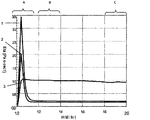
コンパクトなシャンプー及び市販のベンチマークにおける現在データを見る限り、ピーク形状は良好な識別ツールのように思われる。図1は、レオロジー特性のための上記試験パラメータの例証のために、2つの市販の製品を示すが、本発明のものではない。上側カーブは、初期のピーク(図1のAで示される)を示し、図1のBで示される試験を通して値は比較的高いままである。しかし、下方カーブは実質上ピークを示さず(図1のCで示される)、図1のDにより示されるように試験を通してレベルは低いままである。上方カーブからの製品は、広がり及び手触りの点で消費者には極めて受け入れがたい。下方カーブは、許容可能な手触りを有する。 From the current data on compact shampoos and commercial benchmarks, the peak shape seems to be a good identification tool. FIG. 1 shows two commercial products for illustration of the above test parameters for rheological properties, but not of the present invention. The upper curve shows an initial peak (indicated by A in FIG. 1) and the value remains relatively high throughout the test shown in FIG. 1B. However, the lower curve shows virtually no peak (indicated by C in FIG. 1), and the level remains low throughout the test as shown by D in FIG. Products from the upper curve are extremely unacceptable to consumers in terms of breadth and feel. The lower curve has an acceptable feel.
図2は、シャンプーなどのコンパクトにされた組成物のレオロジー特性を示し、より高い初期ピークを示が、ピークは速やかに低レベルへと低下し、これにより手触りについての消費者の問題を回避する。消費者の許容性については、特定の箇所というよりも全体のレオロジー特性と多く関連することは明らかである。レオロジー特性方法は、図2のゾーン1(第1主要パラメータ)、ゾーン2(第2主要パラメータ)又はゾーン3(第3主要パラメータ)に示すような画定された主要パラメータを獲得しようとする。ピークは図2のゾーン1(第1主要パラメータ)のプロット内に図2中のAとして示され、液体の動きに対する初期抵抗力を表す。ピークの急速な低下(又はその欠如)がゾーン2(第2主要パラメータ)内にて、図2中のBとして観察される。連続した抵抗が、ゾーン3(第3主要パラメータ)内に含まれており、図2のCとして示される。1及び2とラベリングされたカーブは、コンパクトにされた組成物にとって許容可能なレオロジー特性であり、3とラベリングされたカーブはコンパクトにされた組成物にとって許容可能なレオロジー特性ではない。 FIG. 2 shows the rheological properties of compacted compositions such as shampoos, showing a higher initial peak, but the peak quickly drops to a low level, thereby avoiding consumer problems with the touch . Clearly, consumer acceptability is more related to overall rheological properties than to specific locations. The rheological characterization method attempts to obtain defined key parameters as shown in zone 1 (first key parameter), zone 2 (second key parameter) or zone 3 (third key parameter) of FIG. The peak is shown as A in FIG. 2 in the zone 1 (first primary parameter) plot of FIG. 2 and represents the initial resistance to liquid movement. A rapid drop in peak (or lack thereof) is observed as B in FIG. 2 within zone 2 (second main parameter). A continuous resistance is contained within zone 3 (third main parameter) and is shown as C in FIG. Curves labeled 1 and 2 are acceptable rheological properties for compacted compositions, and curves labeled 3 are not acceptable rheological properties for compacted compositions.
この特性を、3つのデータポイント及び消費者の研究によって解析しようと試み、本試験での第1主要パラメータのピークが、第2又は第3主要パラメータより大きい場合、プロトタイプが許容可能な手の広がりを有することを見出したが、次に、第1主要パラメータ未満に急速に低下し(第2主要パラメータ)、第2主要パラメータとほぼ同じかわずかに小さい(less then)ところで保持され続けた(第3主要パラメータ)。 If this characteristic is attempted to be analyzed by three data points and a consumer study, and the peak of the first major parameter in this study is greater than the second or third major parameter, the prototype has an acceptable hand spread. But then rapidly dropped below the first primary parameter (second primary parameter) and continued to be held at about the same or slightly less than the second primary parameter (second 3 main parameters).
本発明は、高い初期ピークを有する(高濃度シャンプーの定義を満足させるように)が、次に手でこすることによる剪断力で素早く破壊され、これによってピーク後及び継続してこすった後に低い値を有する材料を目標としている。 The present invention has a high initial peak (so as to satisfy the definition of high concentration shampoo), but then it is quickly broken by shear forces by hand rubbing, thereby reducing after the peak and after continued rubbing Targeting materials with values.
幾つかの実施形態では、瞬間的剪断力ピークは約0.2〜約8Pa・s(パスカル・秒)であり、特定の実施形態では、約0.8〜約8Pa・sであり、更にその他の実施形態では、約0.8Pa・s超である。 In some embodiments, the instantaneous shear force peak is about 0.2 to about 8 Pa · s (Pascal · second), in certain embodiments about 0.8 to about 8 Pa · s, and others In this embodiment, it is greater than about 0.8 Pa · s.
特定の実施形態では、瞬間的剪断力測定手順開始後1.2s(秒)での値は、約0.8Pa・s未満、幾つかの実施形態では、約0.6Pa・s未満、その他の場合は、約0.4Pa・s未満である。更にその他の実施形態では、1.2秒での値は約0〜約0.8Pa・sであり、代替的実施形態では、約0.05〜約0.8Pa・sである。 In certain embodiments, the value at 1.2 s (seconds) after the start of the instantaneous shear force measurement procedure is less than about 0.8 Pa · s, in some embodiments less than about 0.6 Pa · s, other In this case, it is less than about 0.4 Pa · s. In still other embodiments, the value at 1.2 seconds is from about 0 to about 0.8 Pa · s, and in alternative embodiments, from about 0.05 to about 0.8 Pa · s.
幾つかの実施形態では、瞬間的剪断力測定手順開始後2秒での値は、約0.8Pa・s未満であり、その他の場合、約0.4Pa・s未満であり、更にその他の場合は、約0.2Pa・s未満である。更にその他の実施形態では、瞬間的剪断力開始後2秒での値は約0〜約0.8Pa・sであり、他の場合では、約0.05〜約0.8Pa・sである。 In some embodiments, the value at 2 seconds after the start of the instantaneous shear force measurement procedure is less than about 0.8 Pa · s, in other cases less than about 0.4 Pa · s, and in other cases Is less than about 0.2 Pa · s. In yet other embodiments, the value at 2 seconds after the onset of instantaneous shear is from about 0 to about 0.8 Pa · s, and in other cases from about 0.05 to about 0.8 Pa · s.
レオロジー特性に関する展延性
組成物に対する消費者の要望についての別の要素は、シャンプーなどの組成物がいかに濡れた毛髪全体及び濡れた手の上で広がるか、ということである。このことは、少量の水の添加によってシャンプーの構造がいかに素早く変化するかに関係する。展延性は、粘度及び構造が破壊される剪断速度と関連づけることができる。
Spreadability with respect to rheological properties Another factor in consumer demand for compositions is how the composition, such as shampoo, spreads over wet hair and wet hands. This is related to how quickly the structure of the shampoo changes with the addition of a small amount of water. Spreadability can be related to viscosity and shear rate at which the structure breaks.
界面活性剤及びポリマーの選択、並びに塩濃度及びその他の要因に応じて、展延パラメータ(c1*c2)は、以下の「方法」にて議論するように、約180Pa〜1000Paのレベルで変化するように見える。試験は、本明細書中で議論する本方法論に従って、約200Paの展延パラメータを持つような本発明の処方が、濡れた手及び毛髪に広げるのに許容可能であることを示した。 Depending on the choice of surfactant and polymer, as well as salt concentration and other factors, the spreading parameter (c1 * c2) varies at a level of about 180 Pa to 1000 Pa, as discussed in the “Method” below. looks like. Tests have shown that according to the methodology discussed herein, the formulations of the present invention having a spreading parameter of about 200 Pa are acceptable for spreading on wet hands and hair.
この場合、展延パラメータは、16.3Pa・s及び41.2s−1(=671Pa)の製品となる。本プロトタイプは、消費者による展延性については期せずして低い評価となっている。許容可能な展延挙動のために、発明者らの分析及び消費者の試験により、c1及びc2パラメータの製品はおよそ200Pa以下である必要があることが示された。 In this case, the spreading parameters are products of 16.3 Pa · s and 41.2 s −1 (= 671 Pa). This prototype has an unsatisfactory reputation for consumer extensibility. For acceptable spreading behavior, the inventors' analysis and consumer tests have shown that the c1 and c2 parameter products need to be approximately 200 Pa or less.
泡サイズ
消費者は、消費者製品の洗浄性能を、製品の使用において生じる気泡/泡内の泡サイズにより識別するようになった。パーソナルクレンジング製品においては、より小さい泡サイズは通常、洗浄以上の利益(例えば、毛髪又は皮膚コンディショニング)を提供する製品と関連付けられる。したがって、洗浄製品使用中に生じる使用中の泡サイズを調整するのが望ましい。研究者らは、セテアレスサルフェート又はネオドール(NEODOL)(登録商標)67サルフェートなどのより長鎖の界面活性剤を、界面活性剤系内の微量成分として慎重に使用することにより、製品使用中に泡サイズを調整して、これらの利点を知らしめることができることを発見した。これにより、クリーミーな感触の泡を生成しない大きな気泡とは対照的に、クリーミーな感触を有する小さい気泡を作り出すことができる。
Foam Size Consumers have come to identify the cleaning performance of consumer products by the bubble size within the bubbles / bubbles that occur during product use. In personal cleansing products, smaller foam sizes are usually associated with products that provide benefits beyond cleaning (eg, hair or skin conditioning). It is therefore desirable to adjust the in-use foam size that occurs during use of the cleaning product. Researchers have carefully used longer-chain surfactants, such as cetealess sulfate or NEODOL® 67 sulfate, as minor components within the surfactant system, during product use. It has been discovered that the bubble size can be adjusted to inform these benefits. This can create small bubbles with a creamy feel as opposed to large bubbles that do not produce a creamy feel.
幾つかの実施形態では、組成物は、約0.025mm2未満の泡サイズを有し、その他の場合には、約0.005mm2〜約0.025mm2、更にその他の実施形態では、約0.005mm2〜約0.02mm2の泡サイズを有する。 In some embodiments, the composition has a foam size of less than about 0.025 mm 2 , in other cases from about 0.005 mm 2 to about 0.025 mm 2 , and in still other embodiments, about It has a bubble size of 0.005 mm 2 to about 0.02 mm 2 .
追加の界面活性剤
任意の好適な追加の界面活性剤は、等方性実現物質と組み合わせて、等方性界面活性剤混合物を形成し、本発明の組成物内で利用することができる。好適な界面活性剤の非限定的な例は、米国特許第5,624,666号、アルレッド・パブリッシング・コーポレーション(Allured Publishing Corporation)発行の「洗剤及び乳化剤、北米版」(マッカチャン(McCutcheon)、1986年)、及び「機能材料、北米版」(マッカチャン(McCutcheon)、1992年)に開示されている。望ましい追加の界面活性剤としては、アニオン性界面活性剤及び所望によりその他の共界面活性剤が挙げられる。
Additional Surfactants Any suitable additional surfactant can be combined with the isotropic material to form an isotropic surfactant mixture and utilized in the compositions of the present invention. Non-limiting examples of suitable surfactants are described in US Pat. No. 5,624,666, “Detergents and Emulsifiers, North American Version” published by Allured Publishing Corporation (McCutcheon, 1986), and "Functional Materials, North American Edition" (McCutcheon, 1992). Desirable additional surfactants include anionic surfactants and optionally other co-surfactants.
アニオン性界面活性剤
本明細書に用いるのに好適な追加のアニオン性界面活性剤としては、式(III)ROSO3M及び式(IV)RO(C2H4O)XSO3Mのアルキル及びアルキルエーテルサルフェート類が挙げられ、ここで、式(III)及び(IV)のRは、約8〜約18個の炭素原子のアルキル又はアルケニルであり、式(IV)のxは、1〜10であり、かつ式(III)及び(IV)のMは、アンモニウム、ナトリウム、カリウム、及びトリエタノールアミンカチオンなどの水溶性カチオン又は2つのアニオン性界面活性剤アニオンを備えた二価のマグネシウムイオンの塩類である。アルキルエーテル硫酸塩は、エチレンオキシド及び約8〜約18個の炭素原子を有する一価アルコールの縮合生成物として調製されてよい。アルコールは、例えばココヤシ油、パーム油、パーム核油、若しくはタロー等の脂肪から誘導され得るか、又は合成であり得る。
Anionic Surfactants Additional anionic surfactants suitable for use herein include alkyls of formula (III) ROSO 3 M and formula (IV) RO (C 2 H 4 O) X SO 3 M And alkyl ether sulfates, wherein R in formulas (III) and (IV) is an alkyl or alkenyl of about 8 to about 18 carbon atoms, and x in formula (IV) is 1 to And M in formulas (III) and (IV) is a divalent magnesium ion with a water-soluble cation or two anionic surfactant anions such as ammonium, sodium, potassium, and triethanolamine cation The salt. The alkyl ether sulfate may be prepared as a condensation product of ethylene oxide and a monohydric alcohol having from about 8 to about 18 carbon atoms. The alcohol can be derived from fats such as coconut oil, palm oil, palm kernel oil, or tallow, or can be synthetic.
本明細書において使用に好適である追加のアニオン性界面活性剤の例としては、ラウリル硫酸アンモニウム、ラウレス硫酸アンモニウム、ラウリル硫酸トリエチルアミン、ラウレス硫酸トリエチルアミン、ラウリル硫酸トリエタノールアミン、ラウレス硫酸トリエタノールアミン、ラウリル硫酸モノエタノールアミン、ラウレス硫酸モノエタノールアミン、ラウリル硫酸ジエタノールアミン、ラウレス硫酸ジエタノールアミン、ラウリルモノグリセリド硫酸ナトリウム、ラウリル硫酸ナトリウム、ラウレス硫酸ナトリウム、ラウレス硫酸カリウム、ラウリルサルコシン酸ナトリウム、ラウロイルサルコシン酸ナトリウム、ラウリルサルコシン、ココイルサルコシン、ココイル硫酸アンモニウム、ラウロイル硫酸アンモニウム、ココイル硫酸ナトリウム、ラウロイル硫酸ナトリウム、ココイル硫酸カリウム、ラウリル硫酸カリウム、ココイル硫酸モノエタノールアミン、トリデセス硫酸ナトリウム、トリデシル硫酸ナトリウム、メチルラウロイルタウリン酸ナトリウム、メチルココイルタウリン酸ナトリウム、ラウロイルイセチオン酸ナトリウム、ココイルイセチオン酸ナトリウム、ラウレススルホコハク酸ナトリウム、ラウリルスルホコハク酸ナトリウム、トリデシルベンゼンスルホン酸ナトリウム、ドデシルベンゼンスルホン酸ナトリウム、及びこれらの混合物が挙げられるが、これらに限定されない。 Examples of additional anionic surfactants suitable for use herein include ammonium lauryl sulfate, ammonium laureth sulfate, lauryl sulfate triethylamine, laureth sulfate triethylamine, lauryl sulfate triethanolamine, laureth sulfate triethanolamine, lauryl sulfate mono Ethanolamine, laureth sulfate monoethanolamine, lauryl sulfate diethanolamine, laureth sulfate diethanolamine, sodium lauryl monoglyceride sulfate, sodium lauryl sulfate, sodium laureth sulfate, potassium laureth sulfate, sodium lauryl sarcosinate, sodium lauroyl sarcosine, lauryl sarcosine, cocoyl sarcosine, Ammonium cocoyl sulfate, ammonium lauroyl sulfate, sodium cocoyl sulfate Lithium, sodium lauroyl sulfate, potassium cocoyl sulfate, potassium lauryl sulfate, monoethanolamine cocoyl sulfate, sodium trideceth sulfate, sodium tridecyl sulfate, sodium methyl lauroyl taurate, sodium methyl cocoyl taurate, sodium lauroiyl thiothionate, cocoyl isethionate Examples include, but are not limited to, sodium, sodium laureth sulfosuccinate, sodium lauryl sulfosuccinate, sodium tridecylbenzene sulfonate, sodium dodecyl benzene sulfonate, and mixtures thereof.
共界面活性剤
共界面活性剤は、泡体積の向上及び/又は泡質感を修正するために、等方性実現物質及び所望によりアニオン性界面活性剤と組み合わされる物質である。典型的には、これらの物質は、限定されないが、両性、双極性、カチオン性、及び非イオン性を含む種々の群の構造から選択され得る。それらは、典型的には1:20〜1:4の重量比、より好ましくは1:12〜1:7の重量比でアニオン性界面活性剤と併用される。
Co-surfactants Co-surfactants are substances that are combined with an isotropic material and optionally an anionic surfactant to improve foam volume and / or modify foam texture. Typically, these materials can be selected from various groups of structures including, but not limited to, amphoteric, zwitterionic, cationic, and nonionic. They are typically used in combination with anionic surfactants in a weight ratio of 1:20 to 1: 4, more preferably in a weight ratio of 1:12 to 1: 7.
本明細書において使用に好適な両性界面活性剤には、脂肪族ラジカルが直鎖又は分枝状であり得、脂肪族置換基の1つの置換基が約8〜約18個の炭素原子を含み、1つは例えばカルボキシ、スルホネート、サルフェート、ホスフェート、又はホスホネート等のアニオン水溶性基を含む、脂肪族二級及び三級アミンの誘導体が含まれるが、これらに限定されない。例としては、3−ドデシル−アミノプロピオン酸ナトリウム、3−ドデシルアミノプロパンスルホン酸ナトリウム、ラウリルサルコシン酸ナトリウム、米国特許第2,658,072号の教示に従ってドデシルアミンとイセチオン酸ナトリウムとを反応させることによって調製されるもののようなN−アルキルタウリン、米国特許第2,438,091号の教示に従って生成されるもののようなN−高級アルキルアスパラギン酸、及び米国特許第2,528,378号に記載の生成物、並びにこれらの混合物が挙げられる。アルカノイルアンホアセテートを生成するためのクロロ酢酸ナトリウムとアミドアミンとの反応から誘導されるアンホアセテート群、例えばラウリル(lauryol)アンホアセテート等は、特に効果的である。 Suitable amphoteric surfactants for use herein include aliphatic radicals that may be linear or branched, wherein one substituent of the aliphatic substituent contains from about 8 to about 18 carbon atoms. One includes, but is not limited to, aliphatic secondary and tertiary amine derivatives, including anionic water-soluble groups such as carboxy, sulfonate, sulfate, phosphate, or phosphonate. Examples include reacting sodium 3-dodecyl-aminopropionate, sodium 3-dodecylaminopropanesulfonate, sodium lauryl sarcosinate, dodecylamine and sodium isethionate according to the teachings of US Pat. No. 2,658,072. N-alkyl taurines such as those prepared by N, higher N-alkyl aspartic acids such as those produced in accordance with the teachings of US Pat. No. 2,438,091, and those described in US Pat. No. 2,528,378. Products as well as mixtures thereof are mentioned. Particularly effective are the amphoacetate groups derived from the reaction of sodium chloroacetate with amidoamine to produce alkanoyl amphoacetate, such as lauryol amphoacetate.
本明細書において使用に好適である双極性界面活性剤には、脂肪族四級アンモニウム、ホスホニウム、及びスルホニウム化合物の誘導体が挙げられるが、これらに限定されず、脂肪族ラジカルは直鎖又は分枝状であり得、脂肪族置換基の1つは約8〜約18個の炭素原子を含み、1つの置換基は、アニオン性基、例えばカルボキシ、スルホネート、サルフェート、ホスフェート、又はホスホネートを含む。本明細書において使用に好適な他の双極性界面活性剤には、高級アルキルベタインを包含するベタイン、例えば、ココジメチルカルボキシメチルベタイン、ココアミドプロピルベタイン、ココベタイン、ラウリルアミドプロピルベタイン、オレイルベタイン、ラウリルジメチルカルボキシメチルベタイン、ラウリルジメチルαカルボキシエチルベタイン、セチルジメチルカルボキシメチルベタイン、ラウリルビス−(2−ヒドロキシエチル)カルボキシメチルベタイン、ステアリルビス−(2−ヒドロキシプロピル)カルボキシメチルベタイン、オレイルジメチルγ−カルボキシプロピルベタイン、ラウリルビス−(2−ヒドロキシプロピル)α−カルボキシエチルベタイン、及びこれらの混合物が挙げられる。スルホベタイン類には、ココジメチルスルホプロピルベタイン、ステアリルジメチルスルホプロピルベタイン、ラウリルジメチルスルホエチルベタイン、ラウリルビス−(2−ヒドロキシエチル)スルホプロピルベタイン、及びこれらの混合物が含まれ得る。また、好適な両性界面活性剤には、RCONH(CH2)3ラジカル(式中、Rは、C11〜C17アルキルである)がベタインの窒素原子に付着する、アミドベタイン類及びアミドスルホベタイン類が含まれ、本発明においてやはり有用である。 Bipolar surfactants suitable for use herein include, but are not limited to, aliphatic quaternary ammonium, phosphonium, and sulfonium compound derivatives, wherein the aliphatic radical is linear or branched. One of the aliphatic substituents contains from about 8 to about 18 carbon atoms, and one substituent comprises an anionic group such as carboxy, sulfonate, sulfate, phosphate, or phosphonate. Other bipolar surfactants suitable for use herein include betaines including higher alkyl betaines such as cocodimethylcarboxymethyl betaine, cocoamidopropyl betaine, coco betaine, lauramidopropyl betaine, oleyl betaine, Lauryl dimethyl carboxymethyl betaine, lauryl dimethyl α-carboxyethyl betaine, cetyl dimethyl carboxymethyl betaine, lauryl bis- (2-hydroxyethyl) carboxymethyl betaine, stearyl bis- (2-hydroxypropyl) carboxymethyl betaine, oleyldimethyl γ-carboxypropyl Examples include betaine, lauryl bis- (2-hydroxypropyl) α-carboxyethyl betaine, and mixtures thereof. The sulfobetaines can include cocodimethylsulfopropyl betaine, stearyldimethylsulfopropyl betaine, lauryldimethylsulfoethyl betaine, lauryl bis- (2-hydroxyethyl) sulfopropyl betaine, and mixtures thereof. Suitable amphoteric surfactants include amide betaines and amide sulfobetaines in which the RCONH (CH 2 ) 3 radical (where R is C 11 -C 17 alkyl) is attached to the nitrogen atom of betaine. Are also useful in the present invention.
起泡体積又は質感を向上させるために本組成物中で典型的に使用される非イオン性共界面活性剤としては、ラウリルジメチルアミンオキシド、ココジメチルアミンオキシド、ココアミドプロピルアミンオキシド、ラウリルアミドプロピルアミンオキシド等、又はラウレス−4〜ラウレス−7等のアルキルポリエトキシレート等の水溶性物質と、ココモノエタノールアミド、ココジエタノールアミド、ラウロイルモノエタノールアミド、アルカノイルイソプロパノールアミド、並びにセチルアルコール及びオレイルアルコール等の脂肪アルコール、並びに2−ヒドロキシアルキルメチルエーテル等の非水溶性成分が挙げられる。 Nonionic co-surfactants typically used in the present compositions to improve foam volume or texture include lauryl dimethylamine oxide, cocodimethylamine oxide, cocoamidopropylamine oxide, lauramidopropyl Water-soluble substances such as amine oxides or alkylpolyethoxylates such as laureth-4 to laureth-7, cocomonoethanolamide, cocodiethanolamide, lauroylmonoethanolamide, alkanoylisopropanolamide, cetyl alcohol and oleyl alcohol And water-insoluble components such as 2-hydroxyalkyl methyl ether.
好適な材料としては、1,2−アルキルエポキシド、1,2−アルカンジオール、分枝鎖又は直鎖アルキルグリセリルエーテル(例えば、欧州特許第1696023(A1)号に記載されているような)、1,2−アルキル環状カーボネート、及び1,2−アルキル環状サルファイトであって、特にアルキル基が直鎖又は分枝状構成中に6〜14個の炭素原子を含有するものが挙げられる。他の例には、米国特許第5,741,948号、同第5,994,595号、同第6,346,509号、及び同第6,417,408号の教示に従って調製され得る、C10又はC12αオレフィンをエチレングリコール(例えばヒドロキシエチル−2−デシルエーテル、ヒドロキシエチル−2−ドデシルエーテル)と反応させることにより誘導されるアルキルエーテルアルコールが含まれる。 Suitable materials include 1,2-alkyl epoxides, 1,2-alkanediols, branched or straight chain alkyl glyceryl ethers (eg as described in EP 1696023 (A1)), 1 , 2-alkyl cyclic carbonates, and 1,2-alkyl cyclic sulfites, particularly those in which the alkyl group contains 6 to 14 carbon atoms in a linear or branched configuration. Other examples may be prepared according to the teachings of US Pat. Nos. 5,741,948, 5,994,595, 6,346,509, and 6,417,408, C 10 or C 12 alpha-olefin ethylene glycol (such as hydroxyethyl-2-decyl ether, hydroxyethyl-2-dodecyl ether) include alkyl ether alcohols derived by reacting with.
その他の好ましい非イオン性界面活性剤は、グルコースアミド、アルキルポリグルコシド、スクロースココエート、ラウリル硫酸スクロース、アルカノールアミド、エトキシル化アルコール、及びこれらの混合物からなる群から選択され得る。 Other preferred nonionic surfactants may be selected from the group consisting of glucose amides, alkyl polyglucosides, sucrose cocoates, sucrose lauryl sulfate, alkanolamides, ethoxylated alcohols, and mixtures thereof.
一実施形態では、非イオン性界面活性剤は、モノヒドロキシステアリン酸グリセリル、イソステアレス−2、トリデセス−3、ヒドロキシステアリン酸、ステアリン酸プロピレングリコール、ステアリン酸PEG−2、モノステアリン酸ソルビタン、ラウリン酸グリセリル、ラウレス−2、コカミドモノエタノールアミン、ラウリルアミドモノエタノールアミン、及びこれらの混合物からなる群から選択される。 In one embodiment, the nonionic surfactant is glyceryl monohydroxystearate, isosteares-2, trideceth-3, hydroxystearic acid, propylene glycol stearate, PEG-2 stearate, sorbitan monostearate, glyceryl laurate , Laureth-2, cocamide monoethanolamine, laurylamide monoethanolamine, and mixtures thereof.
特定の実施形態では、共界面活性剤は、ココモノエタノールアミド、ココアミドプロピルベタイン、ラウリルアミドプロピルベタイン、ココベタイン、ラウリルベタイン、ラウリルアミンオキシド、ラウリルアンホ酢酸ナトリウム;アルキルグリセリルエーテル、アルキル−ジ−グリセリルエーテル、1,2−アルキル環状サルファイト、1,2−アルキル環状カーボネート、1,2−アルキル−エポキシド、アルキルグリシジルエーテル、及びアルキル−1,3−ジオキソラン(アルキル基は、直鎖又は分枝状構成の6〜14個の炭素原子を含有する);1,2−アルカンジオール(総炭素含有量は、直鎖又は分枝状の6〜14個の炭素原子である)、メチル−2−ヒドロキシ−デシルエーテル、ヒドロキシエチル−2−ドデシルエーテル、ヒドロキシエチル−2−デシルエーテル、並びにこれらの混合物からなる群から選択される。 In certain embodiments, the co-surfactant is cocomonoethanolamide, cocoamidopropyl betaine, laurylamidopropyl betaine, coco betaine, lauryl betaine, lauryl amine oxide, sodium lauryl amphoacetate; alkyl glyceryl ether, alkyl-di- Glyceryl ether, 1,2-alkyl cyclic sulfite, 1,2-alkyl cyclic carbonate, 1,2-alkyl-epoxide, alkyl glycidyl ether, and alkyl-1,3-dioxolane (the alkyl group is linear or branched) Containing 1 to 6 carbon atoms in the form of a structure); 1,2-alkanediol (total carbon content is 6 to 14 carbon atoms in a straight chain or branched form), methyl-2- Hydroxy-decyl ether, hydroxyethyl-2-dodecyl ether Hydroxyethyl-2-decyl ether, and is selected from the group consisting of mixtures.
カチオン性界面活性剤は、製剤のpHでプロトン化されたアミンから誘導されてもよく、例えばビス−ヒドロキシエチルラウリルアミン、ラウリルジメチルアミン、ラウロイルジメチルアミドプロピルアミン、ココイルアミドプロピルアミン等である。また、カチオン性界面活性剤は、ラウリルトリメチルアンモニウムクロリド及びラウロイルアミドプロピルトリメチルアンモニウムクロリド等の脂肪族四級アンモニウム塩から誘導されてもよい。 Cationic surfactants may be derived from amines protonated at the pH of the formulation, such as bis-hydroxyethyl laurylamine, lauryl dimethylamine, lauroyldimethylamidopropylamine, cocoylamidopropylamine, and the like. Cationic surfactants may also be derived from aliphatic quaternary ammonium salts such as lauryltrimethylammonium chloride and lauroylamidopropyltrimethylammonium chloride.
本発明の組成物は、組成物の約0.5重量%〜約10重量%、あるいは約0.5重量%〜約5重量%、あるいは約1重量%〜約3重量%の少なくとも1つの好適な共界面活性剤を含み得る。 The compositions of the present invention are at least one suitable from about 0.5% to about 10%, alternatively from about 0.5% to about 5%, alternatively from about 1% to about 3% by weight of the composition. Various co-surfactants.
コンディショニング剤
本発明の組成物は、コンディショニング剤を含むことができ、幾つかの実施形態では、組成物の重量に対して、少なくとも約0.05重量%のコンディショニング剤を含むことができる。特定の実施形態では、組成物は、組成物の重量に対して、約0.05重量%〜約10重量%の、他の実施形態では、約0.05重量%〜約2重量%の、代替的実施形態では、約0.5重量%〜約10重量%のコンディショニング剤を含み、更にその他の実施形態では、組成物の重量に対して、約0.5重量%〜約6重量%のコンディショニング剤を含む。コンディショニング剤としては、例えば、カチオン性ポリマー、大粒子及び小粒子シリコーン(例えば、0.1マイクロメートル未満の小粒子シリコーン)、並びに油を挙げることができる。任意の好適なコンディショニング剤を使用することが可能である。コンディショニング剤は、毛髪及び/又は皮膚に特定のコンディショニング効果を与えるために用いられるいかなる物質も含む。
Conditioning Agents The compositions of the present invention can include a conditioning agent, and in some embodiments can include at least about 0.05% by weight of a conditioning agent, based on the weight of the composition. In certain embodiments, the composition is about 0.05% to about 10% by weight, in other embodiments about 0.05% to about 2% by weight, based on the weight of the composition. In alternative embodiments, from about 0.5% to about 10% by weight of a conditioning agent, and in still other embodiments, from about 0.5% to about 6% by weight relative to the weight of the composition. Contains conditioning agents. Conditioning agents can include, for example, cationic polymers, large and small particle silicones (eg, small particle silicones of less than 0.1 micrometers), and oils. Any suitable conditioning agent can be used. Conditioning agents include any substance used to provide a particular conditioning effect to the hair and / or skin.
カチオン性ポリマー
本発明の組成物内で使用するコンディショニング剤は、カチオン性ポリマーを含有してもよい。好適なカチオン性ポリマーは、組成物の企図される用途でのpHにおいて、少なくとも約0.3meq/g、典型的には少なくとも約0.5meq/g、通常は少なくとも約0.7meq/gであるが、また、一般には約7meq/g未満、典型的には約6.5meq/g未満である、カチオン電荷密度を有する。組成物の企図される用途のpHは一般に、約pH3〜約pH9、典型的には約pH4〜約pH8の範囲である。好適なカチオン性ポリマーは一般に、約1,000〜約10,000,000、典型的には約10,000〜約5,000,000、通常は約20,000〜約2,000,000の範囲の平均分子量を有する。
Cationic Polymer The conditioning agent used in the composition of the present invention may contain a cationic polymer. Suitable cationic polymers are at least about 0.3 meq / g, typically at least about 0.5 meq / g, usually at least about 0.7 meq / g, at the pH for the intended use of the composition. Also have a cationic charge density that is generally less than about 7 meq / g, typically less than about 6.5 meq / g. The pH of the intended use of the composition is generally in the range of about
本明細書で使用するとき、用語「電荷密度」は、ポリマー上の正電荷の数と前記ポリマーの分子量との比を指す。 As used herein, the term “charge density” refers to the ratio of the number of positive charges on a polymer to the molecular weight of the polymer.
本発明の組成物に用いるのに好適なカチオン性ポリマーは、第四級アンモニウムのようなカチオン性窒素含有部分又はカチオン性プロトン化アミノ部分を含有することができる。カチオン性プロトン化アミンは、組成物の特定の化学種及び選択したpHに応じて、第一級、第二級又は第三級アミン(典型的には、第二級又は第三級)であり得る。カチオン性ポリマーに関連して、いかなるアニオン性対イオンを使用することもできるが、そのポリマーが、水、組成物、又は組成物のコアセルベート相に可溶なままであること、また、その対イオンが、組成物の構成成分と物理的及び化学的に適合性があり、そうでなければ製品の性能、安定性、又は審美性を過度に損なわないことを条件とする。そのような対イオンの非限定例には、ハロゲン化物(例えば、塩化物、フッ化物、臭化物、ヨウ化物)、スルフェート及びメチルスルフェートが挙げられる。 Suitable cationic polymers for use in the compositions of the present invention can contain cationic nitrogen-containing moieties such as quaternary ammonium or cationic protonated amino moieties. Cationic protonated amines are primary, secondary or tertiary amines (typically secondary or tertiary) depending on the particular chemical species of the composition and the selected pH. obtain. Any anionic counterion can be used in connection with the cationic polymer, but the polymer remains soluble in water, the composition, or the coacervate phase of the composition, and the counterion Provided that it is physically and chemically compatible with the components of the composition and otherwise does not unduly impair the performance, stability, or aesthetics of the product. Non-limiting examples of such counterions include halides (eg, chloride, fluoride, bromide, iodide), sulfate and methyl sulfate.
このようなポリマーの非限定例は、CTFA化粧品成分辞典(CTFA Cosmetic Ingredient Dictionary)、第3版、エストリン(Estrin)、クロスレー(Crosley)、及びヘインズ(Haynes)編(米国化粧品工業協会(The Cosmetic,Toiletry,and Fragrance Association,Inc.)、ワシントンD.C.(1982年))に記載されている。好適なカチオン性ポリマーの非限定例としては、カチオン性プロトン化アミン又は第四級アンモニウム官能基を有するビニルモノマーと、アクリルアミド、メタクリルアミド、アルキル及びジアルキルアクリルアミド、アルキル及びジアルキルメタクリルアミド、アルキルアクリレート、アルキルメタクリレート、ビニルカプロラクトン、又はビニルピロリドンのような水溶性のスペーサーモノマーとのコポリマーが挙げられる。 Non-limiting examples of such polymers are the CTFA Cosmetic Ingredient Dictionary, 3rd edition, Estrin, Crosley, and Haynes editions (The Cosmetic, Toiletry, and Fragrance Association, Inc.), Washington, DC (1982)). Non-limiting examples of suitable cationic polymers include cationic protonated amines or vinyl monomers having quaternary ammonium functional groups and acrylamide, methacrylamide, alkyl and dialkyl acrylamide, alkyl and dialkyl methacrylamide, alkyl acrylate, alkyl Mention may be made of copolymers with water-soluble spacer monomers such as methacrylate, vinylcaprolactone or vinylpyrrolidone.
本明細書の組成物のカチオン性ポリマーに包含するために好適なカチオン性プロトン化アミノ及び第四級アンモニウムモノマーとしては、ジアルキルアミノアルキルアクリレート、ジアルキルアミノアルキルメタクリレート、モノアルキルアミノアルキルアクリレート、モノアルキルアミノアルキルメタクリレート、トリアルキルメタクリルオキシアルキルアンモニウム塩、トリアルキルアクリルオキシアルキルアンモニウム塩、ジアリル第四級アンモニウム塩で置換されたビニル化合物、並びに、例えばアルキルビニルイミダゾリウム、アルキルビニルピリジニウム、アルキルビニルピロリドン塩等の、ピリジニウム、イミダゾリウム、及び第四級ピロリドンのような環状カチオン性窒素含有環を有するビニル第四級アンモニウムモノマーが挙げられる。 Cationic protonated amino and quaternary ammonium monomers suitable for inclusion in the cationic polymers of the compositions herein include dialkylaminoalkyl acrylate, dialkylaminoalkyl methacrylate, monoalkylaminoalkyl acrylate, monoalkylamino Vinyl compounds substituted with alkyl methacrylates, trialkylmethacryloxyalkylammonium salts, trialkylacryloxyalkylammonium salts, diallyl quaternary ammonium salts, as well as alkyl vinyl imidazolium, alkyl vinyl pyridinium, alkyl vinyl pyrrolidone salts, etc. Vinyl quaternary ammonium monomers having cyclic cationic nitrogen-containing rings such as pyridinium, imidazolium, and quaternary pyrrolidone And the like.
組成物に用いられる他の好適なカチオン性ポリマーには、1−ビニル−2−ピロリドンと1−ビニル−3−メチルイミダゾリウム塩(例えば、塩化物)のコポリマー(化粧品香料工業協会(Cosmetic,Toiletry,and Fragrance Association)「CTFA」により、産業界で、ポリクオタニウム(Polyquaternium)−16と呼ばれる);1−ビニル−2−ピロリドンとジメチルアミノエチルメタクリレートのコポリマー(産業界で、CTFAにより、ポリクオタニウム−11と呼ばれる);カチオン性ジアリル第四級アンモニウム含有ポリマー、例えば、ジメチルジアリルアンモニウムクロライドホモポリマー、アクリルアミドとジメチルジアリルアンモニウムクロライドのコポリマー(産業界で、CTFAにより、それぞれポリクオタニウム6及びポリクオタニウム7と呼ばれる);アクリル酸の両性コポリマー、例えば、アクリル酸とジメチルジアリルアンモニウムクロライドのコポリマー(産業界で、CTFAにより、ポリクオタニウム22と呼ばれる);アクリル酸とジメチルジアリルアンモニウムクロライド及びアクリルアミドとのターポリマー(産業界で、CTFAにより、ポリクオタニウム39と呼ばれる);並びにアクリル酸とメタクリルアミドプロピルトリメチルアンモニウムクロライド及びメチルアクリレートとのターポリマー(産業界で、CTFAにより、ポリクオタニウム47と呼ばれる)が挙げられる。好適なカチオン性置換モノマーは、カチオン性置換ジアルキルアミノアルキルアクリルアミド、ジアルキルアミノアルキルメタクリルアミド、及びこれらの組み合わせである。これらの好適なモノマーは次式(V)に従い: Other suitable cationic polymers used in the composition include copolymers of 1-vinyl-2-pyrrolidone and 1-vinyl-3-methylimidazolium salt (eg, chloride) (Cosmetic, Toiletry , and Fragrance Association) called “Polyquaternium-16” in the industry by “CTFA”; copolymer of 1-vinyl-2-pyrrolidone and dimethylaminoethyl methacrylate (in industry, by CTFA, with polyquaternium-11) Cationic diallyl quaternary ammonium-containing polymers such as dimethyldiallylammonium chloride homopolymer, copolymers of acrylamide and dimethyldiallylammonium chloride (in industry, by CTFA, polyquaternium 6 and polyquaternium respectively) 7); amphoteric copolymers of acrylic acid, such as copolymers of acrylic acid and dimethyldiallylammonium chloride (in industry, referred to by CTFA as polyquaternium 22); terpolymers of acrylic acid with dimethyldiallylammonium chloride and acrylamide ( In the industry, CTFA refers to polyquaternium 39); and terpolymers of acrylic acid and methacrylamidopropyltrimethylammonium chloride and methyl acrylate (in industry, referred to as polyquaternium 47 by CTFA). Suitable cationic substituted monomers are cationic substituted dialkylaminoalkyl acrylamides, dialkylaminoalkyl methacrylamides, and combinations thereof. These suitable monomers are according to the following formula (V):
ここで、式(V)のR1は水素、メチル又はエチルであり、式(V)のR2、R3及びR4はそれぞれ独立して、水素、又は約1〜約8個の炭素原子、典型的には約1〜約5個の炭素原子、一般的には約1〜約2個の炭素原子を有する短鎖アルキルであり、nは約1〜約8、典型的には約1〜約4の値を有する整数であり、式(V)のXは対イオンである。式(V)のR2、R3及びR4に結合する窒素はプロトン化アミン(第一級、第二級又は第三級)であってもよいが、典型的には第四級アンモニウムであり、式(V)の各R2、R3及びR4はアルキル基であり、その非限定例はポリメタクリルアミドプロピル(polymethyacrylamidopropyl)塩化トリモニウムであり、米国ニュージャージー州クランベリーのローヌ・プーラン(Rhone-Poulenc)より、ポリケア(Polycare)133の商品名で入手可能である。 Where R 1 in formula (V) is hydrogen, methyl or ethyl, and R 2 , R 3 and R 4 in formula (V) are each independently hydrogen or from about 1 to about 8 carbon atoms. , Typically short chain alkyls having from about 1 to about 5 carbon atoms, generally from about 1 to about 2 carbon atoms, and n is from about 1 to about 8, typically about 1 Is an integer having a value of about 4 and X in formula (V) is a counter ion. The nitrogen attached to R 2 , R 3 and R 4 of formula (V) may be a protonated amine (primary, secondary or tertiary), but is typically quaternary ammonium. Each R 2 , R 3 and R 4 in formula (V) is an alkyl group, a non-limiting example of which is polymethyacrylamidopropyl trimonium chloride, Rhone-Purlan (Cranberry, NJ, USA) From Poulenc) under the trade name Polycare 133.
本組成物に用いる他の好適なカチオン性ポリマーとしては、カチオン性セルロース誘導体及びカチオン性のデンプン誘導体のような多糖類ポリマーが挙げられる。好適なカチオン性多糖類ポリマーとしては、式(VI)に従うものが挙げられる: Other suitable cationic polymers for use in the present composition include polysaccharide polymers such as cationic cellulose derivatives and cationic starch derivatives. Suitable cationic polysaccharide polymers include those according to formula (VI):
ここで、式(VI)のAは、スターチ又はセルロース無水グルコース残基のような無水グルコース残基であり、式(VI)のRは、アルキレンオキシアルキレン、ポリオキシアルキレン、又はヒドロキシアルキレン基、又はそれらの組み合わせであり、式(X)のR1、R2、及びR3は、独立して、アルキル、アリール、アルキルアリール、アリールアルキル、アルコキシアルキル、又はアルコキシアリール基であり、各基は、約18個以下の炭素原子を有し、各カチオン部分の炭素原子の合計数(即ち、式(VI)のR1、R2、及びR3内の炭素原子の合計数)は、好ましくは20以下であり、式(VI)のXは、前述したようにアニオン性対イオンである。 Where A in formula (VI) is an anhydroglucose residue, such as a starch or cellulose anhydroglucose residue, and R in formula (VI) is an alkyleneoxyalkylene, polyoxyalkylene, or hydroxyalkylene group, or A combination thereof, wherein R 1 , R 2 , and R 3 in formula (X) are independently alkyl, aryl, alkylaryl, arylalkyl, alkoxyalkyl, or alkoxyaryl groups, each group being The total number of carbon atoms in each cation moiety (ie, the total number of carbon atoms in R 1 , R 2 , and R 3 of formula (VI)) having no more than about 18 carbon atoms is preferably 20 Where X in formula (VI) is an anionic counterion as described above.
好適なカチオン性セルロースポリマーは、トリメチルアンモニウム置換エポキシドと反応させたヒドロキシエチルセルロースの塩であり、当業界(CTFA)ではポリクオタニウム10と呼ばれており、アマコール社(Amerchol Corp.)(米国、ニュージャージー州エジソン(Edison))より、ポリマーのポリマー(Polymer)LR、JR及びKGシリーズとして入手可能である。カチオン性セルロースのその他の好適な種類としては、当業界(CTFA)ではポリクオタニウム24と呼ばれる、ラウリルジメチルアンモニウム置換エポキシドと反応させたヒドロキシエチルセルロースのポリマーの第四級アンモニウム塩が挙げられる。これらの物質は、アマコール社(Amerchol Corp.)より、ポリマーLM−200の商標名で入手可能である。
A preferred cationic cellulose polymer is a salt of hydroxyethyl cellulose reacted with a trimethylammonium substituted epoxide, referred to in the industry (CTFA) as
その他の好適なカチオン性ポリマーには、グアーヒドロキシプロピル塩化トリモニウムのようなカチオン性グアーガム誘導体が挙げられ、その具体例としては、ローヌ・プーラン社(Rhone-Poulenc Incorporated)より市販されているジャガー(Jaguar)シリーズ、及びハーキュレス社(Hercules,Inc.)のアクアロン部門(Aqualon Division)より市販されているN−ハンス(N-Hance)シリーズが挙げられる。その他の好適なカチオン性ポリマーには、四級窒素含有セルロースエーテルが挙げられ、その幾つかの例が米国特許第3,962,418号に記載されている。他の好適なカチオン性ポリマー類には、エーテル化セルロース、グアー及びデンプンのコポリマー類が挙げられ、その幾つかの例が、米国特許第3,958,581号に記載されている。使用される場合、本明細書におけるカチオン性ポリマーは、組成物に可溶であるか、又はそのカチオン性ポリマーと、前述した洗浄性界面活性剤構成成分とにより形成される組成物中の複合コアセルベート相に可溶である。カチオン性ポリマーの複合コアセルベートはまた、組成物中の他の荷電物質で形成されることもできる。 Other suitable cationic polymers include cationic guar gum derivatives such as guar hydroxypropyltrimonium chloride, specific examples of which include Jaguar commercially available from Rhone-Poulenc Incorporated. ) Series and the N-Hance series commercially available from the Aqualon Division of Hercules, Inc. Other suitable cationic polymers include quaternary nitrogen-containing cellulose ethers, some examples of which are described in US Pat. No. 3,962,418. Other suitable cationic polymers include etherified cellulose, guar and starch copolymers, some examples of which are described in US Pat. No. 3,958,581. When used, the cationic polymer herein is soluble in the composition or is a complex coacervate in the composition formed by the cationic polymer and the detersive surfactant component described above. Soluble in phase. Cationic polymer complex coacervates can also be formed with other charged materials in the composition.
コポリマー−コポリマーは、2個のカチオン性モノマー、又は非イオン性及びカチオン性モノマーを含んでもよい。 Copolymer-copolymer may comprise two cationic monomers, or nonionic and cationic monomers.
非イオン性モノマー単位
合成コポリマーは、次式(VII)で表される非イオン性モノマー単位を含む:
Nonionic Monomer Unit The synthetic copolymer comprises a nonionic monomer unit represented by the following formula (VII):
ここで、式(VII)のRは、水素又はC1〜4アルキルであり、式(VII)のR1及びR2は、水素、C1〜4アルキル、CH2OCH3、CH2OCH2CH(CH3)2、及びフェニルからなる群から独立して選択され、あるいは共に、C3〜6シクロアルキルである。 Here, R in formula (VII) is hydrogen or C 1-4 alkyl, and R 1 and R 2 in formula (VII) are hydrogen, C 1-4 alkyl, CH 2 OCH 3 , CH 2 OCH 2. Independently selected from the group consisting of CH (CH 3 ) 2 and phenyl, or both are C 3-6 cycloalkyl.
一実施形態では、非イオン性モノマー単位は、アクリルアミド(AM)であり、即ち、式(VII)のR、R1、及びR2は、次式(VIII)に示されるように、全てHであり、 In one embodiment, the nonionic monomer unit is acrylamide (AM), ie, R, R 1 , and R 2 in formula (VII) are all H, as shown in formula (VIII): Yes,
式(VIII)のmは、1に等しい。 M in formula (VIII) is equal to 1.
別の好ましい非イオン性モノマー単位は、メタクリルアミド(MethAM)であり、即ち、(VII)のRはC1アルキル、式(VII)のR1及びR2はそれぞれ各Hである: Another preferred nonionic monomer unit is methacrylamide (MethAM), ie, R in (VII) is C 1 alkyl and R 1 and R 2 in formula (VII) are each H:
式(IX)のmは、1に等しい。 M in the formula (IX) is equal to 1.
しかし、前記式(IX)の範囲内の他のアクリルアミド誘導体も、本発明の一部であることも意図しており、ポリアクリルアミド及びアクリルアミドモノマーを使用するコポリマーが有用である。 However, other acrylamide derivatives within the scope of formula (IX) are also intended to be part of the present invention, and copolymers using polyacrylamide and acrylamide monomers are useful.
合成コポリマーの非イオン性モノマー部分は、コポリマー全体の約50重量%〜約99.5重量%の量で存在してもよい。好ましくは、この量は、コポリマーの重量に対して、約70重量%〜約99重量%、更により好ましくは約80重量%〜約99重量%である。 The nonionic monomer portion of the synthetic copolymer may be present in an amount from about 50% to about 99.5% by weight of the total copolymer. Preferably, this amount is from about 70% to about 99%, even more preferably from about 80% to about 99% by weight, based on the weight of the copolymer.
カチオン性モノマー単位
コポリマーは、式(X)で表されるカチオン性モノマー単位をも含む:
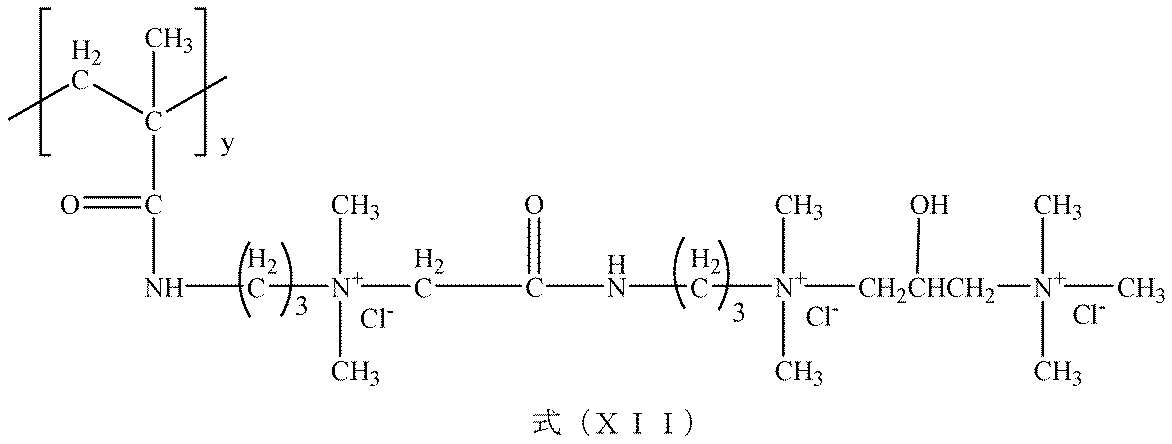
Cationic monomer unit The copolymer also comprises a cationic monomer unit of the formula (X):
ここで、式(X)のkは、1に等しく、式(X)の各v、v’、及びv”は独立して、1〜6の整数であり、式(X)のwは0又は1〜10の整数であり、式(X)のX-はアニオンである。 Here, k in the formula (X) is equal to 1, each v, v ′, and v ″ in the formula (X) is independently an integer of 1 to 6, and w in the formula (X) is 0. or an integer from 1 to 10, X of formula (X) - is the anion.
一実施形態では、式(X)の構造が存在し、式中、k=1、v=3及びw=0、z=1及びX−はCl−であって、次式(XI)を形成する: In one embodiment, there is a structure of formula (X), wherein k = 1, v = 3 and w = 0, z = 1 and X − are Cl − to form formula (XI) To:
上の構造は、ジクワット(diquat)と称されてもよい。 The above structure may be referred to as a diquat.
更に別の実施形態は、形成された式(X)の構造により達成されるが、式中、v及びv”はそれぞれ3であり、v’=1、w=1、y=1及びX−がCl−であり、例えば: Yet another embodiment is achieved by the structure of formula (X) formed, where v and v ″ are 3, respectively, v ′ = 1, w = 1, y = 1 and X −. Is Cl − , for example:
上記構造体は、トリクワット(triquat)と称されることもある。 The structure is sometimes referred to as a triquat.
好適なカチオン性モノマーは、例えば、米国特許公開公報第2004/0010106(A1)号に記載される方法によって製造することができる。 Suitable cationic monomers can be produced, for example, by the method described in US Patent Publication No. 2004/0010106 (A1).
シリコーン
本発明の組成物中で有用なコンディショニング剤は通常、粒子形態の、不溶性、非揮発性シリコーンコンディショニング剤である。シリコーンコンディショニング剤粒子は、揮発性シリコーン、不揮発性シリコーン、又はそれらの組み合わせを含んでよい。シリコーンコンディショニング剤粒子は、シリコーン流体コンディショニング剤を含んでもよく、シリコーン流体の付着効率を改善するか又は毛髪の光沢度を向上させるためのシリコーン樹脂のような他の成分も含んでもよい。
Silicone Conditioning agents useful in the compositions of the present invention are typically in particulate, insoluble, non-volatile silicone conditioning agents. The silicone conditioning agent particles may comprise volatile silicone, non-volatile silicone, or combinations thereof. The silicone conditioning agent particles may include a silicone fluid conditioning agent and may also include other components such as a silicone resin to improve the deposition efficiency of the silicone fluid or improve the gloss of the hair.
好適なシリコーンコンディショニング剤の非限定例、及びシリコーンのための任意の懸濁剤は、米国再発行特許第34,584号、米国特許第5,104,646号、及び同第5,106,609号に記載されている。本発明の組成物内で使用するシリコーンコンディショニング剤の粘度は、25℃で測定した場合で、一般に約2E−5m2/s(20センチストークス)〜約2m2/s(2,000,000センチストークス)(「csk」)、典型的には、約0.001m2/s(1,000csk)〜約1.8m2/s(1,800,000csk)、通常は、約0.05m2/s(50,000csk)〜約1.5m2/s(1,500,000csk)、典型的には、約0.1m2/s(100,000csk)〜約1.5m2/s(1,500,000csk)である。 Non-limiting examples of suitable silicone conditioning agents, and optional suspending agents for silicones are described in U.S. Reissue Pat. No. 34,584, U.S. Pat. Nos. 5,104,646, and 5,106,609. In the issue. The viscosity of the silicone conditioning agent used in the composition of the present invention is generally from about 2E-5 m 2 / s (20 centistokes) to about 2 m 2 / s (2,000,000 centimeters) when measured at 25 ° C. Stokes) ( "csk"), typically, about 0.001m 2 / s (1,000csk) ~ about 1.8m 2 / s (1,800,000csk), usually, about 0.05m 2 / s (50,000 csk) to about 1.5 m 2 / s (1,500,000 csk), typically about 0.1 m 2 / s (100,000 csk) to about 1.5 m 2 / s (1, 500,000 csk).
分散したシリコーンコンディショニング剤粒子は、典型的には約0.005μm〜約50μmの範囲の数平均粒子径を有する。小粒子を毛髪に塗布するには、数平均粒子径は典型的には約0.01μm〜約4μm、一般に、約0.01μm〜約2μm、一般には、約0.01μm〜約0.5μmの範囲である。毛髪へのより大きな粒子の塗布については、数平均粒子径は、典型的には約4μm〜約50μm、通常は約6μm〜約30μm、一般には、約9μm〜約20μm、典型的には約12μm〜約18μmの範囲である。 The dispersed silicone conditioning agent particles typically have a number average particle size ranging from about 0.005 μm to about 50 μm. For applying small particles to the hair, the number average particle size is typically about 0.01 μm to about 4 μm, generally about 0.01 μm to about 2 μm, generally about 0.01 μm to about 0.5 μm. It is a range. For the application of larger particles to the hair, the number average particle size is typically about 4 μm to about 50 μm, usually about 6 μm to about 30 μm, generally about 9 μm to about 20 μm, typically about 12 μm. In the range of ~ 18 μm.
シリコーンオイル
シリコーン流体としてはシリコーンオイルが挙げられ、これは25℃で測定して、1m2/s(1,000,000csk)未満、典型的は、約5E−6m2/s(5csk)〜約1m2/s(1,000,000csk)、一般に約0.0001m2/s(100csk)〜約0.6m2/s(600,000csk)の粘度を有する流動性のシリコーン物質である。本発明の組成物に用いるのに好適なシリコーンオイルとしては、ポリアルキルシロキサン、ポリアリールシロキサン、ポリアルキルアリールシロキサン、ポリエーテルシロキサンコポリマー、及びこれらの混合物が挙げられる。またヘアコンディショニング特性を有する他の不溶性、不揮発性シリコーン流体を使用してもよい。
Silicone oils Silicone fluids include silicone oils, measured at 25 ° C., of less than 1 m 2 / s (1,000,000 csk), typically from about 5E-6 m 2 / s (5 csk) to about 1m 2 / s (1,000,000csk), a flowable silicone materials having a viscosity of typically about 0.0001m 2 / s (100csk) ~ about 0.6m 2 / s (600,000csk). Suitable silicone oils for use in the compositions of the present invention include polyalkyl siloxanes, polyaryl siloxanes, polyalkylaryl siloxanes, polyether siloxane copolymers, and mixtures thereof. Other insoluble, non-volatile silicone fluids having hair conditioning properties may also be used.
アミノ及びカチオン性シリコーン
本発明の組成物中に使用するのに好適なカチオン性シリコーン液としては、限定されないが、以下の一般式(XIII)に合致するものである:
(R1)aG3−aSi−(−OSiG2)n−(−OSiGb(R1)2−b)m−O−SiG3−a(R1)a
Amino and Cationic Silicones Suitable cationic silicone fluids for use in the compositions of the present invention include, but are not limited to, those that meet the following general formula (XIII):
(R 1) a G 3- a Si - (- OSiG 2) n - (- OSiG b (R 1) 2-b) m -O-SiG 3-a (R 1) a
ここで、式(XIII)のGは、水素、フェニル、ヒドロキシ、又はC1〜C8アルキル、典型的には、メチルであり;式(XIII)のaは、0又は1〜3の値を有する整数であり、典型的には、0であり;式(XIII)のbは0又は1であり、典型的には、1であり;式(XIII)のnは0〜1,999の数字であり、典型的には49〜499であり;式(XIII)のmは1〜2,000の整数であり、典型的には1〜10であり;式(XIII)のn及びmの合計は、1〜2,000の数字であって、典型的には50〜500であり;式(XIII)のR1は、一般式(XIV)CqH2qLに従う一価のラジカルであり、式(XIV)のqは、2〜8の値を有する整数であって、式(XIV)のLは、次の群から選択される:
式(XV):−N(R2)CH2−CH2−N(R2)2
式(XVI):−N(R2)2
式(XVII):−N(R2)3A−
式(XVIII):−N(R2)CH2−CH2−NR2H2A−
Here, G of formula (XIII) hydrogen, phenyl, hydroxy, or C 1 -C 8 alkyl, typically methyl; the a, the value of 0 or 1 to 3 of formula (XIII) An integer having, typically 0; b in formula (XIII) is 0 or 1, typically 1, and n in formula (XIII) is a number from 0 to 1,999. And is typically 49 to 499; m in formula (XIII) is an integer from 1 to 2,000, typically from 1 to 10; the sum of n and m in formula (XIII) Is a number from 1 to 2,000, typically 50 to 500; R 1 in formula (XIII) is a monovalent radical according to general formula (XIV) C q H 2q L; Q in the formula (XIV) is an integer having a value of 2 to 8, and L in the formula (XIV) is selected from the following group: That:
Formula (XV): —N (R 2 ) CH 2 —CH 2 —N (R 2 ) 2
Formula (XVI): - N (R 2) 2
Formula (XVII): - N (R 2) 3 A -
Formula (XVIII): - N (R 2) CH 2 -CH 2 -NR 2 H 2 A -
ここで、式(XV)〜(XVIII)のR2は、水素、フェニル、ベンジル、又は飽和炭化水素ラジカルであり、典型的には、約C1〜約C20アルキルラジカルであり、式(XV)〜(XVIII)のAはハロゲン化物イオンである。 Where R 2 in formulas (XV) to (XVIII) is hydrogen, phenyl, benzyl, or a saturated hydrocarbon radical, typically about a C 1 to about C 20 alkyl radical, ) To (XVIII) A is a halide ion.
式(XIII)に対応する好適なカチオン性シリコーンは、下記の式(XIX)に示される「トリメチルシリルアモジメチコン」として既知のポリマーである: Suitable cationic silicones corresponding to formula (XIII) are the polymers known as “trimethylsilylamodimethicone” shown in the following formula (XIX):
本発明の組成物中で使用してもよい他のシリコーンカチオン性ポリマーは、一般式(XX)によって表される: Other silicone cationic polymers that may be used in the compositions of the present invention are represented by the general formula (XX):
ここで、式(XX)のR3は、C1〜C18の一価炭化水素ラジカル、典型的にはメチルのようなアルキル又はアルケニルラジカルであり、式(XX)のR4は、炭化水素ラジカル、典型的にはC1〜C18アルキレンラジカル又はC10〜C18アルキレンオキシラジカル、通常はC1〜C8アルキレンオキシラジカルであり、式(XX)のQはハロゲン化物イオン、典型的には塩化物であり、式(XX)のrは2〜20、典型的には2〜8の平均統計値であり、式(XX)のsは20〜200、典型的には20〜50の平均統計値である。このクラスの好適なポリマーは、ユーケア・シリコーンALE 56(UCARE SILICONE ALE 56)(商標)として既知であり、ユニオン・カーバイド(Union Carbide)より入手可能である。 Where R 3 in formula (XX) is a C 1 -C 18 monovalent hydrocarbon radical, typically an alkyl or alkenyl radical such as methyl, and R 4 in formula (XX) is a hydrocarbon A radical, typically a C 1 -C 18 alkylene radical or a C 10 -C 18 alkyleneoxy radical, usually a C 1 -C 8 alkyleneoxy radical, wherein Q in formula (XX) is a halide ion, typically Is chloride, r in formula (XX) is an average statistic of 2-20, typically 2-8, and s in formula (XX) is 20-200, typically 20-50. Average statistics. A suitable polymer of this class is known as UCARE SILICONE ALE 56 ™ and is available from Union Carbide.
シリコーンゴム
本発明の組成物に用いるのに好適なその他のシリコーン流体は、不溶性シリコーンゴムである。これらのゴムは、25℃で測定して、1m2/s(1,000,000csk)以上の粘度を有するポリオルガノシロキサン物質である。シリコーンゴムは、米国特許第4,152,416号、ノル(Noll)及びウォルター(Walter)、シリコーンの化学及び技術(Chemistry and Technology of Silicones)、ニューヨーク(New York)、アカデミックプレス(Academic Press)(1968)、及びジェネラル・エレクトリック・シリコーンラバー・プロダクト・データシート(General Electric Silicone Rubber Product Data Sheets)SE 30、SE 33、SE 54及びSE 76に記載されている。本発明の組成物に用いるシリコーンゴムの具体的な非限定例には、ポリジメチルシロキサン、(ポリジメチルシロキサン)(メチルビニルシロキサン)コポリマー、ポリ(ジメチルシロキサン)(ジフェニルシロキサン)(メチルビニルシロキサン)コポリマー、及びこれらの混合物が挙げられる。
Silicone Rubber Other silicone fluids suitable for use in the compositions of the present invention are insoluble silicone rubbers. These rubbers are polyorganosiloxane materials having a viscosity of 1 m 2 / s (1,000,000 csk) or higher as measured at 25 ° C. Silicone rubber is described in US Pat. No. 4,152,416, Noll and Walter, Silicone Chemistry and Technology of Silicones, New York, Academic Press ( 1968), and General Electric Silicone Rubber Product Data Sheets SE 30, SE 33, SE 54 and SE 76. Specific non-limiting examples of silicone rubbers used in the compositions of the present invention include polydimethylsiloxane, (polydimethylsiloxane) (methylvinylsiloxane) copolymer, poly (dimethylsiloxane) (diphenylsiloxane) (methylvinylsiloxane) copolymer , And mixtures thereof.
高屈折率シリコーン
本発明の組成物に用いるのに好適な他の不揮発性不溶性シリコーン流体コンディショニング剤は、屈折率が少なくとも約1.46、典型的には少なくとも約1.48、通常は少なくとも約1.52、典型的には少なくとも約1.55である「高屈折率シリコーン」として既知のものである。ポリシロキサン流体の屈折率は、一般に約1.70未満、典型的には約1.60未満であろう。この文脈において、ポリシロキサン「流体」は、油並びにガムを含む。
High Refractive Index Silicone Other non-volatile insoluble silicone fluid conditioning agents suitable for use in the compositions of the present invention have a refractive index of at least about 1.46, typically at least about 1.48, usually at least about 1. .52, typically known as “high index silicone” which is at least about 1.55. The refractive index of the polysiloxane fluid will generally be less than about 1.70, typically less than about 1.60. In this context, polysiloxane “fluid” includes oils as well as gums.
シリコーン樹脂
シリコーン樹脂が、本発明の組成物のシリコーンコンディショニング剤に含まれてもよい。これらの樹脂は、高度に架橋したポリマーシロキサン系である。架橋は、シリコーン樹脂の製造中に三官能性及び四官能性シランを一官能性又は二官能性又はその両方のシランとともに組み込むことによって導入される。
Silicone Resin A silicone resin may be included in the silicone conditioning agent of the composition of the present invention. These resins are highly crosslinked polymeric siloxane systems. Crosslinking is introduced during the production of the silicone resin by incorporating trifunctional and tetrafunctional silanes with monofunctional and / or bifunctional silanes.
有機コンディショニングオイル
本発明の組成物のコンディショニング構成成分はまた、約0.05重量%〜約3重量%、典型的には約0.08重量%〜約1.5重量%、一般的に約0.1重量%〜約1重量%の、少なくとも1種の有機コンディショニングオイルを、単独で又はシリコーンなどの他のコンディショニング剤と組み合わせて、含んでもよい。
Organic Conditioning Oil The conditioning component of the compositions of the present invention will also be from about 0.05% to about 3%, typically from about 0.08% to about 1.5%, generally from about 0%. From 1% to about 1% by weight of at least one organic conditioning oil may be included alone or in combination with other conditioning agents such as silicone.
炭化水素油
本発明の組成物においてコンディショニング剤として使用するのに好適な有機コンディショニングオイルとしては、少なくとも約10個の炭素原子を有する炭化水素油、例えば、環状炭化水素、直鎖脂肪族炭化水素(飽和又は不飽和)、及び分枝鎖脂肪族炭化水素(飽和又は不飽和)(これらのポリマー及びこれらの混合物を含む)が挙げられるが、これらに限定されない。直鎖炭化水素油は典型的に、約C12〜約C19である。炭化水素ポリマーを含む分岐鎖炭化水素油は、典型的に19個超の炭素原子を含有するであろう。
Hydrocarbon oils Organic conditioning oils suitable for use as conditioning agents in the compositions of the present invention include hydrocarbon oils having at least about 10 carbon atoms, such as cyclic hydrocarbons, straight chain aliphatic hydrocarbons ( Saturated or unsaturated) and branched chain aliphatic hydrocarbons (saturated or unsaturated), including but not limited to these polymers and mixtures thereof. Straight chain hydrocarbon oils typically about C 12 ~ about C 19. Branched chain hydrocarbon oils, including hydrocarbon polymers, will typically contain more than 19 carbon atoms.
ポリオレフィン
本発明の組成物で使用するための有機コンディショニングオイルはまた、液体ポリオレフィン、典型的には液体ポリ−α−オレフィン、一般に水素添加液体ポリ−α−オレフィンを包含することもできる。本明細書で使用されるポリオレフィンは、C4〜約C14、典型的には約C6〜約C12のオレフィンモノマーの重合によって調製される。
Polyolefins Organic conditioning oils for use in the compositions of the present invention can also include liquid polyolefins, typically liquid poly-α-olefins, generally hydrogenated liquid poly-α-olefins. Polyolefins used herein, C 4 ~ about C 14, are typically prepared by the polymerization of olefin monomers of about C 6 ~ about C 12.
本明細書のポリオレフィン液の調製に使用するオレフィンモノマーの非限定例としては、エチレン、プロピレン、1−ブテン、1−ペンテン、1−ヘキセン、1−オクテン、1−デセン、1−ドデセン、1−テトラデセン、4−メチル−1−ペンテンのような分岐鎖異性体、及びこれらの混合物が挙げられる。また、ポリオレフィン液を調製するのに適したものは、オレフィン含有精製原料又は廃液である。典型的な水素添加α−オレフィンモノマーとしては、1−ヘキセン〜1−ヘキサデセン、1−オクテン〜1−テトラデセン、及びこれらの混合物が挙げられるが、これらに限定されない。 Non-limiting examples of olefin monomers used to prepare the polyolefin liquids herein include ethylene, propylene, 1-butene, 1-pentene, 1-hexene, 1-octene, 1-decene, 1-dodecene, 1- Examples include tetradecene, branched chain isomers such as 4-methyl-1-pentene, and mixtures thereof. Also suitable for preparing polyolefin liquids are olefin-containing purified raw materials or waste liquids. Typical hydrogenated α-olefin monomers include, but are not limited to, 1-hexene to 1-hexadecene, 1-octene to 1-tetradecene, and mixtures thereof.
脂肪酸エステル
本発明の組成物においてコンディショニング剤として用いる、他の好適な有機コンディショニングオイルとしては、少なくとも10の炭素原子を有する脂肪酸エステルが挙げられるが、これらに限定されない。これらの脂肪族エステルとしては、脂肪酸又はアルコールから誘導されるヒドロカルビル鎖を有するエステル(例えば、モノエステル、多価アルコールエステル)が挙げられる。本明細書の脂肪族エステルのヒドロカルビルラジカルは、アミド及びアルコキシ部分(例えば、エトキシ又はエーテル結合等)のような、他の適合性の官能基を包含してもよい。
Fatty Acid Esters Other suitable organic conditioning oils used as conditioning agents in the compositions of the present invention include, but are not limited to, fatty acid esters having at least 10 carbon atoms. Examples of these aliphatic esters include esters having hydrocarbyl chains derived from fatty acids or alcohols (for example, monoesters and polyhydric alcohol esters). The hydrocarbyl radicals of the aliphatic esters herein may include other compatible functional groups such as amide and alkoxy moieties (eg, ethoxy or ether linkages, etc.).
他のコンディショニング剤
同様に、本明細書の組成物に用いるのに好適であるのは、プロクター・アンド・ギャンブル社(Procter & Gamble Company)の米国特許第5,674,478号及び同第5,750,122号に記載されているコンディショニング剤である。本明細書で用いるのに好適なものは更に、米国特許第4,529,586号、同第4,507,280号、同第4,663,158号、同第4,197,865号、同第4,217,914号、同第4,381,919号及び同第4,422,853号に記載されているようなコンディショニング剤である。
Other Conditioning Agents Similarly, suitable for use in the compositions herein are those of Procter & Gamble Company, US Pat. It is a conditioning agent described in 750,122. Also suitable for use herein are U.S. Pat. Nos. 4,529,586, 4,507,280, 4,663,158, 4,197,865, No. 4,217,914, No. 4,381,919 and No. 4,422,853.
組成物は、約0.75超の発泡性インデックスを有し、幾つかの実施形態では、約0.75〜約1.5の発泡性インデックスを有する。組成物は、約200秒(「sec」)未満の溶解度を有し、一実施形態では、約10秒〜約200秒の、他の実施形態では、約100秒〜約200秒の溶解度を有する。 The composition has an effervescent index greater than about 0.75, and in some embodiments, has an effervescent index from about 0.75 to about 1.5. The composition has a solubility of less than about 200 seconds (“sec”), in one embodiment from about 10 seconds to about 200 seconds, and in another embodiment from about 100 seconds to about 200 seconds. .
任意成分
高濃度パーソナルケア組成物は、製品形態及びその企図される用途及び最終効果に応じて広範囲の追加の構成成分を包含してもよい。本発明の組成物内で使用するための任意構成成分の非限定例は、米国特許第6,335,312号(コフィンダファー(Coffindaffer)らに発行)に記載されており、従来のパーソナルケアポリマー(付着ポリマー、整髪ポリマー、分散相ポリマー)、抗フケ剤、及びこれらの組み合わせを包含する。
Optional Ingredients The high concentration personal care composition may include a wide range of additional components depending on the product form and its intended use and end effect. Non-limiting examples of optional components for use in the compositions of the present invention are described in US Pat. No. 6,335,312 (issued to Coffindaffer et al.) (Adhesive polymer, hairstyling polymer, dispersed phase polymer), antidandruff agents, and combinations thereof.
更に、追加の構成成分としては、静電防止剤、湿潤剤及び緩和剤、懸濁剤、粘度を増加させる粘度調整剤、色素、染料、パールエッセンス助剤、起泡増進剤、抗菌剤類、ペディキュロサイド(pediculocides)、pH調整剤、香料、酸化防止剤、防腐剤、キレート剤、金属イオン封鎖剤、タンパク質、スキンケア用活性物質、日焼け止め剤、UV吸収剤、ビタミン及びエッセンシャルオイルなどのその他の審美的構成成分、パンテノール及び誘導体(例えば、エチルパンテノール)、パントテン酸及びその誘導体、キサンテン(カフェインなど)、丁子油、メントール、カンファー、ユーカリ油、オイゲノール、メンチルラクテート、マンサク蒸留物、アラントイン、ビサバロール、グリチルリチン酸二カリウム、前述のいずれかの誘導体並びにこれらの組み合わせを挙げることができる。 In addition, additional components include antistatic agents, wetting and relaxing agents, suspending agents, viscosity modifiers that increase viscosity, pigments, dyes, pearlescent aids, foam enhancers, antibacterial agents, Others such as pediculocides, pH adjusters, fragrances, antioxidants, preservatives, chelating agents, sequestering agents, proteins, skin care actives, sunscreens, UV absorbers, vitamins and essential oils Aesthetic components, panthenol and derivatives (eg, ethyl panthenol), pantothenic acid and its derivatives, xanthene (such as caffeine), clove oil, menthol, camphor, eucalyptus oil, eugenol, menthyl lactate, witch hazel distillate, allantoin , Bisabalol, dipotassium glycyrrhizinate, any of the aforementioned derivatives and These combinations can be mentioned.
また、所与の製品型に従来使用される成分のような、あらゆる他の好適な任意構成要素も、本発明のパーソナルケア組成物に含まれることができる。CTFA化粧品成分便覧、第10版(米国化粧品工業会社出版、ワシントンD.C)(2004年)(以後、「CTFA」)は、高濃度パーソナルケア組成物に添加することができる多種多様な非限定物質を記載している。 Any other suitable optional components, such as ingredients conventionally used in a given product type, can also be included in the personal care composition of the present invention. CTFA Cosmetic Ingredients Handbook, 10th Edition (published by the US Cosmetic Industry Company, Washington, DC) (2004) (hereinafter “CTFA”) is a wide variety of non-limiting that can be added to highly concentrated personal care compositions. The substance is described.
起泡増進剤
組成物の発泡能力(特に、発泡ポンプと併用する場合)を増大させるために、好適な起泡増進剤を含有させてもよい。一実施形態は、サンヨー(Sanyo)社からビューライトSHAA(Beaulight SHAA)の名称で販売されている2−(2−ヒドロキシアルキルオキシ)酢酸ナトリウムの使用である。
Foam enhancer A suitable foam enhancer may be included to increase the foaming capacity of the composition (particularly when used in combination with a foaming pump). One embodiment is the use of sodium 2- (2-hydroxyalkyloxy) acetate sold under the name Beaulight SHAA by the company Sanyo.
抗ふけ活性物質
本発明の組成物はまた、抗ふけ剤を含有してもよい。抗ふけ粒子の好適な非限定例としては、ピリジンチオン塩、炭酸亜鉛、例えばケトコナゾール、エコナゾール、及びエルビオールなどのアゾール、硫化セレン、粒子状イオウ、サリチル酸、並びにこれらの混合物が挙げられる。典型的な抗ふけ粒子は、ピリジンチオン塩である。このような抗ふけ粒子は、物理的及び化学的に組成物の構成成分と適合すべきであり、過度に製品の安定性、審美性、又は性能を損なうべきではない。
Anti-dandruff actives The compositions of the present invention may also contain an anti-dandruff agent. Suitable non-limiting examples of antidandruff particles include pyridinethione salts, zinc carbonates such as azoles such as ketoconazole, econazole, and erviol, selenium sulfide, particulate sulfur, salicylic acid, and mixtures thereof. A typical anti-dandruff particle is a pyridinethione salt. Such anti-dandruff particles should be physically and chemically compatible with the components of the composition and should not unduly compromise product stability, aesthetics, or performance.
ピリジンチオン塩
ピリジンチオン抗ふけ粒子、特に1−ヒドロキシ−2−ピリジンチオン塩は、本発明の組成物に用いるのに好適な粒子状抗ふけ剤である。ピリジンチオン抗ふけ粒子の濃度は、典型的には組成物の約0.01重量%〜約5重量%、一般に約0.1重量%〜約3重量%、通例約0.1重量%〜約2重量%の範囲である。好適なピリジンチオン塩としては、亜鉛、スズ、カドミウム、マグネシウム、アルミニウム、及びジルコニウムのような重金属、一般には亜鉛から形成されるものが挙げられ、典型的には1−ヒドロキシ−2−ピリジンチオンの亜鉛塩(「ジンクピリジンチオン」又は「ZPT」として既知)であり、通常は平板状粒子の形態の1−ヒドロキシ−2−ピリジンチオン塩であり、この際、粒子は約20μまで、典型的には約5μまで、通常は約2.5μまでの平均サイズを有する。ナトリウムのようなその他のカチオンから形成される塩もまた、好適な場合がある。ピリジンチオン抗ふけ剤は、例えば米国特許第2,809,971号、同第3,236,733号、同第3,753,196号、同第3,761,418号、同第4,345,080号、同第4,323,683号、同第4,379,753号、及び同第4,470,982号に記載されている。
Pyridinethione salt Pyridinethione antidandruff particles, particularly 1-hydroxy-2-pyridinethione salt, are suitable particulate antidandruff agents for use in the compositions of the present invention. The concentration of pyridinethione antidandruff particles is typically from about 0.01% to about 5%, generally from about 0.1% to about 3%, typically from about 0.1% to about It is in the range of 2% by weight. Suitable pyridinethione salts include heavy metals such as zinc, tin, cadmium, magnesium, aluminum, and zirconium, typically those formed from zinc, typically of 1-hydroxy-2-pyridinethione. Zinc salt (known as “zinc pyridinethione” or “ZPT”), usually 1-hydroxy-2-pyridinethione salt in the form of tabular grains, where the grains are typically up to about 20 μ, Has an average size of up to about 5μ, usually up to about 2.5μ. Salts formed from other cations such as sodium may also be suitable. Examples of pyridinethione antidandruff agents include U.S. Pat. Nos. 2,809,971, 3,236,733, 3,753,196, 3,761,418, and 4,345. No. 4,080, No. 4,323,683, No. 4,379,753, and No. 4,470,982.
抗菌活性物質
ピリチオンの多価の金属塩から選択される抗ふけ活物質に加えて、本発明は、金属ピリチオン塩活物質に加えて、1つ以上の抗真菌又は抗菌活物質を更に含んでよい。好適な抗菌活性物質には、コールタール、イオウ、ウィットフィールド(whitfield)軟膏、カステラーニ(castellani)塗布剤、塩化アルミニウム、ゲンチアナバイオレット、オクトピロックス(ピロクトンオラミン)、シクロピロックスオラミン、ウンデシレン酸及びその金属塩、過マンガン酸カリウム、硫化セレン、チオ硫酸ナトリウム、プロピレングリコール、ビターオレンジ油、尿素調製物、グリセオフルビン、8−ヒドロキシキノリンシロキノール、チオベンダゾール、チオカルバメート、ハロプロジン、ポリエン、ヒドロキシピリドン、モルホリン、ベンジルアミン、アリルアミン(例えば、テルビナフィン)、茶木油、クローブリーフ油、コリアンダー、パルマロッサ、ベルベリン、タイムレッド、桂皮油、シンナミックアルデヒド、シトロネル酸、ヒノキトール(hinokitol)、イヒチオールペール、センシバ(Sensiva)SC−50、エレスタブ(Elestab)HP−100、アゼライン酸、リチカーゼ(lyticase)、ヨードプロピニルブチルカルバメート(IPBC)、オクチルイソチアザリノンのようなイソチアザリノン及びアゾール、並びにこれらの組み合わせが挙げられる。典型的には抗菌剤としては、イトラコナゾール、ケトコナゾール、硫化セレン及びコールタールが挙げられる。
Antimicrobial active substances In addition to the antidandruff active material selected from the polyvalent metal salts of pyrithione, the present invention may further comprise one or more antifungal or antimicrobial active materials in addition to the metal pyrithione salt active material. . Suitable antimicrobial active substances include coal tar, sulfur, whitfield ointment, castellani coatings, aluminum chloride, gentian violet, octopirox (pyrocton olamine), ciclopirox olamine, undecylen Acid and its metal salts, potassium permanganate, selenium sulfide, sodium thiosulfate, propylene glycol, bitter orange oil, urea preparation, griseofulvin, 8-hydroxyquinoline siloquinol, thiobendazole, thiocarbamate, haloprozin, polyene, Hydroxypyridone, morpholine, benzylamine, allylamine (eg terbinafine), tea tree oil, clove leaf oil, coriander, palmarossa, berberine, thyme red, cinnamon oil, cinnamic aldehyde Citronellic acid, Hinokitol, Ihithiol Pale, Sensiva SC-50, Elestab HP-100, Azelaic acid, lyticase, iodopropynyl butyl carbamate (IPBC), Octylisothiazalinone And isothiazarinones and azoles, and combinations thereof. Typically, antibacterial agents include itraconazole, ketoconazole, selenium sulfide and coal tar.
アゾール
アゾール抗菌剤には、ベンズイミダゾールのようなイミダゾール、ベンゾチアゾール、ビフォナゾール、硝酸ブタコナゾール、クリムバゾール(climbazole)、クロトリマゾール、クロコナゾール、エベルコナゾール、エコナゾール、エルビオール、フェンチコナゾール、フルコナゾール、フルチマゾール、イソコナゾール、ケトコナゾール、ラノコナゾール、メトロニダゾール、ミコナゾール、ネチコナゾール、オモコナゾール、硝酸オキシコナゾール、セルタコナゾール、硝酸サルコナゾール、チオコナゾール、チアゾール及びテルコナゾール及びイトラコナゾールのようなトリアゾール及びこれらの組み合わせが挙げられる。アゾール抗菌活性物質は、組成物中に存在するとき、組成物の約0.01重量%〜約5重量%、典型的には約0.1重量%〜約3重量%、通常は約0.3重量%〜約2重量%の量で包含される。特に、ケトコナゾールが、一般的に本発明で使用される。
Azole Azole antibacterial agents include imidazoles such as benzimidazole, benzothiazole, bifonazole, butaconazole nitrate, climbazole, clotrimazole, croconazole, evelconazole, econazole, erbiol, fenconazole, fluconazole, flutimazole, Examples include isoconazole, ketoconazole, ranoconazole, metronidazole, miconazole, neticonazole, omoconazole, oxyconazole nitrate, sertaconazole, sarconazole nitrate, thioconazole, thiazole and triazoles such as terconazole and itraconazole and combinations thereof. The azole antimicrobial active, when present in the composition, is about 0.01% to about 5% by weight of the composition, typically about 0.1% to about 3%, usually about 0.1%. Included in an amount of 3% to about 2% by weight. In particular, ketoconazole is generally used in the present invention.
硫化セレン
硫化セレンは本発明の抗菌組成物に用いるのに好適な粒子状抗ふけ剤であり、その有効濃度は組成物の重量に対して、約0.1重量%〜約4重量%、典型的には約0.3重量%〜約2.5重量%、通常は約0.5重量%〜約1.5重量%の範囲である。硫化セレンは一般にセレン1モル及びイオウ2モルを有する化合物とみなされるが、一般式SexSy(式中x+y=8)に従う環式構造であってよい。硫化セレンの平均粒径は、典型的には前方レーザー光散乱装置(forward laser light scattering device)(例えばマルバーン(Malvern)3600装置)で測定したときに15μm未満、好ましくは10μm未満である。硫化セレン化合物は、例えば米国特許第2,694,668号、同第3,152,046号、同第4,089,945号、同第4,885,107号に記載されている。
Selenium sulfide Selenium sulfide is a particulate anti-dandruff agent suitable for use in the antimicrobial composition of the present invention, and its effective concentration is about 0.1% to about 4% by weight, typically based on the weight of the composition. Specifically, it is in the range of about 0.3 wt% to about 2.5 wt%, usually about 0.5 wt% to about 1.5 wt%. Selenium sulfide is generally regarded as a compound having 1 mole of selenium and 2 moles of sulfur, but may be a cyclic structure according to the general formula Se x S y (where x + y = 8). The average particle size of selenium sulfide is typically less than 15 μm, preferably less than 10 μm, as measured with a forward laser light scattering device (eg, Malvern 3600 device). Selenium sulfide compounds are described, for example, in U.S. Pat. Nos. 2,694,668, 3,152,046, 4,089,945, and 4,885,107.
イオウ
イオウもまた、本発明の抗菌性組成物において粒子状抗菌剤/抗ふけ剤として使用されてもよい。粒子状硫黄の効果的な濃度は、典型的には、組成物の約1重量%〜約4重量%、典型的には約2重量%〜約4重量%である。
Sulfur Sulfur may also be used as a particulate antimicrobial / antidandruff agent in the antimicrobial composition of the present invention. Effective concentrations of particulate sulfur are typically from about 1% to about 4%, typically from about 2% to about 4% by weight of the composition.
角質溶解剤
本発明は、サリチル酸のような1つ以上の角質溶解剤を更に含んでよい。
Keratolytic Agent The present invention may further comprise one or more keratolytic agents such as salicylic acid.
亜鉛含有層状物質
本発明の実施形態では、組成物は、有効量の亜鉛含有層状物質を含んでもよい。本発明の好ましい実施形態は、約0.001%〜約10%、より好ましくは約0.01%〜約7%、更により好ましくは約0.1%〜約5%の亜鉛含有層状物質を含む。
Zinc-containing layered material In embodiments of the present invention, the composition may comprise an effective amount of a zinc-containing layered material. Preferred embodiments of the present invention comprise from about 0.001% to about 10%, more preferably from about 0.01% to about 7%, even more preferably from about 0.1% to about 5% zinc-containing layered material. Including.
本発明の特定の実施形態に有用な亜鉛含有層状物質の例には以下のものが挙げられる。 Examples of zinc-containing layered materials useful in certain embodiments of the present invention include:
亜鉛含有層状構造は、主として二次元で生じる結晶成長を有するものである。層構造は、全ての原子が明確な層に組み込まれているものとしてだけではなく、ギャラリーイオン(galleryion)と呼ばれる、層の間にイオン又は分子があるものとすることが慣例的である(A.F.ウェルズ(A. F. Wells)の「構造無機化学(Structural Inorganic Chemistry)」、クラレンドン出版(Clarendon Press)、1975年)。亜鉛含有層状物質(ZLM)は、亜鉛を層に組み込んで有してもよく、及び/又はギャラリーイオンの構成成分であってもよい。 Zinc-containing layered structures have crystal growth that occurs primarily in two dimensions. It is customary for the layer structure not only to have all atoms incorporated into a well-defined layer, but to have ions or molecules between the layers, called gallery ions (A F Wells, “Structural Inorganic Chemistry,” Clarendon Press, 1975). The zinc-containing layered material (ZLM) may have zinc incorporated into the layer and / or may be a component of gallery ions.
多くのZLMが鉱物として自然発生する。一般例としては、水亜鉛鉱(炭酸水酸化亜鉛)、塩基性炭酸亜鉛、水亜鉛銅鉱(炭酸水酸化銅亜鉛)、亜鉛孔雀石(炭酸水酸化亜鉛銅)、及び亜鉛を含有する多くの関連する鉱物が挙げられる。天然のZLMもまた発生可能であり、その際、粘土型鉱物(例えばフィロシリケート)のようなアニオン性層の種には、イオン交換した亜鉛ギャラリーイオンが含有されている。これらの天然物質の全てはまた、合成的に得ることもでき、又は組成物中にその場で若しくは製造方法の間に生じさせることもできる。 Many ZLMs occur naturally as minerals. General examples include hydrozincite (zinc carbonate hydroxide), basic zinc carbonate, hydrozinc copper ore (zinc carbonate copper hydroxide), zinc peacock stone (zinc copper carbonate carbonate), and many associations containing zinc Minerals. Natural ZLM can also be generated, where anionic layer species such as clay-type minerals (eg phyllosilicates) contain ion exchanged zinc gallery ions. All of these natural materials can also be obtained synthetically or can be generated in the composition in situ or during the manufacturing process.
多くの場合合成であるが、いつも合成であるとは限らないZLMの他の一般の種類は、二重層状水酸化物であり、一般に式[M2+ 1−xM3+ x(OH)2]x+Am− x/m・nH2Oで表わされ、二価イオン(M2+)の一部又は全てが亜鉛イオンで表わされる(クレパルディ(Crepaldi)、EL、パバ(Pava)、PC、トロント(Tronto)、J、バリム(Valim)、JBJ. Colloid Interfac.Sci.2002年、248、429〜42頁)。 Another common type of ZLM, which is often synthetic but not always synthetic, is a double layered hydroxide, generally represented by the formula [M2 + 1- xM3 + x (OH) 2 ]. x + A m− x / m · nH 2 O, and some or all of the divalent ions (M 2+ ) are represented by zinc ions (Crepaldi, EL, Pava, PC, Toronto, J, Valim, JBJ. Colloid Interfac. Sci. 2002, 248, 429-42).
ヒドロキシ複塩と呼ばれる、ZLMの更に他の種類を調製することができる(H.モリオカ(Morioka,H.)、H.タガヤ(Tagaya,H.)、M.カラス(Karasu,M)、J.カドカワ(Kadokawa,J)、K.チバ(Chiba,K)、無機化学(Inorg.Chem.)、1999年、38、4211〜6)。ヒドロキシ複塩は、一般式[M2+ 1−xM2+ 1+x(OH)3(1−y)]+An− (1=3y)/n・nH2O(式中、2つの金属イオンは異なっていてよく、それらが同じで亜鉛で表わされる場合、式は[Zn1+x(OH)2]2x+2xA−・nH2Oに簡略化される)で表わすことができる。この後者の式(式中、x=0.4)は、ヒドロキシ塩化亜鉛及びヒドロキシ硝酸亜鉛のような一般物質を表す。これらは水亜鉛鉱にも関連し、その際、二価のアニオンは一価のアニオンを置き換える。これらの物質はまた、組成物中にその場で又は製造方法の間に生じさせることもできる。
Still other types of ZLM, referred to as hydroxy double salts, can be prepared (H. Morioka, H., H. Tagaya, H., M. Karasu, M., J. Am. Kadokawa, J, K. Chiba, K, Inorganic Chemistry (Inorg. Chem.), 1999, 38, 4211-6). Hydroxy double salts can be represented by the
ZLMのこれらの種類は、一般カテゴリーの比較的一般的な例を表すが、この定義に合う物質のより広い範囲に関する限定を意図するものではない。 These types of ZLM represent a relatively general example of the general category, but are not intended to limit the broader range of materials that meet this definition.
塩基性炭酸亜鉛の市販の供給源には、炭酸亜鉛塩基(Zinc Carbonate Basic)(ケイター・ケミカルズ(Cater Chemicals);米国イリノイ州ベンセンビル)、炭酸亜鉛(Zinc Carbonate)(シェパード・ケミカルズ(Shepherd Chemicals);米国オハイオ州ノーウッド)、炭酸亜鉛(Zinc Carbonate)(CPSユニオン社(CPS Union Corp.);米国ニューヨーク州ニューヨーク)、炭酸亜鉛(Zinc Carbonate)(エレメンティス・ピグメンツ(Elementis Pigments);英国ダラム)、及び炭酸亜鉛AC(Zinc Carbonate AC)(ブリュッグマン・ケミカル(Bruggemann Chemical);米国ペンシルベニア州ニュータウンスクエア)が挙げられる。 Commercial sources of basic zinc carbonate include Zinc Carbonate Basic (Cater Chemicals; Bensenville, Illinois, USA), Zinc Carbonate (Shepherd Chemicals); Norwood, Ohio), Zinc Carbonate (CPS Union Corp .; New York, NY), Zinc Carbonate (Elementis Pigments; Durham, UK), and Zinc Carbonate AC (Bruggemann Chemical; Newtown Square, Pennsylvania, USA).
塩基性炭酸亜鉛はまた、商業的には「炭酸亜鉛」又は「炭酸亜鉛塩基」又は「ヒドロキシ炭酸亜鉛」と呼ばれる場合もあるが、天然起源の水亜鉛鉱に類似した物質からなる合成の種類である。理想的な化学量論は、Zn5(OH)6(CO3)2により表されるが、実際の化学量論的比は僅かに変化することができ、またその他の不純物が結晶格子内に組み込まれてもよい。 Basic zinc carbonate is also sometimes referred to commercially as “zinc carbonate” or “zinc carbonate base” or “hydroxy zinc carbonate”, but is a synthetic class of substances similar to naturally occurring hydrozincite. is there. The ideal stoichiometry is represented by Zn 5 (OH) 6 (CO 3 ) 2, but the actual stoichiometric ratio can vary slightly and other impurities can be present in the crystal lattice. May be incorporated.
本発明の実施形態により、界面活性剤系中で特定の亜鉛反応活性度を有する有効量の亜鉛含有層状物質と組み合わせることによって、局所用組成物において抗ふけ効力を劇的に高めることができることを見出した。亜鉛反応活性度は、亜鉛イオンの化学的利用能の基準である。溶液中で他の化学種と錯体を形成しない可溶性亜鉛塩は、定義上100%の相対亜鉛反応活性度を有する。部分的に可溶性形態の亜鉛塩の使用及び/又はマトリクスへの潜在的錯体(complexants)の組み込みは、一般に亜鉛反応活性度を定義された100%最大値のかなり下まで低下する。 Embodiments of the present invention show that anti-dandruff efficacy can be dramatically increased in topical compositions by combining with an effective amount of a zinc-containing layered material having a specific zinc reaction activity in a surfactant system. I found it. Zinc reaction activity is a measure of the chemical availability of zinc ions. Soluble zinc salts that do not complex with other species in solution, by definition, have a relative zinc reaction activity of 100%. The use of partially soluble forms of zinc salts and / or incorporation of potential complexes into the matrix generally reduces the zinc reaction activity well below a defined 100% maximum.
有効な亜鉛含有層状物質の選択によって、又は既知の方法により有効な亜鉛含有層状物質をその場で生じさせることによって、反応活性度の高い亜鉛が維持される。 Highly reactive zinc is maintained by selection of an effective zinc-containing layered material or by generating an effective zinc-containing layered material in situ by known methods.
本発明の実施形態により、亜鉛含有層状物質と組み合わせて、ジンクピリチオン等のピリチオンの多価金属塩を用いることによって、局所用組成物において抗ふけ効果を劇的に高めることができることが見出されている。したがって、本発明の実施形態は、皮膚及び頭皮に対して改善された効果(例えば、改善された抗ふけ効果)を有する局所適用組成物を提供する。 In accordance with embodiments of the present invention, it has been found that by using a polyvalent metal salt of pyrithione such as zinc pyrithione in combination with a zinc-containing layered material, the anti-dandruff effect can be dramatically enhanced in topical compositions. Yes. Accordingly, embodiments of the present invention provide topical compositions that have improved effects on the skin and scalp (eg, improved anti-dandruff effects).
本発明の一実施形態は、亜鉛源が粒子状形態で存在する、亜鉛含有層状物質分散液のための安定な組成物を提供する。亜鉛含有層状物質には独特の物理的特性及び化学的特性があるので、亜鉛含有層状物質を含有する水性系を配合するのが困難であることが示されている。亜鉛含有層状物質は、高い密度(約3g/cm3)を有することがあり、凝集又は沈殿しないようにするには、製品全体に一様に分散させる必要がある。亜鉛含有層状物質は、また、非常に反応性の高い表面化学的性質を有することに加えて、pH値が6.5未満の系に溶解する傾向にある。 One embodiment of the present invention provides a stable composition for a zinc-containing layered material dispersion in which the zinc source is present in particulate form. Zinc-containing layered materials have unique physical and chemical properties that have proved difficult to formulate aqueous systems containing zinc-containing layered materials. Zinc-containing layered materials can have a high density (about 3 g / cm 3 ) and must be uniformly dispersed throughout the product to avoid agglomeration or precipitation. Zinc-containing layered materials also tend to dissolve in systems with pH values less than 6.5, in addition to having very reactive surface chemistry.
溶解度が25%未満の亜鉛含有層状物質は、亜鉛化合物の重量パーセント及び分子量によって決定される閾値よりも低い、測定可能な可溶性亜鉛値(%)を有することになる。理論上の閾値は、以下の式によって計算することができる。 A zinc-containing layered material with a solubility of less than 25% will have a measurable soluble zinc value (%) that is below the threshold determined by the weight percent and molecular weight of the zinc compound. The theoretical threshold can be calculated by the following formula:
組成物がZLMを含む本発明の実施形態では、pHが約6.5を上回ってもよく、更に、pHは、約6.5〜約12、好ましくは約6.8〜約9.5、より好ましくは約6.8〜約8.5の範囲であってもよい。 In embodiments of the invention in which the composition comprises ZLM, the pH may be greater than about 6.5, and the pH is from about 6.5 to about 12, preferably from about 6.8 to about 9.5, More preferably, it may be in the range of about 6.8 to about 8.5.
亜鉛含有製品中の亜鉛反応活性度の評価方法
亜鉛反応活性度は、亜鉛イオンの化学的利用能の基準である。溶液中で他の化学種と錯体を形成しない可溶性亜鉛塩は、定義上100%の相対亜鉛反応活性度を有する。ある程度可溶性の形態の亜鉛塩を使用し、及び/又は潜在的な錯体形成物質(potential complexants)と共にマトリックス中に組み込むと、一般に亜鉛反応活性度は、定義された100%最大値のかなり下まで低下する。
Method for evaluating zinc reaction activity in zinc-containing products Zinc reaction activity is a measure of the chemical availability of zinc ions. Soluble zinc salts that do not complex with other species in solution, by definition, have a relative zinc reaction activity of 100%. When zinc salts in a somewhat soluble form are used and / or incorporated into a matrix with potential complexants, the zinc reaction activity generally decreases well below the defined 100% maximum. To do.
亜鉛反応活性度は、希釈亜鉛含有溶液又は分散液と金属クロム染料キシレノールオレンジ(XO)とを組み合わせ、特定条件下で色の変化の程度を測定することによって評価される。色形成の規模は、反応活性度の高い亜鉛の濃度に比例する。開発された手順は、水性界面活性剤製剤について最適化されているが、他の物理製品形態にも同様に適応できる。 Zinc reaction activity is assessed by combining dilute zinc-containing solutions or dispersions with the metal chromium dye xylenol orange (XO) and measuring the degree of color change under specific conditions. The scale of color formation is proportional to the concentration of zinc with high reaction activity. The developed procedure has been optimized for aqueous surfactant formulations, but can be applied to other physical product forms as well.
分光光度計を使用して、XOに関して最適な色変化の波長である572nmでの色の変化を定量する。分光光度計は、潜在的に反応度の高い形態の亜鉛以外を除く、試験製品の組成に近い製品対照を利用して、572nmでの吸光度を0に設定する。次いで、対照及び試験製品を、次のように同様に処理する。50μLの製品試料を瓶に分配し、95mLの脱気した蒸留水を加え、攪拌する。5mLの23mg/mLキシレノールオレンジ原液をpH5.0にて、サンプルジャー内にピペットで取り、これを時間0と考えた。次いで、希釈HCl又はNaOHを用いて、pHを5.50±0.01に調整する。10.0分後、試料の一部を濾過し(0.45μ)、吸光度を572nmで測定する。次いで、測定した吸光度を、別に測定した対照と比較して、相対亜鉛反応活性度(0〜100%)を決定する。100%反応活性度の対照を、亜鉛基準で等濃度にて組み込まれた可溶性亜鉛物質(例えば硫酸亜鉛)の利用を除いて、試験製品と同様にマトリックスに調製する。100%反応活性度の対照の吸光度を、上記で試験物質について測定したように測定する。相対亜鉛反応活性度は、好ましくは約15%より高く、より好ましくは約20%より高く、更に好ましくは約25%よりも高い。 A spectrophotometer is used to quantify the color change at 572 nm, the wavelength of the optimal color change for XO. The spectrophotometer utilizes a product control close to the composition of the test product, except for the potentially reactive form of zinc, and sets the absorbance at 572 nm to zero. Controls and test products are then treated similarly as follows. Dispense 50 μL of the product sample into a jar, add 95 mL of degassed distilled water and stir. 5 mL of 23 mg / mL xylenol orange stock solution was pipetted into a sample jar at pH 5.0 and this was considered time zero. The pH is then adjusted to 5.50 ± 0.01 using diluted HCl or NaOH. After 10.0 minutes, a portion of the sample is filtered (0.45 μ) and the absorbance is measured at 572 nm. The measured absorbance is then compared with a separately measured control to determine relative zinc reaction activity (0-100%). A 100% reaction activity control is prepared in a matrix similar to the test product, except for the use of soluble zinc material (eg, zinc sulfate) incorporated at equal concentrations on a zinc basis. The absorbance of the 100% reaction activity control is measured as measured above for the test substance. The relative zinc reaction activity is preferably greater than about 15%, more preferably greater than about 20%, and even more preferably greater than about 25%.
この方法を使用して、以下の実施例は、固有の反応活性度が低い物質(ZnO)と比較して、アニオン性界面活性剤系での反応活性度が本質的に高い物質(塩基性炭酸亜鉛)を実証する。 Using this method, the following examples show a material (basic carbonic acid) that has an intrinsically high reaction activity in an anionic surfactant system compared to a material with a low intrinsic reaction activity (ZnO). Zinc) is demonstrated.
ZLMの粒径
本発明の一実施形態では、より小さい粒径が、相対亜鉛反応活性度に反比例することが見出されている。
ZLM Particle Size In one embodiment of the present invention, it has been found that the smaller particle size is inversely proportional to the relative zinc reaction activity.
D(90)は、粒子の量の90%がその粒径未満であることに相当する粒径である。本発明の一実施形態では、亜鉛含有層状物質は、粒子の90%が約50マイクロメートル未満である粒径分布を有してよい。本発明の他の実施形態では、亜鉛含有層状物質は、粒子の90%が約30マイクロメートル未満である粒径分布を有してよい。本発明の更に他の実施形態では、亜鉛含有層状物質は、粒子の90%が約20マイクロメートル未満である粒径分布を有してよい。 D (90) is a particle size corresponding to 90% of the amount of particles being less than the particle size. In one embodiment of the present invention, the zinc-containing layered material may have a particle size distribution in which 90% of the particles are less than about 50 micrometers. In other embodiments of the present invention, the zinc-containing layered material may have a particle size distribution in which 90% of the particles are less than about 30 micrometers. In yet another embodiment of the present invention, the zinc-containing layered material may have a particle size distribution in which 90% of the particles are less than about 20 micrometers.
粒径測定方法
酸化亜鉛及び水亜鉛鉱の原材料に対する粒径分析を、ホリバLA−910粒径分析装置(Horiba LA-910 Particle Size Analyzer)を使用して実施する。ホリバLA−910(Horiba LA-910)機器は、小角のフラウンホーファー回折(Fraunhofer Diffraction)及び光散乱(Light Scattering)の原理を用いて粒子の希釈溶液中での粒径及び分布を測定する。これら2つの種類の原材料の試料を、ラウリルポリエーテルアルコールの希釈溶液中に予め分散させ、混合してから、機器に導入する。導入したら、試料を更に希釈し、機器内に循環させてから、測定を実施する。測定後、計算アルゴリズムを使用してデータを処理し、粒径及び分布の両方を得る。D(50)は、中央粒径値、又は粒子の量の50%がその粒径未満であることに相当する粒径である。D(90)は、粒子の量の90%がその粒径未満であることに相当する粒径である。
Particle Size Measurement Method Particle size analysis for zinc oxide and hydrozinc ore raw materials is performed using a Horiba LA-910 Particle Size Analyzer. The Horiba LA-910 instrument measures the particle size and distribution of dilute particles in dilute solutions using the principles of small angle Fraunhofer Diffraction and Light Scattering. Samples of these two types of raw materials are pre-dispersed and mixed in a dilute solution of lauryl polyether alcohol and then introduced into the instrument. Once introduced, the sample is further diluted and circulated through the instrument before measurement. After measurement, the data is processed using a computational algorithm to obtain both particle size and distribution. D (50) is the median particle size value, or the particle size corresponding to 50% of the amount of particles being less than the particle size. D (90) is a particle size corresponding to 90% of the amount of particles being less than the particle size.
D(10)は、粒子の量の10%がその粒径未満であることに相当する粒径である。 D (10) is a particle size corresponding to 10% of the amount of particles being less than the particle size.
この方法を使用して、以下の実施例は、塩基性炭酸亜鉛についての粒径と相対亜鉛反応活性度との間の関係を実証する。 Using this method, the following example demonstrates the relationship between particle size and relative zinc reaction activity for basic zinc carbonate.
2粒径測定
2 Particle size measurement
ZLMの表面積
本発明の一実施形態では、表面積と相対亜鉛反応活性度との間に直接的な関係がある場合がある。
ZLM Surface Area In one embodiment of the present invention, there may be a direct relationship between surface area and relative zinc reaction activity.
粒子の表面積が増大すると、一般に、動的因子によって亜鉛反応活性度が増大する。粒子の表面積は、粒径を縮小させることによって、かつ/又は多孔質粒子、若しくはその全体的な形状が幾何学的に球体から外れた粒子をもたらすように粒子のモルホロジーを変化させることによって、増大させることができる。 Increasing the surface area of the particles generally increases the zinc reaction activity by dynamic factors. The surface area of the particles is increased by reducing the particle size and / or by changing the morphology of the particles to result in porous particles, or particles whose overall shape is geometrically off-sphere. Can be made.
本発明の実施形態において、塩基性炭酸亜鉛の表面積は約10m2/gmを超えてもよい。更なる実施形態において、塩基性炭酸亜鉛の表面積は約20m2/gmを超えてもよい。本発明の更なる実施形態において、塩基性炭酸亜鉛の表面積は約30m2/gmを超えてもよい。 In embodiments of the present invention, the basic zinc carbonate surface area may exceed about 10 m 2 / gm. In further embodiments, the basic zinc carbonate surface area may be greater than about 20 m 2 / gm. In further embodiments of the present invention, the basic zinc carbonate surface area may be greater than about 30 m 2 / gm.
表面積測定方法
表面積の分析を、マイクロメリティクスオートポアIV(Micromeritics Auto Pore IV)を使用して実施する。マイクロメリティクスオートポアIVは、非湿潤性の液体、より具体的には水銀の、小孔内への浸透を支配する、毛管の法則(capillary law)の原理を使用して、全孔表面積を測定する。この法則は、ウォッシュバーン(Washburn)の式によって表される:
D=(1/P)4γcosφ
式中、Dは孔の直径、Pは加えられる圧力、γは水銀の表面張力、φは水銀と試料との間の接触角である。ウォッシュバーン(Washburn)の式は、すべての孔が円筒状であると仮定している。代表的な表面積測定を塩基性炭酸亜鉛に対して実施したが、それについて以下に記載する。
Surface Area Measurement Method Surface area analysis is performed using a Micromeritics Auto Pore IV. Micromeritics Autopore IV uses the principle of capillary law, which governs the penetration of non-wetting liquids, more specifically mercury, into small pores, to reduce the total pore surface area. taking measurement. This law is represented by the Washburn equation:
D = (1 / P) 4γcosφ
Where D is the hole diameter, P is the applied pressure, γ is the surface tension of mercury, and φ is the contact angle between the mercury and the sample. The Washburn equation assumes that all holes are cylindrical. A representative surface area measurement was performed on basic zinc carbonate, which is described below.
2.炭酸亜鉛(Zinc Carbonate)として市販
Log亜鉛結合定数を有する配位化合物
本発明の更なる実施形態では、組成物は、亜鉛の生物学的利用能を維持するのに十分な範囲のLog亜鉛結合定数を有する配位化合物を更に含む。好ましくは、このような配位化合物は、約6未満、好ましくは約5未満、より好ましくは約4未満、約−0.5超のLog亜鉛結合定数を有する。好ましくは、このような配位化合物は、有機酸、強鉱酸又は配位種である。このような配位化合物の好ましい例としては、次のもの(括弧内にそれぞれのLog亜鉛結合定数を示す)が挙げられる:EDTA(16.5)、EDDS(13.5)、EDDA(11.1)、NTA(10.7)、キシレノールオレンジ(10.3)、システイン(9.1)、シスチン(6.7)、アスパラギン酸(アスパラテート)(5.9)、グリシン(5.0)、クエン酸(シトレート)(4.8)、グルタミン酸(4.5)、メチオニン(4.4)、アルギニン(4.2)、炭酸(カーボネート)(3.9)、オルニチン(3.8)、タトロン酸(Tatronic Acid)(タータラート)(3.2)、リンゴ酸(マレート)(2.9)、マロン酸(マロネート)(2.9)、酒石酸(タータラート)(2.7)、アジピン酸(アジペート)(2.6)、リン酸(ホスフェート)(2.4)、フタル酸(フタラート)(2.2)、グリコール酸(グリコレート)(2.0)、乳酸(ラクテート)(1.9)、コハク酸(サクシネート)(1.8)、酢酸(アセテート)(1.0)、硫酸(サルフェート)(0.9)、ホウ酸(ボレート)(0.9)、ギ酸(ホルメート)(0.6)、塩化物(−0.3)。
Coordination Compound Having Log Zinc Binding Constant In a further embodiment of the invention, the composition further comprises a coordination compound having a Log zinc binding constant in a range sufficient to maintain zinc bioavailability. . Preferably, such coordination compounds have a Log zinc binding constant of less than about 6, preferably less than about 5, more preferably less than about 4, greater than about −0.5. Preferably, such coordination compounds are organic acids, strong mineral acids or coordination species. Preferred examples of such coordination compounds include the following (indicating the respective Log zinc binding constants in parentheses): EDTA (16.5), EDDS (13.5), EDDA (11. 1), NTA (10.7), xylenol orange (10.3), cysteine (9.1), cystine (6.7), aspartic acid (aspartate) (5.9), glycine (5.0) Citric acid (citrate) (4.8), glutamic acid (4.5), methionine (4.4), arginine (4.2), carbonic acid (carbonate) (3.9), ornithine (3.8), Tatronic Acid (tartarate) (3.2), Malic acid (malate) (2.9), Malonic acid (malonate) (2.9), Tartaric acid (tartarate) (2.7), Adipic acid ( Adipate) (2.6), phosphoric acid (phosphate) (2.4), phthalic acid (phthalate) (2.2), glycolic acid (glycolate) (2.0), lactic acid (lactate) (1.9), Succinic acid (succinate) (1.8), acetic acid (acetate) (1.0), sulfuric acid (sulfate) (0.9), boric acid (borate) (0.9), formic acid (formate) (0.6 ), Chloride (−0.3).
ピリチオン又はピリチオンの多価金属塩
一実施形態では、本発明は、ピリチオン又はピリチオンの多価金属塩を含んでもよい。血小板状及び針晶構造などの、いかなる形態の多価金属のピリチオン塩も用いてよい。本明細書での使用に好ましい塩としては、多価金属のマグネシウム、バリウム、ビスマス、ストロンチウム、銅、亜鉛、カドミウム、ジルコニウム及びこれらの混合物から、より好ましくは亜鉛から形成されているものが挙げられる。本明細書で用いるのに更により好ましいのは、1−ヒドロキシ−2−ピリジンチオンの亜鉛塩(「ジンクピリチオン」又は「ZPT」として知られている)であり、より好ましくは小板状粒子形態のジンクピリチオンであり、この粒子の平均の大きさは、約20μmまで、好ましくは約5μmまで、より好ましくは約2.5μmまでである。
Pyrithione or a polyvalent metal salt of pyrithione In one embodiment, the present invention may include pyrithione or a polyvalent metal salt of pyrithione. Any form of polythiol metal pyrithione salts may be used, such as platelet-like and needle-like structures. Preferred salts for use herein include those formed from the polyvalent metals magnesium, barium, bismuth, strontium, copper, zinc, cadmium, zirconium and mixtures thereof, more preferably zinc. . Even more preferred for use herein is a zinc salt of 1-hydroxy-2-pyridinethione (known as “zinc pyrithione” or “ZPT”), more preferably in the form of platelet particles. Zinc pyrithione, the average size of the particles is up to about 20 μm, preferably up to about 5 μm, more preferably up to about 2.5 μm.
ピリジンチオン抗菌及び抗ふけ剤は、例えば米国特許第2,809,971号、同第3,236,733号、同第3,753,196号、同第3,761,418号、同第4,345,080号、同第4,323,683号、同第4,379,753号、及び同第4,470,982号に記載されている。 Examples of pyridinethione antibacterial and antidandruff agents include U.S. Pat. Nos. 2,809,971, 3,236,733, 3,753,196, 3,761,418, and 4, , 345,080, 4,323,683, 4,379,753, and 4,470,982.
ZPTを本明細書の抗菌組成物中の抗菌粒子として使用すると、付加的な効果である育毛若しくは再生が促進若しくは調節される場合があり、又はその両方である場合があり、又は脱毛が減少若しくは抑制される場合があり、又は毛髪がより濃く見える若しくはより豊かに見える場合があることが更に考えられる。 When ZPT is used as antimicrobial particles in the antimicrobial compositions herein, additional effects of hair growth or regeneration may be promoted or regulated, or both, or hair loss may be reduced or It is further contemplated that the hair may be suppressed or the hair may appear darker or richer.
ジンクピリチオンは、米国特許第2,809,971号に例証されるように、1−ヒドロキシ−2−ピリジンチオン(即ち、ピリチオン酸)又はその可溶性塩を亜鉛塩(例えば硫酸亜鉛)と反応させて、ジンクピリチオン沈殿を形成することによって作製されてもよい。 Zinc pyrithione is obtained by reacting 1-hydroxy-2-pyridinethione (ie, pyrithionic acid) or a soluble salt thereof with a zinc salt (eg, zinc sulfate), as illustrated in US Pat. No. 2,809,971. It may be made by forming a zinc pyrithione precipitate.
好ましい実施形態には、約0.01重量%〜約5重量%、より好ましくは約0.1重量%〜約2重量%のピリチオン又はピリチオンの多価金属塩が含まれる。 Preferred embodiments include from about 0.01% to about 5%, more preferably from about 0.1% to about 2% by weight of pyrithione or a polyvalent metal salt of pyrithione.
亜鉛含有層状物質及びピリチオン又はピリチオンの多価金属塩を有する実施形態では、亜鉛含有層状物質と、ピリチオン又はピリチオンの多価金属塩との比は、好ましくは5:100〜10:1、より好ましくは約2:10〜5:1、更により好ましくは1:2〜3:1である。 In embodiments having a zinc-containing layered material and pyrithione or a polyvalent metal salt of pyrithione, the ratio of the zinc-containing layered material to pyrithione or the polyvalent metal salt of pyrithione is preferably 5: 100 to 10: 1, more preferably. Is about 2:10 to 5: 1, even more preferably 1: 2 to 3: 1.
追加の抗菌活性物質
本発明の追加の抗菌活性物質は、メラレウカ(茶木)及び炭の抽出物を包含してもよい。本発明はまた、抗菌活性物質の組み合わせを含んでもよい。このような組み合わせとして、オクトピロックスとジンクピリチオンとの組み合わせ、パインタールと硫黄との組み合わせ、サリチル酸とジンクピリチオンとの組み合わせ、エルビオールとジンクピリチオンとの組み合わせ、エルビオールとサリチル酸との組み合わせ、オクトピロックスとクリムバゾール(climbasole)との組み合わせ、及びサリチル酸とオクトピロックスとの組み合わせ、及びこれらの混合物が挙げられる。
Additional antimicrobial actives Additional antimicrobial actives of the present invention may include Melaleuca (tea tree) and charcoal extracts. The present invention may also include a combination of antimicrobial active substances. Such combinations include octopirox and zinc pyrithione, pine tar and sulfur, salicylic acid and zinc pyrithione, erviol and zinc pyrithione, erbiol and salicylic acid, octopirox and climbazole ( climbasole), salicylic acid and octopirox, and mixtures thereof.
その他の任意構成成分
本発明の組成物にはまた、例えばビタミンB1、B2、B6、B12、C、パントテン酸、パントテニルエチルエーテル、パンテノール、ビオチン及びこれらの誘導体のような水溶性ビタミン、例えばアスパラギン、アラニン、インドール、グルタミン酸及びこれらの塩のような水溶性アミノ酸、例えばビタミンA、D、E及びこれらの誘導体のような非水溶性ビタミン、例えばチロシン、トリプタミン及びこれらの塩のような非水溶性アミノ酸、といったビタミン及びアミノ酸を含有してもよい。
Also the composition of the other optional components present invention, such as vitamin B 1, B 2, B 6 ,
本発明の組成物はまた、C.I.名を有するもののような水溶性の成分を包含する、無機、ニトロソ、モノアゾ、ジスアゾ(disazo)、カロチノイド、トリフェニルメタン、トリアリールメタン、キサンテン、キノリン、オキサジン、アジン、アントラキノン、インジゴイド、チオンインジゴイド、キナクリドン、フタロシアニン(phthalocianine)、植物の色、天然の色などの、色素物質を含有してもよい。 The composition of the present invention also contains C.I. I. Inorganic, nitroso, monoazo, disazo, carotenoid, triphenylmethane, triarylmethane, xanthene, quinoline, oxazine, azine, anthraquinone, indigoid, thione indigoid, including water-soluble components such as those having names It may contain pigment substances such as quinacridone, phthalocianine, plant colors, natural colors.
本発明の組成物はまた、ピロクトンオラミンのような水溶性成分、3,4,4’−トリクロロカルバニリド(トリクロサン)のような非水溶性成分、トリクロカルバン、及びジンクピリチオンを包含する、化粧品の殺生物剤及び抗ふけ剤として有用である抗菌剤を含有してもよい。 The compositions of the present invention also include a water soluble component such as piroctone olamine, a water insoluble component such as 3,4,4′-trichlorocarbanilide (triclosan), triclocarban, and zinc pyrithione. It may contain antibacterial agents that are useful as cosmetic biocides and antidandruff agents.
製造方法
本発明の高濃度パーソナルケア組成物を製造するための任意の好適な方法を使用してよい。一実施形態では、等方性実現物質界面活性剤を、当該技術分野において既知の標準的な方法に従い、高濃度パーソナルケア組成物の他の成分とブレンドする。
Manufacturing Method Any suitable method for manufacturing the high concentration personal care composition of the present invention may be used. In one embodiment, the isotropic enabling agent surfactant is blended with the other ingredients of the high concentration personal care composition according to standard methods known in the art.
シャンプーに使用される典型的な手順は、等方性実現物質ペースト又はこれらの混合物を、水と合わせ、所望の水溶性共界面活性剤を添加し、防腐剤、pH制御剤、香料、及び塩類を添加することによって組成物を仕上げる。非水溶性共界面活性剤が所望される場合、界面活性剤及び水混合物を好適な温度、典型的には非水溶性共界面活性剤の融点を超えるまで加熱し、その組み込みを促進することができる。場合によっては、上記のように界面活性剤ペーストを共界面活性剤と組み合わせて、最終活性を達成するのに相応した目標レベルまで、水で希釈する。粘度を増大させることができるレオロジー調整剤をこの時点で添加し、続いて、コンディショニング剤、例えば、シリコーン若しくはシリコーンエマルション又は他の油、ポリマープレミックスからのカチオン性ポリマー、香料、真珠光沢剤若しくは不透明化剤、香料、及び防腐剤を添加することができる。均質性を確実にするための適切な混合工程が、必要に応じて使用される。製品は、pH制御剤、及び塩類を添加することにより仕上げる。 A typical procedure used for shampoos is combining an isotropic material paste or a mixture thereof with water, adding the desired water-soluble co-surfactant, preservatives, pH control agents, perfumes, and salts. Finish the composition by adding. If a water-insoluble cosurfactant is desired, the surfactant and water mixture can be heated to a suitable temperature, typically above the melting point of the water-insoluble cosurfactant, to facilitate its incorporation. it can. In some cases, the surfactant paste is combined with a co-surfactant as described above and diluted with water to a target level commensurate with achieving final activity. A rheology modifier capable of increasing viscosity is added at this point, followed by a conditioning agent such as a silicone or silicone emulsion or other oil, a cationic polymer from a polymer premix, a perfume, a pearlescent agent or an opaque Agents, fragrances, and preservatives can be added. Appropriate mixing steps to ensure homogeneity are used as needed. The product is finished by adding pH control agents and salts.
特定の実施形態では、高濃度パーソナルケア組成物は、界面活性剤を含み、ここで当該界面活性剤は、等方性実現物質を含む。等方性実現物質は、通常入手可能な中和装置を備えた流下薄膜反応器内にて、25%の又は25%超の活性界面活性剤で、及び幾つかの実施形態では、約25%〜約40%の活性界面活性剤で、等方性の流体ペーストとして調製することができる。 In certain embodiments, the high concentration personal care composition includes a surfactant, wherein the surfactant includes an isotropic enabling material. The isotropic material is 25% or greater than 25% active surfactant in a falling film reactor with commonly available neutralization equipment, and in some embodiments about 25% It can be prepared as an isotropic fluid paste with ~ 40% active surfactant.
組成物が、典型的なコンディショニングシャンプー処方中に通常存在する界面活性剤濃度の約三倍で含まれる(即ち、組成物に対する界面活性剤濃度が、典型的シャンプー重量又は体積レベルの約3分の1である)特定の実施形態では、1種以上の界面活性剤は、より高活性の(即ち、より高濃度の)ラメラ相ペースト(SLE(1)S、C11S、C11E(1)S、C13〜15スルホン酸パラフィン)から誘導される。これら材料は、多数の等方性実現物質、例えば、SLE(1)S、C11E(1)S、C13〜15パラフィンスルホネート、NSKKエトキシサルフェートに、流動性流体として製造することができる。より高活性のC11S(35%)等方性ペースト及び濃縮レベル(約20%C10サルフェート)のC10(38%)を含有するSLSを製造して、同様にこれらの処方を促進することができる。 The composition is included at about three times the surfactant concentration normally present in a typical conditioning shampoo formulation (ie, the surfactant concentration for the composition is about 3 minutes of a typical shampoo weight or volume level). In certain embodiments, the one or more surfactants are more highly active (ie, more concentrated) lamellar phase pastes (SLE (1) S, C 11 S, C 11 E (1 ) S, C 13-15 sulfonic acid paraffin). These materials can be produced as a fluid fluid in a number of isotropic realization materials, such as SLE (1) S, C 11 E (1) S, C 13-15 paraffin sulfonate, NSKK ethoxy sulfate. SLS containing more active C 11 S (35%) isotropic pastes and C 10 (38%) at a concentrated level (approximately 20% C 10 sulfate) are produced to facilitate these formulations as well be able to.
典型的な手順においては、等方性ペーストを補助界面活性剤、防腐剤、及び所望量のラメラ相ペーストと混ぜ合わせる。これは、フラック・テック(Flak Tek)などのスピードミキサーにて、均一になるまで混合する。パールライザー(Pearlizer)分散体(EGDS)、カチオン性ポリマー、及び香料を添加し、均質混合物が得られるまで混合する。最後に、シリコーンエマルション、追加の防腐剤及びpH制御剤を混合し、低エネルギーを入力し、所望の最終生成物混合物のための穏やかな攪拌を得る。 In a typical procedure, an isotropic paste is combined with a cosurfactant, preservative, and a desired amount of lamellar phase paste. This is mixed until uniform using a speed mixer such as Flak Tek. Add Pearlizer Dispersion (EGDS), cationic polymer, and perfume and mix until a homogeneous mixture is obtained. Finally, mix the silicone emulsion, additional preservatives and pH control agent, enter low energy and get gentle agitation for the desired end product mixture.
本発明の方法は、デシルアルコール変性ラウリルサルフェートを製造するための方法もまた提供する。研究者らは、デシルアルコールを約5重量%〜約25重量%の濃度で添加することによって、より高活性で薄い等方性界面活性剤ペーストを製造することができることを発見した。典型的な方法では、約20重量%のデカノールをラウリルアルコール(C12、C14、及びC16直鎖一級アルコールの混合物)に添加し、当該混合物を流下薄膜サルフェーター(Falling Film Sulfator)に供給する。これをSO3ガスと混ぜ合わすと、硫酸化反応が完了するまで進行し、得られた酸混合物を十分な水の入った高せん断ミキサー内でNaOH(50%)により中和して、所望の活性度(例えば、38%界面活性剤濃度)を得る。 The method of the present invention also provides a method for producing decyl alcohol modified lauryl sulfate. Researchers have discovered that by adding decyl alcohol at a concentration of about 5 wt% to about 25 wt%, a more active and thin isotropic surfactant paste can be produced. In a typical method, about 20% by weight of decanol is added to lauryl alcohol (a mixture of C 12 , C 14 , and C 16 linear primary alcohols) and the mixture is fed to a falling film sulfator. . When this is mixed with SO 3 gas, it proceeds until the sulfation reaction is complete, and the resulting acid mixture is neutralized with NaOH (50%) in a high shear mixer with sufficient water to give the desired activity. Degree (eg, 38% surfactant concentration).
使用方法
本発明の組成物は、毛髪及び/又は皮膚等の哺乳類のケラチン性組織を洗浄及びコンディショニングするために使用され得、また、迅速な起泡及び/又はすすぎ適性を提供し得る。毛髪を洗浄及びコンディショニングするための方法は、a)毛髪を水で濡らす工程、b)有効量のシャンプー組成物を毛髪に適用する工程、及びc)シャンプー組成物を毛髪から水ですすぐ工程を含み得る。所望の洗浄及びコンディショニング効果を達成するために、所望なだけ何回でもこれらの工程を繰返すことができる。
Methods of Use The compositions of the present invention can be used to clean and condition mammalian keratinous tissue, such as hair and / or skin, and can provide rapid foaming and / or rinsing properties. A method for washing and conditioning hair comprises the steps of a) wetting the hair with water, b) applying an effective amount of the shampoo composition to the hair, and c) rinsing the shampoo composition from the hair. obtain. These steps can be repeated as many times as desired to achieve the desired cleaning and conditioning effects.
本発明の別の実施形態によると、好適なパーソナルケアフォームを提供する方法が提供され、その方法は、好適なポンプディスペンサーから、第1の実施形態の組成物を分配する工程を含む。好適なポンプディスペンサーの非限定例としては、国際公開特許第2004/078903号、同第2004/078901号、及び同第2005/078063号に記載されているようなものが挙げられる。所望のフォーム生成ディスペンサーは、ノズルを含むが、そこから組成物が小出しされ、それによって、組成物がディップチューブを通ってフォーム生成ディスペンサーへ入る。液体ピストンは、吸引を起こし、これが組成物を液体チャンバへと引き込み、それによってフォーム生成ディスペンサーを起動(primes)する。それと同時に、空気チャンバ及び空気ピストンが更に起動され、アクティベーターを押し下げた際に、空気チャンバからの空気及び液体チャンバからの組成物の両方が、激しく混合チャンバ内へと送り込まれ、第1メッシュ及び第2メッシュを通過する。激しくかき混ぜられた空気/組成物混合物は、最初に第1メッシュを強制的に通過させられ(forced past the first mesh a first)、フォームが生成し、第2及び第3メッシュを通過した後でそれがより微細なものとなる。これらのメッシュは、同一の、あるいは異なる孔径を有してよい。更に、所望の場合、追加のメッシュもまた用いてよい。 According to another embodiment of the present invention, a method of providing a suitable personal care foam is provided, the method comprising dispensing the composition of the first embodiment from a suitable pump dispenser. Non-limiting examples of suitable pump dispensers include those described in WO 2004/078903, 2004/077901, and 2005/078063. The desired foam production dispenser includes a nozzle from which the composition is dispensed, thereby entering the foam production dispenser through the dip tube. The liquid piston causes aspiration, which draws the composition into the liquid chamber, thereby priming the foam production dispenser. At the same time, when the air chamber and air piston are further activated and the activator is depressed, both the air from the air chamber and the composition from the liquid chamber are vigorously pumped into the mixing chamber and the first mesh and second Pass through 2 meshes. The vigorously agitated air / composition mixture is first forced past the first mesh a first, after the foam has formed and passed through the second and third meshes Becomes finer. These meshes may have the same or different pore sizes. In addition, additional meshes may also be used if desired.
本明細書で有用な好ましいフォーム生成ディスペンサーとしては、T8900、OpAd FO、8203、及び7512シリーズ・ローマーズ(アファ−ポリテック(Afa-Polytek)(オランダ、ヘルモンド(Helmond))から);T1、F2、及びWR−F3シリーズ・ローマーズ(エアスプレイ・インターナショナル(Airspray International, Inc.)(オランダ、アルクマール(Alkmaar)又は(米国、フロリダ州、ノース・ポンパノ・ビーチ(North Pompano Beach))から));TS−800及びミックスオール(Mixor)シリーズ・ローマーズ(roamers)(セイント−ゴベイン・カルマー(Saint-Gobain Calmar, Inc.)(米国、カリフォルニア州、シティ・オブ・インダストリー(City of Industry))から);ポンプローマー及びスクイーズローマー(大和製罐(Daiwa Can Company)(日本、東京));TS1及びTS2シリーズ・ローマーズ(グアラ・ディスペンシングUSA(Guala Dispensing USA, Inc.)(米国ニュージャージー州ヒルズバラ)から);及びYT−87L−FP、YT−87L−FX、及びYT−97シリーズ・ローマーズ(吉野工業所(Yoshino Kogyosho Co., Ltd.)(日本、東京)から)が挙げられる。日本語の出版物である、Food & Package,(2001)vol.42,no.10,pp 609〜13;Food & Package,(2001)vol.42,no.11,pp 676〜79;及びFood & Package,(2001)vol.42,no.12,pp 732〜35にて議論されているフォーム生成ディスペンサーもまた参照のこと。 Preferred foam-generating dispensers useful herein include T8900, OpAd FO, 8203, and 7512 series Romers (from Afa-Polytek (Helmond, The Netherlands)); T1, F2, and WR-F3 Series Romers (from Airspray International, Inc. (from Alkmaar or (North Pompano Beach, Florida, USA)); TS- 800 and Mixor series roamers (from Saint-Gobain Calmar, Inc. (City of Industry, California, USA)); pump roamers And Squeeze Romer (Daiwa Can Compa ny) (Tokyo, Japan)); TS1 and TS2 series Romers (from Guala Dispensing USA, Inc., Hillsborough, NJ); and YT-87L-FP, YT-87L-FX , And YT-97 series Romers (from Yoshino Kogyosho Co., Ltd., Tokyo, Japan). Japanese publication, Food & Package, (2001) vol. 42, no. 10, pp 609-13; Food & Package, (2001) vol. 42, no. 11, pp 676-79; and Food & Package, (2001) vol. 42, no. See also the foam generation dispenser discussed in 12, pp 732-35.
組成物は、フォーム分配前に、約0.01〜1Pa・s(約10〜約100センチポアズ(cps))、別の実施形態では、約0.01〜0.6Pa・s(約10〜約60cps)、及び別の実施形態では、約0.01〜0.3Pa・s(約10〜約30cps)の粘度を有し得る。 The composition is about 0.01-1 Pa · s (about 10 to about 100 centipoise (cps)) before foam dispensing, in another embodiment about 0.01-0.6 Pa · s (about 10 to about 100 centipoise (cps)). 60 cps), and in another embodiment, may have a viscosity of about 0.01 to 0.3 Pa · s (about 10 to about 30 cps).
適用される組成物の量、適用頻度、及び使用期間は、所定の組成物の適用の目的、成分のレベル、及び所望されるクレンジングレベルに応じて、大きく変わることになる。例えば、組成物を毛髪に適用する際、効果的な量は一般に、約0.25g〜25gの範囲で変動し、あるいは、ほとんど又は全ての毛髪が組成物と接触するのに十分な量である。 The amount of composition applied, frequency of application, and duration of use will vary widely depending on the purpose of application of the given composition, the level of ingredients, and the level of cleansing desired. For example, when applying the composition to the hair, the effective amount generally varies in the range of about 0.25 g to 25 g, or is sufficient for most or all of the hair to come into contact with the composition. .
H.製造物品
本発明は、本明細書に記載される1つ以上の組成物を含む製造物品、並びに洗浄効果、迅速に起泡するフォーム、迅速にすすげるフォーム、清潔なすすぎフォーム、及びこれらの組み合わせをもたらすように、組成物をケラチン性組織に適用することを消費者に指示する文書を提供する。文書は、組成物を包む包装に直接又は間接的に添付され得る。あるいは、前記コミュニケーションは製品と関連付けられた電子的又は同報メッセージであってもよい。あるいは、前記コミュニケーションは少なくとも1つの活用可能性、性能、際立った特徴及び/又は製品の制限について記載してもよい。
H. Articles of Manufacture The present invention relates to articles of manufacture comprising one or more compositions as described herein, as well as cleaning effects, rapidly foaming foams, rapidly soaking foams, clean rinse foams, and the like A document is provided instructing the consumer to apply the composition to keratinous tissue to provide a combination. The document can be attached directly or indirectly to the packaging enclosing the composition. Alternatively, the communication may be an electronic or broadcast message associated with the product. Alternatively, the communication may describe at least one availability, performance, salient features, and / or product limitations.
分析方法
レオロジー特性法に関する展延性:
10gのシャンプーをバイアル瓶に添加し、そこへ0.5gの脱イオン水を添加して攪拌する(stirrer)。この混合物を一夜かけて平衡させる。次に、50mmの円錐平板固定治具及び51マイクロメートルのギャップを使用し、一定の剪断速度掃引を行って、本混合物のレオロジー試験を行う。剪断速度の関数として、粘度を測定する。次に、周知の3パラメータ粘度−剪断速度モデルである、エリス(Ellis)モデルを使用して、データを適合させる。前記適合の結果から、ゼロ剪断粘度(c1)、重要な剪断速度(c2)、及び指数法則関連パラメータ(c3)が得られる。次に、最初の2つのパラメータ(c1及びc2)の結果を、濡れた手/毛髪展延性の指標として使用する。代表的なプロットが、近似を包含した図1に示されている。実験データは黒丸で示され、エリス近似は線で描かれている。
Analytical methods Extensibility for rheological property methods:
Add 10 g of shampoo to the vial and add 0.5 g of deionized water to it and stir. The mixture is allowed to equilibrate overnight. The rheology test of the mixture is then performed using a 50 mm conical plate fixture and a 51 micron gap with a constant shear rate sweep. Viscosity is measured as a function of shear rate. The data is then fitted using the Ellis model, a well-known three-parameter viscosity-shear rate model. From the result of the fit, the zero shear viscosity (c1), the critical shear rate (c2), and the power law related parameter (c3) are obtained. The results of the first two parameters (c1 and c2) are then used as an indicator of wet hand / hair spreadability. A representative plot is shown in FIG. 1, which includes an approximation. The experimental data is shown as black circles and the Ellis approximation is drawn as lines.
房起泡試験方法
房起泡試験方法は、シャンプー製品の起泡の容易性及び体積を評価するように設計される。アジア人の自然な毛髪の房(平坦構造、15g/25.4cm(10インチ))を、ヘキサン溶液からの0.1gの人口皮脂で均一に処理し、現実的な汚れの程度にする。泡評価においては、房を最初に水道水(37.8℃(100°F)、7〜0.17g/L(10gpg硬度))で濡らし、含水量が1g水/1g毛髪となるまで脱液した。0.75mLの製品を房中央まで適用し、次に房下部を毛髪上の製品上から、円運動にて5ストロークにてこすり、製品を均一に分布させた。この後、前後に40回なでる。
Tuft Foam Test Method The tuft foam test method is designed to evaluate the foaming ease and volume of a shampoo product. Asian natural hair tresses (flat structure, 15 g / 25.4 cm (10 inches)) are uniformly treated with 0.1 g of artificial sebum from hexane solution to a realistic soil level. For foam evaluation, the tress is first wetted with tap water (37.8 ° C. (100 ° F.), 7-0.17 g / L (10 gpg hardness)) and drained until the water content is 1 g water / 1 g hair. did. 0.75 mL of the product was applied to the center of the tress, and then the lower part of the tress was rubbed from the product on the hair with 5 strokes in a circular motion to evenly distribute the product. After this, stroke back and forth 40 times.
起泡の容易さを、一杯に起泡するのに必要な、なでる回数によって判定する。前後に40回なでた後、作業者の手袋から泡を回収し、メスシリンダーに入れる。毛髪に残る泡を下方向に1回なでる(搾り取る)ことで集め、初期量に加える。起泡体積の合計を記録する。 The ease of foaming is determined by the number of strokes required to fully foam. After 40 strokes back and forth, the foam is collected from the operator's gloves and placed in a graduated cylinder. The foam remaining on the hair is collected by stroking (squeezing out) once and added to the initial amount. Record the total foam volume.
それぞれの試験製品につき3回行い、3つの値の平均を計算し、それを、処理当たりの起泡体積を表すために使用する。高程度(典型的な浄化シャンプー処方)及び中程度(典型的なコンディショニングシャンプー処方)の市販製品が、典型的に基準対照として含まれる。プロトタイプシャンプーの泡体積は、高泡対照として1.0にインデックス化される。 Run three times for each test product, calculate the average of the three values and use it to represent the foam volume per treatment. High (typical cleansing shampoo formulations) and medium (typical conditioning shampoo formulations) commercial products are typically included as reference controls. The foam volume of the prototype shampoo is indexed to 1.0 as a high foam control.
泡気泡サイズ法
ミディアムブラウンの自然の髪から作られた毛髪の房を、ヘキサン溶液からの人工の皮脂で予め汚し、毛髪上に重量割合で0.5%の皮脂を残す。これらの房を温水で濡らして、1g水/1g毛髪のレベルとする。典型的なコンディショニングシャンプー処方では、毛髪の重量の0.5%で適用し、房を泡立たせる。より高濃度の本発明のシャンプーでは、レベルは、圧縮係数を反映するように、例えば、2X圧縮であれば、レベルは0.25%へ減少するように調整される。
Bubble Bubble Size Method Hair strands made from medium brown natural hair are pre-stained with artificial sebum from hexane solution, leaving 0.5% by weight of sebum on the hair. These tresses are wetted with warm water to a level of 1 g water / 1 g hair. In a typical conditioning shampoo formulation, it is applied at 0.5% of the weight of the hair and lathers the lather. For higher concentration shampoos of the present invention, the level is adjusted to reflect the compression factor, eg, 2X compression, so that the level is reduced to 0.25%.
気泡後、泡を収集し、素早く(10秒以内)ガラスプリズム表面上に置き、それが表面を完全に濡らすようにする。泡サイズは、4mm×3mm視野の高品質画像を生成可能なソニーB&Wプログレッシブ・スキャン・カメラ及びコンピュータ・レンズを含む光学系を用いた画像解析システムによって決定する。プリズム表面上のみの気泡を目に見えるようになり、グローバル・ラボ・イメージ・システム(Global Lab Image system)、V/2 v 3.7によって分析され、それらの平均サイズが記録される。試験は、3回実施し、標準偏差と共に平均値を報告する。 After foaming, the foam is collected and quickly (within 10 seconds) placed on the glass prism surface so that it completely wets the surface. The bubble size is determined by an image analysis system using an optical system including a Sony B & W progressive scan camera and a computer lens capable of generating a high quality image with a 4 mm × 3 mm field of view. Bubbles only on the prism surface become visible and are analyzed by the Global Lab Image system, V / 2 v 3.7, and their average size is recorded. The test is performed in triplicate and the average value is reported with standard deviation.
ウエット&ドライ・コンディショニング試験方法
本試験方法は、濡れた状態での櫛通り及び乾燥した状態での櫛通りの両方の有効性について、典型的なコンディショニングシャンプー処方の基本性能についての主観的評価を許容するものである。対照処理は、界面活性剤のみを用い、コンディショニング物質が存在しない典型的な浄化シャンプー処方であり、洗浄方法において使用されるこの同一シャンプーに続いて、典型的なコンディショニングシャンプー処方が適用される。これらの処理により、所定のプロトタイプコンディショニングシャンプーの性能を容易に区別することができる。典型的な試験3〜5の個々の処方では、それらの性能によって評価することができる。基材は、均一性及び有意性のある表面ダメージが無いことを確保するためにスクリーニングされた各種供給源から入手可能な自然の茶色の毛髪である。
Wet & Dry Conditioning Test Method This test method allows a subjective assessment of the basic performance of a typical conditioning shampoo formulation for the effectiveness of both combing in wet and combing conditions when dry. To do. The control treatment is a typical cleansing shampoo formulation that uses only surfactant and no conditioning material, and this same shampoo used in the cleaning method is followed by a typical conditioning shampoo formulation. By these processes, the performance of a predetermined prototype conditioning shampoo can be easily distinguished. The individual formulations of typical tests 3-5 can be evaluated by their performance. The substrate is natural brown hair available from various sources screened to ensure uniformity and no significant surface damage.
処理手順
4グラム、20.3cm(8インチ)長の房を5つ、ヘアピースホルダー内にまとめ、10秒間水を操作して40℃、典型的硬度(0.15〜0.17g/L(9〜10gpg))にて濡らして、確実に完全にかつ均一に濡らす。房を軽く脱液し、一体化させた房の長さだけ、ホルダーの2.54cm(1インチ)下から末端に向かって、乾燥した毛髪の1g当たり0.1gの典型的なコンディショニングシャンプー処方のレベル(0.1g/毛髪1g又は2g/毛髪20g)にて、製品を均一に適用する。より高濃度の本発明の組成物の場合、使用量は0.05g/毛髪1gまで減らす。房を束ねたものは、摩擦動作により泡立てるが、これは典型的には、消費者によって30秒間使用されるものであるとともに、5.68L/分(1.5ガロン/分)で流れる40℃の水ですすぎ(毛髪は操作されている)、完全にすすがれたことを確実にするため30秒間行われる。この工程は、1回だけ繰り返す。コンディショナーが適用される場合、房を束ねたもの全体を操作しながら、上記シャンプーと同様に房を束ねたものの上に同様に適用され、操作しながら完全にすすぎ洗いをする。房を軽く脱液し、互いに分離し、それらが接触しないようにラックに吊して、目の粗い櫛でほぐす。
Treatment Procedure Five 4 gram, 20.3 cm (8 inch) long tresses were combined in a hairpiece holder and operated for 10 seconds with water at 40 ° C., typical hardness (0.15-0.17 g / L (9 -10 gpg)) to ensure complete and even wetting. A typical conditioning shampoo formulation of 0.1 g / g dry hair, from the bottom of the holder 2.54 cm (1 inch) from the bottom to the end, with the length of the unit being lightly drained. Apply the product uniformly at the level (0.1 g / 1 g hair or 2 g / 20 g hair). For higher concentrations of the composition of the invention, the amount used is reduced to 0.05 g / g hair. Tufted bundles are frothed by frictional motion, which is typically used by consumers for 30 seconds and flows at 5.68 L / min (1.5 gal / min) at 40 ° C. Rinse with water (the hair is being manipulated) and 30 seconds to ensure complete rinsing. This process is repeated only once. When the conditioner is applied, it is applied in the same way over the bunches as well as the shampoo while operating the entire bunches and rinses thoroughly while operating. The tufts are drained lightly, separated from each other, hung on a rack so that they do not touch, and loosened with a coarse comb.
格付け手順
訓練された採点者を使用した湿潤くし通り性評価のため、房をラック上で5つに分離し、そのうち格付けセットに包含される各処理からの1つの房がある。各房について、2つのみの櫛通り性評価が実施される。格付け者は、櫛通りによって処理の比較をするように依頼されるが、消費者によって使用される典型的なものである目の細かいナイロン製の櫛を使い、0(容易)〜10(困難)までの目盛り上で、容易性/困難性を評価する。10個の別個の評価を収集し、結果を統計分析パッケージ、例えば、スタットグラフィックス・プラス(Statgraphics Plus)5.1により分析し、統計的有意性を得た。対照記録は、一定間隔で使用されて、低対照(典型的な浄化シャンプー処方)及び高対照(典型的なコンディショニングシャンプー処方)が正規領域へと確実に分離される。全てのコンディショニングプロトタイプは、許容可能と見られる浄化対照よりも3つ以上LSDが上でなければならない。
Rating procedure For wet combability assessment using a trained scorer, bunches are separated into five on the rack, of which there is one tress from each treatment included in the rating set. Only two comb-through evaluations are performed for each tuft. Ratings are asked to compare treatments by comb streets, but using fine nylon combs typical of consumers, 0 (easy) to 10 (difficult) Ease / difficulty is evaluated on the scale up to Ten separate evaluations were collected and the results were analyzed by a statistical analysis package such as Statgraphics Plus 5.1 to obtain statistical significance. Control records are used at regular intervals to ensure that the low control (typical cleansing shampoo formulation) and the high control (typical conditioning shampoo formulation) are separated into normal regions. All conditioning prototypes must be at least 3 LSD above the cleansing control that appears to be acceptable.
乾燥くし通り性評価のために、上記の房を温度及び湿度がコントロールされた部屋(22.2℃(72°F)/50%RH)に移動し、一晩乾燥させる。それらは上記の通り、分けられたままであり、3種のアセスメントである、房中央での乾燥くし通り性の容易性、先端での乾燥くし通り性の容易性、及び先端感触の触覚評価を行うことによって、パネリストは乾燥コンディショニング性能を評価するようにリクエストされる。同一の10目盛りスケール[ゼロ(容易)〜10(困難)]をこれらの比較のために使用する。再言すると、各房セットの評価は2人のパネリストのみが行う。分離の差異に対する統計分析は、上記と同一の方法を用いて行う。 For dry comb evaluation, the tress is transferred to a temperature and humidity controlled room (22.2 ° C. (72 ° F.) / 50% RH) and allowed to dry overnight. They remain separate as described above, and three assessments are performed: tactile assessment of ease of dry combing at the center of the tuft, ease of dry combing at the tip, and tip feel. By doing so, panelists are requested to evaluate dry conditioning performance. The same 10-scale scale [zero (easy) to 10 (difficult)] is used for these comparisons. In other words, each panel set is evaluated by only two panelists. Statistical analysis for separation differences is performed using the same method as described above.
毛髪の泡のすすぎ方法
毛髪泡すすぎ洗い方法は、高い用法濃度ではあるが、水温、水流量、及び水質は通常である、典型的なコンディショニングシャンプー処方のすすぎ洗い時間の評価を目的としている。これにより、製品の区別を最大化できる。4g、20.3cm(8インチ)の房を水にて、10秒間、37.8℃(100°F)、0.11〜0.17g/L(7〜10gpg)硬度にて、2.4〜2.6Lpm(0.65〜0.70gpm)の流量にて、予め湿らせた。余分な水を絞り取り、毛髪1gに対して1gのH2Oの含水量を達成する。1.0gの典型的なコンディショニングシャンプー処方を、毛髪の房の中央部に適用し、房を中央で折り曲げ、30秒間前後運動させて泡を生成させる。本発明の高濃度シャンプーのために、0.5gのシャンプーを適用した。起泡量及び質感の評価を記録する。房を折り曲げ、水を房に適用する。ストップウォッチを同時に始動させ、房の泡の完全な消失(流れる水が透明)の時間を記録する。それぞれの製品を3回試験し、平均すすぎ時間を判定する。典型的な試験では、10個以下のプロトタイプ製品を分析するが、内部対照、浄化シャンプー例は常に包含される。
Hair Foam Rinsing Method The hair foam rinsing method is intended to evaluate the rinsing time of a typical conditioning shampoo formulation where water temperature, water flow rate, and water quality are normal, although at high usage concentrations. This maximizes product distinction. 4 g, 20.3 cm (8 inch) tress in water for 10 seconds at 37.8 ° C. (100 ° F.), 0.11-0.17 g / L (7-10 gpg) hardness 2.4 Pre-wet at a flow rate of ~ 2.6 Lpm (0.65-0.70 gpm). Excess water is squeezed out to achieve a water content of 1 g H 2 O per 1 g hair. 1.0 g of a typical conditioning shampoo formulation is applied to the center of the hair tress and the tress is folded in the middle and moved back and forth for 30 seconds to generate foam. For the high concentration shampoo of the present invention, 0.5 g of shampoo was applied. Record the amount of foam and texture. Bend the tuft and apply water to the tuft. Start the stopwatch at the same time and record the time of complete disappearance of the tufted bubbles (clear flowing water). Each product is tested three times to determine the average rinse time. In a typical test, no more than 10 prototype products are analyzed, but an internal control, cleansing shampoo example is always included.
すすぎ時間は、本対照と比較され、コンディショニングシャンプーのための優れたすすぎ洗いは本対照に相当し、典型的なコンディショニングシャンプー処方をはるかに下回っている。 Rinse time is compared to this control, and an excellent rinse for the conditioning shampoo corresponds to this control and is well below the typical conditioning shampoo formulation.
実施例4の典型的なコンディショニングシャンプー処方では、カラムは比較のポイントとして使用される。実施例4の典型的なコンディショニングシャンプー処方のすすぎ洗い平均時間は、1.0としてインデックス化される。0.8未満のすすぎ洗いインデックスは、重要なすすぎ洗い利点を有すると判断される。約0.65での典型的なコンディショニングシャンプー処方インデックス。 In the exemplary conditioning shampoo formulation of Example 4, the column is used as a point of comparison. The average rinse time of the exemplary conditioning shampoo formulation of Example 4 is indexed as 1.0. A rinse index of less than 0.8 is judged to have important rinse benefits. A typical conditioning shampoo prescription index at about 0.65.
方法:
溶解方法(シャンプー溶解時間)
実験−0.5mLのシャンプー/製品を典型的なスライド・ガラス(コーニング2947マイクロスライド)上に置く。シャンプー/製品でカバーしたスライドを1分間周囲条件にて平衡させる。次に、製品を含有するスライド・ガラスを1Lの水(34℃±2℃に維持)を含有するビーカー内に吊り下げる。溶液を再現可能な方法で400rpmにて攪拌する(IKAビッグスクイッド(BigSquid)1500RPM攪拌機)。次に、スライドが水中に置かれてから、浸漬させたスライド上にシャンプー/製品が見えなくなるまでの時間を記録する。結果は、溶解するための秒数で与えられる。
Method:
Dissolution method (shampoo dissolution time)
Experiment-Place 0.5 mL of shampoo / product on a typical glass slide (Corning 2947 microslide). Equilibrate slides covered with shampoo / product for 1 minute at ambient conditions. The slide glass containing the product is then suspended in a beaker containing 1 L of water (maintained at 34 ° C. ± 2 ° C.). Stir the solution in a reproducible manner at 400 rpm (IKA BigSquid 1500 RPM stirrer). The time from when the slide is placed in water until the shampoo / product is no longer visible on the immersed slide is recorded. The result is given in seconds to dissolve.
方法:レオロジー性−剪断力
装置:
ティー・エイ・インスツルメンツ(TA Instruments):ファースト−ハイスピードDAQモジュールを装着したARES歪み管理レオメーター
形状:円錐&プレート
25mm直径−0.04rad円錐
Gap=0.051mm
温度=周囲温度
試験:一定の剪断力を始動
遅延=1.0秒
剪断速度=1000s−1で5秒
350ポイントで収集した
Method: Rheological properties-shear force Equipment:
TA Instruments: ARES strain management rheometer with fast-high speed DAQ module Shape: Cone & Plate 25 mm diameter-0.04 rad cone Gap = 0.051 mm
Temperature = Ambient temperature Test: Start constant shear force Delay = 1.0 s Shear rate = 1000 s -1 5 s Collected at 350 points
製造業者からの取扱説明書に従って、レオメーターを較正する。ユニットには、25mm直径チタン円錐平板形状を取り付けた。温度は、周囲温度(約22℃)であり、周囲湿度であった。機器は、固定治具本体にタールを塗り(tarred)、次にギャップをゼロ化した。試験は、上記条件にて構成した。試料は、下側プレート上に配置した(約0.5g)。上部のプレートを下げ、試料がギャップを完全に満たすように見える。一旦、ギャップが0.051mmになったら、試料をプラスチックナイフで切り整える。コンピュータを介して試験を開始する。前記方法は、1秒の遅延を提供し(そこで、試料は器具に入れられてから休止期間がある)、次に1000s-1の剪断速度が5秒間生じる。機器は、所望の剪断速度に非常に速やかに到達する(即ち、最初のデータポイントが収集される前に)。 Calibrate the rheometer according to the manufacturer's instructions. The unit was fitted with a 25 mm diameter titanium conical plate shape. The temperature was ambient temperature (about 22 ° C.) and ambient humidity. The instrument tarred the fixture body and then zeroed the gap. The test was configured under the above conditions. The sample was placed on the lower plate (about 0.5 g). The top plate is lowered and the sample appears to fill the gap completely. Once the gap is 0.051 mm, cut the sample with a plastic knife. Start the test via the computer. The method provides a 1 second delay (where the sample is placed in the instrument and has a rest period), and then a shear rate of 1000 s −1 occurs for 5 seconds. The instrument reaches the desired shear rate very quickly (ie, before the first data point is collected).
溶解方法及び粘度特性方法を含む、本明細書中で議論した試験方法(単数又は複数)は、消費者製品組成物及び構成成分を評価するために用いることができる。代表的な、製品カテゴリーの非限定的リストは、制汗剤、ベビィケア、コロン、商品(卸売り、工業的、及び商業マーケット類似品から消費者志向消費者製品までを包含する)、化粧品、デオドラント、食器洗い、女性保護、ヘアケア、ヘアカラー、ヘルスケア、家庭用洗剤、失禁ケア、洗濯、口腔ケア、紙製品、パーソナルクレンジング、使い捨て吸収性物品、ペットヘルス及び栄養学、医療用医薬品、プレステージ・フレグランス、スキンケア、スナック及び飲料、特別な布地ケア、剃毛並びにその他の育毛管理製品を包含する。例示的な製品の形態及びブランドが、プロクター・アンド・ギャンブル社(The Procter & Gamble Company)のウェブサイト(www.pg.com及びそのサイト上に見出されるリンク先のサイトに記載されている。)及びその以上の前記試験方法が、上記に掲載されたようなもの以外の製品カテゴリーの一部である消費者製品の評価又は測定に対して有用であり得ると理解すべきである。 The test method (s) discussed herein, including dissolution methods and viscosity property methods, can be used to evaluate consumer product compositions and components. Representative, non-limiting lists of product categories include antiperspirants, baby care, colons, merchandise (including wholesale, industrial, and commercial market analogs to consumer oriented consumer products), cosmetics, deodorants, Dishwashing, female protection, hair care, hair color, health care, household detergent, incontinence care, laundry, oral care, paper products, personal cleansing, disposable absorbent articles, pet health and nutrition, prescription fragrance, Includes skin care, snacks and beverages, special fabric care, shaving and other hair growth management products. Exemplary product forms and brands are listed on the Procter & Gamble Company website (www.pg.com and linked sites found on that site). It should be understood that and above the test methods may be useful for the evaluation or measurement of consumer products that are part of product categories other than those listed above.
洗濯カテゴリー内の代表的製品としては、浄化剤、漂白剤、コンディショナー、柔軟剤、静電気防止製品、及び液体リフレッシャーが挙げられる。口腔ケアカテゴリー内の代表的製品としては、歯磨剤、義歯接着剤、口部リンス、歯肉ケア製品、歯増白製品、及びその他の歯ケア製品が挙げられる。代表的ベビィケア製品としては、ふき取り用品、及び発泡浴室ハンドソープが挙げられる。代表的ヘルスケア製品としては、経口及び局所鎮痛剤、胃腸治療製品、呼吸及び咳/風邪製品、並びに水精製製品が挙げられる。代表的ヘアケア製品としては、シャンプー、コンディショナー(リンスオフ及びリーブイン形態を包含する)並びに整髪助剤が挙げられる。代表的家庭内ケア製品としては、スイーパー製品、床及び表面洗浄製品、ウッドフロア洗浄剤、抗菌フロア及び表面洗浄剤、布地及び空気リフレッシャー、並びに車両洗浄製品が挙げられる。スキンケア製品には、ボディソープ、洗顔クレンザー、ハンド・ローション、湿潤剤、コンディショナー、収斂剤、剥離製品、マイクロ皮膚剥離(microdermabrasion)及び剥離製品、皮膚再生製品、老化防止製品、マスク、紫外線保護剤、並びにふき取り用品が挙げられるが、これらに限定されない。 Representative products within the laundry category include cleaners, bleaches, conditioners, softeners, antistatic products, and liquid refreshers. Representative products within the oral care category include dentifrices, denture adhesives, mouth rinses, gum care products, tooth whitening products, and other tooth care products. Exemplary baby care products include wipes and foamed bathroom hand soap. Exemplary health care products include oral and topical analgesics, gastrointestinal treatment products, respiratory and cough / cold products, and water purification products. Exemplary hair care products include shampoos, conditioners (including rinse-off and leave-in forms) and hair styling aids. Exemplary home care products include sweeper products, floor and surface cleaning products, wood floor cleaning agents, antimicrobial floor and surface cleaning agents, fabric and air refreshers, and vehicle cleaning products. Skin care products include body soaps, facial cleansers, hand lotions, wetting agents, conditioners, astringents, release products, microdermabrasion and release products, skin regeneration products, anti-aging products, masks, UV protection agents, As well as, but not limited to, wipes.
ポンプフォーム特性:フォーム寿命方法:
エアスプレイ・インターナショナル(Airspray International, Inc.)からのWR−F3シリーズ泡発生器などのフォーム生成ディスペンサーが取り付けられている容器に、製品を充填する。製品は、フォーム生成ディスペンサーを通して容器から小出しされる。
Pump foam characteristics: foam life method:
The product is filled into a container fitted with a foam-generating dispenser such as the WR-F3 series foam generator from Airspray International, Inc. The product is dispensed from the container through a foam generating dispenser.
得られたフォームの設置面積を測定し、おおよその体積は得られたフォームの高さを測定することで測定する。2分間待った後、測定を繰り返す。泡の体積変化は、50%未満でなければならず、好ましくは40%未満でなければならない。泡の体積変化が50%未満である場合、ポンプフォームは「良好」と考えられる。 The installation area of the obtained foam is measured, and the approximate volume is measured by measuring the height of the obtained foam. Wait 2 minutes and repeat the measurement. The volume change of the foam should be less than 50%, preferably less than 40%. A pump foam is considered "good" if the foam volume change is less than 50%.
方法:ZPT付着試験方法
インビトロスクリーニング試験方法
本試験方法は、ヒト頭皮の代用として使用される、豚皮様皮膚表面上の異なった完全製品ふけ防止処方からの亜鉛ピリチオン(pyrithone)(ZPT)付着の比較を目的としている。対照処理は、1%ZPTを含有する現在販売されている処方である。2つのその他の処方を、試験に追加し、それに対して対照よりもより広い適用範囲で付着してよい任意の試験処方を決定する、一連の付着を提供した。4%ZPT処方は、より多量のZPTを同一シャーシ内に市販の対照として含有し、対照よりもはるかに多量に付着することが一貫して観察された。試験した処方は、通常のふけ防止シャンプーの半分のみの用量を使用して同一ZPTカバレッジを送達するように開発された。典型的な試験では、対照に対する付着及び高い付着の配合について、9個以下の別個の処方を評価できる。豚皮様皮膚基材を毛髪が無い状態に剃り、脂質をこすって均一な厚さにし、洗浄しかつ照射して、試験において微生物の干渉がないようにする。
Method: ZPT Adhesion Test Method In Vitro Screening Test Method This test method is used for zinc pyrithione (ZPT) adhesion from different complete product anti-dandruff formulations on pig skin-like skin surfaces used as a substitute for human scalp. For comparison purposes. The control treatment is a currently marketed formulation containing 1% ZPT. Two other formulations were added to the test, which provided a series of attachments that determined any test formulation that could be attached with a wider coverage than the control. The 4% ZPT formulation contained a higher amount of ZPT as a commercial control in the same chassis and was consistently observed to adhere much more than the control. The tested formulations were developed to deliver the same ZPT coverage using only half the dose of a regular anti-dandruff shampoo. In a typical test, no more than 9 separate formulations can be evaluated for adhesion and high adhesion formulations relative to the control. The pig skin-like skin matrix is shaved free of hair, rubbed to a uniform thickness, washed and irradiated to avoid microbial interference in the test.
処理手順
豚皮様皮膚の100cm2の片を20℃で保存し、必要に応じて解凍する。1つの正方形の豚皮様皮膚を使い、4回抽出した。豚皮様皮膚を0.3mLのDAWN(登録商標)食器用洗剤で洗浄し、すすぎ洗いをして、空気乾燥させた。正方形の豚皮様皮膚をステンレス鋼プレート上に置き(油脂面をプレートと反対に)、2つの毛髪の房を皮膚の最上部にクリップで留める。皮膚の上に房を慎重に広げて、皮膚領域全体が毛髪で被われるようにする。計量シャワーヘッド器具から、水道水を4.92L/分(±0.757L/分)[1.3ガロン/分(±0.2ガロン/分)]、かつ37.8℃(36.1℃〜39.4℃)[100°F(±3°F)]で送達し、皮膚/毛髪は、シャワーヘッドの下約25.4cm(10インチ)に保持し、10秒間濡らす。通常処方の場合、ポジティブ・トランスファー・ピペットを使用して、毛髪及び豚皮様皮膚を横切るようにジグザグパターンにて、1.6mLの試験用製品を送達する。試験処方のために、0.8mLを同様に、送達させた。毛髪及び皮膚を30秒間泡立て、次に10秒間すすぐ。毛髪の房を除去し、ヘアドライヤーにて60秒間豚皮様皮膚を乾燥させる。
抽出及び分析手順
毛髪の除去後、各試験処理をするための、2つの豚皮様皮膚サンプル各々の上の4カ所(3.14cm2)(全体で8カ所)から、0.5M EDTA/エタノールの80/20混合物で抽出する。抽出物のピリチオン含有量をHPLCにて分析する。8カ所の測定値の平均を記録する。スチューデントの独立両側T検定(90%信頼限界にて)を使用して、データを分析した。
Extraction and Analysis Procedure From 4 locations (3.14 cm 2 ) on each of the two pig skin-like skin samples (8 locations total) for each test treatment after hair removal, 0.5 M EDTA / ethanol Extract with an 80/20 mixture of The pyrithione content of the extract is analyzed by HPLC. Record the average of the 8 measurements. Data were analyzed using Student's independent two-tailed T test (with 90% confidence limits).
適切な付着助剤を選択することによって、ZPTを付着できるだけでなく、その他の有益剤を(across the across)約5ナノメートル〜約50マイクロメートルの範囲の粒径の有益剤にコントールすることができる。一実施形態では、付着助剤はカチオン性ポリマーである。 By selecting an appropriate deposition aid, not only can ZPT be deposited, but other beneficial agents can be controlled across the across to beneficial agents with particle sizes ranging from about 5 nanometers to about 50 micrometers. it can. In one embodiment, the deposition aid is a cationic polymer.
非限定的な実施例
以下の実施例で示されるシャンプー組成物は、従来の配合及び混合方法により調製される。特に規定のない限り、例示した全ての量は重量パーセントで記載され、防腐剤、着色剤溶液、イメージ成分、植物等の微量物質は除外する。特に規定のない限り、全ての%は重量基準である。
Non-limiting examples The shampoo compositions shown in the following examples are prepared by conventional formulation and mixing methods. Unless otherwise specified, all exemplified amounts are stated in weight percent and exclude trace materials such as preservatives, colorant solutions, image components, plants, and the like. Unless otherwise specified, all percentages are by weight.
(実施例1)
下記処方は、等方性実現物質を含まず、界面活性剤は等方相として組成物中に存在しない。その結果、それらは溶解、安定性、及び起泡性能問題の組み合わせを示す。実施例A〜Cは、溶剤又はヒドロトロープを添加することなく、現在の界面活性剤原材料にて調製可能な処方を示す。二倍に濃縮されたコンディショニング及び浄化シャンプーの実施例は、最初の2つのカラムに示すように、水を蒸発させることから直接調製することはできなかったことに留意されたい。最初の2つのカラム内の処方は、水中にて希釈/溶解しないゲル相の界面活性剤を有する。
Example 1
The following formulation does not contain an isotropic material and the surfactant is not present in the composition as an isotropic phase. As a result, they exhibit a combination of dissolution, stability, and foaming performance issues. Examples A to C illustrate formulations that can be prepared with current surfactant raw materials without the addition of solvents or hydrotropes. Note that the double concentrated conditioning and cleansing shampoo example could not be prepared directly from evaporating the water, as shown in the first two columns. The formulation in the first two columns has a gel phase surfactant that does not dilute / dissolve in water.
実施例A〜Cは、従来の処方アプローチを使用して作製した蒸発によって調製された高濃度配合物を示す。実施例Aは、高濃度SLSと共に調製された二倍濃縮配合物を示す。その、溶解性、安定性及びレオロジー特性は受け入れがたい。実施例Bは、高濃度SLE(3)S及びココベタイン共界面活性剤を備えた処方を示す。その起泡性能は貧弱である。実施例Cは、高濃度SLE(3)S及びCMEA共界面活性剤を備えた処方を示す。その起泡性能もまた貧弱である。 Examples A-C show high concentration formulations prepared by evaporation made using a conventional formulation approach. Example A shows a double concentrated formulation prepared with high concentration SLS. Its solubility, stability and rheological properties are unacceptable. Example B shows a formulation with high concentration SLE (3) S and cocobetaine co-surfactant. Its foaming performance is poor. Example C shows a formulation with high concentrations of SLE (3) S and CMEA co-surfactant. Its foaming performance is also poor.
(実施例2)
本実施例2は、溶剤及びヒドロトロープなどの添加剤を使用することにより、許容可能な安定性及びレオロジーを備えた処方を調製可能であることを示しているが、炭素含有量及び泡などの他の問題点が増える。溶剤又はヒドロトロープの添加と共に、エトキシル化非エトキシル化界面活性剤の比を変えることで、許容可能なレオロジー特性を生じることができるが、許容可能な気泡性を備えた処方は得られない。
(Example 2)
This Example 2 shows that a formulation with acceptable stability and rheology can be prepared by using additives such as solvents and hydrotropes, but the carbon content and foam, etc. Other problems increase. Changing the ratio of ethoxylated non-ethoxylated surfactant with the addition of solvent or hydrotrope can produce acceptable rheological properties, but does not result in a formulation with acceptable cellular properties.
主要:コンディショニング−++=少なくとも2SD上;2+’S OK,しかし1プラスが限界
Major: Conditioning-++ = at least 2SD above; 2 + 'S OK, but 1 plus limit
(実施例3)
市販の等方性界面活性剤ペーストを使用して、記載された等方性実現物質を使用しない場合、下記処方は、現在の製品に対して、安定性及び気泡性の問題を有する。これらの実施例は、現在の界面活性剤原材料を用い、溶剤/ヒドロトロープを添加しないで調製可能な処方を表す。エトキシル化及び非エトキシル化アニオン性物質(anionics)の比の変化は、許容可能な気泡及び溶解特性を備えた処方を生じない。
(Example 3)
When using a commercially available isotropic surfactant paste and not using the described isotropic material, the following formulation has stability and foam problems for current products. These examples represent formulations that can be prepared using current surfactant raw materials and without the addition of solvents / hydrotropes. Changing the ratio of ethoxylated and non-ethoxylated anionics does not result in a formulation with acceptable foam and dissolution characteristics.
(実施例4)
本発明の等方性実現物質を用いると、以下の高濃度処方は、現在印付けられている製品に類似したコンディショニングシャンプー対照と比較して、許容可能なレオロジー、安定性、及び気泡性を有する。これらの処方は、典型的な混合を使用して等方性ペーストから調製した。
(Example 4)
With the isotropic material of the present invention, the following high concentration formulations have acceptable rheology, stability, and foamability compared to conditioning shampoo controls similar to currently marked products. . These formulations were prepared from isotropic pastes using typical mixing.
NM=測定されず
NM = not measured
実施例4A−等方性実現物質のより多くの例:本発明の等方性実現物質を用いると、下記処方のレオロジー、安定性、コンディショニング性、及び気泡性は、現在の製品と比較して許容可能なものとなる。それらは、従来の等方性ペーストを混合することにより調製される。類似の性能特性は、貧弱な気泡及びコンディショニング特性を有するネオドール(Neodol)67Sを除いて10%活性等方性実現物質にて観察することができる。 Example 4A-More Examples of Isotropic Realizers: Using the isotropic realizers of the present invention, the rheology, stability, conditioning and foamability of the following formulations are compared to current products: It will be acceptable. They are prepared by mixing conventional isotropic pastes. Similar performance characteristics can be observed with 10% active isotropic material, except for Neodol 67S, which has poor foam and conditioning properties.
注意:追加のプロトタイプは、等方性実現物質(SLE(1)S及びネオドール(Neodol)67サルフェート以外(others than))を10%濃度レベルで用いて調製した。上記の5%濃度処方について記録されたものと同様の性能特性が観察された。 Note: Additional prototypes were prepared using isotropic material (SLE (1) S and Neodol 67 other than 67) at a 10% concentration level. Performance characteristics similar to those recorded for the 5% concentration formulation above were observed.
(実施例5)
等方性実現物質を含有するふけ防止特定製品:
(Example 5)
Anti-dandruff specific products containing isotropic material:
高濃度配合物は、気泡性能及びすすぎ洗い性能の両方を向上させる類似のふけ防止活性物質付着濃度を提供することに留意されたい。 It should be noted that high concentration formulations provide similar anti-dandruff active agent deposition concentrations that improve both bubble performance and rinse performance.
(実施例6)
これらの実施例は、三倍濃縮プロトタイプが、より高活性ペーストから調製することができ、かつ等方性界面活性剤混合物を36%以上にすることができることを示す。下記実施例は、気泡、コンディショニング、及びすすぎ洗いの利益が維持されていることを示す。
(Example 6)
These examples show that triple concentration prototypes can be prepared from higher active pastes and that the isotropic surfactant mixture can be over 36%. The following examples show that the benefits of bubbles, conditioning, and rinsing are maintained.
(実施例7)
泡サイズ制御:重要なことであるが、処方が高濃度へ圧縮された場合、得られたのは、消費者が泡に対して悪い印象を受けるであろう、大きくて、空気の入った泡である。研究者らは、泡体積及びすすぎ洗い利点を維持しつつ、泡サイズを小さくする高濃度製品のための添加物を決定した。
(Example 7)
Foam size control: Importantly, if the formulation is compressed to a high concentration, the result is a large, airy foam that will give consumers a bad impression on the foam It is. Researchers have determined additives for highly concentrated products that reduce foam size while maintaining foam volume and rinsing benefits.
実施例B〜Dは、セテアリルサルフェート及びネオドール(NEODOL)(登録商標)67サルフェートの両方が、消費者の感覚が向上したよりクリーミーな泡を生成する現在販売されている製品と同程度のレベルまで泡サイズを小さくするために使用することができることを示す。 Examples B-D are at a level comparable to currently marketed products where both cetearyl sulfate and NEODOL® 67 sulfate produce a creamier foam with improved consumer perception. It can be used to reduce the bubble size up to.
実施例8−二酸化炭素排出量削減
典型的な1倍の典型的なコンディショニングシャンプー処方を見ると、全組成物中の有機炭素のおおよその重量%を13.1%と計算できる。この計算において、主要成分のそれぞれにおける重量%炭素を決定し、合計する。処方中の全成分の総重量%は22%である。
Example 8-Reduction of carbon dioxide emissions Looking at a typical 1x typical conditioning shampoo formulation, the approximate weight percent of organic carbon in the total composition can be calculated as 13.1%. In this calculation, the weight percent carbon in each of the major components is determined and summed. The total weight percent of all ingredients in the formulation is 22%.
実施例4中のプロトタイプA(表4)は、2Xプロトタイプの炭素利用率の上限を示す。処方中の活性物質の総重量%は32.4%であり、有機炭素含有量は18.7%である。1/2レベル用量では、本プロトタイプの炭素利用率は、半分に削減されて9.4%となる。より効率的なプロトタイプの1つは、実施例4Aの実施例M(表5)に示されている。その総重量%活性物質は27.7%であり、その有機炭素含有量は15.5%である。したがって、1/2レベル用量で使用すると、タスク当たりのその炭素利用率は7.8%まで減少する。この同一分析は、3XプロトタイプD実施例6(表7)に適用することができる。その総重量%活性物質は、39.2%である。その有機炭素含有量は、20.0%である。1/3レベル用量では、6.7%の有機炭素利用率がもたらされた。 Prototype A (Table 4) in Example 4 shows the upper limit of the carbon utilization rate of the 2X prototype. The total weight percent of active substance in the formulation is 32.4% and the organic carbon content is 18.7%. At the 1/2 level dose, the carbon utilization of this prototype is cut in half to 9.4%. One more efficient prototype is shown in Example M (Table 5) of Example 4A. Its total weight% active substance is 27.7% and its organic carbon content is 15.5%. Thus, when used at a 1/2 level dose, its carbon utilization per task is reduced to 7.8%. This same analysis can be applied to 3X Prototype D Example 6 (Table 7). Its total weight% active substance is 39.2%. Its organic carbon content is 20.0%. The 1/3 level dose resulted in 6.7% organic carbon utilization.
実施例9−ポンプフォーマー実施例
望ましいフォームとして分配可能なコンディショニングシャンプーを製造するためには、プロトタイプ製品が、典型的なシャンプー及び本発明でのよりコンパクトな上記実施例と比較して非常に低粘度を有していなければならないため、使用される技術において選択的でなければならない。典型的な許容可能な範囲は、0.1Pa・s(100cps)未満の粘度を備えた液体であり、より好ましくは0.03〜0.06Pa・s(30cps〜60cps)である。
Example 9-Pump Former Example To produce a conditioning shampoo that can be dispensed as a desired foam, the prototype product is very low compared to a typical shampoo and the more compact embodiment of the present invention. Since it must have a viscosity, it must be selective in the technique used. A typical acceptable range is a liquid with a viscosity of less than 0.1 Pa · s (100 cps), more preferably 0.03 to 0.06 Pa · s (30 cps to 60 cps).
等方性実現物質の(of of)幾つかは、高活性にて低粘度を有すると考えられるので、それらを、小粒子コンディショニング剤及び小粒子コンディショニング剤(例えば、100ナノメートル未満のサイズ)の付着を促進するカチオン性ポリマーと共に使用して、ポンプフォーマーから動作可能なコンディショニングシャンプーを処方することができる。表9の組成物は、単純に選択した成分を混合し、かつ組成物を所望のpHに調整することにより調製される。 Because some of the isotropic realizers are believed to have high activity and low viscosity, they can be made of small particle conditioning agents and small particle conditioning agents (eg, sizes less than 100 nanometers). Conditioning shampoos operable from pump formers can be formulated for use with cationic polymers that promote adhesion. The compositions in Table 9 are prepared by simply mixing the selected ingredients and adjusting the composition to the desired pH.
ポンプフォーマー実施例 Example of pump former
NM=測定されず
NM = not measured
以下の実施例は、一般的に最高の起泡体積特性を提供する、「浄化シャンプー」処方である。評価は、高対照として典型的な浄化シャンプーを用いる房起泡試験方法に従って実施する。典型的なコンディショニングシャンプー処方は、コンディショニングシャンプーに特有の中域対照として使用される。生じた相対体積を、この対照に対してインデックス化される。これらの製品間の典型的な相違は、浄化シャンプーの起泡体積が30%大きいことである。 The following examples are “cleansing shampoo” formulations that generally provide the best foaming volume properties. The evaluation is performed according to the froth foam test method using a typical cleansing shampoo as the high control. A typical conditioning shampoo formulation is used as a mid-range control specific to conditioning shampoos. The resulting relative volume is indexed against this control. A typical difference between these products is that the foaming volume of the purification shampoo is 30% larger.
本出願を通して、幾つかの略語が使用される。以下は、このような略語が意味するものについて主要なものである。 Throughout this application, several abbreviations are used. The following are the main ones that these abbreviations mean.
略語の要点
ALS−ラウリル硫酸アンモニウム
ALE(3)S−ラウレス(3)硫酸アンモニウム
AM:TRI−Polyquat 76
SLS−ラウリル硫酸ナトリウム
SLE(1)S−ラウレス(1)硫酸ナトリウム
SLE(3)S−ラウレス(3)硫酸ナトリウム
SLS w/C10−20%デシルサルフェートを含むラウリル硫酸ナトリウム
C11S−ウンデシルサルフェート
C11E(1)−ウンデセス(1)サルフェート
CAPB−ココアミドプロピルベタイン
CocoB−ココベタイン
CMEA−ココモノエタノールアミド
EGDS−エチレングリコールジステアレート
グアー−ヒドロキシプロピルトリモニウムグアー(カチオン性)
LP−シリコーン−大粒子(>20マイクロメートル)シリコーン
DC 1872又はミクロシリコーン1872−ダウ・コーニングシリコーンマイクロエマルション
PQ−10ポリクアット(Polyquat)−10
PS 1:2:1−C13〜C15スルホン酸パラフィン
NSKKbrC12−硫酸ヒドロキシエチル−2−ドデシルエーテルのナトリウム塩
SCS−クメンスルホン酸ナトリウム
ネオ(Neo)67S又はネオドール(Neodol)67サルフェート−直鎖及び分岐鎖のヘキサデシル及びヘプタデシルアルコールサルフェートの混合物
ネオドール(Neodol)1サルフェート−直鎖及び分岐鎖のヘキサデシル及びヘプタデシルの混合物であって、1分子当たりに平均1モルのエトキシル化がされているもの
ネオドール(Neodol)23サルフェート−直鎖及び分岐鎖のドデシル及びトリデシルアルコールのサルフェートの混合物
ライアル(Lial)23−直鎖及び分岐鎖のドデシル及びトリデシルアルコールサルフェートの混合物
ZPT−ジンクピリジンチオン
DADMAC−メルクァット(MERQUAT)100又はポリクオタニウム6
ピュアシン6−水素添加ポリデセン(例えば、エクソンモービル・ケミカル(ExxonMobile Chemical))
ピュアシン3E20−トリメチロールプロパントリカプリレート/トリカプレート(例えば、エクソンモービル・ケミカル(ExxonMobile Chemical))
Summary of Abbreviations ALS-Ammonium Lauryl Sulfate ALE (3) S-Laureth (3) Ammonium Sulfate AM: TRI-Polyquat 76
SLS-sodium lauryl sulfate SLE (1) S-laureth (1) sodium sulfate SLE (3) S-laureth (3) sodium sulfate SLS w / C 10-20% sodium lauryl sulfate containing decyl sulfate C11S-undecyl sulfate C11E ( 1) -Undesses (1) Sulfate CAPB-Cocoamidopropylbetaine CocoB-Cocobetaine CMEA-Cocomonoethanolamide EGDS-Ethylene glycol distearate Guar-hydroxypropyltrimonium guar (cationic)
LP-silicone-large particles (> 20 micrometers) silicone DC 1872 or microsilicone 1872-Dow Corning silicone microemulsion PQ-10 Polyquat-10
PS 1: 2: 1-C 13 -C 15 sulfonic acid paraffin NSKKbrC 12 -sodium salt of hydroxyethyl-2-dodecyl ether SCS-cumene sodium sulfonate Neo (Neo) 67S or Neodol 67 sulfate-linear And a mixture of branched hexadecyl and heptadecyl
Purecin 6-hydrogenated polydecene (eg ExxonMobile Chemical)
Purecin 3E20-trimethylolpropane tricaprylate / tricaplate (eg ExxonMobile Chemical)
本明細書に開示される寸法及び値は、列挙された正確な数値に厳しく制限されるものとして理解されるべきでない。むしろ特に断らない場合には、こうした寸法はそれぞれ示された値及びその値の周辺の機能的に等価な範囲の両方を意味するものとする。例えば、「40mm」として開示した寸法は、「約40mm」を意味することを意図したものである。 The dimensions and values disclosed herein are not to be understood as being strictly limited to the exact numerical values recited. Rather, unless otherwise specified, each such dimension shall mean both the recited value and a functionally equivalent range surrounding that value. For example, a dimension disclosed as “40 mm” is intended to mean “about 40 mm”.
あらゆる相互参照又は関連特許若しくは特許出願を含む、本明細書に引用される文献は全て、明白に除外さもなくば限定されている場合を除いて、本明細書中にその全容を援用するものである。いずれの文献の引用もこうした文献が本明細書中で開示又は権利請求される任意の発明に対する先行技術であることを容認するものではなく、また、こうした文献が、単独で、あるいは他のあらゆる参照文献との組み合わせにおいて、こうした発明のいずれかを参照、教示、示唆又は開示していることを容認するものでもない。更には、本文書における用語のいずれかの意味又は定義が参考として組み込まれた文書における同じ用語のいずれかの意味又は定義と矛盾する範囲では、本文書においてその用語に付与された意味又は定義に従うものとする。 All references cited herein, including any cross-references or related patents or patent applications, are hereby incorporated by reference in their entirety, unless expressly excluded or limited. is there. Citation of any document is not an admission that such document is prior art to any invention disclosed or claimed herein, and such document alone or in any other reference. Neither is it acceptable to reference, teach, suggest, or disclose any of these inventions in combination with the literature. In addition, to the extent that any meaning or definition of a term in this document contradicts any meaning or definition of the same term in a document incorporated by reference, it follows the meaning or definition given to that term in this document. Shall.
本発明の特定の諸実施形態を図示し、記載したが、本発明の趣旨及び範囲から逸脱することなく他の様々な変更及び修正を実施できることが当業者には自明である。したがって、本発明の範囲内にあるそのような全ての変更及び修正を添付の特許請求の範囲で扱うものとする。 While particular embodiments of the present invention have been illustrated and described, it would be obvious to those skilled in the art that various other changes and modifications can be made without departing from the spirit and scope of the invention. Accordingly, it is intended to cover in the appended claims all such changes and modifications that are within the scope of this invention.
Claims (15)
b.0.05重量%超のコンディショニング剤
を含む高濃度パーソナルクレンジング組成物であって、
有機溶剤及びヒドロトロープを実質的に含まない当該組成物が、0.75超の発泡性インデックス及び200秒未満の溶解度を有する、高濃度パーソナルクレンジング組成物。 a. A surfactant greater than 23% by weight, wherein the surfactant is isotropic in the composition; and b. A high concentration personal cleansing composition comprising more than 0.05 wt% conditioning agent,
A highly concentrated personal cleansing composition wherein the composition substantially free of organic solvent and hydrotrope has a foamability index greater than 0.75 and a solubility of less than 200 seconds.
ラウリル硫酸アンモニウム、ラウレス硫酸アンモニウム、ラウリル硫酸トリエチルアミン、ラウレス硫酸トリエチルアミン、ラウリル硫酸トリエタノールアミン、ラウレス硫酸トリエタノールアミン、ラウリル硫酸モノエタノールアミン、ラウレス硫酸モノエタノールアミン、ラウリル硫酸ジエタノールアミン、ラウレス硫酸ジエタノールアミン、ラウリル硫酸ナトリウム、ラウレス硫酸ナトリウム、ラウレス硫酸カリウム、ラウリル硫酸カリウム、及びこれらの混合物からなる群から選択されるアニオン性界面活性剤と、
ウンデシルサルフェートである等方性実現物質であって、前記ウンデシルサルフェートが組成物の21重量%以上のレベルで含有される等方性実現物質と、
を含む界面活性剤、及び
b.0.05重量%超のコンディショニング剤
を含む高濃度パーソナルクレンジング組成物であって、
有機溶剤及びヒドロトロープを含まない当該組成物が、0.75超の発泡性インデックス及び200秒未満の溶解度を有する、高濃度パーソナルクレンジング組成物。 a. Greater than 23% by weight of the surfactant, wherein the surfactant is isotropic in the composition;
Ammonium lauryl sulfate, ammonium laureth sulfate, triethylamine lauryl sulfate, triethylamine laureth sulfate, triethanolamine lauryl sulfate, triethanolamine laureth sulfate, monoethanolamine lauryl sulfate, monoethanolamine laureth sulfate, diethanolamine lauryl sulfate, diethanolamine laureth sulfate, sodium lauryl sulfate, An anionic surfactant selected from the group consisting of sodium laureth sulfate, potassium laureth sulfate, potassium lauryl sulfate, and mixtures thereof;
An isotropic material that is undecyl sulfate, wherein the undecyl sulfate is contained at a level of 21% by weight or more of the composition;
A surfactant comprising, and b. A high concentration personal cleansing composition comprising more than 0.05 wt% conditioning agent,
A high concentration personal cleansing composition wherein the composition without organic solvent and hydrotrope has a foamability index greater than 0.75 and a solubility of less than 200 seconds.
a.0.2〜8Pa・sのピーク値、
b.1.2秒にて0.8Pa・s未満の値、
c.2秒にて0.8Pa・s未満の値、
の瞬間的剪断力を有する、請求項1〜10のいずれか一項に記載の組成物。 The composition is
a. A peak value of 0.2 to 8 Pa · s,
b. A value of less than 0.8 Pa · s in 1.2 seconds,
c. A value of less than 0.8 Pa · s in 2 seconds,
The composition according to claim 1, which has an instantaneous shearing force of
a.0.8〜8Pa・sのピーク値、
b.1.2秒にて0.05〜0.6Pa・sの値、
c.2秒にて0.05〜0.4Pa・sの値、
の瞬間的剪断力を有する、請求項1〜10のいずれか一項に記載の組成物。 The composition is
a. A peak value of 0.8 to 8 Pa · s,
b. A value of 0.05 to 0.6 Pa · s in 1.2 seconds,
c. A value of 0.05 to 0.4 Pa · s in 2 seconds,
The composition according to claim 1, which has an instantaneous shearing force of
b.有機溶剤及びヒドロトロープを実質的に含まない高濃度パーソナルクレンジング組成物であって、ここで、当該組成物が0.75超の発泡性インデックス、200秒未満の溶解度を有し、かつ30重量%超の界面活性剤を含み、ここで当該界面活性剤が当該組成物中で等方相であり、かつ0.05重量%超のコンディショニング剤を含む、高濃度パーソナルクレンジング組成物
を含む製造物品。 a. Pump dispenser suitable for foaming,
b. A high concentration personal cleansing composition substantially free of organic solvents and hydrotropes, wherein the composition has a foamability index greater than 0.75, a solubility of less than 200 seconds, and 30% by weight An article of manufacture comprising a high concentration personal cleansing composition comprising a supersurfactant, wherein the surfactant is isotropic in the composition and comprises a conditioning agent greater than 0.05% by weight.
(b)前記混合物を流下薄膜サルフェーターに供給して、SO3ガスと混ぜ合わせて酸混合物を得る工程、
(c)前記酸混合物を十分な水が加えられた高せん断ミキサー内でNaOHにより中和し、38%活性界面活性剤濃度を得る工程、
を含む、デシルアルコール変性ラウリルサルフェートの製造方法。 (A) adding 20% by weight of decanol to lauryl alcohol to form a mixture;
(B) supplying the mixture to a falling film sulfator and mixing with SO 3 gas to obtain an acid mixture;
(C) neutralizing the acid mixture with NaOH in a high shear mixer to which sufficient water has been added to obtain a 38% active surfactant concentration;
A process for producing decyl alcohol-modified lauryl sulfate.
Applications Claiming Priority (4)
| Application Number | Priority Date | Filing Date | Title |
|---|---|---|---|
| US1163108P | 2008-01-18 | 2008-01-18 | |
| US61/011,631 | 2008-01-18 | ||
| US10598908P | 2008-10-16 | 2008-10-16 | |
| US61/105,989 | 2008-10-16 |
Related Parent Applications (1)
| Application Number | Title | Priority Date | Filing Date |
|---|---|---|---|
| JP2010542723A Division JP2011523621A (en) | 2008-01-18 | 2009-01-16 | High concentration personal cleansing composition |
Publications (2)
| Publication Number | Publication Date |
|---|---|
| JP2014132013A true JP2014132013A (en) | 2014-07-17 |
| JP5888791B2 JP5888791B2 (en) | 2016-03-22 |
Family
ID=40765580
Family Applications (2)
| Application Number | Title | Priority Date | Filing Date |
|---|---|---|---|
| JP2010542723A Pending JP2011523621A (en) | 2008-01-18 | 2009-01-16 | High concentration personal cleansing composition |
| JP2014029306A Active JP5888791B2 (en) | 2008-01-18 | 2014-02-19 | High concentration personal cleansing composition |
Family Applications Before (1)
| Application Number | Title | Priority Date | Filing Date |
|---|---|---|---|
| JP2010542723A Pending JP2011523621A (en) | 2008-01-18 | 2009-01-16 | High concentration personal cleansing composition |
Country Status (6)
| Country | Link |
|---|---|
| US (1) | US20090221463A1 (en) |
| EP (1) | EP2229134B1 (en) |
| JP (2) | JP2011523621A (en) |
| CN (2) | CN102186451A (en) |
| MX (1) | MX2010007867A (en) |
| WO (1) | WO2009090617A2 (en) |
Cited By (1)
| Publication number | Priority date | Publication date | Assignee | Title |
|---|---|---|---|---|
| JP2018511638A (en) * | 2015-04-23 | 2018-04-26 | ザ プロクター アンド ギャンブル カンパニー | Delivery of surfactant soluble anti-dandruff agents |
Families Citing this family (108)
| Publication number | Priority date | Publication date | Assignee | Title |
|---|---|---|---|---|
| US9968535B2 (en) * | 2007-10-26 | 2018-05-15 | The Procter & Gamble Company | Personal care compositions comprising undecyl sulfates |
| CN102076380A (en) * | 2008-06-25 | 2011-05-25 | 宝洁公司 | Hair conditioning composition comprising a salt of behenylamidopropyldimethylamine and L-glutamic acid |
| US20090324530A1 (en) * | 2008-06-25 | 2009-12-31 | Jian-Zhong Yang | Hair conditioning composition having higher yield point and higher conversion rate of fatty compound to gel matrix |
| EP2437720A2 (en) * | 2009-06-04 | 2012-04-11 | The Procter & Gamble Company | Multiple product system for hair |
| ES2409893T3 (en) | 2009-06-08 | 2013-06-28 | The Procter & Gamble Company | Process for manufacturing a cleaning composition using the direct incorporation of concentrated surfactants |
| CN102725286A (en) * | 2009-11-06 | 2012-10-10 | 拜耳作物科学公司 | Insecticidal arylpyrroline compounds |
| US8017566B2 (en) * | 2009-11-13 | 2011-09-13 | Conopco, Inc. | Liquid personal cleansing composition |
| US8933131B2 (en) | 2010-01-12 | 2015-01-13 | The Procter & Gamble Company | Intermediates and surfactants useful in household cleaning and personal care compositions, and methods of making the same |
| WO2011123737A1 (en) | 2010-04-01 | 2011-10-06 | The Procter & Gamble Company | Care polymers |
| US20110269657A1 (en) | 2010-04-28 | 2011-11-03 | Jiten Odhavji Dihora | Delivery particles |
| US9186642B2 (en) | 2010-04-28 | 2015-11-17 | The Procter & Gamble Company | Delivery particle |
| US9993793B2 (en) | 2010-04-28 | 2018-06-12 | The Procter & Gamble Company | Delivery particles |
| CN103687583B (en) | 2010-07-15 | 2016-08-17 | 宝洁公司 | The method of cleaning hair |
| US20120172281A1 (en) | 2010-07-15 | 2012-07-05 | Jeffrey John Scheibel | Detergent compositions comprising microbially produced fatty alcohols and derivatives thereof |
| BR112013023115A2 (en) * | 2011-03-10 | 2016-08-16 | Unilever Nv | hair treatment composition |
| WO2012119824A2 (en) | 2011-03-10 | 2012-09-13 | Unilever Nv | Composition |
| EP2694031B1 (en) | 2011-04-07 | 2015-07-08 | The Procter and Gamble Company | Conditioner compositions with increased deposition of polyacrylate microcapsules |
| JP5869663B2 (en) | 2011-04-07 | 2016-02-24 | ザ プロクター アンド ギャンブルカンパニー | Shampoo compositions with increased adhesion of polyacrylate microcapsules |
| EP2694017B1 (en) | 2011-04-07 | 2019-05-22 | The Procter and Gamble Company | Personal cleansing compositions with increased deposition of polyacrylate microcapsules |
| JP5800669B2 (en) * | 2011-10-18 | 2015-10-28 | 大阪化成株式会社 | Antibacterial / antifungal agent, fiber processing agent, and method for producing antibacterial / antifungal fiber |
| CN102626377A (en) * | 2011-12-14 | 2012-08-08 | 李海祥 | Tea bran hair washing powder |
| US9949901B2 (en) | 2015-04-23 | 2018-04-24 | The Procter & Gamble Company | Low viscosity hair care composition |
| EP3285729B1 (en) | 2015-04-23 | 2019-12-18 | The Procter and Gamble Company | Concentrated personal cleansing compositions and methods |
| WO2016172472A1 (en) | 2015-04-23 | 2016-10-27 | The Procter & Gamble Company | Concentrated personal cleansing compositions and uses |
| MX376295B (en) | 2015-04-23 | 2025-03-07 | Procter & Gamble | CONCENTRATED COMPOSITIONS FOR PERSONAL CLEANING AND METHODS. |
| MX368401B (en) | 2015-04-23 | 2019-09-25 | Procter & Gamble | A low viscosity hair care composition. |
| US10952949B2 (en) | 2015-04-23 | 2021-03-23 | The Procter And Gamble Company | Concentrated personal cleansing compositions |
| AU2015203362B2 (en) | 2015-06-17 | 2020-09-24 | Stepan Co. | Branched alkyl sulfate gypsum foamer |
| JP6629003B2 (en) * | 2015-08-06 | 2020-01-15 | 花王株式会社 | Liquid dishwashing detergent composition |
| US9730867B2 (en) | 2016-01-06 | 2017-08-15 | The Procter & Gamble Company | Methods of forming a slurry with microcapsules formed from phosphate esters |
| WO2017139727A1 (en) * | 2016-02-11 | 2017-08-17 | Gojo Industries, Inc. | High quality non-aerosol hand sanitizing foam |
| ES2893974T3 (en) | 2016-03-03 | 2022-02-10 | Procter & Gamble | Aerosol anti-dandruff composition |
| CN109310320B (en) | 2016-03-23 | 2022-09-06 | 宝洁公司 | Imaging method for determining stray fibers |
| US20170304172A1 (en) * | 2016-04-22 | 2017-10-26 | The Procter & Gamble Company | Delivery of surfactant soluble agent |
| EP3463261B1 (en) * | 2016-05-27 | 2019-10-02 | Unilever Plc. | Antimicrobial personal cleansing compositions |
| WO2018075861A1 (en) | 2016-10-21 | 2018-04-26 | The Procter & Gamble Company | Concentrated shampoo comprising a hydrofluoroolefin or a hydrochlorofluoroolefin for delivering compositional and foam dosage property benefits |
| EP3528774A1 (en) | 2016-10-21 | 2019-08-28 | The Procter and Gamble Company | Concentrated shampoo dosage of foam designating hair volume benefits |
| WO2018075845A1 (en) | 2016-10-21 | 2018-04-26 | The Procter & Gamble Company | Concentrated shampoo dosage of foam for providing hair care benefits |
| US20180110690A1 (en) | 2016-10-21 | 2018-04-26 | The Procter & Gamble Company | Concentrated Shampoo Dosage of Foam for Providing Hair Care Benefits |
| US11185486B2 (en) | 2016-10-21 | 2021-11-30 | The Procter And Gamble Company | Personal cleansing compositions and methods |
| CN109715131B (en) * | 2016-10-21 | 2022-04-26 | 宝洁公司 | Low viscosity hair care compositions |
| US11129783B2 (en) * | 2016-10-21 | 2021-09-28 | The Procter And Gamble Plaza | Stable compact shampoo products with low viscosity and viscosity reducing agent |
| EP3528778A1 (en) | 2016-10-21 | 2019-08-28 | The Procter and Gamble Company | Aerosol hair care compositions comprising hfo foaming agent and water miscible solvents |
| WO2018075846A1 (en) | 2016-10-21 | 2018-04-26 | The Procter & Gamble Company | Concentrated shampoo dosage of foam designating hair conditioning benefits |
| CN109843383A (en) | 2016-10-21 | 2019-06-04 | 宝洁公司 | For delivering the foam of the desired dose volume of consumer, amount of surfactant and scalp health dosage in optimal formulation space |
| WO2018075749A1 (en) | 2016-10-21 | 2018-04-26 | The Procter & Gamble Company | Skin cleansing compositions and methods |
| WO2018075850A1 (en) | 2016-10-21 | 2018-04-26 | The Procter & Gamble Company | Dosage of foam for delivering consumer desired dosage volume and surfactant amount in an optimal formulation space |
| EP3528894A1 (en) | 2016-10-21 | 2019-08-28 | The Procter and Gamble Company | Concentrated shampoo dosage of foam for providing hair care benefits |
| US10675231B2 (en) * | 2017-02-17 | 2020-06-09 | The Procter & Gamble Company | Packaged personal cleansing product |
| US10806686B2 (en) | 2017-02-17 | 2020-10-20 | The Procter And Gamble Company | Packaged personal cleansing product |
| US20180311135A1 (en) | 2017-04-26 | 2018-11-01 | The Procter & Gamble Company | Compositions with anionic and cationic polymers having improved benefits |
| US20180311136A1 (en) | 2017-04-26 | 2018-11-01 | The Procter & Gamble Company | Compositions with a thickening polymer |
| MX386122B (en) | 2017-05-12 | 2025-03-18 | Procter & Gamble | COMPOSITIONS WITH AGENTS FOR SCALP HEALTH WITH INCREASED DEPOSIT. |
| US11679073B2 (en) | 2017-06-06 | 2023-06-20 | The Procter & Gamble Company | Hair compositions providing improved in-use wet feel |
| US11141370B2 (en) | 2017-06-06 | 2021-10-12 | The Procter And Gamble Company | Hair compositions comprising a cationic polymer mixture and providing improved in-use wet feel |
| US11224567B2 (en) | 2017-06-06 | 2022-01-18 | The Procter And Gamble Company | Hair compositions comprising a cationic polymer/silicone mixture providing improved in-use wet feel |
| EP3694483B1 (en) | 2017-10-10 | 2022-09-07 | The Procter & Gamble Company | Sulfate free clear personal cleansing composition comprising low inorganic salt |
| WO2019074988A1 (en) | 2017-10-10 | 2019-04-18 | The Procter & Gamble Company | A method of treating hair or skin with a personal care composition in a foam form |
| MX388495B (en) | 2017-10-10 | 2025-03-20 | Procter & Gamble | COMPACT SHAMPOO COMPOSITION CONTAINING SULFATE-FREE SURFACTANTS. |
| JP2020536876A (en) | 2017-10-10 | 2020-12-17 | ザ プロクター アンド ギャンブル カンパニーThe Procter & Gamble Company | Compact shampoo composition containing amino acid-based anionic surfactant and cationic polymer |
| JP2020536943A (en) | 2017-10-20 | 2020-12-17 | ザ プロクター アンド ギャンブル カンパニーThe Procter & Gamble Company | Compact aerosol hair care composition containing hydrocarbon foaming agent |
| US10912732B2 (en) | 2017-12-20 | 2021-02-09 | The Procter And Gamble Company | Clear shampoo composition containing silicone polymers |
| EP3530262B1 (en) | 2018-02-27 | 2026-01-14 | The Procter & Gamble Company | Personal care compositions and uses |
| WO2019195640A1 (en) | 2018-04-06 | 2019-10-10 | The Procter & Gamble Company | Foam dispenser for concentrated shampoos comprising ethoxylated anionic surfactants |
| CN112004578A (en) | 2018-04-25 | 2020-11-27 | 宝洁公司 | Compositions with enhanced surfactant soluble anti-dandruff agent deposition |
| MX2020014144A (en) | 2018-06-29 | 2021-03-25 | Procter & Gamble | ANTI-DANDRUFF COMPOSITION IN AEROSOL WITH LOW SURFACTANT CONTENT. |
| US12226505B2 (en) | 2018-10-25 | 2025-02-18 | The Procter & Gamble Company | Compositions having enhanced deposition of surfactant-soluble anti-dandruff agents |
| WO2020110606A1 (en) * | 2018-11-26 | 2020-06-04 | 株式会社 資生堂 | Detergent composition |
| CN113164801B (en) * | 2018-11-26 | 2023-09-15 | 株式会社资生堂 | Detergent composition |
| CN109646326A (en) * | 2018-12-04 | 2019-04-19 | 澳宝化妆品(惠州)有限公司 | A kind of scalp care compositions of the solid-state structure containing liquid crystal |
| WO2020233971A1 (en) * | 2019-05-21 | 2020-11-26 | Unilever Plc | Isotropic liquid cleansers comprising acyl isethionate and methyl acyl taurate surfactant mixtures |
| EP4027965A1 (en) | 2019-09-10 | 2022-07-20 | The Procter & Gamble Company | Personal care compositions comprising anti-dandruff agents |
| US20210121381A1 (en) | 2019-10-24 | 2021-04-29 | The Procter & Gamble Company | Personal care composition preservatives level optimization |
| EP4048409A1 (en) | 2019-10-24 | 2022-08-31 | The Procter & Gamble Company | Personal care composition preservatives level optimization |
| WO2021081557A1 (en) | 2019-10-24 | 2021-04-29 | The Procter & Gamble Company | Personal care composition preservatives level optimization |
| JP7410298B2 (en) | 2019-12-06 | 2024-01-09 | ザ プロクター アンド ギャンブル カンパニー | Sulfate-free composition that strengthens the adhesion of scalp active substances |
| JP7405982B2 (en) | 2019-12-19 | 2023-12-26 | ザ プロクター アンド ギャンブル カンパニー | Transparent composition with soluble scalp health active substances |
| US11266582B2 (en) * | 2020-02-12 | 2022-03-08 | Hayden Products Llc | Water-soluble refill dose article enclosing a concentrated cleanser composition and kits having same |
| CN115151310B (en) | 2020-02-27 | 2024-12-20 | 宝洁公司 | Sulfur-containing anti-dandruff compositions with enhanced efficacy and aesthetics |
| MX2022012789A (en) | 2020-05-05 | 2022-11-16 | Procter & Gamble | Compositions with non-ethoxylated surfactans and co-surfactants achieving good product consistency and performance. |
| US20210401710A1 (en) | 2020-06-26 | 2021-12-30 | The Procter & Gamble Company | Azoxystrobin efficacy in personal care forms |
| US12486478B2 (en) | 2020-10-16 | 2025-12-02 | The Procter & Gamble Company | Consumer products comprising delivery particles with high core:wall ratios |
| MX2023004231A (en) | 2020-10-16 | 2023-04-21 | Procter & Gamble | CONSUMER PRODUCT COMPOSITIONS THAT COMPRISE A POPULATION OF ENCAPSULATES. |
| JP2023543578A (en) | 2020-10-16 | 2023-10-17 | ザ プロクター アンド ギャンブル カンパニー | Consumer product compositions having at least two populations of inclusion bodies |
| MX2023005560A (en) | 2020-11-23 | 2023-05-29 | Procter & Gamble | Personal care compositions free of sulfated surfactants. |
| US11819474B2 (en) | 2020-12-04 | 2023-11-21 | The Procter & Gamble Company | Hair care compositions comprising malodor reduction materials |
| US20220192955A1 (en) | 2020-12-18 | 2022-06-23 | The Procter & Gamble Company | Azoxystrobin efficacy in scalp health |
| US20220192956A1 (en) | 2020-12-18 | 2022-06-23 | The Procter & Gamble Company | Superior efficacy of azoxystrobin and other strobilurins |
| US11833237B2 (en) | 2021-03-09 | 2023-12-05 | The Procter & Gamble Company | Method for enhancing scalp active deposition |
| US11771635B2 (en) | 2021-05-14 | 2023-10-03 | The Procter & Gamble Company | Shampoo composition |
| US11986543B2 (en) | 2021-06-01 | 2024-05-21 | The Procter & Gamble Company | Rinse-off compositions with a surfactant system that is substantially free of sulfate-based surfactants |
| US20250025396A1 (en) | 2021-11-29 | 2025-01-23 | Conopco, Inc., D/B/A Unilever | Hydratable concentrated surfactant compositions |
| CN118265516A (en) | 2021-12-09 | 2024-06-28 | 宝洁公司 | Sulfate-free personal cleansing compositions containing effective preservatives |
| CA3245754A1 (en) | 2022-04-14 | 2023-10-19 | The Procter & Gamble Company | Method of making shelf stable sulfur containing personal care composition |
| WO2024130097A1 (en) | 2022-12-16 | 2024-06-20 | The Procter & Gamble Company | A clear scalp composition with discrete particles |
| WO2024137267A1 (en) | 2022-12-21 | 2024-06-27 | The Procter & Gamble Company | Sulfate-free dilutable compact personal cleansing composition |
| WO2024137266A1 (en) | 2022-12-21 | 2024-06-27 | The Procter & Gamble Company | Dilutable compact personal cleansing composition |
| WO2024187060A1 (en) | 2023-03-08 | 2024-09-12 | The Procter & Gamble Company | Hydroxy acids for scalp and hair in personal care compositions |
| WO2024187061A1 (en) | 2023-03-08 | 2024-09-12 | The Procter & Gamble Company | Hydroxy acids for scalp and hair in sulfate free personal care compositions |
| EP4719337A1 (en) | 2023-06-02 | 2026-04-08 | The Procter & Gamble Company | Compositions having low levels of surfactants and enhanced deposition of scalp care actives |
| CN121548404A (en) | 2023-06-02 | 2026-02-17 | 宝洁公司 | Anti-dandruff composition |
| WO2025076736A1 (en) | 2023-10-11 | 2025-04-17 | The Procter & Gamble Company | Squeezable fiber-based bottle with a personal care composition |
| WO2025080905A1 (en) | 2023-10-11 | 2025-04-17 | The Procter & Gamble Company | A biodegradable container with a personal care composition |
| WO2025076732A1 (en) | 2023-10-11 | 2025-04-17 | The Procter & Gamble Company | A biodegradable flexible package with a personal care composition |
| US20250241833A1 (en) | 2024-01-31 | 2025-07-31 | The Procter & Gamble Company | Sulfur co-grinding process |
| FR3165391A1 (en) * | 2024-08-07 | 2026-02-13 | L'oreal | Cosmetic composition comprising sulfated and non-sulfated anionic surfactants, and water, in a specific weight ratio |
| FR3165392A1 (en) * | 2024-08-07 | 2026-02-13 | L'oreal | Cosmetic composition comprising anionic surfactants sulfate and sulfonate, and water in a particular concentration |
| FR3165393A1 (en) * | 2024-08-07 | 2026-02-13 | L'oreal | Cosmetic composition comprising sulfated anionic surfactants, conditioning agents and water in a specific concentration |
Citations (10)
| Publication number | Priority date | Publication date | Assignee | Title |
|---|---|---|---|---|
| US4024078A (en) * | 1975-03-31 | 1977-05-17 | The Procter & Gamble Company | Liquid detergent composition |
| JPH03291213A (en) * | 1990-04-09 | 1991-12-20 | Colgate Palmolive Co | Hair conditioning shampoo |
| JPH07509480A (en) * | 1992-08-03 | 1995-10-19 | ロレアル | Cosmetic or dermatological compositions, especially shampoos, which can be diluted without losing their viscosity after dilution |
| JPH11505839A (en) * | 1995-05-27 | 1999-05-25 | ザ、プロクター、エンド、ギャンブル、カンパニー | Cleansing composition containing polyhydroxy fatty acid amide surfactant |
| JP2000503699A (en) * | 1996-04-16 | 2000-03-28 | ザ、プロクター、エンド、ギャンブル、カンパニー | Liquid cleaning compositions containing selected mid-chain branched surfactants |
| JP2000515884A (en) * | 1996-07-25 | 2000-11-28 | ザ、プロクター、エンド、ギャンブル、カンパニー | Shampoo composition |
| JP2002541080A (en) * | 1999-04-05 | 2002-12-03 | ユニリーバー・ナームローゼ・ベンノートシヤープ | Liquid composition with high low temperature stability |
| JP2003500525A (en) * | 1999-05-26 | 2003-01-07 | ザ、プロクター、エンド、ギャンブル、カンパニー | Detergent composition comprising a polymeric foam enhancer with improved mildness and skin feel |
| US20070119864A1 (en) * | 2005-11-25 | 2007-05-31 | Yih Tai Glass Industrial Co., Ltd. | Piston device and a fluid/gas drawing apparatus and a foam producing apparatus using such piston device |
| JP2011500789A (en) * | 2007-10-26 | 2011-01-06 | ザ プロクター アンド ギャンブル カンパニー | Personal care composition comprising undecyl sulfate |
Family Cites Families (30)
| Publication number | Priority date | Publication date | Assignee | Title |
|---|---|---|---|---|
| US3616859A (en) * | 1969-01-06 | 1971-11-02 | Millmaster Onyx Corp | Making foam compositions from water-soluble salts of undecyl sulfuric acid |
| US4753754B1 (en) * | 1977-12-09 | 1997-05-13 | Albright & Wilson | Concentrated aqueous surfactant compositions |
| US4253993A (en) * | 1978-05-29 | 1981-03-03 | The Procter & Gamble Company | Shampoo in flake form |
| US4414144A (en) * | 1981-12-30 | 1983-11-08 | Colgate-Palmolive Co. | Aqueous skin cleaner containing hydroxypropylated guar gum and paraffin sulfonate/alkyl sulfate detergent mixture |
| USRE34584E (en) * | 1984-11-09 | 1994-04-12 | The Procter & Gamble Company | Shampoo compositions |
| US5019377A (en) * | 1987-12-11 | 1991-05-28 | The Procter & Gamble Company | Low glass transistion temperature adhesive copolymers for use in hair styling products |
| CA2019352A1 (en) * | 1989-06-21 | 1990-12-21 | Clarence R. Robbins | Fiber conditioning compositions containing aminosilicone conditioning agent |
| US5507970A (en) * | 1992-05-29 | 1996-04-16 | Lion Corporation | Detergent composition |
| DE4224714A1 (en) * | 1992-07-27 | 1994-02-03 | Henkel Kgaa | Foaming detergent mixtures |
| EP0758371A1 (en) * | 1994-05-06 | 1997-02-19 | The Procter & Gamble Company | Liquid detergent containing polyhydroxy fatty acid amide and toluene sulfonate salt |
| US5900393A (en) * | 1995-03-31 | 1999-05-04 | Colgate-Palmolive Company | Scalp care products containing anti itching /anti irritant agents |
| GB9510838D0 (en) * | 1995-05-27 | 1995-07-19 | Procter & Gamble | Cleansing compositions |
| AU702870B2 (en) * | 1995-06-08 | 1999-03-11 | Nippon Shokubai Co., Ltd. | Process for production of (poly)alkylene glycol monoalkyl ether |
| US6218345B1 (en) * | 1996-07-03 | 2001-04-17 | The Procter & Gamble Company | Cleansing compositions |
| US5994595A (en) * | 1996-12-06 | 1999-11-30 | Nippon Shokubai Co., Ltd. | Production process for (poly)alkylene glycol monoalkyl ether |
| US6224852B1 (en) * | 1999-04-23 | 2001-05-01 | Unilever Home & Personal Care Usa | Liquid sunscreen compositions which both deposit and lather well |
| US6217889B1 (en) * | 1999-08-02 | 2001-04-17 | The Proctor & Gamble Company | Personal care articles |
| US7115535B1 (en) * | 1999-08-02 | 2006-10-03 | The Procter & Gamble Company | Personal care articles comprising batting |
| JP2002038200A (en) * | 2000-07-28 | 2002-02-06 | Lion Corp | Liquid detergent manufacturing method |
| US6706931B2 (en) * | 2000-12-21 | 2004-03-16 | Shell Oil Company | Branched primary alcohol compositions and derivatives thereof |
| US20030083210A1 (en) * | 2001-08-24 | 2003-05-01 | Unilever Home And Personal Care Usa, Division Of Conopco, Inc. | Lamellar post foaming cleansing composition and dispensing system |
| US20040092413A1 (en) * | 2002-07-29 | 2004-05-13 | Synergylabs | Concentrated liquid compositions and methods of providing the same |
| US20060165635A1 (en) * | 2002-11-28 | 2006-07-27 | Kelly Robert J | Personal care formulations containing keratin |
| US20040254253A1 (en) * | 2003-02-28 | 2004-12-16 | The Procter & Gamble Company | Foam-generating kit containing a foam-generating dispenser and a high viscosity composition |
| EP1466592A1 (en) * | 2003-04-07 | 2004-10-13 | Kao Corporation | Cleansing compositions |
| JP4220824B2 (en) * | 2003-04-17 | 2009-02-04 | 花王株式会社 | Hair cleanser |
| FR2867196A1 (en) * | 2004-02-10 | 2005-09-09 | Procter & Gamble | LIQUID DETERGENT COMPOSITION FOR USE WITH A FOAM GENERATING DISPENSER |
| GB0417357D0 (en) * | 2004-08-04 | 2004-09-08 | Givaudan Sa | Composition |
| EP2431019B1 (en) * | 2005-02-04 | 2016-07-13 | Stepan Company | Personal liquid cleansing composition |
| KR101222646B1 (en) * | 2005-02-28 | 2013-01-16 | 가오 가부시키가이샤 | Surfactant composition |
-
2009
- 2009-01-16 WO PCT/IB2009/050162 patent/WO2009090617A2/en not_active Ceased
- 2009-01-16 CN CN2009801025268A patent/CN102186451A/en active Pending
- 2009-01-16 JP JP2010542723A patent/JP2011523621A/en active Pending
- 2009-01-16 CN CN201410385261.XA patent/CN104116646B/en active Active
- 2009-01-16 MX MX2010007867A patent/MX2010007867A/en active IP Right Grant
- 2009-01-16 EP EP09701852.7A patent/EP2229134B1/en active Active
- 2009-01-16 US US12/354,887 patent/US20090221463A1/en not_active Abandoned
-
2014
- 2014-02-19 JP JP2014029306A patent/JP5888791B2/en active Active
Patent Citations (10)
| Publication number | Priority date | Publication date | Assignee | Title |
|---|---|---|---|---|
| US4024078A (en) * | 1975-03-31 | 1977-05-17 | The Procter & Gamble Company | Liquid detergent composition |
| JPH03291213A (en) * | 1990-04-09 | 1991-12-20 | Colgate Palmolive Co | Hair conditioning shampoo |
| JPH07509480A (en) * | 1992-08-03 | 1995-10-19 | ロレアル | Cosmetic or dermatological compositions, especially shampoos, which can be diluted without losing their viscosity after dilution |
| JPH11505839A (en) * | 1995-05-27 | 1999-05-25 | ザ、プロクター、エンド、ギャンブル、カンパニー | Cleansing composition containing polyhydroxy fatty acid amide surfactant |
| JP2000503699A (en) * | 1996-04-16 | 2000-03-28 | ザ、プロクター、エンド、ギャンブル、カンパニー | Liquid cleaning compositions containing selected mid-chain branched surfactants |
| JP2000515884A (en) * | 1996-07-25 | 2000-11-28 | ザ、プロクター、エンド、ギャンブル、カンパニー | Shampoo composition |
| JP2002541080A (en) * | 1999-04-05 | 2002-12-03 | ユニリーバー・ナームローゼ・ベンノートシヤープ | Liquid composition with high low temperature stability |
| JP2003500525A (en) * | 1999-05-26 | 2003-01-07 | ザ、プロクター、エンド、ギャンブル、カンパニー | Detergent composition comprising a polymeric foam enhancer with improved mildness and skin feel |
| US20070119864A1 (en) * | 2005-11-25 | 2007-05-31 | Yih Tai Glass Industrial Co., Ltd. | Piston device and a fluid/gas drawing apparatus and a foam producing apparatus using such piston device |
| JP2011500789A (en) * | 2007-10-26 | 2011-01-06 | ザ プロクター アンド ギャンブル カンパニー | Personal care composition comprising undecyl sulfate |
Cited By (2)
| Publication number | Priority date | Publication date | Assignee | Title |
|---|---|---|---|---|
| JP2018511638A (en) * | 2015-04-23 | 2018-04-26 | ザ プロクター アンド ギャンブル カンパニー | Delivery of surfactant soluble anti-dandruff agents |
| JP7066412B2 (en) | 2015-04-23 | 2022-05-13 | ザ プロクター アンド ギャンブル カンパニー | Delivery of surfactant-soluble antidandruff agents |
Also Published As
| Publication number | Publication date |
|---|---|
| JP2011523621A (en) | 2011-08-18 |
| CN104116646B (en) | 2018-08-17 |
| MX2010007867A (en) | 2010-08-09 |
| CN104116646A (en) | 2014-10-29 |
| EP2229134B1 (en) | 2017-11-15 |
| WO2009090617A3 (en) | 2011-06-03 |
| US20090221463A1 (en) | 2009-09-03 |
| JP5888791B2 (en) | 2016-03-22 |
| EP2229134A2 (en) | 2010-09-22 |
| WO2009090617A2 (en) | 2009-07-23 |
| CN102186451A (en) | 2011-09-14 |
Similar Documents
| Publication | Publication Date | Title |
|---|---|---|
| JP5888791B2 (en) | High concentration personal cleansing composition | |
| JP5804704B2 (en) | Personal care composition comprising undecyl sulfate | |
| EP3532013B1 (en) | Hair compositions with increased deposition of active agents | |
| JP7280265B2 (en) | Transparent shampoo composition containing silicone polymer | |
| JP7410298B2 (en) | Sulfate-free composition that strengthens the adhesion of scalp active substances | |
| CA3014923C (en) | Aerosol antidandruff composition | |
| EP2999455B1 (en) | Method of achieving improved product rheology, cosmetic consumer acceptance and deposition | |
| EP2763653B1 (en) | Personal care compositions and methods of making same | |
| JP5986290B2 (en) | Hair care composition comprising a metathesized unsaturated polyol ester | |
| WO2016172410A1 (en) | A method of achieving targeted delivery of a scalp cleansing composition and a conditioning shampoo composition | |
| CN102639108A (en) | Multiple product system for hair | |
| WO2016172412A1 (en) | Method of achieving targeted delivery/application of hair | |
| JP2023549165A (en) | Personal care compositions free of sulfated surfactants | |
| JP6761043B2 (en) | Hair cleaning methods using low pH hair care compositions | |
| HK1148218B (en) | Personal care compositions comprising undecyl sulfates |
Legal Events
| Date | Code | Title | Description |
|---|---|---|---|
| A977 | Report on retrieval |
Free format text: JAPANESE INTERMEDIATE CODE: A971007 Effective date: 20150205 |
|
| A131 | Notification of reasons for refusal |
Free format text: JAPANESE INTERMEDIATE CODE: A131 Effective date: 20150217 |
|
| A601 | Written request for extension of time |
Free format text: JAPANESE INTERMEDIATE CODE: A601 Effective date: 20150507 |
|
| A521 | Request for written amendment filed |
Free format text: JAPANESE INTERMEDIATE CODE: A523 Effective date: 20150810 |
|
| TRDD | Decision of grant or rejection written | ||
| A01 | Written decision to grant a patent or to grant a registration (utility model) |
Free format text: JAPANESE INTERMEDIATE CODE: A01 Effective date: 20160112 |
|
| A61 | First payment of annual fees (during grant procedure) |
Free format text: JAPANESE INTERMEDIATE CODE: A61 Effective date: 20160212 |
|
| R150 | Certificate of patent or registration of utility model |
Ref document number: 5888791 Country of ref document: JP Free format text: JAPANESE INTERMEDIATE CODE: R150 |
|
| R250 | Receipt of annual fees |
Free format text: JAPANESE INTERMEDIATE CODE: R250 |
|
| R250 | Receipt of annual fees |
Free format text: JAPANESE INTERMEDIATE CODE: R250 |
|
| R250 | Receipt of annual fees |
Free format text: JAPANESE INTERMEDIATE CODE: R250 |
|
| R250 | Receipt of annual fees |
Free format text: JAPANESE INTERMEDIATE CODE: R250 |
|
| R250 | Receipt of annual fees |
Free format text: JAPANESE INTERMEDIATE CODE: R250 |
|
| R250 | Receipt of annual fees |
Free format text: JAPANESE INTERMEDIATE CODE: R250 |
|
| R250 | Receipt of annual fees |
Free format text: JAPANESE INTERMEDIATE CODE: R250 |
|
| R250 | Receipt of annual fees |
Free format text: JAPANESE INTERMEDIATE CODE: R250 |