JP2014506830A - Filtration method using polyimide nanoweb having amidated surface and apparatus therefor - Google Patents
Filtration method using polyimide nanoweb having amidated surface and apparatus therefor Download PDFInfo
- Publication number
- JP2014506830A JP2014506830A JP2013543271A JP2013543271A JP2014506830A JP 2014506830 A JP2014506830 A JP 2014506830A JP 2013543271 A JP2013543271 A JP 2013543271A JP 2013543271 A JP2013543271 A JP 2013543271A JP 2014506830 A JP2014506830 A JP 2014506830A
- Authority
- JP
- Japan
- Prior art keywords
- nanoweb
- aromatic polyimide
- polyimide
- functional group
- group
- Prior art date
- Legal status (The legal status is an assumption and is not a legal conclusion. Google has not performed a legal analysis and makes no representation as to the accuracy of the status listed.)
- Pending
Links
- 229920001721 polyimide Polymers 0.000 title claims abstract description 158
- 239000004642 Polyimide Substances 0.000 title claims abstract description 157
- 238000001914 filtration Methods 0.000 title claims abstract description 22
- 125000003118 aryl group Chemical group 0.000 claims abstract description 112
- 238000000034 method Methods 0.000 claims abstract description 35
- IJGRMHOSHXDMSA-UHFFFAOYSA-N Atomic nitrogen Chemical compound N#N IJGRMHOSHXDMSA-UHFFFAOYSA-N 0.000 claims description 82
- 125000000524 functional group Chemical group 0.000 claims description 75
- 125000001183 hydrocarbyl group Chemical group 0.000 claims description 49
- 239000002121 nanofiber Substances 0.000 claims description 44
- 229910052757 nitrogen Inorganic materials 0.000 claims description 41
- 239000000203 mixture Substances 0.000 claims description 39
- NINIDFKCEFEMDL-UHFFFAOYSA-N Sulfur Chemical compound [S] NINIDFKCEFEMDL-UHFFFAOYSA-N 0.000 claims description 34
- QVGXLLKOCUKJST-UHFFFAOYSA-N atomic oxygen Chemical compound [O] QVGXLLKOCUKJST-UHFFFAOYSA-N 0.000 claims description 34
- 239000001301 oxygen Substances 0.000 claims description 34
- 229910052760 oxygen Inorganic materials 0.000 claims description 34
- 229910052717 sulfur Inorganic materials 0.000 claims description 34
- 239000011593 sulfur Substances 0.000 claims description 34
- 125000000217 alkyl group Chemical group 0.000 claims description 26
- 150000003334 secondary amides Chemical class 0.000 claims description 20
- 239000012530 fluid Substances 0.000 claims description 14
- 229930195734 saturated hydrocarbon Natural products 0.000 claims description 14
- 239000007787 solid Substances 0.000 claims description 13
- 150000001412 amines Chemical class 0.000 claims description 6
- 239000000706 filtrate Substances 0.000 claims description 6
- 238000007599 discharging Methods 0.000 claims description 4
- 125000004432 carbon atom Chemical group C* 0.000 claims 1
- 229910001416 lithium ion Inorganic materials 0.000 abstract description 18
- HBBGRARXTFLTSG-UHFFFAOYSA-N Lithium ion Chemical compound [Li+] HBBGRARXTFLTSG-UHFFFAOYSA-N 0.000 abstract description 9
- 238000004519 manufacturing process Methods 0.000 abstract description 7
- 150000001408 amides Chemical class 0.000 abstract description 6
- 239000010410 layer Substances 0.000 description 50
- 239000007772 electrode material Substances 0.000 description 41
- 239000000243 solution Substances 0.000 description 31
- ZMXDDKWLCZADIW-UHFFFAOYSA-N N,N-Dimethylformamide Chemical compound CN(C)C=O ZMXDDKWLCZADIW-UHFFFAOYSA-N 0.000 description 30
- 229910052751 metal Inorganic materials 0.000 description 26
- 239000002184 metal Substances 0.000 description 26
- HLBLWEWZXPIGSM-UHFFFAOYSA-N 4-Aminophenyl ether Chemical compound C1=CC(N)=CC=C1OC1=CC=C(N)C=C1 HLBLWEWZXPIGSM-UHFFFAOYSA-N 0.000 description 25
- 239000011888 foil Substances 0.000 description 25
- OKTJSMMVPCPJKN-UHFFFAOYSA-N Carbon Chemical compound [C] OKTJSMMVPCPJKN-UHFFFAOYSA-N 0.000 description 24
- 229920005575 poly(amic acid) Polymers 0.000 description 22
- VLDPXPPHXDGHEW-UHFFFAOYSA-N 1-chloro-2-dichlorophosphoryloxybenzene Chemical compound ClC1=CC=CC=C1OP(Cl)(Cl)=O VLDPXPPHXDGHEW-UHFFFAOYSA-N 0.000 description 19
- 239000003792 electrolyte Substances 0.000 description 19
- 239000000523 sample Substances 0.000 description 17
- NTYJJOPFIAHURM-UHFFFAOYSA-N Histamine Chemical compound NCCC1=CN=CN1 NTYJJOPFIAHURM-UHFFFAOYSA-N 0.000 description 16
- 125000003277 amino group Chemical group 0.000 description 16
- 229910052799 carbon Inorganic materials 0.000 description 15
- 239000002904 solvent Substances 0.000 description 14
- XLYOFNOQVPJJNP-UHFFFAOYSA-N water Substances O XLYOFNOQVPJJNP-UHFFFAOYSA-N 0.000 description 14
- 239000000835 fiber Substances 0.000 description 12
- 229930195733 hydrocarbon Natural products 0.000 description 12
- 150000002430 hydrocarbons Chemical class 0.000 description 12
- 229920006395 saturated elastomer Polymers 0.000 description 12
- 239000004215 Carbon black (E152) Substances 0.000 description 11
- LFQSCWFLJHTTHZ-UHFFFAOYSA-N Ethanol Chemical compound CCO LFQSCWFLJHTTHZ-UHFFFAOYSA-N 0.000 description 10
- 239000003990 capacitor Substances 0.000 description 10
- 239000000463 material Substances 0.000 description 10
- 229920000642 polymer Polymers 0.000 description 10
- RYGMFSIKBFXOCR-UHFFFAOYSA-N Copper Chemical compound [Cu] RYGMFSIKBFXOCR-UHFFFAOYSA-N 0.000 description 9
- YXFVVABEGXRONW-UHFFFAOYSA-N Toluene Chemical compound CC1=CC=CC=C1 YXFVVABEGXRONW-UHFFFAOYSA-N 0.000 description 9
- 238000010521 absorption reaction Methods 0.000 description 9
- 239000000853 adhesive Substances 0.000 description 9
- 230000001070 adhesive effect Effects 0.000 description 9
- 229910000625 lithium cobalt oxide Inorganic materials 0.000 description 9
- BFZPBUKRYWOWDV-UHFFFAOYSA-N lithium;oxido(oxo)cobalt Chemical compound [Li+].[O-][Co]=O BFZPBUKRYWOWDV-UHFFFAOYSA-N 0.000 description 9
- 229910002804 graphite Inorganic materials 0.000 description 8
- 239000010439 graphite Substances 0.000 description 8
- NAQMVNRVTILPCV-UHFFFAOYSA-N hexane-1,6-diamine Chemical compound NCCCCCCN NAQMVNRVTILPCV-UHFFFAOYSA-N 0.000 description 8
- 229960001340 histamine Drugs 0.000 description 8
- 239000000047 product Substances 0.000 description 8
- 125000001931 aliphatic group Chemical group 0.000 description 7
- 239000011889 copper foil Substances 0.000 description 7
- REYJJPSVUYRZGE-UHFFFAOYSA-N Octadecylamine Chemical compound CCCCCCCCCCCCCCCCCCN REYJJPSVUYRZGE-UHFFFAOYSA-N 0.000 description 6
- GTDPSWPPOUPBNX-UHFFFAOYSA-N ac1mqpva Chemical compound CC12C(=O)OC(=O)C1(C)C1(C)C2(C)C(=O)OC1=O GTDPSWPPOUPBNX-UHFFFAOYSA-N 0.000 description 6
- 229910052782 aluminium Inorganic materials 0.000 description 6
- XAGFODPZIPBFFR-UHFFFAOYSA-N aluminium Chemical group [Al] XAGFODPZIPBFFR-UHFFFAOYSA-N 0.000 description 6
- 238000007112 amidation reaction Methods 0.000 description 6
- 238000000137 annealing Methods 0.000 description 6
- 230000000052 comparative effect Effects 0.000 description 6
- 239000007789 gas Substances 0.000 description 6
- WUPRYUDHUFLKFL-UHFFFAOYSA-N 4-[3-(4-aminophenoxy)phenoxy]aniline Chemical compound C1=CC(N)=CC=C1OC1=CC=CC(OC=2C=CC(N)=CC=2)=C1 WUPRYUDHUFLKFL-UHFFFAOYSA-N 0.000 description 5
- 229910001290 LiPF6 Inorganic materials 0.000 description 5
- 238000002425 crystallisation Methods 0.000 description 5
- 230000008025 crystallization Effects 0.000 description 5
- 238000010438 heat treatment Methods 0.000 description 5
- 239000007788 liquid Substances 0.000 description 5
- 150000003141 primary amines Chemical class 0.000 description 5
- 125000006160 pyromellitic dianhydride group Chemical group 0.000 description 5
- 150000003839 salts Chemical class 0.000 description 5
- 230000003068 static effect Effects 0.000 description 5
- 239000000126 substance Substances 0.000 description 5
- 238000012360 testing method Methods 0.000 description 5
- LYCAIKOWRPUZTN-UHFFFAOYSA-N Ethylene glycol Chemical class OCCO LYCAIKOWRPUZTN-UHFFFAOYSA-N 0.000 description 4
- KFZMGEQAYNKOFK-UHFFFAOYSA-N Isopropanol Chemical compound CC(C)O KFZMGEQAYNKOFK-UHFFFAOYSA-N 0.000 description 4
- 239000002253 acid Substances 0.000 description 4
- 230000009435 amidation Effects 0.000 description 4
- 238000004458 analytical method Methods 0.000 description 4
- 238000005102 attenuated total reflection Methods 0.000 description 4
- -1 diphenylphosphophone Chemical compound 0.000 description 4
- 238000001035 drying Methods 0.000 description 4
- 229910052744 lithium Inorganic materials 0.000 description 4
- 239000002002 slurry Substances 0.000 description 4
- UHOVQNZJYSORNB-UHFFFAOYSA-N Benzene Chemical compound C1=CC=CC=C1 UHOVQNZJYSORNB-UHFFFAOYSA-N 0.000 description 3
- YMWUJEATGCHHMB-UHFFFAOYSA-N Dichloromethane Chemical compound ClCCl YMWUJEATGCHHMB-UHFFFAOYSA-N 0.000 description 3
- KMTRUDSVKNLOMY-UHFFFAOYSA-N Ethylene carbonate Chemical compound O=C1OCCO1 KMTRUDSVKNLOMY-UHFFFAOYSA-N 0.000 description 3
- 238000005033 Fourier transform infrared spectroscopy Methods 0.000 description 3
- FXHOOIRPVKKKFG-UHFFFAOYSA-N N,N-Dimethylacetamide Chemical compound CN(C)C(C)=O FXHOOIRPVKKKFG-UHFFFAOYSA-N 0.000 description 3
- LGRFSURHDFAFJT-UHFFFAOYSA-N Phthalic anhydride Natural products C1=CC=C2C(=O)OC(=O)C2=C1 LGRFSURHDFAFJT-UHFFFAOYSA-N 0.000 description 3
- JHIWVOJDXOSYLW-UHFFFAOYSA-N butyl 2,2-difluorocyclopropane-1-carboxylate Chemical compound CCCCOC(=O)C1CC1(F)F JHIWVOJDXOSYLW-UHFFFAOYSA-N 0.000 description 3
- 238000003490 calendering Methods 0.000 description 3
- 238000006243 chemical reaction Methods 0.000 description 3
- 239000011248 coating agent Substances 0.000 description 3
- 238000000576 coating method Methods 0.000 description 3
- 239000000470 constituent Substances 0.000 description 3
- 230000007423 decrease Effects 0.000 description 3
- 238000001523 electrospinning Methods 0.000 description 3
- 239000011521 glass Substances 0.000 description 3
- 238000010348 incorporation Methods 0.000 description 3
- 150000002500 ions Chemical class 0.000 description 3
- GELKBWJHTRAYNV-UHFFFAOYSA-K lithium iron phosphate Chemical compound [Li+].[Fe+2].[O-]P([O-])([O-])=O GELKBWJHTRAYNV-UHFFFAOYSA-K 0.000 description 3
- 229910002102 lithium manganese oxide Inorganic materials 0.000 description 3
- VLXXBCXTUVRROQ-UHFFFAOYSA-N lithium;oxido-oxo-(oxomanganiooxy)manganese Chemical compound [Li+].[O-][Mn](=O)O[Mn]=O VLXXBCXTUVRROQ-UHFFFAOYSA-N 0.000 description 3
- UDGSVBYJWHOHNN-UHFFFAOYSA-N n',n'-diethylethane-1,2-diamine Chemical compound CCN(CC)CCN UDGSVBYJWHOHNN-UHFFFAOYSA-N 0.000 description 3
- 239000007773 negative electrode material Substances 0.000 description 3
- 238000012643 polycondensation polymerization Methods 0.000 description 3
- 230000002829 reductive effect Effects 0.000 description 3
- 238000004626 scanning electron microscopy Methods 0.000 description 3
- 150000003457 sulfones Chemical class 0.000 description 3
- 238000004736 wide-angle X-ray diffraction Methods 0.000 description 3
- FJLUATLTXUNBOT-UHFFFAOYSA-N 1-Hexadecylamine Chemical compound CCCCCCCCCCCCCCCCN FJLUATLTXUNBOT-UHFFFAOYSA-N 0.000 description 2
- JVERADGGGBYHNP-UHFFFAOYSA-N 5-phenylbenzene-1,2,3,4-tetracarboxylic acid Chemical compound OC(=O)C1=C(C(O)=O)C(C(=O)O)=CC(C=2C=CC=CC=2)=C1C(O)=O JVERADGGGBYHNP-UHFFFAOYSA-N 0.000 description 2
- WHXSMMKQMYFTQS-UHFFFAOYSA-N Lithium Chemical compound [Li] WHXSMMKQMYFTQS-UHFFFAOYSA-N 0.000 description 2
- UFWIBTONFRDIAS-UHFFFAOYSA-N Naphthalene Chemical compound C1=CC=CC2=CC=CC=C21 UFWIBTONFRDIAS-UHFFFAOYSA-N 0.000 description 2
- JUJWROOIHBZHMG-UHFFFAOYSA-N Pyridine Chemical compound C1=CC=NC=C1 JUJWROOIHBZHMG-UHFFFAOYSA-N 0.000 description 2
- UCKMPCXJQFINFW-UHFFFAOYSA-N Sulphide Chemical compound [S-2] UCKMPCXJQFINFW-UHFFFAOYSA-N 0.000 description 2
- 239000011149 active material Substances 0.000 description 2
- 239000000654 additive Substances 0.000 description 2
- 125000003342 alkenyl group Chemical group 0.000 description 2
- 125000005910 alkyl carbonate group Chemical group 0.000 description 2
- 150000004984 aromatic diamines Chemical class 0.000 description 2
- 239000011230 binding agent Substances 0.000 description 2
- 230000015556 catabolic process Effects 0.000 description 2
- 239000007795 chemical reaction product Substances 0.000 description 2
- 239000003795 chemical substances by application Substances 0.000 description 2
- 238000006731 degradation reaction Methods 0.000 description 2
- 239000008367 deionised water Substances 0.000 description 2
- 229910021641 deionized water Inorganic materials 0.000 description 2
- 238000013461 design Methods 0.000 description 2
- 150000004985 diamines Chemical class 0.000 description 2
- 238000001965 diffuse reflectance infrared spectroscopy Methods 0.000 description 2
- IEJIGPNLZYLLBP-UHFFFAOYSA-N dimethyl carbonate Chemical compound COC(=O)OC IEJIGPNLZYLLBP-UHFFFAOYSA-N 0.000 description 2
- ZUOUZKKEUPVFJK-UHFFFAOYSA-N diphenyl Chemical compound C1=CC=CC=C1C1=CC=CC=C1 ZUOUZKKEUPVFJK-UHFFFAOYSA-N 0.000 description 2
- KZTYYGOKRVBIMI-UHFFFAOYSA-N diphenyl sulfone Chemical compound C=1C=CC=CC=1S(=O)(=O)C1=CC=CC=C1 KZTYYGOKRVBIMI-UHFFFAOYSA-N 0.000 description 2
- DMBHHRLKUKUOEG-UHFFFAOYSA-N diphenylamine Chemical compound C=1C=CC=CC=1NC1=CC=CC=C1 DMBHHRLKUKUOEG-UHFFFAOYSA-N 0.000 description 2
- JRBPAEWTRLWTQC-UHFFFAOYSA-N dodecylamine Chemical compound CCCCCCCCCCCCN JRBPAEWTRLWTQC-UHFFFAOYSA-N 0.000 description 2
- 230000005484 gravity Effects 0.000 description 2
- 238000006358 imidation reaction Methods 0.000 description 2
- 150000003949 imides Chemical class 0.000 description 2
- 238000002329 infrared spectrum Methods 0.000 description 2
- 239000011244 liquid electrolyte Substances 0.000 description 2
- 229910003002 lithium salt Inorganic materials 0.000 description 2
- 159000000002 lithium salts Chemical class 0.000 description 2
- 239000003960 organic solvent Substances 0.000 description 2
- 239000011236 particulate material Substances 0.000 description 2
- 239000007774 positive electrode material Substances 0.000 description 2
- 238000001878 scanning electron micrograph Methods 0.000 description 2
- 238000007789 sealing Methods 0.000 description 2
- 125000003156 secondary amide group Chemical group 0.000 description 2
- 229910000619 316 stainless steel Inorganic materials 0.000 description 1
- RZVAJINKPMORJF-UHFFFAOYSA-N Acetaminophen Chemical compound CC(=O)NC1=CC=C(O)C=C1 RZVAJINKPMORJF-UHFFFAOYSA-N 0.000 description 1
- JHYPCEDZUTZPAB-UHFFFAOYSA-N B([O-])O.C(C(=O)O)(=O)O.C(C(=O)O)(=O)O.[Li+] Chemical compound B([O-])O.C(C(=O)O)(=O)O.C(C(=O)O)(=O)O.[Li+] JHYPCEDZUTZPAB-UHFFFAOYSA-N 0.000 description 1
- BVKZGUZCCUSVTD-UHFFFAOYSA-L Carbonate Chemical compound [O-]C([O-])=O BVKZGUZCCUSVTD-UHFFFAOYSA-L 0.000 description 1
- 229920000742 Cotton Polymers 0.000 description 1
- 239000004593 Epoxy Substances 0.000 description 1
- PIICEJLVQHRZGT-UHFFFAOYSA-N Ethylenediamine Chemical compound NCCN PIICEJLVQHRZGT-UHFFFAOYSA-N 0.000 description 1
- UFHFLCQGNIYNRP-UHFFFAOYSA-N Hydrogen Chemical compound [H][H] UFHFLCQGNIYNRP-UHFFFAOYSA-N 0.000 description 1
- 238000004566 IR spectroscopy Methods 0.000 description 1
- 229910008365 Li-Sn Inorganic materials 0.000 description 1
- 229910012851 LiCoO 2 Inorganic materials 0.000 description 1
- 229910032387 LiCoO2 Inorganic materials 0.000 description 1
- 229910015645 LiMn Inorganic materials 0.000 description 1
- 229910006759 Li—Sn Inorganic materials 0.000 description 1
- SECXISVLQFMRJM-UHFFFAOYSA-N N-Methylpyrrolidone Chemical compound CN1CCCC1=O SECXISVLQFMRJM-UHFFFAOYSA-N 0.000 description 1
- 229910005580 NiCd Inorganic materials 0.000 description 1
- 229910005813 NiMH Inorganic materials 0.000 description 1
- CTQNGGLPUBDAKN-UHFFFAOYSA-N O-Xylene Chemical compound CC1=CC=CC=C1C CTQNGGLPUBDAKN-UHFFFAOYSA-N 0.000 description 1
- 239000004952 Polyamide Substances 0.000 description 1
- 229920002125 Sokalan® Polymers 0.000 description 1
- RTAQQCXQSZGOHL-UHFFFAOYSA-N Titanium Chemical compound [Ti] RTAQQCXQSZGOHL-UHFFFAOYSA-N 0.000 description 1
- 241000364021 Tulsa Species 0.000 description 1
- 239000006230 acetylene black Substances 0.000 description 1
- 230000003213 activating effect Effects 0.000 description 1
- 230000002411 adverse Effects 0.000 description 1
- 229910045601 alloy Inorganic materials 0.000 description 1
- 239000000956 alloy Substances 0.000 description 1
- 150000001450 anions Chemical class 0.000 description 1
- 230000003466 anti-cipated effect Effects 0.000 description 1
- 230000002238 attenuated effect Effects 0.000 description 1
- 238000001210 attenuated total reflectance infrared spectroscopy Methods 0.000 description 1
- RWCCWEUUXYIKHB-UHFFFAOYSA-N benzophenone Chemical compound C=1C=CC=CC=1C(=O)C1=CC=CC=C1 RWCCWEUUXYIKHB-UHFFFAOYSA-N 0.000 description 1
- 239000012965 benzophenone Substances 0.000 description 1
- 230000015572 biosynthetic process Effects 0.000 description 1
- 235000010290 biphenyl Nutrition 0.000 description 1
- 239000004305 biphenyl Substances 0.000 description 1
- 238000002144 chemical decomposition reaction Methods 0.000 description 1
- 239000003153 chemical reaction reagent Substances 0.000 description 1
- 239000000571 coke Substances 0.000 description 1
- 238000004939 coking Methods 0.000 description 1
- 150000001875 compounds Chemical class 0.000 description 1
- 238000009833 condensation Methods 0.000 description 1
- 230000005494 condensation Effects 0.000 description 1
- 230000001143 conditioned effect Effects 0.000 description 1
- 230000003750 conditioning effect Effects 0.000 description 1
- 239000011231 conductive filler Substances 0.000 description 1
- 238000012790 confirmation Methods 0.000 description 1
- 238000011109 contamination Methods 0.000 description 1
- 239000013068 control sample Substances 0.000 description 1
- 229920001577 copolymer Polymers 0.000 description 1
- 238000005260 corrosion Methods 0.000 description 1
- 230000007797 corrosion Effects 0.000 description 1
- 238000005336 cracking Methods 0.000 description 1
- 238000002788 crimping Methods 0.000 description 1
- 239000013078 crystal Substances 0.000 description 1
- 238000005520 cutting process Methods 0.000 description 1
- 238000011118 depth filtration Methods 0.000 description 1
- 239000003599 detergent Substances 0.000 description 1
- 125000006159 dianhydride group Chemical group 0.000 description 1
- ZBCBWPMODOFKDW-UHFFFAOYSA-N diethanolamine Chemical compound OCCNCCO ZBCBWPMODOFKDW-UHFFFAOYSA-N 0.000 description 1
- ASMQGLCHMVWBQR-UHFFFAOYSA-M diphenyl phosphate Chemical compound C=1C=CC=CC=1OP(=O)([O-])OC1=CC=CC=C1 ASMQGLCHMVWBQR-UHFFFAOYSA-M 0.000 description 1
- LTYMSROWYAPPGB-UHFFFAOYSA-N diphenyl sulfide Chemical compound C=1C=CC=CC=1SC1=CC=CC=C1 LTYMSROWYAPPGB-UHFFFAOYSA-N 0.000 description 1
- 230000000694 effects Effects 0.000 description 1
- 229920001971 elastomer Polymers 0.000 description 1
- 239000011263 electroactive material Substances 0.000 description 1
- 239000008151 electrolyte solution Substances 0.000 description 1
- 238000004146 energy storage Methods 0.000 description 1
- 125000003700 epoxy group Chemical group 0.000 description 1
- RTZKZFJDLAIYFH-UHFFFAOYSA-N ether Substances CCOCC RTZKZFJDLAIYFH-UHFFFAOYSA-N 0.000 description 1
- 150000002170 ethers Chemical class 0.000 description 1
- JBTWLSYIZRCDFO-UHFFFAOYSA-N ethyl methyl carbonate Chemical compound CCOC(=O)OC JBTWLSYIZRCDFO-UHFFFAOYSA-N 0.000 description 1
- 238000001125 extrusion Methods 0.000 description 1
- 239000003205 fragrance Substances 0.000 description 1
- 239000004519 grease Substances 0.000 description 1
- 239000001307 helium Substances 0.000 description 1
- 229910052734 helium Inorganic materials 0.000 description 1
- SWQJXJOGLNCZEY-UHFFFAOYSA-N helium atom Chemical compound [He] SWQJXJOGLNCZEY-UHFFFAOYSA-N 0.000 description 1
- 229920001519 homopolymer Polymers 0.000 description 1
- 239000001257 hydrogen Substances 0.000 description 1
- 229910052739 hydrogen Inorganic materials 0.000 description 1
- 125000004435 hydrogen atom Chemical group [H]* 0.000 description 1
- 230000007062 hydrolysis Effects 0.000 description 1
- 238000006460 hydrolysis reaction Methods 0.000 description 1
- 230000002209 hydrophobic effect Effects 0.000 description 1
- 238000007654 immersion Methods 0.000 description 1
- 238000011065 in-situ storage Methods 0.000 description 1
- 238000009830 intercalation Methods 0.000 description 1
- 238000010030 laminating Methods 0.000 description 1
- 230000000670 limiting effect Effects 0.000 description 1
- 229910021450 lithium metal oxide Inorganic materials 0.000 description 1
- MHCFAGZWMAWTNR-UHFFFAOYSA-M lithium perchlorate Chemical compound [Li+].[O-]Cl(=O)(=O)=O MHCFAGZWMAWTNR-UHFFFAOYSA-M 0.000 description 1
- 229910001486 lithium perchlorate Inorganic materials 0.000 description 1
- 229910001496 lithium tetrafluoroborate Inorganic materials 0.000 description 1
- SBWRUMICILYTAT-UHFFFAOYSA-K lithium;cobalt(2+);phosphate Chemical compound [Li+].[Co+2].[O-]P([O-])([O-])=O SBWRUMICILYTAT-UHFFFAOYSA-K 0.000 description 1
- ILXAVRFGLBYNEJ-UHFFFAOYSA-K lithium;manganese(2+);phosphate Chemical compound [Li+].[Mn+2].[O-]P([O-])([O-])=O ILXAVRFGLBYNEJ-UHFFFAOYSA-K 0.000 description 1
- URIIGZKXFBNRAU-UHFFFAOYSA-N lithium;oxonickel Chemical compound [Li].[Ni]=O URIIGZKXFBNRAU-UHFFFAOYSA-N 0.000 description 1
- 230000014759 maintenance of location Effects 0.000 description 1
- 238000005259 measurement Methods 0.000 description 1
- 239000012528 membrane Substances 0.000 description 1
- QSHDDOUJBYECFT-UHFFFAOYSA-N mercury Chemical compound [Hg] QSHDDOUJBYECFT-UHFFFAOYSA-N 0.000 description 1
- 229910052753 mercury Inorganic materials 0.000 description 1
- VNWKTOKETHGBQD-UHFFFAOYSA-N methane Chemical compound C VNWKTOKETHGBQD-UHFFFAOYSA-N 0.000 description 1
- DHOYZNRIPLSCPT-UHFFFAOYSA-N methyl(nitroso)cyanamide Chemical compound O=NN(C)C#N DHOYZNRIPLSCPT-UHFFFAOYSA-N 0.000 description 1
- 238000002156 mixing Methods 0.000 description 1
- 239000002086 nanomaterial Substances 0.000 description 1
- 239000002105 nanoparticle Substances 0.000 description 1
- 229910021382 natural graphite Inorganic materials 0.000 description 1
- 229910052759 nickel Inorganic materials 0.000 description 1
- PXHVJJICTQNCMI-UHFFFAOYSA-N nickel Substances [Ni] PXHVJJICTQNCMI-UHFFFAOYSA-N 0.000 description 1
- 239000002245 particle Substances 0.000 description 1
- 239000013618 particulate matter Substances 0.000 description 1
- 238000002161 passivation Methods 0.000 description 1
- 125000001997 phenyl group Chemical group [H]C1=C([H])C([H])=C(*)C([H])=C1[H] 0.000 description 1
- 230000000704 physical effect Effects 0.000 description 1
- 229920002647 polyamide Polymers 0.000 description 1
- 229920000647 polyepoxide Polymers 0.000 description 1
- 229920001223 polyethylene glycol Chemical class 0.000 description 1
- 238000006116 polymerization reaction Methods 0.000 description 1
- 239000004810 polytetrafluoroethylene Substances 0.000 description 1
- 229920001343 polytetrafluoroethylene Polymers 0.000 description 1
- 229920002981 polyvinylidene fluoride Polymers 0.000 description 1
- 238000002459 porosimetry Methods 0.000 description 1
- 239000011148 porous material Substances 0.000 description 1
- 239000002243 precursor Substances 0.000 description 1
- 238000007639 printing Methods 0.000 description 1
- RUOJZAUFBMNUDX-UHFFFAOYSA-N propylene carbonate Chemical class CC1COC(=O)O1 RUOJZAUFBMNUDX-UHFFFAOYSA-N 0.000 description 1
- 238000010926 purge Methods 0.000 description 1
- 238000001812 pycnometry Methods 0.000 description 1
- 239000005297 pyrex Substances 0.000 description 1
- UMJSCPRVCHMLSP-UHFFFAOYSA-N pyridine Natural products COC1=CC=CN=C1 UMJSCPRVCHMLSP-UHFFFAOYSA-N 0.000 description 1
- 239000000376 reactant Substances 0.000 description 1
- 230000009257 reactivity Effects 0.000 description 1
- 238000011084 recovery Methods 0.000 description 1
- 239000013557 residual solvent Substances 0.000 description 1
- 238000005096 rolling process Methods 0.000 description 1
- 239000005060 rubber Substances 0.000 description 1
- 229910052710 silicon Inorganic materials 0.000 description 1
- 239000002153 silicon-carbon composite material Substances 0.000 description 1
- 239000002356 single layer Substances 0.000 description 1
- 239000007784 solid electrolyte Substances 0.000 description 1
- 238000000638 solvent extraction Methods 0.000 description 1
- 238000001179 sorption measurement Methods 0.000 description 1
- 229910001220 stainless steel Inorganic materials 0.000 description 1
- 239000010935 stainless steel Substances 0.000 description 1
- 238000010561 standard procedure Methods 0.000 description 1
- 239000007858 starting material Substances 0.000 description 1
- 125000004079 stearyl group Chemical group [H]C([*])([H])C([H])([H])C([H])([H])C([H])([H])C([H])([H])C([H])([H])C([H])([H])C([H])([H])C([H])([H])C([H])([H])C([H])([H])C([H])([H])C([H])([H])C([H])([H])C([H])([H])C([H])([H])C([H])([H])C([H])([H])[H] 0.000 description 1
- 238000003756 stirring Methods 0.000 description 1
- 238000003860 storage Methods 0.000 description 1
- 229920003048 styrene butadiene rubber Polymers 0.000 description 1
- 125000001424 substituent group Chemical group 0.000 description 1
- 239000000758 substrate Substances 0.000 description 1
- 238000002411 thermogravimetry Methods 0.000 description 1
- 150000003568 thioethers Chemical class 0.000 description 1
- PQDJYEQOELDLCP-UHFFFAOYSA-N trimethylsilane Chemical class C[SiH](C)C PQDJYEQOELDLCP-UHFFFAOYSA-N 0.000 description 1
- 238000005303 weighing Methods 0.000 description 1
- 230000004580 weight loss Effects 0.000 description 1
- 239000008096 xylene Substances 0.000 description 1
Images


Classifications
-
- B—PERFORMING OPERATIONS; TRANSPORTING
- B01—PHYSICAL OR CHEMICAL PROCESSES OR APPARATUS IN GENERAL
- B01D—SEPARATION
- B01D67/00—Processes specially adapted for manufacturing semi-permeable membranes for separation processes or apparatus
- B01D67/0081—After-treatment of organic or inorganic membranes
- B01D67/0093—Chemical modification
- B01D67/00931—Chemical modification by introduction of specific groups after membrane formation, e.g. by grafting
-
- B—PERFORMING OPERATIONS; TRANSPORTING
- B01—PHYSICAL OR CHEMICAL PROCESSES OR APPARATUS IN GENERAL
- B01D—SEPARATION
- B01D61/00—Processes of separation using semi-permeable membranes, e.g. dialysis, osmosis or ultrafiltration; Apparatus, accessories or auxiliary operations specially adapted therefor
-
- B—PERFORMING OPERATIONS; TRANSPORTING
- B01—PHYSICAL OR CHEMICAL PROCESSES OR APPARATUS IN GENERAL
- B01D—SEPARATION
- B01D69/00—Semi-permeable membranes for separation processes or apparatus characterised by their form, structure or properties; Manufacturing processes specially adapted therefor
-
- B—PERFORMING OPERATIONS; TRANSPORTING
- B01—PHYSICAL OR CHEMICAL PROCESSES OR APPARATUS IN GENERAL
- B01D—SEPARATION
- B01D69/00—Semi-permeable membranes for separation processes or apparatus characterised by their form, structure or properties; Manufacturing processes specially adapted therefor
- B01D69/06—Flat membranes
-
- B—PERFORMING OPERATIONS; TRANSPORTING
- B01—PHYSICAL OR CHEMICAL PROCESSES OR APPARATUS IN GENERAL
- B01D—SEPARATION
- B01D71/00—Semi-permeable membranes for separation processes or apparatus characterised by the material; Manufacturing processes specially adapted therefor
- B01D71/06—Organic material
- B01D71/58—Other polymers having nitrogen in the main chain, with or without oxygen or carbon only
- B01D71/62—Polycondensates having nitrogen-containing heterocyclic rings in the main chain
- B01D71/64—Polyimides; Polyamide-imides; Polyester-imides; Polyamide acids or similar polyimide precursors
-
- B—PERFORMING OPERATIONS; TRANSPORTING
- B01—PHYSICAL OR CHEMICAL PROCESSES OR APPARATUS IN GENERAL
- B01D—SEPARATION
- B01D71/00—Semi-permeable membranes for separation processes or apparatus characterised by the material; Manufacturing processes specially adapted therefor
- B01D71/06—Organic material
- B01D71/76—Macromolecular material not specifically provided for in a single one of groups B01D71/08 - B01D71/74
- B01D71/82—Macromolecular material not specifically provided for in a single one of groups B01D71/08 - B01D71/74 characterised by the presence of specified groups, e.g. introduced by chemical after-treatment
-
- D—TEXTILES; PAPER
- D04—BRAIDING; LACE-MAKING; KNITTING; TRIMMINGS; NON-WOVEN FABRICS
- D04H—MAKING TEXTILE FABRICS, e.g. FROM FIBRES OR FILAMENTARY MATERIAL; FABRICS MADE BY SUCH PROCESSES OR APPARATUS, e.g. FELTS, NON-WOVEN FABRICS; COTTON-WOOL; WADDING ; NON-WOVEN FABRICS FROM STAPLE FIBRES, FILAMENTS OR YARNS, BONDED WITH AT LEAST ONE WEB-LIKE MATERIAL DURING THEIR CONSOLIDATION
- D04H1/00—Non-woven fabrics formed wholly or mainly of staple fibres or like relatively short fibres
- D04H1/40—Non-woven fabrics formed wholly or mainly of staple fibres or like relatively short fibres from fleeces or layers composed of fibres without existing or potential cohesive properties
- D04H1/42—Non-woven fabrics formed wholly or mainly of staple fibres or like relatively short fibres from fleeces or layers composed of fibres without existing or potential cohesive properties characterised by the use of certain kinds of fibres insofar as this use has no preponderant influence on the consolidation of the fleece
- D04H1/4326—Condensation or reaction polymers
-
- D—TEXTILES; PAPER
- D04—BRAIDING; LACE-MAKING; KNITTING; TRIMMINGS; NON-WOVEN FABRICS
- D04H—MAKING TEXTILE FABRICS, e.g. FROM FIBRES OR FILAMENTARY MATERIAL; FABRICS MADE BY SUCH PROCESSES OR APPARATUS, e.g. FELTS, NON-WOVEN FABRICS; COTTON-WOOL; WADDING ; NON-WOVEN FABRICS FROM STAPLE FIBRES, FILAMENTS OR YARNS, BONDED WITH AT LEAST ONE WEB-LIKE MATERIAL DURING THEIR CONSOLIDATION
- D04H1/00—Non-woven fabrics formed wholly or mainly of staple fibres or like relatively short fibres
- D04H1/40—Non-woven fabrics formed wholly or mainly of staple fibres or like relatively short fibres from fleeces or layers composed of fibres without existing or potential cohesive properties
- D04H1/42—Non-woven fabrics formed wholly or mainly of staple fibres or like relatively short fibres from fleeces or layers composed of fibres without existing or potential cohesive properties characterised by the use of certain kinds of fibres insofar as this use has no preponderant influence on the consolidation of the fleece
- D04H1/4326—Condensation or reaction polymers
- D04H1/4334—Polyamides
- D04H1/4342—Aromatic polyamides
-
- H—ELECTRICITY
- H01—ELECTRIC ELEMENTS
- H01M—PROCESSES OR MEANS, e.g. BATTERIES, FOR THE DIRECT CONVERSION OF CHEMICAL ENERGY INTO ELECTRICAL ENERGY
- H01M10/00—Secondary cells; Manufacture thereof
- H01M10/02—Details
-
- H—ELECTRICITY
- H01—ELECTRIC ELEMENTS
- H01M—PROCESSES OR MEANS, e.g. BATTERIES, FOR THE DIRECT CONVERSION OF CHEMICAL ENERGY INTO ELECTRICAL ENERGY
- H01M10/00—Secondary cells; Manufacture thereof
- H01M10/05—Accumulators with non-aqueous electrolyte
- H01M10/052—Li-accumulators
-
- H—ELECTRICITY
- H01—ELECTRIC ELEMENTS
- H01M—PROCESSES OR MEANS, e.g. BATTERIES, FOR THE DIRECT CONVERSION OF CHEMICAL ENERGY INTO ELECTRICAL ENERGY
- H01M12/00—Hybrid cells; Manufacture thereof
- H01M12/02—Details
-
- H—ELECTRICITY
- H01—ELECTRIC ELEMENTS
- H01M—PROCESSES OR MEANS, e.g. BATTERIES, FOR THE DIRECT CONVERSION OF CHEMICAL ENERGY INTO ELECTRICAL ENERGY
- H01M50/00—Constructional details or processes of manufacture of the non-active parts of electrochemical cells other than fuel cells, e.g. hybrid cells
- H01M50/40—Separators; Membranes; Diaphragms; Spacing elements inside cells
- H01M50/409—Separators, membranes or diaphragms characterised by the material
- H01M50/411—Organic material
- H01M50/414—Synthetic resins, e.g. thermoplastics or thermosetting resins
- H01M50/423—Polyamide resins
-
- H—ELECTRICITY
- H01—ELECTRIC ELEMENTS
- H01M—PROCESSES OR MEANS, e.g. BATTERIES, FOR THE DIRECT CONVERSION OF CHEMICAL ENERGY INTO ELECTRICAL ENERGY
- H01M50/00—Constructional details or processes of manufacture of the non-active parts of electrochemical cells other than fuel cells, e.g. hybrid cells
- H01M50/40—Separators; Membranes; Diaphragms; Spacing elements inside cells
- H01M50/489—Separators, membranes, diaphragms or spacing elements inside the cells, characterised by their physical properties, e.g. swelling degree, hydrophilicity or shut down properties
- H01M50/491—Porosity
-
- B—PERFORMING OPERATIONS; TRANSPORTING
- B01—PHYSICAL OR CHEMICAL PROCESSES OR APPARATUS IN GENERAL
- B01D—SEPARATION
- B01D2323/00—Details relating to membrane preparation
- B01D2323/36—Introduction of specific chemical groups
-
- B—PERFORMING OPERATIONS; TRANSPORTING
- B01—PHYSICAL OR CHEMICAL PROCESSES OR APPARATUS IN GENERAL
- B01D—SEPARATION
- B01D2323/00—Details relating to membrane preparation
- B01D2323/39—Electrospinning
-
- B—PERFORMING OPERATIONS; TRANSPORTING
- B01—PHYSICAL OR CHEMICAL PROCESSES OR APPARATUS IN GENERAL
- B01D—SEPARATION
- B01D2323/00—Details relating to membrane preparation
- B01D2323/42—Details of membrane preparation apparatus
-
- Y—GENERAL TAGGING OF NEW TECHNOLOGICAL DEVELOPMENTS; GENERAL TAGGING OF CROSS-SECTIONAL TECHNOLOGIES SPANNING OVER SEVERAL SECTIONS OF THE IPC; TECHNICAL SUBJECTS COVERED BY FORMER USPC CROSS-REFERENCE ART COLLECTIONS [XRACs] AND DIGESTS
- Y02—TECHNOLOGIES OR APPLICATIONS FOR MITIGATION OR ADAPTATION AGAINST CLIMATE CHANGE
- Y02E—REDUCTION OF GREENHOUSE GAS [GHG] EMISSIONS, RELATED TO ENERGY GENERATION, TRANSMISSION OR DISTRIBUTION
- Y02E60/00—Enabling technologies; Technologies with a potential or indirect contribution to GHG emissions mitigation
- Y02E60/10—Energy storage using batteries
Landscapes
- Chemical & Material Sciences (AREA)
- Chemical Kinetics & Catalysis (AREA)
- Engineering & Computer Science (AREA)
- Electrochemistry (AREA)
- General Chemical & Material Sciences (AREA)
- Manufacturing & Machinery (AREA)
- Textile Engineering (AREA)
- Inorganic Chemistry (AREA)
- Transplantation (AREA)
- Health & Medical Sciences (AREA)
- Water Supply & Treatment (AREA)
- Nonwoven Fabrics (AREA)
- Cell Separators (AREA)
- Laminated Bodies (AREA)
- Treatments Of Macromolecular Shaped Articles (AREA)
- Macromolecular Compounds Obtained By Forming Nitrogen-Containing Linkages In General (AREA)
Abstract
本発明は、アミド変性表面を有する芳香族ポリイミドナノウェブの製造および使用に関する。使用には、ろ過媒体として、および電池、特にリチウムイオン電池のセパレータとしての使用が含まれる。本発明は、アミド変性表面を有する芳香族ポリイミドナノウェブを含む方法にも関する。本発明はさらに、アミド変性表面を有する芳香族ポリイミドナノウェブを含む多層物品、およびこの多層物品を含む電気化学セルに関する。 The present invention relates to the production and use of aromatic polyimide nanowebs having amide-modified surfaces. Use includes use as a filtration medium and as a separator for batteries, particularly lithium ion batteries. The invention also relates to a method comprising an aromatic polyimide nanoweb having an amide modified surface. The invention further relates to a multilayer article comprising an aromatic polyimide nanoweb having an amide modified surface and an electrochemical cell comprising the multilayer article.
Description
本発明は、アミド変性表面を有する芳香族ポリイミドナノウェブの製造および使用に関する。使用には、ろ過媒体として、および電池、特にリチウムイオン電池のセパレータとしての使用が含まれる。本発明は、アミド変性表面を有する芳香族ポリイミドナノウェブを含むろ過装置にも関する。本発明はさらに、アミド変性表面を有する芳香族ポリイミドナノウェブを含む多層物品、およびこの多層物品を含む電気化学セルに関する。 The present invention relates to the production and use of aromatic polyimide nanowebs having amide-modified surfaces. Use includes use as a filtration medium and as a separator for batteries, particularly lithium ion batteries. The present invention also relates to a filtration device comprising an aromatic polyimide nanoweb having an amide modified surface. The invention further relates to a multilayer article comprising an aromatic polyimide nanoweb having an amide modified surface and an electrochemical cell comprising the multilayer article.
ポリイミドは、強度、様々な環境における化学的不活性、および熱安定性を兼ね備えていることが市場において長年評価されてきた。ここ数年、ポリイミドの非常に望ましい特性を、高度に多孔質のシート構造と初めて組み合わせるために、ポリイミドから作製された、静電紡糸またはエレクトロブローされた不織ナノウェブが製造されている。 Polyimides have long been evaluated in the market for combining strength, chemical inertness in various environments, and thermal stability. In recent years, electrospun or electroblown nonwoven nanowebs made from polyimide have been produced in order to combine the highly desirable properties of polyimide for the first time with a highly porous sheet structure.
同時係属中の米国仮特許出願第61/286618号明細書、同第61/286628号明細書、および同第61/286623号明細書には、Liイオン電池および他の電気化学セルのセパレータとしての全芳香族ポリイミドナノウェブの使用が開示されている。 Co-pending US Provisional Patent Application Nos. 61/286618, 61/286628, and 61/286623 include a separator for Li-ion batteries and other electrochemical cells. The use of wholly aromatic polyimide nanowebs is disclosed.
本多ら(Honda et al.)の特開2004−308031号公報には、ポリアミド酸溶液の静電紡糸とその後のイミド化によるポリイミドナノウェブの製造が開示されている。芳香族ポリイミドを含む何千ものポリイミド組成物が開示されている。電池セパレータとしての有用性が開示されている。 Honda et al., JP 2004-308031, discloses the production of polyimide nanowebs by electrospinning a polyamic acid solution and subsequent imidization. Thousands of polyimide compositions containing aromatic polyimides have been disclosed. Utility as a battery separator is disclosed.
Jo et al.の国際公開第2008/018656号パンフレットには、LiおよびLiイオン電池の電池セパレータとしての非全芳香族ポリイミドナノウェブの使用が開示されている。 Jo et al. WO 2008/018656 discloses the use of non-fully aromatic polyimide nanowebs as battery separators for Li and Li ion batteries.
Hayesの欧州特許第0 401 00581号明細書には、半透過性の、選択透過性ポリイミド膜の表面に炭化水素をグラフトすることが開示されている。 Hayes European Patent No. 0 401 00581 discloses grafting hydrocarbons onto the surface of a semi-permeable, selectively permeable polyimide membrane.
ポリイミドは、100℃を超える温度で加水分解に不安定であることが知られている。エポキシなどの特定の基材へのポリイミドフィルムの接着には、多くの場合、層間に特別に調合された接着剤を使用する必要があることも知られている。 Polyimide is known to be unstable to hydrolysis at temperatures in excess of 100 ° C. It is also known that adhesion of polyimide films to specific substrates such as epoxies often requires the use of specially formulated adhesives between layers.
様々な最終用途のために、ナノウェブ構造の多孔率をずっと保ちながら、相溶性(compatibility)を改善し、湿潤性を高めるかまたは低下させ、化学物質の侵食(attack)から表面を保護するように、芳香族ポリイミドナノウェブの表面の化学的性質を改質できることが望ましい。 For various end uses, to improve the compatibility, increase or decrease the wettability and protect the surface from chemical attack while maintaining the porosity of the nanoweb structure In addition, it is desirable to be able to modify the surface chemistry of the aromatic polyimide nanoweb.
一態様において、本発明は、芳香族ポリイミドのナノ繊維を含むナノウェブを含む物品であって、前記ナノウェブが、自由表面積を有し、その少なくとも一部が、ヒドロカルビル基を含む官能基を含む第二級アミドを含む物品を提供する。 In one aspect, the invention is an article comprising a nanoweb comprising aromatic polyimide nanofibers, the nanoweb having a free surface area, at least a portion of which comprises a functional group comprising a hydrocarbyl group. Articles comprising secondary amides are provided.
一実施形態において、前記官能基は、酸素、窒素、または硫黄を含む官能基をさらに含む。他の実施形態において、酸素、窒素、または硫黄を含む前記官能基はアミノ基である。 In one embodiment, the functional group further includes a functional group including oxygen, nitrogen, or sulfur. In another embodiment, the functional group comprising oxygen, nitrogen, or sulfur is an amino group.
別の態様において、本発明は、芳香族ポリイミドナノウェブの表面を化学的に変化させるための方法であって、1〜240分間の期間にわたって室温から150℃までの範囲の温度で、芳香族ポリイミドナノウェブを、第一級アミンの溶液と接触させる工程を含み、前記第一級アミンが、ヒドロカルビル基を含む官能基を含む方法を提供する。 In another aspect, the present invention is a method for chemically changing the surface of an aromatic polyimide nanoweb, wherein the aromatic polyimide is at a temperature ranging from room temperature to 150 ° C. over a period of 1 to 240 minutes. Contacting the nanoweb with a solution of a primary amine provides a method wherein the primary amine comprises a functional group comprising a hydrocarbyl group.
一実施形態において、前記官能基は、酸素、窒素、または硫黄を含む官能基をさらに含む。他の実施形態において、酸素、窒素、または硫黄を含む前記官能基はアミノ基である。 In one embodiment, the functional group further includes a functional group including oxygen, nitrogen, or sulfur. In another embodiment, the functional group comprising oxygen, nitrogen, or sulfur is an amino group.
別の態様において、本発明は、固体と流体との混合物を、表面改質ポリイミドナノウェブの表面に湿式に衝突させて、前記混合物の流体富化部分が、前記表面改質ポリイミドナノウェブを通って輸送される一方、前記混合物の固体富化部分が輸送されないようにする工程を含むろ過方法であって;前記表面改質ポリイミドナノウェブが、芳香族ポリイミドのナノ繊維を含むナノウェブを含み、前記ナノウェブが、自由表面積を有し、その少なくとも一部が、ヒドロカルビル基を含む官能基を含む第二級アミドを含む方法を提供する。 In another aspect, the present invention involves wet impinging a mixture of solid and fluid against the surface of a surface modified polyimide nanoweb so that the fluid-enriched portion of the mixture passes through the surface modified polyimide nanoweb. A filtration method comprising preventing a solid-enriched portion of the mixture from being transported; wherein the surface-modified polyimide nanoweb comprises a nanoweb comprising aromatic polyimide nanofibers; A method is provided wherein the nanoweb comprises a secondary amide having a free surface area, at least a portion of which comprises a functional group comprising a hydrocarbyl group.
一実施形態において、前記官能基は、酸素、窒素、または硫黄を含む官能基をさらに含む。他の実施形態において、酸素、窒素、または硫黄を含む前記官能基はアミノ基である。 In one embodiment, the functional group further includes a functional group including oxygen, nitrogen, or sulfur. In another embodiment, the functional group comprising oxygen, nitrogen, or sulfur is an amino group.
別の態様において、本発明は、ろ過される混合物を導入するための第1のポートと、ろ液を排出するための第2のポートとを備えたハウジングを含むろ過装置であって、前記ハウジングが、表面改質芳香族ポリイミドナノウェブを含み、表面改質芳香族ポリイミドナノウェブは、前記混合物の流体富化部分が前記表面改質ポリイミドナノウェブを通って輸送される一方、前記混合物の固体富化部分が輸送されないように、前記混合物がその表面に湿式に衝突するように封止的に配置され;前記表面改質ポリイミドナノウェブが、芳香族ポリイミドのナノ繊維を含むナノウェブを含み、前記ナノウェブが、自由表面積を有し、その少なくとも一部が、ヒドロカルビル基を含む官能基を含む第二級アミドを含む装置を提供する。 In another aspect, the present invention is a filtration apparatus comprising a housing having a first port for introducing a mixture to be filtered and a second port for discharging filtrate. Comprises a surface modified aromatic polyimide nanoweb, the surface modified aromatic polyimide nanoweb being transported through the surface modified polyimide nanoweb while the fluid-enriched portion of the mixture is transported through the solid The mixture is sealingly disposed such that the mixture does not wet the surface so that the enriched portion is transported; the surface-modified polyimide nanoweb comprises a nanoweb comprising nanofibers of aromatic polyimide; An apparatus is provided wherein the nanoweb comprises a secondary amide having a free surface area, at least a portion of which comprises a functional group comprising a hydrocarbyl group.
一実施形態において、前記官能基は、酸素、窒素、または硫黄を含む官能基をさらに含む。他の実施形態において、酸素、窒素、または硫黄を含む前記官能基はアミノ基である。 In one embodiment, the functional group further includes a functional group including oxygen, nitrogen, or sulfur. In another embodiment, the functional group comprising oxygen, nitrogen, or sulfur is an amino group.
別の態様において、本発明は、第1の電極材料と、第2の電極材料と、前記第1の電極材料と前記第2の電極材料との間に配置され、それらと接触する多孔質セパレータとを含む多層物品であって、前記多孔質セパレータが、芳香族ポリイミドのナノ繊維を含むナノウェブを含み、前記ナノウェブが、自由表面積を有し、その少なくとも一部が、ヒドロカルビル基を含む官能基を含む第二級アミドを含む物品を提供する。 In another aspect, the present invention provides a porous separator disposed between and in contact with a first electrode material, a second electrode material, and the first electrode material and the second electrode material. The porous separator comprises a nanoweb comprising aromatic polyimide nanofibers, the nanoweb having a free surface area, at least a portion of which comprises a hydrocarbyl group functional group Articles comprising secondary amides containing groups are provided.
一実施形態において、前記官能基は、酸素、窒素、または硫黄を含む官能基をさらに含む。他の実施形態において、酸素、窒素、または硫黄を含む前記官能基はアミノ基である。 In one embodiment, the functional group further includes a functional group including oxygen, nitrogen, or sulfur. In another embodiment, the functional group comprising oxygen, nitrogen, or sulfur is an amino group.
別の態様において、本発明は、内部に配置されるハウジングと、電解質と、前記電解質に少なくとも部分的に浸漬される多層物品とを含む電気化学セルであって;前記多層物品が、第1の金属製集電器と、前記第1の金属製集電器と導電接触する第1の電極材料と、前記第1の電極材料とイオン伝導接触する第2の電極材料と、前記第1の電極材料と前記第2の電極材料との間に配置され、それらと接触する多孔質セパレータと;前記第2の電極材料と導電接触する第2の金属製集電器とを含み、前記多孔質セパレータが、芳香族ポリイミドのナノ繊維を含むナノウェブを含み、前記ナノウェブが、自由表面を有し、その少なくとも一部が、ヒドロカルビル基を含む官能基を含む第二級アミドを含む電気化学セルを提供する。 In another aspect, the present invention is an electrochemical cell comprising a housing disposed therein, an electrolyte, and a multilayer article at least partially immersed in the electrolyte; A metal current collector, a first electrode material in conductive contact with the first metal current collector, a second electrode material in ion conductive contact with the first electrode material, and the first electrode material A porous separator disposed between and in contact with the second electrode material; and a second metal current collector in conductive contact with the second electrode material, the porous separator comprising a fragrance An electrochemical cell comprising a nanoweb comprising a group polyimide nanofiber, the nanoweb having a free surface, at least a portion of which comprises a secondary amide comprising a functional group comprising a hydrocarbyl group.
一実施形態において、前記官能基は、酸素、窒素、または硫黄を含む官能基をさらに含む。他の実施形態において、酸素、窒素、または硫黄を含む前記官能基はアミノ基である。 In one embodiment, the functional group further includes a functional group including oxygen, nitrogen, or sulfur. In another embodiment, the functional group comprising oxygen, nitrogen, or sulfur is an amino group.
本発明は、改質された表面張力、新規な化学官能性、および化学分解に対する向上された耐性によって様々に特徴付けられる表面改質芳香族ポリイミドナノウェブを提供する。本明細書の表面改質芳香族ポリイミドナノウェブは、ろ過媒体として、および電池、特にリチウムイオン電池のセパレータとして有用である。 The present invention provides surface modified aromatic polyimide nanowebs that are variously characterized by modified surface tension, novel chemical functionality, and improved resistance to chemical degradation. The surface-modified aromatic polyimide nanowebs herein are useful as filtration media and as separators for batteries, particularly lithium ion batteries.
本発明の趣旨では、「不織」という用語のISO 9092の定義を使用するものとする:紙ならびに、結合用の糸またはフィラメントを組み込んだ、織物製品、編物製品、タフト化された(tufted)製品、ステッチボンドされた(stitch−bonded)製品、または追加のニードリングの有無にかかわらず湿式縮絨によってフェルト化された製品を除く、摩擦、および/または粘着および/または接着によって結合される、方向性のあるまたはランダムに配向された繊維の製造されたシート、ウェブまたはバット(batt)。これらの繊維は、天然由来または合成由来のものであり得る。それらは、ステープルフィラメントまたは連続フィラメントであっても、またはその場で形成されてもよい。本明細書において用いられる「ナノウェブ」という用語は、繊維が、1マイクロメートル未満の断面直径を特徴とする指定された「ナノ繊維」である不織物品の部分集合を表す。本明細書において用いられるナノウェブは、比較的平坦で、可撓性でかつ多孔質の平面構造を画定し、1つ以上の連続フィラメントを敷置することによって形成される。 For the purposes of the present invention, the definition of ISO 9092 in the term “nonwoven” shall be used: paper, as well as woven products, knitted products, tufted, incorporating binding yarns or filaments. Combined by friction and / or tack and / or adhesion, excluding products, stitch-bonded products, or products felted by wet crimping with or without additional needling, A manufactured sheet, web or batt of directional or randomly oriented fibers. These fibers can be of natural or synthetic origin. They may be staple filaments or continuous filaments, or may be formed in situ. As used herein, the term “nanoweb” refers to a subset of nonwoven articles in which the fibers are designated “nanofibers” characterized by a cross-sectional diameter of less than 1 micrometer. As used herein, nanowebs are formed by defining a relatively flat, flexible and porous planar structure and laying one or more continuous filaments.
本明細書において使用される際の「ナノ繊維」という用語は、1000nm未満、さらには800nm未満、さらには約50nm〜500nm、さらには約100〜400nmの数平均直径を有する繊維を指す。非円形断面のナノ繊維の場合、本明細書において使用される際の「直径」という用語は、最大断面寸法を指す。 As used herein, the term “nanofiber” refers to a fiber having a number average diameter of less than 1000 nm, even less than 800 nm, even about 50 nm to 500 nm, and even about 100 to 400 nm. For non-circular cross-section nanofibers, the term “diameter” as used herein refers to the maximum cross-sectional dimension.
本発明に用いられるナノ繊維は、1つ以上の全芳香族ポリイミドから本質的になる。例えば、本発明に用いられるナノ繊維は、80重量%超の1つ以上の全芳香族ポリイミド、90重量%超の1つ以上の全芳香族ポリイミド、95重量%超の1つ以上の全芳香族ポリイミド、99重量%超の1つ以上の全芳香族ポリイミド、99.9重量%超の1つ以上の全芳香族ポリイミド、または100重量%の1つ以上の全芳香族ポリイミドから製造され得る。 The nanofibers used in the present invention consist essentially of one or more wholly aromatic polyimides. For example, the nanofibers used in the present invention may comprise more than 80% by weight of one or more wholly aromatic polyimides, more than 90% by weight of one or more wholly aromatic polyimides, more than 95% by weight of one or more wholly aromatics. Can be made from an aromatic polyimide, greater than 99% by weight of one or more wholly aromatic polyimides, greater than 99.9% by weight of one or more wholly aromatic polyimides, or 100% by weight of one or more wholly aromatic polyimides .
本発明に適したナノウェブは、ポリアミド酸(PAA)溶液のエレクトロブロー、静電紡糸、またはメルトブローからなる群から選択されるプロセスによって作製することができ、続いて、このように作製されたPAAナノウェブのイミド化が行われる。以下に示される特定の実施形態に用いられるナノウェブは、エレクトロブローによって製造された。ナノウェブを形成するためのポリマー溶液のエレクトロブローは、Kim et al.の米国特許出願公開第2005/0067732号明細書にかなり詳細に記載されている。 Nanowebs suitable for the present invention can be made by a process selected from the group consisting of electroblowing of polyamic acid (PAA) solutions, electrospinning, or meltblowing, followed by the PAA thus produced. The nanoweb is imidized. The nanoweb used in the specific embodiments shown below was produced by electroblowing. Electroblowing polymer solutions to form nanowebs is described in Kim et al. U.S. Patent Application Publication No. 2005/0067732.
芳香族ポリイミドのナノ繊維を含むナノウェブは、本発明の実施に適している。芳香族ポリイミドは、そのポリマー主鎖繰り返し単位中に少なくとも1つの芳香族部分を有すると特徴付けられる。簡潔にするために、本明細書において用いられる際の「ナノウェブ」という用語は、「芳香族ポリイミドのナノ繊維を含むナノウェブ」を意味することが理解されるものとする。好適なナノウェブは、そのポリマー主鎖繰り返し単位中に少なくとも1つの芳香族部分を有すると特徴付けられるポリアミド酸のイミド化によって形成される。好適なPAAは、少なくとも1つのカルボン酸二無水物と、少なくとも1つのジアミンと(そのうちの少なくとも1つは芳香族である)の縮合重合によって製造される。 Nanowebs comprising aromatic polyimide nanofibers are suitable for the practice of the present invention. Aromatic polyimide is characterized as having at least one aromatic moiety in its polymer backbone repeat unit. For the sake of brevity, the term “nanoweb” as used herein shall be understood to mean “nanoweb comprising nanofibers of aromatic polyimide”. Suitable nanowebs are formed by imidization of polyamic acids characterized as having at least one aromatic moiety in the polymer backbone repeat unit. Suitable PAAs are made by condensation polymerization of at least one carboxylic dianhydride and at least one diamine, at least one of which is aromatic.
一実施形態において、芳香族ポリイミドは全芳香族ポリイミドである。「全芳香族ポリイミドナノウェブ」という用語は、PAAが少なくとも1つの芳香族カルボン酸二無水物と少なくとも1つの芳香族ジアミンとの縮合重合によって製造されるPAAナノウェブのイミド化によって形成されるナノウェブを指す。一実施形態において、本明細書において使用するのに適した全芳香族ポリイミドナノウェブは、少なくとも90%がイミド化されたポリイミドを含み、ここで、ポリマー主鎖中の隣接するフェニル環の間の結合の少なくとも95%が、共有結合またはエーテル結合によって行われる。最大で25%、好ましくは最大で20%、最も好ましくは最大で10%の結合が、脂肪族炭素、硫化物、スルホン、リン化物、またはホスホン(phosphone)官能基またはそれらの組合せによって行われ得る。ポリマー主鎖を構成する芳香環の最大で5%が、脂肪族炭素、硫化物、スルホン、リン化物、またはホスホンの環置換基を有し得る。90%がイミド化されたとは、ポリアミド酸前駆体のアミド酸官能基の90%がイミドに転化されたことを意味する。好ましくは、全芳香族ポリイミドは、脂肪族炭素、硫化物、スルホン、リン化物、またはホスホンを含有しない。 In one embodiment, the aromatic polyimide is a wholly aromatic polyimide. The term “fully aromatic polyimide nanoweb” refers to a nanoparticle formed by imidation of a PAA nanoweb in which PAA is produced by condensation polymerization of at least one aromatic carboxylic dianhydride and at least one aromatic diamine. Point to the web. In one embodiment, a wholly aromatic polyimide nanoweb suitable for use herein comprises a polyimide that is at least 90% imidized, wherein between the adjacent phenyl rings in the polymer backbone. At least 95% of the bonds are made by covalent bonds or ether bonds. Up to 25%, preferably up to 20%, most preferably up to 10% of the bonds may be made by aliphatic carbon, sulfide, sulfone, phosphide, or phosphophone functional groups or combinations thereof . Up to 5% of the aromatic rings making up the polymer backbone can have aliphatic carbon, sulfide, sulfone, phosphide, or phosphone ring substituents. 90% imidized means that 90% of the amic acid functionality of the polyamic acid precursor has been converted to imide. Preferably, the wholly aromatic polyimide does not contain aliphatic carbon, sulfides, sulfones, phosphides, or phosphones.
好適な芳香族二無水物としては、限定はされないが、ピロメリット酸二無水物(PMDA)、ビフェニルテトラカルボン酸二無水物(BPDA)、およびそれらの混合物が挙げられる。好適な芳香族ジアミンとしては、限定はされないが、オキシジアニリン(ODA)、1,3−ビス(4−アミノフェノキシ)ベンゼン(RODA)、およびそれらの混合物が挙げられる。好ましい二無水物としては、ピロメリット酸二無水物、ビフェニルテトラカルボン酸二無水物、およびそれらの混合物が挙げられる。好ましいジアミンとしては、オキシジアニリン、1,3−ビス(4−アミノフェノキシ)ベンゼン、およびそれらの混合物が挙げられる。最も好ましいのは、PMDAおよびODAである。 Suitable aromatic dianhydrides include, but are not limited to, pyromellitic dianhydride (PMDA), biphenyltetracarboxylic dianhydride (BPDA), and mixtures thereof. Suitable aromatic diamines include, but are not limited to, oxydianiline (ODA), 1,3-bis (4-aminophenoxy) benzene (RODA), and mixtures thereof. Preferred dianhydrides include pyromellitic dianhydride, biphenyltetracarboxylic dianhydride, and mixtures thereof. Preferred diamines include oxydianiline, 1,3-bis (4-aminophenoxy) benzene, and mixtures thereof. Most preferred are PMDA and ODA.
好適な全芳香族ポリイミドは、構造式

一実施形態において、ポリイミドナノウェブは、以下の構造によって表される繰返し単位を有する、ピロメリット酸二無水物(PMDA)およびオキシ−ジアニリン(ODA)から形成されるポリイミドナノ繊維から本質的になる。
本明細書における本発明は、それによって限定されないが、重合方法が、芳香族ポリイミドナノウェブの化学的不活性に影響を与え得ると考えられる。過剰の二無水物は、化学的に活性な水素を有するアミン末端基を有するポリイミドをもたらす。やや過剰な二無水物を有するように化学量論量を調整することによってまたは無水フタル酸などの一無水物でアミンを末端封止することによって、それらの活性な水素は非活性化される。 Although the invention herein is not limited thereby, it is believed that the polymerization process can affect the chemical inertness of the aromatic polyimide nanoweb. Excess dianhydride results in a polyimide having amine end groups with chemically active hydrogen. These active hydrogens are deactivated by adjusting the stoichiometry to have a slight excess of dianhydride or by endcapping the amine with a monoanhydride such as phthalic anhydride.
ポリアミド酸は、まず、溶液中で製造され;典型的な溶媒は、ジメチルアセトアミド(DMAC)またはジメチルホルムアミド(DMF)である。本発明の実施に適した一方法において、ポリアミド酸の溶液は、Kim et al.(前掲)に記載され、以下に詳細に記載されるように、エレクトロブローによってナノウェブへと成形される。本発明の実施に適した代替的な方法において、ポリアミド酸の溶液は、Huang et al.,Adv.Mat.DOI:10.1002/adma.200501806に記載されるように、静電紡糸によってナノウェブへと成形される。本発明に用いられる全芳香族ポリイミドは、高度に不溶性である。本発明の実施者は、まず、ポリアミド酸からナノウェブを形成した後、このように形成されたナノウェブをイミド化しなければならない。 Polyamic acid is first prepared in solution; typical solvents are dimethylacetamide (DMAC) or dimethylformamide (DMF). In one method suitable for the practice of the present invention, a solution of polyamic acid is prepared according to Kim et al. (Above) and molded into nanowebs by electroblowing as described in detail below. In an alternative method suitable for the practice of the present invention, the polyamic acid solution is prepared according to Huang et al. , Adv. Mat. DOI: 10.1002 / adma. As described in 200501806, it is formed into a nanoweb by electrospinning. The wholly aromatic polyimide used in the present invention is highly insoluble. The practitioner of the present invention must first form a nanoweb from polyamic acid and then imidize the nanoweb thus formed.
そのように形成されるポリアミド酸ナノウェブのイミド化は、まず、ナノウェブを、窒素パージによって真空オーブン中約100℃の温度で溶媒抽出にさらすことによって好都合に行うことができ;抽出後、次に、ナノウェブを、約10分以下、好ましくは5分以下にわたって300〜350℃の温度に加熱して、ナノウェブを完全にイミド化する。本明細書の方法にしたがうイミド化により、少なくとも90%、好ましくは100%のイミド化が得られる。大抵の状況下で、分析方法は、長いイミド化時間の後でさえ、100%のイミド化がめったに達成されないことを示す。実用的な目的のために、時間曲線に対するイミド化のパーセンテージの傾きがゼロであるとき、完全なイミド化が達成される。 Imidization of the polyamic acid nanoweb so formed can be conveniently performed by first exposing the nanoweb to solvent extraction at a temperature of about 100 ° C. in a vacuum oven by nitrogen purge; In addition, the nanoweb is heated to a temperature of 300 to 350 ° C. for about 10 minutes or less, preferably 5 minutes or less to completely imidize the nanoweb. Imidization according to the method herein provides at least 90%, preferably 100% imidization. Under most circumstances, analytical methods show that 100% imidization is rarely achieved even after long imidization times. For practical purposes, complete imidization is achieved when the slope of the imidation percentage relative to the time curve is zero.
本発明の実施に適した芳香族ポリイミドナノウェブは、少なくとも0.2の結晶化指数を特徴とするいわゆる強化されたナノウェブであり得る。一実施形態において、強化されたナノウェブは、少なくとも0.2の結晶化指数を有するPMDA/ODAのナノ繊維から本質的になる。強化された芳香族ポリイミドナノウェブは、強化されていない対応する芳香族ポリイミドナノウェブに対して、より高い強度、より低い電解質溶媒吸収、および電解質溶媒による物理的特性の低下の減少を特徴とする。強化された芳香族ポリイミドナノウェブの特性の観察される強化は、強化されたナノウェブを製造するためのプロセス中に進行する結晶化度の増加によって少なくとも部分的に説明されると考えられる。 Aromatic polyimide nanowebs suitable for the practice of the present invention can be so-called reinforced nanowebs characterized by a crystallization index of at least 0.2. In one embodiment, the reinforced nanoweb consists essentially of PMDA / ODA nanofibers having a crystallization index of at least 0.2. Reinforced aromatic polyimide nanowebs are characterized by higher strength, lower electrolyte solvent absorption, and reduced physical property degradation due to electrolyte solvents relative to the corresponding non-reinforced aromatic polyimide nanoweb . It is believed that the observed enhancement of the properties of the reinforced aromatic polyimide nanoweb is at least partially explained by the increased crystallinity that proceeds during the process for producing the reinforced nanoweb.
本発明に使用するのに適した、強化された芳香族ポリイミドナノウェブは、アニーリング範囲内で芳香族ポリイミドナノウェブを加熱することによって製造される。アニーリング範囲は、材料の組成に大きく左右される。PMDA/ODAの場合、アニーリング範囲は400〜500℃である。BPDA/RODAの場合、アニーリング範囲は約200℃であり;BPDA/RODAは、400℃まで加熱されると分解する。一般的には、本明細書の方法において、アニーリング範囲は、そのイミド化温度を少なくとも50℃超える温度で開始する。本発明の趣旨では、所与の芳香族ポリアミド酸ナノウェブのためのイミド化温度は、熱重量分析において、50℃/分の加熱速度で、重量損失%/℃が、±0.005%(単位は重量%)および±0.05℃の精度で、1.0未満、好ましくは0.5未満まで減少する500℃未満の温度である。全芳香族ポリイミドナノウェブは、5秒間〜20分間、好ましくは5秒間〜10分間の期間にわたってアニーリング範囲内で加熱される。 Reinforced aromatic polyimide nanowebs suitable for use in the present invention are produced by heating aromatic polyimide nanowebs within the annealing range. The annealing range depends greatly on the composition of the material. In the case of PMDA / ODA, the annealing range is 400-500 ° C. For BPDA / RODA, the annealing range is about 200 ° C .; BPDA / RODA decomposes when heated to 400 ° C. In general, in the methods herein, the annealing range begins at a temperature that is at least 50 ° C. above its imidization temperature. For the purposes of the present invention, the imidization temperature for a given aromatic polyamic acid nanoweb is, in thermogravimetric analysis, a weight loss% / ° C. of ± 0.005% at a heating rate of 50 ° C./min ( The unit is weight%) and a temperature of less than 500 ° C., which decreases to less than 1.0, preferably less than 0.5, with an accuracy of ± 0.05 ° C. The wholly aromatic polyimide nanoweb is heated in the annealing range for a period of 5 seconds to 20 minutes, preferably 5 seconds to 10 minutes.
一実施形態において、溶液からの縮合重合と、その後のナノウェブのエレクトロブローによって生成されるPMDA/ODAアミド酸ナノウェブは、まず、真空オーブン中約100℃まで加熱されて、残留溶媒が除去される。溶媒除去の後、ナノウェブは、300〜350℃の範囲の温度まで加熱され、アミド(amic)官能基の少なくとも90%がイミド官能基に転化(イミド化)されるまで、好ましくは、アミド官能基の100%がイミド化されるまで、15分未満、好ましくは10分未満、最も好ましくは5分未満の期間にわたって保持される。次に、このようにイミド化されたナノウェブは、0.2の結晶化指数が得られるまで、5秒間〜20分間の期間にわたって、400〜500℃の範囲、好ましくは400〜450℃の範囲の温度まで加熱される。 In one embodiment, the PMDA / ODA amic acid nanoweb produced by condensation polymerization from solution and subsequent electroblowing of the nanoweb is first heated to about 100 ° C. in a vacuum oven to remove residual solvent. The After solvent removal, the nanoweb is heated to a temperature in the range of 300-350 ° C., preferably until the amide functionality is converted until at least 90% of the amide functionality is converted (imidized) to imide functionality. Hold for a period of less than 15 minutes, preferably less than 10 minutes, and most preferably less than 5 minutes until 100% of the groups are imidized. Next, the imidized nanoweb is in the range of 400-500 ° C., preferably in the range of 400-450 ° C., over a period of 5 seconds to 20 minutes, until a crystallization index of 0.2 is obtained. To a temperature of
本明細書において用いられるパラメータ「結晶化指数」は、広角X線回折(WAXD)から測定される相対的な結晶化度パラメータを指す。WAXD走査は、1)バックグラウンド信号;2)秩序正しいが非晶質の領域からの散乱;3)結晶領域からの散乱からなる。バックグラウンドを差し引いた走査曲線全体の下側の積分に対する、結晶ピークとして同定されるピークの下側の積分の比率が結晶化指数である。 As used herein, the parameter “crystallization index” refers to a relative crystallinity parameter measured from wide angle X-ray diffraction (WAXD). A WAXD scan consists of 1) background signal; 2) scattering from an ordered but amorphous region; 3) scattering from a crystalline region. The ratio of the lower integral of the peak identified as the crystal peak to the lower integral of the entire scan curve minus the background is the crystallization index.
一態様において、本発明は、芳香族ポリイミドのナノ繊維を含むナノウェブを含む物品であって、前記ナノウェブが、表面を有し、その少なくとも一部が、ヒドロカルビル基を含む官能基を含む第二級アミドを含む物品を提供する。ヒドロカルビル基は、飽和またはオレフィン性不飽和であり得、芳香族置換基を含み得る。一実施形態において、ヒドロカルビル基は飽和炭化水素である。他の実施形態において、炭化水素はアルキル基である。他の実施形態において、アルキル基は、n−アルキル基の形態である。他の実施形態において、n−アルキル基は、10〜30個の炭素長の範囲である。さらに他の実施形態において、n−アルキル基は、15〜20個の炭素長である。 In one aspect, the present invention is an article comprising a nanoweb comprising aromatic polyimide nanofibers, the nanoweb having a surface, at least a portion of which comprises a functional group comprising a hydrocarbyl group. Articles comprising secondary amides are provided. The hydrocarbyl group can be saturated or olefinically unsaturated and can contain aromatic substituents. In one embodiment, the hydrocarbyl group is a saturated hydrocarbon. In other embodiments, the hydrocarbon is an alkyl group. In other embodiments, the alkyl group is in the form of an n-alkyl group. In other embodiments, n-alkyl groups range from 10-30 carbons long. In still other embodiments, the n-alkyl group is 15-20 carbons long.
一実施形態において、前記官能基は、酸素、窒素、または硫黄を含む官能基をさらに含む。他の実施形態において、酸素、窒素、または硫黄を含む前記官能基はアミノ基である。 In one embodiment, the functional group further includes a functional group including oxygen, nitrogen, or sulfur. In another embodiment, the functional group comprising oxygen, nitrogen, or sulfur is an amino group.
本明細書において使用するのに適したナノウェブは、自由表面積を有すると特徴付けられるランダムに重なり合う繊維で構成される。ナノウェブの自由表面積は、液体または気体試薬による接触に利用できる表面積である。ナノウェブの自由表面積は、実質的に、各構成繊維の表面積の合計から、2つ以上の繊維の重なりによって塞がれる面積を差し引いたものである。窒素吸着、水銀ポロシメトリー、およびヘリウムピクノメトリーなどの、自由表面積を直接測定するための方法が周知である。本発明の趣旨では、好適なポリイミドナノウェブは、20〜80%の多孔率を特徴とする。一実施形態において、多孔率は、30〜60%の範囲である。 Nanowebs suitable for use herein are composed of randomly overlapping fibers characterized as having a free surface area. The free surface area of the nanoweb is the surface area available for contact with liquid or gaseous reagents. The free surface area of the nanoweb is substantially the sum of the surface areas of each constituent fiber minus the area covered by the overlap of two or more fibers. Methods for directly measuring free surface area are well known, such as nitrogen adsorption, mercury porosimetry, and helium pycnometry. For the purposes of the present invention, suitable polyimide nanowebs are characterized by a porosity of 20-80%. In one embodiment, the porosity is in the range of 30-60%.
別の態様において、本発明は、芳香族ポリイミドナノウェブの表面を化学的に変化させるための方法であって、1〜240分間の期間にわたって室温から150℃までの範囲の温度で、芳香族ポリイミドナノウェブを、第一級アミンの溶液と接触させる工程を含み、前記第一級アミンが、ヒドロカルビル基を含む官能基を含む方法を提供する。ヒドロカルビル基は、飽和またはオレフィン性不飽和であり得、芳香族置換基を含み得る。一実施形態において、ヒドロカルビル基は飽和炭化水素である。他の実施形態において、炭化水素はアルキル基である。他の実施形態において、アルキル基は、n−アルキル基の形態である。他の実施形態において、n−アルキル基は、10〜30個の炭素長の範囲である。さらに他の実施形態において、n−アルキル基は、15〜20個の炭素長である。 In another aspect, the present invention is a method for chemically changing the surface of an aromatic polyimide nanoweb, wherein the aromatic polyimide is at a temperature ranging from room temperature to 150 ° C. over a period of 1 to 240 minutes. Contacting the nanoweb with a solution of a primary amine provides a method wherein the primary amine comprises a functional group comprising a hydrocarbyl group. The hydrocarbyl group can be saturated or olefinically unsaturated and can contain aromatic substituents. In one embodiment, the hydrocarbyl group is a saturated hydrocarbon. In other embodiments, the hydrocarbon is an alkyl group. In other embodiments, the alkyl group is in the form of an n-alkyl group. In other embodiments, n-alkyl groups range from 10-30 carbons long. In still other embodiments, the n-alkyl group is 15-20 carbons long.
一実施形態において、前記官能基は、酸素、窒素、または硫黄を含む官能基をさらに含む。他の実施形態において、酸素、窒素、または硫黄を含む前記官能基はアミノ基である。 In one embodiment, the functional group further includes a functional group including oxygen, nitrogen, or sulfur. In another embodiment, the functional group comprising oxygen, nitrogen, or sulfur is an amino group.
アミン溶液の濃度に対する制限は特にないが、約1重量%以下の濃度における本発明の実施において、ポリイミドナノウェブ表面に対する観察可能な影響がほとんどないことが分かっている。 Although there is no particular limitation on the concentration of the amine solution, it has been found that there is little observable effect on the polyimide nanoweb surface in the practice of the present invention at concentrations of about 1 wt% or less.
ポリイミドナノウェブ表面のアミド化の後、このように処理されたナノウェブを、数種のトルエン洗浄剤ですすいで、未反応のアミンを除去するのが望ましい。場合によっては、アミド化されたポリイミドナノウェブを乾燥させるのが望ましい。乾燥は、95℃で行うことができる。 After amidation of the polyimide nanoweb surface, it is desirable to rinse the nanoweb thus treated with several toluene detergents to remove unreacted amine. In some cases, it is desirable to dry the amidated polyimide nanoweb. Drying can be performed at 95 ° C.
本明細書の方法の一実施形態において、第一級アミンの溶液は、0.1〜0.5Mの範囲の濃度を有する。一実施形態において、期間は、1〜60分間の範囲である。 In one embodiment of the methods herein, the primary amine solution has a concentration in the range of 0.1-0.5M. In one embodiment, the period ranges from 1 to 60 minutes.
脂肪族アミンの溶液を形成するのに適した溶媒としては、限定はされないが、N,N−ジメチルホルムアミド、N,N−ジメチルアセトアミド、N−メチルピロリドン、トルエン、およびキシレンが挙げられる。一実施形態において、溶媒は、N,N−ジメチルホルムアミドである。本発明の実施に適した脂肪族アミンとしては、限定はされないが、オクタデシルアミン、ヘキサデシルアミン、またはドデシルアミン、ヘキサメチレンジアミン、ヒスタミン、エチレンジアミンが挙げられる。 Suitable solvents for forming the aliphatic amine solution include, but are not limited to, N, N-dimethylformamide, N, N-dimethylacetamide, N-methylpyrrolidone, toluene, and xylene. In one embodiment, the solvent is N, N-dimethylformamide. Aliphatic amines suitable for the practice of the present invention include, but are not limited to, octadecylamine, hexadecylamine, or dodecylamine, hexamethylenediamine, histamine, ethylenediamine.
別の態様において、本発明は、固体と流体との混合物を、表面改質ポリイミドナノウェブの表面に湿式に衝突させて、前記混合物の流体富化部分が、前記表面改質ポリイミドナノウェブを通って輸送される一方、前記混合物の固体富化部分が輸送されないようにする工程を含むろ過方法であって;前記表面改質ポリイミドナノウェブが、芳香族ポリイミドのナノ繊維を含むナノウェブを含み、前記ナノウェブが、自由表面積を有し、その少なくとも一部が、ヒドロカルビル基を含む官能基を含む第二級アミドを含む方法を提供する。ヒドロカルビル基は、飽和またはオレフィン性不飽和であり得、芳香族置換基を含み得る。一実施形態において、ヒドロカルビル基は飽和炭化水素である。他の実施形態において、炭化水素はアルキル基である。他の実施形態において、アルキル基は、n−アルキル基の形態である。他の実施形態において、n−アルキル基は、10〜30個の炭素長の範囲である。さらに他の実施形態において、n−アルキル基は、15〜20個の炭素長である。 In another aspect, the present invention involves wet impinging a mixture of solid and fluid against the surface of a surface modified polyimide nanoweb so that the fluid-enriched portion of the mixture passes through the surface modified polyimide nanoweb. A filtration method comprising preventing a solid-enriched portion of the mixture from being transported; wherein the surface-modified polyimide nanoweb comprises a nanoweb comprising aromatic polyimide nanofibers; A method is provided wherein the nanoweb comprises a secondary amide having a free surface area, at least a portion of which comprises a functional group comprising a hydrocarbyl group. The hydrocarbyl group can be saturated or olefinically unsaturated and can contain aromatic substituents. In one embodiment, the hydrocarbyl group is a saturated hydrocarbon. In other embodiments, the hydrocarbon is an alkyl group. In other embodiments, the alkyl group is in the form of an n-alkyl group. In other embodiments, n-alkyl groups range from 10-30 carbons long. In still other embodiments, the n-alkyl group is 15-20 carbons long.
一実施形態において、前記官能基は、酸素、窒素、または硫黄を含む官能基をさらに含む。他の実施形態において、酸素、窒素、または硫黄を含む前記官能基はアミノ基である。 In one embodiment, the functional group further includes a functional group including oxygen, nitrogen, or sulfur. In another embodiment, the functional group comprising oxygen, nitrogen, or sulfur is an amino group.
本方法の一実施形態において、ナノ繊維は、1000nm未満、さらには800nm未満、さらには約50nm〜500nm、さらには約100〜400nmの数平均直径を有すると特徴付けられる。非円形断面のナノ繊維の場合、本明細書において使用される際の「直径」という用語は、最大断面寸法を指す。 In one embodiment of the method, the nanofibers are characterized as having a number average diameter of less than 1000 nm, even less than 800 nm, even about 50 nm to 500 nm, or even about 100 to 400 nm. For non-circular cross-section nanofibers, the term “diameter” as used herein refers to the maximum cross-sectional dimension.
本方法の一実施形態において、芳香族ポリイミドは全芳香族ポリイミドである。他の実施形態において、全芳香族ポリイミドはPMDA/ODAである。 In one embodiment of the method, the aromatic polyimide is a wholly aromatic polyimide. In other embodiments, the wholly aromatic polyimide is PMDA / ODA.
本明細書のナノウェブは、流体流れから微粒子物質を除去するためのいわゆる深層ろ過に適している。一実施形態において、流体混合物は、中に取り込まれた粒状物質を保持するガスである。代替的な実施形態において、流体混合物は、中に取り込まれた粒状物質を保持する液体である。他の実施形態において、ガスは、複数種のガスの混合物である。代替的な実施形態において、液体は、複数種の液体の混合物である。本発明の表面改質芳香族ポリイミドナノウェブは、液体に対するその表面の親和性が第二級アミドのヒドロカルビル基の具体的な選択に応じて調整可能であるという特性を有する。例えば、比較例Aに示されるように、アミド化によって表面改質しなかった芳香族ポリイミドナノウェブの水接触角が105°であった一方、実施例9において、オクタデシルアミンによるアミド化の後、接触角は146°であった。これは、疎水性の大幅な増加を示す。本明細書の表面改質芳香族ポリイミドナノウェブは、強塩基性条件および高い水蒸気含量を特徴とする環境におけるろ過用途に特に適している。本明細書の表面改質ポリイミドナノウェブは、水蒸気の存在下で、かなり減少された膨張を示すと同時に緩和された寸法不安定性を示す。流体の輸送は、重力、圧力、および毛管作用などの従来の手段によって行われ得る。 The nanowebs herein are suitable for so-called depth filtration to remove particulate matter from a fluid stream. In one embodiment, the fluid mixture is a gas that retains particulate material incorporated therein. In an alternative embodiment, the fluid mixture is a liquid that retains particulate material incorporated therein. In other embodiments, the gas is a mixture of multiple gases. In an alternative embodiment, the liquid is a mixture of multiple liquids. The surface-modified aromatic polyimide nanoweb of the present invention has the property that its surface affinity for a liquid can be adjusted depending on the specific choice of the hydrocarbyl group of the secondary amide. For example, as shown in Comparative Example A, the water contact angle of an aromatic polyimide nanoweb that was not surface modified by amidation was 105 °, whereas in Example 9, after amidation with octadecylamine, The contact angle was 146 °. This indicates a significant increase in hydrophobicity. The surface-modified aromatic polyimide nanowebs herein are particularly suitable for filtration applications in environments characterized by strong basic conditions and high water vapor content. The surface-modified polyimide nanowebs herein show significantly reduced expansion in the presence of water vapor as well as moderate dimensional instability. Fluid transport can be done by conventional means such as gravity, pressure, and capillary action.
別の態様において、本発明は、分離される混合物を導入するための第1のポートと、ろ液を排出するための第2のポートとを備えたハウジングを含むろ過装置であって、前記ハウジングが、表面改質芳香族ポリイミドナノウェブを含み、表面改質芳香族ポリイミドナノウェブは、前記混合物の流体富化部分が前記表面改質ポリイミドナノウェブを通って輸送される一方、前記混合物の固体富化部分が輸送されないように、前記混合物がその表面に湿式に衝突するように封止的に配置され;前記表面改質ポリイミドナノウェブが、芳香族ポリイミドのナノ繊維を含むナノウェブを含み、前記ナノウェブが、自由表面積を有し、その少なくとも一部が、ヒドロカルビル基を含む官能基を含む第二級アミドを含む装置を提供する。ヒドロカルビル基は、飽和またはオレフィン性不飽和であり得、芳香族置換基を含み得る。一実施形態において、ヒドロカルビル基は飽和炭化水素である。他の実施形態において、炭化水素はアルキル基である。他の実施形態において、アルキル基は、n−アルキル基の形態である。他の実施形態において、n−アルキル基は、10〜30個の炭素長の範囲である。さらに他の実施形態において、n−アルキル基は、15〜20個の炭素長である。 In another aspect, the present invention is a filtration apparatus comprising a housing having a first port for introducing a mixture to be separated and a second port for discharging filtrate. Comprises a surface modified aromatic polyimide nanoweb, the surface modified aromatic polyimide nanoweb being transported through the surface modified polyimide nanoweb while the fluid-enriched portion of the mixture is transported through the solid The mixture is sealingly disposed such that the mixture does not wet the surface so that the enriched portion is transported; the surface-modified polyimide nanoweb comprises a nanoweb comprising nanofibers of aromatic polyimide; An apparatus is provided wherein the nanoweb comprises a secondary amide having a free surface area, at least a portion of which comprises a functional group comprising a hydrocarbyl group. The hydrocarbyl group can be saturated or olefinically unsaturated and can contain aromatic substituents. In one embodiment, the hydrocarbyl group is a saturated hydrocarbon. In other embodiments, the hydrocarbon is an alkyl group. In other embodiments, the alkyl group is in the form of an n-alkyl group. In other embodiments, n-alkyl groups range from 10-30 carbons long. In still other embodiments, the n-alkyl group is 15-20 carbons long.
一実施形態において、前記官能基は、酸素、窒素、または硫黄を含む官能基をさらに含む。他の実施形態において、酸素、窒素、または硫黄を含む前記官能基はアミノ基である。 In one embodiment, the functional group further includes a functional group including oxygen, nitrogen, or sulfur. In another embodiment, the functional group comprising oxygen, nitrogen, or sulfur is an amino group.
ろ過装置の一実施形態において、ナノ繊維は、1000nm未満、さらには800nm未満、さらには約50nm〜500nm、さらには約100〜400nmの数平均直径を特徴とする。非円形断面のナノ繊維の場合、本明細書において使用される際の「直径」という用語は、最大断面寸法を指す。 In one embodiment of the filtration device, the nanofibers are characterized by a number average diameter of less than 1000 nm, even less than 800 nm, even about 50 nm to 500 nm, or even about 100 to 400 nm. For non-circular cross-section nanofibers, the term “diameter” as used herein refers to the maximum cross-sectional dimension.
ろ過装置の一実施形態において、芳香族ポリイミドは全芳香族ポリイミドである。他の実施形態において、全芳香族ポリイミドはPMDA/ODAである。 In one embodiment of the filtration device, the aromatic polyimide is a wholly aromatic polyimide. In other embodiments, the wholly aromatic polyimide is PMDA / ODA.
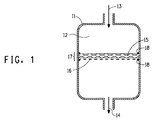
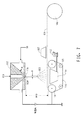
一実施形態において、ろ過装置は、表面改質芳香族ポリイミドナノウェブの厚さにわたる圧力差の結果としての前記ナノウェブの変形を防ぐための剛性支持部材をさらに含む。前記剛性支持部材は、ナノウェブを出るときのろ液の自由な流れを可能にする開放設計構造のものである。ろ過装置の一実施形態が、図1に示される。図1を参照すると、11は、内部空間12を画定するハウジングである。好適なハウジングは、具体的なろ過用途に適した任意の材料から作製され得る。多くの用途では、特に316型のステンレス鋼が、許容可能なハウジング材料である。図示されるように、ハウジングは、ろ過される混合物が内部空間12に導入される入力ポート13と、ろ液が除去される出口ポート14とを備えている。本明細書の表面改質芳香族ポリイミドナノウェブ15は、開放構造を有する剛性支持部材16と組み合わされて、フィルタ部材17が形成される。フィルタ部材17は、ろ液と固体を隔てるように内部空間12内に配置され、漏れを防ぐためのシール18の使用によって内部に封止的に取り付けられる。当該技術分野において公知であり、かつ具体的なろ過用途に適した任意の封止手段が、本発明の実施に適している。好適な封止手段としては、Oリング、ガスケット(ゴム製および金属製の両方)、コーキング、グリースなどが挙げられる。
In one embodiment, the filtration device further includes a rigid support member to prevent deformation of the nanoweb as a result of a pressure differential across the thickness of the surface modified aromatic polyimide nanoweb. The rigid support member is of an open design structure that allows free flow of filtrate as it exits the nanoweb. One embodiment of a filtration device is shown in FIG. Referring to FIG. 1, reference numeral 11 denotes a housing that defines an
上記の説明において、「適した」という用語は、一方で、構成材料が、腐食、亀裂、または他の劣化を起こさないように、他方で、流体流れの汚染を避けるように考慮して、ろ過装置の構成材料が、分離される混合物の化学的性質、およびろ過の温度によって選択されなければならないことを意味することが理解されるものとする。 In the above description, the term “suitable” refers to filtration, taking into account, on the one hand, the constituent materials to avoid corrosion, cracking or other degradation, and on the other hand to avoid contamination of the fluid flow. It shall be understood that the constituent materials of the device mean that it must be selected according to the chemistry of the mixture to be separated and the temperature of the filtration.
別の態様において、本発明は、第1の電極材料と、第2の電極材料と、第1の電極材料と第2の電極材料との間に配置され、それらと接触する多孔質セパレータとを含む多層物品であって、多孔質セパレータは、複数のナノ繊維を含むナノウェブを含み、ナノ繊維が、芳香族ポリイミドから本質的になり、前記ナノウェブが、自由表面積を有し、その少なくとも一部が、ヒドロカルビル基を含む官能基を含む第二級アミドを含む多層物品を提供する。ヒドロカルビル基は、飽和またはオレフィン性不飽和であり得、芳香族置換基を含み得る。一実施形態において、ヒドロカルビル基は飽和炭化水素である。他の実施形態において、炭化水素はアルキル基である。他の実施形態において、アルキル基は、n−アルキル基の形態である。他の実施形態において、n−アルキル基は、10〜30個の炭素長の範囲である。さらに他の実施形態において、n−アルキル基は、15〜20個の炭素長である。 In another aspect, the present invention provides a first electrode material, a second electrode material, a porous separator disposed between and in contact with the first electrode material and the second electrode material. A multi-layer article comprising a porous separator comprising a nanoweb comprising a plurality of nanofibers, the nanofibers consisting essentially of an aromatic polyimide, the nanoweb having a free surface area, at least one of which A multilayer article comprising a secondary amide, wherein the portion comprises a functional group comprising a hydrocarbyl group. The hydrocarbyl group can be saturated or olefinically unsaturated and can contain aromatic substituents. In one embodiment, the hydrocarbyl group is a saturated hydrocarbon. In other embodiments, the hydrocarbon is an alkyl group. In other embodiments, the alkyl group is in the form of an n-alkyl group. In other embodiments, n-alkyl groups range from 10-30 carbons long. In still other embodiments, the n-alkyl group is 15-20 carbons long.
一実施形態において、前記官能基は、酸素、窒素、または硫黄を含む官能基をさらに含む。他の実施形態において、酸素、窒素、または硫黄を含む前記官能基はアミノ基である。 In one embodiment, the functional group further includes a functional group including oxygen, nitrogen, or sulfur. In another embodiment, the functional group comprising oxygen, nitrogen, or sulfur is an amino group.
ろ過装置の一実施形態において、ナノ繊維は、1000nm未満、さらには800nm未満、さらには約50nm〜500nm、さらには約100〜400nmの数平均直径を特徴とする。非円形断面のナノ繊維の場合、本明細書において使用される際の「直径」という用語は、最大断面寸法を指す。 In one embodiment of the filtration device, the nanofibers are characterized by a number average diameter of less than 1000 nm, even less than 800 nm, even about 50 nm to 500 nm, or even about 100 to 400 nm. For non-circular cross-section nanofibers, the term “diameter” as used herein refers to the maximum cross-sectional dimension.
多層物品の一実施形態において、芳香族ポリイミドは全芳香族ポリイミドである。他の実施形態において、全芳香族ポリイミドはPMDA/ODAである。 In one embodiment of the multilayer article, the aromatic polyimide is a wholly aromatic polyimide. In other embodiments, the wholly aromatic polyimide is PMDA / ODA.
一実施形態において、第1および第2の電極材料は異なっており、本明細書の多層物品は、電池に有用である。代替的な実施形態において、第1および第2の電極材料は同じであり、本明細書の多層物品は、コンデンサ、特に「電気二重層コンデンサ」として知られている種類のコンデンサに有用である。 In one embodiment, the first and second electrode materials are different and the multilayer article herein is useful for batteries. In an alternative embodiment, the first and second electrode materials are the same, and the multilayer article herein is useful for capacitors, particularly the type of capacitor known as an “electric double layer capacitor”.
一実施形態において、第1の電極材料、セパレータ、および第2の電極材料は、積層体の形態で互いに接着して接触している。一実施形態において、各電極材料は、1つ以上のポリマーおよび他の添加剤と組み合わされて、2つの反対面を有するナノウェブセパレータの表面に接着して塗布されるペーストが形成される。接着積層体を形成するために、圧力および/または熱が加えられ得る。 In one embodiment, the first electrode material, the separator, and the second electrode material are in adhesive contact with each other in the form of a laminate. In one embodiment, each electrode material is combined with one or more polymers and other additives to form a paste that is adhered and applied to the surface of a nanoweb separator having two opposite sides. Pressure and / or heat can be applied to form an adhesive laminate.
本発明の多層物品がリチウムイオン電池に有用である一実施形態において、第1の電極材料は、Liイオンのための挿入材料(intercalating material)を含む負極材料である。一実施形態において、負極材料は、炭素、黒鉛、コークス、チタン酸リチウム、Li−Sn合金、Si、C−Si複合体、およびそれらの混合物からなる群から選択される。他の実施形態において、第2の電極材料は、リチウムコバルト酸化物、リン酸鉄リチウム、リチウムニッケル酸化物、リン酸マンガンリチウム、リン酸コバルトリチウム、MNC(LiMn(1/3)Co(1/3)Ni(1/3)O2)、NCA(Li(Ni1−y−zCoyAlz)O2)、リチウムマンガン酸化物、およびそれらの混合物からなる群から選択される正極材料である。 In one embodiment where the multilayer article of the present invention is useful for lithium ion batteries, the first electrode material is a negative electrode material that includes an intercalating material for Li ions. In one embodiment, the negative electrode material is selected from the group consisting of carbon, graphite, coke, lithium titanate, Li—Sn alloy, Si, C—Si composite, and mixtures thereof. In another embodiment, the second electrode material is lithium cobalt oxide, lithium iron phosphate, lithium nickel oxide, lithium manganese phosphate, lithium cobalt phosphate, MNC (LiMn (1/3) Co (1 / 3) A positive electrode material selected from the group consisting of Ni (1/3) O2), NCA (Li (Ni1-y-zCoyAlz) O2), lithium manganese oxide, and mixtures thereof.
一実施形態において、本明細書の多層物品は、第1または第2の電極材料の少なくとも1つと接着して接触する少なくとも1つの金属製集電器をさらに含む。好ましくは、本明細書の多層物品は、各電極材料と接着して接触する金属製集電器をさらに含む。 In one embodiment, the multilayer article herein further comprises at least one metal current collector that is in adhesive contact with at least one of the first or second electrode materials. Preferably, the multilayer article herein further includes a metal current collector that is in adhesive contact with each electrode material.
本発明の多層物品の他の実施形態において、少なくとも1つの電極材料は、集電器として働く非多孔質の金属製シート上に塗布される。好ましい実施形態において、両方の電極材料がそのように塗布される。本明細書の電気化学セルの電池実施形態において、金属製集電器は、異なる金属を含む。本明細書の電気化学セルのコンデンサ実施形態において、金属製集電器は、同じ金属を含む。本発明に使用するのに適した金属製集電器は、好ましくは金属箔である。 In another embodiment of the multilayer article of the present invention, at least one electrode material is applied on a non-porous metal sheet that acts as a current collector. In a preferred embodiment, both electrode materials are so applied. In the battery embodiment of the electrochemical cell herein, the metal current collector comprises a different metal. In the capacitor embodiment of the electrochemical cell herein, the metal current collector comprises the same metal. A metal current collector suitable for use in the present invention is preferably a metal foil.
図2は、本発明の多層物品の一実施形態を示す。図2を参照すると、図中に示される本発明の多層物品は、負極22と正極23との間に配置される、全芳香族ポリイミドから本質的になるポリイミドナノ繊維から本質的になる多孔質ナノウェブセパレータ21を含み、各電極はそれぞれ、非多孔質の導電性の金属箔24aおよび24b上に付着される。一実施形態において、負極22は、炭素、好ましくは黒鉛を含み、金属箔24aは銅箔である。別の実施形態において、正極23は、リチウムコバルト酸化物、リン酸鉄リチウム、またはリチウムマンガン酸化物であり、金属箔24bはアルミニウム箔であり、前記ナノウェブが、自由表面積を有し、その少なくとも一部が、ヒドロカルビル基を含む官能基を含む第二級アミドを含む。ヒドロカルビル基は、飽和またはオレフィン性不飽和であり得、芳香族置換基を含み得る。一実施形態において、ヒドロカルビル基は飽和炭化水素である。他の実施形態において、ヒドロカルビル基はアルキル基である。他の実施形態において、アルキル基は、n−アルキル基の形態である。他の実施形態において、n−アルキル基は、10〜30個の炭素長の範囲である。さらに他の実施形態において、n−アルキル基は、15〜20個の炭素長である。
FIG. 2 illustrates one embodiment of the multilayer article of the present invention. Referring to FIG. 2, the multilayer article of the present invention shown in the figure is a porous material consisting essentially of polyimide nanofibers consisting essentially of wholly aromatic polyimide, disposed between a
一実施形態において、多層物品は、
第1の金属製集電器を含む第1の層と;
第1の金属製集電器と接着して接触する、第1の電極材料を含む第2の層と;
第1の電極材料と接着して接触する、芳香族ポリイミドナノウェブを含む第3の層であって、前記ナノウェブが、自由表面積を有し、その少なくとも一部が、ヒドロカルビル基を含む官能基を含む第二級アミドを含む第3の層と、
芳香族ポリイミドナノウェブと接着して接触する、第2の電極材料を含む第4の層と;
第2の電極材料と接着して接触する、第2の金属製集電器を含む第5の層とを含む。
In one embodiment, the multilayer article is
A first layer including a first metal current collector;
A second layer comprising a first electrode material in adhesive contact with the first metal current collector;
A third layer comprising an aromatic polyimide nanoweb in adhesive contact with the first electrode material, wherein the nanoweb has a free surface area, at least a portion of which is a functional group comprising a hydrocarbyl group A third layer comprising a secondary amide comprising
A fourth layer comprising a second electrode material in adhesive contact with the aromatic polyimide nanoweb;
And a fifth layer including a second metal current collector that is in adhesive contact with the second electrode material.
ヒドロカルビル基は、飽和またはオレフィン性不飽和であり得、芳香族置換基を含み得る。一実施形態において、ヒドロカルビル基は飽和炭化水素である。他の実施形態において、炭化水素はアルキル基である。他の実施形態において、アルキル基は、n−アルキル基の形態である。他の実施形態において、n−アルキル基は、10〜30個の炭素長の範囲である。さらに他の実施形態において、n−アルキル基は、15〜20個の炭素長である。 The hydrocarbyl group can be saturated or olefinically unsaturated and can contain aromatic substituents. In one embodiment, the hydrocarbyl group is a saturated hydrocarbon. In other embodiments, the hydrocarbon is an alkyl group. In other embodiments, the alkyl group is in the form of an n-alkyl group. In other embodiments, n-alkyl groups range from 10-30 carbons long. In still other embodiments, the n-alkyl group is 15-20 carbons long.
一実施形態において、前記官能基は、酸素、窒素、または硫黄を含む官能基をさらに含む。他の実施形態において、酸素、窒素、または硫黄を含む前記官能基はアミノ基である。 In one embodiment, the functional group further includes a functional group including oxygen, nitrogen, or sulfur. In another embodiment, the functional group comprising oxygen, nitrogen, or sulfur is an amino group.
一実施形態において、第1の層は銅箔であり、第2の層は、炭素、好ましくは黒鉛である。他の実施形態において、第3の層の芳香族ポリイミドナノウェブは、強化された芳香族ポリイミドナノウェブである。他の実施形態において、第3の層の芳香族ポリイミドナノウェブは、全芳香族ポリイミドナノウェブである。他の実施形態において、第3の層の全芳香族ポリイミドナノウェブは、強化された全芳香族ポリイミドナノウェブである。他の実施形態において、第3の層の全芳香族ポリイミドナノウェブは、PMDA/ODAである。他の実施形態において、第3の層のPMDA/ODAナノウェブは、強化されたPMDA/ODAナノウェブである。別の実施形態において、第4の層はリチウムコバルト酸化物であり、第5の層はアルミニウム箔である。 In one embodiment, the first layer is a copper foil and the second layer is carbon, preferably graphite. In other embodiments, the third layer aromatic polyimide nanoweb is a reinforced aromatic polyimide nanoweb. In other embodiments, the third layer aromatic polyimide nanoweb is a wholly aromatic polyimide nanoweb. In other embodiments, the third layer fully aromatic polyimide nanoweb is a reinforced fully aromatic polyimide nanoweb. In other embodiments, the wholly aromatic polyimide nanoweb of the third layer is PMDA / ODA. In other embodiments, the third layer PMDA / ODA nanoweb is a reinforced PMDA / ODA nanoweb. In another embodiment, the fourth layer is lithium cobalt oxide and the fifth layer is an aluminum foil.
一実施形態において、第1の層は銅箔であり、第2の層は、炭素、好ましくは黒鉛であり、第3の層は、PMDA/ODAのナノ繊維から本質的になるナノウェブであり、第4の層はリチウムコバルト酸化物であり、第5の層はアルミニウム箔であり、前記ナノウェブが、自由表面積を有し、その少なくとも一部が、ヒドロカルビル基を含む官能基を含む第二級アミドを含む。ヒドロカルビル基は、飽和またはオレフィン性不飽和であり得、芳香族置換基を含み得る。一実施形態において、ヒドロカルビル基は飽和炭化水素である。他の実施形態において、炭化水素はアルキル基である。他の実施形態において、アルキル基は、n−アルキル基の形態である。他の実施形態において、n−アルキル基は、10〜30個の炭素長の範囲である。さらに他の実施形態において、n−アルキル基は、15〜20個の炭素長である。 In one embodiment, the first layer is a copper foil, the second layer is carbon, preferably graphite, and the third layer is a nanoweb consisting essentially of PMDA / ODA nanofibers. , The fourth layer is lithium cobalt oxide, the fifth layer is an aluminum foil, and the nanoweb has a free surface area, at least a portion of which includes a functional group including a hydrocarbyl group. Contains secondary amides. The hydrocarbyl group can be saturated or olefinically unsaturated and can contain aromatic substituents. In one embodiment, the hydrocarbyl group is a saturated hydrocarbon. In other embodiments, the hydrocarbon is an alkyl group. In other embodiments, the alkyl group is in the form of an n-alkyl group. In other embodiments, n-alkyl groups range from 10-30 carbons long. In still other embodiments, the n-alkyl group is 15-20 carbons long.
一実施形態において、前記官能基は、酸素、窒素、または硫黄を含む官能基をさらに含む。他の実施形態において、酸素、窒素、または硫黄を含む前記官能基はアミノ基である。 In one embodiment, the functional group further includes a functional group including oxygen, nitrogen, or sulfur. In another embodiment, the functional group comprising oxygen, nitrogen, or sulfur is an amino group.
他の実施形態において、箔は、両面に正または負の電気活性材料が塗布される。図3に示されるように、これにより、両面の箔を、本明細書の芳香族ポリイミドナノウェブと交互に層状に重ねることによって、任意のサイズ(および電圧)の角型のスタックを迅速に形成することができる。そのように示されるスタックは、典型的に、電解質溶液32で満たされたハウジング31中に配置される。図2に示されるように、スタックは、本発明の複数の相互に連結された多層物品を含む。図3を参照すると、複数の多孔質ポリイミドナノウェブセパレータ21には、負極22、および正極23の交互の層が積み重ねられている。一実施形態において、負極材料22は、銅箔24aの両面に付着される、炭素、好ましくは黒鉛であり、正極材料23は、アルミニウム箔24bの両面に付着されるリチウムコバルト酸化物であり、前記ナノウェブが、自由表面積を有し、その少なくとも一部が、ヒドロカルビル基を含む官能基を含む第二級アミドを含む。ヒドロカルビル基は、飽和またはオレフィン性不飽和であり得、芳香族置換基を含み得る。一実施形態において、ヒドロカルビル基は飽和炭化水素である。他の実施形態において、炭化水素はアルキル基である。他の実施形態において、アルキル基は、n−アルキル基の形態である。他の実施形態において、n−アルキル基は、10〜30個の炭素長の範囲である。さらに他の実施形態において、n−アルキル基は、15〜20個の炭素長である。
In other embodiments, the foil is coated with a positive or negative electroactive material on both sides. This quickly forms a square stack of any size (and voltage) by alternately laminating foils on both sides with the aromatic polyimide nanowebs herein, as shown in FIG. can do. The stack so shown is typically placed in a
一実施形態において、前記官能基は、酸素、窒素、または硫黄を含む官能基をさらに含む。他の実施形態において、酸素、窒素、または硫黄を含む前記官能基はアミノ基である。 In one embodiment, the functional group further includes a functional group including oxygen, nitrogen, or sulfur. In another embodiment, the functional group comprising oxygen, nitrogen, or sulfur is an amino group.
本発明の物品の代替的な実施形態が、図4aに示される。図4aを参照すると、本発明の物品は、負極22と正極23との間に配置される、全芳香族ポリイミドのナノ繊維から本質的になる、本発明に使用するのに適した多孔質ナノウェブセパレータ21を含み、各電極が、ナノウェブの両面に直接付着され、前記ナノウェブが、自由表面積を有し、その少なくとも一部が、ヒドロカルビル基を含む官能基を含む第二級アミドを含む。ヒドロカルビル基は、飽和またはオレフィン性不飽和であり得、芳香族置換基を含み得る。一実施形態において、ヒドロカルビル基は飽和炭化水素である。他の実施形態において、炭化水素はアルキル基である。他の実施形態において、アルキル基は、n−アルキル基の形態である。他の実施形態において、n−アルキル基は、10〜30個の炭素長の範囲である。さらに他の実施形態において、n−アルキル基は、15〜20個の炭素長である。
An alternative embodiment of the article of the invention is shown in Figure 4a. Referring to FIG. 4a, the article of the present invention is a porous nanomaterial suitable for use in the present invention consisting essentially of wholly aromatic polyimide nanofibers disposed between a
電極材料は、ペースト押し出し、印刷を含む当該技術分野において周知のような方法によってナノウェブ上に付着される。一実施形態において、負極は、炭素、好ましくは黒鉛を含む。別の実施形態において、正極は、リチウムコバルト酸化物、リン酸鉄リチウム、またはリチウムマンガン酸化物、好ましくはリチウムコバルト酸化物を含む。 The electrode material is deposited on the nanoweb by methods well known in the art including paste extrusion and printing. In one embodiment, the negative electrode comprises carbon, preferably graphite. In another embodiment, the positive electrode comprises lithium cobalt oxide, lithium iron phosphate, or lithium manganese oxide, preferably lithium cobalt oxide.
図4aの形態の他の実施形態が、図4bに示され、図4bでは、図示されるように、金属箔24の層が、図4aの構造に追加されている。好ましい実施形態において、図4bの多層構造は、表面間の密着および層間の接着を得るように積層される。
Another embodiment of the form of FIG. 4a is shown in FIG. 4b, in which a layer of
別の態様において、本発明は、内部に配置されるハウジングと、電解質と、電解質に少なくとも部分的に浸漬される多層物品とを含む電気化学セルであって;多層物品が、第1の金属製集電器と、第1の金属製集電器と導電接触する第1の電極材料と、第1の電極材料とイオン伝導接触する第2の電極材料と、第1の電極材料と第2の電極材料との間に配置され、それらと接触する芳香族ポリイミドナノウェブセパレータと;第2の電極材料と導電接触する第2の金属製集電器とを含み、芳香族ポリイミドナノウェブセパレータが、複数のナノ繊維を含むナノウェブを含み、ナノ繊維が、芳香族ポリイミドから本質的になり、前記ナノウェブが、自由表面積を有し、その少なくとも一部が、ヒドロカルビル基を含む官能基を含む第二級アミドを含む。 In another aspect, the present invention is an electrochemical cell comprising a housing disposed therein, an electrolyte, and a multilayer article at least partially immersed in the electrolyte; the multilayer article is made of a first metal. A current collector, a first electrode material in conductive contact with the first metal current collector, a second electrode material in ion conductive contact with the first electrode material, and a first electrode material and a second electrode material An aromatic polyimide nanoweb separator disposed between and in contact with; a second metal current collector in conductive contact with the second electrode material, wherein the aromatic polyimide nanoweb separator comprises a plurality of nano A secondary amide comprising a nanoweb comprising fibers, the nanofibers consisting essentially of an aromatic polyimide, the nanoweb having a free surface area, at least a portion of which comprises a functional group comprising a hydrocarbyl group Including.
ヒドロカルビル基は、飽和またはオレフィン性不飽和であり得、芳香族置換基を含み得る。一実施形態において、ヒドロカルビル基は飽和炭化水素である。他の実施形態において、炭化水素はアルキル基である。他の実施形態において、アルキル基は、n−アルキル基の形態である。他の実施形態において、n−アルキル基は、10〜30個の炭素長の範囲である。さらに他の実施形態において、n−アルキル基は、15〜20個の炭素長である。 The hydrocarbyl group can be saturated or olefinically unsaturated and can contain aromatic substituents. In one embodiment, the hydrocarbyl group is a saturated hydrocarbon. In other embodiments, the hydrocarbon is an alkyl group. In other embodiments, the alkyl group is in the form of an n-alkyl group. In other embodiments, n-alkyl groups range from 10-30 carbons long. In still other embodiments, the n-alkyl group is 15-20 carbons long.
一実施形態において、前記官能基は、酸素、窒素、または硫黄を含む官能基をさらに含む。他の実施形態において、酸素、窒素、または硫黄を含む前記官能基はアミノ基である。 In one embodiment, the functional group further includes a functional group including oxygen, nitrogen, or sulfur. In another embodiment, the functional group comprising oxygen, nitrogen, or sulfur is an amino group.
ろ過装置の一実施形態において、ナノ繊維は、1000nm未満、さらには800nm未満、さらには約50nm〜500nm、さらには約100〜400nmの数平均直径を特徴とする。非円形断面のナノ繊維の場合、本明細書において使用される際の「直径」という用語は、最大断面寸法を指す。 In one embodiment of the filtration device, the nanofibers are characterized by a number average diameter of less than 1000 nm, even less than 800 nm, even about 50 nm to 500 nm, or even about 100 to 400 nm. For non-circular cross-section nanofibers, the term “diameter” as used herein refers to the maximum cross-sectional dimension.
電気化学セルの一実施形態において、芳香族ポリイミドは全芳香族ポリイミドである。他の実施形態において、全芳香族ポリイミドはPMDA/ODAである。 In one embodiment of the electrochemical cell, the aromatic polyimide is a wholly aromatic polyimide. In other embodiments, the wholly aromatic polyimide is PMDA / ODA.
本明細書の電気化学セルの一実施形態において、多層物品の第1の層は銅箔であり、多層物品の第2の層は、炭素、好ましくは黒鉛である。本明細書の電気化学セルの他の実施形態において、第3の層の芳香族ポリイミドナノウェブセパレータは、強化された芳香族ポリイミドナノウェブを含む。他の実施形態において、第3の層の芳香族ポリイミドナノウェブセパレータは、全芳香族ポリイミドナノウェブを含む。他の実施形態において、第3の層の全芳香族ポリイミドナノウェブセパレータは、強化された全芳香族ポリイミドナノウェブを含む。他の実施形態において、第3の層の全芳香族ポリイミドナノウェブは、PMDA/ODAを含む。他の実施形態において、第3の層のPMDA/ODAナノウェブセパレータは、強化されたPMDA/ODAナノウェブを含む。別の実施形態において、第4の層はリチウムコバルト酸化物であり、第5の層はアルミニウム箔である。 In one embodiment of the electrochemical cell herein, the first layer of the multilayer article is a copper foil and the second layer of the multilayer article is carbon, preferably graphite. In other embodiments of the electrochemical cell herein, the third layer aromatic polyimide nanoweb separator comprises a reinforced aromatic polyimide nanoweb. In other embodiments, the third layer aromatic polyimide nanoweb separator comprises a wholly aromatic polyimide nanoweb. In other embodiments, the third layer of wholly aromatic polyimide nanoweb separator comprises a reinforced wholly aromatic polyimide nanoweb. In other embodiments, the third layer of wholly aromatic polyimide nanoweb comprises PMDA / ODA. In other embodiments, the third layer PMDA / ODA nanoweb separator comprises a reinforced PMDA / ODA nanoweb. In another embodiment, the fourth layer is lithium cobalt oxide and the fifth layer is an aluminum foil.
一実施形態において、第1の層は銅箔であり;第2の層は、炭素、好ましくは黒鉛であり;第3の層は、PMDA/ODAのナノ繊維から本質的になるナノウェブであり;第4の層はリチウムコバルト酸化物であり;第5の層はアルミニウム箔であり、前記ナノウェブが、自由表面積を有し、その少なくとも一部が、ヒドロカルビル基を含む官能基を含む第二級アミドを含む。 In one embodiment, the first layer is a copper foil; the second layer is carbon, preferably graphite; and the third layer is a nanoweb consisting essentially of PMDA / ODA nanofibers. The fourth layer is a lithium cobalt oxide; the fifth layer is an aluminum foil; the nanoweb has a free surface area, at least a portion of which includes a functional group that includes a hydrocarbyl group. Contains secondary amides.
ヒドロカルビル基は、飽和またはオレフィン性不飽和であり得、芳香族置換基を含み得る。一実施形態において、ヒドロカルビル基は飽和炭化水素である。他の実施形態において、炭化水素はアルキル基である。他の実施形態において、アルキル基は、n−アルキル基の形態である。他の実施形態において、n−アルキル基は、10〜30個の炭素長の範囲である。さらに他の実施形態において、n−アルキル基は、15〜20個の炭素長である。 The hydrocarbyl group can be saturated or olefinically unsaturated and can contain aromatic substituents. In one embodiment, the hydrocarbyl group is a saturated hydrocarbon. In other embodiments, the hydrocarbon is an alkyl group. In other embodiments, the alkyl group is in the form of an n-alkyl group. In other embodiments, n-alkyl groups range from 10-30 carbons long. In still other embodiments, the n-alkyl group is 15-20 carbons long.
一実施形態において、前記官能基は、酸素、窒素、または硫黄を含む官能基をさらに含む。他の実施形態において、酸素、窒素、または硫黄を含む前記官能基はアミノ基である。 In one embodiment, the functional group further includes a functional group including oxygen, nitrogen, or sulfur. In another embodiment, the functional group comprising oxygen, nitrogen, or sulfur is an amino group.
本明細書の電気化学セルの一実施形態において、第1および第2の電極材料は異なっており、本明細書の電気化学セルは、電池、好ましくはリチウムイオン電池である。本明細書の電気化学セルの代替的な実施形態において、第1および第2の電極材料は同じであり、本明細書の電気化学セルは、コンデンサ、好ましくは電気二重層コンデンサである。電極材料が同じであることが本明細書に記載されている場合、電極材料が同じ化学組成を含むことを意味する。しかしながら、電極材料は、粒度などのいくつかの構造構成要素が異なり得る。 In one embodiment of the electrochemical cell herein, the first and second electrode materials are different and the electrochemical cell herein is a battery, preferably a lithium ion battery. In an alternative embodiment of the electrochemical cell herein, the first and second electrode materials are the same, and the electrochemical cell herein is a capacitor, preferably an electric double layer capacitor. Where it is described herein that the electrode material is the same, it means that the electrode material comprises the same chemical composition. However, the electrode material can differ in several structural components such as particle size.
図3を再度参照すると、本発明の電気化学セルは、図3に示される層状のスタックが、液密ハウジング31中に収容されると形成され、液密ハウジング31は、液体電解質32を含有する金属製の「缶」であり得る。他の実施形態において、液体電解質は、有機溶媒およびそれに溶解可能なリチウム塩を含む。他の実施形態において、リチウム塩は、LiPF6、LiBF4またはLiClO4である。さらに他の実施形態において、有機溶媒は、1つ以上の炭酸アルキルを含む。他の実施形態において、1つ以上の炭酸アルキルは、炭酸エチレンと炭酸ジメチルとの混合物を含む。塩および溶媒濃度の最適範囲は、用いられる具体的な材料、および予想される使用条件に応じて;例えば、意図される動作温度に応じて変化し得る。一実施形態において、溶媒は70体積部の炭酸エチレンであり、30体積部の炭酸ジメチルであり、塩はLiPF6である。あるいは、電解質塩は、ヘキサフルオロヒ酸リチウム、ビス−トリフルオロメチルスルホンアミドリチウム、ビス(オキサレート)ボロン酸リチウム、ジフルオロオキサラトボロン酸リチウム(lithium difluorooxalatoboronate)、または多フッ素化クラスターアニオンのLi+塩、またはこれらの組合せを含み得る。
Referring back to FIG. 3, the electrochemical cell of the present invention is formed when the layered stack shown in FIG. 3 is received in a liquid-
あるいは、電解質溶媒は、炭酸プロピレン、エチレングリコールまたはポリ(エチレングリコール)のエステル、エーテル、またはトリメチルシラン誘導体あるいはこれらの組合せを含み得る。さらに、電解質は、例えばK.XuによってChem.Rev.,104,4303(2004)に、およびS.S.ZhangによってJ.Power Sources,162,1379(2006)に概説されるように、Liイオン電池の性能または安定性を高めることが知られている様々な添加剤を含有し得る。 Alternatively, the electrolyte solvent may comprise propylene carbonate, ethylene glycol or poly (ethylene glycol) esters, ethers, or trimethylsilane derivatives or combinations thereof. Furthermore, the electrolyte is, for example, K.I. Xu by Chem. Rev. 104, 4303 (2004) and S. S. By Zhang As outlined in Power Sources, 162, 1379 (2006), it may contain various additives known to increase the performance or stability of Li-ion batteries.
層状のスタックに関して、図3に示されるスタックの代わりに、図2に示される多層物品を用いることができる。また、図示されていないが、セルを外部の電気負荷に接続するための手段または充電手段も存在するであろう。好適な手段としては、ワイヤ、タブ、コネクタ、プラグ、クランプ、および電気接続を形成するのに一般的に使用される任意の他のこのような手段が挙げられる。 For a layered stack, the multilayer article shown in FIG. 2 can be used instead of the stack shown in FIG. Also, although not shown, there will also be means for connecting the cell to an external electrical load or charging means. Suitable means include wires, tabs, connectors, plugs, clamps, and any other such means commonly used to make electrical connections.
スタック中の個々のセルが、正から負へ互いに直列に電気接続される場合、スタックからの出力電圧は、各セルからの合計電圧に等しい。スタックを構成する個々のセルが、並列に電気接続される場合、スタックからの出力電圧は、1つのセルの電圧に等しい。電気技術分野の平均的な実践者は、直列配列が適切な場合、および並列配列が適切な場合を認識しているであろう。 If the individual cells in the stack are electrically connected in series from positive to negative, the output voltage from the stack is equal to the total voltage from each cell. When the individual cells that make up the stack are electrically connected in parallel, the output voltage from the stack is equal to the voltage of one cell. The average practitioner in the electrotechnical field will recognize when a series arrangement is appropriate and when a parallel arrangement is appropriate.
リチウムイオン電池は、円筒形、角型、袋状、巻回型、および積層形状を含む様々な形状で利用可能である。リチウムイオン電池は、様々な用途(例えば家庭用電化製品、電動工具、およびハイブリッド電気自動車)に使用される。リチウムイオン電池の製造方法は、NiCdおよびNiMHなどの他の電池の製造方法と同様であるが、Liイオン電池に使用される材料の反応性のために、より慎重に行うべきものである。 Lithium ion batteries are available in a variety of shapes including cylindrical, square, bag-shaped, wound, and laminated shapes. Lithium ion batteries are used in a variety of applications (eg, household appliances, power tools, and hybrid electric vehicles). The manufacturing method of the lithium ion battery is the same as that of other batteries such as NiCd and NiMH, but it should be performed more carefully because of the reactivity of the materials used in the Li ion battery.
本発明の一実施形態に使用するのに適したリチウムイオンセルの正極および負極は、互いに形状が類似しており、同様のまたは同一の設備で同様の方法によって作製される。一実施形態において、セルの中およびセルの外に電流を伝導する集電器として働く、金属箔、好ましくはAl箔またはCu箔の両面に、活性材料が塗布される。一実施形態において、負極は、銅箔に黒鉛炭素を塗布することによって作製される。一実施形態において、正極は、Al箔にリチウム金属酸化物(例えばLiCoO2)を塗布することによって作製される。他の実施形態において、このように塗布される箔は、大型のリールに巻き取られ、100〜150℃の範囲の温度で乾燥されてから、セル作製のために乾燥室の中に入れられる。 The positive and negative electrodes of a lithium ion cell suitable for use in one embodiment of the present invention are similar in shape to each other and are made by similar methods with similar or identical equipment. In one embodiment, the active material is applied to both sides of a metal foil, preferably an Al foil or Cu foil, that acts as a current collector that conducts current into and out of the cell. In one embodiment, the negative electrode is made by applying graphitic carbon to a copper foil. In one embodiment, the positive electrode is made by applying a lithium metal oxide (eg, LiCoO 2) to an Al foil. In other embodiments, the foil thus applied is wound on a large reel, dried at a temperature in the range of 100-150 ° C., and then placed in a drying chamber for cell fabrication.
図5を参照すると、各電極について、活性材料51が、バインダー溶液52、およびアセチレンブラックなどの導電性充填材53と組み合わされる。このように形成される組合せは、精密レギュレータ54を通って、混合タンク55に供給され、ここで、この組合せは、均一な外観が得られるまで混合される。好適なバインダーとしては、限定はされないが、ポリ(フッ化ビニリデン)ホモポリマーおよびコポリマー、スチレンブタジエンゴム、ポリテトラフルオロエチレン、およびポリイミドが挙げられる。次に、このように形成されるスラリーは、ポンプ56に重力送りまたは圧力送りされ、ポンプ56は、スラリーをフィルタ57に通して、そこから塗布ヘッド58へと送り込む。塗布ヘッドは、制御される量のスラリーを、供給ロール510から供給される移動金属箔59の表面に付着させる。このように塗布される箔は、一連のロール511によって、100〜150℃に設定されるオーブン512を通って搬送される。オーブンの入口に配置されるナイフエッジ513が、箔の上の調整可能な距離に位置決めされ;それによって形成される電極の厚さが、ナイフエッジと箔との間の間隙を調整することによって制御される。オーブン中、溶媒は、典型的に溶媒回収ユニット514を通って揮発される。次に、このように乾燥される電極が、巻き取りロール515に搬送される。
Referring to FIG. 5, for each electrode, an
乾燥後に得られる電極厚さは、典型的に50〜150マイクロメートルの範囲である。箔の両面に塗膜を形成するのが望ましい場合、このように片面を塗布された箔が、塗布機に送り戻されるが、塗布されていない面が、スラリー付着を受けるように配置される。塗布の後、次に、そのように形成される電極がカレンダー加工され、様々なサイズの電池のために幅の狭いストリップに切り裂かれてもよい。箔ストリップの縁部のバリは、セル内の内部短絡を引き起こすおそれがあるため、切断機は、非常に精密に製造され、維持されなければならない。 The electrode thickness obtained after drying is typically in the range of 50 to 150 micrometers. If it is desirable to form a coating on both sides of the foil, the foil coated on one side in this way is sent back to the applicator, but the uncoated surface is arranged to receive slurry adhesion. After application, the electrodes so formed may then be calendered and cut into narrow strips for various sized batteries. Since burrs at the edges of the foil strip can cause internal shorts in the cell, the cutting machine must be manufactured and maintained very precisely.
本発明の電気化学セルの一実施形態において、本明細書の電極アセンブリは、円筒形のセルに使用される渦巻き型構造である。渦巻き型電極アセンブリに使用するのに適した構造が図6に示される。代替的な実施形態において、本明細書の電極アセンブリは、角型のセルに使用するのに適した図3の構造と類似した層状構造である。角型のセルも、巻回形状で作製され得る。角型のセルの場合、巻回型のセルは、矩形の構造を形成するように加圧され、次に、それが、矩形のハウジングの中に押し込まれる。 In one embodiment of the electrochemical cell of the present invention, the electrode assembly herein is a spiral structure used for cylindrical cells. A suitable structure for use in a spiral electrode assembly is shown in FIG. In an alternative embodiment, the electrode assembly herein is a layered structure similar to the structure of FIG. 3 suitable for use in a square cell. Square cells can also be made in a wound shape. In the case of a square cell, the wound cell is pressurized to form a rectangular structure, which is then pushed into a rectangular housing.
本発明のLiイオンセルの円筒形実施形態を形成するために、電極アセンブリは、まず、図6に示されるような渦巻き型構造になるように巻き付けられる。次に、タブが、電極をその対応する端子に接続するために電極の縁部に貼り付けられる。高出力セルの場合、高電流を流すために電極ストリップの縁部に沿って溶接された複数のタブを用いることが望ましい。次に、タブが、缶に溶接され、渦巻き型電極アセンブリは、円筒形ハウジング中に挿入される。次に、ハウジングは密閉されるが、電解質をハウジング中に注入するための開口部を残しておく。次に、セルは、電解質で満たされてから密閉される。電解質は、通常、塩(LiPF6)とカーボネート系溶媒との混合物である。 In order to form a cylindrical embodiment of the Li ion cell of the present invention, the electrode assembly is first wound into a spiral structure as shown in FIG. A tab is then affixed to the edge of the electrode to connect the electrode to its corresponding terminal. For high power cells, it is desirable to use a plurality of tabs welded along the edges of the electrode strip to pass high currents. The tab is then welded to the can and the spiral electrode assembly is inserted into the cylindrical housing. The housing is then sealed, but leaving an opening for injecting electrolyte into the housing. The cell is then filled with electrolyte and then sealed. The electrolyte is usually a mixture of a salt (LiPF6) and a carbonate solvent.
電解質が水と反応するため、セルの組み立ては、好ましくは「乾燥室」中で行われる。水分は、LiPF6を加水分解してHFを形成することがあり、これは、電極を劣化させ、セルの性能に悪影響を与え得る。 As the electrolyte reacts with water, the assembly of the cell is preferably performed in a “drying chamber”. Moisture can hydrolyze LiPF6 to form HF, which can degrade the electrode and adversely affect cell performance.
セルが組み立てられた後、セルは、少なくとも1回の精密に制御された充電/放電サイクルを経て作用物質を活性化することによって形成(状態調節)される。ほとんどのリチウムイオンの化学作用では、これは、SEI(固体電解質界面)層を負(炭素)極上に形成することを含む。これは、リチウム化炭素の、電解質とのさらなる反応を防ぐのに不可欠な不動態化層である。 After the cell is assembled, it is formed (conditioned) by activating the agent through at least one precisely controlled charge / discharge cycle. For most lithium ion chemistries, this involves forming a SEI (solid electrolyte interface) layer on the negative (carbon) electrode. This is a passivation layer that is essential to prevent further reaction of the lithiated carbon with the electrolyte.
別の態様において、本発明は、電気化学的二重層コンデンサ(EDLC)を提供する。EDLCは、数ファラッド程度であり得る高いキャパシタンスを有するエネルギー貯蔵装置である。二重層電気化学的コンデンサにおける電荷貯蔵は、電極、典型的に炭素と、電解質との界面で起こる表面現象である。本明細書の二重層コンデンサでは、本明細書の芳香族ポリイミドナノウェブは、電解質を吸収し、保持し、それによって、電解質と電極との密着を維持するセパレータとして働く。本明細書の芳香族ポリイミドナノウェブのセパレータとしての役割は、負極から正極を電気的に絶縁すること、および充電および放電中の、電解質中のイオンの移動を促進することである。電気化学的二重層コンデンサは、典型的に、2つの炭素電極およびセパレータが一緒に巻かれた、円筒形に巻かれた設計で作製され、高強度を有する芳香族ポリイミドナノウェブセパレータは、2つの電極間の短絡を避ける。 In another aspect, the present invention provides an electrochemical double layer capacitor (EDLC). An EDLC is an energy storage device with a high capacitance that can be on the order of a few farads. Charge storage in double layer electrochemical capacitors is a surface phenomenon that occurs at the electrode, typically carbon, electrolyte interface. In the double layer capacitor herein, the aromatic polyimide nanoweb herein serves as a separator that absorbs and retains the electrolyte, thereby maintaining adhesion between the electrolyte and the electrode. The role of the aromatic polyimide nanoweb in this specification as a separator is to electrically insulate the positive electrode from the negative electrode, and to promote the movement of ions in the electrolyte during charging and discharging. Electrochemical double layer capacitors are typically made in a cylindrically wound design with two carbon electrodes and separators wound together, and aromatic polyimide nanoweb separators with high strength are two Avoid short circuit between electrodes.
本発明は、以下の特定の実施形態によってさらに説明されるが、それによって限定されるものではない。 The present invention is further illustrated by the following specific embodiments, but is not limited thereby.
実施例1〜8および比較例A
ポリマーの製造
[HMT E115199−39PI=ポリマー21109、紡糸SF44P1DBX001D15IR20IM501]
DMF溶媒中のPMDAおよびODAのポリアミド酸を、過剰なODAを用いて業界標準方法にしたがって製造して、97%の化学量論量および23重量%の固体を得た。ポリアミド酸を、0.04重量%の無水フタル酸(末端封止剤の重量%を確認する必要がある)で末端封止した。
Examples 1-8 and Comparative Example A
Production of polymer [HMT E115199-39PI = polymer 21109, spun SF44P1DBX001D15IR20IM501]
PMDA and ODA polyamic acids in DMF solvent were prepared according to industry standard methods with excess ODA to give 97% stoichiometric amount and 23 wt% solids. The polyamic acid was end-capped with 0.04% by weight phthalic anhydride (which requires confirmation of the end capping agent wt%).
ナノウェブの製造
そのように製造されたPAA溶液を、図7に示される装置に充填した。図7は、好適なエレクトロブロー装置の一実施形態を示す。34℃の温度および55℃のプロセスガス温度および5833メートル/分の速度で、5.5バールの溶液圧力で(本発明者らの仮特許出願に)記載されるエレクトロブロープロセスにしたがって、ポリアミド酸溶液を紡糸してナノ繊維ウェブにした。得られたナノウェブは、63%の多孔率で厚さ21〜26ミクロンであった。
Production of Nanoweb The PAA solution so produced was loaded into the apparatus shown in FIG. FIG. 7 shows one embodiment of a suitable electroblowing apparatus. Polyamic acid according to the electroblowing process described (in our provisional patent application) at a solution pressure of 5.5 bar at a temperature of 34 ° C. and a process gas temperature of 55 ° C. and a rate of 5833 meters / min. The solution was spun into a nanofiber web. The resulting nanoweb had a porosity of 63% and a thickness of 21-26 microns.
さらに図7を参照して、ナノウェブ105を、180℃で1.13分間、熱風乾燥機107に通過させた。次に、このように乾燥されたナノウェブを、巻き取ってロールにした。次に、このように製造されたポリアミド酸ナノウェブを巻き出してから、Glenro中波長赤外線オーブン中で、約325℃の温度まで0.87分間加熱することによってイミド化し、再度巻き取った。次に、ウェブを巻き出し、BF Perkinsカレンダー上で、ステンレス鋼製カレンダーロールと綿で被覆されたカレンダーロールとの間でリニアインチ当たり2700ポンドの圧力でカレンダー加工してから、再度巻き取った。次に、カレンダー加工されたウェブを巻き出し、約450℃の温度で2.6分間、2度目の熱処理を行い、再度巻き取った。
Still referring to FIG. 7,
アミド化および試験の結果
それぞれ重さ約35mgの、そのように製造されたポリイミドナノ繊維ウェブの8つの試料を、加熱マントルが装着されたPyrex(登録商標)容器中で、窒素下で、100mLの無水N,Nジメチルホルムアミド(DMF)(Aldrich 227056)に溶解させた5.0gmのオクタデシルアミン(Aldrich 305391)の予め加熱された溶液に加えた。表1に示される各期間の後、示される溶液温度で、1つの試料を取り出し、トルエン中で4回すすぎ、真空オーブン中、減圧下で95℃で1時間乾燥させた。未処理の出発材料の試料を比較のために確保した。
Results of amidation and testing Eight samples of polyimide nanofiber web so produced, each weighing about 35 mg, were placed in a Pyrex® vessel fitted with a heating mantle under 100 mL of nitrogen. To a preheated solution of 5.0 gm octadecylamine (Aldrich 305391) dissolved in anhydrous N, N dimethylformamide (DMF) (Aldrich 227056). After each period shown in Table 1, one sample was removed at the indicated solution temperature, rinsed 4 times in toluene, and dried in a vacuum oven at 95 ° C. under reduced pressure for 1 hour. A sample of untreated starting material was reserved for comparison.
各試料について、減衰反射赤外分光法(ATR/IR)は、芳香族CH伸張モードによる、3092cm−1におけるピークと比較して、脂肪族CH伸張モードによる、2920cm−1における吸収ピークによって示される試料表面におけるオクタデシル基の組み込みを示した。脂肪族基の組み込みには、第二級アミドの形成と一致する3360cm−1における幅の広い吸収の増加も伴った。表にまとめられるように、これらの測定値は、最初の60分間の後の反応速度の大幅な低下を示した。 For each sample, attenuated reflectance infrared spectroscopy (ATR / IR) is indicated by the absorption peak at 2920 cm −1 due to the aliphatic CH stretch mode compared to the peak at 3092 cm −1 due to the aromatic CH stretch mode. The incorporation of octadecyl groups on the sample surface was shown. Incorporation of aliphatic groups was also accompanied by an increase in broad absorption at 3360 cm-1 consistent with the formation of secondary amides. As summarized in the table, these measurements showed a significant decrease in reaction rate after the first 60 minutes.
表1に示されるように、オクタデシルアミンの組み込みの増加とともに、ナノ繊維ウェブにおける脱イオン水の静的接触角は、104.7°から146.8°まで増加し、これは、高度に疎水性の表面を示し、一方、質量は、ポリイミドのモル当たり0.039当量のオクタデシルアミド基に相当するわずか2.5%だけ増加した。本発明の範囲を限定するものではないが、ポリイミド繊維の芯を比較的変化させないままにして、反応が、主にナノ繊維の表面において起こるモデルにデータが一致すると考えられる。 As shown in Table 1, with increasing incorporation of octadecylamine, the static contact angle of deionized water in the nanofiber web increased from 104.7 ° to 146.8 °, which is highly hydrophobic While the mass increased by only 2.5%, corresponding to 0.039 equivalents of octadecylamide groups per mole of polyimide. While not limiting the scope of the present invention, it is believed that the data agrees with a model in which the reaction occurs primarily at the nanofiber surface, leaving the polyimide fiber core relatively unchanged.
比較例Aおよび実施例9の試験片の部分を、それぞれ図8aおよび8bに示されるように、走査電子顕微鏡法によって調べた。オクタデシルアミンによる処理に起因する差が、繊維形態または格子間空間(interstitial spacing)に見られなかった。 The portions of the test specimens of Comparative Example A and Example 9 were examined by scanning electron microscopy as shown in FIGS. 8a and 8b, respectively. No differences due to treatment with octadecylamine were found in fiber morphology or interstitial spacing.
実施例10および11:n−アルキルアミンで部分的にアミド化されたポリイミドナノウェブ
5gのn−ドデシルアミンを、100mLのDMF溶媒に溶解させた。実施例1のポリイミドナノウェブの試料を、50℃でそれぞれ1時間および20時間の期間にわたって溶液中に浸漬した。試料を同時に浸漬させ、異なる時間間隔の後に取り出し、次に、イソプロパノールで3回すすいだ。走査電子顕微鏡法は、未反応の対照と比べて繊維形態の変化を示さなかった。
Examples 10 and 11: Polyimide nanoweb partially amidated with n-alkylamine 5 g of n-dodecylamine was dissolved in 100 mL of DMF solvent. A sample of the polyimide nanoweb of Example 1 was immersed in the solution at 50 ° C. for a period of 1 hour and 20 hours, respectively. Samples were soaked at the same time, removed after different time intervals, and then rinsed 3 times with isopropanol. Scanning electron microscopy showed no change in fiber morphology compared to unreacted controls.
拡散反射赤外分光法は、脂肪族基を確認する2852および2919cm−1における吸収ピークを示した。1545、1650および3267cm−1におけるピークにより、第二級アミド基が確認された。反応生成物の赤外線スペクトルは、元のポリイミドの1700および1500cm−1における強い吸収ピークを保ち、これは、アミド化反応が主にナノ繊維の表面上のポリマーの薄層に限定されることを示唆していた。 Diffuse reflectance infrared spectroscopy showed absorption peaks at 2852 and 2919 cm-1 confirming the aliphatic group. Secondary amide groups were confirmed by peaks at 1545, 1650 and 3267 cm-1. The infrared spectrum of the reaction product retains strong absorption peaks at 1700 and 1500 cm −1 of the original polyimide, suggesting that the amidation reaction is mainly limited to a thin layer of polymer on the nanofiber surface. Was.
実施例12および13:n−アルキルアミンで部分的にアミド化されるポリイミドナノウェブ
DMF中のn−ヘキサデシルアミンの5重量%溶液を製造した。実施例1のポリイミドナノウェブの試料を、それぞれ1時間および20時間の期間にわたって50℃で溶液中に浸漬し、次に、イソプロパノールで3回すすいだ。走査電子顕微鏡法は、未反応の対照と比べて繊維形態の変化を示さなかった。拡散反射赤外分光法は、脂肪族基を確認する2852および2919cm−1における吸収ピークを示した。1545、1650および3267cm−1におけるピークにより、第二級アミド基が確認された。反応生成物の赤外線スペクトルは、元のポリイミドの1700および1500cm−1における強い吸収ピークを保ち、これは、アミド化反応が主にナノ繊維の表面上のポリマーの薄層に限定されることを示唆していた。
Examples 12 and 13: Polyimide nanoweb partially amidated with n-alkylamine A 5 wt% solution of n-hexadecylamine in DMF was prepared. A sample of the polyimide nanoweb of Example 1 was immersed in the solution at 50 ° C. for a period of 1 hour and 20 hours, respectively, and then rinsed 3 times with isopropanol. Scanning electron microscopy showed no change in fiber morphology compared to unreacted controls. Diffuse reflectance infrared spectroscopy showed absorption peaks at 2852 and 2919 cm-1 confirming the aliphatic group. Secondary amide groups were confirmed by peaks at 1545, 1650 and 3267 cm-1. The infrared spectrum of the reaction product retains strong absorption peaks at 1700 and 1500 cm −1 of the original polyimide, suggesting that the amidation reaction is mainly limited to a thin layer of polymer on the nanofiber surface. Was.
実施例14〜17および比較例B〜D
2つの1インチ×3インチ幅のストリップを、実施例10〜13のアミド化されたナノウェブのそれぞれから切断し、真空チャンバ中、90℃で一晩乾燥させた。このように乾燥された試験片を、電気化学的コイン電池中に組み込んだ。
Examples 14-17 and Comparative Examples B-D
Two 1 inch × 3 inch wide strips were cut from each of the amidated nanowebs of Examples 10-13 and dried overnight at 90 ° C. in a vacuum chamber. The test piece thus dried was incorporated into an electrochemical coin cell.
真空チャンバ中、90℃で一晩乾燥された構成要素からLiイオンコイン電池(CR232)を以下のとおりに組み立てた。電極を、Pred Materials International,NY,NY 10165から入手した。アノードおよびカソードはそれぞれ、Cu箔に塗布された天然黒鉛およびAl箔に塗布されたLiCoO2の層を含んでいた。電解質は、炭酸エチルメチルと炭酸エチレンとの70:30混合物中の1モルのLiPF6(Ferro Corp.,Independence,OH 44131)を含んでいた。 A Li-ion coin cell (CR232) was assembled from the components dried overnight at 90 ° C. in a vacuum chamber as follows. Electrodes were obtained from Pred Materials International, NY, NY 10165. The anode and cathode each contained a layer of natural graphite applied to the Cu foil and LiCoO2 applied to the Al foil. The electrolyte contained 1 mole of LiPF6 (Ferro Corp., Independence, OH 44131) in a 70:30 mixture of ethyl methyl carbonate and ethylene carbonate.
アノードおよびカソードを、厚さ15〜25ミクロンの、実施例10〜13のアミド化されたポリイミドナノウェブのうちの1つの単層で隔てた。このように組み立てられたLiイオンコイン電池を、電池試験装置(Series 4000,Maccor Inc.,2805 W.40th St.,Tulsa,OK 74107)に取り付け、0.25mAで2.75Vから4.2Vまでの3回のサイクルを繰り返すことによって状態調節した。2.5mAにおけるさらなる250サイクルの後に容量保持を測定した。10Cにおける4.2から2.75までの放電能力を測定することによってレート能力(rate capability)を測定した。ここで、Cは、ちょうど1時間で全セル容量を回復するのに必要な電流を表す。250番目のサイクルにおける容量は、セルの安定性の指標とみなされる。結果を表2にまとめる。 The anode and cathode were separated by a single layer of one of the amidated polyimide nanowebs of Examples 10-13, 15-25 microns thick. The Li-ion coin battery assembled in this way is attached to a battery testing device (Series 4000, Maccor Inc., 2805 W.40th St., Tulsa, OK 74107), and from 2.75 V to 4.2 V at 0.25 mA. Conditioning was repeated by repeating the three cycles. Capacity retention was measured after an additional 250 cycles at 2.5 mA. The rate capability was measured by measuring the discharge capability from 4.2 to 2.75 at 10C. Here, C represents the current required to restore full cell capacity in just one hour. The capacity at the 250th cycle is taken as an indication of cell stability. The results are summarized in Table 2.
実施例18〜21
ポリ(アミド酸)溶液2(PAA2)
97%の化学量論量および23.5重量%の固体で、DMF中のPMDA/ODAのポリアミド酸を製造した。アミド酸を、0.04重量%の無水フタル酸で末端封止した(確認する必要がある)。
Examples 18-21
Poly (amic acid) solution 2 (PAA2)
PMDA / ODA polyamic acid in DMF was made with 97% stoichiometric amount and 23.5 wt% solids. The amic acid was endcapped with 0.04 wt% phthalic anhydride (need to be confirmed).
ナノウェブ#2(NW−2)
そのように製造されたPAA溶液を、図7に示される装置に充填した。図7は、好適なエレクトロブロー装置の一実施形態を示す。37℃の温度および72℃のプロセスガス温度および5833メートル/分の速度で、5.5バールの溶液圧力で、(本発明者らの仮特許出願に)記載されるエレクトロブロープロセスにしたがって、ポリアミド酸溶液を紡糸してナノ繊維ウェブにした。
Nanoweb # 2 (NW-2)
The so-prepared PAA solution was filled into the apparatus shown in FIG. FIG. 7 shows one embodiment of a suitable electroblowing apparatus. A polyamide according to the electroblowing process described (in our provisional patent application) at a solution gas pressure of 5.5 bar at a temperature of 37 ° C. and a process gas temperature of 72 ° C. and a rate of 5833 meters / min. The acid solution was spun into a nanofiber web.
次に、ナノウェブを、手作業で巻き出し、手動のローリングブレードカッター(rolling blade cutter)を用いて、長さ約12インチで幅10インチのハンドシート(hand sheet)へと切断した。得られたナノウェブは、85±5%の多孔率、および18±2g/m2の坪量を特徴としていた。 The nanoweb was then manually unwound and cut into hand sheets about 12 inches long and 10 inches wide using a manual rolling blade cutter. The resulting nanoweb was characterized by a porosity of 85 ± 5% and a basis weight of 18 ± 2 g / m 2.
実施例18:および比較例E−ヒスタミンで部分的にアミド化されたポリイミドナノウェブ
このように形成されるナノウェブの2×2インチ試料をイミド化し、空気対流炉中、350℃で2分間、および450℃で2分間アニーリングした。このようにイミド化され、アニーリングされた試料を、10mLの塩化メチレンとともに20mLのガラスシンチレーションバイアルに入れ、Branson超音波浴中で15分間超音波処理した。このように超音波処理された試料を取り出し、窒素下で、真空オーブン中、100℃で10分間、窒素下で乾燥させた。
Example 18: and comparative example E-polyimide nanoweb partially amidated with histamine A 2x2 inch sample of the nanoweb thus formed was imidized and placed in an air convection oven at 350 ° C for 2 minutes. And annealed at 450 ° C. for 2 minutes. The imidized and annealed sample was placed in a 20 mL glass scintillation vial with 10 mL methylene chloride and sonicated in a Branson ultrasonic bath for 15 minutes. The sample thus sonicated was removed and dried under nitrogen in a vacuum oven at 100 ° C. for 10 minutes under nitrogen.
ヒスタミン(Aldrich)の溶液を、エタノール中0.06Mの濃度で100mLのガラスビーカー中で製造した。固体ヒスタミンをガラスビーカーに加え、0.06Mの最終濃度に達するようにエタノールを撹拌しながら加えた。上記のように乾燥されたナノウェブ試料を、50℃で1時間、ヒスタミン溶液中に浸漬した。このように浸漬されたナノウェブ試料を取り出し、真空オーブン中、100℃で10分間、窒素下で乾燥させ、その後、10mLのエタノールで満たされたシンチレーションバイアルに入れ、Branson超音波浴中で15分間超音波処理した。このように超音波処理された試料を取り出し、真空オーブン中、100℃で10分間、窒素下で乾燥させた。アミド化された表面生成物の存在を、2920cm−1および2850cm−1における特性吸収の存在によって、減衰全反射(ATR)アタッチメントを用いたFTIR分析によって確認した。接触角の分析も行った。アミド化されていないナノウェブ対照(比較例E)が、150°±4°の静的水接触角を示した一方、ヒスタミンで処理した試料は、0°の静的水接触角を示した。水滴が構造中に完全に吸い上げられるのが観察された。各データ点は、少なくとも3つの試験のそれぞれの平均であった。 A solution of histamine (Aldrich) was prepared in a 100 mL glass beaker at a concentration of 0.06 M in ethanol. Solid histamine was added to a glass beaker and ethanol was added with stirring to reach a final concentration of 0.06M. The nanoweb sample dried as described above was immersed in a histamine solution at 50 ° C. for 1 hour. The soaked nanoweb sample is removed and dried in a vacuum oven at 100 ° C. for 10 minutes under nitrogen, then placed in a scintillation vial filled with 10 mL of ethanol for 15 minutes in a Branson ultrasonic bath. Sonicated. The sample so sonicated was removed and dried under nitrogen in a vacuum oven at 100 ° C. for 10 minutes. The presence of amidated surface product was confirmed by FTIR analysis using an attenuated total reflection (ATR) attachment by the presence of characteristic absorption at 2920 cm-1 and 2850 cm-1. The contact angle was also analyzed. The non-amidated nanoweb control (Comparative Example E) showed a static water contact angle of 150 ° ± 4 °, while the sample treated with histamine showed a static water contact angle of 0 °. It was observed that water droplets were completely sucked into the structure. Each data point was the average of each of at least three tests.
実施例19:N,Nジエチルエチレンジアミンで部分的にアミド化されたポリイミドナノウェブ
実施例18の0.06Mのヒスタミン溶液の代わりにエタノール中のN,N−ジエチルエチレンジアミン(Aldrich)の0.086Mの溶液を用いたことを除いて、実施例18の手順を、実施例18のナノウェブのさらなる2×2インチ試料を用いて繰り返した。アミド化された表面生成物の存在を、2920cm−1および2850cm−1における特性吸収の存在によって、減衰全反射(ATR)アタッチメントを用いたFTIR分析によって確認した。N,N−ジエチルエチレンジアミンで処理された試料は、0°の静的水接触角を示した。
Example 19: Polyimide nanoweb partially amidated with N, N diethylethylenediamine 0.086M of N, N-diethylethylenediamine (Aldrich) in ethanol instead of the 0.06M histamine solution of Example 18 The procedure of Example 18 was repeated with an additional 2 × 2 inch sample of the nanoweb of Example 18, except that the solution was used. The presence of amidated surface product was confirmed by FTIR analysis using an attenuated total reflection (ATR) attachment by the presence of characteristic absorption at 2920 cm-1 and 2850 cm-1. The sample treated with N, N-diethylethylenediamine exhibited a 0 ° static water contact angle.
実施例20:ヘキサメチレンジアミンで部分的にアミド化されたポリイミドナノウェブ
実施例18の0.06Mのヒスタミン溶液の代わりに、エタノール中のヘキサメチレンジアミン(Aldrich)の0.05Mの溶液を用い、浸漬時間が実施例18の1時間の代わりに20時間であったことを除いて、実施例18の手順を、実施例18のナノウェブのさらなる2×2インチ試料を用いて繰り返した。アミド化された表面生成物の存在を、実施例18と同様に、FTIR分析によって確認した。接触角の分析も行った。ヘキサメチレンジアミンで処理された試料は、0°の静的水接触角を示した。
Example 20: Polyimide nanoweb partially amidated with hexamethylenediamine Instead of the 0.06M histamine solution of Example 18, a 0.05M solution of hexamethylenediamine (Aldrich) in ethanol was used. The procedure of Example 18 was repeated with a further 2 × 2 inch sample of the nanoweb of Example 18, except that the immersion time was 20 hours instead of 1 hour of Example 18. The presence of amidated surface product was confirmed by FTIR analysis as in Example 18. The contact angle was also analyzed. The sample treated with hexamethylenediamine exhibited a static water contact angle of 0 °.
実施例21:
それぞれ実施例18、19および20にしたがって製造されたアミド化されたナノウェブ試料のそれぞれの1つの6mg(約2cm×2cm)のアリコート、ならびに正規化された対照の6mgのアリコートを、個々に、2mLのパスツールピペットに充填した。脱イオン水の0.20mLのアリコートを各ピペットに加え、水が、ナノウェブが充填されたカラムを通過するのに必要な時間を記録した。24時間後、水は、対照試料を保持するピペットを通過していなかった。水は、実施例18、19、および20において製造された材料が充填されたピペットを、10分間以内に完全に通過した。
Example 21:
A 6 mg (about 2 cm × 2 cm) aliquot of each of the amidated nanoweb samples prepared according to Examples 18, 19 and 20, respectively, and a normalized control 6 mg aliquot, Filled 2 mL Pasteur pipette. A 0.20 mL aliquot of deionized water was added to each pipette and the time required for the water to pass through the nanoweb packed column was recorded. After 24 hours, water had not passed through the pipette holding the control sample. The water completely passed through the pipette filled with the material produced in Examples 18, 19, and 20 within 10 minutes.
Claims (15)
Applications Claiming Priority (3)
| Application Number | Priority Date | Filing Date | Title |
|---|---|---|---|
| US12/963,962 US9475009B2 (en) | 2009-12-15 | 2010-12-09 | Filtration method using polyimide nanoweb with amidized surface and apparatus therefor |
| US12/963,962 | 2010-12-09 | ||
| PCT/US2011/063526 WO2012078627A2 (en) | 2010-12-09 | 2011-12-06 | Filtration method using polyimide nanoweb with amidized surface and apparatus therefor |
Publications (2)
| Publication Number | Publication Date |
|---|---|
| JP2014506830A true JP2014506830A (en) | 2014-03-20 |
| JP2014506830A5 JP2014506830A5 (en) | 2015-01-29 |
Family
ID=46208242
Family Applications (1)
| Application Number | Title | Priority Date | Filing Date |
|---|---|---|---|
| JP2013543271A Pending JP2014506830A (en) | 2010-12-09 | 2011-12-06 | Filtration method using polyimide nanoweb having amidated surface and apparatus therefor |
Country Status (7)
| Country | Link |
|---|---|
| US (1) | US9475009B2 (en) |
| EP (1) | EP2648830A4 (en) |
| JP (1) | JP2014506830A (en) |
| KR (1) | KR101943667B1 (en) |
| CN (1) | CN103249469B (en) |
| TW (1) | TW201226045A (en) |
| WO (1) | WO2012078627A2 (en) |
Cited By (1)
| Publication number | Priority date | Publication date | Assignee | Title |
|---|---|---|---|---|
| JP2022170261A (en) * | 2021-04-28 | 2022-11-10 | 東京応化工業株式会社 | polyimide porous membrane |
Families Citing this family (7)
| Publication number | Priority date | Publication date | Assignee | Title |
|---|---|---|---|---|
| US20140008210A1 (en) * | 2012-07-06 | 2014-01-09 | Aviva Biosciences Corporation | Methods and compositions for separating or enriching cells |
| US20130130126A1 (en) * | 2011-10-12 | 2013-05-23 | Giner, Inc. | Electrochemical cell for high-voltage operation and electrode coatings for use in the same |
| US8679200B2 (en) | 2011-11-18 | 2014-03-25 | E I Du Pont De Nemours And Company | Method for reducing self discharge in an electrochemical cell |
| WO2016160703A1 (en) | 2015-03-27 | 2016-10-06 | Harrup Mason K | All-inorganic solvents for electrolytes |
| US10707531B1 (en) | 2016-09-27 | 2020-07-07 | New Dominion Enterprises Inc. | All-inorganic solvents for electrolytes |
| CN111921315A (en) * | 2020-07-13 | 2020-11-13 | 陈刚 | Mist catcher for gas-liquid separation |
| CN116063709B (en) * | 2021-11-01 | 2024-08-16 | 宁德时代新能源科技股份有限公司 | Composite polyimide diaphragm and preparation method thereof, and secondary battery |
Citations (15)
| Publication number | Priority date | Publication date | Assignee | Title |
|---|---|---|---|---|
| JPH0321336A (en) * | 1989-06-01 | 1991-01-30 | E I Du Pont De Nemours & Co | Amine-modified polyimide film |
| JPH08117531A (en) * | 1994-10-26 | 1996-05-14 | Nittetsu Mining Co Ltd | Unit combination filter element |
| JP2003041189A (en) * | 2001-07-25 | 2003-02-13 | Mitsui Chemicals Inc | Varnish and cross-linkable polyimide |
| US20040082731A1 (en) * | 2001-03-09 | 2004-04-29 | Wolfgang Albrecht | Functionalized polyimide molded body and functionalized polyimide membrane |
| JP2004277743A (en) * | 2003-03-13 | 2004-10-07 | National Univ Of Singapore | Polyimide treatment process and polyimide film |
| JP2004308031A (en) * | 2003-04-03 | 2004-11-04 | Teijin Ltd | Polyamide acid non-woven fabric, polyimide non-woven fabric obtained therefrom and methods for producing them |
| US20060249018A1 (en) * | 2005-05-04 | 2006-11-09 | Hua Wang | Nucleophilic modifier functionalized and/or crosslinked solvent-resistant polymide and copolymer membranes |
| WO2007013552A1 (en) * | 2005-07-29 | 2007-02-01 | Toyo Boseki Kabushiki Kaisha | Polyamide imide fiber, non-woven fabric composed of the fiber, process for manufacture of the non-woven fabric, and separator for electronic component |
| JP2008002011A (en) * | 2006-06-22 | 2008-01-10 | Toyobo Co Ltd | Polyimide nonwoven fabric and method for producing the same |
| JP2010504444A (en) * | 2006-09-20 | 2010-02-12 | イー・アイ・デュポン・ドウ・ヌムール・アンド・カンパニー | Improved nanoweb |
| JP2010509039A (en) * | 2006-11-02 | 2010-03-25 | イー・アイ・デュポン・ドウ・ヌムール・アンド・カンパニー | Fuel filter |
| JP2010520053A (en) * | 2007-03-06 | 2010-06-10 | イー・アイ・デュポン・ドウ・ヌムール・アンド・カンパニー | Improved liquid filtration media |
| JP2010525938A (en) * | 2007-05-02 | 2010-07-29 | イー・アイ・デュポン・ドウ・ヌムール・アンド・カンパニー | Baghouse filters and media |
| JP2010526919A (en) * | 2007-05-14 | 2010-08-05 | エボニック ファイバース ゲゼルシャフト ミット ベシュレンクテル ハフツング | Cross-linked polyimide film |
| JP2010528846A (en) * | 2007-06-07 | 2010-08-26 | イー・アイ・デュポン・ドウ・ヌムール・アンド・カンパニー | Method for forming a laminate of nanoweb and substrate and filter using the laminate |
Family Cites Families (8)
| Publication number | Priority date | Publication date | Assignee | Title |
|---|---|---|---|---|
| US4851505A (en) | 1988-04-13 | 1989-07-25 | E. I. Du Pont De Nemours And Company | Highly soluble aromatic polyimides |
| US5976380A (en) * | 1997-05-01 | 1999-11-02 | Millipore Corporation | Article of manufacture including a surface modified membrane and process |
| KR100549140B1 (en) | 2002-03-26 | 2006-02-03 | 이 아이 듀폰 디 네모아 앤드 캄파니 | Ultra-fine nanofiber web manufacturing method by electro-blowing |
| US20040166311A1 (en) * | 2003-02-25 | 2004-08-26 | Clemson University | Electrostatic spinning of aromatic polyamic acid |
| KR20090020544A (en) | 2006-02-21 | 2009-02-26 | 더 트러스티즈 오브 프린스턴 유니버시티 | High yield activation of polymer surface for covalent attachment of molecules |
| GB2437519B (en) * | 2006-04-28 | 2010-04-21 | Imp Innovations Ltd | Method for separation |
| KR100820162B1 (en) | 2006-08-07 | 2008-04-10 | 한국과학기술연구원 | Heat-resistant ultra-fine fibrous separator and manufacturing method thereof, and secondary battery using same |
| WO2010111755A2 (en) | 2009-04-01 | 2010-10-07 | Katholieke Universiteit Leuven - K.U.Leuven R & D | Improved method for making cross-linked polyimide membranes |
-
2010
- 2010-12-09 US US12/963,962 patent/US9475009B2/en active Active
-
2011
- 2011-12-06 CN CN201180058986.2A patent/CN103249469B/en active Active
- 2011-12-06 EP EP11846513.7A patent/EP2648830A4/en not_active Withdrawn
- 2011-12-06 KR KR1020137017816A patent/KR101943667B1/en active Active
- 2011-12-06 WO PCT/US2011/063526 patent/WO2012078627A2/en not_active Ceased
- 2011-12-06 JP JP2013543271A patent/JP2014506830A/en active Pending
- 2011-12-09 TW TW100145519A patent/TW201226045A/en unknown
Patent Citations (15)
| Publication number | Priority date | Publication date | Assignee | Title |
|---|---|---|---|---|
| JPH0321336A (en) * | 1989-06-01 | 1991-01-30 | E I Du Pont De Nemours & Co | Amine-modified polyimide film |
| JPH08117531A (en) * | 1994-10-26 | 1996-05-14 | Nittetsu Mining Co Ltd | Unit combination filter element |
| US20040082731A1 (en) * | 2001-03-09 | 2004-04-29 | Wolfgang Albrecht | Functionalized polyimide molded body and functionalized polyimide membrane |
| JP2003041189A (en) * | 2001-07-25 | 2003-02-13 | Mitsui Chemicals Inc | Varnish and cross-linkable polyimide |
| JP2004277743A (en) * | 2003-03-13 | 2004-10-07 | National Univ Of Singapore | Polyimide treatment process and polyimide film |
| JP2004308031A (en) * | 2003-04-03 | 2004-11-04 | Teijin Ltd | Polyamide acid non-woven fabric, polyimide non-woven fabric obtained therefrom and methods for producing them |
| US20060249018A1 (en) * | 2005-05-04 | 2006-11-09 | Hua Wang | Nucleophilic modifier functionalized and/or crosslinked solvent-resistant polymide and copolymer membranes |
| WO2007013552A1 (en) * | 2005-07-29 | 2007-02-01 | Toyo Boseki Kabushiki Kaisha | Polyamide imide fiber, non-woven fabric composed of the fiber, process for manufacture of the non-woven fabric, and separator for electronic component |
| JP2008002011A (en) * | 2006-06-22 | 2008-01-10 | Toyobo Co Ltd | Polyimide nonwoven fabric and method for producing the same |
| JP2010504444A (en) * | 2006-09-20 | 2010-02-12 | イー・アイ・デュポン・ドウ・ヌムール・アンド・カンパニー | Improved nanoweb |
| JP2010509039A (en) * | 2006-11-02 | 2010-03-25 | イー・アイ・デュポン・ドウ・ヌムール・アンド・カンパニー | Fuel filter |
| JP2010520053A (en) * | 2007-03-06 | 2010-06-10 | イー・アイ・デュポン・ドウ・ヌムール・アンド・カンパニー | Improved liquid filtration media |
| JP2010525938A (en) * | 2007-05-02 | 2010-07-29 | イー・アイ・デュポン・ドウ・ヌムール・アンド・カンパニー | Baghouse filters and media |
| JP2010526919A (en) * | 2007-05-14 | 2010-08-05 | エボニック ファイバース ゲゼルシャフト ミット ベシュレンクテル ハフツング | Cross-linked polyimide film |
| JP2010528846A (en) * | 2007-06-07 | 2010-08-26 | イー・アイ・デュポン・ドウ・ヌムール・アンド・カンパニー | Method for forming a laminate of nanoweb and substrate and filter using the laminate |
Cited By (2)
| Publication number | Priority date | Publication date | Assignee | Title |
|---|---|---|---|---|
| JP2022170261A (en) * | 2021-04-28 | 2022-11-10 | 東京応化工業株式会社 | polyimide porous membrane |
| JP7799390B2 (en) | 2021-04-28 | 2026-01-15 | 東京応化工業株式会社 | Polyimide porous membrane |
Also Published As
| Publication number | Publication date |
|---|---|
| US20110139730A1 (en) | 2011-06-16 |
| WO2012078627A2 (en) | 2012-06-14 |
| CN103249469B (en) | 2016-04-27 |
| EP2648830A2 (en) | 2013-10-16 |
| US9475009B2 (en) | 2016-10-25 |
| KR101943667B1 (en) | 2019-01-29 |
| CN103249469A (en) | 2013-08-14 |
| WO2012078627A3 (en) | 2012-10-04 |
| TW201226045A (en) | 2012-07-01 |
| EP2648830A4 (en) | 2017-04-05 |
| KR20140005917A (en) | 2014-01-15 |
Similar Documents
| Publication | Publication Date | Title |
|---|---|---|
| JP6185842B2 (en) | Polyimide nanoweb with amidated surface and method for making | |
| TWI500207B (en) | Multi-layer object including polyamidene nanonet | |
| KR101943667B1 (en) | Filtration method using polyimide nanoweb with amidized surface and apparatus therefor | |
| US20120148896A1 (en) | Multi-layer article of polyimide nanoweb with amidized surface | |
| KR20120123047A (en) | Electrochemical Cell Comprising a Separator Comprising a Nanoweb Consisting Essentially of Nanofibers of Fully Aromatic Polyimide | |
| JP2013514466A (en) | Method for increasing the strength and solvent resistance of polyimide nanowebs | |
| CN104853919A (en) | Method for producing porous polyimide membrane, porous polyimide membrane, and separator using the porous polyimide membrane | |
| US20120148897A1 (en) | Electrochemical cell comprising a multi-layer article of polyimide nanoweb with amidized surface | |
| JP6180424B2 (en) | Method for reducing self-discharge in electrochemical cells. | |
| TW201232893A (en) | Multi-layer article of polyimide nanoweb with amidized surface | |
| HK1177774A (en) | Method for increasing the strength and solvent resistance of polyimide nanowebs | |
| HK1177818A (en) | Multi-layer article comprising polyimide nanoweb |
Legal Events
| Date | Code | Title | Description |
|---|---|---|---|
| A521 | Request for written amendment filed |
Free format text: JAPANESE INTERMEDIATE CODE: A523 Effective date: 20141208 |
|
| A621 | Written request for application examination |
Free format text: JAPANESE INTERMEDIATE CODE: A621 Effective date: 20141208 |
|
| A131 | Notification of reasons for refusal |
Free format text: JAPANESE INTERMEDIATE CODE: A131 Effective date: 20151028 |
|
| A601 | Written request for extension of time |
Free format text: JAPANESE INTERMEDIATE CODE: A601 Effective date: 20160128 |
|
| A02 | Decision of refusal |
Free format text: JAPANESE INTERMEDIATE CODE: A02 Effective date: 20160704 |