JP2015123747A - Non-aqueous inkjet printing method - Google Patents
Non-aqueous inkjet printing method Download PDFInfo
- Publication number
- JP2015123747A JP2015123747A JP2013272449A JP2013272449A JP2015123747A JP 2015123747 A JP2015123747 A JP 2015123747A JP 2013272449 A JP2013272449 A JP 2013272449A JP 2013272449 A JP2013272449 A JP 2013272449A JP 2015123747 A JP2015123747 A JP 2015123747A
- Authority
- JP
- Japan
- Prior art keywords
- post
- aqueous
- ink
- treatment liquid
- aqueous pigment
- Prior art date
- Legal status (The legal status is an assumption and is not a legal conclusion. Google has not performed a legal analysis and makes no representation as to the accuracy of the status listed.)
- Granted
Links
Images

Classifications
-
- C—CHEMISTRY; METALLURGY
- C09—DYES; PAINTS; POLISHES; NATURAL RESINS; ADHESIVES; COMPOSITIONS NOT OTHERWISE PROVIDED FOR; APPLICATIONS OF MATERIALS NOT OTHERWISE PROVIDED FOR
- C09D—COATING COMPOSITIONS, e.g. PAINTS, VARNISHES OR LACQUERS; FILLING PASTES; CHEMICAL PAINT OR INK REMOVERS; INKS; CORRECTING FLUIDS; WOODSTAINS; PASTES OR SOLIDS FOR COLOURING OR PRINTING; USE OF MATERIALS THEREFOR
- C09D179/00—Coating compositions based on macromolecular compounds obtained by reactions forming in the main chain of the macromolecule a linkage containing nitrogen, with or without oxygen, or carbon only, not provided for in groups C09D161/00 - C09D177/00
- C09D179/02—Polyamines
-
- B—PERFORMING OPERATIONS; TRANSPORTING
- B41—PRINTING; LINING MACHINES; TYPEWRITERS; STAMPS
- B41J—TYPEWRITERS; SELECTIVE PRINTING MECHANISMS, i.e. MECHANISMS PRINTING OTHERWISE THAN FROM A FORME; CORRECTION OF TYPOGRAPHICAL ERRORS
- B41J2/00—Typewriters or selective printing mechanisms characterised by the printing or marking process for which they are designed
- B41J2/005—Typewriters or selective printing mechanisms characterised by the printing or marking process for which they are designed characterised by bringing liquid or particles selectively into contact with a printing material
- B41J2/01—Ink jet
- B41J2/135—Nozzles
- B41J2/16—Production of nozzles
- B41J2/1621—Manufacturing processes
- B41J2/1631—Manufacturing processes photolithography
-
- B—PERFORMING OPERATIONS; TRANSPORTING
- B41—PRINTING; LINING MACHINES; TYPEWRITERS; STAMPS
- B41M—PRINTING, DUPLICATING, MARKING, OR COPYING PROCESSES; COLOUR PRINTING
- B41M7/00—After-treatment of prints, e.g. heating, irradiating, setting of the ink, protection of the printed stock
- B41M7/0018—After-treatment of prints, e.g. heating, irradiating, setting of the ink, protection of the printed stock using ink-fixing material, e.g. mordant, precipitating agent, after printing, e.g. by ink-jet printing, coating or spraying
-
- C—CHEMISTRY; METALLURGY
- C08—ORGANIC MACROMOLECULAR COMPOUNDS; THEIR PREPARATION OR CHEMICAL WORKING-UP; COMPOSITIONS BASED THEREON
- C08K—Use of inorganic or non-macromolecular organic substances as compounding ingredients
- C08K3/00—Use of inorganic substances as compounding ingredients
- C08K3/02—Elements
- C08K3/04—Carbon
-
- C—CHEMISTRY; METALLURGY
- C08—ORGANIC MACROMOLECULAR COMPOUNDS; THEIR PREPARATION OR CHEMICAL WORKING-UP; COMPOSITIONS BASED THEREON
- C08K—Use of inorganic or non-macromolecular organic substances as compounding ingredients
- C08K5/00—Use of organic ingredients
- C08K5/04—Oxygen-containing compounds
- C08K5/06—Ethers; Acetals; Ketals; Ortho-esters
-
- C—CHEMISTRY; METALLURGY
- C09—DYES; PAINTS; POLISHES; NATURAL RESINS; ADHESIVES; COMPOSITIONS NOT OTHERWISE PROVIDED FOR; APPLICATIONS OF MATERIALS NOT OTHERWISE PROVIDED FOR
- C09D—COATING COMPOSITIONS, e.g. PAINTS, VARNISHES OR LACQUERS; FILLING PASTES; CHEMICAL PAINT OR INK REMOVERS; INKS; CORRECTING FLUIDS; WOODSTAINS; PASTES OR SOLIDS FOR COLOURING OR PRINTING; USE OF MATERIALS THEREFOR
- C09D11/00—Inks
- C09D11/02—Printing inks
- C09D11/10—Printing inks based on artificial resins
- C09D11/106—Printing inks based on artificial resins containing macromolecular compounds obtained by reactions only involving carbon-to-carbon unsaturated bonds
-
- C—CHEMISTRY; METALLURGY
- C09—DYES; PAINTS; POLISHES; NATURAL RESINS; ADHESIVES; COMPOSITIONS NOT OTHERWISE PROVIDED FOR; APPLICATIONS OF MATERIALS NOT OTHERWISE PROVIDED FOR
- C09D—COATING COMPOSITIONS, e.g. PAINTS, VARNISHES OR LACQUERS; FILLING PASTES; CHEMICAL PAINT OR INK REMOVERS; INKS; CORRECTING FLUIDS; WOODSTAINS; PASTES OR SOLIDS FOR COLOURING OR PRINTING; USE OF MATERIALS THEREFOR
- C09D11/00—Inks
- C09D11/30—Inkjet printing inks
- C09D11/32—Inkjet printing inks characterised by colouring agents
- C09D11/322—Pigment inks
-
- C—CHEMISTRY; METALLURGY
- C09—DYES; PAINTS; POLISHES; NATURAL RESINS; ADHESIVES; COMPOSITIONS NOT OTHERWISE PROVIDED FOR; APPLICATIONS OF MATERIALS NOT OTHERWISE PROVIDED FOR
- C09D—COATING COMPOSITIONS, e.g. PAINTS, VARNISHES OR LACQUERS; FILLING PASTES; CHEMICAL PAINT OR INK REMOVERS; INKS; CORRECTING FLUIDS; WOODSTAINS; PASTES OR SOLIDS FOR COLOURING OR PRINTING; USE OF MATERIALS THEREFOR
- C09D11/00—Inks
- C09D11/30—Inkjet printing inks
- C09D11/36—Inkjet printing inks based on non-aqueous solvents
-
- C—CHEMISTRY; METALLURGY
- C09—DYES; PAINTS; POLISHES; NATURAL RESINS; ADHESIVES; COMPOSITIONS NOT OTHERWISE PROVIDED FOR; APPLICATIONS OF MATERIALS NOT OTHERWISE PROVIDED FOR
- C09D—COATING COMPOSITIONS, e.g. PAINTS, VARNISHES OR LACQUERS; FILLING PASTES; CHEMICAL PAINT OR INK REMOVERS; INKS; CORRECTING FLUIDS; WOODSTAINS; PASTES OR SOLIDS FOR COLOURING OR PRINTING; USE OF MATERIALS THEREFOR
- C09D11/00—Inks
- C09D11/54—Inks based on two liquids, one liquid being the ink, the other liquid being a reaction solution, a fixer or a treatment solution for the ink
Landscapes
- Chemical & Material Sciences (AREA)
- Organic Chemistry (AREA)
- Engineering & Computer Science (AREA)
- Chemical Kinetics & Catalysis (AREA)
- Wood Science & Technology (AREA)
- Life Sciences & Earth Sciences (AREA)
- Materials Engineering (AREA)
- Polymers & Plastics (AREA)
- Medicinal Chemistry (AREA)
- Health & Medical Sciences (AREA)
- Manufacturing & Machinery (AREA)
- Ink Jet Recording Methods And Recording Media Thereof (AREA)
- Inks, Pencil-Leads, Or Crayons (AREA)
- Ink Jet (AREA)
Abstract
【課題】非水系の後処理液を用いながらも印刷濃度の向上を図ることができる非水系インクジェット印刷方法を提供する。
【解決手段】顔料と、非水系溶剤とを少なくとも含む非水系顔料インクの液滴を印刷媒体表面に吐出して非水系顔料インクからなるドット10を形成した後、シリカと有機溶剤とを少なくとも含む非水系の後処理液の液滴12を、前記非水系顔料インクからなるドットに重なるように印刷媒体に向けて吐出する工程を含む非水系インクジェット印刷方法であって、前記非水系顔料インク及び前記後処理液のいずれかに、アミノ基を有する水溶性樹脂を含む。
【選択図】図1The present invention provides a non-aqueous ink jet printing method capable of improving the printing density while using a non-aqueous post-treatment liquid.
A droplet of a non-aqueous pigment ink containing at least a pigment and a non-aqueous solvent is ejected onto the surface of a printing medium to form dots 10 made of the non-aqueous pigment ink, and then at least silica and an organic solvent are included. A non-aqueous ink jet printing method comprising a step of ejecting droplets 12 of a non-aqueous post-treatment liquid toward a printing medium so as to overlap dots made of the non-aqueous pigment ink, the non-aqueous pigment ink and the One of the post-treatment liquids contains a water-soluble resin having an amino group.
[Selection] Figure 1
Description
本発明は、非水系インクを用い、インクジェット記録方式により印刷を行う非水系インクジェット印刷方法に関する。 The present invention relates to a non-aqueous ink jet printing method that uses a non-aqueous ink and performs printing by an ink jet recording method.
インクジェット記録システムは、流動性の高い液体インクを微細なノズルから噴射し、紙等の記録媒体に付着させて印刷を行なう印刷システムである。このシステムは、比較的安価な装置で、高解像度、高品位の画像を、高速かつ低騒音で印刷可能という特徴を有し、最近急速に普及している。 The ink jet recording system is a printing system that performs printing by ejecting liquid ink having high fluidity from a fine nozzle and attaching it to a recording medium such as paper. This system is a relatively inexpensive device and has a feature that it can print high-resolution and high-quality images at high speed and with low noise.
インクジェット記録システムに用いられるインクの色材としては、顔料を利用したものと染料を利用したものに大別される。このうち、高画質印刷に必要な耐光性、耐候性および耐水性に優れていることから、顔料を色材とするインクが増加する傾向にある。 The ink coloring materials used in the ink jet recording system are roughly classified into those using pigments and those using dyes. Among these, since it is excellent in light resistance, weather resistance, and water resistance required for high-quality printing, there is a tendency for inks using pigments as color materials to increase.
他方、溶剤からみると、インクは水系タイプインクと非水系タイプインクとに大別される。揮発性溶剤を主体とする溶剤系インクや不揮発性溶剤を主体とするオイル系インクのように、インク用溶媒として水を使用しない非水系インクは、機上安定性(間欠吐出性、長時間放置後の吐出回復性など)が良い、印刷用紙のカールがない、インクの浸透乾燥時間が短い、などの特徴を有し注目されている。 On the other hand, from the viewpoint of the solvent, the ink is roughly classified into an aqueous type ink and a non-aqueous type ink. Non-water-based inks that do not use water as a solvent for inks, such as solvent-based inks mainly composed of volatile solvents and oil-based inks mainly composed of non-volatile solvents, are stable on the machine (intermittent ejection, left for a long time) It has attracted attention because it has features such as good discharge recovery later), no curling of printing paper, and short permeation drying time of ink.
しかし、非水系インクは、色材が印刷媒体内部まで浸透しやすいため印刷濃度が低くなるという課題がある。そこで、印刷濃度の向上を図るため、種々の提案がなされている(例えば、特許文献1参照)。特許文献1では、インク溶剤に対して顔料分散能を有する非水系樹脂分散微粒子を含む非水系顔料インクが提案されている。しかし、特許文献1の手法により印刷濃度を高めると、貯蔵安定性や吐出安定性など他の性能が悪化してしまう。またインクの転移量を増やすことでも印刷濃度は高められるが、そうすると印字物表面が擦れやすくなる(耐擦過性悪化)といった問題が生じる。 However, the non-aqueous ink has a problem that the printing density is low because the color material easily penetrates into the print medium. Thus, various proposals have been made to improve the printing density (see, for example, Patent Document 1). Patent Document 1 proposes a non-aqueous pigment ink containing non-aqueous resin dispersed fine particles having a pigment dispersing ability with respect to an ink solvent. However, when the print density is increased by the method of Patent Document 1, other performance such as storage stability and ejection stability is deteriorated. Further, although the printing density can be increased by increasing the amount of ink transferred, this causes a problem that the surface of the printed matter is easily rubbed (abrasion resistance deteriorates).
一方、インクではなく印刷方法に着目し、その工夫をすることで、印刷濃度を高める検討が行われている(特許文献2〜3参照)。いずれの特許文献においても、印刷に際し、インクによるドット形成の前又は後の被記録媒体に所定の処理液をインクと重なるように付与し、インク中の色材が記録媒体内部に浸透するのを防ぐものであるが、特許文献2では非水系インク用の前処理液が、特許文献3では非水系インク用の後処理液が提案され、それぞれ印刷濃度の向上を図っている。
On the other hand, studies have been made to increase the printing density by focusing on the printing method, not the ink, and devising the method (see
しかしながら、特許文献2及び3における処理液はいずれも水を含む水系のため、吐出性や放置性能の悪化、あるいはカールが発生することが懸念される。
以上のことから、処理液が非水系であっても印刷濃度を向上させることができれば、印刷濃度と吐出性・放置性能・カール防止に優れた印刷方法を実現することができると考えられる。
However, since the treatment liquids in
From the above, it can be considered that if the printing density can be improved even if the treatment liquid is non-aqueous, a printing method excellent in printing density and ejection properties, leaving performance and curling prevention can be realized.
本発明は、上記従来の問題点に鑑みなされたものであり、その課題は、非水系の後処理液を用いながらも印刷濃度の向上を図ることができる非水系インクジェット印刷方法を提供することにある。 The present invention has been made in view of the above-described conventional problems, and its object is to provide a non-aqueous ink jet printing method capable of improving the printing density while using a non-aqueous post-treatment liquid. is there.
前記課題を解決する本発明は以下の通りである。
(1)顔料と、非水系溶剤とを少なくとも含む非水系顔料インクの液滴を印刷媒体表面に吐出して非水系顔料インクからなるドットを形成した後、シリカと有機溶剤とを少なくとも含む非水系の後処理液の液滴を、前記非水系顔料インクからなるドットに重なるように印刷媒体に向けて吐出する工程を含む非水系インクジェット印刷方法であって、
前記非水系顔料インク及び前記後処理液のいずれかに、アミノ基を有する水溶性樹脂を含むことを特徴とする非水系インクジェット印刷方法。
The present invention for solving the above problems is as follows.
(1) A nonaqueous pigment ink containing at least silica and an organic solvent is formed by ejecting droplets of a nonaqueous pigment ink containing at least a pigment and a nonaqueous solvent onto the surface of the printing medium to form dots made of the nonaqueous pigment ink. A non-aqueous inkjet printing method comprising a step of discharging a droplet of a post-treatment liquid toward a printing medium so as to overlap with a dot made of the non-aqueous pigment ink,
Either of the non-aqueous pigment ink and the post-treatment liquid contains a water-soluble resin having an amino group.
(2)前記後処理液の有機溶剤がグリコールエーテル系溶剤を含むことを特徴とする前記(1)に記載の非水系インクジェット印刷方法。 (2) The non-aqueous inkjet printing method according to (1), wherein the organic solvent of the post-treatment liquid contains a glycol ether solvent.
(3)印刷媒体表面に前記非水系顔料インクからなるドットの列を複数形成した後、該非水系顔料インクの各ドット上に前記後処理液の液滴が着弾するように、前記後処理液を吐出することを特徴とする前記(1)又は(2)に記載の非水系インクジェット印刷方法。 (3) After forming a plurality of dots of the non-aqueous pigment ink on the surface of the print medium, the post-treatment liquid is added so that the droplets of the post-treatment liquid land on each dot of the non-aqueous pigment ink. The non-aqueous ink jet printing method according to the above (1) or (2), wherein the ink is discharged.
(4)印刷媒体表面に前記非水系顔料インクからなるドットの列を複数形成した後、該非水系顔料インクの隣り合うドット間の間隙に前記後処理液の液滴が着弾するように、前記後処理液を吐出することを特徴とする前記(1)又は(2)に記載の非水系インクジェット印刷方法。 (4) After forming a plurality of rows of dots made of the non-aqueous pigment ink on the surface of the print medium, the post-treatment liquid droplets land in the gaps between adjacent dots of the non-aqueous pigment ink. The non-aqueous inkjet printing method according to (1) or (2), wherein the treatment liquid is discharged.
本発明によれば、非水系の後処理液を用いながらも印刷濃度の向上を図ることができる非水系インクジェット印刷方法を提供することができる。 According to the present invention, it is possible to provide a non-aqueous ink jet printing method capable of improving the printing density while using a non-aqueous post-treatment liquid.
本発明の非水系インクジェット印刷方法は、顔料と、非水系溶剤とを少なくとも含む非水系顔料インクの液滴を印刷媒体表面に吐出して非水系顔料インクからなるドットを形成した後、シリカと有機溶剤とを少なくとも含む後処理液の液滴を、前記非水系顔料インクからなるドットに重なるように印刷媒体に向けて吐出する工程を含む非水系インクジェット印刷方法であって、前記非水系顔料インク及び前記後処理液のいずれかに、アミノ基を有する水溶性樹脂を含むことを特徴としている。
本発明においては、非水系の後処理液を用いながらも、該後処理液中にアミノ基を有する水溶性樹脂を含有させることで顔料の印刷媒体内部への浸透を抑制し印刷濃度の向上を図ったものである。
以下にまず、本発明の非水系インクジェット印刷方法に用いる非水系顔料インクと、後処理液とについて順次説明する。
In the non-aqueous inkjet printing method of the present invention, a droplet of non-aqueous pigment ink containing at least a pigment and a non-aqueous solvent is ejected onto the surface of a printing medium to form dots made of non-aqueous pigment ink, and then silica and organic A non-aqueous ink jet printing method comprising a step of ejecting droplets of a post-treatment liquid containing at least a solvent toward a printing medium so as to overlap dots made of the non-aqueous pigment ink, the non-aqueous pigment ink and One of the post-treatment liquids includes a water-soluble resin having an amino group.
In the present invention, while using a non-aqueous post-treatment liquid, by containing a water-soluble resin having an amino group in the post-treatment liquid, the penetration of the pigment into the print medium is suppressed and the printing density is improved. It is intended.
First, the non-aqueous pigment ink used in the non-aqueous ink jet printing method of the present invention and the post-treatment liquid will be described sequentially.
[非水系顔料インク]
本発明に係る非水系顔料インク(以下、単に「インク」とも呼ぶ。)は、顔料と、非水系溶剤とを少なくとも含んでなり、必要に応じて、水溶性樹脂、顔料分散剤(非水系樹脂)などを含む。
[Non-aqueous pigment ink]
The non-aqueous pigment ink according to the present invention (hereinafter also simply referred to as “ink”) includes at least a pigment and a non-aqueous solvent, and includes a water-soluble resin, a pigment dispersant (non-aqueous resin) as necessary. ) Etc.
(顔料)
顔料としては、アゾ顔料、フタロシアニン顔料、多環式顔料、染付レーキ顔料等の有機顔料、及び、無機顔料を用いることができる。アゾ顔料としては、溶性アゾレーキ顔料、不溶性アゾ顔料及び縮合アゾ顔料が挙げられる。フタロシアニン顔料としては、金属フタロシアニン顔料及び無金属フタロシアニン顔料が挙げられる。多環式顔料としては、キナクリドン系顔料、ペリレン系顔料、ペリノン系顔料、イソインドリン系顔料、イソインドリノン系顔料、ジオキシサジン系顔料、チオインジゴ系顔料、アンスラキノン系顔料、キノフタロン系顔料、金属錯体顔料及びジケトピロロピロール(DPP)等が挙げられる。無機顔料としては、代表的にはカーボンブラック及び酸化チタン等が挙げられる。これらの顔料は単独で用いてもよいし、2種以上組み合わせて使用してもよい。
(Pigment)
As the pigment, organic pigments such as azo pigments, phthalocyanine pigments, polycyclic pigments, dyed lake pigments, and inorganic pigments can be used. Examples of the azo pigments include soluble azo lake pigments, insoluble azo pigments, and condensed azo pigments. Examples of phthalocyanine pigments include metal phthalocyanine pigments and metal-free phthalocyanine pigments. Polycyclic pigments include quinacridone pigments, perylene pigments, perinone pigments, isoindoline pigments, isoindolinone pigments, dioxysazine pigments, thioindigo pigments, anthraquinone pigments, quinophthalone pigments, metal complex pigments. And diketopyrrolopyrrole (DPP). Representative examples of inorganic pigments include carbon black and titanium oxide. These pigments may be used alone or in combination of two or more.
本発明に係る非水系顔料インク中の顔料の含有量は、通常0.01〜20質量%であり、印刷濃度とインク粘度の観点から1〜15質量%であることが好ましく、5〜10質量%であることが一層好ましい。 The content of the pigment in the non-aqueous pigment ink according to the present invention is usually 0.01 to 20% by mass, preferably 1 to 15% by mass from the viewpoint of printing density and ink viscosity, and 5 to 10% by mass. % Is more preferable.
非水系顔料インク中の顔料の平均粒径は、分散性と保存安定性の観点から500nm以下であることが好ましく、150nm以下であることがより好ましい。ここで、顔料の平均粒径は、(株)堀場製作所製の動的光散乱式粒度分布測定装置LB−500により測定された体積基準の値である。 The average particle diameter of the pigment in the non-aqueous pigment ink is preferably 500 nm or less, and more preferably 150 nm or less, from the viewpoints of dispersibility and storage stability. Here, the average particle diameter of the pigment is a volume-based value measured by a dynamic light scattering particle size distribution analyzer LB-500 manufactured by Horiba, Ltd.
(非水系溶剤)
非水系溶剤としては、非極性有機溶剤及び極性有機溶剤の何れも使用できる。これらは、単独で使用してもよく、単一の相を形成する限り、2種以上を組み合わせて使用することもできる。非極性有機溶剤としては、脂肪族炭化水素溶剤、脂環式炭化水素溶剤、芳香族炭化水素溶剤等の石油系炭化水素溶剤を好ましく挙げることができる。脂肪族炭化水素溶剤、脂環式炭化水素溶剤としては、パラフィン系、イソパラフィン系、ナフテン系の溶剤が挙げられる。例えば、以下の商品名で販売されているものが挙げられる。テクリーンN−16、テクリーンN−20、テクリーンN−22、ナフテゾールL、ナフテゾールM、ナフテゾールH、0号ソルベントL、0号ソルベントM、0号ソルベントH、アイソゾール300、アイソゾール400、AFソルベント4号、AFソルベント5号、AFソルベント6号、及びAFソルベント7号(いずれもJX日鉱日石エネルギー株式会社製);アイソパーG、アイソパーH、アイソパーL、アイソパーM、エクソールD40、エクソールD80、エクソールD100、エクソールD130、及びエクソールD140(いずれも東燃ゼネラル石油株式会社製)。芳香族炭化水素溶剤としては、グレードアルケンL、グレードアルケン200P(いずれもJX日鉱日石エネルギー株式会社製)、ソルベッソ200(東燃ゼネラル石油株式会社製)等が挙げられる。
(Non-aqueous solvent)
As the non-aqueous solvent, any of a non-polar organic solvent and a polar organic solvent can be used. These may be used alone or in combination of two or more as long as they form a single phase. Preferable examples of the nonpolar organic solvent include petroleum hydrocarbon solvents such as aliphatic hydrocarbon solvents, alicyclic hydrocarbon solvents, and aromatic hydrocarbon solvents. Examples of the aliphatic hydrocarbon solvent and alicyclic hydrocarbon solvent include paraffinic, isoparaffinic, and naphthenic solvents. For example, what is sold with the following brand names is mentioned. Teclean N-16, Teclean N-20, Teclean N-22, Naphthezol L, Naphthezol M, Naphthezol H, No. 0 Solvent L, No. 0 Solvent M, No. 0 Solvent H, Isosol 300, Isosol 400, AF Solvent No. 4, AF Solvent No. 5, AF Solvent No. 6, and AF Solvent No. 7 (all manufactured by JX Nippon Oil & Energy Corporation); Isopar G, Isopar H, Isopar L, Isopar M, Exol D40, Exol D80, Exol D100, Exol D130 and Exol D140 (both manufactured by TonenGeneral Sekiyu KK). Examples of the aromatic hydrocarbon solvent include grade alkene L, grade alkene 200P (all manufactured by JX Nippon Oil & Energy Corporation), Solvesso 200 (manufactured by TonenGeneral Sekiyu KK), and the like.
極性有機溶剤としては、エステル系溶剤、高級アルコール系溶剤、高級脂肪酸系溶剤等を好ましく挙げることができる。例えば、ラウリル酸メチル、ラウリル酸イソプロピル、ミリスチン酸イソプロピル、パルミチン酸イソプロピル、パルミチン酸イソステアリル、オレイン酸メチル、オレイン酸エチル、オレイン酸イソプロピル、オレイン酸ブチル、リノール酸メチル、リノール酸イソブチル、リノール酸エチル、イソステアリン酸イソプロピル、大豆油メチル、大豆油イソブチル、トール油メチル、トール油イソブチル、アジピン酸ジイソプロピル、セバシン酸ジイソプロピル、セバシン酸ジエチル、モノカプリン酸プロピレングリコール、トリ2−エチルヘキサン酸トリメチロールプロパン、トリ2−エチルヘキサン酸グリセリル等の、1分子中の炭素数が14以上のエステル系溶剤;イソミリスチルアルコール、イソパルミチルアルコール、イソステアリルアルコール、オレイルアルコール等の、1分子中の炭素数が8以上の高級アルコール系溶剤;イソノナン酸、イソミリスチン酸、ヘキサデカン酸、イソパルミチン酸、オレイン酸、イソステアリン酸等の、1分子中の炭素数が9以上の高級脂肪酸系溶剤、等が挙げられる。 Preferable examples of the polar organic solvent include ester solvents, higher alcohol solvents, higher fatty acid solvents, and the like. For example, methyl laurate, isopropyl laurate, isopropyl myristate, isopropyl palmitate, isostearyl palmitate, methyl oleate, ethyl oleate, isopropyl oleate, butyl oleate, methyl linoleate, isobutyl linoleate, ethyl linoleate , Isopropyl isostearate, soybean oil methyl, soybean oil isobutyl, tall oil methyl, tall oil isobutyl, diisopropyl adipate, diisopropyl sebacate, diethyl sebacate, propylene glycol monocaprate, trimethylolpropane tri-2-ethylhexanoate, tri Ester solvent having 14 or more carbon atoms in one molecule such as glyceryl 2-ethylhexanoate; isomyristyl alcohol, isopalmityl alcohol, isostear Higher alcohol solvents with 8 or more carbon atoms in one molecule such as alcohol, oleyl alcohol, etc .; carbon in one molecule such as isononanoic acid, isomyristic acid, hexadecanoic acid, isopalmitic acid, oleic acid, isostearic acid And higher fatty acid solvents having a number of 9 or more.
(顔料分散剤)
本発明に係る非水系顔料インクには、顔料の分散安定性を確保するため、顔料分散剤を含有することが好ましい。
本発明で使用できる顔料分散剤としては、顔料を非水系溶剤中に安定して分散させるものであれば特に限定されないが、例えば、水酸基含有カルボン酸エステル、長鎖ポリアミノアマイドと高分子量酸エステルの塩、高分子量ポリカルボン酸の塩、長鎖ポリアミノアマイドと極性酸エステルの塩、高分子量不飽和酸エステル、高分子共重合物、変性ポリウレタン、変性ポリアクリレート、ポリエーテルエステル型アニオン系活性剤、ナフタレンスルホン酸ホルマリン縮合物塩、ポリオキシエチレンアルキルリン酸エステル、ポリオキシエチレンノニルフェニルエーテル、ポリエステルポリアミン、ステアリルアミンアセテート等が好適に使用され、そのうち、高分子分散剤を使用するのが好ましい。
(Pigment dispersant)
The non-aqueous pigment ink according to the present invention preferably contains a pigment dispersant in order to ensure the dispersion stability of the pigment.
The pigment dispersant that can be used in the present invention is not particularly limited as long as the pigment is stably dispersed in a non-aqueous solvent. For example, a hydroxyl group-containing carboxylic acid ester, a long-chain polyaminoamide, and a high molecular weight acid ester are used. Salt, salt of high molecular weight polycarboxylic acid, salt of long chain polyaminoamide and polar acid ester, high molecular weight unsaturated acid ester, polymer copolymer, modified polyurethane, modified polyacrylate, polyether ester type anionic active agent, Naphthalenesulfonic acid formalin condensate salt, polyoxyethylene alkyl phosphate ester, polyoxyethylene nonylphenyl ether, polyester polyamine, stearylamine acetate and the like are preferably used, and among them, a polymer dispersant is preferably used.
顔料分散剤は、総量で、顔料1に対し0.2〜1.0の質量比で含まれていることが好ましい。 The total amount of the pigment dispersant is preferably 0.2 to 1.0 with respect to the pigment 1.
顔料分散剤のインク総量における配合量としては、1〜15質量%であることが好ましく、2〜10質量%であることがより好ましい。 The blending amount of the pigment dispersant in the total amount of ink is preferably 1 to 15% by mass, and more preferably 2 to 10% by mass.
上記顔料分散剤のほかに、アミンと反応できる官能基を有するアクリル樹脂を用いることができる。その一例として、以下にアクリル樹脂Aの合成方法を示すが、以下の例に限定されるものではない。 In addition to the pigment dispersant, an acrylic resin having a functional group capable of reacting with an amine can be used. As an example, a method for synthesizing the acrylic resin A is shown below, but is not limited to the following example.
(アクリル樹脂Aの合成)
四つ口フラスコに、AFソルベント6号(ナフテン系溶剤;JX日鉱日石エネルギー(株)製)を仕込み、窒素ガスを通気しながら撹拌し、110℃まで昇温する。次いで、温度を110℃に保ちながら、表1に示す組成の各単量体混合物とAFソルベント6号、パーブチルO(t−ブチルパーオキシ2−エチルヘキサノエート;日油(株)製)の混合物を3時間かけて滴下する。その後、110℃に保ちながら1時間後、2時間後に、パーブチルOを添加する。さらに110℃で1時間熟成を行い、AFソルベント6号で希釈して、不揮発分50%の無色透明の樹脂溶液が得られる。
以上のようにして得られるアクリル樹脂Aにおいて、アミンと反応できる官能基は、GMAのグリシジル基、AAEMのβ−ジケトン基である。
(Synthesis of acrylic resin A)
A four-necked flask is charged with AF Solvent No. 6 (naphthenic solvent; manufactured by JX Nippon Oil & Energy Corporation), stirred while aeration of nitrogen gas, and heated to 110 ° C. Next, while maintaining the temperature at 110 ° C., each monomer mixture having the composition shown in Table 1 and AF Solvent No. 6, perbutyl O (t-butylperoxy 2-ethylhexanoate; manufactured by NOF Corporation) The mixture is added dropwise over 3 hours. Thereafter, perbutyl O is added after 1 hour and 2 hours while maintaining at 110 ° C. Further, aging is performed at 110 ° C. for 1 hour and diluted with AF Solvent No. 6 to obtain a colorless and transparent resin solution having a nonvolatile content of 50%.
In the acrylic resin A obtained as described above, functional groups capable of reacting with amines are GMA glycidyl group and AAEM β-diketone group.
その他、本発明においては、非水系顔料インク及び後処理液のいずれかにアミノ基を有する水溶性樹脂を含有することから、非水系顔料インクに当該水溶性樹脂を含有する場合もあるが、それについては後述する。 In addition, in the present invention, since the non-aqueous pigment ink and the post-treatment liquid contain a water-soluble resin having an amino group, the non-aqueous pigment ink may contain the water-soluble resin. Will be described later.
本発明に係る非水系顔料インクには、上記各成分に加えて、慣用の添加剤が含まれていてよい。添加剤としては、界面活性剤、例えばアニオン性、カチオン性、両性、もしくはノニオン性の界面活性剤、酸化防止剤、例えばジブチルヒドロキシトルエン、没食子酸プロピル、トコフェロール、ブチルヒドロキシアニソール、及びノルジヒドログアヤレチック酸等、が挙げられる。 The non-aqueous pigment ink according to the present invention may contain a conventional additive in addition to the above components. Additives include surfactants such as anionic, cationic, amphoteric or nonionic surfactants, antioxidants such as dibutylhydroxytoluene, propyl gallate, tocopherol, butylhydroxyanisole, and nordihydroguaiare. And tic acid.
インクの粘度は、インクジェット記録システム用の場合、吐出ヘッドのノズル径や吐出環境等によってその適性範囲は異なるが、一般に、23℃において5〜30mPa・sであることが好ましく、5〜15mPa・sであることがより好ましく、約10mPa・s程度であることが、インクジェット記録装置用として適している。ここで粘度は、23℃において0.1Pa/sの速度で剪断応力を0Paから増加させたときの10Paにおける値を表す。 In the case of an ink jet recording system, the viscosity of the ink varies depending on the nozzle diameter of the ejection head, the ejection environment, and the like, but in general, it is preferably 5 to 30 mPa · s at 23 ° C., preferably 5 to 15 mPa · s. It is more preferable that the pressure is about 10 mPa · s, which is suitable for an inkjet recording apparatus. Here, the viscosity represents a value at 10 Pa when the shear stress is increased from 0 Pa at a rate of 0.1 Pa / s at 23 ° C.
非水系顔料インクの調製方法としては、特に制限されず、非水系溶剤に顔料、及び必要に応じて他の成分を混合することで調製することができる。 The method for preparing the non-aqueous pigment ink is not particularly limited, and the non-aqueous pigment ink can be prepared by mixing a pigment and other components as required in a non-aqueous solvent.
[後処理液]
本発明に係る後処理液は、シリカと有機溶剤とを少なくとも含んでなり、必要に応じて水溶性樹脂、顔料分散剤(非水系樹脂)などを含む。
[Post-treatment liquid]
The post-treatment liquid according to the present invention includes at least silica and an organic solvent, and includes a water-soluble resin, a pigment dispersant (non-aqueous resin) and the like as necessary.
(シリカ)
シリカとしては、特に制限はないが、粉末シリカ、コロイダルシリカ、及び合成非晶質シリカ等をそれぞれ単独で、または組み合わせて使用することができる。粉末シリカとしては、例えば、日本アエロジル(株)製AEROSIL 90、OX 50、東ソー・シリカ(株)製E−200A、E−220A、K−500、E−1009、E−1011、E−1030、E−150J、E−170等を使用することができる。コロイダルシリカとしては、例えば、日産化学工業(株)製スノーテックスS、OS、XS、OXS、20、30、40、50、O、AK、AK−YL、O−40、CM、20L、C、ZL、XL、N、UP、扶桑化学工業(株)製クォートロン PL−1、PL−3、PL−7、PL−20、三興コロイド化学(株)製シリカロイド、シリカロイド−LL、シリカロイド−A等を使用することができる。合成非晶質シリカとしては、珪酸塩と酸の中和反応で形成され、その製造方法によりさまざまな性質に分けることができるが、例えば、水澤化学工業(株)製ミズカシルP−73、P−78A、P−707、P−709、P−527、P−803等を使用することができる。
(silica)
Silica is not particularly limited, but powdered silica, colloidal silica, synthetic amorphous silica, and the like can be used alone or in combination. Examples of the powder silica include AEROSIL 90, OX 50, manufactured by Nippon Aerosil Co., Ltd., E-200A, E-220A, K-500, E-1009, E-1011, E-1030, manufactured by Tosoh Silica Co., Ltd. E-150J, E-170, etc. can be used. Examples of colloidal silica include Snowtex S, OS, XS, OXS, 20, 30, 40, 50, O, AK, AK-YL, O-40, CM, 20L, C, manufactured by Nissan Chemical Industries, Ltd. ZL, XL, N, UP, Quatron PL-1, PL-3, PL-7, PL-20 manufactured by Fuso Chemical Industry Co., Ltd., silicaloid, silicaloid-LL, silicaloid manufactured by Sanko Colloid Chemical Co., Ltd. -A etc. can be used. Synthetic amorphous silica is formed by neutralization reaction of silicate and acid, and can be divided into various properties depending on the production method thereof. For example, Mizusuka Chemical Co., Ltd. Mizukasil P-73, P- 78A, P-707, P-709, P-527, P-803, and the like can be used.
シリカの平均粒子径は10〜400nmであることが好ましく、15〜300nmであることがより好ましく、25〜200nmであることがさらに好ましい。この範囲であることで、より裏抜けを低減し、高い印刷濃度を得ることができる。ここで、シリカの平均粒子径は、(株)堀場製作所製の動的光散乱式粒径分布測定装置LB−500により測定される体積基準の値である。 The average particle diameter of silica is preferably 10 to 400 nm, more preferably 15 to 300 nm, and still more preferably 25 to 200 nm. By being in this range, the showthrough can be further reduced and a high printing density can be obtained. Here, the average particle diameter of silica is a volume-based value measured by a dynamic light scattering particle size distribution measuring device LB-500 manufactured by Horiba, Ltd.
後処理剤液中におけるシリカの含有量としては、固形分換算で、1〜20質量%が好ましく、5〜20質量%であることがより好ましい。1質量%以上であることで、裏抜けの低減及び印刷濃度の向上効果を十分に得ることができる。記録媒体上での光の乱反射の防止や、後処理剤中での無機粒子の分散安定性の観点から、20質量%以下であることが好ましい。 As content of the silica in a post-processing agent liquid, 1-20 mass% is preferable in conversion of solid content, and it is more preferable that it is 5-20 mass%. By being 1% by mass or more, it is possible to sufficiently obtain the effect of reducing the back-through and the printing density. From the viewpoint of preventing irregular reflection of light on the recording medium and the dispersion stability of inorganic particles in the post-treatment agent, the content is preferably 20% by mass or less.
(有機溶剤、顔料分散剤)
後処理液に用いられる有機溶剤及び顔料分散剤としては、非水系顔料インクに用いられる非水系溶剤、顔料分散剤と同じものを使用することができ、好ましい例も同様である。
一方、後処理液に顔料分散剤を使用すると、シリカが印刷媒体の内部に浸透しやすくなり、画像濃度向上の妨げになることが懸念される。従って、顔料分散剤を用いることなく分散安定性を確保することが好ましく、そうするには有機溶剤としてグリコールエーテル系溶剤を用いることが好ましい。後処理液に顔料分散剤を用いない場合、シリカはグリコールエーテル系溶剤に追従せず、印刷媒体の内部に浸透しにくくなると考えられる。このことにより、シリカが印刷媒体表面に残りやすくなり、シリカの含有率が同じであっても、顔料分散剤を用いた後処理液よりも印刷濃度の向上を図ることができると考えられる。
さらに、顔料分散剤を用いないことで、インク液滴の着弾後に起こる溶剤離脱時に、シリカ同士が凝集しやすくなる。このことによって、顔料分散剤を用いていないシリカゾルは、顔料分散剤を用いた系に比べ、溶剤離脱に伴い急速に増粘すると考えられる。系全体が急速に増粘することで、グリコールエーテル系溶剤が印刷媒体の内部深くまで浸透せず、印刷濃度を向上させても裏抜けが悪化しにくくなっていると考えられる。よって、有機溶剤としてグリコールエーテル系溶剤を用いることで、耐擦過性、裏抜け防止、間欠吐出性を確保することができる。
(Organic solvent, pigment dispersant)
As the organic solvent and pigment dispersant used in the post-treatment liquid, the same non-aqueous solvent and pigment dispersant used in the non-aqueous pigment ink can be used, and preferred examples are also the same.
On the other hand, when a pigment dispersant is used in the post-treatment liquid, there is a concern that silica easily penetrates into the print medium and hinders improvement in image density. Therefore, it is preferable to ensure dispersion stability without using a pigment dispersant, and in order to do so, it is preferable to use a glycol ether solvent as the organic solvent. When a pigment dispersant is not used in the post-treatment liquid, it is considered that silica does not follow the glycol ether solvent and does not easily penetrate into the print medium. As a result, the silica tends to remain on the surface of the print medium, and even if the silica content is the same, the print density can be improved more than the post-treatment liquid using the pigment dispersant.
Further, by not using a pigment dispersant, silica is likely to aggregate when the solvent is released after the ink droplets have landed. As a result, it is considered that the silica sol that does not use the pigment dispersant rapidly increases in viscosity with the removal of the solvent as compared with the system using the pigment dispersant. It is thought that the rapid increase in viscosity of the entire system prevents the glycol ether solvent from penetrating deep inside the printing medium, and even if the printing density is improved, the show-through is hardly deteriorated. Therefore, by using a glycol ether solvent as the organic solvent, it is possible to ensure scratch resistance, prevention of back-through, and intermittent ejection.
好ましいグリコールエーテル系溶剤としては、
(a)CxHx+2 O (C2H4O)YH (1≦X≦4 2≦Y≦4)
(b)CPHP+2 O (C2H4O)R CQHQ+2 (1≦P≦4 1≦Q≦4 2≦R≦4)
で示される範囲のものが挙げられる。
この範囲を超えるものを用いると、沸点が低くなりすぎて間欠吐出性が悪化することや、粘度が高くなりすぎてインクジェットインクとして好ましくないものになることがある。
Preferred glycol ether solvents include
(a) C x H x + 2 O (C 2 H 4 O) Y H (1≤X≤4 2≤Y≤4)
(b) C P H P + 2 O (C 2 H 4 O) R C Q H Q + 2 (1 ≦ P ≦ 4 1 ≦ Q ≦ 4 2 ≦ R ≦ 4)
The thing of the range shown by is mentioned.
If a material exceeding this range is used, the boiling point may be too low and the intermittent ejection property may be deteriorated, or the viscosity may be too high and the ink may be unpreferable as an inkjet ink.
その他、後処理液には、必要に応じて、酸化防止剤、防腐剤等を適宜含有させることができる。 In addition, the post-treatment liquid may appropriately contain an antioxidant, a preservative, and the like as necessary.
また、本発明においては、非水系顔料インク及び後処理液のいずれかにアミノ基を有する水溶性樹脂を含有することから、後処理液に当該水溶性樹脂を含有する場合もあるが、それについては後述する。 Further, in the present invention, since either the non-aqueous pigment ink or the post-treatment liquid contains a water-soluble resin having an amino group, the post-treatment liquid may contain the water-soluble resin. Will be described later.
後処理液の調製方法としては、特に制限されず、有機溶剤にシリカ、及び必要に応じて他の成分を混合することで調製することができる。 The method for preparing the post-treatment liquid is not particularly limited, and the post-treatment liquid can be prepared by mixing an organic solvent with silica and, if necessary, other components.
(アミノ基を有する水溶性樹脂)
本発明においては、非水系顔料インク及び後処理液のいずれかに、アミノ基を有する水溶性樹脂を含む。
本発明では、非水系顔料インク及び後処理液のいずれかにアミノ基を有する水溶性樹脂を添加することで、顔料やシリカの滲みや裏抜けの防止を図ったものである。たとえば非水系インクにおいては、顔料表面の置換基(カルボン酸やスルホン酸などの酸性置換基)と、アミノ基を有する水溶性樹脂のアミノ基とが結合することで、顔料が非水系溶剤とともに溶出するのが阻止され、さらに後処理液を印字することで、滲みや裏抜けが強く抑えられるものと推察される。同様に後処理液においては、顔料の代わりにシリカの滲みや裏抜けが抑えられ、顔料の滲みが強く抑えられると推察される。
(Water-soluble resin having amino group)
In the present invention, either the non-aqueous pigment ink or the post-treatment liquid contains a water-soluble resin having an amino group.
In the present invention, the addition of a water-soluble resin having an amino group to any of the non-aqueous pigment ink and the post-treatment liquid prevents the bleeding of the pigment and silica and the back-through. For example, in non-aqueous inks, pigments elute together with non-aqueous solvents by combining substituents on the pigment surface (acidic substituents such as carboxylic acid and sulfonic acid) with amino groups of water-soluble resins having amino groups. It is presumed that bleeding and back-through can be strongly suppressed by printing the post-treatment liquid. Similarly, in the post-treatment liquid, it is presumed that silica bleeding and back-through are suppressed instead of pigment, and pigment bleeding is strongly suppressed.
アミノ基を有する水溶性樹脂は、例えば、ポリエチレンイミン(PEI)、ポリビニルアミン、ポリビニルピリジン等の塩基性高分子電解質またはそれらの誘導体を挙げることができ、特に、重量平均分子量が200〜2000のポリエチレンイミン、または、重量平均分子量200〜2000のポリエチレンイミンとアクリル酸エステルまたはビニル化合物のいずれかと付加反応した変性ポリエチレンイミンを好適に使用することができる。変性ポリエチレンイミンは、ポリエチレンイミンの全アミン価を1モル当量とした場合に、アクリル酸エステルまたはビニル化合物との比率が0.3モル当量以上1モル当量未満のもの(以下、単に変性ポリエチレンイミンともいう)が好ましい。ここで、アミン価は、JIS K−7237−1995(エポキシ樹脂のアミン硬化剤の全アミン価試験方法)の(2)指示薬滴定方法によりアミン価(KOHmg/g)を求め、KOHの分子量56.11mg/mmolと換算して算出したものである。 Examples of the water-soluble resin having an amino group include basic polymer electrolytes such as polyethyleneimine (PEI), polyvinylamine, and polyvinylpyridine, or derivatives thereof. Particularly, polyethylene having a weight average molecular weight of 200 to 2,000. Imine or a modified polyethyleneimine obtained by addition reaction with polyethyleneimine having a weight average molecular weight of 200 to 2000 and either an acrylate ester or a vinyl compound can be suitably used. The modified polyethyleneimine has a ratio of 0.3 mol equivalent to less than 1 mol equivalent to the acrylic ester or vinyl compound when the total amine value of polyethyleneimine is 1 mol equivalent (hereinafter, simply referred to as modified polyethyleneimine). Is preferred). Here, the amine value is determined by the amine titration method (KOHmg / g) by (2) indicator titration method of JIS K-7237-1995 (total amine value test method for amine curing agent of epoxy resin), and the molecular weight of KOH is 56. It is calculated in terms of 11 mg / mmol.
ポリエチレンイミンの重量平均分子量が200未満であると普通紙に対する高濃度化の効果が低く、2000以上になると保存環境下にもよるが保存安定性が悪くなることがある。ポリエチレンイミンの重量平均分子量は、高濃度化の効果が大きく、かつ、流動点が−5℃以下であって低温時の保存安定性が良好であることから、300〜1800であることがより好ましい。 When the weight average molecular weight of the polyethyleneimine is less than 200, the effect of increasing the density with respect to plain paper is low, and when it exceeds 2000, the storage stability may be deteriorated depending on the storage environment. The weight-average molecular weight of polyethyleneimine is more preferably 300 to 1800 because the effect of increasing the concentration is great, the pour point is −5 ° C. or lower, and the storage stability at low temperatures is good. .
ポリエチレンイミンは、市販のものを用いることが可能であり、たとえば、(株)日本触媒製SP−006、SP−012、SP−018、SP−200;BASF(株)製Lupasol FG、Lupasol G20 Waterfree、Lupasol PR8515等を好ましく挙げることができる。 As the polyethyleneimine, commercially available products can be used. For example, SP-006, SP-012, SP-018, SP-200 manufactured by Nippon Shokubai Co., Ltd. Lupasol FG, Lupasol G20 Waterfree manufactured by BASF Corp. And Lupasol PR8515.
アミノ基を有する水溶性樹脂の含有率は、非水系顔料インクも後処理液も、0.2〜10質量%とすることが好ましく、1〜5質量%とすることがより好ましい。 The content of the water-soluble resin having an amino group is preferably 0.2 to 10% by mass, and more preferably 1 to 5% by mass in both the non-aqueous pigment ink and the post-treatment liquid.
<インクジェット印刷方法>
本発明の非水系インクジェット印刷方法においては、以上の非水系顔料インク及び後処理液が用いられる。そして、本発明においては、非水系顔料インクの液滴を印刷媒体表面に吐出して非水系顔料インクからなるドットを形成した後、シリカと有機溶剤とを少なくとも含む後処理液の液滴を、前記非水系顔料インクからなるドットに重なるように印刷媒体に向けて吐出する工程を含む。ここで、本発明において上記「・・・ドットに重なるように印刷媒体に向けて・・・」における「重なる」とは、少なくとも一部が重なることを意味する。
<Inkjet printing method>
In the non-aqueous ink jet printing method of the present invention, the above non-aqueous pigment ink and post-treatment liquid are used. In the present invention, after forming a dot made of a non-aqueous pigment ink by discharging a non-aqueous pigment ink droplet onto the print medium surface, a post-treatment liquid droplet containing at least silica and an organic solvent, And a step of discharging toward the printing medium so as to overlap the dots made of the non-aqueous pigment ink. Here, in the present invention, the term “overlap” in the above “... Toward the print medium so as to overlap the dots” means that at least a part thereof overlaps.
また、本発明においては、非水系顔料インク及び後処理液のいずれかに、アミノ基を有する水溶性樹脂を含むのであるが、非水系顔料インクに当該水溶性樹脂を含む態様を第1の態様と称し、後処理液に当該水溶性樹脂を含む態様を第2の態様と称することにする。
いずれの態様においても、上記工程後には、印刷媒体上において、顔料、シリカ及び水溶性樹脂が混ざり合うことで印刷濃度が向上するのであるが、そのメカニズムについては以下のように推察される。
第1の態様においては、アミノ基を有する水溶性樹脂で分散した非水系顔料インクを印字し、その後、後処理液を印字すると、両者は混ざり合い、顔料表面に存在する水溶性樹脂のうち残存するアミン基がシリカ表面の水酸基と結合する。そして、やがて顔料やシリカの分散安定性が崩れ凝集することになるため、紙表面に留まりやすくなり、印刷濃度が向上すると考えられる。第2の態様においても、非水系顔料インク及び後処理液の印字後は両者は混ざり合うため、第1の態様と同様のメカニズムで印刷濃度が向上すると考えられる。
なお、顔料又はシリカに水溶性樹脂が吸着していない状態では、水溶性樹脂は非水系溶剤に均一に存在し続けることができない。しかし、顔料やシリカはわずかではあるが親水性の置換基(カルボン酸基など)を有するため、分散機等で混練することで水溶性樹脂を吸着することができる。従って、水溶性樹脂は非水系顔料インク中又は後処理液中で均一に存在しつづけることが可能となり、着弾直後の短時間の浸透前の時間でも、顔料とシリカとを効率的に結び付けることができ、印刷濃度向上の効果が発揮される。
In the present invention, either the non-aqueous pigment ink or the post-treatment liquid contains a water-soluble resin having an amino group. The first embodiment is an embodiment in which the non-aqueous pigment ink contains the water-soluble resin. The mode in which the post-treatment liquid includes the water-soluble resin is referred to as a second mode.
In any embodiment, after the above process, the print density is improved by mixing the pigment, silica, and water-soluble resin on the print medium, and the mechanism is presumed as follows.
In the first aspect, when a non-aqueous pigment ink dispersed with a water-soluble resin having an amino group is printed and then a post-treatment liquid is printed, the two are mixed and remain among the water-soluble resins present on the pigment surface. The amine group that binds to the hydroxyl group on the silica surface. Then, since the dispersion stability of the pigment and silica collapses and aggregates over time, it is likely to stay on the paper surface, and the printing density is considered to be improved. Also in the second aspect, since the non-aqueous pigment ink and the post-treatment liquid are mixed after printing, it is considered that the printing density is improved by the same mechanism as in the first aspect.
In the state where the water-soluble resin is not adsorbed on the pigment or silica, the water-soluble resin cannot continue to exist uniformly in the non-aqueous solvent. However, since pigments and silica have slight hydrophilic substituents (such as carboxylic acid groups), the water-soluble resin can be adsorbed by kneading with a disperser or the like. Therefore, the water-soluble resin can continue to exist uniformly in the non-aqueous pigment ink or in the post-treatment liquid, and the pigment and the silica can be efficiently combined even for a short time immediately before landing and immediately before penetration. And the effect of improving the printing density is exhibited.
本発明においては、上記の通り、後処理液の液滴を、非水系顔料インクからなるドットに重なるように印刷媒体に向けて吐出するのであるが、このときの非水系顔料インク液滴と後処理液の液滴の比率は、体積比で95:5〜50:50とすることが好ましく、90:10〜75:25とすることがより好ましい。 In the present invention, as described above, the droplets of the post-treatment liquid are ejected toward the printing medium so as to overlap the dots made of the non-aqueous pigment ink. The ratio of the treatment liquid droplets is preferably 95: 5 to 50:50, more preferably 90:10 to 75:25, by volume.
本発明においては、非水系顔料インクからなるドットを形成した後、後処理液の液滴を、非水系顔料インクからなるドットに重なるように着弾する迄の時間としては、0.01秒以上とすることが好ましく、0.03秒以上とすることがより好ましい。 In the present invention, after the dot made of the non-aqueous pigment ink is formed, the time until the droplet of the post-treatment liquid lands so as to overlap the dot made of the non-aqueous pigment ink is 0.01 seconds or more. Preferably, it is 0.03 seconds or more.
非水系顔料インクからなるドットに後処理液の液滴が重なるようにするには、(1)印刷媒体表面に非水系顔料インクからなるドットの列を複数形成した後、該非水系顔料インクの各ドット上に後処理液の液滴が着弾するように後処理液を吐出する、又は(2)印刷媒体表面に非水系顔料インクからなるドットの列を複数形成した後、該非水系顔料インクの隣り合うドット間の間隙に後処理液の液滴が着弾するように後処理液を吐出することが好ましい。これら(1)及び(2)の態様のいずれにおいても、非水系顔料インク及び後処理液のいずれかにアミノ基を有する水溶性樹脂を含有することにより印刷濃度の向上を図ることができる。 In order for the droplets of the post-treatment liquid to overlap the dots made of non-aqueous pigment ink, (1) after forming a plurality of rows of dots made of non-aqueous pigment ink on the print medium surface, The post-treatment liquid is ejected so that the droplets of the post-treatment liquid land on the dots, or (2) after forming a plurality of dot rows made of non-aqueous pigment ink on the surface of the print medium, It is preferable to discharge the post-treatment liquid so that the droplets of the post-treatment liquid land on the gaps between the matching dots. In any of these aspects (1) and (2), the printing density can be improved by containing a water-soluble resin having an amino group in either the non-aqueous pigment ink or the post-treatment liquid.
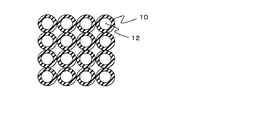
図1は、非水系顔料インク及び後処理液を用い、上記(1)の態様により印刷した後の様子を模式的に示している。すなわち、図1においては、非水系顔料インクからなるドット10の列の各ドット上に後処理液の液滴12が着弾した様子を示している。このように各液滴を着弾させるには、非水系顔料インクの液滴が印刷媒体に着弾した後、後処理液の液滴が当該非水系顔料インクの液滴と同位置に着弾するように制御すればよい。例えば、インクジェットプリンターにおいて、非水系顔料インクを吐出するノズルと、後処理液を吐出するノズルとを設け、非水系顔料インクの液滴の吐出後に、後処理液の液滴が吐出されるように、各ノズルの配置、印刷媒体の搬送機構、及びインクジェットヘッドの走査機構などを設定すればよい。インクジェットプリンターにおいてこのような制御方法は周知である。
FIG. 1 schematically shows a state after printing according to the aspect (1) using a non-aqueous pigment ink and a post-treatment liquid. That is, FIG. 1 shows a state in which the
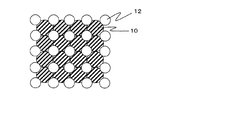
一方、図2は、非水系顔料インク及び後処理液を用い、上記(2)の態様により印刷した後の様子を模式的に示している。すなわち、図2においては、非水系顔料インクからなるドット10の複数の列において、非水系顔料インクの隣り合うドット間の間隙に後処理液12の液滴が着弾した様子を示している。このように、非水系顔料インクの隣り合うドット間の間隙に後処理液の液滴が着弾するようにする手段としては特に制限はないが、例えば、以下のような手段が挙げられる。
On the other hand, FIG. 2 schematically shows a state after printing according to the aspect (2) using a non-aqueous pigment ink and a post-treatment liquid. That is, FIG. 2 shows a state in which the droplets of the
図3は、ライン型インクジェットプリンタの搬送部を示す平面図である。搬送部2は、図3の紙面の左右方向に移動することにより印刷媒体を搬送する搬送ベルト22、及び搬送ベルトの上方に位置し、搬送される印刷媒体にインク等を吐出するインクジェットヘッド20A〜20Cが配置されている。インクジェットヘッド20A〜20Cは、印刷媒体に向けてインクや後処理液の液滴を吐出するノズルを複数備えている。
具体的には、インクジェットヘッド20Aは、複数のヘッドユニット24Aを有する。図3に示す例では、インクジェットヘッド20Aは、6個のヘッドユニット24Aから構成されている。6個のヘッドユニット24Aは、千鳥配置されている。さらに具体的には、6個のヘッドユニット24Aは、用紙(印刷媒体)の搬送方向(左右方向)と略直交する方向(前後方向)に配列され、かつ、1つおきに搬送方向における位置をずらして配置されている。インクジェットヘッド20Bは、6個のヘッドユニット24Bから構成されている。インクジェットヘッド20Cは、6個のヘッドユニット24Cから構成されている。6個のヘッドユニット24B、6個のヘッドユニット24Cは、6個のヘッドユニット24Aと同様に、千鳥配置されている。ヘッドユニット24A〜24Cは、ヘッドホルダ(図示せず)に固定されている。ヘッドユニット24A〜24Cは、後述のように吐出するインクが異なる以外は、同様の構成を有する。
なお、以下の説明においては、インクジェットヘッド20A〜20C、ヘッドユニット24A〜24Cの符号におけるアルファベットの添え字(A〜C)を省略して総括的に表記することがある。
FIG. 3 is a plan view showing a conveyance unit of the line type ink jet printer. The
Specifically, the
In the following description, the alphabetic suffixes (A to C) in the reference numerals of the ink jet heads 20A to 20C and the
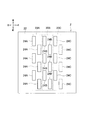
ヘッドユニット24は、図4に示すように、2つのインクチャンバ26U,26Dと、2列のノズル列28U,28Dとを有する。ここで、図4は、左右方向に沿った同一列のヘッドユニット24A〜24Cを下側から見た図である。なお、インクチャンバ26U,26D、ノズル列28U,28Dの符号におけるアルファベットの添え字(U,D)を省略して総括的に表記することがある。
As shown in FIG. 4, the head unit 24 has two
インクチャンバ26は、非水系顔料インク又は後処理液を貯留する。インクチャンバ26には、インク経路(図示せず)を介してインクが供給される。インクチャンバ26内には、ピエゾ素子(図示せず)が配置されている。ピエゾ素子の駆動により、後述するノズル30からインクが吐出される。
The ink chamber 26 stores non-aqueous pigment ink or post-treatment liquid. Ink is supplied to the ink chamber 26 via an ink path (not shown). A piezo element (not shown) is arranged in the ink chamber 26. By driving the piezo element, ink is ejected from a
ヘッドユニット24Aのインクチャンバ26U,26Dには、ともにブラックの色インクが供給される。ヘッドユニット24Bのインクチャンバ26Uには、シアンの色インクが供給される。ヘッドユニット24Bのインクチャンバ26Dには、マゼンタの色インクが供給される。ヘッドユニット24Cのインクチャンバ26Uには、イエローの色インクが供給される。ヘッドユニット24Cのインクチャンバ26Dには、本発明に係る後処理液が供給される。
Black ink is supplied to the
ノズル列28は、インクを吐出する複数のノズル30からなる。各ノズル列28において、複数のノズル30は、主走査方向(前後方向)に所定のピッチPで等間隔に配置されている。上流側のノズル列28Uと下流側のノズル列28Dとは、用紙の搬送方向(左右方向)に並列配置されている。また、ノズル列28Uのノズル30とノズル列28Dのノズル30とが、主走査方向に半ピッチ(P/2)分だけずれるように配置されている。
The nozzle row 28 includes a plurality of
ヘッドユニット24Aのノズル列28U,28Dは、ヘッドユニット24Aのインクチャンバ26U,26Dに供給されるブラックの色インクを吐出する。ノズル列28U,28Dの2列からブラックの色インクを吐出することで、ブラックの印字解像度を他の色より高めることができる。ヘッドユニット24Bのノズル列28U,28Dは、それぞれヘッドユニット24Bのインクチャンバ26U,26Dに供給されるシアン、マゼンタの色インクを吐出する。ヘッドユニット24Cのノズル列28U,28Dは、それぞれヘッドユニット24Cのインクチャンバ26U,26Dに供給されるイエローの色インク、後処理液を吐出する。
The
ここで、ヘッドユニット24Aとヘッドユニット24Bとは、主走査方向における各ノズル位置が一致するように配置されている。すなわち、ヘッドユニット24Aのノズル列28Uとヘッドユニット24Bのノズル列28Uとは、主走査方向における各ノズル30の位置が一致している。また、ヘッドユニット24Aのノズル列28Dとヘッドユニット24Bのノズル列28Dとは、主走査方向における各ノズル30の位置が一致している。
Here, the
これに対し、ヘッドユニット24Cは、ヘッドユニット24A,24Bのノズル列28U,28Dにおける同一画素(ドット)に対応する4つのノズル30の主走査方向における重心位置と、ヘッドユニット24Cのノズル列28Dの当該画素に対応するノズル30の主走査方向における中心位置とが一致するように配置されている。ここで、ヘッドユニット24A,24Bのノズル列28U,28Dにおける同一画素に対応する4つのノズル30の主走査方向における重心位置は、これら4つのノズル30から吐出されたインクにより用紙上に形成される画素の主走査方向における重心位置と同義である。また、ヘッドユニット24Cのノズル列28Dの当該画素に対応するノズル30の主走査方向における中心位置は、当該ノズル30から吐出されたインクにより用紙上に形成される画素の主走査方向における中心位置と同義である。また、「一致」は、完全一致に限らず、所定範囲内の変動を含むものである。この所定範囲は、例えば、実験的に決定することができる。
On the other hand, the
ヘッドユニット24A〜24Cにおける同一画素に対応するノズル30の組み合わせを、図4において一点鎖線で囲んで示す。
A combination of the
ヘッドユニット24A,24Bにおいて、同一画素に対応するノズル列28Uのノズル30とノズル列28Dのノズル30とは、主走査方向に半ピッチ(P/2)分だけずれている。そして、ヘッドユニット24Aのノズル列28Uとヘッドユニット24Bのノズル列28Uとにおいては、同一画素に対応するノズル30の主走査方向おける位置は一致している。また、ヘッドユニット24Aのノズル列28Dとヘッドユニット24Bのノズル列28Dにおいては、同一画素に対応するノズル30の主走査方向おける位置は一致している。
In the
したがって、ヘッドユニット24A,24Bにおける同一画素に対応する4つのノズル30の主走査方向における重心位置は、同一画素に対応するノズル列28Uのノズル30とノズル列28Dのノズル30との主走査方向における中間位置である。
Therefore, the gravity center position in the main scanning direction of the four
そこで、図4に示すように、主走査方向において、ヘッドユニット24Cのノズル列28Dのノズル30の中心位置が、同一画素に対応するヘッドユニット24A,24Bのノズル列28Uのノズル30とノズル列28Dのノズル30との中間位置に一致するように、ヘッドユニット24Cが配置されている。従って、ヘッドユニット24A,24Bのノズル30から吐出した液滴により形成される画素に対し、ヘッドユニット24Cのノズル30から吐出した液滴により形成される画素は、主走査方向において半ピッチずれた状態となる。
Therefore, as shown in FIG. 4, in the main scanning direction, the center position of the
以上のようなインクジェットヘッドの構成により、後処理液の液滴により形成される画素は、非水性顔料インクの液滴により形成される画素に対して、主走査方向において半ピッチずれた状態となる。また、副走査方向における、後処理液の液滴により形成される画素も、非水系顔料インクの液滴により形成される画素に対して半ピッチずれた状態で形成するには、搬送される印刷媒体に対し、非水系顔料インクの液滴により形成される画素に対して半ピッチ分ずれた状態で後処理液の液滴が着弾するように吐出するタイミングを制御すればよい。
以上のように印刷することで、主走査方向及び副走査方向の双方において半ピッチずれた状態、すなわち図2に示すように、非水系顔料インクの隣り合うドット間の間隙に後処理液12の液滴が着弾した状態となる。
With the configuration of the ink jet head as described above, the pixels formed by the post-treatment liquid droplets are shifted by a half pitch in the main scanning direction with respect to the pixels formed by the non-aqueous pigment ink droplets. . Also, in the sub-scanning direction, the pixels formed by the post-treatment liquid droplets are also transported in order to be formed with a half-pitch deviation from the pixels formed by the non-aqueous pigment ink droplets. The ejection timing may be controlled so that the post-treatment liquid droplets land on the medium in a state shifted by a half pitch with respect to the pixels formed by the non-aqueous pigment ink droplets.
By printing as described above, the state of the
以上の(1)及び(2)のいずれにおいても、印刷濃度の向上の観点から、非水系顔料インクの液滴及び後処理液の液滴の体積比は、95:5〜50:50とすることが好ましく、90:10〜75:25とすることがより好ましい。 In any of the above (1) and (2), the volume ratio of the non-aqueous pigment ink droplet and the post-treatment liquid droplet is 95: 5 to 50:50 from the viewpoint of improving the printing density. It is preferably 90:10 to 75:25, and more preferably.
本発明において用いられる印刷媒体としては、特に限定されず、普通紙、上質普通紙、インクジェット(IJ)紙、IJマット紙、記録媒体上にインク吸収溶液がコートされたコート紙、コート紙よりもインク吸収層の厚みが薄い微コート紙、光沢紙(フォト光沢用紙)、特殊紙、布等で使用することができる。 The printing medium used in the present invention is not particularly limited, and is more than plain paper, high-quality plain paper, inkjet (IJ) paper, IJ matte paper, coated paper in which an ink absorbing solution is coated on a recording medium, and coated paper. It can be used for fine coated paper, glossy paper (photo glossy paper), special paper, cloth, etc. with a thin ink absorption layer.
以下に、実施例により本発明をさらに具体的に説明するが、本発明は以下の実施例に限定されるものではない。 EXAMPLES Hereinafter, the present invention will be described more specifically with reference to examples. However, the present invention is not limited to the following examples.
[実施例1〜9、比較例1〜2]
(非水系顔料インク(ブラックインク)の調製)
表2に示す成分・配合率(質量%)となるように、各成分を混合し、ジルコニアビーズ(直径0.5mm)を充填率85%にて充填したダイノーミル((株)シンマルエンタープライゼス製)により滞留時間15分間の条件で分散し、非水系顔料インクK−1〜K−5を得た。
表2に記載の各成分の詳細を以下に示す。
顔料:三菱化学(株)製、MA8
顔料分散剤:日本ルーブリゾール(株)製、ソルスパース13940
石油系炭化水素溶剤:東燃ゼネラル石油(株)製:アイソパーG
水溶性カチオンポリマー(ポリエチレンイミン);
PEI1:(株)日本触媒製、エポミン SP−003(固形分100%)
PEI2:(株)日本触媒製、エポミン SP−012(固形分100%)
PEI3:(株)日本触媒製、エポミン SP−200(固形分100%)
水溶性カチオンポリマー(ジメチルアミン アンモニアエピクロルヒドリン樹脂):センカ(株)製、パピオゲン P−105(固形分60%)
[Examples 1-9, Comparative Examples 1-2]
(Preparation of non-aqueous pigment ink (black ink))
Each component was mixed so that the components and blending ratios (mass%) shown in Table 2 were mixed, and dyno mill (made by Shinmaru Enterprises Co., Ltd.) filled with zirconia beads (diameter 0.5 mm) at a filling ratio of 85%. To obtain non-aqueous pigment inks K-1 to K-5.
The detail of each component described in Table 2 is shown below.
Pigment: MA8 manufactured by Mitsubishi Chemical Corporation
Pigment dispersing agent: Nippon Lubrizol Corporation, Solsperse 13940
Petroleum hydrocarbon solvent: TonenGeneral Sekiyu KK: Isopar G
Water-soluble cationic polymer (polyethyleneimine);
PEI1: manufactured by Nippon Shokubai Co., Ltd., Epomin SP-003 (solid content 100%)
PEI2: manufactured by Nippon Shokubai Co., Ltd., Epomin SP-012 (100% solid content)
PEI3: Nippon Shokubai Co., Ltd., Epomin SP-200 (100% solid content)
Water-soluble cationic polymer (dimethylamine ammonia epichlorohydrin resin): Senpa Co., Ltd., Papiogen P-105 (solid content 60%)
(後処理液の調製)
表3に示す成分・配合率(質量%)となるように、各成分を混合し、非水系顔料インクの調製と同じ条件で分散し、後処理液S−1〜S−5を得た。
表3に記載の各成分の詳細を以下に示す。
シリカ;
シリカ1:日本アエロジル(株)製、アエロジルR104(平均粒子径:150±25nm)
シリカ2:日本アエロジル(株)製、アエロジルR106(平均粒子径:250±30nm)-
シリカ3:日本アエロジル(株)製、アエロジルR202(平均粒子径:100±20nm)
顔料分散剤:日本ルーブリゾール(株)製、ソルスパース13940
石油系炭化水素溶剤:東燃ゼネラル石油(株)製:アイソパーG
水溶性カチオンポリマー(ポリエチレンイミン):(株)日本触媒製、エポミン SP−003(固形分100%)
(Preparation of post-treatment liquid)
Each component was mixed so that it might become a component and a mixture ratio (mass%) shown in Table 3, and it disperse | distributed on the same conditions as preparation of a non-aqueous pigment ink, and obtained post-processing liquid S-1 to S-5.
Details of each component described in Table 3 are shown below.
silica;
Silica 1: Aerosil R104 (average particle size: 150 ± 25 nm) manufactured by Nippon Aerosil Co., Ltd.
Silica 2: Aerosil R106 (average particle size: 250 ± 30 nm) manufactured by Nippon Aerosil Co., Ltd.
Silica 3: Aerosil R202 manufactured by Nippon Aerosil Co., Ltd. (average particle size: 100 ± 20 nm)
Pigment dispersing agent: Nippon Lubrizol Corporation, Solsperse 13940
Petroleum hydrocarbon solvent: TonenGeneral Sekiyu KK: Isopar G
Water-soluble cationic polymer (polyethyleneimine): manufactured by Nippon Shokubai Co., Ltd., Epomin SP-003 (solid content 100%)
各実施例・比較例において、表4に示す通り、上記のようにして得られた非水系顔料インクK−1〜K−5のいずれか及び後処理液S−1〜S−5のいずれかをインクジェットプリンター「オルフィスX9050」(理想科学工業株式会社製、インクジェット記録装置である高速カラープリンター)に装填し、普通紙にベタ画像(印字サイズ:150mm×100mm)を印刷した。なお、用いたインクジェットプリンターは、非水系顔料インクの液滴を吐出してドットを形成した後、そのドットと重なるように後処理液の液滴を吐出する機構を有し、その機構により上記ベタ画像を印刷した。また、各実施例・比較例において、非水系顔料インク及び後処理液の液滴1滴は、表4に示す転移量とした。 In each Example / Comparative Example, as shown in Table 4, any of the non-aqueous pigment inks K-1 to K-5 and post-treatment liquids S-1 to S-5 obtained as described above. Was loaded into an inkjet printer “Orufis X9050” (manufactured by Riso Kagaku Kogyo Co., Ltd., high-speed color printer which is an inkjet recording apparatus), and a solid image (print size: 150 mm × 100 mm) was printed on plain paper. The ink jet printer used has a mechanism for ejecting droplets of non-aqueous pigment ink to form dots, and then ejecting droplets of post-treatment liquid so as to overlap the dots. The image was printed. Further, in each of the examples and comparative examples, the transfer amount shown in Table 4 was set for one droplet of the non-aqueous pigment ink and the post-treatment liquid.
(評価)
後処理前後における印刷物の印刷面(表面)の印刷濃度(OD値)を、マクベス濃度計(マクベス社製RD920)により測定した。また、各実施例・比較例において、得られたOD値に基づき、表濃度を以下の評価基準に従い評価した。結果を表4に示す。
−評価基準−
○:比較例1に比べて+0.05以上向上(目視で黒くなったと認識できるレベル)
×:比較例1に比べて+0.05以下
(Evaluation)
The printing density (OD value) of the printed surface (surface) of the printed matter before and after the post-treatment was measured with a Macbeth densitometer (RD920 manufactured by Macbeth). Moreover, in each Example and the comparative example, based on the obtained OD value, the table | surface density | concentration was evaluated according to the following evaluation criteria. The results are shown in Table 4.
-Evaluation criteria-
◯: Improved by +0.05 or more compared to Comparative Example 1 (a level at which it can be visually recognized that it has turned black)
X: +0.05 or less compared with Comparative Example 1
表4より、実施例1〜9においてはいずれも、非水系顔料インク及び後処理液が混ざり合った後において、顔料、カチオン性ポリマー(アミノ基を有する水溶性樹脂)、及びシリカの組み合わせで存在し、表濃度が大きく向上していることが分かる。
実施例2〜4はそれぞれ、非水系顔料インク中のカチオン性ポリマー(アミノ基を有する水溶性樹脂)の種類を異ならせた例であるが、カチオン性ポリマーの種類を変えても表濃度が大きく向上していることが分かる。
実施例5、6は、後処理液中のシリカの種類を異ならせた例であるが、シリカの種類を変えても表濃度が大きく向上していることが分かる。
実施例7、8は、後処理液の転移量を異ならせた例であるが、転移量が6〜30plであれば、表濃度が大きく向上することが分かる。
実施例9は、実施例1〜8とは異なり、非水系顔料インクではなく後処理液にアミノ基を有する水溶性樹脂を含有させた例であるが、実施例9においても表濃度が大きく向上しているのが分かる。
比較例1は、非水系顔料インクにも後処理液にも、アミノ基を有する水溶性樹脂を含有しない例であるが、表濃度が向上していないのが分かる。
比較例2は、後処理液にシリカを含有しない例であるが、表濃度が低下しているのが分かる。
From Table 4, in Examples 1 to 9, after the non-aqueous pigment ink and the post-treatment liquid are mixed, they exist as a combination of a pigment, a cationic polymer (water-soluble resin having an amino group), and silica. It can be seen that the surface concentration is greatly improved.
Examples 2 to 4 are examples in which the type of the cationic polymer (water-soluble resin having an amino group) in the non-aqueous pigment ink is different, but the surface concentration is large even if the type of the cationic polymer is changed. It can be seen that it has improved.
Examples 5 and 6 are examples in which the type of silica in the post-treatment liquid is varied, but it can be seen that the surface concentration is greatly improved even if the type of silica is changed.
Examples 7 and 8 are examples in which the transfer amount of the post-treatment liquid is varied, but it can be seen that when the transfer amount is 6 to 30 pl, the surface concentration is greatly improved.
Unlike Example 1-8, Example 9 is an example in which a water-soluble resin having an amino group is contained in the post-treatment liquid instead of the non-aqueous pigment ink, but the surface concentration is greatly improved in Example 9 as well. You can see that
Comparative Example 1 is an example in which neither the non-aqueous pigment ink nor the post-treatment liquid contains a water-soluble resin having an amino group, but it can be seen that the surface concentration is not improved.
Although the comparative example 2 is an example which does not contain a silica in a post-processing liquid, it turns out that the surface density | concentration is falling.
[実施例10〜15、比較例3]
(非水系顔料インク(ブラックインク)の調製)
上述の実施例1、5〜8、比較例2で使用した非水系顔料インクK−1を調製した。
[Examples 10 to 15, Comparative Example 3]
(Preparation of non-aqueous pigment ink (black ink))
Non-aqueous pigment inks K-1 used in Examples 1 to 5 and Comparative Example 2 described above were prepared.
(後処理液の調製)
表5に示す成分・配合率(質量%)となるように、各成分を混合し、上述の非水系顔料インクの調製時と同じ条件で分散し、後処理液S−6〜S−12を得た。
なお、表5に記載の各成分の詳細を以下の通りである。
シリカ;
シリカ4:日本アエロジル(株)製、アエロジルRX300(平均粒子径:180±30nm)
なお、「シリカ1」は、後処理液S−1等で使用したシリカ1である。
顔料分散剤:日本ルーブリゾール(株)製、ソルスパース13940
グリコールエーテル系溶剤;
ジエチレングリコールモノブチルエーテル:東京化成工業(株)製
ジエチレングリコールジブチルエーテル:東京化成工業(株)製
トリエチレングリコールモノブチルエーテル:東京化成工業(株)製
テトラエチレングリコールジメチルエーテル:東京化成工業(株)製
石油系炭化水素溶剤:東燃ゼネラル石油(株)製、アイソパーG
高級アルコール系溶剤:リソノール18SP(イソステアリルアルコール)、高級アルコール工業(株)製
水溶性樹脂:ポリエチレンイミン SP-012、(株)日本触媒製
(Preparation of post-treatment liquid)
Each component is mixed so that it may become a component and a mixture ratio (mass%) shown in Table 5, and it disperse | distributes on the same conditions as the time of preparation of the above-mentioned non-aqueous pigment ink, and post-processing liquid S-6 to S-12 is carried out. Obtained.
In addition, the detail of each component of Table 5 is as follows.
silica;
Silica 4: Aerosil RX300 (average particle size: 180 ± 30 nm) manufactured by Nippon Aerosil Co., Ltd.
“Silica 1” is silica 1 used in the post-treatment liquid S-1 or the like.
Pigment dispersing agent: Nippon Lubrizol Corporation, Solsperse 13940
Glycol ether solvents;
Diethylene glycol monobutyl ether: manufactured by Tokyo Chemical Industry Co., Ltd. Diethylene glycol dibutyl ether: manufactured by Tokyo Chemical Industry Co., Ltd. Triethylene glycol monobutyl ether: manufactured by Tokyo Chemical Industry Co., Ltd. Tetraethylene glycol dimethyl ether: Petroleum carbonized by Tokyo Chemical Industry Co., Ltd. Hydrogen solvent: manufactured by TonenGeneral Sekiyu KK, Isopar G
Higher alcohol solvent: Lisonol 18SP (isostearyl alcohol), water-soluble resin manufactured by Higher Alcohol Industry Co., Ltd .: Polyethyleneimine SP-012, manufactured by Nippon Shokubai Co., Ltd.
各実施例・比較例において、表6に示す通り、上記のようにして得られた非水系顔料インクK−1及び後処理液S−6〜S−12のいずれかをインクジェットプリンター「オルフィスX9050」(理想科学工業株式会社製)に装填し、普通紙にベタ画像(印字サイズ:150mm×100mm)を印刷した。なお、用いたインクジェットプリンターは、非水系顔料インクの液滴を吐出してドットを形成した後、そのドットと重なるように後処理液の液滴を吐出する機構を有し、その機構により上記ベタ画像を印刷した。また、各実施例・比較例において、非水系顔料インク及び後処理液の液滴1滴は、表6に示す転移量とした。 In each of the examples and comparative examples, as shown in Table 6, any one of the non-aqueous pigment ink K-1 and the post-treatment liquids S-6 to S-12 obtained as described above was used as an inkjet printer “Orpheus X9050”. It was loaded on (Riso Kagaku Kogyo Co., Ltd.) and a solid image (print size: 150 mm × 100 mm) was printed on plain paper. The ink jet printer used has a mechanism for ejecting droplets of non-aqueous pigment ink to form dots, and then ejecting droplets of post-treatment liquid so as to overlap the dots. The image was printed. Further, in each of the examples and comparative examples, one droplet of the non-aqueous pigment ink and the post-treatment liquid has a transfer amount shown in Table 6.
(評価)
1.印刷濃度
後処理前後における印刷物の印刷面(表面)及び裏面の印刷濃度(OD値)を、マクベス濃度計(マクベス社製RD920)により測定した。また、各実施例・比較例において、得られたOD値に基づき、表濃度を以下の評価基準に従い評価した。結果を表6に示す。
−評価基準−
表面のOD値
◎:比較例1に対し、表面のOD値が0.05〜0.1向上した。
○:比較例1に対し、表面のOD値が0.01〜0.04向上した。
×:比較例1に対し、表面のOD値が同等もしくは低下した。
裏面のOD値
○:比較例1に対し、裏面のODが0.01以上向上した。
×:比較例1に対し、裏面のODが同等以下であった。
(Evaluation)
1. Printing density The printing density (OD value) of the printed surface (front surface) and the back surface of the printed material before and after the post-treatment was measured with a Macbeth densitometer (RD920 manufactured by Macbeth). Moreover, in each Example and the comparative example, based on the obtained OD value, the table | surface density | concentration was evaluated according to the following evaluation criteria. The results are shown in Table 6.
-Evaluation criteria-
Surface OD Value A: The surface OD value was improved by 0.05 to 0.1 with respect to Comparative Example 1.
○: Compared with Comparative Example 1, the surface OD value was improved by 0.01 to 0.04.
X: The OD value of the surface was equal to or decreased with respect to Comparative Example 1.
OD value on the back surface: The OD on the back surface was improved by 0.01 or more compared to Comparative Example 1.
X: The OD on the back surface was equal to or less than that of Comparative Example 1.
2.間欠吐出性
各インクを調製後、インクジェットプリンター「オルフィスX9050」にインクを導入し、35℃環境下で印字後10分放置した後に、再度印字し印刷物の状態を下記の基準で評価した。
−評価基準−
○:印字後10分放置し、再印字した時に不吐出が発生しなかった。
×:印字後10分放置し、再印字した時に不吐出が発生した。
2. Intermittent ejection property After each ink was prepared, the ink was introduced into an inkjet printer “Olfis X9050”, left standing for 10 minutes after printing in a 35 ° C. environment, printed again, and the state of the printed matter was evaluated according to the following criteria.
-Evaluation criteria-
◯: No discharge occurred when left for 10 minutes after printing and reprinted.
X: Non-ejection occurred when reprinting was allowed to stand for 10 minutes after printing.
3.耐擦過性
クロックメーターに布を取り付け、印字物表面を5往復し、布への汚れ度合いを以下の評価基準に従い目視で評価した。
−評価基準−
○:比較例1と比較して、布および紙の汚れが薄いもしくは同程度であった。
×:比較例1と比較して、布および紙の汚れが濃かった。
3. Scratch resistance A cloth was attached to a clock meter, the printed surface was reciprocated five times, and the degree of stain on the cloth was visually evaluated according to the following evaluation criteria.
-Evaluation criteria-
○: Compared with Comparative Example 1, the cloth and paper were less dirty or comparable.
×: Compared with Comparative Example 1, the stain on the cloth and paper was dark.
表6より、実施例10〜15はいずれも、後処理液に用いた有機溶剤がグリコールエーテル系溶剤を含み、印刷濃度、間欠吐出性及び耐擦過性のすべてにおいて満足できる評価結果が得られた。これに対して後処理液自体を用いなかった比較例3は印刷濃度において不良であった。 From Table 6, in all of Examples 10 to 15, the organic solvent used in the post-treatment liquid contained a glycol ether solvent, and satisfactory evaluation results were obtained in all of the printing density, intermittent ejection property, and scratch resistance. . On the other hand, the comparative example 3 which did not use post-processing liquid itself was inferior in printing density.
[実施例16〜18、比較例4〜6]
(非水系顔料インク(ブラックインク)の調製)
上述の実施例2で使用した非水系顔料インクK−2、及び実施例9及び比較例1で使用した非水系顔料インクK−5を調製した。
[Examples 16 to 18, Comparative Examples 4 to 6]
(Preparation of non-aqueous pigment ink (black ink))
The non-aqueous pigment ink K-2 used in Example 2 and the non-aqueous pigment ink K-5 used in Example 9 and Comparative Example 1 were prepared.
(後処理液の調製)
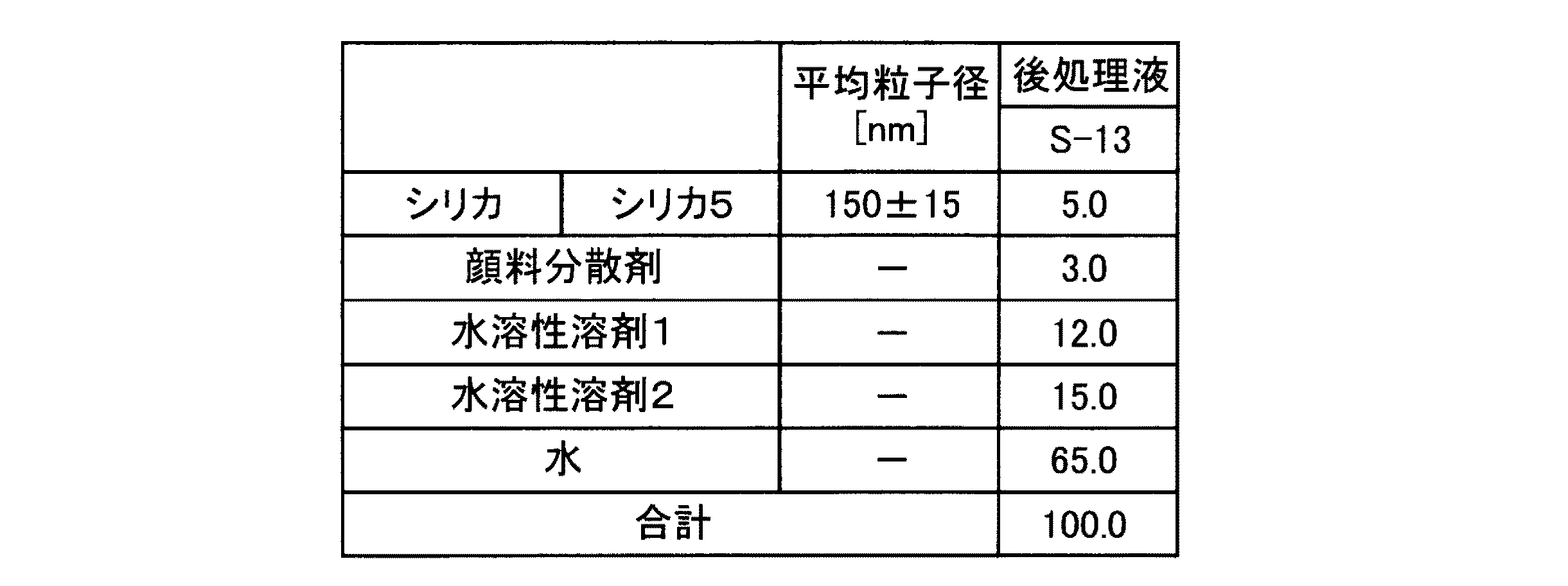
上述の実施例1〜4等で使用した後処理液S−1を調製した。また、表7に示す成分・配合率(質量%)となるように、各成分を混合し、上述の非水系顔料インクの調製と同じ条件で分散し、後処理液S−13を得た。
なお、表7に記載の各成分の詳細を以下の通りである。
シリカ5:日本アエロジル(株)製、アエロジル150(平均粒子径:150±15nm)
顔料分散剤:日本ルーブリゾール(株)製、ソルスパース27000
水溶性溶剤1:グリセリン
水溶性溶剤2:3−メトキシ−3−メチル−1−ブタノール
また、顔料分散剤として用いた「ソルスパース27000」の有効成分は100%である。一方、後処理液S−1において7.50質量%含む顔料分散剤たる「ソルスパース13940」の有効成分は70%である。従って、有効成分換算で、後処理液S−13と後処理液S−1とでシリカ/顔料分散剤比は同じである。
(Preparation of post-treatment liquid)
A post-treatment liquid S-1 used in Examples 1 to 4 and the like described above was prepared. Moreover, each component was mixed so that it might become a component and a mixture ratio (mass%) shown in Table 7, and it disperse | distributed on the same conditions as preparation of the above-mentioned non-aqueous pigment ink, and obtained post-processing liquid S-13.
In addition, the detail of each component of Table 7 is as follows.
Silica 5: manufactured by Nippon Aerosil Co., Ltd., Aerosil 150 (average particle size: 150 ± 15 nm)
Pigment dispersant: Nippon Lubrizol Corporation, Solsperse 27000
Water-soluble solvent 1: Glycerin water-soluble solvent 2: 3-methoxy-3-methyl-1-butanol The active ingredient of “Solsperse 27000” used as a pigment dispersant is 100%. On the other hand, the active ingredient of “Solsperse 13940” which is a pigment dispersant containing 7.50% by mass in the post-treatment liquid S-1 is 70%. Therefore, the silica / pigment dispersant ratio is the same in post-treatment liquid S-13 and post-treatment liquid S-1 in terms of active ingredients.
上記のようにして得られた非水系顔料インク及び後処理液を、インクジェットプリンター「オルフィスX9050」(理想科学工業株式会社製)に装填し、普通紙にベタ画像(印字サイズ:150mm×100mm)を印刷した。なお、用いたインクジェットプリンターは、非水系顔料インクの液滴を吐出してドットを形成した後、そのドットと重なるように後処理液の液滴を吐出する機構を有し、その機構により上記ベタ画像を印刷した。また、各実施例・比較例において、非水系顔料インク及び後処理液は、以下のように吐出して印刷を行った。すなわち、実施例16及び18においては、非水系顔料インクからなるドットを形成した後、そのドット上に後処理液の液滴が着弾するようにし、実施例17、比較例5及び6においては、非水系顔料インクからなるドットを複数形成した後、隣り合うドット間の間隙に後処理液の液滴が着弾するようにした。 The non-aqueous pigment ink and the post-treatment liquid obtained as described above are loaded into an inkjet printer “Orphis X9050” (made by Riso Kagaku Kogyo Co., Ltd.), and a solid image (print size: 150 mm × 100 mm) is placed on plain paper. Printed. The ink jet printer used has a mechanism for ejecting droplets of non-aqueous pigment ink to form dots, and then ejecting droplets of post-treatment liquid so as to overlap the dots. The image was printed. Further, in each of the examples and comparative examples, the non-aqueous pigment ink and the post-treatment liquid were printed as follows. That is, in Examples 16 and 18, after forming dots made of non-aqueous pigment ink, the droplets of the post-treatment liquid land on the dots. In Example 17 and Comparative Examples 5 and 6, After a plurality of dots made of non-aqueous pigment ink were formed, the post-treatment liquid droplets landed in the gaps between adjacent dots.
(評価)
1.印刷濃度
後処理前後における印刷物の印刷面(表面)を、マクベス濃度計(マクベス社製RD920)により測定した。結果を表8に示す。
2.裏抜け
後処理前後における印刷物の裏面を、マクベス濃度計(マクベス社製RD920)により測定した。
3.搬送性
搬送性評価は、インクジェットプリンター「オルフィスX9050」(理想科学工業株式会社製)を用いて行った。用紙は理想用紙薄口(A4サイズ、理想科学工業株式会社製)を用い、印刷速度120枚/分で片面全面にベタ画像を印刷し、20枚印字後の排紙揃えで評価した。紙詰まりがなく排紙揃えも良好の場合を「OK」とし、紙詰まりが発生もしくは排紙が乱れた場合を「NG」とした。
(Evaluation)
1. Print density The printed surface (surface) of the printed material before and after post-treatment was measured with a Macbeth densitometer (RD920 manufactured by Macbeth). The results are shown in Table 8.
2. The back side of the printed matter before and after post-treatment was measured with a Macbeth densitometer (RD920 manufactured by Macbeth).
3. Transportability The transportability evaluation was performed using an inkjet printer “Olphis X9050” (manufactured by Riso Kagaku Co., Ltd.). An ideal paper thin mouth (A4 size, manufactured by Riso Kagaku Kogyo Co., Ltd.) was used. A solid image was printed on the entire surface of one side at a printing speed of 120 sheets / min. The case where there is no paper jam and the paper discharge alignment is good is “OK”, and the case where paper jam occurs or paper discharge is disturbed is “NG”.
表8より、実施例16〜18においてはいずれも、印字濃度に優れ、裏抜けやカールは認められなかった。
これに対して、アミノ基を有する水溶性樹脂を含有しない非水系顔料インクを用い、かつ後処理液を用いなかった比較例4は十分な印刷濃度が得られなかった。また、アミノ基を有する水溶性樹脂を含有しない非水系顔料インクを用いた比較例5は、は十分な印刷濃度が得られなかったとともに裏抜けが認められた。また、水系の後処理液を用いた比較例6はカールが発生し搬送性に劣っていた。
From Table 8, in Examples 16-18, all were excellent in printing density, and neither show-through nor curl was recognized.
On the other hand, Comparative Example 4 using a non-aqueous pigment ink not containing a water-soluble resin having an amino group and using no post-treatment liquid did not provide a sufficient printing density. Further, in Comparative Example 5 using a non-aqueous pigment ink not containing a water-soluble resin having an amino group, a sufficient print density was not obtained and a showthrough was observed. Further, in Comparative Example 6 using the aqueous post-treatment liquid, curling occurred and the transportability was inferior.
Claims (4)
前記非水系顔料インク及び前記後処理液のいずれかに、アミノ基を有する水溶性樹脂を含むことを特徴とする非水系インクジェット印刷方法。 A non-aqueous post-treatment comprising at least silica and an organic solvent is formed after droplets of a non-aqueous pigment ink containing at least a pigment and a non-aqueous solvent are ejected onto the surface of the printing medium to form dots made of the non-aqueous pigment ink. A non-aqueous ink jet printing method comprising a step of discharging a liquid droplet toward a printing medium so as to overlap a dot made of the non-aqueous pigment ink,
Either of the non-aqueous pigment ink and the post-treatment liquid contains a water-soluble resin having an amino group.
Priority Applications (2)
| Application Number | Priority Date | Filing Date | Title |
|---|---|---|---|
| JP2013272449A JP6139401B2 (en) | 2013-12-27 | 2013-12-27 | Non-aqueous inkjet printing method |
| US14/574,816 US9624402B2 (en) | 2013-12-27 | 2014-12-18 | Non-aqueous inkjet printing method |
Applications Claiming Priority (1)
| Application Number | Priority Date | Filing Date | Title |
|---|---|---|---|
| JP2013272449A JP6139401B2 (en) | 2013-12-27 | 2013-12-27 | Non-aqueous inkjet printing method |
Publications (2)
| Publication Number | Publication Date |
|---|---|
| JP2015123747A true JP2015123747A (en) | 2015-07-06 |
| JP6139401B2 JP6139401B2 (en) | 2017-05-31 |
Family
ID=53481015
Family Applications (1)
| Application Number | Title | Priority Date | Filing Date |
|---|---|---|---|
| JP2013272449A Active JP6139401B2 (en) | 2013-12-27 | 2013-12-27 | Non-aqueous inkjet printing method |
Country Status (2)
| Country | Link |
|---|---|
| US (1) | US9624402B2 (en) |
| JP (1) | JP6139401B2 (en) |
Cited By (2)
| Publication number | Priority date | Publication date | Assignee | Title |
|---|---|---|---|---|
| JP2017014325A (en) * | 2015-06-26 | 2017-01-19 | 理想科学工業株式会社 | Non-aqueous inkjet printing method |
| JP2022085779A (en) * | 2020-11-27 | 2022-06-08 | キヤノン株式会社 | Recording device, data generation device, recording method, data generation method and program |
Families Citing this family (15)
| Publication number | Priority date | Publication date | Assignee | Title |
|---|---|---|---|---|
| JP6604000B2 (en) | 2015-02-24 | 2019-11-13 | セイコーエプソン株式会社 | Inkjet ink composition and inkjet recording method |
| JP6604001B2 (en) | 2015-02-24 | 2019-11-13 | セイコーエプソン株式会社 | Inkjet ink composition, inkjet recording method, and ink set |
| EP3156240A3 (en) * | 2015-10-14 | 2017-09-27 | OCE-Technologies B.V. | Preventing bleeding of multi-color print by in-line jetting |
| CN107011739B (en) | 2016-01-27 | 2021-10-08 | 精工爱普生株式会社 | Non-aqueous inkjet composition |
| CN107022243A (en) * | 2016-01-27 | 2017-08-08 | 精工爱普生株式会社 | Non-aqueous inkjet composition |
| EP3366736B1 (en) | 2017-02-28 | 2023-11-22 | Riso Kagaku Corporation | Oil-based inkjet ink |
| CN108504193B (en) | 2017-02-28 | 2021-05-07 | 理想科学工业株式会社 | Oil-based inkjet ink |
| EP3366734B1 (en) | 2017-02-28 | 2020-09-23 | Riso Kagaku Corporation | Oil-based inkjet ink |
| US10865320B2 (en) | 2017-02-28 | 2020-12-15 | Riso Kagaku Corporation | Oil-based inkjet ink |
| CN108504192B (en) | 2017-02-28 | 2021-09-28 | 理想科学工业株式会社 | Oil-based ink-jet ink |
| US10793734B2 (en) | 2017-02-28 | 2020-10-06 | Riso Kagaku Corporation | Oil-based inkjet ink |
| JP7014558B2 (en) * | 2017-09-29 | 2022-02-01 | 理想科学工業株式会社 | Oil-based inkjet ink set and printed matter manufacturing method |
| JP6904865B2 (en) * | 2017-09-29 | 2021-07-21 | 理想科学工業株式会社 | Printed matter manufacturing method |
| JP7030642B2 (en) * | 2018-07-31 | 2022-03-07 | 理想科学工業株式会社 | Oil-based inkjet ink |
| EP3981600B1 (en) * | 2020-10-09 | 2023-09-06 | Dover Europe Sàrl | Method for printing a plurality of drops at high speed and printer thereof |
Citations (6)
| Publication number | Priority date | Publication date | Assignee | Title |
|---|---|---|---|---|
| JP2007056217A (en) * | 2005-08-26 | 2007-03-08 | Fuji Xerox Co Ltd | Ink set for inkjet recording, as well as inkjet recording method and inkjet recording apparatus using the same |
| JP2009184214A (en) * | 2008-02-06 | 2009-08-20 | Riso Kagaku Corp | Inkjet printing method and ink set |
| JP2010228302A (en) * | 2009-03-27 | 2010-10-14 | Riso Kagaku Corp | Inkjet printing method |
| US20110181666A1 (en) * | 2008-10-06 | 2011-07-28 | Barreto Marcos A | Fast-drying, solvent-based inkjet composition and a method and system for printing such ink |
| JP2012161981A (en) * | 2011-02-07 | 2012-08-30 | Riso Kagaku Corp | Post-processing agent for nonaqueous ink, ink set, and printing method |
| JP2012245723A (en) * | 2011-05-30 | 2012-12-13 | Riso Kagaku Corp | Post-treatment agent for water-in-oil emulsion ink, ink set, and printing method |
Family Cites Families (7)
| Publication number | Priority date | Publication date | Assignee | Title |
|---|---|---|---|---|
| JP2001246767A (en) * | 2000-03-07 | 2001-09-11 | Sharp Corp | Ink jet image forming method and ink jet image forming apparatus |
| JP2007276141A (en) * | 2006-04-03 | 2007-10-25 | Seiko Epson Corp | Waste ink liquid absorber and ink jet recording apparatus including the same |
| JP5054938B2 (en) * | 2006-07-12 | 2012-10-24 | 理想科学工業株式会社 | Non-aqueous pigment ink |
| JP2009269397A (en) * | 2008-02-29 | 2009-11-19 | Seiko Epson Corp | Method of forming opaque layer, recording method, ink set, ink cartridge, and recording apparatus |
| JP5593024B2 (en) | 2008-05-23 | 2014-09-17 | 理想科学工業株式会社 | Non-aqueous pigment ink |
| JP5342252B2 (en) * | 2009-01-28 | 2013-11-13 | 理想科学工業株式会社 | White ink for inkjet |
| JP2011098454A (en) | 2009-11-04 | 2011-05-19 | Riso Kagaku Corp | Inkjet printing method using oil-based ink and ink set |
-
2013
- 2013-12-27 JP JP2013272449A patent/JP6139401B2/en active Active
-
2014
- 2014-12-18 US US14/574,816 patent/US9624402B2/en active Active
Patent Citations (6)
| Publication number | Priority date | Publication date | Assignee | Title |
|---|---|---|---|---|
| JP2007056217A (en) * | 2005-08-26 | 2007-03-08 | Fuji Xerox Co Ltd | Ink set for inkjet recording, as well as inkjet recording method and inkjet recording apparatus using the same |
| JP2009184214A (en) * | 2008-02-06 | 2009-08-20 | Riso Kagaku Corp | Inkjet printing method and ink set |
| US20110181666A1 (en) * | 2008-10-06 | 2011-07-28 | Barreto Marcos A | Fast-drying, solvent-based inkjet composition and a method and system for printing such ink |
| JP2010228302A (en) * | 2009-03-27 | 2010-10-14 | Riso Kagaku Corp | Inkjet printing method |
| JP2012161981A (en) * | 2011-02-07 | 2012-08-30 | Riso Kagaku Corp | Post-processing agent for nonaqueous ink, ink set, and printing method |
| JP2012245723A (en) * | 2011-05-30 | 2012-12-13 | Riso Kagaku Corp | Post-treatment agent for water-in-oil emulsion ink, ink set, and printing method |
Cited By (3)
| Publication number | Priority date | Publication date | Assignee | Title |
|---|---|---|---|---|
| JP2017014325A (en) * | 2015-06-26 | 2017-01-19 | 理想科学工業株式会社 | Non-aqueous inkjet printing method |
| JP2022085779A (en) * | 2020-11-27 | 2022-06-08 | キヤノン株式会社 | Recording device, data generation device, recording method, data generation method and program |
| JP7585009B2 (en) | 2020-11-27 | 2024-11-18 | キヤノン株式会社 | Recording device, data generation device, recording method, data generation method, and program |
Also Published As
| Publication number | Publication date |
|---|---|
| JP6139401B2 (en) | 2017-05-31 |
| US20150184011A1 (en) | 2015-07-02 |
| US9624402B2 (en) | 2017-04-18 |
Similar Documents
| Publication | Publication Date | Title |
|---|---|---|
| JP6139401B2 (en) | Non-aqueous inkjet printing method | |
| JP6371523B2 (en) | Inkjet printing method and non-aqueous ink set | |
| JP6501651B2 (en) | Non-aqueous ink jet printing method | |
| US6966944B2 (en) | Anticurling agent, ink jet ink, method for ink jet recording and method for reducing curling | |
| JP5784954B2 (en) | Non-aqueous pigment ink | |
| JP2009270061A (en) | Non-aqueous pigment ink and non-aqueous pigment ink set | |
| WO2006022456A1 (en) | Water-base ink, ink jet recording method, ink cartridge, recording unit, ink jet recording apparatus, and image forming method | |
| CN101642980B (en) | Inkjet printing method and ink set | |
| CN102952427B (en) | Non-aqueous ink and manufacture method thereof | |
| JP6200323B2 (en) | Non-aqueous ink, method for producing the same, and pigment dispersant | |
| JP6235290B2 (en) | Non-aqueous pigment ink | |
| JP7773693B2 (en) | Ink set and recording device | |
| CN103102736B (en) | Non-aqua-system pigment ink for ink jet | |
| JP6392662B2 (en) | Non-aqueous ink for inkjet | |
| JP2019019233A (en) | Oil-based inkjet ink | |
| JP2011012149A (en) | Non-aqueous ink set for inkjet, and method of inkjet-recording | |
| JP2010228302A (en) | Inkjet printing method | |
| JP2011032310A (en) | Nonaqueous pigment ink and nonaqueous pigment ink set | |
| JP2013159648A (en) | Non-aqueous inkjet ink | |
| JP6215701B2 (en) | Inkjet printing method and inkjet printing apparatus used in the printing method | |
| JP2024172104A (en) | Inkjet ink composition and recording method | |
| JP2015124382A (en) | Non-aqueous ink | |
| JP2024065510A (en) | Water-based ink-jet ink composition and ink-jet recording method | |
| JP2024050085A (en) | Water-based ink-jet ink composition and ink-jet recording method | |
| JP2017007297A (en) | Inkjet printing method |
Legal Events
| Date | Code | Title | Description |
|---|---|---|---|
| A621 | Written request for application examination |
Free format text: JAPANESE INTERMEDIATE CODE: A621 Effective date: 20160803 |
|
| A977 | Report on retrieval |
Free format text: JAPANESE INTERMEDIATE CODE: A971007 Effective date: 20170322 |
|
| TRDD | Decision of grant or rejection written | ||
| A01 | Written decision to grant a patent or to grant a registration (utility model) |
Free format text: JAPANESE INTERMEDIATE CODE: A01 Effective date: 20170411 |
|
| A61 | First payment of annual fees (during grant procedure) |
Free format text: JAPANESE INTERMEDIATE CODE: A61 Effective date: 20170427 |
|
| R150 | Certificate of patent or registration of utility model |
Ref document number: 6139401 Country of ref document: JP Free format text: JAPANESE INTERMEDIATE CODE: R150 |
|
| R250 | Receipt of annual fees |
Free format text: JAPANESE INTERMEDIATE CODE: R250 |
|
| R250 | Receipt of annual fees |
Free format text: JAPANESE INTERMEDIATE CODE: R250 |
|
| R250 | Receipt of annual fees |
Free format text: JAPANESE INTERMEDIATE CODE: R250 |
|
| R250 | Receipt of annual fees |
Free format text: JAPANESE INTERMEDIATE CODE: R250 |
|
| R250 | Receipt of annual fees |
Free format text: JAPANESE INTERMEDIATE CODE: R250 |
|
| R250 | Receipt of annual fees |
Free format text: JAPANESE INTERMEDIATE CODE: R250 |