JP2015225719A - Lead storage battery - Google Patents
Lead storage battery Download PDFInfo
- Publication number
- JP2015225719A JP2015225719A JP2014108342A JP2014108342A JP2015225719A JP 2015225719 A JP2015225719 A JP 2015225719A JP 2014108342 A JP2014108342 A JP 2014108342A JP 2014108342 A JP2014108342 A JP 2014108342A JP 2015225719 A JP2015225719 A JP 2015225719A
- Authority
- JP
- Japan
- Prior art keywords
- negative electrode
- electrode material
- sulfuric acid
- particle size
- average particle
- Prior art date
- Legal status (The legal status is an assumption and is not a legal conclusion. Google has not performed a legal analysis and makes no representation as to the accuracy of the status listed.)
- Granted
Links
- QAOWNCQODCNURD-UHFFFAOYSA-N Sulfuric acid Chemical compound OS(O)(=O)=O QAOWNCQODCNURD-UHFFFAOYSA-N 0.000 claims abstract description 126
- 239000003795 chemical substances by application Substances 0.000 claims abstract description 41
- 239000007773 negative electrode material Substances 0.000 claims abstract description 39
- 239000011148 porous material Substances 0.000 claims abstract description 26
- 230000005484 gravity Effects 0.000 claims abstract description 18
- 239000007864 aqueous solution Substances 0.000 claims abstract description 8
- 239000002245 particle Substances 0.000 claims description 67
- 239000002253 acid Substances 0.000 claims description 17
- XLYOFNOQVPJJNP-UHFFFAOYSA-N water Substances O XLYOFNOQVPJJNP-UHFFFAOYSA-N 0.000 claims description 10
- HEMHJVSKTPXQMS-UHFFFAOYSA-M Sodium hydroxide Chemical compound [OH-].[Na+] HEMHJVSKTPXQMS-UHFFFAOYSA-M 0.000 claims description 6
- 230000007935 neutral effect Effects 0.000 claims description 4
- 239000000243 solution Substances 0.000 abstract description 6
- 229920001577 copolymer Polymers 0.000 abstract description 4
- IISBACLAFKSPIT-UHFFFAOYSA-N bisphenol A Chemical compound C=1C=C(O)C=CC=1C(C)(C)C1=CC=C(O)C=C1 IISBACLAFKSPIT-UHFFFAOYSA-N 0.000 abstract description 2
- 229930185605 Bisphenol Natural products 0.000 abstract 1
- 230000015556 catabolic process Effects 0.000 abstract 1
- 238000006731 degradation reaction Methods 0.000 abstract 1
- 238000006277 sulfonation reaction Methods 0.000 abstract 1
- BDHFUVZGWQCTTF-UHFFFAOYSA-N sulfonic acid Chemical compound OS(=O)=O BDHFUVZGWQCTTF-UHFFFAOYSA-N 0.000 abstract 1
- 229920005610 lignin Polymers 0.000 description 34
- FOGYNLXERPKEGN-UHFFFAOYSA-N 3-(2-hydroxy-3-methoxyphenyl)-2-[2-methoxy-4-(3-sulfopropyl)phenoxy]propane-1-sulfonic acid Chemical compound COC1=CC=CC(CC(CS(O)(=O)=O)OC=2C(=CC(CCCS(O)(=O)=O)=CC=2)OC)=C1O FOGYNLXERPKEGN-UHFFFAOYSA-N 0.000 description 20
- WSFSSNUMVMOOMR-UHFFFAOYSA-N Formaldehyde Chemical compound O=C WSFSSNUMVMOOMR-UHFFFAOYSA-N 0.000 description 6
- 125000000542 sulfonic acid group Chemical group 0.000 description 6
- 238000012360 testing method Methods 0.000 description 6
- 229920000642 polymer Polymers 0.000 description 5
- 239000011734 sodium Substances 0.000 description 5
- 239000011149 active material Substances 0.000 description 4
- TZCXTZWJZNENPQ-UHFFFAOYSA-L barium sulfate Chemical compound [Ba+2].[O-]S([O-])(=O)=O TZCXTZWJZNENPQ-UHFFFAOYSA-L 0.000 description 4
- 239000007772 electrode material Substances 0.000 description 4
- 229920005611 kraft lignin Polymers 0.000 description 4
- DGAQECJNVWCQMB-PUAWFVPOSA-M Ilexoside XXIX Chemical compound C[C@@H]1CC[C@@]2(CC[C@@]3(C(=CC[C@H]4[C@]3(CC[C@@H]5[C@@]4(CC[C@@H](C5(C)C)OS(=O)(=O)[O-])C)C)[C@@H]2[C@]1(C)O)C)C(=O)O[C@H]6[C@@H]([C@H]([C@@H]([C@H](O6)CO)O)O)O.[Na+] DGAQECJNVWCQMB-PUAWFVPOSA-M 0.000 description 3
- 239000000654 additive Substances 0.000 description 3
- 125000000484 butyl group Chemical group [H]C([*])([H])C([H])([H])C([H])([H])C([H])([H])[H] 0.000 description 3
- 239000000084 colloidal system Substances 0.000 description 3
- 238000009783 overcharge test Methods 0.000 description 3
- 229920002401 polyacrylamide Polymers 0.000 description 3
- 239000012779 reinforcing material Substances 0.000 description 3
- 229910052708 sodium Inorganic materials 0.000 description 3
- BDHFUVZGWQCTTF-UHFFFAOYSA-M sulfonate Chemical compound [O-]S(=O)=O BDHFUVZGWQCTTF-UHFFFAOYSA-M 0.000 description 3
- 229910000978 Pb alloy Inorganic materials 0.000 description 2
- LSNNMFCWUKXFEE-UHFFFAOYSA-N Sulfurous acid Chemical compound OS(O)=O LSNNMFCWUKXFEE-UHFFFAOYSA-N 0.000 description 2
- 230000000996 additive effect Effects 0.000 description 2
- 238000004220 aggregation Methods 0.000 description 2
- 230000002776 aggregation Effects 0.000 description 2
- -1 aluminum ions Chemical class 0.000 description 2
- 239000006229 carbon black Substances 0.000 description 2
- 238000006243 chemical reaction Methods 0.000 description 2
- 238000010586 diagram Methods 0.000 description 2
- 239000008151 electrolyte solution Substances 0.000 description 2
- 125000000524 functional group Chemical group 0.000 description 2
- 230000007062 hydrolysis Effects 0.000 description 2
- 238000006460 hydrolysis reaction Methods 0.000 description 2
- 150000002500 ions Chemical class 0.000 description 2
- WABPQHHGFIMREM-UHFFFAOYSA-N lead(0) Chemical compound [Pb] WABPQHHGFIMREM-UHFFFAOYSA-N 0.000 description 2
- 238000012423 maintenance Methods 0.000 description 2
- 150000003839 salts Chemical group 0.000 description 2
- 238000004062 sedimentation Methods 0.000 description 2
- 150000003460 sulfonic acids Chemical class 0.000 description 2
- NWUYHJFMYQTDRP-UHFFFAOYSA-N 1,2-bis(ethenyl)benzene;1-ethenyl-2-ethylbenzene;styrene Chemical compound C=CC1=CC=CC=C1.CCC1=CC=CC=C1C=C.C=CC1=CC=CC=C1C=C NWUYHJFMYQTDRP-UHFFFAOYSA-N 0.000 description 1
- LSNNMFCWUKXFEE-UHFFFAOYSA-M Bisulfite Chemical group OS([O-])=O LSNNMFCWUKXFEE-UHFFFAOYSA-M 0.000 description 1
- OKTJSMMVPCPJKN-UHFFFAOYSA-N Carbon Chemical compound [C] OKTJSMMVPCPJKN-UHFFFAOYSA-N 0.000 description 1
- 239000004698 Polyethylene Substances 0.000 description 1
- 229920002125 Sokalan® Polymers 0.000 description 1
- 238000002835 absorbance Methods 0.000 description 1
- 239000003513 alkali Substances 0.000 description 1
- 239000012670 alkaline solution Substances 0.000 description 1
- 229910052782 aluminium Inorganic materials 0.000 description 1
- 229910052799 carbon Inorganic materials 0.000 description 1
- 239000003729 cation exchange resin Substances 0.000 description 1
- 150000001875 compounds Chemical class 0.000 description 1
- 239000004020 conductor Substances 0.000 description 1
- 238000007796 conventional method Methods 0.000 description 1
- 230000006866 deterioration Effects 0.000 description 1
- 230000008034 disappearance Effects 0.000 description 1
- UZUODNWWWUQRIR-UHFFFAOYSA-L disodium;3-aminonaphthalene-1,5-disulfonate Chemical compound [Na+].[Na+].C1=CC=C(S([O-])(=O)=O)C2=CC(N)=CC(S([O-])(=O)=O)=C21 UZUODNWWWUQRIR-UHFFFAOYSA-L 0.000 description 1
- 230000000694 effects Effects 0.000 description 1
- 239000003792 electrolyte Substances 0.000 description 1
- 125000002887 hydroxy group Chemical group [H]O* 0.000 description 1
- 239000007788 liquid Substances 0.000 description 1
- QSHDDOUJBYECFT-UHFFFAOYSA-N mercury Chemical compound [Hg] QSHDDOUJBYECFT-UHFFFAOYSA-N 0.000 description 1
- 229910052753 mercury Inorganic materials 0.000 description 1
- 125000001570 methylene group Chemical group [H]C([H])([*:1])[*:2] 0.000 description 1
- 239000000203 mixture Substances 0.000 description 1
- 239000000178 monomer Substances 0.000 description 1
- 230000003472 neutralizing effect Effects 0.000 description 1
- 150000002894 organic compounds Chemical class 0.000 description 1
- 238000011056 performance test Methods 0.000 description 1
- 239000004584 polyacrylic acid Substances 0.000 description 1
- 229920000573 polyethylene Polymers 0.000 description 1
- 229910001415 sodium ion Inorganic materials 0.000 description 1
- 159000000000 sodium salts Chemical class 0.000 description 1
- 238000003756 stirring Methods 0.000 description 1
- 239000000126 substance Substances 0.000 description 1
- 239000006228 supernatant Substances 0.000 description 1
- 229920001059 synthetic polymer Polymers 0.000 description 1
- 239000011800 void material Substances 0.000 description 1
- 238000005406 washing Methods 0.000 description 1
Images
Classifications
-
- Y—GENERAL TAGGING OF NEW TECHNOLOGICAL DEVELOPMENTS; GENERAL TAGGING OF CROSS-SECTIONAL TECHNOLOGIES SPANNING OVER SEVERAL SECTIONS OF THE IPC; TECHNICAL SUBJECTS COVERED BY FORMER USPC CROSS-REFERENCE ART COLLECTIONS [XRACs] AND DIGESTS
- Y02—TECHNOLOGIES OR APPLICATIONS FOR MITIGATION OR ADAPTATION AGAINST CLIMATE CHANGE
- Y02E—REDUCTION OF GREENHOUSE GAS [GHG] EMISSIONS, RELATED TO ENERGY GENERATION, TRANSMISSION OR DISTRIBUTION
- Y02E60/00—Enabling technologies; Technologies with a potential or indirect contribution to GHG emissions mitigation
- Y02E60/10—Energy storage using batteries
Landscapes
- Battery Electrode And Active Subsutance (AREA)
Abstract
Description
この発明は、鉛蓄電池に関する。 The present invention relates to a lead storage battery.
鉛電池の負極電極材料には、リグノスルホン酸、スルホン化したビスフェノール類縮合物等の、有機防縮剤(エキスパンダ)が添加されている。そして特許文献1(特開平8-287916)は、有機防縮剤により、鉛蓄電池の低温高率放電性能及び寿命性能を改良できることを開示している。また特許文献1は、リグノスルホン酸は分子量が小さいため、負極板から電解液中へ溶出しやすく、正極板で酸化されて消失するとしている。そこで特許文献1は、陽イオン交換樹脂であるスチレン−ジビニルベンゼン共重合体のスルホン酸塩とリグノスルホン酸との混合物を用いると、化学的に安定なスチレン−ジビニルベンゼン共重合体のスルホン酸塩により、寿命末期まで良好な低温高率放電性能が得られることを開示している。
An organic shrinkage agent (expander) such as lignosulfonic acid or a sulfonated bisphenol condensate is added to the negative electrode material of the lead battery. And patent document 1 (Unexamined-Japanese-Patent No. 8-287916) is disclosing that the low temperature high rate discharge performance and lifetime performance of a lead storage battery can be improved with an organic shrinkage agent.
特許文献2(特許4135788)は、粒径が0.01〜0.8μmの微粒子状リグニンから成る、鉛蓄電池用の添加剤を開示している。特許文献2では、この添加剤により、1年間使用した鉛蓄電池を活性化できるとしている。
Patent Document 2 (Patent 4135788) discloses an additive for a lead storage battery, which is made of fine lignin having a particle size of 0.01 to 0.8 μm. In
代表的な有機防縮剤であるリグノスルホン酸が、負極板でどのような状態で存在するのかは、実際には余り明らかになっていない。発明者は、リグノスルホン酸が硫酸中で凝集し、中性の水中よりも硫酸中で粒径が大きくなることを見出した。従って硫酸以外の環境での、リグノスルホン酸の平均粒径、平均分子量等を議論しても余り意味はないことになる。いうまでもなく、リグノスルホン酸は負極板中で電解液と接触しながら存在している。発明者はさらに、硫酸中でのリグノスルホン酸の平均粒径により、リグノスルホン酸の効果が変化することを発見した。また硫酸中でのリグノスルホン酸の平均粒径に応じて、負極電極材料の細孔径の中央値が変化することを発見した。即ち平均粒径が大きなリグノスルホン酸は、負極電極材料の細孔径の中央値を大きくするのである。そして他の有機防縮剤についても、硫酸中での平均粒径が重要であることを確認した。そこで発明者は、有機防縮剤の硫酸中での平均粒径を制御することにより、負極電極材料の細孔径を制御し、低温高率放電特性と高温への耐久性とを制御することを検討し、この発明に到った。 In fact, it is not very clear what state lignosulfonic acid, which is a typical organic shrinking agent, is present in the negative electrode plate. The inventor has found that lignosulfonic acid aggregates in sulfuric acid and has a larger particle size in sulfuric acid than in neutral water. Therefore, it is meaningless to discuss the average particle size, average molecular weight, etc. of lignosulfonic acid in an environment other than sulfuric acid. Needless to say, lignosulfonic acid is present in contact with the electrolyte in the negative electrode plate. The inventor has further discovered that the effect of lignosulfonic acid varies with the average particle size of lignosulfonic acid in sulfuric acid. Moreover, it discovered that the median value of the pore diameter of a negative electrode material changed according to the average particle diameter of lignosulfonic acid in a sulfuric acid. That is, lignosulfonic acid having a large average particle size increases the median value of the pore diameter of the negative electrode material. And it confirmed that the average particle diameter in a sulfuric acid was important also about other organic shrink-proofing agents. Therefore, the inventor considered controlling the pore diameter of the negative electrode material by controlling the average particle diameter of the organic shrinking agent in sulfuric acid, and controlling the low temperature and high rate discharge characteristics and the durability to high temperatures. And this invention was reached.
この発明の課題は、初期的な低温高率放電性能を向上させることと、高温を経験することによる低温高率放電性能の低下を小さくすることとにある。 An object of the present invention is to improve initial low-temperature high-rate discharge performance and to reduce a decrease in low-temperature high-rate discharge performance due to high temperature experience.
この発明の鉛蓄電池の特徴は、負極電極材料が水に可溶で、かつ比重1.25の硫酸中での平均粒径が0.1μm以上で9μm以下の有機防縮剤を含有することにある。 The lead storage battery of the present invention is characterized in that the negative electrode material is soluble in water and contains an organic shrinkage agent having an average particle size of 0.1 μm or more and 9 μm or less in sulfuric acid having a specific gravity of 1.25.
この発明の鉛蓄電池の他の特徴は、負極電極材料が水に可溶な有機防縮剤を含有し、負極電極材料からアルカリ水溶液により抽出した際に、有機防縮剤は、比重1.25の硫酸中での平均粒径が0.1μm以上で9μm以下であることにある。
この発明の鉛蓄電池のさらに他の特徴は、負極電極材料が、中性〜塩基性(pHが7以上)で水に可溶な有機防縮剤を含有し、負極電極材料からアルカリ水溶液により抽出した際に、有機防縮剤は、比重1.25の硫酸中での平均粒径が0.1μm以上で9μm以下であることにある。
Another feature of the lead acid battery of the present invention is that the negative electrode material contains an organic shrinkage agent that is soluble in water, and when extracted from the negative electrode material with an alkaline aqueous solution, the organic shrinkage agent is in sulfuric acid having a specific gravity of 1.25. The average particle size is 0.1 μm or more and 9 μm or less.
Still another feature of the lead-acid battery of the present invention is that the negative electrode material contains a neutral to basic (pH of 7 or more) water-soluble organic shrunk agent and is extracted from the negative electrode material with an aqueous alkaline solution. In this case, the organic shrinking agent is that the average particle size in sulfuric acid having a specific gravity of 1.25 is 0.1 μm or more and 9 μm or less.
比重1.25の硫酸中での平均粒径が0.1μm以上で9μm以下である有機防縮剤を含有すると、負極電極材料の細孔径の中央値は例えば、平均粒径が0.9μmの時、1.5μmである。上記の有機防縮剤の含有量は、負極電極材料100mass%に対し、0.05mass%以上0.5mass%以下が好ましい。 When an organic shrinkage agent having an average particle size of 0.1 μm or more and 9 μm or less in sulfuric acid having a specific gravity of 1.25 is included, the median pore diameter of the negative electrode material is, for example, 1.5 μm when the average particle size is 0.9 μm. is there. The content of the organic shrinking agent is preferably 0.05 mass% or more and 0.5 mass% or less with respect to 100 mass% of the negative electrode material.
有機防縮剤は水に可溶なものを用いる。もしくは中性から塩基性(pHが7以上)で、水に可溶なものを用いる。スチレン−ジビニルベンゼン共重合体のスルホン酸塩は水に不溶で、凝集体を形成しない。有機防縮剤の種類は例えばリグノスルホン酸であるが、スルホメチル化したクラフトリグニン、ポリアクリルアミド・ターシャリーブチル・スルホン酸等の合成高分子防縮剤でも良い。またこれらの化合物は酸型でも、ナトリウム塩等の塩型でも良い。 As the organic pre-shrinking agent, one soluble in water is used. Alternatively, use neutral to basic (pH 7 or more) and soluble in water. The sulfonate of styrene-divinylbenzene copolymer is insoluble in water and does not form an aggregate. The type of organic shrinkage agent is, for example, lignosulfonic acid, but synthetic polymer shrinkage agents such as sulfomethylated kraft lignin, polyacrylamide, tertiary butyl, and sulfonic acid may be used. These compounds may be in acid form or salt form such as sodium salt.
有機防縮剤の平均粒径を測定するには、濃度が1〜10mg/mLの有機防縮剤の水溶液を、比重が1.26の硫酸により、容積比で20倍に希釈し、比重1.25の硫酸の溶液とする。有機防縮剤の水溶液は、例えば鉛蓄電池の負極板から電極材料を取り出し、水洗して硫酸を除いた後に、1.0MのNaOH水溶液等のアルカリに溶解して、有機防縮剤を抽出することにより得られる。硫酸で20倍希釈した試料を、例えば堀場製作所製のレーザー回折/散乱式粒子径分布測定装置LA-950V2を用い、25℃で、バッチ式のセルを用い、マグネチックスターラーで撹拌しながら測定し、体積基準の平均粒径を求める。なお鉛イオン、アルミニウムイオン、ナトリウムイオン等の共存イオンは、平均粒径の測定値にほとんど影響しない。 In order to measure the average particle diameter of the organic shrinking agent, an aqueous solution of the organic shrinking agent having a concentration of 1 to 10 mg / mL is diluted 20 times by volume with sulfuric acid having a specific gravity of 1.26, and a solution of sulfuric acid having a specific gravity of 1.25. And An aqueous solution of an organic shrinking agent is obtained, for example, by taking out an electrode material from a negative electrode plate of a lead-acid battery, washing it with water and removing sulfuric acid, and then dissolving it in an alkali such as a 1.0 M NaOH aqueous solution and extracting the organic shrinking agent. It is done. A sample diluted 20-fold with sulfuric acid is measured using a laser diffraction / scattering particle size distribution analyzer LA-950V2 manufactured by HORIBA, Ltd. at 25 ° C. using a batch cell and stirring with a magnetic stirrer. The volume-based average particle diameter is obtained. Coexisting ions such as lead ions, aluminum ions, and sodium ions have little influence on the measured average particle diameter.
負極電極材料の細孔径の中央値は、例えば水銀圧入式の細孔径分布測定装置により、例えば0.01μm〜1000μmの範囲で細孔径分布を測定し、体積基準の中央値を測定する。有機防縮剤のスルホン酸基の含有量は、例えば予め酸型にした有機化合物の水溶液について、電気伝導度を測定しながら中和滴定することにより測定する。 For the median pore diameter of the negative electrode material, for example, the pore diameter distribution is measured in the range of 0.01 μm to 1000 μm by using a mercury intrusion pore diameter distribution measuring device, and the median of volume reference is measured. The content of the sulfonic acid group in the organic anti-shrinking agent is measured, for example, by neutralizing and titrating an aqueous solution of an organic compound previously converted into an acid form while measuring electric conductivity.
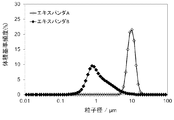
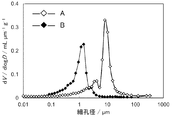
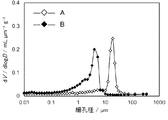
リグノスルホン酸(以下リグニン)を、例えば高温の硫酸中で加水分解すると、硫酸中での粒径を小さくできる(図1)。親水性の官能基、例えば水酸基を増すことにより、硫酸中でのリグニンの粒径を小さくできると考えられ、リグニンの分子量はリグニンの硫酸中での粒径に余り影響しない。そして硫酸中での平均粒径の小さなリグニンを用いると、細孔径が小さな負極電極材料が得られ、硫酸中での平均粒径の大きなリグニンを用いると、細孔径が大きい負極電極材料が得られる(図2)。また細孔径が小さな負極電極材料を用いると、高い低温高率放電性能が得られる。硫酸中でのリグニンの平均粒径によって、負極電極材料の細孔径が制御されているのである。 When lignosulfonic acid (hereinafter lignin) is hydrolyzed in, for example, high-temperature sulfuric acid, the particle size in sulfuric acid can be reduced (FIG. 1). It is considered that the particle size of lignin in sulfuric acid can be reduced by increasing hydrophilic functional groups such as hydroxyl groups, and the molecular weight of lignin does not significantly affect the particle size of lignin in sulfuric acid. When lignin having a small average particle size in sulfuric acid is used, a negative electrode material having a small pore size can be obtained. When lignin having a large average particle size in sulfuric acid is used, a negative electrode material having a large pore size can be obtained. (FIG. 2). Further, when a negative electrode material having a small pore diameter is used, high low temperature and high rate discharge performance can be obtained. The pore diameter of the negative electrode material is controlled by the average particle diameter of lignin in sulfuric acid.
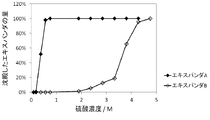
リグニン水溶液に硫酸を加えるとリグニンが沈降し、吸光度が低い上澄みが得られ、沈降したリグニンは凝集が進んだコロイド状である。このことは、リグニンが凝集したコロイド粒子の粒径が、硫酸濃度に依存して定まることを示している(図3)。 When sulfuric acid is added to the aqueous lignin solution, the lignin settles and a supernatant with low absorbance is obtained, and the precipitated lignin is a colloidal form in which aggregation has progressed. This indicates that the particle size of the colloidal particles in which lignin is aggregated is determined depending on the sulfuric acid concentration (FIG. 3).
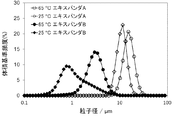
リグニンの硫酸溶液を加熱すると、リグニンの粒径が増大する(図4)。また鉛蓄電池を高温下で過充電すると、負極電極材料の細孔径が増大する(図5)。従って、高温過充電等により高温を経験すると、リグニンの粒径が大きくなり、これと共に負極電極材料の細孔径も増大することになる。また硫酸中での粒径が大きなリグニンを用いると、高温過充電を経験した際の低温高率放電性能の低下も著しい。 When the sulfuric acid solution of lignin is heated, the particle size of lignin increases (FIG. 4). Moreover, when the lead storage battery is overcharged at a high temperature, the pore diameter of the negative electrode material increases (FIG. 5). Therefore, if a high temperature is experienced due to high temperature overcharge or the like, the particle size of lignin increases and the pore diameter of the negative electrode material also increases. In addition, when lignin having a large particle diameter in sulfuric acid is used, the low-temperature high-rate discharge performance is significantly reduced when high-temperature overcharge is experienced.
リグニンの平均粒径には最適範囲があり、極端に平均粒径が小さいリグニンでは低温高率放電性能は向上しない(表1)。そこで硫酸中でのリグニンの平均粒径は0.1μm以上で9μm以下とし、0.4μm以上で9μm以下が好ましく、0.4μm以上で8μm以下が最も好ましい(表1,表2)。 The average particle size of lignin has an optimum range, and lignin having an extremely small average particle size does not improve the low-temperature high-rate discharge performance (Table 1). Therefore, the average particle size of lignin in sulfuric acid is 0.1 μm or more and 9 μm or less, preferably 0.4 μm or more and 9 μm or less, and more preferably 0.4 μm or more and 8 μm or less (Table 1 and Table 2).
リグニンに関する検討は他の有機防縮剤にも当てはまり、硫酸中での平均粒径を0.1μm以上で9μm以下とすると、低温高率放電性能の初期値に優れ、高温を経験しても低温高率放電性能の低下が小さい鉛蓄電池が得られる(表3)。有機防縮剤について、硫酸中での平均粒径を小さくするには、例えば、モノマー1分子当たり、あるいは、基本骨格当たりの、親水性官能基の量、特にスルホン酸基の量を大きくすることが有効である。 The study on lignin is also applicable to other organic shrinkage agents. When the average particle size in sulfuric acid is 0.1 μm or more and 9 μm or less, the initial value of low temperature and high rate discharge performance is excellent, and even if high temperature is experienced, low temperature and high rate A lead-acid battery with a small decrease in discharge performance is obtained (Table 3). In order to reduce the average particle size in sulfuric acid for the organic shrinking agent, for example, the amount of hydrophilic functional groups, particularly the amount of sulfonic acid groups, per monomer molecule or per basic skeleton may be increased. It is valid.
この発明では、有機防縮剤の硫酸中での平均粒径を最適化することにより、低温高率放電性能の初期値を高め、かつ高温を経験することによる低温高率放電性能の低下を小さくする。本明細書では、水洗・乾燥した極板において、極板から集電体を除いたものすべてが電極材料であり、導電材、補強材、防縮剤などの添加剤を含む。実施例では、電極材料を単に活物質と呼び、電極材料と活物質は同じものを示す。 In the present invention, by optimizing the average particle size of the organic shrinking agent in sulfuric acid, the initial value of the low temperature high rate discharge performance is increased, and the deterioration of the low temperature high rate discharge performance due to the high temperature is reduced. . In this specification, in the electrode plate that has been washed and dried, all of the electrode plate excluding the current collector is an electrode material, and includes additives such as a conductive material, a reinforcing material, and an anti-shrink agent. In the examples, the electrode material is simply referred to as an active material, and the electrode material and the active material are the same.
以下に、本願発明の最適実施例を示す。本願発明の実施に際しては、当業者の常識及び先行技術の開示に従い、実施例を適宜に変更できる。 Hereinafter, an optimum embodiment of the present invention will be described. In carrying out the present invention, the embodiments can be appropriately changed in accordance with common sense of those skilled in the art and disclosure of prior art.
予備試験
リグノスルホン酸を、オートクレーブにより、160℃で比重1.25の硫酸中で加水分解した。加水分解温度は140℃以上が好ましい。加水分解しなかったリグノスルホン酸をエキスパンダA、加水分解したリグノスルホン酸をエキスパンダBとし、主成分の鉛粉と、エキスパンダを0.1mass%、カーボンブラックを0.15mass%、硫酸バリウムを0.3mass%、補強材0.1mass%とを負極電極材料に含むように硫酸でペースト化し、鉛合金格子に充填して、未化成の負極板とした。鉛粉と補強材0.1mass%とを硫酸でペースト化し、鉛合金格子に充填して、未化成の正極板とした。負極板をポリエチレンセパレータで包み、電解液を加えて電槽化成することにより、液式の鉛蓄電池として、特性を測定した。硫酸中での平均粒径が異なるエキスパンダを用いる点が重要で、他の点は任意で、特に硫酸バリウムの有無と含有量、カーボンブラック等のカーボンの有無と含有量は任意である。
Preliminary lignosulfonic acid was hydrolyzed in sulfuric acid with a specific gravity of 1.25 at 160 ° C. by autoclaving. The hydrolysis temperature is preferably 140 ° C. or higher. Lignosulfonic acid not hydrolyzed is expander A, hydrolyzed lignosulfonic acid is expander B, lead powder of the main component, expander 0.1 mass%, carbon black 0.15 mass%, barium sulfate 0.3 An unformed negative electrode plate was prepared by pasting with sulfuric acid so that the negative electrode material contains mass% and 0.1 mass% of the reinforcing material, and filling the lead alloy lattice. Lead powder and 0.1 mass% of the reinforcing material were pasted with sulfuric acid and filled in a lead alloy lattice to obtain an unchemically formed positive electrode plate. The characteristics were measured as a liquid lead-acid battery by wrapping the negative electrode plate with a polyethylene separator and adding an electrolytic solution to form a battery case. It is important to use an expander having a different average particle size in sulfuric acid, and other points are optional. In particular, the presence and content of barium sulfate and the presence and content of carbon such as carbon black are arbitrary.
図1はエキスパンダA,Bの25℃で比重が1.25の硫酸中での粒度分布を示し、エキスパンダBの体積平均粒径は0.9μm、エキスパンダAでは10μmであった。 FIG. 1 shows the particle size distribution of expanders A and B in sulfuric acid having a specific gravity of 1.25 at 25 ° C., and the volume average particle size of expander B was 0.9 μm, and that of expander A was 10 μm.
図2は化成後の負極活物質の細孔径分布を示し、エキスパンダBの体積換算の細孔径の中央値は1.5μm、エキスパンダAでは9.0μmで、粒径が小さなエキスパンダBでは活物質の細孔径も小さかった。 FIG. 2 shows the pore size distribution of the negative electrode active material after chemical conversion. The median pore size of expander B is 1.5 μm, expander A is 9.0 μm, and expander B has a small particle size and active material. The pore diameter of was also small.
図3は、エキスパンダA,Bの硫酸溶液を撹拌して一晩静置した際の、沈殿したエキスパンダの量と硫酸濃度との関係を示す。エキスパンダAでは硫酸濃度が0.8M付近から凝集による沈降が生じるが、エキスパンダBでは4M付近まで沈降は生じなかた。このことはリグニンのエキスパンダは硫酸中で凝集し、リグニンが凝集したコロイド粒子の粒径は硫酸濃度に依存することを示している。 FIG. 3 shows the relationship between the amount of expander precipitated and the sulfuric acid concentration when the sulfuric acid solutions of expanders A and B were stirred and allowed to stand overnight. In Expander A, sedimentation occurred due to aggregation from around sulfuric acid concentration of 0.8M, but in Expander B, sedimentation did not occur until around 4M. This indicates that the lignin expander aggregates in sulfuric acid, and the particle size of the colloidal particles aggregated with lignin depends on the sulfuric acid concentration.
図4は、65℃におけるエキスパンダの、比重1.25の硫酸中での粒度分布を示し、平均粒径はエキスパンダAで15μm、エキスパンダBで3μmであった。高温環境下では、エキスパンダの平均粒径が増加した。また60℃で20日間充電する高温過充電試験を実施した後に、負極活物質の細孔径分布を測定すると図5のようになり、エキスパンダA,Bとも高温過充電により負極活物質の細孔径が増加したが、エキスパンダBではエキスパンダAよりも細孔径が小さかった。 FIG. 4 shows the particle size distribution of the expander in sulfuric acid having a specific gravity of 1.25 at 65 ° C. The average particle size was 15 μm for the expander A and 3 μm for the expander B. Under the high temperature environment, the average particle size of the expander increased. In addition, after conducting a high temperature overcharge test for 20 days at 60 ° C, the pore size distribution of the negative electrode active material is measured as shown in Fig. 5. Both expanders A and B have a pore size of the negative electrode active material due to high temperature overcharge. However, the expander B had a smaller pore diameter than the expander A.
これらのことは、エキスパンダ粒子(有機防縮剤が凝集したコロイド粒子)が立体的な障害となって、小さな細孔の消失を防止していることを示している。また鉛蓄電池の性能試験から、平均粒径が小さなエキスパンダBで、平均粒径が大きなエキスパンダAよりも、優れた低温高率放電性能と、優れた高温過充電への耐久性が得られることが判明した。 These facts indicate that the expander particles (colloid particles in which the organic shrinkage agent is aggregated) are sterically hindering to prevent the disappearance of small pores. Also, from the performance test of lead-acid battery, expander B with a small average particle size provides superior low-temperature high-rate discharge performance and excellent durability to high-temperature overcharge than expander A with a large average particle size It has been found.
本試験
予備試験と同様にして、加水分解時間を変えることにより、硫酸中での平均粒径が0.05μm〜10μmのリグニン(リグノスルホン酸)を調製した。リグニンは酸型で加えてナトリウム等の塩型で加えても良い。他に加水分解を行わなかったリグニン(硫酸中での平均粒径は10μm)を用意した。これらのリグニンを用い、予備試験と同様にして、定法により、55D23型の鉛蓄電池を製造した。負極活物質中のリグニン含有量は0.1mass%としたが、0.05mass%以上0.5mass%以下が好ましい。各鉛蓄電池を充電した後に、-15℃で300Aの定電流放電の持続時間を測定して、低温高率放電持続時間とした。次いで60℃の水槽中で,2.4Aの充電を10日間継続し、その後再度低温高率放電持続時間を測定して、持続時間の比を初期容量維持率とした。さらに高温過充電試験後の負極活物質の細孔径分布を測定し、体積基準の中央値を測定した。結果を表1,表2に示す。各表でのコロイド粒子径は、比重1.25の硫酸中での平均粒子径を示し、表2のコロイド粒子径は高温過充電試験前の値である。表1のA,Bは予備試験でのエキスパンダA,Bを表す。
In the same manner as in the preliminary test, lignin (lignosulfonic acid) having an average particle size in sulfuric acid of 0.05 μm to 10 μm was prepared by changing the hydrolysis time. Lignin may be added in an acid form or in a salt form such as sodium. In addition, lignin that had not been hydrolyzed (average particle size in sulfuric acid was 10 μm) was prepared. Using these lignins, a 55D23 type lead-acid battery was produced in the same manner as in the preliminary test by a conventional method. The lignin content in the negative electrode active material is 0.1 mass%, but is preferably 0.05 mass% or more and 0.5 mass% or less. After charging each lead-acid battery, the duration of constant current discharge of 300 A at -15 ° C. was measured to obtain a low temperature high rate discharge duration. Next, charging at 2.4 A was continued for 10 days in a 60 ° C. water bath, and then the low temperature high rate discharge duration was measured again, and the ratio of duration was defined as the initial capacity maintenance rate. Furthermore, the pore size distribution of the negative electrode active material after the high temperature overcharge test was measured, and the median value based on volume was measured. The results are shown in Tables 1 and 2. The colloid particle diameter in each table indicates the average particle diameter in sulfuric acid having a specific gravity of 1.25, and the colloid particle diameter in Table 2 is a value before the high temperature overcharge test. A and B in Table 1 represent expanders A and B in the preliminary test.
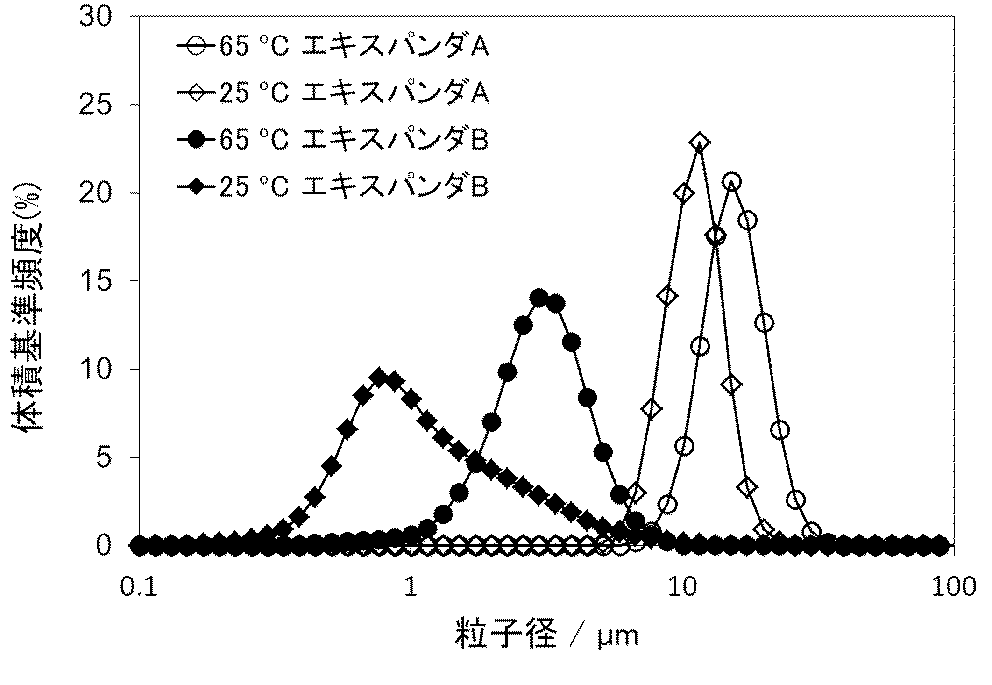
表1から、硫酸中でのリグニンの平均粒径を9μm以下にすることにより、低温高率放電持続時間が増し、この特徴は平均粒径が0.1μmまで、より好ましくは0.4μmまで保たれることが判明した。表2から、硫酸中でのリグニンの平均粒径を9μm以下にすることにより、高温過充電の経験による低温高率放電持続時間の低下率を小さくできることが判明した。さらに高温過充電を経験した後の活物質の細孔径の中央値を小さくするには、硫酸中でのリグニンの平均粒径を小さくすればよいことが判明した。また硫酸中でのリグニンの平均粒径を0.1μm以上9μm以下、より好ましくは0.4μm以上9μm以下、最も好ましくは0.4μm以上8μm以下とすると、低温高率放電性能の初期値でも、高温過充電の経験後でも、硫酸中での平均粒径が10μm以上のリグニンよりも良い性能が得られることが判明した。 From Table 1, by setting the average particle size of lignin in sulfuric acid to 9 μm or less, the low-temperature high-rate discharge duration is increased, and this feature is maintained up to an average particle size of 0.1 μm, more preferably 0.4 μm. It has been found. From Table 2, it was found that the decrease rate of the low temperature high rate discharge duration due to the experience of high temperature overcharge can be reduced by setting the average particle size of lignin in sulfuric acid to 9 μm or less. Further, it has been found that in order to reduce the median pore diameter of the active material after experiencing high temperature overcharge, the average particle diameter of lignin in sulfuric acid should be reduced. If the average particle size of lignin in sulfuric acid is 0.1 μm or more and 9 μm or less, more preferably 0.4 μm or more and 9 μm or less, and most preferably 0.4 μm or more and 8 μm or less, even at the initial value of the low temperature high rate discharge performance, the high temperature overcharge Even after this experience, it has been found that better performance can be obtained than lignin having an average particle size in sulfuric acid of 10 μm or more.
リグニン以外の有機防縮剤
ポリアクリル酸(平均分子量1000,000,比重1.25の硫酸中で平均粒子径25μm)、
ポリアクリルアミド・ターシャリーブチル・スルホン酸Naの重合物(ATBSポリマー:ATBSは登録商標)、
スルホメチル化クラフトリグニン、
の3種類の合成有機防縮剤を検討した。
Organic anti-shrink agent other than lignin, polyacrylic acid (
Polymer of polyacrylamide, tertiary butyl and sodium sulfonate (ATBS polymer: ATBS is a registered trademark),
Sulfomethylated kraft lignin,
The following three types of synthetic organic shrinkage agents were studied.
ポリアクリルアミド・ターシャリーブチル・スルホン酸Naの重合物(ATBSポリマー)では、平均分子量を50,000、75,000、100,000の3種類とし、比重1.25の硫酸中での平均粒子径は8.0μm、6.0μm、4.0μmで、分子量とは大小の順序が逆であった。ATBSポリマーでは、基本骨格とスルホン酸基量との比が1:1であった。 Polyacrylamide / tertiary butyl / sodium sulfonate polymer (ATBS polymer) has an average molecular weight of 50,000, 75,000 and 100,000, and the average particle size in sulfuric acid with a specific gravity of 1.25 is 8.0μm, 6.0μm and 4.0. The order of magnitude was opposite to the molecular weight at μm. In the ATBS polymer, the ratio between the basic skeleton and the amount of sulfonic acid groups was 1: 1.
スルホメチル化クラフトリグニンは、クラフトリグニンにホルムアルデヒドと亜硫酸塩を加えて高温加圧下で処理したものであり、−CH2−SO3H(Na)としてメチレン基を介してスルホン酸基(H型またはNa型)が導入されている。従来のリグノスルホン酸とは、スルホン酸基の位置が異なるものである。平均分子量は12,000とし、ホルムアルデヒドと亜硫酸塩の量、すなわち、スルホメチル化の条件を変えて、基本骨格当たりのスルホン酸基の量を0.05〜0.4の範囲で制御することにより、比重1.25の硫酸中での平均粒径を17.0μmから1.4μmの範囲で制御した。 Sulfomethylated kraft lignin is obtained by adding formaldehyde and sulfite to kraft lignin and treating it under high temperature and pressure. As —CH 2 —SO 3 H (Na), a sulfonic acid group (H type or Na) is introduced through a methylene group. Type) has been introduced. The position of the sulfonic acid group is different from the conventional lignosulfonic acid. In the sulfuric acid having a specific gravity of 1.25, the average molecular weight is 12,000, and the amount of formaldehyde and sulfite, that is, the sulfomethylation conditions are changed, and the amount of sulfonic acid groups per basic skeleton is controlled in the range of 0.05 to 0.4. The average particle size was controlled in the range of 17.0 μm to 1.4 μm.
従来のリグノスルホン酸に代えて、これらの有機防縮剤を負極活物質に0.1mass%含有させ、他は予備試験及び本試験に従って鉛蓄電池を製造し、低温高率放電性能の初期値と高温過充電試験後の値とを測定した。結果を、リグノスルホン酸(リグニン)の従来例のデータと共に、表3に示す。 Instead of conventional lignosulfonic acid, 0.1 mass% of these organic shrinkage agents are contained in the negative electrode active material, and others produce lead-acid batteries according to the preliminary test and the main test. The value after the charge test was measured. The results are shown in Table 3 together with conventional example data of lignosulfonic acid (lignin).
いずれの有機防縮剤でも、比重1.25の硫酸中での平均粒子径を9μm以下とすることにより、
・ 低温高率放電性能を高くでき、
・ 高温での過充電を経験した後も、低温高率放電性能が高く、また低温高率放電性能の維持率を高くできた。
In any organic shrinkage agent, by setting the average particle size in sulfuric acid having a specific gravity of 1.25 to 9 μm or less,
・ The low temperature and high rate discharge performance can be improved.
-Even after experiencing overcharge at high temperature, the low-temperature high-rate discharge performance was high, and the maintenance rate of the low-temperature high-rate discharge performance was high.
Claims (5)
Priority Applications (5)
| Application Number | Priority Date | Filing Date | Title |
|---|---|---|---|
| JP2014108342A JP6195169B2 (en) | 2014-05-26 | 2014-05-26 | Lead acid battery |
| US15/312,508 US10790501B2 (en) | 2014-05-26 | 2014-12-19 | Lead-acid battery |
| CN201480079189.6A CN106463729B (en) | 2014-05-26 | 2014-12-19 | Lead storage battery |
| PCT/JP2014/006355 WO2015181865A1 (en) | 2014-05-26 | 2014-12-19 | Lead storage cell |
| DE112014006702.4T DE112014006702B4 (en) | 2014-05-26 | 2014-12-19 | lead-acid battery |
Applications Claiming Priority (1)
| Application Number | Priority Date | Filing Date | Title |
|---|---|---|---|
| JP2014108342A JP6195169B2 (en) | 2014-05-26 | 2014-05-26 | Lead acid battery |
Publications (2)
| Publication Number | Publication Date |
|---|---|
| JP2015225719A true JP2015225719A (en) | 2015-12-14 |
| JP6195169B2 JP6195169B2 (en) | 2017-09-13 |
Family
ID=54842347
Family Applications (1)
| Application Number | Title | Priority Date | Filing Date |
|---|---|---|---|
| JP2014108342A Active JP6195169B2 (en) | 2014-05-26 | 2014-05-26 | Lead acid battery |
Country Status (1)
| Country | Link |
|---|---|
| JP (1) | JP6195169B2 (en) |
Cited By (5)
| Publication number | Priority date | Publication date | Assignee | Title |
|---|---|---|---|---|
| WO2021060386A1 (en) * | 2019-09-27 | 2021-04-01 | 株式会社Gsユアサ | Negative plate for lead-acid battery, lead-acid battery, and production method for negative plate for lead-acid battery |
| WO2022190829A1 (en) * | 2021-03-08 | 2022-09-15 | 日本製紙株式会社 | Organic anti-shrinkage agent for lead-acid batteries |
| JPWO2023095511A1 (en) * | 2021-11-26 | 2023-06-01 | ||
| JP2023154163A (en) * | 2022-04-06 | 2023-10-19 | 古河電池株式会社 | lead acid battery |
| WO2024047491A1 (en) * | 2022-08-30 | 2024-03-07 | Arcactive Limited | Lead-acid battery and manufacture method |
Citations (6)
| Publication number | Priority date | Publication date | Assignee | Title |
|---|---|---|---|---|
| JPH0465062A (en) * | 1990-07-02 | 1992-03-02 | Sanyo Chem Ind Ltd | Lead storage battery |
| JPH11250913A (en) * | 1998-03-02 | 1999-09-17 | Aisin Seiki Co Ltd | Lead-acid battery |
| JP2005294027A (en) * | 2004-03-31 | 2005-10-20 | Yuasa Corp | Negative electrode active material and lead-acid battery using the same |
| JP2006196191A (en) * | 2005-01-11 | 2006-07-27 | Shin Kobe Electric Mach Co Ltd | Lead acid battery |
| WO2012086008A1 (en) * | 2010-12-21 | 2012-06-28 | 新神戸電機株式会社 | Lead storage battery |
| JP2013041848A (en) * | 2012-10-25 | 2013-02-28 | Shin Kobe Electric Mach Co Ltd | Lead battery |
-
2014
- 2014-05-26 JP JP2014108342A patent/JP6195169B2/en active Active
Patent Citations (6)
| Publication number | Priority date | Publication date | Assignee | Title |
|---|---|---|---|---|
| JPH0465062A (en) * | 1990-07-02 | 1992-03-02 | Sanyo Chem Ind Ltd | Lead storage battery |
| JPH11250913A (en) * | 1998-03-02 | 1999-09-17 | Aisin Seiki Co Ltd | Lead-acid battery |
| JP2005294027A (en) * | 2004-03-31 | 2005-10-20 | Yuasa Corp | Negative electrode active material and lead-acid battery using the same |
| JP2006196191A (en) * | 2005-01-11 | 2006-07-27 | Shin Kobe Electric Mach Co Ltd | Lead acid battery |
| WO2012086008A1 (en) * | 2010-12-21 | 2012-06-28 | 新神戸電機株式会社 | Lead storage battery |
| JP2013041848A (en) * | 2012-10-25 | 2013-02-28 | Shin Kobe Electric Mach Co Ltd | Lead battery |
Cited By (11)
| Publication number | Priority date | Publication date | Assignee | Title |
|---|---|---|---|---|
| WO2021060386A1 (en) * | 2019-09-27 | 2021-04-01 | 株式会社Gsユアサ | Negative plate for lead-acid battery, lead-acid battery, and production method for negative plate for lead-acid battery |
| JP2021057120A (en) * | 2019-09-27 | 2021-04-08 | 株式会社Gsユアサ | Negative electrode plate for lead-acid battery and lead-acid battery, and method for manufacturing negative electrode plate for lead-acid battery |
| JP7363288B2 (en) | 2019-09-27 | 2023-10-18 | 株式会社Gsユアサ | Negative electrode plate for lead-acid battery, lead-acid battery, and manufacturing method of negative electrode plate for lead-acid battery |
| WO2022190829A1 (en) * | 2021-03-08 | 2022-09-15 | 日本製紙株式会社 | Organic anti-shrinkage agent for lead-acid batteries |
| JPWO2022190829A1 (en) * | 2021-03-08 | 2022-09-15 | ||
| JP2024019560A (en) * | 2021-03-08 | 2024-02-09 | 日本製紙株式会社 | Organic anti-shrink agent for lead-acid batteries |
| JPWO2023095511A1 (en) * | 2021-11-26 | 2023-06-01 | ||
| WO2023095511A1 (en) * | 2021-11-26 | 2023-06-01 | 日本製紙株式会社 | Organic anti-shrinkage agent for lead-acid batteries |
| JP7381807B2 (en) | 2021-11-26 | 2023-11-16 | 日本製紙株式会社 | Organic anti-shrink agent for lead-acid batteries |
| JP2023154163A (en) * | 2022-04-06 | 2023-10-19 | 古河電池株式会社 | lead acid battery |
| WO2024047491A1 (en) * | 2022-08-30 | 2024-03-07 | Arcactive Limited | Lead-acid battery and manufacture method |
Also Published As
| Publication number | Publication date |
|---|---|
| JP6195169B2 (en) | 2017-09-13 |
Similar Documents
| Publication | Publication Date | Title |
|---|---|---|
| CN106463729B (en) | Lead storage battery | |
| Xu et al. | Nanocellulose‐carboxymethylcellulose electrolyte for stable, high‐rate zinc‐ion batteries | |
| JP6195169B2 (en) | Lead acid battery | |
| CN103326001B (en) | The preparation method of core-shell polymers-nano-sulfur particles composite material | |
| WO2023273367A1 (en) | High-viscosity lithium carboxymethyl cellulose, preparation method therefor, and application thereof | |
| CN110336037B (en) | Aqueous binder for negative electrode material of lithium ion battery and preparation method thereof | |
| JP6413703B2 (en) | Lead acid battery and negative electrode plate thereof | |
| CN109243843B (en) | A kind of ultrafine sulfide/graphene two-dimensional composite material and preparation method and application thereof | |
| CN105702953B (en) | A kind of high temperature heavy load start and stop GND lead plaster and preparation method thereof | |
| CN104600338A (en) | A zinc-bromine flow battery electrolyte additive and its preparation method | |
| CN107706406B (en) | A kind of organic cathode material, preparation method and application thereof | |
| CN116111091A (en) | A kind of binder composition, sodium-ion battery cathode slurry and sodium-ion battery | |
| CN107069033A (en) | A battery electrode containing graphene fibers and its preparation method and application | |
| CN105609733A (en) | Preparation method for boron-nitrogen-co-doped three-dimensional structured positive electrode material of lithium-sulfur battery | |
| CN105552326A (en) | Coating method for high-conductivity cathode material | |
| CN104377357B (en) | A kind of low temperature resistant lead-acid accumulator lead plaster | |
| CN118315594B (en) | A new type of current collector of lithium metal negative electrode material and its preparation method and application | |
| CN104766976A (en) | Lithium ion secondary battery negative pole piece and preparation method thereof | |
| CN104362345A (en) | A kind of storage battery composite additive | |
| CN106981687A (en) | A kind of preparation method of high-energy-density lithium battery | |
| CN103515615A (en) | Aqueous positive slurry of capacity type power lithium battery and preparation method of aqueous positive slurry | |
| JP6539029B2 (en) | Method of manufacturing lithium ion secondary battery | |
| CN103762347B (en) | A kind of electrode material and preparation method thereof | |
| Xiong et al. | Improved performance of the rechargeable hybrid aqueous battery at near full state-of-charge | |
| CN111162277A (en) | A kind of graphene composite conductive agent and preparation method thereof |
Legal Events
| Date | Code | Title | Description |
|---|---|---|---|
| A621 | Written request for application examination |
Free format text: JAPANESE INTERMEDIATE CODE: A621 Effective date: 20160929 |
|
| A131 | Notification of reasons for refusal |
Free format text: JAPANESE INTERMEDIATE CODE: A131 Effective date: 20170524 |
|
| A521 | Request for written amendment filed |
Free format text: JAPANESE INTERMEDIATE CODE: A523 Effective date: 20170703 |
|
| TRDD | Decision of grant or rejection written | ||
| A521 | Request for written amendment filed |
Free format text: JAPANESE INTERMEDIATE CODE: A821 Effective date: 20170703 |
|
| A01 | Written decision to grant a patent or to grant a registration (utility model) |
Free format text: JAPANESE INTERMEDIATE CODE: A01 Effective date: 20170721 |
|
| A61 | First payment of annual fees (during grant procedure) |
Free format text: JAPANESE INTERMEDIATE CODE: A61 Effective date: 20170803 |
|
| R150 | Certificate of patent or registration of utility model |
Ref document number: 6195169 Country of ref document: JP Free format text: JAPANESE INTERMEDIATE CODE: R150 |