JP2016007766A - Method for manufacturing printed matter, and printing plate - Google Patents
Method for manufacturing printed matter, and printing plate Download PDFInfo
- Publication number
- JP2016007766A JP2016007766A JP2014129564A JP2014129564A JP2016007766A JP 2016007766 A JP2016007766 A JP 2016007766A JP 2014129564 A JP2014129564 A JP 2014129564A JP 2014129564 A JP2014129564 A JP 2014129564A JP 2016007766 A JP2016007766 A JP 2016007766A
- Authority
- JP
- Japan
- Prior art keywords
- base material
- ink
- hole
- printing plate
- substrate
- Prior art date
- Legal status (The legal status is an assumption and is not a legal conclusion. Google has not performed a legal analysis and makes no representation as to the accuracy of the status listed.)
- Pending
Links
Images





Landscapes
- Inking, Control Or Cleaning Of Printing Machines (AREA)
- Printing Methods (AREA)
- Printing Plates And Materials Therefor (AREA)
- Manufacturing Of Printed Wiring (AREA)
Abstract
【課題】印刷版の溝に残留したインキを簡易に洗浄することができ、このため、高い品質の印刷物を容易に得ることができる、印刷物の製造方法を提供する。
【解決手段】印刷物の製造方法は、平坦な第1面を有する第1基材と、一端および他端を有する貫通孔が形成された第2基材と、を準備する工程と、貫通孔の一端が第1基材の第1面に接するように、第2基材を第1基材の第1面上に載置する工程と、他端側から貫通孔内の空間にインキを充填する工程と、貫通孔内の空間に充填されたインキを被転写物へ転写する工程と、第1基材の第1面および第2基材の貫通孔の壁面に付着しているインキを洗浄する洗浄工程と、を備えている。洗浄工程は、第2基材を第1基材の前記第1面から少なくとも部分的に取り外した状態で実施される。
【選択図】図3An object of the present invention is to provide a method for producing a printed material, in which ink remaining in a groove of a printing plate can be easily washed, and a high-quality printed material can be easily obtained.
A method of manufacturing a printed material includes: preparing a first base material having a flat first surface; and a second base material having a through hole having one end and another end; A step of placing the second base material on the first surface of the first base material so that one end is in contact with the first surface of the first base material, and filling the space in the through hole from the other end side with ink. Washing the ink adhering to the first surface of the first base material and the wall surface of the through hole of the second base material, the step of transferring the ink filled in the space in the through hole to the transfer object, and the step; And a cleaning process. The cleaning step is performed in a state where the second substrate is at least partially removed from the first surface of the first substrate.
[Selection] Figure 3
Description
本発明は、インキによって形成されたパターンを含む印刷物の製造方法に関する。また本発明は、印刷物の製造方法において用いられる印刷版に関する。 The present invention relates to a method for producing a printed material including a pattern formed by ink. Moreover, this invention relates to the printing plate used in the manufacturing method of printed matter.
印刷技術のひとつとして、印刷版の溝にインキを充填し、このインキを紙や基板などの被転写物へ転写し、これによって、インキによって形成されたパターンを含む印刷物を製造する方法が知られている。印刷版の溝に充填されたインキを被転写物へ転写する方法としては、被転写体を印刷版に接触させ、これによってインキを印刷版から被転写体へ転写する方法や、ブランケットを印刷版に接触させ、これによってインキをブランケットへ渡し、次に、ブランケット上のインキを被転写体に転写する方法がある。 As one of the printing technologies, a method is known in which ink is filled into a groove of a printing plate, and the ink is transferred to an object to be transferred such as paper or a substrate, thereby producing a printed material including a pattern formed by the ink. ing. As a method of transferring the ink filled in the groove of the printing plate to the transfer object, the transfer object is brought into contact with the printing plate, whereby the ink is transferred from the printing plate to the transfer object, or the blanket is transferred to the printing plate. There is a method in which the ink is transferred to the blanket, and then the ink on the blanket is transferred to the transfer medium.
近年、印刷技術を利用して、導電性を有する配線を形成することが試みられている。すなわち、印刷物のパターンが、導電性を有する配線として形成される場合がある。例えば特許文献1においては、インキとして、導電性を有する材料を含む導電性ペーストを用い、この導電性ペーストを被転写物上へ転写することによって、回路基板、電子部品、電磁波シールドなどの電子機器や電子部品における、導電性を有する配線を作製する点が開示されている。
In recent years, attempts have been made to form conductive wiring using printing technology. That is, the printed pattern may be formed as a conductive wiring. For example, in
印刷版の溝に充填されたインキは、一般に、全部が被転写物やブランケットへ渡されるのではなく、一部のインキは印刷版の溝に残留する。溝にインキが残留した印刷版を使用し続けると、被転写物へ転写されるインキに、固化したインキの欠片が混じってしまうことや、印刷版の溝が詰まってしまうことなどが生じ得る。従って、印刷を高い品質で継続的に実施するためには、溝に残留したインキを洗浄する洗浄工程が、転写工程を実施する度に、または、複数回の転写工程につき1回、実施されることが好ましい。 In general, the ink filled in the grooves of the printing plate is not entirely transferred to the transfer object or the blanket, but a part of the ink remains in the grooves of the printing plate. If the printing plate in which the ink remains in the groove is continuously used, solidified ink fragments may be mixed with the ink transferred to the transfer object, or the groove of the printing plate may be clogged. Therefore, in order to continuously perform the printing with high quality, the cleaning process for cleaning the ink remaining in the groove is performed every time the transfer process is performed or once for a plurality of transfer processes. It is preferable.
ところで、電子機器や電子部品の分野においては、小型化等のため、配線の幅を小さくすることが求められる。従って、電子機器や電子部品の分野において印刷技術が用いられる場合、印刷版の溝の幅が数十μm程度に設定されることがある。しかしながら、印刷版の溝が小さくなることは、洗浄工程の際に洗浄液などを導入するための溝の開口面積が小さくなり、この結果、洗浄工程の際に溝内のインキが除去されにくくなることを意味している。 By the way, in the field of electronic equipment and electronic components, it is required to reduce the width of the wiring for miniaturization and the like. Therefore, when printing technology is used in the field of electronic equipment and electronic components, the width of the groove of the printing plate may be set to about several tens of μm. However, when the groove of the printing plate is reduced, the opening area of the groove for introducing a cleaning solution or the like is reduced during the cleaning process, and as a result, the ink in the groove is not easily removed during the cleaning process. Means.
溝に残留したインキを洗浄する方法としては、インキに向けて洗浄液を噴射するという方法だけでなく、特許文献1に記載されているように、インキに向けて過熱水蒸気を噴射するという方法も考えられる。しかしながら、過熱水蒸気を利用する場合、過熱水蒸気を生成して噴射するための設備を新たに導入することや、過熱水蒸気を噴射するための作業場所を新たに確保することが必要になる。
As a method of cleaning the ink remaining in the groove, not only a method of spraying a cleaning liquid toward the ink but also a method of spraying superheated steam toward the ink as described in
本発明は、このような点を考慮してなされたものであり、印刷版の溝に残留したインキを簡易に洗浄することができ、このため、高い品質の印刷物を容易に得ることができる、印刷物の製造方法を提供することを目的とする。 The present invention has been made in consideration of such points, and can easily wash the ink remaining in the grooves of the printing plate, and thus can easily obtain a high-quality printed matter. It aims at providing the manufacturing method of printed matter.
本発明は、インキによって形成されたパターンを含む印刷物の製造方法であって、平坦な第1面を有する第1基材と、一端および他端を有する貫通孔が形成された第2基材と、を準備する工程と、前記貫通孔の前記一端が前記第1基材の前記第1面に接するように、前記第2基材を前記第1基材の前記第1面上に載置する工程と、前記他端側から前記貫通孔内の空間にインキを充填する工程と、前記貫通孔内の空間に充填されたインキを被転写物へ転写する工程と、前記第1基材の前記第1面および前記第2基材の前記貫通孔の壁面に付着しているインキを洗浄する洗浄工程と、を備え、前記洗浄工程は、前記第2基材を前記第1基材の前記第1面から少なくとも部分的に取り外した状態で実施される、印刷物の製造方法である。 The present invention is a method for producing a printed material including a pattern formed of ink, a first substrate having a flat first surface, and a second substrate having a through hole having one end and the other end. And placing the second base material on the first surface of the first base material so that the one end of the through hole is in contact with the first surface of the first base material. A step, a step of filling ink in the space in the through hole from the other end side, a step of transferring the ink filled in the space in the through hole to the transfer object, and the step of the first base material A cleaning step of cleaning ink adhering to the wall of the through hole of the first surface and the second base material, the cleaning step including the second base material and the first base material of the first base material. It is a manufacturing method of printed matter implemented in the state where it removed at least partially from one side.
本発明による印刷物の製造方法において、前記第1基材の前記第1面の法線方向に沿って見た場合、前記第2基材の前記貫通孔は、少なくとも部分的に線状に延びており、前記貫通孔のうち線状に延びる部分の幅の最小値が、20μm以下であってもよい。 In the printed matter manufacturing method according to the present invention, when viewed along the normal direction of the first surface of the first base material, the through hole of the second base material extends at least partially linearly. And the minimum value of the width | variety of the part extended linearly among the said through-holes may be 20 micrometers or less.
本発明による印刷物の製造方法において、前記第1基材は、移動可能な定盤上に載置されていてもよい。若しくは、前記第1基材は、移動可能な定盤であってもよい。 In the method for producing a printed material according to the present invention, the first base material may be placed on a movable surface plate. Alternatively, the first base material may be a movable surface plate.
本発明による印刷物の製造方法において、前記第1基材の前記第1面のうち前記第2基材が載置される領域における表面粗さが、0.1μm以下であってもよい。表面粗さとしては、例えば、最大高さRmaxを採用することができる。 In the method for producing a printed material according to the present invention, a surface roughness of the first surface of the first base material in a region where the second base material is placed may be 0.1 μm or less. As the surface roughness, for example, the maximum height Rmax can be adopted.
本発明による印刷物の製造方法において、前記インキは、導電性を有する材料を含み、前記印刷物の前記パターンは、導電性を有する配線を含んでいてもよい。 In the method for producing a printed material according to the present invention, the ink may include a conductive material, and the pattern of the printed material may include a conductive wiring.
本発明は、インキを被印刷物に転写するための印刷版であって、平坦な第1面を有する第1基材と、一端および他端を有する貫通孔が形成された第2基材であって、前記貫通孔の前記一端が前記第1基材の前記第1面に接するように、前記第1基材の前記第1面上に載置された第2基材と、を備え、前記第2基材は、少なくとも部分的に、前記第1基材の前記第1面から取り外し可能である、印刷版である。 The present invention is a printing plate for transferring ink to a printing material, which is a first substrate having a flat first surface and a second substrate having a through hole having one end and the other end. A second substrate placed on the first surface of the first substrate so that the one end of the through hole is in contact with the first surface of the first substrate, The second substrate is a printing plate that is at least partially removable from the first surface of the first substrate.
本発明によれば、印刷版の溝に残留したインキを簡易に洗浄することができ、このため、高い品質の印刷物を容易に得ることができる。 According to the present invention, it is possible to easily wash the ink remaining in the grooves of the printing plate, and thus it is possible to easily obtain a high-quality printed matter.
以下、図1乃至図5を参照して、本発明の実施の形態について説明する。はじめに、本実施の形態に係る印刷版10について、図1および図2を参照して説明する。図1は、本実施の形態による印刷版10を示す平面図および縦断面図である。
Hereinafter, embodiments of the present invention will be described with reference to FIGS. First, a
(印刷版)
図1に示すように、印刷版10には、インキが充填される溝11が形成されている。この溝11の構造について、図2を参照して説明する。
(Printed version)
As shown in FIG. 1, the
図2に示すように、印刷版10は、平坦な第1面13と、第1面13に対向する第2面14と、を有する第1基材12と、第1基材12の第1面13上に載置された第2基材16と、を備えている。本実施の形態において、第2基材16は、少なくとも部分的に、第1基材12の第1面13から取り外し可能であるよう、構成されている。図2において、符号17は、第2基材16の第1面を表しており、符号18は、第2基材16の第2面を表している。第2基材16は、第2面18が第1基材12の第1面13に面するよう、第1基材12上に載置されている。
As shown in FIG. 2, the
なお図2においては、第1基材12の側端部の位置と第2基材16の側端部の位置とが一致している例が示されている。しかしながら、後述する第2基材16の貫通孔20の周囲において第2基材16の第2面18が第1基材12の第1面13に密着することができる限りにおいて、第1基材12の側端部と第2基材16の側端部との間の位置関係が特に限られることはない。例えば、第2基材16の側端部が、第1基材12の側端部よりも内側に位置していてもよく、若しくは、第2基材16の側端部が、第1基材12の側端部よりも外側に位置していてもよい。
FIG. 2 shows an example in which the position of the side end portion of the
図2に示すように、第2基材16には、第1面17と第2面18との間で第2基材16を貫通する貫通孔20が形成されている。図2において、符号21は、第2面18側に位置する貫通孔20の一端を表しており、符号22は、第1面17側に位置する貫通孔20の他端を表している。図2に示すように、第2基材16は、貫通孔20の一端21が第1基材12の第1面13に接するように、第1基材12の第1面13上に載置されている。このように第2基材16を第1基材12上に載置することにより、印刷版10には、第1基材12の第1面13と、第2基材16の貫通孔20とによって区画された溝11が形成されることになる。
As shown in FIG. 2, a through-
ところで、貫通孔20の周囲において第1基材12の第1面13と第2基材16の第2面18との間に隙間が存在していると、貫通孔に充填されたインキが隙間から漏れ出てしまうことが考えられる。従って、第1基材12の第1面13および第2基材16の第2面18は、互いに密着するよう構成されていることが好ましい。例えば、第1基材12の第1面13および第2基材16の第2面18のうちの少なくとも一方を、粘着性を有する材料によって構成することが考えられる。若しくは、第1基材12の第1面13と第2基材16の第2面18との間に粘着層を介在させることが考えられる。
By the way, if there is a gap between the
また、第1基材12の第1面13の表面粗さ、および、第2基材16の第2面18の表面粗さを所定値以下に設定し、これによって、第1基材12の第1面13と第2基材16の第2面18との間に隙間が形成されることを抑制するという方法も考えられる。例えば、第1基材12の第1面13の表面粗さ、および、第2基材16の第2面18の表面粗さを0.1μm以下に設定することが考えられる。表面粗さとしては、JISB0601−1982において規定されている最大高さRmaxを採用することができる。
Further, the surface roughness of the
(溝の形状)
次に、第1基材12の第1面13の法線方向に沿って印刷版10を見た場合の溝11すなわち貫通孔20の形状について説明する。図1においては、貫通孔20が、タッチパネルの電極となる配線に対応した形状を有する例が示されている。貫通孔20は、第1基材12の第1面13の法線方向に沿って見た場合に、少なくとも部分的に線状に延びている。配線の微細化に関する要求を考慮すると、貫通孔20のうち線状に延びる部分の幅Wの最小値が、20μm以下になることが考えられる。このような場合であっても、本実施の形態によれば、後述するように、貫通孔20内に残留したインキを容易に洗浄することが可能である。
(Groove shape)
Next, the shape of the
次に、印刷版10の厚み方向における印刷版10の寸法について説明する。図2において、溝11の深さすなわち貫通孔20の高さが符号Dで表されている。貫通孔20の高さDは、タッチパネルに形成される配線の厚みに対する要求などに応じて定められるが、例えば、25μm〜100μmの範囲内に設定される。
Next, the dimension of the
(印刷版の材料)
第1基材12および第2基材16が少なくとも部分的に互いに着脱可能である限りにおいて、第1基材12および第2基材16を構成する材料が特に限られることはない。例えば、第1基材12および第2基材16を構成する材料として、ガラス等を用いることができる。なお、第1基材12を構成する材料と、第2基材16を構成する材料とは、同一であってもよく、異なっていてもよい。
(Material of printing plate)
As long as the
なお第2基材16は、後述する洗浄工程において第2基材16を第1基材12から取り外す作業を容易にするため、可撓性を有するよう構成されていてもよい。若しくは、第2基材16は、貫通孔20の壁面に付着したインキを洗浄する作業を容易にするため、取り外した際に湾曲しない程度の剛性を有するよう構成されていてもよい。
In addition, the
次に、このような構成からなる本実施の形態の作用および効果について説明する。ここでは、上述の印刷版10を用いて、インキによって形成されたパターンを含む印刷物を製造する方法について説明する。なお本実施の形態において、「パターン」とは、視覚的な効果を呈するための絵柄や、電気的な効果を呈するための後述する配線など、所定の軌跡に沿って形成された、厚みを有する実在物を意味している。「所定の軌跡」は、規則的な軌跡だけでなく、無秩序に決定される軌跡をも含む概念である。
Next, the operation and effect of the present embodiment having such a configuration will be described. Here, a method for producing a printed matter including a pattern formed of ink using the above-described
はじめに、上述の第1基材12と、一端21および他端22を有する貫通孔20が形成された上述の第2基材16と、を準備する。次に、図3(a)に示すように、貫通孔20の一端21が第1基材12の第1面13に接するように、第2基材16を第1基材12の第1面13上に載置する載置工程を実施する。これによって、溝11が形成された印刷版10を得ることができる。印刷版10は、図3(a)に示すように、移動可能な第1定盤24に載置される。
First, the above-described
後述する転写工程の際にブランケット胴41が第2基材16に接することによって第2基材16が第1基材12に対して有意に変位しない限りにおいて、第2基材16が第1基材12に対して固定されているかどうかが特に限られることはない。例えば、第1基材12の第1面13と第2基材16の第2面18との間に粘着層などを介在させ、これによって第2基材16が第1基材12に対して強固に固定されるようにしてもよい。粘着層は、第2基材16の第2面18の全域にわたって設けられていてもよく、若しくは、第2基材16の第2面18の一部分にのみ、例えば第2面18の周縁にのみ設けられていてもよい。また、第1基材12の第1面13と第2基材16の第2面18との間に粘着層などの介在物が存在していなくてもよい。
As long as the
ところで上述のように、第1基材12の第1面13は、平坦な面として構成されている。このことは、第1基材12の第1面13の法線方向に沿って見た場合に第2基材16の貫通孔20が第1基材12の第1面13に重なる限りにおいて、印刷版10の機能が発揮され得ることを意味している。すなわち、載置工程の際、第1基材12に対する第2基材16の位置決めの精度が特に求められないことを意味している。従って本実施の形態によれば、載置工程を、簡易な設備を用いて容易に実施することができる。
By the way, as mentioned above, the
次に、他端22側から貫通孔20内の空間にインキ42を充填する充填工程を実施する。例えば図3(a)に示すように、はじめに、第2基材16の第1面17上にインキ42を塗布し、次に、スキージ43を用いて第1面17上のインキ42を掻く。これによって、図3(b)に示すように、貫通孔20内の空間にインキ42を充填させることができる。
Next, a filling step of filling the
次に、貫通孔20内の空間に充填されたインキ42を被転写物24へ転写する転写工程を実施する。ここでは、はじめに、ロール状のブランケット胴41に巻き付けられたブランケット40に向けて、第1定盤24を移動させ、ブランケット40に第2基材16の第1面17を接触させる。これによって、図3(c)に示すように、貫通孔20内の空間に充填されたインキ42がブランケット40へ渡される。なお図3(c)に示すように、貫通孔20内の空間に充填されたインキ42は、全部がブランケット40によって受理されるのではなく、一部のインキ42は貫通孔20内の空間に残留する。
Next, a transfer process for transferring the
その後、第1定盤24および印刷版10を退避させた後、図3(d)に示すように、ブランケット40上のインキ42に被転写物26を接触させ、インキ42を被転写物26へ転写する。これによって、図4に示すように、インキ42によって形成されたパターン32を含む印刷物30を得ることができる。被転写物26は、例えば図3(d)に示すように、移動可能な第2定盤28上に載置されていてもよい。この場合、第2定盤28および被転写物26をブランケット40に向けて移動させることにより、ブランケット40上のインキ42に被転写物26を接触させることができる。
Thereafter, after the
ここで、インキ42として、導電性を有する材料を含むインキを用いる場合、印刷物30のパターン32として、導電性を有する配線を含むものを作製することが可能である。例えば上述のように、印刷物30として、タッチパネルの電極となる配線が形成された回路基板を製造することができる。なお印刷物30として得られるものが、タッチパネル用の回路基板に限られることはない。本実施の形態による印刷版10を用いて、その他の電子デバイス用の回路基板や、導電性を有さない印刷物30を製造することもできる。
Here, when an ink containing a conductive material is used as the
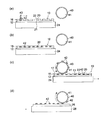
次に図5(a)〜(d)を参照して、印刷版10の溝11に残留しているインキ42を洗浄する方法について説明する。図5(a)は、転写工程後の印刷版10を示す図である。
Next, a method for cleaning the
この場合、はじめに図5(b)に示すように、第2基材16を第1基材12の第1面13から取り外す。このとき、第1基材12の第1面13および第2基材16の貫通孔20の壁面23には、インキ42が付着したままとなっている。次に、第1基材12および第2基材16に付着しているインキ42をそれぞれ洗浄する。具体的な洗浄方法が特に限られることはなく、インキ42に向けて洗浄液を噴射する方法や、布などを用いてインキ42を拭き取る方法など、公知の方法が適宜採用され得る。
In this case, first, the
ここで本実施の形態によれば、第2基材16が第1基材12から取り外されているので、第1基材12の第1面13に付着しているインキ42は、貫通孔20によって囲われることなく露出している。従って、第1基材12の第1面13に付着しているインキ42に対して、洗浄液や布からの力を容易に加えることができる。このため、図5(c)に示すように、第1面13上のインキ42を容易に洗浄することができる。また本実施の形態によれば、第2基材16が第1基材12から取り外されているので、第2基材16の貫通孔20の壁面23に付着しているインキ42に対して、貫通孔20の他端22側からだけでなく、貫通孔20の一端21側からも、洗浄液や布からの力を加えることができる。このため、図5(c)に示すように、第1面13上のインキ42を容易に洗浄することができる。
Here, according to the present embodiment, since the
その後、図5(d)に示すように、第2基材16を第1基材12の第1面13上に再び載置する。これによって、残留していたインキ42が取り除かれた印刷版10を再び準備することができる。
Thereafter, as shown in FIG. 5D, the
このように本実施の形態によれば、互いに着脱可能な第1基材12および第2基材16を用いて印刷版10を構成することにより、洗浄の際に、第2基材16を第1基材12から取り外した状態で、第1基材12および第2基材16をそれぞれ洗浄することができる。このため、印刷版10に残留しているインキ42を容易かつ十分に取り除くことができる。従って、その後に再び実施される、印刷版10を用いた転写工程において、被転写物26へ転写されるインキ42に、固化したインキ42の欠片が混じってしまうことや、印刷版10の溝11が詰まってしまうことを抑制することができる。このことにより、高い品質の印刷物30を容易に得ることができる。
As described above, according to the present embodiment, the
また本実施の形態によれば、上述のように、第2基材16の貫通孔20の壁面23に付着しているインキ42に対して、貫通孔20の他端22側からだけでなく、貫通孔20の一端21側からも、洗浄液や布からの力を加えることができる。このため、貫通孔20のうち線状に延びる部分の幅Wの最小値が小さく、例えば20μm以下になっている場合であっても、貫通孔20の壁面23に付着したインキ42を容易かつ十分に取り除くことができる。このことにより、小さな幅、例えば20μm以下の幅を有する配線を、印刷によって容易に形成することが可能になる。
In addition, according to the present embodiment, as described above, not only from the
(比較の形態)
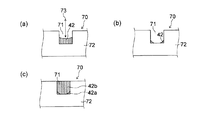
次に、本実施の形態の効果を、比較の形態と比較して説明する。図6(a)〜(c)は、比較の形態における印刷工程を示す図である。
(Comparison form)
Next, the effect of this embodiment will be described in comparison with a comparative embodiment. FIGS. 6A to 6C are diagrams illustrating a printing process in a comparative form.
比較の形態においては、図6(a)に示すように、印刷版70の溝71が、基材72の表面に形成された被貫通の凹部として構成されている。このため、溝71の幅が小さい場合や、溝71の深さが大きい場合は、溝71の底部や隅部にまでは洗浄液73が到達し難いと考えられる。この結果、図6(b)に示すように、溝71に残留しているインキ42を洗浄する洗浄工程を実施した後にも、溝71内に部分的にインキ42が残留することが考えられる。この場合、図6(c)に示すように、その後の印刷工程において溝71に新たに充填されるインキ42bが、残留しているインキ42aと溝71内で混在することになる。このため、古いインキ42bの欠片が新しいインキ42bに混じり、印刷の品質が低下してしまうことが考えられる。また、固化した古いインキ42bが溝71に蓄積されると、印刷版70の溝71が詰まってしまい、印刷版70の溝71からブランケットや被転写物へ渡されるインキの量が不十分になってしまうことも考えらえる。
In the comparative form, as shown in FIG. 6A, the
これに対して本実施の形態によれば、第2基材16を第1基材12から取り外した状態で、第1基材12および第2基材16をそれぞれ洗浄することができるので、印刷版10に残留しているインキ42を容易かつ十分に取り除くことができる。従って、古いインキが新しいインキに混ざってしまうことや、印刷版10の溝11が詰まってしまうことを抑制することができる。
On the other hand, according to the present embodiment, since the
変形例
なお、上述した実施の形態に対して様々な変更を加えることが可能である。以下、必要に応じて図面を参照しながら、変形例について説明する。以下の説明および以下の説明で用いる図面では、上述した実施の形態と同様に構成され得る部分について、上述の実施の形態における対応する部分に対して用いた符号と同一の符号を用いることとし、重複する説明を省略する。また、上述した実施の形態において得られる作用効果が変形例においても得られることが明らかである場合、その説明を省略することもある。
Modifications Various modifications can be made to the above-described embodiment. Hereinafter, modified examples will be described with reference to the drawings as necessary. In the following description and the drawings used in the following description, the same reference numerals as those used for the corresponding parts in the above embodiment are used for the parts that can be configured in the same manner as in the above embodiment. A duplicate description is omitted. In addition, when it is clear that the operational effects obtained in the above-described embodiment can be obtained in the modified example, the description thereof may be omitted.
(第1基材の変形例)
上述の本実施の形態においては、移動可能な第1定盤24の上に第1基材12が載置され、第1基材12の上に第2基材16が載置される例を示した。しかしながら、これに限られることはなく、図7に示すように、移動可能な第1定盤24の上に、貫通孔20が形成された第2基材16を載置してもよい。すなわち、第1定盤24を、上述の本実施の形態における第1基材12として利用してもよい。この場合、印刷版10の溝11は、第1定盤24の面と、第2基材16の貫通孔20とによって区画されることになる。
(Modification of the first base material)
In the present embodiment described above, an example in which the
(洗浄工程の変形例)
また上述の本実施の形態においては、残留しているインキ42を洗浄する洗浄工程が、第2基材16が全体的に第1基材12から取り外された状態で実施される例を示した。しかしながら、これに限られることはなく、洗浄の対象となる貫通孔20に付着しているインキ42に対して、貫通孔20の他端22側および一端21側の両方から、洗浄液や布からの力を加えることができる限りにおいて、第2基材16が部分的に第1基材12に密着したままとなっていてもよい。すなわち、洗浄工程の際、第2基材16は、第1基材12の第1面13から少なくとも部分的に取り外されていればよい。
(Modification of cleaning process)
Further, in the above-described embodiment, an example is shown in which the cleaning process for cleaning the remaining
(ブランケットの変形例)
また上述の本実施の形態においては、ブランケット40が、ロール状のブランケット胴41に巻き付けられている例を示した。しかしながら、印刷版10の溝11に充填されたインキ42を受け取ることができる限りにおいて、ブランケット40の形態が特に限られることはない。例えば、図示はしないが、ブランケット40が平板状の形態を有していてもよい。
(Blanket variant)
Further, in the above-described embodiment, the example in which the
(転写工程の変形例)
また上述の本実施の形態においては、印刷版10の溝11に充填されたインキ42が、ブランケット40を介して被転写物26へ転写される例を示したが、これに限られることはなく、印刷版10の溝11に充填されたインキ42を被転写物26へ直接的に転写してもよい。
(Modification of transfer process)
In the above-described embodiment, the example in which the
(その他の変形例)
また上述の本実施の形態においては、転写工程の際、印刷版10が載置された第1定盤24や、被転写物26が載置された第2定盤28が、ブランケット胴41に巻き付けられたブランケット40に向けて移動する例を示した。しかしながら、これに限られることはなく、ブランケット40が、印刷版10や被転写物26に向かって移動することにより、インキ42の受け渡しや転写が行われてもよい。
(Other variations)
In the above-described embodiment, the
なお、上述した実施の形態に対するいくつかの変形例を説明してきたが、当然に、複数の変形例を適宜組み合わせて適用することも可能である。 In addition, although some modified examples with respect to the above-described embodiment have been described, naturally, a plurality of modified examples can be applied in combination as appropriate.
10 印刷版
11 溝
12 第1基材
13 第1面
14 第2面
16 第2基材
17 第1面
18 第2面
20 貫通孔
21 一端
22 他端
23 壁面
24 第1定盤
26 被転写物
28 第2定盤
30 印刷物
32 パターン
40 ブランケット
41 ブランケット胴
42 インキ
DESCRIPTION OF
Claims (7)
平坦な第1面を有する第1基材と、一端および他端を有する貫通孔が形成された第2基材と、を準備する工程と、
前記貫通孔の前記一端が前記第1基材の前記第1面に接するように、前記第2基材を前記第1基材の前記第1面上に載置する工程と、
前記他端側から前記貫通孔内の空間にインキを充填する工程と、
前記貫通孔内の空間に充填されたインキを被転写物へ転写する工程と、
前記第1基材の前記第1面および前記第2基材の前記貫通孔の壁面に付着しているインキを洗浄する洗浄工程と、を備え、
前記洗浄工程は、前記第2基材を前記第1基材の前記第1面から少なくとも部分的に取り外した状態で実施される、印刷物の製造方法。 A method for producing a printed matter including a pattern formed by ink,
Preparing a first base material having a flat first surface and a second base material having a through hole having one end and the other end;
Placing the second base material on the first surface of the first base material such that the one end of the through hole is in contact with the first surface of the first base material;
Filling the space in the through-hole from the other end with ink;
Transferring the ink filled in the space in the through hole to the transfer object;
A cleaning step of cleaning ink adhering to the first surface of the first base material and the wall surface of the through hole of the second base material,
The said washing process is a manufacturing method of printed matter performed in the state where the said 2nd base material was removed from the said 1st surface of the said 1st base material at least partially.
前記貫通孔のうち線状に延びる部分の幅の最小値が、20μm以下である、請求項1に記載の印刷物の製造方法。 When viewed along the normal direction of the first surface of the first base material, the through hole of the second base material extends at least partially linearly;
The printed matter manufacturing method according to claim 1, wherein a minimum value of a width of a portion extending linearly in the through hole is 20 μm or less.
前記印刷物の前記パターンは、導電性を有する配線を含む、請求項1乃至5のいずれか一項に記載の印刷物の製造方法。 The ink includes a material having conductivity,
The method for producing a printed material according to claim 1, wherein the pattern of the printed material includes a conductive wiring.
平坦な第1面を有する第1基材と、
一端および他端を有する貫通孔が形成された第2基材であって、前記貫通孔の前記一端が前記第1基材の前記第1面に接するように、前記第1基材の前記第1面上に載置された第2基材と、を備え、
前記第2基材は、少なくとも部分的に、前記第1基材の前記第1面から取り外し可能である、印刷版。 A printing plate for transferring ink to a substrate,
A first substrate having a flat first surface;
A second base material having a through hole having one end and the other end, wherein the one end of the through hole is in contact with the first surface of the first base material. A second substrate placed on one surface,
The printing plate, wherein the second substrate is at least partially removable from the first surface of the first substrate.
Priority Applications (1)
| Application Number | Priority Date | Filing Date | Title |
|---|---|---|---|
| JP2014129564A JP2016007766A (en) | 2014-06-24 | 2014-06-24 | Method for manufacturing printed matter, and printing plate |
Applications Claiming Priority (1)
| Application Number | Priority Date | Filing Date | Title |
|---|---|---|---|
| JP2014129564A JP2016007766A (en) | 2014-06-24 | 2014-06-24 | Method for manufacturing printed matter, and printing plate |
Publications (1)
| Publication Number | Publication Date |
|---|---|
| JP2016007766A true JP2016007766A (en) | 2016-01-18 |
Family
ID=55225692
Family Applications (1)
| Application Number | Title | Priority Date | Filing Date |
|---|---|---|---|
| JP2014129564A Pending JP2016007766A (en) | 2014-06-24 | 2014-06-24 | Method for manufacturing printed matter, and printing plate |
Country Status (1)
| Country | Link |
|---|---|
| JP (1) | JP2016007766A (en) |
Cited By (1)
| Publication number | Priority date | Publication date | Assignee | Title |
|---|---|---|---|---|
| JP2017189929A (en) * | 2016-04-14 | 2017-10-19 | 株式会社小森コーポレーション | Electronic device manufacturing equipment |
-
2014
- 2014-06-24 JP JP2014129564A patent/JP2016007766A/en active Pending
Cited By (1)
| Publication number | Priority date | Publication date | Assignee | Title |
|---|---|---|---|---|
| JP2017189929A (en) * | 2016-04-14 | 2017-10-19 | 株式会社小森コーポレーション | Electronic device manufacturing equipment |
Similar Documents
| Publication | Publication Date | Title |
|---|---|---|
| CN105813405A (en) | Rigid-flexible printed circuit board | |
| CN101588676B (en) | Printed Circuit Board Manufacturing Method Using Photosensitive Dry Film to Realize Selective Plugging | |
| US20150053457A1 (en) | Printed circuit board and method of manufacturing the same | |
| JP2014504019A (en) | Printed circuit board having an insulated metal substrate | |
| JP2001062993A (en) | Screen printer | |
| TW200704314A (en) | Circuit pattern forming method, circuit pattern forming device and printed circuit board | |
| JP2016007766A (en) | Method for manufacturing printed matter, and printing plate | |
| CN102647857B (en) | Manufacture process of printed circuit board | |
| TWI573506B (en) | Method for manufacturing printed circuit board | |
| JPWO2015037394A1 (en) | Method for forming external electrode of electronic component | |
| JPWO2009063730A1 (en) | Screen printing mask, solder paste printing apparatus and solder paste printing method using the same | |
| JP2014197606A (en) | Wiring board and manufacturing method of the same | |
| JP2013115237A (en) | Intaglio plate for photogravure offset printing, method of manufacturing printed wiring base material using the same, and printed wiring base material | |
| JP4274264B2 (en) | Module manufacturing method | |
| JP5475853B2 (en) | Mask for printing | |
| JP2015041770A (en) | Printed circuit board and manufacturing method of the same | |
| JP2005150654A (en) | Formation method for printed board, and printed board | |
| JP2016165861A (en) | Method for producing printed matter and printing apparatus | |
| JP2008244336A (en) | Printed wiring board manufacturing method and printed wiring board | |
| JP5585687B2 (en) | Manufacturing method of electronic device | |
| JP2006110923A (en) | Gravure printing machine and manufacturing method of multilayer ceramic electronic component | |
| JP2006339297A (en) | Printed board and method of manufacturing same | |
| JP2013161951A (en) | Wiring board and method for manufacturing the same | |
| KR101199078B1 (en) | printer | |
| JP2012206400A (en) | Screen printing device, adsorption plate thereof, and method for production of flexible printed wiring board |