JP2017011697A - Receiver, reception method, and program - Google Patents
Receiver, reception method, and program Download PDFInfo
- Publication number
- JP2017011697A JP2017011697A JP2016115379A JP2016115379A JP2017011697A JP 2017011697 A JP2017011697 A JP 2017011697A JP 2016115379 A JP2016115379 A JP 2016115379A JP 2016115379 A JP2016115379 A JP 2016115379A JP 2017011697 A JP2017011697 A JP 2017011697A
- Authority
- JP
- Japan
- Prior art keywords
- video
- program
- resolution
- display
- unit
- Prior art date
- Legal status (The legal status is an assumption and is not a legal conclusion. Google has not performed a legal analysis and makes no representation as to the accuracy of the status listed.)
- Pending
Links
Images











Landscapes
- Two-Way Televisions, Distribution Of Moving Picture Or The Like (AREA)
Abstract
【課題】解像度により表示できない映像が提供される場合、視聴者と放送事業者がより満足できる受信装置、受信方法、およびプログラムを提供する。【解決手段】受信部は映像を含む番組の放送信号を受信し、表示処理部は前記映像の解像度が、前記映像を表示部が表示できない表示不能解像度である場合、前記表示部の表示状態を所定の表示状態に制御し、前記映像の解像度が、前記映像を前記表示部が表示できる表示可能解像度である場合、前記表示部に前記映像を表示させる。【選択図】図8A receiving apparatus, a receiving method, and a program are provided that can satisfy viewers and broadcasters when video that cannot be displayed due to resolution is provided. A receiving unit receives a broadcast signal of a program including video, and a display processing unit changes the display state of the display unit when the resolution of the video is an undisplayable resolution in which the display unit cannot display the video. A predetermined display state is controlled, and when the resolution of the image is a displayable resolution at which the image can be displayed by the display unit, the image is displayed on the display unit. [Selection drawing] Fig. 8
Description
本発明は、受信装置、受信方法、およびプログラムに関する。 The present invention relates to a receiving device, a receiving method, and a program.
近年、従来の高精細テレビジョン放送(HDTV:High Definition Television)よりも映像の解像度が高い超高精細テレビジョン放送(UHDTV:Ultra High Definition Television)が普及しつつある。UHDTVでは、主に解像度が4K又は8Kである映像を含む映像コンテンツが提供される。4Kとは、水平方向3840画素、垂直方向2160画素の解像度を意味する。8Kとは、水平方向7680画素、垂直方向4320画素の解像度を意味する。 In recent years, Ultra High Definition Television (UHDTV), which has a higher video resolution than conventional High Definition Television (HDTV), is becoming more popular. In UHDTV, video content mainly including video having a resolution of 4K or 8K is provided. 4K means a resolution of 3840 pixels in the horizontal direction and 2160 pixels in the vertical direction. 8K means a resolution of 7680 pixels in the horizontal direction and 4320 pixels in the vertical direction.
解像度が4Kである映像コンテンツを表示可能な受信装置(以下、4Kテレビ、と呼ぶ)には、従来よりも解像度が高い映像の視聴を促進するための手段を備えるものがある。例えば、特許文献1には、受信した受信データについて算出された受信信号品質値が、当該映像データを所定の映像品質以上の映像品質で復号可能な受信信号品質値の基準を満たす場合に、当該映像データが送信されているチャンネルを受信可能なチャンネルとして登録する放送受信装置について記載されている。この放送受信装置により、表示性能に比べて低い受信品質でしか復号できない映像データが送信されているチャンネルの登録を防止する。
Some receiving devices (hereinafter referred to as 4K televisions) capable of displaying video content with a resolution of 4K include means for promoting viewing of videos with higher resolution than before. For example, in
高解像度の映像を表示する表示デバイスは、多くの画素を備えるため製造、開発コストが高くなりがちである。例えば、解像度が8Kである映像の表示に要する画素数は、解像度が4Kである映像の表示に要する画素数の4倍である。このことから、解像度が8Kである映像コンテンツを表示可能な受信装置(以下、8Kテレビ、と呼ぶ)よりも、4Kテレビの普及が先行する可能性がある。 A display device that displays a high-resolution image has a large number of pixels, and thus the manufacturing and development costs tend to be high. For example, the number of pixels required for displaying an image with a resolution of 8K is four times the number of pixels required for displaying an image with a resolution of 4K. For this reason, there is a possibility that the spread of 4K television may precede the receiving device (hereinafter referred to as 8K television) capable of displaying video content having a resolution of 8K.
他方、UHDTVによる放送サービスにおいて、同一のチャンネルを通じて解像度が4Kである映像(以下、4K映像、と呼ぶ)を提供する番組(以下、4K番組、と呼ぶ)と、解像度が8Kである映像(以下、8K映像)を含む番組(以下、8K番組、と呼ぶ)を、異なる時間帯に提供することが検討されている。そのため、4Kテレビは、4K番組の終了後、8K番組が開始すると、8K番組に係る映像を表示することができず、いわゆる黒画面を表示することがある。また、受信装置には、有効な受信信号が一定時間入力されないと、通常よりも電力消費量が低い動作モードへ切り替える機能や、動作を停止する機能を有するものがある。 On the other hand, in a broadcast service based on UHDTV, a program (hereinafter referred to as 4K program) that provides video with a resolution of 4K (hereinafter referred to as 4K video) through the same channel, and a video with resolution of 8K (hereinafter referred to as 4K video). , 8K video) (hereinafter referred to as 8K program) is being considered to be provided at different times. Therefore, when the 8K program starts after the 4K program ends, the 4K television cannot display the video related to the 8K program and may display a so-called black screen. Some receiving apparatuses have a function of switching to an operation mode in which power consumption is lower than usual or a function of stopping operation when a valid received signal is not input for a certain period of time.
しかしながら、上述した動作状態の変化は必ずしも視聴者の意図に沿うものではない。例えば、視聴者が視聴可能な番組の再開を期待して受信装置への操作を行わずに放置する場合がある。また、受信装置が黒画面を表示するとき、視聴者が視聴対象のチャンネルを切り替えることがある。このことは、選局されたチャンネルへの視聴率の低下を招く。視聴率の低下は、番組を提供する放送事業者にとり一般に望ましくない事象である。 However, the above-described change in the operation state does not necessarily match the viewer's intention. For example, the viewer may be left without performing an operation on the receiving device in expectation of restart of a program that can be viewed. Further, when the receiving device displays a black screen, the viewer may switch the channel to be viewed. This leads to a decrease in the audience rating for the selected channel. A decrease in audience rating is generally an undesirable event for broadcasters who provide programs.
本発明は、上記の課題に基づいてなされたものであり、解像度により表示できない映像が提供される場合、視聴者と放送事業者がより満足できる受信装置、受信方法、およびプログラムを提供することを目的としている。 The present invention has been made on the basis of the above problems, and provides a receiving apparatus, a receiving method, and a program that can satisfy viewers and broadcasters when videos that cannot be displayed depending on resolution are provided. It is aimed.
本発明は上記の課題を解決するためになされたものであり、本発明の一態様は、映像を含む番組の放送信号を受信する受信部と、前記映像の解像度が、前記映像を表示部が表示できない表示不能解像度である場合、前記表示部の表示状態を所定の表示状態に制御し、
前記映像の解像度が、前記映像を前記表示部が表示できる表示可能解像度である場合、前記表示部に前記映像を表示させる表示処理部と、を備える受信装置である。
The present invention has been made to solve the above-described problems. One embodiment of the present invention includes a receiving unit that receives a broadcast signal of a program including video, a resolution of the video, and a display unit that displays the video. When the display resolution is not displayable, the display state of the display unit is controlled to a predetermined display state,
When the resolution of the video is a displayable resolution at which the display unit can display the video, a display processing unit that displays the video on the display unit.
本発明によれば、解像度により表示できない映像が提供される場合、視聴者と放送事業者がより満足できる受信装置、受信方法、およびプログラムを提供することができる。 ADVANTAGE OF THE INVENTION According to this invention, when the image | video which cannot be displayed according to the resolution is provided, the receiver, receiving method, and program which a viewer and a broadcaster can satisfy more can be provided.
(第1の実施形態)
以下、本発明の第1の実施形態について、図面を参照して説明する。
図1は、本実施形態に係る放送システム1の概略構成を示すブロック図である。
放送システム1は、受信装置10と、送信装置20とを含んで構成される。放送システム1において、受信装置10と、送信装置20との台数は、一般的にそれぞれ複数である。以下の説明においては、説明を容易にするため、受信装置10と、送信装置20との台数が、それぞれ1台である場合について説明する。また、以下の説明では、放送システム1におけるデジタル放送のメディアトランスポート方式として、MMT(MPEG Media Transport)方式が採用されている場合を主に例にする。
(First embodiment)
A first embodiment of the present invention will be described below with reference to the drawings.
FIG. 1 is a block diagram showing a schematic configuration of a
The
送信装置20は、番組データi1と、制御データとを多重化した多重化データを示す信号を電波で送信する。制御データは、番組配列情報i2と、番組構成情報i3と、を含むデータである。送信装置20は、例えば、放送局などの放送事業者が有する送信装置である。番組データi1は、番組を構成する映像を示す映像データを少なくとも含むコンテンツデータである。なお、以下の説明においては、番組データi1が、映像データと音声データの両方を含むコンテンツデータであるものとして説明する。なお、映像データと音声データとのそれぞれは、予め定めた符号化方式で符号化されたデータである。例えば、映像データは、H.265、いわゆる、HEVC(High Efficiency Video Coding)などの符号化方式で符号化されたデータである。また、例えば、音声データは、ISO/IEC 14496 Part3、いわゆる、MPEG−4オーディオなどの符号化方式で符号化されたデータである。
The
番組配列情報i2は、その時点(現在)において各チャンネルで放送される番組と、その時点から所定時間後までの間に各チャンネルで放送予定の番組のそれぞれに関する情報を含む。従って、番組配列情報i2には、番組データi1に係る番組、つまり、その時点で放送される番組に関する情報が含まれる。番組配列情報i2には、各番組について含まれる放送情報として、例えば、番組識別情報と、放送日時情報とがある。ここで、番組識別情報は、例えば、放送される番組の種類および配列などの番組やその属性を識別する情報である。また、放送日時情報は、番組の放送日時を示す情報である。その他、番組配列情報i2には、電子番組表を生成する際に用いられる種々の情報が含まれている。番組配列情報i2として、例えば、MMT−SI(MMT−System Information)を構成するMH−EIT(Event Information Table)が含まれる。MH−EITの例については後述する。 The program arrangement information i2 includes information related to a program broadcast on each channel at that time (current) and a program scheduled to be broadcast on each channel between that time and a predetermined time later. Therefore, the program arrangement information i2 includes information related to the program related to the program data i1, that is, the program broadcast at that time. The program arrangement information i2 includes, for example, program identification information and broadcast date / time information as broadcast information included for each program. Here, the program identification information is information for identifying a program such as the type and arrangement of a broadcast program and its attributes, for example. The broadcast date / time information is information indicating the broadcast date / time of the program. In addition, the program arrangement information i2 includes various information used when generating the electronic program guide. As the program arrangement information i2, for example, an MH-EIT (Event Information Table) constituting an MMT-SI (MMT-System Information) is included. An example of MH-EIT will be described later.
番組構成情報i3は、番組データi1に係る番組、つまり放送される番組の構成要素であるアセットのリストや、それらの諸要件を示す要件情報を含む。アセットとは、番組の構成要素である要素データである。要件情報として、例えば、番組データi1に含まれる映像データの解像度を示す情報が含まれる。番組構成情報i3として、例えば、MMT−SIを構成するMPT(MMT Package Table;MPテーブル)が含まれる。MPTの例については後述する。 The program configuration information i3 includes a list of assets that are components of a program related to the program data i1, that is, a broadcast program, and requirement information indicating various requirements thereof. An asset is element data that is a component of a program. The requirement information includes, for example, information indicating the resolution of video data included in the program data i1. As the program configuration information i3, for example, an MPT (MMT Package Table; MP table) that configures the MMT-SI is included. An example of MPT will be described later.
送信装置20は、番組データi1と、制御データとを多重化した多重化データを所定の暗号化方式(例えば、AES:Advanced Encryption Standard)で暗号化する。そして、送信装置20は、暗号化された多重化データについて誤り訂正符号化を行い、生成された誤り訂正符号を多重化データに付加する。送信装置20は、誤り訂正符号として、例えば、BCH(Bose Chaudhuri Hocquenghem)符号とLDPC(Low Density Parity Check)符号を付加する。送信装置20は、誤り訂正符号を付加した多重化データを所定の変調方式(例えば、8PSK:8 Phase Shift Keying(八相位相変調)、APSK:Amplitude and Phase Shift Keying(振幅位相変調))を用いて変調する。送信装置20は、変調により生成された放送信号を、放送伝送路BTを介して受信装置10に送信する。放送伝送路BTは、不特定の送信先として1台又は複数台の受信装置10に一斉に放送信号を送信することができる伝送路である。図1に示す例では、放送伝送路BTは、放送信号を電波で伝送する伝送路である。この例では、送信装置20は、変調により生成された基底帯域の放送信号を、所定のチャンネルの周波数帯域の信号にアップコンバートする。送信装置20は、アップコンバートにより生成された放送信号を電波として放送伝送路BTに送出する。放送伝送路BTは、その一部又は全部に無線又は有線の通信ネットワークを含んで構成されてもよい。
The
上述した多重化データから放送信号に変換するまでの一連の処理、及びそれらの逆処理、つまり、受信装置10において放送信号から多重化データに変換するまでの処理については、次の文献に詳しく記載されている。
「高度広帯域衛星デジタル放送の伝送方式 標準規格」,一般社団法人 電波産業会,2014年7月,ARIB STD−B44,2.0版
The series of processes from the multiplexed data to the conversion to the broadcast signal and the inverse process thereof, that is, the processes from the broadcast signal to the conversion to the multiplexed data in the receiving
"Transmission standard for advanced broadband satellite digital broadcasting", Japan Radio Industry Association, July 2014, ARIB STD-B44, 2.0
受信装置10は、送信装置20から放送伝送路BTを介して伝送された放送信号を受信する。受信装置10は、放送信号から番組データi1と要素データを抽出する。受信装置10は、抽出した要素データに含まれる番組構成情報i3を解析して番組データi1に含まれる映像データの解像度を判定する。受信装置10は、判定した解像度が、表示部14(図9)により表示可能な解像度であるか否かを判定する。表示可能な解像度であると判定する場合、受信装置10は、表示部14に映像データに基づく映像を表示させる。表示可能な解像度ではないと判定する場合、受信装置10は、表示部14に所定の映像を表示させる。
The receiving
また、受信装置10は、抽出した要素データに含まれる番組構成情報i3が示すチャンネル毎の番組の放送時間を判定する。受信装置10は、各番組について判定した放送時間に基づいてチャンネル毎の番組それぞれの番組情報を放送時間に基づいて配列して電子番組表を生成する。電子番組表において、各番組の番組情報の表示態様が、当該番組の映像の解像度が、表示部14において当該映像データに基づく映像を表示できる表示可能解像度であるか否かに応じて異なってもよい。受信装置10は、生成した電子番組表を表示部14に表示させる。受信装置10の構成については、後述する。
Further, the receiving
(MPT)
次に、本実施形態に係るMPTのデータ構造について説明する。図2は、MPTのデータ構造の一例を示す図である。MPTは、放送される各番組の構成要素であるアセット毎の属性や仕様を示すパラメータなど、番組の構成を示すテーブルである。具体的には、MPTは、アセットタイプ(asset_type)と、ロケーション情報(MMT_general_location_info)と、アセット記述子領域(asset_descriptors_byte)をアセット毎に含んで構成される。アセットタイプ(asset_type)は、アセットの種類を示す情報である。例えば、アセットタイプとして「hvc1」が記述されるアセットは映像を示し、アセットタイプとして「mp4a」が記述されるアセットは音声を示す。
ロケーション情報は、該当するアセットの伝送経路を示す情報である。アセット記述子領域は、アセットについての情報を記述する記述子を格納する領域である。アセット記述子領域に記述される記述子には、例えば、映像コンポーネント記述子(Video_Component_Descriptor)がある。
(MPT)
Next, the data structure of the MPT according to this embodiment will be described. FIG. 2 is a diagram illustrating an example of a data structure of MPT. The MPT is a table showing the configuration of a program such as parameters indicating attributes and specifications for each asset that is a component of each broadcast program. Specifically, the MPT includes an asset type (asset_type), location information (MMT_general_location_info), and an asset descriptor area (asset_descriptors_byte) for each asset. The asset type (asset_type) is information indicating the type of asset. For example, an asset in which “hvc1” is described as the asset type indicates video, and an asset in which “mp4a” is described as the asset type indicates audio.
The location information is information indicating the transmission path of the corresponding asset. The asset descriptor area is an area for storing a descriptor that describes information about the asset. Examples of the descriptor described in the asset descriptor area include a video component descriptor (Video_Component_Descriptor).
(映像コンポーネント記述子)
次に、本実施形態に係る映像コンポーネント記述子のデータ構造について説明する。図3は、映像コンポーネント記述子のデータ構造の一例を示す図である。映像コンポーネント記述子は、映像コンポーネントに関するパラメータや説明を示す記述子である。映像コンポーネント記述子には、映像信号解像度(video_resolution)が記述される。映像信号解像度(video_resolution)として、1フレーム内の垂直方向の画素数を表す値が記述される。
(Video component descriptor)
Next, the data structure of the video component descriptor according to the present embodiment will be described. FIG. 3 is a diagram illustrating an example of the data structure of the video component descriptor. The video component descriptor is a descriptor indicating parameters and explanation regarding the video component. In the video component descriptor, video signal resolution (video_resolution) is described. As the video signal resolution (video_resolution), a value indicating the number of pixels in the vertical direction in one frame is described.
図4は、映像信号解像度の値と垂直方向の画素数の関係を示す表である。
図4の左列、右列は、それぞれ映像信号解像度(video_resolution)に記述される値と、その値が意味する垂直方向の画素数とを示す。映像信号解像度の値が大きいほど解像度が高いことを示す。例えば、記述される値が「6」とは、垂直方向の画素数が2160個であること、つまり、映像の解像度が4K(3840×2160)であることを示す。記述される値が「7」とは、垂直方向の画素数が4320個であること、つまり、映像の解像度が8K(7680×4320)であることを示す。
FIG. 4 is a table showing the relationship between the video signal resolution value and the number of pixels in the vertical direction.
The left column and the right column in FIG. 4 indicate values described in the video signal resolution (video_resolution) and the number of pixels in the vertical direction that the values mean. The larger the video signal resolution value, the higher the resolution. For example, the value described as “6” indicates that the number of pixels in the vertical direction is 2160, that is, the video resolution is 4K (3840 × 2160). The value described as “7” indicates that the number of pixels in the vertical direction is 4320, that is, the video resolution is 8K (7680 × 4320).
(MH−EIT)
次に、本実施形態に係るMH−EITのデータ構造について説明する。図5は、MH−EITのデータ構造の一例を示す図である。MH−EITは、各番組の名称、放送日時、放送内容の説明など、番組に関する種々の情報を示すテーブルである。具体的には、MH−EITには、イベント識別(event_id)、開始時刻(start_time)及び継続時間(duration)を含んで構成される。イベント識別(event_id)には、例えば、番組の識別情報などのイベントの識別番号が示される。開始時刻(start_time)には、イベント、つまり、番組の開始時刻(日時)が示される。また、継続時間(duration)は、イベントの継続時間、つまり、番組の放送時間(長さ)が示される。
(MH-EIT)
Next, the data structure of the MH-EIT according to the present embodiment will be described. FIG. 5 is a diagram illustrating an example of the data structure of the MH-EIT. The MH-EIT is a table indicating various information related to programs such as the name of each program, broadcast date and time, and description of broadcast contents. Specifically, the MH-EIT includes an event identification (event_id), a start time (start_time), and a duration (duration). The event identification (event_id) indicates, for example, an event identification number such as program identification information. The start time (start_time) indicates an event, that is, the start time (date and time) of the program. The duration (duration) indicates the duration of the event, that is, the broadcast time (length) of the program.
また、MH−EITには、イベント識別(event_id)毎に記述子領域(descriptor())が設けられている。記述子領域(descriptor())は、記述子を格納する領域である。本実施形態では、記述子領域(descriptor())には、MH−短形式イベント記述子(MH_Short_Event_Descriptor())、MH−拡張形式イベント記述子(MH_Extended_Event_Descriptor())及び映像コンポーネント記述子が含まれる。MH−短形式イベント記述子及びMH−拡張形式イベント記述子に、番組名や番組の説明などの情報が記述される。映像コンポーネント識別子には、上述したように番組を構成する映像データの解像度などの情報が記述される。 The MH-EIT has a descriptor area (descriptor ()) for each event identification (event_id). The descriptor area (descriptor ()) is an area for storing a descriptor. In the present embodiment, the descriptor area (descriptor ()) includes an MH-short format event descriptor (MH_Short_Event_Descriptor ()), an MH-extended format event descriptor (MH_Extended_Event_Descriptor ()), and a video component descriptor. In the MH-short format event descriptor and the MH-extended format event descriptor, information such as a program name and a program description is described. In the video component identifier, information such as the resolution of the video data constituting the program is described as described above.
(MH−短形式イベント記述子)
次に、MH−短形式イベント記述子のデータ構造について説明する。図6は、MH−短形式イベント記述子のデータ構造の一例を示す図である。MH−短形式イベント記述子は、番組名(event_name_char)、および番組記述(text_char)を含んで構成される。番組名には、番組の名称が記述される。番組記述には、番組の説明が記述される。
(MH-short format event descriptor)
Next, the data structure of the MH-short format event descriptor will be described. FIG. 6 is a diagram illustrating an example of the data structure of the MH-short format event descriptor. The MH-short format event descriptor includes a program name (event_name_char) and a program description (text_char). In the program name, the name of the program is described. In the program description, a description of the program is described.
(MH−拡張形式イベント記述子のデータ構造)
次に、MH−拡張形式イベント記述子のデータ構造について説明する。図7は、MH−拡張形式イベント記述子のデータ構造の一例を示す図である。MH−拡張形式イベント記述子は、項目ごとの項目名(item_description_char)、および項目記述(item_char)を含んで構成される。項目名には、項目の名称が記述される。項目記述には、項目の内容が記述される。項目名と項目記述には、例えば、その番組の出演者が記述される。例えば、項目名「プロデューサー」であり、項目記述「日本 太郎」である場合、その項目名と項目記述とは、番組のプロデューサーが日本太郎であることを表している。
また、MH−拡張形式イベント記述子には、拡張記述(text_char)を含んで構成される。拡張記述には、項目なしの番組についての情報が記述されることがある。
(MH-Extended format event descriptor data structure)
Next, the data structure of the MH-extended event descriptor will be described. FIG. 7 is a diagram illustrating an example of the data structure of the MH-extended event descriptor. The MH-extended event descriptor includes an item name (item_description_char) and an item description (item_char) for each item. In the item name, the name of the item is described. The item description describes the contents of the item. In the item name and item description, for example, the performer of the program is described. For example, when the item name is “producer” and the item description is “Nippon Taro”, the item name and item description indicate that the producer of the program is Nippon Taro.
The MH-extended format event descriptor includes an extended description (text_char). In the extended description, information about a program without an item may be described.
(受信装置)
次に、本実施形態に係る受信装置10の構成について説明する。
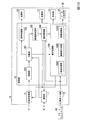
図8は、本実施形態に係る受信装置10の概略構成を示すブロック図である。
受信装置10は、放送受信部11と、操作入力部12と、拡声部13と、表示部14と、記憶部15と、制御部16とを含んで構成される。制御部16は、復調部161と、分離部162と、音声処理部163と、表示処理部164と、解像度判定部165と、動作制御部166と、を含んで構成される。また、表示処理部164は、番組表生成部1641と、選局処理部1642と、映像処理部1643とを含んで構成される。
(Receiver)
Next, the configuration of the receiving
FIG. 8 is a block diagram illustrating a schematic configuration of the receiving
The receiving
放送受信部11は、選局処理部1642から入力された選局信号で指示されるチャンネルに対応する周波数帯域の放送信号を電波で受信する。放送信号として、送信装置20から放送伝送路BTを介して伝送された放送信号が受信される。放送受信部11は、受信した放送信号を基底周波数帯域にダウンコンバートする。放送受信部11は、ダウンコンバートにより生成された放送信号を復調部161に出力する。放送受信部11は、例えば、チューナーを含んで構成される。
The
操作入力部12は、受信装置10のユーザーである視聴者の操作に基づいて生成された操作信号を取得する。操作入力部12は、取得した操作信号を制御部16に出力する。操作入力部12は、例えば、リモートコントローラRCから赤外線で伝送された操作信号を受信する赤外線インタフェースを含んで構成される。リモートコントローラRCは、複数のボタンを備え、視聴者の操作により押下されたボタンに対応する指示(コマンド)を示す操作信号を生成する。指示には、放送信号を受信する受信チャンネル、表示部14に表示される各種の情報の位置などがある。各種の情報の位置として、電子番組表を構成する番組のうち1つの番組の番組情報を配置する表示枠の位置などがある。
The
なお、操作入力部12は、ボタン、つまみなどの、物理的な部材を含んで構成され、部材が受け付けた操作に応じた操作信号を生成してもよい。また、操作入力部12は、他の電子機器からの操作信号を無線又は有線で受信する入出力インタフェースを含んで構成されてもよい。他の電子機器は、例えば、画像を表示可能なディスプレイと、操作入力を受け付けるタッチセンサなどのポインティングデバイスとを備える電子機器、例えば、多機能携帯電話機(いわゆる、スマートフォンを含む)、タブレット端末装置などでもよい。
The
拡声部13は、制御部16の音声処理部163から入力された音声信号に基づく音声を再生する。拡声部13は、例えば、スピーカーを含んで構成される。拡声部13は、例えば、放送信号で送信装置20から搬送される番組データi1に基づく音声を再生する。
The
表示部14は、表示処理部164から入力された映像信号に基づく映像を表示する。表示部14は、例えば、放送信号で送信装置20から搬送された番組データi1に基づく映像、番組配列情報i2に基づく電子番組表などを表示する。表示部14は、例えば、液晶パネルを含んで構成される。
The
記憶部15は、制御部16または制御部16内の構成要素が種々の処理を実行するためのプログラム、処理に用いられるデータ、処理により生成されるデータを記憶する。記憶部15は、例えば、ROM(Read Only Memory)やRAM(Random Access Memory)などの記憶媒体を含んで構成される。なお、記憶部15は、その他の記憶媒体や、HDD(Hard disk drive)などの記憶装置を含んで構成されてもよい。また、記憶部15は、例えば、音声処理部163が出力する音声信号と表示処理部164が出力する画像信号とを対応づけて記憶する記憶媒体、いわゆるビデオメモリを含んで構成されてもよい。
The
制御部16は、放送受信部11から入力された放送信号から番組データi1と制御データを検出する。制御部16は、検出した番組データi1に基づく音声信号を拡声部13に出力し、番組データi1に基づく映像信号を表示部14に出力する。制御部16は、制御データに含まれる番組配列情報i2から電子番組表を示す映像信号を表示部14に出力する。但し、映像データの解像度が、映像データに基づく映像を表示部14が表示できない表示不能解像度である場合、制御部16は、表示部14の表示状態を所定の表示状態に制御する。
The
復調部161は、放送受信部11から入力された放送信号についてフロントエンド処理を行って多重化データに変換する。フロントエンド処理とは、アナログ信号である放送信号を復号し、ディジタルデータである多重化信号に変換するまでの一連の処理である。フロントエンド処理には、復調、誤り訂正及び暗号化の各処理が含まれる。復調、暗号化の各処理は、送信装置20における変調、暗号化の逆の処理に相当する。誤り訂正処理では、送信装置20において付加された誤り訂正符号が用いられる。例えば、復調部161は、誤り訂正処理として、BCH符号を用いてシンドローム復号を行い、LDPC符号を用いてパリティ検査を行う。復調部161は、変換した多重化データを分離部162に出力する。
The
分離部162は、復調部161から入力された多重化データを番組データi1と制御データに分離する。分離部162は、制御データをさらに番組配列情報i2と番組構成情報i3に分離する。分離部162は、分離した番組構成情報i3に含まれるMPTを参照して番組データi1から音声データと映像データを抽出する。分離部162は、抽出した音声データを音声処理部163に出力し、抽出した映像データを表示処理部164の映像処理部1643に出力する。分離部162は、分離した番組配列情報i2を表示処理部164の番組表生成部1641に出力し、分離した番組構成情報i3を解像度判定部165に出力する。
The
音声処理部163は、分離部162から入力される音声データを所定の音声復号方式を用いて復号する。音声処理部163が用いる音声復号方式は、送信装置20が送信する音声データの符号化に用いられた音声符号化方式に対応する音声復号方式である。音声処理部163は、復号により得られた音声信号を拡声部13に出力する。
The
番組表生成部1641は、分離部162から入力された番組配列情報i2に含まれるMH−EITに基づいて電子番組表を生成する。電子番組表を生成するタイミングは、例えば、操作入力部12から電子番組表の生成を指示する操作信号が入力されるときである。
より具体的には、番組表生成部1641は、MH−EITを参照して、ネットワークID毎に、各番組(イベント)について設定された開始時刻の昇順に、継続時間に応じた長さの表示枠を配列した列を形成する。ネットワークIDは、放送信号を受信するチャンネルを表す情報である。番組表生成部1641は、各番組について、MH−短形式イベント記述子から抽出した番組名と番組記述を当該番組の表示枠内に配置し、MH−拡張形式イベント記述子から項目毎に抽出した項目名と項目記述を当該表示枠内に配置して電子番組表を生成する。
The program
More specifically, the program
但し、番組表生成部1641は、各番組の映像コンポーネント記述子に記述された映像解像度が、表示部14が映像を表示できる表示可能解像度であるか否かを判定する。番組表生成部1641は、映像コンポーネント記述子に記述された映像解像度が、表示部14の映像解像度と等しいか、より低い場合、表示部14が映像を表示できる表示可能解像度であると判定する。番組表生成部1641は、映像コンポーネント記述子に記述された映像解像度が、表示部14の映像解像度よりも高い場合、表示部14が映像を表示できない表示不能解像度であると判定する。番組表生成部1641は、生成される電子番組表において、映像解像度が表示可能解像度であると判定された番組の番組情報については、表示不能解像度であると判定される番組よりも訴求性が高い態様で表す。番組表生成部1641は、生成した電子番組表を示す映像信号を映像処理部1643に出力する。電子番組表の表示例については、後述する。
However, the program
選局処理部1642は、操作入力部12から入力された操作信号に基づいて、放送信号を受信するチャンネルを選択する。特定のチャンネルを指示する操作信号が入力される場合には、選局処理部1642は、当該操作信号が示すチャンネルを選択する。特定のチャンネルは、リモートコントローラRCが備えるチャンネルボタンのうち、押下されたチャンネルボタンに係るチャンネルに相当する。電子番組表が表示部14に表示されている場合には、選局処理部1642は、番組毎の表示枠のうち、操作信号が指示する表示枠に係る番組を放送するチャンネルを選択してもよい。選局処理部1642は、選択したチャンネルを示す選局信号を放送受信部11に出力する。よって、選局処理部1642は、放送受信部11に選択したチャンネルで放送信号を受信させることができる。
The channel
映像処理部1643は、分離部162から入力された映像データを所定の映像復号方式を用いて復号する。映像処理部1643が用いる映像復号方式は、送信装置20が送信する映像データの符号化に用いられた映像符号化方式に対応する映像復号方式である。復号により番組の映像を表す映像信号が生成される。映像処理部1643は、生成した映像信号を表示部14に出力する。なお、番組表生成部1641から電子番組表の表示を指示する映像信号が入力される場合には、映像処理部1643は、復号により生成された番組の映像に電子番組表を重畳して表示用の映像を示す映像信号を生成してもよい。
The
解像度判定部165は、分離部162から入力された番組構成情報i3に含まれるMPTに基づいて、受信中の放送信号から検出された映像データの解像度を判定する。より具体的には、解像度判定部165は、MPTを解析してアセットタイプが映像であるアセットを判定する。そして、解像度判定部165は、判定したアセットの映像コンポーネント記述子に記述された映像解像度が、表示部14が映像を表示できる表示可能解像度であるか否かを判定する。解像度判定部165は、映像コンポーネント記述子に記述された映像解像度が、表示部14の映像解像度と等しいか、表示部14の映像解像度よりも低い場合、表示部14が映像を表示できる表示可能解像度であると判定する。解像度判定部165は、映像コンポーネント記述子に記述された映像解像度が、表示部14の映像解像度よりも高い場合、表示部14が映像を表示できない表示不能解像度であると判定する。解像度判定部165は、表示部14が映像を表示できない表示不能解像度であるか否かを示す表示可否フラグを動作制御部166に出力する。
The
動作制御部166は、解像度判定部165から入力された表示可否フラグに基づいて制御部16の各構成要素の動作を制御する。例えば、表示可否フラグが示す解像度が表示可能解像度である場合、動作制御部166は、表示処理部164の映像処理部1643に映像データを復号させる。その場合には、表示部14は映像処理部1643から入力された映像信号に基づく映像を表示する(通常表示)。表示可否フラグが示す解像度が表示不能解像度である場合、動作制御部166は、表示部14の表示状態が所定の表示状態となるように表示処理部164の動作を制御する。例えば、動作制御部166は、映像処理部1643に映像データの復号を停止させる。映像データの復号が停止している場合には、表示部14には映像データが入力されないので、表示部14は黒画面を表す。黒画面は、表示領域内の各画素の輝度が最も低い状態である。なお、黒画面に所定のコーション映像が表示されてもよい。
The
(表示例)
次に、本実施形態に係る表示部14の表示例について説明する。
図9は、本実施形態に係る電子番組表の一例を示す図である。電子番組表は、各列にチャンネル毎の番組情報が配列して構成される。各チャンネルについて、番組毎の表示枠が開始時刻の早い順に上から下に配置される。図9に示す例では、Ch1〜Ch3のうち、Ch1は映像の解像度が4Kである4K番組と、映像の解像度が8Kである8K番組を提供するチャンネルである。9時から11時の間、8K番組として番組名が「8Kスポーツ」である番組が提供されることが表されている。矢印は、その時点において放送中である番組を示す。この矢印は、表示部14において必ずしも表示されなくてもよい。なお、その他の番組の番組情報については、図示が省略されている。
(Display example)
Next, a display example of the
FIG. 9 is a diagram showing an example of an electronic program guide according to the present embodiment. The electronic program guide is configured by arranging program information for each channel in each column. For each channel, display frames for each program are arranged from top to bottom in order of early start time. In the example shown in FIG. 9, among Ch1 to Ch3, Ch1 is a channel that provides a 4K program with a video resolution of 4K and an 8K program with a video resolution of 8K. It is shown that a program whose program name is “8K sports” is provided as an 8K program from 9:00 to 11:00. Arrows indicate programs that are currently being broadcast. This arrow does not necessarily have to be displayed on the
表示部14の解像度が8Kであり、その時間帯にCh1が選局される場合には、解像度判定部165は、受信中の放送信号から検出された映像データの解像度である8Kが表示可能解像度であると判定する。動作制御部166は、映像処理部1643に映像データを復号させる。表示部14には、復号により得られた映像信号が入力され、入力された映像信号に基づく映像として番組名が「8Kスポーツ」である番組の映像を表示する(図10)。
When the resolution of the
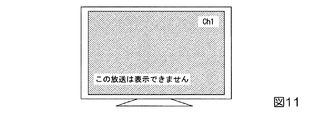
表示部14の解像度が4Kであり、その時間帯にCh1が選局される場合には、解像度判定部165は、受信中の放送信号から検出された映像データの解像度である8Kが表示不能解像度であると判定する。動作制御部166は、映像処理部1643に映像データの復号を停止させ、映像処理部1643に所定のコーション映像信号を取得させる。表示部14には、取得されたコーション映像信号が入力され、入力されたコーション映像信号に基づくコーション映像として「この放送は表示できません」との文字を含む映像を表示する(図11)。視聴者は、選択された番組が表示されない事由が、受信装置10の故障ではなく、放送が要因であることを知得することができる。
When the resolution of the
なお、番組表生成部1641は、映像の解像度が表示不能解像度である番組に係る番組情報を、映像の解像度が表示可能解像度である番組に係る番組情報よりも目立たない態様で表す電子番組表を生成する。番組表生成部1641は、目立たない態様として、例えば、背景とのコントラストがより低い文字を用いて「8Kスポーツ」の文字を表してもよい(例えば、グレイアウト)。また、選局処理部1642は、操作入力部12から入力される操作信号が指示する表示枠に係る番組について、その番組が放送されるチャンネルの選局を停止してもよい。
Note that the program
また、受信中の放送信号から検出された映像データの解像度である8Kが表示不能解像度であると判定する場合には、映像処理部1643に対して、コーション映像に所定の映像を重畳して表示用映像を示す映像信号を生成させてもよい。その場合には、表示部14には、映像処理部1643から入力された映像信号に基づく映像として、コーション映像に所定の映像が重畳された映像が表示される。重畳される所定の映像として、表示部14が表示可能な解像度を有する映像であれば利用可能である。例えば、予め記憶部15に記憶しておいた映像信号、放送信号から検出された映像データから復号により得られた映像信号が示す映像の解像度を8Kから4Kに低下させて得られた映像信号などが利用可能である。そこで、受信装置10は、映像の解像度を低下するための変換器(コンバータ)を備えてもよい。また、映像処理部1643は、解像度を低下した映像に、その解像度を示す表示(例えば、4Kの文字)を重畳してもよい。
In addition, when it is determined that 8K, which is the resolution of the video data detected from the broadcast signal being received, is an undisplayable resolution, the
(受信処理)
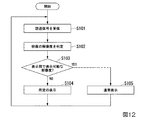
次に、本実施形態に係る放送信号の受信処理について説明する。図12は、本実施形態に係る受信処理を示すフローチャートである。
(ステップS101)放送受信部11は、放送伝送路BTで伝送された放送信号を受信する。復調部161は、受信した放送信号についてフロントエンド処理を行って多重化データに変換する。その後、ステップS102に進む。
(ステップS102)解像度判定部165は、多重化データから分離された番組構成情報i3のMPTを参照して、映像のアセットについて設定された映像コンポーネント記述子に記述された映像解像度を判定する。判定される映像解像度は、放送信号により搬送された映像の解像度に相当する。その後、ステップS103に進む。
(ステップS103)解像度判定部165は、判定した映像解像度が、表示部14が映像を表示できる表示可能解像度であるか否かを判定する。映像解像度が、表示可能解像度であると判定されるとき(ステップS103 YES)、ステップS105に進む。映像解像度が、表示不能解像度であると判定されるとき(ステップS103 NO)、ステップS104に進む。
(Reception processing)
Next, broadcast signal reception processing according to the present embodiment will be described. FIG. 12 is a flowchart showing a reception process according to the present embodiment.
(Step S101) The
(Step S102) The
(Step S103) The
(ステップS104)動作制御部166は、表示部14の表示状態を所定の表示状態としてコーション映像を表示する状態に制御する。ここで、動作制御部166は、映像処理部1643に映像データの復号を停止させ、コーション映像信号を取得し、取得したコーション映像信号を表示部14に出力させる。その後、ステップS101に戻る。よって、放送信号が搬送する映像の解像度が、新たに表示可能解像度となるまでステップS101〜104の処理が繰り返される。
(Step S104) The
(ステップS105)動作制御部166は、表示処理部164の映像処理部1643に映像データを復号させる。表示部14は映像処理部1643から入力された映像信号に基づく映像を表示する(通常表示)。その後、ステップS101に戻る。
(Step S105) The
なお、解像度判定部165は、ステップS102においてMPTに代えて、MH−EITのうち現在受信中の番組に係る記述子領域に記述された映像コンポーネント記述子の映像信号解像度に基づいて映像の解像度を判定してもよい。例えば、放送信号を受信するチャンネル切り換え直後等、番組データに係るMPTがまだ取得されていないときに、既に取得したMH−EITを用いることによって処理の遅延を低減することができる。
Note that the
また、動作制御部166は、MH−EITを参照して、選択されているチャンネルについて、現時点よりも所定時間(例えば、3分後)に提供される番組の映像の解像度が表示可能解像度であるか否かを判定してもよい。表示可能解像度であるか否かの判定が、現時点における判定から変化する場合には、動作制御部166は、その変化を案内するメッセージを含む案内映像を表示部14に表示させてもよい。現時点において提供される番組の映像の解像度が表示可能解像度である場合には、例えば、案内映像に「このチャンネルは、あと●分で表示できなくなります。」との映像の表示が停止されることの予告メッセージが含まれる。また、現時点において提供される番組の映像の解像度が表示不能解像度である場合には、例えば「このチャンネルは、あと●分で表示されます。」との映像の表示が再開されることの予告メッセージが含まれる。視聴者は表示状態の変更予定に接することで、より安心して当該チャンネルを選択することができる。
Further, the
以上に説明したように、本実施形態に係る受信装置10は、映像を含む番組の放送信号を受信する放送受信部11を備える。また、受信装置10は、映像の解像度が、その映像を表示部が表示できない表示不能解像度である場合、表示部14の表示状態を所定の表示状態に制御し、映像の解像度が、その映像を表示部14が表示できる表示可能解像度である場合、表示部14にその映像を表示させる表示処理部164を備える。
この構成により、所定の表示状態として、例えば、コーション映像を視認した視聴者は表示部14が表示できない表示不能解像度を有する映像が提供されることを知得することができる。また、視聴者が受信装置10への操作を行わずに放置しても、表示部14が表示できる表示可能解像度を有する映像が再度提供されると、表示部14はその映像を表示する。映像の表示が再開されることは視聴者の期待に沿うので、過度なチャンネルの切り替えが回避される。そのため、単に表示部14の表示状態を所定の表示状態に制御する場合よりも、視聴者と放送事業者の双方がより満足することができる。
As described above, the receiving
With this configuration, as a predetermined display state, for example, a viewer who has viewed a caution video can know that a video having a non-displayable resolution that cannot be displayed by the
(第2の実施形態)
次に、本発明の第2の実施形態について説明する。上述した実施形態と同一の構成については、同一の符号を付してその説明を援用する。
本実施形態に係る放送システム1の受信装置10において、動作制御部166には解像度が表示不能解像度であることを示す表示可否フラグが解像度判定部165から入力される場合がある。その場合には、動作制御部166は、所定の消費電力よりも消費電力が低い省エネモードで表示処理部164を動作させる。省エネモードは、所定の消費電力として、視聴モードで動作させる場合における消費電力よりも低い動作モード(消費電力低減モード)である。省エネモードにおいて、例えば、動作制御部166は、映像処理部1643に映像データの復号を停止させる。また、省エネモードでは、動作制御部166は、表示部14の映像光を発する発光部(例えば、バックライト)に発光を停止させてもよい。このとき、表示部14は、映像を表示しない(画面表示OFF)。但し、省エネモードでは、動作制御部166は操作入力部12からの操作入力を待ち受ける。視聴モードとは、放送信号で搬送される映像を表示部14に表示させる動作モードである。
(Second Embodiment)
Next, a second embodiment of the present invention will be described. About the same structure as embodiment mentioned above, the same code | symbol is attached | subjected and the description is used.
In the receiving
動作制御部166は、動作モードを視聴モードから省エネモードに変化するとき、表示部14に所定の時間(例えば、1分間)終了予約画面を表示させてもよい。終了予約画面は、省エネモードを終了し、動作モードを視聴モードに変更(復帰)する時刻(終了時刻)の指示(予約)を示す画面である。このとき、映像処理部1643は、予め記憶された終了予約画面信号を記憶部15から読み出し、読み出した終了予約画面信号を表示部14に出力する。また、終了予約画面の表示を開始するタイミングは、映像の解像度が表示不能解像度である番組の開始時刻から所定時間(例えば、1分)早い時刻であってもよい。視聴者は、省エネモードの開始前に所望の終了時刻を指示することができる。
When the operation mode is changed from the viewing mode to the energy saving mode, the
表示部14が、終了予約画面信号に基づく終了予約画面を表示しているとき、動作制御部166は操作入力部12から入力された操作信号が指示する時刻を終了時刻として定める。また、表示部14が電子番組表と終了予約画面を表示しているとき、動作制御部166は、操作信号が指示する表示枠に番組情報が表される番組であって、その番組の映像の解像度が表示可能解像度である場合、その番組の開始時刻を終了時刻と定めてもよい。動作制御部166は、終了予約画面の表示開始後、所定時間内に終了時刻を定めた場合、動作モードを視聴モードから省エネモードに変更し、それ以外の場合、動作モードを視聴モードに維持してもよい。動作制御部166は、その時点の時刻(現時刻)が定めた終了時刻に達するとき、動作モードを省エネモードから視聴モードに変更する。このとき、動作制御部166は、映像処理部1643における映像データの復号を再開する。また、動作制御部166は、表示部14の発光部に発光を停止させていた場合には、発光を再開させる。
When the
なお、動作制御部166は、終了時刻として、映像の解像度が表示不能解像度である番組の終了時刻よりも早い時刻が操作信号で指示される場合には、その指示を無視し、終了時刻を定めなくてもよい。
また、受信装置10が映像の解像度を低下させるための変換器を備える場合、動作制御部166は、指示される時刻を終了時刻として定めてもよい。その場合、動作制御部166は、定めた終了時刻から番組の終了までの間、映像処理部1643が生成した映像信号が示す映像の解像度を変換部に変換させ、変換した映像を示す映像信号を表示部14にさせてもよい。
When the operation signal indicates an end time that is earlier than the end time of the program whose video resolution is the non-displayable resolution, the
In addition, when the
動作モードが省エネモードであり、操作入力部12から入力される操作信号が省エネモードの終了、もしくは、省エネモードの終了予約の解除を示すとき、動作モードを視聴モードに変更する。制御部16は、さらに入力された操作信号で指示される処理、例えば、選局処理部1642における選局処理を行う。但し、その時点において、映像コンポーネント記述子に記述された映像解像度、つまり、放送信号が搬送する映像の解像度が、まだ表示不能解像度である場合がある。その場合には、動作制御部166は、表示処理部164に対して、表示部14の表示状態を所定の表示状態に制御してもよい。動作制御部166は、所定の表示状態として、第1の実施形態と同様に電子番組表、表示部14にコーション映像、解像度を低下した番組の映像のいずれか又はその組み合わせを表示させてもよい。
また、新たに選択されたチャンネルで受信される放送信号、又は新たな番組の開始後に受信される放送信号で搬送される映像の解像度が、表示可能解像度である場合には、動作制御部166は、省エネモードを終了し、動作モードを視聴モードに変更する。
When the operation mode is the energy saving mode and the operation signal input from the
If the resolution of the video signal carried by the broadcast signal received on the newly selected channel or the broadcast signal received after the start of the new program is a displayable resolution, the
(表示例)
次に、本実施形態に係る表示部14の表示例について説明する。
図13は、本実施形態に係る電子番組表の一例を示す図である。図13に示す例では、Ch1において9時から11時までの間、番組名が「8Kスポーツ」である8K番組が提供され、11時から13時までの間、番組名が「Hello TV」である4K番組が提供されることが表されている。その他の番組の番組情報については、図示が省略されている。
(Display example)
Next, a display example of the
FIG. 13 is a diagram showing an example of an electronic program guide according to the present embodiment. In the example shown in FIG. 13, an 8K program with a program name “8K Sports” is provided from 9 o'clock to 11 o'clock in Ch1, and the program name is “Hello TV” from 11 o'clock to 13 o'clock. It is shown that a 4K program is provided. Illustrations of other program information are omitted.
表示部14の解像度が8Kであり、9時から11時までの時間帯、11時から13時までの時間帯ともにCh1が選局される場合には、解像度判定部165は、受信中の放送信号から検出された映像データの解像度がいずれも表示可能解像度であると判定する。動作制御部166は、動作モードを視聴モードのまま維持し、映像処理部1643に映像データを復号させる。表示部14は、映像処理部1643から入力された映像信号に基づく映像として、9時から11時までの時間帯において番組名が「8Kスポーツ」である番組の映像を表示する(図14(a))。表示部14は、11時から13時までの時間帯において番組名が「Hello TV」である番組の映像を表示する(図14(b))。
When the resolution of the
表示部14の解像度が4Kであり、9時から11時までの時間帯にCh1が選局される場合には、解像度判定部165は、受信中の放送信号から検出された映像データの解像度が表示不能解像度であると判定する。動作制御部166は、動作モードを視聴モードから省エネモードに変更する。動作制御部166は、映像処理部1643に映像データの復号を停止させることにより、表示部14による映像の表示を停止する(図15(a))。現時刻が終了時刻(11時から13時までの任意の時刻)又は新たな4K番組である「Hello TV」の開始時刻である11時に達したとき、動作制御部166は、受信中の放送信号から検出された映像データの解像度が表示可能解像度であると判定する。動作制御部166は、動作モードを省エネモードから視聴モードに変更し、映像処理部1643に映像データを復号させる。表示部14は、番組名が「Hello TV」である番組の映像の表示を開始する(図15(b))。
When the resolution of the
(受信処理)
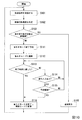
次に、本実施形態に係る放送信号の受信処理について説明する。図16は、本実施形態に係る受信処理を示すフローチャートである。図16に示す処理は、ステップS101〜S103、S105、及びS111〜S116の処理を有する。但し、図16の処理の開始当初において、動作モードが視聴モードである場合を例にする。本実施形態では、ステップS103において解像度判定部165は、映像コンポーネント記述子に記述された映像解像度であると判定するとき(ステップS103 NO)、ステップS111に進む。
(Reception processing)
Next, broadcast signal reception processing according to the present embodiment will be described. FIG. 16 is a flowchart showing a reception process according to this embodiment. The process illustrated in FIG. 16 includes the processes of steps S101 to S103, S105, and S111 to S116. However, the case where the operation mode is the viewing mode at the beginning of the process of FIG. 16 is taken as an example. In the present embodiment, when the
(ステップS111)動作制御部166は、表示部14に所定の時間、省エネモードの終了時刻の指定の案内を示す終了予約画面を表示させる。動作制御部166は、操作入力部12から入力された操作信号に基づいて終了時刻を定める。その後、ステップS112に変更する。
(ステップS112)動作制御部166は、動作モードを視聴モードから省エネモードに変更(遷移)し、映像処理部1643に映像データの復号を停止させる。その後、ステップS113に進む。
(Step S <b> 111) The
(Step S112) The
(ステップS113)動作制御部166は、現時刻が終了時刻に達したか否かを判定する。達したと判定されたとき(ステップS113 YES)、ステップS116に進む。達していないと判定されたとき(ステップS113 NO)、ステップS114に進む。
(ステップS114)動作制御部166は、操作入力部12から操作信号が入力されたか否かを判定する。入力されたと判定されたとき(ステップS114 YES)、ステップS115に進む。入力されていないと判定されたとき(ステップS114 NO)、ステップS112に戻る(待ち受け)。
(ステップS115)動作制御部166は、入力された操作信号が省エネモードの終了、もしくは、省エネモードの終了予約の解除を示すか否かを判定する。示すと判定されたとき(ステップS115 YES)、ステップS116に進む。示さないと判定されたとき(ステップS115 NO)、ステップS112に戻る(待ち受け)。
(Step S113) The
(Step S114) The
(Step S115) The
(ステップS116)動作制御部166は、省エネモードを終了し、動作モードを視聴モードに変更(復帰)する。その後、ステップS101に戻る。
(Step S116) The
なお、図16に示す処理において、ステップS114において操作信号が入力されたと判定されたとき(ステップS114 YES)、ステップS115を省略し、ステップS116に進むようにしてもよい。その場合、操作信号の指示に関わらず、操作入力がなされたとき省エネモードが終了し、動作モードが視聴モードに変更される。 In the process shown in FIG. 16, when it is determined in step S114 that an operation signal has been input (YES in step S114), step S115 may be omitted and the process may proceed to step S116. In this case, the energy saving mode ends when the operation input is made regardless of the instruction of the operation signal, and the operation mode is changed to the viewing mode.
以上に説明したように、本実施形態に係る受信装置10は、映像の解像度が表示不能解像度である場合、所定の消費電力よりも消費電力が低い省エネモードで表示処理部164を動作させ、操作入力に応じて省エネモードを終了する終了時刻を定める動作制御部166を備える。
この構成により、視聴者の操作に応じて定めた終了時刻において、省エネモードを終了させ、視聴モードを再開させることができる。視聴者が所望の時刻において映像の表示が再開するので、視聴者は放送サービスに対してより満足することができる。
As described above, the receiving
With this configuration, the energy saving mode can be ended and the viewing mode can be resumed at the end time determined according to the operation of the viewer. Since the display of the video resumes at the time desired by the viewer, the viewer can be more satisfied with the broadcast service.
(第3の実施形態)
次に、本発明の第3の実施形態について説明する。上述した実施形態と同一の構成については、同一の符号を付してその説明を援用する。
本実施形態に係る放送システム1において、送信装置20は、ある番組に対応する他のコンテンツに関するリンク情報をさらに含む番組配列情報i2を取得する。他のコンテンツは、受信装置10の種別に関わらず表示可能な映像(例えば、4K映像)を含むコンテンツである。他のコンテンツの提供形態として、例えば、他のチャンネルで放送される放送番組、通信で提供可能なコンテンツが含まれる。リンク情報には、他のコンテンツの送信元の所在を示す送信元情報が含まれる。リンク情報として、例えば、ハイパーリンク記述子を用いて表される。ハイパーリンク記述子の例については、後述する。
(Third embodiment)
Next, a third embodiment of the present invention will be described. About the same structure as embodiment mentioned above, the same code | symbol is attached | subjected and the description is used.
In the
次に、本実施形態に係る送信処理について説明する。図17は、本実施形態に係る送信処理を示すフローチャートである。
(ステップS201)送信装置20は、番組の映像を示す映像データを含む番組データi1を取得する。その後、ステップS202に進む。
(ステップS202)送信装置20は、番組データi1の構成を示す番組構成情報i3と、番組毎の番組データに関する番組情報ならびにある番組に対応する他のコンテンツに関するリンク情報とを含む番組配列情報i2とを取得する。その後、ステップS203に進む。
(ステップS203)送信装置20は、番組データi1と、番組配列情報i2と番組構成情報i3とを含む制御データとを多重化して多重化データを生成する。その後、ステップS204に進む。
(ステップS204)送信装置20は、生成した多重化データについて上述したフロントエンド処理を行って放送信号に変換する。送信装置20は、変換した放送信号を放送伝送路BTに送出することにより、受信装置10に送信する。その後、図17に示す処理を終了する。
Next, transmission processing according to the present embodiment will be described. FIG. 17 is a flowchart showing a transmission process according to the present embodiment.
(Step S201) The
(Step S202) The
(Step S203) The
(Step S204) The
(ハイパーリンク記述子)
次に、本実施形態に係るハイパーリンク記述子のデータ構造について説明する。図18は、ハイパーリンク記述子のデータ構造の一例を示す図である。
ハイパーリンク記述子は、MH−EIT(図5)のイベント(番組)毎の記述子領域(descriptor())に記述される。ハイパーリンク記述子には、ハイパーリンク種別(hyper_linkage_type)、リンク先種別(link_destination_type)、プライベートデータ(private_data)及び優先種別(priority_type)の各項目が含まれる。
(Hyperlink descriptor)
Next, the data structure of the hyperlink descriptor according to this embodiment will be described. FIG. 18 is a diagram illustrating an example of the data structure of the hyperlink descriptor.
The hyperlink descriptor is described in a descriptor area (descriptor ()) for each event (program) of MH-EIT (FIG. 5). The hyperlink descriptor includes items of a hyperlink type (hyper_linkage_type), a link destination type (link_destination_type), private data (private_data), and a priority type (priority_type).
ハイパーリンク種別(hyper_linkage_type)には、リンクの形態を示す符号が記述される。リンクの形態は、例えば、テレビジョン番組、データ放送などである。リンク先種別(link_destination_type)には、リンク先のデータの種別を示す符号が記述される。リンク先のデータの種別は、例えば、サービス、イベント、コンテント(コンテンツ)などである。リンク先が放送番組の番組データを提供する場合には、イベントが指定される。プライベートデータ(private_data)には個別に定義された値が記述される。個別に定義された値として、例えば、コンテンツの名称(番組名など)が記述されてもよい。優先種別(priority_type)には、提供に係る伝送路が2種類以上ある場合において、優先して利用する伝送路の種別を示す符号が記述される。例えば、「0x01」は、ネットワーク(通信伝送路)、「0x02」は、放送(放送伝送路)を示す。 In the hyperlink type (hyper_linkage_type), a code indicating the form of the link is described. The form of the link is, for example, a television program or a data broadcast. In the link destination type (link_destination_type), a code indicating the type of link destination data is described. The type of data at the link destination is, for example, service, event, content (content), or the like. An event is designated when the link destination provides program data of a broadcast program. In private data (private_data), individually defined values are described. As an individually defined value, for example, a content name (program name or the like) may be described. In the priority type (priority_type), when there are two or more types of transmission paths to be provided, a code indicating the type of transmission path to be used with priority is described. For example, “0x01” indicates a network (communication transmission path), and “0x02” indicates a broadcast (broadcast transmission path).
ハイパーリンク記述子には、さらにリンク先の所在を示す情報として、URL(URL_byte)、オリジナルネットワーク識別(original_network_id)、トランスポートストリーム識別(transport_stream_id)、サービス識別(service_id)、イベント識別(event_id)、開始時刻(start_time)及び継続時間(duration)が含まれる。伝送路としてネットワークで提供されるコンテンツについて、URL(URL_byte)により送信元が特定される。放送で提供される番組について、オリジナルネットワーク識別(original_network_id)により提供されるチャンネルが特定される。トランスポートストリーム識別(transport_stream_id)により、番組データが提供されるアセットが特定される。サービス識別(service_id)、イベント識別(event_id)により提供対象の番組が特定される。開始時刻(start_time)及び継続時間(duration)により、その放送時間が特定される。 The hyperlink descriptor further includes URL (URL_byte), original network identification (original_network_id), transport stream identification (transport_stream_id), service identification (service_id), event identification (event_id), and start as information indicating the location of the link destination. A time (start_time) and a duration (duration) are included. For the content provided on the network as a transmission path, the transmission source is specified by URL (URL_byte). For a program provided by broadcasting, a channel provided by an original network identification (original_network_id) is specified. The transport stream identification (transport_stream_id) identifies the asset to which the program data is provided. The program to be provided is specified by the service identification (service_id) and the event identification (event_id). The broadcast time is specified by the start time (start_time) and the duration (duration).
(受信装置)
次に、本実施形態に係る受信装置10の構成について説明する。
図19は、本実施形態に係る受信装置10の概略構成を示すブロック図である。
受信装置10は、図8に示す受信装置10について、さらに通信部17と、データ入出力部18とを含んで構成される。
(Receiver)
Next, the configuration of the receiving
FIG. 19 is a block diagram illustrating a schematic configuration of the receiving
The receiving
通信部17は、通信伝送路NTと有線又は無線で接続され、通信伝送路NTに接続された他の機器との間で各種の信号を送受信する。通信伝送路NTには、ある番組に関連するコンテンツを提供するサーバ装置が接続される。通信伝送路NTは、例えば、インターネット等の広域通信網を含んで構成される。通信部17は、例えば、通信インタフェースである。
The
データ入出力部18は、表示装置30と有線又は無線で接続され、表示処理部164から入力された各種の映像信号を表示装置30に出力する。また、データ入出力部18は、表示装置30から入力された各種の信号を制御部16に出力する。データ入出力部18は、例えば、データ入出力インタフェースである。表示装置30は、入力された映像信号に基づいて映像を表示する表示部を備える電子機器である。表示装置30は、表示部14に表示される番組の映像に付随する他の映像又は当該番組に関連する情報を表示する電子機器(セカンドスクリーン)である。表示装置30は、例えば、多機能携帯電話機(いわゆるスマートフォンを含む)、タブレット端末装置、等である。
The data input /
番組表生成部1641は、映像コンポーネント記述子に記述された映像解像度が、表示不能解像度である番組について、リンク情報としてハイパーリンク記述子が、MH−EITの記述子領域(descriptors())に含まれているか否かを判定する。番組表生成部1641は、ハイパーリンク記述子を解析し、当該番組に対応する他のコンテンツの名称と、リンク先として、チャンネル又はURLを取得する。番組表生成部1641は、当該番組の表示枠に取得した他のコンテンツのリンク先とその名称を表すタグをさらに含む電子番組表を生成する。タグ内の表示は、当該番組よりも目立つ態様、例えば、より高いコントラストで表示されてもよい。また、1つの番組に係るリンク情報が示すリンク先が複数あり、それらに優先順位が定められている場合には、番組表生成部1641は、その順位でリンク先と番組名のセットをそれぞれ配列してもよい。
The program
なお、番組表生成部1641は、ハイパーリンク記述子に記述された他のコンテンツが利用できるか否かを判定してもよい。番組表生成部1641は、利用できると判定された他のコンテンツについて、リンク先と名称のセットを電子番組表に配列し、利用できないと判定された他のコンテンツについて当該セットを配列しない。他のコンテンツが放送番組である場合、番組表生成部1641は、現時刻が放送時間内であって、特段の契約なしに利用できるチャンネルもしくは提供者と契約済みのチャンネルで提供される番組が利用できると判定し、それ以外の番組は利用できないと判定する。特段の契約なしに利用できるチャンネルには、例えば、普及促進用のチャンネル(プロモチャンネル)、通信販売専用チャンネル(ショップチャンネル)がある。契約済みのチャンネルか否かについては、例えば、契約情報として、提供者が発行した復号鍵と当該受信装置10を特定するユーザーIDのセットが記憶部15に記憶されているか否かをもって判定できる。また、他のコンテンツがネットワークで提供されるコンテンツである場合、番組表生成部1641は、通信部17が通信伝送路NTに接続されているとき他のコンテンツが利用できると判定し、通信部17が通信伝送路NTに接続されていないとき他のコンテンツが利用できないと判定する。
Note that the program
動作制御部166は、受信中の放送信号で搬送される映像の解像度が受信不能解像度であって、利用できる他のコンテンツに係るリンク情報が存在する場合には、当該他のコンテンツを搬送する信号を放送受信部11又は通信部17に受信させる。動作制御部166は、当該リンク情報を参照して、他のコンテンツのリンク先を判定する。他のコンテンツが放送番組である場合には、動作制御部166は、判定したリンク先として提供されるチャンネルを判定する。動作制御部166は、判定したチャンネルを示す選局信号を生成し、生成した選局信号を放送受信部11に出力する。放送受信部11は、そのチャンネルで放送信号を受信する。また、動作制御部166は、他のコンテンツがネットワークで提供されるコンテンツ(ネットワークコンテンツ)である場合には、当該コンテンツの要求信号を生成し、生成した要求信号を、通信部17を介してリンク先のサーバ装置に送信する。通信部17は、送信した要求信号の応答としてサーバ装置から当該コンテンツを含むコンテンツデータを受信する。通信部17は、受信したコンテンツデータを分離部162に出力する。分離部162は、通信部17から入力されるコンテンツデータから映像データを分離し、分離した映像データを映像処理部1643に出力する。よって、リンク先の放送番組の映像が表示部14に表示される。
When the resolution of the video carried by the broadcast signal being received is an unreceivable resolution and there is link information related to other usable content, the
(表示例)
次に、本実施形態に係る表示部14の表示例について説明する。
図20は、本実施形態に係る電子番組表の一例を示す図である。図20(a)は、表示部14の解像度が4Kである場合に表示される電子番組表の一例である。Ch1において9時から11時までの間、番組名が「8Kスポーツ」である8K番組の表示枠内に、タグLk1が重畳される。その他の番組の番組情報については、図示が省略されている。タグLk1は太枠で囲まれ、タグLk1内の背景の明度又は輝度は、表示枠内の背景よりも高い。タグLk1は、この番組に関連するコンテンツとして、その時点において利用可能な他のコンテンツが存在することを示す。上述したように、解像度が4Kである表示部14は、この番組の映像を表示できない。
(Display example)
Next, a display example of the
FIG. 20 is a diagram showing an example of an electronic program guide according to the present embodiment. FIG. 20A is an example of an electronic program guide displayed when the resolution of the
図20(b)は、タグLk1にリンク情報として、リンク先のチャンネルとして「Ch 33」とコンテンツの名称として「ハロージャパン」が表示される。本実施形態では、動作制御部166は、放送受信部11が放送信号を受信するチャンネルとしてCh33を指示する。そのため、Ch33で受信された放送信号で搬送される映像データに基づく映像として、表示部14は、番組名が「ハロージャパン」である番組の映像を表示することができる(図21(c))。
In FIG. 20B, “Ch 33” is displayed as the link destination channel and “Hello Japan” is displayed as the content name as link information on the tag Lk1. In the present embodiment, the
リンク情報が存在しない8K番組については、動作制御部166は、映像処理部1643に対して映像データの復号を停止し、コーション映像信号を表示部14に出力する。その場合に、表示部14は、コーション映像を表示する(図21(b))。
なお、表示部14の解像度が8Kである場合には、電子番組表にはタグLk1は必ずしも表示されなくてもよい。Ch1が選局される場合には、9時から11時までの時間帯において番組名が「8Kスポーツ」である番組の映像が可能なためである(図21(a))。
For an 8K program for which no link information exists, the
If the resolution of the
図22(a)は、表示部14の解像度が4Kである場合に表示される電子番組表の他の例を示す。この例では、Ch1、Ch2、Ch3のそれぞれについて、7時から13時までに放送される全ての番組の番組情報が表される。但し、映像を表示できない8K番組の表示枠内の背景は、映像を表示できる他の番組(4K番組)よりも低い輝度で表されている。この例では、8K番組は、「8Kスポーツ」、「モーニングニュース」、「8K音楽」が該当する。そのうち、「8K音楽」については、リンク情報が存在する。そのため、この番組の表示枠には、リンク情報の一部であるリンク先のチャンネルとして「Ch33」とコンテンツの名称として「ハロージャパン」を表すタグLk2が付加される(図22(b))。なお、「8Kスポーツ」、「モーニングニュース」については、リンク情報が存在しないため、タグが表示されない。
FIG. 22A shows another example of an electronic program guide displayed when the resolution of the
図22(a)に示す番組編成のもとで、受信装置10がCh3で7時から13時までの間、放送信号を受信することを仮定する。7時から9時までの間、放送受信部11はCh3で番組名が「今日の天気」である番組の放送信号を受信する。次の番組の開始時刻である9時において、動作制御部166は、受信チャンネルをCh3からリンク先のCh33に変更する。9時から11時までの間、放送受信部11はCh33で番組名が「ハロージャパン」である番組の放送信号を受信する。当該番組の終了時刻である11時において、受信チャンネルをリンク先のCh33から変更前のCh3に戻す。11時から13時までの間、放送受信部11はCh3で番組名が「午後の天気」である番組の放送信号を受信する。
It is assumed that the receiving
なお、同一時間帯において、リンク情報が存在する番組を提供するチャンネルは、複数チャンネル存在しうる。番組表生成部1641は、その複数のチャンネルのうち、放送受信部11が放送信号を受信するチャンネルに係るタグLk3を表示させ、その他のタグを表示させなくてもよい。これにより、視聴者は現在受信しているチャンネルで提供される番組に対応する他のコンテンツの視聴が促され、その他の番組に対応する他のコンテンツの視聴は促されない。
In the same time zone, there may be a plurality of channels that provide a program for which link information exists. Of the plurality of channels, the program
図23(a)は、表示部14の解像度が8Kである場合に表示される電子番組表の一例を示す。この例における番組編成は、図22(a)に示す番組編成と同様である。表示部14は、全ての番組の映像を表示することができるため、番組間において表示態様の差異は特に設けられていない。また、図23(a)に示す例では、リンク情報が存在する番組「8K音楽」については、タグLk2は付加されない。これは、放送事業者は、他のコンテンツよりも解像度が高い映像に係る8K番組を視聴者に視聴させるためである。
FIG. 23A shows an example of an electronic program guide displayed when the resolution of the
但し、データ入出力部18に表示装置30が接続されている場合には、番組表生成部1641は、生成したタグLk3を示す映像信号を表示部14に出力せずに、データ入出力部18を介して表示装置30に出力してもよい。図23(b)に示す例では、表示装置30の表示部35にタグLk3が表示される。
また、視聴者の操作によりタグLk3を指示する操作信号が入力されることがある。その場合、表示装置30は、リンク先としてタグLk3にリンク先として表示されたCh33で放送される他のコンテンツである番組「ハロージャパン」の要求信号を受信装置10の動作制御部166に送信してもよい。動作制御部166は、表示装置30からの要求信号の入力に応じて、Ch3で受信中の番組「8K音楽」に対応する番組「ハロージャパン」を搬送する放送信号を、上述した手法を用いて放送受信部11に受信させる。映像処理部1643は、Ch33で受信した放送信号から取得される番組「ハロージャパン」に係る映像データを復号して得られる映像信号を、データ入出力部18を介して表示装置30に出力する。よって、表示装置30は、他のコンテンツに係る映像として、番組名が「ハロージャパン」である番組の映像を表示する(セカンドスクリーン対応)。
However, when the
In addition, an operation signal indicating the tag Lk3 may be input by the operation of the viewer. In that case, the
また、受信装置10が放送された映像データを記録する録画部(図示せず)を備える場合には、録画部は、操作入力部12から入力される操作信号の指示に応じて、映像を表示する番組に対応する他のコンテンツに係る映像データを記録してもよい。図23(a)に示す例において、表示部14が番組「8K音楽」の映像を表示しているとき、録画部は番組「ハロージャパン」の映像を示す映像データを記録してもよい(録画対応)。
Further, when the receiving
(受信処理)
次に、本実施形態に係る放送信号の受信処理について説明する。図24は、本実施形態に係る受信処理を示すフローチャートである。図24に示す処理は、ステップS101〜S105、及びS121〜S124の処理を有する。本実施形態では、ステップS103において解像度判定部165は、映像コンポーネント記述子に記述された映像解像度であると判定するとき(ステップS103 NO)、ステップS121に進む。
(Reception processing)
Next, broadcast signal reception processing according to the present embodiment will be described. FIG. 24 is a flowchart showing a reception process according to this embodiment. The process illustrated in FIG. 24 includes the processes of steps S101 to S105 and S121 to S124. In this embodiment, when the
(ステップS121)番組表生成部1641は、番組配列情報i2を示すMH−EITを解析し、映像の解像度が表示不能解像度である番組毎に映像コンポーネント記述子の記述子領域(descriptors())にリンク情報を表すハイパーリンク記述子が記述されているか否かを判定する。その後、ステップS122に進む。
(ステップS122)リンク情報を表すハイパーリンク記述子が記述されていると判定された番組がある場合(ステップS122 YES)、ステップS123に進む。ハイパーリンク記述子が記述されていると判定された番組がない場合(ステップS122 NO)、ステップS104に進む。
(Step S121) The program
(Step S122) When it is determined that there is a program in which a hyperlink descriptor representing link information is described (YES in Step S122), the process proceeds to Step S123. If there is no program for which it is determined that the hyperlink descriptor is described (NO in step S122), the process proceeds to step S104.
(ステップS123)番組表生成部1641は、リンク情報を表すハイパーリンク記述子で記述された他のコンテンツが利用可能であるか否かを確認する。番組表生成部1641は、利用可能であると判定した番組について、当該番組に対応する他のコンテンツのリンク先と名称とを示すタグを、当該番組の表示枠に付加した電子番組表を生成する。番組表生成部1641は、生成した電子番組表を表示部14に表示させる。その後、ステップS124に進む。
(Step S123) The program
(ステップS124)動作制御部166は、その時点で受信中の番組に対応する利用可能な他のコンテンツのコンテンツデータを搬送する信号を、当該他のコンテンツのリンク先から放送受信部11又は通信部17に受信させる。映像処理部1643は、受信したコンテンツデータに含まれる映像データを復号して得られた映像信号を表示部14に出力する。表示部14は、映像処理部1643からの映像信号が示す映像として、リンク先から取得した他のコンテンツの映像を表示する。その後、ステップS101に戻る。
(Step S124) The
なお、ステップS122において、ハイパーリンク記述子が記述されていると判定された番組がない場合(ステップS122 NO)、ステップS111(図16)に進み、受信装置10はステップS104に代えてステップS111〜S116(図16)の処理を行ってもよい。
また、受信中の番組に係るリンク情報が示すリンク先が複数あり、それらに優先順位が付されている場合には、動作制御部166は、リンク先毎にその優先順位でステップS124の処理を試行してもよい。1つのリンク先からのコンテンツデータの取得に失敗しても、他の利用可能なコンテンツデータの取得が試行されるので、表示部14に映像が表示されない可能性を低減することができる。
In step S122, if there is no program for which it is determined that a hyperlink descriptor is described (NO in step S122), the process proceeds to step S111 (FIG. 16), and the receiving
In addition, when there are a plurality of link destinations indicated by the link information related to the program being received, and priorities are assigned to them, the
また、上述した例では、放送される映像の解像度が表示不能解像度であると判定されるとき、操作入力部12からの操作信号の入力の有無に関わらず、タグに表示された他のコンテンツを放送受信部11又は通信部17に受信させる場合を例にした。動作制御部166は、電子番組表に表示されるタグを指示する操作信号が入力されるとき、タグに表示される他のコンテンツのリンク先から、当該他のコンテンツのコンテンツデータを搬送する信号を放送受信部11又は通信部17に受信させてもよい。その場合、視聴者は、意思に応じて映像の解像度が表示不能解像度である番組に対応する他のコンテンツを視聴するか否かを選択することができる。
In the above-described example, when it is determined that the resolution of the broadcast video is an undisplayable resolution, the other content displayed on the tag is displayed regardless of whether or not the operation signal is input from the
また、リンク情報としてハイパーリンク記述子に代えて、MH−リンク記述子を用いて、他のコンテンツのリンク先、名称が記述されてもよい。その場合には、番組表生成部1641は、ハイパーリンク記述子に代えて、MH−リンク記述子を解析して、他のコンテンツのリンク先、名称を判定する。
Further, instead of the hyperlink descriptor as the link information, the link destination and name of other content may be described using an MH-link descriptor. In that case, the program
以上に説明したように、本実施形態に係る受信装置10は、放送信号で搬送され、放送中または放送予定の番組に関する番組配列情報から受信中の番組に対応する他のコンテンツに関するリンク情報を取得し、映像の解像度が表示不能解像度である場合、放送受信部11又は通信部17に他のコンテンツを受信させる動作制御部166、をさらに備える。
この構成により、表示部14は、解像度が表示不能解像度である番組の映像に代えて、他のコンテンツとして表示可能な映像を表示する。そのため、視聴者はチャンネルの切り替えに係る操作を行わなくても、選択されたチャンネルで提供されるべき番組に関連する他のコンテンツを視聴することができる。また、放送事業者は、その意図に沿った他のコンテンツに関する情報を番組配列情報の一部として指定することができる。よって、視聴者及び放送事業者ともに放送サービスに対してより満足することができる。
As described above, the receiving
With this configuration, the
また、受信装置10において、番組配列情報は、番組毎の番組情報を含み、番組毎の番組情報を当該番組の放送時間ならびにチャンネルに基づいて配列し、リンク情報の少なくとも一部を受信中の番組の番組情報を表示するための表示枠にタグとして表す電子番組表を生成する番組表生成部1641を備える。
この構成により、映像の解像度が表示不能解像度である番組に代えて提供される他のコンテンツの提供や、その時間帯などの情報が電子番組表に表される。視聴者は、他のコンテンツの提供、その時間帯などの情報を知得することができるので、当該他のコンテンツの提供に対してより満足することができる。
In the receiving
With this configuration, provision of other content provided in place of a program whose video resolution is not displayable, and information such as a time zone thereof are displayed in the electronic program guide. Since the viewer can know information such as the provision of other content and the time period, the viewer can be more satisfied with the provision of the other content.
また、受信装置10において、動作制御部166は、他のコンテンツが利用できるか否かを判定する。
この構成により、利用できない他のコンテンツに関する情報の表示が排除することができる。そのため、視聴者が利用できない他のコンテンツに関する情報に接することで、期待を裏切ることを回避することができる。
In the receiving
With this configuration, it is possible to eliminate display of information regarding other contents that cannot be used. Therefore, it is possible to avoid disappointing by touching information related to other contents that cannot be used by the viewer.
(第4の実施形態)
次に、本発明の第4の実施形態について説明する。上述した実施形態と同一の構成については、同一の符号を付してその説明を援用する。
本実施形態に係る放送システム1において、受信装置10の表示部14は、図25に示すように、通電状態を示すLED(Light Emitting Diode)ランプ14−1と、放送される映像の解像度ごとにLEDランプ14−2を備える。通電状態として、電力が供給されている状態(電源ON)または電力の供給が停止されている状態(電源OFF)が表される。映像の解像度が表される。LEDランプ14−1と、解像度ごとのLEDランプ14−2は、発光態様がそれぞれ異なる発光素子を少なくとも2個備える。発光態様は、例えば、発光する光の色である。図25に示す例では、受信装置10に電源ONの状態が、LEDランプ14−1が緑色で点灯することにより表される。左端、中央、右端のLEDランプ14−2は、それぞれ解像度が8K、4K、2Kに対応するLEDランプである。選局されたチャンネルにおいて、表示部14が表示できない解像度が8Kの映像として番組「8K スポーツ」の映像が提供されていることが、左端のLEDランプ14−2が赤色で点灯することにより表される。なお、2Kとは、水平方向1920画素、垂直方向1080画素の解像度である。解像度判定部165は、映像コンポーネントに記述された映像信号解像度の値が「5」(図4参照)であることをもって、提供される映像の解像度が2Kであることを判別することができる。
(Fourth embodiment)
Next, a fourth embodiment of the present invention will be described. About the same structure as embodiment mentioned above, the same code | symbol is attached | subjected and the description is used.
In the
本実施形態では、解像度判定部165は、放送される映像データの解像度の情報を取得できるか否かを判定する。映像の解像度の情報を取得できない場合には、例えば、選択されているチャンネルでの受信品質が劣る場合、そのチャンネルでの受信信号が微弱な場合、そのチャンネルでの放送設備からの放送波の送信が停止されている場合、などがある。解像度判定部165は、映像の解像度の情報を取得できない場合には、その情報を取得できないことを示す取得不能情報を動作制御部166に出力する。映像の解像度の情報を取得できる場合には、解像度判定部165は、上述したように、取得した映像の解像度について表示部14への表示の可否を判定する。解像度判定部165は、表示部14への表示の可否を示す表示可否フラグに、その判定対象とした解像度を示す情報を付加して動作制御部166に出力する。
動作制御部166は、解像度判定部165から入力される表示可否フラグまたは取得不能情報、操作入力部12から入力される操作信号および動作モードのいずれか、またはそれらの組み合わせに基づいてLEDランプ14−1、14−2の点灯を制御する。
In the present embodiment, the
The
動作制御部166は、起動(電源ON)を指示する操作信号が入力されるとき、自装置の各構成要素に動作に要する電力の供給を開始するとともに、LEDランプ14−1を所定の色(例えば、緑)で点灯させる。その際、動作制御部166は、LEDランプ14−1が備える緑色の発光素子に電力を供給する。動作の停止(電源OFF)を指示する操作信号が入力されるとき、動作制御部166は、自装置の各構成要素への電力の供給を停止するとともに、LEDランプ14−1が備える赤色の発光素子に電力の供給を開始し、緑色の発光素子への電力の供給を停止する。また、動作制御部166は、いずれの解像度に対応するLEDランプ14−2にも電力の供給を行わない。
When an operation signal instructing activation (power ON) is input, the
なお、動作制御部166は、解像度以外の原因により動作モードを視聴モードから省エネモードに切り替えるとき、いずれの解像度に係るLEDランプ14−2にも電力の供給を停止してもよい。解像度以外の原因により動作モードを省エネモードに切り替えるときには、例えば、動作モードが視聴モードであるとき操作信号が所定時間(例えば、3〜10分)以上継続して入力されないときなどがある。
Note that when the operation mode is switched from the viewing mode to the energy saving mode due to a cause other than the resolution, the
さらに、解像度判定部165から取得不能情報が入力されるときにも、動作制御部166は、動作モードを視聴モードから省エネモードに切り替えることがある。その場合には、動作制御部166は、全ての解像度のそれぞれに対応するLEDランプ14−2を赤色で点灯させてもよい。全ての解像度とは、提供される可能性のある解像度の候補の全てを意味し、図25に示す例では、8K、4K、2Kのいずれもが該当する。その際、動作制御部166は、全ての解像度のそれぞれに対応するLEDランプ14−2が備える赤色の発光素子に電力を供給する。
Furthermore, even when non-acquisition information is input from the
解像度判定部165は、分離部162から入力された番組構成情報i3に含まれるMPTに基づいて、受信中の放送信号から検出された映像データの解像度を判定する。より具体的には、解像度判定部165は、MPTを解析してアセットタイプが映像であるアセットを判定する。
The
動作制御部166は、表示可否フラグが、映像の解像度が表示可能解像度であることを示すとき、その解像度に対応するLEDランプ14−2が備える緑色の発光素子に電力を供給し赤色の発光素子への電力の供給を停止する。動作制御部166は、表示可否フラグが、映像の解像度が表示不能解像度であることを示すとき、その解像度に対応するLEDランプ14−2が備える赤色の発光素子に電力を供給し、緑色の発光素子への電力の供給を停止する。
When the display enable / disable flag indicates that the video resolution is the displayable resolution, the
従って、LEDランプ14−1、14−2の点滅とその態様により、受信装置10の動作状態が表わされる。図26の第2行に示すように、電源ON/OFFを示すLEDランプ14−1が緑色で点灯し、かつ解像度に対応するLED14−2が赤色で点灯することは、そのチャンネルの選局中において、表示不能解像度を有する映像が提供されていることを示す。図26の第3行に示すように、LEDランプ14−1が緑色で点灯し、かつ解像度に対応するLED14−2が緑色で点灯することは、そのチャンネルの選局中において、表示可能解像度を有する映像が提供されていることを示す。
Therefore, the operation state of the receiving
図26の第4行に示すように、LEDランプ14−1が緑色で点灯し、かつLED14−2がいずれも消灯していることは、そのチャンネルの選局中において、所定期間継続して操作がされないこと等により省エネモードに遷移したことを示す。図26の第5行に示すように、LEDランプ14−1が緑色で点灯し、かつ全ての解像度にそれぞれ対応するLEDランプ14−2が赤色で点灯すること(全赤)は、解像度判定部165が解像度の情報を取得できないことを示す。図26の第6行に示すように、LEDランプ14−1が赤色で点灯し、かつLED14−2がいずれも消灯していることは、操作により電源OFFが指示されたことを示す。このように、映像が表示されない場合であっても、視聴者は、その原因が、表示部14の解像度、解像度以外の事由で遷移した省エネモード、選択されたチャンネルにおける放送信号の受信不能、操作により指示された動作の停止、のいずれであるかを直感的に認知することができる。
As shown in the fourth row of FIG. 26, the fact that the LED lamp 14-1 is lit in green and the LEDs 14-2 are all turned off is a continuous operation for a predetermined period during channel selection. Indicates that the mode has been changed to the energy saving mode due to not being performed. As shown in the fifth row of FIG. 26, the LED lamp 14-1 is lit in green and the LED lamps 14-2 corresponding to all resolutions are lit in red (all red). 165 indicates that resolution information cannot be acquired. As shown in the sixth line of FIG. 26, the fact that the LED lamps 14-1 are lit red and all the LEDs 14-2 are turned off indicates that the operation has been instructed to turn off the power. As described above, even when the video is not displayed, the viewer can determine whether the cause is the resolution of the
次に、本実施形態に係る受信処理について説明する。図27は、本実施形態に係る受信処理を示すフローチャートである。図27に示す処理は、ステップS101〜S105およびS131〜S137の処理を含む。図27に示す処理では、ステップS101の後、ステップS131に進む。
(ステップS131)解像度判定部165は放送される映像データの解像度の情報を取得できるか否かを判定する。できると判定されるとき(ステップS131 YES)、ステップS102に進む。できないと判定されるとき(ステップS131 NO)、ステップS132に進む。
Next, the reception process according to the present embodiment will be described. FIG. 27 is a flowchart showing a reception process according to this embodiment. The process shown in FIG. 27 includes the processes of steps S101 to S105 and S131 to S137. In the process shown in FIG. 27, the process proceeds to step S131 after step S101.
(Step S131) The
(ステップS132)動作制御部166は、ステップS104と同様に、表示部14の表示状態を所定の表示状態としてコーション映像を表示する状態に制御する。その後、ステップS133に進む
(ステップS133)動作制御部166は、ステップS112と同様に、動作モードを視聴モードから省エネモードに遷移する。その後、ステップS134に進む。
(ステップS134)動作制御部166は、全ての解像度に係るLEDランプ14−2を赤色で点灯させる。その後、ステップS101に戻る。
(Step S132) Similar to step S104, the
(Step S134) The
図27に示す処理では、ステップS105の後、ステップS135に進む。
(ステップS135)動作制御部166は、表示可能解像度と判定した解像度に係るLEDランプ14−2を緑色で点灯させる。その後、ステップS101に戻る。
図27に示す処理では、ステップS104の後、ステップS136に進む。
(ステップS136)動作制御部166は、ステップS112と同様に、動作モードを視聴モードから省エネモードに遷移する。その後、ステップS137に進む。
(ステップS137)動作制御部166は、表示不能解像度と判定した解像度に係るLEDランプ14−2を赤色で点灯させる。その後、ステップS101に戻る。
In the process shown in FIG. 27, the process proceeds to step S135 after step S105.
(Step S135) The
In the process illustrated in FIG. 27, the process proceeds to step S136 after step S104.
(Step S136) The
(Step S137) The
なお、上述した例では、表示可能解像度、表示不能解像度のそれぞれに対応するLEDランプ14−2の表示態様が、緑、赤であり、電源ON、OFFのそれぞれに対応するLEDランプ14−1の表示態様が、緑、赤である場合を例にしたが、これには限られない。表示態様として、他の色が用いられてもよいし、輝度、点滅の有無、点滅周期、などが用いられてもよい。但し、表示可能解像度に対応する表示態様と、電源ONに対応する表示態様が同一または類似していることが好ましい。なお、発光部として用いられる光源は、必ずしもLEDランプに限られない。LEDランプに代えて、蛍光ランプ、電球などが用いられてもよい。 In the above-described example, the display mode of the LED lamp 14-2 corresponding to each of the displayable resolution and the non-displayable resolution is green and red, and the LED lamps 14-1 corresponding to the power ON and OFF respectively. Although the case where the display mode is green or red is taken as an example, it is not limited to this. As the display mode, other colors may be used, and brightness, presence / absence of blinking, blinking cycle, and the like may be used. However, it is preferable that the display mode corresponding to the displayable resolution and the display mode corresponding to the power ON are the same or similar. In addition, the light source used as a light emission part is not necessarily restricted to an LED lamp. Instead of the LED lamp, a fluorescent lamp, a light bulb, or the like may be used.
また、光源は、図25に示すように表示部14の外縁部(ベゼル)に設置されていなくてもよい。光源は、例えば、受信装置10の筐体、リモートコントローラRC、などに表面に設置されてもよい。また、光源は、受信装置10本体と電気的に接続されていなくてもよい。その場合には、動作制御部166は、点灯の要否、点灯する場合にはその態様を示す制御信号を、それぞれの光源に送信する。光源は、動作制御部166から受信した制御信号に従って点灯または消灯する。点灯する際、光源は、制御信号が示す態様で点灯する。
Moreover, the light source does not need to be installed in the outer edge part (bezel) of the
以上に説明したように、本実施形態に係る受信装置10において、動作制御部166は、映像の解像度が表示不能解像度である場合と、表示可能解像度である場合とで異なる態様で、映像の解像度に対応する発光部を点灯させる。
この構成により、視聴者は、映像が表示されない理由が、放送される映像の解像度が、表示部14が表示できない表示不能解像度であるか否かを直感的に把握することができる。また、動作制御部166は、受信装置10の起動が指示されるとき映像の解像度に対応する発光部とは別個の第2の発光部を点灯させ、受信装置10の動作の停止が指示されるとき第2の発光部を消灯させてもよい。
また、解像度判定部165が番組で提供される映像の解像度の情報を取得できないとき、動作制御部166は、個別の解像度とは異なる態様で発光部を点灯させてもよい。
この構成により、視聴者は解像度の情報を取得できない事由として、選択されているチャンネルでの受信不能を認識することができる。
この構成により、視聴者は、第2の発光部を視認することで、受信装置10が動作中であるか、受信自身が指示した動作により動作が停止されたかを認識することができる。そのため、視聴者は、映像が表示されない理由が、自身が指示した動作の停止であるか、操作されない期間が所定時間以上継続されたことであるかを、判別することができる。
As described above, in the receiving
With this configuration, the viewer can intuitively understand whether the video is not displayed because the resolution of the video to be broadcast is a non-displayable resolution that cannot be displayed by the
Further, when the
With this configuration, the viewer can recognize the inability to receive on the selected channel as the reason why the resolution information cannot be acquired.
With this configuration, the viewer can recognize whether the receiving
(第5の実施形態)
次に、本発明の第5の実施形態について説明する。上述した実施形態と同一の構成については、同一の符号を付してその説明を援用する。
(Fifth embodiment)
Next, a fifth embodiment of the present invention will be described. About the same structure as embodiment mentioned above, the same code | symbol is attached | subjected and the description is used.
本実施形態に係る放送システム1において、受信装置10の動作制御部166は、解像度判定部165から入力される表示可否フラグが、映像の解像度が表示可能解像度であることを示すとき、MH−EITの番組ごとに設定された映像コンポーネント記述子に記述された映像信号解像度を参照する。動作制御部166は、選局処理部1642がその時点までに選択した直近のチャンネルで提供される放送予定の番組のうち、提供される映像の解像度が、表示部14が表示することができる表示可能解像度である番組を表示可能番組として検索する。この直近のチャンネルとは、放送受信部11が放送信号を受信しているチャンネル、つまり、解像度が表示可能解像度である映像であるならば、その映像が表示されるべき番組が放送されるチャンネルである。検索対象である放送予定の表示可能番組は、例えば、その時点よりも後に放送が開始される番組のうち、解像度が表示可能解像度である映像が提供される表示可能番組であって、放送開始時刻が最も早い番組である。検索対象の番組は、必ずしも1件に限られず、その時点から所定時間(例えば、1〜3時間)以内に放送が開始される複数の表示可能番組であってもよい。
In the
動作制御部166は、検索した表示可能番組に関する受信予約を示す受信予約表示情報を表示部14に出力する。受信予約表示情報は、少なくとも表示可能番組の受信予約を案内する情報である。つまり、受信予約表示情報には、表示可能番組の受信予約の要否に対する質問が含まれる。受信予約表示情報を見た視聴者に対して、その質問に対する操作による受信予約が促される。動作制御部166は、受信予約表示情報の出力開始から所定時間(例えば、1〜3分)以内に受信予約を指示する操作信号が操作入力部12から入力されるとき、その表示可能番組の受信について予約設定を行う。受信予約表示情報の出力開始から所定時間(例えば、1〜3分)以内に受信予約を指示する操作信号が入力されないとき、動作制御部166は、受信予約表示情報の出力を停止し、動作モードを視聴モードから省エネモードに変更する。
The
予約設定が行われた場合、動作制御部166は、その表示可能番組の番組開始時刻になるまで待機する。その後、動作制御部166は、その時点における動作モードが省エネモードであるとき、動作モードを省エネモードから視聴モードに変更する。ここで、動作制御部166は、映像処理部1643に映像データの復号と、復号により得られる映像信号の表示部14への出力を再開させる。これにより、表示可能番組の映像が表示部14に表示される。
When the reservation setting is performed, the
なお、その時点における動作モードが視聴モードであって、他のチャンネルが選局されている場合には、動作制御部166は、放送受信部11に放送信号を受信するチャンネルとして、その表示可能番組が提供されるチャンネルを通知する。放送受信部11は、通知されたチャンネルで放送信号を受信する。従って、通知されるチャンネルで提供される表示可能番組の映像が表示部14に表示される。
When the operation mode at that time is the viewing mode and another channel is selected, the
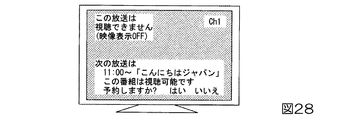
次に、受信予約表示情報の例について説明する。図28は、本実施形態に係る受信予約表示情報の一例を示す図である。図28に示す例では、受信予約表示情報として、放送開始時刻がその時点から最も早い放送予定の表示可能番組の放送開始時刻、番組名および予約の要否を視聴者に問い合わせるメッセージが含まれる。具体的には、「次の放送は、11:00〜「こんにちはジャパン」 この番組は視聴可能です 予約しますか? はい いいえ」、とのメッセージが表示部14に表示される。受信予約表示情報は、その時点において放送される番組「8K スポーツ」で提供される映像の解像度が表示不能解像度であると判定されたときに表示される。そして、「こんにちはジャパン」は、図22に示すように番組「8K スポーツ」が放送されるチャンネルで放送予定の番組のうち、解像度が表示可能解像度であって、最も早く放送が開始される番組である。
Next, an example of reception reservation display information will be described. FIG. 28 is a diagram showing an example of reception reservation display information according to the present embodiment. In the example shown in FIG. 28, the reception reservation display information includes a message for inquiring the viewer about the broadcast start time of the displayable program whose broadcast start time is the earliest scheduled broadcast from that point, the program name, and the necessity of reservation. Specifically, "the next broadcast, 11: 00" Hello Japan "Are you sure that you want this program is available for viewing reservation? A message “Yes No” is displayed on the
受信予約表示情報の表示開始から所定時間以内に操作信号により「はい」の文字が指示されるとき、動作制御部166は、受信予約表示情報を消去し、表示可能番組である「こんにちはジャパン」の受信予約を設定する。動作制御部166は、現時刻が11時になったとき、受信予約が設定された番組「こんにちはジャパン」が提供される受信信号の受信を開始し、その番組の映像を表示部14に表示させる。操作信号により「いいえ」の文字が指示されるとき、または受信予約表示情報の表示開始から所定時間以内に操作信号が入力されないとき、動作制御部166は、受信予約表示情報の表示を消去し、動作モードを視聴モードから省エネモードに変更する。
なお、「この放送は視聴できません」とのメッセージは、その時点で放送される番組の映像の解像度が表示不能解像度であるときに表示させる表示不可メッセージである。「Ch1」は、その時点で選局されているチャンネルのチャンネル番号を示す。
When a character of "YES" by operation signal within a predetermined time from the start of the display of the received reservation display information is instructed, the
The message “This broadcast cannot be viewed” is a non-displayable message that is displayed when the resolution of the video of the program broadcast at that time is an undisplayable resolution. “Ch1” indicates the channel number of the channel currently selected.
次に、本実施形態に係る受信処理について説明する。図29は、本実施形態に係る受信処理を示すフローチャートである。図29に示す処理は、ステップS101〜S103、S105およびS141〜S145の処理を含む。図29に示す処理では、映像解像度が表示不能解像度であると判定されるとき(ステップS103 NO)、ステップS141に進む。 Next, the reception process according to the present embodiment will be described. FIG. 29 is a flowchart showing a reception process according to this embodiment. The process shown in FIG. 29 includes the processes of steps S101 to S103, S105, and S141 to S145. In the process shown in FIG. 29, when it is determined that the video resolution is a non-displayable resolution (NO in step S103), the process proceeds to step S141.
(ステップS141)動作制御部166は、映像処理部1643に映像データの復号を停止させ、表示不可メッセージを表示部14に表示させるステップS141の処理は、ステップS104の処理と同様であってもよい。その後、ステップS142の処理に進む。
(ステップS142)動作制御部166は、MH−EITを参照して、選局中のチャンネルの放送予定の番組から、解像度が表示可能解像度である映像が提供される表示可能番組を検索する。その後、ステップS143に進む。
(ステップS143)動作制御部166は、受信予約表示情報を表示部14に表示させ、表示後、所定時間内において表示可能番組の受信予約の要否について操作信号の操作入力部12からの入力を待ち受ける。受信予約を指示する操作信号が入力されるとき(ステップS143 YES)、ステップS144に進む。受信予約を指示する操作信号が入力されないとき(ステップS143 NO)、ステップS145に進む。
(Step S141) The
(Step S142) The
(Step S143) The
(ステップS144)動作制御部166は、表示可能番組について受信予約を設定する。その後、ステップS145に進む。
(ステップS145)動作制御部166は、動作モードを視聴モードから省エネモードに変更し、映像処理部1643に映像データの復号を停止させる。その後、ステップS101に戻る。但し、受信予約が設定された場合には、動作制御部166は、現時刻が表示可能番組の放送開始時間になったとき、表示可能番組が放送されるチャンネルの放送信号の受信を放送受信部11に開始させる。また、動作制御部166は、映像処理部1643に受信した映像データの復号を開始し、復号により得られた映像信号の表示部14への出力を開始させる。
(Step S144) The
(Step S145) The
なお、上述した例では、受信予約表示情報の表示開始後、所定時間以内に受信予約を指示する操作信号が入力されない場合、動作制御部166は、動作モードを省エネモードに変更することを例にしたが、これには限られない。その場合、動作制御部166は、MH−EITを参照して、その時点において放送されている番組のうち、解像度が表示可能解像度である映像が提供される番組を特定し、その番組を放送するチャンネルのいずれかを特定する。そして、動作制御部166は、特定したチャンネルでの放送信号の受信を放送受信部11に指示する。これにより、動作モードを視聴モードに維持したまま、解像度が表示可能解像度である映像が表示される。また、その場合、動作制御部166は、受信装置10の各構成要素への電力の供給を停止(電源OFF)してもよい。電力の供給停止前に、受信予約が設定されている場合には、動作制御部166は、受信装置10の各構成要素への電力の供給を再開(電源ON)したうえで、表示可能番組が放送されるチャンネルの放送信号の受信開始を放送受信部11に指示し、映像データの復号と復号により得られた映像信号の表示部14への出力開始を映像処理部1643に指示する。
In the above-described example, the
また、上述した例では、受信予約が設定されている場合において、動作制御部166が放送される番組の映像を表示部14に表示させることを例にしたが、これには限られない。動作制御部166は、その映像の表示に代え、または、その映像の表示と併せて、その番組の映像データを記憶部15に記憶(録画)してもよい。
In the above-described example, when the reception reservation is set, the
以上に説明したように、本実施形態に係る受信装置10において、動作制御部166は、映像の解像度が表示不能解像度である場合、映像の番組が放送されるチャンネルにおいて放送予定の番組から映像の解像度が表示可能解像度である表示可能番組を検索する。そして、動作制御部166は、検索した表示可能番組の受信予約に関する案内情報を表示部14に表示させる。
この構成により、解像度が表示不能解像度である映像が提供される番組が放送されるチャンネルで放送予定の番組から、解像度が表示可能解像度である映像が提供される表示可能番組が視聴者に案内され、その受信予約が促される。そのため、視聴者の意思により、その番組を受信することで受信者の満足感を向上させることができる。また、選局されたチャンネルでの番組の受信が促されることにより、解像度が表示不能解像度である映像が提供される番組の放送による、そのチャンネルの視聴率の低下が抑えられる。
As described above, in the receiving
With this configuration, the viewer is guided to a displayable program that provides a video with a resolution that can be displayed from a program that is scheduled to be broadcast on a channel that broadcasts a program that provides a video with a resolution that cannot be displayed. The reception reservation is prompted. Therefore, the viewer's satisfaction can be improved by receiving the program at the viewer's will. In addition, since the reception of the program on the selected channel is promoted, a decrease in the audience rating of the channel due to the broadcast of the program providing the video whose resolution is not displayable can be suppressed.
なお、上述した実施形態では、放送システム1におけるデジタル放送のメディアトランスポート方式としてMMT方式が採用されている場合について説明したが、MMT方式に限定されるものではない。例えば、メディアトランスポート方式として、MPEG−2 TS(Moving Picture Experts Group−2 Transport Stream)方式やRTP(Real−time Transport Protocol)方式が採用されてもよい。
In the above-described embodiment, the case where the MMT system is adopted as the media transport system for digital broadcasting in the
また、上述した実施形態では、番組配列情報i2と番組構成情報i3が、番組データi1と多重化された放送信号で搬送される場合について説明したが、番組配列情報i2と番組構成情報i3が送信される方法は、上述した方法に限定されるものではない。例えば、受信装置10は、通信伝送路NTに接続されたサーバ装置との通信によって番組配列情報i2と番組構成情報i3を取得してもよい。
In the above-described embodiment, the case where the program arrangement information i2 and the program configuration information i3 are carried by a broadcast signal multiplexed with the program data i1 has been described. However, the program arrangement information i2 and the program configuration information i3 are transmitted. The method to be performed is not limited to the method described above. For example, the receiving
また、上述した実施形態では、受信装置10が、主にテレビジョン受像装置である場合を例にしたが、上述した構成に限定されるものではない。例えば、各実施形態に係る受信装置10は、拡声部13と表示部14の一方又は両方との間で各種の信号を送受信できれば、その一方又は両方は着脱可能であってもよい。受信装置10と着脱可能である表示部14が受信装置10と接続されたとき、制御部16は、表示部14に設定された機器情報を取得し、取得した機器情報に基づいて表示部14の解像度を判定してもよい。例えば、機器情報に解像度を示す情報が含まれる場合には、制御部16は、その解像度を採用する。機器情報が表示部14の機種を示す場合には、制御部16は、予め記憶部15に記憶された解像度データを参照して、機器情報が示す型番に対応する解像度を定める。解像度データは、機種毎の解像度を示すデータである。
なお、第3の実施形態に係る受信装置10では、通信部17とデータ入出力部18の一方又は両方が省略されてもよい。
In the above-described embodiment, the case where the receiving
In the receiving
なお、例えば、受信装置10の一部、例えば、制御部16や、制御部16が備える表示処理部164、解像度判定部165、動作制御部166による処理を実現するためのプログラムを、コンピュータ読み取り可能な記録媒体に記録して、当該記録媒体に記録されたプログラムをコンピュータシステムに読み込ませ、実行することにより、上述した種々の処理を行ってもよい。なお、ここでいう「コンピュータシステム」とは、OSや周辺機器等のハードウェアを含むものであってもよい。また、「コンピュータシステム」は、WWWシステムを利用している場合であれば、ホームページ提供環境(あるいは表示環境)も含むものとする。また、「コンピュータ読み取り可能な記録媒体」とは、フレキシブルディスク、光磁気ディスク、ROM、フラッシュメモリ等の書き込み可能な不揮発性メモリ、CD−ROM等の可搬媒体、コンピュータシステムに内蔵されるハードディスク等の記憶装置のことをいう。
For example, a part of the receiving
さらに「コンピュータ読み取り可能な記録媒体」とは、インターネット等のネットワークや電話回線等の通信回線を介してプログラムが送信された場合のサーバやクライアントとなるコンピュータシステム内部の揮発性メモリ(例えば、DRAM(Dynamic Random Access Memory))のように、一定時間プログラムを保持しているものも含むものとする。また、上記プログラムは、このプログラムを記憶装置等に格納したコンピュータシステムから、伝送媒体を介して、あるいは、伝送媒体中の伝送波により他のコンピュータシステムに伝送されてもよい。ここで、プログラムを伝送する「伝送媒体」は、インターネット等のネットワーク(通信網)や電話回線等の通信回線(通信線)のように情報を伝送する機能を有する媒体のことをいう。また、上記プログラムは、前述した機能の一部を実現するためのものであってもよい。さらに、前述した機能をコンピュータシステムにすでに記録されているプログラムとの組み合わせで実現するもの、いわゆる差分ファイル(差分プログラム)であってもよい。 Further, the “computer-readable recording medium” refers to a volatile memory (for example, DRAM (in DRAM) in a computer system that becomes a server or a client when a program is transmitted through a network such as the Internet or a communication line such as a telephone line. Dynamic Random Access Memory)) that holds a program for a certain period of time is also included. The program may be transmitted from a computer system storing the program in a storage device or the like to another computer system via a transmission medium or by a transmission wave in the transmission medium. Here, the “transmission medium” for transmitting the program refers to a medium having a function of transmitting information, such as a network (communication network) such as the Internet or a communication line (communication line) such as a telephone line. The program may be for realizing a part of the functions described above. Furthermore, what implement | achieves the function mentioned above in combination with the program already recorded on the computer system, what is called a difference file (difference program) may be sufficient.
受信装置10の一部、例えば、制御部16や、制御部16が備える表示処理部164、解像度判定部165、動作制御部166、又は全部を、LSI(Large Scale Integration)等の集積回路として実現してもよい。また、本実施形態の受信装置10内の各構成要素は個別にプロセッサ化してもよいし、一部、または全部を集積してプロセッサ化してもよい。また、集積回路化の手法はLSIに限らず専用回路、または汎用プロセッサで実現してもよい。また、半導体技術の進歩によりLSIに代替する集積回路化の技術が出現した場合、当該技術による集積回路を用いてもよい。
A part of the receiving
なお、本発明は、次の態様でも実施することができる。
(1)映像を含む番組の放送信号を受信する受信部と、前記映像の解像度が、前記映像を表示部が表示できない表示不能解像度である場合、前記表示部の表示状態を所定の表示状態に制御し、前記映像の解像度が、前記映像を前記表示部が表示できる表示可能解像度である場合、前記表示部に前記映像を表示させる表示処理部と、を備える受信装置。
In addition, this invention can be implemented also in the following aspect.
(1) When a receiving unit that receives a broadcast signal of a program including video and the resolution of the video is a non-displayable resolution at which the video cannot be displayed by the display unit, the display state of the display unit is changed to a predetermined display state. And a display processing unit configured to display the video on the display unit when the resolution of the video is a displayable resolution at which the display unit can display the video.
(2)前記映像の解像度が、前記表示不能解像度である場合、所定の消費電力よりも消費電力が低い動作モードである消費電力低減モードで前記表示処理部を動作させ、操作入力に応じて前記消費電力低減モードの終了時刻を定める動作制御部、をさらに備える(1)の受信装置。 (2) When the resolution of the video is the non-displayable resolution, the display processing unit is operated in a power consumption reduction mode that is an operation mode in which power consumption is lower than predetermined power consumption, and the display processing unit is operated according to an operation input. The receiving device according to (1), further comprising: an operation control unit that determines an end time of the power consumption reduction mode.
(3)前記動作制御部は、前記映像の解像度が前記表示不能解像度である場合と、前記表示可能解像度である場合とで異なる態様で、前記映像の解像度に対応する発光部を点灯させる(2)の受信装置。 (3) The operation control unit turns on the light emitting unit corresponding to the resolution of the video in a different manner depending on whether the resolution of the video is the non-displayable resolution or the displayable resolution (2 ) Receiver.
(4)前記動作制御部は、前記映像の解像度が前記表示不能解像度である場合、前記映像の番組が放送されるチャンネルにおいて放送予定の番組から映像の解像度が前記表示可能解像度である表示可能番組を検索し、前記表示可能番組の受信予約に関する案内情報を前記表示部に表示させる(2)または(3)の受信装置。 (4) When the resolution of the video is the non-displayable resolution, the operation control unit is a displayable program in which the video resolution is the displayable resolution from a program scheduled to be broadcast in a channel on which the video program is broadcast. The receiving apparatus according to (2) or (3), wherein the display section displays guidance information relating to reception reservation of the displayable program.
(5)前記放送信号で搬送され、放送中または放送予定の番組に関する番組配列情報から受信中の番組に対応する他のコンテンツに関するリンク情報を取得し、前記映像の解像度が、前記表示不能解像度である場合、前記受信部に前記他のコンテンツを受信させる動作制御部、をさらに備える(1)から(4)のいずれかの受信装置。 (5) Link information relating to other content corresponding to the program being received is acquired from program arrangement information relating to the program being broadcast or scheduled to be broadcast, and the video resolution is the non-displayable resolution. In some cases, the receiving device according to any one of (1) to (4), further including an operation control unit that causes the receiving unit to receive the other content.
(6)前記番組配列情報は、番組毎の番組情報を含み、前記番組毎の番組情報を当該番組の放送時間ならびにチャンネルに基づいて配列し、前記リンク情報の少なくとも一部を受信中の番組の番組情報を表示する表示領域に表す電子番組表を生成する番組表生成部と、を備える(5)の受信装置。 (6) The program arrangement information includes program information for each program, the program information for each program is arranged based on the broadcast time and channel of the program, and at least a part of the link information is being received. (5) A receiving apparatus comprising: a program guide generating unit that generates an electronic program guide that is displayed in a display area for displaying program information.
(7)前記動作制御部は、前記他のコンテンツが利用できるか否かを判定する(5)または(6)の受信装置。 (7) The receiving device according to (5) or (6), wherein the operation control unit determines whether or not the other content can be used.
(8)受信装置における受信方法であって、映像を含む番組の放送信号を受信する受信過程と、前記映像の解像度が、前記映像を表示部が表示できない表示不能解像度である場合、前記表示部の表示状態を所定の表示状態に制御し、前記映像の解像度が、前記映像を前記表示部が表示できる表示可能解像度である場合、前記表示部に前記映像を表示させる表示処理過程と、を有する受信方法。 (8) A receiving method in a receiving apparatus, in which a receiving process of receiving a broadcast signal of a program including a video, and the resolution of the video is a non-displayable resolution at which the video cannot be displayed by the display unit, A display processing step of controlling the display state to a predetermined display state and displaying the video on the display unit when the resolution of the video is a displayable resolution at which the display unit can display the video. Reception method.
(9)映像を含む番組の放送信号を受信する受信部を備える受信装置のコンピュータに、前記映像の解像度が、前記映像を表示部が表示できない表示不能解像度である場合、前記表示部の表示状態を所定の表示状態に制御し、前記映像の解像度が、前記映像を前記表示部が表示できる表示可能解像度である場合、前記表示部に前記映像を表示させる表示処理ステップ、を実行させるためのプログラム。 (9) When the resolution of the video is a non-displayable resolution at which the video cannot be displayed on the computer of a receiving device including a receiving unit that receives a broadcast signal of a program including video, the display state of the display Is controlled to a predetermined display state, and when the resolution of the video is a displayable resolution capable of displaying the video on the display unit, a program for executing a display processing step of displaying the video on the display unit .
以上、本発明の実施形態について、図面を参照して説明してきたが、具体的な構成はこの実施形態に限定されるものではなく、本発明の趣旨を逸脱しない範囲においての種々の変更も含まれる。 The embodiment of the present invention has been described above with reference to the drawings. However, the specific configuration is not limited to this embodiment, and includes various modifications within the scope of the present invention. It is.
1…放送システム、10…受信装置、11…放送受信部、12…操作入力部、13…拡声部、14…表示部、15…記憶部、16…制御部、161…復調部、162…分離部、163…音声処理部、164…表示処理部、1641…番組表生成部、1642…選局処理部、1643…映像処理部、165…解像度判定部、166…動作制御部、17…通信部、18…データ入出力部、20…送信装置、30…表示装置
DESCRIPTION OF
Claims (9)
前記映像の解像度が、前記映像を表示部が表示できない表示不能解像度である場合、前記表示部の表示状態を所定の表示状態に制御し、
前記映像の解像度が、前記映像を前記表示部が表示できる表示可能解像度である場合、前記表示部に前記映像を表示させる表示処理部と、
を備える受信装置。 A receiving unit for receiving a broadcast signal of a program including video;
If the resolution of the video is a non-displayable resolution at which the display unit cannot display the video, the display state of the display unit is controlled to a predetermined display state,
When the resolution of the video is a displayable resolution at which the display unit can display the video, a display processing unit that displays the video on the display unit;
A receiving device.
をさらに備える請求項1に記載の受信装置。 When the resolution of the video is the non-displayable resolution, the display processing unit is operated in a power consumption reduction mode that is an operation mode in which power consumption is lower than predetermined power consumption, and the power consumption reduction is performed according to an operation input. Operation control unit that determines the end time of the mode,
The receiving device according to claim 1, further comprising:
前記映像の解像度が前記表示不能解像度である場合と、前記表示可能解像度である場合とで異なる態様で、前記映像の解像度に対応する発光部を点灯させる
請求項2に記載の受信装置。 The operation controller is
The receiving device according to claim 2, wherein a light emitting unit corresponding to the resolution of the video is turned on in a different manner depending on whether the resolution of the video is the non-displayable resolution or the displayable resolution.
前記映像の解像度が前記表示不能解像度である場合、前記映像の番組が放送されるチャンネルにおいて放送予定の番組から映像の解像度が前記表示可能解像度である表示可能番組を検索し、前記表示可能番組の受信予約に関する案内情報を前記表示部に表示させる
請求項2または請求項3のいずれか一項に記載の受信装置。 The operation controller is
When the resolution of the video is the non-displayable resolution, a searchable program whose video resolution is the displayable resolution is searched from a program scheduled to be broadcast in a channel on which the video program is broadcast, and the displayable program The receiving apparatus according to any one of claims 2 and 3, wherein guide information related to reception reservation is displayed on the display unit.
をさらに備える請求項1から請求項4のいずれか一項に記載の受信装置。 When link information related to other content corresponding to the program being received is acquired from the program arrangement information related to the program being broadcast or scheduled to be broadcast, and the resolution of the video is the non-displayable resolution, An operation control unit for causing the receiving unit to receive the other content;
The receiving device according to any one of claims 1 to 4, further comprising:
前記番組毎の番組情報を当該番組の放送時間ならびにチャンネルに基づいて配列し、前記リンク情報の少なくとも一部を受信中の番組の番組情報を表示する表示領域に表す電子番組表を生成する番組表生成部と、
を備える請求項5に記載の受信装置。 The program arrangement information includes program information for each program,
A program guide for generating an electronic program guide in which program information for each program is arranged based on a broadcast time and a channel of the program, and at least a part of the link information is displayed in a display area for displaying program information of the program being received. A generator,
The receiving device according to claim 5.
請求項5または請求項6に記載の受信装置。 The receiving device according to claim 5 or 6, wherein the operation control unit determines whether or not the other content can be used.
映像を含む番組の放送信号を受信する受信過程と、
前記映像の解像度が、前記映像を表示部が表示できない表示不能解像度である場合、前記表示部の表示状態を所定の表示状態に制御し、
前記映像の解像度が、前記映像を前記表示部が表示できる表示可能解像度である場合、前記表示部に前記映像を表示させる表示処理過程と、
を有する受信方法。 A receiving method in a receiving device,
A receiving process for receiving a broadcast signal of a program including video;
If the resolution of the video is a non-displayable resolution at which the display unit cannot display the video, the display state of the display unit is controlled to a predetermined display state,
When the resolution of the video is a displayable resolution at which the display unit can display the video, a display process for displaying the video on the display unit;
Receiving method.
前記映像の解像度が、前記映像を表示部が表示できない表示不能解像度である場合、前記表示部の表示状態を所定の表示状態に制御し、
前記映像の解像度が、前記映像を前記表示部が表示できる表示可能解像度である場合、前記表示部に前記映像を表示させる表示処理ステップ、
を実行させるためのプログラム。 In a computer of a receiving device including a receiving unit that receives a broadcast signal of a program including video,
If the resolution of the video is a non-displayable resolution at which the display unit cannot display the video, the display state of the display unit is controlled to a predetermined display state,
A display processing step of displaying the video on the display unit when the video resolution is a displayable resolution at which the display unit can display the video;
A program for running
Applications Claiming Priority (2)
| Application Number | Priority Date | Filing Date | Title |
|---|---|---|---|
| JP2015121463 | 2015-06-16 | ||
| JP2015121463 | 2015-06-16 |
Publications (1)
| Publication Number | Publication Date |
|---|---|
| JP2017011697A true JP2017011697A (en) | 2017-01-12 |
Family
ID=57764473
Family Applications (1)
| Application Number | Title | Priority Date | Filing Date |
|---|---|---|---|
| JP2016115379A Pending JP2017011697A (en) | 2015-06-16 | 2016-06-09 | Receiver, reception method, and program |
Country Status (1)
| Country | Link |
|---|---|
| JP (1) | JP2017011697A (en) |
Cited By (1)
| Publication number | Priority date | Publication date | Assignee | Title |
|---|---|---|---|---|
| JP2019186833A (en) * | 2018-04-13 | 2019-10-24 | 東芝映像ソリューション株式会社 | Broadcast receiver and broadcast reception method |
Citations (12)
| Publication number | Priority date | Publication date | Assignee | Title |
|---|---|---|---|---|
| JPH0715676A (en) * | 1993-06-23 | 1995-01-17 | Hochiki Corp | Tv modulator |
| JPH10248051A (en) * | 1997-03-05 | 1998-09-14 | Matsushita Electric Ind Co Ltd | Digital data transmission method, digital data transmission device, and digital data reception device |
| JP2008048299A (en) * | 2006-08-21 | 2008-02-28 | Matsushita Electric Ind Co Ltd | Broadcast receiving apparatus and broadcast receiving method |
| JP2008193172A (en) * | 2007-01-31 | 2008-08-21 | Sharp Corp | Broadcast receiver |
| WO2009016835A1 (en) * | 2007-08-01 | 2009-02-05 | Panasonic Corporation | Digital broadcast transmission device and digital broadcast reception device |
| JP2010062708A (en) * | 2008-09-02 | 2010-03-18 | Nec Electronics Corp | Digital broadcast receiver |
| JP2011166198A (en) * | 2010-02-04 | 2011-08-25 | Yamaha Corp | Audio video device |
| JP2012004893A (en) * | 2010-06-17 | 2012-01-05 | Hitachi Ltd | Contents conversion system, and contents conversion method |
| JP2012110050A (en) * | 2012-02-27 | 2012-06-07 | Toshiba Corp | Broadcast transmitter, broadcast receiver, and broadcast transmission method |
| JP2015005917A (en) * | 2013-06-21 | 2015-01-08 | 株式会社東芝 | Information transmitting apparatus, information transmitting method, and information receiving apparatus |
| JP2015070404A (en) * | 2013-09-27 | 2015-04-13 | 沖電気工業株式会社 | Device and program for program table generation |
| JP2015104101A (en) * | 2013-11-28 | 2015-06-04 | 船井電機株式会社 | Video receiving apparatus, video transmitting apparatus, and video reproduction method |
-
2016
- 2016-06-09 JP JP2016115379A patent/JP2017011697A/en active Pending
Patent Citations (12)
| Publication number | Priority date | Publication date | Assignee | Title |
|---|---|---|---|---|
| JPH0715676A (en) * | 1993-06-23 | 1995-01-17 | Hochiki Corp | Tv modulator |
| JPH10248051A (en) * | 1997-03-05 | 1998-09-14 | Matsushita Electric Ind Co Ltd | Digital data transmission method, digital data transmission device, and digital data reception device |
| JP2008048299A (en) * | 2006-08-21 | 2008-02-28 | Matsushita Electric Ind Co Ltd | Broadcast receiving apparatus and broadcast receiving method |
| JP2008193172A (en) * | 2007-01-31 | 2008-08-21 | Sharp Corp | Broadcast receiver |
| WO2009016835A1 (en) * | 2007-08-01 | 2009-02-05 | Panasonic Corporation | Digital broadcast transmission device and digital broadcast reception device |
| JP2010062708A (en) * | 2008-09-02 | 2010-03-18 | Nec Electronics Corp | Digital broadcast receiver |
| JP2011166198A (en) * | 2010-02-04 | 2011-08-25 | Yamaha Corp | Audio video device |
| JP2012004893A (en) * | 2010-06-17 | 2012-01-05 | Hitachi Ltd | Contents conversion system, and contents conversion method |
| JP2012110050A (en) * | 2012-02-27 | 2012-06-07 | Toshiba Corp | Broadcast transmitter, broadcast receiver, and broadcast transmission method |
| JP2015005917A (en) * | 2013-06-21 | 2015-01-08 | 株式会社東芝 | Information transmitting apparatus, information transmitting method, and information receiving apparatus |
| JP2015070404A (en) * | 2013-09-27 | 2015-04-13 | 沖電気工業株式会社 | Device and program for program table generation |
| JP2015104101A (en) * | 2013-11-28 | 2015-06-04 | 船井電機株式会社 | Video receiving apparatus, video transmitting apparatus, and video reproduction method |
Cited By (2)
| Publication number | Priority date | Publication date | Assignee | Title |
|---|---|---|---|---|
| JP2019186833A (en) * | 2018-04-13 | 2019-10-24 | 東芝映像ソリューション株式会社 | Broadcast receiver and broadcast reception method |
| JP7010756B2 (en) | 2018-04-13 | 2022-01-26 | Tvs Regza株式会社 | Broadcast receiving device and broadcasting receiving method |
Similar Documents
| Publication | Publication Date | Title |
|---|---|---|
| US11558657B2 (en) | Integration of control data into digital broadcast content for access to ancillary information | |
| US20080225167A1 (en) | Method for displaying video pictures | |
| JP4444932B2 (en) | Information processing apparatus and control method thereof | |
| CN110612677B (en) | Receiving apparatus, receiving method, transmitting apparatus, and transmitting method | |
| CN101141589A (en) | Method for automatically searching data application for all channels and device using same | |
| CN101345851B (en) | Image processing apparatus and control method thereof | |
| US11889161B2 (en) | Receiving device, receiving method, signal processing device, and signal processing method | |
| US20170006346A1 (en) | Video receiving apparatus and video display method | |
| JP3539453B2 (en) | Electronic program guide display control apparatus and method | |
| KR20120046988A (en) | Method and computer readable recording medium for controlling multimedia display device and voice recorder | |
| JP4958922B2 (en) | Information processing apparatus and control method thereof | |
| JP2017011697A (en) | Receiver, reception method, and program | |
| JP6359134B2 (en) | Receiving device, receiving method, program, and storage medium | |
| US8146122B2 (en) | Receiving apparatus | |
| JP3539452B2 (en) | Electronic program guide display control apparatus and method | |
| CN101682703B (en) | Method for viewing data broadcast and receiving device for realizing the method | |
| JP6429402B2 (en) | Reception device, television reception device, reception method, program, and storage medium | |
| JP6238086B2 (en) | Receiving device, receiving method, program, and storage medium | |
| US20240313874A1 (en) | Transmission device, transmission method, and reception device | |
| JP2018182762A (en) | Receiving device, television device, storage medium, receiving method, and program | |
| JP2006340111A (en) | Digital broadcast receiving device | |
| KR20120001928A (en) | Method of displaying channel information and display device using same | |
| JP6950892B2 (en) | Broadcast receiver and content search method | |
| JP6500956B2 (en) | Receiving apparatus, television apparatus, program, storage medium, and control method | |
| JP2004064463A (en) | Digital broadcast receiving apparatus |
Legal Events
| Date | Code | Title | Description |
|---|---|---|---|
| A621 | Written request for application examination |
Free format text: JAPANESE INTERMEDIATE CODE: A621 Effective date: 20190320 |
|
| A977 | Report on retrieval |
Free format text: JAPANESE INTERMEDIATE CODE: A971007 Effective date: 20190722 |
|
| A131 | Notification of reasons for refusal |
Free format text: JAPANESE INTERMEDIATE CODE: A131 Effective date: 20190813 |
|
| A02 | Decision of refusal |
Free format text: JAPANESE INTERMEDIATE CODE: A02 Effective date: 20200225 |