JP2017014547A - High Mn steel for high-pressure hydrogen gas and pipes, containers, valves and joints made of the steel - Google Patents
High Mn steel for high-pressure hydrogen gas and pipes, containers, valves and joints made of the steel Download PDFInfo
- Publication number
- JP2017014547A JP2017014547A JP2015129682A JP2015129682A JP2017014547A JP 2017014547 A JP2017014547 A JP 2017014547A JP 2015129682 A JP2015129682 A JP 2015129682A JP 2015129682 A JP2015129682 A JP 2015129682A JP 2017014547 A JP2017014547 A JP 2017014547A
- Authority
- JP
- Japan
- Prior art keywords
- hydrogen gas
- steel
- pressure hydrogen
- content
- less
- Prior art date
- Legal status (The legal status is an assumption and is not a legal conclusion. Google has not performed a legal analysis and makes no representation as to the accuracy of the status listed.)
- Granted
Links
Classifications
-
- Y—GENERAL TAGGING OF NEW TECHNOLOGICAL DEVELOPMENTS; GENERAL TAGGING OF CROSS-SECTIONAL TECHNOLOGIES SPANNING OVER SEVERAL SECTIONS OF THE IPC; TECHNICAL SUBJECTS COVERED BY FORMER USPC CROSS-REFERENCE ART COLLECTIONS [XRACs] AND DIGESTS
- Y02—TECHNOLOGIES OR APPLICATIONS FOR MITIGATION OR ADAPTATION AGAINST CLIMATE CHANGE
- Y02E—REDUCTION OF GREENHOUSE GAS [GHG] EMISSIONS, RELATED TO ENERGY GENERATION, TRANSMISSION OR DISTRIBUTION
- Y02E60/00—Enabling technologies; Technologies with a potential or indirect contribution to GHG emissions mitigation
- Y02E60/30—Hydrogen technology
- Y02E60/32—Hydrogen storage
Landscapes
- Filling Or Discharging Of Gas Storage Vessels (AREA)
Abstract
【課題】Ni当量を管理したSUS316系鋼よりも安価かつTS≧800MPaであり、高圧水素ガス環境下での機械的特性に優れて良好な耐水素ガス脆化特性を備える高Mn鋼鋼材を提供する。【解決手段】化学組成が、質量%で、C<0.40%、Si:0.05〜1.0%、Mn:20.0〜60.0%、N<0.10%、Ni:0〜5%、Cu:0〜5%、Co:0〜5%、Al:0〜1%、Cr:0〜5%、Mo:0〜3%、W:0〜6%、V:0〜1.0%、Nb:0〜1.0%、Ti:0〜1.0%、Zr:0〜1.0%、Hf:0〜1.0%、Ta:0〜1.0%、B:0〜0.020%、Ca:0〜0.0050%、Mg:0〜0.0050%、REM:0〜0.50%、残部:Fe及び不純物、不純物としてのP、S、Oが、P≦0.050%、S≦0.050%、O≦0.020%、更に0.05≦C+4N≦0.40であり、マトリックスの金属組織が、体積率で、fcc構造相:90〜100%、bcc構造相:0〜10%及びhcp構造相:0〜10%、上記構造相の合計:100%で、結晶粒のアスペクト比:2.0超であり、TS≧800MPaである高圧水素ガス用高Mn鋼鋼材。【選択図】なし[PROBLEMS] To provide a high-Mn steel material that is cheaper than SUS316 steel with a controlled Ni equivalent, has TS ≧ 800MPa, has excellent mechanical properties in a high-pressure hydrogen gas environment, and has good hydrogen gas embrittlement resistance. To do. SOLUTION: Chemical composition is mass%, C <0.40%, Si: 0.05-1.0%, Mn: 20.0-60.0%, N <0.10%, Ni: 0-5%, Cu: 0-5%, Co: 0-5%, Al: 0-1%, Cr: 0-5%, Mo: 0-3%, W: 0-6%, V: 0-1.0%, Nb: 0-1.0%, Ti : 0-1.0%, Zr: 0-1.0%, Hf: 0-1.0%, Ta: 0-1.0%, B: 0-0.020%, Ca: 0-0.0050%, Mg: 0-0.0050%, REM: 0 to 0.50%, balance: Fe and impurities, P, S, and O as impurities are P ≦ 0.050%, S ≦ 0.050%, O ≦ 0.020%, and 0.05 ≦ C + 4N ≦ 0.40, and the metal structure of the matrix is , Volume ratio, fcc structural phase: 90-100%, bcc structural phase: 0-10% and hcp structural phase: 0-10%, total of the above structural phases: 100%, crystal grain aspect ratio: over 2.0 And high Mn steel for high pressure hydrogen gas with TS ≧ 800MPa. [Selection figure] None
Description
本発明は、高圧水素ガス用高Mn鋼鋼材ならびにその鋼材からなる、配管、容器、バルブおよび継手に関する。より詳しくは、本発明は、高圧水素ガス環境において優れた機械的特性を有する高Mn鋼鋼材に関し、さらに、上記の鋼材からなり、水素を燃料として走行する燃料電池自動車(以下、単に「燃料電池自動車」という。)ならびに上記燃料電池自動車に水素を供給する水素ステーションで使用される高圧水素ガス用の、配管、容器、バルブおよび継手にも関する。 The present invention relates to a high-Mn steel material for high-pressure hydrogen gas and a pipe, container, valve and joint made of the steel material. More specifically, the present invention relates to a high-Mn steel material having excellent mechanical properties in a high-pressure hydrogen gas environment, and further, a fuel cell vehicle (hereinafter simply referred to as “fuel cell”) made of the above-described steel material and running on hydrogen as fuel. It also relates to piping, containers, valves and fittings for high pressure hydrogen gas used in hydrogen stations that supply hydrogen to the fuel cell vehicle.
近年、燃料電池自動車の開発および水素ステーションの実用化研究が進められており、オーステナイト系ステンレス鋼はこれらに用いられる主要金属材料である。 In recent years, development of fuel cell vehicles and practical application research of hydrogen stations have been promoted, and austenitic stainless steel is the main metal material used in these.
これは、結晶構造として、面心立方(fcc)構造のオーステナイト系ステンレス鋼が、一般的に体心立方(bcc)構造または体心正方(bct)構造(以下、本明細書においてはこれらをまとめて「bcc構造」という。)の炭素鋼および低合金鋼に比べて、優れた耐水素ガス脆化特性を有するためである。 This is because the austenitic stainless steel having a face-centered cubic (fcc) structure as a crystal structure is generally a body-centered cubic (bcc) structure or a body-centered tetragonal (bct) structure (hereinafter, these are summarized in this specification). This is because it has excellent hydrogen gas embrittlement resistance compared to carbon steel and low alloy steel of “bcc structure”.
しかし、高圧の水素ガス環境ではオーステナイト系ステンレス鋼も水素ガスによる脆化(以下「水素ガス脆化」という。)を起こす場合がある。 However, in a high-pressure hydrogen gas environment, austenitic stainless steel may also be embrittled by hydrogen gas (hereinafter referred to as “hydrogen gas embrittlement”).
例えば、オーステナイト系ステンレス鋼のうちで、SUS304等の準安定オーステナイト系ステンレス鋼は、塑性変形に伴って水素脆化感受性の高いbcc構造のひずみ誘起マルテンサイト(α’マルテンサイト)を生成するため、水素ガス脆化を起こし易い。 For example, among austenitic stainless steels, metastable austenitic stainless steels such as SUS304 produce strain-induced martensite (α ′ martensite) having a bcc structure that is highly susceptible to hydrogen embrittlement due to plastic deformation. Prone to hydrogen gas embrittlement.
一方、SUS316、SUS316L等の安定オーステナイト系ステンレス鋼は、常温では相変態を起こしにくいため、優れた耐水素ガス脆化特性を有する。 On the other hand, stable austenitic stainless steels such as SUS316 and SUS316L have excellent hydrogen gas embrittlement resistance because they hardly undergo phase transformation at room temperature.
しかし、上記のSUS316およびSUS316Lでも、温度が低くなって常温を下回ると、それらの成分規格内でもCr、Ni等の含有量が低い場合にひずみ誘起マルテンサイトを生成し、水素ガス脆化を起こす。 However, even in the above-mentioned SUS316 and SUS316L, when the temperature is lower than normal temperature, strain-induced martensite is generated even when the content of Cr, Ni, etc. is low even within these component specifications, causing hydrogen gas embrittlement. .
さらに、燃料電池自動車の航続距離向上のため、燃料電池自動車に搭載される水素タンクの圧力は、近年では従来の45MPaよりも高い70MPaとなっている。 Furthermore, in order to improve the cruising distance of the fuel cell vehicle, the pressure of the hydrogen tank mounted on the fuel cell vehicle is 70 MPa, which is higher than the conventional 45 MPa in recent years.
このため、非特許文献1に、高圧の水素ガス環境用のオーステナイト系ステンレス鋼として、その使用温度に応じて、下記の〔1〕式で表されるNi当量と呼ばれるパラメータ式に基づき、化学組成を厳格に管理したものを使用するべきことが提案されている。
Ni当量=12.6C+0.35Si+1.05Mn+Ni+0.65Cr+0.98Mo・・・〔1〕。
但し、〔1〕式中のC、Si、Mn、Ni、CrおよびMoは、それぞれの元素の鋼中含有量(質量%)を意味する。
For this reason, non-patent document 1 describes a chemical composition as austenitic stainless steel for high-pressure hydrogen gas environment based on a parameter formula called Ni equivalent represented by the following formula [1] according to the operating temperature. It is proposed to use a strictly controlled version.
Ni equivalent = 12.6C + 0.35Si + 1.05Mn + Ni + 0.65Cr + 0.98Mo (1).
However, C, Si, Mn, Ni, Cr and Mo in the formula [1] mean the content (mass%) of each element in steel.
高圧ガス保安法に定められる自動車用圧縮水素容器例示基準では、水素ガス脆化を起こしにくいオーステナイト系ステンレス鋼として、上記Ni当量の下限値が規定され、該条件を満たすSUS316およびSUS316Lの使用が認められている。そして、実態として、所定のNi当量値を満足するように、高価なNiを成分規格の上限に近い量まで多量に含有させたSUS316およびSUS316Lが用いられている。 In the example of compressed hydrogen container for automobiles stipulated in the High Pressure Gas Safety Law, the lower limit of the Ni equivalent is defined as an austenitic stainless steel that is less prone to hydrogen gas embrittlement, and the use of SUS316 and SUS316L satisfying the condition is permitted. It has been. In actuality, SUS316 and SUS316L containing a large amount of expensive Ni up to an amount close to the upper limit of the component standard are used so as to satisfy a predetermined Ni equivalent value.
一方、現在、燃料電池自動車および水素ステーションでは、製造コストの低減が最大の課題となっている。したがって、高価なNiを多量に含有する材料を使用することは、燃料電池自動車および水素ステーションの低コスト化に対して大きな抵抗となる。このため、水素ガス脆化を起こしにくく、かつSUS316およびSUS316Lよりも安価なオーステナイト系ステンレス鋼の開発要望が極めて高い。 On the other hand, at present, reduction of manufacturing costs is the biggest issue for fuel cell vehicles and hydrogen stations. Therefore, using a material containing a large amount of expensive Ni is a great resistance to reducing the cost of fuel cell vehicles and hydrogen stations. For this reason, there is an extremely high demand for development of austenitic stainless steel that is less prone to hydrogen gas embrittlement and cheaper than SUS316 and SUS316L.
さらに、燃料電池自動車の航続距離向上のための高い水素タンク圧力に耐えられるように、上記オーステナイト系ステンレス鋼には、従来以上の高強度も要求される。このため、特に、800MPa以上の引張強さを有する安価な高強度オーステナイト系ステンレス鋼の開発要望が大きい。 Further, the austenitic stainless steel is required to have higher strength than before so that it can withstand a high hydrogen tank pressure for improving the cruising distance of the fuel cell vehicle. For this reason, in particular, there is a great demand for development of an inexpensive high-strength austenitic stainless steel having a tensile strength of 800 MPa or more.
オーステナイト安定化作用を有し、かつNiよりも安価な元素として、Mnが挙げられる。オーステナイト系の高Mn鋼としては、例えば、Cr−Mn−Ni系の高N鋼であるAISI type 205ステンレス鋼およびC−Mn系のハッドフィールド鋼(Hadfield’s Steel)がよく知られている。 An element having an austenite stabilizing action and cheaper than Ni is Mn. As an austenitic high Mn steel, for example, AISI type 205 stainless steel and C-Mn based Hadfield's Steel, which are Cr-Mn-Ni high N steels, are well known.
また、特許文献1〜3に、オーステナイト系の各種高Mn鋼が開示されている。 Patent Documents 1 to 3 disclose various austenitic high Mn steels.
前述のとおり、SUS304のようにオーステナイトの安定度が低く、塑性変形によりひずみ誘起マルテンサイトを生成するオーステナイト系ステンレス鋼は、水素ガス脆化を起こし易いので高圧の水素ガス環境で用いることはできない。 As described above, austenitic stainless steel, which has low austenite stability such as SUS304 and generates strain-induced martensite by plastic deformation, easily causes hydrogen gas embrittlement and cannot be used in a high-pressure hydrogen gas environment.
また、前記〔1〕式で表されるNi当量の規定値を満足させるために高価なNiを成分規格の上限に近い量まで多量に含有させたSUS316およびSUS316Lは、水素ガス脆化を起こしにくいものの高価である。 Further, SUS316 and SUS316L containing a large amount of expensive Ni up to an amount close to the upper limit of the component standard in order to satisfy the specified value of the Ni equivalent represented by the formula [1] are less prone to hydrogen gas embrittlement. Things are expensive.
一方、既存のAISI type 205ステンレス鋼およびハッドフィールド鋼は、オーステナイトの安定度が高く塑性変形してもひずみ誘起マルテンサイトを生じない。さらに、これらの鋼は、上述のSUS316およびSUS316Lよりも安価である。しかし、本発明者らが70MPa以上という高圧水素ガス環境での水素ガス脆化特性を評価したところ、いずれも水素ガス脆化を起こし易く、上記高圧水素ガス環境ではこれらの鋼を使用できないことが判明した。 On the other hand, existing AISI type 205 stainless steel and hadfield steel have high austenite stability and do not cause strain-induced martensite even when plastically deformed. Furthermore, these steels are cheaper than the above-mentioned SUS316 and SUS316L. However, when the present inventors evaluated the hydrogen gas embrittlement characteristics in a high-pressure hydrogen gas environment of 70 MPa or more, all of them easily cause hydrogen gas embrittlement, and these steels cannot be used in the high-pressure hydrogen gas environment. found.
特許文献1で開示された鉄合金は、「水素脆化に対する抵抗性を持つ」とされている。しかしながら、本発明者らが水素ガス脆化特性を70MPa以上という高圧水素ガス環境で評価したところ、特許文献1の鉄合金は、その規定範囲内の化学組成を有していても、特に引張強さが800MPa以上の場合には、水素ガス脆化を起こすことがあり、上記のような高圧の水素ガス環境では安定して使用できないことが判明した。 The iron alloy disclosed in Patent Document 1 is said to have “resistance to hydrogen embrittlement”. However, when the present inventors evaluated the hydrogen gas embrittlement property in a high-pressure hydrogen gas environment of 70 MPa or more, the iron alloy of Patent Document 1 has a particularly high tensile strength even if it has a chemical composition within the specified range. When the thickness is 800 MPa or more, hydrogen gas embrittlement may occur, and it has been found that it cannot be stably used in the high-pressure hydrogen gas environment as described above.
特許文献2で開示された鋼材は、硫化物応力割れ(SSC)に対して優れた耐性を有しているため、高強度油井用鋼材として適している。なお、上記の「SSC」は、腐食環境中で鋼材表面に発生した水素の鋼中への拡散と鋼材に負荷された応力との相乗作用によって破断に至る水素脆化の1種である。しかし、本発明者らが70MPa以上という高圧水素ガス環境で上記鋼材の水素ガス脆化特性を評価したところ、特許文献2の鋼材は、その規定範囲内の化学組成を有していても、水素ガス脆化を起こす場合のあることが判明した。このため、特許文献2で提案された鋼材は、70MPa以上という高圧の水素ガス環境での使用に対しては、改善すべき余地がある。 Since the steel material disclosed in Patent Document 2 has excellent resistance to sulfide stress cracking (SSC), it is suitable as a steel material for high-strength wells. The above-mentioned “SSC” is one type of hydrogen embrittlement that results in fracture due to the synergistic action of the diffusion of hydrogen generated on the steel material surface in the corrosive environment into the steel and the stress applied to the steel material. However, when the present inventors evaluated the hydrogen gas embrittlement characteristics of the above steel material in a high-pressure hydrogen gas environment of 70 MPa or more, the steel material of Patent Document 2 has a chemical composition within the specified range. It has been found that gas embrittlement may occur. For this reason, the steel material proposed in Patent Document 2 has room to be improved for use in a high-pressure hydrogen gas environment of 70 MPa or more.
特許文献3で開示された鋼は、確かに、SUS316系鋼を上回る耐水素脆化感受性を有するため、高圧水素環境で使用するのに適している。しかし、特許文献3の鋼は、Cr含有量が10〜20%と高いため、鋼材コストの低減という観点から、改善すべき余地がある。 The steel disclosed in Patent Document 3 certainly has a higher resistance to hydrogen embrittlement than SUS316 steel, and is therefore suitable for use in a high-pressure hydrogen environment. However, since the steel of Patent Document 3 has a high Cr content of 10 to 20%, there is room for improvement from the viewpoint of reducing the steel material cost.
上記のように、これまでは800MPa以上の引張強さおよび70MPa以上という高圧水素ガス環境での良好な耐水素ガス脆化特性を有し、さらに経済性にも優れる金属材料は存在しなかった。 As described above, there has been no metal material that has a tensile strength of 800 MPa or more and a good hydrogen gas embrittlement resistance in a high-pressure hydrogen gas environment of 70 MPa or more and is also excellent in economy.
本発明は、上記現状に鑑みてなされたもので、Ni当量を管理したSUS316およびSUS316Lよりも安価で800MPa以上の引張強さを有し、かつ高圧水素ガス環境(中でも70MPa以上の高圧水素ガス環境)下での機械的特性に優れて良好な耐水素ガス脆化特性を備える高Mn鋼鋼材を提供することを目的とする。さらに、上記の鋼材からなる、高圧水素ガス用の、配管、容器、バルブおよび継手を提供することもまた、本発明の目的である。 The present invention has been made in view of the above situation, and is cheaper than SUS316 and SUS316L in which Ni equivalent is controlled and has a tensile strength of 800 MPa or more and a high-pressure hydrogen gas environment (in particular, a high-pressure hydrogen gas environment of 70 MPa or more). An object of the present invention is to provide a high Mn steel material having excellent mechanical properties under the above and having good hydrogen gas embrittlement resistance. Furthermore, it is also an object of the present invention to provide pipes, containers, valves and joints for high-pressure hydrogen gas made of the above steel materials.
本発明者らは、前記の課題を解決するために、高圧水素ガス環境で十分な耐水素ガス脆化特性を確保するための調査を実施した。この調査には、既存のAISI type 205ステンレス鋼およびハッドフィールド鋼をベースにして化学組成を種々調整した鋼、ならびに従来提案されているオーステナイト系の高Mn鋼をベースにして化学組成を種々調整した高Mn鋼を用いた。その結果、下記(a)〜(f)の知見を得た。 In order to solve the above-mentioned problems, the present inventors conducted an investigation to ensure sufficient hydrogen gas embrittlement characteristics in a high-pressure hydrogen gas environment. In this study, various chemical compositions were adjusted based on existing AISI type 205 stainless steel and Hadfield steel based on various chemical compositions, and on the conventional austenitic high Mn steel. High Mn steel was used. As a result, the following findings (a) to (f) were obtained.
(a)Mnを多量に含有させることにより、高価なNiを含有させることなく、オーステナイトを安定化させることができる。しかし、高Mn鋼は、固溶化熱処理のままでは、安定して800MPa以上の引張強さが得られないことがある。 (A) By containing a large amount of Mn, austenite can be stabilized without containing expensive Ni. However, the high Mn steel may not be able to stably obtain a tensile strength of 800 MPa or more with the solution heat treatment.
(b)下記の[1]式で表されるFn1が0.05以上である高Mn鋼は、塑性変形、特に冷間加工によって、安定して800MPa以上の引張強さを備える。
Fn1=C+4N・・・[1]。
但し、[1]式中のCおよびNは、それぞれの元素の鋼中含有量(質量%)を意味する。
(B) The high Mn steel having Fn1 represented by the following formula [1] of 0.05 or more has a tensile strength of 800 MPa or more stably by plastic deformation, particularly cold working.
Fn1 = C + 4N ... [1].
However, C and N in the formula [1] mean the content (mass%) of each element in steel.
(c)AISI type 205ステンレス鋼およびハッドフィールド系鋼は、塑性変形でひずみ誘起マルテンサイトが生成しないにも拘わらず、70MPa以上という高圧水素ガス環境で水素ガス脆化を起こし易い。その理由は、積層欠陥エネルギーを低下させる元素である固溶型元素のN(窒素)および/またはC(炭素)を多く含有するためと考えられる。すなわち、AISI type 205ステンレス鋼は、一般に、質量%で、0.32〜0.40%のNおよび0.12〜0.25%のCを含有し、ハッドフィールド系鋼は、一般に、質量%で、0.9〜1.2%のCを含有する。このため、Nまたは/およびCを多量に含有する上記の鋼種では、塑性変形時に積層欠陥が生じ易くなり、積層欠陥の生成によって変形の局所化が起こり、変形が局所化した部位で水素ガス脆化感受性が高まると考えられる。 (C) AISI type 205 stainless steel and Hadfield steel are susceptible to hydrogen gas embrittlement in a high-pressure hydrogen gas environment of 70 MPa or higher, although strain-induced martensite is not generated by plastic deformation. The reason for this is considered to be that a large amount of solid solution element N (nitrogen) and / or C (carbon), which is an element that lowers the stacking fault energy, is contained. That is, AISI type 205 stainless steel generally contains 0.32 to 0.40% N and 0.12 to 0.25% C in mass%, while the Hadfield steel generally contains mass%. And containing 0.9-1.2% C. For this reason, in the above steel types containing a large amount of N or / and C, stacking faults are likely to occur during plastic deformation, and deformation is localized due to the generation of stacking faults, and hydrogen gas embrittlement occurs at the site where the deformation is localized. It is thought that susceptibility will increase.
(d)さらに、冷間加工された高Mn鋼では、CおよびNの含有量が水素ガス脆化に及ぼす作用が大きくなる。特に、前記の[1]式で表されるFn1が0.40を超える高Mn鋼は、冷間加工によって極めて70MPa以上という高圧水素ガス環境で水素ガス脆化を生じやすくなる。 (D) Further, in the cold-worked high Mn steel, the effect of the contents of C and N on hydrogen gas embrittlement is increased. In particular, a high Mn steel having Fn1 expressed by the above formula [1] exceeding 0.40 is likely to cause hydrogen gas embrittlement in a high-pressure hydrogen gas environment of 70 MPa or more by cold working.
(e)オーステナイトの安定度が低く、しかも冷間加工を受けて、金属組織中にbcc構造のフェライトまたは/およびα’マルテンサイトの体積率が高くなったオーステナイト系の高Mn鋼は、70MPa以上という高圧水素ガス環境で極めて水素ガス脆化を起こし易い。 (E) Austenitic high Mn steel having low austenite stability and undergoing cold working to increase the volume fraction of ferrite or / and α ′ martensite in the bcc structure in the metal structure is 70 MPa or more. It is extremely easy to cause hydrogen gas embrittlement in a high-pressure hydrogen gas environment.
(f)同様に、オーステナイトの安定度が低く、しかも冷間加工を受けて、金属組織中にhcp構造のεマルテンサイトの体積率が高くなったオーステナイト系の高Mn鋼は、70MPa以上という高圧水素ガス環境で極めて水素ガス脆化を起こし易い。 (F) Similarly, an austenitic high Mn steel having a low austenite stability and undergoing cold working to have a high volume fraction of ε-martensite having an hcp structure in the metal structure has a high pressure of 70 MPa or more. Hydrogen gas embrittlement easily occurs in a hydrogen gas environment.
本発明は、上記の内容に基づいて完成されたものであり、その要旨は、下記に示す高圧水素ガス用高Mn鋼鋼材ならびにその鋼材からなる、高圧水素ガス用の、配管、容器、バルブおよび継手にある。 The present invention has been completed on the basis of the above contents, the gist of which is the following high-pressure hydrogen gas Mn steel material and high-pressure hydrogen gas pipe, container, valve and It is in the joint.
(1)化学組成が、質量%で、C:0.40%未満、Si:0.05〜1.0%、Mn:20.0〜60.0%、N:0.10%未満、Ni:0〜5%、Cu:0〜5%、Co:0〜5%、Al:0〜1%、Cr:0〜5%、Mo:0〜3%、W:0〜6%、V:0〜1.0%、Nb:0〜1.0%、Ti:0〜1.0%、Zr:0〜1.0%、Hf:0〜1.0%、Ta:0〜1.0% B:0〜0.020%、Ca:0〜0.0050%、Mg:0〜0.0050%、REM:0〜0.50%、残部がFeおよび不純物であり、不純物としてのP、SおよびOが、P:0.050%以下、S:0.050%以下およびO:0.020%以下で、さらに、下記[1]式で表されるFn1が、0.05≦Fn1≦0.40であり、
マトリックスの金属組織が、体積率で、fcc構造相:90〜100%、bcc構造相:0〜10%およびhcp構造相:0〜10%、かつ上記構造相の合計:100%であり、結晶粒のアスペクト比:2.0超えであり、
引張強さが800MPa以上である、
高圧水素ガス用高Mn鋼鋼材。
Fn1=C+4N・・・[1]
但し、[1]式中のCおよびNは、それぞれの元素の鋼中含有量(質量%)を意味する。
(1) Chemical composition is mass%, C: less than 0.40%, Si: 0.05 to 1.0%, Mn: 20.0 to 60.0%, N: less than 0.10%, Ni : 0-5%, Cu: 0-5%, Co: 0-5%, Al: 0-1%, Cr: 0-5%, Mo: 0-3%, W: 0-6%, V: 0 to 1.0%, Nb: 0 to 1.0%, Ti: 0 to 1.0%, Zr: 0 to 1.0%, Hf: 0 to 1.0%, Ta: 0 to 1.0 % B: 0 to 0.020%, Ca: 0 to 0.0050%, Mg: 0 to 0.0050%, REM: 0 to 0.50%, the balance being Fe and impurities, P as impurities, S and O are P: 0.050% or less, S: 0.050% or less and O: 0.020% or less, and Fn1 represented by the following formula [1] is 0.05 ≦ Fn1 ≦ 0.40,
The metal structure of the matrix is, by volume, fcc structural phase: 90 to 100%, bcc structural phase: 0 to 10% and hcp structural phase: 0 to 10%, and the total of the above structural phases: 100%, The aspect ratio of the grains is over 2.0,
The tensile strength is 800 MPa or more,
High Mn steel for high pressure hydrogen gas.
Fn1 = C + 4N [1]
However, C and N in the formula [1] mean the content (mass%) of each element in steel.
(2)質量%で、Ni:0.1〜5%、Cu:0.1〜5%およびCo:0.1〜5%から選択される1種以上を含有する、上記(1)に記載の高圧水素ガス用高Mn鋼鋼材。 (2) The composition according to (1) above, containing 1% or more selected from Ni: 0.1 to 5%, Cu: 0.1 to 5%, and Co: 0.1 to 5% by mass%. High Mn steel for high pressure hydrogen gas.
(3)質量%で、Al:0.005〜1%、Cr:0.1〜5%、Mo:0.1〜3%、W:0.1〜6%、V:0.01〜1.0%、Nb:0.01〜1.0%、Ti:0.001〜1.0%、Zr:0.001〜1.0%、Hf:0.001〜1.0%、Ta:0.001〜1.0%およびB:0.0001〜0.020%から選択される1種以上を含有する、上記(1)または(2)に記載の高圧水素ガス用高Mn鋼鋼材。 (3) By mass%, Al: 0.005 to 1%, Cr: 0.1 to 5%, Mo: 0.1 to 3%, W: 0.1 to 6%, V: 0.01 to 1 0.0%, Nb: 0.01 to 1.0%, Ti: 0.001 to 1.0%, Zr: 0.001 to 1.0%, Hf: 0.001 to 1.0%, Ta: The high Mn steel material for high-pressure hydrogen gas according to the above (1) or (2), which contains one or more selected from 0.001 to 1.0% and B: 0.0001 to 0.020%.
(4)質量%で、Ca:0.0001〜0.0050%、Mg:0.0001〜0.0050%およびREM:0.0001〜0.50%から選択される1種以上を含有する、上記(1)から(3)までのいずれかに記載の高圧水素ガス用高Mn鋼鋼材。 (4) by mass%, containing at least one selected from Ca: 0.0001 to 0.0050%, Mg: 0.0001 to 0.0050% and REM: 0.0001 to 0.50%. The high Mn steel for high-pressure hydrogen gas according to any one of (1) to (3) above.
(5)マトリックスの金属組織が、体積率で、fcc構造相:100%である、上記(1)から(4)までのいずれかに記載の高圧水素ガス用高Mn鋼鋼材。 (5) The high Mn steel material for high-pressure hydrogen gas according to any one of (1) to (4), wherein the matrix metal structure has a volume ratio of fcc structural phase: 100%.
(6)上記(1)から(5)までのいずれかに記載の高圧水素ガス用高Mn鋼鋼材からなる、高圧水素ガス用の、配管、容器、バルブおよび継手。 (6) A pipe, container, valve and joint for high-pressure hydrogen gas, comprising the high-Mn steel material for high-pressure hydrogen gas according to any one of (1) to (5) above.
本発明によれば、Ni当量を管理したSUS316およびSUS316Lよりも安価で800MPa以上の引張強さを有し、かつ高圧水素ガス環境(中でも70MPa以上の高圧水素ガス環境)下での機械的特性に優れて良好な耐水素ガス脆化特性を備える高Mn鋼鋼材を得ることができる。また、この高Mn鋼鋼材からなる、配管、容器、バルブおよび継手は、上記高圧水素ガス環境での耐久性に優れる。 According to the present invention, it is cheaper than SUS316 and SUS316L in which Ni equivalent is controlled, has a tensile strength of 800 MPa or more, and has mechanical properties under a high-pressure hydrogen gas environment (in particular, a high-pressure hydrogen gas environment of 70 MPa or more). A high Mn steel with excellent hydrogen gas embrittlement resistance can be obtained. Moreover, piping, containers, valves and joints made of this high Mn steel material are excellent in durability in the high-pressure hydrogen gas environment.
以下、本発明の各要件について詳しく説明する。 Hereinafter, each requirement of the present invention will be described in detail.
1.化学組成:
本発明の高圧水素ガス用高Mn鋼鋼材の化学組成の限定理由は次のとおりである。以下の説明において各元素の含有量についての「%」は、「質量%」を意味する。
1. Chemical composition:
The reasons for limiting the chemical composition of the high-Mn steel for high-pressure hydrogen gas of the present invention are as follows. In the following description, “%” for the content of each element means “mass%”.
C:0.40%未満
Cは、オーステナイトの安定化および冷間加工後の高強度化に有効な元素である。しかし、過剰なC含有量は、冷間加工によって、高Mn鋼鋼材中に積層欠陥の生成を促進し、耐水素ガス脆化特性を大きく低下させる。したがって、Cの含有量を0.40%未満とする。C含有量の好ましい上限は0.30%であり、また、より好ましい上限は0.10%である。なお、C含有量は、前記[1]式で表されるFn1が、0.05≦Fn1≦0.40も満たす必要がある。
C: Less than 0.40% C is an element effective for stabilizing austenite and increasing strength after cold working. However, the excessive C content promotes the generation of stacking faults in the high Mn steel by cold working and greatly reduces the hydrogen gas embrittlement resistance. Therefore, the C content is less than 0.40%. The upper limit with preferable C content is 0.30%, and a more preferable upper limit is 0.10%. In addition, as for C content, Fn1 represented by said Formula [1] needs to also satisfy | fill 0.05 <= Fn1 <= 0.40.
Si:0.05〜1.0%
Siは、鋼の脱酸に有効な元素であり、この効果を得るには、0.05%以上含有させる必要がある。一方、1.0%を超えてSiを含有させても上記の効果は飽和する。このため、Siの含有量は0.05〜1.0%とする。Si含有量の好ましい下限は0.1%であり、また、好ましい上限は0.5%である。
Si: 0.05-1.0%
Si is an element effective for deoxidation of steel, and to obtain this effect, it is necessary to contain 0.05% or more. On the other hand, even if it contains Si exceeding 1.0%, said effect is saturated. For this reason, content of Si shall be 0.05-1.0%. The minimum with preferable Si content is 0.1%, and a preferable upper limit is 0.5%.
Mn:20.0〜60.0%
Mnは、本発明において重要な元素である。Mnは、安価でかつオーステナイトを安定化させる作用を有する。この効果を十分に得るには、Mnを20.0%以上含有させる必要がある。一方、Mnを60.0%を超えて過剰に含有させても上記の効果は飽和し、かつ熱間加工性等の製造性が低下する。このため、Mnの含有量は20.0〜60.0%とする。Mn含有量の好ましい下限は30.0%であり、より好ましい下限は35.0%である。Mn含有量の好ましい上限は50.0%であり、より好ましい上限は45.0%である。
Mn: 20.0-60.0%
Mn is an important element in the present invention. Mn is inexpensive and has the effect of stabilizing austenite. In order to obtain this effect sufficiently, it is necessary to contain 20.0% or more of Mn. On the other hand, even if Mn is contained excessively exceeding 60.0%, the above effects are saturated and productivity such as hot workability is lowered. For this reason, content of Mn shall be 20.0-60.0%. The minimum with preferable Mn content is 30.0%, and a more preferable minimum is 35.0%. The upper limit with preferable Mn content is 50.0%, and a more preferable upper limit is 45.0%.
N:0.10%未満
Nは、オーステナイトの安定化および冷間加工後の高強度化に有効な元素である。しかし、過剰なN含有量は、冷間加工によって、高Mn鋼鋼材中に積層欠陥の生成を促進し、耐水素ガス脆化特性を大きく低下させる。したがって、Nの含有量を0.10%未満とする。N含有量の好ましい上限は0.08%であり、また、より好ましい上限は0.05%である。なお、N含有量は、前記[1]式で表されるFn1が、0.05≦Fn1≦0.40も満たす必要がある。
N: Less than 0.10% N is an element effective for stabilizing austenite and increasing strength after cold working. However, the excessive N content promotes the generation of stacking faults in the high Mn steel by cold working, and greatly reduces the resistance to hydrogen gas embrittlement. Therefore, the N content is less than 0.10%. The upper limit with preferable N content is 0.08%, and a more preferable upper limit is 0.05%. The N content needs to satisfy that Fn1 represented by the formula [1] satisfies 0.05 ≦ Fn1 ≦ 0.40.
Ni:0〜5%
Niは、オーステナイトを安定化させて水素ガス脆化を防止するのに有効な元素である。また、Niは、靱性の改善にも有効な元素である。このため、必要に応じてNiを含有させてもよい。しかしながら、Niを多量に含有させると、材料コストの上昇を招く。したがって、含有させる場合のNi含有量の上限を5%とする。Ni含有量の上限は3%であることが好ましい。なお、上述の効果を得るためには、Ni含有量の下限は、0.1%であることが好ましく、0.5%であることがより好ましい。
Ni: 0 to 5%
Ni is an element effective for stabilizing austenite and preventing hydrogen gas embrittlement. Ni is an element effective for improving toughness. For this reason, you may contain Ni as needed. However, when Ni is contained in a large amount, the material cost increases. Therefore, the upper limit of the Ni content when contained is 5%. The upper limit of the Ni content is preferably 3%. In order to obtain the above-described effect, the lower limit of the Ni content is preferably 0.1%, and more preferably 0.5%.
Cu:0〜5%
Cuは、オーステナイトを安定化させて水素ガス脆化を防止するのに有効な元素である。このため、必要に応じてCuを含有させてもよい。しかしながら、Cuを多量に含有させると、材料コストの上昇を招き、さらに熱間加工性等製造性の低下も招く。したがって、含有させる場合のCu含有量の上限を5%とする。Cu含有量の上限は3%であることが好ましい。なお、上述の効果を得るためには、Cu含有量の下限は、0.1%であることが好ましく、0.5%であることがより好ましい。
Cu: 0 to 5%
Cu is an element effective for stabilizing austenite and preventing hydrogen gas embrittlement. For this reason, you may contain Cu as needed. However, when Cu is contained in a large amount, the material cost is increased, and the productivity such as hot workability is also decreased. Therefore, the upper limit of the Cu content when contained is 5%. The upper limit of the Cu content is preferably 3%. In addition, in order to acquire the above-mentioned effect, it is preferable that the minimum of Cu content is 0.1%, and it is more preferable that it is 0.5%.
Co:0〜5%
Coは、オーステナイトを安定化させて水素ガス脆化を防止するのに有効な元素である。また、Coは、靱性の改善にも有効な元素である。このため、必要に応じてCoを含有させてもよい。しかしながら、Coを多量に含有させると、材料コストの上昇を招く。したがって、含有させる場合のCo含有量の上限を5%とする。Co含有量の上限は3%であることが好ましい。なお、上述の効果を得るためには、Co含有量の下限は、0.1%であることが好ましく、0.5%であることがより好ましい。
Co: 0 to 5%
Co is an element effective for stabilizing austenite and preventing hydrogen gas embrittlement. Co is an element effective for improving toughness. For this reason, you may contain Co as needed. However, if Co is contained in a large amount, the material cost increases. Therefore, the upper limit of the Co content when it is contained is set to 5%. The upper limit of the Co content is preferably 3%. In addition, in order to acquire the above-mentioned effect, it is preferable that the minimum of Co content is 0.1%, and it is more preferable that it is 0.5%.
上記したNi、CuおよびCoから選択される2種以上を複合して含有させる場合の合計量は、5%以下であることが好ましい。 The total amount in the case where two or more selected from Ni, Cu and Co described above are combined and contained is preferably 5% or less.
Al:0〜1%
Alは、フェライト安定化元素である。一方、Alは、鋼の脱酸に有効な元素である。このため、必要に応じてAlを含有させてもよい。しかしながら、Alを1%を超えて含有させてもその効果は飽和する。しかも、Alの含有量が1%を超えると、フェライトの生成を促進して耐水素ガス脆化特性の低下を招き、さらに、酸化物が形成されやすくなって、靱性等にも悪影響を与えることがある。このため、含有させる場合のAlの量を1%以下とする。Alの量は、0.5%以下であることが好ましい。一方、前記したAlの効果を安定して発現させるためには、Alの量は、0.005%以上であることが好ましく、0.02%以上であることがさらに好ましい。なお、本発明のAl含有量とは、酸可溶Al(所謂「Sol.Al」)での含有量を指す。
Al: 0 to 1%
Al is a ferrite stabilizing element. On the other hand, Al is an element effective for deoxidation of steel. For this reason, you may contain Al as needed. However, the effect is saturated even if Al is contained exceeding 1%. In addition, if the Al content exceeds 1%, the formation of ferrite is promoted to deteriorate the hydrogen gas embrittlement resistance, and oxides are more easily formed, which adversely affects toughness and the like. There is. For this reason, the quantity of Al in the case of making it contain shall be 1% or less. The amount of Al is preferably 0.5% or less. On the other hand, the amount of Al is preferably 0.005% or more, and more preferably 0.02% or more, in order to stably express the effect of Al described above. The Al content of the present invention refers to the content of acid-soluble Al (so-called “Sol. Al”).
Cr:0〜5%
Crは、フェライト安定化元素である。一方、Crは、耐候性、耐酸性等、ステンレス鋼としての一般的な耐食性を確保するのに有効な元素である。このため、必要に応じてCrを含有させてもよい。しかしながら、Crを多量に含有させても上記の効果が飽和して材料コストの上昇を招き、さらに、フェライトの生成を促進して耐水素ガス脆化特性を低下させることがある。したがって、含有させる場合のCr含有量の上限を5%とする。Cr含有量の上限は3%であることが好ましい。なお、上述の効果を得るためには、Cr含有量の下限は、0.1%であることが好ましく、0.5%であることがより好ましい。
Cr: 0 to 5%
Cr is a ferrite stabilizing element. On the other hand, Cr is an element effective for ensuring general corrosion resistance as stainless steel, such as weather resistance and acid resistance. For this reason, you may contain Cr as needed. However, even if Cr is contained in a large amount, the above effects are saturated, leading to an increase in material cost, and further, the formation of ferrite may be promoted to deteriorate the hydrogen gas embrittlement resistance. Therefore, the upper limit of the Cr content when contained is 5%. The upper limit of the Cr content is preferably 3%. In order to obtain the above-described effect, the lower limit of the Cr content is preferably 0.1%, and more preferably 0.5%.
Mo:0〜3%
Moは、フェライト安定化元素である。一方、Moは、耐候性、耐酸性等、ステンレス鋼としての一般的な耐食性を確保するのに有効な元素である。このため、必要に応じてMoを含有させてもよい。しかしながら、Moを多量に含有させても上記の効果が飽和して材料コストの上昇を招き、さらに、フェライトの生成を促進して耐水素ガス脆化特性を低下させることがある。したがって、含有させる場合のMo含有量の上限を3%とする。Mo含有量の上限は2%であることが好ましい。なお、上述の効果を得るためには、Mo含有量の下限は、0.1%であることが好ましく、0.5%であることがより好ましい。
Mo: 0 to 3%
Mo is a ferrite stabilizing element. On the other hand, Mo is an element effective for ensuring general corrosion resistance as stainless steel, such as weather resistance and acid resistance. For this reason, you may contain Mo as needed. However, even if Mo is contained in a large amount, the above effect is saturated, resulting in an increase in material cost, and further, the formation of ferrite may be promoted to deteriorate the hydrogen gas embrittlement resistance. Therefore, the upper limit of the Mo content in the case of inclusion is set to 3%. The upper limit of the Mo content is preferably 2%. In addition, in order to acquire the above-mentioned effect, it is preferable that the minimum of Mo content is 0.1%, and it is more preferable that it is 0.5%.
W:0〜6%
Wは、フェライト安定化元素である。一方、Wは、耐候性、耐酸性等、ステンレス鋼としての一般的な耐食性を確保するのに有効な元素である。このため、必要に応じてWを含有させてもよい。しかしながら、Wを多量に含有させても上記の効果が飽和して材料コストの上昇を招き、さらに、フェライトの生成を促進して耐水素ガス脆化特性を低下させることがある。したがって、含有させる場合のW含有量の上限を6%とする。W含有量の上限は3%であることが好ましい。なお、上述の効果を得るためには、W含有量の下限は、0.1%であることが好ましく、0.5%であることがより好ましい。
W: 0-6%
W is a ferrite stabilizing element. On the other hand, W is an element effective for ensuring general corrosion resistance as stainless steel, such as weather resistance and acid resistance. For this reason, you may contain W as needed. However, even if a large amount of W is contained, the above effects are saturated, leading to an increase in material cost, and further, the formation of ferrite may be promoted to deteriorate the hydrogen gas embrittlement resistance. Therefore, the upper limit of the W content in the case of inclusion is 6%. The upper limit of the W content is preferably 3%. In addition, in order to acquire the above-mentioned effect, it is preferable that the minimum of W content is 0.1%, and it is more preferable that it is 0.5%.
V:0〜1.0%
Vは、フェライト安定化元素である。一方、Vは、合金炭窒化物を形成し、結晶粒を微細化し、靱性改善に寄与する元素である。このため、必要に応じてVを含有させてもよい。しかしながら、Vを多量に含有させても上記の効果が飽和して材料コストの上昇を招き、さらに、フェライトの生成を促進して耐水素ガス脆化特性を低下させることがある。したがって、含有させる場合のV含有量の上限を1.0%とする。V含有量の上限は0.5%であることが好ましい。なお、上述の効果を得るためには、V含有量の下限は、0.01%であることが好ましく、0.1%であることがより好ましい。
V: 0 to 1.0%
V is a ferrite stabilizing element. On the other hand, V is an element that forms alloy carbonitrides, refines crystal grains, and contributes to toughness improvement. For this reason, you may contain V as needed. However, even if V is contained in a large amount, the above effects are saturated, leading to an increase in material cost, and further, the formation of ferrite may be promoted to deteriorate the hydrogen gas embrittlement resistance. Therefore, the upper limit of the V content when contained is 1.0%. The upper limit of V content is preferably 0.5%. In addition, in order to acquire the above-mentioned effect, it is preferable that the minimum of V content is 0.01%, and it is more preferable that it is 0.1%.
Nb:0〜1.0%
Nbは、フェライト安定化元素である。一方、Nbは、合金炭窒化物を形成し、結晶粒を微細化し、靱性改善に寄与する元素である。このため、必要に応じてNbを含有させてもよい。しかしながら、Nbを多量に含有させても上記の効果が飽和して材料コストの上昇を招き、さらに、フェライトの生成を促進して耐水素ガス脆化特性を低下させることがある。したがって、含有させる場合のNb含有量の上限を1.0%とする。Nb含有量の上限は0.5%であることが好ましい。なお、上述の効果を得るためには、Nb含有量の下限は、0.01%であることが好ましく、0.1%であることがより好ましい。
Nb: 0 to 1.0%
Nb is a ferrite stabilizing element. On the other hand, Nb is an element that forms alloy carbonitrides, refines crystal grains, and contributes to toughness improvement. For this reason, you may contain Nb as needed. However, even if Nb is contained in a large amount, the above effects are saturated, leading to an increase in material cost, and further, the formation of ferrite may be promoted to deteriorate the hydrogen gas embrittlement resistance. Therefore, the upper limit of the Nb content when contained is 1.0%. The upper limit of the Nb content is preferably 0.5%. In addition, in order to acquire the above-mentioned effect, it is preferable that the minimum of Nb content is 0.01%, and it is more preferable that it is 0.1%.
Ti:0〜1.0%
Tiは、フェライト安定化元素である。一方、Tiは、合金炭窒化物を形成し、結晶粒を微細化し、靱性改善に寄与する元素である。このため、必要に応じてTiを含有させてもよい。しかしながら、Tiを多量に含有させても上記の効果が飽和して材料コストの上昇を招き、さらに、フェライトの生成を促進して耐水素ガス脆化特性を低下させることがある。したがって、含有させる場合のTi含有量の上限を1.0%とする。Ti含有量の上限は0.5%であることが好ましい。なお、上述の効果を得るためには、Ti含有量の下限は、0.001%であることが好ましく、0.1%であることがより好ましい。
Ti: 0 to 1.0%
Ti is a ferrite stabilizing element. On the other hand, Ti is an element that forms alloy carbonitrides, refines crystal grains, and contributes to toughness improvement. For this reason, you may contain Ti as needed. However, even if Ti is contained in a large amount, the above effects are saturated, leading to an increase in material cost, and further, the formation of ferrite may be promoted to deteriorate the hydrogen gas embrittlement resistance. Therefore, the upper limit of the Ti content when contained is 1.0%. The upper limit of the Ti content is preferably 0.5%. In order to obtain the above-described effect, the lower limit of the Ti content is preferably 0.001%, and more preferably 0.1%.
Zr:0〜1.0%
Zrは、フェライト安定化元素である。一方、Zrは、合金炭窒化物を形成し、結晶粒を微細化し、靱性改善に寄与する元素である。このため、必要に応じてZrを含有させてもよい。しかしながら、Zrを多量に含有させても上記の効果が飽和して材料コストの上昇を招き、さらに、フェライトの生成を促進して耐水素ガス脆化特性を低下させることがある。したがって、含有させる場合のZr含有量の上限を1.0%とする。Zr含有量の上限は0.5%であることが好ましい。なお、上述の効果を得るためには、Zr含有量の下限は、0.001%であることが好ましく、0.1%であることがより好ましい。
Zr: 0 to 1.0%
Zr is a ferrite stabilizing element. On the other hand, Zr is an element that forms alloy carbonitrides, refines crystal grains, and contributes to toughness improvement. For this reason, you may contain Zr as needed. However, even if Zr is contained in a large amount, the above effects are saturated, leading to an increase in material cost, and further, the formation of ferrite may be promoted to deteriorate the hydrogen gas embrittlement resistance. Therefore, the upper limit of the Zr content when contained is 1.0%. The upper limit of the Zr content is preferably 0.5%. In addition, in order to acquire the above-mentioned effect, it is preferable that the minimum of Zr content is 0.001%, and it is more preferable that it is 0.1%.
Hf:0〜1.0%
Hfは、フェライト安定化元素である。一方、Hfは、合金炭窒化物を形成し、結晶粒を微細化し、靱性改善に寄与する元素である。このため、必要に応じてHfを含有させてもよい。しかしながら、Hfを多量に含有させても上記の効果が飽和して材料コストの上昇を招き、さらに、フェライトの生成を促進して耐水素ガス脆化特性を低下させることがある。したがって、含有させる場合のHf含有量の上限を1.0%とする。Hf含有量の上限は0.5%であることが好ましい。なお、上述の効果を得るためには、Hf含有量の下限は、0.001%であることが好ましく、0.1%であることがより好ましい。
Hf: 0 to 1.0%
Hf is a ferrite stabilizing element. On the other hand, Hf is an element that forms alloy carbonitrides, refines crystal grains, and contributes to toughness improvement. For this reason, you may contain Hf as needed. However, even if Hf is contained in a large amount, the above effects are saturated, leading to an increase in material cost, and further, the formation of ferrite may be promoted to deteriorate the hydrogen gas embrittlement resistance. Therefore, the upper limit of the Hf content when contained is 1.0%. The upper limit of the Hf content is preferably 0.5%. In addition, in order to acquire the above-mentioned effect, it is preferable that the minimum of Hf content is 0.001%, and it is more preferable that it is 0.1%.
Ta:0〜1.0%
Taは、フェライト安定化元素である。一方、Taは、合金炭窒化物を形成し、結晶粒を微細化し、靱性改善に寄与する元素である。このため、必要に応じてTaを含有させてもよい。しかしながら、Taを多量に含有させても上記の効果が飽和して材料コストの上昇を招き、さらに、フェライトの生成を促進して耐水素ガス脆化特性を低下させることがある。したがって、含有させる場合のTa含有量の上限を1.0%とする。Ta含有量の上限は0.5%であることが好ましい。なお、上述の効果を得るためには、Ta含有量の下限は、0.001%であることが好ましく、0.1%であることがより好ましい。
Ta: 0 to 1.0%
Ta is a ferrite stabilizing element. On the other hand, Ta is an element that forms alloy carbonitrides, refines crystal grains, and contributes to toughness improvement. For this reason, you may contain Ta as needed. However, even if Ta is contained in a large amount, the above effects are saturated, leading to an increase in material cost, and further, the formation of ferrite may be promoted to deteriorate the hydrogen gas embrittlement resistance. Therefore, the upper limit of the Ta content when contained is 1.0%. The upper limit of the Ta content is preferably 0.5%. In order to obtain the above-described effect, the lower limit of the Ta content is preferably 0.001%, and more preferably 0.1%.
B:0〜0.020%
Bは、フェライト安定化元素である。一方、Bは、オーステナイト結晶粒径を微細化し、靱性改善に寄与する元素である。このため、必要に応じてBを含有させてもよい。しかしながら、Bを多量に含有させても上記の効果が飽和して材料コストの上昇を招き、また、フェライトの生成を促進して、耐水素ガス脆化特性を低下させることがある。このため、含有させる場合のBの量を0.020%以下とする。Bの量は、0.01%以下であることが好ましい。一方、前記したBの効果を安定して発現させるためには、Bの量は、0.0001%以上であることが好ましく、0.0005%以上であることがさらに好ましい。
B: 0 to 0.020%
B is a ferrite stabilizing element. On the other hand, B is an element that refines the austenite crystal grain size and contributes to toughness improvement. For this reason, you may contain B as needed. However, even if a large amount of B is contained, the above effects are saturated, leading to an increase in material cost, and the formation of ferrite may be promoted to deteriorate the hydrogen gas embrittlement resistance. For this reason, the quantity of B in the case of making it contain shall be 0.020% or less. The amount of B is preferably 0.01% or less. On the other hand, in order to stably express the effect of B described above, the amount of B is preferably 0.0001% or more, and more preferably 0.0005% or more.
上記したAl、Cr、Mo、W、V、Nb、Ti、Zr、Hf、TaおよびBから選択される2種以上を複合して含有させる場合の合計量は、8%以下であることが好ましく、6%以下であることがより好ましい。 The total amount in the case where two or more selected from Al, Cr, Mo, W, V, Nb, Ti, Zr, Hf, Ta, and B are combined and contained is preferably 8% or less. More preferably, it is 6% or less.
Ca:0〜0.0050%
Caは、鋳造時の凝固割れを防止する作用を有する。このため、必要に応じてCaを含有させてもよい。しかしながら、Caを多量に含有させると、熱間加工性の低下を招くことがある。このため、含有させる場合のCa含有量の上限を0.0050%とする。Ca含有量の上限は0.0030%であることが好ましい。なお、上述の効果を得るためには、Ca含有量の下限は、0.0001%であることが好ましく、0.0005%であることがより好ましい。
Ca: 0 to 0.0050%
Ca has the effect of preventing solidification cracking during casting. For this reason, you may contain Ca as needed. However, when Ca is contained in a large amount, hot workability may be deteriorated. For this reason, the upper limit of Ca content in the case of making it contain shall be 0.0050%. The upper limit of the Ca content is preferably 0.0030%. In addition, in order to acquire the above-mentioned effect, it is preferable that the minimum of Ca content is 0.0001%, and it is more preferable that it is 0.0005%.
Mg:0〜0.0050%
Mgは、鋳造時の凝固割れを防止する作用を有する。このため、必要に応じてMgを含有させてもよい。しかしながら、Mgを多量に含有させると、熱間加工性の低下を招くことがある。このため、含有させる場合のMg含有量の上限を0.0050%とする。Mg含有量の上限は0.0030%であることが好ましい。なお、上述の効果を得るためには、Mg含有量の下限は、0.0001%であることが好ましく、0.0005%であることがより好ましい。
Mg: 0 to 0.0050%
Mg has the effect of preventing solidification cracking during casting. For this reason, you may contain Mg as needed. However, when Mg is contained in a large amount, hot workability may be deteriorated. For this reason, the upper limit of Mg content in the case of making it contain shall be 0.0050%. The upper limit of the Mg content is preferably 0.0030%. In order to obtain the above effect, the lower limit of the Mg content is preferably 0.0001%, and more preferably 0.0005%.
REM:0〜0.50%
REMは、鋳造時の凝固割れを防止する作用を有する。このため、必要に応じてREMを含有させてもよい。しかしながら、REMを多量に含有させると、熱間加工性の低下を招くことがある。このため、含有させる場合のREM含有量の上限を0.50%とする。REM含有量の上限は0.30%であることが好ましい。なお、上述の効果を得るためには、REM含有量の下限は、0.0001%であることが好ましく、0.0005%であることがより好ましい。
REM: 0 to 0.50%
REM has the effect of preventing solidification cracking during casting. For this reason, you may contain REM as needed. However, when a large amount of REM is contained, the hot workability may be deteriorated. For this reason, the upper limit of REM content in the case of making it contain shall be 0.50%. The upper limit of the REM content is preferably 0.30%. In addition, in order to acquire the above-mentioned effect, it is preferable that the minimum of REM content is 0.0001%, and it is more preferable that it is 0.0005%.
本発明において「REM」とは、Sc、Y、およびランタノイドの合計17元素を指し、「REMの含有量」とは、REMが1種の場合はその含有量、2種以上の場合はそれらの合計含有量を指す。また、REMは一般的には複数種のREMの合金であるミッシュメタルとしても供給されている。このため、個別の元素を1種または2種以上添加してREMの量が上記の範囲となるように含有させてもよいし、例えば、ミッシュメタルの形で添加して、REMの量が上記の範囲となるように含有させてもよい。 In the present invention, “REM” refers to a total of 17 elements of Sc, Y, and lanthanoid, and “REM content” refers to the content when REM is 1 type, and the content thereof when 2 or more types are included. Refers to the total content. REM is also supplied as misch metal, which is generally an alloy of a plurality of types of REM. For this reason, one or more individual elements may be added and contained so that the amount of REM is in the above range. For example, the amount of REM may be added in the form of misch metal. You may make it contain so that it may become this range.
上記したCa、MgおよびREMから選択される2種以上を複合して含有させる場合の合計量は、REMを含む場合は0.50%以下であることが好ましく、また、REMを含まない場合には0.0050%以下であることが好ましい。 In the case where two or more selected from the above-mentioned Ca, Mg and REM are combined and contained, the total amount is preferably 0.50% or less when REM is included, and when REM is not included Is preferably 0.0050% or less.
本発明の高圧水素ガス用高Mn鋼鋼材は、上述の各元素と、残部がFeおよび不純物とからなり、不純物としてのP、SおよびOが、P:0.050%以下、S:0.050%以下およびO:0.020%以下で、さらに、前記[1]式で表されるFn1が、0.05≦Fn1≦0.40である化学組成を有する。 The high Mn steel for high-pressure hydrogen gas of the present invention comprises the above-mentioned elements, the balance being Fe and impurities, and P, S and O as impurities are P: 0.050% or less, S: 0.00. 050% or less and O: 0.020% or less, and Fn1 represented by the formula [1] has a chemical composition satisfying 0.05 ≦ Fn1 ≦ 0.40.
ここで「不純物」とは、鋼材を工業的に製造する際に、鉱石、スクラップ等の原料、製造工程の種々の要因によって混入する成分であって、本発明に悪影響を与えない範囲で許容されるものを意味する。 Here, “impurities” are components that are mixed due to various factors of raw materials such as ores and scraps and manufacturing processes when industrially producing steel materials, and are permitted within a range that does not adversely affect the present invention. Means something.
P:0.050%以下
Pは、粒界に偏析し、靱性等の機械的特性に悪影響を及ぼす元素である。このため、P含有量は0.050%以下に制限する必要がある。P含有量はできるだけ少ないことが望ましい。
P: 0.050% or less P is an element that segregates at grain boundaries and adversely affects mechanical properties such as toughness. For this reason, P content needs to be limited to 0.050% or less. It is desirable that the P content is as low as possible.
S:0.050%以下
SもPと同様に、鋼の靱性等の機械的特性に悪影響を及ぼす元素である。このため、S含有量は0.050%以下に制限する必要がある。S含有量はできるだけ少ないことが望ましい。
S: 0.050% or less S, like P, is an element that adversely affects mechanical properties such as toughness of steel. For this reason, S content needs to be limited to 0.050% or less. It is desirable that the S content is as low as possible.
O:0.020%以下
O(酸素)も、SおよびPと同様に、鋼の靱性等の機械的特性に悪影響を及ぼす元素である。このため、O含有量は0.020%以下に制限する必要がある。O含有量はできるだけ少ないことが望ましい。
O: 0.020% or less O (oxygen), like S and P, is an element that adversely affects mechanical properties such as toughness of steel. For this reason, O content needs to be limited to 0.020% or less. It is desirable that the O content be as low as possible.
Fn1:0.05以上で0.40以下
本発明の高圧水素ガス用高Mn鋼鋼材は、下記[1]式で表されるFn1が、0.05≦Fn1≦0.40である。
Fn1=C+4N・・・[1]
但し、[1]式中のCおよびNは、それぞれの元素の鋼中含有量(質量%)を意味する。
Fn1: 0.05 or more and 0.40 or less In the high Mn steel for high-pressure hydrogen gas of the present invention, Fn1 represented by the following formula [1] is 0.05 ≦ Fn1 ≦ 0.40.
Fn1 = C + 4N [1]
However, C and N in the formula [1] mean the content (mass%) of each element in steel.
Fn1は、本発明の高圧水素ガス用高Mn鋼鋼材におけるオーステナイトの安定化、冷間加工後の高強度化および耐水素ガス脆化特性確保の指標である。Fn1が0.05以上で0.40以下の場合に、オーステナイトの安定化と冷間加工後の高強度化が達成され、しかも良好な耐水素ガス脆化特性が確保される。Fn1の好ましい上限は0.30であり、より好ましい上限は0.10である。Fn1は、0.05以上であれば、より0.05に近いことが望ましい。 Fn1 is an index for stabilizing austenite, increasing strength after cold working, and ensuring hydrogen gas embrittlement resistance in the high Mn steel for high pressure hydrogen gas of the present invention. When Fn1 is 0.05 or more and 0.40 or less, stabilization of austenite and high strength after cold working are achieved, and good hydrogen gas embrittlement resistance is ensured. The upper limit with preferable Fn1 is 0.30, and a more preferable upper limit is 0.10. If Fn1 is 0.05 or more, it is desirable that Fn1 is closer to 0.05.
例えば、後述の「4.製造方法」の項で述べる方法によって得られる上記の化学組成を有する高Mn鋼鋼材は、800MPa以上の引張強さを有するとともに、概ね高圧水素ガス環境での機械的特性に優れて良好な耐水素ガス脆化特性を備える。しかし、化学組成の規定だけでは、70MPa以上という高圧水素ガス環境での良好な耐水素ガス脆化特性を安定して確保できない場合もある。したがって、本発明の高圧水素ガス用高Mn鋼鋼材においては、次に述べるマトリックスの金属組織も併せて規定する。 For example, a high-Mn steel material having the above-described chemical composition obtained by the method described in “4. Manufacturing method” described later has a tensile strength of 800 MPa or more and generally has mechanical properties in a high-pressure hydrogen gas environment. Excellent hydrogen gas embrittlement characteristics. However, there may be a case where a good hydrogen gas embrittlement characteristic in a high-pressure hydrogen gas environment of 70 MPa or more cannot be stably ensured only by defining the chemical composition. Therefore, in the high Mn steel for high-pressure hydrogen gas of the present invention, the metal structure of the matrix described below is also defined.
2.マトリックスの金属組織:
本発明の高圧水素ガス用高Mn鋼鋼材は、マトリックスの金属組織が、体積率で、fcc構造相:90〜100%、bcc構造相:0〜10%およびhcp構造相:0〜10%、かつ上記構造相の合計:100%であり、結晶粒のアスペクト比:2.0超えである。
2. Matrix microstructure:
In the high Mn steel for high pressure hydrogen gas of the present invention, the matrix metal structure has a volume ratio of fcc structural phase: 90 to 100%, bcc structural phase: 0 to 10%, and hcp structural phase: 0 to 10%. And the total of the said structural phase: It is 100%, and the aspect-ratio of a crystal grain is more than 2.0.
先の化学組成規定およびマトリックスの金属組織が上記規定を満たす本発明の高圧水素ガス用高Mn鋼鋼材は、800MPa以上の引張強さを有するとともに、70MPa以上という高圧水素ガス環境において、機械的特性に優れて良好な耐水素ガス脆化特性を安定して確保することができる。 The high-Mn steel material for high-pressure hydrogen gas of the present invention that satisfies the above-mentioned chemical composition regulations and the metal structure of the matrix has a tensile strength of 800 MPa or more and mechanical properties in a high-pressure hydrogen gas environment of 70 MPa or more. And excellent hydrogen gas embrittlement resistance can be stably ensured.
上記金属組織におけるfcc構造相の体積率は95%以上であることが好ましく、100%であることが最も好ましい。上記金属組織におけるbcc構造相の体積率は、5%以下であることが好ましく、0%であれば最も好ましい。同様に、上記金属組織におけるhcp構造相の体積率は、5%以下であることが好ましく、0%であれば最も好ましい。 The volume fraction of the fcc structural phase in the metal structure is preferably 95% or more, and most preferably 100%. The volume fraction of the bcc structural phase in the metal structure is preferably 5% or less, and most preferably 0%. Similarly, the volume fraction of the hcp structure phase in the metal structure is preferably 5% or less, and most preferably 0%.
既に述べたように、本明細書における「bcc構造」とは、bcc構造とbct構造をまとめたものを指す。 As described above, the “bcc structure” in this specification refers to a combination of the bcc structure and the bct structure.
本発明の高圧水素ガス用高Mn鋼鋼材のマトリックスの金属組織における上記各構造相の体積率は、例えば、次の(1)〜(4)の順に処理して求めることができる。
(1)厚さが2mm、幅が10mmで長さが10mmの寸法の試験片を採取する。
(2)上記の試験片を、1200番エメリー紙まで研磨する。
(3)上記の研磨した試験片を常温の過酸化水素とシュウ酸の混合溶液に浸漬して表面の加工層を除去する。
(4)加工層を除去した試験片にX線回折測定を実施する。
The volume ratio of each structural phase in the metal structure of the matrix of the high Mn steel for high pressure hydrogen gas of the present invention can be determined by, for example, processing in the following order (1) to (4).
(1) Collect a test piece having a thickness of 2 mm, a width of 10 mm, and a length of 10 mm.
(2) Polish the test piece up to 1200 emery paper.
(3) The polished test piece is immersed in a mixed solution of hydrogen peroxide and oxalic acid at room temperature to remove the processed layer on the surface.
(4) X-ray diffraction measurement is performed on the test piece from which the processed layer has been removed.
本発明の高圧水素ガス用高Mn鋼鋼材は、上記金属組織における結晶粒のアスペクト比が2.0超えであれば、安定して800MPa以上の引張強さを備えることができる。なお、本明細書における「結晶粒のアスペクト比」とは、結晶粒における、鋼材の圧延方向または鍛錬軸に平行な方向(以下、まとめて「長手方向」という。)での長径の平均値aと、前記方向に垂直な方向(以下、「厚さ方向」という。)での長径の平均値bとの比「a/b」を指す。なお、結晶粒のアスペクト比は、4.0以上であることが好ましい。 The high Mn steel for high-pressure hydrogen gas of the present invention can stably have a tensile strength of 800 MPa or more as long as the aspect ratio of the crystal grains in the metal structure exceeds 2.0. In the present specification, the “aspect ratio of crystal grains” means the average value a of the major axis in the rolling direction of the steel material or the direction parallel to the forging axis (hereinafter collectively referred to as “longitudinal direction”). And the ratio “a / b” to the average value b of the major axis in a direction perpendicular to the direction (hereinafter referred to as “thickness direction”). The aspect ratio of the crystal grains is preferably 4.0 or more.
本発明の高圧水素ガス用高Mn鋼鋼材のマトリックスの金属組織における結晶粒のアスペクト比は、例えば、次の<1>〜<4>の順に処理して求めることができる。
<1>厚さが10mm、幅が10mmで長さが20mmの寸法の試験片を採取する。
<2>上記試験片の厚さが10mmで長さが20mmの断面が被検面になるように樹脂埋めして鏡面研磨する。
<3>ビレラ溶液で腐食(エッチング)し、光学顕微鏡を用いて100倍の倍率で適宜の面積の視野を観察する。
<4>切片法にて、結晶粒における、長手方向での長径の平均値aおよび厚さ方向での長径の平均値bを求め、「a/b」を算出する。
The aspect ratio of the crystal grains in the metal structure of the matrix of the high Mn steel for high pressure hydrogen gas of the present invention can be determined by, for example, processing in the following order <1> to <4>.
<1> A test piece having a thickness of 10 mm, a width of 10 mm and a length of 20 mm is collected.
<2> The test piece is filled with resin so that a cross section having a thickness of 10 mm and a length of 20 mm becomes a test surface, and is mirror-polished.
<3> Corrode (etch) with Virella solution, and observe a visual field of an appropriate area with a magnification of 100 using an optical microscope.
<4> By the intercept method, the average value a of the major axis in the longitudinal direction and the average value b of the major axis in the thickness direction are obtained for the crystal grains, and “a / b” is calculated.
3.引張強さ:
本発明に係る高圧水素ガス用高Mn鋼鋼材ならびにその鋼材からなる、高圧水素ガス用の、配管、容器、バルブおよび継手の強度は、引張強さ(TS)が800MPa以上である。引張強さが800MPa以上であれば、例えば、燃料電池自動車の航続距離向上のための高い水素タンク圧力にも安定して耐えることができる。なお、本発明における「引張強さ」とは「大気中での引張強さ」を指す。
3. Tensile strength:
The tensile strength (TS) of the high Mn steel material for high pressure hydrogen gas according to the present invention and the strength of pipes, containers, valves, and joints for high pressure hydrogen gas made of the steel material is 800 MPa or more. If the tensile strength is 800 MPa or more, for example, it can stably withstand a high hydrogen tank pressure for improving the cruising distance of a fuel cell vehicle. In the present invention, “tensile strength” refers to “tensile strength in the atmosphere”.
4.製造方法:
本発明の高圧水素ガス用高Mn鋼鋼材ならびにその鋼材からなる、高圧水素ガス用の、配管、容器、バルブおよび継手は、例えば、以下の方法により製造することができるが、この方法には限定されない。
4). Production method:
The high-Mn steel material for high-pressure hydrogen gas of the present invention and the pipe, container, valve, and joint for high-pressure hydrogen gas made of the steel material can be produced, for example, by the following method, but are limited to this method. Not.
上記で説明した化学組成を有する高Mn鋼を、溶製した後、鋳造によりインゴットまたは鋳片とする。鋳造されたインゴットまたは鋳片は、熱間圧延、熱間押出、熱間鍛造等の熱間加工によって、厚板、薄板、丸棒、継目無鋼管等所要の粗形状を有する鋼材に仕上げる。その後、固溶化熱処理を行う。 After melting the high Mn steel having the chemical composition described above, it is made into an ingot or slab by casting. The cast ingot or slab is finished into a steel material having a required rough shape such as a thick plate, a thin plate, a round bar, or a seamless steel pipe by hot working such as hot rolling, hot extrusion, hot forging, or the like. Thereafter, a solution heat treatment is performed.
上記固溶化熱処理の条件は、析出物等を十分固溶させることができる温度、時間条件であればよい。具体的には、上記粗形状を有する鋼材のサイズにもよるが、通常は1000〜1200℃の温度域で、10分以上の均熱保持とすればよい。上記固溶化熱処理において、均熱温度の好ましい下限は1050℃程度、好ましい上限は1100℃程度であり、均熱保持時間の好ましい上限は60分程度である。均熱後は、油冷以上の冷却速度で冷却することが望ましい。 The conditions for the solution heat treatment may be any temperature and time conditions that can sufficiently dissolve the precipitates and the like. Specifically, although it depends on the size of the steel material having the above-mentioned rough shape, it is sufficient to keep the soaking for 10 minutes or more in a temperature range of 1000 to 1200 ° C. In the solution heat treatment, the preferred lower limit of the soaking temperature is about 1050 ° C., the preferred upper limit is about 1100 ° C., and the preferred upper limit of the soaking time is about 60 minutes. After soaking, it is desirable to cool at a cooling rate higher than oil cooling.
上記固溶化熱処理を施した所要の粗形状を有する鋼材に対して、次に冷間加工を施して所要の形状を有する鋼材、さらには、配管、容器等所定形状の部材に仕上げる。この場合の冷間加工方法は、特に指定するものではなく、例えば、断面減少率が20%以上となるような冷間加工を行えばよい。上記の冷間加工を行えば、結晶粒のアスペクト比が2.0超えになる。上記冷間加工において、断面減少率の好ましい下限は40%程度である。 The steel material having the required rough shape subjected to the solution heat treatment is then subjected to cold working to finish the steel material having the required shape, and further to a member having a predetermined shape such as a pipe and a container. The cold working method in this case is not particularly specified, and for example, cold working may be performed so that the cross-section reduction rate is 20% or more. When the above cold working is performed, the aspect ratio of the crystal grains exceeds 2.0. In the cold working, a preferable lower limit of the cross-section reduction rate is about 40%.
以下、実施例によって本発明をより具体的に説明するが、本発明はこれらの実施例に限定されるものではない。 EXAMPLES Hereinafter, although an Example demonstrates this invention more concretely, this invention is not limited to these Examples.
表1に示す化学組成を有する高Mn鋼A〜Zを50kg真空溶解炉を用いて溶製し、インゴットに鋳造した。 High Mn steels A to Z having the chemical compositions shown in Table 1 were melted using a 50 kg vacuum melting furnace and cast into ingots.
表1における鋼A〜S、鋼Xおよび鋼Zは、化学組成が本発明で規定する範囲内にある鋼である。 Steels A to S, Steel X, and Steel Z in Table 1 are steels whose chemical compositions are within the range defined by the present invention.
一方、表1における鋼T〜Wおよび鋼Yは、化学組成が本発明で規定する条件から外れた鋼である。 On the other hand, steels T to W and steel Y in Table 1 are steels whose chemical compositions deviate from the conditions defined in the present invention.
上記の各インゴットを熱間鍛造して、厚さ80mmのブロックとし、このブロックをさらに熱間圧延して、厚さ15〜60mmの板材に仕上げた。 Each of the above ingots was hot forged into a block having a thickness of 80 mm, and this block was further hot-rolled to finish a plate material having a thickness of 15 to 60 mm.
上記の各15〜60mmの板材は、1100℃で60分保持した後水冷して固溶化熱処理を行った。 Each of the above plate materials of 15 to 60 mm were held at 1100 ° C. for 60 minutes and then cooled with water and subjected to solution heat treatment.
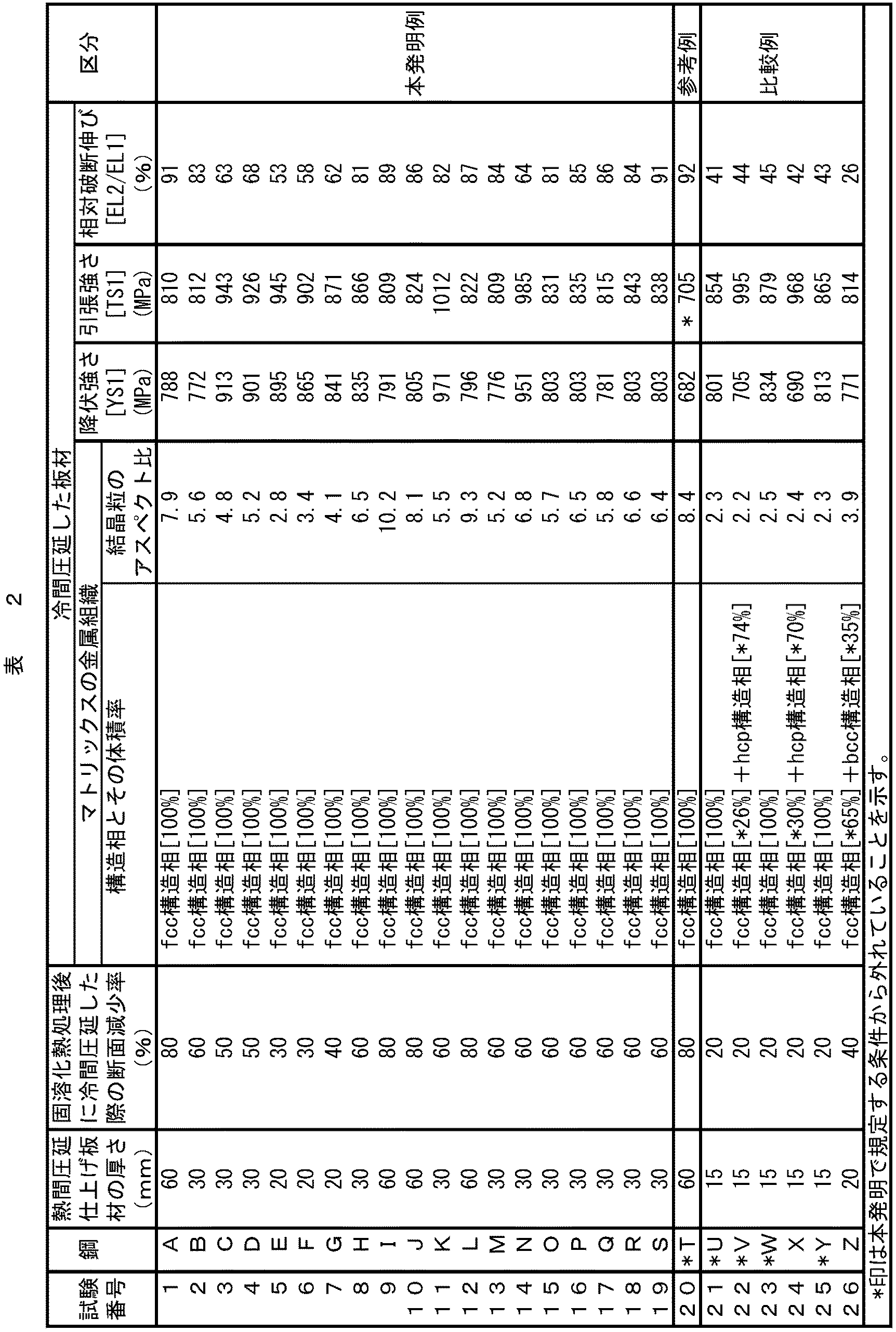
各鋼について、上記固溶化熱処理した板材を用いて、表2に示す20〜80%のいずれかの断面減少率で冷間圧延を行い、各構造相の体積率を求めた。具体的には、板材の厚さ方向中心部から、長手方向に厚さが2mm、幅が10mmで長さが10mmの寸法の試験片を採取し、1200番エメリー紙まで研磨後、常温の過酸化水素とシュウ酸の混合溶液に浸漬して表面の加工層を除去した。次いで、上記の加工層を除去した試験片に非特許文献2に準拠した方法でX線回折測定(Cu対陰極、管電圧30kV、管電流100mA)を実施し、マトリックスの金属組織における各構造相の体積率を求めた。 About each steel, it cold-rolled by the cross-sectional reduction rate of 20 to 80% shown in Table 2 using the board | plate material which carried out the said solution heat treatment, and calculated | required the volume ratio of each structural phase. Specifically, a specimen having a thickness of 2 mm in the longitudinal direction, a width of 10 mm, and a length of 10 mm is collected from the central portion in the thickness direction of the plate material, polished to 1200-th emery paper, and then subjected to room temperature excess. The surface processed layer was removed by dipping in a mixed solution of hydrogen oxide and oxalic acid. Next, X-ray diffraction measurement (Cu anti-cathode, tube voltage 30 kV, tube current 100 mA) was performed on the test piece from which the processed layer had been removed by a method based on Non-Patent Document 2, and each structural phase in the metal structure of the matrix was measured. The volume ratio of was determined.
具体的には、fcc構造相に関しては(111)、(200)および(220)のピーク強度、bcc構造相に関しては(110)、(200)および(211)のピーク強度、hcp構造相に関しては(100)、(101)および(102)のピーク強度に基づいて各構造相の体積率を同定した。 Specifically, for the fcc structure phase, the peak intensity of (111), (200) and (220), for the bcc structure phase, the peak intensity of (110), (200) and (211), and for the hcp structure phase Based on the peak intensities of (100), (101) and (102), the volume fraction of each structural phase was identified.
また、各鋼について、上記冷間圧延した板材の厚さ方向中心部から、長手方向に厚さが10mm、幅が10mmで長さが20mmの寸法の試験片を採取した。次いで、結晶粒における、長手方向での長径と厚さ方向での長径の双方を観察するために、厚さが10mmで長さが20mmの断面が被検面になるように樹脂埋めして鏡面研磨した後、ビレラ溶液で腐食(エッチング)し、以下に示す方法でマトリックスの金属組織における結晶粒のアスペクト比を求めた。 For each steel, a test piece having a thickness of 10 mm in the longitudinal direction, a width of 10 mm, and a length of 20 mm was sampled from the thickness direction center of the cold-rolled plate. Next, in order to observe both the major axis in the longitudinal direction and the major axis in the thickness direction in the crystal grain, the resin is buried so that a cross section having a thickness of 10 mm and a length of 20 mm becomes the test surface. After polishing, corrosion (etching) was performed with a Virella solution, and the aspect ratio of the crystal grains in the metal structure of the matrix was determined by the following method.
上記の厚さが10mmで長さが20mmの断面を被検面として、光学顕微鏡を用いて100倍の倍率で500μm×500μmの視野をランダムに5視野観察し、切片法にて、結晶粒における、長手方向での長径の平均値a(μm)および厚さ方向での長径の平均値b(μm)を求めた。次いで、「a/b」すなわち結晶粒のアスペクト比を算出した。 Using a cross section having a thickness of 10 mm and a length of 20 mm as a test surface, a 500 μm × 500 μm field of view was randomly observed at a magnification of 100 using an optical microscope, and a section method was applied to the crystal grains. The average value a (μm) of the major axis in the longitudinal direction and the average value b (μm) of the major axis in the thickness direction were determined. Next, “a / b”, that is, the aspect ratio of the crystal grains was calculated.
さらに、各鋼について、冷間圧延した板材の厚さ方向中心部から、長手方向に平行部直径が2.5mmの丸棒引張試験片を採取した。 Furthermore, about each steel, the round bar tensile test piece whose parallel part diameter is 2.5 mm was extract | collected from the thickness direction center part of the cold-rolled board | plate material.
上記の丸棒引張試験片を用いて、常温大気中で、ひずみ速度3×10⁻⁶/sで引張試験を行い、降伏強さ(0.2%耐力、YS1)、引張強さ(TS1)および破断伸び(EL1)を測定した。また、上記の丸棒引張試験片を用いて、常温の85MPaの高圧水素ガス中で、上記と同じ3×10-6/sのひずみ速度で引張試験を行い、破断伸び(EL2)を測定した。 Using the above round bar tensile test piece, a tensile test was conducted at room temperature and at a strain rate of 3 × 10 −6 / s, yield strength (0.2% proof stress, YS1), tensile strength (TS1) The elongation at break (EL1) was measured. In addition, using the above round bar tensile test piece, a tensile test was performed at a strain rate of 3 × 10 −6 / s in the high-pressure hydrogen gas at a normal temperature of 85 MPa, and the elongation at break (EL2) was measured. .
水素の影響は延性の低下に顕著に現れる。このため、大気中での破断伸び(EL1)と高圧水素ガス中での破断伸び(EL2)から、下記[2]式を用いて相対破断伸びを算出した。このようにして求めた相対破断伸びの値が50%以上であれば、水素による脆化が抑制されて良好な耐水素ガス脆化特性を有し、さらに、70%以上であれば、極めて良好な耐水素ガス脆化特性を有すると判断できる。
(EL2/EL1)×100・・・[2]。
The effect of hydrogen is prominent in the reduction of ductility. Therefore, the relative elongation at break was calculated from the elongation at break (EL1) in the atmosphere and the elongation at break (EL2) in high-pressure hydrogen gas using the following equation [2]. If the relative elongation at break obtained in this way is 50% or more, the hydrogen embrittlement is suppressed and good hydrogen gas embrittlement resistance is obtained, and if it is 70% or more, extremely good. It can be judged that it has a good hydrogen gas embrittlement resistance.
(EL2 / EL1) × 100 (2).
表2に、上記の各調査結果をまとめて示す。 Table 2 summarizes the results of each of the above investigations.
表2における試験番号1〜19は本発明例である。TSが800MPaを超える高強度の上記試験番号は、いずれも相対破断伸びが50%を超えており、良好な耐水素ガス脆化特性を有していることが明らかである。なお、上記の本発明例では、いずれもマトリックスの金属組織は、体積率で、fcc構造相が100%であった。 Test numbers 1 to 19 in Table 2 are examples of the present invention. It is clear that all of the above test numbers with high strength at which TS exceeds 800 MPa have a good hydrogen gas embrittlement resistance with a relative elongation at break exceeding 50%. In all of the above examples of the present invention, the metal structure of the matrix was volume ratio and the fcc structure phase was 100%.
試験番号20は参考例であり、相対破断伸びは92%と大きく良好な耐水素ガス脆化特性を有している。しかし、この試験番号20は、用いた鋼TのFn1が本発明で規定する化学組成条件から外れる0.033であるため、冷間圧延してもTSが705MPaと低く、本発明で規定する下限値の800MPaに達しなかった。 Test No. 20 is a reference example, and the relative elongation at break is as large as 92% and has good hydrogen gas embrittlement resistance. However, since this test number 20 is 0.033 where Fn1 of the steel T used deviates from the chemical composition condition defined in the present invention, TS is as low as 705 MPa even when cold rolled, and the lower limit defined in the present invention. The value of 800 MPa was not reached.
試験番号21〜26は比較例である。上記の比較例は、いずれも相対破断伸びが50%未満であり、耐水素ガス脆化特性に劣っていた。 Test numbers 21 to 26 are comparative examples. All of the above comparative examples had a relative elongation at break of less than 50% and were inferior in hydrogen gas embrittlement resistance.
試験番号21は、用いた鋼UのC含有量およびFn1がそれぞれ、0.453%および0.525で、いずれも本発明で規定する化学組成条件から外れるため、耐水素ガス脆化特性に劣っていた。 Test No. 21 was inferior in hydrogen gas embrittlement resistance because the C content and Fn1 of steel U used were 0.453% and 0.525, respectively, both of which deviated from the chemical composition conditions defined in the present invention. It was.
試験番号22は、用いた鋼VのMn含有量が19.82%と低く本発明で規定する化学組成条件から外れ、マトリックスの金属組織における体積率が、fcc構造相が26%およびhcp構造相が74%で規定を満たさないため、耐水素ガス脆化特性に劣っていた。 Test No. 22 has a Mn content of steel V used as low as 19.82% and deviates from the chemical composition condition defined in the present invention. The volume fraction in the metal structure of the matrix is 26% for the fcc structural phase and the hcp structural phase. However, since it did not satisfy the regulations at 74%, the hydrogen gas embrittlement resistance was inferior.
試験番号23は、用いた鋼WのFn1が本発明で規定する化学組成条件から外れる0.495であるため、耐水素ガス脆化特性に劣っていた。 Test No. 23 was inferior in hydrogen gas embrittlement resistance because Fn1 of the steel W used was 0.495 which deviates from the chemical composition conditions defined in the present invention.
試験番号24は、用いた鋼Xの化学組成は本発明で規定する範囲内にあるが、マトリックスの金属組織におえる体積率が、fcc構造相が30%およびhcp構造相が70%で規定を満たさないため、耐水素ガス脆化特性に劣っていた。 In test number 24, the chemical composition of steel X used is within the range specified in the present invention, but the volume ratio in the metal structure of the matrix is specified as 30% for the fcc structural phase and 70% for the hcp structural phase. Since it did not satisfy | fill, it was inferior to the hydrogen gas embrittlement characteristic.
試験番号25は、試験番号23と同様に、用いた鋼YのFn1が本発明で規定する化学組成条件から外れる0.470であるため、耐水素ガス脆化特性に劣っていた。 Test number 25 was inferior in hydrogen gas embrittlement resistance because Fn1 of steel Y used was 0.470, which deviates from the chemical composition conditions defined in the present invention, as in test number 23.
試験番号26は、用いた鋼Zの化学組成は本発明で規定する範囲内にあるが、マトリックスの金属組織における体積率が、fcc構造相が65%およびbcc構造相が35%で規定を満たさないため、耐水素ガス脆化特性に劣っていた。 In test number 26, the chemical composition of the steel Z used is within the range specified in the present invention, but the volume fraction in the metal structure of the matrix satisfies the specification at 65% for the fcc structural phase and 35% for the bcc structural phase. Therefore, the hydrogen gas embrittlement resistance was poor.
本発明によれば、Ni当量を管理したSUS316およびSUS316Lよりも安価で800MPa以上の引張強さを有し、かつ高圧水素ガス環境(中でも70MPa以上の高圧水素ガス環境)下での機械的特性に優れて良好な耐水素ガス脆化特性を備える高Mn鋼鋼材を得ることができる。また、この高Mn鋼鋼材からなる、配管、容器、バルブおよび継手は、上記高圧水素ガス環境での耐久性に優れる。
According to the present invention, it is cheaper than SUS316 and SUS316L in which Ni equivalent is controlled, has a tensile strength of 800 MPa or more, and has mechanical properties under a high-pressure hydrogen gas environment (in particular, a high-pressure hydrogen gas environment of 70 MPa or more). A high Mn steel with excellent hydrogen gas embrittlement resistance can be obtained. Moreover, piping, containers, valves and joints made of this high Mn steel material are excellent in durability in the high-pressure hydrogen gas environment.
Claims (6)
マトリックスの金属組織が、体積率で、fcc構造相:90〜100%、bcc構造相:0〜10%およびhcp構造相:0〜10%、かつ上記構造相の合計:100%であり、結晶粒のアスペクト比:2.0超えであり、
引張強さが800MPa以上である、
高圧水素ガス用高Mn鋼鋼材。
Fn1=C+4N・・・[1]
但し、[1]式中のCおよびNは、それぞれの元素の鋼中含有量(質量%)を意味する。 Chemical composition is mass%, C: less than 0.40%, Si: 0.05 to 1.0%, Mn: 20.0 to 60.0%, N: less than 0.10%, Ni: 0 to 5%, Cu: 0 to 5%, Co: 0 to 5%, Al: 0 to 1%, Cr: 0 to 5%, Mo: 0 to 3%, W: 0 to 6%, V: 0 to 1 0.0%, Nb: 0 to 1.0%, Ti: 0 to 1.0%, Zr: 0 to 1.0%, Hf: 0 to 1.0%, Ta: 0 to 1.0% B: 0 to 0.020%, Ca: 0 to 0.0050%, Mg: 0 to 0.0050%, REM: 0 to 0.50%, the balance being Fe and impurities, and P, S and O as impurities P: 0.050% or less, S: 0.050% or less, and O: 0.020% or less, and Fn1 represented by the following formula [1] is 0.05 ≦ Fn1 ≦ 0.40 And
The metal structure of the matrix is, by volume, fcc structural phase: 90 to 100%, bcc structural phase: 0 to 10% and hcp structural phase: 0 to 10%, and the total of the above structural phases: 100%, The aspect ratio of the grains is over 2.0,
The tensile strength is 800 MPa or more,
High Mn steel for high pressure hydrogen gas.
Fn1 = C + 4N [1]
However, C and N in the formula [1] mean the content (mass%) of each element in steel.
A pipe, container, valve and joint for high-pressure hydrogen gas, comprising the high-Mn steel for high-pressure hydrogen gas according to any one of claims 1 to 5.
Priority Applications (1)
| Application Number | Priority Date | Filing Date | Title |
|---|---|---|---|
| JP2015129682A JP6455342B2 (en) | 2015-06-29 | 2015-06-29 | High Mn steel for high-pressure hydrogen gas and pipes, containers, valves and joints made of the steel |
Applications Claiming Priority (1)
| Application Number | Priority Date | Filing Date | Title |
|---|---|---|---|
| JP2015129682A JP6455342B2 (en) | 2015-06-29 | 2015-06-29 | High Mn steel for high-pressure hydrogen gas and pipes, containers, valves and joints made of the steel |
Publications (2)
| Publication Number | Publication Date |
|---|---|
| JP2017014547A true JP2017014547A (en) | 2017-01-19 |
| JP6455342B2 JP6455342B2 (en) | 2019-01-23 |
Family
ID=57829158
Family Applications (1)
| Application Number | Title | Priority Date | Filing Date |
|---|---|---|---|
| JP2015129682A Active JP6455342B2 (en) | 2015-06-29 | 2015-06-29 | High Mn steel for high-pressure hydrogen gas and pipes, containers, valves and joints made of the steel |
Country Status (1)
| Country | Link |
|---|---|
| JP (1) | JP6455342B2 (en) |
Cited By (1)
| Publication number | Priority date | Publication date | Assignee | Title |
|---|---|---|---|---|
| CN117305713A (en) * | 2023-11-01 | 2023-12-29 | 衡阳华菱钢管有限公司 | Seamless steel pipe and preparation method and application thereof |
Families Citing this family (3)
| Publication number | Priority date | Publication date | Assignee | Title |
|---|---|---|---|---|
| CN110565011A (en) * | 2019-06-17 | 2019-12-13 | 南阳汉冶特钢有限公司 | q345qENH weather-proof bridge steel plate with thickness less than or equal to 50mm and production method thereof |
| CN110306122B (en) * | 2019-08-06 | 2021-05-11 | 鄱阳县黑金刚钓具有限责任公司 | Novel high-strength material fishhook |
| CN111270133B (en) * | 2020-02-04 | 2021-10-12 | 北京科技大学 | Hot-rolled boron-containing medium-manganese high-strength steel and preparation method thereof |
Citations (7)
| Publication number | Priority date | Publication date | Assignee | Title |
|---|---|---|---|---|
| US4531974A (en) * | 1982-04-13 | 1985-07-30 | Vereinigte Edelstahlwerke Ag (Vew) | Work-hardenable austenitic manganese steel and method for the production thereof |
| JPH10121202A (en) * | 1996-10-21 | 1998-05-12 | Sumitomo Metal Ind Ltd | High-strength steel used in an environment requiring sulfide stress cracking resistance and method of manufacturing the same |
| JP2010106313A (en) * | 2008-10-30 | 2010-05-13 | Jfe Steel Corp | Steel sheet having high yield ratio and ultrahigh tensile strength superior in ductility, and method for manufacturing the same |
| US20110008714A1 (en) * | 2009-07-10 | 2011-01-13 | Abd Elhamid Mahmoud H | Low-cost manganese-stabilized austenitic stainless steel alloys, bipolar plates comprising the alloys, and fuel cell systems comprising the bipolar plates |
| WO2012043877A1 (en) * | 2010-09-29 | 2012-04-05 | 新日鐵住金ステンレス株式会社 | Austenite high-manganese stainless steel, manufacturing method therefor, and member using said steel |
| WO2015012357A1 (en) * | 2013-07-26 | 2015-01-29 | 新日鐵住金株式会社 | High-strength steel material for oil well use, and oil well pipe |
| JP2015171729A (en) * | 2014-02-21 | 2015-10-01 | 新日鐵住金株式会社 | Austenitic high Mn stainless steel welded joint for high-pressure hydrogen gas and liquid hydrogen and method for producing the same |
-
2015
- 2015-06-29 JP JP2015129682A patent/JP6455342B2/en active Active
Patent Citations (7)
| Publication number | Priority date | Publication date | Assignee | Title |
|---|---|---|---|---|
| US4531974A (en) * | 1982-04-13 | 1985-07-30 | Vereinigte Edelstahlwerke Ag (Vew) | Work-hardenable austenitic manganese steel and method for the production thereof |
| JPH10121202A (en) * | 1996-10-21 | 1998-05-12 | Sumitomo Metal Ind Ltd | High-strength steel used in an environment requiring sulfide stress cracking resistance and method of manufacturing the same |
| JP2010106313A (en) * | 2008-10-30 | 2010-05-13 | Jfe Steel Corp | Steel sheet having high yield ratio and ultrahigh tensile strength superior in ductility, and method for manufacturing the same |
| US20110008714A1 (en) * | 2009-07-10 | 2011-01-13 | Abd Elhamid Mahmoud H | Low-cost manganese-stabilized austenitic stainless steel alloys, bipolar plates comprising the alloys, and fuel cell systems comprising the bipolar plates |
| WO2012043877A1 (en) * | 2010-09-29 | 2012-04-05 | 新日鐵住金ステンレス株式会社 | Austenite high-manganese stainless steel, manufacturing method therefor, and member using said steel |
| WO2015012357A1 (en) * | 2013-07-26 | 2015-01-29 | 新日鐵住金株式会社 | High-strength steel material for oil well use, and oil well pipe |
| JP2015171729A (en) * | 2014-02-21 | 2015-10-01 | 新日鐵住金株式会社 | Austenitic high Mn stainless steel welded joint for high-pressure hydrogen gas and liquid hydrogen and method for producing the same |
Cited By (1)
| Publication number | Priority date | Publication date | Assignee | Title |
|---|---|---|---|---|
| CN117305713A (en) * | 2023-11-01 | 2023-12-29 | 衡阳华菱钢管有限公司 | Seamless steel pipe and preparation method and application thereof |
Also Published As
| Publication number | Publication date |
|---|---|
| JP6455342B2 (en) | 2019-01-23 |
Similar Documents
| Publication | Publication Date | Title |
|---|---|---|
| JP6451545B2 (en) | High Mn steel for high-pressure hydrogen gas, method for producing the same, and piping, container, valve and joint made of the steel | |
| JP6004140B1 (en) | Austenitic stainless steel and manufacturing method thereof | |
| JP5131794B2 (en) | High-strength austenitic stainless steel for high-pressure hydrogen gas | |
| JP5786830B2 (en) | High-strength austenitic stainless steel for high-pressure hydrogen gas | |
| JP4251229B1 (en) | Low alloy steel for high pressure hydrogen gas environment and container for high pressure hydrogen | |
| US9200344B2 (en) | High strength hot rolled steel sheet having excellent bendability and method for manufacturing the same | |
| JP6684620B2 (en) | High-strength austenitic stainless steel excellent in hydrogen embrittlement resistance, its manufacturing method, and hydrogen equipment used in high-pressure hydrogen gas and liquid hydrogen environment | |
| JP4539559B2 (en) | Austenitic stainless steel for hydrogen gas and its manufacturing method | |
| JP6492163B2 (en) | High strength austenitic stainless steel with excellent hydrogen embrittlement resistance and method for producing the same | |
| JP6648646B2 (en) | Low alloy steel material, low alloy steel pipe and container, and method of manufacturing the container | |
| KR101664635B1 (en) | Hot rolled high tensile strength steel sheet and method for manufacturing same | |
| JP7329984B2 (en) | stainless steel | |
| CN105102653A (en) | Steel structure for hydrogen, and method for manufacturing pressure accumulator for hydrogen and line pipe for hydrogen | |
| JP2012031509A (en) | High strength low yield ratio steel with highly uniform elongation characteristic, method of producing the same and high strength low yield ratio welded steel pipe | |
| JP6554844B2 (en) | Manufacturing method of high-pressure hydrogen container | |
| JP6455342B2 (en) | High Mn steel for high-pressure hydrogen gas and pipes, containers, valves and joints made of the steel | |
| JP6455333B2 (en) | High Mn steel for high-pressure hydrogen gas and pipes, containers, valves and joints made of the steel |
Legal Events
| Date | Code | Title | Description |
|---|---|---|---|
| A621 | Written request for application examination |
Free format text: JAPANESE INTERMEDIATE CODE: A621 Effective date: 20180205 |
|
| TRDD | Decision of grant or rejection written | ||
| A01 | Written decision to grant a patent or to grant a registration (utility model) |
Free format text: JAPANESE INTERMEDIATE CODE: A01 Effective date: 20181120 |
|
| A61 | First payment of annual fees (during grant procedure) |
Free format text: JAPANESE INTERMEDIATE CODE: A61 Effective date: 20181203 |
|
| R151 | Written notification of patent or utility model registration |
Ref document number: 6455342 Country of ref document: JP Free format text: JAPANESE INTERMEDIATE CODE: R151 |
|
| S533 | Written request for registration of change of name |
Free format text: JAPANESE INTERMEDIATE CODE: R313533 |
|
| R350 | Written notification of registration of transfer |
Free format text: JAPANESE INTERMEDIATE CODE: R350 |