JP2017145487A - Ferrite austenite stainless steel sheet excellent in moldability and manufacturing method therefor - Google Patents
Ferrite austenite stainless steel sheet excellent in moldability and manufacturing method therefor Download PDFInfo
- Publication number
- JP2017145487A JP2017145487A JP2016029971A JP2016029971A JP2017145487A JP 2017145487 A JP2017145487 A JP 2017145487A JP 2016029971 A JP2016029971 A JP 2016029971A JP 2016029971 A JP2016029971 A JP 2016029971A JP 2017145487 A JP2017145487 A JP 2017145487A
- Authority
- JP
- Japan
- Prior art keywords
- less
- steel sheet
- value
- stainless steel
- cold rolling
- Prior art date
- Legal status (The legal status is an assumption and is not a legal conclusion. Google has not performed a legal analysis and makes no representation as to the accuracy of the status listed.)
- Granted
Links
Images



Landscapes
- Heat Treatment Of Sheet Steel (AREA)
Abstract
【課題】高価かつ希少な元素のNiを多量に含有せずTRIPの発現しない成分系で均一伸び及び局部伸びが大きいフェライト・オーステナイト系ステンレス鋼板とその製造方法の提供。【解決手段】質量%でN:0.080〜0.300%を含有しPI値が30未満オーステナイト相中の化学組成より計算されるMd値が−10℃未満、鋼板の圧延幅方向に垂直な断面のオーステナイト粒の投影面積円相当径の平均が1.0+5.0×鋼板全体の窒素含有量(質量%)μm以上、鋼板の圧延幅方向に垂直な断面のオーステナイト粒の全面積に対する最長径の長さをそれに直交する方向での最大長さで除した値の逆数で表される形状アスペクト比が0.5未満のオーステナイト粒の面積率と鋼板の厚さ方向に垂直な断面において圧延方向に垂直な方向1000μm中のフェライト/オーステナイト相境界数から計算されるF値が120以上のフェライト・オーステナイト系ステンレス鋼板。【選択図】図3Provided is a ferritic / austenitic stainless steel sheet which does not contain a large amount of expensive and rare element Ni and does not exhibit TRIP and has a uniform elongation and a large local elongation, and a method for producing the same. SOLUTION: N: 0.080 to 0.300% in mass%, PI value less than 30 Md value calculated from chemical composition in austenite phase is less than −10 ° C., perpendicular to the rolling width direction of the steel sheet The average projected area equivalent circle diameter of the austenite grains in a simple cross section is 1.0 + 5.0 × the nitrogen content (mass%) μm or more of the whole steel sheet, and the maximum relative to the total area of the austenite grains in the cross section perpendicular to the rolling width direction Rolling in the cross section perpendicular to the area ratio of austenite grains with a shape aspect ratio of less than 0.5, expressed by the reciprocal of the value obtained by dividing the length of the major axis by the maximum length in the direction orthogonal thereto, and the thickness direction of the steel sheet A ferritic-austenitic stainless steel sheet having an F value of 120 or more calculated from the number of ferrite / austenite phase boundaries in a direction 1000 μm perpendicular to the direction. [Selection] Figure 3
Description
本発明は、フェライト・オーステナイト系ステンレス鋼板及びその製造方法に関する。 The present invention relates to a ferritic / austenitic stainless steel sheet and a method for producing the same.
ステンレス鋼を大きく分類すると、オーステナイト系ステンレス鋼、フェライト系ステンレス鋼、フェライト・オーステナイト系ステンレス鋼に分けられる。オーステナイト系ステンレス鋼は、高価なNiを7%以上含有して、成形性に優れた鋼種が多い。フェライト系ステンレス鋼は、Niをほとんど含有せず、また、一般的には成形性はオーステナイト系ステンレス鋼に比べてかなり低い。 Stainless steel is roughly classified into austenitic stainless steel, ferritic stainless steel, and ferritic / austenitic stainless steel. Austenitic stainless steel contains 7% or more of expensive Ni and many steel types have excellent formability. Ferritic stainless steel contains almost no Ni and generally has a much lower formability than austenitic stainless steel.
一方、フェライト・オーステナイト系ステンレス鋼は、Ni含有量が比較的少なく、成形性、耐食性などにおいてオーステナイト系ステンレス鋼とフェライト系ステンレス鋼の中間的な特性を有する鋼種が多い。 On the other hand, ferrite and austenitic stainless steels have a relatively low Ni content, and many steel types have intermediate characteristics between austenitic stainless steels and ferritic stainless steels in terms of formability and corrosion resistance.
近年、Ni含有量が少なく経済性に優れるフェライト・オーステナイト系ステンレス鋼を、オーステナイト系ステンレス鋼の代替として用いることがある。そのため、フェライト・オーステナイト系ステンレス鋼の強度および延性の更なる向上が求められている。そこで、フェライト・オーステナイト系ステンレス鋼の結晶粒径、結晶粒の形などを制御することによって、強度および延性を向上させる技術が開発されている。 In recent years, ferritic / austenitic stainless steels with low Ni content and excellent economic efficiency are sometimes used as substitutes for austenitic stainless steels. Therefore, further improvement in the strength and ductility of the ferritic / austenitic stainless steel is required. Therefore, a technique for improving the strength and ductility has been developed by controlling the crystal grain size, crystal grain shape, and the like of ferrite-austenitic stainless steel.
そのような技術の一つが加工誘起マルテンサイト変態による変態誘起塑性(TRIP:TRansformation−Induced Plasticity)の発現による伸びの向上である。加工誘起マルテンサイト変態とは、比較的柔らかいオーステナイト相が、加工によって比較的硬いマルテンサイト相に変態する現象である。 One such technique is an improvement in elongation due to the development of transformation-induced plasticity (TRIP) due to work-induced martensitic transformation. The processing-induced martensitic transformation is a phenomenon in which a relatively soft austenite phase is transformed into a relatively hard martensite phase by processing.
材料を引張試験すると、ある程度の均一伸びを示した後にくびれが発生し、変形がくびれ部に集中して破断に至る。加工によって加工誘起マルテンサイト変態が生じた場合、鋼中のマルテンサイト相は硬いので、くびれ部ではその後変形が進展しなくなる。その結果、材料の延性が向上するのである。 When the material is subjected to a tensile test, constriction occurs after exhibiting a certain degree of uniform elongation, and deformation concentrates on the constricted portion, leading to fracture. When processing-induced martensitic transformation occurs by processing, the martensite phase in the steel is hard, so that deformation does not progress afterwards at the constricted portion. As a result, the ductility of the material is improved.
特許文献1には、Md値とオーステナイト相の結晶粒径及びアスペクト比を規定し、TRIPを発現しやすくして均一伸びを高めたフェライト・オーステナイト系ステンレス鋼が開示されている。
また、特許文献2には、多パス圧延によってフェライトの集合組織を制御してリジング性を高めると共に、オーステナイト相率を規定することでTRIPを発現させて延性を高めたフェライト・オーステナイト系ステンレス鋼が開示されている。
また、特許文献3には、元素量を調整することでオーステナイト相を準安定とし、変形時および衝撃時にTRIPを発現させることで加工性と耐衝撃性を高めたフェライト・オーステナイト系ステンレス鋼が開示されている。
Patent Document 1 discloses a ferrite-austenite stainless steel in which the Md value, the crystal grain size and aspect ratio of the austenite phase are specified, and TRIP is easily developed to increase uniform elongation.
Patent Document 2 discloses a ferrite-austenitic stainless steel in which the texture of ferrite is controlled by multi-pass rolling to improve ridging properties, and TRIP is expressed by regulating the austenite phase ratio to increase ductility. It is disclosed.
Patent Document 3 discloses a ferrite-austenitic stainless steel in which the austenite phase is metastable by adjusting the amount of elements and the workability and impact resistance are improved by developing TRIP during deformation and impact. Has been.
特許文献1では、Md値によってオーステナイト粒の安定度を規定するとともに、オーステナイト相の粒径を小さくし、アスペクト比を球形に近くすることでTRIPを発現しやすくさせて、均一伸びを高める技術が記載されている。しかし、特許文献1には、TRIPの発現しない鋼において伸びを高める技術については記載されていない。 In Patent Document 1, there is a technology that regulates the stability of austenite grains by the Md value, reduces the austenite phase grain size, and makes the aspect ratio close to a sphere, thereby facilitating the expression of TRIP and increasing the uniform elongation. Have been described. However, Patent Document 1 does not describe a technique for increasing elongation in steel that does not exhibit TRIP.
特許文献2では、オーステナイト相率を規定することでTRIPを発現させ、均一伸びを高める技術が記載されている。しかし、TRIPの発現しない鋼において伸びを高める技術については記載されていない。 Patent Document 2 describes a technique for increasing the uniform elongation by expressing TRIP by defining the austenite phase ratio. However, there is no description of a technique for increasing elongation in steel that does not exhibit TRIP.
特許文献3では、元素量を調整することでオーステナイト相を準安定としTRIPを発現させることで加工性と衝撃吸収性を高める技術が記載されている。しかし、特許文献3には、TRIPの発現しない鋼において伸びを高める技術については記載されていない。 Patent Document 3 describes a technique for improving workability and impact absorption by adjusting the amount of elements to make the austenite phase metastable and exhibiting TRIP. However, Patent Document 3 does not describe a technique for increasing elongation in steel that does not exhibit TRIP.
以上のように、鋼の成分および金属組織の制御によってフェライト・オーステナイト系ステンレス鋼の延性を向上するための知見はある。しかし、従来の知見は、いずれもTRIPの発現を目的とした技術である。TRIPが発現する鋼では、加工によって応力の残留が生じ、時効割れなどの問題が発生するため、熱処理などの工程が必要になる場合がある。そのため、TRIPを発現せず、熱処理などの工程の必要がないステンレス鋼について、成形性向上が求められている。先に述べたように、特許文献1〜3には、TRIPが発現しない鋼において、成形性を向上させる手法については一切記載がない。 As described above, there is knowledge for improving the ductility of ferritic / austenitic stainless steels by controlling the steel components and the metal structure. However, all of the conventional findings are techniques aimed at the expression of TRIP. In steel in which TRIP is manifested, stress remains due to processing, and problems such as aging cracking occur, and thus a process such as heat treatment may be required. Therefore, improvement in formability is required for stainless steel that does not exhibit TRIP and does not require a process such as heat treatment. As described above, Patent Documents 1 to 3 do not describe any technique for improving formability in steel that does not exhibit TRIP.
上記のような技術背景に鑑み、本発明は、加工誘起マルテンサイト変態によるTRIPの発現しない成分を有し、成形性が良好であるフェライト・オーステナイト系ステンレス鋼板及びその製造方法を提供することを課題とする。 In view of the above technical background, the present invention has an object to provide a ferritic / austenitic stainless steel sheet having a component that does not exhibit TRIP due to processing-induced martensitic transformation and having good formability, and a method for producing the same. And
本発明者らは、上記の課題に対し、TRIPを発現しない鋼において、伸びを支配する金属組織因子を調査するために、以下の実験を行った。
まず、質量%でN:0.051〜0.310%を含有し、PI値が30未満である13種類の鋼を鋳造し、熱間圧延した後に、焼鈍と冷間圧延を行って鋼板を製造するにあたり、熱間圧延条件、焼鈍温度等の製造条件を変化させた。得られた鋼板は、Md値が−3〜−106のフェライト・オーステナイト系ステンレス鋼板であった。鋼の成分を表1に示す。また、得られた鋼板のMd値を表2〜4に示す。表1および表4に示す成分番号16は、Nの含有量が過剰な例である。成分番号17はMd値が−10以上になった例である。
In order to investigate the metal structure factor governing elongation in the steel that does not express TRIP, the present inventors conducted the following experiments.
First, 13 types of steel containing N: 0.051 to 0.310% by mass% and having a PI value of less than 30 were cast and hot-rolled, and then annealed and cold-rolled to obtain a steel plate. In manufacturing, manufacturing conditions such as hot rolling conditions and annealing temperature were changed. The obtained steel plate was a ferrite-austenitic stainless steel plate having an Md value of -3 to -106. Table 1 shows the components of the steel. Moreover, Md value of the obtained steel plate is shown to Tables 2-4. Ingredient number 16 shown in Table 1 and Table 4 is an example in which the N content is excessive. Component number 17 is an example in which the Md value is −10 or more.
成形性の指標となる評価項目は、均一伸びと局部伸びを選択した。一般的な伸びの指標とされる破断伸びは、局所的な板厚減少(ネッキング)が生じるまでの均一伸びと、板厚減少が生じた後の局部伸びの和として表される。即ち、均一伸びを大きくすることは張り出し成形性などの向上に有効であり、局部伸びを大きくすることは曲げ性や穴拡げ性などの向上に有効である。全体的な成形性を向上させるためには、均一伸びと局部伸びの両方を高める必要がある。 Uniform elongation and local elongation were selected as the evaluation items serving as moldability indicators. The elongation at break, which is a general index of elongation, is expressed as the sum of uniform elongation until local thickness reduction (necking) occurs and local elongation after the thickness reduction occurs. That is, increasing the uniform elongation is effective for improving the stretch formability, and increasing the local elongation is effective for improving the bendability and hole expandability. In order to improve the overall formability, it is necessary to increase both uniform elongation and local elongation.
フェライト・オーステナイト系ステンレス鋼では、局部伸びの向上は難しい。しかし、フェライト・オーステナイト系ステンレス鋼は、フェライト系ステンレス鋼に比べて破断強度が高いため、同程度の伸びでも破断抵抗が大きく、良い成形性が得られる。均一伸びおよび局部伸びの絶対値は高いほど成形性は高くなり、板厚が1mmのフェライト・オーステナイト系ステンレス鋼板では、均一伸びが20%以上、局部伸びが10%以上あれば、比較的成形性がよいフェライト系ステンレス鋼と同程度の成形性を示すことになる。更に加工方法を工夫することで、フェライト・オーステナイト系ステンレス鋼であっても、オーステナイト系ステンレス鋼とほぼ同形状の加工を行うことが可能である。より好ましくは、均一伸びが21%以上、局部伸びが10.5%以上であるとよい。破断伸びおよび均一伸びの測定は、上記で得られた厚さ1mmの鋼板から圧延方向に平行にJIS13号B引張試験片を採取し、JIS Z 2241に準拠した方法で行った。局部伸びは破断伸びと均一伸びの差として求めた。 With ferrite-austenitic stainless steel, it is difficult to improve local elongation. However, since the ferrite-austenitic stainless steel has a higher breaking strength than the ferritic stainless steel, the fracture resistance is large even with the same elongation, and good formability is obtained. The higher the absolute value of uniform elongation and local elongation, the higher the formability. In a ferritic / austenitic stainless steel sheet with a thickness of 1 mm, if the uniform elongation is 20% or more and the local elongation is 10% or more, the formability is relatively high. However, it will exhibit the same formability as ferritic stainless steel. Further, by devising the processing method, even if it is a ferrite-austenitic stainless steel, it is possible to perform processing with substantially the same shape as that of the austenitic stainless steel. More preferably, the uniform elongation is 21% or more and the local elongation is 10.5% or more. Measurement of elongation at break and uniform elongation was carried out by a method in accordance with JIS Z 2241 by collecting a JIS No. 13 B tensile test piece in parallel with the rolling direction from the steel plate having a thickness of 1 mm obtained above. The local elongation was determined as the difference between the breaking elongation and the uniform elongation.
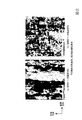
また、電子線マイクロアナライザ(EPMA)を用いて組織中のオーステナイト粒内の化学組成を調査し、得られた化学組成よりオーステナイト相の安定度の指標であるMd値を計算した。さらに、鋼板の組織形態を調査するために、圧延幅方向中心位置の圧延幅方向に垂直な断面(L断面)および板厚方向に垂直な断面(Z断面)の金属組織を電子後方散乱解析像法(EBSP)により調査した。このEBSPによる調査では、L断面では相の同定、結晶粒径の測定、アスペクト比の測定を、Z断面では相の同定、圧延方向に垂直な方向におけるフェライト/オーステナイト粒界の数を測定を行った。EBSPより得られたデータを結晶粒ごとにフェライト粒(BCC相)およびオーステナイト粒(FCC相)に分類し、その境界を結晶粒界とした。また、同一の結晶構造を有する粒同士が隣接している場合は、隣接する測定点における結晶方位差が15°以上の箇所については結晶粒界とみなした。結晶粒界を黒線で示した測定例を図1に示す。図1はL断面のEBSP測定結果であり、図1(a)はBCC相を、図1(b)はFCC相を白色表示で示す図である。オーステナイト粒(FCC相)の各粒の投影面積円相当径及び最長径の長さをそれに直交する最大の径の長さで除した値の逆数としてアスペクト比を測定した。図2はZ断面のEBSP測定結果であり、図2(a)は冷延圧下率50%の試料1−1を、図2(b)は冷延圧下率80%の試料2−1の結果を示す図である。図2ではBCC相を黒色、FCC相を白色で示しており、結晶粒界は表示していない。 Moreover, the chemical composition in the austenite grain in structure | tissue was investigated using the electron beam microanalyzer (EPMA), and Md value which is a parameter | index of the stability of an austenite phase was calculated from the obtained chemical composition. Furthermore, in order to investigate the structure of the steel sheet, electron backscatter analysis images of the metal structure of the cross section perpendicular to the rolling width direction (L cross section) and the cross section perpendicular to the sheet thickness direction (Z cross section) at the center position in the rolling width direction are used. Investigated by law (EBSP). In this EBSP survey, phase identification, crystal grain size measurement, and aspect ratio measurement were performed in the L section, phase identification was performed in the Z section, and the number of ferrite / austenite grain boundaries in the direction perpendicular to the rolling direction was measured. It was. Data obtained from EBSP was classified into ferrite grains (BCC phase) and austenite grains (FCC phase) for each crystal grain, and the boundary was defined as a grain boundary. In addition, when grains having the same crystal structure are adjacent to each other, a portion having a crystal orientation difference of 15 ° or more at adjacent measurement points is regarded as a crystal grain boundary. A measurement example in which the crystal grain boundaries are indicated by black lines is shown in FIG. FIG. 1 shows EBSP measurement results of the L cross section, FIG. 1 (a) shows the BCC phase, and FIG. 1 (b) shows the FCC phase in white. The aspect ratio was measured as the reciprocal of the value obtained by dividing the projected area equivalent diameter and the longest diameter of each austenite grain (FCC phase) by the maximum diameter perpendicular to the projected area. FIG. 2 shows the EBSP measurement results of the Z cross section, FIG. 2 (a) shows the result of sample 1-1 with a cold rolling reduction ratio of 50%, and FIG. 2 (b) shows the result of sample 2-1 with a cold rolling reduction ratio of 80%. FIG. In FIG. 2, the BCC phase is shown in black and the FCC phase is shown in white, and the crystal grain boundaries are not shown.
上記の実験結果について、オーステナイト相の粒径とアスペクト比に着目し、引張試験の均一伸びと局部伸びとの関係を調査した結果、TRIPを発現しない鋼板では、その圧延幅方向に垂直な断面において、
(i)オーステナイト相の結晶粒径が大きい場合に均一伸びが大きい。
(ii)オーステナイト相の形状が圧延方向に展伸している場合に局部伸びが大きい。
さらに、厚さ方向に垂直な断面において、
(iii)圧延方向に垂直な方向のフェライト/オーステナイト粒界数が多い場合に局部伸びが大きい。
という知見を得た。本発明は、上記知見に基づいて完成したものであり、その要旨は以下のとおりである。
Regarding the above experimental results, focusing on the grain size and aspect ratio of the austenite phase and investigating the relationship between the uniform elongation and local elongation of the tensile test, in the steel sheet that does not express TRIP, in the cross section perpendicular to the rolling width direction ,
(I) Uniform elongation is large when the crystal grain size of the austenite phase is large.
(Ii) The local elongation is large when the shape of the austenite phase extends in the rolling direction.
Furthermore, in a cross section perpendicular to the thickness direction,
(Iii) Local elongation is large when the number of ferrite / austenite grain boundaries in the direction perpendicular to the rolling direction is large.
I got the knowledge. The present invention has been completed based on the above findings, and the gist thereof is as follows.
<1>質量%で、N:0.080〜0.300%を含有し、式(1)で表されるPI値が30未満のフェライト・オーステナイト系ステンレス鋼板であって、
オーステナイト相中の化学組成より式(2)で計算されるMd値が−10℃未満であり、
鋼板の圧延幅方向に垂直な断面において、オーステナイト粒の投影面積円相当径の平均が1.0+5.0×鋼板全体での窒素含有量(質量%)μm以上であり、
鋼板の圧延幅方向に垂直な断面におけるオーステナイト粒の全面積に対する、最長径の長さをそれに直交する方向での最大長さで除した値の逆数で表される形状アスペクト比が0.5未満であるオーステナイト粒の面積率および、鋼板の厚さ方向に垂直な断面において、圧延方向に垂直な方向1000μm中におけるフェライト/オーステナイト相境界数から式(3)で求められるF値が120以上であることを特徴とするフェライト・オーステナイト系ステンレス鋼板。
PI値={Cr}+3.3{Mo}+16{N} ・・・(1)
Md値=551−462({C}+[N])−9.2[Si]−8.1[Mn]−13.7[Cr]−29[Ni]−29[Cu]−18.5[Mo] ・・・(2)
F値=100×アスペクト比が0.5未満であるオーステナイト粒の面積率+0.28×フェライト/オーステナイト粒界数 ・・・(3)
[但し、式(1)から式(3)中の{ }で囲まれた元素記号は、当該元素の鋼板全体での含有率(質量%)であり、[ ]で囲まれた元素記号は、当該元素のオーステナイト相中での含有量(質量%)であり、式(1)及び式(2)において当該元素を含有しない場合は0を代入する。]
<2>更に質量%で、C:0.050%以下、Si:2.00%以下、Mn:1.00〜8.00%、P:0.050%以下、S:0.050%以下、Cr:17.0〜25.0%、Ni:0.10〜6.00%、を含有し、残部が鉄及び不可避的不純物からなることを特徴とする<1>記載のフェライト・オーステナイト系ステンレス鋼板。
<3>更に質量%で、Cu:0.10〜3.00%、Mo:0.10〜2.50%、Sn:1.00%以下、W:0.01〜1.00%、V:0.01〜1.00%の1種または2種以上を含有することを特徴とする<2>に記載のフェライト・オーステナイト系ステンレス鋼板。
<4>更に質量%で、Nb:0.50%以下、Ti:0.50%以下、B:0.0050%以下の1種または2種以上を含有することを特徴とする<2>または<3>に記載のフェライト・オーステナイト系ステンレス鋼板。
<5>更に質量%で、Ca:0.0050%以下、Mg:0.0050%以下、Al:0.50%以下、Ta:0.0050%以下、Ga:0.0050%以下、希土類元素:0.50%以下の1種または2種以上を含有することを特徴とする<2>〜<4>のいずれか一項に記載のフェライト・オーステナイト系ステンレス鋼板。
<6><1>乃至<5>のいずれか一項に記載の成分の鋼を連続鋳造し、得られた鋼片を1150℃〜1250℃に加熱し、すべてのパスでの圧下率が35%以下であり、かつ仕上温度が950℃以上である熱間圧延を行い、熱間圧延によって得られた熱延板を1050℃〜1150℃で焼鈍し、冷延圧下率が50%以上80%以下である1回の冷間圧延、または中間焼鈍を挟む2回以上の冷間圧延を行ない、最終焼鈍を920+r+300×鋼板全体での窒素含有量(質量%)(℃)〜940+r+300×鋼板全体での窒素含有量(質量%)(℃)かつ保定終了から400℃までの冷却速度を30℃/s超70℃/s未満にて行うことを特徴とするフェライト・オーステナイト系ステンレス鋼板の製造方法。ここで冷延圧下率(%)は、(冷延前の板厚−冷延後の板厚)/冷延前の板厚×100で計算される値であり、rは冷延圧下率と同値の温度(℃)である。ただし、冷間圧延を複数回行い、冷間圧延の間で中間焼鈍を行った場合は、rの計算に最終の冷間圧延の圧下率を用いる。
<1>% by mass, N: 0.080 to 0.300%, a ferrite austenitic stainless steel sheet having a PI value represented by the formula (1) of less than 30,
The Md value calculated by the formula (2) from the chemical composition in the austenite phase is less than −10 ° C .;
In the cross section perpendicular to the rolling width direction of the steel sheet, the average of the projected area circle equivalent diameter of the austenite grains is 1.0 + 5.0 × the nitrogen content (mass%) μm or more in the whole steel sheet,
The shape aspect ratio expressed by the reciprocal of the value obtained by dividing the length of the longest diameter by the maximum length in the direction perpendicular to the total area of the austenite grains in the cross section perpendicular to the rolling width direction of the steel sheet is less than 0.5. The F value obtained by the formula (3) is 120 or more from the area ratio of the austenite grains and the number of ferrite / austenite phase boundaries in a direction perpendicular to the rolling direction of 1000 μm in the cross section perpendicular to the thickness direction of the steel sheet. A ferritic / austenitic stainless steel sheet.
PI value = {Cr} +3.3 {Mo} +16 {N} (1)
Md value = 551-462 ({C} + [N])-9.2 [Si] -8.1 [Mn] -13.7 [Cr] -29 [Ni] -29 [Cu] -18.5 [Mo] (2)
F value = 100 × area ratio of austenite grains having an aspect ratio of less than 0.5 + 0.28 × number of ferrite / austenite grain boundaries (3)
[However, the element symbol surrounded by {} in the formulas (1) to (3) is the content (mass%) of the element in the whole steel plate, and the element symbol surrounded by [] is This is the content (mass%) of the element in the austenite phase, and 0 is substituted when the element is not contained in the formulas (1) and (2). ]
<2> Further, by mass%, C: 0.050% or less, Si: 2.00% or less, Mn: 1.00 to 8.00%, P: 0.050% or less, S: 0.050% or less , Cr: 17.0 to 25.0%, Ni: 0.10 to 6.00%, and the balance consisting of iron and unavoidable impurities <1> Stainless steel sheet.
<3> Further, by mass%, Cu: 0.10 to 3.00%, Mo: 0.10 to 2.50%, Sn: 1.00% or less, W: 0.01 to 1.00%, V : The ferrite-austenitic stainless steel sheet according to <2>, containing one or more of 0.01 to 1.00%.
<4> Further, by mass%, Nb: 0.50% or less, Ti: 0.50% or less, B: 0.0050% or less, or one or more kinds <2> or The ferritic / austenitic stainless steel sheet according to <3>.
<5> Further, by mass%, Ca: 0.0050% or less, Mg: 0.0050% or less, Al: 0.50% or less, Ta: 0.0050% or less, Ga: 0.0050% or less, rare earth element : The ferrite austenitic stainless steel sheet according to any one of <2> to <4>, characterized by containing one or more of 0.50% or less.
<6><1> to <5> The steel of the component according to any one of <5> is continuously cast, and the obtained steel slab is heated to 1150 ° C. to 1250 ° C., and the rolling reduction ratio in all passes is 35. %, And the hot rolling is performed at 1050 ° C. to 1150 ° C., and the cold rolling reduction is 50% to 80%. The following cold rolling, or two or more cold rollings with intermediate annealing in between, is performed, and the final annealing is performed in 920 + r + 300 × total steel sheet nitrogen content (mass%) (° C.) to 940 + r + 300 × whole steel sheet. A method for producing a ferritic / austenitic stainless steel sheet, wherein the nitrogen content (mass%) (° C.) and the cooling rate from the end of holding to 400 ° C. are performed at a rate of more than 30 ° C./s and less than 70 ° C./s. Here, the cold rolling reduction ratio (%) is a value calculated by (sheet thickness before cold rolling−sheet thickness after cold rolling) / plate thickness before cold rolling × 100, and r is the cold rolling reduction ratio. It is the temperature (° C) of the same value. However, when cold rolling is performed a plurality of times and intermediate annealing is performed between the cold rollings, the rolling reduction rate of the final cold rolling is used for the calculation of r.
本発明によれば、TRIPの発現しない成分系で成形性に優れたフェライト・オーステナイト系ステンレス薄鋼板を得ることができる。したがって、時効割れ対策の熱処理やトリミングなどの追加工程を必要とせず、従来、多量のNiを含有したオーステナイト系ステンレス鋼板が用いられていた部品に適用でき、製品加工の効率の向上に大きく貢献するものである。 According to the present invention, it is possible to obtain a ferritic / austenitic stainless steel sheet having excellent formability with a component system that does not exhibit TRIP. Therefore, it does not require additional steps such as heat treatment and trimming to prevent aging cracking, and can be applied to parts that have conventionally used austenitic stainless steel sheets containing a large amount of Ni, greatly contributing to the improvement of product processing efficiency. Is.
以下に本発明を詳細に説明する。なお、特に注記しない限り、本明細書において元素含有量の%は質量%を意味する。 The present invention is described in detail below. Unless otherwise noted,% of element content in this specification means mass%.
本発明のフェライト・オーステナイト系ステンレス鋼板は、Nを0.080〜0.300%含有するものである。Nはオーステナイト相の安定度に大きな影響を及ぼす元素である。また、Nは、固溶して存在した場合に耐食性を向上させる効果を持つ。従ってNは、0.080%以上添加することとする。但し、Nを0.300%超添加した場合は、均一伸びおよび局部伸びが低下する場合が認められる。また、Nを0.300%超添加すると、Cr窒化物が析出しやすくなって耐食性の低下をもたらす。従ってNは0.300%以下がよい。Nの好ましい添加量は0.150〜0.250%の範囲である。
なお、Nは均一伸び、局部伸びに大きな影響を及ぼす元素である。したがって、Nの成分範囲とNの含有量に応じた製造条件のみを規定すれば本発明の成形性向上効果が得られるため、それ以外の元素については適宜元素種とその含有量を選択すれば良い。
The ferritic / austenitic stainless steel sheet of the present invention contains 0.080 to 0.300% of N. N is an element that greatly affects the stability of the austenite phase. Further, N has an effect of improving the corrosion resistance when present in a solid solution. Therefore, N is added in an amount of 0.080% or more. However, when N exceeds 0.300%, uniform elongation and local elongation may be reduced. On the other hand, when N is added in an amount exceeding 0.300%, Cr nitride is liable to precipitate, resulting in a decrease in corrosion resistance. Therefore, N is preferably 0.300% or less. The preferable addition amount of N is in the range of 0.150 to 0.250%.
N is an element that has a large effect on uniform elongation and local elongation. Therefore, if only the production conditions according to the N component range and the N content are defined, the effect of improving the moldability of the present invention can be obtained. For other elements, the element type and the content thereof are appropriately selected. good.
(PI値:30未満)
PI値は、ステンレス鋼板の耐孔食性を示す一般的な指標であり、鋼板の平均組成から下式(1)で計算される。PI値が30以上では、鋼板が硬質化して加工性を損なうとともに、合金コストが高くなるため、30未満を上限とする。下限は特に規定する必要はないが、SUS304相当の耐食性を得るためには20以上が望ましい。より望ましくは23以上である。
(PI value: less than 30)
The PI value is a general index indicating the pitting corrosion resistance of a stainless steel plate, and is calculated from the average composition of the steel plate according to the following formula (1). When the PI value is 30 or more, the steel sheet is hardened and the workability is impaired, and the alloy cost is increased. Therefore, the upper limit is less than 30. The lower limit is not particularly required, but 20 or more is desirable for obtaining corrosion resistance equivalent to SUS304. More desirably, it is 23 or more.
PI値={Cr}+3.3{Mo}+16{N} ・・・(1)
ただし、(1)式中の{ }で囲まれた元素記号は、鋼板全体での平均含有量(質量%)を意味する。
PI value = {Cr} +3.3 {Mo} +16 {N} (1)
However, the element symbol enclosed in {} in (1) Formula means the average content (mass%) in the whole steel plate.
(オーステナイト相中の化学組成より計算されるMd値:−10℃未満)
Md値は、オーステナイト粒の安定性の指標であり、下式(2)で計算される。Md値が小さいとTRIPは発現しにくくなる。Md値が−10以上の鋼板は、Md値が−10℃未満の鋼板に比べて均一伸びが著しく大きくなり、また、最終製品を絞り比2.2で円筒絞り加工を行なうと48時間以内に時効割れが生じる。これはTRIPの発現によるものであると考えられる。したがって、Md値は−10℃未満であることが好ましい。より好ましくはMd値は−20℃未満である。下限は特に規定する必要はないが、Md値を低下させるには合金元素の添加が必要であるため、製造コストの観点からは、Md値の下限は−200℃超とすることが望ましい。
(Md value calculated from chemical composition in austenite phase: less than −10 ° C.)
The Md value is an index of the stability of austenite grains and is calculated by the following formula (2). When the Md value is small, TRIP is difficult to express. Steel sheets with Md values of -10 or more have a significantly larger uniform elongation than steel sheets with Md values of less than -10 ° C, and within 48 hours when the final product is subjected to cylindrical drawing with a drawing ratio of 2.2. Aging cracks occur. This is thought to be due to the expression of TRIP. Therefore, the Md value is preferably less than −10 ° C. More preferably, the Md value is less than −20 ° C. Although the lower limit is not particularly required, addition of an alloy element is required to lower the Md value, and therefore, the lower limit of the Md value is desirably more than −200 ° C. from the viewpoint of manufacturing cost.
Md値=551−462({C}+[N])−9.2[Si]−8.1[Mn]−13.7[Cr]−29[Ni]―29[Cu]−18.5[Mo] ・・・(2)
ただし、(2)式中の[ ]は鋼板のオーステナイト相中の組成(質量%)であり、{ }は鋼板全体の平均組成(質量%)である。
Md value = 551-462 ({C} + [N])-9.2 [Si] -8.1 [Mn] -13.7 [Cr] -29 [Ni] -29 [Cu] -18.5 [Mo] (2)
However, [] in the formula (2) is the composition (mass%) in the austenite phase of the steel sheet, and {} is the average composition (mass%) of the entire steel sheet.
Md値の計算の基となるオーステナイト相中の化学組成は、例えば、EPMAにより測定される。上記のMd値の計算式における[ ]は、EPMAで測定されたオーステナイト相中の各元素の含有量(質量%)であってもよい。ただし、CについてはEPMAでの測定が困難であるため、オーステナイト相中の組成でなく、鋼板全体での含有量(重量%)を用いることが好ましい。 The chemical composition in the austenite phase on which the Md value is calculated is measured by, for example, EPMA. [] In the above formula for calculating the Md value may be the content (mass%) of each element in the austenite phase measured by EPMA. However, since C is difficult to measure with EPMA, it is preferable to use the content (% by weight) of the entire steel sheet, not the composition in the austenite phase.
(オーステナイト粒の平均結晶粒径:1.0+5.0×鋼板全体での窒素含有量(質量%)μm以上)
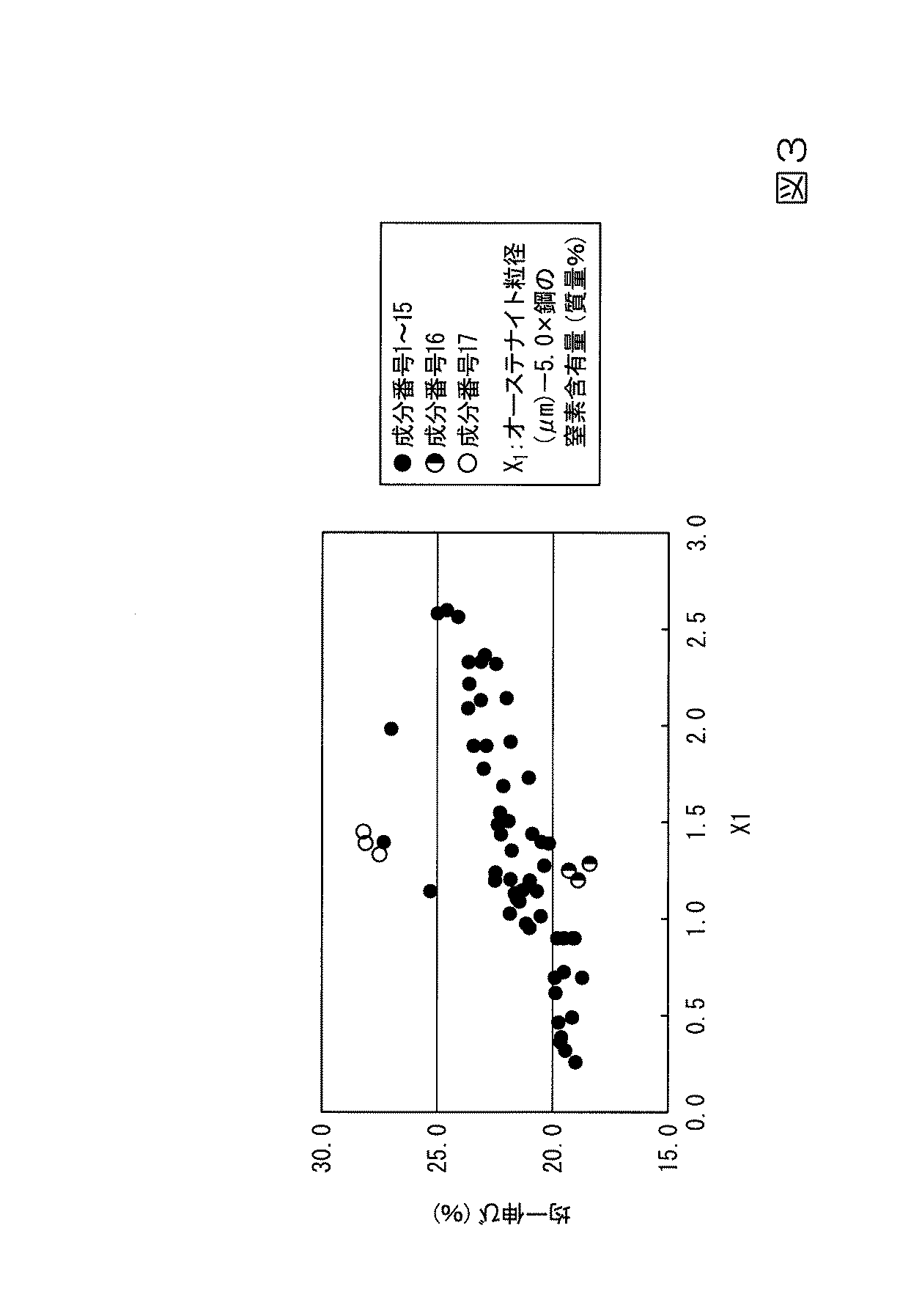
本発明において、オーステナイト粒の平均結晶粒径は、L断面(圧延方向に平行な面を板幅方向から観察した面)のEBSP測定により、オーステナイト粒の投影円相当径の測定結果から求める。本発明では、オーステナイト粒の平均結晶粒径を大きくすることで、良好な均一伸びが得られることを見出している。一方で窒素は、鋼の強度を増加し伸びを減少させる元素であるから、良好な均一伸びを得るためには窒素含有量に応じてオーステナイト粒の平均結晶粒径を制御する必要がある。オーステナイト粒の投影円相当径の平均(μm)から5.0×鋼板全体の窒素含有量(質量%)を引いた値X1と均一伸び(%)の関係を調査した結果を図3に示す。図3中の黒塗り記号は、表1の成分番号1〜15、半黒塗り記号は成分番号16、白抜き記号は成分番号17の試料である。X1が1.0以上の場合、均一伸びが20%以上となるため、オーステナイト粒の平均結晶粒径は1.0+5.0×鋼板全体での窒素含有量(質量%)μm以上が好ましい。より好ましくは1.2+5.0×鋼板全体での窒素含有量(質量%)μm以上である。また、平均結晶粒径の上限は特に規定する必要はないが、平均結晶粒径を大きくすると強度が低下するため、20μm未満が望ましい。
(Average crystal grain size of austenite grains: 1.0 + 5.0 × nitrogen content (mass%) μm or more in the whole steel sheet)
In the present invention, the average crystal grain size of the austenite grains is determined from the measurement result of the projected circle equivalent diameter of the austenite grains by EBSP measurement of the L cross section (a plane observed in the plate width direction). In the present invention, it has been found that good uniform elongation can be obtained by increasing the average crystal grain size of austenite grains. On the other hand, nitrogen is an element that increases the strength of steel and decreases the elongation. Therefore, in order to obtain good uniform elongation, it is necessary to control the average crystal grain size of austenite grains according to the nitrogen content. Figure 3 shows the results of examining the relationship of the average of the projected equivalent circle diameter of austenite grains nitrogen content of the overall from ([mu] m) 5.0 × steel uniform elongation value X 1 obtained by subtracting the (mass%) (%) . The black symbols in FIG. 3 are samples of component numbers 1 to 15 in Table 1, the semi-black symbols are component numbers 16, and the white symbols are component numbers 17. When X 1 is 1.0 or more, the uniform elongation is 20% or more, the nitrogen content in the overall average grain size 1.0 + 5.0 × steel sheet austenite grain (mass%) [mu] m or more. More preferably, it is 1.2 + 5.0 × the nitrogen content (mass%) of the whole steel plate or more. The upper limit of the average crystal grain size does not need to be specified in particular. However, when the average crystal grain size is increased, the strength is lowered, so that it is preferably less than 20 μm.
(鋼板の圧延幅方向に垂直な断面における形状アスペクト比が0.5未満であるオーステナイト粒の面積率および、鋼板の厚さ方向に垂直な断面において、圧延方向に垂直な方向1000μmに含まれるフェライト/オーステナイト粒界数から式(3)で求められるF値が120以上)
本発明においては、L断面(圧延方向に平行な面を板幅方向から観察した面)のEBSP測定により各オーステナイト粒のアスペクト比およびZ断面(厚さ方向に垂直な面)のEBSP測定により圧延方向に垂直な方向1000μmに含まれるフェライト/オーステナイト相境界数を測定した結果より、形状アスペクト比が0.5未満であるオーステナイト粒が全オーステナイトに占める割合と相境界数および鋼板全体での窒素含有量(質量%)を用いて、下式(3)で計算されるF値が120以上で、良好な局部伸びが得られることを見出している。
(Area ratio of austenite grains whose shape aspect ratio in the cross section perpendicular to the rolling width direction of the steel sheet is less than 0.5, and ferrite contained in a direction perpendicular to the rolling direction of 1000 μm in the cross section perpendicular to the thickness direction of the steel sheet / F value calculated by the formula (3) from the number of austenite grain boundaries is 120 or more)
In the present invention, rolling is performed by EBSP measurement of the aspect ratio of each austenite grain and EBSP measurement of the Z cross section (plane perpendicular to the thickness direction) by EBSP measurement of the L cross section (surface observed in the plate width direction). As a result of measuring the number of ferrite / austenite phase boundaries included in the direction 1000 μm perpendicular to the direction, the ratio of the austenite grains having a shape aspect ratio of less than 0.5 to the total austenite, the number of phase boundaries, and nitrogen content in the entire steel sheet Using the amount (mass%), it has been found that the F value calculated by the following formula (3) is 120 or more and good local elongation can be obtained.
F値=100×アスペクト比が0.5未満であるオーステナイト粒の面積率+0.28×フェライト/オーステナイト粒界数・・・(3) F value = 100 × area ratio of austenite grains whose aspect ratio is less than 0.5 + 0.28 × ferrite / austenite grain boundary number (3)
式(3)において、形状アスペクト比は、各粒の最長径の長さをそれに直交する最大の径の長さで除した値の逆数とする。したがって形状アスペクト比の上限は1となる。フェライト/オーステナイト相境界数は圧延方向に垂直な方向1000μmに含まれる相境界の数である。F値と局部伸び(%)との関係を調査した結果を図4に示す。図4中の黒塗り記号は、表1の成分番号1〜15、半黒塗り記号は成分番号16、白抜き記号は成分番号17の試料である。図3より、F値が120以上のときに10%以上の局部伸びが得られることがわかる。また、F値が大きいほど局部伸びが大きくなる傾向が認められる。F値は、より好ましくは130以上である。 In formula (3), the shape aspect ratio is the reciprocal of the value obtained by dividing the length of the longest diameter of each grain by the length of the maximum diameter orthogonal thereto. Therefore, the upper limit of the shape aspect ratio is 1. The number of ferrite / austenite phase boundaries is the number of phase boundaries included in the direction 1000 μm perpendicular to the rolling direction. The result of investigating the relationship between F value and local elongation (%) is shown in FIG. The black symbols in FIG. 4 are samples of component numbers 1 to 15 in Table 1, the semi-black symbols are component numbers 16, and the white symbols are component numbers 17. From FIG. 3, it can be seen that a local elongation of 10% or more is obtained when the F value is 120 or more. Moreover, the tendency for local elongation to become large is recognized, so that F value is large. The F value is more preferably 130 or more.
平均結晶粒径及び形状アスペクト比を測定する結晶粒数は100個以上とする。また、フェライト/オーステナイト相境界数の測定回数は10回以上とする。本発明においてはオーステナイト粒の粒径の粗大化によって均一伸びが向上し、形状アスペクト比が0.5未満の粒の面積率およびフェライト/オーステナイト相境界数が大きくなると局部伸びが向上することが明らかとなっているが、この理由については現段階では不明である。しかし、均一伸びの向上の理由としては粒径の粗大化による強度の減少が考えられ、局部伸びの向上の理由としては形状アスペクト比が0.5未満の粒およびフェライト/オーステナイト相境界がボイドの連結を抑制し破断の抵抗となることが考えられる。 The number of crystal grains for measuring the average crystal grain size and the shape aspect ratio is 100 or more. The number of ferrite / austenite phase boundary measurements is 10 or more. In the present invention, the uniform elongation is improved by increasing the grain size of austenite grains, and the local elongation is improved when the area ratio of grains having a shape aspect ratio of less than 0.5 and the number of ferrite / austenite phase boundaries are increased. However, the reason for this is unknown at this stage. However, the reason for the improvement in uniform elongation is considered to be a decrease in strength due to the coarsening of the grain size, and the reason for the improvement in local elongation is that the grains having a shape aspect ratio of less than 0.5 and the ferrite / austenite phase boundary are voids. It is conceivable that the connection is suppressed and resistance to breakage occurs.
上述したように、本発明においては、N含有量以外の鋼成分組成は、適宜設定することが可能である。そのため、N以外の元素やその含有量は何ら限定されるものではない。以下、本発明に係るフェライト・オーステナイト系ステンレス鋼板の好ましい成分組成について説明する。 As described above, in the present invention, the steel component composition other than the N content can be set as appropriate. Therefore, elements other than N and their contents are not limited at all. Hereinafter, the preferable component composition of the ferritic / austenitic stainless steel sheet according to the present invention will be described.
本発明に係るフェライト・オーステナイト系ステンレス鋼板の好ましい一例として、C:0.050%以下、Si:2.00%以下、Mn:1.00〜8.00%、P:0.050%以下、S:0.050%以下、Cr:17.0〜25.0%、Ni:0.10〜6.00%、を含有し、残部が鉄及び不可避的不純物からなる鋼板を例示できる。 As a preferable example of the ferritic / austenitic stainless steel sheet according to the present invention, C: 0.050% or less, Si: 2.00% or less, Mn: 1.00 to 8.00%, P: 0.050% or less, S: 0.050% or less, Cr: 17.0 to 25.0%, Ni: 0.10 to 6.00%, with the balance being iron and inevitable impurities.
(C:0.050%以下)
Cは、Nと同様にオーステナイト相の安定度に大きな影響を及ぼす元素である。0.050%超のCを添加すると、鋼板の均一伸びおよび局部伸びが低下する場合がある。また、0.050%超のCを添加すると、Cr炭化物の析出を促進するために粒界腐食の発生をもたらす。従って、Cの添加量は0.050%以下とするのが好ましく、より好ましくは0.040%以下である。また、耐食性の点からCは低くするほうが好ましいが、現存の製鋼設備ではC量を0.002%以下に低下させるには大きなコスト増加を招くため、Cは0.002%以上であることが好ましい。
(C: 0.050% or less)
C, like N, is an element that greatly affects the stability of the austenite phase. If more than 0.050% of C is added, the uniform elongation and local elongation of the steel sheet may decrease. In addition, when more than 0.050% of C is added, intergranular corrosion is caused to promote precipitation of Cr carbide. Therefore, the addition amount of C is preferably 0.050% or less, and more preferably 0.040% or less. Moreover, although it is preferable to make C low from the point of corrosion resistance, in existing steelmaking equipment, in order to reduce C amount to 0.002% or less, a big cost increase is caused, so C may be 0.002% or more. preferable.
(Si:2.00%以下)
Siは脱酸元素として使われたり、耐酸化性向上のために添加されたりする場合がある。しかし、2.00%超のSiの添加は、鋼板の硬質化をもたらし、均一伸びが低下する。従ってSiは2.00%以下とするのが好ましく、1.50%以下がより好ましく、1.00%以下が更に好ましい。またSi量を極少量まで低減するためには鋼の精錬時のコスト増加を招くため、Siは0.03%以上がよい。
(Si: 2.00% or less)
Si may be used as a deoxidizing element or may be added to improve oxidation resistance. However, the addition of more than 2.00% Si results in hardening of the steel sheet and lowers the uniform elongation. Accordingly, Si is preferably 2.00% or less, more preferably 1.50% or less, and even more preferably 1.00% or less. Further, in order to reduce the amount of Si to an extremely small amount, the cost for refining steel is increased, so Si is preferably 0.03% or more.
(Mn:1.00〜8.00%)
Mnは、オーステナイト相に濃化し、Md値を変化させるのに重要な役割を持つ。しかし、Mnの多量の添加は均一伸びを低下させ、また、耐食性や熱間加工性を低下させる。従って、Mn量は8.00%以下とするのが好ましく、6.00%以下とすることがより好ましい。また、Mn量を1.00%未満とするには、鋼の精錬工程におけるコストの増加とMd値の増加とを招くため、Mn量は1.00%以上とするのが好ましく、3.00%以上とすることがより好ましい。
(Mn: 1.00 to 8.00%)
Mn concentrates in the austenite phase and plays an important role in changing the Md value. However, the addition of a large amount of Mn decreases the uniform elongation, and also reduces the corrosion resistance and hot workability. Therefore, the Mn content is preferably 8.00% or less, and more preferably 6.00% or less. Further, if the amount of Mn is less than 1.00%, an increase in cost and an increase in Md value in the steel refining process are caused, so the amount of Mn is preferably 1.00% or more, and 3.00 % Or more is more preferable.
(P:0.050%以下)
Pは、不可避的に混入する元素であり、またCrなどの原料にも含有されているため、低減することが困難であるが、Pを多量に含有すると成形性を低下させる。P量は少ないほど好ましく、0.050%以下とするのが好ましく、0.040%以下とすることがより好ましい。
(P: 0.050% or less)
P is an element that is inevitably mixed in, and is also contained in raw materials such as Cr, so it is difficult to reduce it. However, if P is contained in a large amount, formability is lowered. The smaller the amount of P, the better. The amount is preferably 0.050% or less, and more preferably 0.040% or less.
(S:0.050%以下)
Sは不可避的に混入する元素であり、Mnと結合して介在物をつくり、発銹の基点となる場合がある。従ってSは、0.050%以下とするのが好ましい。S量は低いほど耐食性が向上するので、0.0030%以下とすることがより好ましい。
(S: 0.050% or less)
S is an element inevitably mixed in, and may combine with Mn to form inclusions, which may serve as a starting point for igniting. Therefore, S is preferably 0.050% or less. Since corrosion resistance improves so that the amount of S is low, it is more preferable to set it as 0.0030% or less.
(Cr:17.0〜25.0%)
Crは耐食性を確保するために必要な元素であり、17.0%以上の添加が好ましい。しかし、Crの多量の添加は熱間加工割れをもたらしたり、精錬工程のコスト増加につながったりするため、上限を25.0%とするのが好ましい。Cr量はより好ましくは20.0〜23.0%であり、更に好ましくは21.0〜22.0%である。
(Cr: 17.0 to 25.0%)
Cr is an element necessary for ensuring corrosion resistance, and addition of 17.0% or more is preferable. However, the addition of a large amount of Cr causes hot working cracks or increases the cost of the refining process, so the upper limit is preferably made 25.0%. The amount of Cr is more preferably 20.0 to 23.0%, and further preferably 21.0 to 22.0%.
(Ni:0.10〜6.00%以下)
Niは、オーステナイト安定化元素であり、オーステナイト相の安定度を調整するために重要な元素である。また、Niは窒化物の析出を抑制し、耐食性を向上させる効果を持つ。従ってNiは0.10%以上添加することが好ましく、1.00%以上添加することがより好ましい。一方、6.00%を超えるNiの添加は、原料コストの増加をもたらし、またオーステナイト相率が高くなることで応力腐食割れなどの問題が生じる可能性があるため、Niは6.00%以下とするのが好ましく、3.00%以下とするのがより好ましく、2.00%以下とするのが更に好ましい。
(Ni: 0.10 to 6.00% or less)
Ni is an austenite stabilizing element and is an important element for adjusting the stability of the austenite phase. Ni also has the effect of suppressing the precipitation of nitrides and improving the corrosion resistance. Therefore, Ni is preferably added in an amount of 0.10% or more, and more preferably 1.00% or more. On the other hand, addition of Ni exceeding 6.00% leads to an increase in raw material cost, and a problem such as stress corrosion cracking may occur due to an increase in the austenite phase ratio, so Ni is 6.00% or less. Preferably, the content is 3.00% or less, more preferably 2.00% or less.
更に、本発明のフェライト・オーステナイト系ステンレス鋼板は、耐食性を向上させるために、Cu、Mo、Sn、W、Vの中から一種または二種以上を任意で添加することができる。 Furthermore, the ferrite-austenitic stainless steel sheet of the present invention can be optionally added with one or more of Cu, Mo, Sn, W, and V in order to improve the corrosion resistance.
(Cu:0.10〜3.00%)
Cuはオーステナイト安定化元素であり、Md値を調整するために重要な元素である。また、Cuは窒化物の析出を抑制し耐食性を向上する効果を持つ。従ってCuは0.10%以上添加してもよい。ただし、3.00%を超えるCuの添加は減量コストの増加をもたらし、また熱間加工性を悪化させる。そのため、Cuは3.00%以下が好ましく、1.5%以下がより好ましい。
(Cu: 0.10 to 3.00%)
Cu is an austenite stabilizing element and is an important element for adjusting the Md value. Further, Cu has the effect of suppressing the precipitation of nitride and improving the corrosion resistance. Therefore, Cu may be added by 0.10% or more. However, the addition of Cu exceeding 3.00% brings about an increase in weight reduction cost and deteriorates hot workability. Therefore, Cu is preferably 3.00% or less, and more preferably 1.5% or less.
(Mo:0.10〜2.50%)
Moは耐食性を向上させる元素であるため、0.10%以上添加してもよい。ただし、Moの添加量が2.50%を超えると、原料コストが大きく増加するため、Moは2.50%以下が好ましく、1.00%以下がより好ましい。
(Mo: 0.10 to 2.50%)
Since Mo is an element that improves the corrosion resistance, 0.10% or more may be added. However, if the addition amount of Mo exceeds 2.50%, the raw material cost greatly increases. Therefore, Mo is preferably 2.50% or less, and more preferably 1.00% or less.
(Sn:1.00%以下)
Snは耐食性を向上させる元素である。0.030%以上のSnの添加で効果が発揮されるため、これを下限とすることが好ましい。ただし、Snが1.00%を超えると熱間加工性を悪化させるため、これを上限とすることが好ましい。
(Sn: 1.00% or less)
Sn is an element that improves the corrosion resistance. Since the effect is exhibited by the addition of 0.030% or more of Sn, it is preferable to set this as the lower limit. However, when Sn exceeds 1.00%, the hot workability is deteriorated, so this is preferably set as the upper limit.
(V:0.01〜1.00%)
Vは耐食性を向上させる元素であるため、0.01%を下限として添加しても良い。ただし、Vが1.00%を超えると圧延時の負荷を増大させて製造疵を生成させやすくなるためこれを上限とする。Vのより好ましい上限は0.50%以下である。
(V: 0.01-1.00%)
Since V is an element that improves the corrosion resistance, 0.01% may be added as a lower limit. However, if V exceeds 1.00%, the load during rolling is increased and it becomes easy to produce a manufacturing iron, so this is the upper limit. A more preferable upper limit of V is 0.50% or less.
(W:0.01〜1.00%)
Wは耐食性を向上させる元素であるため、0.01%を下限として添加しても良い。ただし、Wが1.00%を超えると圧延時の負荷を増大させて製造疵を生成させやすくなるためこれを上限とする。Wのより好ましい上限は0.50%以下である。
(W: 0.01-1.00%)
Since W is an element that improves the corrosion resistance, 0.01% may be added as a lower limit. However, if W exceeds 1.00%, the load at the time of rolling is increased, and it becomes easy to produce a production iron, so this is the upper limit. A more preferable upper limit of W is 0.50% or less.
更に、本発明のフェライト・オーステナイト系ステンレス鋼板は、熱間加工性および成形性を更に向上させるために、Nb、Ti、Bの中から一種または二種以上を任意で添加することができる。 Furthermore, in order to further improve the hot workability and formability, one or more of the ferrite and austenitic stainless steel sheets of the present invention can be optionally added from Nb, Ti and B.
(Nb:0.50%以下)
Nbは、溶接熱影響部の粗大化を防止する効果があるため、添加してもよい。Nbの効果を発揮するためには0.005%以上の添加が必要であるため、これを下限として添加してもよい。ただし、Nbの0.50%超の添加は、均一伸びおよび局部伸びを低下させるので、Nbは0.50%以下がよい。
(Nb: 0.50% or less)
Nb may be added because it has an effect of preventing the weld heat affected zone from becoming coarse. In order to exhibit the effect of Nb, addition of 0.005% or more is necessary, so this may be added as the lower limit. However, addition of Nb in excess of 0.50% lowers uniform elongation and local elongation, so Nb is preferably 0.50% or less.
(Ti:0.50%以下)
TiはNbと同様に、溶接熱影響部の粗大化を防止したり、さらには凝固組織を微細等軸晶化する効果がある。このような効果を発揮させるためには、Tiは0.005%以上添加することが好ましい。ただし、0.50%超のTiの添加は、均一伸びおよび局部伸びを低下させるため、Tiは0.50%以下がよい。
(Ti: 0.50% or less)
Ti, like Nb, has an effect of preventing the weld heat-affected zone from becoming coarse, and further has the effect of finely equiaxing the solidified structure. In order to exert such an effect, it is preferable to add Ti by 0.005% or more. However, addition of Ti exceeding 0.50% lowers uniform elongation and local elongation, so Ti is preferably 0.50% or less.
(B:0.0050%以下)
Bは、熱間加工性を向上させる効果を持ち、添加される場合がある。これらの効果を発揮するためには、Bは0.0003%以上の添加が好ましい。しかし、Bが0.0050%を超えると耐食性が著しく劣化するため、Bは0.0050%以下が好ましく、より好ましくは0.0030%以下である。
(B: 0.0050% or less)
B has an effect of improving hot workability and may be added. In order to exert these effects, B is preferably added in an amount of 0.0003% or more. However, if B exceeds 0.0050%, the corrosion resistance is remarkably deteriorated. Therefore, B is preferably 0.0050% or less, more preferably 0.0030% or less.
更に、本発明のフェライト・オーステナイト系ステンレス鋼板は、精錬時に脱酸や脱硫を行うために、Ca、Mg、Al、Ta、Ga、希土類元素の中から一種または二種以上を任意で添加することができる。 Furthermore, the ferritic / austenitic stainless steel sheet of the present invention may be optionally added with one or more of Ca, Mg, Al, Ta, Ga and rare earth elements for deoxidation and desulfurization during refining. Can do.
(Ca:0.0050%以下)
Caは脱硫、脱酸のために若干添加されることがある。0.0001%以上のCaの添加で効果が発揮されるため、これを下限として添加してもよい。但し、0.0050%超のCaの添加によって熱間加工割れが生じやすくなり、また耐食性が低下するため、Caは0.0050%以下がよい。
(Ca: 0.0050% or less)
Ca may be slightly added for desulfurization and deoxidation. Since the effect is exhibited by the addition of 0.0001% or more of Ca, this may be added as the lower limit. However, hot work cracking is likely to occur due to the addition of over 0.0050% Ca, and the corrosion resistance is lowered, so the Ca content is preferably 0.0050% or less.
(Mg:0.0050%以下)
Mgは、脱酸だけでなく、凝固組織を微細化する効果を持ち、添加される場合がある。これらの効果を発揮するためには、0.0001%以上のMgの添加が必要であり、これを下限として添加すればよい。また0.0050%超のMgの添加は製鋼工程でのコスト増加をもたらすため、Mgは0.0050%以下がよい。
(Mg: 0.0050% or less)
Mg has an effect of refining the solidified structure as well as deoxidation, and may be added. In order to exert these effects, 0.0001% or more of Mg needs to be added, and this may be added as the lower limit. Moreover, since addition of 0.0050% Mg brings about an increase in cost in the steelmaking process, Mg is preferably 0.0050% or less.
(Al:0.50%以下)
Alは、脱硫、脱酸のために若干添加されることがある。0.0030%以上のAlの添加によって効果が発揮されるため、これを下限として添加すればよい。ただし、0.50%超の添加によって製造疵の増加ならびに原料コストの増加を招くため、0.50%以下がよい。
(Al: 0.50% or less)
Al may be slightly added for desulfurization and deoxidation. Since the effect is exhibited by the addition of 0.0030% or more of Al, this may be added as the lower limit. However, addition of more than 0.50% leads to an increase in manufacturing costs and an increase in raw material costs, so 0.50% or less is preferable.
(Ta:0.050%以下)
Taは介在物の改質により耐食性を向上させる元素であり、必要に応じて添加されることがある。0.001%以上のTaの添加によって効果が発揮されるため、これを下限として添加すれば良い。ただし、0.050%超のTaの添加は、常温延性の低下や靱性の低下を招くため、0.050%以下が好ましく、より好ましくは0.020%以下である。
(Ta: 0.050% or less)
Ta is an element that improves corrosion resistance by modification of inclusions, and may be added as necessary. Since the effect is exhibited by the addition of 0.001% or more of Ta, this may be added as the lower limit. However, addition of more than 0.050% of Ta causes lowering of normal temperature ductility and toughness, so 0.050% or less is preferable, and more preferably 0.020% or less.
(Ga:0.050%以下)
Gaは、耐食性向上や水素脆化を抑制する元素であり、必要に応じて添加されることがある。0.001%以上のGaの添加によって効果が発揮されるため、これを下限として添加すれば良い。ただし、0.050%超のTaの添加は、加工性の低下を招くため、0.050%以下が好ましく、より好ましくは0.020%以下である。
(Ga: 0.050% or less)
Ga is an element that suppresses corrosion resistance improvement and hydrogen embrittlement, and may be added as necessary. Since the effect is exhibited by the addition of 0.001% or more of Ga, this may be added as the lower limit. However, addition of more than 0.050% of Ta causes a decrease in workability, so 0.050% or less is preferable, and more preferably 0.020% or less.
(希土類元素:0.50%以下)
希土類元素は、Sc、YおよびLa〜Luまでの15元素(ランタノイド)の総称であり、熱間加工性を向上させるために添加されることがある。希土類元素の添加量が合計0.005%以上の添加によって効果が発揮されるため、これを下限として添加してもよい。しかし、希土類元素の添加量が合計0.50%を超えると製造性を損なうとともにコスト増加をもたらすため、上限は0.50%とする。より好ましい希土類元素の添加範囲は、0.020〜0.20%である。
(Rare earth elements: 0.50% or less)
Rare earth elements are a generic term for 15 elements (lanthanoids) from Sc, Y, and La to Lu, and may be added to improve hot workability. Since the effect is exhibited by the addition of a total amount of rare earth elements of 0.005% or more, this may be added as the lower limit. However, if the total amount of rare earth elements exceeds 0.50%, the productivity is impaired and the cost is increased, so the upper limit is made 0.50%. A more preferable rare earth element addition range is 0.020 to 0.20%.
次に本発明のフェライト・オーステナイト系ステンレス鋼板の製造方法について説明する。前述のように良好な均一伸びを得るためには金属組織を制御する必要があるが、そのような金属組織は、鋼の化学組成と、適切な製造条件とを組み合わせることで実現できる。 Next, the manufacturing method of the ferrite austenitic stainless steel sheet of the present invention will be described. As described above, in order to obtain a good uniform elongation, it is necessary to control the metal structure. Such a metal structure can be realized by combining the chemical composition of steel and appropriate manufacturing conditions.
熱間圧延素材としては連続鋳造により得られた鋼片を用いる。鋼片の組成は、先に説明した成分組成を有する鋼であればよい。熱間圧延前の加熱温度は1150℃〜1250℃とする。加熱温度が1150℃未満であると熱間圧延中に耳割れが生じてくるため、これを下限とする。また加熱温度が1250℃超になると、加熱炉内で鋼片が変形したり、熱延時に疵が生じやすくなったりするため、加熱温度は1250℃以下とする。加熱温度のより好ましい範囲は1180℃〜1220℃である。 As a hot rolled material, a steel piece obtained by continuous casting is used. The steel slab composition may be steel having the component composition described above. The heating temperature before hot rolling is 1150 ° C to 1250 ° C. When the heating temperature is less than 1150 ° C., ear cracks occur during hot rolling, so this is the lower limit. Further, when the heating temperature exceeds 1250 ° C., the steel slab is deformed in the heating furnace or flaws are likely to occur during hot rolling, so the heating temperature is set to 1250 ° C. or less. A more preferable range of the heating temperature is 1180 ° C to 1220 ° C.
熱間圧延は、すべてのパスにおいて圧下率を35%以下とし、最終仕上げ温度を950℃以上に制御する。本発明において良好な均一伸びを得るためには、オーステナイト粒の粒径を大きくする必要がある。従って、熱間圧延工程でオーステナイト粒の粒径を大きくすることが必要となる。圧下率が35%超のパスが1パス以上あったり、または仕上げ温度が950℃未満である場合、冷延焼鈍後の金属組織においてオーステナイト粒径が1.0+5.0×鋼板全体での窒素含有量(質量%)μm未満となり、引張試験時の均一伸びが不十分となる。より好ましくはすべてのパスで圧下率を34%以下とし、最終仕上げ温度を980℃以上とする。なお、圧下率35%を満たしていれば、それぞれのパスにおいて圧下率が異なっていてもよいし、すべてのパスの圧下率が同じでもよい。 In hot rolling, the rolling reduction is 35% or less in all passes, and the final finishing temperature is controlled to 950 ° C. or more. In order to obtain good uniform elongation in the present invention, it is necessary to increase the austenite grain size. Therefore, it is necessary to increase the grain size of the austenite grains in the hot rolling process. When there is one or more passes with a rolling reduction of over 35%, or when the finishing temperature is less than 950 ° C., the austenite grain size is 1.0 + 5.0 × nitrogen content in the entire steel sheet in the metal structure after cold rolling annealing The amount (mass%) is less than μm, and the uniform elongation during the tensile test becomes insufficient. More preferably, the reduction ratio is 34% or less and the final finishing temperature is 980 ° C. or more in all passes. As long as the rolling reduction of 35% is satisfied, the rolling reduction may be different in each pass, or the rolling reductions of all the passes may be the same.
熱間圧延後の熱延板の焼鈍温度は、1050℃〜1150℃とする。焼鈍温度が1050℃未満の場合には、冷延、焼鈍後のオーステナイト粒径が1.0+5.0×鋼板全体での窒素含有量(質量%)μm未満となり、引張試験時の均一伸びが低下する。また焼鈍温度が1150℃超の場合には、冷延、焼鈍後のアスペクト比が0.5未満のオーステナイト粒の面積率が減少するため式(3)で計算されるF値が120未満となり、引張試験時の局部伸びが低下する。焼鈍温度のより好ましい範囲は1050℃〜1100℃である。 The annealing temperature of the hot-rolled sheet after hot rolling is set to 1050 ° C to 1150 ° C. When the annealing temperature is less than 1050 ° C., the austenite grain size after cold rolling and annealing is less than 1.0 + 5.0 × the total nitrogen content (mass%) μm of the steel sheet, and the uniform elongation during the tensile test is reduced. To do. When the annealing temperature is higher than 1150 ° C., the area ratio of austenite grains having an aspect ratio of less than 0.5 after cold rolling and annealing decreases, so the F value calculated by formula (3) is less than 120, The local elongation during the tensile test decreases. A more preferable range of the annealing temperature is 1050 ° C to 1100 ° C.
焼鈍後に冷延圧下率が50%以上80%以下である冷間圧延を行う。冷間圧延は1回だけでもよく、2回行ってもよい。冷間圧延を2回行う場合は、冷間圧延の間で中間焼鈍を行ってもよい。中間焼鈍を行う場合、すべての冷間圧延で圧下率を50%以上80%以下とする必要がある。冷延圧下率が50%未満の冷間圧延が一回以上ある場合はフェライト/オーステナイト相境界数が減少するため式(3)で計算されるF値が120未満となり、引張試験時の局部伸びが低下する。冷間圧下率が80%超の冷間圧延が一回以上ある場合は粒径が小さくなるため引張試験時の均一伸びが低下する。冷間圧下率のより好ましい範囲は、60%以上75%以下である。ここで冷延圧下率(%)は、(冷延前の板厚−冷延後の板厚)/冷延前の板厚×100で計算される値である。ただし、中間焼鈍を行った場合は、冷延前の板厚として中間焼鈍後の板厚を用いる。中間焼鈍温度は、熱間圧延後の熱延板に対する焼鈍と同じように、1050℃〜1150℃とする必要がある。中間焼鈍温度が1050℃未満の場合には、冷延、焼鈍後のオーステナイト粒の粒径が1.0+5.0×鋼板全体での窒素含有量(質量%)μm未満となり、引張試験時の均一伸びが低下する。また中間焼鈍温度が1150℃超の場合には、冷延、焼鈍後のオーステナイト粒のアスペクト比が0.5未満の粒の割合が減少するため式(3)で計算されるF値が120未満となり、引張試験時の局部伸びが低下する。中間焼鈍温度のより好ましい範囲は1050℃〜1100℃である。 After the annealing, cold rolling with a cold rolling reduction of 50% or more and 80% or less is performed. Cold rolling may be performed only once or twice. When cold rolling is performed twice, intermediate annealing may be performed between cold rolling. When performing the intermediate annealing, it is necessary to set the reduction ratio to 50% or more and 80% or less in all cold rolling. When there is at least one cold rolling with a cold rolling reduction of less than 50%, the number of ferrite / austenite phase boundaries decreases, so the F value calculated by equation (3) is less than 120, and the local elongation during the tensile test Decreases. When there is at least one cold rolling with a cold rolling reduction of more than 80%, the particle size becomes small, and the uniform elongation during the tensile test is lowered. A more preferable range of the cold rolling reduction is 60% or more and 75% or less. Here, the cold rolling reduction ratio (%) is a value calculated by ((plate thickness before cold rolling−plate thickness after cold rolling) / plate thickness before cold rolling × 100). However, when intermediate annealing is performed, the thickness after intermediate annealing is used as the thickness before cold rolling. The intermediate annealing temperature needs to be 1050 ° C. to 1150 ° C., similarly to the annealing for the hot-rolled sheet after hot rolling. When the intermediate annealing temperature is less than 1050 ° C., the grain size of the austenite grains after cold rolling and annealing is 1.0 + 5.0 × the nitrogen content (mass%) of the entire steel sheet is less than μm, and uniform during the tensile test Elongation decreases. Further, when the intermediate annealing temperature is higher than 1150 ° C., the proportion of grains having an aspect ratio of austenite grains after cold rolling and annealing of less than 0.5 decreases, so the F value calculated by the formula (3) is less than 120. Thus, the local elongation during the tensile test decreases. A more preferable range of the intermediate annealing temperature is 1050 ° C to 1100 ° C.
冷間圧延後の冷延鋼板に対して、最終焼鈍を行う。最終焼鈍温度は冷延圧下率と窒素含有量に応じて、920+r+300×鋼板全体での窒素含有量(質量%)(℃)〜940+r+300×鋼板全体での窒素含有量(質量%)(℃)で実施する。ここでrは冷延圧下率と同値の温度(℃)であり、冷延圧下率は(冷延前の板厚−冷延後の板厚)/冷延前の板厚×100で計算される値である。ただし、冷間圧延を複数回行い、冷間圧延の間で中間焼鈍を行った場合は、最終の冷間圧延の圧下率を用いる。 Final annealing is performed on the cold-rolled steel sheet after cold rolling. The final annealing temperature is 920 + r + 300 × nitrogen content (% by mass) (° C.) to 940 + r + 300 × total nitrogen content (% by mass) (° C.) depending on the cold rolling reduction ratio and nitrogen content. carry out. Here, r is a temperature (° C.) equivalent to the cold rolling reduction ratio, and the cold rolling reduction ratio is calculated by (sheet thickness before cold rolling−thickness after cold rolling) / plate thickness before cold rolling × 100. Value. However, when cold rolling is performed a plurality of times and intermediate annealing is performed between the cold rollings, the rolling reduction of the final cold rolling is used.
冷延圧下率が高い場合、導入される転位が多くなるためオーステナイト粒経は小さくなる傾向にあり、一方で、フェライト/オーステナイト粒界数およびアスペクト比0.5未満のオーステナイト粒の面積率は増える、すなわちF値は大きくなる傾向にある。また、冷延圧下率が低い場合、導入される転位が少なくなるためオーステナイト粒経は大きくなる傾向にあり、一方で、フェライト/オーステナイト粒界数およびアスペクト比0.5未満のオーステナイト粒の面積率は減る、すなわちF値は小さくなる傾向にある。焼鈍温度が高い場合は、低い場合に比べて粒径は大きくなり、アスペクト比0.5未満のオーステナイト粒の面積率は小さくなる。さらに、窒素含有量が多い場合は鋼板の強度が高くなることによって、均一伸びが減少するため、焼鈍温度を高くしオーステナイト粒径を大きくする必要がある。一方で、窒素含有量が多い場合は細かなオーステナイト相が多く析出し、フェライト/オーステナイト粒界数が増えるため焼鈍温度を高くしてもF値はそれほど低下しない。窒素含有量が低い場合はその逆である。したがって、良好な均一伸びと局部伸びを同時に得るために、冷間圧延後の焼鈍温度を、冷間圧延の圧下率と鋼板の窒素含有量に応じて調整する必要がある。 When the cold rolling reduction ratio is high, the austenite grain diameter tends to be small because more dislocations are introduced, while the number of ferrite / austenite grain boundaries and the area ratio of austenite grains with an aspect ratio of less than 0.5 increase. That is, the F value tends to increase. Also, when the cold rolling reduction is low, the austenite grain diameter tends to increase because less dislocations are introduced. On the other hand, the number of ferrite / austenite grain boundaries and the area ratio of austenite grains with an aspect ratio of less than 0.5 Tends to decrease, that is, the F value tends to decrease. When the annealing temperature is high, the particle size is larger than when the annealing temperature is low, and the area ratio of austenite grains having an aspect ratio of less than 0.5 is small. Furthermore, when the nitrogen content is high, the strength of the steel sheet increases, and the uniform elongation decreases. Therefore, it is necessary to increase the annealing temperature and increase the austenite grain size. On the other hand, when the nitrogen content is high, a lot of fine austenite phases are precipitated, and the number of ferrite / austenite grain boundaries increases. Therefore, even if the annealing temperature is increased, the F value does not decrease so much. The converse is true when the nitrogen content is low. Therefore, in order to obtain good uniform elongation and local elongation at the same time, it is necessary to adjust the annealing temperature after cold rolling in accordance with the rolling reduction of cold rolling and the nitrogen content of the steel sheet.
最終焼鈍温度が規定範囲内の場合は良好な均一伸び、局部伸びが得られている。最終焼鈍温度が規定範囲より低温の場合、オーステナイト相の粒径が1.0+5.0×鋼板全体での窒素含有量(質量%)μm未満となるため均一伸びが低下する。最終焼鈍温度が規定範囲より高温の場合、アスペクト比0.5未満の粒の割合が低下するため、式(3)で計算されるF値が120未満となり、局部伸びが低下する。最終焼鈍温度のより好ましい範囲は925+r+300×鋼板全体での窒素含有量(質量%)(℃)〜935+r+300×鋼板全体での窒素含有量(質量%)(℃)である。 When the final annealing temperature is within the specified range, good uniform elongation and local elongation are obtained. When the final annealing temperature is lower than the specified range, the austenite phase grain size is less than 1.0 + 5.0 × the total nitrogen content (mass%) μm of the steel sheet, so that the uniform elongation is lowered. When the final annealing temperature is higher than the specified range, the proportion of grains having an aspect ratio of less than 0.5 is lowered, so that the F value calculated by the formula (3) is less than 120, and the local elongation is lowered. A more preferable range of the final annealing temperature is 925 + r + 300 × nitrogen content (% by mass) (° C.) in the whole steel plate to 935 + r + 300 × nitrogen content (% by mass) (° C.) in the whole steel plate.
熱延板に対する焼鈍、中間焼鈍および最終焼鈍の均熱時間は適宜設定できる。代表的には5〜300秒である。 The soaking time for annealing, intermediate annealing and final annealing on the hot-rolled sheet can be set as appropriate. Typically, it is 5 to 300 seconds.
最終焼鈍の均熱終了から400℃までの冷却速度は30℃/s超70℃/s未満とする。保定後の冷却速度が70℃/s以上であると、冷却過程で元素が十分に拡散できないためオーステナイト粒の成分にばらつきが生じる。その結果、Md値が−10℃を超えるオーステナイト粒でTRIPが発現し、最終製品を絞り比2.2で円筒絞り加工をおこなうと48時間以内に時効割れが生じる。保定後の冷却速度が30℃/s未満であると、介在物の析出により耐食性、靭性が低下する。なお、生産性や酸洗性を考慮すると冷却速度は40〜60℃/secが望ましく、冷却方法は気水冷却、水冷など適宜選択すれば良い。 The cooling rate from the end of soaking in the final annealing to 400 ° C. is more than 30 ° C./s and less than 70 ° C./s. If the cooling rate after the holding is 70 ° C./s or more, the elements cannot be sufficiently diffused during the cooling process, so that the austenite grain components vary. As a result, TRIP appears in austenite grains having an Md value exceeding −10 ° C., and aging cracking occurs within 48 hours when the final product is subjected to cylindrical drawing with a drawing ratio of 2.2. When the cooling rate after the holding is less than 30 ° C./s, corrosion resistance and toughness are reduced due to the precipitation of inclusions. In consideration of productivity and pickling properties, the cooling rate is preferably 40 to 60 ° C./sec, and the cooling method may be appropriately selected such as air-water cooling or water cooling.
本実施形態のフェライト・オーステナイト系ステンレス鋼板によれば、TRIPの発現しない成分系で成形性に優れたフェライト・オーステナイト系ステンレス鋼板を得ることができる。
また、本実施形態のフェライト・オーステナイト系ステンレス鋼板は、Niの含有量が0.10〜6.00%であって比較的少量であり、多量のNiを含有せずにTRIPを発現させないようにできる。
したがって、時効割れ対策の熱処理やトリミングなどの追加工程を必要とせず、従来、多量のNiを含有したオーステナイト系ステンレス鋼板が用いられていた部品に適用でき、製品加工の効率の向上に大きく貢献するものである。
According to the ferrite-austenitic stainless steel plate of the present embodiment, a ferrite-austenitic stainless steel plate excellent in formability can be obtained with a component system that does not exhibit TRIP.
In addition, the ferrite-austenitic stainless steel sheet of the present embodiment has a Ni content of 0.10 to 6.00% and a relatively small amount so that TRIP is not expressed without containing a large amount of Ni. it can.
Therefore, it does not require additional steps such as heat treatment and trimming to prevent aging cracking, and can be applied to parts that have conventionally used austenitic stainless steel sheets containing a large amount of Ni, greatly contributing to the improvement of product processing efficiency. Is.
表1に示す化学組成の鋼を溶製して鋼片とし、熱間圧延、熱延板の焼鈍、冷間圧延、最終焼鈍の工程を経て、1.0mm厚の鋼板を作製した。鋼板を製造するにあたり、金属組織を変化させるために、熱間圧延前の加熱温度、熱間圧延のパススケジュール、熱延最終仕上温度、熱延板の焼鈍温度、中間焼鈍温度、冷延圧下率、最終焼鈍温度を変化させた。 Steel having a chemical composition shown in Table 1 was melted to form a steel piece, and a steel plate having a thickness of 1.0 mm was produced through steps of hot rolling, annealing of hot-rolled sheet, cold rolling, and final annealing. In manufacturing the steel sheet, in order to change the metal structure, the heating temperature before hot rolling, the hot rolling pass schedule, the final finishing temperature of the hot rolling, the annealing temperature of the hot rolled sheet, the intermediate annealing temperature, the cold rolling reduction ratio The final annealing temperature was changed.
そして、得られた製品板に対して引張試験を実施し、均一伸びおよび局部伸びを測定した。また、得られた製品板の金属組織についてEPMA測定を行い、オーステナイト相の組成を同定し、オーステナイト相のMd値を求めた。さらに鋼板/L断面の金属組織より、EBSPによる相の同定、オーステナイト粒の粒径及びアスペクト比の調査を実施し、鋼板Z/断面の金属組織よりEBSPによる相の同定及び圧延幅方向のフェライト/オーステナイト相境界数の調査を実施した。各条件は前述のとおりである。
表2〜4に製造条件およびこれらの測定結果を示す。
And the tensile test was implemented with respect to the obtained product board, and uniform elongation and local elongation were measured. Further, EPMA measurement was performed on the metal structure of the obtained product plate, the composition of the austenite phase was identified, and the Md value of the austenite phase was determined. Furthermore, the phase identification by EBSP and the austenite grain size and aspect ratio were investigated from the steel sheet / L cross-section metal structure, the phase identification by EBSP from the steel sheet Z / cross-section metal structure, and the ferrite / The number of austenite phase boundaries was investigated. Each condition is as described above.
Tables 2 to 4 show the manufacturing conditions and the measurement results.
なお、表1、表2中の符号は下記に示すとおりである。
PI値:鋼の平均組成から下記式で計算される値。
PI値={Cr}+3.3{Mo}+16{N}
ここで{ }は平均組成(質量%)である。
T1:熱延前加熱温度(℃)
N :熱間圧延工程において、35%超の圧下率を有する圧下の回数。
T2:熱延最終仕上温度(℃)
HA:熱延板焼鈍温度(℃)もしくは、中間焼鈍を行った場合は中間焼鈍温度(℃)
FA:最終焼鈍温度(℃)
冷延率:冷延圧下率(%)
V :最終焼鈍における保定終了から400℃までの冷却速度(℃/s)
Md値:オーステナイト相中の組成(Cのみ平均組成)より、下記式で計算される値。
Md値=551−462({C}+[N])−9.2[Si]−8.1[Mn]−13.7[Cr]−29[Ni]−29Cu−18.5[Mo]
上記式において[ ]はオーステナイト相中の当該元素の含有量(質量%)であり、{ }は鋼全体の当該元素の平均含有量(質量%)である。
X1:オーステナイト相の粒径−5.0×鋼板全体での窒素含有量(質量%)(μm)
F値:L断面においてアスペクト比が0.5%未満のオーステナイト粒の面積が全オーステナイト粒の面積に占める割合とZ断面において圧延方向に垂直な方向1000μm中におけるフェライト/オーステナイト相境界数より下記式で計算される値。
F値=100×アスペクト比が0.5未満であるオーステナイト粒の面積率+0.28×フェライト/オーステナイト相境界数
製造性:熱延の際に耳割れ・疵が生じた試料、または最終製品を絞り比2.2で円筒絞りを行ない、48時間経過した段階で時効割れが生じた試料を、×印で示した。
In addition, the code | symbol in Table 1 and Table 2 is as showing below.
PI value: Value calculated from the average composition of steel by the following formula.
PI value = {Cr} +3.3 {Mo} +16 {N}
Here, {} is an average composition (mass%).
T 1 : Heating temperature before hot rolling (° C.)
N: Number of rolling reductions having a rolling reduction of more than 35% in the hot rolling process.
T 2 : Hot rolling final finishing temperature (° C.)
HA: Hot-rolled sheet annealing temperature (° C), or intermediate annealing temperature (° C) when intermediate annealing is performed
FA: Final annealing temperature (° C)
Cold rolling rate: Cold rolling reduction rate (%)
V: Cooling rate (° C./s) from the end of holding in the final annealing to 400 ° C.
Md value: A value calculated from the composition in the austenite phase (average composition of C only) by the following formula.
Md value = 551-462 ({C} + [N])-9.2 [Si] -8.1 [Mn] -13.7 [Cr] -29 [Ni] -29 Cu-18.5 [Mo]
In the above formula, [] is the content (mass%) of the element in the austenite phase, and {} is the average content (mass%) of the element in the entire steel.
X 1 : austenite phase grain size -5.0 × nitrogen content (% by mass) (μm) in the whole steel plate
F value: the ratio of the area of austenite grains having an aspect ratio of less than 0.5% in the L cross section to the total austenite grain area and the number of ferrite / austenite phase boundaries in the direction 1000 μm perpendicular to the rolling direction in the Z cross section The value calculated by.
F value = 100 × area ratio of austenite grains having an aspect ratio of less than 0.5 + 0.28 × ferrite / austenite phase boundary manufacturability: a sample in which ear cracks and wrinkles occurred during hot rolling, or a final product Cylindrical drawing was performed at a drawing ratio of 2.2, and a sample in which aging cracking occurred after 48 hours was indicated by x.
試料1−1は本発明例であり、良好な均一伸び、局部伸びが得られている。試料1−2は最終焼鈍温度(FA)が高いため、F値が本発明から外れた。試料1−3は熱延最終仕上温度(T2)が低いため、オーステナイト相の粒径(X1)が本発明から外れた。 Sample 1-1 is an example of the present invention, and good uniform elongation and local elongation are obtained. Since Sample 1-2 had a high final annealing temperature (FA), the F value deviated from the present invention. Since Sample 1-3 had a low hot rolling final finishing temperature (T 2 ), the particle size (X 1 ) of the austenite phase deviated from the present invention.
試料2−1は本発明例であり、良好な均一伸び、局部伸びが得られている。試料2−2は最終焼鈍温度(FA)が低いため、オーステナイト相の粒径(X1)が本発明から外れた。試料2−3は最終焼鈍温度(FA)が高いため、F値が本発明から外れた。試料2−4は35%超の圧下率を有する圧下の回数(N)が1回あるため、オーステナイト相の粒径(X1)が本発明から外れた。 Sample 2-1 is an example of the present invention, and good uniform elongation and local elongation are obtained. Since Sample 2-2 had a low final annealing temperature (FA), the particle size (X 1 ) of the austenite phase deviated from the present invention. Since Sample 2-3 has a high final annealing temperature (FA), the F value deviated from the present invention. Since Sample 2-4 has one rolling reduction (N) having a rolling reduction of more than 35%, the particle size (X 1 ) of the austenite phase deviated from the present invention.
試料3−1、3−2は本発明例であり、良好な均一伸び、局部伸びが得られている。試料3−3は最終焼鈍での保定終了から400℃までの冷却速度(V)が速いため、製造性に問題が生じた。試料3−4は最終焼鈍温度(FA)が高いため、F値が本発明から外れた。 Samples 3-1 and 3-2 are examples of the present invention, and good uniform elongation and local elongation are obtained. Sample 3-3 had a problem in manufacturability because the cooling rate (V) from the end of holding in the final annealing to 400 ° C. was high. Since Sample 3-4 had a high final annealing temperature (FA), the F value deviated from the present invention.
試料4−1、4−2は本発明例であり、良好な均一伸び、局部伸びが得られている。試料4−3、4−4は冷延率が低いため、F値が本発明から外れた。 Samples 4-1 and 4-2 are examples of the present invention, and good uniform elongation and local elongation are obtained. Since Samples 4-3 and 4-4 had a low cold rolling rate, the F value deviated from the present invention.
試料5−1、5−2は本発明例であり、良好な均一伸び、局部伸びが得られている。試料5−3は熱間圧延前の加熱温度(T1)が高いため、製造性に問題が生じた。試料5−4は熱延最終仕上温度(T2)が低いため、オーステナイト相の粒径(X1)が本発明から外れた。 Samples 5-1 and 5-2 are examples of the present invention, and good uniform elongation and local elongation are obtained. Since Sample 5-3 had a high heating temperature (T 1 ) before hot rolling, there was a problem in manufacturability. Since Sample 5-4 had a low hot rolling final finishing temperature (T 2 ), the particle size (X 1 ) of the austenite phase deviated from the present invention.
試料6−1は本発明例であり、良好な均一伸び、局部伸びが得られている。試料6−2は35%超の圧下率を有する圧下の回数(N)が1回あるため、オーステナイト相の粒径(X1)が本発明から外れた。試料6−3は冷延率が低いため、F値が本発明から外れた。試料6−4は冷延率が高いためオーステナイト相の粒径(X1)が本発明から外れた。 Sample 6-1 is an example of the present invention, and good uniform elongation and local elongation are obtained. Since Sample 6-2 has one rolling reduction (N) having a rolling reduction of more than 35%, the particle size (X 1 ) of the austenite phase deviated from the present invention. Since Sample 6-3 had a low cold rolling rate, the F value deviated from the present invention. Since Sample 6-4 has a high cold rolling rate, the particle size (X 1 ) of the austenite phase deviated from the present invention.
試料7−1、7−2は本発明例であり、良好な均一伸び、局部伸びが得られている。試料7−3は熱延板の焼鈍温度(HA)が低いため、オーステナイト相の粒径(X1)が本発明から外れた。試料7−4は熱間圧延前の加熱温度(T1)が低いため、製造性に問題が生じた。 Samples 7-1 and 7-2 are examples of the present invention, and good uniform elongation and local elongation are obtained. Since Sample 7-3 had a low annealing temperature (HA) of the hot-rolled sheet, the particle size (X 1 ) of the austenite phase deviated from the present invention. Since sample 7-4 had a low heating temperature (T 1 ) before hot rolling, there was a problem in manufacturability.
試料8−1は本発明例であり、良好な均一伸び、局部伸びが得られている。試料8−2は最終焼鈍での保定終了から400℃までの冷却速度(V)が速いため、製造性に問題が生じた。試料8−3は熱延板の焼鈍温度(HA)が高いため、F値が本発明から外れた。試料8−4は最終焼鈍温度(FA)が低いため、オーステナイト相の粒径(X1)が本発明から外れた。 Sample 8-1 is an example of the present invention, and good uniform elongation and local elongation are obtained. Sample 8-2 had a problem in manufacturability because the cooling rate (V) from the end of holding in the final annealing to 400 ° C. was high. Since Sample 8-3 had a high annealing temperature (HA) of the hot-rolled sheet, the F value deviated from the present invention. Since Sample 8-4 had a low final annealing temperature (FA), the particle size (X 1 ) of the austenite phase deviated from the present invention.
試料9−1は本発明例であり、良好な均一伸び、局部伸びが得られている。試料9−2は熱延板の焼鈍温度(HA)が低いため、オーステナイト相の粒径(X1)が本発明から外れた。試料9−3は熱間圧延前の加熱温度(T1)が低いため、製造性に問題が生じた。 Sample 9-1 is an example of the present invention, and good uniform elongation and local elongation are obtained. Since Sample 9-2 had a low annealing temperature (HA) of the hot-rolled sheet, the particle size (X 1 ) of the austenite phase was out of the present invention. Since Sample 9-3 had a low heating temperature (T 1 ) before hot rolling, there was a problem in manufacturability.
試料10−1、10−2は本発明例であり、良好な均一伸び、局部伸びが得られている。試料10−3は熱間圧延前の加熱温度(T1)が低いため、製造性に問題が生じた。試料10−4は熱延板の焼鈍温度(HA)が高いため、F値が本発明から外れた。 Samples 10-1 and 10-2 are examples of the present invention, and good uniform elongation and local elongation are obtained. Since Sample 10-3 had a low heating temperature (T 1 ) before hot rolling, a problem occurred in manufacturability. Since Sample 10-4 had a high annealing temperature (HA) of the hot-rolled sheet, the F value deviated from the present invention.
試料11−1は本発明例であり、良好な均一伸び、局部伸びが得られている。試料11−2は熱延板の焼鈍温度(HA)が高いため、F値が本発明から外れた。試料11−3は35%超の圧下率を有する圧下の回数(N)が1回あるため、オーステナイト相の粒径(X1)が本発明から外れた。試料11−4は最終焼鈍温度(FA)が高いためF値が本発明から外れた。 Sample 11-1 is an example of the present invention, and good uniform elongation and local elongation are obtained. Since sample 11-2 had a high annealing temperature (HA) of the hot-rolled sheet, the F value deviated from the present invention. Since Sample 11-3 had one rolling reduction (N) having a rolling reduction of more than 35%, the particle size (X 1 ) of the austenite phase deviated from the present invention. Since Sample 11-4 had a high final annealing temperature (FA), the F value deviated from the present invention.
試料12−1、12−2は本発明例であり、良好な均一伸び、局部伸びが得られている。試料12−3は熱延最終仕上温度(T2)が低いため、オーステナイト相の粒径(X1)が本発明から外れた。試料5−4は最終焼鈍温度(FA)が低いため、オーステナイト相の粒径(X1)が本発明から外れた。 Samples 12-1 and 12-2 are examples of the present invention, and good uniform elongation and local elongation are obtained. Since Sample 12-3 had a low hot rolling final finishing temperature (T 2 ), the particle size (X 1 ) of the austenite phase deviated from the present invention. Since Sample 5-4 had a low final annealing temperature (FA), the particle size (X 1 ) of the austenite phase deviated from the present invention.
試料13−1、13−2は本発明例であり、良好な均一伸び、局部伸びが得られている。試料13−3は熱間圧延前の加熱温度(T1)が高いため、製造性に問題が生じた。試料13−4は最終焼鈍での保定終了から400℃までの冷却速度(V)が速いため、製造性に問題が生じた。 Samples 13-1 and 13-2 are examples of the present invention, and good uniform elongation and local elongation are obtained. Since Sample 13-3 had a high heating temperature (T 1 ) before hot rolling, there was a problem in manufacturability. Sample 13-4 had a problem in manufacturability because the cooling rate (V) from the end of the holding in the final annealing to 400 ° C. was high.
試料14−1は本発明例であり、良好な均一伸び、局部伸びが得られている。試料14−2は最終焼鈍温度(FA)が低いため、オーステナイト相の粒径(X1)が本発明から外れた。試料14−3は熱間圧延前の加熱温度(T1)が低いため、製造性に問題が生じた。 Sample 14-1 is an example of the present invention, and good uniform elongation and local elongation are obtained. Since Sample 14-2 had a low final annealing temperature (FA), the particle size (X 1 ) of the austenite phase deviated from the present invention. Since sample 14-3 had a low heating temperature (T 1 ) before hot rolling, there was a problem in manufacturability.
試料15−1、15−2は本発明例であり、良好な均一伸び、局部伸びが得られている。試料15−3は35%超の圧下率を有する圧下の回数(N)が1回あるため、オーステナイト相の粒径(X1)が本発明から外れた。試料15−4は冷延率が高いため、オーステナイト相の粒径(X1)が本発明から外れた。 Samples 15-1 and 15-2 are examples of the present invention, and good uniform elongation and local elongation are obtained. Since Sample 15-3 had one rolling reduction (N) having a rolling reduction of more than 35%, the particle size (X 1 ) of the austenite phase deviated from the present invention. Since Sample 15-4 had a high cold rolling rate, the particle size (X 1 ) of the austenite phase was out of the present invention.
試料16−1、16−2、16−3はいずれも成分系が本発明範囲を満足しないため、良好な均一伸びおよび局部伸びが得られなかった。 In Samples 16-1, 16-2, and 16-3, the component system did not satisfy the scope of the present invention, so that good uniform elongation and local elongation were not obtained.
試料17−1、17−2、17−3はいずれもMd値が本発明範囲を満足しないため、製造性に問題が生じた。 Samples 17-1, 17-2, and 17-3 all had problems in manufacturability because the Md values did not satisfy the scope of the present invention.
以上説明したように、本発明例では良好な製造性、均一伸びおよび局部伸びが得られた。一方、比較例ではT1またはMd値または最終焼鈍での冷却速度が条件を満足しておらず製造性に問題が生じるか、T2、オーステナイト相の粒径X1またはL断面においてアスペクト比が0.5%未満のオーステナイト粒が全オーステナイト粒に占める割合とZ断面において圧延方向に垂直な方向1000μm中におけるフェライト/オーステナイト相境界数より計算されるF値が条件を満足しておらず、均一伸びまたは局部伸びが低くなった。 As described above, good manufacturability, uniform elongation, and local elongation were obtained in the examples of the present invention. On the other hand, in the comparative example, the T 1 or Md value or the cooling rate in the final annealing does not satisfy the conditions, causing a problem in manufacturability, or the aspect ratio is T 2 , the grain size X 1 of the austenite phase, or the L section. The F value calculated from the ratio of the austenite grains less than 0.5% to the total austenite grains and the number of ferrite / austenite phase boundaries in the direction of 1000 μm perpendicular to the rolling direction in the Z cross section does not satisfy the condition, and is uniform Elongation or local elongation is low.
<1>質量%で、N:0.080〜0.300%を含有し、式(1)で表されるPI値が30未満のフェライト・オーステナイト系ステンレス鋼板であって、
オーステナイト相中の化学組成より式(2)で計算されるMd値が−10℃未満であり、
鋼板の圧延幅方向に垂直な断面において、オーステナイト粒の投影面積円相当径の平均が1.0+5.0×鋼板全体での窒素含有量(質量%)μm以上であり、
鋼板の圧延幅方向に垂直な断面におけるオーステナイト粒の全面積に対する、最長径の長さをそれに直交する方向での最大長さで除した値の逆数で表される形状アスペクト比が0.5未満であるオーステナイト粒の面積率および、鋼板の厚さ方向に垂直な断面において、圧延方向に垂直な方向1000μm中におけるフェライト/オーステナイト相境界数から式(3)で求められるF値が120以上であり、
更に質量%で、
C:0.050%以下、
Si:2.00%以下、
Mn:1.00〜8.00%、
P:0.050%以下、
S:0.050%以下、
Cr:17.0〜25.0%、
Ni:0.10〜6.00%、
を含有し、残部が鉄及び不可避的不純物からなることを特徴とするフェライト・オーステナイト系ステンレス鋼板。
PI値={Cr}+3.3{Mo}+16{N} ・・・(1)
Md値=551−462({C}+[N])−9.2[Si]−8.1[Mn]−13.7[Cr]−29[Ni]−29[Cu]−18.5[Mo] ・・・(2)
F値=100×アスペクト比が0.5未満であるオーステナイト粒の面積率+0.28×フェライト/オーステナイト粒界数 ・・・(3)
[但し、式(1)から式(3)中の{ }で囲まれた元素記号は、当該元素の鋼板全体での含有率(質量%)であり、[ ]で囲まれた元素記号は、当該元素のオーステナイト相中での含有量(質量%)であり、式(1)及び式(2)において当該元素を含有しない場合は0を代入する。]
<2>更に質量%で、Cu:0.10〜3.00%、Mo:0.10〜2.50%、Sn:1.00%以下、W:0.01〜1.00%、V:0.01〜1.00%の1種または2種以上を含有することを特徴とする<1>に記載のフェライト・オーステナイト系ステンレス鋼板。
<3>更に質量%で、Nb:0.50%以下、Ti:0.50%以下、B:0.0050%以下の1種または2種以上を含有することを特徴とする<1>または<2>に記載のフェライト・オーステナイト系ステンレス鋼板。
<4>更に質量%で、Ca:0.0050%以下、Mg:0.0050%以下、Al:0.50%以下、Ta:0.0050%以下、Ga:0.0050%以下、希土類元素:0.50%以下の1種または2種以上を含有することを特徴とする<1>〜<3>のいずれか一項に記載のフェライト・オーステナイト系ステンレス鋼板。
<5><1>乃至<4>のいずれか一項に記載のフェライト・オーステナイト系ステンレス鋼板の製造方法であって、<1>乃至<4>のいずれか一項に記載の成分の鋼を連続鋳造し、得られた鋼片を1150℃〜1250℃に加熱し、すべてのパスでの圧下率が35%以下であり、かつ仕上温度が950℃以上である熱間圧延を行い、熱間圧延によって得られた熱延板を1050℃〜1150℃で焼鈍し、冷延圧下率が50%以上80%以下である1回の冷間圧延、または中間焼鈍を挟む2回以上の冷間圧延を行ない、最終焼鈍を920+r+300×鋼板全体での窒素含有量(質量%)(℃)〜940+r+300×鋼板全体での窒素含有量(質量%)(℃)かつ保定終了から400℃までの冷却速度を30℃/s超70℃/s未満にて行うことを特徴とするフェライト・オーステナイト系ステンレス鋼板の製造方法。
ここで冷延圧下率(%)は、(冷延前の板厚−冷延後の板厚)/冷延前の板厚×100で計算される値であり、rは冷延圧下率と同値の温度(℃)である。ただし、冷間圧延を複数回行い、冷間圧延の間で中間焼鈍を行った場合は、rの計算に最終の冷間圧延の圧下率を用いる。
<1>% by mass, N: 0.080 to 0.300%, a ferrite austenitic stainless steel sheet having a PI value represented by the formula (1) of less than 30,
The Md value calculated by the formula (2) from the chemical composition in the austenite phase is less than −10 ° C .;
In the cross section perpendicular to the rolling width direction of the steel sheet, the average of the projected area circle equivalent diameter of the austenite grains is 1.0 + 5.0 × the nitrogen content (mass%) μm or more in the whole steel sheet,
The shape aspect ratio expressed by the reciprocal of the value obtained by dividing the length of the longest diameter by the maximum length in the direction perpendicular to the total area of the austenite grains in the cross section perpendicular to the rolling width direction of the steel sheet is less than 0.5. The F value calculated by the formula (3) is 120 or more from the area ratio of the austenite grains and the number of ferrite / austenite phase boundaries in a direction perpendicular to the rolling direction of 1000 μm in the cross section perpendicular to the thickness direction of the steel sheet. The
In addition,
C: 0.050% or less,
Si: 2.00% or less,
Mn: 1.00 to 8.00%,
P: 0.050% or less,
S: 0.050% or less,
Cr: 17.0-25.0%,
Ni: 0.10 to 6.00%,
Containing, ferritic-austenitic stainless steel sheet balance being Rukoto such iron and unavoidable impurities.
PI value = {Cr} +3.3 {Mo} +16 {N} (1)
Md value = 551-462 ({C} + [N])-9.2 [Si] -8.1 [Mn] -13.7 [Cr] -29 [Ni] -29 [Cu] -18.5 [Mo] (2)
F value = 100 × area ratio of austenite grains having an aspect ratio of less than 0.5 + 0.28 × number of ferrite / austenite grain boundaries (3)
[However, the element symbol surrounded by {} in the formulas (1) to (3) is the content (mass%) of the element in the whole steel plate, and the element symbol surrounded by [] is This is the content (mass%) of the element in the austenite phase, and 0 is substituted when the element is not contained in the formulas (1) and (2). ]
< 2 > Further, by mass%, Cu: 0.10 to 3.00%, Mo: 0.10 to 2.50%, Sn: 1.00% or less, W: 0.01 to 1.00%, V : The ferrite-austenitic stainless steel sheet according to < 1 >, which contains one or more of 0.01 to 1.00%.
< 3 > Further, by mass%, Nb: 0.50% or less, Ti: 0.50% or less, B: 0.0050% or less, or one or more kinds < 1 > or < 2 > The ferritic / austenitic stainless steel sheet according to < 2 >.
< 4 > Further, by mass%, Ca: 0.0050% or less, Mg: 0.0050% or less, Al: 0.50% or less, Ta: 0.0050% or less, Ga: 0.0050% or less, rare earth element : The ferritic / austenitic stainless steel sheet according to any one of < 1 > to < 3 >, comprising one or more of 0.50% or less.
< 5 > A method for producing a ferritic / austenitic stainless steel sheet according to any one of <1> to < 4 >, wherein the steel of the component according to any one of <1> to < 4 > is used. Continuously cast, and the obtained steel slab is heated to 1150 ° C to 1250 ° C, hot rolling is performed with a rolling reduction of 35% or less in all passes and a finishing temperature of 950 ° C or more. The hot-rolled sheet obtained by rolling is annealed at 1050 ° C. to 1150 ° C., and the cold-rolling reduction ratio is 50% or more and 80% or less once, or two or more cold rolling sandwiching the intermediate annealing. 290 + r + 300 × total nitrogen content (mass%) (° C.) to 940 + r + 300 × total nitrogen content (mass%) (° C.) and the cooling rate from the end of holding to 400 ° C. Over 30 ° C / s and less than 70 ° C / s A method for producing a ferritic / austenitic stainless steel sheet.
Here, the cold rolling reduction ratio (%) is a value calculated by (sheet thickness before cold rolling−sheet thickness after cold rolling) / plate thickness before cold rolling × 100, and r is the cold rolling reduction ratio. The temperature is the same value (° C.). However, when cold rolling is performed a plurality of times and intermediate annealing is performed between the cold rollings, the rolling reduction rate of the final cold rolling is used for the calculation of r.
Claims (6)
オーステナイト相中の化学組成より式(2)で計算されるMd値が−10℃未満であり、
鋼板の圧延幅方向に垂直な断面において、オーステナイト粒の投影面積円相当径の平均が1.0+5.0×鋼板全体での窒素含有量(質量%)μm以上であり、
鋼板の圧延幅方向に垂直な断面におけるオーステナイト粒の全面積に対する、最長径の長さをそれに直交する方向での最大長さで除した値の逆数で表される形状アスペクト比が0.5未満であるオーステナイト粒の面積率および、鋼板の厚さ方向に垂直な断面において、圧延方向に垂直な方向1000μm中におけるフェライト/オーステナイト相境界数から式(3)で求められるF値が120以上であることを特徴とするフェライト・オーステナイト系ステンレス鋼板。
PI値={Cr}+3.3{Mo}+16{N} ・・・(1)
Md値=551−462({C}+[N])−9.2[Si]−8.1[Mn]−13.7[Cr]−29[Ni]−29[Cu]−18.5[Mo] ・・・(2)
F値=100×アスペクト比が0.5未満であるオーステナイト粒の面積率+0.28×フェライト/オーステナイト粒界数 ・・・(3)
[但し、式(1)から式(3)中の{ }で囲まれた元素記号は、当該元素の鋼板全体での含有率(質量%)であり、[ ]で囲まれた元素記号は、当該元素のオーステナイト相中での含有量(質量%)であり、式(1)及び式(2)において当該元素を含有しない場合は0を代入する。] A ferrite-austenitic stainless steel sheet containing N: 0.080 to 0.300% in mass% and having a PI value represented by the formula (1) of less than 30;
The Md value calculated by the formula (2) from the chemical composition in the austenite phase is less than −10 ° C .;
In the cross section perpendicular to the rolling width direction of the steel sheet, the average of the projected area circle equivalent diameter of the austenite grains is 1.0 + 5.0 × the nitrogen content (mass%) μm or more in the whole steel sheet,
The shape aspect ratio expressed by the reciprocal of the value obtained by dividing the length of the longest diameter by the maximum length in the direction perpendicular to the total area of the austenite grains in the cross section perpendicular to the rolling width direction of the steel sheet is less than 0.5. The F value obtained by the formula (3) is 120 or more from the area ratio of the austenite grains and the number of ferrite / austenite phase boundaries in a direction perpendicular to the rolling direction of 1000 μm in the cross section perpendicular to the thickness direction of the steel sheet. A ferritic / austenitic stainless steel sheet.
PI value = {Cr} +3.3 {Mo} +16 {N} (1)
Md value = 551-462 ({C} + [N])-9.2 [Si] -8.1 [Mn] -13.7 [Cr] -29 [Ni] -29 [Cu] -18.5 [Mo] (2)
F value = 100 × area ratio of austenite grains having an aspect ratio of less than 0.5 + 0.28 × number of ferrite / austenite grain boundaries (3)
[However, the element symbol surrounded by {} in the formulas (1) to (3) is the content (mass%) of the element in the whole steel plate, and the element symbol surrounded by [] is This is the content (mass%) of the element in the austenite phase, and 0 is substituted when the element is not contained in the formulas (1) and (2). ]
C:0.050%以下、
Si:2.00%以下、
Mn:1.00〜8.00%、
P:0.050%以下、
S:0.050%以下、
Cr:17.0〜25.0%、
Ni:0.10〜6.00%、
を含有し、残部が鉄及び不可避的不純物からなることを特徴とする請求項1に記載のフェライト・オーステナイト系ステンレス鋼板。 In addition,
C: 0.050% or less,
Si: 2.00% or less,
Mn: 1.00 to 8.00%,
P: 0.050% or less,
S: 0.050% or less,
Cr: 17.0-25.0%,
Ni: 0.10 to 6.00%,
The ferritic / austenitic stainless steel sheet according to claim 1, wherein the balance is made of iron and inevitable impurities.
Cu:0.10〜3.00%、
Mo:0.10〜2.50%、
Sn:1.00%以下、
W:0.01〜1.00%、
V:0.01〜1.00%
の1種または2種以上を含有することを特徴とする請求項2に記載のフェライト・オーステナイト系ステンレス鋼板。 In addition,
Cu: 0.10 to 3.00%,
Mo: 0.10 to 2.50%,
Sn: 1.00% or less,
W: 0.01-1.00%,
V: 0.01-1.00%
The ferritic / austenitic stainless steel sheet according to claim 2, comprising one or more of the following.
Nb:0.50%以下、
Ti:0.50%以下、
B:0.0050%以下
の1種または2種以上を含有することを特徴とする請求項2または3に記載のフェライト・オーステナイト系ステンレス鋼板。 In addition,
Nb: 0.50% or less,
Ti: 0.50% or less,
B: One type or two or more types of 0.0050% or less are contained, The ferrite austenitic stainless steel sheet according to claim 2 or 3 characterized by things.
Ca:0.0050%以下、
Mg:0.0050%以下、
Al:0.50%以下、
Ta:0.0050%以下、
Ga:0.0050%以下、
希土類元素:0.50%以下
の1種または2種以上を含有することを特徴とする請求項2〜4のいずれか一項に記載のフェライト・オーステナイト系ステンレス鋼板。 In addition,
Ca: 0.0050% or less,
Mg: 0.0050% or less,
Al: 0.50% or less,
Ta: 0.0050% or less,
Ga: 0.0050% or less,
Rare earth element: 0.50% or less of 1 type or 2 types or more are contained, The ferrite austenitic stainless steel plate as described in any one of Claims 2-4 characterized by the above-mentioned.
得られた鋼片を1150℃〜1250℃に加熱し、すべてのパスでの圧下率が35%以下であり、かつ仕上温度が950℃以上である熱間圧延を行い、
熱間圧延によって得られた熱延板を1050℃〜1150℃で焼鈍し、
冷延圧下率が50%以上80%以下である1回の冷間圧延、または中間焼鈍を挟む2回以上の冷間圧延を行ない、
最終焼鈍を920+r+300×鋼板全体での窒素含有量(質量%)(℃)〜940+r+300×鋼板全体での窒素含有量(質量%)(℃)かつ保定終了から400℃までの冷却速度を30℃/s超70℃/s未満にて行うことを特徴とするフェライト・オーステナイト系ステンレス鋼板の製造方法。
ここで冷延圧下率(%)は、(冷延前の板厚−冷延後の板厚)/冷延前の板厚×100で計算される値であり、rは冷延圧下率と同値の温度(℃)である。ただし、冷間圧延を複数回行い、冷間圧延の間で中間焼鈍を行った場合は、rの計算に最終の冷間圧延の圧下率を用いる。 Continuously casting the steel of the component according to any one of claims 1 to 5,
The obtained steel slab is heated to 1150 ° C. to 1250 ° C., the rolling reduction in all passes is 35% or less, and the finishing temperature is 950 ° C. or more,
Annealing the hot-rolled sheet obtained by hot rolling at 1050 ° C. to 1150 ° C.,
Perform one cold rolling with a cold rolling reduction of 50% or more and 80% or less, or two or more cold rolling sandwiching intermediate annealing,
Final annealing is 920 + r + 300 × nitrogen content (mass%) (° C.) in the whole steel sheet to 940 + r + 300 × nitrogen content (mass%) (° C.) in the whole steel sheet, and the cooling rate from the end of holding to 400 ° C. is 30 ° C. / A method for producing a ferritic / austenitic stainless steel sheet, characterized by being carried out at a temperature exceeding 70 ° C./s.
Here, the cold rolling reduction ratio (%) is a value calculated by (sheet thickness before cold rolling−sheet thickness after cold rolling) / plate thickness before cold rolling × 100, and r is the cold rolling reduction ratio. It is the temperature (° C) of the same value. However, when cold rolling is performed a plurality of times and intermediate annealing is performed between the cold rollings, the rolling reduction rate of the final cold rolling is used for the calculation of r.
Priority Applications (1)
| Application Number | Priority Date | Filing Date | Title |
|---|---|---|---|
| JP2016029971A JP6140856B1 (en) | 2016-02-19 | 2016-02-19 | Ferritic / austenitic stainless steel sheet with excellent formability and method for producing the same |
Applications Claiming Priority (1)
| Application Number | Priority Date | Filing Date | Title |
|---|---|---|---|
| JP2016029971A JP6140856B1 (en) | 2016-02-19 | 2016-02-19 | Ferritic / austenitic stainless steel sheet with excellent formability and method for producing the same |
Publications (2)
| Publication Number | Publication Date |
|---|---|
| JP6140856B1 JP6140856B1 (en) | 2017-05-31 |
| JP2017145487A true JP2017145487A (en) | 2017-08-24 |
Family
ID=58794382
Family Applications (1)
| Application Number | Title | Priority Date | Filing Date |
|---|---|---|---|
| JP2016029971A Active JP6140856B1 (en) | 2016-02-19 | 2016-02-19 | Ferritic / austenitic stainless steel sheet with excellent formability and method for producing the same |
Country Status (1)
| Country | Link |
|---|---|
| JP (1) | JP6140856B1 (en) |
Cited By (2)
| Publication number | Priority date | Publication date | Assignee | Title |
|---|---|---|---|---|
| JP2019178417A (en) * | 2018-03-30 | 2019-10-17 | 日鉄ステンレス株式会社 | Ferrite austenite two phase stainless steel sheet and steel tube |
| WO2024172023A1 (en) * | 2023-02-13 | 2024-08-22 | 日鉄ステンレス株式会社 | Ferrite-austenite duplex stainless steel sheet |
Families Citing this family (3)
| Publication number | Priority date | Publication date | Assignee | Title |
|---|---|---|---|---|
| WO2021215203A1 (en) * | 2020-04-20 | 2021-10-28 | 日鉄ステンレス株式会社 | Austenitic stainless steel and spring |
| CN114182078A (en) * | 2021-12-03 | 2022-03-15 | 上海电气上重铸锻有限公司 | Preparation method of high-strength austenite shaft heavy forging |
| CN116590615A (en) * | 2023-04-27 | 2023-08-15 | 江苏星火特钢集团有限公司 | A kind of anti-hydrogen embrittlement austenitic alloy and preparation method thereof |
Citations (6)
| Publication number | Priority date | Publication date | Assignee | Title |
|---|---|---|---|---|
| JPH0841594A (en) * | 1994-07-25 | 1996-02-13 | Nippon Yakin Kogyo Co Ltd | Duplex stainless steel sheet with excellent elongation characteristics and method for producing the same |
| JP2006169622A (en) * | 2004-01-29 | 2006-06-29 | Jfe Steel Kk | Austenitic ferritic stainless steel with excellent formability |
| JP2006183129A (en) * | 2004-01-29 | 2006-07-13 | Jfe Steel Kk | Austenitic ferritic stainless steel with excellent formability |
| JP2006193823A (en) * | 2004-03-16 | 2006-07-27 | Jfe Steel Kk | Ferritic / austenitic stainless steel with excellent corrosion resistance at welds |
| JP2006233308A (en) * | 2005-02-28 | 2006-09-07 | Jfe Steel Kk | Austenitic and ferritic stainless steel with excellent intergranular corrosion resistance |
| JP2009035782A (en) * | 2007-08-02 | 2009-02-19 | Nippon Steel & Sumikin Stainless Steel Corp | Ferritic / austenitic stainless steel with excellent corrosion resistance and workability and manufacturing method thereof |
-
2016
- 2016-02-19 JP JP2016029971A patent/JP6140856B1/en active Active
Patent Citations (6)
| Publication number | Priority date | Publication date | Assignee | Title |
|---|---|---|---|---|
| JPH0841594A (en) * | 1994-07-25 | 1996-02-13 | Nippon Yakin Kogyo Co Ltd | Duplex stainless steel sheet with excellent elongation characteristics and method for producing the same |
| JP2006169622A (en) * | 2004-01-29 | 2006-06-29 | Jfe Steel Kk | Austenitic ferritic stainless steel with excellent formability |
| JP2006183129A (en) * | 2004-01-29 | 2006-07-13 | Jfe Steel Kk | Austenitic ferritic stainless steel with excellent formability |
| JP2006193823A (en) * | 2004-03-16 | 2006-07-27 | Jfe Steel Kk | Ferritic / austenitic stainless steel with excellent corrosion resistance at welds |
| JP2006233308A (en) * | 2005-02-28 | 2006-09-07 | Jfe Steel Kk | Austenitic and ferritic stainless steel with excellent intergranular corrosion resistance |
| JP2009035782A (en) * | 2007-08-02 | 2009-02-19 | Nippon Steel & Sumikin Stainless Steel Corp | Ferritic / austenitic stainless steel with excellent corrosion resistance and workability and manufacturing method thereof |
Cited By (3)
| Publication number | Priority date | Publication date | Assignee | Title |
|---|---|---|---|---|
| JP2019178417A (en) * | 2018-03-30 | 2019-10-17 | 日鉄ステンレス株式会社 | Ferrite austenite two phase stainless steel sheet and steel tube |
| WO2024172023A1 (en) * | 2023-02-13 | 2024-08-22 | 日鉄ステンレス株式会社 | Ferrite-austenite duplex stainless steel sheet |
| JPWO2024172023A1 (en) * | 2023-02-13 | 2024-08-22 |
Also Published As
| Publication number | Publication date |
|---|---|
| JP6140856B1 (en) | 2017-05-31 |
Similar Documents
| Publication | Publication Date | Title |
|---|---|---|
| JP6777272B1 (en) | Hot-dip galvanized steel sheet and its manufacturing method | |
| JP5794945B2 (en) | Heat resistant austenitic stainless steel sheet | |
| EP2684973B1 (en) | Two-phase stainless steel exhibiting excellent corrosion resistance in weld | |
| US8226780B2 (en) | Ferrite-austenite stainless steel sheet excellent in ridging resistance and workability and process for manufacturing the same | |
| EP2975149B1 (en) | H-shaped steel and process for manufacturing same | |
| EP2770076B1 (en) | Duplex stainless steel, duplex stainless steel slab, and duplex stainless steel material | |
| JP6811690B2 (en) | Steel plate and its manufacturing method | |
| JP6811694B2 (en) | Steel plate and its manufacturing method | |
| EP2312004B1 (en) | High-strength steel sheet and process for producing molten steel for high-strength steel sheet | |
| WO2013103125A1 (en) | Hot-rolled steel sheet and method for producing same | |
| KR20150105476A (en) | High-strength cold-rolled steel sheet having excellent bendability | |
| JP7317100B2 (en) | hot rolled steel | |
| JP7464887B2 (en) | Steel plate and its manufacturing method | |
| JP6140856B1 (en) | Ferritic / austenitic stainless steel sheet with excellent formability and method for producing the same | |
| KR102463485B1 (en) | Ferritic stainless steel sheet, manufacturing method thereof, and ferritic stainless steel member | |
| JP6816844B1 (en) | Austenitic stainless steel plate | |
| JP5213386B2 (en) | Ferritic / austenitic stainless steel sheet with excellent formability and manufacturing method thereof | |
| KR20220073804A (en) | Ferritic stainless steel sheet, manufacturing method thereof, and ferritic stainless steel member | |
| JP6842257B2 (en) | Fe-Ni-Cr-Mo alloy and its manufacturing method | |
| EP2220260A1 (en) | Low chrome ferritic stainless steel with high corrosion resistance and stretchability and method of manufacturing the same | |
| JP6809325B2 (en) | Duplex stainless steel shaped steel and its manufacturing method | |
| JP4606113B2 (en) | Austenitic stainless steel with high proportional limit stress and manufacturing method | |
| CN104726789A (en) | Low-nickel containing stainless steels | |
| KR20220134780A (en) | Ferritic stainless steel and manufacturing method of ferritic stainless steel | |
| JP2018145484A (en) | High-strength duplex stainless steel with excellent corrosion resistance and bending workability |
Legal Events
| Date | Code | Title | Description |
|---|---|---|---|
| A521 | Request for written amendment filed |
Free format text: JAPANESE INTERMEDIATE CODE: A523 Effective date: 20170315 |
|
| TRDD | Decision of grant or rejection written | ||
| A01 | Written decision to grant a patent or to grant a registration (utility model) |
Free format text: JAPANESE INTERMEDIATE CODE: A01 Effective date: 20170404 |
|
| A61 | First payment of annual fees (during grant procedure) |
Free format text: JAPANESE INTERMEDIATE CODE: A61 Effective date: 20170501 |
|
| R150 | Certificate of patent or registration of utility model |
Ref document number: 6140856 Country of ref document: JP Free format text: JAPANESE INTERMEDIATE CODE: R150 |
|
| S533 | Written request for registration of change of name |
Free format text: JAPANESE INTERMEDIATE CODE: R313533 |
|
| R371 | Transfer withdrawn |
Free format text: JAPANESE INTERMEDIATE CODE: R371 |
|
| S533 | Written request for registration of change of name |
Free format text: JAPANESE INTERMEDIATE CODE: R313533 |
|
| R350 | Written notification of registration of transfer |
Free format text: JAPANESE INTERMEDIATE CODE: R350 |
|
| R250 | Receipt of annual fees |
Free format text: JAPANESE INTERMEDIATE CODE: R250 |
|
| R250 | Receipt of annual fees |
Free format text: JAPANESE INTERMEDIATE CODE: R250 |
|
| R250 | Receipt of annual fees |
Free format text: JAPANESE INTERMEDIATE CODE: R250 |
|
| R250 | Receipt of annual fees |
Free format text: JAPANESE INTERMEDIATE CODE: R250 |
|
| R250 | Receipt of annual fees |
Free format text: JAPANESE INTERMEDIATE CODE: R250 |
|
| R250 | Receipt of annual fees |
Free format text: JAPANESE INTERMEDIATE CODE: R250 |
|
| S111 | Request for change of ownership or part of ownership |
Free format text: JAPANESE INTERMEDIATE CODE: R313111 |
|
| R350 | Written notification of registration of transfer |
Free format text: JAPANESE INTERMEDIATE CODE: R350 |