JP2017155376A - Original fabric for foamed wallpaper, resin sheet, laminated sheet, and foamed wallpaper - Google Patents
Original fabric for foamed wallpaper, resin sheet, laminated sheet, and foamed wallpaper Download PDFInfo
- Publication number
- JP2017155376A JP2017155376A JP2016041313A JP2016041313A JP2017155376A JP 2017155376 A JP2017155376 A JP 2017155376A JP 2016041313 A JP2016041313 A JP 2016041313A JP 2016041313 A JP2016041313 A JP 2016041313A JP 2017155376 A JP2017155376 A JP 2017155376A
- Authority
- JP
- Japan
- Prior art keywords
- wallpaper
- foaming
- mass
- resin
- foamed
- Prior art date
- Legal status (The legal status is an assumption and is not a legal conclusion. Google has not performed a legal analysis and makes no representation as to the accuracy of the status listed.)
- Granted
Links
Images


Landscapes
- Synthetic Leather, Interior Materials Or Flexible Sheet Materials (AREA)
- Manufacture Of Porous Articles, And Recovery And Treatment Of Waste Products (AREA)
- Laminated Bodies (AREA)
- Paper (AREA)
Abstract
【課題】良好な発泡性及び十分な印刷適性を有するとともに、発泡過程での変色が発生しにくい、発泡壁紙用原反、樹脂シート、積層シート及び発泡壁紙を提供する。【解決手段】基材2と共に発泡壁紙1を形成し、且つ基材2上に設けられた発泡樹脂層4を形成する発泡壁紙用原反であって、複数種類の添加剤と、発泡剤と、発泡助剤と、を含有し、複数種類の添加剤のうち少なくとも一種は、トリス(2-ヒドロキシエチル)イソシアヌレート、または、トリス(2-ヒドロキシエチル)イソシアヌレートの持つ水酸基が脱水縮合した多量体であり、発泡助剤は、脂肪酸金属塩の炭素鎖に活性プロトンを含む官能基を有する官能基含有脂肪酸金属塩を含む。【選択図】図1PROBLEM TO BE SOLVED: To provide a raw fabric for a foam wallpaper, a resin sheet, a laminated sheet and a foam wallpaper which have good foamability and sufficient printability and are less likely to cause discoloration in the foaming process. SOLUTION: This is a raw fabric for a foamed wallpaper that forms a foamed wallpaper 1 together with a base material 2 and forms a foamed resin layer 4 provided on the base material 2, and comprises a plurality of types of additives and a foaming agent. , And a foaming aid, and at least one of the plurality of types of additives is a large amount of tris (2-hydroxyethyl) isocyanurate or the hydroxyl group of tris (2-hydroxyethyl) isocyanurate condensed by dehydration. As a body, the foaming aid comprises a functional group-containing fatty acid metal salt having a functional group containing an active proton in the carbon chain of the fatty acid metal salt. [Selection diagram] Fig. 1
Description
本発明は、発泡壁紙用原反、樹脂シート、積層シート及び発泡壁紙に関する。より詳細には、戸建て住宅、集合住宅、店舗、事務所ビル等の建築物の壁面装飾等に利用可能な発泡壁紙、発泡壁紙に用いられる発泡壁紙用原反、樹脂シート及び積層シートに関する。 The present invention relates to a foam fabric wallpaper, a resin sheet, a laminated sheet, and a foam wallpaper. More specifically, the present invention relates to foamed wallpaper that can be used for decorating wall surfaces of buildings such as detached houses, apartment houses, stores, and office buildings, and the like, resin sheet, and laminated sheets.
建築物の壁面装飾等に用いる発泡壁紙の製造方法として、熱分解型の発泡剤を添加する方法がある。このように、熱分解型の発泡剤を添加して製造する発泡壁紙では、発泡剤の分解促進や分解温度の調整等を目的として、脂肪酸金属塩を発泡助剤として用いることが知られている。
発泡助剤として用いる脂肪酸金属塩としては、例えば、特許文献1に開示されているように、ステアリン酸亜鉛及びオクチル酸亜鉛を用いる。
As a method for producing foamed wallpaper used for wall decoration of buildings, there is a method of adding a pyrolytic foaming agent. As described above, it is known that a foamed wallpaper produced by adding a thermal decomposition type foaming agent uses a fatty acid metal salt as a foaming aid for the purpose of accelerating the decomposition of the foaming agent or adjusting the decomposition temperature. .
As the fatty acid metal salt used as the foaming aid, for example, zinc stearate and zinc octylate are used as disclosed in Patent Document 1.
ところで、発泡壁紙には加飾のために表面に印刷層を設けることが一般的である。
しかしながら、ステアリン酸亜鉛及びオクチル酸亜鉛を、高い発泡倍率が得られるように配合した発泡壁紙用の樹脂シートは、表面に印刷を施すような製品に用いる場合、インキの密着性や、絵柄模様の転移性等、印刷適性が低下する問題があった。
上記のような問題に対し、本発明者達は、炭素鎖に官能基を有する脂肪酸金属塩を使用することで、インキの密着性低下を効果的に抑制することが可能であることを見出している。しかし、本発明者達は、さらなる検討の結果、特定の官能基を選択したときの壁紙の発泡過程において、樹脂が変色する場合があることも見出している。
By the way, it is common to provide a printing layer on the surface of the foam wallpaper for decoration.
However, a resin sheet for foamed wallpaper containing zinc stearate and zinc octylate blended so as to obtain a high foaming ratio can be used for products that print on the surface. There was a problem that printability such as transferability deteriorated.
In order to solve the above problems, the present inventors have found that the use of a fatty acid metal salt having a functional group in the carbon chain can effectively suppress a decrease in ink adhesion. Yes. However, as a result of further studies, the present inventors have also found that the resin may change color during the foaming process of wallpaper when a specific functional group is selected.
本発明は、上記事情に鑑みてなされたものであり、良好な発泡性及び十分な印刷適性を有するとともに、発泡過程での変色が発生しにくい、発泡壁紙用原反、樹脂シート、積層シート及び発泡壁紙を提供することを目的とする。 The present invention has been made in view of the above circumstances, and has good foamability and sufficient printability, and is less likely to cause discoloration during the foaming process. The object is to provide foam wallpaper.
上記課題を解決するために、本発明の一態様は、基材と共に発泡壁紙を形成し、且つ基材上に設けられた発泡樹脂層を形成する発泡壁紙用原反が、複数種類の添加剤と、発泡剤と、発泡助剤を含有する。また、複数種類の添加剤のうち少なくとも一種を、トリス(2-ヒドロキシエチル)イソシアヌレート、または、トリス(2-ヒドロキシエチル)イソシアヌレートの持つ水酸基が脱水縮合した多量体とする。さらに、発泡助剤が、脂肪酸金属塩の炭素鎖に活性プロトンを含む官能基を有する官能基含有脂肪酸金属塩を含む。 In order to solve the above-described problems, an embodiment of the present invention provides a foamed wallpaper raw material that forms a foamed wallpaper together with a base material and forms a foamed resin layer provided on the base material. And a foaming agent and a foaming aid. At least one of the plural types of additives is tris (2-hydroxyethyl) isocyanurate or a multimer obtained by dehydration condensation of the hydroxyl group of tris (2-hydroxyethyl) isocyanurate. Further, the foaming aid includes a functional group-containing fatty acid metal salt having a functional group containing an active proton in the carbon chain of the fatty acid metal salt.
本発明の一態様によれば、良好な発泡性及び十分な印刷適性を有するとともに、発泡過程での変色が発生しにくい発泡樹脂層を形成することが可能となる。また、発泡壁紙用原反を用いて形成する、樹脂シート、積層シート及び発泡壁紙が、良好な発泡性及び十分な印刷適性を有するとともに、発泡過程での変色が発生しにくい構成となる。 According to one embodiment of the present invention, it is possible to form a foamed resin layer that has good foamability and sufficient printability, and that hardly undergoes discoloration during the foaming process. In addition, the resin sheet, the laminated sheet, and the foamed wallpaper formed using the foamed wallpaper raw material have good foamability and sufficient printability, and are less likely to cause discoloration during the foaming process.
以下の詳細な説明では、本発明の実施形態について、完全な理解を提供するように、特定の細部について記載する。しかしながら、かかる特定の細部が無くとも、一つ以上の実施形態が実施可能であることは明確である。また、図面を簡潔なものとするために、周知の構造及び装置を、略図で表す場合がある。 In the following detailed description, specific details are set forth in order to provide a thorough understanding of the embodiments of the invention. However, it will be apparent that one or more embodiments may be practiced without such specific details. In other instances, well-known structures and devices are schematically shown in order to simplify the drawing.
(第一実施形態)
以下、本発明の第一実施形態について、図面を参照しつつ説明する。
(構成)
図1を参照して、発泡壁紙1の構成について説明する。
図1中に表すように、発泡壁紙1は、基材2と、発泡樹脂層4を備える。
(First embodiment)
Hereinafter, a first embodiment of the present invention will be described with reference to the drawings.
(Constitution)
With reference to FIG. 1, the structure of the foam wallpaper 1 is demonstrated.
As shown in FIG. 1, the foam wallpaper 1 includes a
(基材2)
基材2の材料としては、壁紙用の裏打紙等、紙基材として通常使用されている材料であれば、特に限定されずに使用可能である。
したがって、基材2の材料としては、水溶性難燃剤を含浸させたパルプ主体の難燃紙や、無機質剤を混抄した無機質紙等を用いることが可能である。また、難燃紙や無機質紙の秤量は、50[g/m2]以上300[g/m2]以下の範囲内であってもよく、60[g/m2]以上160[g/m2]以下の範囲内であってもよい。
(Substrate 2)
The material of the
Therefore, as the material of the
水溶性難燃剤としては、例えば、スルファミン酸グアニジン、リン酸グアニジン等を用いることが可能である。
無機質剤としては、例えば、炭酸マグネシウム、水酸化アルミニウム、水酸化マグネシウム等を用いることが可能である。
基材2の表面のうち、発泡樹脂層4を積層する側の面(図1中において、基材2の上側の面)には、易接着処理を施してもよく、また、易接着処理層を設けてもよい。
易接着処理としては、例えば、コロナ放電処理、プラズマ処理、オゾン処理等を用いることが可能である。
易接着処理層は、例えば、アクリル−ブチル共重合体や、イソシアネートとポリオールとからなるポリウレタン等から形成する。
As the water-soluble flame retardant, for example, guanidine sulfamate, guanidine phosphate, or the like can be used.
As the inorganic agent, for example, magnesium carbonate, aluminum hydroxide, magnesium hydroxide or the like can be used.
Of the surface of the
As the easy adhesion treatment, for example, corona discharge treatment, plasma treatment, ozone treatment or the like can be used.
The easy adhesion treatment layer is formed from, for example, an acrylic-butyl copolymer, polyurethane made of isocyanate and polyol, or the like.
(発泡樹脂層4)
発泡樹脂層4は、基材2上に積層されている。なお、「基材2上」とは、図1中において、基材2の上側の面を表す。
また、発泡樹脂層4は、発泡壁紙用原反を含んで形成されている。
発泡壁紙用原反は、充填剤と、発泡剤と、発泡助剤と、樹脂分と、添加剤を含有している。
したがって、発泡壁紙用原反は、基材2と共に発泡壁紙1を形成し、且つ基材2上に設けられた発泡樹脂層4を形成する。
また、発泡樹脂層4の基材2とは反対側の面は、均一な面に形成されている。
以下、発泡壁紙用原反が含有している、充填剤と、発泡剤と、発泡助剤と、樹脂分と、添加剤について説明する。
(Foamed resin layer 4)
The
Moreover, the
The raw material for foamed wallpaper contains a filler, a foaming agent, a foaming aid, a resin component, and an additive.
Therefore, the raw material for foamed wallpaper forms the foamed wallpaper 1 together with the
Moreover, the surface on the opposite side to the
Hereinafter, the filler, the foaming agent, the foaming auxiliary agent, the resin component, and the additive contained in the raw material for foamed wallpaper will be described.
(充填剤)
充填剤としては、例えば、無機充填剤や有機充填剤を用いることが可能である。また、無機充填剤や有機充填剤は、一種を単独で用いることも、二種以上を併用して用いることも可能である。
無機充填剤としては、例えば、炭酸カルシウム、二酸化チタン等を用いることが可能である。
有機充填剤としては、例えば、メラミンシアヌレート、ポリテトラフルオロエチレン(PTFE)、木粉、セルロース及びその誘導体を用いることが可能である。
充填剤の含有量は、特に制限されないが、その合計量が、発泡壁紙用原反全量を基準として、10[%]以上60[%]以下の範囲内の質量であることが好ましい。
(filler)
As the filler, for example, an inorganic filler or an organic filler can be used. Moreover, an inorganic filler and an organic filler can be used individually by 1 type, or can be used in combination of 2 or more types.
As the inorganic filler, for example, calcium carbonate, titanium dioxide or the like can be used.
As the organic filler, for example, melamine cyanurate, polytetrafluoroethylene (PTFE), wood powder, cellulose, and derivatives thereof can be used.
The content of the filler is not particularly limited, but the total amount is preferably a mass in the range of 10 [%] to 60 [%] based on the total amount of the foam wallpaper raw material.
発泡壁紙用原反に充填剤を添加する理由は、発泡壁紙1の隠蔽性の確保、単位面積当たりの燃焼カロリーの低減、嵩増しによる製造コストの低減等がある。
また、充填剤(特に、無機充填剤)の含有量が、発泡壁紙用原反全量を基準として20[%]以上40[%]以下の範囲内の質量%であると、良好な隠蔽性を確保することが可能であるとともに燃焼カロリーが低い発泡壁紙1を、低製造コストで製造することが可能となる。
上記の特性を有する無機充填剤(炭酸カルシウム)としては、例えば、備北粉化(株)製:「ソフトン1000」等、市販品を用いることが可能である。
上記の特性を有する有機充填剤(二酸化チタン)としては、例えば、石原産業(株)製:「タイペークCR−60−2」等、市販品を用いることが可能である。
The reason for adding the filler to the raw material for the foam wallpaper is to ensure the concealment of the foam wallpaper 1, to reduce the combustion calories per unit area, and to reduce the production cost due to the increase in volume.
In addition, when the content of the filler (particularly, the inorganic filler) is mass% in the range of 20% to 40% based on the total amount of the raw material for foamed wallpaper, good concealability is achieved. The foamed wallpaper 1 that can be ensured and has low combustion calories can be manufactured at a low manufacturing cost.
As an inorganic filler (calcium carbonate) having the above-mentioned properties, for example, commercially available products such as “Softon 1000” manufactured by Bihoku Flourishing Co., Ltd. can be used.
As the organic filler (titanium dioxide) having the above-mentioned characteristics, for example, commercially available products such as “Taipaque CR-60-2” manufactured by Ishihara Sangyo Co., Ltd. can be used.
(発泡剤)
発泡剤としては、例えば、熱分解型発泡剤を用いることが可能である。
熱分解型発泡剤としては、アゾ系発泡剤、ヒドラジド系発泡剤、ニトロソ系発泡剤等を用いることが可能である。また、熱分解型発泡剤は、一種を単独で用いることも、二種以上を併用して用いることも可能である。
アゾ系発泡剤としては、例えば、アゾジカルボンアミド(ADCA)、アゾブチロニトリル、ジアゾアミノベンゼン等を用いることが可能である。
また、アゾジカルボンアミド系発泡剤としては、例えば、永和化成(株)製:「ビニホールAC#3C−K2」等、市販品を用いることが可能である。
(Foaming agent)
As the foaming agent, for example, a pyrolytic foaming agent can be used.
As the pyrolytic foaming agent, an azo foaming agent, a hydrazide foaming agent, a nitroso foaming agent, or the like can be used. Moreover, a thermal decomposition type foaming agent can be used individually by 1 type, or can also be used in combination of 2 or more types.
As the azo foaming agent, for example, azodicarbonamide (ADCA), azobutyronitrile, diazoaminobenzene, or the like can be used.
Moreover, as an azodicarbonamide type | system | group foaming agent, it is possible to use commercial items, such as the Eiwa Kasei Co., Ltd. product: "Vinol AC # 3C-K2", for example.
ヒドラジド系発泡剤としては、例えば、p−トルエンスルホニルヒドラジド等を用いることが可能である。
また、ヒドラジド系発泡剤としては、例えば、永和化成(株)製:「ネオセルボン SB#51」等、市販品を用いることが可能である。
ニトロソ系発泡剤としては、例えば、N,N’−ジニトロソペンタメチレンテトラミン等を用いることが可能である。
また、ニトロソ系発泡剤としては、例えば、永和化成(株)製:「セルラーD」等、市販品を用いることが可能である。
As the hydrazide-based foaming agent, for example, p-toluenesulfonyl hydrazide can be used.
Moreover, as a hydrazide type | system | group foaming agent, it is possible to use commercial items, such as the Eiwa Kasei Co., Ltd. product: "Neocerbon SB # 51", for example.
As the nitroso-based blowing agent, for example, N, N′-dinitrosopentamethylenetetramine can be used.
Moreover, as a nitroso type | system | group foaming agent, it is possible to use commercial items, such as Eiwa Kasei Co., Ltd. product: "Cellular D", for example.
上述した熱分解型発泡剤の中でも、特に、毒性が少なく、発泡開始温度の調節が容易で適用範囲が広いことを理由に、アゾジカルボンアミド(ADCA)を用いることが好適である。
発泡剤の含有量は、特に制限されないが、その合計量が、発泡壁紙用原反全量を基準として、1[%]以上20[%]以下の範囲内の質量%であることが好ましい。これは、発泡剤の含有量が上記の範囲内であると、過剰なガスの発生に起因した表面からのガス抜けが抑制されている発泡樹脂層を得ることが可能であることが理由である。
Among the above pyrolytic foaming agents, it is particularly preferable to use azodicarbonamide (ADCA) because of its low toxicity, easy adjustment of the foaming start temperature, and wide application range.
The content of the foaming agent is not particularly limited, but the total amount is preferably mass% in the range of 1 [%] to 20 [%] based on the total amount of foam wallpaper raw material. This is because when the content of the foaming agent is within the above range, it is possible to obtain a foamed resin layer in which gas escape from the surface due to generation of excessive gas is suppressed. .
(発泡助剤)
発泡助剤は、脂肪酸金属塩の炭素鎖に活性プロトンを含む官能基を有する官能基含有脂肪酸金属塩を含む。
脂肪酸金属塩の炭素鎖とは、脂肪酸を構成する直鎖状の炭化水素基を表す。
直鎖状の炭化水素基は、飽和であっても不飽和であってもよい。
直鎖状の炭化水素基の炭素数は、6以上30以下の範囲内が好ましいが、10以上24以下の範囲内がより好ましい。その理由は、炭素数が少なくなると、金属石鹸(脂肪酸金属塩)の融点が低下して液状になり、取り扱いが難しくなることと、炭素鎖が長すぎると、融点が高くなりすぎて、成型温度での分解性が低下するためである。
(Foaming aid)
The foaming assistant contains a functional group-containing fatty acid metal salt having a functional group containing an active proton in the carbon chain of the fatty acid metal salt.
The carbon chain of the fatty acid metal salt represents a linear hydrocarbon group constituting the fatty acid.
The linear hydrocarbon group may be saturated or unsaturated.
The number of carbon atoms of the linear hydrocarbon group is preferably in the range of 6 to 30 but more preferably in the range of 10 to 24. The reason for this is that when the number of carbons decreases, the melting point of the metal soap (fatty acid metal salt) decreases and becomes liquid, making it difficult to handle, and if the carbon chain is too long, the melting point becomes too high and the molding temperature This is because the decomposability at this point decreases.
炭化水素基を有する脂肪酸としては、飽和脂肪酸系、ジカルボン酸系、不飽和カルボン酸系等を用いることが可能である。
飽和脂肪酸系としては、例えば、ヘキサン酸、ステアリン酸、ラウリン酸、ベヘン酸等を用いることが可能である。
ジカルボン酸系としては、例えば、セバシン酸、アゼライン酸等を用いることが可能である。
不飽和カルボン酸系としては、例えば、オレイン酸、リノール酸、ウンデシレン酸等を用いることが可能である。
As the fatty acid having a hydrocarbon group, a saturated fatty acid, dicarboxylic acid, unsaturated carboxylic acid, or the like can be used.
As the saturated fatty acid system, for example, hexanoic acid, stearic acid, lauric acid, behenic acid and the like can be used.
As the dicarboxylic acid, for example, sebacic acid, azelaic acid and the like can be used.
As the unsaturated carboxylic acid type, for example, oleic acid, linoleic acid, undecylenic acid and the like can be used.
また、活性プロトンを含む官能基とは、直鎖状の炭化水素基に直接結合する有機基のうち、25[℃]の水中における酸解離定数が18以下であるものが挙げられる。
酸解離定数の下限値については、特に制限されないが、樹脂分の酸劣化、充填剤の凝集・酸変性、壁紙としての一般使用の観点から、9以上とすることが可能である。
また、同一分子中における官能基の個数については、特に制限されず、官能基を二個以上有する場合には、これらは互いに同一であっても、異なっていてもよい。
官能基としては、例えば、水酸基、ニトロメチル基、メルカプト基等が挙げられる。中でも、入手が容易であるため、官能基は、水酸基であることが好ましい。
Examples of the functional group containing an active proton include those having an acid dissociation constant of 18 or less in water at 25 [° C.] among organic groups directly bonded to a linear hydrocarbon group.
The lower limit of the acid dissociation constant is not particularly limited, but can be 9 or more from the viewpoint of acid degradation of the resin, aggregation / acid modification of the filler, and general use as wallpaper.
Further, the number of functional groups in the same molecule is not particularly limited, and when two or more functional groups are present, these may be the same or different.
Examples of the functional group include a hydroxyl group, a nitromethyl group, a mercapto group, and the like. Especially, since acquisition is easy, it is preferable that a functional group is a hydroxyl group.
第一実施形態では、官能基を、水酸基とした場合について説明する。
また、発泡助剤に、水酸基を含有した脂肪酸金属塩を用いることで、水酸基の強い分極に起因する電気的な分子間相互作用がより強固に働き、より効果的にブリードアウトが低減され、発泡性と印刷適性を、更に高水準で両立することが可能となる。
特に、樹脂分として、エチレン単独重合体や、エチレンと他のオレフィンとの共重合体と組み合わせて用いた場合には、ベース樹脂の表面エネルギーの差があるために、ブリードアウトの低減による、親インク性の向上効果がより大きく発揮される。このため、印刷適性の良好な壁紙用原反としての、樹脂シートや積層シートを得ることが可能となる。
In the first embodiment, a case where the functional group is a hydroxyl group will be described.
In addition, by using a fatty acid metal salt containing a hydroxyl group as a foaming aid, electrical intermolecular interaction due to strong polarization of the hydroxyl group works more strongly, bleedout is reduced more effectively, foaming Compatibility and printability can be achieved at a higher level.
In particular, when the resin component is used in combination with an ethylene homopolymer or a copolymer of ethylene and another olefin, there is a difference in the surface energy of the base resin. The effect of improving ink properties is exhibited more greatly. For this reason, it becomes possible to obtain a resin sheet or a laminated sheet as an original material for wallpaper having good printability.
さらに、水酸基は、活性プロトンを有する官能基としては、酸解離定数が低いため、系中の活性プロトン濃度が抑えられることで、呈色物質の発生をより抑えることが可能となる。
官能基を含有する脂肪酸金属塩(以降の説明では、「官能基含有脂肪酸金属塩」と記載する場合がある)の官能基含有脂肪酸としては、例えば、ヒドロキシラウリン酸、ヒドロキシステアリン酸、リシノール酸、ジヒドロキシステアリン酸、ジヒドロキシラウリン酸等を用いることが可能である。
Furthermore, since the hydroxyl group has a low acid dissociation constant as a functional group having an active proton, the concentration of the active proton in the system can be suppressed, so that the generation of a colored substance can be further suppressed.
Examples of the functional group-containing fatty acid of the fatty acid metal salt containing a functional group (which may be described as “functional group-containing fatty acid metal salt” in the following description) include, for example, hydroxylauric acid, hydroxystearic acid, ricinoleic acid, Dihydroxy stearic acid, dihydroxy lauric acid and the like can be used.
官能基含有脂肪酸金属塩の金属としては、例えば、バリウム、マグネシウム、カルシウム、亜鉛等が挙げられるが、中でも亜鉛である場合は、発泡助剤としての活性が非常に強く、特に有用である。
上述した観点から、官能基含有脂肪酸金属塩として、ヒドロキシラウリン酸亜鉛塩、ヒドロキシステアリン酸亜鉛塩、ジヒドロキシステアリン酸亜鉛塩、ジヒドロキシラウリン酸亜鉛塩が好ましい。特に、入手の容易さやコストの観点から、12−ヒドロキシステアリン酸亜鉛がより好ましい。また、これらの官能基含有脂肪酸金属塩は、一種を単独で用いることも、二種以上を併用して用いることも可能である。
Examples of the metal of the functional group-containing fatty acid metal salt include barium, magnesium, calcium, zinc, and the like. Among them, zinc is particularly useful because it has very strong activity as a foaming aid.
In view of the above, the functional group-containing fatty acid metal salt is preferably a hydroxylauric acid zinc salt, a hydroxystearic acid zinc salt, a dihydroxystearic acid zinc salt, or a dihydroxylauric acid zinc salt. In particular, zinc 12-hydroxystearate is more preferable from the viewpoint of availability and cost. In addition, these functional group-containing fatty acid metal salts can be used alone or in combination of two or more.
官能基含有脂肪酸金属塩の含有量としては、樹脂分100質量部に対して、1以上10以下の範囲内の質量部であることが好ましく、1以上8以下の範囲内の質量部であることが、より好ましい。その理由を、以下に記載する。
官能基含有脂肪酸金属塩の含有量が、樹脂分100質量部に対して1以上10以下の範囲内の質量部であれば、より良好な印刷適性をもつ発泡壁紙用原反を得ることが可能となる。また、官能基含有脂肪酸金属塩の含有量が1質量部未満であると、官能基含有脂肪酸金属塩の発泡助剤としての効果が十分に得られにくく、発泡剤の分解効率が低下する傾向がある。さらに、官能基含有脂肪酸金属塩の含有量が10質量部より多いと、製膜した樹脂シートの表面に存在する官能基含有脂肪酸金属塩の影響により、印刷適性が低下する傾向がある。
The content of the functional group-containing fatty acid metal salt is preferably 1 to 10 parts by mass, and preferably 1 to 8 parts by mass with respect to 100 parts by mass of the resin content. Is more preferable. The reason is described below.
If the content of the functional group-containing fatty acid metal salt is in the range of 1 to 10 parts by mass with respect to 100 parts by mass of the resin component, it is possible to obtain an original fabric for foamed wallpaper having better printability. It becomes. In addition, if the content of the functional group-containing fatty acid metal salt is less than 1 part by mass, it is difficult to sufficiently obtain the effect of the functional group-containing fatty acid metal salt as a foaming aid, and the decomposition efficiency of the foaming agent tends to decrease. is there. Furthermore, when there is more content of a functional group containing fatty acid metal salt than 10 mass parts, there exists a tendency for printability to fall by the influence of the functional group containing fatty acid metal salt which exists in the surface of the resin sheet formed into a film.
第一実施形態の発泡助剤としては、本願発明による効果が損なわれない範囲であれば、官能基含有脂肪酸金属塩以外の発泡助剤を用いてもよい。すなわち、発泡助剤としては、例えば、脂肪族系、脂肪酸アミド系、脂肪酸金属塩系、ビウレア等の尿素系、塩化亜鉛等の金属塩化物、酸化亜鉛等の金属酸化物等を用いてもよい。
脂肪族系としては、ステアリン酸、ラウリン酸等を用いてもよい。
脂肪酸アミド系としては、ステアリン酸アミド、オレイン酸アミド等を用いてもよい。
脂肪酸金属塩系としては、ステアリン酸亜鉛、ラウリン酸カルシウム、オクチル酸マグネシウム等を用いてもよい。
また、第一実施形態において、官能基含有脂肪酸金属塩の含有量としては、発泡助剤の総量100質量部に対して、30以上100以下の範囲内の質量部であることが好ましく、50以上100以下の範囲内の質量部であることがより好ましい。これは、官能基含有脂肪酸金属塩の含有量が、発泡助剤の総量100質量部に対して30以上100以下の範囲内の質量部であれば、印刷適性を十分維持しつつ、より良好な施工性及び発泡倍率を有する発泡壁紙用原反を得ることが可能となるためである。
As a foaming aid of the first embodiment, a foaming aid other than the functional group-containing fatty acid metal salt may be used as long as the effect of the present invention is not impaired. That is, as the foaming aid, for example, aliphatic, fatty acid amide, fatty acid metal salt, urea such as biurea, metal chloride such as zinc chloride, metal oxide such as zinc oxide, etc. may be used. .
As the aliphatic system, stearic acid, lauric acid or the like may be used.
As the fatty acid amide system, stearic acid amide, oleic acid amide or the like may be used.
As the fatty acid metal salt system, zinc stearate, calcium laurate, magnesium octylate or the like may be used.
In the first embodiment, the content of the functional group-containing fatty acid metal salt is preferably 30 parts by mass or more and 100 parts by mass or less with respect to 100 parts by mass of the total amount of the foaming aid. It is more preferable that it is a mass part within the range of 100 or less. If the content of the functional group-containing fatty acid metal salt is a mass part in the range of 30 or more and 100 or less with respect to 100 parts by mass of the total amount of foaming aid, it is better while maintaining printability sufficiently. It is because it becomes possible to obtain the raw material for foam wallpaper which has workability and a foaming ratio.
発泡助剤の総量としては、発泡剤100質量部に対して、20以上150以下の範囲内の質量部であることが好ましく、20以上100以下の範囲内の質量部であることがより好ましい。これは、発泡助剤の総量が、発泡剤100質量部に対して20以上100以下の範囲内の質量部であれば、発泡壁紙1の製造時における発泡温度を下げすぎることなく、発泡後の呈色をより効率的に抑えることが可能となり、印刷適性も良好に保つことが可能となるためである。また、発泡助剤の含有量が、発泡剤100質量部に対して150質量部以下であれば、発泡剤の分解温度が低下しすぎることによる、発泡壁紙1の製造時における、機械的制約及び材料的制約を小さくすることが可能となるためである。さらに、発泡助剤の含有量が、発泡剤100質量部に対して20質量部以上であれば、発泡工程における加熱を、過度に長期化、高温化することなく、十分な発泡性を得ることが可能となり、基材2の熱劣化や樹脂の酸化劣化による変色を抑制することが可能となるためである。
以上により、発泡助剤は、脂肪酸金属塩の炭素鎖に活性プロトンを含む官能基を有する官能基含有脂肪酸金属塩を含む。
The total amount of the foaming aid is preferably 20 to 150 parts by mass, and more preferably 20 to 100 parts by mass with respect to 100 parts by mass of the foaming agent. If the total amount of the foaming aid is 20 parts by weight or less in the range of 100 to 100 parts by weight with respect to 100 parts by weight of the foaming agent, the foaming temperature after foaming is not lowered too much when the foamed wallpaper 1 is manufactured. This is because it is possible to suppress coloration more efficiently and to maintain good printability. Further, if the content of the foaming aid is 150 parts by mass or less with respect to 100 parts by mass of the foaming agent, the mechanical restriction during the production of the foamed wallpaper 1 due to the decomposition temperature of the foaming agent being too low, and This is because material constraints can be reduced. Furthermore, if the content of the foaming aid is 20 parts by mass or more with respect to 100 parts by mass of the foaming agent, sufficient foaming can be obtained without excessively prolonged heating and high temperature in the foaming process. This is because discoloration due to thermal degradation of the
As described above, the foaming aid contains a functional group-containing fatty acid metal salt having a functional group containing an active proton in the carbon chain of the fatty acid metal salt.
(樹脂分)
樹脂分は、燃焼時にダイオキシン等の有毒ガスの発生を防ぐ観点から、非塩素系の熱可塑性樹脂(以降の説明では、「非塩素系熱可塑性樹脂」と記載する場合がある)を含むことが好ましい。
非塩素系熱可塑性樹脂としては、例えば、エチレン単独重合体、エチレンと他のオレフィンとの共重合体、ポリオレフィン樹脂、スチレン系樹脂、エチレンコポリマー等を用いることが可能である。また、非塩素系熱可塑性樹脂として用いる重合体、樹脂、ポリマーは、一種を単独で用いることも、二種以上を併用して用いることも可能である。
(Resin content)
From the viewpoint of preventing the generation of toxic gases such as dioxins during combustion, the resin component may contain a non-chlorine-based thermoplastic resin (in the following description, it may be described as “non-chlorine-based thermoplastic resin”). preferable.
As the non-chlorine thermoplastic resin, for example, an ethylene homopolymer, a copolymer of ethylene and another olefin, a polyolefin resin, a styrene resin, an ethylene copolymer, or the like can be used. Moreover, the polymer, resin, and polymer used as the non-chlorine-based thermoplastic resin can be used singly or in combination of two or more.
ポリオレフィン樹脂としては、例えば、ポリプロピレン、ポリブテン、ポリメチルペンテン等の単一オレフィン重合体、2種以上のオレフィンのランダム、ブロック共重合体等を用いることが可能である。
スチレン系樹脂としては、例えば、ポリスチレン、アクリロニトリル・スチレン共重合体(AS)、アクリロニトリル・ブタジエン・スチレン共重合体(ABS)等を用いることが可能である。
エチレンコポリマーとしては、例えば、エチレン−酢酸ビニル共重合体、エチレン−メチルメタクリレート共重合体、エチレン−アクリル酸共重合体、エチレン−エチルアクリレート共重合体、エチレン−メチルアクリレート共重合体、エチレン−メタクリル酸共重合体等を用いることが可能である。
As the polyolefin resin, for example, a single olefin polymer such as polypropylene, polybutene, or polymethylpentene, a random or block copolymer of two or more olefins, and the like can be used.
As the styrene resin, for example, polystyrene, acrylonitrile / styrene copolymer (AS), acrylonitrile / butadiene / styrene copolymer (ABS), or the like can be used.
Examples of the ethylene copolymer include ethylene-vinyl acetate copolymer, ethylene-methyl methacrylate copolymer, ethylene-acrylic acid copolymer, ethylene-ethyl acrylate copolymer, ethylene-methyl acrylate copolymer, ethylene-methacrylic copolymer. An acid copolymer or the like can be used.
上述した重合体、樹脂、ポリマーの中でも、樹脂分としては、エチレン単独重合体、または、エチレンと他のオレフィンとの共重合体を含むことが好ましい。これは、エチレン単独重合体、または、エチレンと他のオレフィンとの共重合体を用いると、ベース樹脂の表面エネルギーが大きいため、ブリードアウトの低減による親インク性の向上効果がより大きく発揮されるためである。また、エチレン単独重合体、及びエチレンと他のオレフィンとの共重合体は、無極性の非ハロゲン系熱可塑性樹脂であり、これらを用いることで、充填剤を増量した場合の粘度上昇が抑えられるため、高品質の壁紙を安定して生産することが可能となるためである。 Among the polymers, resins, and polymers described above, the resin component preferably includes an ethylene homopolymer or a copolymer of ethylene and another olefin. This is because when ethylene homopolymer or a copolymer of ethylene and another olefin is used, the surface energy of the base resin is large, so that the effect of improving the ink affinity due to the reduction of bleed out is exhibited more greatly. Because. In addition, ethylene homopolymers and copolymers of ethylene and other olefins are nonpolar non-halogen thermoplastic resins, and by using these, increase in viscosity when the amount of filler is increased can be suppressed. This is because it becomes possible to stably produce high-quality wallpaper.
エチレン単独重合体としては、例えば、高圧法で合成された低密度ポリエチレン、中低圧法で合成されたコモノマーを含まない高密度ポリエチレン等を用いることが可能である。
なお、エチレン単独重合体としては、低密度ポリエチレンを用いることが好ましい。
また、低密度ポリエチレンは、例えば、密度0.91[g/cm3]以上0.94[g/cm3]以下の範囲内にあるものが挙げられる。
低密度ポリエチレンの密度は、好ましくは、密度0.91[g/cm3]以上0.93[g/cm3]以下の範囲内であり、より好ましくは、密度0.92[g/cm3]以上0.93[g/cm3]以下の範囲内である。
As the ethylene homopolymer, for example, a low density polyethylene synthesized by a high pressure method, a high density polyethylene not containing a comonomer synthesized by a medium pressure method, or the like can be used.
As the ethylene homopolymer, it is preferable to use low density polyethylene.
Examples of the low density polyethylene include those having a density in the range of 0.91 [g / cm 3 ] to 0.94 [g / cm 3 ].
The density of the low-density polyethylene is preferably in the range of 0.91 [g / cm 3 ] or more and 0.93 [g / cm 3 ] or less, more preferably 0.92 [g / cm 3]. ] In the range of 0.93 [g / cm 3 ] or less.
低密度ポリエチレンの分子量、融点、メルトフローレート(MFR)等については、特に制限されないが、融点については、50[℃]以上140[℃]以下の範囲内が好ましく、60[℃]以上110[℃]以下の範囲内がより好ましい。これは、低密度ポリエチレンの融点が140[℃]以下であれば、樹脂を溶融して成型する際に、より高温で溶融する必要がなく、発泡剤が成型中に分解してしまうという可能性が少ないためである。また、低密度ポリエチレンの融点が50[℃]以上であれば、実使用上の熱耐久性が十分に得られるためである。 The molecular weight, melting point, melt flow rate (MFR), etc. of the low density polyethylene are not particularly limited, but the melting point is preferably in the range of 50 [° C.] to 140 [° C.], and preferably 60 [° C.] to 110 [ [° C.] The following range is more preferable. If the melting point of the low density polyethylene is 140 [° C.] or less, there is no need to melt at a higher temperature when the resin is melted and molded, and the foaming agent may be decomposed during molding. This is because there are few. Further, if the melting point of the low density polyethylene is 50 [° C.] or more, the thermal durability in actual use can be sufficiently obtained.
低密度ポリエチレンのメルトフローレート(MFR)については、3以上150以下の範囲内のものが好ましく、4以上100以下の範囲内のものがより好ましい。これは、低密度ポリエチレンのMFRが3以上であれば、成型時に生じるせん断発熱を抑えることが可能であるため、加工温度の制御が容易になり、成型中に発泡剤が分解してしまうという可能性が少ないためである。また、低密度ポリエチレンのMFRが150以下であれば、製造された発泡壁紙1の機械強度が保たれて、施工性及び耐久性に優れるためである。
上記の特性を有する低密度ポリエチレンとしては、例えば、日本ポリエチレン(株)製:「ノバテックLD LC802A」や「ノバテックLD LC604」、宇部丸善ポリエチレン(株)製:「宇部ポリエチレン J2516」等、市販品を用いることが可能である。
About the melt flow rate (MFR) of a low density polyethylene, the thing within the range of 3 or more and 150 or less is preferable, and the thing within the range of 4 or more and 100 or less is more preferable. This is because if the MFR of low density polyethylene is 3 or more, it is possible to suppress shearing heat generated during molding, so that the processing temperature can be easily controlled and the foaming agent can be decomposed during molding. It is because there is little property. Moreover, if MFR of low density polyethylene is 150 or less, it is because the mechanical strength of the manufactured foamed wallpaper 1 is maintained, and it is excellent in workability and durability.
Examples of the low density polyethylene having the above-mentioned properties include commercially available products such as “Novatech LD LC802A” and “Novatech LD LC604” manufactured by Nippon Polyethylene Co., Ltd. and “Ube Polyethylene J2516” manufactured by Ube Maruzen Polyethylene Co., Ltd. It is possible to use.
エチレンと他のオレフィンとの共重合体としては、例えば、直鎖状低密度ポリエチレン、超低密度ポリエチレン、コモノマーとの共重合で得られた高密度ポリエチレン等を用いることが可能である。また、エチレンと他のオレフィンとの共重合体として用いるポリエチレンは、一種を単独で用いることも、二種以上を併用して用いることも可能であるが、超低密度ポリエチレンを単独で用いることが好ましい。
超低密度ポリエチレンとしては、例えば、密度0.88[g/cm3]以上0.91[g/cm3]未満の範囲内にあるものを用いることが可能である。
As a copolymer of ethylene and another olefin, for example, linear low density polyethylene, ultra-low density polyethylene, high density polyethylene obtained by copolymerization with a comonomer, or the like can be used. In addition, polyethylene used as a copolymer of ethylene and other olefins can be used singly or in combination of two or more, but ultra-low density polyethylene can be used alone. preferable.
As the ultra-low density polyethylene, for example, a polyethylene having a density in the range of 0.88 [g / cm 3 ] or more and less than 0.91 [g / cm 3 ] can be used.
超低密度ポリエチレンの密度は、好ましくは、密度0.88[g/cm3]以上0.90[g/cm3]以下の範囲内であり、より好ましくは、密度0.89[g/cm3]以上0.90[g/cm3]以下の範囲内である。
超低密度ポリエチレンの分子量、融点、MFR等については、特に制限されないが、融点については、50[℃]以上140[℃]以下の範囲内が好ましく、60[℃]以上110[℃]以下の範囲内がより好ましい。これは、超低密度ポリエチレンの融点が140[℃]以下であれば、樹脂を溶融して成型する際に、より高温で溶融する必要がなく、発泡剤が成型中に分解してしまうという可能性が少ないためである。また、超低密度ポリエチレンの融点が50[℃]以上であれば、実使用上の熱耐久性が十分に得られるためである。
The density of the ultra-low density polyethylene is preferably in the range of 0.88 [g / cm 3 ] or more and 0.90 [g / cm 3 ] or less, more preferably 0.89 [g / cm 3 ] or more and 0.90 [g / cm 3 ] or less.
The molecular weight, melting point, MFR, etc. of the ultra-low density polyethylene are not particularly limited, but the melting point is preferably in the range of 50 [° C.] to 140 [° C.], and is preferably 60 [° C.] to 110 [° C.]. Within the range is more preferable. This is because if the melting point of ultra-low density polyethylene is 140 [° C.] or less, when the resin is melted and molded, it is not necessary to melt at a higher temperature, and the foaming agent may be decomposed during molding. It is because there is little property. Further, if the melting point of the ultra-low density polyethylene is 50 [° C.] or more, the thermal durability in actual use can be sufficiently obtained.
超低密度ポリエチレンのMFRについては、3以上150以下の範囲内のものが好ましく、4以上100以下の範囲内のものがより好ましい。これは、超低密度ポリエチレンのMFRが3以上であれば、成型時に生じるせん断発熱を抑えることが可能となるため、加工温度の制御が容易になり、成型中に発泡剤が分解してしまうという可能性が少ないためである。また、超低密度ポリエチレンのMFRが150以下であれば、製造された発泡壁紙1の機械強度が保たれ、施工性及び耐久性に優れるためである。 The MFR of ultra-low density polyethylene is preferably in the range of 3 to 150, and more preferably in the range of 4 to 100. This is because if the MFR of ultra-low density polyethylene is 3 or more, it becomes possible to suppress shearing heat generated during molding, so that the processing temperature is easily controlled and the foaming agent is decomposed during molding. This is because there is little possibility. Moreover, if the MFR of the ultra-low density polyethylene is 150 or less, the mechanical strength of the produced foamed wallpaper 1 is maintained, and the workability and durability are excellent.
上記の特性を有する超低密度ポリエチレンとしては、例えば、三井化学(株)製:「タフマー DF140、DF940、DF7350」や、日本ポリエチレン(株)製:「カーネル KJ−640T」等、市販品を用いることが可能である。同様に、超低密度ポリエチレンとしては、例えば、住友化学(株)製:「エクセレンFX CX5508」や、ダウ・ケミカル社(株)製:「エンゲージ 8400/8407」等、市販品を用いることが可能である。さらに、超低密度ポリエチレンとしては、例えば、プライムポリマー(株)製:「エボリューP SP90100」や、東ソー(株)製:「ルミタック09L54A」等、市販品を用いることが可能である。
樹脂分の含有量は、樹脂の合計量が、発泡壁紙用原反全量を基準として、20質量[%]以上80質量[%]以下の範囲内であることが好ましく、40質量[%]以上75質量[%]以下の範囲内であることがより好ましく、50質量[%]以上70質量[%]以下の範囲内であることが更に好ましい。なお、この場合、樹脂分は架橋されていてもよい。
以上により、発泡壁紙用原反は、樹脂分を含有する。
As the ultra-low density polyethylene having the above characteristics, for example, commercially available products such as “Tafmer DF140, DF940, DF7350” manufactured by Mitsui Chemicals, Inc. and “Kernel KJ-640T” manufactured by Nippon Polyethylene Co., Ltd. are used. It is possible. Similarly, commercially available products such as Sumitomo Chemical Co., Ltd .: “Excellen FX CX5508” and Dow Chemical Co., Ltd .: “Engage 8400/8407” can be used as the ultra-low density polyethylene. It is. Further, as the ultra-low density polyethylene, for example, commercially available products such as “Evolue P SP90100” manufactured by Prime Polymer Co., Ltd. and “LumiTac 09L54A” manufactured by Tosoh Co., Ltd. can be used.
The resin content is preferably such that the total amount of the resin is in the range of 20 mass [%] or more and 80 mass [%] or less, based on the total amount of the raw material for foam wallpaper, and 40 mass [%] or more. More preferably, it is in the range of 75 mass [%] or less, and still more preferably in the range of 50 mass [%] or more and 70 mass [%] or less. In this case, the resin component may be cross-linked.
By the above, the raw material for foam wallpaper contains a resin component.
(添加剤)
添加剤は、トリス(2-ヒドロキシエチル)イソシアヌレート、または、トリス(2-ヒドロキシエチル)イソシアヌレートの持つ水酸基が脱水縮合した多量体を含有する。
トリス(2-ヒドロキシエチル)イソシアヌレートまたは多量体の含有量としては、樹脂分100質量部に対して、0.1質量部以上15質量部以下の範囲内であり、1質量部以上8質量部以下の範囲内であることがより好ましい。これは、トリス(2-ヒドロキシエチル)イソシアヌレートまたは多量体の含有量が、樹脂分100質量部に対して0.1質量部以上15質量部以下の範囲内であれば、トリス(2-ヒドロキシエチル)イソシアヌレートまたは多量体によるブリードアウトを制限しながら、発泡工程での呈色物質の発生をより効率的に抑えることが可能となるためである。
(Additive)
The additive contains a polymer obtained by dehydration condensation of a hydroxyl group of tris (2-hydroxyethyl) isocyanurate or tris (2-hydroxyethyl) isocyanurate.
The content of tris (2-hydroxyethyl) isocyanurate or multimer is in the range of 0.1 to 15 parts by mass with respect to 100 parts by mass of the resin content, and 1 to 8 parts by mass. More preferably within the following range. If the content of tris (2-hydroxyethyl) isocyanurate or multimer is in the range of 0.1 to 15 parts by mass with respect to 100 parts by mass of the resin, tris (2-hydroxyethyl) This is because it is possible to more efficiently suppress the generation of a colored substance in the foaming process while restricting bleed out due to (ethyl) isocyanurate or multimers.
また、トリス(2-ヒドロキシエチル)イソシアヌレートまたは多量体の含有量としては、官能基含有脂肪酸金属塩100質量部に対して、30質量部以上200質量部以下の範囲内であることが好ましく、50質量部以上120質量部以下の範囲内であることがより好ましい。これは、トリス(2-ヒドロキシエチル)イソシアヌレートまたは多量体の含有量が、官能基含有脂肪酸金属塩100質量部に対して30質量部以上200質量部以下の範囲内であれば、トリス(2-ヒドロキシエチル)イソシアヌレートまたは多量体によるブリードアウトを制限しながら、発泡工程での呈色物質の発生をより効率的に抑えることが可能であり、印刷適性も良好に保つことが可能となるためである。 Further, the content of tris (2-hydroxyethyl) isocyanurate or multimer is preferably within a range of 30 parts by mass or more and 200 parts by mass or less with respect to 100 parts by mass of the functional group-containing fatty acid metal salt. More preferably, it is in the range of 50 to 120 parts by mass. If the content of tris (2-hydroxyethyl) isocyanurate or multimer is within the range of 30 parts by mass or more and 200 parts by mass or less with respect to 100 parts by mass of the functional group-containing fatty acid metal salt, tris (2 -Hydroxyethyl) Isocyanurate or multimers can limit the generation of colored substances in the foaming process while limiting the bleed-out, and can maintain good printability. It is.
なお、多価アルコールの含有量が、官能基含有脂肪酸金属塩100質量部に対して30質量部以上であれば、呈色抑制効果が得られやすくなり、200質量部以下であれば、多価アルコールによるブリードアウトを制限することが可能となる。
また、第一実施形態に係る発泡壁紙用原反には、必要に応じて顔料等を添加して着色してもよい。
顔料の添加による着色は、透明であってもよいし、半透明であってもよいし、不透明であってもよい。
If the content of the polyhydric alcohol is 30 parts by mass or more with respect to 100 parts by mass of the functional group-containing fatty acid metal salt, the coloration suppressing effect is easily obtained. It becomes possible to limit the bleed out by alcohol.
Moreover, you may add and color a pigment etc. to the raw material for foam wallpaper based on 1st embodiment as needed.
Coloring by adding a pigment may be transparent, translucent, or opaque.
顔料としては、例えば、酸化鉄、カーボンブラック等の無機顔料、アニリンブラック、フタロシアニンブルー等の有機顔料等を用いることが可能である。
顔料の添加量は、発泡壁紙用原反全量を基準として、好ましくは5[質量%]以上50[質量%]以下の範囲内、より好ましくは、10[質量%]以上30[質量%]以下の範囲内である。
また、発泡壁紙用原反には、必要に応じて、難燃剤、セル調整剤、安定剤、滑剤等の周知の添加剤を用いることが可能である。
Examples of the pigment include inorganic pigments such as iron oxide and carbon black, and organic pigments such as aniline black and phthalocyanine blue.
The addition amount of the pigment is preferably within the range of 5 [% by mass] to 50 [% by mass], more preferably from 10 [% by mass] to 30 [% by mass], based on the total amount of the raw material for foam wallpaper. Is within the range.
Moreover, it is possible to use well-known additives, such as a flame retardant, a cell regulator, a stabilizer, and a lubricant, for the raw material for foam wallpaper.
難燃剤としては、例えば、水酸化マグネシウム、水酸化アルミニウム等の金属酸化物系難燃剤、リン酸エステル系等のリン系難燃剤、テトラブロモビスフェノールA等の臭素系難燃剤等を用いることが可能である。
セル調整剤としては、例えば、リン酸エステル系化合物、アクリル酸エステル系樹脂、メタクリル酸エステル系樹脂等を用いることが可能である。また、セル調整剤としては、例えば、ADEKA(株)製:「アデカスタブHP−10」や、B.A.S.F. Japan(株)製:「Irgafos 38」や、城北化学工業(株)製:「JPP−2000」等、市販品を用いることが可能である。
Examples of flame retardants that can be used include metal oxide flame retardants such as magnesium hydroxide and aluminum hydroxide, phosphorus flame retardants such as phosphate esters, and bromine flame retardants such as tetrabromobisphenol A. It is.
As the cell regulator, for example, a phosphoric acid ester compound, an acrylic acid ester resin, a methacrylic acid ester resin, or the like can be used. Examples of the cell regulator include ADEKA Corporation "Adeka Stub HP-10" and B.I. A. S. F. Commercial products such as “Irgafos 38” manufactured by Japan and “JPP-2000” manufactured by Johoku Chemical Industry Co., Ltd. can be used.
安定剤としては、例えば、フェノール/アミン系酸化防止剤、ヒンダードアミン系光安定剤等のラジカル捕捉剤、リン系、イオウ系等の過酸化物分解剤、ベンゾトリアゾール系、ヒドロキシフェニルトリアジン系、ベンゾフェノン系紫外線吸収剤等を用いることが可能である。
滑剤としては、例えば、ステアリン酸、ラウリン酸等の脂肪酸系、ステアリン酸アミド、オレイン酸アミド等の脂肪酸アミド系、ステアリン酸亜鉛、ラウリン酸カルシウム、オクチル酸亜鉛等の脂肪酸金属塩系の滑剤等を用いることが可能である。
以上により、発泡壁紙用原反は、複数種類の添加剤と、発泡剤と、発泡助剤を含有する。
Stabilizers include, for example, radical scavengers such as phenol / amine antioxidants, hindered amine light stabilizers, peroxide decomposers such as phosphorus and sulfur, benzotriazoles, hydroxyphenyltriazines, and benzophenones. An ultraviolet absorber or the like can be used.
As the lubricant, for example, fatty acid type such as stearic acid and lauric acid, fatty acid amide type such as stearic acid amide and oleic acid amide, fatty acid metal salt type lubricant such as zinc stearate, calcium laurate and zinc octylate are used. It is possible.
By the above, the raw material for foam wallpaper contains a plurality of types of additives, a foaming agent, and a foaming aid.
また、発泡壁紙用原反が含有する複数種類の添加剤のうち少なくとも一種は、トリス(2-ヒドロキシエチル)イソシアヌレート、または、トリス(2-ヒドロキシエチル)イソシアヌレートの持つ水酸基が脱水縮合した多量体である。
また、トリス(2-ヒドロキシエチル)イソシアヌレートの含有量、または、多量体の含有量が、樹脂分の100質量部に対して、0.1質量部以上15質量部以下の範囲内である。
さらに、トリス(2-ヒドロキシエチル)イソシアヌレートの含有量、または、多量体の含有量は、官能基含有脂肪酸金属塩の100質量部に対して30質量部以上200質量部以下の範囲内である。
In addition, at least one of the plural types of additives contained in the raw material for foam wallpaper is tris (2-hydroxyethyl) isocyanurate or a large amount obtained by dehydration condensation of the hydroxyl group of tris (2-hydroxyethyl) isocyanurate. Is the body.
Further, the content of tris (2-hydroxyethyl) isocyanurate or the content of multimers is in the range of 0.1 to 15 parts by mass with respect to 100 parts by mass of the resin component.
Furthermore, the content of tris (2-hydroxyethyl) isocyanurate or the content of multimers is in the range of 30 parts by mass or more and 200 parts by mass or less with respect to 100 parts by mass of the functional group-containing fatty acid metal salt. .
(発泡壁紙1の製造方法)
以下、図1を参照しつつ、図2を用いて、第一実施形態の発泡壁紙1の製造方法を説明する。
発泡壁紙1の製造方法は、第一工程と、第二工程を有する。
第一工程では、図2中に表すように、樹脂シート6を基材2上にラミネートして、積層シート8を形成する。なお、樹脂シート6及び積層シート8の詳細な説明は、後述する。
第二工程では、第一工程で形成した積層シート8に対し、樹脂シート6が含有する発泡剤を発泡させることで発泡樹脂層4を形成するとともに、発泡樹脂層4を基材2上に積層して、発泡壁紙1を製造する(図1参照)。
(Method for producing foam wallpaper 1)
Hereinafter, the manufacturing method of the foam wallpaper 1 of 1st embodiment is demonstrated using FIG. 2, referring FIG.
The manufacturing method of the foam wallpaper 1 has a first step and a second step.
In the first step, as shown in FIG. 2, the
In the second step, the foamed
発泡剤の発泡は、樹脂シート6を加熱することで行う。
樹脂シート6を加熱する条件としては、樹脂シート6を構成する成分によって適宜設定することが可能であり、特に制限は無い。具体的には、160[℃]以上280[℃]以下の範囲内で10秒〜120秒の間で加熱することが好ましく、220[℃]以上240[℃]以下の範囲内で20秒〜40秒の間で加熱することがより好ましく、220[℃]で40秒間加熱することが更に好ましい。
以上により、発泡壁紙1は、積層シート8を用いて形成されている。また、発泡壁紙1は、樹脂シート6が含有する発泡剤を発泡させて形成されている。すなわち、積層シート8は、発泡剤が発泡した樹脂シート6を備える。
Foaming of the foaming agent is performed by heating the
The conditions for heating the
As described above, the foam wallpaper 1 is formed using the laminated sheet 8. The foam wallpaper 1 is formed by foaming a foaming agent contained in the
(樹脂シート6の詳細な説明)
樹脂シート6は、発泡壁紙用原反を用いて形成されている。
第一実施形態では、樹脂シート6を、発泡壁紙用原反を押出製膜して形成した場合について説明する。
押出製膜の方法としては、例えば、Tダイ押出法、Tダイ押出同時ラミネーション法、Tダイ押出タンデムラミネーション法、円形ダイ押出法、円形ダイインフレーション押出法等の押出成形を用いることが可能である。
(Detailed description of the resin sheet 6)
The
In the first embodiment, a case will be described in which the
As the extrusion film forming method, for example, extrusion molding such as T-die extrusion method, T-die extrusion simultaneous lamination method, T-die extrusion tandem lamination method, circular die extrusion method, circular die inflation extrusion method and the like can be used. .
また、樹脂シート6を形成する方法としては、押出成形以外に、射出成形、プレス成形、ブロー成形、カレンダ成形、コーティング成形、キャスト成形、ディッピング成形、真空成形、トランスファ成形等、公知の成形方法を用いることも可能である。
樹脂シート6を形成する発泡壁紙用原反としては、各成分を押出機で溶融・混練・分散させた後に、適宜ペレット化したものを用いることが可能である。
押出機は、単軸押出機でも二軸押出機でもよいが、生産性や品質への影響を考慮した場合、二軸押出機が望ましい。
In addition to extrusion molding, the
As the raw material for the foamed wallpaper for forming the
The extruder may be a single-screw extruder or a twin-screw extruder, but a twin-screw extruder is desirable when the influence on productivity and quality is taken into consideration.
押出製膜の条件としては、押出温度が100[℃]以上160[℃]以下の範囲内、押出圧力が2[MPa]以上50[MPa]以下の範囲内が挙げられる。
なお、発泡剤成分の分解を抑制しつつ、ポリエチレン成分の融点以上とする観点から、押出温度は、110[℃]以上150[℃]以下の範囲内、120[℃]以上140[℃]以下の範囲内がより好ましい。また、押出安定性の観点から、押出圧力は、3[MPa]以上40[MPa]以下の範囲内が好ましく、3[MPa]以上30[MPa]以下の範囲内がより好ましい。
The conditions for extrusion film formation include an extrusion temperature in the range of 100 [° C.] to 160 [° C.] and an extrusion pressure in the range of 2 [MPa] to 50 [MPa].
The extrusion temperature is in the range of 110 [° C.] or higher and 150 [° C.] or lower and 120 [° C.] or higher and 140 [° C.] or lower from the viewpoint of setting the melting point of the polyethylene component to be higher than the melting point while suppressing the decomposition of the blowing agent component The range of is more preferable. From the viewpoint of extrusion stability, the extrusion pressure is preferably in the range of 3 [MPa] to 40 [MPa], and more preferably in the range of 3 [MPa] to 30 [MPa].
樹脂シート6の厚さは、用途に応じて適宜設定することが可能であるが、第一実施形態のように、発泡壁紙1を製造する用途であれば、50[μm]以上200[μm]以下の範囲内とすることが可能である。
また、第一実施形態では、樹脂シート6に架橋処理が施されている場合について説明する。すなわち、第一実施形態では、樹脂シート6が架橋している場合について説明する。
架橋処理としては、例えば、電子線照射処理、過熱蒸気処理等の加熱処理を用いることが可能である。
The thickness of the
Moreover, 1st embodiment demonstrates the case where the crosslinking process is performed to the
As the crosslinking treatment, for example, heat treatment such as electron beam irradiation treatment or superheated steam treatment can be used.
電子線照射処理は、例えば、製膜した樹脂シート6の片面側、または、両面から電子線を照射する処理により、樹脂シート6に架橋処理を施す処理である。
電子線照射の条件としては、発泡樹脂層4の厚さにもよるが、加速電圧が150[kV]以上300[kV]以下の範囲内、照射線量が10[kGy]以上100[kGy]以下の範囲内が好ましい。これは、加速電圧が上記の範囲内であれば、電子線を樹脂シート6の厚さ方向深くまで十分に到達させることが可能であり、なおかつ、裏打紙への電子線による劣化を抑制することが可能となるためである。また、照射線量が上記の範囲内であれば、樹脂シート6の黄変や機械物性の変化を抑制しつつ、樹脂シート6に所望の架橋処理を施すことが容易となるためである。
An electron beam irradiation process is a process which performs the crosslinking process to the
Although the electron beam irradiation conditions depend on the thickness of the foamed
過熱蒸気処理としては、例えば、温度が130[℃]以上280[℃]以下の範囲内の環境下で、20秒から15分の間、過熱蒸気(過熱水蒸気ともいう)処理する方法等を用いることが可能である。
また、過熱蒸気処理としては、例えば、過熱蒸気雰囲気下にシート状の物体を配置し、シート状の物体に過熱蒸気を接触させる方法が挙げられる。また、水架橋させる方法としては、湿度が60[%]以上の環境下において、温度が40[℃]以上70[℃]以下の範囲内の温度域で、1日〜1ヶ月の間、養生させて水架橋させる方法を用いることが可能である。具体的には、温度が40[℃]であるとともに、湿度が90[%]の恒温恒湿槽の環境下で養生させて、水架橋させる方法が挙げられる。
なお、発泡壁紙用原反がシラン架橋性樹脂を含む場合には、架橋処理として、例えば、過熱蒸気処理、水架橋処理を用いることが可能である。
また、樹脂シート6の架橋処理は、発泡壁紙用原反を製膜したものに施してもよく、積層シート8に対して施してもよい。
As the superheated steam treatment, for example, a method in which superheated steam (also referred to as superheated steam) is treated for 20 seconds to 15 minutes in an environment where the temperature is in the range of 130 [deg.] C. to 280 [deg.] C. is used. It is possible.
Moreover, as a superheated steam process, the method of arrange | positioning a sheet-like object in a superheated steam atmosphere and contacting superheated steam with a sheet-like object is mentioned, for example. In addition, as a method of water crosslinking, curing is performed for 1 day to 1 month in a temperature range of 40 [° C.] to 70 [° C.] in an environment where the humidity is 60 [%] or higher. It is possible to use a method of crosslinking by water. Specifically, there may be mentioned a method in which the temperature is 40 [° C.] and the moisture is cured in the environment of a constant temperature and humidity chamber having a humidity of 90 [%] for water crosslinking.
In addition, when the raw material for foam wallpaper contains a silane crosslinkable resin, for example, a superheated steam treatment or a water crosslinking treatment can be used as the crosslinking treatment.
Further, the crosslinking treatment of the
(積層シート8の詳細な説明)
積層シート8は、基材2と、基材2上に設けられた樹脂シート6を備えている。
また、積層シート8は、樹脂シート6を、基材2上にラミネートして形成されている。
樹脂シート6を基材2上にラミネートする方法としては、特に限定されるものではないが、例えば、樹脂シート6と基材2とを、熱プレス機等を用いて熱圧着を行う方法や、過熱蒸気を用いて圧着を行う方法等を用いることが可能である。
過熱蒸気を用いて圧着を行う方法によれば、過熱蒸気によって、樹脂シート6の表面の溶融状態を保ったまま、基材2上へラミネートすることが可能となる。このため、レベリング効果によって、密着させる基材2の表面の凹凸が、樹脂シート6に転写されることを抑制することが可能となる。また、樹脂シート6がシラン架橋性樹脂を含む場合は、過熱蒸気によって、シラン架橋性樹脂を効率良く架橋させることが可能となる。
なお、上述した第一実施形態は、本発明の一例であり、本発明は、上述した第一実施形態に限定されることはなく、この実施形態以外の形態であっても、本発明に係る技術的思想を逸脱しない範囲であれば、設計等に応じて種々の変更が可能である。
(Detailed description of the laminated sheet 8)
The laminated sheet 8 includes a
The laminated sheet 8 is formed by laminating the
The method of laminating the
According to the method of performing pressure bonding using superheated steam, the superheated steam can be laminated onto the
The above-described first embodiment is an example of the present invention, and the present invention is not limited to the above-described first embodiment, and the present invention may be applied to other forms than this embodiment. Various modifications can be made according to the design or the like as long as they do not depart from the technical idea.
(第一実施形態の効果)
第一実施形態の発泡壁紙1であれば、以下に記載する効果を奏することが可能となる。
(1)発泡壁紙用原反が、複数種類の添加剤と、発泡剤と、発泡助剤を含有する。これに加え、複数種類の添加剤のうち少なくとも一種が、トリス(2-ヒドロキシエチル)イソシアヌレート、または、トリス(2-ヒドロキシエチル)イソシアヌレートの持つ水酸基が脱水縮合した多量体である。さらに、発泡助剤が、脂肪酸金属塩の炭素鎖に活性プロトンを含む官能基を有する官能基含有脂肪酸金属塩を含む。
その結果、良好な発泡性及び十分な印刷適性を有するとともに、発泡過程での変色が発生しにくい発泡樹脂層を形成することが可能となる。
(Effects of the first embodiment)
If it is the foam wallpaper 1 of 1st embodiment, it will become possible to show the effect described below.
(1) The raw material for foam wallpaper contains a plurality of types of additives, a foaming agent, and a foaming aid. In addition, at least one of the plural types of additives is tris (2-hydroxyethyl) isocyanurate or a multimer obtained by dehydration condensation of the hydroxyl group of tris (2-hydroxyethyl) isocyanurate. Further, the foaming aid includes a functional group-containing fatty acid metal salt having a functional group containing an active proton in the carbon chain of the fatty acid metal salt.
As a result, it is possible to form a foamed resin layer that has good foamability and sufficient printability and is less likely to discolor during the foaming process.
以下、良好な発泡性及び十分な印刷適性を有するとともに、発泡過程での変色が発生しにくい発泡樹脂層を形成することが可能となる理由について説明する。
まず、従来の脂肪酸金属塩が配合された樹脂シート6の印刷適性が低下する要因としては、脂肪酸金属塩の界面活性作用が非常に強く、印刷が施される表面、または、印刷後の印刷界面にブリードアウトした脂肪酸金属塩が、表面の濡れ性や親インク性を低下させたり、インキの密着性を低下させたりすることが考えられる。
Hereinafter, the reason why it becomes possible to form a foamed resin layer that has good foamability and sufficient printability and is less likely to discolor during the foaming process will be described.
First, as a factor that the printability of the
これに対し、第一実施形態では、発泡助剤が官能基含有脂肪酸金属塩を含むことで、良好な発泡性を得ることが可能となる。これに加え、脂肪酸金属塩の炭素鎖に付加している活性プロトンを含む官能基が周囲の樹脂と相互作用し、印刷が施される表面、または、印刷後の印刷界面へのブリードアウトを低減することが可能となる。これにより、印刷適性が維持される。
また、発泡助剤が官能基含有脂肪酸金属塩を含む場合、系中の活性プロトンが発泡剤と相互作用することで分解過程が変化し、呈色物質が発生することで、得られる発泡壁紙1が変色する場合がある。
On the other hand, in 1st embodiment, it becomes possible for foaming adjuvant to obtain favorable foamability because a functional group containing fatty acid metal salt is included. In addition, functional groups containing active protons attached to the carbon chain of the fatty acid metal salt interact with the surrounding resin, reducing bleedout to the surface on which printing is performed or to the printing interface after printing. It becomes possible to do. Thereby, the printability is maintained.
In addition, when the foaming assistant contains a functional group-containing fatty acid metal salt, the active proton in the system interacts with the foaming agent to change the decomposition process and generate a colored substance, thereby obtaining the foamed wallpaper 1 May change color.
これに対し、第一実施形態では、複数種類の添加剤のうち少なくとも一種が、トリス(2-ヒドロキシエチル)イソシアヌレート、または、トリス(2-ヒドロキシエチル)イソシアヌレートの持つ水酸基が脱水縮合した多量体である。このため、発泡剤と相互作用する活性プロトンが、トリス(2-ヒドロキシエチル)イソシアヌレート、または、トリス(2-ヒドロキシエチル)イソシアヌレートの持つ水酸基が脱水縮合した多量体と水素結合する。これにより、呈色物質の生成を抑制することが可能となるため、得られる発泡壁紙1の変色を抑制することが可能となる。 In contrast, in the first embodiment, at least one of the plurality of types of additives is tris (2-hydroxyethyl) isocyanurate or a large amount obtained by dehydration condensation of the hydroxyl group of tris (2-hydroxyethyl) isocyanurate. Is the body. For this reason, active protons that interact with the foaming agent hydrogen bond with tris (2-hydroxyethyl) isocyanurate or a multimer obtained by dehydration condensation of the hydroxyl group of tris (2-hydroxyethyl) isocyanurate. Thereby, since it becomes possible to suppress the production | generation of a colored substance, it becomes possible to suppress discoloration of the foaming wallpaper 1 obtained.
ところで、近年、消費者の化学物質に対する意識の高まりから、住宅に使われる発泡壁紙の印刷層には、水系のインキが使用されている。
しかしながら、水系のインキは、樹脂に対する親和性の低さから、密着性を確保しにくい。また、従来の脂肪酸金属塩は強い界面活性効果を持っているために、発泡壁紙の表面へのブリードアウトが生じてしまった場合には、そのインキ密着性を、著しく低下させることがあった。
By the way, in recent years, water-based inks have been used for printed layers of foamed wallpaper used in houses due to increasing consumer awareness of chemical substances.
However, water-based inks are difficult to ensure adhesion because of their low affinity for resins. Moreover, since the conventional fatty acid metal salt has a strong surface-active effect, when the bleed-out to the surface of the foamed wallpaper occurs, the ink adhesion may be significantly reduced.
これに対し、第一実施形態の発泡壁紙用原反であれば、発泡壁紙1の表面へのブリードアウトが生じにくいため、印刷層に水系のインキを用いた場合であっても、インキ密着性を、十分に確保することが可能となる。
また、第一実施形態の発泡壁紙用原反によれば、例えば、積層シート8の表面に非発泡層を設けて発泡助剤のブリードアウトをブロックする等の処置を必要とせずに、十分な印刷適性を確保することが可能となる。これにより、より簡便なシート構造で、十分な印刷適性と、良好な発泡性とを兼ね備える樹脂シート6を形成することが可能となる。
On the other hand, if the raw material for foamed wallpaper according to the first embodiment, bleeding out to the surface of the foamed wallpaper 1 is unlikely to occur, so even if water-based ink is used for the printing layer, the ink adhesion Can be sufficiently secured.
Moreover, according to the raw material for foamed wallpaper of the first embodiment, for example, a non-foamed layer is provided on the surface of the laminated sheet 8 and sufficient measures are not required, such as blocking the bleeding out of the foaming aid. It becomes possible to ensure printability. Thereby, it becomes possible to form the
(2)発泡壁紙用原反が、樹脂分を含有する。これに加え、トリス(2-ヒドロキシエチル)イソシアヌレートの含有量、または、トリス(2-ヒドロキシエチル)イソシアヌレートの持つ水酸基が脱水縮合した多量体の含有量が、樹脂分の100質量部に対して、0.1質量部以上15質量部以下の範囲内である。
その結果、トリス(2-ヒドロキシエチル)イソシアヌレートの含有量、または、トリス(2-ヒドロキシエチル)イソシアヌレートの持つ水酸基が脱水縮合した多量体によるブリードアウトを制限しながら、発泡工程での呈色物質の発生を、より効率的に抑制することが可能となる。
(2) The raw material for foam wallpaper contains a resin component. In addition to this, the content of tris (2-hydroxyethyl) isocyanurate, or the content of multimers obtained by dehydration condensation of the hydroxyl group of tris (2-hydroxyethyl) isocyanurate is 100 parts by mass of the resin content. And within the range of 0.1 parts by mass or more and 15 parts by mass or less.
As a result, the coloration in the foaming process is limited while limiting the bleed-out due to the content of tris (2-hydroxyethyl) isocyanurate or the dehydration condensation of the hydroxyl group of tris (2-hydroxyethyl) isocyanurate. The generation of substances can be more efficiently suppressed.
(3)トリス(2-ヒドロキシエチル)イソシアヌレートの含有量、または、トリス(2-ヒドロキシエチル)イソシアヌレートの持つ水酸基が脱水縮合した多量体の含有量が、官能基含有脂肪酸金属塩の100質量部に対して、30質量部以上200質量部以下の範囲内である。
その結果、トリス(2-ヒドロキシエチル)イソシアヌレートの含有量、または、トリス(2-ヒドロキシエチル)イソシアヌレートの持つ水酸基が脱水縮合した多量体によるブリードアウトを制限しながら、発泡工程での呈色物質の発生を、より効率的に抑制することが可能となるとともに、印刷適性も良好に保つことが可能となる。
(3) The content of tris (2-hydroxyethyl) isocyanurate or the content of a multimer obtained by dehydration condensation of the hydroxyl group of tris (2-hydroxyethyl) isocyanurate is 100 mass of the functional group-containing fatty acid metal salt. Is within a range of 30 parts by mass or more and 200 parts by mass or less with respect to parts.
As a result, the coloration in the foaming process is limited while limiting the bleed-out due to the content of tris (2-hydroxyethyl) isocyanurate or the dehydration condensation of the hydroxyl group of tris (2-hydroxyethyl) isocyanurate. The generation of substances can be more efficiently suppressed, and the printability can be kept good.
詳細には、トリス(2-ヒドロキシエチル)イソシアヌレートの含有量、または、トリス(2-ヒドロキシエチル)イソシアヌレートの持つ水酸基が脱水縮合した多量体の含有量が、官能基含有脂肪酸金属塩100質量部に対して30質量部以上であれば、呈色抑制効果が得られやすくなる。これに加え、トリス(2-ヒドロキシエチル)イソシアヌレートの含有量、または、トリス(2-ヒドロキシエチル)イソシアヌレートの持つ水酸基が脱水縮合した多量体の含有量が、官能基含有脂肪酸金属塩100質量部に対して200質量部以下であれば、トリス(2-ヒドロキシエチル)イソシアヌレートの含有量、または、トリス(2-ヒドロキシエチル)イソシアヌレートの持つ水酸基が脱水縮合した多量体によるブリードアウトを制限することが可能となる。 Specifically, the content of tris (2-hydroxyethyl) isocyanurate or the content of a multimer obtained by dehydration condensation of the hydroxyl group of tris (2-hydroxyethyl) isocyanurate is 100 masses of functional group-containing fatty acid metal salt. If it is 30 mass parts or more with respect to a part, it will become easy to obtain the coloring suppression effect. In addition to this, the content of tris (2-hydroxyethyl) isocyanurate or the content of multimers obtained by dehydration condensation of hydroxyl groups of tris (2-hydroxyethyl) isocyanurate is 100 masses of functional group-containing fatty acid metal salt. If the amount is 200 parts by mass or less, the content of tris (2-hydroxyethyl) isocyanurate or the bleed-out caused by the dehydration condensation of the hydroxyl group of tris (2-hydroxyethyl) isocyanurate is limited. It becomes possible to do.
(4)官能基が、水酸基である。
その結果、脂肪酸金属塩の炭素鎖に水酸基を有する水酸基含有脂肪酸金属塩を用いることととなり、発泡壁紙用原反の発泡性及び印刷適性を高水準で両立させるとともに、発泡工程での呈色物質の発生をより効率的に抑えることが可能となる。
これは、水酸基が、活性プロトンを有する官能基としては酸解離定数が低いため、系中の活性プロトン濃度が抑えられることで呈色物質の発生をより抑えることが可能となり、なおかつ、炭素−水素結合に比べて強い分極に起因する電気的な分子間相互作用がより強固に働き、より効果的にブリードアウトを低減することが可能となるためである。
また、第一実施形態の樹脂シート6であれば、以下に記載する効果を奏することが可能となる。
(4) The functional group is a hydroxyl group.
As a result, a hydroxyl group-containing fatty acid metal salt having a hydroxyl group in the carbon chain of the fatty acid metal salt is used, and both the foamability and printability of the raw material for foamed wallpaper are compatible at a high level, and the coloring material in the foaming process Can be more efficiently suppressed.
This is because the hydroxyl group has a low acid dissociation constant as a functional group having an active proton, so that it is possible to suppress the generation of a colored substance by suppressing the active proton concentration in the system, and carbon-hydrogen. This is because the electrical intermolecular interaction resulting from the strong polarization compared to the bond works more firmly, and the bleedout can be reduced more effectively.
Moreover, if it is the
(5)樹脂シート6が、発泡壁紙用原反を用いて形成されている。
その結果、良好な発泡性及び十分な印刷適性を有するとともに、発泡過程での変色が発生しにくい樹脂シート6を形成することが可能となる。
(6)樹脂シート6が、架橋している。
その結果、発泡時のガス抜けを抑制することが可能となるため、均一且つ表面からのガス抜けが少ない発泡樹脂層4を形成することが可能となる。
また、第一実施形態の積層シート8であれば、以下に記載する効果を奏することが可能となる。
(5) The
As a result, it is possible to form a
(6) The
As a result, it is possible to suppress the escape of gas at the time of foaming, and thus it is possible to form the foamed
Moreover, if it is the lamination sheet 8 of 1st embodiment, it will become possible to show the effect described below.
(7)積層シート8が、基材2と、基材2上に設けられた樹脂シート6を備える。
その結果、良好な発泡性及び十分な印刷適性を有するとともに、発泡過程での変色が発生しにくい積層シート8を形成することが可能となる。
また、第一実施形態の発泡壁紙1であれば、以下に記載する効果を奏することが可能となる。
(8)発泡壁紙1が、積層シート8を用いて形成されている。これに加え、積層シート8は、発泡剤が発泡した樹脂シート6を備える。
その結果、良好な発泡性及び十分な印刷適性を有するとともに、発泡過程での変色が発生しにくい発泡壁紙1を形成することが可能となる。これに加え、発泡壁紙1を、効率よく形成することが可能となる。
(7) The laminated sheet 8 includes a
As a result, it is possible to form the laminated sheet 8 that has good foamability and sufficient printability and is unlikely to cause discoloration during the foaming process.
Moreover, if it is the foam wallpaper 1 of 1st embodiment, it will become possible to show the effect described below.
(8) The foam wallpaper 1 is formed using the laminated sheet 8. In addition to this, the laminated sheet 8 includes a
As a result, it is possible to form the foamed wallpaper 1 that has good foamability and sufficient printability and is less likely to discolor during the foaming process. In addition to this, the foam wallpaper 1 can be formed efficiently.
(変形例)
(1)第一実施形態では、発泡樹脂層4の基材2とは反対側の面を、均一な面に形成したが、これに限定するものではない。すなわち、発泡樹脂層4の基材2とは反対側の面が、凹凸形状を有していてもよい。
この場合、発泡樹脂層4の基材2とは反対側の面に凹凸形状を設ける方法としては、例えば、加熱発泡の際の熱を利用して、表面側を冷却エンボスロールとし、基材側をゴムロールとしておき、2つのトールでニップし(エンボス加工し)冷却することにより、表面に凹凸形状を形成する方法等を用いることが可能である。
また、発泡樹脂層4の基材2とは反対側の面に設ける凹凸形状としては、例えば、木目板導管溝、石板表面凹凸、布表面テクスチャー、梨地、砂目、ヘアライン、万線条溝等を用いることが可能であり、目的とする意匠により、適宜選択可能である。
(Modification)
(1) In 1st embodiment, although the surface on the opposite side to the
In this case, as a method of providing a concavo-convex shape on the surface of the foamed
Moreover, as uneven | corrugated shape provided in the surface on the opposite side to the
(2)第一実施形態では、発泡壁紙1の構成を、基材2と、発泡樹脂層4を備える構成としたが、これに限定するものではない。すなわち、発泡壁紙1の構成を、基材2と発泡樹脂層4に加え、模様層及び表面保護層を設けた構成としてもよい。
この場合、模様層及び表面保護層は、公知の材料を使用して適宜設けることが可能である。また、模様層及び表面保護層は、グラビアコーティング等、公知の印刷技術を用いて設けることが可能である。なお、模様層及び表面保護層は、発泡剤を発泡させる前に設けることが可能である。
(2) In 1st embodiment, although the structure of the foam wallpaper 1 was set as the structure provided with the
In this case, the pattern layer and the surface protective layer can be appropriately provided using known materials. The pattern layer and the surface protective layer can be provided using a known printing technique such as gravure coating. The pattern layer and the surface protective layer can be provided before foaming the foaming agent.
第一実施形態の図1及び図2を参照しつつ、以下に記載する実施例により、本発明例1から3の発泡壁紙と、比較例1から3の発泡壁紙について説明する。
(発泡壁紙の製造)
コートハンガータイプのマニュホールドを有するTダイを用いて、スクリュー径(D)が65[mm]、L/D=32のバリアタイプスクリューを用い、表1中に表す組成(表1中の数値は、質量部を表す)を有する発泡壁紙用原反を、押出温度を125[℃]とし、厚さを100[μm]として製膜し、本発明例及び比較例の樹脂シートをそれぞれ形成した。
なお、本発明例及び比較例の樹脂シートは、それぞれ、加速電圧を200[kV]とし、照射線量を50[kGy]として電子線を照射し、樹脂分を架橋させた。
With reference to FIG.1 and FIG.2 of 1st embodiment, the Example described below demonstrates the foam wallpaper of the examples 1-3 of this invention and the foam wallpaper of the comparative examples 1-3.
(Manufacture of foam wallpaper)
Using a T-die having a coat hanger type manifold, using a barrier type screw having a screw diameter (D) of 65 [mm] and L / D = 32, the composition shown in Table 1 (the numerical values in Table 1 are , Which represents a mass part), was formed into a film with an extrusion temperature of 125 [° C.] and a thickness of 100 [μm] to form resin sheets of the present invention and comparative examples, respectively.
In addition, the resin sheet of the example of this invention and the comparative example respectively irradiated the electron beam with an acceleration voltage of 200 [kV] and an irradiation dose of 50 [kGy], and crosslinked the resin component.
次に、重量が65[g/cm2]の裏打紙(KJ特種紙(株)製:「WK−6651HT」)上に、本発明例及び比較例の樹脂シートを置き、温度が110[℃]で加熱した熱プレス機で、プレス圧力が5[MPa]の条件で2分間プレスして熱融着させ、積層シートを形成した。
さらに、積層シートのうち、樹脂シート側の表面にコロナ放電処理を施した後、グラビア印刷機により、水性インキ(大日精化工業(株)製:「ハイドリックWP」)を用いて絵柄模様を印刷した。
次に、本発明例及び比較例の積層シートを、温度を240[℃]に設定したオーブンで25秒間加熱し、発泡剤を発泡させて、本発明例及び比較例の発泡壁紙を製造した。
Next, the resin sheet of the example of the present invention and the comparative example is placed on a backing paper having a weight of 65 [g / cm 2 ] (manufactured by KJ Special Paper Co., Ltd .: “WK-6651HT”), and the temperature is 110 ° C. ] Was pressed for 2 minutes under the condition of a press pressure of 5 [MPa] with a hot press machine heated in the above to form a laminated sheet.
Furthermore, after the corona discharge treatment is applied to the surface of the resin sheet side of the laminated sheet, a pattern is printed using a water-based ink (Daiichi Seika Kogyo Co., Ltd .: “Hydric WP”) with a gravure printing machine. Printed.
Next, the laminated sheets of the inventive examples and comparative examples were heated in an oven set at a temperature of 240 [° C.] for 25 seconds to foam the foaming agent, thereby producing foamed wallpaper of the inventive examples and comparative examples.
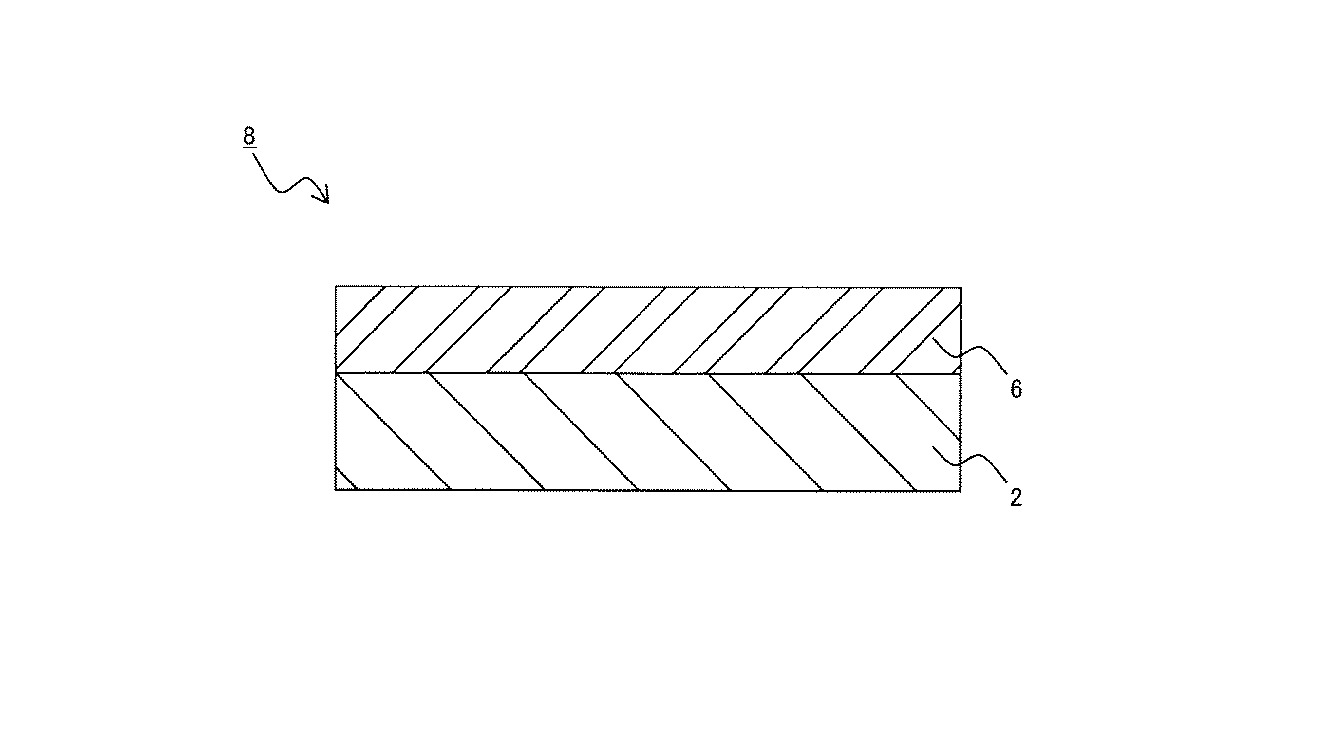
表1中に表す各成分としては、以下の材料を用いた。
・樹脂A:密度が0.918[g/cm3]の低密度ポリエチレン(日本ポリエチレン(株)製:「ノバテックLD LC604」)
・樹脂B:密度が0.905[g/cm3]の超低密度ポリエチレン(三井化学(株)製:「タフマー DF140」)
・充填剤A:炭酸カルシウム(備北粉化工業(株)製:「ソフトン1000」)
・充填剤B:二酸化チタン(石原産業(株)製:「タイペークCR−60−2」)
・発泡剤:アゾジカルボンアミド系発泡剤(永和化成工業(株)製:「ビニホールAC#3C−K2」)
・発泡助剤A:12−ヒドロキシステアリン酸亜鉛(日東化成工業(株)製:「ZS−6」)
・発泡助剤B:ステアリン酸亜鉛等脂肪酸金属塩及び炭酸カルシウムの、重量比1:1混合物(ADEKA(株)製:「アデカスタブ OF−101」)
・添加剤A:トリス(2-ヒドロキシエチル)イソシアヌレート(四国化成工業(株)製:「セイク」)
・添加剤B:リン酸エステル(ADEKA(株)製:「HP-10」)
・安定剤:フェノール系酸化防止剤(ADEKA(株)製:「AO−50」)
・耐候剤:ヒンダードアミン系光安定剤(ADEKA(株)製:「アデカスタブ LA-63P」)
・滑剤:(ADEKA(株)製:「アデカスタブAP−546」)
The following materials were used as the components shown in Table 1.
Resin A: Low density polyethylene having a density of 0.918 [g / cm 3 ] (manufactured by Nippon Polyethylene Co., Ltd .: “Novatech LD LC604”)
Resin B: Ultra-low density polyethylene having a density of 0.905 [g / cm 3 ] (manufactured by Mitsui Chemicals, Inc .: “Toughmer DF140”)
・ Filler A: Calcium carbonate (Bihoku Powder Chemical Co., Ltd .: “Softon 1000”)
Filler B: Titanium dioxide (Ishihara Sangyo Co., Ltd .: “Taipeke CR-60-2”)
-Foaming agent: azodicarbonamide-based foaming agent (manufactured by Eiwa Kasei Kogyo Co., Ltd .: “Vinifer AC # 3C-K2”)
Foaming aid A: 12-hydroxyzinc stearate (manufactured by Nitto Kasei Kogyo Co., Ltd .: “ZS-6”)
-Foaming aid B: 1: 1 mixture of fatty acid metal salt such as zinc stearate and calcium carbonate (made by ADEKA Corporation: "ADK STAB OF-101")
Additive A: Tris (2-hydroxyethyl) isocyanurate (manufactured by Shikoku Kasei Kogyo Co., Ltd .: “Sake”)
Additive B: Phosphate ester (manufactured by ADEKA Corporation: “HP-10”)
Stabilizer: Phenol antioxidant (manufactured by ADEKA Corporation: “AO-50”)
Weathering agent: hindered amine light stabilizer (manufactured by ADEKA Corporation: “Adeka Stub LA-63P”)
・ Lubricant: (manufactured by ADEKA Corporation: “ADK STAB AP-546”)
(発泡壁紙の性能評価)
本発明例1から3の発泡壁紙と、比較例1から3の発泡壁紙に対し、以下に記載する方法を用いて、発泡倍率と、インキの密着性と、変色を評価した。評価結果は、表2中に表す。
(発泡倍率)
まず、発泡前であり乾燥している発泡樹脂層の厚さ(a)を測定し、これを初期値とした。
次に、発泡炉にて発泡した後の発泡壁紙が備える発泡樹脂層の厚さ(b)を測定し、(b)/(a)を、発泡倍率として算出した。
(Performance evaluation of foam wallpaper)
For the foamed wallpaper of Invention Examples 1 to 3 and the foamed wallpaper of Comparative Examples 1 to 3, the foaming ratio, ink adhesion, and discoloration were evaluated using the methods described below. The evaluation results are shown in Table 2.
(Foaming ratio)
First, the thickness (a) of the dried foamed resin layer before foaming was measured and used as an initial value.
Next, the thickness (b) of the foamed resin layer included in the foamed wallpaper after foaming in the foaming furnace was measured, and (b) / (a) was calculated as the foaming ratio.
(インキ密着性)
織物絵柄を印刷した積層シートに対して、テープ(ニチバン(株)製:「CT−24」)による絵柄層の密着試験を行った。
インキ密着性に関しては、試験前と比較して絵柄層が99%以上残留しているものを「◎」とし、絵柄層の残留率が50%以上99%未満のものを「○」とし、50%未満のものを「×」とした。
(Ink adhesion)
The adhesion test of the picture layer with a tape (manufactured by Nichiban Co., Ltd .: “CT-24”) was performed on the laminated sheet on which the textile pattern was printed.
Regarding ink adhesion, “◎” indicates that 99% or more of the pattern layer remains compared to before the test, and “◯” indicates that the residual rate of the pattern layer is 50% or more and less than 99%. Less than% was marked with “x”.
(変色)
発泡後の発泡壁紙の色調を、目視にて評価した。
変色に関しては、比較例1の発泡壁紙と比較して差異がみられないものを「◎」とし、ほとんど黄変がみられないものを「○」とし、黄変しているものを「×」とした。
(積層シートの性能評価)
本発明例1から3の積層シートと、比較例1から3の積層シートに対し、以下に記載する方法を用いて、コロナ処理後の濡れ性と、インキに対する接触角を評価した。評価結果は、表2中に表す。
(discoloration)
The color tone of the foamed wallpaper after foaming was visually evaluated.
Regarding discoloration, “◎” indicates that there is no difference compared to the foamed wallpaper of Comparative Example 1, “◯” indicates that yellowing is hardly observed, and “×” indicates that yellowing is not observed. It was.
(Performance evaluation of laminated sheets)
Using the methods described below, the wettability after corona treatment and the contact angle with respect to the ink were evaluated for the laminated sheets of Invention Examples 1 to 3 and Comparative Examples 1 to 3. The evaluation results are shown in Table 2.
(濡れ性)
まず、積層シートの、樹脂シート側の表面に対し、コロナ放電処理を施した。
次に、コロナ放電処理を施した面に対し、濡れ張力試験用の混合液(和光純薬(株)製:「濡れ張力試験用混合液No.30〜No.42」)を用いて、JIS K6768に記載の通りに試験を行い、樹脂シートの濡れ張力(mN/m=N/mm)を測定した。
(接触角)
マツボー(株)製:「携帯式接触角計PG−3」を用いて、ハイドリックインキ(大日精化工業(株)製:「ハイドリックWP」)に対する接触角を測定した。
(Wettability)
First, a corona discharge treatment was performed on the surface of the laminated sheet on the resin sheet side.
Next, the surface subjected to the corona discharge treatment is subjected to JIS using a mixed liquid for wet tension test (manufactured by Wako Pure Chemical Industries, Ltd .: “mixed liquid for wet tension test No. 30 to No. 42”). The test was performed as described in K6768, and the wetting tension (mN / m = N / mm) of the resin sheet was measured.
(Contact angle)
Matsubo Co., Ltd .: “Contact angle meter PG-3” was used to measure the contact angle with respect to Hydrick ink (Daiichi Seika Kogyo Co., Ltd .: “Hydric WP”).
(評価結果)
表2中に表されるように、本発明例1から3の発泡壁紙及び樹脂シートは、比較例1から3の発泡壁紙及び樹脂シートと比較して、良好な発泡性と、十分な印刷適性を有するとともに、発泡過程での変色が発生しにくいことが確認された。
(Evaluation results)
As shown in Table 2, the foamed wallpaper and the resin sheet of Examples 1 to 3 of the present invention have better foamability and sufficient printability as compared with the foamed wallpaper and the resin sheet of Comparative Examples 1 to 3. It was confirmed that discoloration during the foaming process hardly occurs.
1…発泡壁紙、2…基材、4…発泡樹脂層、6…樹脂シート、8…積層シート DESCRIPTION OF SYMBOLS 1 ... Foam wallpaper, 2 ... Base material, 4 ... Foamed resin layer, 6 ... Resin sheet, 8 ... Laminated sheet
Claims (8)
複数種類の添加剤と、発泡剤と、発泡助剤と、を含有し、
前記複数種類の添加剤のうち少なくとも一種は、トリス(2-ヒドロキシエチル)イソシアヌレートまたは前記トリス(2-ヒドロキシエチル)イソシアヌレートの持つ水酸基が脱水縮合した多量体であり、
前記発泡助剤は、脂肪酸金属塩の炭素鎖に活性プロトンを含む官能基を有する官能基含有脂肪酸金属塩を含むことを特徴とする発泡壁紙用原反。 Forming a foam wallpaper together with a base material, and forming a foam resin layer provided on the base material;
Containing multiple types of additives, foaming agents, and foaming aids,
At least one of the plurality of types of additives is tris (2-hydroxyethyl) isocyanurate or a multimer obtained by dehydration condensation of the hydroxyl group of the tris (2-hydroxyethyl) isocyanurate,
The foaming wallpaper raw material, wherein the foaming aid contains a functional group-containing fatty acid metal salt having a functional group containing an active proton in the carbon chain of the fatty acid metal salt.
前記トリス(2-ヒドロキシエチル)イソシアヌレートの含有量または前記多量体の含有量が、前記樹脂分の100質量部に対して0.1質量部以上15質量部以下の範囲内であることを特徴とする請求項1に記載した発泡壁紙用原反。 Further containing resin,
The content of the tris (2-hydroxyethyl) isocyanurate or the content of the multimer is in the range of 0.1 to 15 parts by mass with respect to 100 parts by mass of the resin. The raw material for foam wallpaper according to claim 1.
前記基材上に設けられた請求項5または請求項6に記載した樹脂シートと、を備えることを特徴とする積層シート。 A substrate;
A laminated sheet comprising: the resin sheet according to claim 5 or 6 provided on the substrate.
前記積層シートは、前記発泡剤が発泡した前記樹脂シートを備えることを特徴とする発泡壁紙。 A foam wallpaper formed using the laminated sheet according to claim 7,
The laminated wallpaper includes the resin sheet in which the foaming agent is foamed.
Priority Applications (1)
| Application Number | Priority Date | Filing Date | Title |
|---|---|---|---|
| JP2016041313A JP6772483B2 (en) | 2016-03-03 | 2016-03-03 | Raw fabric for foam wallpaper, resin sheet, laminated sheet and foam wallpaper |
Applications Claiming Priority (1)
| Application Number | Priority Date | Filing Date | Title |
|---|---|---|---|
| JP2016041313A JP6772483B2 (en) | 2016-03-03 | 2016-03-03 | Raw fabric for foam wallpaper, resin sheet, laminated sheet and foam wallpaper |
Publications (2)
| Publication Number | Publication Date |
|---|---|
| JP2017155376A true JP2017155376A (en) | 2017-09-07 |
| JP6772483B2 JP6772483B2 (en) | 2020-10-21 |
Family
ID=59808381
Family Applications (1)
| Application Number | Title | Priority Date | Filing Date |
|---|---|---|---|
| JP2016041313A Active JP6772483B2 (en) | 2016-03-03 | 2016-03-03 | Raw fabric for foam wallpaper, resin sheet, laminated sheet and foam wallpaper |
Country Status (1)
| Country | Link |
|---|---|
| JP (1) | JP6772483B2 (en) |
Citations (12)
| Publication number | Priority date | Publication date | Assignee | Title |
|---|---|---|---|---|
| JPS61213252A (en) * | 1985-03-18 | 1986-09-22 | Sakai Chem Ind Co Ltd | Vinyl chloride resin composition |
| JPH04233958A (en) * | 1990-07-31 | 1992-08-21 | Ciba Geigy Ag | Method for recirculation of colored polyolefin |
| JPH05220885A (en) * | 1991-11-07 | 1993-08-31 | Monsanto Europe Sa | Flame resisting plastic article |
| JPH0939137A (en) * | 1995-07-26 | 1997-02-10 | Sekisui Chem Co Ltd | Laminated sheet for coating |
| JP2000119467A (en) * | 1998-10-15 | 2000-04-25 | Akishima Kagaku Kogyo Kk | Foamable vinyl chloride resin composition |
| WO2002077055A1 (en) * | 2001-03-27 | 2002-10-03 | Kaneka Corporation | Crosslinked rigid vinyl chloride resin foam and process for producing the same |
| US20060004128A1 (en) * | 2002-11-26 | 2006-01-05 | Baerlocher Gmbh | Stabiliser composition for halogen-containing polymers |
| JP2007204525A (en) * | 2006-01-31 | 2007-08-16 | Adeka Corp | Liquid stabilizer composition for vinyl chloride resin and plastisol composition containing the liquid stabilizer composition |
| JP2009208355A (en) * | 2008-03-04 | 2009-09-17 | Furukawa Electric Co Ltd:The | Fire proof resin foaming laminate |
| US20130005877A1 (en) * | 2010-03-11 | 2013-01-03 | Walter Reith | Stabilizer mixtures for halogen-containing plastics by underwater pelletization |
| EP2915839A1 (en) * | 2014-03-06 | 2015-09-09 | JSC Veika | Composite sheet and manufacturing method for a foamed decorative sheet free of PVC and plasticizers |
| JP2015223934A (en) * | 2014-05-28 | 2015-12-14 | 勝田化工株式会社 | Seat for vehicle |
-
2016
- 2016-03-03 JP JP2016041313A patent/JP6772483B2/en active Active
Patent Citations (12)
| Publication number | Priority date | Publication date | Assignee | Title |
|---|---|---|---|---|
| JPS61213252A (en) * | 1985-03-18 | 1986-09-22 | Sakai Chem Ind Co Ltd | Vinyl chloride resin composition |
| JPH04233958A (en) * | 1990-07-31 | 1992-08-21 | Ciba Geigy Ag | Method for recirculation of colored polyolefin |
| JPH05220885A (en) * | 1991-11-07 | 1993-08-31 | Monsanto Europe Sa | Flame resisting plastic article |
| JPH0939137A (en) * | 1995-07-26 | 1997-02-10 | Sekisui Chem Co Ltd | Laminated sheet for coating |
| JP2000119467A (en) * | 1998-10-15 | 2000-04-25 | Akishima Kagaku Kogyo Kk | Foamable vinyl chloride resin composition |
| WO2002077055A1 (en) * | 2001-03-27 | 2002-10-03 | Kaneka Corporation | Crosslinked rigid vinyl chloride resin foam and process for producing the same |
| US20060004128A1 (en) * | 2002-11-26 | 2006-01-05 | Baerlocher Gmbh | Stabiliser composition for halogen-containing polymers |
| JP2007204525A (en) * | 2006-01-31 | 2007-08-16 | Adeka Corp | Liquid stabilizer composition for vinyl chloride resin and plastisol composition containing the liquid stabilizer composition |
| JP2009208355A (en) * | 2008-03-04 | 2009-09-17 | Furukawa Electric Co Ltd:The | Fire proof resin foaming laminate |
| US20130005877A1 (en) * | 2010-03-11 | 2013-01-03 | Walter Reith | Stabilizer mixtures for halogen-containing plastics by underwater pelletization |
| EP2915839A1 (en) * | 2014-03-06 | 2015-09-09 | JSC Veika | Composite sheet and manufacturing method for a foamed decorative sheet free of PVC and plasticizers |
| JP2015223934A (en) * | 2014-05-28 | 2015-12-14 | 勝田化工株式会社 | Seat for vehicle |
Also Published As
| Publication number | Publication date |
|---|---|
| JP6772483B2 (en) | 2020-10-21 |
Similar Documents
| Publication | Publication Date | Title |
|---|---|---|
| JP6536172B2 (en) | Resin composition, resin sheet, laminated sheet and foam wallpaper | |
| JP6638277B2 (en) | Resin composition set, resin sheet, laminated sheet and foamed wallpaper, and method for producing resin sheet and foamed wallpaper | |
| JP2017159537A (en) | Multilayer resin sheet, layered sheet, method for producing multilayer resin sheet, method for producing layered sheet, and method for producing foaming wall paper | |
| JP6413696B2 (en) | Resin composition, resin sheet, laminated sheet and foamed wallpaper | |
| JP6569299B2 (en) | Resin composition, resin sheet, laminated sheet and foamed wallpaper | |
| JP6554961B2 (en) | Resin sheet, laminated sheet and foam wallpaper | |
| JP6520138B2 (en) | Resin composition, resin sheet, laminated sheet and foam wallpaper | |
| JP6733130B2 (en) | Method for producing foamed wallpaper and method for producing laminated sheet | |
| JP6772483B2 (en) | Raw fabric for foam wallpaper, resin sheet, laminated sheet and foam wallpaper | |
| JP6413557B2 (en) | Resin composition, resin sheet, laminated sheet and foamed wallpaper | |
| JP6511932B2 (en) | Resin composition, resin sheet, laminated sheet and foam wallpaper | |
| JP6536146B2 (en) | Foam wallpaper | |
| JP6645010B2 (en) | Resin composition, resin sheet, laminated sheet and foamed wallpaper | |
| JP6520434B2 (en) | Resin composition, resin sheet, laminated sheet and foam wallpaper | |
| JP2017088802A (en) | Resin composition, method for producing resin sheet, method for producing laminated sheet, and method for producing foamed wallpaper | |
| JP2017088746A (en) | Resin composition, and manufacturing method of resin sheet, laminate sheet and foam wallpaper | |
| JP6582504B2 (en) | RESIN COMPOSITION, LAMINATED SHEET, LAMINATE, FOAM WALLPAPER AND METHOD FOR PRODUCING FOAM WALLPAPER | |
| JP6607064B2 (en) | Multilayer resin sheet, laminate sheet, method for producing multilayer resin sheet, method for producing laminate sheet, and method for producing foamed wallpaper | |
| JP6554797B2 (en) | RESIN COMPOSITION, LAMINATED SHEET, LAMINATE, FOAM WALLPAPER AND METHOD FOR PRODUCING FOAM WALLPAPER | |
| JP6492482B2 (en) | Resin composition, resin sheet, laminated sheet and foamed wallpaper | |
| JP2018178468A (en) | Raw fabric for foam wallpaper and foam wallpaper | |
| JP2017100398A (en) | Multilayer resin sheet, laminate sheet, method for producing multilayer resin sheet, method for producing laminate sheet, and method for producing foamed wallpaper | |
| JP6384224B2 (en) | RESIN COMPOSITION, LAMINATED SHEET, LAMINATE, FOAM WALLPAPER AND METHOD FOR PRODUCING FOAM WALLPAPER | |
| JP6690274B2 (en) | Method for manufacturing laminated sheet and foam wallpaper | |
| JP6607063B2 (en) | Multilayer resin sheet, laminate sheet, method for producing multilayer resin sheet, method for producing laminate sheet, and method for producing foamed wallpaper |
Legal Events
| Date | Code | Title | Description |
|---|---|---|---|
| A711 | Notification of change in applicant |
Free format text: JAPANESE INTERMEDIATE CODE: A712 Effective date: 20160603 |
|
| RD03 | Notification of appointment of power of attorney |
Free format text: JAPANESE INTERMEDIATE CODE: A7423 Effective date: 20160622 |
|
| A621 | Written request for application examination |
Free format text: JAPANESE INTERMEDIATE CODE: A621 Effective date: 20190221 |
|
| A131 | Notification of reasons for refusal |
Free format text: JAPANESE INTERMEDIATE CODE: A131 Effective date: 20200324 |
|
| A521 | Request for written amendment filed |
Free format text: JAPANESE INTERMEDIATE CODE: A523 Effective date: 20200422 |
|
| TRDD | Decision of grant or rejection written | ||
| A01 | Written decision to grant a patent or to grant a registration (utility model) |
Free format text: JAPANESE INTERMEDIATE CODE: A01 Effective date: 20200901 |
|
| A61 | First payment of annual fees (during grant procedure) |
Free format text: JAPANESE INTERMEDIATE CODE: A61 Effective date: 20200914 |
|
| R150 | Certificate of patent or registration of utility model |
Ref document number: 6772483 Country of ref document: JP Free format text: JAPANESE INTERMEDIATE CODE: R150 |
|
| R250 | Receipt of annual fees |
Free format text: JAPANESE INTERMEDIATE CODE: R250 |
|
| R250 | Receipt of annual fees |
Free format text: JAPANESE INTERMEDIATE CODE: R250 |
|
| R250 | Receipt of annual fees |
Free format text: JAPANESE INTERMEDIATE CODE: R250 |