JP2017166331A - Power generation method and power generation system - Google Patents
Power generation method and power generation system Download PDFInfo
- Publication number
- JP2017166331A JP2017166331A JP2016049646A JP2016049646A JP2017166331A JP 2017166331 A JP2017166331 A JP 2017166331A JP 2016049646 A JP2016049646 A JP 2016049646A JP 2016049646 A JP2016049646 A JP 2016049646A JP 2017166331 A JP2017166331 A JP 2017166331A
- Authority
- JP
- Japan
- Prior art keywords
- power generation
- gas
- liquid
- circulating medium
- heating
- Prior art date
- Legal status (The legal status is an assumption and is not a legal conclusion. Google has not performed a legal analysis and makes no representation as to the accuracy of the status listed.)
- Pending
Links
Images
Classifications
-
- Y—GENERAL TAGGING OF NEW TECHNOLOGICAL DEVELOPMENTS; GENERAL TAGGING OF CROSS-SECTIONAL TECHNOLOGIES SPANNING OVER SEVERAL SECTIONS OF THE IPC; TECHNICAL SUBJECTS COVERED BY FORMER USPC CROSS-REFERENCE ART COLLECTIONS [XRACs] AND DIGESTS
- Y02—TECHNOLOGIES OR APPLICATIONS FOR MITIGATION OR ADAPTATION AGAINST CLIMATE CHANGE
- Y02P—CLIMATE CHANGE MITIGATION TECHNOLOGIES IN THE PRODUCTION OR PROCESSING OF GOODS
- Y02P80/00—Climate change mitigation technologies for sector-wide applications
- Y02P80/10—Efficient use of energy, e.g. using compressed air or pressurized fluid as energy carrier
- Y02P80/15—On-site combined power, heat or cool generation or distribution, e.g. combined heat and power [CHP] supply
Landscapes
- Engine Equipment That Uses Special Cycles (AREA)
Abstract
【課題】工場排水などの熱エネルギーを有効活用できる低温発電方法およ低温発電システムの提供。【解決手段】実施形態による発電方法は、二酸化炭素とアミン化合物と水とを含む循環媒体を加熱する工程、前記加熱によって生じた気体と液体とを分離する工程、前記蒸気で発電タービンを回転させて起電する工程、および発電に供した後の前記気体を、前記液体と混合および冷却して、前記気体を前記液体に吸収させて前記循環媒体を再生する工程、を含む。この方法は、加熱器、気液分離器、発電タービン、混合器、および冷却器、を具備し、内部に酸化炭素とアミン化合物と水とを含む循環媒体が封入した発電システムにより実施できる。【選択図】図1[Problem] To provide a low-temperature power generation method and a low-temperature power generation system capable of effectively utilizing thermal energy such as factory waste water. A power generation method according to an embodiment includes a step of heating a circulating medium containing carbon dioxide, an amine compound, and water, a step of separating a gas and a liquid generated by the heating, and rotating a power generation turbine with the steam. And the step of regenerating the circulating medium by mixing and cooling the gas after being subjected to power generation and cooling the liquid and absorbing the gas in the liquid. This method can be implemented by a power generation system that includes a heater, a gas-liquid separator, a power generation turbine, a mixer, and a cooler, in which a circulating medium containing carbon oxide, an amine compound, and water is enclosed. [Selection] Figure 1
Description
本発明の実施形態は、低温で駆動可能な発電方法およびそれを利用した発電システムに関するものである。 Embodiments described herein relate generally to a power generation method that can be driven at a low temperature and a power generation system using the power generation method.
従来、電気エネルギーを供給するためには、化石燃料を用いた火力発電が用いられていた。しかし、エネルギー資源の枯渇や地球温暖化問題に対する対策として、代替エネルギーを利用した発電システムが検討されている。そのような発電方法の一つとして、工場などで発生する、例えば200℃以下の低温排熱等の未利用エネルギーを利用した低温発電システムが検討されている。 Conventionally, thermal power generation using fossil fuel has been used to supply electric energy. However, power generation systems using alternative energy are being studied as countermeasures against energy resource depletion and global warming. As one of such power generation methods, a low-temperature power generation system using unused energy generated at a factory or the like, for example, low-temperature exhaust heat of 200 ° C. or less has been studied.
低温発電システムのひとつは、排熱により水を加熱して水蒸気ガスに変換し、その圧力で発電タービンを回転させる、ランキンサイクルである。しかし、ランキンサイクルは出力が比較的低いために、さらなる改良が検討された。そのような背景から考案されたのが、低沸点媒体を利用するカリーナサイクルである。 One of the low-temperature power generation systems is a Rankine cycle in which water is heated by exhaust heat and converted into steam gas, and a power generation turbine is rotated by the pressure. However, because the Rankine cycle has a relatively low output, further improvements have been considered. From such a background, a carina cycle utilizing a low boiling point medium has been devised.
カリーナサイクルは、アンモニア−水混合媒体を加熱して得られるアンモニア−水蒸気混合流体でタービンを回すシステムである(例えば非特許文献1参照)。この方法では、ランキンサイクルに対して20〜50%の出力向上が見込むことができる。このため、低温発電システムとしては、各種の改良が検討されている(例えば特許文献1)。 The carina cycle is a system that rotates a turbine with an ammonia-water vapor mixed fluid obtained by heating an ammonia-water mixed medium (see, for example, Non-Patent Document 1). In this method, an output improvement of 20 to 50% can be expected with respect to the Rankine cycle. For this reason, various improvement is examined as a low temperature electric power generation system (for example, patent documents 1).
しかしながら、従来検討されているカリーナシステムでは、出力向上のためには作動圧力を高くする必要がある。具体的には、2気圧以上の作動圧力が必要となるのが一般的である。そして、出力をより向上させるためには作動圧力をさらに大きくすることが望ましい。しかし、作動圧力を大きくすると、タービン軸受け等からの作動ガスのリークが起こりやすい。カリーナサイクルにおいては作動ガスに有害なアンモニアが含まれるため、作動ガスのリークは重大な問題となる。このように、カリーナシステムでは、出力改善のための作動圧力の上昇と、作動ガスのリーク防止とがトレードオフの関係にあるため、これ以上の改善が困難であった。このために、新たな低温発電方法およびシステムの開発が望まれていた。 However, in the conventional carina system, it is necessary to increase the operating pressure in order to improve the output. Specifically, an operating pressure of 2 atmospheres or more is generally required. In order to further improve the output, it is desirable to further increase the operating pressure. However, when the operating pressure is increased, the working gas leaks easily from the turbine bearing or the like. In the carina cycle, since the working gas contains harmful ammonia, leakage of the working gas becomes a serious problem. As described above, in the carina system, the increase in the operating pressure for improving the output and the prevention of leakage of the working gas are in a trade-off relationship, and thus further improvement is difficult. For this reason, development of a new low-temperature power generation method and system has been desired.
実施形態による発電方法は、
二酸化炭素とアミン化合物と水とを含む循環媒体を加熱する工程、
前記加熱によって生じた蒸気と液体とを分離する工程、
前記蒸気で発電タービンを回転させて起電する工程、および
発電に供した後の前記蒸気を、前記液体と混合および冷却して、前記蒸気を前記液体に吸収させて前記循環媒体を再生する工程、
を含むことを特徴とするものである。
The power generation method according to the embodiment includes:
Heating a circulating medium containing carbon dioxide, an amine compound and water;
Separating the vapor and liquid generated by the heating;
A step of generating electricity by rotating a power generation turbine with the steam, and a step of regenerating the circulating medium by mixing and cooling the vapor after being subjected to power generation with the liquid and absorbing the vapor into the liquid ,
It is characterized by including.
実施形態によれば、比較的温度が低い熱源を利用して効率的な発電を行うことができる。 According to the embodiment, efficient power generation can be performed using a heat source having a relatively low temperature.
実施形態に係る発電方法および発電システムについて、図面を参照しながら説明すると以下の通りである。 The power generation method and power generation system according to the embodiment will be described below with reference to the drawings.
(第1の実施形態)
第1の実施形態による発電方法では、二酸化炭素とアミン化合物と水とを含む循環媒体を用いる。この循環媒体を、熱源を用いて加熱して蒸気を含む気体と、アミン化合物を含む液体とを発生させ、その気体によって発電タービンを回転させて起電を行う。起電に用いられた後の気体は、分離された液体に吸収させて回収し、液体状態の循環媒体として再利用する。
(First embodiment)
In the power generation method according to the first embodiment, a circulating medium containing carbon dioxide, an amine compound, and water is used. The circulating medium is heated using a heat source to generate a gas containing steam and a liquid containing an amine compound, and the gas turbine is rotated by the gas to generate electricity. The gas used for electromotive force is collected by being absorbed by the separated liquid and reused as a circulating medium in a liquid state.
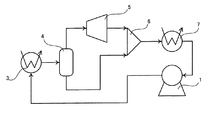
循環媒体を用いた発電方法としてカリーナサイクルが知られているが、実施形態による発電方法は、カリーナサイクルで用いられるアンモニアと水とを含む循環媒体に代えて、二酸化炭素とアミン化合物と水とを含む循環媒体を用いる点が特徴のひとつである。この実施形態を図1を参照しながら説明すると以下の通りである。 The carina cycle is known as a power generation method using a circulating medium, but the power generation method according to the embodiment uses carbon dioxide, an amine compound, and water instead of the circulating medium containing ammonia and water used in the carina cycle. One of the features is that it uses a circulating medium. This embodiment will be described below with reference to FIG.
循環媒体は、ポンプ1により加熱器3に圧送される。圧送される循環媒体は、循環使用されており、後述する冷却器7において再生されるものであっても、冷却器7とポンプ1との間に配置された循環媒体貯蔵容器(図示せず)に貯蔵されたものであってもよい。
The circulating medium is pumped to the
実施形態に用いられる循環媒体は、二酸化炭素とアミン化合物と水とを含むものである。ここで、アミン化合物の水溶液は、二酸化炭素吸収能力があり、低温低圧で二酸化炭素を吸収して、二酸化炭素とアミン化合物と水とを含む水溶液、すなわち循環媒体となる。そして、この循環媒体を加熱すると、比較的低い温度で、二酸化炭素を多く含む蒸気と、アミン化合物を多く含む液体とに分離するため、低温で蒸気を得ることができる。 The circulating medium used in the embodiment includes carbon dioxide, an amine compound, and water. Here, the aqueous solution of the amine compound has carbon dioxide absorption ability, absorbs carbon dioxide at low temperature and low pressure, and becomes an aqueous solution containing carbon dioxide, the amine compound and water, that is, a circulation medium. When this circulating medium is heated, it is separated into a vapor containing a large amount of carbon dioxide and a liquid containing a large amount of an amine compound at a relatively low temperature, so that the vapor can be obtained at a low temperature.
このようなアミン化合物としては、工場などの排気ガスに含まれる二酸化炭素回収システムに用いられるものが好ましい。具体的には、モノエタノールアミン、ジエタノールアミン、メチルジエタノールアミン、ジイソプロパノールアミン、およびそれらの組み合わせからなる群から選択されるものであることが好ましく、モノエタノールアミンがより好ましい。そして、実施形態における循環媒体は、このアミン化合物を含む水溶液に二酸化炭素を吸収させたものであるが、このような循環媒体として、工場などの排気ガスに含まれる二酸化炭素回収システムにおける、二酸化炭素を吸収させた吸収液を用いることもできる。 As such an amine compound, what is used for the carbon dioxide recovery system contained in exhaust gas, such as a factory, is preferable. Specifically, it is preferably selected from the group consisting of monoethanolamine, diethanolamine, methyldiethanolamine, diisopropanolamine, and combinations thereof, and monoethanolamine is more preferable. The circulation medium in the embodiment is obtained by absorbing carbon dioxide in the aqueous solution containing the amine compound. As such a circulation medium, carbon dioxide in a carbon dioxide recovery system contained in exhaust gas such as a factory is used. It is also possible to use an absorbing solution that has absorbed water.
循環媒体のアミン化合物の含有量は特に限定されず、熱源の温度や目的とする起電能力などに応じて適切に設定される。アミン化合物の濃度が高い方が二酸化炭素の放出性能が高くなって起電性能に有利に作用する。一方、循環媒体による装置の腐食を抑制するためには、アミン化合物の濃度は低い方が望ましい。このような観点から、循環媒体のアミン化合物含有量は、例えば10〜40質量%、好ましくは15〜30質量%である。特に、熱源の温度が100〜120℃の場合には、アミン化合物の含有量は約15質量%が適切である。 The content of the amine compound in the circulating medium is not particularly limited, and is appropriately set according to the temperature of the heat source, the target electromotive capacity, and the like. The higher the concentration of the amine compound, the higher the carbon dioxide release performance, which advantageously affects the electromotive performance. On the other hand, in order to suppress corrosion of the apparatus due to the circulating medium, it is desirable that the concentration of the amine compound is low. From such a viewpoint, the content of the amine compound in the circulating medium is, for example, 10 to 40% by mass, preferably 15 to 30% by mass. In particular, when the temperature of the heat source is 100 to 120 ° C., the content of the amine compound is suitably about 15% by mass.
また、二酸化炭素の含有率は、循環媒体に含まれるアミン化合物に含まれるアミン基1モルあたり0.3〜1モル、好ましくは0.3〜0.7モルである。なお、この二酸化炭素とアミン化合物との割合は、前記ポンプから圧送されるとき、すなわち蒸気を発生させる前のものである。また、アミン化合物がモノエタノールアミンなどのモノアミンの場合は、アミン化合物に含まれるアミン基のモル数は、アミン化合物のモル数に一致する。 Moreover, the content rate of a carbon dioxide is 0.3-1 mol with respect to 1 mol of amine groups contained in the amine compound contained in a circulating medium, Preferably it is 0.3-0.7 mol. The ratio of carbon dioxide to amine compound is that when pumped from the pump, that is, before generating steam. When the amine compound is a monoamine such as monoethanolamine, the number of moles of the amine group contained in the amine compound matches the number of moles of the amine compound.
この循環媒体は、ポンプによって加圧されるが、そのときの圧力は一般的に知られているカリーナサイクルに比較して低い。具体的には150〜200kPaであることが好ましく、170〜190kPaであることが好ましい。 This circulating medium is pressurized by a pump, but the pressure at that time is lower than that of a generally known carina cycle. Specifically, it is preferably 150 to 200 kPa, and preferably 170 to 190 kPa.
圧送された循環媒体は、加熱器3により加熱される。この加熱には任意の熱源を用いることができるが、本実施形態による発電方法は、低温で起電することができる。具体的には、工場排水、発電所排水、地熱、または温泉熱を用いることができる。加熱後の循環媒体の温度は、熱源の種類および温度、ならびに加熱器3の構造などを調整することによって変更することが可能である。加熱によって、循環媒体を気液二相状態にすることが必要であるが、そのためには、加熱後の循環媒体の温度が高いことが好ましい。一方、循環媒体中に含まれるアミン化合物の劣化を抑制するため、また循環媒体から二酸化炭素を十分に放出させるためには、温度が言っていいかであることが好ましい。このような観点から
加熱後の循環媒体の温度は80〜120℃となるように調整されることが好ましい。
The circulating medium thus pumped is heated by the
加熱器3において加熱された循環媒体は気液二相状態となり、気液分離器4で供給される。気液二相状態の循環媒体は気液分離器4で、二酸化炭素−水蒸気混合気体と、水およびアミン化合物を主成分とする液体とに分離される。
The circulating medium heated in the
分離された二酸化炭素−水蒸気混合気体は、タービン5に供給されて断熱膨張し、タービンを駆動する。この駆動エネルギーが起電に利用されて発電される。
The separated carbon dioxide-water vapor mixed gas is supplied to the
タービンを駆動した後、混合気体は混合器6へ供給され、気液分離器4から供給される液体と混合される。混合器6で形成された混合物は、冷却器7へ供給されて冷却される。冷却器7において混合物は、一般に20〜60℃、例えば40℃に冷却されて、混合気体を液体に吸収させる。このとき、実施形態においては特定の循環媒体を用いるため、加圧をする必要が無い。そして、吸収後の圧力は一般に10〜30kPaとなる。
After driving the turbine, the mixed gas is supplied to the
この結果、タービン上流の圧力が120〜180kPa、タービン下流の圧力が10〜30kPaとなるため、大きな圧力差が発生し、発電効率が高くなる。このような発電装置によるエネルギーは、装置の規模、循環媒体の種類、熱源の温度など、種々の条件で変動し得るが、例えば数百kWまでの発電が可能である。そして、圧力が最大でも180kpa程度であるために、装置内部の圧力が従来知られているカリーナサイクルなどに比べて低いため、外気と接する部分は負圧となるため、タービン軸受けなどからの媒体のリークが少ない。このことに加え、有害なアンモニアを用いないために、安全性が高く、環境にも優しい発電方法である。 As a result, since the pressure upstream of the turbine is 120 to 180 kPa and the pressure downstream of the turbine is 10 to 30 kPa, a large pressure difference is generated and the power generation efficiency is increased. The energy generated by such a power generation apparatus can vary under various conditions such as the scale of the apparatus, the type of circulating medium, and the temperature of the heat source, but can generate power up to several hundred kW, for example. And since the pressure is about 180 kpa at the maximum, the pressure inside the device is lower than that of the conventionally known carina cycle, etc., so the portion in contact with the outside air is negative pressure, so that the medium from the turbine bearing etc. There are few leaks. In addition to this, since it does not use harmful ammonia, it is a safe and environmentally friendly power generation method.
冷却器7で再生された循環媒体は、直接ポンプ1に供給されて、再度循環されるか、循環媒体貯蔵容器(図示せず)に一次滞留された後に、再度循環される。
The circulating medium regenerated by the
(第2の実施形態)
第2の実施形態による発電方法は、第1の実施形態の方法に対して、熱交換器2によって、熱エネルギーをさらに有効活用するものである。
(Second Embodiment)
The power generation method according to the second embodiment uses the heat energy more effectively by the
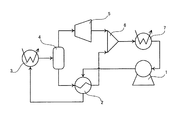
熱交換器2は、例えば図2に示すように、ポンプ1と加熱器3との間の配管と、気液分離器4から混合器6へ液体を供給する配管の交点に配置される。そして気液分離された後の、比較的高温である液体によって、加熱前の循環媒体を余熱するものである。この結果、加熱器3に供給される循環媒体の温度を上昇させることができると共に、混合器6に供給される液体の温度を下降させ、冷却器7における気体吸収の効率を改善することができる。
For example, as shown in FIG. 2, the
以上説明した各実施形態によれば、工場排水などの比較的温度が低い、例えば120℃以下の熱源を利用して、効率的な発電を行うことができる。さらにこの発電方法は、カリーナサイクルで必要とされた有害なアンモニアを利用する必要が無いうえ、作動圧力が低いために、循環媒体のリークそのものが抑制されているので、取り扱い性に優れている。 According to each embodiment described above, efficient power generation can be performed by using a heat source having a relatively low temperature such as factory waste water, for example, 120 ° C. or less. Furthermore, this power generation method is excellent in handleability because there is no need to use harmful ammonia required in the carina cycle, and since the operating pressure is low, leakage of the circulating medium itself is suppressed.
(発電システム)
実施形態による発電システムは、前記の発電方法を実施することができるシステムである。したがって、加圧ポンプ、加熱器、気液分離器、発電タービン、混合器、および冷却器、を具備している。そして、このシステムの内部には、二酸化炭素とアミン化合物と水とを含む循環媒体が封入されており、システム内で加熱された循環媒体が気体となって、発電タービンを回転させることによって起電することができる。
(Power generation system)
The power generation system according to the embodiment is a system capable of implementing the above power generation method. Accordingly, the apparatus includes a pressurizing pump, a heater, a gas-liquid separator, a power generation turbine, a mixer, and a cooler. In addition, a circulating medium containing carbon dioxide, an amine compound, and water is enclosed inside the system, and the circulating medium heated in the system becomes a gas, and the electromotive turbine is rotated by rotating the power generation turbine. can do.
まず、ポンプ1は、加熱前の循環媒体を加熱器に圧送するものである。圧送された循環媒体は、加熱器3において加熱される。このとき、加熱の熱源は外部から供給される。加熱によって二酸化炭素と水蒸気とを含む気体が発生し、一方で気化しなかった水およびアミン化合物は液体のまま残留する。気液分離器4は、加熱器3から供給される加熱後の循環媒体を、気体と液体とに分離することができるものである。
First, the pump 1 pumps the circulating medium before heating to a heater. The circulating medium thus pumped is heated in the
気液分離器4によって分離された気体は、発電タービン5に供給され、発電タービンを駆動し、発電が起こる。発電タービン駆動後の気体は、混合器6に供給される。
The gas separated by the gas-
気液分離器によって分離された液体は、直接混合器6に供給されるか、熱交換器2が存在する場合にはそれを経由して混合器6に供給される。熱交換器2が存在する場合、この熱交換器は分離後の液体によって加熱前の循環媒体を加熱するものである。
The liquid separated by the gas-liquid separator is directly supplied to the
混合器6は、発電タービン駆動後の気体と、気液分離器から供給される液体とを混合する。生成した混合物は、引き続き冷却器7に供給される。冷却器7は混合器において得られる混合物を冷却して、前記気体を前記液体に吸収させて、循環媒体を再生するものである。
The
再生された循環媒体は、さらに循環されて連続的に発電を行うことができる。 The regenerated circulating medium can be further circulated to generate power continuously.
このような発電システムは、従来のカリーナサイクルに用いられていたものと同様にものを用いることができる。ただし、実施形態による発電方法は、システムの内部圧力がカリーナサイクルよりも低く、発電タービンが基本的に負圧によって駆動されるという特徴がある。このため、内部の循環媒体に含まれる物質が外部にリークする危険性が低い。さらには内部の循環媒体に用いられるアミン化合物や二酸化炭素は毒性が低いために、安全性がより高いものとなっている。 Such a power generation system can be the same as that used in a conventional carina cycle. However, the power generation method according to the embodiment is characterized in that the internal pressure of the system is lower than that of the carina cycle, and the power generation turbine is basically driven by negative pressure. For this reason, the danger that the substance contained in the internal circulating medium leaks to the outside is low. Furthermore, the amine compound and carbon dioxide used for the internal circulation medium are less toxic and therefore have higher safety.
(実施例)
図2に示されるシステムを用いて、実施形態による発電方法を実施する。
(Example)
The power generation method according to the embodiment is performed using the system shown in FIG.
循環媒体として10kPaの圧力で二酸化炭素(CO2)を吸収させた15質量%モノエタノールアミン(MEA)水溶液を用意する。この循環媒体をポンプ1から吐出圧力180kPaへ加圧する。このときの二酸化炭素吸収量はCO2/MEAモル比は0.5である。 A 15% by mass monoethanolamine (MEA) aqueous solution in which carbon dioxide (CO 2 ) is absorbed at a pressure of 10 kPa as a circulation medium is prepared. The circulating medium is pressurized from the pump 1 to a discharge pressure of 180 kPa. The amount of carbon dioxide absorbed at this time is 0.5 in CO 2 / MEA molar ratio.
加圧された循環媒体は熱交換器2および加熱器3で加熱され、気液二相状態になり、気液分離器4へ供給される。気液二相状態の循環媒体は気液分離器4で、CO2−水蒸気混合気体と、水及びアミン化合物を主成分とする液体とに分離される。分離されたCO2−水蒸気混合気体はタービン5で断熱膨張し、タービン5を駆動する。タービン5から放出された気体は混合器6へ供給される。一方、気液分離器4から放出された液体は熱交換器2でポンプ1から供給される加圧循環媒体を加熱後、混合器6へ供給される。
The pressurized circulating medium is heated by the
混合器6で混合されたCO2−水蒸気混合気体と液体は冷却器7へ供給される。冷却器7で40℃に冷却され、CO2−水蒸気混合気体は10kPaで液体へ吸収され、循環媒体として再生され、ポンプ1へ供給される。このときの発電効率を見積もったところ、約14%であった。
The CO 2 -steam mixed gas and liquid mixed in the
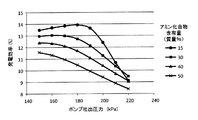
同様にして、吐出圧力を150〜220kPaの間で変化させて、発電効率を見積もった。さらに、循環媒体中のアミン化合物の含有量を15〜50質量%の間で変化させて、発電効率を見積もった。得られた結果は図3に示すとおりであった。 Similarly, the power generation efficiency was estimated by changing the discharge pressure between 150 and 220 kPa. Furthermore, the power generation efficiency was estimated by changing the content of the amine compound in the circulating medium between 15 and 50% by mass. The obtained result was as shown in FIG.
1 ポンプ、 2 熱交換器、 3 加熱器、 4 気液分離器、 5 タービン、 6 混合器、 7 冷却器 1 pump, 2 heat exchanger, 3 heater, 4 gas-liquid separator, 5 turbine, 6 mixer, 7 cooler
Claims (6)
前記加熱によって生じた気体と液体とを分離する工程、
前記蒸気で発電タービンを回転させて起電する工程、および
発電に供した後の前記気体を、前記液体と混合および冷却して、前記気体を前記液体に吸収させて前記循環媒体を再生する工程、
を含むことを特徴とする、発電方法。 Heating a circulating medium containing carbon dioxide, an amine compound and water;
Separating the gas and liquid generated by the heating;
A step of generating electricity by rotating a power generation turbine with the steam, and a step of regenerating the circulation medium by mixing and cooling the gas after being subjected to power generation with the liquid and absorbing the gas into the liquid ,
A power generation method comprising:
前記システムの内部には、二酸化炭素とアミン化合物と水とを含む循環媒体が封入されており、
前記加圧ポンプが、前記循環媒体を前記加熱器に圧送するものであり、
前記加熱器が、外部から供給される熱源によって前記循環媒体を加熱するものであり、
前記気液分離器が、加熱された前記循環媒体を気体と液体とに分離するものであり、
前記発電タービンが、前記気体によって回転し起電するものであり、
前記混合器が、前記発電タービンから放出される蒸気および前記熱交換器より放出される液体とを混合するものであり、
前記冷却器が、前記混合器において得られる混合物を冷却して、前記気体を前記液体に吸収させて、循環媒体を再生するものであり、
前記再生された循環媒体が、さらに循環されて連続的に発電を行うことを特徴とする発電システム。 A power generation system comprising a pressure pump, a heater, a gas-liquid separator, a power generation turbine, a mixer, and a cooler,
Inside the system, a circulating medium containing carbon dioxide, an amine compound and water is enclosed,
The pressure pump pumps the circulating medium to the heater;
The heater heats the circulating medium by a heat source supplied from outside;
The gas-liquid separator separates the heated circulating medium into a gas and a liquid;
The power generation turbine is rotated by the gas to generate electricity,
The mixer mixes the steam discharged from the power generation turbine and the liquid discharged from the heat exchanger;
The cooler cools the mixture obtained in the mixer, absorbs the gas into the liquid, and regenerates the circulation medium;
The regenerated circulating medium is further circulated to continuously generate power.
Priority Applications (1)
| Application Number | Priority Date | Filing Date | Title |
|---|---|---|---|
| JP2016049646A JP2017166331A (en) | 2016-03-14 | 2016-03-14 | Power generation method and power generation system |
Applications Claiming Priority (1)
| Application Number | Priority Date | Filing Date | Title |
|---|---|---|---|
| JP2016049646A JP2017166331A (en) | 2016-03-14 | 2016-03-14 | Power generation method and power generation system |
Publications (1)
| Publication Number | Publication Date |
|---|---|
| JP2017166331A true JP2017166331A (en) | 2017-09-21 |
Family
ID=59910100
Family Applications (1)
| Application Number | Title | Priority Date | Filing Date |
|---|---|---|---|
| JP2016049646A Pending JP2017166331A (en) | 2016-03-14 | 2016-03-14 | Power generation method and power generation system |
Country Status (1)
| Country | Link |
|---|---|
| JP (1) | JP2017166331A (en) |
Cited By (4)
| Publication number | Priority date | Publication date | Assignee | Title |
|---|---|---|---|---|
| JP2021124074A (en) * | 2020-02-06 | 2021-08-30 | 株式会社東芝 | Power generation method and power generation system |
| JP2022049466A (en) * | 2020-09-16 | 2022-03-29 | 株式会社東芝 | Power generation method and power generation system |
| WO2022225484A1 (en) * | 2021-04-20 | 2022-10-27 | Phase Muhendislik Danismanlik Sanayi Ve Ticaret Anonim Sirketi | A converter |
| US12392263B2 (en) | 2023-06-27 | 2025-08-19 | Kabushiki Kaisha Toshiba | Power generating system and power generating method |
Citations (1)
| Publication number | Priority date | Publication date | Assignee | Title |
|---|---|---|---|---|
| JP2014514487A (en) * | 2011-03-22 | 2014-06-19 | クリメオン アクティエボラーグ | Low temperature heat to electricity conversion and cooling method and system therefor |
-
2016
- 2016-03-14 JP JP2016049646A patent/JP2017166331A/en active Pending
Patent Citations (1)
| Publication number | Priority date | Publication date | Assignee | Title |
|---|---|---|---|---|
| JP2014514487A (en) * | 2011-03-22 | 2014-06-19 | クリメオン アクティエボラーグ | Low temperature heat to electricity conversion and cooling method and system therefor |
Cited By (4)
| Publication number | Priority date | Publication date | Assignee | Title |
|---|---|---|---|---|
| JP2021124074A (en) * | 2020-02-06 | 2021-08-30 | 株式会社東芝 | Power generation method and power generation system |
| JP2022049466A (en) * | 2020-09-16 | 2022-03-29 | 株式会社東芝 | Power generation method and power generation system |
| WO2022225484A1 (en) * | 2021-04-20 | 2022-10-27 | Phase Muhendislik Danismanlik Sanayi Ve Ticaret Anonim Sirketi | A converter |
| US12392263B2 (en) | 2023-06-27 | 2025-08-19 | Kabushiki Kaisha Toshiba | Power generating system and power generating method |
Similar Documents
| Publication | Publication Date | Title |
|---|---|---|
| JP4274846B2 (en) | Carbon dioxide recovery method and system | |
| JP5643691B2 (en) | Carbon dioxide recovery steam power generation system and operation method thereof | |
| EP2636440B1 (en) | Apparatus and method for carbon dioxide recovery | |
| JP2021181786A (en) | Plant and combustion exhaust gas treatment method | |
| US12409411B2 (en) | Exhaust gas processing equipment and gas turbine plant | |
| JP2017166331A (en) | Power generation method and power generation system | |
| CN107011944A (en) | A kind of Biomass Gasification And Power Generation System | |
| JP2014190277A (en) | Organic Rankine cycle system | |
| CN103089356A (en) | Flash evaporation-double work medium combined power generation device | |
| WO2013114937A1 (en) | Carbon dioxide recovery system | |
| JP5261473B2 (en) | Medium temperature engine | |
| CN103939215A (en) | Organic Rankin cycle generation device using residual heat of gas turbine | |
| JP4929227B2 (en) | Gas turbine system using high humidity air | |
| CN105840259A (en) | A pumping gas regenerative organic Rankine cycle system with ejector | |
| CN103953404A (en) | Organic Rankine cycle power generation device utilizing exhaust waste heat of gas turbine engine | |
| JP6916714B2 (en) | Power generation system and condensing absorber | |
| US20250347238A1 (en) | Exhaust gas processing equipment and gas turbine plant | |
| CN103452783A (en) | Small-temperature-difference thermal power generation system | |
| JP2022049466A (en) | Power generation method and power generation system | |
| JP2021124074A (en) | Power generation method and power generation system | |
| CN203822468U (en) | Organicrankine cycle power generation device using waste heat of gas turbine | |
| CN108868933B (en) | Coal-fired decarbonization and waste heat utilization power generation system integrating supercritical CO₂ and heat pump | |
| CN116537898A (en) | Low-carbon high-efficiency energy system based on waste heat cascade utilization and working method | |
| JP2753347B2 (en) | Steam turbine system and energy supply system | |
| US20250345746A1 (en) | Exhaust gas processing equipment and gas turbine plant |
Legal Events
| Date | Code | Title | Description |
|---|---|---|---|
| A711 | Notification of change in applicant |
Free format text: JAPANESE INTERMEDIATE CODE: A712 Effective date: 20171129 |
|
| A711 | Notification of change in applicant |
Free format text: JAPANESE INTERMEDIATE CODE: A711 Effective date: 20171130 |
|
| A621 | Written request for application examination |
Free format text: JAPANESE INTERMEDIATE CODE: A621 Effective date: 20180730 |
|
| A131 | Notification of reasons for refusal |
Free format text: JAPANESE INTERMEDIATE CODE: A131 Effective date: 20190531 |
|
| A977 | Report on retrieval |
Free format text: JAPANESE INTERMEDIATE CODE: A971007 Effective date: 20190530 |
|
| A521 | Request for written amendment filed |
Free format text: JAPANESE INTERMEDIATE CODE: A523 Effective date: 20190716 |
|
| A02 | Decision of refusal |
Free format text: JAPANESE INTERMEDIATE CODE: A02 Effective date: 20200107 |