JP2017186796A - Placing method of high strength concrete having freezing damage resistance - Google Patents
Placing method of high strength concrete having freezing damage resistance Download PDFInfo
- Publication number
- JP2017186796A JP2017186796A JP2016076482A JP2016076482A JP2017186796A JP 2017186796 A JP2017186796 A JP 2017186796A JP 2016076482 A JP2016076482 A JP 2016076482A JP 2016076482 A JP2016076482 A JP 2016076482A JP 2017186796 A JP2017186796 A JP 2017186796A
- Authority
- JP
- Japan
- Prior art keywords
- concrete
- placement
- site
- placing
- fresh
- Prior art date
- Legal status (The legal status is an assumption and is not a legal conclusion. Google has not performed a legal analysis and makes no representation as to the accuracy of the status listed.)
- Granted
Links
Images

Classifications
-
- Y—GENERAL TAGGING OF NEW TECHNOLOGICAL DEVELOPMENTS; GENERAL TAGGING OF CROSS-SECTIONAL TECHNOLOGIES SPANNING OVER SEVERAL SECTIONS OF THE IPC; TECHNICAL SUBJECTS COVERED BY FORMER USPC CROSS-REFERENCE ART COLLECTIONS [XRACs] AND DIGESTS
- Y02—TECHNOLOGIES OR APPLICATIONS FOR MITIGATION OR ADAPTATION AGAINST CLIMATE CHANGE
- Y02P—CLIMATE CHANGE MITIGATION TECHNOLOGIES IN THE PRODUCTION OR PROCESSING OF GOODS
- Y02P40/00—Technologies relating to the processing of minerals
- Y02P40/10—Production of cement, e.g. improving or optimising the production methods; Cement grinding
Landscapes
- Preparation Of Clay, And Manufacture Of Mixtures Containing Clay Or Cement (AREA)
- On-Site Construction Work That Accompanies The Preparation And Application Of Concrete (AREA)
Abstract
【課題】フライアッシュセメントを用いた高強度コンクリートを、寒冷地等において用いる場合において、コンクリートの強度を損なわずに、当該コンクリートの耐凍害性を十分に向上させることができるコンクリートの打設方法を提供すること。【解決手段】フライアッシュを含有するセメント材と、骨材と、水とを含んでなるフレッシュコンクリート材料1をコンクリート製造現場S1からコンクリート打設現場S2に運搬し搬入する工程と、搬入後コンクリート打設現場S2において、フレッシュコンクリート材料1に、微細気泡を内包するムース状泡塊2を添加混練して打設用フレッシュコンクリート3を得る工程と、打設用フレッシュコンクリート3をコンクリート打設現場S2内の打設地点SP1に打設する工程と、を行うコンクリートの打設方法とする。【選択図】図1[PROBLEMS] To provide a concrete placing method capable of sufficiently improving the frost resistance of the concrete without impairing the strength of the concrete when high strength concrete using fly ash cement is used in a cold district or the like. To provide. A method of transporting and carrying a fresh concrete material 1 comprising a cement material containing fly ash, an aggregate, and water from a concrete manufacturing site S1 to a concrete placing site S2, and concrete casting after loading. In the installation site S2, a step of adding and kneading the mousse-like foam lump 2 containing fine bubbles to the fresh concrete material 1 to obtain the fresh concrete 3 for placement, and the placement of the fresh concrete 3 for placement in the concrete placement site S2 And a step of placing at the placement point SP1 of the concrete. [Selection] Figure 1
Description
本発明は、耐凍害性を有する高強度コンクリート(以下「耐凍害性高強度コンクリート」とも言う)の打設方法に関する。本明細書における耐凍害性を有する高強度コンクリート(耐凍害性高強度コンクリート)とは、フライアッシュの添加による強度の向上と、微細気泡の連行による耐凍害性の向上とを、高い水準で両立させたコンクリート硬化体を形成可能なコンクリートのことを言うものとする。 The present invention relates to a method for placing high-strength concrete having frost resistance (hereinafter also referred to as “frost-resistant high-strength concrete”). In this specification, high-strength concrete with frost damage resistance (frost-resistant high-strength concrete) achieves both high levels of strength improvement by adding fly ash and frost damage resistance by entrainment of fine bubbles. The concrete which can form the hardened concrete hardened body shall be said.
火力発電所の微粉炭燃焼ボイラから副産品として大量に産出されるフライアッシュは、セメント混和材として用いた場合に、コンクリート組織が緻密化して強度(特には長期強度)が増大し、粒径が球形であるため、ボールベアリング効果にてフレッシュ性状についても改善する。このため、フライアッシュを含むセメント材(以下「フライアッシュセメント」とも言う)を用いた高強度コンクリートが、ダムや橋梁等のマスコンクリート構造物等を中心に、様々なコンクリート構造物に広く用いられている(特許文献1参照)。 Fly ash produced in large quantities as a by-product from a pulverized coal fired boiler at a thermal power plant, when used as a cement admixture, the concrete structure becomes dense and strength (especially long-term strength) increases, and the particle size is spherical. Therefore, the fresh properties are also improved by the ball bearing effect. For this reason, high-strength concrete using cement material containing fly ash (hereinafter also referred to as “fly ash cement”) is widely used in various concrete structures, especially in mass concrete structures such as dams and bridges. (See Patent Document 1).
ここで、例えば、マスコンクリート構造物の代表例たるダムは、寒冷地に建設されることが多い。この場合、上記の高強度コンクリートには、上記の強度の高さに加えて、耐凍害性にも優れるコンクリートであることが求められる。 Here, for example, dams, which are representative examples of mass concrete structures, are often constructed in cold regions. In this case, the high-strength concrete is required to be a concrete having excellent frost damage resistance in addition to the high strength described above.
コンクリートの耐凍害性については、コンクリート中に適切な空気量の範囲で適切な粒径の微細な気泡を形成することにより、耐凍害性に優れるコンクリートとすることができることが知られている(非特許文献1参照)。又、そのような気泡をコンクリート内に形成する方法として、例えば、AE剤又はAE減水剤をフレッシュコンクリートに混入することによって、コンクリート内の微細気泡の径を0.25mm以下程度に調整する方法も開示されている(特許文献2参照)。 Regarding the frost damage resistance of concrete, it is known that a concrete having excellent frost damage resistance can be obtained by forming fine bubbles with an appropriate particle diameter in the range of an appropriate amount of air in the concrete (non-freezing damage). Patent Document 1). Moreover, as a method for forming such bubbles in concrete, for example, a method of adjusting the diameter of fine bubbles in concrete to about 0.25 mm or less by mixing AE agent or AE water reducing agent into fresh concrete. It is disclosed (see Patent Document 2).
しかしながら、フライアッシュセメントを用いた高強度コンクリートを寒冷地において用いる場合には、フライアッシュが、AE剤又はAE減水剤を吸着してしまうことにより、耐凍害性を向上させるための微細な気泡の安定的な形成が阻害されてしまうことが問題となっていた。これは、フライアッシュ中に含まれる未燃炭素とAE剤等との吸着によるものと考えられている。この場合においては、セメント材として普通セメントを用いた場合と比較して、大量のAE剤等を添加しないと同等の耐凍害性能を担保できず、一方で、AE剤等の大量添加は、安定的な気泡形成が困難な状態において結果的に空気量が過大となりコンクリートの強度低下を引き起こすリスクもあった。 However, when high-strength concrete using fly ash cement is used in cold regions, the fly ash adsorbs the AE agent or the AE water reducing agent, so that fine bubbles for improving the frost damage resistance can be obtained. It has been a problem that stable formation is inhibited. This is considered to be due to adsorption of unburned carbon contained in fly ash and AE agent. In this case, compared to the case where ordinary cement is used as the cement material, the equivalent frost resistance performance cannot be secured unless a large amount of AE agent is added. On the other hand, the addition of a large amount of AE agent is stable. As a result, there was a risk that the amount of air would become excessive and the strength of the concrete would be reduced in a state where it was difficult to form bubbles.
本発明は、フライアッシュセメントを用いた高強度コンクリートを、寒冷地等において用いる場合において、コンクリートの強度を損なわずに、当該コンクリートの耐凍害性を十分に向上させることができるコンクリートの打設方法を提供することを課題とする。 The present invention relates to a method for placing concrete capable of sufficiently improving the frost resistance of the concrete without impairing the strength of the concrete when high strength concrete using fly ash cement is used in a cold district or the like. It is an issue to provide.
本発明者は、フライアッシュセメントを含有するフレッシュコンクリートに、微細気泡を連行するためのへのAE剤等の添加を、コンクリート工場でこれをプレミックスする方法に替えて、微細気泡を内包するムース状泡塊を、コンクリート打設現場において、打設直前に、フレッシュコンクリートに混錬添加する方法によって行うことにより、上記の高強度コンクリートの耐凍害性を、安定的に向上させることができることを見出し、本発明を完成させるに至った。本発明は具体的には、以下の各方法等を提供する。 The present inventor changed the addition of AE agent and the like to fresh concrete containing fly ash cement to a method of premixing this in a concrete factory, and included mousse containing fine bubbles. It has been found that the frost damage resistance of the above high-strength concrete can be stably improved by performing a method of kneading and adding foam-like foam blocks to the fresh concrete immediately before placing it. The present invention has been completed. Specifically, the present invention provides the following methods.
(1) 耐凍害性を有する高強度コンクリートの打設方法であって、フライアッシュを含有するセメント材と、骨材と、水とを含んでなるフレッシュコンクリート材料をコンクリート製造現場からコンクリート打設現場に運搬し搬入する工程と、上記搬入後前記コンクリート打設現場において、前記フレッシュコンクリート材料に、微細気泡を内包するムース状泡塊を添加混練して打設用フレッシュコンクリートを得る工程と、前記打設用フレッシュコンクリートを前記コンクリート打設現場内の打設地点に打設する工程と、を行うコンクリートの打設方法。 (1) A method of placing high-strength concrete having frost resistance, and a fresh concrete material containing fly ash-containing cement, aggregate, and water from a concrete production site to a concrete placement site A step of transporting and transporting to the concrete, and a step of adding and kneading a mousse-like foam lump containing fine bubbles to the fresh concrete material at the concrete placement site after the transport to obtain the fresh concrete for placement. A method for placing concrete, comprising: placing fresh concrete for installation at a placement point in the concrete placement site.
(1)の発明によれば、フライアッシュセメントを含有する高強度コンクリート用のフレッシュコンクリートの強度を確実に保持したまま、耐凍害性を安定的に向上させることができる。これにより、フライアッシュセメントを含有する高強度コンクリートからなるコンクリート硬化体の強度及び耐凍害性に係る品質安定性を著しく向上させることができる。 According to the invention of (1), frost damage resistance can be stably improved while the strength of fresh concrete for high-strength concrete containing fly ash cement is reliably maintained. Thereby, the quality stability concerning the intensity | strength and frost damage resistance of the hardened concrete body which consists of high-strength concrete containing fly ash cement can be improved significantly.
(2) 前記骨材がアルカリ骨材反応性を有する骨材である(1)に記載のコンクリートの打設方法。 (2) The concrete placing method according to (1), wherein the aggregate is an aggregate having alkali aggregate reactivity.
(2)の発明によれば、フライアッシュの優れた耐アルカリ骨材性能により、寒冷地等において、アルカリ骨材反応を有する骨材の使用をせざるを得ない状況下であっても、尚、(1)の発明の効果を安定的に享受することができる。 According to the invention of (2), due to the excellent alkali-resistant aggregate performance of fly ash, even in a cold region or the like, it is necessary to use an aggregate having an alkali-aggregate reaction. The effect of the invention of (1) can be enjoyed stably.
(3) 前記コンクリート製造現場がそれぞれ異なる場所に存在する複数の製造プラントからなる(1)又は(2)に記載のコンクリートの打設方法。 (3) The concrete placement method according to (1) or (2), wherein the concrete production site is composed of a plurality of production plants that exist in different places.
(3)の発明によれば、フレッシュコンクリートが複数の製造プラントから搬入される場合においても、最終的に打設する直前のフレッシュコンクリートにおける微細気泡の形成を安定的に制御することができる。これにより、フレッシュコンクリートの製造現場とコンクリート打設現場を結ぶコンクリート運搬、搬入経路の組合せに多大なフレキシビリティが生まれる。これにより、(1)又は(2)の発明の実施に際するフレッシュコンクリートの製造現場とコンクリート打設現場間の地理的制約を解消して、経済性の面でもより有利な形で(1)又は(2)の発明の享受することができる可能性が著しく拡大する。 According to the invention of (3), even when fresh concrete is carried in from a plurality of manufacturing plants, the formation of fine bubbles in the fresh concrete immediately before final placement can be stably controlled. This creates a great deal of flexibility in the combination of concrete transport and carry-in routes connecting the fresh concrete production site and the concrete placement site. As a result, the geographical restriction between the production site of the fresh concrete and the concrete placement site in the implementation of the invention of (1) or (2) is eliminated, and the economics are more advantageous (1) Or the possibility that the invention of (2) can be enjoyed remarkably expands.
(4) 前記コンクリート製造現場から前記コンクリート打設現場までの前記フレッシュコンクリート材料の運搬距離が5km以上である(1)から(3)のいずれかに記載のコンクリートの打設方法。 (4) The concrete placement method according to any one of (1) to (3), wherein a transport distance of the fresh concrete material from the concrete production site to the concrete placement site is 5 km or more.
(4)の発明によれば、コンクリート製造現場から前記コンクリート打設現場までの搬送距離が一定以上の長距離となる場合であっても、(1)から(3)のいずれかの発明の実施に際するフレッシュコンクリートの製造現場とコンクリート打設現場間の地理的制約を解消して、その効果を、安定的に享受することができる。特にコンクリート打設現場の近辺にコンクリート製造現場を確保することが困難である山間部等での施工において有利な効果を発揮する。 According to the invention of (4), even if the transport distance from the concrete manufacturing site to the concrete placement site is a long distance of a certain value or more, the implementation of any of the inventions of (1) to (3) It is possible to eliminate the geographical restriction between the production site of fresh concrete and the concrete placement site, and enjoy the effect stably. In particular, it has an advantageous effect in construction in mountainous areas where it is difficult to secure a concrete production site near the concrete placement site.
(5) 前記コンクリート打設現場が、年間最低気温が−5℃以下の寒冷地である(1)から(4)のいずれかに記載のコンクリートの打設方法。 (5) The concrete placement method according to any one of (1) to (4), wherein the concrete placement site is a cold district having an annual minimum temperature of −5 ° C. or less.
(5)の発明によれば、年間最低気温が所定温度以下の寒冷地である施工現場においても、(1)から(4)のいずれかの発明の奏する効果を、安定的に享受することができる。これにより、寒冷地における巨大ダムの建設等において特段有利な効果を享受することができる。 According to the invention of (5), it is possible to stably enjoy the effects of any of the inventions of (1) to (4) even in a construction site where the annual minimum temperature is a cold region having a predetermined temperature or less. it can. Thereby, especially advantageous effects can be enjoyed in the construction of a huge dam in a cold region.
以上の通り、本発明によれば、フライアッシュセメントを用いた高強度コンクリートを、寒冷地等において用いる場合において、コンクリートの強度を損なわずに、当該コンクリートの耐凍害性を十分に向上させることができるコンクリートの打設方法を提供することができる。 As described above, according to the present invention, when high-strength concrete using fly ash cement is used in a cold district or the like, the frost damage resistance of the concrete can be sufficiently improved without impairing the strength of the concrete. It is possible to provide a method for placing concrete that can be used.
以下、本発明の実施形態について説明する。尚、本発明は以下の実施形態に限定されない。 Hereinafter, embodiments of the present invention will be described. The present invention is not limited to the following embodiment.
<耐凍害性高強度コンクリート>
本明細書においては、フライアッシュを含有するセメント材(フライアッシュセメント)を結合材として用いたものであり、尚且つ、直径0.01mm以上0.3mm以下の微細気泡の量が0.2体積%以上のコンクリート硬化体のことを「耐凍害性高強度コンクリート硬化体」と言うものとする。又、この耐凍害性高強度コンクリート硬化体を形成することができるフレッシュコンクリートのことを「耐凍害性高強度コンクリート」と言うものとする。
<Frost-resistant high-strength concrete>
In this specification, a cement material containing fly ash (fly ash cement) is used as a binder, and the amount of fine bubbles having a diameter of 0.01 mm to 0.3 mm is 0.2 volume. % Of concrete hardened body is said to be “frost-resistant high-strength concrete hardened body”. Moreover, the fresh concrete which can form this frost-proof high-strength concrete hardening body shall be called "frost-proof high-strength concrete."
[耐凍害性高強度コンクリート]
本発明における耐凍害性高強度コンクリートは、フライアッシュセメントを用いたフレッシュコンクリートであって、微細気泡の量が、0.2体積%以上のコンクリート硬化体を形成するために、打設時におけるフレッシュコンクリートの空気量が、3.5%以上6.0%以下であることが好ましい。尚、フレッシュコンクリートにおける気泡部の体積比等を測定する方法については、水中を上昇した気泡による浮力の経時変化より解析を行う浮力法等の従来公知の方法を採用することができる。
[Frost-resistant high-strength concrete]
The frost-resistant high-strength concrete in the present invention is a fresh concrete using fly ash cement, and the amount of fine bubbles forms a hardened concrete body with a volume of 0.2% by volume or more. The amount of air in the concrete is preferably 3.5% or more and 6.0% or less. In addition, about the method of measuring the volume ratio etc. of the bubble part in fresh concrete, conventionally well-known methods, such as the buoyancy method which analyzes from the time-dependent change of the buoyancy by the bubble which rose in water, are employable.
(セメント材)
耐凍害性高強度コンクリートにおいて結合剤としては、フライアッシュを含有するセメント材(フライアッシュセメント)を用いる。セメント材中のフライアッシュの含有量は、特に限定されないが、セメントの内割りにて5重量%以上30重量%以下であることが好ましい。又、本発明で使用するフライアッシュは、JIS A 6201に記載のあるコンクリート用フライアッシュI種、II種、III種、及びIV種であることが好ましいが、特段の限定はなく、通常原粉と称される粗粒分も含んだフライアッシュ、及びシンダーアッシュをも含めた、所謂広い意味での石炭灰全般を用いることもできる。フライアッシュのブレーン値は、2,500〜10,000cm2/gが好ましく、3,500〜6,500cm2/gがより好ましい。2,500cm2/g未満では、コンクリートの初期強度が不十分となる可能性があり、10,000cm2/gを超えると、強度の向上率が乏しくなり、又、コンクリートに粘性が生じ、打設時の圧送にかかる負荷が大きくなる点で不利となるからである。
(Cement material)
Cement material containing fly ash (fly ash cement) is used as a binder in the frost-resistant high-strength concrete. Although content of the fly ash in a cement material is not specifically limited, It is preferable that they are 5 weight% or more and 30 weight% or less in the internal division of cement. The fly ash used in the present invention is preferably concrete fly ash type I, type II, type III, and type IV described in JIS A 6201, but there is no particular limitation. So-called general coal ash in a broad sense including fly ash including coarse particles and cinder ash can also be used. Blaine value of the fly ash is preferably 2,500~10,000cm 2 / g, 3,500~6,500cm 2 / g is more preferable. If it is less than 2,500 cm 2 / g, the initial strength of the concrete may be insufficient. If it exceeds 10,000 cm 2 / g, the strength improvement rate will be poor, and the concrete will become viscous, resulting in impact. This is because it is disadvantageous in that the load required for pumping during installation is increased.
(骨材)
本発明で使用する骨材は、通常のコンクリートに使用されている砂、砂利、砕石等の普通骨材、及びフライアッシュ、抗火石、膨張頁岩等を主原料とした人工骨材等を、特に限定なく用いることができる。特に、結合材に必須の成分として含有されるフライアッシュが優れた耐アルカリ骨材性能を持つことにより、寒冷地等において、安山岩、チャート等、アルカリ骨材反応を引き起こす骨材を選択せざるを得ない状況下であっても、尚、本発明の上記効果を安定的に享受することができる。
(aggregate)
Aggregates used in the present invention include ordinary aggregates such as sand, gravel and crushed stone used in ordinary concrete, and artificial aggregates mainly composed of fly ash, anti-fluorite, expanded shale, etc. It can be used without limitation. In particular, fly ash contained as an essential component in the binder has excellent alkali-resistant aggregate performance, so it is necessary to select an aggregate that causes an alkali-aggregate reaction such as andesite and chart in cold regions. Even under conditions that cannot be obtained, the above-described effects of the present invention can be enjoyed stably.
(ムース状泡塊)
微細気泡を内包するムース状泡塊は、起泡剤溶液と圧縮空気とを気液混合して作製することができる。起泡剤溶液は、少なくとも空気連行剤、カプセル基剤、及び水を含み、更に抑泡剤を含んでいてもよい。
(Mousse foam lump)
A mousse-like foam lump containing fine bubbles can be produced by gas-liquid mixing a foaming agent solution and compressed air. The foaming agent solution contains at least an air entraining agent, a capsule base, and water, and may further contain a foam suppressant.
起泡剤溶液に含まれる空気連行剤としては、(1)脂肪酸石鹸、アルケニルコハク酸石鹸、アルキルスルホン酸塩、アルキルベンゼンスルホン酸塩、ジアルキルスルホサクシネート塩、(ポリ)オキシアルキレンアルキルエーテルスルホン酸塩、(ポリ)オキシアルキレンアルキルベンゼンスルホン酸塩、アルキル硫酸塩、天然油脂の硫酸化物の塩、(ポリ)オキシアルキレンアルキルエーテル硫酸塩、アルキルリン酸エステル塩、(ポリ)オキシアルキレンアルキルエーテルリン酸エステル塩等のアニオン界面活性剤、(2)ポリオキシアルキレンアルキルエーテル、ポリオキシアルキレンアルキルフェニルエーテル、ポリオキシアルキレンアルキルエステル、ポリオキシアルキレンヒマシ油、ポリオキシアルキレン硬化ヒマシ油、ポリオキシアルキレンアルキルアミノエーテル等のポリオキシアルキレン基を有する非イオン界面活性剤、(3)ソルビタンモノラウレート、ソルビタントリオレート、グリセリンモノラウレート、ジグリセリンジラウレート等の多価アルコール部分エステル型の非イオン界面活性剤、(4)アルキルジメチルベタイン、アルキルイミダゾリンのベタイン化合物等の両性界面活性剤、(5)アルキルトリメチルアンモニウム塩、アルキルジメチルエチルアンモニウム塩、アルキルイミダゾリニウム塩等のカチオン界面活性剤等が挙げられる。中でも、アルキルベンゼンスルホン酸塩、アルキル硫酸塩、(ポリ)オキシアルキレンアルキルエーテル硫酸塩が好ましい。 The air entraining agent contained in the foaming agent solution includes (1) fatty acid soap, alkenyl succinic acid soap, alkyl sulfonate, alkylbenzene sulfonate, dialkyl sulfosuccinate salt, (poly) oxyalkylene alkyl ether sulfonate , (Poly) oxyalkylene alkyl benzene sulfonate, alkyl sulfate, salt of natural oil and fat sulfate, (poly) oxyalkylene alkyl ether sulfate, alkyl phosphate ester salt, (poly) oxyalkylene alkyl ether phosphate salt Anionic surfactants such as (2) polyoxyalkylene alkyl ether, polyoxyalkylene alkyl phenyl ether, polyoxyalkylene alkyl ester, polyoxyalkylene castor oil, polyoxyalkylene hydrogenated castor oil, polio Nonionic surfactants having polyoxyalkylene groups such as salkylenealkylaminoethers, (3) Polyionic alcohol partial ester type nonions such as sorbitan monolaurate, sorbitan trioleate, glycerin monolaurate, diglycerin dilaurate Surfactants, (4) amphoteric surfactants such as alkyldimethylbetaines and alkylimidazoline betaine compounds, (5) cationic surfactants such as alkyltrimethylammonium salts, alkyldimethylethylammonium salts, alkylimidazolinium salts, etc. Can be mentioned. Of these, alkylbenzene sulfonate, alkyl sulfate, and (poly) oxyalkylene alkyl ether sulfate are preferable.
起泡剤溶液に含まれるカプセル基剤としては、(1)ポリビニルアルコール、ポリビニルピロリドン、ポリビニルメチルエーテル等の合成高分子、(2)ゼラチン、カゼイン、でんぷん、グアーガム、キサンタンガム等の天然高分子、(3)メチルセルロース、カルボキシメチルセルロースナトリウム、可溶性でんぷん、アルギン酸塩等の半合成高分子等が挙げられる。中でも、ポリビニルアルコール、メチルセルロースが好ましい。 Capsule bases contained in the foaming agent solution include (1) synthetic polymers such as polyvinyl alcohol, polyvinyl pyrrolidone, and polyvinyl methyl ether, (2) natural polymers such as gelatin, casein, starch, guar gum, xanthan gum, 3) Semi-synthetic polymers such as methylcellulose, sodium carboxymethylcellulose, soluble starch, alginate and the like. Among these, polyvinyl alcohol and methyl cellulose are preferable.
起泡剤溶液に含まれる抑泡剤としては、ポリオキシアルキレンアルキルエーテル系抑泡剤、ポリオキシアルキレン脂肪酸エステル系抑泡剤、ポリオキシエチレンポリオキシプロピレングリコール系抑泡剤、シリコーン系抑泡剤等が挙げられる。中でも、ポリオキシアルキレン脂肪酸エステル系抑泡剤が好ましい。 Antifoaming agents contained in the foaming agent solution include polyoxyalkylene alkyl ether antifoaming agents, polyoxyalkylene fatty acid ester antifoaming agents, polyoxyethylene polyoxypropylene glycol antifoaming agents, and silicone antifoaming agents. Etc. Among these, polyoxyalkylene fatty acid ester foam suppressors are preferable.
上記の各成分(空気連行剤、及び、カプセル基剤、場合により更に抑泡剤)の含有量を調整した起泡剤溶液を、圧縮空気と混合することにより、所望の性質を有するムース状泡塊を作製することができる。 A mousse-like foam having the desired properties by mixing the foaming agent solution in which the content of each of the above components (air entraining agent and capsule base, and optionally a foam suppressor) is adjusted with compressed air. A mass can be made.
(配合比)
耐凍害性高強度コンクリートの配合比については、結合材としてフライアッシュセメントを用いたフレッシュコンクリートであって、上記のムース状泡を混錬することにより、微細気泡が連行可能な配合である限りは、特段限定されず、コンクリート硬化体となった時点で要求される用途や品質を考慮して適宜設定すればよい。具体的には、水セメント比40〜60%、細骨材率(s/a)20〜60%、単位水量110〜185kg/m3、単位セメント材量210〜450kg/m3、単位細骨材量450〜1000kg/m3の範囲を、コンクリート製造現場で調合する「フレッシュコンクリート材料」の好ましい配合例として例示することができる。
(Mixing ratio)
As for the blending ratio of frost-resistant high-strength concrete, as long as it is a fresh concrete using fly ash cement as a binder and kneading the above mousse-like foam, it can blend fine bubbles. It is not particularly limited, and may be appropriately set in consideration of the use and quality required at the time of becoming a concrete hardened body. Specifically, the water cement ratio is 40 to 60%, the fine aggregate rate (s / a) is 20 to 60%, the unit water amount is 110 to 185 kg / m 3 , the unit cement material amount is 210 to 450 kg / m 3 , and the unit fine bone A range of a material amount of 450 to 1000 kg / m 3 can be exemplified as a preferable blending example of “fresh concrete material” blended at a concrete manufacturing site.
但し、本発明の耐凍害性高強度コンクリートの打設方法においては、上記の「ムース状泡塊」を用い、これを、打設直前にコンクリート製造現場からコンクリート打設現場に運搬してきた「フレッシュコンクリート材料」に添加し混錬することによって「打設用フレッシュコンクリート」を得る。 However, in the frost-resistant high-strength concrete placing method of the present invention, the above-mentioned “mousse-like foam lump” is used, and this is transported from the concrete manufacturing site to the concrete placing site immediately before placing. "Fresh concrete for placement" is obtained by adding to the concrete material and kneading.
尚、微細気泡を形成するための添加剤の添加をコンクリート打設現場においてのみ行うことも可能ではあるが、一般的なAE剤、AE減水剤、高性能AE減水剤等の混和剤は、最終的な打設直前における空気量が過剰となることがないような範囲で、予め適量をフレッシュコンクリート段階で添加しておくことが好ましい。その上で、打設直前に、最終的な空気量の微調整を「微細気泡を内包するムース状泡塊」の添加によって行うことにより、空気量が過剰となることによる強度低下のリスクを回避し、耐凍害性高強度コンクリート硬化体の品質安定性を高めることができる。又、相対的に高価な「微細気泡を内包するムース状泡塊」の使用量を必要最小限の適量に抑えながら、本発明の効果を十分に享受できるため、経済性の面においてもこのような実施態様とすることがより好ましい。 Although it is possible to add additives for forming fine bubbles only at the concrete placement site, general AE agents, AE water reducing agents, high performance AE water reducing agents and other admixtures are used in the final stage. It is preferable to add an appropriate amount in advance in the fresh concrete stage in such a range that the amount of air immediately before placing is not excessive. In addition, just before placing, fine adjustment of the final air volume is made by adding “mouse-like lump containing fine bubbles” to avoid the risk of strength reduction due to excessive air volume. In addition, it is possible to improve the quality stability of the frost-resistant high-strength concrete hardened body. Further, since the effect of the present invention can be fully enjoyed while suppressing the amount of the relatively expensive “mouse-like foam lump containing fine bubbles” to a necessary minimum amount, this is also economical. It is more preferable to use such an embodiment.
[耐凍害性高強度コンクリート硬化体]
耐凍害性高強度コンクリート硬化体は、上記のフレッシュコンクリートを硬化させて得ることができる。耐凍害性高強度コンクリート硬化体は、セメント内に多数の気泡部が分散形成された所謂気泡コンクリートである。尚、コンクリート硬化体の気泡間隔係数は、0.4mm以下であることが好ましく、より好ましくは、0.2mm以下である。気泡間隔係数を上記範囲とすることによって、耐凍害性高強度コンクリート硬化体の凍結融解抵抗性を更に向上させることができる。耐凍害性高強度コンクリート硬化体における気泡部の体積比や気泡間隔係数等を測定する方法については、例えば、公知の方法である「ASTM C457 硬化コンクリートの気泡パラメータの顕微鏡による測定方法」等によることができる。
[Frost-resistant high-strength concrete hardened body]
The frost damage resistant high-strength concrete cured body can be obtained by curing the above-mentioned fresh concrete. The frost-resistant high-strength concrete hardened body is so-called cellular concrete in which a large number of cellular parts are dispersedly formed in cement. In addition, it is preferable that the bubble space | interval coefficient of a hardened concrete body is 0.4 mm or less, More preferably, it is 0.2 mm or less. By setting the bubble spacing coefficient in the above range, the freeze-thaw resistance of the frost-resistant high-strength concrete hardened body can be further improved. About the method of measuring the volume ratio of the bubble part, the bubble interval coefficient, etc. in the frost damage resistant high-strength concrete hardened body, for example, according to “Method for measuring bubble parameters of ASTM C457 hardened concrete with a microscope” which is a known method Can do.
<耐凍害性高強度コンクリートの打設方法>
従来の一般的なフレッシュコンクリートの調合から打設までのプロセスは、以下の通りである。先ずフレッシュコンクリートの調合は、主として、生コン工場等の製造プラント即ち「コンクリート製造現場」で行われる。そして、調合されたフレッシュコンクリートは、アジテータ車によって「コンクリート打設現場」まで運搬される。そして、「コンクリート打設現場」に到着した調合済のフレッシュコンクリートは、当該現場において、何らかの圧送手段により、「打設地点」まで搬送されて打設される。フライアッシュを含有する高強度フレッシュコンクリートについても、従来はこの方法によって調合から打設までのプロセスが実施されていた。
<Method of placing frost-resistant high-strength concrete>
The process from the preparation of a conventional general fresh concrete to the placement is as follows. First, fresh concrete is mixed mainly in a production plant such as a ready-mixed concrete factory, that is, a “concrete production site”. Then, the blended fresh concrete is transported to a “concrete placement site” by an agitator vehicle. Then, the prepared fresh concrete that has arrived at the “concrete placement site” is transported and placed to the “placement site” by some pumping means at the site. For high-strength fresh concrete containing fly ash, the process from blending to placing was conventionally performed by this method.
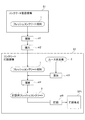
これに対して、本発明の耐凍害性高強度コンクリートの打設方法は、従来、「コンクリート製造現場」で行われていたフレッシュコンクリートの調合の一部、具体的にはフレッシュコンクリート内に必要な空気を連行するための処理を、「コンクリート打設現場」において、打設直前に「微細気泡を内包するムース状泡塊」を添加混錬する方法によって行う点に特徴がある。以下、図1を参照しながら、本発明の耐凍害性高強度コンクリートの打設方法の実施態様と各工程の詳細について説明する。 On the other hand, the frost-resistant high-strength concrete placement method of the present invention is a part of the preparation of fresh concrete that has been conventionally performed at the “concrete manufacturing site”, specifically, it is necessary in the fresh concrete. It is characterized in that the process for entraining air is performed by a method of adding and kneading “mousse-like foam lump containing fine bubbles” immediately before placing in the “concrete placing site”. Hereinafter, with reference to FIG. 1, the embodiment of the frost damage resistant high-strength concrete placing method of the present invention and the details of each step will be described.
[フレッシュコンクリート材料1をコンクリート製造現場S1からコンクリート打設現場S2に運搬(st1)し搬入(st2)する工程]
フレッシュコンクリート材料1のコンクリート製造現場S1からコンクリート打設現場S2への運搬(st1)及び搬入(st2)は、従来、広範に使用されているアジテータ車によって行うことができる。このアジテータ車は、生コンクリートを撹拌しながら輸送することができる、荷台部分にミキシング・ドラムを備えた貨物自動車であり、その機能に大きな差はないが、最大積載量2〜11t級のものがあり、用途に応じて使い分けられている。
[Process of transporting (st1) and carrying in (st2) fresh concrete material 1 from concrete production site S1 to concrete placement site S2]
The transport (st1) and the carry-in (st2) of the fresh concrete material 1 from the concrete production site S1 to the concrete placing site S2 can be performed by an agitator vehicle that has been widely used conventionally. This agitator car is a freight car equipped with a mixing drum in the loading platform that can transport the ready-mixed concrete with agitation, and there is no big difference in its function. Yes, depending on the application.
本発明の耐凍害性高強度コンクリートの打設方法は、打設用フレッシュコンクリート3の最終的な調合を、コンクリート製造現場S1ではなくコンクリート打設現場S2で行うプロセスであるため、コンクリート製造現場S1が、それぞれ異なる場所に存在する複数の製造プラントからなる場合であっても、複数のコンクリート製造現場毎のフレッシュコンクリートの配合比のばらつきを、打設直前の最終的な調合段階で解消することが可能であり、これにより、打設用フレッシュコンクリート3の品質安定性を維持することができる。
The method for placing frost-resistant high-strength concrete according to the present invention is a process in which the final blending of the
又、本発明の耐凍害性高強度コンクリートの打設方法は、AE剤等をコンクリート製造現場で予め調合したフレッシュコンクリートをコンクリート打設現場まで運搬する場合と異なり、運搬中にフレッシュコンクリート材料1の気泡含有量が減少或いは消失するリスクがない。よって、長距離の運搬が必要となる場合に特に有利な方法でもある。 In addition, the method of placing the frost-resistant high-strength concrete of the present invention is different from the case of transporting fresh concrete prepared in advance by mixing AE agent or the like at the concrete production site to the concrete placement site. There is no risk of the bubble content decreasing or disappearing. Therefore, it is a particularly advantageous method when long-distance transportation is required.
[コンクリート打設現場S2において、フレッシュコンクリート材料1に、微細気泡を内包するムース状泡塊2を添加混練して打設用フレッシュコンクリート3を得る工程]
運搬(st1)により、コンクリート打設現場S2に搬入(st2)されたフレッシュコンクリート材料1に、ムース状泡塊2を添加(st3)し、これらを混錬(st4)することによって、耐凍害性において優れた効果を発現する微細気泡が分散形成された打設用フレッシュコンクリート3を得ることができる。ムース状泡塊2は、フレッシュコンクリート材料1、1m3あたり0.1kg以上20kg以下の割合となるように混合することが好ましく、1kg以上5kg以下となるように混合することがより好ましい。
[In the concrete placement site S2, the mousse-
Addition of mousse-like foam 2 (st3) to the fresh concrete material 1 (st2) carried into the concrete placement site S2 by transportation (st1), and kneading them (st4) It is possible to obtain a
[(打設用フレッシュコンクリート3をコンクリート打設現場S2内の打設地点SP1に打設する工程]
上記工程で得た打設用フレッシュコンクリート3を、コンクリート打設現場S2内において、何らかの搬送手段により、当該現場内の打設地点SP1まで搬送してこれを打設(st5)する。打設用フレッシュコンクリート3は打設(st5)されて所望のコンクリート硬化体とされる。打設(st5)は従来公知の手法により行うことができ、例えば、予め離型剤を塗布した型枠に打設した後、蒸気養生することによりコンクリート硬化体を得ることができる。
[(Placing the pouring
In the concrete placement site S2, the
本発明の耐凍害性高強度コンクリートの打設方法は、フライアッシュセメントを用いた高強度コンクリートでありながら、尚且つ、耐凍害性にもおいても優れたコンクリート硬化体の形成が可能であるため、打設現場S2が、年間最低気温が−5℃以下の寒冷地(建築学会JASS5基準)である場合に、更には、当該現場におけるマスコンクリート構造物の建設等において特段に有利な効果を発揮するものである。 The frost-resistant high-strength concrete placing method of the present invention is a high-strength concrete using fly ash cement, and can form a hardened concrete body that is also excellent in frost-proof resistance. Therefore, when the placement site S2 is a cold district where the annual minimum temperature is −5 ° C. or less (the Architectural Institute JASS5 standard), the construction site has a particularly advantageous effect in the construction of mass concrete structures. It is something that demonstrates.
以下、本発明の耐凍害性高強度フレッシュコンクリートの打設方法について、実施例を示して詳細に説明する。尚、本発明は、以下に示す実施例に限定されるものではない。 Hereinafter, the method for placing the frost damage resistant high strength fresh concrete of the present invention will be described in detail with reference to examples. In addition, this invention is not limited to the Example shown below.
(打設用フレッシュコンクリート材料の調合)
実施例及び比較例の打設用フレッシュコンクリートとして、以下に説明する各材料を用いて、下記の表1の組成の通りの調合を行ったものを用いた。空気量に関しては、実施例及び比較例1ではAE剤にて3.5%の空気を連行した後、現場到着時を想定し、ムース状泡塊(Ad1)にて1.0%分の空気を後添加した。又、各フレッシュコンクリート材料のスランプ値は8cmとなるように調整した。尚、表1中、ムース状泡塊(Ad1)の配合比は、コンクリート打設現地到着時点でのフレッシュコンクリート材料全体に対する体積比(%)を示し、AE減水剤(Ad2)及びAE剤(Ad3)の配合比は、セメント(下記のセメント材1又はセメント材2)に対する体積比(%)を示すものである。
(Composition of fresh concrete material for placement)
As the fresh concrete for placement in Examples and Comparative Examples, those prepared as shown in Table 1 below using each material described below were used. Regarding the amount of air, in Example and Comparative Example 1, 3.5% air was entrained by the AE agent, and after arrival at the site, 1.0% air by the mousse-like foam (Ad1). Was added afterwards. The slump value of each fresh concrete material was adjusted to 8 cm. In Table 1, the blending ratio of the mousse-like foam lump (Ad1) indicates the volume ratio (%) with respect to the whole fresh concrete material at the time of arrival of the concrete, and the AE water reducing agent (Ad2) and AE agent (Ad3). ) Indicates a volume ratio (%) to cement (cement material 1 or
水(W):上澄水,密度:1.00g/cm3
セメント材1(FB):フライアッシュセメントB種、密度:2.85g/cm3
セメント材2(OPC):普通ポルトランドセメント、密度:3.16g/cm3
細骨材(S):砕砂 表乾密度2.65g/cm3(2.5mm以下)、粗粒率2.67
粗骨材(G):砕石 20mm〜5mm、表乾密度:2.65g/cm3、実積率:60.0
ムース状泡塊(Ad1):プレフォーム型AE剤(MACリート、(ミルコン社製))
AE減水剤(Ad2):(主成分:リグニンスルホン酸塩とオキシカルボン酸塩)
AE剤(Ad3):(主成分:変性ロジン酸化合物系陰イオン界面活性剤)
Water (W): supernatant water, density: 1.00 g / cm 3
Cement material 1 (FB): fly ash cement type B, density: 2.85 g / cm 3
Cement material 2 (OPC): ordinary Portland cement, density: 3.16 g / cm 3
Fine aggregate (S): Crushed sand Surface dry density 2.65 g / cm 3 (2.5 mm or less), coarse particle ratio 2.67
Coarse aggregate (G): crushed
Moose foam lump (Ad1): Preform type AE agent (MAC REIT, manufactured by Milcon)
AE water reducing agent (Ad2): (main components: lignin sulfonate and oxycarboxylate)
AE agent (Ad3): (main component: modified rosin acid compound anionic surfactant)

(耐凍害性に関する試験)
実施例及び比較例の各打設用フレッシュコンクリートについて、耐凍害性に係る性能を検証するために、凍結融解抵抗性に関する試験をJIS A 1148−A法に従って実施した。凍結融解サイクルと相対動弾性係数の関係を図2に示す。普通ポルトランドセメントを用い、ムース状泡塊を後添加した比較例1の凍結融解抵抗性が最も高く、普通ポルトランドセメントに通常のAE剤を用いた比較例4と、フライアッシュセメントにムース状泡塊を後添加した実施例のケースの相対動弾性係数は同程度の値であった。普通ポルトランドセメントに通常のAE剤を用いたものでは,300サイクルの相対動弾性係数で65%となった。フライアッシュセメントに通常のAE剤を使用したケースでは,240サイクル時点で相対動弾性係数の測定が不能となり,所定の凍結融解抵抗性を満足しない結果となった。
(Test on frost resistance)
In order to verify the performance related to the frost damage resistance of each of the fresh concretes for placement in Examples and Comparative Examples, a test on freeze-thaw resistance was performed according to the JIS A 1148-A method. The relationship between the freeze-thaw cycle and the relative dynamic elastic modulus is shown in FIG. Comparative Example 1 using ordinary Portland cement and post-added mousse foam has the highest resistance to freezing and thawing, Comparative Example 4 using ordinary AE agent for ordinary Portland cement, and mousse foam for fly ash cement The relative kinematic elastic modulus of the case of the example in which was added later was approximately the same. In ordinary Portland cement using a normal AE agent, the relative dynamic elastic modulus of 300 cycles was 65%. In the case where a normal AE agent was used for fly ash cement, the measurement of the relative kinematic modulus became impossible at the 240th cycle, and the predetermined freeze-thaw resistance was not satisfied.
(アルカリ骨材反応の抑制に関する試験)
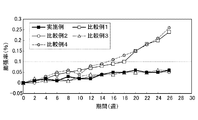
実施例及び比較例の各打設用フレッシュコンクリートについて、アルカリ骨材反応に対する抑制効果を検証するために、アルカリシリカ反応性に関する試験を、コンクリート法(JCI AAR−3(1987))に従って実施した。促進期間と膨張率の関係を図3に示す。普通ポルトランドセメントを用いた比較例1及び比較例4では、膨張率が0.1%以上となり、アリカリシリカ反応性を有するものとして判断された。フライアッシュセメントを用いた実施例、比較例2及び比較例3については、いずれも26週で、膨張率0.1%以下となり、アルカリシリカ反応性としては問題ないものと判定された。
(Test on suppression of alkali-aggregate reaction)
In order to verify the inhibitory effect on the alkali-aggregate reaction of each of the fresh concretes for placement in Examples and Comparative Examples, a test on alkali silica reactivity was performed according to a concrete method (JCI AAR-3 (1987)). The relationship between the promotion period and the expansion rate is shown in FIG. In Comparative Example 1 and Comparative Example 4 using ordinary Portland cement, the expansion rate was 0.1% or more, and it was judged as having antkari silica reactivity. About the Example using a fly ash cement, the comparative example 2, and the comparative example 3, all became 26% or less and the expansion rate became 0.1% or less, and it was determined that there is no problem as alkali silica reactivity.
(圧縮強度に関する試験)
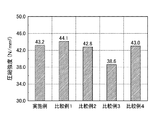
実施例及び比較例の各打設用フレッシュコンクリートについての、材齢28日における圧縮強度の試験結果を図4に示す。AE剤により空気量を6.5%とした比較例3において、強度低下が著しく、他の例と比較して10%程度、強度が低下することが確認された。
(Test on compressive strength)
FIG. 4 shows the test results of the compressive strength at the age of 28 days for each of the fresh concrete for placement in Examples and Comparative Examples. In Comparative Example 3 in which the air amount was 6.5% with the AE agent, the strength was significantly reduced, and it was confirmed that the strength was reduced by about 10% compared to the other examples.
実施例及び比較例の各打設用フレッシュコンクリートについて、上記各試験結果に関する評価結果を下記表2に示す。年間最低気温が−5℃以下の寒冷地(建築学会JASS5基準)において使用する耐凍害性高強度コンクリートとして合格品と判断できる項目は「○」、不合格と判断した項目については「×」を記した。 Table 2 below shows the evaluation results regarding the above test results for each of the fresh concrete for placement in Examples and Comparative Examples. Items that can be judged as acceptable frost-resistant high-strength concrete for use in cold regions with an annual minimum temperature of -5 ° C or lower (Architectural Institute JASS5 standard) are marked with “○”. I wrote.
以上の結果より、本発明によれば、フライアッシュセメントを用いた高強度コンクリートを、寒冷地等において用いる場合において、コンクリートの強度を損なわずに、当該コンクリートの耐凍害性を十分に向上させることができることが分かる。 From the above results, according to the present invention, when high-strength concrete using fly ash cement is used in a cold district or the like, the frost damage resistance of the concrete can be sufficiently improved without impairing the strength of the concrete. You can see that
1 フレッシュコンクリート材料
2 ムース状泡塊
3 打設用フレッシュコンクリート
S1 コンクリート製造現場
S2 コンクリート打設現場
DESCRIPTION OF SYMBOLS 1 Fresh
Claims (5)
フライアッシュを含有するセメント材と、骨材と、水とを含んでなるフレッシュコンクリート材料をコンクリート製造現場からコンクリート打設現場に運搬し搬入する工程と、
上記搬入後前記コンクリート打設現場において、前記フレッシュコンクリート材料に、微細気泡を内包するムース状泡塊を添加混練して打設用フレッシュコンクリートを得る工程と、
前記打設用フレッシュコンクリートを前記コンクリート打設現場内の打設地点に打設する工程と、を行うコンクリートの打設方法。 A method of placing high-strength concrete having frost resistance,
A process of transporting and carrying a fresh concrete material comprising a cement material containing fly ash, an aggregate, and water from a concrete manufacturing site to a concrete placing site;
In the concrete placement site after carrying in, the fresh concrete material is added and kneaded with a mousse-like foam lump containing fine bubbles to obtain fresh concrete for placement;
Placing the fresh concrete for placement at a placement site in the concrete placement site, and placing concrete.
Priority Applications (1)
| Application Number | Priority Date | Filing Date | Title |
|---|---|---|---|
| JP2016076482A JP6730065B2 (en) | 2016-04-06 | 2016-04-06 | Placing method for high strength concrete with frost resistance |
Applications Claiming Priority (1)
| Application Number | Priority Date | Filing Date | Title |
|---|---|---|---|
| JP2016076482A JP6730065B2 (en) | 2016-04-06 | 2016-04-06 | Placing method for high strength concrete with frost resistance |
Publications (2)
| Publication Number | Publication Date |
|---|---|
| JP2017186796A true JP2017186796A (en) | 2017-10-12 |
| JP6730065B2 JP6730065B2 (en) | 2020-07-29 |
Family
ID=60043843
Family Applications (1)
| Application Number | Title | Priority Date | Filing Date |
|---|---|---|---|
| JP2016076482A Active JP6730065B2 (en) | 2016-04-06 | 2016-04-06 | Placing method for high strength concrete with frost resistance |
Country Status (1)
| Country | Link |
|---|---|
| JP (1) | JP6730065B2 (en) |
Cited By (1)
| Publication number | Priority date | Publication date | Assignee | Title |
|---|---|---|---|---|
| JP7524037B2 (en) | 2020-11-20 | 2024-07-29 | 鹿島建設株式会社 | How to transport fresh concrete |
Citations (3)
| Publication number | Priority date | Publication date | Assignee | Title |
|---|---|---|---|---|
| JPH07229298A (en) * | 1994-02-21 | 1995-08-29 | Cellform Gijutsu Kenkyusho:Kk | Aerated concrete placing device |
| JPH08295545A (en) * | 1995-04-25 | 1996-11-12 | Shikoku Electric Power Co Inc | Air entraining agent for cement composition containing fly ash |
| JP2008031006A (en) * | 2006-07-31 | 2008-02-14 | Denki Kagaku Kogyo Kk | Mortar or concrete composition |
-
2016
- 2016-04-06 JP JP2016076482A patent/JP6730065B2/en active Active
Patent Citations (3)
| Publication number | Priority date | Publication date | Assignee | Title |
|---|---|---|---|---|
| JPH07229298A (en) * | 1994-02-21 | 1995-08-29 | Cellform Gijutsu Kenkyusho:Kk | Aerated concrete placing device |
| JPH08295545A (en) * | 1995-04-25 | 1996-11-12 | Shikoku Electric Power Co Inc | Air entraining agent for cement composition containing fly ash |
| JP2008031006A (en) * | 2006-07-31 | 2008-02-14 | Denki Kagaku Kogyo Kk | Mortar or concrete composition |
Non-Patent Citations (1)
| Title |
|---|
| 坂田 昇・菅俣 匠・林 大介・橋本 学: "コンクリートの気泡組織と耐凍害性の関係に関する考察", コンクリート工学論文集第23巻第1号, JPN6019046496, 15 January 2012 (2012-01-15), JP, pages 35 - 47, ISSN: 0004164461 * |
Cited By (1)
| Publication number | Priority date | Publication date | Assignee | Title |
|---|---|---|---|---|
| JP7524037B2 (en) | 2020-11-20 | 2024-07-29 | 鹿島建設株式会社 | How to transport fresh concrete |
Also Published As
| Publication number | Publication date |
|---|---|
| JP6730065B2 (en) | 2020-07-29 |
Similar Documents
| Publication | Publication Date | Title |
|---|---|---|
| JP5901652B2 (en) | Method for preparing lightweight foamed cementitious binder and composition for preparing lightweight foamed cementitious binder for cement board | |
| JP2019085304A (en) | Non-shrink grout composition and non-shrink grout | |
| JP2008230900A (en) | Levelable hydraulic compositions capable of being thinned and thinnable mortars obtained therefrom | |
| JP2008189526A (en) | Grout admixture and grout cement composition | |
| JP2004091535A (en) | Injection material for frozen ground and method for producing and injecting the same | |
| KR100403831B1 (en) | Crack retardant mixture made from flyash and its application to concrete | |
| JP2008094674A (en) | Reinforcing bar joint filler and reinforcing joint filling method using the same | |
| JP2008120611A (en) | Grout composition, grout mortar and grout method | |
| KR102619818B1 (en) | Self-compacting concrete composition comprising mono-fluid type admixture composition | |
| JP2019043816A (en) | Concrete composition and method for producing concrete composition | |
| JP5712497B2 (en) | Carbon dioxide emission reduction method when manufacturing premixed mortar products | |
| JP6639917B2 (en) | Concrete and method for producing concrete | |
| JP2007261845A (en) | Hydraulic composition | |
| JP6730065B2 (en) | Placing method for high strength concrete with frost resistance | |
| CN113860821A (en) | Green environment-friendly lightweight aggregate concrete and preparation method thereof | |
| JP2009184867A (en) | Hydraulic composition | |
| JP6306973B2 (en) | High fluidity retention type low exothermic grout composition | |
| JP2021155231A (en) | Expansion material-containing concrete | |
| JP2018162171A (en) | Durability improver for concrete and concrete | |
| JP2011132106A (en) | Hydraulic composition and cured product | |
| KR20150146469A (en) | Shirinkage reducing agent composition and mortar and concrete composition including the same | |
| KR20150062107A (en) | Shirinkage reducing agent composition and mortar and concrete composition including the same | |
| JP6752443B2 (en) | Powder drying shrinkage reducing agent for premixed mortar, premixed mortar and hardened cement | |
| JP2022183463A (en) | Low-shrinkage ultra-high-strength grout composition and low-shrinkage ultra-high-strength grout | |
| JP2018076190A (en) | Cement composition and production method thereof |
Legal Events
| Date | Code | Title | Description |
|---|---|---|---|
| A621 | Written request for application examination |
Free format text: JAPANESE INTERMEDIATE CODE: A621 Effective date: 20181227 |
|
| A977 | Report on retrieval |
Free format text: JAPANESE INTERMEDIATE CODE: A971007 Effective date: 20191018 |
|
| A131 | Notification of reasons for refusal |
Free format text: JAPANESE INTERMEDIATE CODE: A131 Effective date: 20191203 |
|
| A521 | Request for written amendment filed |
Free format text: JAPANESE INTERMEDIATE CODE: A523 Effective date: 20191218 |
|
| TRDD | Decision of grant or rejection written | ||
| A01 | Written decision to grant a patent or to grant a registration (utility model) |
Free format text: JAPANESE INTERMEDIATE CODE: A01 Effective date: 20200623 |
|
| A61 | First payment of annual fees (during grant procedure) |
Free format text: JAPANESE INTERMEDIATE CODE: A61 Effective date: 20200702 |
|
| R150 | Certificate of patent or registration of utility model |
Ref document number: 6730065 Country of ref document: JP Free format text: JAPANESE INTERMEDIATE CODE: R150 |
|
| R250 | Receipt of annual fees |
Free format text: JAPANESE INTERMEDIATE CODE: R250 |